

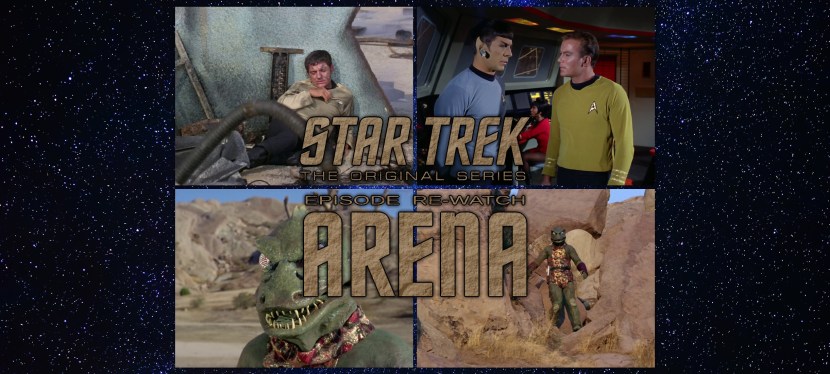

Spoiler Warning: There are spoilers ahead for Star Trek: Strange New Worlds Seasons 1, 2, and 3, Star Trek: Enterprise Season 4, and Star Trek: The Original Series Season 1.
It’s been more than five years since I set up this website. In that time, I’ve written hundreds – literally hundreds – of articles, essays, and reviews all about Star Trek. But this’ll be the first time I’ve written up a full re-watch of an episode of The Original Series. I must be the first Trekkie in history to write up a re-watch of an episode of The Animated Series before The Original Series! But this catastrophic failure of Trekkie-dom comes to an end today, as we sit down together to watch the classic first season episode Arena.
I’m going to split this article into two parts. We’ll talk about Arena on its face, including some of the episode’s production history – and the reason why the creator of the iconic Gorn costume went uncredited and unknown for almost a decade after the episode aired – and then we’ll talk about the Gorn themselves in a bit more detail. Spoiler alert if you haven’t watched Strange New Worlds and still plan to, but the Gorn appear prominently in that show. That’s actually part of the reason why I wanted to re-visit Arena ahead of the third season premiere!
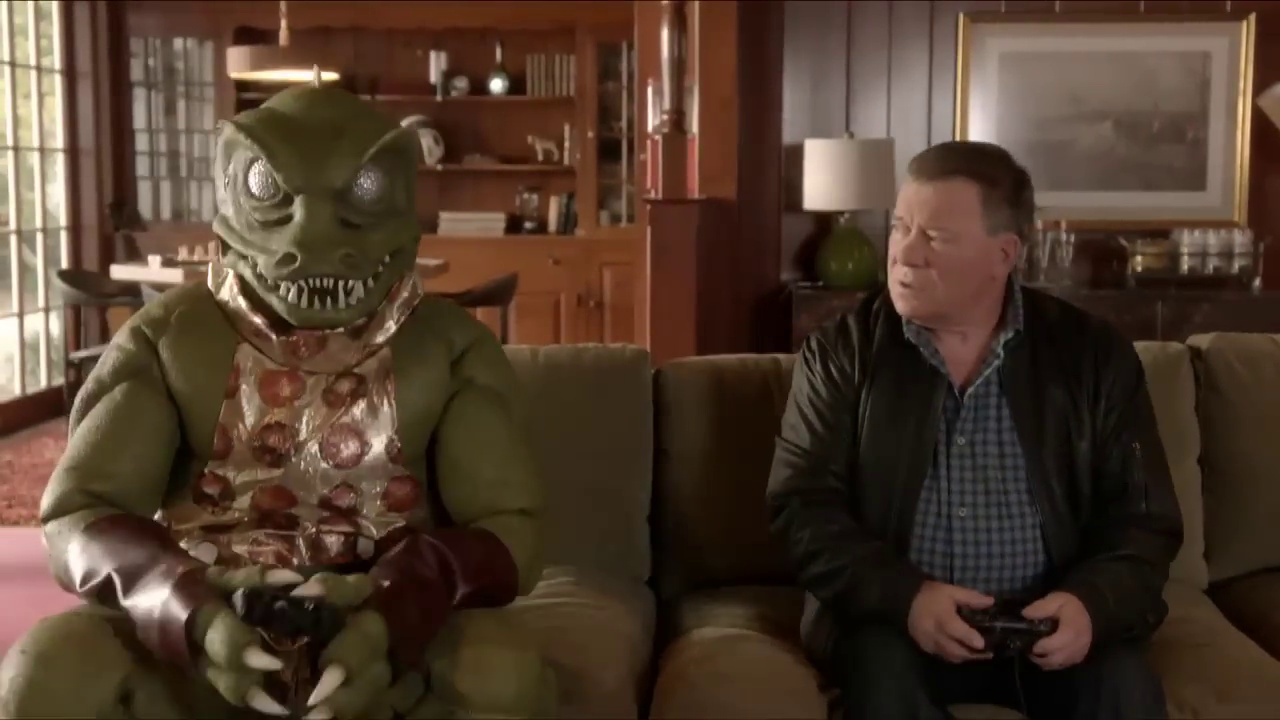
Arena is an iconic episode – and the Gorn captain has to be one of The Original Series’ most recognisable villains. In fact, I was a little surprised not to see Arena on the list when I did my recent recap of IMDB’s top-rated Star Trek episodes – according to that site’s users, Arena ranks a measly 19th out of The Original Series’ 79 episodes! I think I’d have put it a fair bit higher than that; it’s gotta be a top ten episode, at the very least! It has a strong story, expanding our understanding of the Federation, while also containing enough of that esoteric sci-fi “weirdness” that makes Star Trek the franchise we know and love.
It’s also best-known, of course, as “the Gorn episode,” introducing the famous reptillian species to the franchise. But Arena is as much about another alien race – the Metrons – as it is about the Gorn. The Metrons feel, with the benefit of decades of hindsight now, almost like a prototype of what would become the Q Continuum – millennia ahead of the Federation, considering themselves to be enlightened, but not above a bit of interference in galactic affairs. The Metrons have never returned to Star Trek, though, and I can kind of understand why: for a “morality play” like Arena, they work well as a somewhat neutral arbiter. But as the franchise has expanded, we’ve seen fewer of these kinds of stories. Modern Star Trek in particular lends itself much more to the inclusion of the Gorn than it does the Metrons!
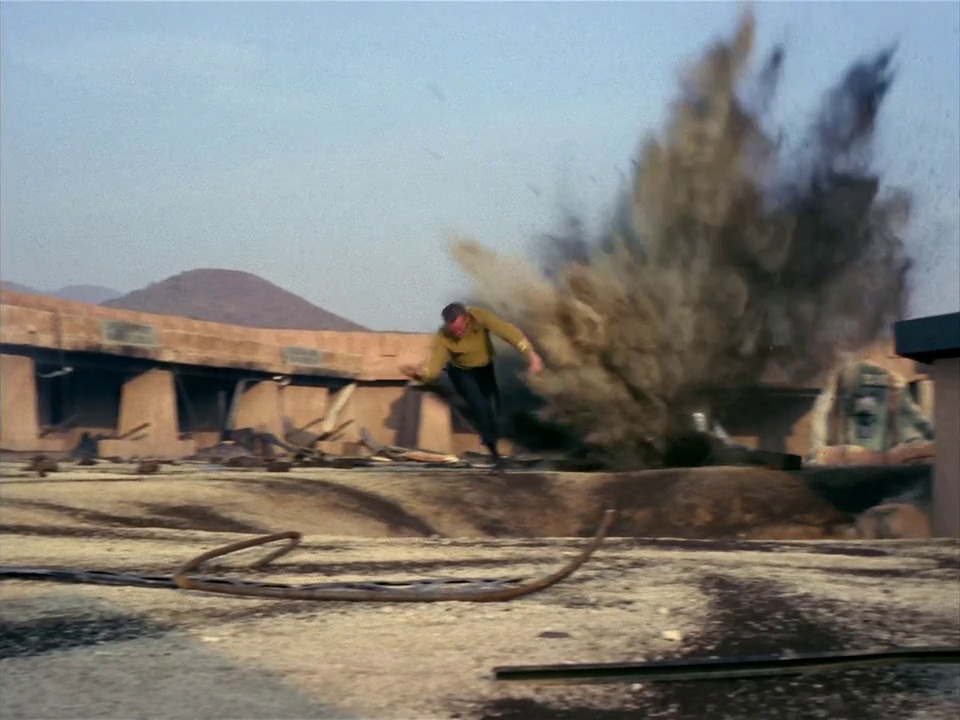
Because the battle at Vasquez Rocks is so well-remembered, it can be easy to overlook the first part of Arena – but the away mission to Cestus III is one of the first season’s most tense combat sequences. Drawing on war films for inspiration, with an unseen enemy and whistling noises reminiscent of World War II-era mortars, the entire away mission to the destroyed outpost is – for the time, anyway – really exciting stuff. This is also one of the first away missions to be shot on location – i.e. not on a sound stage or backlot. Following the previous episode, Shore Leave, which was also shot in the Los Angeles area, Arena took the cast and crew to a set near Vasquez Rocks which had been built a few years earlier for a different television series.
I think I’m right in saying that it’s this away mission sequence in Arena, which used several pyrotechnic explosions to create the effect of the Gorn attack, that led to both William Shatner and Leonard Nimoy suffering from tinnitus – a condition that causes ringing in the ears and can be painful. The Original Series used pyrotechics throughout its run, but this battle sequence pushed the performers to act in close proximity to these explosive devices. Knowing the impact the sequence had on the actors, that does taint how we view it. Because as exciting and intense as the Cestus III mission was, no television scene is worth suffering from life-long after-effects.
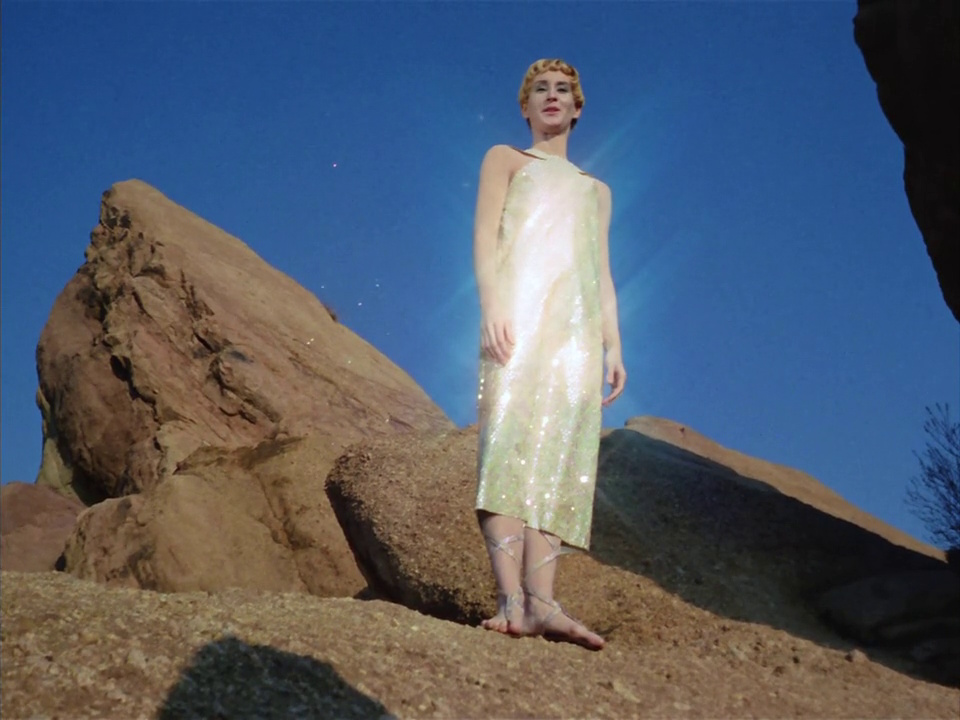
The first part of Arena, it could be argued, plays out similarly to Balance of Terror, which would’ve premiered just a month or so earlier. The attack on a Federation outpost, pursuing a powerful but unseen enemy… it starts the story in a familiar way. But the episode soon takes a completely different turn with the intervention of the Metrons. What begins with a deadly raid and an attack on the away team seems to be building up to another starship battle – but just as the Enterprise seems to be catching up to the Gorn vessel, the Metrons rebuke both ships and crews for their violent nature.
The Metrons are an interesting addition to the story. Rather than just another enemy encounter or a straightforward action story, their intervention puts a different spin on things. Kirk, who seemed hell-bent on revenge at first, is forced to confront the way he handled the interaction, and this idea of revenge at any cost – mutually assured destruction, perhaps – is thrust into the spotlight in an uncomfortable way.
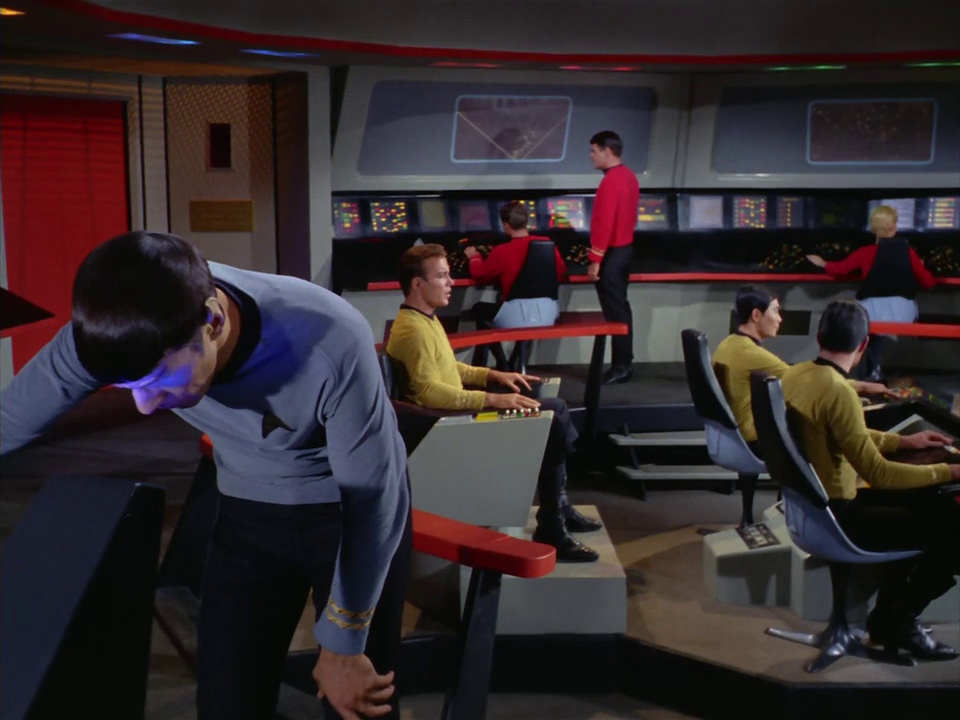
That’s part of the context behind Arena, this idea that seeking revenge isn’t healthy and is, in itself, a violent urge. But there’s more to it than that. The revelation that the Gorn considered Cestus III to be one of their planets, and that’s why they attacked the outpost, reframes things for Kirk, Bones, and the rest of the crew. The Federation may not have been aware of the Gorn claim, but either way, they settled an outpost on a planet that someone else considered to be their territory. There’s another analogy here that I think is particularly interesting.
The Original Series draws inspiration from the western genre. The idea of space as a new “frontier” conjures images of the wild west, and in Arena itself, Kirk refers to himself and the Enterprise as the only lawmen in this region of the galaxy. The Gorn, therefore, are this story’s metaphorical Native Americans, having a pre-existing claim to the land and attacking the Federation settlers who’d moved in on their territory. Maybe that wasn’t exactly how the story was written, but I think that reading is there, just beneath the surface. And for the 1960s – when the western genre was still riding high at the box office, with films like El Dorado, Ride in the Whirlwind, and The Good, the Bad, and the Ugly – that’s kind of a progressive idea. To make the point that, in this case, the Federation may have been in the wrong… that’s a pretty neat inversion of the typical western-inspired frontier story.
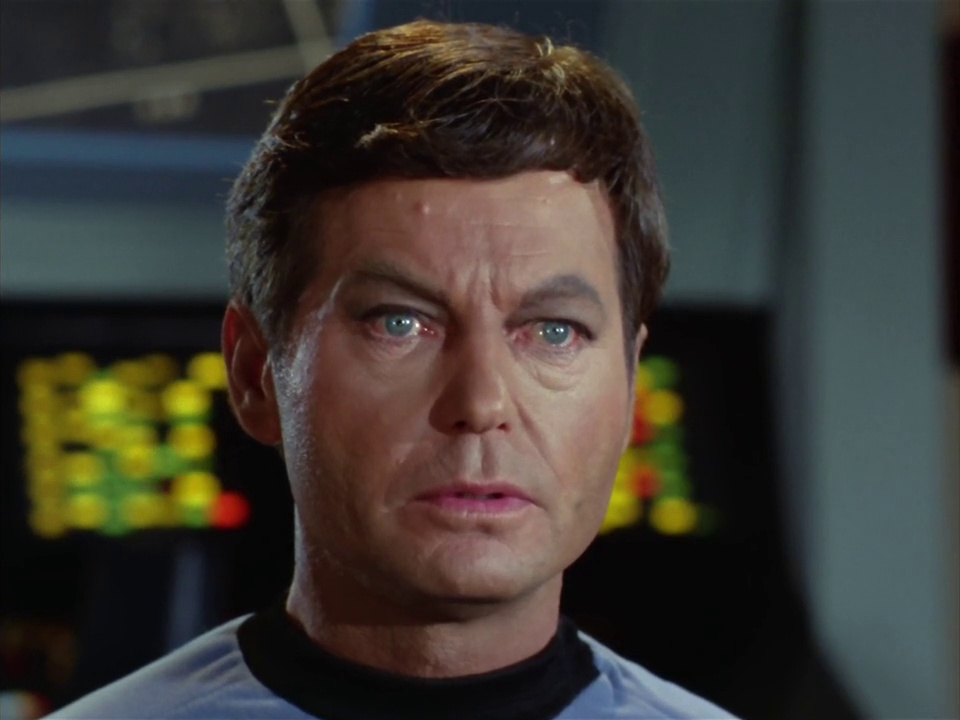
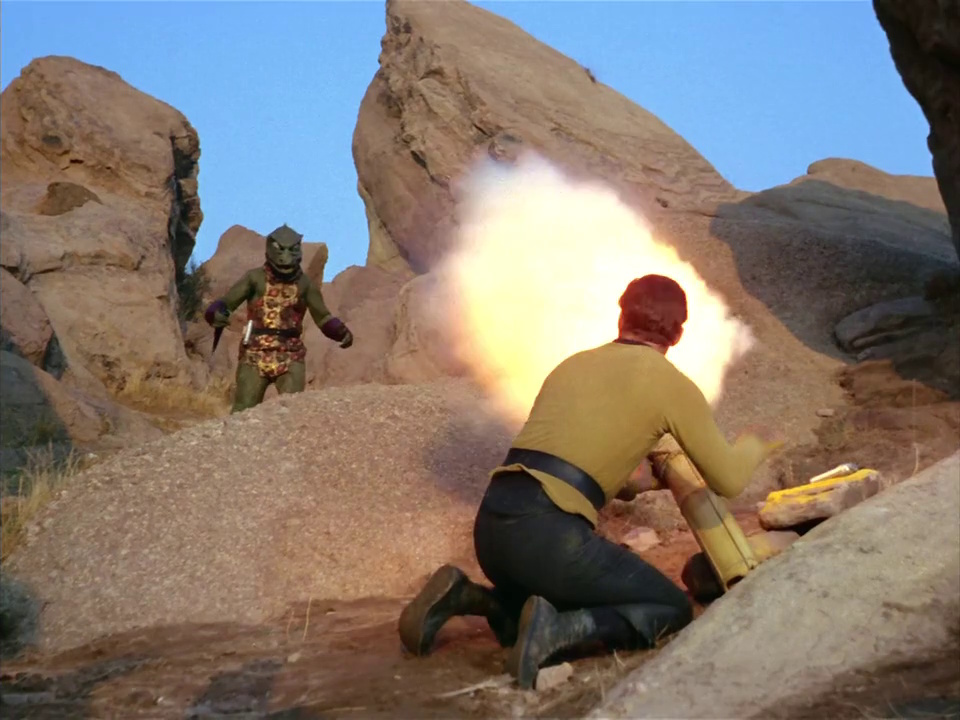
Vasquez Rocks has become an iconic location within the Star Trek franchise, and that really began here in Arena. The filming location, which is just inside the famous “thirty-mile zone” around the film studios in Los Angeles, has appeared in The Next Generation, Voyager, Enterprise, Picard, and two of the Kelvin films as well as The Original Series and The Voyage Home. It was a great choice for Kirk’s battle against the Gorn commander, and even though I’ve criticised some modern Star Trek productions for re-using the same filming locations too often, I think Vasquez Rocks is such an iconic spot that it gets a pass!
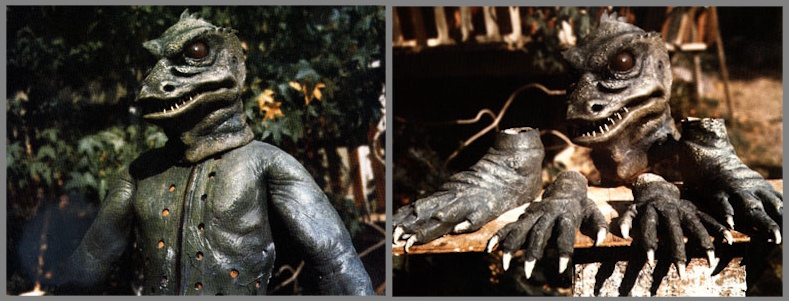
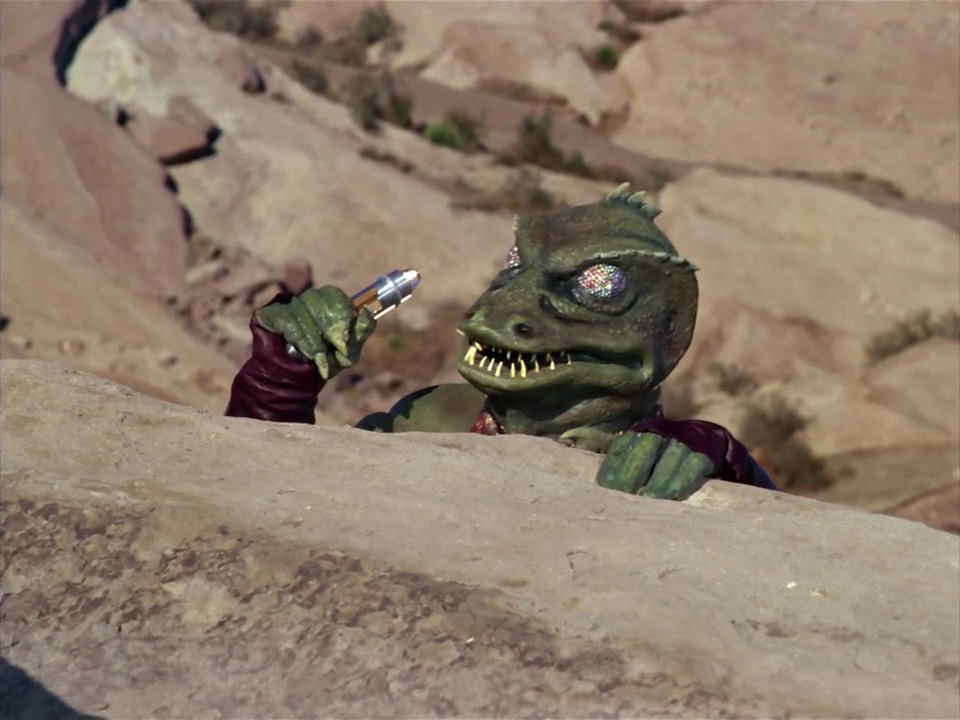
I absolutely love the original Gorn design, and even though it might not be as “realistic” as the updated variant seen in Strange New Worlds… I think there’s something special about the original costume. I always compared the Gorn to a Tyrannosaurus Rex – but that’s because I first watched Arena after having seen Jurassic Park in the mid 1990s! The design draws inspiration from real-world reptiles like the komodo dragon, using reflective, almost insect-like eyes and needle-sharp teeth to complement the monstrous design.
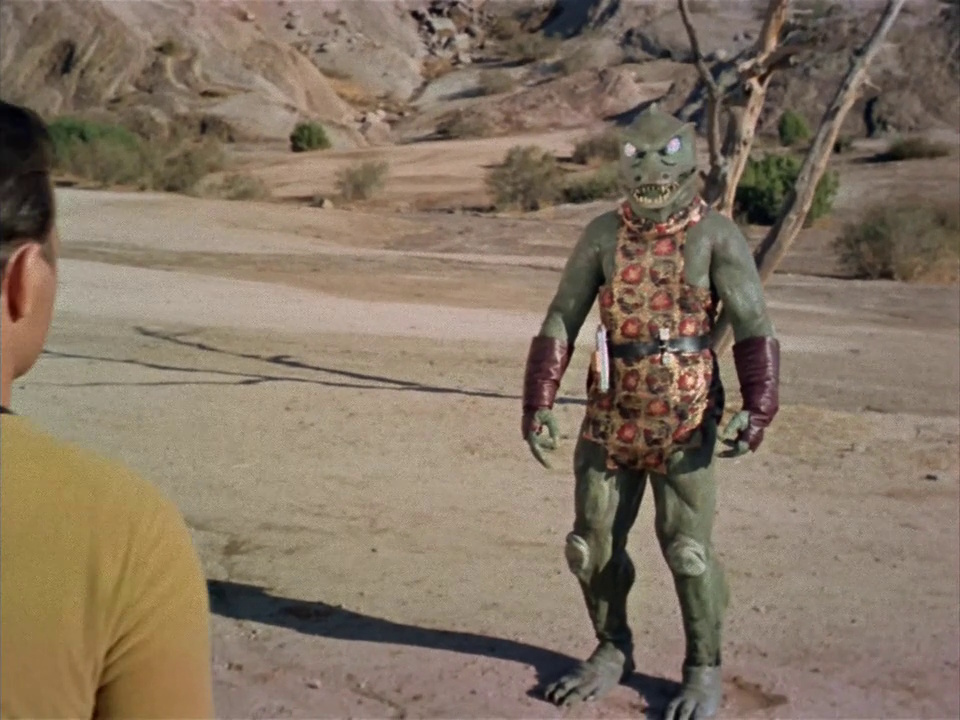
Wah Chang designed the Gorn costume as well as many other iconic Star Trek props. The tricorder, the flip-open communicator, and tribbles were all his creations – but he went uncredited for all of it, and was unknown until members of the Star Trek fan community uncovered his role in the 1970s. Chang seems to have been commissioned by Desilu – Star Trek’s production company – in a weird legal grey area; director and producer Bob Justman wanted to use Chang’s work, but Chang wasn’t a member of the prop-makers union. In a kind of workaround, Desilu would “purchase” items from Chang, but he was never credited on screen for any of his creations.
This is another great example of the early Star Trek fan community pulling together! Chang’s role was eventually uncovered in the 1970s by Trekkies, who were keen to find out more about some of the show’s iconic props and designs. It’s one of those fun little stories that, were it not for the dedication of fans, would’ve simply never come to light. Chang’s contributions to Star Trek – not only the episode Arena, but really across the entire first season – helped to define the look and feel of this vision of the 23rd Century. Who knows where Star Trek would’ve been without him?
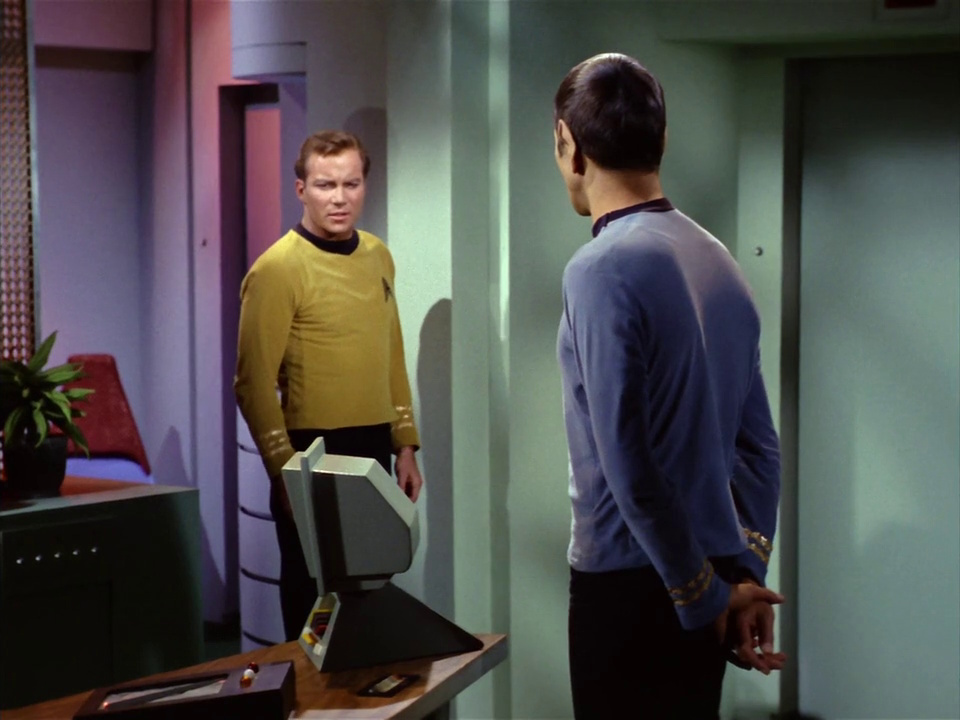
There are some great moments between Kirk and Spock in Arena, as they wrangle with the aftermath of the Gorn attack on Cestus III and what it could mean. In the context of Arena itself, disregarding any other Gorn stories, we can see both points of view. Kirk argues that the attack – which seems, at first, to be completely unprovoked – could be the precursor to a wider invasion, and as the only ship in the area, it falls to the Enterprise to prevent that. But Spock is also correct – without more information about what happened, who perpetrated the attack, and why… Kirk is kind of jumping to conclusions. His line about seeking revenge hits particularly hard.
We’ll get into this more in a moment when we discuss the Gorn, but this is one area where more recent Star Trek productions – and Strange New Worlds in particular – arguably re-frame this conversation. As a veteran of conflicts against the Gorn while serving under Pike’s command, Spock is acutely aware of how bloodthirsty and vicious the Gorn can be, and how single-minded they are when staking their claims to planets that the Federation already occupies. There is wiggle-room here, and nothing in Strange New Worlds explicitly contradicts Arena (at least as of the end of Season 2). But it does change how we perceive these conversations – which, it shouldn’t need to be said, supposedly take place a decade or so after the events of that show.
Kirk’s hand-to-hand battle with the Gorn captain is a ton of fun. The lumbering monster reminds me of the titular Creature from the Black Lagoon with its heavy rubber suit and somewhat clumsy movements, and I just really love that kind of old-school style of creature design. The rubber suit may be old-fashioned compared to, say, the new dinosaur-inspired Gorn depiction from Strange New Worlds… but I think it’s light-years ahead of the awful CGI rendition that we got in Enterprise! The very “sixties” fabric used for the Gorn captain’s uniform just adds to the charm.
The fight has its tense and serious moments. Kirk’s two-handed attack, which we’ve seen him use to great effect across the show’s first season, has absolutely no impact on the powerful and muscular Gorn, which was interesting. We also see the Gorn’s own ingenuity as he devises a trap – Kirk ends up injured and seemingly about to be impaled… just in time for the ad break! But the fight also has moments that, almost sixty years later, seem almost cartoonish or campy. The obviously polystyrene rocks – which look even less convincing in HD on a large television set – are part of that.
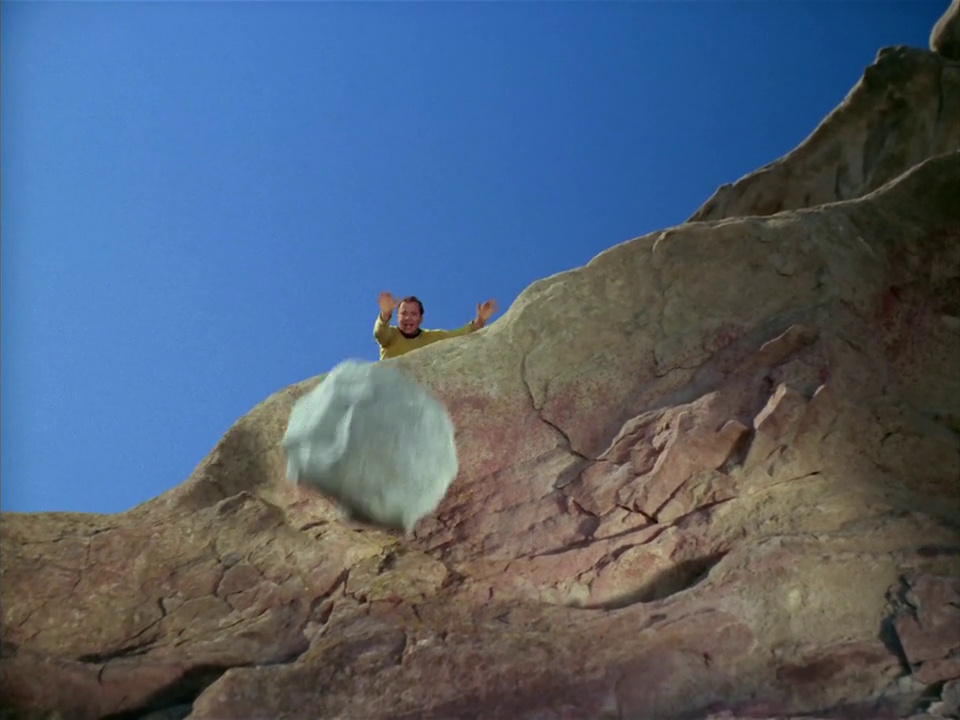
Then there’s Kirk’s “Wile E. Coyote” moment! Sneaking up on the Gorn captain from atop Vasquez Rocks, Kirk plans to drop a very large boulder on his opponent. And look, I get it: it’s a smart move given the circumstances. But the way this sequence is framed and shot makes it look like something straight out of the old Road Runner cartoon. It’s a ton of fun, but perhaps less tense or serious to a modern audience than it was intended to be in 1966!
The fight ends with Kirk choosing to show mercy to his defeated and injured opponent, impressing the Metrons and showing that, despite his earlier feelings about the attack on Cestus III, Kirk has learned something from the experience. His final conversation with Spock suggests that Federation diplomats might be able to contact the Gorn and peacefully resolve the Cestus III dispute. This resolution was clearly successful, because according to Deep Space Nine, Cestus III had a Federation colony again in the 24th Century… though we never saw this on screen for ourselves!
With Strange New Worlds’ third season coming up, I want to talk a little bit more about the Gorn, and how Arena still has relevance to Star Trek today.
The Gorn have become Strange New Worlds’ most important villain, filling a role that the Klingons arguably did in The Original Series, the Borg did in The Next Generation, or the Cardassians and Dominion did in Deep Space Nine. Gorn stories have had profound impacts on Pike and the crew, from La’an’s tragic backstory, through Hemmer’s untimely death, and ultimately leading to the attack on Parnassus Beta, the infection of Captain Batel, and the abduction of Ortegas and many surviving colonists.
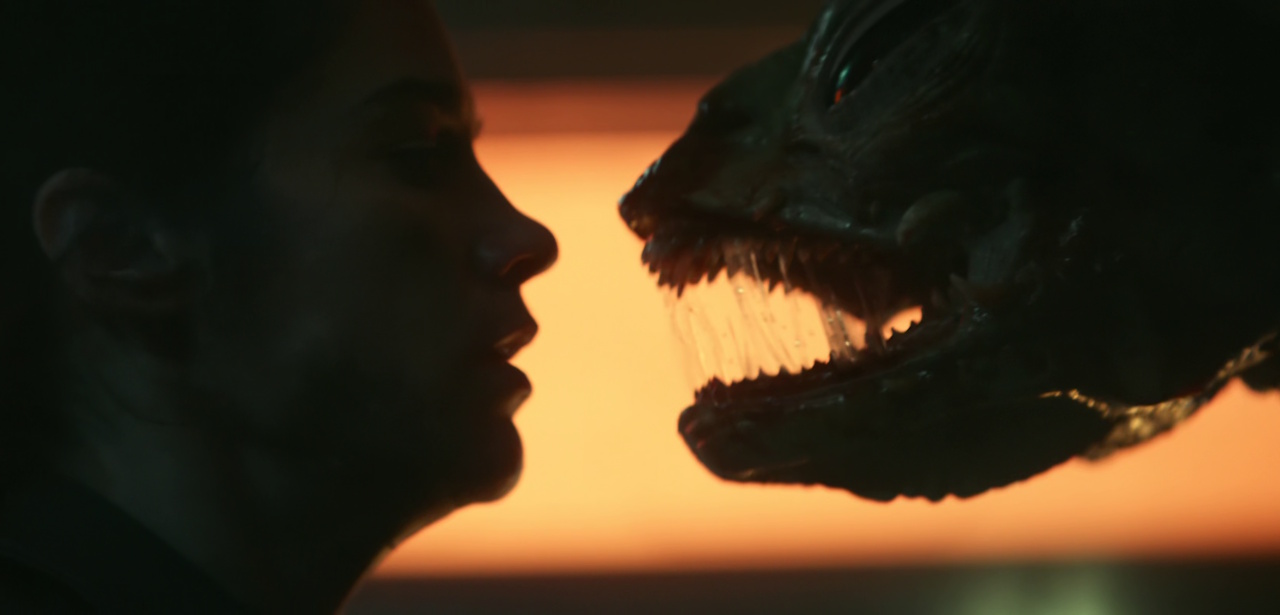
Strange New Worlds took the barest of outlines of the Gorn – a race who, since Arena, had only made a couple of other appearances in Star Trek – and changed them into a genuinely intimidating and threatening villain. Strange New Worlds’ depiction of the Gorn blends together the likes of Jurassic Park’s velociraptors with Alien’s iconic Xenomorphs. The new series takes the foundation established by Arena – that the Gorn are kind of monstrous reptillians – but pads it out with newer inspirations from the horror and sci-fi genres.
If you take a straight reading of Star Trek as a whole, from the point of view of a “canon purist,” then I guess I can understand why this change might not work. It *is* a change, at the end of the day, and with Strange New Worlds being a prequel, the fact that a major conflict against the Gorn happened just a few years earlier – involving several of the same characters – arguably gets close to treading on Arena’s toes. I’m not a “canon purist,” though, and I’m perfectly happy to enjoy both of these different depictions of the Gorn on their own terms.
I wish I had the photoshop skills to bring Arena’s Gorn captain into Strange New Worlds! I think that would be a really funny visual, and would make a great little Star Trek meme. Highlighting the differences in these depictions would be fun, and much of that would come from how different they appear to be – even though, I would argue, in terms of how they’re depicted, the Gorn aren’t actually all that inconsistent.
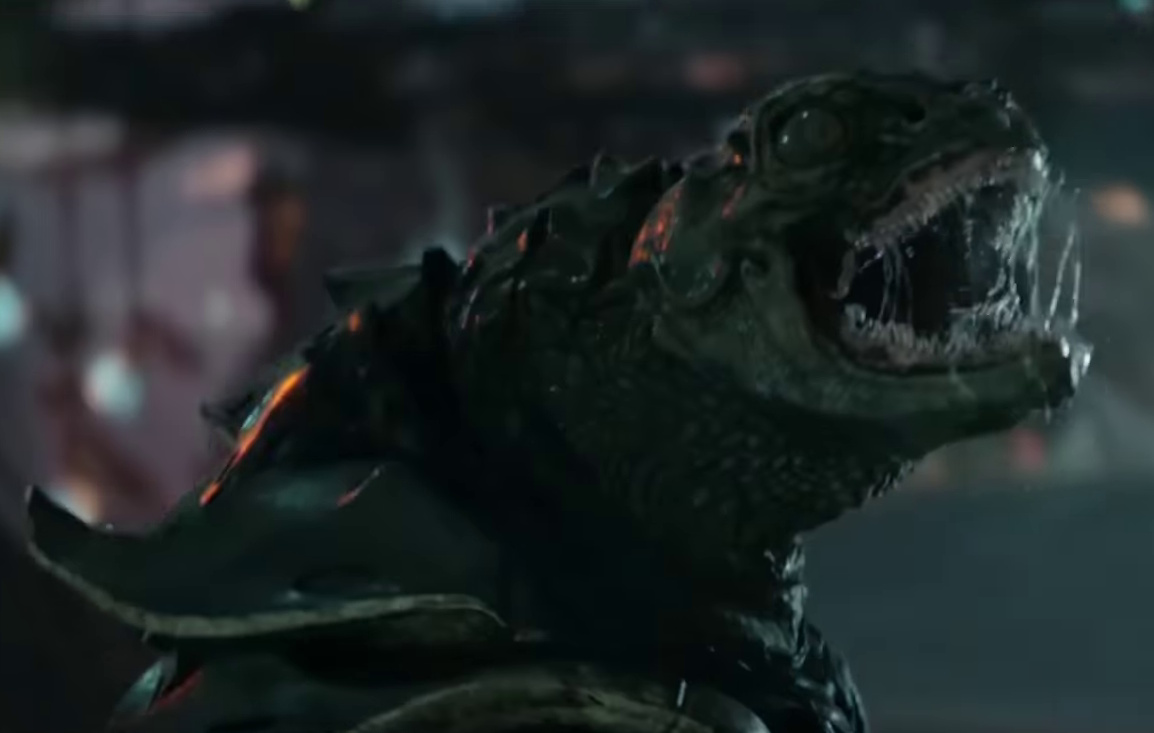
Think about it: the attack on Cestus III and the total destruction the Gorn wrought isn’t far off what we see on Parnassus Beta in Strange New Worlds. The Gorn captain still makes the same kinds of horror-inspired “monster” noises, emphasising how different this life-form is to our familiar characters. The differences are really twofold: the limitations of the visual effects of the time compared to a more modern production with a higher budget, and perhaps more importantly, the limitations imposed on broadcast television at the time in terms of how graphic and horrifying visuals could be. For the mid-1960s, the Gorn captain is pure horror – and I think we can forget that because of how much time has elapsed and the kinds of things television shows today can do that they couldn’t do back then.
All that being said, I still adore the original Gorn design. I think it was incredibly creative, and Arena is just a fantastic episode all around, really. I think the parts we tend to overlook – the mission to Cestus III, the spaceship chase, and the involvement of the Metrons – are arguably the story’s most interesting parts, and to reduce Arena to Kirk and the Gorn squabbling in the desert is incredibly reductive and does Arena a huge disservice.
So that’s it for now. The Gorn are coming back, though… and soon! Strange New Worlds’ third season is just a couple of weeks away at time of writing, and I’m really looking forward to the resolution of the cliffhanger from Hegemony last season. I’ll do my best to write up reviews of Hegemony, Part II and the rest of the episodes in a more timely fashion this time around!
I hope this has been a bit of fun. I’ve been wanting to do a full write-up of an Original Series episode for ages, but I kept putting it on the back burner for one reason or another. Stay tuned, though, because I’ll definitely return to Star Trek’s roots before too long! I’d love to tackle one of my favourite episodes next: The Doomsday Machine! I have no idea when that’ll be… but one of these days, for sure.
Live Long and Prosper!
Star Trek: The Original Series (a.k.a. Star Trek) is available to stream now on Paramount+ in countries and territories where the platform is available. The series is also available on DVD and Blu-ray. The Star Trek franchise – including The Original Series, Strange New Worlds, and all other properties discussed above – is the copyright of Paramount Global. This article contains the thoughts and opinions of one person only and is not intended to cause any offence.
 Trekking with Dennis