



Spoiler Warning: There are minor spoilers ahead for Star Trek: Voyager – Elite Force and for Star Trek: Voyager.
On the 20th of September 2000, Star Trek: Voyager – Elite Force was released. That’s twenty years ago – to my great shock – so it seems like a great opportunity to take a brief look back at what is arguably one of Star Trek’s best and most successful video game adaptations.
The Star Trek franchise hasn’t had a lot of luck in the video game arena, despite the fact that there’s a good deal of crossover between Trekkies and gamers. Most Star Trek games really only appealed to existing fans, and failed to either cross over and win support among a wider gaming audience, or to bring in any new fans. Elite Force was – for a time, at least – an exception to that. As a result it’s fondly remembered not only by Trekkies but by many fans of first-person shooters in the early 2000s.
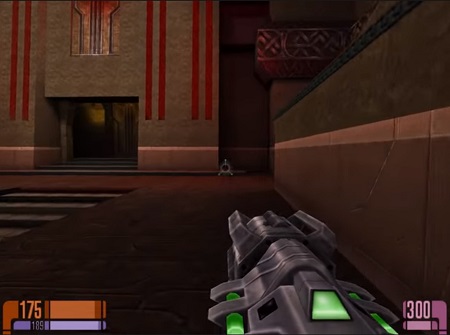
Elite Force was the first game released that was made using the Quake III engine (also known as id Tech 3) except for the original Quake III Arena, and many first-person shooter fans just after the millennium were excited to see what this new game engine would bring to the table. Elite Force also offered local and online multiplayer on PC at a time when the idea of playing games via LAN or online was becoming a bigger and bigger deal in the PC gaming sphere; it was certainly the first such game I ever played at a LAN party!
Using the tagline “Set phasers to frag!” – where “frag” is (or was) a gaming term for “kill” – Elite Force became a moderate success for its multiplayer mode. Gaming as a hobby was much smaller around the turn of the millennium than it is today, and also skewed younger in terms of the average age of gamers. Most players at the time were aware of Star Trek, which had been on a roll through the ’90s, and where Elite Force truly broke new ground for a Star Trek game was in reaching out beyond the franchise’s usual fanbase to appeal to non-fans. It’s unfortunate that the game’s release coincided with the end of The Next Generation’s era; I think if it had been released earlier in Voyager’s lifetime it might have been able to retain some of those new players and convert them to Trekkies. The idea of the “box set” hadn’t really materialised in 2000, so with Voyager already into its final season, and with The Next Generation and Deep Space Nine already over, there wasn’t much Star Trek content for those who did enjoy the game and its setting to get stuck into.
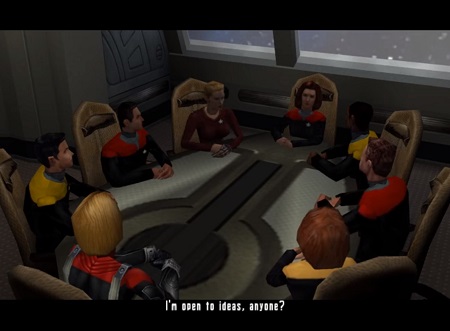
In that sense, Elite Force was released at a time when the Star Trek franchise was entering a period of decline, and the end of Voyager’s run a few months after the game was released meant that the franchise wasn’t able to keep many of the players who gave Star Trek a chance. That’s a shame, but it can’t be helped!
Beyond its multiplayer mode, Elite Force told a really interesting story. The game begins with the explanation that Captain Janeway and Tuvok have created a specialist “Hazard Team” for the USS Voyager, of which the player character is a member. Elite Force was one of the first games I played that allowed players to choose their character’s gender; Ensign Munro could be male or female. It was groundbreaking in the sense that the game didn’t change at all depending on the player’s decision – if Ensign Munro was a woman she was just as capable as if she were a man, and no one aboard the ship would behave differently. That decision alone represents Star Trek’s vision of an equal future. Gender representation in games is getting better, and there are some great female protagonists. But some franchises and series have still never offered players a female lead, and others struggle with writing a female protagonist successfully. Elite Force got this right twenty years ago, so there’s no excuse!
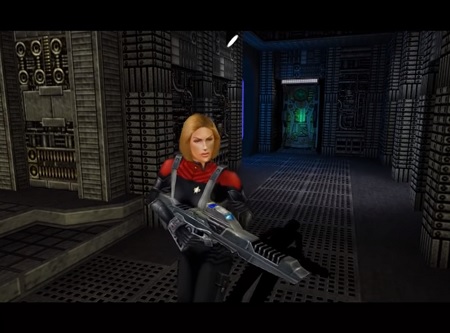
To get back to the story, Hazard Team has been assembled in response to the threat of the Borg and other dangers the ship faces in the Delta Quadrant. The first level of the game is set aboard a Borg vessel – which soon turns out to be a holodeck simulation! I liked the creative use of Star Trek’s technology to explain some in-game features; players were said to have a personal transporter buffer which contained their inventory, explaining how it was possible to carry so many items at once. That was a neat little addition!
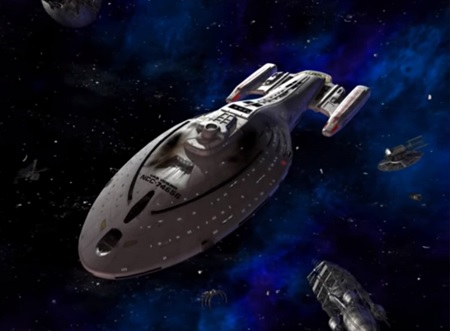
The USS Voyager itself was recreated using the aforementioned Quake III engine, and remains one of the best in-game depictions of any Starfleet vessel. It was such a shame when fan project Stage 9 was forcibly shut down by ViacomCBS a few months ago, as their recreation of the Enterprise-D was stunning. Elite Force did something similar with Voyager, and in between missions several large areas of the ship were able to be explored. This was a complete novelty at the time, and it was amazing to be able to wander around the ship looking at every little detail that developers Raven Software had built.

When the USS Voyager is pulled into a rift in space, it comes under attack by scavengers who reside there. The Hazard Team is deployed on a number of missions to recover supplies, defeat opponents, and find a way for the ship and crew to escape. Interestingly, some Alpha Quadrant races (including humans) are present in the “graveyard,” along with Delta Quadrant races like the Malon.
I don’t want to spoil the story too much, because it is still possible to find copies of the game both for PC and PlayStation 2 second-hand if you want to try it for yourself. Suffice to say that I found the story of the single-player campaign to have a solid Star Trek feel to it. Fans of the franchise might find a couple of nitpicks here and there, but generally it was great fun. Voyager would use a somewhat similar premise – getting sucked into a rift in space populated by scavengers – in the seventh season episode The Void, which was broadcast a few months after the game was released.
Almost the whole Voyager cast stepped in to voice their characters. The main two in terms of the storyline and in terms of who Ensign Munro interacted with were Tuvok – who is the head of security and nominal leader of the Hazard Team – and Captain Janeway. Aside from Jeri Ryan, who was unable to voice Seven of Nine, and Jennifer Lien, whose character of Kes was not part of the game, the entire main cast were present. A couple of Voyager’s minor recurring characters (Chell and Vorik) were also voiced by their television series actors, which was a nice touch. The game was certainly far better for having the proper voice cast!
A darling of early-2000s LAN parties and a pioneer of first-person shooters in the online multiplayer space, Elite Force is a rare example of a Star Trek video game that broke the mould and expanded beyond the fandom. It’s also one of the better Star Trek video games both in terms of gameplay, where the Quake III engine provided a rock solid first-person shooter experience, and in terms of storyline, which for the most part felt like players were taking part in a real episode of Voyager. It’s a wonderful game, well worth playing for any Trekkie, and it would have been a shame to let its twentieth anniversary pass by unnoticed.
So here’s to Star Trek: Voyager – Elite Force! Happy anniversary!
Star Trek: Voyager – Elite Force probably remains the copyright of Activision-Blizzard. Star Trek: Voyager – Elite Force is available for purchase on PC via GOG. The Star Trek franchise – including Star Trek: Voyager – is the copyright of ViacomCBS. This article contains the thoughts and opinions of one person only and is not intended to cause any offence.


 Trekking with Dennis