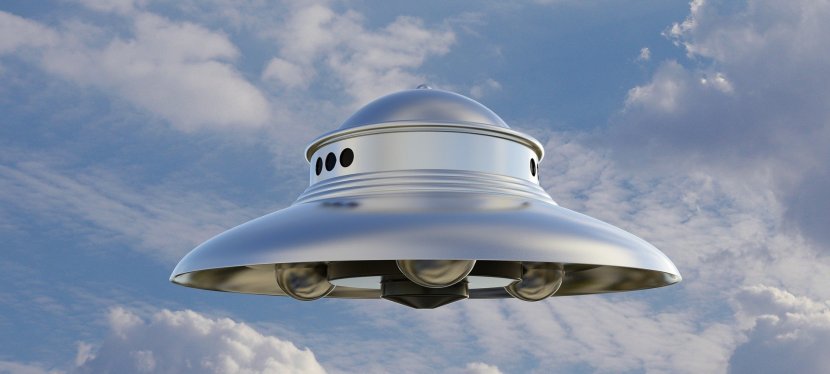
Why we should be sceptical and think critically about UFOs

Headlines have been made around the world in recent weeks about an official United States government investigation into UFOs; “unidentified flying objects.” It seems from news reporting as though the existence of alien visitors, which has been denied for decades by successive American governments, is about to be revealed to the public. A handful of images and even videos from official United States military sources have also come out, seemingly showing unknown objects moving through the sky.

But let’s slow down and try to put our critical thinking hats on for just a moment. What have we actually been shown? Beyond the headlines screaming about alien spaceships, what have we really seen in these photos and videos, and could there be an alternative, far more boring explanation?

Have we really seen alien spacecraft?

If you’ve ever studied philosophy, or even read articles on some pop-science websites, you might know what Occam’s razor is. Also known as the law of parsimony, in short the razor says that, when confronted with multiple hypotheses or potential explanations for an unknown event or phenomenon, the one with the fewest or smallest assumptions is preferable and most likely to be correct. To put it another way: the simplest explanation is the most likely.

So what is the simplest explanation for these UFO pictures and videos?

One thing we don’t have are any photographs or live video recordings. The clips and images shown off are all radar, infrared, and images put together from other scans and sensors. A computer takes the information taken in by the lens or scanner and translates it into a visual image. These are not “images” from a “camera” in the usual sense of either term.
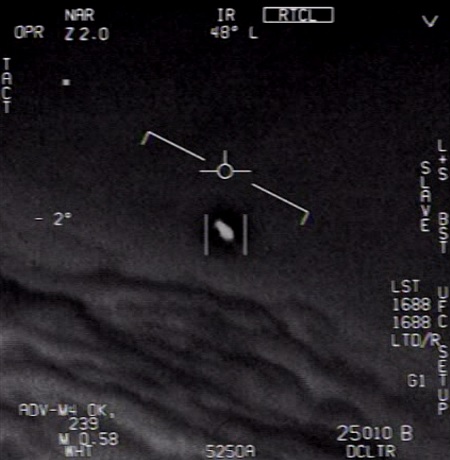
It isn’t clear what this image represents.

When dealing with any technology, there’s scope for things to go wrong. An infrared sensor attached to a fast-moving aircraft could misinterpret something close as being far away, or something moving relatively slowly as moving quickly. Changes in the aircraft’s speed and position mean the sensor has to move and adjust its trajectory to keep track of an object, and this can make it appear as though the object is moving unnaturally.

There are many different objects that could be detected by a sensor, infrared scanner, and other sensitive equipment that would be far more likely than an alien spaceship. Balloons have been suggested in the past as one such example, and there are myriad others from reflections and clouds to other aircraft. There’s also the prospect of newly developed technology – either domestic (i.e. American) or foreign – some of these aircraft could be Russian or Chinese spyplanes or drones, for example. Even if we can’t account for every UFO by saying there’s a bug in the code or a problem with sensors or onboard computers, everyday phenomena are still more plausible explanations than alien spacecraft.

The F-117 “Nighthawk” stealth aircraft was developed in secret and is designed to be difficult to detect.

I’m not sure how I feel about aliens. On the one hand, it seems rational to imagine that alien life exists given the size of the observable universe and the consistent detection of exoplanets around practically every observed star. On the other, the lack of concrete proof of their existence, at least in our galactic neighbourhood, could mean that intelligent alien life is exceptionally rare. This is commonly known as the Fermi paradox; the absence of alien life in a universe that can support it.

But if intelligent alien life did exist, is this the way we would expect to detect it?

UFOs have been reported for decades, so if even 1% of the UFO sightings and reports are genuinely of alien origin, what have they been doing all this time? Obviously they don’t intend to contact us or make their presence widely known or they’d have done so by now. Any alien race that’s advanced enough to build interstellar or even interplanetary spacecraft is far superior in technological terms to humanity, and with their knowledge they’d be more than capable of announcing their presence to the world, conquering the world, or doing whatever else they might want to do. The fact that they haven’t is a significant hurdle for alien believers and advocates to surmount.
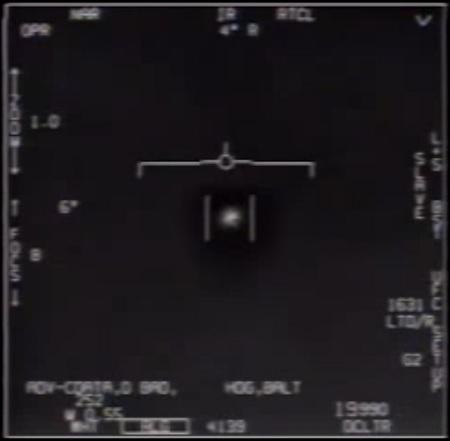
Another grainy and unclear still frame from one of the UFO report videos.

Then we come to a pretty big question: what’s the point? If an alien race is capable of travelling to the stars, why come to Earth and fly around in our atmosphere? What possible purpose could that serve? It can’t be for any kind of observation; even humans don’t need to fly at 30,000 feet to perform observations of things on the ground. Our satellites, even commercial ones like those used for services like Google Earth, are more than capable of performing accurate scans of the surface of our planet. If aliens existed and wished to observe us, they could do so at a great distance without us ever knowing.

And speaking of “without us ever knowing,” were these aliens careless or did they allow themselves to be detected? If they wanted to make their presence known, this is not a rational way to accomplish that goal. Nor is it particularly threatening or intimidating. If aliens wanted to let the peoples of Earth know that they were here, they could land in the middle of a big city and announce themselves. And if they’re possessing such technology as to be able to travel to the stars, would they really be so dumb as to allow a primitive human to catch them with an infrared sensor or a night-vision camera? I doubt it.

A third UFO as seen from the USS Russell.

The U in “UFO” stands for “unidentified.” By definition, that means we don’t know what these objects are; they were not able to be identified in the short span of time that the various pilots and military personnel spent in the vicinity. That could mean we’re dealing with alien spacecraft, but it also seems very likely that we aren’t. This is not the coup that tabloid headlines and the tin foil hat brigade want it to be. The United States government has admitted that it has detected a handful of objects that it can’t identify. Given the size of the US military, the number of daily flights undertaken, and the increasing reliance on technology, sensors, and computers – all of which are subject to glitches, issues, and even misinterpretations – it doesn’t seem all that far-fetched that they’d occasionally spot something that they couldn’t immediately identify.

I like science fiction, and there have been some wonderful depictions of aliens and extra-terrestrial worlds over the years. But we can’t let our wishes and our fantasies guide the real world, and the fact remains that no matter how much we might want to believe in aliens, there still isn’t any proof. When making an argument and building a case, you can’t just slap down any old explanation into the gaps in our knowledge and cry “gotcha!” as if that’s the end of the matter. That’s the classic “god of the gaps” argument that many religious people often make; “you can’t explain X, therefore god.” In this case, some people seem to be making an “alien of the gaps” argument, proclaiming that, because the US military has been unable to identify something, it must be an alien spaceship. That’s simply not a valid argument.

The United States military (Pentagon HQ pictured) is investigating these incidents and will soon release a report.

So I’m sorry to pour cold water on this story. Maybe some of these UFO encounters are genuinely down to alien visitors, but until there’s more proof than a grainy non-image from a sensor made by the lowest-bidding military contractor, I’ll remain sceptical. The discovery of intelligent extra-terrestrial life would be the single biggest scientific achievement of the century, and has the potential to radically change many aspects of human life. Given the scope of such an important moment, we need to be absolutely sure of what we’re dealing with, and this set of unknowns may be circumstantial evidence in its favour, but it’s a long, long way away from being conclusive. It’s possible that “they” are hiding things from the public or not revealing everything they know, but unfalsifiable conspiracy theories and a lack of evidence to the contrary do not make for a valid argument and do not come close to constituting proof.

It’s possible that one day we’ll discover more about extra-terrestrial life. It seems almost certain, for example, that microbial life and bacteria once existed on Mars. But aliens in UFOs flying over United States airspace (and seemingly no other country’s)? As long as these items remain unexplained, aliens are always a possibility. But on a ranked list of all the possible explanations, they have to be at or very near the bottom. So despite all of the excitement, these images and video clips, and the impending government report about them, don’t come close to proving the existence of alien spacecraft. Sorry!

The United States government will soon release a report into “unidentified aerial phenomena.” Some stock photos courtesy of Unsplash and Pixabay. This article contains the thoughts and opinions of one person only and is not intended to cause any offence.


Netflix series review – Pandemic: How to Prevent an Outbreak

If you’ve been a reader for a while, you’ll know that I love documentaries. There have been some really interesting documentary films and series made over the years that I’ve been lucky enough to see, including many whose subject matter I would never have thought to explore otherwise. Netflix is actually a great platform for documentary content. I don’t know how many films and series they have available in the genre – and unfortunately it will vary somewhat depending on where you are in the world – but there are a lot of interesting ones to check out, including some that have been nominated for major awards.

It was with all of the above in mind that I decided to try Pandemic: How to Prevent an Outbreak, which was released in January 2020. I’ve always had an interest in things like disaster preparedness and emergency planning, so it definitely piqued my curiosity when it appeared on my list of things to watch that Netflix recommended. I’d been meaning to check it out ever since, but as always, there were other things to see and do!

Title card for Pandemic.

Pandemic follows a few different individuals, mostly medical professionals, in a number of places around the world as they work on various aspects of disease prevention and treatment. It’s actually incredibly ambitious in that regard, telling the narrative from different places and different perspectives. The filmmakers visited such diverse places as the Democratic Republic of Congo, India, Egypt, Guatemala, and various locations in the United States – a truly huge amount of travelling that must have massively inflated the budget of the series. And the end result is definitely the better for gaining different perspectives.

Some of the locations visited – like Rajasthan in India and Cairo in Egypt – are incredibly densely populated, and as Pandemic goes to great lengths to show, are much more vulnerable to influenza – the disease which is the focus of the documentary – as a result. Seeing those places, and the overcrowded buildings and streets, instead of merely reading about them or having them explained in a voiceover, was definitely an interesting aspect, one that the filmmakers have clearly wanted to convey.

Given that a pandemic of a disease like influenza is a global problem, I think it’s important that any attempt to cover the subject matter should be global in scope. Only seeing a European, American, or western perspective would be more relevant to Netflix’s core audience, perhaps, but would be limited in its messaging and understanding of the topic. The truth is that, in a lot of cases, it’s places in the third world that are worst-hit when a disease outbreak occurs because the infrastructure and medical facilities aren’t present in the same way, and the level of preventative care – like inoculations – and post-infection treatment is of lower quality. That’s not meant to be a criticism – there are clearly people in those regions working incredibly hard. But it is the reality that millions of people in some countries aren’t vaccinated against, for example, tuberculosis – despite the vaccine having existed for decades.

Healthcare workers in India.

As well as looking at some of the history behind disease prevention, and the scientific research that is ongoing, Pandemic is also a series of personal stories. We spend time with many of the documentary’s subjects as they go about their lives, interact with their families, and discuss the impact that their work can have on their life and those around them. In that sense, it was a much more personal look at the subject than a documentary that focused on facts, figures, and interviews staying on-topic would have been. While I enjoyed that aspect of Pandemic most of the time, there were some moments that were awkward and clearly scripted, or at the very least set up to get the exact shot and line that the filmmakers wanted. There’s a line that a documentary filmmaker has to walk when doing something like that, and at times Pandemic was on the wrong side, as some of these scripted moments ended up feeling like the film was being dishonest. By presenting a scene through the camerawork and editing as if it were a genuine, spur-of-the-moment conversation when it clearly was not, some of these sequences ended up feeling forced and fabricated. While there weren’t too many of these moments such that the series was overwhelmed by them, it did suffer as a result.

When considering Pandemic, we do have to talk briefly about the current coronavirus outbreak. Pandemic was made last year, before this current outbreak had begun, but how we approach it – and indeed the fact that more people have been interested in it – can’t be completely detached from the current situation. Coronavirus is not influenza; the two viruses are very different and thus will have to be approached differently by governments and medical staff. But much of Pandemic’s subject matter is applicable to the current outbreak – most notably how easily it can spread and how it can take root in some of these densely-populated areas in the third world where healthcare and hygiene are worse than here in the west. In that sense, Pandemic is a timely release – with all the fuss in the news at the moment about the spread of coronavirus and the various quarantines and other steps being taken to stop and prevent its spread, there are lessons to be learned from this series.

Politics is at play in Pandemic; it is a deeply political series at times. For some people that will be offputting, especially because the way some political issues – like migration – are handled are very one-sided. There are numerous swipes and digs at Donald Trump and his administration in particular, as well as interviews with Democratic Party politicians, legislators, and supporters. It would have been worth the filmmakers including some kind of statement at the end of the episodes where these people appeared to say that they did ask Republicans to join in with the series – if indeed they did ask. That would have shifted the blame for the lack of political inclusion to those who refused to participate.

Oregon State Senator Elizabeth Steiner Hayward was interviewed in Pandemic.

Healthcare is a political issue. The inclusion of politics is thus unsurprising, and Pandemic does not claim to be a balanced, all-around look at the subject matter. Many documentaries are incredibly subjective in the way they handle their subject matter – look at Michael Moore’s Bowling for Columbine or Fahrenheit 9/11 as examples of that. This doesn’t make Pandemic worse, but it does mean that as the audience we have to be aware of the filmmakers’ leanings and biases and remember to treat it as a subjective piece. In 2020, there really isn’t such a thing as a truly objective piece of reporting or filmmaking, but even so, there will be numerous points where I’m sure that people who don’t fully subscribe to the filmmakers’ politics will be at least a little uncomfortable in the way some of the material is presented – I can tell you that I certainly was.

Staying with contentious political issues, one of the most interesting aspects of Pandemic for me is that the filmmakers went out of their way to track down and speak with anti-vaccination families and campaigners. The anti-vaccine movement has been growing for some time, and is widely blamed for a resurgence in diseases like measles which had once been essentially eradicated in the western world. It’s likely that, as we go forward into the new decade, decisions will have to be made about what rights people do and don’t have when it comes to issues like vaccination, and by letting the anti-vaccine campaigners speak for themselves, Pandemic did a good job of presenting both sides of the argument – even though it was clear from the way some of those sequences were edited which side the filmmakers were on.

Overall, I’d say that Pandemic approaches an incredibly broad topic in a personal way. The decision to present it through a series of separate, individual stories rather than as a more general overview of the topic definitely shows off different angles of how organisations around the world approach disease prevention, but at the cost of having a narrower focus than some documentary series covering the same subject might. I enjoyed it, it was interesting and informative, but certainly not comprehensive. However, given the position we’re in when it comes to the current coronavirus outbreak, I would recommend it – just so long as people remember to keep their fears in check. Some of the interviewees can stray into “doom-and-gloom” territory at times, and again considering our current situation in regards to coronavirus, this might be offputting for some. Regardless, I had a good time with the series. Netflix has both created and hosted a number of good documentaries, and Pandemic is a solid addition to its lineup.

Pandemic: How to Prevent an Outbreak is available to stream now on Netflix around the world. The series is the copyright of Netflix. This article contains the thoughts and opinions of one person only and is not intended to cause any offence.

Mars by 2030?

It’s the start of a new decade! And as we enter the 2020s, “futurologists” and others are popping up, sharing their predictions for the technologies and events we can look forward to in the 2020s. One prediction that has cropped up on a number of lists is that we – and by “we” I mean humankind – will land at least one manned mission on Mars before the close of the decade.

Sounds amazing!

Except… haven’t we been here before? Every decade since the 1980s we’ve been promised the same thing, both by people who try to make a living predicting the future and by governments and space agencies themselves. So why hasn’t it happened?

Mars – the red planet. Are we going there soon?
Photo credit: ESA – European Space Agency & Max-Planck Institute for Solar System Research for OSIRIS Team ESA/MPS/UPD/LAM/IAA/RSSD/INTA/UPM/DASP/IDA

Money is of course a factor. NASA has seen its budget cut dramatically in the last few years, particularly by the Obama administration in the wake of the 2008 financial crisis. When citizens are living on food stamps and unable to afford basic necessities like healthcare, it seems more than a little obscene to spend vast sums of taxpayers’ money – their money – on space exploration. Space exploration is seen by many as the ultimate luxury for a government, and is one of the first projects on the chopping block when financial savings need to be made.

The space shuttle programme is also a factor, and that ties into the financial issues mentioned above. The space shuttle was designed to be reusable – largely to help NASA cut costs. And overall that’s a positive thing, because it meant more manned space missions were possible during the shuttle’s lifespan. But the shuttle also stifled technological growth in the space industry. Because there was a reliable, reusable vessel to get humans and cargo into orbit, there was no need for a long time to upgrade it or design new spacecraft, and crucially, successive governments could get away with saying “no” when NASA wanted to undertake those projects, using the excuse that they already had a perfectly serviceable fleet of spaceships, so why pay to build new ones? Many people have said how the space shuttle’s limited cargo capacity has, in many ways, constrained the development of satellite technology by forcing practically every major satellite project during the shuttle era to fit certain size and weight requirements. But the shuttle also, in very real ways, slowed down the development of other spacecraft and other space technologies – including those that would have been required to get mankind to Mars in every decade since the 1980s.

Only six months ago we passed the fiftieth anniversary of the first moon landing. And sadly, within a couple of years we’ll pass the fiftieth anniversary of the last manned moon landing too. In my lifetime, no human being has stood on the moon or even left Earth’s orbit, yet that would have seemed completely incomprehensible to people in the late ’60s and early ’70s when space exploration was reaching its peak. Back then, the idea that we’d have gone on to Mars and elsewhere seemed an absolute certainty.

So there are definitely practical considerations from here on Earth – both financial and political – as to why a manned Mars mission hasn’t yet happened. But there are other issues at play too, and unfortunately they may mean that Mars by 2030 just isn’t possible.

The longest ever human spaceflight (achieved by Russian cosmonaut Valery Polyakov in the early 1990s) is one year and two-and-a-half months, or 438 days. A mission to Mars, assuming the best possible launch window, would take at least nine months each way, plus a mission on the surface of three months or so, for an absolute minimum duration of 635 days – almost 50% longer than any other previous human spaceflight. And unlike a spaceflight to low Earth orbit, there’d be no prospect of resupplying a ship once it had left on its mission.

A human could absolutely survive for that long in space; there’s nothing to suggest that 438 days is the maximum a human body can last under those conditions. But the problem is that it isn’t just a case of being in space.

When astronauts return to Earth even after relatively short missions in low gravity, it can take weeks or months to adjust to being in gravity again. The reason astronauts are carried from their landing sites when they get back to Earth instead of walking is usually because they physically can’t, especially after months in space. When the Apollo astronauts went to the moon this wasn’t as much of an issue for two reasons – the moon’s gravity is about 17% of Earth’s gravity, and the amount of time they spent in space was only a few days. A mission to Mars gets neither of these advantages, meaning the first humans to land on the red planet after a nine-month-long flight might not even be able to stand up when they touched down.

Mars’ gravity is much stronger than the moon’s, at around 38% of that of Earth. And as we have already covered, the travel time to get there is measured in months, not days.

There’s also the logistics of creating a spacecraft that is capable of getting to Mars, existing as a home base for astronauts while they’re there, and is capable of getting home again. It would need to be a huge vessel – capable of housing the astronauts both in space and while on Mars, and carrying enough fuel and supplies to complete a mission of that duration. Remember that the International Space Station, as well as previous long-stay space stations in Earth’s orbit, were always able to be resupplied, even on short notice. That obviously isn’t possible for a Mars mission, meaning that any spacecraft headed there would have to be entirely self-sufficient.

Realistically that means a crew far larger than the three-person Apollo missions, as there would need to be specialist engineers on hand with the technical knowledge to perform repairs to any part or system of the ship, as well as at least two pilots who could make independent adjustments to the vessel’s trajectory as needed. The ship would also need a dedicated medical facility – and at least one doctor. That would be in addition to the scientists and geologists and microbiologists that would be at the core of the work the mission wanted to undertake. And each additional person requires extra food, water, and air, adding to the weight and size of the vessel, which in turn would need more powerful engines and more fuel.

Then there’s the problem of cabin fever, and the issues humans have when living and working in close proximity with one another for prolonged periods of time. On a Mars mission, there’d be no escape from your colleagues, and no privacy. When experiments have been conducted, putting a group of people in total isolation for a year or more, issues almost always emerge. One famous study that aimed to look at the effect of a long-term Mars mission ended with the “crew” having split into two factions that weren’t even on speaking terms. During the moon missions, real-time two-way communication was possible, albeit with a short delay. On a Mars mission, the distances involved mean that communication would only be possible in the form of recorded messages, and real-time conversations both with the space agency and with their friends and family wouldn’t be possible for the crew – further adding to their isolation.

The duration of the flight also causes another issue – dangerous levels of radiation. On Earth, and even in low orbit, Earth’s magnetosphere shields us from what would otherwise be fatal levels of solar and other cosmic radiation. After leaving the protection of this magnetic field, astronauts would be exposed to much higher levels of radiation than is safe, meaning any spacecraft has to find a way to offer protection from that. And while it’s accepted that the Apollo spacecraft were suitable for the short duration to the moon and back, a spacecraft built to similar specifications would not be good enough for a months-long mission outside of Earth’s protective magnetosphere.

Then there’s the concern of Martian microorganisms. One of the main reasons we want to go to Mars is to find out if it supports life – but what if it does? It wouldn’t be possible to create a sterile environment on the Martian surface for astronauts to live in, at least not without making the landing vehicle/home base significantly larger and more complex. So if there are microorganisms present, either fully alive or in some kind of suspended state, what would be the effect of interacting with them?

This was a concern for the Apollo missions, too, and there’s a famous photo of President Nixon with the Apollo 11 crew – while they’re standing at the window of an isolation chamber to keep them quarantined. The risk of contamination is significant, and exposing a human to what is literally an alien microbe could be harmful or even fatal. And while living on the surface of Mars for literally months, it would be very difficult to prevent that kind of contamination, if there’s anything of that nature on the surface at least.

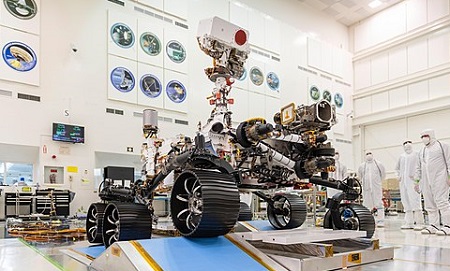
The Mars Rover.
Photo credit: NASA/JPL-Caltech/MSSS

So the question I have is this – is a manned mission to Mars genuinely practically achievable with our current level of technology?

It seems to me that we’re missing some key pieces.

The first is some form of artificial gravity, both for the spacecraft and to use while on the planet’s surface. There are some great theoretical means of generating artificial gravity, but none have yet been realised. And unfortunately many of our attempts in this area are hampered by a lack of understanding of the fundamentals of gravity itself – we simply don’t know exactly why gravity works the way it does, even though we’re fairly clear on the how.

Secondly, we really need a faster method of propulsion than we currently have. Partly this is to keep astronauts safe from both radiation exposure and the effects of low gravity, but also it’s a practical concern to prevent astronauts succumbing to cabin fever and avoiding the issues that can develop from living and working in close quarters. If the time to fly between Earth and Mars could be cut even in half, that would be a great first step.

Finally, we need to be able to build a spacecraft larger and more powerful than any we’ve ever constructed. It needs to be large enough to hold its crew, all of their consumables, and have the ability to land and take off from the surface of Mars. Taking off from Mars is an issue in itself – with Martian gravity being a significant hurdle. The spacecraft would need to be able to exist as a home base for astronauts while on the surface, and be shielded from dust storms known to plague the planet. The engineering task of building such a vehicle is enormous.

With all of the issues above taken into account, are we really on course to land on Mars in the 2020s? It’s not impossible, and there are some incredibly clever and outright brilliant people working on achieving precisely this feat. But until the ship is built and the astronauts are suited up and sitting on the launchpad ready to go, I’m going to remain sceptical. We’ve been here before, and previous promises of Mars missions have come to naught. There are huge issues that still need to be tackled to make it a reality, and while it’s definitely possible we’ll get there before 2030, I’m just not convinced yet that it’s a certainty.

Fingers crossed, though!

This article contains the thoughts and opinions of one person only and is not intended to cause any offence.