

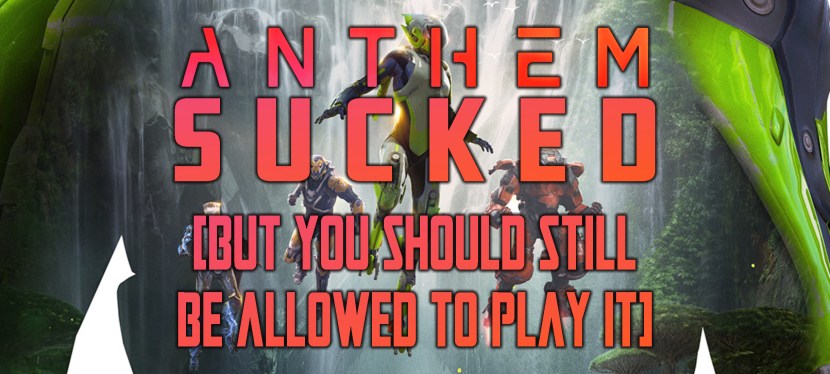
Bad news, guys: Anthem is gone. After today, you can never play it again.
What do you mean “WTF is Anthem?” You know: that BioWare game from 2019? With the flying “Iron Man” suits? BioWare’s genre-busting epic? The “ten-year experience” that defined a generation? The “Bob Dylan of video games?” Anthem!
Okay, all jokes aside, today – the 12th of January 2026 – is the final day that Anthem’s servers are going to be online. The game has already been removed from digital shops on all platforms in anticipation of this, and when the plug is pulled on those servers later today, that’s it. No more Anthem… ever.

Photo: Jean-Luc, CC BY-SA 2.0 , via Wikimedia Commons
Let’s not beat around the bush: Anthem was dog shit. It was a decade too late, developed by a studio that had no experience with online multiplayer titles, it suffered from weak world-building, and the entire game was rebuilt from scratch in the eighteen months before it launched because the version(s) shown to the higher-ups at EA were even worse. It relied on a totally fake CGI trailer to generate hype, players felt swindled and let down when they finally got to try the game, and it even seemed, for a hot minute, that Anthem’s failure would condemn BioWare to the ever-growing Electronic Arts graveyard.
So… why should we care that Anthem is finally being put out of its misery?
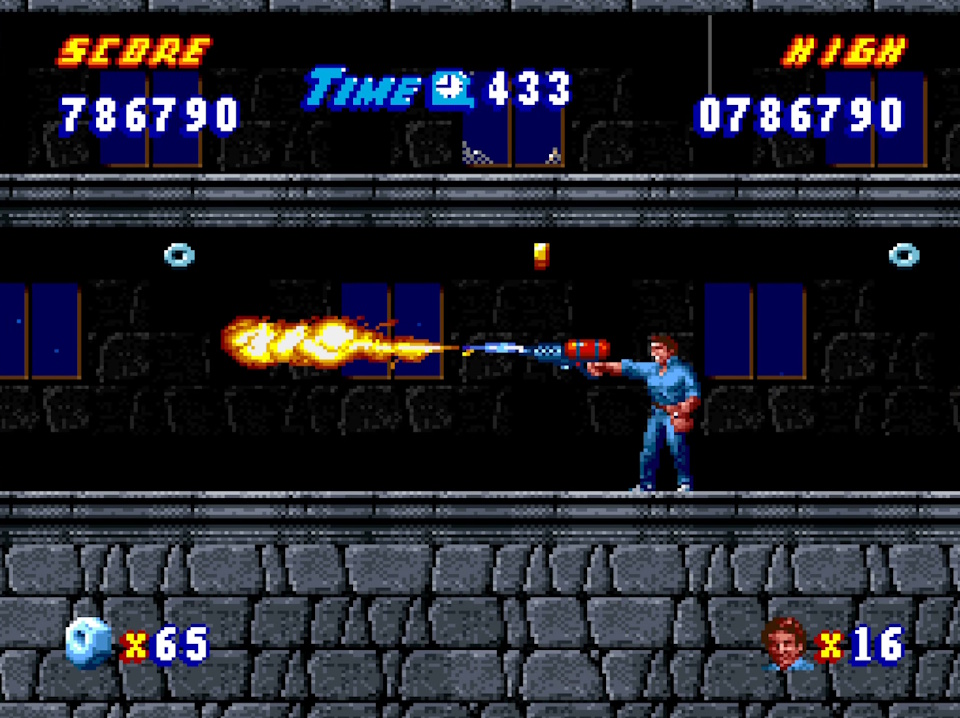
There are some pretty bad or poorly-received games that I think we *all* have enjoyed over the years. And there are plenty of so-bad-it’s-good titles that can be fun to boot up for a challenge… or just to have a laugh. The weird Home Improvement tie-in game for the SNES, Carmageddon 64, Blue Stinger on the Dreamcast… I’m sure you have your own examples. But the point is this: we can still play those games if we want to.
Anthem may have sucked, but it shouldn’t be up to EA and BioWare to tell us we can’t play it. That’s the bottom line here, and loathe as we may be to defend a monotonous, boring slog of a game like Anthem… it should still be accessible. Converting the game to be playable offline isn’t beyond EA and BioWare’s capabilities, and while I absolutely concede that keeping dedicated server space online for a dead game is a waste of resources… that doesn’t excuse killing the game entirely and rendering it unplayable.
A lot of players (okay, not *a lot*, because it’s Anthem, but you know what I mean) played Anthem solo. Despite being intended to be a multiplayer experience, it was possible to go through the game on your own, if you wanted to. And games like this have bots all the time – how hard would it have been to tone down some of the more difficult moments, add bots to replace human teammates, and keep the game playable for solo players? Or how hard would it be to turn off the dedicated servers but keep the game playable for local multiplayer, or even for peer-to-peer multiplayer? These things *are* achievable.

Another notorious flop in the live service space is Suicide Squad: Kill the Justice League. That game is also dead, and cost its parent company well over $100 million. But last year, Suicide Squad was updated to give the game an offline mode for solo players. Even when its servers are inevitably shut down, the game will remain playable for the folks who enjoyed it. See how easy that was? Yes, Kill the Justice League isn’t a fun game, and you can see why people who tried it bounced off it. But some people did gel with it and did enjoy it for its gameplay, its story, and so on. The same is true of Anthem. Don’t both sets of players deserve to be able to continue to play the games they enjoy? Games that, lest we forget, *they paid for*.
Anthem was never free-to-play. If you picked it up on launch day, you paid £50/$60 for the privilege. That’s less than seven years ago, and now that money – and any additional money spent at the in-game shop – is just… gone. The product that folks bought is now useless; Anthem discs might as well be coasters or frisbees. That… well, it just isn’t right. Is it?
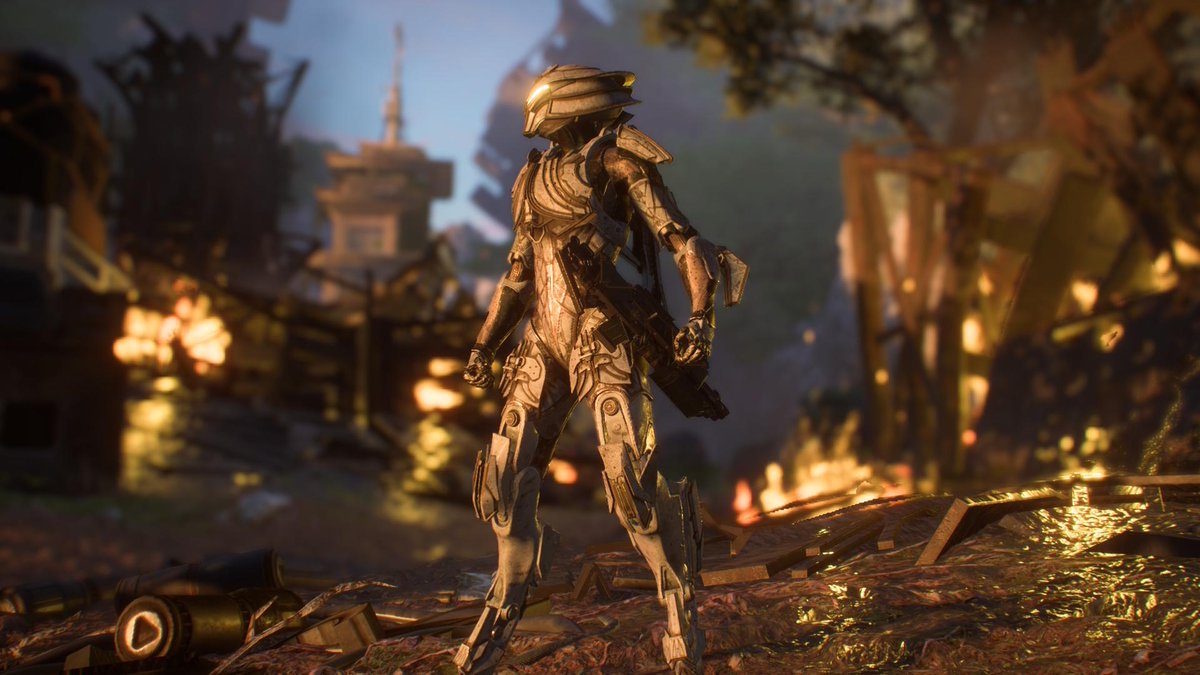
This is a much more fundamental, philosophical point, but I believe all works of art and media should be preserved. This is human creativity, free expression… Anthem is the culmination of the work of hundreds of people over several years. And like any other work of art, it should be preserved for posterity. If we allow games like Anthem to be deleted, we not only deprive players today of a game they might’ve actually enjoyed or at least wanted to try out, but we also deprive people in the future the chance to see what gaming looked like at that moment in time.
Anthem wasn’t the only big-budget live service title to fail hard in the late 2010s or early 2020s. But in a way, it’s become emblematic of a period in the games industry where corporate publishers went all-in on the live service model. And being able to see what that looked like is important. We shouldn’t allow Electronic Arts and BioWare to get away with scrubbing the internet of Anthem; their shameful failure *should* be on display for all to see. It needs to be seen to be understood, and it needs to be understood because it says a lot about the state of the games industry in the late 2010s. Future media historians are being deprived of the opportunity to study Anthem… and learn what went wrong.

I made a similar argument in relation to the original Star Wars film from 1977. Most folks have never seen Star Wars. Sure, they’ve seen A New Hope – the modified version of the film with crappy CGI additions that George Lucas forced into it in the late ’90s. But the original version of Star Wars – the film that started it all – was deliberately being erased and overwritten by Lucasfilm and the Walt Disney Company. That is, until fans took the task of digitally preserving it into their own hands, and created something called “Project 4K77.” You can read more about that by clicking or tapping here.
The point is this: all works of art and pieces of media are important and worth preserving. No film, TV series, painting, novel, or video game deserves to be erased. They simply should not be made inaccessible to folks who want to engage with them, either for entertainment and enjoyment or for academic purposes. And we shouldn’t permit corporations to just arbitrarily decide which works of art and media us plebs are permitted to view. Once something has been created and released, it should remain accessible to everyone. There’s no justification for killing Anthem.
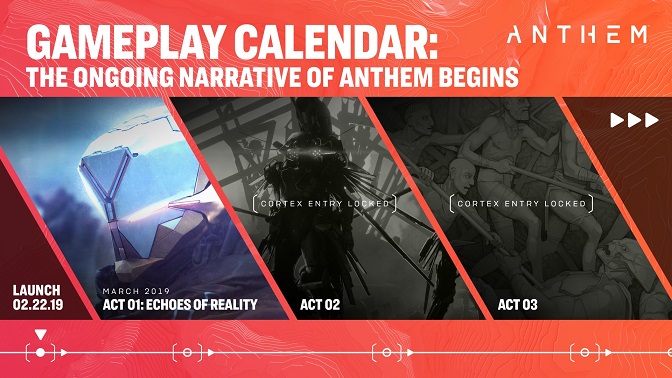
Even if Anthem’s online servers needed to be shut down, there were still a plethora of options for preserving the game itself. And that’s what’s so disappointing about this move: Anthem could have been preserved as a single-player, offline experience, or even with local or peer-to-peer multiplayer. There simply are no technical limitations to prevent this from being possible, which means it was a conscious choice on the part of Electronic Arts to kill the game. It was EA cheaping out, refusing to spend the minuscule amount of money that would’ve been required to preserve the game.
So that task? Now it falls to fans, players, and game preservation groups.
Video games have always been a bit of an odd case when it comes to preservation for one simple reason: hardware. If you don’t own a functional SNES, playing games from Alien 3 to Zero the Kamikaze Squirrel becomes impossible. But that’s where players stepped in: emulation keeps those older games playable long after their original hardware is out of stock, and far beyond the moment where they went out of print. The same could happen for Anthem, though it’ll be a tougher task.

Anthem will need to be modified to be playable offline. I’m not even going to *pretend* that I understand what will need to be done to make that happen; “cracking” the game and modifying parts of its code are just way above my pay grade as a mere critic! But, if past experience has taught us anything, it’s that there are folks out there who are dedicated to video game preservation, and plenty of clever people who know just how to modify even the most complex of code. A playable offline version of Anthem is possible – and it may already be underway.
But it’s unfortunate that a version of this game that folks will be able to play offline wasn’t created officially by EA. And it’s a timely reminder of the importance of the “Stop Killing Games” initiative, which has launched petitions in various countries and territories. A change in the law would be needed, but it isn’t impossible to think that, one day, the kind of thing EA has just done to Anthem will be illegal; that future developers and publishers will be required to preserve their titles and keep a version of them playable indefinitely. For all of the reasons we’ve discussed, I think that’s vitally important.
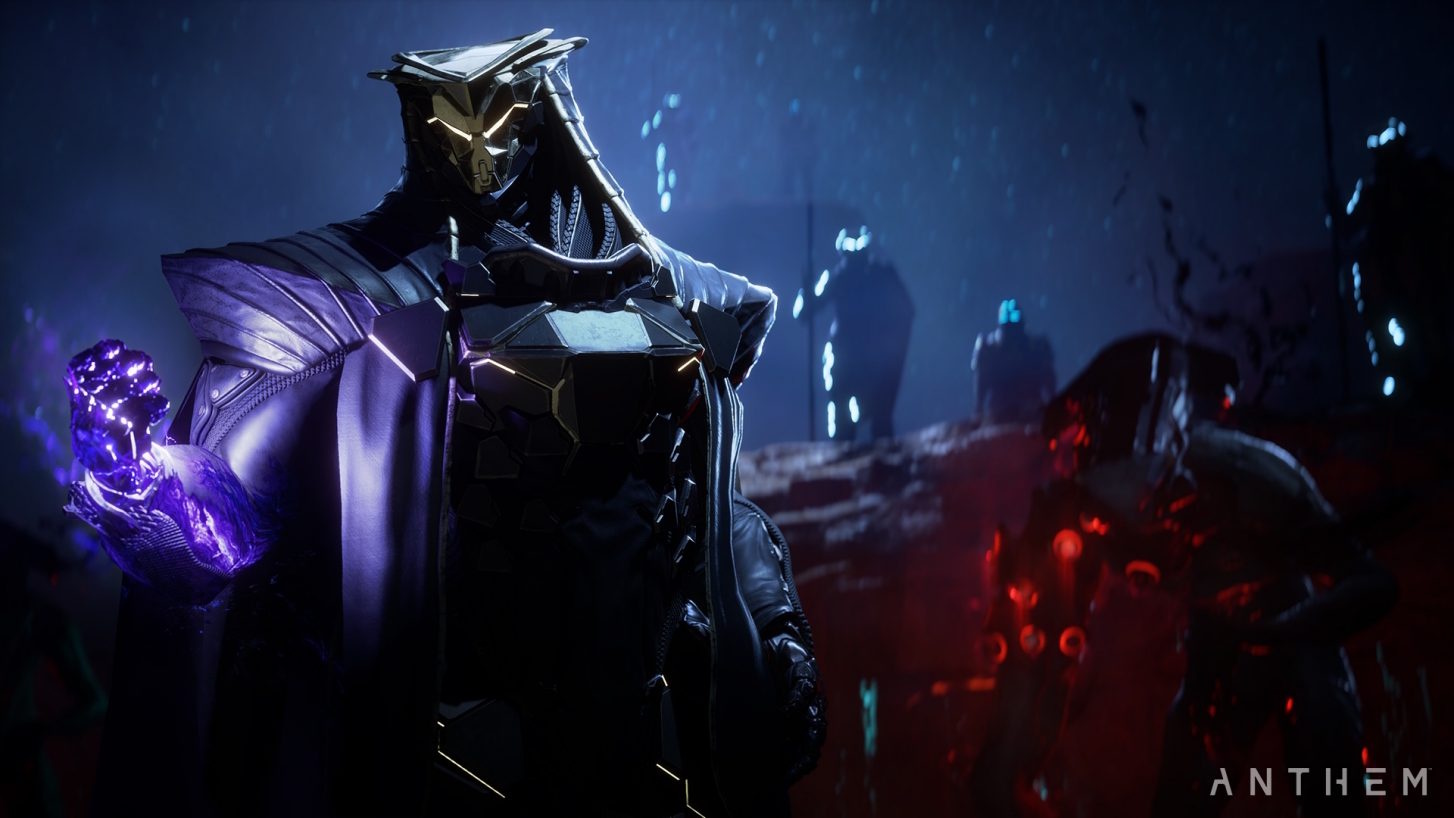
While I personally don’t give a shit about the utterly dire Anthem, I think its erasure by Electronic Arts is not something to celebrate – nor something to tolerate. And I encourage you to check out “Stop Killing Games” and see how the movement is progressing, whether there are active petitions in your region, and encourage local lawmakers and politicians to get on board. Anthem may not seem like it’s worth preserving, but who are any of us to decide what’s “good enough” for future players and academics to have access to? Even the very worst games you can think of – E.T., Superman 64, Sonic ’06, or Ride to Hell: Retribution – don’t deserve the ignominious fate of being *erased* entirely.
It’s important to preserve as many works of art and media as possible. And at a fundamental level, it’s important not to allow corporations to dictate to us which games we can play, which films we can watch, and so on. That choice should be ours.
Even if that choice is to play a truly awful game like Anthem.
Anthem was released by BioWare and Electronic Arts in 2019 for PC, PlayStation 4, and Xbox One consoles. The game is no longer available for purchase. This article contains the thoughts and opinions of one person only and is not intended to cause any offence.




 Trekking with Dennis