Star Trek: Discovery theories – week 10

Spoiler Warning: There are spoilers ahead for Star Trek: Discovery Season 3, as well as for Star Trek: Picard and other iterations of the franchise.

The two halves of Terra Firma gave us quite a lot to work with, but with only three episodes left before Season 3 is over, Discovery has a lot of work left to do to resolve major ongoing storylines. I’m ever so slightly concerned that we’re going to end up with a rushed conclusion, repeating the mistake Star Trek: Picard Season 1 made earlier in the year. Hopefully that won’t be the case and there will be enough time for every extant story thread to either reach a conclusion or set up the events of Season 4 – whenever that may come!

By the end of Terra Firma, Part II we’d seen two confirmations and three debunkings, so let’s look at those first.

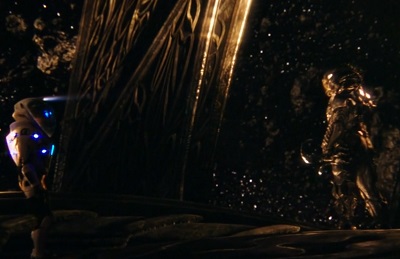
Confirmed theory #1: Carl is the Guardian of Forever.

The Guardian of Forever’s portal.

I got goosebumps when Carl announced who he really was – complete with the Guardian’s voiceover from The Original Series. Though the revelation may have been less interesting to new fans who aren’t familiar with The Original Series, I adored this moment and sat with a big dumb grin on my face for much of the rest of Terra Firma, Part II.

Though we could kind of argue that the inclusion of Sarek, Pike, and Una/Number One accomplished something similar in Season 2, the mystery of Carl’s powers and identity that we all had to sit with for a week is part of what made the ultimate reveal so exciting. I’ll always love when Discovery ties itself into past iterations of Star Trek, and this was perhaps my favourite connection of the season so far.

Confirmed theory #2: Georgiou will travel back in time.

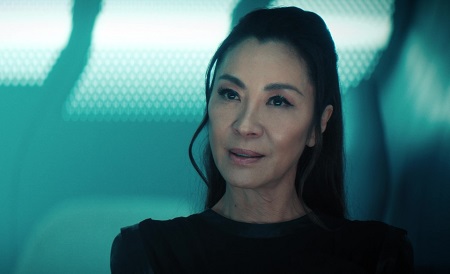
Georgiou checks her holo-padd.

Where did Georgiou go for the three months she spent seemingly in the Mirror Universe? Well, Carl seemed to suggest he sent her to some kind of parallel universe, but perhaps not the Mirror Universe she came from.

Regardless, Georgiou has now definitely gone back in time – perhaps to the 23rd Century, or perhaps to another time period as we’ll discuss in a moment. We don’t know where or when she’ll emerge, and given how final her exit from Discovery felt, I doubt very much we’ll learn anything about her destination until the Section 31 series is ready to go.

My earlier theory had been that Georgiou may have travelled back in time along with the USS Discovery, perhaps in a tie-in with the Calypso story that saw the ship abandoned. This now can’t happen, of course, and while I wasn’t correct about how and why Georgiou travelled back in time, I did get the overall point right!

So those theories were confirmed in Terra Firma, Part II. Next we have three debunkings, all related to Georgiou.

Debunked theory #1: Georgiou will accidentally change the future.

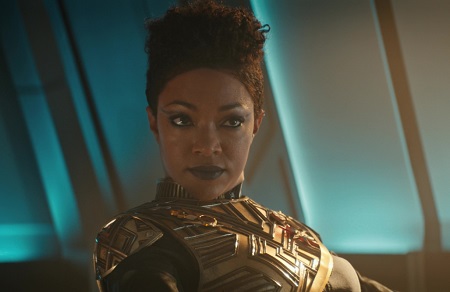
Georgiou prepares to execute Mirror Burnham.

Although I wasn’t convinced that Georgiou had truly travelled back in time, one issue that time travel stories can encounter is a paradox. When Georgiou began making changes to the 23rd Century Mirror Universe, I wondered if we might’ve seen some ramifications for the future, perhaps something she and Burnham would then have to fix by restoring the true timeline.

When it seemed as though the Mirror Universe that Georgiou was seeing was different to how we saw it in Season 1 – with key players like Stamets and Burnham arriving at altogether different fates – it seemed at least a possibility. However, for Guardian of Forever-related reasons, nothing Georgiou did appears to have altered the 32nd Century, and as of the moment she left, everything was exactly where it should be.

Debunked theory #2: Georgiou didn’t travel back in time or to the Mirror Universe.

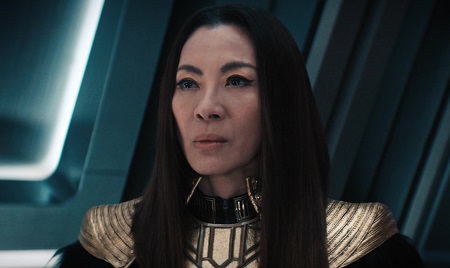
Georgiou with Burnham and her honour guard.

As discussed above, it wasn’t 100% clear where and when Georgiou spent her time over the last two episodes. But she did, according to Carl, travel back in time and to a different universe – whether or not it’s the Mirror Universe is up for debate.

I postulated this theory because of the major narrative differences between the setting Georgiou occupied and what we know of the history of the Mirror Universe and some familiar characters from Season 1. I doubt the series will revisit any of these points in future, and it seems as though the ultimate explanation for why things are different is because she was in a different universe either created or accessed by the Guardian of Forever. I’m okay with that, as it doesn’t create any major inconsistencies.

Debunked theory #3: Georgiou had been tampered with by the Federation (or Section 31).

Georgiou first became ill after a meeting with Kovich.

Despite being in the 32nd Century for at least a few weeks before Discovery found Federation HQ, Georgiou’s technobabble health problems did not emerge until immediately after her meeting with the mysterious Kovich. This led me to theorise that he could be a Section 31 operative and may be responsible for the sudden decline in her wellbeing.

However, it seems that this was a deliberate false lead, as Kovich not only was not implicated in making Georgiou ill, he actively consulted with Dr Culber and offered his expertise when asked. He knew more than he let on, both to Georgiou and Starfleet, but he was not responsible for harming her.

So those theories were debunked. Now let’s dive into the main list, beginning with a special bonus theory!

Bonus theory: Four ideas for Georgiou’s destination.

Georgiou’s destination, both in space and time, was left deliberately unanswered in Terra Firma, Part II. Carl told us he was sending her “to a time when the Mirror Universe and the Prime Universe were still aligned.” That’s an interesting statement, and could be interpreted in a lot of ways. We are very unlikely to know for sure where and when Georgiou ends up until she returns to our screens in the upcoming Section 31 series – but naturally, I have a few ideas.

The 21st Century

The reason why this one seems unlikely right now is because a Star Trek show set even earlier in the timeline than Enterprise would be difficult to produce. Enterprise depicted Earth’s first voyage of exploration, and while there were humans in space before Archer’s big mission, they were limited in speed and in the areas they covered. Thus, from the point of view of a Star Trek show, what is there to do?

On the flip side, the 21st Century is arguably the best fit for Carl’s ambiguous explanation of where Georgiou is going. We don’t know anything about the early history of the Mirror Universe, but if it’s true that it and the Prime Universe were once “aligned,” as Carl explained, the earliest known point of divergence between the two timelines is 2063 and first contact between Earth and Vulcan. In the Mirror Universe, after Cochrane’s warp flight he and his followers massacred the Vulcans who arrived on Earth, before humanity conquered their homeworld and founded the Terran Empire.

If this is truly the point of divergence, sending Georgiou to the 21st Century could fit with what Carl said. It could also mean that the Section 31 series depicts the creation of the organisation, and we could learn that Georgiou was its first leader.

The 23rd Century

The most likely destination based simply on what we know of the Section 31 series. It would also return Georgiou to her own time, thus curing her technobabble ailment. A return to the 23rd Century would allow for the return of characters like Ash Tyler, and we could even see a crossover with Strange New Worlds reuniting Georgiou with Captain Pike.

A series set in this era would depict Section 31 going underground, transforming itself into the clandestine outfit we first encountered in Deep Space Nine. However, the Mirror and Prime Universes are certainly not “aligned,” as Carl put it, in the 23rd Century, so could that be a hint that Georgiou is headed elsewhere? If not, how will that be explained?

The dawn of the 25th Century

The Mirror Universe episodes from Deep Space Nine showed a far less “Terran” group of Terrans fighting for their freedom against a Klingon-Cardassian alliance. Perhaps this change in the Terrans continued, leaving the Prime and Mirror Universes in something close to alignment by the late 24th Century.

This would have the benefit of connecting the Section 31 series with Star Trek: Picard – and any future shows or films set in that same era. There could be crossovers with Picard, and we could see major connections between Star Trek’s different ongoing timelines. Is it likely? Well, I’m not so sure. I think you have to squeeze the semantics of Carl’s statement a little too much, plus it connects only to a handful of Deep Space Nine episodes that most audiences wouldn’t be familiar with. But it’s not impossible.

The 27th Century

Kovich told us in Die Trying that there hadn’t been a crossover between the two universes in “five hundred years,” which would mean the last time it was possible would have been in or around the 27th Century. Does that mean the two universes were “aligned” at that point? Well no, but it could be argued that they were.

The drawback to this idea, like with the 21st Century above, is that it would isolate the Section 31 series in yet another time period, splitting up the ongoing Star Trek projects. There’s also no compelling reason to visit the 27th Century – very few of characters from other Star Trek shows could be alive, and nothing major seems to have happened in this era, which takes place after everything else in Star Trek yet before the Temporal Wars and the Burn brought the Federation to the brink.

So those are four ideas for where (and when) Georgiou might be headed. Now let’s get into the main theory list.

Number 1: Saru, Burnham, or somebody else will use the Guardian of Forever to send the USS Discovery back in time.
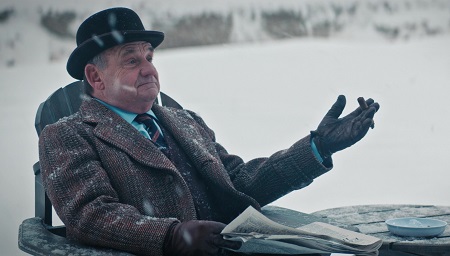
Carl – a.k.a. the Guardian of Forever.

The Red Angel suit may have been the last remaining piece of technology capable of time-travel – if we’re to believe the Federation’s claims that nobody violates the ban! But now that the Guardian of Forever has been rediscovered, the potential for travel through time is once again on the agenda. Whether Burnham explained exactly what happened to Saru, and if she did, whether he will explain it to Starfleet is not clear, but even if they’re the only ones who know about the Guardian, they may have need of its services.

When considering the story of Calypso, particularly how the USS Discovery came to be abandoned in a nebula, the big question is “why.” Why would Saru, Vance, or Burnham feel a need to take the ship back in time and hide it? There is no obvious reason right now, and with only three episodes to go if a major new problem were to emerge it could end up feeling rushed or like a deus ex machina.

Regardless, it’s at least possible that Discovery will travel back in time. And right now, one of the only ways that could happen would be to make use of the Guardian of Forever.

Number 2: The Emerald Chain will attempt to steal the USS Discovery and/or the Spore Drive.

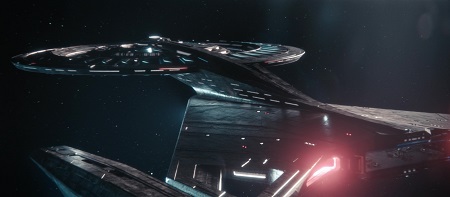
The USS Discovery.

Admiral Vance was incredibly worried about Book’s use of an Emerald Chain signal booster on board Discovery, fearing that the untested technology could cause problems. It seems this macguffin could be a “backdoor” into Discovery’s systems, or perhaps some kind of tracking device that could allow the Emerald Chain to find the ship – and its Spore Drive. Spoiler warning for anyone who missed the promo for episode 11, but it seems that at least one Emerald Chain ship will show up.

Additionally, in The Sanctuary Ryn confided in Tilly that the reason Osyraa – the Emerald Chain’s leader – is so keen to recover him is because he knows their biggest secret: the Emerald Chain is running out of dilithium. This will undoubtedly make the faction more aggressive as it looks to shore up its position, but now that they’ve seen Discovery able to jump to Kwejian, perhaps Osyraa and her people will begin to suspect that the ship has a powerful new method of propulsion.

Admiral Vance told Starfleet’s senior officers about the Spore Drive in Scavengers, and I picked up at least a hint that not everyone was happy about this disruption to the established hierarchy of Starfleet. Could someone within Starfleet – such as Lieutenant Willa – have passed along to the Emerald Chain details of the USS Discovery?

Number 3: The Emerald Chain will attack Federation HQ.

Discovery at Federation HQ.

Obviously this theory and the one above can’t both be true! But if the Emerald Chain is moving, Federation HQ seems a logical target. The Emerald Chain is planning “military exercises,” according to Starfleet. Both Starfleet and Book’s courier friends believe this is code for some kind of larger-scale military engagement.

Clearly the Emerald Chain story thread needs to be wrapped up somehow – by defeating them militarily or coming to a negotiated settlement – so perhaps this is the moment they make their move.

Right now it seems as though the Emerald Chain will go after Discovery, but it’s possible that’s a deliberate misdirect, or that they’re able to wield a large enough force to attack both targets at once.

Number 4: Admiral Vance is going to be killed.
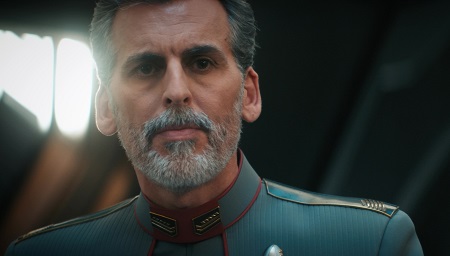
Admiral Vance.

If the Emerald Chain does make a significant move against Starfleet, I wonder if this could see Admiral Vance killed off. Though he returned (in holo-form) in Terra Firma, Part II, his line to Saru in Part I that he and Starfleet would “handle the Chain” in Discovery’s absence feels like something that could come back to haunt him. There was an air of finality to that scene.

We also know that Discovery looks set not to return to the fleet this week, pursuing its investigation of the Burn to the Verubin Nebula. If the Emerald Chain attacks in Discovery’s absence, Admiral Vance may not survive the fight. This could set up an interesting story – let’s look at that now!

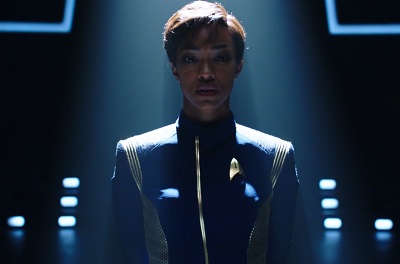
Number 4A: Saru will become an admiral, and Burnham will assume command of Discovery.

Burnham & Saru.

As Georgiou prepared to step into the Guardian of Forever’s portal, she told Burnham that Saru is “not the only one suited for the captain’s chair.” Though this is the opinion of one character within the story, it was also very deliberately shown to us as the audience. Perhaps it’s simply to mirror what Prime Georgiou said to Burnham in Season 1 about setting her up for her own command, but there could be more to it than that.

If Admiral Vance and/or other senior Starfleet commanders were killed, as I speculated could happen, perhaps Saru would be offered the opportunity to become an Admiral. His different approach to command that we’ve seen this season could benefit Starfleet, and even if Vance survives, he may ask Saru to join him at the head of Starfleet. Saru, as someone from a different era and as a Kelpien, brings a unique perspective that Starfleet Command would certainly benefit from if they move to begin rebuilding the Federation.

Saru’s promotion would leave yet another vacancy in the captain’s chair of Discovery. Tilly had been appointed acting first officer a few episodes ago, but there’s no way she could assume command of the ship on a permanent basis. Given that this is Star Trek: Discovery, and Burnham has such a prominent role in the series, she is the only candidate.

In my opinion, after Burnham’s awful character regression midway through the season, Discovery will have to work incredibly hard over these final three episodes to make such an appointment feel plausible. However, it can be done, and we’ve seen Burnham do a lot better over the last couple of weeks. Burnham assuming command always felt like a destination the series was trying to reach – could this be the moment it gets there?

Number 5: Dr Issa is a descendant of Saru’s sister Siranna.

Saru with the hologram of Dr Issa.

The revelation that a Kelpien ship was responsible for at least part of the Federation distress signal in the Verubin Nebula was interesting, and had a great effect on Captain Saru. It was the first he’d seen of his people since arriving in the 32nd Century. When Dr Issa – the Kelpien scientist who sent the distress signal – first appeared, I genuinely thought we were seeing Siranna, Saru’s sister who was introduced in the Short Treks episode The Brightest Star and who reappeared in Season 2 of Discovery last year.

The reason for this is that Siranna and Dr Issa are both portrayed by the same actress (Hannah Spear) and thus look very similar. It remains a (remote) possibility that the two characters could be one and the same – either through time-travel shenanigans or perhaps because post-vahar’ai Kelpiens are especially long-lived, but what I think is more likely is that a familial connection will be revealed – Dr Issa will be a distant relation to Saru through his sister.

The reason for this is primarily production-side: why bring back the same actress to portray a Kelpien, and have the characters look practically identical, if there isn’t meant to be a connection? From a story point of view it could give Saru a dilemma – saving the Kelpien ship versus aiding Starfleet, for example – or it could give him a deeper emotional connection to the stranded ship than he would otherwise have.

Number 6: A time-travelling (or parallel universe) USS Discovery is at the centre of the nebula – and may be responsible for the Burn.
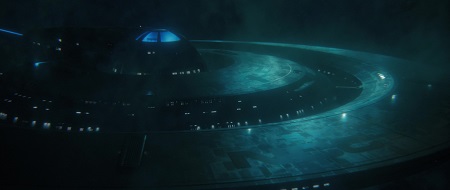
The USS Discovery was in an unnamed nebula in Calypso.

Should these next three theories about the Verubin Nebula that I posited a couple of weeks ago be considered debunked? After all, we have the revelation of the Kelpien ship being in the nebula to contend with now, and that could be the beginning of the end for the Burn mystery.

I’m not convinced, though, at least not yet, that there isn’t more going on in the Verubin Nebula. We don’t know anything about the nebula or what’s inside it, and the existence of a Kelpien ship doesn’t rule out the possible existence of the USS Discovery or any other vessel. We know, in fact, that a Starfleet ship was en route to the Verubin Nebula to assist Dr Issa, so there may be at least one more ship in there, and we don’t know the nature of the “dilithium nursery” the Kelpiens were investigating or what became of it.

In the Short Treks episode Calypso, the USS Discovery was found abandoned in an unnamed nebula by Craft. Craft was a soldier in a war against the V’draysh; an alternate name for the Federation in the 32nd Century. Zora, an AI present aboard the USS Discovery, told Craft the ship had been abandoned for almost a thousand years, and not only have we seen the potential creation of Zora earlier this season (from a merger of Discovery’s computer and the Sphere data) but in addition, Season 3 takes place 930 years in the future from Discovery’s original 23rd Century setting. If Discovery had been abandoned at that time, things begin to fall into place.

There are two possibilities for how it could be the USS Discovery – which, of course, has not been abandoned – in that nebula: the ship will be sent back in time, or it has crossed over from an alternate timeline or parallel universe.

Number 7: A familiar starship is at the centre of the nebula – and may be responsible for the Burn.

Is Star Trek: Picard’s La Sirena in the Verubin Nebula?

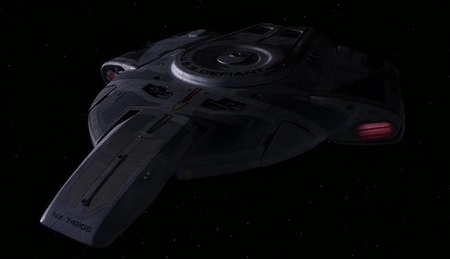
If not the USS Discovery, then who could it be at the centre of the Verubin Nebula? How about one of the hero ships from a past iteration of Star Trek? We could encounter the USS Defiant, the Enterprise-E, Riker’s USS Titan, or Star Trek: Picard’s La Sirena among many others. If such a vessel were caught in a temporal anomaly, that would explain their presence in the 32nd Century – and if time travel is involved, from their point of view the Burn may have only just happened, instead of happening 120 years ago.

It’s more likely, though, that any ship Saru and the crew find in the nebula would be deserted so long after the Burn – either abandoned by its crew or having become their tomb. If it is a familiar ship, we could thus see the ultimate end of a significant character (or multiple characters) from a past iteration of Star Trek.

The one exception to this could be La Sirena. This would be totally out of left-field for the Star Trek franchise, and keeping a lid on a secret this big would be difficult. But it would finally accomplish something I’ve been arguing for for a while: simplifying the Star Trek franchise. If La Sirena were discovered, along with Picard and his crew, Picard Season 2 could join Discovery in the 32nd Century. I don’t consider this likely, but it would be a fascinating way for the Star Trek franchise to go!

Number 8: The Red Angel suit is at the centre of the nebula – and may be responsible for the Burn.
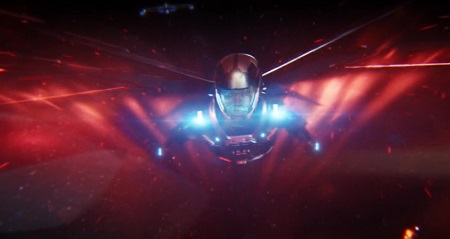
Burnham in the Red Angel suit at the end of Season 2.

Burnham’s Red Angel suit was last seen on Hima when she sent it back in time. She ordered the suit to self-destruct, but as we never saw the destruction on screen, what became of the suit after it sent the final Red Burst is unknown. Was it captured, intercepted, or damaged? Could someone have stolen it with a view to weaponising it? It’s at least a possibility.

The Red Angel suit was known to be incredibly powerful, and in an age where time travel has been outlawed, it may be one of the only ways to travel through time that still exists – making it a lucrative target for all sorts of factions.

If Discovery wants to present the Burn as an accident or disaster rather than a deliberate act, having the Red Angel suit malfunction could be one way of doing that. Rather than requiring a villain, the story of the season could instead see the crew unravelling a scientific puzzle, one which points to Discovery and her crew as the origin of the Burn, but in such a way that they themselves are blameless.

So it’s clear that all three of these Verubin Nebula theories can’t be true. And now that we’ve seen the Kelpien ship, it’s possible that none are true and there won’t be anything else to find if and when Discovery heads to the nebula. I’m not convinced of that yet; the Verubin Nebula and the Burn have been presented as complex puzzles, and I’m sure there will be more twists, turns, and revelations before we uncover the truth about what’s really going on.

Number 8A: The name “Burn” is derived from the name Burnham.

Burnham in Die Trying.

Connected to the theory above, if indeed the Red Angel suit is the source of the Burn, perhaps the name of the event is derived from the name of the wearer of the Red Angel suit – either Michael or Gabrielle Burnham.

The music within the signal emanating from the Verubin Nebula has – somehow – subconsciously embedded itself in people all across the galaxy. We didn’t hear everything Dr Issa had to say – her message was tantalisingly cut short as a result of decades of radiation and decay. If, somehow, Dr Issa was trying to contact Burnham, or was trying to report on her discovery of the Red Angel suit within the nebula, perhaps that could be how the names are related.

I speculated way back when I looked at possible Burn origins before the season premiered that it was, at the very least, an odd coincidence that in a show all about Michael Burnham there’s a disastrous event called “the Burn.” Could these two seemingly unconnected things actually be related?

I stand by what I said a few weeks ago: if it is somehow Burnham’s fault, calling the event “the Burn” sounds way better than calling it “the Ham!”

Number 9: Discovery Season 3 is taking place in an alternate timeline or parallel universe.

The two-part Voyager episode Year of Hell took place in an alternate timeline caused by time-travel meddling.

I’m tempted to retire this theory, especially after the Guardian of Forever referred to Burnham and Discovery as being in the “prime universe” this week. But even if this is the Prime timeline – the one which goes from Enterprise to Picard – it’s still possible that, with the involvement of time travel, this particular version of it has unfolded differently from the way it was supposed to.

If the Burn was caused – intentionally or accidentally – by time travel, surely from the point of view of the Federation, they would want to undo it to restore the “true” timeline. If that’s the case, most of the events of Discovery Season 3 could be wiped from existence – in the same way that the timelines in Yesterday’s Enterprise and Year of Hell were in past iterations of Star Trek.

Whether this would be a good way to go is up for debate. As a one-off story like those mentioned above, an alternate timeline can be fun to explore. But having seen Saru and the crew put in a huge amount of effort over the season so far to build bridges and begin to reunite the fractured Federation, undoing all of that and saying it never happened – or that no one besides Discovery’s crew will remember it – risks making these stories feel hollow and devoid of meaning.

I’m pretty much convinced that Discovery is in the Prime universe. Whether the alternate timeline stuff will pan out is still a possibility, though.

Number 10: The Burn was a superweapon – perhaps one the Federation or Section 31 built.
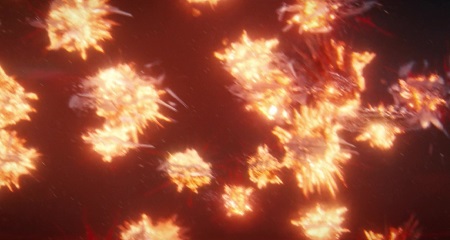
The Burn.

The discovery of a Kelpien science vessel at the centre of the Verubin Nebula is interesting, but it seems unlikely that such a craft would be carrying a superweapon – if one even existed! However, as discussed, Dr Issa’s craft may not be the only one within the nebula.

The Burn could be a superweapon – one developed by Starfleet or Section 31, perhaps designed to counter a galactic-scale threat like the Borg or the super-synths from Star Trek: Picard.

Both Admiral Vance and Kovich have stated that they don’t know what caused the Burn, and they don’t consider any of the many theories more or less likely than others. Kovich could be lying, but Admiral Vance certainly seemed genuine. However, given how long ago the Burn was, it’s possible the knowledge of what caused it has been lost or deliberately concealed, either by Starfleet, Section 31, or whichever faction was responsible.

It could also have been a revenge attack; some kind of galactic-scale mutually-assured destruction. If the Federation, Section 31, or some other organisation launched an attack against someone, the Burn may be that faction’s retaliation. That would explain the lack of an invader: they were already dead.

We’re edging closer to learning the true nature of the Burn. A superweapon remains on the table as one possibility – but the question it raises is this: were Starfleet and the Federation the target of the Burn, or its perpetrator?

Number 11: There will be a resolution to the story of Calypso (the Short Treks episode).
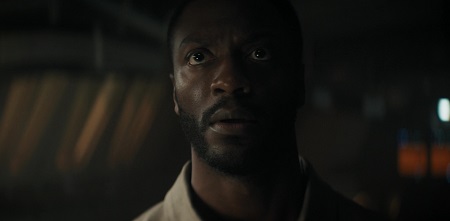
Craft, the protagonist of Calypso.

We got further confirmation last week that Zora – the AI encountered in Calypso – has been created. Kovich referred to it as “an AI,” and though unnamed right now, Zora herself became involved in the story. It was her intervention that sent Discovery to Dannus V in search of help for Georgiou – having pieced together the Guardian of Forever’s location from a combination of the Sphere data and 32nd Century Federation computer systems.

One thing that’s definitely interesting right now is that the USS Discovery as it appeared in Calypso no longer exists. The ship was retrofitted in Scavengers, and in addition to features like programmable matter interfaces and detachable nacelles, now sports the designation NCC 1031-A.

My theory is that, if indeed Discovery somehow travels backwards in time this season, the crew will very deliberately un-retrofit the ship first, removing any 32nd Century features to avoid polluting the timeline in case of accidental discovery. Discovery was in a nebula in Calypso – could that be the Verubin Nebula?

Calypso has been an outlier in Discovery’s story since it was broadcast in between Seasons 1 and 2. Having seen some elements from that episode cross over, all that remains is for the mystery at its core – Discovery being abandoned in a nebula – to be resolved. No small task, perhaps, but if this entire storyline from Calypso to Control to the time-wormhole to the Burn has been planned out properly, there’s no reason why we won’t see everything tied up by the end of the season.

Number 12: Tilly is going to go rogue.

Saru and Tilly in Far From Home.

One line which stuck with me from Unification III was when Tilly asked Saru if he chose her to be his first officer because he believed her to be “compliant.” He ducked the question, but it was at least hinted that he does indeed see her as someone who will do as she’s told. Having experienced the Burnham problem, perhaps that’s a knee-jerk reaction from Saru, and one which, if true, would make me question his judgement. But the line carried with it a potentially serious implication – Tilly may choose, at a certain moment, not to comply.

She may do so to assist Burnham in some way, and if Tilly were to disobey orders – as she stated she would in Scavengers when talking with Saru – I would assume it would be for this reason. But there may be something else that causes her to go rogue, following in Burnham’s footsteps. I can’t say exactly what it could be if not Burnham, but we’ve had two lines that can certainly be interpreted to say that Tilly may be less “compliant” than Saru hopes.

Over the few episodes since she accepted the role, we have seen Tilly begin to grow into it. This is undoubtedly a change to her character, but not necessarily a bad one. I still think, however, that there is scope for her to do something significant when faced with a difficult situation, even if that means going against orders.

Number 13: The Spore Drive will become Starfleet’s new method of faster-than-light propulsion.

Discovery makes a Spore Drive jump.

SB-19, whether it caused the Burn or not, was an imperfect way to travel when compared to the Spore Drive. At present, only Discovery is capable of using the mycelial network, but that could change. What the implications of that would be on races like the JahSepp, who are native to the mycelial network, is not clear, but assuming it would be safe to use the network to travel, Spore Drives may yet be installed on all of Starfleet’s ships.

At the moment Discovery relies on Stamets as navigator; without him, accessing the mycelial network is not possible. But if, as was hinted at in Forget Me Not, it’s possible to create a non-human navigator, a major obstacle to other vessels using the Spore Drive melts away.

This theory would allow the resolution to the Burn to keep the current timeline intact – there would be no need to go back in time and undo anything, nor would there be a deus ex machina of a sudden discovery of a huge cache of dilithium. Instead, Starfleet could get back on its feet using the Spore Drive – finally finding a proper use for Discovery’s most controversial piece of technology!

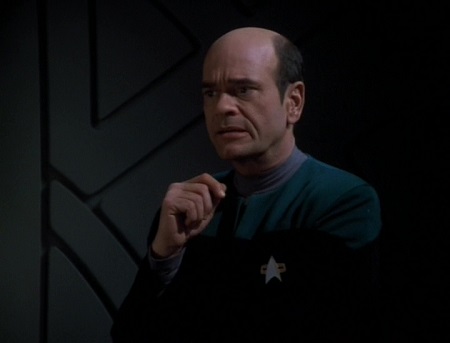
Number 14: A character from a past iteration of Star Trek – such as the Doctor from Star Trek: Voyager – will make an appearance.

The Doctor.

Technically this theory was proven in Terra Firma, as the Guardian of Forever returned from The Original Series! But the Guardian of Forever/Carl’s identity had its own entry on the theory list, so we can’t really call this one confirmed. Besides, there are still three episodes left for another character to appear!

Before Season 3 premiered I made the case for Voyager’s Doctor – or rather, a backup copy of him seen in the Season 4 episode Living Witness – being a prime candidate for inclusion. Aside from him, other characters I suggested included Soji (or a synth who looks like her), Lore, Captain Sisko, and Enterprise’s Crewman Daniels – the latter of whom was a 30th/31st Century temporal agent. Any of these could reasonably be alive in the 32nd Century, and characters who have long lifespans or are known to have spent time in the far future are perhaps more likely to appear.

If a starship from a past iteration of Star Trek is somehow within the Verubin Nebula, perhaps that could be how a crossover character is introduced. With time travel, temporal anomalies, and technobabble at their disposal, the writers could find an excuse to bring back practically anybody!

Having seen a tie-in with Picard via the appearance of the Qowat Milat, and the aforementioned Guardian of Forever return from The Original Series, it gives me hope that Discovery will find more ways to tie itself to the wider Star Trek franchise. A character crossover is a spectacular way of doing that, and as The Next Generation showed with episodes like Relics, the passage of centuries is no barrier to such a crossover in a sci-fi world. Until the credits roll on the season finale, I’ll keep advocating this theory!

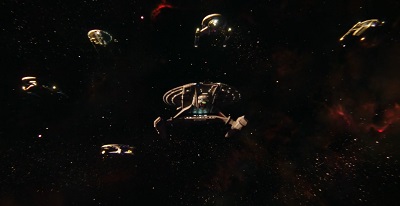
Number 15: The ships at Federation HQ represent the majority of Starfleet’s remaining vessels. And they’re all 120+ years old.

Discovery and a couple of other starships at Federation HQ.

How many ships were present as Discovery arrived at Federation HQ? Ten? Twelve? It wasn’t much more than that, that’s for sure. In a post-Burn environment, one where the Federation has shrunk considerably and where dilithium is in short supply, it’s possible that these ships are all that remain of the once-mighty Starfleet.

In That Hope Is You, Mr Sahil noted two Federation ships in flight, so perhaps we can say from his comment that there are at least two more! But I wouldn’t be surprised to learn that we’ve seen the bulk of Starfleet. Certainly the Federation seems incapable of either building any more ships nor fielding a large armada right now, which is perhaps one of the reasons why they need to keep their base cloaked.

Because of the catastrophic nature of the Burn, it also seems highly likely that shipbuilding facilities would have been damaged, destroyed, or would be inaccessible. That may mean that the Federation’s fleet entirely consists of ageing vessels, each one over 120 years old and probably not designed for being in service this long. In addition, without fuel what would be the point of expending a lot of resources building a new ship?

If the Emerald Chain really is on the warpath, the Federation may find itself outnumbered if these ships really do comprise the entire fleet.

Number 16: Burnham’s Red Angel suit has been stolen.
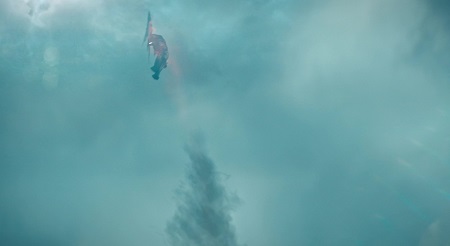
Burnham’s Red Angel suit – this was the last we saw of it.

As mentioned above, the Red Angel suit – and possibly Burnham or her mother – could be responsible for the Burn, and could be waiting for Discovery at the centre of the Verubin Nebula through parallel universe or time travel shenanigans!

This has been a theory I’ve been pushing since Burnham sent her Red Angel suit back into the wormhole in That Hope Is You right at the beginning of the season. I was struck by a line in Die Trying: Admiral Vance described the Red Angel suit as being “inaccessible.”

Burnham goes on to say she set the suit to self-destruct, but all this did for me is reinforce the fact that we didn’t see the suit’s destruction with our own eyes. The finale of Season 2 confirmed that Pike and Spock received the final red burst in the 23rd Century, but beyond that we simply do not know what became of the suit.

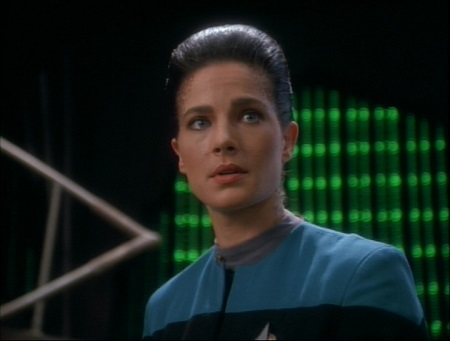
Number 17: The Dax symbiont is still alive.

Ezri Dax.

This one is looking increasingly unlikely, because the two locations where Dax could have appeared have both seemingly come and gone without them: most notably the Trill homeworld in Forget Me Not, but also Federation HQ in Die Trying. However, there are hints at a lifespan for Trill symbionts that may be exceptionally long, in which case Dax could very well still be alive in the 32nd Century.

Obviously we won’t see Ezri Dax (barring some bizarre time travel/stasis storyline) but the symbiont itself could have lived this long. When Adira “met” the Tal symbiont’s former hosts in Forget Me Not, one was wearing a Star Trek: Picard-era uniform, hinting that Tal may have lived 700+ years. There are production-side explanations for this Easter egg, and as stated the fact that two of the best opportunities so far to meet Dax have come and gone most likely means it won’t happen this season. But I’m sticking to my guns on this one: Dax is alive!

Number 18: The ban on time travel is being flouted – possibly by secretive elements within the Federation.

The USS Enterprise travelled back in time in The Original Series second season episode Assignment: Earth.

Admiral Vance clearly believes that the ban on time travel is intact and being followed. Kovich indicated that he does too – but I’m not sure how far I trust him. Is he an agent of Section 31?

Even if the ban had been obediently followed thus far, the arrival of Discovery – and more importantly, the Red Angel suit – could have changed that if someone were able to get their hands on it. We know from what Zareh said in Far From Home that Discovery’s arrival in the future did not go unnoticed, and that anyone with a decent sensor array would have been able to detect time travel. Could someone – possibly even someone within the Federation – have tracked down the Red Angel suit or entered the time-wormhole before it closed?

It’s impossible to un-invent a powerful, useful, weaponisable technology, no matter how hard you try. Considering how crappy the 32nd Century seems to be, are we convinced that nobody at all is using time travel to try to give themselves an advantage? Not the Dominion? Not the Borg? Not Section 31? Seems unlikely to me, though for production-side reasons of wanting to keep the timeline intact and to avoid overcomplicating the plot we might be told this is true!

The reappearance of the Guardian of Forever – although it remains a secret only Burnham knows for now – could mean that future time travel stories are on the agenda, even if this theory isn’t correct.

Number 19: Kovich is an agent of Section 31.
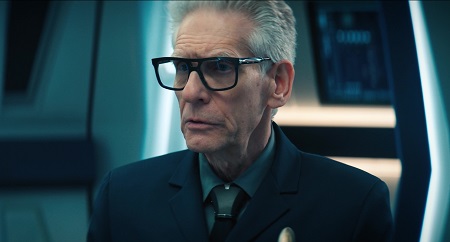
Kovich.

Who is Kovich? He doesn’t wear a normal Starfleet uniform, and doesn’t appear to hold a Starfleet rank. Yet he wears a Starfleet combadge and is clearly a high-ranking intelligence officer as he undertook Georgiou’s debriefing and has access to classified files that pertain to time travel and parallel universes.

It is at least possible – if not outright likely – that this mysterious character works for Section 31. Since we now know he hasn’t just disappeared and may well be coming back, perhaps we’ll learn more about him. We know he has an interest in the Mirror Universe and Terran society, expressing almost an admiration for Georgiou and her way of doing things.

Though his two appearances so far have both been connected to Georgiou, David Cronenberg has stated that Kovich may return in Season 4, and it’s possible we’ll see more of him before the end of this season too. It’s a shame we won’t get to see him and Georgiou have another conversation, because the way they talked around each other was truly fascinating. But there are many other ways Kovich could contribute to the story – or any future story. If, as speculated above, the Burn is somehow connected to Section 31, perhaps he could play a role in the way that mystery is resolved.

Number 20: We haven’t seen the last of Zareh.

Zareh.

Despite being quite content to kill all of Zareh’s goons, Saru balked at the idea of killing the man himself in Far From Home. Instead, he and Georgiou let him go, sending him out into the wilds of the Colony – despite being told by the locals that that’s a death sentence. However, we didn’t see Zareh die. And in stories like these, characters like Zareh tend to pop back up looking for revenge. His association with the Emerald Chain could bring him back into the story if they plan to make a move against Starfleet and/or the USS Discovery.

So that’s it. We’ve reduced the number of theories from last week ever so slightly! As we head into the final three episodes that was bound to happen, and with the Georgiou storyline now resolved, Discovery has three episodes remaining to either resolve the mystery of the Burn or set up a cliffhanger on that subject! Just because the first two seasons saw relatively self-contained stories that doesn’t necessarily mean the same will be true this time too, and if the Burn is as complex as has been suggested, perhaps three episodes – which also have to deal with the Emerald Chain – won’t be enough time to fully explore it. A season-ending cliffhanger is thus a real possibility!

Ever since we learned about the Verubin Nebula I’ve been itching for Saru and Discovery to get there. It looks like we’re finally about to see that happen, and I cannot wait! If you’re in the United States you’ll be able to see episode 11 in a matter of hours; those of us in the rest of the world have to wait a little longer!

Please remember that these theories are just a bit of fun. Some may seem plausible – or even highly likely – but that doesn’t mean that this is the way the story will unfold. I’m just a guy with a website, I’m not claiming to have any “insider information,” nor am I saying that the theories postulated above will come true. No fan theory is worth getting so invested in that the actual story becomes disappointing or upsetting. Personally, as much as I love feeling like I predicted something that later appeared on screen, I also truly love being surprised by Star Trek and other franchises. That doesn’t mean writers should make silly or arbitrary decisions purely for shock value, but it does mean that when a theory of mine falls flat on its face, far from getting upset I revel in that. If we could all remember to take fan theories with a healthy pinch of salt, maybe there’d be a little less toxicity in certain areas of the fandom.

Star Trek: Discovery is available to stream on CBS All Access in the United States, and on Netflix in the United Kingdom and elsewhere. The Star Trek franchise – including Discovery and all other properties mentioned above – is the copyright of ViacomCBS. This article contains the thoughts and opinions of one person only and is not intended to cause any offence.
Star Trek: Discovery theories – week 9

Spoiler Warning: There are spoilers ahead for Star Trek: Discovery Seasons 1-3, Star Trek: Picard, and for other iterations of the Star Trek franchise.

Terra Firma, Part I was a fascinating episode. Though there was minimal advancement of the main storyline of the season, there were several new and exciting hints about things to come from which we can construct new theories. Though a couple of theories we had going into the episode now seem unlikely, we’re also not at a point where we can really consider any debunked, and with no confirmations either, this week the theory list will grow longer!

Let’s jump straight into the list, then, beginning with new theories and those which saw movement in Terra Firma, Part I.

Number 1: Dr Issa is a descendant of Saru’s sister Siranna.

A hologram of Dr Issa.

The revelation that a Kelpien ship was responsible for at least part of the Federation distress signal in the Verubin Nebula was interesting, and had a great effect on Captain Saru. It was the first he’d seen of his people since arriving in the 32nd Century. When Dr Issa – the Kelpien scientist who sent the distress signal – first appeared, I genuinely thought we were seeing Siranna, Saru’s sister who was introduced in the Short Treks episode The Brightest Star and who reappeared in Season 2 of Discovery last year.

The reason for this is that Siranna and Dr Issa are both portrayed by the same actress (Hannah Spear) and thus look very similar. It remains a (remote) possibility that the two characters could be one and the same – either through time-travel shenanigans or perhaps because post-vahar’ai Kelpiens are especially long-lived, but what I think is more likely is that a familial connection will be revealed – Dr Issa will be a distant relation to Saru through his sister.

The reason for this is primarily production-side: why bring back the same actress to portray a Kelpien, and have the characters look practically identical, if there isn’t meant to be a connection? From a story point of view it could give Saru a dilemma – saving the Kelpien ship versus aiding Starfleet, for example – or it could give him a deeper emotional connection to the stranded ship than he would otherwise have.

Number 2: The Emerald Chain will attack Federation HQ.

The Emerald Chain’s leader Osyraa.

The Emerald Chain is planning “military exercises,” according to Starfleet. Both Starfleet and Book’s courier friends believe this is code for some kind of larger-scale military engagement, and surely the only target for an Emerald Chain attack would be Federation HQ. Why go to the trouble of telling us as the audience about the Emerald Chain’s movements otherwise?

When Saru shot down Book’s attempt to help, this felt all but confirmed. Though it’s possible that it’s a misdirect, I would question why such a thing would be included. Clearly the Emerald Chain story thread needs to be wrapped up somehow – by defeating them militarily or coming to a negotiated settlement – so perhaps this is the moment they make their move.

I’m not sure that Terra Firma, Part II will see a huge space battle; with Discovery away at Dannus V we may simply see the aftermath when they return. But the Emerald Chain is clearly on the warpath, and while there are other possible targets, Federation HQ seems the most likely to me at this juncture.

Number 3: The Emerald Chain will attempt to steal the USS Discovery and/or the Spore Drive.

The USS Discovery in Terra Firma, Part I.

I mentioned this last week as a continuation of a theory I had that Discovery’s Spore Drive is no longer a secret. If the Emerald Chain is moving, Starfleet HQ seems the most likely target – but there is another significant one, and that’s the USS Discovery itself.

In The Sanctuary, Ryn confided in Tilly that the reason Osyraa – the Emerald Chain’s leader – is so keen to recover him is because he knows their biggest secret: the Emerald Chain is running out of dilithium. This will undoubtedly make the faction more aggressive as it looks to shore up its position, but now that they’ve seen Discovery able to jump to Kwejian, perhaps Osyraa and her people will begin to suspect that the ship has a powerful new method of propulsion.

Admiral Vance told Starfleet’s senior officers about the Spore Drive in Scavengers, and I picked up at least a hint that not everyone was happy about this disruption to the established hierarchy of Starfleet. Could someone within Starfleet – such as Lieutenant Willa – have passed along to the Emerald Chain details of the USS Discovery?

Even if none of that happens, with Discovery jumping all over the galaxy – to Earth, Trill, Ni’Var, Federation HQ, Kwejian, Dannus V, and the location of the USS Tikhov – how long until the Emerald Chain notices? Obviously this theory and the one above can’t both be true, but I suspect the Emerald Chain has one of these targets in mind.

Number 4: Admiral Vance is going to be killed.

Admiral Vance in Unification III.

When Admiral Vance sanctioned Discovery’s mission to Dannus V, there was a strange air of finality to his scene with Saru, Burnham, and the others. Partly he was attempting to save Saru from making a mistake that he feels he himself made in the past, one which may have led to the death of someone under his command.

The Emerald Chain is clearly planning some kind of attack on Starfleet – Vance and Book appear to have all but confirmed this, as we already looked at. While the addition of a single extra ship may not have a huge impact, Discovery has the Spore Drive which could be a decisive advantage in battle – as we saw in Season 1.

Vance clearly knew that sending Discovery away was a risk, and I feel his line to Saru that Starfleet will “handle the Chain” without them will come back to bite him. It was set up that way, using a trope that’s familiar in action stories. One character will say to another, “don’t worry, we can handle this situation without you” only for that character to be killed when it turns out they can’t, in fact, handle it. That’s what this scene with Admiral Vance felt like, and I’m worried that he may not live to see the end of Terra Firma, Part II.

Number 5: Mirror Georgiou will inadvertently change the future.

Georgiou chose not to execute Mirror Burnham.

I don’t believe that Georgiou has literally travelled back in time and back to the Mirror Universe. We’ll look at some other options in a moment, but suffice to say what’s happening to her on the other side of Carl’s mysterious door may not be all that it seems.

However, if I’m wrong about that, Georgiou has already begun to change the timeline. She killed Mirror Stamets – who was still alive when Discovery entered the Mirror Universe – and refused to execute Mirror Burnham, despite the events surrounding her betrayal and execution being confused somewhat compared to the established story from Discovery Season 1. If Georgiou is literally back in her original timeline, these changes could radically alter the future.

For example, if Georgiou was able to maintain her grip on power by defeating Lorca more easily, and didn’t end up aboard the Prime USS Discovery, all sorts of things would be different in the Prime Universe from the end of Season 1 onwards. The Klingon War would have ended very differently – or may not have ended at all. Captain Leland and his mission to track down Spock would have gone differently. The Control AI may have been more easily able to acquire the Sphere data. And many other moments where Georgiou intervened would have panned out completely differently.

How all of this will be resolved is anyone’s guess right now. Time travel stories are difficult because of the presence of paradoxes, alternate realities, and so forth. They can become complicated and convoluted very easily, so I hope the writers have a solid exit plan for Georgiou!

Number 6: Mirror Georgiou will travel back in time… but she hasn’t yet.

Mirror Georgiou.

For weeks I’ve maintained that Georgiou will travel back in time. But as mentioned, I’m not convinced that what we saw in Terra Firma, Part I actually represents full-blown time travel. If Georgiou hasn’t travelled back in time, though, she may yet do so.

Whatever’s happening to Georgiou may trigger something inside her – a desire to return home. Having experienced a different outcome to certain events, she may wish to return to the Mirror Universe to set things “right” from her perspective.

Alternatively, she may need to travel back in time for some other reason. This could line up with Calypso, the Short Treks episode which saw an abandoned USS Discovery hidden away in a nebula. Georgiou could take the ship back in time – perhaps to hide it from the Emerald Chain, to alert Starfleet to the impending Burn, or for some other reason – then leave it in the nebula for the crew to pick up 930 years later.

Georgiou may even remain in the past – and as we know, the upcoming Section 31 series is supposedly taking place in the 23rd Century.

Number 7: Mirror Georgiou did not travel back in time or to the Mirror Universe.

Where does the door lead?

Whatever’s happening to Georgiou on Dannus V is supposed to cure her of her technobabble ailment. Her condition was caused by travelling from one parallel universe to another and also travelling forwards in time, causing her cells to break down somehow. The mechanics of what’s happening to her and why are a little vague, but there’s enough to work with to say that simply travelling briefly to her own time and universe doesn’t seem like a cure.

Instead, Georgiou may be in a pocket universe (as seen in Star Trek episodes like Remember Me), or the events we’re seeing unfold may be taking place inside her head. It could be a simulation, a holodeck programme, or it could be connected to the mysterious Carl – he could be giving her a vision, like those Captain Sisko received from the Prophets.

We’ll come to Carl in a moment, but to stick with Georgiou’s storyline, one circle that needs to be squared is why the events she’s seeing don’t line up with Season 1 of Discovery. To me, that’s the biggest indication that Georgiou has not travelled back in time and across to the Mirror Universe. As I wrote in my review of Terra Firma, Part I, even though Discovery has taken a somewhat loose approach to the broader Star Trek canon, it has always remained internally consistent. Georgiou’s supposed execution of Mirror Burnham days or weeks before the events of Season 1 would undo that, as would the killing of Mirror Stamets. I sincerely hope that we’re not going to be told that Georgiou is seeing things exactly as they happened, because that would open up a plot hole in the overall story of Discovery.

Number 8: Mirror Georgiou has been tampered with by Starfleet and/or Section 31.

Georgiou was interrogated by Kovich in Die Trying.

Despite what Kovich had to say this week regarding Georgiou’s condition, I’m not 100% convinced that he and his organisation didn’t have something to do with it. Even if they didn’t inflict this ailment upon her, perhaps he and Section 31 accelerated its progress or deliberately worsened it.

Kovich claims to have known that Georgiou would suffer this fate, yet chose to say nothing. That shows us he’s the kind of person who is quite happy to be dishonest – in this case, a lie of omission – and is thus less than fully trustworthy.

His uniform, mannerisms, and the way in which he stands apart from other Starfleet characters suggest he could be affiliated with Section 31, but at present that is unconfirmed. However, if he is with Section 31, that could explain the lack of morals required to either cause or worsen Georgiou’s condition.

The timing of Georgiou’s condition is suspect. She was fine after arriving in the future right up until she met Kovich. In fact the first indication we had that something could be awry was right after she returned to Discovery following her meeting with him, so in that sense there’s still a possible connection.

This could even be some kind of planned mission on Kovich’s part – causing Georgiou to suffer in order to track down Carl and the mysterious door on Dannus V.

Number 9: Carl is a “Guardian of Forever” type of character.

The mysterious Carl.

Who is Carl? And what’s going on with his mysterious door? Those are two of the biggest questions Terra Firma, Part I brought up. When I first saw Carl and the doorway, one thing I really appreciated was the oddness of the situation. Carl and his door felt like something that Kirk, Spock, and McCoy could have encountered in The Original Series, and feels like a mid-century sci-fi concept when compared with things like the Emerald Chain and the Burn, both of which seem like simple enough puzzles to find a technological solution to.

Carl, in contrast, feels kind of like the Guardian of Forever from the iconic episode The City on the Edge of Forever. His door is unexplained yet clearly very powerful – much in the same way as the Guardian of Forever’s portal was in The Original Series. Whatever Carl is, he represents an entity capable of wielding extreme power – or at least, power beyond what the 32nd Century Federation is able to detect.

Perhaps Carl is a Q; we have recently seen the Q referenced in Star Trek: Lower Decks, so the franchise isn’t trying to ignore the Q Continuum. In a way, I would be happy if Carl and the door weren’t over-explained. Leaving behind some elements of mystery that future stories could perhaps pick up would be one way to go.

Number 10: A time-travelling (or parallel universe) USS Discovery is at the centre of the nebula – and may be responsible for the Burn.

The USS Discovery in a nebula.

Should these next three theories about the Verubin Nebula that I posited last week be considered debunked? After all, we have the revelation of the Kelpien ship being in the nebula to contend with now, and that could be the beginning of the end for the Burn mystery.

I’m not convinced, though, at least not yet, that there isn’t more going on in the Verubin Nebula. We don’t know anything about the nebula or what’s inside it, and the existence of a Kelpien ship doesn’t rule out the possible existence of the USS Discovery or any other vessel. We know, in fact, that a Starfleet ship was en route to the Verubin Nebula to assist Dr Issa, so there may be at least one more ship in there, and we don’t know the nature of the “dilithium nursery” the Kelpiens were investigating or what became of it.

In the Short Treks episode Calypso, the USS Discovery was found abandoned in an unnamed nebula by Craft. Craft was a soldier in a war against the V’draysh; an alternate name for the Federation in the 32nd Century. Zora, an AI present aboard the USS Discovery, told Craft the ship had been abandoned for almost a thousand years, and not only have we seen the potential creation of Zora earlier this season (from a merger of Discovery’s computer and the Sphere data) but in addition, Season 3 takes place 930 years in the future from Discovery’s original 23rd Century setting. If Discovery had been abandoned at that time, things begin to fall into place.

There are two possibilities for how it could be the USS Discovery – which, of course, has not been abandoned – in that nebula: the ship will be sent back in time, or it has crossed over from an alternate timeline or parallel universe – it could have even crossed over from the prime timeline if Season 3 is itself taking place in an alternate reality!

Number 11: A familiar starship is at the centre of the nebula – and may be responsible for the Burn.

Could the USS Defiant be trapped in the nebula?

If not the USS Discovery, then who could it be at the centre of the Verubin Nebula? How about one of the hero ships from a past iteration of Star Trek? We could encounter the USS Defiant, the Enterprise-E, Riker’s USS Titan, or Star Trek: Picard’s La Sirena among many others. If such a vessel were caught in a temporal anomaly, that would explain their presence in the 32nd Century – and if time travel is involved, from their point of view the Burn may have only just happened, instead of happening 120 years ago.

It’s more likely, though, that any ship Saru and the crew find in the nebula would be deserted so long after the Burn – either abandoned by its crew or having become their tomb. If it is a familiar ship, we could thus see the ultimate end of a significant character (or multiple characters) from a past iteration of Star Trek.

The one exception to this could be La Sirena. This would be totally out of left-field for the Star Trek franchise, and keeping a lid on a secret this big would be difficult. But it would finally accomplish something I’ve been arguing for for a while: simplifying the Star Trek franchise. If La Sirena were discovered, along with Picard and his crew, Picard Season 2 could join Discovery in the 32nd Century. I don’t consider this likely, but it would be a fascinating way for the Star Trek franchise to go!

Number 12: The Red Angel suit is at the centre of the nebula – and may be responsible for the Burn.

Burnham in the Red Angel suit at the end of Season 2.

Burnham’s Red Angel suit was last seen on Hima when she sent it back in time. She ordered the suit to self-destruct, but as we never saw the destruction on screen, what became of the suit after it sent the final Red Burst is unknown. Was it captured, intercepted, or damaged? Could someone have stolen it with a view to weaponising it? It’s at least a possibility.

The Red Angel suit was known to be incredibly powerful, and in an age where time travel has been outlawed, it may be one of the only ways to travel through time that still exists – making it a lucrative target for all sorts of factions.

If Discovery wants to present the Burn as an accident or disaster rather than a deliberate act, having the Red Angel suit malfunction could be one way of doing that. Rather than requiring a villain, the story of the season could instead see the crew unravelling a scientific puzzle, one which points to Discovery and her crew as the origin of the Burn, but in such a way that they themselves are blameless.

So it’s clear that all three of these Verubin Nebula theories can’t be true. And now that we’ve seen the Kelpien ship, it’s possible that none are true and there won’t be anything else to find if and when Discovery heads to the nebula. I’m not convinced of that yet; the Verubin Nebula and the Burn have been presented as complex puzzles, and I’m sure there will be more twists, turns, and revelations before we uncover the truth about what’s really going on.

Number 12A: The name “Burn” is derived from the name Burnham.

Mirror Burnham.

Connected to the theory above, if indeed the Red Angel suit is the source of the Burn, perhaps the name of the event is derived from the name of the wearer of the Red Angel suit – either Michael or Gabrielle Burnham.

The music within the signal emanating from the Verubin Nebula has – somehow – subconsciously embedded itself in people all across the galaxy. We didn’t hear everything Dr Issa had to say – her message was tantalisingly cut short as a result of decades of radiation and decay. If, somehow, Dr Issa was trying to contact Burnham, or was trying to report on her discovery of the Red Angel suit within the nebula, perhaps that could be how the names are related.

I speculated way back when I looked at possible Burn origins before the season premiered that it was, at the very least, an odd coincidence that in a show all about Michael Burnham there’s a disastrous event called “the Burn.” Could these two seemingly unconnected things actually be related?

I stand by what I said a few weeks ago: if it is somehow Burnham’s fault, calling the event “the Burn” sounds way better than calling it “the Ham!”

Number 13: Discovery Season 3 is taking place in an alternate timeline or parallel universe.

Crewman Daniels in the “time stream” in Star Trek: Enterprise.

Two key pieces of evidence which had seemed to point to this theory have since fallen away: the absence of Dr Gabrielle Burnham and the lack of explanation for the mysterious music. However, it could still pan out… somehow.

Burnham mentioned during her debrief that unexplained “gravitational waves” in the time-wormhole pushed her and Discovery off-course, which is why they didn’t arrive at the planet Terralysium. The acknowledgement of problems within the time-wormhole may indicate that they crossed over into a different universe or reality.

The second half of this theory is that the Burn happened due to the interference of a time traveller or time travelling faction. From Starfleet’s point of view, the timeline in which the Burn occurred is not the “true” timeline, and thus part of the resolution to the Burn may be travelling through time to undo it.

How does the existence of Carl and his mysterious door play into the narrative? Could he be indicative of being in a different reality?

Number 14: The Burn was a superweapon – perhaps one the Federation or Section 31 built.

The Burn.

The discovery of a Kelpien science vessel at the centre of the Verubin Nebula is interesting, but it seems unlikely that such a craft would be carrying a superweapon – if one even existed! However, as discussed, Dr Issa’s craft may not be the only one within the nebula.

The Burn could be a superweapon – one developed by Starfleet or Section 31, perhaps designed to counter a galactic-scale threat like the Borg or the super-synths from Star Trek: Picard.

Both Admiral Vance and Kovich have stated that they don’t know what caused the Burn, and they don’t consider any of the many theories more or less likely than others. Kovich could be lying, but Admiral Vance certainly seemed genuine. However, given how long ago the Burn was, it’s possible the knowledge of what caused it has been lost or deliberately concealed, either by Starfleet, Section 31, or whichever faction was responsible.

It could also have been a revenge attack; some kind of galactic-scale mutually-assured destruction. If the Federation, Section 31, or some other organisation launched an attack against someone, the Burn may be that faction’s retaliation. That would explain the lack of an invader: they were already dead.

We’re edging closer to learning the true nature of the Burn. A superweapon remains on the table as one possibility – but the question it raises is this: were Starfleet and the Federation the target of the Burn, or its perpetrator?

Number 15:There will be a resolution to the story of Calypso (the Short Treks episode).

Craft, the protagonist of Calypso.

We got further confirmation this week that Zora – the AI encountered in Calypso – has been created. Kovich referred to it as “an AI,” and though unnamed right now, Zora herself became involved in the story. It was her intervention that sent Discovery to Dannus V in search of help for Georgiou – perhaps because the Sphere had travelled there or knew about Carl.

One thing that’s definitely interesting right now is that the USS Discovery as it appeared in Calypso no longer exists. The ship was retrofitted in Scavengers, and in addition to features like programmable matter interfaces and detachable nacelles, now sports the designation NCC 1031-A.

My theory is that, if indeed Discovery somehow travels backwards in time this season, the crew will very deliberately un-retrofit the ship first, removing any 32nd Century features to avoid polluting the timeline in case of accidental discovery. Discovery was in a nebula in Calypso – could that be the Verubin Nebula?

Calypso has been an outlier in Discovery’s story since it was broadcast in between Seasons 1 and 2. Having seen some elements from that episode cross over, all that remains is for the mystery at its core – Discovery being abandoned in a nebula – to be resolved. No small task, perhaps, but if this entire storyline from Calypso to Control to the time-wormhole to the Burn has been planned out properly, there’s no reason why we won’t see everything tied up by the end of the season.

Number 16: Tilly is going to go rogue.

Tilly in Unification III.

One line which stuck with me from Unification III was when Tilly asked Saru if he chose her to be his first officer because he believed her to be “compliant.” He ducked the question, but it was at least hinted that he does indeed see her as someone who will do as she’s told. Having experienced the Burnham problem, perhaps that’s a knee-jerk reaction from Saru, and one which, if true, would make me question his judgement. But the line carried with it a potentially serious implication – Tilly may choose, at a certain moment, not to comply.

She may do so to assist Burnham in some way, and if Tilly were to disobey orders – as she stated she would in Scavengers when talking with Saru – I would assume it would be for this reason. But there may be something else that causes her to go rogue, following in Burnham’s footsteps. I can’t say exactly what it could be if not Burnham, but we’ve had two lines that can certainly be interpreted to say that Tilly may be less “compliant” than Saru hopes.

Over the couple of episodes since she accepted the role, we have seen Tilly begin to grow into it. This is undoubtedly a change to her character, but not necessarily a bad one. I still think, however, that there is scope for her to do something significant when faced with a difficult situation, even if that means going against orders.

Number 17: The Spore Drive will become Starfleet’s new method of faster-than-light propulsion.

Discovery makes a Spore Drive jump.

SB-19, whether it caused the Burn or not, was an imperfect way to travel when compared to the Spore Drive. At present, only Discovery is capable of using the mycelial network, but that could change. What the implications of that would be on races like the JahSepp, who are native to the mycelial network, is not clear, but assuming it would be safe to use the network to travel, Spore Drives may yet be installed on all of Starfleet’s ships.

At the moment Discovery relies on Stamets as navigator; without him, accessing the mycelial network is not possible. But if, as was hinted at in Forget Me Not, it’s possible to create a non-human navigator, a major obstacle to other vessels using the Spore Drive melts away.

This theory would allow the resolution to the Burn to keep the current timeline intact – there would be no need to go back in time and undo anything, nor would there be a deus ex machina of a sudden discovery of a huge cache of dilithium. Instead, Starfleet could get back on its feet using the Spore Drive – finally finding a proper use for Discovery’s most controversial piece of technology!

Number 18: A character from a past iteration of Star Trek – such as the Doctor from Star Trek: Voyager – will make an appearance.

The Doctor.

Before Season 3 premiered I made the case for Voyager’s Doctor – or rather, a backup copy of him seen in the Season 4 episode Living Witness – being a prime candidate for inclusion. Aside from him, other characters I suggested included Soji (or a synth who looks like her), Lore, Captain Sisko, and Enterprise’s Crewman Daniels – the latter of whom was a 30th/31st Century temporal agent. Any of these could reasonably be alive in the 32nd Century, and characters who have long lifespans or are known to have spent time in the far future are perhaps more likely to appear.

If a starship from a past iteration of Star Trek is somehow within the Verubin Nebula, perhaps that could be how a crossover character is introduced. With time travel, temporal anomalies, and technobabble at their disposal, the writers could find an excuse to bring back practically anybody!

Having seen a tie-in with Picard via the appearance of the Qowat Milat, it gives me hope that Discovery will find more ways to tie itself to the wider Star Trek franchise. A character crossover is a spectacular way of doing that, and as The Next Generation showed with episodes like Relics, the passage of centuries is no barrier to such a crossover in a sci-fi world. Until the credits roll on the season finale, I’ll keep advocating this theory!

Number 19: The ships at Federation HQ represent the majority of Starfleet’s remaining vessels. And they’re all 120+ years old.

Discovery with a few other Starfleet vessels at Federation HQ.

How many ships were present as Discovery arrived at Federation HQ? Ten? Twelve? It wasn’t much more than that, that’s for sure. In a post-Burn environment, one where the Federation has shrunk considerably and where dilithium is in short supply, it’s possible that these ships are all that remain of the once-mighty Starfleet.

In That Hope Is You, Mr Sahil noted two Federation ships in flight, so perhaps we can say from his comment that there are at least two more! But I wouldn’t be surprised to learn that we’ve seen the bulk of Starfleet. Certainly the Federation seems incapable of either building any more ships nor fielding a large armada right now, which is perhaps one of the reasons why they need to keep their base cloaked.

Because of the catastrophic nature of the Burn, it also seems highly likely that shipbuilding facilities would have been damaged, destroyed, or would be inaccessible. That may mean that the Federation’s fleet entirely consists of ageing vessels, each one over 120 years old and probably not designed for being in service this long. In addition, without fuel what would be the point of expending a lot of resources building a new ship?

Number 20: Burnham’s Red Angel suit has been stolen.

Dr Gabrielle Burnham’s Red Angel suit.

As mentioned above, the Red Angel suit – and possibly Burnham or her mother – could be responsible for the Burn, and could be waiting for Discovery at the centre of the Verubin Nebula through parallel universe or time travel shenanigans!

This has been a theory I’ve been pushing since Burnham sent her Red Angel suit back into the wormhole in That Hope Is You right at the beginning of the season. I was struck by a line in Die Trying: Admiral Vance described the Red Angel suit as being “inaccessible.”

Burnham goes on to say she set the suit to self-destruct, but all this did for me is reinforce the fact that we didn’t see the suit’s destruction with our own eyes. The finale of Season 2 confirmed that Pike and Spock received the final red burst in the 23rd Century, but beyond that we simply do not know what became of the suit.

Number 21: The Dax symbiont is still alive.

Jadzia Dax in Star Trek: Deep Space Nine.

This one is looking less likely, because the two locations where Dax could have appeared have both seemingly come and gone without them: most notably the Trill homeworld in Forget Me Not, but also Federation HQ in Die Trying. However, there are hints at a lifespan for Trill symbionts that may be exceptionally long, in which case Dax could very well still be alive in the 32nd Century.

Obviously we won’t see Ezri Dax (barring some bizarre time travel/stasis storyline) but the symbiont itself could have lived this long. When Adira “met” the Tal symbiont’s former hosts in Forget Me Not, one was wearing a Star Trek: Picard-era uniform, hinting that Tal may have lived 700+ years. There are production-side explanations for this Easter egg, and as stated the fact that two of the best opportunities so far to meet Dax have come and gone may mean it won’t happen this season. But I’m sticking to my guns on this one: Dax is alive!

Number 22: The ban on time travel is being flouted – possibly by secretive elements within the Federation.

Kirk takes a commandeered Klingon Bird-of-Prey back in time in Star Trek IV: The Voyage Home.

Admiral Vance clearly believes that the ban on time travel is intact and being followed. Kovich indicated that he does too – but I’m not sure how far I trust him. Is he an agent of Section 31?

Even if the ban had been obediently followed thus far, the arrival of Discovery – and more importantly, the Red Angel suit – could have changed that if someone were able to get their hands on it. We know from what Zareh said in Far From Home that Discovery’s arrival in the future did not go unnoticed, and that anyone with a decent sensor array would have been able to detect time travel. Could someone – possibly even someone within the Federation – have tracked down the Red Angel suit or entered the time-wormhole before it closed?

It’s impossible to un-invent a powerful, useful, weaponisable technology, no matter how hard you try. Considering how crappy the 32nd Century seems to be, are we convinced that nobody at all is using time travel to try to give themselves an advantage? Not the Dominion? Not the Borg? Not Section 31? Seems unlikely to me, though for production-side reasons of wanting to keep the timeline intact and to avoid overcomplicating the plot we might be told this is true!

Number 23: Kovich is an agent of Section 31.

Kovich returned in Terra Firma, Part I.

Kovich was a character I wasn’t expecting to see return. Though I’d speculated since his first appearance in Die Trying that he could be a Section 31 operative, his status as a character who seemed unlikely to reappear meant I hadn’t spun out the theory fully. However, now we know that Kovich is back – and may even be returning for Season 4 according to David Cronenberg, the famed director who plays the character.

So the question is this: who is Kovich? He doesn’t wear a normal Starfleet uniform, and doesn’t appear to hold a Starfleet rank. Yet he wears a Starfleet combadge and is clearly a high-ranking intelligence officer as he undertook Georgiou’s debriefing and has access to classified files that pertain to time travel and parallel universes.

It is at least possible – if not outright likely – that this mysterious character works for Section 31. Since we now know he hasn’t just disappeared and may well be coming back, perhaps we’ll learn more about him. We know he has an interest in the Mirror Universe and Terran society, expressing almost an admiration for Georgiou and her way of doing things. Depending on what happens with her after she crossed through Carl’s doorway on Dannus V, she may want to talk to Kovich again. We may learn that he and Section 31 either triggered or worsened her condition, as discussed above.

Number 24: We haven’t seen the last of Zareh.

Zareh in Far From Home.

Despite being quite content to kill all of Zareh’s goons, Saru balked at the idea of killing the man himself in Far From Home. Instead, he and Georgiou let him go, sending him out into the wilds of the Colony – despite being told by the locals that that’s a death sentence. However, we didn’t see Zareh die. And in stories like these, characters like Zareh tend to pop back up looking for revenge. His association with the Emerald Chain could bring him back into the story if they plan to make a move against Starfleet and/or the USS Discovery.

So that’s it. There are twenty-four theories in play as we head into Terra Firma, Part II later this week. The first half of this two-parter brought some genuinely interesting moments for Georgiou in particular, and there are many different ways the story could unfold from here.

There is clearly some kind of connection between the Federation and the Burn, but in what way and how the Kelpiens connect to that is still not known. Also up in the air is the storyline from Calypso; will we see Discovery abandoned in a nebula by the end of the season? And if so, who will abandon it and for what purpose? There are a lot of mysteries still to unpick as Discovery enters the final four episodes of Season 3.

One final note: no fan theory, no matter how plausible it may seem, is worth getting upset or disappointed over. I put these lists together for fun, and as an excuse to spend more time in the Star Trek galaxy, and that’s all. If something goes completely the opposite way I was expecting, far from being annoyed or upset I revel in that. That doesn’t mean writers should make arbitrary and silly decisions, but it means I like being surprised! If we could all remember to take fan theories with a healthy pinch of salt, there’d be less conflict in fan communities.

Star Trek: Discovery is available to stream on CBS All Access in the United States, and on Netflix in the United Kingdom and elsewhere. The Star Trek franchise – including Discovery and all other properties mentioned above – is the copyright of ViacomCBS. This article contains the thoughts and opinions of one person only and is not intended to cause any offence.

Star Trek: Discovery re-watch – The Vulcan Hello/Battle at the Binary Stars

Spoiler Warning: There are spoilers ahead for Star Trek: Discovery Season 1, as well as for other iterations of the Star Trek franchise, including Star Trek: Picard.

There aren’t many episodes of Star Trek that I’ve only seen once. As a big fan of the franchise, I love going back and watching my favourite stories over and over again. Even though there are many episodes and films I haven’t seen in years, I’ve almost certainly seen them all twice – or much more than twice, in many cases. But Star Trek: Discovery’s opening two-parter was poor, and as a result I haven’t been interested in revisiting it in the three years since it was first broadcast. Until now, that is!

Star Trek series have typically not started particularly strongly, or at least their premieres would go on to be surpassed by later stories. Deep Space Nine’s Emissary and Star Trek: Picard’s Remembrance buck that particular trend – as I noted when I reviewed the latter episode in January. While other premieres for Star Trek series – Where No Man Has Gone Before, Encounter at Farpoint, Caretaker, and Broken Bow – were all episodes I’d personally consider average compared to the rest of their respective shows, and are all stories that I’m content to revisit, Discovery’s premiere was out-and-out bad. I’d been absolutely thrilled to hear of Star Trek’s return to the small screen after a twelve-year hiatus, and while I wouldn’t say I was distraught by The Vulcan Hello and Battle at the Binary Stars, I was certainly underwhelmed.

Star Trek: Picard’s premiere, Remembrance, was a much better opening episode.

We’ll get into specifics later, but my main feeling after my first viewing was that Michael Burnham was just an incredibly unlikeable protagonist, and someone whose motivations I couldn’t understand. After finishing the first part and before hitting “play” on the second (the episodes were released simultaneously, at least here in the UK) I honestly thought that the producers might have been trying to pull off a genuinely unexpected twist by making Burnham – who had been the main focus of the show’s marketing in 2017 – an antagonist. It wasn’t the case, of course, and over the remainder of a somewhat rocky first season, she did grow on me.

Aside from wanting to spend some more time in the Star Trek universe, and revisit Discovery before its third season debuts later this year, I wanted to re-watch these two episodes to see if my opinion has changed now that we’ve had two full seasons to get to know Burnham and the crew. Will revisiting the story having seen Burnham’s character development across Seasons 1 and 2 make the experience better – or even any different?

The opening sequences of The Vulcan Hello look at the Klingons, who are rallying around a leadership figure, and Captain Georgiou and Burnham on the surface of a desert planet. It’s worth talking about the Klingon redesign, because a lot of fans weren’t happy with the aesthetic chosen for the Discovery-era Klingons. Out of all of the races in Star Trek, none have been so thoroughly explored over the franchise’s history as the Klingons. Worf was a main character for all of The Next Generation, four films, and the back half of Deep Space Nine, and B’Elanna Torres was a main character for all of Voyager’s run. These two characters in particular taught us a lot about Klingon culture in the 24th Century. Deep Space Nine brought the Klingons into the show in a huge way, exploring various aspects of their culture. Aside from Worf and B’Elanna, there was General Martok, who was a recurring character in Deep Space Nine, as well as General Chang, Chancellor Gowron, the Duras family, and many other secondary characters who all added to our understanding of the Klingons. Enterprise even told a three-part story to explain the reason why Klingons look different in different eras. While that story in particular was not my favourite, it’s fair to say that we’ve spent a lot of time with the Klingons before Discovery’s debut, and for many fans the changes were extreme to say the least.

The redesigned aesthetic of the Klingons did not go over well with everyone.

The redesign is mostly an aesthetic thing, swapping the long hair and familiar prosthetics of 1990s Star Trek for an appearance closer to the Klingons of the Kelvin-timeline films. There was also a lot of what I considered to be an ancient Egyptian influence in the Klingons – particularly their costumes and architecture. Combined with speaking in the Klingon language as opposed to English, the Klingons of Discovery’s premiere have a much more “alien” feel than their earlier counterparts.

It’s an issue I’m split on, personally. While I liked the ancient Egyptian influence, and I can even excuse the baldness as hair styles and fashion varies wildly from era to era in our own history, the prosthetic makeup used for the Klingons’ heads and faces felt a long way removed from what had been established not only in the 24th Century but, thanks to Enterprise, the 22nd Century too. It is of course true that this isn’t the first Klingon redesign – that came in The Motion Picture when Klingons were changed from basically looking like dark-skinned humans to the familiar ridged-forehead appearance, but that was a change to overcome the limitations of The Original Series’ 1960s makeup – and lower budget. Messing too much with the established canon of any fictional world can be a problem, and while many elements of the new design were great, the faces were definitely a weak spot.

Burnham and Georgiou’s mission to the desert planet was jam-packed with exposition, and several of these lines felt rather clumsy. It can be difficult to establish to the audience who characters are and what their relationships are quickly, but Discovery took a sequence that lasted almost five full minutes, and there was scope in that time to set up the relationship between these two characters (one of whom isn’t going to survive the premiere anyway) in a way that felt more natural. Skipping the away mission – which was really only in the episode for the visual effect of the Starfleet emblem drawn in the sand – and having Burnham and co. on the bridge would have been my first choice for setting this up. However, I did like seeing the USS Shenzhou descending through the sandstorm – and the classic Star Trek music sting that accompanied it. Moments like that go a long way to making a story “feel like Star Trek”. I always put that expression in quotation marks because it’s a feeling that can be very hard to pin down and explain in words.

The USS Shenzhou descends to rescue Burnham and Georgiou.

I don’t want to talk too much about Star Trek: Picard, but the character introductions in that series were conducted in a much better and more natural way. Each character who joins the mission to Freecloud and the Artifact feels like they’re there for a valid reason, and for us as the audience, meeting them felt like it happened at the right moment. There was little by way of ham-fisted exposition in Picard, and that’s partly thanks to the slower and more methodical approach it took to introducing its characters.

I liked Burnahm’s log, and the visual effect of the Shenzhou at warp. Log entries have been how Star Trek has always handled the framing of stories, and the setup for the episode is contained here.

Saru is the next character to be properly introduced, and he and Burnham apparently share a rivalry that I’d forgotten all about. Their bickering straddled a line between mildly humorous and mildly annoying, as they push each other out of the way of Saru’s bridge station trying to determine what, if anything, damaged a communications relay – which is the reason the Shenzhou had been called to that region of space. Establishing early on, as Burnham does, that there is a protocol in place which requires sending a ship to investigate a damaged relay felt similar to Kirk’s revelation in Star Trek Into Darkness that the attack on the Starfleet archive would lead to a meeting of senior officers. I like this kind of storyline, and in both cases it was done well, clearly setting up tension and the expectation that this seemingly-innocuous event – which in Discovery’s case the characters treat almost with whimsy – is actually the precursor to something far more serious.

As Burnham steps onto the hull, the star system she’s looking at is stunningly beautiful. Just as she is awed by it, so are we as the audience. Previous Star Trek shows often depicted planets and space sequences that were flat, or where only one object was in focus. The star system here is on full display, and it really is majestic. Perhaps I’m wrong, but I felt there may have been some influence from the film Interstellar – released about three years before Discovery premiered – in the depiction of this binary star system.
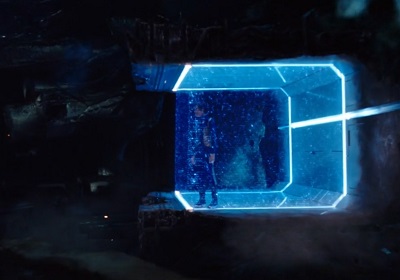
This shot of the binary system was just stunning.

Burnham takes a thruster pack (a nice little callback to The Motion Picture) and travels to an object in the debris field that is implied to be responsible for damaging the subspace relay. The voyage through the asteroids was tense, but Burnham is able to steer around all the obstacles to arrive at the object. I liked that the story cut her off from communicating with the ship, as this ramped up the tension.

After a brief survey, she lands on the hull of the object – described as a sculpture but which must evidently be a spacecraft of some kind. A Klingon emerges onto the hull, armed with a batleth. I would have liked to see more of this fight, as well as the sequence as a whole pushing Burnham herself closer to her 19-minute time limit. As it is, the last time we see Burnham she’s got a clear ten minutes – more than half of her time remaining – and then after the brief fight the action cuts back to the bridge of the Shenzhou, where Burnham now has mere seconds to get back aboard.

The fight could have been so much more than it was. With Burnham and the Klingon making exactly one move each it’s hardly fair to even call it a fight. I did appreciate the use of the thruster pack on Burnham’s part; it makes more sense for her to use her technology to defeat the Klingon than for the story to have tried to match them in terms of physical strength. But the Klingon’s spacesuit was unnecessarily ornate. I mentioned earlier that some of the ancient Egyptian influence in the way the Klingons appear was something I liked. And generally that is true, but this particular costume overwhelmed the Klingon warrior, and as it was seen so briefly there wasn’t really time to appreciate it or take it in. Given that the episode had already established that the Klingons are in play, and given that Burnham’s computer easily identified the assailant as a Klingon, skipping the overly-ornate suit and having the Klingon in something simpler would have been my preference. There was no reason to cover him up, after all. I did like, however, that the Klingon’s blood was purple – a callback to The Undiscovered Country.
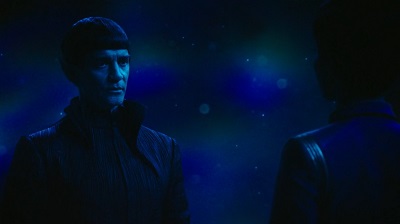
Burnham and the Klingon warrior before their brief fight.

The next Klingon scene – in which the killed spacesuit warrior is laid to rest – was kind of a miss for me. And the Klingons’ motivation conflicts with what we already know about them. Klingons have always been presented as aggressive and expansionist. They’re warriors who fight and conquer because it’s in their nature – they don’t need to feel that Starfleet’s expansion is a threat in order to seek war. The two sequences we’ve had in the episode so far establish that this is the reason the Klingons have unified behind this new leader, but I just don’t feel that they needed this reason in order to be antagonists. While “evil for the sake of it” can be an unsatisfactory explanation, in the case of the Klingons it makes sense, and it could easily have been framed as a continuation of the Klingon Empire’s expansion instead of something altogether new.

This plotline wanted to say something like this: “you might think you’re just engaging in peaceful exploration, but other people don’t see it that way. They don’t want your culture exported to their world, they want to remain pure.” It’s a heavy-handed metaphorical critique of isolationism and nationalism as concepts – and that isn’t just me saying so; around the time Discovery premiered, co-producer and showrunner Aaron Harberts went on record saying that the Klingons were supposed to critique Donald Trump and his supporters, with their rallying cry to “Remain Klingon” mimicking Trump’s “Make America Great Again”.

Star Trek has never shied away from wading into politics, and I think if it had been left alone as a depiction that people could interpret however they chose, perhaps that would have been that. But in such a polarised political climate, the comments from Harberts and others were deeply unpopular with some fans – and at the end of the day, when Donald Trump won basically half of the vote in the previous year’s election, it’s not hard to see why such rhetoric would be divisive. Star Trek shows of the past tackled contentious social issues too, and although some of those episodes – like In the Hands of the Prophets from Deep Space Nine’s first season – hit very sensitive and polarising topics, I don’t think any Star Trek show before Discovery had been so open in their decision to attack a contemporary political figure, political party, and political movement. The key difference between what had come before and what Harberts was saying is this: previous Star Trek shows looked at and criticised issues: racism, nuclear proliferation, the spread of communism, terrorism as a political tool, the HIV/AIDS epidemic, and many more besides; Discovery was singling out an individual politician – and by extension his supporters. However one may feel about Donald Trump, that is definitely a change and I can understand why, after hearing such comments, some fans who had supported or voted for Trump would have felt upset. As an aside, I’m not an American so I’m not interested in taking sides in an American political argument, but I don’t believe anyone should be a gatekeeper when it comes to Star Trek – the franchise has room for fans of different political leanings.

Burnham, having been saved by the crew of the Shenzhou off-screen, is recovering in a medical bay. She has a flashback to her time on Vulcan, and it’s here we’re reintroduced to Sarek. I was vaguely familiar with James Frain from his role in Gotham, but his character’s introduction seemed to mark an unrelated decline in that show’s quality and I honestly can’t remember what became of his character. He played a villain very well, though, and for that reason may not have been my first choice to play Sarek. However, I have to admit he put in creditable performances across Discovery’s first and second seasons, including in the flashback depicted here. Perhaps we will see him back for Strange New Worlds, as Spock is set to be a main character.

James Frain as Sarek.

The flashback hints at the attack on Doctori Alpha – which of course we’ve now seen in full in Season 2. It also establishes that the Klingons were responsible. I liked Sarek’s line that it’s Burnham’s “human heart” that was a problem – this does set up early on in Discovery that she’s conflicted between her emotional human side and her logical Vulcan upbringing. Establishing this conflict is a key part of her character, but across both parts of the premiere this setup was rushed and badly done. I’ve never felt that the two aspects of Burnham’s background helped me understand her or sympathise with her as a character anyway, especially not in the premiere where she makes incomprehensible decisions.

Burnham flees the medical bay, despite the objections of the Dr Nambue (played by Maulik Pancholy, who starred in Phineas and Ferb, a favourite cartoon series of mine) and rushes to the bridge. Captain Georgiou and the others are seemingly unaware of any Klingons in the area, presumably having not recovered the data from Burnham’s suit. The editing of these two sequences was not great – the Klingons appear to have had enough time to recover their soldier, learn what happened to him, embalm him, write a speech around his death, and send him into space in the three hours Burnham was unconscious. Three hours should have been plenty of time for the Shenzhou’s crew to pull something from Burnham’s sensor data. Her suit wasn’t particularly badly damaged, yet they all seem to just be sitting around waiting for her to wake up – and I put this down to poor editing.

Having deliberately sent Burnham on a recon mission to the unidentified object – which is jamming their scans – there is no reason for Saru and especially Georgiou to disbelieve Burnham when she reports that she encountered a Klingon, yet the scene on the bridge shows them doing exactly that. She was sent out to gather information and came back wounded – yet for some reason they initially dismiss what she has to tell them. It felt like this was done purely to create an artificially-inflated sense of tension, particularly between Saru and Burnham, but also driving Burnham apart from Georgiou in anticipation of her mutiny later on. Those crucial moments of hesitation and doubt are meant to establish that Burnham feels she can’t fully trust her commanding officer – but this doesn’t work and is unearned. If Burnham, in her wounded state, had been blabbering incoherently, perhaps muttering the word “Klingon” in amongst calling Sarek’s name and other nonsense, perhaps the idea that Saru and Georgiou would treat her as delusional and concussed would have worked better. As it is, she arrives on the bridge wounded but determined to make her point, speaking clearly and explaining what she saw – albeit in a bit of a rush. It just didn’t work for me as a story point.

I loved the different visuals of the Shenzhou jumping to red alert; the panels switching immediately from blue to red, the Wrath of Khan-era “Alert” displayed on one character’s helmet, and the bridge being illuminated in red mood lighting all felt perfectly Star Trek-y. The crew jumping to battle stations had a very military feel; no more joking or slouching, everyone in an instant is fully focused on their jobs.

The USS Shenzhou and crew jump to red alert.

Saru improves a lot over Discovery’s first two seasons, and especially after the incredibly dramatic change to his character in Season 2 he becomes much bolder. But in the premiere his cowardice – it’s hard to find another word for it – feels out of place on the bridge of a starship. He isn’t urging caution when he wants to withdraw; his terror and fear seem to legitimately hamper his ability to think straight and do his job. While I did not like the way his transformation was handled in Season 2 – I felt it was clumsily done and purely a reaction to criticism – in The Vulcan Hello he’s way too cowardly to reasonably be a Starfleet bridge officer of such high rank.

The visual effect of the Sarcophagus ship decloaking was spectacular; one of the premiere’s single best CGI moments. Some fans have criticised Discovery for giving the Klingons a cloaking device more than a decade before Kirk’s first encounter with the technology in the episode Balance of Terror. However, I think this can be explained and I’ll briefly detail my thoughts on the subject. Technology evolves over time, and particularly in military technology, encryptions change rapidly. When one type of encryption is broken it becomes useless and obsolete, and I figure the same must be true of cloaking devices. When Starfleet learns how to penetrate one type of cloak, the Romulans and Klingons invent something new in an ever-evolving technological battle. We need only look at real-world history for parallels – in the Second World War, the Allies and Axis powers were constantly trying to stay one step ahead of each other with encrypting and cracking communications. The Romulans were seen to use cloaking devices in Enterprise, set a century earlier, so the technology has existed in some form for a long time. A cloaking device, despite how it’s usually shown on screen, doesn’t merely render a ship invisible. It also hides it from scans and actively presents the illusion that there’s empty space. To make a long story short, my personal head-canon explanation for Discovery-era cloaks compared to those seen later and regarded as “new” is simply that there are different kinds.
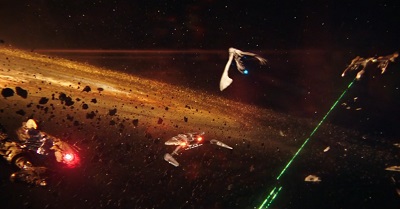
In the aftermath of the Klingons decloaking, I liked how the Shenzhou and the Klingon ship were not perfectly aligned on a flat plane. Something Star Trek hasn’t always represented well is the third dimension of space; ships had almost always been shown perfectly flat and parallel to each other, with tilted or sideways craft usually only shown when damaged or in distress. But there’s no real reason for this, and in that sense I would call this depiction more realistic of the way we might expect two different space vessels to encounter one another. I also liked Georgiou’s use of the phrase “we have engaged the Klingons”, as this definitely harkened back to past uses of “engaged” by Starfleet commanders to describe confrontations.
Voq’s introduction aboard the Klingon ship was interesting. His character is presented here as a zealot, someone who had been radicalised, for want of a better term, by the Klingon leader’s teachings. The Klingons treating Voq as a lower caste because of his lack of noble birth is one thing that’s definitely consistent with past iterations of the franchise; we saw General Martok talk about this in particular in Deep Space Nine.

The interaction between Burnham and Admiral Anderson was one of the premiere’s weakest moments. Clearly set up as a one-dimensional foil for Burnham, Anderson behaves with irrational hostility toward her, and his barbed comment about race was stupid and beneath what Star Trek should aim to be. While the defence of that line is that, in-universe, Anderson was referring to Burnham’s background with both the Klingons and Vulcans as well as her upbringing, to us as the audience it was a white man making a charged racial comment to a black woman. It’s hard to see this as anything other than a “white man bad” moment – that’s how it was written and clearly intended to come across.

Admiral Anderson was a badly-written character.

We’ve all experienced, at some point in our lives, someone like Anderson – a manager, boss, teacher, etc. who would use their position of authority to be unkind or rude for the sake of it. If the scene had been written better, we could have empathised much more with Burnham. But Anderson’s characterisation here was just stupid and hollow, and the meaning behind his exchange with Burnham was incredibly transparent.

All three participants are right. Georgiou has to hold the line – the Shenzhou, as she says herself, is the only line of defence for other Federation outposts in the area. Burnham knows that the Klingons will attack, as Saru confirms. But Anderson is right too: Starfleet doesn’t go looking for a fight, and the Shenzhou’s job is to sit tight and wait for backup. Anderson believes he can defuse the situation, but even if he can’t he still needs to be there – an admiral has far more authority in these matters than the captain of an insignificant ship, and bringing backup is the only way the Shenzhou stands a chance of surviving a fight if one should break out. I don’t like defending him, because he is undeniably the kind of pushy, rude person that, in a better-written story, would have been an interesting, annoying antagonist and a character we could have recognised.

Withdrawing when threatened is not an option, especially in front of the Klingons. This shows weakness and would leave open this section of space to Klingon attacks or raids. But attacking is clearly the wrong move too – all the Shenzhou needs to do is await backup.

The visual effect of the Klingon beacon was interesting – even if all it really involved was turning the studio lights all the way up! But as something we hadn’t really seen before in Star Trek, I liked it. Klingons have often been shown as ritualistic, and the idea of lighting a beacon is something I find at least plausible. In-universe, I question whether a light-and-sound-based weapon should really effect the Shenzhou in the way it does – they should be able to close the shutters or something so that the entire bridge crew aren’t crippled by the light as if it were a flashbang grenade! And with shipboard computers, this should really happen automatically. Heck, we have comparable technology now for those purposes, let alone in the 23rd Century.

Apparently turning up the lights can cripple a starship.

Burnham rushes off to talk to Sarek – and this seems like a great moment to talk about Discovery’s holo-communicators. Generally speaking, I’m okay with Star Trek (and other franchises) introducing new and different technologies and aesthetics with new iterations. But because of Discovery’s place in the timeline, holo-technology isn’t a good choice, and it makes tying the series to the wider canon more difficult than it already was. In the Deep Space Nine Season 5 episode For the Uniform, holo-communicators are presented as something brand-new, which they were in Star Trek at the time. With this episode taking place 120+ years after Discovery, the decision to have holo-communicators instead of, for example, expanding our understanding of how viewscreens work, added fuel to the arguments made by those who didn’t like the show. There was no real reason for it; none of the moments where characters use the holo-communicators would be substantially different if viewscreens had been used instead.

This prequel problem of having technology look better and more advanced than what supposedly comes later in the timeline inst’t unique to Discovery. Enterprise received similar criticism when it debuted, with many people noting that its technology and overall aesthetic looked way more advanced than anything seen in The Original Series.

To get back on track, the Sarek call was the second scene in the episode that I felt was especially weak. Heavy-handed exposition that felt unnatural, and especially the line that was clearly inserted to provide material for pre-release trailers (“what have you done out there on the edge of Federation space?”) contributed to a scene that didn’t work. Sarek essentially tells Burnham that killing the Klingon seems like fair revenge for the Klingons killing her parents, despite that being an absolutely stupid thing to say. No one, let alone a logical Vulcan and a diplomat like Sarek, should even suggest that an entire race be held responsible for the actions of certain individuals. “The Klingons” didn’t kill Burnham’s parents – specific individuals did. Even if the Klingon government as a whole can be deemed responsible for that act, how does killing one random Klingon who is almost certainly unrelated to that incident seem “only fair” to Sarek? I absolutely hated this characterisation when I first saw it – and I still dislike it today.

Sarek, in suitably vague terms, suggests to Burnham that the reason for the Klingons’ activity in this region of space could be indicative of the fact that they have a new, unifying leader. The Klingon Empire, despite being united when we last saw it in Enterprise and being united by the time of The Original Series, is depicted as being divided among bickering Great Houses in Discovery’s era. It did tie in well with the previous Klingon scenes, but given it is such a change in direction from where we might’ve expected the Klingons to be, I think this setup needed more explanation and to be seen overtly on screen. As it is, we had the Klingon leader (later revealed as T’Kuvma) telling us that the Great Houses are divided. And we have Sarek telling us that they’re divided too – I’d have preferred to have seen some examples of that division before we got to this moment.

This scene is where the episode turned from mediocre to bad. Sarek makes assumptions about the Klingons – a race he admits he has limited knowledge of – based on practically no information except the appearance of one ship and one dead warrior. Encountering the Klingons has been rare in the years before Discovery, yet Sarek pretends to know their motivations and makes the highly illogical leap – in light of the lack of information – that the Klingons must be preparing for war.

One short conversation convinces Burnham to mutiny.

Burnham takes this talk with Sarek as gospel and runs with it, setting up what will come later in the premiere. But for a scene like this to have worked, we needed much more information. I mentioned we needed to see the Klingons bickering amongst themselves. We also needed far more from Sarek about how he was able to make these assumptions, how he claimed to know the Klingons’ motivations, what insider information he might’ve had, etc. And we needed this scene to be much longer, as it’s pivotal in the story of the premiere. There wasn’t enough time to communicate everything we needed to see, and as a result Burnham’s character turn from competent officer to mutineer does not work.

I’ve written on a number of occasions that I found Burnham’s motivations in the premiere impossible to understand, and this scene underpins why. This one conversation with Sarek is her entire motivation for the mutiny, yet it’s threadbare. Sarek talks in vague and caged terms for the most part, and while he is a father figure of sorts, and definitely fills the role of “mentor”, he’s cold, emotionless, and hard to relate to. As the audience, we’re looking in trying to understand what’s happening, and it just doesn’t make sense. What we’ve seen of Burnham so far tells us that, despite the trauma she went through in her childhood, she’s a capable officer. Even if she believed Sarek’s vague threat of war wholeheartedly, Starfleet has backup en route. Even if she’s upset that Captain Georgiou won’t take her stupid advice to fire the first shot, Admiral Anderson will be arriving in a matter of hours and she can try to give the advice to him.

Choosing to give Georgiou this advice based solely on her conversation with Sarek also makes no sense. The Vulcans’ method of firing first (the titular “Vulcan hello”) was used before Klingon-Vulcan contact had ever been established. Starfleet has already made first contact – and on several occasions have even worked with the Klingons, as depicted in Enterprise.

As things sit, the Shenzhou and Sarcophagus ship are in a stand-off. Firing the first shot is the worst possible thing to do. She should never have made the decision based on the conversation with Sarek. Sarek, knowing Burnham’s personality and limitations, should have been more careful what he said. And hanging the whole story off this one moment simply does not work.

Burnham tells Captain Georgiou to fire on the Klingon ship.

Captain Georgiou is the voice of reason here, telling Burnham that firing first on a ship that plans to attack won’t dissuade them from attacking – all it will do is start the fight at that moment, instead of at an undetermined future moment, such as after the Shenzhou’s backup has arrived.

Burnham’s decision to mutiny, far from creating what the series’ producers hoped would be a satisfying season-long character arc, came very close to ruining her character and making her completely unlikeable and impossible to root for. Because, in a roundabout way, Burnham is right in that the Klingons did plan to go to war after unifying behind T’Kuvma, the story expects us to feel that she’s in the right and everyone else is being intransigent and failing to recognise her unique and individual brilliance. But because she has no basis for the course of action she wants to take other than a gut feeling, it does not work. The earlier Klingon scenes are meant to inform this decision, as is the Sarek conversation, but even taking the whole rest of the episode together, there is not enough background to what’s happening, nor enough information about the state of the Klingon Empire, Sarek’s knowledge of the topic, or anything else to make Burnham’s mutiny any more palatable.

We know that it isn’t fair to lay the blame for the war at her feet. The Klingons wanted war anyway. But she was still wrong to do what she did – and on top of that, firing first would have accomplished nothing anyway as the Klingons had already decided on war. If Burnham, along with the rest of the crew, had simply waited and the Klingons had instigated the war, the rest of Discovery’s first season could play out almost unaffected but with a much more likeable protagonist. There wouldn’t be the hurdle of the incomprehensible mutiny to overcome for Burnham in every subsequent episode because her character wouldn’t have been dragged down by this one stupid moment.

For the first time in Discovery, I liked Saru in the scene immediately after Burnham incapacitates Captain Georgiou. He sees through her ruse immediately, and despite his earlier cowardice when confronting an enemy, has no qualms whatsoever about confronting a friend when she’s about to make a colossal mistake.

Saru figures out what’s happening.

As the first part of the finale ends, the Klingon fleet emerges from warp. And I know I said I wouldn’t reference Star Trek: Picard too often, but here’s a rare example of Discovery doing something better! The Klingon fleet is composed of a number of different starship designs, making for a fleet that’s both impressive and interesting to look at. Contrast that to the Romulan and Federation fleets seen in Picard’s finale, where both fleets were comprised exclusively of one style of ship each (that had clearly been copied-and-pasted by the CGI animators). There’s no question that Discovery achieved a more impactful and dramatic visual effect.

This marked the end of The Vulcan Hello, and honestly, by the halfway point the story of the premiere had already gone off the rails.

Battle at the Binary Stars begins with a flashback to Burnham’s first meeting with Captain Georgiou. We get to see Burnham being much more stilted, playing a wannabe-Vulcan role alongside Sarek. Georgiou drops some exposition about Burnham’s background; she’d been the first human to ever attend the Vulcan Learning Center – presumably the school we saw her at in The Vulcan Hello. Just as an interesting note, the hallways of the Shenzhou in this sequence have the familiar angled design that we’re familiar with from practically all main Starfleet ships post-The Original Series. I like it when Discovery goes out of its way to tie itself into the franchise, and the corridors aboard the Shenzhou may be subtle, but the design was great nevertheless.

Burnham and Captain Georgiou meet for the first time in a scene that should have been right at the beginning.

This flashback scene could – and perhaps should – have been the first scene in the previous episode. Seeing Burnham in her Vulcan mode poses a nice contrast to how she is in the present day, and it would have shown us how far she’d come, as well as showing – rather than telling through exposition – her Vulcan background. By this point, after everything we saw with Sarek and her attempted mutiny, Burnham is already completely impossible to root for. This scene, had it been the first one we saw, would have at least informed her background with Sarek, and gone some way to humanising her as it explains a lot about where she came from. It was a missed opportunity, and while moving one scene would not fix the premiere’s fundamental story problems, it would have been a step in the right direction.

Back in the present, Burnham tries to use the arrival of 24 Klingon vessels – one for each of the Great Houses – as a reason to keep arguing for shooting first. This just does not make sense. To explain why, we need to look at the situation from an in-universe perspective. The arrival of 24 ships could indicate that someone plans to unify the Klingons. Why would that be a bad thing? As Sarek suggested, a unified Empire may want to wage war. But even if that’s the case, and Burnham’s earlier assertion is correct, how does firing first accomplish anything? The Vulcans fired first before they’d made first contact as a warning not to attack – over 200 years ago. The Federation and Klingons have long ago made first contact, and all firing first in this situation will do is lead to the Shenzhou being obliterated in a hail of disruptor fire from 25 ships. It wouldn’t stop the battle or the war – it would just change who fired the first shot.

This is what I mean when I say I found Burnham impossible to root for as a protagonist. And I don’t understand why, given that the show wants us to support her, the writers and producers sent her down this route. She comes across as arrogant, closed-minded, insubordinate, and basically illogical to the point of being a moron. She fundamentally misunderstood what Sarek said, and at every opportunity the show has failed to go into sufficient detail in the scenes relevant to the story. More background, explanation, and screen time could have made her decision work, but in the moment it fell completely flat.

Burnham’s decision to mutiny was poorly-written and did not make sense in the finished episode.

As a narrative choice, telling a story with a clear protagonist is fine. Making that character flawed and needing to make mistakes, learn from them, and grow is fantastic – it provides a satisfying character arc. But this isn’t what happened with Burnham in Discovery’s premiere. She was such a selfish, bad person that I honestly thought she was going to be a villain, and for any narrative to so deliberately ruin its main character minutes after she’s been introduced is just bad storytelling, plain and simple. It’s very difficult to recover from something like this, and while Discovery tries over the course of Season 1, Burnham remained one of the show’s weakest elements well into the second half of the season. It should have been possible to construct the mutiny storyline in a way that was sympathetic, and in a way that got us as the audience to empathise with Burnham; to see her as unequivocally right, and Geogriou, Saru, and Anderson as unequivocally wrong. This is what The Vulcan Hello and Battle at the Binary Stars absolutely needed to do. Burnham needed to be right, and how she got to that moment needed to be understandable. The story failed at both of these points and couldn’t recover.

Perhaps, in retrospect, we needed more time with Burnham – an episode or two, at least – before we got to this moment. Seeing more of her, spending more time with her, getting to know her and know her heart and motivations would have helped inform the key moment in this story. The premiere tried to give us this, but with the need to include Klingon scenes as well as everything else, there wasn’t time before her mutiny for Burnham to have been established as a protagonist. As it is, in the premiere (and for the next few episodes too) Burnham is the “protagonist” of Discovery not because she feels like it, but because the series beats us over the head with her and tells us she is. Remember what I said before about “show don’t tell”? We needed to be shown why Burnham should be our protagonist, not merely told that she is.

After Burnham is (quite rightly) dragged off to the brig, we get another scene with the Klingons. They have holo-communicators too. T’Kuvma, the Klingon aboard the Sarcophagus ship, is refusing to speak to the leaders of the Great Houses, who are getting annoyed. This scene went on too long and didn’t really do much of anything; we already knew that T’Kuvma plans to unite the Klingons, that he wants to fight the Federation, and that he feels the Federation encroaching on Klingon territory is a bad thing. A five-minute sequence was just unnecessary fluff.

The Federation fleet dropping out of warp looked great, and again having a mix of different starship designs will always look better than a large fleet consisting of ships that look identical. T’Kuvma uses Captain Georgiou’s line “we come in peace” as a rallying cry for his followers to “remain Klingon”, and attacks the Federation fleet.

The Federation fleet begins to assemble.

The battle itself was actually one of the best moments in the episode. It was edge-of-your-seat excitement, and with the Klingons having the upper hand, suitably tense. The damage to the Shenzhou’s bridge was impressive, and I really liked the Shenzhou coming in to assist the USS T’Plana-Hath during the battle. Moments like that feel great when done well, and the titular Battle at the Binary Stars is up there with other great battle sequences in Star Trek, such as the fight against the Borg in First Contact, and several of the Dominion War battles in Deep Space Nine. Credit to the show’s animators, because the ships looked amazing, they moved beautifully, and the battle was truly exciting in the way I always want action sequences to be.

One of the bridge officers – Connor – stumbles into the brig where Burnham had been taken. Clearly concussed, he’s supposed to be on his way to sickbay. The scene where he’s killed and ejected into space was shocking, so in that sense it accomplished what it meant to and gave a little more depth to the battle. It would have been more meaningful if he’d had more than one line before dying, but as a basic premise I can’t really fault the idea of killing off a named character in a battle like this.

The visual effect of Burnham isolated in the damaged brig – which had been reduced to a little box that was mostly forcefields – was incredibly dramatic and again, shows just how exceptional the CGI animation was in Discovery’s first season.

Burnham is saved by emergency forcefields.

In the context of a massive battle, and having seen the ship suffer major damage, I don’t think Captain Georgiou and Saru would have been as worried about Burnham in the brig as they seemed to be when they learned how badly damaged the ship was. Along with Connor, many others must surely have died; there isn’t time now to worry about that, they have to focus on their jobs on the bridge.

Burnham and Sarek evidently have the power to mind-meld over long distances. As a concept I don’t feel that this has to be a problem; we know Vulcans are telepathic and just because it’s something we hadn’t seen before doesn’t mean it can’t be possible. It could also be interpreted, if you really hate the idea of Skype-mind melding, as Burnham drawing on a memory or something within her own head. But the content of the scene between them was, once again, fluff. Sarek just straight-up announces that Burnham is gifted, smart, brave, and that Starfleet needs her so she can’t just give up and die. For the fourth or fifth time – we need to see those things, not just be told them by another character. Seeing Burnham be told that she’s brave and gifted and desperately needed means absolutely nothing if we don’t have anything to back it up. Sarek’s words were hollow, and the scene accomplished nothing.

Sarek and Burnham are able to communicate telepathically.

The Shenzhou suffers further damage, including a visually-impressive hull breach on the bridge, but before the Klingons can destroy the disabled ship it ends up drifting closer and closer to the system’s stars. I liked that this story beat gave the Klingons a sensible reason for breaking off their attack, while still keeping the tension up. In a better episode, this would have made for a fascinating story in and of itself!

Anderson’s arrival grants the Shenzhou temporary reprieve, before his ship is rammed by a cloaked Klingon vessel and self-destructs. By taking the action away from Burnham, Battle at the Binary Stars told a creditable battle story that had been exciting and engaging. If Anderson had been better-written we could have perhaps even felt his ship being destroyed was his comeuppance; as it is it just fet like another moment in the battle and Anderson remains a fairly one-dimensional character.

T’Kuvma declares to the Great Houses that the battle is won, and proposes they fight under his banner and leadership as a united force. And I come back to what I said earlier: the Klingons didn’t need this motivation. We could have seen them already united, and the battle break out in any one of a number of different ways and nothing would change from a story perspective for the rest of the season. As it is, the Klingon scenes in general ended up mostly being irrelevant.

When the battle is over, the story returns to Burnham who must escape the damaged brig. I liked this sequence overall, though arguing with the computer was a bit silly and did detract from it. Firing herself through the damaged and depressurised wreck was a similar visual effect to one seen in Star Trek Into Darkness, and as a whole, Discovery’s premiere borrows a few different points from the Kelvin-timeline films.

The battle sequence was probably the high point of the premiere.

Captain Georgiou and Saru make a plan to attack the Sarcophagus ship with torpedoes when Burnham interrupts. Georgiou gives her a dressing-down for her earlier actions, even telling her that she thought she had undone some of Burnham’s Vulcan upbringing; her humanity failed her in that moment. If the story wanted us on Burnham’s side in this conversation, it failed. Everything Georgiou says is spot on, and actually underlines how I was already feeling about Burnham.

Georgiou’s plan – beaming a torpedo warhead onto a Klingon corpse which will then be taken in by the Sarcophagus ship – is genius. This is the kind of cunning plan we could’ve expected someone like Data to dream up in past iterations of Star Trek, and I loved how well it worked.

However, the next phase of the plan was poorly-executed; designed in such a way as to be artificially limited. Why send only two officers – Burnham and Georgiou? Are there no soldiers, tactical, or security personnel? Why send Burnham, the mutineer? Does Georgiou trust her again now? And why only send two of them? This whole sequence was rushed, and with a little more time taken to explain what was happening perhaps it could have worked better. As it was, it was designed to get the story to a specific climax – the deaths of Georgiou and T’Kuvma – but it just did not feel like these events unfolded naturally. Burnham’s anguish at Georgiou’s death was beautifully performed – but felt unearned and cheap as a story point. Georgiou has been a good captain, and we should be mourning her, but the whole story across both parts of the premiere hadn’t done enough to give this moment the emotional weight it was aiming for.

Captain Georgiou is killed.

T’Kuvma’s death scene was also a bag of nothing, and we see the Shenzhou evacuated and Burnham plead guilty at a court-martial to mutiny and myriad other charges. At her court-martial, when speaking in her defence, Burnham says how she always wanted to serve and hoped to have her own command. How is that relevant here? How could that possibly help us as the audience feel better about her or think more kindly of her? She’s been an awful person across both parts of the premiere, and when she has a chance to justify herself and mourn her captain, she first speaks about herself and her ambitions. She seems equally sad that she won’t get to have her own ship as she does for Georgiou’s death. She’s sad just as much that the “only home” she had, the Shenzhou, is lost as she is for the crewmates who died. And at every point in this statement, she talks from her own selfish point of view – “my ship”, “my captain”, “my friend”, etc. That’s the icing on the cake of a poorly-written protagonist who comes across as arrogant and self-centred. This scene was also poorly-lit. Putting Burnham in a spotlight and the judges in darkness was clearly supposed to look dramatic, but it just came across as looking fake.

The attempt at dramatic lighting for Burnham’s court-martial failed.

So. A re-watch of Discovery’s premiere clearly hasn’t altered my thoughts too much. The story was poor. The only times it picked up were during the battle, after Burnham had been taken out of the picture. No story should begin with the character we’re supposed to be following set up in such a wholly negative way. The first chapter of Discovery left us with a protagonist whose motivations made no sense, who was arrogant, selfish, and who seems to have relished being told she was special and gifted. Someone like that is not a nice person. There’s no “heart of gold” hiding beneath Burnham’s exterior in these episodes. She thinks she knows better than everyone else, refuses to accept her position as first officer when contradicted by her captain, and the way it was supposed to be explained to us as the audience that Burnham was right – the Sarek scene in particular, and the Klingon scenes too – did not work and did not succeed in communicating that message.

Burnham did grow on me over the rest of the season and over the course of a much better Season 2. But this moment, when Star Trek returned to television for the first time in over a decade, was poor. It has to be the worst premiere of all of the Star Trek shows to date, and it took a lot of hard work for the season to recover from an incomprehensible start and a truly bad protagonist.

With some changes, the mutiny storyline could have worked. Seeing Burnham earlier in her life at the beginning of the story, to give us a frame of reference, would have helped. As would more time spent on the conversation with Sarek. The Klingon scenes added very little; their motivation was silly in the context of an aggressive warrior culture, and could have been cut. But even assuming they had the same motivation – unifying to confront the Federation who they see as a threat to Klingon culture and unity – we knew that after one scene, and the others were just fluff. If the story was to be all about Burnham, we needed more time with her to make her turnaround from competent officer to arrogant mutineer work properly. Discovery had some leeway with how many episodes were going to be made, and I would absolutely make the case for making some changes and adding a third part to this premiere to allow Burnham some more screen time prior to the mutiny, and a better-constructed setup to that moment to have played out.

Michael Burnham, you are guilty… of being a badly-written character.

When I set out to re-watch these episodes, I wondered if having spent more time with Burnham and the crew, I’d have a more enjoyable experience. I did not. The Vulcan Hello and Battle at the Binary Stars do some things very well – the visual effect of the two fleets, for example, and the battle scenes themselves – but the main story, that of protagonist Michael Burnham, does not work.

I cannot imagine that making Burnham so unlikeable was a deliberate choice on the part of the producers and writers. If that was the case, however, it was a stupid idea. Giving her an arc is one thing, but starting her off as someone we don’t like and can’t relate to damages the overall story they were trying to tell. Storytelling simply doesn’t work that way, so for that reason I have to assume it was not their intention to set up Burnham as someone the audience should hate going into episode 3.

So that’s it. The show did improve over the next few episodes, and despite a weak start I do enjoy Discovery and consider it a worthy part of the Star Trek franchise.

Discovery is coming back with Season 3 literally any day now – I’m crossing my fingers waiting for a release date. If you missed it, you can check out my thoughts on the Season 3 trailer by clicking or tapping here. When the show is on the air, I plan to review each episode as they’re released, so please check back for that. This won’t be the only Star Trek re-watch that I write up, either. If you missed it, I have a similar article for The Next Generation Season 2 episode The Measure of a Man already live – you can find it by clicking or tapping here. I have no idea which episode will get a write-up next, though!

Star Trek: Discovery is available to stream now on CBS All Access in the United States, and on Netflix in the United Kingdom and other countries and territories. The Star Trek franchise – including Star Trek: Discovery – is the copyright of ViacomCBS. This article contains the thoughts and opinions of one person only and is not intended to cause any offence.