Nvidia DLSS 5: Is This What The Future Looks Like?

Allow me to preface this by saying that I’m not on the “anti-A.I.” bandwagon by any stretch. While I’m sceptical, to a reasonable degree, about some of today’s large-language models, and whether they can really do as much as investors have been promised, I see the potential in A.I. in a lot of ways. I don’t want this piece – discussing one very specific use of A.I. – to be misunderstood! In fact, I’d argue that anyone who claims to be “anti-A.I.” in every possible case doesn’t actually understand what A.I. is and how broad a category it is; it would be like saying your “anti-computer,” or “anti-electricity.” The uses for A.I. are vast – it’s an incredibly big category of inventions.

So what are we getting into today, then? If you missed the announcement, graphics card manufacturer (and major supplier of components to A.I. datacentres) Nvidia has recently shown off its new A.I.-powered DLSS 5.0 – a graphical overlay for some video games, which is intended to add more “realism” to environments, character models, and faces.

And… to be blunt, I think it looks like shit.

Nvidia DLSS 5.0 demo image
The DLSS 5 Starfield demo.

Some of today’s generative A.I. models can create photorealistic landscapes, creatures, and even people. A.I. art is a big topic in and of itself, and it can be quite controversial, so we won’t get into all of the arguments around it. Suffice to say that, as someone who runs a small website as a hobby, the only times I’ve used A.I. art (that I’m aware of, anyway) are in a couple of my other articles discussing A.I. – and that was a deliberate choice to help illustrate a point I was making. I’m not actively opposed to A.I. art in all cases; as with any subject, it’s not a black-or-white thing. Not all photographs are “art,” but some can be – and I would suggest A.I. art is probably in that same kind of space.

But we’re off-topic already!

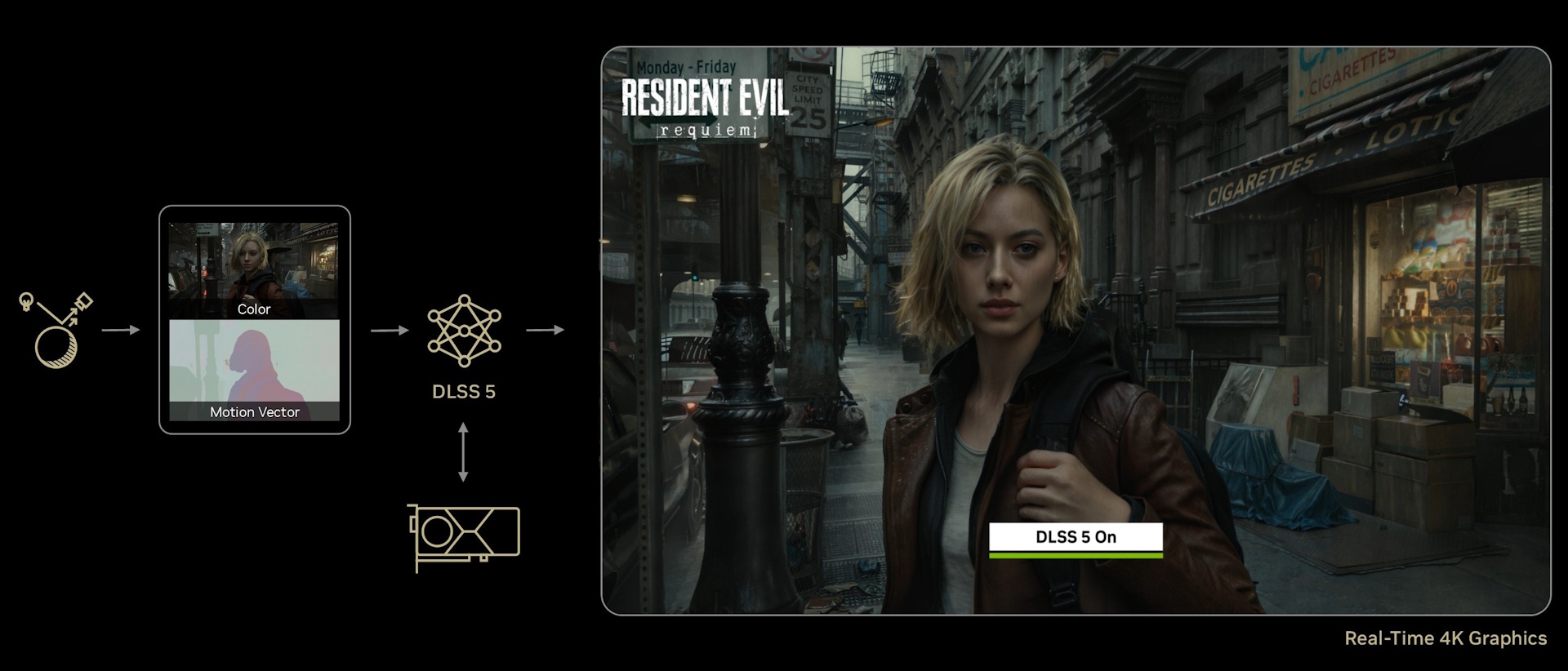
DLSS 5, according to Nvidia, is intended to increase the “visual fidelity” of video games, and the company claims it’s their most significant innovation since real-time ray-tracing almost nine years ago. DLSS 5 uses generative A.I. in some form – the exact details are not clear – and seems to work as a kind of “middle man” during the rendering of frames, upscaling, adding detail, and trying to give games a more photorealistic look.
Nvidia DLSS 5.0 demo image
Nvidia’s helpful explanation of how DLSS 5 works.

On the surface, this sounds like a useful invention, right? At least for *some* games, anyway. Game developers have been chasing photorealism since, really, the very dawn of video games and computer-generated imagery, so any new innovation that brings us closer to that goal should be a cause for celebration. Only… well, is DLSS 5 *actually* making things photorealistic? Or is it simply adding a filter?

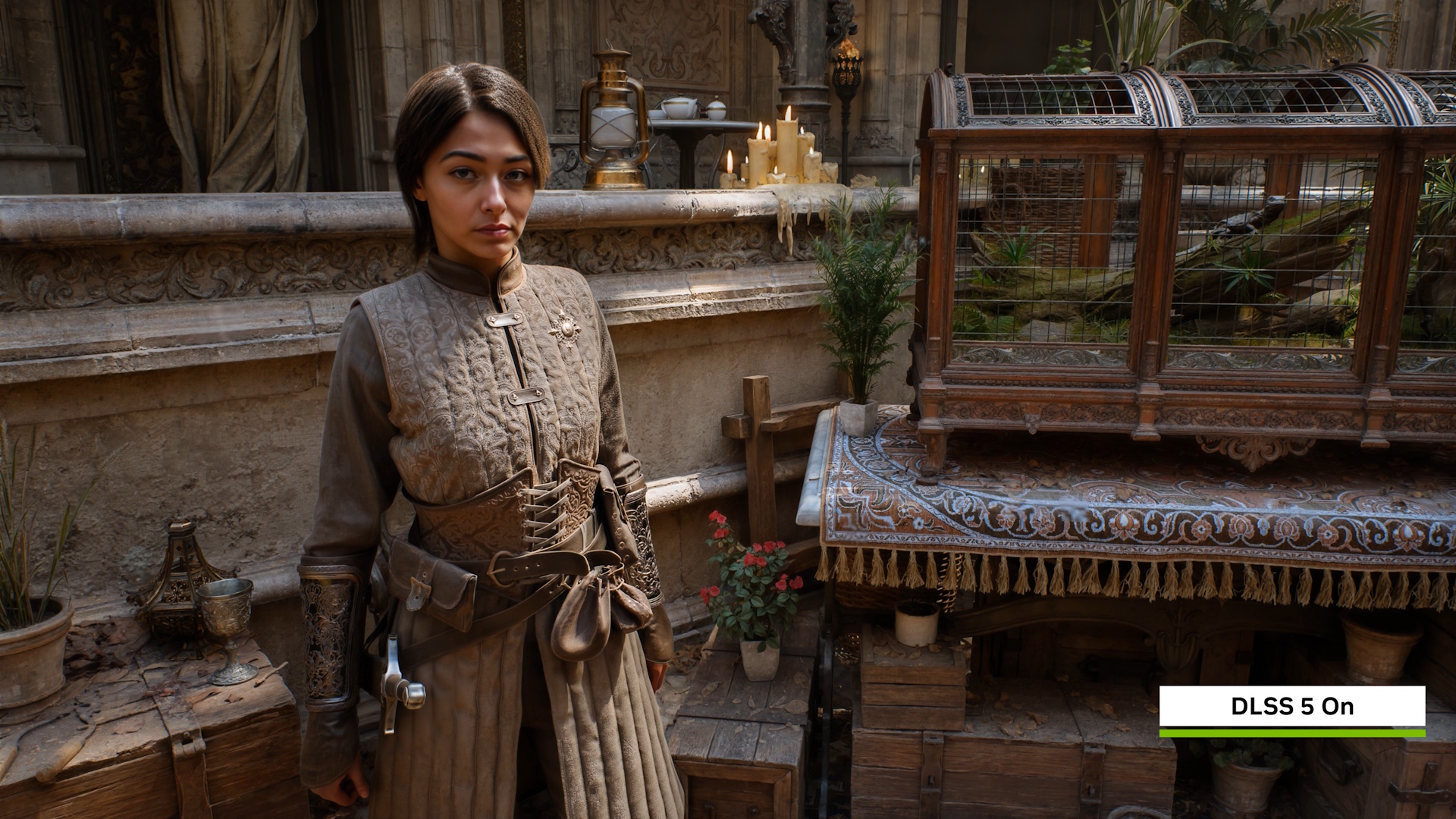
The screenshots Nvidia provided – which, I would note, are going to have been *very* carefully selected to show the new tech in the best possible light – all feel, well, kinda samey. And that’s despite the games selected to show off this new technology all being pretty different from one another in terms of art style. Yes, all of the games in question were aiming for some measure of photorealism, but there are incredibly important differences in the way they use more subtle things like light, shading, facial animations, and so on. If DLSS 5 smooths all of that out, resulting in games that look indistinguishable from one another… I’m not sure I’d call that a “breakthrough.”
Nvidia DLSS 5.0 demo image
DLSS 5 running on an Nvidia tech demo.

To Nvidia’s credit, they claim, in their marketing blurb, that DLSS 5 is meant to be “tightly grounded in the game developer’s 3D world and artistic intent.” But based on the screenshots and video that Nvidia itself provided as part of this announcement, I gotta be honest: I’m not seeing that. I see a filter that smooths out a game’s rough edges, sure, and definitely adds more detail – but if those details are all the same, and the end result is that faces in particular end up looking incredibly similar from title to title (and, I would add, not unlike a Snapchat/TikTok filter or other A.I.-generated artwork), then I don’t think it’s going to be of interest – at least, not to me.

There’s already a lot of sameyness and repetitiveness in the way modern games look thanks to many of the industry’s biggest studios using the same handful of game engines. Unreal Engine 4 and 5 are so commonplace nowadays that you can almost always notice its presence from the moment you boot up a title. And there are advantages to that – don’t get me wrong. As someone who used to work in the industry, one of the biggest issues developers (and studios) faced was that skills in one engine or one programming language don’t automatically translate; if more studios are using the same software, skills are more easily transferrable.
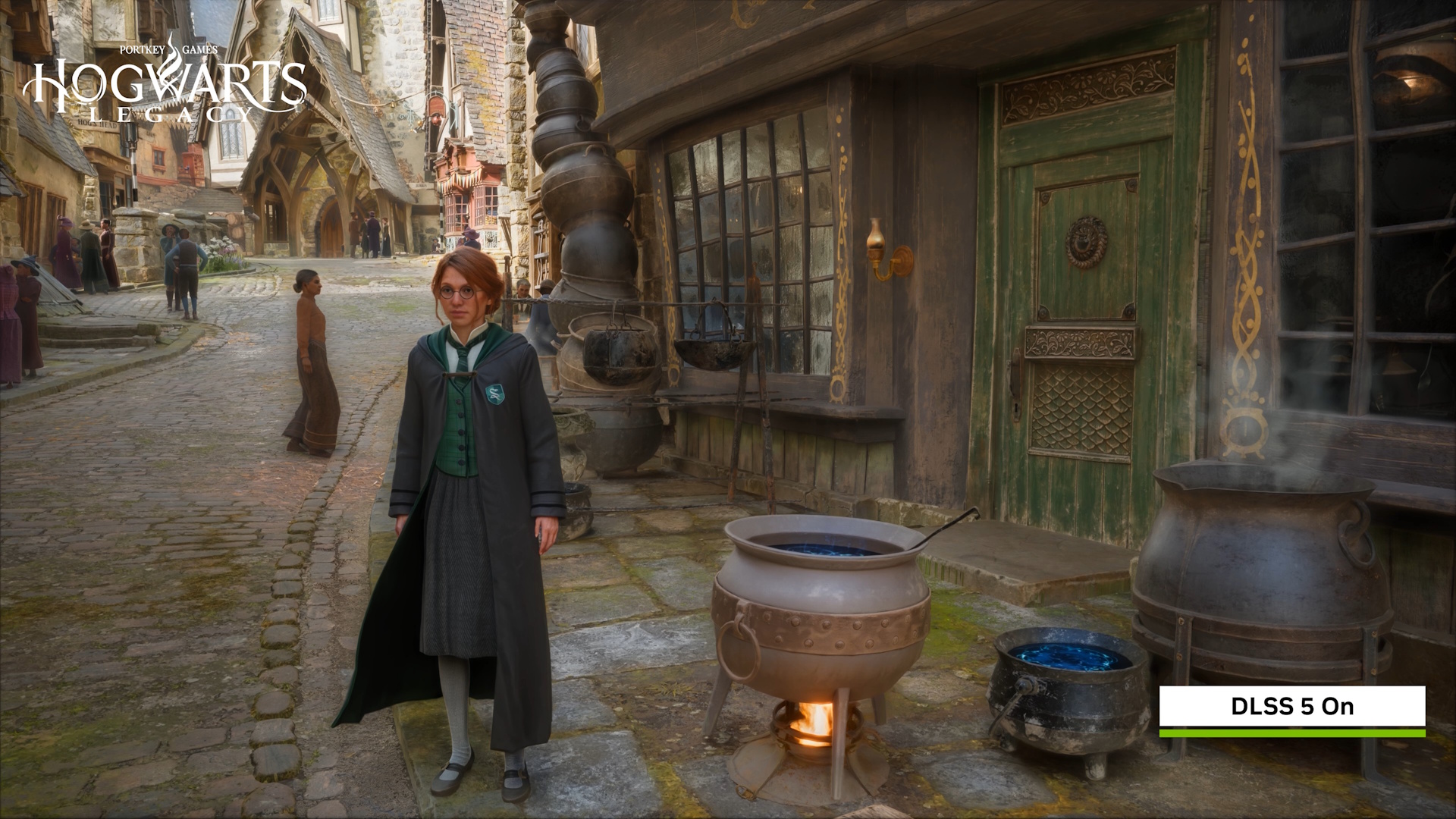
Nvidia DLSS 5.0 demo image
Another of the demo images.

But for players, the end result has been that an increasing number of big-budget titles feel… samey. And DLSS 5, if it can actually do what’s being advertised, might just make that particular trend *worse*, not better. Photorealism is not one singular thing – just go to an art gallery and look at photos, and you can see that, even in the real world, there are completely different ways to capture a portrait, a city, a landscape… and more. DLSS 5 seems, to me, to be trying to apply the same techniques to every game shown off – and the results are more miss than hit.

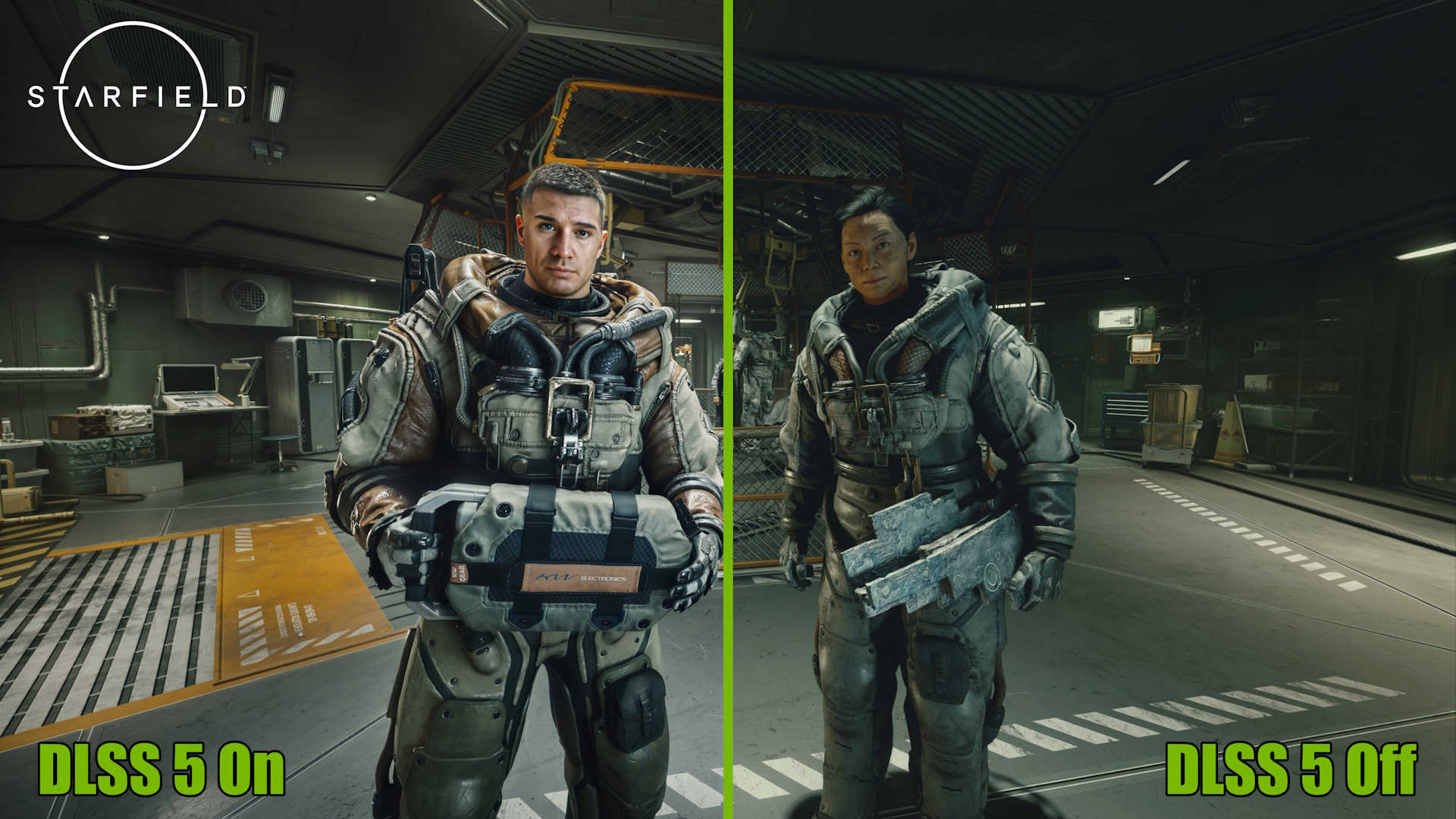
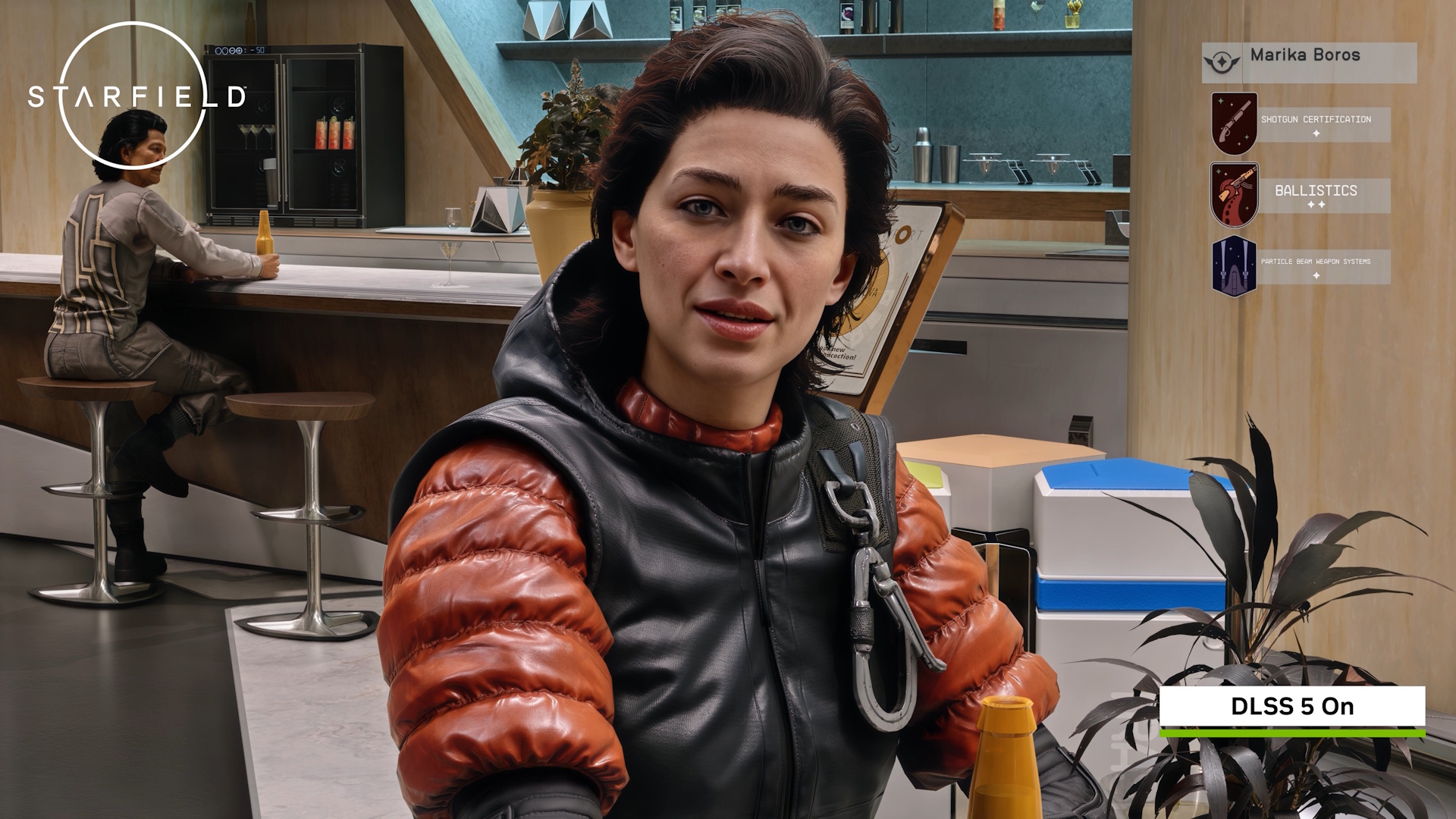
One of the titles selected was Starfield – and if you know me, you’ll know I’m of the opinion that Starfield needs all the help it can get! I once described Starfield’s NPCs as “dead-eyed, waxy-skinned Madame Tussauds rejects,” so *anything* that could be added to the game to “fix” its NPCs should be great. Right?
Nvidia DLSS 5.0 demo image
Starfield with DLSS 5.

Look at the image above, which is taken from the opening act of Starfield. Look at the two characters – Heller and Lin. Doesn’t Heller just look like… a meme? You know, the edited “Chad face” meme? And what’s with the lighting? The image is horrifically over-lit, completely negating the vibe of the original scene. I can’t believe Nvidia has got me *defending* Bethesda’s “artistic vision” for Starfield, but the original version of the scene genuinely has more character. The dimly-lit, dusty space evokes the feeling of being on a small outpost at the arse end of space; the DLSS 5 version completely changes the entire tone of the setting. It makes it feel washed-out.

Even if you prefer the more brightly-lit version of Starfield’s opening area, can we at least agree that Bethesda lit the original room a certain way on purpose? Starfield has other indoor areas which are much brighter, so it’s not a technical limitation. It’s clearly a creative choice for that room, at that mining outpost, to be lit the way it was. And DLSS 5 blasted right through that, ignoring all of it.
Nvidia DLSS 5.0 demo image
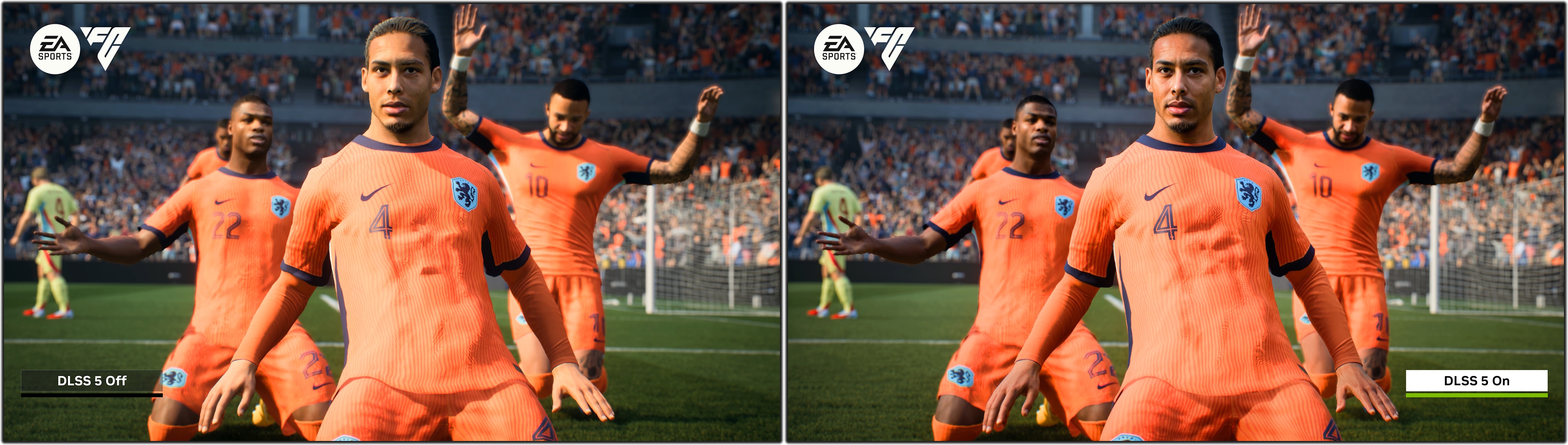
EA Sports FC.

The one game where I thought DLSS 5 worked best (or “least badly,” I guess) was EA Sports FC. Those kinds of sports games have always been interested in pushing photorealism, and I just felt that DLSS 5 looked most in line with the game’s art style. But the EA Sports FC promo images also threw up some pretty weird and jarring artefacting in the background: in the image above, note how the player on the left, when DLSS 5 has been enabled, seems to stick out from the background quite abruptly. Compare that to the same image without DLSS 5; it’s a much smoother transition from face to background – something that, I would argue, looks more natural and less artificial.

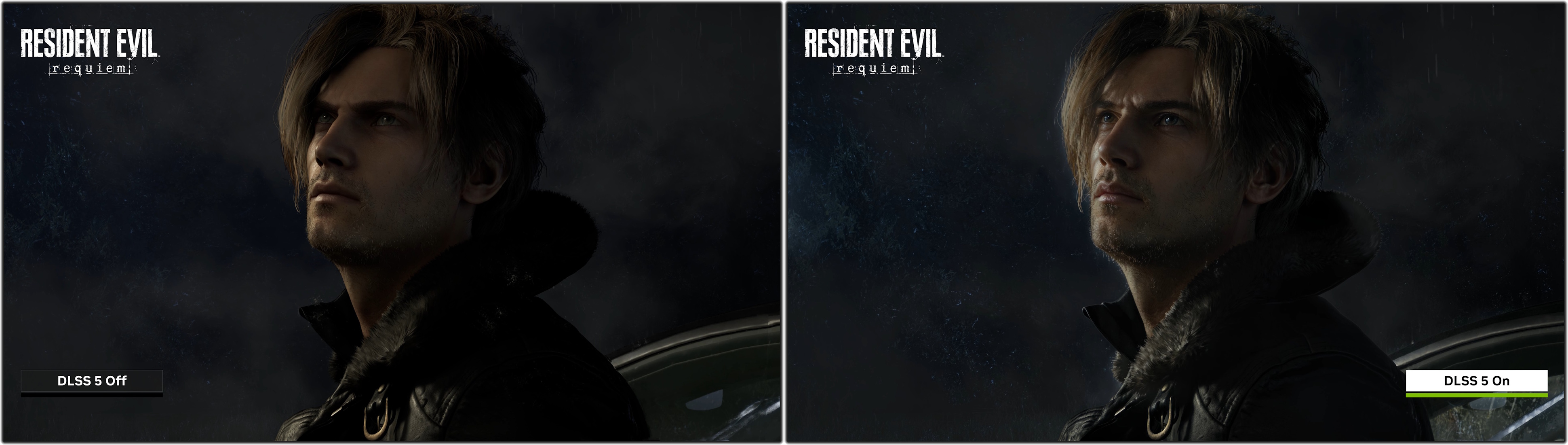
The lighting issue also affects Resident Evil Requiem. The provided images of protagonist Leon (seen below) show DLSS 5 completely changing the way he appears in that scene – and again, as with Starfield above, it looks too bright compared to the original. For a horror game, where environments and lighting matter all the more, I can only describe that as being a potentially huge problem.

The Leon image also has a weird “glassy” effect to the sky in the background, despite seemingly being set outdoors. That could also be a bug – a bug in the very demo images that Nvidia is using to introduce this new technology.
Nvidia DLSS 5.0 demo image
Resident Evil Requiem’s entire lighting has changed.

According to reports by folks who’ve seen DLSS 5 for themselves, Nvidia was running the demonstration on not one but *two* of its top-of-the-line RTX 5090 graphics cards. Here in the UK, those cards retail for upwards of £1,800 – so a rig needing two of them is gonna set you back a pretty penny! Cutting-edge innovation often starts expensive and gradually comes down in price – 1080p HD, ray-tracing, 4K, etc. were all in that category. But if DLSS 5 launches, as promised, later this year and it needs the highest of high-end hardware just to get started… well, I guess that rules me out, anyway!

From what I’ve seen, I gotta be honest with you: I’m not impressed. I think there’s potential – in theory – to use A.I. in some way to improve graphical fidelity, add realism, and do the kinds of things that Nvidia is promising DLSS 5 can. But if the end result is games and characters that look like they’re straight out of memes or A.I. art… I don’t see that proving popular and catching on. Even when DLSS 5 had opportunities to genuinely improve some pretty janky-looking character models in a game like Starfield, it still came up short.
Nvidia DLSS 5.0 demo image
If DLSS 5 could’ve improved any of the games selected, it would’ve been Starfield.

Art is complicated, and art is subjective. And I have no doubt that some folks will happily sacrifice “artistic vision” in order to gain a more detailed, photorealistic look. But if there’s one thing we’ve learned from the success of indie games over the past decade-plus, it’s that graphics aren’t the only thing that matters to players. I’m still of the opinion that, if I had to choose between two similar games in the same genre, the better-looking one is going to grab my attention first. And the push for photorealism has led to some absolutely beautiful video games over the past few years. But does adding a generative A.I. layer improve things? Based on the evidence Nvidia chose to submit, I’m gonna say “no.”

However, this could be an idea to keep an eye on. If we haven’t yet reached the ceiling of generative A.I.’s capabilities, and if improvements to this kind of system are possible, it could be an interesting technology for the future. For one thing, it could mean there’s less of a need to remaster and remake older games; if the goal of a remaster, like last year’s Oblivion, for instance, is just to improve the graphical fidelity, well, this kind of system might be able to do that much more easily. So, despite not liking DLSS 5 as it’s been shown today, I can at least see the potential for its use somewhere down the line – assuming that Nvidia can hone it, refine it, and ensure that it really does preserve a game’s unique art style without ruining things like brightness and environmental details, or making faces look… well, like *that*.

Thanks for reading. I’m not a tech expert by any stretch, but I wanted to share my thoughts on this new technology as it pertains to video games. If you want to check out my thoughts on one potential future for generative A.I. in entertainment, click or tap here. And if you want to get my thoughts on last year’s alarming A.I. 2027 paper, you can find that by clicking or tapping here. Until next time!


DLSS and DLSS 5 are trademarks of Nvidia. All titles discussed above are the copyrights of their respective developer, studio, and/or publisher. This article contains the thoughts and opinions of one person only and is not intended to cause any offence.

The Future of A.I. Entertainment?

I have a longer piece in the pipeline about a document titled A.I. 2027, which you may have seen doing the rounds. I’ll save most of my thoughts on A.I. and its future disruptive potential for that, so be sure to check back. But today, I wanted to tackle a more specific use for artificial intelligence, and how we could see a change in the way we engage with and consume entertainment in the not-so-distant future.

This was prompted, in part, by a conversation I was having with a friend about A.I. 2027. Spoiler alert for my longer piece, but I compared the possibility of a “do-everything” general A.I. system to things like 3D televisions, Google Glass, and the Concorde supersonic jet. All three are examples of technologies that seemed to be on the cusp of revolutionising various aspects of our lives… but didn’t. I can’t help but feel that future predictions of general or super-intelligent A.I. – either as a horseman of the apocalypse or as a revolutionary technology about to deliver some kind of utopia – are, at best, far-fetched! But generative A.I. models, which are more limited in scope, do have the potential to play a huge role in the future of entertainment.

And that’s what I want to address today.

ChatGPT's text box with the words "Ask anything" prominently displayed.
Is A.I. about to revolutionise entertainment?

If you’d asked me in 2005 what the future of entertainment would look like, I would not have been able to predict user-generated content on platforms like YouTube and TikTok becoming massive, popular, and hugely profitable. But in 2025, barely 24 hours go by for me without watching at least one video on YouTube or spending a little time scrolling TikTok. The widespread adoption of broadband internet, social media, and smartphones with built-in connectivity and cameras facilitated this transformation in the way literally billions of people engage with entertainment.

It’s not a stretch to say that there are people today – adults as well as kids – who don’t care much for television, films, or even video games. Their primary sources of entertainment come from social media – and from user-generated content specifically. It turns out that a lot of people enjoy watching things no media executive could’ve ever dreamed of: vlogs, workout routines, makeup tutorials, video game “let’s plays,” and even ASMR. If you’d told me in 2005 what some of the most popular YouTube and TikTok pages would look like twenty years later, I’d have struggled to believe it!

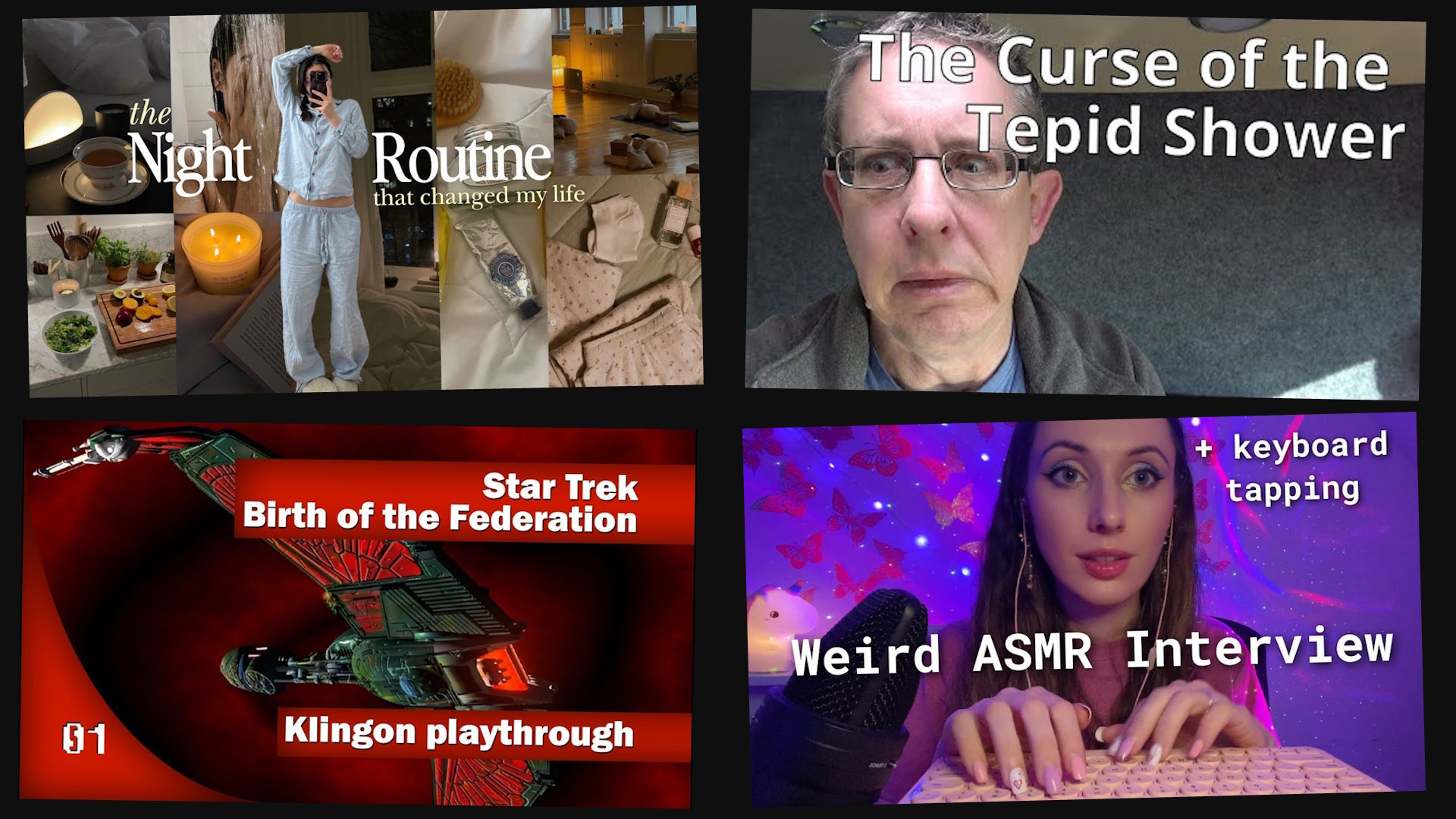
Four YouTube thumbnails from different genres of video.
These kinds of videos didn’t seem like they’d be the future of entertainment just a few short years ago!

All of this is to say that a revolution in how we engage with media is nothing new. It’s already happened over the past fifteen to twenty years – and that came after a century of changes as we went from live music and theatre productions to the cinema, television, video recording, video games, and so on. Nothing in the entertainment sector stays still for very long, so there are definitely changes coming. Whether my prediction is right… well, if I’m still here in a decade or two, we can revisit this piece and see!

So what is my prediction, exactly? What is this big, revolutionary, A.I.-driven change that I foresee?

In short: user-controlled movies, TV shows, and perhaps even video games. All monetised by big corporations, all licensed and based on subscription models, and all generated by A.I.

Artwork of a traditional cinema film reel on a gold-coloured background.
Are A.I.-generated films and TV shows going to be part of the future of entertainment?

Imagine Star Trek’s holodeck, where you can tell the computer what you want to see, but on a flat screen. The biggest names in entertainment at the time will have either developed or bought out A.I. systems to power this content, and you’ll see celebrities, actors, and anyone famous copyrighting or trademarking their likeness and voice, ready to be licensed out. Some performers will be contracted solely to one big entertainment powerhouse, others might be “jobbing it” wherever they can make a buck. “Traditional” – i.e. human-created – films, TV shows, and games will still be made, and social media likely won’t go away, either. But A.I.-generated, customisable, tailored entertainment is going to be a big deal very soon.

You can already see the beginnings of this. Google’s Veo software is just one example of text-to-video A.I., and people are already using it to make their own videos of all kinds of things. The real revolution in the implementation of this technology won’t actually be its development, but its monetisation; how big companies can extract the most money possible for their service will determine how it’s used going forward. Right now, if I ask one of these programmes to generate me a video of Darth Vader in a hot tub, it’ll do it without question – but LucasFilm and Disney won’t be happy about that. As soon as there’s a viable method for monetising these things, we’ll see A.I. models go the way of film and TV streamers – walling off their own intellectual property, and licensing it out for a fee.

Screenshot of Google's Veo 2 software generating a video from a text prompt.
Google’s Veo video generator is one of several that already exist.

Maybe one of the big names in entertainment today – Netflix, for example – will buy out one of the big A.I. companies, using their software exclusively on their platform. Or conversely, maybe one of the big A.I. companies will buy out someone like Disney or Netflix, in a not dissimilar way to how Amazon was able to purchase the venerable MGM Studios a few years ago. Both of those seem possible – but the end result will be the same: content and IP locked behind a paywall, available only to those willing and able to pay.

But for those lucky folks, a world of possibilities opens up.

You’ll sign into your new A.I.-Netflix hybrid, and along with the pre-made programmes and perhaps other user-generated content, there’ll be a simple prompt: “What would you like to watch today?”

A mock-up of Netflix's logo with the subtitle "Powered by ChatGPT" in the same font.
Big entertainment corporations – like Netflix – surely see the potential in A.I.-generated content already.

From there, your only limit will be your imagination. “I want to see a film that’s about two hours long, starring John Wayne as a mercenary in outer space, with Kate Mara as his love interest, and a pink robot voiced by Brent Spiner as the villain. They should pilot a spaceship called the R.M.S. Wombat, there should be a soundtrack by Bon Jovi, and the entire story should be a metaphor for the dangers of secondhand smoking.” A split-second later… and bang! You’re watching your fantasy film with whatever parameters you’ve given the A.I. It’ll be capable of pulling off shocking twists, bringing long-dead actors back to life, and even generating brand-new stories in established fictional universes.

Imagine being able to fire up Paramount’s A.I. (or, let’s be realistic, the A.I. company that owns whatever remains of Paramount by that point) and generate brand-new Star Trek stories. Maybe you’ve always wanted to know what would’ve happened if Captain Picard died after his assimilation by the Borg, or what might’ve happened if the USS Voyager was destroyed, with a handful of survivors being taken in by Chakotay and his Maquis crew. Or perhaps you want to see an expanded look at an existing story, potentially filling in some of the blanks in between established events. You could even look at a story from the other side, like seeing the Dominion War from the Cardassian perspective. All of those things feel plausible with A.I. integration.

Still frame from Star Trek VI: The Undiscovered Country showing the USS Enterprise-A.
We might be able to make our own Star Trek stories one day…

As A.I. technology gets better, its ability to retain information will improve. This means that, the more you use an A.I. programme, the more it gets to “know” you – or at least it gets better at predicting your reactions, your likes, and your dislikes. This means that our hypothetical A.I.-Netflix hybrid will very quickly get to know what kinds of stories you like, what generates the best responses from you, and will be able to use that information to fine-tune and personalise the content it generates for you.

It’ll be kind of like having your own personal film studio. As the A.I. retains all of the information and storylines it’s generated, it’ll be able to make sequels, prequels, and expand on certain story points. If you really liked a character in an A.I.-generated film, it’ll be able to make a spin-off, just for you, tailored to what you liked about the character and the kinds of stories it knows you responded well to elsewhere. Heck, it could even generate a casual vlog-style series based on your favourite celebrity or character, kind of like how we see A.I. chat bots based on fictional characters today.

Photo of a Hollywood film studio.
Imagine having your own film studio in your TV or phone, ready to turn your ideas and thoughts into real, ready-to-watch content.

By now, you’ve heard the criticisms of A.I. Its supercomputers use more energy than entire countries. It’s stealing people’s art, writing, and more. It’s capable of “lying” or “hallucinating” falsehoods, spreading misinformation. It’s going to put millions of people out of work. And I don’t dispute any of those things, nor am I “championing” the use of A.I. in the entertainment space. This prediction is based on what I’ve seen from my limited engagement with the world of A.I. so far. I don’t actively use A.I. myself; I don’t really have a place in my life for an A.I. chat bot, and I’ve never needed to use A.I. to generate anything. But I see people using it more and more, and to me, the scenario outlined above feels like a plausible next step for the technology as it currently exists.

The big things from the corporate side are how to lock down their A.I. models and monetise them, as well as how to prevent competing A.I. systems from “trawling” their content and using intellectual property that they claim ownership of. After all, it’d be no good to offer your service for sale if a free competitor could do the exact same thing without the price tag! But if there’s one thing I can say with certainty after more than forty years of existing in this capitalist economy, it’s that you should never underestimate the ability of corporations to find a way to monetise… everything.

Photo of a briefcase overflowing with $100 bills.
Whichever corporation figures this out first is gonna make a lot of money…

Twenty years ago, I wouldn’t have been able to predict the rise of social media, user-generated content, and subscription services. All of those things seemed to come out of nowhere, catching me off-guard. The idea that people would spend hours each day watching what are basically other people’s home videos… that would’ve seemed positively ludicrous, even in 2005. But some people did see that potential, and more importantly, were able to get in early and monetise the heck out of it.

With generative A.I. being the current trend, it’s easy to write it off as a flash in the pan; another 3D television or MiniDisc. And maybe that’s still going to be the case; I haven’t watched a 3D movie in years, and my MiniDisc player has been gathering dust in the attic since the mid-2000s. But right now, with the amount of money being thrown at generative A.I. software, it feels at least plausible to me that, a few years from now, we could all be generating our own high-quality films, TV programmes, and perhaps even video games from simple prompts, with the only limitations being our imagination… and our wallets.

Stock photo of a Sony MiniDisc.
Remember MiniDisc?

I don’t know if that’s the kind of future I want… but I gotta be honest: part of me feels intrigued by the possibilities A.I. could offer. Being able to get tailor-made, fully customisable movies… there’s genuine appeal there, and whoever gets it right first stands to make a ton of money. I don’t think such a marketplace means that films, TV shows, and video games created by human beings will disappear; there will still be a place for creativity, imagination, and innovation. But there could be far, far fewer of those types of films, TV shows, and games being created if the big corporations go all-in on generative A.I. in the way I’ve outlined above. As with all things A.I., that basically means a ton of people are gonna be out of work. That undeniably taints the finished product; A.I. will come with an obvious, and pretty devastating, cost.

But for a lot of people… well, we already know that the cost to human lives doesn’t matter if they enjoy the finished product. Video games are still frequently created under “crunch” conditions, an exploitative practice I saw firsthand when I worked in the video games industry. Batteries rely on cobalt and lithium, mined by underpaid or even enslaved workers in horrible conditions. People pay for cheap clothes and shoes made in sweatshops. The list goes on… and my point is simple: don’t expect some kind of moral crusade against A.I. to change a lot of minds if it hasn’t in the cases we just mentioned.

Whether A.I. is here to stay, and whether I’m even close to being right about its potential future role in entertainment remains to be seen. I don’t know how much time I’ve got left, but if I’m still here in a decade or two, let’s revisit this piece together. Perhaps we’ll share a chuckle about how wrong I was, and how I exaggerated a flash in the pan technological fad way beyond its capabilities. Or not.


All brands and properties mentioned above are the copyright or trademark of their respective studio, distributor, broadcaster, etc. This article contains the thoughts and opinions of one person only and is not intended to cause any offence.