

Using an ad-blocker when heading online feels simultaneously like a cheat code and also something that’s absolutely essential nowadays. Ad-blocking browser extensions don’t simply prevent you from seeing ads, they also stop companies from tracking at least part of your online activity, including searches and clicks. Although it’s not something that gets discussed often, I’d go so far as to say that an ad-blocker is a pretty essential piece of software for anyone who wants to get a bit of extra privacy and who doesn’t want to see their data shared online. Obviously an ad-blocker on its own isn’t the only thing one needs to remain private and un-tracked online… but it’s a good, easy first step.
At the same time, though, ad-blockers fundamentally challenge the way in which a significant portion of the internet operates. The only way many websites can afford to remain online is because they’re funded by advertising revenue, and using ad-blocking extensions undermines that funding model. I have no sympathy for big corporations (as you’ll know if you’re a regular around here), but small businesses and community projects that rely on ad revenue aren’t things I’d want to see vanish from the internet.

YouTube has recently kicked off an attempt to crack down on ad-blockers, and it’s this effort that I wanted to talk about today – as well as talk about ads online and ad-blocking in a more general sense.
As YouTube’s position as the dominant video platform has been seriously challenged over the past three or four years, I can understand Google’s approach to ads and ad-blockers – or at least, I can recognise that there’s a perverse kind of logic to the corporation’s approach, even if I fundamentally disagree with much of what it’s doing. YouTube has been losing out to TikTok in particular, as well as other video sharing apps and websites, and that partially explains Google’s insistence on both serving up more and more ads to users and cracking down on ad-blocking.
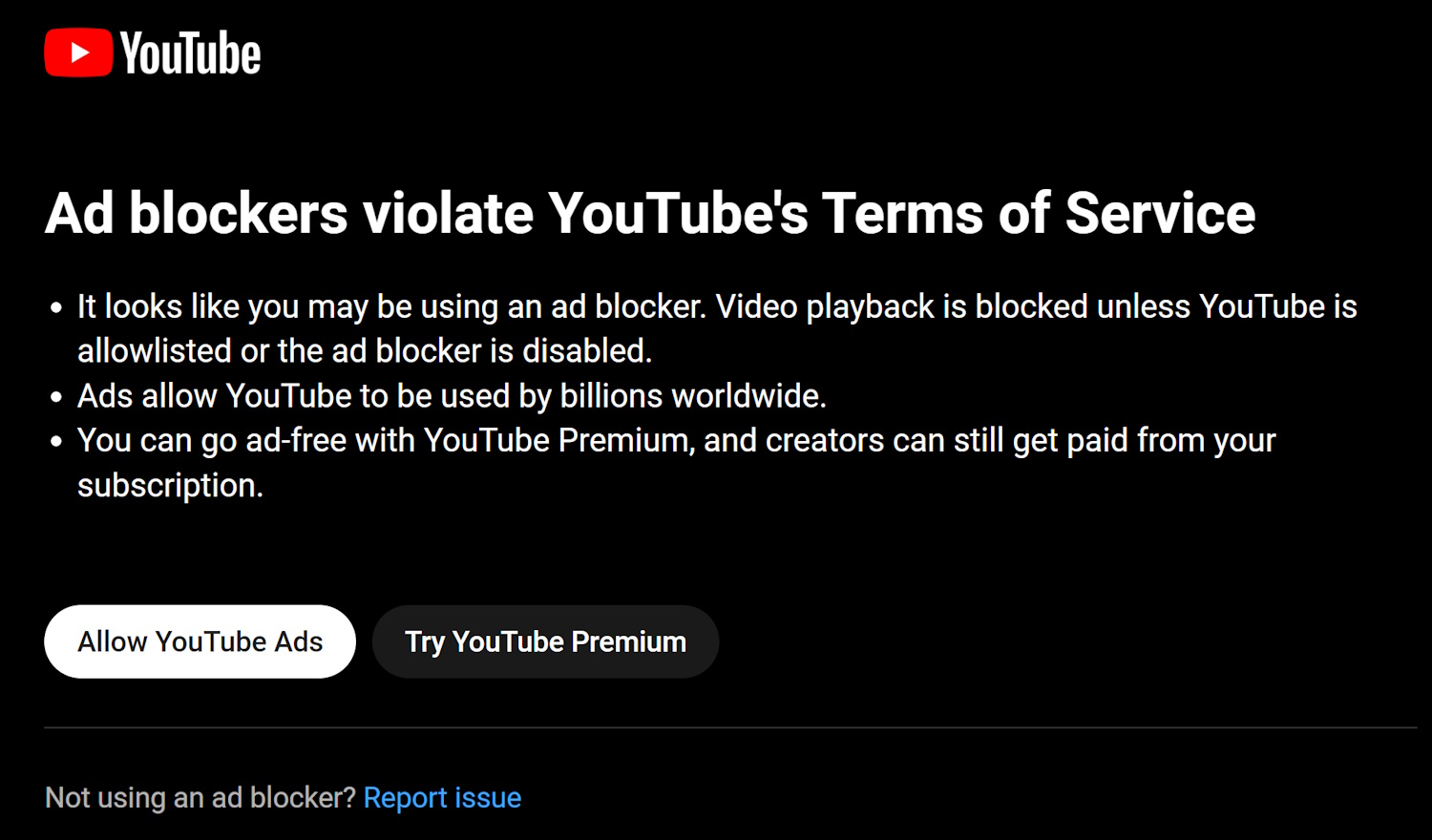
But Google is failing to learn not one but two vital lessons from the early days of the internet! The first is the “Streisand Effect.” By talking about ad-blocking, Google and YouTube are drawing attention to the existence of ad-blockers… and there are tangible, noticeable effects as a result. I don’t put much stock in Reddit as a bellwether of online discourse, but it’s at least noteworthy that the sub-Reddits for several well-known ad-blockers have seen massive increases in comments and subscribers since the YouTube crackdown began.
In short, Google and YouTube may be falling victim to the “law of unintended consequences!” By making a fuss about ad-blockers and trying to push ad-block users to ditch a useful piece of software, all they’ve managed to do is draw attention to the existence of ad-blocking software… causing more users, not fewer, to begin blocking ads on YouTube and other Google services.

Image Credit: Copyright (C) 2002 Kenneth & Gabrielle Adelman, California Coastal Records Project, http://www.californiacoastline.org
The second lesson Google and YouTube seem to have missed is that of Napster’s demise. In the early 2000s, Napster was one of the first big file-sharing websites. People began sharing music online, and the recording industry tried to sue anyone and everyone involved. Napster was shut down after only a couple of years… but that wasn’t the end of file-sharing. Other applications immediately picked up where Napster had left off, and file-sharing is still available online to this day.
Even if YouTube were to manage to successfully disable or shut down all of the most prominent ad-blocking extensions and applications, more will arise to take their place. And even now, there’s a raging battle between Google’s army of coders and those who volunteer or work for ad-blocking applications. As soon as Google updates its code, ad-blockers find a way around it. There’s no end in sight and no obvious way for Google to strike a killer blow.
There will always be people who want to get something for nothing, and who want to enjoy YouTube without ever seeing a single ad. That’s inevitable. But the rise in ad-blocking isn’t the fault of “greedy” consumers… it’s YouTube’s own fault.
Ads on YouTube used to be inoffensive enough. They’d show up once per five or six videos, there’d only be a single ad, and most ads were only a few seconds long. YouTube also allowed for many ads to be skipped after five seconds – and this combination seemed to be working well enough. It’s never fun to be served up an ad, but it wasn’t obtrusive and didn’t get in the way of the YouTube experience for most people.

But YouTube wasn’t content with that… despite raking in literally billions of dollars in ad revenue. Parent company Google began inserting more ads, longer ads, mid-video ads, and unskippable ads… all of which made the user experience noticeably worse. The delicate equilibrium between advertising and content became unbalanced, so is it any wonder people started looking for ways to skip or avoid the ads? YouTube brought this upon itself!
This is the first time in almost four years of writing on the website that I’ve so much as mentioned ad-blocking. By trying to crack down on ad-blockers, all YouTube has managed to do is draw attention to their existence, and call out its own piss-poor advertising situation. It’s the classic case of trying to squeeze users too hard: all YouTube will do is drive more and more people away from its platform and into the arms of gleeful competitors like TikTok.
If ads on YouTube would go back to the way they were a few years ago, maybe the corporation would be able to convince more people to switch off the ad-blockers. But Google is trying to force users to sign up for YouTube Premium – a new subscription service that’s surprisingly expensive. This is a case of “invent a problem, sell a solution.” Google makes the ad situation on YouTube worse and worse, then offers to let folks pay to skip the ads. Ad-blockers are an existential threat to that business model.
If Google believes that it can win this fight… I think it’s wrong and it’s underestimating the resourcefulness of folks online. There may be small victories along the way – Google may shut down one ad-blocking extension, for example, ban ad-blocking on Chrome, or manage to re-code YouTube to temporarily prevent ad-blockers. But there’s a whole lot of determination on the other side, and as we’ve already seen so far in this fight, it’s never more than a few minutes before workarounds are discovered for whatever updates are rolled out to YouTube. Even if Google managed to score a big win and prevented all ad-blocking on YouTube… it won’t be long before cunning volunteers find a way around it.

YouTube is not the juggernaut it once was. TikTok’s rise has seriously challenged its status as the leading video-sharing platform, especially among younger folks, and TikTok’s advertising situation seems to be a lot better and more user-friendly. I don’t use TikTok all that much, but having tried it out recently, I find ads on that platform far less annoying and far more tolerable.
At this point, doing anything to turn off users or push them away feels like a catastrophically bad decision for YouTube that could blow up in its face. The history of the internet is littered with once-massive websites and companies that failed to keep up with changing user attitudes… so there’s no guarantee that YouTube will just be able to coast on its current and past success and simply win by default. That didn’t work for MySpace.

The internet and social media are constantly in a state of flux. It may seem that YouTube is in a dominant position right now – but the brief history of the web tells us that no website, app, or social media platform is unassailable. Doing anything to upset the apple cart while in that first-place position… it just isn’t a good idea. If YouTube was losing money hand over fist, unable to afford to keep the lights on, maybe this crackdown on ad-blocking would be more understandable. But we’re talking about a multi-billion dollar website backed up by one of the biggest tech companies on the planet.
YouTube’s own anti-consumer practices, coupled with the rise of TikTok and other platforms, have pushed people away at the precise moment that Google wants to rope them into long-term paid subscriptions. That’s unfortunate and puts YouTube in an awkward position, but I don’t think this is the right way to react. As Barbara Streisand found out when she tried to force a small photographer to take a picture of her house off the internet, calling attention to something only leads to more people becoming aware of it. YouTube and Google are drawing more attention to ad-blockers… and the result is articles like this one. I’ve literally never mentioned ad-blocking in almost four years of writing here on the website… not until Google and YouTube made it into an issue.
At the end of the day, this is a fight YouTube won’t be able to win. They may score some successes along the way, and Google may even succeed at temporarily preventing ad-blockers on their platform. But it won’t be long before another ad-blocker pops up with a workaround. Look at what happened with Napster, LimeWire, and The Pirate Bay. Or look at how game developers and publishers are locked in a continual battle with pirates. No sooner has an anti-piracy tool been created than people are figuring out how to crack it and work around it. Spending a lot of money on these endeavours is ultimately fruitless – and it’s better for Google and YouTube to realise it now.
There’s also a very real legal question for Google and YouTube: are they even allowed to use software that detects ad-blockers? Scanning a user’s browser, extensions, or computer without permission is illegal in many jurisdictions, so these ad-blocker-blockers may not even be lawful. It would take someone with better legal knowledge than I to litigate that, though!
So that’s the situation. YouTube is trying to push back against the small minority of its PC users who use ad-blocking software… but all that’s happened so far is a rise in the use of ad-blockers and more attention being drawn to ad-blocking. Volunteers working for popular ad-blocking extensions are easily able to shut down YouTube’s best efforts right now… and good for them.
I’d encourage anyone who wants to get a small bit of extra security and privacy online to seriously consider installing one of the available ad-blocking browser add-ons. You can manually “white-list” certain websites and apps, like YouTube, if you want to and if it feels important to you to contribute to smaller businesses and content creators.
As for YouTube’s prospects… I’m not so sure. The way people – especially younger people – consume media is changing, and YouTube’s status as the dominant video-sharing platform is already under threat. Maybe this clampdown on ad-blocking will succeed and will bring in a bit more loose change in the short-term, but beyond that? The future of online video platforms looks a lot more like TikTok and a lot less like YouTube.
Some images used above courtesy of Unsplash and Pixabay. This article contains the thoughts and opinions of one person only and is not intended to cause any offence.
 Trekking with Dennis