Five television shows that ran too long

Spoiler Warning: There are minor spoilers ahead for the titles on this list.

When writers and producers sit down to craft a new television series, usually they can’t plan for anything beyond a single season. Most television shows are greenlit for one season at a time, and renewed for one additional season at a time. Forward planning for events that may take place in Season 6 of a show are usually not at the forefront of creators’ minds when sketching out the storyline of Season 1.

And this approach makes a lot of sense. A series like Terra Nova clearly had a multi-season story planned, as Season 1 ended on a cliffhanger, but cancellation meant that the remaining story was never put to screen. That’s frustrating as a viewer – and yes, even though it’s been ten years I’m still sore about Terra Nova!

Terra Nova had the opposite problem to the titles on this list!

But one drawback to this season-by-season approach to writing and storytelling comes when a show is renewed. If writers have managed to successfully wrap up a season-long storyline and character arcs, what comes next? This is something I’ve termed “the Disney sequel problem,” because it’s comparable to a situation many sequels to successful Disney films find themselves in. What comes next after “happily ever after?” Or in this case, what comes next after a finished story?

Some shows just run and run and run, continuing long after they’ve completely exhausted their potential stories and original purpose. These shows tend to morph into something different – even unrecognisable – from their original incarnation. Even though the characters may remain the same, storylines change and often get wilder and more bizarre. Though some shows retain a large following even as they change, in many cases fans of the first couple of seasons realise that the changes have been for the worse.

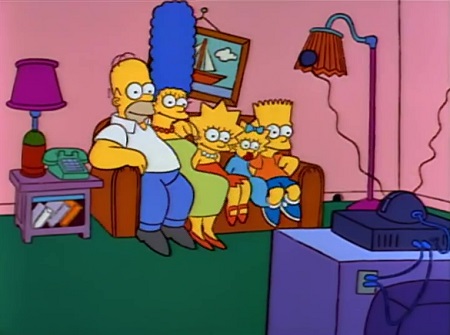
The Simpsons is now approaching its 33rd Season…

Television, like any entertainment or artistic medium, has its limits. No single story can run and run forever, and no set of characters can endure season upon season of increasingly outlandish storylines. Most television shows, like most stories across other forms of media, have natural lifespans. In some cases that could be a single season, in others it could be ten seasons. It varies a lot and depends on the show. But practically every show eventually hits that wall – and some try to sidestep it and keep going.

Today we’re going to look at five examples of television shows that should’ve ended far sooner than they did. As I always say, this is just the opinion of one person. If you like a show on this list and enjoyed its later seasons, that’s okay. I’m not trying to claim these shows or their latter episodes are somehow objectively bad. Simply put, I feel they outstayed their welcome.

Number 1: The Simpsons (1989-present)

The Simpson family.

Given The Simpsons’ place in popular culture and the show’s enormous influence over satire and comedy, this one is painful to admit. But The Simpsons, which will begin broadcasting its 33rd season later this year, has clearly and demonstrably gone on too long. Its original premise – satirising family-oriented 1980s sitcoms and taking a comedic yet biting look at America as the 1990s dawned – has entirely evaporated, and while there have been creditable attempts in recent seasons to recapture parts of that, the show has largely forgotten its roots.

A few weeks ago I picked out twelve of my favourite episodes – and as I was composing that article I came to realise pretty quickly that all of my favourites were within the first eight or nine seasons. That was when The Simpsons was at its peak, and while the show is still running and clearly has an audience, even Simpsons fans admit that it’s gone downhill.

The Simpsons’ decline set in sometime around the year 2000.

One of the most-cited differences between The Simpsons in its ’90s heyday and the series today is the characterisation of Homer. Originally he was presented as a hard-working everyman, down on his luck and with undeniable flaws, but nevertheless someone viewers could root for. In his first standalone appearance in the Season 1 premiere Simpsons Roasting on an Open Fire, Homer’s financial problem and desire to do right by his family as Christmas approaches elicits genuine sympathy; an oddly timeless story. But by later seasons, spurred on by a desire or need to continue a trend of increasingly outrageous storylines, Homer has been turned into a character that’s half-clown, half-jerk, exaggerating his worst traits and becoming a parody of himself.

Unlike some other entries on this list, The Simpsons is episodic in nature. It didn’t have a single overarching story to tell that was exhausted at some point in its run. Instead it had an underlying premise, and a desire to show Americans a satirical mirror of their society. But since the show itself became part of American popular culture, and inspired not only a whole genre of adult-oriented animation but also a whole style of comedy, its ability to effectively do that waned. And as writers exhausted plausible storylines to put a comedic spin on, all that remained was to take the show to extremes – pushing the boat out ever further to try to keep it funny.

Number 2: Supernatural (2005-2020)

Brothers Sam and Dean Winchester in Season 15 of Supernatural.

Supernatural is the show that originally inspired this article! If you’re a regular around here you might remember it from last year’s awards – where it “won” the award for worst television series of the year. I stand by what I said then: Supernatural had become the king of running too long.

When Supernatural premiered in 2005 it had a wonderfully innovative premise. It was a great blend of episodic, monster-of-the-week television with season-long character arcs and stories that rumbled away in the background, particularly the disappearance of the boys’ father and their quest to hunt the Yellow-Eyed Demon. As Sam and Dean travelled the United States hunting an array of new and old monsters and horror movie villains, there was a lot to love.

Sam and Dean Winchester in the pilot episode.

But Supernatural exhausted its original storylines sometime before 2010, certainly by the fifth season or so. Not only that, but having faced down examples of most horror staples – ghosts, demons, werewolves, and the like – the writers and producers were running out of material. The show moved away from its original semi-episodic format toward a more serialised approach, and while there’s nothing wrong with serialised storytelling, combined with the satisfying conclusion of Supernatural’s original storylines and the exhausting of most monster-of-the-week stereotypes, there was nothing left for the show to explore.

For me, one episode more than any other cements Supernatural’s decline: Season 6’s The French Mistake. It was at this moment that the show lost all semblance of seriousness and descended into the fan-servicey mess that became the hallmark of its latter seasons. The transformation of main characters Sam and Dean from two relatively ordinary guys thrust into a world of demon-hunting into invincible Biblical warriors anointed by God and the angels was catastrophic, but that episode was the icing on the cake.

Number 3: Lost (2004-2010)

Title card for Lost.

Lost is absolutely one of the best shows of the 2000s, and unlike other entries on this list which ran for a decade or longer, its six seasons actually seem rather modest in comparison. But Lost nevertheless exhibits many of the same issues, including exhausting its original premise and storylines, and putting its characters in increasingly weird and wacky situations to try to keep the magic going.

I mentioned at the beginning that many television shows are written season by season, without much thought for how or when they will end. Lost is a case in point. JJ Abrams, who created the show, has become notorious for writing half a story – a beginning without any idea of how it will end. In fact, the so-called “mystery box” has become a hallmark of the way Abrams creates his stories. In the case of Lost – as with the Star Wars sequel trilogy that Abrams also helmed parts of – the weaknesses of this approach become apparent.

Lost started strongly and encouraged fans to theorise and speculate – but the writers and producers hadn’t planned any answers to the questions they set up.

There were mysteries in Season 1 of Lost. What caused the plane to crash? How were they so far off-course? What’s with the weird smoke monster? What’s inside the hatch? Who is Kate, and what did she do? But fundamentally it was a character-driven story with a strong focus on the need for survival. The characters found themselves in a hostile environment with no immediate hope of escape, and much of the drama came from that premise.

Lost had become unrecognisable by Season 6, with a narrative that involved worldwide conspiracies, time travel, an island that could literally move, and so on. For fans who had become engrossed in its world, perhaps some of these answers were satisfying. For many, though, they were not, and what started as a fun and mysterious show lost its way when the creative team found themselves boxed in narratively, unable to find a satisfying way to conclude various story elements.

Number 4: 12 Monkeys (2015-2018)

12 Monkeys protagonist James Cole in Season 1.

As with Lost above, 12 Monkeys doesn’t seem to have enough seasons to fit the bill as a show that outstayed its welcome. But it absolutely did! The series began with a similar premise to the 1995 film of the same name – a man from the future must travel back in time to the modern day in order to prevent the release of a biological weapon that would decimate humankind.

That premise sounds amazing, and more than a little timely given the year we’ve just had! Though time travel stories are seldom my favourite for a number of reasons, 12 Monkeys Season 1 absolutely nailed it. But then they ran out of story, and what was chosen to replace it simply did not work. Things went downhill fast.

12 Monkeys did time travel very well… in its first season.

The plot became overly complicated when the original premise – stopping the release of the virus – was played out. What replaced it was a convoluted and frankly just plain dumb story about an international conspiracy to “stop time itself.” Yeah. I know.

Though the characters remained the same, the lines they were spewing now made no sense, and the show had to create increasingly stupid reasons for both using the time machine – its central piece of tech – and for including characters from the modern day. With the focus having switched to battling this weird army of time-hating people, the entire concept of the series was lost.

Number 5: The Walking Dead (2010-present)

An iconic image from Season 1 of The Walking Dead.

The Walking Dead’s main problem is that the entire show is built around a very simple premise: zombies. When the zombies stop being frightening, and when the show’s original cast has been decimated by season after season of “shocking” deaths, there’s nothing left to do. That should be game over – and The Walking Dead managed about three seasons before that feeling set in.

Unfortunately, despite hitting the wall, The Walking Dead kept going. The zombies stopped being the show’s focus and were relegated to a background role, with the impetus switching to new groups of characters who, for no other reason than “because plot,” would turn out to have a burning hatred of protagonist Rick Grimes and his group.
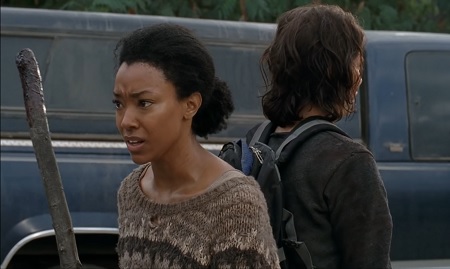
Sonequa Martin-Green (Star Trek: Discovery’s Michael Burnham) appeared in The Walking Dead.

After the show found success with the Governor as its main human antagonist in Season 3, the writers evidently became desperate to recapture that feeling, throwing villain after villain at Rick. That’s all the Terminus cannibals were, that’s all Negan was, and now this new villain Alpha is in the same mould.

The Walking Dead, along with Game of Thrones which was around at the same time in the early 2010s, helped to pioneer the idea of a “disposable” main cast – where viewers were kept on the edge of their seats not sure if all of their favourites would survive to the end. The problem is that the end should’ve come far sooner. Spin-offs like Fear the Walking Dead and World Beyond can pick up the baton for the franchise, telling new stories with new characters. But the main series should’ve ended a long time ago.

So that’s it. Five shows that ran too long – or are still running too long!

Usually this happens for “business reasons” – namely money. Investing in the creation of a new television series is expensive, and when a show is a hit, executives and producers naturally want to keep going, bringing in more money and making use of existing sets, props, and characters. However, this can come at the expense of artistic integrity and good storytelling, with shows forced to make major changes to compensate for either concluding their original story or simply running out of ideas.

We didn’t even mention The Big Bang Theory…

None of the shows on the list above were bad. I actively enjoyed all five in their early days. But somewhere along the way their original intentions got lost, and the transformed series that resulted became less enjoyable. In some cases this can happen within a season or two, especially if the original creative team tell what is essentially a one-and-done story across one season of television. But other shows have a slower, more gradual decline over the course of several years, with concepts that were interesting and exciting in Season 1 decaying and becoming clichéd tropes by Season 5. There are different ways this decline can manifest, just as there are different lifespans for different shows.

As a fan, in every single case I’d rather be writing an article saying “this show was cancelled too soon!” instead of “this show should’ve been cancelled already.” I’d rather lament what we could’ve seen had a show ran for just one more season than feel it declined because it went on too long. Perhaps that seems paradoxical, but sometimes, as the saying goes, “less is more.”

Regardless of what I may think, this phenomenon isn’t going away any time soon. Television producers will always look to continue successful projects where they can and cancel those that don’t bring in enough viewers and enough money. That’s just the way the industry works!

All titles listed above are the copyright of their respective network, broadcaster, studio, and/or distributor. This article contains the thoughts and opinions of one person only and is not intended to cause any offence.

Twelve great episodes of The Simpsons

Spoiler Warning: There are spoilers ahead for the episodes on this list.

At time of writing, the 700th episode of The Simpsons is imminent. Aside from soap operas, which are usually broadcast daily, very few shows come close to reaching that mark. The Simpsons is the longest-running scripted television series in US history, having made its debut in 1989 – 32 years ago! So there must be at least twelve decent episodes, right?

I first encountered The Simpsons in the mid-1990s. The first episodes to be broadcast on terrestrial television here in the UK were in 1996 or 1997, and I recall that it used to occupy the 6pm slot on the BBC. In the late 1990s this would mean it was on right before Star Trek: Deep Space Nine and Star Trek: Voyager, providing a nice little extra as I sat down to my favourite shows!

The Simpsons in its heyday was funny, clever, and a satirical take on the idealistic sitcom families of the 1970s and 1980s. It took television tropes of that era and turned them on its head. It showed a “darker” side of American family life than other shows of its era, with a dysfunctional family at the centre. That edginess held a particular appeal, as did The Simpsons’ style of humour. Some of its nuance and specific America-centric jokes went way over my head in my youth, but I came to enjoy what the fun cartoon had to offer. The fact that The Simpsons was detested by my parents and others of their generation was another great point in its favour! In that sense, perhaps I associate earlier seasons of The Simpsons – which we got in the UK several years after their US premiere – with my burgeoning adolescence. The show came along when I was at that age – having outgrown kids’ cartoons and looking for something edgier and more serious.

It will come as no surprise, then, that the earlier seasons of The Simpsons hold most of my favourite episodes. Despite that, I have watched every season of the show at least once, and while I agree with the general consensus that the quality declined somewhere after Season 9 or 10, most seasons have had decent episodes, and most episodes manage to win a chuckle for the odd good joke, even if the premise or story itself is less fun overall.

Looking at a series that has endured for more than 30 years offers some unique challenges. Is it fair to assess The Simpsons’ overall output; all 700 episodes? If so, the show is undoubtedly mediocre, with far more sub-par episodes than good ones. But if we break The Simpsons down into two distinct eras – its ’90s heyday and then the more recent seasons – we can perhaps be fairer in our assessment. Think of it as comparable to assessing the musical legacy of artists like Bob Dylan or The Rolling Stones. In their heydays, both put out incredible, genre-defining work. But as they kept going and going and going some more, the music they were making became stagnant and its quality dropped. Can we call the careers of either artist mediocre because of a back catalogue overflowing with uninspired work that doesn’t live up to their early successes? I would argue no, both Bob Dylan and The Rolling Stones should be considered musical greats – that their early work defines them, not their mediocre decades. The same should be true of The Simpsons when we come to write its eulogy. It was a great show once. It isn’t any more, but it was once – and it was such a great show that it redefined American humour for an entire generation and spawned a whole genre: adult animation. Without The Simpsons we wouldn’t have Family Guy, South Park, Rick and Morty, or even Star Trek: Lower Decks. It’s an influential series; a landmark in both the history of television and ’90s popular culture.

So without any further ado, let’s take a look at my twelve episodes. For the record, because I know people like to throw tantrums and get upset: I’m not saying that these episodes are objectively the best, nor that they represent the absolute pinnacle of The Simpsons. These are simply twelve episodes from the show that I consider to be great and well worth a watch – especially if you’re looking for something to watch on Disney+!

Number 1: Simpsons Roasting on an Open Fire (Season 1, 1989)

Where better to start than at the beginning? Airing just before Christmas 1989, Simpsons Roasting on an Open Fire launched the series. The characters were not new – they had been part of The Tracey Ullman Show going back to 1987 – but this Christmas episode marked their solo debut. As I wrote the last time I looked at this episode on one of my Christmas lists, it represents a series finding its feet. Not all of the characters or other elements of the show that we would come to know are present yet, but the feel of The Simpsons was firmly established.

Even as Homer spirals downward, it’s impossible not to sympathise with him. The down-on-his luck dad genuinely trying to save his family’s Christmas is an oddly timeless story, one that works just as well in 2021 as it did in 1989. In my opinion, any fan of The Simpsons needs to watch this episode – if for no other reason than to see where it all began!

Number 2: Krusty Gets Busted (Season 1, 1990)

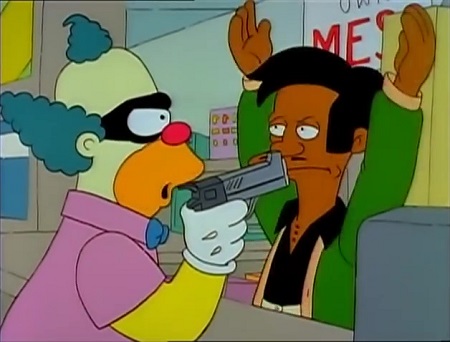
Kelsey Grammar became the first household name to guest-star in an episode of The Simpsons in this episode. He plays the role of Sideshow Bob – a character who recurs occasionally to this day! Bob attempts to frame Springfield legend – and Bart’s hero – Krusty the Clown for armed robbery, and what transpires is an astonishingly good piece of television that incorporates elements of action, mystery, and courtroom drama.

The Simpsons had already proved across its first season that it was more than just dumb jokes and simple comedy, but for me, no other Season 1 episode epitomises this better than Krusty Gets Busted. It managed to be witty and clever, taking the audience on a wild ride as Bart and Lisa attempt to prove Krusty’s innocence in spite of seemingly overwhelming evidence.

Number 3: One Fish, Two Fish, Blowfish, Blue Fish (Season 2, 1991)

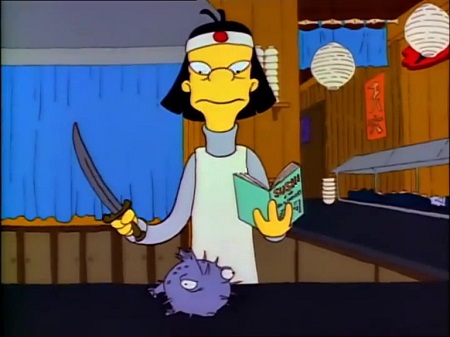
Guest-starring Star Trek’s George Takei, this episode was surprisingly sombre for an animated comedy. After Lisa prompts the Simpson family to try sushi, Homer accidentally consumes the poisonous fish fugu, and is given 24 hours to live. He begins to prepare for death, and though the episode contains a number of jokes and gags, it really showed that both the series and Homer himself can be serious.

Homer makes a bucket list of things he wants and needs to do, the most touching of which were making amends with Grandpa and recording a video for Maggie. More recent episodes focusing on Homer have either shown him to be rude and selfish or a complete clown, so this goes down as a story that shows how Homer used to be – a regular guy trying his best. He has heart in this story, and his impending death doesn’t just mean he wants to do things for himself, but rather for others – for his father, his daughter, and his friends.

Number 4: Flaming Moe’s (Season 3, 1991)

There are a few episodes of The Simpsons that are absolutely iconic, and Flaming Moe’s has to be one of them. Focusing on the relationships between Homer and Moe and Homer and Bart, it’s a surprisingly dramatic story with a truly silly premise! That concept is something that the show did especially well in its early years. Homer accidentally invents an amazing drink – the “Flaming Homer” – but Moe steals his recipe and uses it to drive business to his bar.

Moe is a strangely relatable character, at least for me. He does a lot of bad things across the show’s run, and is by no means sympathetic, but he’s driven by depression and loneliness. While that doesn’t excuse his actions in Flaming Moe’s, the desire to be successful and lauded, especially for someone who feels so low much of the time, is at least understandable, and the episode manages to be more than the sum of its parts because of the nuance in both Moe and Homer’s characters.

Number 5: Homer at the Bat (Season 3, 1992)

We don’t have baseball or softball in the UK, so some of the gags in Homer at the Bat went over my head on first viewing! But it’s a truly funny story, as Mr Burns tries to cheat at softball by hiring professional players to work at his power plant – a commentary both on the way some countries run their Olympic teams and on the concept of college sports.

In true ’90s sports movie style, Homer ends up winning the important game by accident! It’s a fun romp, one which shows Mr Burns at both his most devious and eccentric, as well as looking at the sport of baseball in some detail.

Number 6: Mr. Plow (Season 4, 1992)

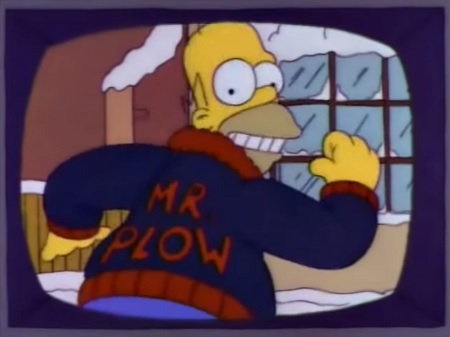
Another of The Simpsons’ most iconic episodes, Mr. Plow shows Homer stepping away from his usual job at the nuclear plant to start his own snowplow business. I like winter time and winter-themed episodes, so this premise was a lot of fun. But in true Simpsons style, things don’t go to plan for Homer. After initially becoming successful as the town’s snowplow of choice, Homer loses it all when Barney (of all people) jumps into the business as his competitor.

The “Mr. Plow jingle” became an early meme, and it’s a great example of the show’s early humour and depictions of Homer. By creating the silly five-second jingle, Homer imitates other commercials of the era in his own way. The whole Mr. Plow commercial perfectly captures low-quality local television commercials of the 1990s and was absolutely hilarious.

Number 7: Homer’s Barbershop Quartet (Season 5, 1993)

There have been some great flashback episodes across the show’s run, providing elaborate backstories to many of the characters. In Homer’s Barbershop Quartet, we learn that Homer – along with Apu, Barney, and Principal Skinner – used to be famous. The plot parodies the rise and fall of The Beatles, from the band getting together, having a string of hits, and subsequently falling apart, but like many earlier episodes, it manages to be gentle in its treatment of the subject it tackles – it’s a send-up of The Beatles without being mean-spirited.

The reunion concert which closes the episode is of course a reference to The Beatles’ famous rooftop concert in 1969, and was a truly touching moment for the episode to end on. This is another episode that manages to have plenty of jokes, but still tells a story with emotion and heart. There are some great songs, too!

Number 8: Itchy & Scratchy Land (Season 6, 1994)

I’ve written before about how I greatly enjoy Disney World and other Disney theme parks, and Itchy & Scratchy Land is a perfect parody of them! Homer and Marge take the kids on holiday to the titular theme park, but things go wrong almost from the first moment they arrive. Seeing Bart and Lisa begging for the vacation was cute and funny, and Homer buying “Itchy & Scratchy money” only to find it isn’t accepted at any of the shops in the park was a hilarious gag.

The episode later turns into a send-up of Jurassic Park when the theme park’s animatronics come to life and begin attacking the family. Of course they manage to survive and escape, but it’s a surprisingly tense and action-filled second half to an episode that started out as a gentle family holiday parody.

Number 9: Lisa the Vegetarian (Season 7, 1995)

A show like The Simpsons typically “resets” after each story, with any growth or change the characters experience being largely ignored in subsequent adventures. A rare exception to this came in Lisa the Vegetarian, which added a new dimension to the character of Lisa. Lisa’s vegetarianism has gone on to be a defining feature of her character, a major part of making her the show’s liberal, left-leaning voice.

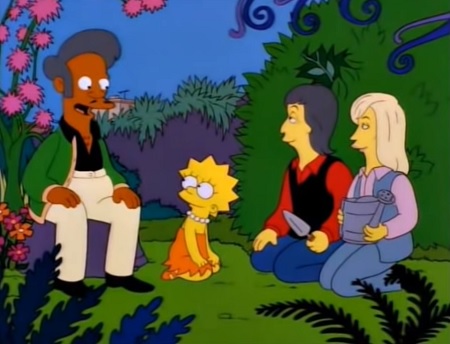
Paul and Linda McCartney, who guest-star, were already committed vegetarians by this point, and making Lisa a vegetarian was done in their honour. Linda McCartney sadly passed away less than three years after the episode was broadcast. A true gem that often flies under the radar when fans put together “best of” lists, Lisa the Vegetarian tackles some deep issues in The Simpsons’ typically fun way and deserves more recognition.

Number 10: The City of New York vs. Homer Simpson (Season 9, 1997)

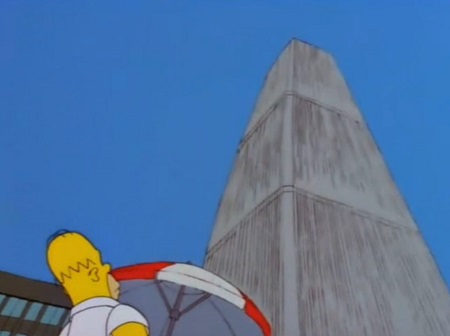
New York City in the 1990s was experiencing somewhat of a renaissance, and this episode shows why. Homer had a bad experience in the crime-riddled city years previously and refuses to go back, but when Barney leaves his car parked at the World Trade Center, Homer and the family must go there to retrieve it.

I’ve only been to New York a couple of times, but the city is absolutely iconic. This episode does a fantastic job of capturing the look and feel of New York, and as we see part of it through Homer’s eyes, it isn’t quite the paradise it wants to be! The city can be confusing and difficult for tourists and newcomers, and The Simpsons’ gentle prodding shows why. We really see two sides of New York in the episode – Homer’s dark vision of the city and the rest of the family’s vision of a fun place to visit.

Number 11: Treehouse of Horror X (Season 11, 1999)

I wanted to put at least one Treehouse of Horror episode on the list, because The Simpsons Halloween specials have always been fun. It’s unusual for any series to regularly roll out “non-canon” episodes, but the annual Halloween specials are a perfect example of how The Simpsons doesn’t take itself too seriously.

In the tenth outing (the Treehouse of Horror specials first appeared in Season 2) the three mini-stories focus on the family running over Ned Flanders in a parody of the 1997 horror film I Know What You Did Last Summer, then Bart and Lisa gain superpowers in a gentle send-up of nerd culture and collecting, and finally Homer accidentally brings about the end of the world – courtesy of the millennium bug! Do you remember “Y2K” and how a lot of folks were in a panic about that? It was a big deal in 1999, and was the perfect way for that year’s Halloween special to end.

Number 12: Mypods and Boomsticks (Season 20, 2008)

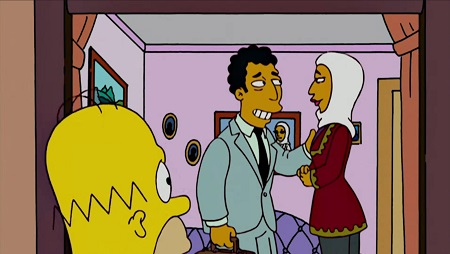
I wanted to choose at least one recent episode for this list – though I suppose 2008 is stretching that definition a little – to prove that The Simpsons does still, at least on occasion, get it right. Mypods and Boomsticks partly focuses on Lisa as she overspends on music for her new MyPod – a not-so-subtle iPod parody. But the main reason it succeeds is in its depiction of Homer and his interactions with a new Muslim family.

The Simpsons in its early years tried to be a dark mirror of American society, showcasing and parodying the darker side of everyday American life. After the 9/11 attacks, anti-Muslim prejudice rose significantly in the United States, and Mypods and Boomsticks is the show’s attempt to look at the issue. Homer initially suspects his new neighbours are plotting a terrorist attack, but it’s later shown that he’s completely mistaken. The episode was praised by many Muslim groups in the United States for breaking down stereotypes and presenting a positive depiction of American Muslims.

So that’s it. Twelve great episodes of The Simpsons.

There are far, far more great episodes that I didn’t put on this list – so maybe this can be a topic to revisit one day! The Simpsons, especially in its early years, was a fantastic and very witty series, so there are dozens of truly outstanding episodes to choose from. It’s certainly true that recent years have seen a drop in quality, but perhaps that’s as much to do with the way entertainment and humour have moved on than it is to do with the series itself.

The Simpsons pioneered a new style of comedy and brought animation to the world of adult entertainment for the first time. A whole host of shows that are going strong today owe it their existence, and it will always have a place in the history of television. If you have Disney+ you have access to the show’s entire back catalogue, and while I’ve recommended twelve episodes here, there are so many more that are worth your time as well.

As a comedy series I first encountered in adolescence, The Simpsons holds a special place for me as a piece of my youth. In its heyday it was a slice of American counter-culture that definitely upset the crusty old grown-ups, and I wasn’t alone in appreciating that side of the show’s darker, edgier humour.

That’s about all I have to say. The Simpsons was a fantastic series, and I had fun choosing a small number of great episodes from its almost 700-strong back catalogue. I hope this was a bit of fun for you too!

The Simpsons is available to stream now on Disney+ and is also available on DVD. The Simpsons, and all episodes listed above, are the copyright of the Walt Disney Company. This article contains the thoughts and opinions of one person only and is not intended to cause any offence.