

Spoiler Warning: There are spoilers ahead for Star Trek: Discovery Seasons 1-4.
Last week, All In took Discovery on a bit of a detour to a Star Wars-inspired gamblers’ den. With the season now building to what appears to be the climax of its story, Rubicon returned to the DMA in a big way, moving the story along in leaps and bounds while spending a little too much time on the dreaded Burnham Relationship Drama™.
I’m in two minds about Rubicon, really. On the one hand, the episode was by far the cinematographic highlight of the season so far, with some outstanding visual effects, beautifully-composed camera shots, and a sense of scale that would’ve made Rubicon feel right at home on the big screen. On the other, there were a couple of moments where I literally couldn’t stop my eyes from rolling at overplayed clichés that I’d hoped Discovery could’ve outgrown by now. What resulted, all things considered, was a mixed bag of an episode; there were some excellent moments and some very sub-par ones.
Stepping back from Rubicon for a moment, I want to consider the overall story of the DMA and Unknown Species 10-C in Season 4. As the season has rolled on, I’ve been feeling a growing sense of déjà vu. The DMA storyline is unfolding in a remarkably similar fashion to the Burn in Season 3, with the big, mysterious, galaxy-threatening event being slowly uncovered by Burnham and the crew of the USS Discovery.
When the first Season 4 teaser initially revealed another “big bad,” I wrote the following: “there are possible downsides to another ‘huge galactic disaster’ storyline so soon after resolving the Burn, in that it risks feeling tacked-on, derivative, or even anticlimactic…” Right now, with the very similar way that the two storylines are unfolding – with little tidbits of information about the DMA or Unknown Species 10-C having been tacked on to episodes throughout the season – I’m definitely feeling that Discovery is straying increasingly close to repetitive territory. There’s still time for the emergence of the second DMA or the reveal of Unknown Species 10-C to take things in a very different direction, but this feeling is something that had been building up for several episodes now, and it kind of came to a head in Rubicon.
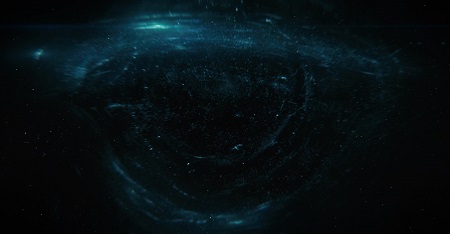
I don’t usually like to talk about too much production-side stuff, but while we’re taking more of a birds-eye view of Season 4, I thought it was worth noting that showrunner Michelle Paradise recently discussed Unknown Species 10-C during a social media event. Her comments seemed to imply that Unknown Species 10-C will be someone that we’ve never met before; someone brand-new to Star Trek. And while it’s possible these comments have been misinterpreted – Paradise could have been talking about an extensive redesign of an existing faction, perhaps – I wanted to briefly consider what that could mean for the show.
In Season 3, one of the reasons why the Burn storyline fell flat at what should’ve been its climax is that basically none of the hints that Burnham and the crew had picked up over the course of the season ultimately mattered – the ending was such a bolt from the blue that it was unpredictable, making for an unsatisfying end to a season-long mystery. Because Season 4 has followed such a similar mystery box-type setup, the DMA and Unknown Species 10-C have seen crumbs of information thrown our way over the course of the season thus far. And with myriad smaller references to past iterations of Star Trek, fans have been encouraged to speculate about possible connections and explanations. For the ending to be another “surprise!” might work… but it might not. And I can’t shake the feeling right now that the explanations for the two big mysterious elements of Season 4’s story are ultimately going to be disappointing for a lot of fans.
Okay, that’s enough of that! The speculation about who Unknown Species 10-C may or may not be will have to wait, and we may not know the answer for a while!
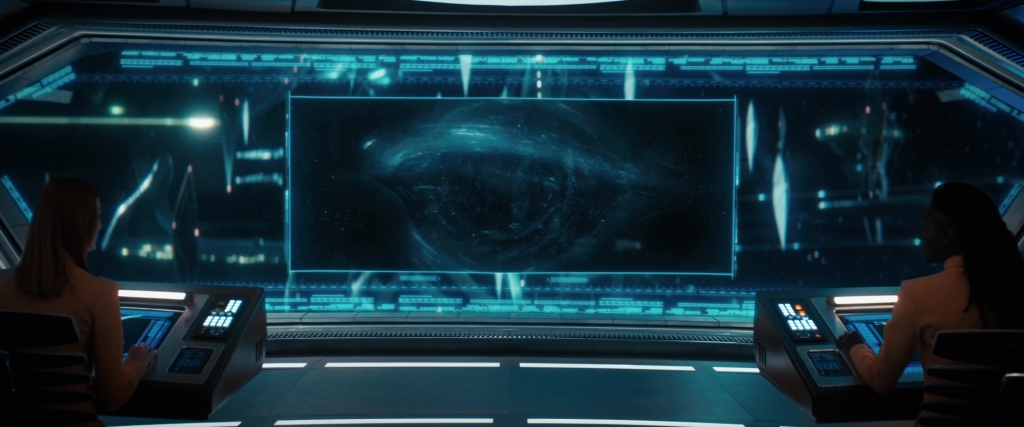
One of the central conceits of Rubicon was this idea of searching for a middle ground in between Book and Burnham’s positions. Communication and compromise have been themes that Discovery has tackled on multiple occasions over the past couple of seasons, but here I’m just not sure it’s been handled very well. I said in my review of But To Connect that there has always been a middle ground in this standoff, and it’s such a basic one that it beggars belief that no one so much as mentioned it until now.
The dividing line was whether to attempt to make peaceful first contact, as Burnham wanted, or to deploy a weapon against the DMA, as Book wanted. But the answer has been right in front of everybody the entire time: do both. In the time it would take to build the weapon and plan for its deployment, the Federation could make its attempt at first contact. It didn’t need to turn into the big fight that it did, and the idea that none of the dozens of diplomats, the Federation President, Starfleet Admirals, and the entire crew of Discovery didn’t even consider it might be a clumsy metaphor for our current divided political climate, but it doesn’t really work as a story beat. And that means that when Burnham finally proposed the compromise to Book, instead of cheering it on and thinking what a wonderful idea it was, all I could think was “that took you long enough!”
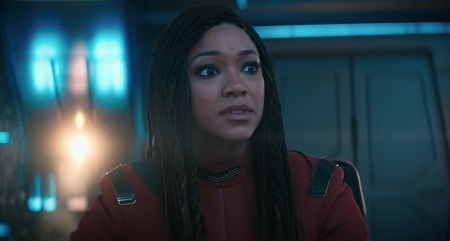
If the story underlying this division was stronger, perhaps I would forgive the silliness of failing to propose a compromise sooner. But because this particular story focuses almost exclusively on Burnham Relationship Drama™, something that I would argue Discovery simply does not need at this point in its run, it feels even more disappointing, somehow.
Despite a weak start in the Season 1 premiere, I have genuinely come to like Captain Burnham. Her ascent to the captaincy, particularly across the back half of Season 3, felt great – and along with Captain Sisko from Deep Space Nine, we can absolutely say that she’s one of the few Star Trek characters who genuinely earned her promotion. We saw a lot of the process that took her from a subordinate to a commanding officer, and while she has her flaws, which Star Trek captain doesn’t?

But after a lot of messing around with Ash Tyler in Season 2 in particular, the whole Burnham Relationship Drama™ angle is completely overdone. Giving her a new start with Book worked so well in Season 3, and to upend that over such a stupid disagreement that should have been solvable is disappointing. Female characters don’t need the support of male characters to be successful, so I’m not saying that Captain Burnham somehow needs Book in her life – but having given her that relationship, to strip it away from her so soon just for the sake of injecting additional drama into a series that’s already full to the brim with it just seems gratuitous and unnecessary.
It would still have been possible to have a conflict over the DMA, with Tarka taking off on a mission to detonate his weapon. All In and Rubicon could’ve played out almost word-for-word without the Burnham Relationship Drama™ detracting from other aspects of the storylines. Another character could’ve been teamed up with Tarka, if the writers felt it necessary, and he could have even swayed a member of Discovery’s crew. In Rubicon, we saw glimpses of the way this could’ve gone with Rhys being generally supportive of Tarka, and any of the secondary characters could’ve played the Book role on this side of the story. Tarka is the driving force here, Book is really just a pilot. And while Book’s story of grief leading him to dark places sounds interesting in theory, Discovery hasn’t really done anything significant with that angle for several episodes. Book got to his dark place earlier in the season, and has been fairly static since.
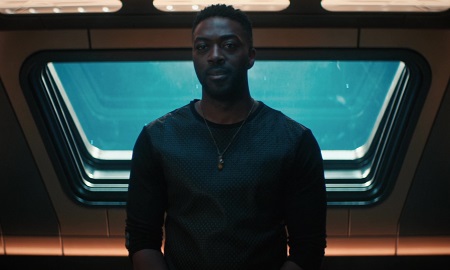
In short, if I was going to make one change to Season 4 as it’s unfolded so far, it would be to keep Book and Burnham together. There was scope to see Book in therapy with Dr Culber, talking out his feelings with Saru or even Zora, and being comforted all the while by Burnham. Instead, the story almost suggests that Burnham is out of her depth with Book, unable to know what to do or say.
The only way I can see the Burnham Relationship Drama™ making sense in Season 4 is if it leads to some bigger destination that isn’t apparent right now. Rubicon saw Burnham hesitate, unwilling to give the order to stop Book because of her love for him essentially overriding her duty as a Starfleet officer – comparable, in some respects, to the choice Worf made in the Deep Space Nine episode Change of Heart. If she feels that she can’t ever make that kind of choice again, or that Starfleet is getting in the way of her relationship, maybe she’ll end up resigning her commission in order to stay with him. If there’s some kind of larger arc at work, perhaps we’ll look back on the way it unfolded and reflect, wondering if the ends justified the means. But right now, assuming that isn’t going to be the case, this aspect of the Season 4 storyline remains disappointing verging on irritating.

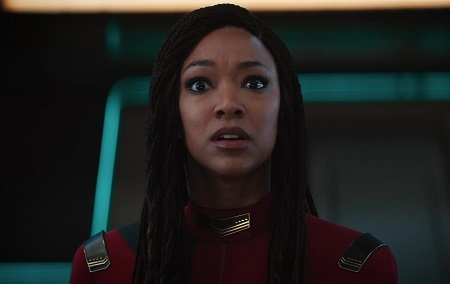
None of that is to detract from two wonderful performances. Sonequa Martin-Green continues to be impressive as Captain Burnham, and in an episode that revolved around her character’s internal conflict between love and duty, Martin-Green put in an outstanding and beautifully complex performance that was, at times, riveting. David Ajala made a wonderful addition to the cast in Season 3, and his arc in Season 4 has seen him put in some harrowingly beautiful performances that truly succeed at communicating Book’s grief. This latest turn for his character and his disagreement with Burnham wouldn’t have been my choice, but there’s no denying that Ajala brought it to screen and did his utmost to sell it.
It was also great to welcome back Rachael Ancheril in Rubicon, with her character of Nhan making a return for the first time since Season 3’s Die Trying. I felt it was a shame to see Nhan shuffled off the ship so quickly after arriving in the 32nd Century, and although it seems like her role this time was a one-off and not the start of a full-blown homecoming, it was still nice to catch up with her and learn that her mission aboard the USS Tikhov came to a successful conclusion.
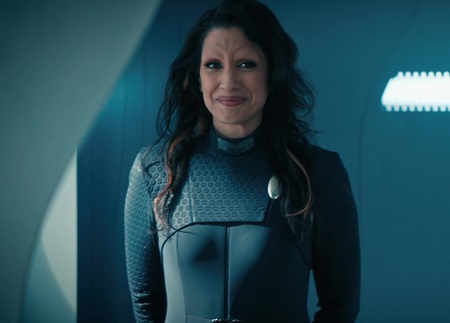
Unfortunately, though, one of Nhan’s lines was so poor that I felt myself involuntarily rolling my eyes. At a crucial moment in the mission, Nhan revealed to Burnham that, rather than just following her orders, she had another motivation: she’d been on another mission somewhere else and had lost “half her team” because she waited too long to make a decision. This terribly clichéd moment added nothing to Rubicon, nothing to Nhan’s character, and nothing to the overall story. It was undeveloped beyond a single line and was nothing but unnecessary fluff thrown in seemingly haphazardly to try to further ramp up the drama.
Discovery has a tendency to do this: taking a secondary character and giving them one or two lines about something in their past that we never saw and that is never referenced again to try to inject additional tension and drama into a story beat. It occasionally works, but more often than not it just falls flat on its face because it’s so painfully obvious that these lines are purely there for dramatic effect. Nhan’s is a case in point: it didn’t flow naturally, it was too barebones to add anything of substance to either her character’s motivation or the storyline she was part of, and overall it just felt like a very clumsy addition to the episode; the kind of line that might be written by a middle school student in one of their first creative writing projects.
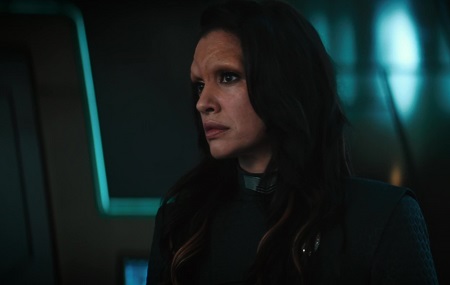
Despite that one line being so poor that it detracted somewhat from her return, I liked the role that had been given to Nhan in a more general sense. There’s no denying that Captain Burnham is too close to Book to be objective, and the rest of Discovery’s crew know him well so couldn’t necessarily be trusted either. Bringing in an outsider – or at least somewhat of an outsider – who has the authority to override Captain Burnham in this specific case makes a lot of sense from Starfleet’s point of view, and it was neat that Discovery managed to find a way to address this conflict in a way that felt natural.
I also liked the way Nhan introduced Saru and Captain Burnham to her secondary plan – the secret briefing that she gave them when their first attempt to capture Book and Tarka failed. It fitted perfectly with Nhan’s very militaristic role as a Federation security officer, and the way she presented the plan after the shuttle mission was as close as Starfleet gets to feeling like a military organisation.
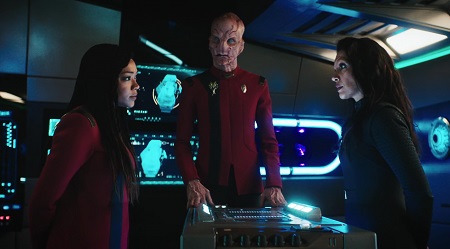
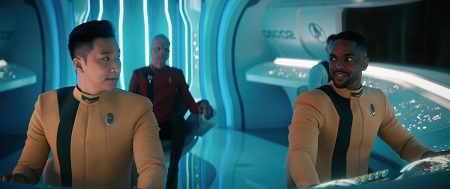
Speaking of the shuttle mission, it was nice to see Saru in command for the first time since Season 3! I also really like the shuttlecraft set design, with its rounded consoles and expansive bridge area. We saw this set used when Tilly took a group of cadets on a mission in the episode All Is Possible, and it’s neat that Discovery is continuing to make use of this new space. Because the USS Discovery hasn’t really seen much of a redesign internally, it’s one of the few sets other than Federation HQ that has a 32nd Century feel, and I like that. The USS Discovery has always felt like a ship that blends aspects of the NX-01 Enterprise, the USS Kelvin, and to an extent, parts of the Constitution-class refit into its own somewhat spartan 23rd Century style. I was wondering if we’d see much of a redesign this season, but in lieu of that it’s nice to get scenes like the one aboard the shuttlecraft that incorporate more 32nd Century design elements.
Although it sadly didn’t take up much screen time and wasn’t really expanded upon in a significant way, the conflict between Rhys and Bryce was an interesting one. It makes sense that there’d be members of Discovery’s crew who were generally supportive of Book and Tarka, so giving that debate some air was neat to see. It didn’t last as long as it could’ve, and the resolution – with Bryce offering Rhys a hand after they were beamed back aboard Discovery – was a blink-and-you’ll-miss-it affair, but it was nevertheless an attempt by the show’s writers to expand the story beyond Captain Burnham, Book, Tarka, and Nhan.
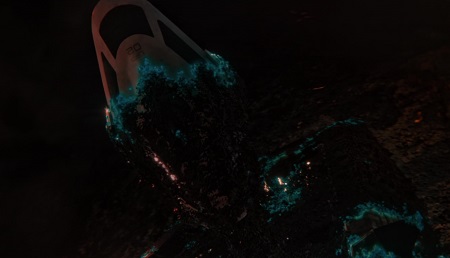
The visual effect of the shuttle being “eaten” and torn in half was spectacular, and definitely one of the highlights of the season so far. The “goo” that captured the shuttle seemed to be a visual blend of programmable matter – a stalwart of 32nd Century tech – and the living ice from the Season 3 episode Far From Home that almost consumed the USS Discovery. And as it gripped the shuttle, eventually ripping it in half as it tried to get away, it was an absolutely thrilling spectacle.
I genuinely felt that Saru, Dr Culber, Rhys, and Bryce were in danger during their away mission, and in a series – and a franchise – that almost always sees its heroes make it home safely, that can be a difficult thing to pull off. As Saru led his team, though, I was so immersed in the world of Star Trek that I fully suspended my disbelief! I would add, though, that this isn’t the first time in Season 4 that Discovery has put crew members into dangerous, life-or-death situations only to save them at the last second. Dr Pollard had a very lucky escape in the episode Stormy Weather, and that’s perhaps the most obvious example. It can feel as though Discovery is providing even its minor characters with some very heavy plot armour at times, and while I didn’t feel that way in the moment, as I was thrilled by an incredibly tense, well-constructed sequence, looking back it feels like yet another opportunity to demonstrate the dangers posed by the DMA, Unknown Species 10-C, and Tarka’s weapon that Discovery missed. A character death can be so meaningful and so significant, and even if it were one of the secondary characters involved in this mission, it would still have been impactful; they’re characters we’ve seen in dozens of episodes across more than four years.
After the failed shuttle mission, Discovery chased Book and Tarka into the heart of the DMA. I wish we’d got something – even just a clumsy line of obvious exposition – to explain how it’s possible for the ships to operate inside the DMA with impunity, especially considering how dangerous it was for Book when he piloted his ship inside it in the episode Anomaly a few weeks ago. I guess the explanation is that the central part of the DMA is more gravitationally stable than its outer edges… but something on-screen to confirm that wouldn’t have gone amiss.
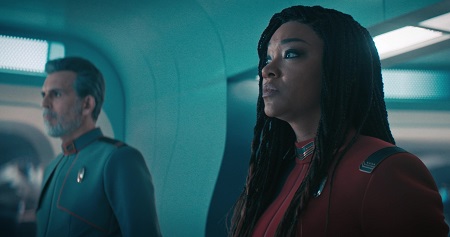
Despite that, I greatly enjoyed this part of the episode. It began with a really incredible close-up of Captain Burnham ordering Black Alert – something I still find incredibly cool four seasons in! – and that led us into a ship-to-ship combat situation that was reminiscent of the Battle of the Mutara Nebula in The Wrath of Khan. This sequence was much faster-paced, as the two ships could use their spore drives to jump around, but the basic premise of having to fight without the ship’s full array of scanners, shields, and weapons in the confines of a nebula-esque setting definitely felt like it was drawing on inspiration from what is still one of the Star Trek franchise’s best space battles.
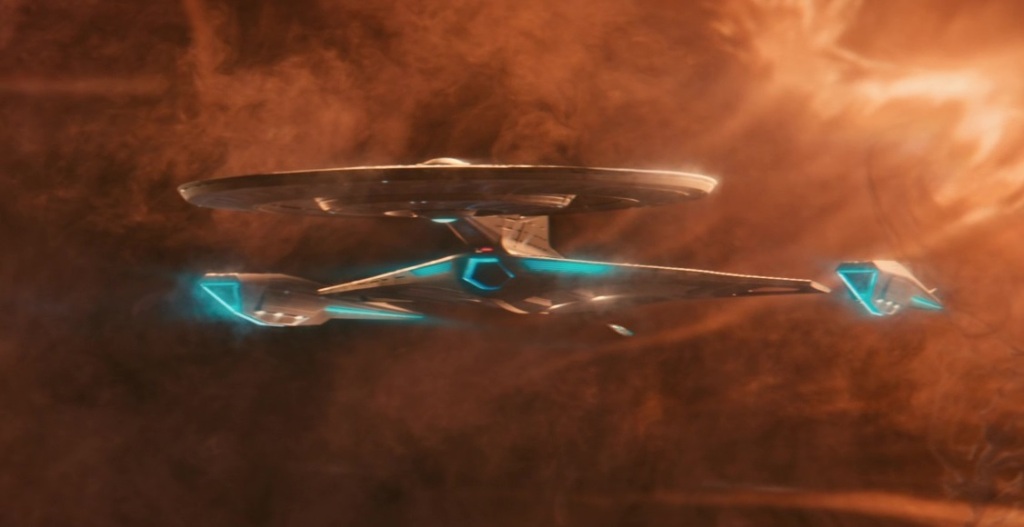
The USS Discovery bridge set saw a significant upgrade this season with the addition of pyrotechnics that could spew jets of fire. That effect was, perhaps, ever so slightly overused earlier in the season, so to see the show return to a more typical “battle damage” style with sparks flying and the occasional chunks of scenery being thrown around was certainly no bad thing. Some effects are best used sparingly, after all!
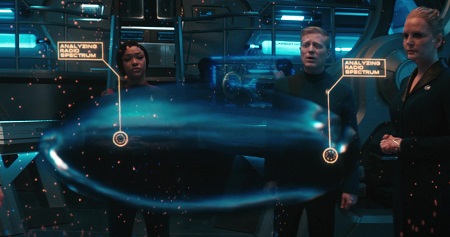
Partly because Discovery still likes to give most of the significant story moments to Captain Burnham, and partly for the sake of increasing the drama and tension, there was once again a moment during this battle that felt rather contrived. Captain Burnham managed to single-handedly figure out that the DMA wouldn’t leave the area until it had hoovered up all of the boronite particles – something that doesn’t survive a second glance as you’d think everyone would’ve realised that far sooner. It worked to set up the “middle ground” part of the story, offering a compromise to Book, but it feels like something that Stamets and co. should have worked out sooner – they’ve supposedly been working on the DMA for weeks off-screen.
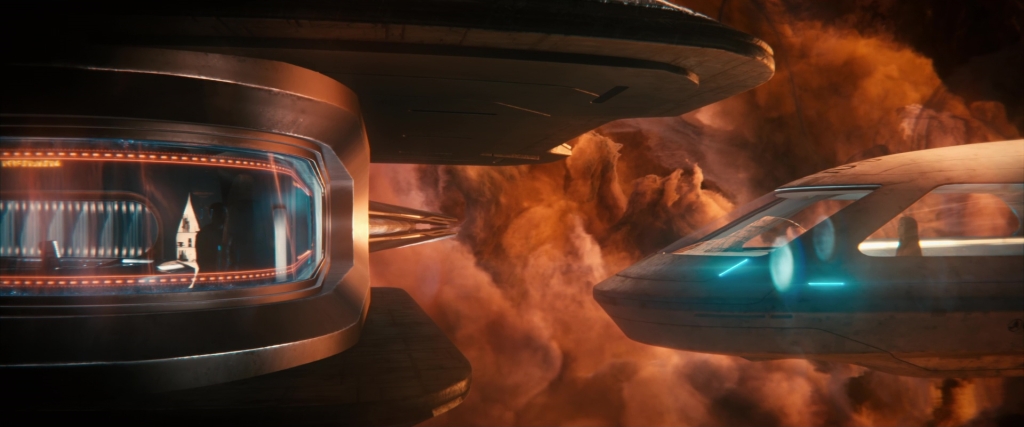
The shot of Book on the bridge of his ship and Burnham at the console of a shuttlecraft was another that was beautifully composed and cinematic. Discovery could’ve chosen to set up this scene using holo-communicators, and that would’ve worked okay, but there was something about seeing the two characters literally divided that really emphasised the point that the series is trying to make about compromise, reaching out, and doing the right thing. Although I think I’ve made clear that the whole Burnham Relationship Drama™ angle isn’t something I’m wild about, I can still appreciate that it was handled incredibly well at this moment.
It seemed obvious to me that Tarka – the driving force behind this whole renegade mission – would fire his weapon regardless, and so it proved. Perhaps because I’m less invested in the Book-versus-Burnham conflict I wasn’t so distracted by it that I was caught off-guard by Tarka’s actions, but it seemed like Discovery was trying to tee this up as a shocking twist near the episode’s conclusion. In that respect it fell a little flat, but I like that the writers didn’t just forget about Tarka or have him break character by standing down.

Tarka was originally presented as an arrogant mad scientist – a character archetype that we’ve seen in Star Trek on a number of previous occasions. But he very quickly showed off a depth that went far beyond that character trope. I would classify Tarka as somewhat of a fanatic; he’s single-mindedly dedicated to his own goal, and is willing not only to go to extreme lengths, but to disregard the feelings and views of practically everyone else in the process. He would hurt – and perhaps even kill – if it meant he could accomplish his objective of going “home” to find the friend he’s been talking about. In that regard, I would compare Tarka with Dr Tolian Soran, the villain from Star Trek: Generations. Both characters share a comparable goal – seeking their idealised versions of paradise – and both are willing to go to extreme lengths to get there.
When the DMA was destroyed, however, we got a very rushed scene with Tarka as he realised the DMA controller had disappeared or been destroyed. He scanned the area for literally a few seconds before sitting down looking dejected, and the pacing of this moment just felt off. We’ve seen in Discovery that sensor scans can take a long time, but even if we set aside nitpicky canon reasons, just as a character moment I think this scene needed more. It wasn’t even clear if he’d miscalculated, destroying the controller, if it had been recovered by Unknown Species 10-C, or something else had happened to it.
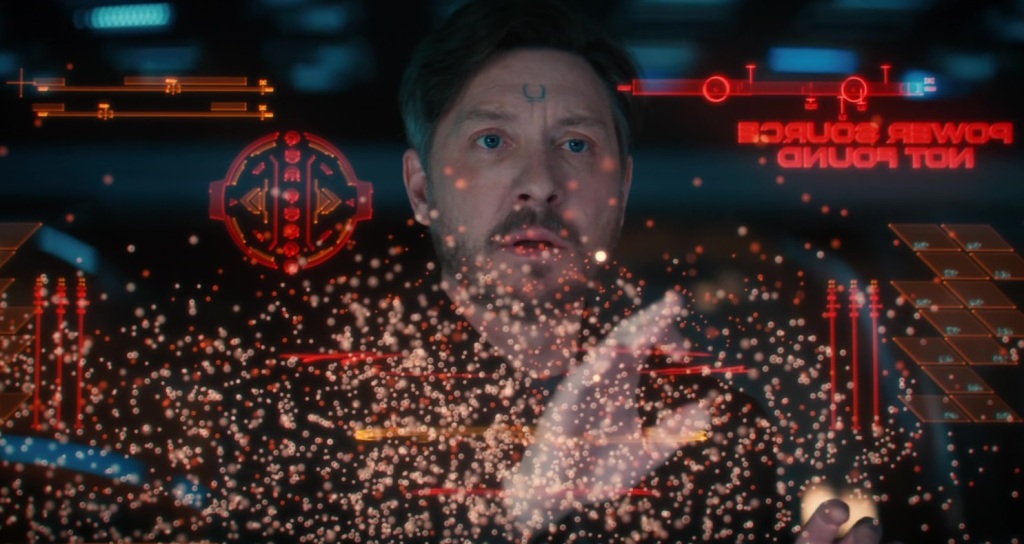
Shawn Doyle has done a remarkable job bringing the complex Tarka to screen in an understandable and occasionally sympathetic way, so at the moment of what appears to be his biggest gamble and biggest defeat (at least so far), we needed to spend more time with him. With the scene’s short runtime, Doyle did what he could to communicate the extent of Tarka’s disbelief, sadness, and even anger… but a few extra minutes spent here would have gone a long way to paying off an arc that has been running for several episodes. There will be more to come from Tarka, I have no doubt, but this moment feels like it should have been bigger and handled with more significance in his story. This is another consequence of Discovery choosing to prioritise Burnham Relationship Drama™ over practically everything else in the story at this point.
Finally in Rubicon we had a development in the burgeoning relationship between Saru and Ni’Var President T’Rina. In a story that focused on the growing separation between one couple and arguments between friends, it was cute and sweet of the series to dedicate some time to a story like this. It served as somewhat of a counterbalance to some of the heavier themes of separation and failure, but more importantly the chemistry between Tara Rosling and Doug Jones is intoxicating, even with the latter under heavy prosthetic makeup. Saru, despite his wisdom and calm demeanour, is inexperienced in this area, and that’s a nice new angle for his character, too.
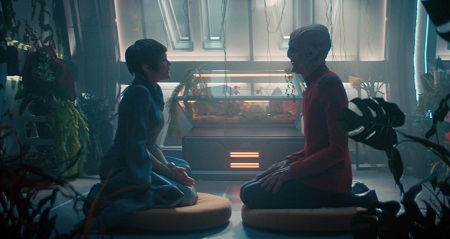
Seeing Saru being the one to seek romantic advice toward the end of the episode was interesting, and the candour shown to him by Dr Culber says a lot about the respect and friendliness between the two of them, too. Aside from the away mission earlier in Rubicon, we haven’t seen much interaction between Saru and Dr Culber for quite a long time, so this reminder that other members of the crew have friendships with one another was very sweet. I’m looking forward to seeing how the Saru-T’Rina relationship plays out, and the fact that Discovery hasn’t rushed it is a good thing!
So I think I’ve said more or less everything I wanted to say about Rubicon. It was a mixed episode for me, one where a particular storyline really clogged things up and overshadowed others, but that managed to have some beautiful moments that shone through even when I wasn’t particularly interested in the approach being taken. It was a beautifully cinematic episode, one of Discovery’s best from a visual and technical standpoint, and one that used sound and silence to great effect. Seeing Captain Burnham silently looking around at the climax of the battle was one of the most intense, dramatic moments from all four seasons of the show, and I can’t fault it.
An episode with some stellar performances from both of its leads and a couple of guest stars stumbled under the weight of an unnecessarily heavy storyline that, unfortunately, had all the subtlety of a sledgehammer at times. There were a couple of places where more time could have been spent away from Captain Burnham and Book; stories that are just as deserving of attention that Discovery chose to rush through in favour of spending more time with its protagonist and her angst about her boyfriend. This is a choice that I wouldn’t have made for a series which is well into its fourth season, and it’s one that, unless it gets resolved soon, will continue to be a drag on what is an otherwise excellent and engaging sci-fi adventure.
Star Trek: Discovery Season 4 is available to stream now on Paramount+ in the United States, Scandinavia, Latin America, and Australia. The show is on Pluto TV in the UK, France, Germany, Italy, and other parts of Western Europe at 9pm on Fridays and Saturdays. Individual episodes or the full season can be purchased on iTunes, Amazon Video, and possibly other platforms in the UK, parts of Europe, and select other countries. The Star Trek franchise – including Discovery and all other properties mentioned above – is the copyright of Paramount/ViacomCBS. This article contains the thoughts and opinions of one person only and is not intended to cause any offence.






 Trekking with Dennis