Star Trek: Discovery review – Season 4, Episode 8: All In

Spoiler Warning: There are spoilers ahead for Star Trek: Discovery Seasons 1-4 and Star Trek: Voyager Season 4.

After what seemed like a never-ending six-week break, Discovery has finally returned to our screens! I don’t necessarily mind a mid-season break in principle, but the way Discovery’s was handled was poor from ViacomCBS and Paramount+. Being announced with mere days to spare seems intentional, as if it were deliberately designed to make sure that fans had no opportunity to cancel or suspend their Paramount+ subscriptions. We’ve talked on several occasions recently about the need for ViacomCBS and Paramount+ to get a grip and demonstrate that they’re serious about this whole streaming business – and randomly announced, unscheduled mid-season breaks are not a particularly good look.

The six-week break opened up a gap for Star Trek: Prodigy, though – and if you skipped it or didn’t want to check it out because it’s billed as a show for children, do yourself a favour and reconsider! Prodigy was fantastic, and managed to be a series that really embodied the spirit of Star Trek. Unfortunately it’s only available “officially” if you live in the United States (even Paramount+ in Australia didn’t broadcast the full ten episodes for inexplicable reasons) but I daresay you can find a way to watch if you so choose. Check out my spoiler-free review of Prodigy Season 1, Part 1 by clicking or tapping here.

If you missed Prodigy, go back and check it out. I can’t recommend it highly enough.

So let’s talk about All In. The episode had a very strong “Star Wars” feel for the most part, with the gamblers’ den that served as the main setting definitely taking its cues from comparable locales in the Star Wars franchise. The Karma Barge felt like Star Trek’s answer to the Mos Eisley cantina in the original film, complete with shady aliens, drinking, gambling, and criminality – all under the watchful eye of a charismatic crime boss. And I can’t be the only one to notice the similarity between the way the names of Haz Mazaro and Star Wars’ Maz Kanata sound, can I?

I don’t object to these kinds of “out of bounds” places existing in Star Trek, and we’ve seen lawless settlements and shady saloons in basically every iteration of the franchise in some form or another. It’s a trope from westerns that the franchise inherited going all the way back to its inception. In the context of a post-Burn galaxy it makes sense that places like this would exist and would be popular with a certain proportion of the population. I guess the only real thing to say is that this Karma Barge was definitely more Mos Eisley cantina than Quark’s – and that’s a choice that the show’s writers and producers made.

The Karma Barge felt like something lifted from the Star Wars franchise.

After a break of six weeks, putting Book and Burnham back together makes a certain kind of sense. There are only another five episodes to resolve everything before we get to the end of the season, after all. But if we watch But To Connect and All In back-to-back, and take into account statements made by President Rillak in particular about the in-universe passage of time, the story feels pretty weak. All In kicks off mere hours after the events of But To Connect, and although it arguably says something about the connection or similarities between Book and Burnham that they both chose to visit the same location… it makes the story feel incredibly contrived.

Also, considering the major contrivances required to simply get these two in the same room, I’m not sure this pretty weak story setup actually accomplished very much. Book and Burnham are no closer to resolving their feud than they were at the end of But To Connect, and in some ways are a step further apart having tried and failed to talk it out. I think we needed at least one episode in between But To Connect and the Book-Burnham reunion to really let things sink in for both of them, so going from that conflict over the vote last time (which was itself a rather weak premise that could have been easily resolved) to this episode, with another phase of the conflict in a pretty contrived setup, leaves me struggling to find many positive things to say.

Book and Burnham were reunited.

If All In had been a stronger episode overall, with a stronger central premise, perhaps some of those feelings would’ve melted away. If we’d spent longer getting to the Book-Burnham reunion, or if the gambling storylines were better written (to put it bluntly) I could’ve seen myself getting to a place where it would’ve been possible to write off some of these contrivances. But as you can probably tell already, I felt that All In’s story was, once we cut through the contrived fluff, not an especially strong one.

Book and Tarka definitely got the better and more interesting part of the story, as they had to earn the magical macguffin molecule by tracking down a cheater in the gamblers’ den. Though All In skipped over much of Tarka’s process as he tracked down the changeling and modified a piece of equipment to trap them, it was a neat premise and one that, for lack of a better term, had a very “Star Trek” feel to it in what was, as mentioned, a setting that definitely drew on other sci-fi/fantasy influences. As an aside, I don’t think this changeling was a Founder – there are other shape-shifting species in Star Trek, and the way this changeling switched forms didn’t remind me of Odo in any way.
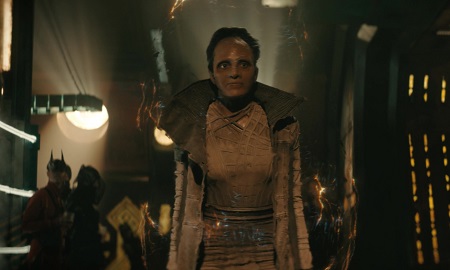
Tarka caught a changeling gambling cheat.

We also got to see glimpses of how well Book and Tarka actually work as a duo. In a scene at the tail end of The Examples we got to see them together for the first time, albeit briefly, and But To Connect showed them coming together to try to win the vote. But it was here, for the first time, that we really got to see their dynamic as a dysfunctional duo – and it works remarkably well. Shawn Doyle and David Ajala play off one another’s strengths beautifully, and they do an excellent job at showing how these two characters have such radically different motivations for undertaking this mission.

There was a moment later in the episode which seemed to hint at Tarka perhaps having some kind of emotional draw to the “friend” he told Book about in But To Connect that arguably goes beyond “just” friendship. It’s possible that this character is a love interest for Tarka, which could be an interesting development if: a) this character is still alive, and/or b) they’re someone we as the audience might be familiar with. Neither of those points is guaranteed, so this could be a red herring that doesn’t go anywhere significant.
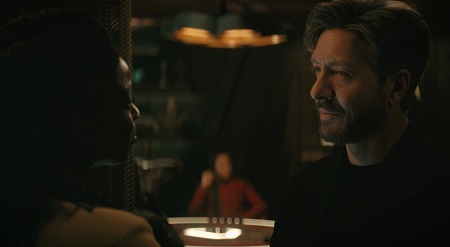
Did Owosekun touch a nerve when she pressed Tarka about his “friend?”

That scene between Tarka and Owosekun was cleverly-written, though, and I honestly can’t tell if Tarka was responding to Owosekun with genuine emotion or was feigning it in some kind of double-bluff. He’s an egotistical man, that’s something we’ve known since even before we first saw him on screen, but whether he’s capable of lying and manipulating at that level to throw people off-balance is unclear right now.

All In was a good episode for Owosekun, giving her a storyline comparable in scale, at least, to Detmer’s in Season 3. A lot of folks have complained about Discovery not making good use of its secondary cast – the bridge crew in particular – so this might be the writers and producers responding to those criticisms. A similar role could have been created for Burnham or several other main cast members – so the choice to put Owosekun in this situation was definitely a deliberate one.

All In gave Owosekun her biggest role in the season thus far.

It was definitely a sweet moment to have Burnham and Owosekun paired up, and they worked well as a character duo for this part of the story. The moment between them on the shuttle was perhaps the strongest, at least from an emotional point of view, and aside from episodes like Explorers, where Captain Sisko and Jake went on their own adventure, it’s got to be one of the very few missions in Star Trek’s 800+ episodes where both principal characters were black. Add into the mix Book and the only non-black participant in this story was Tarka.

Unfortunately, though, I felt that Owosekun’s big fight was not well-constructed. This was the central turning point of the mission for her and Burnham, and there are basically two ways to interpret what happened. Either Owosekun was, as her rivals later alleged, essentially hustling the fight by throwing the first two rounds – which I don’t believe, based on the extent of her injuries and her interactions with Burnham – or the fight was simply badly-written and poorly-filmed, not allowing us as the audience to see any of the process involved as Owosekun presumably tried to figure out how to outplay her opponent.
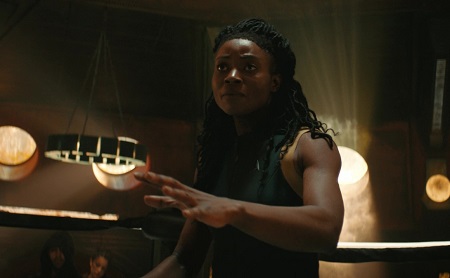
Owosekun’s fight sequence was not well-constructed.

From where I was sitting, here’s how it looked like the fight went down: Round 1, Owosekun got her butt kicked incredibly easily by a far larger, stronger opponent. Round 2: the exact same thing happened. Round 3: out of nowhere, and with all of their money on the line, Owosekun suddenly became 10x stronger and was able to win by magic.

We needed to see something – anything, really – to indicate what was going on. Was Owosekun using the first two rounds to spot weaknesses or patterns in her opponent’s fighting style that she later exploited? If so, that was subtle to the point of being hidden. Was she, in fact, hustling, knowing that the odds would get better with each defeat? Again, if so, that was not communicated to us as the audience. Fights don’t work like this in any contact sport in the real world – so either the explanation is childish writing, saying that Owosekun “got good” at the perfect moment, or the explanation is bad writing and/or filming and editing, meaning that essential elements of the story were simply not well-communicated to us as the audience.

Owosekun on the ropes with her opponent in the background.

In a story that was already choked by the contrivance of Book and Burnham finding their way to the same place within hours of the events of the previous episode, the poor way in which the fight was executed on screen added to the sense that All In was just not working very well. It was exciting in the moment, I will happily concede that point. And Oyin Oladejo did a creditable job at making me feel that Owosekun was in danger, but determined. Combined with her scene with Tarka later on, it was her best episode of the season so far, and her best performance since That Hope Is You, Part 2 in Season 3. It’s just a shame that the material itself wasn’t particularly strong.

The final part of the episode depicted a card game with Burnham, Book, and two nobodies, with the magical macguffin molecule on the line. And here’s a piece of free advice to the writers of Star Trek, Star Wars, or literally any other sci-fi or fantasy franchise: if you’re going to make a card game an essential part of your story, either make it a familiar card game or explain the rules. Spending nearly ten minutes watching people play a card game that was impossible to follow because it used different designs for the cards and different rules was not entertaining in any way, and this sequence was the episode’s weakest by far.
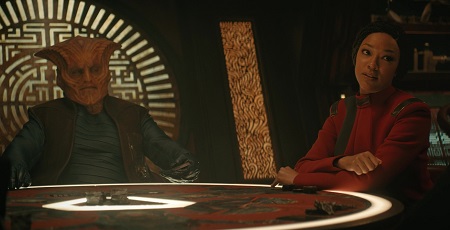
Haz Mazaro and Burnham at the card table.

The game was called Leonian poker, and despite the “poker” moniker, the rules were not explained at all. The non-face cards had a vaguely familiar design, but were different enough that it wasn’t easy to see at a glance who was winning or who had a strong hand. And this sequence dragged as a result. Now I will freely admit that watching professional poker is not something I care about in the slightest, but at least if I do watch a poker game I know the rules and can follow what’s going on. Here, a combination of the card designs, lack of clarity over the rules, and the pacing of the sequence itself meant that it was impossible to follow what was happening. This led to a deeply unsatisfying feeling of being on the edge of my seat hoping Book and Burnham could defeat the “Emerald Chain holdouts,” but not knowing what was going on or who was in a good position. The entire sequence was just frustrating.

When designing any kind of fictional card game, it needs to either have its mechanics explained, or be visually very easy to follow – or ideally both. This game, while it may or may not have followed the basic rules of poker, was neither explained nor visually simple enough to be intuitively understood, and I think it’s that combination that detracted from this sequence. If it had been a shorter sequence it might’ve worked better, but it lasted almost eight minutes – and those minutes really did seem to drag.
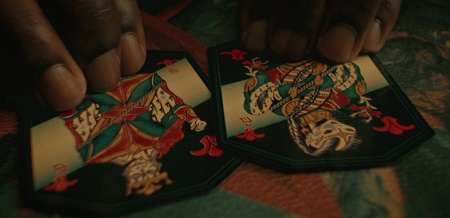
I found the card game frustrating and difficult to follow.

The upshot of all of this was that Book won the game, meaning that he and Tarka could escape with the magical macguffin molecule. I think there was something at least somewhat visually underwhelming about this isolynium, too, that made the stakes of the whole gambling operation – and the threat from Burnham that Book was crossing a line that he “could never come back from” – feel a bit anticlimactic.

In the real world, of course, we have materials like plutonium and uranium which don’t look like much, but are very dangerous, and isolynium is clearly modelled after elements like those. But it doesn’t make for a visually impressive presentation in the way that, say, a barrel of glowing, pulsing, neon pink goo might have had. That’s a deliberate aesthetic choice on the part of the show’s creators – but coming in an episode that had a number of other weak elements, the fact that the highly sought-after prize that all of our characters were desperate to procure was a vial of nondescript metallic flakes no bigger than a coffee mug was definitely an anticlimax. I didn’t know what to expect from isolynium – as far as I know the material is new to Star Trek – but the way the magical macguffin molecule was presented felt like a bit of a let-down in visual terms. Discovery has done some exceptionally interesting things with some of its visual effects across all four seasons, including in a number of unimportant or background areas. For something so vital to the plot to be so visually uninspired made this moment underwhelming.
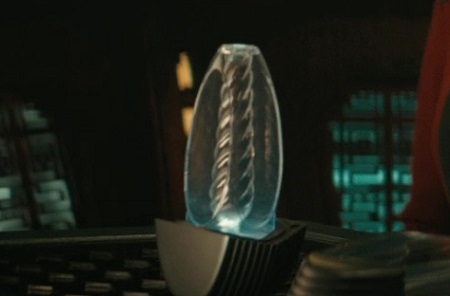
The isolynium – the macguffin at the centre of the episode’s story – was visually unimpressive.

All of this led us to Book and Tarka taking the magical macguffin molecule and leaving, planning to build the weapon. I don’t really see what was stopping Burnham having the USS Discovery on standby to jump in and try to apprehend them after they’d left the barge (which was, understandably, neutral ground). But I suppose that’s a bit of a nitpick. Technologies like the Spore Drive can feel kind of overpowered, so using them sparingly is probably no bad thing! What’s the betting, though, that Tarka already figured out about the tracking device and leads Burnham and the rest of Starfleet to a dead-end? Maybe I’ll save that one for my theory update!

The conflict between Rillak, Vance, and Burnham was one that had the potential to be interesting, but it strayed very close to feeling as though Rillak in particular, but also Vance, were lashing out at Burnham for something that she couldn’t have reasonably been expected to predict. Book’s turn in But To Connect was sudden, and their theft and escape came 90% from Tarka – he was the one who stole the Spore Drive prototype. I can understand the frustration that Rillak in particular would have as she tries to keep the Federation united, and I think Chelah Horsdal did a good job portraying that complex emotional state.
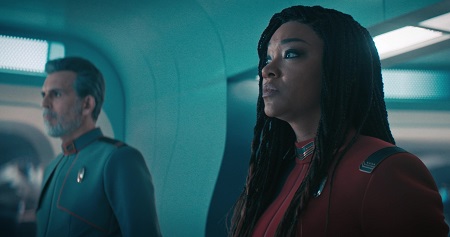
Vance and Burnham during their meeting with President Rillak.

It was also somewhat of a rarity to see Admiral Vance get a bit of a dressing-down from the Federation President. We’ve usually seen Vance very composed and in control, but this situation has exposed a vulnerability for him, as he fears not being able to see his family – or even for their safety – in the event of war with Unknown Species 10-C. Again, a stellar performance from Oded Fehr communicated Vance’s emotions expertly. I also liked that Vance was willing to find loopholes and bend the rules for Burnham, something that I think he would never have considered under normal circumstances.

As the episode was drawing to a close we got a tiny tidbit of information about Unknown Species 10-C. Much of the rest of the episode felt like a detour, so it was important in the closing moments to advance the season’s main story in some way. The revelations this week were that Unknown Species 10-C appear to have some method of cloaking an entire star system – making them far more powerful than the Federation had been anticipating – and that the DMA is designed to harvest a particular particle: boronite. This could be a reference to the Voyager episode The Omega Directive, in which boronite was said to have been used by the Borg to synthesise an omega molecule – one of the most powerful substances in the Star Trek galaxy.
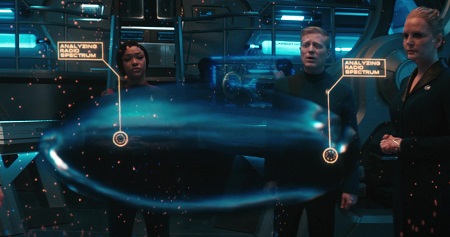
Unknown Species 10-C live here.

This sequence was cut a little short for me; I felt Discovery could have made more of the explanation of this new angle. The DMA being akin to a mining tool confirms what I’d been suspecting – that it isn’t a weapon – but the scene in which this was explained was very short on detail. Burnham makes huge assumptions based on only a few pieces of information, and may not have the complete picture. For storytelling reasons I daresay her assumptions are accurate and I’m not expecting any of it to be reversed or undone, but I feel like a longer sequence with a bit more time for debate and discussion could have got us to the same place in a bit more of a believable way.

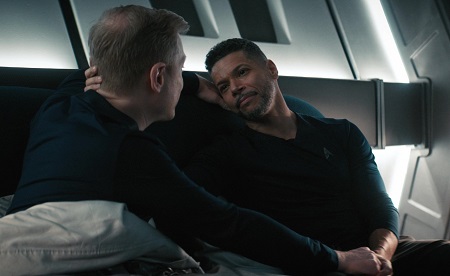
Finally, one of the more understated moments in All In was actually one of the best. Dr Culber had been feeling overwhelmed with his role as ship’s counsellor, and that slow build finally boiled over in what was a rare emotional moment in an episode that had its focus elsewhere. The sequence between Dr Culber and Stamets in their quarters was tender and sweet, and reinforces how the pair really are Discovery’s emotional core.

Dr Culber finally got to confront some of his bubbling emotional issues this week.

It also tapped into a theme that Discovery has been running all season – and going back to last season, too: trauma. Different members of the crew have come to stand for different responses to trauma and different parts of the grieving process. We saw Tilly choose to take a very different path, leaving the ship. Gray returned to Trill to try to pick up the pieces of his training. Book had been most strongly affected by grief and ended up going down a dark path. And in Dr Culber’s case, he’d been throwing himself into his work at the expense of taking care of himself.

Feeling that he had failed Book, and also failed to prevent Book from taking the actions he took in But To Connect, Dr Culber was blaming himself and taking it as a personal failure. Stamets seemed to be able to get through to him, though, and that’s definitely a positive thing. Showing how love can cut through moments like this is something that we’ve seen Discovery do on occasion, and it was powerful here.

Stamets and Culber took some time away from work.

So I think that’s it for All In. Overall, I’d say it was a bit of a disappointment, despite some individually strong performances and well-constructed moments. The central conceit of putting Book and Burnham back together in such a random way didn’t work for me, and as a result much of the drama at the gamblers’ den felt contrived. The climactic card game was too difficult to follow, leading to a sequence that dragged on far too long and was frustrating to watch, and when All In did find time for fun or interesting moments, they tended to be cut short in favour of returning to the contrived, less-interesting side of the story.

I don’t want to say this is “the worst episode of the season,” because that makes it sound like I hated it and it was irredeemably terrible. I don’t think All In was an awful episode; it’s certainly streets ahead of the likes of Season 2’s The Red Angel. But it was a bit of a let-down, and a weak reintroduction to Discovery after its six-week break.

With only five episodes remaining, there’s still a lot of work to do; All In didn’t move the needle in a major way. Tarka and Book are still on the run, planning to build their weapon. Unknown Species 10-C is still out there and still hidden. The DMA is still doing its thing, flitting about the galaxy. And Starfleet is still two steps behind both. It will take a lot to bring Season 4’s storylines together and start wrapping things up! I hope Discovery is up to the task.

Star Trek: Discovery Season 4 is available to stream now on Paramount+ in the United States, Scandinavia, Latin America, and Australia. The show is on Pluto TV in the UK, France, Germany, Italy, and other parts of Western Europe at 9pm on Fridays and Saturdays. Individual episodes or the full season can be purchased on iTunes, Amazon Video, and possibly other platforms in the UK, parts of Europe, and select other countries. The Star Trek franchise – including Discovery and all other properties mentioned above – is the copyright of ViacomCBS. This article contains the thoughts and opinions of one person only and is not intended to cause any offence.
Star Trek: Discovery review – Season 4, Episode 5: The Examples

Spoiler Warning: There are spoilers ahead for Star Trek: Discovery Seasons 1-4, Star Trek: Picard Season 1, and for other iterations of the Star Trek franchise.

The Examples was a stunningly good episode. When the season draws to a close, no matter how key storylines are ultimately paid off, we’ll look back and say this was one of the highlights. This week we got three stories rolled into one, all connected to the DMA in different ways, and we also got the introduction of a wonderfully complex new scientist character played by Shawn Doyle.

Before we go any further, I want to continue to call out the corporate nonsense from ViacomCBS that has prevented Star Trek fans from outside of Europe and North America from being able to watch Star Trek: Discovery. ViacomCBS seems to have no interest in Africa, Asia, or even countries and territories like Ireland or Puerto Rico, and the rollout of Paramount+, which continues at what we might generously call a snail’s pace, means nothing to millions of Trekkies all over the world. Discovery has become one of the most-pirated shows in recent weeks – something that’s entirely the fault of ViacomCBS and their decision to pull the show from Netflix.

The USS Discovery’s main viewscreen as the DMA approaches.

Let’s set that aside for now and talk about The Examples. We’ll begin with the smaller storyline present in the episode: that of Dr Culber and his emotional struggles. For me, these sequences with Dr Culber – and especially his conversations with Stamets – formed the episode’s real emotional heart. There was a moment toward the end between Captain Burnham and a prisoner named Felix that was also emotional, but we’ve known Dr Culber and followed his story for more than three seasons, so I think it’s natural to feel that this was the one that brought the most emotional weight.

I’m increasingly convinced that Discovery’s main characters each embody a different response to grief and trauma. In Tilly’s case, which we saw come to a head last week, she chose to leave the past behind and strike out on her own. In the case of Stamets we see the workaholic, someone willing to set aside much of his personal life and family commitments and throw himself into his work. The same kind of applies to Captain Burnham, though she also embodies the “protective partner” through her relationship with Book. Book, of course, has shown us the depths of depression and grief. And with Dr Culber we have someone who’s dedicated himself to helping others – even if that comes at his own expense.

Dr Culber and Stamets in their quarters.

The scenes between Stamets and Culber were a complete inversion of what I’d been expecting – and I loved every second of it. After Stamets missed Gray’s incorporation and wasn’t there for Adira in Choose To Live, I’d been expecting Dr Culber to be the one to call him out for overworking himself, telling him he missed something important with his family – and with his friend, as he wasn’t really there for Tilly before she left the ship. But instead we got the reverse of that: it was Stamets who had to tell Dr Culber that he’s been the one overworking himself for the sake of the crew.

This moment was absolutely perfect, and I felt it really drove home just how these two came to fall in love in the first place. Stamets and Culber have been Discovery’s emotional core since the show’s first season, but this was the first time we got this level of insight into what brought them together – and what has kept them together even through all the sci-fi adventures they’ve been on.

Stamets and Culber gave the episode heart and emotion.

Kovich – or should that be Doctor Kovich? – continues to confound me. Who is this mysterious man? We’ve seen him seemingly working for Starfleet Intelligence in some capacity, working alongside Admiral Vance at or near the top of the organisation, playing a leading role in Starfleet Academy – including being able to appoint teachers simply on his say-so – and now, in The Examples, he appeared to be acting as a counsellor, therapist, and even psychologist for Dr Culber. I wonder if Discovery plans to nail down Kovich at some point in the future – or if he’ll continue to be used in a variety of roles like this, allowing the lack of a clear explanation or background to provide him with an air of mystery and gravitas. It’s hard to deny that it’s working!

Kovich certainly laid some harsh truths on Dr Culber during their very short session together. And I liked that it came back to what happened to him in Season 2; Dr Culber went through an almost unimaginable experience, one that’s bound to leave emotional wounds. Past iterations of Star Trek were pretty bad at following up with characters who went through what should’ve been traumatic events, so it’s cathartic in a sense to see that the franchise is using its serialised format to right that old wrong.

Kovich offered Dr Culber counselling… of a sort.

Some of the goings-on at the prison felt a little rushed and a little forced. After discovering the existence of the prisoners and finding out that they weren’t scheduled to be rescued, Captain Burnham and the crew seem to have made no efforts to follow that up. Could they, for example, have located the prison guards who were said to have fled? Or sought out someone else capable of opening the prison? I know it’s a bit nit-picky, but going there in person feels like it should’ve been a last resort.

There was definitely an interesting element to the prison stand-off, though, once we got into the meat of this side of the story. I said last week that Captain Burnham has a “moral certainty” to her; she knows what is the right thing to do. This time she came upon two challenges to that morality – and I think in the way she responded to those challenges, we can see how much she’s grown as a character over the past three-plus seasons.

Captain Burnham faced a very difficult choice this week.

Captain Burnham wanted to rescue all of the prisoners. She wanted to do so not only for Book’s sake, as he’d been suffering ever since the destruction of his homeworld, but also because she truly believed in her heart that it was the objectively moral thing to do. The prisoners immediately challenged that, with several of them expressing the desire to be left to die rather than return to confinement. There was a bit of a cliché as we were told that one of the prisoners had “stolen food to feed his family,” but other than that this side of the story felt complex and nuanced.

We also got a glimpse at the kind of clashing of cultures that happens out here in the real world. The Akaali – a race that first appeared in Enterprise – have a very different culture to the Federation, perhaps influenced in part by the Emerald Chain. In this case, their ideas of justice, punishment, and imprisonment seem draconian by Federation standards – and Captain Burnham had to deal with that culture shock.

The Akaali magistrate.

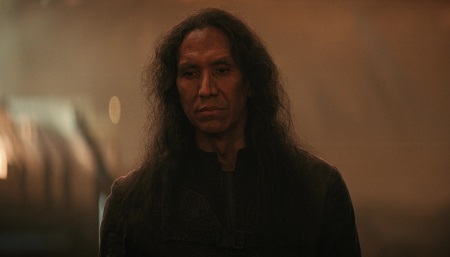
Felix was the most complex of the prisoners, a man who’d killed someone decades earlier and had lived with that regret ever since. Guest star Michael Greyeyes put in a stellar performance as someone not merely resigned to their fate, but actively choosing to embrace it. Felix seemed to truly believe that his punishment or penance for his crime required his own death, and had he survived if the DMA had taken a different path, I believe he would have sought out the Akaali authorities and turned himself in all over again.

His choice was difficult for Book and Burnham, though, who had endeavoured to save all six prisoners. Book appeared to be ready to intervene, saving Felix’s life even if it went against his wishes, but Captain Burnham eventually understood that this was something she had to do. After all the talk earlier in the season about the Kobayashi Maru test and no-win scenarios, here we got to see Captain Burnham confronted with her own small-scale version of that very challenge. She rose to meet it in a way that she would have struggled to in earlier stories.

Leaving Felix behind was a kind of Kobayashi Maru moment for Captain Burnham.

There are many different ways we could read Felix’s story in The Examples. There’s definitely an allegory for imprisonment itself; that prison can have value as a rehabilitative institution. But we can also read Felix’s final choice through a more metaphorical and philosophical lens: it’s a tale about the value of freedom, and the freedom to choose one’s own path and ultimate fate. It’s a story about agency and the right to determine the outcome of one’s own life. Felix could have been “saved,” but doing so would have cost him his freedom in a different way.

This story took what could have been a fairly simple and uninspired plot about rescuing prisoners in a different and unexpected direction, providing some much-needed complexity to Captain Burnham’s side of the episode. It also gave both her and Book an emotional moment toward the end of the episode, with Book in particular believing the decision to leave Felix behind was wrong. And as the audience, we can see both sides of this argument and acknowledge that there’s no objectively right answer. On the one hand, if Felix had been saved he could have found other ways to have meaning in his life or to complete his penance and rehabilitate himself. Giving him that chance, even if it was against his will in that moment, could have paid dividends later. On the other hand, though, Felix was a grown adult of seemingly sound mind, and if this was the choice he freely made, knowing the consequences, does anyone have the right to interfere? It’s a complex story with no easy answer – and this could be a whole essay in itself drawing comparisons with things like the right-to-die movement, suicide, and many more.

Felix made his own decision.

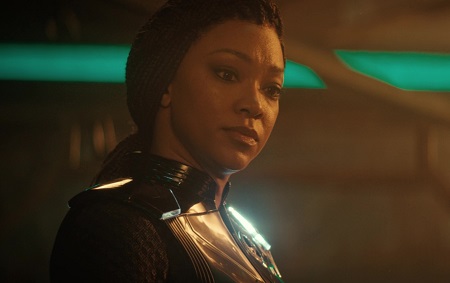
Sonequa Martin-Green played Captain Burnham with real complexity this week, and her performance nailed Burnham’s real struggle with this decision. As recently as the season premiere, Burnham had said to President Rillak that she wasn’t ever willing to leave anyone behind or make this kind of choice; a variation on Captain Kirk’s famous “I don’t believe in no-win scenarios” stance. But something’s changed for Burnham – perhaps the existence of the DMA, or simply the realities of command. This evolution allows her to remain true to herself – she still wants to do the right thing. She just seems willing to consider different perspectives on what is “right,” including those that fall outside of her own interpretation.

So let’s take a look at the biggest revelation in The Examples: the DMA is an artificial creation. This is something I’d been theorising about in one form or another since we first learned of the existence of the anomaly in the first Season 4 teaser trailer earlier in the year, and I don’t think many fans or viewers will have been terribly shocked. A natural disaster angle could’ve worked well for the DMA, presenting Captain Burnham and the crew with a scientific challenge to untangle rather than a villainous adversary to defeat. But that ship has sailed – and really, this is the way I think we all expected Discovery to go with the DMA.

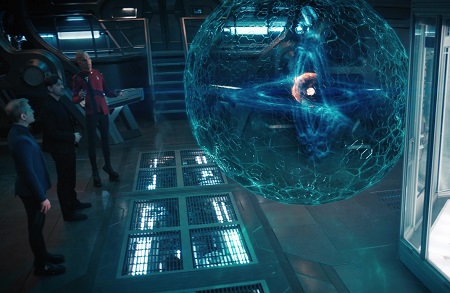
Tarka and Stamets created a scale model of the DMA.

Though this story was great overall, there was one part at the beginning that felt very rushed. After Stamets noticed the DMA disappearing and reappearing, Captain Burnham asked Zora (the ship’s AI) if the DMA could be a natural ocurrence. Zora replied that it couldn’t be, and based seemingly on these two lines alone, the rest of the plot was left to unfold. It just feels far too quick and easy to have gotten a one-line answer from Zora about the nature of the DMA, and I feel it would’ve been nicer to see at least some of the workings that led to that conclusion – perhaps Stamets could’ve said he’d come up with an artificial DMA as a new theory after weeks of work; same result, same short scene, but perhaps a better overall feeling that this wasn’t all based on one very brief analysis.

This second point is really more of a nitpick, but here we go anyway: how did everyone in the galaxy find out that the DMA isn’t a natural phenomenon? If Stamets is leading the charge on this investigation, and he only figured it out with the help of Zora… how did that news get out? Starfleet might’ve wanted to keep a lid on something so explosive, and I can absolutely see someone like President Rillak wanting to keep that news on a need-to-know basis to prevent panic and possible political consequences for the very tenuously-united Federation. Maybe we can excuse it by saying the DMA’s disappearance and reappearance led others to figure it out independently, but again this all happened very quickly at the beginning of the episode. It’s a nitpick, though.

Kaminar – and other worlds – already know that the DMA is artificial.

There were references to past iterations of Star Trek – as well as the video game Star Trek Online – on this side of The Examples. Admiral Vance listed the Metrons, who first appeared in The Original Series episode Arena, the Nacene, who constructed the Caretaker’s Array that pulled the USS Voyager into the Delta Quadrant, and the Iconian Empire, who were believed to be extinct during the events of The Next Generation but ultimately appeared in the aforementioned Star Trek Online.

However, at the end of the episode, Ruon Tarka explicitly ruled out all three of these races as being the culprit. So who is Species 10-C? And perhaps a bigger question is this: will the DMA connect back to a past iteration of Star Trek, or will the storyline follow a similar route to the Burn in Season 3 and ultimately turn out to be something altogether new? Part of me wants to say that we wouldn’t have had all of these teases if there wasn’t going to be some big connection and a big reveal that would be meaningful for us as the audience – the Borg, the super-synths from Picard, or something of that nature. But another big part of me is saying “remember the Burn!” and feels certain that we’re going to encounter someone entirely new.

Admiral Vance has a list of possible culprits… but Ruon Tarka dismissed them.

We’ll save the theorising for later, though, because this side of the episode had far more going on than just that! Shawn Doyle arrived as Ruon Tarka, and he played the arrogant scientist exceptionally well. Tarka is a strangely relatable character – I think a lot of us have known someone who’s so incredibly self-assured and who comes across as very rude and even selfish. Tarka, to my surprise I must admit, backed up his arrogance with genuine skill, and by the end of the episode even Stamets seemed to have warmed up to him!

There’s always going to be the temptation to have a character introduced in this fashion ultimately be proven wrong and get some kind of comeuppance, but what makes Tarka such an interesting and nuanced character is that he really did have the scientific skill and know-how to back up what he was saying; all the trash-talking with Stamets actually led somewhere. We can dislike Tarka for his abrasiveness and the way he was rude with Stamets and Saru, but at the end of the day I’m still left with a strong sense that, arrogant or not, he’s someone I want on my side – especially given the nature of the DMA. Pulling off that balance with a brand-new character isn’t going to be easy to get right, yet Discovery pulled it off thanks to a wonderful guest star.

Ruon Tarka made for a wonderfully complex character.

It was very sweet to get multiple mentions of Aurellio this week. Kenneth Mitchell played the character in Season 3, and even though he wasn’t able to appear in person on this occasion, the fact that Discovery went out of its way to reference the character more than once was incredibly sweet. It’s nice to know that Aurellio still exists in the 32nd Century, and that he’s teamed up with the Federation to help solve the mystery of the DMA. Again, I feel better knowing Aurellio is working on this problem too!

The idea that Stamets and Tarka came up with, to create essentially a scaled-down version of the DMA, was a good one, and it worked well on this side of the story. We got to see the two scientists truly working on the problem, tweaking their theories as they went along. This is the scientific method – having a crazy idea and testing it out! Other sci-fi shows would’ve skipped this step and just brought us the conclusion so we could get into more space battles and laser fights, but one thing I’ve always liked about Star Trek is seeing the characters slow down and take their time working on a problem. Neither Stamets nor Tarka could figure out the DMA instantly – and we’ve seen Stamets working on this problem across several episodes now. They seemed to be close to a breakthrough before the experiment had to be shut down – so perhaps a future episode will pick up that dangling story thread.

Stamets, Tarka, and Saru examine their model of the DMA.

Though she didn’t have many lines, it was great to welcome back Tig Notaro as Reno during this story. Her dry wit cut through what was a very heavy scientific story, and provided some moments of levity that were definitely appreciated. Due to the difficulties of travelling and filming during the pandemic, I already know we aren’t going to get as many Reno appearances as we might want – so it was great to see her on this occasion, and I will definitely savour those light-hearted moments that she brought.

Saru played a guiding role here, ultimately shutting the experiment down as it got too close to the danger zone. But he brought a sense of calmness to the proceedings, something necessary given the hot-headedness of Tarka and Stamets. Seeing him “roar” was definitely something a bit weird… but it was neat nevertheless! Saru was very much back in his element as the senior officer on this side of the story, taking command of the situation but deferring to the scientists as much as possible. Since he underwent the vahar’ai transformation in Season 2, we’ve seen this calmer presentation of Saru. I’ve said this before no doubt, especially during his tenure as captain in Season 3, but he makes for an excellent commander – someone kind of in the mould of Picard as a considerate, level-headed leader.

Saru and Tarka having a stand-off!

So that was The Examples. We’re one step closer to figuring out the DMA thanks to Tarka and Stamets’ dangerous experiment – and I hope to see further progress on that storyline soon! The suspense, not knowing who’s responsible for the DMA or what their goal might be is really pulling me in right now – I desperately want the answers to those huge questions!

Some scattered final thoughts: the USS Janeway was a neat callback to Voyager. We’ve had several references to both Enterprise and Voyager so far this season – could either of those be a tease or indication of the direction of the story? The DMA makes an interesting climate change analogy – something ever-present that our heroes all have to work together to overcome. The episode opened by reminding us that Tilly has gone, and Mary Wiseman is no longer credited in the opening credits – so I think her departure from the series is permanent. I had a horrible feeling that something was going to happen to Rhys as he took a leading role in the evacuation… but luckily he lives to fight another day!

I had a fantastic time with The Examples. It advanced the season’s main story in a huge and very significant way, introduced us to a new scientist character who was a ton of fun, and gave us some cathartic emotional moments with Captain Burnham, Book, Dr Culber, and Stamets. All in all, a truly outstanding episode. I’m tearing my hair out trying to figure out who Species 10-C might be – so stay tuned for my next batch of theories for more on that!

Star Trek: Discovery Season 4 is available to stream now on Paramount+ in the United States, Scandinavia, Latin America, and Australia. The show is on Pluto TV in the UK, France, Germany, Italy, and other parts of Western Europe at 9pm on Fridays and Saturdays. Individual episodes or the full season can be purchased on iTunes, Amazon Video, and possibly other platforms in the UK, parts of Europe, and select other countries. The Star Trek franchise – including Discovery and all other properties mentioned above – is the copyright of ViacomCBS. This article contains the thoughts and opinions of one person only and is not intended to cause any offence.