Remember Starfield? That space game we got all excited about in 2023? I wouldn’t blame you if you’d forgotten all about it by now; I haven’t touched the game in months myself and I have no real plans to go back to it. Any lingering feelings of positivity I might’ve had toward the game – and developer Bethesda Game Studios in a more general sense – evaporated pretty quickly when microtransactions and paid mods were added to this single-player title, so I’ve pretty much moved on.
But the launch of Shattered Space – the first of several larger pieces of DLC that are planned for the game – has dragged up the shambling corpse of Starfield for me once again, and I couldn’t let it pass by without sharing my thoughts on what I’ve seen… and offering some unsolicited advice to Bethesda and parent company Microsoft. There are things to consider for both Starfield’s future as well as any potential new games that Bethesda may be lucky enough to make. Let’s get into all of that today.
So far at least, Shattered Space doesn’t appear to have saved (or even really helped) Starfield.
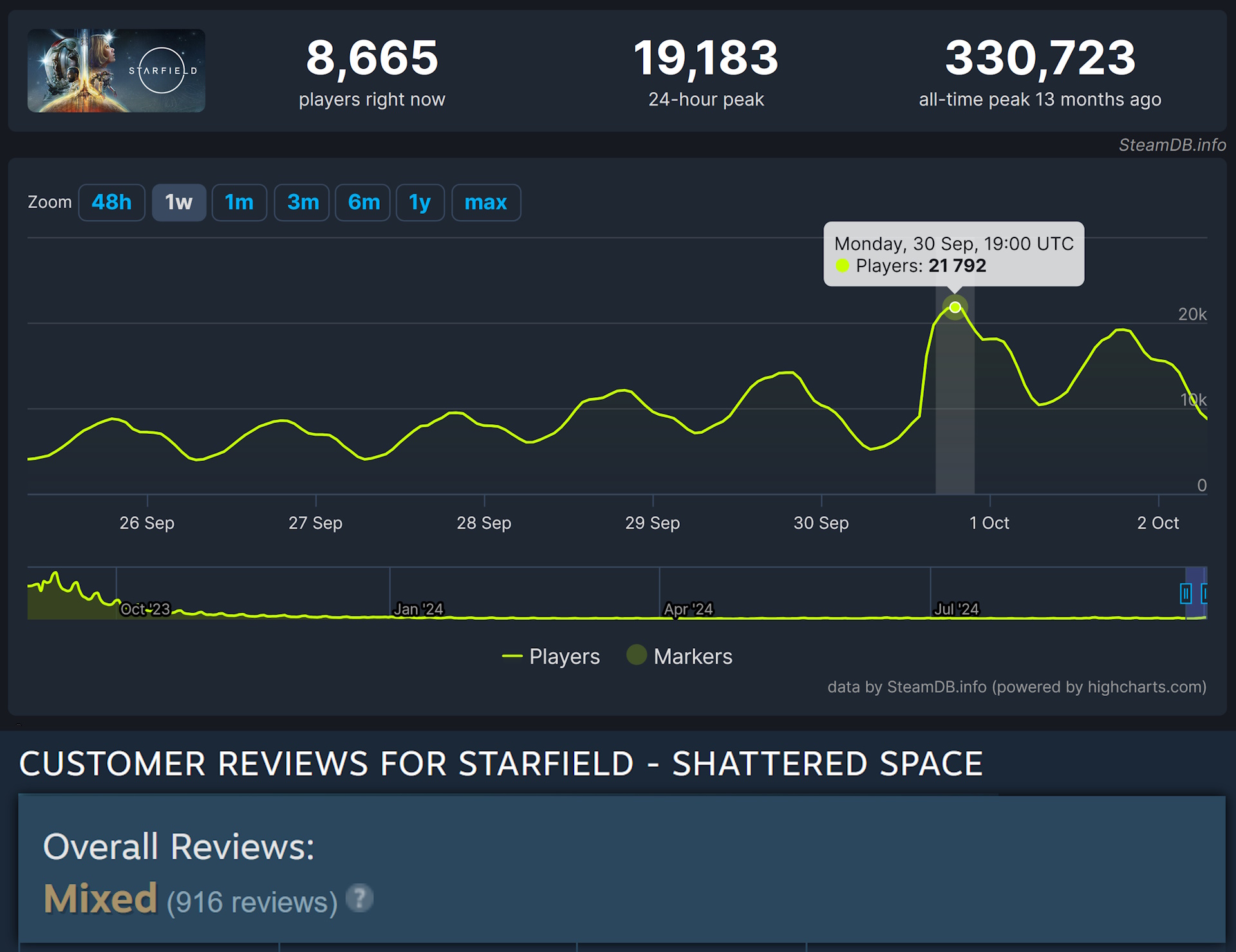
The reaction to Shattered Space has been mediocre at best outside of Bethesda and Starfield mega-fans. The expansion is currently sitting at a “mixed” rating on Steam… but far more worrying for Microsoft and Bethesda should be the real lack of engagement that Shattered Space is driving. There are, at time of writing, fewer than 1,000 reviews of Shattered Space on Steam – a number that seems pitifully small for the first major expansion pack for the newest Bethesda role-playing game. And the release of Shattered Space didn’t give the game much of a boost in terms of player numbers, either; Starfield was beaten by both Fallout 4 and Skyrim on the day the expansion launched and every day since.
This is even more alarming when you consider that many players will have already pre-purchased Shattered Space last year. In order to pick up the “deluxe” version of Starfield (or whatever it was called), which gave players access to the game on its real release date instead of almost a week later, players had to fork over an additional £35 on Xbox, Steam, and even Game Pass. Included in that price was Shattered Space, so even players left underwhelmed by the base game should have still had access to this DLC. The fact that so few of them could be bothered to even download it or check it out should be ringing alarm bells at Bethesda HQ and for Xbox, too.
Shattered Space’s launch (date highlighted) didn’t bring in a lot of players. Image Credit: SteamDB (above) and Steam (below).
The mixed reception to Shattered Space from those who did bother to fire it up is something that I think could’ve been avoided – and could at least be mitigated in the future. But it would require a change in approach from Bethesda. I’ll try to explain what I mean.
Over the last few weeks and months, Bethesda has been rolling out updates to Starfield. Among the biggest of these have been the rover/buggy, which allows players to traverse the game’s maps more quickly, and also the ability to decorate the interior of spaceships. Both of these were highly-requested by players, and the fact that Bethesda added them is a positive thing.
But part of the disappointment some players and critics are noting with Shattered Space is that it’s “only” a story expansion. The DLC doesn’t add anything of substance to Starfield beyond one new planet and some quests, and that’s leaving some people feeling underwhelmed yet again.
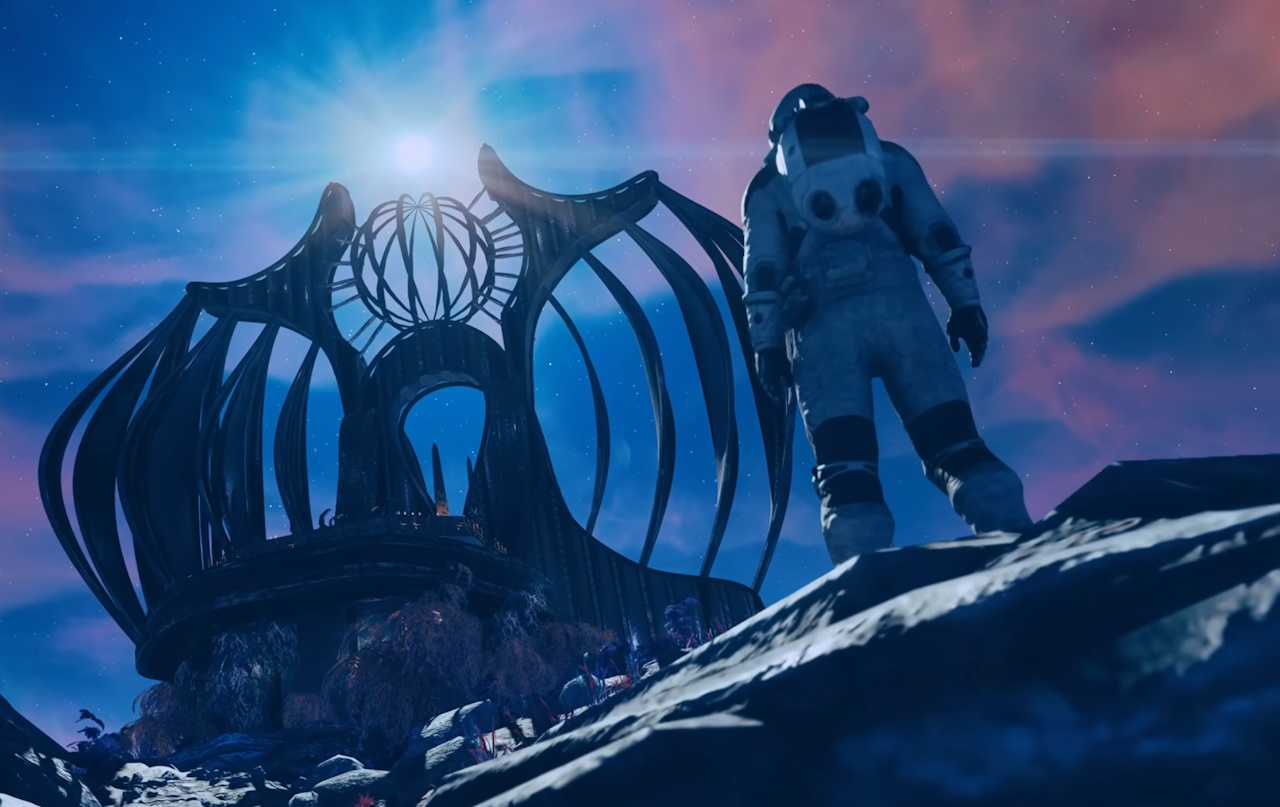
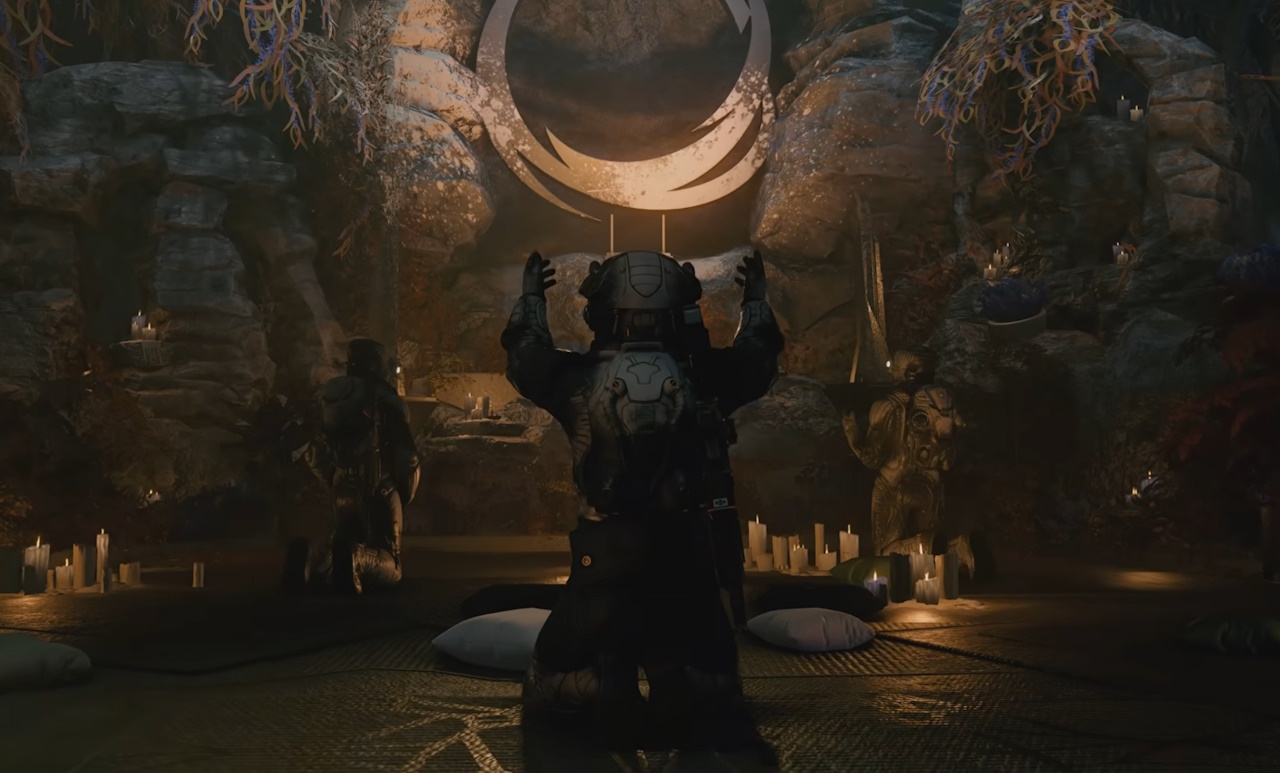
A scene from the Shattered Space trailer.
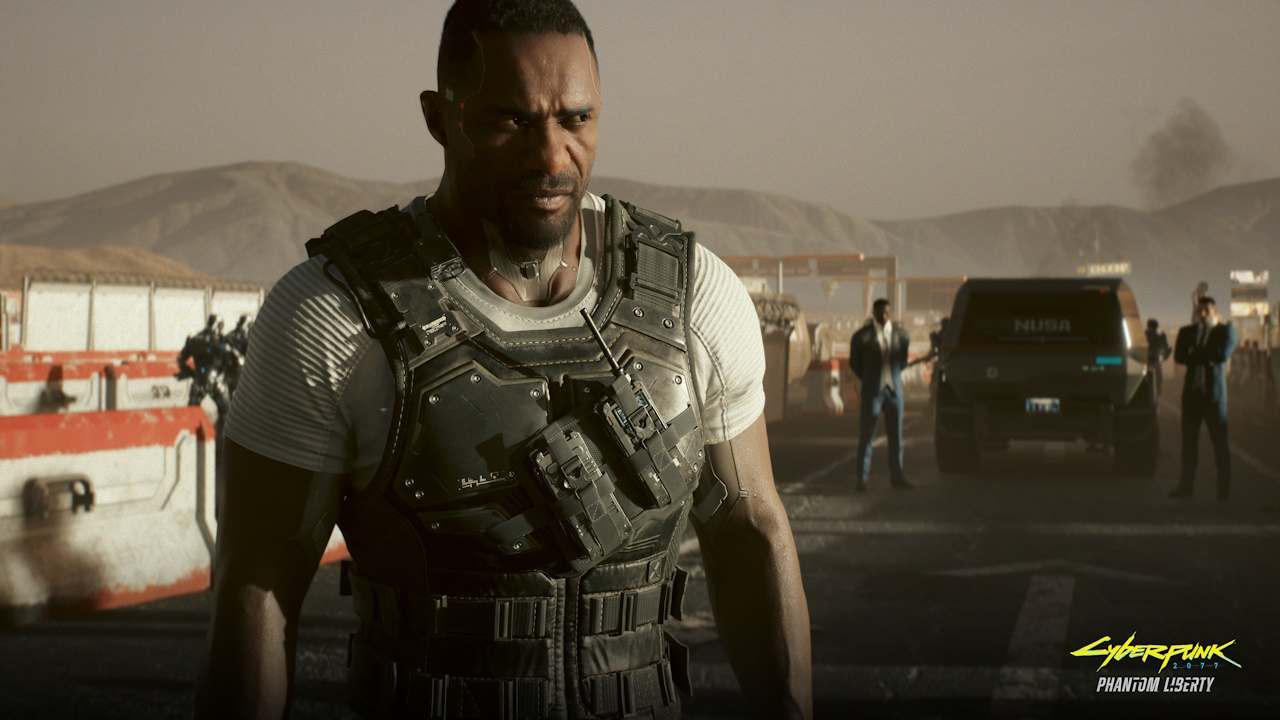
A few months ago, I wrote a piece here on the website in which I argued that Starfield’s first piece of DLC needed to be comparable in how transformative it is to Cyberpunk 2077′s Phantom Liberty, which was released last year. That expansion came with a new area of the map and new quests – just like Shattered Space. But it also came with a major update that overhauled whole in-game systems, completely fixed some of the biggest disappointments with the game, and significantly improved the experience. That’s what Starfield needed… and that’s what it still needs.
The conversation around Shattered Space might’ve been different if things like detailed city maps, interior ship decorating, and the rover vehicle had all arrived along with it. It wouldn’t have fundamentally “fixed” Starfield, but it might’ve given the game more of a boost and gotten more players talking about the game in a positive light for a change. Instead, this opportunity was missed.
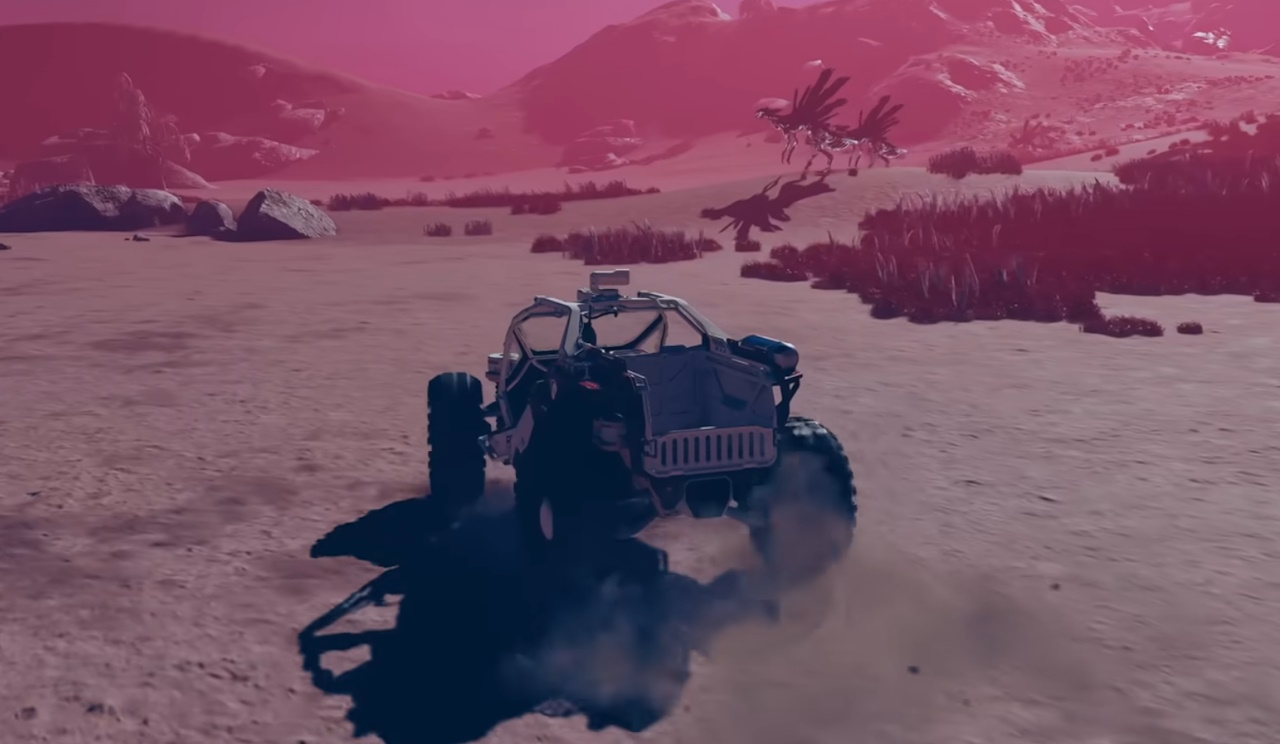
Starfield has a rover now.
So here’s my advice for Microsoft and Bethesda: stop the trickle of minor updates. Obviously you’ve gotta keep working on fixing bugs, so there can’t be a total lack of patches, but from now on, everything should be saved up for the next DLC. The next and final DLC.
Take two years – or three, if that’s what you need. Use that time to craft a larger expansion to Starfield’s world and story – perhaps one with an actual ending to the game’s main quest. But save up all of the smaller things that might’ve been added along the way, and add them all at once. Instead of trying to wring as much money as possible out of a disappointed and shrinking player base, focus on transforming the game into something that more people might actually want to buy. For me, that also means stripping out the entire microtransaction marketplace… but since that doesn’t seem realistic, at the very least focus on making one significantly larger expansion that can launch alongside overhauls to in-game systems. In a word, make Phantom Liberty… but for Starfield.
Starfield’s executive producer Todd Howard.
Starfield feels like a very greedy game right now, and £35 for a single expansion pack that only really adds one new location and questline isn’t doing anything to change the narrative. A “single-player live service” type of game – which is clearly what Bethesda wanted to create – is absolutely not my thing and never will be, and for that reason I’m almost certainly never going to play Starfield again. But even knowing that, and knowing what kind of penny-pinching game this is… Shattered Space still seems pretty unexceptional.
There should be a way around this, but only if Bethesda and Microsoft are willing to listen to feedback. Right now, Starfield is on its last legs. It’s been surpassed in so many ways by its contemporaries, and most players have just moved on already. Shattered Space, because of how it was designed and launched, was never going to bring them back en masse. And part of that is because of the way the DLC was structured and how these other free updates have been drip-fed to players over the months since Starfield launched. At a time when the game needed a win, decisions taken earlier in the year tripped up Shattered Space’s launch… and the end result seems to be that most players just aren’t paying attention any more.
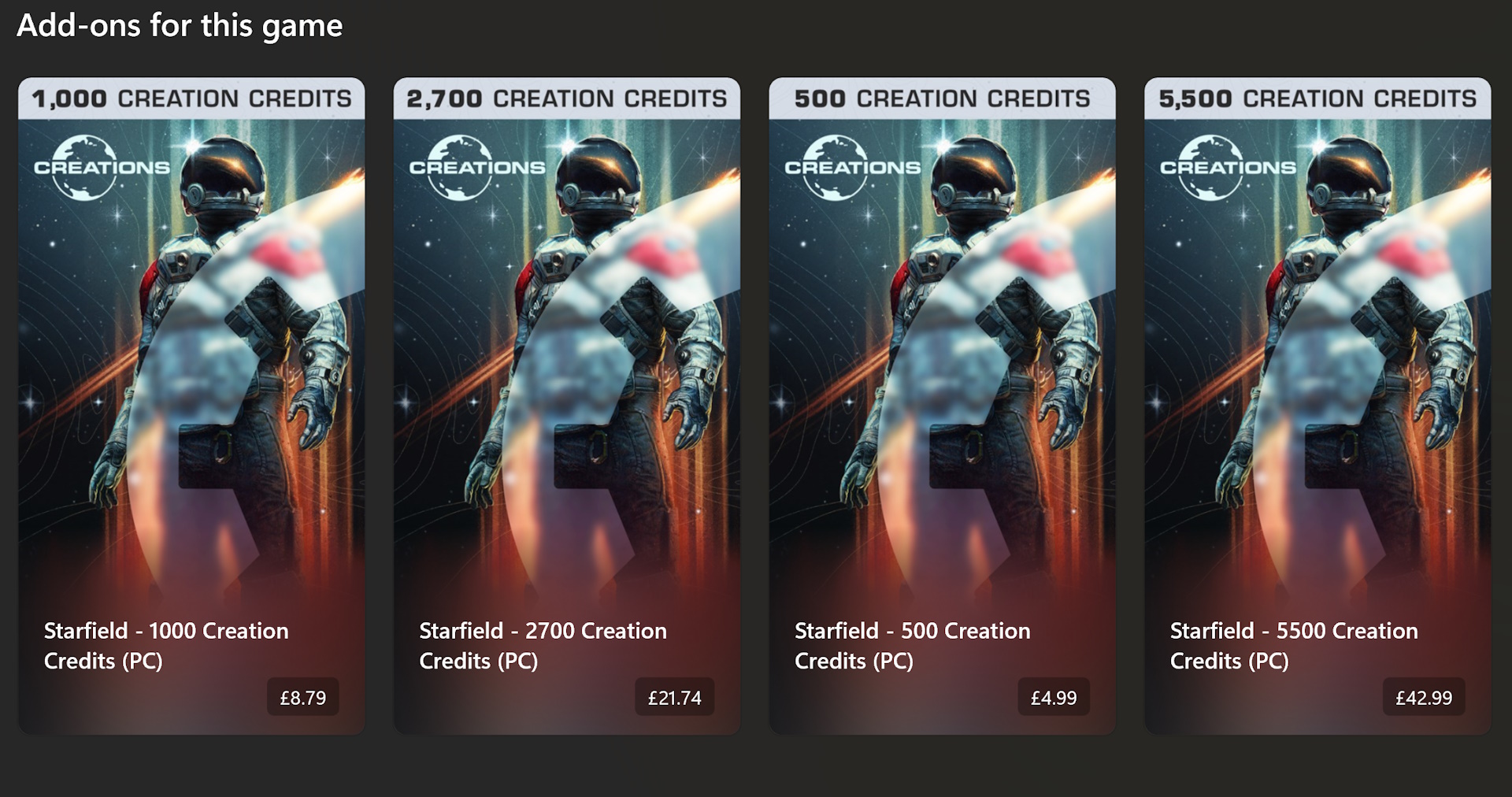
Microtransactions and paid mods have been added to Starfield since the game was released last year.
For me, Starfield would only become playable again if the microtransactions and paid mods were removed and all of that content added either totally for free or as part of the next expansion. Given the lack of things like costumes, skins, and other cosmetic items in both the base game and Shattered Space, I’d argue that all of those should be added for free. But rather than doing so bit by bit in small updates over the span of months, what Starfield really needs is one big update and one big expansion that can get players talking about the game once again. Phantom Liberty for Cyberpunk 2077 is my go-to point of comparison, but I’m sure you can think of other similarly large and similarly transformative expansion packs that have been released over the years.
As to the content of Shattered Space itself… I have to say that, based on what I remember of the game, this House Va’Ruun stuff seems like it should’ve been part of the base game from day one. I mean, you literally have a companion character who’s an ex-member of this faction, and they’re mentioned multiple times across the main quest. Shattered Space, having been planned and developed alongside Starfield, basically feels like cut content to me.
I’m over Starfield at this point.
I’m not surprised that Shattered Space hasn’t turned things around for Starfield based on what I’ve seen. And as someone who was genuinely looking forward to this game once upon a time, my concern now is that Bethesda is running out of chances to make Starfield into the game that I thought it should’ve been. Without a serious re-think and complete change in approach, I don’t see that happening. And given how brutal Microsoft can be when games and studios aren’t performing to their high expectations… well, let’s just say it probably isn’t a great time to be a Bethesda executive right now.
Despite how I feel, I will be keeping up with the latest Starfield news to see if there are going to be changes or improvements in the future. I sincerely hope that Bethesda takes its time with the next update and expansion, because that feels like the game’s best chance to come back strong and re-capture at least some of its lapsed players.
But I have to be honest: the microtransaction marketplace has killed any residual support I had for the game, and it will be a weight around its neck for as long as it continues to exist. Charging £10 for a single mission, £7 or £8 for a tiny pack of cosmetic items, and selling in-game currency at the usual awkward exchange rate are all truly scummy, shitty things for a massive company to try to get away with. I loathe Starfield’s microtransactions, and seeing the way Bethesda has behaved not only with this game but with Skyrim’s “creation club” and Fallout 76 too… it’s really put me off The Elder Scrolls VI. I can’t root for Starfield’s redemption as long as this stupid live service marketplace remains in a single-player game.
Starfield and the Shattered Space DLC are out now for PC and Xbox Series consoles. Starfield, Shattered Space, and all other properties discussed above are the copyright of Bethesda Softworks, Bethesda Game Studios, Xbox Game Studios, and/or Microsoft. This article contains the thoughts and opinions of one person only and is not intended to cause any offence.
Spoiler Warning: There are spoilers ahead for Starfield’s main quest – including its ending.
I know, I know: I keep telling you that I’m “done” talking about Starfield… only to pop up again a few weeks later with another new article or something else to add! So perhaps I’d better stop saying that this will be my last-ever piece about Starfield and just take it as it comes!
Over the past couple of weeks, Starfield has come back into focus for me. The recent Fallout television series has seen a surge of interest in Bethesda’s other sci-fi property, with both Fallout 76 and Fallout 4 seeing massive player numbers in April 2024. Both games were already running ahead of Starfield – which seems to have dropped out of the charts altogether by this point – but with talk of Bethesda potentially greenlighting some new Fallout project to tie in with the second season of the show, it really puts into perspective how far Starfield has fallen.
Don’t forget to check out my review of the Fallout TV series, by the way. You can find it by clicking or tapping here.
The Fallout TV series has given a big boost to the games.
So here’s the deal: if you’ve read my first impressions of the game, or any of my other post-launch articles, you’ll know that I was underwhelmed by Starfield. There were elements of the game that had potential – but none that truly lived up to the hype. I didn’t hate Starfield by any means, and when I looked back at the worst or most disappointing gaming experiences of 2023, it didn’t seem fair to include it there, either. But the game was clearly not all it could’ve been.
Today, what I’d like to do is throw out a few of my (totally unsolicited) ideas for how Starfield could be improved. None of these are “magic bullets” capable of turning the game into a 10/10 perfect experience. I think that ship has sailed! But even within the confines of Starfield’s limitations, there are ways in which the game could be improved to make it worth returning to. I’m not proposing a total overhaul or re-making of the game, nor am I asking for something totally unrealistic like a brand-new main quest or recreating the game in a new engine. Instead, I’m trying to propose reasonable changes to certain systems or additions that wouldn’t undermine or fundamentally break the game as it currently exists.
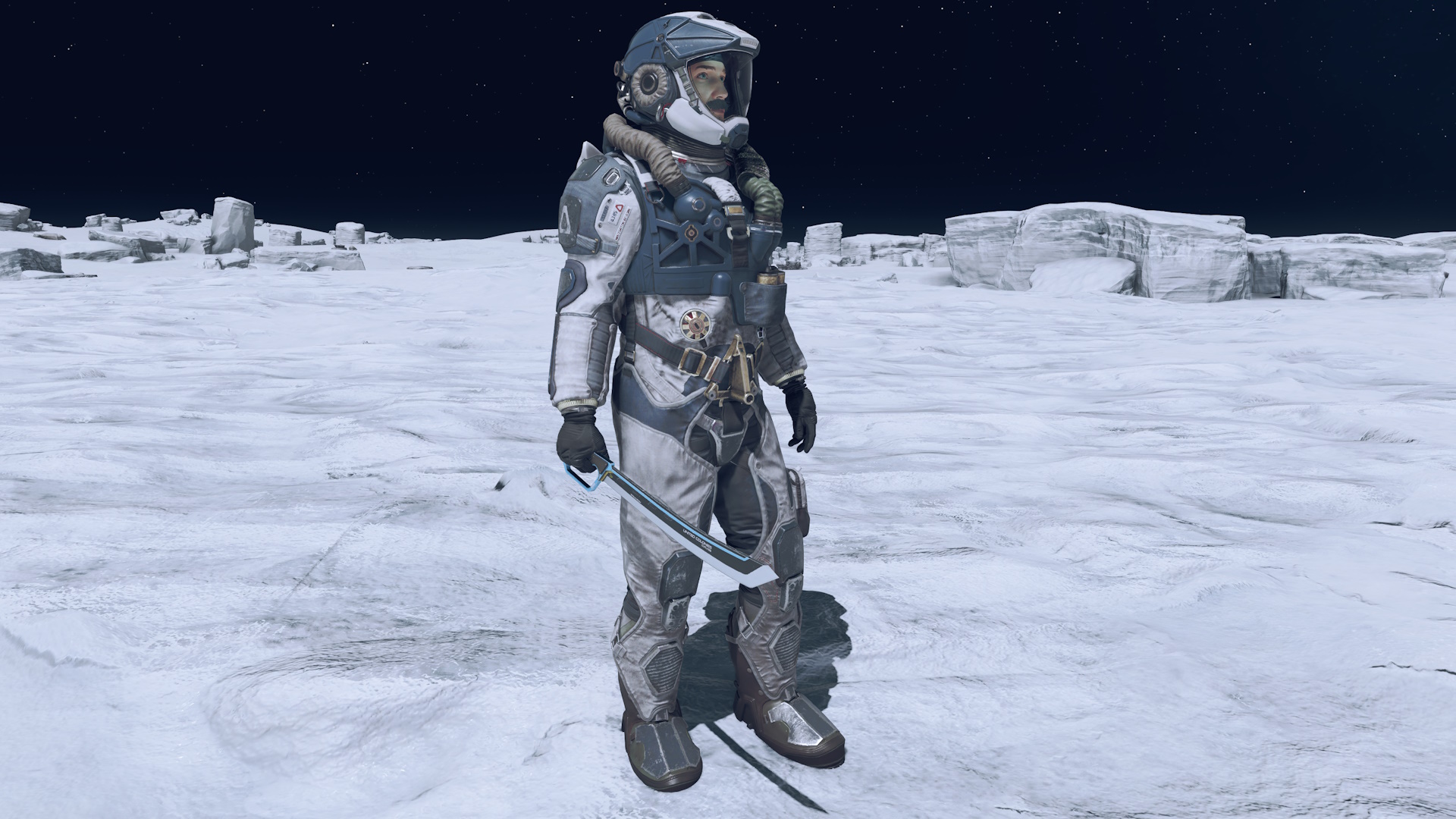
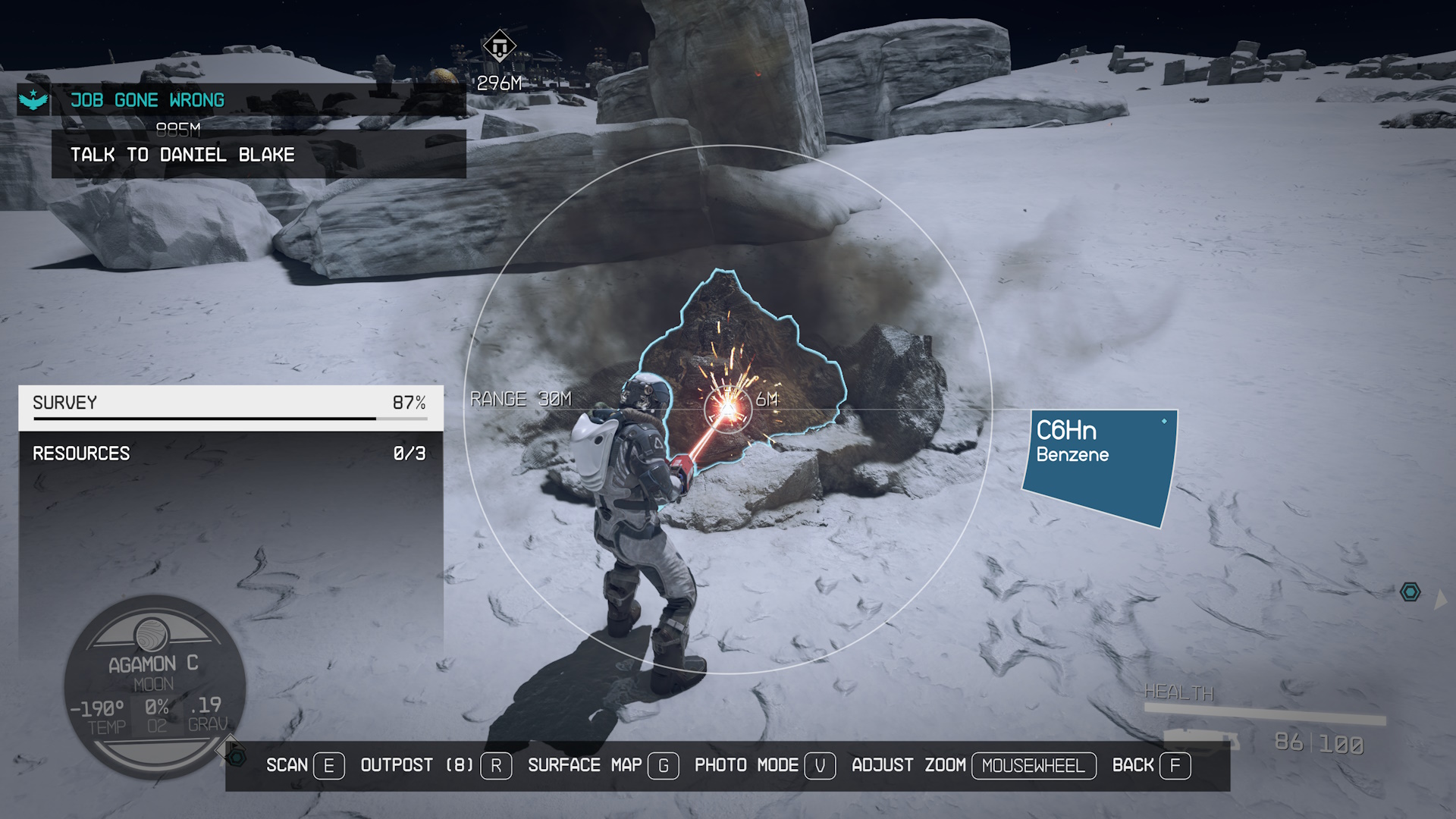
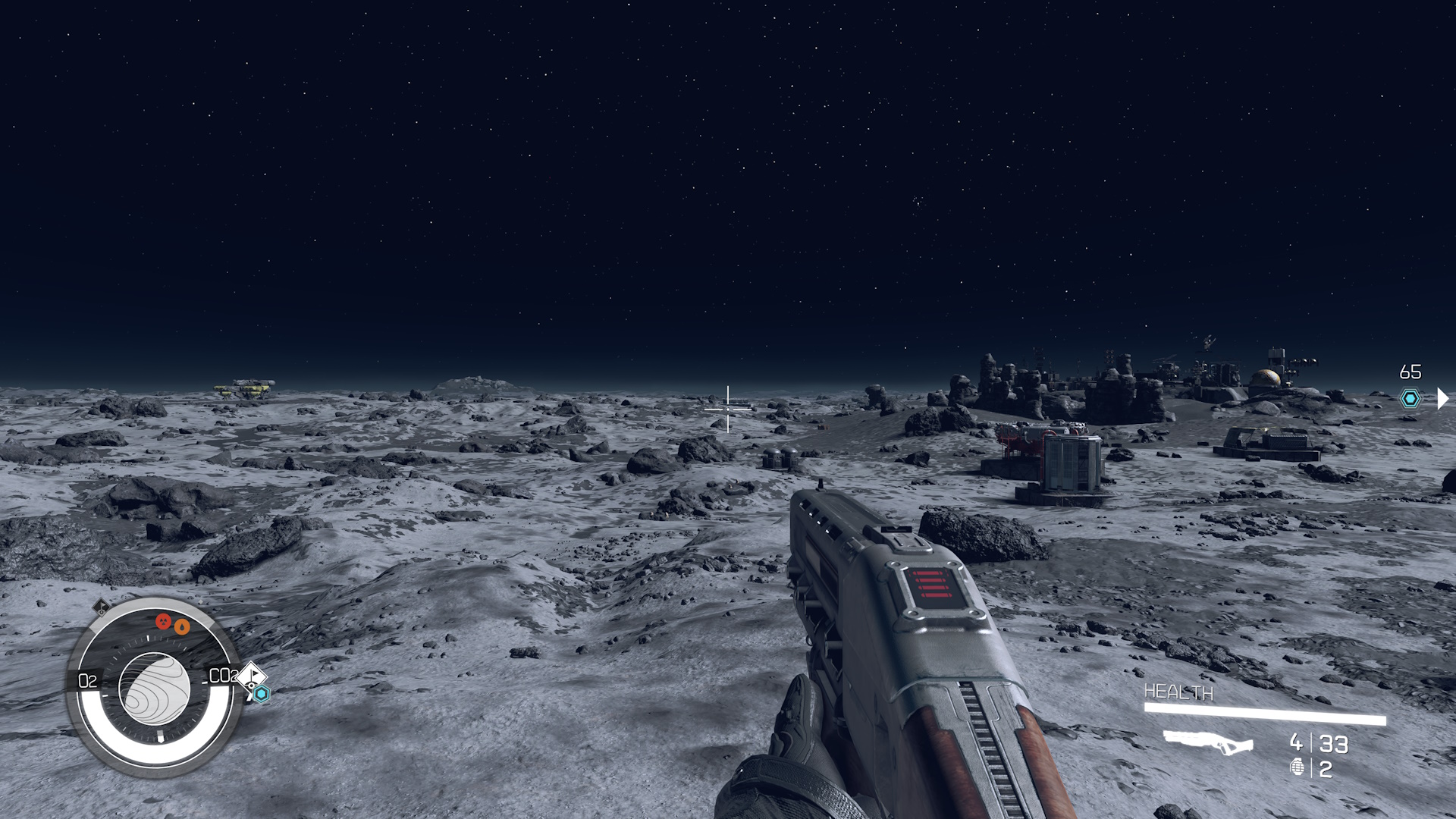
My character on the surface of an icy moon.
If that sounds like something you’re interested in, let me begin with my usual caveats! First of all, I have no “insider information.” I’m not trying to claim that anything discussed below can, will, or must be included in a future update or expansion for Starfield. This is a wishlist from an ex-player, and nothing more.
Secondly, all of this is my entirely subjective opinion. If you loved Starfield in its original form, think the game is utterly irredeemable, or just hate all of my suggestions, that’s totally okay! There’s plenty of room in the Starfield and Bethesda fan communities for polite discussion and disagreement – and we don’t need to get into an argument about hypothetical ideas for the game that Bethesda may never include.
With all of that out of the way, let’s get started!
Number One: Empty Planets.
A man-made structure on a random planet.
Considering that one of the biggest complaints I repeatedly hear about Starfield is that “too many of the planets are empty and boring,” this might seem counter-intuitive. But bear with me, because I genuinely believe that making a portion of the game’s planets completely empty would be a significant improvement.
One of the things I wanted most of all from a game like Starfield was the sense of going “where no man has gone before,” and being the first person to set foot in an alien landscape. Like a Starfleet officer, I wanted to explore the galaxy – after all, isn’t that supposed to be the mission of Constellation, the main faction that players are forced to join in Starfield?
Landing on a planet where people have already been – and are still actively living – isn’t really “exploration,” is it?
But instead, the way Bethesda chose to create planets has meant that there are none – literally zero – that are empty. Humans have set foot on all of Starfield’s 1,000 planets, and it’s completely impossible to pick a landing zone that doesn’t already have pre-made structures, points of interest, shipwrecks, spaceship landing sites, and more. Any chance to feel like a bona fide explorer was lost… and for me, one of the single most crucial elements of a “space game” melted away as I came to realise that.
Empty planets in Starfield could serve a variety of purposes. Building outposts and habitats is one – because honestly, who wants to build their dream home or pirate base a few metres away from a spacer hideout, a commonly-used landing site, and an abandoned research tower? Such worlds could also contain more resources – and with a potential overhaul to the way resources are collected and used in-game, becoming a miner or space-trucker could become viable in-game career options.
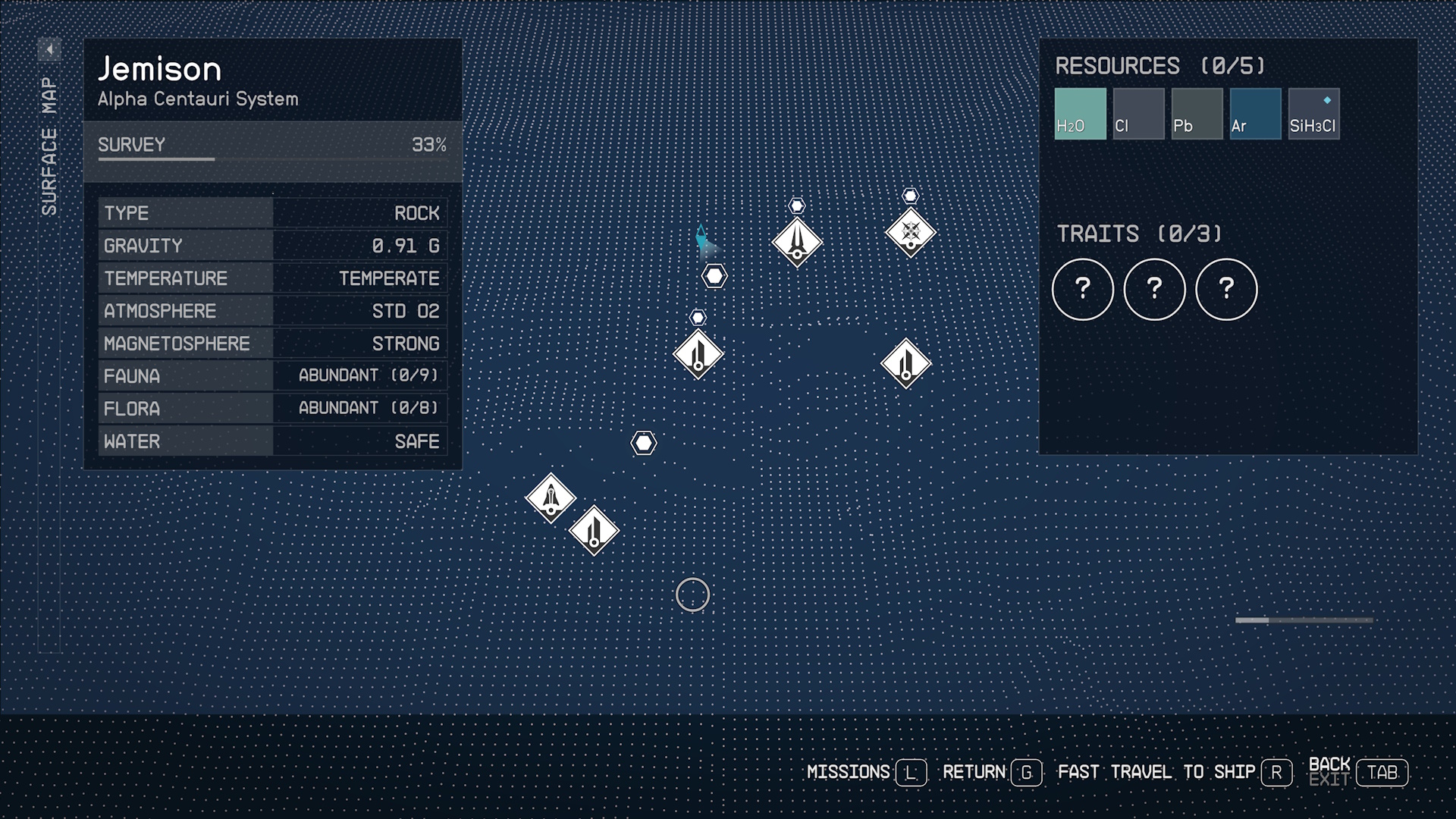
Scanning a planetary body from orbit.
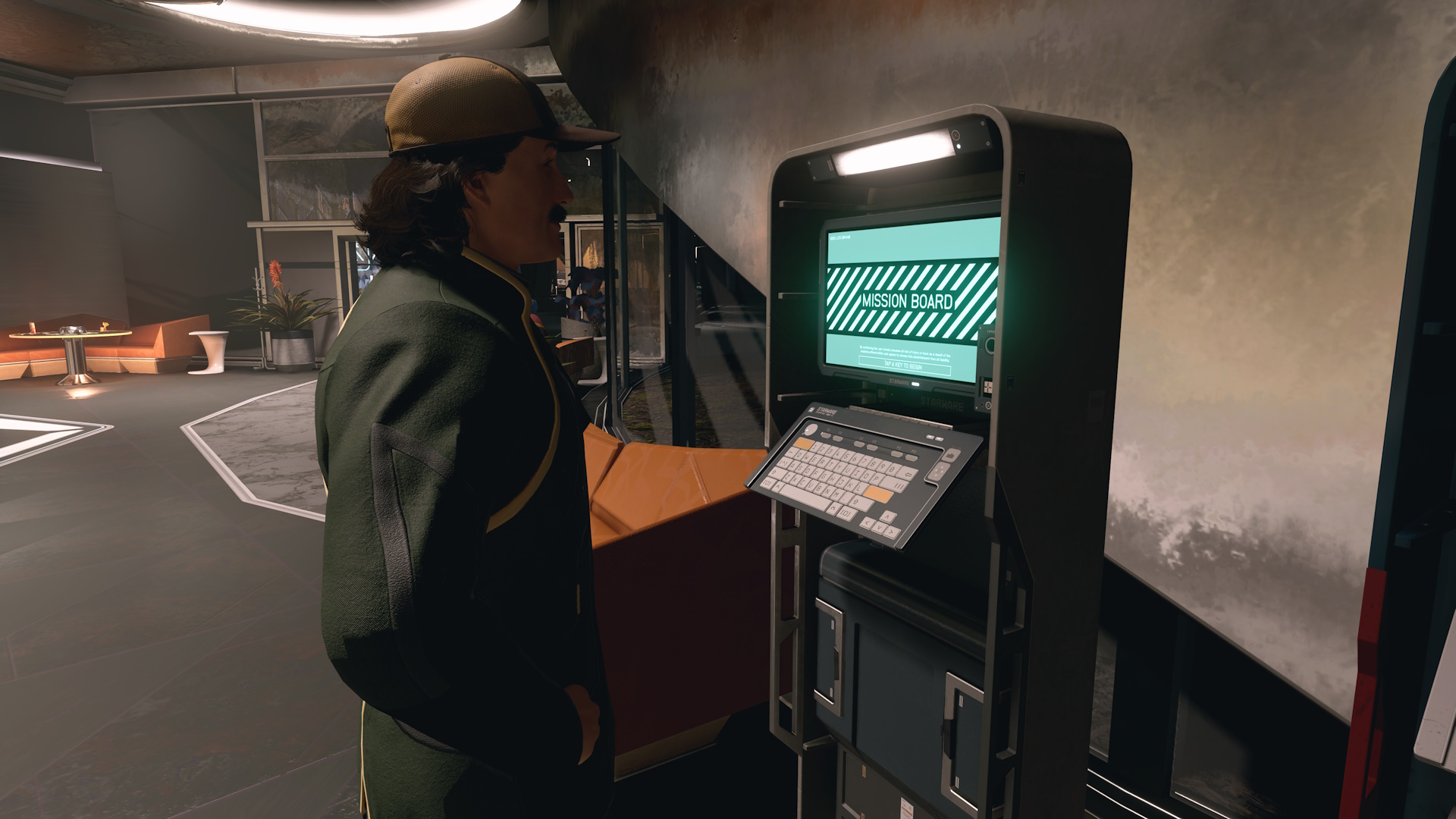
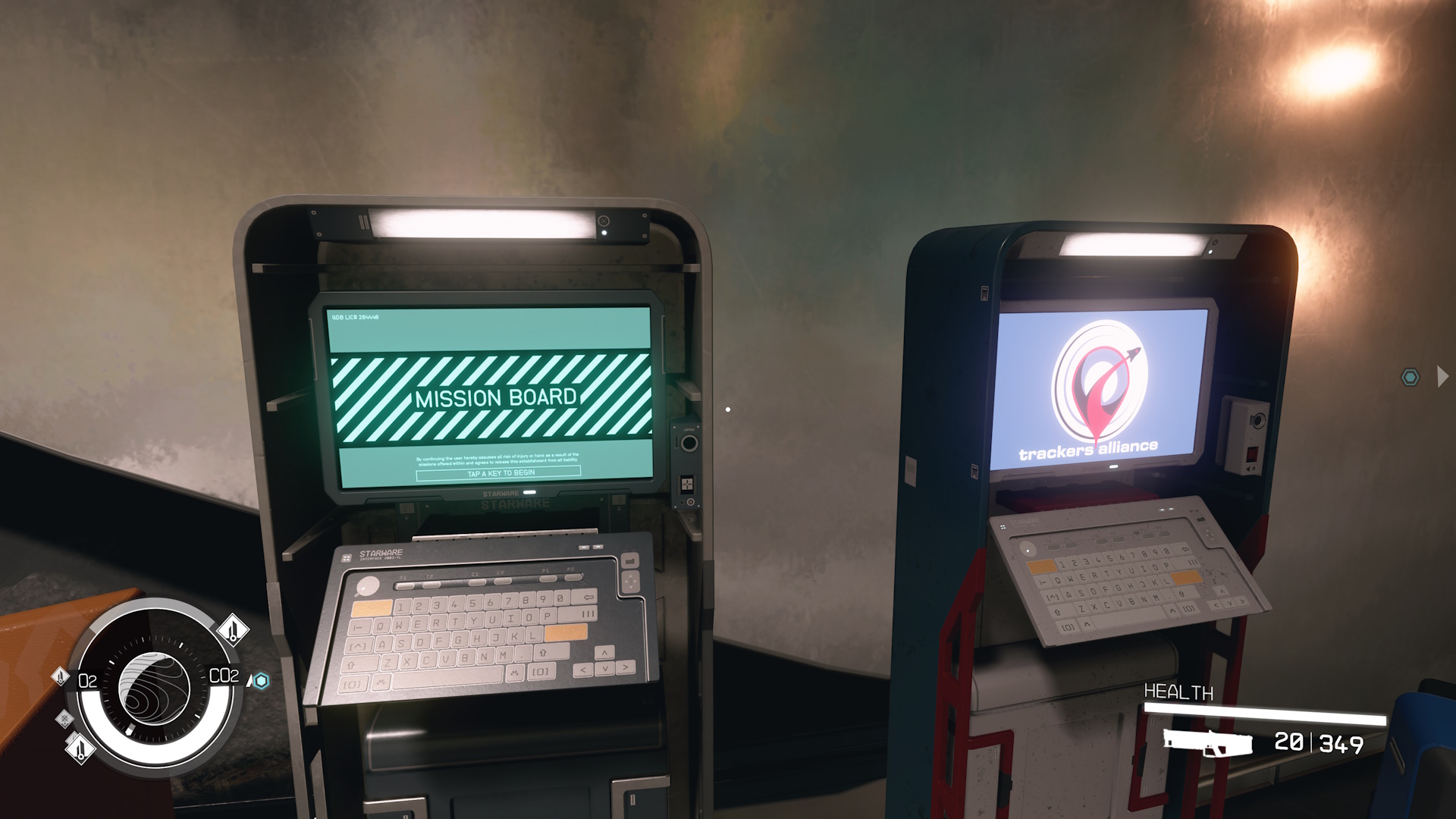
I loved the idea of finding a desolate planet, far away from civilisation, and building my luxury space penthouse there. I loved the idea of hopping from world to world, collecting rare resources that could be sold or traded, and upgrading my ship so that I could carry more and more cargo. Starfield offers the illusion of this through “mission boards,” but these are so barebones and non-interactive that they hardly even count.
I’d take the core of the Settled Systems – worlds around Sol, Alpha Centauri, and Cheyenne – and leave them more or less as they are. But the further out players get from those core worlds with their bigger settlements, the greater the number of genuinely empty planets there should be. I think this change could work wonders for Starfield, especially if it were to be combined with some of the other suggestions and proposals on this list.
Number Two: New and Modified “Points of Interest,” Including Different Variants.
Arriving at a “deserted biotics lab.”
Within my first few hours of playing Starfield, I’d been to the same “abandoned research tower” and the same “abandoned mine” four or five times each. I hoped that I was just unlucky – that there were many more of these copy-and-paste structures out there and I’d just run into the same couple of them a few times. But there really are only a few of these – some of which don’t have much going on. Considering how big the game is and how Bethesda expected players to want to spend hundreds of hours playing Starfield over the span of a decade, that’s pretty poor, and has been a huge weight around Starfield’s neck.
What the game desperately needs is many, many more of these so-called “points of interest.” Just to start, I’d say there ought to be four times as many as there currently are, and every free update should be adding new ones on top of that. But even if that were to happen, the fact that all of these structures – and everything within – are literally identical from one appearance to the next means that further changes are needed.
Discovering another copy-and-paste location.
So here’s my next proposal: each point of interest should come with multiple variants. I wouldn’t mind encountering the same structure half as much if the NPCs and loot contained within were in different configurations every time! It would make approaching one of these structures feel a bit more tense, too – you wouldn’t know whether you were about to encounter friendly NPCs, hostile enemies, alien monsters, or something else.
Taking the “abandoned research tower” as an example (because I played through several of those!) Here are some variant ideas: one variant could be the same as it is now, with hostile pirate NPCs having made the tower into their base. A second variant could contain scientists and researchers, perhaps even with a quest-giver to provide radiant quests or missions on the planet. A third could also have scientists, but be guarded by soldiers belonging to one faction or another, with players who haven’t gained enough ranks in that faction being turned away… or having to sneak in! A fourth variant could be totally empty, but with audio logs and notes suggesting something bad happened. A fifth could be filled with terrormorphs or other hostile monsters. And so on. How much more interesting would it be to approach an “abandoned research tower” if you didn’t know which variant you were going to get?
A non-hostile NPC at a random location.
There could also be unique once-per-playthrough points of interest that still appear at random but are never repeated. These could be variants of common structures or complete one-offs – ideally a mix of both. Some might spawn randomly on a certain planet or only in a certain biome, and others could be 100% random, with exclusive loot or quests to participate in. Clues could be left behind in the world to guide players to their locations.
In any case, one of the biggest things holding Starfield back is the incredibly repetitive dungeons/points of interest. I don’t think they can be entirely scrubbed from the game due to the way it’s made, but even just adding new and different variants of the current points of interest would be a start. Creating brand-new ones to add to the game ought to be a priority, too.
Number Three: Changes to the Ship-Builder. (Part One)
Starfield’s ship-building system.
Starfield’s ship-builder is one of the game’s best features… but it’s imperfect, finicky, and in serious need of some quality-of-life improvements. Firstly, it’s a pain in the arse to have to trek from one vendor to another to be able to design my ship exactly how I’d like it! Enabling players to access all ship parts at all vendors – or to unlock different constructors’ parts and use them from that point on – would massively improve the ship-building experience.
Being able to unlock different parts or groups of parts and then use them at all ship-building stations would be a massive improvement, one that this otherwise decent system desperately needs. The easiest way, I think, would be for each manufacturer to grant players a “license” (or other in-game jargon) for their pieces, permanently unlocking them. This would mean that players would still have to work to unlock all the different parts; they wouldn’t just be there by default. But it would also mean that there’d be no need to keep travelling between star stations and planets to add one component that’s only available in one location.
It’s a pain to have to continually travel between locations to access all of the different spaceship components.
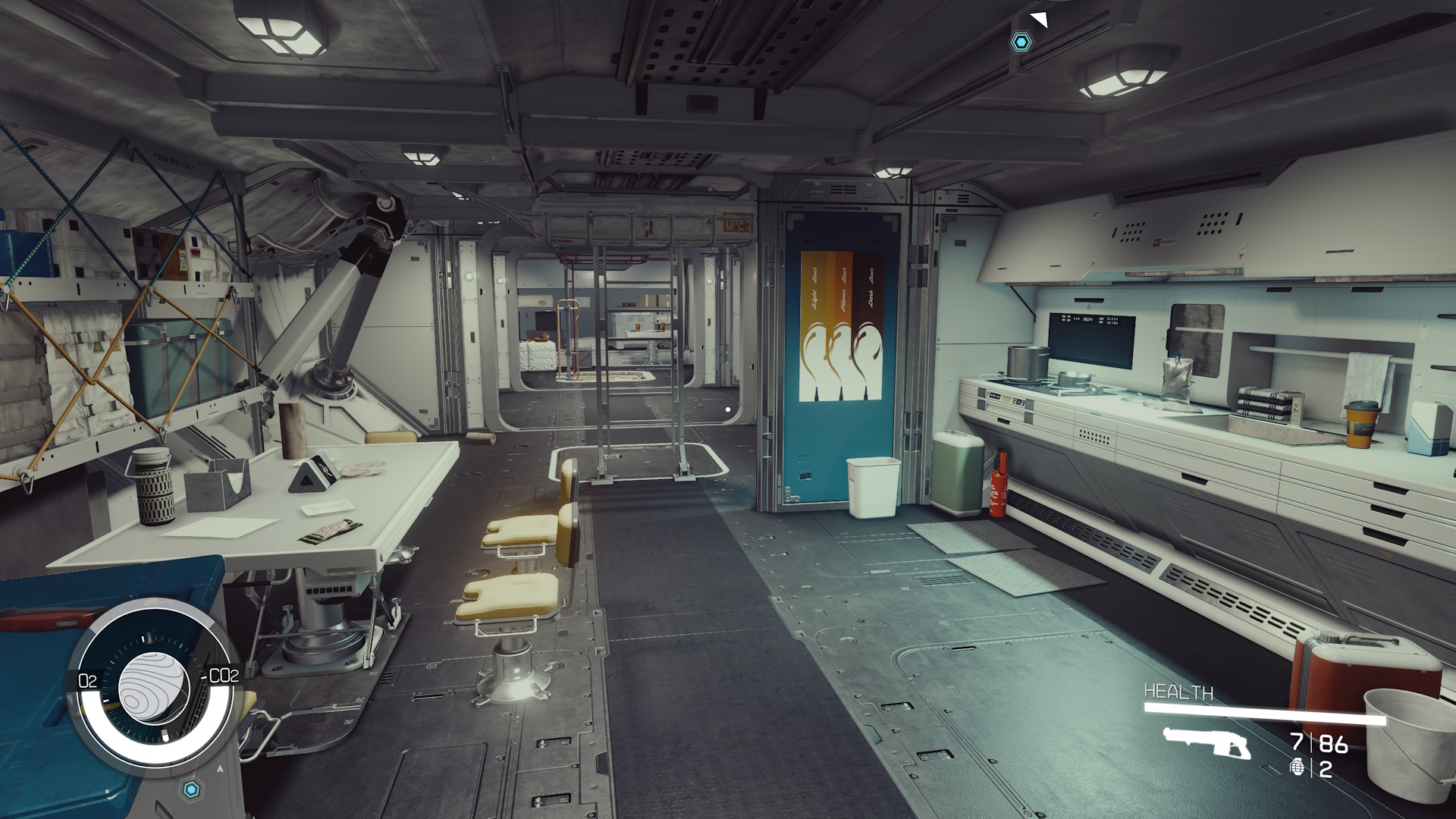
Secondly, I’d want to see Starfield combine its interior decorating – which is currently only present in the outpost builder – with ship-building. This could be optional, meaning that players who aren’t interested wouldn’t have to participate. But one area of the ship-builder that I felt really let down the whole system was the lack of interior customisation.
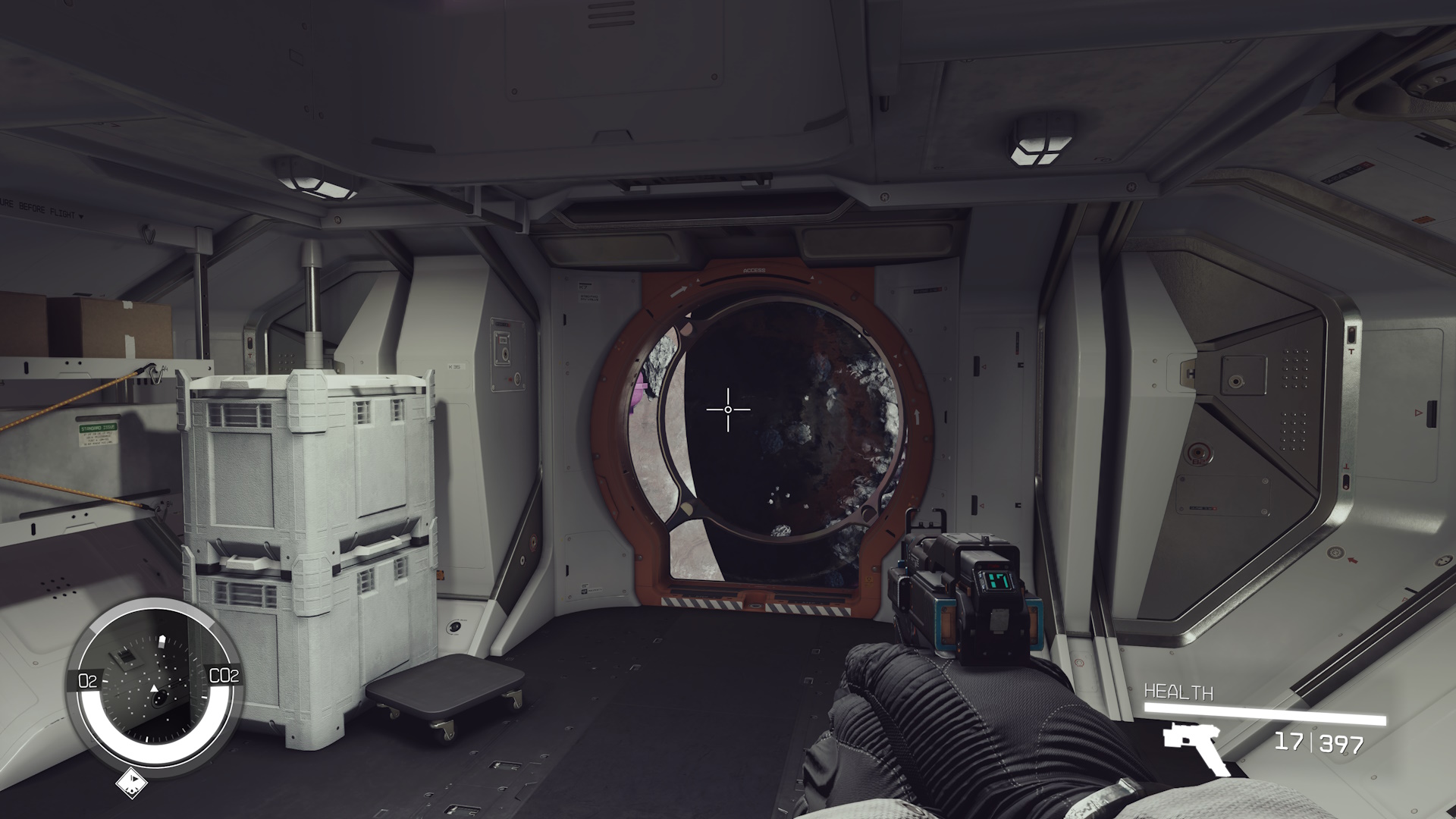
It’s possible for players to drop items aboard their ship and have them remain where they fall – something that was epitomised by “sandwich lady” in the Starfield Direct marketing broadcast. But this is a Bethesda game hallmark that’s been present since Morrowind… and it hasn’t been improved in any way for almost a quarter of a century. Not only that, but any modification to a ship – even if those modifications don’t change the interior or layout in any way – would lead to all items being removed and dumped in the ship’s inventory. So even that very, very basic amount of interior customisation comes with a massive downside!
It’s possible to drop and clumsily reposition items on your ship – like this wooden duck.
At the very least, I’d like to be able to choose colours for the walls, floors, and doors, as well as choose where doors and hatches in between modules will appear. At present, there are only pre-set colours and doors appear at random; this should be easily added with a modicum of effort!
If I dared to dream, I’d like to see furniture options for each module, posters and wall art to decorate the ship, and everything from rugs to kitchen appliances, all with different designs and colour variants to choose from. One of the disappointing things for me was that, despite making my ship look the way I wanted from the outside, it never really felt like “mine” when I was exploring the inside. There was a half-eaten sandwich on a table that my character didn’t bite. There were math equations on a whiteboard in my captain’s cabin that I didn’t write. And I would have never chosen such a ghastly colour scheme!
Number Four: Changes to the Ship-Builder. (Part Two)
The ship services technician on Akila.
Sticking with Starfield’s ship-builder, there are a few more places where I think improvements could be made. Firstly, having to manually “assign” weapons is finicky and annoying, and there has got to be a better way to do this. Ideally, weapons would be automatically assigned as soon as they’re added to a ship, with the same slot always being used for the same weapon type. Heck, there are only four types of shipboard weapons in the game – so ensuring that each one is always assigned the same button shouldn’t be that difficult!
Secondly, adding the option to rotate ship pieces would be nice. Maybe not every single piece would need to be rotatable – engines, for instance, as well as cockpits might be tricky. But some layouts might work better a different way around, and being able to have some hab modules running “sideways” could open up a lot more combinations. There are also visual and aesthetic reasons for wanting to be able to rotate certain ship pieces – and this must surely be achievable without ruining the ship-builder!
Having to manually “assign” weapons is a pain in the arse.
It would also be great if there was some way to preview how different ship pieces look on the inside without having to buy them. The in-game descriptions of the likes of the brig and armoury are pretty barebones, and it’s only after purchasing an expensive hab and installing it that players actually get to see what it looks like. If the look isn’t right, if it doesn’t match the rest of the ship, or if it doesn’t do what players had been expecting… it can end up being a waste of time and credits.
This could be combined with the interior decorating and doorway positioning additions that I suggested above. The preview window could show different colour variants, for instance, and also allow players to choose where to place hatches, doorways, and even ladders.
Adding a new module in the ship-builder.
Finally, if players have a particular ship component on another vessel in their fleet, it should be possible – somehow – to swap parts between ships. Even if removing a part from one ship to add it to another made the first ship un-spaceworthy, if that wasn’t the player’s currently-assigned ship, then it should be okay. It seems silly to allow players to amass a fleet of ships that could have perfectly usable components, but be unable to swap them between different vessels in the fleet. Having to buy the same part more than once – especially if other ships are unused and just sitting there – feels like something that could be avoided.
The ship-builder is definitely one of the better game modes that Starfield introduced, building on the likes of Fallout 4′s settlement system. But there are ways in which it could be improved, allowing players to really make their ship into the flying home of their dreams!
Number Five: Alternate Starting Points for Different Character Backgrounds.
Every character starts here – regardless of how they’re set up.
It never made a lot of sense to me that a xenobiologist, a professor, or a diplomat would have ended up working in a mine. Sure, an ex-soldier or a criminal on the run might’ve taken a gig like that… but some of Starfield’s backgrounds just don’t gel with the game’s opening act. Rather than changing the entire opening (starting from a prison cell would’ve worked better, IMHO) perhaps Bethesda could add just a couple of alternate starts to account for some of these different backgrounds.
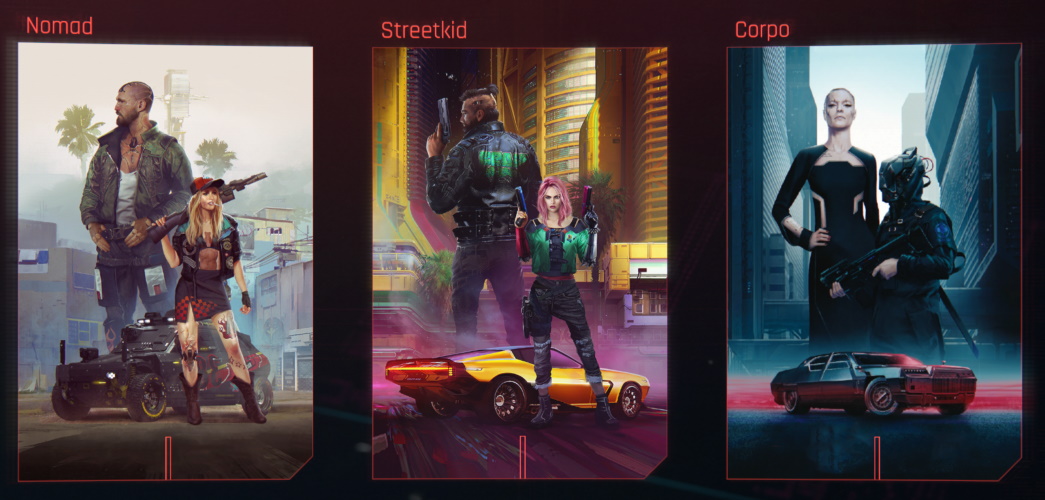
Look at what Cyberpunk 2077 did with its life paths as an example. There are three different starts in that game, each of which sees V living a different life in a different place. They all come together to kick-start the main storyline, but the journey to that point is pretty different. Even though the life paths don’t matter once the game gets going (there’s one mission apiece midway through, but they were pretty basic and uninteresting), the way the game begins offers players a different role-playing experience.
Starfield could offer alternate starts that work similarly to Cyberpunk 2077′s life paths.
Each Starfield starting point could still see players grabbing an artefact on the mining planet of Vectera if that’s important to Bethesda, but how players get to that point could change depending on which start was chosen. For example, players who wanted to imagine their character as a spacefarer could begin in space, landing on the planet to transport the unearthed artefact to New Atlantis. Or players could begin working in the mine’s laboratory, studying the artefact.
I’d also like to see at least one starting point that didn’t force players down the Constellation/main quest route immediately. Players could choose not to engage with the artefact, for instance, or could choose not to accept Barrett’s offer. After the pirate attack on Vectera, players could commandeer the pirate ship instead of being given the Frontier. These are just a few ideas off the top of my head!
Many of the available backgrounds don’t line up with working in a mine at the beginning of the game.
I don’t think Bethesda would need to go overboard here. There could be two or three mining-adjacent roles that could see players on Vectera in just the right place at just the right time to pick up the artefact. But these could be different enough from one another to take into account the different player backgrounds on offer in Starfield, which is something that I think would make a lot more sense.
If nothing else, adding a couple of alternate starting points would add to the game’s replayability, as it has for Cyberpunk 2077. There are ways to implement something like this without radically changing the game’s main story or even its opening act, and when it comes to the role-playing side of things – the side that makes me want to lose myself in a character and their fictional world – it would be a huge improvement.
Number Six: Make In-Game Careers Viable.
I was unimpressed with Starfield’s mission boards.
One of the things I love to do in a big open-world game is to step away from the main story and get lost in the world. In order to do that, my character needs to be more than just a generic adventurer… so in-game career options need to exist. And no, I don’t mean getting a job with one of the factions that quickly sees the player character climb the ladder to become its leader! I mean jobs that are off to one side, not really connected to any of the main questlines.
For example, it could be possible to be an explorer: charting unexplored and unvisited planets. Players could send probes to the surface, like in Mass Effect 2, to scout landing sites, then disembark and either map the area or collect different resources. These planetary surveys – which would actually require work to complete – could then be returned to Constellation for a profit… or sold to one of the game’s other factions. As players acquire a reputation for exploration, new quests could even arise, with factions offering players bigger rewards to survey planets further and further afield.
The mission board in New Atlantis.
Being a long hauler – one of the actual in-game backgrounds – could also be a career option. Using the mission boards, players could collect cargo from one planet and take it to another, either under contract or just to buy and sell. Different planets or settlements could have different resources or items that they’re asking for, and this could change week-to-week.
These missions would need to be much more interactive than they are currently, with players having to manually load and unload cargo, perhaps, or travelling to meet up with different NPCs inside settlements instead of just having a mission marked as “complete” as soon as the ship touches down! But there’s potential in this system to expand it and make it into a bona fide “space trucking simulator.”
Mining a resource.
Finally, for a game that kicked off deep inside a mine… there’s basically no reason to do any actual mining in Starfield. Resources are so worthless and sparsely spread out that I found there was absolutely no point in mining them when exploring a planet. If I desperately wanted to complete a research project or something, it was easier and quicker to loot a spacer base, sell the items for credits, and buy whatever resource I was missing.
But all of that could change! Making resources more abundant and accessible on different planets could make mining a viable in-game career. Tweaking the value of these resources could also make it much more worthwhile, and it could be strangely relaxing to spend an hour or two mining mercury or lithium to haul back to New Atlantis and sell it. I’m not alone in enjoying those kinds of slower-paced, “cosy” experiences… and it’s actually something I was hoping to get out of Starfield. As things stand, it’s way too unbalanced and grindy, but I can see the potential for a fun time hiding just under the surface!
Number Seven: An Alternate Ending/Reframe the Starborn.
One of the Starborn early in the game.
I hesitate to call this an “alternate” ending… because one of Starfield’s big narrative problems is that many of the fundamental questions present in its main story didn’t get any kind of conclusion in the first place. But that’s beside the point! What I’d like to see, as players reach the final act of the main quest, is the option to reject the Unity and to really push back against the whole concept of becoming Starborn. Not simply choosing not to go through the Unity, but actively stating how evil it is and the Starborn are and rejecting the whole thing.
The game puts Starborn adversaries in the player’s way, but most of these are unexplained, nameless non-entities that don’t really feel like actual people. The only two Starborn characters that players can engage with, the Hunter and the Emissary, have both been “reborn” hundreds or thousands of times over in many different universes – and the game actively pushes players to do the same thing. In fact, it’s the only way to fully complete the main quest.
Completing the main quest requires players to travel to a new universe.
But there are huge implications to abandoning one’s entire universe and everyone in it, and Starfield doesn’t do much more than pay lip service to this. It’s possible, for instance, for players to have a romantic partner or even get married – but their spouse doesn’t travel to a new universe with them. It’s implied that, based on choices the player has made, their universe of origin will be permanently changed in some way by their becoming Starborn… but this raises some massive ethical questions. Again, Starfield does nothing with these ideas.
So here’s my proposal: introduce new dialogue during the final act of the main quest that makes clear that the player rejects the entire concept of the Unity and becoming Starborn – and not only that, but they want to kill the Hunter and the Emissary to make sure that no one else can ever become Starborn either. However many universes these two might’ve fucked up… it ends here.
I’d like to see a “rejection” option added to the end of the main quest.
This is what I’d want to do if I found myself in that situation, confronted with a weird mirror image of myself telling me that “the Creators created everything,” and that becoming a Starborn is my destiny. No – fuck that. I’m from this universe, I want to stay in this universe, and I want to make damn sure that these Starborn clowns won’t be able to harm or kill anyone in the next universe, either. This universe-hopping quest ends here – not just for my character, but for all of the Starborn.
The Starborn and the Unity are the game’s real villains – at least until we get a proper explanation for the artefacts, their purpose, and where they came from. And I would want to see that reality reflected in the game’s final act, with players able to choose to reject the very idea of the Unity and the Starborn and ensuring they can’t go on harming people across countless parallel realities.
Number Eight: Quests with Multiple Pathways to Completion.
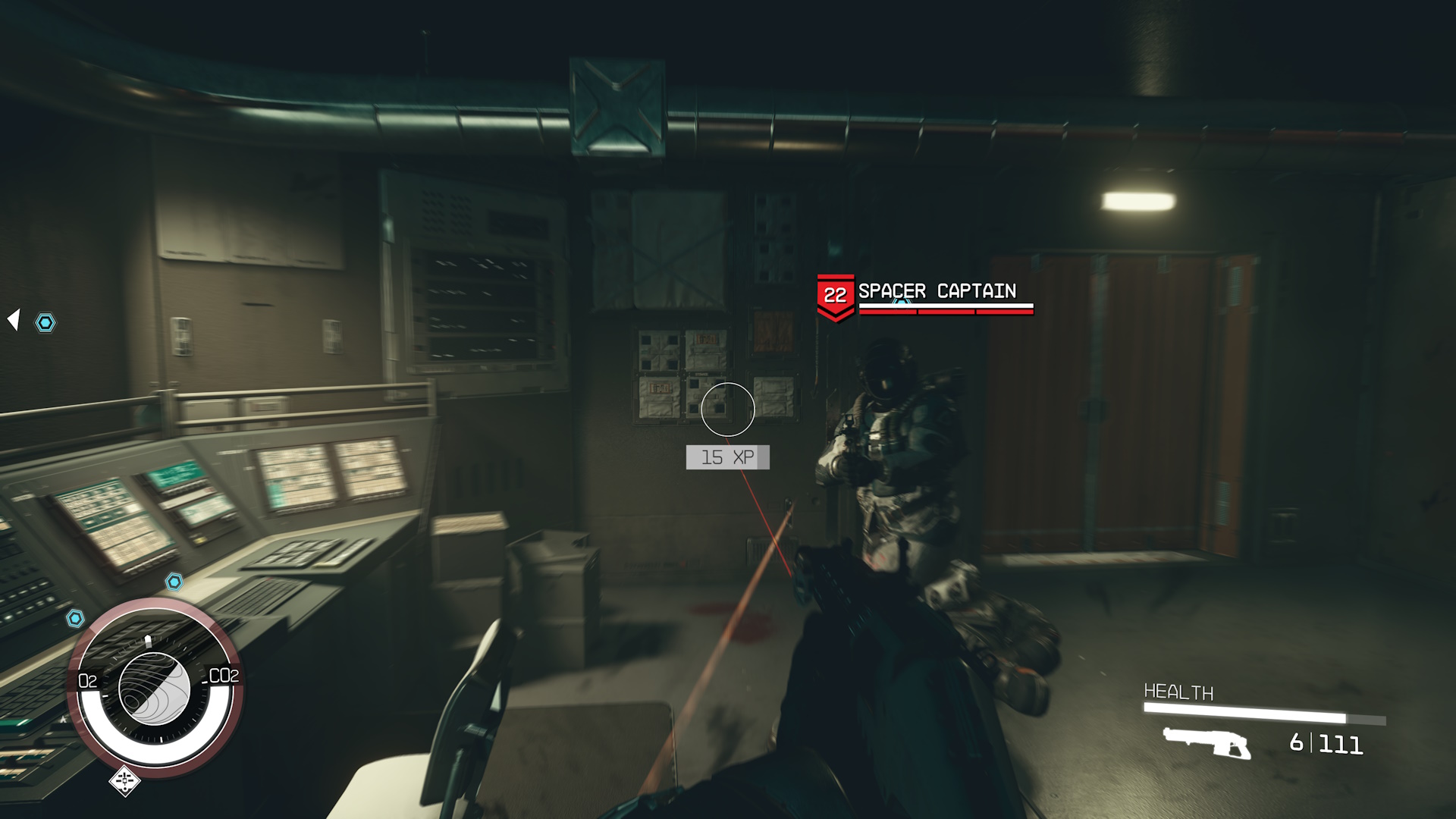
Battling a Spacer Captain at the climax of a quest.
One very disappointing thing about Starfield is how damn linear so many of its quests are. Most quests only have one route from beginning to end, and playing the game can feel like you’re riding a bike with training wheels half of the time. It ought to be possible to complete at least some quests in different ways, utilising different combinations of combat, tech, stealth, and even piloting skills depending on how players have set up their characters and which skills they’ve chosen to invest in.
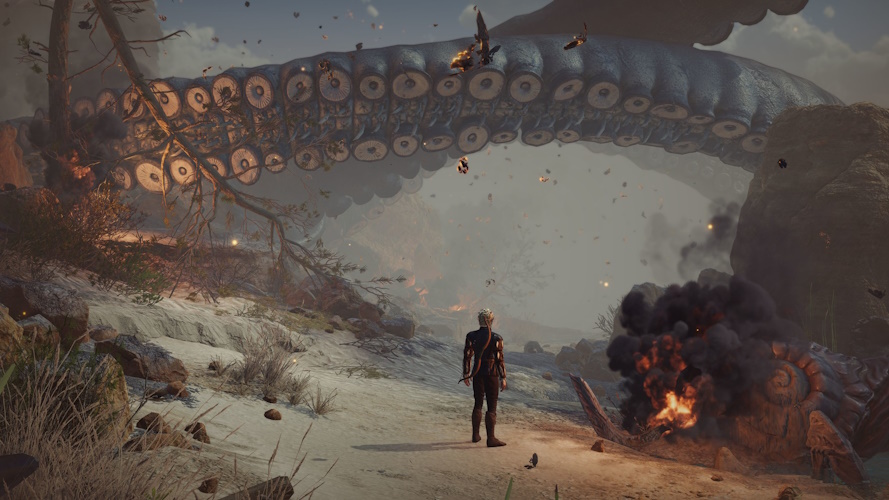
Perhaps Starfield was harmed by comparisons with Baldur’s Gate 3, which was released just a month earlier. Actually, scratch that. Starfield was undeniably harmed by those comparisons! Baldur’s Gate 3 opens up practically all of its quests and characters, giving players a huge amount of freedom to decide how they want to tackle the game – leading to some incredibly fun gameplay moments. It’s possible for practically everyone in the game to die – something Starfield doesn’t allow with its “unkillable” NPCs – and for many quests to be tackled in radically different ways.
Baldur’s Gate 3 is overflowing with player choice and different ways to complete quests.
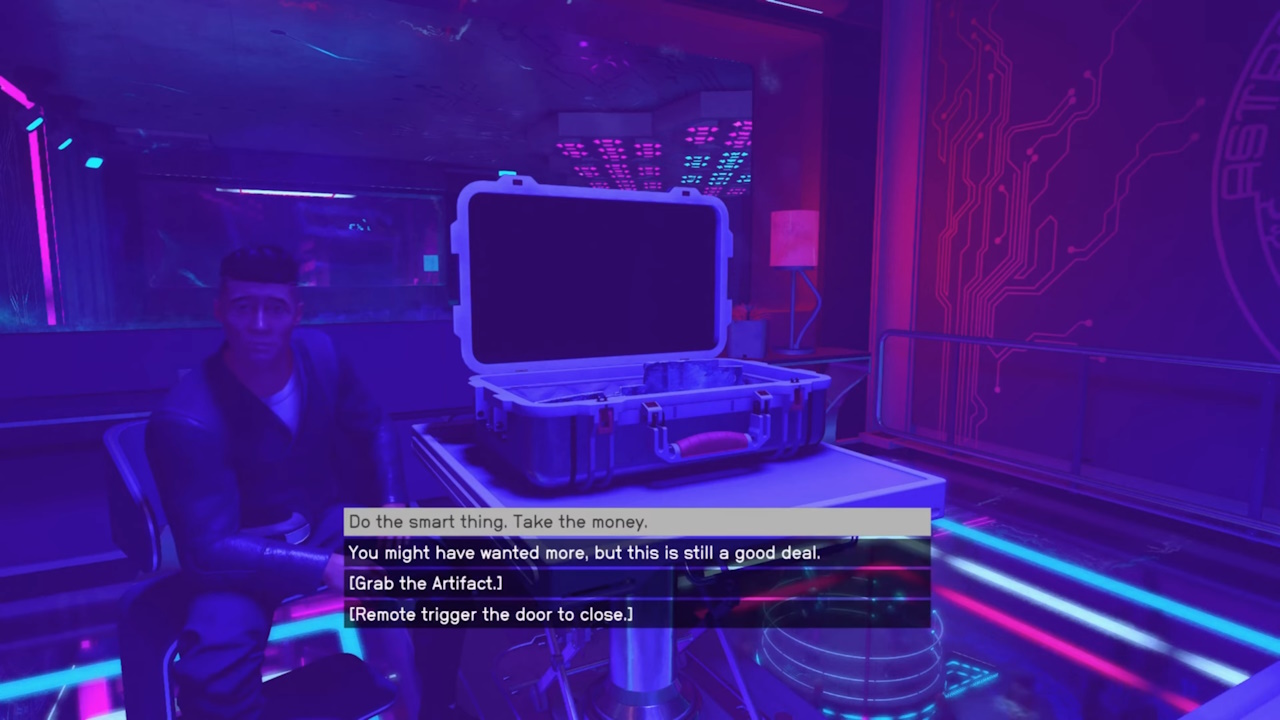
Where I got frustrated with Starfield was when the game presented the illusion of choice. At one now-infamous mission on Neon, players are teamed up with Walter to acquire another artefact. Walter states multiple times that there will be different ways to approach this interaction – but that turns out to be a lie. The game forces players down one path, and one path only.
Just taking this one mission as an example, it should be possible to abandon Walter and acquire the artefact alone, either by stealthily stealing it, killing the person carrying it, or causing panic at the nightclub and seizing it in the chaos. Then, after the player’s ship is impounded, there should be multiple options for escaping Neon. Players could sneak to the landing pad, knock out the guards, and disable the lockdown, or even rush over to another landing bay and steal a different ship. Just within this one mission there are so many ways things could go – but Bethesda has insisted that players must be locked onto one very specific route.
There should’ve been multiple approaches to this mission on Neon.
And there are many missions like this – both in main questlines and just out in the world. One side-story that I encountered involved a group of families on different planets and moons who found themselves in conflict with a gang of spacers. But there was only one way to complete every step of this mission – getting their communications back up and running, solving a conflict within the group, and then boarding the spacers’ station and killing them all. There should be so many different options in a mission like this – such as siding with the spacers for a reward, picking one family over the other when they argue, sneaking aboard the spacers’ station and opening all of the airlocks, or building a missile launcher on one of the moons and blowing it up from 10,000km away. Those are just a handful of ideas off the top of my head.
It’s obviously true that not every mission can have 100 different outcomes and routes to completion. But there should be some degree of choice in a role-playing game, for goodness’ sake! Even if all Bethesda can do at this point is make it so that some unkillable NPCs can now die and add one new alternate path for a handful of main story missions… that would still be a noticeable improvement.
Number Nine: More Cosmetic Items and Apparel.
It doesn’t take long to find NPCs wearing the same outfit as you!
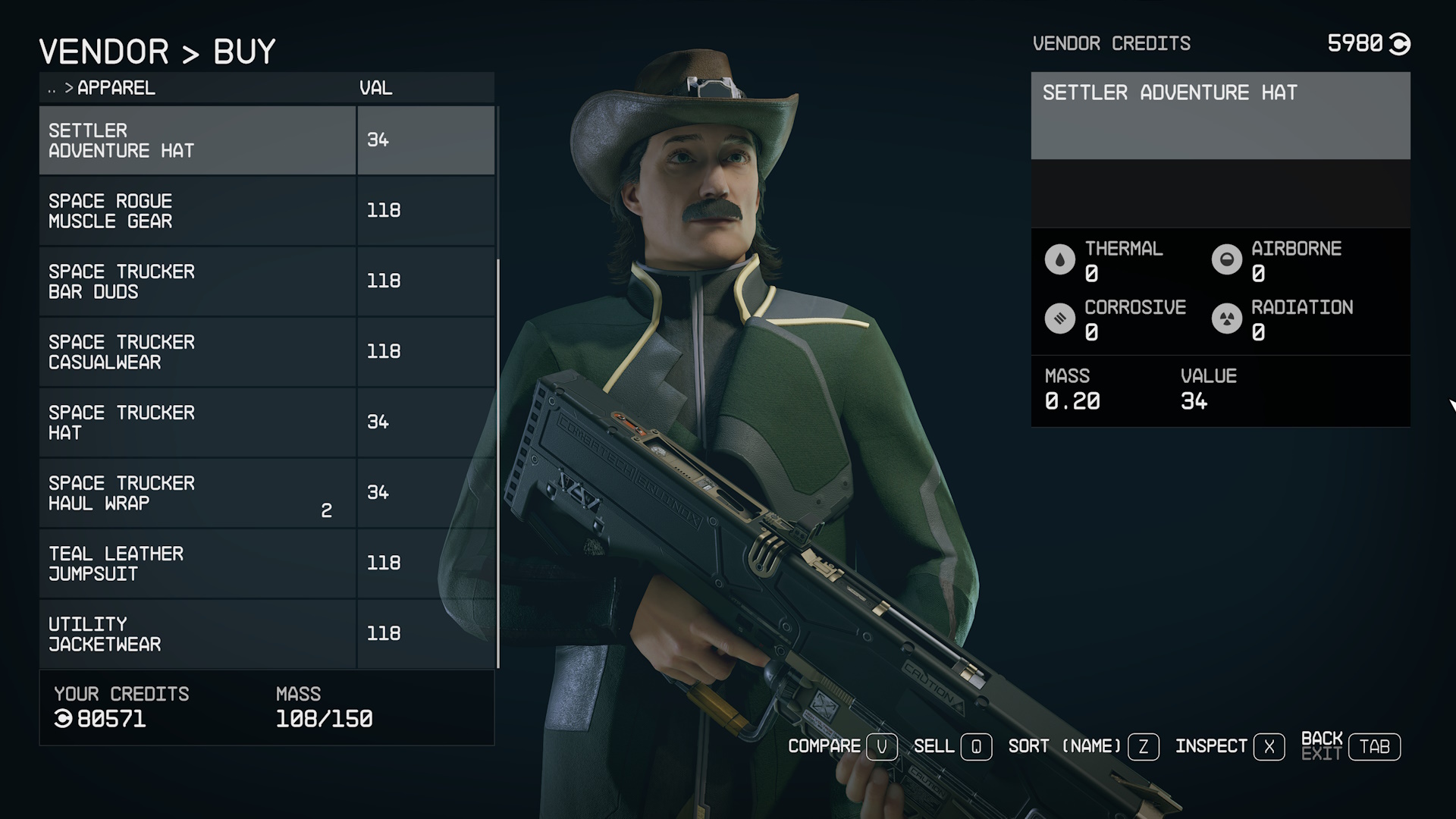
I was quite disappointed with Starfield’s lack of cosmetic items – clothing in particular. For some reason, clothing only comes by way of whole outfits, with no option to mix and match different tops, trousers, or shoes – and there are almost no skirts, shorts, or different kinds of headgear beyond basic baseball caps and the occasional cowboy hat. Even Starfield’s omnipresent spacesuits are cosmetically limited, with the few available options having no colour variants.
It seems a given that Bethesda and Microsoft plan to add skins as paid-for microtransactions at a future point. You can even see in the game just where these skins will appear when they’re ready to be rolled out. But in my opinion, cosmetic microtransactions have no place in a wholly single-player game, and Bethesda should’ve added a lot more cosmetic variety to Starfield for free from day one.
Clothes shopping in Starfield isn’t much fun.
As far back as Morrowind it was possible to play dress-up by choosing different trousers, tops, shoes, and even individual pieces of armour. This would already make Starfield’s whole-body costumes feel like a backwards step even if there weren’t so few of them… but a combination of a lack of different costumes combined with the inability to select individual pieces of clothing comes together to make for an apparel system that’s underwhelming in the extreme.
For me, one part of the role-playing experience is getting my character to look exactly the way I want them to, and when Starfield offers such a limited range of costumes, that’s impossible. Most outfits in Starfield fall into one of two categories: generic “futuristic” sci-fi or western/cowboy. There’s very little diversity, no way to reflect different cultures and backgrounds… and for a game that makes a selling-point of its photo mode, there’s very little worth photographing from the available outfits.
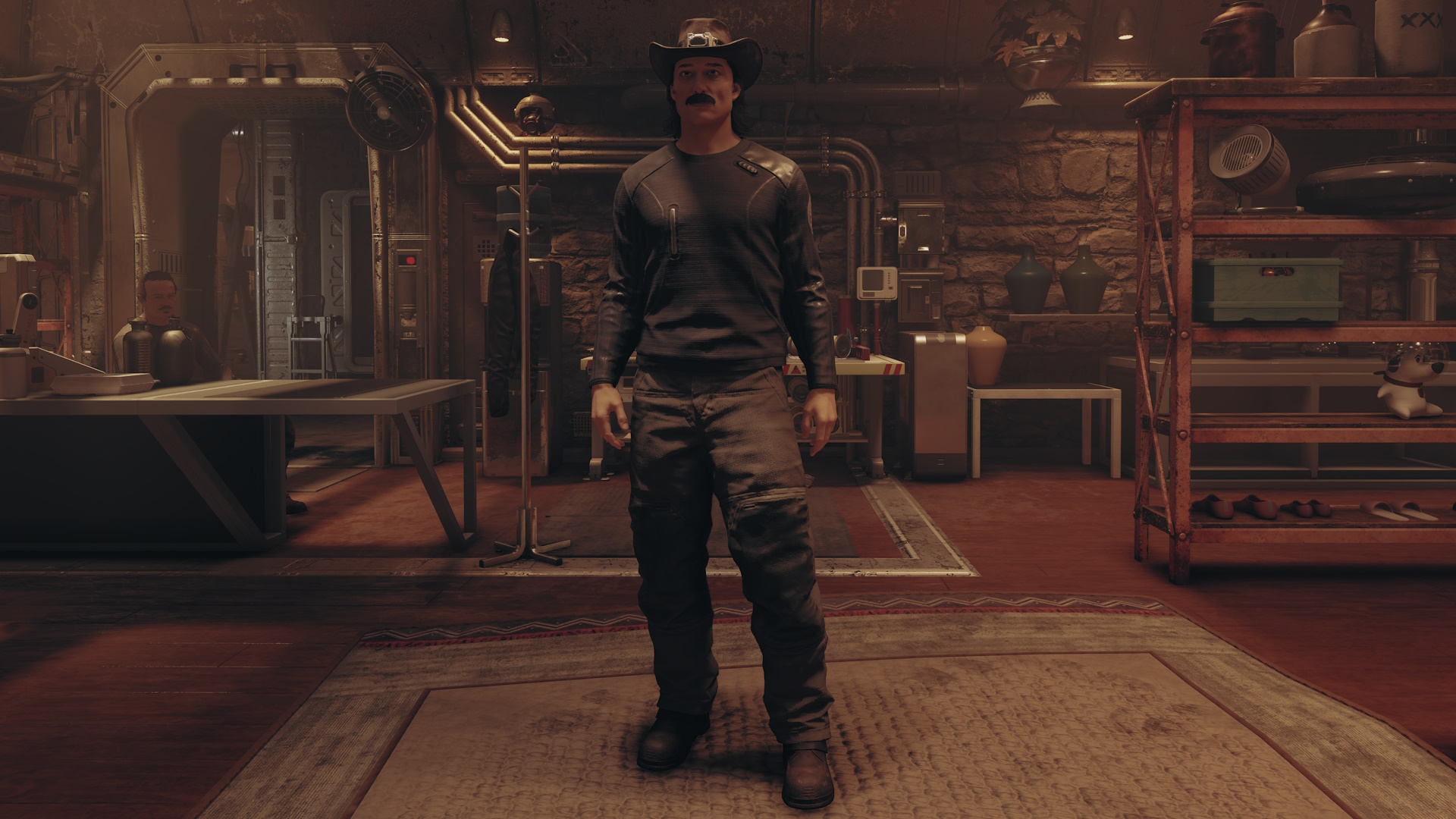
Wearing a cowboy hat in Akila City.
Things like fashion sense and personal style are, of course, incredibly subjective – so you might enjoy the outfits and spacesuits that Starfield has to offer. That’s great – but even if you like some or all of the costumes available, adding new ones into the mix, as well as expanding the existing lineup with new colour variants and designs, can only be a good thing! I’d love to see Starfield add a lot more costumes and outfits, as well as skins and colour variants – all for free. There shouldn’t be paid skins in a game of this type.
And while we’re at it, let’s create some wholly unique cosmetic items that can only be found once per playthrough. One of the fun things about past Bethesda games used to be exploring dungeons and following questlines and being rewarded with something shiny and new! The only outfit in Starfield that comes close to falling into that category is the Starborn spacesuit… and I wasn’t especially wild about the way it looks.
Number Ten: Actual Spaceflight/Piloting.
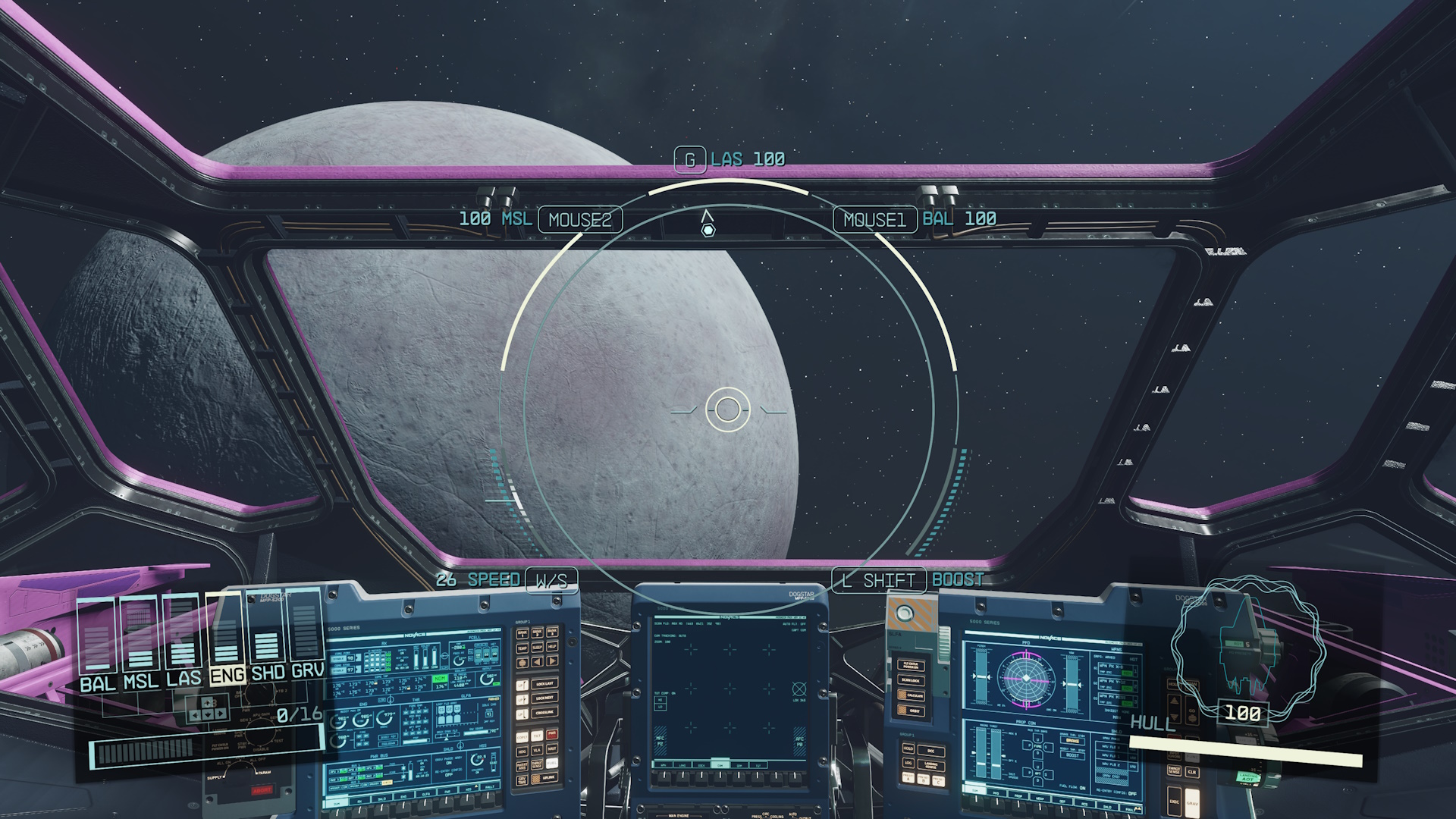
There’s not much of an opportunity to be a pilot…
Starfield is a game set in space. It encourages players to build and customise their own spacecraft. Ship-to-ship combat takes place in real-time in space. But there’s absolutely no spaceflight in this game. Let me explain what I mean by that: players can’t get in their ship and manually fly it from one location to another. The only option is a modified form of fast-travel that generates a small bubble of space around the player’s ship. As some folks have demonstrated, there are no “real” planets or objects within that bubble; they’re just jpegs floating in the background.
Of all the points I’ve raised today, this could be the hardest to fix. Starfield is built from the ground up around fast-travelling between locations, and the way in which pockets of space are generated in orbit of planets or near starstations would need to be expanded and changed in a significant way in order to make real spaceflight work. Ships, too, would need to change – with better and faster engines being options for players who long for that space-sim experience.
Starfield appears to be built around fast-travelling from the galaxy map.
So there are real logistical issues in the way of adding bona fide spaceflight to Starfield. But I think it’s worth trying, at least – because if the only option is to fast-travel between locations, much of what appeals about taking to the stars is lost. Locations don’t feel far away from one another if players can teleport there in a few seconds, meaning much of the scale of Starfield’s galaxy – something that already feels diminished in light of its tiny cities, repetitive NPCs, and copy-and-pasted points of interest – is lost.
In past Bethesda titles, the journey from place to place was a significant part of the gameplay in and of itself. Walking from Seyda Neen to Balmora in Morrowind could lead to random combat encounters, side-quests, and interactions with NPCs. In Fallout 3, travelling from Megaton to the radio tower likewise saw the player presented with new opportunities to get lost in the game’s world and have fun. Heck, the recent Fallout TV series even referenced how exploring the wasteland often leads to getting side-tracked!
Part of the fun of past Bethesda games was journeying from place to place and stumbling upon new adventures along the way.
In short, the lack of spaceflight means there are fewer opportunities for players to take their time and explore Starfield’s galaxy in their own way at their own pace. When not on the surface of a planet – or approached by a random ship in orbit – there’s basically no way for players to get side-tracked by being offered a totally different quest or mission in a way that feels natural.
Starfield having functionally no spaceflight doesn’t just harm the game from a space-sim or space game perspective, it also denies players one of the fundamental building blocks of a Bethesda open-world game, too. I don’t know how it could realistically be implemented at this stage – and flying in between star systems would probably have to remain as fast-travel only. But making an effort to get proper spaceflight up and running would be worth it as it would be a huge improvement to Starfield’s immersion and gameplay.
So that’s it!
Does Starfield need to be rushed to the medical bay?
We’ve considered ten ways that Starfield could be improved – in my humble opinion, of course.
Although I spent close to a decade working in the games industry, I’m not a developer. I don’t know whether some or all of these ideas might’ve once been considered for Starfield, but were ultimately cut because they proved to be unpopular, impractical, or unworkable. The game’s very existence is, in some respects, a technological achievement; that Bethesda managed to build something this complex using the zombified remains of a game engine that’s more than twenty-five years old should count for something, right?
But I’m not alone in finding Starfield to be an underwhelming experience to play, and the fact that it didn’t win any big awards and seems to have dropped out of our collective cultural conversation after just a few months is testament to that. Starfield was being regularly beaten by Skyrim and Fallout 4 in terms of active players even before the Fallout TV show brought renewed attention to that franchise… and unless Microsoft and Bethesda take bold action in the months and years ahead, Starfield may very well end up being forgotten.
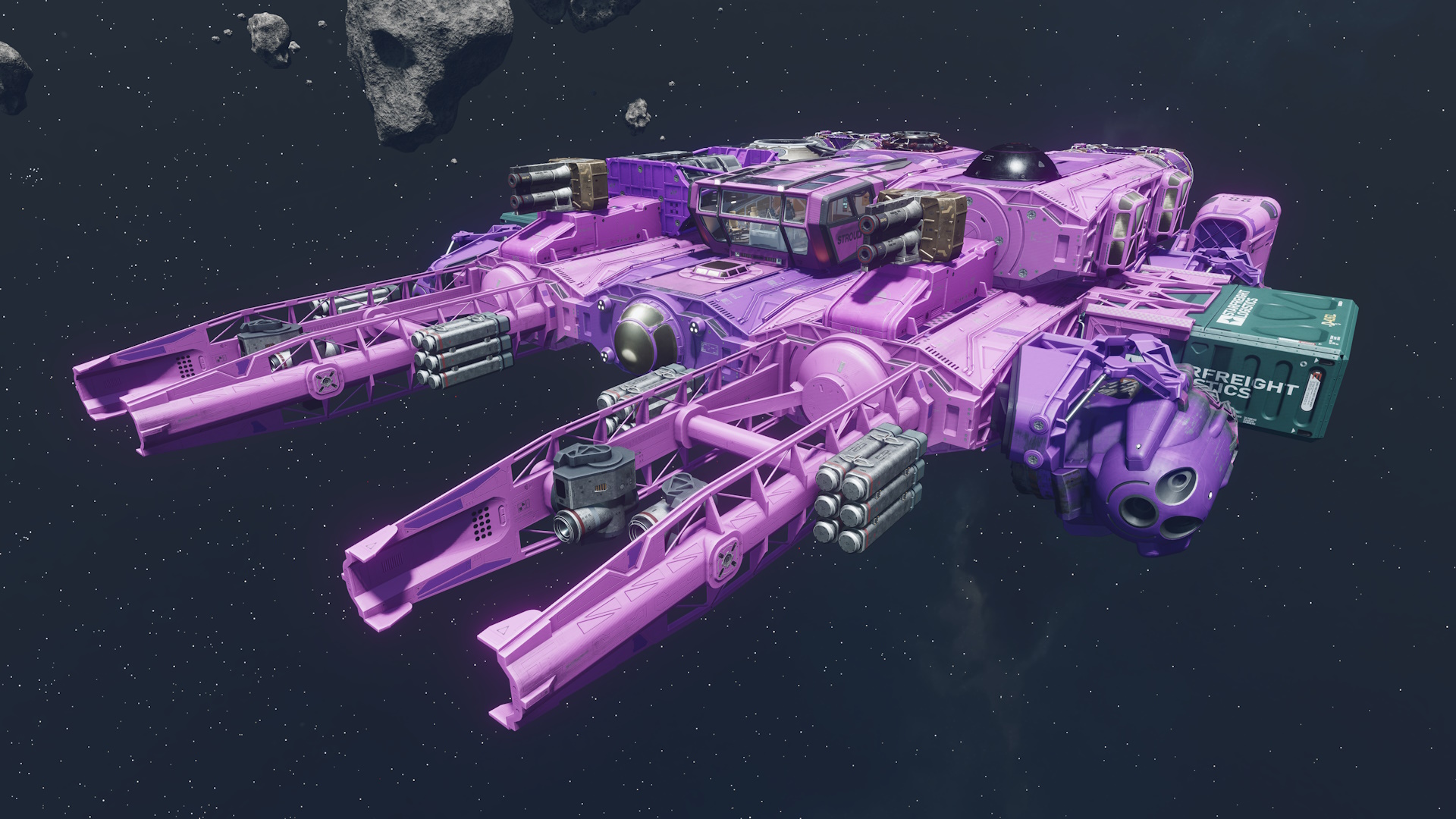
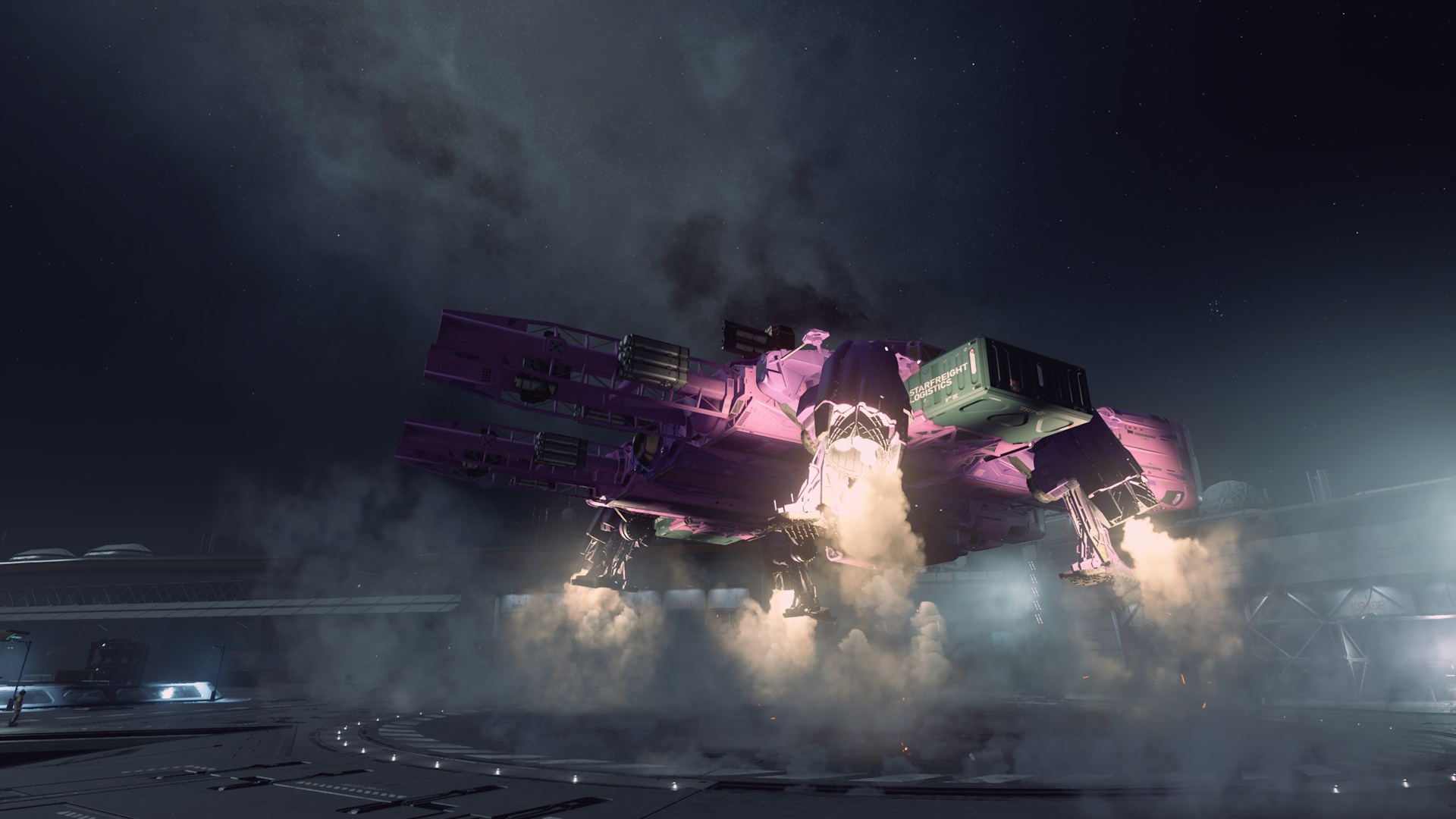
A custom spaceship on the landing pad at New Atlantis.
I’ve said before that I believe the only way to save Starfield is if its first major expansion is at least as big and impressive as Cyberpunk 2077′s Phantom Liberty DLC was last year. Tinkering around the edges won’t cut it, and if Bethesda can’t find a way to build a significant improvement to Starfield – not just a narrative addition or the inclusion of a new questline – then I think the game’s longer-term prospects will remain bleak.
I’ve had my say, and I’ve made my suggestions! Maybe not all of them would work, and maybe some of them are impossible due to the technical limitations of Bethesda’s game engine or the less-powerful Xbox Series S console. But Starfield would be a damn sight better if they were included… and really, some of these things should have been present at launch.
Could Starfield get its redemption arc one day? Never say never…
Starfield is out now for PC and Xbox Series S & X consoles. Starfield is the copyright of Bethesda Game Studios, Bethesda Softworks, Xbox Game Studios, and/or Microsoft. Some promo images and screenshots used above courtesy of Bethesda. This article contains the thoughts and opinions of one person only and is not intended to cause any offence.
Spoiler Warning: There are spoilers ahead for several main story missions in Starfield.
I was excited about Starfield last year. By the time the game’s big showcase had wrapped up in June, Starfield had rocket-boosted its way to the very top of my most-anticipated games list, and it held onto that position even as Baldur’s Gate 3 diverted my attention. But despite doing my best to give the title a fair shake, sinking more than twenty-five hours into it, and really wanting to love it… I didn’t. Starfield just didn’t have that “Bethesda magic;” the “je ne sais quoi” that has made some of the studio’s previous games into all-time classics.
And I’m far from the only person who feels that way. Despite launching to generally positive reviews from both players and professional critics, the longer folks have spent with Starfield, the further the game’s ratings have slipped. Although there are multiple areas of criticism from writing and dialogue through to the game’s outdated underlying technology, the general consensus is that Starfield is disappointing, shallow, and lacking in the replayability that Bethesda desperately tried to build into it.
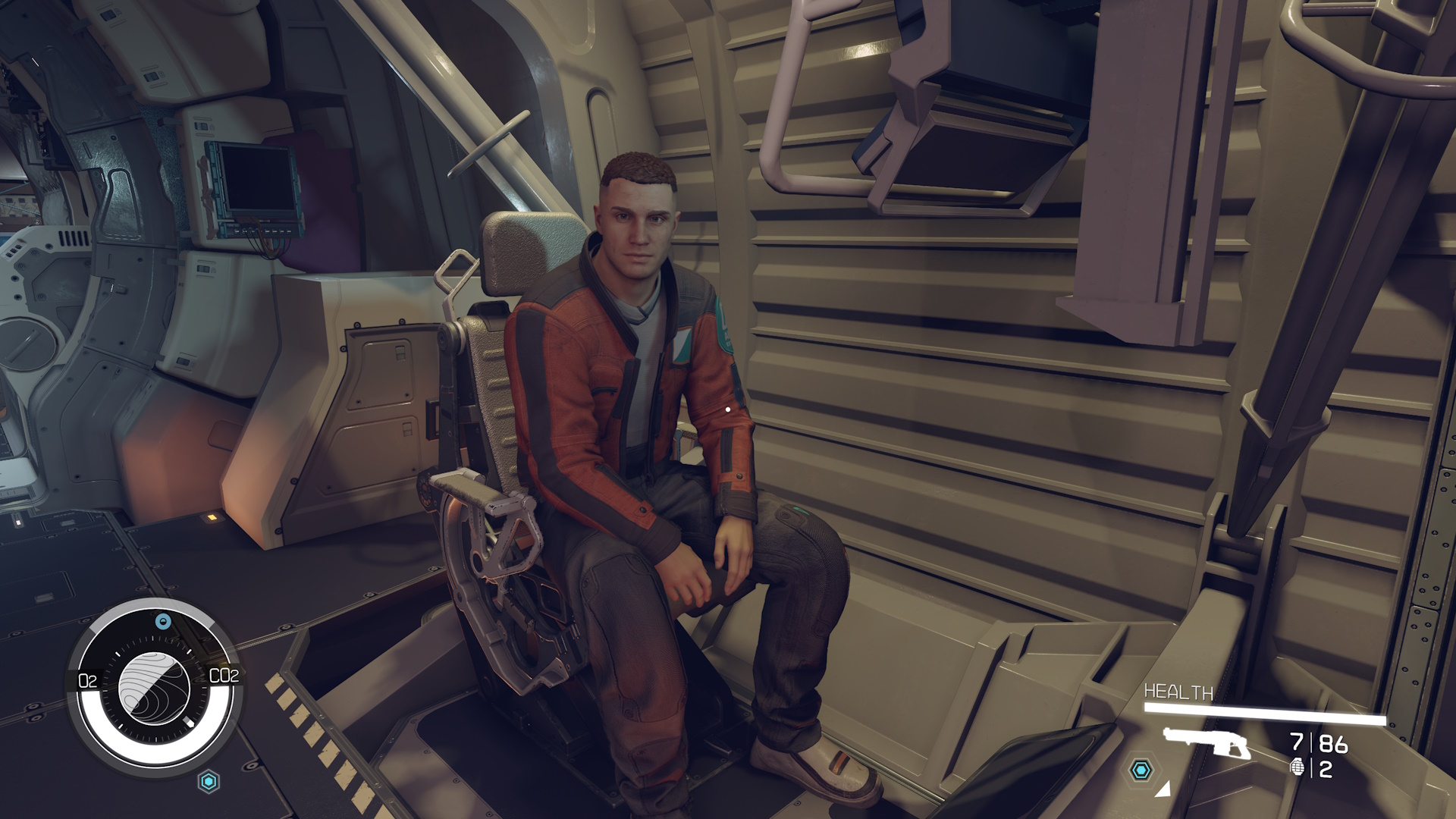
An NPC aboard a spaceship in Starfield.
But it’s 2024, and if there’s one thing the games industry knows it’s this: you can launch half a game today and promise to patch out all of its issues later! The dreaded business model that I’ve dubbed “release now, fix later” has firmly embedded itself in the games industry – and Bethesda is no stranger to utilising it. The company’s most recent title before Starfield – Fallout 76 – has received years’ worth of patches and updates, and even though it endured an appalling launch, it’s in a much better state today than it was five years ago. In fact, Fallout 76 is now sitting just ahead of Starfield in terms of average reviews on Steam.
There are some areas of Starfield that patches, updates, and DLC have the potential to improve or fix. In a game all about exploration, being forced to re-play the same handful of copy-and-paste structures filled with nameless, mindless enemies got old fast – so how about quadrupling the number of these structures, creating some unique ones that only appear once per playthrough, and adding new and different types of enemies and loot to fill them. Or how about making at least some of the game’s 1,000 planets genuinely empty, with no pre-built structures at all. That sense of exploration, of being the first person to set foot in a “strange, new world” is what I wanted from a game like Starfield… and it seems like something that could be implemented into the game without too much effort.
It’s hard to convey how disappointing it was to land on a “deserted planet” only to find buildings and bases full of nameless, meaningless NPCs.
Then there’s the game’s main story. It was left deliberately open-ended to push players into New Game Plus – and I firmly believe this was one of the first and most important ideas conceived for Starfield during its creation – but it’s led to a fundamentally unsatisfying end to the game’s main quest. So Bethesda could write a better ending – and a more conclusive one. Who created the artefacts? What was their intention? Could the player character interact with these “Creators” somehow? Again, that seems like something that should be achievable.
Adding in new and varied paths through certain quests is also something that should be doable. A notorious mission in the main quest sees the player character travel to the “pleasure city” of Neon to acquire another artefact, but this quest is about as on-rails as it’s possible to be. No matter what choices the player makes, there’s only one way to get the artefact and complete the mission. It should be possible to tackle a quest like this in more than one way – and adding that in wouldn’t break the rest of the story or other parts of the game. For example, being able to kill the character who has the artefact, or finding another way to escape Neon after the deal goes down are things that would only impact that one quest – and being forced to play it in one specific way isn’t what a lot of folks wanted or expected from a game like Starfield.
This mission offers the illusion of choice, but ultimately forces players down one very specific route.
There are, of course, some things that can’t be fixed in Starfield, no matter how much of an annoyance they seem to be! I wasn’t personally all that bothered by the game’s loading screens when opening an airlock or entering a building – but I know that the loading screens have been an area of complaint for a lot of folks. Starfield is built on the creaking, zombified remains of a twenty-five-year-old game engine, though… so I don’t see a way to remove them. Nor could the game’s fundamental spaceflight problem be fixed; Starfield is built on the player and their ship fast-travelling between locations, so any opportunity for actual piloting or flying is basically gone at this point.
So we need to be realistic about what we could reasonably see from updates and future DLC; Starfield won’t change fundamentally in terms of either gameplay mechanics or narrative. But that doesn’t mean there can’t be significant improvements that could mean the game will be worth re-installing and giving a second chance. And yes, in case you were wondering: I’ve already uninstalled Starfield.
Things like adding better in-game maps for towns and other locations should be achievable.
But here’s the thing: Bethesda basically has one chance to do this.
Many players who tried out Starfield are already moving on. Games like Baldur’s Gate 3 and Cyberpunk 2077′s Phantom Liberty DLC emerged around the same time and have, by comparison, highlighted many of the fundamental weaknesses in Starfield – as well as how far behind Bethesda has fallen in terms of game design and development. Bringing back players like myself who tried and gave up on Starfield – or convincing sceptics to try it for the first time in light of mediocre reviews – is not an easy task.
Phantom Liberty has done the impossible for Cyberpunk 2077, completely changing the way whole mechanics work, adding a massive new area of the map, new missions, and much more. Starfield needs its first piece of DLC to be at least as substantial and as transformative as Phantom Liberty given its shortcomings, and it needs this DLC to be well-received. If not… a lot of those players we’ve been talking about will be forever lost, with Starfield being brushed aside in favour of newer, better gaming experiences.
Phantom Liberty quite literally transformed Cyberpunk 2077.
Starfield is basically a “single-player live service” game. That’s the model Bethesda and Xbox chose to adopt, and we can see inside Starfield just where the paid skins and cosmetic items will appear when they’re ready to be pushed out. But like any live service, Starfield has to be basically good enough to build up a playerbase before anyone should be thinking about microtransactions, cosmetic loot, or paid mods. If Starfield’s first big expansion isn’t good enough, I don’t see the game retaining enough players to make that kind of “ten-year experience” anywhere close to viable.
Look at other games in the live-service space. Whether it’s Anthem, Marvel’s Avengers, or Ghost Recon: Breakpoint, it’s incredibly easy for even massive publishers with huge brands to fail. And there are relatively few titles that launch to such a mixed reception that go on to make a recovery. The jury’s still out on the likes of Halo Infinite and Suicide Squad: Kill the Justice League, but to say they’re limping along wouldn’t be unfair. Asking for a single patch or update to transform the fortunes of titles like that seems like a big ask… but it’s where they’re at. Just like Starfield, they’re in the last chance saloon.
We’ll see how much of this promised content for Suicide Squad: Kill the Justice League actually gets released…
Gaming is a marketplace – and a very competitive one at that. New titles are being released all the time, and while once-in-a-generation masterpieces like Red Dead Redemption II or Baldur’s Gate 3 are comparatively rare, there are enough good games out there – even in the single-player and role-playing spaces – for players to very quickly move on from a disappointing or underwhelming experience. Most games don’t even get a second chance; by the time developers have been able to address issues and roll out updates, the damage has been done and players have left, never to return.
Starfield is lucky in that Bethesda’s pedigree and Xbox’s sky-high marketing budget will almost certainly grant it a second chance and a second look from a decent number of players. But that second look had better be substantially different and a massive improvement – with changes and fixes across the board. Because there damn well won’t be a third.
Starfield has already had a chance to impress me.
Xbox won’t willingly burn money on Starfield if things don’t improve, just like Electronic Arts didn’t with Anthem or Square Enix didn’t with Marvel’s Avengers. Publishers pretty quickly hit their limit when it comes to supporting a failing game – so Starfield’s life-support can’t last forever. The game sold a decent number of copies at launch, and drove at least some new subscribers to Game Pass, so it’s probably bought Bethesda some time. But that time is finite, and if, at the end of it, the DLC or update isn’t good enough… I can see that being the end of the road for Starfield.
One interesting example here is No Man’s Sky. After that game was poorly-received by a lot of players upon release, Hello Games knuckled down and got back to work. Over the span of years, No Man’s Sky received dozens of updates that brought it much closer to its original vision. But those updates were all free, and players who stuck with the game were rewarded for their support and patience. Hello Games didn’t have the audacity to charge extra for completing the work that should have been done ahead of release… so perhaps there’s a lesson there for Bethesda and Xbox, too.
Some big free updates wouldn’t go amiss!
At the end of the day, despite whatever positive spin the PR departments at Microsoft and Bethesda might try to put on it, Starfield is in trouble. I gave up on the game after giving it more than enough time to impress me, but what should be even more concerning for Bethesda are the reports from folks who stuck with the game to the end – only to say it isn’t worth re-playing. The game’s launch did not go to plan, and the purported “ten-year experience” seems to be disintegrating before our very eyes.
We can discuss how all of this happened, where Bethesda went wrong, or what the worst aspects of the game are. There are already plenty of articles and essays about all of those subjects – and many different answers to those questions. But there is still a glimmer of hope for Starfield, that updates and improvements could bring it closer to the game we were all hoping for. But time’s a-ticking, and there’s one last chance to get it right.
Let’s cross our fingers and hope that Xbox and Bethesda seize the opportunity.
Starfield is out now for Xbox Series S and X consoles and PC, and is also available on Game Pass. Starfield is the copyright of Bethesda Game Studios, ZeniMax Media, Xbox Game Studios, and Microsoft. This article contains the thoughts and opinions of one person only and is not intended to cause any offence.


















 Trekking with Dennis