Spoiler Warning: There are minor spoilers ahead for the titles on this list.
With Halloween fast approaching, it seems like a good time to once again dabble in the spookier side of cinema! Horror has never been my favourite genre, but at this time of year I’m not averse to the occasional spooky film.
This short list is a follow-up to a similar list I wrote last Halloween, so if you’d like to see five more horror films that I recommend, you can do so by clicking or tapping here.
It’s about to get spooky!
Horror as a genre can be incredibly varied. From jump-scares to the psychological terror of something unseen, and with such diversity of monsters, ghouls, and creepy critters, there are a lot of different titles that put their own spin on the horror concept. Whether you’re looking for serial killers, vampires, zombies, or demons, chances are you can find an excellent horror film that successfully brings them to screen!
I confess that I’m particularly sensitive to jump-scares, and now that I don’t feel the same kind of pressure to join in with horror titles as I did in my younger years (when watching horror films was almost a rite of passage!) I tend to favour films that don’t go for that style. Despite that, I hope you’ll find a varied mix of titles on this list!
Number 1: The Birds (1963)
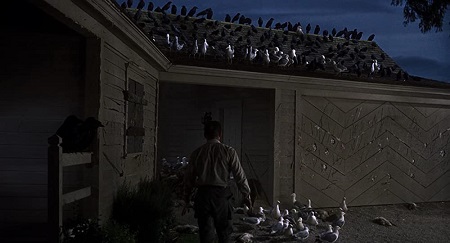
Those birds are up to something…
Alfred Hitchcock is still considered one of the greatest directors of the horror and thriller genres, and for good reason. His pioneering style put viewers right at the centre of his stories, and every shot and every sequence was meticulously planned and crafted to maximise suspense and fear. The Birds is one of Hitchcock’s later films, coming toward the end of his career and following on from the likes of Vertigo and, of course, Psycho.
As a kid, I can remember being terrified by The Birds. The slow, tense build-up that Hitchcock’s films are known for is on full display in the title, with every scene and sequence gradually ramping up the threat to a terrifying climax. But more than that, the sheer randomness of birds as the “villain” of the piece is genuinely unsettling.
Birds are generally harmless. The worst a bird might do is steal your chips at the beach, but The Birds asks a question no one ever thought to ask before: what if they were working together to a menacing and aggressive end? It’s this premise – taking something harmless that we generally pay little attention to and making it scary – that makes the film succeed.
Number 2: Sleepy Hollow (1999)
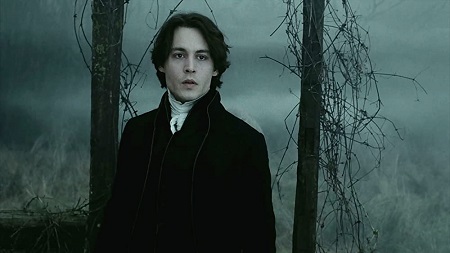
Johnny Depp as Ichabod Crane in Sleepy Hollow.
Johnny Depp stars in this adaptation of the famous Washington Irving story, and the film brings the Headless Horseman to life in genuinely frightening fashion! The story of Ichabod Crane and the Headless Horseman is an old one, dating back to the early 1800s, and Washington Irving is considered one of the first great American authors.
Unlike the earlier Disney adaptation, Sleepy Hollow takes a distinctly adult horror tone. Director Tim Burton makes a number of changes to the source material, making the film an unpredictable ride even for those familiar with the original short story. Johnny Depp puts in a wonderful dramatic performance as Ichabod, too.
There’s something inherently frightening about the undead, and the first time the Headless Horseman is seen on screen manages to capture that feeling pitch-perfectly. Johnny Depp manages to perfectly convey Ichabod’s fear as well, ramping up the tension and making Sleepy Hollow a truly scary and spooky watch!
Number 3: The Omen (1976)
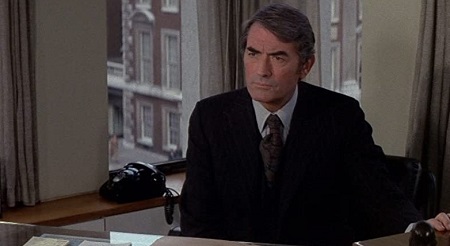
Gregory Peck as Robert Thorn in The Omen.
The Omen is an outstanding example of how to build up fear and tension without resorting to too many jump-scares or a lot of gore! It’s also a deeply disturbing film because of the implications of shadowy cults and conspiracies – and that’s before we even get to the birth of the literal anti-Christ!
When I first watched The Omen I was left unsettled for days afterwards. There’s a specific scene that I won’t spoil for you, but the build-up to a particularly shocking reveal in an Italian graveyard – and the implications it had for the film’s protagonist – left me stunned and disturbed! That particular memory is still vivid for me now, decades later.
As a film about demons, Satan, and the anti-Christ, The Omen was designed to be shocking and unsettling, especially to folks with any kind of religious convictions. And it succeeded beyond its wildest ambitions, becoming an absolute classic of the horror genre and spawning a franchise that still gets periodic updates and instalments today. Oh, and if you’re looking for a Star Trek connection, the film’s lead, Gregory Peck, was the grandfather of Ethan Peck – star of Discovery Season 2 and soon to be appearing in Strange New Worlds!
Number 4: 28 Days Later (2002)
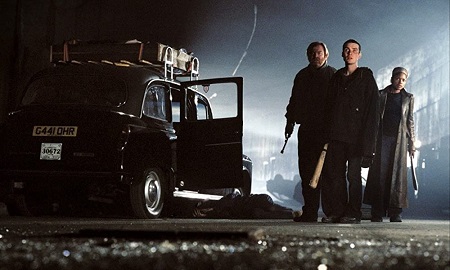
The infected are coming!
With 28 Days Later, director Danny Boyle reinvigorated the zombie genre in a new and truly terrifying way! Prior to the film’s 2002 release, most zombies in cinema followed a pattern first popularised by George A. Romero in Night of the Living Dead – slow, shuffling, mindless creatures that were scary en masse but could be outrun by anyone fit enough. 28 Days Later introduced us to the infected – humans who were still alive but infected with a virus that turned them into killing machines… killing machines that could sprint!
Seeing the zombie horde running after the film’s protagonists was a new and incredibly shocking experience in 2002. Though a number of titles have used this more aggressive style of zombie in the years since, for me the portrayal in 28 Days Later remains one of the best and most frightening.
Technically not a “zombie” film as the infected aren’t undead, 28 Days Later nevertheless has a post-apocalyptic feel that is present in a lot of zombie fiction. Anyone who’s seen The Walking Dead (or read the original comic books) should note an eerie similarity in the way 28 Days Later opens… and remember that the film was released before the first issue of the comics!
Number 5: The Shining (1980)
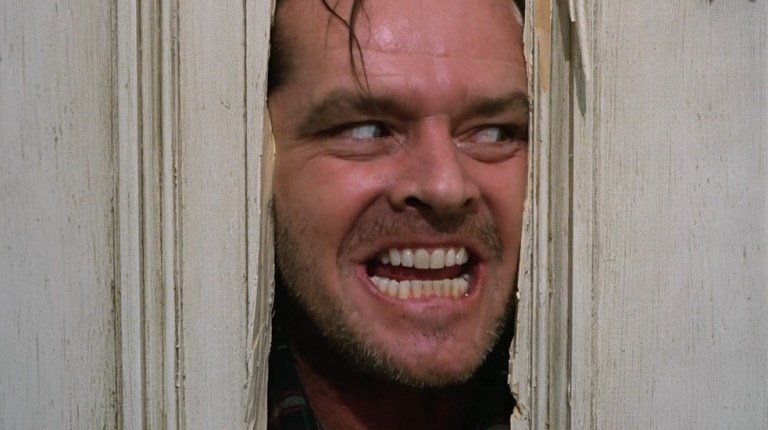
Here’s… a classic horror film!
The Shining is an adaptation of a Stephen King novel, and as such it’s an unpredictable and very disturbing ride. Stanley Kubrick directed one of his last films, and adapted the book in truly inspired style. Some of the best-known moments in The Shining, including the famous line referenced above, weren’t present in the original book, and the film adaptation is arguably a rare example of a film surpassing its source material.
The film features some truly outstanding special effects. The “blood flood” scene has gone on to become iconic, and was shot in miniaturised form using detailed scale models. The practical special effects give the film a unique charm that today’s CGI can’t match, and in some cases the use of incredibly realistic practical effects ramps up the fear factor.
Jack Nicholson gave the world one of cinema’s most iconic scenes. But The Shining is so much more than that, and his character’s slow descent into madness is what makes the film so tense, exciting, and frightening.
So that’s it! Five horror films to get you into the Halloween spirit.
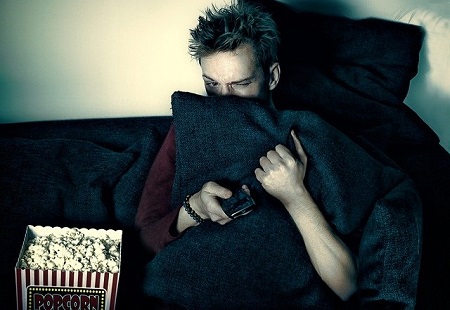
Don’t have nightmares…
Remember to check out last year’s list for five more horror titles you might enjoy – you can find it by clicking or tapping here. And if you’re interested to see my review of last year’s television adaptation of another Stephen King work, The Stand, you can find that by clicking or tapping here.
I tried to put together a collection of films with different themes, styles, and subjects! Horror is an incredibly varied genre, and just in the five films above we have the natural world turned against us, an undead horseman, Satanism, technically-not-zombies, and finally a film with ghosts and a mad man. And we’ve barely scratched the surface!
Halloween is almost upon us, so stay tuned over the next few days – I have a couple more spooky ideas before the main event rolls around!
All titles included on the list above are the copyright of their respective studio, distributor, production company, broadcaster, etc. This article contains the thoughts and opinions of one person only and is not intended to cause any offence.
Spoiler Warning: There are spoilers ahead for The Stand.
I’ve been to Stephen King’s house. Not for any function, of course – nor indeed was I invited. But in his hometown of Bangor, Maine, King’s house is a local landmark with ornate gates befitting the preeminent author of pop-horror. I’m categorically not a fan of horror on screen, either television shows or films. Modern horror tends to veer very strongly into jump-scares – which always unnerve me – or just gore for the sake of gore, which I really have little interest in. But Stephen King straddles the line between out-and-out horror with a creepy weirdness that can, under the right circumstances, be absolutely riveting.
The Stand has already been adapted for television, with a miniseries in 1994 starring Gary Sinise. I put that adaptation on a tongue-in-cheek list that I wrote last year, before I became aware of this latest adaptation. Like my last miniseries review – which was for Marvel show The Falcon and the Winter Soldier – this review is also late to the party! The Stand was broadcast on CBS All Access – since rebranded as Paramount+ – late last year. Though I’ve been meaning to watch it ever since – and it even made my list last June of things I was looking forward to in the second half of 2020 – it’s taken me until now to get around to it.
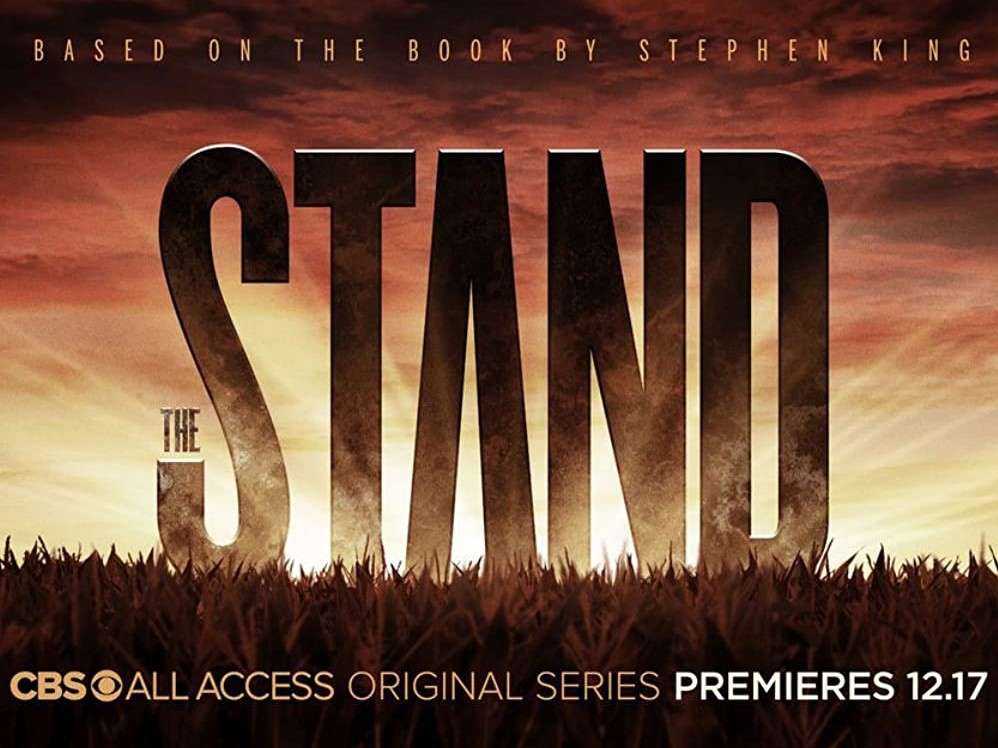
Promotional poster for The Stand.
I feel more than a little sorry for this adaptation of The Stand, which languished in development hell for years before being commissioned in early 2019. The miniseries was filmed in late 2019 and early 2020, before the extend of the coronavirus pandemic became evident, and I think the mere premise of the series was more than enough to put people off given what’s happening in the world. Having invested in the project, it wasn’t practical for ViacomCBS to just sit on it or dump it – so it ended up being broadcast to a world that, quite frankly, was not in the mood for a show about a viral pandemic that killed everyone. That might undersell what The Stand is – or what it aims to be. But it nevertheless goes some way toward explaining its muted reception.
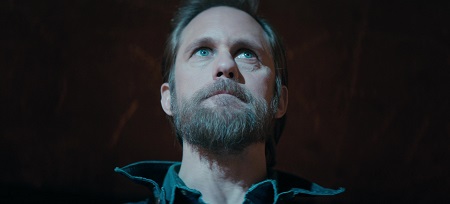
There were some inspired casting choices. James Marsden channels his inner Gary Sinise to put on a performance that lived up to – and in some respects mirrored – Sinise’s own in the 1994 adaptation. Alexander Skarsgård was fantastic as the villainous Dark Man/Randall Flagg. And Owen Teague – who I confess I wasn’t familiar with prior to The Stand – put in a truly inspired performance as the creepy Harold Lauder.
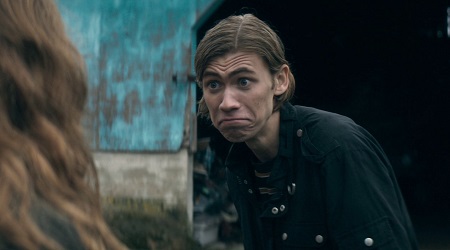
Owen Teague as Harold Lauder.
Stephen King’s novel Rage, about a shooting at a high school, hit a little too close to home even for the author and has been out of print since the early 2000s. In the characterisation of Harold Lauder, one of The Stand’s villains, I note some familiar themes. Lauder is an outcast, an obsessive, a true-to-type “incel” who blames society and the world around him for his own lack of success. Lauder is an interesting villain in some respects – though he has no real nuance, I think a lot of people are familiar with someone like this; someone who’s generally unsuccessful in life and who’s become bitter, jaded, and even creepy. The Stand throws such a person into the apocalypse, and Lauder’s newfound freedom allows him to follow his own destructive course.
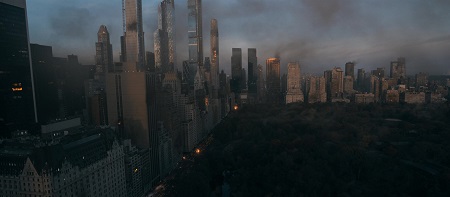
The Stand mixes supernatural horror with post-apocalyptic storytelling, which make a natural pair at certain points, yet tug against each other and fail to gel at others. The miniseries contains some genuinely amazing moments and scenes that rival anything else in the entire post-apocalyptic genre. There’s a sweeping shot of New York City in the second episode, showing smoke from numerous small fires drifting over the city and Central Park, and it was incredibly atmospheric. This kind of silent storytelling, using the camera and some minimal visual effects work, did an amazing job at setting up the world that The Stand wanted to transport us to, and there were numerous examples of this across the nine-episode series.
The very atmospheric shot of New York City burning.
One thing I’ve always been interested in when it comes to post-apocalyptic fiction are the character stories – who survives whatever the event is and why? And what sort of person do we find in the aftermath of such events? The Stand gives us plenty of examples of thoroughly unpleasant people: criminals, liars, thieves, and worse. It also shows us examples of better people: heroes and those willing to do what’s right. Unfortunately that comes at the expense of nuance; The Stand basically splits its characters into goodies and baddies with very little going on in between.
We’ve already talked about Lauder and his characterisation as creepy, bitter, and ultimately murderous. But other villains fall into even more obvious stereotypes: Lloyd is a wannabe-gangster, the Trashcan Man is a pyromaniac, Nadine is the girl who made a deal with the “devil.” And speaking of the devil, the Dark Man himself, Randall Flagg, is a Stephen King mainstay and stand-in for the devil.
Randall Flagg – a.k.a. the Dark Man.
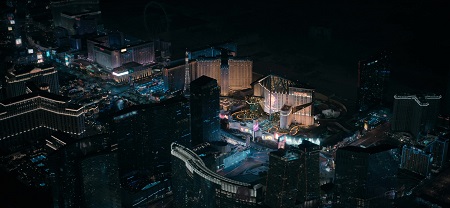
In that sense, nothing about The Stand is subtle. Its narrative centres around the battle of “good versus evil,” and that naturally divides its characters into two camps. Those on the side of good are selfless exemplars of virtue, those on the bad side are basically Satanic stereotypes who revel in every sin imaginable. The Stand setting its villain’s headquarters in Las Vegas – Sin City itself – is likewise about as subtle as a brick to the face.
Not every story has to have complexity and nuance; there’s room for a classic “heroes and villains” narrative even in 2021. But something about the way The Stand leaps headfirst into so many patently obvious plotlines and character arcs makes it less than it could’ve been. There are definitely narrative elements that are unpredictable, but most of the mainstays of both the overarching storyline and the individual stories of the characters felt telegraphed in advance, and that robbed the series of a good portion of its impact and drama.
The choice of Las Vegas as the setting for a story about the demerits of sin was… obvious.
In terms of the soundtrack and music, I have to credit The Stand as being truly fantastic. Practically every one of the nine episodes contains moments of extreme tension, and these moments were elevated significantly by some excellent, understated musical scoring. Music sets the stage for many significant scenes and moments, and the difference in tone it sets between the heroes’ home base in Boulder and the devil’s nest in Las Vegas is huge – and a big part of why the contrast between the two settings works so well. Each episode also features at least one popular song, and the choices here were generally good as well. I particularly liked the use of Melanie’s Brand New Key – it’s a great song in its own right, but the way it was used at the end of one of the episodes gave it a strangely creepy, almost otherworldly feel.
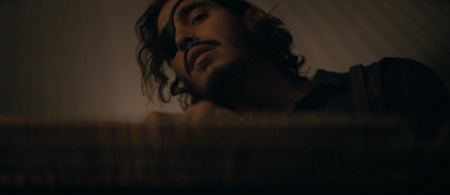
Cinematography was likewise pretty good across the board. There were some really excellent artistic shots – I mentioned the New York City one above, but also a shot of Frannie and Harold split through a wall was fascinating, as well as numerous silent (or practically silent) moments featuring Nick, the deaf character, which really added to the sense of immersion. Nick’s scene with the piano, in which we could see the inner workings of the piano but not hear the notes, was inspired, and something I would’ve expected to see in a series like Hannibal – another horror series with a strong artistic slant to its cinematography.
One of the very artistic moments involving Nick and the piano.
The way The Stand uses light was interesting. At first, I felt that the way several different characters seemed to leave lights on and candles burning was just typical post-apocalyptic/horror fare – a cheap way for villains to track or find them. But there’s something more to it than that, and the way the series as a whole used light, and particularly uncovered, obvious light, feels like a metaphor. The Stand is a series flooded with religious imagery, and there’s something almost poetic about seeing many of the heroic characters as representatives of “the light” against the forces of the Dark Man.
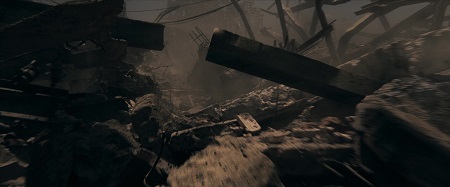
There was only one real miss in terms of visual effects, and it came in the final episode. In a sequence that was basically fully-animated, the camera panned over the ruins of Las Vegas to focus on Flagg’s trademark badge, and the whole thing fell into the so-called “uncanny valley,” where the CGI work just wasn’t quite believable enough. It wasn’t awful by any means, and would compare favourably to anything from ten years ago, even in cinema, but in a series that otherwise did its visual effects well, it has to go down as the weakest moment.
The CGI sequence that I felt didn’t quite stick the landing.
I’m not a religious person, and perhaps someone who is would get something more out of The Stand, which relies heavily on Christian apocalypticism for the theme underpinning its main story. At the same time, some of these religious themes work against the narrative – or at least the setting. The Stand wants to be bleaker than it manages to be; a post-apocalyptic tale of desperate people driven to do evil things and kill themselves. Yet the use of Christian imagery, which ramps up to near-continuous after about the halfway point, tugs The Stand in the other direction, softening some of those dark edges. What results is a series that’s confused.
The Stand wants to be two things at once: post-apocalyptic horror and supernatural horror with strong religious themes. As noted above, these two can make a natural pair, but The Stand doesn’t nail the pairing on every occasion, and there are times when the religious themes work against the bleaker, character-centric story about the world after an apocalyptic event. The theme of hope, which is so often present in post-apocalyptic fiction, is undermined by the sense that many of the protagonists have that their quest is anointed by an all-powerful interventionist god.
Mother Abigail’s role as the prophet of a very active and involved god gave hope to many of the characters – and led to a less satisfying narrative as a result.
Hope in post-apocalyptic stories works when it seems like characters have little to no reason to cling to it, yet through sheer force of will and strength of character, they find ways to do so. Some characters may revel in small victories – like the character of Tallahassee in Zombieland who finally gets a Twinkie (a kind of small cake) after craving one for the whole film. Others find meaning in their companions, fellow survivors, or family members – like Viggo Mortensen’s character in The Road, for example. The Stand drops all of its protagonists into a setting where they never genuinely question their status as “god’s chosen” and their hope for a better future stems from that. But that foundation, while somewhat novel, loses something significant as a result – and that something unfortunately happens to be what I personally find one of the most interesting and appealing things about post-apocalyptic stories.
Frannie’s snap decision at the beginning of the final episode to return to Maine felt like it came out of nowhere; an arbitrary character move to give the story a “shock” as it entered its endgame. Though the characters were, as I explained above, pretty standard heroes and villains, they were generally consistent in the way they were written and in their motivations. Frannie left Maine with Harold initially in search of others, and having found them, made friends, and begun to build a new civilisation in Boulder, seems far too quick to throw it away for the sake of what? Homesickness? If she’d mentioned Maine even once or twice in previous episodes it would at least feel like there’d been hints she was feeling this way. Sometimes when a story knows the endgame it wants to reach, some character choices necessary to get there can feel completely arbitrary, and Frannie’s desire to return to Maine – without even really providing a reason why – definitely falls into that category.
I wasn’t sold on Frannie’s out-of-nowhere decision in the final episode.
Though not really overt, there was one significant political theme that I picked up in The Stand. In the character of Flagg we have a dictator – someone who rules through fear, as characters like Glen note. The way Flagg draws his supernatural powers, embodied by his ability to levitate, from the worship and fear of his subjects could be read as a commentary on the way any dictator’s power relies on the people around them continuing to “feed” them with that fear. Or to put it another way: people have the power, even when it seems like a truly evil tyrant is in charge. We see this as Larry, Glen, and Ray’s challenge to his authority quickly inspires others and leaves him significantly weakened.
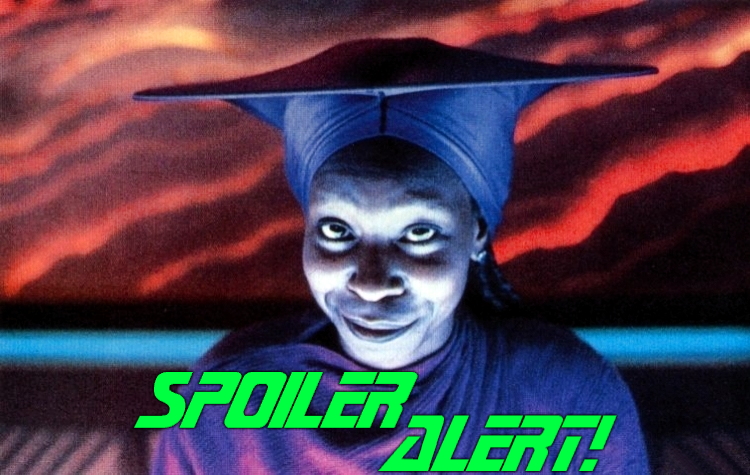
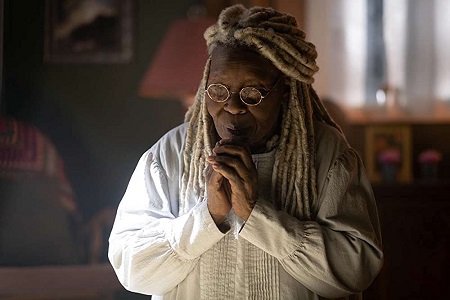
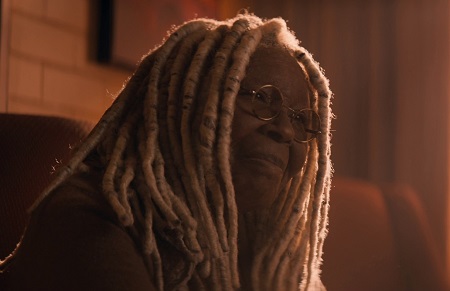
I’m a big fan of the Star Trek franchise, as you may know if you’re a regular around here. Star Trek: The Next Generation in particular is a favourite series of mine, and Whoopi Goldberg’s role as Mother Abigail had more than a little of her Star Trek character of Guinan in it. Guinan serves as a friend and guide to Captain Picard, and in particular her role in episodes like Q Who and Time’s Arrow, as well as the film Generations lines up perfectly with Mother Abigail’s place in The Stand. Though this isn’t intentional, of course, as a Trekkie I just find it interesting to note when former Star Trek stars take on new roles that are somewhat similar! Goldberg’s performance was excellent, and she brought a real weight or gravitas to the role of Mother Abigail that was much-needed.
Whoopi Goldberg as Mother Abigail.
The Stand attracted some controversy in the months before its broadcast for casting a non-deaf actor in the role of deaf character Nick. Nick’s role in the show does involve some scenes where he can hear and speak, and for that reason creator Josh Boone defended the decision. While I would say that I generally don’t subscribe to the camp that says actors can only play roles if they meet certain criteria, in this case it would have been relatively easy to cut the couple of scenes in which Nick speaks, or to replace them with signed scenes. It would take away a tiny bit of the supernatural aspect of Mother Abigail’s abilities, but there was more than enough of that through the rest of the show that I don’t think it would’ve made a significant difference. With that being the case, a deaf actor could have certainly taken on this role.
As someone who is disabled, I would be quite happy with an able-bodied actor playing a disabled role – so long as it was done tastefully and it doesn’t feel as though anyone has been excluded. Likewise with characters who are asexual or who are in between male and female on the gender spectrum; I think so long as it doesn’t stray into voyeuristic territory, actors can take on a wider variety of roles. There are great actors who are deaf, disabled, and in other categories, and I hope they find opportunities to play characters as well. I don’t want to see anyone’s career options limited, and as mentioned in this case I think the couple of scenes where Nick spoke could have been cut or changed to accommodate a deaf actor. As a general point, though, I’m okay with actors from many different backgrounds being able to take on a variety of roles. Perhaps this is something we should go into more detail in on another occasion, as I feel it could be an entire essay in itself, and I don’t want to spend too much time on just this one point on this occasion.
Another promotional poster for The Stand.
So I think we’re about at the end of my review. The Stand was interesting, and had some genuinely great moments. It was also a flawed production that didn’t get everything right and could feel, at certain moments, that it was trying to be two very different things at the same time. In part that fault lies with the source material – Stephen King’s novel. But it also lies with the adaptation and the way in which the novel was put to screen.
Despite nominally falling into the horror genre, The Stand won’t be giving me nightmares any time soon! It was tense at points, and there was some distinctive Stephen King supernatural weirdness, but nothing that I felt was terrifying or frightening. There was some gory violence and some gratuitous sex scenes that really didn’t add much to the story. But there was also some fantastic musical scoring and cinematography, as well as some great acting performances that elevated the series, making it better than it could’ve been.
I’m in no hurry to re-watch The Stand now that I’ve seen it. And with so many interesting film and television projects on the horizon between now and Christmas, I daresay it will go back on the shelf (or rather, Amazon Video’s shelf) for quite some time. But I’m glad to have finally got around to seeing it more than six months after its debut! Now, what should I watch next?
The Stand is available to stream now on Paramount+ in the United States and on Amazon Video (for a fee) in other countries and territories. The Stand is the copyright of ViacomCBS and/or Vertigo Entertainment. This article contains the thoughts and opinions of one person only and is not intended to cause any offence.


 Trekking with Dennis