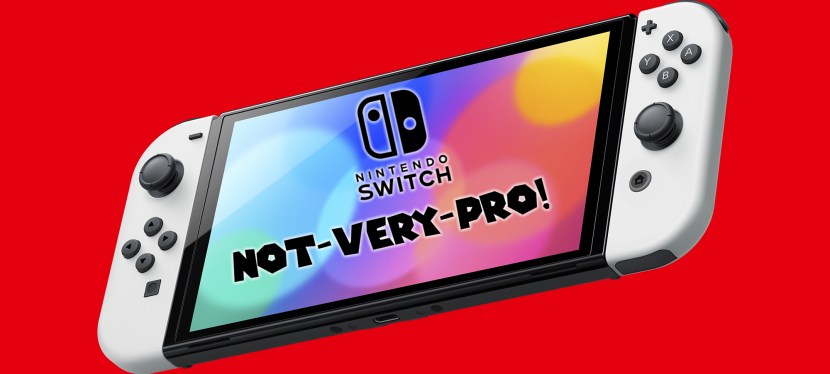
The OLED Nintendo Switch disappoints fans… good.

Just to clarify: I don’t want to revel in someone’s disappointment. There are valid reasons to look forward to a brand-new Nintendo console and all of the improvements that such a device could bring to upcoming games. But I was very pleased to see that the rumours about an impending “Nintendo Switch Pro” have come to naught on this occasion.

There’s a moral to this story, one which we all need to be aware of in the age of the internet: don’t believe everything you read! Not long ago I talked about how a single Twitter post sent the online Star Trek fandom into a spiral of clickbaity articles promising the return of a major character, and in this case it seems that unspecified, unsourced, anonymous “rumours” led many Nintendo fans and commentators to expect the imminent announcement of a brand-new console.
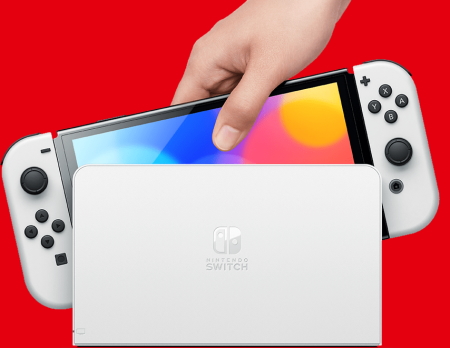
The Switch OLED version has led some fans to feel disappointed – they were hoping for something more.

It’s incredibly easy to start a rumour. Sign up for an account on a popular forum, post your bullshit, claim to have “sources” close to the company or production concerned, and Bob’s your uncle. Rumour started. Watch with glee as the internet goes wild for whatever nonsense you’ve decided to peddle. I can’t count the number of articles I’ve seen that were kicked off by these so-called “leaks,” including about major games like Grand Theft Auto 6, huge films like Star Wars Episode VIII, and many more besides. Practically all of them turned out to be completely wrong, and those few that got something right seem to have done so more by chance than because of anything legitimate.

In short, don’t believe rumours that you read on the internet, especially those which concern the games industry. Even if you read something in the mainstream games press, on a usually-reliable website, or even see something on a YouTube channel with multiple millions of subscribers, it could all be based on nonsense. Check the sources of whatever publication or outlet is reporting these rumours. Where did they get it from? If it’s an “anonymous leak” or the publication refuses to say where the rumour comes from, it should be dismissed out of hand. I’ve said on more than one occasion here on the website that I’d rather not discuss a story that turns out to be true instead of jump in and comment on every non-event sparked by one of these ridiculous anonymous posts.

Any idiot with an internet connection can start a rumour.

Obviously the reason we’re talking about all of this is because Nintendo has finally revealed to the world the latest iteration of their Nintendo Switch console, and after months of rumours that a brand-new machine was in the offing, a lot of Nintendo superfans are feeling disappointed.

The Nintendo Switch is barely four years old, having been launched in March 2017. Though early console generations could be relatively short, for the past several generations we’ve seen double that – there were eight years between the launch of the PlayStation 4 and the PlayStation 5, for example. It’s not good business sense for Nintendo to launch a completely new console this soon after the Switch’s launch; doing so would leave the millions of players who’ve only just bought one feeling like they made a mistake, and would sour Nintendo’s carefully-constructed brand.

The rumoured Switch Pro was alleged to be a machine which would have had its own exclusive games; titles which wouldn’t work on the original 2017 Switch or the Switch Lite, and this horrible naming confusion would have made the Xbox Series X and Wii U debacles look positively genius by comparison.
The rumoured “Switch Pro” has failed to materialise.

So I’m glad that the Switch OLED has turned out to be a bag of nothing; a minor upgrade with a shiny new screen, better stand, and not a lot else to offer. When one of the biggest features Nintendo can brag about in the new device’s marketing is that the dock is a different colour, you know there’s not much worth talking about!

The Switch still has years’ worth of life left in it. It’s not impossible to think it could pass the decade mark and run alongside the PlayStation 5 and Xbox Series X for the entirety of this generation. Its limited internal hardware will mean that ports of brand-new games will become difficult to impossible, but as game streaming rises to become a big deal in the industry, it’s not beyond the realm of possibility to see a “Switch Streaming” app sometime soon that would allow players to stream games to their console that otherwise wouldn’t work. Developing something like that seems like a far better use of Nintendo’s time than making a Switch Pro.

The Switch is barely four years old – there’s plenty of life left in it yet!

Nintendo is uniquely positioned in the video game marketplace. Not only does the Switch offer Nintendo’s own, generally high-quality titles from Animal Crossing: New Horizons to The Legend of Zelda: Breath of the Wild, but it also allows players to take all kinds of games with them on the go. The unique selling point of the console has proven to be wildly popular with gamers of all stripes, and ditching it or mothballing it in favour of a new project would be a wasted opportunity. The Switch has already sold over 85 million units in just four years – and is already hot on the heels of the Wii, which sold just over 100 million. It’s not a stretch to think that the Switch could literally become the best-selling console ever, stealing the crown currently held by the PlayStation 2.

So it’s absolutely appropriate for Nintendo to continue to invest in the Switch. This latest iteration is just that: an iteration. A minor adjustment of the Switch to appeal to new fans and perhaps to convince some folks to upgrade to get the shinier screen. The Switch’s future success will be built on games, though, and I’m sure Nintendo has plenty of ideas in the pipeline there as well.
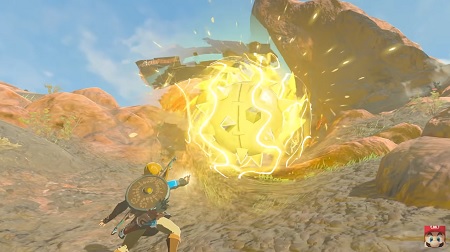
A sequel to The Legend of Zelda: Breath of the Wild is coming soon.

It’s also worth mentioning the very rocky launch that both the PlayStation 5 and Xbox Series X have endured, with shortages of key components leading to far fewer consoles being available. Even now, eight months later, tracking down a console at its recommended retail price is still difficult, and in some parts of the world is completely impossible. Any new Nintendo console would face similar issues, and with the shortage of components not looking like it’s going to ease up any time soon, such a device would have had a rough launch.

I’m sorry if you feel disappointed that there isn’t going to be a new Nintendo console this year, but in my opinion it’s for the best. There are some great positive reasons to stick with the Switch family of systems instead of trying to pre-emptively create something new, and there are plenty of negative reasons that should tell any wannabe-manufacturer that now is not a great time to consider launching new hardware. As I said at the beginning, rumours and leaks don’t mean anything. In 2021, with so much junk flying around online, unless something is outright confirmed by an official source it should always be looked at with a healthy degree of scepticism.

So I think this was the right call by Nintendo, and I hope they plan on sticking with the Switch beyond 2021 as well. There are some great Switch games out already, and I have no doubt that there are many more to come.

The Nintendo Switch and all other properties mentioned above are the copyright of Nintendo. This article contains the thoughts and opinions of one person only and is not intended to cause any offence.
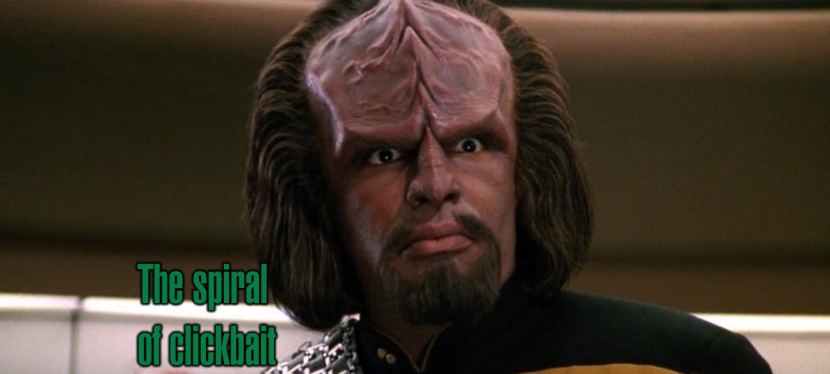
Worf and the spiral of clickbait

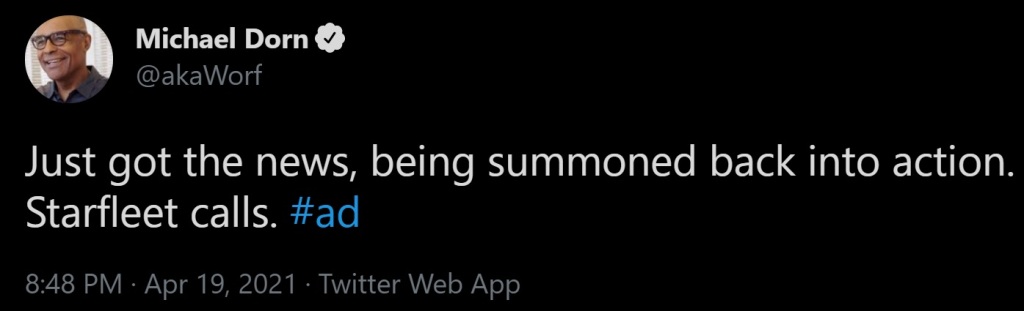
One potential news story that I opted not to cover here on the website was a recent social media post by Worf actor Michael Dorn. In a single Twitter post, Dorn wrote the following: “Just got the news, being summoned back into action. Starfleet calls. #ad”

Well, no sooner had that post hit Twitter than the Star Trek fan community began scrambling to “break” the news of Worf’s return to Star Trek. Websites, blogs, and YouTube shows all jumped on Dorn’s post, using headlines like: “Michael Dorn CONFIRMS Worf’s Return!” As the battle for clicks escalated, Trekkies online began speculating about what form Worf’s return could take, and this too began to grow and spiral out of control.

The Tweet that launched a thousand clickbait articles…

The Captain Worf series that he’s been trying to get off the ground for the better part of a decade seemed to be 100% confirmed, if you believed certain websites and channels. Others were convinced the Twitter post meant Worf would appear in Picard Season 2 or Discovery Season 4. And of course, many outlets reported their wild speculation with minimal caveats as though it were fact.

All of this hype came crashing down within 48 hours, however, when it became clear that Dorn’s Twitter post was nothing more than an advertisement for mobile game Star Trek Legends, an Apple Arcade exclusive title. Legends looks like so many other mobile games released in the last few years, and I have no desire to sign up to Apple Arcade at £5 per month just to play one mediocre-looking title. Even if it does have Worf!

Logo for Star Trek Legends.

Uninspired mobile games aside, I think this whole Michael Dorn saga is yet another example in a very long line of how we have to be incredibly careful how we use social media and how difficult it is to trust even supposedly “reputable” outlets. In this piece I’ll look at the issue as it relates to the Star Trek fan community in particular, but obviously these same broad points can apply to news, politics, and so on.

Michael Dorn’s post was designed to get attention. He may have written it himself, but it’s equally likely – in my opinion as someone who used to work in video games marketing – that it was written by the marketing team behind Star Trek Legends. But whoever wrote the actual words, the post was deliberately ambiguous and designed to get Trekkies talking, playing on fan hopes of the return of a major character who hasn’t been seen on screen since 2002.

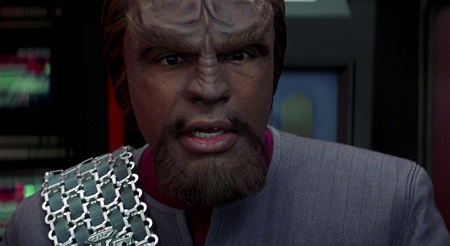
Worf made his last canonical appearance in 2002’s Star Trek: Nemesis.

Marketers do this kind of thing all the time; it’s a nostalgia play. It isn’t the first time we’ve seen it in the Star Trek community, either. But because we’re in an age of 24/7 social media use, some of the biggest names in the online Star Trek fandom jumped on Dorn’s comment, seeing an easy way to get clicks – and thus money – for themselves.

Reading the Twitter post, and especially seeing the #ad hashtag, it should’ve been screamingly obvious that this was not connected to a new television show or film. And I have no doubt whatsoever that the social media managers, webmasters, and fan group leaders who began to write clickbaity articles and produce clickbait videos knew that for a fact. But they did so anyway. It was a topic of conversation – and an easy win. Who wouldn’t click on a video or article that screamed “Worf is coming back!” in big bold capital letters? For fans unaware of the original Twitter post, they jumped on such articles and videos hoping to learn that Worf was getting his own show or that he would appear in Picard – the natural implication of such a headline.

Worf having a role in Picard Season 2 was something some fans speculated about at length.

I’m lucky to have my own website, and that means I can cover the topics I want to at my own pace. I did see the Michael Dorn controversy unfold, but two things became apparent very quickly. First was that no one commenting online, no matter how large their website and following, actually knew anything substantial. And second, Dorn’s post had the #ad hashtag, which meant it was clearly connected to a product of some kind. Star Trek Legends turned out to be that product.

As a result, I chose not to cover a “story” that was a bag of nothing. I could easily have penned a short article about the prospects of a Captain Worf series and the potential for Worf to appear in Picard Season 2, Discovery Season 4, or Lower Decks Season 2. Maybe doing so would have driven traffic to the website. But it would’ve felt more than a little dishonest.

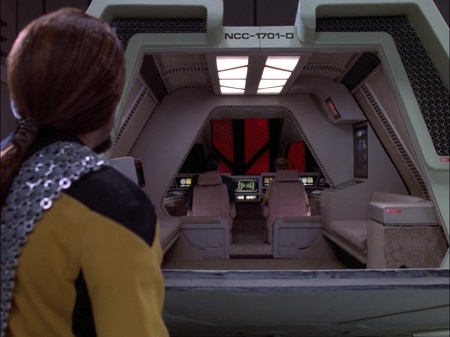
Worf in The Next Generation Season 7 episode Lower Decks.

Rumours swirl in the Star Trek fan community all the time – as indeed they do in every online community. But most of these “rumours” are clearly nonsense, based on unverified and often unspecified sources. The truth is that ViacomCBS and the creative team in charge of Star Trek generally do a good job at keeping a lid on leaks. Occasionally a story will leak ahead of an official announcement, but as we’ve seen with some big projects recently, including the new film scheduled for 2023, most of the time that is simply not the case. Yet many social media channels, fan groups, and websites insist on reporting rumour as if it were fact.

When I write speculatively here on the website, you’ll note that I always caveat what I’m saying by explaining that I have no “insider information” nor any “sources.” This is specifically to damp down any theory or speculation that I’m writing about and to clarify that it’s just guesswork on my part. Sometimes it’s educated guesswork, putting together things that seem obvious even if there’s yet to be official confirmation, but even then such a caveat is incredibly important.

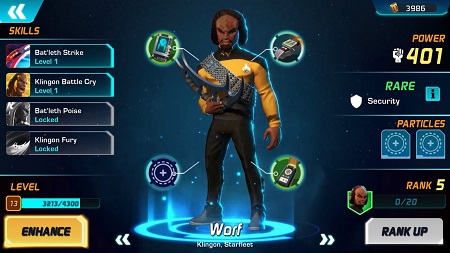
Worf is a character in mobile game Star Trek Legends.

It’s easy for a website or social media group to fall into the trap of writing clickbait based on things like Michael Dorn’s Twitter post, but it doesn’t do anything for the Star Trek fan community. In some cases it can be actively harmful – building up hype and expectations that are obviously only going to lead to disappointment. Marketing folks need to be aware of this, as well. As much as Dorn’s post got people talking about Star Trek Legends, they deliberately set up Trekkies for disappointment by allowing Dorn to imply – albeit in a way that should’ve been easy for fans to see through – that Worf was coming back to Star Trek.

But the blame in this case doesn’t lie only with the marketing team at Star Trek Legends, who are, after all, doing their best to market a product. It lies with fan groups, websites, and social media channels who took that obvious piece of marketing and put their own spin on it, building up the hype of Worf’s possible return to Star Trek in order to drive clicks, views, and website traffic.

Worf in a teaser video for Star Trek Legends posted on Twitter.

This is what I mean by the “spiral” of clickbait: a slightly dishonest marketing post on social media appears. Fan websites and social media channels jump on it and take it out of context, in some cases completely disregarding or ignoring the possibility of it being marketing. As the hype bubble starts to build, more outlets and fans jump on the story, talking about it and driving more and more clicks and traffic. What began as a single post advertising a mobile game thus exploded to become a big story online, and it didn’t need to be. From the marketers’ point of view, it’s a rousing success! But for fans, at best it’s a mild disappointment.

It’s becoming increasingly difficult to find reliable, objective sources of information online, and it’s getting to a point where, unless something is confirmed unambiguously by an official outlet, I don’t trust it.

We all need to be careful what we read and watch, and try our best not to give in to clickbait!

Star Trek Legends is out now for iOS devices via Apple Arcade. The Star Trek franchise – including all titles mentioned above – is the copyright of ViacomCBS. This article contains the thoughts and opinions of one person only and is not intended to cause any offence.