
Ten great things from Lower Decks Season 1

Spoiler Warning: There are spoilers ahead for Star Trek: Lower Decks Season 1 and the trailers and teasers for Season 2. Spoilers are also present for the following Star Trek productions: Discovery Season 3, Picard Season 1, The Next Generation, and The Animated Series.

Star Trek: Lower Decks Season 2 is now less than a week away, and as the buildup to its premiere continues I thought it could be fun to step back to last year’s episodes and pull out ten of my favourite moments – and other things!

There was a lot to enjoy in Season 1 last year. The show succeeded at taking the regular goings-on in Starfleet and making them funny, while at the same time it managed to avoid the pitfall of coming across as mean-spirited and laughing at Star Trek. A sense of humour is a very subjective thing, and it’s certainly true that Lower Decks’ comedic style won’t be to everyone’s taste. But for my money, by and large the jokes and humour worked – and underlying all of that was a truly solid and engaging Star Trek show.

Lower Decks is coming back soon! Yay!

When Lower Decks’ first season ended last October I wrote that I was going to miss my weekly viewing appointment, and though Discovery’s third season came along and offered up a different kind of fun, as we’ve got to see more teasers, trailers, and discussion about the upcoming season, I’ve come to realise again just how much I missed Lower Decks in the months it’s been off the air. Though the Star Trek franchise has always had a sense of humour – something I said many times in the run-up to Lower Decks’ first season in response to critics of the concept – this show was the first to put comedy front-and-centre. It also took us back to the 24th Century and The Next Generation era in a big way, which is something I adored.

The Next Generation had been my first contact with the Star Trek franchise in the early 1990s, and I have a fondness for the shows of that era as a result. Lower Decks leaned into that in a big way in its first season, and I hope to see more of the same when Season 2 arrives in just a few days’ time!

So let’s take a look at ten of my favourite things from Season 1. The list below is in no particular order.

Number 1: Ensign Mariner’s character arc.
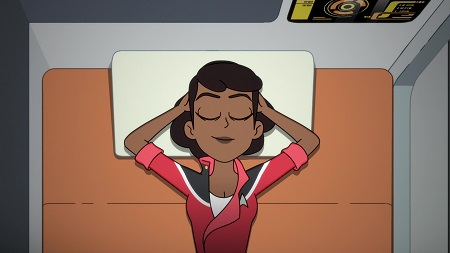
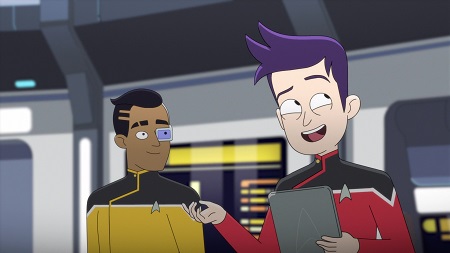
Ensign Beckett Mariner.

In the first episode of Lower Decks, and again at the beginning of the second, I didn’t like the way Mariner was presented. Coming across as arrogant and selfish, I felt that the writers were trying to set her up as Star Trek’s answer to Rick and Morty’s Rick Sanchez. Such a character could work in the Star Trek galaxy, don’t get me wrong, but not as an ensign – and probably not even as a senior officer. Mariner’s “I don’t care about anything” attitude was epitomised in a scene at the beginning of the episode Envoys, where she kidnapped a sentient alien lifeform and forced it to grant her “wishes” – seemingly just for the hell of it. To me, that seemed about as un-Starfleet as it was possible to get.

Beginning in the second half of Envoys, though, we started to see a turnaround in Mariner. Perhaps her friendship with the hapless Boimler was part of it, but over the course of the season we began to see less of the “teen angst” side of Mariner’s rebelliousness. She still had a streak of rebellion in her character, but some of the edginess was blunted – something which was a colossal improvement.
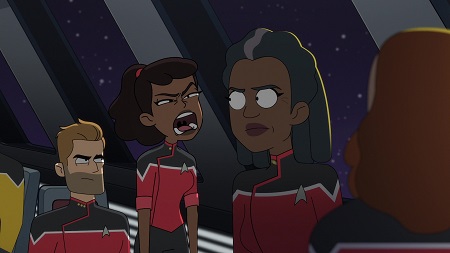
In the first few episodes, Mariner could feel more like a wayward teenager than a Starfleet officer.

In the episode Much Ado About Boimler, the USS Cerritos is visited by an Academy colleague of Mariner’s – who has already reached the rank of captain. Captain Ramsey’s intervention went a long way toward causing Mariner to have a re-think, as she saw how her friend had matured and moved on from their past childish behaviour.

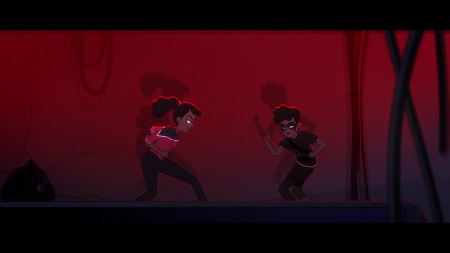
The episode Crisis Point was where Mariner made her real breakthrough, though. After setting herself up as an extreme anti-Starfleet villain on the holodeck, Mariner saw her friends abandon her, and in a fight against a holographic version of herself, all of that teenage rebellion stuff came to a head. Mariner came to realise that she does care about Starfleet and her mother – Captain Freeman – even if she doesn’t always express that care in ways that line up with Starfleet regulations.

Captain Freeman is Mariner’s mother.

In a way, there are echoes of Michael Burnham (Discovery’s protagonist) in Mariner. Both characters started off with portrayals that I found to be negative and even difficult to watch, yet both characters have grown over the course of subsequent episodes. By the time we got to No Small Parts, the Season 1 finale, Mariner was able to take charge of a difficult situation, using her talents to help her friends and shipmates.

That season-long arc made Mariner’s actions in the finale feel genuine and earned, just like Michael Burnham’s recent promotion felt earned after all of her hard work. By the time we reached the point where the ship was in peril, turning to Mariner to play a big role in saving the day felt great. As a result, a character who I felt could’ve been one of the weaker elements of Lower Decks turned out to be one of its strongest. All I can say now is that I hope the version of Mariner we meet in Season 2 is closer to the one from Crisis Point and No Small Parts than Second Contact!

Number 2: The return to an episodic format.
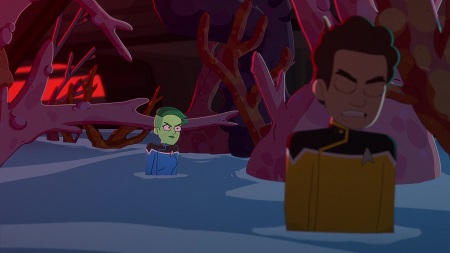
Tendi in the episode Moist Vessel.

Lower Decks was the first Star Trek show really since the first couple of seasons of Enterprise to use a wholly episodic format. Serialised storytelling has become the norm in television in recent years, thanks to shows like Lost, Breaking Bad, and Game of Thrones, but the Star Trek franchise had primarily been episodic – at least prior to Deep Space Nine’s Dominion War arc.

This didn’t mean that the show reset itself after every episode, nor that past events were ignored. As mentioned above, Ensign Mariner had a satisfying season-long character arc that saw her grow, something which wouldn’t have been possible if the series kept rebooting after every outing. But Lower Decks saw the ensigns take on different challenges and stories each week, and while there were callbacks and references to things that happened in earlier episodes, the show revelled in its ability to do different things.
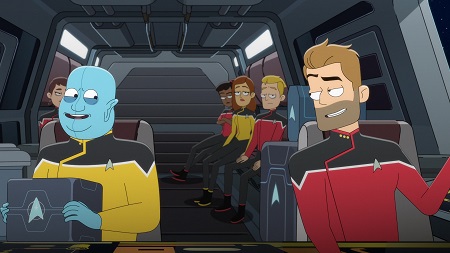
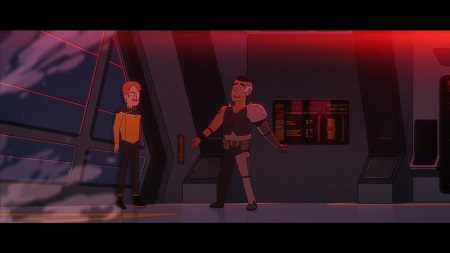
Commander Ransom leading an away mission in Temporal Edict.

I like episodic television. In a show like Lower Decks it makes a lot of sense to go down this route, as it allowed for many different scenarios and settings – and maximum fun! That isn’t to say serialised storytelling is bad, and I like the way Picard Season 1 and Discovery handled their season-long stories. But after seeing so many different serialised shows over the last few years – both within the Star Trek franchise and outside of it – it was a nice change of pace!

Season 2 will almost certainly retain this style of storytelling. There’s nothing to be gained by giving Lower Decks a season-long story of the kind seen in Discovery and Picard, and doing so would be an unnecessary constraint.

Number 3: The theme music.
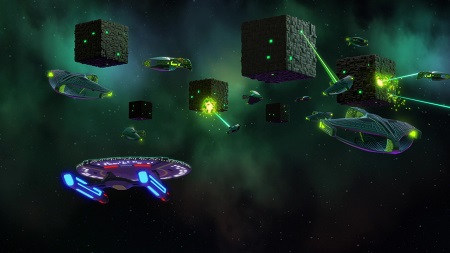
The USS Cerritos in the title sequence.

Both Discovery and Picard have softer, slower theme music. I like both, and the understated musical pieces are a huge improvement over Enterprise’s early-2000s pop song! But Lower Decks’ theme is in a whole different league!

I wrote in one of my reviews last year that the Lower Decks theme could have been The Next Generation’s theme. The up-tempo, adventurous piece of music would have fit right in with that show and its theme of exploration, and I just adore it. The opening title sequence is also neat, showing the Cerritos getting into all sorts of trouble, and really went a long way to setting the stage for the show itself.

Number 4: “He’s got wood!”

A contender for best line of the season?

This line was one of the funniest of the whole season. Low-brow comedy for sure, but the execution of this moment in Temporal Edict was absolutely perfect. There were some great jokes, puns, and one-liners across the season, and I’m not saying this one was somehow the best, but the scene on the Galrakian home planet was built up wonderfully.

As Mariner, Ransom, and the rest of the away team leave behind the chaotic ship, there was a sense that the new time management rules that Captain Freeman was trying to implement were not going to plan. The Galrakians (a new alien race) were a crystal-obsessed people, and as part of the Cerritos’ mission of second contact, the away team had to present an honour crystal to the Galrakian delegation. But because of the problems on the ship, the away team accidentally brought a wooden totem instead of the crystal, leading one of the Galrakians to exclaim “he’s got wood!” I had to pause the episode because I was laughing so much.

Number 5: The return of the Edosians.
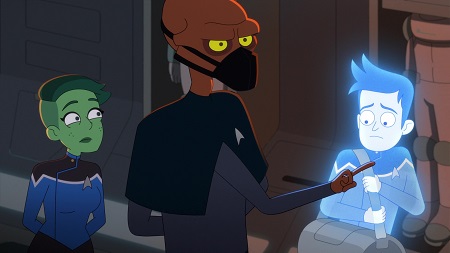
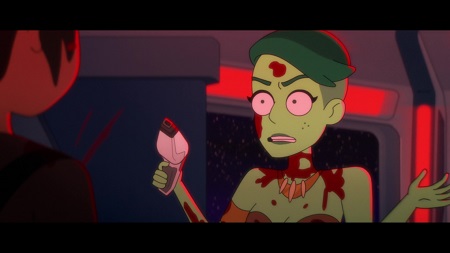
The Division 14 commander with Tendi and Boimler.

Lower Decks represented the best opportunity so far to bring back elements from The Animated Series, not only because of its animation style but because its wackier sense of humour would be a good fit for some of the weirder elements from Star Trek’s first cartoon show. In the episode Much Ado About Boimler we got the return of the Edosians – the three-legged, three-armed aliens first encountered in The Animated Series.

Lieutenant Arex (voiced by Scotty actor James Doohan) had been a mainstay on the bridge of the Enterprise in The Animated Series, but Star Trek’s return to live-action in 1979 meant that the character was dropped. Bringing to life a very different-looking alien was just prohibitively expensive at the time, and I don’t know if Gene Roddenberry and the others even considered including Arex in Phase II or The Motion Picture.

Arex (left) with Kirk and Sulu in The Animated Series.

Picard Season 1 had referenced the Kzinti, another alien race only ever seen in The Animated Series, and following some debate in the 1990s about whether the show should be considered part of Star Trek’s “official” canon or not, it was great to see the creators of Lower Decks and modern Star Trek embrace this more obscure part of the franchise.

The Edosian character we met was fun, too. Division 14 was presented as a mysterious off-the-books type of operation, and the episode – which saw the first team-up between Boimler and Tendi as well – leaned into a darker, almost horror vibe at points. It was great to welcome back the Edosians to Star Trek after such a long absence.

Number 6: Basically everything about Dr T’Ana!
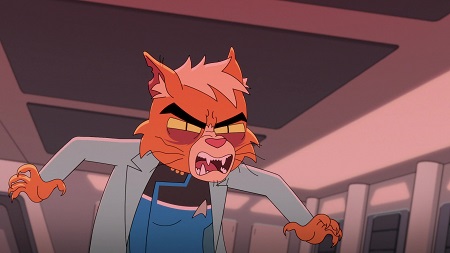
Dr T’Ana was a lot of fun across Season 1.

Dr T’Ana has a terrible bedside manner. She’s gruff and sarcastic, but she’s incredibly funny and a great character! Practically every moment she was on screen in Season 1 was fun, and she elevated what would otherwise have been less-interesting moments many times. Speaking as we were of returning races, Dr T’Ana is a Caitian, an alien race only seen a few times in The Animated Series and some of The Original Series films.

Dr T’Ana reminds me of both Dr McCoy and Dr Pulaski. The latter is a character who I feel went under-appreciated in The Next Generation’s second season, and although Dr T’Ana turns up to eleven some of the rudeness present in both her and Dr McCoy, something about the way she came across on screen felt familiar – and I appreciated that.

Dr T’Ana and the ensigns have a standoff!

The ship’s doctor has been part of Star Trek since the beginning, but is a role that can be fairly static in sickbay. Dr T’Ana managed to find different things to do at points across the season, and appeared to be on the verge of developing a relationship with Shaxs – before his untimely demise.

I’m looking forward to seeing more from the Cerritos’ doctor in Season 2. I wonder what she’ll get up to as the ship continues its adventures?

Number 7: The cinematic shots of the USS Cerritos in Crisis Point.
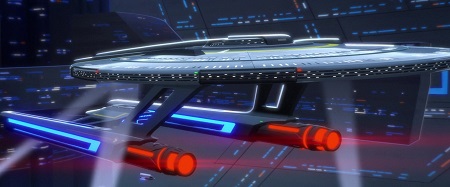
The USS Cerritos in all her glory.

This sequence channelled one of my favourite moments in all of Star Trek – the reveal of the refitted Enterprise in drydock in The Motion Picture. That sequence still brings a tear to my eye even though I’ve seen it countless times, and this moment in Crisis Point was a wonderful homage to it.

Accompanied by a stirring musical number that was a mix of the Lower Decks theme with music from The Wrath of Khan and other films, the whole sequence was absolutely pitch-perfect, and without a doubt one of the highlights of the episode and the whole season.

The holo-crew and Boimler looking at the ship in awe.

Sometimes we can overlook the starships that our heroes serve aboard, but as has been pointed out on many occasions, the ship itself can be almost an extra character on the show. Moments like this go a long way to highlighting just how beautiful some Star Trek vessels can be. Is the Cerritos the best-looking ship in the fleet? Maybe not, but for a couple of minutes during this sequence you might just think she is!

Seeing the reactions of Boimler and the holographic bridge crew also added to the moment. These are people who really love their ship – and who can blame them?

Number 8: Badgey
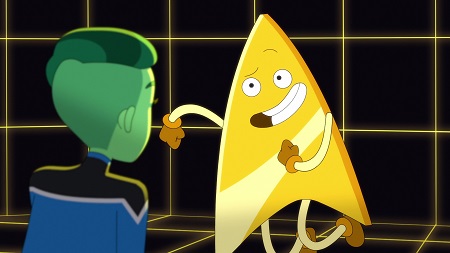
Tendi with Badgey in Terminal Provocations.

Badgey would go on to be a villain not once but twice, and is a classic example of Starfleet’s own technology going wrong on the holodeck! Inspired by Clippy, the Microsoft Office “assistant” from the early 2000s, there’s something distinctly creepy about Badgey. The way he seems to be peppy and enthusiastic hides a murderous rage, and the concept of our own machines betraying us is a trope as old as science-fiction.

Originally created by Ensign Rutherford, like several of his inventions Badgey quickly went awry! Rutherford is a fun character on the show, but his love of tinkering and inventing caused trouble for the ensigns on more than one occasion!
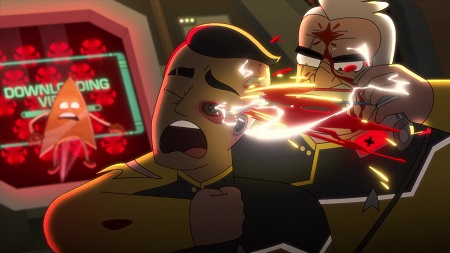
Badgey almost got Ensign Rutherford killed in the season finale!

Badgey returned in the season finale and again tried to kill Rutherford. Shaxs’ intervention saved his life, but at the cost of his memories – and Shaxs himself. We’re yet to see how Rutherford will react to his lost memories in Season 2, but we already know, thanks to the teasers, than his implant is back.

Everything about Badgey from concept to execution worked perfectly, and he was one of the most interesting adversaries the crew had to face in Season 1. Have we truly seen the last of him, though? The return of the Pakleds (as glimpsed in one of the trailers) may suggest otherwise!

Number 9: A return to the aesthetic of The Next Generation era.

A hallway aboard the Cerritos – note the inspiration from older Star Trek productions.

I don’t dislike the way modern Star Trek looks. The Kelvin films used a lot of glossy white plastic and glass, and Discovery has somewhat of an industrial look to some areas of the ship, but on the whole recent productions have looked great. But for the first time since Voyager went off the air and Nemesis was in cinemas, Lower Decks brought back the aesthetic of ’80s and ’90s Star Trek in a big way.

As I mentioned at the beginning, this was “my” era of Star Trek; the point at which I became a fan. Just as I’m attached to The Next Generation in terms of its characters and stories, I adore the way the show looks, and how that look continued into Deep Space Nine, Voyager, and the films of that era. Lower Decks unapologetically brought that look back – and I love it.

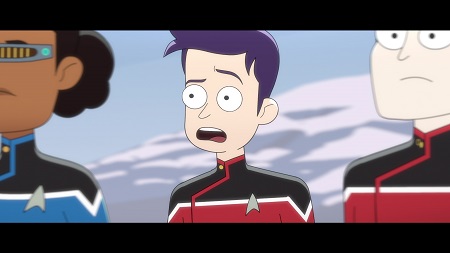
Boimler wielding a Next Generation-era phaser.

At the same time, Lower Decks has adapted this look to fit the kinds of stories it wants to tell. The USS Cerritos has visual elements inspired by The Next Generation, but the ship also manages to look smaller and less significant, especially when set alongside other Starfleet vessels. The uniforms are likewise a riff on The Next Generation and other uniforms of past Star Trek shows, with a jacket seemingly inspired by the “monster maroon” uniforms that debuted in The Wrath of Khan.

Everything about the way Lower Decks looks just oozes “Star Trek,” and for fans like myself who adore those shows, that can only be a positive thing.

Number 10: The arrival of the USS Titan in No Small Parts.
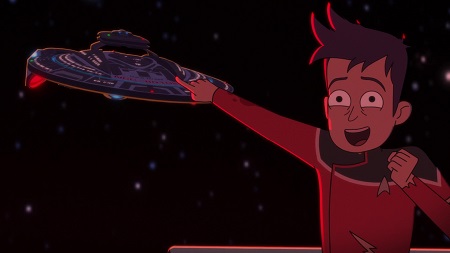
“It’s the Titan!”

Toward the end of the season finale, it seemed as though the Pakleds had the Cerritos on the ropes. The last-minute arrival of the USS Titan was absolutely pitch-perfect, and drew inspiration from the likes of the Enterprise-E’s arrival at the Battle of Sector 001 in First Contact, with the theme music from The Next Generation accompanying it.

This is one of my favourite moments not just in Lower Decks but in all of Star Trek. The arrival of Riker and Troi aboard a ship we’d heard of but never seen was absolutely amazing, and the fact that they swooped in to save the day was heroic and exciting. The whole sequence is surprisingly emotional – at least it was for me!

Riker and Troi on the Titan’s bridge.

We’d seen Riker and Troi return in Picard Season 1 earlier in the year, but seeing them in their prime aboard their own ship was a moment that I didn’t expect from Lower Decks. It was something I didn’t know I wanted to see, but having seen it I can’t imagine the episode – or the first season – being the same without this wonderful inclusion.

After the Titan saved the day we got a sequence with Riker and Troi hanging out with the Cerritos’ crew. Boimler then received his promotion and transferred to the ship to serve under Riker’s command – and that’s where we left him when the season ended. Riker and the Titan will be back in Season 2, and I’m curious to see how the show will fit them in for a second time. Not to mention how the Boimler situation will be resolved!

So that’s it. Ten of my favourite things from Season 1 of Lower Decks.
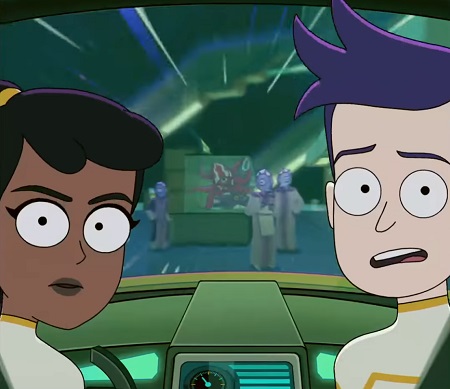
Mariner, Boimler, and the rest of the crew will be back in just a few days!

Season 2 is almost upon us, and I honestly can’t wait! I had such a great time with the show last year, and despite the fact that the clusterfuck surrounding its lack of an international broadcast definitely did some damage, it’s my hope that Star Trek fans the world over will be able to enjoy Season 2 this time around. Hopefully Lower Decks will also succeed at bringing in many new fans to the Star Trek franchise as well.

Stay tuned because I plan to write reviews of every episode of Lower Decks this season, hopefully within a day or so of their broadcast. I’m sure I’ll have a lot to say! I hope this list has been a bit of fun, and that you’re as hyped up and excited for the return of Lower Decks as I am.

Star Trek: Lower Decks Season 2 will be broadcast on Paramount+ in the United States and on Amazon Prime Video internationally beginning on the 12th of August. Season 1 is available to stream now. The Star Trek franchise – including Lower Decks and all other properties mentioned above – is the copyright of ViacomCBS. This article contains the thoughts and opinions of one person only and is not intended to cause any offence.

Star Trek: Lower Decks review – Season 1, Episode 9: Crisis Point

Spoiler Warning: There are spoilers ahead for the first nine episodes of Star Trek: Lower Decks. There may be further spoilers for other iterations of the Star Trek franchise.

I didn’t enjoy last week’s episode of Lower Decks on the whole. It tried to push the boat out and try some different things – which I admire – but that didn’t work for me. I’m pleased to say that this week’s episode. Crisis Point, was a return to form and an enjoyable story. Not only that, but Ensign Mariner, who had been a weak link in the series, especially in the first couple of episodes, appears to have made a breakthrough in her relationship with Starfleet. Lower Decks has been an episodic series so far, so whether that will stick around for the next episode and for Season 2 is unclear, but I really hope so!

There was a troubling point in Crisis Point which we’ll look at when we get to it, but overall I had a good time with a fun story that had several callbacks to the Star Trek film series. After a disappointment last week I was very pleased to see a return to form, especially now that there’s only one episode left in the season. Time really flies, doesn’t it? It seems like only yesterday we were talking about the premiere!

The title card for Crisis Point.

As I’ve done throughout Season 1, I’m going to continue to call attention to Lower Decks’ lack of an international broadcast. With the season ending in a matter of days, it’s such an immense disappointment to me that the show’s potential to bring in a whole new audience of prospective Trekkies has been wasted. All the hard work Mike McMahan and everyone behind the scenes put into the series has been squandered in an appalling business decision that hasn’t only stopped new fans discovering this amazing franchise, but has upset millions of Star Trek’s most loyal existing fans too. There were better options than denying Lower Decks to Star Trek’s international audience, and with the pandemic continuing to disrupt production as it drags on, holding the show back six months for an early 2021 release worldwide would have made a lot of sense. As things sit right now, we’ll have Discovery Season 3 in a couple of weeks, but potentially nothing after that for many months.

Of course, you guys know I’d never sink so low as to pirate Lower Decks – even though doing so is totally morally justifiable. Instead I’ve moved to my second home here in the good old U. S. of A. The wonderful city of San Francisco overlooks the Mississippi delta, and is famous for its clam chowder. Yummy stuff.

This is where I live now. In San Francisco.

So let’s crack on with Crisis Point, shall we? The episode didn’t begin particularly strongly. We started at what appeared to be the end of a potentially-interesting mission for Mariner, in which she has interfered in a planet’s development by overthrowing a leader. Captain Freeman steps in to restore order, and while this was clearly set up to portray Mariner in a positive light – helping out aliens who were being oppressed and eaten – I couldn’t help but feel it was a character regression for her. Past episodes had seen Mariner come to work at least slightly better as a team player, and going off all on her own to do something she considered right, but without the approval or authorisation of her captain and without any support from her crewmates felt like a backward step.

Luckily this was just the teaser, and we got the first of many great jokes at the end as the captain finds that the entire situation can be easily resolved by simply offering the planet Federation replicators. Again, though, this just rubbed in that Mariner was acting out of line – had she followed the chain of command the same resolution could have been arrived at without her getting in trouble.

Mariner reprimanded by Captain Freeman.

I’d like to take a moment to once again praise the title music Lower Decks uses, because it’s fantastic. It will be heard multiple times in the episode, including in an amazing and somewhat emotional sequence that we’ll come to in a moment. Lower Decks has one of my favourite Star Trek themes; certainly the best we’ve had since the 1990s.

After the opening titles we see Mariner in her mandatory therapy session. After misbehaving on the away mission, Mariner had been expected to be sent to the brig, but instead Captain Freeman insisted she attend therapy. It clearly isn’t her first time, as she’s familiar with the therapist. This is where the character regression that I was disappointed to see from the teaser appeared to continue. Like a petulant child, Mariner bangs her fist on a plant when she didn’t get her way.

Mariner’s therapy session.

On the holodeck – presumably after the therapy session has ended – Mariner is sulking while Rutherford and Tendi play through a holodeck programme. Leonardo da Vinci previously appeared (in hologram form) in Star Trek: Voyager, where he was played by John Rhys-Davies, better-known for his role as Gimli in the Lord of the Rings films. It was a nice little callback!

Boimler interrupts and asks if he can use the holodeck to prepare for an interview he has with the captain. Like Barclay in The Next Generation, Boilmler has created a holodeck programme that simulates the entire crew! In this case it’s less of a fantasy and purely practical, as he can practice what he wants to say and how to behave without doing something wrong in front of the real crew. Still pretty creepy, though, especially because he used the crew’s personal logs to simulate them.

Boimler explains his holodeck programme.

Mariner takes over, and starts messing with the programme’s code in order to set up a fantasy of her own, and moments later the holodeck is transformed into a Lower Decks movie, complete with credits scrolling by. I loved every little touch here – the screen narrows from its usual 16:9 widescreen presentation into something more akin to a film, the credits (on the holodeck) use the Lower Decks/The Next Generation font (which Rutherford comments on in a cute scene) and the music was a riff on the Lower Decks theme that made it sound much closer to the score from The Original Series-era films.

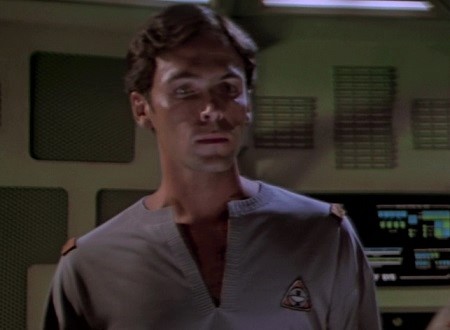
We also got one of the most obscure Star Trek references in Lower Decks so far – Mariner tells Boimler he was “kind of a Xon.” Prior to The Motion Picture being, well, a motion picture, it was a television series called Star Trek: Phase II. Phase II would have brought back the original cast – but without Leonard Nimoy. A Vulcan character called Xon was to be his replacement, and had even been cast and screen-tested. When the pilot episode of Phase II was later expanded into a feature film, Xon was initially retained, but when Leonard Nimoy agreed to reprise his role, Xon was cut from the project. A couple of small remnants of the role remained in the film – not only in the role of deceased science officer Sonak, but also in the role of the Epsilon IX station commander, who was played by David Gautreaux, the actor originally cast as Xon. If you want to read up a little more on Star Trek: The Motion Picture, I wrote a piece last December for its fortieth anniversary which you can find by clicking or tapping here.

David Gautreaux in Star Trek: The Motion Picture. He was originally cast as Xon.

So if you weren’t sure what that line was all about, now you know! Mariner tells the ensigns she’s written roles for each of them in her holodeck movie, and while Boimler insists his programme is a work tool and not something to have fun with, Mariner, Tendi, and Rutherford depart to get into costume.

The movie begins with Boimler interrupting the captain’s vacation, as she and the senior staff are using jet-skis. Boimler is still trying to use the programme to accomplish his original goal of learning how to act around the captain, which was kind of funny. He’s aware that what’s happening is just on the holodeck, so we see Boimler acting a little differently – and perhaps more assertively – that he usually does, especially when the captain is around. In that sense, perhaps we’re seeing that the holodeck can, in a weird way, be helpful for someone like Boimler. Despite the ethical concerns of simulating a person without their consent, for someone with anxiety issues I can see how it would be helpful to do so.

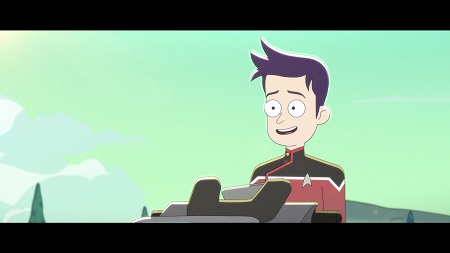
Boimler in the holodeck movie.

The next part has to be my favourite in the episode. I was genuinely getting emotional! After a meeting with an admiral aboard a Spacedock-type Starbase in which the Cerritos is given an assignment, we got a prolonged sequence of Boimler and the simulated senior staff transferring to the ship via shuttlecraft. The music in this sequence was perfect, another riff on the Lower Decks theme, but this time one that mimicked the sequence in The Motion Picture where Scotty and Kirk board the Enterprise. The shuttle made several passes by the Cerritos, and while I’ve always felt the design of the ship was fine, here Crisis Point slowed things down so we could really appreciate its design. It was a beautiful sequence that paid homage not only to The Motion Picture, but also to several other occasions in The Original Series-era films where the ship was the star of the show. I loved it.

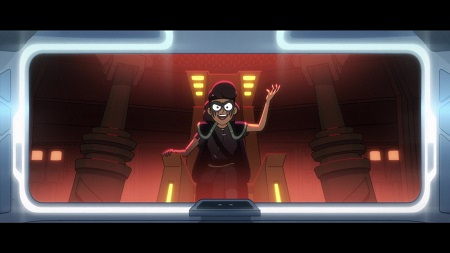
After the Cerritos warps to its destination, Mariner appears aboard a cloaked Klingon ship. She’s cast herself as a villain called Vindicta, and she has Rutherford, Tendi, and a simulated Boimler has her “henchmen.” While she distracts the captain with a rambling speech, she and the others sneak aboard the Cerritos and begin to attack – and murder – the crew. I liked Mariner’s over-the-top acting performance in her role as Vindicta (credit to Tawny Newsome, who plays Mariner!) and I liked that she cast herself as the villain rather than the hero. I think Mariner’s therapist might have a thing or two to say about that!

Mariner as “Vindicta.”

Realising that Boimler has perfectly simulated the entire crew of the Cerritos, Rutherford rushes away to confront his commanding officer: chief engineer Billups. This is the second episode in a row to expand Billups’ role, and as the role of chief engineer has typically been important in past iterations of Star Trek, that was a touch I appreciated.

Tendi seems increasingly uncomfortable with the violence, but continues to play along with Mariner for a time. However, here’s where the episode’s only significant issue comes into play: Mariner displays racial prejudice towards Tendi. There’s a famous story that Gene Roddenberry hated Star Trek VI: The Undiscovered Country when it was screened for him shortly before he passed away. In particular he detested anti-Klingon racism, particularly from Kirk but also from other Starfleet officers. Roddenberry believed such attitudes had no place in his vision of the 23rd Century. When I reviewed episode 3, Temporal Edict, I mentioned this as well. In that episode, Captain Freeman and an unnamed admiral display similar anti-Cardassian sentiments. This time, Mariner keeps bringing up the fact that Tendi is Orion, and that “Orions are pirates.” This is unquestionably racial stereotyping. Even though Orions are a fictional sci-fi species, I found this uncomfortable. I can’t help but wonder what the reaction would be from the audience if Tendi – or any other character – made similar remarks about Mariner’s African heritage. While I enjoyed the episode overall, and in the context of a story about Mariner going off the rails it makes a kind of sense, this is as close as Lower Decks has come to being completely the opposite of what Star Trek has always tried to be.

Tendi tries to talk some sense into Mariner.

One positive to come out of this is that Tendi stands up for herself, telling Mariner to stop the stereotyping and race prejudice and storming off the holodeck in disgust. At times, Tendi has been a difficult character to follow. The writers of the series haven’t really found a niche for her, and for much of the season she’s just been floating in the background. Here, though, Tendi has a strong moment where she stands up for her heritage and her people, and shows that she won’t take Mariner’s nonsense. Good for her.

With Tendi gone, Mariner is all on her own. Rutherford has gone to the simulated main engineering to tell Billups what he really thinks of him… which, in true Rutherford style, is that he thinks he’s amazing. The things he wanted to say, far from being rude or anything of that nature, are kind-hearted compliments. As the simulated ship is under attack, Rutherford and the hologram of Billups work together, complimenting each other as they go.

Rutherford tells Billups what he really thinks of him!

After making her way to the bridge, Mariner confronts Captain Freeman. After another argument, she reveals she’s rigged her Klingon ship to self-destruct; the resultant explosion causes the Cerritos to lose orbit and plummet to the planet below. The crash sequence was very well done, as the ship loses a nacelle, then its lower hull, before the saucer comes to rest at a steep angle by a mountain or rock formation. We’ve seen ships crash-land in Star Trek before, but never quite so violently or catastrophically! Even the Enterprise-D’s saucer in Star Trek: Generations was in better shape!

A short scene with Rutherford and Billups reveals Rutherford saved the Cerritos’ crew by beaming them off the ship. In a funny line he says that “you can do all sorts of beaming stuff in a movie!” Her business with Captain Freeman unfinished, Mariner continues her attack after the crash. The captain orders her surviving crew to evacuate, and Mariner tells her to “drop the act” of being a captain who cares.

The Cerritos’ saucer on the surface of the planet.

Their fight continues (in what was probably a slightly over-long sequence but I’ll forgive it!) and when Mariner seems to finally have the upper hand and is ready to kill the captain, she’s interrupted by the holo-version of herself! The obvious parallel in the ensuing Mariner-versus-Mariner fight is when Kirk fought a changeling with his appearance in The Undiscovered Country, but as this was the emotional climax of Mariner’s story, I didn’t really think about that on first viewing.

Mariner (the real Mariner, that is) is upset and annoyed at being unable to finish her movie the way she wanted, but as the fight progresses it’s clear that she comes to realise something about herself – she does care about Starfleet, and she does care about her mother. The ship, crew, and captain all matter to her more than she realised, and she comes to regret going to such a silly extreme. This is the emotional breakthrough Mariner has needed to have all season long, and I hope it signals a turnaround in her character that will become permanent.

Mariner vs. Mariner.

There’s no question that Mariner can be a fun character. She can be sweet and funny and entertaining in equal measure, but where Lower Decks has stumbled more than once is where Mariner has been the antithesis of a Starfleet officer. A bad or lazy Starfleet officer can be funny. A laid-back Starfleet officer can be funny. But someone who behaves the way Mariner has numerous times across the season misses the point, and speaking for myself, I haven’t found that side of the show’s humour very effective.

The childishness and the teenage rebellion streak that run through Mariner needed to come to a head in some kind of scenario like the one depicted in Crisis Point so that they can be excised from her character permanently. We can still see Mariner the rebel, Mariner breaking rules, Mariner being laid-back, and so on. But the anti-authority, anti-parent nature of some of her rebelliousness hasn’t been enjoyable to watch – and I’d argue won’t be for anyone over the age of about 14.

Mariner learns a valuable lesson thanks to her holographic self.

Holo-Mariner and real Mariner are well-matched in their fight, and as it draws to a close, holo-Mariner plays a blinder: the fight has just been a distraction while she set the Cerritos to self-destruct. Obviously with the holodeck safety protocols on, real Mariner was unharmed! Though she didn’t get the outcome she wanted from the movie, she learned a valuable lesson and got the outcome she needed.

Boimler, who remained with the crew, is still on the holodeck, and listens to Captain Freeman eulogise Mariner – and finally learns the truth of their connection. I can think of many reasons why Starfleet officers may choose to conceal family ties; Tom Paris in Voyager made it clear that being the son of a high-ranking officer came with a lot of pressure. Some may argue that it would be difficult or impossible to cover up something like that, but I don’t see why that has to be the case. It fits fine with established canon, and there’s nothing wrong with the way it was handled here.

Boimler learns that Mariner is the captain’s daughter.

Stunned by the revelation, Boimler messes up his interview with the captain – the one that set the scene for the whole holodeck movie. Mariner, to her credit, apologises to Tendi for her anti-Orion comments, and Rutherford has the same appreciation for his commanding officer as before, but is satisfied he got the opportunity to express it.

So that was Crisis Point. After how I felt about Mariner, especially in the first couple of episodes of the season, seeing her come to realise that she does actually care about Starfleet and her mother was almost a cathartic experience. As the audience we’ve seen glimpses of this side of her, of the “heart of gold” beneath the laid-back, uncaring exterior. And those moments have been fantastic. But there’s also an anti-authority, teen angst, almost nastiness to her that can – at times – make for unpleasant viewing. It really feels as though Mariner learned a lesson and turned a corner this week, and I hope at least some of that sticks with her into the finale and Season 2.

Mariner apologises – has she turned the page?

Boimler, despite setting up the main storyline, was mostly absent this week. However, learning the truth about Freeman and Mariner’s family connection has surely set up a bigger plot for him next week. Tendi finally stood up for herself, which was great. She’s been a character who, because she lacks a well-developed personality of her own, can sometimes feel that she goes along with whatever anyone else is doing. It was nice to see her take a stand, especially against such stereotyping and prejudice. Rutherford is just adorable, and his story this week was too cute.

I had a wonderful time this week, despite Mariner going off the rails for practically the entire episode. There were some great callbacks to past Star Trek films, and I loved the sequence with Boimler and the senior staff taking a shuttle to the Cerritos. That was the high point of the episode for me. I’ve always loved that sequence in The Motion Picture, and seeing it paid homage to here was beautiful.

Only one episode left now! Where does the time go? Swing by next week for my review of the Season 1 finale, and perhaps at some point in the next few weeks I’ll do a recap/review of the season as a whole.

The first nine episodes of Star Trek: Lower Decks are available to stream now on CBS All Access in the United States. The Star Trek franchise – including Lower Decks – is the copyright of ViacomCBS. This article contains the thoughts and opinions of one person only and is not intended to cause any offence.