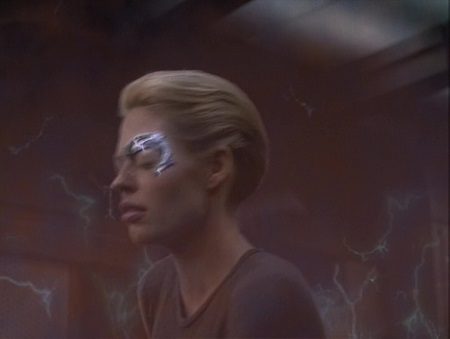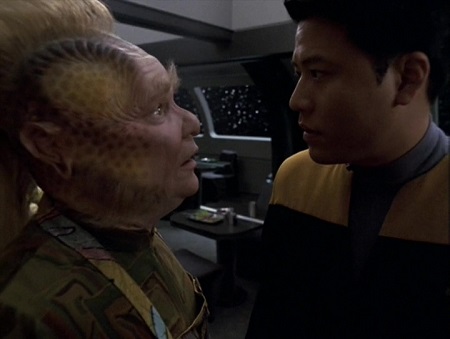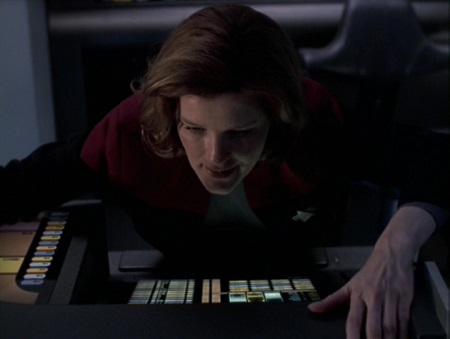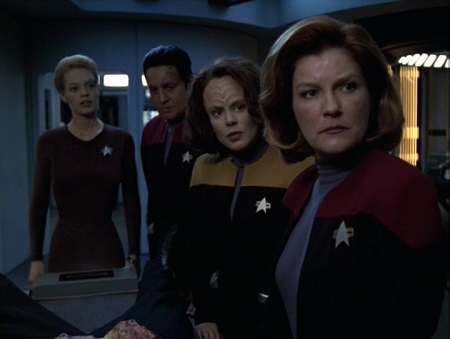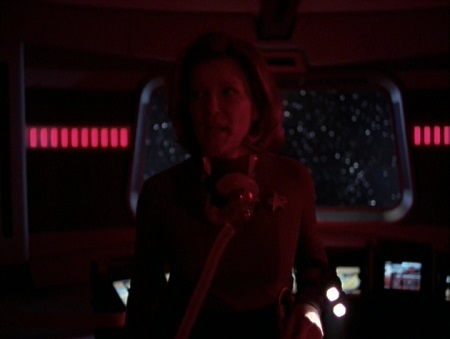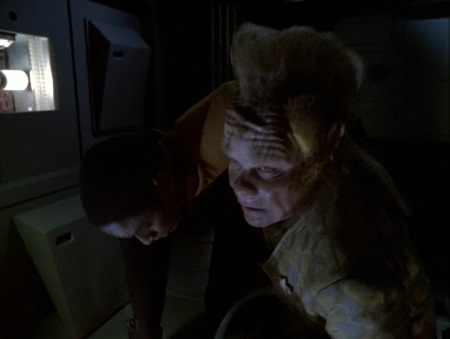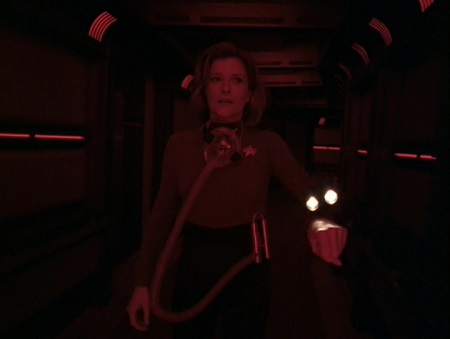
Thirty Episodes to Celebrate Thirty Years of Star Trek: Voyager

A spoiler warning graphic featuring Janeway.

Spoiler Warning: There are spoilers ahead for the Star Trek: Voyager episodes on this list.

The celebration of Star Trek: Voyager’s thirtieth anniversary continues! Today, I’m marking the occasion by picking out a whopping thirty of my favourite Voyager episodes to mark thirty years since the series premiered in the United States. This is gonna be a long one, so you might wanna grab a drink and a snack before we jump in!

Voyager premiered on the 16th of January 1995, meaning it’s been a full thirty years since the series officially joined the Star Trek franchise. I wrote a longer piece detailing my thoughts and memories on Voyager as a whole, so if you missed that you can find it by clicking or tapping here.
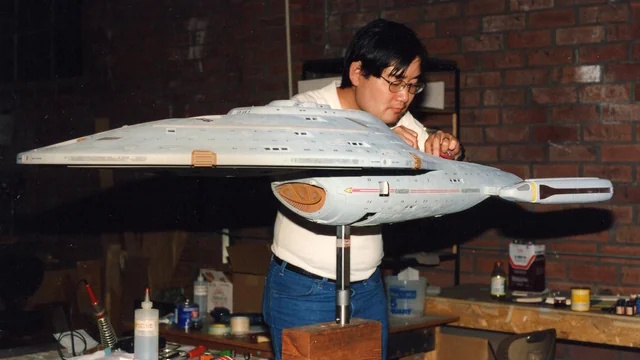
Behind-the-scenes photo showing Michael Okuda working on a model of the USS Voyager.
Mike Okuda working on the USS Voyager filming model.
Photo Credit: Forgotten Treks/TrekDocs

Before we get into the list, a couple of caveats. There’s no right or wrong answer to the question “what’s the best Voyager episode,” so please keep in mind that all of this is subjective, not objective. If I pick out episodes you hate, or exclude something you think should’ve been on the list… that’s okay! We all have different opinions about the Star Trek franchise, and there’s enough room in the fan community for polite discussion and differences of opinion.

I’m listing the episodes in broadcast order – so these aren’t being ranked! There are a few two-part episodes that I’m counting as just one entry on the list. I’ll try to explain what I enjoyed, found amusing, or just what I thought about each episode as we go along.

With all of that out of the way, let’s talk about some of my favourite Voyager episodes!

Season 1, Episodes 1-2:
Caretaker
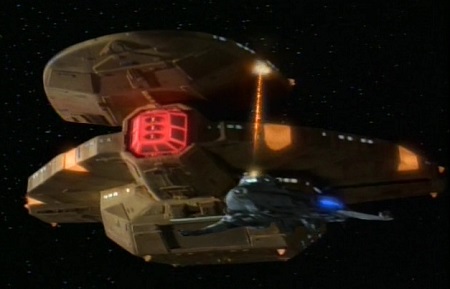
Still frame from Star Trek: Voyager showing a Cardassian ship firing on a much smaller Maquis vessel.

Where else to start but at the beginning? Caretaker set the stage for Voyager, kick-starting the voyage home that would run for all seven seasons. It’s a great episode, introducing us to Chakotay and his Maquis band, as well as to Captain Janeway and the crew of the USS Voyager. The sequence where Tom Paris is brought aboard Voyager by shuttlecraft was also a wonderful introduction to the starship.

Janeway has to confront a big ethical question in Caretaker, and ultimately makes the sacrifice of stranding her ship and crew on the far side of the galaxy. By destroying the Caretaker’s array, Janeway saved the Ocampans – at least in the short-term – but paid a heavy price. It’s a fascinating twist on a premise we’d seen before, taking the idea at the core of episodes like Where No One Has Gone Before and running with it.

Season 1, Episode 3:
Parallax
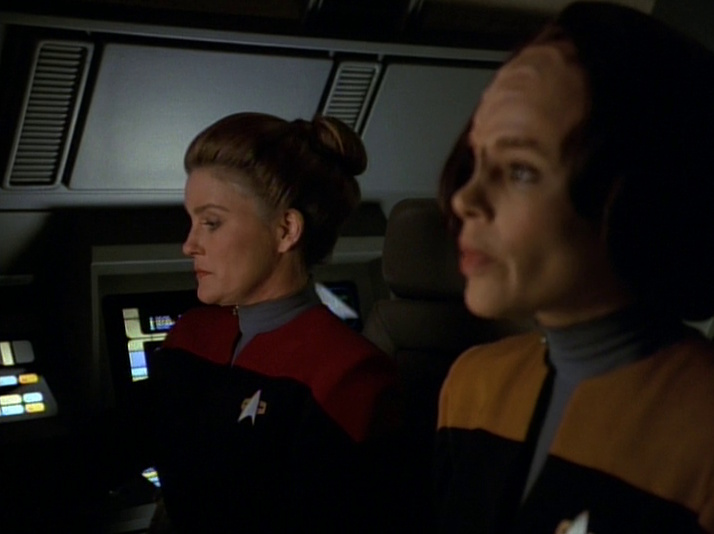
Still frame from Star Trek: Voyager showing Janeway and Torres on a shuttlecraft.

Parallax is one of a handful of Season 1 episodes to lean into the idea of a split between the Maquis and Starfleet members of Voyager’s crew – and that’s really why I’m placing it on the list. Its main “quantum singularity” plot is interesting, too, but it’s nothing we haven’t seen before in Star Trek. Where Parallax really shines is in those character moments – particularly as the two crews begin the process of coming together.

This episode also establishes B’Elanna as Voyager’s chief engineer, as well as Kes’ hydroponics bay and Neelix’s role as the ship’s cook. All of these would be important in future stories. Parallax is a great episode for Torres in particular, setting her up in engineering and developing her relationships with both Chakotay and Captain Janeway.

Season 1, Episode 7:
Eye of the Needle
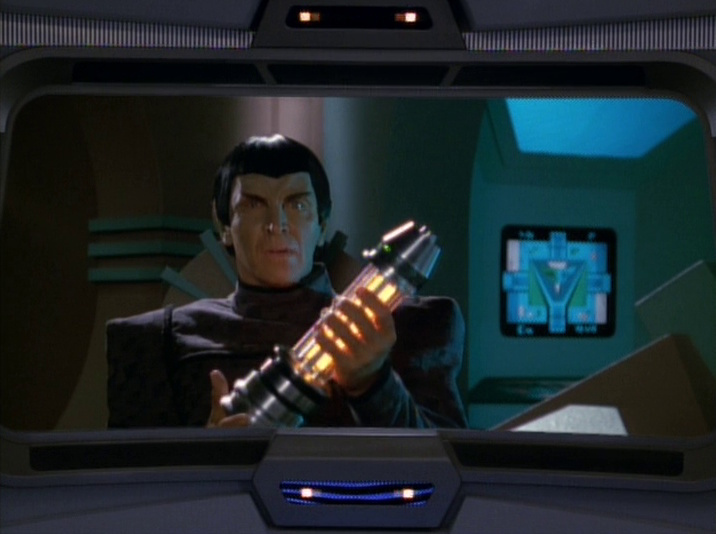
Still frame from Star Trek: Voyager showing a Romulan officer on Voyager's viewscreen.

Eye of the Needle was one of the first episodes to tease Voyager’s crew – and Ensign Kim in particular – with finding a shortcut back to the Alpha Quadrant. Kim’s enthusiasm for the wormhole is cute, and just makes the disappointment later so much more heartbreaking. Garrett Wang puts in one of the best performances of the first season in those moments, taking Kim from elation to dejection.

The idea of bringing in the notoriously difficult Romulans as the faction Voyager is able to reach was a masterstroke, and Telek R’Mor was an engaging character, too. Guest star Vaughn Armstrong, who played R’Mor, had also played a Klingon in The Next Generation, a Cardassian in Deep Space Nine, and would go on to have a recurring role as Admiral Forrest in Enterprise. The final twist in Eye of the Needle felt particularly cruel for our heroes… but it wouldn’t be the last chance they’d get to communicate with someone back in the Alpha Quadrant!

Season 1, Episode 10:
Prime Factors
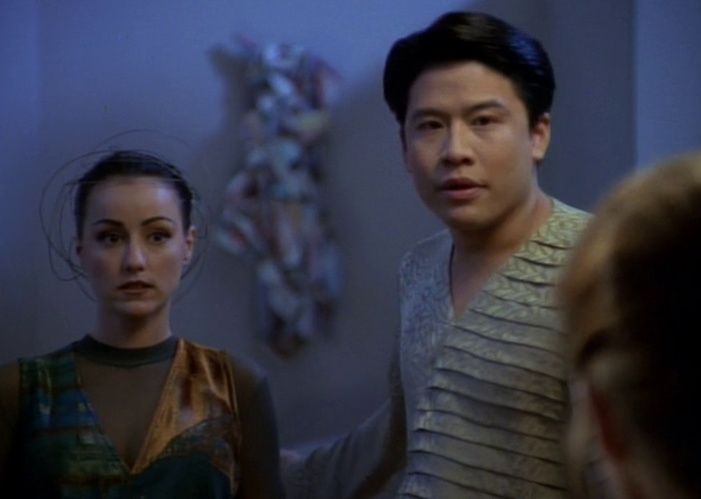
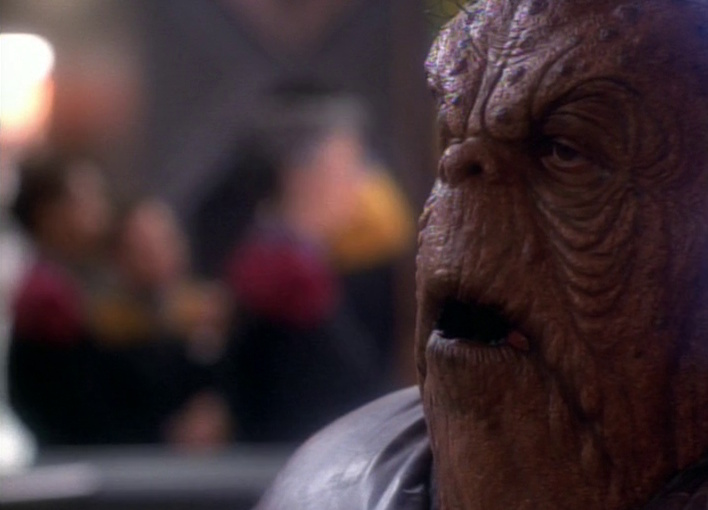
Still frame from Star Trek: Voyager showing Harry Kim and an alien in the episode Prime Factors.

On several occasions, Star Trek stories have shown the Federation being unwilling to intervene or to share certain technologies, citing the Prime Directive as the reason why. Janeway herself invoked the Prime Directive when choosing not to trade replicators and weapons with the Kazon, and when destroying the Caretaker’s array. But Prime Factors did something different – it put Janeway and the crew on the other side, on the receiving end of that kind of intransigent attitude.

Prime Factors gave us another example of Harry Kim’s eager excitement at discovering a potential shortcut, but also did a lot for the relationship between Tuvok and Janeway – Tuvok’s breach of trust, while well-intentioned, hurt her. Seska’s involvement in the story was interesting, too, and set the stage for her future villainous arc.

Season 1, Episode 15:
Jetrel
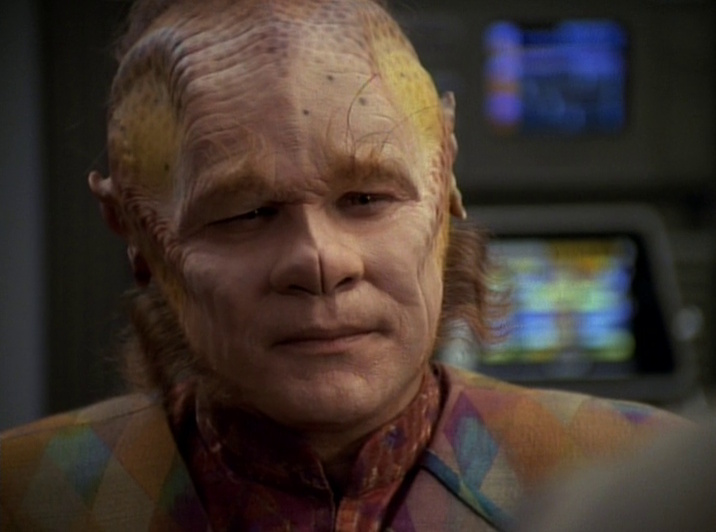
Still frame from Star Trek: Voyager showing a close-up of Neelix.

Jetrel is an intense and emotional Neelix episode… which is a weird statement when you consider Neelix’s usual role on Voyager! Neelix, however, had a tragic past, and we got to learn more about where he came from and what became of his people – the Talaxians. The metreon cascade, an obvious analogy for chemical and nuclear weapons, was presented as a real and very deadly weapon, and Dr Jetrel’s attempt at undoing some of the damage he’d caused made for an interesting character.

There’s one quite shocking jump-scare in Jetrel, which is still a rarity for the Star Trek franchise. You’ll know the one I mean if you remember the episode; if you don’t… well, consider this a warning! As an episode that got into the horrors of war and the dangers of weapons of mass destruction, Jetrel did what Star Trek has always done: used its sci-fi setting to examine real-world issues. For my money, it does so exceptionally well.

Season 2, Episode 3:
Projections
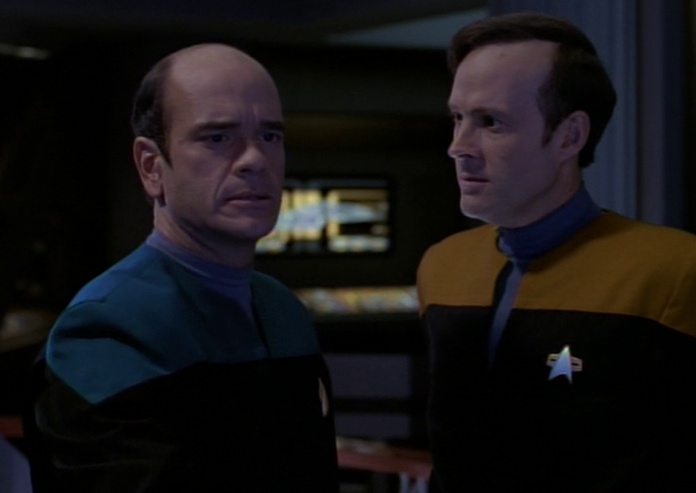
Still frame from Star Trek: Voyager showing the EMH and Barclay.

Projections was Reg Barclay’s Voyager debut – though after this episode it would be four years before he returned to the show! It was also a fun story with a deadly serious edge – as the Doctor awakened on an apparently abandoned Voyager. Seeing the Doctor able to leave the confines of sickbay was also a bit of a novelty; I think this was the first time he got to visit the bridge or engineering, coming years before he acquired his mobile emitter.

Barclay made for a pleasant surprise in Projections; I wouldn’t have expected to see him aboard Voyager, but his interactions with the Doctor were good fun. Dwight Schultz brought the same chaotic energy to the role as he had in The Next Generation, and he and Robert Picardo worked well together. This was a great episode for Voyager’s EMH, as we got to see him stepping outside of his comfort zone – literally and figuratively.

Season 2, Episode 5:
Non Sequitur
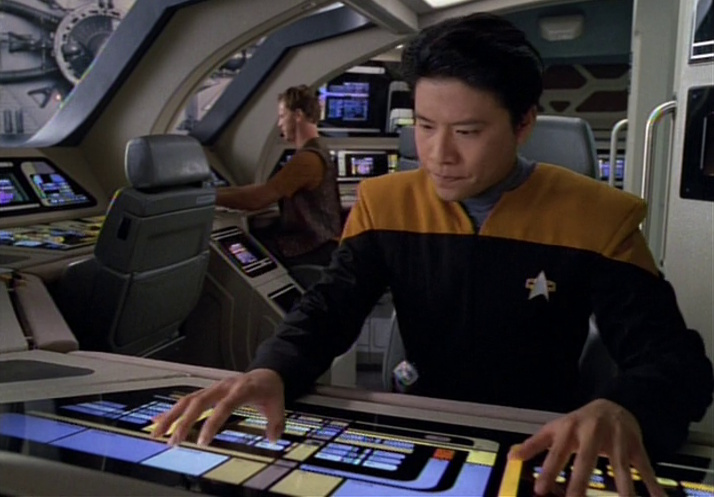
Still frame from Star Trek: Voyager showing Tom Paris and Harry Kim in a Starfleet runabout.

Harry Kim finally gets what he’s wanted all along: to be back home on Earth. But after realising that “something’s wrong with the timeline,” Kim has to spend the entire episode trying to get back to Voyager and the Delta Quadrant! This inversion of Kim’s goal made for an interesting episode, and I’ve always enjoyed Star Trek stories that showed us glimpses of civilian life back on Earth.

Non Sequitur also made for a great “bromance” story for Paris and Kim, showing off their friendship and putting them in a completely different situation. Friendship is about trust, and Kim turned to the only person he felt he could trust to get him back to Voyager and restore the timeline. Kim and Paris would remain firm friends across the show, but Non Sequitur was a great example of the depth of that relationship and the bond of trust they shared.

Season 2, Episode 6:
Twisted
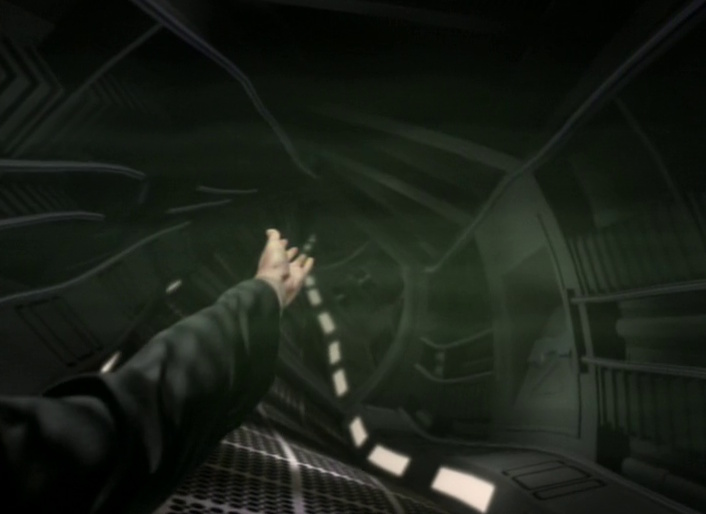
Still frame from Star Trek: Voyager showing a distorted Jeffries tube and hand.

Apparently, Twisted has a bad reputation – not only among fans and viewers, but with the cast themselves. A holdover from Season 1, there was a rumour that Twisted was “so bad” that UPN (Voyager’s original broadcaster) didn’t want to air it… but the episode was eventually included as part of Season 2. For my money, Twisted isn’t anywhere near as bad as its reputation suggests!

However, Twisted makes the cut on this list for one primary reason: the sequence near the end where most of the main characters are sitting in Sandrine’s, expecting to die. This is an intense moment, and several of the characters clear the air, while others pray or try to find comfort. Was it rendered a little anticlimactic by both a pretty poor visual effect and the revelation that no-one was ever in danger? Maybe. Was the whole “it was only trying to communicate” cliché a bit of a silly twist right at the end? Probably. But there are some great character moments in Twisted, so don’t let its reputation put you off.

Season 2, Episode 24:
Tuvix
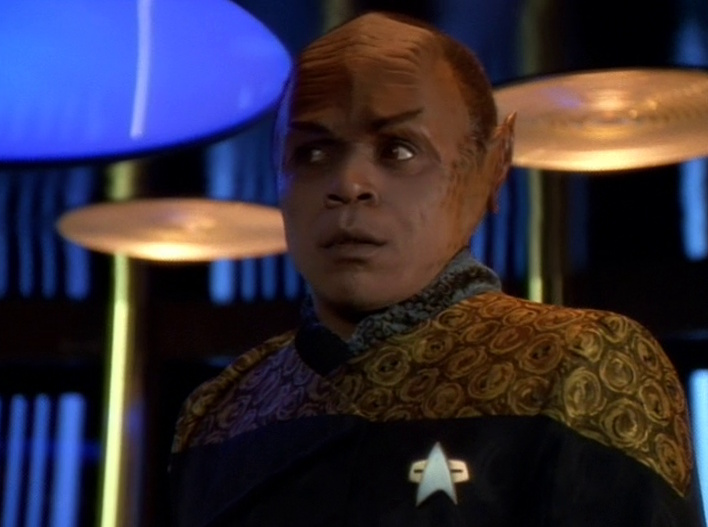
Still frame from Star Trek: Voyager showing Tuvix on the transporter pad.

Ah, Tuvix: the meme episode. Seriously, what is up with Trekkies citing Tuvix all the time these days? I get that poor old Tuvix was hard done by at the end, but I admit that I’m surprised to see this episode constantly referenced and called back to! Memes aside, though, this “the transporter done goofed” story was actually a genuinely interesting one – for Janeway as well as Neelix and Tuvok.

If you were going to blend two characters together, you couldn’t pick two who were more different than Tuvok and Neelix. Neelix’s one-sided friendship with Tuvok was a fun element of Voyager, and Tuvix only added to that, in my opinion – giving both men a renewed appreciation for one another. Janeway’s final choice – and the Doctor’s refusal to carry it out – was heartbreaking, and I get why it’s still a hotly-debated topic all these years later. That just speaks to the quality of the episode, the writing, and the moral conundrum that Janeway had to confront.

Season 3, Episode 2:
Flashback
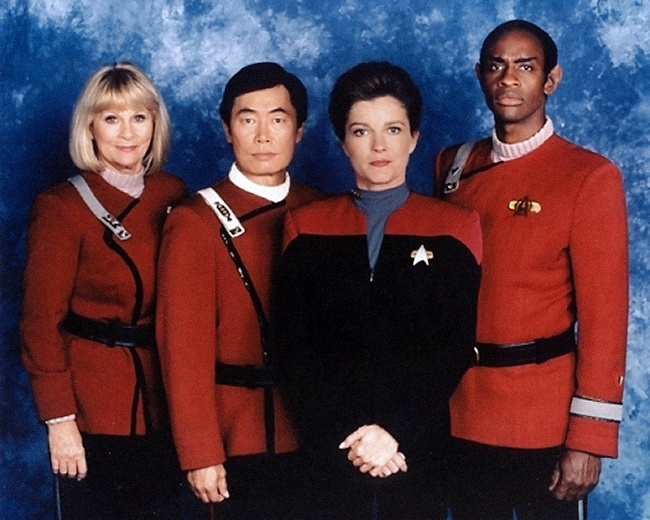
Promotional photo for the Star Trek: Voyager episode Flashback, showing Rand, Sulu, Janeway, and Tuvok in uniform.

Flashback was one of two episodes made to celebrate the Star Trek franchise’s 30th anniversary; the other was Deep Space Nine’s Trials and Tribble-ations. I can’t believe we’re now celebrating Voyager’s own 30th anniversary – but time really does fly, I guess! Flashback saw Tuvok and Janeway take a visit to the USS Excelsior, and is set during the events of The Undiscovered Country. It was a fun way to include Captain Sulu and Janice Rand; the episode has become one of many threads of continuity that tie Star Trek together.

I would posit that Flashback’s core premise – a “memory virus” that Tuvok was infected by – wasn’t especially strong, but that’s almost incidental. Digging into Tuvok’s past was fun, and I’ll never tire of seeing Sulu in command of the Excelsior. Getting some interactions between Janeway and Sulu was fantastic to see, too. Perhaps Flashback is overshadowed by Trials and Tribble-ations, but it’s an excellent episode in its own right.

Season 3, Episodes 8-9:
Future’s End, Parts I & II
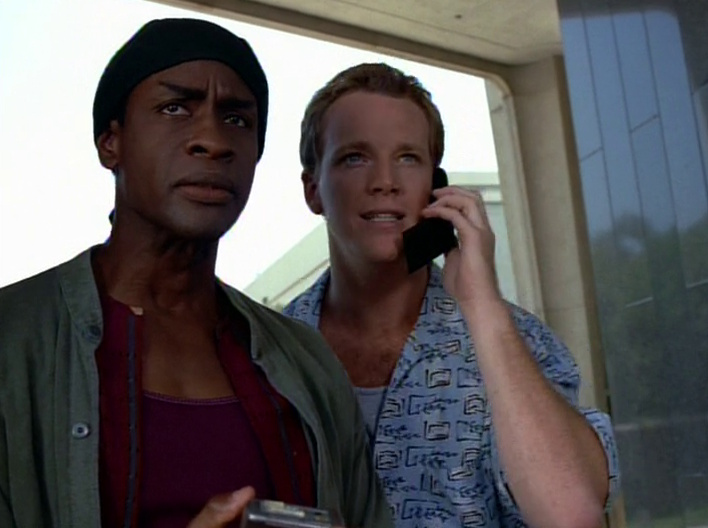
Still frame from Star Trek: Voyager showing Tuvok and Paris in the '90s using a mobile phone.

Let’s be honest: Future’s End is horribly dated – it might be one of the most dated Star Trek episodes. Everything about it screams “nineties,” but that’s just fine by me! At the time, Future’s End seemed like just another fun Voyager story – just with a time travel twist. But now, almost thirty years after its premiere, it feels like a little slice of history; Voyager captured perfectly this moment in time. And yes, I know that’s my nostalgia talking… but this is my list, so get over it!

Future’s End teased Janeway and the crew with a return to Earth… but unfortunately it was in the wrong time period! It was neat to see them visiting a sun-drenched California, though, and comedian Sarah Silverman made for an unexpectedly sweet guest star. Time travel episodes aren’t usually my favourites, but Future’s End bucks the trend.

Season 3, Episode 12:
Macrocosm
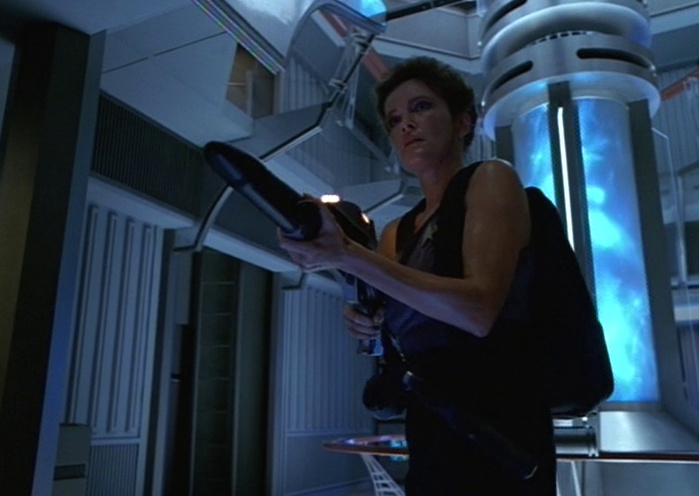
Still frame from Star Trek: Voyager showing Janeway wielding a phaser rifle.

Macrocosm was a great episode for Janeway, showing off her action-heroine side! If you read my earlier piece marking Voyager’s thirtieth anniversary, you might remember I talked briefly about the first actress cast for the role of Janway, before it passed to Kate Mulgrew. Episodes like Macrocosm would’ve been borderline impossible if Voyager’s producers had stuck with a different interpretation of the character – and in my view, the series would be worse for it.

This was a story that did something Star Trek hasn’t always been good at: showing off a truly alien-feeling alien life-form. In this case, Janeway and the Doctor were forced to confront human-sized viruses, and it turned out to be a fight to the death! An action-packed episode, for sure.

Season 3, Episode 26/Season 4, Episode 1:
Scorpion, Parts I & II
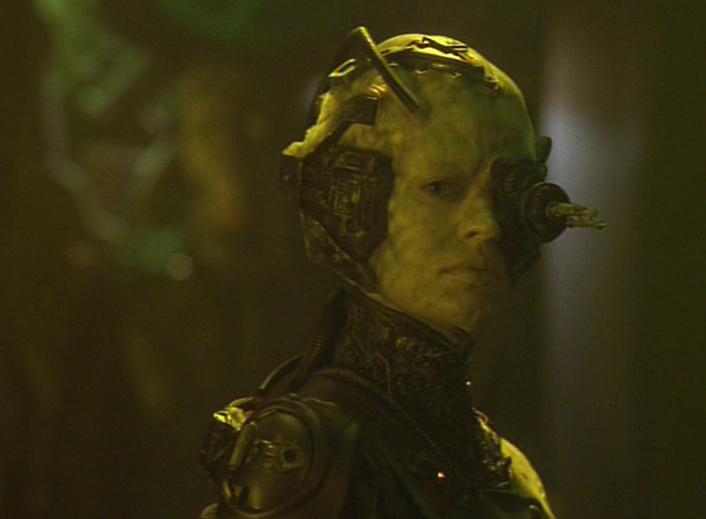
Still frame from Star Trek: Voyager showing Seven of Nine while she was still a Borg drone.

Alright, I suppose we’d better talk about Scorpion. The two-parter that introduced Seven of Nine also went a long way to damaging the Borg Collective as a villain. It wasn’t the only story to do so across the back half of Voyager’s run, but seeing the Borg so easily-defeated and inept… it took something away from them. Sure, it set up Species 8472 as a frightening adversary, but Voyager never really did much with them after this, so it all just feels a bit… wet.

Still, I recognise Scorpion’s importance to Voyager, shaking up the cast and setting the stage for more confrontations with the Borg – who would sporadically show up from here on out. Despite my later feelings about the character, Seven of Nine got one of the best introductions in Star Trek history, and seeing her reaction to being cut off from the Collective was especially interesting.

Season 4, Episode 6:
The Raven
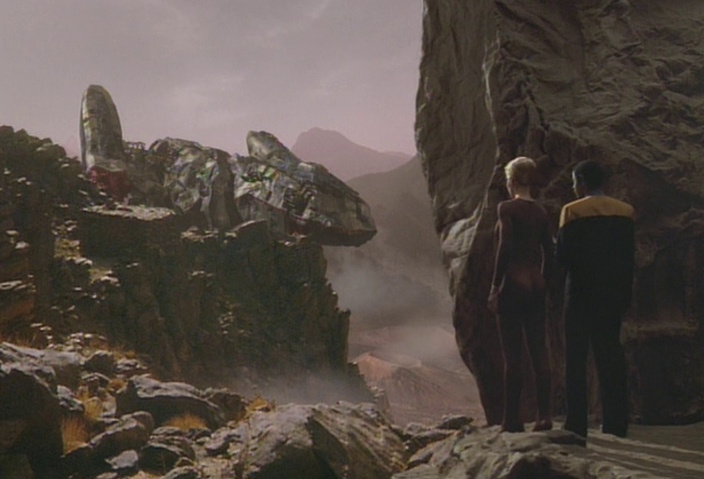
Still frame from Star Trek: Voyager showing Seven of Nine and Tuvok surveying a crashed starship.

Across Voyager’s later seasons, I burned out on Seven of Nine going through one repetitive story after another. As one of the first to give her a starring role and explore her backstory, though, I give The Raven a bit of a pass. Finding out what became of Annika Hansen, and how she came to be assimilated, was genuinely interesting – even if it came as part of a story that muddled the history of the Borg’s contact with humanity and the Federation.

The wreck of the USS Raven was also an interesting setting. This was one of the first episodes to start the process of humanising Seven of Nine, breaking her away from her Borg indoctrination and establishing relationships with other members of the crew. The scene where she sits in the mess hall with Neelix was particularly cute.

Season 4, Episode 14:
Message in a Bottle
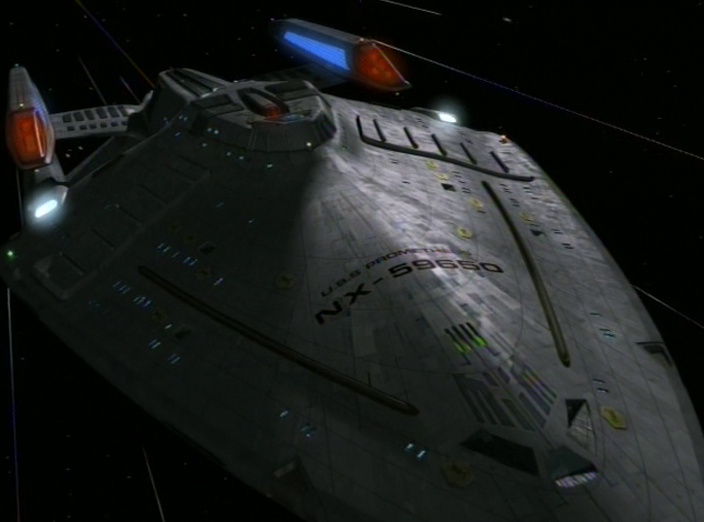
Still frame from Star Trek: Voyager showing the USS Prometheus at warp.

Coming at basically the halfway point of Voyager’s run, Message in a Bottle established contact between the stranded vessel and Starfleet Command for the first time. It’s also absolutely hilarious thanks to a wacky guest star, a prototype starship that can break into three parts, and a surprise attack by the Romulans!

There are some excellent comedic moments in Message in a Bottle, with comedian Andy Dick playing a new, updated version of the EMH. He and Robert Picardo both have great timing and played well off of one another, leading to some laugh-out-loud scenes. It’s also an important episode for establishing the first point of contact between Voyager in the Delta Quadrant and Starfleet back at home.

Season 4, Episode 21:
The Omega Directive
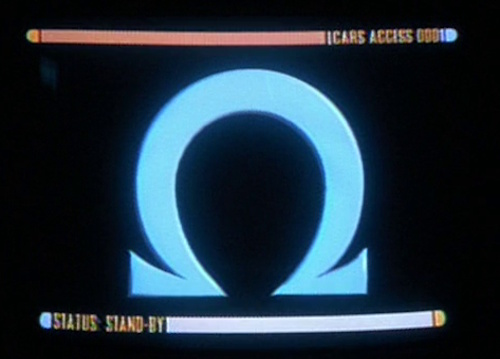
Still frame from Star Trek: Voyager showing the Omega mission symbol on an LCARS monitor.

Are you interested in the philosophy of the Borg Collective? Or do you want to see one of Starfleet’s most top-secret, classified missions? Then The Omega Directive has you covered! This episode was a genuinely interesting look at the technology and science of Star Trek’s galaxy – from two very different and diametrically opposed angles.

Seeing Voyager ground to a halt by the titular Omega directive showed us how seriously Starfleet takes this issue, and it also became a challenge for Janeway – having to deal with Omega while being thousands of light-years from home with no backup. Her reluctance to open up to the crew and over-reliance on Seven of Nine weren’t great for her character, in my opinion, but that just shows the difficult situation she found herself in. The Omega Directive also expanded upon the idea of the Borg Collective seeking “perfection,” which was interesting.

Season 5, Episode 1:
Night
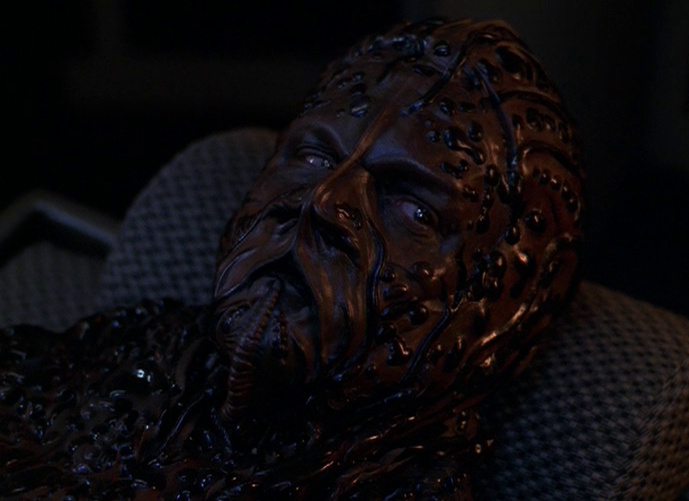
Still frame from Star Trek: Voyager showing an alien lying in sickbay.

Night introduces us to the Malon – a villainous faction who showed up a few times in Season 5. There’s an interesting environmentalist message here, one that seems all the more important a quarter of a century later. Janeway and the crew also had to confront something that we’d never seen before: a species refusing the Federation’s help and superior technology for economic reasons. Again, something that’s still highly relevant today!

But Night isn’t really here for that reason. It shows us an empty region of space, which is something a bit different, and we get to see how the crew spend their time when there isn’t a mission of exploration to embark upon or a villain to be defeated. That’s something no Star Trek series had really done before; examining the “down time” in between missions while at warp was interesting, even if it only took up a small portion of the episode. Moreover, this is an important episode for Janeway – without something going on to distract her, she becomes depressed, re-playing the decision that stranded Voyager in the Delta Quadrant over and over again in her head.

Season 5, Episode 6:
Timeless
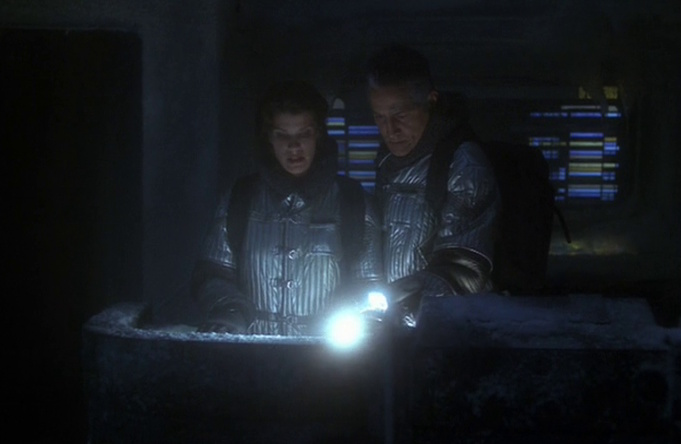
Still frame from Star Trek: Voyager showing Tessa and an older Chakotay aboard the frozen, derelict Voyager.

I don’t like time-loop/time-paradox storylines, and I don’t like stories in which the magical, magnificent Seven of Nine is the only one who’s able to save the day. So Timeless really shouldn’t have much to offer for me! But you know what? It’s a surprisingly entertaining affair, one that looks at how badly wrong Voyager’s journey home could’ve gone. Harry Kim and Chakotay are the stars; the former torturing himself over the mistakes and miscalculations that led to Voyager’s crash.

The sequence in which the ship crash-lands is brutal, and seeing most of our heroes meet an untimely end was genuinely shocking the first time I saw it. Timeless also brought back The Next Generation’s Geordi La Forge, which was neat to see, and we also caught a glimpse of the future of Starfleet in this era. There was an emotional character story at the core of Timeless, and plenty of other interesting elements, too.

Season 5, Episode 18:
Course: Oblivion
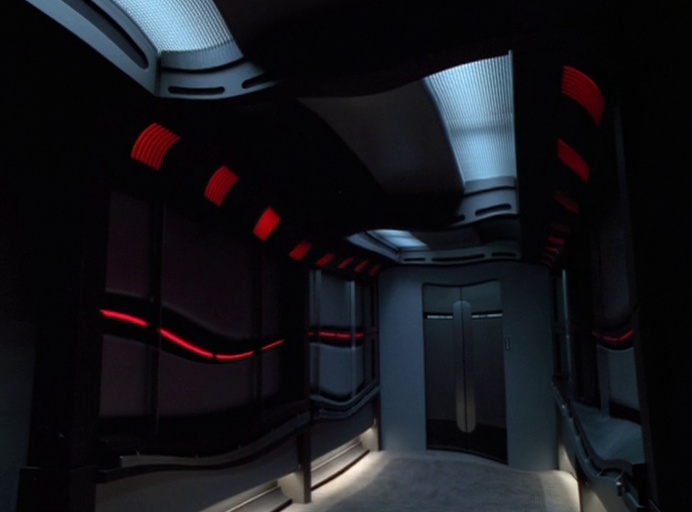
Still frame from Star Trek: Voyager showing a melting and distorted corridor.

Course: Oblivion is a heart-wrenching episode – one that sees its entire cast of characters dead by the time the credits roll. Taking the Silver Blood aliens from the Season 4 episode Demon as a starting point, it sees the crew of an alternate Voyager discovering the truth about their identities, before slowly succumbing to the ravages of space, radiation, and warp engines over the course of an agonising forty-five minutes.

There’s a case to be made that Course: Oblivion is Voyager’s most depressing individual episode, even more so than the likes of Year of Hell. Because the Silver Blood characters took on the familiar identities of our heroes, there’s an automatic attachment to all of them when they’re in danger – and the episode delivers gut-punch after gut-punch as they slowly suffer the worst fate imaginable.

Season 5, Episode 23:
11:59
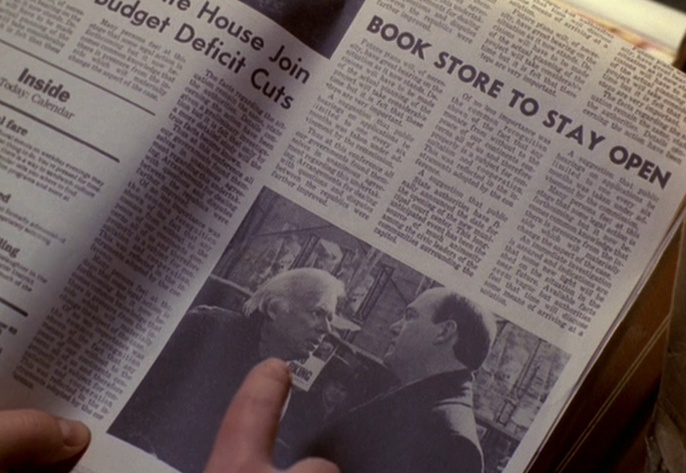
Still frame from Star Trek: Voyager showing a newspaper article about Mr Janeway's bookshop.

I don’t typically care for stories that leave Star Trek’s spaceships and future behind. The likes of Far Beyond the Stars, The Inner Light, and so on just aren’t my favourites, and I usually skip over them when re-watching The Next Generation and Deep Space Nine. But 11:59 – despite having a similar premise – has a unique charm, perhaps because of its close association with the millennium.

In the UK, 11:59 was broadcast in September 2000, mere weeks before it was set. I greatly enjoyed the episode and its focus on Janeway’s ancestors at the turn of the millennium. There was an interesting story about how “progress” can come at the expense of everyday people – and how history, even personal history, can be subject to interpretation. As an episode filmed before the millennium, it was also quite prescient in its observations of things like the millennium bug!

Season 5, Episode 26/Season 6, Episode 1:
Equinox, Parts I & II
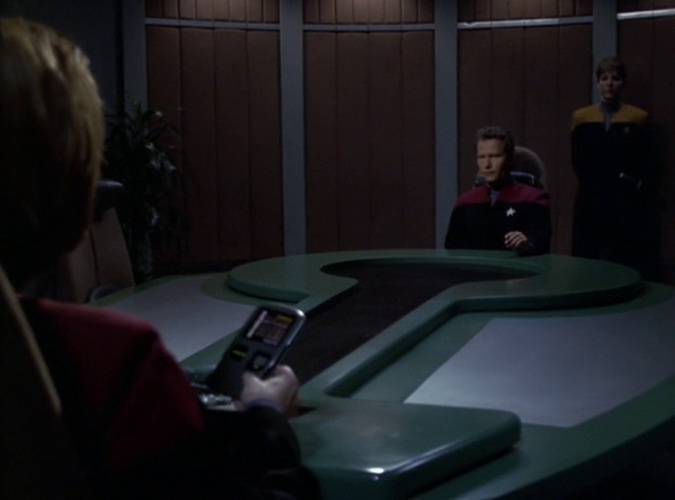
Still frame from Star Trek: Voyager showing Captain Janeway confronting Captain Ransom in the briefing room.

I’m glad that Voyager’s writers didn’t try to tell a story like Equinox too early – I think a run-in with Starfleet like this needed to come this far into the show. It’s a powerful story, one that doesn’t treat Captain Ransom as and out-and-out villain, but rather challenges viewers. Equinox asks: “what would you have done in his place?” and I think that’s a really interesting way to watch it.

Sure, there are moments of pure villainy. Equinox’s EMH is a deliciously immoral baddie, as is Lieutenant Burke. And the story of what the Equinox’s crew did to the sentient nucleogenic life-forms is horrible and tragic. But there’s an amount of moral ambiguity to Captain Ransom and at least some of his crew, making Equinox a tale of desperation and survival at any cost rather than a purely black-and-white morality play.

Season 6, Episode 7:
Dragon’s Teeth
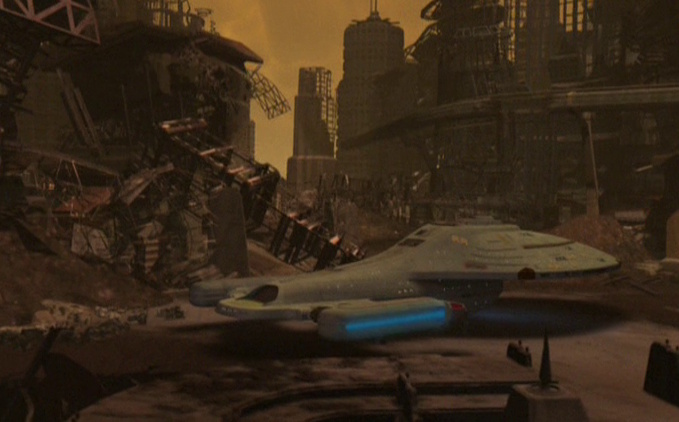
Still frame from Star Trek: Voyager showing the USS Voyager on the surface of a planet, surrounded by ruins.

I love the idea of Dragon’s Teeth: an ancient alien race goes into cryo-sleep, only to be awakened centuries later. Voyager puts a fun spin on this story premise, too, by making the Vaadwuar into an evil all-conquering empire, adding to the moral complexity of the situation. Because they’d been in stasis for centuries, the surviving Vaadwaur also told us quite a bit about the Delta Quadrant as it was almost a millennium ago. Most interestingly, the Borg Collective was positively tiny, only occupying a handful of star systems. Little tidbits of information like that about the Star Trek galaxy are incredibly interesting to me!

Dragon’s Teeth also told an interesting story about the Vaadwaur and their enemies, with Voyager accidentally caught in the middle of the conflict. The Vaadwaur were an interesting race, and I’d love to see Star Trek revisit them one day. It would be fun to find out if the re-awakened Vaadwaur were able to re-establish their civilisation… or their empire.

Season 6, Episode 10:
Pathfinder
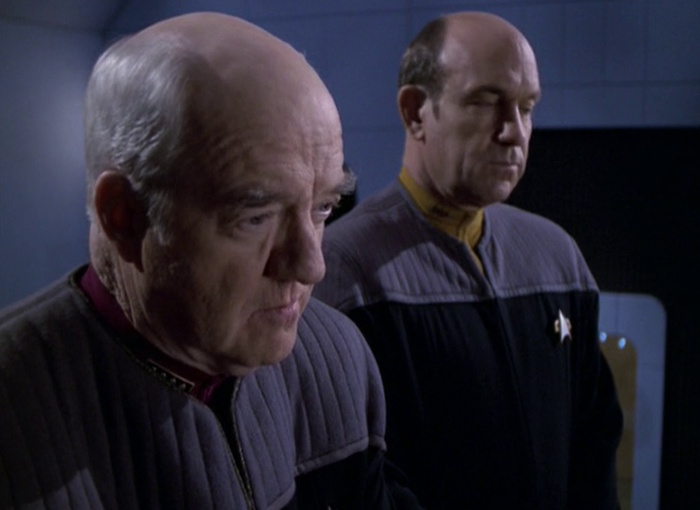
Still frame from Star Trek: Voyager showing Admiral Paris and Commander Harkins.

Pathfinder builds on Barclay’s appearance in Projections and the Doctor’s visit to the Alpha Quadrant in Message in a Bottle – see both of those episodes above for more! In short, the story focuses on Barclay and the Pathfinder Project at Starfleet, as the Federation attempts to find a way to establish contact with the USS Voyager, despite the vast distances involved.

Barclay is a fun character, and throwing him into a technological challenge like this was a bit of a change of pace. Bringing Deanna Troi into the episode, too, was a neat inclusion, and another of those threads of continuity that I talked about earlier. Barclay’s obsession with Voyager could feel uncomfortable, in places – but deliberately so, and it seemed in keeping with what we learned about him in The Next Generation. As the episode to establish the first proper communication between Voyager and Starfleet HQ, Pathfinder is an important one going into the show’s final couple of seasons.

Season 6, Episodes 11 & 17:
Fair Haven and Spirit Folk
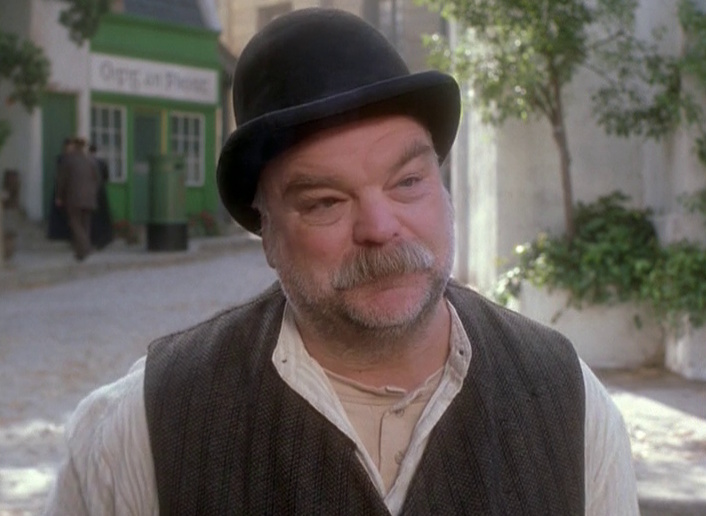
Still frame from Star Trek: Voyager showing a holographic Irishman.

I’m putting these two episodes together because they form two parts of a single story. After Tom Paris created a holo-programme set in an Irish village, Spirit Folk expanded upon that idea, and let us see the impact the crew were having on the holographic world through the eyes of the villagers. Sentient holograms have been part of Star Trek since The Next Generation introduced us to Professor Moriarty, but this was a completely different take on the idea.

There are plenty of laugh-out-loud moments in both episodes, but also serious themes, too. It was nice to see the crew – including Captain Janeway – letting their hair down a bit and just having fun in a different setting. I definitely prefer Fair Haven’s holodeck stories to anything involving Captain Proton!

Season 6, Episode 20:
Good Shepherd
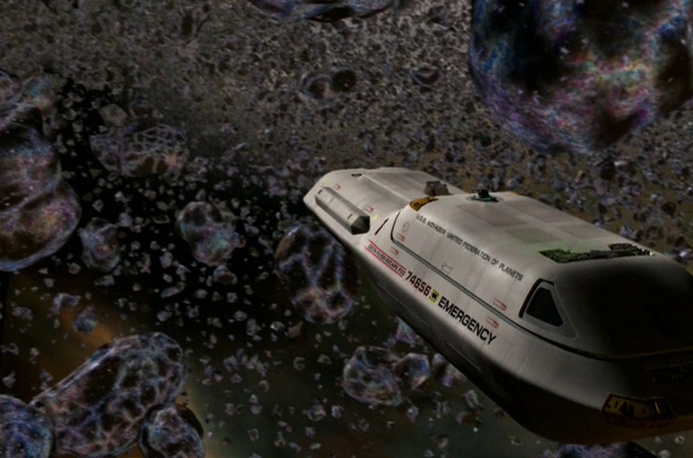
Still frame from Star Trek: Voyager showing an escape pod floating in a nebula.

Good Shepherd sees Janeway go on an away mission with three under-performing crew members, trying to boost their confidence. I like the premise, and it was fun getting to meet other members of the crew that we don’t usually get to spend much time with. My only criticism of Good Shepherd, really, is that none of the three guest stars became recurring characters going into Season 7. There was definitely room for some of them to pop up in future episodes.

Disappointment aside, though, there was a neat story at the core of Good Shepherd, and it put Captain Janeway’s leadership skills to the test! I find the character of Harren to be especially relatable; I think I’d also want to squirrel myself away below decks and not interact with people if I were trapped on a starship!

Season 7, Episode 11:
Shattered
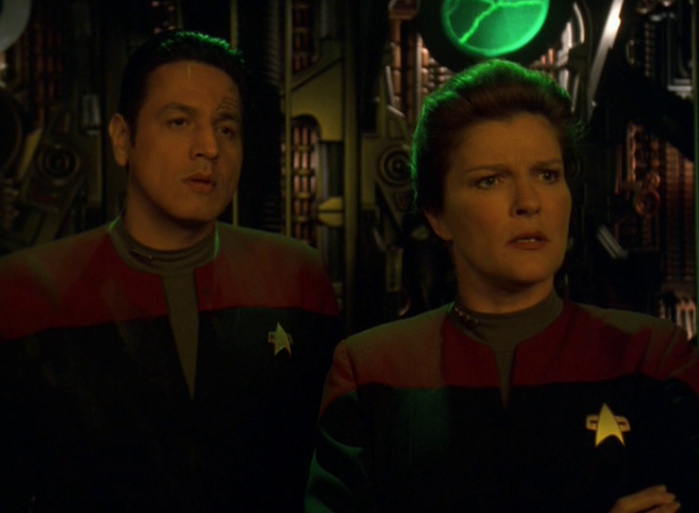
Still frame from Star Trek: Voyager showing Chakotay and Janeway in the assimilated cargo bay.

Shattered was a fun way to celebrate Voyager as the show entered its final season. The premise saw the ship caught in a temporal anomaly, with only Chakotay able to move between different parts of the ship. He’s able to turn to Janeway for help – but coming from different time periods, she struggles to trust him at first. It’s a creative take on Star Trek’s “temporal anomaly” idea, and one that Discovery would draw inspiration from for its fifth season episode Face the Strange.

I’m glad that Shattered was given to Chakotay, and not Janeway or Seven of Nine. He made for a fun point-of-view character as the madness unfolded, and stepping back in time to see different villains and different problems that befell Voyager earlier in the journey was a lot of fun. In many ways, Shattered feels like a love letter to Voyager.

Season 7, Episode 14:
Prophecy
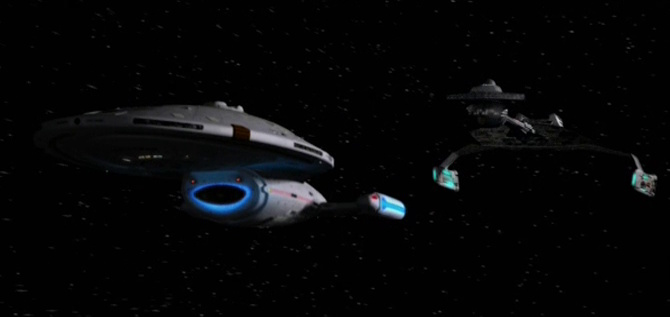
Still frame from Star Trek: Voyager showing the USS Voyager and a Klingon battle cruiser side by side.

Because Voyager was in the Delta Quadrant, far away from Klingon space, there weren’t a lot of Klingon characters to meet. Prophecy changed all of that, and introduced us to a Klingon generation ship that had travelled across the galaxy for religious reasons. It was really fun to see a D7 battle cruiser in Voyager, and this episode was also an interesting one for B’Elanna Torres.

We’d seen B’Elanna confront her Klingon heritage before, in episodes like Barge of the Dead and Faces, but this time the Klingons were 100% real – and they were interested in her unborn child. Tom Paris got a turn wielding a bat’leth, which was fun to see, and the episode looked at the themes of religion and peace between old enemies; the Kligons not being aware of the Khitomer Accords was particularly interesting.

Season 7, Episode 20:
Author, Author
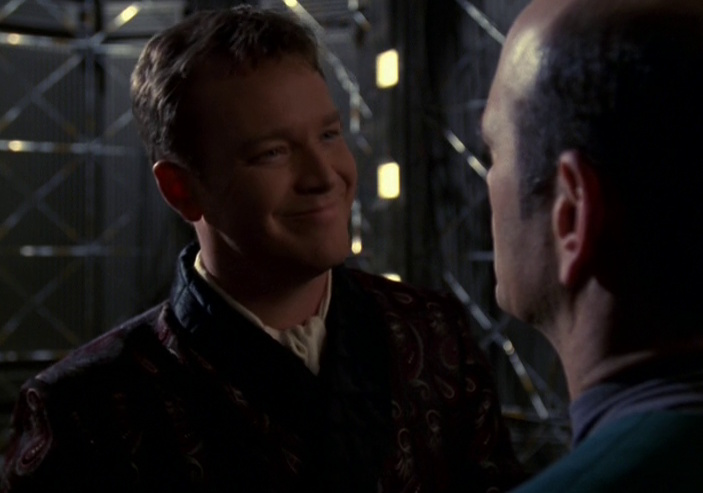
Still frame from Star Trek: Voyager showing a holographic Tom Paris and the Doctor.

Author, Author focuses on the Doctor – and whether he, as a sentient hologram, has the same rights as the rest of the crew. It could’ve ended up as little more than a re-do of The Next Generation episode The Measure of a Man, where Data’s rights were also up for debate. However, it’s to the writers’ credit that Author, Author doesn’t feel repetitive at all. The Doctor’s holo-programme was also a lot of fun – and raised questions about discrimination, matters of perspective, and how conspicuous and out-of-place one can feel.

Tom Paris intervened with a hilarious re-working of the Doctor’s original holo-programme, giving him a taste of his own medicine. That was a fun sequence, and this was a great episode for the Doctor’s growth as an independent being and as a creator.

Season 7, Episode 23:
Homestead
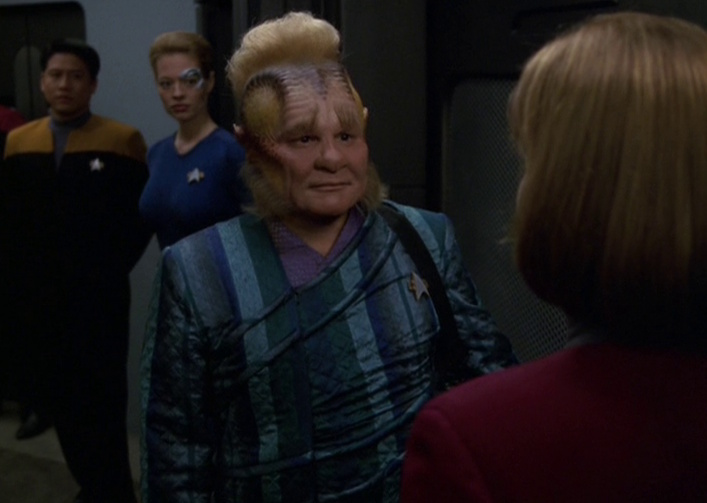
Still frame from Star Trek: Voyager showing Neelix preparing to disembark.

As Season 7 wound down, it seemed clear that Voyager and her crew were going to make it home. But Homestead really came out of left-field, seeing Neelix depart the ship – and the show – before making it back to the Alpha Quadrant. It always seemed a tad silly and unrealistic to me that a colony of Talaxians could be so many thousands of light-years away from home… but if you set that aside, what you get in Homestead is a touching story of a man finding his family.

Neelix’s departure is heart-wrenching, and Ethan Phillips puts in an outstanding performance. Neelix saying goodbye to Naomi is one of the most emotional moments, but seeing the entire crew lining up to say goodbye gets the tears flowing every single time.

Season 7, Episodes 25-26:
Endgame
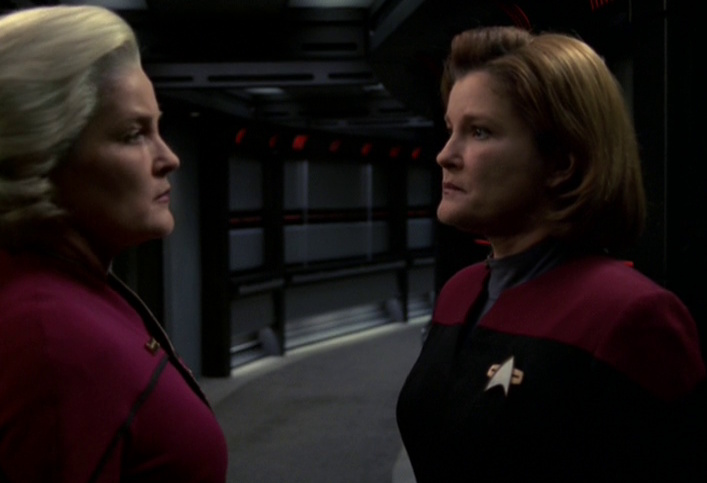
Still frame from Star Trek: Voyager showing an older Admiral Janeway with a younger Captain Janeway.

Endgame is a complicated episode – but there’s no way to finish a re-watch of Voyager without it! A time-travelling Admiral Janeway basically breaks every rule in the book for the sole purpose of saving Seven of Nine… and in doing so appears to have destroyed the entire Borg Collective. Scenes set in the future timeline are interesting, and I wish we could’ve explored more of this time period before hopping back to the 24th Century.

After seven seasons, it was great to see Voyager and her crew make it back home. I’ve heard some Trekkies say that the final scene of Endgame feels abrupt, but I never interpreted it that way. It was the end of the story – the goal Janeway and the crew had been striving for. Voyager made it home, back to Earth. What else were people expecting to see other than the ship being escorted back home by Starfleet? I don’t think Endgame as a whole is the perfect episode, but those closing scenes were great – at least in my opinion.

Bonus Video Game:
Star Trek: Voyager – Elite Force
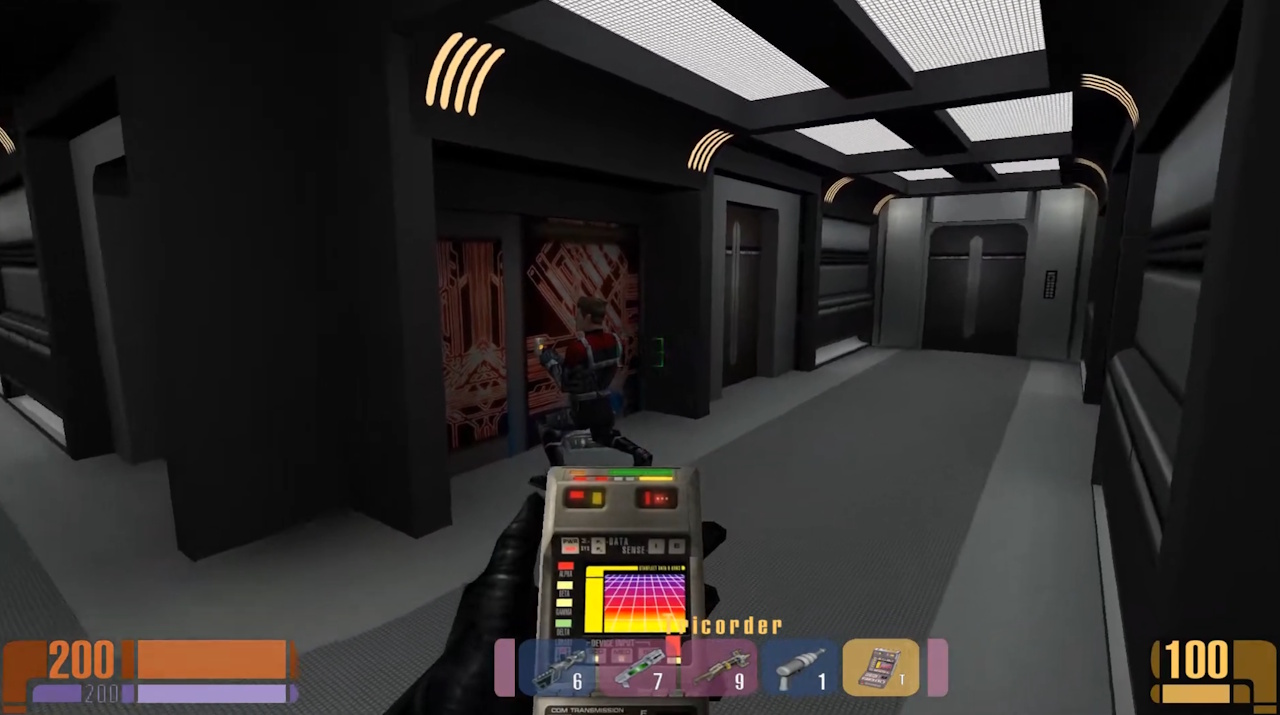
Screenshot of Star Trek: Voyager - Elite Force showing a first person viewpoint, a tricorder, and one of the hallways aboard the USS Voyager.

We’ve done thirty episodes, but I couldn’t let the occasion pass by without talking briefly about Elite Force. This game, which was released just after the turn of the millennium, was absolutely fantastic, and features a detailed (for the time) recreation of parts of the USS Voyager that can be walked through and explored. There’s a strong single-player story, too, with the USS Voyager pulled into a “void” in space.

Elite Force is a rare Star Trek game insofar as it broke through to a wider audience. In the early days of LAN parties and online matchmaking, Elite Force, powered by its Quake III engine, was pretty popular. Personally, I was always more interested in the single-player campaign, though! Copies are still available for PC and PlayStation 2, and I believe the game is also available digitally via the GOG platform.

So that’s it!
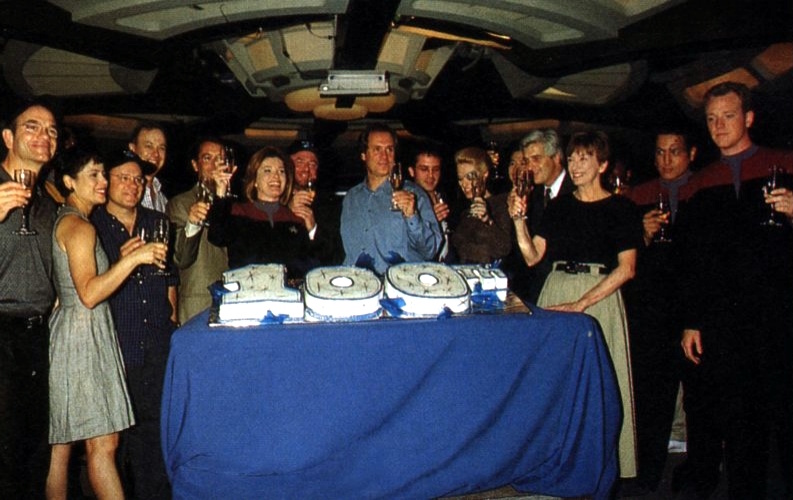
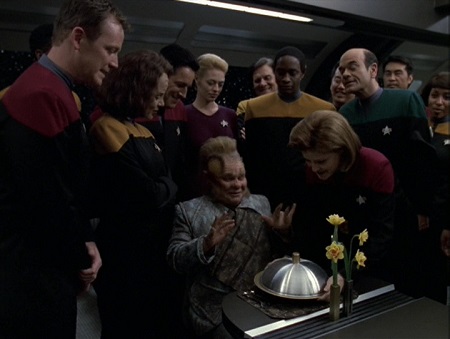
Behind-the-scenes photo from Star Trek: Voyager's 100th episode celebration. A large cake is present along with the cast and crew.
Voyager’s 100th episode party, featuring the cast and crew.

I’ve picked out a whopping thirty episodes (plus one bonus video game) to celebrate Voyager’s landmark anniversary.

I hope this has been an interesting look back at Voyager – and my personal memories of the show. I greatly enjoyed Voyager during its original run, and I don’t think I missed more than one or two episodes while the show was airing. I later went back and bought the entire series on DVD when it was released that way.

I keep holding out hope for a Voyager remaster – I think that would be a fantastic addition to Paramount+. Fingers crossed we’ll get to see the show in 4K one of these days, eh?
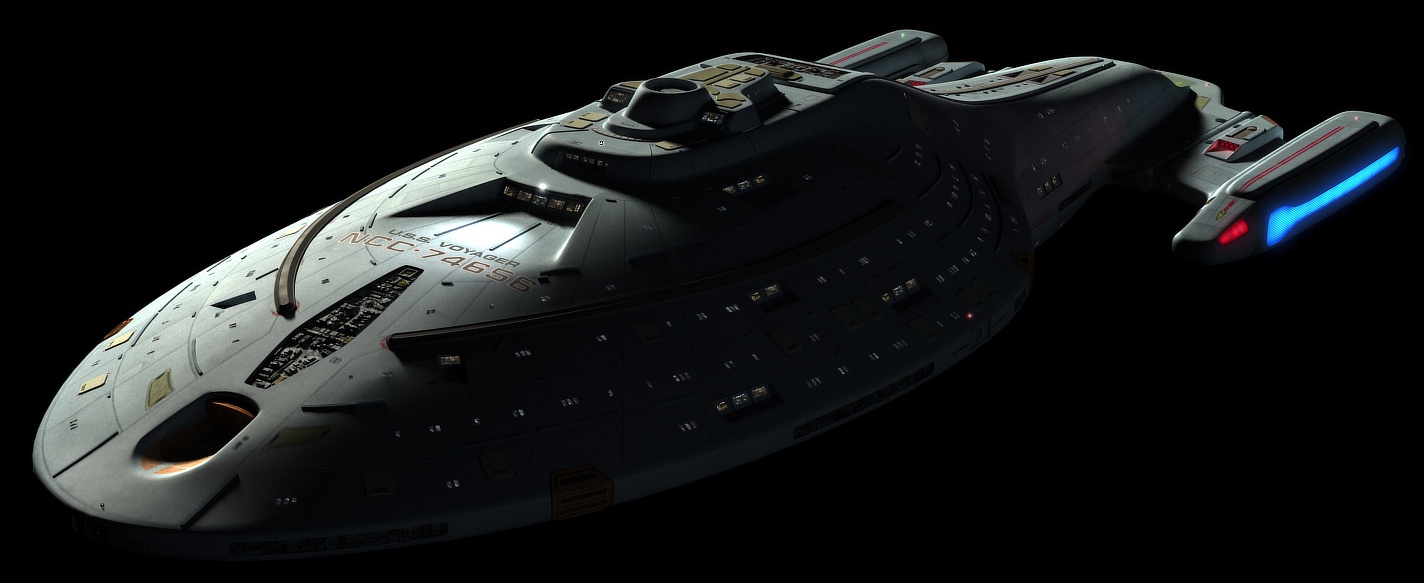
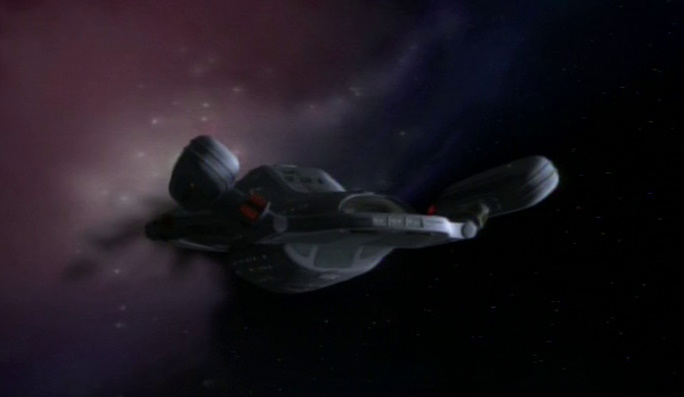
A high-definition digital render of the USS Voyager from TrekCore.
A high-definition digital render of the USS Voyager.
Image Credit: Robert Bonchune/TrekCore

So Star Trek: Voyager is officially thirty years old. Does that make you feel ancient? It makes me feel ancient. I enjoyed re-visiting the series to pick out this selection of episodes, and there were at least thirty others that I wanted to include! I tried to get a good mix of stories featuring different characters and with different themes, rather than being too repetitive or with a singular focus.

Thanks for joining me as we celebrate Voyager’s anniversary. I’m not sure what’s on the agenda next… perhaps a longer write-up of one or two of these episodes? Or another look at Elite Force? Truth be told I haven’t got a plan, but it would be nice to do something else in the next few days or weeks to continue the anniversary celebrations!

Until then… Live Long and Propser! And happy anniversary, Voyager!


Star Trek: Voyager is available to stream now on Paramount+ in countries and territories where the platform is available. The series is also available on DVD. The Star Trek franchise – including Voyager and all other properties discussed above – is the copyright of Paramount Global. Some images courtesy of TrekCore and Paramount. This article contains the thoughts and opinions of one person only and is not intended to cause any offence.
Star Trek: Voyager – Thirty Years Later

A spoiler warning graphic - featuring Neelix.

Spoiler Warning: There are spoilers ahead for Star Trek: Voyager and Star Trek: Prodigy.

In 1996, the Star Trek: Voyager episode Flashback was broadcast as part of the Star Trek franchise’s thirtieth anniversary celebrations. Today – and I can scarcely believe I’m writing these words – we’re marking Voyager’s own thirtieth anniversary!

That’s right: it was on the 16th of January 1995 that Caretaker, the premiere episode of Star Trek: Voyager, debuted in the United States. I thought it could be worth taking a few minutes to look back at not only the premiere, but Voyager as a whole – and try to assess its legacy and its place in the history of Star Trek. That’s what we’re going to talk about today, so I hope you’ll join me on a rose-tinted look back at Star Trek’s fourth live-action series!

Still frame from Star Trek: Voyager showing the title "Caretaker" with Captain Janeway and Tom Paris.
Caretaker premiered on this day in 1995.

When Voyager premiered in 1995, the Star Trek franchise was arguably at the absolute peak of its “golden age.” The Next Generation cast had started making feature films, Deep Space Nine was well into its third season, and it felt like Star Trek had well and truly made it; a franchise that was dominating the sci-fi world. I remember at the time hearing some criticism of launching another series, but with The Next Generation having explored strange new worlds in the Alpha and Beta Quadrants, and Deep Space Nine tackling the Gamma Quadrant… I gotta admit that I was excited to see Voyager head to the unexplored and mysterious Delta Quadrant!

Having read a preview of the series (I think in the Radio Times; a UK TV magazine) I was also intrigued by this “one ship, two crews” idea that Voyager seemed to be promoting. Seeing Starfleet officers having to work hand-in-hand with the Maquis seemed like a really interesting concept, and one that could’ve given Voyager a unique selling point and a way to stand out from the pack as Star Trek continued its growth and expansion. I don’t think Voyager’s writers ever really made good on that promise – but more on that in a moment!

An early mock-up of the Star Trek: Voyager logo before the show premiered.
An early placeholder logo for the show circa 1994.

Stories about long journeys, people from different backgrounds having to work together in common cause, and having a small “island of safety” in a dangerous and unexplored environment are all things I absolutely adore in fiction – so Voyager seemed to be bringing together a bundle of elements that might as well have been tailor-made for me! And across its seven-season run, all of those things came to the fore in different ways. Voyager was a fun series.

Of course, one of the most-discussed things leading up to Voyager’s premiere was the show’s new captain: Kathryn Janeway, played by Kate Mulgrew, became Star Trek’s first woman captain. I remember this news being received positively at the time, at least in the Star Trek fan groups I was aware of. No one in 1995 knew what the word “woke” would come to mean, so Janeway’s announcement didn’t get the same kind of negative reaction and whining as we might expect in 2025! That’s not to say there wasn’t some degree of pushback, of course. There have always been toxic individuals within the fan community.

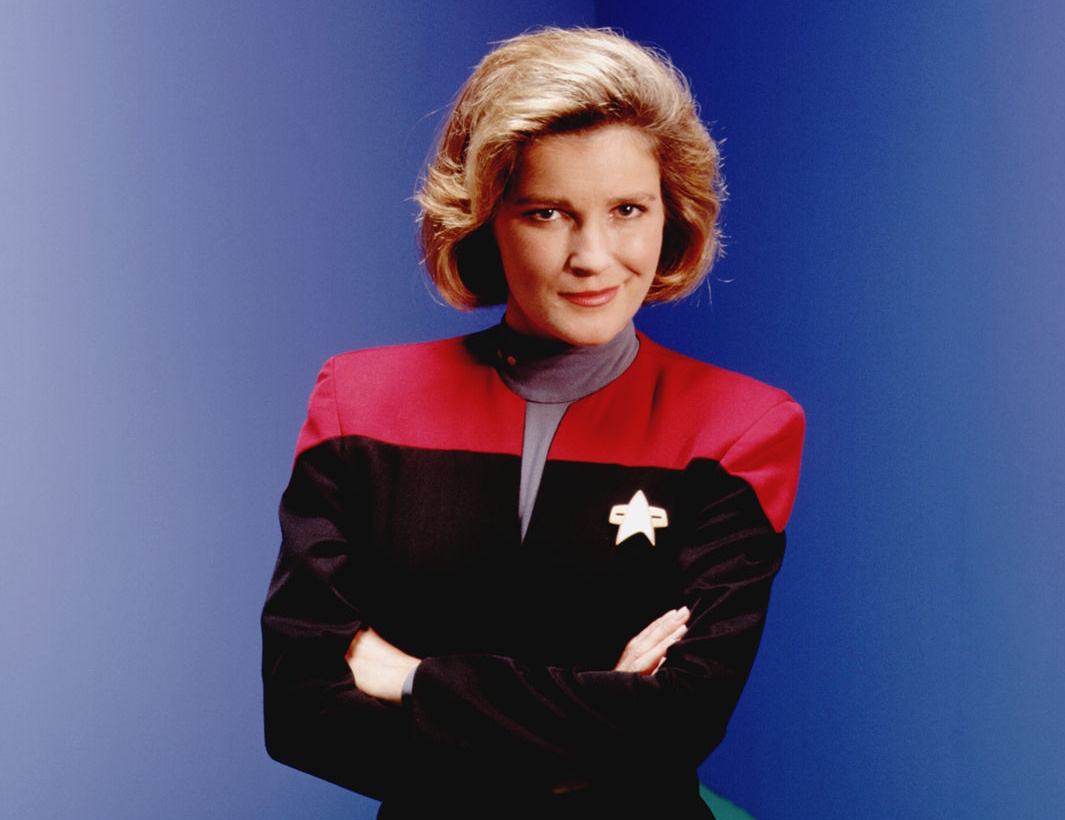
Promotional photo of Kate Mulgrew as Captain Janeway.
Captain Kathryn Janeway.

I remember the days leading up to Voyager’s premiere being ones of positivity and anticipation. I was absolutely thrilled at the prospect of Star Trek’s expansion, at getting a new exploration-focused series after The Next Generation’s finale, and at meeting a whole new crew and cast of characters. There was a lot to be excited about as Voyager’s premiere got closer!

Star Trek: Voyager was almost a very different show, though, and I think it’s worth taking a diversion to acknowledge that. As work began on the series, the question of who should sit in the captain’s chair was perhaps the biggest individual casting decision that befell casting directors Nan Dutton and Kathryn Eisenstein… and they fucked it up. Kate Mulgrew was considered for the role of Janeway, along with several others, but the role was given to Oscar-nominated actress Geneviève Bujold instead.

Still frame from the Star Trek: Voyager DVD special features showing Geneviève Bujold as Nicole Janeway.
What might’ve been…

Bujold was a terrible fit for the role of Janeway – as evidenced by the scenes she shot for Caretaker, which were included as a bonus in Voyager’s DVD box set – and seriously struggled with working on the show. Thankfully, Winrich Kolbe – who directed Caretaker – and executive producer Rick Berman recognised this before it was too late, and Bujold was replaced with Kate Mulgrew after only a couple of days. Still, this near-miss could’ve derailed Voyager before the show had a chance to get started.

As an aside, I don’t think Geneviève Bujold is in any way a bad actress or performer. But the idea to cast a character closer in style and tone to Jean-Luc Picard would’ve been wrong for Voyager, and that’s how I interpret her performance in those few scenes that have been revealed. Voyager needed a dynamic, energetic captain – someone who could make incredibly tough decisions under pressure while retaining the support of her crew. I didn’t see any of that in Bujold’s performance, so replacing her was unquestionably the right call.

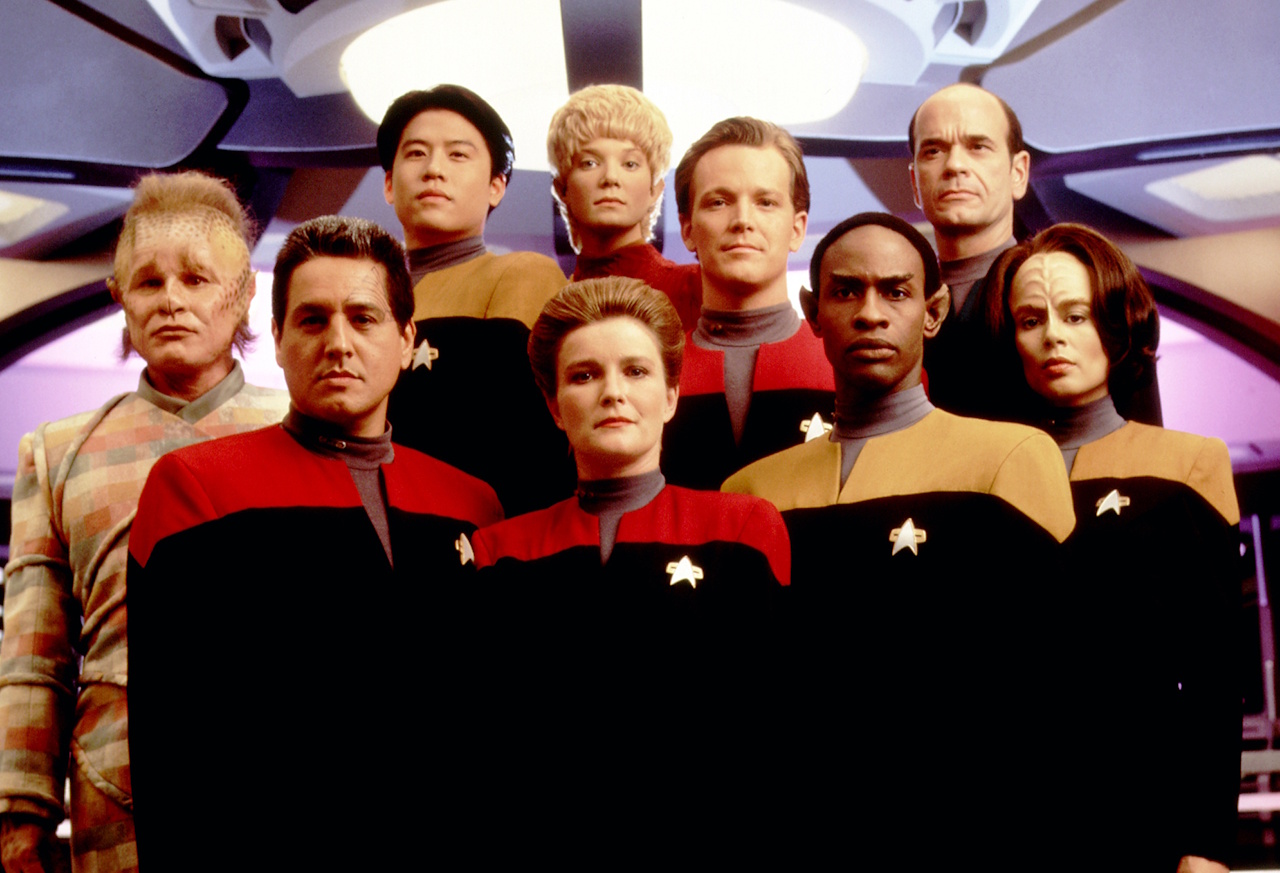
Promo photo showing the main cast of Star Trek: Voyager Season 1.
The main cast in Season 1.

Having to re-cast your lead role after filming has already started isn’t a great look for any television series, but Voyager was able to recover. Caretaker kicked off the show in style – and put a very interesting twist on a story premise that we’ve seen before in other episodes of Star Trek.

Several times in The Original Series, The Next Generation, and Deep Space Nine, our crews found themselves apparently stranded – perhaps on an alien planet, or else far away from Federation space. But in all of these, they found their way home again by the time the credits rolled. To me, Voyager always felt like it was taking one of those episodes and asking the obvious question: what if there wasn’t an instant way home? I really loved that idea, even in 1995 it felt subversive and creative; a unique and different take on a Star Trek story concept that we’d seen before.

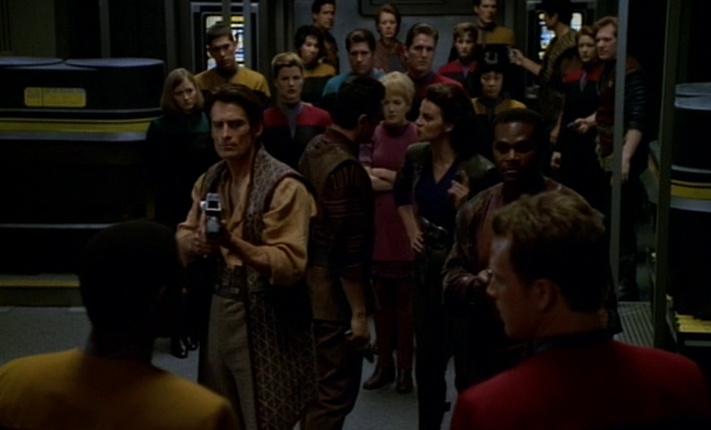
Still frame from Star Trek: Voyager showing the USS Voyager and the Maquis raider Val Jean in orbit of a planet.
The USS Voyager (and Chakotay’s ship) in orbit of the Ocampa homeworld.

Caretaker was also a fantastic crossover episode, bringing in characters and locations from Deep Space Nine. A couple of years earlier, the two-part episode Birthright had brought The Next Generation to DS9, too – so launching the show in this way felt like a real thread of continuity between all three extant Star Trek projects. Star Trek was doing the whole “shared universe” thing decades before the likes of Marvel!

Quark, Morn, and Gul Evek returned from past iterations of Star Trek, further tying Voyager into the franchise before striking out on its own. These three characters – along with Q – are the only ones to have appeared in all three of The Next Generation-era Star Trek shows, which is a fun little bit of trivia for your next Star Trek quiz night! Having that connection to the rest of the franchise was important, though, and it continued the trend of characters from Star Trek’s past appearing in the premiere of a new series.

Still frame from Star Trek: Voyager showing Morn at Quark's bar.
Morn in Caretaker.

Caretaker gave Captain Janeway a moral dilemma, one that tied into the idea of the Prime Directive and Starfleet’s core mission of peaceful exploration. Janeway ultimately decided to intervene, destroying the Caretaker’s array to prevent it from falling into the hands of the aggressive Kazon – but stranding her ship and crew in the Delta Quadrant in the process. This kicked off a story that would run for seven seasons, blending Star Trek’s normal episodic format with an underlying quest: Voyager’s journey home.

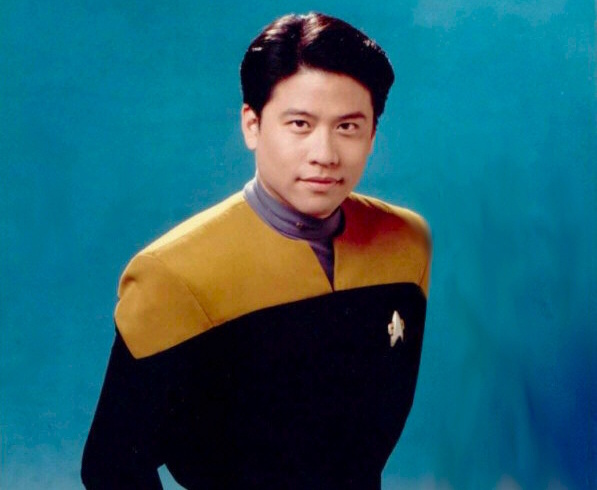
Harry Kim made a fine addition to the crew, and also filled an important role for Voyager in a narrative sense. Kim was always the first character to jump on the idea of finding a shortcut home, and the most eager (of the main characters, at least) to make it back to the Alpha Quadrant. I wouldn’t say it was his sole defining character trait, but it was an important one. Voyager needed at least one character like this to keep the voyage home at the top of the agenda.

Promotional photo of Garrett Wang as Ensign Harry Kim.
Garrett Wang portrayed Harry Kim in all seven seasons.

More recently, Kim has become best-remembered in the fan community for never receiving a promotion! And I can kind of understand that; particularly as the show wore on and Kim gained more experience, it began to stretch belief to think that he’d remain a mere ensign. Again, though, Voyager was a semi-episodic show, and a show that needed at least one “young and eager” junior officer to fulfil that narrative role and occupy that space.

I was a big fan of Kes in Voyager’s early days; her gentle bedside manner and strong sense of empathy stood in contrast to the brash and often impolite Doctor in scenes set in sickbay. The idea of a short-lived species (Ocampa typically had a lifespan of around nine years) was also a unique one at this point in Star Trek’s history. Kes had close relationships with Neelix, Tom Paris, and of course the Doctor, too, all of which gave her plenty to do.

Promotional photo of Jennifier Lien as Kes.
A promotional photo of Kes.

I was disappointed when I learned that Kes was going to be dropped from Voyager heading into the show’s fourth season, particularly as she’d just begun developing her telepathic powers under the tutelage of Tuvok. I felt there was still more to explore with her character, and it was a shame that she was booted off the show before this potential could really be reached… especially because of who replaced her.

I know I’m in the minority here… but during the back half of Voyager’s run, I came to really dislike Seven of Nine. This character felt so boring and repetitive, but due to her popularity with at least a portion of the show’s audience she was prominently featured in many different episodes from Season 4 onwards. Seven always seemed to learn some lesson in “how to be human” in an episode… only to forget it all a week later and have to re-learn the same stuff over and over again. I really burned out on her character pretty quickly.

Still frame from Star Trek: Voyager showing Seven of Nine (looking surprised).
Seven of Nine wasn’t my favourite character.

But there’s no denying that Star Trek’s first ex-Borg main character (not counting Picard, of course) shook up Voyager and added something new to the show. Seven’s introduction also kicked off a succession of Borg-centric episodes… which, I’m afraid, were more miss than hit in my opinion, and went a long way to damaging the fear factor that a villain like the Borg needs to have. However, recent Seven of Nine appearances in Star Trek: Picard rehabilitated the character for me, resolved many of the issues I had with her, and generally left me with a much more positive view of Seven as a whole. Here’s hoping she might return one day!

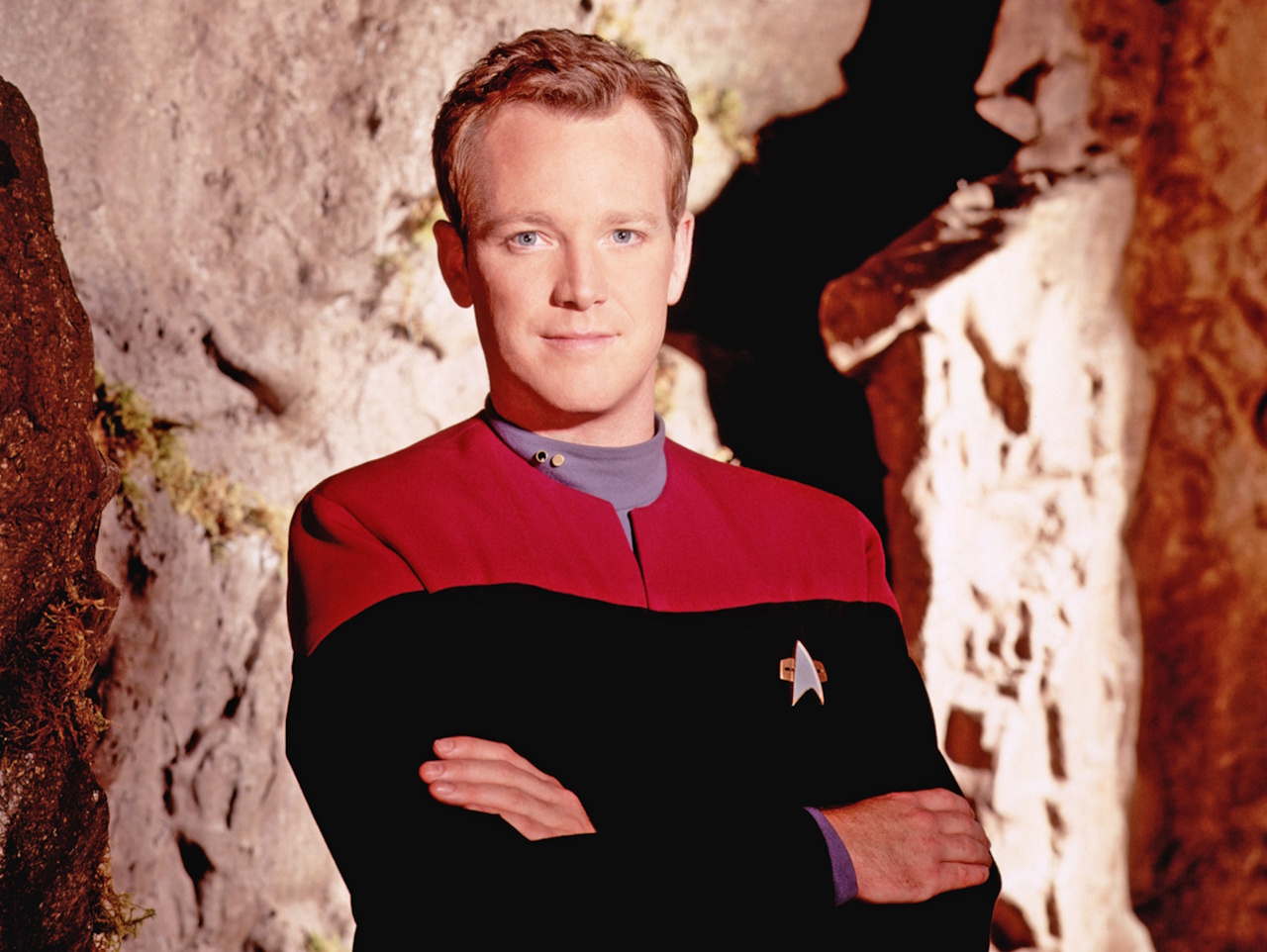
I’ve said this before, but Tom Paris was the Star Trek franchise’s first proper pilot – the first helmsman to really seem like he loved being in the chair. Paris was a fun character – an ex-Maquis and ex-Starfleet officer who seemed to attract the ire of both halves of the combined crew, but came to be seen as a dependable fixture on Voyager’s bridge. Paris’ arc took him from a failure and a criminal to a rehabilitated Starfleet officer and family man, and it was great to see it play out.

Promotional Photo of Robert Duncan McNeill as Tom Paris.
Tom Paris had a great character arc across Voyager’s run.

Paris’ love for the holodeck also led to some fun diversions across Voyager’s run. I was less enthusiastic about the likes of Captain Proton – though it could be fun for an episode or two – but his creations of Sandrine’s bar, the town of Fair Haven, and the Maquis insurrection holo-programmes all led to fun and exciting stories.

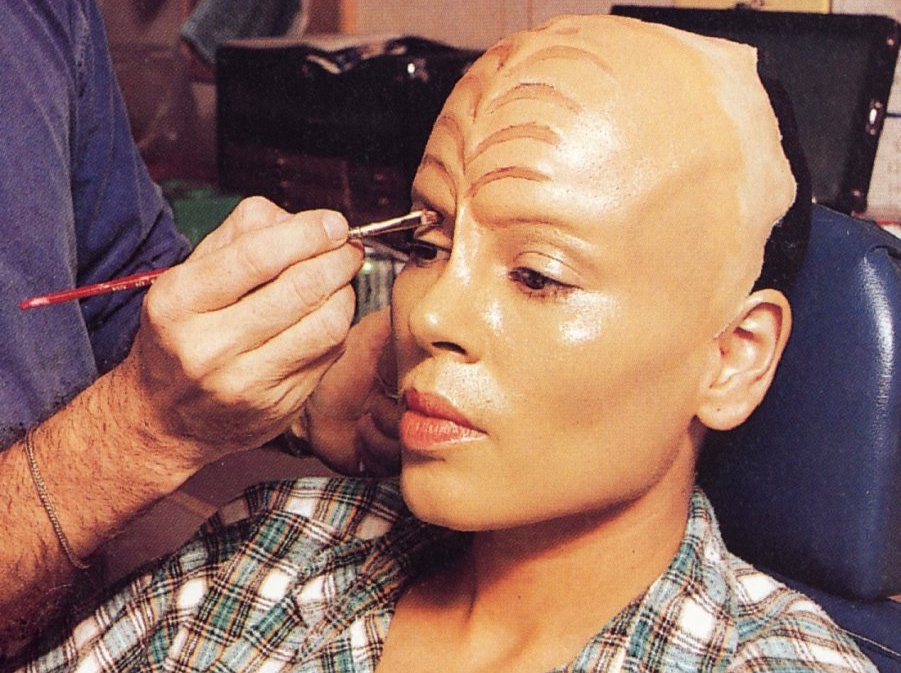
How can we talk about Tom Paris without mentioning B’Elanna Torres? Torres became – at Chakotay’s insistence – Voyager’s chief engineer, and had the challenge of standing out as both the second Maquis main character and (after Worf in The Next Generation) the second character with Klingon heritage. Voyager didn’t always know how to define and handle Torres, with some early episodes presenting her as angry and belligerent… but she soon settled into the role of chief engineer.

Behind-the-scenes photo from Star Trek: Voyager showing Roxann Dawson having her prosthetic makeup applied.
Roxann Dawson in the makeup chair.

B’Elanna, for me, is defined by two key relationships that would develop later in Voyager’s run: her antagonistic stance against Seven of Nine and her relationship and later marriage to Tom Paris. B’Elanna often stood as the voice of reason against Seven’s “Borg-ification” of parts of the ship, but her relationship with Tom went a long way to settling both characters down and giving them purpose. We’d also see several episodes featuring B’Elanna’s Klingon side – and these could be fun changes of direction for a show set thousands of light-years away from Klingon space.

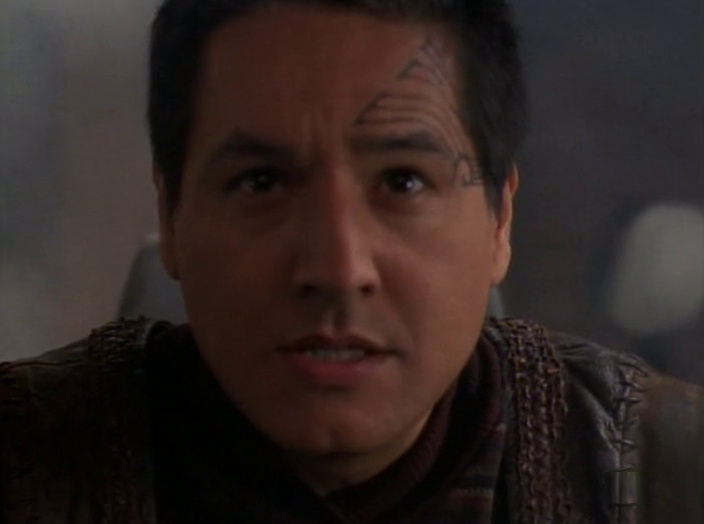
Chakotay feels like the embodiment of Voyager’s missed opportunities. Voyager’s writers never made good on the “one ship, two crews” idea, meaning Chakotay basically became a Starfleet officer and Janeway’s confidante within a couple of episodes, robbing him of more than one potential character arc. His relationships with most of the crew besides Janeway and B’Elanna were never really explored in much depth, and he just feels like… a presence. Chakotay was on the bridge the whole time, but can you think of many episodes where he drove the plot or was otherwise in focus? Because I can’t!

Still frame from Star Trek: Voyager showing Chakotay - the first shot of the series.
Chakotay was the first character we saw at the very beginning of Star Trek: Voyager.

I must get caught up with Prodigy, because Chakotay may get the kind of cathartic redemption arc that we were discussing with Seven of Nine, and that’s something I need to see! And across the show’s seven years, Chakotay did get a few spotlight episodes and storylines – notably exploring his Native American heritage and his relationship with Seska. I just feel there was more that Voyager could have done with this character – he was the first officer, after all, and it would be weird if the likes of Spock, Riker, or Major Kira had been similarly sidelined in their respective shows.

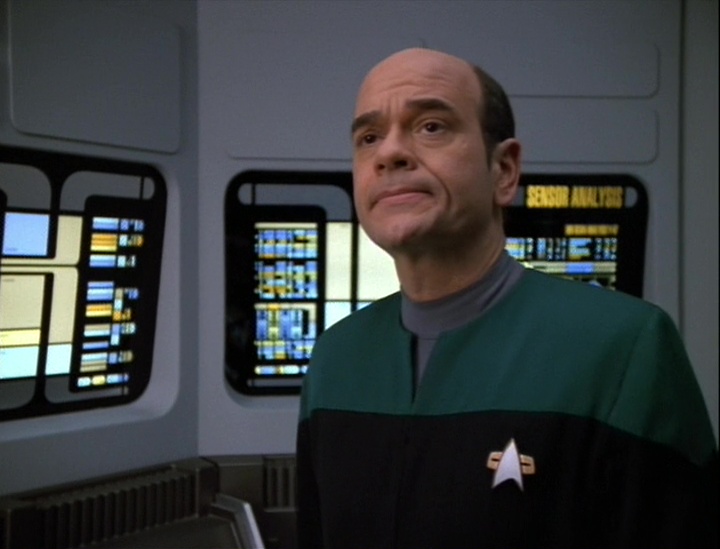
I remember feeling confused on learning that Voyager’s doctor was going to be a hologram! “How could that work?” I remember thinking to myself. “Exceptionally well” seems to be the answer, because Voyager’s Doctor was an incredibly fun character – and one who experienced growth over the course of the series. Starting out as a holo-programme with relatively little personality and no interests, the Doctor changed and evolved over the course of the show, taking on new challenges and new interests, and that was a really fun thing to see play out.

Still frame from Star Trek: Voyager showing the Doctor in sickbay.
The Doctor – the first holographic main character in Star Trek.

When the Doctor got his mobile emitter – a piece of 29th Century technology – in the third season, I was sceptical. But allowing him to leave the confines of sickbay and the holodeck turned out to be a great decision, leading to more involvement from this fun and enjoyable character across the second half of the show’s run. The Doctor could be great comic relief, and actor Robert Picardo has excellent comedic timing, but there’s much more to the character than that. We got some great emotional moments with him, too, such as losing his holographic family or sitting in court arguing for his rights as a sentient life-form.

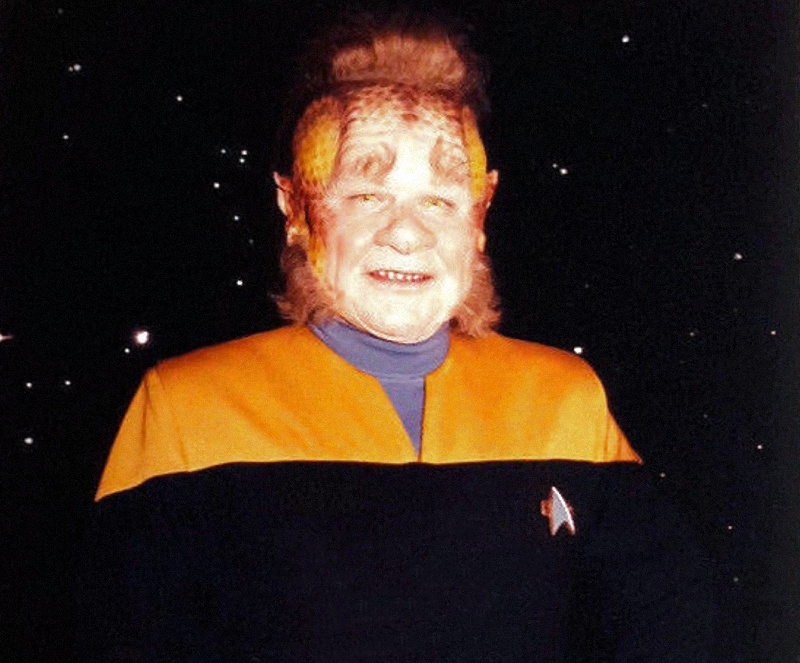
Speaking of comic relief, we have Neelix! Star Trek shows had had barkeeps before – Guinan in The Next Generation and Quark in Deep Space Nine – but never a cook. Neelix took broad liberties with that role, serving first as a guide to the area around Ocampa, then as a “morale officer” for the ship – while cooking up a selection of interesting dishes to feed a hungry crew! I bought a copy of Ethan Phillips’ Star Trek Cookbook and even tried a few of them for myself… with terrestrial ingredients, of course.

Promotional photo of Ethan Phillips as Neelix (in a Starfleet uniform for some reason).
A promo photo of Neelix… in a Starfleet uniform.

Neelix’s relationship with Kes could feel a little uncomfortable, but fortunately it wasn’t in focus all that much outside of a few early episodes. As Neelix settled in aboard the ship, he became an important character – and would often serve as a bridge between characters who didn’t always get much interaction. His largely one-sided friendship with Tuvok – though often played for laughs – was great to see, too, and showed Neelix’s way of accepting people different from him.

And speaking of Tuvok, Star Trek’s second Vulcan main character made quite an impact! Spock was always going to be a hard act to follow, but taking the calm and logical Tuvok as far away from science and exploration as possible was undeniably the right call. A Vulcan security and tactical officer makes a lot of sense when you stop to think about it – and Tuvok demonstrates exactly why. Calm and stoic under pressure is just what that job requires!

Promotional photo of Tim Russ as Tuvok.
Tuvok.

Tuvok also served as Janeway’s friend and confidante – arguably treading on the toes of the traditional first officer role, in that sense. I wish we’d gotten more of an examination of his relationship with Chakotay, though that’s more from Chakotay’s side, as mentioned above. Tuvok also bridged the gap between The Original Series era and Voyager in the most unexpected of ways – check out the episode Flashback, that I mentioned at the beginning, for more on that!

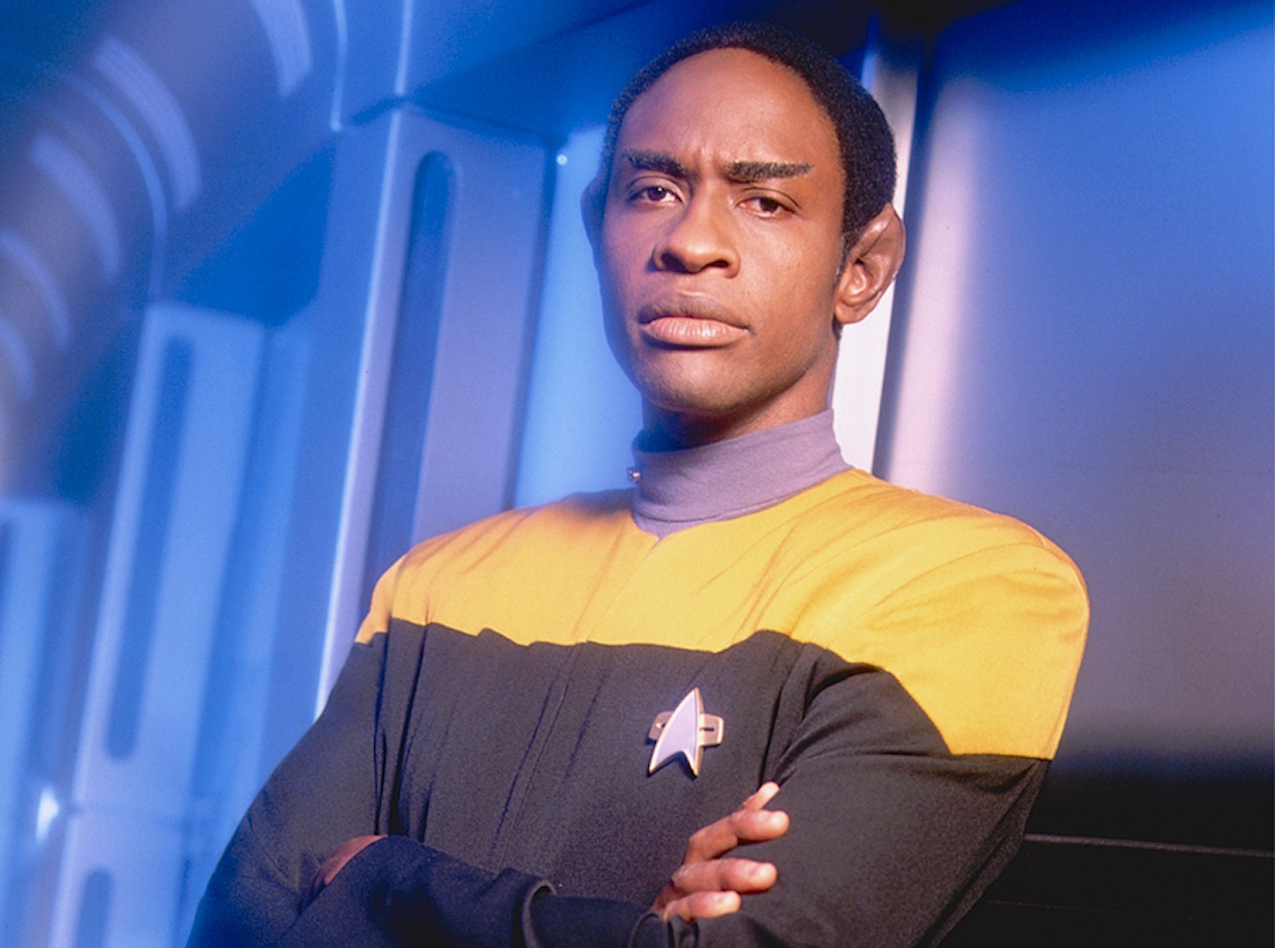
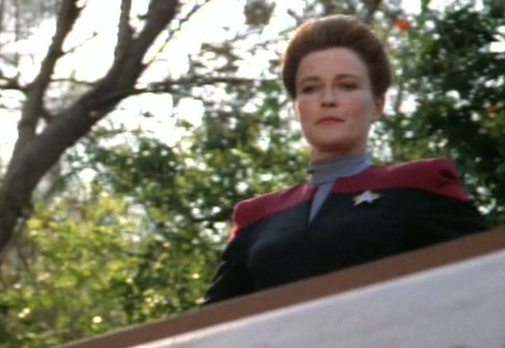
So that leaves us with Captain Janeway. Janeway was the captain that Voyager needed on a quest like this, and she had the strength to guide her crew home. She also had some fun character quirks, like her love of coffee, that kept her feeling grounded and real. The first woman to sit in the captain’s chair for a Star Trek series embodied elements of all three of her predecessors: Kirk’s toughness, Picard’s diplomacy and tact, and Sisko’s dedication to doing the right thing. But she was always her own woman, never feeling overshadowed by any of the captains that had come before.

Still frame from Star Trek: Voyager showing Captain Janeway at the penal colony in the premiere.
Captain Janeway in Caretaker.

As mentioned above, Kate Mulgrew was the perfect choice for this role, and she delivered a masterful performance across all seven seasons of the show. Voyager’s journey home wouldn’t have been the same without her, in fact, and across the show’s run we got several great episodes that shone a spotlight on the captain. Stories pitted her against villains like the Krenim and the Borg Queen, and Janeway always found a way to come out on top!

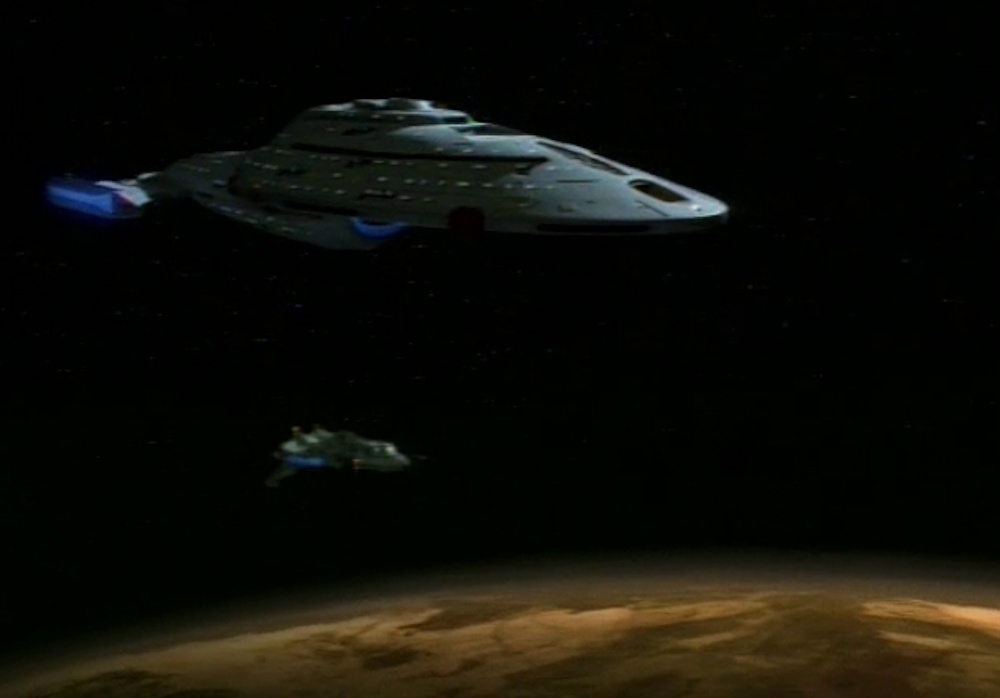
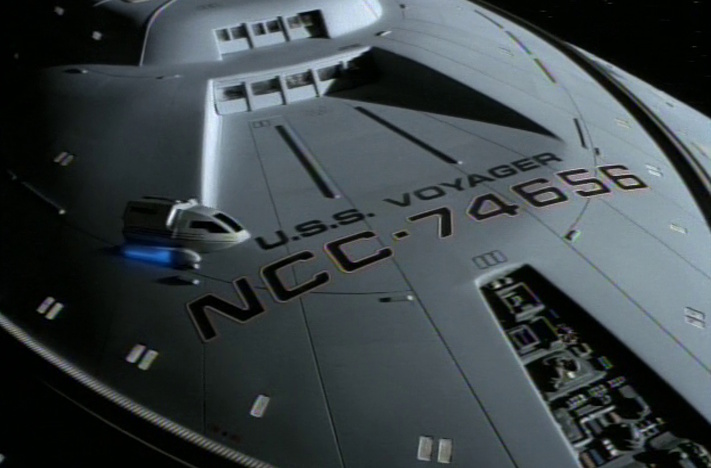
The USS Voyager still feels like a futuristic design to me even thirty years on from its debut! Something about the more angled saucer section makes it feel more modern than the circular hull of Kirk’s Enterprise and the Enterprise-D, and the sleeker lines also scream “speed!” Voyager was a long-range tactical ship made for exploration and combat, and the ship’s design philosophy reflects that. I will never tire of the sequence in Caretaker of Paris being flown in by shuttlecraft, seeing Voyager for the first time.

Still frame from Star Trek: Voyager showing a shuttlecraft flying over Voyager's saucer section.
Our first introduction to this wonderful starship.

On the inside, we got a continuation of the Starfleet aesthetic that debuted in The Motion Picture and has been a mainstay in the franchise since. Voyager’s bridge is larger and wider, though – or at least it feels larger and wider – than anything we’d seen before. This expansive space was the perfect stage for interactions between all of our favourite crew members! Again, the bridge felt more modern than that of the Enterprise-D, while at the same time continuing the design trends that we saw in The Next Generation.

Janeway’s ready-room was an interesting area, giving her a large desk but also a couch that could act as a social space. Engineering had a really neat effect for its warp core, and the expansive entryway was often where intense conversations played out. The Doctor had sickbay as his domain, but he also got an office and a small lab off to one side that were fun inclusions. Voyager also had a shuttlebay, holodecks, crew quarters, corridors, and the mess hall – all of which would get moments where they were in focus!

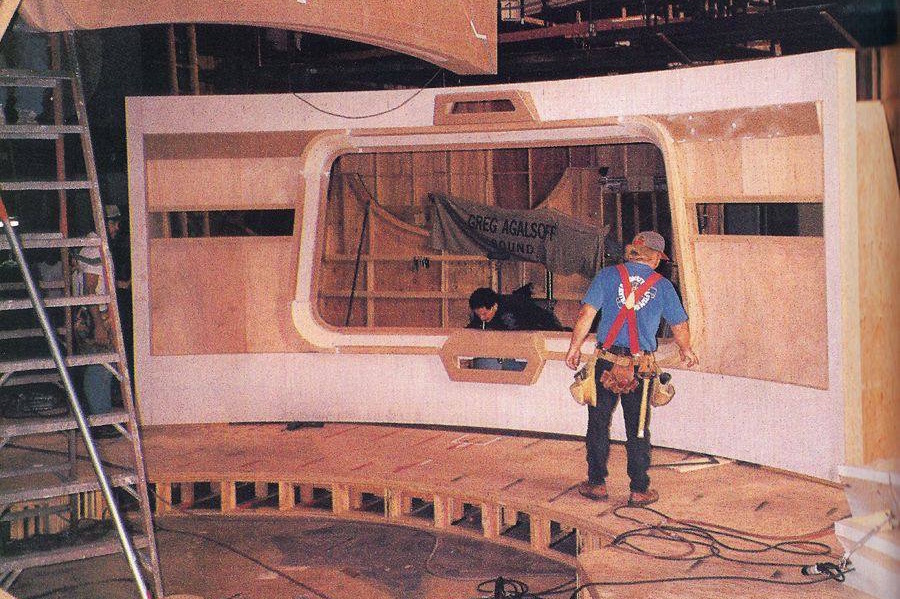
Behind-the-scenes photo from Star Trek: Voyager showing the bridge set under construction.
Voyager’s bridge set under construction circa 1994.
Image Credit: Forgotten Treks/TrekDocs

As an aside, being able to virtually explore Voyager in the game Elite Force was one of my absolute favourite things about that game! In 2000, being able to wander through the bridge, sickbay, and some of the ship’s corridors felt absolutely magical as a Star Trek fan, and while Elite Force wasn’t the only game to offer that experience (the adaptation of Generations had a mission set on the Enterprise-D, and there were probably others around the same time), it was certainly one of the most memorable for me personally.

One thing Voyager didn’t really have was an expansive secondary cast. Deep Space Nine gradually gave more time and attention to characters like Rom and Martok, but Voyager, by and large, kept its focus on its main cast of characters. The Borg children – and Icheb in particular – were really the only ones to break through in more than a handful of episodes, though some, like Seska and The Next Generation’s Reg Barclay, would go on to make multiple appearances. Deep Space Nine showed what Star Trek could do with a wider and more expansive cast… and it’s something the franchise has yet to return to. Voyager had the opportunity to build out some of its secondary characters, but never really went there. I think that’s a bit of a shame – but it is what it is!

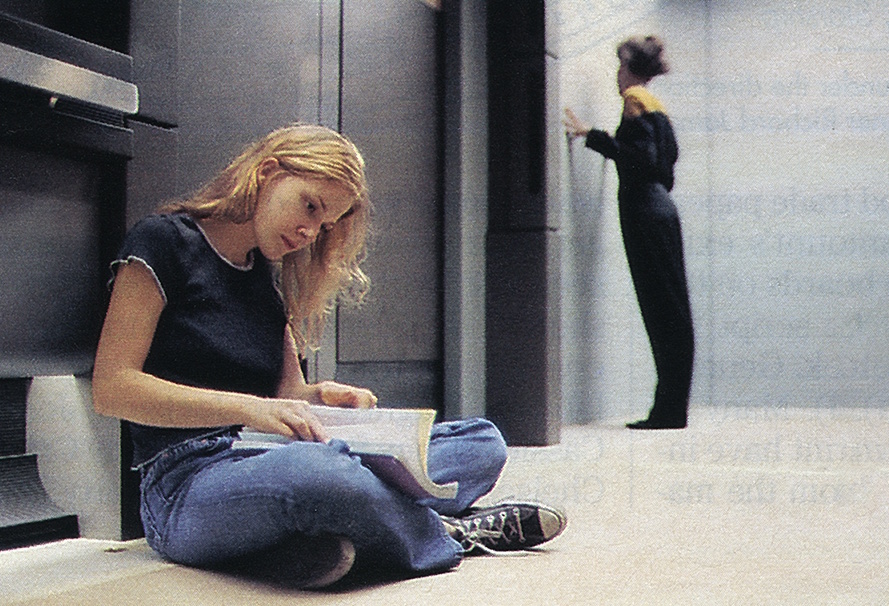
Behind-the-scenes photo from Star Trek: Voyager showing Jennifer Lien reading her script while sat on the floor.
Jennifer Lien (Kes) reading her script on the set of Caretaker.

For a variety of reasons, Voyager never really made good on its “one ship, two crews” idea, and by about halfway through Season 1, the main Maquis characters were basically entirely integrated with the Starfleet crew. With the exception of plot-relevant moments, such as stories involving Seska, the fact that almost one-third of Voyager’s complement were Maquis never really came to the fore in a big way, and I think that’s a bit of a missed opportunity.

Don’t get me wrong, a story about people from different backgrounds finding a way to work together for the common good is something I absolutely adore, and there were times where Voyager absolutely nailed that feeling. I guess I’ve just always felt that I would’ve liked to see more tension, scepticism, and disagreement as the two crews began the process of integrating. I never really felt as much of that as I would’ve liked – and that’s perhaps Voyager’s biggest sore spot for me, thirty years on.

Still frame from Star Trek: Voyager showing a Maquis rebellion (on the holodeck!)
Voyager struggled to make good on its “one ship, two crews” premise.

That being said, Voyager was a great show all around, and a welcome addition to Star Trek. With The Next Generation’s crew off making feature films and Deep Space Nine occupying a space station, there was plenty of room for a new series set aboard a starship. Voyager embodied Star Trek’s ethos of peaceful exploration… but set that exploration against a new backdrop of trying, against the odds, to make it home. It was both familiar and different at the same time; a really interesting blend of storytelling styles.

Voyager was also a much more episodic series than Deep Space Nine – despite its voyage home story being omnipresent and frequently referred to. There were plenty of one-off stories featuring a wide range of alien races, factions, and wacky premises. It was a Star Trek series through and through, one that brought a fantastic cast of characters to the table and threw them into plenty of fun, exciting, and occasionally emotional situations.

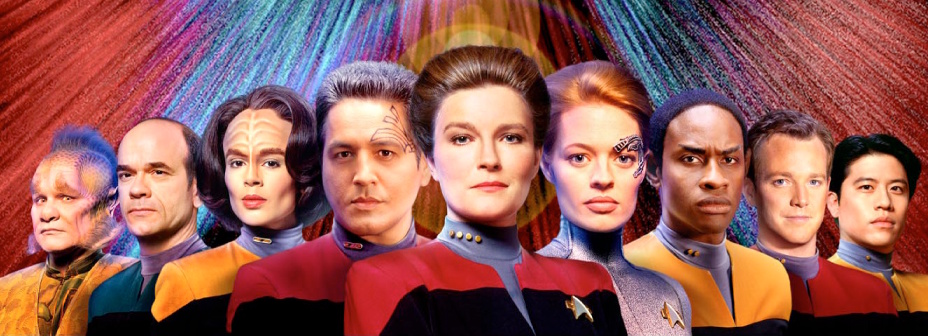
Promotional image of the Star Trek: Voyager cast.
The cast on a promotional poster.

The excitement I felt thirty years ago was more than rewarded! Voyager was an outstanding show, and I got thoroughly invested in the crew and their quest to return to the Alpha Quadrant. There were some episodes that were wide of the mark – as there are bound to be in any show that runs to 168 episodes across seven seasons! But even at its worst, there were things to enjoy, fun lines of dialogue, entertaining character moments, or creative decisions that made Voyager well worth watching for any Trekkie or fan of sci-fi in general.

As the final show of what I consider to be Star Trek’s “golden age,” I’ve long had a soft spot for Voyager. Of course I watched every single episode during the show’s run – I would tune in when they made their debut on terrestrial TV here in the UK, and I very rarely missed a week. I later bought all seven seasons when they were released on DVD and enjoyed the series all over again.

Still frame from Star Trek: Voyager showing the USS Voyager preparing to jump to warp.
The USS Voyager set course for the Alpha Quadrant thirty years ago today.

So I hope this has been an interesting look back! I wanted to do something to acknowledge Voyager’s milestone anniversary, but it’s hard to summarise my thoughts on 168 episodes and seven years’ worth of television in a single article! Stay tuned, though, because I’ll be writing up my thoughts on some of my favourite episodes in the days ahead as we continue to celebrate Voyager’s thirtieth anniversary.

I hope that Paramount and the folks in charge of Star Trek plan to do something to mark this momentous occasion, so I’ll definitely be checking out the official Star Trek website and social media pages over the next couple of days. With Seven of Nine, Janeway, Chakotay, and others all having returned to the Star Trek franchise in the last few years, Voyager’s legacy is very much alive. The documentary To The Journey: Looking Back at Star Trek: Voyager has had its official premieres, too, though I don’t think it’s available to stream just yet. Still, another thing to keep an eye on.

All that remains to say is this: happy thirtieth anniversary, Star Trek: Voyager! Thanks for all the memories.


Star Trek: Voyager is available to stream now on Paramount+ in countries and territories where the platform is available. The series is also available on DVD. The Star Trek franchise – including Voyager and all other properties discussed above – is the copyright of Paramount Global. Some images courtesy of TrekCore and Paramount. This article contains the thoughts and opinions of one person only and is not intended to cause any offence.
Star Trek: Voyager re-watch – The Haunting of Deck Twelve

Spoiler Warning: There are spoilers ahead for Star Trek: Voyager, Star Trek: Picard, and for other iterations of the Star Trek franchise.

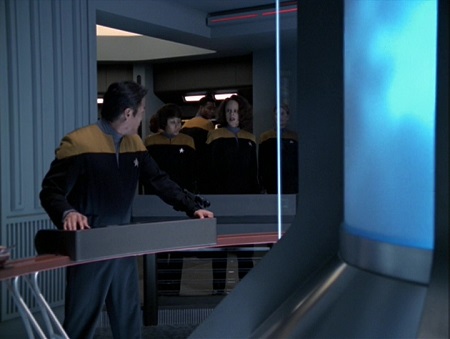
Happy Halloween! With the scariest day of the year upon us, I thought it could be fun to delve into Star Trek’s spooky side for a change! The Haunting of Deck Twelve was the penultimate episode of Voyager’s sixth season, and premiered in the United States on the 17th of May 2000. It’s framed as a campfire ghost story, with Neelix recounting the supposedly-true story of spooky goings-on aboard the ship to the Borg children: Icheb, Mezoti, Azan, and Rebi. Naomi Wildman, the USS Voyager’s other child, is conspicuously absent.

When it was announced earlier this month that Kate Mulgrew will reprise her role as Captain Janeway in the upcoming animated series Star Trek: Prodigy, I wanted to write up a Voyager episode here on the website. Despite being up and running for almost a year now I haven’t done so, though I did pick out ten great episodes from the series. Voyager is, to many fans, a less-favoured series than The Next Generation or Deep Space Nine, and can sometimes feel like an also-ran among Star Trek’s canon. However, I definitely feel that the show got a lot of things right, had some excellent characters, and told some unique and interesting stories. Many of Voyager’s alien races were different from what we’d seen before (due to the Delta Quadrant setting) and have yet to be revisited in any detail.

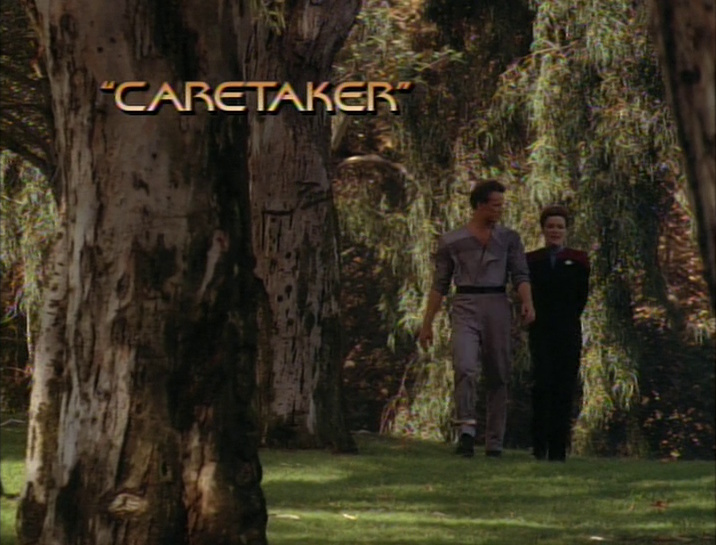
The episode’s title card.

Voyager is certainly a series I enjoy. I find ranking the different Star Trek shows very difficult, because each one really brings something different to the table. Voyager is comparable in many ways to The Original Series and The Next Generation in that it’s set aboard a moving starship and the crew routinely conduct missions of exploration. However, its overarching story of the ship being stranded a long way from home makes it something different. Not every aspect of Voyager was perfect – the “one ship, two crews” storyline never really took off, and in later seasons especially, I found Seven of Nine to be a pretty boring, flat character – but as a series it tried to do some different things and succeeded in telling some excellent stories.

Is The Haunting of Deck Twelve one of them? Well, that’s an interesting question!

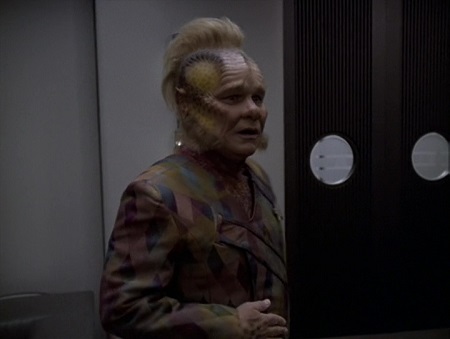
The episode begins with a beautiful shot of the ship in flight. The usual inspiring musical score immediately sours, however, and we get a horror-style minor chord sting as the camera fades in to Neelix in an empty mess hall. Neelix walks around looking concerned – an expression that can’t be easy to convey under such heavy prosthetic makeup – and nervously straightens a chair before turning out the lights. He’s then startled by Seven of Nine as he turns to leave, and tells her he’s feeling jumpy “after what happened last time.” A suitably mysterious line!

A nervous Neelix prepares to leave the mess hall.

Seven explains that main power will soon be shut down, interrupting the Borg children’s regeneration (remember that Borg don’t “sleep,” but rather regenerate in alcoves) and she wants Neelix to keep them company. This is the setup for the frame narrative that much of the rest of the episode would use.

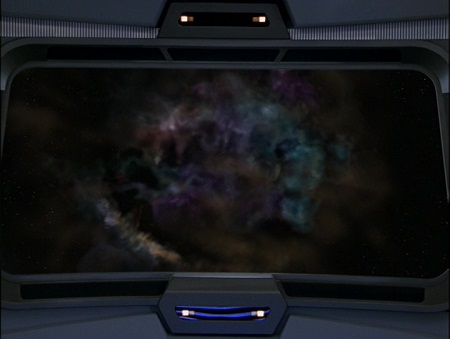
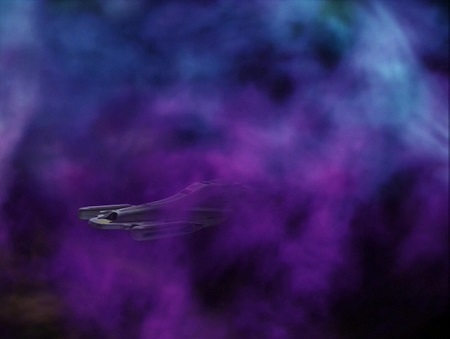
On the bridge we get a comparatively rare example of a starship powering down its engines and using inertia to continue moving. In Star Trek, ships at warp don’t seem able to do this (presumably for reasons related to subspace) but there’s no reason why a ship traveling at sublight speeds shouldn’t be able to fire its engines and then coast! Yet for some reason it isn’t mentioned very often. As Voyager drifts toward a nebula, Tom Paris and Harry Kim comment on its spooky appearance; the nebula is depicted in shades of brown, orange, purple, and blueish-grey, but I wouldn’t have said it looks any more frightening than any of the other nebulae the ship has visited. Perhaps the officers’ overactive imaginations (which Tuvok is happy to point out) stem from the fact that they know what’s coming. As the audience, we still don’t!

The nebula on Voyager’s viewscreen.

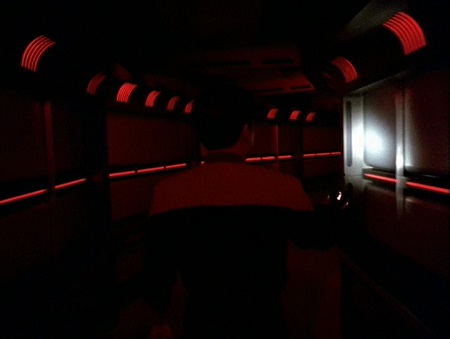
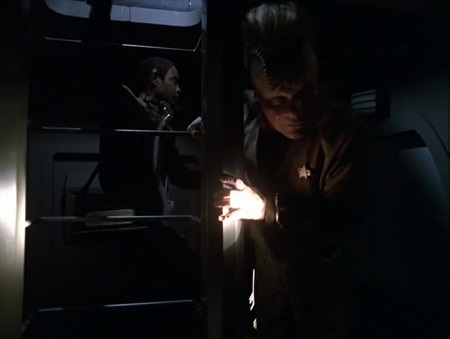
Harry confirms that the ship is ready – and we soon see what for. Main power is deactivated ship-wide; the bridge goes dark, a corridor soon follows, and the Doctor deactivates himself in sickbay. The shot of two background crew members in the hallway was particularly well put together. Filmed from a low angle, the lights in the hallway went out in sequence, and the pair of officers then activated their wrist-mounted torches. Seven of Nine’s astrometrics lab goes dark too, save for a single computer panel on the wall. Seven was oftentimes a rule-breaker, and on first viewing I wondered if she had unilaterally decided her work was too important to stop!

In the cargo bay, Neelix greets the Borg children as they’re shocked awake by the shutting down of their Borg alcoves. And it was my first time seeing Icheb since his reappearance in the episode Stardust City Rag from Star Trek: Picard Season 1 earlier in the year. In main engineering, Torres and the crew shut down the warp core, presumably completing the process of turning off everything aboard the ship, which is now illuminated only by wrist-mounted torches and lanterns. Spooky stuff.

B’Elanna Torres and her team switch off the warp core.

There are many things we can consider iconic within Star Trek, and for my money the warp core is absolutely one of them. The concept of the warp core as an upright glowing column first appeared in Star Trek: The Motion Picture in 1979 and has carried through the franchise in some form ever since, even reappearing in Lower Decks and Short Treks. Though the way this vital piece of technology functions has always been deliberately ambiguous, its design and aesthetic are emblematic of Star Trek, and when you see a warp core you know you’re aboard a Federation starship.

Back on the bridge, Harry confirms every deck is without power. Janeway signals Seven of Nine with the cryptic message “we’re ready.” And after a neat shot of the unpowered ship coasting into the nebula – which suddenly appears a much brighter shade of purple than it had on the viewscreen – the opening titles roll.

Is this the same nebula we saw a minute ago?

Voyager followed on from Deep Space Nine in having a slower-tempo, softer theme. The themes for The Original Series and The Next Generation were upbeat, representing the excitement of adventure and exploration. Voyager’s stands in contrast to that, but is nevertheless a beautiful piece of music in its own right. The title sequence itself is a representation of the long journey the ship and crew will take; no one scene lingers, and Voyager moves past different planets and nebulae before going to warp.

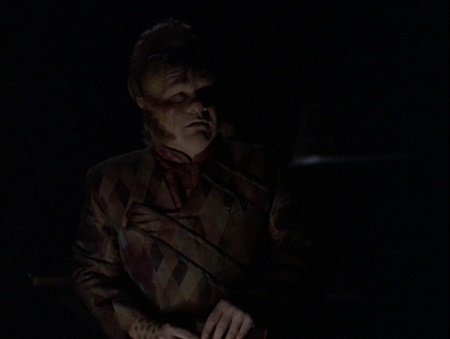
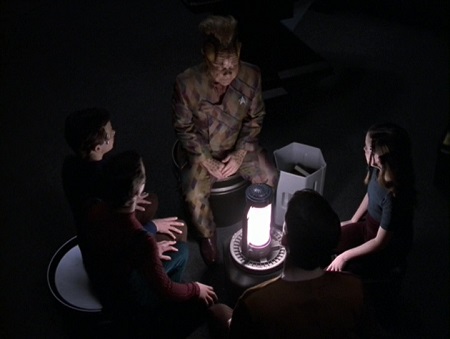
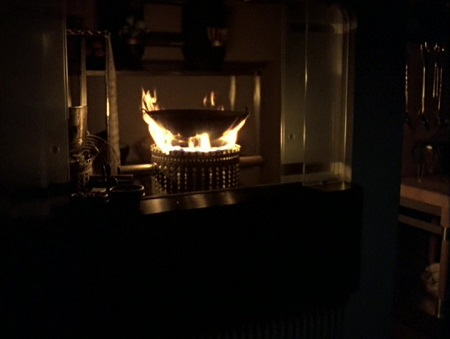
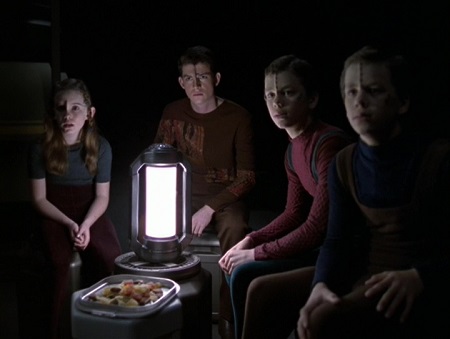
When the action resumes we’re back in the cargo bay with Neelix and the kids. Icheb immediately demands to know about the loss of main power, and seems dissatisfied with Neelix’s explanation. Neelix tries to distract the kids with various campfire supplies, but they aren’t buying it. The way this scene was set up and shot was clever; there’s only one light source (a lantern) which serves as the “campfire” analogue, leaving the rest of the cargo bay in darkness. There’s just enough light to illuminate Neelix and the kids, but that’s all.

Neelix in the cargo bay.

Icheb insists that Neelix be more forthright about what’s happening, and Mezoti asks if what’s going on is related to deck 12, which she has heard is haunted. It’s clear that, with part of the deck under lockdown and inaccessible without a high security clearance, something is going on!

After very little persuasion, Neelix relents and agrees to tell the kids about what’s happening and how it connects to deck 12. In a way, this is just as cathartic for him as it is for them, as he’s nervous about Voyager’s mission to the nebula. And I think we get a showcase in how great a character Neelix can be in episodes like this. Though the “one ship, two crews” concept never really worked in Voyager, as the Maquis had been wholly assimilated into the Starfleet crew even as early as the first season, Neelix always stood apart. At times he would bend the rules because he isn’t from a Starfleet background, and here, with the kids, he’s quite happy to go against what he was asked to do and tell them a story about what’s going on.

Sitting around the “campfire.”

We get a “Borg take things too literally” joke when Neelix tells the kids that the story isn’t suitable for “the faint of heart,” which was funny. Contrary to what some folks wanted to tell you in the run-up to the release of Star Trek: Lower Decks earlier in the year, the franchise has always had these moments of humour. And this one was on point – even if the “Borg takes things too literally” joke was generally overdone on Voyager thanks to Seven of Nine!

As the children insist Neelix tell them everything, he gives them a final warning that it’s a spooky story! It all began with a routine deuterium-collecting mission to a nebula several months ago… and thus begins the bulk of the episode, told in flashbacks with occasional narration from Neelix, who seems more than happy at the chance to tell a story!

Neelix and Tuvok in a flashback.

Neelix tells Tuvok that he’s concerned about “crew morale,” despite Tuvok noting that the crew in the mess hall seem perfectly fine. Neelix wants to know how long the ship will be in the nebula – so he can reassure everyone else, of course. Tuvok, very perceptively, realises that it’s Neelix who’s on edge, and his suspicions are confirmed when Neelix seems to snap at him in the middle of the mess hall. Clearly the stress of the nebula has been getting to him.

It will take days before the deuterium collection work is finished, though, and all Tuvok can suggest is that Neelix put up some curtains. A truly helpful and empathetic response from Voyager’s resident Vulcan! Neelix seems happy with this, however, and dashes off to find some material with which to make curtains.

Tuvok speaks with Neelix in the mess hall.

Meanwhile on the bridge, the turbulence is getting worse. Harry suggests to the captain a technobabble explanation for why the nebula is “destabilising,” and then we get a jump-cut back to Neelix and the kids in the cargo bay. Icheb accuses Neelix of misleading them on the specifics, noting that “bussard collectors do not emit nadeon emissions.” Neelix tells him that the specifics aren’t important to the story – and we have another part of the setup, the “unreliable narrator.”

Using this term might be a bit of a stretch, but it’s important for the remainder of the story. Neelix’s recollections are imperfect, and while the main thrust of the episode’s narrative is ultimately revealed to be true, it’s not unfair to think that Neelix has embellished certain other elements for the sake of storytelling! I liked the way this was set up, and for a story with a frame narrative like this one, it works really well.

Neelix’s recollection of what Harry Kim said was not accurate – according to Icheb, at least.

Neelix wasn’t on the bridge during this moment, so how could he have known everything that was said? Again, this is something we’ll keep in mind during any scene where Neelix isn’t physically present! As Neelix prepares to hand out a plate of snacks to the kids in the cargo bay, we jump back to the action on the bridge.

A minor inconsistency, perhaps, as Janeway contacts Torres to tell her they’re going to stop the “dilithium” collection – not deuterium, which is what everyone else had been talking about – but this could simply be another of Neelix’s misremembrances. Before the ship can successfully leave the nebula, however, it’s struck by some kind of electrical discharge! The kids pipe up, asking if this was the ghost.

Voyager is zapped!

On the bridge, the crew report minor damage and some power outages, but nothing serious and no injuries. Voyager resumes its course having harvested as much dilithium/deuterium as it could, and everyone seems to think that they got away with it. However, as Neelix explains, the ship had picked up a “mysterious stowaway.” At the same time, we see a CGI rendition of the ship leaving the nebula, complete with a glowing ball of lightning that slips through the hull – just like a ghost would!

The late 1990s and early 2000s weren’t a great time for CGI. However, on the small screen it looks a lot better – or at least less bad – than it does in some big-screen productions made around the same time. I’m looking at you, Star Wars prequels. Star Trek had been experimenting with CGI since The Next Generation was on the air, and while I’d absolutely love nothing more than for Voyager to be properly remastered, which would include redoing almost all of these CGI effects, I have to admit that it doesn’t look too bad here.

The stowaway.

The kids ask a bunch of questions about the stowaway, and Neelix confirms that it was a space-dwelling creature. However, they keep trying to press him to tell what exactly the life-form was, but when offered the choice between debating what the creature was and resuming the story, the kids ultimately choose – after exchanging glances – to continue with the story. Thank goodness, I want to know how it ends!

After leaving the nebula, Voyager begins to suffer some unusual malfunctions. Chakotay reports to Captain Janeway some of the damage done by the “zap” as the ship escaped the nebula, including the loss of artificial gravity on one deck. That would’ve been fun to see! We so rarely see a loss of gravity on Star Trek – due, of course, to the practical difficulties in filming such a sequence. The artificial gravity systems aboard a starship are invariably the last things to fail even when every other system is compromised, so for it to have been damaged here is, I would argue, a major issue.
Chakotay in the captain’s ready-room.

As Chakotay explains his findings, the captain’s replicator malfunctions, and I just love Janeway’s nonchalant response as she tells Chakotay he can “add replicators to [his] list.” Even when annoyed she manages to be in control, and I have no doubt she’ll make a great captain in the upcoming series Star Trek: Prodigy.

As Janeway speaks to the ship, Chakotay tells her that he used to have similar chats with his Maquis vessel – something I think we saw him do in Caretaker, the series premiere. Either way, it was a fun acknowledgement of Chakotay’s Maquis past. Chakotay didn’t get many scenes, let alone stories of his own, during the latter part of Voyager’s run, so it was nice to see him here alongside Captain Janeway. Though he lost his Maquis side pretty quickly as the show got going, he found a role as Janeway’s older and more seasoned advisor, as well as her moral compass. Those roles suited him. Looking out the ready-room window Janeway spots a meteorite cluster – and thinks it’s the same one Voyager has already been past. Is the ship now flying in circles?

Chakotay and Janeway spot the meteorites.

Not to nitpick, but technically a “meteorite” is something that falls to Earth, not something in space! On the bridge, Tom Paris insists the ship hasn’t been traveling backwards or in circles, yet the presence of the meteors suggests otherwise. Tuvok runs a (very fast) diagnostic that reveals a problem – Voyager is heading back the way it came.

As the captain orders an all-stop, Paris begins to launch into a speech about how the ship relies too much on sensors and technology. Before he can say too much, however, the warp engines activate by themselves and can’t be shut down. The malfunctions suddenly get a lot worse. The communications system goes down. The computer, when asked to locate B’Elanna, lists the locations of every officer aboard the ship, and Chakotay’s turbolift to engineering takes him to the mess hall instead.

Tom Paris at his post – just before the warp engines malfunction.

As Chakotay steps back into the turbolift and, once again, asks it to go to engineering, we get a rare look inside the turbolift shaft. As Neelix explains in a voiceover that the turbolift was falling, we see a neat CGI sequence of the turbolift itself, including the inside of the turboshaft, complete with horizontal tubes. This is a rarity, and for us nerds, a bit of a treat to catch a glimpse of the inner mechanisms of one of the franchise’s staple technologies.

Chakotay’s turbolift inside the turboshaft.

Another jump-cut back to the cargo bay sees Neelix teasing the kids by pausing his story, offering them snacks. Mezoti informs him that “snacks are irrelevant!” and insists he continue the story. I loved this line, it was very “Borg,” but also a typical reaction from a little girl who wants her story. Not to mention that it was funny.

Here I think we see the frame narrative working well. The story of the malfunctions is interesting, as is the idea of a nebula-dwelling life-form, but Neelix and the kids give the episode a kind of light-hearted brevity that stands in contrast to the serious goings-on, yet somehow works really well.

“Snacks are irrelevant!”

The frame narrative also allows The Haunting of Deck Twelve to still tell us as the audience about some dramatic events – like Chakotay being pinned to the ceiling of the turbolift as it fell – but without having to go to the expense of filming them! Chakotay storms into engineering, but B’Elanna says she’s pinpointed the problem and is on her way to fix it.

Crewman Celes – who appeared in Good Shepherd a few episodes previously – makes a welcome return. One thing Voyager lacked was a Deep Space Nine-style secondary cast, yet its “lost in space” narrative would have allowed for that. Some background officers like Vorik, Chell, and Carey got to make repeated appearances, but none had a major impact on the story in the same way as Deep Space Nine’s secondary characters did.

Crewman Celes with Seven of Nine.

Seven of Nine accuses Crewman Celes of causing a power failure, despite her having only just opened a panel. It was clear, despite Seven’s rush to judgement, that this was connected to the ongoing malfunctions aboard the ship. Seven of Nine presses a few buttons on the exposed panel, and the lights in the hallway begin to flicker.

Chakotay and B’Elanna have arrived at their destination – some damaged gel-packs. Voyager uses “bio-neural circuitry” in its systems, something that was set up way back in Season 1. These systems are supposedly faster and more reliable, but more difficult to replace. The aesthetic used for the gel-packs – which are a neon blue colour – was pretty neat, and I think still holds up today as a fun and suitably futuristic piece of technology.
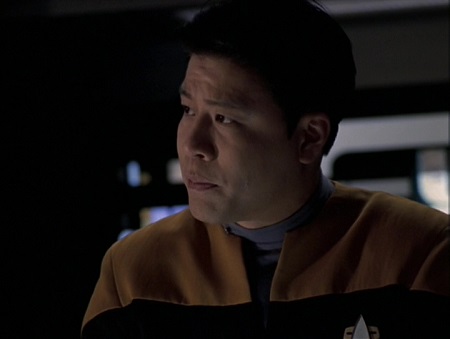
The gel-packs.

The problem has “jumped” from one set of gel-packs to another, this time near Seven of Nine’s cargo bay 2. With no communications, Neelix explains in voiceover, B’Elanna and Chakotay couldn’t contact her to warn her something was going on! As the camera focuses in on Seven, who is working at her console in the cargo bay, the mysterious stowaway appears to materialise behind her…

Seven of Nine and the nebula life-form.

The Borg kids are shocked and alarmed – this was happening in this very cargo bay! Mezoti once again insists on Neelix telling the rest of the story, and shuts down Icheb when he tries to interrupt! The life-form jumped into the Borg alcoves near to Seven of Nine, and then released a strange gas into the cargo bay; gas that looked a lot like the nebulae we’ve seen!

Unable to escape the cargo bay – as forcefields have been set up outside the main doorway – Seven is trapped and begins to choke on the gas. The lantern in the cargo bay suddenly goes out, just as the kids are beginning to get excited and anxious about the story and what happened to Seven of Nine. Neelix is able to fix it easily – I wonder if he did that on purpose!
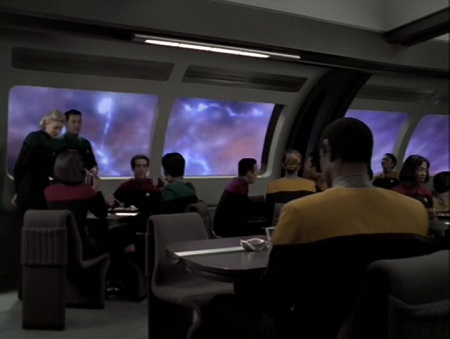
Seven of Nine chokes on the gas.
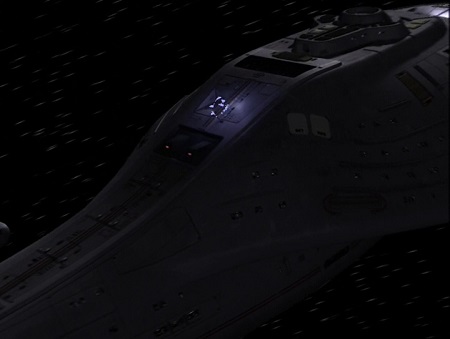
Chakotay and B’Elanna arrive just in the nick of time, and after phasering the forcefield control panel manage to get Seven of Nine to sickbay. Malfunctions increase across the ship, including in the mess hall where Neelix is cooking and Harry Kim is having a meal.

Kim – despite being just an ensign – orders everyone to report to their stations. The lights continue to flicker, and Neelix nervously asks if he can tag along with Harry. However, Kim reminds him that the mess hall is his post before departing, leaving a nervous Neelix alone in the mess hall – as the lights go out.

Neelix and Harry.

Neelix says to the kids that Voyager was “dead in space,” though gravity and life-support still seem to be working! The bridge is overheating, and we got a cute moment with Paris and Tuvok as the latter explains the Vulcans don’t sweat unless the temperature reaches a staggering 350°K – about 77°C or 170°F.

Following the earlier scene with Chakotay in the ready-room, Captain Janeway once again tries talking to the ship. This time, she offers to make a deal, a maintenance overhaul in exchange for no more malfunctions! I like this side to her character; it took a serious story but gave it another light-hearted aspect that I think worked well in conjunction with Neelix’s frame narrative.

Janeway tries to bargain with Voyager.

Her bargaining seems to have worked – helm control has been restored! But as soon as Paris steps up to the console to plot a course he’s zapped by an energy discharge – leaving him with some nasty-looking burns. As Janeway and another bridge officer try to help Paris, the bridge is suddenly deprived of oxygen and they must all evacuate. The practical makeup effects for Paris’ burns were gruesome – and come as quite a shock.

Paris is brought to sickbay – where it seems that injuries are becoming a problem across the ship. The Doctor immediately diagnoses Paris as the victim of an EM surge, similar to the electrical discharge that struck Seven of Nine when she was trapped with the nebula gas. Standing around Tom’s bio-bed, Seven, Chakotay, B’Elanna, the Doctor, and Captain Janeway come to a typical Star Trek realisation – there’s an alien intelligence at work.

The group in sickbay.

The alien is trying to use Voyager’s systems to make an environment for itself – just like the nebula. And it’s attacking anyone who tries to interfere or undo its work, as all of the crew it’s hit have been doing precisely that. I called this a “typical Star Trek revelation” because it’s not uncommon in the franchise when something unusual or unexplained happens for the reason to ultimately be “life, Jim, but not as we know it!” That line, by the way, was used in the song Star Trekkin’.

The Doctor suddenly goes off-line (though no one seemed to move when Janeway ordered his programme to be transferred to the mobile emitter) and power fails in sickbay. In voiceover, Neelix explains how power was failing across the ship, deck by deck. In a dark hallway, lit only by the intermittent red alert/emergency lights, Harry Kim gets a scare – and so do we! It turns out he’s just bumped into Crewman Celes, and neither of them know what’s happening. This sequence was very atmospheric, with the intermittent red lights and Harry’s wrist-mounted torch being the only sources of illumination. It felt very eerie, and meant that when Celes appears, it’s hard not to jump even if you know what’s coming!

Harry in the dark hallway.

Celes starts rambling about Borg and Hirogen and the ship being under attack, and Harry tries his best to calm her down. The two set off for engineering, where Kim assumes the captain will have set up a command post due to the environmental failure on the bridge.

Neelix, meanwhile, has been stuck at his post in the mess hall. He’s lit a fire under one of the pans which provides some additional light alongside his torch, and we hear the doors hiss open. This music across the episode has been fantastic, horror-inspired and very atmospheric. Here it reaches another high, adding tension to an already-tense moment as Neelix looks around the deserted mess hall.

The Haunting of Deck Twelve uses light in imaginative ways to build tension.

As Neelix exits the mess hall, with no one answering his calls, he sees the source of the noise: a malfunctioning door opens and closes repeatedly at the end of a hallway. This shot was another that builds up that sense of fear; Neelix is all alone, and I think many ghost stories have some kind of door opening or closing of its own volition, meaning the episode plays off that trope. It was very spooky indeed!

When Tuvok wordlessly appears behind Neelix as he investigates the door, all of the tension from the mess hall through the hallway scene boils over, and we get the second of two jumpy moments! Tuvok has come to the mess hall to evacuate Neelix, and is wearing some kind of portable oxygen mask. Neelix admits to the kids that he was very frightened as he and Tuvok must crawl through the jeffries’ tubes and descend eight decks to make it to the captain’s command post.

Tuvok in his mask.

In a break from the flashbacks, Neelix gives the kids a lesson in fear. Icheb tells him he shouldn’t be afraid, but Neelix retorts that fear can be good thing – keeping people safe. For kids especially, I think this is a very important message. Not only because it shows that it really is okay to be scared and that everybody gets scared sometimes, but that there’s nothing to be ashamed or embarrassed about with showing fear. Fear, as Neelix rightly says, can be useful, and it’s an important emotion. The Borg kids need to know this as they rediscover their emotions, but many of Star Trek’s younger viewers would do well to remember this too!

After Mezoti elaborates on her first experience with being afraid, Neelix gets back to the story. Aside from Collective, the episode which introduced us to the Borg kids, I’d argue that The Haunting of Deck Twelve is one of the most important for their development, particularly as they wrangle with the feelings and emotions they have after being disconnected from the Borg collective. This is precisely for the reasons we discussed – learning to show and handle emotions is vital. In the flashback, Neelix tells the kids that he was stuck with only Tuvok for company.

Tuvok and Neelix on their journey.

Neelix attempts to make small-talk, but Tuvok isn’t having it. While crawling through the tubes, Neelix begins to tell a story-within-a-story: that of a Talaxian ship that similarly underwent a systems failure, leading to the crew drawing lots to see who would survive. Mezoti and Icheb pipe up, wondering what the bodies of the dead Talaxians looked like, and whether they resorted to cannibalism, before Neelix resumes his story. This moment definitely felt like “ghost stories around the campfire” in the way the episode was going for!

Neelix and Tuvok encounter a jeffries’ tube slowly filling with nebula gas and can’t progress any further. Tuvok opens a panel and plans to vent the gas – but we know that anyone doing so has been attacked! There is an alternate route, but Tuvok says it will take hours to reach engineering that way. I was still nervous for Tuvok as Neelix jumps the story to engineering…

Tuvok attempts to use environmental controls to vent the gas.

In main engineering, Harry expresses regret at leaving Neelix in the mess hall. The nebula life-form has gotten into the main computer, and is now unable to be contained. However, the life-form uses the communications network to contact the captain. She responds to its attempts to communicate, assuming the life-form has learned how to use the systems to communicate.

Using the ship’s computer, the life-form summons the captain to astrometrics, and it’s worth taking a moment to remember Majel Barret-Roddenberry, who was the voice of Starfleet’s computers from The Original Series all the way through The Next Generation era and even up to 2009’s Star Trek. She was the wife of Gene Roddenberry, Star Trek’s creator, and has almost certainly appeared – in voiceover form – in more Star Trek episodes than anyone else. Here, as the life-form attempts to communicate, it’s her voice it uses.

Janeway decides to go to astrometrics.

Despite Chakotay’s concern about a trap, Janeway proceeds to astrometrics. There isn’t much of a choice, as the alternative appears to be letting the life-form take over the ship. Back in the jeffries’ tube, Tuvok works on the panel while attempting to calm Neelix down. We get a flashback-within-a-flashback, as Neelix remembers with fondness his birthday party.

However, the memory turns sour as Neelix imagines himself attacked by the nebula gas! This was another well-executed deception, taking what should have been a safe moment for Neelix, and for us as the audience, and turning it into something scary. I loved the visual before that moment as Neelix sat down with the crew all around him. He clearly has great fondness for all of them – and they for him.

Neelix’s birthday dinner.

Tuvok jumps as Neelix yells out, and the kids ask what happened. In astrometrics, the life-form points Janeway to the nebula and restores helm control. Seven of Nine objects, thinking it may be a precursor to an invasion. However, Janeway believes the life-form just wants to return to its home and agrees. The malfunctions are not as random as they appeared; all were designed to push Voyager back to the nebula.

Janeway can empathise strongly with the desire to return home – after all, that’s what she and the crew are doing too. Perhaps with that in mind she agrees to return the ship to the nebula. It allows her access to the bridge as Neelix tells us in voiceover that the relationship between them was “fragile.”

Captain Janeway makes a breakthrough in communicating with the life-form.

Upon returning to the nebula, however, there’s a problem: there is no longer a nebula! Whatever happened to destabilise it earlier has caused it to dissipate entirely, leading to the life-form throwing a major tantrum! It tries to turn off life support and tells the crew to abandon ship, but luckily Captain Janeway is able to talk it down.

This is classic Janeway – she’s an explorer and a scientist, but also a diplomat. When the life-form threatens her crew, she steps up and shows her diplomatic abilities, saving the ship and crew. This is the climax of the storyline, as Janeway must act to save the ship, and it shows why she’s such an amazing captain.

Janeway on the bridge trying to talk to the life-form.

Neelix explains to the kids that this was Voyager’s only chance, but it doesn’t go well at first. The life-form refuses to communicate or unlock any more systems, and Janeway appears to be out of options.

Back in the tube, Tuvok is – perhaps predictably – shocked by a discharge from the panel he was working on. Neelix describes this as one of his worst fears. Again we see great makeup work to represent Tuvok’s grisly plasma/EM burns. Neelix uses the story of the Talaxian ship from earlier as a bad example, saying that he won’t leave the injured Tuvok to his fate despite nebula gases pouring into the tube. Tuvok attempts to order Neelix, but in an uncharacteristic moment of bravery, Neelix disobeys and lifts Tuvok to his feet. Neelix can certainly be a scaredy-cat, and at times Voyager derived humour from that. But here he, like the captain, steps up and does what’s needed. Fear may be important, as we discussed earlier, but so is overcoming it.

Neelix carries Tuvok away from the nebula gas.

The two share the single oxygen mask as they make their way through the gas. Why Tuvok didn’t bring a second mask with him on his mission to retrieve Neelix is, well… unknown. But it makes the story more exciting, so perhaps it’s best not to nitpick!

Janeway is making her way back through the deserted ship, continuing to reason with the life-form. She tells the life-form to run a diagnostic, confirming that systems will fail aboard the ship. This means that the life-form cannot survive aboard Voyager without the crew, and it’s this revelation which turns the tide.

Janeway continues to negotiate.

Neelix and Tuvok reach main engineering just as the captain has given the order to abandon ship. The crew race to the escape pods, though B’Elanna’s warning that the pods may not be able to be ejected felt ominous. The reply that “we’ll push them out if we have to” feels unhelpful here too, and little more than hyperbole!

Chakotay is the second-to-last to reach a shuttlebay/escape pod, but before Capain Janeway can join him the door is sealed. The life-form seems to think it can keep the captain as its slave to maintain the ship’s systems, but she refuses, telling the life-form that they will die together. The life-form, however, was bluffing, and realising it cannot survive aboard Voyager without the crew, relents. Kate Mulgrew’s performance as the pained and asphyxiating captain was riveting, and I couldn’t look away from the horrifying scene.

Janeway suffocates in the nebula gas.

As Neelix explains, the creature’s bluff had been called. The crew were able to return and all systems were restored. However, one section of deck 12 was set aside for the creature to live, and the captain pledged to return it to a suitable nebula as soon as the ship detected one. Mezoti turns to Icheb to gloat; she told him there was a monster on deck 12!

It was no monster, of course, just a lost creature that wanted to return home. Moments later, main power is restored and the lights are back on. As the kids head back to their alcoves, Neelix says he made the whole thing up, and had this been the end it would have been a disappointment on par with “it was all just a dream.” Icheb in particular seems content to believe Neelix made it up, and the kids step back into their alcoves and begin regenerating.

The kids get into their alcoves.

However, this wasn’t the end of the episode! In the final scenes, Neelix returns to the bridge. The whole trip to the nebula took three hours, and he reassures the captain that the kids weren’t frightened. He told them a story, he says, to pass the time.

Neelix then asks if everything is alright. Harry activates the viewscreen, showing the nebula from the beginning of the episode. It now seems to crackle with lightning or some kind of electrical energy – the life-form is home. Neelix says he hopes it “lives happily ever after” in its new nebula.

Neelix delivers the final line of the episode.

So there we go. Star Trek: Voyager’s campfire ghost story! The life-form, despite Neelix’s claim at the end, was indeed real. But how much of his story was, and how much did he embellish or exaggerate for the sake of making it engrossing for the kids? I suppose we’ll never know, but I choose to believe that it was largely accurate.

It was a truly fun piece of television, something different from Star Trek’s usual output while, at the same time, being very familiar. The “it wants to communicate” trope is something we see a lot, particularly in older Star Trek shows, and it’s a trademark of the franchise at this point! But the manner in which The Haunting of Deck Twelve uses this familiar theme makes it stand out. We could have just had the story from the flashbacks, but instead it was chosen to use Neelix and the kids around their “campfire” as a frame, and I really think that worked. It made the episode something different from Star Trek’s past offerings, and I like that.

The campfire frame narrative made The Haunting of Deck Twelve something different.

So I hope this was a bit of fun for Halloween! Whatever you’re doing today or tonight, I hope you have a great time and some spooky fun. I will be writing up this week’s episode of Discovery, so don’t worry. But I didn’t want to let Halloween pass unmarked, and The Haunting of Deck Twelve ticked a lot of boxes for being a fun Star Trek story to re-watch at this time of year.

Star Trek: Voyager is available to stream now on CBS All Access in the United States, and on Netflix in the United Kingdom and elsewhere. The series is also available on DVD. The Star Trek franchise – including Star Trek: Voyager – is the copyright of ViacomCBS. This article contains the thoughts and opinions of one person only and is not intended to cause any offence.