Well that didn’t take long! The first major television drama about the coronavirus pandemic was announced recently, and is currently scheduled to debut on Sky here in the UK next year. But surely, with coronavirus still raging as the series is being filmed, it’s far too soon for this kind of show. Isn’t it?
This Sceptred Isle is billed as an examination of the UK government’s response to the “first few months” of the pandemic. And in many ways, such a story is worth telling. The UK government did not handle the pandemic’s arrival particularly well, being slow to put measures into place that were already being taken by other countries, in particular Italy. As a result, the UK’s per capita death toll has been higher than many comparable western nations, and despite the success of the vaccine rollout – I got my first dose of the vaccine last month – that remains a stain on the government’s handling of the pandemic.
Promo picture of Kenneth Branagh as Boris Johnson in This Sceptred Isle. Picture Credit: Sky TV.
But something about This Sceptred Isle just rubs me the wrong way. It feels like it’s in incredibly poor taste to create a fictionalised drama series based on something so significant and that has cost so many lives while it’s quite literally still raging on. Not to mention that planning for the series, writing scripts, hiring producers, and so on must’ve been going on for months already – pre-production on any show takes time, and for This Sceptred Isle to have begun filming at the end of February it must’ve been conceived at the latest by last summer, with plots and storylines already prepared.
What I fear will be the case is that the series will have an axe to grind, and rather than making any real attempt to faithfully retell the events of the early weeks and months of the UK’s pandemic response, it will instead descend into a farcical and utterly fictitious portrayal of Prime Minister Boris Johnson and his government. I’m not a political person, and the electoral fortunes of Mr Johnson are not my concern. But a series like this presents itself as factual, or at least fact-based, and I seriously question how it can be.
This Sceptred Isle is being produced by British satellite broadcaster Sky TV.
No major government figure has broken ranks since the pandemic began to tell “their side of the story.” Actual verifiable information of what went on behind closed doors in Downing Street in the first half of 2020 doesn’t exist; at best This Sceptred Isle will be based on hearsay. When a series is trying to bill itself as having at least a basis in fact, that’s not acceptable.
One of my favourite miniseries of the last few years was HBO’s Chernobyl. Like This Sceptred Isle, Chernobyl took a factual event – the 1986 Chernobyl nuclear disaster – and dramatised it for television. As I noted once, some pretty significant changes were made, including the creation of a fictional “composite” character. However, the events surrounding the Chernobyl disaster were well-established by 2019, with books written about the subject, involved persons having given frank first-hand accounts of what took place, and decades of historical analysis of the precise details of the disaster and its consequences for the creative team at HBO to draw on. The result was one of the best pieces of television made in the last few years, and something which is as accurate as can be for a dramatic work.
HBO’s Chernobyl earned widespread acclaim… but was produced years after the events it depicted.
All of that was possible because of the series’ distance from the events it depicted. Almost a quarter of a century had passed since the Chernobyl nuclear disaster, and the passage of time allowed for more information to be available, making the show more accurate. This Sceptred Isle is filming now, right in the middle of the pandemic. Despite some signs of progress in some parts of the world, the pandemic is not dying down nor going away, and we can’t say what the state of affairs will be in six weeks or six months from now, let alone by the second half of next year. That context is crucial to a series like This Sceptred Isle, and will be entirely absent from the production.
How we reflect on the pandemic’s early days will depend entirely on what course it takes over the remainder of this year and into next year. Will it die down with the rollout of vaccination programmes across the world? Or will it adapt, flare up, and continue to wreak havoc? Without knowing the answer to that question, This Sceptred Isle may very well end up on the wrong side of the argument, either being overly-critical of a government that did its best, or by being too lenient in retrospect. It’s an impossible line to walk without knowing what happens next.
This Sceptred Isle aims to look at Prime Minister Boris Johnson’s handling of the pandemic – but the pandemic (and his handling of it) are still ongoing.
In short, This Sceptred Isle is trying to produce a television series based on an unfinished story. We don’t yet know how or when the coronavirus pandemic will end, nor what all of the consequences will be. There will be political fallout from it, that’s all but certain. But without knowing which way to lean, without crucial information that won’t be heard in public for several years at least, the show will be little more than straight-faced pantomime, stabbing in the dark trying to tell a compelling story without the necessary facts or information to do so.
If its objective is to criticise the government and convince people not to support them, maybe the creative team will consider This Sceptred Isle a success. If they don’t care about creating a fact-based depiction of events to begin with, they naturally won’t be bothered by such criticism. But blindly attacking the government at a dangerous moment is not a good thing, and I’m concerned that if This Sceptred Isle is nothing more than a teardown of everything the government has done, it will have implications for the country. If we’re in a position when the series is broadcast where more vaccinations are needed, or where there are still some rules or restrictions in place, a savage attack on every aspect of the government’s handling of the crisis could lead to people ceasing to abide by the rules or become unwilling to get vaccinated.
Could there be unintended consequences if This Sceptred Isle goes too far in its attacks on the UK government?
I’m positive that there was a mad rush on the part of television producers to be the first to make a major drama series based on the pandemic, and Sky jumped the gun and managed to get in ahead of everyone else. But in this case, patience may be a virtue. If This Sceptred Isle is shown to contain scenes which are demonstrably false, that will harm its reputation and damage Sky’s brand.
A series like This Sceptred Isle is important and necessary – but not yet. Right now it’s too soon, and with people still sick and dying both in the UK and around the world, it seems aggressive and downright ghoulish to try to dramatise the pandemic for money. Not only that, but because of the lack of clear and verifiable information about what’s going on in the real world, the series will be inaccurate at best – and completely and utterly wrong at worst. Maybe that’s what it’s designed to be; Boris Johnson and his Conservative Party are not well-supported in the entertainment industry as a whole, and this could simply be a way to attack them. But when the entire offering is based around telling a story grounded in the truth, that’s not good enough.
Art and entertainment will dine out on the pandemic in the years ahead. There are so many different kinds of stories that can be told about it, from the exciting and tense to the wholesome and sweet. Some projects can be timely, considering the effects of things like refusal to wear a mask or vaccine hesitancy. But a project like This Sceptred Isle, with its inclusion of characters based on real people and claiming to depict real events, comes at the wrong moment. It’s too soon – and that makes it feel as though it’s in very poor taste.
This Sceptred Isle will be broadcast on Sky Atlantic and NOW TV in the UK in “Autumn 2022.” International distribution has not been announced at time of writing. This article contains the thoughts and opinions of one person only and is not intended to cause any offence.
To perhaps nobody’s real surprise, three big films have recently announced delays: No Time to Die, Dune, and The Batman. With the coronavirus pandemic clearly not dying down any time soon – at least in the west – studios quite rightly feel that releasing their titles this year or even early next year won’t bring in audiences and won’t make enough money. They’re not wrong in that assessment; many people I know here in the UK would be uncomfortable visiting a cinema in person, even if the law or guidelines say that doing so is allowed. It’s going to take time – and, perhaps, a widely-available vaccine – for that mindset to change.
Over the summer, the UK government ran a scheme called “eat out to help out.” If you’re unfamiliar with it, the programme offered diners a 50% discount (up to a maximum of £10 per head) at participating restaurants. The goal was to encourage people anxious about the ongoing pandemic to get back into restaurants and, frankly, save the industry from collapse. It was successful, at least partially, with participating restaurants reporting increased takeup. However, such schemes are temporary, and there’s no way the government could run something like that for every impacted industry.
Cinema bosses have denounced decisions to delay releases – or, in the case of titles like Mulan – send titles directly to streaming platforms. Without big blockbuster releases, there’s no way to entice cinema-goers back, and the entire industry is on the brink. Cineworld, one of the world’s largest cinema chains, has announced it will close all of its US and UK sites until further notice – putting 45,000 people out of work. This is the real impact of the pandemic, and the longer it goes on, the worse it’s going to get.
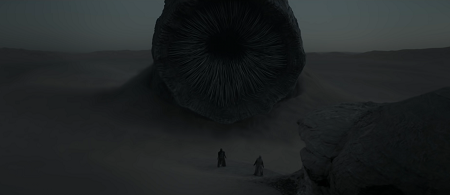
Dune (2020) has been delayed.
There’s no “eat out to help out” equivalent coming to cinemas. The industry is on its own to handle the fallout from the pandemic – as are so many others – and there’s no easy fix. Until the public at large have confidence that it’s safe to go out, that it’s safe to sit in a big room with a couple of hundred strangers, there’s nothing that can be done. Even the release of Tenet in August failed to bring in sufficient numbers of viewers to make running a cinema financially viable. At this rate, the highest-grossing film of 2020 will remain Bad Boys for Life. Nobody would have predicted that in January!
I can understand from the cinemas’ perspective that film studios aren’t behaving appropriately. Cinemas and film studios are two parts of a greater whole, yet the studios have unilaterally acted to pull their films, either delaying them or sending them directly to streaming. And I can understand why that’s going to sting. Where there could have been a coming together, it feels like the bigger companies are acting selfishly; it’s everyone for themselves instead of a sense of community and togetherness.
And ultimately that’s going to make things more difficult. We’ve already seen Odeon, another large cinema chain, pledge to stop showing films from Universal Pictures in retaliation for Universal making Trolls World Tour a streaming-only title. As I wrote when looking at Mulan’s release on Disney+, if every cinema chain were to come together and announce a boycott of companies that acted this way, they could effectively prevent the release of any film they chose. There’s power in working together, but ultimately the question will be: who has that power?
Mulan (2020) went straight to Disney+, upsetting cinema chains worldwide.
Film studios clearly see streaming as a viable option. As television screen technology continues to improve – and as screens get larger – the adage that a particular film was “better in the cinema” doesn’t ring true for a lot of people any more. In some ways, the move towards streaming is something we can absolutely argue was coming anyway; like with many things, the pandemic may have accelerated the move, but it didn’t fundamentally cause it. Titles like Annihilation and the critically-acclaimed The Irishman began production with the intention of a theatrical release, but circumstances changed and they ended up going to Netflix instead.
Streaming titles have also been nominated for top awards, and when a film is released digitally nowadays, it’s become so commonplace that it scarcely gets a mention in reviews. When people of my parents’ generation were young, going to the cinema was at least a weekly outing, and not only was there an A- and B-movie but you’d probably also get a newsreel too. Those days have gone, and for increasing numbers of people pre-pandemic, the cinema was an occasional treat rather than a regular one. Attendance has been steady, but the likes of Netflix, Amazon, Disney+, and big-budget television series like Game of Thrones have slowly been eroding the need for cinemas. In short, if cinemas try to pick a fight with film studios over digital releases, I think they’ll likely lose.
But for film studios it’s not as clear-cut. Selling an already-made film to the likes of Netflix is a complicated undertaking. Netflix wants to make sure any purchase is going to be worth its while, and the gold standard is whether a title will bring in new subscribers. As a result, I think it’s not unfair to say that a lot of films would likely make more money at the box office than on a streaming platform. That’s why Mulan costs $30 instead of being available to anyone with a Disney+ account; Disney wants to make as much of the film’s budget back as possible.
Bringing a film to Netflix – or any streaming platform – is not straightforward and will not make as much money, in most cases, as a theatrical release.
Making a film is an expensive project, and the vast majority of any title’s money is made at the box office, not through streaming or sales. If film studios were to move to streaming-only releases, a lot of things would have to change. Budgets may have to fall in some cases, which would not only be to the detriment of the quality of films, but would also put more people in the industry out of work.
As I said at the beginning, there is no easy answer. Streaming is a short-term solution that may be viable for some projects, but certainly can’t replace the revenue of a full theatrical release for most titles. Mulan was a test case, but as a film that has received mixed reviews at best, it perhaps isn’t the best example for studios to look to. And besides, most film studios don’t have their own streaming platforms, meaning they have to negotiate with the likes of Amazon or Netflix to put their titles out.
One thing that history teaches us about the longer-term effects of a disaster on any industry is that things do eventually get back to normal. If one big cinema chain were to go out of business this year, within five years or so most of its empty cinemas will have been bought up and reopened by some other company. The desire for going to the cinema may not be present right now, but it will largely return when the pandemic is brought under control. At least, that’s the way I see it. Streaming has already been disruptive, but there’s still a sense of enjoyment in going to the cinema, and from the point of view of studios, streaming is far less profitable. That means that as soon as they can, film studios will want to encourage people to get back to the cinema.
How long the pandemic will continue to drag on, and how long studios and cinema owners can hang in there are the big questions right now. And unfortunately those are the same questions people are asking across many different sectors of the economy. When the pandemic is brought under control – and it will be, sooner or later – how many businesses will have survived? And how long will it take to rebuild? From the point of view of films, are we about to enter a “dark age” where budgets and quality drop? I don’t have a good answer to any of these questions. Only time will tell.
All titles mentioned above are the copyright of their respective studio and/or distributor. This article contains the thoughts and opinions of one person only and is not intended to cause any offence.
Spoiler Warning: There may be spoilers ahead for the titles on this list. If you haven’t seen one and want to be certain of avoiding spoilers, skip ahead to the next entry just to be safe.
Depending on where you are in the world, you may have been suggested, requested, or outright forced into self-isolation as a result of coronavirus. I’m one of the people you’re keeping safe by self-isolating – I have a fairly complicated set of health issues, several of which tick the boxes for putting me at greater risk from the illness. So thank you for helping to keep me safe, I appreciate it!
But being stuck at home is awful if you aren’t used to it, so as a way of saying thanks for staying indoors and limiting the spread of this disease, here are a few television series and films that would make for highly inappropriate quarantine viewing.
Film #1: Contagion (2011)
Bodies being buried in mass graves in Contagion.
Contagion takes a realistic approach to a global pandemic, focusing on the doctors and scientists leading the response and trying to find a cure. It demonstrates how a pandemic can easily get out of control, and how those tasked with leading the response can be just as in the dark as everyone else in the early stages of an outbreak. There’s a great performance from Lawrence Fishburne in particular.
Film #2: I Am Legend (2007)
Will Smith in I Am Legend.
A scientist attempting to find a cure for cancer accidentally releases a pathogen which kills more than 90% of the world’s population and turns almost all of the rest into zombie-like creatures. Dedicated to his research, he stays in an eerily abandoned New York City trying to reverse the effects. I Am Legend is, in parts, a very emotional film, and its ending, while deliberately ambiguous, seems to suggest that the zombies were a lot more “human” than they were given credit for.
Film #3: 28 Days Later (2002)
London is deserted in 28 Days Later.
A man wakes up from a coma in a hospital to find it deserted and the world outside ravaged by zombies. No, this isn’t television’s The Walking Dead, but it’s 28 Days Later, a film directed by Danny Boyle. Set in the UK in the aftermath of a virus called “rage” that turns people into living zombies, a small group of survivors look to escape London and find safety.
Film #4: World War Z (2013)
Brad Pitt in World War Z.
This Brad Pitt-led film gets somewhat of a bad rap, perhaps because it was so different from its source material. As a zombie infection begins to spread, a scientist must travel across the world in search of a cure. Things get progressively worse as society collapses around him.
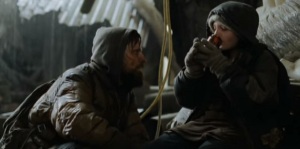
Film #5: The Road (2009)
Father and son share a drink in The Road.
Not specifically about a virus – though that could perhaps be the cause of The Road’s unspecified disaster – this film focuses on a father and son as they try to survive in the aftermath of an apocalyptic event. A strongly character-driven story looking at a dark, gritty post-apocalyptic environment where people will do anything to survive, it’s a fascinating, if depressing, film.
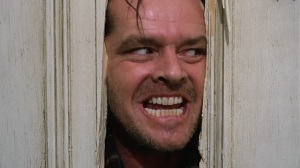
Film #6: The Shining (1980)
Jack Nicholson in one of cinema’s most iconic scenes.
What better to watch when stuck in place with no one to talk to than a film about a man being driven insane by being stuck in place with no one to talk to? This adaptation of the Steven King novel is a classic, and one of Jack Nicholson’s most legendary performances. It recently spawned a sequel – Doctor Sleep – but that film didn’t seem to have recaptured the magic.
Film #7: The Purge (2013)
Masked attackers terrorise a family in The Purge.
If you want to torture yourself with fears about being burgled and having your home broken into in these days of a supposedly limited police response to what they deem “less-important” crimes, why not check out 2013’s The Purge? In an America which has solved crime by legalising crimes for one night of the year, the film sees a family hunker down in their home as criminals try to break in. Can they survive the night?
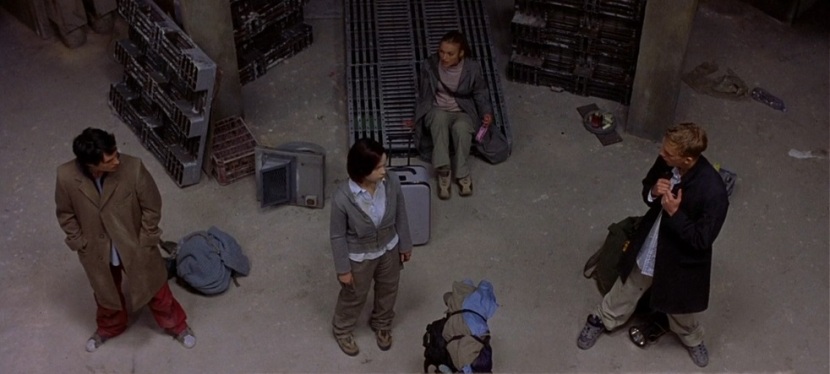
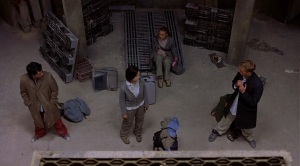
Film #8: The Hole (2001)
Teenagers trapped underground in The Hole.
A group of teenagers end up locked in an underground bunker after a party goes wrong. They begin to run out of food and medicine while trapped, unable to leave the “hole” – they should’ve stockpiled toilet paper and pasta. A deeply claustrophobic film, The Hole is perfect quarantine viewing!
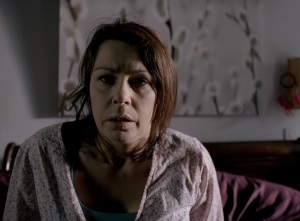
Television series #1: Survivors (2008)
Abby wakes up in a post-apocalyptic world in Survivors.
A small group of people must survive in a post-apocalyptic UK, after a disease has ravaged the world and killed the vast majority of the population. The disparate group must pull together to overcome obstacles in the world the virus has left behind, and contend with people who become incredibly selfish in the face of survival. As a show that examines the duality of human nature in the face of disaster, Survivors is a fascinating look at the post-apocalypse.
Television series #2: The Andromeda Strain (2008)
A dead body in The Andromeda Strain.
A loose adaptation of a Michael Crichton novel, The Andromeda Strain is a miniseries which looks at a disease that comes from space – an extraterrestrial microbe. Naturally humanity has no immunity or resistance to the infection, as it comes from space, and it quickly spreads through an American town. Primarily focused on the government response, the miniseries looks at how a situation can spiral out of control.
Television series #3: The Last Ship (2014)
The USS Nathan James in The Last Ship.
This show made my list of the top ten shows of the 2010s a few months ago, and for good reason. It’s a fascinating look at survival and rebuilding in a global pandemic. The action is focused on the crew of the USS Nathan James, a US Navy ship which is tasked with researching and curing a disease called the “red flu”. During Season 1, it becomes clear to the crew that the virus is far worse than they imagined and that society is on the precipice of collapse. Along with lone virologist Dr Rachel Scott, Capt. Chandler and his crew race to find a cure before it’s too late for humanity’s remaining survivors, but they must contend with a Russian ship which is also researching the disease. Later seasons introduce other antagonists, like the crew of a rogue submarine and pirates in East Asia, and look at how American society is slowly being rebuilt.
Television series #4: Pandemic: How to Prevent an Outbreak (2019)
Title card for Pandemic.
I actually have a review for this series already posted on the blog – you can find it by clicking or tapping here. A documentary looking at various aspects of pandemic prevention, including attempts to synthesise a general cure for all kinds of flu, Pandemic is an interesting look at its subject matter – if somewhat politically slanted and limited by its focus on specific individuals. It attempts to be a broad overview of the subject matter, and although an incomplete picture, it is genuinely interesting.
Television series #5: The Stand (1994)
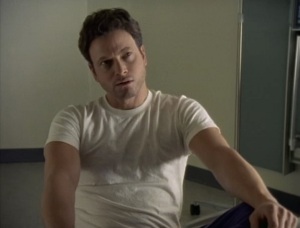
Gary Sinise in The Stand.
Based on a Steven King novel, this miniseries looks at the accidental release of a biological weapon based on influenza, which is rapidly spread across the United States. The disease has a massive death toll, leaving only a few survivors worldwide. The miniseries featured some great performances from actors who either were big stars already or who would go on to find further fame later on, like Gary Sinise, Rob Lowe, and Molly Ringwald.
Television series #6: Helix (2015)
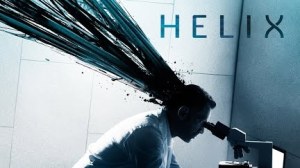
Promotional image for Helix.
Helix is one of those shows that starts off great but gets progressively worse as its story progresses. At a remote research station in the Arctic, a disease has infected a number of scientists and workers. A team from the CDC is dispatched to bring the infection under control, and the plot then spirals into a zombie story, a family drama, and a global conspiracy of silver-eyed immortals. Jeri Ryan (Seven of Nine from Star Trek: Voyager) guest stars, and the cast is led by Star Trek: The Next Generation guest star William O. Campbell.
Television series #7: The Strain (2014)
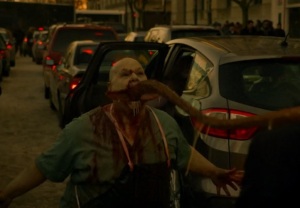
One of The Strain’s vampires.
The way this vampire story unfolds – particularly in its first few episodes – focuses very much on how the infection spreads from one “master” vampire to everyone else. Focusing on a CDC doctor in New York City, this show has a great cast – including David Bradley, whose performance is outstanding – and is a fun bit of fantasy-horror in a modern setting.
Television series #8: Twelve Monkeys (2015)
Title card for Twelve Monkeys.
Based on a film from the 1990s, Twelve Monkeys is a time-travel series that starts off with a fascinating premise: a man must travel to the present day from a future where a deliberately-released disease has killed off most of humanity. Over the course of the first season, the time-traveller unites with a doctor from our time to track down the source of the virus. Later seasons go off the rails and stop looking at the disease, focusing on a conspiracy to destroy time itself(?) at which point I stopped watching. But the first season in particular is outstanding and thoroughly worth a watch.
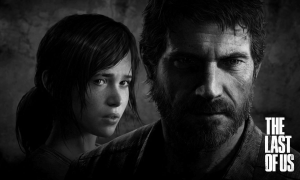
Video game #1: The Last Of Us (2013)
Promotional image for The Last Of Us.
Another one of my top tens of the 2010s, this time in the video games category, The Last Of Us is essentially a road trip that sees a man escort a young girl across America, twenty years after a fungus-based disease brought down society. In a few secure locations, some semblance of the American government still exists, but for the most part it’s everyone for themselves out in the wilderness. There are some beautiful locations for players to explore – even though the game was released on last generation’s PlayStation 3. And not to spoil anything, but the final act of the game is incredibly emotional and a great example of a videogame telling a story that would be just as at home on the big or small screen.
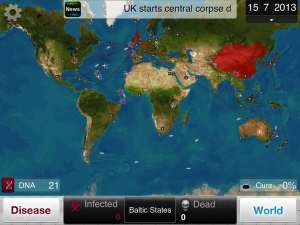
Video game #2: Plague Inc. (2012)
Promotional screenshot for Plague Inc.
Now available for PC, this game started on smartphones just at the right time, when phones were taking off and becoming a legitimate gaming platform. Rather than taking on the role of humans facing a disease, Plague Inc. sees players take on the role of the disease itself. There are various types from viruses to bacteria to fungal spores, and diseases must be upgraded in order to achieve the goal of wiping out humanity. Striking the right balance between being sufficiently contagious, able to remain undetected, severe enough to cause mass deaths, and able to adapt to and outsmart human researchers is no easy challenge – so be prepared for a lot of defeats before you’re finally able to get your version of coronavirus to kill everyone.
Star Trek has looked at diseases, quarantines, and issues surrounding isolation at many points in its history, so as an addendum to the main list, here are a few episodes from various iterations of the Star Trek franchise which would also make for inappropriate self-isolation viewing!
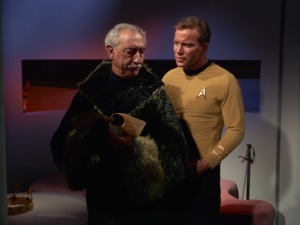
Star Trek episode #1:The Conscience of the King (The Original Series, 1966)
Kirk must solve the riddle of this man’s identity.
Years before he assumed command of the Enterprise, Captain Kirk was resident on a colony which ran out of food. In an attempt to save lives, the colony’s governor condemned half of the population to death so that the remaining food could be rationed among the other half – those he deemed worthy of survival. When a man beams aboard the Enterprise who may be the tyrannical governor, Kirk must put the pieces together.
Star Trek episode #2: The Deadly Years (The Original Series, 1967)
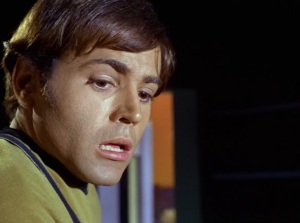
A terrified Chekov in The Deadly Years.
Several senior Enterprise crew members are afflicted with a disease which causes rapid ageing. Dr McCoy and his medical staff must try to find a cure – before it’s too late! Not even Spock is immune, and it seems as though the ship and its entire crew are in danger.
Star Trek episode #3: Starship Mine (The Next Generation, 1993)
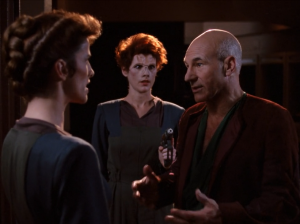
Picard talks to the mercenaries in Starship Mine.
Trapped alone aboard a deserted Enterprise-D, Picard must contend with intruders set on stealing a byproduct of the ship’s warp drive. Without any of his friends or crew to help, Picard must outsmart the mercenaries using only what he can find on the deserted ship. Starship Mine is actually one of my favourite episodes of The Next Generation.
Star Trek episode #4: Genesis (The Next Generation, 1994)
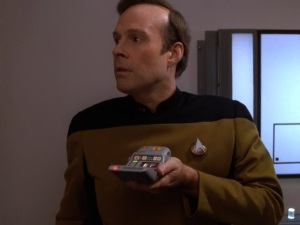
Barclay attempts to diagnose himself, kicking off the events of Genesis.
An attempt to cure a case of the flu goes horribly wrong, resulting in the “de-evolution” of the Enterprise-D’s crew into various inhuman monsters. Picard and the immune Data must synthesise an antidote before it’s too late!
Star Trek episode #5: Armageddon Game (Deep Space Nine, 1994)
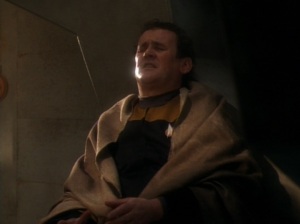
Chief O’Brien is in a bad way in Armageddon Game.
Infected with a biological weapon, O’Brien is dying and trapped in hostile territory with Dr Bashir. This episode would mark a major milestone in the friendship of these two characters, whose relationship would be a significant factor in later seasons of Deep Space Nine.
Star Trek episode #6: The Quickening (Deep Space Nine, 1996)
Dax and Bashir work on a cure.
The Dominion used a biological weapon (the titular “quickening”) to punish a wayward planet. Dr Bashir attempts to find a cure for the disease, which can cause rapid death, in an episode which was an interesting look at how doctors cope with an “unwinnable” situation.
Star Trek episode #7: Phage (Voyager, 1995)
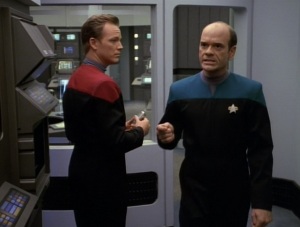
Tom Paris and The Doctor work to help Neelix in Phage.
Voyager encounters the Vidiians, a species suffering from a centuries-long plague which causes their bodies to rot. They survive by becoming pirates, capturing others and stealing body parts to replace their own disease-ravaged ones. The Phage would crop up several times in Voyager, and despite the best efforts of the crew they never managed to find a cure.
Star Trek episode #8: Year of Hell, Parts 1 & 2 (Voyager, 1997)
The USS Voyager suffers extensive damage in the two-part episode Year of Hell.
A time-travel story in which the Voyager crew see their ship constantly attacked and running out of energy and resources. Crew members die and become maimed, the ship falls apart and whole sections become uninhabitable, and resources dwindle to the point where Capt. Janeway gives the order to abandon ship.
Star Trek episode #9: A Night in Sickbay (Enterprise, 2002)
Porthos in A Night In Sickbay.
Capt. Archer’s beloved pet dog becomes ill with an alien virus, and he spends a tense night in sickbay with Dr Phlox as they wait to see whether Porthos will pull through. A Night in Sickbay is a surprisingly emotional episode that any pet owner can relate to.
Star Trek episode #10: Observer Effect (Enterprise, 2005)
Sato and Tucker suffering from the effects of a virus.
Sato and Tucker are infected with a silicon-based virus in this Enterprise episode, while the crew are being observed by a noncorporeal race who want to see if they can figure out a cure in time. Observer Effect served as a semi-prequel to The Original Series episode Errand of Mercy, featuring the same alien race.
So that’s it. I hope we can all stay safe and well during these strange times, and if you are told to stay at home please follow the instructions of the authorities in your local area. I know it can be frustrating and that “cabin fever” is a real sensation, but if we all comply we’ll all come out the other side and life can get back to normal.
Staying at home isn’t just for your own selfish benefit – it helps people like me, who have health issues and would be more likely to suffer complications from coronavirus. It also helps doctors, hospitals, and healthcare providers to not become overwhelmed with tens of thousands of cases all at once. I’ve seen lots of people, including in some major national newspapers, arguing that because coronavirus is “not that bad” that everyone should just carry on as normal. And while we should all certainly be avoiding panic-buying, things cannot carry on as normal, at least not in the short-term. By staying in, avoiding as much contact with people as possible, and maintaining a high level of hygiene, we can slow the spread of the disease which will relieve the pressure on hospitals and allow more time for the development of a vaccine. Staying at home isn’t actually all that difficult, especially with YouTube, Netflix, Disney+, digital videogame platforms, hundreds of television channels, and the entire internet providing us with so much to do.
If none of the shows, films, or episodes I’ve semi-jokingly listed seem like something you’re interested in, then stay tuned because I’ll be bringing you more lists and reviews of things to watch while you’re stuck indoors. Once again, I urge all of my readers to follow local advice and requirements, and do what you’re told to avoid making things worse and inadvertently spreading this nasty disease to others.
Stay safe everyone!
All episodes, games, television series, and films listed above are the copyright of their respective studios, publishers, distributors, producers, etc. This article contains the thoughts and opinions of one person only and is not intended to cause any offence.
If you’ve been a reader for a while, you’ll know that I love documentaries. There have been some really interesting documentary films and series made over the years that I’ve been lucky enough to see, including many whose subject matter I would never have thought to explore otherwise. Netflix is actually a great platform for documentary content. I don’t know how many films and series they have available in the genre – and unfortunately it will vary somewhat depending on where you are in the world – but there are a lot of interesting ones to check out, including some that have been nominated for major awards.
It was with all of the above in mind that I decided to try Pandemic: How to Prevent an Outbreak, which was released in January 2020. I’ve always had an interest in things like disaster preparedness and emergency planning, so it definitely piqued my curiosity when it appeared on my list of things to watch that Netflix recommended. I’d been meaning to check it out ever since, but as always, there were other things to see and do!
Title card for Pandemic.
Pandemic follows a few different individuals, mostly medical professionals, in a number of places around the world as they work on various aspects of disease prevention and treatment. It’s actually incredibly ambitious in that regard, telling the narrative from different places and different perspectives. The filmmakers visited such diverse places as the Democratic Republic of Congo, India, Egypt, Guatemala, and various locations in the United States – a truly huge amount of travelling that must have massively inflated the budget of the series. And the end result is definitely the better for gaining different perspectives.
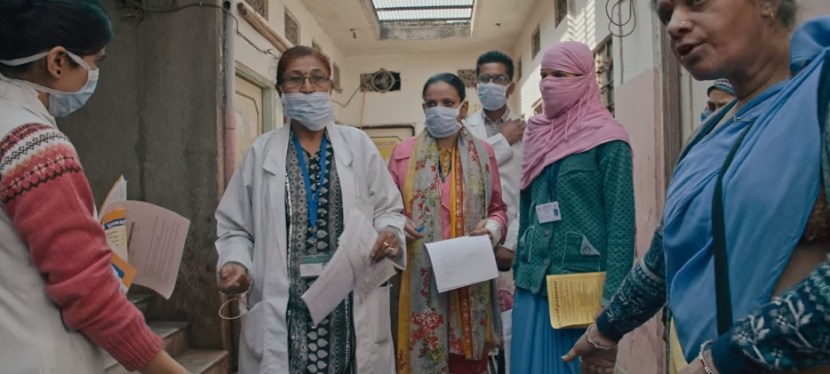
Some of the locations visited – like Rajasthan in India and Cairo in Egypt – are incredibly densely populated, and as Pandemic goes to great lengths to show, are much more vulnerable to influenza – the disease which is the focus of the documentary – as a result. Seeing those places, and the overcrowded buildings and streets, instead of merely reading about them or having them explained in a voiceover, was definitely an interesting aspect, one that the filmmakers have clearly wanted to convey.
Given that a pandemic of a disease like influenza is a global problem, I think it’s important that any attempt to cover the subject matter should be global in scope. Only seeing a European, American, or western perspective would be more relevant to Netflix’s core audience, perhaps, but would be limited in its messaging and understanding of the topic. The truth is that, in a lot of cases, it’s places in the third world that are worst-hit when a disease outbreak occurs because the infrastructure and medical facilities aren’t present in the same way, and the level of preventative care – like inoculations – and post-infection treatment is of lower quality. That’s not meant to be a criticism – there are clearly people in those regions working incredibly hard. But it is the reality that millions of people in some countries aren’t vaccinated against, for example, tuberculosis – despite the vaccine having existed for decades.
Healthcare workers in India.
As well as looking at some of the history behind disease prevention, and the scientific research that is ongoing, Pandemic is also a series of personal stories. We spend time with many of the documentary’s subjects as they go about their lives, interact with their families, and discuss the impact that their work can have on their life and those around them. In that sense, it was a much more personal look at the subject than a documentary that focused on facts, figures, and interviews staying on-topic would have been. While I enjoyed that aspect of Pandemic most of the time, there were some moments that were awkward and clearly scripted, or at the very least set up to get the exact shot and line that the filmmakers wanted. There’s a line that a documentary filmmaker has to walk when doing something like that, and at times Pandemic was on the wrong side, as some of these scripted moments ended up feeling like the film was being dishonest. By presenting a scene through the camerawork and editing as if it were a genuine, spur-of-the-moment conversation when it clearly was not, some of these sequences ended up feeling forced and fabricated. While there weren’t too many of these moments such that the series was overwhelmed by them, it did suffer as a result.
When considering Pandemic, we do have to talk briefly about the current coronavirus outbreak. Pandemic was made last year, before this current outbreak had begun, but how we approach it – and indeed the fact that more people have been interested in it – can’t be completely detached from the current situation. Coronavirus is not influenza; the two viruses are very different and thus will have to be approached differently by governments and medical staff. But much of Pandemic’s subject matter is applicable to the current outbreak – most notably how easily it can spread and how it can take root in some of these densely-populated areas in the third world where healthcare and hygiene are worse than here in the west. In that sense, Pandemic is a timely release – with all the fuss in the news at the moment about the spread of coronavirus and the various quarantines and other steps being taken to stop and prevent its spread, there are lessons to be learned from this series.
Politics is at play in Pandemic; it is a deeply political series at times. For some people that will be offputting, especially because the way some political issues – like migration – are handled are very one-sided. There are numerous swipes and digs at Donald Trump and his administration in particular, as well as interviews with Democratic Party politicians, legislators, and supporters. It would have been worth the filmmakers including some kind of statement at the end of the episodes where these people appeared to say that they did ask Republicans to join in with the series – if indeed they did ask. That would have shifted the blame for the lack of political inclusion to those who refused to participate.
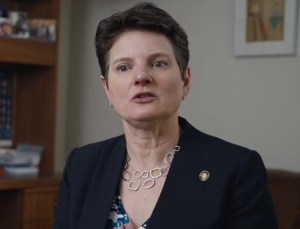
Oregon State Senator Elizabeth Steiner Hayward was interviewed in Pandemic.
Healthcare is a political issue. The inclusion of politics is thus unsurprising, and Pandemic does not claim to be a balanced, all-around look at the subject matter. Many documentaries are incredibly subjective in the way they handle their subject matter – look at Michael Moore’s Bowling for Columbine or Fahrenheit 9/11 as examples of that. This doesn’t make Pandemic worse, but it does mean that as the audience we have to be aware of the filmmakers’ leanings and biases and remember to treat it as a subjective piece. In 2020, there really isn’t such a thing as a truly objective piece of reporting or filmmaking, but even so, there will be numerous points where I’m sure that people who don’t fully subscribe to the filmmakers’ politics will be at least a little uncomfortable in the way some of the material is presented – I can tell you that I certainly was.
Staying with contentious political issues, one of the most interesting aspects of Pandemic for me is that the filmmakers went out of their way to track down and speak with anti-vaccination families and campaigners. The anti-vaccine movement has been growing for some time, and is widely blamed for a resurgence in diseases like measles which had once been essentially eradicated in the western world. It’s likely that, as we go forward into the new decade, decisions will have to be made about what rights people do and don’t have when it comes to issues like vaccination, and by letting the anti-vaccine campaigners speak for themselves, Pandemic did a good job of presenting both sides of the argument – even though it was clear from the way some of those sequences were edited which side the filmmakers were on.
Overall, I’d say that Pandemic approaches an incredibly broad topic in a personal way. The decision to present it through a series of separate, individual stories rather than as a more general overview of the topic definitely shows off different angles of how organisations around the world approach disease prevention, but at the cost of having a narrower focus than some documentary series covering the same subject might. I enjoyed it, it was interesting and informative, but certainly not comprehensive. However, given the position we’re in when it comes to the current coronavirus outbreak, I would recommend it – just so long as people remember to keep their fears in check. Some of the interviewees can stray into “doom-and-gloom” territory at times, and again considering our current situation in regards to coronavirus, this might be offputting for some. Regardless, I had a good time with the series. Netflix has both created and hosted a number of good documentaries, and Pandemic is a solid addition to its lineup.
Pandemic: How to Prevent an Outbreak is available to stream now on Netflix around the world. The series is the copyright of Netflix. This article contains the thoughts and opinions of one person only and is not intended to cause any offence.

















 Trekking with Dennis