Space Jam: A New Legacy – film review

Spoiler Warning: There are spoilers ahead for Space Jam and Space Jam: A New Legacy.

I don’t think I’ve re-watched Space Jam since I saw it at the cinema in 1996… so it’s been a while! But the film is adored by many, and has a following of its own within the broader Looney Tunes fandom. I’m not sure I’d go so far as to call it a classic of the 1990s, but I daresay a lot of self-proclaimed “90s kids” would – even though many of them were born far too late to truly warrant the label. But we’re off-topic already!

The original Space Jam was a unique offering. A blend of live-action and animation, a mixture of comedy and sport, it’s a film that’s hard to define and pigeon-hole, and as a result of its premise – and wacky, child-friendly humour – it’s well-remembered and held in high regard even a quarter of a century later. Going back to that premise for a second time always felt like a risky move for Warner Bros. simply because it can be very difficult to recapture the magic of such a genuinely different, one-of-a-kind title.

Promo poster for Space Jam: A New Legacy featuring the Road Runner.

But this is the reality of modern cinema. In the realm of kids’ films – a genre Space Jam: A New Legacy is surely included in, despite its appeal to the millennial generation – Disney has pushed the boat out ever further with its recent slate of remade classics, and in a broader sense the idea of reboots, soft reboots, and remakes is something practically every major film studio is throwing money at. In a sense, Warner Bros. doesn’t really care whether anyone actually likes Space Jam: A New Legacy, because they know that the name and branding alone will convince many fans of the original to turn up and see it no matter what the critics say. The film is, to use an outdated movie industry term, “bankable.”

I recently had this conversation with a family member who lamented the existence of Steven Spielberg’s remake of West Side Story – which is due out later this year, in case you care. They were despondent at the idea that one of their favourite films of all time was being remade, and I can sympathise. Remakes, by their very nature, are aiming low. They can only ever hope to be considered “just as good” as the original, but never even try to surpass it.

LeBron James in Space Jam: A New Legacy.

But remakes serve a purpose, at least from the point of view of corporations. They’re easy money, because film studios know that millions of fans of West Side Story or Space Jam will turn up for the new version – even if only out of morbid curiosity! There’s also an argument to be made that, in some cases, younger audiences aren’t interested in watching films that they deem to be “too old.” Thus a remake can, from an artistic point of view, be argued to bring a story or a setting to a new generation of prospective fans. Whether that’s the case with Space Jam: A New Legacy is debatable; the film isn’t a straight remake. Nor is it really a sequel, instead I think it’s best described as a riff on the original concept, taking some familiar and some new characters and throwing them into a similar – but not identical – story.

That’s the area that Space Jam: A New Legacy occupies. Not a sequel, not a remake, but a riff. A shaken-up copy made a quarter of a century later with, let’s be honest, business and financial reasons at its core. It’s not an artistic piece; it wasn’t made because its director or writer had a burning passion for the wonderful, underexplored universe of Space Jam. Nor was it made because the original film was desperately crying out for a sequel or an expansion. It was made purely because corporate executives at Warner Bros. were looking through their back catalogue in search of something to monetise, and Space Jam caught someone’s eye. If we were being cruel, we might say that Space Jam: A New Legacy is soulless.

Space Jam: A New Legacy could feel, at times, very corporate.

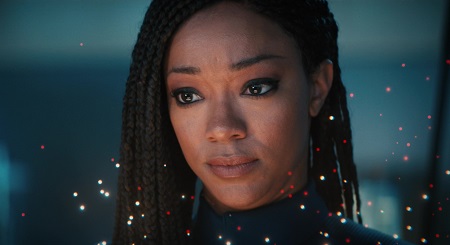
One of the reasons I was curious to see Space Jam: A New Legacy – beyond the vague interest in a follow-up to a film I remember with fondness from the ’90s – was the involvement of Sonequa Martin-Green. Martin-Green plays Michael Burnham, the main protagonist of Star Trek: Discovery, and like many Trekkies I’m always interested to see other projects involving stars of Star Trek. Though I haven’t always felt that Michael Burnham was the easiest protagonist to root for in the franchise, there’s no denying Martin-Green’s talent and hard work, and just like she excelled in The Walking Dead a few years ago, she put in a great performance in Space Jam: A New Legacy. Though her character played a supporting role, it was still great to see her and her performance elevated the film.

I’ve seen more Space Jam films than I have basketball games. Basketball isn’t a big sport here in the UK, and while I have tried it in PE lessons at school way back when, it isn’t a sport I follow, nor do I know much about it beyond the basic rules. LeBron James is among the few basketball players whose names I’ve heard, but that’s really where my familiarity with the sport ends.

Sonequa Martin-Green as Kamiyah James.

Space Jam: A New Legacy felt, at points, like a love letter to its star, which was a very strange thing to watch. Some films can feel like vanity projects – John Travolta’s Battlefield Earth, Kevin Costner’s The Postman, and even to an extent William Shatner’s Star Trek V: The Final Frontier all cross that invisible line, and Space Jam: A New Legacy comes close. The introduction of Don Cheadle’s Al-G Rhythm is a scene which has him reading aloud a list of James’ accomplishments on and off the court, and the film’s title sequence is likewise a flattering summary of his career. For a film where this man is the star, it makes watching those sequences feel more than a little weird.

I didn’t have high expectations for LeBron James as an actor, and while he won’t be winning an Oscar anytime soon he did, to my surprise, manage to put in a solid performance. His early scenes left me concerned that I’d find him too flat and wooden, as many sports stars and athletes can be when they try acting for the first time, but when the plot got going and he and his son were transported to the Warner 3000 server-world, the quality of the performance definitely improved.

LeBron James finds out that he’s been turned into a cartoon.

While we’re discussing the acting, Don Cheadle was clearly having a great time as Al-G Rhythm, and embraced the opportunity to play a cartoonish, somewhat over-the-top villain for a change! It was fun to see him in the role, and he did a creditable job. Cedric Joe, who took on the challenging role of young Dom James (a character inspired by LeBron’s real-life son) put in a great performance. He was believable as a young man who felt rejected by his father and overshadowed by his legacy, and his struggle to get his dad to “let me be me,” as he put it, was the emotional core of the narrative.

The voice cast who played the Looney Tunes did a good job, but I have to caveat that by saying that none of them really got much material to work with. Most of the ‘Tunes weren’t even secondary characters, but were relegated to background roles. They all got to show off their greatest hits from past Looney Tunes outings, but even the two main players – Bugs and Lola Bunny – didn’t get an awful lot to do for much of the film.

Most of the Tune Squad didn’t have a lot to do.

At the centre of Space Jam: A New Legacy, underneath the cartoon comedy and basketball trappings, was a story that aimed to be uplifting. It was trying to send a message to kids that everyone has different passions and different talents, and not being good at sports doesn’t mean you have no worth. The film also wanted to tell a story to parents about allowing their kids to step out of their shadow and embrace the things they like, to experience different things and figure out their own path. Those messages are important in a film like this, and their inclusion made it feel like Space Jam: A New Legacy had purpose.

However, that purpose was in danger of getting lost in a film that was very commercial. There was a lot of product placement in Space Jam: A New Legacy, including things like E3 (a video game industry event), Red Vines (an American candy), a whole lot of Nike, Mercedes, Dell, Bose, and many, many mentions of Warner Bros. itself. It’s been a long time since I saw a film so heavy on product placement, and there were moments where this marketing ploy felt overwhelming. It adds to the sense I mentioned above that Space Jam: A New Legacy is a corporate product first and an artistic work second.

Space Jam: A New Legacy had a lot of product placement.

I literally cannot fault the visuals and animation work in Space Jam: A New Legacy. For a film to incorporate fully live-action scenes, traditional cartoon animation, 3D computer animation, greenscreen CGI sequences, and even footage from older films is a monumental task, and the animators, CGI artists, and editors did an amazing job not only on the individual segments but at blending it all together. The film’s climax is the basketball game, and this sequence features real actors and CGI creations alongside each other, and it works seamlessly.

Space Jam: A New Legacy is thus a visually impressive film. Not every element is unique or beautiful in its own right, but the technical skill required to bring so many different things into the same project is truly impressive. Aesthetics are a matter of personal taste, and I’m sure some folks will criticise some of the designs used for the characters and settings, but on the whole I felt what was presented on screen looked fantastic, and unlike in many CGI-heavy titles, I honestly couldn’t find fault; there were literally zero moments where the animation work didn’t hit the target it was aiming for. That’s something I find quite amazing.

The film did well to blend so many different elements seamlessly.

There were a lot of callbacks and references to other Warner Bros. properties, including a number of scenes from famous films that the characters were inserted into à la Forrest Gump. This was unexpected, but many of these scenes and cameo appearances were funny and added a lot to the film. Space Jam: A New Legacy has a pretty childish sense of humour, but sometimes that’s perfectly fine, and its comedy generally stuck the landing as far as I’m concerned.

Seeing characters from other franchises, like the Night King from Game of Thrones or the titular characters from Rick and Morty meant that there was something for adults to laugh at too, and though the humour was hardly sophisticated, it was, at points, more than simple cartoon slapstick. Perhaps younger viewers will cringe at things like Porky’s awkward rap battle, but you know what? I’m going to admit right now that I found that whole sequence – and many others – hilarious!

LeBron James and the Tune Squad.

In fact, despite initially having pretty low expectations for the film, there were plenty of enjoyable moments under the corporate fluff, and I found myself chuckling more than I thought. Though the narrative was silly – playing a computerised basketball game in order to win freedom – the basic premise underlying it was a father learning to connect with his son and embrace what makes him special instead of trying to push him in a certain direction. That story shone through the cartoon wackiness at key moments, and was just enough of an emotional force to make Space Jam: A New Legacy a more enjoyable film than I might’ve thought.

Was it the perfect film, or the perfect vehicle for telling this kind of story about bridging the gap and coming to an understanding? Perhaps not. Its commercial aspects certainly detracted from that message at points, which was a shame. Also, in a film which was supposedly half about basketball and half about the Looney Tunes, the cartoon characters themselves didn’t exactly get much time in the spotlight. That was perhaps the biggest let-down for me, as it made the film feel less like “basketball meets Looney Tunes” and more like a LeBron James vehicle with some cartoon trappings.

Despite that, however, I had fun with Space Jam: A New Legacy. It probably wasn’t as good as the original – as films of this nature seldom are – but it was visually impressive, had a narrative that was relatable for kids and for adults, and the quality of the acting performance from its lead took me a little by surprise. All in all, it was a perfectly entertaining way to spend a couple of hours.

Space Jam: A New Legacy is out now in cinemas in the United Kingdom, United States, and certain other countries and territories. Space Jam: A New Legacy is available to stream on HBO Max in the United States, and will come to streaming platforms in other countries and territories at an unspecified later date. This article contains the thoughts and opinions of one person only and is not intended to cause any offence.


Star Trek: Discovery Season 4 theory – Michael Burnham

Spoiler Warning: There are spoilers ahead for Star Trek: Discovery Seasons 1-3, the teaser for Season 4, and for other iterations of the Star Trek franchise.

Did you read my weekly theory posts as Star Trek: Discovery Season 3 was ongoing? If you did, perhaps you’ll remember that, about four episodes in, I began to speculate that Michael Burnham’s new attitude toward Starfleet – which had changed following a year alone in the 32nd Century – would ultimately lead to her leaving the organisation, and perhaps even Star Trek: Discovery altogether.

That didn’t happen, of course, and it was part of Burnham’s arc across the season to get her ready to assume the captaincy at the end of the season finale. Although Burnham had at least one bump in the road where I felt her newfound independence spilled over into selfishness, her storyline and her rise to assume command was generally satisfying, especially across the back half of the season. By the time the credits rolled on That Hope Is You, Part 2, Burnham had truly earned the captaincy.

Michael Burnham assumed command of the USS Discovery in the Season 3 finale.

What I’m about to suggest may seem odd seen in that context, but there are a couple of reasons why I consider it plausible as I’ll try to explain. In short, I’m bringing back the theory that flopped in Season 3: Michael Burnham will, somehow, no longer be in command of the USS Discovery by the end of Season 4.

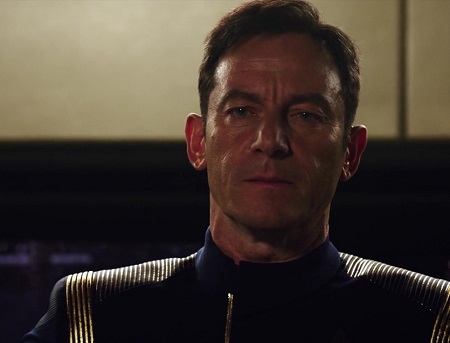
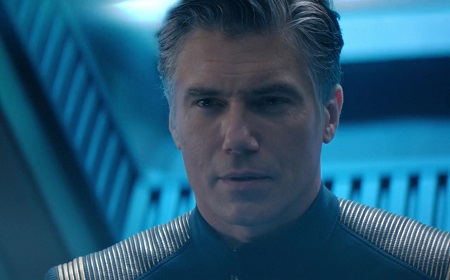
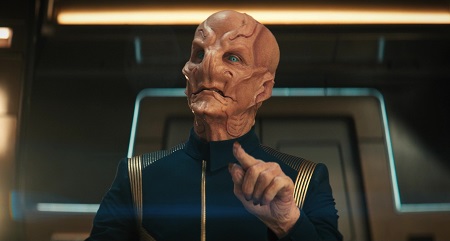
One of Discovery’s unique features within Star Trek’s broader canon has been the season-long captaincies of three very different individuals. Season 1 brought us Captain Lorca, the hardball who ultimately turned out to be deceptive. Season 2 reintroduced Captain Pike, the classic character who embodied the best of Starfleet’s values. And Season 3 saw Saru sit in the captain’s chair, the first ever alien captain to helm a Star Trek series.

Gabriel Lorca was the USS Discovery’s captain in Season 1.

Each captain brought something new and different to the ship, and thus to the series as well. And Michael Burnham, having assumed command at the end of Season 3, will undoubtedly put her own stamp on things as we enter Season 4. That’s great, and it keeps one of Discovery’s unexpected themes going. But as we look ahead to Discovery’s future, with a fifth season rumoured to be all but confirmed and even the possibility of some kind of feature film involvement, I can’t help but wonder whether she will remain in the captain’s chair.

Unlike Lorca, Pike, and Saru, Burnham has been Discovery’s protagonist since the beginning – even if, at times, her status as our main character didn’t always work as intended! So perhaps that means her rise to the captaincy, rather than the captaincies of the three other characters, is what we should be focused on. And that is a good argument in some ways – the story of Discovery, rather than being about the other captains or even other members of the crew, has primarily been about Michael Burnham.

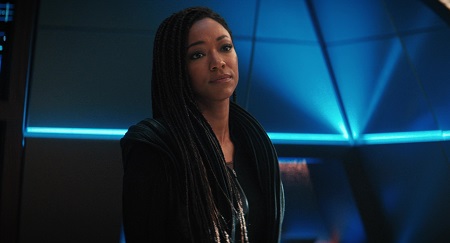
Even though she wasn’t captain of the ship in Seasons 1-3, Burnham was still Discovery’s protagonist.

Thus we can argue that Seasons 1, 2, and 3 showed off different aspects of her ascent to the captain’s chair – which, it has to be said, is an amazing premise for a Star Trek series. Past shows all introduced us to captains who were already established; even Commander Sisko, who we saw at the beginning of Deep Space Nine assume his post for the first time, was still very clearly in command. We did get some episodes showing us parts of the backstories and pasts of Captains Kirk, Picard, Sisko, Janeway, and Archer, but when we first met them they were already established. We didn’t see their rise through the ranks in the way we’ve seen Burnham’s unfold over the past three seasons.

So that argument is valid, and it may very well prove to be true. But despite Discovery’s tight focus on Burnham much of the time, the show does have a broader cast of characters, some of whom we’re getting to know reasonably well now that we’re three seasons in. The show has never been about Burnham alone, and the different captains have, as I mentioned above, all put a unique spin on things during their tenures.

Captain Pike was in command for practically all of Season 2 – and is now starring in a spin-off: Star Trek: Strange New Worlds.

Discovery feels like it’s in a place where it could go down one of two paths, and which one the producers ultimately choose will depend on all sorts of factors, including future plans for the wider Star Trek franchise. One path is outlined above, keeping the Burnham focus as a key aspect of the series, and allowing Seasons 1-3 to depict her growth and rise. But there is another option.

The second path would be for Burnham to follow Lorca, Pike, and Saru, with her captaincy of the ship lasting a single season. Discovery’s unique selling point as a series would thus change from being all about Burnham to being a show which had a rotating captaincy. Those first three seasons – and probably Season 4 as well – would still have that Burnham focus. But if Discovery manages to keep going into Season 5 and beyond, perhaps we’ll look back on it as “the show with all those different captains!”

Saru had his turn in the captain’s chair during Season 3.

Because of a captain’s role and status, changing things up can really have a significant impact on the ship – and the series. While arguably an extreme example, if we look to Chain of Command, the two-part episode from The Next Generation Season 6, the introduction of Captain Jellico as a replacement for Captain Picard radically changed things up on the Enterprise-D, and if he’d remained in command we’d certainly have seen The Next Generation transformed into a very different series!

It makes for an interesting concept for a Star Trek show – something closer to an anthology series than a “traditional” Star Trek show in the vein of The Original Series and The Next Generation. Not only would the captaincy have changed, but we also have two very different time periods in play which really adds to the sense that Discovery has been, across its three-season run to date, very different season by season. Burnham’s departure could cement that trend.

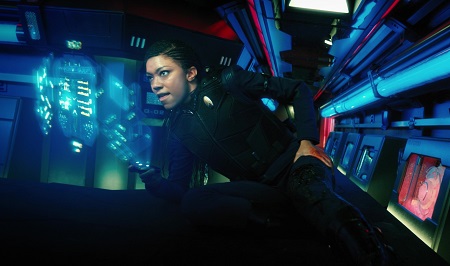
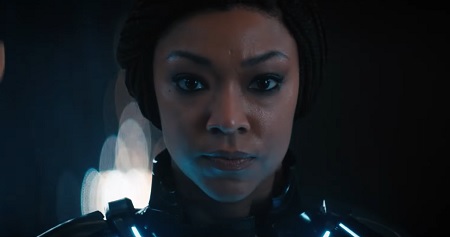
A determined-looking Michael Burnham in the Season 4 teaser.

To clarify, I’m not saying this should happen, or that it would be great for the series. Because despite some of my critiques of Burnham’s characterisation, particularly early in Season 1, her rise to the captain’s chair worked. Seeing her take her seat at the end of Season 3 felt earned and it felt great; a genuinely emotional moment.

Despite that, however, I can’t help but wonder if the storyline of Season 4 – which seems to involve another “galaxy-threatening” event – will end with Burnham’s departure from the ship and the show.

There are two ways such a departure could happen, at least as far as I can see, so before we wrap things up we’ll briefly look at both.

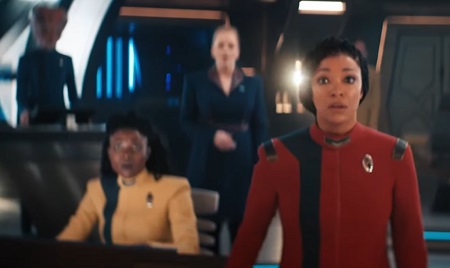
Burnham on the bridge – and sporting a new uniform – in the Season 4 teaser.

Firstly, the one that seems more obvious given what we saw in the Season 4 teaser, and given what we know of Burnham’s disposition and personality, is some kind of self-sacrifice. Perhaps the only way to save the ship and crew – or more likely, save the whole galaxy – will involve Burnham making a decision to sacrifice herself for the cause. Her death would thus mirror characters like Data and Captain Kirk, both of whom were killed in the line of duty while saving others.

In a show that has been all about Burnham, depicting her at her lowest moments and showing her greatest achievements, there would be something poetic about going out in a “blaze of glory” – but at the same time, her death might seem like the series finale. If there are no plans for a fifth season (or film) to continue Discovery’s story, perhaps the series will conclude with Burnham’s death.

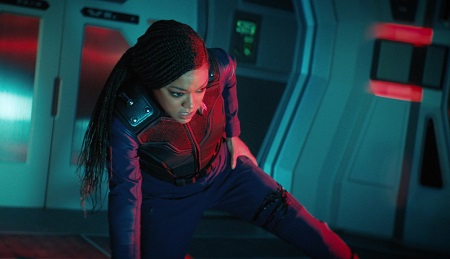
Burnham has been injured in the line of duty previously.

It wouldn’t be impossible for the show to go on without her, though, despite her prominent role. And while her death might feel like Discovery’s conclusive end, that wouldn’t necessarily have to be the case. As I’ve argued in the past, Star Trek shows are typically about more than just one character, and as we’ve spent more time with other members of the crew, I think there’s more than enough interest and potential for the series to stand on its own two feet if Burnham leaves or is killed off.

And that brings us to our second possibility – that Burnham survives, but for other reasons chooses to leave Starfleet.

This is what I felt Season 3 seemed to be hinting at in those early episodes. The shift in Burnham’s attitude toward Starfleet, her willingness to break the rules and disregard orders given by Saru and Admiral Vance, and the fact that she admitted to both Book and Georgiou that she found a sense of freedom outside of Starfleet in her year alone all seemed to be building up to a potential departure. The second half of the season got rid of that, and we saw Burnham’s attitude change such that her rise to the captaincy made sense in-universe. But there’s still the prospect of those feelings returning.

After a year away from Starfleet, Burnham seemed ready to quit the organisation altogether, at least for a time.

Burnham has, ever since the Season 1 premiere, had a bit of a problem with authority and the chain of command. While we should see much less of that with her in command, and thus not answerable to anyone else aboard the ship, the USS Discovery does not exist independently and is still under the command of Admiral Vance and Starfleet. If Burnham feels constrained by the orders she’s given, and repeatedly butts heads with senior Starfleet officers, perhaps the craving for freedom that we saw her express in Season 3 will come back.

I wouldn’t want to see Burnham storm off, throwing down her combadge and just walking away. After three seasons of being with her and seeing her grow, that would feel wrong. That’s why I was so critical of Discovery at one point in Season 3 when I felt this antagonistic attitude and selfishness, putting her own wants ahead of Starfleet’s orders, seemed to be a character regression, dragging Burnham back to where she was in Season 1. Luckily it didn’t pan out that way, and I hope it won’t here.

If Burnham does leave the show, hopefully her departure will be handled well and will treat her character with the respect she has earned.

But there can certainly be a way to get Burnham to walk away from Starfleet, perhaps at the conclusion of a successful, galaxy-saving mission, that would work. If she were to say goodbye and head into the sunset with Book, having saved the galaxy not once but twice, I think we could absolutely say that she earned the right to live her own life away from Starfleet in the manner she chooses. In short, this storyline could work, but it would all hinge on the way Burnham’s characterisation was handled and the manner in which she left.

So that’s it, really. We can call this a pre-season theory, and summarise it thusly: somehow, perhaps toward the end of Season 4, either through an heroic death or satisfying resignation, Michael Burnham will leave the USS Discovery and cease to be a main character on the show.

Will it come true? I have no idea! And with filming on Season 4 currently paused for two weeks due to a small coronavirus outbreak, perhaps we won’t find out for a while.

Burnham in some kind of armour or spacesuit in the Season 4 teaser.

Once again, I’m not arguing in favour of this theory necessarily. I think it could be made to work in a way that felt right, and it would mix up the captaincy of the ship again, potentially keeping things fresh going into Season 5. But at the same time, I’ve grown to like Burnham. Her departure would be a bittersweet moment for the series, and in a way it would be a risk unlike any the show has taken so far.

I hope you’ll swing by later in the year, as I plan to review every Discovery Season 4 episode when they’re broadcast. If Season 4 lends itself to theory-crafting, I daresay my weekly theories posts will be back as well! Between now and then we have Season 2 of Lower Decks to look forward to, which is coming up in less than four months now! So there’ll be a lot to talk about there as well. I hope you enjoyed this theory, but as always, please remember not to get too attached to any one individual fan theory. No theories are worth getting upset or disappointed over.

Star Trek: Discovery Seasons 1-3 are available to stream now on Paramount+ in the United States and on Netflix in the United Kingdom and other countries and territories. Season 4 is due for broadcast in late 2021. The Star Trek franchise – including Discovery and all other properties mentioned above – is the copyright of ViacomCBS. This article contains the thoughts and opinions of one person only and is not intended to cause any offence.