Some great Steam Holiday Sale deals for PC gamers

Important: The Steam Holiday Sale has now ended. Prices below will no longer be accurate.
Check back in June-July for the Summer Sale, and December for the next Winter/Holiday Sale deals.

Spoiler Warning: There are minor spoilers ahead for some of the games on this list.

The Steam Holiday Sale runs from today (22nd December) through to the 5th of January. Prices and discounts listed below are for the UK versions only and may vary by region. Prices and discounts were correct at time of writing but may be subject to change.

Steam treats PC gamers to big sales twice a year, in addition to the many smaller sales that seem to run almost all the time. As I’ve said before, these sales go a long way to making PC gaming competitive from a price standpoint, even though the initial expense of buying a gaming PC is higher than buying a console.

That’s especially the case in 2020, as the launch of new consoles has meant that getting a gaming PC of comparable spec has become pricey! However, if you do spend the money on a PlayStation 5-beater – or even if you don’t – there are some fantastic deals on great games this holiday season. Let’s look at a few.

Number 1: Halo: The Master Chief Collection (2019)
40% discount, £17.99
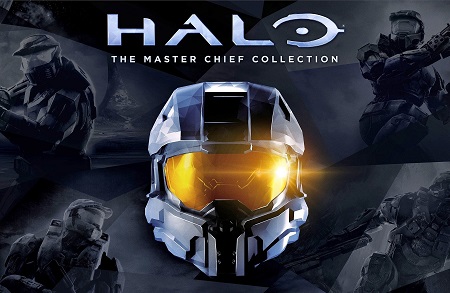
If you don’t already have Halo: The Master Chief Collection on Xbox or Game Pass, it’s well worth picking it up on Steam. The first six games in the Halo series – i.e. every title except for Halo 5 – are included in the package, and have been updated over the last few years to meet current-gen specifications.

Halo had, until last year, been exclusive to Xbox consoles, so many PC gamers haven’t had the opportunity to try out these great first-person shooters. There is an online multiplayer mode, but for me the enjoyment of the Halo series has always been its single-player campaigns. It could be a long wait for Halo Infinite, so why not replay the rest of the series in the meantime?

Number 2: Fall Guys (2020)
20% discount, £12.79

Though a 20% discount isn’t huge – and I was half-expecting something larger – for less than £13 Fall Guys is fantastic. It’s my second most-played game of the year, behind only Animal Crossing: New Horizons, and it’s a ton of fun. I logged back in for the first time in a few weeks to check out the most recent update, which has brought a lot of Christmas- and winter-themed costumes and events.

Fall Guys, if you’re totally unfamiliar, is an online “battle royale” game in which players run obstacle courses. The courses are based on classic television game shows like Total Wipeout and Gladiators, and it’s an absolute blast.

Number 3: Ryse: Son of Rome (2013)
70% discount, £2.39

Ryse: Son of Rome was one of the few Xbox One launch titles back in 2013, which was when I first played it. It was arguably not worth the £45-50 I paid for it back then, not least because it isn’t very long at around 6-7 hours, but it did a wonderful job of showing off what we could expect from what were then the next generation of consoles in terms of visuals. Ryse: Son of Rome’s graphics hold up remarkably well today, and the PC port of the game is decent.

It’s a single-player hack-and-slash game set in the Roman Empire, and for history buffs or fans of anything to do with Rome it’s well worth a play for less than the price of a pint!

Number 4: Hotshot Racing (2020)
50% discount, £7.99

I picked up Hotshot Racing when it was released in September, and even for its £16 original price I thought it was well worth it. This isn’t a hardcore racing sim that needs a racing wheel, it’s purely an arcade racer.

What first drew me to Hotshot Racing was its retro aesthetic which mimics titles from the mid-1990s. But there’s far more to this fun, fast-paced racer than just its visual style, and I’ve had a lot of fun with it.

Number 5: The Deus Ex Collection (2000-2016)
88% discount, £7.79
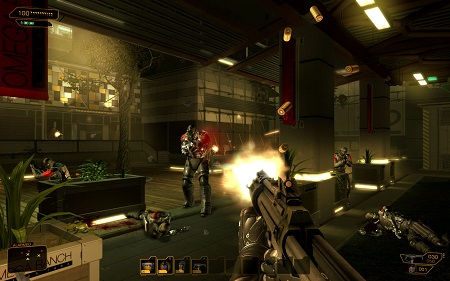
If you’re desperate to play Cyberpunk 2077 but have been put off by the bugs and the backlash (or if you just don’t have a good enough PC to run the game very well) then the Deus Ex series is an interesting alternative. The four games in the series are far more linear than the open-world Cyberpunk 2077, but many elements cross over between the two titles, such as first-person action, augmenting your human character, and a dystopian future setting.

The two most recent titles in the series – Human Revolution and Mankind Divided – made my list of ten games to play instead of Cyberpunk 2077 a couple of weeks ago.

Number 6: Plague Inc: Evolved (2016)
60% discount, £4.79

Depending on your sense of humour this could either be timely or incredibly offensive! Plague Inc: Evolved is an expanded port of a game that was originally released on Android and iOS in 2012 and sees players take on the role of a disease looking to wipe out humankind. In that sense it’s a unique experience as there’s nothing else quite like it on the market!

Plague Inc: Evolved is a lot of fun, and offers a number different ways to play as well as different upgrade paths for your chosen pathogen. Obviously the current pandemic makes it a somewhat controversial choice, but it is undeniably an entertaining little strategy game.

Number 7: Star Wars: Squadrons (2020)
40% discount, £20.99
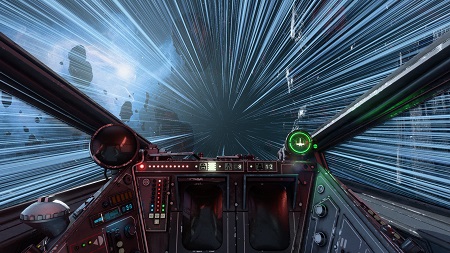
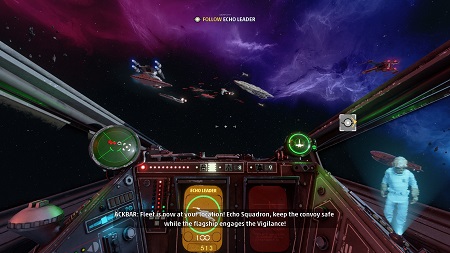
Since I wrote up my first impressions of Star Wars: Squadrons back in October I’ve continued to play the game. It’s been an incredibly enjoyable experience, slipping into the role of a fighter pilot in a galaxy far, far away. I know some folks are put off by the “realistic simulator” style of play and the mandatory first-person viewpoint, but if you can look beyond those limitations and are willing to invest a few hours into learning the way it works, under the surface is a fun game.

I haven’t played much multiplayer; as you may know I’m not really an online multiplayer fan. But if you like that, and you want a different Star Wars experience to enjoy with friends, this could well be the game for you.

Number 8: Control (Ultimate Edition) (2020)
50% discount, £17.49

Big caveat here: I have yet to play Control for myself. It’s been on my radar for a while, though, and I may even write up my playthrough as part of my Let’s Play series here on the website. The game is a single-player action-adventure title with a strong narrative, focusing on Jesse as she has to figure out a supernatural event.

Control and publisher 505 Games have rightly received criticism for the way they handled the rollout of the Ultimate Edition – refusing players a free upgrade despite the game being only a few months old. If you can look past the controversy, however, Control has received great reviews and I’m excited to try it for myself.

Number 9: Skully (2020)
50% discount, £12.49

It’s unusual for me to spend so much money on an indie title, but Skully is an absolutely delightful 3D platformer in which you get to play as a disembodied skull. That premise alone sold it for me, and I was not disappointed when I sat down to play the game in the autumn. I have an article about Skully in the pipeline, but as with so many writing projects here on the website I haven’t bashed it into shape yet!

Despite the game’s protagonist being a literal skull, there’s more to it than just rolling around – though the physics used for the rolling sections is exquisite! Skully can take on different golem-style bodies, and even though a game based on a skull might seem spooky, there’s a magical fantasy theme rather than anything grotesque or horrifying. I thought it was great value when it was full price, but with a 50% discount it’s absolutely worth picking up this underrated gem.

Number 10: Steep (2016)
80% discount, £5.19

It’s winter! Or at least it is here in the northern hemisphere, so snow and winter sports are on our minds. Steep is a fun winter sports title that lets you ski and snowboard in a large open world, as well as take on the extreme sports of paragliding and wingsuit flying.

Steep has a few DLC options available – which are similarly discounted – but one which stands out is Road to the Olympics, which added in extras related to the 2018 Winter Olympic Games. Even without any DLC though, the base game is great fun. It’s one of those sports games which is easy to get started with but difficult to really master.

Number 11: Black Mesa (2020)
50% discount, £7.49

The non-existence of Half-Life 3 has become a meme at this point, and although the VR-only title Half-Life Alyx may have offered a glimmer of hope that the series isn’t entirely on ice, there’s been no announcement of future titles at this stage. What we did get in March this year, though, was Black Mesa, a fan-made remake of the original Half-Life from 1998.

As you’d expect from a remake, Black Mesa incorporates everything that players loved about the original, but updates the visuals to bring it in line with more recent first-person action titles. If you missed the original Half-Life in the late 1990s or just want to relive that experience, Black Mesa comes highly recommended!

Number 12: Red Dead Redemption 2 (2019)
33% discount, £36.84
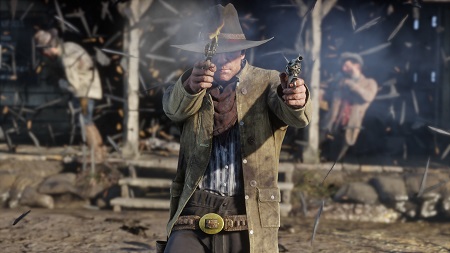
Another title which needs the “I haven’t played it yet” caveat, Red Dead Redemption 2 is widely hailed as a masterpiece. The Wild West-themed action title comes from Rockstar, best known for the Grand Theft Auto series, and promises to transport players back in time to the latter days of the American frontier.

I’ve been waiting and waiting for Red Dead Redemption 2 to go on sale, and while a 33% discount isn’t huge it’s certainly more than generous enough to make this fun title worth a try. The main campaign alone is said to be over 40 hours, with many players spending 60+ hours in Rockstar’s American west setting. I’m genuinely interested to try it for myself, and if reviews from professional and amateur critics alike are to be believed, it’ll be a fun time.

Number 13: Pillars of Eternity Collection (2015-18)
70% discount, £24.06

Obsidian Entertainment developed these two fantastically detailed old-school role-playing games, and to see both titles plus their DLC so heavily discounted is great. There is literally days’ or even weeks’ worth of gameplay and story to get stuck into here, and again if you’re craving a role-playing game to play given the recent release of Cyberpunk 2077 these two games could be a worthwhile – if wholly different – alternative option.

It’s hard to say too much about either game without spoiling the narrative – which is, of course, the primary focus of such titles. But they’re amazing, in-depth experiences and if you get stuck in you’ll find yourself playing for hours on end.

Number 14: Resident Evil 2 (2019)
60% discount, £13.99
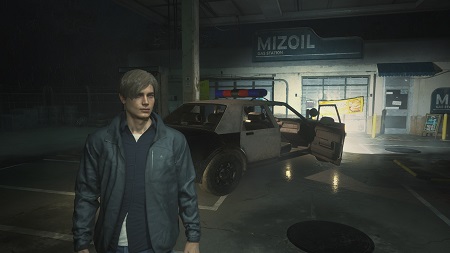
The remake of Resident Evil 2 won many awards in 2019, and was many folks’ choice for game of the year. The horror title debuted in 1998, but was rebuilt from the ground up for this version. There are mutant monsters, zombies, and jump-scares galore in this gory, visceral horror title, and it is not for the faint of heart!

After the disappointment many felt at Resident Evil 3′s cut content and short runtime earlier in the year, Resident Evil 2 seems even better by comparison. It’s possible to pick up both remakes for a little over £25, though, and for the heavily discounted price, Resident Evil 3 doesn’t feel quite so bad. It’s like I always say – length doesn’t matter, as long as a game is priced accordingly!

Number 15: Vampyr (2018)
75% discount, £8.74

Set during the 1918-19 Spanish flu pandemic, Vampyr is another game you might consider timely given the state of the world today! It’s got a unique premise as far as vampire titles go – the player character is a doctor, a newly-turned vampire who must balance his bloodlust with his Hippocratic oath in a hauntingly beautiful rendition of interwar London.

The pandemic can be a touchy subject, and it’s totally understandable for folks to want to skip Vampyr for now. But give it a chance and you’ll find an enjoyable title, one that blends reality and the supernatural within a truly interesting historical setting. Though arguably a little short, it’s the kind of narrative-heavy game where you feel your choices genuinely matter in the world you’re inhabiting.

Number 16: FIFA 21 (2020)
63% discount, £25.89

Ah, the annual FIFA series. Not to every gamer’s taste, I admit, but if you like football and support a team in any of the major divisions around the world, there’s no other football title that offers as much. I’m surprised to see FIFA 21 so heavily discounted so soon after its October release, because there’s nothing wrong with it at all.

That being said, modern FIFA games are iterative rather than transformative with each new release, and players who’ve picked up any title in the series in the last few years won’t see a huge difference or improvement with FIFA 21. Personally, it isn’t a series I buy every iteration of every year, and having waited three or four years since I last picked up the latest entry, there was enough going on in FIFA 21 for me to have an enjoyable time with its single-player mode.

Number 17: Disney Classic Games: Aladdin and The Lion King (2019)
60% discount, £9.51

With an original asking price of over £20, I felt that Aladdin and The Lion King was far too expensive for what it was when it was released last year. Despite Aladdin in particular being an outstanding platformer, I found it hard to justify the steep cost for two games which are now more than a quarter of a century old. With a reasonable discount, however, this two-game bundle feels more accessible and appropriately-priced.

I fondly remember both games from the SNES days, and though it’s the Sega Mega Drive/Genesis versions that were used for this collection, those nostalgic feelings are still present! If you’re in the market for a couple of cute but surprisingly difficult 2D platformers, Aladdin and The Lion King could be just what you need. It’s also well worth showing games like these to younger players, to let them experience a slice of gaming history.

Number 18: Kingdoms of Amalur: Re-Reckoning (2020)
40% discount, £20.99

Though I adore Kingdoms of Amalur, this version must come with a caveat: despite claiming to be a remaster, it’s really little more than an upscaled version of the original title. Very little has been changed, and players (like myself) who expected more of a remake were left underwhelmed. So if you already own the original Kingdoms of Amalur: Reckoning, there’s basically no reason to get this version.

If you missed Kingdoms of Amalur when it was new, or never owned it on PC, however, it’s definitely worthwhile picking it up. What you’ll find is a fantasy role-playing game that combines some of the best elements of franchises like the Elder Scrolls and Dragon Age series into one exciting title. There’s a unique and interesting story at the core of the game, too, and if it hooks you in you won’t want to put Kingdoms of Amalur down until you’ve unravelled all of its mysteries!

Number 19: Jurassic World Evolution (2018)
90% discount, £3.49

Jurassic World Evolution is the dinosaur park builder that every fan of the Jurassic Park/World series has always wanted. A blend of the dinosaur-themed series with the likes of “tycoon” games such as Rollercoaster Tycoon, it’s a surprisingly detailed yet incredibly fun experience. And with such a heavy discount, there’s no excuse not to give it a try!

As someone who returned to the theme park-building genre after a long absence, it took me a while to get to grips with the plethora of options and massively expanded nature of titles like Planet Coaster and Jurassic World Evolution. Better technology means these games can offer a lot more – and that means that there is a learning curve! But stick with the tutorial and you’ll learn all you need to step into John Hammond’s shoes and run your own dino park!

Number 20: Star Trek: Bridge Crew (2017)
60% discount, £8.39

When it comes to gaming lists, it’s hard to find Star Trek titles to include! The franchise has not always been well-served in the gaming realm, unfortunately. Star Trek: Bridge Crew was originally designed as a VR-only title, but an update not long after its release allowed for non-VR play too. It’s best enjoyed with friends, as each of you can take on the role of a character on the bridge of a Starfleet vessel.

I wrote up my first impressions of Star Trek: Bridge Crew a few months ago when I picked it up, and suffice to say the VR-oriented controls take some getting used to. But if you’ve ever wanted to take command of a Federation starship and have your own Star Trek adventures, this is one of the only modern titles that allows you to get anywhere close to that experience. And as I often find myself saying, it wouldn’t be one of my lists without at least one Star Trek title!

So that’s it. Twenty recommendations from the Steam Holiday Sale. If you were to buy all of them I reckon you’d have spent £269.29. That doesn’t sound as impressive as some of my previous lists of Steam sales, but this time I tried to focus more on recent titles instead of going back to games of yesteryear! If you consider that it averages out to £13.47 per entry on this list (several of which are bundles) I think it’s pretty good considering we’re looking at mostly new titles! These sales give PC gaming an edge over consoles, and even as services like Game Pass begin to take off, there’s still a place for the Steam Holiday Sale!

Even though I’m not a huge fan of Epic Games these days, there’s a sale running over on the Epic Games Store too. In addition, Epic is giving out several free games this holiday season, and a £10/$10 voucher. Cyberpunk 2077 is available on the Epic Games Store, and even though it isn’t discounted right now, if you use your free voucher to buy it you can reduce the cost of 2020’s hottest mess!

So there’s some inspiration for you as you head over to Steam to check out the holiday sale. I hope this has been useful, and if your favourite title isn’t on sale this time, don’t panic! It might be included in the Steam Summer Sale next year!

Prices and discounts included in this article were correct in the UK at time of publication. The Steam Holiday Sale begins today (22nd December 2020) and runs until 6:00pm GMT on the 5th of January 2021. Prices and discounts are subject to change at any time, and may vary by region and currency.

All titles listed above are the copyright of their respective studio, developer, publisher, and/or corporation. Some promotional screenshots and artwork courtesy of press kits on IGDB. This article contains the thoughts and opinions of one person only and is not intended to cause any offence.

Star Wars: Squadrons – First Impressions

Spoiler Warning: There are spoilers ahead for the story mode prologue missions of Star Wars: Squadrons. Further spoilers may be present for other iterations of the Star Wars franchise.

It’s a rarity these days for me to pick up a new game the day it’s released, but that’s what I did for Star Wars: Squadrons. I remember with fondness titles like Rogue Squadron, which I played on the Nintendo 64, as well as the spaceflight sections of the first Battlefront II, and I’d had Squadrons on my radar (pun intended) since it was shown off at EA Play in June. I don’t pre-order as a rule, but when the game was released I picked it up on Steam. My slow internet connection meant that I had to leave it overnight to download and install, but I got up the next morning eager to jump into the cockpit!

First, Squadrons needed me to download and install the latest Nvidia graphics card driver. It’s been a while since any game insisted on something like that! But that didn’t take too long and I was ready to go – only to be confronted with a strange graphical issue when the game booted up. I have a 4K display, and for some reason Squadrons had cut off the majority of the display, only showing a small portion stretched out to full-screen. If anyone else encounters this issue, here’s how I fixed it: pressing Alt + Enter to exit full-screen mode. From there, I was able to access the graphics settings and change them from whatever bizarre resolution Squadrons thought I wanted to a standard 1080p full-screen experience.

This was all I could see at first! Not the best start…

When the game restarted I got the proper experience. I appreciate that Squadrons offers a range of options for colour-blind players; though I’m not colour-blind myself my brother-in-law is, and I know some titles can be almost inaccessible for people with visual impairments. Any accessibility features like that are a welcome addition.

Despite being marketed as a game with a multiplayer focus, Squadrons insists that you first play the prologue of its campaign. It’s also recommended to complete the campaign, but after the prologue is complete it’s possible to jump into multiplayer. As someone who isn’t big on multiplayer gaming I was planning to play the campaign anyway, but it’s worth knowing that it isn’t possible to go straight to multiplayer if that’s what you’re buying the game for. All told, the prologue took less than an hour to complete, so it isn’t a huge time-waster for people who want to dive right in.

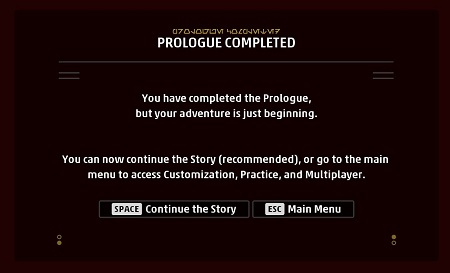
You’ll receive this message upon clearing the prologue.

The campaign has an unusual format in that players are assigned two playable characters, one on each side of the conflict. The main setting is post-Return of the Jedi, looking at the conflict between the remains of the Imperial forces and the New Republic, but the prologue takes place years earlier, just after the destruction of Alderaan (as seen in A New Hope). This narrative choice won’t be to everyone’s taste, and I’ve already seen criticism online from players who wanted to be able to pick a side and stick with it all the way, but I don’t mind that. It’s different, interesting, and it gives a more rounded view of events (as well as allowing players to fly both Imperial and Rebel/New Republic ships).

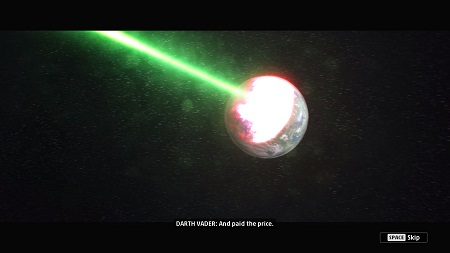
The destruction of Alderaan, as seen in-game.

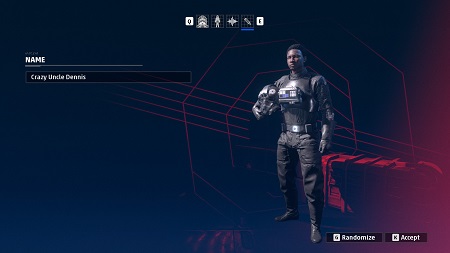
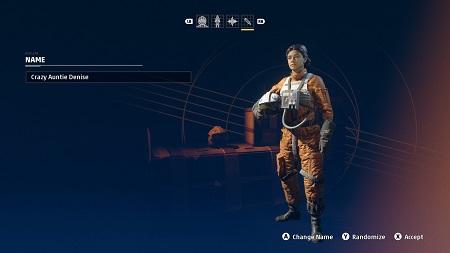
The character creator is rather basic. In fact, I wouldn’t even call it a “creator,” rather there are a dozen or so pre-created faces and two body types (male or female) to choose from. There are a few different voices, and although the player character doesn’t seem to talk much, that’s a nice touch. The game is played entirely in first-person mode, so perhaps a character creator is unnecessary. You do get to choose your character’s name, though, and there’s a “randomise” option if you want the game to generate a Star Wars-sounding name.

My Imperial pilot…
…and my Rebel/New Republic pilot.

The voice options and the name are the more important points. The voices are good, and although there are only a few types, they are all clearly different from one another. Names will be shown in subtitles (if you have subtitles enabled; I always do). After customising the two characters, the prologue began, and it was a moderately interesting story surrounding a convoy of refugees fleeing Alderaan. The Empire tasks a squad of TIE fighters with finding and destroying the convoy, and the Rebels task a group of X-wings with defending it.

The game begins with the Imperial mission, and this is where I got my first taste of gameplay. Squadrons is not a cakewalk, and it takes time to get the hang of the controls. I’d say it’s closer to a simulator experience than an arcade-style game such as Rogue Squadron, so be prepared for a learning curve.

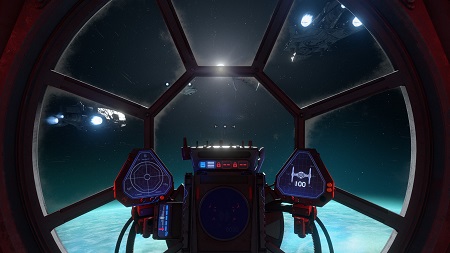
The view from the cockpit of a TIE fighter.

I’m someone who prefers to play with a gamepad, but even so I didn’t find the controls easy at first. The control pad is mimicking – in a very basic way – a HOTAS or dual-stick cockpit, with the left thumbstick used to throttle up and down and the right for turning. I found this counterintuitive at first; most games use the two triggers – right to accelerate, left to slow down or reverse. Using the thumbstick for this takes some getting used to.

The throttle controls.

In that sense, players who use a proper HOTAS setup – which Squadrons does support – may find it easier and more immersive. I have seen reports online that it takes time to calibrate a HOTAS for Squadrons, but I think that’s true for many titles, and as someone who doesn’t have a HOTAS I can’t verify that. However, if I find myself getting really into the game, perhaps getting that kind of setup is something I’d consider.

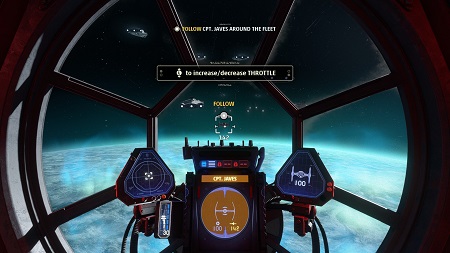
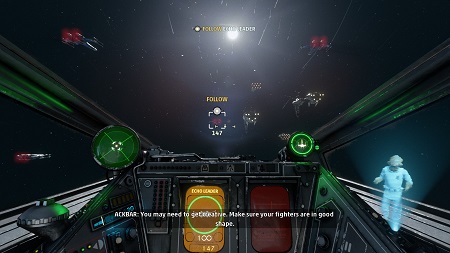
Squadrons gives you plenty of time to acclimate to the controls, though. The first few minutes of the mission consist of gently following the lead TIE fighter around the fleet, and from there the action amps up slowly rather than dumping you right into a huge battle. This is not only greatly appreciated, but arguably necessary! Perhaps the most ardent combat flight sim players don’t need this level of hand-holding, but I’d suggest that most gamers will.

It was definitely helpful that the game didn’t launch right into a huge firefight.

The prologue offered an interesting – if somewhat predictable – story of an Imperial pilot (not the player character) who defects to the Rebel Alliance. During the aforementioned mission to chase down a fleeing fleet of refugees from Alderaan, the TIE squad’s captain chooses to defect, and after a firefight and a chase, the action then switches to Rebel forces. This is the dual narrative at work.

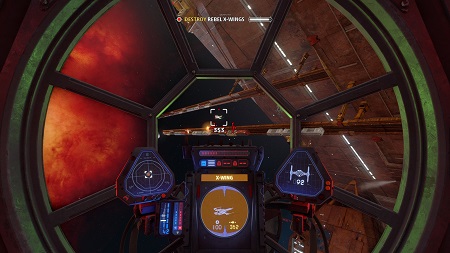
Taking on Rebel X-wings.

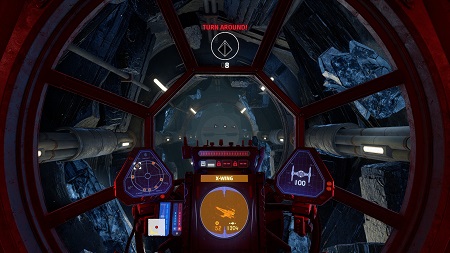
I did die once during this section; Squadrons will automatically destroy your ship and force you to respawn if you fly out of bounds of a given section of a mission, and I chose to investigate a tunnel before it was time. The tunnel would turn out to be where the refugees were hiding, and where Captain Javes would defect, but the linear narrative doesn’t want players straying from the course laid out, which is fair enough. There’s a short timer to give you a chance to turn around before having to restart.

Going the wrong way leads to dying and having to restart.

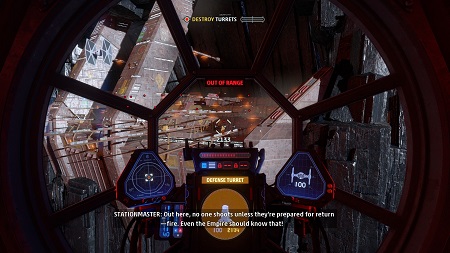
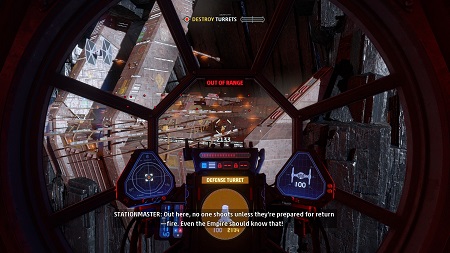
I’m not sure whether this applies to all the different classes of starfighter – I assume it does – but it’s possible to be out of weapons range. Even when a target appears to be relatively close, the game will designate it “out of range” unless it’s within 1000 metres (or whatever the Star Wars galaxy’s equivalent of metres is!) Again, once you get the hang of this it’s fine, and targets all have floating distance numbers when locked-on to tell you how far away they are. 1000 is a nice round number that should be easy to remember!

An out of range target.

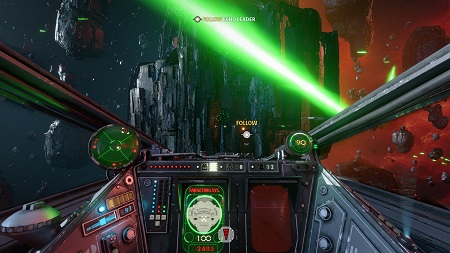
After the defection, the action switches to Rebel forces, and I got a chance to pilot an X-wing! This was great fun, and both ships have incredibly detailed cockpits. I’m sure the other vessels that can be played will also be created in such stunning detail too. The visuals in Squadrons are truly impressive and offer an immersive Star Wars experience as a result. I know some people will insist that “graphics aren’t everything,” and while this is true, there’s no denying that a title like this works exceptionally well when it offers players the best visual experience possible.

The X-wing cockpit.

After another “fly around the fleet and get used to the controls” section, the X-wings are called into action to assist the refugee fleet that we’d been pursuing as the Empire moments earlier. These missions work well back-to-back, and I enjoyed the different perspectives. Both the Rebel and Imperial missions offer a lot to do, with different objectives to complete in addition to dogfights against enemy fighters.

My X-wing came under attack!

Captain Javes, the defecting Imperial pilot, is welcomed into the Rebel family and provides information that helps the Rebels defeat the Imperial forces and protect the refugee fleet. It was a fun sequence to play though, and while I feared for the defector’s life, he appears to have survived the events of the prologue!

The refugee fleet.

There was a great sequence which involved attacking a Star Destroyer at close range. After defeating a handful of TIE fighters, the Imperial defector insists we need to take out the capitol ship’s ability to track the fleeing refugees, otherwise they’ll just follow and catch up to them later. I believe that this is the first taste of Squadrons’ “fleet battles,” in which players team up in multiplayer (or against the AI) to take on larger fleets. Each ship has several weak points that have to be knocked out. Here in the prologue we just had to destroy one before retreating with the rest of the Rebel forces.

Jumping to hyperspace.

Overall the prologue serves as a great starting point for what seems to be a fun title. Its control scheme and semi-simulator style will mean it isn’t to everybody’s taste, and players looking for a more casual experience may be disappointed. There’s only one viewpoint: a first-person, in-cockpit view. This means you can’t switch to get a third-person view from behind your spacecraft, and again this is something that won’t be to everyone’s taste.

Electronic Arts has shown a great deal of respect for the Star Wars brand here, not only by avoiding microtransactions, but also by pricing the game below the standard “full price” of £55/$60. I almost certainly wouldn’t have picked it up on release at that price, but for £35 it feels fair and a reasonable purchase. The short campaign (estimated at around 6 hours) may have a bearing on that, but as we’ve seen recently, some other titles – such as the remake of Resident Evil 3 – have been content to try to charge more for campaigns of a similar length. Credit to Electronic Arts for not doing so.

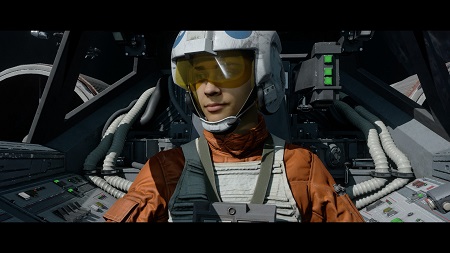
The Rebel player character.

Squadrons is a simple game with complex gameplay that will take time to master. But it’s fun! I had a great time earlier in the year playing through Star Wars Jedi: Fallen Order, and this looks set to be my second fun Star Wars experience of the year. Even while I’m writing up my first impressions I’m itching to jump back in and have another go at piloting an X-wing or a TIE fighter and having my own crack at being a pilot in the Star Wars galaxy.

For this price, it’s hard not to recommend Star Wars: Squadrons if you’re someone who enjoys this kind of gameplay. If you aren’t, but still want that Star Wars pilot experience, there’s always Battlefront II, which has a starfighter mode, or you could even go back and look at older titles like Rogue Squadron.

Star Wars: Squadrons is out now for PC, Xbox One, and PlayStation 4. Star Wars: Squadrons was developed by EA Motive and published by Electronic Arts. The Star Wars franchise is the copyright of Lucasfilm and Disney. This article contains the thoughts and opinions of one person only and is not intended to cause any offence.
Are presentations like EA Play the future of gaming events?

EA Play 2020.

The coronavirus pandemic has caused many events to be delayed or cancelled. One of the biggest casualties in the gaming world was E3 – the Electronic Entertainment Expo – which is held annually in California. E3 has been where big companies would make their biggest announcements: consoles from the Sega Saturn to the Xbox One, and so many games, from GoldenEye to the still-unreleased Elder Scrolls VI, all debuted at the event. It has been the biggest and most significant event on the calendar for games companies for years. But is it on the way out? If it does return next year as promised, what will the impact of its absence be in the longer-term?

There have been rumours for a few months now that a remaster of the Mass Effect trilogy is in the works – and I was at least a little disappointed that last night’s EA Play didn’t include it. But setting that aside, the presentation was a huge success – and crucially, for the vast majority of its audience watching at home, was no worse for not being part of a massively expensive event like E3.

Nintendo pioneered the “direct-to-consumer” digital marketing years ago with its Nintendo Direct presentations, and no longer attends the main E3 event. Sony has followed suit, and didn’t attend last year’s E3 either. Both companies have been successful with the kind of presentations we saw from EA last night.

Nintendo Direct broadcasts have been very successful.

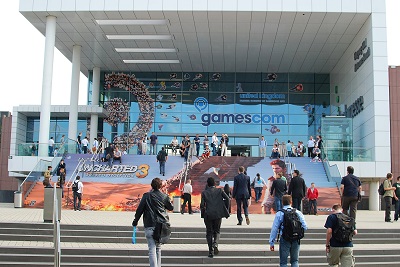
If you’re a regular reader you may recall that I used to work for a large games company. I wrote marketing material and website content for them for several years, and in that capacity I attended two iterations of Gamescom – Europe’s answer to E3, held annually in Cologne, Germany. These events are big, hot, overcrowded, and something the vast majority of a company’s audience will never be able to attend in person. The two Gamescom fairs I attended were interesting, but overall I found them to be uncomfortable experiences. While working took up most of my time, I was able to slip away a few times to visit other companies’ stalls and see a few speeches and bigger events, and that was vaguely interesting. When I look back on those experiences I guess I can say I’m glad that I had the opportunity to attend, but on the whole it’s a far more comfortable experience to watch the events on a live stream from home.

And this is what companies like EA are, I suspect, beginning to realise. Why go to all the expense of building a big stage, renting a building, flying out hundreds of people to Los Angeles or Cologne – which must cost tens or hundreds of thousands of dollars on top of producing the marketing material to be shown off – when a smaller-scale presentation like this can be taken care of in-house? What benefit does E3 or Gamescom offer any more that an event like EA Play doesn’t? It’s working just great for Nintendo, doing it this way, so why not for other companies too?

Gamescom is Europe’s biggest gaming event – but is it necessary for companies like EA any more?
Photo Credit: Sergey Galyonkin

Presentations like EA Play feel like a natural progression in the way big games publishers interact with their audiences. E3 made sense when it debuted in 1994, as it brought together different games companies and journalists – and there was no way to directly market their products in the way that social media and live-streaming allows. But an event like that feels kind of dated in 2020, and the benefits of attending the event are only seen by a tiny fraction of the company’s audience who are able to be there in person. It might make those people feel great – as well as showing off to journalists (who are themselves increasingly seeming like dinosaurs in a digital/social media age) – but doesn’t actually do anything for the majority of people who will watch from home.

In fact, the dangers of a live presentation before a large audience are great, especially when compared to the safety of a pre-recorded presentation. There are many instances at such events where things went horribly awry: the notorious “Mr Caffeine” at Ubisoft’s E3 2011 conference, for example, or the moment at Blizzard’s 2018 convention where an underwhelmed audience member asked – in front of the whole world – if crappy mobile game Diablo Immortal was “an out of season April Fools’ joke”. Yep, live events can go very wrong indeed – another great reason to avoid them.

Blizzard’s Diablo Immortal event in 2018 went so badly that it became an internet meme.
Photo Credit: imgflip.com

At the end of the day, most people want to get some information about the latest games from their favourite developers and maybe see a few trailers showing off those games actually being played. They aren’t interested in hours of fluff, and as they can’t attend the event in person, they don’t get to wander around checking out different booths or conferences, nor picking up the freebies handed out by interns and volunteers. The audience wants to see gameplay and get key facts like release dates, system requirements, and the like. This information is able to be much more easily and concisely communicated in a pre-recorded presentation like EA Play.

I enjoyed last night’s EA Play far more than I’ve enjoyed any recent E3 or Gamescom event. It ran through a number of games, some of which I had never heard of but are now on my watchlist, and it dropped a great new trailer for Star Wars: Squadrons, which is a game I’m looking forward to. By trimming the fat that would usually be part of a live event, like transitions between trailers and live moments, changing presenters, inevitable glitches, and so on, EA Play was great to watch. I really feel that these kind of presentations are going to be much more important in future, and events like E3 and Gamescom will decline. I don’t expect either of them to disappear entirely, at least not imminently, but as companies realise that not only does switching to this kind of broadcast have less risk and is probably more enjoyable for most viewers, but will also save them a lot of money, it’s a no-brainer to skip the big conferences and communicate directly with fans.

CEO of Electronic Arts Andrew Wilson speaks at the beginning of last night’s EA Play presentation.

Aside from the lack of news about Mass Effect – which I’m still holding out hope is in the works – EA Play was a great success. And if their marketing team has been able to get the word out so thoroughly that even someone like me knew in advance that the event was coming up, that should confirm the power of social media as a marketing tool. One of E3 and Gamescom’s big selling points has always been that they’re huge events that pull in audiences – but if a company like EA can manage to drum up support to get hundreds of thousands of people watching their presentation live, with over half a million more (at time of writing) watching the event after its initial broadcast, that argument is no longer valid.

Presentations like EA Play are going to become the norm across the industry sooner or later. Whether that will be to everyone’s advantage – or whether it will consolidate the power of the existing big publishers and companies, further pushing out smaller ones and making it harder for anyone new to get started – is unclear, and those are valid concerns. But EA will find that this summer has been a success despite the lack of E3. Will they return next year, or simply opt for another presentation like this one?

All games mentioned above are the copyright of their respective developers and/or publishers. This article contains the thoughts and opinions of one person only and is not intended to cause any offence.