The Official* Star Wars Tier List

A spoiler warning graphic.

Spoiler Warning: There are spoilers ahead for practically the entire Star Wars franchise.

I don’t know who first came up with the format, but I really like the way tier lists work. Instead of trying to rank every film or episode in a series in perfect order, we can just give them a grade – which is a nice and easy way of expressing how we feel! So today, I thought it could be fun to make The Official* Star Wars Tier List… of all the shows and films that I’ve seen, at any rate.

I first came to Star Wars in the early 1990s, when I watched the original trilogy at the insistence of a schoolfriend. He had just bought the films on VHS, and even though I’d been getting into sci-fi with TV shows Star Trek: The Next Generation, Space 1999, Captain Scarlet and the Mysterons, and films like Flight of the Navigator, E.T., and Back to the Future, somehow Star Wars had completely passed me by. I might’ve seen a few toys in the shops, but that was all. I grew up in a rural part of England in the ’80s and ’90s – but I was too young to have seen any of the Star Wars films at the cinema, so I just hadn’t engaged with the franchise at all.
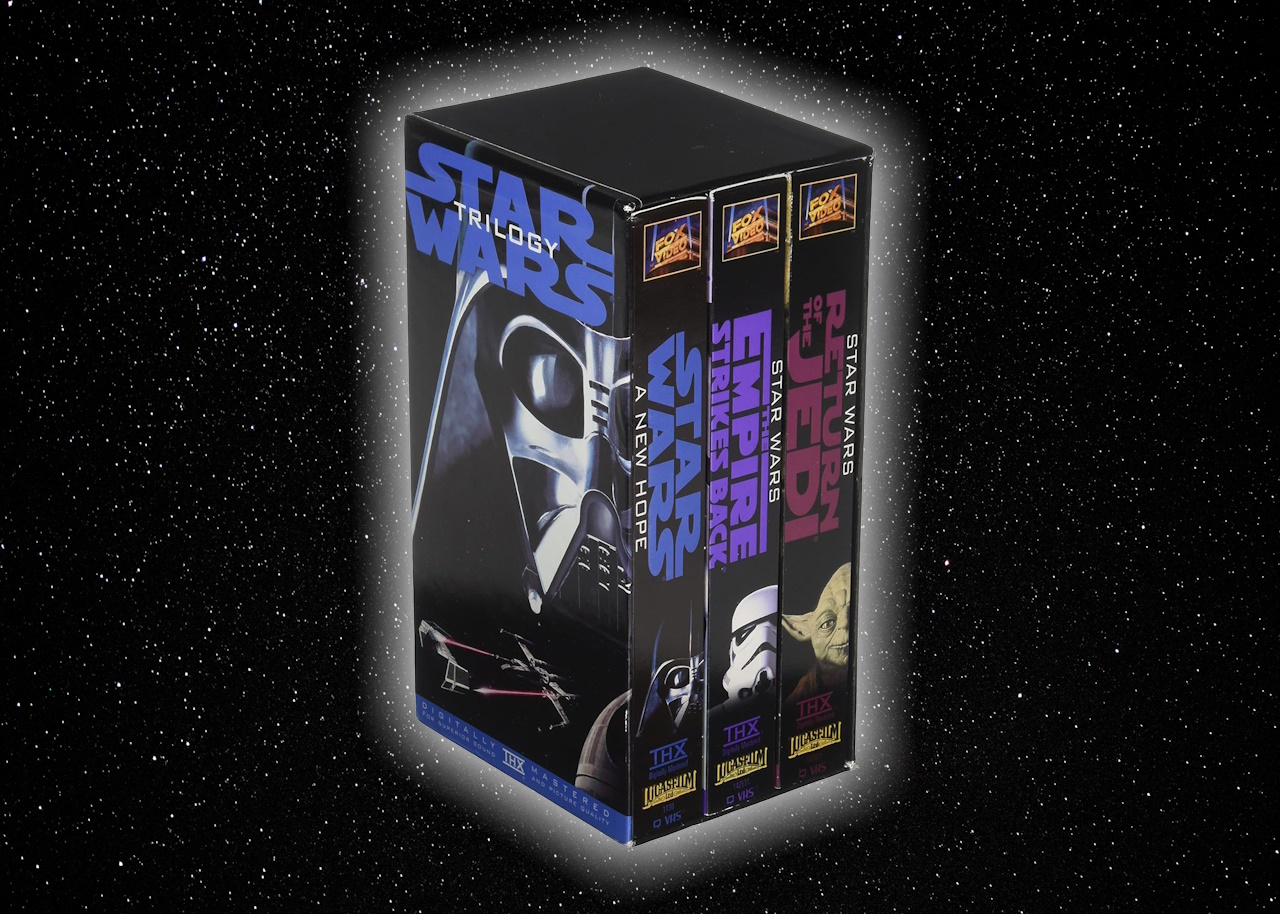
The Star Wars trilogy on VHS on a starry background.
I first watched the Star Wars trilogy on VHS in the early ’90s.

I was aware of the Star Trek-versus-Star Wars rivalry that fans at the time were still battling out, and as such I recall being unimpressed with Star Wars on that very first viewing. I felt it was somehow in opposition to “my” fandom – Star Trek: The Next Generation – and that some of its storylines were pretty basic and violent compared to what I guess I considered to be the more sophisticated and “grown-up” Star Trek. But that attitude didn’t last long – and after watching the films a couple more times and playing Super Star Wars on the SNES, as well as spending more time with my Star Wars-loving chum, I was officially a convert! I was a Star Wars fan!

And a Star Wars fan I remain to this day – even if I haven’t loved everything that the franchise has put out in the thirty-plus years I’ve been following it. But that’s a brief summary of my history with Star Wars to give you a bit of background as we put this tier list together.

A blank tier list.
Let’s fill out this tier list together!

Before we jump into the list, a couple of important caveats. As I always say, all of this is the entirely subjective opinion of just one fan. If you hate all of my rankings, if I put a film you hate way too high, or a series you adore way too low… that’s okay! Nothing about this is in any way “objective,” and while I will try to justify my rankings and explain why I placed each production in its tier, you are free to disagree vehemently. There should be enough room in the Star Wars fan community for civil discussion and polite disagreement.

Secondly, I will be ranking a number of Star Wars films, television shows, and – perhaps somewhat controversially – video games. I don’t know about you, but speaking for myself some of the best Star Wars stories have come from interactive media, and there are a couple of Star Wars games that I genuinely believe surpass the films and TV shows in terms of the quality of their storytelling, characterisation, and so on. It wouldn’t feel right to exclude those stories from this tier list… so I’m not!
Lego Star Wars minifigures.
We won’t be including every single Star Wars production this time!

Finally, I won’t be including any production that I haven’t seen for myself. What would be the point in pretending to rank a series or film I haven’t seen, after all? At the end I’ll make a note of these, but for reasons that I hope are obvious they aren’t going on the list.

I will be giving each Star Wars production one of the following grades: S, A, B, C, D, and F. These work like grades you might remember from school: F-tier is reserved for the worst of the worst, D-tier is pretty bad but a step up, C-tier is mediocre but not terrible, B-tier is generally good, A-tier is pretty great, and S-tier is the absolute cream of the crop! I will rank each production that I’ve seen/played in release order, beginning with the original Star Wars in 1977 and going through to 2024’s The Acolyte – which is the most recent Star Wars production at time of writing.

Phew! With all of that out of the way, let’s jump into the list.

Star Wars
(Episode IV: A New Hope)
1977
Tier: A

Still frame from Star Wars (1977) showing the main characters aboard the Millennium Falcon.

I think we have to rank the original Star Wars pretty highly, right? This is the film that created the entire franchise; without it, Star Wars wouldn’t exist. It introduced us to some great characters, established a setting that was crying out to be expanded upon, and above all told a really engaging story about the Rebel Alliance, the evil Empire, and a young man caught in the middle of it all. Luke Skywalker is a wonderful protagonist, point-of-view character, and introduction to this world.

The Death Star trench run has become iconic, as have the designs of ships like the X-Wing and Millennium Falcon. The characters of Ben Kenobi, Princess Leia, and Han Solo all felt like they had their own personalities and motivations, seeming to be real people inhabiting this fictional setting. The villainous duo of Darth Vader and Grand Moff Tarkin had weight, meaning our heroes felt like they were in constant danger. All in all, a wonderful start to the franchise and a film I’m always happy to revisit.

Episode V: The Empire Strikes Back
1980
Tier: S
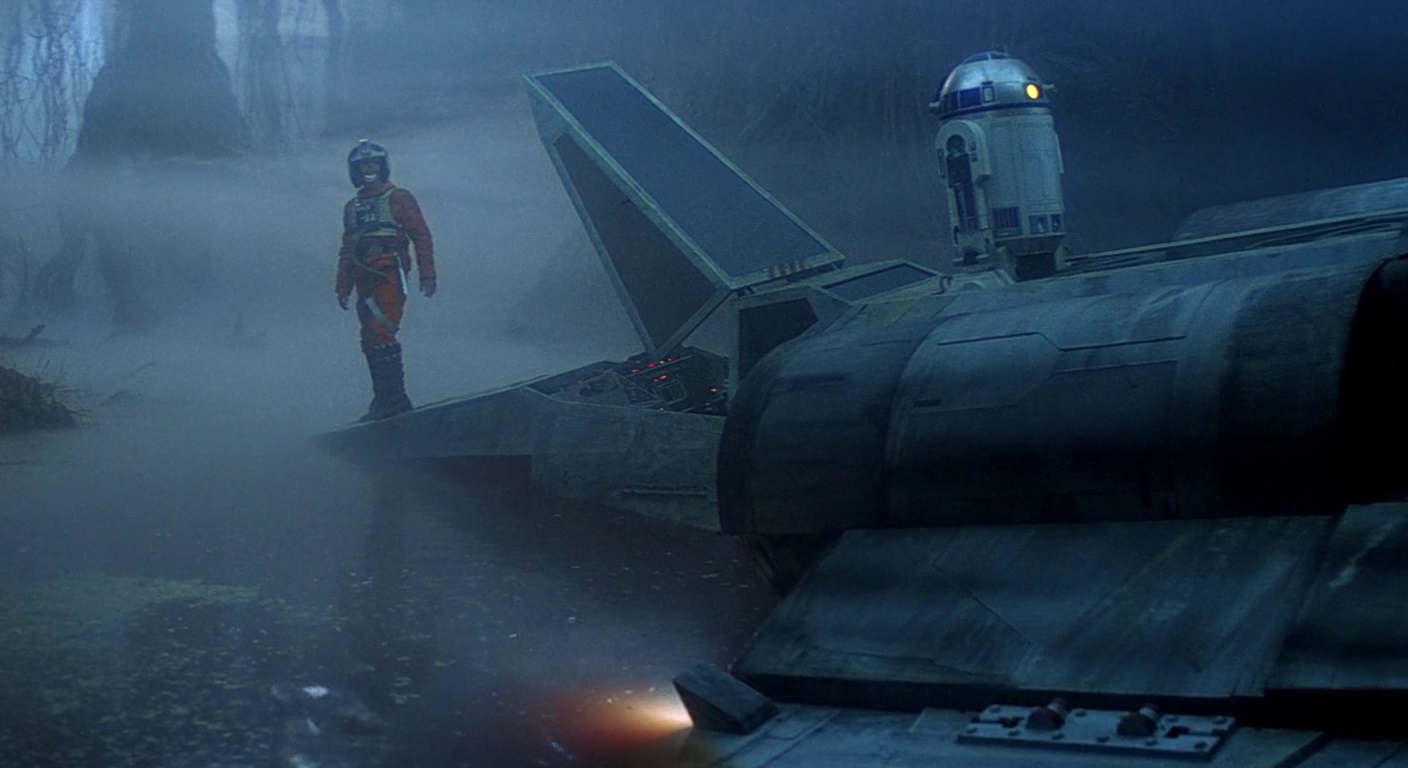
Still frame from The Empire Strikes Back (1980) showing Luke Skywalker's crashed X-Wing.

I’m not alone in considering The Empire Strikes Back to be Star Wars’ high-water mark, and I think you’ll see it right at the top of many folks’ ranked lists! And it’s easy to see why: this is a fantastic film. The opening scenes on Hoth set the tone for a story where the villains are on the march, and everything our heroes accomplished last time is at risk of being undone. Luke is able to follow in his father’s footsteps and pick up his Jedi training with the absolutely iconic Yoda, while Han and Leia are betrayed on Cloud City.

The Empire Strikes Back also contains one of the most iconic scenes in all of cinema: when Luke finds out that Darth Vader is his father. This was a pretty shocking twist, and one that reframed much of the story. Lightsaber duelling stepped up about ten notches in this film, and we were also introduced – albeit briefly – to Darth Vader’s master: the Emperor. Iconic designs like the AT-AT and Snowspeeder debuted here, and the Battle of Hoth is still one of the most tense and exciting that the franchise has ever produced. No doubt that The Empire Strikes Back is a top-tier Star Wars production.

Episode VI: Return of the Jedi
1983
Tier: C
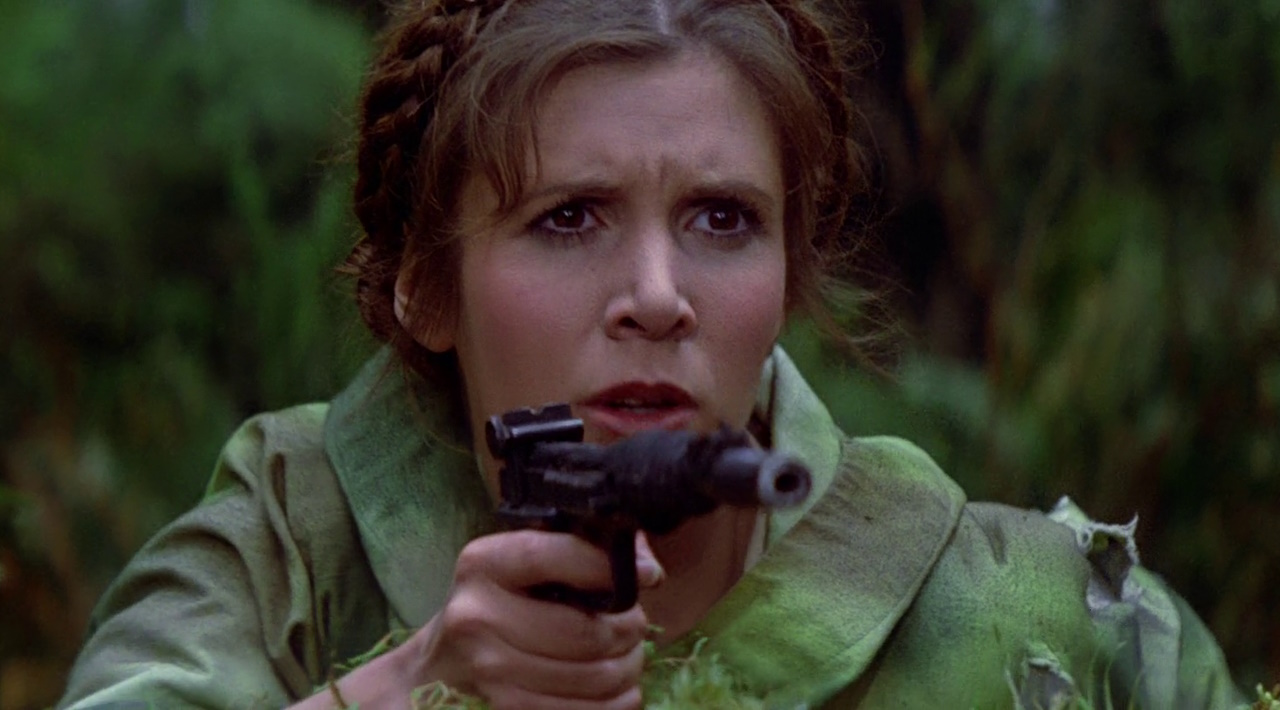
Still frame from Return of the Jedi (1983) showing Princess Leia holding a blaster.

On that first viewing of the Star Wars films that I told you about, my friend’s father insisted that Return of the Jedi was a crap film and a poor way for the trilogy to end. And this was not an uncommon view at the time: a second Death Star already feels pretty derivative, the conflict at Jabba’s palace drags on too long, and the Ewoks were an army of teddy bears that disrupted the Emperor’s carefully-laid plans! I wouldn’t say Return of the Jedi is “bad,” but I would say it’s nowhere near as good as its predecessors.

Return of the Jedi also retconned the relationship between Luke and Leia. I maintain that this decision was a mistake, one that’s been compounded by subsequent productions. Having Luke be Vader’s son was a shocking twist that worked; having Leia be Luke’s sister was an attempt to replicate that… but it didn’t live up to what had come before and doesn’t make a ton of sense, either. Return of the Jedi is also the film that introduced “from a certain point of view;” an overly complicated work of semantic gymnastics to justify the retcon in The Empire Strikes Back – and something that was not only entirely unnecessary, but that has also proven damaging to other stories as the franchise has doubled-down.

The Super Star Wars trilogy
1992-1994
Tier: B
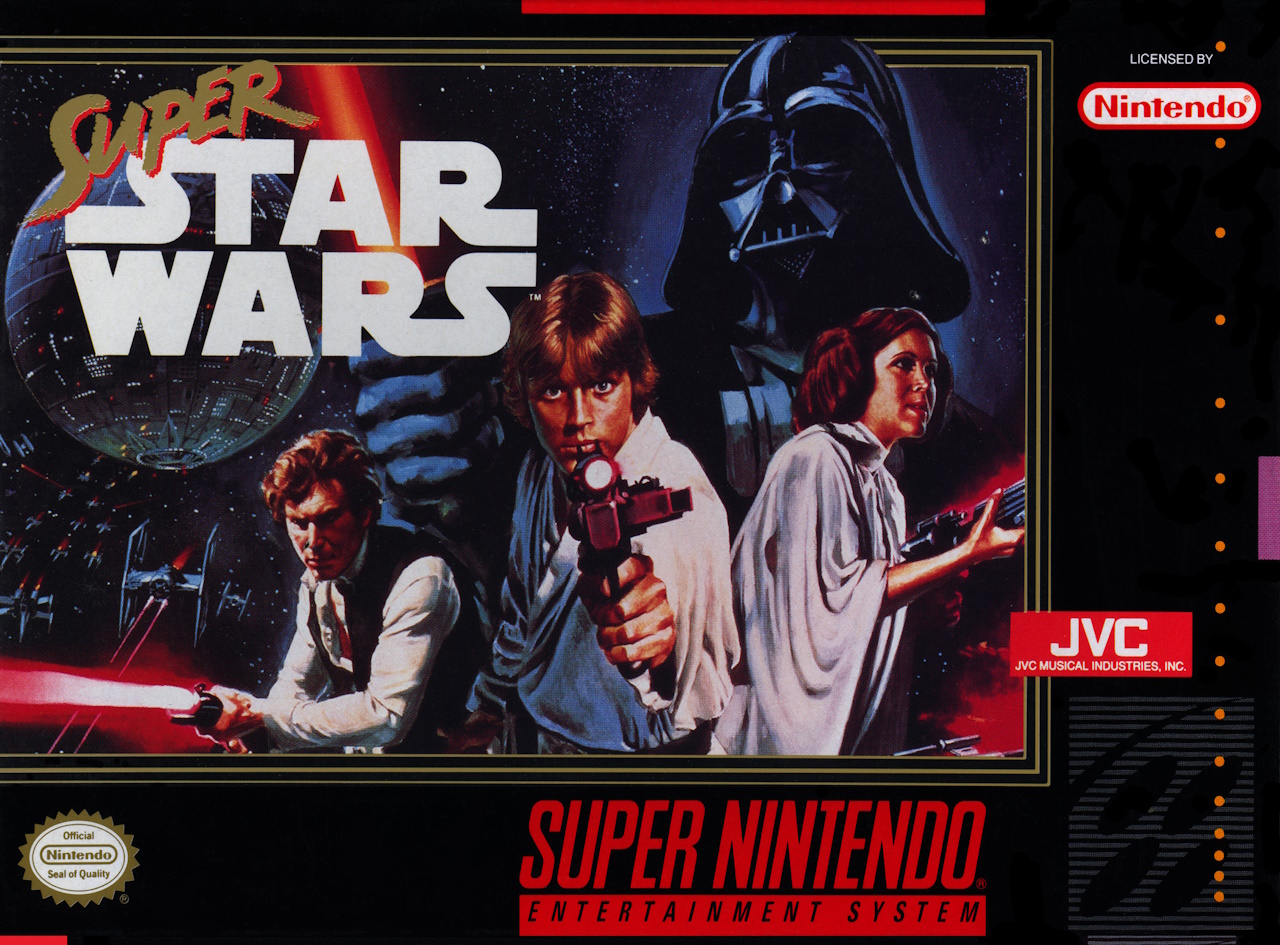
Box art for the SNES game Super Star Wars.

The first part of this trio of SNES games was my first introduction to Star Wars in the video game realm – and it was a lot of fun. These games are challenging 2D platformers, and they don’t always succeed at faithfully adapting the story of the films! In order to make some Star Wars scenes and settings fit the 2D platforming mould, some pretty big liberties were taken and the games diverge from those stories in a significant way. However, there’s plenty of enjoyment to be had jumping and blasting your way across a variety of Star Wars environments… or at least there was in the early ’90s!

X-Wing and TIE Fighter
1993/1994
Tier: B
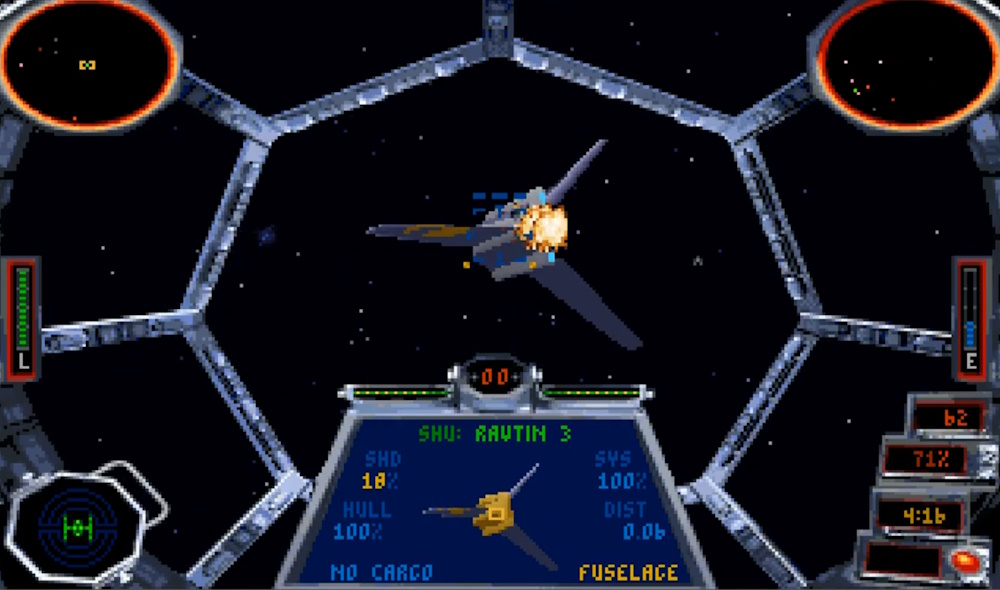
Screenshot of TIE Fighter (1994) showing a space battle.

Although undeniably dated by today’s standards, I loved playing TIE Fighter in the mid-90s. I didn’t go back to play X-Wing for several years (I didn’t own a copy at the time), but when I did I enjoyed that game, too. Both of these titles really let players feel like they were genuine starfighter pilots in a galaxy far away – even more so if you played with a joystick! These games were tremendous fun… but also pretty difficult! I imagine returning to them nowadays would be pretty hard, and I admit that I’m definitely cruising on my gamer nostalgia here!

Shadows of the Empire
1996
Tier: A

Box art for Shadows of the Empire (1996).

Shadows of the Empire was one of the first games I bought after getting a Nintendo 64 for Christmas in 1997, and I had a blast going on my very own Star Wars adventure. Shadows of the Empire introduced a brand-new character – Dash Rendar – and dropped him into the story of The Empire Strikes Back. After playing through the Battle of Hoth, Dash has his own adjacent adventure that sees him team up with all of the heroes of the original trilogy while battling against the likes of Boba Fett and IG-88.

This was the first game to really give me the sense of being part of the Star Wars galaxy on my own terms, and I think that’s because of how well-written Dash is as a protagonist. He feels like a real character with his own story to tell, and unlike in games like Super Star Wars, where you’d play as Luke and other characters, introducing someone brand-new really expanded the story. It was a ton of fun to go on this adventure through some wonderfully diverse levels – and the combination of gameplay in space and on the ground was neat, too.

Rogue Squadron
1998
Tier: B
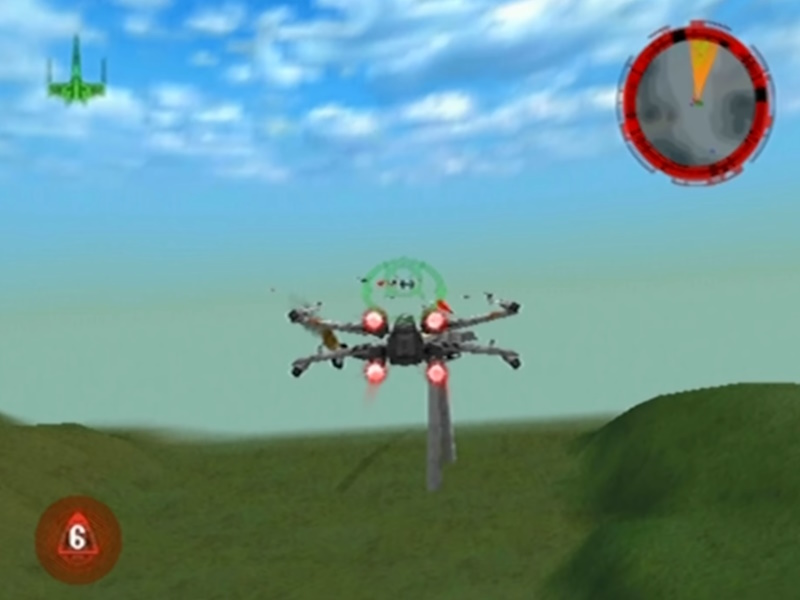
Screenshot from Rogue Squadron (1998) showing an X-Wing.

Another classic from the Nintendo 64, Rogue Squadron felt like a huge step up from TIE Fighter thanks to its 3D models and more diverse levels. It was also a lot easier than those other titles, with a better control scheme and more forgiving gameplay. There were also different spaceships to pilot: the X-Wing, of course, but also the A-Wing, Y-Wing, and Snowspeeder, each of which had different weapons that could be useful in different missions.

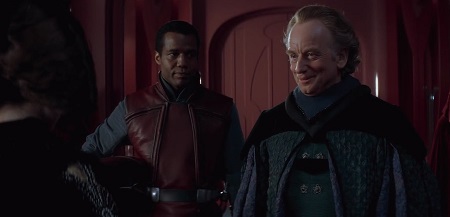
Episode I: The Phantom Menace
1999
Tier: F
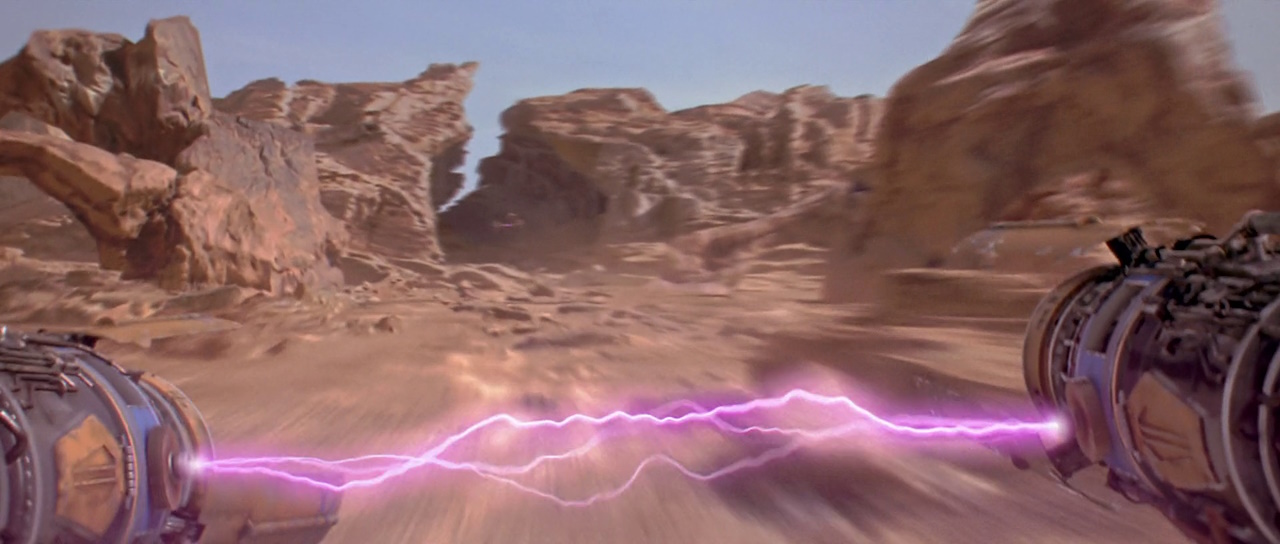
Still frame from The Phantom Menace (1999) showing the pod race.

I went back and forth on this, trying to decide if The Phantom Menace does enough to scrape its way into D-tier. But unfortunately it doesn’t, and the film remains one of the low points of the Star Wars franchise for me. I remember the buzz and excitement The Phantom Menace generated on its release in cinemas… and I also remember the controversy and disappointment it caused.

I’ve addressed this before, but the short version is that The Phantom Menace kick-started a story that just didn’t need to be told. We knew everything we needed to know about Anakin, Palpatine, and Obi-Wan Kenobi from the original trilogy, and seeing the rise and fall of Anakin Skywalker just wasn’t necessary. The Phantom Menace also contained some poorly-written dialogue, a convoluted storyline, some questionable character inclusions, and more. However, I will give the film credit for successfully bringing a whole new generation of Star Wars fans on board – and that, more so than anything else, was its objective.

Episode I: Jedi Power Battles
2000
Tier: B
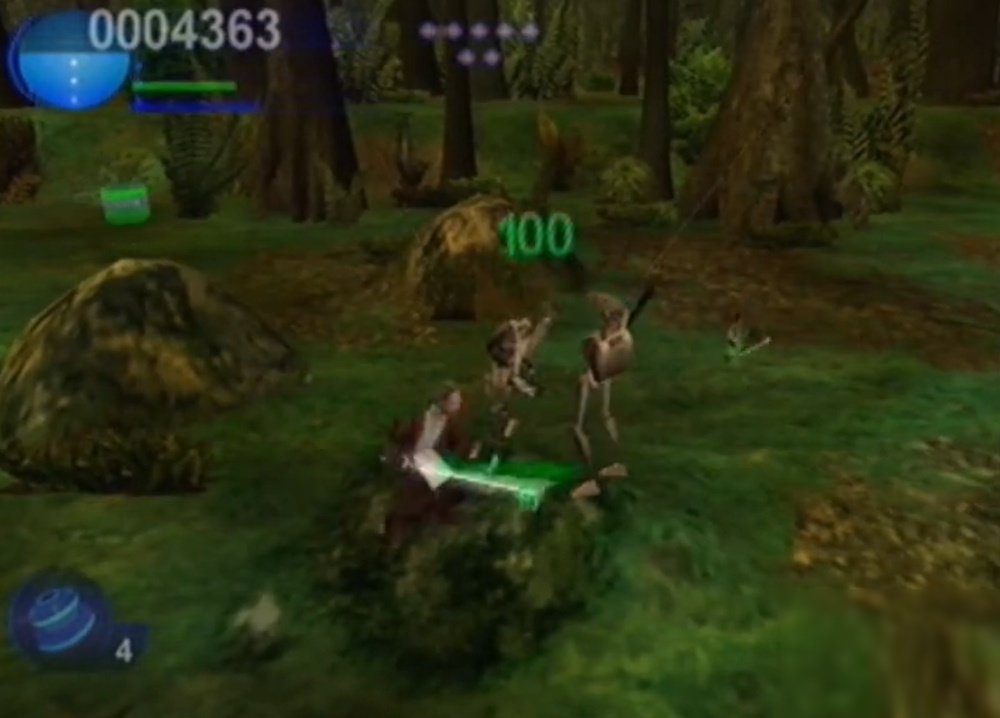
Screenshot of Jedi Power Battles (2000) showing a Jedi fighting battle droids.

Although less well-remembered than Episode I: Racer these days, Jedi Power Battles was a surprisingly fun action-platformer. The film it was based on may have been a disappointment, but Jedi Power Battles turned out to be a genuinely good time. I picked it up on the Dreamcast, and playing it co-op with a friend on the couch was a lot of fun (especially after a few drinks!)

Jedi Power Battles expanded the roster of characters, with some minor and background Jedi from the film becoming playable. As with Shadows of the Empire above, taking on different roles and playing as new and unknown characters felt pretty good, and the additional characters played well with the game’s expanded story. All in all, a fun romp – albeit held back by the source material’s weak story.

Episode II: Attack of the Clones
2002
Tier: D
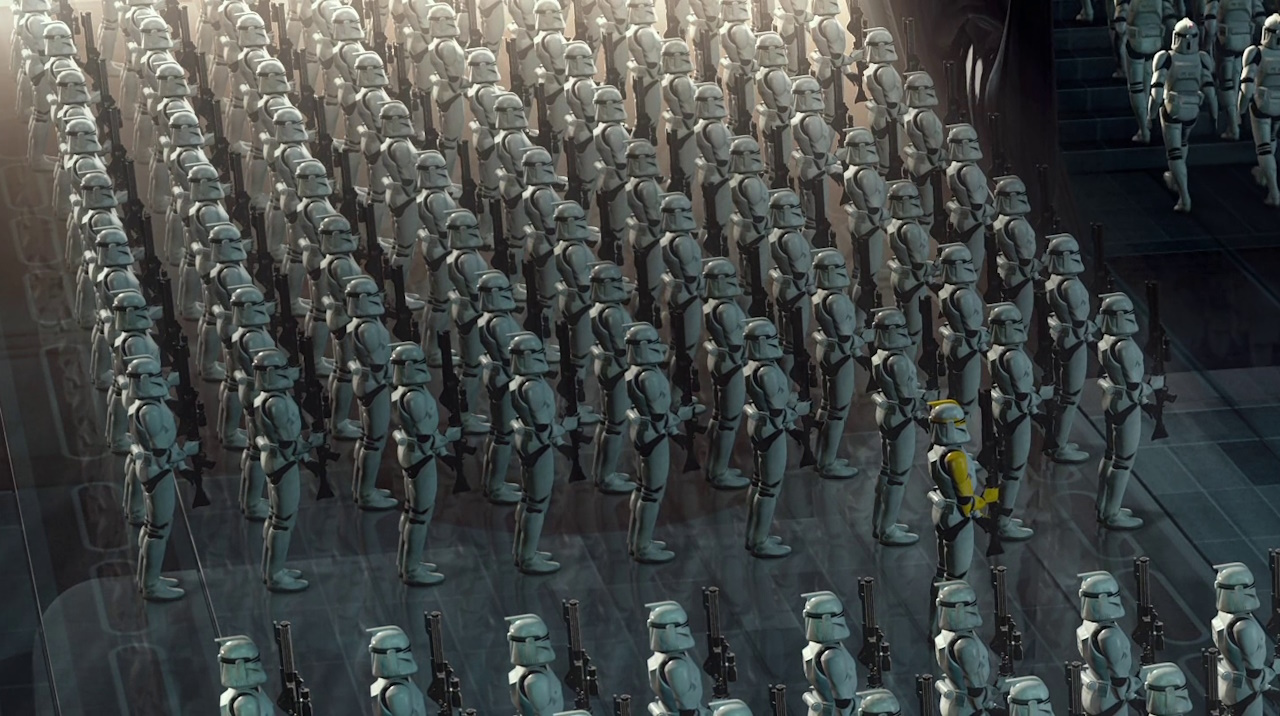
Still frame from Attack of the Clones (2002) showing the CGI clone army.

Attack of the Clones was Star Wars’ chance to redeem itself after The Phantom Menace… and if that was its objective, the film failed miserably. The writing and dialogue could be shockingly bad (“I don’t like sand,” anyone?) and the film’s overreliance on green screens and CGI that just wasn’t at the level it needed to be has meant it’s aged incredibly poorly. Seriously: the original trilogy, made more than two decades earlier, looks a heck of a lot better than Attack of the Clones, which looks like a Dreamcast-era cut-scene in places.

Attack of the Clones also continued Star Wars’ annoying trend of making every major and minor character related to someone else. In this case we meet Jango Fett – father of Boba Fett and the “template” for the Kaminoans’ clone army. I like watching Palpatine’s scheme unfold, and Count Dooku – played by the late great Christopher Lee – is a fine addition as a villain. But overall, the film still struggles. Attack of the Clones also has characters and story beats that were either set up or expanded upon in comics or other spin-off media, and this left it feeling somewhat incomplete when the credits rolled.

Knights of the Old Republic
2003
Tier: A
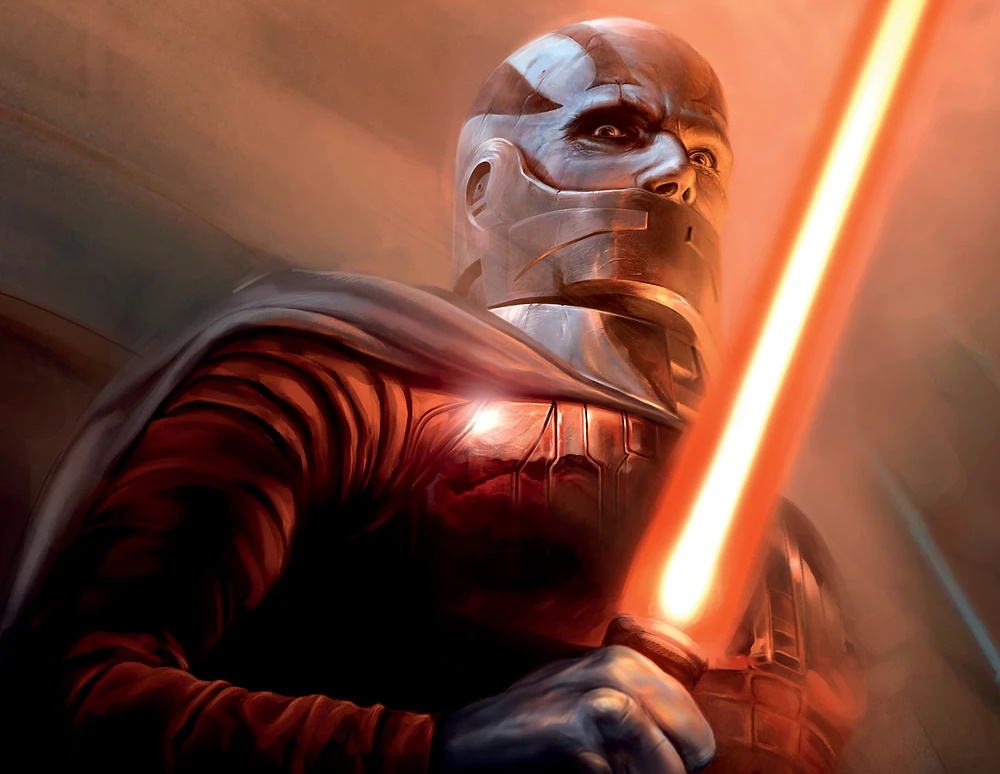
Concept art for Knights of the Old Republic showing Darth Malak.

Now we’re getting somewhere! Knights of the Old Republic helped me to fall in love with Star Wars all over again and put the disappointment of the first two prequel films to bed. There are prequel-era references throughout, of course, but KOtoR told a story that stood on its own two feet, fully separate from the characters of both the original films and prequels for the very first time. I absolutely adored this adventure, and creating my own character and taking them across the galaxy was just fantastic.

KOtoR’s innovative light side-dark side system was a blast, giving the game more replayability. The companion characters and villains were all absolutely incredible, and the variety of levels and missions on offer was outstanding, too. And the twist! I genuinely did not see the game’s big revelation coming until almost the last second, and when it was revealed I can vividly remember sitting on my couch, holding my Xbox control pad with my mouth just hanging open in shock. After the Vader-Luke reveal in The Empire Strikes Back, KOtoR’s twist is the best the franchise has ever pulled off.

Knights of the Old Republic II: The Sith Lords
2004
Tier: S
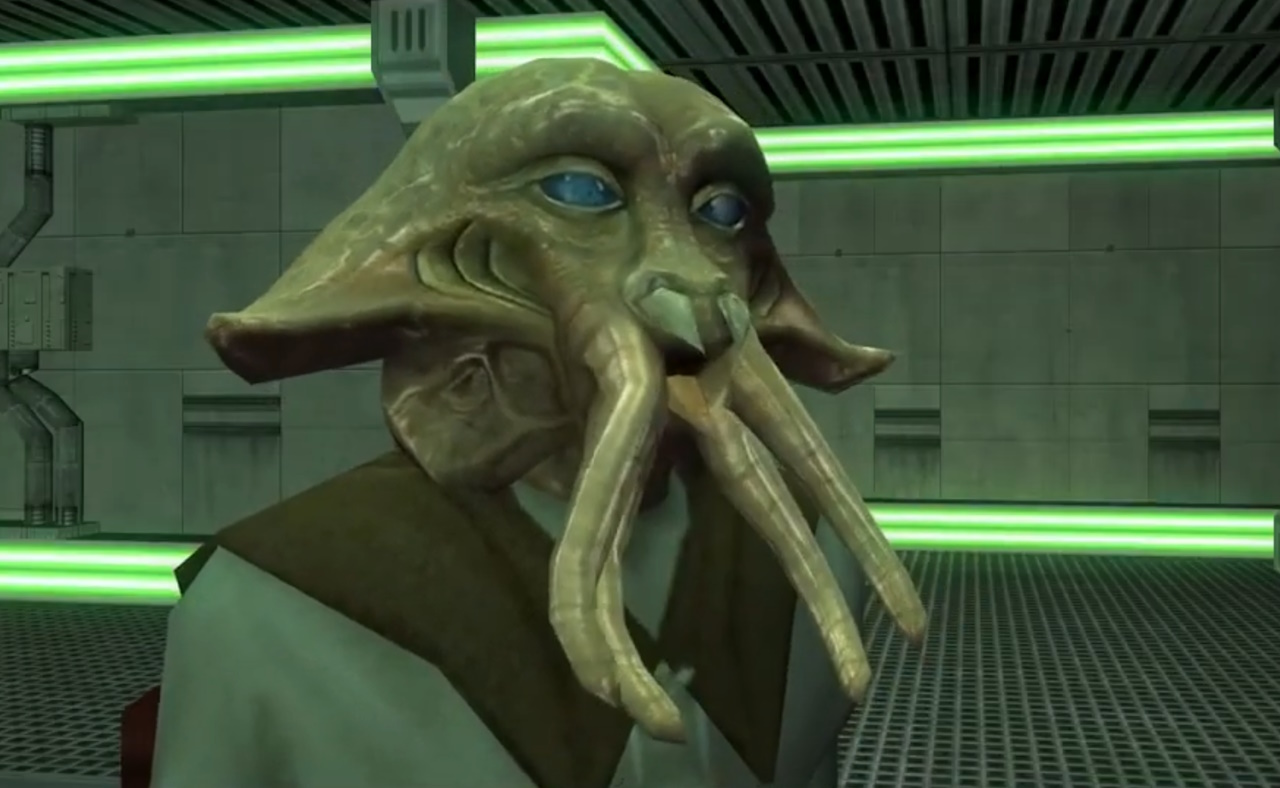
Screenshot from Knights of the Old Republic II showing a Quarren character.

As great as the first KOtoR had been, its sequel was even better. Despite being a rushed game with some content having to be cut, the story is just absolutely phenomenal, with stunning planets to visit, a war-torn protagonist still suffering the effects of their service and choices they made, and a stellar cast of secondary characters who all feel like real people. My Star Wars love is Visas Marr, by the way, and her arc from Sith assassin to Jedi apprentice is one of the best and most touching in any Star Wars production to date.

There are some wonderful set-pieces in KOtoR II, as the Jedi Exile travels the galaxy in search of the few remaining Jedi Knights and the Sith Lords who had been hunting them. Boss fights against these Sith – and the final climactic fight against Darth Traya – are tense and a ton of fun, and the game’s story is gripping from start to finish. Twenty years later and I’d still love nothing more than to get a proper sequel to this game.

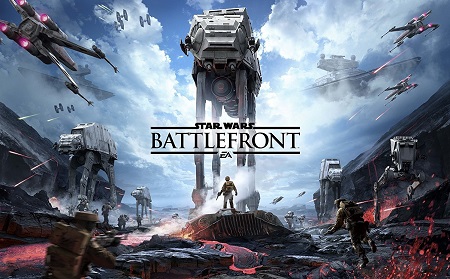
Battlefront and Battlefront II
2004-2005
Tier: B
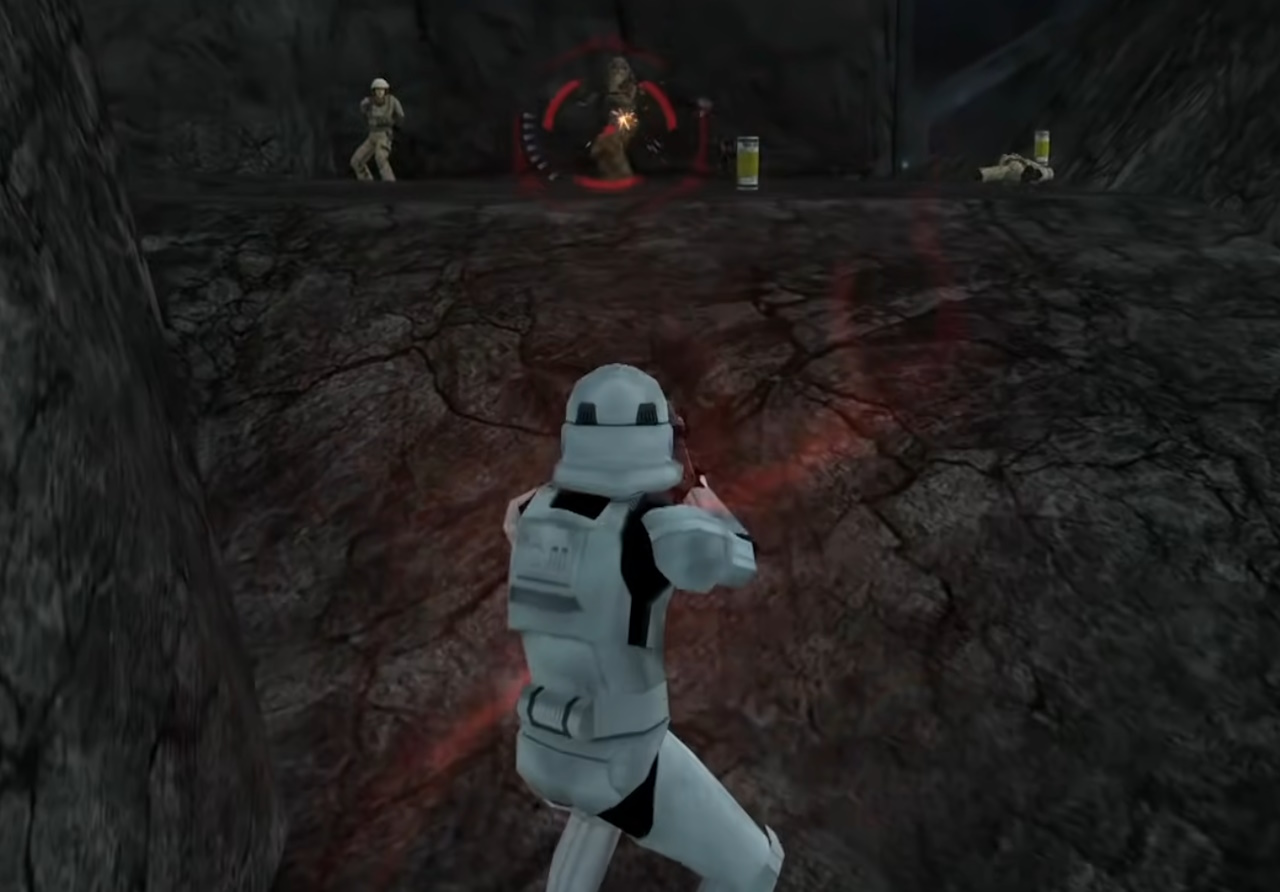
Screenshot from Battlefront II (2005) showing a Stormtrooper engaging Rebel soldiers.

The original Battlefront games – before EA sunk its money-tainted claws into the series – were great fun. I’m not really a multiplayer gamer, and I like games with strong narratives first and foremost, but there was a lot of enjoyment to get from both of these games. Even the levels focused on the prequel trilogy were solid, and fighting wave after wave of enemy soldiers was something that most games at the time didn’t offer – not like this, at any rate.

In multiplayer was where Battlefront and Battlefront II really excelled, though, and if you could find three friends to play with on the couch, you were definitely in for a fun night!

Episode III: Revenge of the Sith
2005
Tier: C
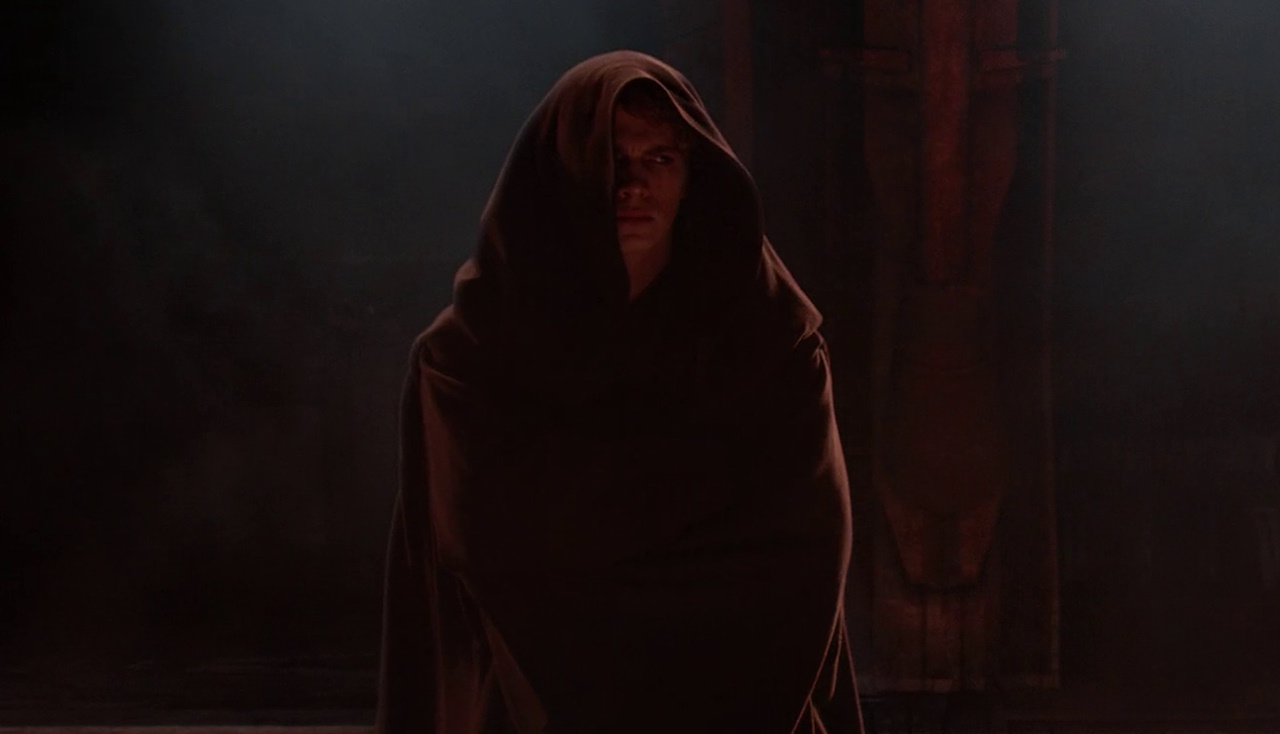
Still frame from Revenge of the Sith (2005) showing Anakin Skywalker in a hooded robe.

The final part of the prequel trilogy went some way to redeeming the story, and was certainly a cut above what had come before. There are still issues with visuals and CGI as well as some clumsily-written dialogue, but there are also some tense and exciting moments as the Jedi Order falls and Anakin loses himself to the dark side. The main lightsaber duel between Anakin and Obi-Wan runs way too long for me, but other fights earlier in the film – including against Grievous and Count Dooku – were pretty great.

A critic far smarter than I am once suggested that an extended Revenge of the Sith could have replaced the prequel trilogy, and I don’t think that’s a bad idea on the whole. There would’ve been more time for Anakin’s premonitions and slide to darkness to be shown, and for Palpatine’s manipulation of the situation to play out. All in all, though, Revenge of the Sith may not be perfect, but it’s by far the best part of the prequel trilogy.

Lego Star Wars: The Complete Saga
2007
Tier: A
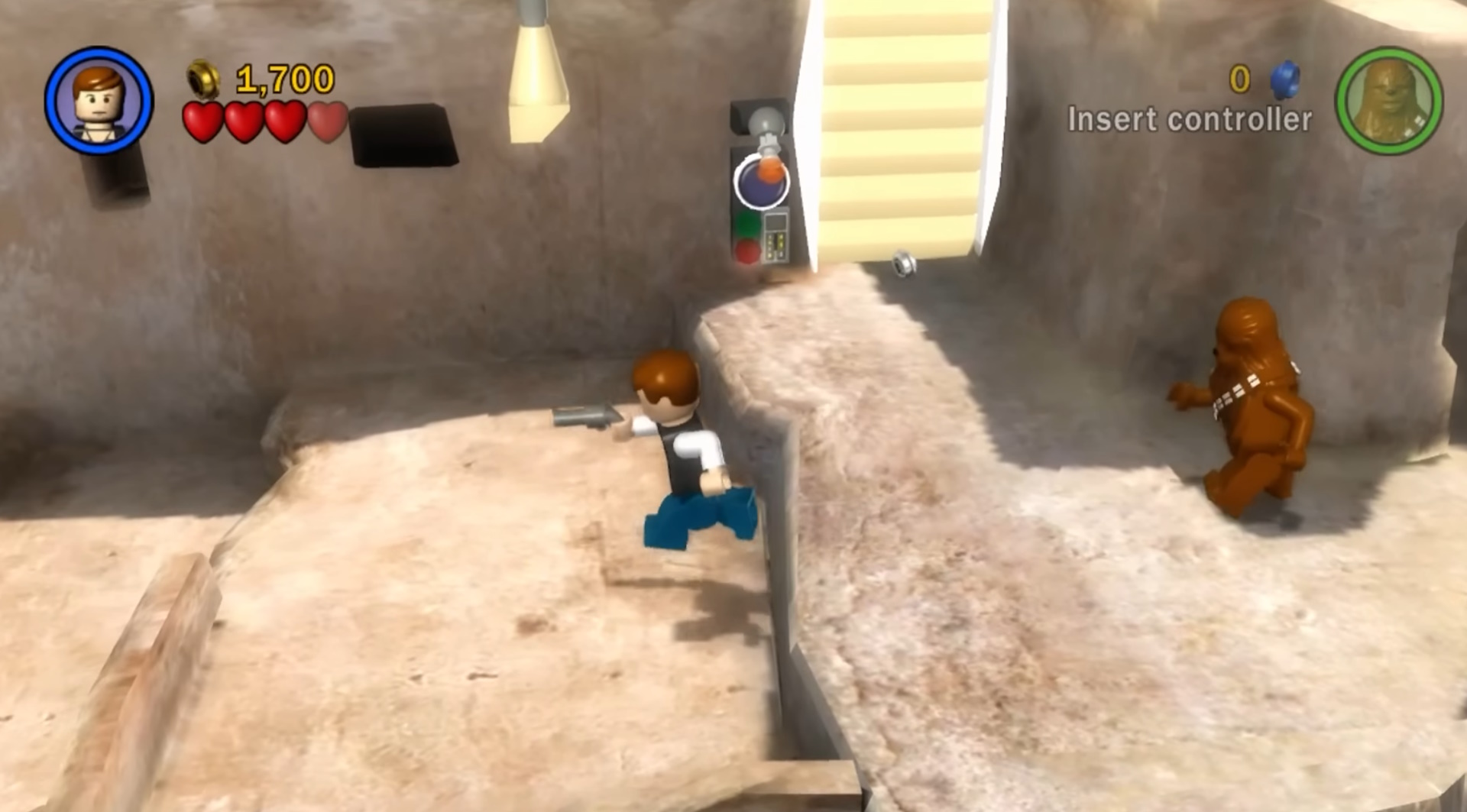
Screenshot of Lego Star Wars: The Complete Saga (2007) showing two characters on Tatooine.

I wasn’t sure whether to include this game, but it’s a ton of fun so why not? This compilation brought together the two earlier Lego Star Wars titles into one package – and with Star Wars apparently complete as a six-film series, it took a comedic romp through the entire story. Lego Star Wars: The Complete Saga was just overstuffed with content – so many characters to unlock, things to collect, and areas of levels that weren’t accessible on a first run. The lack of dialogue and mumbling also made the game feel light-hearted and funny – and after the relative disappointment of the prequel trilogy, putting a different spin on Star Wars to make it fun and entertaining again was just what I needed!

Episode VII: The Force Awakens
2015
Tier: D
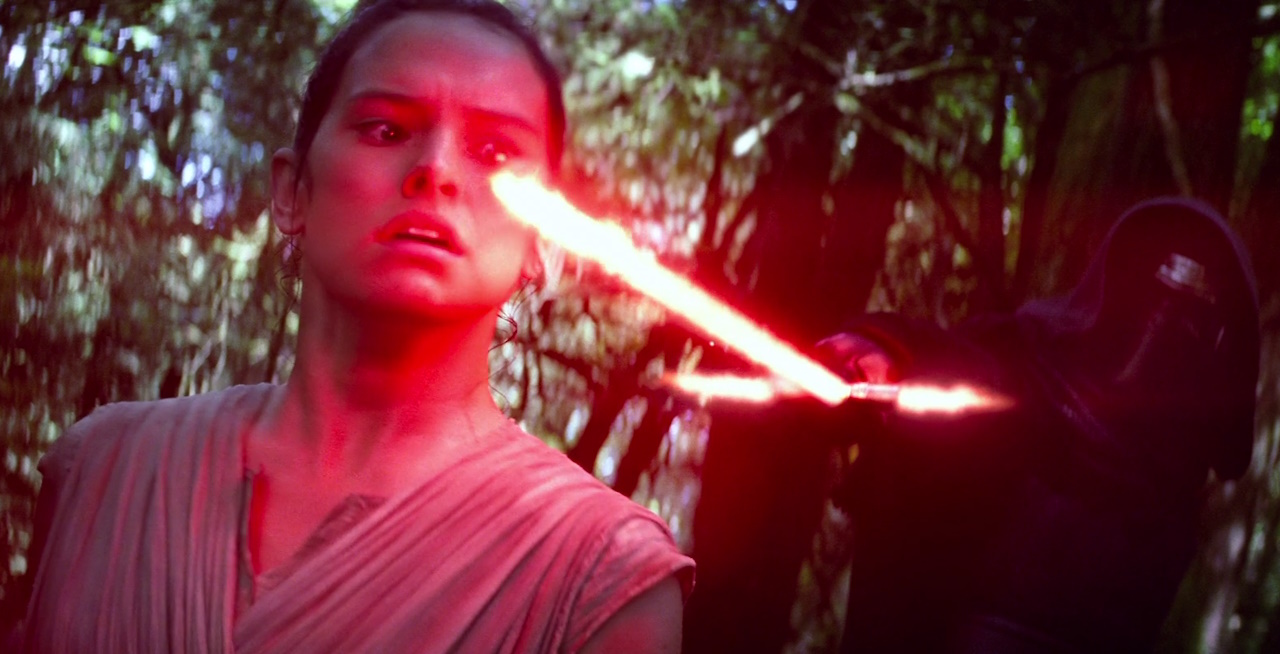
Still frame from The Force Awakens (2015) showing Kylo Ren holding a lightsaber to Rey's neck.

In 2015, I adored The Force Awakens. Returning to Star Wars’ “greatest hits” seemed to be just what the doctor ordered as a new era for the franchise got underway. However, with the benefit of hindsight the film’s weaknesses come into full view. The decision to have Luke Skywalker go missing – with no reason for why he’d disappeared being written – was a mistake, and with the death of Han Solo, any chance of reuniting the trio of heroes from the original trilogy was gone. The film is also incredibly derivative to the point of outright copying: a young Force-sensitive person from a desert planet joins a rebellion against a faction of space fascists and helps them blow up a planet-destroying super-weapon. There’s even a “trench run,” for goodness’ sake.

Unfortunately, The Force Awakens was a weak foundation upon which to build the rest of the sequel trilogy, and the decision to allow each writer/director free rein to do whatever they wanted led to a jumbled narrative mess. There were positives in The Force Awakens – the character of Finn, for instance, and his story of defecting from the First Order and overcoming his indoctrination, as well as a story that involved an older Han and Leia reuniting to try to save their son. But there were too many missteps and mistakes – and I just can’t forgive that the film squandered so many of the opportunities that a Star Wars sequel should have had.

Rogue One: A Star Wars Story
2016
Tier: S

Still frame from Rogue One (2016) showing the Death Star being assembled.

I didn’t really have high expectations for Rogue One when I heard about it. A prequel all about stealing the Death Star plans just didn’t sound all that exciting – but I was wrong about that! Jyn Erso made for a wonderful protagonist, and her story took her from being apathetic and sitting on the sidelines to leading the mission that inspired the Rebellion. Cassian Andor was such a great character that he ended up getting his own spin-off. The decision to kill off practically all of the main characters was also incredibly bold for this franchise.

There are so many great moments and sequences in Rogue One that we’d run out of time trying to list them all! The mission to Jedha was incredible, characters like Krennic and Saw Gerrera have become iconic, and while I never felt that the destruction of the Death Star needed an in-universe explanation, learning how it came to be sabotaged was genuinely interesting. An unexpected story that expanded upon the lore of Star Wars in a really fun way.

Episode VIII: The Last Jedi
2017
Tier: A

Still frame from The Force Awakens (2017) showing the Holdo manoeuvre.

The Last Jedi is a great film. It isn’t as great as it wants to be, and there are places where it misses the mark or where its storytelling gets too in-your-face. But it represents a brave attempt to take the franchise in a different direction, far away from the copycat narrative of its predecessor. Some of the things introduced here really work well and expand our understanding of the Star Wars galaxy. I really like the Holdo manoeuvre, for example, and how the film took a look at the galaxy’s mega-rich citizens who are content to sit out the war, knowing that whichever side wins they’ll still come out on top.

Moreover, the film puts two big twists on the story of the sequels. First, Rey turned out not to be descended from a known character. For me, this made her far more interesting and set her up as a protagonist in her own right. Secondly, Kylo rejected any pull to the light side and tried to seize power for himself, setting himself up as the ruler of the First Order. Both of these twists worked exceptionally well… before they were immediately undone in the final instalment of the trilogy.

Solo: A Star Wars Story
2018
Tier: C
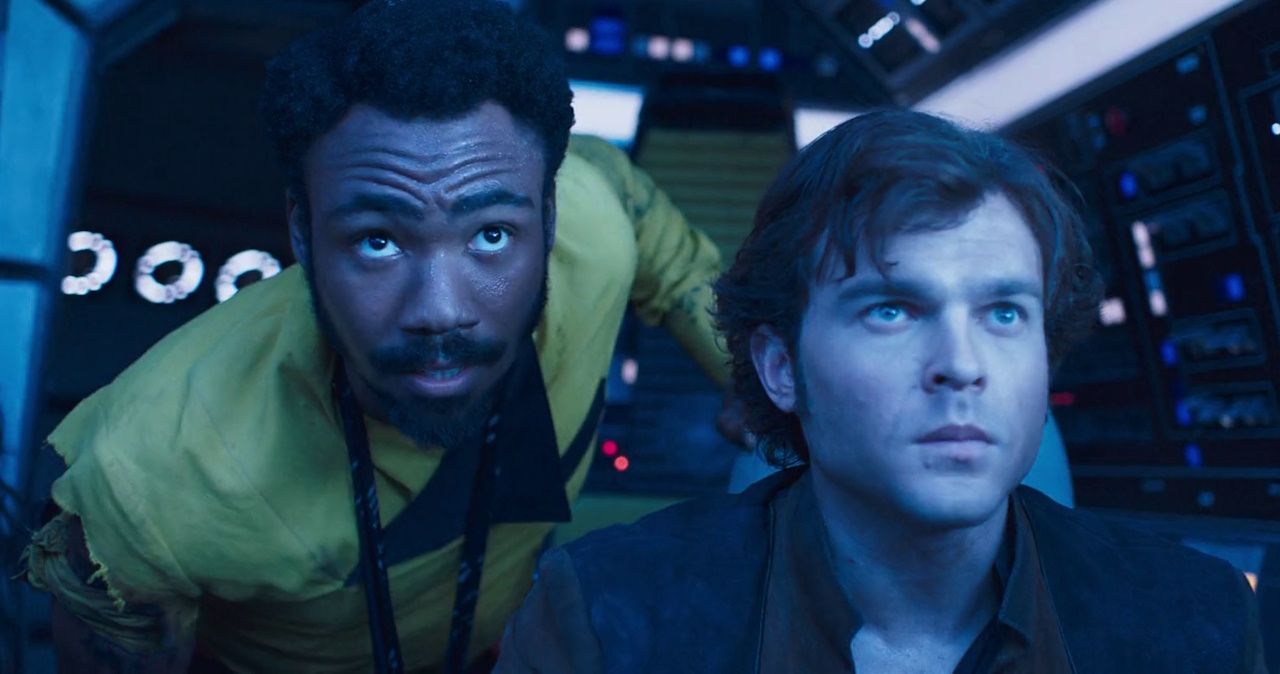
Still frame from Solo: A Star Wars Story (2018) showing Lando and Han in the cockpit.

There’s nothing wrong with the main thrust of the plot in Solo: A Star Wars Story… but nothing about the film feels all that special or interesting, either. The story basically doubles down on Star Wars’ prequel problem; we just didn’t need to see this chapter of Han Solo’s life to understand who he is or what his priorities are. We’d already been able to infer all of that from his earlier appearances, and while we learned a bit more about Han in a strictly factual sense… none of that really mattered.

I also loathe the resurrection of the obviously-dead Darth Maul and his insertion into Disney-era canon. Star Wars has continually struggled to let go of characters – even relatively minor and unsuccessful ones – and to see Maul popping up as a “crime lord” of all things was just… ugh. I hated it. The central heist at the film’s core was good enough and there were some solid moments of characterisation. But the film was let down by its fundamental premise.

The Mandalorian
2019-Present
Tier: C
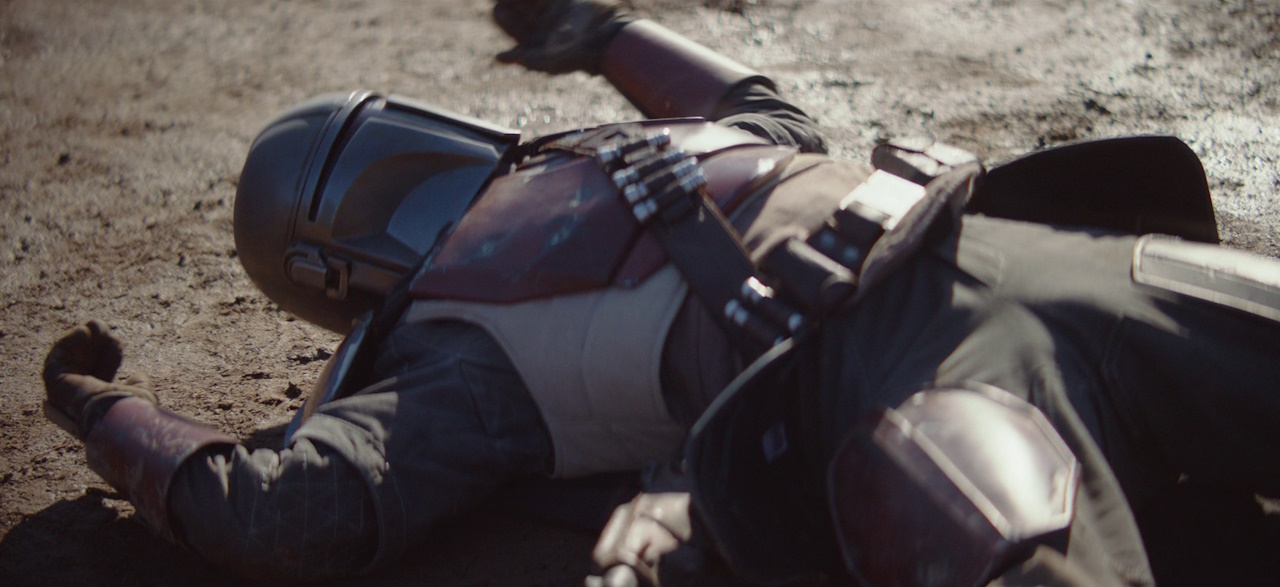
Still frame from The Mandalorian Season 1 (2019) showing the title character knocked down on the ground.

The Mandalorian has some fun scenes and great design elements, introduces some creative new characters, takes us to new worlds, and tells a story that dives deeply into a little-known faction. But for me, The Mandalorian didn’t really hit the mark. Its premise of following “the adventures of a gunslinger beyond the reach of the New Republic” sounded spectacular… but within two episodes the show brought the Force back into play. Things only got worse from there, with Luke Skywalker eventually showing up in person to hammer home that this series can’t escape the clutches of nostalgia.

Worse, though, was the protagonist himself – who seemed, for the first season-and-a-half at least, to have no understandable motivation for doing… anything. Mandy seemed to act at the behest of a room full of TV writers, and it showed, with massive story points like betraying his client to save Baby Yoda coming from nowhere. The series is also too short, with Seasons 1 and 2 barely amounting to the runtime of just one season of television – and sharing two halves of a story that would’ve been a lot better if it had played out in a single season instead of two. Things have improved and the series has grown on me, but I can’t escape the feeling that there’s some wasted potential here.

Jedi: Fallen Order
2019
Tier: A
Screenshot of Jedi: Fallen Order showing the player character sliding down an icy canyon.

I had a great time with Jedi: Fallen Order. After the disappointments of both The Mandalorian and The Rise of Skywalker (which I watched before playing the game), I was glad to see that I hadn’t entirely fallen out of love with Star Wars. Cal’s story of re-establishing his connection to the Force, rediscovering his Jedi side, and going on a rip-roaring adventure across the galaxy was great, and I felt like I was right there with him thanks to some outstanding voice acting and animation work.

Jedi: Fallen Order also gave me what is probably my favourite Star Wars video game moment: piloting an AT-AT! This sequence is one of the best in the game and is just perfectly-paced. There are a few points that come together to deny Fallen Order S-tier status, though: overuse of Super Mario 64′s sliding mechanic, having to both re-play levels and backtrack through them after finishing an objective, and a confusing false choice early in the game all took some of the shine off of what was an otherwise fantastic experience.

Episode IX: The Rise of Skywalker
2019
Tier: F
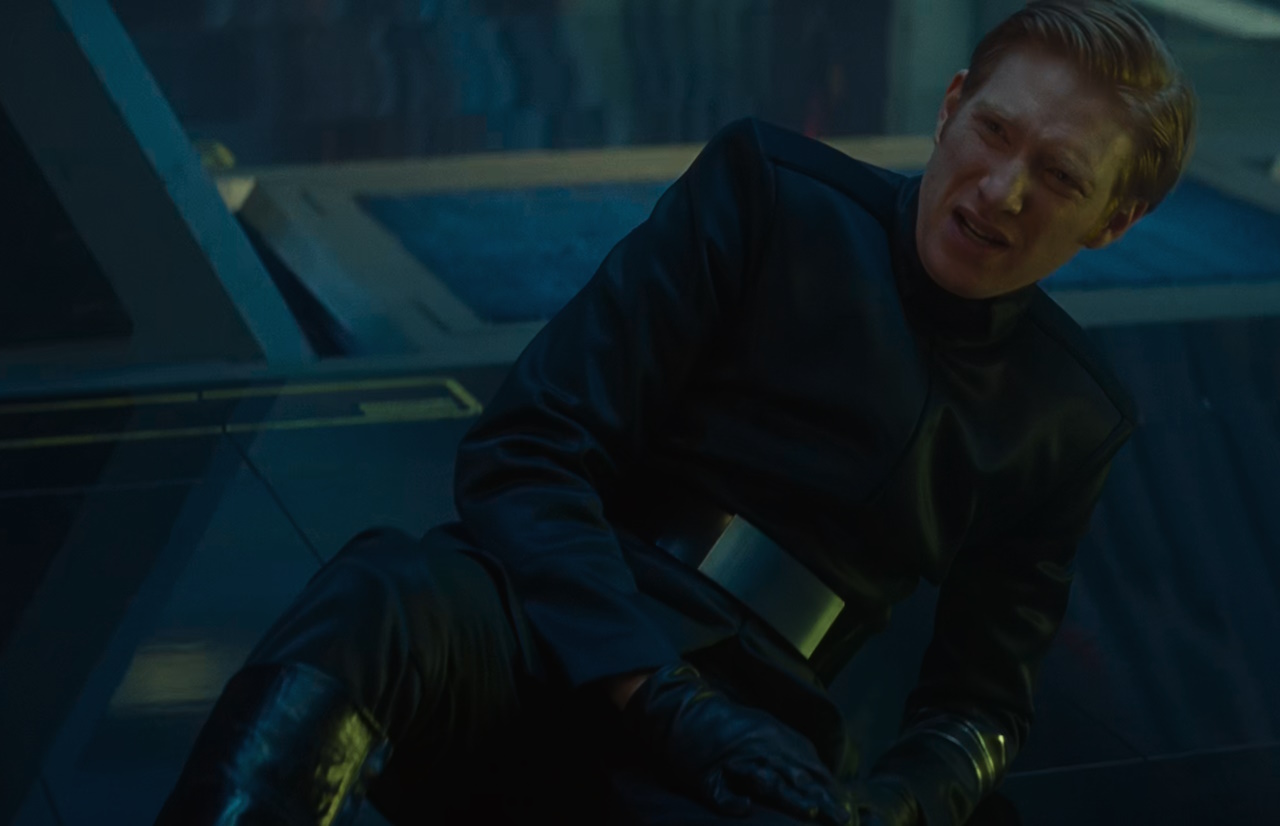
Still frame from The Rise of Skywalker (2019) showing General Hux wounded.

What an atrocious film. The Rise of Skywalker jumps around, barely spending more than a few seconds per scene, desperately trying to undo the big story points from The Last Jedi. It basically tries to cram two films’ worth of plot into the runtime of a single title, and so many of the storylines it tries to include just fall flat on their face. The clumsy insertion of Palpatine into a story that was never meant to be his not only ruins this film, but manages to make the rest of the sequel trilogy and even the original trilogy feel worse in retrospect.

The Rise of Skywalker betrays or completely misunderstands most of the characters it includes, like Kylo, Rey, and General Hux, undoing key parts of their stories and characterisations. It ignores altogether major characters like Rose and Finn, relegating them to the sidelines and having no idea how to use them. And finally, it contains probably the single worst line of dialogue in the entire Star Wars franchise: “Somehow Palpatine returned.” I don’t like to single out individual writers or creatives for criticism, but I genuinely hope that the people who wrote that line, approved it, and got it into the film never work in the entertainment industry again.

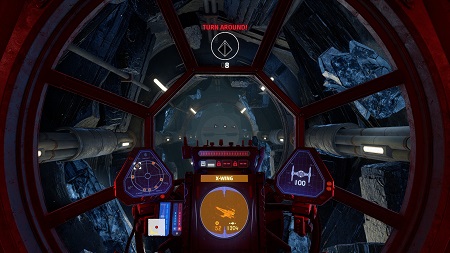
Star Wars Squadrons
2020
Tier: B
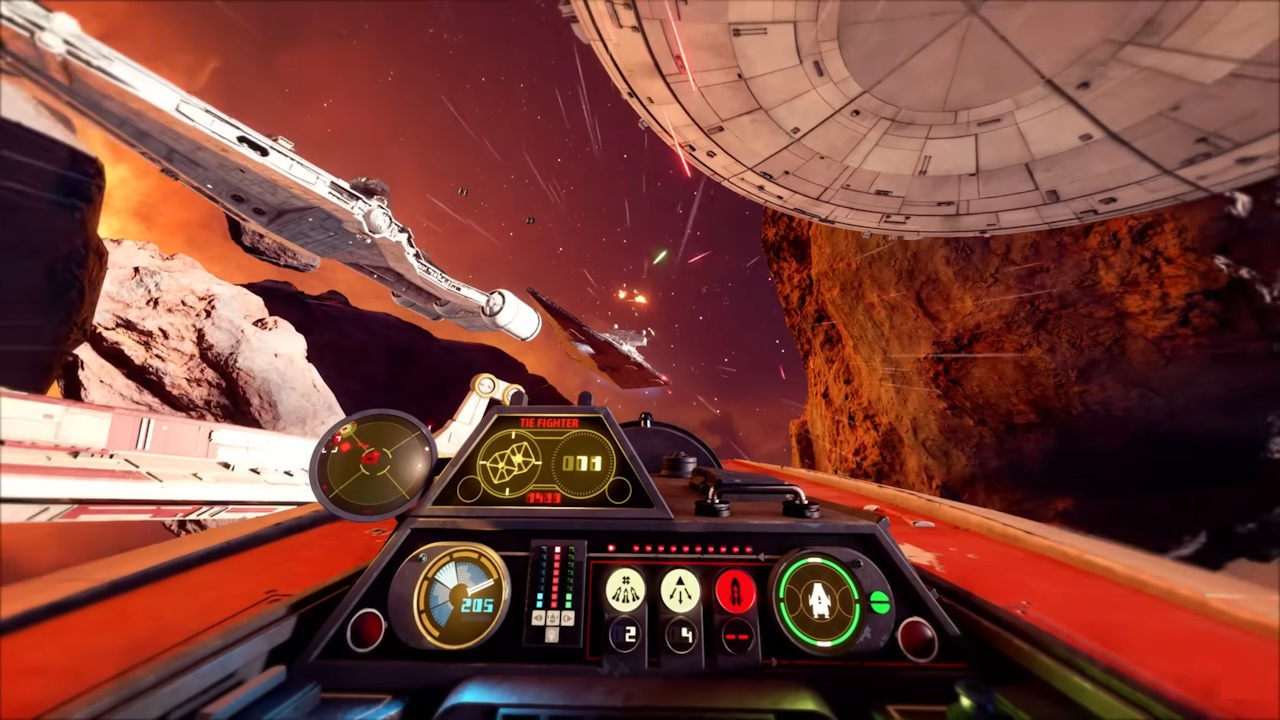
Screenshot from the Star Wars Squadrons trailer showing a starfighter cockpit.

Squadrons feels like an updated TIE Fighter or Rogue Squadron – and yes, those are compliments! Thanks to major advances in graphics, sitting in the pilot seat of a starfighter has never looked more beautiful, and the game really succeeds at capturing that sensation in a way few titles ever have. Narratively there wasn’t a lot to say, but the story was worth following to its conclusion, and the side characters were solid in their own ways. I haven’t fired up Squadrons for a while, but I really should jump back in and have another go – it really is the best Star Wars simulator out there right now.

The Disney+ Lego Star Wars Specials
2020-Present
Tier: A

Still frame from The Lego Star Wars Holiday Special showing the main characters and a Christmas tree.

There have been three Lego Star Wars specials made for Disney+ at time of writing – though a fourth is arriving imminently. And all of them have been great fun! I like the less serious tone of these specials, and how each one so far has had a seasonal theme. Terrifying Tales also did more to give backstory to Ben Solo and the Knights of Ren than the entire sequel trilogy had done, and it was quite cathartic to see that!

Star Wars shouldn’t be taken too seriously all the time, and these Lego specials really lean into the more fun, light-hearted, and casual side of the franchise. At the end of the day, Star Wars is supposed to be entertaining – and if there’s one thing I can say about the Lego Star Wars specials it’s that they absolutely entertained me!

The Book of Boba Fett
2021
Tier: A

Still frame from The Book of Boba Fett showing the famous "like a bantha" scene.

I really did not expect to like The Book of Boba Fett. Boba himself always felt like a non-entity to me; a minor character elevated, somehow, through high sales of his action figure, but who did nothing of consequence in the original films and who died incredibly easily in his only big fight! The series also had a huge hurdle to overcome: how did Boba survive dying in Return of the Jedi? I wouldn’t have chosen to greenlight The Book of Boba Fett if I’d been in charge!

But I was wrong, and I found a surprisingly entertaining series with heart. Boba’s adventure on Tatooine was just plain fun in a way that I really hadn’t been expecting, and this miniseries about a character I’d always been underwhelmed by was much, much better than I could have expected. It wasn’t perfect, of course, and in some ways it felt closer to The Mandalorian Season 3 than a standalone project. But I had fun with The Book of Boba Fett for what it was, and I enjoyed its contribution to the Star Wars galaxy.

Obi-Wan Kenobi
2022
Tier: F
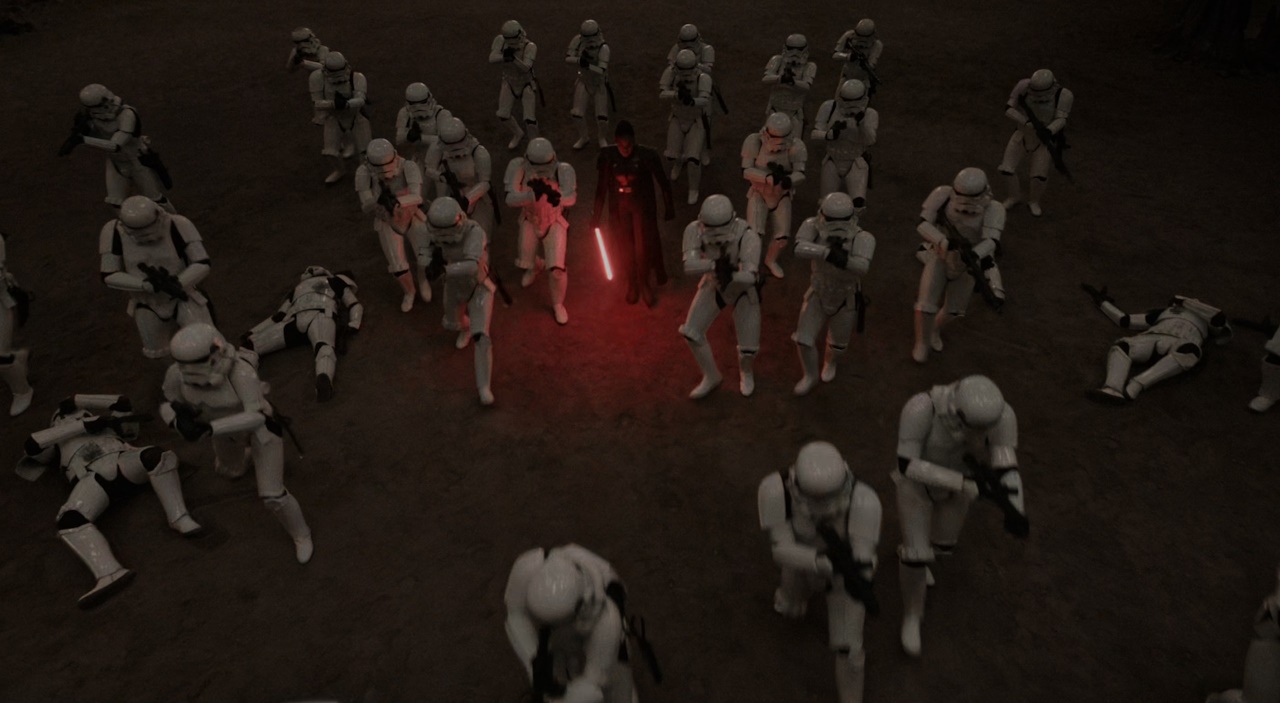
Still frame from Obi-Wan Kenobi showing an Inquisitor and a large group of Stormtroopers.

Obi-Wan Kenobi has done the impossible: it has eclipsed both The Phantom Menace and The Rise of Skywalker to become my least-favourite Star Wars project of all time. The series was already going to tell the least-interesting chapter in Obi-Wan’s life, but it ended up completely ruining his character and undermining one of the most powerful moments in A New Hope. It’s the textbook example of why prequels and mid-quels have to be handled with care, and honestly I could write a book about all the things this series got wrong.

In principle, the idea of Obi-Wan leaving Tatooine to rescue Leia could have worked, but it would’ve needed to be a completely different story, one that kept Darth Vader completely out of it. Bringing back Vader for yet more lightsaber duelling with Obi-Wan just felt desperate and tacky, and the entire series fell apart. It was unnecessary in the first place, poorly-written, and with a central premise that completely undermines Ben Kenobi’s role in A New Hope.

Jedi: Survivor
2023
Tier: D
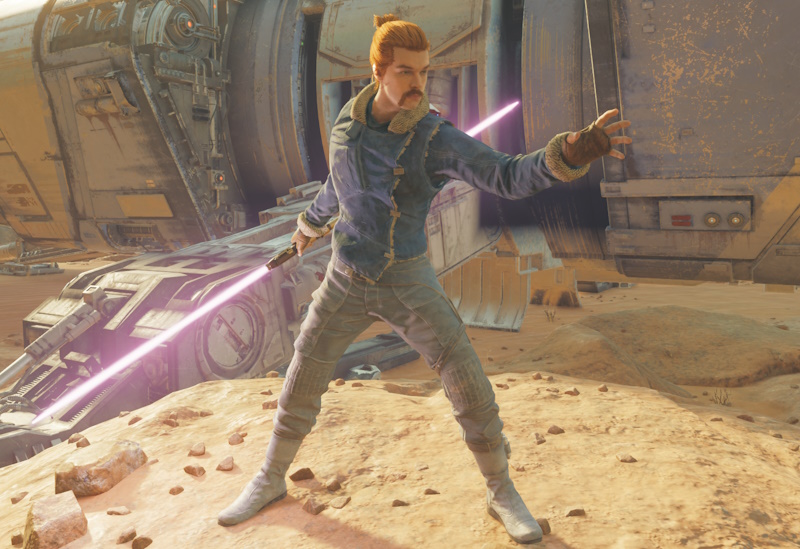
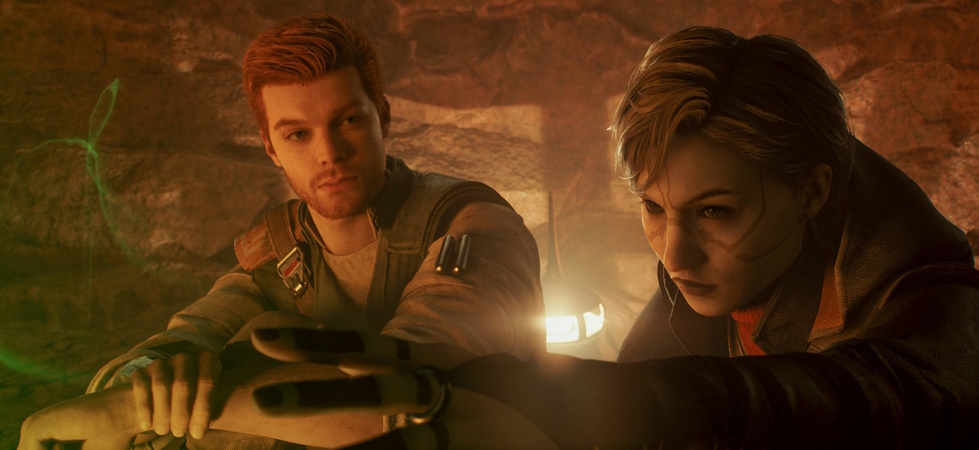
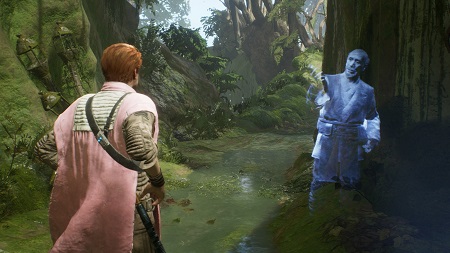
Screenshot from Jedi: Survivor showing a customised Cal Kestis.

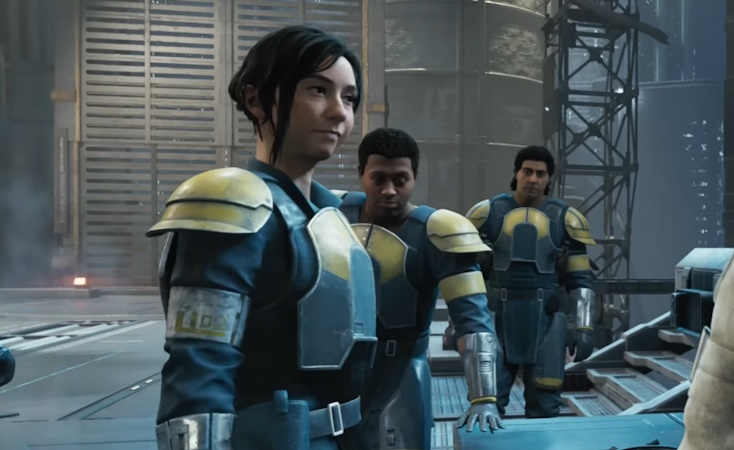
I was properly excited to get a sequel to Fallen Order and to get back out in the Star Wars galaxy with Cal and the crew of the Stinger Mantis. But the story Jedi: Survivor told was pretty weak and convoluted by comparison. The sheer randomness of parts of the story – like Greez just accidentally building his cantina atop ancient Jedi ruins – went a long way to undermining it, the surprise return of Master Cordova completely fell flat, an ancient Jedi sealed in a bacta tank for centuries was kind of silly, and a “lost” planet that no one could reach just felt like a boring macguffin. Fallen Order gave Cal a quest that I could follow and that seemed to flow naturally from point to point. Survivor felt much more artificial and constructed.

The game was also let down, in my view, by a reliance on open-world level design that just didn’t fit the story. The supposedly hidden, off-the-beaten-path settlement of Ramblers Reach was located a stone’s throw from two huge Imperial bases and the headquarters of a pirate warlord, and the Jedi outpost on Jedha was walking distance from two massively important areas, too. And of course, there was a traitor in Cal’s group who was so incredibly obvious from his first second on screen that he might as well have had the words “secret bad guy” tattooed across his forehead. The game being released way too early while unfinished and full of glitches didn’t help matters, either.

The Acolyte
2024
Tier: B
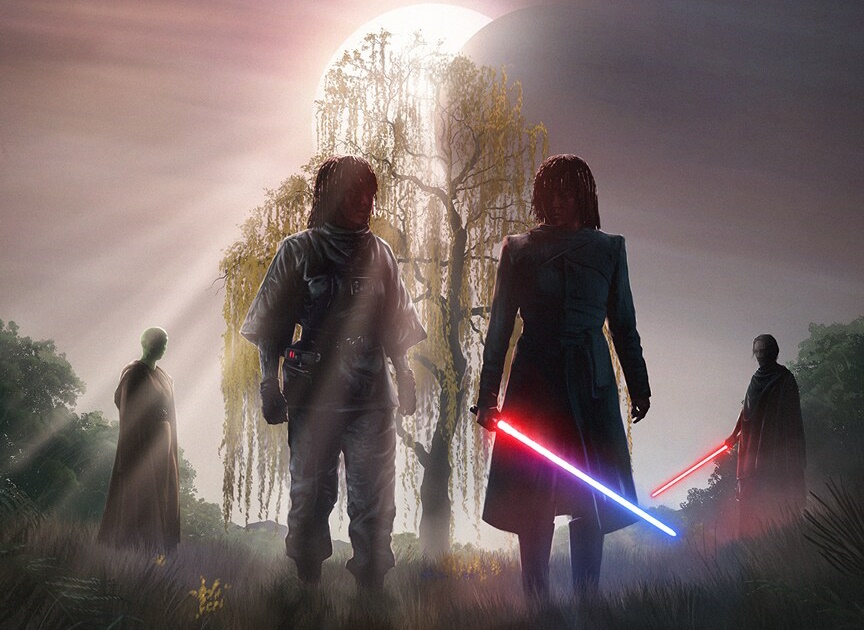
Cropped promo poster for The Acolyte.

So we come to The Acolyte – the latest Star Wars series at time of writing! Although it proved to be controversial, I generally liked what I saw in this one-and-done series. Stepping away from the “Skywalker saga” to tell a story in a different time period is something I’d been wanting to see on the big or small screen for a long time, and a focus on the Sith was also something interesting. I don’t think The Acolyte hit all of the high notes it was aiming for, but it was decent nevertheless.

If Star Wars is going to survive long-term, stepping away from familiar characters and the time period of the Empire will be necessary, and The Acolyte is the franchise’s first real attempt to do so. That is admirable, even if it comes a bit late in the day! The story also framed the Jedi Order in somewhat of a negative way, showing how it can fall prey to internal politicking, emotion, and disagreement – all of which were themes that were present in the prequel and sequel trilogies.

So that’s it!
Still frame from Star Wars (1977) showing Old Ben Kenobi.
It’s Old Ben Kenobi!

I’m pretty sure that those are all of the Star Wars films, games, and TV shows that I’ve spent enough time with to place on this list. You’ll note some absences: the animated Star Wars shows of the 2000s/2010s, as well as Andor, Ahsoka, and the Force Unleashed games, to name but a few. I haven’t watched or played everything in the Star Wars franchise – and I probably won’t get around to all of them. That’s why they’re not part of this list.

Let’s take a look at how the final tier list looks:
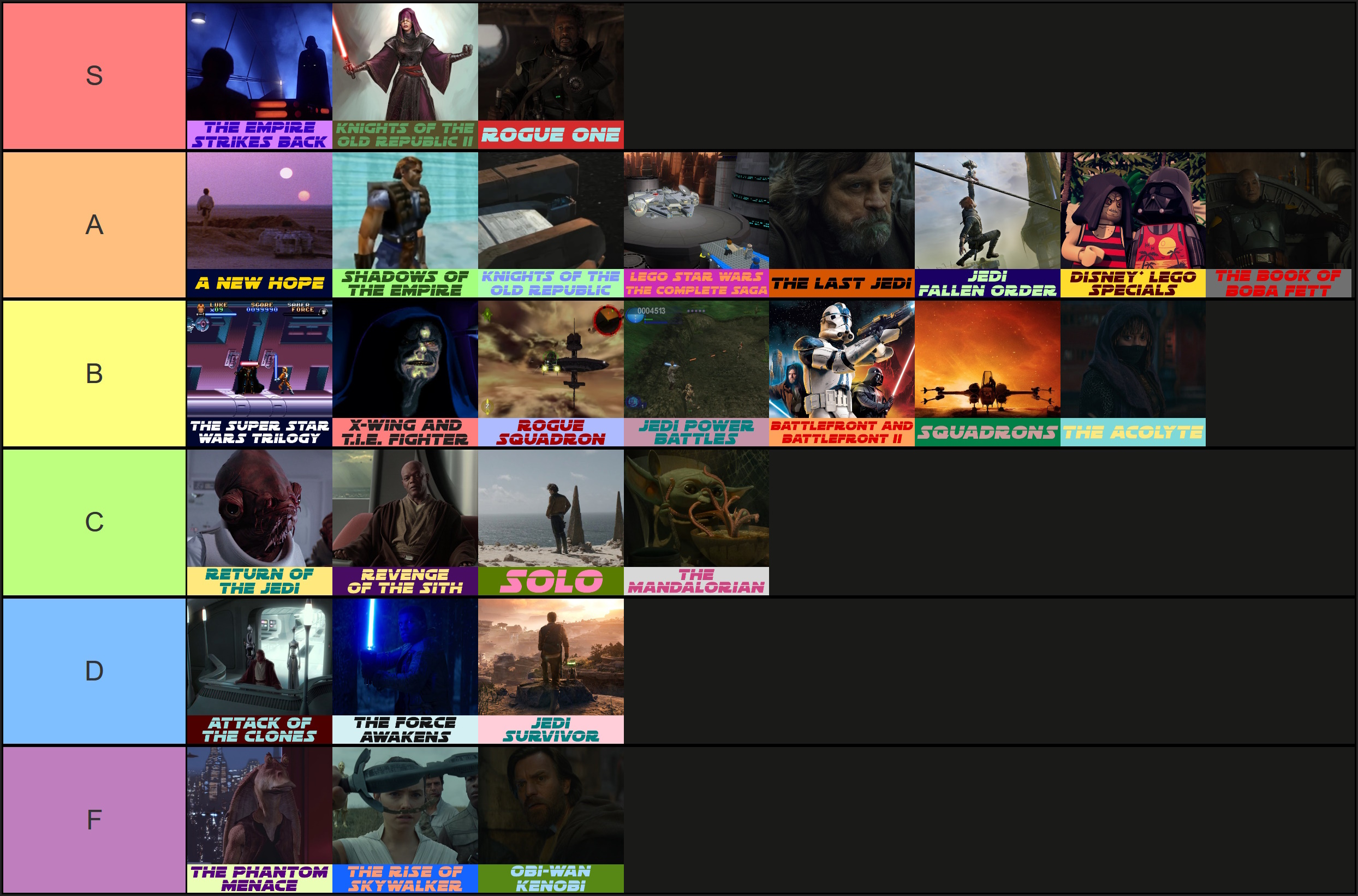
A tier list showing various Star Wars productions.
You can open this image in a new tab if you want a closer look!

Putting this tier list together has been great fun, and it’s been interesting to revisit some of these Star Wars projects. It’s been a long time since I so much as thought about the TIE Fighter game, and I haven’t re-watched the likes of The Mandalorian Season 1 since it premiered, so going back to them has certainly been something different.

I hope none of these opinions proved to be too controversial! At the end of the day, I’m a Star Wars fan – but I don’t enjoy every single thing that has been produced for the franchise. Still, whether we agree or disagree on what the highlights are, I think you can see that there are more positives than negatives in this wonderful space epic!

All that remains to say is this: May the Force be with you! And I hope you’ll check back soon for more Star Wars discussion here on Trekking with Dennis.


*Obviously this list is not official in any way. The title is a joke!

Most films and TV shows in the Star Wars franchise can be streamed on Disney+ or purchased on DVD, Blu-ray, or digitally. Some games discussed above are out-of-print, others may be available on PC, Xbox, PlayStation, and/or Nintendo consoles. The Star Wars franchise – including all films, games, and television shows discussed above – is the copyright of Lucasfilm and The Walt Disney Company. This article contains the thoughts and opinions of one person only and is not intended to cause any offence.

Star Wars Jedi: Survivor – A Review

Spoiler Warning: There are spoilers ahead for Star Wars Jedi: Fallen Order and Star Wars Jedi: Survivor. Minor spoilers may also be present for parts of the Star Wars franchise.

It’s been a while since I shared my first impressions of Jedi: Survivor here on the website. I’ve since returned to the game, despite its performance issues, and beaten the main story, so I’m now in a position where I can put metaphorical pen to paper and share my full thoughts with you. Sorry that it took so long!

For some context, I adored Jedi: Fallen Order. I documented my first playthrough of that game here on the website back in 2020, and I was thrilled to see Lucasfilm and Electronic Arts recognising the strength of feeling in the Star Wars fan community for a linear single-player game. Jedi: Fallen Order had a high budget, but it proved definitively – as if any such proof were really needed – that single-player games can still be profitable, and that players still long for those kinds of experiences. Moreover, at a time when both The Rise of Skywalker and The Mandalorian had been disappointing, Jedi: Fallen Order came along and showed me that I hadn’t entirely fallen out of love with Star Wars.

I definitely felt optimistic about Jedi: Survivor.

I was genuinely thrilled at the prospect of a sequel to one of my favourite Star Wars games of all-time, and to see what would come next for Cal Kestis and the crew of the Stinger Mantis – and that was how I felt in the weeks leading up to the launch of Jedi: Survivor. If things went well, I believed that it might’ve been in contention for my “game of the year” award come December.

But things did not go well.

The Jedi: Survivor story is an all-too-familiar one: Electronic Arts forced the game to be released too early, despite knowing that there were serious technical issues. The game is a “release now, fix later” title, replete with bugs, performance issues, and other such problems. Although these issues afflicted the game and harmed players’ enjoyment across all platforms, as is often the case it seems that the PC version of the game was in the worst shape. Unfortunately, as I don’t own a PlayStation 5 or Xbox Series console, PC was where I played Jedi: Survivor.

One of many bugs that I encountered. Nightsister Merrin crouching in an out-of-bounds area.

I actually thought I’d been smart. Having read the reviews of the game when it launched and having seen performance reports from players and professional critics, I shelved my plans to buy Jedi: Survivor. I waited a couple of months and kept my eye on the game as patches were rolled out, and mistakenly believed that six patches later, things would have improved. Spurred on by having inadvertently come across a couple of story spoilers, I picked up the game at the end of June.

Unfortunately, however, the performance issues hadn’t been fixed – and in spite of another patch having been rolled out since then, those issues are still present on PC at time of writing. I described Jedi: Survivor as a “release now, fix later” game… but the fix still hasn’t been made, and the game remains in a poor state even five months after its troubled launch. In fact, having returned to the game to grab a few screenshots, I felt that its performance was worse in September than it had been in June and July.

A levitating Stormtrooper.

The blame for this lies with Electronic Arts, and the company has transformed what should have been a guaranteed hit into a game surrounded by controversy thanks to pathetically poor decision-making at the highest levels. Developers Respawn Entertainment were placed in an impossible position, and while I have no doubt that talented, passionate folks did their absolute best to get Jedi: Survivor as ready for launch as possible, they were screwed over by EA. It’s a tale as old as time in the games industry: a greedy publisher shits all over the hard work of talented developers, then seeks to blame them for the game’s poor condition and lower-than-expected sales.

My first few hours with Jedi: Survivor were spent messing about with settings rather than actually playing the game. Every time I thought I’d improved things, the stuttering and frame-drops would inevitably return – and they were far from the only problems. I encountered dozens of bugs across my playthrough, with Cal and other characters getting stuck in the environment or clipping through solid objects, as well as items not rendering properly or even disappearing. These issues didn’t just affect gameplay, but were also prevalent during cut-scenes – something I hadn’t seen in a supposedly “complete” game in a very long time.

And I have no doubt that Jedi: Survivor’s performance problems have tainted my view of the game as a whole.

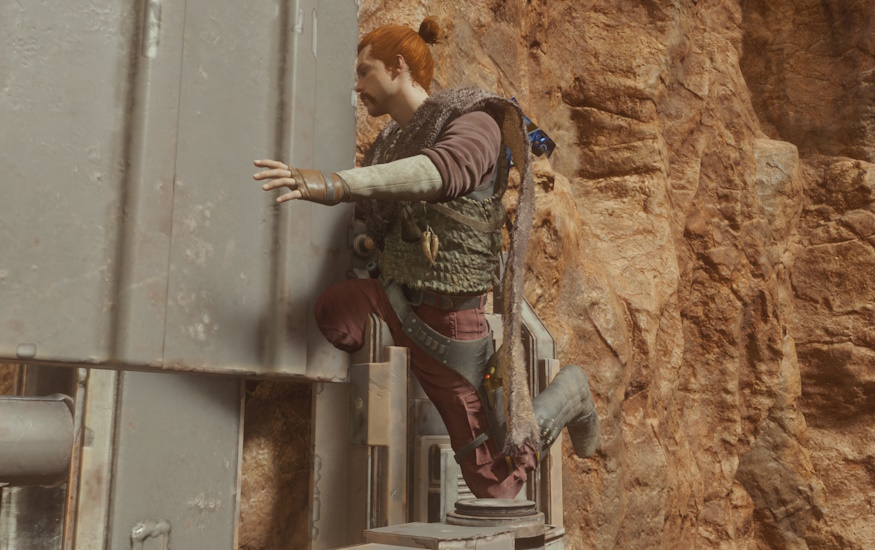
Clipping through and getting stuck in the environment was a recurring problem throughout Jedi: Survivor.

When I sit down to play a game like Jedi: Survivor, it’s because I want to be immersed in a story. I want the game to transport me to a galaxy far, far away, and lose myself for a few hours in the life of a Jedi Knight on the run from the Empire. The occasional bug or glitch would be tolerable, but when a game is in such shockingly poor shape, dogged by performance issues, stuttering, broken animations, and bugs galore… it rips the immersion away. I struggled to really get into Jedi: Survivor and its story, and even its better moments were spoiled or diminished by the unacceptable state that it was released in.

But that’s enough about bugs for now, because there are other issues with the game that we need to talk about.

I have two major gripes with Jedi: Survivor aside from the bugs. One is mechanical; a choice that was made in terms of the way the game was designed and its levels were crafted. And the second is with parts of the story itself, as well as with the way in which certain new and returning characters were handled. We’ll look at each of these points in turn.

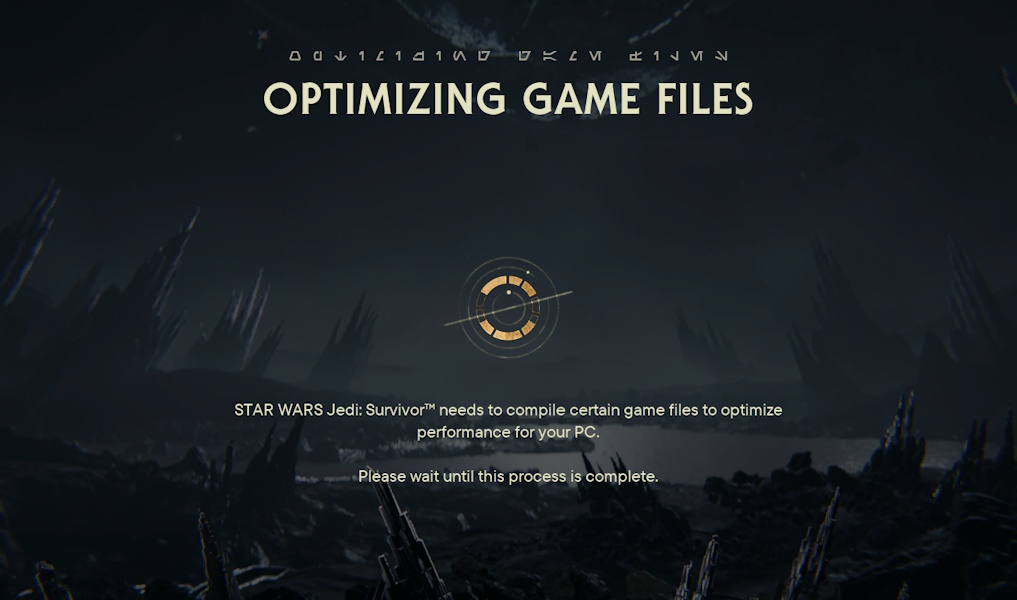
Optimising game files and compiling shaders appears to make fuck all difference.

Firstly, an open world (or semi-open world) did not suit Jedi: Survivor. The game’s story was hamstrung by this decision, and crafting a couple of open stages that actually felt condensed and small really damaged that sense of immersion that I was talking about. On the main planet of Koboh, the village of Rambler’s Reach was a few dozen metres away from the base of a massive gang of pirate-raiders and also a few dozen metres away from two Imperial outposts. Hardly the out-of-sight hiding place that it was presented as in-game.

One day we’ll have to talk more about the open-world trend, and how it simply isn’t the right choice for every game. Jedi: Survivor, to me, stands as perhaps one of the best recent examples of that. The design of both Koboh and Jedha was hampered by this attempt to move in an open-world direction, and the game would have benefitted from tighter, more curated levels, as well as areas of the map that had more distance between them. By all means, have raiders and Imperials on Koboh if that’s necessary for the story – but why not have Cal travel to the other side of the planet in a cut-scene before encountering them? The design of those parts of the map could have been similar, but breaking them off from the Rambler’s Reach hub would have improved the game from a narrative and immersion standpoint.

The saloon in Rambler’s Reach.

I also felt that the move to broader, more expansive levels should have been accompanied by more cosmetic items and loot. It became frustrating to explore a whole area, climbing onto hidden ledges, wading through rivers, and so on only to find… absolutely fuck all. There are more cosmetics in Jedi: Survivor than there were in Jedi: Fallen Order – and that’s great. I had fun customising Cal and unlocking some of these options. But this was something that felt unbalanced.

I’d explore a whole section of the map, kill dozens of enemies, and find nothing. No in-game currency, no cosmetics, no chest with an item… just nothing at all. And to me, that reinforces what we were talking about with Jedi: Survivor’s open-world style: it just doesn’t fit the game. It didn’t fit the story and it didn’t fit the amount of content that had been created, either. A good game strikes a balance, making exploration feel fun and worthwhile. There were moments of that in Jedi: Survivor, but they were too few and far between.

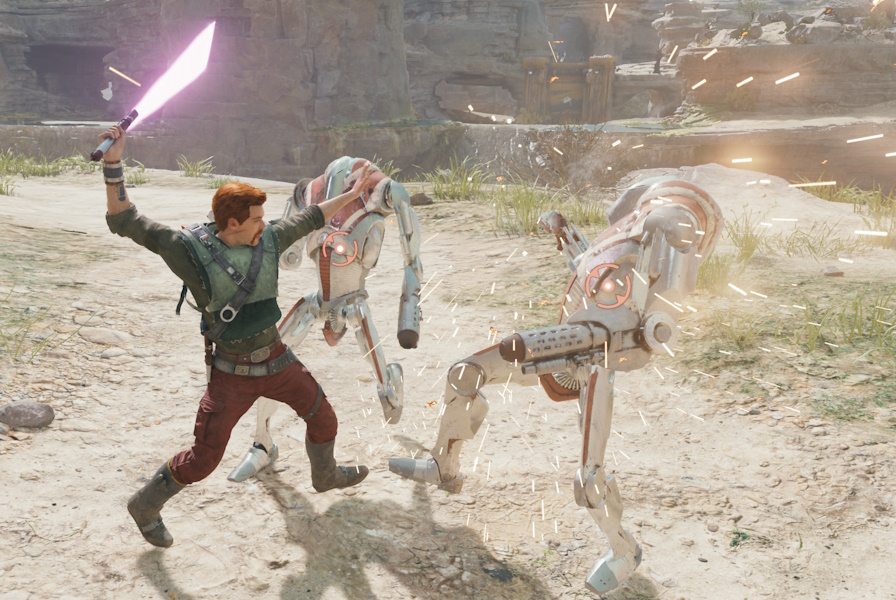
Battling battle droids.

Jedi: Survivor bills itself as a “souls-like” game; i.e. a “difficult-for-the-sake-of-it” title. But to its credit, the game offers an easier mode to play on – something I took full advantage of. However, even on the easiest difficulty there were some particularly finicky and challenging moments. While I found the game’s combat to be okay, there were some moments where Jedi: Survivor required frame-perfect button presses that I found near-impossible. Because I suffer from arthritis that affects my hands and fingers, some rapid button combos are nigh-on impossible for me to perform. At several points in the game, I was almost entirely locked out from progressing because I couldn’t complete a particularly intensive button combo.

On one occasion it took me almost forty tries to navigate just a single section of the map on Jedha – a particularly convoluted wall-run, jump, and swing combination that my hands and fingers just couldn’t manage. The game offered no help with these things, no accessibility options, and no way to skip ahead to bypass these moments. This is poor, and while I will give Jedi: Survivor some well-earned praise for offering a story mode, more accessibility features need to be present, and developers need to be aware that easier combat isn’t the only thing that players are looking for. Many games offer the option to skip ahead if players can’t make it past a certain puzzle or area of the map; these things are not that difficult to implement.

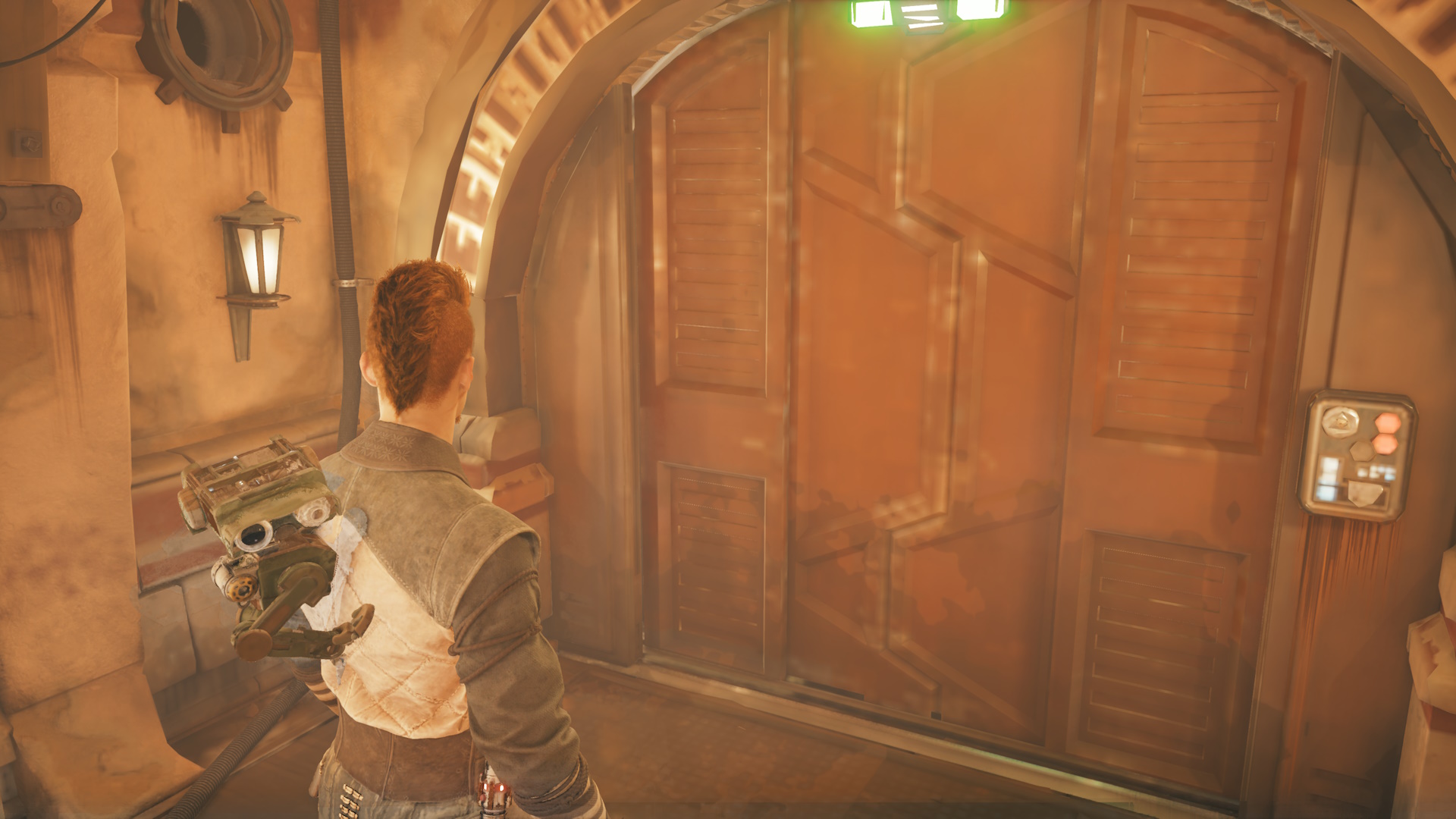
Cal on Jedha.

Stories are incredibly subjective. What works for you might not work for me, and vice versa, so everything I’m going to say about Jedi: Survivor’s narrative choices have to be taken in that way. Nothing about this is “objective” at all!

Where I’d felt gripped by Jedi: Fallen Order’s story, Jedi: Survivor came up short. Cal felt listless, rushing from place to place at the behest of the plot but not in a particularly understandable way, and there were moments of sheer randomness in the story – particularly at the beginning – that really detracted from the adventure.

A customised Cal.

In Jedi: Fallen Order, Cal was being hunted by the Imperial Inquisition after he used his Force powers, but was rescued by Cere. She already had a mission of her own: to open the holocron. Cal slotted into that story perfectly, and at every stage it felt like it unfolded naturally as Cal visited different worlds to unlock the holocron’s mysteries.

Jedi: Survivor begins with Cal falling into a hole that leads to a random cave – entirely by accident. It just so happened that Greez built his Cantina on top of some ancient Jedi ruins, and Cal stumbled into those ruins completely by mistake. That mistake kicked off a convoluted plot about a planet lost in an impenetrable nebula, a fallen Jedi who’d been sealed in a bacta tank for hundreds of years, and an Imperial spy who was so obvious that he might as well have had the words “secret bad guy” tattooed across his forehead.

Yup.

I admit that the performance issues and bugs in Jedi: Survivor made it harder to fully get into the story, as did the open-world mechanics described above. And those two things have undoubtedly impacted the way I view certain character decisions and the game’s narrative path. But even keeping that in mind, and doing my best to separate my thoughts about the state of the game and its design choices from its narrative… I still find it to be a weaker and less engaging story than its predecessor.

Any Star Wars story set during the reign of the Empire has a tightrope to walk – and for me, Jedi: Survivor created narrative issues for itself as a result of a couple of key decisions. Bringing back Master Eno Cordova for what was, unfortunately, an underwhelming and unimpressive role seriously challenges the idea of Cal as the game’s protagonist and leading figure in any kind of Jedi restoration. Cere had appointed herself as a kind of librarian or preserver of Jedi knowledge, but Cordova – a Jedi Master, lest we forget – should have been in a strong position to play a leading role in the preservation and restoration of the Jedi Order.

Master Cordova’s role was unimpressive.

Instead, Cordova’s role was a disappointment. He hand-waved away Cal’s destruction of the holocron that he’d gone to such extreme lengths to protect in the first game, then just stood around doing fuck all. He didn’t help, he didn’t offer guidance, he didn’t do… well, anything. And then he died remarkably easily at the climax of the game’s “twist” – a twist so thoroughly telegraphed that it might as well have been lit up in neon. Ever since the “no, I am your father” moment back in 1980, Star Wars has been obsessed with putting these kinds of twists into its stories. As I said once, recapturing that magic moment isn’t gonna happen, and Jedi: Survivor was made worse by trying to pull off something like this – and doing it so unsuccessfully.

When the dust settled, I also felt that Bode’s reason for his betrayal of Cal was paper-thin and didn’t make a lot of sense. Did Bode really plan to take his child to an uninhabited, uncharted planet and stay there – completely alone? What were they gonna eat? Without access to technology, what were they gonna do? Sure, they’d be “safe” from the Empire, and Bode would be wiped off the Empire’s list, but there doesn’t seem to have been any real planning on his part for the long-term.

Bode didn’t make for a particularly compelling villain.

In a “linear, story-driven” game – tags that Jedi: Survivor’s publishers love to draw attention to – the story is more important, in many ways, than the gameplay. Jedi: Survivor’s third-person exploration, parkour, and lightsaber combat could be fantastic… but if they’re let down by a poor story or one that feels convoluted, there’s no salvaging the game. And while I wouldn’t say anything in Jedi: Survivor was as bad, narratively speaking, as something like The Rise of Skywalker… that’s an incredibly low bar.

There were some genuinely tense, thrilling, or otherwise fun moments scattered throughout the story, as well as callbacks to the first game and references to other parts of the Star Wars franchise that I appreciated. So it wasn’t a total narrative collapse or anything like that; Cal’s story, while built on weak foundations, was still worth following to its conclusion. Even though I saw Bode’s betrayal coming from a mile away, Cal’s raw emotional reaction to it definitely hit the notes it was aiming for. While Master Cordova’s death felt like a waste, Cere’s demise at the hands of Darth Vader not only took her story full-circle after the events of Jedi: Fallen Order, but it was a heartbreaking moment that was handled well.

Cere was hunted down by Darth Vader.

The weakest part of the story of Jedi: Fallen Order was one that I hoped its sequel might address. The Haxion Brood storyline – in which Greez and Cal were pursued by a gaggle of unimpressive bounty hunters – was left unresolved by the time the credits rolled on the first game, and I had hoped to see a resolution in Jedi: Survivor. There was a bounty hunter side-story in the game, with several different bounty hunters to defeat that served as kind of mini-bosses. The ending of this questline was neat, but here’s my gripe: it didn’t resolve the Haxion Brood storyline!

As of the end of the game, Cal and Greez are still wanted by the bounty hunters, and the faction’s leader, who we met in the first game and who seemed like the kind of arrogant dick that it would be so satisfying to kill, wasn’t even mentioned this time. Again, this storyline just feels half-baked, and I had hoped that Respawn might’ve taken that feedback on board after the way the bounty hunter story just fizzled out in the first game.

Bounty hunter Caij Vanda offered what amounted to side-missions.

I liked that there were more cosmetic options in Jedi: Survivor, and I had fun playing with Cal’s appearance, BD-1’s appearance, and Cal’s lightsaber. I wasn’t wild about the way these cosmetics were unlocked, however, as I felt the game was particularly stingy with its currencies and lootable containers. That being said, I was able to unlock most of the items that I had my eye on, and by the time I was halfway through the campaign (or thereabouts) I’d got Cal, BD-1, and Cal’s weapons looking the way I wanted them to.

The expansion of lightsaber styles from Jedi: Fallen Order was nice – but these felt a little restrictive. I loved the way the crossguard lightsaber looked, but the incredibly slow and cumbersome fighting style that accompanied it basically rendered it non-viable for me. It would have been nice if there were options to mix and match fighting stances with cosmetics – in my case allowing Cal to use a crossguard lightsaber in a different way, but this could also open up double-bladed and dual-wielding stances to other styles of play.

Cal with a crossguard lightsaber.

Jedi: Survivor retains the Dark Souls-inspired “checkpoint” save system, instead of allowing players to freely save. This is a particularly irritating trend that many “souls-like” games (or should that be “souls-wannabes?”) implement, and it just feels annoying and outdated in 2023. Having to re-do chunks of a level because of the lack of a proper save system is just silly, it doesn’t increase the difficulty nor add anything to a game, and with Jedi: Survivor’s meditation spots not exactly being ubiquitous, I felt this choice got in the way of the fun.

One thing I did appreciate was that Cal’s Force powers carried over from Jedi: Fallen Order. Given the way in which that game weaved Cal’s connection to the Force into its narrative, it would have felt strange if he’d begun the sequel having to re-learn those same skills, and I will give credit to the writers for keeping Cal’s growth going instead of going for the typical video game sequel “reset” of his powers.

Customising BD-1.

I expected better from Jedi: Survivor, at the end of the day. The follow-up to one of my favourite games of the last few years was a title that I genuinely expected to compete for the coveted “game of the year” title come December, but instead it’s going to go down as one of the biggest disappointments of 2023 for me personally. The unacceptably poor state that Jedi: Survivor was in at launch – and remains in more than five months later – is a big part of that. But even if those performance issues and bugs had been kept to a minimum, the game itself feels like a poor relation to its illustrious predecessor.

Narratively, Jedi: Survivor built a weak, convoluted, and random story that split up the first game’s crew and saw Cal team up with an incredibly obvious turncoat. And mechanically, the game was forced into an open-world mould that simply didn’t suit it. It was hard enough to get invested in the story because of the poor shape that the game was in, but every time I got close, either the bland open-world formula would trip it up or I’d find myself annoyed by a story that was so much weaker than that of the first game.

Improperly rendered low-res textures.

So that was my experience with Jedi: Survivor. It’s hard to recommend it right now, given the performance issues and bugs that remain present. Electronic Arts and Respawn Entertainment have massively slowed the rollout of patches and fixes since the game launched, and I fear that Jedi: Survivor is being quietly abandoned and may never reach the level of basic playability and mechanical competence that should have been present at launch. This is already a huge disappointment and should be enough to put off all but the most ardent Star Wars fans.

Your mileage may vary when it comes to the game’s story, though, and my take is clearly not shared by all players. I’ve seen plenty of comments hailing the story as one of the best that the Star Wars franchise has to offer, and while that’s certainly not my opinion, it’s worth keeping in mind that these things are subjective. As I said earlier, I have no doubt that my overall impressions of Jedi: Survivor have been coloured by its bugs and performance issues.

I have no plans to return to Jedi: Survivor right now, and having stepped back into the game to capture a few screenshots for this piece, I’ll probably be uninstalling it. If a huge patch is released, or the game receives significant DLC that could add to its story, I might consider going around again. But unfortunately I must report that Jedi: Survivor was not the fun and engaging Star Wars adventure that I wanted it to be.

Star Wars Jedi: Survivor is out now for PC, PlayStation 5, and Xbox Series S/X. Jedi: Survivor is the copyright of Electronic Arts, Lucasfilm Games, and Respawn Entertainment. The Star Wars franchise is the copyright of Lucasfilm and The Walt Disney Company. Some promo artwork and images used above courtesy of IGDB. This article contains the thoughts and opinions of one person only and is not intended to cause any offence.

Star Wars Jedi: Survivor – First Impressions

Spoiler Warning: There are minor spoilers ahead for the first couple of levels of Jedi: Survivor. Spoilers are also present for Jedi: Fallen Order.

I have made a mistake.

With Jedi: Survivor having been released two months ago, and with six major patches rolling out for the PC version of the game in that time, I made the ignorant assumption that the game would have been fixed by now – or at least substantially improved. Having held off on purchasing the game when it was first released given its broken, unfinished state – and even worse PC port – I had hoped that some extra development time and post-release patches would have fixed things up.

Despite trying my best to avoid spoilers for the game, I’d come across a couple of seemingly pretty big ones over the past couple of months, and I wanted to play Jedi: Survivor without encountering any more. I was also keen to fill the void while I wait for Starfield – all of which are factors that led me to purchase Jedi: Survivor.

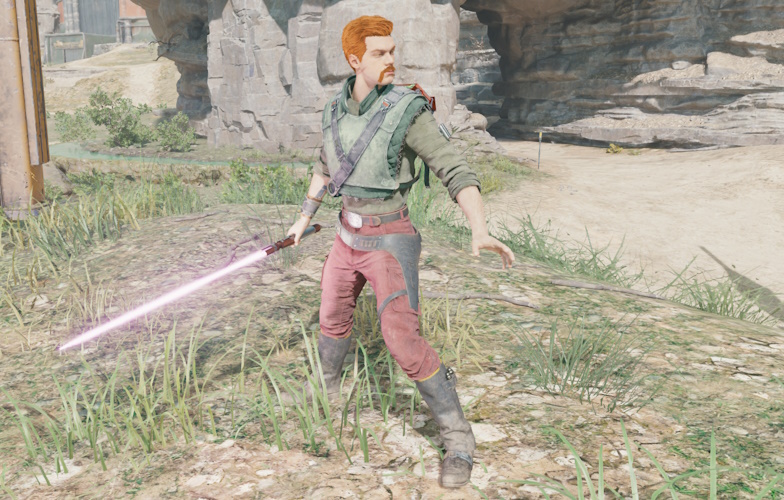
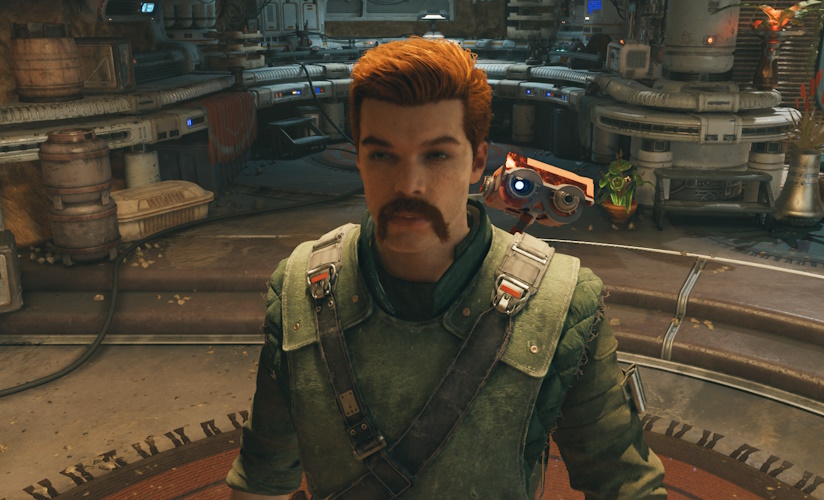
Cal Kestis – with his trademark moustache and pink lightsaber, of course.

On PC, the game is in a poor state even two months and six patches later. My PC far exceeds the game’s recommended system requirements, and should be capable of running Jedi: Survivor with detailed graphics and ray-tracing enabled without any issues. For comparison, I can run demanding titles like Red Dead Redemption II and Cyberpunk 2077 at their highest resolution, with ray-tracing enabled, and easily get a smooth 60 frames-per-second.

Jedi: Survivor runs poorly. Most of the time, walking around and exploring a level isn’t an issue. But as soon as combat begins, or even when Cal has to perform an acrobatic move like a double-jump or running along a wall, there are noticeable frame drops and stuttering issues. With some levels requiring fairly specific button-presses to navigate areas, inconvenient frame drops can mean the difference between successfully completing a section and having to replay it. This got old fast.

Cal stuck in the environment due to a glitch.

And this is in spite of turning down all of the in-game settings. I tried Jedi: Survivor in 4K at first, then 1440p, then finally 1080p. I tried the “high” preset, before dropping down to medium, and then again turning some settings – like shadows and the draw distance – all the way down to low. I refuse to drop the settings any further; playing the game in 720p with all settings on low would make it look no better than an Xbox 360 title, and what’s the point?

Some of these frame-drops occur during cut-scenes, which is something I haven’t encountered in a game in a long time. Although this kind of problem is annoying during gameplay, at least it’s understandable to an extent… but for cut-scenes to be similarly afflicted is actually quite shocking. It speaks to how unready Jedi: Survivor was when it was forced into a premature launch.

This “optimisation” takes place every time the game is started.

The frame-rate and stuttering issues are indicative of a game that is poorly-optimised. Despite Jedi: Survivor taking its sweet time to “optimise files” every time it boots, there’s no indication that this does anything at all. The game simply isn’t running well on PC. This isn’t an issue on my end, either – take a look at tech breakdowns from people far more skilled than I am and who have significantly more powerful computers. Similar issues are also impacting performance on PlayStation 5 and Xbox Series X – though I don’t have those consoles so I can’t speak to that for myself.

Jedi: Survivor has some visually interesting locations, but the experience of these – and the sense of immersion that I was hoping to find – has been ruined; soiled by just how janky and unfinished the game still is. When it works, these sights are definitely something to see, but the sad fact is that the game doesn’t work far too often.

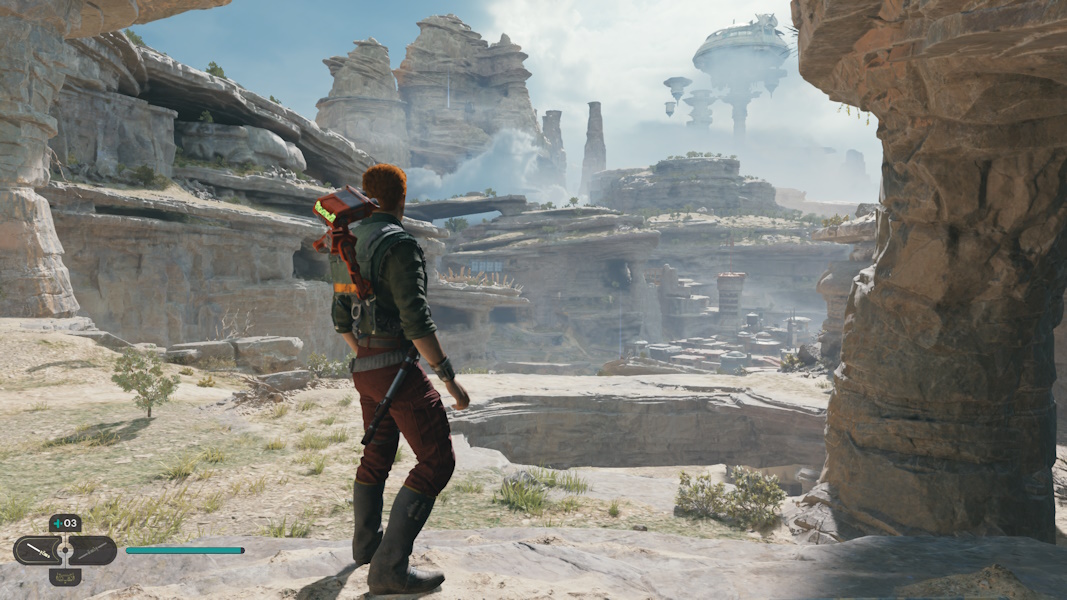
Some of Jedi: Survivor’s levels should look great.

I’m now considering abandoning Jedi: Survivor, despite only being a couple of hours into the game. If future patches come along that will genuinely address the performance problems that are plaguing the game on PC, it will be worth revisiting or restarting. But at the moment, I find that I’m spending almost as much time battling poor performance as I am battling enemies – and that just isn’t a lot of fun. Jedi: Survivor isn’t the only game this year to arrive in an unfinished state, especially on PC, but it’s so disappointing to see that this godawful “release now, fix later” approach has really put a downer on what should have been an exciting and fun experience.

But there’s more to say. In the time I’ve spent with the game so far, I have a couple of thoughts to share on the narrative and gameplay. This all comes with the major caveat that I’m only at the beginning of the main story, and that my thoughts may very well shift depending on how things go later on. How a story begins isn’t nearly as important as the journey it takes us on, after all!

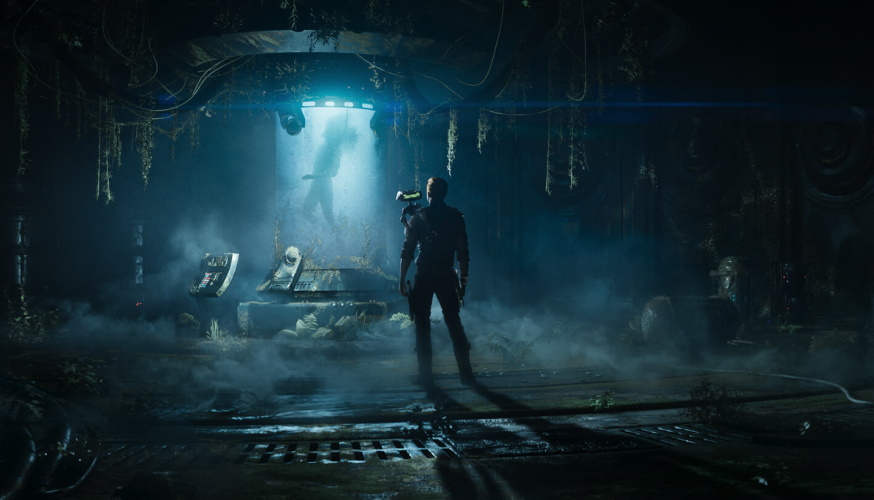
Concept art for Jedi: Survivor.

That being said, the first couple of hours of Jedi: Survivor haven’t exactly blown me away narratively. I’ll avoid as many major spoilers as I can, but there will be some minor spoilers ahead – so if you ignored my spoiler warning at the beginning, this is your last chance to nope out!

When we’re reintroduced to Cal, he’s working with a new crew, with the friends he met in the first game having gone their separate ways. I’m not averse to that idea, as several years have passed since the events of Jedi: Fallen Order. Unfortunately, however, the members of Cal’s crew that we’re introduced to just feel incredibly one-dimensional and bland. Their dialogue was laden with clichés – something clearly designed to convey Cal’s friendliness with them all – but it all ended up falling flat. I couldn’t find a way to care about any of these people when they were in danger – because the game didn’t succeed at getting me invested in them or their fates.

Some of the game’s new characters felt bland and uninteresting.

Contrast this with Prauf, Cal’s scrapper friend from the opening act of the first game. Prauf felt like he had personality, and I genuinely felt his connection with Cal from almost the first moment he appeared on screen. When Prauf was killed, Cal’s reaction was genuinely heartbreaking because the game had successfully set up their relationship.

I’m also a little concerned that Jedi: Survivor is going to retread parts of Jedi: Fallen Order by seeing Cal seek out the same people that he met last time. Reuniting a crew that had been together the last time we saw them is a risk; it’s something that could feel underwhelming in the extreme. Though there are new characters to get to know, part of the appeal of a sequel is to catch up with all of the characters we met last time – and I’m concerned that the way Jedi: Survivor plans to handle this will feel repetitive and just less interesting as a result.

Promo screenshot featuring Cal and Merrin.

In Jedi: Fallen Order, Cal was guided to a succession of specific locations on his quest. He had to visit the tombs of Zeffo, the forested world of Kashyyyk, the scorched desert of Dathomir, and the frozen wasteland of Ilum – but he went to each of these locations with a goal in mind. The first part of Jedi: Survivor sees Cal seemingly by accident fall into a cave – and from that random cave discover a hidden Jedi artefact. It just feels a little too convenient.

Out of all the places in the galaxy that Cal could have ended up, he finds himself on just the right part of just the right planet – and not because he was guided there by Cere or by Master Cordova’s holocron, but by sheer random chance. Star Wars fans may say “that’s the Force!” and pedants will say “it’s just a story!” but to me, neither of those excuses feel especially strong. Last time, Cal had a purpose, and was guided on his quest to particular locations. This time, things feel a lot more random.

Jedi: Fallen Order’s story seemed to take Cal on a more natural journey – rather than a random, incredibly convenient one.

Mechanically, Jedi: Survivor has a couple of issues, too. Larger levels can be more confusing, and the in-game holo-map still isn’t particularly user-friendly. In just the first couple of stages I found myself getting lost, and partly that’s because the way to go wasn’t well-signposted. Areas that looked accessible weren’t, areas that were supposed to be reachable looked blocked off or too far away, and while I don’t want a Skyrim-style waypoint on my screen the entire time… there’s got to be a way to make some of these pathways more visible, surely.

Jedi: Survivor is leaning into more of an open-world style, at least with one of the planets Cal has visited so far… and that can be a double-edged sword. On the one hand, larger and more expansive levels are a welcome change from linear paths, but on the other, some open worlds can get in the way of story progression. There are also more hiding places for items and chests… and it can be frustrating, sometimes, to explore a whole chunk of a level, climbing on every ledge and jumping into every cave only to find nothing at all.

Battling battle droids.

I like the expanded customisation options for Cal – and I’ve already found a suitably silly moustache for him to plaster on his face. I wish more customisation options were unlocked at the start, though; the available cosmetics felt pretty threadbare at first. I love a game with good customisation options, though, and Jedi: Survivor appears to have a bunch of fun cosmetics to play about with.

The game is larger than Jedi: Fallen Order was – with more characters, more skills, more quests, and more cosmetic variety. All of those things are positive, and so far I don’t feel overwhelmed or like the game is too large. Some open-world games can feel like they dropped you in the middle of a mass of stories and quests with little to no direction; at least in its first couple of hours, Jedi: Survivor manages to avoid that sensation.

A closer look at Cal’s moustache.

I want to progress further with this game. I adored Jedi: Fallen Order and I was really excited about its sequel, reuniting with Cal and the Stinger Mantis, and having another adventure in a galaxy far, far away. Although there are a couple of story complaints that I’ve found so far, by far the worst issue with Jedi: Survivor is that it just doesn’t play very well. The game probably needs at least two or three more significant patches and updates to knock it into shape – and when the most recent patch took over a month to be rolled out, that could mean Jedi: Survivor will have to go back on the shelf for a while.

Electronic Arts fucked up what should have been a guaranteed success by doing what they’ve done too many times before: forcing the release of an unfinished game too early. Had Jedi: Survivor been delayed to, say, September or October, to allow Respawn more time to actually finish working on it, we could be talking about one of the best games of the year – and one of the best Star Wars games in a long time.

Instead, Jedi: Survivor will always have an asterisk; a little caveat next to it. No matter what happens to the game in the months ahead – and I sincerely hope that more patches and fixes are coming – it will always be tainted by the poor shape it was in when it launched. That didn’t have to happen… and I wish I’d taken my own advice and waited a little longer before purchasing it.

Star Wars Jedi: Survivor is out now for PC, PlayStation 5, and Xbox Series S/X. Jedi: Survivor is the copyright of Electronic Arts, Lucasfilm Games, and Respawn Entertainment. The Star Wars franchise is the copyright of Lucasfilm and The Walt Disney Company. Some promo artwork and images used above courtesy of IGDB. This article contains the thoughts and opinions of one person only and is not intended to cause any offence.

Lego Star Wars: The Skywalker Saga – first impressions

Spoiler Warning: There are minor spoilers ahead for Lego Star Wars: The Skywalker Saga and the nine mainline Star Wars films.

I had a lot of fun in the days when I owned an Xbox 360 with Lego Star Wars: The Complete Saga. That game brought a lot of lightheartedness to the Star Wars franchise, and was also a surprisingly complex game, with many characters to unlock and collectables to find. Going back and replaying levels didn’t feel like a chore, making it a great game to play solo or co-operatively. I had high hopes when a new Lego Star Wars title was announced, and it’s finally here after several lengthy delays!

I’m not even going to attempt a thorough playthrough in time to write a review; it will take a long time to go through the game and truly experience all that it has to offer. But for now I thought it would be worth sharing my first impressions! I’ve spent just over six hours with the game over the past couple of days, and I’ve jumped into two of the game’s stories/campaigns. I feel that’s long enough to get a feel for how the game plays – as well as to spot any major flaws or problems!

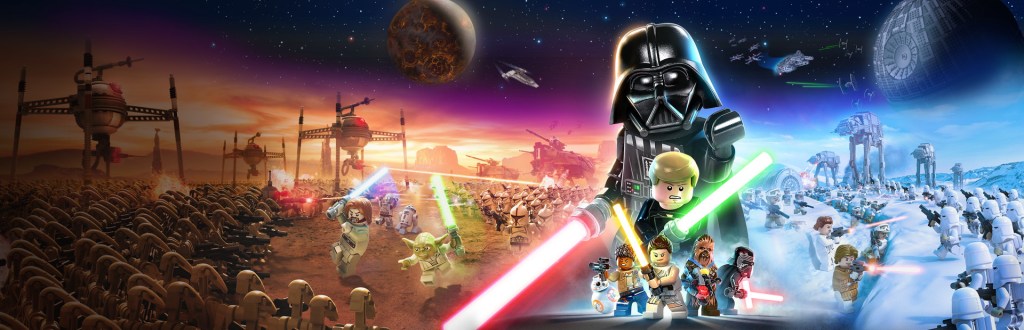
Promo art/banner for Lego Star Wars: The Skywalker Saga.

Lego Star Wars: The Skywalker Saga is split up into nine parts – one for each of the nine mainline films of the Skywalker Saga. On booting up the game for the first time, only three are available: The Phantom Menace, A New Hope, and The Force Awakens. Completing these unlocks the next part of that particular trilogy, and so on. It’s a neat way to organise it, and I liked that I was able to choose which trilogy I wanted to get started with. If the campaign had been entirely linear, with players having to unlock each film one by one, it would probably have been less enjoyable – and likewise, if all nine campaigns were unlocked from the start there’d be less to accomplish. All in all, this approach feels like it strikes the right balance.

I chose to start with The Phantom Menace – it’s my least-favourite film (well, tied with The Rise of Skywalker), but it’s often been my starting point when I go back to re-watch the mainline Star Wars films. As a film with a child-friendly atmosphere, it’s also one that I felt could translate well to the world of Lego! After spending a bit of time progressing through The Phantom Menace I hopped out of that campaign and loaded up A New Hope. It took me a second to figure out how to change campaigns on the fly, but it’s something the game allows you to do.

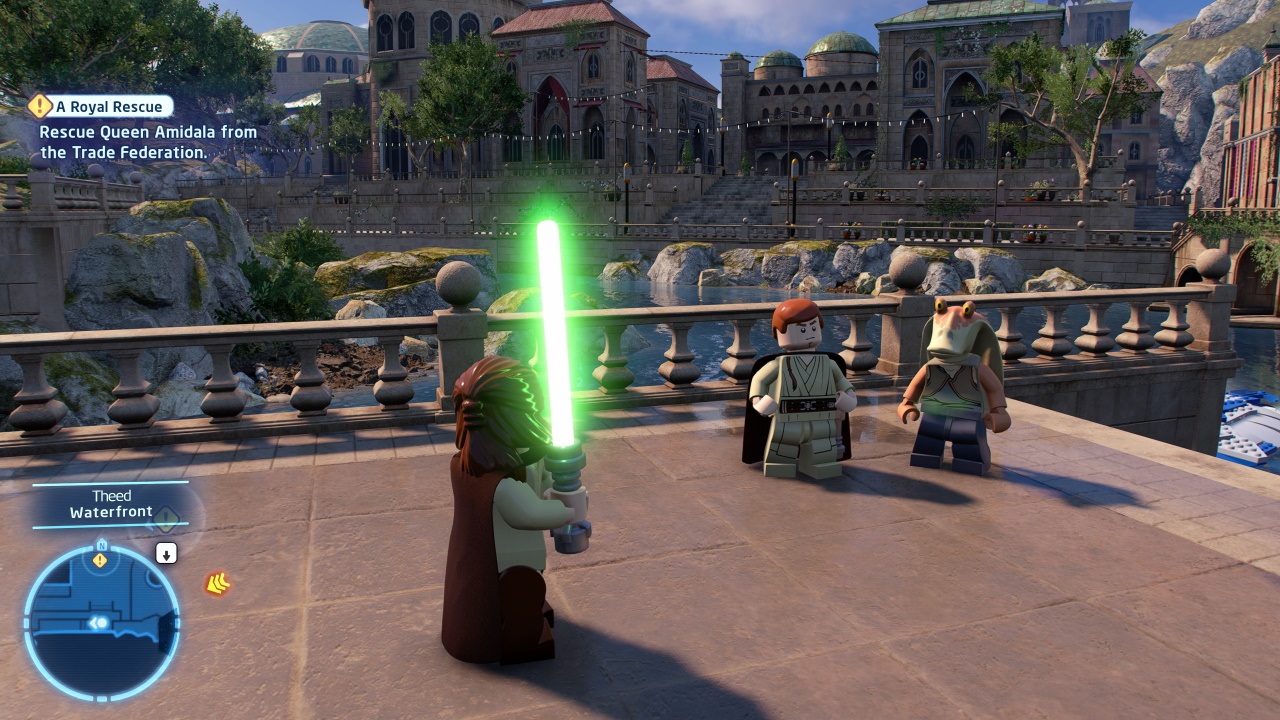
Qui-Gon Jinn with Obi-Wan Kenobi and Jar Jar Binks.

As someone who hasn’t played a Lego game in years, I wasn’t sure what to expect. I was pleasantly surprised to note that, despite major visual improvements, the feel of playing a Lego game is still present. There’s a cartoon silliness that doesn’t merely begin and end with the game’s visual style, it permeates many different aspects of the gameplay as well – and that less-than-serious take has been a hallmark of Lego Star Wars games (and Lego games in general) going back to the very first iteration. All of that is still present in The Skywalker Saga.

Half the fun of Lego games has always been in roaming around the environment, looking for things to destroy, studs to collect, and hidden collectables. I have no idea how many different things are hidden across the game – but in the few hours I’ve spent with it so far I’ve found dozens, and I’ve barely scratched the surface! What I love about these hidden collectables is that it isn’t just a case of wandering around until you find an obscure part of the map that’s off the beaten track; in order to find or unlock many of them you have to solve a puzzle, run through an optional extra assignment, and things like that. Not all of these puzzles are easy, either, despite the game being aimed at kids!

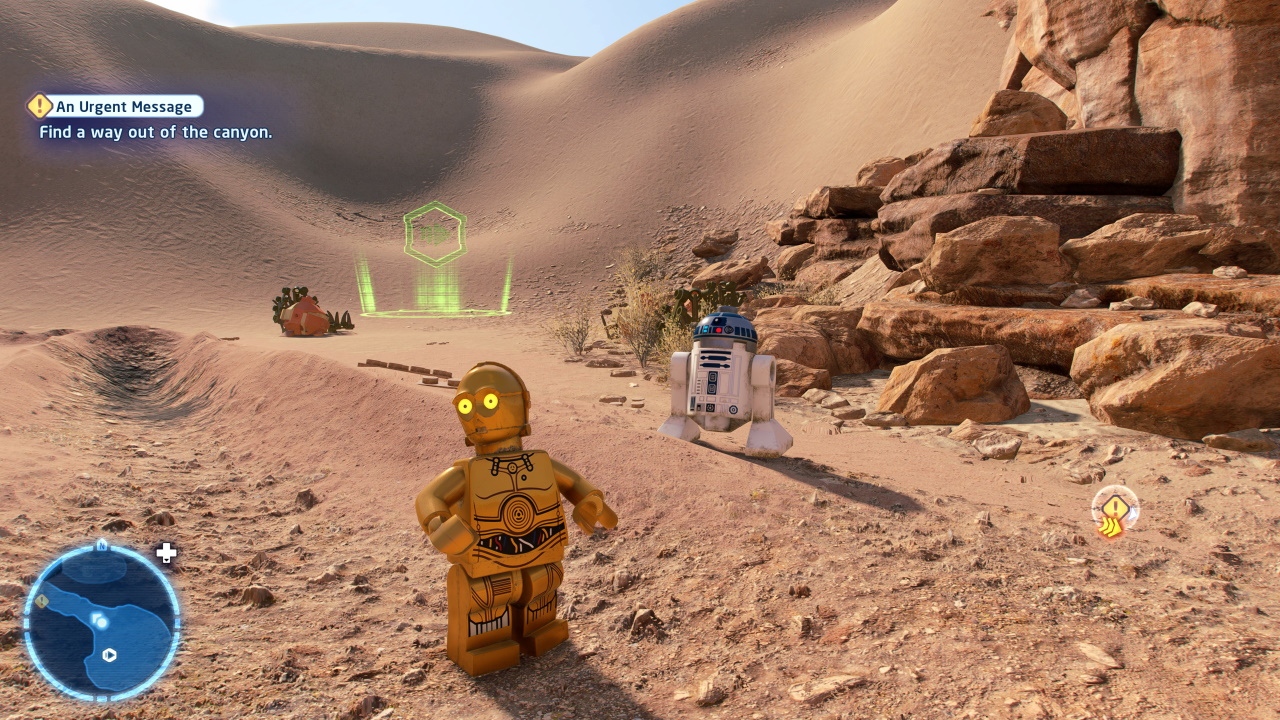
C-3PO and R2D2 on Tatooine.

The Skywalker Saga would absolutely be the perfect first Star Wars game for a younger fan. Of the Star Wars games released in recent years, it’s by far the easiest to get started with – and it’s also the most complete in terms of telling the classic story of the films. Some scenes and sequences are skipped over during the story, but so far I’ve found both of the stories that I’ve played to be surprisingly deep; there’s certainly more than enough context provided by the game that even someone unfamiliar with the films could follow the story.

One thing that surprised me at least a little was the diversity of environments on display in The Skywalker Saga. The Star Wars galaxy is huge, canonically speaking, and we’ve seen a huge variety of different locales and biomes on display in the films and TV shows. But because The Skywalker Saga is a Lego game and has a cartoon feel, I wasn’t sure how well some of that would translate. It was great to see that the different interior and exterior environments all look and feel distinct from one another; that’s something that really captures the sense of scale present in Star Wars.

Promotional screenshot showing an Ewok and AT-ST on Endor.

Speaking of diversity, there’s more than one type of level in The Skywalker Saga! In addition to levels which characters must traverse on foot, there are ship-based sections where players can pilot a variety of different ships from the Star Wars galaxy. I can’t remember if this is something that has been present in prior Lego Star Wars games, but it was neat to see it here. Being able to hop into everything from starfighters to submarines adds a heck of a lot to the experience, making it feel deeper and richer. Programming and developing different modes of gameplay is no mean feat, and even though we all might have our preferences when it comes to the kinds of levels we prefer, I’d say that The Skywalker Saga is significantly better for including these different styles of gameplay.

The Skywalker Saga is being pitched by publisher Warner Bros. as the definitive Lego Star Wars experience. It brings more characters to the table than ever before, as well as more levels based on all nine of the mainline Star Wars films. It’s hard to argue that – at least in 2022 – this really is as good as it gets for a fan of Lego Star Wars!

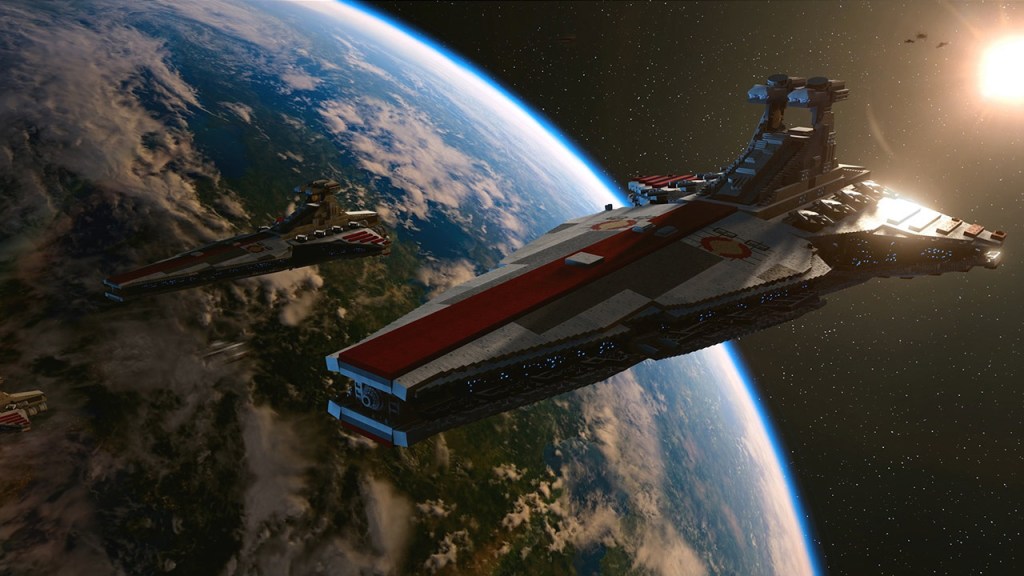
Promotional screenshot showing prequel-era Republic starships.

There are new elements that are clearly designed to modernise the familiar formula. The fact that it’s possible to level up your characters and give them gameplay upgrades is a nod to the way that this aspect that originated with role-playing games has become omnipresent in video games today. But none of that feels intrusive, and while it’s certainly possible to spend a lot of time chasing down enough studs or Kyber bricks to unlock the next upgrade, it’s also possible to have fun playing the game without paying too much attention to that side of it. I wouldn’t call these things entirely “optional,” but they’re inoffensive for players who aren’t interested or who just want to have fun playing the game.

Getting to grips with the gameplay felt easy enough. There are a few different moves and attacks that player characters can perform, and the nature of these will depend on whether the character is a Jedi, a gunslinger-type, a droid, and so on. There are ranged shots, melee attacks, jumps, and it’s possible to perform combos. Sometimes these combos will be required (enemies can block certain attacks) meaning it isn’t always possible to race through a level mindlessly hitting the X button!

Promotional screenshot showing Boba Fett.

I didn’t encounter a single bug, glitch, or graphical issue with The Skywalker Saga through my six hours of gameplay, and considering the state of some recent highly-anticipated games I think that’s pretty good! I played on PC, but the game is also available on Xbox One, Xbox Series S/X, PlayStation 4, PlayStation 5, and Nintendo Switch.

The Switch version in particular holds a lot of appeal! Being able to play the game on the go is something I’m sure a lot of fans will appreciate, but it also just feels like a good fit in general for Nintendo’s family-friendly machine. I’m glad that The Skywalker Saga was able to get a Switch release; even more so that it was released on Switch at the same time as on every other platform.

Qui-Gon Jinn using the Force to lift a Lego object.

So I guess that’s it. Lego Star Wars: The Skywalker Saga has been a lot of fun so far, and I can’t wait to jump back in and play some more! I’ll be curious to see how the Lego treatment works for The Rise of Skywalker; that film is tied with The Phantom Menace for being my least-favourite in the saga. The Phantom Menance managed to be fun, so I feel reasonably optimistic that, despite not enjoying the film, I’ll at least have fun with its gameplay adaptation!

I’d happily recommend The Skywalker Saga to anyone who enjoys either the Star Wars franchise or this style of kid-friendly gameplay. You won’t get a massive Elden Ring-style challenge out of it, and in terms of multiplayer you’re limited to playing with a single friend only (and I hear it works far better locally than online). But with those caveats, Lego Star Wars: The Skywalker Saga is something I think a lot of players will be able to find enjoyment in. For kids, especially younger kids looking to get started with perhaps their first big Star Wars game, I think it’s a no-brainer.

So far, Lego Star Wars: The Skywalker Saga has been great. For me personally, while I had fun with Lego Star Wars: The Complete Saga during the Xbox 360 era, I don’t feel the same nostalgic pull to these games as some younger folks who grew up playing them as kids might. But even so, I’m having a lot of fun and I’m happy to recommend the game to anyone still on the fence.

Lego Star Wars: The Skywalker Saga is out now for PC, PlayStation 4, PlayStation 5, Nintendo Switch, Xbox One, and Xbox Series S/X. Lego Star Wars: The Skywalker Saga is the copyright of Traveller’s Tales, Warner Bros. Interactive Entertainment, and/or the Walt Disney Company. The Star Wars franchise is the copyright of Lucasfilm and the Walt Disney Company. This article contains the thoughts and opinions of one person only and is not intended to cause any offence.

Electronic Arts seemingly loses its exclusive rights to Star Wars

For almost a decade following Disney’s acquisition of LucasFilm, only one company has been able to make Star Wars video games: Electronic Arts. A deal between Disney and EA gave them exclusive rights to the Star Wars license, and in the years since there have been four mainline Star Wars games, one Lego tie-in, one VR game, and a handful of mobile titles.

Both 2015’s Battlefront and of course 2017’s Battlefront II proved controversial and divisive; the former being disappointingly threadbare and the latter for its aggressive in-game monetisation. 2019 saw Jedi: Fallen Order, which I played through last year and was a fun title, and finally 2020 saw Star Wars: Squadrons, which I’ve also been enjoying. However, four games in nine years is perhaps less than many fans were expecting, especially with two of them having serious issues.

2015’s Battlefront was disappointing to many fans.

Calls for Electronic Arts to be “stripped” of the Star Wars license began after Battlefront’s release in 2015, but reached fever pitch in the weeks after Battlefront II’s launch. There was even a petition that hundreds of thousands of folks signed to ask Disney to revoke EA’s exclusive arrangement. That went nowhere, of course – fan petitions never achieve anything – but is indicative of the strong feelings over EA holding the rights.

The well-received Jedi: Fallen Order and Squadrons, combined with updates and patches which greatly improved Battlefront II, led to a cooling-off period, and as of early 2021 cries for the Disney-EA deal to be somehow undone had largely abated. It was a surprise, then, when LucasFilm announced a new Star Wars game… published not by EA but by Ubisoft!

“A surprise, to be sure, but a welcome one.”

Ubisoft has been honing its style of open-world games for years, with franchises like Assassin’s Creed, Far Cry, and Watch Dogs. It seems, from the teaser announcement made yesterday, that the new title will be an open-world game in a similar style, though no mention has yet been made whether it will be a single-player title like those in Ubisoft’s other open-world series, or a multiplayer “live service.” From my point of view I’m hoping for the former!

The game itself may be several years away, though Star Wars does have a recent track record of announcing games closer to release – that’s what happened with Squadrons last year, for example. No release window has been suggested as yet, and in fact we know precious little about the game itself beyond the publisher responsible.
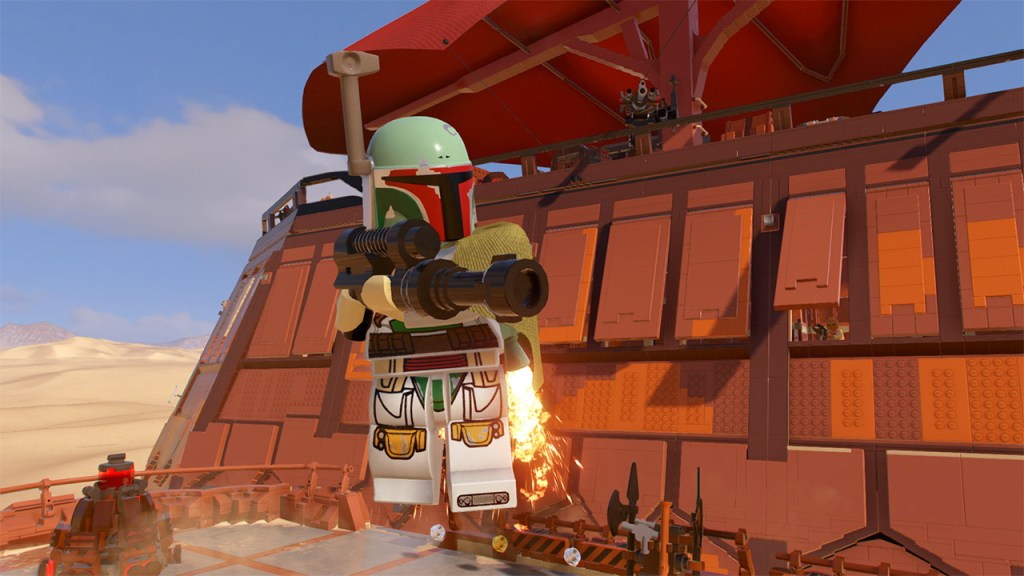
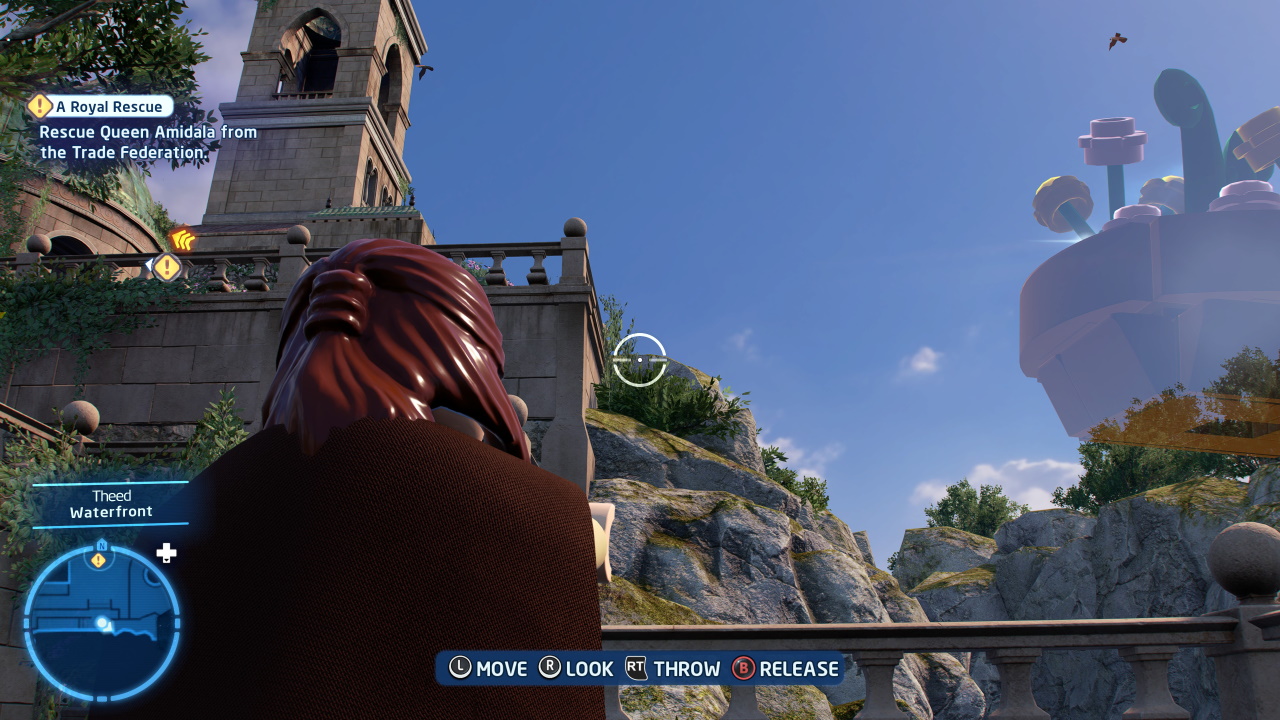
Star Wars: Squadrons.

The upcoming game is just one part of this story, though. Most industry watchers agreed that Electronic Arts had a couple of years remaining on their deal with Disney, which raises the question of how and why this Ubisoft game has been able to enter development. It’s possible that the original contract was incorrectly reported, in which case it may simply have run its course. Or there may have been clauses regarding a number of titles, profit made, etc. that Electronic Arts didn’t live up to, allowing Disney to open up Star Wars to other companies. We don’t know the details – and unless someone senior breaks ranks to tell us, we likely never will!

Exclusivity arrangements can be difficult, and the Disney-EA deal over Star Wars is pretty much a textbook example of why. An exclusive contract like the one Disney offered EA effectively gives that company a monopoly over the license, and anyone who knows anything about basic economics can tell you why monopolies are a bad idea in practically every industry.

No, not that kind of Star Wars monopoly…

Having a monopoly meant there was no threat of competition, and this allowed EA to sit on the Star Wars license, cancelling titles that senior executives didn’t think would bring in “recurring user spending” and not feeling under any real pressure to develop or release anything. They could afford to be complacent because no one else was contractually allowed to even pitch a concept for a Star Wars title.

This attitude was changed when Electronic Arts saw the scale of the backlash to Battlefront II. The effects of that debacle are still being felt, and the game opened the eyes of parents, journalists, and even politicians to the shady practice of in-game gambling. But we’re off-topic. Too late, EA shifted focus away from cash-grabs, putting out the single-player Jedi: Fallen Order and following up with the space-sim Squadrons.

2017’s Battlefront II controversy may have triggered a change in thinking at EA – and at Disney.

Fans had been clamouring for a single-player story-driven Star Wars game for years, and while Battlefront II had a creditable single-player campaign, it wasn’t until Jedi: Fallen Order’s release in November 2019 that the single-player itch was truly scratched for most fans. By then the damage had been done for Electronic Arts, though, and their earlier complacency and attempts to swindle players with truly awful monetisation came back to bite them.

Though Electronic Arts will continue to work on Star Wars titles – most significantly the upcoming sequel to Jedi: Fallen Order – they will no longer be the only company Disney trusts with their incredibly expensive, incredibly lucrative license. The Ubisoft game may be the first of several upcoming Star Wars projects to be taken on by other companies, and hopefully what results will be a broader range of genres and styles of game.

Protagonist Cal Kestis in Jedi: Fallen Order.

In December 2020, LucasFilm announced half a dozen or so upcoming Star Wars films and television shows. There will be a lot of Star Wars content to come over the next few years at least, and while not all of the shows and films will be suitable for a video game adaptation, some may be. Disney and LucasFilm need to ensure they have access to the broadest possible range of talents in the video game industry if they hope to make the most of Star Wars.

I wasn’t especially excited by the film and television announcements made last month, to put it politely. Too many of them seem to be spin-offs, prequels, and deep dives into uninteresting side-characters rather than expanding Star Wars beyond its original incarnation. But even so, several of these projects seem ripe for video game tie-ins, and the end of the Skywalker Saga of films coupled with this expansion into new films and television projects may have been a contributing factor to Disney ending or not renewing its exclusive arrangement with EA.

Could a game based on the upcoming series Rangers of the New Republic be in the works?

For my two cents, I see the ending of this kind of exclusivity deal as a good thing. Monopolies are problematic for consumers for precisely the reasons the Disney-EA arrangement shows, and in future it could even be used as a case study for why these kinds of deals are a bad idea. Opening up Star Wars games to other companies allows for different points of view, competition, and hopefully what will result at the end of the day will be better games. Not necessarily more games. But better ones.

It is worth noting that Ubisoft is a company that hasn’t exactly escaped controversy recently. There have been serious problems within the company, including sexual harassment accusations against senior executives, and the accusation that the company itself tried to cover this up and cover for abusers. Company culture and institutional problems count against Ubisoft, and while Star Wars fans are rightly excited to learn that the franchise will be moving away from the EA exclusivity deal, it’s worth noting that Ubisoft has issues – and Disney should also be aware of this. The last thing the Star Wars brand needs right now is further controversy, yet a team-up with Ubisoft risks precisely that.

So that’s it. The end to Electronic Arts’ monopoly over the Star Wars license. Now if only someone would make a Star Trek video game…

The Star Wars franchise – including all titles mentioned above – is the copyright of Disney and LucasFilm. Star Wars: Battlefront, Star Wars: Battlefront II, Star Wars Jedi: Fallen Order, and Star Wars: Squadrons were published by Electronic Arts. Some screenshots and promo art courtesy of IGDB. This article contains the thoughts and opinions of one person only and is not intended to cause any offence.