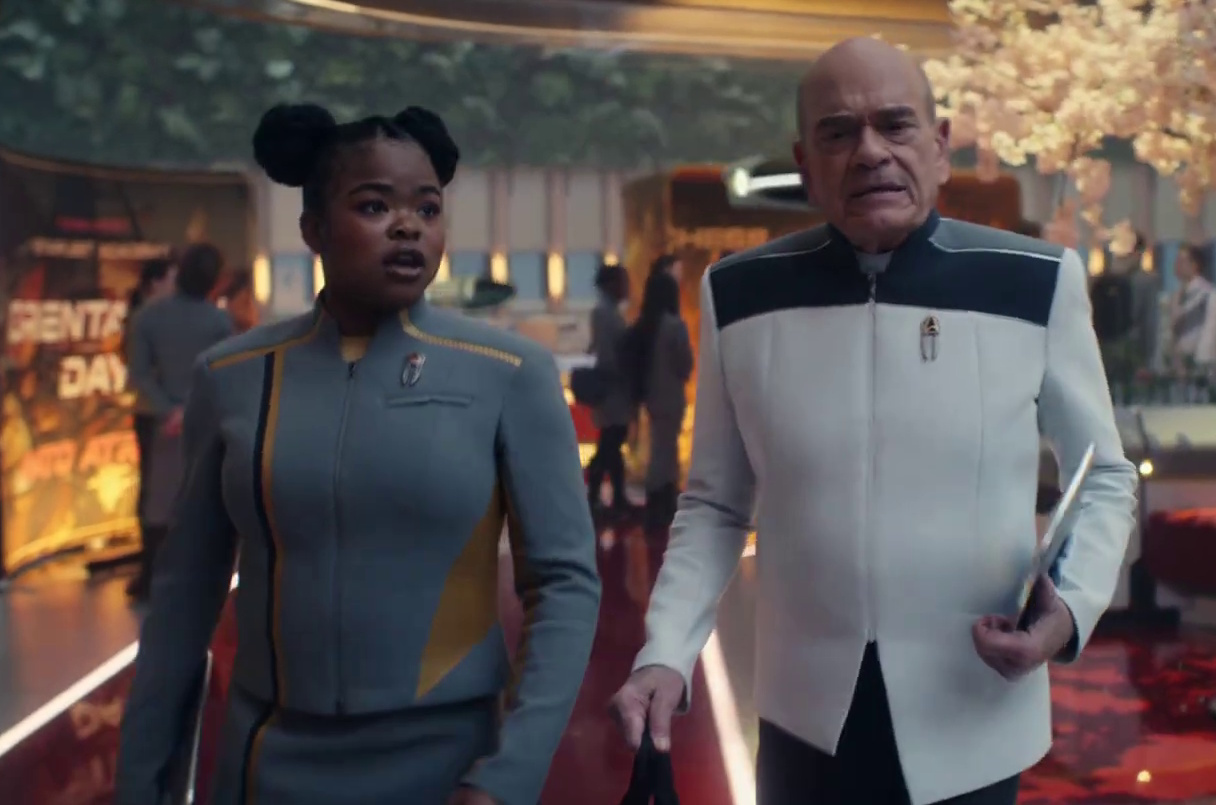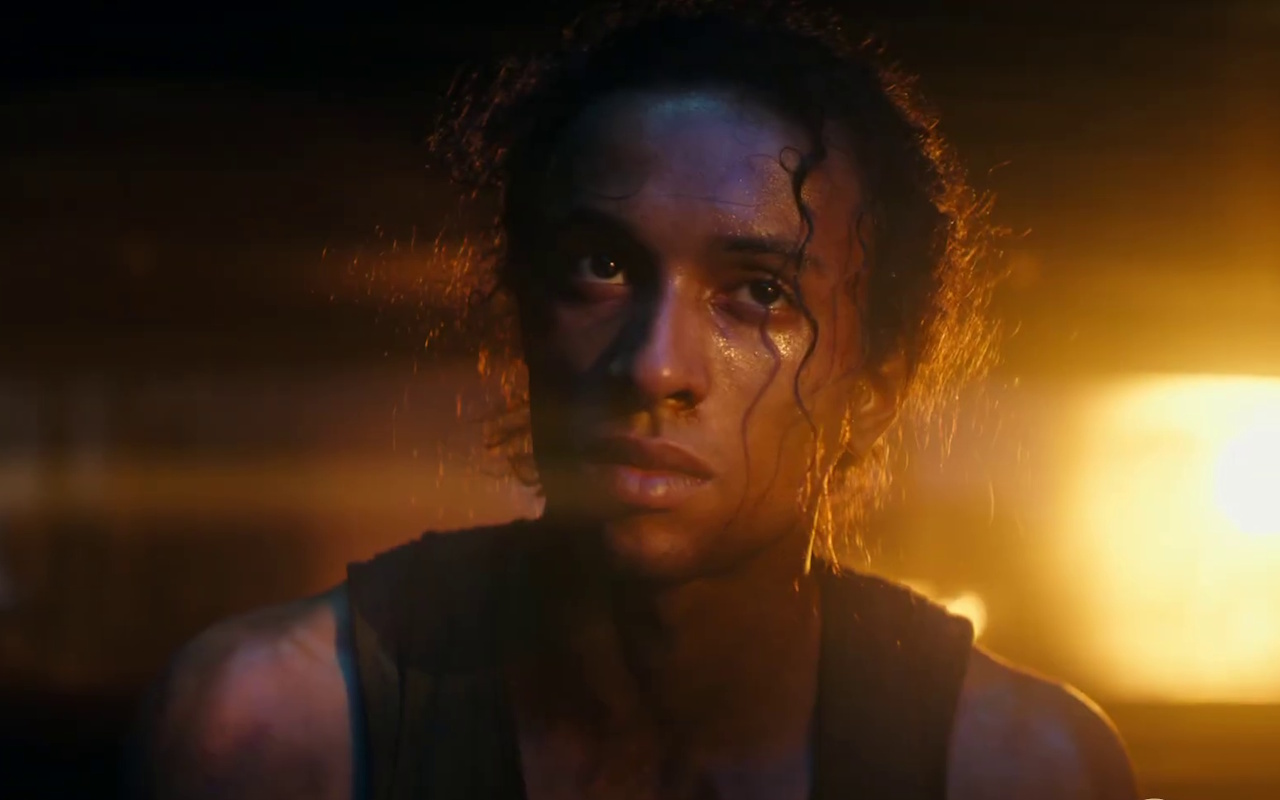
Star Trek: Starfleet Academy – Season 1 Review

A Star Trek-themed spoiler warning.

Spoiler Warning: There are spoilers ahead for Star Trek: Starfleet Academy Season 1, as well as for the following Star Trek productions: Deep Space Nine, Voyager, Discovery, Picard, Lower Decks, and Section 31.

Alright, let’s talk about Starfleet Academy!

First of all, some general information. I chose not to write individual episode reviews week-to-week for Starfleet Academy this season. So this review is going to be a little different in terms of format. This article will detail my overall thoughts on the season, the characters, the storylines, the VFX, and so on. And in the days ahead, I will write a follow-up piece in which I share my thoughts on episodes 3-10 of Season 1. I already have a review of the two-part series premiere, and you can find that by clicking or tapping here.

Secondly, I went into detail about one of Starfleet Academy’s mid-season storylines – the one involving DS9 and Captain Sisko. I’ll touch on that this time, but if you want my full thoughts on the Sisko storyline and whether it was a good idea, click or tap here to check it out. Finally, I thought it would be interesting to return to the Academy’s first major on-screen appearance, which came during The Next Generation’s fifth season. I re-watched The First Duty, and you can read my impressions of that episode, in which I reference Starfleet Academy Season 1, by clicking or tapping here.

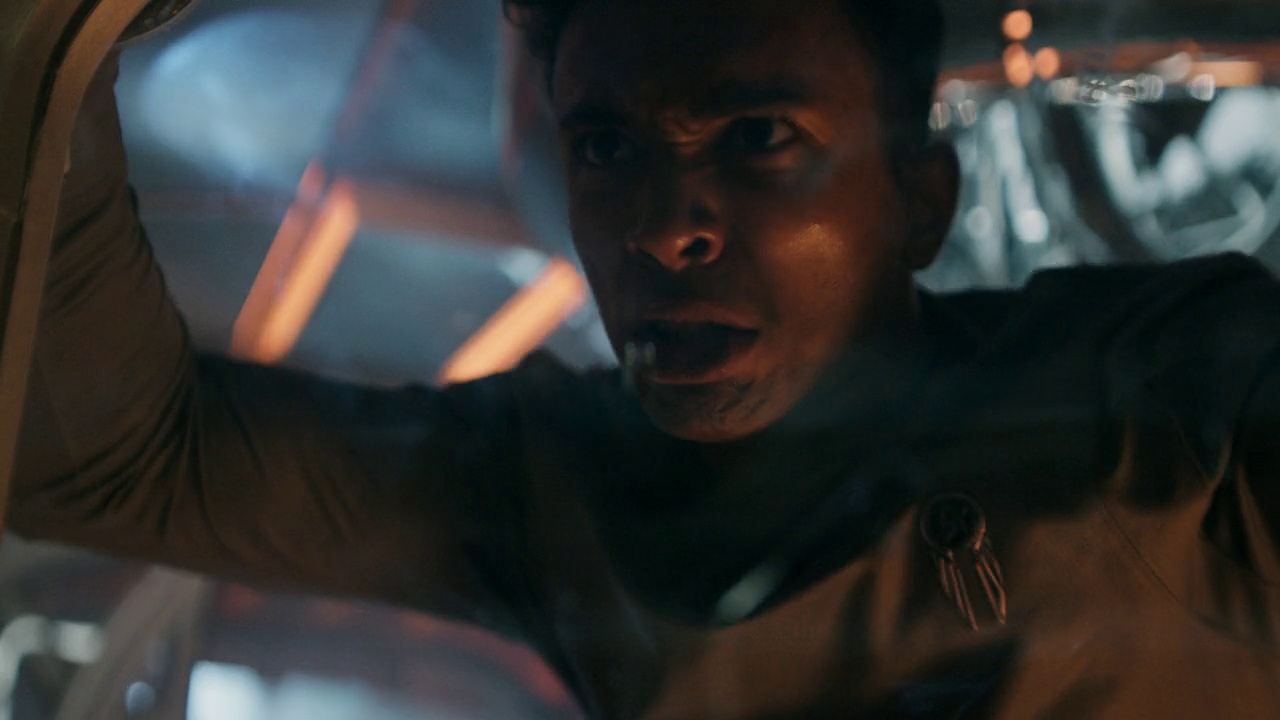
Still frame from Star Trek SFA S1 showing a spotlight
Let’s put Starfleet Academy in the spotlight!

I share those articles with you in case you want to get some additional context for some of the things we’re going to discuss today – and even if you don’t care about that, I still encourage you to have a read if you’re a Trekkie, like me! I enjoy writing about Star Trek, and I think some of those pieces will definitely add to the conversation around Starfleet Academy’s first season, if that’s something you’re interested in.

So… what did I think of Starfleet Academy, then, as someone who’s been a Star Trek fan for some thirty-five years?

Cards on the table: I went into this series expecting to find that it wouldn’t be “my thing.” I tried hard to set aside my biases about teen/young adult drama shows, but the inescapable conclusion is that I wouldn’t have even switched on Starfleet Academy were it not for the “Star Trek” label. I asked myself the question of whether I’d have chosen to sit down and watch a similar programme in a different franchise; if this were “Star Wars: Jedi University” or “The Lord of the Rings: Bilbo Goes To College.” And the answer is “almost certainly not.” I showed up for the Star Trek name and the Star Trek name alone, hoping to find that the series… well, wasn’t as advertised, really, and didn’t have as strong a focus on teen/young adult drama as its promo material suggested.

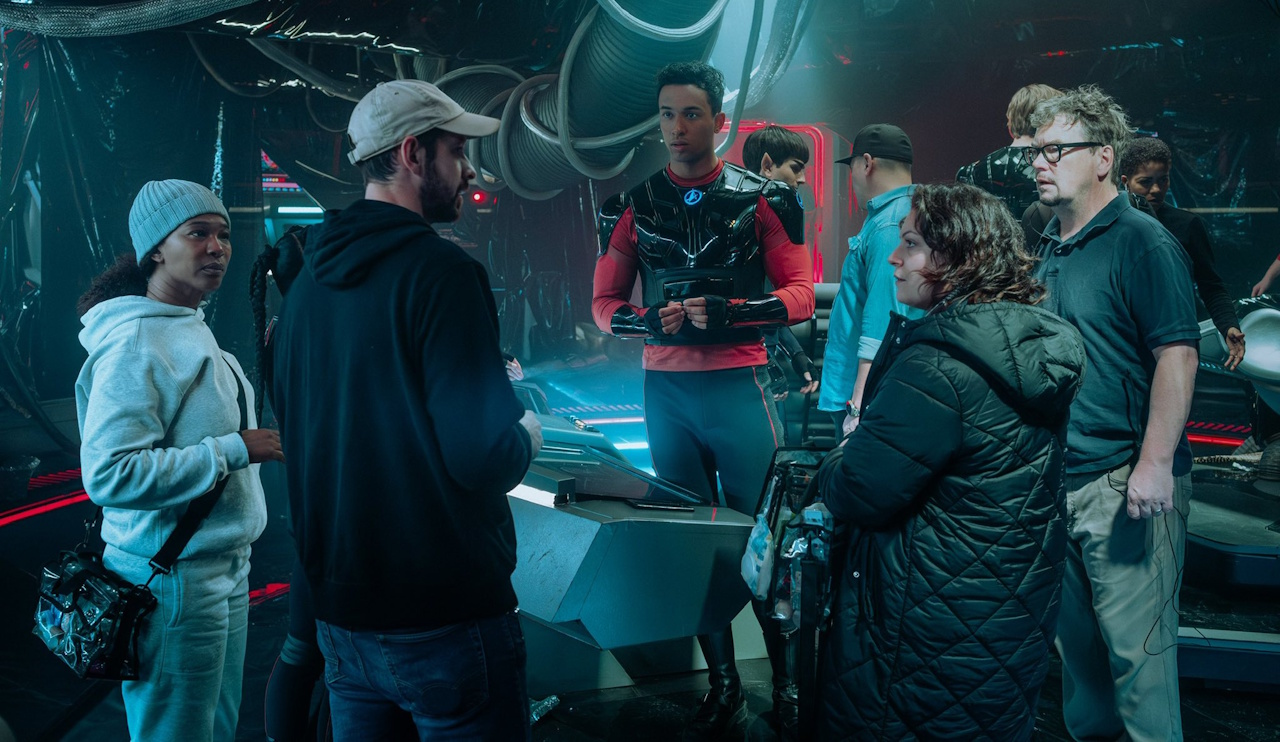
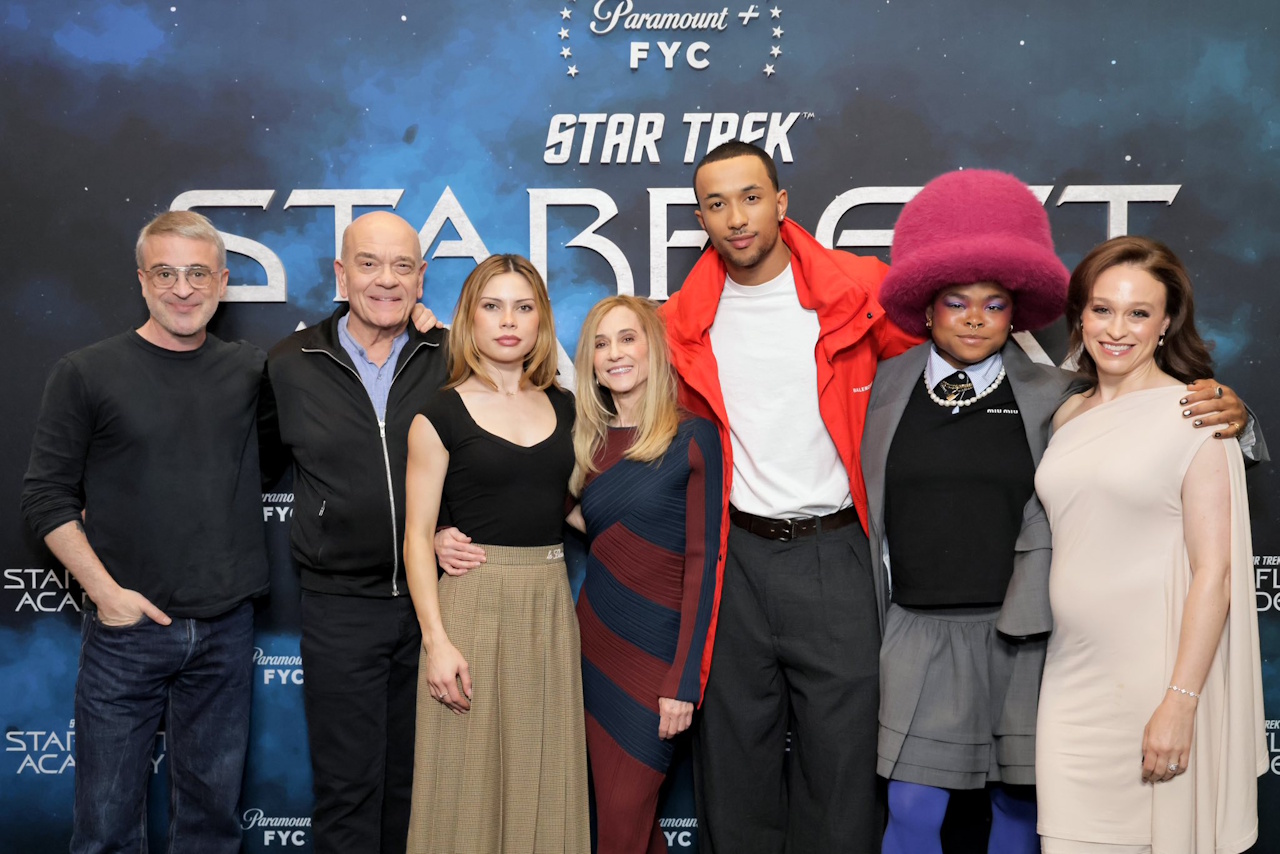
Photo from the Star Trek SFA finale screening showing the main cast and showrunners
Showrunners Alex Kurtzman and Noga Landau with several main cast members at a special screening for the series finale in March 2026.

Sometimes, having low expectations can be a good thing! And there are definitely aspects of Starfleet Academy that both exceeded my expectations and just plain *worked*, either as a Star Trek story or just a fun sci-fi adventure in a more general sense. I will absolutely give credit where it’s due for the series being significantly more episodic in nature than I’d feared; there are still serialised storylines and character arcs, but not quite to the same extent as either Discovery or Picard.

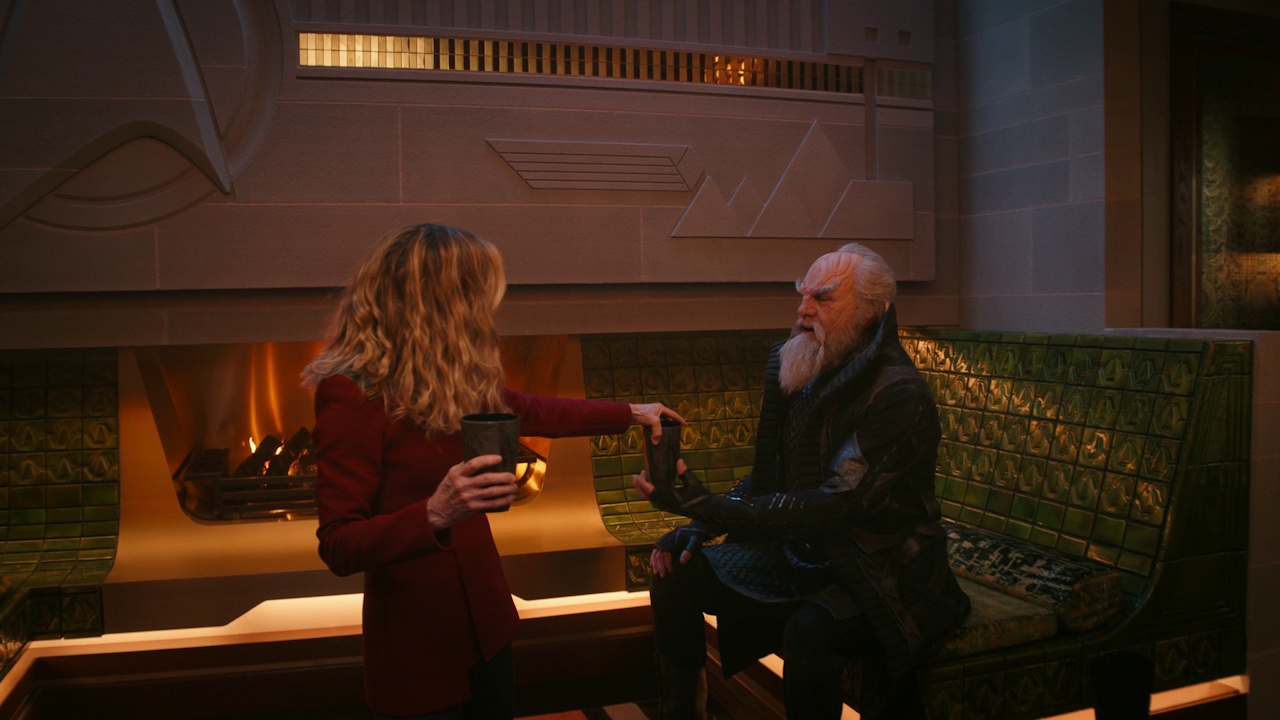
However, what I would also say is that Starfleet Academy doesn’t feel like an especially memorable addition to the franchise – at least, not for me. There are episodes from right across modern Star Trek that stick in my mind for one reason or another – positive as well as negative. There are characters with strong personalities or who got heavily-featured in big, impactful storylines. There are starship and uniform designs that I found visually pleasing – or, occasionally, so-bad-it’s-good! But Starfleet Academy… it had basically none of that, and I really can’t call to mind a single protagonist, antagonist, visual element, or individual storyline that I’d say will stick with me now that the credits have rolled on the season finale.

And I think at least *part* of the reason for that is because Starfleet Academy has been unlucky. Let me explain what I mean.

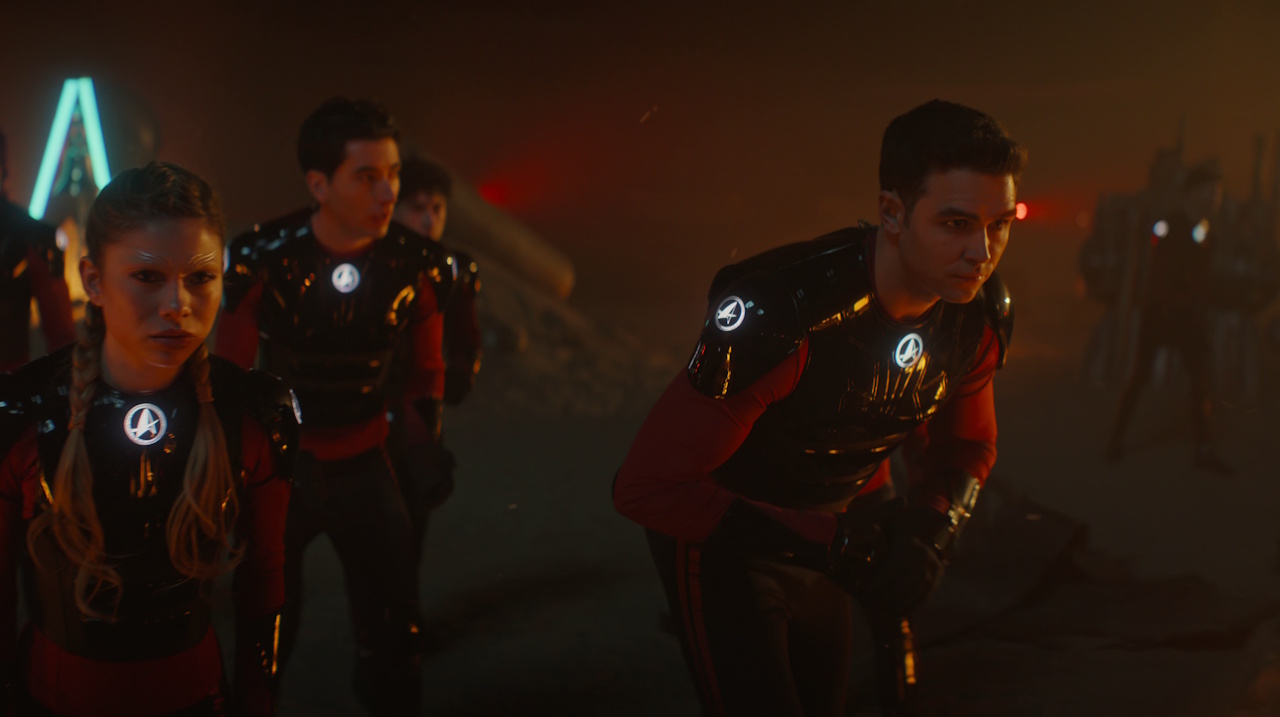
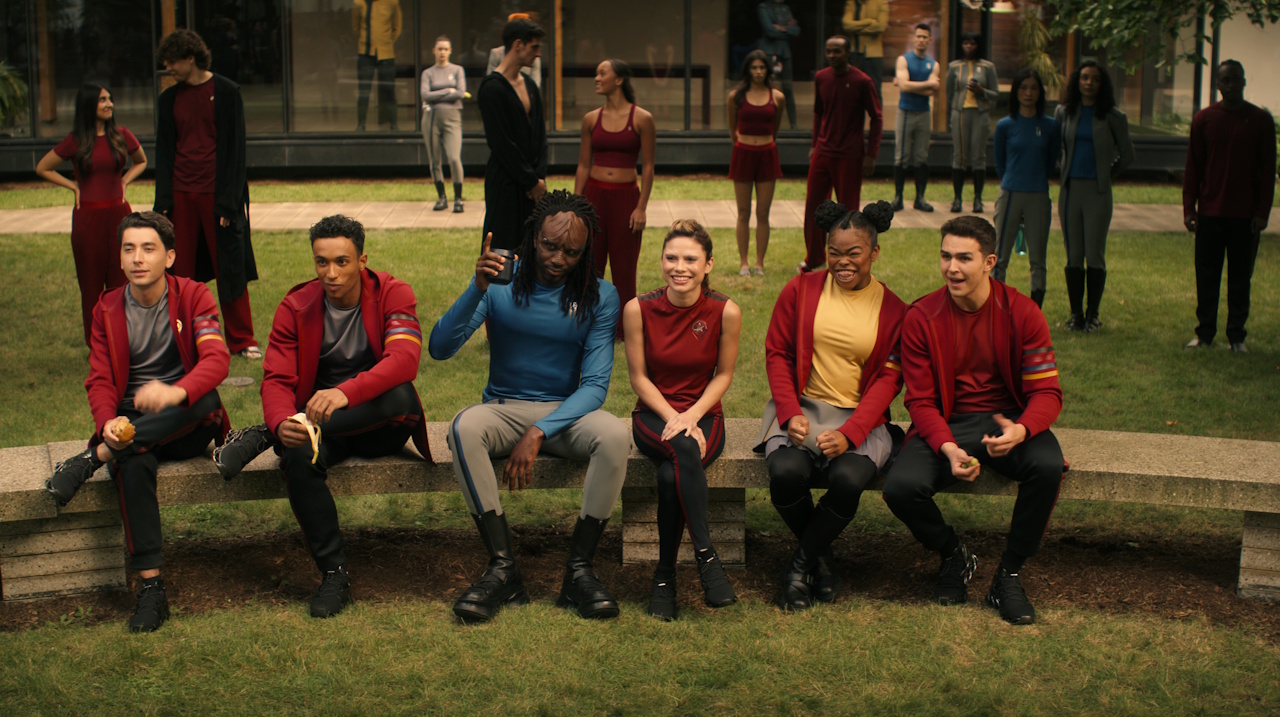
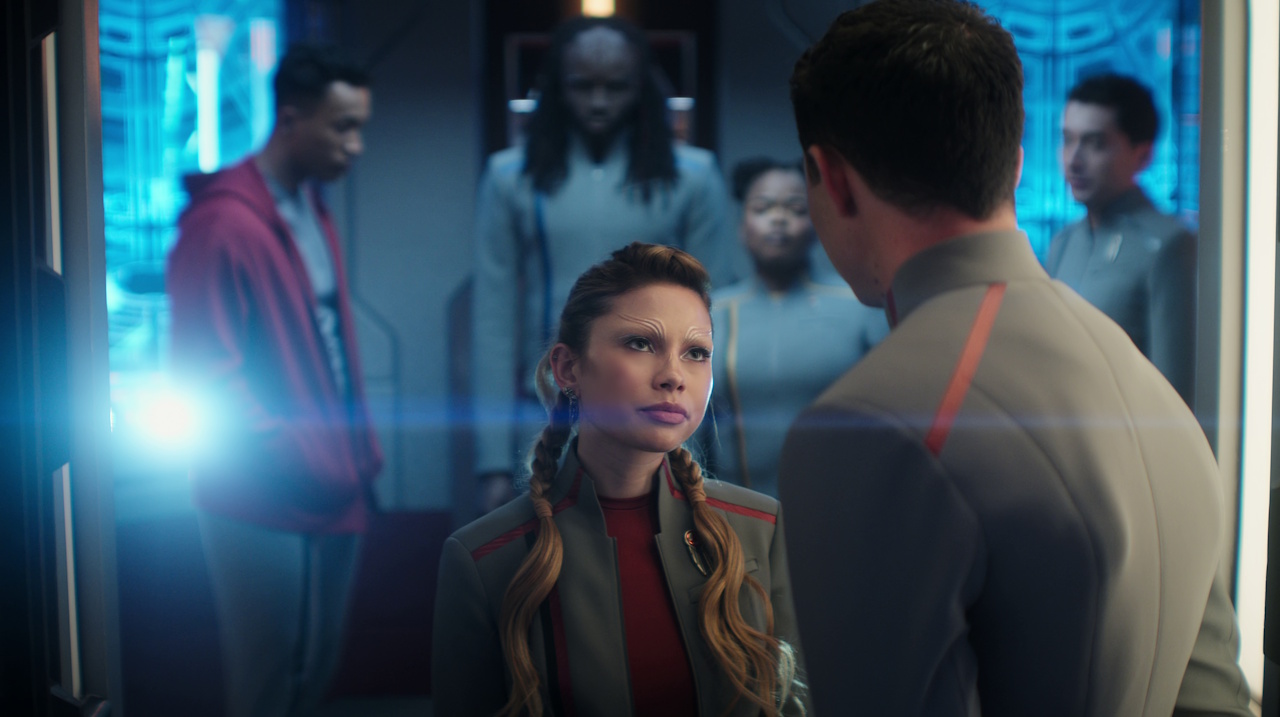
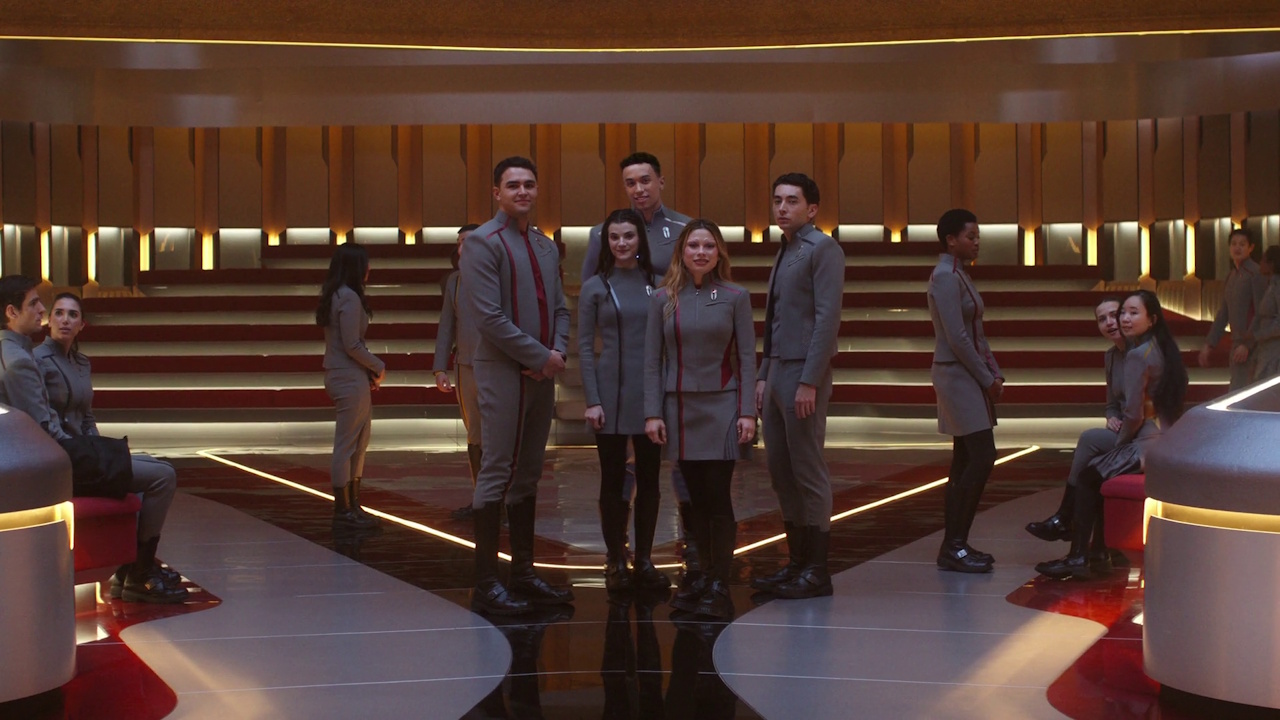
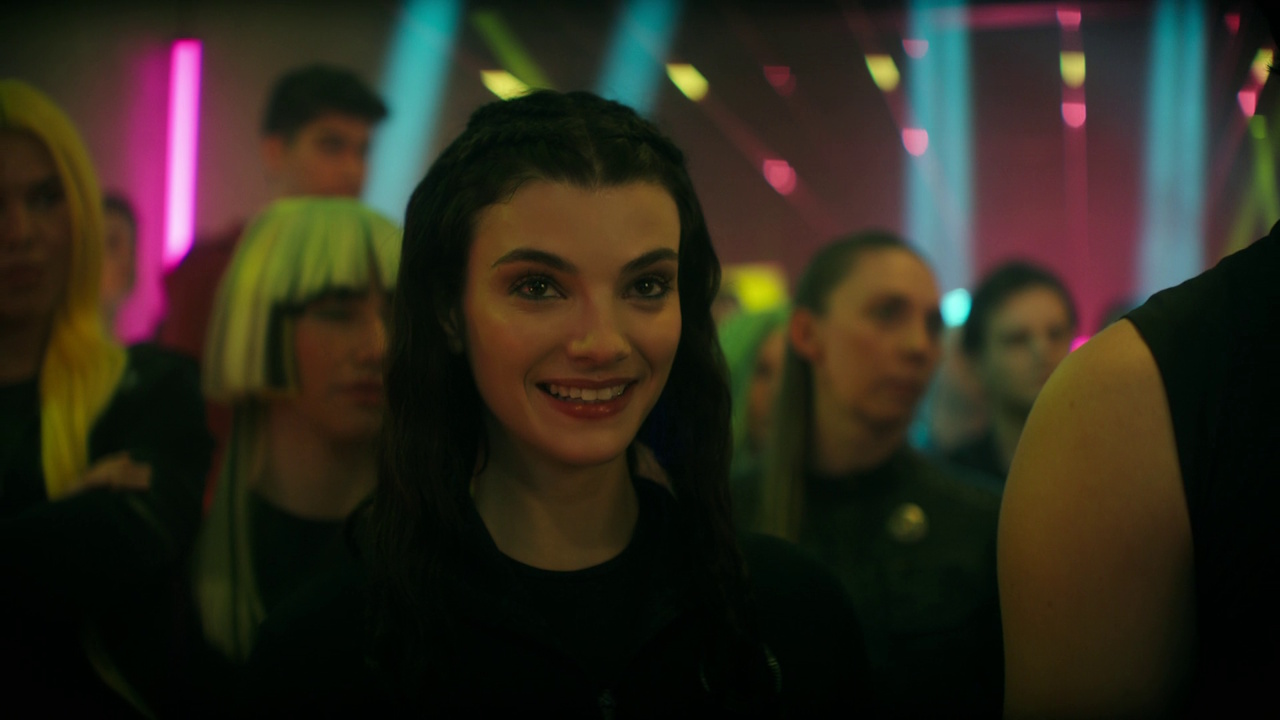
Still frame from Vox in Excelso showing the cadets
The main cadet characters.

Discovery brought the franchise back to its small-screen home almost nine years ago, and since then, we’ve had more than 200 episodes of Star Trek across six mainline shows, as well as short episodes, animated mini-episodes, and a TV movie. The timeline has been chopped up, with different stories taking place hundreds of years apart, featuring new and returning characters, and there’s been so much Star Trek coming at us so quickly that I found myself dealing with franchise fatigue and burnout back in 2023, even as someone who’s a huge Trekkie.

Furthermore, modern Star Trek’s content, with very few exceptions, has been action-packed to the extreme and with ridiculously high stakes. Starfleet Academy’s over-the-top villain and Federation-ending threat don’t exist in a vacuum – they’ve come along after the franchise has repeatedly returned to those same narrative spaces, whether it was with Vadic and the Borg in Picard, Control and Osyraa in Discovery, the Gorn in Strange New Worlds, the Mirror Universe from Section 31, or the Diviner in Prodigy. Lower Decks wasn’t immune, either, with its Pakled story arc, and we can extend this trend back further, with a trio of nefarious villains in the Kelvin trilogy, and even Enterprise’s Xindi arc shortly after the turn of the millennium.

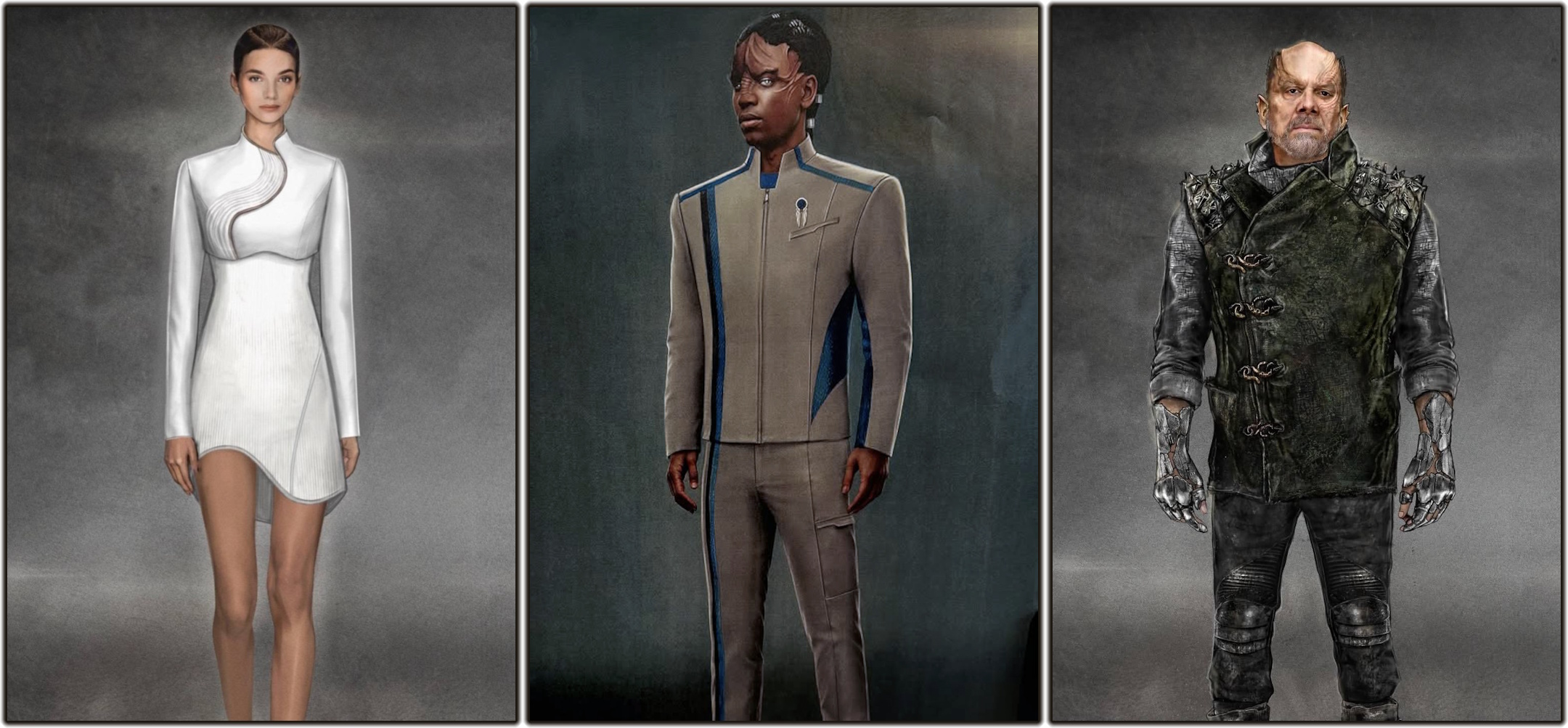
Concept art for Star Trek SFA showing three characters/costumes
Concept art of Tarima, Jay-Den, and Nus Braka.

In a word… there have been *a lot* of Star Trek stories in recent (and not-so-recent) years that all used the same basic underlying premise: there’s an over-the-top villain whose evil scheme threatens not just these characters, but everyone else in the Federation, or even the entire galaxy. The fact that I’m bored to tears of that kind of storyline is not, in isolation, Starfleet Academy’s fault. But it is a factor that the show has to contend with, and unfortunately, it’s one of the reasons why I came away from this new series feeling that very little about it was unique or memorable.

Let’s play a game called “who am I describing?” I’m going to describe a Star Trek villain from the past decade, and you have to guess who it is. Ready?

This villain clearly has a connection to at least one of the show’s protagonists. The performance is hammy and over-the-top, trying to channel iconic villains like Khan or the Borg Queen, but doing so less effectively. Their plan involves using a magical macguffin of impossible destructive power to attack Starfleet and the Federation. And the only ones who can stop them are a rag-tag group of misfits who become a “found family” over the course of the season.

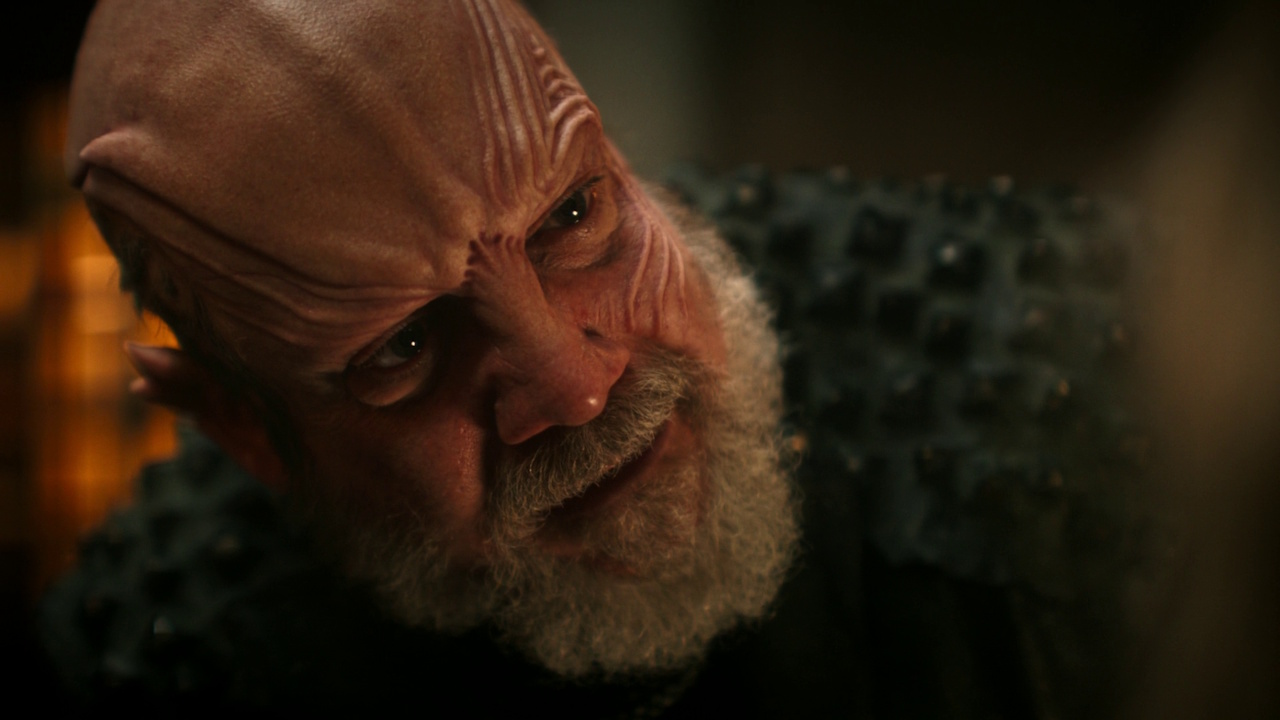
Still frame from Come, Let's Away showing Braka
Nus Braka.

See, that *could* be Starfleet Academy’s Nus Braka. Or it could be Vadic, Lorca, the Diviner, Mol and La’ak, the super-synths, Nick Locarno, San, the Red Angel… and more.

This, in a nutshell, is Starfleet Academy’s problem. We’ve seen this story before, and not just once. Repeatedly, since Star Trek returned in 2017, we’ve gotten season after season after season where we’ve seen another over-the-top villain who’s mysteriously connected to a main character, and whose evil scheme is galactic in scope. One or two stories like that can work. And Star Trek can do big, Federation-threatening storylines pretty well. But this core concept is utterly, thoroughly burned out, so trying to return to it *again* didn’t work for me.

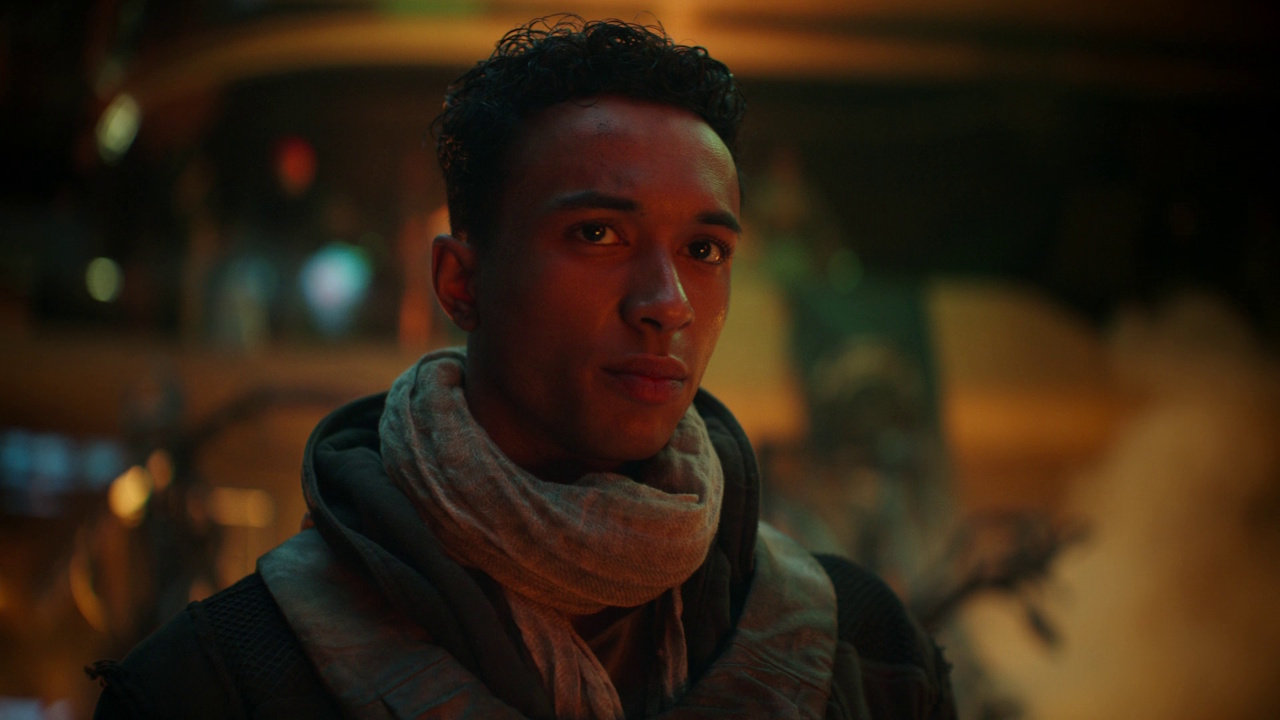
What’s more, Starfleet Academy didn’t even handle this story outline particularly well. I noted in my coverage of the premiere that giving the main villain a big defeat in his first-ever appearance seldom works well, and it set up the main cadets – Caleb in particular – as being too skilled and too perfect. It felt like we’d seen the end before it began; having seen how easily Nus Braka can be defeated, and how impossibly perfect Caleb is at everything from hacking and computers to hand-to-hand combat… it basically left neither character with anywhere to go as this storyline rumbled on across subsequent episodes.

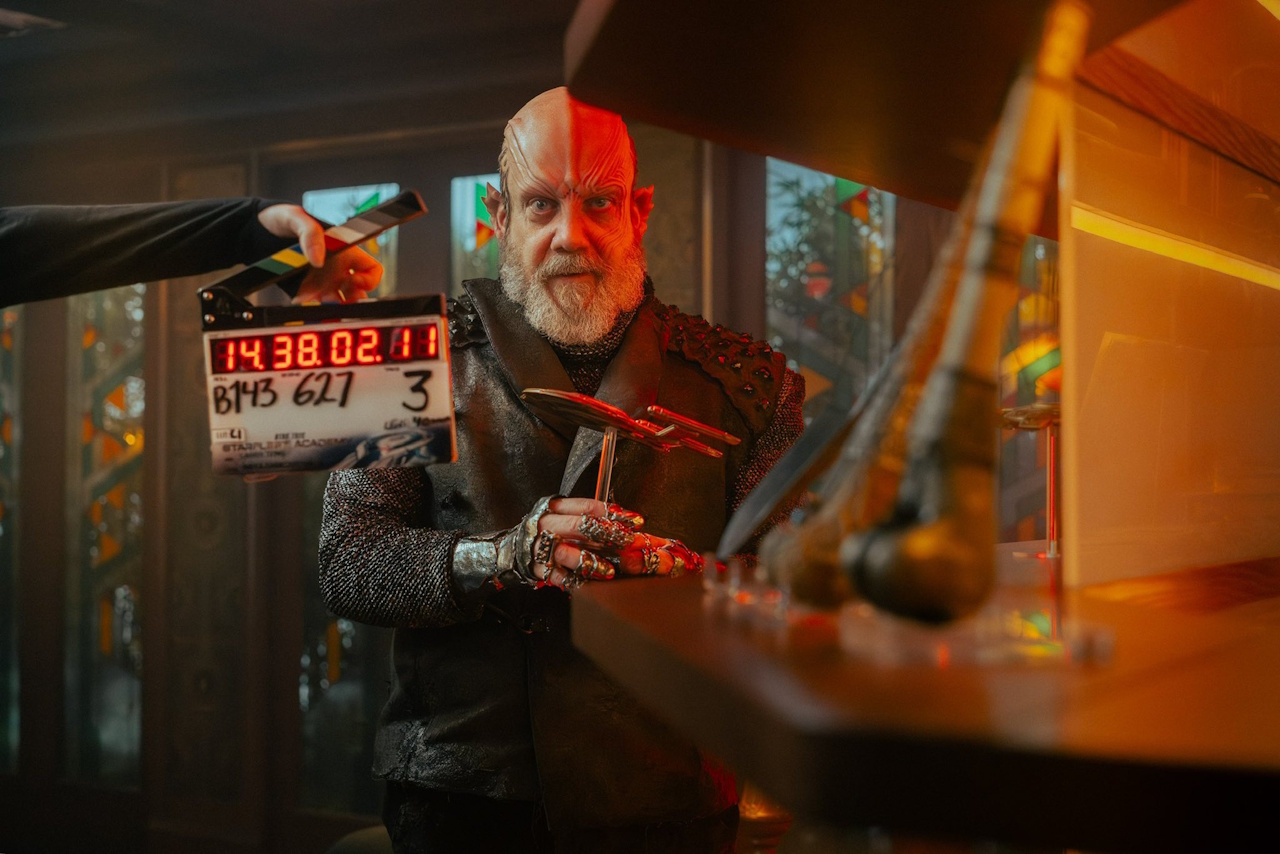
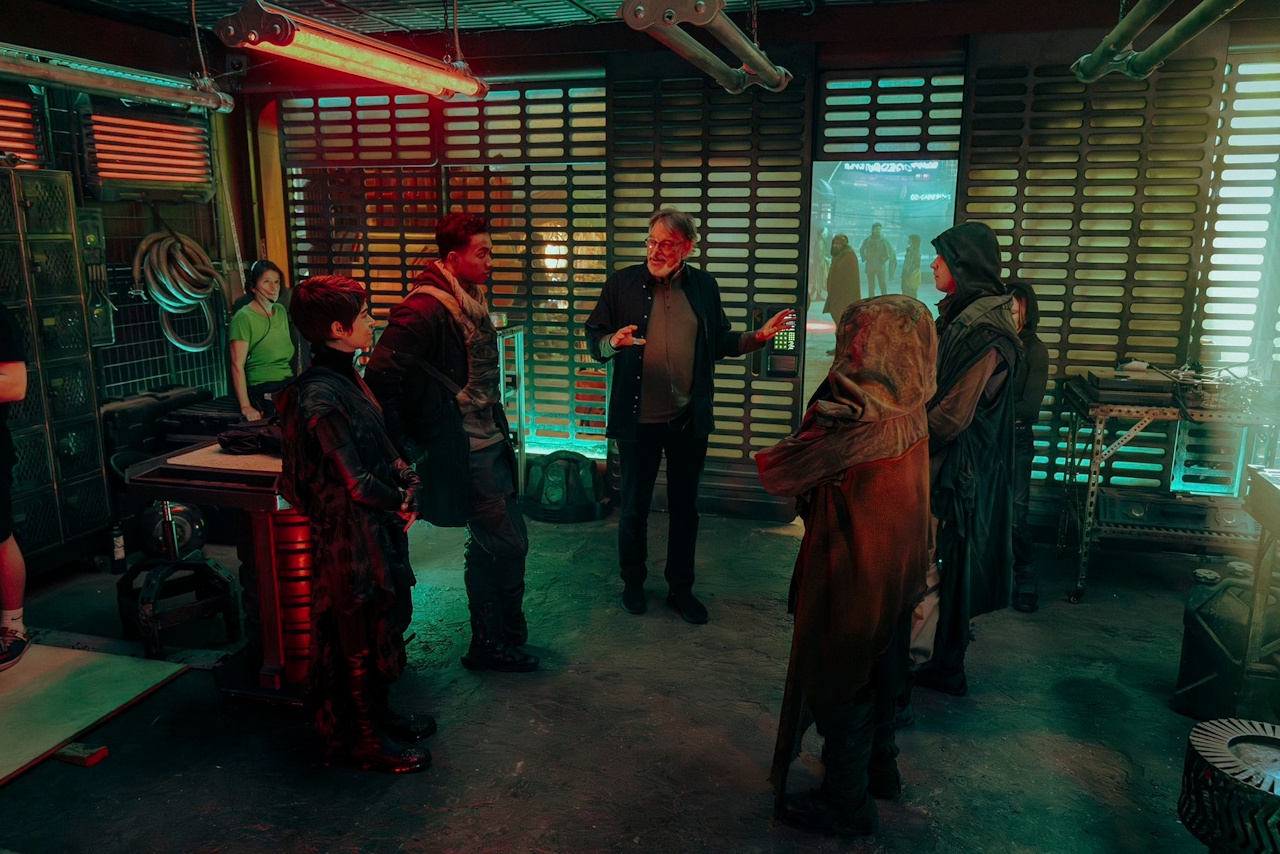
Behind-the-scenes photo from Star Trek SFA S1 showing Braka
Behind-the-scenes photo of Paul Giamatti on set.

More so than any other Star Trek show, Starfleet Academy needed to start with characters who had room to improve. What’s the point in someone like Caleb going to school when he already knows everything, and can do things better, faster, and more effectively than most of his teachers? It gave me “Wesley Crusher” vibes from almost the first moment, and it was tough to root for Caleb, sometimes, because of how impossibly perfect he seemed to be – at least in terms of his skills.

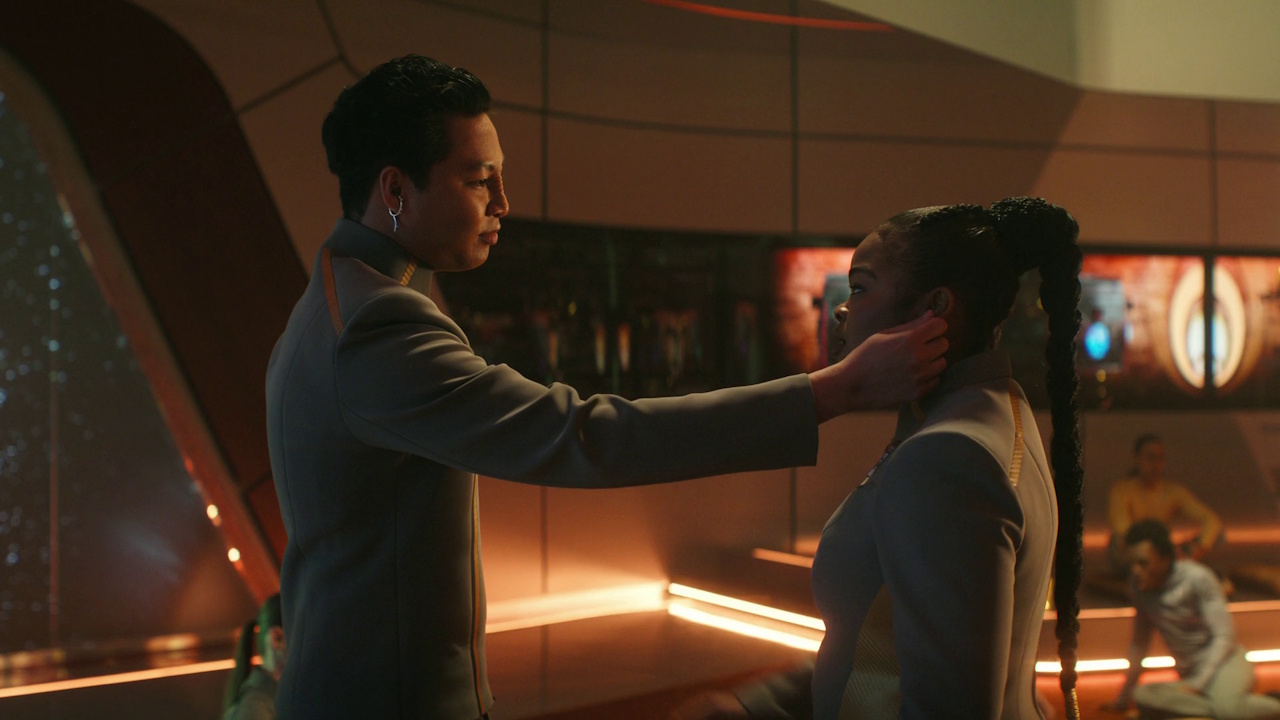
Where Caleb did find room to grow – at least for a while – was in terms of his relationships with his peers. I don’t think Caleb came *close* to nailing the “learning to play well with others” kind of arc that I believe was intended for him. But his relationships with Tarima, Darem, and Genesis in particular did evolve over the course of ten episodes, and largely in ways that felt natural and in keeping with this kind of teen/young adult series’ tone. There were some emotional moments in the mix, too, as Caleb clashed with – and later figured out how to befriend – his peers.

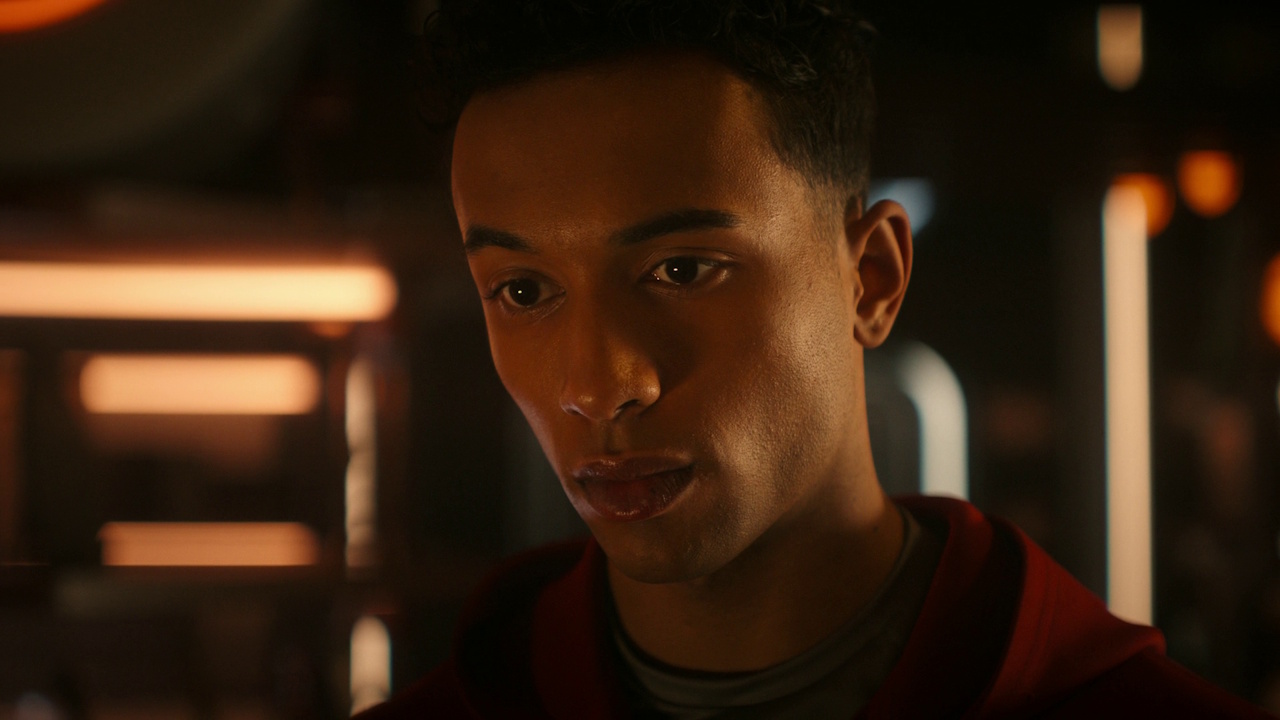
Still frame from 300th Night showing Caleb
Caleb.

I try to review Star Trek (and everything else I review here on the website) without having exposed myself to other viewpoints; that’s just part of my process, and I don’t want to feel like I’m being influenced by the conversation around a film or TV series – I want to judge it on its own merit as much as possible. But, as a Trekkie who follows some fansites and social media pages, I haven’t been able to shut out *everything* Starfleet Academy-related for the last nine weeks.

One thing that definitely caught me off-guard was the negative reception in some corners of the internet to Captain Nahla Ake. I’ve seen fans criticising things like her preference for going barefoot and the way she sits in a chair… things that, frankly, give her a bit of depth and personality, and which I found in no way offensive or off-putting. Imagine criticising the (in)famous “Riker manoeuvre,” where Riker would swing his leg over the back of a chair before sitting down. Or Picard’s tendency to tug at the bottom of his tunic to straighten up his uniform. Maybe some fans did, back in The Next Generation era, genuinely hate those things… but I certainly don’t remember any of that being an issue. And to me, some of the criticisms of Captain Ake feel rather petty.

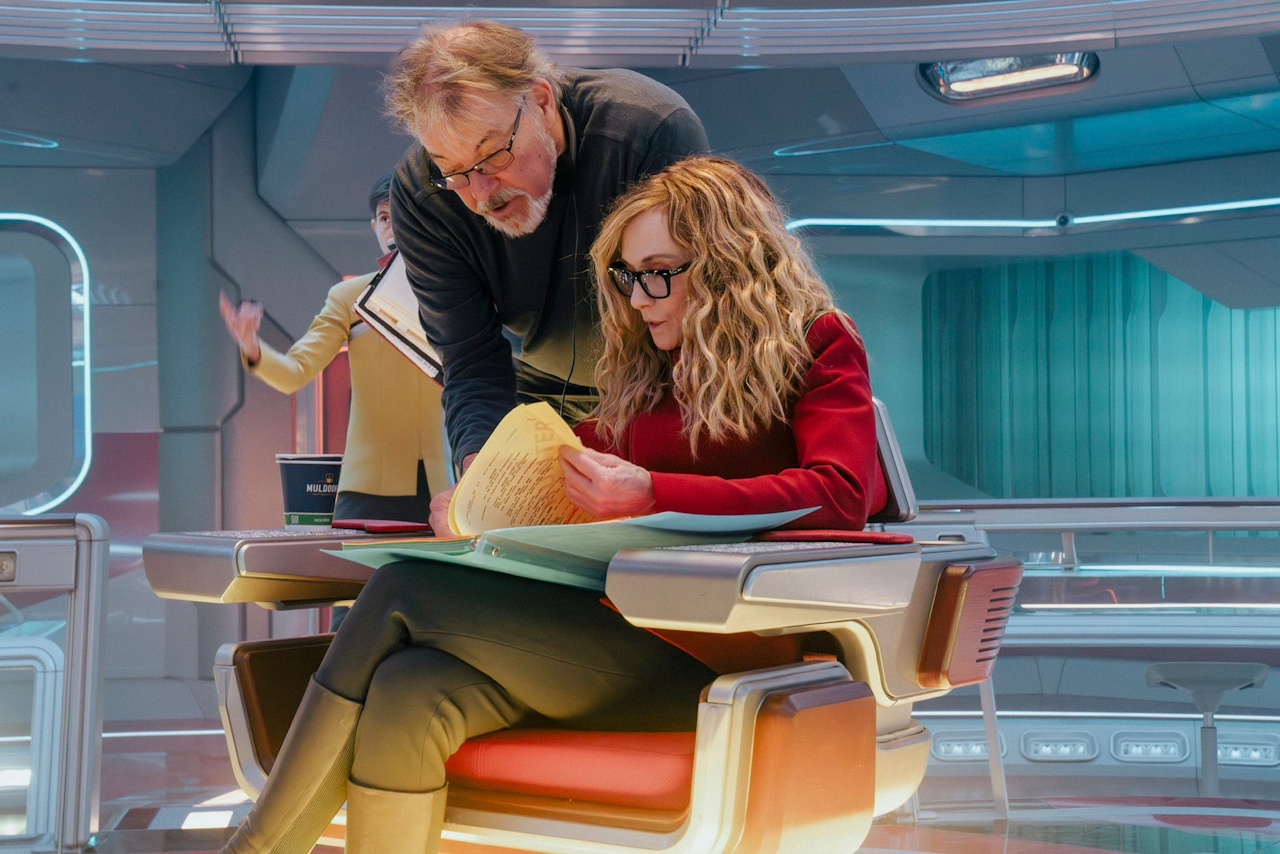
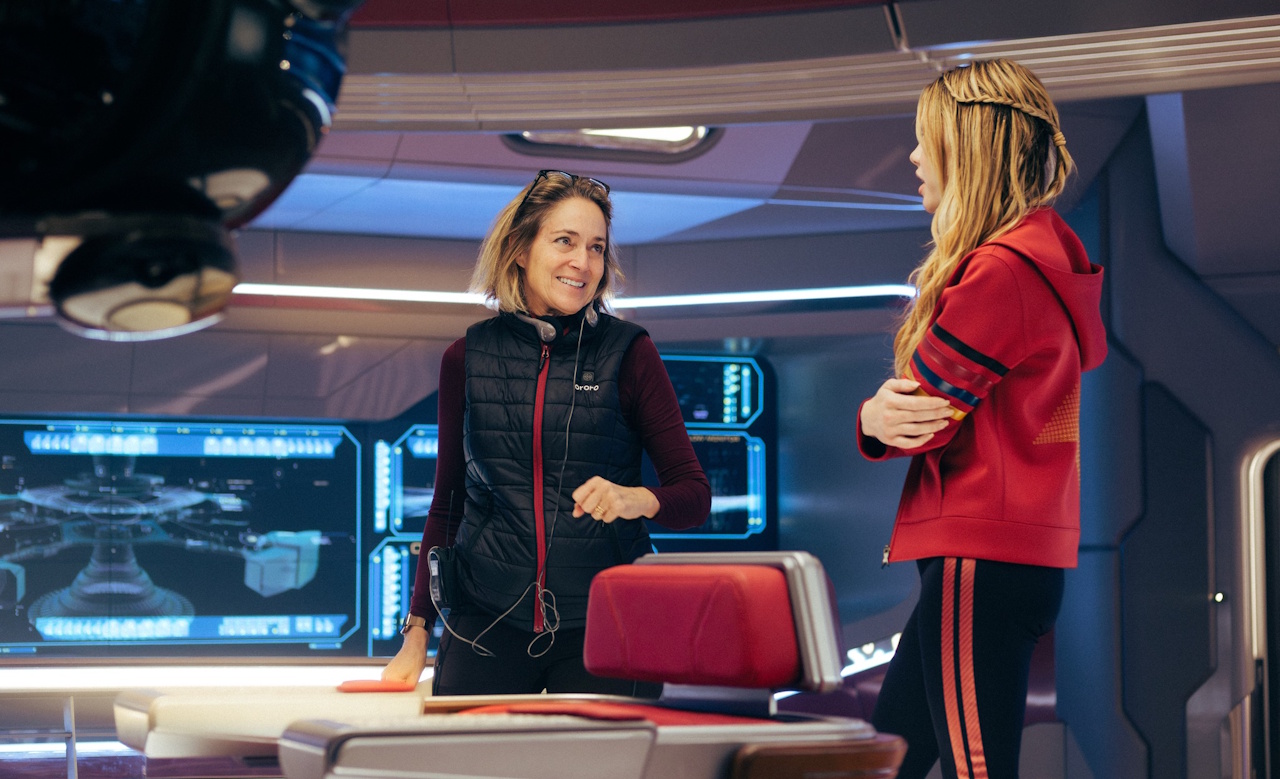
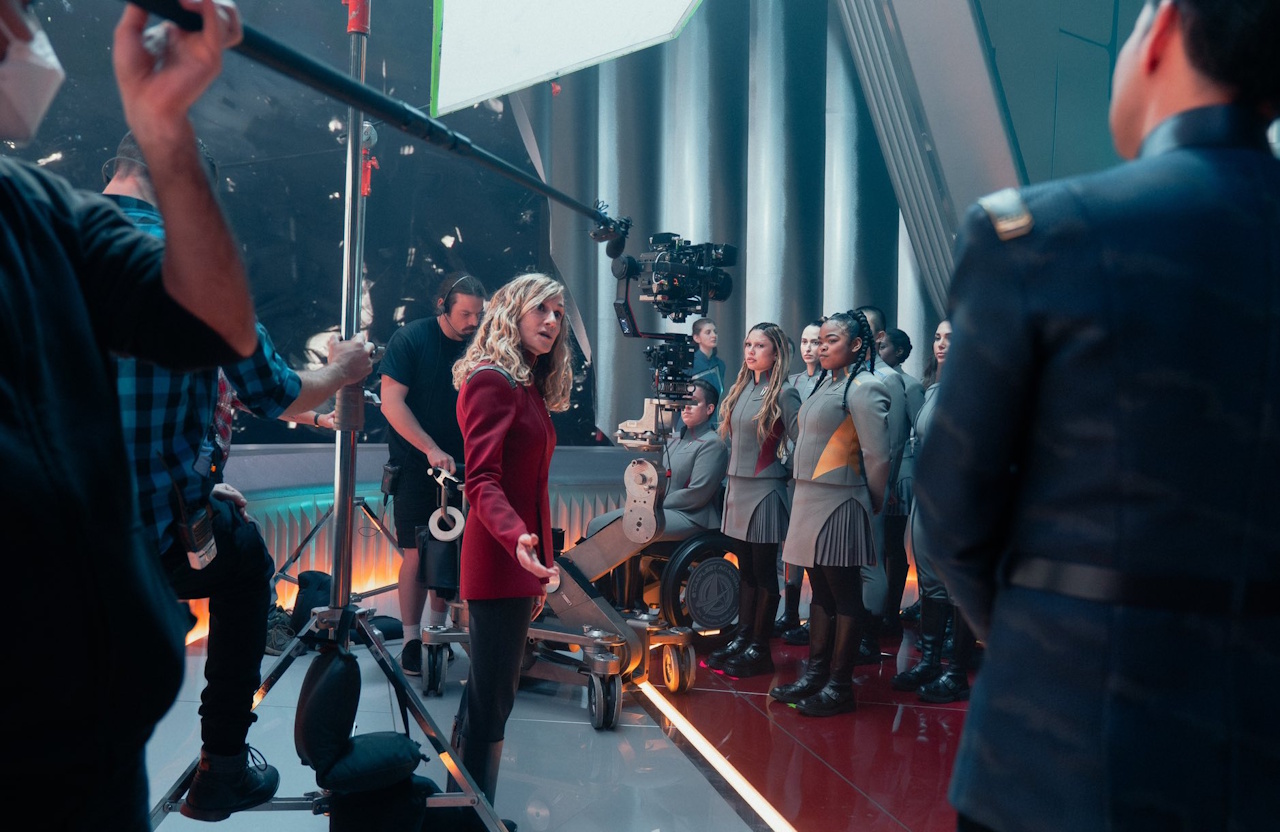
Behind-the-scenes photo from Star Trek SFA S1 showing Jonathan Frakes and Holly Hunter
Director Jonathan Frakes with Holly Hunter on the set of Starfleet Academy.

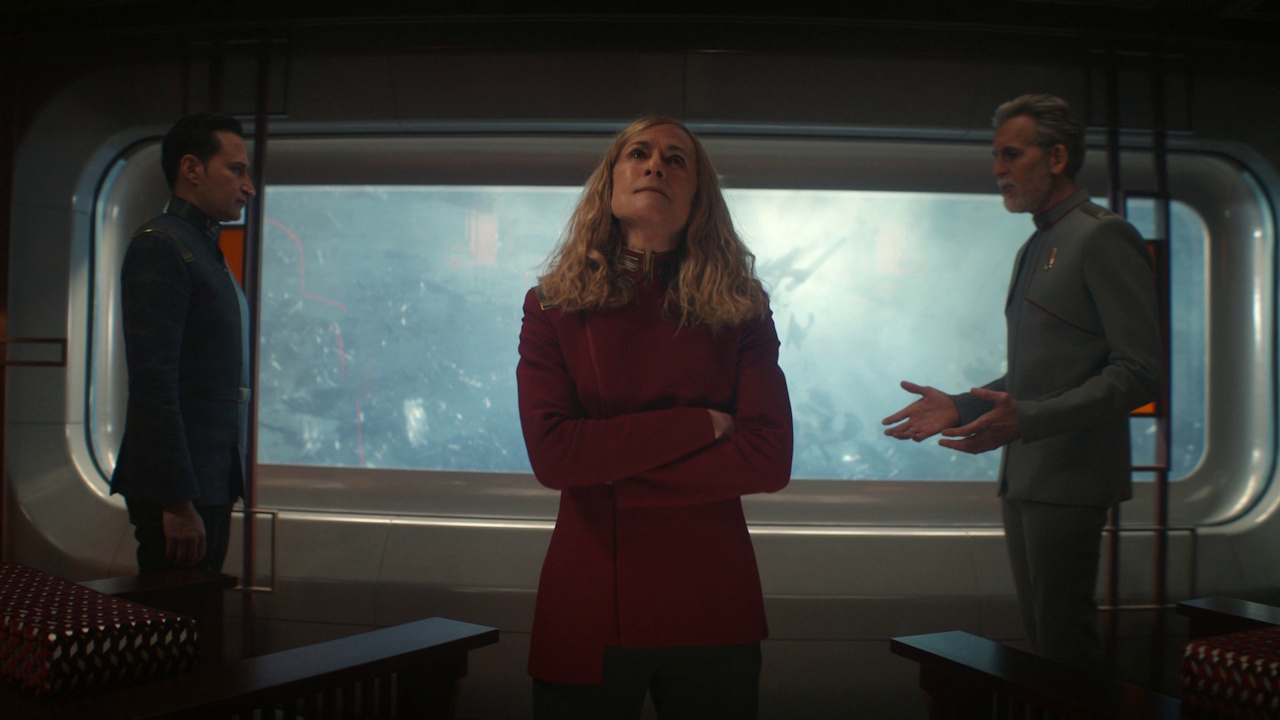
Captain Ake, for me, seemed to be channelling a bit of Strange New Worlds’ Pelia in the way she came across – and if you know me, you’ll know that Pelia is one of my favourite additions to that series! I like how Captain Ake takes a less-rigid approach, and it makes perfect sense for the role she has to play. She’s not a typical captain, who can afford to be concerned with strict discipline in front of trained officers. She’s a teacher, and most of her crew are cadets who are still learning what it means to serve in Starfleet. Of course she’s going to take a different approach; the best teachers find ways to get through to their students, and that can include taking a more casual or less-disciplinarian approach.

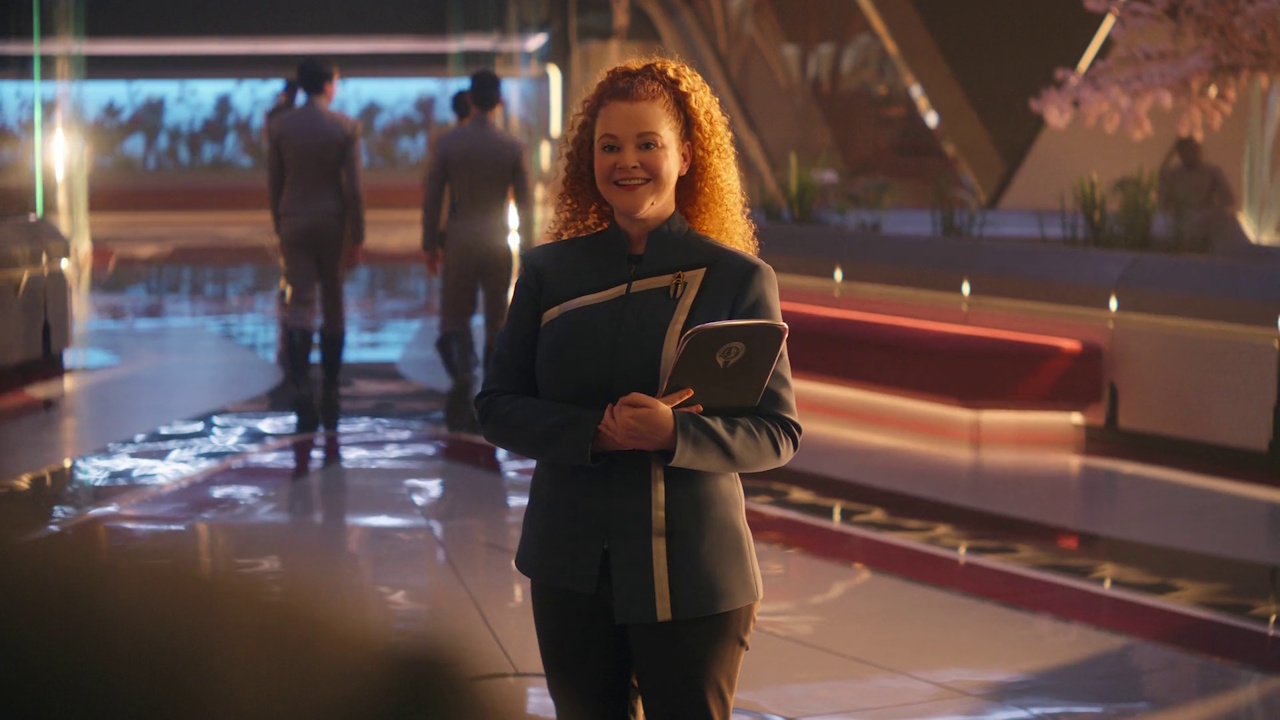
Captain Ake also brings centuries’ worth of experience to the table as a Lanthanite, and that earns her a great deal of respect from the kids. As someone who remembers what Starfleet was like in the years before the Burn – something we’ll talk about more in a moment – Captain Ake is uniquely-poisitioned, within the world of Starfleet Academy, to instil old-school Starfleet values into a new generation of cadets. Her approach may not be rigid and adhering to the letter of the rules, and she may not always keep to a strict uniform code… but she’s clearly a good captain, a respected teacher, and a great leader.

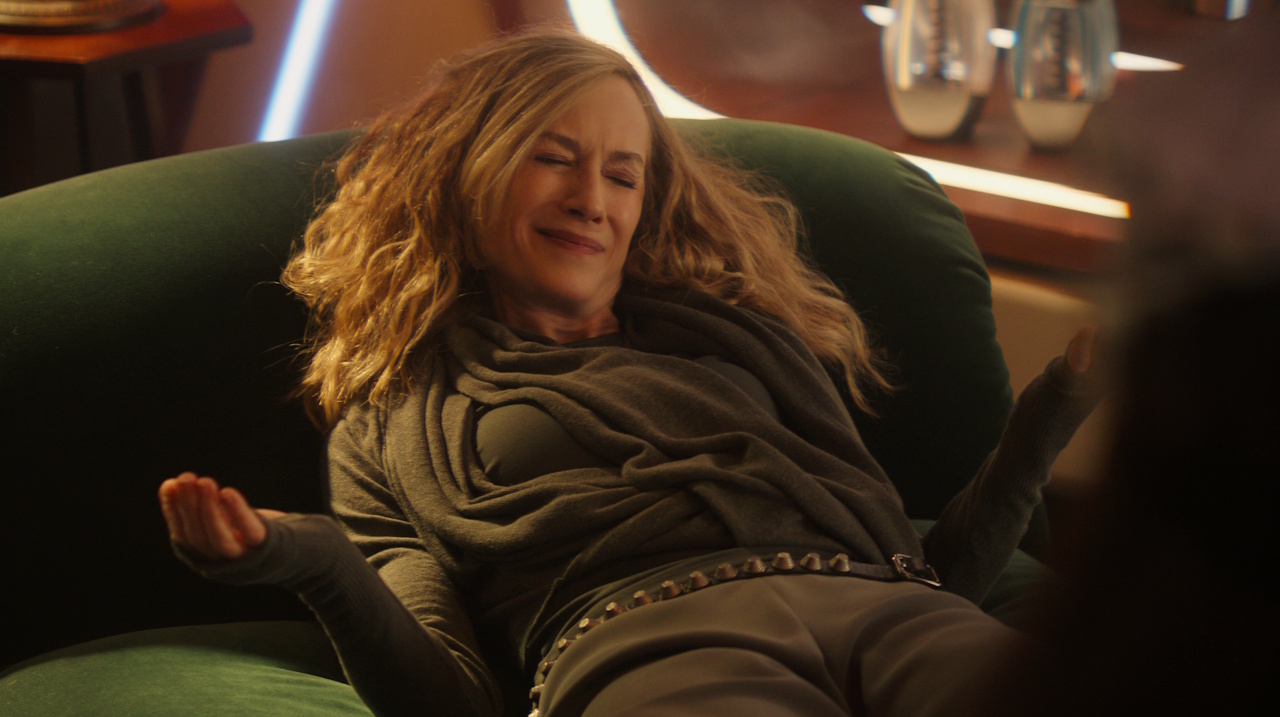
Still frame from Vitus Reflux showing Ake
Captain Ake has come in for criticism in some quarters.

I think some of the criticism of Captain Ake – and of Starfleet Academy in a more general sense – is coming from folks who would never have been interested in the series to begin with. There are some “anti-woke” folks crawling out of the woodwork to pick on Starfleet Academy, as well as people (like myself) who are way outside of the target demographic. And some of these criticisms of the way Captain Ake sits on a chair stem from that; they’re indicative of a portion of the fanbase who couldn’t go into the show with an open mind and who want to pick on anything they can find to criticise.

Starfleet Academy isn’t going to be right for every viewer, or even every Trekkie. And if the show’s low streaming numbers hold… well, it doesn’t look like it’s having as much success as I’d have hoped when it comes to connecting with new viewers. But that isn’t because it’s “woke,” or because Captain Ake puts her feet on the seat. There can be many factors behind a series failing to connect with audiences, and I’d posit that franchise fatigue and repetitiveness are bigger deals in this case than any individual performance or storyline.

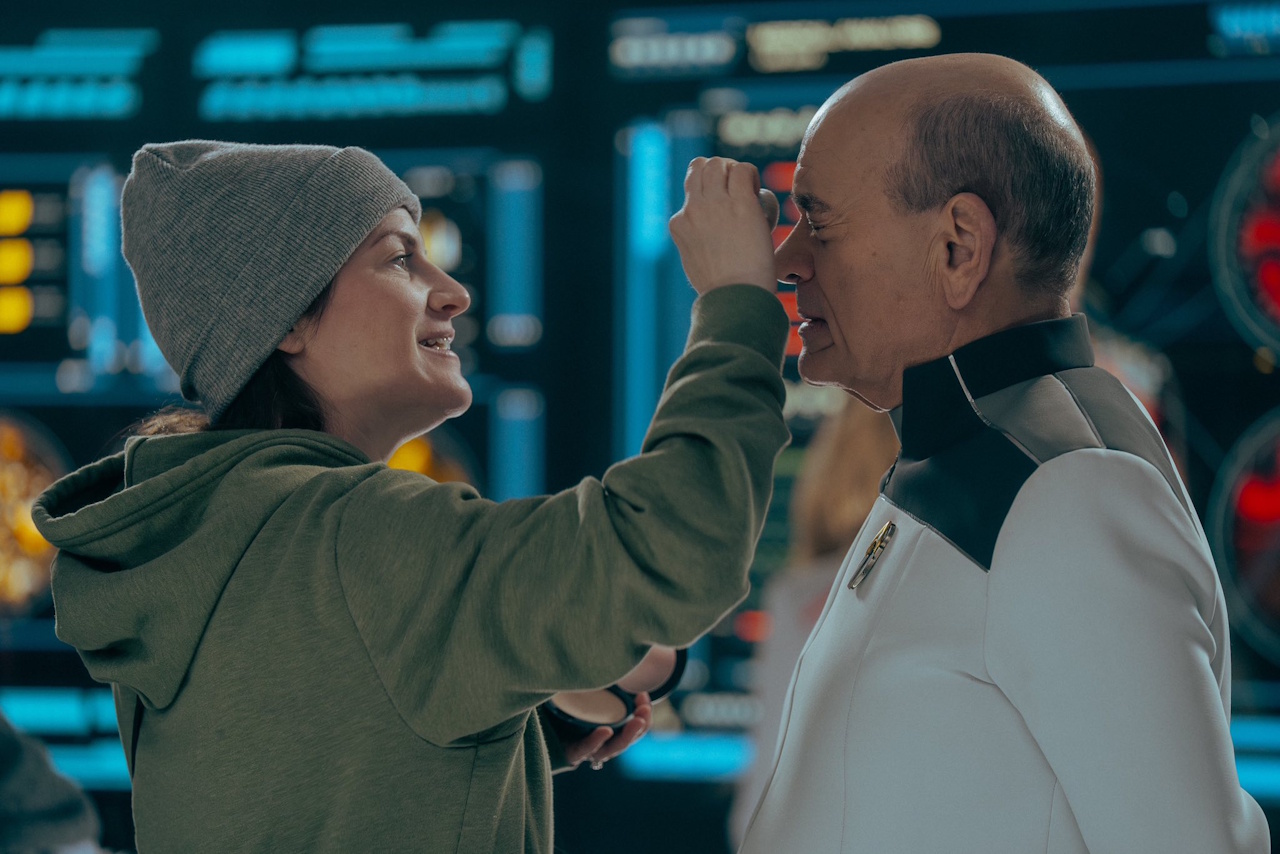
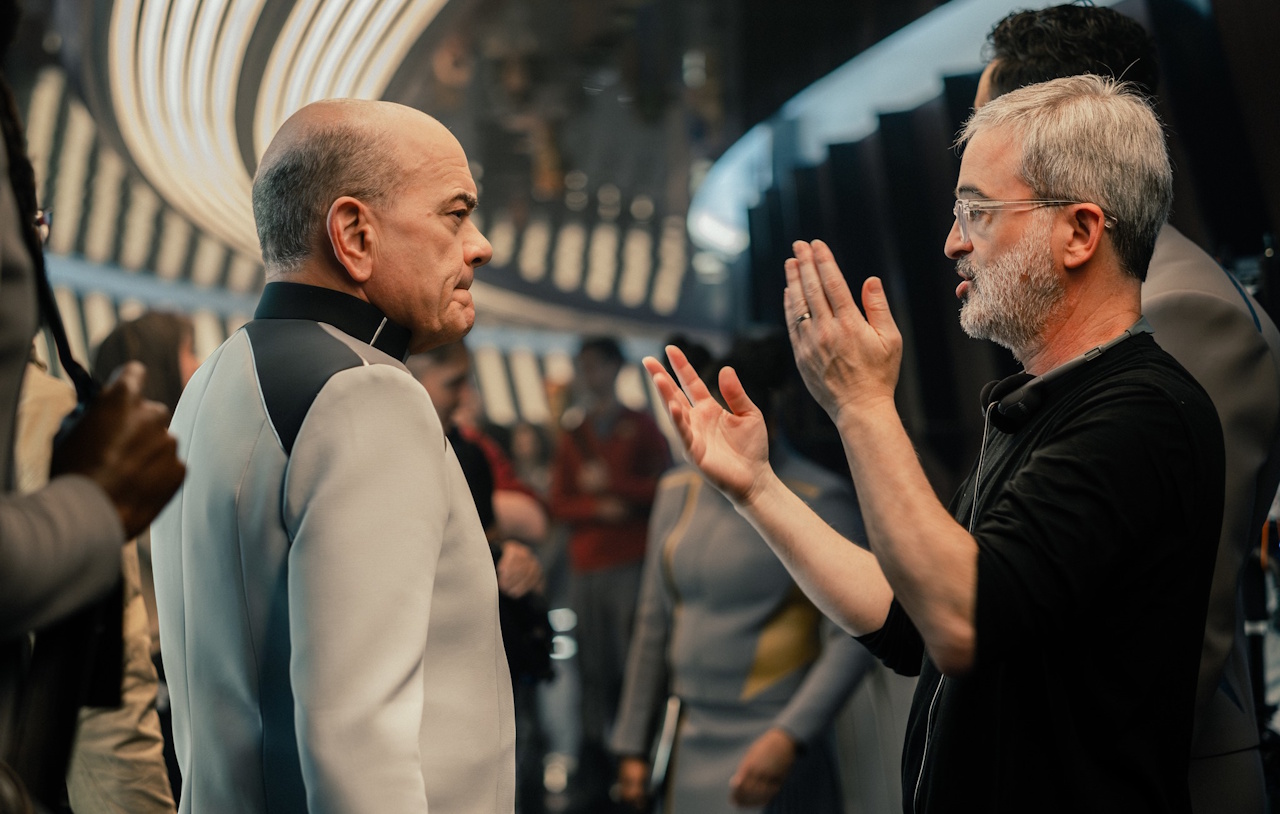
Behind-the-scenes photo from Star Trek SFA S1 showing Kurtzman and Picardo
Robert Picardo with director/showrunner Alex Kurtzman during production on the season premiere.

That being said, I saw nothing across Season 1 that, to be blunt about it, changed my mind on Starfleet Academy’s future prospects. With the series seeming not to make a huge splash for Skydance/Paramount on streaming, and given that the corporation has already cancelled every other Star Trek series that had been in production at the time of the merger, I very seriously doubt whether a third season renewal will happen.

The show doesn’t have any huge strong suits in its corner, really, and it feels like it’s in the same kind of position as Enterprise was some twenty-plus years ago – it just may not have been Starfleet Academy’s moment, coming after so much Star Trek has been on our screens over the past few years. If the show doesn’t get renewed, and hasn’t done enough to demonstrate to Paramount’s new owners that it’s a solid investment… I don’t think we can lay the blame for that exclusively on Starfleet Academy itself and its production team. As I said above, the series feels like it drew the short straw, in a sense.

Still frame from The Life of the Stars showing cadets
Several of the main characters.

I criticised Discovery, from Season 3 onwards, for not making more of the Burn – the giant apocalyptic event that *should* underpin everything about this 32nd Century setting. Discovery’s writers wanted to make a drama series; it felt like the Burn very quickly disappeared into the background, serving as little more than the backdrop for other, generally less-interesting stories to play out in front of.

Starfleet Academy did more with the Burn that Discovery had done, and for that I’m grateful. But I still feel like this brand-new setting, this brand-new narrative idea for Star Trek, something huge and transformative for literally *the entire franchise* just… isn’t being used very well. Or very often.

There were *references* to the Burn and the state of the galaxy in dialogue. And some storylines and settings reflected this event and its lingering aftermath more than others. But the main characters, with the partial exception of Caleb, could’ve really been from any pre-Burn era, and even when references were made to the Burn and its post-apocalyptic after-effects… it just didn’t stick the landing much of the time.

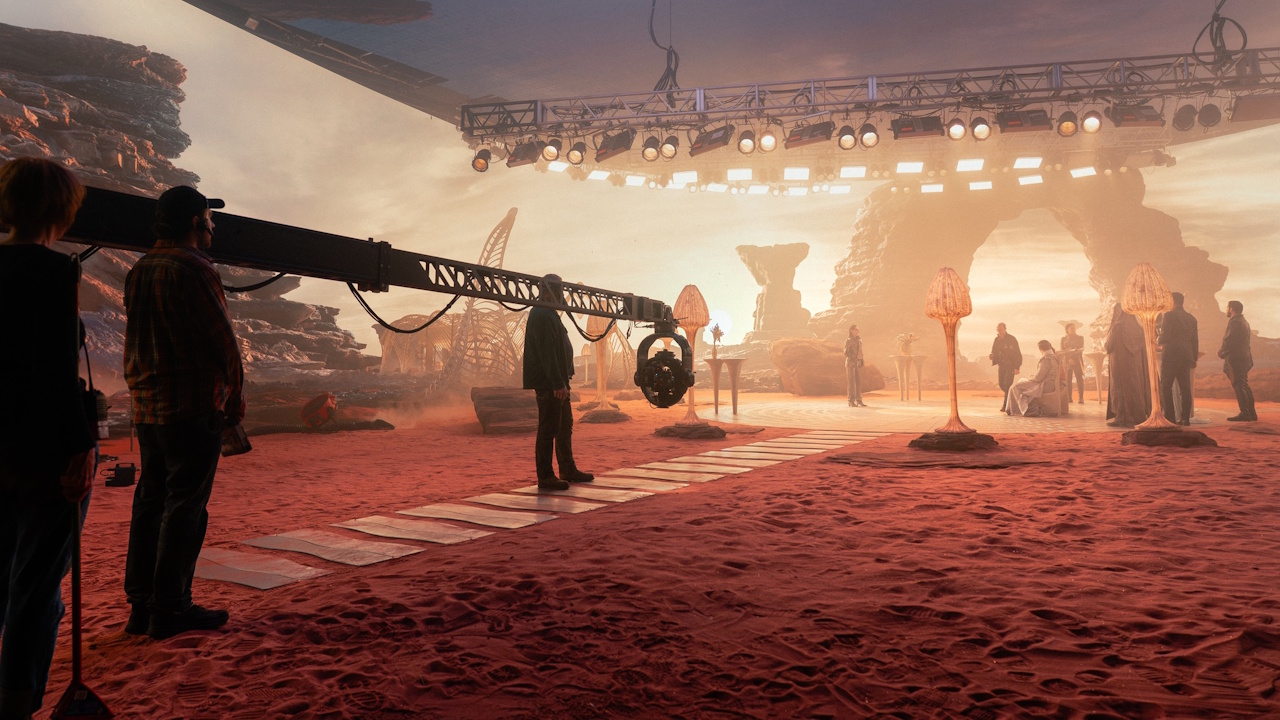
Behind-the-scenes photo from Star Trek SFA S1 showing a camera and the AR wall
Filming Darem’s homeworld.

Let’s take episode seven, Ko’Zeine, as an example. The cadets get a break from their classes and head to different places. Jay-Den and Darem get the A-story, visiting Darem’s homeworld for what felt like a bit of an Amok Time homage. And Genesis and Caleb got the B-plot, getting into hijinks back at the deserted campus. Literally *nothing* about either storyline would have changed if this episode had been set before the Burn. Despite getting an opportunity to do so, with the introduction of a brand-new alien race in the Khionians, there was absolutely no mention of the Burn at all. Did Khionia just… not notice?

Star Trek has always used its sci-fi lens to take a look at real-world issues. And as a series focusing on younger folks that’s being broadcast in the mid-2020s, there was scope to take the Burn as a starting point and view it as an analogy for the disrupted post-pandemic world that kids today are growing up in. To use the Burn as a metaphor to examine what it might mean for young people whose education and formative years were massively disrupted in unprecedented ways. I didn’t want or expect that to be a constant presence, hammered home in *every* story. But I did expect it to be present more often than it was.

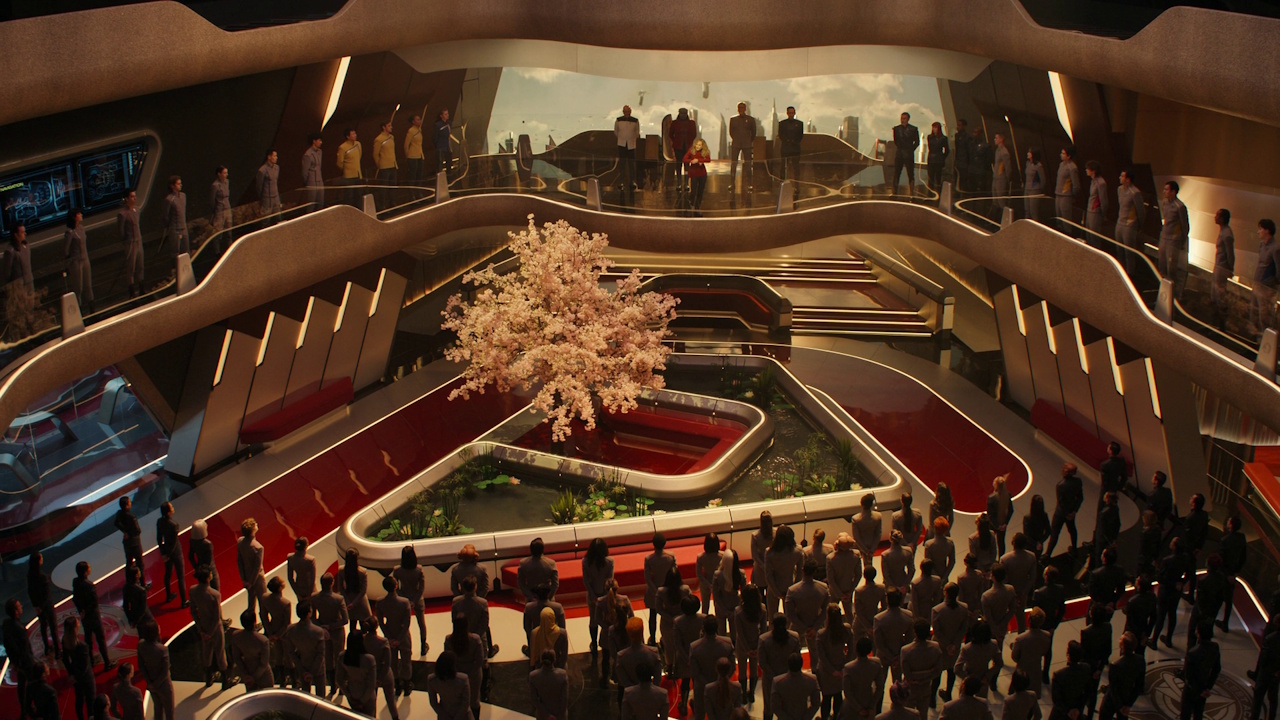
Still frame from Star Trek: Starfleet Academy Season 1 showing the Chancellor giving a speech to the cadets.
The re-opening of the Academy.

I’ve said this before, and I daresay I’ll repeat myself again before too long, but I don’t like what the Burn says about the future of the Star Trek galaxy, and how it challenges and alters how we interpret stories set in the 23rd and 24th Centuries. But, if Discovery and now Starfleet Academy had been able to find stories to tell in that setting, really leaning into what it means to live and grow up in a “post-apocalyptic” galaxy… maybe it would have at least felt justified. But after three seasons of Discovery and one of Starfleet Academy… we’re still stuck with stories and characters which, at best, pay lip service to the Burn and its decades-long aftermath without really exploring what any of it means.

And the result? Unfortunately, I’m still of the opinion that, somehow, we should find a way to push this “post-apocalyptic” far future out of the prime timeline.

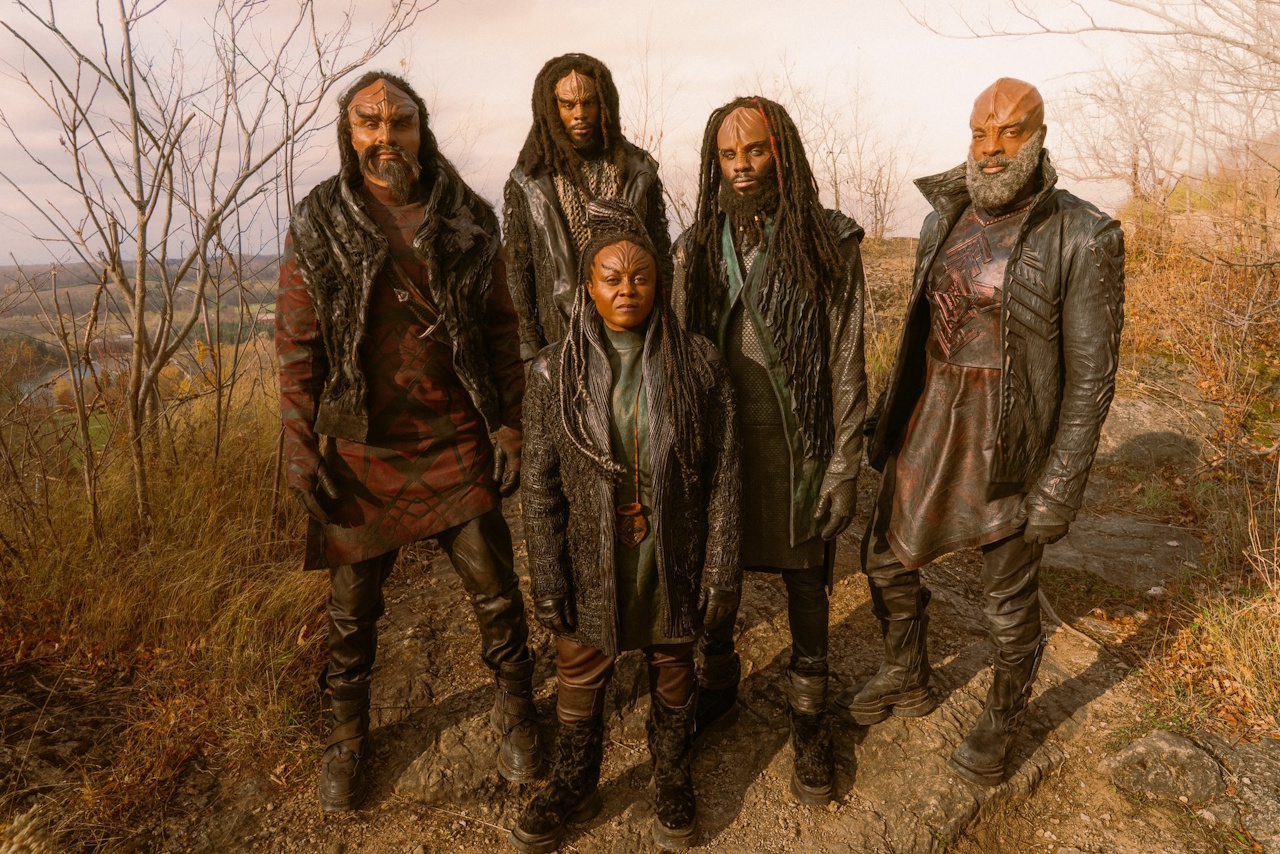
That being said, there was *more* of an effort to explore the state of the galaxy after the Burn in Starfleet Academy than there was in Discovery. I appreciated getting a look at the Klingons in this era – though I’m still curious to learn what the Klingon survivors would make of the knowledge that the Burn was caused by the Federation! And seeing Betazed’s accession back to the Federation, and the changes the organisation was willing to make to accomodate the Betazoids, made for a fun and engaging story, too.

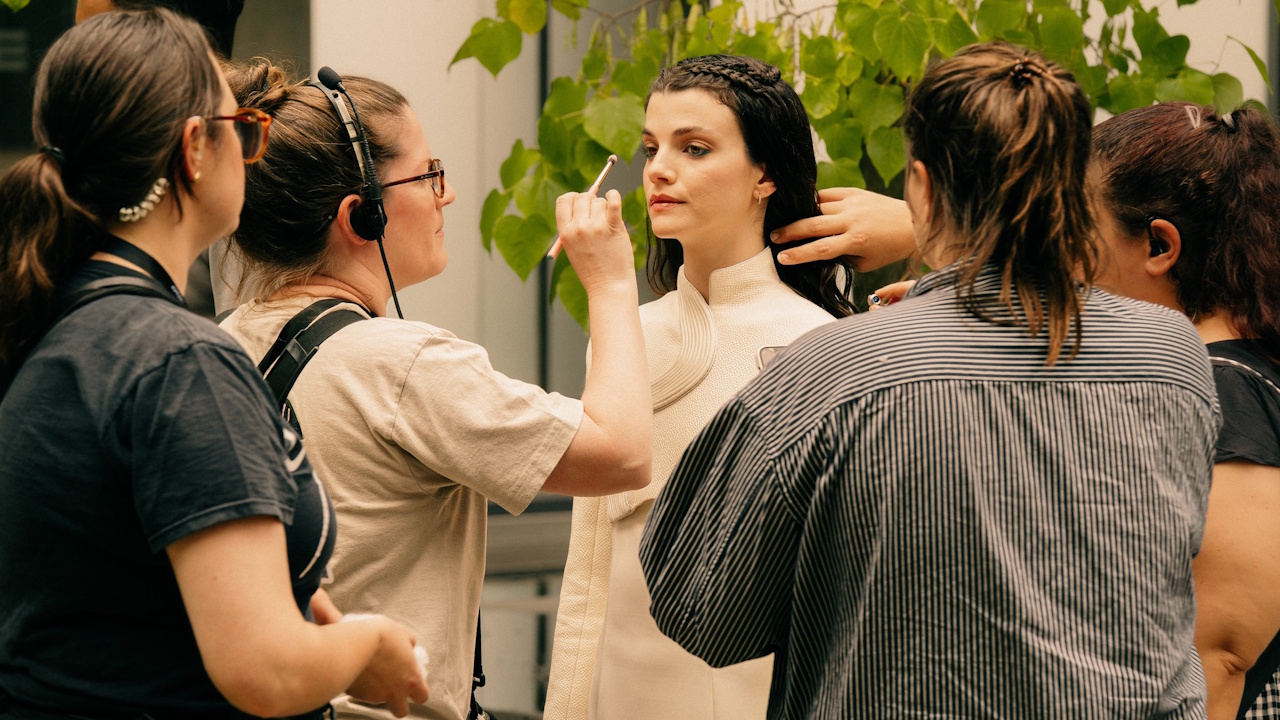
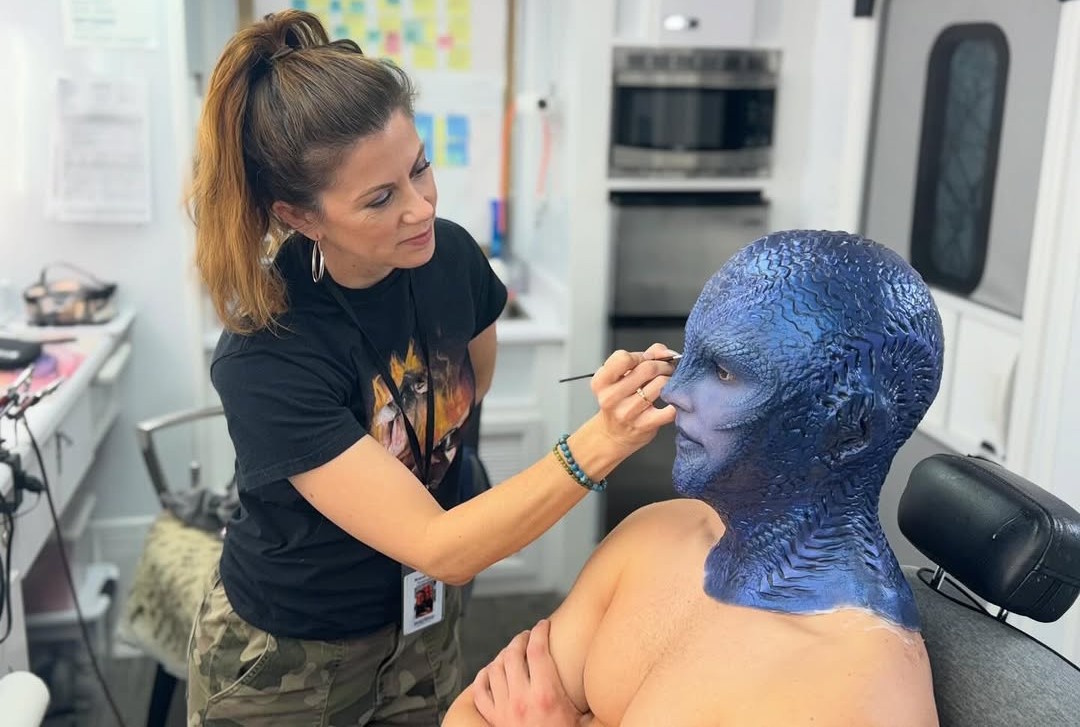
Behind-the-scenes photo from Star Trek SFA S1 showing Zoe Steiner as Tarima
Zoë Steiner (Tarima) getting her makeup touched up on set.

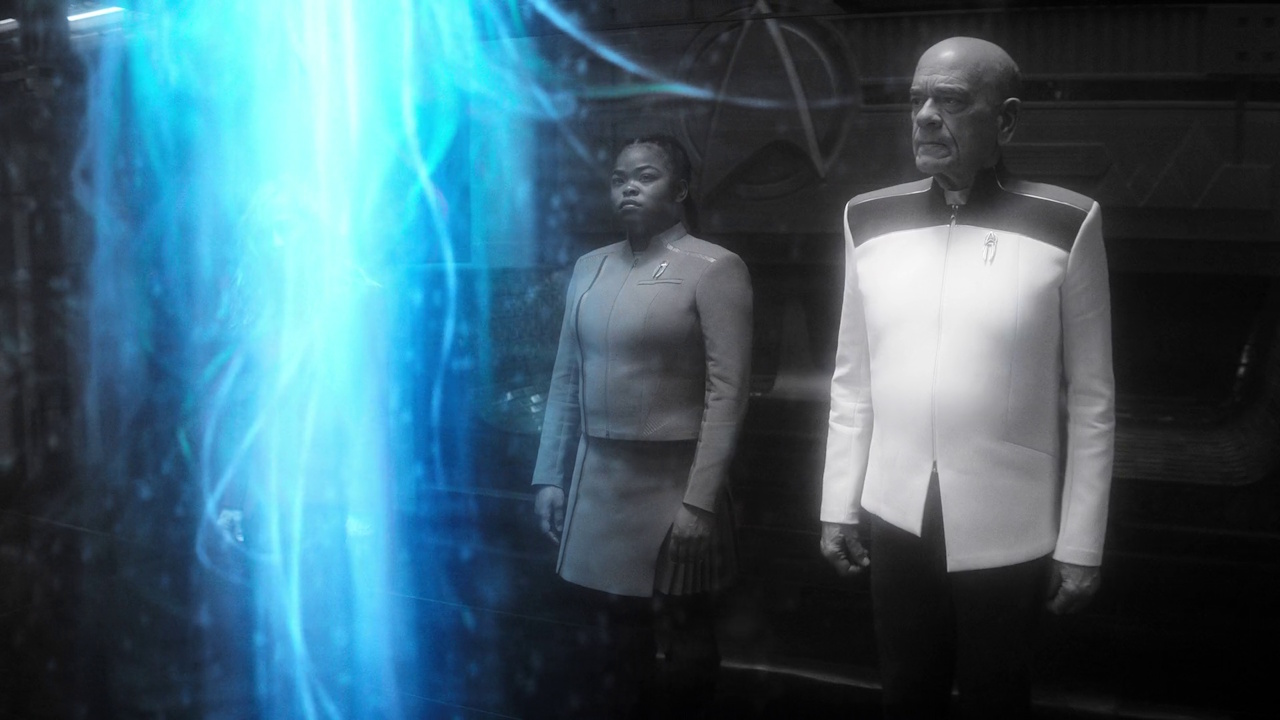
Sam was an interesting character, and I particularly enjoyed Kerrice Brooks’ enthusiastic, wide-eyed performance. She really captured Sam’s nature as a “newborn;” someone experiencing the world for the very first time. But unfortunately, Sam also got two of my least-favourite storylines in the entire season – and two stories that felt pretty repetitive, too, if you think about it.

Let’s play another game: this one’s called “which episode am I describing?” This episode, from Season 1 of Starfleet Academy, sees the character of Sam making a connection with a major character from The Next Generation era. She comes to see this character as a major influence, or even a father figure of sorts, and the writers go out of their way to draw parallels between Sam and this legacy character. The legacy character gets an epilogue to their story from The Next Generation era, which – many fans will argue – detracts from their original story or even actively harms their characterisation.

So… was I talking about Series Acclimation Mil or The Life of the Stars?

Still frame from The Life of the Stars showing Sam and the Doctor
Sam with the Doctor.

I said a lot of what I wanted to say about Starfleet Academy’s treatment of Sisko in my standalone piece – click or tap here to read that. But to very briefly recap: despite being a well-intentioned effort to celebrate the legacy of Star Trek’s first African American captain, the episode ultimately was an awful ending for Sisko and his legacy, turning him into the very “absent black father” trope that Avery Brooks had argued against more than a quarter of a century earlier. Starfleet Academy asked a question that didn’t need to be asked about Sisko’s survival (because it was already perfectly well-explained in Deep Space Nine), and then set about answering that question in just about the worst conceivable way.

And then, a couple of episodes later, we get a remarkably similar story involving Sam and the Doctor.

I don’t want to linger for too long on legacy characters in this review, and if you join me for my episode breakdown in the days ahead, I might delve into the Doctor a bit more when we discuss The Life of the Stars. But again, this was a story that felt… well, tacked-on, in one sense, but also became one that painted the Doctor in a really negative light.

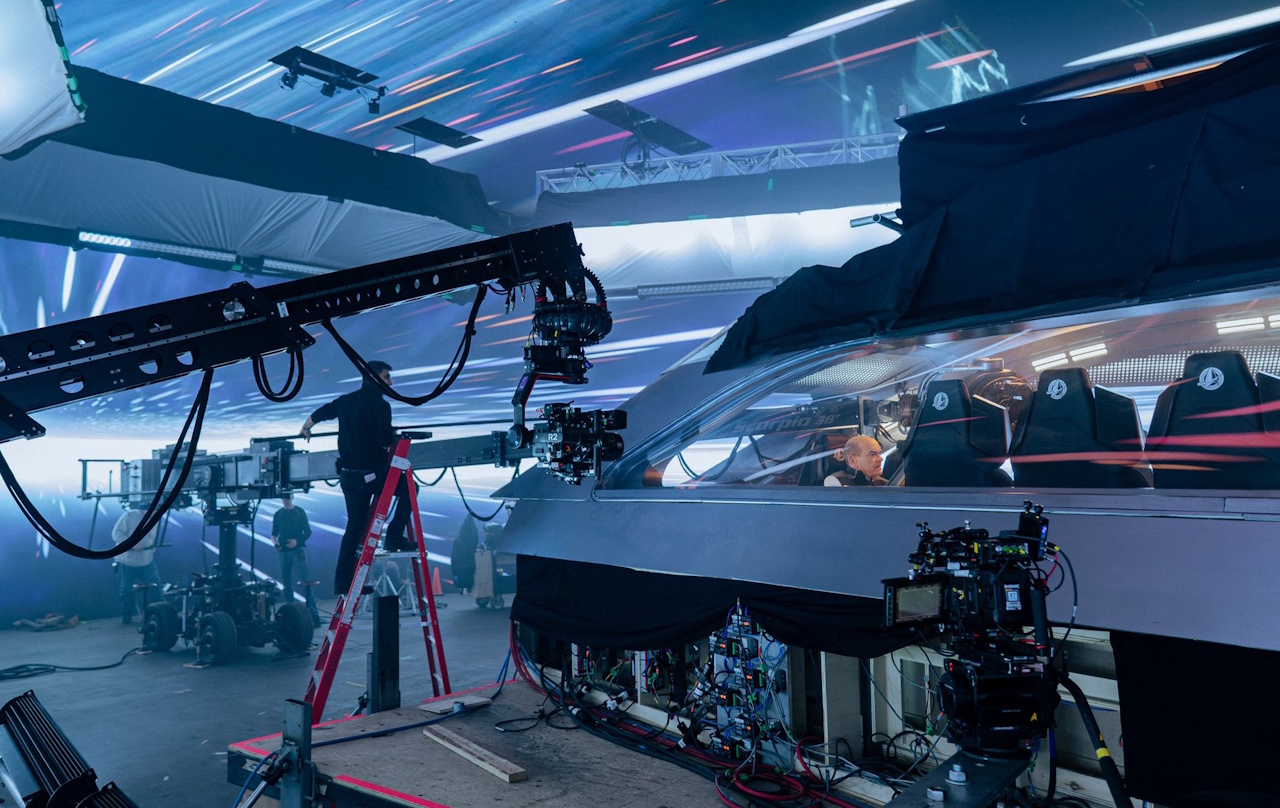
Behind-the-scenes photo from Star Trek SFA S1 showing the shuttle set
Filming The Life of the Stars.

The Doctor, it turns out, was not terribly moved by outliving his friends aboard the USS Voyager, nor the cadets of the USS Protostar. He didn’t miss Janeway, Tuvok, or Neelix. But he *had* spent almost a millennium pining for the holographic family he created in the Voyager third season episode Real Life. Not only were these holograms *non-sentient* as defined by the show, but it also paints B’Elanna as a major villain, since she was the one who edited the Doctor’s family holoprogramme, “killing” his holographic daughter.

As above with the Sisko storyline, I think there were good intentions and at least parts of an interesting idea at the story’s core. But the way it came across, with the Doctor not even acknowledging his friends – the people he spent years of his life with and who first helped him explore what it means to be a sentient life-form… it left a bad taste in the mouth. If the plan was always for Sam to view the Doctor as a father figure, why not simply start from that point? Or else find a different route to get there.

I’ll shelve this for now, but stay tuned, because there’s more to say about this element of The Life of the Stars.

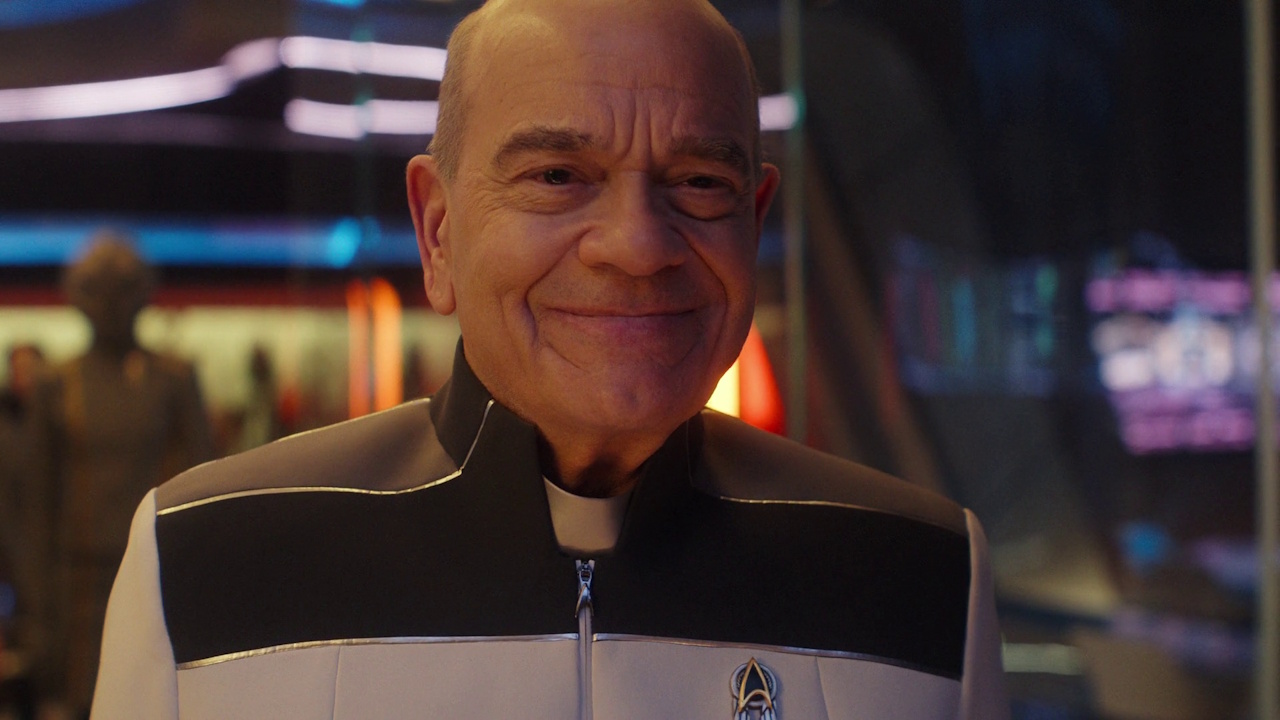
Still frame from The Life of the Stars showing the Doctor
The Doctor at the end of The Life of the Stars.

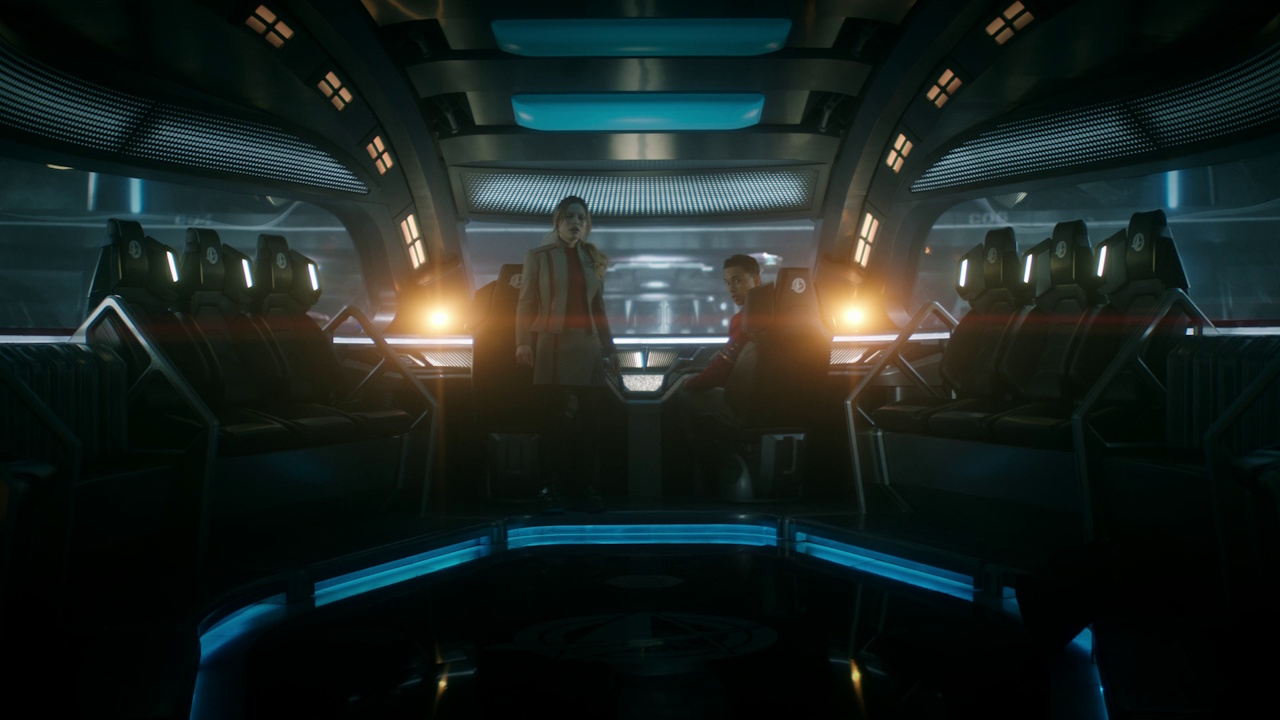
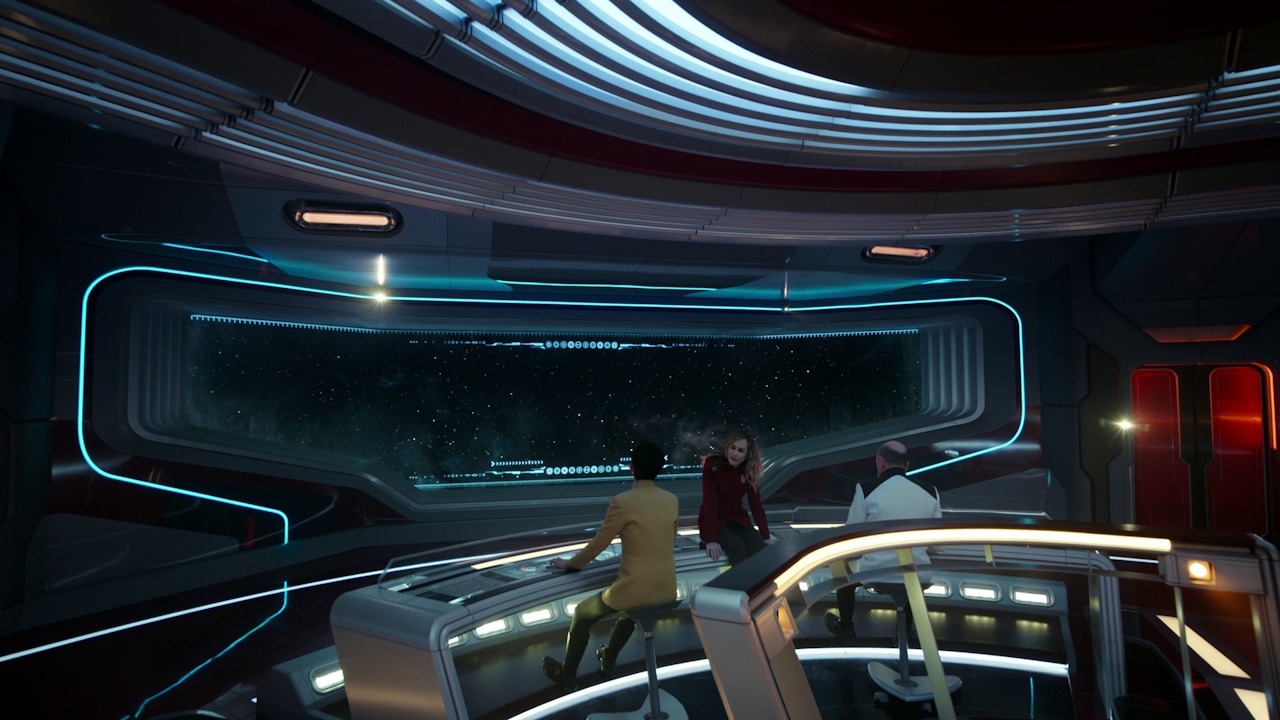
Visually, Starfleet Academy was pretty okay much of the time. There were things the show did well, like using a proper 16:9 aspect ratio instead of the weird letterbox that other shows of the streaming era have employed. I also greatly appreciated getting episodes that all felt sufficiently long: not a single episode was under the fifty-minute mark, which made them feel all feel quite meaty! Compare Starfleet Academy’s ten-plus-hour first season with something like A Knight of the Seven Kingdoms, where the entirety of Season 1 barely cracked the three-and-a-half-hour mark.

Set design was more hit than miss, but some of the misses were… well, they were pretty dire. In my review of the series premiere, I talked about one sequence involving a low-poly, horribly pixellated “whale” when Caleb and Tarima went to the aquarium. And while I’m pleased to say that nothing else in Season 1 sank quite so far as that awful CGI misfire, there were a few other unimpressive visual moments, unfortunately.

Behind-the-scenes photo from Star Trek SFA S1 showing Frakes on Ukeck
Director Jonathan Frakes on set with members of the main cast.

The sets used for parts of the Academy could feel cluttered, at times, with an overabundance of holographic signs and interfaces. The end result was an environment that looked too busy, with too many things on screen at once. I also felt that some choices, both for outdoor filming locations and using the AR wall, weren’t particularly impressive, and just didn’t leave me with much of an impression at all. I’d call out Jay-Den’s Klingon encampment from Vox in Excelso and Darem’s homeworld from Ko’Zeine as examples of the latter.

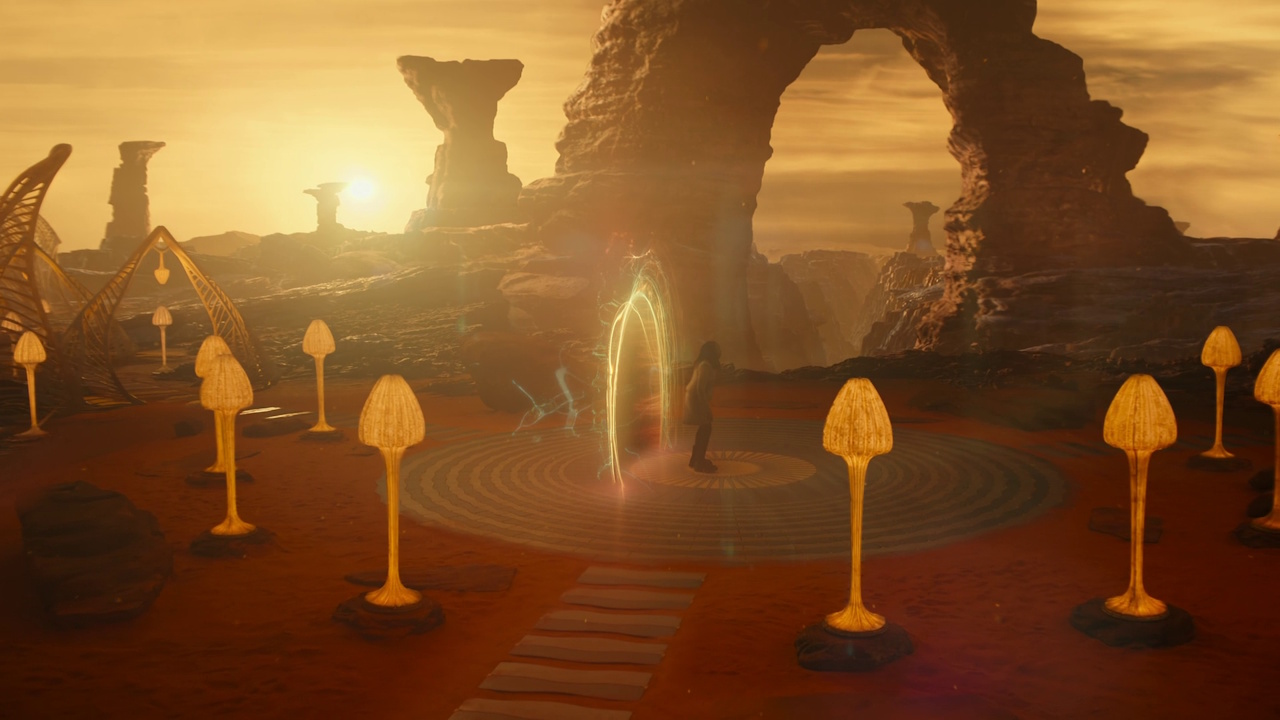
In fact, Darem’s homeworld looked an awful lot like a copy-and-paste of the Vulcan set that we’ve seen extensively in both Discovery and Strange New Worlds, which just felt profoundly odd for the Khionians – a semi-aquatic race. I get that we were technically visiting their desert moon, not their watery planet, but that just raises the question of… why? I guess it was an effort to spend less money on prosthetics, or to keep Darem in his humanoid form so he could better emote? Either way, it’s a bit of a shame; I’d have been genuinely quite pleased to visit Khionia and spend more time with this brand-new alien faction.

Still frame from Ko'Zeine showing the moon
Jay-Den arrives on the Khionian moon.

I think, on balance, my favourite episode of the season was Come, Let’s Away – the episode where Braka returns and scores a big win at the cadets’ expense. It was well-paced, action-packed, and its emotional moments generally hit the mark. But the major caveat I have to give is that this *kind* of story – where the villain gets a big win, and sets up the next phase of their nefarious scheme – shouldn’t come when we’re past the halfway point. And it shouldn’t have come along *after* we’ve already seen the villain being defeated by a bunch of untrained cadets on their first day at school.

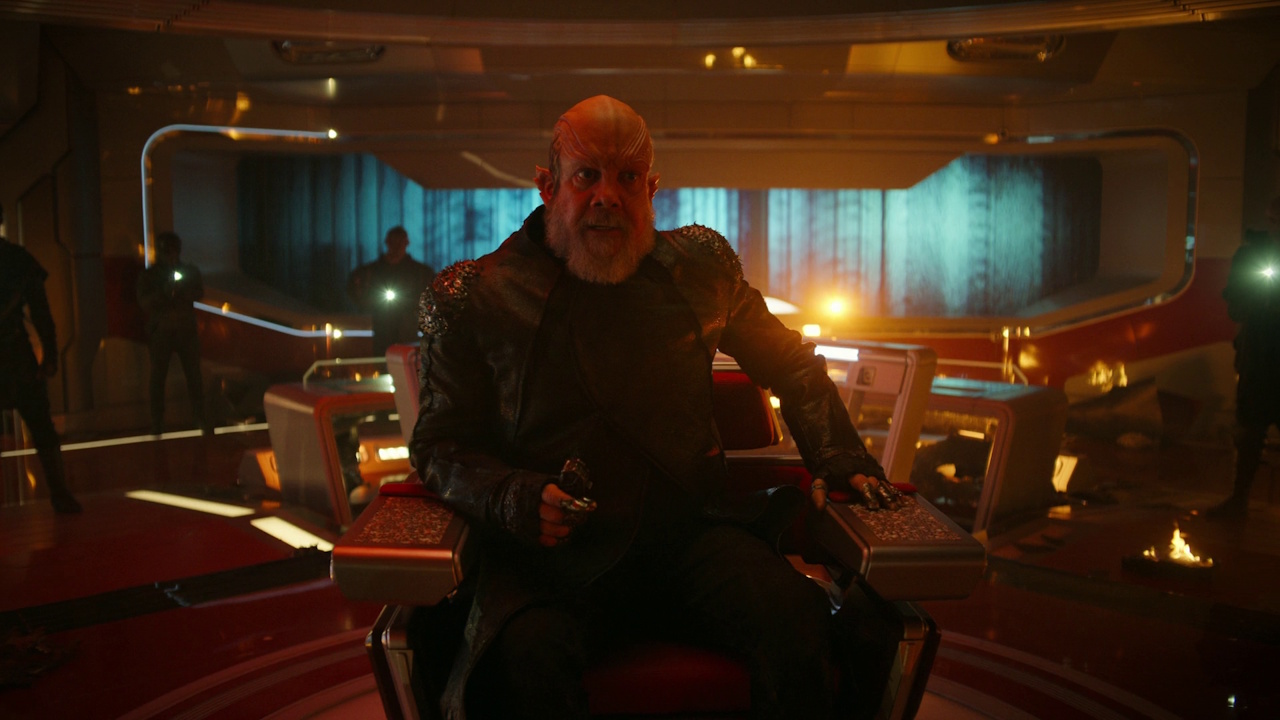
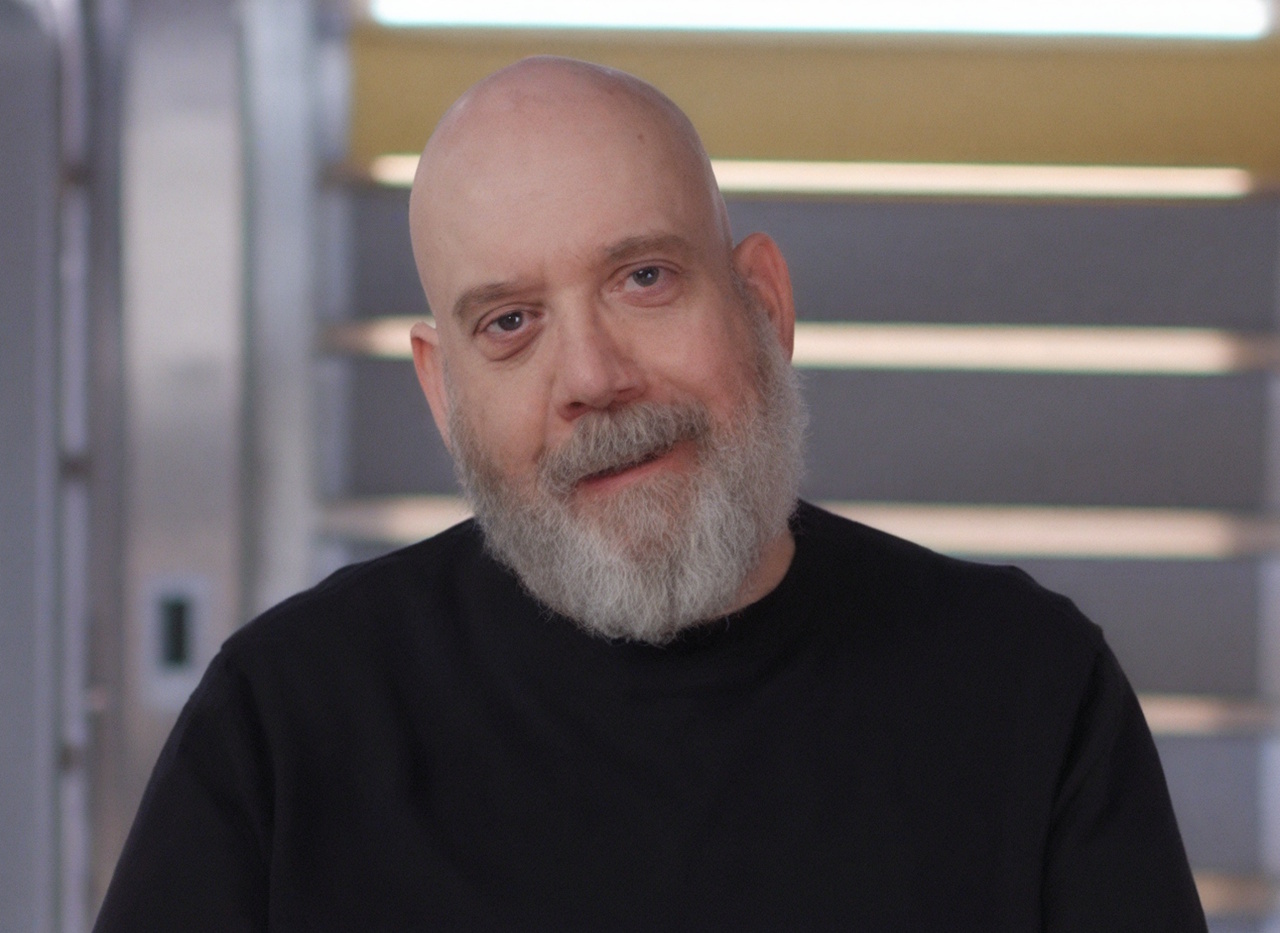
I mentioned this in my review of the premiere, but Nus Braka was not an entertaining villain. The performance was ridiculously hammy and off-putting, and I’m so disappointed that a genuinely wonderful actor like Paul Giamatti – whose performances I’ve enjoyed elswhere, and whose name felt like a big coup for Starfleet Academy when his role was announced – could be reduced by the show’s producers and directors to being so genuinely awful. Braka was, for the most part, a one-dimensional pantomime villian; the antagonist from a direct-to-video kids’ movie who’s “evil for the sake of it” and turns everything up to eleven for no reason.

Still frame from a Star Trek SFA event showing Paul Giamatti (Braka)
Paul Giamatti, who played Nus Braka.
Image: Star Trek on Facebook

When a series commits to a serialised arc, it’s important for that arc to stick the landing. In Starfleet Academy’s case, Nus Braka was the show’s overarching antagonist, and even in some episodes where he didn’t appear in person, his influence loomed large and he was discussed by other characters. But when a villain is so weak, so one-dimensional, and so uninteresting… it really takes a lot away from that serialised story arc. For me, unfortunately, Nus Braka is firmly in that category, and feels like one of the Star Trek franchise’s least-interesting villainous characters. I don’t doubt that Giamatti had fun playing the role, and I’m also certain that a way could’ve been found for a character like this to have been handled better. But the way Braka came across in the finished product? I’m afraid it’s one of the worst individual elements of the season.

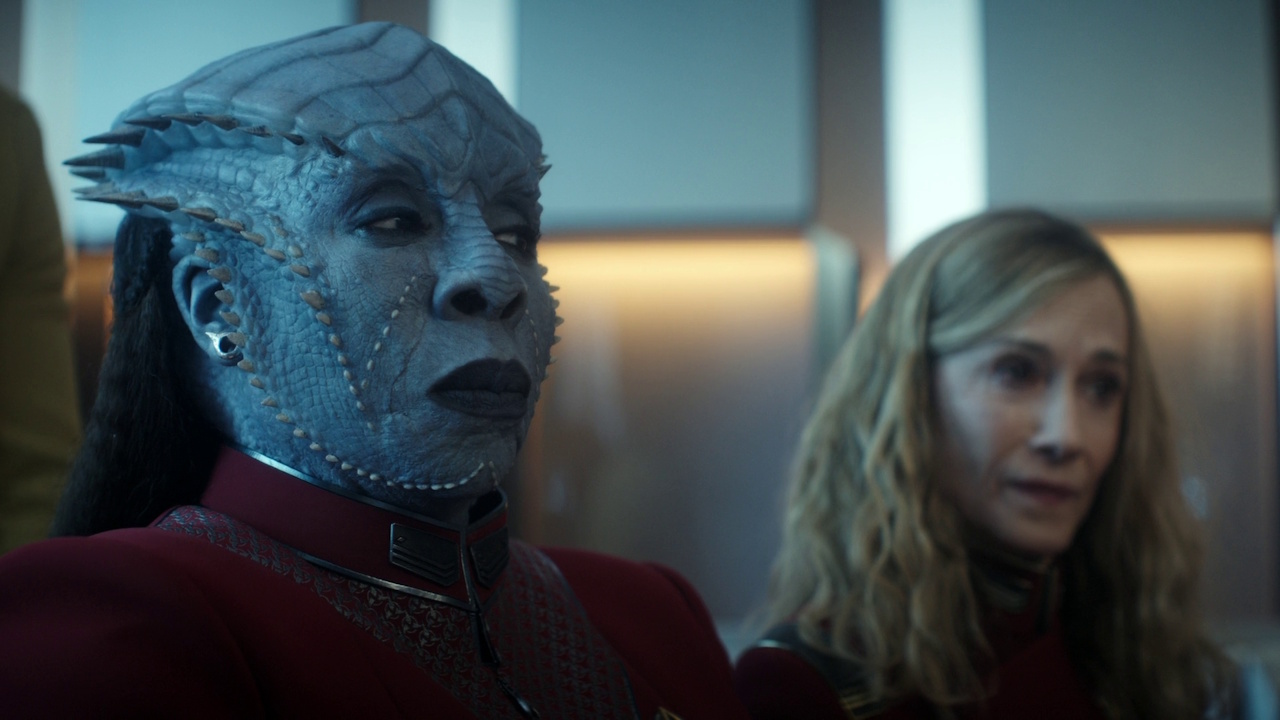
One character I criticised in the two-part premiere (and in the buildup to Starfleet Academy’s debut) was Lura Thok. I felt Gina Yashere’s performance was really… well, amateurish, especially in the opening two-parter. I’m not going to retract that statement, but I will amend it to say that, over the course of her subsequent appearances in Season 1, Lura Thok managed to grow on me, and either I got used to Yashere’s take on the character, the cadence of her speech, and so on, or… maybe she grew into the role somewhat. Either way, I ended the season with more of an appreciation for this Klingon-Jem’Hadar hybrid than I had at the beginning.

Still frame from Vox in Excelso showing Lura and Ake
Lura Thok with Captain Ake.

One of the really odd, left-field announcements going into Starfleet Academy’s premiere was that Stephen Colbert – a late-night talk show host in the United States – was going to have a voice role as the “Digital Dean of Students.” I said at the time that this felt like little more than stunt casting; an attempt to garner some interest for the series based on nothing but the name of the performer. And so it turned out to be. The Digital Dean had a couple of funny lines here and there – the recurring Talaxian fur-fly bit being one – but overall, I didn’t get the impression that the former Paramount corporation needed to recruit someone so well-known (presumably for no small amount of money) for this complete non-role. Colbert’s voice work was *fine*, but would anything about the Digital Dean have changed if it had been a newcomer? Heck, *I* could have done no less of a job in that kind of voice-only role, for all the impact it had.

When the cadets were first introduced, ahead of the show’s premiere, I thought it was at least noteworthy that we were going to meet a Klingon named Jay-Den – a name that sounds, well, human. And I wondered if there might be a reason for that in-universe; maybe it was indicative of the Klingons having joined the Federation centuries earlier, or Jay-Den’s family having an appreciation for human culture. But, as it turns out, the name “Jay-Den” has a meaning in Klingon.

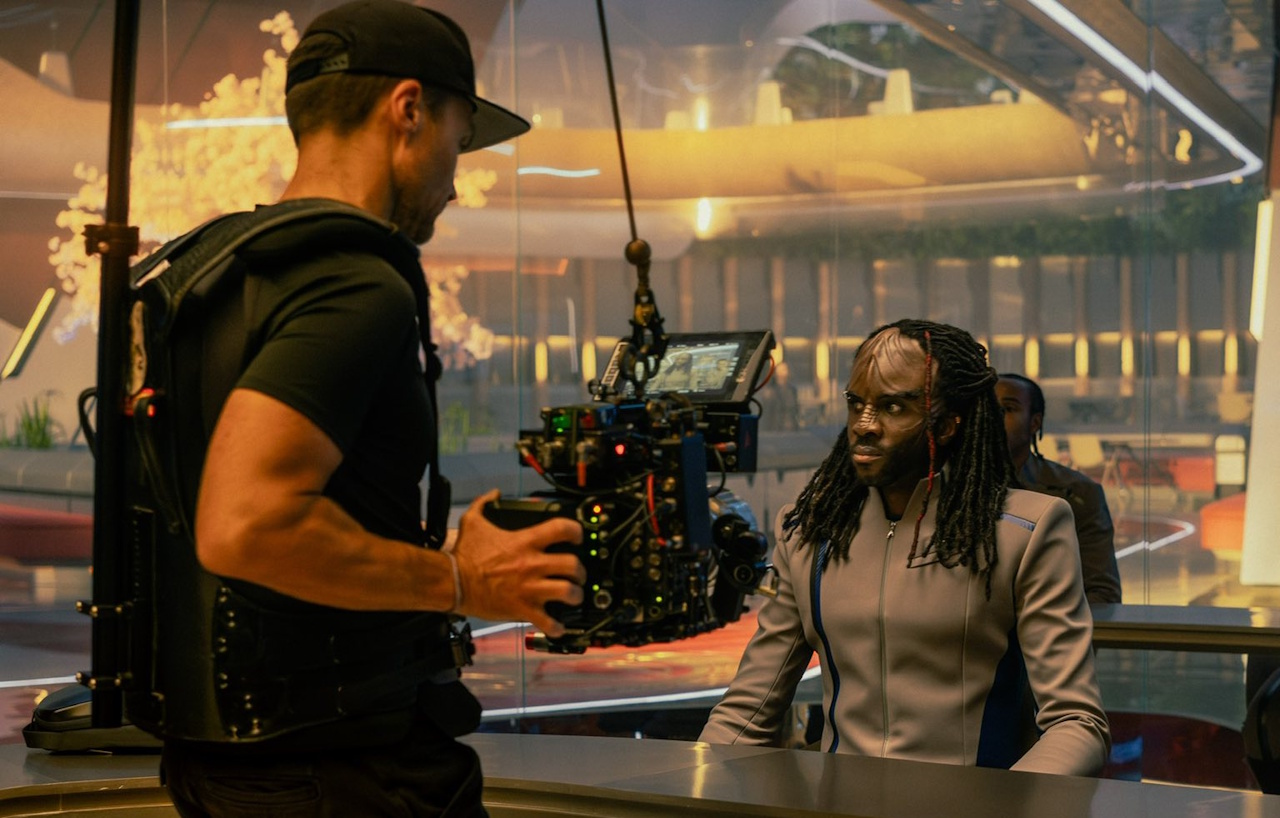
Behind-the-scenes photo from Star Trek SFA S1 showing Jay-Den
Filming one of Jay-Den’s scenes in Vox in Excelso.

Someone who speaks Klingon will have to answer this (I can barely manage English), but… does “Jay-Den” really mean “he who crosses oceans of fire,” as he claimed in Vitus Reflux? I’m gonna go out on a limb and suggest that it doesn’t.

That doesn’t mean, by the way, that I didn’t enjoy Jay-Den. Karim Diané put in an exceptional performance, and I really enjoyed getting a Klingon main character who was a bit more complex, a bit softer, and who didn’t care only about honour and suffering a violent death. Jay-Den came from the same Klingon warrior culture that we’re familiar with from past iterations of Star Trek – regressed, arguably, by the impact of the Burn – but he was his own man with his own interests, and his desire to become a healer, not a warrior, added somewhat to his complexity as a character.

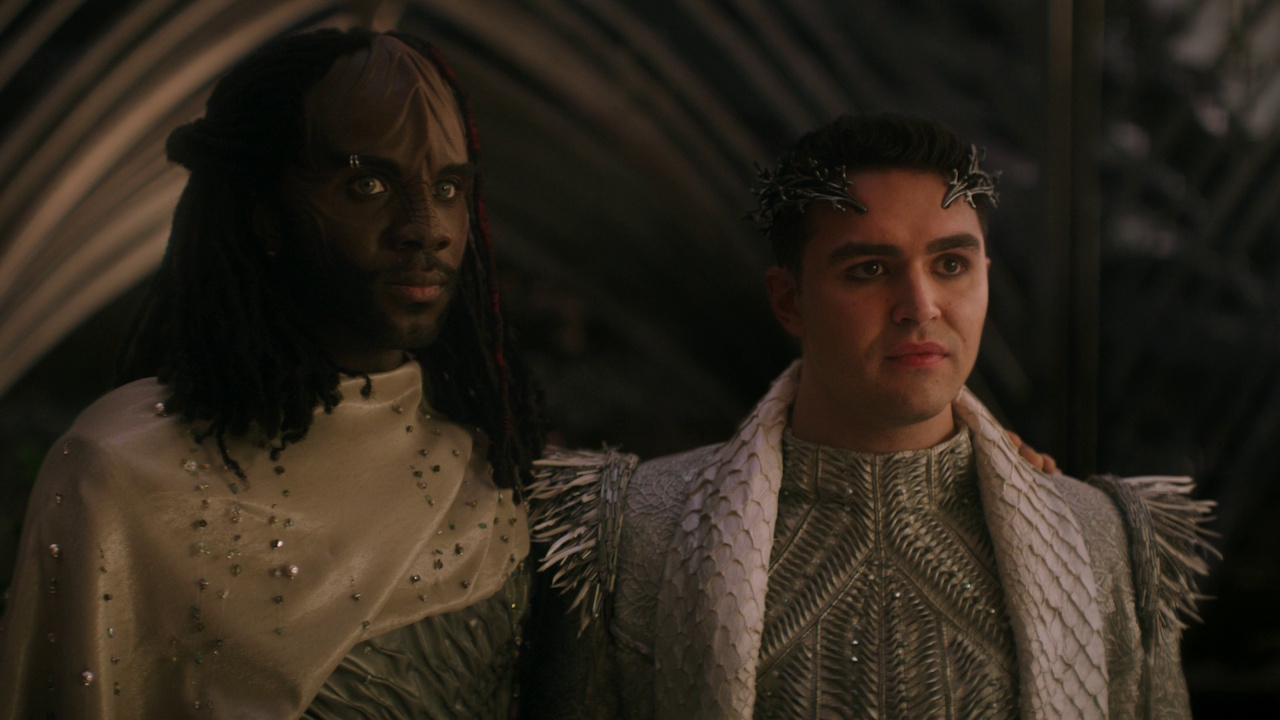
I also liked the way Jay-Den’s romantic life was handled. There was definitely a spark between him and Darem in the latter part of the season – a spark that, I would argue, either wasn’t fully justified or didn’t sit quite right because of their initial bully-and-victim interaction in the first episode. But I appreciated how they overcame that and built up a friendship.

Still frame from Ko'Zeine showing Jay-Den and Darem
Jay-Den and Darem seem to have… a spark.

I’ve always read the Klingons as being somewhat analogous to historical civilisations like the Spartans, at least in the way they were presented after The Original Series. Their warrior culture certainly feels like something Spartan, anyway. And if you know your history… you’ll know that the Spartans (and Ancient Greeks in general) were, to use some technical language from historiography, hella gay. *Hella* gay. So… gay Klingons just make sense, and the only thing weird about it, really, is how we’ve never really explored this aspect of Klingon culture and sexuality before.

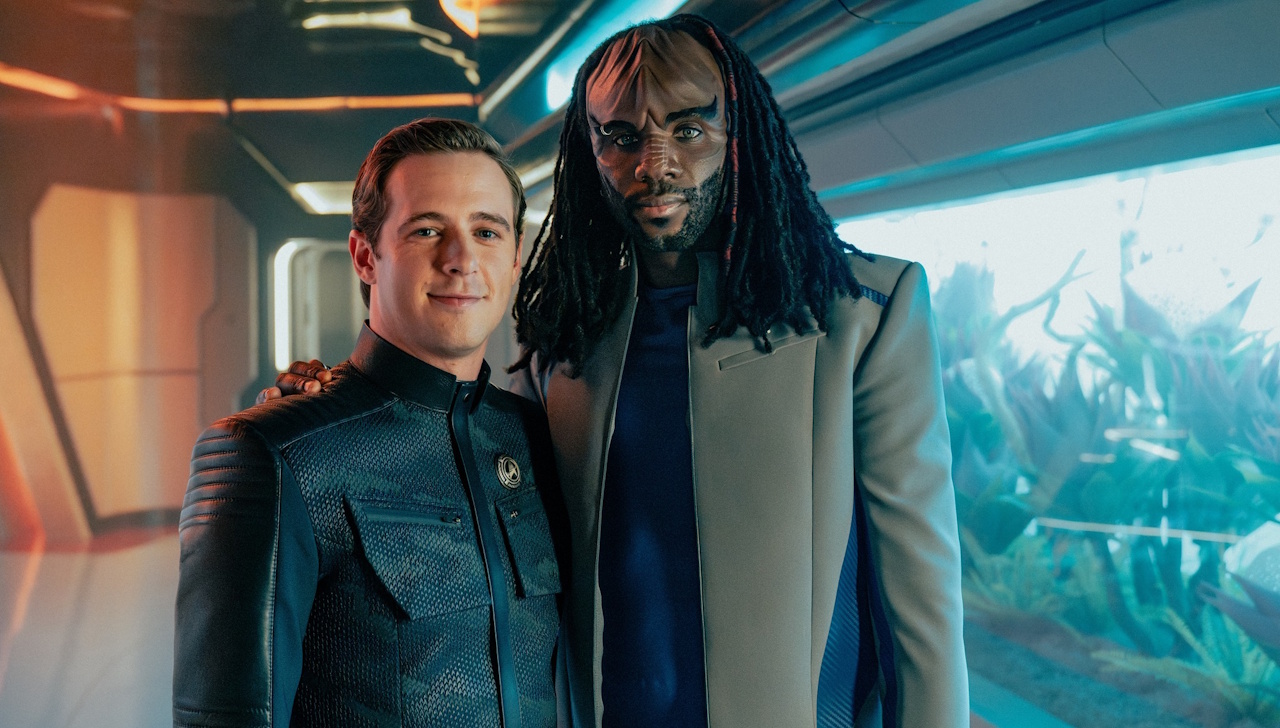
At this point in the far future, being LGBT+ (whatever race you are) shouldn’t be a big deal, and Jay-Den’s arc and his relationship with the War College cadet Kyle was handled subtly, without much fanfare. It reminded me a little of Adira’s “coming out” as non-binary in Discovery; it’s something that everyone involved understood, accepted, and just rolled with without making it a big deal in any way. That’s generally how I like to see LGBT+ representation handled in Star Trek; I like the idea that, in the future, these things won’t be controversial in any way, and stories which set up that ideal as a plot point tend to go down well with me.

Behind-the-scenes photo from Star Trek SFA S1 showing Jay-Den and Kyle
Behind-the-scenes photo of Kyle (Dale Whibley) and Jay-Den (Karim Diané).

The Venari Ral, Nus Braka’s organisation, didn’t feel consistent across the season. When we met Braka, he seemed to be the captain of a pirate ship – or perhaps someone who might be the “commodore” of a small flotilla of ships. And that presentation carried through; Braka was a jumped-up petty criminal, or so it seemed. So it was a real surprise, then, when the Venari Ral, a few episodes later, began annexing entire planets to their “empire,” with Braka painted as the leader of an entire interplanetary faction.

This just wasn’t sufficiently explained within Starfleet Academy itself, and because the Venari Ral are a new faction, we had no frame of reference. If it had been, say, the Cardassian Union or the Gorn Hegemony, there’d be a foundation to build on. Even Discovery’s Emerald Chain could’ve fit the bill. In fact the Emerald Chain is a great point of comparison, because that faction also seemed to fluctuate between “criminal syndicate” and “interstellar empire” – though at least in that case, it never felt quite so small-scale as the Venari Ral did in their first couple of appearances. I think we’d have benefited from seeing a tiny bit more of the Venari Ral, somehow, in the first couple of episodes – something that could’ve nailed down how big, how powerful, and how intimidating the faction was *supposed* to be.

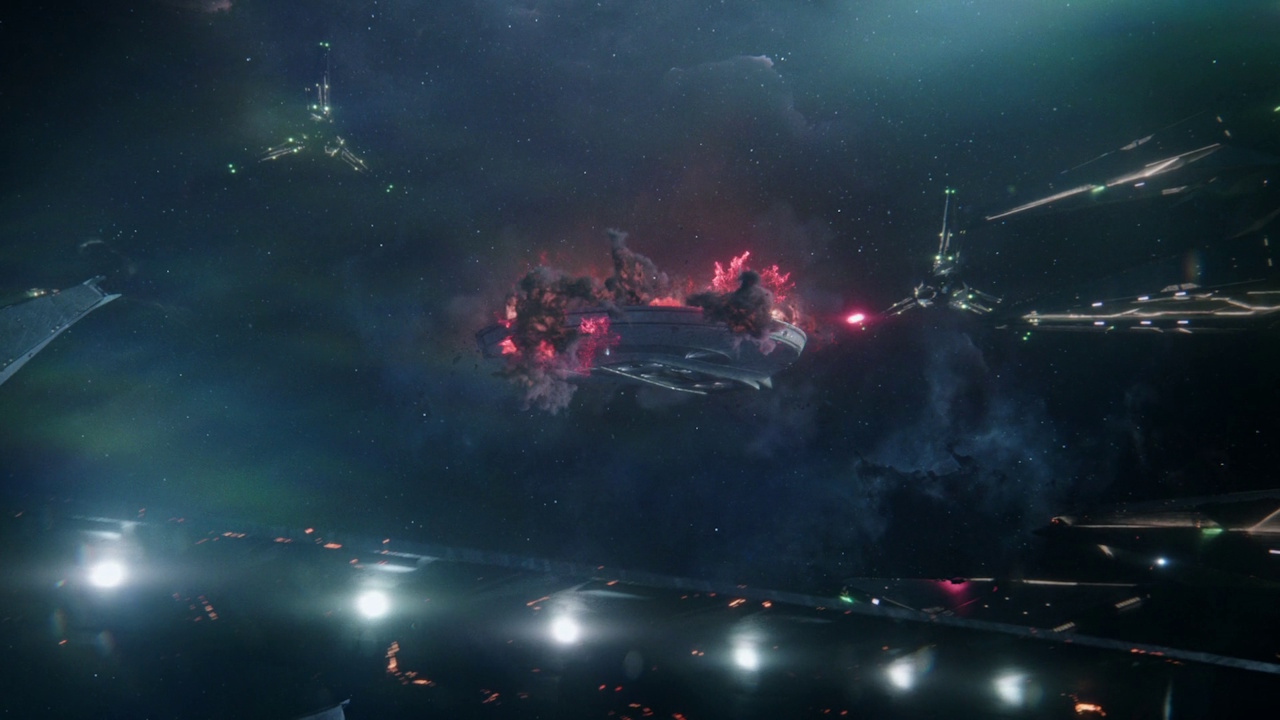
Still frame from Rubincon showing Venari Ral ships firing on the Athena
Venari Ral ships. The scale of the faction and its fleet wasn’t adequately explained.

And then Starfleet Academy would’ve needed to stick to that. If the first episode seemed to show Nus Braka as the captain of a pirate ship, later episodes like Come, Let’s Away and 300th Night tried to present the faction as an empire capable of conquering entire planets, with a fleet of ships, a legion of soldiers and paramilitary, and the resources necessary to hold onto all of that territory. But then the season finale seemed to show only about half a dozen Venari Ral ships and a handful of troops.

This inconsistency was also present in the Venari Ral ships themselves. Kids These Days ended with Braka’s ship being destroyed… with a single volley of torpedoes. Come, Let’s Away showed a Venari Ral ship taking the fight to the Athena, and winning. Then Rubincon saw Starfleet massively outnumbering the Venari Ral, beaming through shields with ease, and arresting their troops and leadership. I came away from the season feeling like I *still* don’t know what the Venari Ral was meant to be: a pirate fleet, a crime lord’s militia, a proto-state, or a fully-fledged interstellar empire. And for the main villainous faction of the season… that’s a bit of a disappointment. How am I meant to be invested in a story when I don’t really comprehend who our heroes are facing off against?

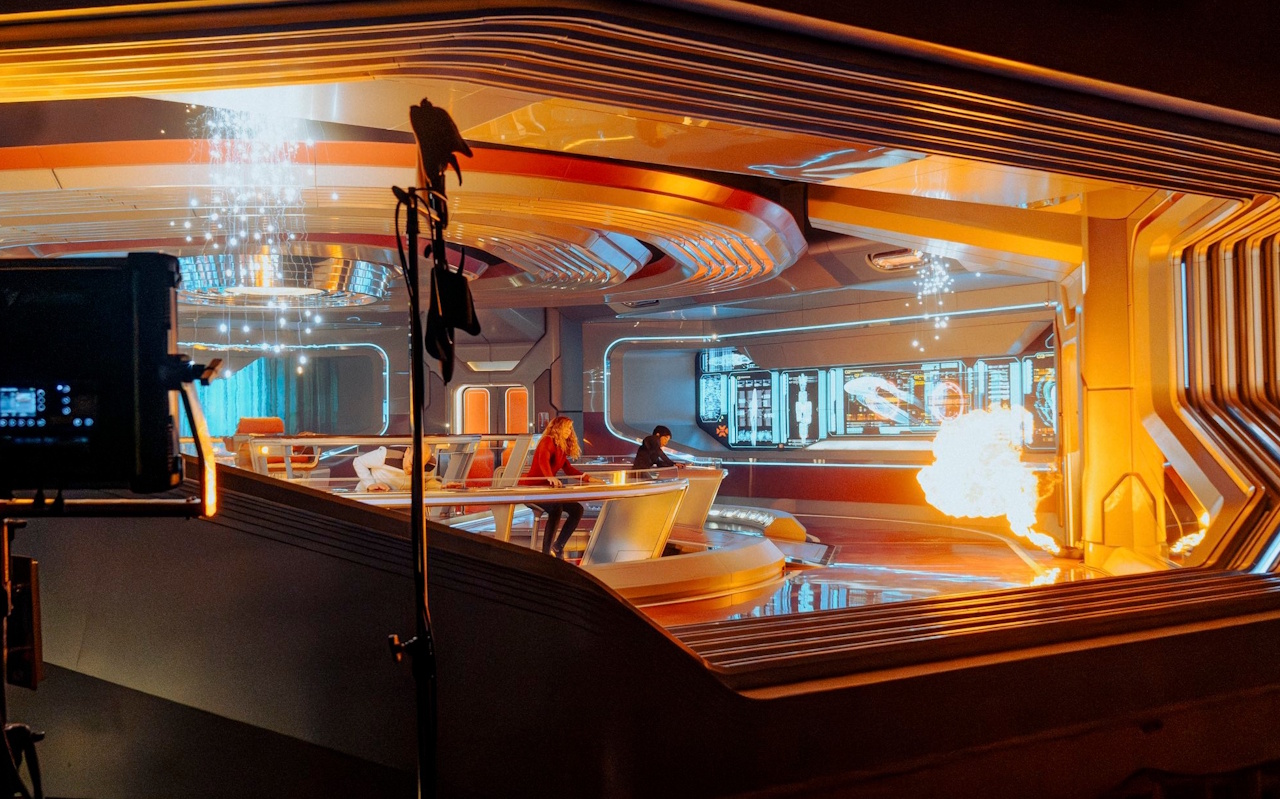
Behind-the-scenes photo from Star Trek SFA S1 showing the bridge set
Fire on the bridge! Paramount has got a lot of mileage out of those pyrotechnics in recent years, eh?

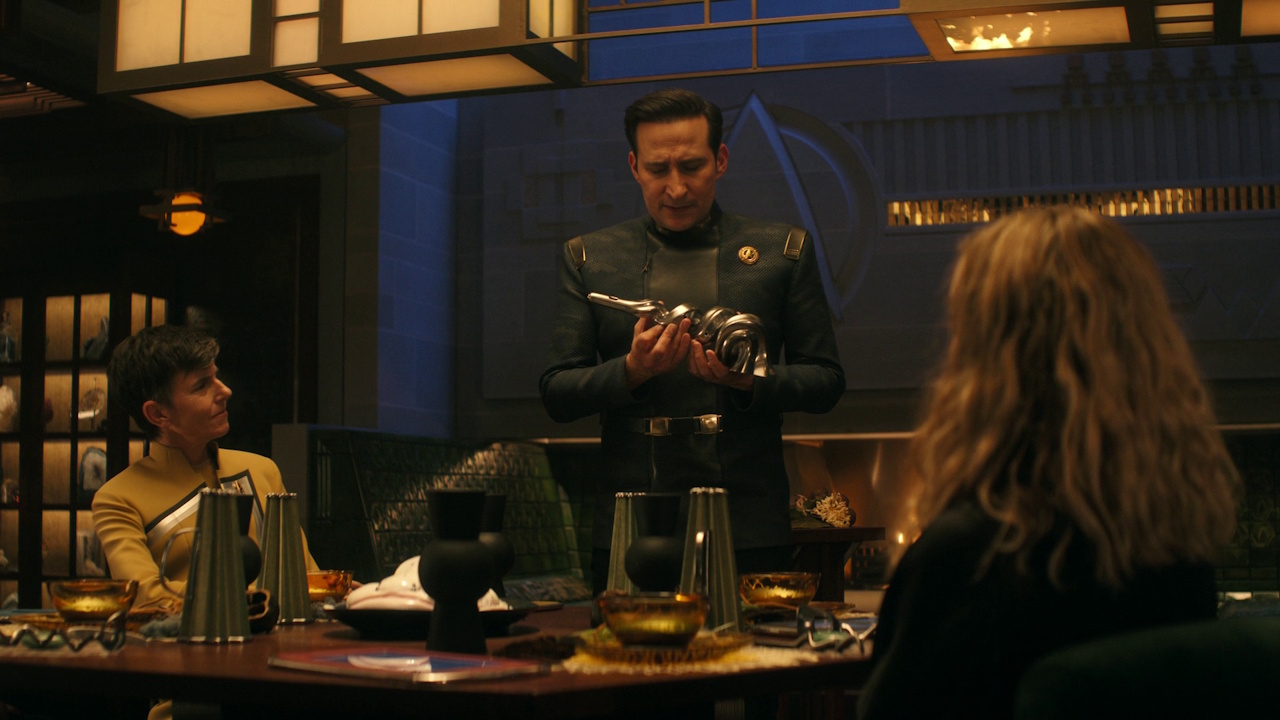
I was a little surprised when it was announced that Tig Notaro’s Jett Reno would be one of the show’s recurring characters, making the jump from Discovery. Out of all of the Discovery characters, as much as I like Reno, she probably wouldn’t have been my first choice to take a significant role in a spin-off. But I greatly enjoyed Reno’s role this season, particularly in the finale when she was left alone with the cadets, and she really seemed to rise to the occasion – while retaining her usual deadpan style.

Reno’s relationship with Lura Thok wasn’t a big part of Starfleet Academy, but it was another of those subtle, understated LGBT+ moments that I discussed above. It worked very well, and I liked how both characters gained a bit of depth and personality from one another. Notaro and Yashere played off each other perfectly in their moments together, and I felt their relationship went a long way to humanising (if you’ll excuse the term) Lura Thok in particular. I also liked what it said about Reno, and how she was finally willing to embrace new relationships after the loss of her wife – something we learned about in Discovery.

Still frame from Rubincon showing Jett and Lura
Lura and Jett together.

A ten-episode season won’t have time to do everything, nor focus on every single character – and for me, it was Genesis who seemed to draw the shortest straw this time around. Genesis got an arc of sorts, relating to her father and how she modified her references when applying to the Academy, but that was very much a B-plot in the episode in which it featured. It’s not necessarily a problem; other characters simply got bigger or more central storylines this time around. But, as I said several times in Discovery and Strange New Worlds, it would be nice if, next time, we could get an episode or two to make up for the characters who took a back seat in Season 1.

I liked what we saw of Genesis, though, and how she seemed able to push through her anxieties and fears to step up and become a leader. We saw this with her taking the captaincy of the Academy’s phaser-game team, and this carried through to later in the season, where she was finally able to take the conn of the Athena in the finale. It was never an arc that was centre-stage, but actress Bella Shepard did very well with the material she had to work with, making Genesis into a cadet who felt like she truly fit the Starfleet mould almost better than everyone else. Perhaps that’s a nod to her background, as the daughter of an admiral and who’d been raised around Starfleet from a young age. In any case, the series needed at least one character like this – and we got that with Genesis, even if she wasn’t as present as some of the others in key storylines.

Behind-the-scenes photo from Star Trek SFA S1 showing Genesis
Bella Shepard on set with a member of the production team.

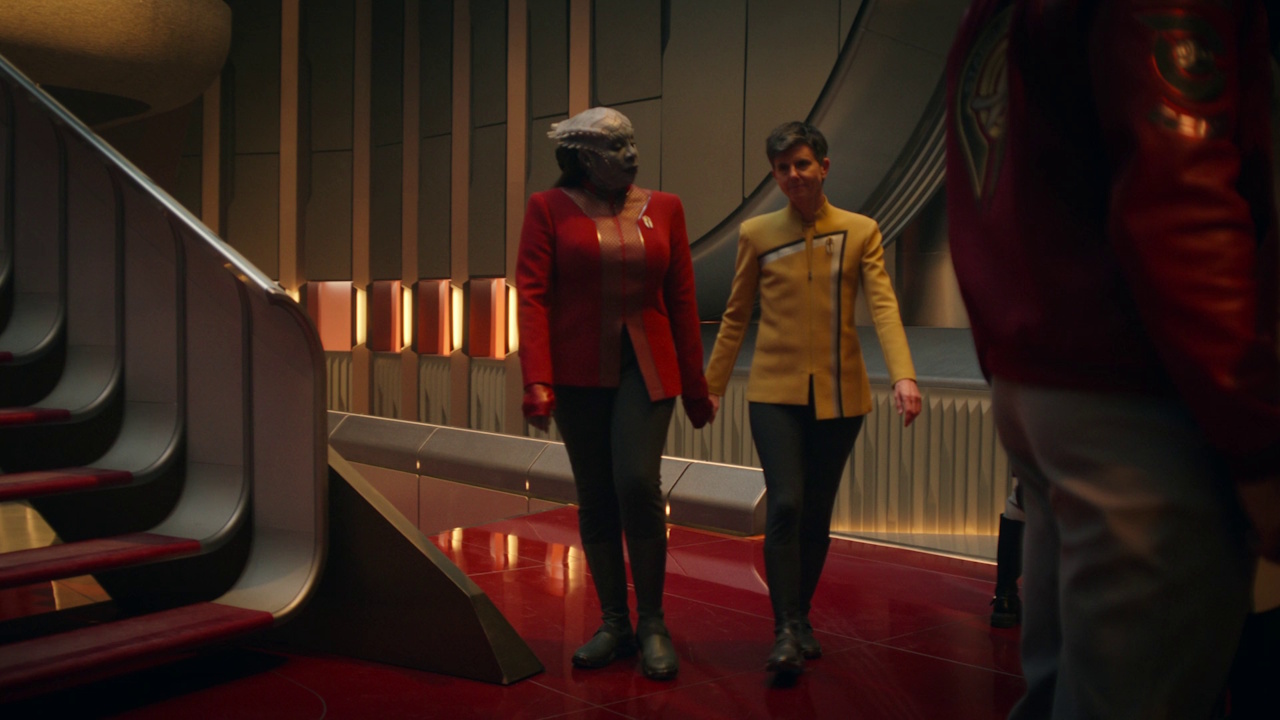
Uniforms can be a contentious point among Trekkies! I appreciated Discovery returning to bold primary colours after Season 3, and Starfleet Academy stuck with a similar design – at least for commissioned officers. The cadets’ uniforms – their main uniforms, anyway – were a bit less interesting in a fairly drab grey. I did like, however, that Starfleet Academy introduced a lot of uniform variants: Jay-Den’s skant, the letterman jackets, away team armour, separate uniforms for the War College… all of these added a lot of depth to the series. None of the uniforms on their own really leapt out at me, but the variety definitely kept things visually interesting.

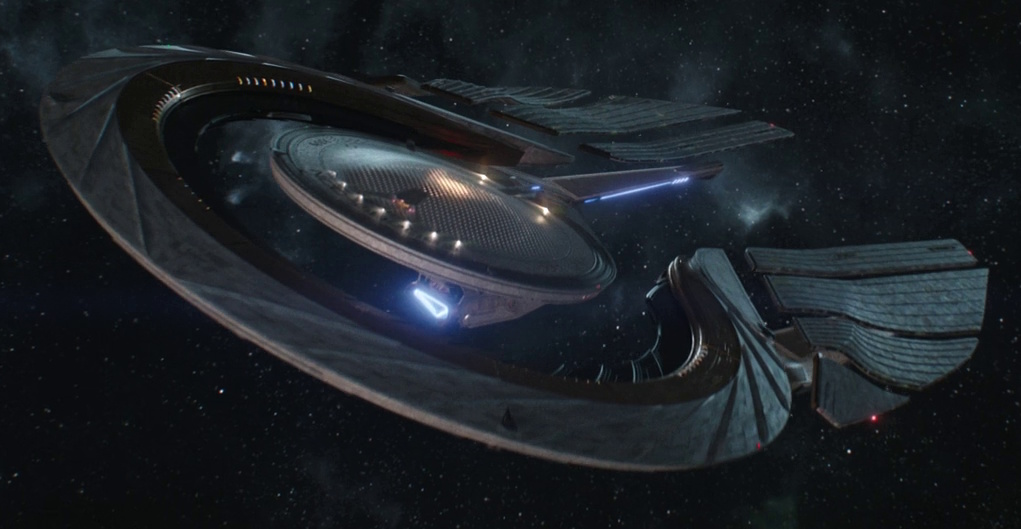
The USS Athena… well, it didn’t really grow on me, as I hoped it might after its introduction in the premiere. I don’t *hate* the design of the ship, but I don’t really find it as visually appealing as, well, almost any other hero ship from past iterations of the franchise. It feels a bit over-designed, if that makes sense, which is a criticism I’d level at a lot of 32nd Century Starfleet vessels. I did like, though, that the design of the ship was reflected in the design of the cadets’ combadges. That was a neat inclusion.

Cropped still frame from 300th Night showing the USS Athena
The USS Athena.

Darem got a potentially interesting arc across the season, but I think it was a bit of a mistake to set him up as being quite so unlikeable in the premiere. Darem had this whole “entitled, wealthy bully” thing going on, and it clashed with his *actual* personality. Part of this was in service to his abortive wedding in Ko’Zeine, but also it was done because – as I’ve said before when discussing Discovery in particular – Star Trek’s modern writers don’t always know how to do subtlety. Darem couldn’t just be overconfident or a bit of a brat – he had to be an aggressive, mean-spirited bully. And that beginning made him hard to root for, at times, even as we got to know the “real” Darem.

In my notes, I called parts of episodes three and seven Darem’s “dickhead to normal guy” arc, which was my way of saying this was the writers demonstrating his growth or his redemption from a poor beginning. And that kind of story can work; in Darem’s case, I think the results are a bit muddled. His spotlight – Ko’Zeine – was one of the season’s least-impressive outings, and his aristocratic background and cancelled wedding weren’t really mentioned again. I love a good redemption story, even for someone who seems unlikable, and there’s merit in doing something like this in a school setting, especially considering the show’s intended audience. But for me… I don’t think it came across as well as it should’ve. And, as mentioned above, I’d have liked to have seen more of the Khionians.

Behind-the-scenes photo from Star Trek SFA S1 showing Darem's makeup
Darem actor George Hawkins getting his prosthetic makeup applied for the series premiere.

In my review of the two-part premiere, I said that I felt sure that Tarima’s condition – which required her to use a device to dampen her telepathic abilities – would turn out to be a “superpower” that would be really useful and end up saving the day. And who’d-a thunk it: I was right about that! In both Come, Let’s Away and Rubincon, Tarima’s magic – which she denied was actually “magic,” but let’s not mince words – turned out to be the only thing the cadets could use to save the day. Sometimes, setting up something in one episode to pay it off later works well and feels right. And sometimes, subtly foreshadowing something that will be important later can be a great way to keep the audience engaged. Tarima’s ability, for me, was neither of those things. It was patently obvious what was going to happen, I called it from the first moment she was on screen, and it played out beat-for-beat not once, but twice.

That aside, Tarima was… well, “okay,” is what I put in my notes. I don’t like to pick on young performers too much, because there’s always room to gain experience, but I felt that Zoë Steiner was the lesser of the main cadets in terms of her performance. Tarima felt stilted and wooden a lot of the time, and while some of that may be the fault of writers and directors as much as (or more than) the performer, it left the character in a weird space for a co-star and the main protagonist’s romantic interest. There were moments where Tarima managed to leave that behind… but overall, she wasn’t my favourite character by a long stretch.

Still frame from Series Acclimation Mil showing Tarima
Tarima.

Starfleet Academy was intended to reach new audiences and expand the Star Trek franchise beyond its current niche. From what I’ve seen of its streaming numbers (and even its performance through “less-than-official” means), I don’t think it’s doing that. Starfleet Academy, across all ten episodes of its first season, was routinely beaten by shows like The Pitt, Fallout, and even Bluey, and never once cracked the top ten most-streamed programmes of the day or the week. That should ring alarm bells for Skydance/Paramount… as well as for anyone who hopes to see the show continue beyond its already-produced second season. For context, shows like Picard and Strange New Worlds were regulars in the top ten most-streamed episodes of the week during their runs.

But audience numbers are not a measure of quality. I wish I could tell you that Starfleet Academy is a real hidden gem, something that the masses are unfairly overlooking and missing out on. But the reality is that… well, this isn’t my kind of show, really. And I knew that – which is why I’m pulling my punches, at least a little, when it comes to criticising some of the character arcs and storylines. There’s a ton of “teen drama” that I knew from the get-go I wasn’t going to enjoy… and I didn’t enjoy it. The Star Trek label could mitigate some of that some of the time, sure… but not enough.

Behind-the-scenes photo from Star Trek SFA S1 showing episode 6 in production
Behind-the-scenes on Come, Let’s Away.

This was the first Star Trek project of the current streaming era (well, after Scouts, I guess) not to hold any appeal for me. I watched it because… I don’t know. I guess I felt an obligation to keep up with live-action Star Trek. And I can say that I did genuinely enjoy some parts of it. But overall? It’s a teen/young adult drama set in the Star Trek universe, using the lore of Star Trek for inspiration and to set up some of its stories, but it isn’t really the kind of Star Trek show that personally appeals to me. I’m okay with that – I made my peace with it before the show even aired! But it does make it hard to recommend the series to someone in a similar position to myself.

I tried to keep an open mind, though. And I was pleased to see Starfleet Academy being a more episodic project than I feared it would be, as well as to see attempts to both harken back to older shows and expand the franchise with new factions and alien races. There are good moments, interesting ideas, and some characters and performances that are a lot better than some folks online would have you believe. But for a Trekkie, the measure of success for any show is how often I think I’ll be tempted to return to Starfleet Academy and re-watch it. I can tell you with certainty that I’ll show up for Season 2. But… I can really only think of one episode from Season 1 (Come, Let’s Away) that I might even consider re-visiting in the future. The rest of it just wasn’t my thing, or else didn’t leave much of an impression at all.

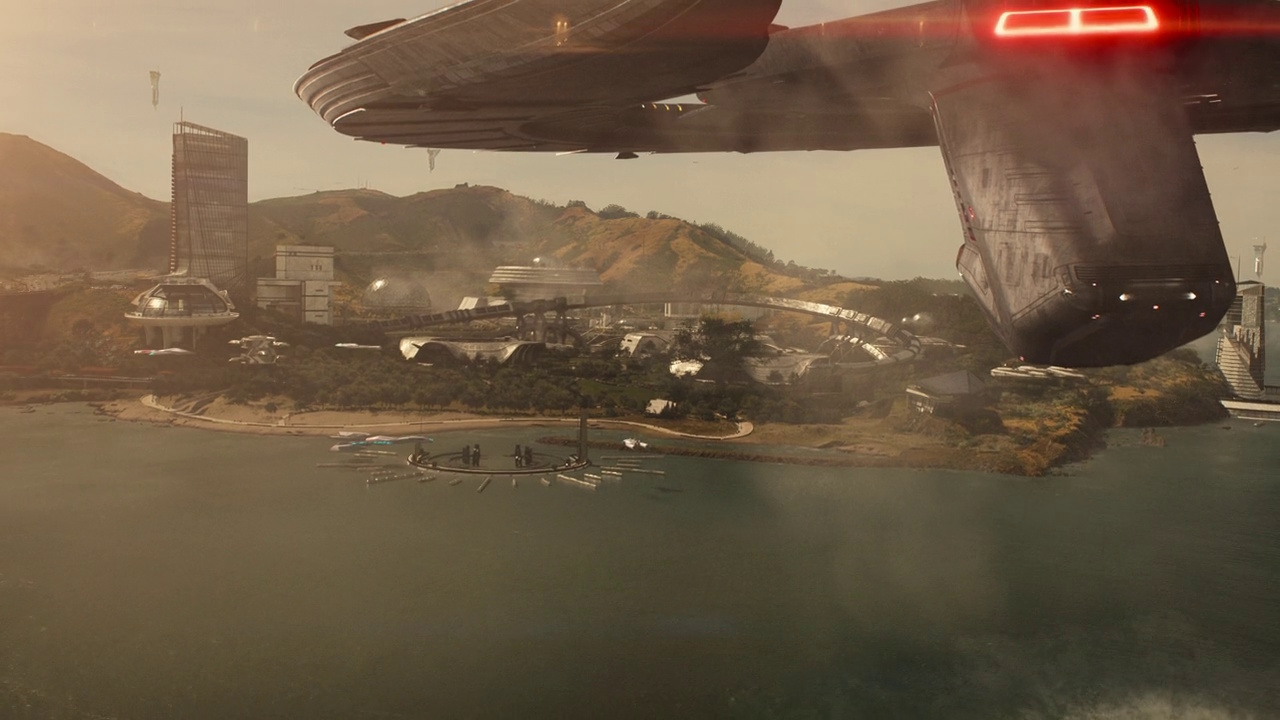
Still frame from Kids These Days showing the USS Athena at San Francisco
The USS Athena arriving at San Francisco.

So that’s all for today.

In the days ahead, I’ll write up my thoughts on individual storylines from episodes 3-10 in a bit more depth, so I hope you’ll join me for some of that. I plan to touch on a few topics that I didn’t get around to on this occasion. Splitting up this review made sense to me – this piece is already running very long, even by my standards, so writing even just three or four paragraphs about each episode would be too much! But stay tuned, because that compilation of mini-reviews is still to come.

I hope this has been interesting, and I hope I didn’t treat Starfleet Academy too unkindly. I keep saying this because I think it’s important, but I know someone who’s the wrong side of forty isn’t the target audience for a series like this. I tried to keep that in mind while writing this review! I can say that I’m glad Starfleet Academy was produced, and I maintain that the Star Trek fan community needs a project like this to reach out to new, younger viewers if the franchise is to have a shot at surviving long-term. Unfortunately, however, I fear circumstances have conspired against Starfleet Academy, with the show coming along at a difficult time for Star Trek, after franchise fatigue has set in, and with a new corporate merger shaking things up. Even if the show was never going to be for me, I still hoped that it would find success with its target audience… but that seems not to have been the case. Maybe Season 2 will “grow the beard” and improve things… but whether you’re a fan or not, I wouldn’t bet on that third season renewal going ahead.


Star Trek: Starfleet Academy is available to stream now on Paramount+ in countries and territories where the service is available. The Star Trek franchise – including Starfleet Academy and everything else discussed above – remains the copyright of Paramount/Skydance. This review contains the thoughts and opinions of one person only and is not intended to cause any offence.
Starfleet Academy: The Final Preview

A Star Trek-themed spoiler warning

Spoiler Warning: There are spoilers ahead for Star Trek: Starfleet Academy. Spoilers are also present for the following Star Trek productions: Discovery, Picard, and Prodigy.

At time of writing, we’re just over five weeks away from the premiere of Star Trek: Starfleet Academy! Paramount/Skydance has begun ramping up the show’s marketing, with interviews, a new poster, and most recently, a new clip from the show. I thought we could take a look at those today, as well as look back at earlier trailers and teasers, and just talk a little about my thoughts, fears, and hopes for the Star Trek franchise’s newest series.

First of all… I still feel, based on what we’ve seen and heard since the Skydance takeover, that Starfleet Academy will be the final Star Trek series, at least for the foreseeable future. And unless it were to truly explode in popularity, storming the streaming charts to genuinely compete with the likes of Wednesday, Squid Game, and Stranger Things, I also feel increasingly confident that the two already-announced seasons will be all the show will get. This is not one of Skydance’s pet projects, and I get the impression that – as with Strange New Worlds – Star Trek’s new corporate overlords will fulfil their contractual obligations, but won’t pursue any kind of continuation for the series beyond what had already been lined up. I could be wrong – and I hope Starfleet Academy will prove such an overwhelming hit that it prompts a rethink in the Paramount-Skydance boardroom! But that’s where I feel the show, and the wider franchise, are at right now.

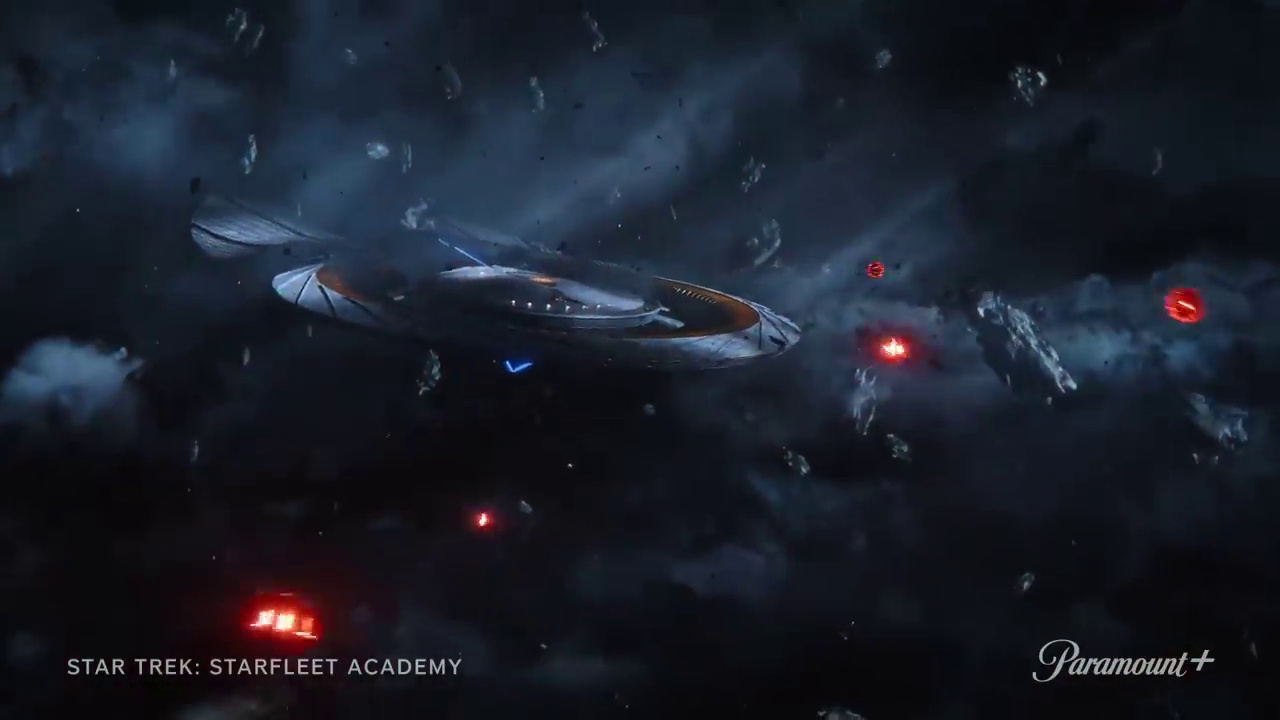
Still frame from the Star Trek: Starfleet Academy promotional clip showing the USS Athena.
The USS Athena.

And from that negativity to… some more negativity. Sorry.

I… did not think very much of the new clip, to be blunt. Don’t get me wrong: there are some interesting things and some great acting performances, and it was wonderful to see the Doctor back in live-action for the first time. But there are also some pretty disappointing things to see, one of which ties into something I’ve been saying about Starfleet Academy since before the show was even officially announced: this didn’t need to be a serialised story with another galaxy-threatening, over-the-top villain.

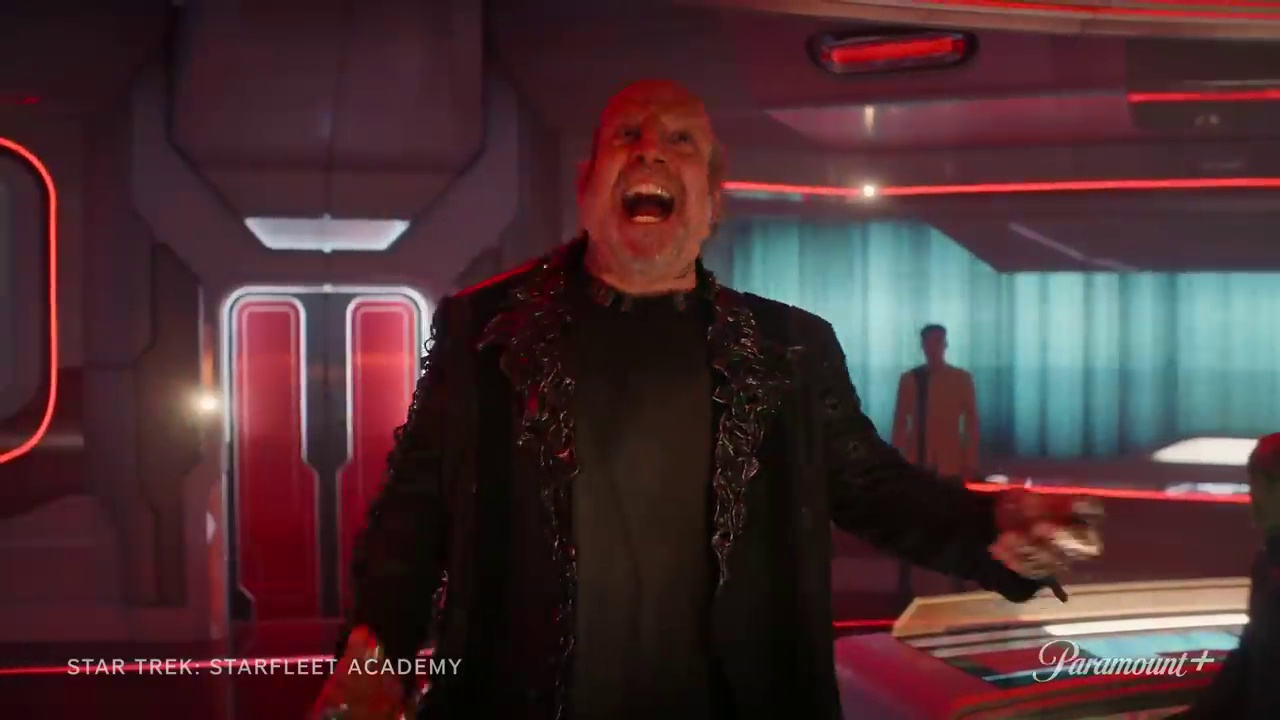
Paul Giamatti is *fantastic.* I loved him in the miniseries John Adams a few years ago, and this is a man who’s won three Golden Globes, an Emmy, and been nominated for two Academy Awards. Giamatti was talking about Starfleet Academy at a recent promotional event, and he seems genuinely enthusiastic about Star Trek, recalling watching the show as a kid, and even talked positively about Deep Space Nine. Which makes it such a shame that, from everything I’ve seen of his performance in the previous trailer and now in the new clip, he seems flat, one-note, over-the-top to a totally unnecessary degree, and just… boring.

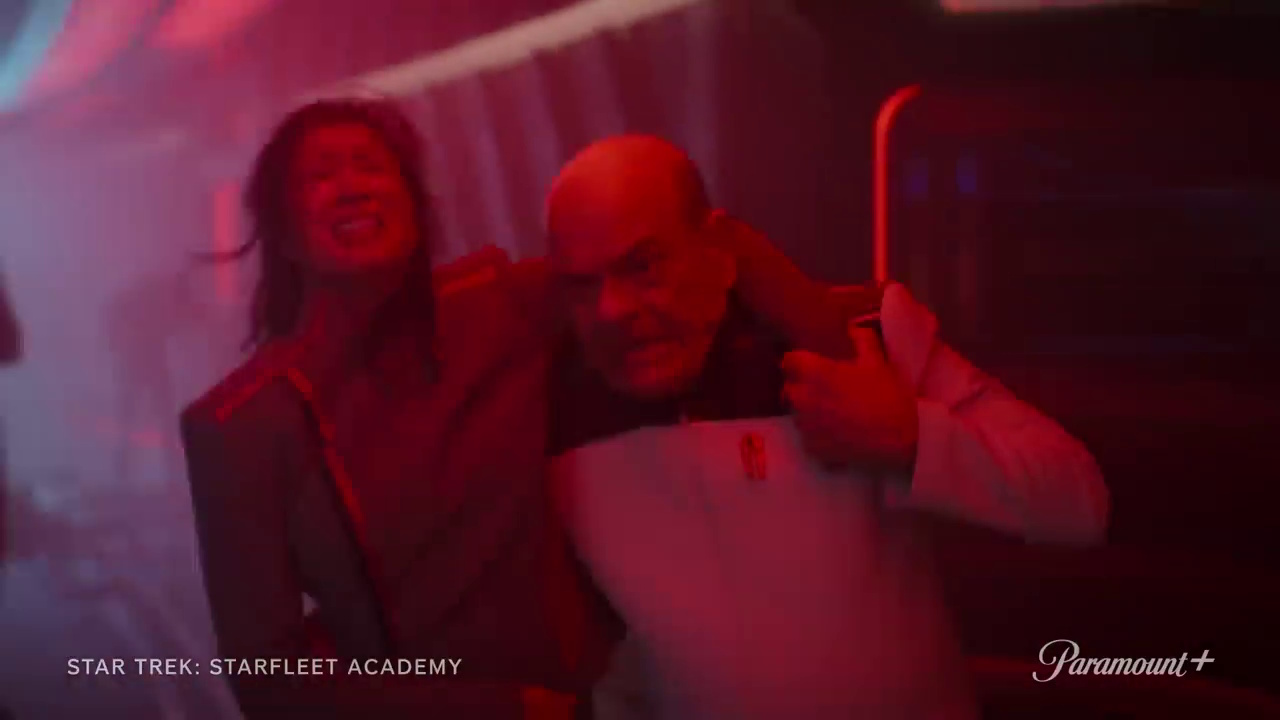
Still frame from the Star Trek: Starfleet Academy promotional clip showing Nus Braka laughing.
Do you see what I mean?

Star Trek *can* do great things with bad guys who get under your skin and really chew the scenery. Khan was like that, if you think about it, and yet fans adore both Space Seed and The Wrath of Khan to this day. But in this modern era, after we’ve had Discovery’s Klingons, the Control AI, the Zhat Vash, Osyraa and the Emerald Chain, various Borg Queens, the Diviner Vadic, Moll, and… whoever else I can’t call to mind right now, do we need *yet another* villain in that mould? After we’ve had so many “villain with a mysterious connection to a main character,” and “villain seeking revenge against Starfleet/a main character” storylines across the past decade… do we need to go down that road again?

To me, Starfleet Academy seemed like the perfect vehicle to do something different. The show would benefit, in my opinion, from following the Strange New Worlds style – leaning much more heavily on episodic storytelling, and leaving things like a main villain and galaxy-ending threats behind. Star Trek, in its prime, was the best kind of episodic television, and while there’s always been room for sequels, character growth, and ongoing story and character arcs… a show like Starfleet Academy, with its focus on a new generation of up-and-coming officers, just seems like it should be perfectly placed to bring back that style of storytelling.

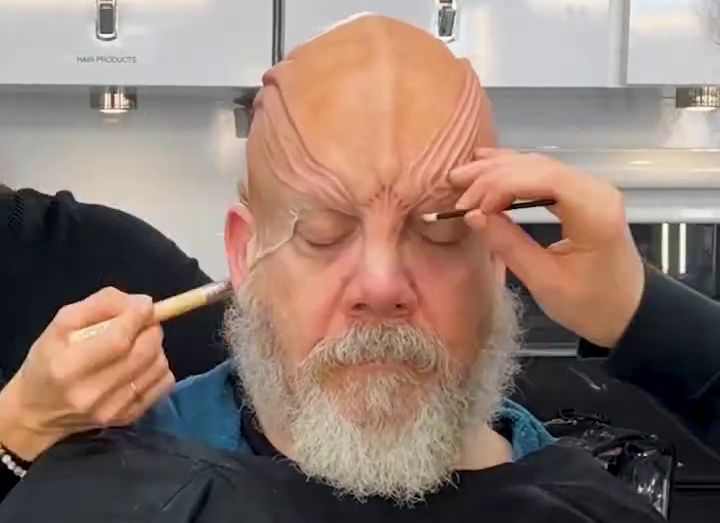
Still frame from a Star Trek: Starfleet Academy promo video showing Paul Giamatti in the makeup chair.
Paul Giamatti in the makeup chair.

Maybe, if Nus Braka didn’t seem so cartoonishly over-the-top, I’d be a bit less critical. And despite what I’ve said, I really will try to give the character – and Starfleet Academy – a fair shake in January. I’m not going to turn up for the show wanting to have a bad time, just so I can say “I knew it” later on. But when one of the things that had excited me the most about Starfleet Academy, before we knew anything else about the show, had been the casting of Paul Giamatti… I’m decidedly unimpressed with what I’ve seen from him so far.

If there’s more subtlety and nuance to the character of Nus Braka in Starfleet Academy, I will happily take back everything I’ve had to say about the character and the performance. And I’ve been wrong before – going into projects with low or no expectations only to be left genuinely impressed. Heck, I was not on board with the idea of re-casting Pike, Spock, and Number One for Discovery’s second season… and look how that turned out! So if I’m wrong, I’ll gladly hold up my hands and admit it. But… if I *am* wrong, and this character isn’t the one-note, scenery-chewing villain stereotype that he seems to be, it’ll leave me wondering why the clips and trailers were cut in such a way as to leave me with that impression!

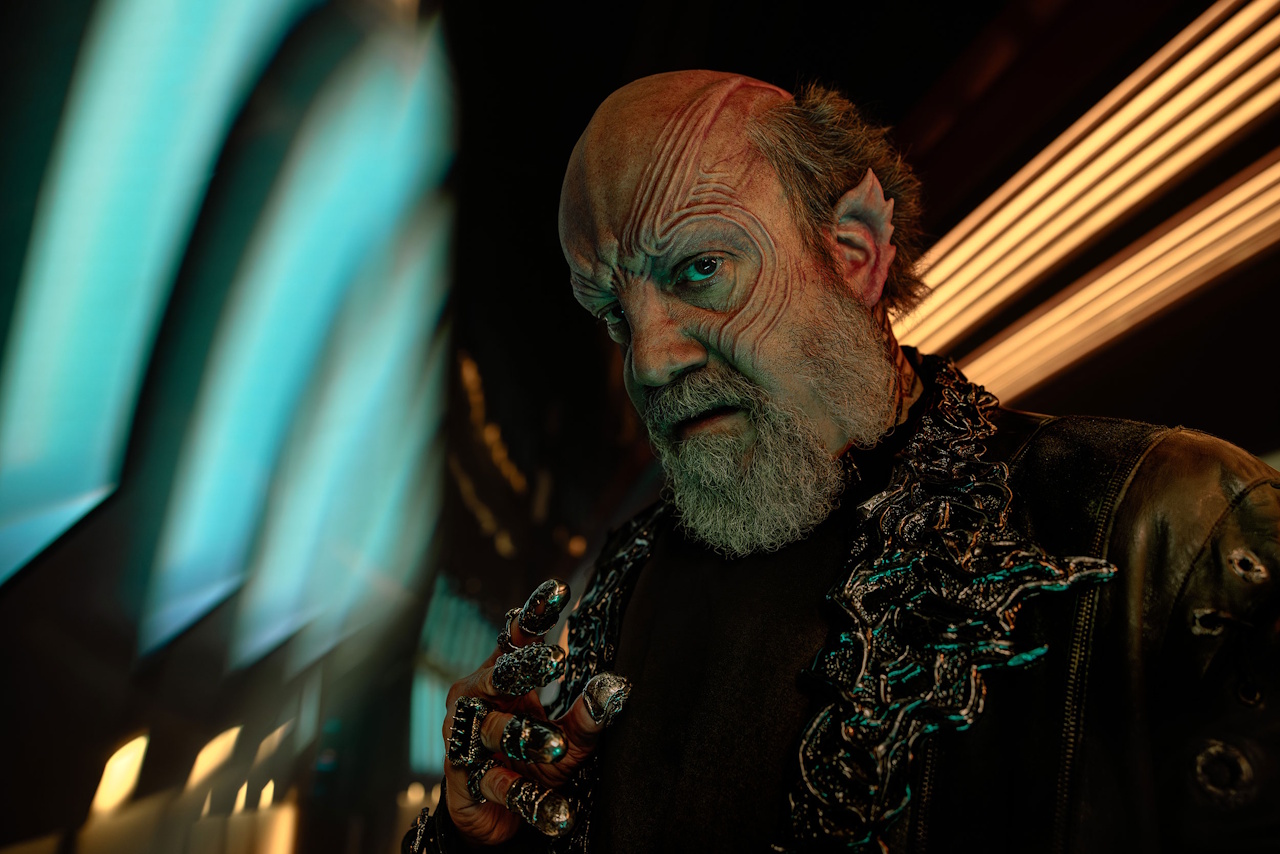
Promotional photo of Paul Giamatti as Nus Braka in Star Trek: Starfleet Academy.
Nus Braka.

The second performance from the recent clip that’s giving me pause is Gina Yashere’s. Yashere plays the role of Lura Throk – an interesting character on paper, as she’s half-Jem’Hadar, half-Klingon. But the way she delivered the couple of lines she had in the clip really just felt amateurish to me. I’m only familiar with Yashere’s work as a comedian; several of her stand-up specials were televised here in the UK, and she also appeared a few times on a comedy panel show called Mock the Week.

Lura Thok *looks* great – there’s some fantastic prosthetic makeup that’s really brought the character to life. And I’m genuinely intrigued at the possibility of learning more about the Jem’Hadar – and by extension the Dominion, perhaps – in this new 32nd Century era. But the way she delivered her lines left me incredibly wary and unconvinced; it felt like I was watching a fan film, when Lura Thok was in focus. Again, these are short moments, and the performance may come across way better in the finished product. But… this is Starfleet Academy’s big push, and the show should be putting its best foot forward to attract as wide of an audience as possible. Performances like that are not the way to do it.

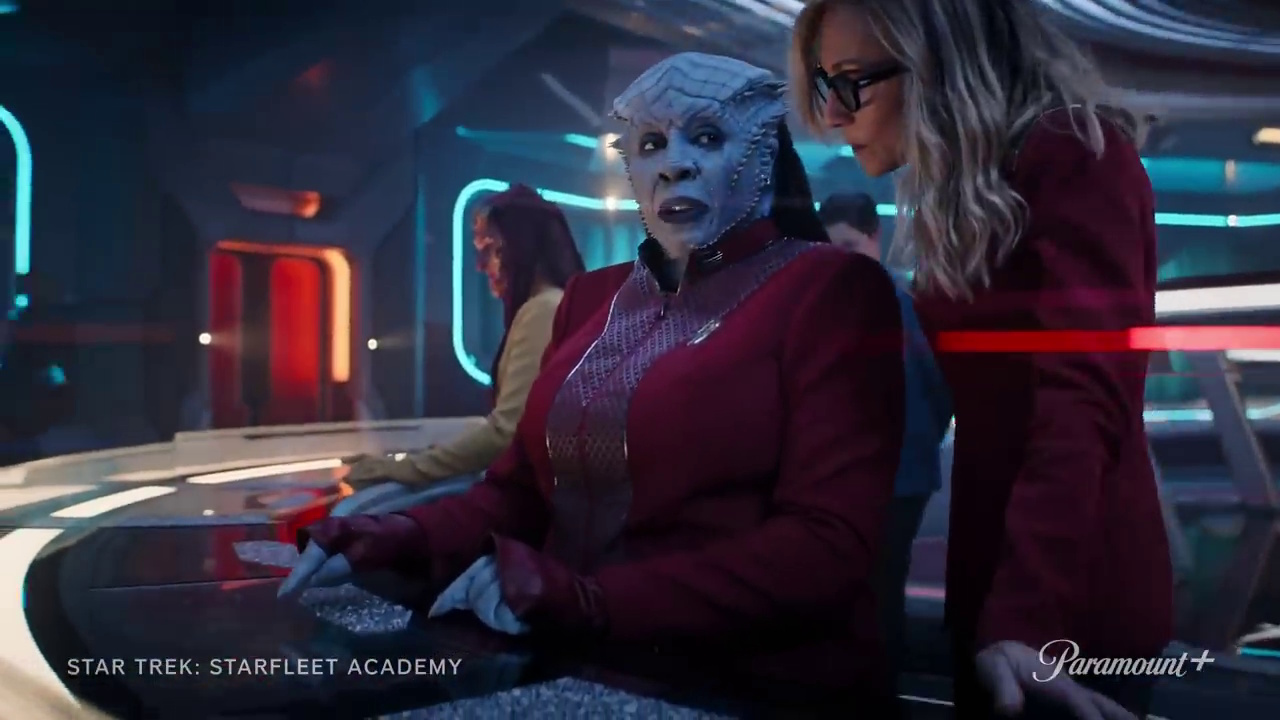
Still frame from the Star Trek: Starfleet Academy promotional clip showing Lura Thok and Captain Ake.
Lura Thok with Captain Ake.

After criticising those two performances, I find myself wrangling with Starfleet Academy’s status and its place in the franchise. When I’ve spoken about two other Star Trek projects in the past – Prodigy a few years ago and Scouts earlier in 2025 – I went out of my way to note that they’re productions aimed at a younger audience. That, by definition, changes how we approach them and where we might choose to be critical. In short, Prodigy and especially Scouts aren’t really being made for the likes of you and I – adult fans who’ve been Trekkies for a long time. They’re aimed at children, with a view to expanding the Star Trek franchise beyond its usual niche.

Is Starfleet Academy in the same camp? Or, to put it another way, am I being too harsh on the show already under the mistaken impression that, because it’s in live-action not animation, it should be held to the same standards as the likes of Strange New Worlds?

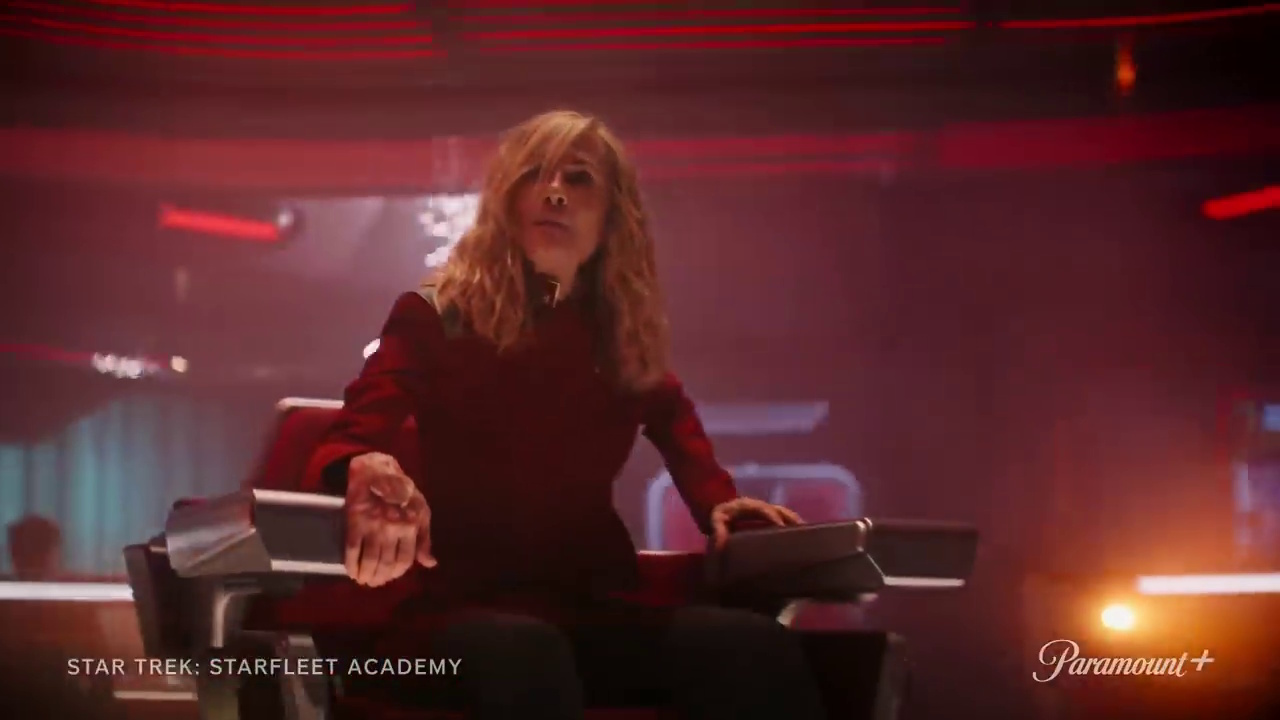
Still frame from the Star Trek: Starfleet Academy promotional clip showing Captain Ake in the captain's chair.
Nahla Ake in the captain’s chair.

This gets to a deeper question, I guess. What’s the purpose of Starfleet Academy? Is it to give Trekkies and sometime fans of the Star Trek franchise another show to enjoy? Or is it aiming to attract a younger audience – tweens, teens, and young adults, the kinds of folks who’ve shown up in droves for the aforementioned Wednesday and Stranger Things? And if it’s the latter… should we be a bit more forgiving about some of the things we don’t like?

Some entertainment products which are supposedly made for kids or aimed at a younger audience end up going way beyond their target demographics. I have a neighbour who’s in his 80s, and in a random conversation with him he brought up that he’d watched and enjoyed Wednesday, having been a fan of The Addams Family decades earlier. And speaking for myself, I greatly enjoy some films and TV shows aimed at a younger audience: just this year I’ve watched and enjoyed Phineas and Ferb, for instance, and the film KPop Demon Hunters. So I don’t necessarily think that the argument “it’s for kids, dumbass” can or should be used to cover any and all flaws; there’s good and bad kids’ entertainment, just as there’s good and bad entertainment made for adults. But, at the same time, Starfleet Academy’s marketing material has shown me pretty clearly that, as someone in their 40s, I’m not really the target audience for a show about young adults at their equivalent of university. And I’m okay with that!

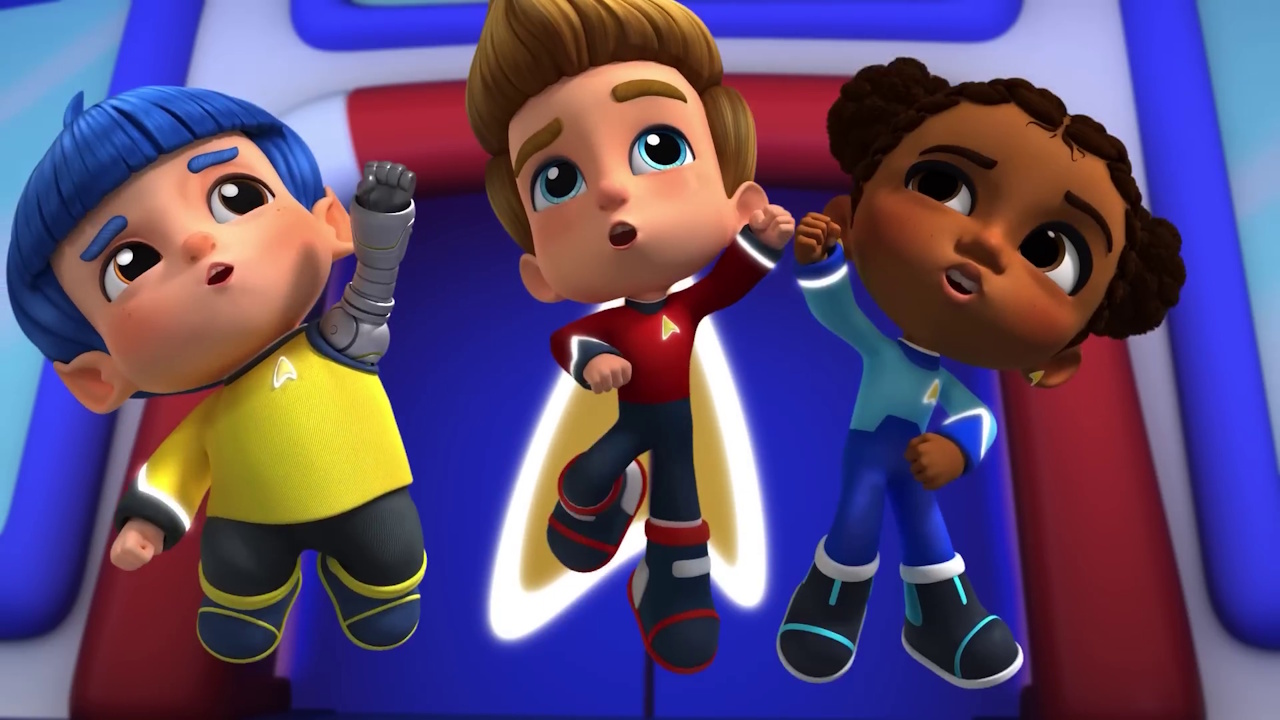
Still frame from Star Trek: Scouts showing the three main characters.
Star Trek: Scouts is a new web series aimed at a preschool audience.

I want to judge Starfleet Academy as fairly as possible, and meet it where it is, on its own terms. This is something I’ve said before on multiple occasions – earlier this year, for instance, I wrote that Star Trek: Section 31 felt, to me, like a perfectly adequate B-movie; not great, not terrible, the kind of mindless action flick that’s the television equivalent of “easy listening” and that doesn’t demand much thought or attention. When I realised that I was watching a B-movie, I kind of went with it. While I get that there was a lot of disappointment in the fan community around Section 31, on its own terms, it was okay. Not the best thing I’ve ever seen the franchise put out… but in context, it was fine.

So… shouldn’t I try to be consistent and hold Starfleet Academy to that same standard?

Rather than judging Starfleet Academy by the standards of Picard and Strange New Worlds, I think – based on what I’ve seen so far – we need to compare it to something like… Dawson’s Creek or The O.C. It’s clearly being pitched to younger folks as a “teen drama” set in the Star Trek universe, not a Star Trek show which just happens to have young adult characters. And maybe that means we’ll get storylines about first loves, skipping class, overly-strict teachers, and all of the tropes that come with that kind of television. That isn’t usually my cup of tea… but I will try to keep that in mind when I talk about Starfleet Academy and the stories it aims to tell.

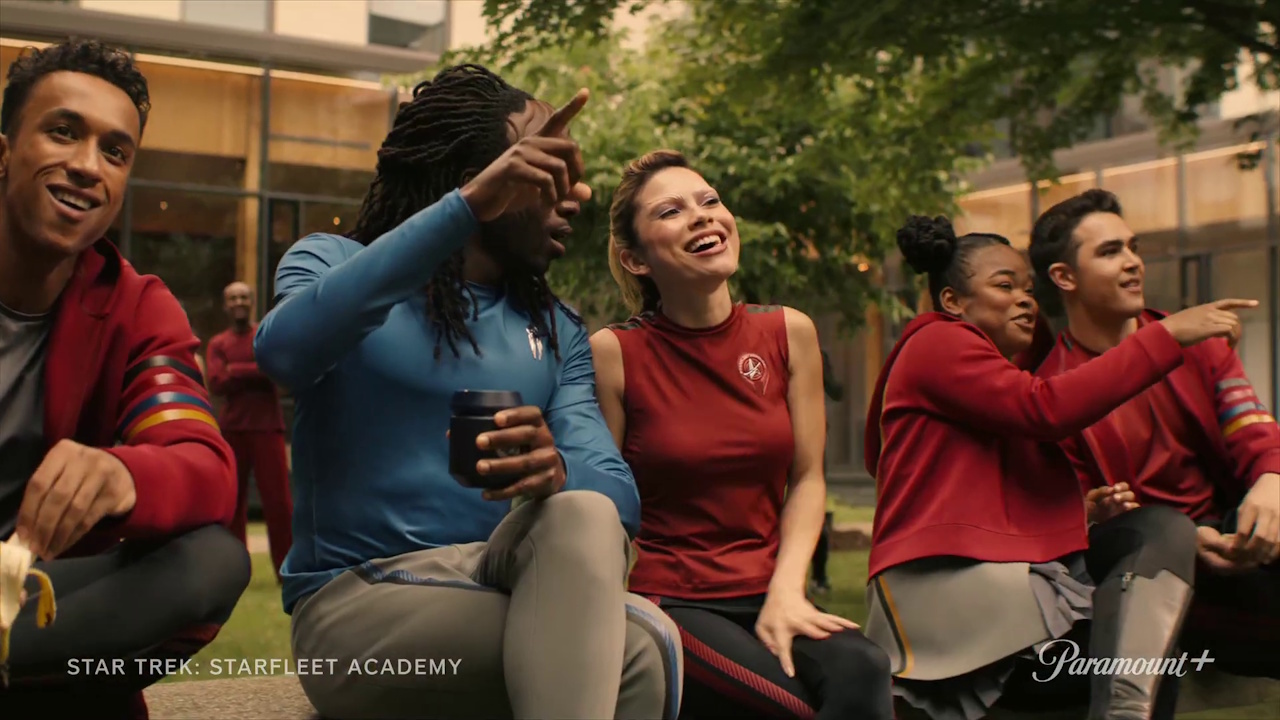
Still frame from the Star Trek: Starfleet Academy trailer showing the cadets.
The main cadet characters, as seen in the first trailer.

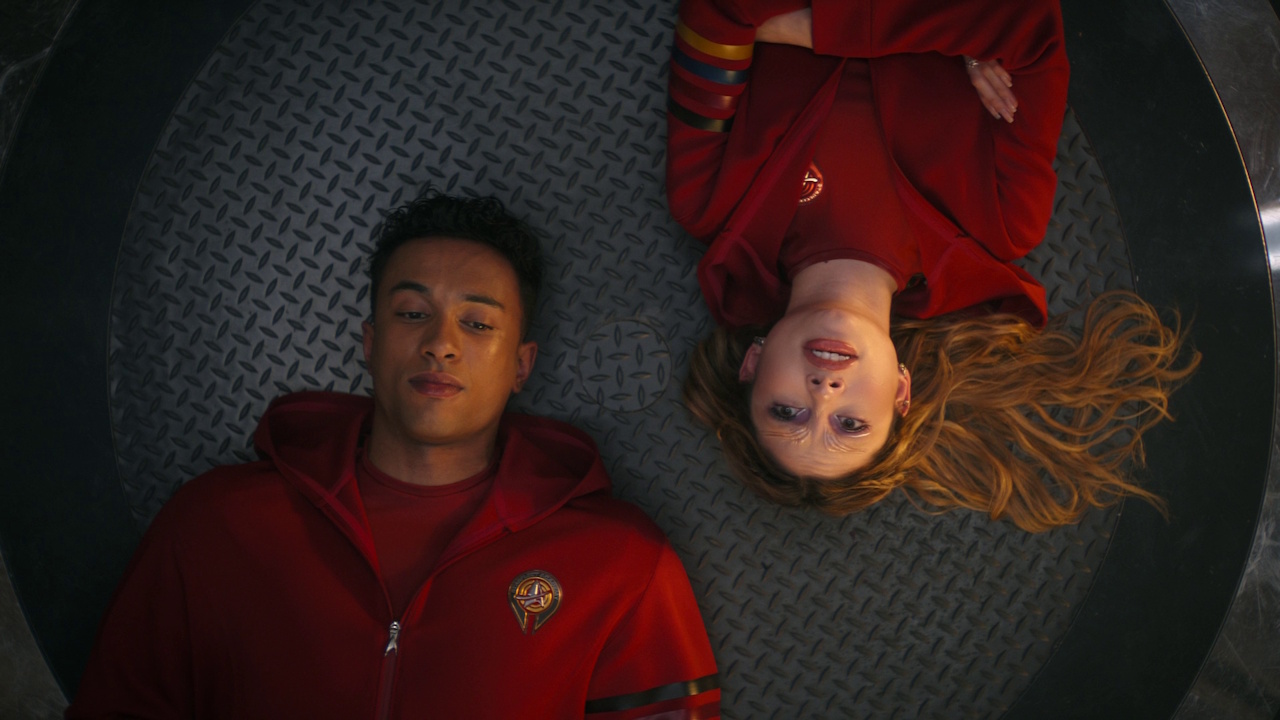
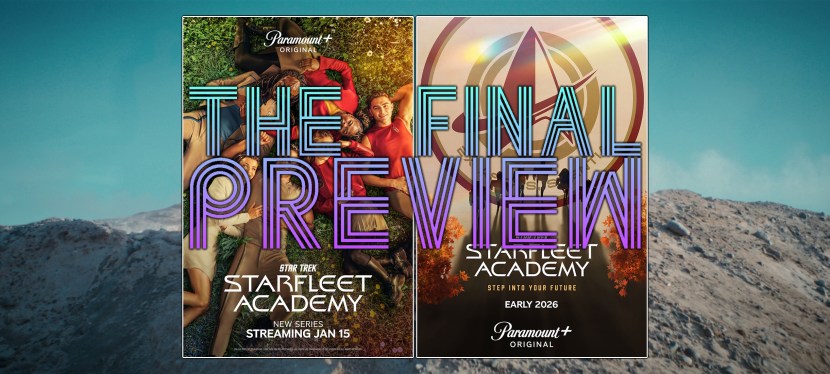
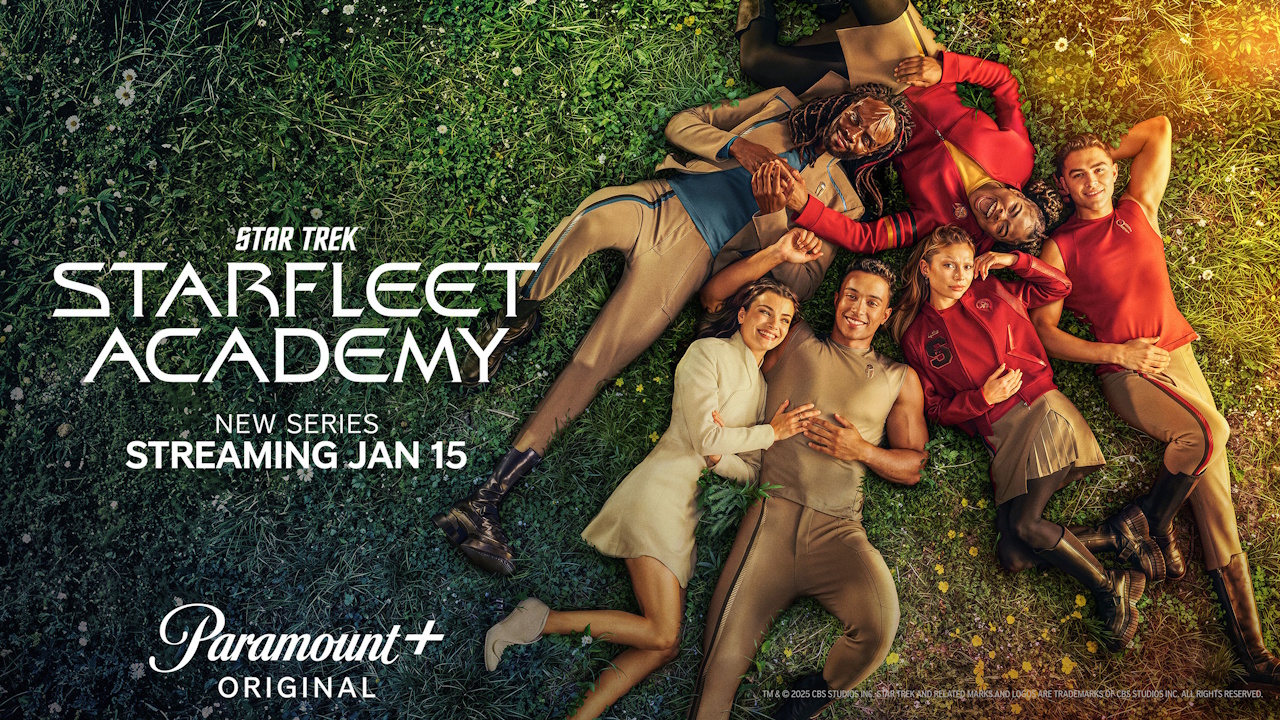
The recently-released poster also leaves that impression. I’ve seen some Trekkies online complaining about or criticising the poster – which depicts the cadets in a casual pose, lying on the grass, presumably in between classes! It evokes a kind of carefree schooldays feel, as if the characters are taking a break from their lessons and whatever personal conflicts or drama may be brewing.

Again, trying to keep in mind who Paramount-Skydance is trying to appeal to… I think that’s probably a good way to go. If the objective is for Starfleet Academy to be a teen drama first and a Star Trek show second, this kind of promo is *exactly* what I’d have suggested. It doesn’t mean we’ll get to see the poster recreated in the show itself, but rather the sensation or feeling that the designers and marketers wanted to create is one of carefree youth. Hopefully it’ll reach the right eyes and convince some new folks to tune in.

Promo poster for Star Trek: Starfleet Academy (landscape version).
The new promotional poster.

To get back to the latest clip, I’m glad we got to see the Doctor in action. Robert Picardo seems to have slid effortlessly back into the role, and I’m really keen to see what this new take on the character will look like. We’re catching up with the Doctor centuries after we last saw him, though I got the impression from a recent interview that *maybe* the Doctor’s holo-programme hasn’t been running continuously for all of that time. Don’t quote me on that, it’s as much a guess as a “theory,” at this stage!

Although the Doctor will clearly have some kind of role as an educator, the clip showed him back in action, tending to and potentially treating wounded cadets and Starfleet personnel after the attack on the USS Athena. Even if that’s the only time the Doctor plays that kind of role… I’m still glad to see it! As an artificial life-form, the Doctor should retain all of his knowledge and skills, even after all this time. I hope the Doctor’s role won’t just be a succession of short cameos, though. There are only ten episodes in the new season, and we’ve got a whole new cast of characters to meet and new storylines to follow. But if Star Trek is gonna do this – bring back another legacy character – they have to be handled with care, and given enough time in the spotlight to feel like they’re there for a purpose. Otherwise… it’s just a nostalgia play to get grumpy old gits to tune in for this new kids’ show!

Still frame from the Star Trek: Starfleet Academy promotional clip showing the Doctor assisting an injured colleage.
The Doctor… and the patient.

We didn’t see very much of the cadets in the recent clip. A scene on the bridge with Captain Ake was interesting – and we’ve learned fairly recently that she’s a Lanthanite. The Lanthanites are a long-lived humanoid species, of which Pelia, from Strange New Worlds, is the only member we’ve met so far. I wonder if there’ll be a connection between them, or some kind of reference to Pelia in the new series.

Holly Hunter, the Academy Award-winner who plays Captain Ake, was far and away the standout performer in the recent clip. She seems to have perfectly brought to life this character who’s both a captain and a teacher, ancient and wise yet constantly surrounded by children. There wasn’t much of Pelia’s light-heartedness in Captain Ake’s characterisation, but that’s fine. I don’t think that, just because one member of a species acts a certain way, every subsequent character must do the same! I’m not sure how I feel about her choosing to wear glasses, though – but perhaps it’ll be explained that that’s a quirk she’s retained after centuries of life? I dunno.

Still frame from the Star Trek: Starfleet Academy promotional clip showing Nahla Ake.
Captain Nahla Ake.

I’m not *wild* about the design of the USS Athena. To be fair, I don’t think what I’ve seen of the exterior of the ship is atrocious, and it’s probably in line with other 32nd Century Starfleet designs that we saw in Discovery… but I wasn’t especially keen on those, either. Inside, the bridge still feels to me like a redress of the USS Discovery bridge set, rather than a totally original creation. Combined with an exterior that doesn’t feel all that special, the USS Athena just doesn’t strike me as being particularly memorable. When I think about some of the best starship designs, my mind goes to iconic vessels like the Excelsior-class, Galaxy-class, or Intrepid-class. All I can say is that I hope the Athena will grow on me over the course of the show.

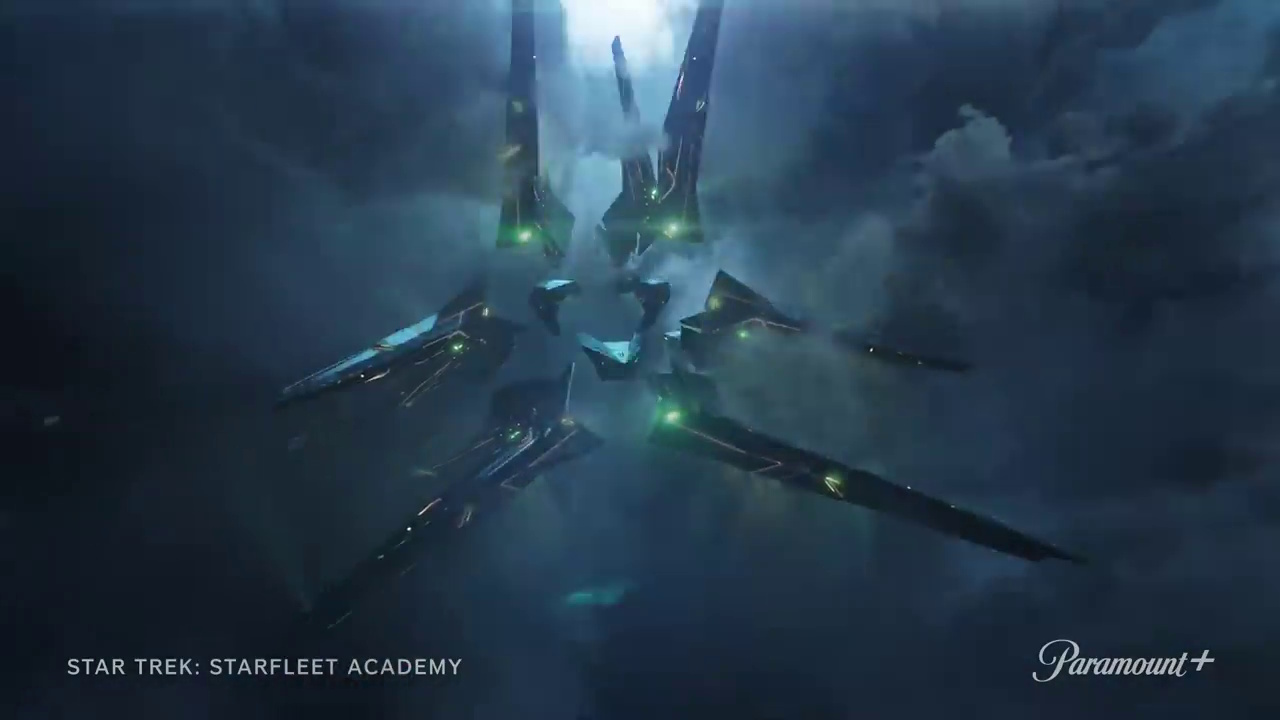
One thing I did like, though, was the design of Braka’s ship. Three separate pieces seem able to break apart and come together. It reminded me of a cross between Booker’s ship, which we saw in Discovery, and the USS Prometheus from Voyager, which also had a three-part separation sequence. Perhaps there was also a dash of the Shrike – Vadic’s ship from Picard – thrown in there, too. Certainly a more memorable design than the Athena!

Still frame from the Star Trek: Starfleet Academy promotional clip showing a villain's spaceship.
Nus Braka’s three-part ship.

The callback to Discovery’s programmable matter was interesting – but I hope this will be developed a bit more in the new series. In Discovery, programmable matter was basically a glorified macguffin, used to fill holes in a few storylines but without ever really being explained. Star Trek’s technobabble has always been like that, but if programmable matter is as important to Starfleet in this era as it appeared in Discovery, and is going to be used by the villain of this story, I hope we get to look at it in a little more detail this time.

One thing I noted in the clip was that Caleb – the cadet we saw being rescued by Captain Ake, and who seems to have a mysterious connection to Nus Braka – didn’t know what this programmable matter attack was. Does that tell us something, perhaps, about his life prior to enlisting in Starfleet? I thought it was potentially interesting that, of all the cadets who could’ve filled that role, it was Caleb who was the one to get the “what is that?!” line. It could be nothing of consequence, though, if Starfleet Academy ends up following Caleb’s story more closely than those of the other cadets.

Still frame from the Star Trek: Starfleet Academy promotional clip showing Caleb and Kraag.
Does this moment mean… anything?

I think that’s everything I had in my notes for today.

This time last year, I said that I was sceptical about the Section 31 TV movie. I felt that it was targeting a younger audience, raised on action and superhero flicks, and that that kind of film might not be to my taste. But I tried to set appropriate expectations and gave the film as fair a shake as I could. I will endeavour to do the same for Starfleet Academy, which likewise feels like a project that may not be “my thing.”

I hope this has been interesting, and I hope I didn’t come across as too harsh, unfair, or overly negative. I really will try to be fair to Starfleet Academy when it premieres next month, and to go into the show with an open mind. Even if it is the kind of teen drama that I’m assuming, based on its marketing material, that doesn’t, by default, mean it will be unenjoyable! The clip may not have impressed me, and I do have some concerns about the show’s villain and a potential return to serialised storytelling. But I’m also crossing my fingers and hoping that – finally, belatedly – *this* will be the project to bring a new generation of fans to the Star Trek franchise.

Still frame from the Star Trek: Starfleet Academy promotional clip showing the programmable matter attack.
The programmable matter attack…

In January, I plan to review Starfleet Academy’s premiere, which I think I’m right in saying will be two episodes. After that, I will make a decision about whether or not to review individual episodes or the season as a whole – that’s not something I want to commit to until I’ve got more of a feel for the show. But regardless, I will review Starfleet Academy in some form in the new year, so I really hope you’ll join me again for that.

And until then, I’ve still got a couple of other reviews from 2025 that I’m working on, and later in the month there’ll be my annual End-of-Year Awards, in which I’ll hand out some imaginary trophies and made-up statuettes to some of my favourite entertainment experiences of the year. Hope to see you for some of those!

Live Long and Propser, friends!


Star Trek: Starfleet Academy will premiere on the 15th of January 2026 on Paramount+ in countries and territories where the platform is available. Star Trek: Starfleet Academy is the copyright of the Skydance-Paramount corporation. This preview contains the thoughts and opinions of one person only and is not intended to cause any offence.
Star Trek at Comic-Con: A Teaser and a Trailer

A Star Trek-themed spoiler warning.

Spoiler Warning: Beware of spoilers for upcoming seasons of Starfleet Academy and Strange New Worlds. Spoilers are also present for the following Star Trek productions: The Undiscovered Country, Voyager, Discovery, Prodigy, and Picard.

The Star Trek franchise popped up at New York’s Comic-Con event this week, building up the hype for Starfleet Academy and the next season of Strange New Worlds. I thought we could take a look at them together, as we begin to get excited for next year’s Star Trek projects.

First of all, it does seem, based on the release of the teaser clip and Starfleet Academy’s mid-January premiere, that Strange New Worlds Season 4 is on the schedule for 2026. That’s good news! After the two-year gap in between Seasons 2 and 3, and with Starfleet Academy still in post-production, I wasn’t sure if Strange New Worlds would manage a 2026 broadcast, but it’s good news in my book that we don’t have to wait too long for the next instalment in what is still my favourite modern Star Trek series.

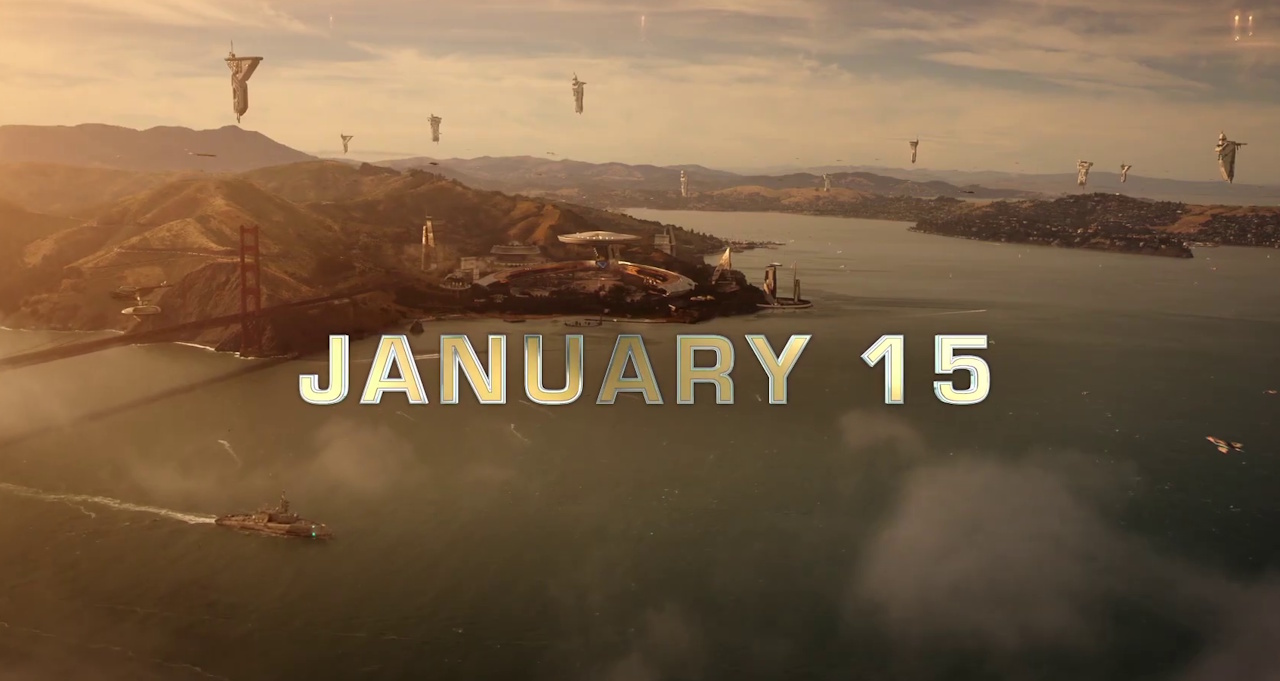
Still frame from the second trailer for Star Trek: Starfleet Academy showing the premiere date.
Starfleet Academy will be on our screens in just over three months!

Since we’re talking Strange New Worlds, let’s take a look at the teaser clip first.
Firstly, I’m not 100% sure if this was one continuous sequence, or if there wasn’t at least one cut somewhere in the middle. It kind of feels, to me, like a scene or two might be missing… but that could also be where the title sequence will appear in the finished episode, I guess! In any case, the Strange New Worlds teaser was taken from a single episode, and it shows Pike and the crew getting into trouble with what looked somewhat like a plasma storm or ion storm.

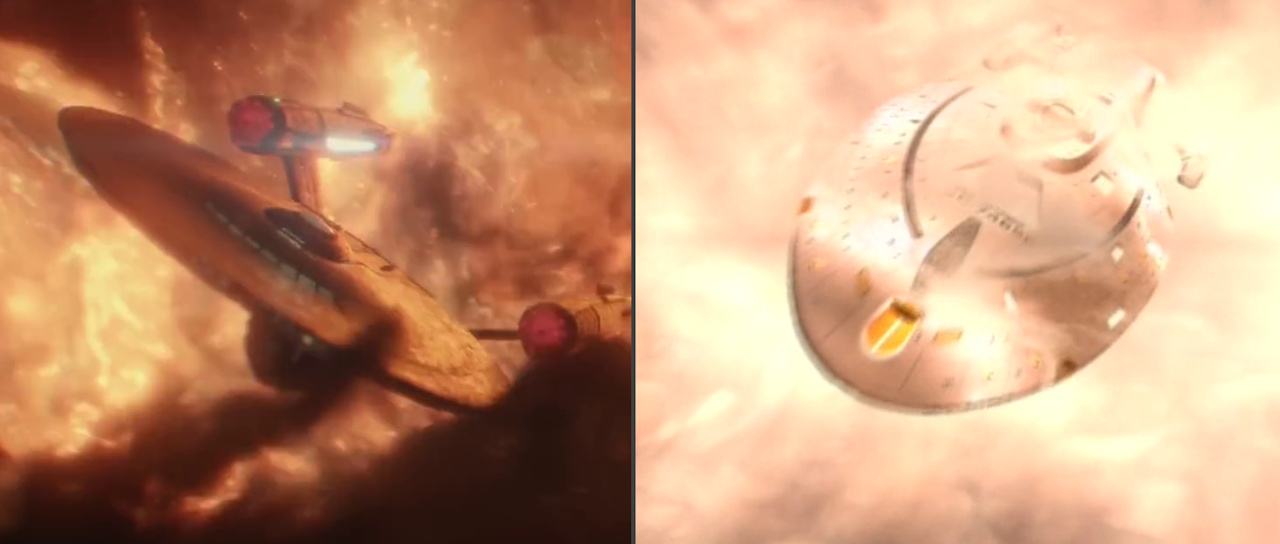
How, exactly, a plasma storm might’ve thrown the Enterprise to a different point in space is… debatable! But we’ve seen similar things happen before; I actually got a “Caretaker” vibe from that part of the clip, as the ship got caught in an expanding space storm and ended up somewhere different. I’m not saying this will be the Delta Quadrant, of course! But as I’ve said before, sometimes Star Trek stories kind of rhyme, and this clip was definitely reminiscent of Voyager’s premiere for me.

Side-by-side comparison of Star Trek: Strange New Worlds Season 4 and Star Trek: Voyager Season 1, showing both starships caught in an orange-tinted region of space and being tossed around.
The USS Enterprise in the Season 4 teaser and the USS Voyager in Caretaker.

I’m glad that we got to see Ortegas back at the helm after her Gorn encounter. I think, having sat with it for a month or so, that Terrarium might be the best episode of Season 3, and I’m definitely excited to spend more time with Ortegas (and some of the show’s other original characters) before Strange New Worlds wraps up. Ortegas was also present on the shuttle mission at the end of the clip, and really seems to be back in her element in the pilot’s seat.

Another character I was pleased to see was Pelia! Pelia seemed to draw the short straw in Season 3, with Scotty taking over key engineering storylines in episodes like A Space Adventure Hour, but she’s at least going to be present in Season 4 and hasn’t just been unceremoniously shuffled off-stage. That makes me happy; Pelia is a great comic relief character and has had some of the best and funniest lines in Seasons 2 and 3. Getting the right balance between Pelia and Scotty – the chief engineer and the deputy – is something Strange New Worlds still needs to work on, but I think Pelia’s presence in the teaser clip is promising, at least.

Still frame from the Star Trek: Strange New Worlds Season 4 promo clip showing Pelia.
Pelia.

Spock and La’an were seen together in the clip – though not in a romantic setting! La’an did seem to be looking at Spock, though, and I suspect that their relationship will continue at least at the beginning of Season 4. As I said, though, when Season 3 was on the air: I kind of need a break from that. I don’t want more “Spock comedy,” or “Spock romance,” not with only a few episodes remaining before Strange New Worlds will be over. So I hope the writers aren’t going to push for more of those things in Season 4. Hard to tell from just this one clip, of course!

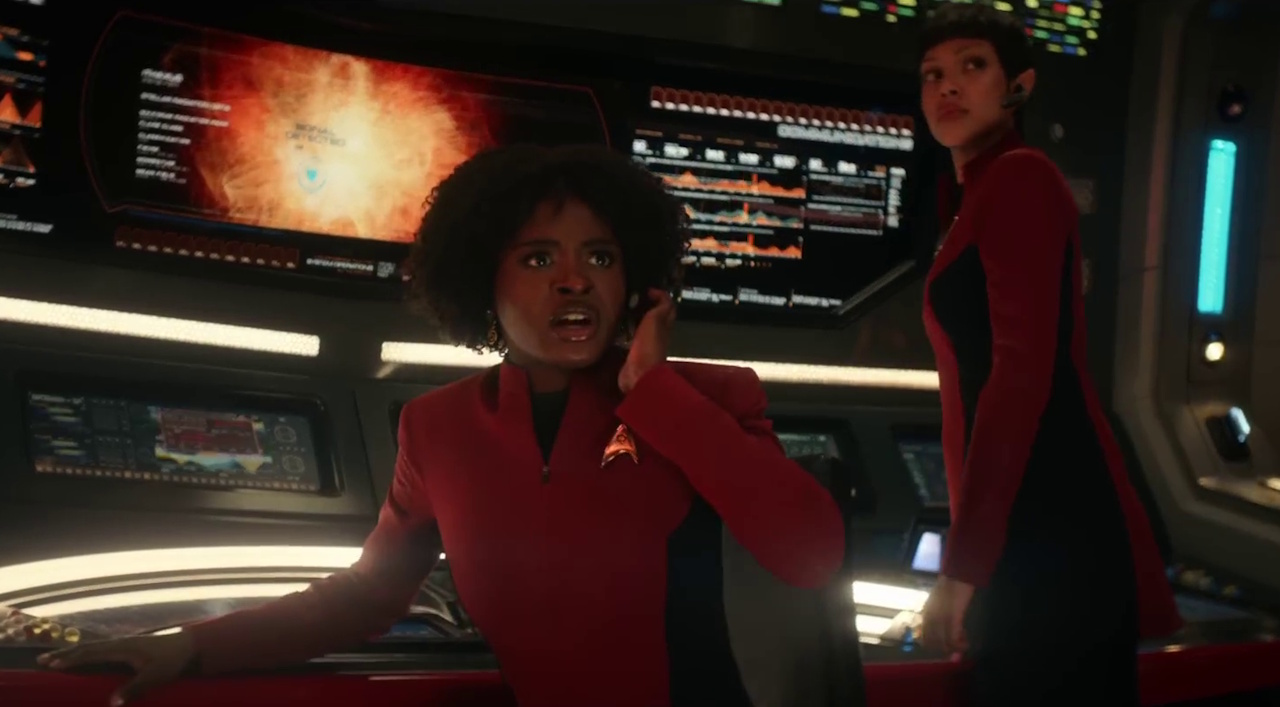
We also caught a glimpse of a new Vulcan character – a cadet, who seems to be shadowing Uhura on the bridge. Giving Uhura a mentorship role could be a fun way to extend her character arc, so I’m on board with that! Part of me wonders if this character is intended to be someone familiar: perhaps Tuvok’s wife, T’Pel, who we saw briefly in Voyager, or even someone like Saavik or Valeris. Given Valeris’ later role in The Undiscovered Country, that could be interesting.

Still frame from the Star Trek: Strange New Worlds Season 4 promo clip showing Uhura and a cadet.
Uhura with the Vulcan cadet.

Pike’s line to Una, asking her if she’d miss space exploration if she had to give it up, felt poignant – and could be related to Pike’s impending accident and disability. Perhaps his knowledge of the future is weighing on him during this mission, maybe he’s still mourning Captain Batel after losing her at the end of Season 3, or it could be connected to the fantasy life we saw in the Season 3 finale. In any case, the line stuck out to me, and clearly indicates that Pike has a lot on his mind beyond just the mission at hand.

This aspect of Pike’s characterisation – his knowledge of what lies in store for him – has made this iteration of the character incredibly impactful and relatable to me personally. I read his story through the lens of my own poor health; I’ve been Captain Pike, hearing bad news about my health and future prospects, knowing there isn’t anything I can do, and the way Anson Mount brings that to the screen has always been nothing short of fantastic. Given that it will probably be a big plot point in the cut-down fifth season, I’m not sure how important Pike’s imminent accident will be this time around, but this clip seems to hint at it being important for him in at least one episode.

Still frame from the Star Trek: Strange New Worlds Season 4 promo clip showing Pike and Una on the bridge.
Pike’s line to Una really stood out to me.

I don’t remember the element iridium being mentioned a lot in previous Star Trek stories, but I like this little expansion of the lore of Star Trek. According to Scotty, iridium is necessary to “ignite” the warp engines – presumably meaning it’s important to the antimatter reaction along with dilithium. In any case, missing iridium seems like a suitable driving force for a story that looks set to take Una, La’an, and Ortegas to – as Captain Pike put it in a kind of too on-the-nose line – a “strange new world.”

Not sure what else to say about the Strange New Worlds clip. I think the episode looks like it’ll get off to a solid start, it was nice to see most of the crew getting a line of dialogue or something to do, and there were enough little teases to get me excited. Pike’s story looks like it could be complex, a new Vulcan cadet could be a fun addition to the bridge, even if she’s only present for an episode or two, and I’m genuinely curious to learn more about this mysterious storm in space and where it might’ve taken Pike and the Enterprise. Could I be about to get my “Pike versus the Borg” story that I’ve been harping on about for years? Erm… no!

Still frame from the Star Trek: Strange New Worlds Season 4 promo clip showing Una, La'an, and Ortegas on a shuttlecraft.
Destination: unknown.

Next, let’s talk about Starfleet Academy.

In a frankly bizarre move, comedian and late-night talk show host Stephen Colbert was announced as having a voice-only role in the series. Apparently, Colbert is a bit of a Star Trek fan, and he’ll be providing the voice of the “Digital Dean of Students” at the Academy. Colbert treated us to what he said was one of the actual lines from the show – and it was… fine, I guess?

I’ll be honest: this feels like stunt casting; hiring a big-name star for no other reason than, well, they’re a big-name star. However… if it helps draw a few more eyes to Star Trek, that’s not necessarily a bad thing. I’m just not convinced it’ll be as big of a deal as Paramount/Skydance would’ve liked, and I’m not sure it was the best possible way to close out the Comic-Con revelations and news. Maybe this is because I’m from the UK, and perhaps to an American audience, someone like Stephen Colbert is much more of a draw. I just wasn’t blown away by it, and my feelings toward the announcement were more like “erm, okay?” rather than “woah, what a great idea!”

Still frame from New York Comic-Con 2025 showing Stephen Colbert.
Stephen Colbert is joining Starfleet Academy for a voice role.

I’ve said this before, but I don’t think a show like Starfleet Academy benefits from having a main villain. I had hoped that Starfleet Academy could’ve adopted the Strange New Worlds model and done something a lot more episodic – that kind of thing feels like it’s well-suited to a show about younger characters learning about serving in Starfleet. It’s still my hope that we’ll get some of that, but it’s seemed for a while like the series is going down a serialised route similar to Discovery.

In fact, I felt echoes of Discovery in the connection between the villain, Nus Braka, and the young cadet Caleb. Every season of Discovery seemed to follow a very familiar pattern: there’s a villain who’s threatening the Federation or the entire galaxy, and somehow, that villain has a connection to one of our heroes. We had it with Lorca, Voq, and Tyler in Season 1, the Red Angel in Season 2, the Emerald Chain and the Burn in Season 3, the DMA and Tarka in Season 4, and the Breen and Moll in Season 5. Picard even got in on the action with Q and the Borg Queen in Season 2, and Vadic and Jack in Season 3, and so did Prodigy with Gwyn and the Diviner.

And I’m just so thoroughly burned out on that repetitive story concept at this point.

Still frame from the second trailer for Star Trek: Starfleet Academy showing Nus Braka, the main villain.
Nus Braka: Starfleet Academy’s villain.

However! It wasn’t all doom and gloom in the Starfleet Academy trailer. We caught a glimpse of Mary Wiseman’s Tilly for the first time in any Starfleet Academy material, which is great news. Tilly was a fun character in Discovery, and it seemed – for a time, at least – as if Starfleet Academy might be being constructed around her as a central character. There was even that backdoor pilot in Season 4 – though none of the cadet characters seem to have shown up in the new series, for some reason.

But with Tilly having been absent from all of Starfleet Academy’s marketing so far, I can’t’ve been the only one who was beginning to wonder whether she’d show up at all! Rumours suggest that Tilly may only be a guest-star for a single episode in the show’s first season, but I’m sure she’ll still be a welcome addition to the cast. It was great to catch sight of her for the first time, in any case.

Still frame from the second trailer for Star Trek: Starfleet Academy showing Tilly.
It’s Tilly!

The rest of the Starfleet Academy trailer looked… well, it looked “teenager-y.” Which makes sense, of course, given the show’s younger characters and target audience! Plenty of shows and films aimed at a younger audience or featuring younger characters still have a lot to offer to the rest of us – look at the likes of Wednesday or Stranger Things (neither of which I’ve actually seen, but they’re good examples nevertheless!) Some of the clips in the trailer seemed to show characters at the Academy falling in love, going on dates, and talking in that kind of angsty way you sometimes get in teen dramas. I’m not sure whether all of that (or any of it) will be to my taste, but I’m content to give the show and these characters a chance to impress me.

One thing I hadn’t clocked until recently was that Sam – one of the new cadets – is a hologram. I think this is really interesting given that Voyager’s Doctor is also going to be present in the series, and I can already see the two of them developing a connection over a shared (or similar) heritage. That’s something that could be really interesting, and I wonder if we’ll get an exploration of how holographic rights developed in the years after Voyager.

Still frame from the second trailer for Star Trek: Starfleet Academy showing Sam and the Doctor.
Sam and the Doctor.

Nahla Ake, the captain and Chancellor of the Academy, is sure to be one of the series’ breakout characters. She’s brought to life by Academy Award-winner Holly Hunter, and the Star Trek franchise really lucked out to land a performer of such calibre. Though I’m not sure her personal connection with Caleb is the right move narratively, I’m really excited to see what this new character will be like, how her style of command will be, and how the rest of the cadets will respond to her. I think there’s a ton of potential there.

It was a deliberate choice to make Starfleet Academy a spin-off from Discovery, set in that same far-future time period. I’ll be curious to see how the show will lean into that, and whether the “post-apocalyptic” setting caused by the Burn and its lingering aftershocks will be a big part of the main storyline. In a way, I hope that Starfleet Academy will be able to do something more meaningful with that idea than Discovery managed… but I won’t lie: a big part of me regrets that this show couldn’t have been set in the Picard era instead.

Still frame from the second trailer for Star Trek: Starfleet Academy showing Caleb looking disheveled.
Caleb.

It seems like Starfleet Academy is setting up Caleb, Captain Ake, and Nus Braka to be the principal characters, all tied up together in a “mystery box” type of story surrounding Caleb’s missing mother. I’m still not convinced that this was the right approach, but maybe if it’s a solid enough story it will at least be worth following to its conclusion. Based on what we saw of him in the trailer, I wasn’t actually wowed by veteran actor Paul Giamatti’s performance – he felt too over-the-top for my liking. And that’s a shame; Giamatti is a fine actor, and someone I’ve been looking forward to seeing in Star Trek. Hopefully it’s just a consequence of the way the trailer was cut; in context, those moments might feel better and make a lot more sense.

I hope Starfleet Academy isn’t going to do the clichéd (and also played-out) trope of “everyone has a hidden secret backstory.” We seemed to get hints at at least two of the other cadets – Genesis and Darem – having some kind of issues with their families or in their past that are driving them to seek positions in Starfleet. I don’t think every character needs that kind of motivation – especially not young, school/university-aged characters. Isn’t it enough to say they’re looking to make something of themselves, or that Starfleet appealed to them because they wanted to be scientists or explorers? Complexity can make a character great in any work of fiction – but not every complex character needs to have some kind of mysterious or traumatising past to explain why they are the way they are. I’m just a little concerned that Starfleet Academy is leaning too much into that kind of storytelling.

Still frame from the second trailer for Star Trek: Starfleet Academy showing Genesis Lythe.
Why does Genesis say she “needs” to be a captain?

I hope this has been an interesting glimpse at both Starfleet Academy and Strange New Worlds. I still haven’t decided yet whether I’m going to review every Starfleet Academy episode or not – I think, at the very least, I’ll review the premiere, just to see how the series is starting off! But whether I do individual episode reviews or review the rest of the season in one hit, I hope you’ll join me for that in January. And I’m hopeful that Strange New Worlds Season 4 will debut later in 2026, too – and I will definitely write up individual episode reviews there, as I did for Season 3 earlier this year.

Obviously, Strange New Worlds remains the Star Trek project I’m most excited for; nothing in the Starfleet Academy trailer convinced me that I should change my mind about that! But, despite what I’d consider to be some narrative red flags, I’m still hopeful that Starfleet Academy will be fun. Even if it’s not “my thing,” perhaps it will finally be the series that reaches out to a new generation of viewers, turning them into Trekkies and kick-starting a renaissance for the franchise that the fan community arguably needs.

In any case… we don’t have much longer to wait!


Star Trek: Starfleet Academy will premiere on Paramount+ in January 2026. Star Trek: Strange New Worlds Seasons 1-3 are available to stream now on Paramount+ and Season 4 looks set to premiere later in 2026. The Star Trek franchise – including all shows and properties discussed above – is the copyright of Skydance/Paramount. This article contains the thoughts and opinions of one person only and is not intended to cause any offence.