

Spoiler Warning: There are spoilers ahead for Star Trek: The Next Generation Season 5, and minor spoilers for Star Trek: Starfleet Academy Season 1.
With Starfleet Academy’s first season currently on the air, I got thinking about the institution. Although we caught a glimpse of the Academy in The Wrath of Khan, its first major on-screen appearance came a decade later in Season 5 of The Next Generation. I thought it could be interesting to return to that episode today, in light of the different approach taken by the new young adult-focused series, and re-watch The First Duty.
I was surprised, when I looked into it, by two things: firstly, how Starfleet Academy only appeared relatively late into The Next Generation’s run. By the time we made our first visit to the Academy, DS9 was already in production, less than a year away from launch, and The Next Generation was well past its halfway point. And secondly, I was surprised at how few appearances the Academy itself actually made during The Next Generation era. Starfleet Academy only appeared twice in The Next Generation and once in Voyager – in simulated form – though the same filming location was re-used as Starfleet Headquarters in Deep Space Nine, Voyager, and Enterprise, which is probably where my confusion stemmed from.
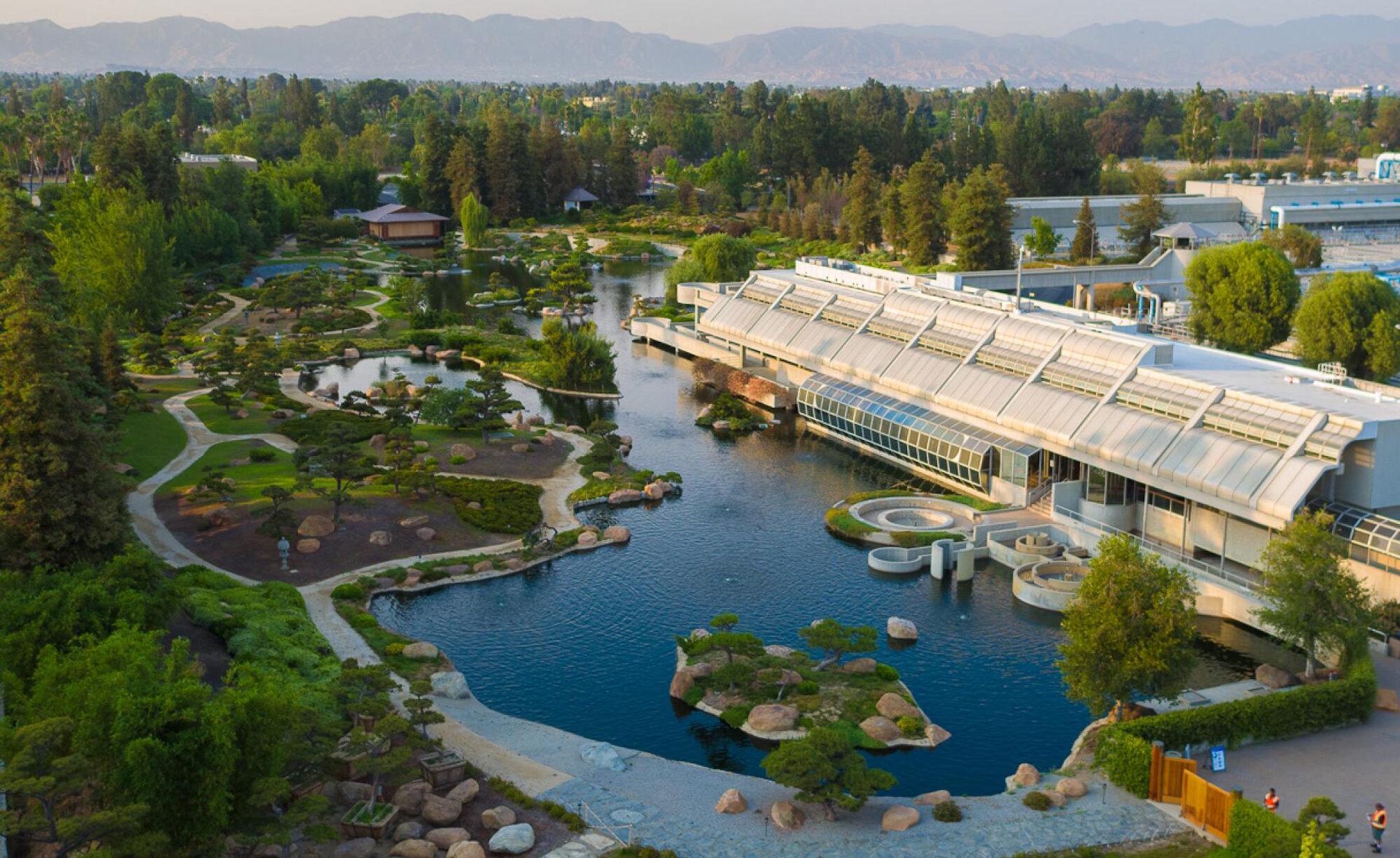
Photo: City of Los Angeles/L.A. Times
Still, it’s interesting, isn’t it? The Academy feels like an iconic institution within the broader lore of Star Trek, yet it made relatively few on-screen appearances in The Next Generation era – and none at all in The Original Series.
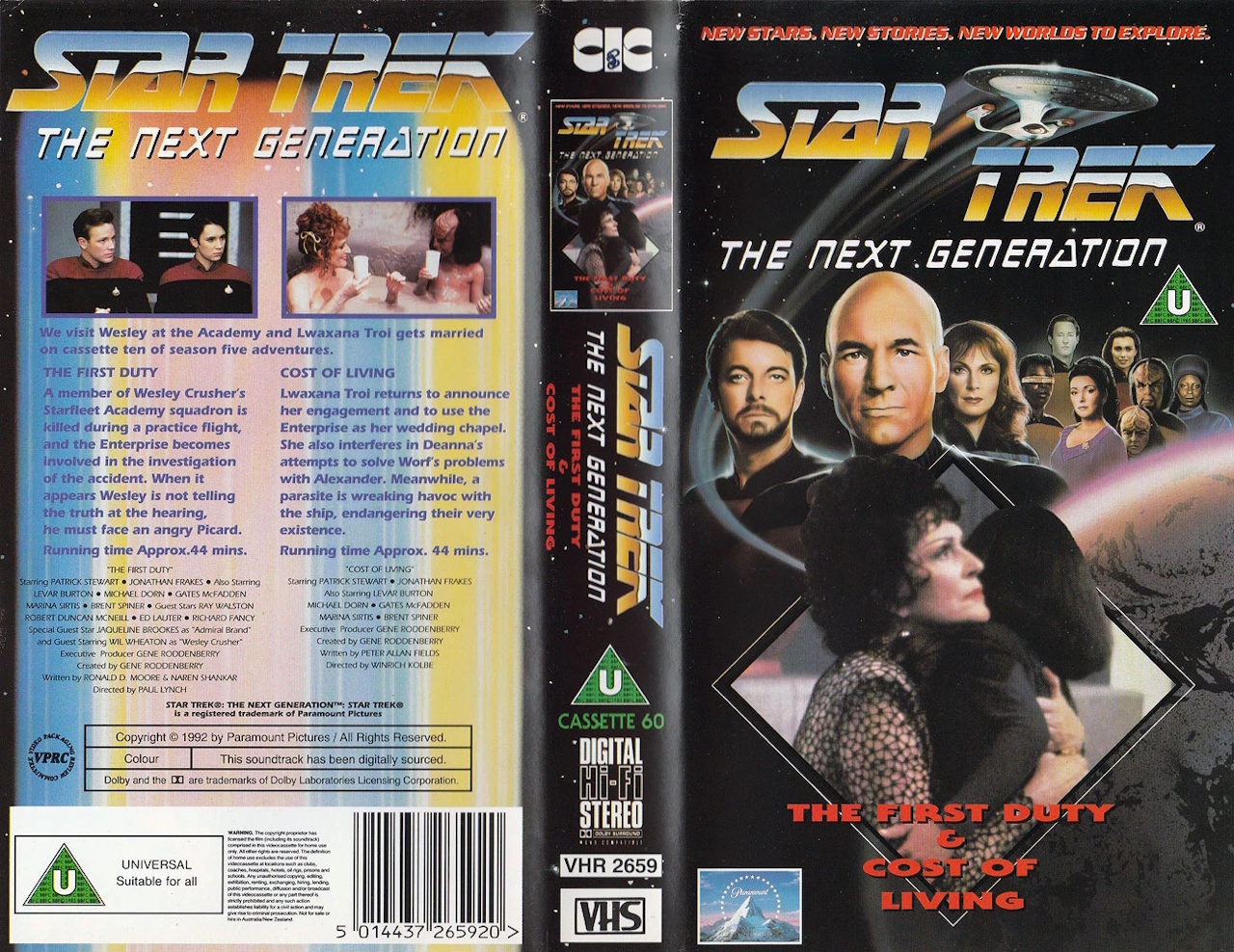
The First Duty is one of a few episodes that I managed to watch *before* its terrestrial broadcast here in the UK – because I rented it on VHS! I couldn’t tell you exactly when; I’d guess sometime in 1993 or 1994. Star Trek video cassettes were a rarity in rental shops in the small towns around where I grew up, so I’d usually jump at the chance to grab a pair of episodes to watch! I’m almost positive I also caught the episode’s first broadcast on the BBC, too, which would’ve been in 1995. After acquiring The Next Generation on DVD, I watched the episode again multiple times, and I’ve since re-watched it on streaming, too.
What’s the point of explaining all of that? Well… my occasional “episode re-watch” series isn’t a “review.” It’s way too late for me to write anything like an “episode review” for a series I adore and for an episode I first watched more than three decades ago! This is going to be my thoughts on the story, but some of how I feel about The First Duty has probably shifted with the benefit of hindsight, with ageing, and after having viewed literally hundreds more Star Trek episodes that have premiered in the intervening years. It should also go without saying that everything we’re going to get into today is the *subjective, not objective* take of just one person. If you hate The First Duty, love it more than I do, disagree with my take, or think I’ve completely missed the point… that’s okay! We’re all here to just geek out about Star Trek, at the end of the day, and I share my take on this classic episode with the Trekkie community in that spirit.
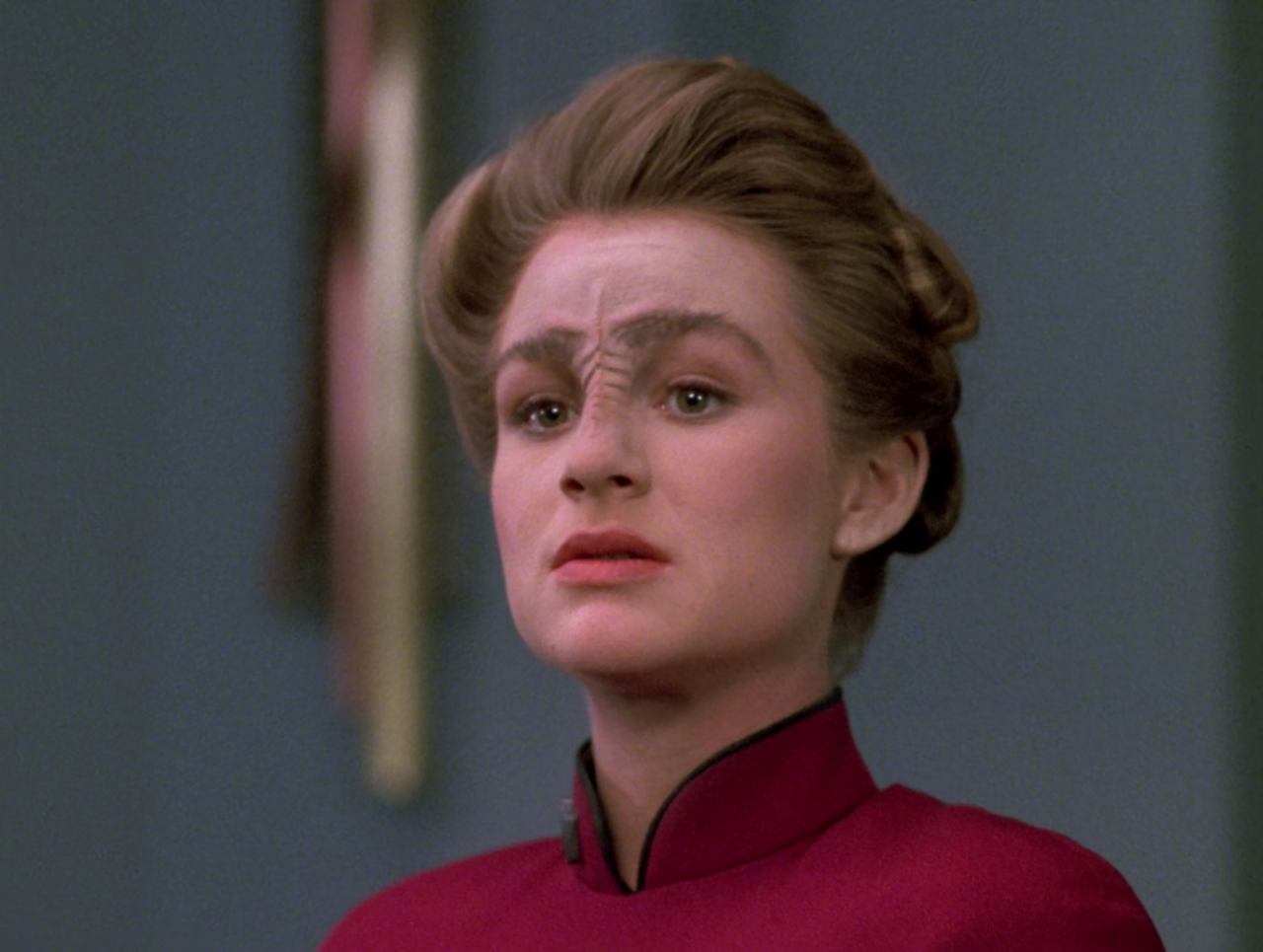
The First Duty has a couple of interesting characters and narrative elements when considering the broader Star Trek franchise, and I’d like to begin there. This episode was only the sixth appearance of a Bajoran character, with the Bajorans having debuted earlier in Season 5. With Deep Space Nine in early production, the Bajorans (and the Cardassians, too) were being set up in The Next Generation ahead of their prominent role in the upcoming series. The character of Sito Jaxa was, after Ro Laren, the second Bajoran to be seen on screen serving in Starfleet. Sito would re-appear in the episode Lower Decks in Season 7.
We talked about Nick Locarno recently – click or tap here for more on that! But Locarno is an interesting character, as it’s pretty clear he was, at the very least, a partial inspiration for the character of Tom Paris in Voyager, which would premiere less than three years after The First Duty aired. Paris and Locarno share an actor in Robert Duncan McNeill, but they also share a piloting career and a lax approach to Starfleet regulations. I’m not fully caught up on Lower Decks yet, but I understand Locarno appeared in that series, too.
I just find it interesting that, in a single episode, we have elements from all three shows of The Next Generation era. In addition to characters from TNG itself, we have a Bajoran, whose home planet and people would be massively important in Deep Space Nine, and Nick Locarno, played by a future Voyager star, and who’s arguably a prototype or inspiration for one of that show’s main characters. It makes The First Duty feel – in hindsight – almost like a crossover! At the very least, it’s an episode that has those different components – even if, at the time, no one watching could’ve known!
And this is what I mean about the benefit of hindsight. Watching The First Duty more than thirty years after its original broadcast means we can see how Star Trek’s production team were already laying the groundwork for their new spin-off. And we can see how Robert Duncan McNeill basically talked himself into getting the role of Tom Paris some three years before Tom Paris ever existed! It makes returning to the story a completely different experience than it was on that first viewing in the first half of the ’90s; nothing about the episode or its narrative has changed, but the way we interpret it arguably has.
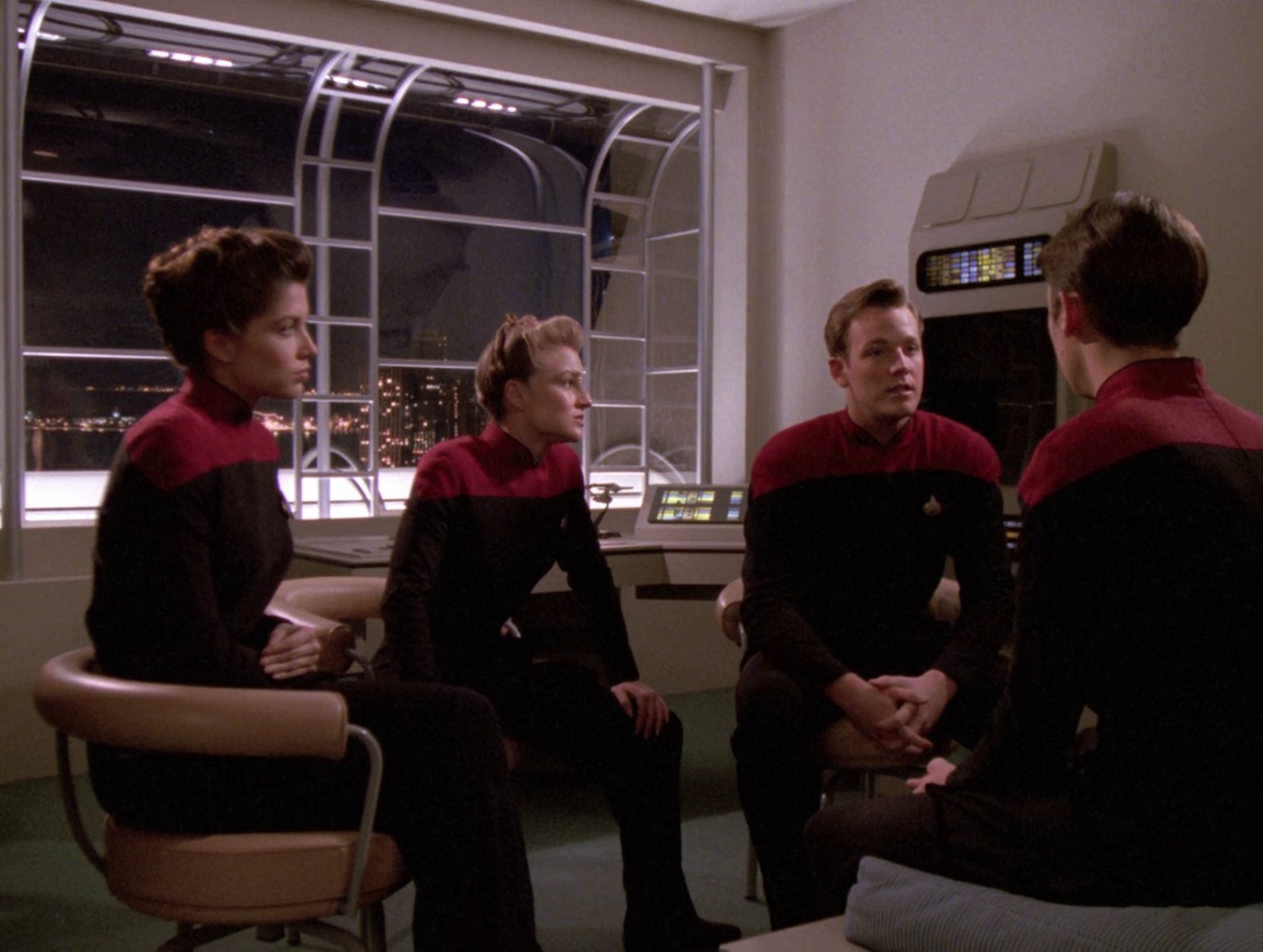
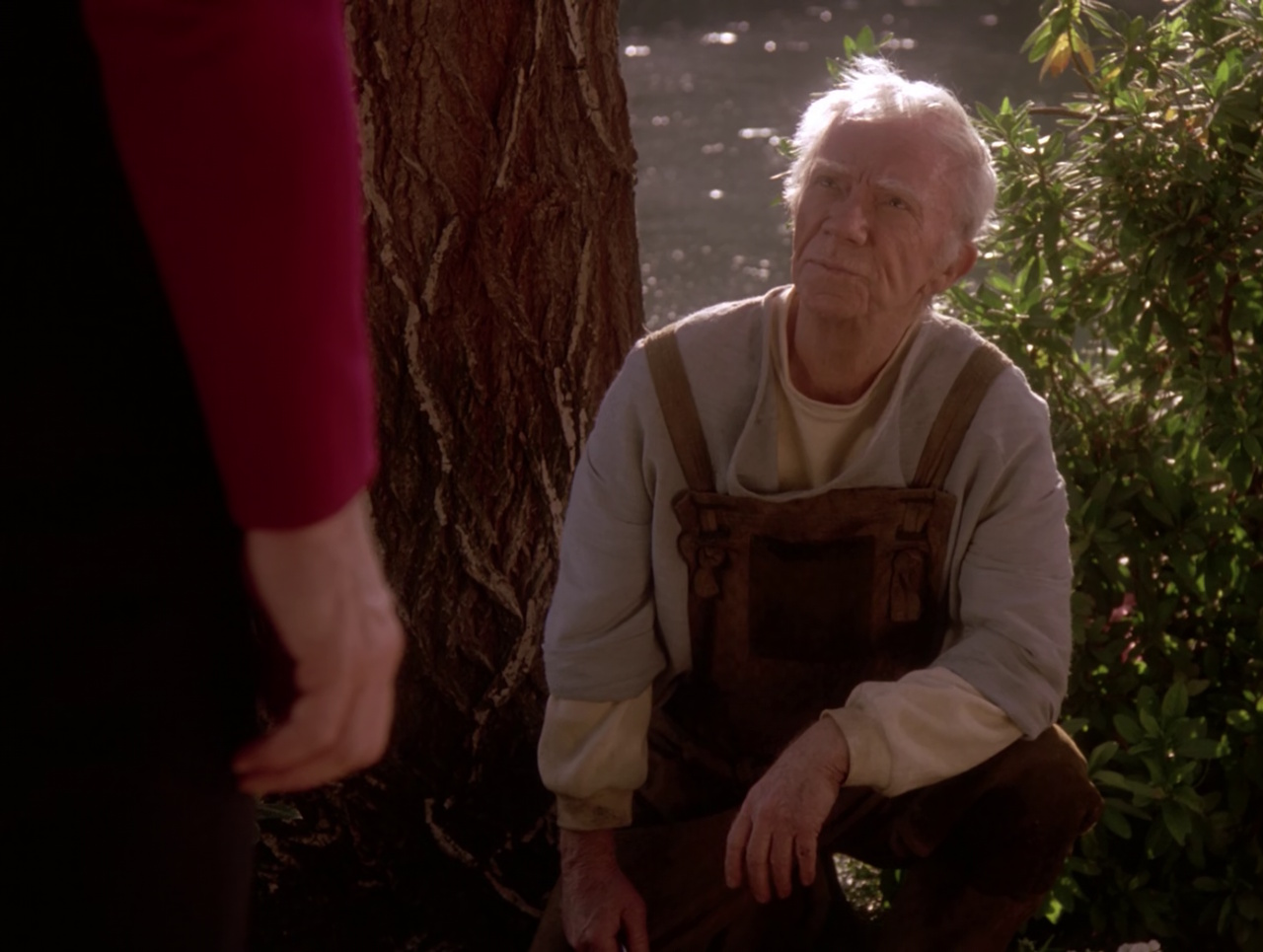
At the core of the episode, we have two key character pairings: Wesley Crusher and Nick Locarno on one side, and Captain Picard and Boothby on the other. The First Duty follows Wesley, Nick, and the other members of Nova Squadron as they try to cover up the events leading to a fatal accident. Picard reconnects with Boothby – apparently for the first time since being promoted to the rank of captain, at least – and also relies on the Academy’s groundskeeper for advice as the inquest into Cadet Albert’s death unfolds.
Wil Wheaton returns to The Next Generation for the second time since departing the series midway through the previous season. Wesley’s departure was written in such a way as to allow the character to return, and The First Duty was one of four episodes in which Wheaton reprised the role.
I don’t know if you were around while The Next Generation was airing, or during those early years of Star Trek fan forums on the interweb, but Wesley was often a controversial character, even for big fans of the series! A “Mary Sue,” according to some, Gene Roddenberry’s “self-insert” according to others, Wesley was perceived as being annoying, too smart or too skilful for his lack of training, and worse, by some viewers. I wouldn’t say that The First Duty was Wesley’s first defeat – see episodes like Justice, Coming of Age, or The Dauphin – but it certainly represents one of Wesley’s low points as a person – and, ironically, one of his most *human* moments, too.
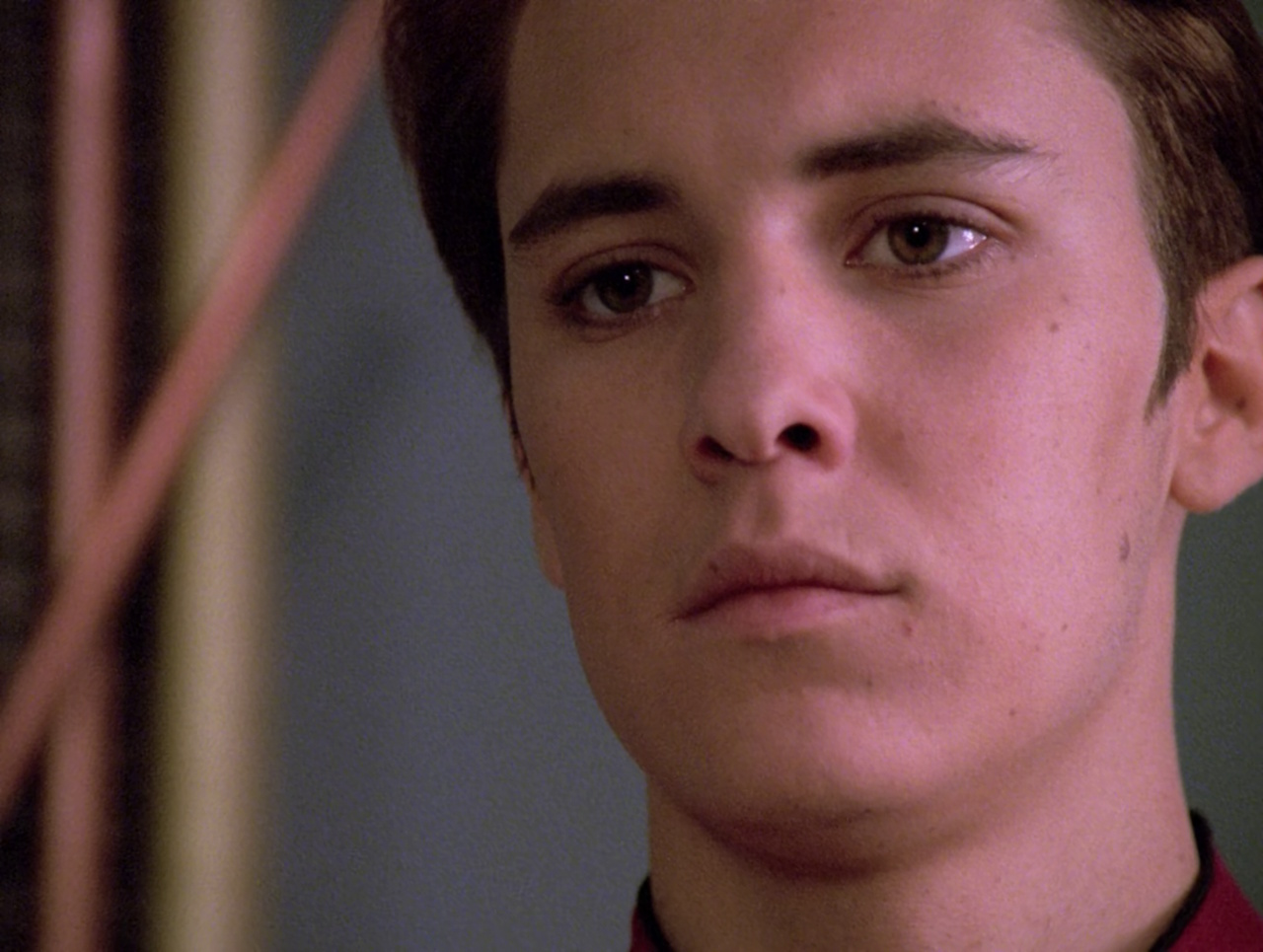
I’m personally of the opinion that Wesley is unfairly disliked by viewers of The Next Generation, and while I get some of the criticism – particularly surrounding his near-perfect skills – I generally enjoy his characterisation in the show. The First Duty, though, shows us a much more vulnerable, weak, and human side to Wesley, showing us that, whatever intelligence and skill he may have, he can still make mistakes, he can still be caught up in the wake of someone more charismatic, and he’s still learning. Wesley is a kid – a university student or military college cadet, as of The First Duty. And… he acts like it.
We’ve seen this side of Wesley before, but in a relatively limited number of stories. And, I would argue, never to this extent. Despite the heavy adult themes of death, conspiracies, duty, and conflicted loyalties, this is a version of Wesley that feels *young* in a way that the character didn’t always manage to when he sat on the bridge of the Enterprise-D. And this is a story that looks at how a young person can feel peer pressure, can be pushed into doing something they know to be wrong, and how easily a charismatic friend can influence their life. Wesley slips into this role effortlessly, and Wil Wheaton puts in a fantastic performance, showing us how torn Wesley feels between his friendships with Nick and the rest of Nova Squadron and his desire to do the right thing by telling the truth.
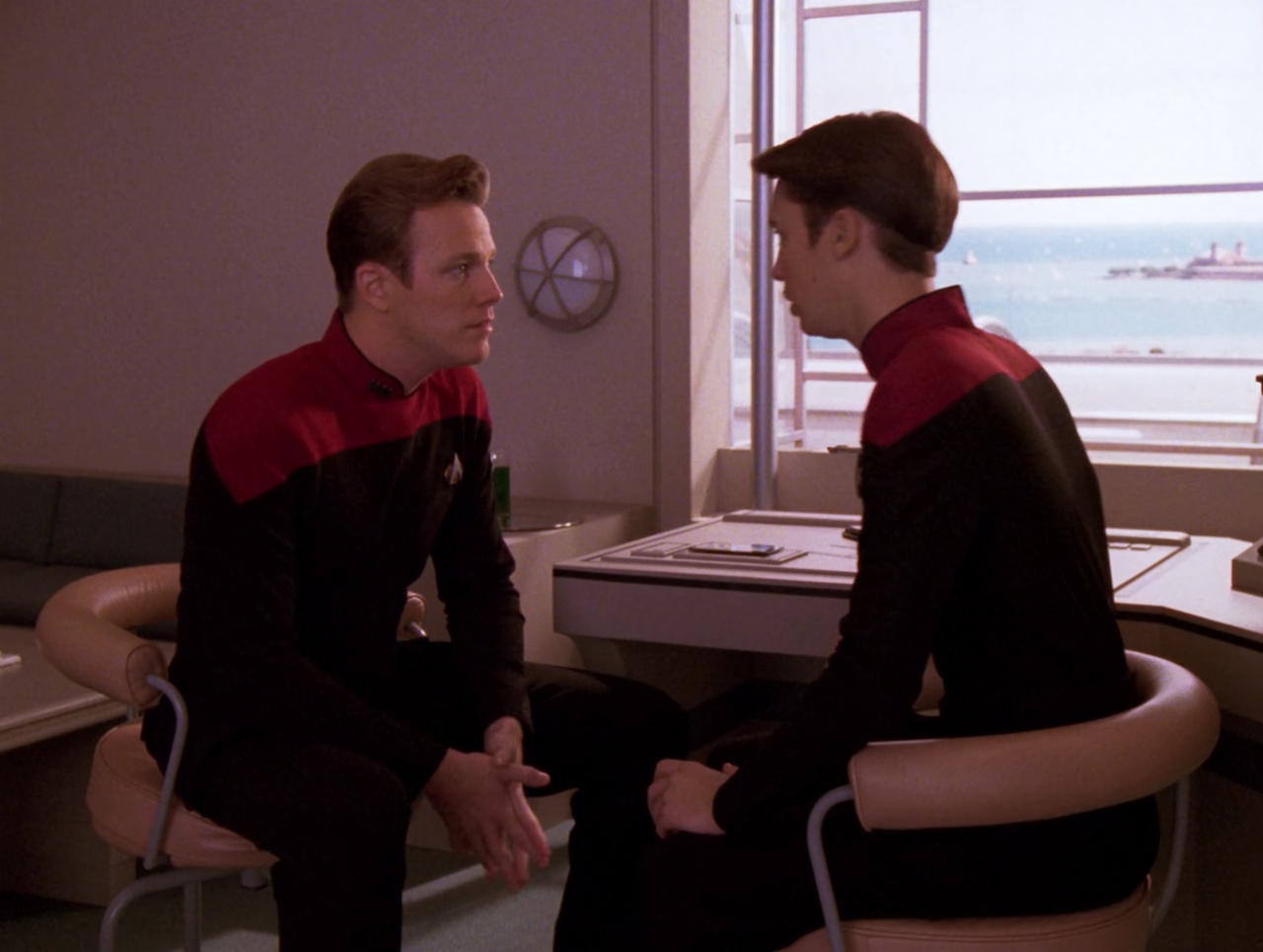
Although never to such an extreme degree, I think a lot of us can relate to getting in trouble at school, or not wanting to “grass up” a friend. I certainly found myself in detention or sent to the headmaster’s office on more than one occasion when I was at school, and I can vividly remember how that felt – that fear of getting in trouble, and how serious it all seemed to be at the time. And I can recall occasions where friends at school would do something stupid – sneaking alcohol on a school trip, smoking behind the woodworking classroom, or cutting class to sneak into town. I covered for them when they misbehaved, and they probably did the same for me!
My point is that a big part of what makes The First Duty work is that, despite its heavy subject matter, it’s an incredibly relatable feeling. I’ve been in a position not unlike Wesley’s – where my schoolfriends expected me to cover for them while teachers demanded the truth. And it’s that near-universal feeling, something a huge number of folks in the audience will have experienced at least once in their lives, that makes Wesley feel so relatable and so human within the story.
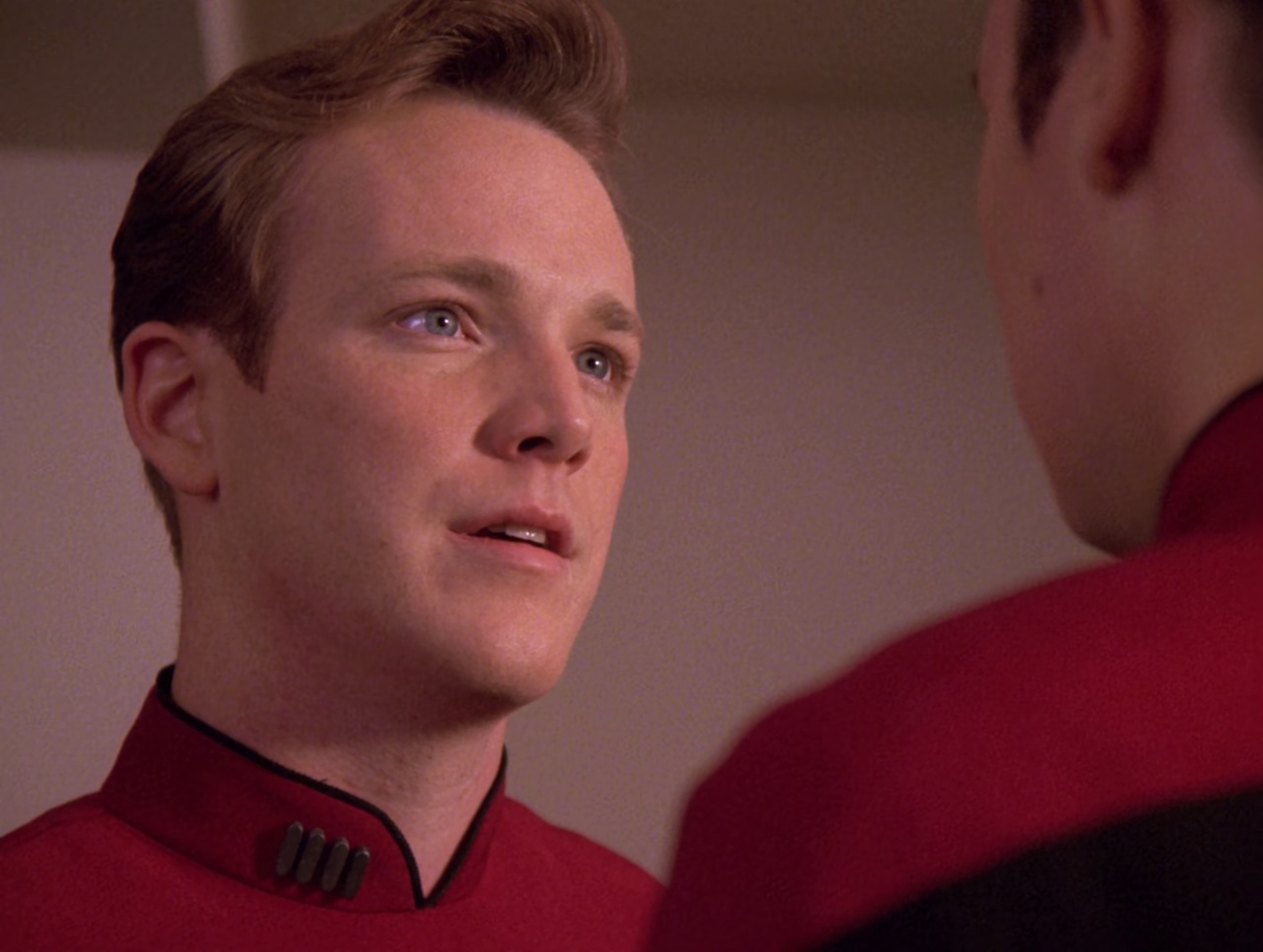
One thing that I think is a bit of a shame when it comes to The First Duty is that the episode didn’t have enough time to really flesh out Captain Picard’s backstory. We glimpsed, through his chat with Boothby, that Picard had made a mistake of some kind during his own Academy days, and that Boothby helped him understand what he’d done. Picard says that, without Boothby’s advice, he might not have been allowed to graduate – combined with his earlier recollection of being summoned to the Superintendent’s office, we can assume it was something pretty serious. We know Picard had a rebellious streak in his youth – something that the episode Tapestry would hammer home in Season 6. But what this incident was… it was never followed up on in the remainder of the show, unfortunately.
Picard and Boothby’s conversations were interesting, but they also leave me wanting more! I wish we could’ve got a flashback to Picard’s Academy days, perhaps, or even just a bit more of an explanation from one of the characters about what Picard did. The chat had a “we both know what this is, so there’s no need to go into detail” thing going on, which makes sense in-universe – both characters know what they’re referring to – but it’s a tiny bit frustrating as a viewer!
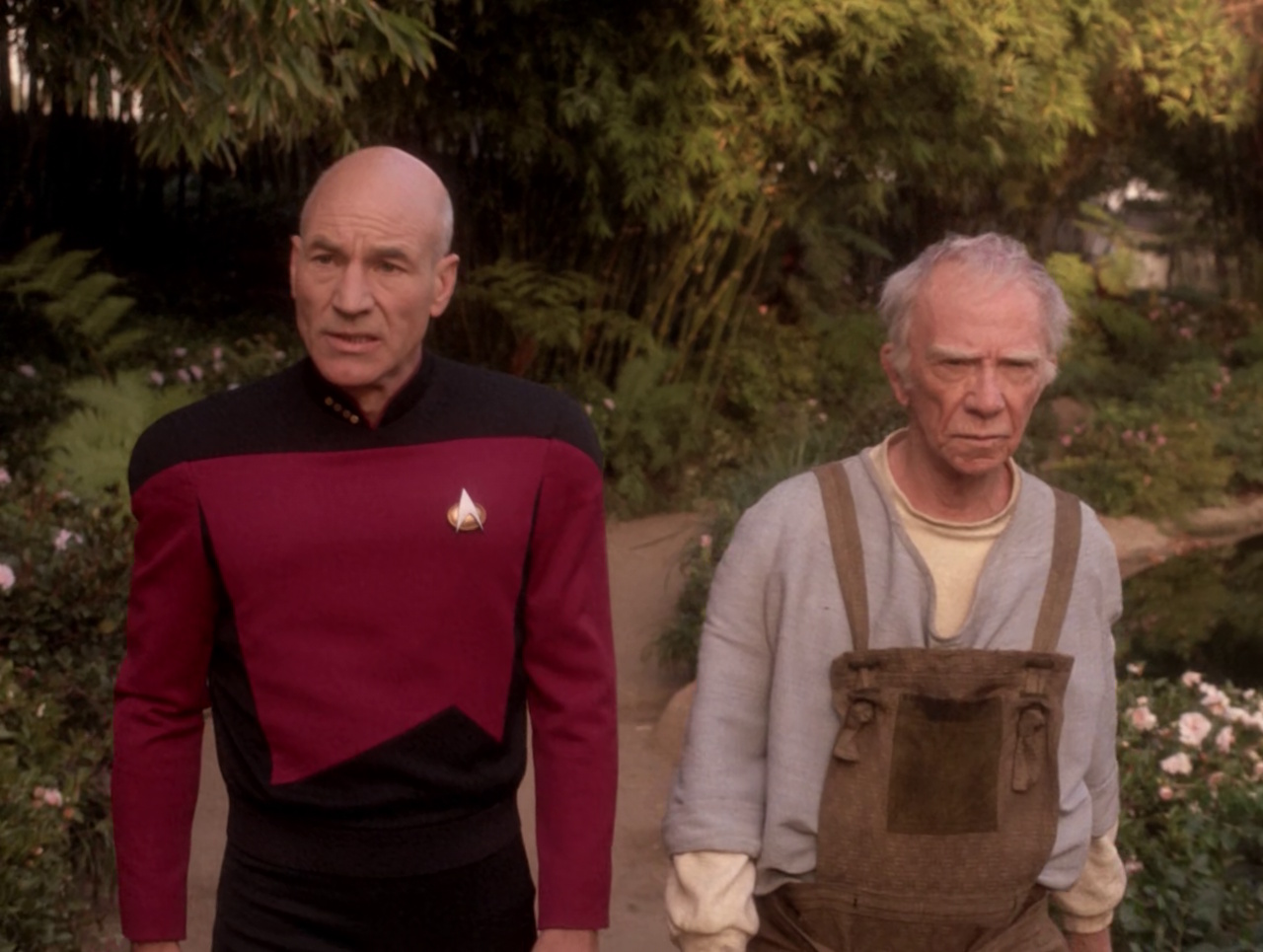
Given the importance of this conversation to Picard, as he pursues the investigation into what happened with Wesley and Nova Squadron, I don’t think it’s unreasonable to want to know more about this mysterious event in Picard’s past. If I were to hazard a guess, I’d say that Picard broke a rule that resulted in endangerment or injury, perhaps, and Boothby was the one to convince him that he needed to come clean. It’s clearly something at least somewhat comparable to Wesley’s situation – but I doubt Picard would’ve done anything as severe as covering up someone’s death.
I kind of feel that Dr Crusher is a bit flat, especially at the beginning of the story. She’s learning for the first time that her son has been injured in an accident that killed one of his friends, but her reaction throws me off just a little. A lot of people don’t have big, over-the-top emotional reactions to events, but even by that standard, Dr Crusher just seems a little bit underwhelmed by what should be such a seismic and shocking event. Subsequent scenes show her a bit more animated when coming to Wesley’s defence, but that moment in her office at the beginning of the episode just… I’m not convinced it was played right, considering the seriousness of the accident.
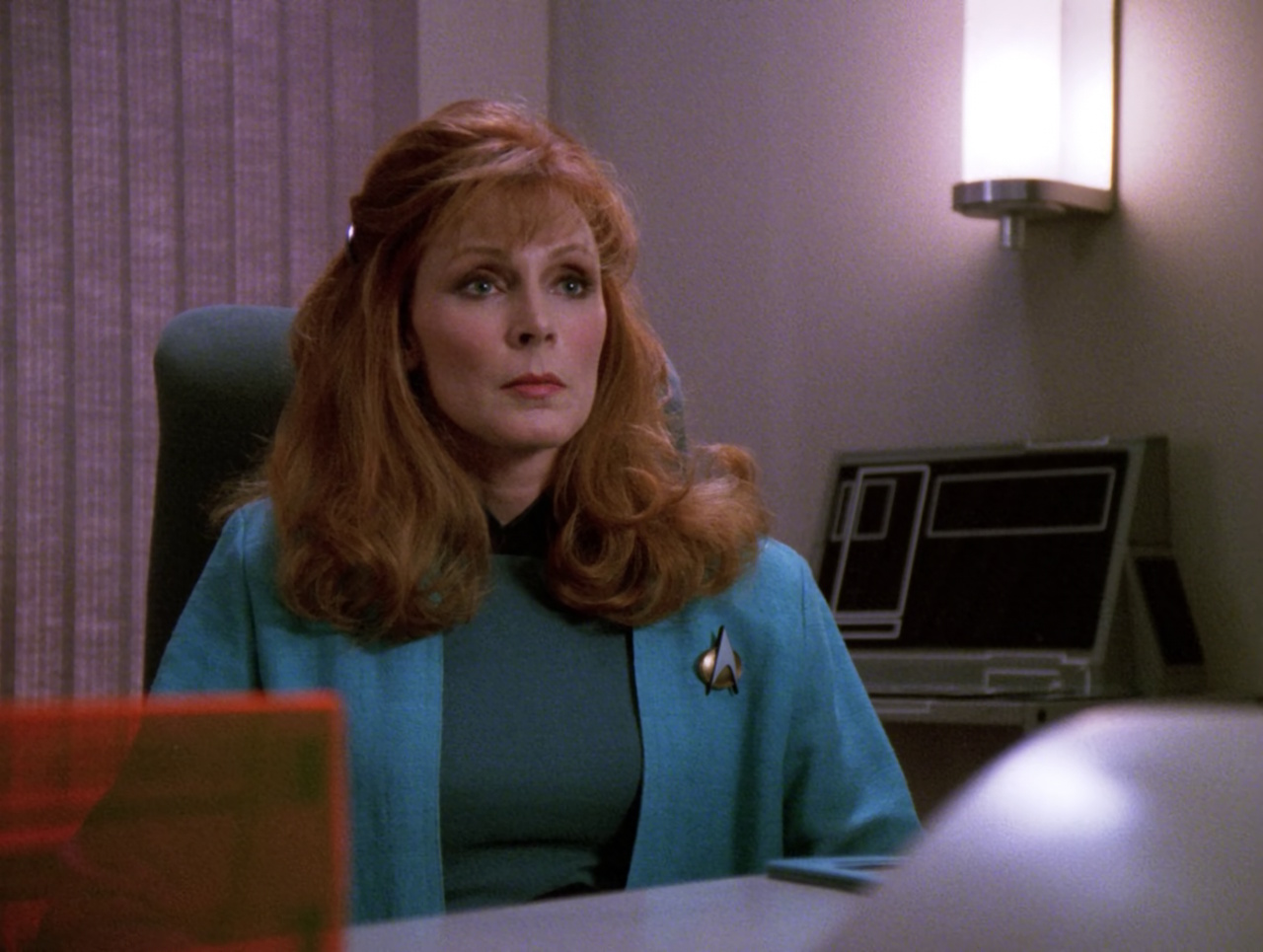
What I adored about Dr Crusher in The First Duty, though, was how she leapt to the conclusion that the sensor data had to be wrong – because, in her mind, there’s absolutely no way that Wesley could’ve been lying. It piled pressure on Wesley, of course, which is something we saw building up over the course of the episode, eating away at his conscience and making him feel ever more guilty. But I like what it says about Dr Crusher, and how she’s so willing to believe her son – even when it seems obvious to everyone else that he’s not being honest.
The downside to this, unfortunately, is that we never got any resolution to this mother-and-son story. Dr Crusher arrives on Earth to see Wesley, goes through the inquest with him, supports him even when he’s lying, but by the time his lie is exposed and he’s pushed into making a confession, she’s gone from the story. Picard is the one to deliver the news to Wesley about his academic punishment, and we never get to see whether Dr Crusher is upset, angry, disappointed, or some combination thereof. It’s not something that feels like a glaring omission until you stop to think about it – but as Wesley’s biggest supporter, Dr Crusher is yet another person that Wesley let down by his actions in The First Duty. And there’s no resolution to that story thread.
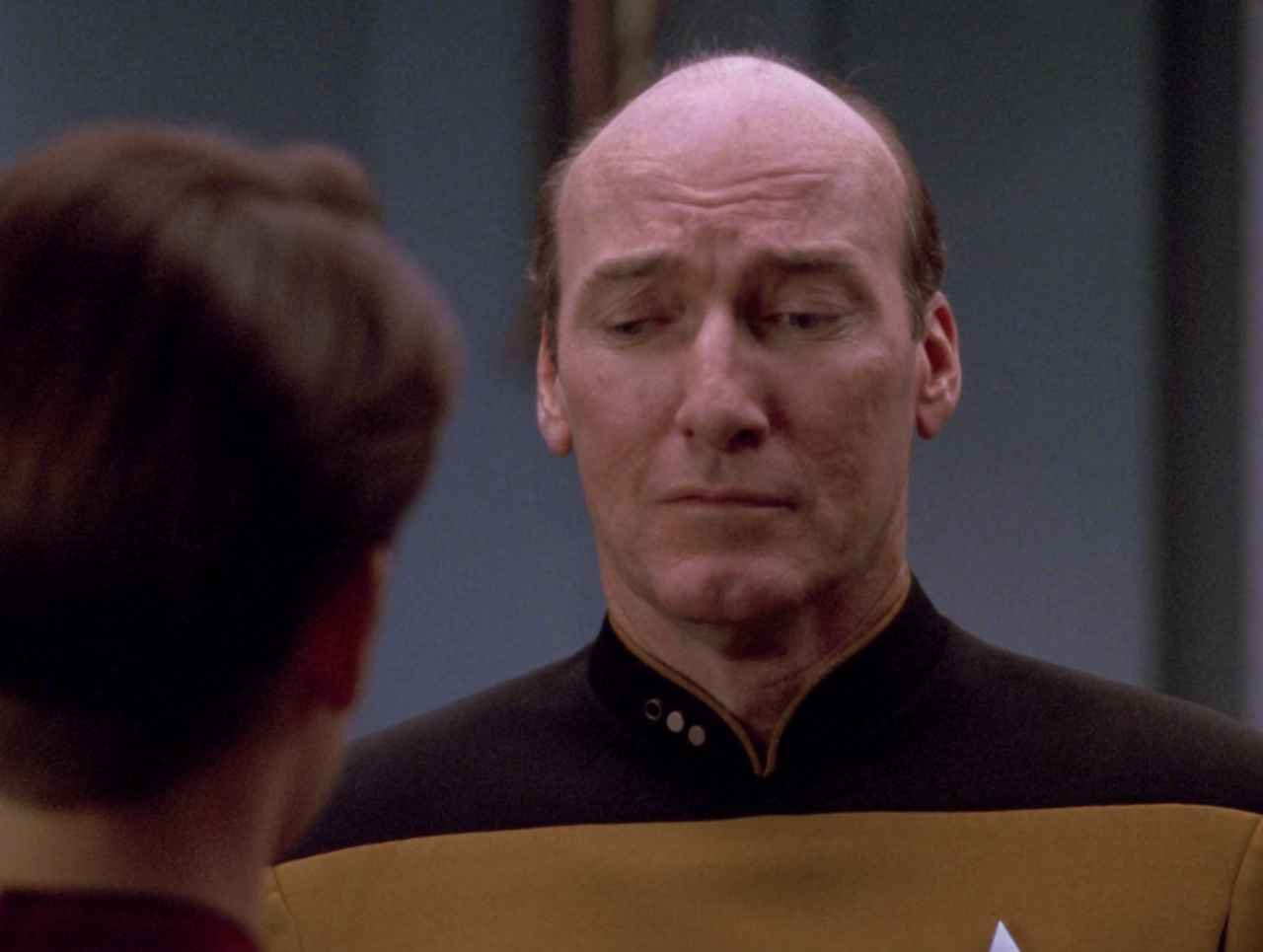
Obviously, a forty-five-minute episode can’t do everything. And given the characters and storylines in play, it was probably the right call for the writers to focus where they did. I just think that, if I had to pick on one thing that I’d say is missing from The First Duty, it would be some kind of closing scene between Dr Crusher and Wesley – some way for her to express her disappointment, perhaps even feeling like he’d broken her trust.
Maybe we should infer from Dr Crusher’s absence that she was so *livid* with Wesley in that moment that she couldn’t even look at him! That could be why Picard had to be the one to deliver the news, to express his own conflicted feelings – pride that Wesley eventually did what was right, understanding that it was difficult, but anger, frustration, and disappointment that the situation occurred in the first place. I don’t believe that was the writers’ intention, but that interpretation of Dr Crusher’s absence is there, if you want to read between the lines, and if you desperately need a way to resolve her arc in the episode.
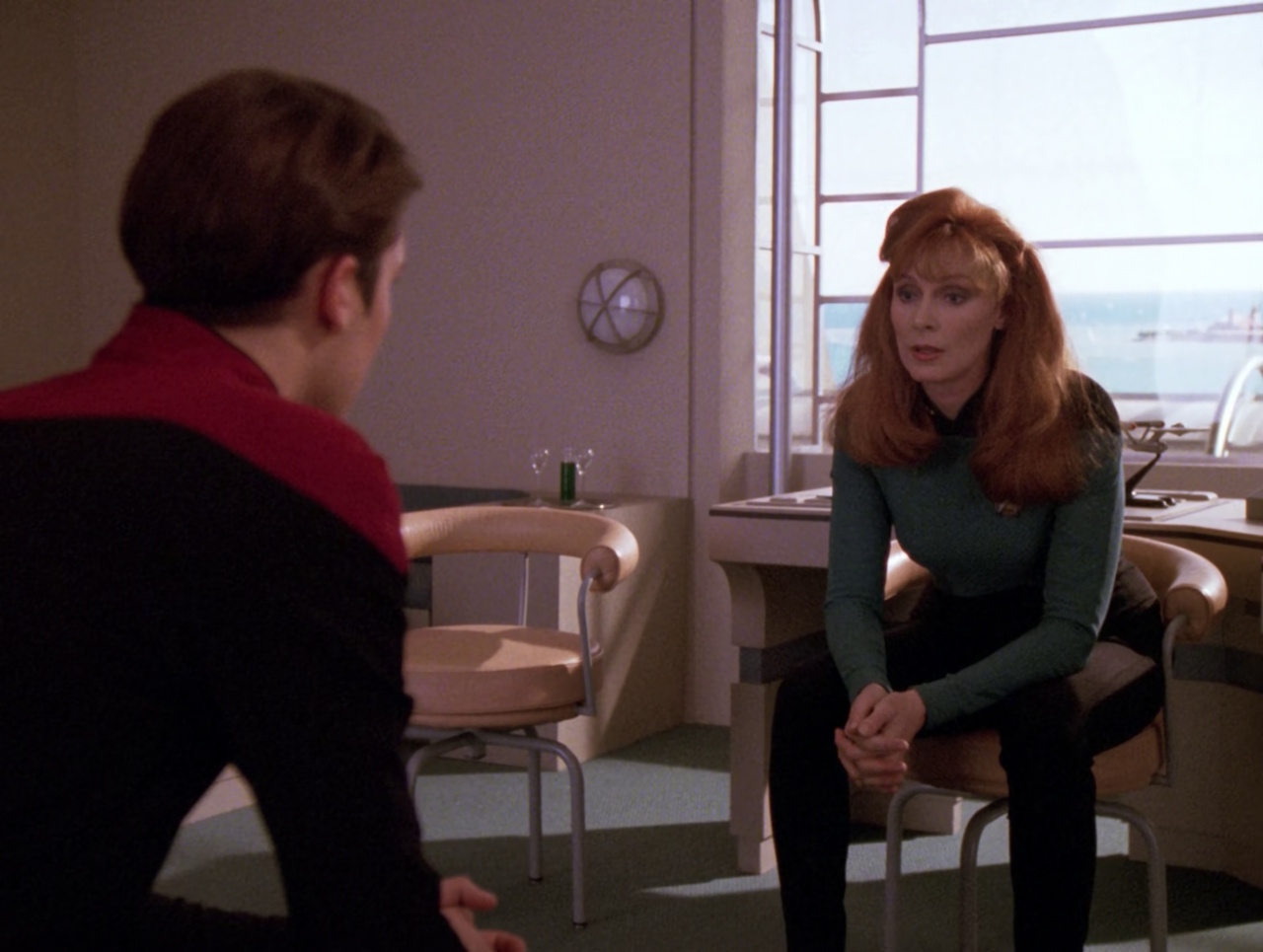
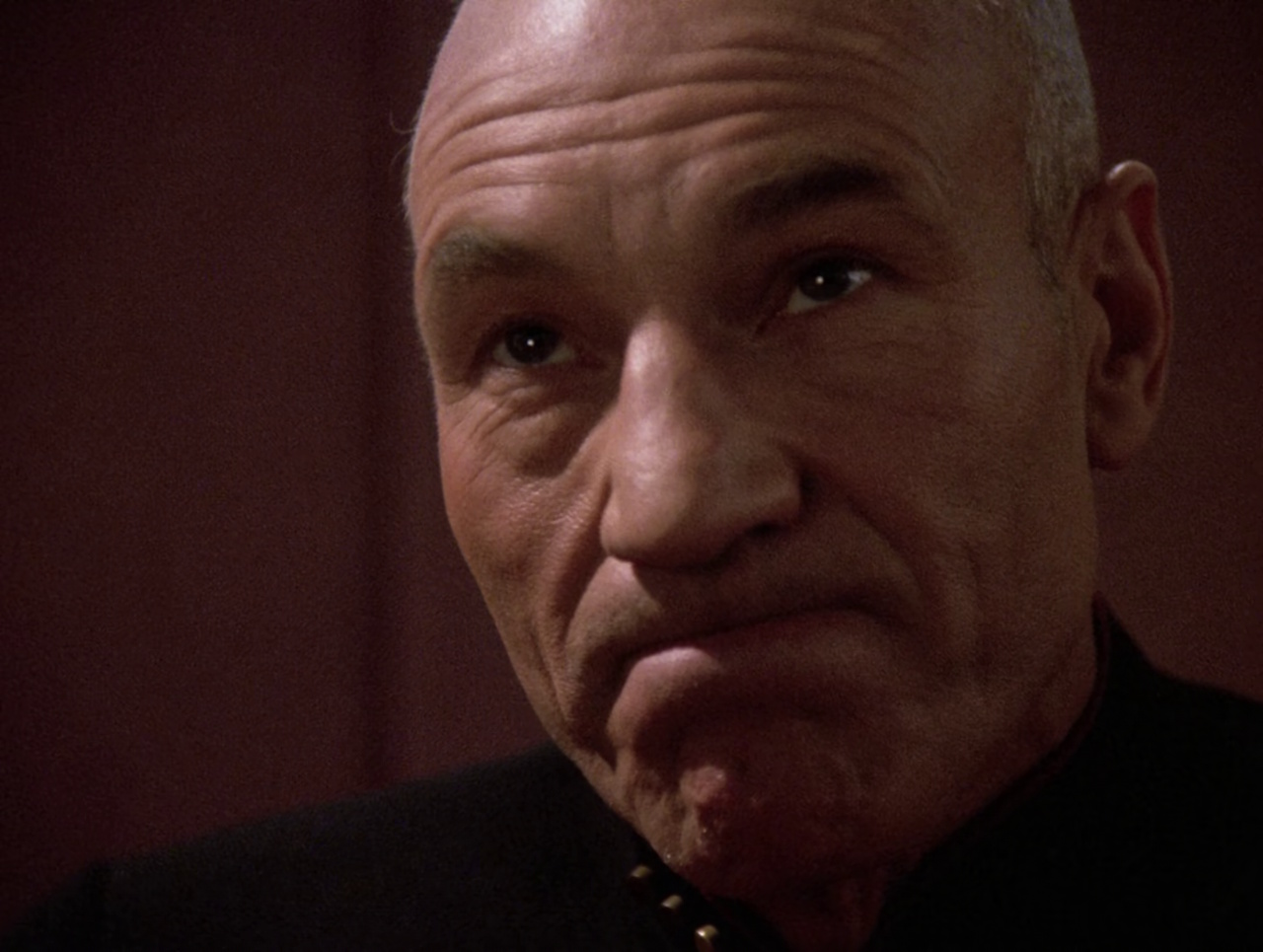
And I happen to really like Picard’s closing scene with Wesley as the episode concludes. Picard went from sympathy to suspicion to righteous anger as he uncovered the truth about the accident, resulting in an incredibly impressive scene in his ready-room aboard the Enterprise-D in which he absolutely tore into Wesley. But the closing scene, after Wesley confessed, showed that Picard recognised how difficult the whole situation was, perhaps sympathised to an extent based on the mysterious event from his own Academy days, and even showed some measure of respect for Wesley’s ability to do the right thing in light of the pressure he felt.
Though they contrast in tone, both scenes between Picard and Wesley – in the ready-room and after the inquest – were played incredibly well. It’s performances like that from the venerable Sir Patrick Stewart that led to the character being so beloved by Trekkies… and eventually returning, some three decades later, for his own spin-off series!
Though they aren’t in focus for a lot of time, I enjoyed the moments we got with Data and Geordi in this episode. Working in main engineering, they analysed the sensor data that poked holes in Nova Squadron’s story, setting the stage for Picard to understand what really happened. The slow reveal of discrepancies or oddities in the recovered Data from Wesley’s ship was a really well-paced scene, and Geordi and Data both had roles to play in explaining (or technobabbling) parts of that.
Starfleet ships of The Next Generation era are almost always my favourites in terms of design. But I gotta be honest: the Nova Squadron ships… they don’t really do much for me. Nothing about the design screams “Star Trek” at all, and they feel almost like single-pilot fighter ships from a franchise like Star Wars. Nothing about the design is *bad* per se, and I don’t dislike the way these ships looked. But in a franchise where there are so many fun and interesting designs, they’re nothing special.
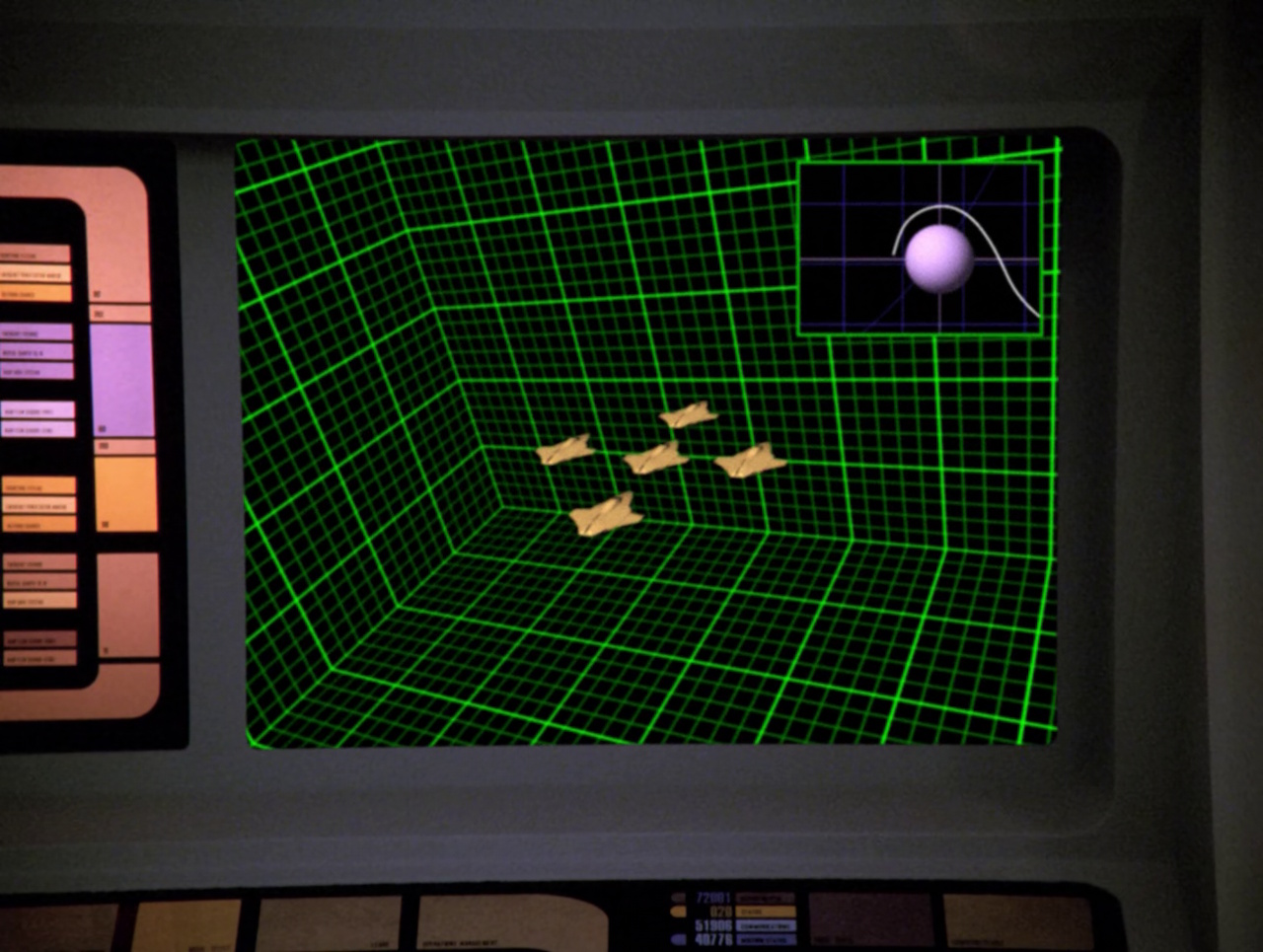
Perhaps this is because these ships were mainly seen as CGI models, with a physical prop only appearing very briefly. The ’90s was a weird time for CGI – with the technology pretty limited. Given that Nova Squadron’s ships were all destroyed prior to the events of the episode, only depicted in logs and sensor data, I guess you could say that it’s fair enough that we didn’t get a more detailed look at them. But still… I just don’t feel like the aesthetic of the ships, the way they look, was particularly strong.
But your mileage may vary! Aesthetics and designs are very much a matter of personal taste. And I would say, having seen a photo of the original model of the Nova Squadron ships, up close, I don’t think it looks that bad. But the way it came across on screen, particularly in those CGI-heavy scenes, just didn’t leave a strong impression. The Next Generation era has way better shuttlecraft, shuttlepods, and smaller vessels.
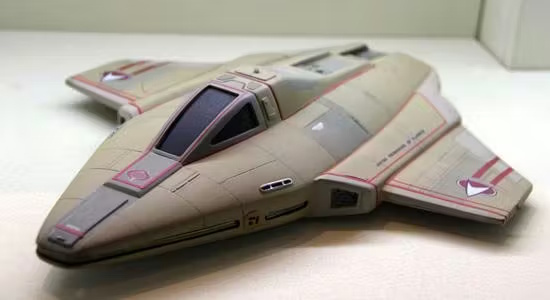
Photo: StarTrek.com
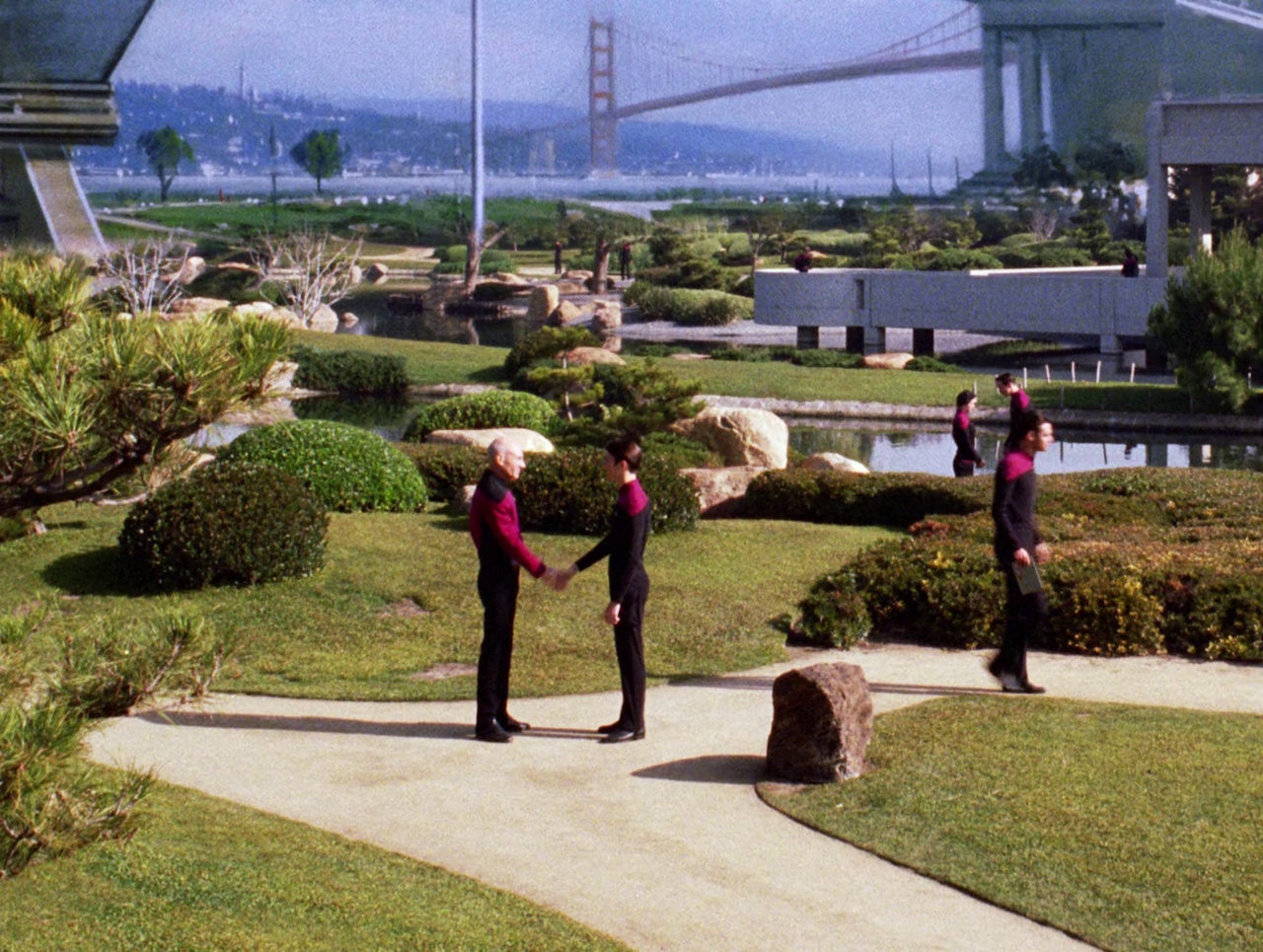
Sticking with the look of the episode, one thing I found particularly interesting was the design of Starfleet Academy itself. Remember, this is our first real look at the campus anywhere in Star Trek, and obviously, there’s a lot of time spent both on the grounds – which were filmed at the Tillman Water Reclamation Plant in Los Angeles – and the room where the inquest took place. The gardens are an iconic part of Star Trek, I would argue, having been seen as both the Academy and Starfleet HQ. But I want to focus on a different space for a moment: Wesley’s dorm room.
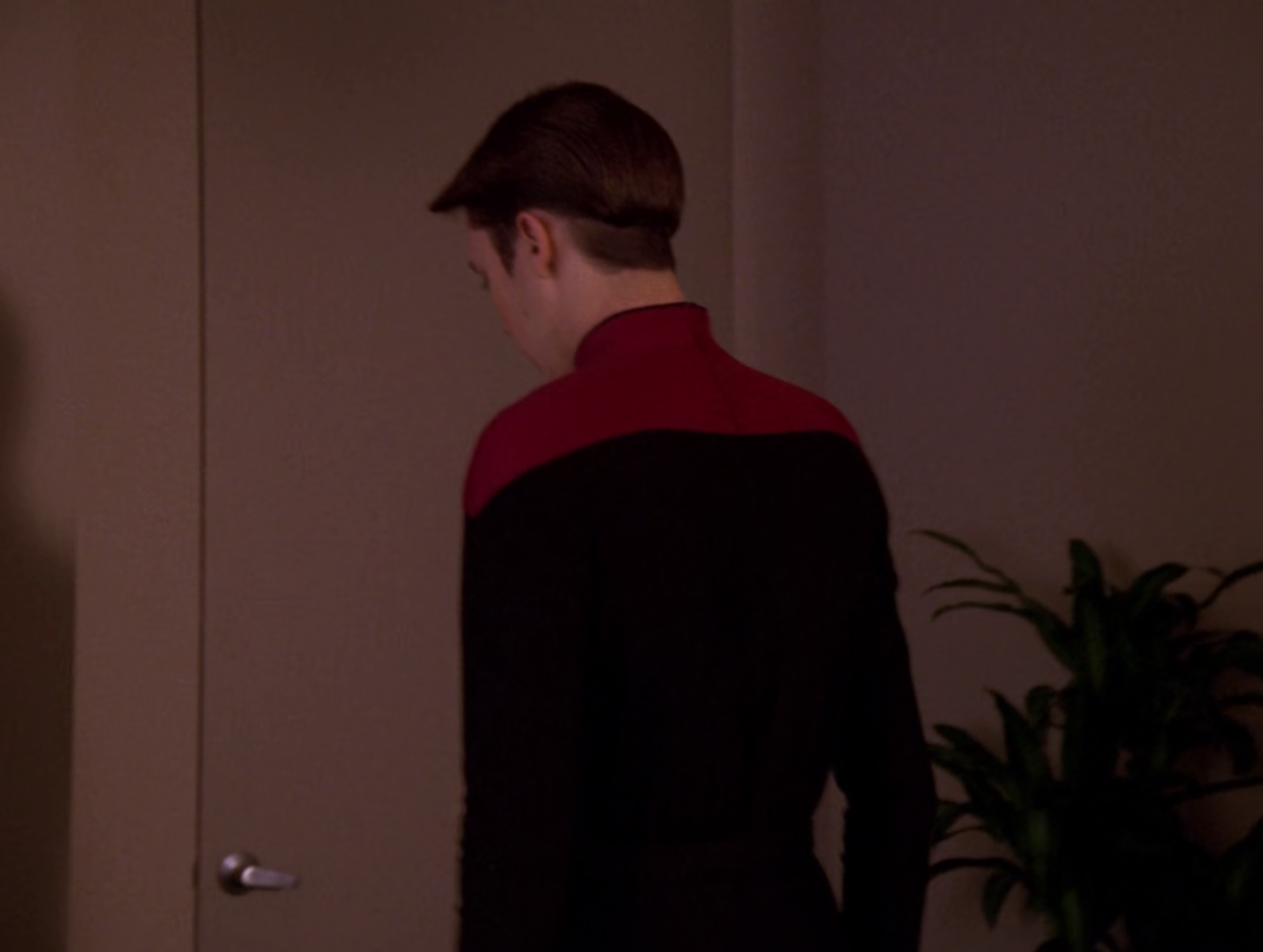
This is going to sound like a totally minor thing to focus on, but why do the doors on Starfleet Academy’s campus have… handles? Surely the Federation has moved beyond such things, right?! I don’t remember it being something I paid much attention to until this re-watch of the episode, but I found that, once I started to think about it, it stuck out like a sore thumb every time Wesley opened the door to his dorm. It’s not *totally* out-of-place in Star Trek, but for a location on Earth like the Academy? I dunno… you’d think they’d have sliding doors like on the Enterprise!
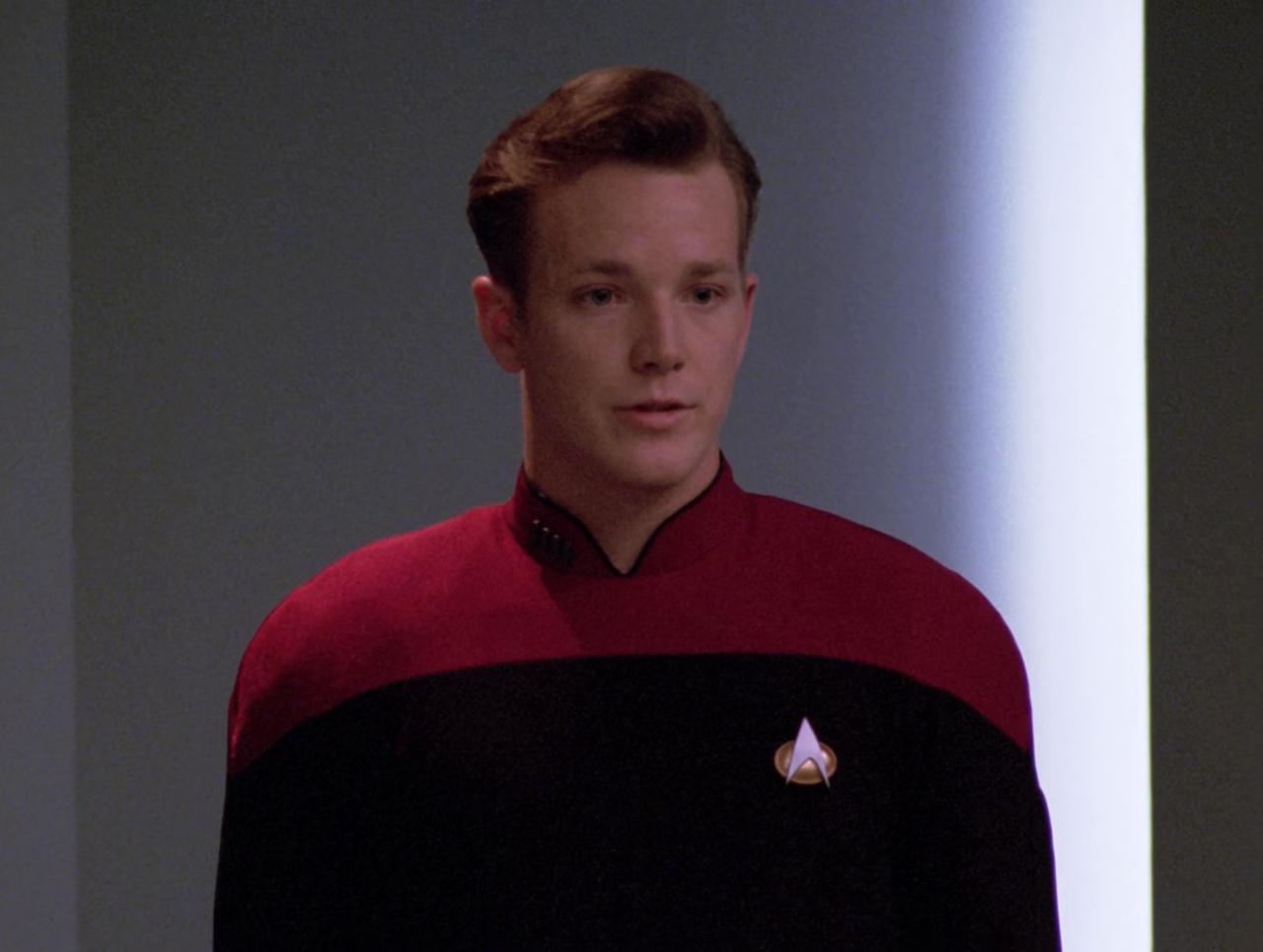
In light of Robert Duncan McNeill’s role in Voyager, I can’t help but wonder how similarly (or differently) we might’ve received his performance if a decision had been made to bring the character of Nick Locarno into that series. Would a similar “redemption arc” story have been possible for Locarno in the way it was for Tom Paris? I think it would have been interesting, and could’ve added another layer to this character, to say that Locarno joined the Maquis after being expelled from the Academy, only to be captured, imprisoned, and really hit rock bottom.
We still got a lot of that with Tom, something that the revelation about his father being an admiral certainly compounded, but part of me will always wonder how differently we might’ve received the character had Nick Locarno been the one assigned to Voyager. It would’ve been another connection point, a through line from The Next Generation to its sister show. I haven’t seen Locarno’s arc in Lower Decks yet, and perhaps I should’ve delayed this re-watch until I have! But maybe that will also change the way I look at the character in The First Duty.
Star Trek has done courtroom drama going all the way back to the first season of The Original Series, and within The Next Generation, we have several other examples, too. I wouldn’t necessarily rank The First Duty’s inquest sequences as being among the best or most compelling courtroom-esque that the franchise has to offer, but they get the job done, and they’re sufficiently tense. When the cadets are caught in their lies, especially by the Vulcan captain, there are some moments of real jeopardy, moments that really captured that feeling of being a kid and getting in trouble that I talked about earlier.
Admiral Brand – the Superintendent of Starfleet Academy – is a fun character. I liked Picard’s description of her at the beginning of the story; it set her up pretty well as a “no-nonsense” type of educator. I think we all came across teachers like that when we were at school! Brand is the first one to question the cadets’ version of events, and her presence adds a lot to this side of the story.
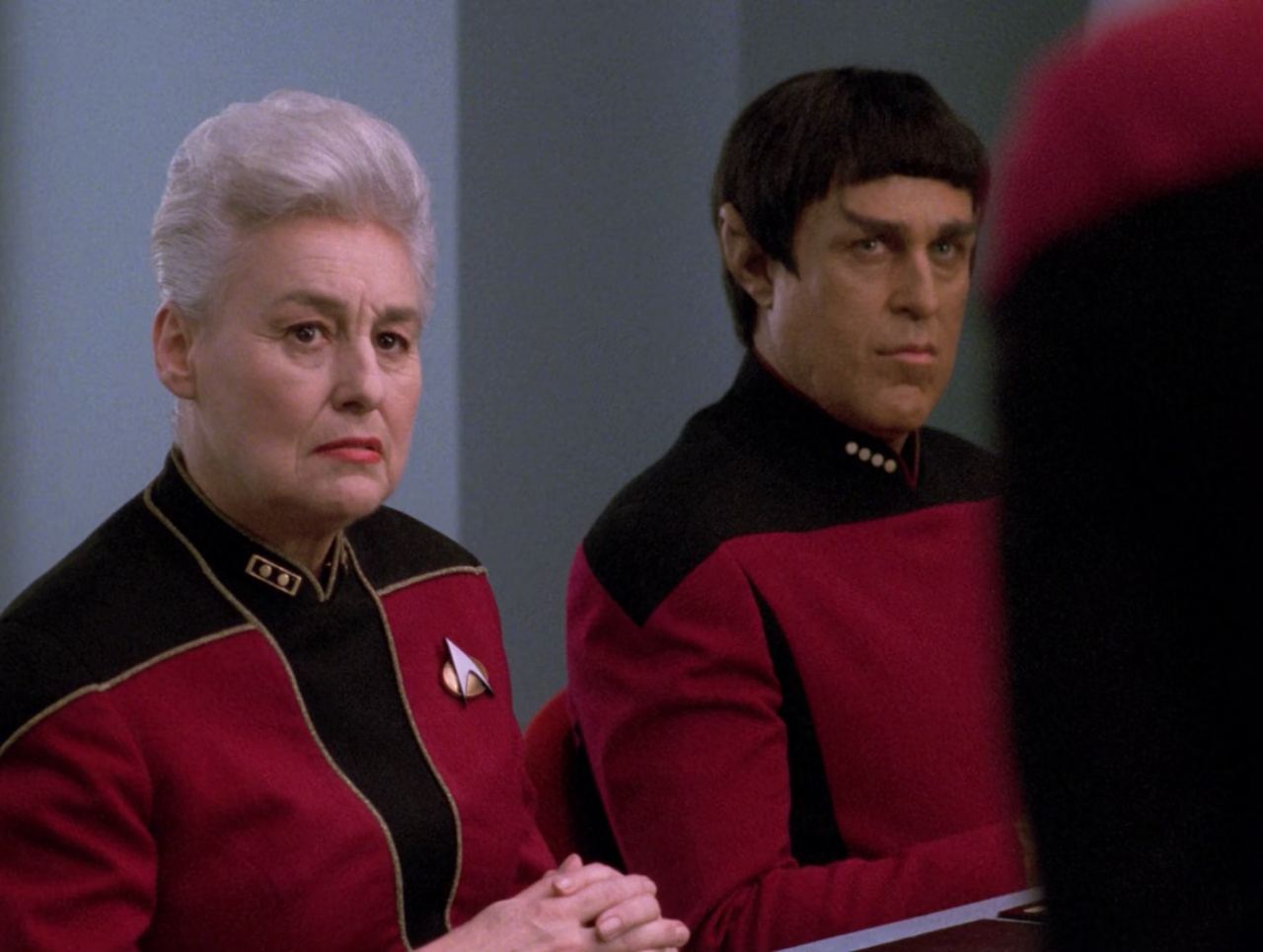
In The Measure of a Man – another classic courtroom story from The Next Generation – it never made a lot of sense to me that Starfleet would pick Picard and Riker to argue the case. So I like how, in The First Duty, we don’t get the contrivance of having Picard or another Enterprise officer serving on the inquest panel. The inquest works better for having Admiral Brand and Captain Satelk as its members.
If I were to nitpick – and you know I must – it never felt realistic to me that Starfleet Academy would be content to basically say “a student died, we know you’re lying about what happened, but there’s nothing more we can do, so nevermind.” Which is, in effect, what Admiral Brand was going to do until Picard pushed Wesley into making a confession. It just doesn’t seem to gel with what we know of Starfleet that they’d give up on the investigation so easily when someone – a student, no less – had actually died. And while this works in the context of the episode as a way to raise the stakes for Wesley, part of me has always felt that Starfleet wouldn’t have been content to let it lie.
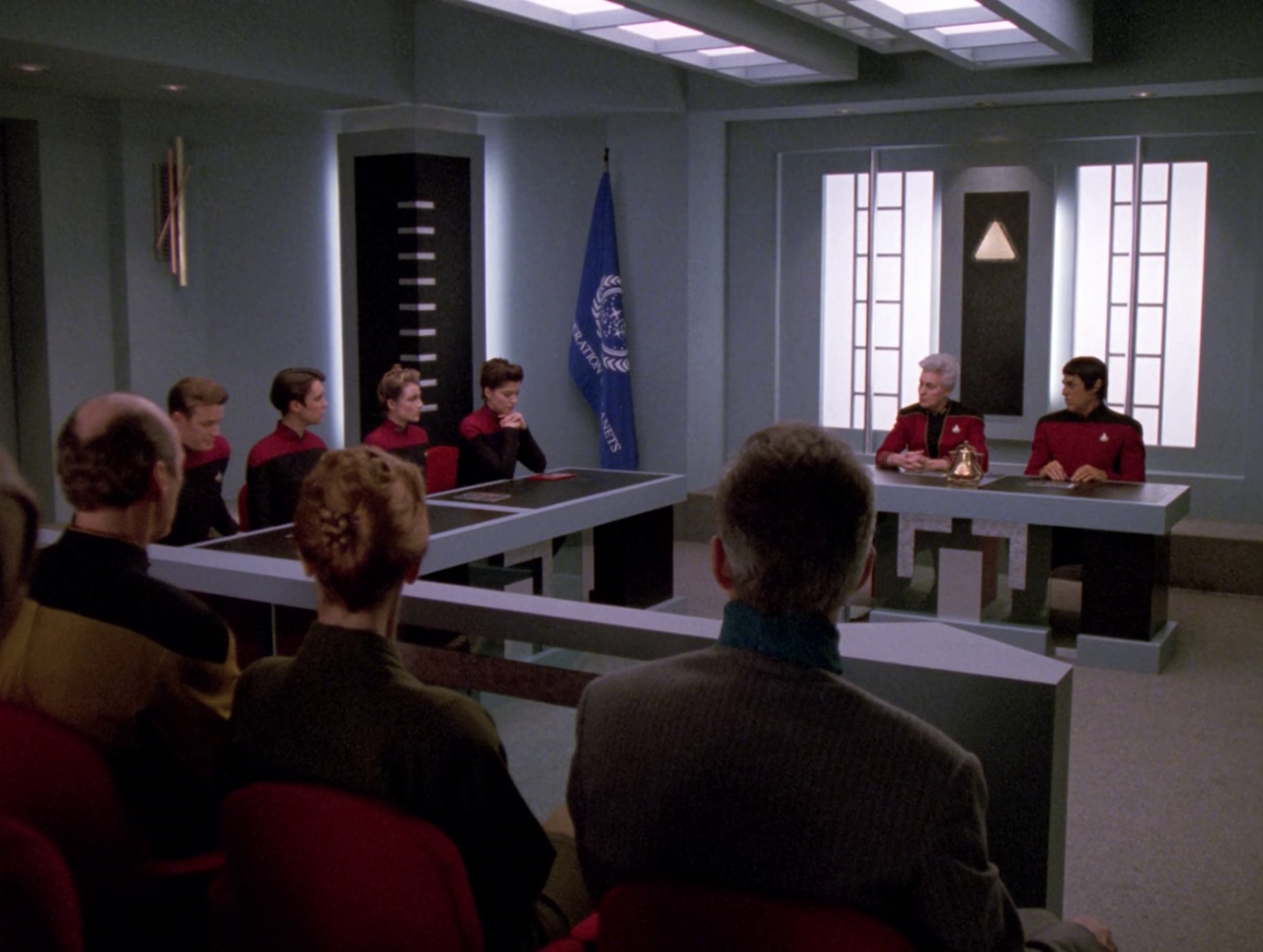
Narratively, The First Duty does an exceptional job of building up the pressure Wesley feels. There’s his initial guilt at Cadet Albert’s death, which is swiftly compounded by his mother fussing over him and his reunion with Captain Picard. Then there’s Nick, insisting that they all collude to cover up what really happened to save their own skins – even if that means Joshua’s reputation gets dragged through the mud. Commander Albert then comes into the story, apologising to Wesley for Joshua “letting Nova Squadron down,” and really just making Wesley feel awful. Next, as the inquest rolls on, the evidence from the satellite shows the team out of formation. Again, Dr Crusher compounds this by insisting that Wesley must be right and the data wrong. And finally, we come to the confrontation with Picard – after we’ve seen this slow buildup of various factors all combining to really weigh on Wesley’s conscience.
Picard’s blow-up would have had an impact regardless, but when you watch that scene after seeing all of those other moments of guilt and pressure… it works a whole lot better. Picard’s harsh words to Wesley come after we’ve already seen the cover-up slowly unravel, and they hit so much harder because we know that Picard is 100% in the right. And for Wesley, this is the final straw: the moment where he has to choose between his loyalty to Nick and his friends… and doing the right thing. The titular first duty.

I think if you forced me to choose my favourite season of The Next Generation, Season 5 would be my pick. It has so many fantastic episodes: Disaster, Unification, Cause and Effect, The Next Phase, and fan-favourites like Darmok and The Inner Light, too. So The First Duty has some tough competition, but I think it fits in pretty well with many of those outstanding stories. It’s an episode that does a lot for Picard and his sense of duty, pushing Wesley to do the right thing. And it’s also an episode that takes the “impossibly perfect” Wesley Crusher and brings him down to earth, really humanising him and showing us that he can make mistakes, too.
I had fun returning to The First Duty, and I think it makes for an interesting point of comparison to the new Starfleet Academy series, too. Starfleet Academy has picked up criticism in some quarters for its tone and some of its stories – and there will always be folks both inside and outside of the fan community who aren’t happy when Star Trek doesn’t give them *exactly* what they want! For my money, I think you can see a through line from The First Duty to Starfleet Academy, even if some of that comes in exposition and dialogue! Boothby, for instance, talks about how the cadets’ celebrations in Picard’s day and for Wesley’s Nova Squadron caused a lot of damage to the grounds – something we see firsthand when the Academy cadets get into a “prank war” in the new series. That’s just one example, but I think it shows that, despite some changes in approach, Star Trek is still Star Trek even all these years later.
So that’s all for today. I wanted to step back to the Academy’s first big appearance now that we have the new Starfleet Academy show – more out of curiosity, really, than for any other reason. When I write up my thoughts on Starfleet Academy’s first season later this month, I’m sure I’ll have more to say about how the show fits in with the wider Star Trek franchise, and this re-watch has certainly given me a lot to think about in that regard!
If you missed it, I reviewed Starfleet Academy’s two-part premiere: you can find that review by clicking or tapping here. And I also shared my thoughts on one storyline from the show’s fifth episode, so if you don’t mind spoilers, you can find that piece by clicking or tapping here.
Thanks for tuning in for this episode re-watch. I had a lot of fun revisiting The Next Generation and catching up with Picard, Wesley, Dr Crusher, and the rest of the crew. The First Duty is a fun episode, and one that feels, with the benefit of hindsight, like it brings together all three shows of The Next Generation era in a pretty fun way. I’m not sure which episode will be getting a full write-up next, but in this milestone 60th anniversary year, I’d love to do more to celebrate. Have fun out there… and Live Long and Prosper!
Star Trek: The Next Generation is available to stream now on Paramount+ in countries and territories where the service is available, and is also available to buy on DVD/Blu-ray. The Star Trek franchise – including The Next Generation and all other properties discussed above – is the copyright of Skydance/Paramount. This article contains the thoughts and opinions of one person only and is not intended to cause any offence.
 Trekking with Dennis