Spoiler Warning: There will be spoilers ahead for Star Wars Episode VIII: The Last Jedi, as well as other films in the Star Wars franchise.
The final film in the Star Wars sequel trilogy, The Rise of Skywalker, releases tomorrow here in the UK. And it’s not unfair to say that there’s a lot riding on it for fans of the franchise.
Disney spent a lot of money to buy Lucasfilm – and with it the rights to Star Wars – back in 2012. Depending on what measure you use, they might’ve just about broken even by now, thanks to three successful titles at the box office, one headline series leading the charge for their new streaming platform, and sales of a ton of toys and merchandise. But breaking even isn’t good enough for a huge company, and with Solo: A Star Wars Story being the first title in the history of the franchise to fail to make its money back, there’s a lot riding on The Rise of Skywalker as far as Disney is concerned.
It’s also a critical time for fans.
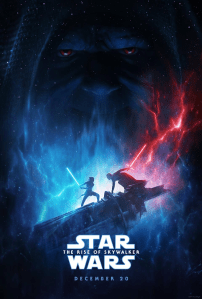
The spectre of Palpatine looms over Rey and Kylo Ren on the promo poster for The Rise of Skywalker.
Personally I enjoyed The Last Jedi, though I think it works better as a standalone piece than it does as part two of a trilogy, or part eight of an ongoing series. The major shift in tone from The Force Awakens – as epitomised by the scene in which Luke Skywalker simply throws away his old lightsaber – is certainly jarring. And while I’m a fan of the film myself, I understand the criticism levied at it by some in the Star Wars fanbase.
The Last Jedi was, whichever side of the argument you’re on, an unquestionably divisive film. And unfortunately, one consequence of the controversy it generated is that fans have broken up into factions. Some fan groups have descended into pure hate, attacking Disney, Lucasfilm, Kathleen Kennedy, and even actors and actresses from the films. This insane amount of online negativity has damaged the Star Wars brand to an extent. The Rise of Skywalker has to find a way to get things back on track.
In the run-up to the release of Solo: A Star Wars Story, some groups of fans were planning to boycott the film and its merchandise as a way to register their dislike of The Last Jedi and disapproval of the overall direction of the franchise. How many of them stuck to their guns and didn’t see Solo is something impossible to measure, but the negative feelings and ill-will undoubtedly hurt the film, which came out only five months after The Last Jedi.
What The Rise of Skywalker has to manage to do is bring back those fans. It has to give them a reason to want to show up at the box office, but more than that, it has to give the story a satisfying conclusion – one which can reunite the fractured fanbase.
I honestly don’t know whether it can.
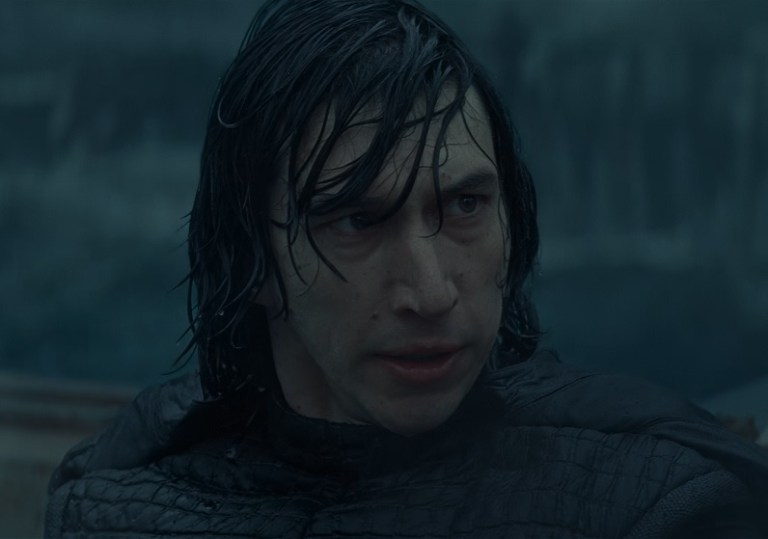
Adam Driver as Kylo Ren.
The problem isn’t that huge numbers of people will stay away. I think that most Star Wars fans, even those who felt that The Last Jedi was a terrible film, will head back to the cinema this time around, if for no other reason than morbid curiosity. At the end of the day, this franchise has been running since 1977, and the first phase of its story – that of Luke Skywalker and Anakin Skywalker – is finally coming to a close. That alone is reason to turn up and check out the film. Whether fans who found The Last Jedi to be a bad experience will find the conclusion of the story to be satisfactory is another question, however.
The Star Wars sequel trilogy failed to reunite its core three characters – Han, Luke, and Leia. By killing off Han Solo in The Force Awakens while Luke was still out of the picture, there was no opportunity for a reunion. And with the untimely passing of Carrie Fisher – as well as Luke’s supposed death in The Last Jedi – there’s now no chance to bring them back together even in a flashback sequence. In time, I suspect this will come to be viewed as a mistake. And as I wrote in my list of disappointments of the decade, the decision to have Luke going missing be the driving force for the plot of The Force Awakens will probably also be seen as problematic in hindsight.
There are, undoubtedly, missteps and mistakes to be overcome in The Rise of Skywalker. On the one hand, bringing back JJ Abrams for the film is a positive thing. He was, after all, responsible for creating characters like Rey, Poe, and Finn, and did initially draft out where those characters could go after The Force Awakens ended. But because the decision was taken to split up the storytelling of these films, giving each part to a different writer/director, Rian Johnson had the opportunity to ignore much of that story treatment when he wrote The Last Jedi – and that seems to be exactly what he did. Johnson was constrained by the concept of Luke being missing, but now Abrams is constrained by the ending of The Last Jedi too. And if it’s the case that the characters are in a completely different place than he intended them to be, then he basically will have had to write a whole new story for The Rise of Skywalker.
JJ Abrams is a good storyteller, and he can make films that are respectful of their place in a franchise but without feeling the need to entirely copy an existing story. His work on Star Trek Into Darkness shows this – that film pays homage to Star Trek II: The Wrath of Khan without copying it or overwriting it. But Abrams can also cross that line, and I’d argue that The Force Awakens strayed from being an homage to the first Star Wars film into copying it. Starkiller Base is, for all practical purposes, the Death Star, even down to the vulnerable hole at the end of a trench that a team of X-wings have to attack. When I first saw The Force Awakens I thought that kind of film is exactly what I wanted from Star Wars, especially after the disappointment of the prequel films a decade earlier. But looking back, it wasn’t the best take on Star Wars, and a little more originality would have been called for, as well as a better use of Luke Skywalker – or at the very least a reason for his absence.
“Mystery box” storytelling is what JJ Abrams has always done. He sets up a puzzle, a set of unexplained situations and circumstances, which draw in audiences and get people thinking. But he never writes a conclusion. His mysteries are beautifully set up – and then he disappears, leaving the ending to someone else. He did that in the television series Lost, which started well, but unfortunately became incredibly convoluted and ended with a controversial and, to many people, disappointing finale. So whether Abrams really was the right choice to bring the “Skywalker saga” to its end is something I’m not convinced of – at least, not yet.
The Rise of Skywalker has a difficult job to do if it’s going to be viewed as a success by both fans and detractors of The Last Jedi – and whether this division in the fanbase between the two camps will be temporary or permanent really does depend on how this film is received. If it manages to be a hit, then the fanbase can come back together and look forward together to new Star Wars projects. But if after release, fans remain divided into pro-Disney and anti-Disney camps, the biggest and best opportunity to heal that divide will have been lost. Also lost will be some fans – who will no longer turn up for new films and shows in the franchise. This happened to an extent with Star Trek, three times in fact: in 1987 with fans who didn’t want The Next Generation, in 2009 with fans who didn’t want the reboot films, and in 2017 when some fans didn’t want Discovery.
Any discussion of this topic would be remiss to not point out that some of the anti-Disney communities online actually make money – even a living in some cases – from their hate. And yes, a lot of it crosses the line from criticism into outright hate. For some of these YouTube channels, websites, and social media groups, controversy, division, and hatred are what drive clicks, views, and advertising revenue. If they were to come out and say “hey guys, The Rise of Skywalker was great and you should all go to see it!” they’d lose subscribers and viewers so fast they’d have nothing left. Many of the people who read and watch such content are there purely to see their own preexisting opinions reflected back at them, and the people creating this content know this. They know that their audiences expect a negative reaction to The Rise of Skywalker – and most of them will give them what they want, regardless of whether it’s what they actually think. And the reason is simple: attention and money.
With that in mind, The Rise of Skywalker has to go even further than any other title in order to be successful. It has to absolutely knock it out of the park, because if it does, maybe the overwhelming positive reaction from fans will force at least some of these people to concede. But if it’s only okay – and even if it’s good but not great – the online hate and anti-Disney sentiment will continue, because people are getting attention from the community and money from advertising on sites like YouTube for speaking out in that way.
It’s an uphill struggle then. But it’s one of Lucasfilm’s own making in a way – splitting up the story, and giving three different writers and directors essentially free reign to do whatever they wanted was an own goal. When creating any story, let alone one that has to be the follow-up to a genre-defining set of films, it’s important to take the time and plan it out. They needed to think carefully about legacy characters as well as plot out character arcs for the new ones. There’s no evidence that there was any proper planning or story work done – and that was a mistake.
Some of the story points which appear to be part of The Rise of Skywalker are questionable, too. Palpatine feels shoehorned in, especially given he was scarcely mentioned in the previous two films and had no impact whatsoever on their plots. A combination of fanservice, to appeal to those who hated The Last Jedi, and desperation, caused by the lack of a significantly imposing villain after Snoke’s death, seems to be why Palpatine has returned. Those reasons do not form the basis of a strong narrative, and the risk is that his appearance in the film will simply come across as cheap and lazy.
I’m sure Disney and Lucasfilm are aware of these issues, and others. There’s a lot riding on JJ Abrams and his storytelling, and in a very real sense The Rise of Skywalker will, for better or worse, set the stage for the next phase of Star Wars.
On a personal level, I really hope that the film will be a success. Not least because I want an ending to Luke and Leia’s stories that will be satisfying, but because I really want to see the division of the last two years put behind us as fans. There will always be disagreements over The Last Jedi – just like there are in Star Trek over who’s a better captain – but if the majority of fans can at least return to civility and get back to a place where new Star Wars projects generate almost universal excitement rather than arguments, I think The Rise of Skywalker will have done its job. Reviews from critics have come out in the last couple of days, and seem to be positive – but critic reviews for The Last Jedi were strong too, and failed to anticipate that film’s divisiveness. So we will have to wait and see.
If we can return to a place in the fanbase where debates are good-natured then that’s really going to be a positive thing. The negativity generated two years ago has been difficult to wade through, at times. There are enough things in the world today to divide people; we don’t need entertainment adding to that. Not when it’s supposed to be escapism and a distraction.
It’s my hope that The Rise of Skywalker will go a long way to mending fences, and that the Star Wars franchise can have a more united and secure future going forward.
The Star Wars franchise and The Rise of Skywalker are the copyright of Lucasfilm and Disney. This article contains the thoughts and opinions of one person only and is not intended to cause any offence.
Spoiler Warning: There will be spoilers ahead for the films, games, and television series listed below. If you don’t want to be spoiled, skip ahead to the next entry.
I initially thought about doing another top ten list for games, films, and television series that left me disappointed or underwhelmed in the 2010s, but the truth is that I don’t think I could reasonably find ten of each that I was genuinely disappointed by. There have been a few, but not enough to fill three full lists. So I’ve condensed what I had into one piece.
“Disappointment” is a very broad term when it comes to entertainment. For example, a television series I really enjoyed this decade was Terra Nova (it was in the “honourable mentions” section of my list of top ten television series), but despite it being a wonderful show, it was cancelled after one season with a story that hadn’t concluded. That’s a disappointment, undoubtedly. And of course there are films, games, and series that were just outright bad. I can be pretty brutal when it comes to switching off something I’m not enjoying – if it doesn’t seem like it’s improving or will improve, I’ll happily switch to something else. Life’s too short, after all, for bad entertainment.
That said, here are a few titles that, for a variety of reasons, I found to be disappointing in the 2010s. Please keep in mind that, as with previous lists, this is 100% subjective. This in my own opinion, and if you like any or all of these titles, that’s okay. You like what you like and I like what I like – and that’s great!
Film #1: Guardians of the Galaxy (2014)
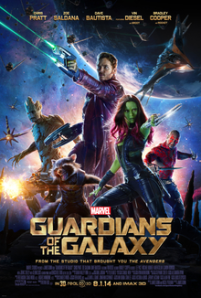
Promo poster for Marvel’s Guardians of the Galaxy.
You may remember from my comments on the list of top ten films that I’m not a Marvel fan, all things considered. I’m not a fan of superheroes, nor of comic books; I just never have been and even as a kid I didn’t read comics – my reading preference was for novels and books. Despite this, by 2014 I had managed to watch (most) of the Marvel Cinematic Universe films – albeit grudgingly in some cases – and I’d even started watching Agents of S.H.I.E.L.D. which was at the time a solid television series.
But then along came Guardians of the Galaxy. I found this film to be an absolute bore from start to finish. The comedy fell flat, the characters were either stupidly uninteresting or childish caricatures who couldn’t stop making (bad) jokes for even ten seconds. But worst of all was the plot. I just couldn’t find a way to care even the tiniest amount about the alien races I’d never seen on a planet I’d never heard of (and can’t even remember the name of) when it was under threat. There were no stakes and thus, no drama. At least in a film like The Avengers, it was New York and Earth that were attacked. In that case I knew the stakes – even if I found the film to be a bland, over-the-top action flick on par with something like Transformers. But Guardians of the Galaxy just failed across the board – uninteresting characters, meaningless aliens, and a threat to an unknown, insignificant planet about which I simply did not care.
On that final point, the film failed to communicate the stakes and get me invested in its world. A lot of sci fi and fantasy stories take place in worlds away from Earth. In The Lord of the Rings, Middle-Earth is threatened – yet I didn’t sit in the cinema thinking “who cares?” the way I did in Guardians of the Galaxy – because Peter Jackson’s films hooked me in and got me invested in its characters and its world. Likewise inthe Star Trek franchise – the destruction of Vulcan in 2009’s Star Trek reboot had emotional weight because the film (and the franchise overall) had successfully got the audience invested in its world. This is the failure of Guardians of the Galaxy for me – it just couldn’t make me give a damn what happened. In most of the other Marvel films I’ve seen, I at least worked up enough investment in the films and their setting to want to see it through to the end. But by the end of Guardians of the Galaxy, I was done with Marvel. I skipped a lot of the next films in the series, and when I saw some of the Guardians characters pop up in Avengers: Endgame this year I let out a sigh of disappointment that I had to put up with their crap again. Just a disappointing, uninspiring, boring film that thinks itself to be far funnier and cleverer than it actually is.
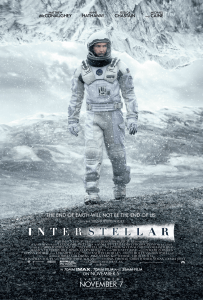
Film #2: Interstellar (2014)
Interstellar poster featuring Matthew McConaughey.
Interstellar reminded me exactly why I don’t like time travel stories. It basically takes everything that I find stupid and uninteresting about time travel and combines them into one slog of a film. It rightly received praise upon release for its visuals, including a stunning depiction of a black hole, but that aside there’s not much I enjoyed here, despite the hype.
Sometimes sci fi can be too science-heavy, with not enough attention paid to the “fiction” element – you know, the part which makes stories interesting. Interstellar falls into that trap at points, spending too much time explaining the relationship between gravity, speed, and the passage of time. And when it finally does get away from real-world science into a story, the plot is exceptionally convoluted, even for a time travel film, and it ties itself in knots in the second half basically creating a time loop – a form of paradox which just irks me.
It’s exceptionally hard to do time travel well, precisely for the reasons Interstellar shows. It’s too easy to write yourself into a corner, creating a scenario which is impossible to understand, let alone explain and communicate to your audience. And that just completely takes me out of it and ruins any enjoyment I might have otherwise got from the cast, who overall give good performances – just with a crap script.
Some people have told me I need to rewatch Interstellar four or five times in order to “get it” – as if that’s somehow a point in its favour. If a film is so bad that I barely made it through to the end the first time, I promise you I’m not going back for more. And if the only way your film is any good is on its fifth viewing, then I’m sorry but you made a crap film. And Interstellar, despite its star cast and great visual effects, is absolutely a crap film.
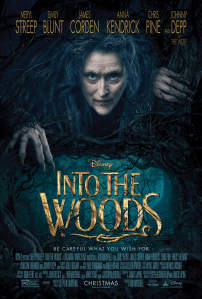
Film #3: Into The Woods (2014)
Poster for Into The Woods.
Musicals aren’t usually my thing. They can work – especially in animation – but most of the time, the cast randomly breaking into song midway through a scene is something I find incredibly jarring. It takes me out of whatever I’m watching, ruining any suspension of disbelief. On the stage or in animation I’m always aware that I’m watching something fictional, but with today’s exceptional visual effects, as well as great costuming and set design, there’s a much greater sense of immersion than in previous decades – and that’s partly what makes the random songs in any musical so offputting, I think.
But anyway, that’s a more general point. Into The Woods features some truly crap songs – sung badly by actors and actresses who aren’t natural singers. So at the numerous points where the film is interrupted by song, the songs aren’t even good or enjoyable to listen to. It also fails as a fantasy film, plagued by over-the-top hammy acting of the kind usually seen in pantomime. In fact, if it were a pantomime, Into The Woods might’ve been alright.
But as with a lot of modern films, Into The Woods wants to make a point. Something about how actions have consequences, maybe? I was so bored by the end I’m not even sure if that’s what it wanted to say. It also tries to satirise the fantasy genre and criticise fairy tales, but instead of gentle parody and laughing with its targets, it comes across as mean-spirited and laughing at them – and at the people who enjoy those genres.
There might’ve been the kernel of an interesting concept buried somewhere in the pre-production of Into The Woods, but it never made it to screen. And the bad acting, bad singing, and overall bad intentions as well as the aggressive, mean nature of the film made it a truly unenjoyable experience.
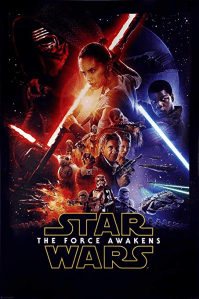
Film #4: Star Wars: The Force Awakens (2015)
The poster for The Force Awakens.
I actually really love this film. And I love its sequel, The Last Jedi, despite what many people have said about it. They are both great films – taken as standalone pieces. As two parts of a greater whole, however, they aren’t anywhere near as good.
The shift in tone from The Force Awakens to The Last Jedi is noticeable, and the reason why is that Disney and Lucasfilm decided that the way the sequel trilogy would be produced is that each writer and director would be given essentially free rein to tell whatever story they wanted. To me, that’s an absolutely absurd and inexplicable decision from a group of accomplished filmmakers. On what planet is that how storytelling works? If you’re creating a trilogy of films you need one writing team to tell a single, cohesive story – one story, told in three parts. Let alone that this trilogy is actually parts seven, eight, and nine to an already-existing series – and that that series happens to be one of the most important works of the genre. I just cannot fathom how this decision came to be made. It doesn’t make sense – and the result is a jarring tonal shift from one film to the next, epitomised by the scene at the very beginning of The Last Jedi where Luke Skywalker throws his lightsaber away.
As a standalone piece, The Force Awakens is a clone of A New Hope (aka Star Wars, the 1977 film). And on first viewing, I thought that was exactly what I wanted – especially after the disappointment of the prequels ten years previously. A return to what made Star Wars great was fantastic – but on looking at it again it’s clear that JJ Abrams crossed that invisible line which divides nostalgic throwbacks from outright copying. The strange thing is that two years previously, while working on Star Trek Into Darkness, Abrams had managed to pay homage to Star Trek II: The Wrath of Khan without falling into that trap. If he could do it there, how did he manage to go too far here?
One final point, the concept of “Luke Skywalker is missing”, which The Force Awakens sets up and uses as the driving force for much of its narrative was, in retrospect, a bad decision. Killing off Han Solo meant that fans of the original films never got to see any on-screen interaction between Han, Luke, and Leia – the trio of characters at the core of those films. As a sequel to a trilogy of films so reliant upon those three characters, I have to say I feel that was a big mistake. Carrie Fisher’s untimely death in 2016, as well as the supposed death of Luke Skywalker in The Last Jedi also means that we got very little Luke and Leia interaction on screen either. While I, like most Star Wars fans, left the cinema thrilled with what The Force Awakens did, looking back at it there are a number of issues which I’d say make it a disappointment.
Its sequel, while divisive, was much better and tried to take the franchise to different places. It was, however, constrained to a great extent by the concept of Luke Skywalker being missing, isolating himself on this small island. From that foundation, there weren’t many places to take the character and the story, and that contributes to the sense that The Force Awakens didn’t set up a strong narrative for the trilogy. But again, that failure is on the head of the producers, and their decision to allow the story to be split up. If one team of writers had worked from day one to tell a single story across three films, instead of three one-shots, the trilogy would arguably have been much better. The Rise of Skywalker – set to conclude the “Skywalker saga” – is to be released soon, and that could go a long way toward redeeming the series if it’s good enough. We’ll have to wait and see.
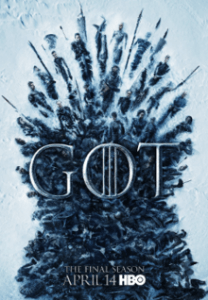
Television series #1: Game of Thrones’ eighth season (2019)
Teaser poster for Game of Thrones’ eighth and final season.
This really boils down to the first three episodes of the season. After that it did improve, though the disappointment of what happened in those first episodes wasn’t wiped away by what came after.
Inthe premiere episode of Game of Thrones way back in 2011, the White Walkers are shown for the first time, and throughout the entire seven seasons leading to this point, the overall message of the show was that the politics and infighting may be interesting, but something far greater and more dangerous lies beyond The Wall and is coming – and it won’t care who’s in charge. In the background, behind all the wars and all the politics, slowly building up over seven seasons was The Night King and his army of the dead. Finally, at the end of season seven, he brings part of The Wall crashing down and is able to lead his army south – atop an undead dragon, no less.
As the eighth season begins, many of the main characters have arrived at Winterfell, and the first couple of episodes lead up to a climactic battle in the third episode – where The Night King finally unleashes his army and all of his firepower upon our heroes. This is the moment the entire show feels like it’s been building up to… and then, just like that, he’s dead at the end of it.
The Night King, built up over seven seasons as the greatest threat our characters have ever faced, doesn’t even last one episode south of The Wall and is killed in his first battle against any significant opposing army. To me, that’s an unforgivable storytelling mistake. Game of Thrones is rightly held up as one of the all-time great works of television, and is a seminal event in this decade’s storytelling, but this one moment, and the episodes preceding it when looking back in hindsight, threatens to undo all of that. It taints Game of Thrones with just how badly it was done.
I won’t go over all of it here – because I plan to do a full article or even a series on this topic – but Game of Thrones deserved a better final season than it got. Luckily, the remaining episodes were largely good and did go some way to saving the season, but even so it remains a disappointment and the way that The Night King didn’t even bring his “long night” for a single day, let alone years, is incredibly disappointing.
Television series #2: House of Cards’ sixth season (2018)
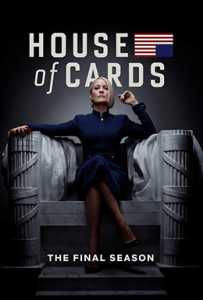
Robin Wright on a promo poster for the sixth season of House of Cards.
House of Cards – a remake of a British series of the same name from the 1990s – is an incredibly important television series. While not on par with something like Game of Thrones, perhaps, it is nevertheless the show that pioneered Netflix’s original programming, and that was the first significant show to premiere all the episodes of its season in a single day. Other Netflix shows owe their existence to House of Cards, and Netflix’s decision to diversify into original programming – as opposed to merely licensing other peoples’ properties – is what will allow it to survive as we enter the “streaming wars”.
In 2017, Kevin Spacey, who played devious mastermind Frank Underwood in House of Cards, was accused of a number of serious sexual offences. His response to the allegations was widely criticised, and as a result he became persona non grata overnight, even being digitally erased from the film All the Money in the World. As the sixth season of House of Cards was in early production, Netflix quickly announced he’d be dropped from that too, and production was restarted without him.
As happens in a lot of cases when a main character leaves a series, the way in which he was written out (he died off-screen) was ham-fisted and just poor overall. For a main character to just be dumped never sits well, but in a story so focused on a single character like House of Cards, where Frank Underwood is so central to everything that happened, there’s basically no point in carrying on without him.
At the end of season five, Frank had resigned as President amidst a scandal (of his own making), thus arguably completing the “rise and fall” narrative of House of Cards. With Spacey embroiled in scandal there was no way Netflix could continue to work with him, so the decision should have been to pull the plug and end the series. The sixth season was just an unnecessary disappointment. This isn’t, by the way, a criticism of Robin Wright, who did an admirable job stepping into the role of protagonist/anti-hero that Spacey had occupied. It’s simply the fact that the series was never her character’s story, and jettisoning its main lead while production was underway and a deadline was coming up meant that the sixth season had to be rapidly adjusted to fit the new circumstances. And unfortunately, it came up short.
Television series #3: The Walking Dead (2010-Present)
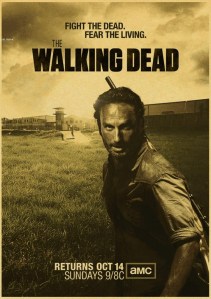
Promo poster for The Walking Dead featuring Andrew Lincoln.
Even speaking as someone who isn’t a huge fan of horror, the first couple of seasons of AMC’s zombie show were decent. Playing more on the post-apocalyptic setting than the zombies themselves, the earlier episodes of The Walking Dead had some great character moments and performances by the cast. But as time has passed, the series has completely run out of ideas.
Rick Grimes and his ever-changing group of survivors seem to stumble from bad situation to bad situation, and in recent years all of those bad situations have been essentially the same thing. When the zombies lost their fear factor a couple of seasons in, writers began looking for new threats for the group to deal with. And since then, every season has followed basically the same pattern – Rick and his group arrive in an area, other human survivors decide they don’t like Rick and his group, the two groups fight, and then that’s it. Roll on the next group of human survivors with an inexplicable and poorly-written anti-Rick agenda. The Governor came first, so he gets somewhat of a pass. But after him came the Terminus cannibals, then Negan, and it’s just become so boring and repetitive that I tuned out.
Fear The Walking Dead – a spin-off of the main show – is actually much better. It’s taken a look at the immediate aftermath of the zombie virus in a way that The Walking Dead didn’t, and thus its post-apocalyptic setting, while the same as that featured in the main series, feels like it has more of a foundation to build upon.
Any villain or enemy can be overused or overexposed. And when they are, when the protagonists have defeated them so many times, they lose their fear factor. And even though The Walking Dead was up there with Game of Thrones in pioneering the “disposable” cast (i.e. main cast members could be killed off at any time and you couldn’t be sure who’d survive), by this point in the show as it passes its tenth season, the vast majority of the original cast have gone, and the few survivors who are left from earlier seasons don’t feel like they’re in danger. Add to that that the new characters are less interesting and less well-known to the audience and the show has become boring. Some series have a natural lifespan – and The Walking Dead should’ve ended after perhaps four seasons or so.
Television series #4: Doctor Who (2005-Present)
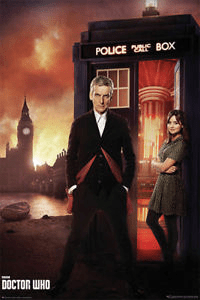
Peter Capaldi and Jenna Coleman on a promo poster for Doctor Who.
There have been some great Doctor Who stories this decade – The Day of the Doctor is brilliant, for example. But unfortunately, after Matt Smith left the role in the 2013 Christmas Special, things went downhill fast.
Peter Capaldi is exactly how I’d imagine The Doctor if someone just described the character to me. He has a certain quality, perhaps best described as “gravitas” or “weight”, allowing him to seamlessly and successfully step into the role of this ancient, time-travelling alien. Which is something that previous Doctor Who actors of the relaunched series arguably lacked.
Sadly, though, Capaldi just had nothing to work with. For the entire three seasons he was in the role, the writing and stories were just bad. They started bad and even managed to get worse over time, as the team being the series simply ran out of ideas. Modern Doctor Who has suffered from an overuse of three key villains – the Daleks most notably, but also the Cybermen and Weeping Angels. All of these adversaries were great in their initial appearances in 2005, 2006, and even up to the end of the last decade. But by the time Peter Capaldi took over they were played out. And the stories featuring new opponents for The Doctor simply didn’t get off the ground.
Clara, who had been the companion to the previous Doctor, was written out of the show in a bad way, and Maisie Williams of Game of Thrones fame is introduced as an incredibly annoying immortal character. The only decent companion of this era, Bill (played by Pearl Mackie) only lasted a single season and was treated as a complete afterthought in most of her stories – and also came to a stupidly annoying end.
I struggled on through Capaldi’s reign as The Doctor, waiting for the writing to improve so the show could finally shine, but unfortunately it never happened, and his departure was thus the last time I bothered watching. Doctor Who needs a root-and-branch overhaul, and since that seems impossible right now, it would be better to put it back on hiatus for a while. Perhaps we can come back to it in a few years when someone has a genuinely good idea for its revival.
Video game #1: Fallout 76 (2018)
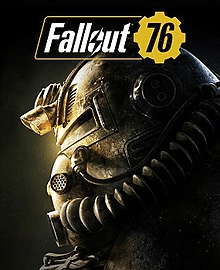
Fallout 76 box art.
What’s at the core of a great story? Whether we’re talking about a film, a television series, or a video game, characters are at the heart of any story. And the Fallout series, from its inception in the 1990s through the three more recent titles, have been story-focused games. So why, then, did Bethesda choose to release Fallout 76 – an online game where there are no non-player characters?
Forget about the bugs for a moment. Fallout 76 was riddled with glitches and graphical errors, but if, underneath all of that, there had been a story worth telling, a lot of that could have been and would have been forgiven. But there wasn’t, and the fact that Fallout 76 is essentially a big, empty world has meant that the issues which are present seem all the more egregious. I’m honestly not sure what the point of this game was. Aside from walking around to look at the decently pretty – if somewhat last-gen – environment, and fighting off a few monsters, there’s literally nothing to do.
I’m not a multiplayer gamer; I don’t enjoy playing online with strangers. But I fully understand that a lot of people do, and that this game was aimed at them. But even if that was the objective, it’s completely failed. The lack of story meant that even players who teamed up to tackle Fallout 76‘s environment together would be bored pretty quickly, and the shoddy gunplay – which Fallout’s signature VATS system concealed so well in Fallout 3, New Vegas, and Fallout 4 – means that it’s worthless as a multiplayer player-versus-player shooter like Call of Duty. So honestly, what was the point of this game? It’s been nothing but a massive PR own goal from Bethesda, and their damaged brand will take a long time to recover. If their next title isn’t absolutely fantastic, they’ll be in a mess of trouble.
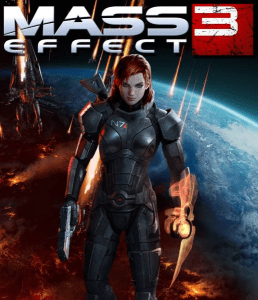
Video game #2: Mass Effect 3 (2012)
Female of Commander Shepard on the alternate box art for Mass Effect 3.
I picked Mass Effect 2 for my game of the decade – spoiler warning for that list. But its sequel struggled to conclude the trilogy in a satisfactory way. Mass Effect 3 told what should’ve been the most interesting part of the story. After Shepard is introduced to the idea of The Reapers – space-dwelling robot aliens who want to rid the galaxy of all intelligent life – in the first game, and the second game uncovers another part of their plan, this game features the actual war against The Reapers – and players have to fight battles and bring the galaxy together to defeat them.
On paper, it sounds like the best part. But, coming out only two years after Mass Effect 2, Mass Effect 3 was rushed. Gameplay remains solid, though not notably improved from its predecessor, and there are none of the bugs and graphical issues which would plague Mass Effect: Andromeda. But as the story ramps up, it’s clear that developers Bioware simply ran out of time to pull everything together.
It isn’t just the “pick a colour” ending – though that is a significant disappointment in itself – but the fact that choices made throughout the game, and indeed in the previous two games, not only don’t matter but aren’t even given lip service as Mass Effect 3 enters its final climactic fight.
To give an example, if players have followed a specific path across all three titles, it’s possible to save both the Geth species and the Quarian species when it seems like it should only be possible to save one or the other. This is an incredible moment in the game, and it feels like having both powerful fleets on your side will make a difference when you reach Earth – where The Reapers have massed their forces. But it doesn’t – literally the only difference comes in the cut-scene immediately after arriving at Earth, where the different fleets check in to confirm they’ve all arrived. Two seconds of dialogue reveals that you have both the Geth and Quarians on your side… then that’s it. And there are dozens of other instances throughout the final third of the game where an extra few months of development time would’ve allowed for a much more satisfying way of recognising the player’s choices.
In a series where players were promised that “every choice matters”, it turned out by the end of Mass Effect 3 that that simply wasn’t the case. And while the game is solid overall, it’s a poor relation to its predecessor.
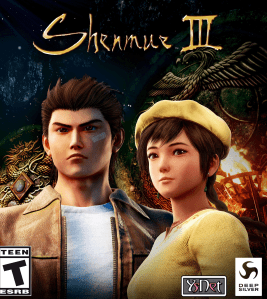
Video game #3: Shenmue III (2019)
Ryo Hazuki and Shenua on Shenmue III‘s box art.
I’ve already written an article detailing at length my problems with Shenmue III, but suffice to say it’s absolutely one of the biggest let-downs for me personally.
As a big fan of the first two Shenmue games, back when I had a Dreamcast, I was absolutely thrilled to hear that series creator Yu Suzuki had managed to buy the rights to the legendary series with a view to finally making a sequel. Eighteen years have passed since I left protagonist Ryo in a cave in China, and I was really looking forward to learning what happened next after that cliffhanger, as well as finally seeing the story brought to an end.
But Shenmue III doesn’t bring the story to an end – thanks to an absolutely inexplicable decision not to make cuts to the bloated story of the series. Yu Suzuki genuinely thinks he can get lightning to strike twice and that he’ll somehow get the money together to make Shenmue IV – and presumably V and VI as well? Fat chance.
His studio had been given a once-in-a-lifetime opportunity by a dedicated group of fans to conclude the story, and they blew it. The Shenmue series was as dead as it was possible to be, and Sega was only willing to part with the rights because they knew that it would never make them any money. As great as Shenmue was, it was a colossal failure, and Shenmue II managed to retain less than 10% of its fans from the first game, resulting in a massive drop in sales from one title to the next. By every conceivable metric, the games failed. And despite that, a small, vocal group of fans managed to stump up over $7,000,000 – some individuals contributing thousands of dollars.
I don’t claim to speak for all of them, but the one thing I expected from Shenmue III – in fact, the only thing I expected from it – is that it would finally complete the story. And if Yu Suzuki couldn’t find a way to cut it down to fit into one game, someone needed to be brought in to swing that axe and make those cuts. As a result of this, I haven’t even bought the game. And I won’t, because what’s the point? Get drawn back into that world, only to be left on another unresolved cliffhanger? No thank you.
So that’s it.
A few titles across entertainment that I found to be disappointing or underwhelming this decade. If your favourite is on the list, well I’m sorry. But we all have our own preferences and tastes. These are just my opinions, and are wholly subjective.
The 2010s have, overall, been a wonderful decade for entertainment. TV shows are better than ever, often with cinema-quality acting and visuals, video games continue to get bigger and better, and at the box office there have been some incredible films. But there are always going to be misses to go along with the hits, and this list just runs through a few that didn’t work – at least for me.
All titles listed above are copyright of their respective studio, developer, producer, and/or distributor. This article contains the thoughts and opinions of one person only and is not intended to cause any offence.
Spoiler Warning: There will be spoilers ahead for each of the films on the list. If you haven’t seen one and don’t want to have it spoiled, skip that entry and scroll to the next.
It’s December 2019, and with the 2020s just around the corner, it’s time to look back at some of the entertainment high points of the decade as it draws to a close. In this first list, I’ll be looking at my personal picks for the decade’s top films.
The 2010s saw some rather impressive technological leaps in cinema, particularly in the realm of special effects. The CGI of the 1990s and 2000s looks incredibly amateurish by today’s standards. Going back to some earlier films – even big-budget blockbusters – which rely heavily on CGI can seriously detract from the experience, especially on today’s large format 4K displays.
Narratively, the decade has seen franchises and sequels firmly dominate the box office, inspired by the success of Marvel in particular. It’s also been a decade where nostalgia and throwbacks to past films and franchises has been important. Many films have gotten sequels years or even decades after release – the revival of the Star Wars franchise being most notable.
By the way, the numbering here isn’t necessarily in order. The number one film is my favourite film of the decade, but the others could really be put in any order. All are great and while some have flaws or weren’t perfect, these are the films I enjoyed most. If your favourite(s) don’t make the list, just remember this is all subjective. You like what you like and I like what I like. And that’s great!
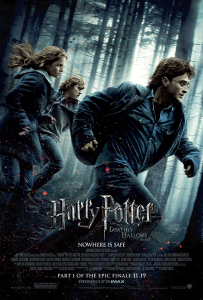
Number 10: Harry Potter and the Deathly Hallows, Parts 1 & 2 (2010 and 2011)
Herminone, Ron, and Harry in the promotional poster for Deathly Hallows Part 1.
This is kind of a cheat because it’s two films, but it’s my list so that’s just tough. Looking back to the beginning of the decade, it’s hard to imagine that the Harry Potter series hadn’t yet concluded. But Deathly Hallows was split into two parts, coming out in 2010 and 2011, and they brought the series to an explosive conclusion. The decision to split up Deathly Hallows – which was, of course, a single book – into two films got a lot of criticism at the time for being a fairly obvious and shameless money grab, but the thing about the Harry Potter series is that there was always a lot of cut content from the books. So while it certainly was a moneymaking ploy on the part of studio Warner Brothers, it wasn’t one which damaged the films. If anything, the extra runtime makes Deathly Hallows a more enjoyable and fully-rounded experience.
Prior to JK Rowling messing with the characters (did you hear Dumbledore is gay now?) Deathly Hallows marked the end of the Harry Potter saga, which had been running since 2001’s The Philosopher’s Stone. Subsequent attempts to pull fans back in, with the two Fantastic Beasts films and the Cursed Child stage play haven’t managed to be anywhere near as successful, either in terms of story or financial results, so it would’ve been better in many ways if this had been the final entry in the series.
By this point in the film series, we’ve been with the characters for a long time, we’ve got to know the actors and watched them in a very literal sense grow into their roles. Deathly Hallows doesn’t shake up the formula or the aesthetic of the Harry Potter world. It’s more of the same, building on previous films and drawing the story to a satisfactory conclusion. The climactic fight against antagonist Voldemort had been building slowly over several films and when he was finally vanquished – with Harry’s trademark disarming spell, no less – it was a great and emotional moment. Aside from the awkward epilogue with several key characters having been “aged”, both films accomplish what they set out to. And as a fan of Harry Potter overall, it was a good way to say goodbye to the series. Or at least, to this iteration of it with these actors. I wouldn’t be shocked at all if Harry Potter returns as a big-budget television series in a decade or two.
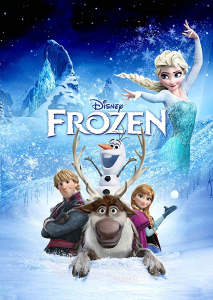
Number 9: Frozen (2013)
Promo poster for 2013’s Frozen.
In the autumn of 2013, when Disney’s Snow Queen-inspired Frozen was released, I was living in a different country, and perhaps it’s for that reason that I missed out on almost all of the advertising and hype for this film. It was only when browsing local cinema listings for English-language films that I even heard about Frozen, and decided from that to go to see it. Disney films have always been decent, so I wasn’t expecting to be disappointed, but I really was surprised at just how good Frozen was.
We could do a whole article on how the animators created the incredible snow for the film – important, obviously, in a film with such a wintry setting – because honestly the amount of work that went into that aspect alone is amazing. The snow in Frozen looks and behaves like real snow, right down to its powdery consistency, and the level of detail really took me by surprise. I understand that animators spent months working on just this one aspect of the film, and that attention to detail shows in the finished product. Frozen wouldn’t be half as good if it looked like Anna and her sister Elsa were trekking across a flat sheet of paper.
As a story, Frozen stands out for breaking the typical Disney Princess mould. Rather than being a story of a damsel in distress being rescued by a dashing prince, Frozen turns that on its head by having the central characters be two sisters, and the ultimate act of love be one of sisterly love. In addition, the dashing handsome prince featured in the early part of the film turns into a villain in what is, by Disney’s standards at least, a shocking and unexpected twist.
Despite being played perhaps more than a little too often in the years after Frozen‘s release, the soundtrack is also amazing. Let It Go, the main song from the film, is undoubtedly one of Disney’s best, and there are several others throughout the film which are memorable. It’s always nice to be surprised at the box office, and Frozen definitely did it for me this decade.
I’d like to give an honourable mention to Disney’s other great film of the decade, Moana. When I was writing this list I debated including Moana, but when it came down to a choice between the two, Frozen just edges it for me. Still a great watch though, and with Disney+ coming soon, there’s no excuse to not see both!
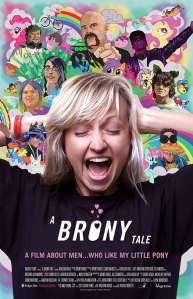
Number 8: A Brony Tale (2014)
Ashleigh Ball on the promo poster for A Brony Tale.
I love a good documentary. I’d have put more docs on this list if I had more space, but considering the theatrical documentaries of the decade, A Brony Tale definitely earns its spot. The film could’ve easily descended into ridiculing the so-called Bronies (a portmanteau of “bro” and “pony”) but manages to stay away from mocking its subject matter, instead telling a more nuanced story.
The film follows My Little Pony: Friendship is Magic voice actress Ashleigh Ball as she prepares to attend a Brony convention. Prior to watching the film, I was loosely aware of Bronies – largely from internet memes – but I hadn’t really spend any time investigating the cartoon or its fans. Bronies, if you’re unaware of the term, are adults (usually men, but the community includes women too) who have become fans of the 2010 cartoon series My Little Pony: Friendship is Magic. Obviously the odd thing about this, for anyone who knows their cartoons and toy brands, is that My Little Pony is aimed at girls, specifically girls aged 6-12, so for adult men to be interested in this series raises a lot of questions.
The documentary tackles its subject matter in a respectful way, letting fans of the show speak for themselves without being overly judgemental or preachy. One story, recounted by the father of a fan, explained how someone dealing with depression and mental health had found an artistic outlet after being inspired by My Little Pony. And the fans themselves come from many walks of life as well as different backgrounds.
At the centre of it all was Ashleigh Ball and her decision to attend a convention. She specifically talks about how she’s used to being anonymous as a voice actress, and how it will be an unusual experience to be the star attraction and have so many people knowing and recognising her. The film documents her struggle to understand and come to terms with the phenomenon of adult fans. And again, the way it’s presented and the way the film explores both the fandom itself and Ball’s reaction to it was done tastefully and respectfully.
It’s also a reminder that any fandom can be seen as odd from the perspective of an outsider. Something like Star Wars is practically mainstream nowadays, but when I was at school, Star Wars was very much a nerdy franchise to be associated with, as was Star Trek or something in the fantasy genre. It’s fascinating to me to see how something like Game of Thrones became as popular as it did as a fantasy series, when not that long ago it was something mainstream audiences would’ve looked down on. The overall message of A Brony Tale seems to be: “let people enjoy whatever they want and try not to judge”. I like that message, and that’s what I took away from the film.
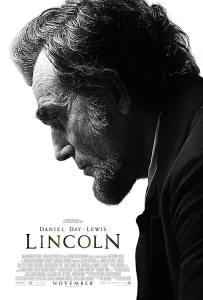
Number 7: Lincoln (2012)
Daniel Day-Lewis won an Academy Award for his portrayal of the titular American President in Lincoln.
Now for a complete change of pace. The American Civil War – and American history in general – has always interested me, so Lincoln had been on my radar for a while prior to its 2012 release. And it was absolutely worth waiting for.
Telling the story of the last few months of Abraham Lincoln’s life, as he struggled with Congress to end the Civil War and emancipate southern slaves, the film and its spectacular cast do an amazing job portraying the complexities of negotiations and political manoeuvring. Sometimes a story can be uninteresting if its ending is known – and we know, of course, that Lincoln successfully freed the slaves and won the war – but in this film, how it played out is a joy to watch.
Aesthetically, Lincoln does a great job portraying Washington DC as it would’ve looked in the 1860s, and the costumes and set designs are absolutely on point. The dirty, gritty reality of life in those days is conveyed beautifully on screen, and supplements the story and acting greatly. People often downplay these aspects of a film, and while its true that some minimalist productions can do well – especially on the stage – as well as low-budget films that don’t necessarily have money to waste, in a title like Lincoln getting the look right definitely adds a quality to the film that just wouldn’t exist even if all other factors (the script, acting, direction, etc) were identical.
Lincoln stands up among other great works of cinema, and I think in future will be hailed as a must-watch classic of the history and drama genres. With Steven Spielberg directing and producing, alongside fellow producer and future Lucasfilm head Kathleen Kennedy, there was so much to this film that even after multiple viewing I still find new elements to enjoy and new moments to revel in. Overall a really stunning piece of cinematic history.
Number 6: Star Trek Into Darkness (2013)
A different look at the Starfleet logo on the poster for Star Trek Into Darkness.
Star Trek Into Darkness isn’t my favourite Star Trek film. It’s probably not even in my top five, but it’s definitely the better of the only two Star Trek films released this decade. As a follow-up to 2009’s Star Trek reboot, Into Darkness builds on its predecessor and is a solid action flick with a twist (some) fans will have appreciated, and a flickering of that elusive “Star Trek-ness”. It’s also notable for being Leonard Nimoy’s final film role; unfortunately the decade has claimed many Star Trek actors.
So I have to admit that as a big Star Trek fan, it would’ve felt wrong to not include a Trek film on this list. That’s 100% my own bias coming through rather than a commentary on Into Darkness, which is a decent action film but probably not one of the best ones I’ve ever seen. What Into Darkness did, however, as with its predecessor and sequel, is keep the Star Trek franchise ticking over, giving it some breathing room while keeping it alive in the popular consciousness. It’s hard to see how we’d have got to see Discovery, Picard, or Lower Decks next year if the JJ-verse films hadn’t given the franchise a breath of fresh air. In that sense, Into Darkness – as arguably the best of the reboot films – is a key stepping stone in the franchise’s continued success. And while the film stands up on its own merits as a piece of Star Trek storytelling, in my opinion at least, its biggest accomplishment is paving the way for what’s come since.
The twist Into Darkness springs on fans was clever, but also had been rumoured to be happening, and the result of that rumour being all over the internet in the weeks before release detracted from it somewhat as I wasn’t surprised. Central villain John Harrison (played by Sherlock actor Benedict Cumberbatch) is revealed to be famous Star Trek baddie Khan, and what follows is a film which pays homage to The Wrath of Khan without going overboard. As a JJ Abrams film, in that sense I greatly prefer it to Star Wars: The Force Awakens, which went too far in copying its 1977 predecessor.
It’s become a recurring theme in this list, but the special effects and visuals were great in Into Darkness, and the difference between this iteration of Star Trek and what we’ve seen previously is huge.While some of the aesthetic changes haven’t sat well with fans of TOS, and I understand that, the effects, particularly in big set-pieces, look fantastic even six years later.
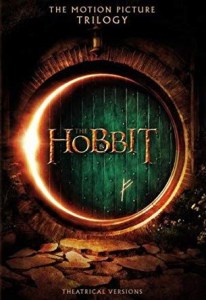
Number 5: The Hobbit trilogy (2012, 2013, & 2014)
Cover of the DVD or Blu-Ray version of The Hobbit trilogy.
Realistically I should’ve just put the first two parts on this list, because the third film isn’t all that great. Indeed, The Hobbit is overall a poor relation to the previous decade’s epic Lord of the Rings trilogy, but nevertheless was an enjoyable return to Peter Jackson’s Middle-Earth.
Martin Freeman is the standout here, a perfectly-cast lead as titular Hobbit Bilbo Baggins. It’s through his eyes that we see Middle-Earth as we follow his adventure to The Lonely Mountain with the Dwarves, and Freeman’s strong performance carries what would otherwise be a much more underwhelming trilogy of films. Part of the criticism these films got is due to comparisons to Lord of the Rings, but that was inevitable, and other criticisms of the runtime, effects, and dialogue are valid.
When I saw the first and second parts in the cinema, I was able to see the “high frame rate” version, shot in 48 frames-per-second – a novelty for the big screen. While this seemed gimmicky and even offputting at first, once I got used to it it did make for an interesting experience. Disappointingly, the films have not been released anywhere in this format, as the DVD, Blu-Ray, and digital releases all stick to the standard cinematic 24 fps.
While the plot of The Hobbit suffered as a consequence of being dragged out across three films instead of one or two, and some of the added new characters fell flat, any time fantasy makes it to the big screen with such a big budget is going to be a positive thing. The plot of The Hobbit is certainly less exciting than Lord of the Rings, at least in the sense that nothing world-ending is threatening our protagonists. Peter Jackson tried to compensate for that by throwing in a lot of “foreshadowing” for the rise of Sauron in Lord of the Rings, but in this case it would’ve arguably been better to stick to the core story.
The final film is a rare example this decade of sub-par special effects, perhaps due to their overuse, and while there are some great moments (such as a Dwarf played by Billy Connolly) overall the first two films do a much better job of telling an interesting fantasy story. Some of the highlights for me included the creepy, claustrophobic time the party spends travelling through Mirkwood in a perfectly-shot sequence, the portrayal of Radagast by former Doctor Who actor Sylvester McCoy, and above all, being back in Middle-Earth once more.
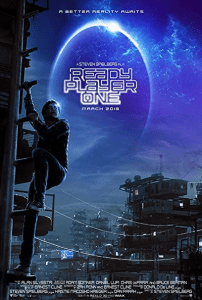
Number 4: Ready Player One (2018)
Lead actor Tye Sheridan on a promo poster for Ready Player One.
The second film on this list to be directed by Steven Spielberg is a geek’s paradise thanks to countless references, easter eggs, and nostalgic throwbacks to films of the 1980s in particular. The story is centred around players in a massive online world who are racing to gain control of that world by solving a series of puzzles its creator left behind when he passed away.
Ben Mendelsohn plays a truly nasty villain, giving the story much more weight and raising the stakes for the main characters. Ready Player One is laden with special effects, and because (most of the time) the effects aren’t trying to be hyper-realistic and imitate reality, but rather imitate a futuristic online game, many issues present in other titles simply vanish here. Because we know that what’s being shown on screen is taking place in a virtual world, there’s no expectation of it to be perfect, and thus none of the “uncanny valley” effect which some CGI-heavy films can fall victim to.
The plot is exciting – and it’s always great to root for an underdog in a fight or race against a big corporation. I have to confess I haven’t read the book upon which the film is based, and I have heard some criticism of the film from fans of the book. But as someone going in with no expectations, I was very impressed and found Ready Player One to be a very entertaining film.
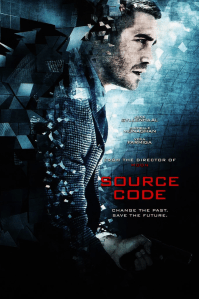
Number 3: Source Code (2011)
Jake Gyllenhaal on a promo poster for Source Code.
I didn’t know what to make of Source Code at first. It’s a complicated film – as time travel stories often are – and it took me a while after leaving the cinema to fully process what I’d seen. Some of the implications are actually a little disturbing – like whether lead Jake Gyllenhaal’s character actually stole someone’s body and identity.
Usually I’m not a big fan of time travel as a concept. It works in some instances, but in too many films and stories it gets convoluted and some stories completely tie themselves in knots either with inexpiable paradoxes or trying to over-explain the rules of time travel in their world. Fortunately, Source Code manages to avoid those traps for the most part, and what results is a genuinely thought-provoking film.
The basic premise is that a secret government programme has given an injured soldier a way to travel back in time to find out who was responsible for a terrorist attack. He only has a few minutes in the past before the explosion occurs and then the operators have to reset the loop and send him back again. It takes multiple visits to the past (or simulated past) before he gets the hang of things. To explain the entire thing would take more time than I have on this list, but suffice to say it’s a fascinating concept that is, for once, well-executed.
Strong performances from leads Jake Gyllenhaal and Michelle Monaghan carry the film, as their characters slowly work out what’s going to happen. It’s perfectly paced, well shot, with a couple of unexpected twists and revelations which keep things interesting. The real-world, modern day setting is a change of pace from a lot of science fiction films of this decade, and I found myself rewatching Source Code multiple times.
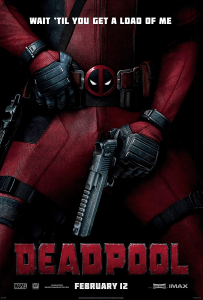
Number 2: Deadpool (2016)
A promo poster for Deadpool.
Though it may seem heretical to some, I’m not really into superheroes. As a kid I didn’t read comic books, and the big-budget superhero films I’ve seen over the years – the likes of Fantastic Four or X-Men – just didn’t hold my interest. Even the Marvel films of the last few years haven’t really interested me all that much, and I found myself seeing them more out of obligation than enjoyment. Deadpool was different, however, as a comedy film and with Ryan Reynolds masterfully portraying antihero Wade Wilson.
Not knowing much about Marvel or any of its characters outside of Iron Man and The Avengers, I didn’t really know what to expect going in. I’d heard the film was funny, but it had some real laugh-out-loud moments that I didn’t expect.
I think the problem many superhero films have is that they simultaneously take themselves very seriously while having storylines, characters, and an aesthetic that is childish and inherently un-serious. That disconnect is jarring for me, and takes me out of it. In addition, as I’ve mentioned previously, much of the appeal of Marvel films – as withStar Trek, Star Wars, The Hobbit, and other franchises this decade – is nostalgia. The films appeal much more to people who grew up with these characters in the various comic books, and as someone who just didn’t have that experience I don’t have the same connection to those characters.
What was great about Deadpool, to get back to my original point, is that the whole point of the character is that he doesn’t take himself or his surroundings seriously. That was true in the comic books and it’s carried over to the film perfectly. Reynolds was an absolutely inspired casting choice, as his comedic range fits the character so well. The frequent breaking of the fourth wall – apparently a Deadpool trademark going back to his comic book days – was done perfectly and provided many fun moments.
The over-the-top action was great, as were the gory deaths which earned the film a more restrictive rating than it otherwise would’ve. But it’s hard to see how Deadpool could’ve worked as a film marketed at kids and teenagers; it needed to have the freedom to offend in order to accomplish what it set out to. Overall, I don’t really care whether it stayed true to its source material, but Deadpool was a hilarious send-up of the whole superhero genre.
Honourable Mentions:
Just before I declare my favourite film of the decade, I want to look briefly at a few other titles that almost made this list. I’ve picked ten – which absolutely could’ve been the top ten themselves. Obviously there are way more than ten or twenty films to enjoy from the 2010s, and while the decade has been dominated by sequels and franchises, there have been some great original and standalone works too.
Oz The Great And Powerful (2013) – A fun return to the Land of Oz, fronted by James Franco. Jurassic World (2015) – An interesting attempt to reboot the Jurassic Park franchise. It was nice to see a fully-operational park. Tomorrowland (2015) – An underrated film loosely based on the Disneyland attraction. Great performances and an interesting concept. Bohemian Rhaposdy (2018) – Perfectly acted by Rami Malek, who won an Academy Award, this biopic of Queen’s front man is an entertaining look at the band’s rise. Star Wars Episode VIII: The Last Jedi (2017) – Controversial and unfortunately divisive among fans, Rian Johnson’s film tried to shake up Star Wars after JJ Abrams played it very safe two years prior. And it succeeded. Joker (2019) – I can’t rank this because I haven’t seen it. But everything I’ve heard has been great and I can’t wait to see for myself. Moana (2016) – As mentioned above, a great Disney film with an inspirational story. And some catchy songs. World War Z (2013) – Less a horror film than an action flick with zombies, it stands up as an interesting and different take on the zombie genre in a decade overrun by The Walking Dead. Game Change (2012) – I fully admit this is a niche film (especially outside the USA) as it documents John McCain and Sarah Palin in their unsuccessful campaign. As someone who finds such things fascinating it was an interesting – if supposedly inaccurate – film. Phineas and Ferb: Across the 2nd Dimension (2011) – What can I say except I really enjoy Phineas and Ferb? The film is based on the longest-running Disney Channel original cartoon, and is more of the same, playing out like a feature-length episode of the show.
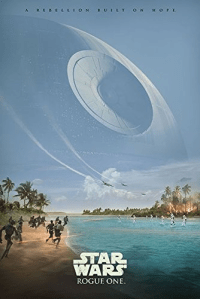
Number 1: Rogue One: A Star Wars Story (2016)
The Death Star looms over the beach on the plant Scarif in this poster for Rogue One.
When it came to naming my favourite film of the decade, I didn’t need to think twice. Rogue One took everything great about Star Wars and condensed it into a single standalone piece of cinema. Though I would argue the scenes with Darth Vader were unnecessary, the full power of The Empire is on full display here, and after The Force Awakens successfully took the story forward by a generation, Rogue One brought fans back to where it all began.
Jyn Erso is such an excellent protagonist; selfish and completely jaded when we first meet her, she becomes conflicted and eventually rises to inspire hope in the Rebellion over the course of the film. Each of the characters we meet is interesting and could reasonably have a whole film or series dedicated just to them. Rogue One is, in that sense, a perfect team-up film, bringing together a diverse array of characters from the Star Wars galaxy in a no-hope plot to steal the Death Star’s plans.
Ben Mendelsohn is on this list as a villain for the second time, and while he was great in Ready Player One, this is truly his outstanding performance. Though unfortunately his character is ultimately overshadowed in the final cut of the film thanks to Darth Vader’s appearances, Krennic is a kind of Star Wars villain we haven’t really seen – the career man who takes far too much glee in his work.
The CGI recreations of both Carrie Fisher and Peter Cushing were very, very close to being perfect. And I think in that sense, Rogue One has paved the way for technology that will become increasingly common in future.
Everything from the music, the aesthetic, the return to the era of the Original Trilogy was everything I wanted from a Star Wars film, and the decision to kill off basically the entire cast was an incredibly bold decision in such a franchise- and sequel-focused era of filmmaking. We need more films like Rogue One.
So that’s it.
My top picks for films of the decade, and while there are undoubtedly lots of enjoyable films I missed, these are the ones that were, at least, the most memorable. I’ll also take a look back on the decade’s best television series and video games in upcoming lists, so be sure to check back for those before 2020 rolls around.
All films mentioned above are the copyright of their studios and distributors. This article contains the thoughts and opinions of one person only and is not intended to cause any offence.
Spoiler Warning: There are spoilers ahead for Star Trek: The Motion Picture and other iterations of the Star Trek franchise.
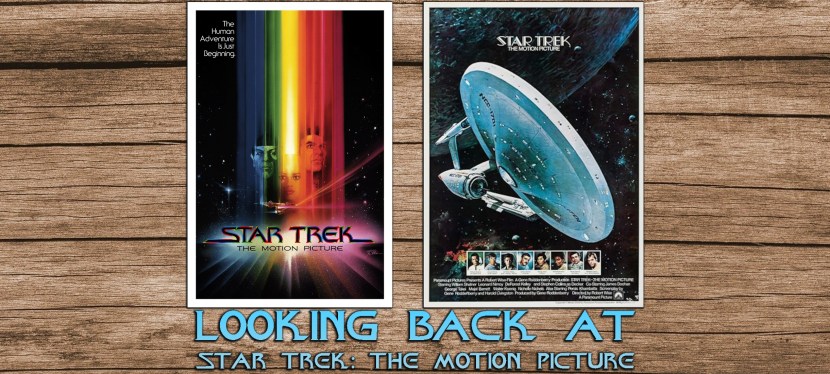
On the 7th of December 1979, ten years after going off the air (and five years since The Animated Series went off the air), Star Trek was back. Star Trek: The Motion Picture premiered, and while it has been overshadowed in many ways by its sequel, Star Trek II: The Wrath of Khan, the film was a success – albeit not an overwhelming one according to distributors and producers – and reinvigorated the franchise. Make no mistake, if it weren’t for The Motion Picture, Star Trek as we know it wouldn’t exist today – there would’ve been no Wrath of Khan, and from that there’d have been no Next Generation or any future series or film. In a very real sense, The Motion Picture paved the way for the franchise’s future, and the success Star Trek enjoys today owes a lot to this film.
The Motion Picture was a risk for Paramount Pictures. Star Trek had shown that it had a number of very vocal fans – the letter-writing campaign in 1968 to get the series renewed demonstrated this – but its wider popularity was an unknown quantity, especially on the big screen. Reruns of The Original Series had garnered a larger audience than its 1966-69 original run, but there were still question marks over whether to make a new television series or to go down the box office route.
Star Trek: The Motion Picture turns 40 in December 2019.
Indeed, the project that would eventually become The Motion Picture started out life as Star Trek: Phase II, a television series that was to reunite the original cast – without Spock – for another five-year mission onboard the Enterprise. After a project called Planet of the Titans failed to get off the ground in the mid-1970s, by 1977 Phase II was officially in production. It has been said many times that the success of another 1977 project – Star Wars – is what led Gene Roddenberry and Paramount to reconsider the television series and make a film instead. While there is undoubtedly a kernel of truth to that, there were other factors at play too. The script which would eventually become The Motion Picture was originally set to be the pilot episode for Phase II but after a series of revisions and discussions between the creative team and the studio, the decision was made to enter production as a film instead, and two versions of the script were submitted – one by Gene Rodenberry and one by Harold Livingston, who’d been a producer on Phase II. Livingston’s script was chosen (by Michael Eisner – future CEO of Disney) and Star Trek: The Motion Picture was officially greenlit.
As an interesting aside, Phase II remained officially “in production” even after the decision was taken to switch focus to a film, and for much of 1977 the official line from the studio was that a series, originally set at 13 episodes, was being produced. It wasn’t until 1978 that the film would be officially announced.
Concept art of the bridge of the Enterprise that was created for Phase II.
So that’s a brief potted history of how it came to be. But despite making around $139 million on a budget of $46 million, Paramount considered the film a disappointment. The big risk had paid off, but not as much as they’d hoped. The expensive special effects and continued revisions to the script even during production were cited as reasons why, as was the less action-heavy, more ethereal storyline.
For me personally, it’s the lack of action and the deliberate slow pacing that gives this film something that others lack – a sense of “Star Trek-ness”. Star Trek was always into the weirder, more esoteric side of science fiction, especially prior to The Motion Picture, and this film stands alongside episodes of The Original Series as a pure science fiction work, not an action-sci fi film like The Wrath of Khan or First Contact. While some people might find its slower pace to be a grind, to me it makes it akin to watching a feature-length episode of the series, rather than just another action flick.
Leonard Nimoy, director Robert Wise, Gene Roddenberry, DeForest Kelley, and William Shatner during production on The Motion Picture.
Because of the overwhelming popularity of The Wrath of Khan within the fanbase, The Motion Picture often gets a bad rap. People have said that “all of the odd-numbered Star Trek films are bad”, including The Motion Picture in with Search for Spock and The Final Frontier. Both of those titles have good and bad moments – the latter suffering perhaps from too much involvement from William Shatner – but to me, The Motion Picture is in a different league.
Some criticism of the film is that it feels like a two-and-a-half hour episode of The Original Series. But why should that be a criticism? The Motion Picture masterfully builds up its drama – the V’ger cloud’s attack on the Klingons, its destruction of the Epsilon IX station, and finally the death of new character Ilia all add to the stakes. While none of these are particularly dramatic, nor gory, that doesn’t detract from the threat, it heightens it. V’ger is shown to be a being of such incredible power that it can make whole fleets of starships vanish in a heartbeat. We don’t need huge explosions or a punch-out to learn this. V’ger’s power is also confirmed by the reaction of characters. So as the film progresses, we know what’s at stake.
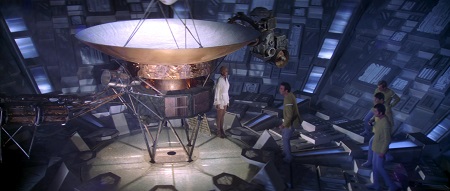
Kirk and the away team encounter V’Ger.
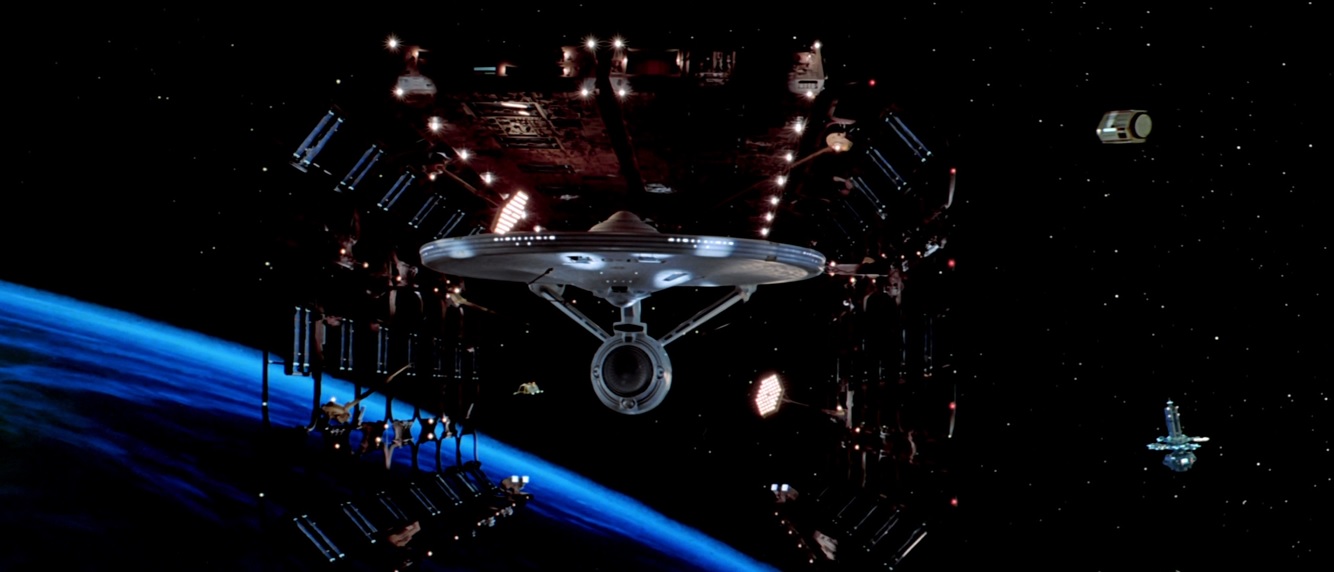
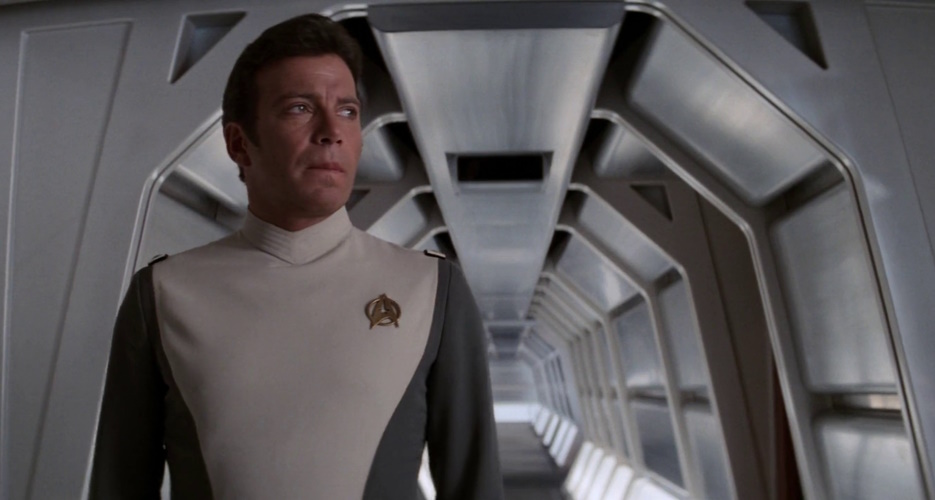
To change lanes completely, I happen to really like the aesthetic of The Motion Picture. It’s very 1970s in some ways – the orange and brown tones, and some of the uniform choices in particular, but that’s not necessarily a negative thing. Kirk’s uniform as an admiral happens to be one of my all-time favourite Star Trek uniforms. The high collar, the belted tunic, and the simple curved lines in grey and white combine with a metallic gold Starfleet insignia to make an understated yet interesting uniform. I’m not a cosplayer by any means, but if I ever were to make myself a uniform, that would be the one I’d go for. And while we’re talking about things that look great, the sweeping shot over the Enterprise when Kirk is being taken aboard by shuttlepod is absolutely perfect. Combined with an amazing score – for which composer Jerry Goldsmith was nominated for an Academy Award – the full sequence is one of the most inspiring and moving in all of Star Trek, speaking for myself as a fan. When the music ramps up right as we see the Enterprise from the front for the first time, it can be quite emotional. I could happily watch that sequence over and over again.
Many of the sets built in 1978-79 were in continuous use (albeit in modified form) right throughto Enterprise‘s cancellation in 2005. Some of the reuses are quite apparent in The Next Generation, so in that sense, the design choices made in The Motion Picture carried through the next two decades of Star Trek as a franchise. The panelling and angles on corridors in particular can be seen on the Enterprise-D and the USS Voyager, and the idea of a warp core as a large upright glowing tube is also something that has carried on right through Star Trek – even cropping up in CGI form in the most recent of the Short Treks episodes. Much of what we consider to be “Star Trek” in terms of aesthetic has its roots not in 1966 but in 1979 – future productions built on what designers and artists had created here. The Next Generation and Voyager in particular owe significant parts of their design to The Motion Picture.
Some of these sets would be in continuous use – albeit with tweaks here and there – until Enterprise’s cancellation in 2005. They defined the “look” of Star Trek.
The storyline of The Motion Picture is certainly different from many science fiction outings. It isn’t a film about defeating and destroying an enemy, it’s a film about bridging the gulf and communicating with a new form of life. V’ger, set up to be the film’s antagonist, wanted to evolve – to merge physically with its creator. The crew of the Enterprise could’ve used that moment of weakness to attack it, and maybe even destroy it – and in a different film perhaps that would’ve been the finale. But The Motion Picture builds up to this moment, and it isn’t the death and vanquishing of a foe that we see, but communication, and ultimately the creation of new life. Klingons, Romulans, Cardassians, and the like may be fun to see on screen, but Star Trek is all about “seeking new life” – and what could be newer and more different than a hyperevolved, massively intelligent machine?
This side of Star Trek, though, has always been more of a niche product. When fans are asked about their favourite films, The Wrath of Khan and First Contact are usually somewhere up near the top, as well as episodes like The Best of Both Worlds, or DS9’s The Way of the Warrior. These are all action-heavy stories, and while Star Trek has enough room for both these and the slower-paced, thought-provoking ones, The Motion Picture falls firmly into the second category. With that comes being underrated and overlooked by fans who prefer more action-oriented stories.
Robert Wise, William Shatner, Leonard Nimoy, Gene Roddenberry, and DeForest Kelley at the film’s premiere.
When Spock describes V’ger as being little more than “a child”, he sets the stage for understanding, and from that, communication. The ultimate revelation that V’ger was, in fact, a probe of human origin was truly unexpected. The Motion Picture had an incredibly ambitious story which sought to blend these elements together. The cyclical nature of a returning spacecraft, the massive differences that almost certainly will exist between humankind and anything we might encounter in outer space, and at the heart of it all, the returning characters – not all of whom had enough to do, arguably. But the core dynamic between Kirk, Spock, and McCoy was still there. Perhaps The Motion Picture needed more fine-tuning, and perhaps its scope was too vast for a single film to properly encompass, but as a story it makes you stop and think. The galaxy isn’t just going to be humanoids, there are going to be things out there completely beyond our understanding. And the choices we make today – like probing outer space – may have consequences well into the future that we could never foresee.
As an inspirational message, I think that can’t be understated. Seeking out new life and new civilisations – the raison d’être of Starfleet – isn’t always going to be smooth sailing. But if we’re willing to look at things from a different point of view, to listen, to understand, and to communicate, we can find a way to coexist even with someone who seems to be big and threatening. I know the real world doesn’t always work that way, but Gene Roddenberry was always about showing us how humanity can be better than we are in the present day. Speaking personally, I find that aspect of The Motion Picture to be inspiring. As a work of science fiction, that’s the kind of message I admire and what I’d like to see more of on our screens.
Above all, The Motion Picture relaunched the Star Trek brand for a new decade, one which would culminate in The Next Generation and a return to television. If it weren’t for this film, Star Trek would look very different today – if it even existed at all. We can argue about which Star Trek film we like best, and at the end of the day it’s always going to be a subjective choice, but I’d definitely rank The Motion Picture highly on any list. Not just for what it did for the franchise, though that is incredibly important, but as a work of science fiction that wasn’t afraid to tell a thought-provoking story.
Star Trek: The Motion Picture is available to stream now on Paramount Plus in the United States, the United Kingdom, and other countries and territories where the platform is available. The film is also available to buy on DVD and Blu-Ray. Star Trek, Star Trek: The Motion Picture, and all other Star Trek properties mentioned above are the copyright of Paramount Global and/or Paramount Pictures. This article contains the thoughts and opinions of one person only and is not intended to cause any offence.