

The first part of this review is free from major narrative spoilers. The end of the spoiler-free section is clearly marked.
Happy Spooktober! To kick off the spookiest, most haunted month of the year… what could be better than watching a horror film?
I’m going to break this review into two sections, so if you haven’t seen Backrooms yet and just want to get my spoiler-free impressions, you can still go into it un-spoiled! But I hope you’ll bookmark this page and come back after you’ve seen the film to also get my thoughts on parts of the story in a bit more depth.
Okay, cards on the table: I am not a horror aficionado by any stretch! I’m a scaredy-cat and I’m particularly sensitive to jump-scares and the supernatural – both of which are present in Backrooms. I’m also not familiar with either the wider online lore of the titular Backrooms – from internet forums and creepypastas – nor with the work of director Kane Parsons (a.k.a. Kane Pixels on YouTube). So I approached Backrooms with that background – or lack of background, I suppose.
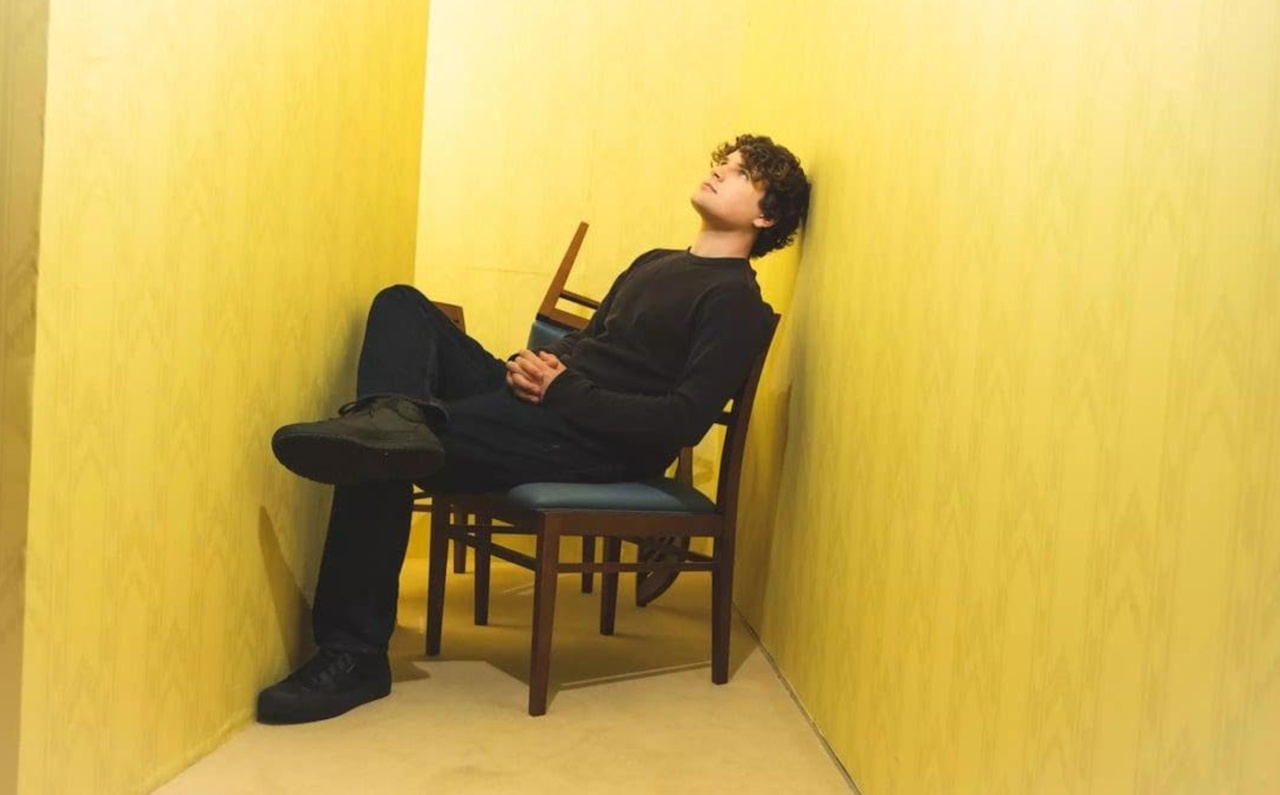
I’m a big fan of passion projects, and of folks outside of the typical Hollywood bubble producing films. I watched and reviewed a film in somewhat of a similar space earlier this year – Iron Lung, which is another independent horror film produced by a YouTuber based on a work of media that they became passionate about adapting. In the case of Iron Lung, I came away less than impressed, unfortunately. But Backrooms was a much better experience all around.
At first, I thought Backrooms was taking a while to get going… but looking back, I think it’s just a great example of the film building up both its characters and a sense of tension – if not dread – in a way many horror titles today just don’t any more. This may sound like an exaggeration, but I feel echoes of classic Hitchcock films in the way Backrooms was a slow burn, and the way in which it used sound, silence, and things just out of sight or off-screen to construct a genuinely disturbing, unsettling, and frightening setting.
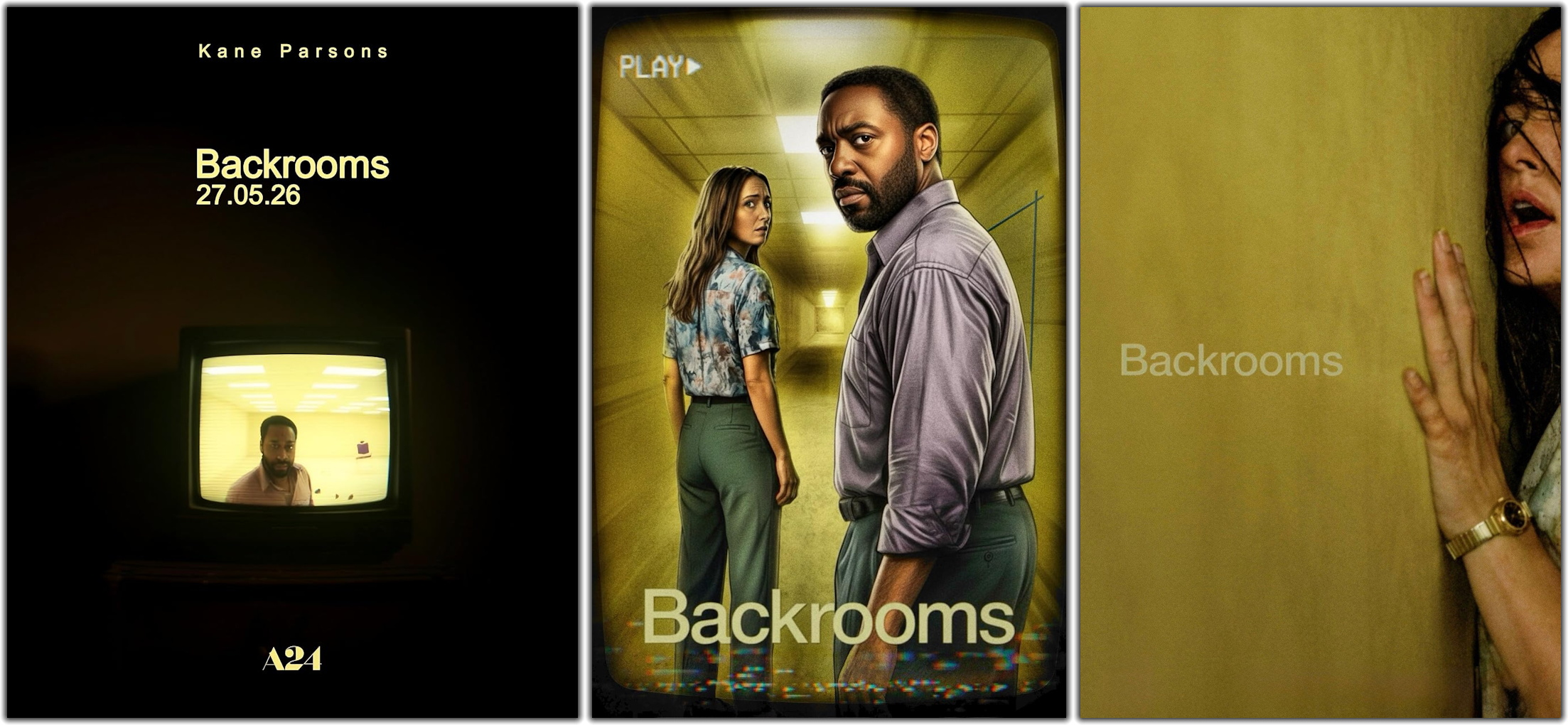
Backrooms is, as a result, the scariest and most unnerving film I’ve seen in a while! It easily beats out other horror or horror-adjacent titles from 2026, including the likes of 28 Years Later: The Bone Temple and Disclosure Day, as well as the aforementioned Iron Lung. A relatively minimalist presentation hides some truly well-crafted horror, and even for someone unfamiliar with the original creepypasta – and therefore the premise behind the film – the character-focused part of the story was easy to follow.
I mentioned sound a moment ago, and I want to really emphasise how brilliantly Backrooms used sound and music to set the scene. I often say that my number-one rule for a film’s score is “do no harm;” i.e. not get in the way of what’s happening or pull me out of the action. In this case, some truly inspired horror music, co-scored by the film’s director and Edo Van Breeman. Again, I felt echoes of classic Hitchcock horror in the score; discordant music, sharp little stings, and sudden cuts to silence all leaning into that old-school style.
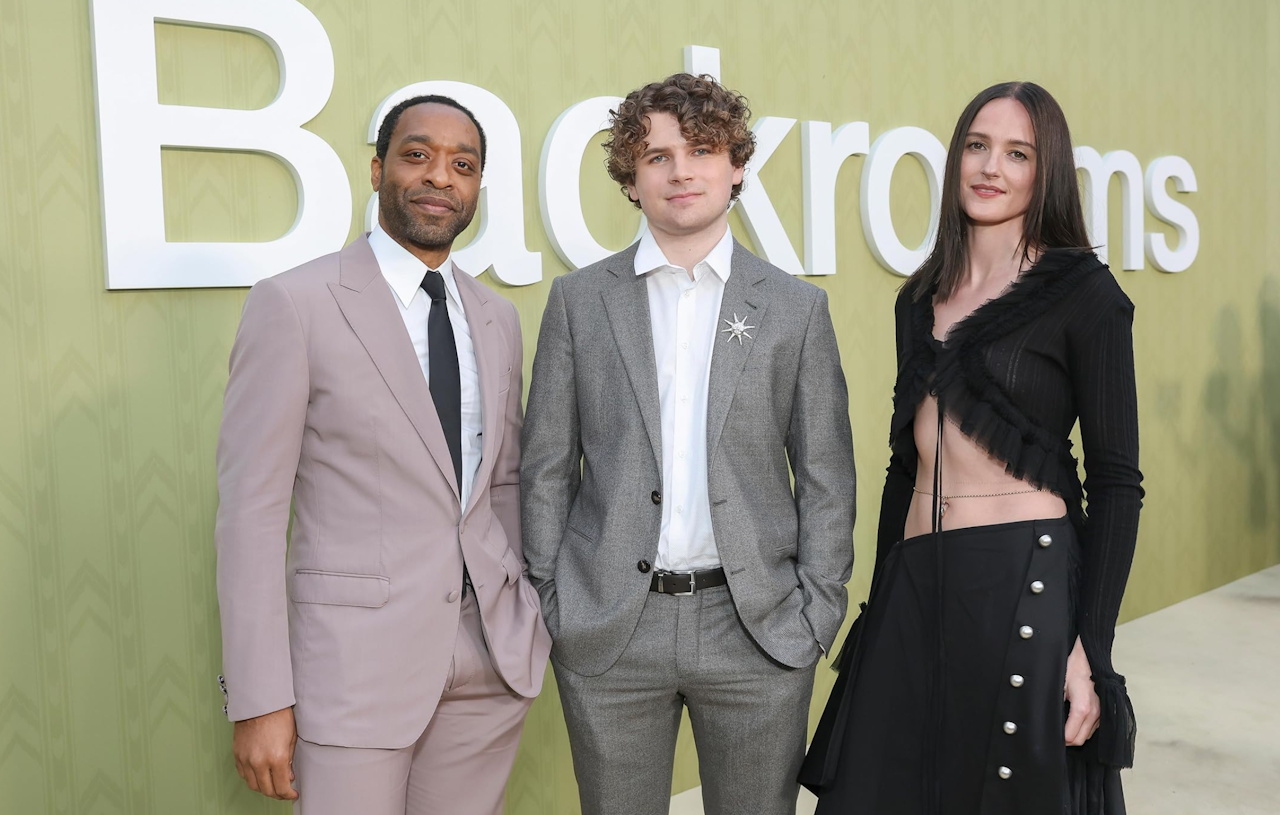
At the same time, though, Backrooms is very modern in its visual presentation, particularly when it comes to some of its sets and special effects. I appreciated a reliance on practical sets, props, and puppets over CGI – and, for those of you interested in such things, the director is on the record with a very anti-generative A.I. stance, so there’s none of that in the film, either. Normally, A.I. wouldn’t even be a consideration, but independent films working with smaller budgets (Backrooms was working with a budget of around $10 million; practically nothing compared to Hollywood blockbusters) mean A.I. tools are bound to be useful in the indie space as a cost-saving measure.
What else can I say without getting into spoiler-ific territory? Backrooms scared me – it genuinely rattled me and unsettled me in a way that no other film this year has managed to do. It also kept me captivated from beginning to end with a pair of interesting and sometimes relatable characters, a bit of early ’90s nostalgia, and a presentation that was both creative and classic at the same time. It’s an easy recommendation for any horror fan, especially at this time of year, as well as for anyone who’s enjoyed the original internet posts and creepypastas and wants to see a cinematic take on it.
Up next, we’ll talk about the plot and characters in a bit more detail. Stick with me if you’ve already seen the film (or don’t care about spoilers!), or save this page for later if you want to watch Backrooms un-spoiled!

Spoiler Warning: There are spoilers for Backrooms from here on out.
For a film directed by someone so young, Backrooms genuinely blew me away. There are directors who’ve been working in the horror genre for years who *wish* they could direct a film with as much of a fear factor as Backrooms, and I’m truly in awe of the mature tone of the film, considering it was created by a twenty-year-old. There must’ve been a temptation to take the original premise of the Backrooms and focus on the monsters and entities inside the titular setting; a hyper-violent, gory slasher-fest could’ve been the result.
But many of the best horror films are defined by what we as the audience *don’t* see, or the things that are on screen for only a tiny fraction of a picture’s runtime. Look at Jaws as an example – we hardly see the shark, yet the film is masterful in the way it builds up a sense of dread and fear. Backrooms is in the same camp – and I wonder if the relatively low budget and decision to work primarily with practical effects are a part of the film’s magic… and the keys to its success.
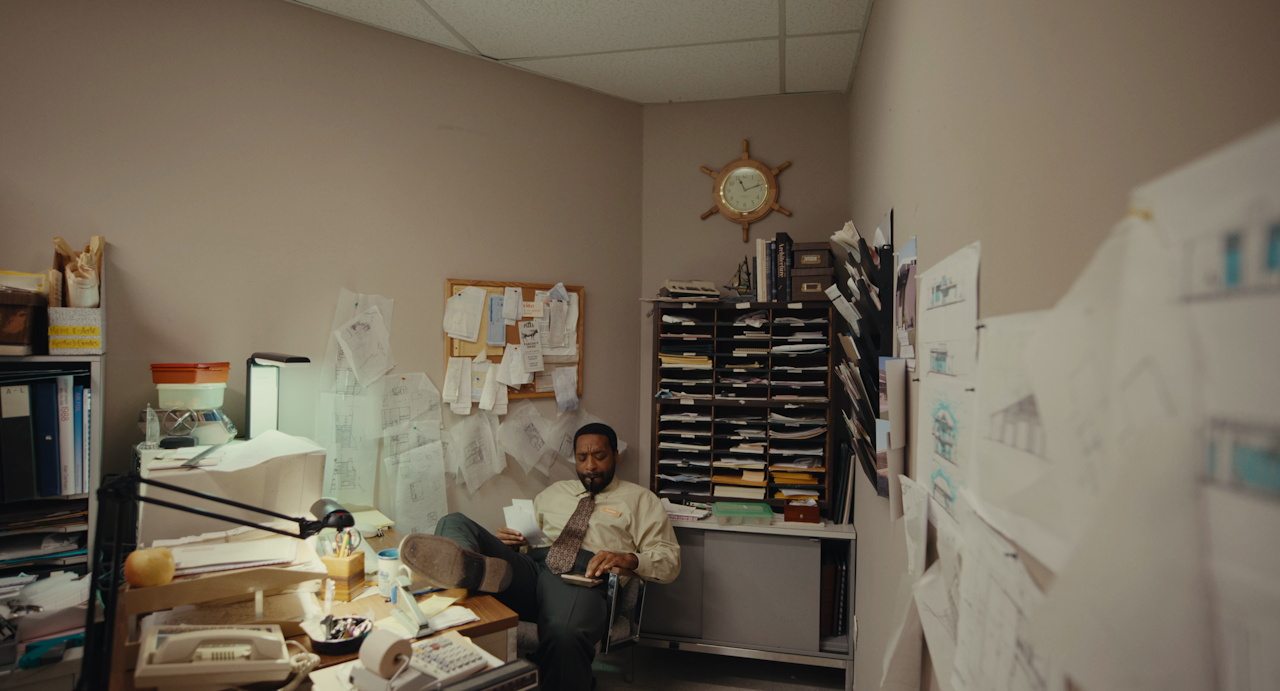
There’s an analogy in Backrooms’ story about mental health that I found interesting and relatable. When we meet Clark, he’s a man who feels like he’s a failure. His marriage failed, his business is failing, he seems to have no personal relationships outside of a couple of employees who don’t really like him, and even his conversations with his therapist come off as self-pitying or even that he’s in denial. The Backrooms, in this context, could be an analogy for Clark’s inner self, his mind – and his descent into madness.
I felt it was ambiguous as to whether what we were seeing was all really happening, or whether we were instead watching the “fever dream” of a man going through a psychotic break. As someone with a diagnosed mental health condition… I know what that’s like, or at least I know how it felt to me. Being unable to distinguish between what’s real and what isn’t – what’s in the Backrooms and the real world – added an undercurrent to the film that was disturbing in all the right ways.
I really enjoyed Backrooms creative use of “found footage”-style clips to depict the use of older recording equipment and camcorders. This is drawn partly from the film’s ’90s setting, but it also echoes classic found footage horror films – the exemplar, of course, still being The Blair Witch Project. The way some of these sequences were shot heightened the tension, and both the opening sequence and Bobby’s death benefited from using this technique.
Sticking with camera work, there were some beautifully-framed shots in Backrooms which, again, leaned on classic horror in the best way possible. Keeping things just off-screen or out of sight is part of that, but the film also makes use, in a few key places, of a first-person viewpoint. This tight angle again restricts the audience’s view, making any off-screen noises feel even more frightening, and quick, almost jerky camera movements and pans added to this effect. I think if the whole film had been shot like this (or had been edited to look like old camcorder footage) it would’ve been way too much, so using these things sparingly was called for – and Backrooms got it just right.
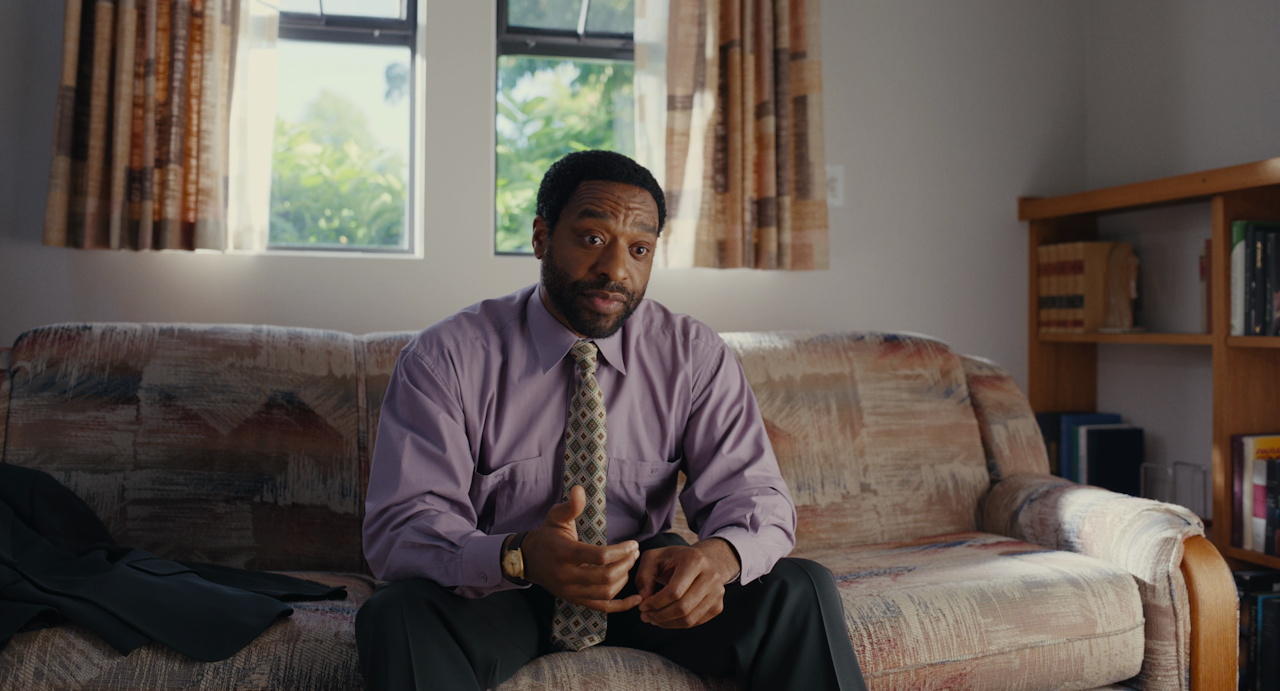
In my review of Iron Lung earlier this year, I said I felt that the film might’ve been improved if the director had chosen to hire a seasoned actor for the lead role instead of trying to take it on by himself, and Backrooms feels like a definitive case in point. Chiwetel Ejiofor was a real coup for a project like this: Academy Award-nominated for his role in 12 Years A Slave, having worked with Disney on projects like The Lion King… a true veteran of the industry brought a complex character to life in a way that I suspect a newcomer would’ve struggled with, and his casting felt pitch-perfect.
Clark began as a flawed but still ultimately relatable character – someone whose life hasn’t gone the way he wanted, with unrealised dreams and a job that seems to be overwhelming him. But the film took this starting point and expanded Clark’s character, showing his selfish side, his inability to recognise or work on his issues, and then threw him into a dangerous place that he arrogantly believed he understood – despite the Backrooms seeming to be inherently unknowable.
Because I’m unfamiliar with the internet posts and the wider lore of the Backrooms, I wasn’t sure whether I’d feel confused or be unable to follow some of the film’s events. I understand, from having done a bit of research, that the corporation – Async – has been a part of the series for a while, so folks who know more about it than I do may have gotten a bit more out of some of those scenes. However, we got just enough from the scenes with Async, and the character of Phil in particular, that Backrooms didn’t leave me feeling completely lost.
The corporate angle could’ve been bigger – and if there’s to be a sequel or spin-off to Backrooms, I wonder whether it will be. For the story this film wanted to tell, I think we got just enough from Async to set the tone; this shadowy corporation is involved in some seriously unethical research. But it’s definitely something I’m curious to learn more about if there’s a sequel. The best films leave you wanting to spend more time in their worlds, eh?
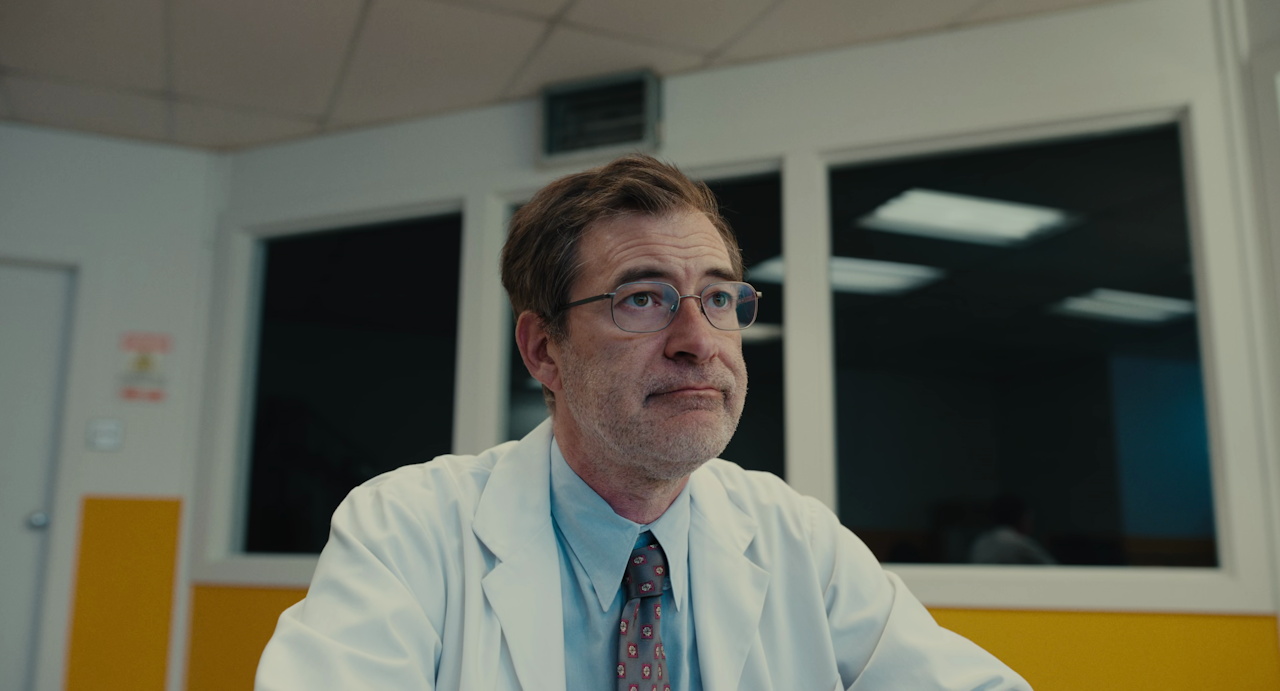
I hadn’t seen co-star Renate Reinsve in anything before, but she seems to be another well-established performer in her native Norway. I felt her portrayal of Clark’s therapist, Mary, was fantastic, and she brought some nuance to the role as well as some much-needed grounding for such a strange and supernatural picture. I was a little confused about Mary’s origin story: she came from a home with a mentally unwell parent, and that clearly had a profound impact on her. But the implications of that weren’t explored in depth compared with Clark’s struggles.
There’s definitely ambiguity with Mary, and the film (deliberately, I think) leaves her character open to interpretation.
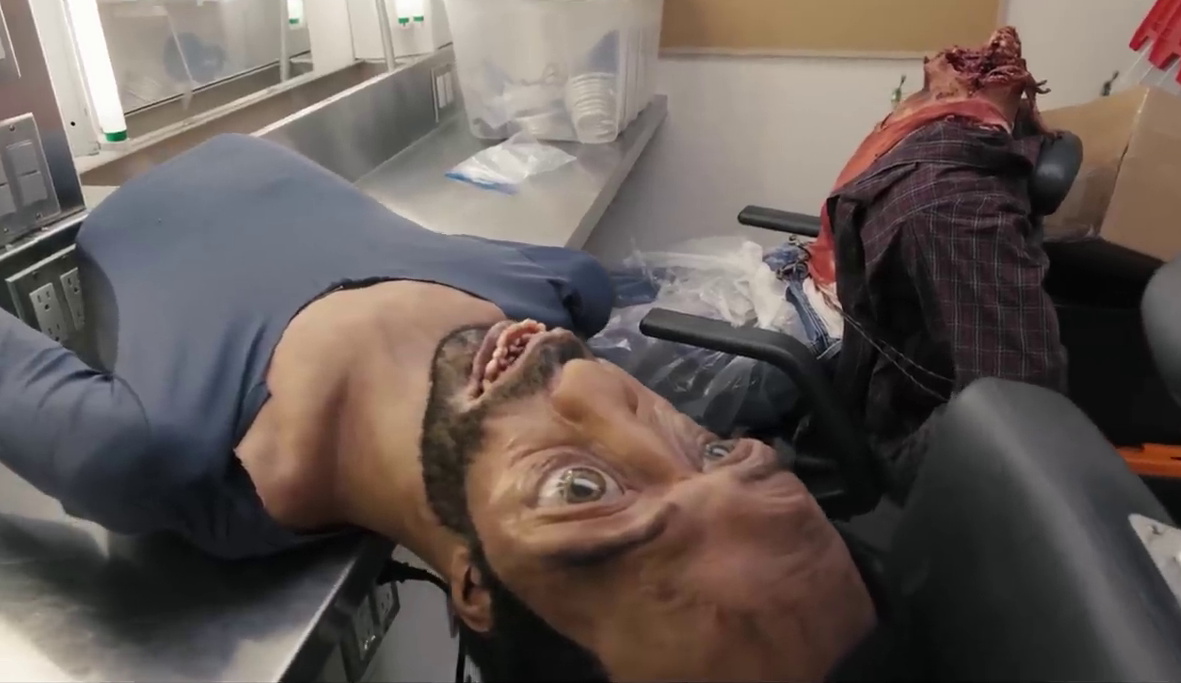
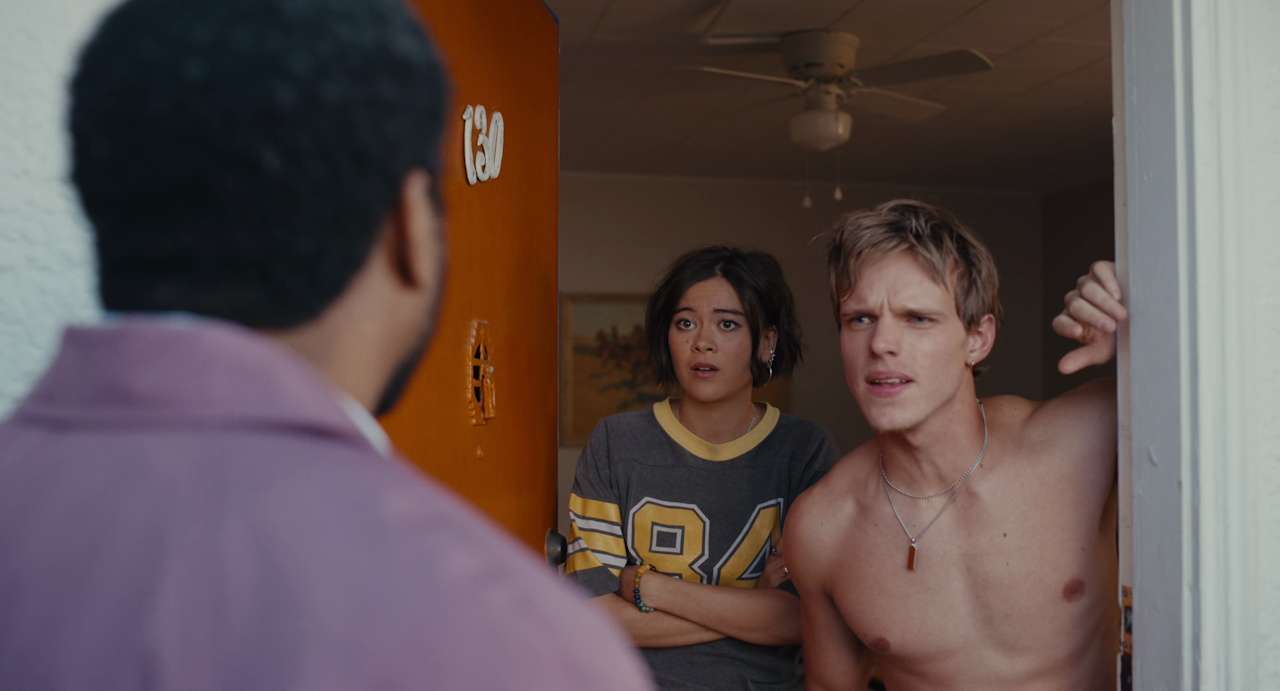
The other two secondary characters – Clark’s employees, Kat and Bobby – were necessary inclusions to help the story feel more rounded and real, but neither character was particularly deep. Bobby’s death was the film’s first (well, outside of the opening sequence) moment of genuine brutality; the first time Clark had to contend with it, anyway, and it was definitely gory and shocking. Seeing Kat’s severed head was also a brutal and visceral moment.
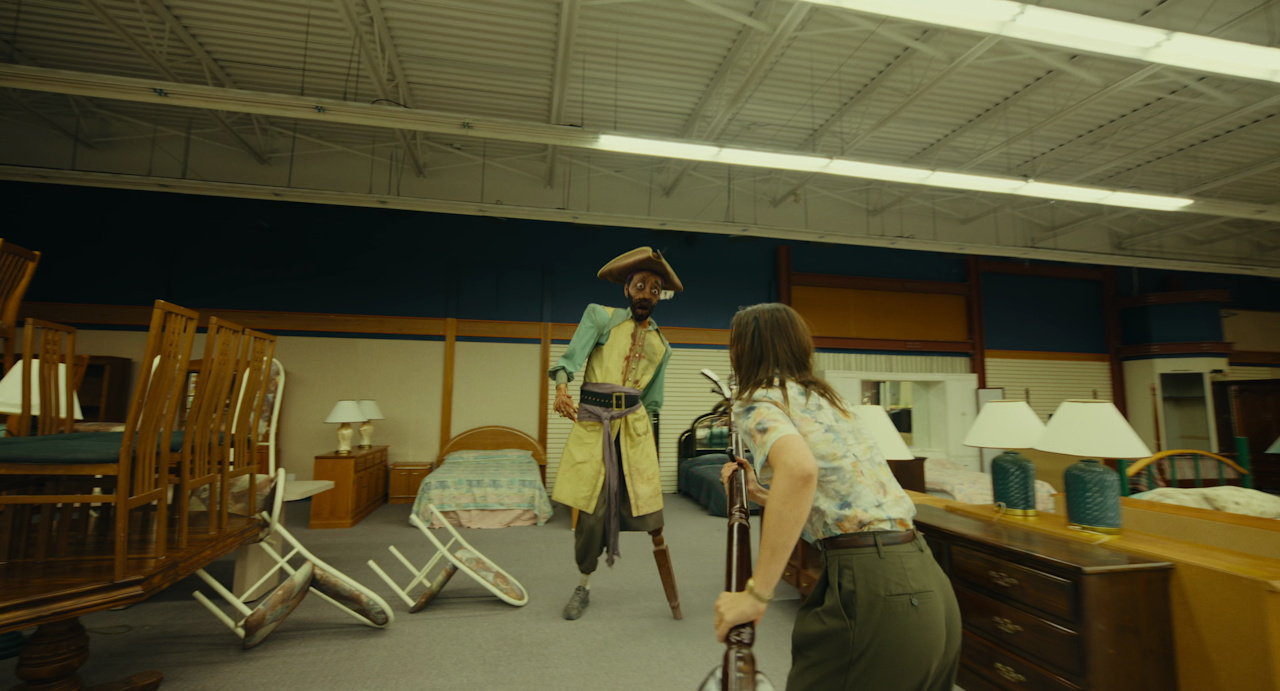
The main monster – or “entity,” since we’re talking Backrooms! – was the corrupted or mutated Pirate Clark figure. First of all, I loved the design! I thought it was creative and fun, and again, I want to re-emphasise how much I respect the film for using physical costumes and props rather than CGI or even generative A.I. to create its main antagonist. Former basketball player Robert Bobroczkyi was the man in the suit, and he did a great job.
However… if I were to make one criticism (and if you know me, you know I must), I would say that nothing about Pirate Clark was particularly scary after we got the reveal. The film masterfully built up to this entity’s appearance, and there were drawings on the wall at one point that seemed to depict an all-black creature with large teeth. But Pirate Clark, compared to what the film had encouraged me to build up in my head, just felt a bit… I dunno. Is “underwhelming” too unkind? The design was creative and fun, and there’s always something “uncanny valley” about a human face with distorted features. But even a cursory look at the Backrooms wiki shows dozens of genuinely terrifying creations that might’ve had more of an impact, at least when initially revealed.
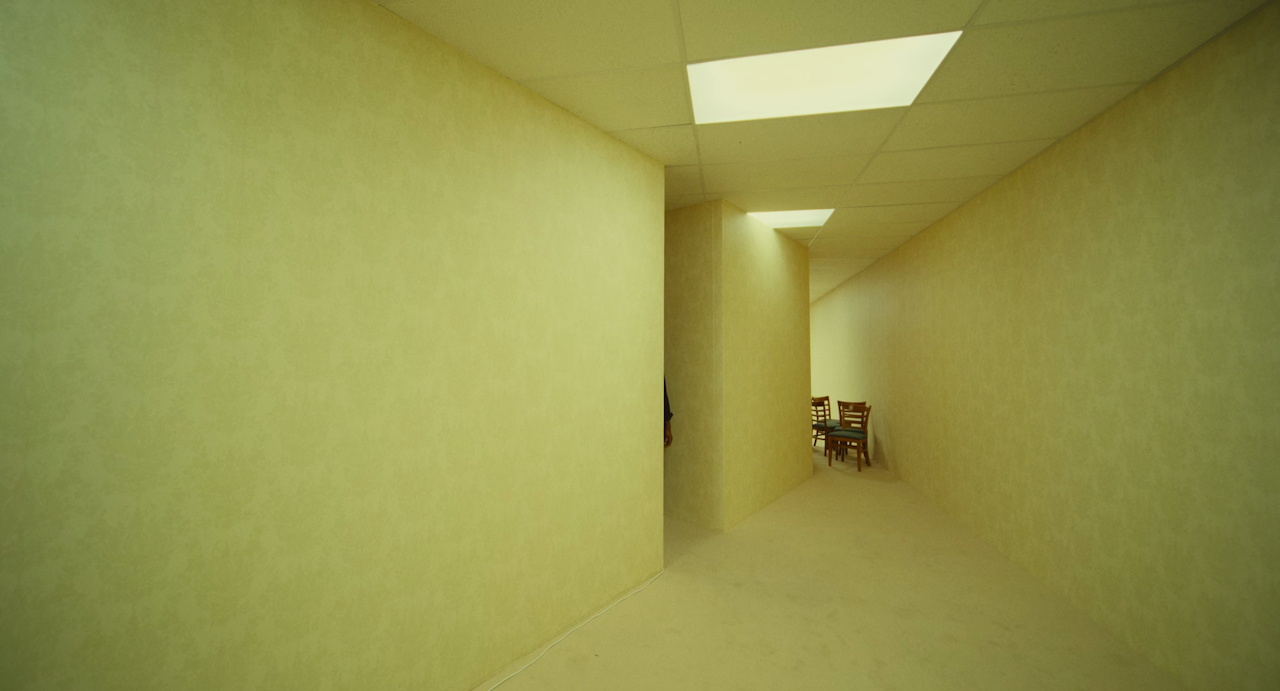
That being said, there were plenty of unsettling visuals and imagery in Backrooms that definitely stuck the landing. And again, the way the film built these up slowly, rather than introducing them all at once, was incredibly well-paced. We started by seeing furniture that looked out-of-place; two chairs fused together, for instance. Then we began to see things that just… didn’t look right. Walls in the wrong place, rooms with no exits, doors that were too small.
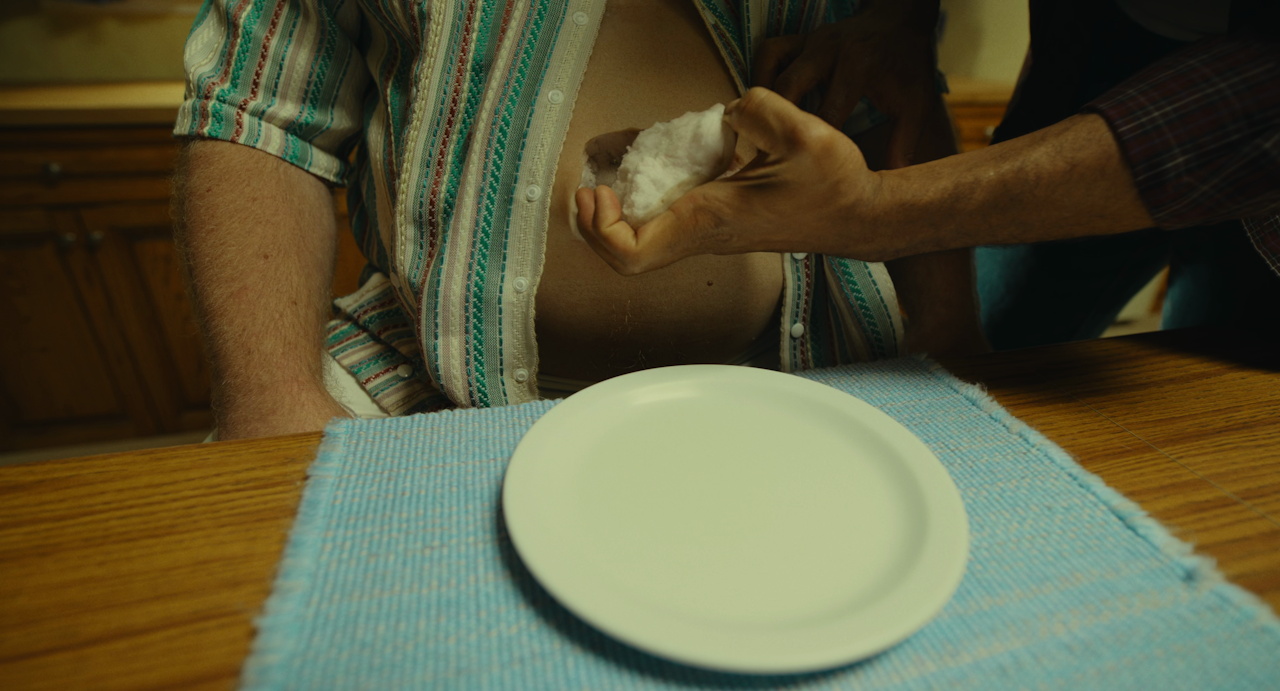
The stop sign with its mirrored letters was one of the first Backrooms props that felt truly… weird. And that whole sequence, as Clark explored the maze more deeply, was paced just right. By the time we came to the distorted “people” with missing or misplaced features, Clark’s descent into madness was complete. Seeing a man sit there, calmly, as pieces of him were torn out as food? That was gruesome – but there was still time for one more twist: the “flesh” that these entities have is just as weird and otherworldly as everything else.
So let’s wrap things up.
Backrooms scared and unsettled me… but I had a great time with the film. It was a fun way to kick off the spookiest, scariest month of the year, as Halloween draws nearer! And for an independent film with a relatively low budget, a passion project, and a film directed by someone so young… it really is a remarkable achievement that everyone involved can be exceptionally proud of. It’s a film I’ll be recommending to folks for years to come – and not only around Halloween! If there’s a sequel or spin-off in the years ahead, I’ll be very interested to check that out, too. Backrooms was a hit with this old scaredy-cat… and now I’m curious to learn more about this internet phenomenon.
Thanks for joining me for this review! I hope this has been interesting. I know Backrooms has been out for a while, but I wanted to save it for October, as that’s a month where I really like dipping my toes into some horror. If you want to check out some other horror or horror-adjacent film reviews, I’ve recently watched 28 Years Later and its sequel, The Bone Temple, as well as Iron Lung, The End of Oak Street, and Disclosure Day. Click or tap any of those links to check out those reviews – and stay tuned for more! I have a couple more horror-adjacent projects on my radar this month.
Thanks again for reading. I hope your exploration of the Backrooms goes smoothly!
Backrooms is available to rent on platforms like YouTube, Apple TV, Amazon Video, and the Sky Store. The film is also available on Blu-ray. Backrooms is the copyright of A24, Northroad Films, 21 Laps Entertainment, Atomic Monster, Phobos, and/or Oddfellows Pictures. This review contains the thoughts and opinions of one person only and is not intended to cause any offence.

