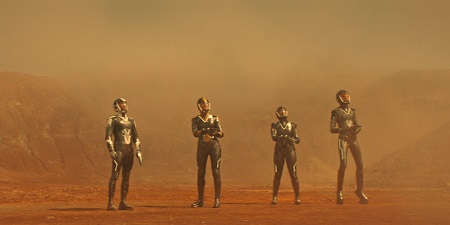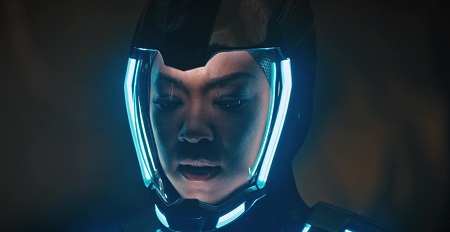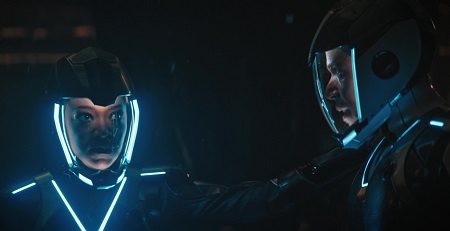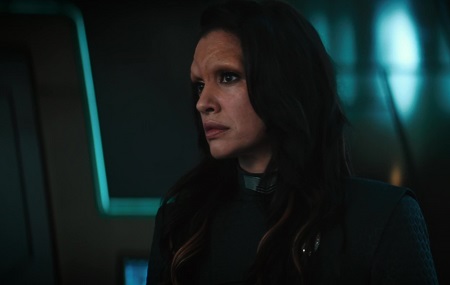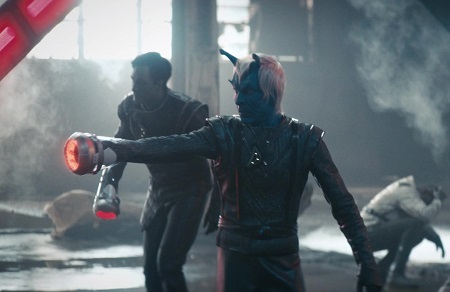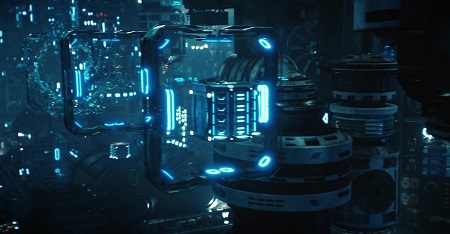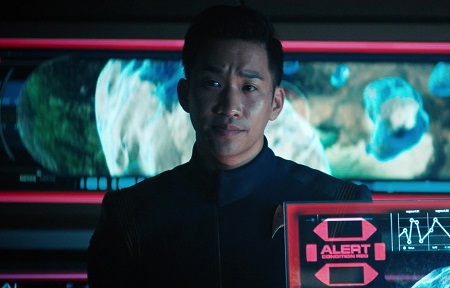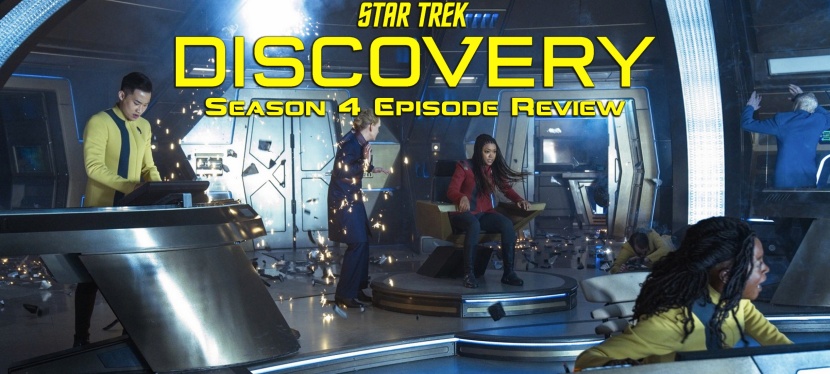
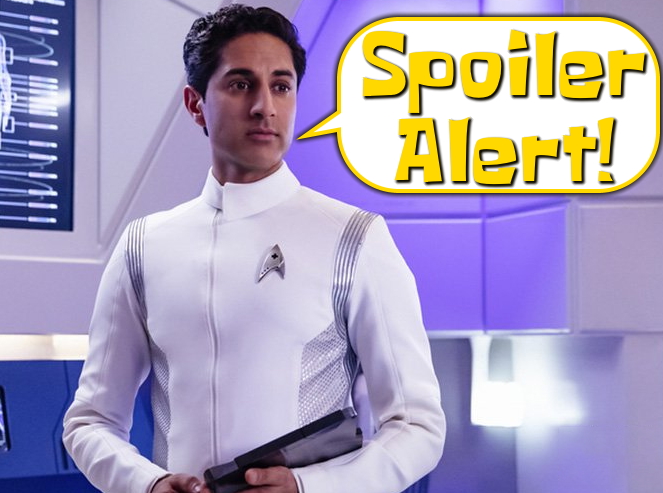
Star Trek: Discovery review – Season 4, Episode 13: Coming Home

Spoiler Warning: There are spoilers ahead for Star Trek: Discovery Seasons 1-4.

I cried a lot while watching Coming Home. It was an incredibly emotional episode, one that hit all of the notes that it was aiming for and brought the season to a close in style. We can say definitively that Season 4 ended on a high, having saved the best for last. In fact, Coming Home might just be the best episode of the entire season!

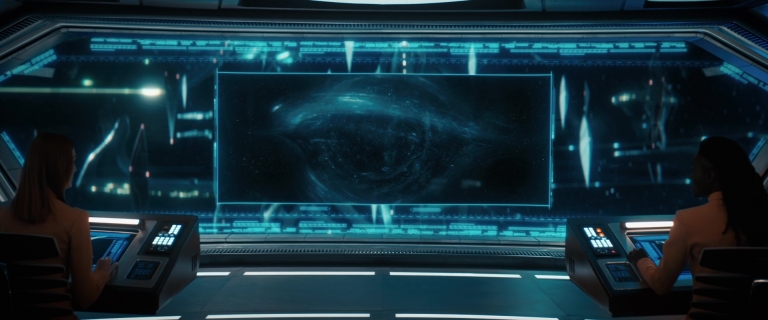
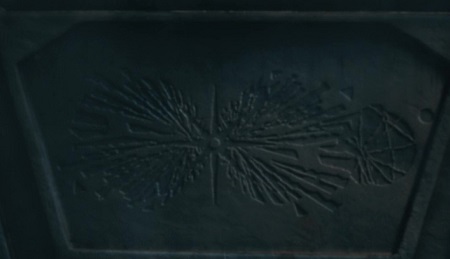
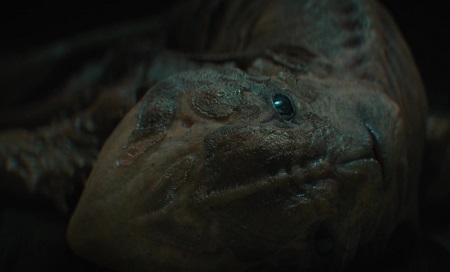
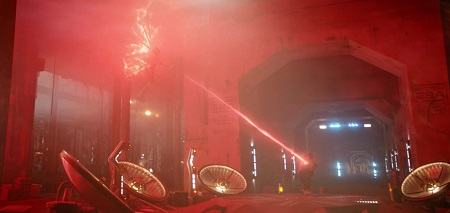
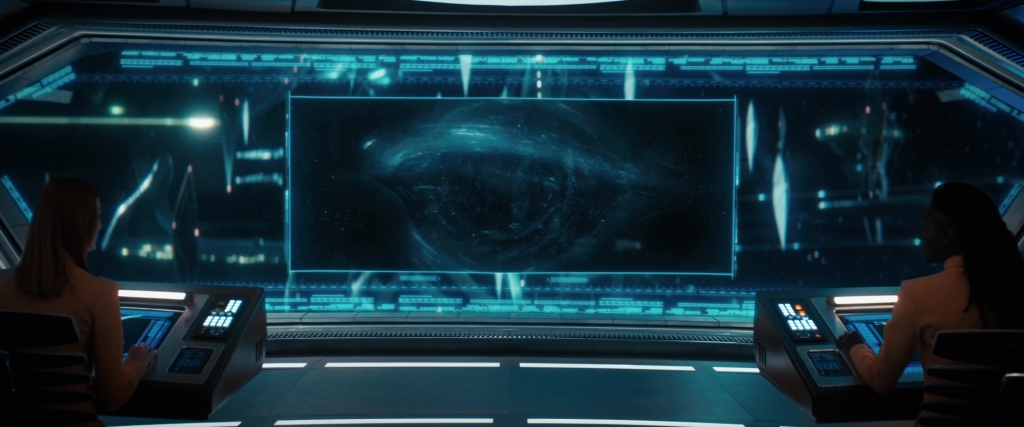
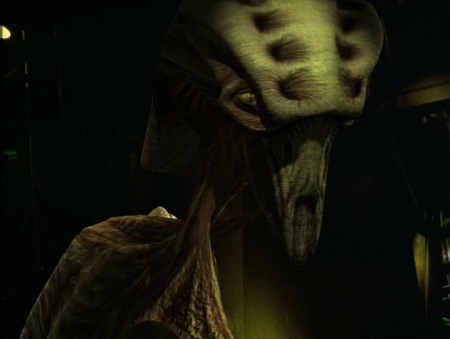
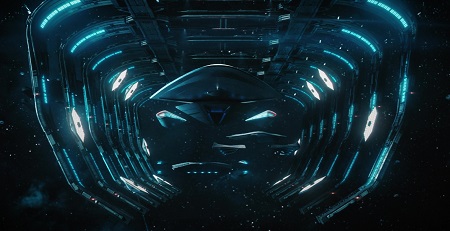
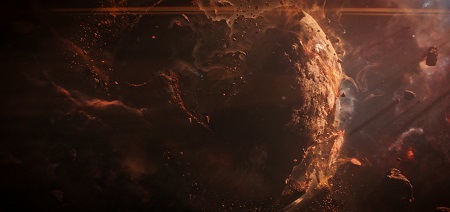
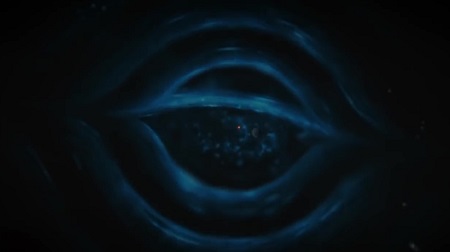
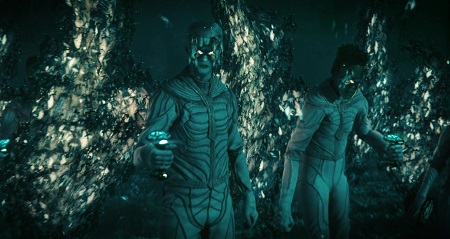
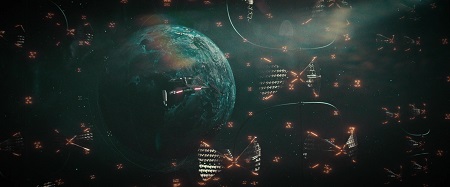
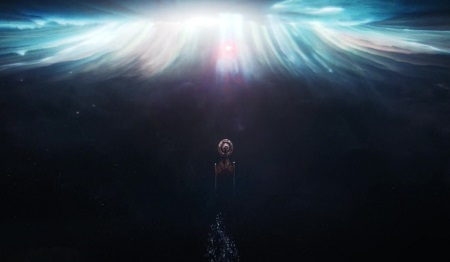
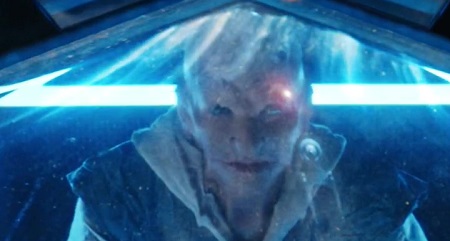
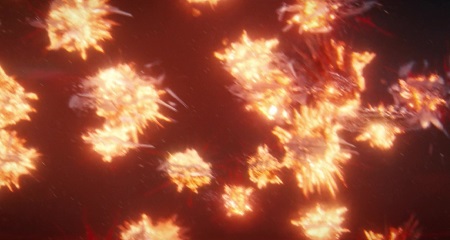
From almost the first minute, the emotional punches started coming – and they didn’t let up until the epilogue. Captain Burnham and the entire crew went on a rollercoaster ride as they battled to stop Tarka, to get Unknown Species 10-C to listen, and to save Earth and Ni’Var from destruction. The episode was well-paced, with plenty of energy to keep things exciting but without ever feeling rushed. And there were some wonderful visual effects and animation work as we finally got an unobscured look at Unknown Species 10-C.
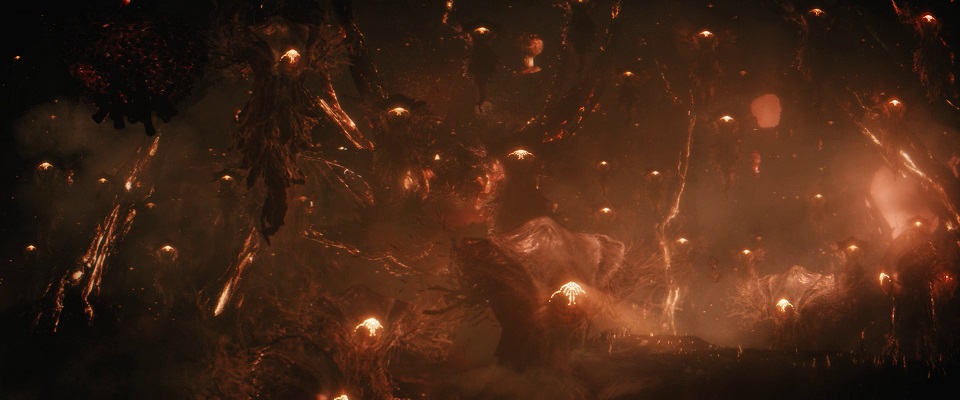
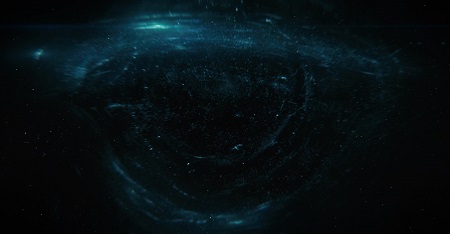
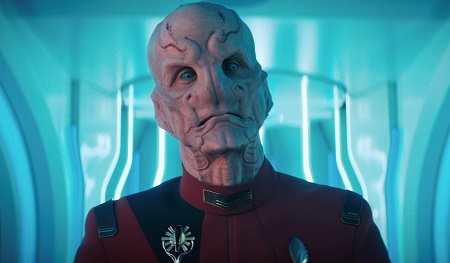
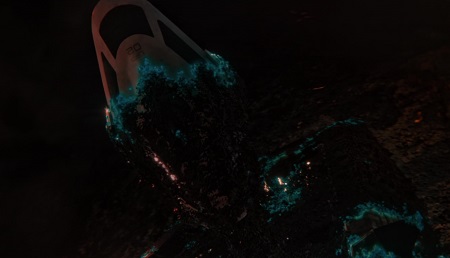
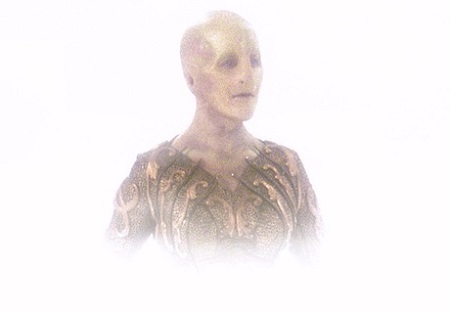
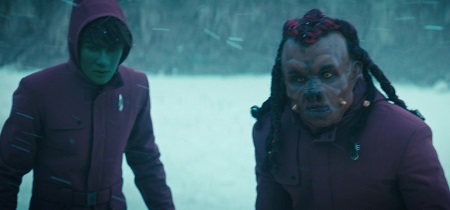
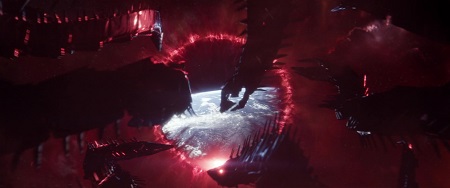
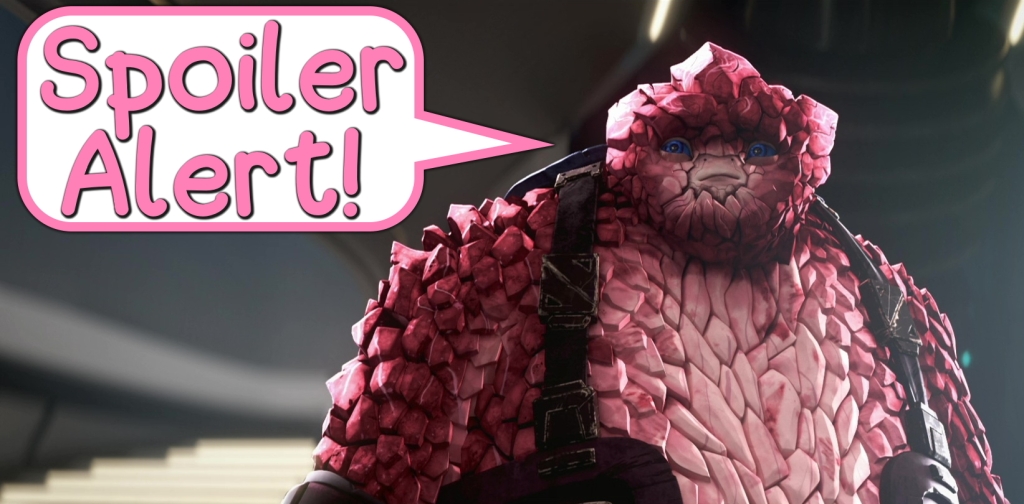
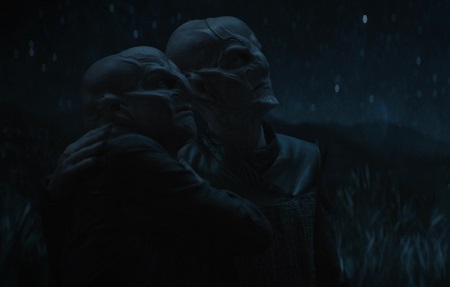
A group of Unknown Species 10-C.

I had a wonderful time with Coming Home, and thinking about Season 4 as a whole, the finale is one of the strongest offerings. That contrasts with Season 3, where the end of the Burn’s story felt like a non-sequitur, if not an outright letdown. In that respect, it’s nice to see that Discovery has grown, adapted, and perhaps even taken on board some of the feedback received about the Burn and Season 3 in general. The creative team can be pleased, I think, that they did a better job this time around.

All that being said, there are some issues that are raised by Coming Home. The episode itself was great, and even some of the storylines that I’d been less invested in were paid off in emotional style. But thinking about the episode as the concluding chapter of a thirteen-episode season, I do have some complaints about absences, about characters who weren’t well-used, and about specific storylines that didn’t get the kind of payoff I’d been hoping for. While these points don’t detract from a wonderful and emotional episode in Coming Home, they do count against Season 4 as a whole.
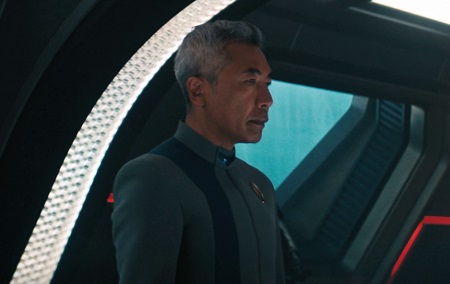
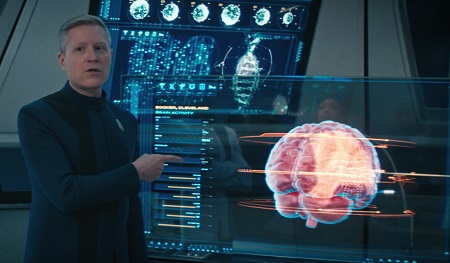
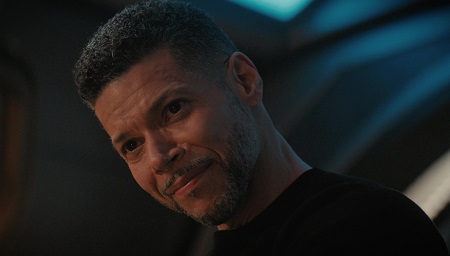
Dr Hirai was a character with potential who felt sadly underused this season.

In the weeks ahead I’d like to do a retrospective of the season, and when I do I’ll go into more detail about some of these complaints. But with Coming Home being the season finale, I’d be remiss not to mention them here. This was the last chance for Discovery to do something significant with some of these narrative points – especially when considering that Season 5 will almost certainly go in a different direction.

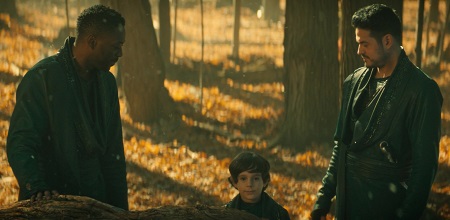
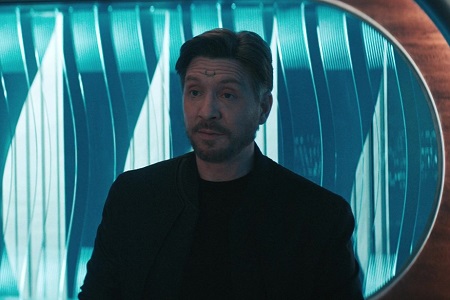
Ruon Tarka’s abrupt turnaround from an understandable and even sympathetic character to a bold-faced villain was not handled particularly well, and while Coming Home went some way toward reversing that and bringing back some of the nuance that had made him such an interesting character in the first place, it came too late. Tarka’s story – much like Tarka himself in his final moments – ran out of road, and ended in an unspectacular and unsatisfying fashion, with no real payoff to his quest to reach Oros and Kayalise.
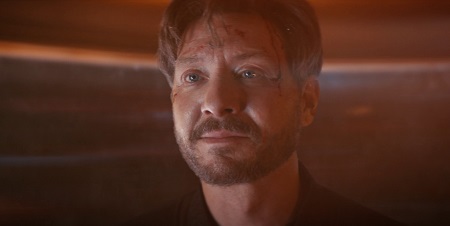
Tarka met his end in an unsatisfying way.

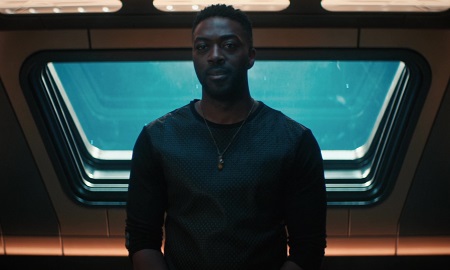
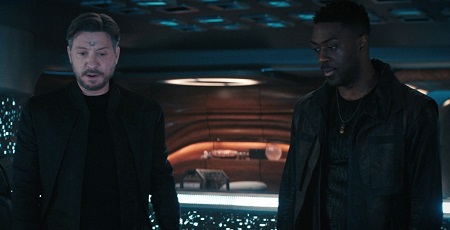
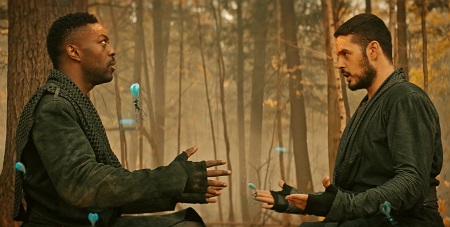
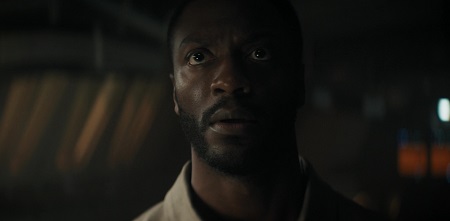
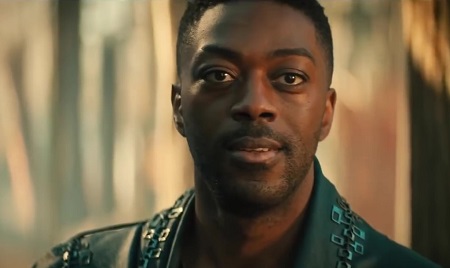
The scenes between Tarka and Book were beautifully constructed, and the raw emotion that both David Ajala and Shawn Doyle brought to screen is undeniable. The performances were fantastic, and Coming Home found enough time to show off these moments despite having plenty of other narrative beats to get through.

Despite that, however, the damage to Tarka’s characterisation had already been done. The complex and nuanced character that we met in The Examples, half a season ago, had been developed slowly over several episodes. His desire to use the power source at the heart of the DMA was explained through a series of flashbacks that introduced us to his long-lost friend Oros… and it feels like none of that really went anywhere. There were the ongoing themes of grief and loss that have been running since Season 3, and I guess we could argue that Tarka represents a different kind of reaction to those things than other characters. But even then, this side of the story doesn’t feel particularly strong.
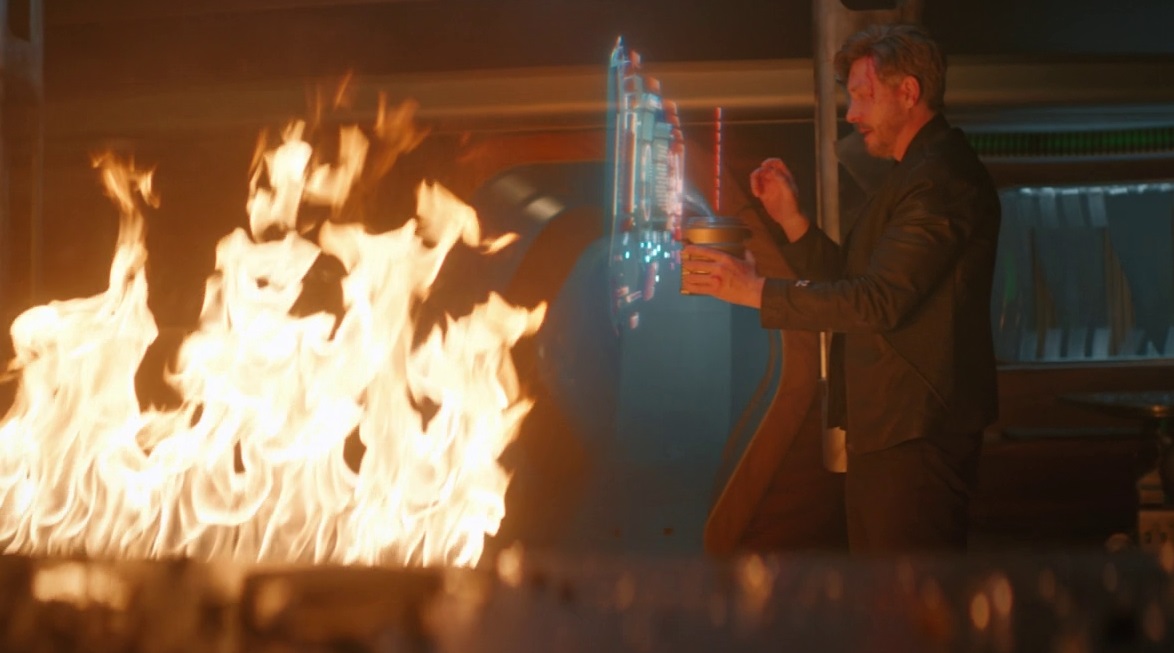
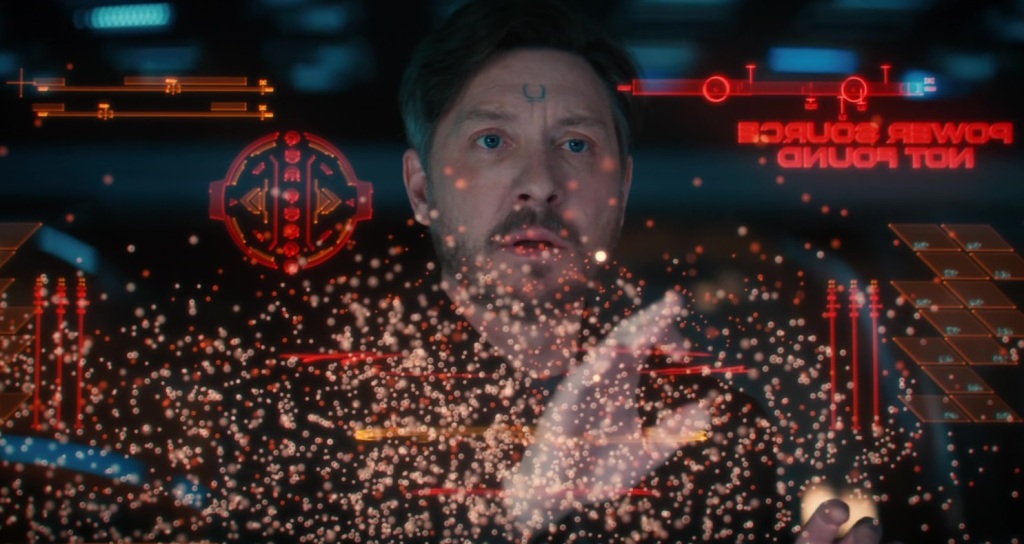
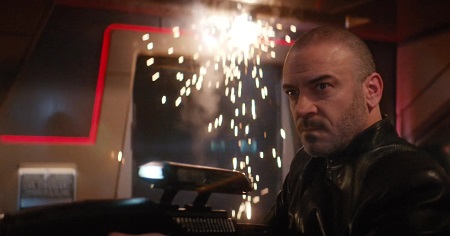
Tarka with the interdimensional transporter shortly before his death.

It was nice to see that, in his final moments, Tarka seemed to come around to Book’s way of thinking. As he stood on the wrecked bridge of Book’s ship, awaiting the inevitable, he’d taken several steps back toward being the complex character that we believed him to be in his earlier appearances, and I do appreciate that. It wasn’t that there wasn’t time to pay off Tarka’s well-established story. It’s just that Discovery chose not to.

This was a story that, at the end of the day, didn’t need Tarka. It didn’t need a villain to be outsmarted and killed in the final act; all the pieces were in place for a story of first contact with Unknown Species 10-C that was tense, interesting, and engaging without him. There was more than enough drama and excitement in that premise to make Tarka’s addition unnecessary; fluff to pad out a season-long story that I’m sure I’m not alone in feeling had been padded out far more than it should’ve been.
Tarka was ultimately the villain of the season… but he didn’t need to be.

Season 4 could have been structured differently, with the Tarka and Unknown Species 10-C stories going in different directions. If one story had concluded around the time of the mid-season break, the second half of the season could’ve followed another related but separate story… and when both sides of the story were overstretched by running for as many episodes as they did, perhaps that would’ve been preferable.

But that’s less about Coming Home than it is about the structure of the season as a whole! Despite my waning interest in the Book and Tarka story, Coming Home pulled out a complex and emotional ending for both characters. It wasn’t the way I would’ve necessarily hoped for nor chosen, but once the decision had been made to kill off Tarka in this way and to have the fake-out over Book’s death, Discovery executed it about as well as possible.
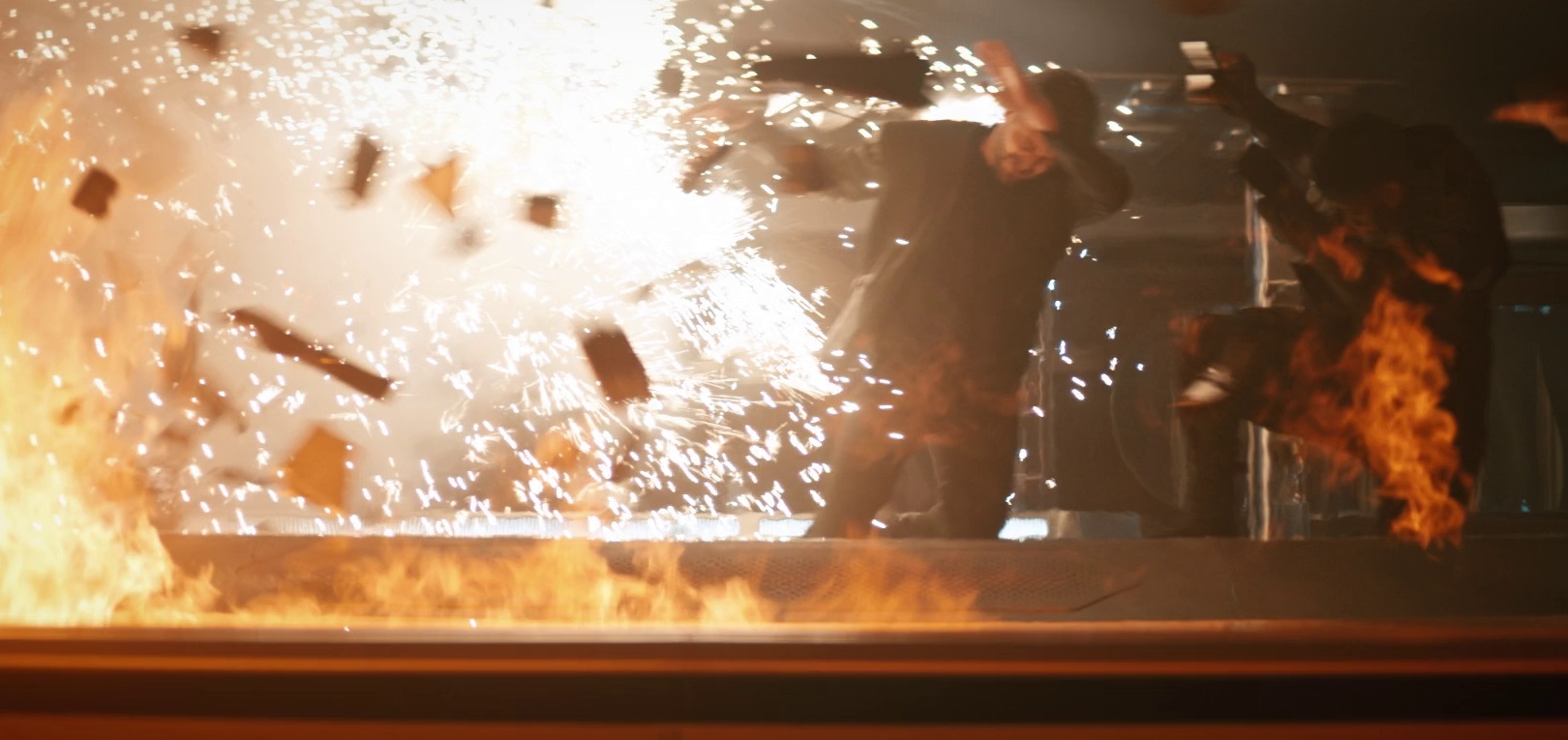
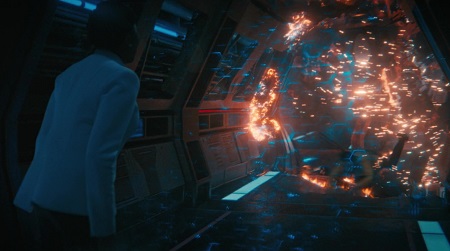
Tarka and Book caught in an explosion.

Going into the finale there were genuine concerns for Book and Reno’s survival. While a fifth season has been confirmed, neither character was guaranteed to appear in it, and there was a real possibility that one or both could’ve died as Tarka tried to execute an increasingly desperate (and, sadly, an increasingly nonsensical) plan. When it came to the moment of Book’s apparent death, it thus felt like he was really gone; there was no part of me saying “this is all just a fake-out.” And again, this was one of many emotional punches that Coming Home set up and delivered perfectly.

Book’s survival was also kept hidden by the story – we weren’t immediately shown him alive with Unknown Species 10-C – which kept things going as other storylines played out. As a fake-out, I think it worked pretty well. It made Book’s return in a pillar of light feel genuinely wonderful, and took Captain Burnham on a rollercoaster that allowed Sonequa Martin-Green to really show off her emotional range. Both as a story point and on the technical side of things, it worked well for Coming Home.

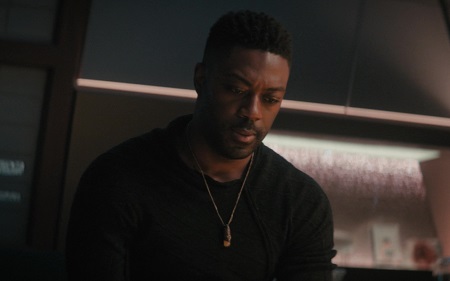
Book was saved by Unknown Species 10-C.

But, as I’ve found myself saying numerous times as the season has worn on, it means that Discovery has yet again given all of its characters some pretty serious plot armour. In an individual episode we can forgive that a near-death situation resulted in survival, or that an apparently-dead character like Book was safe all along. But when we consider the season overall, no one aside from Tarka was actually killed. Despite the incredibly dangerous situations that the crew found themselves in, and despite the overwhelming odds stacked against them by Unknown Species 10-C, the DMA, Tarka, and everything else they went through, they all survived.

Television storytelling has moved on since Star Trek’s early days – something that the very nature of Discovery is itself testament to. To run an entire season this way – with another “galaxy-ending” calamity for the crew to deal with, which they all survive – risks diminishing the threat felt in future stories. If we as the audience can feel confident that everyone will be fine, no matter what else is happening or how badly the ship seems to be blowing up, that robs the show of a significant portion of the excitement, tension, and drama that its storylines have done an otherwise good job at creating. Book’s fake-out “death” isn’t the problem in and of itself; it’s a symptom of a much bigger issue – the obvious lack of willingness on the part of Discovery’s writers to allow even the most minor of tertiary characters to be killed off. In 2022 that’s out-of-date, and it’s a storytelling mistake that will have to be addressed in future.
Book survived… and so did everyone else.

The whole “Earth is in danger” angle is a trope that I wish hadn’t been brought into the story this season. It’s such a played-out cliché, and it’s one which, as I noted a couple of episodes ago when it was introduced, risks making the end of the story feel formulaic. It was obvious two episodes back that Discovery wasn’t going to allow the destruction of Earth and Ni’Var in the final act of Season 4, so unfortunately I went into Coming Home with that expectation firmly embedded in my mind.

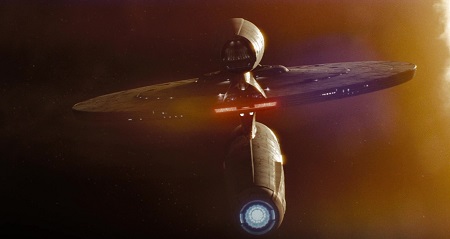
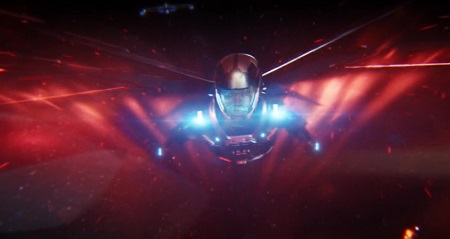
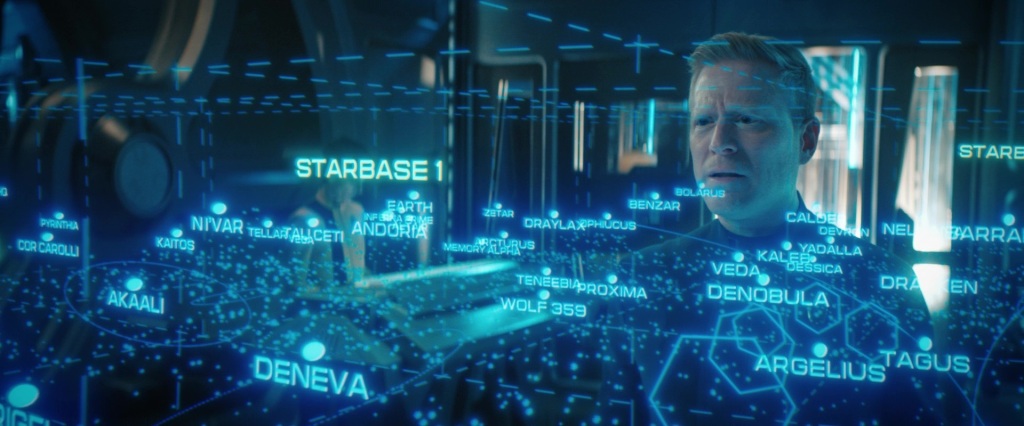
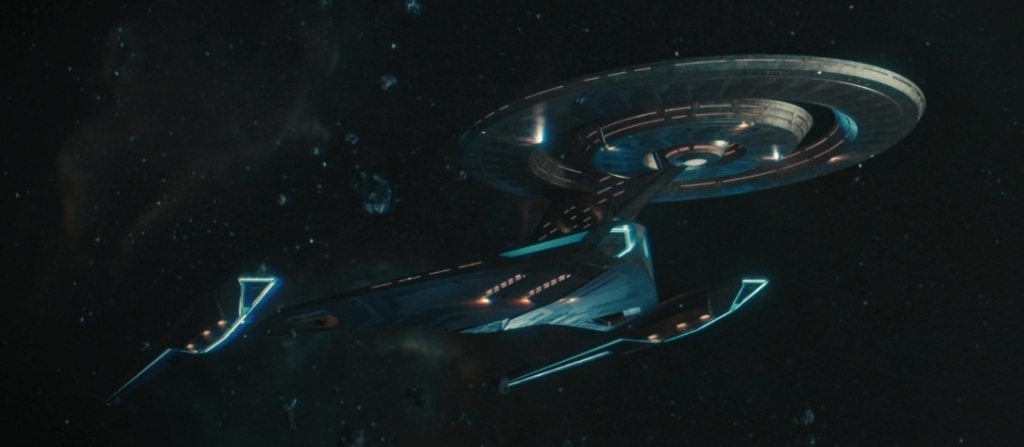
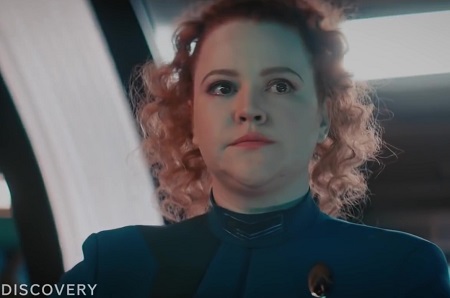
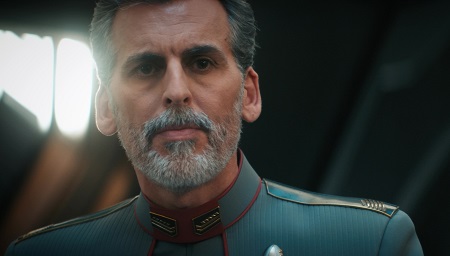
That doesn’t mean that the route to saving Earth was easy, and on the Federation HQ side of the story with Tilly and Admiral Vance there were some absolutely wonderful moments. The swooping arrival of the USS Mitchell – named for Discovery actor Kenneth Mitchell – hit all of the right notes for me, echoing moments like the Enterprise-E’s dramatic entrance during the Battle of Sector 001 in First Contact. In fact, all of the evacuation sequences worked well, and after her departure earlier in the season it was nice to welcome back Tilly – however briefly.
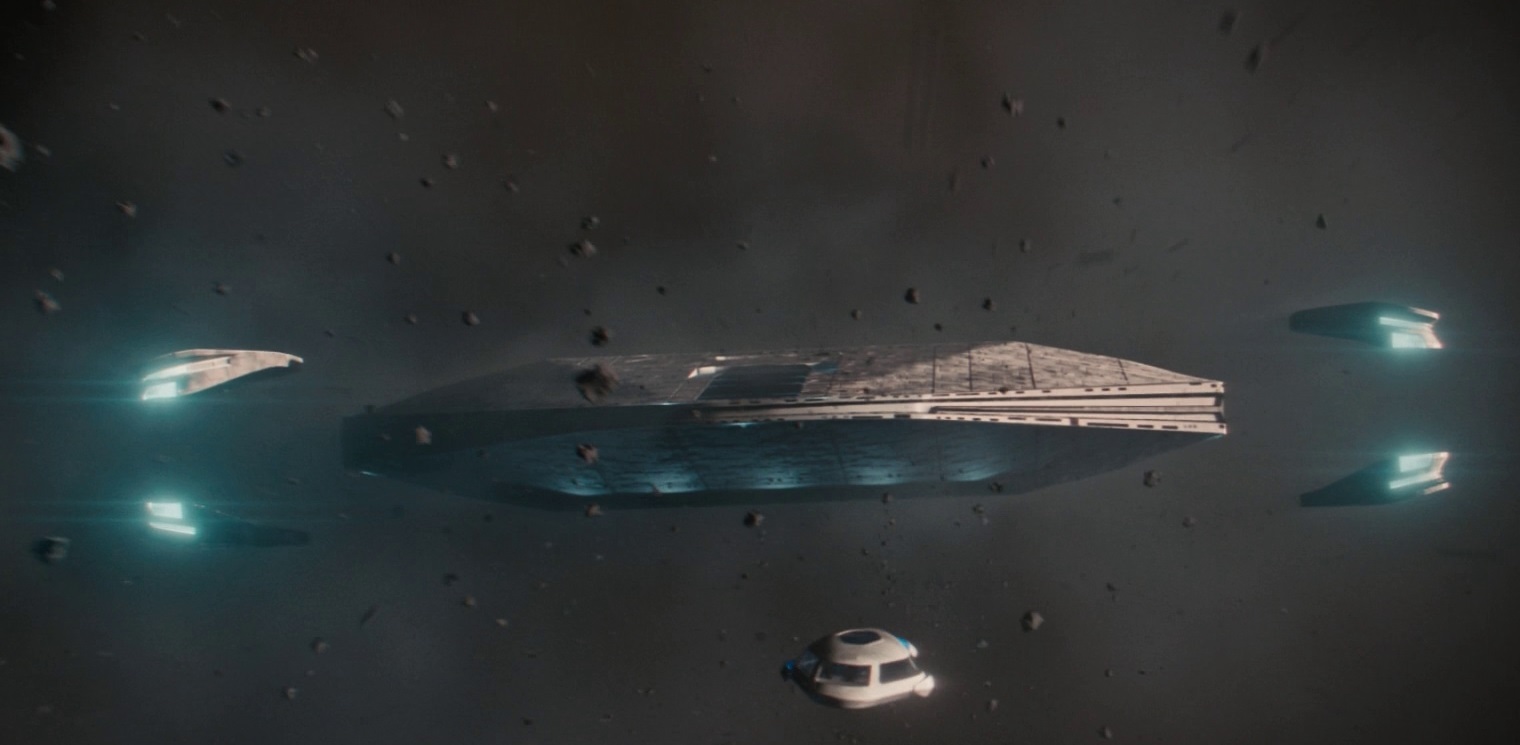
The USS Mitchell arrived to save the day!

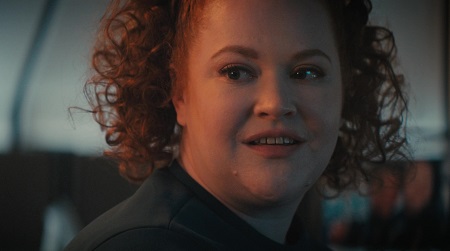
I’d have liked to have seen something earlier in the season to perhaps set up some kind of dynamic between Vance and Tilly, and that would really be my only criticism. The two didn’t feel like they had natural chemistry; I was acutely aware of the difference in status between the head of Starfleet and a character who, until a few episodes ago, was a lowly ensign. The two performers did well to sell it, but had we seen Tilly offered her role at Starfleet Academy by Vance, not Kovich, back in All Is Possible, I think we would’ve had some kind of baseline for their relationship. This would’ve let us see how far they’d come to be able to sit together and share a drink as they awaited what seemed to be the inevitable.

That said, I liked the evacuation sequences. In fact, this part of Coming Home might actually be my favourite – surpassing the meeting with Unknown Species 10-C, and definitely beating out the conclusion to Tarka’s story. There’s something about a doomed, heroic “last stand” that always gets me no matter how it’s played, and for Vance and Tilly, they knew that they didn’t have any control over the DMA situation. They had to do their jobs knowing there was nothing they could do to prevent what was happening – they were relying entirely on Captain Burnham and the USS Discovery.
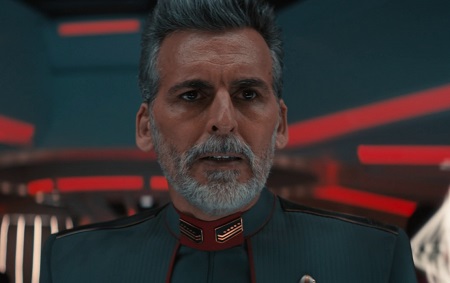
Admiral Vance led the evacuation efforts.

That setup led to a real unexpected highlight. I maintain it would still have worked were it not Earth in the firing line, but setting aside that particular narrative gripe, the scenes at Federation Headquarters were pitch-perfect. Seeing Federation HQ warp in to offer to help, even though Earth was not a member of the Federation, really epitomises what the Federation is all about. That is the spirit of Star Trek, in many ways: offering to help while asking nothing in return. The DMA placed Earth in danger, and Starfleet rode in to help without even having to think twice.

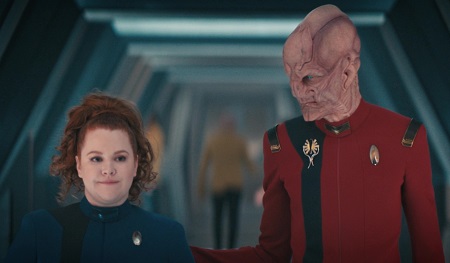
Admiral Vance and Tilly both came to embody that Federation spirit in these sequences, and they gave it their all to get as many people to safety as they possibly could. Choosing to remain behind to cover the escape of the final ships was just the perfect end for both of them – and something I could absolutely see both of them being willing to do. As they sat down, knowing they’d given their all, and shared a drink, I was absolutely blown away by this unexpected and wonderful addition to Coming Home.
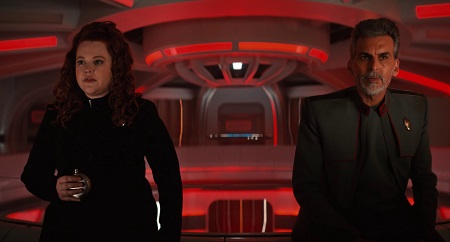
Tilly and Admiral Vance sharing a drink.

We also got to spend a little more time with some of Tilly’s cadets from All Is Possible. After those characters fell somewhat flat in that story, it seems like at least some of them have grown into their roles as Starfleet cadets, which was nice to see. It wasn’t a huge part of this side of the story, but it was a neat way to include something that had been established earlier in the season.

There was, unfortunately, a gaping hole on this side of the story. It wasn’t really apparent until Coming Home was drawing to a close, and it didn’t detract from the way any of these incredibly emotional moments felt as they unfolded. But in retrospect I have to ask: where was Dr Kovich? Is he just a gag character now, someone whose lines tease stories that sound interesting but go nowhere? Because that’s what it feels like. After Dr Kovich’s line in The Galactic Barrier that he had “more important things” to do than make first contact with the species who built the DMA, I was hoping that Discovery would pay that off somehow… but it didn’t happen.
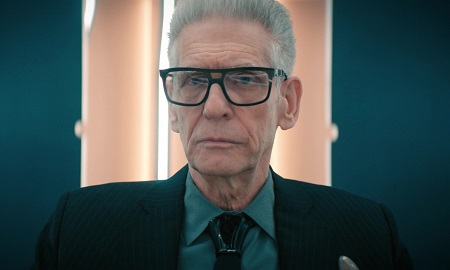
What happened to Dr Kovich?

We’ll deal more with the Dr Kovich situation when I take a look back at the season as a whole, but suffice to say that his absence from this part of the story was noticeable, and several threads that seemed to tease that he was working on something interesting with Lieutenant Commander Bryce ultimately just went nowhere. This isn’t a situation like the Picard Season 1 finale, either, where the meandering story of the season ran out of road and didn’t have enough time to pay off its stories… this was a conscious choice on the part of Discovery’s writers. They teased us with Dr Kovich all season long, feeding us little crumbs of information that seemed to set up something about his character… and then just dropped it, perhaps with a snide laugh behind their hands, in the finale.

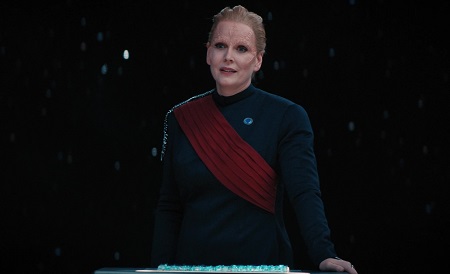
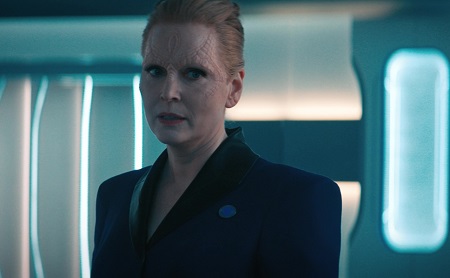
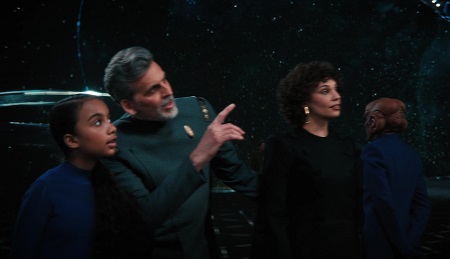
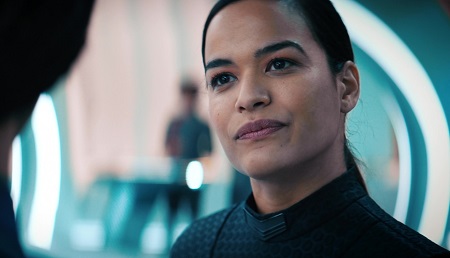
As the episode wrapped up, it seemed as though Discovery had one last surprise up its sleeve. As the President of United Earth was about to arrive, I wondered if we might be about to see Dr Kovich when the doors wooshed open – if not, perhaps a character from a past iteration of the series. When it was revealed to be a new character I wasn’t disappointed; it seemed as if the point the series was making with the buildup to her reveal was that the President of the Federation, the President of United Earth, and the Captain of Discovery are all women, which I thought was a neat way to go.
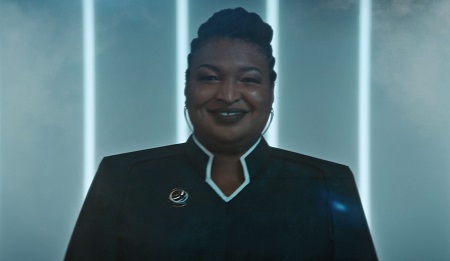
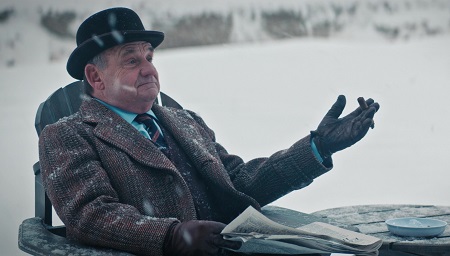
I had no idea who this was at first!

But there was more to it that, as a non-American, I missed at first! The President of United Earth was played by Stacey Abrams, an American politician and writer who’s been quite politically active on the left wing of US politics. This casting choice is interesting – and perhaps a little provocative! There will be people on the conservative side of things who will feel upset, and Discovery knew this well in advance of casting this character. Doing so was a way for the series to really emphasise its progressive principles, which have been front-and-centre just as they’ve always been in Star Trek.

Star Trek is no stranger to cameos and stunt castings, before anyone jumps in to say that this one is somehow different because of who it is. The King of Jordan had a cameo in Voyager once upon a time, and there have been real-life astronauts, scientists, and other celebrities who’ve all joined in for guest-starring roles. Considering that Stacey Abrams is, as far as I’m aware anyway, a newbie to acting, I think she did a wonderful job!

The President and the President shake hands.

I adored this scene with the President of United Earth. Set aside the casting for a moment, because the content of the scene made a huge impact on me. Coming Home had already been a hugely emotional story, so seeing Earth rejoin the Federation after two seasons outside it was pitch-perfect. Stacey Abrams and Sonequa Martin-Green excelled in their moments together, and what resulted was an optimistic and emotional high to bring the episode – and the season – to a conclusion.

There are some interesting real-world parallels that the casting of someone like Stacey Abrams arguably hammers home. After the United States had pursued a nativist, isolationist policy for four years, the country is stepping away from that. United Earth rejoining the Federation could be viewed as symbolic of America’s return to the world stage. From a British perspective, it could be seen as a hope for the UK one day rejoining the European Union after the Brexit referendum. Star Trek has always used its sci-fi setting to look at real-world issues, and those are just a couple of possible ways we can interpret this emotional and uplifting end to the season.
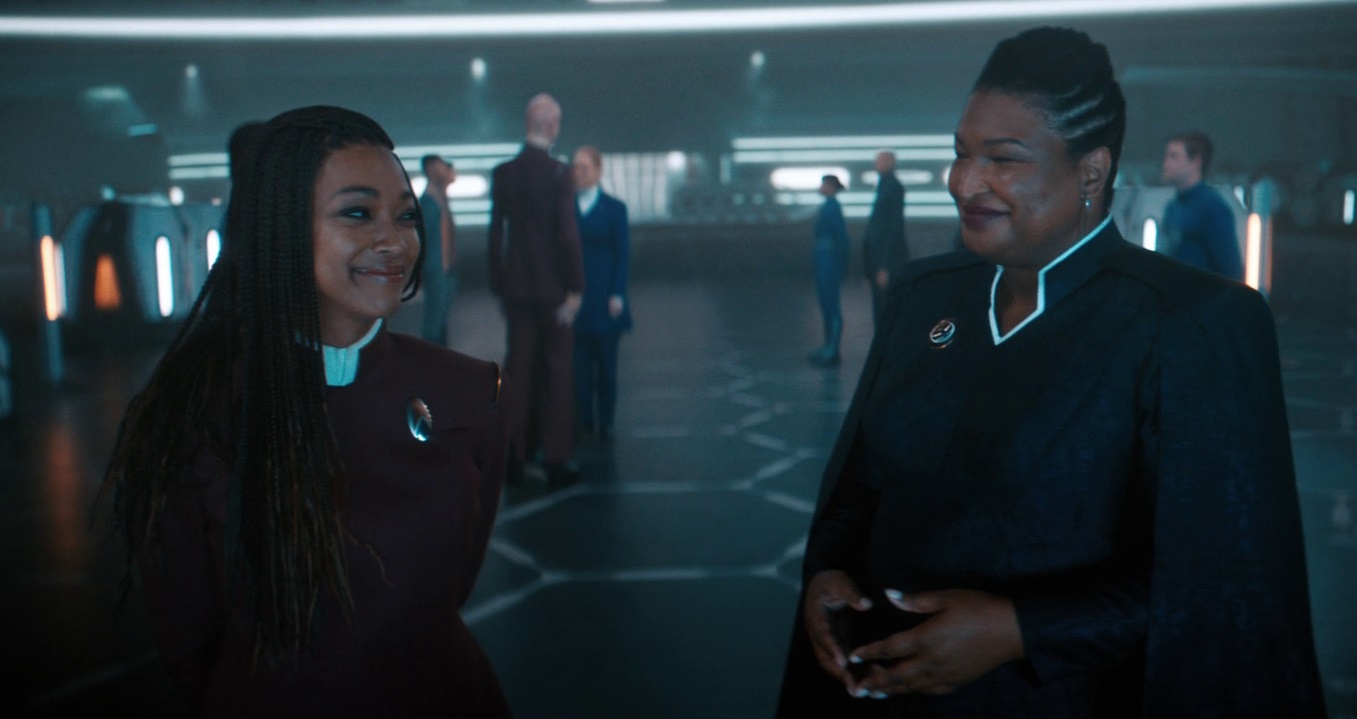
Captain Burnham and the President of United Earth.

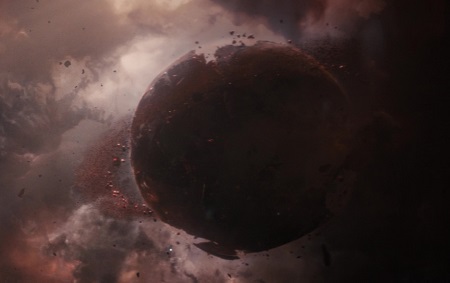
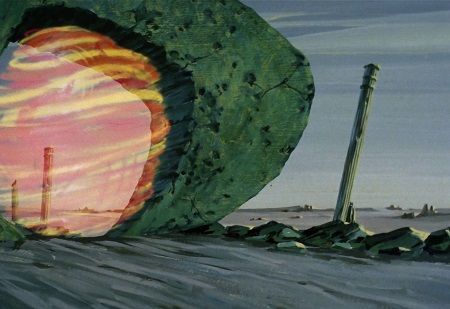
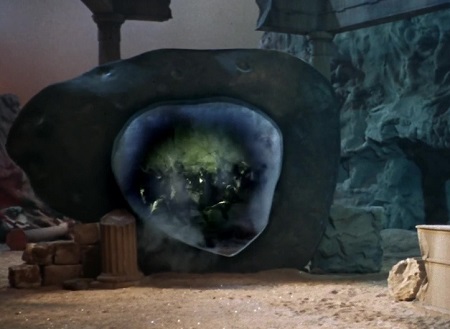
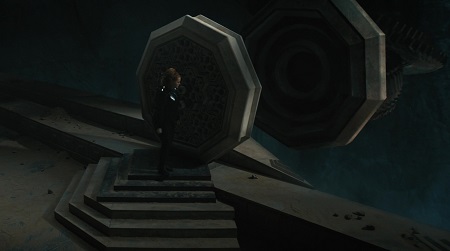
We’ve come all this way but we still haven’t talked about Unknown Species 10-C! The visual effects used to create one of the most “alien” races ever seen on screen in Star Trek were excellent, though I would caveat that by saying that the meeting place being a carbon copy of the ruin visited in Rosetta detracted a little from the way things looked. Recycling sets has been something that the Star Trek franchise has always done, but this moment was the crux of a season-long story, and I think more could’ve been done to give Unknown Species 10-C’s new home a new look, even if it was just in a minor way through changes and tweaks. It’s been a millennium since they lived on the planet seen in Rosetta, so if for no other reason than the passage of time we might’ve expected it to look slightly different.

That being said, I liked Unknown Species 10-C both in appearance and in concept. Star Trek has a long history of showing us alien races that look only slightly different to humans – and in some cases are completely identical! That’s never been a problem for me; I think it’s part of the suspension of disbelief that one has to have when stepping into the Star Trek galaxy. However, the rise of modern CGI and animation, combined with new technologies like Discovery’s AR wall, mean that some very different aliens can be created and can be blended with real actors. This blend was seamless in Coming Home – as it has been, with only a few exceptions, all season long.
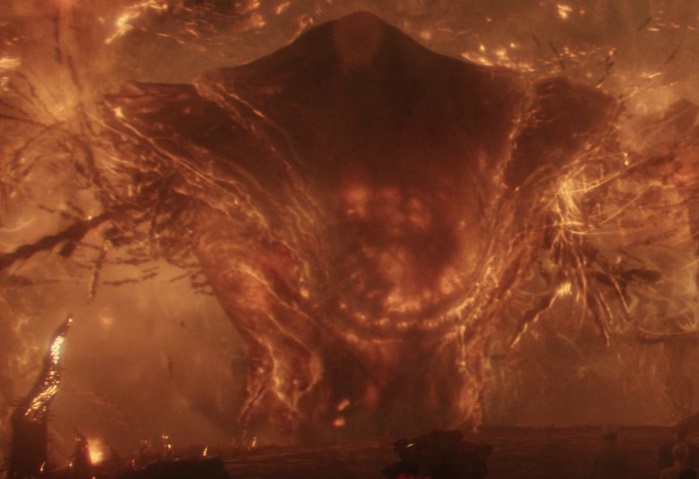
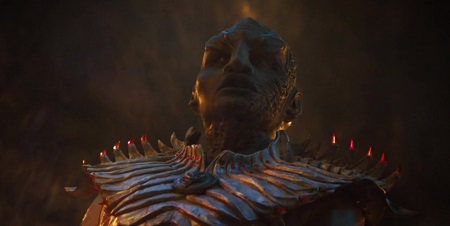
A member of Unknown Species 10-C.

The story of bridging a communication divide is honestly one that I could’ve spent longer on. Much of the legwork had been done in Species Ten-C last week, so we got less of the minutiae that a “learning to understand one another” story can provide. But what we did get was interesting, and we got to see how Unknown Species 10-C didn’t mean to do anything wrong – their scans didn’t indicate that there were sentient life-forms in the areas that the DMA hit.

In that sense, we have a comparable situation to the Burn in Season 3. Unknown Species 10-C weren’t some horrible invading alien for Starfleet to heroically defeat; what happened was a genuine accident, one that they regret. That may not be enough for someone like Book, who lost his home, his family, and his entire race… but it’s a different ending, one that many other sci-fi franchises wouldn’t have even considered. Discovery pulled it off, and while the story leading up to it was imperfect and padded, it worked.
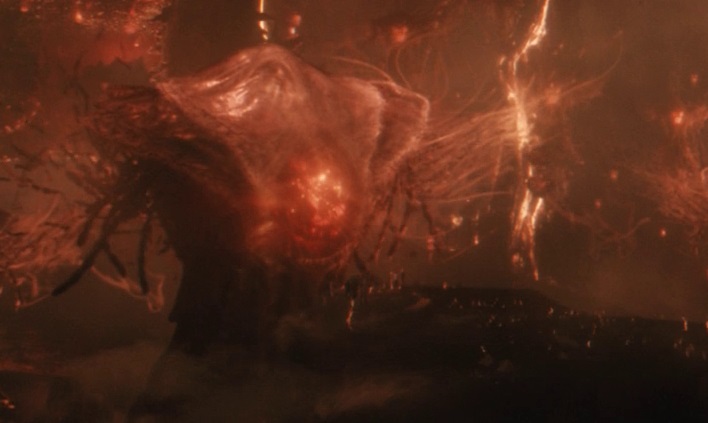
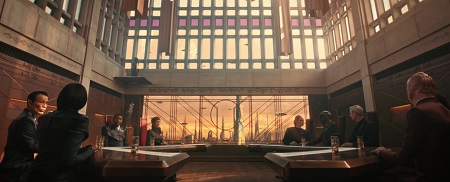
A representative of Unknown Species 10-C conveys their regret to the assembled crew and delegates.

However, Discovery has now run four seasons with some variation of the “major galactic threat” storyline, and I think that framework needs a break. Not every story has to be about the entire galaxy, Earth, and the whole Federation being in danger – there can be just as much drama, tension, excitement, and emotion from stories that are smaller in scale. Just because a story doesn’t threaten life as we know it doesn’t mean it doesn’t matter, and how we as the audience respond to a story begins with the way the characters we’re invested in respond to it. So consider this a plea to all of Discovery’s writers and producers: try something different in Season 5!

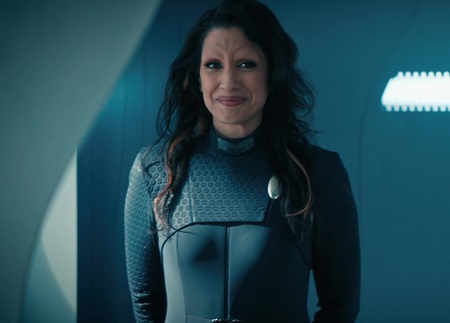
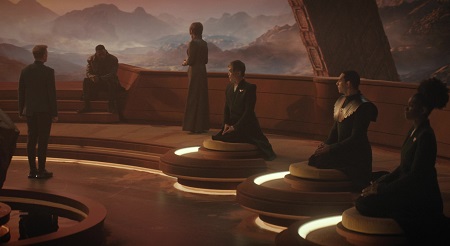
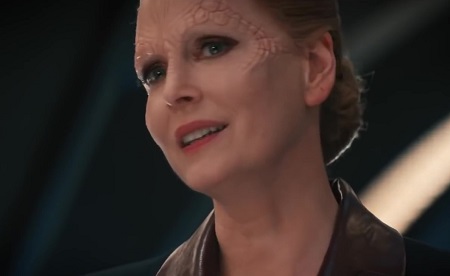
I enjoyed the performance from Chelah Horsdal as President Rillak. For practically the whole season I couldn’t tell if we were going to get a “bad Admiral” type of character turn; President Rillak certainly seemed to have a Machiavellian edge that could have made for a wonderfully complex antagonist. In Coming Home, though, we got to see the culmination of her diplomatic efforts and her leadership of the Federation, both through the way the DMA threat came to an end and through Earth rejoining the organisation – something that had been one of her major objectives.
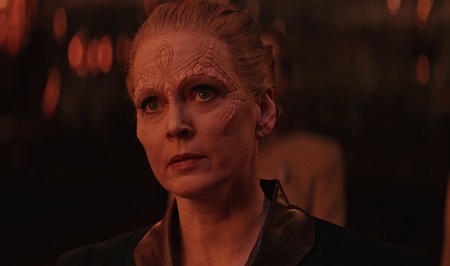
President Rillak speaking with Unknown Species 10-C.

For what feels like the first time this season, Stamets had more than just a couple of lines. It was a shame that he couldn’t be present at the meeting with Unknown Species 10-C; I’d have rather seen him there with Dr Culber and Adira to stand alongside Captain Burnham than some of the secondary bridge characters, really. But it was still nice to see Stamets and his family coming together at the climax of the story, and how Dr Culber forfeited his own chance to go on the away mission to be with them.

Stamets and Culber formed Discovery’s emotional core in the first season and the third, with a disappointing foray into a relationship squabble in the second. But aside from a few smaller scenes, neither character really seemed to have all that much to do in Season 4. With Gray’s story brought to a conclusion early on, in the episode Choose To Live, the family dynamic changed, but Stamets missed practically all of that. In fact, his only scene with Gray all season that I can recall was when Gray left to return to Trill. In short, I was glad to welcome back Stamets in Coming Home, and thrilled to see him bonding again with Culber and Adira… but the reason why it felt so great is because I’m aware of how absent moments like that had been all season long.
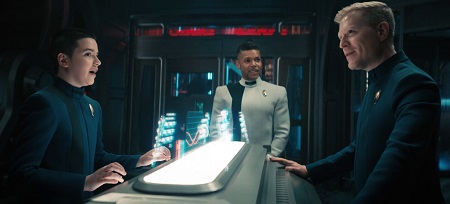
Adira, Dr Culber, and Stamets.

I was not a big fan of the Burnham-versus-Book relationship drama angle that began in But To Connect earlier in the season. It didn’t work for me, and I felt that the focus on Burnham and Book’s emotions, particularly in episodes like All In and Rubicon, came at the expense of other characters and other story developments. It was cathartic, then, to see the two finally reconcile in Coming Home, and I’m glad that the season didn’t end with their relationship left in question.

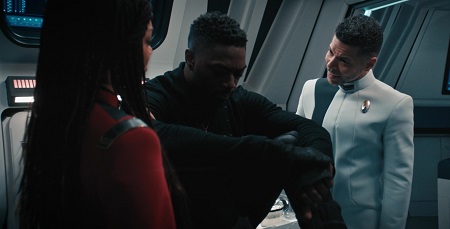
Because of the timing of Book’s fake-out “death,” it could have ended there and still felt satisfactory; Captain Burnham would’ve known that Book loved her, and his actions in his final moments would’ve been trying to stop Tarka and prevent an escalation of the damage he’d already done. That could’ve worked – but I’m glad that Book lives to fight another day and that they got to have a proper sit-down together and a proper reunion on Unknown Species 10-C’s planet. After a storyline that shook things up too much for my taste, a proper resolution that has hopefully set the stage for a rock-solid relationship between them in Season 5 was the least bad outcome.
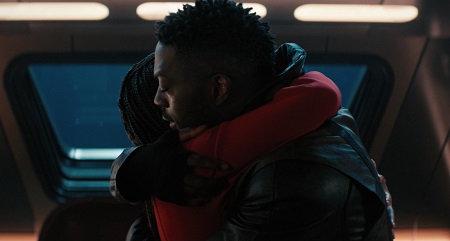
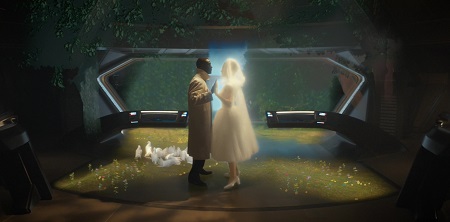
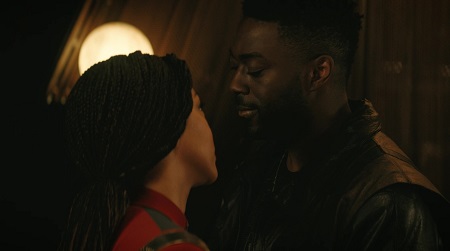
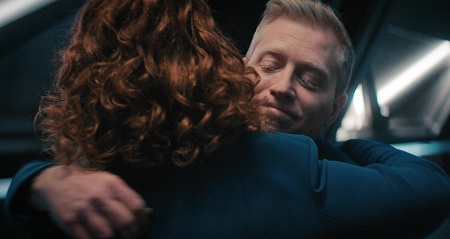
Captain Burnham and Book embrace.

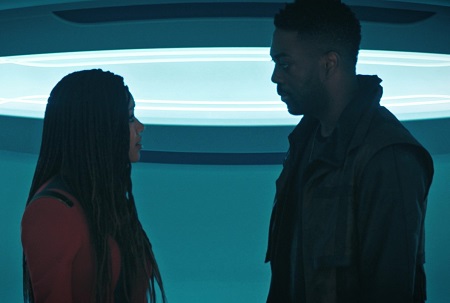
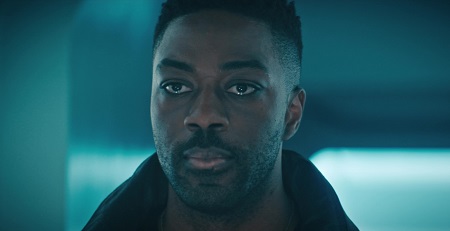
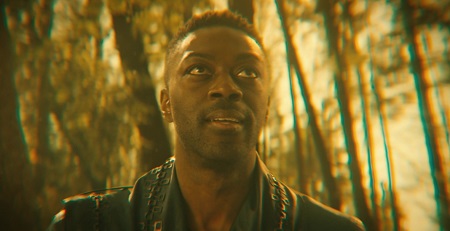
I enjoyed the speeches both Captain Burnham and Book gave to Unknown Species 10-C, and it was great that they were able to find a way to connect with a species that could have been “too different” to bridge the divide. Book’s speech after his resurrection was remarkable, and the emotion packed into each and every word resonated. David Ajala has done a great job all season long conveying Book’s grief and sense of loss, and he brought everything to bear in this scene as he came face-to-face with the race who killed his family and destroyed his home. It was heart-wrenching to watch.

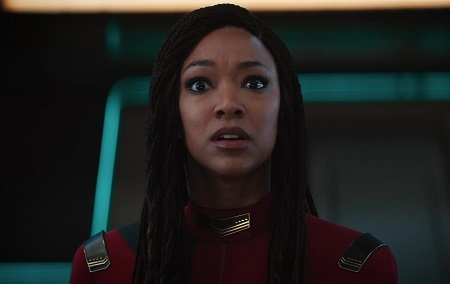
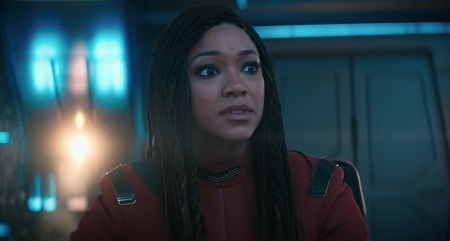
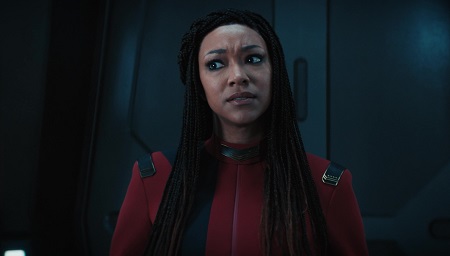
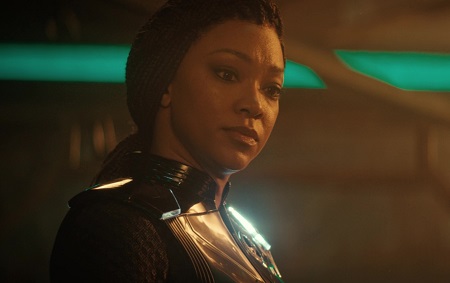
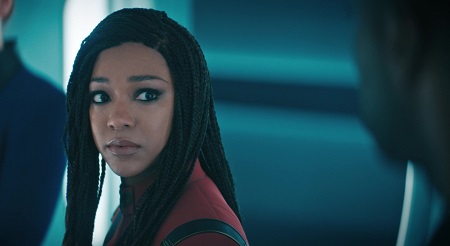
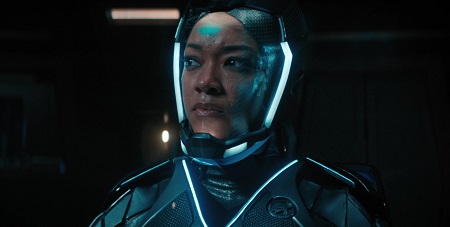
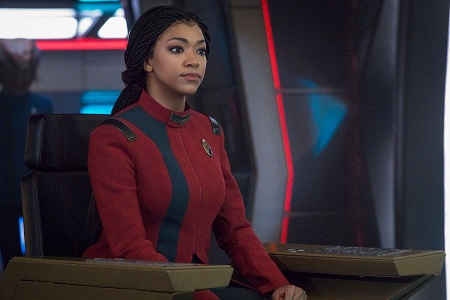
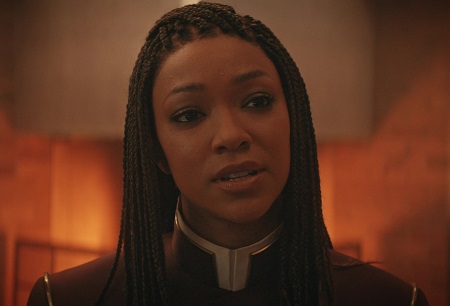
Captain Burnham’s speech was likewise packed with emotion, particularly as she was still reeling from the shock of Book’s apparent death. This was definitely one of Sonequa Martin-Green’s best moments of the season, as Captain Burnham finally made contact with the enigmatic race. She had to convince them that they needed to stand down – and with just moments remaining, she was able to do so.
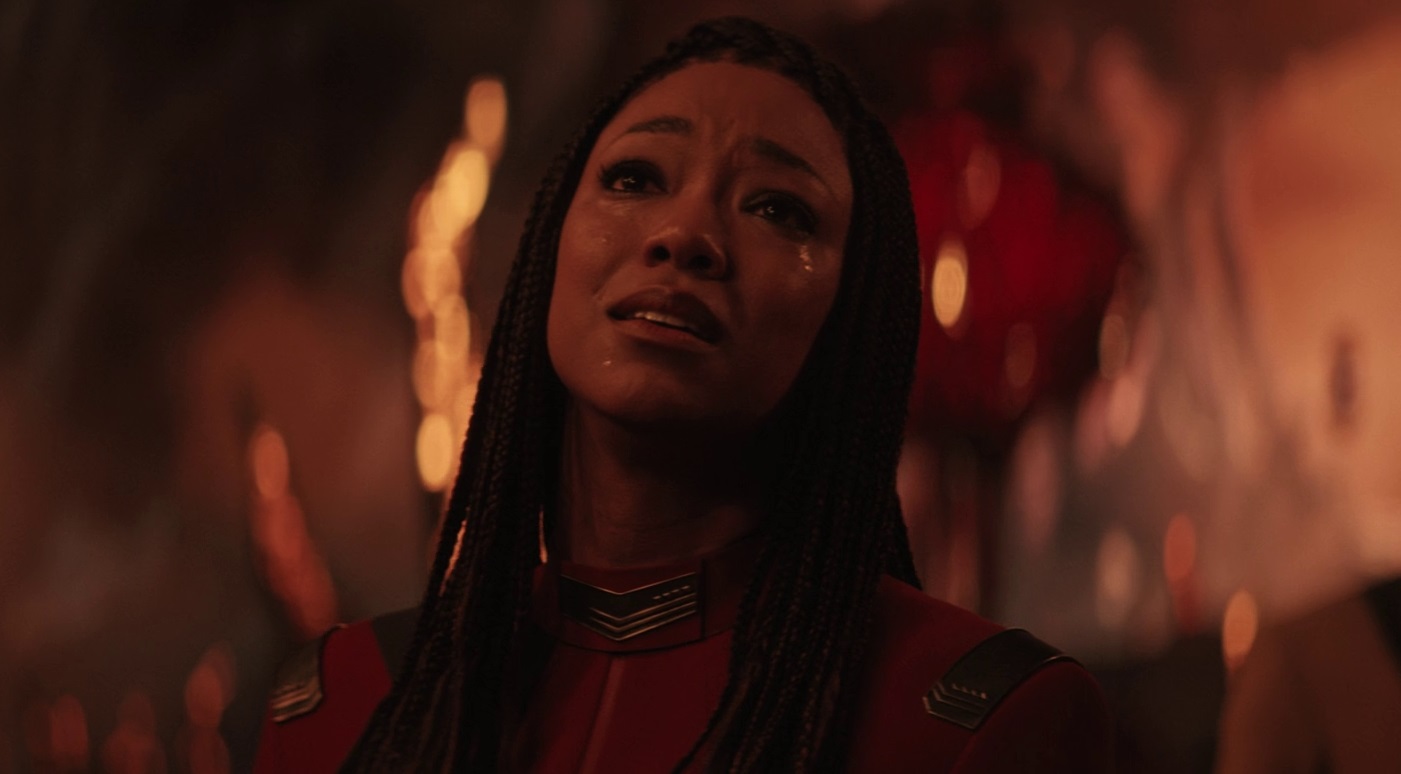
Captain Burnham spoke to Unknown Species 10-C.

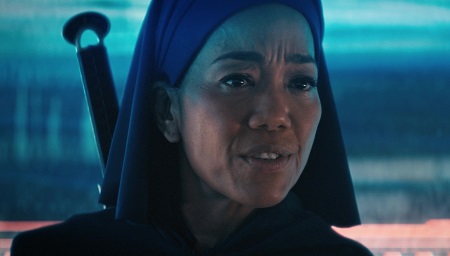
General Ndoye, who had been responsible for Tarka’s escape during the events of the previous episode, stepped up and admitted what she had done. She presented a strength of character that I wasn’t expecting given how she’d been roped into Tarka and Book’s conspiracy. The idea that the first contact mission was progressing but was sabotaged by people who were unwilling to wait was an angle that was potentially interesting – but it didn’t need to go to such extremes, perhaps.

Still, I liked General Ndoye. Phumzile Sitole played the character with a kind of hard-nosed pragmatism, and although General Ndoye was in the wrong from Captain Burnham’s point of view, it’s only because we as the audience could see what was happening that we realised that. Ndoye acted in what she believed to be Earth’s best interests based on the information she had available – she was never a villain nor an antagonist, and she remained in that complex space even while Tarka was being transformed into an out-and-out villain last week.
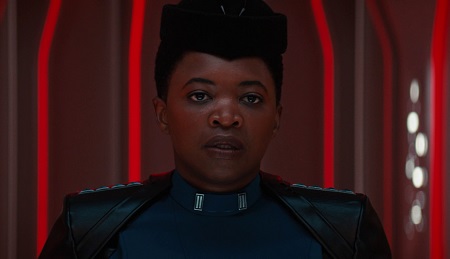
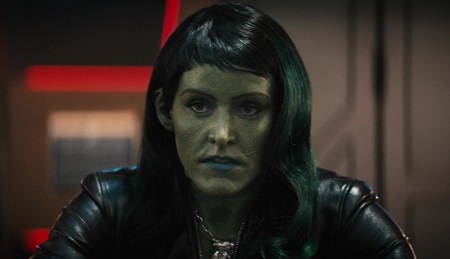
General Ndoye.

A few scattered thoughts before we wrap things up:

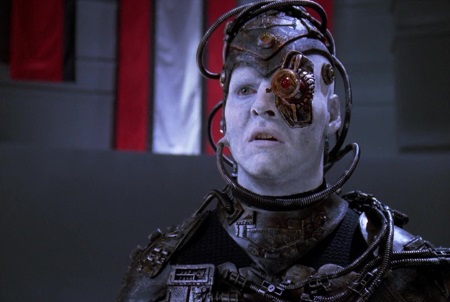
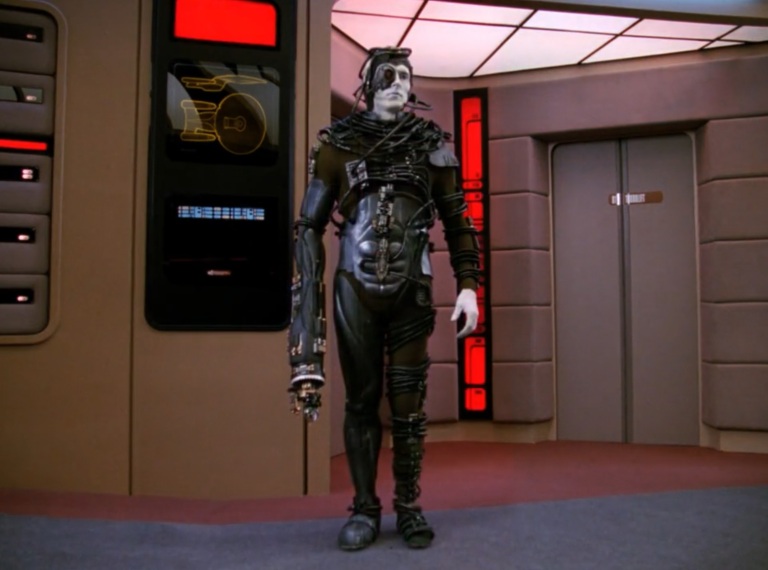
  • Coming Home contained the first mention of the Borg in Discovery… could that be setting up something to come in Season 5, or perhaps some kind of tie-in with Picard? I can’t help but wonder! Seeing Captain Burnham go toe-to-toe with the Borg would be delicious!
  • Dr Hirai felt sidelined once again, contributing relatively little to the story. This character feels like a waste of potential – someone interesting whose role on the mission made sense, but who was underused and who underwhelmed in the few appearances he made.
  • The destruction of Book’s ship feels like it could be symbolic… but I’m struggling to find the intended symbolism considering that Discovery will presumably bring him back in Season 5, and the show didn’t exactly go through a soft reboot at the end of the season.
  • Unknown Species 10-C definitely gave me a “sea monster” vibe.
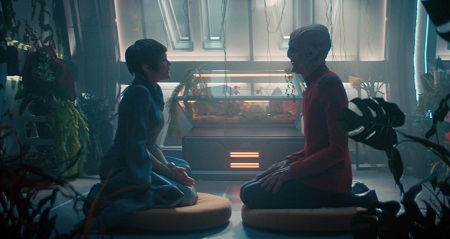
  • It was so sweet that Saru and T’Rina finally got together!
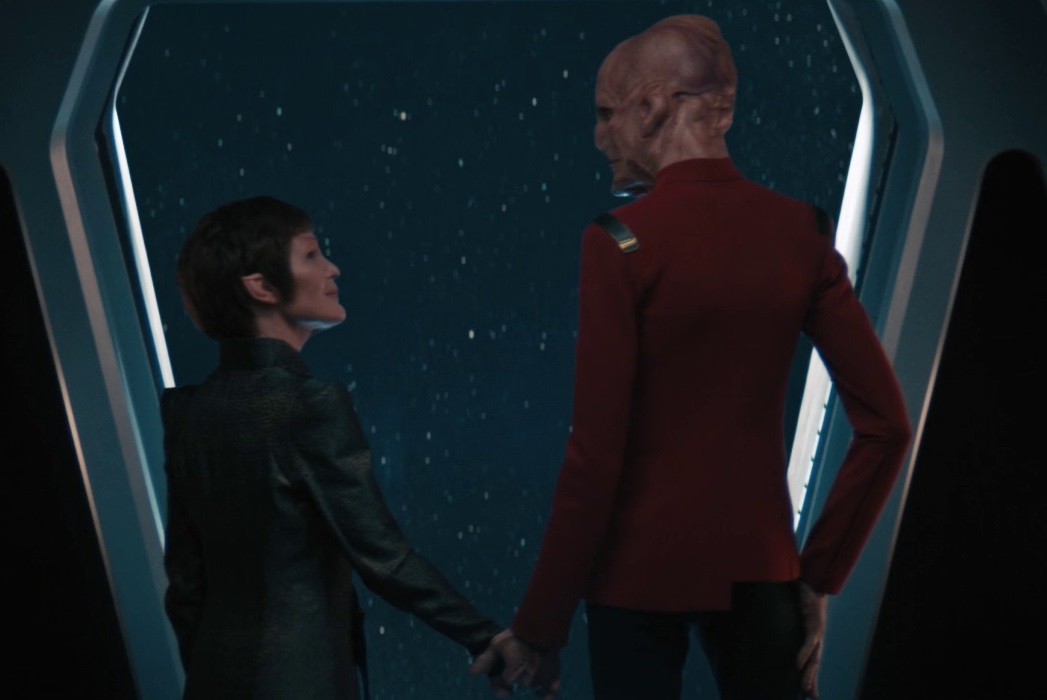
A happy ending for T’Rina and Saru!
  • Shutting down the hyperfield, which Unknown Species 10-C had been running for a millennium, seemed a bit quick right at the end.
  • It would’ve been interesting to see Captain Burnham having to lead Discovery on a Voyager-esque mission back to Earth… but Unknown Species 10-C’s wormhole tech meant it never felt like a realistic prospect.
  • I will always love seeing Admiral Vance with his family!
  • The use of Grudge’s collar to escape the forcefield was a clever inclusion that felt like classic Star Trek technobabble.
  • I hope we’ll see Unknown Species 10-C again and they won’t just be forgotten about in future 32nd Century stories.
  • Will Federation HQ now remain permanently in orbit of Earth? Or will other planets want to have Federation facilities, given that Earth has been absent for more than a century? It could be interesting to explore such a conflict in Season 5.
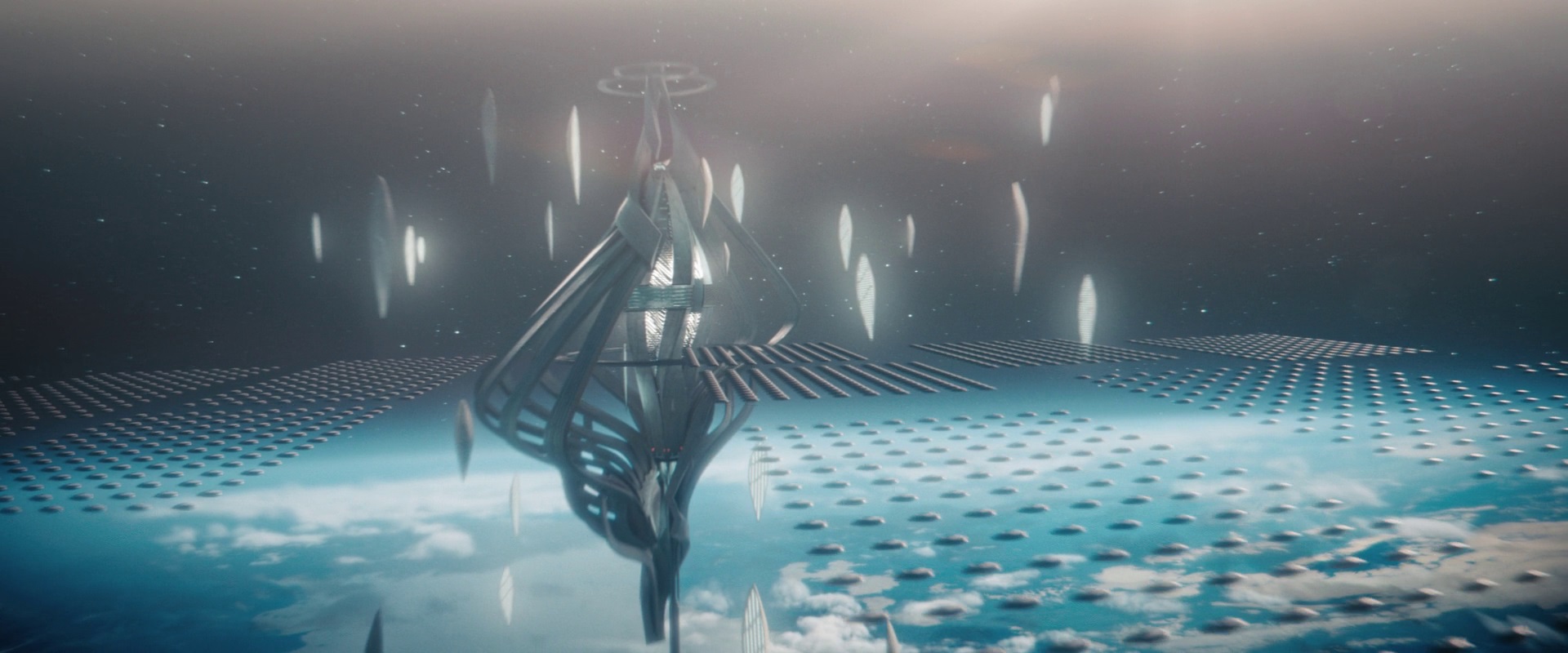
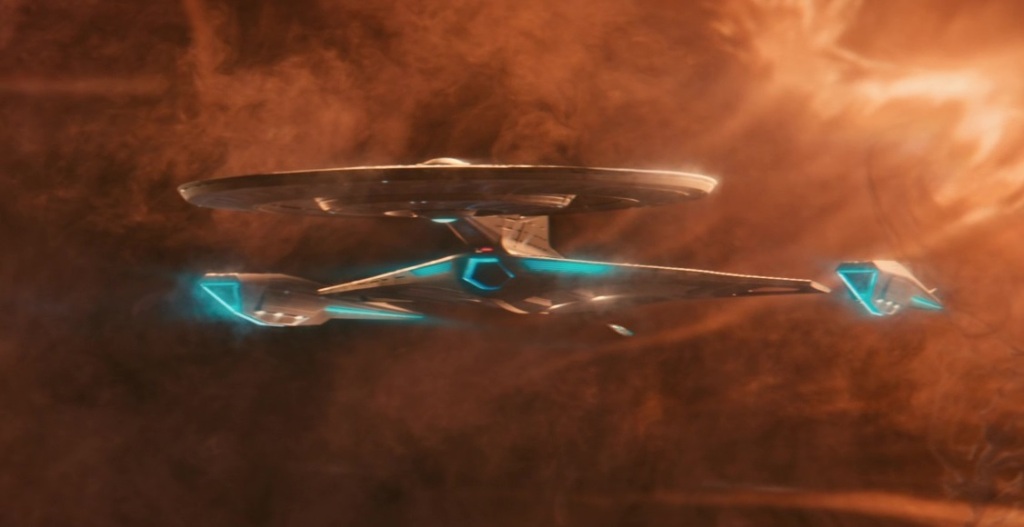
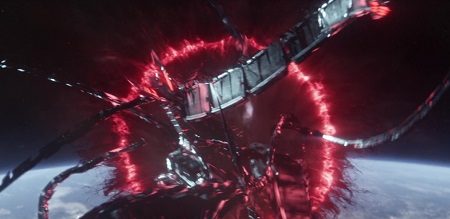
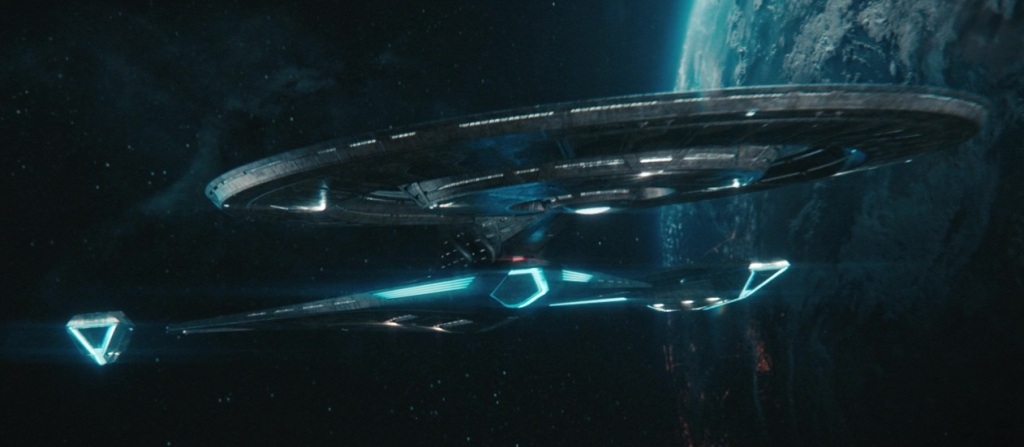
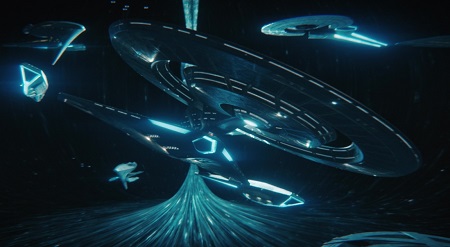
Federation HQ in orbit over Earth.

There’s a lot more to say, quite honestly… but I feel this is already running long. It’s taken me a long time – longer than usual – to get my thoughts in order, and I find that a lot of what I want to say in a more critical way is more about the story or structure of the season as a whole rather than about Coming Home specifically. It was a great episode in its own right, it capped off the season in a beautiful, emotional way, and left me with a real sense of optimism as Discovery prepares for a fifth season. But despite a solid ending, Season 4 as a whole is much more of a mixed bag, and I’d like to talk about that more on another occasion.

Coming Home was the emotional high point of an occasionally frustrating season, but it’s an episode that means we can say that things ended on a positive note. I’m genuinely excited for Season 5 and to see where the show goes next… but I hope it’s not going to be another “the galaxy is in danger” storyline! After the Klingon war, Control, the Burn, and the DMA, we’ve had enough of those.

It took me a while to get this review together, partly because of how much of an emotional experience Coming Home was… and partly because I’m feeling a little burnt out after three weeks of two Star Trek episodes meaning I was writing two big reviews! I really wish Paramount Global would sort out its scheduling…

Star Trek: Discovery Season 4 is available to stream now on Paramount+ in the United States, Scandinavia, Latin America, and Australia. Individual episodes or the full season can be purchased on iTunes, Amazon Video, Google Play, and possibly other platforms in the UK, parts of Europe, and select other countries. The Star Trek franchise – including Discovery and all other properties mentioned above – is the copyright of Paramount Global. This article contains the thoughts and opinions of one person only and is not intended to cause any offence.
Star Trek: Discovery review – Season 4, Episode 12: Species Ten-C

Spoiler Warning: There are spoilers ahead for Star Trek: Discovery Seasons 1-4.

Species Ten-C wasn’t just a good episode in its own right, with plenty of excitement and tension that showed how Star Trek can do a heck of a lot without resorting to violence and battles, but it was one that made the episode immediately preceding it significantly better in retrospect. I wrote last week that the one saving grace to an otherwise frustrating experience in Rosetta could be if the hydrocarbons discovered by Captain Burnham and the away team were put to good use – and that happened in a big way this time.

On the other side of the story, I finally felt what I believe the writers have been aiming for for weeks with the Book and Tarka storyline: that Captain Burnham was right, diplomatic initiatives should be given a chance, and that Book has fallen victim to Tarka’s manipulations. While this has the unfortunate effect of relegating Tarka from a complex character with an equally understandable motivation into the out-and-out villain of the season’s final couple of episodes, it clarifies what had been until now a very fuzzy and occasionally frustrating story.

The Book and Tarka storyline was expanded upon in a big way this week.

If I were to be critical of Species Ten-C, what I’d say is that it probably took too long for the season to reach this point. Several advances in the DMA/Unknown Species 10-C storyline were sprinkled in at or near the end of unrelated or tangentially-related episodes, with the Federation often running into problems or delays that took too long to surmount, and the result of that is that it took a long time to arrive at the hyperfield.

The story of finding a way to bridge the communication divide could have been a longer one, and it was handled in a genuinely interesting way – but with only half an episode dedicated to it here and just one final episode of the season remaining, it’s an interesting concept that may not be explored in as much detail as it could have been.

Species Ten-C saw the crew making first contact.

This story of learning how to communicate with someone far more alien than usual, and doing so while under threat thanks to the DMA, is not one that required a B-plot villain. While Tarka was interesting in his earlier appearances and his motivations were laid out in a clearly understandable way, the narrative just doesn’t require this additional element in order to be exciting.

Discovery has a tendency, as I’ve pointed out on a number of previous occasions, to try to inject double the tension and three times the drama when it just isn’t necessary, and if I were to make one comment about the series as a whole it’s that the writers need to have more confidence in their stories. Dropping the Tarka angle, or reworking it to make him less of an antagonist in this final chapter, would allow the main story of learning to communicate with Unknown Species 10-C to stand on its own – and as it’s already sufficiently tense, interesting, and engaging, Tarka’s villainy just isn’t necessary.

Tarka in Species Ten-C.

Not for the first time, Discovery has set up a character who feels well-rounded and complex, with motivations that seem understandable, only to turn them into a pretty standard villain later on. I wouldn’t have even called Tarka “morally ambiguous;” his weapon plan made a lot of sense when it was first proposed, and I even suggested that a show which has had themes of seeking a “middle ground” could have figured out a way to keep Tarka on board, building his weapon as a back-up plan while attempting to make first contact. But as with Captain Lorca in Season 1, much of Tarka’s nuance now feels lost; brushed aside because the writers determined that the season needs a villain.

There were other ways to formulate this story that either skipped over Tarka altogether or that kept him in that complex space. We may yet learn that his interdimensional transporter will be important, in which case he may have served a narrative function, but if the ending of the story is going to be Tarka’s defeat or death, with a reunion with Oros not being able to happen, then I think I’ll have to go back and re-evaluate his role in the season overall. This story already had the complexities of Unknown Species 10-C and the DMA; I’m not sure it needed a second antagonist, especially not one who seems to have come at the expense of an interesting and complex character.

Tarka with Oros earlier in the season.

We’ve also got to talk about the new character of Dr Hirai. In short, he needs to do something truly outstanding and unique next week – otherwise his inclusion in the season will have proven to be a complete and utter waste of a great actor. I like the concept of the character; a linguistics and communications expert seems perfect for this kind of mission. But in his two earlier appearances this season he did nothing whatsoever, and his accomplishments this week were relatively minor. It didn’t feel like bringing Dr Hirai along was in any way important to the success of the mission, with Captain Burnham, Zora, Saru, and even characters like Detmer, Nilsson and the very minor Lieutenant Christopher all contributing at least as much – if not more – to the story as he did.

He was ultimately sidelined by President Rillak, who chose Saru and Burnham over him for their linguistics and first contact expertise, confirming his relegation to a bit-part role at best. In light of what happened last week with Rosetta, I’m willing to wait and see if Dr Hirai will yet make a significant contribution – but with only one episode left in which to do so, he needs to do something big pretty quickly or we’ll unfortunately have to consider his inclusion in the story a bit of a let-down.

Dr Hirai doesn’t have long left to make an impact on the story.

There is one concept underlying the way Unknown Species 10-C reacted to Discovery’s arrival – and the conversation it prompted between Captain Burnham and the others – that I didn’t like. As humans, we’re able to recognise signs of intelligence in other species, even though we’re far more advanced and intelligent than they are. We can recognise the complex social structures present in ant colonies, for example, or how crows and some great apes are learning to use tools. Even though these creatures are far lower on the intelligence scale than we are, we’re able to determine quite easily that animals – even small and lowly ones – can exhibit signs of complex understanding and intelligence.

With that in mind, the idea that Unknown Species 10-C would see a starship arriving at warp speed, using a warp core and a spore drive, built from clearly artificial alloys, and somehow not understand that the creatures aboard it are sentient makes no sense. This species is supposedly much farther advanced than even the 32nd Century Federation, and even though they exist outside of the galaxy they must have the ability to scan and detect the existence of other sentient species, even if they choose not to interact with them. It’s conceivable that they might be selfish and not care about any other species besides themselves – but the idea that they would be unaware or incapable of determining intelligence in this situation is one that I can’t buy as a believable story point.

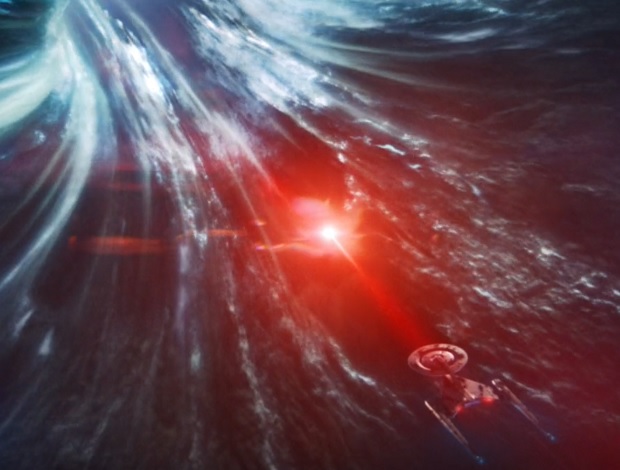
The USS Discovery approaches the hyperfield.

It seemed at first as though Species Ten-C was going to centre on this aspect of first contact, and I was certainly a little disappointed at first. But thankfully this didn’t last too long, with Unknown Species 10-C eventually getting the message and realising that the life-forms aboard the warp-capable starship are actually intelligent. Took them long enough!

I know that probably sounds like a nitpick – and it is, in a way. It’s just that, despite all of the talk of Unknown Species 10-C being very alien and having a very different culture, some things should be universally obvious – like if someone is capable of building a starship that can travel faster than the speed of light, use metal alloys that don’t exist in nature, and fly right up to your base to initiate contact, it’s probably a safe bet to assume that they possess some degree of intelligence. That should apply no matter who you are! And as pointed out above, humans are capable of recognising the signs of intelligence in the natural world. As a narrative beat, I get that it was in there to make the initial meeting feel very tense, but it’s kind of illogical if you think about it!

A representative of Unknown Species 10-C.

We didn’t get a clear look at Unknown Species 10-C, as their representative was partially obscured by a cloud of swirling gas. Nevertheless, the visual effects on this side of the story were mostly high-quality, and Unknown Species 10-C themselves at least seem like they’ll be visually interesting if we ever get a better look at them. I actually got a slight “Mass Effect Leviathan” vibe from what we glimpsed of Unknown Species 10-C. The design of the hyperfield was likewise interesting; it appeared much more solid than I had been expecting based on the holographic projections seen in previous episodes. Seeing it go from solid-metallic looking to swirling like fluid was also a very cool visual effect that Discovery executed well.

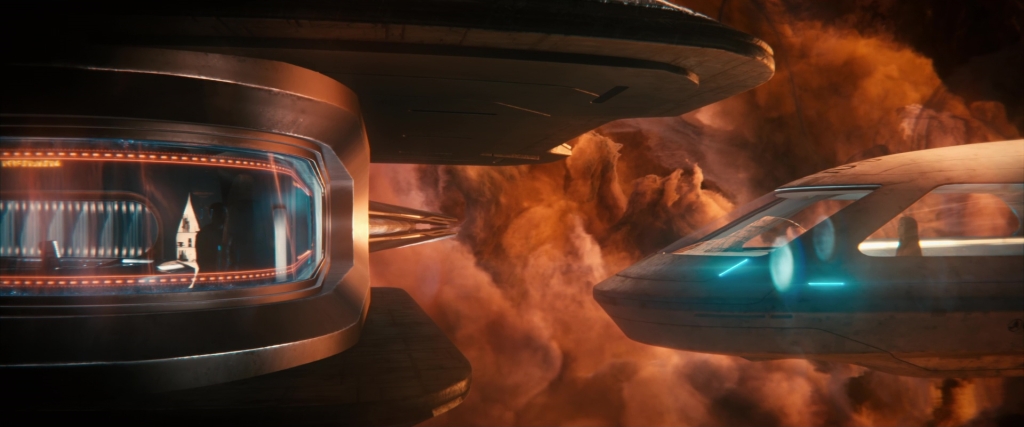
The only visual that I felt was a bit of a miss was Unknown Species 10-C’s shuttle pod/diplomatic chamber. When it arrived in Discovery’s shuttlebay it looked rather bland and low-quality, like a video game where a texture hasn’t loaded properly. It was clearly designed to look similar to the hyperfield, but I guess trying to blend that with a real set and real actors was difficult. It didn’t look awful, but it was noticeably lower quality when compared to the rest of the visual effects and animation work present in Species Ten-C.

This visual effect felt rather weak.

The idea of Unknown Species 10-C recreating part of Discovery as an environment for the crew works as a story point – I can quite understand why they’d choose to do something like that. But I confess that I rolled my eyes a little when I saw Captain Burnham and the others stepping onto the bridge set. It was understandable in the context of the story, but it didn’t make for a particularly impressive or interesting sequence when shown on screen. In fact, it almost makes Species Ten-C feel like a “bottle” episode – a Star Trek trope going all the way back to The Original Series where episodes would be set entirely aboard the ship.

As mentioned above when discussing Dr Hirai, President Rillak chose to bring both Captain Burnham and Saru when boarding Unknown Species 10-C’s diplomatic shuttle. And aside from totally sidelining Dr Hirai, this also left the command structure of Discovery and the rest of the mission uncertain. Rhys had the ship’s conn, as we’d see on the bridge near the episode’s climax, but who was in charge of the remaining delegates and the rest of the diplomatic mission? And how far did Rhys’ authority extend? Would he, for example, have been authorised to fire upon Unknown Species 10-C if time began to run out for Earth? Taking both the captain and first officer on this mission – when other experts were available – is a bit of an odd choice, and while of course as the audience we want to see our familiar characters leading the charge, it again makes the addition of some of these other delegates and experts feel like a bit of a waste.

The interior of Unknown Species 10-C’s pod.

A longer episode – or a story which had arrived at the hyperfield earlier in the season – could have spent longer on the whole first contact thing, and I really think that would have been worth doing. I’m actually getting a bit of a familiar feeling the more I think about Species Ten-C: it reminds me of the finale of Picard Season 1 in the sense that the season dawdled a lot to get to this point, and it feels like there’s a lot of important story points left to get through with very little time remaining. As a result, some aren’t being given as much attention or screen time as they probably should receive. We aren’t at the same level as Et in Arcadia Ego – at least, not yet. But suffice to say that Season 4 as a whole has left its final episode with a lot of work to do to wrap up all of the major stories in a satisfying way.

There were a few very close-up shots of characters’ faces that made the cinematography in Species Ten-C feel a bit odd. Close-ups can work and can be dramatic, but their use here felt rather gratuitous, with the episode both beginning and ending with them in a way that made it feel like the director was throwing everything at the wall in an attempt to make things seem even more dramatic. As I’ve said on several occasions this season when discussing certain narrative choices, Discovery is already a series that brings plenty of drama to the table – trying to take it from a ten to an eleven can sometimes fall flat, and a few of these extreme close-ups definitely strayed very close to the line.

Was there any need for so many close-up shots?

Book saw some significant character development this week after several episodes in which he felt very static. Although Tarka’s motivation for continuing to pursue the DMA’s power source feels pretty well-established by this point in the story, I’ve been finding it increasingly difficult to reconcile Book’s presence on this side of the story in the aftermath of the failure of the isolytic weapon back in Rubicon. We hadn’t seen or heard enough from Book since that dramatic event to signal that he’s still on board with the next phase of Tarka’s plan – and this week he actually seems to have moved much closer to Burnham’s position.

Book’s cause is noble: he wants to stop the DMA from hurting anyone else in the way it destroyed his home and hurt him. And seen in that context, his decision to get on board with Tarka’s weapon plan was understandable. In Rubicon, Book indicated he would be willing to stand down for a short time to give diplomacy a chance to play out, and in the aftermath of the failure of the weapon, it wasn’t clear at all why he continued to follow Tarka. I’m still not exactly sure how he arrived at this point – was he motivated by fear of repercussions for the use of the weapon? Did he still believe it would be possible to destroy it after Tarka failed once? If so, is he now no longer willing to let Captain Burnham try for a diplomatic solution first?

Book in Species Ten-C.

These points were glossed over in Species Ten-C, but we finally got some movement from Book, arguably bringing him back into the fold as one of the “good guys.” It emerged that Tarka’s plan would destroy the DMA, destroy Earth, and destroy the hyperfield containing Unknown Species 10-C and the USS Discovery – so Book didn’t really have a choice! Again, this is Discovery pushing the story to extremes, and it feels as though Book coming back to the light is more of a necessity than a choice at this point. Still, it worked, and for the first time in several episodes I felt like I could relate to Book as a fully-rounded character again, not just a plot device caught up in the narrative wake of other characters with more volition.

There’s even a message in Book’s story, if we look a little deeper. The idea that grief can lead someone to a very dark place was already something we’d seen explored a little with Book earlier in the season, but now we can add into the mix themes of manipulation, of being lied to, and of getting involved with someone untrustworthy. It was initially grief that saw Book teaming up with Tarka, but he also had the noble objective of wanting to prevent others from having to experience that same level of grief. Unfortunately for Book, he relied on someone who turned out to be unworthy of his trust – and that’s how he ended up in this particular predicament.

Grief led Book down a dark path.

Reno saw her best scenes of the entire season on this side of the story, too. We’ll have to try to excuse the lousy “kidnapping” plot last week, because as weak and difficult to explain as that may have been, it ended up going somewhere significant. It didn’t necessarily have to be Reno as the one to reach out to Book – basically anyone on board the ship could’ve done so – but it was interesting to see her in this situation. Her words managed to reach him in a way that even Captain Burnham hadn’t been able to, and the sequences between the two of them worked exceptionally well.

Reno has often been used as a light-hearted character, bringing moments of deadpan comic relief that could lead to brighter moments in otherwise dark stories. This time, her role harkened back to her introduction in Season 2 – which was also referenced this week – when we first encountered her trapped aboard a crashed starship. A more serious performance from a comedic character carried a surprising amount of weight, and perhaps it’s because we know how Reno usually behaves and speaks that her words to Book meant a lot.

This was Reno’s best episode of the season.

For at least the past three episodes, Discovery seems to have been building up to a conclusion which is going to say something like: “if only Tarka and Book had told Captain Burnham what they were doing! It should have been possible for everyone to get what they want through diplomacy and communication!” and I don’t think that’s changed. It isn’t exactly formulaic, and there are still big questions about what Unknown Species 10-C will do and how Captain Burnham will respond to try to cool things down in the time that remains. But one way or another, the story’s going to get to that place.

As we approach the end of the season, feeling like we know roughly where the story is going to go was to be expected, I guess! And on its own merits, Species Ten-C was a good episode, one of the better offerings from Season 4 for certain. Whether it has moved things along far enough for the season finale to wrap up all of the remaining narrative threads is an open question, one we’ll have to wait until next week to get an answer for.

Book’s ship escaped the USS Discovery and entered the hyperfield.

Although I had some nitpicks within the story, overall I had a good time this week. Species Ten-C told a very “Star Trek” story, with perhaps some inspiration from the film Arrival in there too! Meeting a brand-new alien race and learning how to communicate is something truly interesting, and my biggest complaint is that I would have liked to have seen more of it – for the season to have reached this point a couple of episodes ago so we could have spent longer with Captain Burnham, Saru, President Rillak, and Dr Hirai as they worked on figuring out how to use a complex arrangement of lights and pheromones to communicate. It was nice to see some significant movement from Book, too, after several uninteresting or flat episodes on that side of the story.

Did Season 4 need to turn Tarka into a villain? I think that could be a question for a longer essay once the season has wrapped up! I could certainly entertain the argument that the Unknown Species 10-C story – one of misunderstanding, communication, and first contact – was strong enough to carry both this episode and the bulk of the season without requiring this kind of last-minute character twist. Between the DMA and the smaller character moments – some of which, as noted last week, haven’t been as thoroughly explored as they could have been – maybe it would have been better overall to find a different way to include Tarka. But we’ll talk about that more in the weeks ahead, perhaps.

For now, there’s only one episode remaining! This time next week it’ll be all over… or will it? Could a cliffhanger ending be on the cards?

Star Trek: Discovery Season 4 is available to stream now on Paramount+ in the United States, Scandinavia, Latin America, and Australia. The show is on Pluto TV in the UK, France, Germany, Italy, and other parts of Western Europe at 9pm on Fridays and Saturdays. Individual episodes or the full season can be purchased on iTunes, Amazon Video, Google Play, and possibly other platforms in the UK, parts of Europe, and select other countries. The Star Trek franchise – including Discovery and all other properties mentioned above – is the copyright of Paramount Global. This article contains the thoughts and opinions of one person only and is not intended to cause any offence.
Star Trek: Discovery review – Season 4, Episode 11: Rosetta

Spoiler Warning: There are spoilers ahead for Star Trek: Discovery Seasons 1-4.

Last week’s episode, The Galactic Barrier, was absolutely fantastic – one of the highlights of the season for certain! Unfortunately Rosetta didn’t reach that high bar, and was an episode that felt like it was dragging its feet. While there were some emotional character moments, even those weren’t as strong as they might’ve been and couldn’t salvage an episode in which both halves of the story felt contrived, and where a major new element that had been introduced to the story last week constantly got in the way. Rosetta plodded along, constantly tripping over one big, unnecessary narrative cliché.

I like the idea of Discovery stepping away from total serialisation to go on away missions to planets like the one featured in Rosetta. As we saw just last week – and on a couple of occasions earlier in the season – those semi-standalone stories can work exceptionally well, blending together Discovery’s modern serialised approach to storytelling with at least some components of Star Trek’s episodic past. But this week, for much of the time all I could feel was a sense that the mission to Unknown Species 10-C’s ex-homeworld was a complete waste of time – not only for the characters, who don’t have so much as a second to waste, but more importantly for us as the audience.

The away team.

The worst part of last week’s episode was the insertion of the horribly overused trope of Earth being in danger. I tried to put that to the back of my mind as Rosetta got started, hoping that the time constraint it had imposed would lead to some kind of interesting or exciting storyline as Season 4 reaches its conclusion. But this cliché absolutely ruined Rosetta – turning a story that might’ve had the kernel of a good idea at its core into one that felt like a complete and utter waste of everybody’s time. With time being a very limited resource for Captain Burnham, that just isn’t something that should have been allowed to happen!

If the “Earth is about to be destroyed” cliché wasn’t part of the season’s story, this feeling would have been far less prominent throughout Rosetta, and I could have almost certainly forgiven another detour on the way to Unknown Species 10-C’s hyperfield. With less of a time constraint, such a mission would arguably be worth doing, and while there could still be naysayers and dissenters among the crew and assembled delegates, I would have been firmly in the camp that says “let’s see if we can find any interesting or useful information about this completely unknown faction.” But because Discovery’s writers wanted to crank up the tension and drama to eleven out of ten, what should have been a decent episode with some interesting story elements didn’t work. Instead of the tension rumbling in the background, spurring me on to make the story feel exciting, I could barely prevent myself from shouting at the series to just get on with it – to go to the hyperfield right now! Tension became frustration.

Captain Burnham chose to lead an away mission to a planet instead of racing to the hyperfield.

Not for the first time, narrative contrivances in Discovery have conspired to make Captain Burnham seem like she’s in the wrong. While not exactly being a complete and utter moron, she came across in the episode’s opening act as misguided in the extreme – wasting time on a mission that could have easily yielded nothing of consequence. As happened in episodes like The Vulcan Hello and The Red Angel, it fell to another character to be the voice of reason against Captain Burnham – in this case, Earth’s representative, General Ndoye.

Ndoye made the very simple point that there isn’t time to waste visiting a random planet, and that attempting to make contact first would be the best move. If Unknown Species 10-C didn’t respond to attempts at communication, visiting the planet could be Plan B – but there’s no way it should’ve been Plan A. Rosetta attempts to rely on the away team’s discovery of pheromone-like hydrocarbon dust to say “aha! Captain Burnham was right all along!” but in my view, all that the end of the episode proved was that she got very lucky. Her judgement, four seasons in, is still questionable at times – and on this occasion, with the stakes so very high, I can’t shake the feeling that she made the wrong call.

General Ndoye became the voice of reason… briefly.

The hydrocarbon pheromones will almost certainly play a role in the next couple of episodes – I mean, they have to, right? Otherwise Rosetta will have proven to be a complete waste of time. But even assuming that’s the case, Captain Burnham took a massive risk by diverting to the planet with hours to spare, and it just feels like – not for the first time this season – there was a very easy “middle ground” approach that neither she nor anyone else seems to have considered.

The USS Discovery is equipped with a contingent of shuttles, so sending one with a small away team to the planet while the rest of the crew takes the ship and visits the hyperfield – instead of sitting in orbit of the planet doing fuck all – would have been the hallowed “middle ground” option that the show’s writers seem to have just ignored. Because Captain Burnham has to be the main focus of practically every episode and every major plotline, other characters in the show are relegated to sitting on their hands and waiting for her latest stroke of brilliance. In this case, everyone with the exception of Detmer, Saru, and Dr Culber were just shoved off-screen, seemingly doing nothing except waiting for Captain Burnham to get back. Adira and Reno even found time to get coffee.

This picture is Rosetta in microcosm: Captain Burnham goes off on an away mission while everyone else stands around doing nothing.

That makes Discovery Season 4 feel like a pretty basic story – one designed for small children who don’t have the attention to focus on more than one major narrative at once. Because Captain Burnham wanted to visit the planet, everyone has to visit the planet. God forbid any other character is granted any agency over the plot or given the volition to do anything independently – they’re not real people, you know, just narrative devices.

And yes, it’s Star Trek. It’s fiction. It’s “just a story” – but god do I hate that tired excuse every time it’s trotted out in defence of contrived, underwhelming, or just plain indefensible narratives. If we’re expected to suspend our disbelief and get lost in the world of Star Trek, even just for an hour, the way characters behave has to make basic sense. The characters themselves have to feel like real people – flesh-and-blood beings with emotions, feelings, and brains, not just plot devices who can be used one moment then placed into hibernation the next. And this week, Rosetta basically sidelined the entire crew, forcing them to sit on their hands and do nothing while Captain Burnham took charge of a pretty barebones side-story that I’m not even sure accomplished all that much.

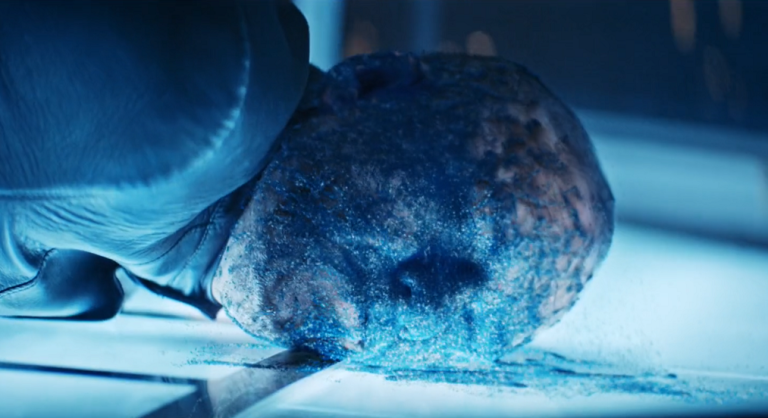
The away team with a cache of magic dust.

I said earlier that the pheromone hydrocarbons will have to feature in the story in some way later on – and I certainly hope that they will! But as of the end of Rosetta, the mission to Unknown Species 10-C’s ex-planet doesn’t feel as though it achieved very much. Captain Burnham didn’t find anything substantial – and the dust, while narratively interesting, was visually unimpressive to say the least. If there had been something more visually unique or interesting about what the away team recovered – like one of the bones that were briefly seen, a computer core, a stone tablet, or literally anything we as the audience could see, maybe that feeling wouldn’t be so prevalent. But because even the away mission’s big accomplishment was difficult to really perceive, the entire story feels like it’s on far shakier ground than it already was.

If the pheromone hydrocarbons are incorporated into the story of the next couple of episodes in a major way, maybe we’ll revisit Rosetta and consider it a little more favourably in hindsight. There are definitely interesting possibilities with this new narrative element that could be explored or that could be paid off in a big way. But if Discovery doesn’t do something big with the pheromone hydrocarbons before the end of the season, the episode will feel like even more of a waste than it already does.

Will the pheromone dust play a significant enough role in the story to make Rosetta feel like a worthwhile detour?

In past iterations of Star Trek – including in previous episodes and seasons of Discovery – the universal translator has been shown to work pretty well. There are some exceptions – such as the Tamarians – but even then a way across the language barrier was eventually found. With the 900-year time jump to the 32nd Century, it stands to reason that the universal translator has only gotten better as Starfleet has encountered more and more races. Even if we accept the premise that communication has never been successfully made with a species that uses pheromones or chemicals to communicate, doesn’t it seem like it would be worth trying to use the universal translator, especially given the time constraints? With the level of technology that Unknown Species 10-C has been shown to have, they might have some kind of translator or communicator of their own, too.

I know a lot of this must sound like nitpicking, but it all stems from the fact that the show’s writers chose to inject forced drama by using an “Earth is in danger and there’s just hours to save it!” cliché that wasn’t necessary to make this story interesting or exciting. The stakes were high enough, the danger was real enough, and by trying to turn the drama up to eleven, Rosetta tripped over. There was a potentially interesting story about learning more about a very new and different form of life… but it’s one that this cliché has spoiled. Take away the time constraint and many of the narrative complaints on this side of the story would have fallen away.

A holographic depiction of the hyperfield.

Rosetta wasn’t saved by its B-plot, either, with Tarka and Book undertaking an equally nonsensical away mission that also seemed to be based on a very shaky premise. With Captain Burnham’s decision to take an away mission to the planet, my criticism stems from the fact that The Galactic Barrier had introduced the cliché of Earth being threatened meaning that there wasn’t time for a detour. But Book and Tarka’s away mission to the USS Discovery was done because they… wanted to stick Book’s ship to Discovery’s hull? Couldn’t they just remain under cloak and tail the ship? It feels pretty weak, even by the standards of Star Trek technobabble.

We also didn’t get to see any of Book and Tarka’s journey navigating the Galactic Barrier, which is something I was genuinely interested in. A powerful ship like the USS Discovery barely made it through, so how would Book’s glorified runabout survive? We basically got no payoff to Book and Tarka’s side-mission last week of collecting programmable antimatter at the abandoned prison camp. Presumably they were able to successfully apply it and transit the Galactic Barrier – but the episode literally didn’t even pay lip service to that, with their story starting up with Book’s ship already parked a few yards away from the USS Discovery.

Couldn’t Book and Tarka just continue to tail Discovery? Also, how did they make it through the Galactic Barrier?

Given how difficult navigating the Galactic Barrier proved to be for the USS Discovery, it’s a shame that we didn’t get to see Book and Tarka having to tackle that task. Maybe it could’ve been included at the end of last week’s episode – even if it was just a short sequence, Discovery should really have done something to pay off their mission to the prison camp.

It also seems like Book has decided that he and Tarka are fugitives without even trying to make contact and explain what happened. The end of Rubicon suggested that there might be a pathway to reconciliation for him and Michael, but he has done nothing to attempt to pursue that – except for creepily spying on her in what has to be one of the most uncomfortable moments in the entire episode. Book signalled his willingness to stand down and give peace a chance; it was only Tarka’s actions that led to the weapon being detonated. With Captain Burnham on his side to advocate for him, you’d think he’d know that he has a good chance of not getting into serious trouble – and he could even be a valuable asset to Starfleet, sharing his knowledge of Tarka and his plans.

Did anyone else find this moment of Book spying on Burnham a little creepy? Cool camera shot, though…

This continues a trend of Book having been fairly static for several episodes now, having gone through several stages of grief for Kwejian and his family before seeming to just… stop. In the first half of the season, Book got some of the most deeply emotional moments in the show, and seeing how grief was leading him down a dark path was a potentially interesting story, but it’s one that Discovery hasn’t really been able to successfully elaborate on. Like most of the rest of the characters, Book has been relegated to a supporting role, and that means he doesn’t really get much agency over the story any more. He’s stuck following Tarka just like everyone else is stuck following Burnham. If we’d heard anything from him to indicate that he was still committed to that cause, maybe it wouldn’t feel so silly. But right now, Book feels like a follower; a passive character caught in Tarka’s narrative wake.

So I’m not going to nitpick things like needing to physically board the ship to install a macguffin into the macguffin network. That’s Star Trek-ish enough to be inoffensive. But the setup that led Book and Tarka to that point felt very contrived, and it wasn’t sufficiently explained as to why they couldn’t just continue to tail Discovery all the way to – and perhaps inside – the hyperfield. It also wasn’t explained why everyone keeps assuming that the hyperfield will be impenetrable – they haven’t even tried to approach it, and if Unknown Species 10-C are as advanced as we think they are, surely they’d see a spaceship coming and investigate. Book and Tarka’s quest this week seems like an unnecessarily involved stealth mission that had the potential to lead to moments of either extreme drama or perhaps even comedy, with the two fugitives sneaking on board the ship, but it ultimately didn’t deliver much of either.

Book and Tarka managed to sneak aboard Discovery.

Bringing General Ndoye into the Book-Tarka side of the story is, again, something that we’ll have to watch and see whether it leads to a significant payoff. Right now it feels like it could go either way, and although I would argue that Ndoye had been the voice of reason earlier in the episode with Captain Burnham, I’m not wild about her becoming a kind of double-agent in this conspiracy.

Two of the big thematic elements of Seasons 3 and 4 have been connection and communication – and it seems like the series is now building to a conclusion which will say something like “if only Book and Tarka had worked with Captain Burnham, everyone could have got what they wanted.” If Book and Tarka would share why Tarka wants the power source, maybe Captain Burnham could work with him – or find an alternative way for him to travel between universes, such as the Guardian of Forever that we saw last season. And if Captain Burnham could find a way to compromise with Book, their whole relationship feud could be solved. A story about how division and failing to communicate can lead to problems can be a powerful one, but it’ll need to be executed a damn sight better than it was in Rosetta. Here, the two disconnected stories just chafed against each other in the most frustrating way.

Book and Tarka at the end of the episode.

The CGI work for Unknown Species 10-C’s planet was good, and although it was only seen very briefly and not really explained, I liked the “Dyson rings” seen orbiting their star. Presumably Discovery scanned the rings off-screen and determined there’s nothing worth looking for there… although that would have been nice to get confirmation of, otherwise the rings seem a good target for an away mission of this nature as well.

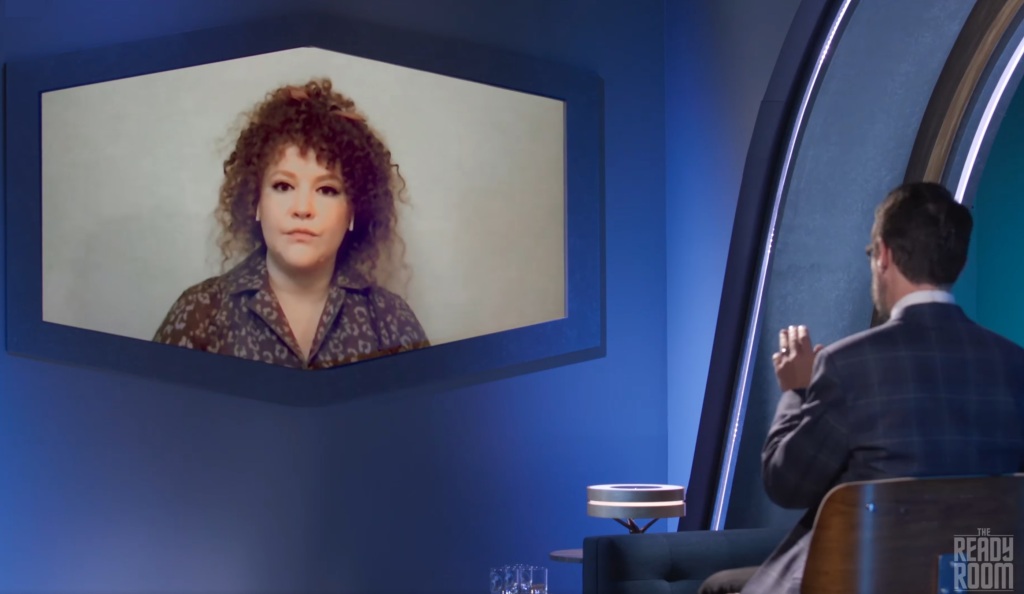
The filming location for the outdoor sections of the away mission looked very familiar; I’m sure it was seen either earlier in Season 4 or perhaps in Season 3. In an interview for The Ready Room a few weeks ago, Mary Wiseman mentioned a quarry in the Toronto area that has been used for several outdoor shoots, which could be why it’s so familiar. Slapping a yellow filter on it in post-production didn’t really do much to disguise it, and with the new AR wall that Paramount invested a fair amount of money in, I’m left wondering why the Star Trek franchise keeps walking headfirst into this particular mistake. The AR wall was used to great effect to depict the interior of the Unknown Species 10-C base… so why not the exterior as well?

The away team.

The crew’s EV suit malfunction is also a bit of a contrivance. Aren’t protective suits meant to protect against everything in the environment, especially things that are new or haven’t been encountered before? This is another nitpick, I guess, but I didn’t like the way that this was just hand-waved away by half a line of dialogue. “Oh, I guess the EV suits don’t protect against substances that aren’t in the Federation database and are very different.” That just seems like an odd way to explain it. And if we want to keep nitpicking, that dust looked like it was everywhere – floating in the air as well as lying on the ground and on surfaces. So how did Detmer not get exposed when everyone else did?

After making the decision to waste time on an away mission that, realistically, she must’ve known had the possibility of failure, Captain Burnham came across as incredibly stubborn shortly before the crew encountered the 10-C nursery. Partly this was triggered by a reaction to the hydrocarbons, I guess, but coming after I found her decision to go on the mission in the first place difficult to justify, stubbornly doubling-down on it when it seemed as though there wasn’t anything to find wasn’t a great look for her character.

Captain Burnham during the away mission.

So have we just nitpicked Rosetta to death?

There were interesting and clever concepts buried here, and there were some nice but unspectacular character moments between Dr Culber and Captain Burnham, Tarka and Book, and to a lesser extent between Reno and Adira and Detmer and Adira too. Some fans argue that Discovery is all about its characters and that the sci-fi trappings should just be seen as a backdrop, with any contrivances and plot complaints waved away because of how well-done some of these character moments can be. I don’t agree with that – if you want character drama, go and watch a soap or some scripted reality show. Star Trek is science fiction, so at the very least the sci-fi side of the story has to be basically competent and good enough to keep my suspension of disbelief going.

Because of how Rosetta sidelined many of the other characters and didn’t actually spend that much time on these interpersonal moments, I would argue that it wasn’t even a particularly impressive episode on the character side of things, either. The moment between Dr Culber and Captain Burnham came in two parts – one during the away mission and one at the end in her ready-room. But it lasted all of two minutes, maybe, and that just isn’t enough time to do justice to a complicated mental health story.

Counselling for the counsellor.

Dr Culber’s storyline feels like it’s retreading the Detmer path from Season 3. We’ve had a few short scenes spread across a handful of episodes to explain in the most basic of ways how he feels overwhelmed, stressed, and/or unable to cope with his work and the situation he’s found himself in. His moment admitting to Captain Burnham that he isn’t okay should have been the culmination of this season-long character arc… but it’s an arc that feels so underdeveloped that, despite the beautiful performance by Wilson Cruz, I’m struggling to buy it. The story of a counsellor – someone working as a mental health professional – needing to seek help for their own struggles is a noble one, and one absolutely worth telling, but it’s also a story that Discovery is not doing justice to as things stand.

I’ve been a big advocate for better mental health representation in all forms of media, but I’m unfortunately in the position of having to say that if the series can’t do justice to stories like this I’d honestly rather that it skipped them altogether. It feels like Discovery is doing little more than paying lip service to a serious topic, one that’s clearly too big for the limited time and attention that the show is willing to dedicate to it.

Captain Burnham and Dr Culber during the away mission.

Returning to Detmer, last season she got a storyline about post-traumatic stress that was referenced in Rosetta. But like Dr Culber’s story of dealing with his struggles this season, it wasn’t fleshed out enough to be meaningful. She had a few scenes spread across a handful of episodes, then seemed to magically “get better.” It’s only now, a full season later, that we even heard about her getting help or treatment for PTSD.

In Rosetta, Discovery also continued a disappointing trend of ham-fistedly inserting blatantly expository dialogue that the writers sometimes use as a substitute for actual character development. In this case, Detmer remembered something about her father mistreating her that could have been significant, but it was treated as an afterthought by a script that had its attention firmly focused elsewhere. Emily Coutts did well with the material she had, and put in a decent performance – but the material was barebones to say the least.

Lieutenant Commander Detmer.

Saru’s panic attack was one of the more interesting moments of characterisation, and if I were to single out one performance and one strong element from Rosetta it would be the way Doug Jones conveyed Saru’s terror during these sequences. We’ll have to set aside questions of why Captain Burnham didn’t immediately send him back to the shuttle, but if we can ignore contrivances like that, Saru really sold me on his panic attack. As someone who has had panic attacks myself – thankfully infrequently – I found the depiction of Saru in these moments very relatable.

We got a bit of a pep talk between Reno and Adira; two characters who don’t feel like a natural pair but who worked well together this time. Adira has adopted much of the awkwardness of Season 1 Tilly, and that “young, inexperienced, and nervous” character type is a good counterbalance to some of the show’s older and more established characters. Reno was deadpan as ever, but none of her lines this week were laugh-out-loud funny; while her scenes brought some much-needed levity to the story, they didn’t exactly blow me away.

Reno with Adira.

Finally, we come to Dr Hirai. For the second episode running – and he’s only been in two episodes so far – he felt very underused. There was a brief scene between him and President Rillak in which she rebuked him for his bluntness, but that was it. Perhaps that was deserved, but as we’ve spent such a minuscule amount of time with this character, it just felt like an unnecessary addition. If Dr Hirai was going to be featured in a scene this week, why not show him working or doing something that could contribute to the story? Just because everyone aboard Discovery was sitting around waiting for Burnham to get back that doesn’t mean he couldn’t have found something useful to do.

Again, Dr Hirai is someone who could have a bigger role to play before the season ends. But his two appearances so far in Rosetta and in The Galactic Barrier have felt like fluff; a potentially-interesting character about whom we know nothing of consequence. If he is going to have something significant to do in the next couple of episodes, we need to start seeing more from him very soon – otherwise he risks feeling rather flat.

Dr Hirai.

So that was Rosetta, I guess. Not the season’s high-water mark, unfortunately.

At the core of the episode there was an interesting idea, and the notion of Unknown Species 10-C being difficult to communicate with is a concept that could still work – if it’s properly executed in the two episodes that remain. But because The Galactic Barrier added an unnecessary time constraint to Captain Burnham’s mission, this side-quest felt more frustrating than exciting; I wanted to shout at Captain Burnham – and at Discovery’s writers – to just get on with the main story.

There were more than enough smaller narrative threads to pick at to unravel the episode’s entire story. Both the A- and B-plots were disappointing, and even where Discovery has been successful in the past – with moments of characterisation and communication – I was underwhelmed by what Rosetta had to offer. As we approach the final two episodes of the season, there’s a lot of work left to do to pull out a decent ending to this rather plodding story.

Star Trek: Discovery Season 4 is available to stream now on Paramount+ in the United States, Scandinavia, Latin America, and Australia. The show is on Pluto TV in the UK, France, Germany, Italy, and other parts of Western Europe at 9pm on Fridays and Saturdays. Individual episodes or the full season can be purchased on iTunes, Amazon Video, Google Play, and possibly other platforms in the UK, parts of Europe, and select other countries. The Star Trek franchise – including Discovery and all other properties mentioned above – is the copyright of Paramount Global. This article contains the thoughts and opinions of one person only and is not intended to cause any offence.
Star Trek: Discovery theories – week 9

Spoiler Warning: There are spoilers ahead for Star Trek: Discovery Season 1-4, Star Trek: Picard Season 1, and for other iterations of the Star Trek franchise.

After All In failed to move the needle in a major way, Rubicon came along! The latest episode saw a minor theory cull, with three theories being debunked – and a couple of others moving ever closer to being struck off the list! As the season builds up to its conclusion, this was bound to start happening, and I don’t lament the passing of any of the theories that didn’t pan out. We also had a rare confirmation this week, and with fewer new theories to talk about, the list will shrink for the first time in several weeks!

On reflection, perhaps I was a little harsh on Rubicon in my review. The episode was decent, but it suffered because I find myself struggling to get invested in the Book-versus-Burnham relationship squabble storyline, and that’s been a dominant force over the past couple of episodes in particular. I’m still hopeful that Discovery will find a sensible – and fairly quick – resolution to this, but at the same time I think I need to try to be less petty about it!

So let’s take a look at the confirmation and the debunkings before we jump into the main list.

Confirmed theory:
Tarka’s weapon will be successful.

Kaboom!

The obvious path for a “happily ever after” kind of story would have been for Captain Burnham and the crew to stop Book and Tarka before they had a chance to use their weapon. And, to her credit, Captain Burnham was inches away from success as she managed to talk to Book and convince him not to deploy the weapon.

But I guess that in her haste to patch things up with her boyfriend, Captain Burnham forgot about Tarka. And Book likewise didn’t make sure that Tarka was on board with his decision to wait for the communication attempt, as Tarka launched his weapon the second Book and Burnham finished their conversation.

Tarka launched his weapon.

I’m glad that the story took this route. It potentially opens up a more interesting meeting with Unknown Species 10-C, one with more tension and the possibility of conflict. But most importantly, Tarka remained true to his characterisation. He didn’t back down just because Book had a change of heart, and he wasn’t able to be persuaded by Captain Burnham’s request.

Tarka remains an interesting adversary. I don’t want to call him a “villain,” not exactly. He has a complexity and a nuance that makes his motivation understandable, even if his “ends justify the means” approach could very well lead to people getting hurt. I’m not ready for Discovery to get rid of Tarka… and I confess that I’m still rooting for him to find a way across the divide between universes.

So that theory was confirmed.

We also have several debunkings to get through, so we’ll run through those next!

Debunked theory #1:
Nhan works for Section 31.

Nhan in Rubicon.

This was a fairly straightforward one by my standards! When we saw Nhan in the promos for Rubicon, I theorised that she might be wearing a different uniform to the standard Starfleet ones worn by Captain Burnham and the crew because she had been recruited by Section 31. She could have been given a Section 31 mission aboard Discovery – perhaps connected to the DMA.

But it didn’t come to pass! Nhan works for Starfleet Security, and has spent some time as a soldier helping the Federation battle against the remaining forces of the Emerald Chain. She doesn’t appear to be making a big return to Discovery, either, merely appearing in a guest role in Rubicon.

Debunked theory #2:
Tarka will realise that there’s a tracker on the isolynium.

Tarka and Book working on the isolytic weapon.

This was another fairly simple one by my standards. In short, I speculated that Tarka would check the isolynium that Book procured and figure out that a tracking device had been placed on it. It seems like the kind of thing he might’ve done; he’s been thorough when it comes to his work, and he clearly didn’t fully trust Haz Mazaro.

But Tarka didn’t check, or if he did off-screen he didn’t find the small tracking device that Captain Burnham had placed. If this theory had panned out we could’ve seen Captain Burnham and the crew having to pick up the trail another way, or even being led into a booby-trap of Tarka’s devising! In a longer season, perhaps such a detour would have made sense. With only four episodes left, I guess wasting an episode chasing down Book and Tarka would’ve been extraneous fluff.

(Probably) debunked theory #3:
The DMA is (or was) a life-form.

The DMA in Rubicon.

It was never stated outright in clear-cut terms, but this theory now feels sufficiently unlikely that I’m striking it from the list. If the DMA was alive… it isn’t anymore! Tarka’s weapon saw to that. The arrival of a second DMA within moments of the demise of the first seems to confirm that the destructive anomaly is little more than a tool; the dredge or mining equipment that Captain Burnham and others figured out at the end of All In.

Unknown Species 10-C could still be a synthetic race, so the concept of a life-form on the scale of the DMA is still plausible in Discovery Season 4. But the DMA itself now seems certain to be little more than a tool – whoever is controlling it is the sentient one. It might’ve been interesting if the DMA had been alive, with a story similar to The Motion Picture perhaps unfolding from that premise. But now we must look to Unknown Species 10-C!

So those theories have been debunked!

Now let’s jump into the main theory list, beginning with those theories that are either new or saw movement in Rubicon. Then we’ll conclude with a few theories that are still in play, but which Rubicon didn’t touch.

Theory #1:
Unknown Species 10-C built the Galactic Barrier.

The USS Enterprise approaching the galactic barrier.

I’ve never been wild about the Galactic Barrier in Star Trek. It’s something that dates right back to the very beginning of The Original Series, but it’s always struck me as a bit of an oddity; an element of pure fantasy in a setting that prefers to base its astronomy on real science. The Galactic Barrier is also rather poorly explained, and can seemingly be ignored at the whim of Star Trek’s writers – some episodes depict crossing it as being impossible, others show starships moving through it with ease. It also feels like a 2D anachronism in the 3D realm; unless the galactic barrier is a sphere, surely flying up and over it should be possible!

But maybe we’re about to learn more about this strange phenomenon. Given their technological capabilities, it doesn’t seem impossible that Unknown Species 10-C constructed the Galactic Barrier – perhaps as a way to shield themselves from the races of the Milky Way, or perhaps to keep anyone from exploring too far and discovering their location. There are many reasons why a technologically advanced race might want to build something on this scale – and we could even learn that the harvested boronite is being used to fuel the Galactic Barrier itself.

The Enterprise-D is one of a number of vessels known to have passed through the Galactic Barrier.

One possible explanation for why Unknown Species 10-C might want to build something like the Galactic Barrier is to keep the Milky Way’s inhabitants in… but it could also be a shield designed to keep someone else out. That raises a very frightening question: what could be so powerful that a barrier is needed around the entire galaxy? And what could be so dangerous that being locked inside a galaxy with the Borg would be preferable?

With Unknown Species 10-C seemingly being very secretive, I think the idea of them building it to shield themselves is more likely… but there are definitely a lot of ways this theory could go!

Theory #2:
Someone else built the Galactic Barrier to keep Unknown Species 10-C out.

The Galactic Barrier on the USS Enterprise’s viewscreen.

If the Galactic Barrier is an artificial construct, perhaps it was created by another race or faction as a shield against Unknown Species 10-C. It could be the case that Unknown Species 10-C has used DMA technology against the Milky Way in the distant past, and some other race or faction constructed the Galactic Barrier to keep them out. If Unknown Species 10-C are belligerent and interested in conquest, it might take something on a galactic scale to keep the Milky Way safe.

The Q Continuum spring to mind as a possible candidate if the Galactic Barrier was artificially created. Admiral Vance mentioned the Q a few episodes back, saying that there hadn’t been any contact for more than 600 years. Given that the Q – or at least one member of the Continuum, at least – were very interested in the progress of races like humanity, perhaps they took a decision to “seal” the Milky Way to protect its inhabitants from Unknown Species 10-C.

Traversing the Galactic Barrier could be very dangerous…

Obviously this theory and the one above can’t both be right! And it’s a distinct possibility that the Galactic Barrier element of the story is just a convenient macguffin to blind Starfleet to Unknown Species 10-C and prevent easy travel to their region of space, dragging out the story and prolonging attempts at communication so other narrative threads could play out.

If that’s the case, we may learn nothing about the Galactic Barrier in the episodes that lie ahead! However, I still think it’s interesting to consider the possibilities, and it could be fun to finally get some more detail on this lesser-known but significant aspect of the Star Trek galaxy.

Theory #3:
Tarka’s mysterious “friend” is someone we’re already acquainted with.

At this point in the story, there’s no need to conceal the identity of Tarka’s friend – unless the revelation of this person’s identity is going to be a huge surprise. It’s possible that there is no Unknown Species 10-C, for example, and that Tarka’s friend is the one responsible – a theory we’ll look at in more detail in a moment! But it has to be considered a possibility that Tarka’s friend is someone we’ve already met, either in Discovery or in another iteration of Star Trek.

Rubicon hammered home Tarka’s desperation to reach his friend, and All In had given us a quote from Tarka about his grief at this person’s loss being unfathomable. Perhaps that was hyperbole on the part of someone very self-centred, but even so it feels like there’s more going on with this mysterious character. If there’s nothing special about them, and they’re just a brand-new character called something like Albert or Gladys, then why go to such trouble to keep their identity hidden during every conversation? It’s setting up a mystery – and for Discovery’s sake I sincerely hope it goes somewhere!

I put together a short list of possible candidates for being Tarka’s mysterious friend, and you can find it by clicking or tapping here.

Theory #4:
Unknown Species 10-C is a faction from a past iteration of Star Trek.

Could Unknown Species 10-C be the Kelvan Empire?

Rubicon didn’t do much to advance this theory – though the DMA controller seemed to bear a very superficial resemblance to omega molecules and possibly Borg tech – but comments from Discovery’s showrunner during a social media event may indicate that this theory isn’t going to pan out, despite the mysterious elements and references to past Star Trek shows scattered throughout the season. In short, Michelle Paradise spoke about “designing” Unknown Species 10-C and how they’re “unlike any species we’ve seen before.”

It’s still possible that we’re dealing with a faction like Picard Season 1’s super-synths, who were only seen on screen very briefly, or an extensive redesign of a race like the Borg to reflect centuries’ worth of technological progress. But I felt it was worth bringing this up, as it’s certainly our biggest indication to date that Unknown Species 10-C may be someone brand-new to the franchise.

Showrunner Michelle Paradise recently dropped a hint about Unknown Species 10-C.

I said last time that I was beginning to get a sense of déjà vu. Many of the suspects for Unknown Species 10-C also felt like plausible culprits for the Burn in Season 3 – and the way that storyline ultimately wrapped up was unpredictable (to say the least). As Trekkies who are invested in this fictional setting, I think there’s always going to be a desire to speculate and theorise about how big events in new stories could be connected to the elements from elsewhere in the franchise… I just hope that the ultimate reveal of Unknown Species 10-C doesn’t prove too disappointing if it has nothing to do with Star Trek’s past.

All that being said, there are still some plausible suspects, even if the DMA’s level of technology would seem to rule out many familiar races. The Borg, Enterprise’s Sphere-Builders, the extragalactic Kelvan Empire, V’Ger, Species 8472, the Q Continuum, and the Terran Empire are all high on my list! For a more detailed look at them, as well as a few less-likely contenders, check out my full list by clicking or tapping here.

Theory #5:
Book and Burnham will reconcile and get back together.

Book and Burnham are currently separated.

Although I may have been excessively critical of it at points in this week’s review, I maintain that the Book-versus-Burnham conflict isn’t one that the show needs. It’s built on very weak foundations, with both of them (and everyone else on the show) needing to be incredibly blinkered (or incredibly stupid) and not being able to recognise a very basic pathway to the “middle ground” that became the focus of Rubicon’s story.

We saw a big step toward reconciliation – at least on Book’s part – in Rubicon, when he agreed to stand down and give Burnham and Starfleet a week to attempt to make peaceful first contact and convince Unknown Species 10-C to deactivate the DMA. Book was willing to take a risk by trusting that Burnham would permit him and Tarka to go ahead with their plan at a later time… whether she would or not is unclear!

Book and Burnham in All In.

So that’s a positive step. With the detonation of Tarka’s weapon, the story could go in one of two ways from here: either Starfleet will let them off the hook, with the debate over the weapon rendered moot by the arrival of a second DMA, or Book and Tarka will have to go on the run to avoid the consequences of their actions.

I would suggest that Tarka is a valuable asset to Starfleet, and they may want to bring him back into the fold to help work on the DMA problem, the Galactic Barrier problem, and other things. Book is far less important in that regard, but as he’d indicated his willingness to stand down he may not be in as much trouble. There’s a pathway here to bring an end to this feud – and I hope Discovery takes it in the next week or two.

Theory #6:
Michael Burnham won’t remain captain of the USS Discovery.

Captain Burnham in Rubicon.

One potential way to pay off the Book-versus-Burnham storyline would be for it to lead to a significant change for Discovery’s captain. We saw in Rubicon that Burnham was unwilling to give the order that could have hurt or killed Book – even though she had been ordered to do so by Starfleet. This fundamental conflict between her romantic relationship and her duty is not new, and could potentially lead to Burnham stepping back from her role as captain of the ship.

Maybe she will have the strength to do what she believes is right during the DMA crisis, but will resign afterwards, unable to contemplate doing the same thing again and wanting to return to her simpler life with Book. This wouldn’t be a bolt from the blue, as we saw her wrangling with these feelings in Season 3.

In Season 3, Burnham had to consider whether remaining in Starfleet was right for her.

One of the unique aspects of Discovery within Star Trek’s broader canon is that the ship has been commanded by four very different individuals across its four seasons. Captain Burnham is different from Saru, Saru was different from Pike, and Pike, in turn, was different from Lorca. It has to be considered at least a possibility that the series will continue this trend.

I’m not really in favour of this, but it’s certainly interesting to consider. Now that we know that Season 5 is definitely happening, one possibility is that Captain Burnham will somehow leave the ship at or around the end of Season 4, making way for a brand-new commanding officer to take over. Because she’s been the show’s protagonist since Season 1, it seems unlikely, and the overall arc of Discovery between Season 1 and Season 3 can be read as Burnham’s redemption and ascent to the captaincy. But the show’s revolving door of captains may continue, and her conflict with Book and the difficult emotional situation it put her in could be the trigger to make this happen.

Theory #7:
Tarka will create his own DMA.

Tarka, Stamets, and Saru with the DMA model.

In The Examples, we saw Tarka – aided by Stamets – building a scale model of the DMA. Now that his plan to destroy it and seize its controller has failed, perhaps he’ll attempt to recreate the device using the knowledge he acquired. If so, he could inadvertently create a new DMA. Or, through time travel shenanigans, Tarka could turn out to be the creator of the original DMA!

Tarka’s story isn’t finished yet, and there’s still time for him to devise and enact a new plan over the course of the next few episodes. He had plans for using the DMA controller, so the next-best thing from his point of view might be to build his own version. He’s certainly clever enough – all he really needs is access to the resources to pull it off.

Theory #8:
Tarka’s friend built the DMA.

The second DMA in Rubicon.

As mentioned above, I think it’s a possibility that Tarka’s friend is directly involved with the DMA. It would explain how Tarka seems to know so much about it, even being able to recreate it on a smaller scale, as well as how he knows that it would be possible to use its power source to punch through to an alternate universe.

After all of the buildup, it’s possible that Unknown Species 10-C could turn out to be a single person: Tarka’s friend. It’s also possible that Tarka’s friend is working with Unknown Species 10-C, perhaps trying to find a way to reach Tarka across the divide between universes. There are a lot of different ways that this could pan out!

So those theories are new or saw movement this week.

Now, as I do every week, I’ll recap all of the other theories currently in play. I find it helps to keep everything in one place – it makes it easier to keep track of every theory so we can strike them off the list as we go!

Theory #9:
We haven’t seen the last of the Abronians.

I currently have four ideas for different ways that the Abronians – the non-humanoid race that Captain Burnham, Tilly, and the Qowat Milat helped save from cryo-sleep in the episode Choose To Live – could play a further role in Season 4.

Theory #9-A:
The Abronians’ homeworld was destroyed by the DMA.

Captain Burnham believes this image depicts a “supernova.”

After arriving at the Abronians’ cryo-ship, Captain Burnham found a stone carving that seemed to depict the destruction of the Abronians’ homeworld. This carving was only shown on screen briefly, but it seemed to show the planet being damaged or destroyed in a large explosion. Burnham credited the planet’s destruction to a “supernova,” and the story then raced ahead.

Considering that the main thrust of the season so far has been about the DMA, perhaps Burnham was incorrect: the Abronian homeworld was destroyed by the anomaly, not a supernova.

Theory #9-B:
The Abronians’ homeworld was on the other side of the DMA.

Abronian stasis pods.

Now that we know a little more about how the DMA works, this theory seems a little more plausible. Its powerful wormhole technology seems capable of transporting matter over many light-years, meaning it doesn’t seem to be a complete stretch to think that the Abronians may have originated in the vicinity of Unknown Species 10-C. They could even be Unknown Species 10-C!

One thing struck me as odd about the Abronians: the Federation was entirely unaware of them, despite the Abronian cryo-ship being relatively close to Federation space – such that Captain Burnham could reach it using Book’s ship in a short span of time. It’s possible that the Abronians had been asleep for millennia, unnoticed by the Federation and the wider galaxy for all that time. But it’s also at least possible that their cryo-ship is a newcomer to the area. If so, perhaps it arrived here via the DMA.

Theory #9-C:
The Abronians will return to help the Federation later in the season.

A deceased Abronian.

One of the themes of Discovery since Season 3 has been connection, including building connections between the Federation and other races and organisations. The Abronians were awoken from cryo-sleep thanks to the interventions of Captain Burnham and Tilly – at least in part – and they may seek to repay the Federation, or Captain Burnham personally, for that help.

We saw this play out last season with Ni’Var; in the season finale Ni’Var ships raced to the Federation’s aid as the Emerald Chain attacked. Perhaps the Abronians will likewise step up to help when the Federation needs allies.

Theory #9-D:
The Abronians’ moon-ship may be useful in a later story.

“That’s no moon…”

The Abronians’ cryo-ship is huge, and at least superficially seems to have the mass of a moon or small planetoid. If Captain Burnham and the crew needed a starship that large, such as to aid in the evacuation of a planet threatened by the DMA, for example, perhaps they’ll return to the Abronians and ask to borrow it.

As we saw in Choose To Live, the moon-ship was in full working order. All it needed was some extra dilithium to power up and it was perfectly capable of moving under its own power, and its computer systems were still functional. The only system that seemed to have failed was the wake-up timer! Discovery has precedent when it comes to telling seemingly one-off stories that have a pay-off later on, so watch this space. If Captain Burnham and the crew need a huge starship urgently, we may not have seen the last of the moon-ship!

Theory #10:
The Red Angel suits from Season 2 are connected to the DMA.

A Red Angel suit in Season 2.

Unknown Species 10-C seem to be responsible for building the DMA… whoever they ultimately turn out to be! But the DMA isn’t the first wormhole-creating technology that Discovery has introduced us to. The Red Angel suits in Season 2 were also capable of creating powerful wormholes… so could it be possible that Unknown Species 10-C built their device around or based on the same technology?

This revelation would greatly affect Captain Burnham, as she’d feel a degree of responsibility even though she wasn’t directly involved. It would also be the second disaster in a row (following the Burn) in which the Federation was implicated – albeit in an oblique way. I’m not convinced that Discovery will go down this route… but the similarities in the wormhole-creating technology gives me pause, at least.

Theory #11:
Saru will be given the captaincy of the USS Voyager-J.

Captain Saru in command… of a shuttle!

Saru’s future was briefly discussed before he offered to serve as Captain Burnham’s first officer in the episode Anomaly. He has already been offered a command of his own, so Starfleet clearly values his command abilities and experience. President Rillak was seen to be assessing Captain Burnham’s suitability for the captaincy of the USS Voyager-J in Kobayashi Maru… and she mentioned having a shortlist of candidates. Could Saru be on her list?

Several of the qualities that President Rillak said she was looking for in a potential captain seem to apply to Saru. He’s more level-headed, less likely to put himself in a dangerous situation, and more inclined to think of the big picture. He has a weakness when it comes to Kaminar, as we saw toward the end of Season 3, but generally speaking he isn’t someone who lets his emotions get the better of him. His wisdom and calm demeanour could be valuable in the captain’s chair of the Federation flagship. This could also set the stage for his departure from the show, or possibly even for a new show following his adventures aboard his new ship.

Theory #12:
The ban on time travel will be explained in more detail.

HMS Bounty was able to travel back in time in Star Trek IV: The Voyage Home.

This one is as much a hope as a theory right now! In short, the ban on time travel was introduced early in Season 3 primarily as a way for the writers and producers to avoid questions about why the 32nd Century was so different from how the far future had been depicted in earlier Star Trek productions, as well as to explain things like how the Burn was able to catch the Federation off-guard and why Georgiou couldn’t simply be sent back in time when she needed to.

But the ban itself raises some issues – the biggest one being the lack of detail on how it works and how something like this could possibly be enforced. As I said several times last season, it isn’t possible to just un-invent a technology so useful and powerful as time travel. Even just a few lines of dialogue going into a little more detail on the mechanisms involved in the ban would be really useful.

Theory #13:
The Federation has flouted the ban on time travel.

President Rillak may have tried to circumvent the ban if she felt doing so would be in the Federation’s interests.

Sticking with the time travel ban, another theory I had last season was that the Federation – and Section 31 in particular – might have deliberately flouted the ban and failed to abide by the rules. Someone as straight-laced and committed to Starfleet ideals as Admiral Vance is highly unlikely to have sanctioned such a move, but there are other Federation leaders – such as President Rillak – who could be implicated.

I don’t think it’s possible any more that the DMA story will be connected to the time travel ban, as I had previously proposed. But that doesn’t mean that a closer look at the ban, and the potential for the Federation to have tried to work around it, isn’t going to happen.

Theory #14:
The crew will have to defend the Verubin Nebula.

The dilithium planet is vital to the Federation.

This one is definitely hanging by a thread right now. Season 4 continues to unfold in a very different direction, largely ignoring the main story beats from Season 3. But the dilithium shortage has been mentioned more than once, and as things stand right now, the Federation is in control of the galaxy’s only significant dilithium supply. The Verubin Nebula is almost certainly going to be a target – even if Unknown Species 10-C don’t care about it.

It begins to stretch credulity to think that all of the belligerent factions and races present in the galaxy would become aware of the Federation controlling this impossibly valuable resource and wouldn’t want to take it for themselves. And while it may not happen now until after the DMA storyline has run its course, I think sooner or later someone is going to want to steal the Verubin Nebula and its dilithium. Maybe it will be at the end of Season 4, maybe it will be in Season 5… who knows?

Theory #15:
A major character will be killed off.

A Starfleet coffin seen in Deep Space Nine.

Lieutenant Tilly’s departure in All Is Possible definitely shook up the cast. And Gray’s departure in But To Connect may do so as well. However, I stand by what I said before the season aired: killing off a character can be a great way to demonstrate the dangerous nature of the circumstances that the crew have found themselves in. So far, despite tangling with the DMA on several occasions, only a couple of redshirts have lost their lives.

In Stormy Weather, Dr Pollard raced through the corridors of the USS Discovery to reach a hull breach, but she survived while a nameless redshirt was blown out into space. And in Rubicon, the shuttle mission saw Saru, Dr Culber, Rhys, and Bryce all in serious danger, but they all made it home. Moments like these can make it feel that Discovery is shielding even its minor characters with some pretty heavy plot armour, but I still feel that there’s scope to see a major character death before the season ends.

Theory #16:
Season 4 will connect with the Short Treks episode Calypso.

Zora dancing with Craft in Calypso.

Zora’s status as a member of the crew was confirmed in But To Connect, and this followed her developing emotions and sentience earlier in the season. Zora is now much closer to her presentation in Calypso, potentially bringing the story of the Short Treks episode one step closer.

There are still significant hurdles to overcome if the story of Calypso is to be wrapped up in Season 4, though. Obviously we have the timeframe issue: will the USS Discovery be sent back in time, be abandoned, or is Calypso taking place centuries in the future? Then we have the USS Discovery itself – it’s been retrofitted since arriving in the 32nd Century, and now looks very different to how it did in Calypso. I’m not sure how Discovery will overcome these hurdles – but it’s possible. Zora hasn’t had a significant role to play in the last couple of episodes, but earlier in the season we definitely saw movement in this direction.

Theory #17:
There will be a character crossover from a past iteration of Star Trek.

Star Trek has had some wonderful crossovers in the past.

Tarka’s friend could, as mentioned, be someone we’ve already met. But there are other ways to bring back a character from a past iteration of the franchise – and there would be many potential benefits to doing so! I had initially proposed a version of this theory in the run-up to Season 3 that centred on the Doctor from Voyager – but with some creative technobabble, practically anyone could be included, despite the leap forward in time.

Choose To Live showed us the Abronians in cryo-sleep, and Stormy Weather saw the crew of Discovery use the transporter buffer to survive – just like Scotty had done in The Next Generation Season 6 episode Relics. Could these be hints at something to come?

It would also be possible for Captain Burnham to discover the logs or a holographic recording of a long-dead character – and while this would be less of a “crossover,” it could still be a ton of fun and great fan-service!

Theory #18:
Some areas of the galaxy – such as the Delta Quadrant – avoided the worst effects of the Burn.

Adira and Stamets with a map of the Milky Way galaxy.

In But To Connect, President Rillak told us that the diplomatic summit she convened would bring together races from “all four” quadrants. Assuming she was referring to the familiar Alpha, Beta, Gamma, and Delta Quadrants that make up the Milky Way galaxy, this would count as our first mention of the Delta Quadrant in the 32nd Century. I didn’t spot any familiar Delta Quadrant races (or their emblems) amongst the assembled delegates, however!

I had previously speculated that the Burn may not have affected the entire galaxy equally, and that regions farthest away from the Verubin Nebula may have survived without much damage. I still think that this is a possibility – though whether Discovery will revisit the Burn in any depth, or visit the Delta Quadrant at all, remains unclear.

To see a full write-up of this theory, click or tap here.

Theory #19:
Tarka aims to travel to the Kelvin universe.

The USS Kelvin.

There are many parallel universes, as Tarka reminded us in But To Connect. Though Star Trek has shown us a number of different parallel universes before, the biggest one that comes to mind (aside from the Mirror Universe) is the Kelvin timeline, in which the three reboot films were set.

Now that we know a fourth Kelvin film is happening, a major link-up between the two settings could definitely be on the cards. We don’t know how far the Kelvin timeline and the prime timeline will have diverged by the 32nd Century, and whether it operates like the Mirror Universe with every character getting their own alternate counterpart. If it does, perhaps Tarka met his own Kelvin timeline counterpart and that’s how he cooked up this scheme. If the Kelvin timeline diverged significantly from the prime timeline it stands to reason that the Burn never happened there. We also got an oblique Kelvin timeline reference in Season 3 – could that have been a hint?

Theory #20:
Book will find Kyheem and Leto on the other side of the DMA.

Book with Leto and Kyheem shortly before the destruction of Kwejian.

In Star Trek: Generations, Captain Picard encountered Captain Kirk inside the Nexus – despite Kirk being declared “dead” after the Enterprise-B encountered the energy ribbon almost eighty years earlier. Now that we know a little more about how the DMA operates, it seems at least faintly possible that, just like Captain Kirk, the inhabitants of Kwejian may not be as dead as they first appear.

This theory is, I freely admit, a bit of a long-shot. But the wormhole technology that we know the DMA uses seems to be capable of sending some of what it harvests or mines back to Unknown Species 10-C’s base of operations. Maybe that means that some of the people from Kwejian were transported there instead of being killed.

Theory #21:
The Guardian of Forever will be back.

The Guardian of Forever as it appeared in The Animated Series.

I’m close to retiring this theory. In short, I had suggested that the reintroduction of the Guardian of Forever in Season 3 could mean that we’ll encounter the timeless entity again in Season 4. It would be nice to bring back Paul Guilfoyle, who played the Guardian’s humanoid avatar in the Season 3 two-parter Terra Firma.

However, it seems as though the DMA/Unknown Species 10-C story isn’t going in that direction. It would make sense, in a way, for Captain Burnham to seek out the Guardian to ask it about the DMA and Unknown Species 10-C – it may well know something about what’s going on that could be helpful. But the best time to have done that would have been earlier in the season. There are still ways in which the Guardian of Forever could be included, though – such as Tarka attempting to use it to reach his friend – so although I’m close, I’m not dropping it just yet.

Theory #22:
President Rillak knows what the DMA is and may be implicated in its creation.

President Rillak, leader of the United Federation of Planets.

I will admit that, as things stand, President Rillak is looking less and less likely to be involved directly with Unknown Species 10-C and the DMA. But there’s still time for a connection to be revealed!

In short, President Rillak’s single-minded goal of reuniting the Federation may be well-served by providing the disparate ex-members with an enemy or a problem to stand against. The DMA has already accelerated Ni’Var’s membership, and President Rillak even got to speak with a representative from Earth in But To Connect – so if she is involved somehow, her scheme is already paying dividends. At the very least, I think it’s fair to say that this complex, somewhat Machiavellian character is not letting the crisis go to waste, and is politicking off the DMA’s trail of destruction.

President Rillak with Captain Burnham on Ni’Var.

In her dealings with Captain Burnham, I’d argue we’ve seen this Machiavellian edge to President Rillak. In the Ni’Var negotiations depicted in All Is Possible, and again for a second time in But To Connect, President Rillak used Captain Burnham to advocate positions that would’ve been politically or diplomatically difficult for her to do openly – effectively manipulating those events from behind the scenes.

In light of all of this, I would hope that Captain Burnham will tread carefully with President Rillak. She seems the type who would happily throw Burnham and the USS Discovery under the bus if it suited her political and/or diplomatic ends. If someone like that felt that unleashing the DMA, or failing to warn everyone that it was coming, would be to her advantage, I can absolutely see her seizing on that opportunity, too. There are myriad ways in which we could connect her to the DMA, even if she didn’t order its creation. She could be in cahoots with Unknown Species 10-C, she could have learned about the DMA and chosen to cover it up, or something else that she believed was in the Federation’s long-term interests.

Theory #23:
Unknown Species 10-C is extinct.

R.I.P.

Although the arrival of a second DMA may count against this theory, it’s possible that it’s some kind of automated system. With Unknown Species 10-C still being hidden and mysterious, it seems at least possible that Captain Burnham and the crew will arrive at their base to find it empty; Unknown Species 10-C may have already gone extinct.

Perhaps they went extinct recently, or perhaps it was millennia ago. The DMA might be Discovery’s equivalent of the Planet Killer from The Doomsday Machine; an automated device left behind, a warning to the real world about the dangers of some of our long-lasting environmental and technological impacts.

Is the DMA going to turn out to be similar to the Planet Killer?

The DMA could even be Unknown Species 10-C’s last-ditch effort to prevent their own extinction. Having used up their entire power supply, they had to build such an imprecise, devastating machine to harvest all of the boronite they could possibly find just to keep the lights on and their machines powered. There could be an interesting analogy there, too.

Because Unknown Species 10-C remains hidden from us going into the next episode, all sorts of possibilities remain on the table. This could certainly be a different and unexpected way to take the story, and perhaps the culmination of the plot would be more of a technological puzzle than a conflict against an adversary, with Captain Burnham leading Starfleet’s efforts to figure out Unknown Species 10-C’s technology in order to deactivate the DMA.

So that’s the main theory list!

We also have two production-side theories in play, so we’ll look at those too before we wrap things up.

Production-side theory #1:
Tilly’s departure will be permanent.

Tilly’s departure feels permanent.

Mary Wiseman confirmed in an interview with Wil Wheaton on The Ready Room (Discovery’s social media aftershow) that Tilly will be seen again before the end of Season 4, and we glimpsed her in the trailer for the second half of the season as well. But that doesn’t mean she will return as a main character on the show going forward, and her departure in All Is Possible felt permanent. Despite that, I’ve seen quite a lot of folks online who don’t believe that Tilly is actually leaving the series – so I wanted to put it out there officially and say that, in my opinion anyway, she is.

Maybe those people know something that I don’t! As I always say, I don’t have any “insider information;” all of this is just speculation on my part. However, I feel that the manner of Tilly’s departure, the fact that she got that emotional sequence with Captain Burnham, a montage showing her leaving the ship, Adira seeming to take over several of her roles, and her departure feeling like the culmination of her arc going back to the latter part of Season 3 all come together to strongly indicate that she won’t be back as a major character. She may yet have a significant role to play in a future Season 4 episode, as has been suggested, but unless Discovery’s writers are really playing with our emotions I believe we’ve seen Tilly’s end as a main character on the show. She may come back in a future Starfleet Academy series, though… so watch this space!

Production-side theory #2:
Season 4 will end on a cliffhanger!

Star Trek has a long, well-established tradition of season-ending cliffhangers! There have been some truly shocking ones in the past, including The Best of Both Worlds in The Next Generation, Deep Space Nine’s Call To Arms, Equinox in Voyager… and many more! With the story of Unknown Species 10-C and the DMA slowly being unpicked, it could be the case that we’ll get a clean resolution – like we did at the end of Season 3. But it’s also possible, in my opinion, that Season 4 will end in similar fashion to Season 2 – on a major cliffhanger!

That could be because the Unknown Species 10-C story didn’t conclude, or a war with the mysterious faction is about to break out. But the Season 4 finale could also set up the beginnings of Season 5’s story, just like how the final moments of Season 1 saw Captain Pike’s Enterprise link up with the USS Discovery.

So that’s it!

The USS Discovery inside the DMA in Rubicon.

There are still some huge questions facing Discovery as we move into the final four episodes of the season. The DMA and Unknown Species 10-C storylines have to be exposed – somehow – and there’s also the question of Tarka. Will he make it across the divide to the universe he’s trying to reach? And what of Book and Burnham – will they be able to put the arguments over the DMA behind them and reconcile? The next episode will take us to The Galactic Barrier – so maybe we’ll finally get to lay eyes on Unknown Species 10-C!

Before we go, one final point. I write up these theories because I like Star Trek and I like writing. But for some folks, fan theories can hamper their enjoyment of a film or television show. It’s worth keeping in mind that most of these theories probably won’t pan out, and we have to be prepared for the fact that even the most well-constructed fan theory, no matter how fun and plausible it seems, simply won’t turn out to be true. If you find that speculating and reading theories is beginning to detract from your enjoyment of Star Trek: Discovery – or any other television show or film – it might be a good idea to take a break for a while.

Star Trek: Discovery Season 4 is available to stream now on Paramount+ in the United States, Scandinavia, Latin America, and Australia. The show is on Pluto TV in the UK, France, Germany, Italy, and other parts of Western Europe at 9pm on Fridays and Saturdays. Individual episodes or the full season can be purchased on iTunes, Amazon Video, Google Play, and possibly other platforms in the UK, parts of Europe, and select other countries. The Star Trek franchise – including Discovery and all other properties mentioned above – is the copyright of Paramount Global. This article contains the thoughts and opinions of one person only and is not intended to cause any offence.
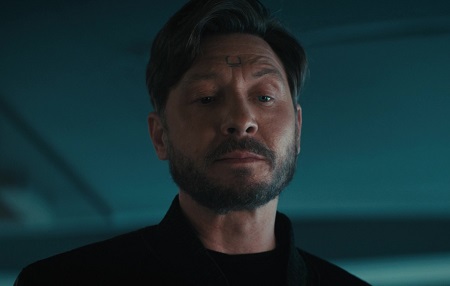
Star Trek: Discovery review – Season 4, Episode 9: Rubicon

Spoiler Warning: There are spoilers ahead for Star Trek: Discovery Seasons 1-4.

Last week, All In took Discovery on a bit of a detour to a Star Wars-inspired gamblers’ den. With the season now building to what appears to be the climax of its story, Rubicon returned to the DMA in a big way, moving the story along in leaps and bounds while spending a little too much time on the dreaded Burnham Relationship Drama™.

I’m in two minds about Rubicon, really. On the one hand, the episode was by far the cinematographic highlight of the season so far, with some outstanding visual effects, beautifully-composed camera shots, and a sense of scale that would’ve made Rubicon feel right at home on the big screen. On the other, there were a couple of moments where I literally couldn’t stop my eyes from rolling at overplayed clichés that I’d hoped Discovery could’ve outgrown by now. What resulted, all things considered, was a mixed bag of an episode; there were some excellent moments and some very sub-par ones.

Captain Burnham on the bridge in Rubicon.

Stepping back from Rubicon for a moment, I want to consider the overall story of the DMA and Unknown Species 10-C in Season 4. As the season has rolled on, I’ve been feeling a growing sense of déjà vu. The DMA storyline is unfolding in a remarkably similar fashion to the Burn in Season 3, with the big, mysterious, galaxy-threatening event being slowly uncovered by Burnham and the crew of the USS Discovery.

When the first Season 4 teaser initially revealed another “big bad,” I wrote the following: “there are possible downsides to another ‘huge galactic disaster’ storyline so soon after resolving the Burn, in that it risks feeling tacked-on, derivative, or even anticlimactic…” Right now, with the very similar way that the two storylines are unfolding – with little tidbits of information about the DMA or Unknown Species 10-C having been tacked on to episodes throughout the season – I’m definitely feeling that Discovery is straying increasingly close to repetitive territory. There’s still time for the emergence of the second DMA or the reveal of Unknown Species 10-C to take things in a very different direction, but this feeling is something that had been building up for several episodes now, and it kind of came to a head in Rubicon.

The DMA as it appeared in Rubicon.

I don’t usually like to talk about too much production-side stuff, but while we’re taking more of a birds-eye view of Season 4, I thought it was worth noting that showrunner Michelle Paradise recently discussed Unknown Species 10-C during a social media event. Her comments seemed to imply that Unknown Species 10-C will be someone that we’ve never met before; someone brand-new to Star Trek. And while it’s possible these comments have been misinterpreted – Paradise could have been talking about an extensive redesign of an existing faction, perhaps – I wanted to briefly consider what that could mean for the show.

In Season 3, one of the reasons why the Burn storyline fell flat at what should’ve been its climax is that basically none of the hints that Burnham and the crew had picked up over the course of the season ultimately mattered – the ending was such a bolt from the blue that it was unpredictable, making for an unsatisfying end to a season-long mystery. Because Season 4 has followed such a similar mystery box-type setup, the DMA and Unknown Species 10-C have seen crumbs of information thrown our way over the course of the season thus far. And with myriad smaller references to past iterations of Star Trek, fans have been encouraged to speculate about possible connections and explanations. For the ending to be another “surprise!” might work… but it might not. And I can’t shake the feeling right now that the explanations for the two big mysterious elements of Season 4’s story are ultimately going to be disappointing for a lot of fans.

Okay, that’s enough of that! The speculation about who Unknown Species 10-C may or may not be will have to wait, and we may not know the answer for a while!

Unknown Species 10-C sent a second DMA.

One of the central conceits of Rubicon was this idea of searching for a middle ground in between Book and Burnham’s positions. Communication and compromise have been themes that Discovery has tackled on multiple occasions over the past couple of seasons, but here I’m just not sure it’s been handled very well. I said in my review of But To Connect that there has always been a middle ground in this standoff, and it’s such a basic one that it beggars belief that no one so much as mentioned it until now.

The dividing line was whether to attempt to make peaceful first contact, as Burnham wanted, or to deploy a weapon against the DMA, as Book wanted. But the answer has been right in front of everybody the entire time: do both. In the time it would take to build the weapon and plan for its deployment, the Federation could make its attempt at first contact. It didn’t need to turn into the big fight that it did, and the idea that none of the dozens of diplomats, the Federation President, Starfleet Admirals, and the entire crew of Discovery didn’t even consider it might be a clumsy metaphor for our current divided political climate, but it doesn’t really work as a story beat. And that means that when Burnham finally proposed the compromise to Book, instead of cheering it on and thinking what a wonderful idea it was, all I could think was “that took you long enough!”

Captain Burnham eventually came to discover a rather obvious compromise position.

If the story underlying this division was stronger, perhaps I would forgive the silliness of failing to propose a compromise sooner. But because this particular story focuses almost exclusively on Burnham Relationship Drama™, something that I would argue Discovery simply does not need at this point in its run, it feels even more disappointing, somehow.

Despite a weak start in the Season 1 premiere, I have genuinely come to like Captain Burnham. Her ascent to the captaincy, particularly across the back half of Season 3, felt great – and along with Captain Sisko from Deep Space Nine, we can absolutely say that she’s one of the few Star Trek characters who genuinely earned her promotion. We saw a lot of the process that took her from a subordinate to a commanding officer, and while she has her flaws, which Star Trek captain doesn’t?

Captain Burnham’s rise to the captain’s chair has been a great story to watch.

But after a lot of messing around with Ash Tyler in Season 2 in particular, the whole Burnham Relationship Drama™ angle is completely overdone. Giving her a new start with Book worked so well in Season 3, and to upend that over such a stupid disagreement that should have been solvable is disappointing. Female characters don’t need the support of male characters to be successful, so I’m not saying that Captain Burnham somehow needs Book in her life – but having given her that relationship, to strip it away from her so soon just for the sake of injecting additional drama into a series that’s already full to the brim with it just seems gratuitous and unnecessary.

It would still have been possible to have a conflict over the DMA, with Tarka taking off on a mission to detonate his weapon. All In and Rubicon could’ve played out almost word-for-word without the Burnham Relationship Drama™ detracting from other aspects of the storylines. Another character could’ve been teamed up with Tarka, if the writers felt it necessary, and he could have even swayed a member of Discovery’s crew. In Rubicon, we saw glimpses of the way this could’ve gone with Rhys being generally supportive of Tarka, and any of the secondary characters could’ve played the Book role on this side of the story. Tarka is the driving force here, Book is really just a pilot. And while Book’s story of grief leading him to dark places sounds interesting in theory, Discovery hasn’t really done anything significant with that angle for several episodes. Book got to his dark place earlier in the season, and has been fairly static since.

A hologram of Book in Rubicon.

In short, if I was going to make one change to Season 4 as it’s unfolded so far, it would be to keep Book and Burnham together. There was scope to see Book in therapy with Dr Culber, talking out his feelings with Saru or even Zora, and being comforted all the while by Burnham. Instead, the story almost suggests that Burnham is out of her depth with Book, unable to know what to do or say.

The only way I can see the Burnham Relationship Drama™ making sense in Season 4 is if it leads to some bigger destination that isn’t apparent right now. Rubicon saw Burnham hesitate, unwilling to give the order to stop Book because of her love for him essentially overriding her duty as a Starfleet officer – comparable, in some respects, to the choice Worf made in the Deep Space Nine episode Change of Heart. If she feels that she can’t ever make that kind of choice again, or that Starfleet is getting in the way of her relationship, maybe she’ll end up resigning her commission in order to stay with him. If there’s some kind of larger arc at work, perhaps we’ll look back on the way it unfolded and reflect, wondering if the ends justified the means. But right now, assuming that isn’t going to be the case, this aspect of the Season 4 storyline remains disappointing verging on irritating.

Captain Burnham.

None of that is to detract from two wonderful performances. Sonequa Martin-Green continues to be impressive as Captain Burnham, and in an episode that revolved around her character’s internal conflict between love and duty, Martin-Green put in an outstanding and beautifully complex performance that was, at times, riveting. David Ajala made a wonderful addition to the cast in Season 3, and his arc in Season 4 has seen him put in some harrowingly beautiful performances that truly succeed at communicating Book’s grief. This latest turn for his character and his disagreement with Burnham wouldn’t have been my choice, but there’s no denying that Ajala brought it to screen and did his utmost to sell it.

It was also great to welcome back Rachael Ancheril in Rubicon, with her character of Nhan making a return for the first time since Season 3’s Die Trying. I felt it was a shame to see Nhan shuffled off the ship so quickly after arriving in the 32nd Century, and although it seems like her role this time was a one-off and not the start of a full-blown homecoming, it was still nice to catch up with her and learn that her mission aboard the USS Tikhov came to a successful conclusion.

Nhan made a welcome return to Discovery this week.

Unfortunately, though, one of Nhan’s lines was so poor that I felt myself involuntarily rolling my eyes. At a crucial moment in the mission, Nhan revealed to Burnham that, rather than just following her orders, she had another motivation: she’d been on another mission somewhere else and had lost “half her team” because she waited too long to make a decision. This terribly clichéd moment added nothing to Rubicon, nothing to Nhan’s character, and nothing to the overall story. It was undeveloped beyond a single line and was nothing but unnecessary fluff thrown in seemingly haphazardly to try to further ramp up the drama.

Discovery has a tendency to do this: taking a secondary character and giving them one or two lines about something in their past that we never saw and that is never referenced again to try to inject additional tension and drama into a story beat. It occasionally works, but more often than not it just falls flat on its face because it’s so painfully obvious that these lines are purely there for dramatic effect. Nhan’s is a case in point: it didn’t flow naturally, it was too barebones to add anything of substance to either her character’s motivation or the storyline she was part of, and overall it just felt like a very clumsy addition to the episode; the kind of line that might be written by a middle school student in one of their first creative writing projects.

Unfortunately one of Nhan’s lines was the worst in the episode; an underexplained piece of exposition thrown in to artificially ramp up the drama.

Despite that one line being so poor that it detracted somewhat from her return, I liked the role that had been given to Nhan in a more general sense. There’s no denying that Captain Burnham is too close to Book to be objective, and the rest of Discovery’s crew know him well so couldn’t necessarily be trusted either. Bringing in an outsider – or at least somewhat of an outsider – who has the authority to override Captain Burnham in this specific case makes a lot of sense from Starfleet’s point of view, and it was neat that Discovery managed to find a way to address this conflict in a way that felt natural.

I also liked the way Nhan introduced Saru and Captain Burnham to her secondary plan – the secret briefing that she gave them when their first attempt to capture Book and Tarka failed. It fitted perfectly with Nhan’s very militaristic role as a Federation security officer, and the way she presented the plan after the shuttle mission was as close as Starfleet gets to feeling like a military organisation.

This briefing was a very cool idea that was executed perfectly.

Speaking of the shuttle mission, it was nice to see Saru in command for the first time since Season 3! I also really like the shuttlecraft set design, with its rounded consoles and expansive bridge area. We saw this set used when Tilly took a group of cadets on a mission in the episode All Is Possible, and it’s neat that Discovery is continuing to make use of this new space. Because the USS Discovery hasn’t really seen much of a redesign internally, it’s one of the few sets other than Federation HQ that has a 32nd Century feel, and I like that. The USS Discovery has always felt like a ship that blends aspects of the NX-01 Enterprise, the USS Kelvin, and to an extent, parts of the Constitution-class refit into its own somewhat spartan 23rd Century style. I was wondering if we’d see much of a redesign this season, but in lieu of that it’s nice to get scenes like the one aboard the shuttlecraft that incorporate more 32nd Century design elements.

Although it sadly didn’t take up much screen time and wasn’t really expanded upon in a significant way, the conflict between Rhys and Bryce was an interesting one. It makes sense that there’d be members of Discovery’s crew who were generally supportive of Book and Tarka, so giving that debate some air was neat to see. It didn’t last as long as it could’ve, and the resolution – with Bryce offering Rhys a hand after they were beamed back aboard Discovery – was a blink-and-you’ll-miss-it affair, but it was nevertheless an attempt by the show’s writers to expand the story beyond Captain Burnham, Book, Tarka, and Nhan.

This conflict could have been expanded upon, but it was a nice inclusion nevertheless.

The visual effect of the shuttle being “eaten” and torn in half was spectacular, and definitely one of the highlights of the season so far. The “goo” that captured the shuttle seemed to be a visual blend of programmable matter – a stalwart of 32nd Century tech – and the living ice from the Season 3 episode Far From Home that almost consumed the USS Discovery. And as it gripped the shuttle, eventually ripping it in half as it tried to get away, it was an absolutely thrilling spectacle.

I genuinely felt that Saru, Dr Culber, Rhys, and Bryce were in danger during their away mission, and in a series – and a franchise – that almost always sees its heroes make it home safely, that can be a difficult thing to pull off. As Saru led his team, though, I was so immersed in the world of Star Trek that I fully suspended my disbelief! I would add, though, that this isn’t the first time in Season 4 that Discovery has put crew members into dangerous, life-or-death situations only to save them at the last second. Dr Pollard had a very lucky escape in the episode Stormy Weather, and that’s perhaps the most obvious example. It can feel as though Discovery is providing even its minor characters with some very heavy plot armour at times, and while I didn’t feel that way in the moment, as I was thrilled by an incredibly tense, well-constructed sequence, looking back it feels like yet another opportunity to demonstrate the dangers posed by the DMA, Unknown Species 10-C, and Tarka’s weapon that Discovery missed. A character death can be so meaningful and so significant, and even if it were one of the secondary characters involved in this mission, it would still have been impactful; they’re characters we’ve seen in dozens of episodes across more than four years.

This was an incredibly exciting sequence that benefitted from some outstanding CGI work.

After the failed shuttle mission, Discovery chased Book and Tarka into the heart of the DMA. I wish we’d got something – even just a clumsy line of obvious exposition – to explain how it’s possible for the ships to operate inside the DMA with impunity, especially considering how dangerous it was for Book when he piloted his ship inside it in the episode Anomaly a few weeks ago. I guess the explanation is that the central part of the DMA is more gravitationally stable than its outer edges… but something on-screen to confirm that wouldn’t have gone amiss.

Despite that, I greatly enjoyed this part of the episode. It began with a really incredible close-up of Captain Burnham ordering Black Alert – something I still find incredibly cool four seasons in! – and that led us into a ship-to-ship combat situation that was reminiscent of the Battle of the Mutara Nebula in The Wrath of Khan. This sequence was much faster-paced, as the two ships could use their spore drives to jump around, but the basic premise of having to fight without the ship’s full array of scanners, shields, and weapons in the confines of a nebula-esque setting definitely felt like it was drawing on inspiration from what is still one of the Star Trek franchise’s best space battles.

The USS Discovery inside the DMA.

The USS Discovery bridge set saw a significant upgrade this season with the addition of pyrotechnics that could spew jets of fire. That effect was, perhaps, ever so slightly overused earlier in the season, so to see the show return to a more typical “battle damage” style with sparks flying and the occasional chunks of scenery being thrown around was certainly no bad thing. Some effects are best used sparingly, after all!

Partly because Discovery still likes to give most of the significant story moments to Captain Burnham, and partly for the sake of increasing the drama and tension, there was once again a moment during this battle that felt rather contrived. Captain Burnham managed to single-handedly figure out that the DMA wouldn’t leave the area until it had hoovered up all of the boronite particles – something that doesn’t survive a second glance as you’d think everyone would’ve realised that far sooner. It worked to set up the “middle ground” part of the story, offering a compromise to Book, but it feels like something that Stamets and co. should have worked out sooner – they’ve supposedly been working on the DMA for weeks off-screen.

Book and Burnham searching for middle ground.

The shot of Book on the bridge of his ship and Burnham at the console of a shuttlecraft was another that was beautifully composed and cinematic. Discovery could’ve chosen to set up this scene using holo-communicators, and that would’ve worked okay, but there was something about seeing the two characters literally divided that really emphasised the point that the series is trying to make about compromise, reaching out, and doing the right thing. Although I think I’ve made clear that the whole Burnham Relationship Drama™ angle isn’t something I’m wild about, I can still appreciate that it was handled incredibly well at this moment.

It seemed obvious to me that Tarka – the driving force behind this whole renegade mission – would fire his weapon regardless, and so it proved. Perhaps because I’m less invested in the Book-versus-Burnham conflict I wasn’t so distracted by it that I was caught off-guard by Tarka’s actions, but it seemed like Discovery was trying to tee this up as a shocking twist near the episode’s conclusion. In that respect it fell a little flat, but I like that the writers didn’t just forget about Tarka or have him break character by standing down.

Tarka stayed true to his characterisation by launching his weapon.

Tarka was originally presented as an arrogant mad scientist – a character archetype that we’ve seen in Star Trek on a number of previous occasions. But he very quickly showed off a depth that went far beyond that character trope. I would classify Tarka as somewhat of a fanatic; he’s single-mindedly dedicated to his own goal, and is willing not only to go to extreme lengths, but to disregard the feelings and views of practically everyone else in the process. He would hurt – and perhaps even kill – if it meant he could accomplish his objective of going “home” to find the friend he’s been talking about. In that regard, I would compare Tarka with Dr Tolian Soran, the villain from Star Trek: Generations. Both characters share a comparable goal – seeking their idealised versions of paradise – and both are willing to go to extreme lengths to get there.

When the DMA was destroyed, however, we got a very rushed scene with Tarka as he realised the DMA controller had disappeared or been destroyed. He scanned the area for literally a few seconds before sitting down looking dejected, and the pacing of this moment just felt off. We’ve seen in Discovery that sensor scans can take a long time, but even if we set aside nitpicky canon reasons, just as a character moment I think this scene needed more. It wasn’t even clear if he’d miscalculated, destroying the controller, if it had been recovered by Unknown Species 10-C, or something else had happened to it.

This moment needed to be longer.

Shawn Doyle has done a remarkable job bringing the complex Tarka to screen in an understandable and occasionally sympathetic way, so at the moment of what appears to be his biggest gamble and biggest defeat (at least so far), we needed to spend more time with him. With the scene’s short runtime, Doyle did what he could to communicate the extent of Tarka’s disbelief, sadness, and even anger… but a few extra minutes spent here would have gone a long way to paying off an arc that has been running for several episodes. There will be more to come from Tarka, I have no doubt, but this moment feels like it should have been bigger and handled with more significance in his story. This is another consequence of Discovery choosing to prioritise Burnham Relationship Drama™ over practically everything else in the story at this point.

Finally in Rubicon we had a development in the burgeoning relationship between Saru and Ni’Var President T’Rina. In a story that focused on the growing separation between one couple and arguments between friends, it was cute and sweet of the series to dedicate some time to a story like this. It served as somewhat of a counterbalance to some of the heavier themes of separation and failure, but more importantly the chemistry between Tara Rosling and Doug Jones is intoxicating, even with the latter under heavy prosthetic makeup. Saru, despite his wisdom and calm demeanour, is inexperienced in this area, and that’s a nice new angle for his character, too.

T’Rina and Saru sitting in a tree…

Seeing Saru being the one to seek romantic advice toward the end of the episode was interesting, and the candour shown to him by Dr Culber says a lot about the respect and friendliness between the two of them, too. Aside from the away mission earlier in Rubicon, we haven’t seen much interaction between Saru and Dr Culber for quite a long time, so this reminder that other members of the crew have friendships with one another was very sweet. I’m looking forward to seeing how the Saru-T’Rina relationship plays out, and the fact that Discovery hasn’t rushed it is a good thing!

So I think I’ve said more or less everything I wanted to say about Rubicon. It was a mixed episode for me, one where a particular storyline really clogged things up and overshadowed others, but that managed to have some beautiful moments that shone through even when I wasn’t particularly interested in the approach being taken. It was a beautifully cinematic episode, one of Discovery’s best from a visual and technical standpoint, and one that used sound and silence to great effect. Seeing Captain Burnham silently looking around at the climax of the battle was one of the most intense, dramatic moments from all four seasons of the show, and I can’t fault it.

An episode with some stellar performances from both of its leads and a couple of guest stars stumbled under the weight of an unnecessarily heavy storyline that, unfortunately, had all the subtlety of a sledgehammer at times. There were a couple of places where more time could have been spent away from Captain Burnham and Book; stories that are just as deserving of attention that Discovery chose to rush through in favour of spending more time with its protagonist and her angst about her boyfriend. This is a choice that I wouldn’t have made for a series which is well into its fourth season, and it’s one that, unless it gets resolved soon, will continue to be a drag on what is an otherwise excellent and engaging sci-fi adventure.

Star Trek: Discovery Season 4 is available to stream now on Paramount+ in the United States, Scandinavia, Latin America, and Australia. The show is on Pluto TV in the UK, France, Germany, Italy, and other parts of Western Europe at 9pm on Fridays and Saturdays. Individual episodes or the full season can be purchased on iTunes, Amazon Video, and possibly other platforms in the UK, parts of Europe, and select other countries. The Star Trek franchise – including Discovery and all other properties mentioned above – is the copyright of Paramount/ViacomCBS. This article contains the thoughts and opinions of one person only and is not intended to cause any offence.
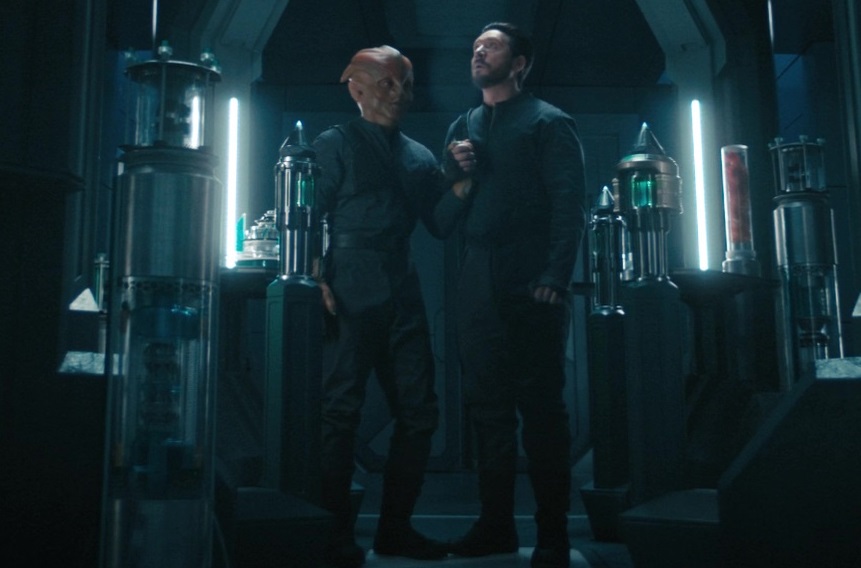
Star Trek: Discovery theories – week 8

Spoiler Warning: There are spoilers ahead for Star Trek: Discovery Seasons 1-4, Star Trek: Picard Season 1, and for other iterations of the Star Trek franchise.

After an unexpected sabbatical, Discovery Season 4 returned with the episode All In. If you read my review of the episode, you’ll know that I didn’t think it was the strongest one of the season so far, but it was interesting in some ways and certainly contained some excellent performances from all of its leading stars. Because All In was, in large part, a detour as Book, Burnham, Owosekun, and Tarka scrambled to get their paws on a magical macguffin molecule called isolynium, most of our big ongoing theories didn’t see significant movement this week. That said, there’s still a lot to talk about and a few updates to get through!

There are still some big open questions, and with five episodes left I’m expecting at least some of them to start moving in pretty big ways in the next week or two! For me, the biggest point of interest right now is whether the season’s big stories will connect in a major way with past iterations of Star Trek. There are a few different ways this could happen, but a big part of me suspects that, as with the Burn in Season 3, we’re going to get something altogether new.

This week we have one confirmed theory and one theory on the production side of things that I’m very pleased to see has been debunked! As always, we’ll start there before moving into the main theory list.

Confirmed theory:
The DMA isn’t a super-weapon.

Burnham, Stamets, and Rillak examine Unknown Species 10-C’s point of origin.

Although I felt that the sequence which contained this revelation was cut rather short, Captain Burnham, Stamets, Zora, and Saru managed to figure out between them what the DMA’s true purpose is. Rather than being a super-weapon, as had been originally assumed, the DMA is a glorified piece of mining equipment, or as Captain Burnham put it, a dredge.

Its purpose appears to be to scour the galaxy for the rare isotope boronite – something that was first mentioned in the Voyager Season 4 episode The Omega Directive. Boronite can be used to synthesise omega molecules – one of the most powerful substances in the known galaxy – but Unknown Species 10-C appear to be using it to power their hyperfield – a kind of forcefield or cloak which is concealing their base or star system.

The DMA’s purpose is to harvest boronite, a rare molecule first mentioned in the Voyager episode The Omega Directive.

I really like this angle. If the DMA isn’t a natural phenomenon, which it seemed to be at first, then having it be something other than a weapon adds a different dimension to the story, one which takes it away from being a fairly typical conflict into something more complex – and, I would argue, more “Star Trek.” We’ve talked about the “it was only trying to communicate!” trope in relation to the DMA before, and how misunderstandings have long been part of Star Trek’s storytelling tradition, highlighting the complexities of dealing with very different cultures and the dangers of making assumptions. This side of the story seems to be cut from the same cloth.

This also seems to rule out other theories about the DMA, such as it being an experiment gone wrong. There’s still room for further twists and turns in the DMA’s story, though, so let’s wait and see what happens, and just what purpose Unknown Species 10-C has in mind for all of this boronite!

Debunked theory:
Star Trek: Discovery isn’t going to be renewed for a fifth season.

Phew! I was getting genuinely worried when we passed the season’s halfway point with no indication of a Season 5 renewal. In past years, we’d always known either before the season kicked off or within a week or two of its premiere that the show had been renewed, so when we got further and further in with no official news – and no rumours of production starting quietly – I began to get worried for Discovery’s future.

But in January, while the show was on hiatus, ViacomCBS confirmed that Discovery will indeed get a fifth season – making it the first show since Voyager to make it that far! (Sorry, Enterprise) This is great news, because I’m not ready yet to say goodbye to Captain Burnham and the crew. There’s so much scope for more adventures in the 32nd Century, and I feel like Discovery could continue to expand and explore this setting, perhaps laying the groundwork for more 32nd Century shows.

So those theories were confirmed and debunked.

Now we can jump into the main theory list! As always, we’ll begin with those theories that are either new or that saw significant movement in All In, before rounding out the list by recapping the rest of them.

Theory #1:
Tarka will realise that there’s a tracker on the isolynium.

Captain Burnham placed a tracking device (highlighted) on the container of isolynium.

Tarka is sharp, and more than that he has access to – and the ability to build – clever pieces of tech. We saw this week that he was able to create a changeling-capturing machine out of a low-quality Devore scanner. It stands to reason he’d want to scan the isolynium that Book procured, and if he’s as thorough as we’ve seen him be so far, perhaps he’ll figure out that Captain Burnham placed a tracking device on it.

If so, the signal that Captain Burnham showed off at the end of All In may lead to a dead-end! I’m sure that the USS Discovery will catch up with Tarka and Book – if not, the story would be fairly short and boring, after all – but it may not be as simple as following the map to the cleverly-placed tracking device.

Theory #2:
Tarka’s weapon will be successful.

Isolynium – a key component of Tarka’s weapon.

President Rillak has tasked Admiral Vance and Captain Burnham with stopping Book and Tarka before they finish work on their weapon and use it against the DMA, fearing that destroying the DMA will lead to all-out war with Unknown Species 10-C. The obvious story route from here is that Captain Burnham and the crew will track them down and either talk them out of it or destroy the weapon before it can be used. But that may not be the direction that Discovery plans on taking us.

It could be more interesting in some ways if Tarka and Book succeed in their aim of launching and detonating the weapon, destroying the DMA and attracting the attention of Unknown Species 10-C. Such a highly advanced species – if they’re as advanced as everyone is assuming, anyway – would be a formidable opponent, but they could also be willing to listen to diplomatic overtures. Perhaps Tarka and Book would have to be sacrificed, imprisoned with Unknown Species 10-C as punishment for their crime.

Tarka and Book.

Speaking of diplomacy, in the mad rush to stop Book and Tarka, I certainly hope that President Rillak hasn’t forgotten about trying to contact Unknown Species 10-C. At the very least, now the Federation knows where they are they should send a message warning them of Book and Tarka’s intentions. It might have to be more of a rush job that the Federation would have preferred – but it would be better to at least make an attempt at first contact in case Captain Burnham can’t stop the weapon in time.

Discovery is definitely unpredictable right now, and I could easily see the series taking its main story to unexpected places. Book and Tarka successfully deploying their weapon would be just one example, and it could make the introduction of Unknown Species 10-C all the more intense, exciting, and edge-of-your-seat thrilling.

Theory #3:
Unknown Species 10-C is extinct.

R.I.P.

We’ll talk in a moment about what All In might mean for my Unknown Species 10-C suspects! But there’s one possibility that I hadn’t really given much thought to that suddenly came to the fore in light of the fact that Unknown Species 10-C is still a mystery and, more significantly, that Starfleet has no way of scanning their base/star system. What if Unknown Species 10-C has already gone extinct?

Perhaps they went extinct recently, or perhaps it was millennia ago. The DMA might be Discovery’s equivalent of the Planet Killer from The Doomsday Machine; an automated device left behind, a warning to the real world about the dangers of some of our long-lasting environmental and technological impacts.

Is the DMA going to turn out to be similar to the Planet Killer?

The DMA could even be Unknown Species 10-C’s last-ditch effort to prevent their own extinction. Having used up their entire power supply, they had to build such an imprecise, devastating machine to harvest all of the boronite they could possibly find just to keep the lights on and their machines powered. There could be an interesting analogy there, too.

Because Unknown Species 10-C remains hidden from us going into the next episode, all sorts of possibilities remain on the table. This could certainly be a different and unexpected way to take the story, and perhaps the culmination of the plot would be more of a technological puzzle than a conflict against an adversary, with Captain Burnham leading Starfleet’s efforts to figure out Unknown Species 10-C’s technology in order to deactivate the DMA.

Theory #4:
Nhan works for Section 31.

Nhan.

Spoiler warning for the next episode, Rubicon, but Nhan will be making a return to Discovery! I thought it was unfortunate that she was shuffled off the ship at such an early stage in Season 3; there was scope, I felt, for more Nhan stories. So it’ll be great to welcome her back to the show in just a few days’ time!

One thing struck me about Nhan based on a couple of photos that the official Star Trek social media channels released, and that’s her uniform. Nhan isn’t kitted out in the standard Season 4 Starfleet uniform that the rest of the crew wear. Hers appears to be a new variant, possibly in a similar style to Lieutenant Willa’s from Season 3. There are many possible explanations for Nhan’s uniform, including an assignment at Federation HQ or a continuation of her service aboard the USS Tikhov, but one interesting possibility comes from Nhan’s background as a security officer. Maybe she’s been recruited by the 32nd Century equivalent of Section 31.

Theory #5:
Tarka’s mysterious “friend” is someone we’re already acquainted with.

All In saw a brief conversation between Tarka and Owosekun in which the subject of his mysterious friend came up. There seems to be more going on with this character than meets the eye, though whether Tarka was being genuine in his emotional reaction isn’t 100% clear! It’s a distinct possibility that his friend is, in fact, a love interest or even a spouse, and that could certainly be an interesting development.

The fact that Discovery has gone out of its way to keep this character’s identity a mystery is interesting as well, and one reason for doing so could be that Tarka’s friend is someone who we as the audience have already met. If it wasn’t a big deal, why not just have Tarka say the individual’s name? The more appearances Tarka makes without revealing this character’s identity, the more strongly I feel that it will turn out to be someone we’ve already met.

I put together a short list of possible candidates for being Tarka’s mysterious friend, and you can find it by clicking or tapping here.

Theory #6:
Book and Burnham will get back together.

Burnham and Book in All In.

I have to be honest: I’m not interested in more Burnham Relationship Drama™. Discovery has already done this with Ash Tyler in Seasons 1-2, and it was okay then, but it’s overdone by now. I get where the central conflict with Book has come from, but I don’t feel that the show needs this additional injection of drama to make Season 4’s story work. If I were to cut one aspect of the Season 4 story that we’ve seen so far, it would be this.

So with that in mind, my hope is that the Book-Burnham feud will be brought to an end – and hopefully within the next couple of episodes. Ideally I’d like to see them get back together, although some of the things they said to each other in All In might make that more complicated. If Burnham manages to stop Book and Tarka, perhaps he’ll come around to her way of thinking. If they’re successful in using the weapon, the argument they had will become a moot point. So there are different ways this could go, but I’m hopeful that it will be resolved soon as it’s an aspect of the show that I’m really not wild about.

Theory #7:
The DMA is a life-form.

“It’s alive!”
Frankenstein (1932)

The revelation that the DMA is a mining tool or dredge would seem to make this theory a lot less likely – but I’m not yet willing to strike it from the list. There are several ways it could unfold, but one possibility is that the DMA is a self-aware piece of technology, comparable to Zora. Perhaps it’s carrying out its orders, unaware of the damage it’s doing, and will be able to be reasoned with even if Unknown Species 10-C won’t back down.

Or perhaps the DMA has gone rogue, operating without Unknown Species 10-C’s permission. That would also be an interesting angle, as it could mean that Captain Burnham and Starfleet will have to ally with Unknown Species 10-C to stop the DMA. Some aspects of this theory as I originally formulated it – such as coming to an understanding with the DMA in a story comparable to V’Ger’s in The Motion Picture – seem to be off the table entirely. But the DMA being a self-aware, conscious machine isn’t… at least, not yet!

Theory #8:
Unknown Species 10-C is a faction from a past iteration of Star Trek.

Could it be the Borg?

The revelation of the hyperfield at Unknown Species 10-C’s point of origin was an interesting one. A field that size could conceal a small star system, as Admiral Vance suggested. But it could also hide something like a huge fleet of starships – or giant mechanical aliens. In my view, there are only a few likely candidates remaining from the long list I put together before Christmas. The technology required to create the DMA and the hyperfield seem to rule out factions like the Klingons, the Gorn, and others.

But there are still some known Star Trek factions with the potential capability of building something like this. I would point to the Borg, the super-synths from Picard Season 1, Enterprise’s Sphere-Builders, the Kelvan Empire from The Original Series (who are also an extragalactic faction), and possibly others like Species 8472, V’Ger, the Q Continuum, or the Terran Empire.

How about Species 8472?

I confess that I feel a sense of déjà vu right now. In Season 3, I theorised and speculated about possible culprits behind the Burn, and a lot of the same names and factions were in the frame then, just as they are now. The Burn ultimately went in a very different and unpredictable direction, and I feel that Unknown Species 10-C could end up in a similar place as a brand-new faction altogether. Because of the mysterious nature of the story, and how long it’s been rumbling on, would that feel like an anticlimax? If Discovery encouraged fans to guess and speculate about who Unknown Species 10-C are, would it be disappointing if the answer was “someone new that you could never have guessed?” I can’t shake the feeling that it might be.

For a more detailed look at the suspects mentioned above, as well as a few less-likely contenders, check out my full list by clicking or tapping here.

Theory #9:
President Rillak knows what the DMA is and may be implicated in its creation.

President Rillak, leader of the United Federation of Planets.

I will admit that, as things stand at the end of All In, President Rillak is looking less and less likely to be involved directly with Unknown Species 10-C and the DMA. But there’s still time for a connection to be revealed!

In short, President Rillak’s single-minded goal of reuniting the Federation may be well-served by providing the disparate members with an enemy or a problem to unite against. The DMA has already accelerated Ni’Var’s membership, and President Rillak even got to speak with a representative from Earth – so if she is involved somehow, her scheme is already paying dividends. At the very least, I think it’s fair to say that this complex, somewhat Machiavellian character is not letting the crisis go to waste, and is politicking off the DMA’s trail of destruction.

President Rillak with Captain Burnham on Ni’Var.

In her dealings with Captain Burnham, I’d argue we’ve seen this Machiavellian edge to President Rillak. In the Ni’Var negotiations depicted in All Is Possible, and again for a second time in But To Connect, President Rillak used Captain Burnham to advocate positions that would’ve been politically or diplomatically difficult for her to do openly – effectively manipulating those events from behind the scenes.

In light of all of this, I would hope that Captain Burnham will tread carefully with President Rillak. She seems the type who would happily throw Burnham and the USS Discovery under the bus if it suited her political and/or diplomatic ends. If someone like that felt that unleashing the DMA, or failing to warn everyone that it was coming, would be to her advantage, I can absolutely see her seizing on that opportunity, too. There are myriad ways in which we could connect her to the DMA, even if she didn’t order its creation. She could be in cahoots with Unknown Species 10-C, she could have learned about the DMA and chosen to cover it up, or something else that she believed was in the Federation’s long-term interests.

Theory #10:
Michael Burnham won’t remain captain of the USS Discovery.

Captain Burnham.

One of the unique aspects of Discovery within Star Trek’s broader canon is that the ship has been commanded by four very different individuals across its four seasons. Captain Burnham is different from Saru, Saru was different from Pike, and Pike, in turn, was different from Lorca. It has to be considered at least a possibility – albeit a remote one, perhaps – that the series will continue this trend.

Now that we know that Season 5 is definitely happening, one possibility is that Captain Burnham will somehow leave the ship at or around the end of Season 4, making way for a brand-new commanding officer to take over. Because she’s been the show’s protagonist since Season 1, it seems unlikely, and the overall arc of Discovery between Season 1 and Season 3 can be read as Burnham’s redemption and ascent to the captaincy. But the show’s revolving door of captains may continue.

Burnham in The Examples.

I’m not really in favour of this, but it’s certainly interesting to consider. The episodes But To Connect and All In definitely showed us how conflicted Burnham feels with regards to Book; she’s torn between her duty and the person she loves. Maybe she will have the strength to do what she believes is right during the DMA crisis, but will resign afterwards, unable to contemplate doing the same thing again and wanting to return to her simpler life with Book. This wouldn’t be a bolt from the blue, as we saw her wrangling with these feelings in Season 3.

Alternatively, Burnham could be promoted, taking up a senior role within Starfleet either at Federation HQ or on a new flagship. We already know that she had been in the running for the captaincy of the USS Voyager-J, so maybe she’ll convince President Rillak, through her work on the DMA, to reconsider her for that role. In short, there are ways her departure could be handled in a way that would feel natural – just like Tilly’s departure did earlier in the season.

Theory #11:
The Guardian of Forever will be back.

The Guardian of Forever as it originally appeared.

I’m close to retiring this theory. In short, I had suggested that the reintroduction of the Guardian of Forever in Season 3 could mean that we’ll encounter the timeless entity again in Season 4. It would be nice to bring back Paul Guilfoyle, who played the Guardian’s humanoid avatar in the Season 3 two-parter Terra Firma.

However, it seems as though the DMA/Unknown Species 10-C story isn’t going in that direction. It would make sense, in a way, for Captain Burnham to seek out the Guardian to ask it about the DMA and Unknown Species 10-C – it may well know something about what’s going on that could be helpful. But the best time to have done that would have been earlier in the season. There are still ways in which the Guardian of Forever could be included, though, so although I’m close, I’m not dropping it just yet.

Theory #12:
Tarka will create his own DMA.

Tarka and Stamets with their DMA model.

In The Examples, Tarka – aided by Stamets – created a working replica of the DMA, albeit on a smaller scale. According to Reno, this recreation came very close to destroying the entire ship! Now that Tarka has isolynium, could it be possible that he will create the DMA – either intentionally or accidentally?

Because of the DMA’s wormhole technology, it doesn’t seem like too much of a stretch to think it could travel through time as well as space, meaning a possible time-loop story is on the cards. It’s got to be at least possible to think that throwing a massive bomb at the DMA could have unintended consequences – if, that is, Tarka actually intends to build a bomb! He might see the DMA’s technology and seek to replicate it, creating his own DMA as a means to break through into the parallel universe he’s aiming to reach.

Theory #13:
Tarka’s “friend” is directly involved with the DMA.

Stamets, Tarka, and Saru with the DMA model.

Though we didn’t learn a lot more about Tarka’s friend in All In, from what we do know about them – their scientific background and desire to travel to an alternate reality – they could be a candidate for building the DMA. Unknown Species 10-C could, perhaps, be a single person, or Tarka’s friend could have worked with them, trading their scientific knowledge for Unknown Species 10-C’s power-generating technology.

Like with President Rillak, there are different ways this involvement could work, and different degrees to which Tarka’s friend could be implicated. But one thing is clear: Tarka knows a lot about the DMA, probably more than he’s been willing to share. That knowledge has to have come from somewhere, right? Maybe his friend told him about this technology before they got separated.

Theory #14:
Book will find Kyheem and Leto on the other side of the DMA.

Book with Leto and Kyheem shortly before the destruction of Kwejian.

In Star Trek: Generations, Captain Picard encountered Captain Kirk inside the Nexus – despite Kirk being declared “dead” after the Enterprise-B encountered the energy ribbon almost eighty years earlier. Now that we know a little more about how the DMA operates, it seems at least faintly possible that, just like Captain Kirk, the inhabitants of Kwejian may not be as dead as they first appear.

This theory is, I freely admit, a bit of a long-shot. But the wormhole technology that we know the DMA uses seems to be capable of sending some of what it harvests or mines back to Unknown Species 10-C’s base of operations. Maybe that means that some of the people from Kwejian were transported there instead of being killed.

So those theories are new or saw movement this week.

Now we’ll recap all of the other theories currently in play! It helps to keep the list complete and in one place, so that we can update and cross off theories as we go!

Theory #15:
Tarka aims to travel to the Kelvin universe.

This scene in Terra Firma, Part 1 referenced the Kelvin universe.

There are many parallel universes, as Tarka reminded us in But To Connect. Though Star Trek has shown us a number of different parallel universes before, the biggest one that comes to mind (aside from the Mirror Universe) is the Kelvin timeline, in which the three reboot films were set.

A fourth Kelvin film may or may not be happening, but even if it does the setting remains ripe for further exploration. We don’t know how far the Kelvin timeline and the prime timeline will have diverged, and whether it operates like the Mirror Universe with every character getting their own alternate counterpart. If it does, perhaps Tarka met his own Kelvin timeline counterpart and that’s how he cooked up this scheme. If the Kelvin timeline diverged significantly from the prime timeline it stands to reason that the Burn never happened there. We also got an oblique Kelvin timeline reference in Season 3 – could that have been a hint?

Theory #16:
Some areas of the galaxy – such as the Delta Quadrant – avoided the worst effects of the Burn.

Adira and Stamets with a map of the Milky Way galaxy.

In But To Connect, President Rillak told us that the diplomatic summit she convened would bring together races from “all four” quadrants. Assuming she was referring to the familiar Alpha, Beta, Gamma, and Delta Quadrants that make up the Milky Way galaxy, this would count as our first mention of the Delta Quadrant in the 32nd Century. I didn’t spot any familiar Delta Quadrant races (or their emblems) amongst the assembled delegates, however!

I had previously speculated that the Burn may not have affected the entire galaxy equally, and that regions farthest away from the Verubin Nebula may have survived without much damage. I still think that this is a possibility – though whether Discovery will revisit the Burn in any depth, or visit the Delta Quadrant at all, remains unclear.

To see a full write-up of this theory, click or tap here.

Theory #17:
There will be a character crossover from a past iteration of Star Trek.

Star Trek has had some wonderful crossovers in the past.

Tarka’s friend could, as mentioned, be someone we’ve already met. But there are other ways to bring back a character from a past iteration of the franchise – and there would be many potential benefits to doing so! I had initially proposed a version of this theory in the run-up to Season 3 that centred on the Doctor from Voyager – but with some creative technobabble, practically anyone could be included, despite the leap forward in time.

Choose To Live showed us the Abronians in cryo-sleep, and Stormy Weather saw the crew of Discovery use the transporter buffer to survive – just like Scotty had done in The Next Generation Season 6 episode Relics. Could these be hints at something to come?

It would also be possible for Captain Burnham to discover the logs or a holographic recording of a long-dead character – and while this would be less of a “crossover,” it could still be a ton of fun and great fan-service!

Theory #18:
Season 4 will connect with the Short Treks episode Calypso.

Zora dancing with Craft in Calypso.

Zora’s status as a member of the crew was confirmed in But To Connect, and this followed her developing emotions and sentience earlier in the season. Zora is now much closer to her presentation in Calypso, potentially bringing the story of the Short Treks episode one step closer.

There are still significant hurdles to overcome if the story of Calypso is to be wrapped up in Season 4, though. Obviously we have the timeframe issue: will the USS Discovery be sent back in time, be abandoned, or is Calypso taking place centuries in the future? Then we have the USS Discovery itself – it’s been retrofitted since arriving in the 32nd Century, and now looks very different to how it did in Calypso. I’m not sure how Discovery will overcome these hurdles – but it’s possible. It feels like a proper link-up with Calypso is edging closer week by week.

Theory #19:
A major character will be killed off.

Spock’s funeral in The Wrath of Khan.

Lieutenant Tilly’s departure in All Is Possible definitely shook up the cast. And Gray’s departure in But To Connect may do so as well. However, I stand by what I said before the season aired: killing off a character can be a great way to demonstrate the dangerous nature of the circumstances that the crew have found themselves in. So far, despite tangling with the DMA on several occasions, only a couple of redshirts have lost their lives.

In Stormy Weather, Dr Pollard raced through the corridors of the USS Discovery to reach a hull breach. Shortly after she arrived, a redshirt was blown out into space – but Dr Pollard survived. Although moments like this can make it feel that Discovery is shielding its main and secondary characters with some pretty heavy plot armour, I still feel that there’s scope to see a major character death before the season ends.

If you want to check out my pre-season “death predictions,” in which I speculated about which characters may or may not be in danger, you can find that by clicking or tapping here.

Theory #20:
The crew will have to defend the Verubin Nebula.

The dilithium planet is vital to the Federation.

Despite having grown to sixty member worlds, the Federation is still in a weakened state and isn’t yet back to full strength. The Verubin Nebula is thus a very tempting target for anyone looking to gain an edge in a galaxy where dilithium is still in short supply. As the only known significant cache of the valuable fuel, whoever controls the Verubin Nebula will have a massive tactical advantage.

It would begin to stretch credulity to think that everyone in the known galaxy would see the Federation rebuilding and having access to dilithium and not want to find out for themselves what’s going on. Once the Verubin Nebula’s existence becomes known, even if the Federation promises to share its bounty with all comers, it seems very likely that someone would want to take control of the dilithium supply for themselves.

Theory #21:
The ban on time travel will be explained in more detail.

The USS Enterprise was able to travel through time using the “slingshot method.”

This one is as much a hope as a theory right now! In short, the ban on time travel was introduced early in Season 3 primarily as a way for the writers and producers to avoid questions about why the 32nd Century was so different from how the far future had been depicted in earlier Star Trek productions, as well as to explain things like how the Burn was able to catch the Federation off-guard and why Georgiou couldn’t simply be sent back in time when she needed to.

But the ban itself raises some issues – the biggest one being the lack of detail on how it works and how something like this could possibly be enforced. As I said several times last season, it isn’t possible to just un-invent a technology so useful and powerful as time travel. Even just a few lines of dialogue going into a little more detail on the mechanisms involved in the ban would be really useful.

Theory #22:
The Federation has flouted the ban on time travel.

President Rillak may have tried to circumvent the ban if she felt doing so would be in the Federation’s interests.

Sticking with the time travel ban, another theory I had last season was that the Federation – and Section 31 in particular – might have deliberately flouted the ban and failed to abide by the rules. Someone as straight-laced and committed to Starfleet ideals as Admiral Vance is highly unlikely to have sanctioned such a move, but there are other Federation leaders – such as President Rillak – who could be implicated.

I don’t think it’s possible any more that the DMA story will be connected to the time travel ban, as I had previously proposed. But that doesn’t mean that a closer look at the ban, and the potential for the Federation to have tried to work around it, isn’t going to happen.

Theory #23:
Saru will be given the captaincy of the USS Voyager-J.

Captain Saru in command of the USS Discovery in Season 3.

Saru’s future was briefly discussed before he offered to serve as Captain Burnham’s first officer in the episode Anomaly. He has already been offered a command of his own, so Starfleet clearly values his command abilities and experience. President Rillak was seen to be assessing Captain Burnham’s suitability for the captaincy of the USS Voyager-J in Kobayashi Maru… and she mentioned having a shortlist of candidates. Could Saru be on her list?

Several of the qualities that President Rillak said she was looking for in a potential captain seem to apply to Saru. He’s more level-headed, less likely to put himself in a dangerous situation, and more inclined to think of the big picture. He has a weakness when it comes to Kaminar, as we saw toward the end of Season 3, but generally speaking he isn’t someone who lets his emotions get the better of him. His wisdom and calm demeanour could be valuable in the captain’s chair of the Federation flagship. This could also set the stage for his departure from the show, or possibly even for a new show following his adventures aboard his new ship.

Theory #24:
The Red Angel suits from Season 2 are connected to the DMA.

Captain Burnham’s Red Angel suit at the end of Season 2.

Unknown Species 10-C seem to be responsible for building the DMA. But it isn’t the first wormhole-creating technology that Discovery has introduced us to! The Red Angel suits in Season 2 were also capable of creating powerful wormholes… so could it be possible that Unknown Species 10-C built their device around or based on the same technology?

This revelation would greatly affect Captain Burnham, as she’d feel a degree of responsibility even though she wasn’t directly involved. It would also be the second disaster in a row (following the Burn) in which the Federation was implicated – albeit in an oblique way. I’m not convinced that Discovery will go down this route… but the similarities in the wormhole-creating technology gives me pause, at least.

Theory #25:
We haven’t seen the last of the Abronians.

I currently have four ideas for different ways that the Abronians – the non-humanoid race that Captain Burnham, Tilly, and the Qowat Milat helped save from cryo-sleep in the episode Choose To Live – could play a further role in Season 4.

Theory #25 A:
The Abronians’ homeworld was destroyed by the DMA.

Captain Burnham believes this image depicts a “supernova.”

After arriving at the Abronians’ cryo-ship, Captain Burnham found a stone carving that seemed to depict the destruction of the Abronians’ homeworld. This carving was only shown on screen briefly, but it seemed to show the planet being damaged or destroyed in a large explosion. Burnham credited the planet’s destruction to a “supernova,” and the story then raced ahead.

Considering that the main thrust of the season so far has been about the DMA, perhaps Burnham was incorrect: the Abronian homeworld was destroyed by the anomaly, not a supernova.

Theory 25 B:
The Abronians’ homeworld was on the “other side” of the DMA.

Abronian stasis pods.

Now that we know a little more about how the DMA works, this theory seems a little more plausible. Its powerful wormhole technology seems capable of transporting matter over many light-years, meaning it doesn’t seem to be a complete stretch to think that the Abronians may have originated in the vicinity of Unknown Species 10-C. They could even be Unknown Species 10-C!

One thing struck me as odd about the Abronians: the Federation was entirely unaware of them, despite the Abronian cryo-ship being relatively close to Federation space – such that Captain Burnham could reach it using Book’s ship in a short span of time. It’s possible that the Abronians had been asleep for millennia, unnoticed by the Federation and the wider galaxy for all that time. But it’s also at least possible that their cryo-ship is a newcomer to the area. If so, perhaps it arrived here via the DMA.

Theory #25 C:
The Abronians will return to help the Federation later in the season.

A deceased Abronian.

One of the themes of Discovery since Season 3 has been connection, including building connections between the Federation and other races and organisations. The Abronians were awoken from cryo-sleep thanks to the interventions of Captain Burnham and Tilly – at least in part – and they may seek to repay the Federation, or Captain Burnham personally, for that help.

We saw this play out last season with Ni’Var; in the season finale Ni’Var ships raced to the Federation’s aid as the Emerald Chain attacked. Perhaps the Abronians will likewise step up to help when the Federation needs allies.

Theory #25 D:
The Abronians’ moon-ship may be useful in a later story.

“That’s no moon…”

The Abronians’ cryo-ship is huge, and at least superficially seems to have the mass of a moon or small planetoid. If Captain Burnham and the crew needed a starship that large, such as to aid in the evacuation of a planet threatened by the DMA, for example, perhaps they’ll return to the Abronians and ask to borrow it.

As we saw in Choose To Live, the moon-ship was in full working order. All it needed was some extra dilithium to power up and it was perfectly capable of moving under its own power, and its computer systems were still functional. The only system that seemed to have failed was the wake-up timer! Discovery has precedent when it comes to telling seemingly one-off stories that have a pay-off later on, so watch this space. If Captain Burnham and the crew need a huge starship urgently, we may not have seen the last of the moon-ship!

So that’s the main theory list.

There is still one production-side theory in play, so we’ll recap that now before we wrap up.

Production-side theory:
Tilly’s departure will be permanent.

Tilly’s departure feels permanent.

Mary Wiseman confirmed in an interview with Wil Wheaton on The Ready Room (Discovery’s social media aftershow) that Tilly will be seen again before the end of Season 4, and we glimpsed her in the trailer for the second half of the season as well. But that doesn’t mean she will return as a main character on the show going forward, and her departure in All Is Possible felt permanent. Despite that, I’ve seen quite a lot of folks online who don’t believe that Tilly is actually leaving the series – so I wanted to put it out there officially and say that, in my opinion anyway, she is.

Maybe those people know something that I don’t! As I always say, I don’t have any “insider information;” all of this is just speculation on my part. However, I feel that the manner of Tilly’s departure, the fact that she got that emotional sequence with Captain Burnham, a montage showing her leaving the ship, Adira seeming to take over several of her roles, and her departure feeling like the culmination of her arc going back to the latter part of Season 3 all come together to strongly indicate that she won’t be back as a major character. She may yet have a significant role to play in a future Season 4 episode, as has been suggested, but unless Discovery’s writers are really playing with our emotions I believe we’ve seen Tilly’s end as a main character on the show. She may come back in a future Starfleet Academy series, though… so watch this space!

So that’s it!

Owosekun in the combat arena in All In.

It’s all still to play for as we move into the final five episodes of the season. There are several key stories to find resolutions to: the DMA, Unknown Species 10-C, the Book-Burnham drama, and more. There’s also plenty of time, in five episodes, for Discovery to take off on a side-mission or two, as well as to introduce completely new and unexpected story elements. It’s even possible that Season 4 will end on a cliffhanger now that we know Season 5 is happening… so perhaps none of the big stories will be resolved until 2023. Say it ain’t so, Joe!

Before we go, one final point. I write up these theories because I like Star Trek and I like writing. But for some folks, fan theories can hamper their enjoyment of a film or television show. It’s worth keeping in mind that most of these theories probably won’t pan out, and we have to be prepared for the fact that even the most well-constructed fan theory, no matter how fun and plausible it seems, simply won’t turn out to be true. If you find that speculating and reading theories is beginning to detract from your enjoyment of Star Trek: Discovery – or any other television show or film – it might be a good idea to take a break for a while.

Star Trek: Discovery Season 4 is available to stream now on Paramount+ in the United States, Scandinavia, Latin America, and Australia. The show is on Pluto TV in the UK, France, Germany, Italy, and other parts of Western Europe at 9pm on Fridays and Saturdays. Individual episodes or the full season can be purchased on iTunes, Amazon Video, Google Play, and possibly other platforms in the UK, parts of Europe, and select other countries. The Star Trek franchise – including Discovery and all other properties mentioned above – is the copyright of ViacomCBS. This article contains the thoughts and opinions of one person only and is not intended to cause any offence.
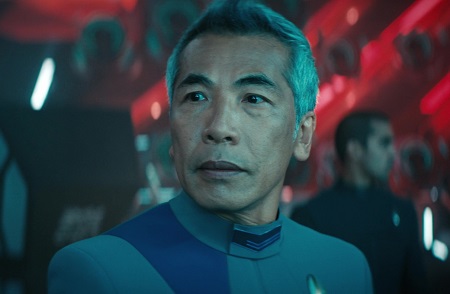
Star Trek: Discovery review – Season 4, Episode 8: All In

Spoiler Warning: There are spoilers ahead for Star Trek: Discovery Seasons 1-4 and Star Trek: Voyager Season 4.

After what seemed like a never-ending six-week break, Discovery has finally returned to our screens! I don’t necessarily mind a mid-season break in principle, but the way Discovery’s was handled was poor from ViacomCBS and Paramount+. Being announced with mere days to spare seems intentional, as if it were deliberately designed to make sure that fans had no opportunity to cancel or suspend their Paramount+ subscriptions. We’ve talked on several occasions recently about the need for ViacomCBS and Paramount+ to get a grip and demonstrate that they’re serious about this whole streaming business – and randomly announced, unscheduled mid-season breaks are not a particularly good look.

The six-week break opened up a gap for Star Trek: Prodigy, though – and if you skipped it or didn’t want to check it out because it’s billed as a show for children, do yourself a favour and reconsider! Prodigy was fantastic, and managed to be a series that really embodied the spirit of Star Trek. Unfortunately it’s only available “officially” if you live in the United States (even Paramount+ in Australia didn’t broadcast the full ten episodes for inexplicable reasons) but I daresay you can find a way to watch if you so choose. Check out my spoiler-free review of Prodigy Season 1, Part 1 by clicking or tapping here.

If you missed Prodigy, go back and check it out. I can’t recommend it highly enough.

So let’s talk about All In. The episode had a very strong “Star Wars” feel for the most part, with the gamblers’ den that served as the main setting definitely taking its cues from comparable locales in the Star Wars franchise. The Karma Barge felt like Star Trek’s answer to the Mos Eisley cantina in the original film, complete with shady aliens, drinking, gambling, and criminality – all under the watchful eye of a charismatic crime boss. And I can’t be the only one to notice the similarity between the way the names of Haz Mazaro and Star Wars’ Maz Kanata sound, can I?

I don’t object to these kinds of “out of bounds” places existing in Star Trek, and we’ve seen lawless settlements and shady saloons in basically every iteration of the franchise in some form or another. It’s a trope from westerns that the franchise inherited going all the way back to its inception. In the context of a post-Burn galaxy it makes sense that places like this would exist and would be popular with a certain proportion of the population. I guess the only real thing to say is that this Karma Barge was definitely more Mos Eisley cantina than Quark’s – and that’s a choice that the show’s writers and producers made.

The Karma Barge felt like something lifted from the Star Wars franchise.

After a break of six weeks, putting Book and Burnham back together makes a certain kind of sense. There are only another five episodes to resolve everything before we get to the end of the season, after all. But if we watch But To Connect and All In back-to-back, and take into account statements made by President Rillak in particular about the in-universe passage of time, the story feels pretty weak. All In kicks off mere hours after the events of But To Connect, and although it arguably says something about the connection or similarities between Book and Burnham that they both chose to visit the same location… it makes the story feel incredibly contrived.

Also, considering the major contrivances required to simply get these two in the same room, I’m not sure this pretty weak story setup actually accomplished very much. Book and Burnham are no closer to resolving their feud than they were at the end of But To Connect, and in some ways are a step further apart having tried and failed to talk it out. I think we needed at least one episode in between But To Connect and the Book-Burnham reunion to really let things sink in for both of them, so going from that conflict over the vote last time (which was itself a rather weak premise that could have been easily resolved) to this episode, with another phase of the conflict in a pretty contrived setup, leaves me struggling to find many positive things to say.

Book and Burnham were reunited.

If All In had been a stronger episode overall, with a stronger central premise, perhaps some of those feelings would’ve melted away. If we’d spent longer getting to the Book-Burnham reunion, or if the gambling storylines were better written (to put it bluntly) I could’ve seen myself getting to a place where it would’ve been possible to write off some of these contrivances. But as you can probably tell already, I felt that All In’s story was, once we cut through the contrived fluff, not an especially strong one.

Book and Tarka definitely got the better and more interesting part of the story, as they had to earn the magical macguffin molecule by tracking down a cheater in the gamblers’ den. Though All In skipped over much of Tarka’s process as he tracked down the changeling and modified a piece of equipment to trap them, it was a neat premise and one that, for lack of a better term, had a very “Star Trek” feel to it in what was, as mentioned, a setting that definitely drew on other sci-fi/fantasy influences. As an aside, I don’t think this changeling was a Founder – there are other shape-shifting species in Star Trek, and the way this changeling switched forms didn’t remind me of Odo in any way.

Tarka caught a changeling gambling cheat.

We also got to see glimpses of how well Book and Tarka actually work as a duo. In a scene at the tail end of The Examples we got to see them together for the first time, albeit briefly, and But To Connect showed them coming together to try to win the vote. But it was here, for the first time, that we really got to see their dynamic as a dysfunctional duo – and it works remarkably well. Shawn Doyle and David Ajala play off one another’s strengths beautifully, and they do an excellent job at showing how these two characters have such radically different motivations for undertaking this mission.

There was a moment later in the episode which seemed to hint at Tarka perhaps having some kind of emotional draw to the “friend” he told Book about in But To Connect that arguably goes beyond “just” friendship. It’s possible that this character is a love interest for Tarka, which could be an interesting development if: a) this character is still alive, and/or b) they’re someone we as the audience might be familiar with. Neither of those points is guaranteed, so this could be a red herring that doesn’t go anywhere significant.

Did Owosekun touch a nerve when she pressed Tarka about his “friend?”

That scene between Tarka and Owosekun was cleverly-written, though, and I honestly can’t tell if Tarka was responding to Owosekun with genuine emotion or was feigning it in some kind of double-bluff. He’s an egotistical man, that’s something we’ve known since even before we first saw him on screen, but whether he’s capable of lying and manipulating at that level to throw people off-balance is unclear right now.

All In was a good episode for Owosekun, giving her a storyline comparable in scale, at least, to Detmer’s in Season 3. A lot of folks have complained about Discovery not making good use of its secondary cast – the bridge crew in particular – so this might be the writers and producers responding to those criticisms. A similar role could have been created for Burnham or several other main cast members – so the choice to put Owosekun in this situation was definitely a deliberate one.

All In gave Owosekun her biggest role in the season thus far.

It was definitely a sweet moment to have Burnham and Owosekun paired up, and they worked well as a character duo for this part of the story. The moment between them on the shuttle was perhaps the strongest, at least from an emotional point of view, and aside from episodes like Explorers, where Captain Sisko and Jake went on their own adventure, it’s got to be one of the very few missions in Star Trek’s 800+ episodes where both principal characters were black. Add into the mix Book and the only non-black participant in this story was Tarka.

Unfortunately, though, I felt that Owosekun’s big fight was not well-constructed. This was the central turning point of the mission for her and Burnham, and there are basically two ways to interpret what happened. Either Owosekun was, as her rivals later alleged, essentially hustling the fight by throwing the first two rounds – which I don’t believe, based on the extent of her injuries and her interactions with Burnham – or the fight was simply badly-written and poorly-filmed, not allowing us as the audience to see any of the process involved as Owosekun presumably tried to figure out how to outplay her opponent.

Owosekun’s fight sequence was not well-constructed.

From where I was sitting, here’s how it looked like the fight went down: Round 1, Owosekun got her butt kicked incredibly easily by a far larger, stronger opponent. Round 2: the exact same thing happened. Round 3: out of nowhere, and with all of their money on the line, Owosekun suddenly became 10x stronger and was able to win by magic.

We needed to see something – anything, really – to indicate what was going on. Was Owosekun using the first two rounds to spot weaknesses or patterns in her opponent’s fighting style that she later exploited? If so, that was subtle to the point of being hidden. Was she, in fact, hustling, knowing that the odds would get better with each defeat? Again, if so, that was not communicated to us as the audience. Fights don’t work like this in any contact sport in the real world – so either the explanation is childish writing, saying that Owosekun “got good” at the perfect moment, or the explanation is bad writing and/or filming and editing, meaning that essential elements of the story were simply not well-communicated to us as the audience.

Owosekun on the ropes with her opponent in the background.

In a story that was already choked by the contrivance of Book and Burnham finding their way to the same place within hours of the events of the previous episode, the poor way in which the fight was executed on screen added to the sense that All In was just not working very well. It was exciting in the moment, I will happily concede that point. And Oyin Oladejo did a creditable job at making me feel that Owosekun was in danger, but determined. Combined with her scene with Tarka later on, it was her best episode of the season so far, and her best performance since That Hope Is You, Part 2 in Season 3. It’s just a shame that the material itself wasn’t particularly strong.

The final part of the episode depicted a card game with Burnham, Book, and two nobodies, with the magical macguffin molecule on the line. And here’s a piece of free advice to the writers of Star Trek, Star Wars, or literally any other sci-fi or fantasy franchise: if you’re going to make a card game an essential part of your story, either make it a familiar card game or explain the rules. Spending nearly ten minutes watching people play a card game that was impossible to follow because it used different designs for the cards and different rules was not entertaining in any way, and this sequence was the episode’s weakest by far.

Haz Mazaro and Burnham at the card table.

The game was called Leonian poker, and despite the “poker” moniker, the rules were not explained at all. The non-face cards had a vaguely familiar design, but were different enough that it wasn’t easy to see at a glance who was winning or who had a strong hand. And this sequence dragged as a result. Now I will freely admit that watching professional poker is not something I care about in the slightest, but at least if I do watch a poker game I know the rules and can follow what’s going on. Here, a combination of the card designs, lack of clarity over the rules, and the pacing of the sequence itself meant that it was impossible to follow what was happening. This led to a deeply unsatisfying feeling of being on the edge of my seat hoping Book and Burnham could defeat the “Emerald Chain holdouts,” but not knowing what was going on or who was in a good position. The entire sequence was just frustrating.

When designing any kind of fictional card game, it needs to either have its mechanics explained, or be visually very easy to follow – or ideally both. This game, while it may or may not have followed the basic rules of poker, was neither explained nor visually simple enough to be intuitively understood, and I think it’s that combination that detracted from this sequence. If it had been a shorter sequence it might’ve worked better, but it lasted almost eight minutes – and those minutes really did seem to drag.

I found the card game frustrating and difficult to follow.

The upshot of all of this was that Book won the game, meaning that he and Tarka could escape with the magical macguffin molecule. I think there was something at least somewhat visually underwhelming about this isolynium, too, that made the stakes of the whole gambling operation – and the threat from Burnham that Book was crossing a line that he “could never come back from” – feel a bit anticlimactic.

In the real world, of course, we have materials like plutonium and uranium which don’t look like much, but are very dangerous, and isolynium is clearly modelled after elements like those. But it doesn’t make for a visually impressive presentation in the way that, say, a barrel of glowing, pulsing, neon pink goo might have had. That’s a deliberate aesthetic choice on the part of the show’s creators – but coming in an episode that had a number of other weak elements, the fact that the highly sought-after prize that all of our characters were desperate to procure was a vial of nondescript metallic flakes no bigger than a coffee mug was definitely an anticlimax. I didn’t know what to expect from isolynium – as far as I know the material is new to Star Trek – but the way the magical macguffin molecule was presented felt like a bit of a let-down in visual terms. Discovery has done some exceptionally interesting things with some of its visual effects across all four seasons, including in a number of unimportant or background areas. For something so vital to the plot to be so visually uninspired made this moment underwhelming.

The isolynium – the macguffin at the centre of the episode’s story – was visually unimpressive.

All of this led us to Book and Tarka taking the magical macguffin molecule and leaving, planning to build the weapon. I don’t really see what was stopping Burnham having the USS Discovery on standby to jump in and try to apprehend them after they’d left the barge (which was, understandably, neutral ground). But I suppose that’s a bit of a nitpick. Technologies like the Spore Drive can feel kind of overpowered, so using them sparingly is probably no bad thing! What’s the betting, though, that Tarka already figured out about the tracking device and leads Burnham and the rest of Starfleet to a dead-end? Maybe I’ll save that one for my theory update!

The conflict between Rillak, Vance, and Burnham was one that had the potential to be interesting, but it strayed very close to feeling as though Rillak in particular, but also Vance, were lashing out at Burnham for something that she couldn’t have reasonably been expected to predict. Book’s turn in But To Connect was sudden, and their theft and escape came 90% from Tarka – he was the one who stole the Spore Drive prototype. I can understand the frustration that Rillak in particular would have as she tries to keep the Federation united, and I think Chelah Horsdal did a good job portraying that complex emotional state.

Vance and Burnham during their meeting with President Rillak.

It was also somewhat of a rarity to see Admiral Vance get a bit of a dressing-down from the Federation President. We’ve usually seen Vance very composed and in control, but this situation has exposed a vulnerability for him, as he fears not being able to see his family – or even for their safety – in the event of war with Unknown Species 10-C. Again, a stellar performance from Oded Fehr communicated Vance’s emotions expertly. I also liked that Vance was willing to find loopholes and bend the rules for Burnham, something that I think he would never have considered under normal circumstances.

As the episode was drawing to a close we got a tiny tidbit of information about Unknown Species 10-C. Much of the rest of the episode felt like a detour, so it was important in the closing moments to advance the season’s main story in some way. The revelations this week were that Unknown Species 10-C appear to have some method of cloaking an entire star system – making them far more powerful than the Federation had been anticipating – and that the DMA is designed to harvest a particular particle: boronite. This could be a reference to the Voyager episode The Omega Directive, in which boronite was said to have been used by the Borg to synthesise an omega molecule – one of the most powerful substances in the Star Trek galaxy.

Unknown Species 10-C live here.

This sequence was cut a little short for me; I felt Discovery could have made more of the explanation of this new angle. The DMA being akin to a mining tool confirms what I’d been suspecting – that it isn’t a weapon – but the scene in which this was explained was very short on detail. Burnham makes huge assumptions based on only a few pieces of information, and may not have the complete picture. For storytelling reasons I daresay her assumptions are accurate and I’m not expecting any of it to be reversed or undone, but I feel like a longer sequence with a bit more time for debate and discussion could have got us to the same place in a bit more of a believable way.

Finally, one of the more understated moments in All In was actually one of the best. Dr Culber had been feeling overwhelmed with his role as ship’s counsellor, and that slow build finally boiled over in what was a rare emotional moment in an episode that had its focus elsewhere. The sequence between Dr Culber and Stamets in their quarters was tender and sweet, and reinforces how the pair really are Discovery’s emotional core.

Dr Culber finally got to confront some of his bubbling emotional issues this week.

It also tapped into a theme that Discovery has been running all season – and going back to last season, too: trauma. Different members of the crew have come to stand for different responses to trauma and different parts of the grieving process. We saw Tilly choose to take a very different path, leaving the ship. Gray returned to Trill to try to pick up the pieces of his training. Book had been most strongly affected by grief and ended up going down a dark path. And in Dr Culber’s case, he’d been throwing himself into his work at the expense of taking care of himself.

Feeling that he had failed Book, and also failed to prevent Book from taking the actions he took in But To Connect, Dr Culber was blaming himself and taking it as a personal failure. Stamets seemed to be able to get through to him, though, and that’s definitely a positive thing. Showing how love can cut through moments like this is something that we’ve seen Discovery do on occasion, and it was powerful here.

Stamets and Culber took some time away from work.

So I think that’s it for All In. Overall, I’d say it was a bit of a disappointment, despite some individually strong performances and well-constructed moments. The central conceit of putting Book and Burnham back together in such a random way didn’t work for me, and as a result much of the drama at the gamblers’ den felt contrived. The climactic card game was too difficult to follow, leading to a sequence that dragged on far too long and was frustrating to watch, and when All In did find time for fun or interesting moments, they tended to be cut short in favour of returning to the contrived, less-interesting side of the story.

I don’t want to say this is “the worst episode of the season,” because that makes it sound like I hated it and it was irredeemably terrible. I don’t think All In was an awful episode; it’s certainly streets ahead of the likes of Season 2’s The Red Angel. But it was a bit of a let-down, and a weak reintroduction to Discovery after its six-week break.

With only five episodes remaining, there’s still a lot of work to do; All In didn’t move the needle in a major way. Tarka and Book are still on the run, planning to build their weapon. Unknown Species 10-C is still out there and still hidden. The DMA is still doing its thing, flitting about the galaxy. And Starfleet is still two steps behind both. It will take a lot to bring Season 4’s storylines together and start wrapping things up! I hope Discovery is up to the task.

Star Trek: Discovery Season 4 is available to stream now on Paramount+ in the United States, Scandinavia, Latin America, and Australia. The show is on Pluto TV in the UK, France, Germany, Italy, and other parts of Western Europe at 9pm on Fridays and Saturdays. Individual episodes or the full season can be purchased on iTunes, Amazon Video, and possibly other platforms in the UK, parts of Europe, and select other countries. The Star Trek franchise – including Discovery and all other properties mentioned above – is the copyright of ViacomCBS. This article contains the thoughts and opinions of one person only and is not intended to cause any offence.
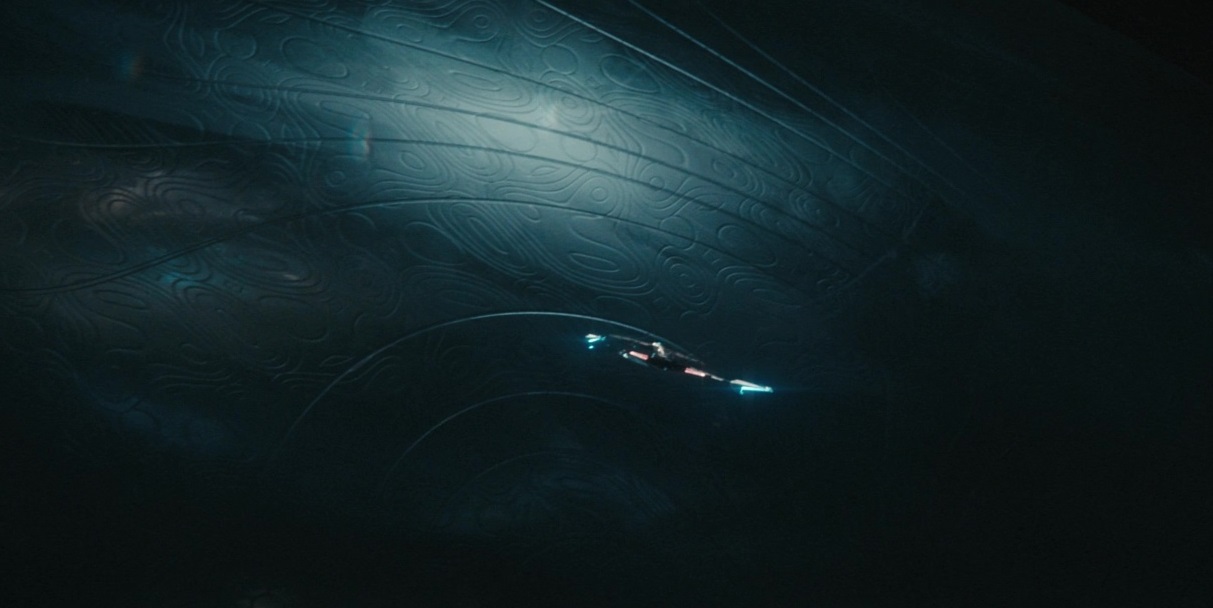
Star Trek: Discovery theories – week 7

Spoiler Warning: There are spoilers ahead for Star Trek: Discovery Seasons 1-4, Short Treks, Star Trek: Picard Season 1, Star Trek: Lower Decks Season 1, and for other iterations of the Star Trek franchise.

Because Discovery is currently taking an unscheduled six-week break, I was in no rush to update my theory list! The second half of Season 4 won’t air until the 10th of February (or the 11th here in the UK), so there was more time than usual to consider the implications of the most recent episode: But To Connect.

But To Connect worked well as a mid-season finale, even though some of its story points weren’t my personal favourites and some of the drama felt rather contrived. We have some interesting questions to consider about Ruon Tarka in particular, as the Risian scientist told us some very interesting and unexpected things.

This week we have three retiring theories and one confirmation. As always, we’ll look at those first before we jump into the main list.

Retired theory #1:
Dr Kovich is an agent of Section 31.

Dr Kovich.

Though Dr Kovich’s role within the hierarchy of Starfleet and the Federation is still unexplained, after But To Connect I think we can finally retire this theory – one which I’d been holding on to since we first met the character in Season 3.

Dr Kovich’s early interactions with Georgiou in particular seemed to show him as someone morally ambiguous to the point of being uncaring; he knew that Georgiou’s health was going to fail, yet did nothing to warn her or Captain Saru. Combined with his stoic demeanour and a sense that he wasn’t telling us anywhere close to everything he knew, I speculated that he could be an operative – or even the head – of shadowy organisation Section 31.

Dr Kovich’s first appearance seemed to set him up as a mysterious, morally ambiguous character – perfect for Section 31.

There was the potential for some kind of tie-in with the Section 31 series, but with that project seemingly being shelved (at least for now), that doesn’t seem like it’s a consideration for the writers and producers in charge of the overall direction of the Star Trek franchise. In fact, we haven’t seen any mention of Section 31 explicitly since Season 2.

We’ve seen Dr Kovich as a psychologist, working with Starfleet Intelligence, having a say in the running of Starfleet Academy, and now as an expert in the field of AI. Whoever he is, and whatever formal title or position he holds, I think we can finally rule out Section 31. Dr Kovich has turned out, to my surprise I must confess, to be one of the true believers in the goals and ideals of Starfleet – something he demonstrated clearly in But To Connect through his interactions with Zora and Stamets.

Retired theory #2:
Zora will go rogue.

Zora with Captain Burnham in Stormy Weather.

There is still an open question surrounding Zora’s burgeoning sentience, and what that could mean for Captain Burnham, the crew of Discovery, and indeed the rest of Starfleet. Whether this is something Season 4 will find time to tackle, or whether Zora will be dealt with in more detail on another occasion isn’t clear right now – but I think what is clear from what we heard in But To Connect is that Zora is firmly on Starfleet’s side.

Especially after Zora’s refusal to follow orders in Stormy Weather – a moment that came with a throwback to HAL 9000 from 2001: A Space Odyssey – I was somewhat nervously awaiting Zora going completely rogue, perhaps even doing something to endanger the ship and crew.

Zora in But To Connect.

Though Zora’s refusal to share the co-ordinates of the DMA’s origin seemed, at first, to confirm my suspicion that this was the direction of travel for this storyline, Discovery ended up turning it around over the course of But To Connect, reassuring Zora that she could trust the crew of Discovery, and reassuring us as the audience that our heroes can trust her as well.

This was cemented by Zora sharing the co-ordinates of the DMA’s origin, but also by Zora being given an official role as a Starfleet mission specialist – the same loophole that brought Burnham aboard the ship after her mutiny in Season 1. Zora has started the process of becoming a more significant character on the show – something that I’d like to see continue in future episodes, as I kind of like the idea of the crew and ship working in tandem. It gives me Farscape vibes!

Retired theory #3:
Captain Burnham and the crew will encounter the Klingons.

Kol, a 23rd Century Klingon leader.

If we were going to see the Klingons this season, I think the diplomatic summit in But To Connect would have been where it happened. With the DMA seeming to be of extragalactic origin, it doesn’t seem like the Klingons will turn out to be the mysterious Unknown Species 10-C, either. So I’m choosing to retire this theory for now.

I don’t know why we haven’t seen any 32nd Century Klingons since Captain Burnham and the crew arrived last season. It’s possible that Discovery’s writers feel they’ve done all they can with the faction and want to move on to other stories, but having a Klingon or two as minor characters at key moments like the diplomatic summit wouldn’t get in the way of that. So I confess that I’m not sure why we haven’t seen any Klingons lately – but it doesn’t seem like we’re going to this season.

Confirmed theory:
Captain Burnham’s war experiences from Season 1 will come into play.

Captain Burnham in But To Connect.

In But To Connect, we saw Captain Burnham arguing in favour of a less-aggressive posture toward the DMA. She drew on her own experiences with the Klingons, in part, to inform this decision. While Book and Tarka argued for attacking the DMA with their new weapon, Burnham was one of the key voices advocating for a peaceful stance and to try to make first contact with Unknown Species 10-C.

It’s reasonable to plan for worst-case scenarios, and as I argued in my review of But To Connect, the two contrasting approaches to the DMA didn’t have to be a zero-sum game. It would have been possible to take a more balanced position, as Discovery has tried to do all season long, in which the DMA-stopping weapon was built while the Federation also made an attempt at peaceful first contact. But regardless, I speculated last week that Burnham would be the one to argue for making an attempt at peaceful first contact, reminding everyone that no one currently knows what the DMA is supposed to be nor what the intentions of its creators were. And that’s pretty much what she did in But To Connect.

So those theories are done!

Now we’re going to jump into the main list, starting with a few new theories and a few theories that saw movement in But To Connect.

Theory #1:
Ruon Tarka’s mysterious “friend” is someone we’re already acquainted with.

I’m sure that’s how Tarka would’ve typed if he’d used MSN Messenger circa 2002.

Why did Ruon Tarka avoid naming his “friend” when Book asked him about it? Tarka’s friend is supposedly one of the major motivating factors in him wanting to stop the DMA – he wants to use the power source at its centre to “punch through” to a parallel universe in the hopes of meeting up with this person. But when Book asked him who this individual was, Tarka tried to ignore the question.

This could be a complete over-reach, but I wonder if the reason for the secrecy is because Tarka’s friend is someone who we as the audience are already familiar with. This could be someone from Discovery, or it could be someone from a past iteration of Star Trek. Given that Tarka wants to travel to a parallel universe, perhaps his friend is the counterpart from that universe to someone we’re familiar with.

I put together a short list of possible candidates for being Tarka’s mysterious friend, and you can find it by clicking or tapping here.

Theory #2:
Tarka aims to travel to the Kelvin universe.

The USS Kelvin, namesake of the Kelvin timeline.

There are many parallel universes, as Tarka reminded us in But To Connect. The Mirror Universe is one that we’re familiar with from Discovery and from past iterations of Star Trek – but Tarka seemed to suggest that that isn’t his destination. In addition, Dr Kovich told us in Season 3 that travel to and from the Mirror Universe is no longer possible as of the 32nd Century.

Though Star Trek has shown us a number of different parallel universes before, the other major one that comes to mind is the Kelvin timeline (also known as the “JJ-verse”) in which the three reboot films were set. 2009’s Star Trek showed us the point of divergence; the moment at which this universe and the prime timeline separated: the arrival of Nero and his attack on the USS Kelvin. Star Trek Into Darkness and Star Trek Beyond furthered our understanding of that universe somewhat.

Kirk and Spock in the Kelvin timeline.

A fourth Kelvin film may or may not be happening, but even if it does the setting remains ripe for further exploration. We don’t know how far the Kelvin timeline and the prime timeline will have diverged, and whether it operates like the Mirror Universe with every character getting their own alternate counterpart. If it does, perhaps Tarka met his own Kelvin timeline counterpart and that’s how he cooked up this scheme.

Though Tarka is correct about the multitude of different universes and realities, of all the ones we’ve spent a significant amount of time with thus far in Star Trek, the Kelvin timeline seems the most likely destination. Compared to the likes of the Mirror Universe it’s safer, and if it diverged significantly from the prime timeline it stands to reason that the Burn never happened. We also got an oblique Kelvin timeline reference in Season 3 – could that have been a hint?

Theory #3:
Tarka’s friend made the DMA.

Tarka and Stamets made a model DMA.

How does Ruon Tarka know so much about the DMA and its inner workings? It’s true that he got data from the USS Discovery’s mission, from the scans Book’s ship took, and from other sources, but even so he seems to have been able to figure out the precise mechanisms by which the DMA operates incredibly quickly. This leads me to suspect that he may know more about it than he’s willing to say.

We should acknowledge a production-side explanation here. The way Discovery Season 4 has been written and edited has seen a number of key moments in the DMA storyline blitzed through incredibly quickly. As the audience, we’ve been parachuted in just in time to see key moments: Stamets’ proto-wormhole theory, the DMA being an artificial construct, the DMA coming from outside of the galaxy, and the discovery of its origin point. The fact that these key moments happened in relatively short sequences with not a lot of setup adds to this sense that people like Tarka seem to have accumulated a lot of information about the DMA very quickly, and we should acknowledge that he claims to have been working on this problem off-screen for many weeks, if not months.

Tarka and T’Rina with a hologram of the DMA.

So there is that caveat. But something about the way Tarka stormed aboard the USS Discovery in The Examples with clear blueprints for building a scale model of the DMA did give me pause. And then in But To Connect, his plan to disable it (but not destroy it) using a very specific type of weapon also seems to have come along at a very convenient moment.

In short, I’m speculating that Tarka knows more about the DMA than he’s letting on, and that his friend may be involved in its creation. If his friend is from a parallel universe, they may have even built the DMA specifically to help Tarka travel there. In The Examples, Book accused Tarka of knowing who made the DMA, which could be a further piece of evidence.

Theory #4:
Book and Burnham will get back together.

Book and Burnham earlier in the season.

If there’s one thing that I’d cut from Season 4 it would be the unnecessary insertion of more Burnham relationship drama. After everything she went through with Ash Tyler in Seasons 1 and 2, finding a way for her to feel settled was a huge net positive for the series. She doesn’t need to have that with Book, but having established that they worked very well together as a couple, undoing that would not be my preference.

So this is as much a hope as it is a bona fide theory, but I would like very much for Book and Burnham to resolve their differences – and quickly. Whether that will come from Book realising that Tarka has manipulated him, from Burnham reaching out, from the pair finding a way to compromise… it doesn’t really matter. But I’d hope that, within an episode or two of Season 4’s return, we can put all of this nonsense to bed. Permanently.

Theory #5:
The DMA isn’t a super-weapon.

President Rillak convinced Captain Burnham to make this argument to the delegates in But To Connect.

We got a more detailed examination of this argument in But To Connect, and as mentioned it was Burnham – with no small amount of prompting from President Rillak – who led the charge.

In brief, the DMA being damaging and destructive doesn’t prove that it’s a super-weapon, even if it was artificially created. I’d add into this discussion the fact that the DMA, in all the weeks (or months) that it’s been in the Milky Way, has destroyed one planet and one small asteroid colony. If someone were using the DMA as a weapon, it seems remarkably inefficient to have harmed precisely two places in all that time.

Captain Burnham pointed out that we have no frame of reference when it comes to Unknown Species 10-C and the DMA. There’s simply no way of knowing what their intentions were by creating this anomaly, and while it could be a weapon, there’s also a chance that it isn’t. Right now, the fact that the DMA has been misunderstood feels like a distinct possibility.

Theory #6:
The DMA is a life-form.

Zora is an AI that came to life. Maybe the DMA is too?

On the other side of But To Connect we got into a complex discussion with Stamets, Dr Kovich, and the others about the nature of Zora. At what point does an artificial construct become a distinct and unique life-form? This argument had echoes of past Star Trek episodes like The Measure of a Man and Author, Author, and was interesting in its own right. But could it be laying the groundwork for something to come with the DMA?

Star Trek has shown us life-forms like V’Ger – a giant energy cloud surrounding an artificial life-form. Perhaps the DMA is something similar, and while it may have started out as a simple piece of machinery, it has since evolved into something more. Just like with Zora, perhaps part of the second half of the season will be about understanding this new form of life – and protecting it, if necessary, from the likes of Tarka.

Theory #7:
Some areas of the galaxy – such as the Delta Quadrant – avoided the worst effects of the Burn.

Adira and Stamets with a map of the Milky Way galaxy.

In But To Connect, President Rillak told us that the diplomatic summit she convened would bring together races from “all four” quadrants. Assuming she was referring to the familiar Alpha, Beta, Gamma, and Delta Quadrants that make up the Milky Way galaxy, this would count as our first mention of the Delta Quadrant in the 32nd Century. I didn’t spot any familiar Delta Quadrant races (or their emblems) amongst the assembled delegates, however!

I had previously speculated that the Burn may not have affected the entire galaxy equally, and that regions farthest away from the Verubin Nebula may have survived without much damage. I still think that this is a possibility – though whether Discovery will revisit the Burn in any depth, or visit the Delta Quadrant at all, remains unclear.

To see a full write-up of this theory, click or tap here.

Theory #8:
There will be a character crossover from a past iteration of Star Trek.

Star Trek has had some wonderful crossovers in the past.

Ruon Tarka’s friend could, as mentioned, be someone we’ve already met. But there are other ways to bring back a character from a past iteration of the franchise – and there would be many potential benefits to doing so! I had initially proposed a version of this theory in the run-up to Season 3 that centred on the Doctor from Voyager – but with some creative technobabble, practically anyone could be included, despite the leap forward in time.

Choose To Live showed us the Abronians in cryo-sleep, and Stormy Weather saw the crew of Discovery use the transporter buffer to survive – just like Scotty had done in The Next Generation Season 6 episode Relics. Could these be hints at something to come?

It would also be possible for Captain Burnham to discover the logs or a holographic recording of a long-dead character – and while this would be less of a “crossover,” it could still be a ton of fun and great fan-service!

Theory #9:
President Rillak knows what the DMA is and may be responsible for its creation.

President Rillak.

Although we’ve seen President Rillak working hard to unravel the DMA, I’m not ready yet to strike her (and the Federation) off my list of suspects! As we saw in But To Connect, President Rillak is very keen to see Earth (and other worlds) rejoin the Federation as quickly as possible. The DMA has facilitated greater contact between Earth and the Federation than there has been in a long time, and was also a driving force in Ni’Var rejoining. In short, if President Rillak ordered the DMA’s creation as part of a cunning plan to bring wayward ex-member worlds back into the fold… it’s working. At the very least, she isn’t letting the crisis go to waste!

I was also struck by President Rillak’s insistence on negotiating peacefully with Unknown Species 10-C. While this is perfectly in line with stated Federation values and objectives… could she have another motive? If the DMA was created by the Federation, destroying it could cause a shockwave to resonate along its wormhole and damage or even destroy the Federation facility or planet where the DMA was originally created. President Rillak’s peaceful approach may be intended to protect the people who created it – because she knows who that is.

President Rillak and Captain Burnham.

Despite her recent appearances seeming to suggest she’s firmly on Captain Burnham’s side, I see a noticeable manipulative, almost Machiavellian side to President Rillak. She’s brought Burnham on board because she believes working together is to her advantage, as she did with the Ni’Var negotiations and at the diplomatic summit. But she also used Burnham in both of those cases to advocate positions that it would be politically or diplomatically difficult for her to do openly – effectively manipulating those events from behind the scenes.

Captain Burnham needs to tread very carefully, as I firmly believe that President Rillak is someone who will happily throw her – and everyone aboard the USS Discovery – under the bus in a heartbeat if she believed doing so would advance what she considers to be the Federation’s best interests. And if she believed that the way to bring the Federation back together is to give the various independent worlds a threat that they couldn’t handle alone… well, that might just be the reason why she sought to create something like the DMA.

As stated in previous weeks, President Rillak may not have created the DMA, nor ordered its creation, but may be covering it up because it’s in the Federation’s best interests in her opinion. She may also be choosing to keep this knowledge hidden so she can continue to exploit the DMA for her own purposes.

Theory #10:
Season 4 will connect with the Short Treks episode Calypso.

Zora dancing with Craft in Calypso.

Zora’s status as a member of the crew was confirmed in But To Connect, and this followed her developing emotions and sentience earlier in the season. Zora is now much closer to her presentation in Calypso, potentially bringing the story of the Short Treks episode one step closer.

There are still significant hurdles to overcome if the story of Calypso is to be wrapped up in Season 4, though. Obviously we have the timeframe issue: will the USS Discovery be sent back in time, be abandoned, or is Calypso taking place centuries in the future? Then we have the USS Discovery itself – it’s been retrofitted since arriving in the 32nd Century, and now looks very different to how it did in Calypso. I’m not sure how Discovery will overcome these hurdles – but it’s possible. It feels like a proper link-up with Calypso is edging closer week by week.

So those theories are new or saw movement last week.

Now, as always, I’ll keep the theory list all in one place by recapping all of the other theories that I currently have in play for Discovery Season 4.

Theory #11:
Unknown Species 10-C is a faction from a past iteration of Star Trek.

Could Unknown Species 10-C have already appeared in Star Trek?

Despite the fact that the DMA has passed through the galactic barrier, making assumptions is dangerous! We’re only at the season’s halfway point, after all, so there’s plenty of time for twists and turns.

Based on the DMA potentially having an origin outside of the Milky Way, the three suspects that immediately spring to mind are the Kelvan Empire, the Sphere-Builders, and the super-synths from Season 1 of Star Trek: Picard. They’d all been on my list of suspects going back months, and I really feel that any one of them would make for a potentially interesting story.

I have a longer list of suspects for Unknown Species 10-C, so for a more detailed look at these three candidates – and many others – click or tap here to see the full list.

Theory #12:
A major character will be killed off.

Shaxs’ funeral in Lower Decks.

Lieutenant Tilly’s departure in All Is Possible definitely shook up the cast. And Gray’s departure in But To Connect may do so as well. However, I stand by what I said before the season aired: killing off a character can be a great way to demonstrate the dangerous nature of the circumstances that the crew have found themselves in. So far, despite tangling with the DMA on several occasions, only a couple of redshirts have lost their lives.

In Stormy Weather, Dr Pollard raced through the corridors of the USS Discovery to reach a hull breach. Shortly after she arrived, a redshirt was blown out into space – but Dr Pollard survived. Although moments like this can make it feel that Discovery is shielding its main and secondary characters with some pretty heavy plot armour, I still feel that there’s scope to see a major character death before the season ends.

If you want to check out my pre-season “death predictions,” in which I speculated about which characters may or may not be in danger, you can find that by clicking or tapping here.

Theory #13:
The Guardian of Forever will be back.

The Guardian of Forever as it appeared in The Animated Series.

Having reintroduced the Guardian of Forever in Season 3, I wouldn’t be at all surprised to see Discovery return to the Guardian’s planet in Season 4. Because Captain Burnham and the crew still don’t know much about the DMA or Unknown Species 10-C, it would make sense to at least ask the Guardian for help – maybe it has encountered this phenomenon or the people who made it before.

The Guardian of Forever is also the only way we know of at present to travel through time – something that might be necessary if Season 4 makes an attempt to link up with Calypso in a big way. There are many reasons why Captain Burnham might want to revisit the Guardian, and it would be great to bring back actor Paul Guilfoyle, who played the Guardian’s humanoid avatar in Season 3.

Theory #14:
The crew will have to defend the Verubin Nebula.

The dilithium planet is vital to the Federation.

Despite having grown to sixty member worlds, the Federation is still in a weakened state and isn’t yet back to full strength. The Verubin Nebula is thus a very tempting target for anyone looking to gain an edge in a galaxy where dilithium is still in short supply. As the only known significant cache of the valuable fuel, whoever controls the Verubin Nebula will have a massive tactical advantage.

It would begin to stretch credulity to think that everyone in the known galaxy would see the Federation rebuilding and having access to dilithium and not want to find out for themselves what’s going on. Once the Verubin Nebula’s existence becomes known, even if the Federation promises to share its bounty with all comers, it seems very likely that someone would want to take control of the dilithium supply for themselves. This could even be the objective Unknown Species 10-C have – they may be looking for a way to control the Verubin Nebula and its supply of dilithium.

Theory #15:
The ban on time travel will be explained in more detail.

The USS Enterprise was able to travel through time using the “slingshot method.”

This one is as much a hope as a theory right now! In short, the ban on time travel was introduced early in Season 3 primarily as a way for the writers and producers to avoid questions about why the 32nd Century was so different from how the far future had been depicted in earlier Star Trek productions, as well as to explain things like how the Burn was able to catch the Federation off-guard and why Georgiou couldn’t simply be sent back in time when she needed to.

But the ban itself raises some issues – the biggest one being the lack of detail on how it works and how something like this could possibly be enforced. As I said several times last season, it isn’t possible to just un-invent a technology so useful and powerful as time travel. Even just a few lines of dialogue going into a little more detail on the mechanisms involved in the ban would be really useful.

Theory #16:
The Federation has flouted the ban on time travel.

President Rillak may have tried to circumvent the ban if she felt doing so would be in the Federation’s interests.

Sticking with the time travel ban, another theory I had last season was that the Federation – and Section 31 in particular – might have deliberately flouted the ban and failed to abide by the rules. Someone as straight-laced and committed to Starfleet ideals as Admiral Vance is highly unlikely to have sanctioned such a move, but there are other Federation leaders – such as President Rillak – who could be implicated.

Obviously the bulk of the season’s story will deal with the DMA. But there’s scope to either talk about the time travel ban in a standalone episode or even tie the two stories together – perhaps the anomaly has been unleashed as a result of unsanctioned time travel.

Theory #17:
Michael Burnham won’t remain captain of Discovery.

Captain Burnham in The Examples.

This is a controversial one, so let me just say up front that I’m neither in favour of this theory nor opposed to it – I just think it’s a possibility. As things stand, Discovery has had four different captains across its four seasons. One of the show’s unique points of interest within Star Trek’s broader canon are the very different ways in which these individual captains commanded the ship and crew.

It’s got to be considered a possibility, then, that the show will continue this trend. This doesn’t mean Captain Burnham will be killed off; I’d actually argue she’s pretty safe. But there are many different routes to her potentially leaving the ship, such as a desire for freedom that we saw in Season 3, or even perhaps taking up a new, more senior role within Starfleet.

Captain Burnham on the bridge in Stormy Weather.

If this theory were to come to pass, it would be something I’d expect to see at the very end of the season. Even if Burnham seems 100% committed to her new role as captain, I don’t think it’s a theory we can definitively rule out.

It’s worth mentioning that at time of writing Discovery hasn’t been officially renewed for a fifth season – so all this talk of who’ll be in the captain’s chair by then could be moot! And of course this theory has a very strong counter-argument: that Discovery’s main story arc across its first three seasons can be read as Burnham’s ascent to the captain’s chair.

Theory #18:
Saru will be given the captaincy of the USS Voyager-J.

Captain Saru.

Saru’s future was briefly discussed before he offered to serve as Captain Burnham’s first officer in the episode Anomaly. He has already been offered a command of his own, so Starfleet clearly values his command abilities and experience. President Rillak was seen to be assessing Captain Burnham’s suitability for the captaincy of the USS Voyager-J in Kobayashi Maru… and she mentioned having a shortlist of candidates. Could Saru be on her list?

Several of the qualities that President Rillak said she was looking for in a potential captain seem to apply to Saru. He’s more level-headed, less likely to put himself in a dangerous situation, and more inclined to think of the big picture. He has a weakness when it comes to Kaminar, as we saw toward the end of Season 3, but generally speaking he isn’t someone who lets his emotions get the better of him. His wisdom and calm demeanour could be valuable in the captain’s chair of the Federation flagship. This could also set the stage for his departure from the show, or possibly even for a new show following his adventures aboard his new ship.

Theory #19:
Book will find Kyheem and Leto inside the DMA.

Book with Leto and Kyheem shortly before the destruction of Kwejian.

In Star Trek: Generations, Captain Picard encountered Captain Kirk inside the Nexus – despite Kirk being declared “dead” after the Enterprise-B encountered the energy ribbon almost eighty years earlier. The DMA’s similarly mysterious nature raises the faint possibility that at least some of those it appears to have “killed” may not be as dead as they first appear.

This theory is, I freely admit, a bit of a long-shot. And it hinges on a fundamental question underlying the story of the season: what’s going on with the DMA? Was it designed to kill? Or is it some kind of method of faster-than-light travel, using the wormhole at its core? If it’s the latter, perhaps some of the people on Kwejian may have survived or been transported to wherever Unknown Species 10-C reside.

Theory #20:
We haven’t seen the last of the Abronians.

I currently have four ideas for different ways that the Abronians – the non-humanoid race that Captain Burnham, Tilly, and the Qowat Milat helped save from cryo-sleep in the episode Choose To Live – could play a further role in Season 4.

Theory #20a:
The Abronians’ homeworld was destroyed by the DMA.

Captain Burnham believes this image depicts a “supernova.”

After arriving at the Abronians’ cryo-ship, Captain Burnham found a stone carving that seemed to depict the destruction of the Abronians’ homeworld. This carving was only shown on screen briefly, but it seemed to show the planet being damaged or destroyed in a large explosion. Burnham credited the planet’s destruction to a “supernova,” and the story then raced ahead.

Considering that the main thrust of the season so far has been about the DMA, perhaps Burnham was incorrect: the Abronian homeworld was destroyed by the anomaly, not a supernova.

Theory 20b:
The Abronians’ homeworld was on the “other side” of the DMA.

Abronian stasis pods.

The DMA seemingly contains the technology to generate an artificial wormhole. It’s thus possible that the DMA can facilitate travel between incredibly distant locations – not only for itself, but for other starships too. The subspace tear that the DMA left behind went nowhere – but it may be possible to get “inside” the DMA itself or even use its wormhole tech to travel vast distances.

One thing struck me as odd about the Abronians: the Federation was entirely unaware of them, despite the Abronian cryo-ship being relatively close to Federation space – such that Captain Burnham could reach it using Book’s ship in a short span of time. It’s possible that the Abronians had been asleep for millennia, unnoticed by the Federation and the wider galaxy for all that time. But it’s also at least possible that their cryo-ship is a newcomer to the area. If so, perhaps it arrived here via the DMA.

Theory #20c:
The Abronians will return to help the Federation later in the season.

A deceased Abronian.

One of the themes of Discovery since Season 3 has been connection, including building connections between the Federation and other races and organisations. The Abronians were awoken from cryo-sleep thanks to the interventions of Captain Burnham and Tilly – at least in part – and they may seek to repay the Federation, or Captain Burnham personally, for that help.

We saw this play out last season with Ni’Var; in the season finale Ni’Var ships raced to the Federation’s aid as the Emerald Chain attacked. Perhaps the Abronians will likewise step up to help when the Federation needs allies.

Theory #20d:
The Abronians’ moon-ship may be useful in a later story.

“That’s no moon…”

The Abronians’ cryo-ship is huge, and at least superficially seems to have the mass of a moon or small planetoid. If Captain Burnham and the crew needed a starship that large, such as to aid in the evacuation of a planet threatened by the DMA, for example, perhaps they’ll return to the Abronians and ask to borrow it.

As we saw in Choose To Live, the moon-ship was in full working order. All it needed was some extra dilithium to power up and it was perfectly capable of moving under its own power, and its computer systems were still functional. The only system that seemed to have failed was the wake-up timer! So if the crew are in need of a huge starship, perhaps we won’t have seen the last of the moon-ship!

Theory #21:
Captain Burnham and/or the Red Angel suits from Season 2 are connected to the DMA.

A Red Angel suit from Season 2.

Now that we know the DMA is artificial in nature, the question shifts to who built it and why. We’ve covered the idea of it being a weapon or an out-of-control experiment, as well as being a life-form in its own right. It could also be something created by the Federation. But because this is Star Trek: Discovery, a show which likes to put Captain Burnham at the centre of its stories, perhaps there’s a connection to her that we’re missing.

The Red Angel time travel suits from Season 2 were phenomenally powerful machines, capable of generating time-wormholes large enough to transport an entire starship 930 years into the future. We already know that the DMA potentially contains a synthetic wormhole, so it wouldn’t be a huge leap to connect the two. We also don’t know for certain what became of Captain Burnham’s Red Angel suit after the Season 3 premiere. There’s also the faint possibility of a parallel universe Burnham or time travelling Burnham being responsible.

Theory #22:
Ruon Tarka – perhaps aided by Book or Stamets – will create the DMA.

Stamets, Tarka, and Saru with the DMA model.

I included Tarka on my list of suspects for the creators of the DMA, but this warrants a full entry on the theory list too! In short, we saw Stamets and Ruon Tarka creating a scale model of the DMA in The Examples, and according to Reno their experiment came very close to destroying the entire ship. They were able to perfectly recreate the device at the centre of the DMA, albeit on a smaller scale – so what’s to prevent Tarka from building a full-scale replica (other than the power generation requirements)?

This theory posits that he will do exactly that – somehow – or that his experiments will set into motion a chain of events that leads to the creation of the DMA in a kind of time-loop storyline. The DMA’s wormhole-generating technology may give it the ability to travel backwards through time as well as across vast distances, so it seems technologically plausible at the very least.

The DMA.

But To Connect fleshed out Tarka a little more, giving backstory to him and a potential motive for his single-minded pursuit of the DMA. He also may know more about the anomaly than he’s letting on – including who is responsible for its creation. Regardless, Tarka has been shown as someone willing to take all kinds of risks, and it’s not impossible to think that one of his risks could backfire – creating the DMA in the process.

Personally, I find time-loop paradox storylines to be frustrating – and they can be very difficult to pull off successfully. There’s no beginning point to such a story: the DMA exists because the DMA was created because the DMA exists because the DMA was created… it’s an infinite loop. But we’ve seen Discovery tackle time travel stories like this before – and the pieces seem to be in play right now for this theory to pan out.

So that’s the main theory list.

We also have two production-side theories in play, and I’ll recap those now.

Production-side theory #1:
Tilly’s departure will be permanent.

Tilly’s departure feels permanent.

Mary Wiseman confirmed in an interview with Wil Wheaton on The Ready Room (Discovery’s social media aftershow) that Tilly will be seen again before the end of Season 4, and we glimpsed her in the trailer for the second half of the season as well. But that doesn’t mean she will return as a main character on the show going forward, and her departure in All Is Possible felt permanent. Despite that, I’ve seen quite a lot of folks online who don’t believe that Tilly is actually leaving the series – so I wanted to put it out there officially and say that, in my opinion anyway, she is.

Maybe those people know something that I don’t! As I always say, I don’t have any “insider information;” all of this is just speculation on my part. However, I feel that the manner of Tilly’s departure, the fact that she got that emotional sequence with Captain Burnham, a montage showing her leaving the ship, Adira seeming to take over several of her roles, and her departure feeling like the culmination of her arc going back to the latter part of Season 3 all come together to strongly indicate that she won’t be back as a major character. She may yet have a significant role to play in a future Season 4 episode, as has been suggested, but unless Discovery’s writers are really playing with our emotions I believe we’ve seen Tilly’s end as a main character on the show. She may come back in a future Starfleet Academy series, though… so watch this space!

Production-side theory #2:
Star Trek: Discovery isn’t going to be renewed for Season 5.

Is a fifth season going to happen?

Since Discovery debuted in 2017, we’ve known well before this point in the season that the show has been renewed. This obviously isn’t one of those “I hate new Star Trek” things that we’ve seen doing the rounds online for years; I adore Discovery and genuinely want to see it continue. But it’s profoundly odd to have arrived at Season 4’s mid-season break and to still have had no announcement about Season 5. For comparison, Star Trek: Picard has been renewed for Season 3 even though Season 2 hasn’t aired yet.

I’m hopeful that this is just a blip; a temporary delay for reasons unknown, and that the show has been renewed for Season 5 already behind the scenes. However, when we look back at Star Trek productions in recent years, it was often apparent that production work was quietly ongoing even if there hadn’t been any official word from ViacomCBS. As far as we know at this stage, there’s been no pre-production work on Season 5, let alone any filming taking place in the Toronto area. The abrupt announcement that the show is taking a mid-season break could also be indicative of issues with the production.

Once again, this is a “watch this space” kind of theory. I hope I’m wrong… but the lack of any news or even any significant rumours about the show’s future is beginning to have me worried.

So that’s it.

Discovery will return in five weeks’ time.

We’ve hit the halfway point of Season 4 with a number of theories still in play! There are major questions surrounding Ruon Tarka, Cleveland Booker, the nature of the DMA, and Unknown Species 10-C in particular that all need answers when the show returns next month. It’s going to feel like a long wait!

Before we go, one final point. I write up these theories because I like Star Trek and I like writing. But for some folks, fan theories can hamper their enjoyment of a film or television show. It’s worth keeping in mind that most of these theories probably won’t pan out, and we have to be prepared for the fact that even the most well-constructed fan theory, no matter how fun and plausible it seems, simply won’t turn out to be true. If you find that speculating and reading theories is beginning to detract from your enjoyment of Star Trek: Discovery – or any other television show or film – it might be a good idea to take a break for a while.

Star Trek: Discovery Season 4 is currently on hiatus and will return on the 10th of February. The first half of Season 4 is available to stream now on Paramount+ in the United States, Scandinavia, Latin America, and Australia. The show is on Pluto TV in the UK, France, Germany, Italy, and other parts of Western Europe at 9pm on Fridays and Saturdays. Individual episodes or the full season can be purchased on iTunes, Amazon Video, YouTube, and possibly other platforms in the UK, parts of Europe, and select other countries. The Star Trek franchise – including Discovery and all other properties mentioned above – is the copyright of ViacomCBS. This article contains the thoughts and opinions of one person only and is not intended to cause any offence.
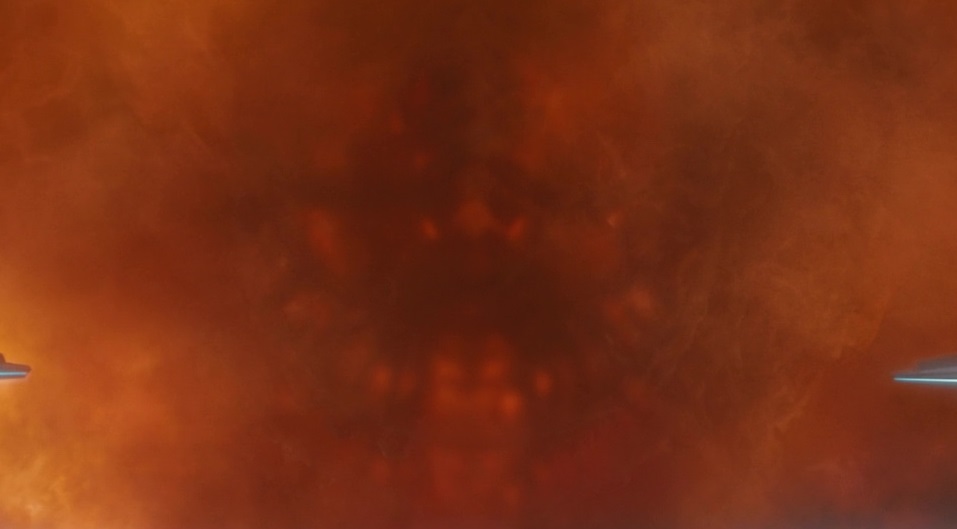
Star Trek: Discovery Season 4 – So who is Ruon Tarka’s “friend?”

Spoiler Warning: There are spoilers ahead for Star Trek: Discovery Seasons 1-4, Star Trek: Picard Season 1, and for other iterations of the Star Trek franchise.

With Discovery taking an unplanned six-week break, we’ve got a little time to settle in and collect our thoughts. The first half of Season 4 has seen some progress toward unravelling the mystery of the dark matter anomaly, but there are still plenty of questions! From this point, the story could go in many different directions, and could potentially make significant connections and crossovers with past iterations of Star Trek. Today, we’re going to consider one such possibility.

In the episode But To Connect, which served as the mid-season finale, Ruon Tarka returned. Tarka is a Risian scientist who had been working on the DMA and who had collaborated with the USS Discovery’s own Paul Stamets in the episode The Examples to build a working scale model of the anomaly. We learned more about him this time, including what he claims to be his motivation for wanting to destroy the DMA while preserving the machine at its centre: he wants to use it to travel to a parallel universe.

Tarka made his first appearance in The Examples.

During a conversation with Book, Tarka claimed that he had “a friend” while he was forced to work for the Emerald Chain. This friend wasn’t mentioned by name, but appears to have been a major motivating factor for Tarka to find a way to cross the divide between universes; to “punch through” as he put it.

This could all be obfuscation on Tarka’s part; a made-up story to help him sink his talons into Book and manipulate him into doing his bidding. Tarka’s plans relied on Book: he needed him to either convince the delegates to approve the use of his weapon, or to use the stolen spore drive to deliver the weapon without Federation help. So we have to acknowledge that possibility.

Stamets and Tarka built a scale model of the DMA.

But I was struck by the way this conversation deliberately kept Tarka’s “friend” hidden from us as the audience. Book asked who the friend was, but Tarka quickly waved away the question. That makes me wonder… who is this friend? And could it be someone we’ve met before – maybe in Discovery, but maybe in a past iteration of Star Trek?

So today we’re going to consider a few possible candidates for Tarka’s friend. Who could this person be, and if they survived their imprisonment with the Emerald Chain, might we be about to meet them?

Tarka and Book aboard Book’s ship.

I can’t decide right now whether Discovery is setting up Tarka to be the main villain for the rest of the season, or whether Captain Burnham and the crew will resolve this storyline within an episode or two before moving back to the DMA and Unknown Species 10-C. Either possibility feels just as likely, so we could perhaps see the Tarka storyline rumble on for much of the second half of the season.

But we’ll have to set that aside for now! I’ve put together a list of candidates for being Tarka’s friend and we’ll go through them one by one. Just remember one thing: I have no “insider information,” and I’m not trying to claim that any of this will actually be included in Star Trek: Discovery. This is speculation and theorising from a fan – and nothing more.

With that caveat out of the way, let’s jump into the list.

Friend #1:
Aurellio

Let’s see… Aurellio is a bona fide scientist. He worked for the Emerald Chain. He and Tarka know one another. And although Aurellio has been mentioned several times this season, we haven’t seen him. Could he be the mysterious friend?

I don’t think so, not unless Tarka is even more devious than we think! Although we haven’t seen Aurellio this season, we’ve heard multiple times that he’s working with Starfleet, and he even built the new spore drive that Book and Tarka used in But To Connect. So unless Tarka has somehow managed to fake Aurellio’s entire existence… I think we can rule him out.

But on the surface, Aurellio fits the bill in some respects! We don’t really know of any other ex-Emerald Chain scientists, so it’s an outside possibility that Aurellio is involved in all of this somehow.

Friend #2:
Altan Inigo Soong

Dr Soong is the son of Data’s creator, and was encountered by Admiral Picard on the planet Coppelius in Et in Arcadia Ego, Part 1 – the first part of the Picard Season 1 finale. As a human from the 24th Century, he shouldn’t still be alive almost eight centuries later, but Dr Soong had plans to transfer his consciousness into a synthetic body. This process was mentioned earlier in Discovery Season 4, as it was used to give Gray a physical body.

If Dr Soong was ultimately successful, it’s possible that his synthetic form survived to the 32nd Century, and he could therefore be Tarka’s friend. He was already a skilled scientist when Picard met him, and with centuries of time to develop his skills he could have proven invaluable to an organisation like the Emerald Chain.

Now we get into abject speculation, but if Unknown Species 10-C turns out to be connected to the super-synths from Picard Season 1, this could give Dr Soong an additional motive for wanting to escape to a parallel universe: he might be aware of the threat they pose to the galaxy and all organic races.

Friend #3:
The Doctor

Nothing that Tarka said about his friend implied that they’re organic – so the Doctor being a hologram shouldn’t count against him! I’ve speculated before that a backup copy of the Doctor could still be alive in the 32nd Century, as we saw in the Voyager Season 4 episode Living Witness. While the Doctor wasn’t a scientist per se, after decades living and working with the Kyrians in the Delta Quadrant he may have broadened his skills.

If the Doctor was re-activated to find a galaxy ravaged by the Burn and all of his friends long gone, he might well want to escape to an alternate reality – there’d be nothing left for him in the prime timeline.

Perhaps the Emerald Chain intercepted his ship while he was on his way from the Delta Quadrant, or perhaps this is a different copy or version of the Doctor altogether from the one we saw in Living Witness. Because of the Doctor’s nature as a hologram, he could have easily survived this long.

Friend #4:
Control

Captain Leland, who had been “assimilated” by the Control AI, was killed at the end of Season 2, and the existence of life in the 32nd Century seems to suggest that Control was permanently shut down shortly after the USS Discovery left. But what if that didn’t happen, or if the shutdown of Control was incomplete?

So far this season we’ve had more mentions of Control – and a greater discussion of the implications of its rise – than we got in the entirety of Season 3. Could that be setting up something big later in the season? Could Tarka’s friend actually be someone that the Control AI “assimilated?”

If so, perhaps Control plans to abandon this universe to find one more easily attacked and dominated – and Tarka may find that his friendship with whomever it is was little more than a ruse.

Friend #5:
Another Ruon Tarka

There are multiple parallel universes – perhaps an infinite number! At least some of those universes contain alternate versions of everyone we’re familiar with: the Mirror Universe and the alternate reality of the Kelvin films being just two examples. So what if Ruon Tarka’s “friend” is, in fact, a parallel universe version of himself?

Tarka was confident that the parallel universe he intends to reach is better than the post-Burn reality he currently inhabits. But how could he possibly know that unless he’d either seen it for himself or met someone from that reality? Though in theory anyone from that universe could be Tarka’s friend, I think someone with the self-assuredness and arrogance of Tarka would be more inclined to trust his own counterpart.

We know that Tarka isn’t bound for the Mirror Universe – at least based on what he told Book. But here’s a spoiler for my next theory post: what if he’s trying to reach the Kelvin timeline? His unnamed friend could be his Kelvin timeline counterpart.

Friend #6:
Michael Burnham

We’re sticking with the parallel universe theme here. If an alternate version of Captain Burnham had somehow crossed into our universe, perhaps she’d been captured by the Emerald Chain and forced to work with Tarka. She might have warmed up to him, telling him of her true origin in a different, better universe.

Burnham has a keen scientific mind, and had she ended up in Emerald Chain captivity they might well have tried to put her to work as a scientist. Discovery has also put Burnham at the centre of big storylines before, such as by making her the Red Angel in Season 2.

The counter-argument to this would be that everyone we met from the Emerald Chain, including Osyraa, Ryn, and Aurellio, didn’t recognise Burnham or claim to have seen her before. It’s possible that they never met her or that she was working in a different lab, but it could also be seen as a mark against this theory. Tarka also suggested that his friend was male, which could also rule out Burnham.

Friend #7:
Dax

Thanks to the inclusion of Gray and Adira, we’ve spent some time with the Trill over the past couple of seasons. Trill symbionts are particularly long-lived, and there’s evidence to suggest that Gray and Adira’s symbiont, Tal, may have been alive in the 24th or 25th Century. It isn’t impossible, then, for the Dax symbiont to have survived to the 32nd Century.

Dax was one character I felt could make a comeback in Season 3. Early trailers dropped hints about the Trill, and bringing back Dax could’ve been a great way for the show to give fans a nod and a wink – but without needing to bring back an actor from the past. The nature of Trill life means that Dax would be in a new host by now – and thus the character could be recast in an easy and inoffensive way.

In Deep Space Nine we saw Dax mostly as a scientist thanks to Jadzia, and while Dax had many different roles over the course of their lifetime, returning to a scientific field is a possibility – certainly if a millennium’s worth of knowledge could be put to use. Dax is also aware, thanks to their adventures with Sisko and others, of the likes of the Mirror Universe.

Friend #8:
Soji

Due to her synthetic nature, Soji is also someone who could potentially still be alive in the 32nd Century. With centuries’ worth of accumulated knowledge under her belt, and a desire to help her people, Soji may have continued the Soongs’ work on cybernetics at some point after her adventures with Admiral Picard.

We haven’t yet seen any Coppelius synths in Discovery’s 32nd Century, and I’d be curious to see what became of them. If they survived and were able to continue to build new synths, there could be a thriving population by now. Many of the synths looked alike, so it’s possible that Tarka’s friend may have a familiar face even if they aren’t a character we’ve met before.

It would be great to get a proper crossover between Discovery and Picard, and this could be one way of doing it. The only drawback is that, because of the difference in time periods, having a character like Soji appear in Discovery would potentially be a limitation on future Picard stories.

Friend #9:
A Borg (or ex-Borg)

Where is the Borg Collective? We haven’t heard so much as a whisper since Burnham and Discovery arrived in the 32nd Century. It’s possible that the Borg have been defeated somehow in the centuries since they last tried to conquer the Federation, but it’s also possible that they’re the mysterious Unknown Species 10-C!

Perhaps Tarka’s friend is a Borg, ex-Borg, or even the Borg Queen, and the Emerald Chain had somehow kept Borg in captivity. It could be that Tarka is the one being manipulated, and his efforts to stop the DMA will allow the Borg to gain control of the power source at its centre.

We saw in Picard Season 1 that Borg technology and components were deemed valuable, such that a black market had sprung up. The Emerald Chain is exactly the kind of immoral faction that might have dealt in harvested Borg implants, and that could explain why they kept Borg captives.

Friend #10:
Gabriel Lorca

Captain Lorca commanded the USS Discovery during the show’s first season – but this character was later revealed to be from the Mirror Universe. The prime timeline version of Captain Lorca has never been found, and despite Admiral Cornwell and others believing that he wouldn’t have survived for long in the Mirror Universe, it’s at least possible that he did.

Or perhaps we’re dealing with another alternate version of Captain Lorca, someone native to the parallel universe that Tarka is attempting to reach.

Regardless, it could be fun to see the crew’s reaction to encountering their old captain! And it would be neat to welcome back Jason Isaacs to Discovery – his performance was one of the highlights of an occasionally rocky first season.

Bonus Friend:
Literally anyone!

Thanks to technobabble, practically any major character from Star Trek’s past could have survived to the 32nd Century. Stasis fields, time-wormholes, transporter accidents, pocket universes, warp bubbles, and many, many different phenomena could be brought in to explain the reappearance of practically anyone.

We already saw an oblique reference to one such method in the episode Stormy Weather. The crew placed themselves in the ship’s transporter buffer in order to survive their dangerous escape from the void – a method employed by Montgomery Scott in The Next Generation Season 6 episode Relics. Could it be that this was more than just a callback to that classic episode, and was the setup for something that will come into play later?

With the exception of those few main characters who had been killed off outright – Captain Kirk, Tasha Yar, Jadzia Dax, and a couple of others – basically anyone could fill this role as Tarka’s friend and make a triumphant return to Star Trek!

So that’s it.

Tarka showed a hologram of the DMA to the assembled diplomats and delegates.

I could be completely over-reaching with this one, but I felt that there was something about the way Tarka refused to name his “friend” in But To Connect that could be significant. Why keep that individual hidden – unless there’s something that’s going to surprise us when they’re ultimately revealed?

We’ve seen the Abronians in cryo-sleep this season, and we’ve seen the crew of the USS Discovery put themselves in suspended animation in the transporter buffer. The DMA also contains a wormhole, a phenomenon that has been used to travel through time in past iterations of Star Trek. Gray used the “Soong method” to acquire a synthetic body. And there have been multiple mentions of parallel universes. Any of these could be hinting at the return of a major character, perhaps someone who used one of these methods to either survive to the 32nd Century or to cross over from their native universe.

So that’s my theory. Ruon Tarka’s “friend” is someone we’ve met before, perhaps someone from Star Trek’s past who we wouldn’t expect to see! Unfortunately we’ve got to wait at least six weeks to see if I’m right!

Star Trek: Discovery Season 4 is currently on hiatus and will return on the 10th of February. The first half of Season 4 is available to stream now on Paramount+ in the United States, Scandinavia, Latin America, and Australia. The show is on Pluto TV in the UK, France, Germany, Italy, and other parts of Western Europe at 9pm on Fridays and Saturdays. Individual episodes or the full season can be purchased on iTunes, Amazon Video, YouTube, and possibly other platforms in the UK, parts of Europe, and select other countries. The Star Trek franchise – including Discovery and all other properties mentioned above – is the copyright of ViacomCBS. This article contains the thoughts and opinions of one person only and is not intended to cause any offence.
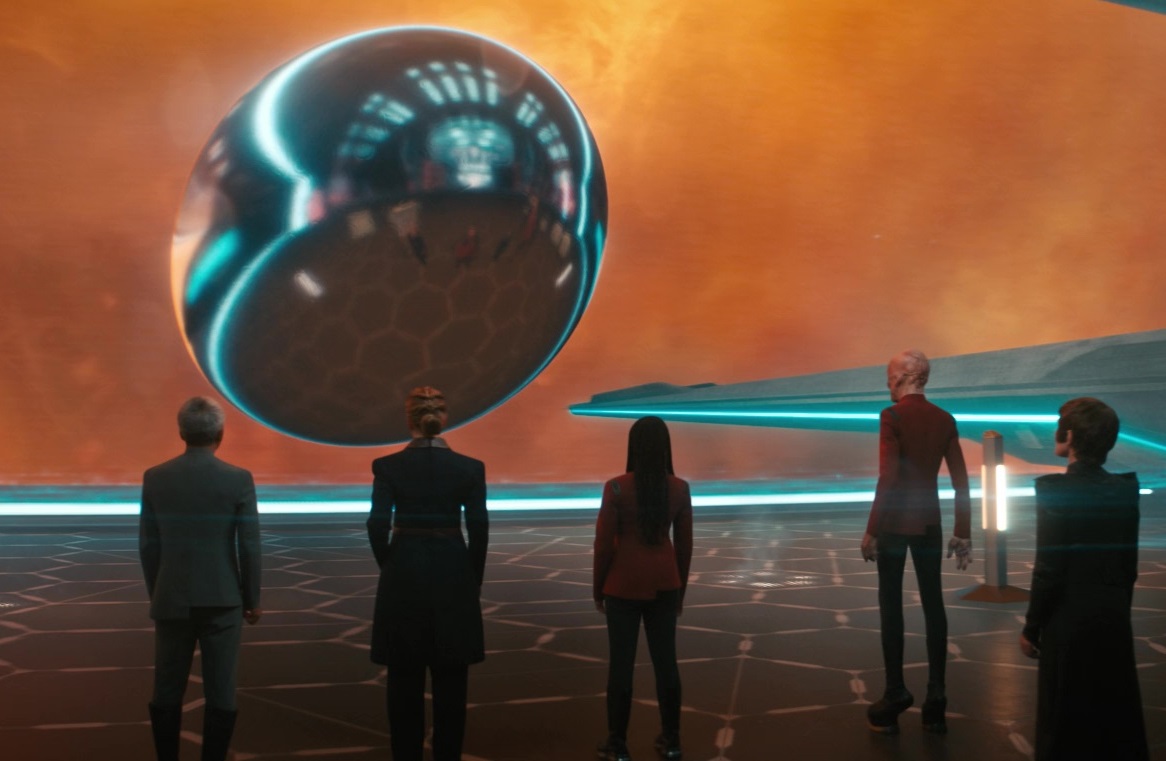
Star Trek: Discovery review – Season 4, Episode 7: …But to Connect

Spoiler Warning: There are spoilers ahead for Star Trek: Discovery Seasons 1-4 and Star Trek: Picard Season 1.

Sorry for being a few days late with this review! I had several other things going on this week, including my big end-of-year article, a piece looking ahead to 2022’s entertainment experiences, and finally a review of The Matrix Resurrections that I worked very hard on. I also hoped to get around to a review of the new Disney film Encanto, but that ended up taking a back seat along with this review of Discovery’s mid-season finale.

As I said last week, I wasn’t exactly thrilled with the way the mid-season break was announced. Doing so on such short notice adds to a growing sense that ViacomCBS and Paramount+ are being very poorly-managed, and while I don’t begrudge the creative team taking additional time to work on or rework episodes in the second half of the season if that work needs to be done, it raises some serious questions about the handling of the Star Trek franchise and the Paramount+ streaming service on the corporate side of things. If ViacomCBS truly aims to compete with the biggest names in streaming, nonsense like this has to stop. In addition, there are still many Trekkies and would-be viewers all around the world who can’t watch Discovery due to corporate bullshit, something else that ViacomCBS needs to fix as quickly as possible.

The opening shot of the episode.

But To Connect worked well as a mid-season finale. It was tense and had moments of high drama that demonstrated beyond any doubt that science fiction doesn’t need to drown in space battles and high-octane action to be exciting. It was also an episode that, unfortunately, made some of its moments of drama feel incredibly contrived.

After everything Michael Burnham went through in her rollercoaster relationship with Ash Tyler in Seasons 1 and 2, giving her the chance to settle down with someone like Book was an incredibly welcome change. Forcing them to go against each other – especially for a central reason that felt contrived in the extreme – would not have been my choice for the direction of their relationship. Discovery has, over the course of its three-and-a-half seasons thus far, felt a need to inject extra drama and extra conflict where none was needed, upping the character stakes to near-soap opera levels at times. Forcing Book and Burnham to work against each other is the latest example of this trend – and it’s a disappointing thing to see.

The last thing Discovery needs is more Burnham relationship drama. Let her settle down, for goodness’ sake.

Book fell under the influence of Ruon Tarka, someone who we’ll have to deal with in more detail in a moment. For now, suffice to say that Tarka pounced on Book’s emotionally compromised state, seemingly manipulating him to advocate for attacking and destroying the DMA instead of pursuing peaceful first contact with whomever created it. Tarka has his reasons for doing this – claiming he wants to preserve the DMA’s power source so he can use it for his own purposes.

Book was clearly not thinking logically – and given his grief and the external prodding by Tarka, that makes sense. But the idea that Burnham couldn’t help him push through that, especially given that the DMA is explicitly stated to not be an immediate threat to anyone, is the point that begins to stretch credulity and make this whole situation feel contrived and forced.

The DMA was not posing an active, imminent threat to anyone.

Here’s the central point: the DMA, despite its potential danger and raw power, hasn’t actually done that much damage. If we assume that Discovery Season 4 has taken place over at least a couple of months of in-universe time, which seems reasonable given how long some of the scientists seem to have been working on these problems, it’s destroyed precisely two places in that time – a rate of one per month. And aside from Kwejian, the only other place we know it’s hit was an asteroid colony with a population of a couple of thousand. The Federation and the rest of the galactic races present at the meeting clearly have time on their side: the DMA’s path doesn’t seem to be taking it near to any inhabited systems in the immediate term, and while its unpredictable nature could see it disappear and reappear somewhere more dangerous, that doesn’t seem to be its primary mission.

If the DMA were a weapon being actively controlled, it would have targeted more places by now, so the Federation’s plan to attempt to contact its creators makes far more sense than attacking it. Even if Book couldn’t understand that at first, being blinded by his grief or desire for revenge, surely of all people Burnham would have been able to convince him to see the logic behind this slower, calmer approach. If the DMA had been actively threatening a planet – especially a named world that we as the audience might be familiar with, such as Betazed or Sigma Draconis III – things would be different. But without that desperate and immediate need to stop another disaster, the rational approach is to try to contact Unknown Species 10-C.

Book fell under the sway of Ruon Tarka – someone who clearly has his own agenda.

Earlier in the season, we saw Burnham advocate a compromise position, and But To Connect should have offered another opportunity to do so: building the weapon capable of destroying the DMA before attempting first contact. If the DMA then changes course and presents an active threat, it can be destroyed. And in addition, having the weapon in reserve while making first contact would be a valuable asset. If Unknown Species 10-C won’t see reason, the weapon could be a threat. If there’s no one there to negotiate with, the DMA could be destroyed. In short, the answer to the pretty basic problem that the episode posed isn’t “do one or the other,” it should have been “do both.” Build the weapon as a back-up while preparing for first contact.

If Discovery hadn’t insisted on themes of compromise across its last two seasons, I guess I’d give it a pass on this false choice. But in context, it seems to run counter to much of what the show has been trying to say for at least the last two years: that there are always solutions to or ways around these kinds of conflicts. The question of how to approach the DMA did not need to be a zero-sum game, and someone like Captain Burnham should have realised that – even if Book couldn’t.

This didn’t need to be a “black or white” choice. Compromise should have been possible; this is a major theme that the show has tried to present all season long.

Not for the first time, I’m left with a sense that Discovery’s writers and producers have a definite goal in mind; an endgame for the story and characters. But they haven’t figured out how to reach that finishing point in a clear and consistent manner, leaving this side of But To Connect feeling contrived.

On the flip side, the speeches that both Book and Burnham gave were very emotional, and I can’t fault the performances of either Sonequa Martin-Green or David Ajala. Both came across as two people trying to do what they genuinely believed was the right thing; conflicted because of what it would mean for their relationship, but determined to press ahead regardless. Although this wouldn’t be the way I would have chosen to handle either character, there can be no denying that the performances were exquisite.

Both actors played their roles exceptionally well.

Also on this side of the story we had a muted role for President Rillak. Though she was on Burnham’s side – wanting to advocate for an attempt at peaceful contact – she chose to recuse herself from the debate, serving as a moderator only. I still get the sense that she has schemes in play – bringing Burnham along as an ally being one of the ways she tried to manipulate proceedings to get her way without being openly involved – but it was interesting to see her in a more centrist, unaffiliated role.

Among her ambitions from the diplomatic summit were showing the Federation as taking the lead in the fight against the DMA, but also opening initial channels to United Earth with a view to bringing the isolationist world back into the fold. We’ve seen a slight softening of Earth’s leadership since Burnham helped reunite Earth and Titan in Season 3, and it was nice to welcome back Phumzile Sitole as the newly-promoted General Ndoye. As a Trekkie, I want more than anything to see Earth rejoin the Federation – but only if it feels right. Earth shouldn’t be manipulated into coming back into the organisation, so this story beat will have to be handled delicately.

General Ndoye represented Earth and Titan at the diplomatic summit.

Ruon Tarka was perhaps the most surprising character in But To Connect. His self-assured cockiness was still there from his role in The Examples, but we got an idea of what could be driving him forward, and where his interest in the DMA may have come from. Stating that he wants to cross over into a parallel universe was certainly not something I expected – but at the same time it felt very familiar, and very Star Trek.

Tarka comes across as somewhat similar to Tolian Soran, the villain from Star Trek: Generations. Soran wanted to return to the Nexus – a paradise-like realm contained inside of an energy ribbon that periodically transited the galaxy. Tarka’s desire to enter the DMA and use its powerful controller to “punch through” to a parallel universe where he expected life to be better is at least somewhat comparable – and his willingness to break the rules and work against Starfleet shows the same kind of single-mindedness that Soran demonstrated.

Tarka is determined to use the DMA controller for his own ends.

We’ll save for my theory post a full discussion of Tarka, his possible motivations, and potential destinations. But suffice to say this character turn has piqued my curiosity. There’s the potential to get a more complex presentation of a “mad scientist” character trope, one which gives him an understandable or even sympathetic motive for his actions. I don’t think we’re at that point yet, but I see potential in this storyline.

Shawn Doyle was wonderful in The Examples, making Tarka stand out as a different take on a character archetype that has appeared on a number of prior occasions in Star Trek. This amazing performance continued in But To Connect, and Doyle deserves a lot of credit for the way he brought the character to screen with complexity – especially given the relatively small amount of screen time that Tarka has had in the season so far.

Tarka and Book formed an unlikely alliance.

As has happened several times already this season, though, Discovery quickly glossed over much of the actual work on the problems and puzzles posed by the DMA in order to get to the dramatic stand-off between Book and Burnham. Tarka’s weapon seemed to come out of nowhere, and although he’s clearly spent weeks or months of off-screen time working on it, in the episode itself it seemed to be a bolt from the blue; almost a deus ex machina solution to the threat posed by the DMA. As I’ve said on several occasions this season, the end result isn’t the problem – it’s that we as the audience really needed to see at least some of the process to get there, even if just by way of something like a montage.

In exactly the same way on the other side of the story, Zora’s discovery of the coordinates of the DMA’s origin was completely blitzed through in order to get to the story that the episode really wanted to tell. When it comes to the DMA, which is the season’s “big bad” at least thus far, Discovery has dedicated precious little time to actually dealing with it head-on, with much of the investigation happening off-screen. As the audience, we’ve been parachuted in just in time to see key moments: Stamets’ proto-wormhole theory, the DMA being an artificial construct, the DMA coming from outside of the galaxy, and now finally the discovery of its origin point. All of these points, so incredibly vital to the story of the DMA, feel like they’re scarcely even footnotes in a story which on the surface should be making more of them.

Captain Burnham, Stamets, and Adira listen to Zora as she refuses to share what she’s learned.

Before anyone jumps in to tell me off for missing the point: I get it. Discovery has other stories to tell, and wants to use this season in particular to look at issues surrounding trauma and grief. Practically all of the main characters seem to embody different responses to trauma: Stamets getting lost in his work, Culber desperately trying to help others even if doing so is at his own expense, Book’s journey through the stages of grief, and Tilly’s career switch all come from that same thematic place. And these individual, character-centric stories are absolutely worth telling. However, in a sci-fi series that also has the DMA as a major plotline, it feels that the first half of Season 4 has prioritised these character moments at the expense of this other major narrative. It should’ve been possible to balance the season’s story to give both appropriate weight and screen time – but Discovery has yet to find that balance.

So let’s tackle Zora next. The USS Discovery’s computer-AI-Sphere data hybrid has been developing slowly since Season 3, and until the very end of The Examples a couple of weeks ago felt like a relatively minor part of the season. Her transformation into basically an additional main character has been an interesting one, and this week was by far Zora’s biggest moment centre-stage. I got echoes of a number of past Star Trek stories – from The Ultimate Computer and The Measure of a Man through to Picard Season 1’s dealings with the synths and Data – in the way Zora was analysed and discussed by Dr Kovich, Dr Culber, Stamets, Adira, and Gray. It was an incredibly honest and frank discussion, one which absolutely embodied the spirit of Star Trek.

Zora’s status and rights were discussed in But To Connect.

Through this side of the story, But To Connect gave us by far the best and most sympathetic presentation of Dr Kovich. I maintain that, based on his earlier appearances, some kind of Section 31 or spy role was a possibility – and maybe that was the original intention for the character when he was created in Season 3. In But To Connect, however, we saw Dr Kovich as a firm believer in the values and ideals of Starfleet and the Federation: determined to seek out new life, and to ensure that very different forms of life have the same rights as everyone else.

Stamets also shone on this side of the story, and the writing here showed off a complexity that the relatively short half-episode runtime could have hampered. Stamets’ attitude toward Zora’s newly developed sentience could have come across badly, making him out to be some kind of “AI-phobe,” in the vein of something like Picard Season 1’s Zhat Vash. However, the way Stamets was handled – aided greatly by a wonderful performance from Anthony Rapp – ensured that we could understand his reservations and concerns without seeing him as some kind of futuristic bigot.

Anthony Rapp gave his best performance of the season so far.

As in All Is Possible, Discovery succeeded at taking a complex argument and ensuring that the views on both sides were sensible and understandable, allowing true understanding and trust to be reached. Likewise this week, Stamets didn’t simply try to put his foot down and declare that the existence of Zora was some kind of horrible, insurmountable problem, and nor did Zora attack Stamets or try to shut down his concerns.

In an increasingly polarised political climate here in the west, where politicians and activists on all sides are increasingly dogmatic and unwilling to listen to opposing points of view, Discovery once again showed us how debate and discussion should be handled: calmly, maturely, and with mutual respect. This is one of the lessons from this season of the show: that we can’t simply write off points of view we disagree with, nor should we try to shut down or dismiss them. Listening is the first step toward understanding.

Despite the stakes and the complexity of the arguments, But To Connect showed us how these kinds of conversations can and should be handled.

From my perspective as someone who’s non-binary, I felt there could be echoes of the real-world conversation surrounding transgender and non-binary folks in the way Zora’s movement toward acceptance was handled. There are many people who are dismissive of trans and non-binary people – something I sadly experienced firsthand recently in a conversation with someone I considered a friend. An unwillingness to listen and a desire to be dismissive of something we personally don’t understand is always going to be a temptation – but Stamets found that, by having a frank and honest conversation, his fears and concerns could be allayed.

There’s been a lot of debate around transgender and non-binary rights in recent years, and the issues of sex, gender, and gender identity have become highly politicised. Zora was struggling to find acceptance in But To Connect, and I felt that the show was perhaps drawing on the trans inclusion discussion for inspiration in this particular storyline. Speaking from a personal perspective, it isn’t easy to figure oneself out. To then present oneself to one’s friends only to be rejected is a horrible feeling – and I’m glad that Zora’s friends were able to remain on her side, even if they had questions about her at first.

It felt like the conversation with Zora may have had a real-world inspiration.

The Zora conversation also tackled the real-world issue of artificial intelligence and the growing impact of machine learning, algorithms, and AI on our daily lives. Star Trek has depicted “evil” AIs on several occasions, including in Season 2 of Discovery, so to take a break from that negative portrayal and to find a way to show AI in a positive light was a welcome change. I’m no longer convinced, for example, that we’ll see Zora go rogue or act against the crew’s wishes later in the season or in future stories; her status as a bona fide member of the crew feels settled.

Stamets was part of that, and voiced his concerns with eloquence before coming around to accepting Zora’s place in the crew. Dr Culber played a role too, as did Gray and Adira. It was very cathartic, after Stamets missed the entirety of Gray’s incorporation a few episodes ago, to see the two characters having the chance to interact. Gray’s future on the show is now uncertain following his departure with Guardian Xi bound for Trill, so it was even more important to give him and Stamets some small crumbs of screen time together.

It was great to finally see Stamets interacting with Gray and Adira.

In a very real sense, But To Connect felt like two distinct episodes haphazardly bolted together. In a longer season, both the conflict at the diplomatic summit and Zora’s moves toward sentience could have been explored while also giving more time to the likes of Tarka and his efforts to untangle the mysteries posed by the DMA. But because Discovery wanted to make a point – not a bad point, I concede – about Starfleet seeking out new life, we got both stories squashed down into the runtime of a single episode. Neither of these stories were bad, nor was the link between them, but the conflict at the summit in particular would have benefitted from additional development, and the incredibly minor side-story about Tarka and the DMA could have been fleshed out a lot more – as could Stamets, Adira, and Zora’s work to find the coordinates.

The similarities between the stories of Zora and the DMA would’ve still worked had they been longer or spread across two episodes, and I guess my big criticism of But To Connect isn’t that I hated or even disliked either, it’s that I would’ve liked to have seen a longer, perhaps slower-paced, version of them. Cutting the conflict between Book and Burnham – or finding a way to resolve it – would also have been a preference.

T’Rina and Tarka view a holo-model of the DMA.

But To Connect told two stories about seeking out new life: the very core of Starfleet’s mission. Zora’s story was the better of the two; it had more nuance, better characterisation, and a truly sympathetic presentation of both sides of the discussion. It dealt with incredibly deep and complex themes in an understandable way, giving rise to a conclusion that felt natural, but most importantly that felt earned.

The diplomatic summit, meanwhile, took what could have been a similar setup but presented it as a false “either-or” choice – a choice that, I would argue, felt unnecessary and thus contrived. Its conclusion, instead of being one that promoted understanding and dialogue, ended with one side claiming total victory and the other suffering defeat. This laid the groundwork for Book and Tarka’s rebellion – stealing a spore drive prototype and flying away to attack the DMA. That ending may have been a natural or inescapable one given the setup, but it didn’t need to be – and it seems to run counter to some very timely and important allegories that Discovery has tried to include this season.

Burnham casting her vote.

A few scattered final thoughts: Discovery seems to be going down the route of some of the ’80s Star Trek films by depicting interesting-looking background aliens… then giving them nothing to do nor even naming them. It would be nice to learn more about some of the galaxy’s races, but just dropping them in the background doesn’t feel like a particularly good way to handle things. The music in But To Connect was probably the best of the season so far, and the score used during the voting scenes in particular was incredibly tense – perfectly complimenting what was happening on screen.

Why does Burnham get a vote? I can understand why each Federation member world might get an individual vote, but giving everyone present the chance to vote could disproportionately favour one side. It feels like it was there for another moment of drama rather than because it makes sense in context.

We saw a full-blooded Cardassian, a Ferengi, and several other familiar races – including one who may be a Xindi. Missing from the summit, however, were races like the Klingons and factions like the Dominion. It’s possible that there have been major structural changes to those governments, or that diplomatic relations with the Federation are poor. Discovery may also be avoiding their use with a view to bringing them back in a future story – or to give room for the likes of Picard or Strange New Worlds to include these factions.

This character was a callback to the events of Kobayashi Maru.

Stamets flipping the issue of trust onto Zora was a clever one, and a great rhetorical way to begin to bring that argument to a close. Dr Kovich’s line that Stamets could have been reassigned if he couldn’t work with Zora was clever – but then who would have operated the Spore Drive? Saru and T’Rina make an adorable couple, and although I wouldn’t consider either Doug Jones or Tara Rosling to be “old,” it was still sweet to see Discovery giving screen time to a burgeoning romance between two people who aren’t 25 any more!

So I think that’s about all I have to say for now. Stay tuned, because later in the week I’ll be writing up my theories for the second half of the season. It’s only six weeks, but I really can’t wait to find out what happens next! The DMA and Unknown Species 10-C still present wonderful mysteries, and although my head says what we’ll ultimately get will be something brand-new to the franchise, my heart is still hopeful that there’ll be some kind of big connection or callback to a past iteration of Star Trek!

Star Trek: Discovery Season 4 is available to stream now on Paramount+ in the United States, Scandinavia, Latin America, and Australia. The show is on Pluto TV in the UK, France, Germany, Italy, and other parts of Western Europe at 9pm on Fridays and Saturdays. Individual episodes or the full season can be purchased on iTunes, Amazon Video, and possibly other platforms in the UK, parts of Europe, and select other countries. The Star Trek franchise – including Discovery and all other properties mentioned above – is the copyright of ViacomCBS. This article contains the thoughts and opinions of one person only and is not intended to cause any offence.
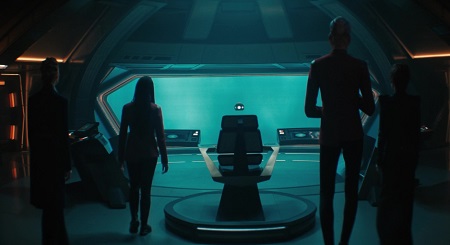
Star Trek: Discovery review – Season 4, Episode 6: Stormy Weather

Spoiler Warning: There are spoilers ahead for Star Trek: Discovery Seasons 1-4.

Last week we learned that the DMA – the anomaly at the heart of Season 4’s story – is an artificial construct. Following up that big revelation was the challenge that befell Stormy Weather and director Jonathan Frakes, and I’m happy to report that Discovery rose to the occasion. Stormy Weather was a tense, dramatic, and incredibly exciting episode, one that has set a high bar for the rest of the season to reach.

Unfortunately, due to inexcusable corporate nonsense from ViacomCBS, Star Trek: Discovery is unavailable to many fans around the world. This short-sighted, self-defeating decision has been rightly condemned by Star Trek fans, but we need to keep the pressure on and continue to call out this misbehaviour at every opportunity. Star Trek is not the sole preserve of any one group of fans – it’s something all of us should be able to enjoy together. Denying that opportunity to even one Trekkie would be unacceptable; to deny it to millions in dozens of countries and territories around the world is just offensive.

Captain Burnham with her family tree.

So let’s take a look at Stormy Weather – an episode named for a song from 1933. There have been some connections between Discovery and sister show Star Trek: Picard, but one of the most unexpected thematic connections came in the form of this song. Picard Season 1 prominently featured the song Blue Skies, written in 1926, and to hear another older, slow-tempo jazz song in Discovery was an unexpected but interesting way to bridge the gap between these two very different parts of the Star Trek franchise.

Stormy Weather featured Captain Burnham prominently, and we’ll look at her contributions in a moment. But where the episode did remarkably well, in my view, was through a series of smaller moments that showed off several members of Discovery’s secondary cast – many of whom have had less to do so far this season than in Season 3 last year.

Several members of the secondary cast (Nilsson pictured) got things to do this week.

Commander Owosekun had a big centre-stage moment, objecting on the bridge in front of her colleagues and leading to a sweet moment later on between her, Detmer, and Saru. Dr Pollard, making her first major appearance of the season, got two significant moments in the spotlight, including one incredibly dramatic moment as a crewman was blown out into space through a hull breach.

Ian Alexander, who plays Gray, and Annabelle Wallis, who voices Zora, were Stormy Weather’s breakout stars for me. Gray had already given us one of the season’s emotional highs when he completed his transfer into a new synthetic body, but there was definitely a question mark surrounding his next steps. Adira was a commissioned ensign, but Gray didn’t really have a role aboard the ship – something that Discovery acknowledged this week when Gray found himself alone in the lounge as the crew scrambled to their posts.

Gray and Zora played Trill chess together.

There’s always something very relatable about this kind of storyline. Anyone who’s ever dealt with feelings of helplessness or loneliness should be able to empathise with Gray in this moment, and it’s certainly something I’ve been through before on more occasions than I perhaps care to admit! As everyone on the ship attended to their duties, Gray was left alone – and this led to a really touching sequence between he and Zora that ended up playing a major role in the story.

Zora was a background presence for much of Season 3, and it was only really last week when the revelation that she can feel emotions came out that she emerged as a major player. Zora’s interactions with Gray this week have done more to humanise her and lay the groundwork for future character development than any episode has since Calypso – and if Discovery chooses to, the show could now make Zora a major presence on the ship going forward.

Gray and Zora played significant roles this week.

I can’t be the only one noticing an homage to 2001: A Space Odyssey, right? Zora’s line to Captain Burnham when she refused to follow an order felt like it had come straight from HAL 9000! Of course, Zora went in a different – and thankfully far friendlier – direction shortly thereafter, but the reference was appreciated nevertheless.

The development of Zora’s emotions brings the character one step closer to her portrayal in the Short Treks episode Calypso, but at this point I’m still not sure how – or even if – the stories will line up. As we’ve discussed previously, for every step made toward Calypso since Season 2 we’ve seen at least one step away – and with Discovery in the far future already, the further development of Zora still leaves the show with significant hurdles to overcome if a full connection to Calypso is on the cards. But I guess that’s a conversation for another time!

“I’m sorry, Dave. I’m afraid I can’t do that.”

Gray and Zora were able to share a connection as two passengers on the ship who felt out of place and unsettled. There was a subtle continuation of the transgender theme present in Gray’s earlier incorporation story, as Gray made reference to choosing his own name; something Zora could relate to. Despite Gray’s incorporation feeling somewhat rushed at the beginning of the season, it’s been great to see him as a character in his own right, able to interact with others aboard the ship. Pairing him up with Zora was unexpected but an absolute delight.

Discovery has continued Star Trek’s use of storytelling by metaphor and analogy, and we see that again with Gray. His struggle to become visible, his comments about getting used to his new body, and again this week through his conversations with Zora all had serious things to say about the difficulty of transitioning, coming out as transgender, finding acceptance, and other trans issues. But they were told through a science fiction lens in the very best tradition of Star Trek. It’s hard to think of a more understandable and relatable depiction of a trans individual in all of entertainment, and the writers deserve a lot of credit – as does Ian Alexander, who stepped up this week and put in his best performance of the season so far.

Stormy Weather was a great episode for Ian Alexander and Gray.

Discovery as a whole is a series with a cinematic feel to it. That isn’t something unique among television shows any more, as we can see many other high-budget productions pushing hard for similar visuals and effects. But Stormy Weather definitely veered hard into the cinematic, with all manner of special effects thrown into the episode’s forty-five minutes. We had silent slow-motion sequences, stunning CGI visual effects – including a striking shot of the USS Discovery itself inside the void, tightly-focused shots of characters in motion, close-ups of faces, and a whole lot of fire and flame to name but a few. Such a varied mix of visuals, coupled with Jonathan Frakes’ clever cinematography, gave Stormy Weather a sense of weight, of gravitas, far beyond what the franchise usually manages outside of its feature films.

Let’s talk about the storyline itself. This week, everything was tied together. There were secondary plotlines with Gray and Zora and with Book, Stamets, and the doctors, but they all came together and connected with the main story in significant ways as Captain Burnham led the USS Discovery inside a subspace rupture that the DMA had left behind.

The USS Discovery approaches the void.

We learned something major about the DMA: that it’s of extragalactic origin, or has, at the very least, passed through the galactic barrier. This would seem to narrow down Unknown Species 10-C to a handful of suspects, assuming that the galactic barrier depicted in past iterations of Star Trek remains generally impermeable to residents of the Milky Way. There were comments from Book and Stamets that this evidence all points to Unknown Species 10-C being someone that “the Federation has never encountered,” but I don’t think we can be certain of that just yet. The Burn seemed to be connected to Ni’Var’s SB-19 project in Season 3… until it wasn’t! We’re barely halfway through the season, so there’s plenty of time for hypotheses to be debunked! In this week’s theory post I’ll go into more detail about what this revelation could mean for Unknown Species 10-C, so stay tuned for that!

Venturing inside a rift in subspace was a dangerous assignment, but one that was certainly necessary for understanding more about the DMA. There really isn’t much to nitpick on this side of the story, and Captain Burnham handled it about as well as any other captain could have. Captains Kirk, Picard, Sisko, Janeway, or Archer would all have made similar choices under the circumstances, and we can point to many moments in past Star Trek shows where similarly dangerous scientific missions have gone awry despite the best efforts of the various captains.

Captain Burnham did everything she could to get her crew home.

Discovery has some very expansive sets when compared to past iterations of Star Trek, with the bridge in particular being larger and wider than basically any other to date. But despite that, this week I felt a real sense of claustrophobia in the style of old war films set aboard submarines. Stormy Weather was basically a bottle show – an episode set almost exclusively aboard the ship making use of existing characters. Rather than that being a limitation, as it sometimes has been in past iterations of Star Trek, the episode leaned into this in the best way possible, drawing on the inherent strengths of that style of story to create a genuinely dark and unsettling atmosphere aboard the ship.

This began with Gray and Zora alone in the lounge and culminated in Captain Burnham staying behind on the bridge, with only Zora for company, as the desperate last-ditch attempt to escape the void came to a head. Discovery has made interesting use of fire this season, and I’ve seen some criticism of the way the pyrotechnics come across on screen. But here, the combination of CGI plasma and jets of real fire worked exceptionally well, building up a sense of genuine danger that Captain Burnham, and indeed the whole crew, were in.

A combination of CGI and pyrotechnics made for a thrilling and dramatic presentation at the episode’s climax.

At this point, after more than three seasons of Discovery, we know that the show has a tendency to blitz through some of the technobabble and sciencey stuff to get to the drama and action, and so it proved again in Stormy Weather. As happened last week, when the DMA’s artificial origin was confirmed in a short scene with a few lines of dialogue, its extragalactic origin was likewise only included in a pretty short sequence. I liked the concept behind it – that the energy surge that hit Book left behind trace particles that could be used to uncover another piece of the puzzle. That setup was interesting. But the conclusion was once again very quick, almost rushed, and I feel more could’ve been made of both of these points.

Another point of criticism I had concerns Dr Pollard’s sequence in the hallway. I said before the season began that killing off a known character can be a great way for a show like Discovery to communicate the stakes involved. And as Dr Pollard raced to the hull breach, there was for a brief moment a feeling that she might’ve been running to her demise. In the end, though, it was a redshirt who ended up being killed – and the death was far less impactful as a result.

More could have been made of this moment.

Now I’m not on some anti-Pollard crusade wishing death upon the character! But hers is the latest example of how Discovery wants to have its cake and eat it too: the writers want all of the emotional impact of a character death but without being willing to commit to making it someone significant. We saw this in Season 2 with Airiam, and again in Season 3 when practically everyone survived despite the dangerous situations the crew found themselves in. The danger in flirting with character deaths but failing to follow through is that the show is slowly building up a sense of plot armour; there’s a developing feeling that basically no one who gets so much as a speaking line in an episode will be in any real danger. And that will have an effect as the season progresses – potentially making similar moments feel less impactful or tense in future episodes.

To be fair, past iterations of Star Trek had this problem too – but television storytelling has evolved since then. In a world where shows like Lost, Game of Thrones, and The Walking Dead pioneered a concept that I call the “disposable cast,” where even major characters can be killed off at the drop of a hat, Star Trek has to take note. Audience expectations are shifting in some respects, and if Discovery wants all of the trappings of modern television storytelling, it has to be willing to boldly swing the proverbial axe on occasion.

This could have been a good moment to kill off a named character instead of a redshirt.

Last week, the addition of wonderful guest star Shawn Doyle as mad scientist Ruon Tarka meant that I didn’t really feel Tilly’s absence. Stormy Weather was different, though, and I think we’re seeing the first real effects of her departure. Tilly suffered with anxiety, and doubtless would have found the void a difficult situation to deal with. But even at her most nervous, she had a way of lightening the mood and ever so slightly lowering the tension. Perhaps a story like Stormy Weather needed her absence to function as intended – and I concede that argument. But at the same time, I look back on the episode and wonder what Tilly might’ve said, how she might’ve found a way to break through some of the more tense moments with Captain Burnham, Stamets, Book, Zora, and everyone else. Adira fills Tilly’s shoes in several key ways – but no one can truly replace the lighthearted energy that she brought to Discovery.

In a fast-paced sequence at the beginning of Kobayashi Maru, we got to see the crew working under Captain Burnham’s command as one well-oiled machine. After that, though, Discovery took the captain on several smaller adventures off to the side, and it wasn’t until Stormy Weather that we saw her in such a tense situation, having to really feel the burden and weight of command. Like Star Trek captains past, she stepped up. I was reminded of the scene in the episode Booby Trap where Captain Picard takes the helm and pilots the Enterprise-D as Captain Burnham arrived on the bridge, alone, to sit in the captain’s chair and guide her ship and crew to safety.

Captain Burnham in her EV suit.

Speaking of The Next Generation, it was neat to see an oblique reference to the episode Relics. In that episode, Scotty was found alive in a transporter pattern buffer, and it was this method that the crew of Discovery were able to use to survive the dangerous journey out of the void. Discovery hasn’t been shy when it comes to harkening back to past iterations of the franchise this season, which has been fun to see. Shooting so far forward in time has expanded the number of callbacks and references that the show is able to do, and the writers – who are clearly big Trekkies themselves – have taken full advantage.

Along with Ian Alexander, we also have to praise Sonequa Martin-Green for her performance this week. Captain Burnham had a complex role this time, one that required her to put any thoughts of failure to one side and to focus on getting her ship and crew to safety. But she also had to find time for empathy, to share her feelings with Zora to help the AI deal with her own newfound emotions. On both sides Sonequa Martin-Green really nailed it, and Stormy Weather is one of the absolute best Captain Burnham episodes as a result.

Stormy Weather really showed off Captain Burnham at her level-headed best.

The themes of trauma, empathy, and unexpected connections were all present in Stormy Weather as they have been all season. This time it was Zora who needed the most help, in a manner somewhat reminiscent of Data in Generations. Developing emotions for the first time led to Zora’s first experience with fear, just as installing his emotion chip did for Data, and both found themselves overwhelmed and struggling to cope. Just as Data’s friends rallied around him, so too Zora found help from both an old friend in Captain Burnham and a new friend in Gray.

It fell to Captain Burnham and, to a lesser but still significant degree, Saru, to remain level-headed as the situation deteriorated. Captain Burnham had to find a way to connect with Zora in order to convince the AI to go through with the plan to escape. Likewise, Saru had to calm Commander Owosekun when tensions on the bridge threatened to boil over. We’re seeing again the very different ways that people respond to trauma: in this case, Zora almost completely shut down, feeling overwhelmed and unable to do anything, whereas Owosekun wanted so badly to do something that she became angry. These themes are almost certainly going to run through the rest of the season, and will go a long way to keeping Discovery grounded in its characters rather than being lost in sci-fi wonders.

Owosekun, Saru, and Detmer on the bridge.

One scene in particular hit close to home for me. After Book had been hit by the energy surge and was recovering in sickbay, he had a moment with Doctors Pollard and Culber where he tried to ask if he was losing his mind, going crazy, and if the hallucinations he was experiencing would last. Having been in a similar position in hospital, struggling and not knowing where my mental health issues began and ended, I found David Ajala’s performance very emotional in that moment.

Book’s hallucination of his father stemmed from the fact that it was his father’s birthday – and we know that mental health issues can absolutely manifest from things someone is already thinking about or dealing with. His line to his father that he hoped he was real, because it would mean his spirit still exists and thus Leto, Kyheem, and others might still exist somehow too, was another deeply emotional line. Though the episode didn’t focus on Book, this presentation took him to completely different emotional places, and I found it resonated with me in a very personal way.

I found Book to be very relatable in this moment.

So I think that’s it for this week. Stormy Weather really has set a high bar for the rest of the season to reach! It would have been easy for an episode like this one to come across as feeling like mind-numbing action, but Discovery’s tight focus on characters and emotions elevated it to being so much more than that. Little moments with the show’s secondary cast were greatly appreciated, and almost everyone got a line or two of dialogue this week. It felt like the plans to escape the void were a real team effort – and not just another “Burnham saves the day” story that we might’ve seen in Seasons 1 or 2.

There was some disappointing news yesterday, though. At the last minute, it’s been announced that Discovery is taking a mid-season break after next week’s episode, going off the air for around six weeks before resuming in February. ViacomCBS and Paramount+ need to do better at communicating with fans, because this is the latest in a long line of unnecessary blunders. Fixing Star Trek’s scheduling conflicts has to be a priority, too – Prodigy only aired four episodes before taking a break, now Discovery gets half a season before it too has to take a break. It’s possible that there are behind-the-scenes delays, perhaps with post-production work on Picard or Strange New Worlds – but it’s not a good look for a company trying to market a big franchise and an expanding streaming platform. Fixing these problems needs to be a priority for Star Trek’s corporate overlords.

Next week looks to bring back Ruon Tarka, which should be a lot of fun! Stay tuned in the days ahead for my updated theory list – including several ideas about the DMA and its possible creators. And if you celebrate, I wish you a very Merry Christmas Eve! I hope your holidays are successful and fun!

Star Trek: Discovery Season 4 is available to stream now on Paramount+ in the United States, Scandinavia, Latin America, and Australia. The show is on Pluto TV in the UK, France, Germany, Italy, and other parts of Western Europe at 9pm on Fridays and Saturdays. Individual episodes or the full season can be purchased on iTunes, Amazon Video, and possibly other platforms in the UK, parts of Europe, and select other countries. The Star Trek franchise – including Discovery and all other properties mentioned above – is the copyright of ViacomCBS. This article contains the thoughts and opinions of one person only and is not intended to cause any offence.
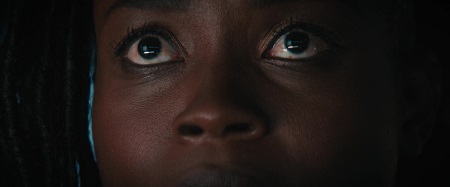
Star Trek: Discovery theories – week 5

Spoiler Warning: There are spoilers ahead for Star Trek: Discovery Seasons 1-4, Star Trek: Picard Season 1, Short Treks, and for other iterations of the Star Trek franchise.

After a couple of weeks where Discovery took character-focused detours, The Examples brought the story right back to the DMA – the dark matter anomaly that’s wreaking havoc across the galaxy. We learned something incredibly significant this week that will most likely have a huge impact on the season’s main storyline… but is everything as it seems?

The biggest question I have right now is about Unknown Species 10-C. Who could they be? And are they a faction we’ve encountered in a past iteration of Star Trek? My heart wants to say they’re someone familiar; that all of the callbacks and references we’ve had in Season 4 so far are building to some kind of big reveal. But my head says “no” – Unknown Species 10-C will turn out to be someone new and unpredictable.

But enough about that for now! We have several theories that were advanced by The Examples this week, as well as one that was debunked and one that was at least partially confirmed. So let’s take a look at those and then get into the main list!

Debunked theory:
Dr Culber will tell Stamets that he needs to slow down.

Stamets and Culber in The Examples.

This one surprised me by being a complete inversion of what I was expecting! After Stamets had seemingly gotten lost in his work, overworking himself desperately trying to figure out the DMA, I felt sure that Dr Culber would have something to say. In Choose To Live, Stamets missed out on Gray’s incorporation, and wasn’t there to support Adira. In All Is Possible, he missed out on talking with Tilly before she left the ship.

I felt that Stamets perhaps needed someone – particularly the man he loves – to intervene and warn him about the dangers of overworking and the family moments he’s been missing. Instead it was Stamets who helped Dr Culber: Discovery’s doctor has been throwing himself into his work, too, neglecting his own mental health for the sake of his patients. It was a neat reversal of a storyline I was expecting – and I think we’ll see more in this vein from Stamets and Culber before the end of the season.

Confirmed theory:
The DMA is a super-weapon.

The moment at which the DMA’s artificial nature was confirmed.

Though it was arguably a conclusion that was arrived at too quickly near the beginning of The Examples, Stamets and Captain Burnham confirmed – thanks to some help from Zora – that the DMA is not a natural phenomenon. Though a natural disaster would have been an interesting story in itself, this always felt like the direction of travel for Discovery, so I wasn’t exactly stunned to learn this!

At present, Captain Burnham and Starfleet are working on the assumption that the DMA is a super-weapon – something I’d been predicting ever since we first heard that some kind of anomaly was going to be a major part of Season 4. Right now, that seems like a logical assumption – and it may very well be true. But as we’ll discuss in a moment, even though the assumption right now is that the DMA is a super-weapon, that may not actually prove to be the case. I can think of several ways in which the DMA could be artificial yet not a weapon! But for now, since Captain Burnham, Admiral Vance, and everyone else on the show are content to assume it’s a super-weapon of some kind, I’m calling this theory confirmed!

So those theories were debunked and confirmed.

Now we’ll get into the main list, beginning with the theories that are either brand-new or which saw significant movement in The Examples.

Theory #1:
The story will connect with the Short Treks episode Calypso.

The USS Discovery in Calypso.

This week we got a few lines from Zora – the USS Discovery’s shipboard AI that we first met in Calypso. Zora was involved in confirming the DMA’s artificial nature, but later in the episode we got something far more significant thanks to a short conversation with Captain Burnham: Zora has begun to experience emotions.

In Calypso, Zora was definitely an emotional life-form, so this evolution in their (her?) personality is a significant step toward Calypso – and one that I hadn’t really considered until after it had happened. Until now, the Zora aboard the USS Discovery had been different from the Zora we’d met in Calypso, but after this week’s episode we’re a big step closer to reconciling the two presentations of the character.

There are still significant hurdles to overcome if the story of Calypso is to be wrapped up in Season 4, though. Obviously we have the timeframe issue: will the USS Discovery be sent back in time, be abandoned, or is Calypso taking place centuries in the future? Then we have the USS Discovery itself – it’s been retrofitted since arriving in the 32nd Century, and now looks very different to how it did in Calypso. Despite all that, however, a connection is one step closer today than it was last week.

Theory #2:
Zora will go rogue.

Zora.

Sticking with Zora, their newfound emotions are a very interesting – and somewhat alarming – addition to the season’s storyline. When Data first installed his emotion chip in Generations, he found the new emotions overwhelming and impossible to cope with at first – could something similar be about to happen to Zora? Will they fail the crew at a key moment? Even worse, might Zora go rogue and become a villain?

The dangerous nature of artificial intelligence has been a theme Star Trek has returned to time and again since The Original Series episode The Ultimate Computer all the way back in 1968. But recent iterations of Star Trek in particular have used narratives involving evil or out-of-control AIs and synthetic life several times: there were the rogue synths and the super-synths in Star Trek: Picard’s first season, and in Discovery’s second season we had the Control AI.

Zora told Captain Burnham of a “recent development” in The Examples.

Captain Burnham seemed concerned at Zora’s newfound emotions, but had other things on her mind so didn’t have time to deal with it then and there. What might be even more concerning, though, is the fact that Zora chose to conceal that fact for a time, choosing not to share their most recent evolution.

Perhaps a storyline like this would feel repetitive coming after Season 2 had to deal with Control. But I think it could be made to work, and it could even be made to fit in with Calypso with a bit of creative writing! Whether this theory comes to pass or not, though, I think we’re going to see something significant from Zora before the end of Season 4.

Theory #3:
The DMA isn’t a super-weapon.

The DMA as seen in Anomaly.

Okay, I know! I just said that the DMA is a super-weapon and patted myself on the back for successfully predicting that story beat months ago! But here’s the thing… the DMA being artificial in nature doesn’t mean that it’s a weapon, despite the assumptions made by Captain Burnham, Admiral Vance, and others.

The DMA could be an out-of-control experiment, perhaps something designed to allow faster-than-light travel without the need for dilithium. Stamets and Ruon Tarka suspect that it possesses the technology to create a synthetic wormhole, something that could be very useful for travelling in a dilithium-poor galaxy.

An accident or an experiment gone wrong would set up a very different kind of story to a super-weapon, one that would replace a villainous adversary with a puzzle of a scientific nature. That could be a fun and interesting way for the season to go – not to mention that it would be subversive and challenging to the audience’s expectations.

Theory #4:
The DMA is a life-form.

The USS Enterprise and V’Ger in The Motion Picture.

The DMA could also turn out to be a life-form in its own right, perhaps a synthetic one or something akin to The Motion Picture’s V’Ger. If that were the case it may not be attacking anyone, but simply exploring or trying to make contact. After all, “they were only trying to communicate” has become a Star Trek trope at this point!

Star Trek has shown us many different forms of synthetic life over the years, and while the DMA would certainly be one of the most unusual, it wouldn’t be entirely without precedent. Seeking out new life is at the very core of Starfleet’s mission, and finding a way to communicate with the DMA and figure out what it wants or needs could be a very interesting story – one about understanding and bridging the chasm between different cultures and societies that Star Trek has always done so well.

Theory #5:
Unknown Species 10-C is a faction from a past iteration of Star Trek.

Could the Borg have built the DMA?

Regardless of the intention behind the DMA, it does indeed appear to be an artificial construct. Whoever created it had a reason for doing so, even if that reason isn’t clear right now! But who could be responsible?

I recently put together a list of suspects, and I strongly encourage you to check out the full list by clicking or tapping here.

If you don’t have time for that, here’s the condensed version: the Borg, the Sphere-Builders from Enterprise, the super-synths from Picard Season 1, the Kelvan Empire, Section 31, and Species 8472 are just some of the possible culprits. For a more detailed version, check out the full list linked above.

Theory #6:
President Rillak knows what the DMA is and may be responsible for its creation.

President Rillak in Kobayashi Maru.

We didn’t see President Rillak this week, though she was briefly mentioned by Admiral Vance. But when I think about the possible suspects for creating the DMA, the Federation – and by extension, President Rillak – are unquestionably on that list.

President Rillak is a cunning, almost Machiavellian politician, willing to do anything to advance what she considers to be the best interests of the Federation. I believe Captain Burnham needs to be very careful with President Rillak. During the events of All Is Possible, working with Captain Burnham was advantageous to the Federation’s president – but I have no doubt that she’d throw Burnham and the USS Discovery under the bus without so much as blinking if she believed it would be to her advantage. Which brings us to the DMA.

President Rillak might know more about the DMA than she’s currently letting on. If the Federation had created a weapon like this, or if it was an experiment gone wrong, covering it up might be her objective even if she wasn’t necessarily the one who ordered the DMA’s creation. Also, with the goal of reuniting the Federation foremost in her mind, President Rillak may prove to be the sort of uncompromising politician who’d willingly unleash destruction upon the galaxy if she believed that doing so would serve a greater purpose.

Theory #7:
Dr Kovich is an agent (or the head) of Section 31.

Dr Kovich in The Examples.

I freely admit that this theory is barely clinging on right now, but I don’t believe it’s been completely disproven just yet! The questions of who Dr Kovich is and what exactly his role is within Starfleet and/or the Federation have no clear answer right now. He’s clearly someone with power and influence, as we’ve seen him working with Admiral Vance and seemingly being able to appoint anyone he chooses to be an instructor at Starfleet Academy. Yet he also seems to have some medical training, serving as a psychologist or counsellor – and it’s in this capacity that we saw him this week.

Because of the unclear nature of his role and the mysterious, stoic presentation from David Cronenberg, Dr Kovich is still an enigma. He’s also the kind of man who could potentially be an agent of Section 31. If it turns out that the Federation, President Rillak, and/or Section 31 are involved with the DMA, perhaps we’ll learn that Dr Kovich is as well. Or perhaps such a storyline will finally put this theory to bed once and for all!

Theory #8:
Captain Burnham and/or the Red Angel suits from Season 2 are connected to the DMA.

Captain Burnham in Anomaly.

Now that we know the DMA is artificial in nature, the question shifts to who built it and why. We’ve covered the idea of it being a weapon or an out-of-control experiment, as well as being a life-form in its own right. It could also be the responsibility of Section 31 or the Federation. But because this is Star Trek: Discovery, a show which likes to put Captain Burnham at the centre of its stories, perhaps there’s a connection to her that we’re missing.

The Red Angel time travel suits from Season 2 were phenomenally powerful machines, capable of generating time-wormholes large enough to transport an entire starship 930 years into the future. We already know that the DMA potentially contains a synthetic wormhole, so it wouldn’t be a huge leap to connect the two. We also don’t know for certain what became of Captain Burnham’s Red Angel suit after the Season 3 premiere. There’s also the faint possibility of a parallel universe Burnham or time travelling Burnham being responsible.

Theory #9:
Stamets and Ruon Tarka will create the DMA.

Stamets, Tarka, and Saru with the DMA model.

I included Stamets and Tarka on my list of suspects a couple of days ago, but they warrant a full entry on the theory list too! In short, we saw Stamets and Ruon Tarka creating a scale model of the DMA in The Examples, and according to Reno their experiment came very close to destroying the entire ship. They were able to perfectly recreate the device at the centre of the DMA, albeit on a smaller scale – so what’s to prevent them from building a full-scale replica?

This theory suggests that they will – somehow – and that doing so will set into motion a chain of events that leads to the creation of the DMA in a kind of time-loop storyline. The DMA’s wormhole-generating technology may give it the ability to travel backwards through time as well as across vast distances, so it seems technologically plausible at the very least.

Tarka and Stamets working on their model.

Ruon Tarka was shown as impatient in The Examples, and in his single-minded pursuit of the DMA he may be willing to take risks – perhaps risks which ultimately lead to the creation of the very anomaly he’s been investigating. How such a story would conclude is up in the air, but I don’t think we can rule it out as a possibility right now.

Personally, I find time-loop paradox storylines to be frustrating – and they can be very difficult to pull off successfully. There’s no beginning point to such a story: the DMA exists because the DMA was created because the DMA exists because the DMA was created… it’s an infinite loop. But we’ve seen Discovery tackle time travel stories like this before – and the pieces seem to be in play right now for this story.

So those theories are new or saw movement this week.

As always, I like to keep all of my theories in one place. So up next we’ll recap all of the other Season 4 theories that are currently in play. I find it helpful to keep the full list going like this – it makes it easier to keep track of all of the theories as they get confirmed or debunked.

Theory #10:
We haven’t seen the last of the Abronians.

I currently have four ideas for different ways that the Abronians – the non-humanoid race that Captain Burnham, Tilly, and the Qowat Milat helped save from cryo-sleep in the episode Choose To Live – could play a further role in Season 4.

Theory #10a:
The Abronians’ homeworld was destroyed by the DMA.

Captain Burnham believes this image depicts a “supernova.”

After arriving at the Abronians’ cryo-ship, Captain Burnham found a stone carving that seemed to depict the destruction of the Abronians’ homeworld. This carving was only shown on screen briefly, but it seemed to show the planet being damaged or destroyed in a large explosion. Burnham credited the planet’s destruction to a “supernova,” and the story then raced ahead.

Considering that the main thrust of the season so far has been about the DMA, perhaps Burnham was incorrect: the Abronian homeworld was destroyed by the anomaly, not a supernova.

Theory #10b:
The Abronians’ homeworld was on the “other side” of the DMA.

Abronian stasis pods.

One clip in the second Season 4 trailer appeared to show Captain Burnham leading the USS Discovery inside the DMA. We don’t yet know what that means, nor to what extent words like “inside” the anomaly or “the other side” of the anomaly are even coherent concepts. But many times in past iterations of Star Trek we’ve seen things like wormholes and gateways to parallel universes. Perhaps the anomaly is something similar – and passing through it leads to a different dimension, parallel reality, or just a faraway region of space.

One thing struck me as odd about the Abronians: the Federation was entirely unaware of them, despite the Abronian cryo-ship being relatively close to Federation space – such that Captain Burnham could reach it using Book’s ship in a short span of time. It’s possible that the Abronians had been asleep for millennia, unnoticed by the Federation and the wider galaxy for all that time. But it’s also at least possible that their cryo-ship is a newcomer to the area. If so, perhaps it arrived here via the DMA.

Theory #10c:
The Abronians will return to help the Federation later in the season.

A deceased Abronian.

One of the themes of Discovery since Season 3 has been connection, including building connections between the Federation and other races and organisations. The Abronians were awoken from cryo-sleep thanks to the interventions of Captain Burnham and Tilly – at least in part – and they may seek to repay the Federation, or Captain Burnham personally, for that help.

We saw this play out last season with Ni’Var; in the season finale Ni’Var ships raced to the Federation’s aid as the Emerald Chain attacked. Perhaps the Abronians will likewise step up to help when the Federation needs allies.

Theory #10d:
The Abronians’ moon-ship may be useful in a later story.

“That’s no moon…”

At this stage I can’t envision precisely what use Captain Burnham and the crew might have for a moon-sized starship… but that doesn’t mean such a need won’t arise! The Abronians’ cryo-ship is huge, and at least superficially seems to have the mass of a moon or small planetoid. If Captain Burnham and the crew needed something that large for some purpose, perhaps they’ll return and either take it or negotiate for it.

As we saw in Choose To Live, the moon-ship was in full working order. All it needed was some extra dilithium to power up and it was perfectly capable of moving under its own power, and its computer systems were still functional. The only system that seemed to have failed was the wake-up timer! So if – for reasons yet unknown – the crew need a huge starship, perhaps we won’t have seen the last of the moon-ship.

Theory #11:
Book will find Kyheem and Leto inside the DMA.

Book and Kyheem in Season 3.

In Star Trek: Generations, Captain Picard encountered Captain Kirk inside the Nexus – despite Kirk being declared “dead” after the Enterprise-B encountered the energy ribbon almost eighty years earlier. We don’t know what the DMA is yet; one of my very early pre-season theories involved the Nexus, but that seems to be debunked already! However, the anomaly’s mysterious nature raises the faint possibility that at least some of those it appears to have “killed” may not be as dead as they first appear.

This theory is, I freely admit, a bit of a long-shot. And it hinges on a fundamental question underlying the story of the season: is there more to the DMA than meets the eye? If the anomaly is just an extreme example of space weather, flitting through Federation space destroying anything unfortunate enough to be in its way, then probably everyone on Kwejian is dead. But if the anomaly harbours some kind of gateway, wormhole, portal, time vortex, or any of the other Star Trek-y technobabble phenomena that we’ve seen across the franchise’s history, then it’s possible that at least some of the folks on Kwejian found themselves transported to whatever realm lies inside of the anomaly.

Theory #12:
Saru will be given the captaincy of the USS Voyager-J.

The USS Voyager-J.

Saru’s future was briefly discussed before he offered to serve as Captain Burnham’s first officer in the episode Anomaly. He has already been offered a command of his own, so Starfleet clearly values his command abilities and experience. President Rillak was seen to be assessing Captain Burnham’s suitability for the captaincy of the USS Voyager-J in Kobayashi Maru… and she mentioned having a shortlist of candidates. Could Saru be on her list?

Several of the qualities that President Rillak said she was looking for in a potential captain seem to apply to Saru. He’s more level-headed, less likely to put himself in a dangerous situation, and more inclined to think of the big picture. He has a weakness when it comes to Kaminar, as we saw toward the end of Season 3, but generally speaking he isn’t someone who lets his emotions get the better of him. His wisdom and calm demeanour could be valuable in the captain’s chair of the Federation flagship. This could also set the stage for his departure from the show, or possibly even for a new show following his adventures aboard his new ship.

Theory #13:
A major character will be killed.

A Starfleet coffin seen in Deep Space Nine.

Season 3 saw a couple of major departures: Mirror Georgiou entered the Guardian of Forever’s portal, and Nhan remained behind aboard the USS Tikhov. Yet despite the dangers the crew faced as they navigated the 32nd Century, battled the Emerald Chain, and figured out the mysteries of the Burn and the Verubin Nebula, only one ally – Ryn – lost their life.

Killing off a character can be an excellent way to communicate the stakes involved if it happens at a relatively early stage. It can also be a storyline that brings a lot of emotion, as we have to say goodbye to a beloved member of the crew.

Spock’s funeral in The Wrath of Khan.

In short, I think there are plenty of reasons on the production side why killing off a major character could make sense in Season 4. Though we’ve already had one departure this season – that of Lieutenant Tilly – I still believe that Discovery could very easily go down this road, especially considering how dangerous the DMA currently is.

For a breakdown of which characters I thought might be in danger before the season premiered, check out my list of “death predictions” by clicking or tapping here.

Theory #14:
There will be a character crossover from a past iteration of Star Trek.

Soji could potentially still be alive in the 32nd Century.

This theory returns from Season 3, where I doggedly clung to it for the entire season!

Discovery’s 32nd Century setting has shot Captain Burnham and the crew far beyond anything in Star Trek’s established canon, and that should mean that practically everyone we remember from other Star Trek shows won’t be around any longer. But this is Star Trek – with some creatively-written technobabble, practically any major character could have survived all the way through to the 32nd Century!

There were several great crossovers during The Next Generation era.

It’s also possible for Captain Burnham to discover the logs of a long-dead officer; someone we as the audience would be familiar with. While this would be less of a “crossover” than if a character from the past could be physically present, it would still be a lot of fun to see!

There are a handful of characters who could have survived to the 32nd Century based on what we know about them from past iterations of the franchise. Included in this category would be people like Soji, Voyager’s Doctor, and a few others. But as we’ve seen in episodes like Relics and even the film Generations, all it would take to make a big crossover happen is some kind of temporal anomaly, stasis field, or other technobabble!

Theory #15:
Michael Burnham won’t remain captain of Discovery.

Burnham in the captain’s chair.

This is a controversial one, so let me just say up front that I’m neither in favour of this theory nor opposed to it – I just think it’s a possibility. As things stand, Discovery has had four different captains across its four seasons. One of the show’s unique points of interest within Star Trek’s broader canon are the very different ways in which these individual captains commanded the ship and crew.

It’s got to be considered at least a possibility, then, that the show will continue this trend. This doesn’t mean Captain Burnham will be killed off; I’d actually argue she’s pretty safe. But there are many different routes to her potentially leaving the ship, such as a desire for freedom that we saw in Season 3, or even perhaps taking up a new, more senior role within Starfleet.

Captain Burnham in The Examples.

If this theory were to come to pass, it would be something I’d expect to see at the very end of the season. Even if Burnham seems 100% committed to her new role as captain, I don’t think it’s a theory we can definitively rule out.

It’s worth mentioning that at time of writing Discovery hasn’t been officially renewed for a fifth season – so all this talk of who’ll be in the captain’s chair by then could be moot! And of course this theory has a very strong counter-argument: that Discovery’s main story arc across its first three seasons can be read as Burnham’s ascent to the captain’s chair.

Theory #16:
The ban on time travel will be explained in more detail.

HMS Bounty was able to travel back in time.

This one is a hope as much as a theory right now! In short, the ban on time travel was introduced early in Season 3 primarily as a way for the writers and producers to avoid questions about why the 32nd Century was so different from how the far future had been depicted in earlier Star Trek productions, as well as to explain things like how the Burn was able to catch the Federation off-guard and why Georgiou couldn’t simply be sent back in time when she needed to.

But the ban itself raises some issues – the biggest one being the lack of detail on how it works and how something like this could possibly be enforced. As I said several times last season, it isn’t possible to just un-invent a technology so useful and powerful as time travel. Even just a few lines of dialogue going into a little more detail on the mechanisms involved in the ban would be really useful.

Theory #17:
The Federation has flouted the ban on time travel.

President Rillak may have tried to circumvent the ban if she felt doing so would be in the Federation’s interest.

Sticking with the time travel ban, another theory I had last season was that the Federation – and Section 31 in particular – might have deliberately flouted the ban and failed to abide by the rules. Someone as straight-laced and committed to Starfleet ideals as Admiral Vance is highly unlikely to have sanctioned such a move, but someone like the shadowy Kovich might have. President Rillak could also be involved.

Obviously the bulk of the season’s story will deal with the DMA. But there’s scope to either talk about the time travel ban in a standalone episode or even tie the two stories together – perhaps the anomaly has been unleashed as a result of unsanctioned time travel.

Theory #18:
The crew will have to defend the Verubin Nebula.

The dilithium planet is vital to the Federation.

The Federation is still in a weakened state, nowhere near as powerful as it once was. The Verubin Nebula is thus a very tempting target for anyone looking to gain an edge in a galaxy where dilithium is still in short supply. As the only known significant dilithium supply, whoever controls the Verubin Nebula will have a massive tactical advantage.

We can compare the Verubin Nebula to Deep Space Nine’s Bajoran wormhole in that respect – it’s a resource of huge strategic importance. Season 3 didn’t show us much about the makeup of the galaxy’s factions outside of the rump Federation and the Emerald Chain, but it’s got to be possible that factions like the Dominion, Klingon Empire, or even the Borg still exist and would want to seize the Verubin Nebula for themselves.

Another view of the planet in the Verubin Nebula.

Season 4 has presented Captain Burnham and the crew with a scientific puzzle: the DMA. But that doesn’t mean there won’t be villains in play, and Discovery has introduced us to several compelling and interesting villains over its first three seasons.

To make a long theory short, it would begin to stretch credulity to think that everyone in the known galaxy would see the Federation rebuilding and having access to dilithium and not want to find out for themselves what’s going on. Once the Verubin Nebula’s existence becomes known, even if the Federation promises to share its bounty with all comers, it seems very likely that someone would want to take control of the dilithium supply for themselves.

Theory #19:
Captain Burnham and the crew will encounter the Klingons.

General Martok, a 24th Century Klingon leader.

By the late 24th Century the Federation and Klingons were firm friends, having been allied for a century and after fighting side-by-side against the Dominion. We don’t know if that alliance endured to the 32nd Century, but it’s certainly plausible to think that it did. The Klingons might even have joined the Federation at some point, and their violent warrior culture may have been significantly pacified.

One thing that could be very interesting to see is how the crew of the USS Discovery – almost all of whom are veterans of the Federation-Klingon war – would respond to that. They’ve worked alongside Klingons like L’Rell before, but many of them still see the Klingons as an old enemy. The story of overcoming that prejudice could mirror episodes like The Wounded from The Next Generation, and would be very interesting to see.

Theory #20:
Some areas of the galaxy – such as the Delta Quadrant – avoided the worst effects of the Burn.

Stamets with a holographic galaxy map in The Examples.

Season 4 touched briefly on the Burn with Su’Kal and Saru in Kobayashi Maru, and may now seek to put last season’s story to bed so it can wrangle with the DMA instead. But one thing I’d be curious to see is the true extent of the disaster – did it reach all four quadrants of the galaxy equally, or did its effects fade out after a certain point? Michael Burnham discovered that the Burn had a point of origin, and that it radiated out from that point like ripples on the surface of water. Ripples eventually diminish, fading away the further they travel, and perhaps that’s true of the Burn as well. There could be whole areas of the galaxy that didn’t even notice the Burn – and maybe the ship and crew will visit one such region.

If the Delta Quadrant was left largely unscathed, for example, what might that mean for the likes of the Borg? It’s possible they aren’t even still around in the 32nd Century, but it’s also possible that they’ve had more than a century to expand and build up their forces while the Federation suffered. To see a full write-up of this theory, click or tap here.

Theory #21:
The Guardian of Forever will be back.

The Guardian of Forever first appeared in The Original Series.

Having reintroduced the Guardian of Forever in Season 3, I wouldn’t be at all surprised to see Discovery return to the Guardian’s planet in Season 4. The DMA is something new and threatening, so it’s possible Captain Burnham might want to ask the Guardian for help or information.

The Guardian of Forever is also the only way we know of at present to travel through time – something that might be necessary if Season 4 makes an attempt to link up with Calypso in a big way. There are many reasons why Captain Burnham might want to revisit the Guardian, and it would be great to bring back actor Paul Guilfoyle, who played the Guardian’s humanoid avatar in Season 3.

So that’s the main theory list.

We also have two production-side theories in play, and I’ll recap those now.

Production-side theory #1:
Tilly’s departure will be permanent.

Tilly’s departure feels permanent.

Mary Wiseman confirmed in an interview with Wil Wheaton on The Ready Room (Discovery’s social media aftershow) that Tilly will be seen again before the end of Season 4. But that doesn’t mean she will be a main character on the show going forward, and her departure feels permanent. Despite that, I’ve seen quite a lot of folks online who don’t believe that Tilly is actually leaving the series – so I wanted to put it out there officially and say that, in my opinion anyway, she is.

Maybe those people know something that I don’t! As I always say, I don’t have any “insider information;” all of this is just speculation on my part. However, I feel that the manner of Tilly’s departure, the fact that she got that emotional sequence with Captain Burnham, a montage showing her leaving the ship, Adira seeming to take over several of her roles, and her departure feeling like the culmination of her arc going back to the latter part of Season 3 all come together to strongly indicate that she won’t be back as a major character. She may yet have a significant role to play in a future Season 4 episode, as has been suggested, but unless Discovery’s writers are really playing with our emotions I believe we’ve seen Tilly’s end as a main character on the show. She may come back in a future Starfleet Academy series, though… so watch this space!

Production-side theory #2:
Star Trek: Discovery isn’t going to be renewed for Season 5.

Is a fifth season going to happen?

Since Discovery debuted in 2017, we’ve known by this point in the season that the show has been renewed. This isn’t one of those “I hate new Star Trek” things that we’ve seen doing the rounds online for years; I adore Discovery and genuinely want to see it continue. But it’s profoundly odd to be nearing the halfway point of Season 4 and to still have had no announcement about Season 5. For comparison, Star Trek: Picard has been renewed for Season 3 even though Season 2 won’t air until next year!

I’m hopeful that this is just a blip; a temporary delay for reasons unknown, and that the show has been renewed for Season 5 already behind-the-scenes. However, when we look back at Star Trek productions in recent years, it was often apparent that production work was quietly ongoing even if there hadn’t been any official word from ViacomCBS. As far as we know at this stage, there’s been no pre-production work on Season 5, let alone any filming taking place in the Toronto area.

Once again this is a “watch this space” kind of theory. I hope I’m wrong… but the lack of any news or even any significant rumours about the show’s future is beginning to have me worried.

So that’s it.

What adventure awaits the crew later this week?

Those are all of the theories that are currently in play as we await Stormy Weather – the sixth episode of Season 4. We’re accumulating quite a few theories, some of which completely contradict one another! So far, Discovery’s fourth season has been an interesting journey. We’ve has some slower character moments, some semi-episodic stories (that may yet come back into play), and some interesting developments in regards to the DMA. As we near the halfway point of the season, there are still many different ways that the story could go.

Stormy Weather looks like it’ll bring back Grudge – I hope the cute little ball of fluff will be okay! A dark matter anomaly is no place for a puss!

Before we go, one final point. I write up these theories because I like Star Trek and I like writing. But for some folks, fan theories can hamper their enjoyment of a film or television show. It’s worth keeping in mind that most of these theories probably won’t pan out, and we have to be prepared for the fact that even the most well-constructed fan theory, no matter how fun and plausible it seems, simply won’t turn out to be true. If you find that speculating and reading theories is beginning to detract from your enjoyment of Star Trek: Discovery – or any other television show or film – it might be a good idea to take a break for a while.

Star Trek: Discovery Season 4 is available to stream now on Paramount+ in the United States, Scandinavia, Latin America, and Australia. The show is on Pluto TV in the UK, France, Germany, Italy, and other parts of Western Europe at 9pm on Fridays and Saturdays. Individual episodes or the full season can be purchased on iTunes, Amazon Video, and possibly other platforms in the UK, parts of Europe, and select other countries. The Star Trek franchise – including Discovery and all other properties mentioned above – is the copyright of ViacomCBS. This article contains the thoughts and opinions of one person only and is not intended to cause any offence.
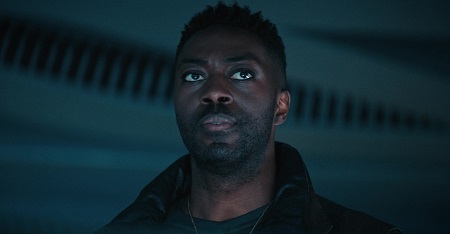
Star Trek: Discovery review – Season 4, Episode 5: The Examples

Spoiler Warning: There are spoilers ahead for Star Trek: Discovery Seasons 1-4, Star Trek: Picard Season 1, and for other iterations of the Star Trek franchise.

The Examples was a stunningly good episode. When the season draws to a close, no matter how key storylines are ultimately paid off, we’ll look back and say this was one of the highlights. This week we got three stories rolled into one, all connected to the DMA in different ways, and we also got the introduction of a wonderfully complex new scientist character played by Shawn Doyle.

Before we go any further, I want to continue to call out the corporate nonsense from ViacomCBS that has prevented Star Trek fans from outside of Europe and North America from being able to watch Star Trek: Discovery. ViacomCBS seems to have no interest in Africa, Asia, or even countries and territories like Ireland or Puerto Rico, and the rollout of Paramount+, which continues at what we might generously call a snail’s pace, means nothing to millions of Trekkies all over the world. Discovery has become one of the most-pirated shows in recent weeks – something that’s entirely the fault of ViacomCBS and their decision to pull the show from Netflix.

The USS Discovery’s main viewscreen as the DMA approaches.

Let’s set that aside for now and talk about The Examples. We’ll begin with the smaller storyline present in the episode: that of Dr Culber and his emotional struggles. For me, these sequences with Dr Culber – and especially his conversations with Stamets – formed the episode’s real emotional heart. There was a moment toward the end between Captain Burnham and a prisoner named Felix that was also emotional, but we’ve known Dr Culber and followed his story for more than three seasons, so I think it’s natural to feel that this was the one that brought the most emotional weight.

I’m increasingly convinced that Discovery’s main characters each embody a different response to grief and trauma. In Tilly’s case, which we saw come to a head last week, she chose to leave the past behind and strike out on her own. In the case of Stamets we see the workaholic, someone willing to set aside much of his personal life and family commitments and throw himself into his work. The same kind of applies to Captain Burnham, though she also embodies the “protective partner” through her relationship with Book. Book, of course, has shown us the depths of depression and grief. And with Dr Culber we have someone who’s dedicated himself to helping others – even if that comes at his own expense.

Dr Culber and Stamets in their quarters.

The scenes between Stamets and Culber were a complete inversion of what I’d been expecting – and I loved every second of it. After Stamets missed Gray’s incorporation and wasn’t there for Adira in Choose To Live, I’d been expecting Dr Culber to be the one to call him out for overworking himself, telling him he missed something important with his family – and with his friend, as he wasn’t really there for Tilly before she left the ship. But instead we got the reverse of that: it was Stamets who had to tell Dr Culber that he’s been the one overworking himself for the sake of the crew.

This moment was absolutely perfect, and I felt it really drove home just how these two came to fall in love in the first place. Stamets and Culber have been Discovery’s emotional core since the show’s first season, but this was the first time we got this level of insight into what brought them together – and what has kept them together even through all the sci-fi adventures they’ve been on.

Stamets and Culber gave the episode heart and emotion.

Kovich – or should that be Doctor Kovich? – continues to confound me. Who is this mysterious man? We’ve seen him seemingly working for Starfleet Intelligence in some capacity, working alongside Admiral Vance at or near the top of the organisation, playing a leading role in Starfleet Academy – including being able to appoint teachers simply on his say-so – and now, in The Examples, he appeared to be acting as a counsellor, therapist, and even psychologist for Dr Culber. I wonder if Discovery plans to nail down Kovich at some point in the future – or if he’ll continue to be used in a variety of roles like this, allowing the lack of a clear explanation or background to provide him with an air of mystery and gravitas. It’s hard to deny that it’s working!

Kovich certainly laid some harsh truths on Dr Culber during their very short session together. And I liked that it came back to what happened to him in Season 2; Dr Culber went through an almost unimaginable experience, one that’s bound to leave emotional wounds. Past iterations of Star Trek were pretty bad at following up with characters who went through what should’ve been traumatic events, so it’s cathartic in a sense to see that the franchise is using its serialised format to right that old wrong.

Kovich offered Dr Culber counselling… of a sort.

Some of the goings-on at the prison felt a little rushed and a little forced. After discovering the existence of the prisoners and finding out that they weren’t scheduled to be rescued, Captain Burnham and the crew seem to have made no efforts to follow that up. Could they, for example, have located the prison guards who were said to have fled? Or sought out someone else capable of opening the prison? I know it’s a bit nit-picky, but going there in person feels like it should’ve been a last resort.

There was definitely an interesting element to the prison stand-off, though, once we got into the meat of this side of the story. I said last week that Captain Burnham has a “moral certainty” to her; she knows what is the right thing to do. This time she came upon two challenges to that morality – and I think in the way she responded to those challenges, we can see how much she’s grown as a character over the past three-plus seasons.

Captain Burnham faced a very difficult choice this week.

Captain Burnham wanted to rescue all of the prisoners. She wanted to do so not only for Book’s sake, as he’d been suffering ever since the destruction of his homeworld, but also because she truly believed in her heart that it was the objectively moral thing to do. The prisoners immediately challenged that, with several of them expressing the desire to be left to die rather than return to confinement. There was a bit of a cliché as we were told that one of the prisoners had “stolen food to feed his family,” but other than that this side of the story felt complex and nuanced.

We also got a glimpse at the kind of clashing of cultures that happens out here in the real world. The Akaali – a race that first appeared in Enterprise – have a very different culture to the Federation, perhaps influenced in part by the Emerald Chain. In this case, their ideas of justice, punishment, and imprisonment seem draconian by Federation standards – and Captain Burnham had to deal with that culture shock.

The Akaali magistrate.

Felix was the most complex of the prisoners, a man who’d killed someone decades earlier and had lived with that regret ever since. Guest star Michael Greyeyes put in a stellar performance as someone not merely resigned to their fate, but actively choosing to embrace it. Felix seemed to truly believe that his punishment or penance for his crime required his own death, and had he survived if the DMA had taken a different path, I believe he would have sought out the Akaali authorities and turned himself in all over again.

His choice was difficult for Book and Burnham, though, who had endeavoured to save all six prisoners. Book appeared to be ready to intervene, saving Felix’s life even if it went against his wishes, but Captain Burnham eventually understood that this was something she had to do. After all the talk earlier in the season about the Kobayashi Maru test and no-win scenarios, here we got to see Captain Burnham confronted with her own small-scale version of that very challenge. She rose to meet it in a way that she would have struggled to in earlier stories.

Leaving Felix behind was a kind of Kobayashi Maru moment for Captain Burnham.

There are many different ways we could read Felix’s story in The Examples. There’s definitely an allegory for imprisonment itself; that prison can have value as a rehabilitative institution. But we can also read Felix’s final choice through a more metaphorical and philosophical lens: it’s a tale about the value of freedom, and the freedom to choose one’s own path and ultimate fate. It’s a story about agency and the right to determine the outcome of one’s own life. Felix could have been “saved,” but doing so would have cost him his freedom in a different way.

This story took what could have been a fairly simple and uninspired plot about rescuing prisoners in a different and unexpected direction, providing some much-needed complexity to Captain Burnham’s side of the episode. It also gave both her and Book an emotional moment toward the end of the episode, with Book in particular believing the decision to leave Felix behind was wrong. And as the audience, we can see both sides of this argument and acknowledge that there’s no objectively right answer. On the one hand, if Felix had been saved he could have found other ways to have meaning in his life or to complete his penance and rehabilitate himself. Giving him that chance, even if it was against his will in that moment, could have paid dividends later. On the other hand, though, Felix was a grown adult of seemingly sound mind, and if this was the choice he freely made, knowing the consequences, does anyone have the right to interfere? It’s a complex story with no easy answer – and this could be a whole essay in itself drawing comparisons with things like the right-to-die movement, suicide, and many more.

Felix made his own decision.

Sonequa Martin-Green played Captain Burnham with real complexity this week, and her performance nailed Burnham’s real struggle with this decision. As recently as the season premiere, Burnham had said to President Rillak that she wasn’t ever willing to leave anyone behind or make this kind of choice; a variation on Captain Kirk’s famous “I don’t believe in no-win scenarios” stance. But something’s changed for Burnham – perhaps the existence of the DMA, or simply the realities of command. This evolution allows her to remain true to herself – she still wants to do the right thing. She just seems willing to consider different perspectives on what is “right,” including those that fall outside of her own interpretation.

So let’s take a look at the biggest revelation in The Examples: the DMA is an artificial creation. This is something I’d been theorising about in one form or another since we first learned of the existence of the anomaly in the first Season 4 teaser trailer earlier in the year, and I don’t think many fans or viewers will have been terribly shocked. A natural disaster angle could’ve worked well for the DMA, presenting Captain Burnham and the crew with a scientific challenge to untangle rather than a villainous adversary to defeat. But that ship has sailed – and really, this is the way I think we all expected Discovery to go with the DMA.

Tarka and Stamets created a scale model of the DMA.

Though this story was great overall, there was one part at the beginning that felt very rushed. After Stamets noticed the DMA disappearing and reappearing, Captain Burnham asked Zora (the ship’s AI) if the DMA could be a natural ocurrence. Zora replied that it couldn’t be, and based seemingly on these two lines alone, the rest of the plot was left to unfold. It just feels far too quick and easy to have gotten a one-line answer from Zora about the nature of the DMA, and I feel it would’ve been nicer to see at least some of the workings that led to that conclusion – perhaps Stamets could’ve said he’d come up with an artificial DMA as a new theory after weeks of work; same result, same short scene, but perhaps a better overall feeling that this wasn’t all based on one very brief analysis.

This second point is really more of a nitpick, but here we go anyway: how did everyone in the galaxy find out that the DMA isn’t a natural phenomenon? If Stamets is leading the charge on this investigation, and he only figured it out with the help of Zora… how did that news get out? Starfleet might’ve wanted to keep a lid on something so explosive, and I can absolutely see someone like President Rillak wanting to keep that news on a need-to-know basis to prevent panic and possible political consequences for the very tenuously-united Federation. Maybe we can excuse it by saying the DMA’s disappearance and reappearance led others to figure it out independently, but again this all happened very quickly at the beginning of the episode. It’s a nitpick, though.

Kaminar – and other worlds – already know that the DMA is artificial.

There were references to past iterations of Star Trek – as well as the video game Star Trek Online – on this side of The Examples. Admiral Vance listed the Metrons, who first appeared in The Original Series episode Arena, the Nacene, who constructed the Caretaker’s Array that pulled the USS Voyager into the Delta Quadrant, and the Iconian Empire, who were believed to be extinct during the events of The Next Generation but ultimately appeared in the aforementioned Star Trek Online.

However, at the end of the episode, Ruon Tarka explicitly ruled out all three of these races as being the culprit. So who is Species 10-C? And perhaps a bigger question is this: will the DMA connect back to a past iteration of Star Trek, or will the storyline follow a similar route to the Burn in Season 3 and ultimately turn out to be something altogether new? Part of me wants to say that we wouldn’t have had all of these teases if there wasn’t going to be some big connection and a big reveal that would be meaningful for us as the audience – the Borg, the super-synths from Picard, or something of that nature. But another big part of me is saying “remember the Burn!” and feels certain that we’re going to encounter someone entirely new.

Admiral Vance has a list of possible culprits… but Ruon Tarka dismissed them.

We’ll save the theorising for later, though, because this side of the episode had far more going on than just that! Shawn Doyle arrived as Ruon Tarka, and he played the arrogant scientist exceptionally well. Tarka is a strangely relatable character – I think a lot of us have known someone who’s so incredibly self-assured and who comes across as very rude and even selfish. Tarka, to my surprise I must admit, backed up his arrogance with genuine skill, and by the end of the episode even Stamets seemed to have warmed up to him!

There’s always going to be the temptation to have a character introduced in this fashion ultimately be proven wrong and get some kind of comeuppance, but what makes Tarka such an interesting and nuanced character is that he really did have the scientific skill and know-how to back up what he was saying; all the trash-talking with Stamets actually led somewhere. We can dislike Tarka for his abrasiveness and the way he was rude with Stamets and Saru, but at the end of the day I’m still left with a strong sense that, arrogant or not, he’s someone I want on my side – especially given the nature of the DMA. Pulling off that balance with a brand-new character isn’t going to be easy to get right, yet Discovery pulled it off thanks to a wonderful guest star.

Ruon Tarka made for a wonderfully complex character.

It was very sweet to get multiple mentions of Aurellio this week. Kenneth Mitchell played the character in Season 3, and even though he wasn’t able to appear in person on this occasion, the fact that Discovery went out of its way to reference the character more than once was incredibly sweet. It’s nice to know that Aurellio still exists in the 32nd Century, and that he’s teamed up with the Federation to help solve the mystery of the DMA. Again, I feel better knowing Aurellio is working on this problem too!

The idea that Stamets and Tarka came up with, to create essentially a scaled-down version of the DMA, was a good one, and it worked well on this side of the story. We got to see the two scientists truly working on the problem, tweaking their theories as they went along. This is the scientific method – having a crazy idea and testing it out! Other sci-fi shows would’ve skipped this step and just brought us the conclusion so we could get into more space battles and laser fights, but one thing I’ve always liked about Star Trek is seeing the characters slow down and take their time working on a problem. Neither Stamets nor Tarka could figure out the DMA instantly – and we’ve seen Stamets working on this problem across several episodes now. They seemed to be close to a breakthrough before the experiment had to be shut down – so perhaps a future episode will pick up that dangling story thread.

Stamets, Tarka, and Saru examine their model of the DMA.

Though she didn’t have many lines, it was great to welcome back Tig Notaro as Reno during this story. Her dry wit cut through what was a very heavy scientific story, and provided some moments of levity that were definitely appreciated. Due to the difficulties of travelling and filming during the pandemic, I already know we aren’t going to get as many Reno appearances as we might want – so it was great to see her on this occasion, and I will definitely savour those light-hearted moments that she brought.

Saru played a guiding role here, ultimately shutting the experiment down as it got too close to the danger zone. But he brought a sense of calmness to the proceedings, something necessary given the hot-headedness of Tarka and Stamets. Seeing him “roar” was definitely something a bit weird… but it was neat nevertheless! Saru was very much back in his element as the senior officer on this side of the story, taking command of the situation but deferring to the scientists as much as possible. Since he underwent the vahar’ai transformation in Season 2, we’ve seen this calmer presentation of Saru. I’ve said this before no doubt, especially during his tenure as captain in Season 3, but he makes for an excellent commander – someone kind of in the mould of Picard as a considerate, level-headed leader.

Saru and Tarka having a stand-off!

So that was The Examples. We’re one step closer to figuring out the DMA thanks to Tarka and Stamets’ dangerous experiment – and I hope to see further progress on that storyline soon! The suspense, not knowing who’s responsible for the DMA or what their goal might be is really pulling me in right now – I desperately want the answers to those huge questions!

Some scattered final thoughts: the USS Janeway was a neat callback to Voyager. We’ve had several references to both Enterprise and Voyager so far this season – could either of those be a tease or indication of the direction of the story? The DMA makes an interesting climate change analogy – something ever-present that our heroes all have to work together to overcome. The episode opened by reminding us that Tilly has gone, and Mary Wiseman is no longer credited in the opening credits – so I think her departure from the series is permanent. I had a horrible feeling that something was going to happen to Rhys as he took a leading role in the evacuation… but luckily he lives to fight another day!

I had a fantastic time with The Examples. It advanced the season’s main story in a huge and very significant way, introduced us to a new scientist character who was a ton of fun, and gave us some cathartic emotional moments with Captain Burnham, Book, Dr Culber, and Stamets. All in all, a truly outstanding episode. I’m tearing my hair out trying to figure out who Species 10-C might be – so stay tuned for my next batch of theories for more on that!

Star Trek: Discovery Season 4 is available to stream now on Paramount+ in the United States, Scandinavia, Latin America, and Australia. The show is on Pluto TV in the UK, France, Germany, Italy, and other parts of Western Europe at 9pm on Fridays and Saturdays. Individual episodes or the full season can be purchased on iTunes, Amazon Video, and possibly other platforms in the UK, parts of Europe, and select other countries. The Star Trek franchise – including Discovery and all other properties mentioned above – is the copyright of ViacomCBS. This article contains the thoughts and opinions of one person only and is not intended to cause any offence.
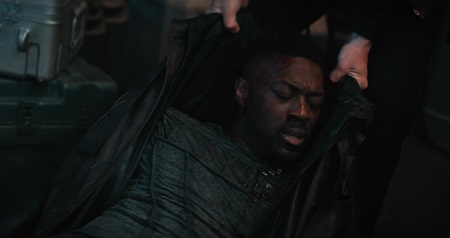
Star Trek: Discovery theories – week 4

Spoiler Warning: There are spoilers ahead for Star Trek: Discovery Seasons 1-4. Spoilers are also present for the following: Star Trek: Picard Season 1, Short Treks, and for other iterations of the Star Trek franchise.

All Is Possible definitely shook up Star Trek: Discovery! It’s an episode which, as things stand anyway, will have major ramifications for the rest of the show’s run thanks to the departure of Lieutenant Tilly. However, with the episode’s trio of stories largely staying away from the DMA (as the gravitational anomaly is now being called) there really aren’t a lot of new theories joining the list on this occasion. The teaser for The Examples has told us that we’re about to see a big return to that storyline, though, and I certainly don’t mind Discovery doing more of these episodic detours!

This week we had one theory that I’m calling semi-confirmed and one theory from way back in Season 3 that’s seen some significant advancement – but that I’m not yet willing to completely strike off the list! We’re also adding two production-side theories to the list for the first time.

Semi-confirmed theory:
Tilly left the USS Discovery.

Tilly is on her way to new adventures.

I’m calling this one semi-confirmed because I speculated about Tilly potentially leaving the ship – but I didn’t guess how soon it would happen or the exact manner of her departure! In the run-up to All Is Possible, my best guess was that whatever was happening with Tilly would rumble on for most of the rest of Season 4, with any potential departure not coming until closer to the end of the season. I certainly didn’t expect to see two “Tilly tries something new” storylines one after the other, and while her departure was very emotional and bittersweet, there was a slight sense that maybe it could’ve been scheduled a little better so we didn’t have both of Tilly’s big Season 4 episodes back-to-back.

I’d previously suggested that Tilly could change departments, resign from Starfleet, or that the character would be killed off by the writers. As it is we kind of got a combination of the first two: Tilly has left the USS Discovery’s science division to move to Federation HQ and teach at Starfleet Academy. She’ll presumably retain her commission as a Starfleet officer even though she isn’t working aboard a starship for the time being.

As I said in my review of All Is Possible, parts of Tilly’s story with the troublesome cadets almost felt like a backdoor pilot for a new series. With a Starfleet Academy show supposedly being worked on, we may not have seen the last of Tilly in Star Trek!

So that theory was semi-confirmed.

Up next we’ve got two production-side (as opposed to in-universe) theories.

Production-side theory #1:
Tilly’s departure will be permanent.

Tilly’s departure feels permanent.

Mary Wiseman confirmed in an interview with Wil Wheaton on The Ready Room (Discovery’s social media aftershow) that Tilly will be seen again before the end of Season 4. But that doesn’t mean she will be a main character on the show going forward, and her departure feels permanent. Despite that, I’ve seen quite a lot of folks online who don’t believe that Tilly is actually leaving the series – so I wanted to put it out there officially and say that, in my opinion anyway, she is.

Maybe those people know something that I don’t! As I always say, I don’t have any “insider information;” all of this is just speculation on my part. However, I feel that the manner of Tilly’s departure, the fact that she got that emotional sequence with Captain Burnham, a montage showing her leaving the ship, Adira seeming to take over several of her roles, and her departure feeling like the culmination of her arc going back to the latter part of Season 3 all come together to strongly indicate that she won’t be back as a major character. She may yet have a significant role to play in a future Season 4 episode, as has been suggested, but unless Discovery’s writers are really playing with our emotions I believe we’ve seen Tilly’s end as a main character on the show. She may, as suggested, be back in a future Starfleet Academy series, though… so watch this space!

Production-side theory #2:
Star Trek: Discovery isn’t going to be renewed for Season 5.

Is a fifth season going to happen?

Since Discovery’s first season in 2017, we’ve known by this point in the season that the show has been renewed. This isn’t one of those “I hate new Star Trek” things that we’ve seen doing the rounds online for years; I adore Discovery and genuinely want to see it continue. But it’s profoundly odd to be basically one-third of the way into Season 4 and to have had no announcement about Season 5. For comparison, Star Trek: Picard has been renewed for Season 3 even though Season 2 won’t air until next year!

I’m hopeful that this is just a blip; a temporary delay for reasons unknown, and that the show has been renewed for Season 5 already behind-the-scenes. However, when we look back at Star Trek productions in recent years, it was often apparent that production work was quietly ongoing even if there hadn’t been any official word from ViacomCBS. As far as we know at this stage, there’s been no pre-production work on Season 5, let alone any filming taking place in the Toronto area.

Once again this is a “watch this space” kind of theory. I hope I’m wrong… but the lack of any news or even any significant rumours about the show’s future is beginning to have me worried.

So those are two theories on the production side of things.

Now we’ll get into the main theory list, beginning with any theories that are new or saw any significant movement in All Is Possible. Then, for the sake of keeping everything in one place, we’ll also recap those theories that didn’t change this week.

Theory #1:
Dr Culber is going to tell Stamets to slow down.

Dr Culber and Stamets in a promo image for The Examples.

Stamets has been almost entirely absent from the past couple of episodes – and in All Is Possible we heard Captain Burnham suggesting that Stamets “won’t slow down,” and is overworking himself as he tries to figure out what’s going on with the DMA. As a result of Stamets dedication to his work, he missed all of Gray’s incorporation in Choose To Live, and we haven’t seen him with Dr Culber, Adira, or Gray since the beginning of the season. He hasn’t even met Gray yet, not properly.

Stamets also didn’t have a chance to speak to Tilly before she left the ship, though he was briefly seen as she departed for Starfleet Academy. In the past, we’ve seen Dr Culber gently remind Stamets that he has other priorities aside from his work, and I’m beginning to wonder if the show is setting up the pair for something similar. I hope we don’t go back to the Season 2 conflict, because that genuinely did not work, but Stamets may need some kind of intervention from the man he loves, pointing out what he’s been missing while he’s been wrapped up in his work.

Theory #2:
President Rillak knows what the DMA is and may be responsible for its creation.

President Rillak in Kobayashi Maru.

All Is Possible continued a trend that we’ve seen across the opening episodes of Season 4, showing us that President Rillak is a cunning, almost Machiavellian politician, willing to do anything to advance what she considers to be the best interests of the Federation. By bringing Burnham and Saru along to the Ni’Var negotiations she hoped to find a solution to a diplomatic impasse she knew was coming – and she succeeded.

As I said in my review, I believe Captain Burnham needs to be very careful with President Rillak. During the events of All Is Possible, working with Captain Burnham was advantageous to the Federation’s president – but I have no doubt that she’d throw Burnham and the USS Discovery under the bus without so much as blinking if she believed it would be to her advantage. Which brings us to the DMA.

President Rillak with Captain Burnham.

President Rillak might know more about the DMA than she’s currently letting on. If the Federation had created a weapon like this, or it was an experiment gone wrong, covering it up might be her objective even if she wasn’t necessarily the one who ordered the DMA’s creation. President Rillak herself is a character with depth, not simply an “evil admiral” character trope. But it wouldn’t be the first time that Discovery has presented us with a fairly hard-line character in a position of authority who turns out to be concealing a dark secret.

We’ll consider in a moment a few other possible candidates for creating the DMA – if it turns out to be an artificial creation. But the Federation – and by extension, President Rillak – have to be possible contenders too. Season 3 of Discovery showed us the Federation at its weakest, but also arguably as an organisation that was still virtuous at its core. In contrast, we have Season 2’s depiction of Starfleet: reliant on the shady Section 31 and their AI. In short, it wouldn’t be unthinkable for Discovery to go back to that kind of presentation.

Theory #3:
Kovich is an agent (or the head) of Section 31.

Kovich in All Is Possible.

This is the theory that’s hanging on by a thread right now! Ever since we met the mysterious Kovich in Season 3, I’ve felt sure that there was something going on with him. His mannerisms, the way he seemed to know more than he was willing to share, and particularly the way he dealt with Empress Georgiou all contributed to that. I began to suspect that he could be an agent – or even the head – of Section 31, the shadowy off-the-books intelligence division that has done some very dubious things!

All Is Possible showed us a different presentation of Kovich. Referred to as Doctor Kovich for the first time, he seems to be playing a senior role in the running of Starfleet Academy. That doesn’t necessarily preclude him working for Section 31, but it is the most significant move away from this theory that we’ve seen so far.

Kovich in Season 3.

It may yet be revealed that Dr Kovich played a role in Tilly’s away mission going so badly wrong, but I suspect if that had been going to happen we’d have seen it in All Is Possible. David Cronenberg plays the character very stoically, which I think adds to that mysterious sense that has been present since Season 3. In All Is Possible, that contributed somewhat to the sense that he may have known what was going to happen.

If it turns out that the Federation and/or President Rillak are involved somehow with the DMA, maybe Dr Kovich is aware of what’s going on. If he’s involved with Section 31, it may turn out that the organisation has important information about the DMA or even knows how to prevent it from doing any more harm.

So those theories were new or saw movement this week.

Now, as always, we’ll recap all of my other Discovery Season 4 theories. I find it helps to keep the full list in one place; it makes it easier to strike off theories when they’ve been debunked or confirmed, and it means nothing gets forgotten about or left behind! At least, that’s the plan!

Theory #4:
The Guardian of Forever will be back.

The Guardian of Forever first appeared in The Original Series.

Having reintroduced the Guardian of Forever in Season 3, I wouldn’t be at all surprised to see Discovery return to the Guardian’s planet in Season 4. The DMA is something new and threatening, so it’s possible Captain Burnham might want to ask the Guardian for help or information.

The Guardian of Forever is also the only way we know of at present to travel through time – something that might be necessary if Season 4 makes an attempt to link up with Calypso in a big way. There are many reasons why Captain Burnham might want to revisit the Guardian, and it would be great to bring back actor Paul Guilfoyle, who played the Guardian’s humanoid avatar in Season 3.

Theory #5:
Some areas of the galaxy – such as the Delta Quadrant – avoided the worst effects of the Burn.

The USS Voyager traversed the Delta Quadrant.

Season 4 touched briefly on the Burn with Su’Kal and Saru in Kobayashi Maru, and may now seek to put last season’s story to bed so it can wrangle with the DMA instead. But one thing I’d be curious to see is the true extent of the disaster – did it reach all four quadrants of the galaxy equally, or did its effects fade out after a certain point? Michael Burnham discovered that the Burn had a point of origin, and that it radiated out from that point like ripples on the surface of water. Ripples eventually diminish, fading away the further they travel, and perhaps that’s true of the Burn as well. There could be whole areas of the galaxy that didn’t even notice the Burn – and maybe the ship and crew will visit one such region.

If the Delta Quadrant was left largely unscathed, for example, what might that mean for the likes of the Borg? It’s possible they aren’t even still around in the 32nd Century, but it’s also possible that they’ve had more than a century to expand and build up their forces while the Federation suffered. To see a full write-up of this theory, click or tap here.

Theory #6:
Captain Burnham and the crew will encounter the Klingons.

General Martok, a 24th Century Klingon leader.

By the late 24th Century the Federation and Klingons were firm friends, having been allied for a century and after fighting side-by-side against the Dominion. We don’t know if that alliance endured to the 32nd Century, but it’s certainly plausible to think that it did. The Klingons might even have joined the Federation at some point, and their violent warrior culture may have been significantly pacified.

One thing that could be very interesting to see is how the crew of the USS Discovery – almost all of whom are veterans of the Federation-Klingon war – would respond to that. They’ve worked alongside Klingons like L’Rell before, but many of them still see the Klingons as an old enemy. The story of overcoming that prejudice could mirror episodes like The Wounded from The Next Generation, and would be very interesting to see.

Theory #7:
The crew will have to defend the Verubin Nebula.

The dilithium planet is vital to the Federation.

The Federation is still in a weakened state, nowhere near as powerful as it once was. The Verubin Nebula is thus a very tempting target for anyone looking to gain an edge in a galaxy where dilithium is still in short supply. As the only known significant dilithium supply, whoever controls the Verubin Nebula will have a massive tactical advantage.

We can compare the Verubin Nebula to Deep Space Nine’s Bajoran wormhole in that respect – it’s a resource of huge strategic importance. Season 3 didn’t show us much about the makeup of the galaxy’s factions outside of the rump Federation and the Emerald Chain, but it’s got to be possible that factions like the Dominion, Klingon Empire, or even the Borg still exist and would want to seize the Verubin Nebula for themselves.

Another view of the planet in the Verubin Nebula.

Season 4 has presented Captain Burnham and the crew with a scientific puzzle: the DMA. But that doesn’t mean there won’t be villains in play, and Discovery has introduced us to several compelling and interesting villains over its first three seasons.

To make a long theory short, it would begin to stretch credulity to think that everyone in the known galaxy would see the Federation rebuilding and having access to dilithium and not want to find out for themselves what’s going on. Once the Verubin Nebula’s existence becomes known, even if the Federation promises to share its bounty with all comers, it seems very likely that someone would want to take control of the dilithium supply for themselves.

Theory #8:
The story will connect with the Short Treks episode Calypso.

Craft, the protagonist of Calypso.

Despite a handful of moments in Season 3 which seemed to connect to Calypso, the story of the season overall ended up going in a very different direction. While we saw a couple of things that arguably did tie in to the Short Treks episode, major things like the USS Discovery undergoing a refit have actually moved the plot even further away.

It’s possible that Calypso will forever remain an outlier in Star Trek’s canon – an episode tied to a vision of Season 2 or Season 3 that was changed before it made it to screen. But earlier in Season 3 it felt like we were getting close to seeing how it could all be tied together – and I’m hopeful that Season 4 will find a way to do so.

Theory #9:
The ban on time travel will be explained in more detail.

The USS Enterprise was able to travel back in time to the 20th Century from the 23rd without too much difficulty.

This one is a hope as much as a theory right now! In short, the ban on time travel was introduced early in Season 3 primarily as a way for the writers and producers to avoid questions about why the 32nd Century was so different from how the far future had been depicted in earlier Star Trek productions, as well as to explain things like how the Burn was able to catch the Federation off-guard and why Georgiou couldn’t simply be sent back in time when she needed to.

But the ban itself raises some issues – the biggest one being the lack of detail on how it works and how something like this could possibly be enforced. As I said several times last season, it isn’t possible to just un-invent a technology so useful and powerful as time travel. Even just a few lines of dialogue going into a little more detail on the mechanisms involved in the ban would be really useful.

Theory #10:
The Federation has flouted the ban on time travel.

President Rillak may have tried to circumvent the ban if she felt doing so would be in the Federation’s interest.

Sticking with the time travel ban, another theory I had last season was that the Federation – and Section 31 in particular – might have deliberately flouted the ban and failed to abide by the rules. Someone as straight-laced and committed to Starfleet ideals as Admiral Vance is highly unlikely to have sanctioned such a move, but someone like the shadowy Kovich might have. President Rillak could also be involved.

Obviously the bulk of the season’s story will deal with the DMA. But there’s scope to either talk about the time travel ban in a standalone episode or even tie the two stories together – perhaps the anomaly has been unleashed as a result of unsanctioned time travel.

Theory #11:
Burnham won’t stay in the captain’s chair.

Captain Burnham in All Is Possible.

This is a controversial one, so let me just say up front that I’m neither in favour of this theory nor opposed to it – I just think it’s a possibility. As things stand, Discovery has had four different captains across its four seasons. One of the show’s unique points of interest within Star Trek’s broader canon are the very different ways in which these individual captains commanded the ship and crew.

It’s got to be considered at least a possibility, then, that the show will continue this trend. This doesn’t mean Captain Burnham will be killed off; I’d actually argue she’s pretty safe. But there are many different routes to her potentially leaving the ship, such as a desire for freedom that we saw in Season 3, or even perhaps taking up a new, more senior role within Starfleet.

Captain Burnham in Anomaly.

If this theory were to come to pass, it would be something I’d expect to see at the very end of the season. Even if Burnham seems 100% committed to her new role as captain, I don’t think it’s a theory we can definitively rule out.

It’s worth mentioning that at time of writing Discovery hasn’t been officially renewed for a fifth season – so all this talk of who’ll be in the captain’s chair by then could be moot! And of course this theory has a very strong counter-argument: that Discovery’s main story arc across its first three seasons can be read as Burnham’s ascent to the captain’s chair.

Theory #12:
There will be a character crossover from a past iteration of Star Trek.

Spock has appeared in several different Star Trek productions.

This theory returns from Season 3, where I doggedly clung to it for the entire season!

Discovery’s 32nd Century setting has shot Captain Burnham and the crew far beyond anything in Star Trek’s established canon, and that should mean that practically everyone we remember from other Star Trek shows won’t be around any longer. But this is Star Trek – with some creatively-written technobabble, practically any major character could have survived all the way through to the 32nd Century!

Riker has appeared in more Star Trek spin-offs than any other character.

It’s also possible for Captain Burnham to discover the logs of a long-dead officer; someone we as the audience would be familiar with. While this would be less of a “crossover” than if a character from the past could be physically present, it would still be a lot of fun to see!

There are a handful of characters who could have survived to the 32nd Century based on what we know about them from past iterations of the franchise. Included in this category would be people like Soji, Voyager’s Doctor, and a few others. But as we’ve seen in episodes like Relics and even the film Generations, all it would take to make a big crossover happen is some kind of temporal anomaly, stasis field, or other technobabble!

Theory #13:
A major character will be killed.

A Starfleet coffin seen in Deep Space Nine.

Season 3 saw a couple of major departures: Mirror Georgiou entered the Guardian of Forever’s portal, and Nhan remained behind aboard the USS Tikhov. Yet despite the dangers the crew faced as they navigated the 32nd Century, battled the Emerald Chain, and figured out the mysteries of the Burn and the Verubin Nebula, only one ally – Ryn – lost their life.

Killing off a character can be an excellent way to communicate the stakes involved if it happens at a relatively early stage. It can also be a storyline that brings a lot of emotion, as we have to say goodbye to a beloved member of the crew.

Spock’s funeral in The Wrath of Khan.

In short, I think there are plenty of reasons on the production side why killing off a major character could make sense in Season 4. Though we’ve already had one departure this season – that of Lieutenant Tilly – I still believe that Discovery could very easily go down this road, especially considering how dangerous the DMA currently is.

For a breakdown of which characters I thought might be in danger before the season premiered, check out my list of “death predictions” by clicking or tapping here.

Theory #14:
The DMA is a superweapon.

One view of the DMA.

We touched on this theory above when we considered the Federation’s possible complicity in the creation of the DMA, but there are many other ways such a story could pan out. The DMA’s unpredictable nature, as noted by Tilly and Saru at the end of Anomaly, could imply that there’s an intelligence at work dictating its moves. This could be the DMA itself if it’s sentient (or contains a sentient life-form) but it could also be the case that it’s being controlled or manipulated by something or someone externally.

If the anomaly turns out not to be a natural phenomenon, and is indeed deliberately targetting the Federation, who might the possible culprits be? And what would be the purpose behind attacking the Federation in this manner? If it’s the precursor to an invasion, perhaps later in the season we’ll see whoever is responsible making their next move.

Theory #14a:
The Borg are responsible.

The Borg Queen.

We don’t know whether the Borg Collective still exists in the 32nd Century; it hasn’t even been mentioned since the USS Discovery’s arrival. However, few other established factions seem capable of creating a weapon on the scale of the DMA. This wouldn’t be in line with the Borg’s usual modus operandi, as they prefer to assimilate rather than attack from afar. But a lot may have changed in the centuries since we last encountered them, meaning this could be the opening salvo of a Borg attack… or the last gasp of a dying Collective.

Theory #14b:
The super-synths from Picard Season 1 are responsible.

Some very menacing-looking synthetic tentacles.

We still don’t know very much about the super-synths that Soji and Sutra attempted to contact in the Season 1 finale of Star Trek: Picard. Other than claiming to offer support and help to synthetic life, what are their goals and motivations? Was their offer even genuine, or was it a trap? The mechanical tentacles glimpsed in Picard Season 1 looked terrifying! Moreover, we know that the super-synths have the technology to move stars – something only possible with an advanced understanding of gravity. Creating a stable 8-star octonary system is an incredible technological and gravitational feat, so they have precedent of a sort when it comes to working with gravity. Finally, Discovery Season 4 has already made connections with Picard Season 1: the Qowat Milat and the synth transfer process used for Gray.

Theory #14c:
The Kelvan Empire is responsible.

Rojan, a representative of the Kelvan Empire.

This one might seem to come completely out of the blue! In The Original Series, Captain Kirk met representatives of the Kelvan Empire, a faction originally from the Andromeda galaxy. Seeking a new home, a Kelvan scouting party had reached the Milky Way and were looking for worlds to conquer. Kirk would ultimately dispatch an unmanned starship offering to help the Kelvan Empire find new worlds to settle – but what if his offer was rejected? Given the vast distances and travel time involved, the timelines kind of line up for the Kelvan Empire to return to the Milky Way.

Theory #14d:
The Sphere-Builders from Enterprise are responsible.

A Sphere-Builder seen in Enterprise.

A defeated faction in one of the Temporal Wars, the Sphere-Builders initially hoped to convert a large swathe of the Alpha Quadrant to match their native extradimensional realm, and constructed a number of large space stations known as Spheres to facilitate this transformation. Crewman Daniels would tell Captain Archer that the Sphere-Builders were defeated in the 26th Century, but could they have since rebuilt? The DMA isn’t necessarily the same as what they were trying to do with the Spheres, but they’re one of the few factions in Star Trek that might be capable of creating a weapon on this scale.

Theory #15:
Saru will be given the captaincy of the USS Voyager-J.

The USS Voyager-J.

Saru’s future was briefly discussed before he offered to serve as Captain Burnham’s first officer in the episode Anomaly. He has already been offered a command of his own, so Starfleet clearly values his command abilities and experience. President Rillak was seen to be assessing Captain Burnham’s suitability for the captaincy of the USS Voyager-J in Kobayashi Maru… and she mentioned having a shortlist of candidates. Could Saru be on her list?

Several of the qualities that President Rillak said she was looking for in a potential captain seem to apply to Saru. He’s more level-headed, less likely to put himself in a dangerous situation, and more inclined to think of the big picture. He has a weakness when it comes to Kaminar, as we saw toward the end of Season 3, but generally speaking he isn’t someone who lets his emotions get the better of him. His wisdom and calm demeanour could be valuable in the captain’s chair of the Federation flagship. This could also set the stage for his departure from the show, or possibly even for a new show following his adventures aboard his new ship.

Theory #16:
The DMA is (or contains) a sentient life-form.

Another view of the DMA.

“It was only trying to communicate!” has become a Star Trek cliché, often used to describe how the seemingly-aggressive actions of an alien life-form are actually something innocuous. Maybe the same is true of the DMA: at its core is a life form, perhaps one not dissimilar to the Sphere seen in Season 2, and it’s on its own mission of exploration.

V’Ger from The Motion Picture is an interesting comparison. Like the DMA, V’Ger was massive in size, capable of destroying space stations, fleets of ships, and even threatening to destroy entire planets. When Admiral Kirk and the crew of the Enterprise were able to figure out V’Ger, however, they found a life-form at its core, one which was just as curious to learn and grow as they were.

Theory #17:
Book will find Kyheem and Leto inside the DMA.

Leto as seen in Book’s memory.

In Star Trek: Generations, Captain Picard encountered Captain Kirk inside the Nexus – despite Kirk being declared “dead” after the Enterprise-B encountered the energy ribbon almost eighty years earlier. We don’t know what the DMA is yet; one of my very early pre-season theories involved the Nexus, but that seems to be debunked already! However, the anomaly’s mysterious nature raises the faint possibility that at least some of those it appears to have “killed” may not be as dead as they first appear.

This theory is, I freely admit, a bit of a long-shot. And it hinges on a fundamental question underlying the story of the season: is there more to the DMA than meets the eye? If the anomaly is just an extreme example of space weather, flitting through Federation space destroying anything unfortunate enough to be in its way, then probably everyone on Kwejian is dead. But if the anomaly harbours some kind of gateway, wormhole, portal, time vortex, or any of the other Star Trek-y technobabble phenomena that we’ve seen across the franchise’s history, then it’s possible that at least some of the folks on Kwejian found themselves transported to whatever realm lies inside of the anomaly.

Theory #18:
Captain Burnham and/or the Red Angel time travel suits from Season 2 are connected to the DMA.

We don’t really know what happened to the Red Angel suit after this moment.

I’m not sure that this one is particularly likely, but as I said last year about a possible Burnham connection to the Burn, not only does Discovery kind of have a precedent for telling this kind of story, but there would also be something very dramatic about this revelation. In this case, Burnham would be indirectly and unknowingly responsible for creating something devastatingly damaging. How would she react to that, and how would Book react given what happened to Kwejian?

Perhaps the Red Angel suit, which Burnham sent back in time in the Season 3 premiere, malfunctioned somehow, and its powerful wormhole-creating technology gave rise to the DMA. If the Red Angel suit completed its journey back to the 23rd Century, the anomaly may have had centuries to grow and expand unchecked. If time travel is involved, perhaps a future Captain Burnham or a parallel universe Captain Burnham could be responsible for the anomaly’s creation – either intentionally or not.

Theory #19:
We haven’t seen the last of the Abronians.

I currently have four ideas for different ways that the Abronians – the non-humanoid race that Captain Burnham, Tilly, and the Qowat Milat helped save from cryo-sleep in the episode Choose To Live – could play a further role in Season 4.

Theory #19a:
The Abronians’ homeworld was destroyed by the DMA.

Captain Burnham believes this image depicts a “supernova.”

After arriving at the Abronians’ cryo-ship, Captain Burnham found a stone carving that seemed to depict the destruction of the Abronians’ homeworld. This carving was only shown on screen briefly, but it seemed to show the planet being damaged or destroyed in a large explosion. Burnham credited the planet’s destruction to a “supernova,” and the story then raced ahead.

Considering that the main thrust of the season so far has been about the DMA, perhaps Burnham was incorrect: the Abronian homeworld was destroyed by the anomaly, not a supernova.

Theory #19b:
The Abronians’ homeworld was on the “other side” of the DMA.

The USS Discovery approaches the DMA.

One clip in the second Season 4 trailer appeared to show Captain Burnham leading the USS Discovery inside the DMA. We don’t yet know what that means, nor to what extent words like “inside” the anomaly or “the other side” of the anomaly are even coherent concepts. But many times in past iterations of Star Trek we’ve seen things like wormholes and gateways to parallel universes. Perhaps the anomaly is something similar – and passing through it leads to a different dimension, parallel reality, or just a faraway region of space.

One thing struck me as odd about the Abronians: the Federation was entirely unaware of them, despite the Abronian cryo-ship being relatively close to Federation space – such that Captain Burnham could reach it using Book’s ship in a short span of time. It’s possible that the Abronians had been asleep for millennia, unnoticed by the Federation and the wider galaxy for all that time. But it’s also at least possible that their cryo-ship is a newcomer to the area. If so, perhaps it arrived here via the DMA.

Theory #19c:
The Abronians will return to help the Federation later in the season.

A deceased Abronian.

One of the themes of Discovery since Season 3 has been connection, including building connections between the Federation and other races and organisations. The Abronians were awoken from cryo-sleep thanks to the interventions of Captain Burnham and Tilly – at least in part – and they may seek to repay the Federation, or Captain Burnham personally, for that help.

We saw this play out last season with Ni’Var; in the season finale Ni’Var ships raced to the Federation’s aid as the Emerald Chain attacked. Perhaps the Abronians will likewise step up to help when the Federation needs allies.

Theory #19d:
The Abronians’ moon-ship may be useful in a later story.

“That’s no moon…”

At this stage I can’t envision precisely what use Captain Burnham and the crew might have for a moon-sized starship… but that doesn’t mean such a need won’t arise! The Abronians’ cryo-ship is huge, and at least superficially seems to have the mass of a moon or small planetoid. If Captain Burnham and the crew needed something that large for some purpose, perhaps they’ll return and either take it or negotiate for it.

As we saw in Choose To Live, the moon-ship was in full working order. All it needed was some extra dilithium to power up and it was perfectly capable of moving under its own power, and its computer systems were still functional. The only system that seemed to have failed was the wake-up timer! So if – for reasons yet unknown – the crew need a huge starship, perhaps we won’t have seen the last of the moon-ship.

So that’s it!

The USS Discovery.

At present, those are all of the theories I currently have in play. Some are more likely than others, some are perhaps plausible but may not come into play in Season 4, and maybe some are just plain silly! But I have a lot of fun thinking them up and writing these lists, and that’s really what this is all about!

After two episodes in a row in which we got minimal advancement of the season’s main storyline, The Examples seems to be teasing us with a return to the DMA in a significant way. I can hardly wait to see what lies in store for Captain Burnham and the crew!

Before we go, one final point. I write up these theories because I like Star Trek and I like writing. But for some folks, fan theories can hamper their enjoyment of a film or television show. It’s worth keeping in mind that most of these theories probably won’t pan out, and we have to be prepared for the fact that even the most well-constructed fan theory, no matter how fun and plausible it seems, simply won’t turn out to be true. If you find that speculating and reading theories is beginning to detract from your enjoyment of Star Trek: Discovery – or any other television show or film – it might be a good idea to take a break for a while.

Star Trek: Discovery Season 4 is available to stream now on Paramount+ in the United States, Scandinavia, Latin America, and Australia. The show is on Pluto TV in the UK, France, Germany, Italy, and other parts of Western Europe at 9pm on Fridays and Saturdays. Individual episodes or the full season can be purchased on iTunes, Amazon Video, and possibly other platforms in the UK, parts of Europe, and select other countries. The Star Trek franchise – including Discovery and all other properties mentioned above – is the copyright of ViacomCBS. This article contains the thoughts and opinions of one person only and is not intended to cause any offence.
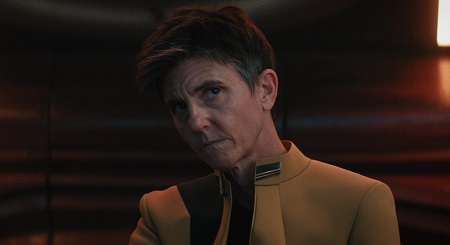
Star Trek: Discovery review – Season 4, Episode 4: All Is Possible

Spoiler Warning: There are spoilers ahead for Star Trek: Discovery Seasons 1-4.

Last week we saw Captain Burnham and the crew largely leave the gravitational anomaly behind as Discovery told three distinct stories. The main thrust of the season still involves the DMA – as the anomaly is now being called – so it was interesting to see that All Is Possible once again shelved that story to take us on another pair of side-missions.

Unfortunately Discovery’s fourth season is still unavailable to large numbers of Trekkies. Fans from Puerto Rico to Tokyo still have no (official) way to enjoy the series, and this self-defeating corporate nonsense is something I’m going to continue to call out at every opportunity. The rollout of Paramount+ internationally next year means nothing to millions of fans in Asia, Africa, and other regions when ViacomCBS believes they don’t exist.

The USS Discovery at the beginning of the episode.

Though there were secondary and tertiary plotlines in All Is Possible, there’s one massive thing that we have to talk about first and foremost: the departure of Lieutenant Tilly. I have to be honest: I did not see this coming – at least, not this early in the season. We’re four episodes into a thirteen-episode season, and Tilly’s arc has already seemingly concluded. Though I had begun to make predictions last week about Tilly’s fate after she’d been seeming so out of sorts, I figured her departure – if indeed that’s what her arc was building towards – wouldn’t have happened until nearer the end of the season.

When All Is Possible kicked off and it became apparent that we were getting a Tilly-focused story, particularly another “Tilly tries something new” story, I was worried that the episode was going to feel a bit samey after she’d played such a big role last week. And although it now makes sense in light of her departure, I’m still left wondering if it was the right decision to schedule these two stories one after the other. We had some stirrings and indications from Tilly in episodes 1 and 2 that she was feeling this way, but because that story has now effectively run its course it feels if not rushed then at least unnecessarily condensed and perhaps poorly scheduled.

This was a huge episode for Tilly – and for Discovery.

The big question, of course, is whether Tilly’s exit will be permanent. It certainly felt permanent in All Is Possible; she even got the send-off from the crew that I argued Saru had missed at the end of Season 3. I don’t usually comment on cast interviews or The Ready Room (Discovery’s social media after-show) in these reviews, but when Mary Wiseman was interviewed this week after All Is Possible had aired she said that we’d see Tilly again before the end of the season. Good news on that front, at least!

That doesn’t mean that Tilly will remain a series regular, though, and her new role at Starfleet Academy has removed her from the ship and thus presumably the bulk of the season’s remaining episodes and storylines. And if the show is renewed for a fifth season – something which is surprisingly still unconfirmed – presumably Tilly won’t be back in a starring role. I think that’s a shame in a way; she was a fun character and after three seasons was beginning to grow in confidence and settle into her role. Or so it felt.

Mary Wiseman spoke with Wil Wheaton on The Ready Room after All Is Possible aired.

On the production side of things, it’s my suspicion that the show’s writers and producers didn’t really know what to do with Tilly or where to take the character. The addition of Adira to the regular cast was a double-edged sword for Tilly because they occupy a very similar role. In Seasons 1 and 2 in particular, we’d see Tilly working in the engineering bay with Stamets. Now Adira fills that role – and because of their deeper connection with Stamets, arguably fills it better. In Seasons 1 and 2, Tilly was the “baby” of the crew; young, fresh-faced, eager to please, worried about making mistakes, and keen to do her part. Adira once again has taken over that character space.

Tilly’s growth across Seasons 1, 2, and 3 was wonderful to see, and when we compare her to characters like Harry Kim – who essentially remained in a similar space for all of Voyager’s seven-year run – we can see the advantages of serialised storytelling. But Tilly’s growth as a character appears to have come at the expense of her roles on the ship, and the addition of Adira may well be the proverbial last straw. We can kind of see the snowglobe scene through this lens – Tilly was passing the metaphorical torch to Adira in that moment.

Tilly gave her snowglobe to Adira.

We can’t ignore the rumours of a Starfleet Academy series when discussing Tilly’s fate and future. Alex Kurtzman, who’s in charge of the overall Star Trek franchise for ViacomCBS, hinted that such a series is in the early stages of being worked on, and in more ways than one the Tilly side of All Is Possible feels like a backdoor pilot for such a show. We got to see Tilly both as a teacher and a leader across these sequences, laying the groundwork not simply for her departure from Discovery, but setting up her new role as well. Could all of that mean that the potential Starfleet Academy series would feature Tilly in some capacity?

I thought Mary Wiseman’s comment in The Ready Room that Tilly’s confidence had been knocked by the events of Season 3 was particularly interesting, too. Tilly had seen herself as being on a pathway that led her from the Academy to the captain’s chair, but when she got a taste of what being in command was like, she found herself out of her depth as she lost the ship to the Emerald Chain. I think a lot of us can relate to feeling overwhelmed by a difficult situation, or feeling the weight of responsibility and struggling with it. Perhaps, as Wiseman suggests, Tilly came to believe that command was not right for her.

Tilly came to believe that she was on the wrong path.

If that’s true, whose fault is it? There was a lot of talk during Season 3 that Saru’s decision to appoint Tilly as acting first officer was the wrong one, and while I defended that story point at the time, when seen through this new lens perhaps we could argue that Saru pushed Tilly to take on that role too quickly. He’s been a good friend to her, and has advocated for her when others might overlook her – as we saw last week, for instance – but might his friendship with Tilly have blinded him, at least somewhat, to her inexperience and limitations? Perhaps.

Tilly held her own when the Emerald Chain captured the ship, and ultimately played a huge role in retaking Discovery and defeating the villainous faction once and for all. But of course it makes sense that those events would completely bowl her over. She was in command of Discovery for a few hours at most, then lost the ship to the Emerald Chain with relative ease. As someone who’d hoped to one day have her own command, those events are going to take a toll, and it’s natural that she’d question her career path in light of what happened. We can empathise with Tilly, putting ourselves in a comparable situation.

Tilly had hoped to one day command her own ship.

It was sweet to see Tilly reunite with Captain Burnham, albeit briefly, before confirming her decision and departing the ship, and the choice of Tilly’s cabin for this conversation harkened back to the early part of Season 1 where we saw them together in that room on multiple occasions. Tilly had already made her decision, it seemed, before Burnham even sat down. Yet it was still nice to see her talking it out with her captain – and friend – before finally confirming that this is what she was going to do. The moments between Mary Wiseman and Sonequa Martin-Green added a lot to this story.

One person who was missing from Tilly’s story, though, was Stamets. Not only had Tilly and Stamets worked together since the beginning of the series, but earlier in the episode Tilly had expressed concern about “abandoning” him to go on the Academy mission – yet by the end of the episode she was content to leave him all alone with the problem of the DMA while she took on a new role. I think we could still have arrived at this point; I’m not saying Tilly needed to stay behind for Stamets’ sake or anything. But just as it was sweet to see her with Burnham talking things out, I think we could have also enjoyed a quiet scene between Tilly and Stamets in which she at least said her goodbyes. As it is, we saw Stamets incredibly briefly as Tilly left the ship, but that was it.

Stamets was noticeably absent from Tilly’s story.

This is the second story in a row from which Stamets has been absent after he missed Gray’s incorporation last week. I confess I’m not exactly sure what’s going on there – whether it’s simply a case of writing/editing (Stamets actor Anthony Rapp confirmed on social media that at least one of his scenes this week had been cut) or whether there’s some other reason for the lack of Stamets in some of these stories. He has a deep connection with Adira, which made his absence from that story last week feel very odd, but he also has a friendship with Tilly – so again, his absence from her story aside from one mention right at the beginning makes it feel like there was something missing; someone else she needed to talk to before departing.

One thing that wasn’t made clear is this: what exactly is Tilly going to teach? I presume it must be something scientific; she can’t be lecturing on subjects like command, surely? Starfleet Academy has usually been presented as something akin to both a military officers’ training college and a civilian university – with different teachers for different subjects. Tilly has a scientific background, so presumably she’d teach something in that department. Or maybe Federation history… since she’s 1,000 years older than all of the cadets! Perhaps this is something we’ll see more of either later in the season or in that potential Starfleet Academy show.

Will we soon see Tilly back on our screens in another Star Trek series?

We haven’t even talked about Tilly’s mission! She and Adira led a small group of cadets on what was supposed to be a training mission – but in true Star Trek style, things didn’t go to plan. I confess at first that I felt sure the whole thing was either a setup or a simulation, especially because of the involvement of the mysterious Kovich. However, it doesn’t seem like that was the case; Tilly’s shuttle really did crash-land on an icy moon, and the monsters she and the cadets had to escape from were real.

It wasn’t clear how much time had passed since the season premiere, when we were first told that there would be a new intake of cadets, so we don’t really know how long these cadets have been together. However, I felt that some of the tension between them was a little forced. The whole point of Starfleet Academy, especially in a post-Burn galaxy, is to work together and pull in the same direction, yet we had exaggerated moments of drama and tension between the cadets that just didn’t feel natural even in that context.

Adira and Tilly with the trio of cadets.

Even if many people in the galaxy harbour prejudices or preconceptions about other races and people from beyond their homeworlds, why would anyone who felt that way apply to join Starfleet? Surely we should be seeing if not “the best of the best” then at least folks who are superficially willing to work together; it kind of felt like the cadets were from some semi-scripted reality TV show, the kind that deliberately chooses the most belligerent contestants with clashing personalities. In that sense, I didn’t really like any of the cadets.

They had to start from a place that would allow them to come together, and in particular that would allow Tilly to be the catalyst for their coming together, and I get that. But it just felt like Discovery, not for the first time, had taken things to an unnecessary extreme in order to accomodate this storyline, putting up one-dimensional characters who behave unnaturally solely for the sake of presenting Tilly with an obstacle and a point of contrast. The young actors who played the cadets did very well with the material they had, but their characters were written rather poorly, in my view, and none came across as feeling either like a natural character nor someone we’d expect to find at Starfleet Academy.

Cadets Harral (left) and Gorev didn’t get along at first.

The puzzle that lay before Tilly and her crew felt like it came right out of The Next Generation’s era, and I’m absolutely there for that kind of story! After the shuttle crash the group was unable to stay aboard, instead needing to climb out of the crash site to use their communicators – but were unable to use their technology. This angle definitely added a lot to the story, forcing Tilly and everyone else to think outside the box rather than being able to fall back on phasers, tricorders, and the like. Again, this feels like a story that could’ve come from any of the 24th Century Star Trek shows and was a great throwback to the franchise’s past.

On a personal note, I have to confess that I’m sad to see Tilly go. If the move is permanent, as it seems to be at this stage, her absence from Discovery will be noticeable going forward, even if Adira steps up to fill the void she leaves behind. I liked Tilly as a character so much that one of my cats is named Tilly (if you want to see a couple of photos of her, follow me on Twitter!). Tilly didn’t just fill that “young and eager” role that characters like Harry Kim, Nog, Hoshi Sato, and Wesley Crusher had in past iterations of the franchise. She was always more than just a character archetype. Tilly was strong in her own way, brilliant in her own way, and funny to boot.

Tilly’s departure is a bittersweet moment.

Across the show’s first three seasons we saw Tilly as a scientist and engineer, working with Stamets on the Spore Drive. We saw her as a friend to Michael Burnham and Saru in particular. We saw her passionate about helping the jahSepp in the mycelial network, and how she came to the aid of Po in the Short Treks episode Runaway. She grew and developed from an anxious cadet into a true Starfleet officer – and while she will undoubtedly make an excellent teacher to a new generation of cadets, her departure is a sad one. She may yet have a role to play either this season or in Star Trek’s future, and I look forward to that. But for now, it seems as though Discovery is moving on without her. And I’m sure I’m not the only one who feels a stab of sadness as a result.

Just like Discovery plans to do we’ll leave Tilly behind and move on to take a look at the rest of the episode. There was a secondary storyline that involved Captain Burnham, Saru, President Rillak, and Ni’Var’s leader T’Rina. We talked last week about contrivances and forced drama, and in this story I’m afraid we did get some of that for the second week in a row. At what was supposed to be the final moment of negotiations to bring Ni’Var back into the Federation, the Ni’Var delegation dropped a diplomatic bombshell that appeared to sabotage the entire thing.

The negotiations on Ni’Var.

Both the timing of this and the way it was pretty easily resolved feel rather contrived – and it begins to stretch credulity to think that neither the Federation nor Ni’Var negotiators could’ve come up with Captain Burnham’s “independent committee” solution on their own. It seems like the perfect compromise, allowing Ni’Var the backdoor they needed without compromising the Federation’s unity. Captain Burnham wasn’t the only person capable of proposing such a solution, and while her status as a citizen of Ni’Var and the Federation makes her well-qualified to serve, I have to ask if she’s the only citizen of Ni’Var who’s also in Starfleet at this point. It seems quite plausible that there are others, and thus her claim to be “uniquely” capable of coming up with this solution might be stretching the truth somewhat.

All that being said, these negotiations reminded me very much of the negotiations that my country, the UK, has been taking part in for much of the past five years. I don’t know whether this story was intentionally written as an allegory for Brexit, but it certainly felt like it had elements of that, and to my surprise it was handled in what felt like a mature way. Brexit, much like certain American political issues, divides opinion sharply, and it would be very easy for a story like this one to come down firmly on one side of the fence, presenting one side as morally right and the other as morally wrong. All Is Possible didn’t do that, and instead tried to find a way to cut through the political machinations of both sides before ultimately settling on a compromise.

Captain Burnham’s compromise can be read as a metaphor for our current divided political climate.

If we ever needed Star Trek to shine a light on contemporary issues through its sci-fi lens, we need it at the moment! There are so many divisive political topics, including Brexit, all across the world. What we’ve seen over the past decade or more are moves away from the political centre ground toward the extremes of left-wing and right-wing politics. The art of the political compromise has been lost in too many cases, and that’s a driving force for further division. Finding ways to compromise and to maturely understand that it isn’t always possible to have everything your own way is something politicians of all ideologies – and their supporters – need to understand, and Discovery delivered this message in a simple yet meaningful way.

It wasn’t the perfect story, as I’ve tried to explain. It had its contrivances that definitely felt forced. But at the same time, any British or European person can tell you that, having watched years of Brexit negotiations, such things aren’t as unrealistic as they might seem. Diplomats for both sides have, at times, seemed to be negotiating in bad faith, waiting to spring the next trap or throw in a new uncompromising proposal at the last minute. It’s a wonder that the Brexit negotiations got as far as they did, all things considered!

President T’Rina was happy with the proposed compromise.

So perhaps calling this story “contrived” was too harsh in light of what we’ve seen in the real world! Though I maintain it’s a story with some imperfections, it was an interesting one nevertheless. Star Trek has tackled many political issues in its long history, from nuclear proliferation to the teaching of religion in schools, but this is one of the first stories to really feature politicians and diplomacy as a key part of the narrative, with nakedly political considerations having to be taken into account by our heroes. That alone makes it a very interesting story.

It was wonderful to welcome Ni’Var back into the Federation after seeing how many worlds had quit the organisation last season. It definitely feels as though the Federation is now making significant strides in reforming; Ni’Var is the first of the “original” member worlds to rejoin as far as we know. Perhaps we’ll see Earth do the same one day soon? It would be a shame if Discovery left that particular storyline unresolved, especially after we saw how isolationist Earth had become in Season 3.

Ni’Var has rejoined the Federation!

President Rillak once again showed her almost Machiavellian political style; her willingness to lie and use truly underhanded tactics to get her way without revealing the extent of her meddling. By sidelining Admiral Vance and bringing in Captain Burnham and Saru, she was able to execute a hidden plan to bring Ni’Var back into the fold and negate their last-second demand. It was, all things considered, a brilliant tactical move on her part – and re-emphasises her uncompromising nature and willingness to bend or even break the rules to advance the Federation’s best interests.

Despite what appeared to be a détente between Captain Burnham and President Rillak toward the end of the episode, I hope Discovery’s captain keeps her wits about her. If we’ve learned anything about President Rillak over these four episodes, it’s that she sees everything and everyone around her as means to an end. Working with Captain Burnham was, in this instance, advantageous to her – but Rillak will throw Burnham into the fire, and Discovery along with her, if she believes it will help her cause or advance what she considers to be the best interests of the Federation.

Captain Burnham would be well-advised to beware of President Rillak… no matter how superficially friendly she’s currently being.

We haven’t seen President Rillak do anything completely immoral or “evil” just yet. And Discovery may choose to keep this nuanced presentation going all season long. I kind of hope that’s the case, because right now I’m loving President Rillak’s “ends justify the means” approach to governing. Chelah Horsdal plays the character expertly. But Rillak is the kind of character with whom a major confrontation feels increasingly inevitable – her moral ambiguity and Captain Burnham’s moral certainty feel like they’re on a collision course.

There was a third storyline this week that involved Book and Dr Culber. As with Stamets, Book found a new but fun pairing with Culber and I hope they revisit this character pairing in future; it would be great to see them socialising or doing something else outside of a therapy setting. There seemed to be a hint that Dr Culber might need help processing his own trauma – perhaps from his time trapped in the mycelial network – in future, and if so maybe Book could have a role to play there.

Dr Culber may need some help of his own one day.

The programmable matter that Dr Culber and Book turned into sand reminded me a lot of the sequence from Lower Decks Season 1 where a character is in the process of “ascending.” Maybe that was unintentional, and tonally these sequences could not be further apart! But it was interesting to see nevertheless – or perhaps I’m grasping at straws as I desperately hope for the producers of Star Trek to do more to bind the franchise together!

Grief and loss have been themes that Discovery hasn’t shied away from, but they’ve come to the fore this season. Book and Tilly’s stories both connect to this theme as they’re both experiencing different kinds of loss. In a sense, everyone aboard Discovery is in Book’s shoes – they’ve all lost everyone they ever knew apart from each other, albeit in very different ways. And we’ve seen different ways of coping with that loss. Book seems to have made a small breakthrough this week, and I hope we see that process continue.

Book spent this week’s episode in counselling.

Captain Burnham, in Season 3, seemed to rebel against the confines of Starfleet for a time. At first I called this a character regression, as I felt it risked dragging her back to her early Season 1 portrayal. But thinking about it again, through this lens of loss and grief, I think we can see that Burnham is processing the loss of her friends, her family, and the world she had to leave behind. She did so at first by seeking freedom, then later by reconnecting with her mother and reaffirming her relationship with Starfleet. In Tilly’s case, she couldn’t make that renewed commitment and has chosen to walk a new path. Book’s destination is still unknown as he’s still processing his own loss and grief – and I’m glad. What Book has gone through is almost unfathomable, and it wouldn’t feel right if this element of his story and characterisation were resolved too soon.

So that was All Is Possible. Tilly’s departure is by far the biggest thing to come out of the episode, and while there were some minor gripes with the way both Tilly and Burnham’s stories unfolded, ultimately they end up feeling like little more than nitpicks in what was a solid, thoroughly enjoyable episode. I’m glad to see Discovery sidestepping the main serialised story and being bold enough to give us these semi-standalone episodes. I have no doubt that some elements will come back into play later in the season, but for the most part what we got is a self-contained story – albeit one with huge implications for the series going forward.

Onward to new adventures.

Unlike when Nhan and Georgiou left last season, I’m not scrambling around wondering who will replace Tilly. That question has already been answered: Adira. However, her departure does potentially open up another space for a new crew member – and with noteworthy absences in departments like security and tactical, perhaps we could be set for someone new to be promoted. Gray is perhaps the most readily apparent choice, but there are great cases to be made for Detmer or Owosekun to get bigger roles on the bridge, as well as for the return of Nhan, or even for a new character to be introduced.

A few scattered final thoughts: is Kovich the head of Starfleet Academy now? Has he always been in that position? I don’t recall him being referred to as “doctor” last season, but he could be some kind of professor holding a PhD. That’s an interesting take on the character! At first I wondered if he was responsible for the shuttle going off-course… it seems like something he might do! Beginning the episode with a traditional captain’s log was awesome, and another great callback to past iterations of the franchise. I believe this was the first time we heard a 32nd Century stardate, too.

Kovich made his first appearance of the season.

It was neat to see the Season 3-style uniforms being used for some secondary characters. Season 3 of The Next Generation and the film Generations both showed that there’s a kind of transition period when uniforms are being changed over where not everyone has the new variants, and that seems to still be true in the 32nd Century. I was a little worried when Admiral Vance seemed to have been shuffled out of the story in favour of President Rillak – but it makes perfect sense. Vance isn’t a politician and wouldn’t be capable of doing the kind of things we saw Rillak doing this week. Nor would I want to see Vance go down that road. Finally, is there a blossoming romance between T’Rina and Saru? I certainly felt the show was hinting at something to come!

Although it was bittersweet to say goodbye to Tilly, All Is Possible was a good episode all around. It didn’t feel overcrowded, which episodes with multiple competing storylines sometimes can, it had some well-made visual effects particularly on Tilly’s away mission, and though the politicking was somewhat contrived in one respect it was still genuinely interesting to see Star Trek trying something different. I think for me, All Is Possible is the high point of Season 4 so far.

Star Trek: Discovery Season 4 is available to stream now on Paramount+ in the United States, Scandinavia, Latin America, and Australia. The show is on Pluto TV in the UK, France, Germany, Italy, and other parts of Western Europe at 9pm on Fridays and Saturdays. Individual episodes or the full season can be purchased on iTunes, Amazon Video, Google Play, and possibly other platforms in the UK, parts of Europe, and select other countries. The Star Trek franchise – including Discovery and all other properties mentioned above – is the copyright of ViacomCBS. This article contains the thoughts and opinions of one person only and is not intended to cause any offence.
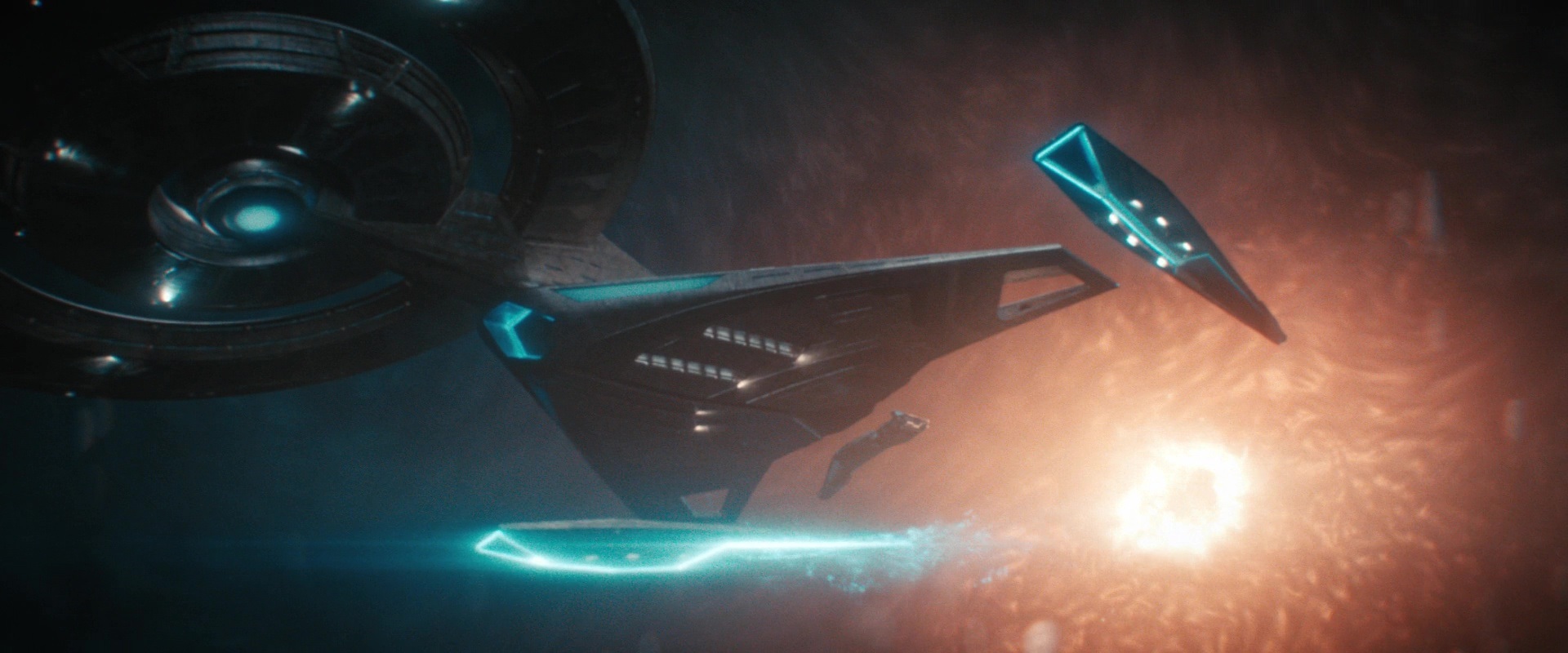
Star Trek: Discovery theories – week 3

Spoiler Warning: There are spoilers ahead for Star Trek: Discovery Seasons 1-4, Star Trek: Picard Season 1, Short Treks, and for other iterations of the Star Trek franchise.

Although this week’s episode, Choose To Live, mostly stayed away from the gravitational anomaly – or the “DMA,” as Stamets is now calling it – we did get some theory-crafting ideas out of it! At such an early point in the season the story still feels wide open, able to go in potentially many different directions. Will tracking down and figuring out the DMA be the only main story of the season? Or will things take a turn as more information about the DMA comes to light? That’s perhaps the biggest question I have as things currently stand!

This week we had no theories confirmed and just one that was debunked. As always, we’ll start there and then move into the main list.

Debunked theory:
Gray’s transfer to a new body won’t be simple.

Gray awoke in a new body this week.

In episode 2, Anomaly, we heard from Adira and Dr Culber that the plan was for Gray to be given a synthetic body – just like Admiral Picard was at the end of Picard Season 1. Because this seemed to come at such an early point in the season, and because Gray’s story of being seen – and its allegory for being transgender – had been discussed a lot in the run-up to the season, I felt sure that it couldn’t possibly be so simple. But I was wrong!

In Choose To Live, Gray made it into his new synthetic body with relative ease. There was a moment midway through when the procedure seemed to be taking a long time, but by the end of the episode he was awake and able to exercise full control over his synthetic body.

The procedure was a success.

As I said in my review of Choose To Live, I felt that this story came too early in the season, and with too much of the work to get there having happened off-screen. It was also noteworthy that Stamets was entirely absent from this story, despite the deep bond he has with Adira in particular. I’m optimistic that Gray’s incorporation will allow him to take part in a wider range of stories both with and without Adira, and the emotional highs of Gray’s incorporation were very sweet. But at the same time, I admit to feeling a little underwhelmed at the fact that the story I was most interested in on a personal level only lasted three episodes before being wrapped up – especially considering that it barely featured in the first two.

So that theory was debunked.

Up next we’ve got the main theory list – and it’s divided into two parts. The first part of the list is comprised of theories that are either brand-new from Choose To Live or which the episode advanced somehow from previous weeks. The second part of the list contains the rest of my Season 4 theories – the ones that didn’t move at all in Choose To Live.

Theory #1:
The Abronians’ homeworld was destroyed by the anomaly.

Captain Burnham believes this image depicts a “supernova.”

After arriving at the Abronians’ cryo-ship, Michael Burnham found a stone carving that seemed to depict the destruction of the Abronians’ homeworld. This carving was only shown on screen briefly, but it seemed to show the planet being damaged or destroyed in a large explosion. Burnham credited the planet’s destruction to a “supernova,” and the story then raced ahead.

Considering that the main thrust of the season so far has been about the DMA, perhaps Burnham was incorrect: the Abronian homeworld was destroyed by the anomaly, not a supernova. I suspect we haven’t seen the last of the Abronians; Discovery loves to tell semi-standalone stories and then bring back elements from those stories later on, so we may yet come to learn more about the Abronians.

Theory #2:
The Abronians’ homeworld was on the “other side” of the anomaly.

The USS Discovery approaches the DMA.

One clip in the second Season 4 trailer appeared to show Captain Burnham leading the USS Discovery inside the DMA. We don’t yet know what that means, nor to what extent words like “inside” the anomaly or “the other side” of the anomaly are relevant. But many times in past iterations of Star Trek we’ve seen things like wormholes and gateways to parallel universes. Perhaps the anomaly is something similar – and passing through it leads to such a place.

One thing struck me as odd about the Abronians: the Federation was entirely unaware of them. Yet the Abronian cryo-ship was relatively close to Federation space – such that Captain Burnham could reach it using Book’s ship in a short span of time. It’s possible that the Abronians had been asleep for millennia, unnoticed by the Federation and the wider galaxy for all that time. But it’s also at least possible that their cryo-ship is a newcomer to the area. If so, perhaps it arrived here via the DMA.

Theory #3:
The Abronians will return to help the Federation later in the season.

A deceased Abronian.

One of the themes of Discovery since Season 3 has been connection: building connections between the Federation and its former friends. The Abronians were awoken from cryo-sleep thanks to the interventions of Captain Burnham and Tilly – at least in part – and they may seek to repay the Federation, or Captain Burnham personally, for that help.

We saw this play out last season with Ni’Var; in the season finale Ni’Var ships raced to the Federation’s aid as the Emerald Chain attacked. Perhaps the Abronians will likewise step up to help when the Federation needs allies.

Theory #4:
The Abronians’ moon-ship may be useful in a later story.

“That’s no moon…”

At this stage I can’t envision precisely what use Captain Burnham and the crew might have for a moon-sized starship… but that doesn’t mean such a need won’t arise! The Abronians’ cryo-ship is huge, and at least superficially seems to have the mass of a moon or small planetoid. If Captain Burnham and the crew needed something that large for some purpose, perhaps they’ll return and either take it or negotiate for it.

As we saw in Choose To Live, the moon-ship was in full working order. All it needed was some extra dilithium to power up and it was perfectly capable of moving under its own power, and its computer systems were still functional. The only system that seemed to have failed was the wake-up timer! So if – for reasons yet unknown – the crew need a huge starship, perhaps we won’t have seen the last of the moon-ship.

Theory #5:
Three ideas about Tilly.

Tilly in Choose To Live.

What’s going on with Tilly? Since the season began, and arguably toward the end of Season 3 as well, she’s been very unsettled and unsure of her role. Perhaps that’s a metaphor for the Discovery writers not knowing what direction to take her character – though I would argue that she’s well-placed to help out with such a scientific mystery! She even has experience with dark matter, as we saw in Seasons 2 and 3, so shouldn’t she be helping out Stamets?

Regardless, Tilly has talked about wanting to get outside her comfort zone and try new experiences. Perhaps her short tenure as first officer last season is part of what prompted her to do so. However, the question of her destination at the end of this arc has arisen. Will she try out a few new things over the course of the season and then settle back down again? Or will we see a more significant change for Tilly before Season 4 is over?

Theory #5a:
Tilly will change departments.

Captain Tilly?

The simplest solution to Tilly’s restlessness may be a career change. Having had a taste of command, perhaps she’ll want to retrain in the command division with a view to working her way back up to first officer or even pursuing her own captaincy. That would be one way to go. Perhaps she’ll want to move over to a medical field, using her scientific expertise to help people. Or maybe she’ll want to move into engineering, where she could focus on the practical side of running a starship. There are other possibilities too, of course – but I think we can rule out a role in security or tactical after Choose To Live!

Theory #5b:
Tilly will resign from Starfleet.

Tilly and Saru in Choose To Live.

We should be careful with this one. Last season, Michael Burnham was the character who seemed to be on an anti-Starfleet trajectory, having spent a year alone and away from the confines of the organisation. But after a couple of twists and turns she ended up recommitting to Starfleet and even assumed the captaincy of the ship! But that said, one possible end to Tilly’s arc could be that she’ll leave Starfleet altogether. Some of the sentiments she’s expressed seem to indicate that she feels adrift, very far removed from Starfleet and her own past. Reaching for help from friends and finding a way through whatever she’s going through is the most likely solution… but she could go down a different path altogether and resign her commission.

Theory #5c:
Tilly will be killed off.

R.I.P…

Sometimes when a character seems to lose their resolve it’s the writers’ way of signalling that it’s the beginning of the end. Adira has taken over not one but two of Tilly’s roles – at least in some respects. Tilly was once the baby of the crew; young and eager, fresh out of the Academy. Now Adira is in that role. Adira is also a great fit for scenes with Stamets in engineering, a role that Tilly had previously occupied. Perhaps Discovery’s writers feel that Tilly has done all she can, and that there isn’t going to be space for two functionally similar characters going forward?

Theory #6:
President Rillak knows what the anomaly is… and may be responsible for its creation.

President Rillak at the end of Choose To Live.

President Rillak is the kind of hard-nosed political pragmatist who seems to be willing to do almost anything if she believes it will advance the Federation’s objectives and ambitions. We saw that laid bare this week when she was willing to turn over J’Vini to the Ni’Var authorities, overruling both Admiral Vance and Captain Burnham because she believed the Federation’s best interests lay in wooing Ni’Var back into the fold.

This ties into something that I said last time: that President Rillak might know more about the DMA than she’s currently letting on. If the Federation had created a weapon like this, or it was an experiment gone wrong, covering it up might be her objective even if she wasn’t necessarily the one who ordered the DMA’s creation.

President Rillak seems willing to go to any lengths for the sake of the Federation.

We’ll consider in a moment a few other possible candidates for creating the DMA – if it turns out to be an artificial creation. But the Federation – and by extension, President Rillak – have to be possible contenders too. Season 3 of Discovery showed us the Federation at its weakest, but also arguably as an organisation that was still virtuous at its core. In contrast, we have Season 2’s depiction of Starfleet: reliant on the shady Section 31 and their AI. In short, it wouldn’t be unthinkable for Discovery to go back to that kind of presentation.

President Rillak herself is a character with depth, not simply an “evil admiral” character trope. But it wouldn’t be the first time that Discovery has presented us with a fairly hard-line character in a position of authority who turns out to be concealing a dark secret.

So those theories are new or were advanced in some way by Choose To Live.

As always, for the sake of keeping everything in one place, I’ll restate my previous theories below. If you missed any of them last time, be sure to read the full list! If you’re all caught up, feel free to skip ahead.

Theory #7:
Captain Burnham and/or the Red Angel time travel suits from Season 2 are connected to the anomaly.

A Red Angel suit from Season 2.

Though we did see some moves away from Discovery’s laser-focus on Michael Burnham in Season 3, the show has put her front-and-centre in all of its main storylines so far. Season 2’s Red Angel storyline was connected to Burnham in a major way, and I wonder if Burnham might similarly have some kind of connection to the anomaly that she’s currently unaware of.

Perhaps the Red Angel suit, which Burnham sent back in time in the Season 3 premiere, malfunctioned somehow, and its powerful wormhole-creating technology gave rise to the gravitational anomaly. If the Red Angel suit completed its journey back to the 23rd Century, the anomaly may have had centuries to grow and expand unchecked.

We don’t really know what happened to the suit after this moment.

I’m not sure that this one is particularly likely, but as I said last year about a possible Burnham connection to the Burn, not only does Discovery kind of have a precedent for telling this kind of story, but there would also be something very dramatic about this revelation. In this case, Burnham would be indirectly and unknowingly responsible for creating something devastatingly damaging. How would she react to that, and how would Book react given what’s just happened to Kwejian?

If time travel is involved, perhaps a future Captain Burnham or a parallel universe Captain Burnham could be responsible for the anomaly’s creation – either intentionally or not.

Theory #8:
Book will find Kyheem and Leto inside the gravitational anomaly.

Leto as seen in Book’s memory.

In Star Trek: Generations, Captain Picard encountered Captain Kirk inside the Nexus – despite Kirk being declared “dead” after the Enterprise-B encountered the energy ribbon. We don’t know what the gravitational anomaly is yet; one of my very early pre-season theories involved the Nexus, but that seems to be debunked already! However, the anomaly’s mysterious nature raises the faint possibility that at least some of those it appears to have “killed” may not be as dead as they first appear.

This theory is, I freely admit, a bit of a long-shot. And it hinges on a fundamental question underlying the story of the season: is there more to the gravitational anomaly than meets the eye? If the anomaly is just an extreme example of space weather, flitting through Federation space destroying anything unfortunate enough to be in its way, then probably everyone on Kwejian is dead. But if the anomaly harbours some kind of gateway, wormhole, portal, time vortex, or any of the other Star Trek-y technobabble phenomena that we’ve seen across the franchise’s history, then it’s possible that at least some of the folks on Kwejian found themselves transported to whatever realm lies inside of the anomaly.

Theory #9:
The gravitational anomaly is (or contains) a sentient life-form.

Season 2’s Sphere is an example of “life, but not as we know it.”

“It was only trying to communicate!” has become a Star Trek cliché, often used to describe how the seemingly-aggressive actions of an alien life-form are actually something innocuous. Perhaps the same is true of the gravitational anomaly: at its core is a life form, perhaps one not dissimilar to the Sphere seen in Season 2, and it’s on its own mission of exploration.

V’Ger from The Motion Picture is an interesting comparison. Like the gravitational anomaly, V’Ger was massive in size, capable of destroying space stations, fleets of ships, and even threatening to destroy entire planets. When Admiral Kirk and the crew of the Enterprise were able to figure out V’Ger, however, they found a life-form at its core, one which was just as curious to learn and grow as they were.

Theory #10:
Saru will be given the captaincy of the USS Voyager-J.

Saru played a supporting role in Choose To Live.

Saru’s future was briefly discussed before he offered to serve as Captain Burnham’s first officer in the episode Anomaly. He has already been offered a command of his own, so Starfleet clearly values his command abilities and experience. President Rillak was seen to be assessing Captain Burnham’s suitability for the captaincy of the USS Voyager-J in Kobayashi Maru… and she mentioned having a shortlist of candidates. Could Saru be on her list?

At time of writing, a fifth season of Discovery hasn’t been officially confirmed. But if the show is to run for another season – or more – the question of Saru’s role comes up. It would be possible to work out a way to keep him on board as first officer for longer than one season, and in many ways I think that’s something fans would want to see. But at the same time, from an in-universe point of view, it kind of makes sense for Starfleet to use its experienced captains where possible.

The USS Voyager-J.

Several of the qualities that President Rillak said she was looking for in a potential captain seem to apply to Saru. He’s more level-headed, less likely to put himself in a dangerous situation, and more inclined to think of the big picture. He has a weakness when it comes to Kaminar, as we saw toward the end of Season 3, but generally speaking he isn’t someone who lets his emotions get the better of him. His wisdom and calm demeanour could be valuable in the captain’s chair of the Federation flagship.

If Saru did depart Discovery in a future episode or season, could that perhaps set the stage for Star Trek: Saru… or Star Trek: Voyager-J? That’s a very interesting possibility! One element of Season 3 that I felt didn’t really get as much attention as it might’ve was that Saru was the Star Trek franchise’s first non-human captain (in a leading role). There’s perhaps scope to follow him on another adventure sometime in the future.

Theory #11:
The gravitational anomaly is a superweapon.

One view of the DMA.

We touched on this theory above when we considered the Federation’s possible complicity in the creation of the gravitational anomaly, but there are many other ways such a story could pan out. The anomaly’s unpredictable nature, as noted by Tilly and Saru at the end of Anomaly, could imply that there’s an intelligence at work, perhaps dictating the anomaly’s moves. This could be the anomaly itself as suggested above, but it could also be the case that the anomaly is being controlled or manipulated by something or someone externally.

If the anomaly turns out not to be a natural phenomenon, and is indeed deliberately targetting the Federation, who might the possible culprits be? And what would be the purpose behind attacking the Federation in this manner? If it’s the precursor to an invasion, perhaps later in the season we’ll see whoever is responsible making their next move.

Theory #11a:
The Borg are responsible.

A Borg seen in The Next Generation.

We don’t know whether the Borg Collective still exists in the 32nd Century; it hasn’t even been mentioned since the USS Discovery’s arrival. However, out of all of the factions in Star Trek, few seem capable of creating a weapon on the scale of the gravitational anomaly. This wouldn’t be in line with the Borg’s usual modus operandi, as they prefer to assimilate rather than attack from afar. But a lot may have changed in the centuries since we last encountered them, meaning this could be the opening salvo of a Borg attack… or the last gasp of a dying Collective.

Theory #11b:
The super-synths from Picard Season 1 are responsible.

Some very menacing-looking synthetic tentacles.

We still don’t know very much about the super-synths that Soji and Sutra attempted to contact in the Season 1 finale of Star Trek: Picard. Other than claiming to offer support and help to synthetic life, what are their goals and motivations? Was their offer even genuine, or was it a trap? The mechanical tentacles glimpsed in Picard Season 1 looked terrifying! Moreover, we know that the super-synths have the technology to move stars – something only possible with an advanced understanding of gravity. Creating a stable 8-star octonary system is an incredible technological and gravitational feat, so they have precedent of a sort when it comes to working with gravity. Finally, Discovery Season 4 has already made connections with Picard Season 1: the Qowat Milat and the synth transfer process used for Gray.

Theory #11c:
The Kelvan Empire is responsible.

Rojan, a representative of the Kelvan Empire.

This one might seem to come completely out of the blue! In The Original Series, Captain Kirk met representatives of the Kelvan Empire, a faction originally from the Andromeda galaxy. Seeking a new home, a Kelvan scouting party had reached the Milky Way and were looking for worlds to conquer. Kirk would ultimately dispatch an unmanned starship offering to help the Kelvan Empire find new worlds to settle – but what if his offer was rejected? Given the vast distances involved, the timelines kind of line up for the Kelvan Empire to return to the Milky Way.

Theory #11d:
The Sphere-Builders from Enterprise are responsible.

A Delphic Expanse sphere seen in Enterprise.

A defeated faction in one of the Temporal Wars, the Sphere-Builders initially hoped to convert a large swathe of the Alpha Quadrant to match their native extradimensional realm, and constructed a number of large space stations known as Spheres to facilitate this transformation. Crewman Daniels would tell Captain Archer that the Sphere-Builders were defeated in the 26th Century, but could they have since rebuilt? The gravitational anomaly isn’t necessarily the same as what they were trying to do with the Spheres, but they’re one of the few factions in Star Trek that might be capable of creating a weapon on this scale.

Theory #12:
A major character will be killed.

A Starfleet coffin seen in Deep Space Nine.

Season 3 saw a couple of major departures: Mirror Georgiou entered the Guardian of Forever’s portal, and Nhan remained behind aboard the USS Tikhov. Yet despite the dangers the crew faced as they navigated the 32nd Century, battled the Emerald Chain, and figured out the mysteries of the Burn and the Verubin Nebula, only one ally – Ryn – lost their life.

Killing off a character can be an excellent way to communicate the stakes involved if it happens at a relatively early stage. It can also be a storyline that brings a lot of emotion, as we have to say goodbye to a beloved member of the crew.

Spock’s funeral in The Wrath of Khan.

In short, I think there are plenty of reasons on the production side why killing off a major character could make sense in Season 4. Discovery has seen a number of characters leave the series – far more than any past Star Trek show, in fact – but the series’ death toll is still relatively low when compared to many other modern television shows.

We discussed above that Tilly’s recent change and the way she seems unsettled could be the beginnings of such an arc. For a breakdown of which characters I thought might be in danger before the season premiered, check out my list of “death predictions” by clicking or tapping here.

Theory #13:
There will be a character crossover from a past iteration of Star Trek.

Scotty was able to appear in The Next Generation… so anything is possible!

This theory returns from Season 3, where I doggedly clung to it for the entire season!

The show’s 32nd Century setting has shot Captain Burnham and the crew far beyond anything in Star Trek’s established canon, and that should mean that practically everyone we remember from other Star Trek shows won’t be around any longer. But this is Star Trek – with some creatively-written technobabble, practically any major character could have survived all the way through to the 32nd Century!

Could Chakotay be coming back?

It’s also possible for Captain Burnham to discover the logs of a long-dead officer; someone we as the audience would be familiar with. While this would be less of a “crossover” than if a character from the past could be physically present, it would still be a lot of fun to see!

There are a handful of characters who could have survived to the 32nd Century based on what we know about them from past iterations of the franchise. Included in this category would be people like Soji, Voyager’s Doctor, and a few others. But as we’ve seen in episodes like Relics and even the film Generations, all it would take to make a big crossover happen is some kind of temporal anomaly, stasis field, or other technobabble!

Theory #14:
Burnham won’t remain as captain.

Captain Burnham in Choose To Live.

This is a controversial one, so let me just say up front that I’m neither in favour of this theory nor opposed to it – I just think it’s a possibility. As things stand, Discovery has had four different captains across its four seasons. One of the show’s unique points of interest within Star Trek’s broader canon are the very different ways in which these individual captains commanded the ship and crew.

It’s got to be considered at least a possibility, then, that the show will continue this trend. This doesn’t mean Captain Burnham will be killed off; I’d actually argue she’s pretty safe. But there are many different routes to her potentially leaving the ship, such as a desire for freedom that we saw in Season 3, or even perhaps taking up a new, more senior role within Starfleet.

Captain Burnham.

If this theory were to come to pass, it would be something I’d expect to see at the very end of the season. Even if Burnham seems 100% committed to her new role as captain, I don’t think it’s a theory we can definitively rule out.

It’s worth mentioning that at time of writing Discovery hasn’t been officially renewed for a fifth season – so all this talk of who’ll be in the captain’s chair by then could be moot! And of course this theory has a very strong counter-argument: that Discovery’s main story arc across its first three seasons can be read as Burnham’s ascent to the captain’s chair.

Theory #15:
Kovich is an agent (or the head) of Section 31.

Kovich in Season 3.

This is another Season 3 theory that I’m choosing to bring back! The question of who Kovich is and what role he played in Starfleet and the Federation was left open at the end of Season 3, and we know that the character will return in some capacity – even though he’s yet to make an appearance. As someone who seemed to talk around the issue at hand and not reveal everything he knew, Kovich strikes me as potentially being a Section 31 operative – or even the head of the organisation.

We don’t know yet if the Section 31 series that was announced in 2019 will go ahead as planned. But if it does, there could potentially be a connection between Kovich and Georgiou that would tie the two shows together. Kovich is mysterious enough that his character could be taken in many different directions – but my money’s on Section 31.

Theory #16:
The ban on time travel will be explained in more detail.

The Enterprise-E was able to travel through time.

This one is a hope as much as a theory right now! In short, the ban on time travel was introduced early in Season 3 primarily as a way for the writers and producers to avoid questions about why the 32nd Century was so different from how the far future had been depicted in earlier Star Trek productions, as well as to explain things like how the Burn was able to catch the Federation off-guard and why Georgiou couldn’t simply be sent back in time when she needed to.

But the ban itself raises some issues – the biggest one being the lack of detail on how it works and how something like this could possibly be enforced. As I said several times last season, it isn’t possible to just un-invent a technology so useful and powerful as time travel. Even just a few lines of dialogue going into a little more detail on the mechanisms involved in the ban would be really useful.

Theory #17:
The Federation has flouted the ban on time travel.

Might someone like Kovich have sought to get around the ban on time travel?

Sticking with the time travel ban, another theory I had last season was that the Federation – and Section 31 in particular – might have deliberately flouted the ban and failed to abide by the rules. Someone as straight-laced and committed to Starfleet ideals as Admiral Vance is highly unlikely to have sanctioned such a move, but someone like the shadowy Kovich (who we talked about a moment ago) might have. President Rillak could also be involved.

Obviously the bulk of the season’s story will deal with the gravitational anomaly. But there’s scope to either talk about the time travel ban in a standalone episode or even tie the two stories together – perhaps the anomaly has been unleashed as a result of unsanctioned time travel.

Theory #18:
The story will connect with the Short Treks episode Calypso.

The USS Discovery in Calypso.

Despite a handful of moments in Season 3 which seemed to connect to Calypso, the story of the season overall ended up going in a very different direction. While we saw a couple of things that arguably did tie in to the Short Treks episode, major things like the USS Discovery undergoing a refit have actually moved the plot even further away.

It’s possible that Calypso will forever remain an outlier in Star Trek’s canon – an episode tied to a vision of Season 2 or Season 3 that was changed before it made it to screen. But earlier in Season 3 it felt like we were getting close to seeing how it could all be tied together – and I’m hopeful that Season 4 will find a way to do so.

Theory #19:
The crew will have to defend the Verubin Nebula.

The dilithium planet is vital to the Federation.

The Federation is in a weakened state, and even if we see worlds like Ni’Var rejoin the organisation it’s still nowhere near as powerful as it once was. The Verubin Nebula is thus a very tempting target for anyone looking to gain an edge in a galaxy where dilithium is still in short supply. As the only known significant dilithium supply, whoever controls the Verubin Nebula will have a massive tactical advantage.

We can compare the Verubin Nebula to Deep Space Nine’s Bajoran wormhole in that respect – it’s a resource of huge strategic importance. Season 3 didn’t show us much about the makeup of the galaxy’s factions outside of the rump Federation and the Emerald Chain, but it’s got to be possible that factions like the Dominion, Klingon Empire, or even the Borg still exist and would want to seize the Verubin Nebula for themselves.

Another view of the planet in the Verubin Nebula.

Season 4 has presented Captain Burnham and the crew with a scientific puzzle: the DMA. But that doesn’t mean there won’t be villains in play, and Discovery has introduced us to several compelling and interesting villains over its first three seasons.

To make a long theory short, it would begin to stretch credulity to think that everyone in the known galaxy would see the Federation rebuilding and having access to dilithium and not want to find out for themselves what’s going on. Once the Verubin Nebula’s existence becomes known, even if the Federation promises to share its bounty with all comers, it seems very likely that someone would want to take control of the dilithium supply for themselves.

Theory #20:
Captain Burnham and the crew will encounter the Klingons.

Klingons seen in Season 2 of Lower Decks.

By the late 24th Century the Federation and Klingons were firm friends, having been allied for a century and after fighting side-by-side against the Dominion. We don’t know if that alliance endured to the 32nd Century, but it’s certainly plausible to think that it did. The Klingons might even have joined the Federation at some point, and their violent warrior culture may have been significantly pacified.

One thing that could be very interesting to see is how the crew of the USS Discovery – almost all of whom are veterans of the Federation-Klingon war – would respond to that. They’ve worked alongside Klingons like L’Rell before, but many of them still see the Klingons as an old enemy. The story of overcoming that prejudice could mirror episodes like The Wounded from The Next Generation, and would be very interesting to see.

Theory #21:
Some areas of the galaxy – such as the Delta Quadrant – avoided the worst effects of the Burn.

The USS Voyager traversed the Delta Quadrant.

Season 4 touched briefly on the Burn with Su’Kal and Saru in Kobayashi Maru, and may now seek to put last season’s story to bed so it can wrangle with the DMA instead. But one thing I’d be curious to see is the true extent of the disaster – did it reach all four quadrants of the galaxy equally, or did its effects fade out after a certain point? Michael Burnham discovered that the Burn had a point of origin, and that it radiated out from that point like ripples on the surface of water. Ripples eventually diminish, fading away the further they travel, and perhaps that’s true of the Burn as well. There could be whole areas of the galaxy that didn’t even notice the Burn – and maybe the ship and crew will visit one such region.

If the Delta Quadrant was left largely unscathed, for example, what might that mean for the likes of the Borg? It’s possible they aren’t even still around in the 32nd Century, but it’s also possible that they’ve had more than a century to expand and build up their forces while the Federation suffered. To see a full write-up of this theory, click or tap here.

Theory #22:
The Guardian of Forever will be back.

The Guardian of Forever first appeared in The Original Series.

Having reintroduced the Guardian of Forever in Season 3, I wouldn’t be at all surprised to see Discovery return to the Guardian’s planet in Season 4. The gravitational anomaly is something new and threatening, so it’s possible Captain Burnham might want to ask the Guardian for help or information.

The Guardian of Forever is also the only way we know of at present to travel through time – something that might be necessary if Season 4 makes an attempt to link up with Calypso in a big way. There are many reasons why Captain Burnham might want to revisit the Guardian, and it would be great to bring back actor Paul Guilfoyle, who played the Guardian’s humanoid avatar in Season 3.

So that’s it! Those are all of the theories I currently have as we approach episode 4: All Is Possible.

The USS Discovery.

I think we’ve got an interesting crop of theories as we begin to get into the story of the season. In some ways Discovery caught me off-guard by taking Captain Burnham on a side-mission in only the third episode… but as noted above there are myriad ways that her encounter with the Abronians may yet come back into play!

I’ll be updating my theory list every week after publishing my episode reviews, so be sure to come back after All Is Possible has aired to see if we have any debunkings, confirmations, or brand-new theories to add to the list. I’m having a lot of fun getting back into the swing of writing my reviews and theories – I hope at least some of this has been interesting for you!

Star Trek: Discovery Season 4 is available to stream now on Paramount+ in the United States, Scandinavia, Latin America, and Australia. The show is on Pluto TV in the UK, France, Germany, Italy, and other parts of Western Europe at 9pm on Fridays and Saturdays. Individual episodes or the full season can be purchased on iTunes, Amazon Video, and possibly other platforms in the UK, parts of Europe, and select other countries. The Star Trek franchise – including Discovery and all other properties mentioned above – is the copyright of ViacomCBS. This article contains the thoughts and opinions of one person only and is not intended to cause any offence.
Star Trek: Discovery review – Season 4, Episode 3: Choose To Live

Spoiler Warning: There are spoilers ahead for Star Trek: Discovery Seasons 1-4. Spoilers are also present for Star Trek: Picard Season 1.

When we saw the first few episode titles for Discovery Season 4 a few weeks ago, I completely missed something huge. “Choose to live” is a Qowat Milat saying, a phrase used by Elnor in Star Trek: Picard Season 1 last year. That was an oversight on my part, and meant that my original analysis of the episode before the season premiered was way off-base. Oops!

Although Discovery Season 4 is now available on Paramount+ in Australia, Latin America, and Scandinavia, and in western Europe and a few other regions via Pluto TV, or to purchase via iTunes, Google, and Amazon, there are still too many Star Trek fans unable to watch the new season of the show. Fans in countries and regions that ViacomCBS believes don’t exist still have no (official) way to access the season, and with the painfully slow rollout of Paramount+ also skipping over large swathes of Africa, Asia, and other parts of the world, that’s very disappointing. In my own small way, I’ll continue to point this out and call on ViacomCBS to do more to fix this problem and bring Star Trek to every fan around the world.

Captain Burnham at the beginning of the episode.

Choose To Live feels like a mid-season episode. It advanced the season’s main gravitational anomaly storyline in a pretty minor way, but in its place gave several different characters episode-long storylines that may or may not connect to the season’s ongoing themes. There are some nitpicks that we’ll get into, particularly surrounding one of the main story elements, but overall Choose To Live was a solid episode with some deeply emotional moments and throwbacks to past iterations of Star Trek. With its three concurrent storylines, I even felt it was structurally similar to episodes of Lower Decks!

As someone who’s spent decades struggling with my own gender identity, it’s really only in recent times that I’ve felt comfortable to be open and “out” as non-binary. Thus it was Gray’s story that perhaps intrigued me the most on a personal, character-scale level as Season 4 approached. We were promised that Dr Culber, Stamets, and Adira wouldn’t forget about Gray, and that his quest to be “seen” would succeed.

Gray watches his new synthetic body being constructed.

I’m absolutely thrilled to see Gray in a corporeal body for the first time. The scene with Gray customising his synthetic body in last week’s episode was absolutely the episode’s emotional high point, leaving me in tears, and I was hoping to see Choose To Live continue that trend. But something about Gray’s story this time felt… rushed. And although it was supported by amazingly emotional performances by Wilson Cruz, Ian Alexander, and in particular Blu del Barrio – who put in their best performance in Discovery so far – I actually felt that something was missing.

It was only when Adira beamed aboard the KSF Khi’eth in the Season 3 finale that Gray was able to be seen by anyone other than Adira. The end of that episode kicked off Gray’s quest to become corporeal again, fully confirming that Gray is indeed “real” and not a figment of Adira’s imagination. The first episode of Season 4 didn’t really feature any part of Gray’s quest, and we got one scene last week; a wonderful scene, but a single scene. And then this time, across several deeply emotional sequences, but in an episode that was packed with other storylines running at the same time, Gray’s quest has already come to an end.

Gray’s quest to be seen has concluded.

Gray’s invisibility had been an analogy for how many transgender people – and I would posit from my own experience, many non-binary people too – feel invisible, either ignored by the world or having to hide our true selves from it. Overcoming that, and finally feeling free to openly live one’s life is not a fast or easy process, and as much as I respect Discovery for putting together a story like this, the way it concluded so early in the season has left me feeling a little hollow.

Firstly, Stamets had no involvement at all – despite being a big part of Adira and Gray’s family. Stamets has had precisely one scene with Adira so far this season, a blink-and-you’ll-miss-it moment in the premiere. It was great this week to see Stamets away from Discovery’s engineering lab for once; his being on Ni’Var was fun to see and another emotional story. But it was also noteworthy that he was absent not only from the scenes featuring Adira, Gray, and Dr Culber, but from their story as well.

Stamets was entirely absent from this story – even though it’s a huge moment for his family.

Here’s what I mean by that: Dr Culber didn’t mention Stamets. Adira didn’t mention Stamets. Gray didn’t mention Stamets. And Stamets didn’t mention any of them – not even a throwaway line about how he was nervous for Gray or upset to be missing such a big moment. He didn’t hesitate about going on the mission; his only moment of pause before going to Ni’Var was thinking about Book and how to spare him from reliving the trauma of Kwejian’s destruction.

Maybe all of this will play into some other storyline as the season runs along. I could foresee, for example, Dr Culber delivering a gentle rebuke to Stamets for getting so lost in his work that he didn’t even check in to see how things were going with Gray and Adira. But I could also see Discovery rushing right past all of this, setting the various characters on different paths and dropping them into different stories as the season rolls on.

Adira and Dr Culber waiting to see if the procedure will succeed.

I don’t want the show to turn something beautiful – Gray’s incorporation – into some kind of Stamets-Culber relationship drama. We had too much of that in Season 2 – and frankly, it did not work. But the show should try to acknowledge, somehow, what’s going on. Think about it this way: if you sat down to watch Choose To Live knowing nothing about Discovery, you wouldn’t know Stamets and Culber even knew one another, let alone are married. You wouldn’t realise that the connection between Adira and Stamets developed first; that Stamets had to tell Adira that he and Culber come as a “package deal.”

For a story about someone becoming whole again… an important person, part of their family, was missing. And combined with the fact that this storyline didn’t run as long or as deep as I might’ve expected it to, I’m left feeling a little empty at its conclusion. I’m absolutely thrilled by the prospect of Gray finally being able to interact with the rest of the crew, and to perhaps offer his services during future missions or playing a role in different stories. And when you pull Gray’s story back to his appearances in Season 3, we did get quite a lot of his invisibility. But I can’t shake the feeling that the entire thing has been shuffled out of the way a little too quickly so that Discovery can race ahead to other stories that it wants to tell.

Stamets’ absence from this story was noticeable.

In a similar way, we talked last week about how much of the work that Captain Burnham and the crew of Discovery had been doing to restore the Federation seems to have happened off-screen. We caught a glimpse of it at the beginning of the season premiere, but then the anomaly story took over. Likewise with Gray – much of the actual work involved to get to this point seems to have taken place off-screen, in the months between the Season 3 finale and the Season 4 premiere. I tried to argue last time that seeing the Federation being restored at a slower pace would have been absolutely worthwhile – and so it is with Gray. We saw the culmination of a longer process, but it would have been nice to see more of the process itself, partly because it’s interesting sci-fi and partly because it’s an analogy for something significant here in the real world.

Before we wrap up the Gray storyline, I want to again point out how outstanding Blu del Barrio was in Choose To Live. I’d enjoyed what del Barrio brought to Discovery in Season 3, but Choose To Live gave them an opportunity to show off a fantastic emotional range, and they absolutely nailed it in every single scene. I went on a rollercoaster with Adira – the anxiety and nervousness as the procedure began, fear and regret when Gray seemed lost, then relief and joy when Gray finally awoke. Blu del Barrio put in the best performance of the season so far, showed off their range as an actor, and made these sequences feel incredibly emotional. Despite my criticism of the somewhat rushed feel to the Gray storyline overall, Blu del Barrio’s performance elevated it and made it so much better than it otherwise would’ve been.

Blu del Barrio put in an outstanding performance this week.

Star Trek as a franchise is full of plot contrivances; story moments that don’t feel genuine because of some inconsistency or other. Some contrivances are bigger than others, though, and on Captain Burnham’s side of Choose To Live we ran into a whopper. I can believe, for the sake of the story, that J’Vini was unable to trust the Federation. After all, in the post-Burn galaxy, trust seems to have been difficult to come by, and Ni’Var isn’t a Federation member. But what feels so incredibly contrived in this storyline is that J’Vini was so unwilling to trust other members of the Qowat Milat that she was prepared to kill one of her own sisters.

If J’Vini was leading some rogue Qowat Milat splinter group, I guess we could argue that perhaps there’d been some kind of split within the order or something. But it was made crystal clear that J’Vini had hired mercenaries as part of her quest to defend the Abronians and their cryo-ship. It simply doesn’t make sense that J’Vini – a proud member of this ancient order – would trust mercenaries when she was unwilling to trust her own sisters, especially considering the stakes, and I find this particular aspect of the story to be incredibly contrived.

J’Vini’s story felt rather contrived.

The contrivance didn’t ruin this storyline, but it certainly detracted from it in retrospect. Looking past all of that, however, we got a genuinely fun adventure romp, one which took Captain Burnham away from the anomaly for a side-mission that, as things stand at least, feels disconnected from the overarching story of the season. In that sense, this part of Choose To Live feels a lot more like the episodic Star Trek stories of The Next Generation’s era. If you removed the Qowat Milat and Captain Burnham from this story, I could easily see it being one for Captain Picard and the crew of the Enterprise-D to have tackled!

It was great to welcome back Sonja Sohn as Dr Gabrielle Burnham. I stand by what I said in Season 3, though: the choice to make Dr Burnham a Qowat Milat nun still feels odd! The connection between J’Vini and Dr Burnham was perhaps less developed than it could’ve been; aside from a couple of lines of dialogue, we didn’t really get to see much evidence of their supposed closeness. J’Vini was, according to Dr Burnham, the Qowat Milat nun who nursed her back to health after her arrival in the 32nd Century… but I didn’t really feel that connection; the story seemed to rush past it.

Dr Gabrielle Burnham returned for a Qowat Milat story.

Dr Burnham’s line about how context matters when considering J’Vini’s actions was an interesting one – and it’s a notion that Discovery has tackled before. Context is for Kings was the title of the third episode of Season 1, and that episode began the slow process of rehabilitating Michael Burnham as a character after her failed mutiny attempt. Dr Burnham compares her support for J’Vini to Michael’s support for Spock in Season 2 – and Michael really doesn’t have a leg to stand on in arguing the point!

Tilly was a welcome addition to this side of the story, too. She got a great moment with Saru, sharing her feelings of loneliness, anxiety, and homesickness that she briefly talked about with Captain Burnham in the premiere and with Dr Culber last week. She got more of a chance to talk with Saru, and he tried to help both by giving her access to his plants, but most significantly by recommending her for the mission.

Tilly and Saru make for a great character duo.

Saru and Tilly make a wonderful pair – something Discovery’s writers found out at the beginning of Season 3. Because they’re such contrasting characters in terms of age, temperament, and even appearance, they don’t necessarily seem like a natural pairing. That may be why Seasons 1 and 2 didn’t feature a great deal of Saru and Tilly together. But their differences complement each other.

Saru has a great deal of faith in Tilly’s abilities – something he made clear in Season 3 when he named her as his temporary first officer. This confidence from someone senior, and someone she clearly respects, gives Tilly a boost of her own, and we saw that play out again this week. I think we can all relate to wanting to step out of our comfort zones – as Tilly does on the away mission – so her inclusion in this story was a great idea.

Tilly stepped far outside her comfort zone this week.

Tilly and Burnham also make for a great duo, and we got to see some of that on the away mission too. Ever since they came together early in Season 1, they’ve established a firm friendship and an intuitive way of working together. Tilly trusted Burnham even when she was told she’ll be “bait,” and I think that’s something significant. Tilly had often been seen as a kind of fearful or anxious character – so to put her faith in her commanding officer in such dangerous circumstances and execute a complicated plan was positive and uplifting to see.

We’ll have to cover this in more detail in this week’s theory post, but I think there’s more going on with the Tilly situation than meets the eye. Since the beginning of the season – and arguably toward the end of Season 3 as well – she’s had this unsettled, almost restless feeling that many people who’ve experienced anxiety can probably relate to. But whether that can be resolved through counselling and talking with friends like Saru is an open question at present. Saru gave Tilly the opportunity to get out of her comfort zone this week – but will she seek to permanently get outside of her comfort zone? And if so, what form might that take?

Tilly and Captain Burnham watch the Abronians colonise their new homeworld.

Captain Burnham took the initiative on this side of the story, figuring out what had happened to the Abronians and how to help them. As mentioned, I liked this story as it definitely had a Next Generation flair to it. The design of the Abronians as a non-humanoid race was also exceptionally neat, and I kind of wish we could’ve seen more of them – but perhaps we will! This is another point I’ll pick up in this week’s theory post, but I suspect that the Abronians have some kind of connection with the gravitational anomaly.

Did anyone else feel that Dr Burnham’s “this isn’t a moon” line had the faintest echo of Star Wars? I surely did! The revelation that the moon base was actually a giant starship was pretty neat, and its stone engines, carvings, and computer interfaces were well-designed and contributed to the feeling that Burnham and co. were inside a tomb or other ancient structure.

The Abronians’ moon-ship made great use of stone to feel ancient and otherworldly.

While we’re talking about designs, the beginning of the episode showed off a brand-new starship: the USS Credence. The Credence has a fantastic design, incorporating elements from several prior Starfleet vessels. I felt I could see callbacks to the Oberth-class and Constellation-class in particular through the alignment of the ship’s body and nacelles. It felt like a 24th or 25th Century ship in some ways – it wouldn’t have looked terribly out-of-place in the Dominion War or in the armada seen in the Picard Season 1 finale!

The ship’s internal design, however, is another matter. I freely admit that this feels like a nitpick, but when I sat down to watch Choose To Live, my sense of immersion was immediately knocked off-course by the fact that the USS Credence’s interior was a barely-disguised USS Discovery. Discovery has, on a couple of occasions, shown us some pretty poor set redresses. The Ba’ul prison cell in Season 2 was so obviously the transporter room set that it was painful – and here, in Choose To Live, we get a sequence supposedly taking place aboard the USS Credence that was clearly just the USS Discovery hallway set. I can’t even charitably call it a “redress” of the set, because basically nothing had changed. Would it have been difficult or expensive to create something at least slightly different to represent the dilithium chamber or cargo bay of the USS Credence? Doing so would have made this sequence so much more enjoyable.

The USS Credence.

Back on topic, and it was another somewhat contrived situation that J’Vini’s whole plan for stealing dilithium and murdering people was basically for the sake of stockpiling it “just in case.” That’s a somewhat timely message, perhaps, given the panic-buying and stockpiling we’ve seen during the pandemic! But it felt a little forced considering that her plan was basically to just sit aboard this cryo-ship and wait for the Abronians to awaken. Did she bother to investigate their computer system at all? It took Captain Burnham barely five minutes to figure out that the Abronians should’ve woken up already! Simply using logic and analysing the situation – even assuming J’Vini had zero computer skills – should have told her that they’d arrived at their destination and could be safely woken up.

However, setting the contrivances of the story aside, it was neat to see Captain Burnham and Tilly working so well together to solve the puzzle and help the Abronians awaken. Seeing them depart their moon-ship to colonise a new world was a powerful moment, and everyone involved – J’Vini, Dr Burnham, Captain Burnham, and Tilly – all played roles in ensuring it could happen. Saving an entire race from what could’ve been extinction is a huge victory, and Choose To Live played it well – even though it was taking place in the context of a smaller, character-focused story.

Captain Burnham helped save an entire race from the brink of extinction.

The way this story concluded was interesting, and I think it shows a pragmatic side to President Rillak that may come into play later in the season. She was willing to turn over J’Vini to the Ni’Var authorities because she believed that doing so was a gesture of friendship that may help sway Ni’Var into rejoining the Federation. Putting the big picture first – or the “needs of the many,” to use a Star Trek quote – was something Captain Burnham didn’t like to see in this instance, but it’s another example of President Rillak being on a different course from Burnham.

It seems clear that Ni’Var will indeed rejoin the Federation at some point this season, which will be great to see. So President Rillak’s politicking will probably pay off – but as Captain Burnham reminded her, it doesn’t come free, and the price in this instance was Federation justice being applied in J’Vini’s case. The hard-nosed political pragmatism of President Rillak makes her a very interesting character – not always playing fully on Burnham’s side, but thus far never as a direct antagonist either. She has her reasons for doing what she does, and she doesn’t care too much if Admiral Vance or Captain Burnham disagree with her. She’s confident in her authority and her decision-making – and I can’t wait to see how that plays out as the season progresses.

President Rillak is a fantastic, well-written character with genuine depth.

That brings us to Stamets and Book’s away mission to Ni’Var. As mentioned, it was great to see Stamets away from Discovery’s engineering bay; it seems like he spent most of Season 3 down there! And after last week, pairing up Book and Stamets again was a good idea. Discovery seems to have found a character pairing it likes in Book and Stamets!

What we saw with this Ni’Var story is the scientific method playing out. Stamets had a theory: that the anomaly is a “primordial wormhole.” He presented his theory to the Ni’Var scientists, who analysed it using their technology and meditative method. But it turned out to be wrong – something Stamets seemed to be fighting against, but arguably must’ve felt was a possibility. We’re still no closer to understanding the anomaly, but it’s another theory that Stamets can cross off his list.

The Ni’Var Science Institute debunked another of Stamets’ anomaly theories.

The interaction between Book and T’Rina was neat to see. Both Kwejian natives and Vulcans are, as T’Rina pointed out, emotional, empathic races. But they take completely opposite approaches to emotion: Kwejian natives draw on it, Vulcans try to suppress it. Book couldn’t learn Vulcan discipline as a way to overcome his grief, but by reliving his last moments on Kwejian he got a kind of cathartic emotional release.

It was painful to relive those memories with Book, and David Ajala put in a wonderfully complex performance. Book is feeling almost unimaginable grief – not just for his family, but for his whole race. Losing one’s home and family would be difficult and painful enough, but to be left as one of the few survivors of his people is something difficult to fathom. David Ajala brought those feelings to screen in an understandable way, and keeping the focus primarily on Book’s family – and his nephew in particular – gave focus to this deeply emotional story.

By reliving his memories, Book found some measure of peace.

Book is moving through the grieving process, and helped by his time on Ni’Var has now moved on, ever so slightly, from where we saw him last week. As Captain Burnham remarked at the end of the episode, he was able to do something – watch a holographic recording of Kwejian – that would’ve been too painful a few days earlier.

So that was Choose To Live. The main thrust of the season’s story was sidelined for the most part as Stamets saw another theory fall down. However, Captain Burnham got her own mission, one which felt like a throwback to past iterations of Star Trek in the best way possible. The return of Dr Burnham and the Qowat Milat was fun, and we got some great character moments with Saru, Tilly, the Burnhams, Book, Stamets, Gray, Dr Culber, and Adira.

Gray and Adira at the episode’s climax.

My only real criticism of Gray’s storyline is that I had expected Discovery to make more of it. The outcome was pitch-perfect, and what I think we had all hoped to eventually see. But there’s a feeling I can’t shake that this story concluded too early in the season – too soon after the events of That Hope Is You, Part 2 had kicked it off. Much of the legwork of figuring out how to help Gray – and his own agency over helping himself – seems to have happened off-screen in between Seasons 3 and 4, just like the dilithium deliveries and Federation rebuilding work. That might be fine… but it depends what happens next, and whether the stories yet to come in Season 4 can compensate for not seeing those things play out.

In Season 3, what I loved most about Adira’s story was that their coming out moment to Stamets was so low-key. Being non-binary in the 32nd Century shouldn’t be a big deal, and that moment captured the kind of optimistic tone of Star Trek’s future absolutely perfectly. Gray’s incorporation was always going to be more complex because of the technobabble side of things, but that gave it the potential to perhaps take into account the false starts and complex emotions that transitioning and coming out can elicit. Some of that was present in Choose To Live, and the payoff to that story was deeply emotional. But I can’t shake the feeling that it happened very quickly, and at a very early stage in the season. Perhaps Gray will go on to play a significant role now he can interact with everyone else – and that will be fantastic to see. I’m optimistic about future storylines… but also a little underwhelmed that the story I’d been most excited for has already concluded after a mere three episodes.

Next week we’ll be watching All Is Possible – and I have no idea what it could be about! Perhaps a return to a story all about the anomaly is on the cards after it took a back seat this week. In any case, I hope you’ll stay tuned for my updated theory list between now and Thursday and another review after I’ve seen All Is Possible next week.

Star Trek: Discovery Season 4 is available to stream now on Paramount+ in the United States, Scandinavia, Latin America, and Australia. The show is on Pluto TV in the UK, France, Germany, Italy, and other parts of Western Europe at 9pm on Fridays and Saturdays. Individual episodes or the full season can be purchased on iTunes, Amazon Video, Google Play, and possibly other platforms in the UK, parts of Europe, and select other countries. The Star Trek franchise – including Discovery and all other properties mentioned above – is the copyright of ViacomCBS. This article contains the thoughts and opinions of one person only and is not intended to cause any offence.
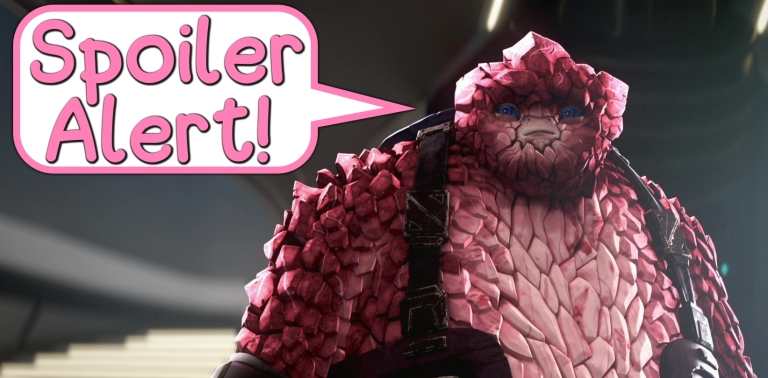
Star Trek: Discovery theories – weeks 1-2

Spoiler Warning: There are spoilers ahead for Star Trek: Discovery Seasons 1-4, Star Trek: Picard Season 1, and for other iterations of the Star Trek franchise.

Now that all of the international broadcasting nonsense is out of the way, let’s get back into my weekly Discovery theory updates! We only missed one week, and there’s still a ton of speculating to be done about the story of Season 4, the gravitational anomaly, and what might become of some of our favourite characters.

If you’re new to my weekly theory updates for Discovery Season 4, here’s how the format works: after every episode I go back to my theory list. I cross off theories that have been debunked, celebrate any that appear to have been confirmed, update any that have seen progression, and add any new theories that the most recent episode has spawned. There will be some theories that, for whatever reason, the most recent episode didn’t advance in any way, so those will simply be restated to keep the list up-to-date and in one place!

I wrote up all of my pre-season theories into one list a couple of weeks ago, so this time we’ve already got two confirmations to take a look at before we jump into the main list.

Confirmed theory #1: The Spore Drive will be rolled out to more ships.

Book in Discovery’s Spore Drive cube.

Finally! After the revelation in the Season 3 finale that Book – and potentially anyone else with similar empathic abilities – could control the Spore Drive, the last hurdle in the way of it being rolled out to other Starfleet ships had been surmounted. It finally feels like Discovery is on the cusp of finding another use for what had been one of the most controversial technologies introduced in the series.

In Kobayashi Maru this was almost treated as a throwaway line, so I wouldn’t blame you if you missed it, but President Rillak confirmed that a “next-generation” Spore Drive is being developed by Starfleet as part of the Federation’s plans to rebuild and expand. It wasn’t stated on screen, but I wonder if the USS Voyager-J might be fitted with a Spore Drive as part of its retrofit; the vessel was in spacedock, after all.

The USS Discovery makes a Spore Drive jump.

I’d been hoping that the series would go down this road for a while. Moving forward in time to the 32nd Century means there are no “canon purist” arguments in favour of abandoning the Spore Drive, keeping it a secret, or ensuring that only the USS Discovery could use it. And the events of the Season 3 finale seemed deliberately designed to create an easy way to expand the Spore Drive to more ships – perhaps even paving the way for future Star Trek productions in this era.

We don’t yet know what the implications will be of Kwejian’s destruction on Starfleet’s plans. It was implied in the Season 3 finale that anyone with empathic abilities could use the Spore Drive, not only Kwejian natives, so the loss of Kwejian and most of its population shouldn’t mean that the Spore Drive expansion has to be abandoned. It might be possible for Betazoids, Deltans, or even Vulcans to train to become Spore Drive navigators.

Confirmed theory #2: A new character joined the main cast.

A new name has been spotted in the opening credits!

Following the departures of Nhan and Georgiou, it felt like there was definitely scope to either promote a recurring character to the main cast or create at least one new one! We’ve met President Rillak, who seems like she’ll become a recurring character, but the one who’s been promoted to join the main cast is Blu del Barrio’s character of Adira.

Adira makes a great addition to Discovery’s main cast of characters, occupying a similar role to Tilly in Season 1 in particular. As Tilly has undergone significant character growth across the show’s first three seasons, there was scope to bring someone brand-new aboard the ship, and having that person be someone young and eager is a positive thing. Adira is not only involved in their own storyline with Gray and Dr Culber, but also as a scientist can work with Stamets, Tilly, Saru, and Captain Burnham. I think Adira has the potential to be a versatile character in whatever stories lie ahead.

My original version of this theory centred around the question of Captain Burnham’s first officer. Now that we know that role has gone to Saru, it seems as though the main and recurring characters for this season are set.

So those theories were confirmed. Now we’ll take a look at some new theories and a few updated theories.

Theory #1: President Rillak knows what the anomaly is… and may be responsible for its creation.

President Rillak in Kobayashi Maru.

This ties into a broader point that we’ll be considering from several angles: the possibility that the gravitational anomaly is not a natural phenomenon. If the anomaly is artificial in nature, the question of who is responsible for its creation crops up. It could be a weapon deployed by another faction, of course, but it could also be a Federation creation – perhaps a weapon designed to defend against the Borg, a rogue experiment to try and prevent a second Burn, or something else entirely.

If that’s the case, President Rillak almost certainly knows more about the anomaly than she’s willing to say right now. Perhaps she’s hoping that it won’t be what she fears it is, or perhaps she’s trying to cover her own back – Captain Burnham did go out of her way to describe her as a “politician,” after all.

Does President Rillak know more about the anomaly than she’s saying?

President Rillak is a character with depth, not simply an “evil admiral” character trope. But it wouldn’t be the first time that Discovery has presented us with a fairly hard-line character in a position of authority who turns out to be concealing a dark secret.

As the head of the Federation, President Rillak is committed to doing whatever it takes to preserve the organisation. The anomaly may have been part of those plans… somehow. If she isn’t responsible for its creation directly, she may still know what it is if a past Federation President signed off on its creation. She may be covering up that secret on behalf of the Federation.

Theory #2: Captain Burnham and/or the Red Angel time travel suits from Season 2 are connected to the anomaly.

Captain Burnham.

Though we did see some moves away from Discovery’s laser-focus on Michael Burnham in Season 3, the show has put her front-and-centre in all of its main storylines so far. Season 2’s Red Angel storyline was connected to Burnham in a major way, and I wonder if Burnham might similarly have some kind of connection to the anomaly that she’s currently unaware of.

Perhaps the Red Angel suit, which Burnham sent back in time in the Season 3 premiere, malfunctioned somehow, and its powerful wormhole-creating technology gave rise to the gravitational anomaly. If the Red Angel suit completed its journey back to the 23rd Century, the anomaly may have had centuries to grow and expand unchecked.

This was the last we saw of the Red Angel suit back at the beginning of Season 3.

I’m not sure that this one is particularly likely, but as I said last year about a possible Burnham connection to the Burn, not only does Discovery kind of have a precedent for telling this kind of story, but there would also be something very dramatic about this revelation. In this case, Burnham would be indirectly and unknowingly responsible for creating something devastatingly damaging. How would she react to that, and how would Book react given what’s just happened to Kwejian?

If time travel is involved, perhaps a future Captain Burnham or a parallel universe Captain Burnham could be responsible for the anomaly’s creation – either intentionally or not.

Theory #3: Gray’s transfer to a new body won’t be simple.

A holographic representation of Gray’s synthetic body.

I adored the scene with Gray, Adira, and Dr Culber in Anomaly. As someone who’s struggled to come to terms with my own gender identity and my gender expression, it was so deeply relatable to see Gray “customising” his new body. But also included in that scene was a line from Dr Culber about how the “Soong method” used to transfer consciousness into a synthetic form has a very low success rate.

I suspect that line was included as a kind of pre-emptive plot hole plug that will have nothing to do with Gray! If the Soong method was said to work every time, then it would be very difficult to kill off any Star Trek characters from the 25th Century onwards, because fans would rightly ask “why didn’t they transfer to a synth body?” So I suspect that’s why the line was included.

Admiral Picard had his consciousness transferred to a synthetic body in the finale of Picard Season 1.

However, it felt a little ominous for poor Gray. It was great to see that Adira, Dr Culber, and others had been working hard to help Gray become seen again after the events of Season 3, and I have no doubt that somehow we’ll see Gray in a physical body before the season is over. But we’re only two episodes in at time of writing – will it really happen so quickly, and so seemingly simply?

I’m not convinced of that yet! There are many things that could go wrong, delay the transfer, or prevent it entirely. And there are an unlimited number of technobabble explanations for finding a new way to give Gray a body! So let’s see what happens – but I wonder if this storyline might have a few twists and turns along the way.

Theory #4: Book will find Kyheem and Leto inside the gravitational anomaly.

Book with Leto and Kyheem shortly before the destruction of Kwejian.

In Star Trek: Generations, Captain Picard encountered Captain Kirk inside the Nexus – despite Kirk being declared “dead” after the Enterprise-B encountered the energy ribbon. We don’t know what the gravitational anomaly is yet; one of my very early pre-season theories involved the Nexus, but that seems to be debunked already! However, the anomaly’s mysterious nature raises the faint possibility that at least some of those it appears to have “killed” may not be as dead as they first appear.

This theory is, I freely admit, a bit of a long-shot. And it hinges on a fundamental question underlying the story of the season: is there more to the gravitational anomaly than meets the eye? If the anomaly is just an extreme example of space weather, flitting through Federation space destroying anything unfortunate enough to be in its way, then probably everyone on Kwejian is dead. But if the anomaly harbours some kind of gateway, wormhole, portal, time vortex, or any of the other Star Trek-y technobabble phenomena that we’ve seen across the franchise’s history, then it’s possible that at least some of the folks on Kwejian found themselves transported to whatever realm lies inside of the anomaly.

Theory #5: The anomaly is a sentient life-form.

Could the anomaly be similar to V’Ger?

“It was only trying to communicate!” has become a Star Trek cliché, often used to describe how the seemingly-aggressive actions of an alien life-form are actually something innocuous. Perhaps the same is true of the gravitational anomaly: at its core is a life form, perhaps one not dissimilar to the Sphere seen in Season 2, and it’s on its own mission of exploration.

V’Ger from The Motion Picture is an interesting comparison. Like the gravitational anomaly, V’Ger was massive in size, capable of destroying space stations, fleets of ships, and even threatening to destroy entire planets. When Admiral Kirk and the crew of the Enterprise were able to figure out V’Ger, however, they found a life-form at its core, one which was just as curious to learn and grow as they were.

Theory #6: Saru will be given the captaincy of the USS Voyager-J.

The USS Voyager-J.

Saru’s future was briefly discussed before he offered to serve as Captain Burnham’s first officer. He has already been offered a command of his own, so Starfleet clearly values his command abilities and experience. President Rillak was seen to be assessing Captain Burnham’s suitability for the captaincy of the USS Voyager-J in Kobayashi Maru… and she mentioned having a shortlist of candidates. Could Saru be on her list?

At time of writing, a fifth season of Discovery hasn’t been officially confirmed. But if the show is to run for another season – or more – the question of Saru’s role comes up. It would be possible to work out a way to keep him on board as first officer for longer than one season, and in many ways I think that’s something fans would want to see. But at the same time, from an in-universe point of view, it kind of makes sense for Starfleet to use its experienced captains where possible.

Captain Saru.

Several of the qualities that President Rillak said she was looking for in a potential captain seem to apply to Saru. He’s more level-headed, less likely to put himself in a dangerous situation, and more inclined to think of the big picture. He has a weakness when it comes to Kaminar, as we saw toward the end of Season 3, but generally speaking he isn’t someone who lets his emotions get the better of him. His wisdom and calm demeanour could be valuable in the captain’s chair of the Federation flagship.

If Saru did depart Discovery in a future episode or season, could that perhaps set the stage for Star Trek: Saru… or perhaps Star Trek: Voyager-J? That’s a very interesting possibility! One element of Season 3 that I felt didn’t really get as much attention as it might’ve was that Saru was the Star Trek franchise’s first non-human captain (in a leading role). There’s perhaps scope to follow him on another adventure sometime in the future.

Theory #7: The gravitational anomaly is a superweapon.

The USS Discovery approaching the anomaly in the second Season 4 trailer.

We touched on this theory above when we considered the Federation’s possible complicity in the creation of the gravitational anomaly, but there are many other ways such a story could pan out. The anomaly’s unpredictable nature, as noted by Tilly and Saru at the end of Anomaly, could imply that there’s an intelligence at work, perhaps dictating the anomaly’s moves. This could be the anomaly itself as suggested above, but it could also be the case that the anomaly is being controlled or manipulated by something or someone externally.

If the anomaly turns out not to be a natural phenomenon, and is indeed deliberately targetting the Federation, who might the possible culprits be? And what would be the purpose behind attacking the Federation in this manner? If it’s the precursor to an invasion, perhaps later in the season we’ll see whoever is responsible making their next move.

Theory #7a: The Borg are responsible.

A Borg drone seen in The Next Generation.

We don’t know whether the Borg Collective still exists in the 32nd Century; it hasn’t even been mentioned since the USS Discovery’s arrival. However, out of all of the factions in Star Trek, few seem capable of creating a weapon on the scale of the gravitational anomaly. This wouldn’t be in line with the Borg’s usual modus operandi, as they prefer to assimilate rather than attack from afar. But a lot may have changed in the centuries since we last encountered them, meaning this could be the opening salvo of a Borg attack… or the last gasp of a dying Collective.

Theory #7b: The super-synths from Picard Season 1 are responsible.

This is all we really saw of the super-synths.

We still don’t know very much about the super-synths that Soji and Sutra attempted to contact in the Season 1 finale of Star Trek: Picard. Other than claiming to offer support and help to synthetic life, what are their goals and motivations? Was their offer even genuine, or was it a trap? The mechanical tentacles glimpsed in Picard Season 1 looked terrifying! Moreover, we know that the super-synths have the technology to move stars – something only possible with an advanced understanding of gravity. Creating a stable 8-star octonary system is an incredible technological and gravitational feat, so they have precedent of a sort when it comes to working with gravity.

Theory #7c: The Kelvan Empire is responsible.

Rojan, a representative of the Kelvan Empire.

This one might seem to come completely out of the blue! In The Original Series, Captain Kirk met representatives of the Kelvan Empire, a faction originally from the Andromeda galaxy. Seeking a new home, a Kelvan scouting party had reached the Milky Way and were looking for worlds to conquer. Kirk would ultimately dispatch an unmanned starship offering to help the Kelvan Empire find new worlds to settle – but what if his offer was rejected? Given the vast distances involved, the timelines kind of line up for the Kelvan Empire to return to the Milky Way.

Theory #7d: The Sphere-Builders from Enterprise are responsible.

A Sphere-Builder seen in Enterprise.

A defeated faction in one of the Temporal Wars, the Sphere-Builders initially hoped to convert a large swathe of the Alpha Quadrant to match their native extradimensional realm, and constructed a number of large space stations known as Spheres to facilitate this transformation. Crewman Daniels would tell Captain Archer that the Sphere-Builders were defeated in the 26th Century, but could they have since rebuilt? The gravitational anomaly isn’t necessarily the same as what they were trying to do with the Spheres, but they’re one of the few factions in Star Trek that might be capable of creating a weapon on this scale.

So those theories were new or saw some advancement in the first two episodes of the season.

To keep these theory posts as uncomplicated as possible, I like to keep all of my theories in one place. So below you’ll find all of my other Season 4 theories. These weren’t debunked or confirmed in the first two episodes, and indeed saw no real movement at all. They remain in play, though.

Theory #8: A major character will be killed.

A Starfleet coffin draped with the Federation flag as seen in Deep Space Nine.

Season 3 saw a couple of major departures: Mirror Georgiou entered the Guardian of Forever’s portal, and Nhan remained behind aboard the USS Tikhov. Yet despite the dangers the crew faced as they navigated the 32nd Century, battled the Emerald Chain, and figured out the mysteries of the Burn and the Verubin Nebula, only one ally – Ryn – lost their life.

Killing off a character can be an excellent way to communicate the stakes involved if it happens at a relatively early stage. It can also be a storyline that brings a lot of emotion, as we have to say goodbye to a beloved member of the crew.

Dr McCoy and Sulu playing dead in The Wrath of Khan.

In short, I think there are plenty of reasons on the production side why killing off a major character could make sense in Season 4. Discovery has seen a number of characters leave the series – far more than any past Star Trek show, in fact – but the series’ death toll is still relatively low when compared to many other modern television shows.

There are also a couple of characters who feel in danger for different reasons. For a full breakdown of which characters I think might be on the proverbial chopping block, check out my list of “death predictions” by clicking or tapping here.

Theory #9: There will be a character crossover from a past iteration of Star Trek.

Voyager’s Doctor is a contender!

Yes, I’m officially bringing this theory back! This is one that I doggedly clung to for all of Season 3, and while it arguably kind of happened with the Guardian of Forever, that wasn’t really what I meant.

The show’s 32nd Century setting has shot Captain Burnham and the crew far beyond anything in Star Trek’s established canon, and that should mean that practically everyone we remember from other Star Trek shows won’t be around any longer. But this is Star Trek – with some creatively-written technobabble, practically any major character could have survived all the way through to the 32nd Century!

Could Sutra still be alive in the 32nd Century?

It’s also possible for Captain Burnham to discover the logs of a long-dead officer; someone we as the audience would be familiar with. While this would be less of a “crossover” than if a character from the past could be physically present, it would still be a lot of fun to see!

There are a handful of characters who could have survived to the 32nd Century based on what we know about them from past iterations of the franchise. Included in this category would be people like Soji, Voyager’s Doctor, and a few others. But as we’ve seen in episodes like Relics and even the film Generations, all it would take to make a big crossover happen is some kind of temporal anomaly, stasis field, or other technobabble!

Theory #10: Burnham may not remain in the captain’s chair.

Michael Burnham in the captain’s chair in a promotional image for Season 4.

This is a controversial one, so let me just say up front that I’m neither in favour of this theory nor opposed to it – I just think it’s a possibility. As things stand, Discovery has had four different captains across its four seasons. One of the show’s unique points of interest within Star Trek’s broader canon are the very different ways in which these individual captains commanded the ship and crew.

It’s got to be considered at least a possibility, then, that the show will continue this trend. This doesn’t mean Captain Burnham will be killed off; I’d actually argue she’s pretty safe. But there are many different routes to her potentially leaving the ship, such as a desire for freedom that we saw in Season 3, or even perhaps taking up a new, more senior role within Starfleet.

Captain Burnham in Anomaly.

If this theory were to come to pass, it would be something I’d expect to see at the very end of the season. Even if Burnham seems 100% committed to her new role as captain, I don’t think it’s a theory we can definitively rule out.

It’s worth mentioning that at time of writing Discovery hasn’t been officially renewed for a fifth season – so all this talk of who’ll be in the captain’s chair by then could be moot! And of course this theory has a very strong counter-argument: that Discovery’s main story arc across its first three seasons can be read as Burnham’s ascent to the captain’s chair.

Theory #11: Kovich works for Section 31.

Kovich in Season 3.

This is another Season 3 theory that I’m choosing to bring back! The question of who Kovich is and what role he played in Starfleet and the Federation was left open at the end of Season 3, and we know that the character will return in some capacity. As someone who seemed to talk around the issue at hand and not reveal everything he knew, Kovich strikes me as potentially being a Section 31 operative – or even the head of the organisation.

We don’t know yet if the Section 31 series that was announced in 2019 will go ahead as planned. But if it does, there could potentially be a connection between Kovich and Georgiou that would tie the two shows together. Kovich is mysterious enough that his character could be taken in many different directions – but my money’s on Section 31.

Theory #12: The ban on time travel will be explained further.

Admiral Vance first told us of the ban on time travel.

This one is a hope as much as a theory right now! In short, the ban on time travel was introduced early in Season 3 primarily as a way for the writers and producers to avoid questions about why the 32nd Century was so different from how the far future had been depicted in earlier Star Trek productions, as well as to explain things like how the Burn was able to catch the Federation off-guard and why Georgiou couldn’t simply be sent back in time when she needed to.

But the ban itself raises some issues – the biggest one being the lack of detail on how it works and how something like this could possibly be enforced. As I said several times last season, it isn’t possible to just un-invent a technology so useful and powerful as time travel. Even just a few lines of dialogue going into a little more detail on the mechanisms involved in the ban would be really useful.

Theory #13: The Federation has flouted the ban on time travel.

HMS Bounty travels through time in Star Trek IV: The Voyage Home.

Sticking with the time travel ban, another theory I had last season was that the Federation – and Section 31 in particular – might have deliberately flouted the ban and failed to abide by the rules. Someone as straight-laced and committed to Starfleet ideals as Admiral Vance is highly unlikely to have sanctioned such a move, but someone like the shadowy Kovich (who we talked about a moment ago) might have. President Rillak could also be involved.

Obviously the bulk of the season’s story will deal with the gravitational anomaly. But there’s scope to either talk about the time travel ban in a standalone episode or even tie the two stories together – perhaps the anomaly has been unleashed as a result of unsanctioned time travel.

Theory #14: The story will connect with the Short Treks episode Calypso.

The USS Discovery seen in Calypso.

Despite a handful of moments in Season 3 which seemed to connect to Calypso, the story of the season overall ended up going in a very different direction. While we saw a couple of things that arguably did tie in to the Short Treks episode, major things like the USS Discovery undergoing a refit have actually moved the plot even further away.

It’s possible that Calypso will forever remain an outlier in Star Trek’s canon – an episode tied to a vision of Season 2 or Season 3 that was changed before it made it to screen. But earlier in Season 3 it felt like we were getting close to seeing how it could all be tied together – and I’m hopeful that Season 4 will find a way to do so.

Theory #15: The crew will have to defend the Verubin Nebula.

The dilithium planet at the centre of the Verubin Nebula.

The Federation is in a weakened state, and even if we see worlds like Ni’Var rejoin the organisation it’s still nowhere near as powerful as it once was. The Verubin Nebula is thus a very tempting target for anyone looking to gain an edge in a galaxy where dilithium is still in short supply. As the only known significant dilithium supply, whoever controls the Verubin Nebula will have a massive tactical advantage.

We can compare the Verubin Nebula to Deep Space Nine’s Bajoran wormhole in that respect – it’s a resource of huge strategic importance. Season 3 didn’t show us much about the makeup of the galaxy’s factions outside of the rump Federation and the Emerald Chain, but it’s got to be possible that factions like the Dominion, Klingon Empire, or even the Borg still exist and would want to seize the Verubin Nebula for themselves.

The USS Discovery arriving at the Verubin Nebula in Season 3.

Season 4 has teased a scientific puzzle – the gravitational anomaly. But that doesn’t mean there won’t be villains in play, and Discovery has introduced us to several compelling and interesting villains over its first three seasons.

To make a long theory short, it would begin to stretch credulity to think that everyone in the known galaxy would see the Federation rebuilding and having access to dilithium and not want to find out for themselves what’s going on. Once the Verubin Nebula’s existence becomes known, even if the Federation promises to share its bounty with all comers, it seems very likely that someone would want to take control of the dilithium supply for themselves.

Theory #16: Captain Burnham and the crew will encounter the Klingons.

The Klingons have been part of Discovery since the beginning.

By the late 24th Century the Federation and Klingons were firm friends, having been allied for a century and after fighting side-by-side against the Dominion. We don’t know if that alliance endured to the 32nd Century, but it’s certainly plausible to think that it did. The Klingons might even have joined the Federation at some point, and their violent warrior culture may have been significantly pacified.

One thing that could be very interesting to see is how the crew of the USS Discovery – almost all of whom are veterans of the Federation-Klingon war – would respond to that. They’ve worked alongside Klingons like L’Rell before, but many of them still see the Klingons as an old enemy. The story of overcoming that prejudice could mirror episodes like The Wounded from The Next Generation, and would be very interesting to see.

Theory #17: Some areas of the galaxy – such as the Delta Quadrant – avoided the worst effects of the Burn.

The USS Voyager was the first Federation starship to explore the Delta Quadrant.

It’s quite possible that Season 4 won’t revisit the Burn narrative in any detail. But one thing I’d be curious to see is the true extent of the disaster – did it reach all four quadrants of the galaxy equally, or did its effects fade out after a certain point? Michael Burnham discovered that the Burn had a point of origin, and that it radiated out from that point like ripples on the surface of water. Ripples eventually diminish, fading away the further they travel, and perhaps that’s true of the Burn as well. There could be whole areas of the galaxy that didn’t even notice the Burn – and maybe the ship and crew will visit one such region.

If the Delta Quadrant was left largely unscathed, for example, what might that mean for the likes of the Borg? It’s possible they aren’t even still around in the 32nd Century, but it’s also possible that they’ve had more than a century to expand and build up their forces while the Federation suffered.

Theory #18: The Guardian of Forever will be back.

Carl – the Guardian of Forever’s new persona.

Having reintroduced the Guardian of Forever in Season 3, I wouldn’t be at all surprised to see Discovery return to the Guardian’s planet in Season 4. The gravitational anomaly is something new and threatening, so it’s possible Captain Burnham might want to ask the Guardian for help or information.

The Guardian of Forever is also the only way we know of at present to travel through time – something that might be necessary if Season 4 makes an attempt to link up with Calypso in a big way. There are many reasons why Captain Burnham might want to revisit the Guardian, and it would be great to bring back actor Paul Guilfoyle, who played the Guardian’s humanoid avatar in Season 3.

So that’s it! Those are all of the theories I currently have in play.

Stay tuned for weekly updates to this list after new episodes air! I try very hard to publish my theory updates in between episodes so that nothing is out-of-date! Season 4 is off to an exciting start – and there are plenty of mysterious elements to get stuck into.

Star Trek: Discovery Season 4 is available to stream now on Paramount+ in the United States, Scandinavia, Latin America, and Australia. The show is on Pluto TV in the UK, France, Germany, Italy, and other parts of Western Europe at 9pm on Fridays and Saturdays. Individual episodes or the full season can be purchased on iTunes, Amazon Video, and possibly other platforms in the UK, parts of Europe, and select other countries. The Star Trek franchise – including Discovery and all other properties mentioned above – is the copyright of ViacomCBS. This article contains the thoughts and opinions of one person only and is not intended to cause any offence.
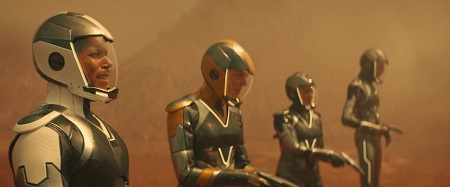
Star Trek: Discovery review – Season 4, Episodes 1-2

Spoiler Warning: There are spoilers ahead for Star Trek: Discovery Seasons 1-4. Spoilers are also present for Star Trek: Picard Season 1 and Star Trek: The Next Generation.

Ahhh… it feels so good to write these words! Star Trek: Discovery is finally available in Latin America, Western Europe, Australia, and a few other countries and territories via a patchwork of different streaming services, television channels, and other digital distribution methods. Significant numbers of Trekkies in Africa, Asia, and elsewhere still can’t access Discovery Season 4 (by conventional methods, at least) but it feels like a victory for fan activism nevertheless. It’s my sincere hope that ViacomCBS will continue to try to bring Discovery Season 4 – and the rest of Star Trek – to regions and territories where it isn’t yet available, and I’ll keep bringing up the issue at every opportunity.

Following the positive news the other day that Discovery is going to be available to watch, I have taken the decision to resume my reviews and theories for the duration of the season. I felt it was necessary to criticise ViacomCBS, Paramount+, and the rest of the corporate side of Star Trek following their poor decision to withdraw the show, but equally I feel it’s important for all of us to support Star Trek if it is available. That means watching it on Pluto TV, purchasing episodes on platforms like iTunes/Amazon, or watching on Paramount+.

Pluto TV is the current home of Star Trek: Discovery here in the UK – and in much of the rest of western Europe.

This isn’t a one-way street, and when corporations make positive decisions – especially following a significant fan campaign – I think we need to go out of our way to support the franchises we love and show companies like ViacomCBS that listening to fan feedback pays off. It’s not good enough to criticise the company for their nonsense, but fail to acknowledge and respond positively when they reverse course or take good decisions.

The “victory” is bittersweet because I know that there are fans in other parts of the world who can’t watch Discovery. If I still lived in South Africa, for example, I’d be continuing my one-person Discovery review blackout! But because the show is now available here in the UK, I will be resuming my reviews. That doesn’t mean I don’t support fans in other parts of the world, and I will continue to do what I can in my own small way here on the website to call on ViacomCBS to make Discovery and the rest of Star Trek available.

Having dedicated close to 10,000 words and a week of my time to Discovery Season 4 and the international distribution situation, I think that’s more than enough on that for now! So let’s get back on track with a double-header review of the first two episodes: Kobayashi Maru and Anomaly.

The first shot of the new season.

Kobayashi Maru kicked off with a neat CGI sequence showing the USS Discovery arriving from a Spore Drive jump, then Book’s ship departing the shuttlebay. The special effects work across both episodes was outstanding, and the animators and artists deserve a lot of credit – even more so when you consider that much of the work was done remotely due to the pandemic. In particular I’d point to shots of Book’s ship in flight, the USS Discovery’s Spore Drive jumps, and the anti-gravity sequences that we’ll look at in a moment.

The one criticism that I have of Kobayashi Maru is related to CGI, though. It isn’t what you think – none of the effects themselves were bad! But as a consequence of the somewhat rapid, occasionally chaotic way that the episode was cut together, edited, and paced, at a couple of crucial moments, CGI sequences were nowhere near as long as they needed to be to properly communicate what was happening. At both points where Book was looking at the impact of the gravitational anomaly, first on Kwejian’s moon from the console of his ship and later at Kwejian itself from the bridge of Discovery, the CGI shots of the anomaly and the remains of the planet were barely shown for a scant few seconds – not long enough, in my opinion at least, to have the impact they were intended to have.

This CGI shot of the remains of Kwejian was only visible for a few seconds.

In the first case I think we can excuse the pacing. Book blacked out as the anomaly hit, and the structure of the scene was enough to show that the proverbial “something bad” was happening, but also the short cut kept it mysterious enough that we didn’t see everything – and were left wanting to know more. But as Book stood on the bridge of Discovery, we caught a glimpse of Kwejian that began somewhat blurry and obscured by the ship’s viewscreen, then lingered for mere seconds before cutting back to Book and the crew to see their reactions. A few extra seconds, perhaps, might’ve helped this moment.

As it is, we know what happened to Kwejian. And since we’re already talking about the premiere’s biggest single moment, let’s jump into the “should Kwejian have been destroyed” conversation! In my view, the season premiere needed something big to sufficiently communicate the stakes. A character death could’ve accomplished this, but considering that the anomaly is being presented as this kind of galaxy-ending threat, the destruction of an entire planet – especially one we’re familiar with and from which a main character originates – succeeds in this objective.

Book’s immediate reaction to the loss of his homeworld.

Objections to the Kwejian storyline seem to stem from a much broader point of contention – that Discovery shouldn’t be running this kind of apocalyptic storyline for the third (or arguably fourth) season in a row. Taking a break from saving the galaxy would’ve allowed the show to tell different kinds of stories – stories that could be just as exciting and dramatic, but smaller in scope and more character-oriented. That’s not a bad argument, but it’s been apparent since we got the first teaser trailer for the season at First Contact Day in April that this was going to be the direction of travel. In the context of this kind of story, the destruction of Kwejian works; it succeeds as a story point.

Obviously this hurts Book, and represents a change for his character that’s at least as substantial as Saru’s Season 2 vahar’ai transformation. Two episodes in, we don’t really know what the outcome of this will be for Book. He could follow the path of Kelvin-timeline Spock, recommitting himself to his work. He could draw on the loss of Kwejian at a key moment later in the story, perhaps spurring him on as he knows he’s one of the last remaining Kwejian natives. Or he could fall deeper into a depression that lasts all season and from which he struggles to recover. One thing is certain, though: Book won’t be the same after the destruction of his home planet and the loss of his family.

Book being comforted by Burnham in Anomaly.

President Rillak manages to simultaneously embody the “bad admiral” character archetype from past iterations of the franchise (where Starfleet admirals would often be depicted as adversarial if not outright evil) while also feeling like a character with nuance and depth. It would’ve been easy for Rillak to fall into a fairly flat villain trope given that Kobayashi Maru deliberately pitted her against Captain Burnham right from the start. But her reasons for seeking an evaluation of Burnham, her level-headed rebuke and assessment of Burnham’s captaincy, and the impressive way she stepped in to disarm the situation aboard the space station all work in her favour.

However, I would be remiss not to point out that her noisy interventions on the bridge of a starship while it was engaged in a dangerous and highly time-sensitive assignment ended up causing a lot of problems. Had Captain Burnham not been delayed by those crucical seconds, the outcome of the mission could have been very different – and someone who lost their life might’ve survived. There is a time and place for someone in a position of authority to question or criticise, and in the heat of the moment is not that time.

President Rillak interrupted Captain Burnham at the wrong moment.

I’m glad that President Rillak has been brought on board, though. The only other authority figure we’ve met within Starfleet is Admiral Vance – and I can’t imagine him being so adversarial and harsh toward Captain Burnham. I was worried before the season premiered that storylines which could’ve been Vance’s will end up going to President Rillak, but I’m actually glad in this case that he gets to remain on friendly terms with Discovery’s captain, and that we don’t have to see him as an obstacle for her to overcome.

The “butterfly aliens” had a neat, unique design, and it played into the story of repairing their non-functional satellite network well. My only criticism of this sequence would be that it felt rushed. The intention was to show Captain Burnham and the crew working together, knowing each other’s strengths and using them to solve a puzzle. But Kobayashi Maru as a whole felt very rapidly-paced, and this sequence – which in past iterations of Star Trek might’ve been a whole episode – felt undeniably rushed, lasting only a few minutes. The episode wanted to get into the meat of the story, and the “butterfly aliens” and their satellites were elbowed out of the way in relatively short order to make that happen.

The butterfly aliens up close.

I get the sense that Book and Burnham’s mission to deliver dilithium to the “butterfly aliens” might be all that we get to see of the Federation being rebuilt this season. Some of this seems to have happened off-screen, and it feels like the rebuilding, expanding Federation is basically going to be a backdrop to the main event – the story of the gravitational anomaly.

Considering how big and devastating the Burn had been, I think I’d have liked to see more of this rebuilding work. It makes a good backdrop, don’t get me wrong, and it gives the crew something to fight for and defend as they step up their efforts to defend against the anomaly. But when you think back to how fractured and small the Federation felt in Season 3, particularly in the first half of the season, there’s a bit of a risk that we’re rushing past something meaningful; a story worth telling.

Fixing the satellites for the butterfly aliens was a short moment designed to be a microcosm of Captain Burnham’s and the USS Discovery’s work prior to the main anomaly storyline.

Frankly, I could have happily entertained the idea of an entire season’s worth of “rebuilding” stories. Seeing Captain Burnham and the crew traveling the length and breadth of the rump Federation, bringing help and hope to familiar and new races would have been really interesting to see. It would’ve allowed for a season-long story, but one comprised much more of individual elements – rebuilding work on one planet or in one system, then moving on to a different area to face a different challenge. It was nice to get a taste of this rebuilding work – which is presumably something Captain Burnham and the crew have been doing a lot of off-screen – but there was absolutely scope to do a lot more with this idea.

Though only on screen for a brief moment, it was wonderful to see Admiral Vance’s family. He’d mentioned them in Season 3, but it was implied that his work meant he couldn’t spend as much time with them as he wanted. To see him able to welcome them to Starfleet Academy and show them around was really touching.

Admiral Vance with his wife and daughter.

One moment in Kobayashi Maru had me tearing up – and I bet you can guess which one! As President Rillak introduced the assembled cadets and officers to Starfleet’s new Archer Space Dock, Archer’s Theme from the end credits of Star Trek: Enterprise was heard. The USS Voyager-J was docked, and for a brief moment I got very emotional! Star Trek has done this to me before: seeing the refit USS Enterprise for the first time in The Motion Picture, accompanied by another beautiful piece of music, is another sequence that turns on the water works! This scene was very similar, and was truly a beautiful homage to Enterprise. More than a millennium after his voyages of exploration, it’s incredibly sweet to see the Federation remembering Captain Archer.

As Kobayashi Maru drew to a close, pretty much everything we’d seen across the episode’s fifty-minute runtime had ceased to feel important. The revelation of Kwejian’s destruction overruled everything else, and the conflict between Captain Burnham and President Rillak felt petty in comparison. Tackling the anomaly would mean they’d have to pull together – any interpersonal conflict or rivalries now needed to be set aside. As I sat down to watch Anomaly, the direction of travel for the season felt set.

This moment, accompanied by a familiar musical sting, was beautiful

That doesn’t mean that Kobayashi Maru was some kind of waste. It told an exciting and engaging story in its own right, one which laid the groundwork for what’s to come in two key ways: firstly by showing off how far the Federation has come, giving Captain Burnham and the crew something to fight for, and secondly by introducing the gravitational anomaly and its devastating destructive power.

So that brings us to Anomaly.

Despite its subject matter, Anomaly ended up being a much more intimate, personal, and emotional episode than I initially expected. Several different characters got cathartic, emotional storylines that really showed off how well Discovery can do these smaller, personal moments even in the midst of a galactic-scale story.

Captain Burnham in Anomaly.

Book and Stamets made an amazing, underrated pair in Anomaly, and their central conflict was handled incredibly well. In the run-up to the season I had asked what Book’s ability to control the Spore Drive could mean for Starfleet, and we got part of an answer to that in Kobayashi Maru, with President Rillak explaining that a “next-generation” Spore Drive was in development. But naturally, a proud person like Stamets would be impacted by the reveal too.

I liked the way this was handled. It wasn’t presented as mere jealousy – though perhaps Stamets’ ego did play a role in the conflict between himself and Book – but more a feeling of helplessness. Having to rely on other people, feeling unable to help and having to watch from the sidelines as Stamets did in the Season 3 finale, is never a nice feeling. As someone who’s disabled and who has to rely on help more often than I’d like, this is definitely something very relatable. Everyone wants to feel independent and in control of their life and their situation – Stamets lost that control, and having already lost his husband once before was already emotionally vulnerable to this kind of situation. He appears to have redirected some of those feelings onto Book, but he recognised that and tried to make amends.

Stamets and Book made a great pair.

David Ajala and Anthony Rapp played off one another beautifully in their scenes together, and it makes me want more Book and Stamets! They’re an unlikely team in so many ways, but it’s fantastic to see Discovery stepping out of its comfort zone and pairing up different character duos. This is something I hope to see more of as the season rumbles on.

One character pairing that came together beautifully at the beginning of Season 3 last year was Saru and Tilly, and seeing them reunited in Anomaly was fantastic. Saru is a calming influence on Tilly, who can be excitable and emotion-driven, and their contrasting personalities make for truly fun viewing. Tilly has come a long way since Season 1, but she still needs the occasional support of someone like Saru.

Tilly was glad to have Saru back!

Speaking of Saru, he’s now back aboard Discovery – albeit in a less-than-permanent capacity. What I liked about Saru’s reunion with Captain Burnham was the agency he was given over his role after returning to Starfleet. It would have been easy for the writers to have Burnham be the one to ask Saru to remain aboard the ship, but for Saru himself to make the offer to serve as first officer was an outstanding choice. I got genuinely emotional seeing Burnham accept his offer.

This might irritate the Discovery haters, but Captain Burnham and first officer Saru mirror Kirk and Spock in more ways than one; echoes of Star Trek’s first main character pairing are present. Burnham is younger, quicker to act, and more of a risk-taker. Saru is older, more experienced, and slower and more deliberate when considering his moves. He’s the perfect first officer to serve someone like Captain Burnham. She needs that kind of XO just like Kirk needed Spock – and while we’re talking about contrasting pairs, just like the calmer, level-headed Picard needed someone like Riker.

Captain Burnham arguably needs a first officer with the temperament of Saru.

I’m glad that Saru didn’t have to be demoted in order to take up his new role (like poor Decker was in The Motion Picture!) Starfleet ships have been depicted with two officers who both hold the rank of captain on several occasions; Kirk and Spock were both captains during the events of The Final Frontier and The Undiscovered Country, for example. So I don’t think it presents any kind of in-universe problem to see Saru occupy the role of first officer.

It would’ve been potentially interesting to see a secondary character promoted to occupy that role. Nilsson, Rhys, Bryce, or even Linus were possible contenders, and it wasn’t really clear who served in that role before Saru came aboard – Discovery has been flying around for months, after all. But on the whole, I think the role suits Saru perfectly. I’d even go so far as to say it suits him better than the captain’s chair ever did. His style is well suited to being the person to present multiple options, to consider the possibilities, but to leave the decision-making to someone else. I just hope that his presence on the ship won’t end up causing Captain Burnham any problems; I don’t think the writers would go down that road, but you never can tell!

There were other prospective first officer candidates – such as Rhys, who appeared to have the conn for a time in Kobayashi Maru.

Speaking of Captain Burnham, we see two distinct aspects of her command style on display across the first two episodes of the season. In Kobayashi Maru, particularly during the fast-paced opening sequence, we see her at her most self-assured, confident not only in her own abilities but in those of the crew under her command. In Anomaly, we see her willing to listen to the advice of members of her crew – relying on Tilly, Adira, Bryce, and particularly Saru at several key moments across the episode.

Critics of Michael Burnham’s characterisation would be well-advised to watch her in Anomaly in particular. I don’t think it’s fair to say she’s “changed” in Anomaly compared to how she’s usually been portrayed, but some of the criticisms of Burnham in past seasons stem from a sense of selfishness or self-centeredness that arguably are more to do with the way Discovery as a whole is written than the way Burnham herself is. But in Anomaly we see firsthand how she’s relying on others – and from the production side of things, how Discovery is willing to allow other characters far more agency over the way the story unfolds.

Anomaly was a great episode for Captain Burnham.

Someone like Bryce is a relative “blank slate” – despite being a longstanding member of the bridge crew. We don’t know a lot about him, his background, or his hobbies, so in that sense making him the one to figure out a solution to the dangerous situation makes sense. It’s quite believable that Bryce might enjoy kite-surfing – far more so than if it was suddenly a hobby ascribed to Burnham, Saru, or Tilly for the first time. It’s a contrivance, for sure, but Star Trek’s history is littered with those – many of which are far more egregious!

David Ajala put in his best and most emotional performance of the series so far in Anomaly, communicating the incredible, almost unimaginable pain of someone who feels like he’s lost everything. Mixed in with loss is regret – Book had spent most of the last few years away from Kwejian, prior to the events of Season 3’s episode Sanctuary, and in light of the loss of the world and his family, regrets those lost years all the more.

Book lost almost everything and everyone he had cared about – and David Ajala’s performance captured that pitch-perfectly.

The standoff between Captain Burnham and Book was riveting to watch in Anomaly, as the latter insisted on helming a dangerous mission into the anomaly. It reminded me of The Next Generation Season 6 episode Lessons, where Captain Picard struggles with the similar conundrum of ordering someone he cares about to undertake a dangerous mission. Lessons is a fantastic episode, but I think in retrospect it’s limited by the fact that Nella Darren – Picard’s love interest – is a new, one-off character. Book and Burnham’s relationship has been well-established over the course of Season 3 and into Season 4, so the conundrum she faces as he insists on going on the mission is something we as the audience are far more invested in.

Star Trek has, on more than one occasion, depicted people at moments of severe depression, willing to end their lives or to give up. Book is in that position in Anomaly – not actively trying to die, but so uncaring about his life in the wake of everything that’s happened that he’s willing to take risks, put himself in harm’s way, and give up rather than fight to survive. But Anomaly showed Book that Burnham is in his corner, willing to fight when he isn’t, and pushing him to find the strength to try.

Burnham was there for Book when he needed her most.

Anomaly shows us, through a variety of different character pairings, how people can help one another through difficult circumstances. Whether it’s Tilly complimenting Adira for their hard work, Saru telling Burnham to be a partner, not a captain, Dr Culber talking to Gray through Adira as he works on his new synthetic body, or Stamets reaching out to Book, the theme of the episode is connection.

I loved the Picard reference in the scene with Adira, Gray, and Dr Culber. It was an interesting revelation that the “Soong process” for transferring minds was ultimately unsuccessful in most cases – I wonder what impact that will have on future Picard stories. The character it might impact most is Dr Soong himself, as he had planned to transfer his own consciousness into a synthetic body. But perhaps we should leave that speculation for another time! I think the intention here was to pre-emptively close a potential plot hole – by saying that the Soong process is basically unlikely to succeed, it gets around potential questions in future about why it wasn’t possible to save characters by transferring them into synthetic bodies when they’re near death. I’m not sure it was necessarily something that needed to be wrapped up in this fashion, but then again we Trekkies can be a pedantic bunch!

Dr Culber connected Gray’s story to Star Trek: Picard Season 1.

As someone who has struggled for a long time with my own gender identity, the scene with Gray “customising” his new body was very emotional. For a long time, I lacked the confidence to change anything about my appearance – especially when going out in public – to better match my own gender identity, so to see Gray talking about making cosmetic changes in order to be more comfortable in his own skin – literally – was a deeply emotional moment.

There’s power in representation, and even though Gray wasn’t the main focus of Anomaly, the main scene he had with Dr Culber and Adira was one of the best, and perhaps most underrated, in the entire episode for me.

Gray had the opportunity to customise his new body.

One of the big questions facing Season 4 at the moment is the nature of the gravitational anomaly. It always felt that the characters’ first guesses as to what it could be wouldn’t pan out, but I kind of liked the idea of a rogue black hole – or pair of black holes, in this case. Facing a purely natural phenomenon could be a story that brings with it all kinds of real-world parallels as we struggle with the climate emergency, for example.

However, it seems from the ending of Anomaly that Stamets, Tilly, and co. weren’t correct with their binary black hole theory, once again opening up the story to a completely unknowable next phase. Keeping the mystery going is good; had the anomaly been all figured out within a couple of episodes it might’ve been less exciting going into the rest of the season! It was interesting, though, to see Tilly in the closing moments of Anomaly presenting this as a defeat.

The nature of the anomaly is still uncertain.

Tilly seemed to be suggesting that the fact that the anomaly’s path remains unpredictable means that the mission to scan it was somehow unsuccessful, but I’m not sure that’s the best way to present this revelation. Scanning the anomaly up close yielded a treasure trove of information for the crew to scour, and was an absolutely necessary step in understanding the danger it poses. Maybe its path is still impossible to predict – for now. But that doesn’t make the mission a failure. And considering no lives were lost and the damage to the ship seems repairable, I guess I just don’t really get why the closing moments of Anomaly chose to present the results of the data in such a negative way. Obviously it’s bad news that the path of the anomaly is still unpredictable – but that’s no one’s fault and it doesn’t mean that the mission failed.

The visual effect of the crew lifted out of their seats as artificial gravity failed was incredibly impactful; one of the most powerful visuals in the first two episodes. I can see why clips of that were chosen for the trailers! Star Trek rarely depicts artificial gravity failures – doing so has historically been prohibitively expensive. A couple of behind-the-scenes photos have shown the cast suspended in harnesses and on wires, and it seems clear that those sequences will have been difficult to film. It was worth the effort, though, and the finished effect is fantastic. Not only that, but I think it’s made substantially more impactful because artificial gravity failures are so uncommon in Star Trek.

Dr Culber and Captain Burnham float free as Discovery’s artificial gravity fails.

So that was Season 4’s opening pair of episodes. It took fans a lot of hard work to ensure the episodes would be available to more folks, so I hope everyone has found a way to tune in and watch via official channels – where such channels are available, of course. I think the season got off to a rocky start with all of the international mess, but the episodes themselves were fabulous, setting up a suitably engrossing mystery that feels very open right now. The story could go down any one of many different, utterly unpredictable routes – just like the anomaly itself!

Discovery is always at its best with moments of intimate characterisation, and there were many, many moments across both episodes that showed off the characters at their best – and gave the actors some fantastic material to work with. There were amazing performances from David Ajala, Sonequa Martin-Green, Doug Jones, Ian Alexander, and Chelah Horsdal in particular, and I’m sure I’m leaving too many folks out. The visual effects are once again amazing, an improvement on Season 3 – something I didn’t think would’ve been possible.

As the credits rolled on Anomaly I was left wanting to know more – and not wanting to have to wait a week! That’s the mark of a good story in my book, leaving fans clamouring for more, wanting to figure out the show’s mysteries. I’m eagerly awaiting next week’s episode, Choose To Live. Stay tuned for my weekly list of theories in the days ahead, and a review of Choose To Live next week!

Star Trek: Discovery Season 4 is available to stream now on Paramount+ in the United States, Scandinavia, Latin America, and Australia. The show is on Pluto TV in the UK, France, Germany, Italy, and other parts of Western Europe at 9pm on Fridays and Saturdays. Individual episodes or the full season can be purchased on iTunes, Amazon Video, and possibly other platforms in the UK, parts of Europe, and select other countries. The Star Trek franchise – including Discovery and all other properties mentioned above – is the copyright of ViacomCBS. This article contains the thoughts and opinions of one person only and is not intended to cause any offence.
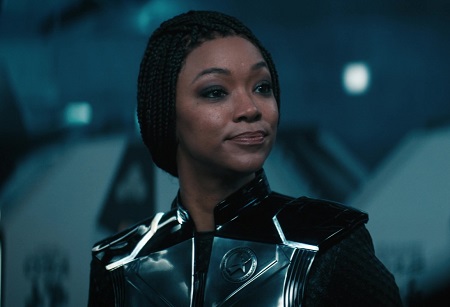
Star Trek: Discovery theories – week 0

Spoiler Warning: There are spoilers ahead for Star Trek: Discovery Seasons 1-3 and the trailers and teasers for Season 4. Spoilers are also present for other iterations of the Star Trek franchise, including Picard Season 1.

Discovery’s fourth season kicks off next week, and if you missed my coverage of the series last year you might not know that I like to write up my theories after each episode has aired. This year I want to get in early and put all of my major pre-season theories into one place… that way we can cross them off as they get debunked – or possibly even confirmed!

Last year I had a lot of fun combing over each episode and trying to speculate and theorise where the story might go. I came up with many theories that were wide of the mark – check out some of my worst ones by clicking or tapping here! – but I did also get some things right.

A Ferengi Starfleet officer glimpsed in the second Season 4 trailer.

It’s important to caveat any list of theories by saying that I have no “insider information” and I’m not trying to claim that anything listed below will happen. Fan theories are a lot of fun for me, but they can also detract from a person’s enjoyment of media if they get too attached to a particular theory that ultimately doesn’t come to pass. If you find yourself in that position, I recommend taking a break from fan theories for a while.

So let’s have a bit of fun and kick off my Star Trek: Discovery Season 4 theories one week early! You might’ve seen some of these already – I’ve written up a few big pre-season theories over the past few months. Let’s jump into the list!

Theory #1: A major character will be killed.

A Starfleet coffin draped with the Federation flag as seen in Deep Space Nine.

Season 3 saw a couple of major departures: Mirror Georgiou entered the Guardian of Forever’s portal, and Nhan remained behind aboard the USS Tikhov. Yet despite the dangers the crew faced as they navigated the 32nd Century, battled the Emerald Chain, and figured out the mysteries of the Burn and the Verubin Nebula, only one ally – Ryn – lost their life.

Killing off a character can be an excellent way to communicate the stakes involved if it happens at a relatively early stage, and we know Captain Burnham and the crew will be facing a dangerous gravitational anomaly. It can also be a storyline that brings a lot of emotion, as we have to say goodbye to a beloved member of the crew.

Dr McCoy and Sulu playing dead in The Wrath of Khan.

In short, I think there are plenty of reasons on the production side why killing off a major character could make sense in Season 4. Discovery has seen a number of characters leave the series – far more than any past Star Trek show, in fact – but the series’ death toll is still relatively low when compared to many other modern television shows.

There are also a couple of characters whose roles aboard the ship feel in danger – not least of whom is poor ex-Captain Saru, who was rather unceremoniously shuffled out of his role in the Season 3 epilogue. For a full breakdown of which other characters may or may not be in danger, check out my list of “death predictions” by clicking or tapping here.

Theory #2: There will be a character crossover from a past iteration of Star Trek.

Voyager’s Doctor is a contender!

Yes, I’m officially bringing this theory back! This is one that I doggedly clung on to for all of Season 3, and while it arguably kind of happened with the Guardian of Forever, that wasn’t really what I meant.

The show’s 32nd Century setting has shot Captain Burnham and the crew far beyond anything in Star Trek’s established canon, and that should mean that practically everyone we remember from other Star Trek shows won’t be around any longer. But this is Star Trek – with some creatively-written technobabble, practically any major character could have survived all the way through to the 32nd Century!

Could Sutra still be alive in the 32nd Century?

It’s also possible for Captain Burnham to discover the logs of a long-dead officer; someone we as the audience would be familiar with. While this would be less of a “crossover” than if a character from the past could be physically present, it would still be a lot of fun to see!

There are a handful of characters who could have survived to the 32nd Century based on what we know about them from past iterations of the franchise. Included in this category would be people like Soji, Voyager’s Doctor, and a few others. But as we’ve seen in episodes like Relics and even the film Generations, all it would take to make a big crossover happen is some kind of temporal anomaly, stasis field, or other technobabble!

Theory #3: Burnham may not remain in the captain’s chair.

Michael Burnham in the captain’s chair in a promotional image for Season 4.

This is a controversial one, so let me just say up front that I’m neither in favour of this theory nor opposed to it – I just think it’s a possibility. As things stand, Discovery has had four different captains across its four seasons. One of the show’s unique points of interest within Star Trek’s broader canon are the differences between these very different individual captains and the way they commanded the ship and crew.

It’s got to be considered at least a possibility, then, that the show will continue this trend. This doesn’t mean Captain Burnham will be killed off; I’d actually argue she’s pretty safe. But there are many different routes to her potentially leaving the ship, such as a desire for freedom that we saw in Season 3, or even perhaps taking up a new, more senior role within Starfleet.

Captain Burnham in the first Season 4 trailer.

If this theory were to come to pass, it would be something I’d expect to see at the very end of the season. Even if Burnham seems 100% committed to her new role as captain, I don’t think it’s a theory we can definitively rule out.

It’s worth mentioning that at time of writing, Discovery hasn’t been officially renewed for a fifth season – so all this talk of who’ll be in the captain’s chair by then could be moot! And of course this theory has a very strong counter-argument: that Discovery’s main story arc across its first three seasons can be read as Burnham’s ascent to the captain’s chair.

Theory #4: The Spore Drive will be rolled out to more ships.

The USS Discovery making a Spore Drive jump.

The Season 3 finale rushed past this point as it had a lot going on, but the revelation that Book – and potentially millions of other people with empathic abilities – can serve in the role of Spore Drive navigator is huge. The technology was previously limited by Stamets being the only one with the ability to interface with the mycelial network, but now that limitation has seemingly been removed.

In a galaxy where dilithium supplies are still low, having a powerful alternative method of propulsion is a godsend for Starfleet, and I would think it would be a priority to start recreating the technology and training up a whole corps of Spore Drive navigators.

Book was able to use the Spore Drive in Season 3 – potentially opening it up for more ships to use.

On the production side of things, this would finally find a proper use for what has been one of Discovery’s more controversial elements. Even after the discovery of the huge dilithium cache in the Verubin Nebula, the vitally-important fuel is still a limited resource. Developing an alternative way for Starfleet ships to get around should still be a priority for the organisation.

This could be a story with real-world parallels, too. Climate change is a very real and very dangerous threat out here in the real world, and finding new, cleaner ways of generating power and fuelling our vehicles is essential. Discovery could use its Spore Drive as an analogy for the development of electric vehicles or renewable energy generation, for example.

Theory #5: Kovich works for Section 31.

Kovich in Season 3.

This is another Season 3 theory that I’m choosing to bring back! The question of who Kovich is and what role he played in Starfleet and the Federation was left open at the end of Season 3, and we know that the character will return in some capacity. As someone who seemed to talk around the issue at hand and not reveal everything he knew, Kovich strikes me as potentially being a Section 31 operative – or even the head of the organisation.

We don’t know yet if the Section 31 series that was announced in 2019 will go ahead as planned. But if it does, there could potentially be a connection between Kovich and Georgiou that would tie the two shows together. Kovich is mysterious enough that his character could be taken in many different directions – but my money’s on Section 31.

Theory #6: The ban on time travel will be explained further.

Admiral Vance first told us of the ban on time travel.

This one is a hope as much as a theory right now! In short, the ban on time travel was introduced early in Season 3 primarily as a way for the writers and producers to avoid questions about why the 32nd Century was so different from how the far future had been depicted in earlier Star Trek productions, as well as to explain things like how the Burn was able to catch the Federation off-guard and why Georgiou couldn’t simply be sent back in time when she needed to.

But the ban itself raises some issues – the biggest one being the lack of detail on how it works and how something like this could possibly be enforced. As I said several times last season, it isn’t possible to just un-invent a technology so useful and powerful as time travel. Even just a few lines of dialogue going into a little more detail on the mechanisms involved in the ban would be really useful.

Theory #7: The Federation has flouted the ban on time travel.

HMS Bounty travels through time in Star Trek IV: The Voyage Home.

Sticking with the time travel ban, another theory I had last season was that the Federation – and Section 31 in particular – might have deliberately flouted the ban and failed to abide by the rules. Someone as straight-laced and committed to Starfleet ideals as Admiral Vance is highly unlikely to have sanctioned such a move, but someone like the shadowy Kovich (who we talked about a moment ago) might have. President Rillak is someone we don’t know yet, but she could also be involved.

Obviously the bulk of the season’s story will deal with the gravitational anomaly. But there’s scope to either talk about the time travel ban in a standalone episode or even tie the two stories together – perhaps the anomaly has been unleashed as a result of unsanctioned time travel.

Theory #8: The story will connect with the Short Treks episode Calypso.

The USS Discovery seen in Calpyso.

Despite a handful of moments in Season 3 which seemed to connect to Calypso, the story of the season overall ended up going in a very different direction. While we saw a couple of things that arguably did tie in to the Short Treks episode, major things like the USS Discovery undergoing a refit have actually moved the plot even further away.

It’s possible that Calypso will forever remain an outlier in Star Trek’s canon – an episode tied to a vision of Season 2 or Season 3 that was changed before it made it to screen. But earlier in Season 3 it felt like we were getting close to seeing how it could all be tied together – and I’m hopeful that Season 4 will find a way to do so.

Theory #9: The crew will have to defend the Verubin Nebula.

The dilithium planet at the centre of the Verubin Nebula.

The Federation is in a weakened state, and even if we see worlds like Ni’Var rejoin the organisation it’s still nowhere near as powerful as it once was. The Verubin Nebula is thus a very tempting target for anyone looking to gain an edge in a galaxy where dilithium is still in short supply. As the only known significant dilithium supply, whoever controls the Verubin Nebula will have a massive tactical advantage.

We can compare the Verubin Nebula to Deep Space Nine’s Bajoran wormhole in that respect – it’s a resource of huge strategic importance. Season 3 didn’t show us much about the makeup of the galaxy’s factions outside of the rump Federation and the Emerald Chain, but it’s got to be possible that factions like the Dominion, Klingon Empire, or even the Borg still exist and would want to seize the Verubin Nebula for themselves.

The USS Discovery arriving at the Verubin Nebula in Season 3.

Season 4 has teased a scientific puzzle – the gravitational anomaly. But that doesn’t mean there won’t be villains in play, and Discovery has introduced us to several compelling and interesting villains over its first three seasons.

To make a long theory short, it would begin to stretch credulity to think that everyone in the known galaxy would see the Federation rebuilding and having access to dilithium and not want to find out for themselves what’s going on. Once the Verubin Nebula’s existence becomes known, even if the Federation promises to share its bounty with all comers, it seems very likely that someone would want to take control of the dilithium supply for themselves.

Theory #10: The super-synths from Picard Season 1 are involved with the gravitational anomaly.

The super-synths in Picard Season 1.

Picard Season 1 introduced us to a faction I nicknamed the “Mass Effect Reapers” – for their similarity to that video game faction. This race of super-synths existed outside of the Milky Way galaxy and promised to come to the aid of any synthetics who were being persecuted by organics, and Soji and Sutra attempted to contact them in the Season 1 finale.

We don’t know much at all about the super-synths or what their goals or motivations might be. It has to be considered at least possible that the attempted contact by the Coppelius synths set in motion a chain of events that could lead to the super-synths attacking the Milky Way galaxy.

Theory #11: The gravitational anomaly is a superweapon.

The USS Discovery en route to the anomaly in the second Season 4 trailer.

Based solely on what we’ve heard about the gravitational anomaly in the trailers and teasers, one thing strikes me as odd. The anomaly appears to be “targetting” the Federation. I put the word in inverted commas because it implies an intelligence at work – someone or something in control of the anomaly, directing it to attack the Federation. But what if that’s actually the case?

I mentioned the super-synths above as one possible culprit, but we could also consider factions like the Borg or the Dominion – they might have taken the opportunity of the Burn to perfect a weapon to destroy the remaining members of the Federation, perhaps as a precursor to invading and conquering the Alpha Quadrant.

A different depiction of the anomaly.

There are also factions like the Kelvan Empire from The Original Series – whose possible return to the Milky Way galaxy lines up in terms of timing. Enterprise’s Sphere Builders also come to mind: they attempted to use their own anomaly-generating devices to convert a region of space to resemble their native realm also as a precursor to invasion.

In short, are we certain that the gravitational anomaly will be nothing more than a natural phenomenon? I’m definitely not convinced of that right now! Past seasons of the show have seen twists and turns, taking stories in unexpected directions. Right now we assume that whatever this anomaly is it’s something natural – but that may not be the case.

Theory #12: Captain Burnham and the crew will encounter the Klingons.

The Klingons have been part of Discovery since the beginning.

By the late 24th Century the Federation and Klingons were firm friends, having been allied for a century and after fighting side-by-side against the Dominion. We don’t know if that alliance endured to the 32nd Century, but it’s certainly plausible to think that it did. The Klingons might even have joined the Federation at some point, and their violent warrior culture may have been significantly pacified.

One thing that could be very interesting to see is how the crew of the USS Discovery – almost all of whom are veterans of the Federation-Klingon war – would respond to that. They’ve worked alongside Klingons like L’Rell before, but many of them still see the Klingons as an old enemy. The story of overcoming that prejudice could mirror episodes like The Wounded from The Next Generation, and would be very interesting to see.

Theory #13: Some areas of the galaxy – such as the Delta Quadrant – avoided the worst effects of the Burn.

The USS Voyager was the first Federation starship to explore the Delta Quadrant.

It’s quite possible that Season 4 won’t revisit the Burn narrative in any detail. But one thing I’d be curious to see is the true extent of the disaster – did it reach all four quadrants of the galaxy equally, or did its effects fade out after a certain point? Michael Burnham discovered that the Burn had a point of origin, and that it radiated out from that point like ripples on the surface of water. Ripples eventually diminish, fading away the further they travel, and perhaps that’s true of the Burn as well. There could be whole areas of the galaxy that didn’t even notice the Burn – and maybe the ship and crew will visit one such region.

If the Delta Quadrant was left largely unscathed, for example, what might that mean for the likes of the Borg? It’s possible they aren’t even still around in the 32nd Century, but it’s also possible that they’ve had more than a century to expand and build up their forces while the Federation suffered.

Theory #14: The Guardian of Forever will be back.

Carl – the Guardian of Forever’s new persona.

Having reintroduced the Guardian of Forever in Season 3, I wouldn’t be at all surprised to see Discovery return to the Guardian’s planet in Season 4. The gravitational anomaly is something new and threatening, so it’s possible Captain Burnham might want to ask the Guardian for help or information.

The Guardian of Forever is also the only way we know of at present to travel through time – something that might be necessary if Season 4 makes an attempt to link up with Calypso in a big way. There are many reasons why Captain Burnham might want to revisit the Guardian, and it would be great to bring back actor Paul Guilfoyle, who played the Guardian’s humanoid avatar in Season 3.

Theory #15: At least one new character will join the main cast.

Lieutenant Detmer in Season 3.

One big question facing the series right now is who will take on the role of Captain Burnham’s first officer? Tilly was seen in the second trailer wearing the blue uniform of the science division, so it seems as though her tenure as the USS Discovery’s number one will be short-lived. So who will replace her? There are several secondary bridge officers like Rhys, Nilsson, and Bryce who are contenders, but it could also be someone like Lieutenant Willa – Admiral Vance’s aide-de-camp from Season 3.

A new character entirely could also join the crew, either directly as Burnham’s XO or to replace someone else who gets promoted to that role. With both Nhan and Georgiou departing in Season 3, and a potentially reduced role for Saru this time around, there’s definitely scope to bring a new major character aboard the ship.

Lieutenant Sahil was commissioned into Starfleet at the end of Season 3.

We could potentially see characters from Season 3 like Lieutenant Sahil or even Aurellio make a comeback. Sahil was the guardian of a Federation relay post who Captain Burnham met at the beginning of the season, and he was commissioned as an officer in the season finale. He would be a great choice in my opinion.

A wholly new character could also be concocted. We know that Federation President Rillak will be new for Season 4, but how significant a role she will have remains to be seen. I definitely feel that there’s scope for at least one new character – or perhaps the promotion of a secondary character to the regular cast.

So that’s it for now! Those are my official Season 4 theories written up and ready to go!

Grudge is also coming back!

The season premiere will arrive in less than a week from now, so stay tuned for a full review of the episode and an update to these theories! I wonder how many will be completely destroyed right off the bat?

I’ve been looking forward to Discovery’s fourth season all year, and it’s hard to believe it’s now only a few days away! I’m hoping to see a season of television that will be tense, exciting, and unpredictable. Despite my love of theory-crafting, I like being wrong just as much as I like being right – if not more! A story that goes in truly unexpected directions is a lot of fun, so I won’t be upset even if absolutely none of my theories come to pass.

Star Trek: Discovery Season 4 will premiere on the 18th of November 2021 on Paramount+ in the United States, and on the 19th of November 2021 on Netflix in the United Kingdom and around the world. The Star Trek franchise – including Discovery and all other properties mentioned above – is the copyright of ViacomCBS. This article contains the thoughts and opinions of one person only and is not intended to cause any offence.
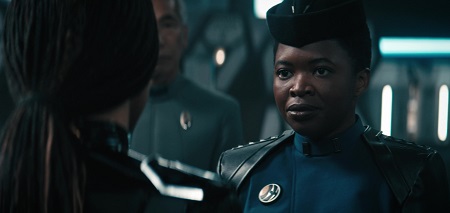
Star Trek: Discovery Season 4 – Death Predictions…

Spoiler Warning: There are spoilers ahead for Star Trek: Discovery Seasons 1-3 and the trailers and teasers for Season 4.

A bit of a morbid one this time… but it is nearly Halloween!

In the last decade or so, a number of television shows have pioneered what I call the “disposable cast” – where even main characters and fan-favourites can’t be assured of safety or survival as a series continues. Shows like Game of Thrones and The Walking Dead have made this a big part of their identities, and the idea that any major character could be in danger can – when done right – add to the tension and drama. Not knowing if your favourite character will make it to the end of the episode or escape a dangerous situation can really increase the weight of a story.

Discovery has technically seen more main cast members depart than any previous Star Trek series! Captains Lorca and Pike, Spock, Georgiou, Tyler, and Nhan were all main cast members at one point before departing the series. But with the exception of Lorca, none of these characters were killed off, and in a television landscape that increasingly favours big, dramatic character deaths, the Star Trek franchise as a whole still hasn’t really caught up.

Sonequa Martin-Green starred in The Walking Dead for a time.

In Season 3 we saw the recurring character of Ryn killed off. He’d been a friend and ally to Booker and Burnham and his death was both a shock – due to the way it was carried out – and a tragedy for the crew. As with Airiam in Season 2, though, Ryn wasn’t a character we’d got to know particularly well before his death, and when Season 3 could have stepped up and actually killed off a main character or a character who’d been present on the show since the beginning, the writers and producers chose not to do so.

Star Trek has always had an optimistic tone, embodied in some ways by Captain Kirk’s assertion that he “doesn’t believe in no-win scenarios.” The desire to save everyone every time is drilled into every Starfleet officer – particularly captains. In that sense I can certainly entertain the argument that a character death feels like a loss or a defeat in a way that is somehow “un-Star Trek.”

Admiral Kirk in The Wrath of Khan. He famously refused to accept the concept of a no-win scenario.

At the same time, I fundamentally disagree with Captain Kirk. Life is full of no-win scenarios, and one of the skills any captain or commander needs to have is knowing how to make a difficult choice; how to choose the least-bad option when no good outcomes are possible. Sometimes that means sacrificing a life to save others, and this is something that the Star Trek franchise has touched on in the past.

Though I don’t want to see any specific character killed off in Discovery’s imminent fourth season, a well-timed character death could go a long way to raising the stakes and making the story much more impactful. The gravitational anomaly would seem all the more deadly if it claimed the life of a familiar face, or the climax of the story could see Captain Burnham having to make an impossible choice.

I don’t necessarily want to see anyone killed off – but it would certainly make for an impactful and dramatic story beat.

So this time we’re going to take a look at Discovery’s main and recurring characters – and try to assess who may or may not survive the season!

The usual caveats apply: I have no “insider information” and I’m not claiming to know what will happen. All of this is guesswork and speculation from a fan of Star Trek, nothing more. It’s also entirely subjective, so if you disagree or hate my ideas that’s okay!

Now that’s out of the way, let’s get started. I’m going to put the characters into a list, then give my assessment of how likely they are to be killed off during Season 4.

Character #1: Captain Michael Burnham
Status: Almost Certainly Safe 💖

Captain Burnham in a promo image for Season 4.

Discovery has been the Michael Burnham show since its premiere episode, and that is unlikely to change! The first three seasons saw Burnham’s rise to the captaincy of the USS Discovery, and having only just got there it would be a really unexpected and subversive twist to kill her off. As the show’s main protagonist she feels safer than most – and even series that pioneered the “disposable cast” like those mentioned above have tended to save their most significant characters from harm.

The only possible argument we could consider to counter that is the uniqueness of the USS Discovery’s captain’s chair. Three seasons of the show have each been led by a different captain – Lorca, Pike, and Saru. One of Discovery’s most interesting features has been these individual season-long captaincies and the very different styles each captain had. It’s possible – though I wouldn’t call it “likely” by any stretch – that the show might choose to bring in another new captain for Season 5, continuing this trend. If that’s the case, perhaps Captain Burnham isn’t quite as safe as it seems! However, I consider that a very unlikely scenario.

Character #2: Saru
Status: In Danger ☠️

Saru in the second Season 4 trailer.

What role does ex-Captain Saru have aboard a ship that has moved on without him? That’s a fundamental question that the series will have to address, because it’s quite odd for a Starfleet vessel to be racing across the galaxy with two captains on board. The situation could, perhaps, even lead to some awkwardness for Captain Burnham!

Some fans felt that Saru might’ve left Discovery after the Season 3 epilogue told us that he was returning to Kaminar to spend time helping Su’Kal. Fortunately that didn’t happen – not least because the short epilogue would have been a very disrespectful way for Saru to be shuffled off the show altogether! But the fact that Discovery has found a new captain means Saru doesn’t really have a role any more, at least not as things currently stand. Characters who feel surplus to requirements are often the most in danger – and Saru doesn’t really have a clear role right now.

Character #3: Paul Stamets
Status: In Danger ☠️

Stamets in the first Season 4 trailer.

Until recently, Stamets felt safer than almost any other character on Discovery! His unique ability to navigate the mycelial network meant that without him, one of Discovery’s unique selling points – the Spore Drive – wouldn’t work. For story reasons that could be a problem and certainly a limitation, so Stamets felt safe. But the revelation at the end of Season 3 that Booker – and any other empathic character, in theory – can interact with the Spore Drive in the same way as Stamets means his unique usefulness is at an end.

So the question is this: was Stamets’ unique ability stripped away from him for a reason? Could Season 3 have been setting up a situation in the near future where the crew will have to survive without him? Or was it just a natural progression in the story of the Emerald Chain’s takeover of Discovery? Actually I guess that was three questions! But the point stands: Stamets is not the only one who can use the Spore Drive any more, and thus no longer feels anywhere near as safe as he did last season.

Character #4: Dr Hugh Culber
Status: Safe 💖

Dr Culber in Season 3.

Dr Culber has already been killed off once – and he didn’t stay dead! There was also a minor backlash in some quarters to the killing off of one of Star Trek’s first major gay characters. Sometimes LGBT+ characters can feel more “expendable” in films and on television than their non-LGBT+ counterparts; a trope that we could definitely do without!

LGBT+ issues aside, I feel that Dr Culber’s “back from the dead” storyline in Season 2 means he’s a safe bet to survive Season 4. It would be a stupidly complicated storyline to kill him off for the second time, and I think for production-side reasons the writers and producers are less willing to kill off Dr Culber than almost anyone else.

Character #5: Sylvia Tilly
Status: Probably Safe 💖

Tilly in the second Season 4 trailer.

I’m calling Tilly safe because it just doesn’t seem as though the writers and producers want to get rid of her yet. Tilly has been the one character other than Michael Burnham to have seen significant growth across all three seasons of the show, overcoming her anxieties to step up and even take command of the ship. The way she led a team of officers in the final couple of episodes of Season 3 came to embody that transformation – and her arc, while imperfectly executed, was nevertheless powerful to see.

As Tilly is still young and only a junior officer, there’s plenty of room to continue that growth. I don’t think she’s going to be Captain Burnham’s first officer in Season 4, but it could well be that her arc across Season 4 and perhaps into Season 5 is readying her to take on that role again. Regardless, I don’t expect to see her killed off in Season 4.

Character #6: Cleveland Booker
Status: Safe 💖

Book in the second Season 4 trailer.

Unless Discovery plans to introduce a new main character, Book is the show’s main guide to the 32nd Century. Not only does he serve in that role for Captain Burnham and the crew of the ship, but he’s also a great character to show us as the audience the perspective of a 32nd Century native. He has a major role in that regard, and unless he can be replaced with a like-for-like character I can’t see the show dispensing with him.

Booker also has a relationship with Captain Burnham to consider, and while we can expect some bumps in the road with that perhaps, I think killing him off at this stage would be too much for Burnham after everything else she’s been through. I’d like to see Book help to anchor Burnham and keep her grounded as she handles the burden of command – serving as a confidante and her closest ally. Book’s story is also incomplete, and we’ve been promised a closer look at his background in the future. For all of those reasons and more, I think he’s pretty safe!

Character #7: Admiral Charles Vance
Status: In Danger ☠️

Admiral Vance in Season 3.

I felt Vance was in danger toward the end of Season 3 as well, and that he could’ve fallen victim to the Emerald Chain when they attacked Federation HQ. That didn’t happen – fortunately – but Admiral Vance definitely feels in danger as we approach Season 4. As one of the most significant secondary characters in Season 3, Vance’s death would carry more weight than a lot of other secondary characters’ would, which is one reason I felt he might’ve been in danger last time around.

Two things struck me from the Season 4 trailers: the almost total absence of Vance and the arrival of Federation President Rillak. Rillak, as I’ve noted in the past, seems to occupy a similar role to Vance’s in Season 3, serving as a “big boss” for Captain Burnham and the crew to ultimately be answerable to. That was the job Vance had as head of Starfleet in Season 3, but if Burnham is now reporting directly to President Rillak… what is there for Vance to do? Combine that with his absence from the two trailers and I wonder what might’ve become of the head of Starfleet.

Character #8: President Rillak
Status: In Danger ☠️

President Rillak in the second Season 4 trailer.

President Rillak’s status is difficult to gauge because she’s brand-new! We’ve only seen her in action very briefly in the trailers for Season 4, so what role she might ultimately play is unclear at best. However, there are a few reasons to think that she could be in danger.

Firstly, any new character should automatically be assumed to be in danger! It’s easier to kill off a brand-new character than an established fan-favourite, and doing so could be a relatively easy way to communicate the stakes in any story. Secondly is Rillak’s role: President of the Federation. The death of someone in such a powerful position is always going to have a significant effect, even if we as the audience didn’t know her particularly well. Thirdly, the main scene we’ve seen so far featuring President Rillak showed her facing off against Captain Burnham in at least a semi-antagonistic way. Killing off a character who’s either a villain or a hurdle to our heroes is a trope as old as time!

Characters #9 and #10: Adira Tal and Gray Tal
Status: Safe 💖

Gray and Adira in Season 3.

One storyline in Season 4 is going to focus on Gray’s quest to be “seen” – to become corporeal again somehow. Discovery certainly won’t kill off Adira and Gray without bringing this story to its conclusion, as it’s an incredibly powerful analogy for the status of trans and non-binary people – as well as being an exciting and interesting story in its own right.

Gray is tied to Adira, and thus it isn’t possible to kill them off without also killing off Gray. I think that makes both of them safe, though there is a lingering question as to what exactly Gray is. Star Trek doesn’t do ghosts, so Gray has to be explained scientifically somehow! Regardless, both characters feel assuredly safe.

Character #11: Dr Tracy Pollard
Status: In Danger ☠️

Dr Pollard at the beginning of Season 3.

After three seasons we don’t really know Dr Pollard very well. She’s often been seen in sickbay, and has patched up many of our heroes when they were injured, but aside from being a competent doctor we don’t really know very much about her. She appeared a few times in Season 3, but was never front-and-centre even in sequences in sickbay.

Dr Pollard is one of those secondary characters who has been in the background for the show’s entire run. Killing her off would be an easy option for Discovery in many ways; an attempt to get the impact of the death of a familar face without having to kill off anyone major. Be on the lookout for an Airiam-style spotlight on Dr Pollard – if she suddenly becomes the focus of a major storyline, she could be on her way to the chopping block!

Character #12: Kovich
Status: Safe… for now! 💖

Kovich in Season 3.

Until we know who Kovich is and what his role is in the hierarchy of the Federation, I can’t imagine Discovery would kill him off. There’s too much mystery surrounding this character, and to leave that unresolved would be fundamentally frustrating at a narrative level. My personal theory is that Kovich is the head of Section 31, or perhaps Starfleet Intelligence, but none of that has been confirmed on screen yet.

Famed director David Cronenberg plays the character, and I think for both Star Trek and Cronenberg it’s been a great partnership. Kovich thus feels safer than most, but it’s still possible that after we learn more about him and what his role has been that he could be killed off in future; he may not be permanently safe!

Character #13: Jett Reno
Status: In Danger ☠️

Reno in the second Season 4 trailer.

Tig Notaro, who plays Jett Reno, has said that the character won’t appear as frequently in Season 4 as originally intended. This is due to the impact of the pandemic on the show’s production. That doesn’t mean that Reno is necessarily in any danger, but it is worth noting.

Reno is famously sarcastic and deadpan, so her line in the second Season 4 trailer that she’s “lived a good life” could simply be her usual wit. However, it could also be some dark foreshadowing – and perhaps Season 4 could see Reno meet her end.

Character #14: Dr Gabrielle Burnham
Status: In Danger ☠️

Dr Burnham in Season 3.

It seems as though Dr Burnham and the Qowat Milat will have a significant role to play in Season 4 – at least based on what we saw in the second trailer. One thing came to mind when I saw other members of the Qowat Milat fighting and training, though: could they be seeking revenge for the death of one of their own? If so, perhaps Dr Burnham is the one who’s died.

This could be connected to the gravitational anomaly or it could be its own independent storyline. Regardless, Dr Burnham’s death would have a huge impact on Michael Burnham, and could be a major source of emotion and drama for her as the season rolls on. Coping with bereavement and learning to move forward while grieving are themes Star Trek has touched on in the past.

Character #15: T’Rina
Status: Probably Safe 💖

T’Rina in the second Season 4 trailer.

The President of Ni’Var, who we met in Season 3, would be an odd choice to kill off. It’s arguable that, if she does indeed lead Ni’Var back to Federation membership as the trailers have hinted, her story is complete and thus she may not have much more to do. But when considering character deaths, one factor is how their loss will impact others in the story.

Saru is the only main character with whom T’Rina has any significant relationship, and thus her death wouldn’t be as impactful for Captain Burnham and the rest of the crew even when compared to the new character of President Rillak. T’Rina being killed would still have the effect of communicating the stakes involved and the dangers of the anomaly, but it would matter far less from an emotional point of view. Thus I think there are probably better candidates when it comes to characters being killed off.

Character #16: Lieutenant Willa
Status: In Danger ☠️

Lieutenant Willa in Season 3.

Lieutenant Willa was Admiral Vance’s aide-de-camp in Season 3, and also briefly spent time aboard Discovery. She helped the crew acclimatise to the 32nd Century, and brought them up to speed on some of the new technologies that had been installed on the ship after arriving at Federation HQ. Though a good deal of Willa’s story and interactions with the crew happened off-screen, it’s fair to say she’s well-known to most of them and on friendly terms.

Willa’s death would thus have a significant impact on practically everyone aboard Discovery – especially if she had transferred aboard the ship or spent more time with Captain Burnham and the crew earlier in Season 4. Her death would also affect Admiral Vance – or she could even be a secondary casualty if Vance himself were killed. As a familiar face and someone known to the crew, Willa could be killed off to communicate the stakes involved in the story.

Character #17: Grudge
Status: She better be safe! Or else… 🐱

Grudge in the second Season 4 trailer.

Discovery can kill off a lot of characters… but the show better leave Grudge alone! Jokes aside, one of the best moments in the Season 3 finale was the way Book stood up to the villainous Zareh when he threatened to hurt Grudge. As a cat owner I love Grudge and I’m very protective of her… so if Discovery tried to get away with killing her off I might actually cry.

On a serious note, I think Grudge is probably safe. She gives Book’s character an extra dimension; a dependent for him to care for and look after. Plus she serves as a kind of mascot for the series. I can’t see Grudge being killed off in Season 4 – no matter how bad things get for Captain Burnham and Book!

Characters #18-23: The Secondary Bridge Crew
Status: In Danger ☠️

Tilly with several secondary characters in Season 3.

I’m lumping six characters together for this final entry because I found myself saying basically the same thing about all of them! Included in this group are the following: Detmer, Owosekun, Rhys, Bryce, Nilsson, and Linus. Most of them had an outing with Tilly at the end of Season 3 in which they were all in serious danger – most notably Owosekun. They all survived that encounter, but I’m not convinced they’ll all make it to the end of Season 4.

Detmer and Owosekun are the two characters we know best thanks to their development in Season 2 and particularly in Season 3. But any of these six could get the Airiam treatment and have a moment in the spotlight followed by a quick death. If Discovery wanted to show us the stakes and communicate the dangers involved without killing off a major character, any of these secondary characters could find themselves on the chopping block.

So that’s it. Those are my pre-season feelings about the safety of each of Discovery’s main characters!

Captain Burnham at the end of Season 3.

Season 4 is only three weeks away now, so we won’t have to wait too long to find out which of our favourite characters will survive the gravitational anomaly – and all of the other dangers out there in the 32nd Century! As I said at the beginning, I’m not advocating for any specific character to be killed off. I like everyone, even the secondary characters, and I wouldn’t necessarily want any of them to die.

At the same time, Season 3 felt like it had a little too perfect of an outcome for some characters, especially in the finale. Sometimes, when facing an impossibly dangerous situation, loss of life is inevitable. Making it so that characters continually survive the impossible quickly gets boring, and there was definitely a sense in the Season 3 finale that “plot armour” was protecting more than one character.

Owosekun is one of several characters who seemed to have plot armour in the Season 3 finale.

A well-timed and well-executed character death can be shocking, impactful, and emotional. When establishing the danger involved in a situation, seeing a character we know meet their end can raise the stakes dramatically for the remainder of the story, and the sense that anyone – even important named characters – could be in danger is part of what has made television storytelling since 2010 so entertaining and dramatic. Discovery doesn’t need to go down this road – but doing so could lead to some outstanding storylines and deeply emotional moments.

I’m looking forward to Season 4 now! Hopefully the show can build on the successes of Season 3 and continue the process of establishing the 32nd Century as a setting in its own right – while also telling a new and different story about the gravitational anomaly. It will also be great to see Captain Burnham in command of the ship in her own right for the first time. Let’s fly!

Star Trek: Discovery Season 4 will premiere on the 18th of November 2021 on Paramount+ in the United States and on Netflix in the United Kingdom and around the world. Seasons 1-3 are available to stream now. The Star Trek franchise – including Discovery and all other properties mentioned above – is the copyright of ViacomCBS. This article contains the thoughts and opinions of one person only and is not intended to cause any offence.

Star Trek: Discovery Season 4 – new trailer analysis

Spoiler Warning: There are spoilers ahead for Star Trek: Discovery Seasons 1-3 and the trailers for Season 4. Minor spoilers may also be present for other iterations of the Star Trek franchise.

As many folks had predicted, 2021’s New York Comic-Con saw a brand-new trailer for Star Trek: Discovery’s impending fourth season make its debut! The trailer was certainly jam-packed with action and plenty of teases, and gave us a tantalising glimpse of the “gravitational anomaly” that seems to be at the core of the main storyline. Though there will almost certainly be smaller sub-plots and one-off stories like last season, the trailer mostly focused on Captain Burnham and the crew’s attempts to tackle the unknown anomaly.

First of all, none of the theories that I posited a few months ago about the nature of the gravitational anomaly now seem to be anywhere close to plausible! I had a feeling that this would be the case; that Discovery would once again create something wholly new rather than rely on a phenomenon we’d seen in a past iteration of the franchise.

Discovery is coming back in just over a month!

Captain Burnham was heard in the trailer telling her crew that the anomaly was unlike anything the galaxy had ever seen, and that once they “enter” it, they will be literally going “where no one has gone before.” I appreciated the callback to the line heard over the opening titles of The Original Series and The Next Generation – it’s a line which encapsulates Star Trek’s spirit of exploration with a side of adventure, and to me the use of that phrase represents Discovery staking its claim to be the successor of those exploration-focused shows.

Between what Burnham and Stamets had to say about the newness and unknown nature of the anomaly, we can seemingly rule out any connection to things like the Nexus, a graviton ellipse, and Tyken’s rift – as well as anything else we’ve seen before in Star Trek. That isn’t to say there categorically will not be any connection to other Star Trek stories, but that the anomaly itself will be something altogether new.

A beautiful CGI shot of the anomaly.

As mentioned, we got a couple of glimpses of what seems to be the anomaly itself. The first time we saw it it seemed to resemble a black hole within a black hole within a black hole… a kind of recursive black hole phenomenon. Discovery’s second season showed off a great recreation of a black hole (that was actually a Talosian illusion) and while the anomaly seen at the beginning of the trailer was different, especially in terms of colour, the design is comparable.

The second time we saw the anomaly in the trailer it looked very different, as though a “rip” or “tear” in the fabric of the universe, surrounded by glowing light but appearing as a dark smear. Unlike the black hole-inspired visual effect seen near the beginning of the trailer, this second look at the anomaly didn’t feature the same light-bending effect, nor was anything inside the anomaly visible.

The USS Discovery approaches the anomaly.

Of the two depictions that seem to be of the anomaly – assuming that they are, in fact, both supposed to represent the phenomenon – the first black hole-esque look is, from purely an aesthetic standpoint, my favourite. It was more memorable and different, and the way the anomaly bent light around it seems more in line with its stated gravitational effects. The “dark smear” was fine – but it wasn’t particularly visually exciting, and could have represented any one of dozens of anomalies seen in past iterations of Star Trek.

There were some short sequences that could be taking place on the other side of the anomaly, depending on how we view things. There seemed to be glimpses of characters fighting with swords, a large explosion, a forest that looked a lot like Su’Kal’s holographic world, and a child in a forest that could all be taking place after the USS Discovery enters the anomaly. We’ve seen parallel universes and different dimensions in Star Trek on a number of occasions, and I wonder if this anomaly could be the gateway to a different dimension once again.

Could this be on the “other side?”

But that’s enough story speculation for now! We won’t know more about the gravitational anomaly until the season kicks off in just over a month’s time, so let’s take a look at some of the other imagery from the trailer to see what else we can discover.

Firstly, it looks as though Ni’Var – the new name for Vulcan since the reunification of Romulans and Vulcans – will indeed rejoin the Federation. A brief scene showed the Federation president – a character identified during the Comic-Con panel as a part-Cardassian, part-Bajoran, part-human character named Rillak – presenting the leader of Ni’Var with a folded Federation flag. This was something teased during the epilogue of Season 3, with Saru’s diplomatic initiatives seeming to bear fruit.

Captain Burnham looks on as the Federation President gives a flag to the leader of Ni’Var.

Speaking of Saru, after being unceremoniously shuffled out of the captain’s chair in that same epilogue sequence to make way for Michael Burnham, he was back in uniform in the new trailer. The first trailer only showed us a glimpse of Saru out of uniform, and there was confusion over the position he could have both aboard the ship and within the new story after taking a leave of absence and returning to Kaminar.

Saru’s role still isn’t clear – he seems to retain the rank of captain but hasn’t been restored to the captaincy of Discovery. He was also depicted wearing a different badge on his uniform alongside his combadge – I wonder if this might indicate a diplomatic role of some kind. Regardless, it’s great to see Saru back on the ship, and presumably he’ll be part of the crew. What role he will play in the ship’s command structure as an ex-captain is still not clear, though.

Saru is back in uniform – and is sporting a new badge!

I couldn’t identify every single alien race seen in the trailer, but there were quite a few! At Federation HQ we saw an Orion woman not wearing a Starfleet uniform; she could be a representative of the Emerald Chain – or whatever remains of it. There seemed to be Tellarite crew members aboard Discovery, as at least one was present during an away mission. Also featured prominently at Federation HQ was a Ferengi Starfleet captain.

I liked the Ferengi design; it felt familiar enough to be obvious, while at the same time taking advantage of improvements in prosthetic makeup that have been made since the Ferengi debuted. There was more detail in this Ferengi’s face and ears than we ever saw in the likes of Quark and others. That isn’t to say the older makeup and prosthetics were bad, just that there have been advancements in the thirty-five years since the Ferengi were originally created! After Season 3 teased us with glimpses of Cardassians, Andorians, and Lurians who ultimately played no role in the story, I’m not getting my hopes up that this new Ferengi character will play a major part in the story of the season – but you never know!

The Ferengi captain.

The existence of President Rillak seems to conclusively rule out the idea that the mysterious Kovich is in charge of the Federation. This had been a rumour or theory that some fans seemed to be quite attached to last time, but I was convinced for much of Season 3 that Kovich is in fact the head of Section 31 – or perhaps Starfleet security. We saw Kovich very briefly in the trailer, and previous statements from David Cronenberg – the famed director who plays the character – had already confirmed that he will be back in some capacity in Season 4.

Tilly appears to have been promoted to lieutenant, at least based on the emblem she’s wearing on her collar in the trailer. Whether that will happen off-screen isn’t clear, but it would be kind of neat after her arc in Season 3 to see her rewarded with a promotion. Tilly was originally Burnham’s choice for first officer, but with Saru back perhaps he’ll fill that role? Either way, it seems that Tilly will be returning to the sciences division and not wearing the red uniform of the command division – something that was ham-fistedly digitally edited in the Season 3 finale!

Tilly is back in science division blue.

Dr Gabrielle Burnham and the Qowat Milat are making a return as well, as we saw them involved in a couple of different scenes during the trailer. It wasn’t clear whether the scenes we saw were all taken from the same episode or not, so the Qowat Milat could be in more than one episode. It was great that Discovery found a way to connect with events from Picard Season 1 in this way, and I wonder if we’ll get any other callbacks to the events of Discovery’s sister show. Due to the pandemic and its associated disruptions, Picard Season 2 won’t arrive until after Discovery Season 4 – though the original plan was surely for things to be the other way around!

We got brief looks at Dr Culber, Adira, and Gray. Gray will supposedly be made visible this season after finally being seen by Dr Culber in the Season 3 finale. The short scenes featuring Adira and Gray in the trailer weren’t clear as to Gray’s visibility, and when Adira interacted with Tilly, Gray wasn’t present. But at the Comic-Con panel, Wilson Cruz teased that Gray will indeed become visible and that he may have a connection to the season’s main story in some way!

Adira in away mission gear.

One of the most interesting shots from the teaser showed Michael Burnham pulling back a shroud over a reptilian-looking alien. This alien seems to be dead, but interestingly seemed to be noticeably larger than the humanoids we’re used to seeing in Star Trek. That could be a consequence of how this one scene was framed, but the idea of aliens – perhaps from inside the anomaly – being “more alien” in appearance is an interesting one in theory. I don’t believe we’ve seen this species before, though the dead alien’s reptilian-inspired look has superficial similarities to a few past Star Trek races.

Burnham with the dead alien.

There was a shot on a snowy planet that I was also taken by. I wonder if this might be a return to the Guardian of Forever’s new homeworld – the one seen in the two-part Season 3 episode Terra Firma. That’s just a gut feeling and it could be somewhere else entirely, but it would be interesting if Discovery didn’t just abandon the Guardian of Forever. If the crew are on a quest to understand a completely alien and unknown phenomenon, the Guardian could be a good place to start. Maybe it has encountered the anomaly before, or at least is aware of it and knows something about it?

Is this scene taking place on the Guardian of Forever’s planet?

Book and Grudge were back – thank goodness! David Ajala was such a wonderful addition to the cast, providing the Starfleet crew of Discovery with an outsider’s perspective while serving as a guide of sorts to the 32nd Century. And Grudge is beautiful, of course! Book’s ship also made a return. We caught a glimpse of Book in the Spore Cube – his telepathy allows him to serve as Discovery’s navigator alongside Stamets. This could be an interesting source of conflict; how will Stamets feel about someone else muscling in on his job? But at the same time the ability of Book to navigate the mycelial network opens up the Spore Drive’s potential. With multiple navigators available – perhaps millions of potential navigators if any Kweijian or anyone who’s telepathic can take on the role – the Spore Drive could finally be rolled out to other Starfleet vessels.

Whether that will actually happen in Season 4 or not is still an open question, but I think finding a way for the Spore Drive to be more than just a gimmick to be used occasionally by Discovery is a good direction for the series to take. With the show now set in the far future of the 32nd Century, it wouldn’t tread on anyone’s toes in terms of canon – and it would be a great way for Starfleet to mitigate the dilithium shortage and future-proof their fleet. I might write this one up as a full theory, so watch this space!

I couldn’t resist including Grudge!

The visual effect of the crew lifted out of their seats by the anomaly’s gravitational effects is stunning. We’re not really used to seeing artificial gravity failures in Star Trek. Aside from The Undiscovered Country, I can’t really call to mind a time where the failure of a starship’s artificial gravity was a significant story element. Even when ships are badly battered and at the point of destruction, artificial gravity usually continues to function! If Discovery uses this effect sparingly I think it could be very impactful in Season 4.

We saw several members of the cast – and a number of unidentified characters – involved in hand-to-hand violence. Some of this looked utterly barbaric, not at all the kind of thing we’d expect from Starfleet officers. At one point the Qowat Milat even seemed to be engaging a Starfleet officer. I wonder if this is all connected to the anomaly – perhaps things on the other side are more violent, like they are in the Mirror Universe, for example? Or perhaps the anomaly has different effects on people, driving some to become violent? Either way, there seemed to be a lot of that on show in the trailer, and some sort of explanation is required!

Captain Burnham looks on while Owosekun appears to be involved in a fight. This was just one of many examples of hand-to-hand violence seen in the trailer.

Though present, Admiral Vance didn’t have much to say in the trailer. I’m glad he’s coming back, though, as he was a great character in Season 3 as someone who embodied the values of Starfleet. We saw several scenes set at Federation HQ, which was of course Admiral Vance’s home base in Season 3. HQ seemed to look at least a little busier in the trailer than it had in Season 3; this could be a visual representation of the growth of the Federation as it begins to bring back wayward members and expand its fleet. The inclusion of President Rillak may mean Admiral Vance has less to do; both characters seem to occupy a similar role as superiors to Captain Burnham.

Speaking of Captain Burnham and President Rillak, a scene appeared to show Discovery’s captain receiving a stern telling-off from the Federation president. My suspicion is that this is something that happens early in the season prior to the discovery of the anomaly. That’s definitely just a gut feeling, but something about this conversation seemed to suggest the stakes weren’t quite so high. Perhaps Burnham did something in an early mission to earn the president’s ire, but the grave threat of the anomaly will force them to work together despite their differences of opinion and leadership styles.

President Rillak apparently doesn’t like Captain Burnham.

This sequence, out of everything we saw in the trailer, was my least-favourite. It felt like forced drama for the sake of forced drama, and the use of the word “bravery” when giving an officer a dressing-down was incredibly clumsy dialogue. It was a way to communicate to us as the audience that Burnham is brave and that she’s some kind of maverick who doesn’t always conform or do what authority figures tell her – but it just felt a little too forced. We know Burnham doesn’t always play by the rules having seen the way she operates over three seasons, and having a brand-new character dropped in to reinforce that point may not be the best use of the show’s time. I’ll reserve judgement until I’ve seen the full sequence in context, but in the trailer I didn’t like the way it came across.

So I think that’s all I have to say for now. Stay tuned because there are a couple of nascent theory ideas that I have based on the trailer, so it’s possible they could get the full write-up treatment in the days ahead. Discovery Season 4 is offering another “natural disaster” storyline after the Burn in Season 3, and that may not be to everyone’s taste. However, I confess to being genuinely curious to learn more about this anomaly. What is it? What danger does it really pose? Could it be a weapon rather than a natural occurrence? There are many, many questions running through my mind!

Cleveland Booker in the new trailer.

Whatever the ultimate cause of the anomaly, Season 4 looks like it’s on a good track. The trailer was action-packed and exciting, with ample interpersonal drama and an awful lot to unpack. I’ve tried to hit the main points here, but I’d encourage you to check out what other fans and publications have to say as they break down the trailer, as I’m sure there are points I missed or overlooked.

I’m really looking forward to Discovery Season 4 now, and with barely a month left there’s not long to wait. When the new season arrives I’ll be writing reviews of each episode and probably indulging in a spot of theory-crafting, just as I did during Season 3 last year. I hope you’ll stay tuned for that here on the website!

Star Trek: Discovery Season 4 will debut on Paramount+ in the United States on the 18th of November 2021, and on Netflix in the United Kingdom and elsewhere a day later. Star Trek: Discovery Seasons 1-3 are available to stream now. The Star Trek franchise – including Discovery and all other properties mentioned above – is the copyright of ViacomCBS. This article contains the thoughts and opinions of one person only and is not intended to cause any offence.
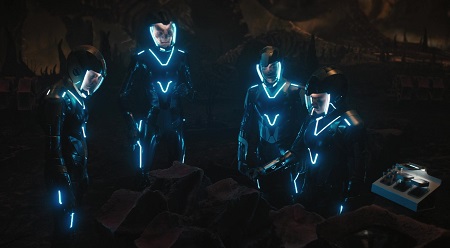
Star Trek: Discovery + Star Trek: Strange New Worlds crossover theory – the big mistake

Spoiler Warning: There are spoilers ahead for Star Trek: Discovery Seasons 1-3.

Today we’re going to take a look at something that’s been bugging me for a couple of years, ever since the finale of Star Trek: Discovery Season 2 in April 2019. I didn’t start working on this website until November ’19, so I haven’t written up full reviews of Season 2, nor have I spent much time breaking down all of the various story points. This will be my first big foray into that! Rather than just a critique of what could be argued to be a plot hole or “goof,” though, I want to turn this into a theory, particularly one that could have an impact on Star Trek: Strange New Worlds – the upcoming series set on the USS Enterprise with Captain Pike, Spock, and a new cast of characters.

Ever since I watched Such Sweet Sorrow, Part 2, something has stuck in my mind. Immediately before Burnham and the USS Discovery left the 23rd Century behind and headed into the far future we’ve seen depicted in Season 3, they were engaged in a climactic battle alongside Pike and the USS Enterprise against the Control AI. In addition to a fleet of Section 31 starships that were unmanned, Control had also possessed (or assimilated) the body of Section 31 commander Captain Leland. Control used Leland’s body to board the USS Discovery at the battle’s climax to attempt to retrieve the Sphere data – the macguffin that was the cause of the fight in the first place.

The data the Sphere transmitted to Discovery was the reason for Control’s attack.

The relationship between Control and Captain Leland was not sufficiently explained on screen, in my opinion, and this has a bearing on what comes next and why I have an issue with Such Sweet Sorrow, Part 2. But based on what we saw during the episode, it seems as though Control was somehow tied to Captain Leland’s body in a very significant way, such that when his body was crippled by Georgiou inside the USS Discovery’s Spore Cube, it had an impact on the battle raging outside.

This is the moment where I feel there’s an issue. The entire reason for sending Burnham and the USS Discovery on a one-way mission to the far future was to keep the Sphere data safe from Control, but when Georgiou defeated Captain Leland, Control appeared to also be defeated – or at least sufficiently incapacitated as to be unable to continue the battle. This all happened before the USS Discovery entered the time-wormhole.

Was it necessary for Burnham and Discovery to leave the 23rd Century? I would argue that it was not.

So, with that in mind, why did Pike, Saru, or even Burnham not stop? Surely at the very least they could have paused what they were doing to consider their next moves. Aboard the Enterprise, Pike was able to easily destroy the disabled Section 31 ships, removing any immediate danger, and with Captain Leland incapacitated and clearly not going anywhere, the Sphere data was also safe. Before sending the ship and crew to an unknown destination with no way back, did no one realise that the battle may have already been won? Was there no reason to send Burnham and the ship into the future?

This is what I’m terming “the big mistake” for the purposes of this theory.

Although Burnham had already used the Red Angel suit to open the time-wormhole, I would absolutely argue that, based on what we saw on screen, the battle against Control had taken a decisive turn before either she or the USS Discovery actually crossed the threshold, and that there was time for Saru, Pike, Spock, or someone to point that out. They were preoccupied with the jobs that they had to do, but when it became obvious that Control was at least incapacitated – if not outright defeated – I think that warrants pause from everyone concerned. They were in the process of making a life-changing decision for Burnham and the crew of Discovery, yet for some reason no one seemed to realise that it may have ultimately been unnecessary.

Even though Pike, Saru, and others acknowledged Control’s defeat, they didn’t stop what they were doing. Burnham and Discovery still travelled to the far future. Why?

So let’s break it down even more, for the sake of clarity, and follow events step-by-step. I don’t usually do time-stamps, but I think this is important so we’re all on exactly the same page. If we begin at exactly 51 minutes, 30 seconds into Such Sweet Sorrow, Part 2 – at least on the Netflix version (I assume it will be roughly the same on Paramount+ and Blu-ray too) – we see Burnham getting ready to open the time-wormhole. In the shot of her flying through space near the raging battle, we see the Section 31 ships beginning to slow their rate of fire with a consequent drop in the number of explosions. This is the first indication that something was changing.

At 51:54, Saru gives Detmer the order to follow Burnham’s lead. The USS Discovery moves through a field of debris (presumably caused by the battle) and then we get our first look at the time-wormhole a few seconds later at around 52:06. At this point, neither Burnham nor the ship are anywhere close to crossing the event horizon and entering the time-wormhole.

As Burnham flies past the battle, Control’s ships appear to be slowing down and losing momentum.

Just before 52:30 the action cuts to Captain Pike on the Enterprise’s bridge, watching Burnham and Discovery preparing to enter the wormhole. Trailing in Discovery’s wake are Section 31/Control drones, chasing after them. After Saru and Pike exchange goodbyes at 52:40, and Dr Culber tells Stamets that “we’re on our way,” at 52:57 we come to the scene at the heart of my argument – and of this theory. In Discovery’s engineering bay, the possessed Captain Leland is trapped in the Spore Cube by Georgiou.

Seemingly admitting defeat, Control-Leland tells Georgiou – in true clichéd villain style – that “this does not end here!” Georgiou then finishes the job of killing him, using the powerful magnets in the Spore Cube to force the nanites out of Leland’s body. This action cripples Control, and severs the link between it and its fleet.

The defeat of Captain Leland crippled Control – at least temporarily – and allowed Pike and the Enterprise to destroy the remaining ships in its fleet.

53:39 sees Control-Leland hit the deck, dead. The nano-bots spill out of his corpse, and though it’s not clear exactly what will happen to the human Leland, or whether he could be saved, this is a major blow for Control. Less than ten seconds later, at 53:48, the USS Discovery and Burnham can both be seen, still outside the time-wormhole, and Control’s fleet suddenly stops pursuing them.

On the bridge of the Enterprise, Una (Number One) notes this at 53:51, informing Captain Pike that “they’re all dead in the water.” Again, this is before either Burnham or Discovery have entered the time-wormhole. Even if no one on Discovery realised what was happening – which is possible given everything else going on – the crew of the Enterprise certainly had, and there was still time to contact Discovery.

With Burnham and Discovery still not having entered the time-wormhole, Control’s fleet is disabled.

At 54:00, Georgiou contacts Captain Saru, and this is the moment where he could have made a decision too. Georgiou informs him of Leland’s death, but uses a very interesting phrase: “Control is neutralised.” Discovery has not yet entered the wormhole, and on the bridge, Saru is already aware that the reason for doing so no longer exists. Pike is aware that their reason for heading into the future no longer exists. They have already won the battle. By Georgiou’s own admission, the threat Control had posed is unequivocally over.

At 54:16, Burnham and the USS Discovery are seen reflected in the glass of Siranna’s starfighter, still not inside the time-wormhole nor having crossed its event horizon. These are the crucial seconds at the core of the theory, because it’s in these few seconds that the decision to leave the 23rd Century behind could have been called off. With the Enterprise destroying what remained of Control’s fleet, and with Leland dead, there was no immediate way for Control to access the Sphere data – and yet no one on either ship seems to have realised that.

Burnham and Discovery are still outside the time-wormhole, as seen in the reflection of Siranna’s starfighter.

Even if we say that Control was not totally killed off, and that its servers remained active at Section 31 HQ (or elsewhere, if you prefer) and thus that Control was still out there and potentially able to regroup, the fact remains that the immediate threat had passed. The battle had been won, even if there was still more to do to win the overall war.

No one mentioned this in Discovery Season 3. After a brief reference to Georgiou destroying the remains of Leland in the episode Far From Home, and a short conversation about Control with Admiral Vance in the episode Die Trying, their reasoning for going to the future was never discussed nor elaborated on. Burnham, when pressed about it by Book in That Hope Is You, maintained that it was the “only way” to save the galaxy, so she clearly hadn’t realised what was going on behind her – but that makes sense as she was busy operating the Red Angel suit and keeping the time-wormhole stable.

Burnham was too busy piloting the Red Angel suit to realise the battle was over.

Saru and Pike have no such excuse, in my opinion. Both commanders clearly and demonstrably knew that Control and/or its fleet were incapacitated, and I believe that should have led to one or both of them bringing an immediate halt to events to take stock. If Control was disabled, there was no immediate need to head to the future. With Leland dead, the Sphere data was safe, at least temporarily. With the battle won, everyone could have taken a moment to breathe and assess the situation, perhaps planning to go to Section 31 HQ and permanently destroy whatever remained of Control. Instead, everyone simply sat back as Burnham and Discovery raced into an unknown future – a future, I would argue, they did not need to travel to.

There’s a way this could come back in either Discovery Season 4, Strange New Worlds Season 1, or both: if Saru and/or Pike realise that they made a big mistake.

Given what he went through to make the Red Angel suit possible, I would suggest the person this would affect the most would be Captain Pike. In the episode Through the Valley of Shadows, Pike obtained a time crystal from the Klingons, but did so at great personal sacrifice – solidifying for himself a future of permanent disability. How would he feel knowing that it was all for naught; that if he replays the events of the battle in his mind, he could see that Control was already beaten and that there was no need for the time crystal?

Having sacrificed his future for this time crystal, will Pike come to believe – as I do – that sending Burnham and Discovery into the future was unnecessary?

One theme Strange New Worlds is certainly going to pick up on is Pike’s knowledge of his impending disability. As a disabled person myself, this is something I’m really interested in seeing come to life on screen. I can relate to what Captain Pike is going through, because I’ve had the experience of sitting in a room with a doctor and being told things about my health and my future that are unavoidable. I get that sense of inevitability, of knowing things won’t get better but they will get worse. This is something genuinely interesting and that has the potential to be inspirational through Anson Mount’s wonderful portrayal of Pike. But I also wonder if we’ll see him wrestle with feelings of regret or remorse, feeling that his fate and future are his own fault. If he knows (or believes) that the battle was won in Such Sweet Sorrow, Part 2 without the need for time travel – and thus, without the need for the time crystal he sacrificed so much to obtain – will those feelings be worse for Pike?

Though we didn’t see much of this in Discovery Season 3, with Season 4 on the horizon there’s a chance for the circumstances of Discovery’s jump into the future to be revisited. Even if nobody aboard realised it at the time, it’s possible that someone will have subsequently had the revelation that their one-way trip to the future, sacrificing so much and leaving their loved ones behind, may not have been necessary. Perhaps this will become an issue for Captain Burnham or Saru, with a disgruntled crew member taking out their anger on them for forcing them into a post-Burn future that they didn’t have to inhabit.

Pike and Spock watched Burnham and Discovery disappear after Control was already defeated.

So that’s it. My theory, based on what we saw in Such Sweet Sorrow, Part 2 is this: the defeat or disabling of Control toward the end of the battle means that Burnham and Discovery didn’t actually need to go to the far future – at least, not immediately. At the very least, pausing to take stock would have been worthwhile.

It seems possible to me that this could be brought back as a story point – even if it’s just in a relatively minor way, such as with a line or two of dialogue acknowledging it – in either Discovery or Strange New Worlds, as it’s a story which impacts major characters from both shows.

Will Captain Pike realise his mistake in Strange New Worlds, and could this be a major story point for his character?

Having delved deeply into this battle from an in-universe point of view, now let’s step back and acknowledge that this is, in effect, a “plot hole” or production-side issue. The writers and producers of Discovery Season 2 wanted to send the ship and crew into the far future, partly due to negative fan feedback involving so-called canon problems during Season 1. But at the same time, they also wanted to make sure that the Control storyline was 100% wrapped up and concluded before Season 3 kicked off.

Unfortunately, in my opinion at least, the way they chose to accomplish those two goals has opened a plot hole. In the mad rush to wrap up Discovery Season 2 in what was already a feature-length episode, an inconsistency has been created within the plot of the show. If Burnham and Discovery had gone into the future, and in the final few minutes of the episode we saw Pike, Spock, and the crew of the Enterprise finish defeating Control, there would be no problem. But because it was Georgiou, aboard Discovery, who killed Captain Leland, and because this unexplained link between Leland’s body and Control seems to have crippled the entire fleet, we have a problem.

Discovery brought Captain Leland aboard the ship for a climactic fight with Georgiou – but his death at her hands before travelling into the future has opened a plot hole.

Overall, for most viewers who don’t spend as much time thinking about (and nitpicking) Star Trek as much as I do, it probably passed by unnoticed. But even in 2019 I was having conversations with fellow viewers – including some who I would call “casual” viewers as opposed to hardcore Trekkies – who noticed this very issue. The fact that no one – not Pike, Spock, Number One, Georgiou, or Saru – thought to call off the journey to the future, even temporarily to assess the new facts, is a plot hole.

However, it’s a plot hole that could be plugged by incorporating it into future stories. Captain Pike could be affected by it, as previously mentioned. As could Spock or Number One on the Enterprise, as they saw the battle end before Burnham and Discovery entered the time-wormhole. It could also become an issue for anyone aboard the USS Discovery – perhaps with their mood and mental health suffering, they replay the events of the battle in their mind and come to the conclusion that they were forced to travel to the future unnecessarily. That’s my theory, anyway!

Will this cause problems for Burnham in a future season of Discovery?

Whether any of that will come to pass, or whether both shows will proceed ignoring this issue is anyone’s guess right now. I would think that, if Discovery wanted to acknowledge this criticism, Season 3 would’ve been the time to do so, and the fact that it didn’t happen may mean that the writers and producers are keen to move on and put Such Sweet Sorrow, Part 2 behind them. But I’m not 100% convinced of that. I think there’s scope to incorporate what feels like a plot hole into the storylines of either upcoming show in a way that would make sense.

As I said at the beginning, this is something that’s been on my mind since I first saw the episode a couple of years ago! Even on first viewing, it seemed patently obvious to me that someone should have realised what was happening before Burnham and Discovery left, speaking up to put the brakes on. It really does feel that, based on the sequence of events and how they unfolded on screen, Burnham and Discovery could have remained in the 23rd Century.

Despite all of this over-analysing of a few minutes of the episode, I really enjoyed Such Sweet Sorrow, Part 2 – and Discovery Season 2 as a whole. It’s a fantastic season of television well worth a watch, and this theory, despite being something that’s bugged me for a while, is really just a glorified nitpick!

Star Trek: Discovery Seasons 1-3 are available to stream now on Paramount+ in the United States and on Netflix in the United Kingdom and elsewhere. The series is also available on Blu-ray. The Star Trek franchise – including Discovery, Strange New Worlds, and all other properties mentioned above – is the copyright of ViacomCBS. This article contains the thoughts and opinions of one person only and is not intended to cause any offence.
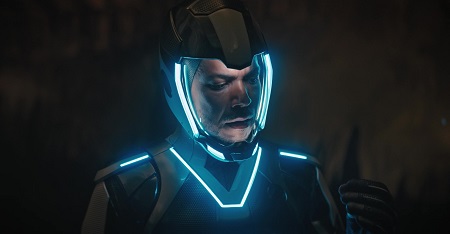
Preliminary Star Trek: Discovery Season 4 predictions

Spoiler Warning: There are spoilers ahead for Star Trek: Discovery Seasons 1-3, Star Trek: Picard Season 1, Star Trek: Lower Decks Season 1, and for other iterations of the franchise.

Star Trek: Discovery Season 3 only concluded a few days ago, and while production has begun on Season 4 it will be a while yet before we get any news. Regardless, I thought now would be the perfect time for some wild speculation… sorry, I mean “preliminary predictions.” It’s very early in the game to be thinking about Season 4 – a season which, if Season 3’s timeline is anything to go by, is unlikely to grace our screens before Spring 2022. But that doesn’t mean it won’t be a bit of fun!

The end of Season 3 wrapped up the main storylines in a generally satisfactory manner; regardless of how we may feel about specific events (like the Burn) their stories were concluded by the time the credits rolled. The dangling story threads left behind are more like teases for what may come, rather than unfinished elements from what came before. That’s a good way to do things, and unfortunately that’s where Picard’s Season 1 finale earlier in 2020 dropped the ball, at least in my opinion.

The USS Discovery departs Federation HQ for a new adventure in the Season 3 finale.

So Season 4 is potentially quite open right now. There’s no obvious direction for the story to go, nor did Season 3 end with a cliffhanger or big tease like Season 2’s journey into the future – or even Season 1’s reveal of the USS Enterprise approaching. Captain Burnham was given her orders after assuming command of Discovery, and set out in the ship to begin the task of delivering dilithium across the fractured Federation. It was implied that this was step one in bringing more wayward ex-members back into the fold, so perhaps that’s something we’ll see continued.

To re-emphasise: I’m categorically not saying that I have any “insider information,” nor that any of these predictions will come to pass in Season 4. This is guesswork on my part – educated guesswork, in some cases, but guesswork nevertheless. I would encourage all of you to be incredibly sceptical of anyone claiming to know for sure what will happen, or anyone claiming to have “anonymous sources” within the production team at ViacomCBS. Many, many times have people making such claims been shown to be making things up.

With that out of the way, let’s jump into my list, which is in no particular order.

Number 1: Visiting Kaminar.

The surface of Kaminar as seen in the Short Treks episode The Brightest Star.

One thing I disliked in the Season 3 finale was the unceremonious dumping of Saru. Though we know that Saru actor Doug Jones is returning to Discovery in Season 4, it will be in a different role now that Burnham has become captain. I have a couple of ideas for where Saru may fit, but for now suffice to say that I think we’ll have at least one episode focusing on Saru’s home planet of Kaminar.

Not only would such a story allow Saru to catch up with his people, but we could see how the Kelpiens and Ba’ul have developed since we saw them in Season 2. The episode Su’Kal suggested that the Kelpiens and Ba’ul joined the Federation jointly, and the way their conflict ended would be interesting to explore.

Su’Kal and Saru on Kaminar at the end of Season 3.

Given the cataclysmic nature of the Burn, though, which I expect to see the lingering effects of for years to come, one storyline that would be potentially interesting is how Kelpien society would react. Knowing that one of their own is responsible for this disaster is going to have some kind of effect on Kaminar and the Kelpiens. If Bill Irwin could return to play Su’Kal, we could see this explored in depth. Would Su’Kal be welcomed by everyone in the way Saru welcomed him? Or will he be shunned by some for his unintentional role in the Burn?

Such a storyline could be timely. In the real world, China is struggling with the fact that the coronavirus pandemic seemingly originated there, and I think that a storyline which looked at how Kaminar deals with its unwitting role in the cause of the Burn could be an interesting way for Star Trek to do what it does best: using its sci-fi setting to look at real-world issues.

Number 2: A new villain or adversary will rise.

Control was the main villain in Season 2.

Over its first three seasons, Discovery introduced us to several different villains. It seems unlikely that Season 4 will break that pattern, and it feels almost certain that there will be a significant adversary or villain for Captain Burnham and the crew to defeat. Whether such a character will be a galactic threat like Control or a playground bully like Osyraa is not obvious; the Emerald Chain was basically the only antagonistic faction we met in Season 3. However, there are bound to be others!

This could be where a race or faction from Star Trek’s past comes back to the fore, though going down that route would be a bit of a constraint. I think we’re more likely to see an original creation for Season 4, someone whose motives are tied in some way to preventing the Federation reestablishing itself, perhaps.

Osyraa was the primary antagonist in Season 3.

If the theme of the season as a whole will be reconnecting the Federation, it stands to reason that any villain or adversary would be someone who seeks to prevent that. However, it isn’t just Burnham and Discovery working on this task, so any such villain would have to be powerful enough to wield a fleet of starships. They may have their own motivations, and the Federation are simply in the way of whatever they’re trying to do.

This could also be a way to introduce time travel to the season, assuming that the producers want to do so. A villain could be someone flouting the ban on time travel for some reason – and could even be someone working inside the Federation, such as Section 31.

Number 3: A connection or crossover with Star Trek: Picard.

Jean-Luc Picard in Star Trek: Picard Season 1.

After Picard Season 1 came and went with nary a hint at the existence of Discovery, I was worried that Discovery would reciprocate in Season 3. Luckily that didn’t happen, and not only did we get to see the Qowat Milat – a faction introduced in Picard – we also got a mention of Admiral Picard himself in the episode Unification III.

At this point we don’t know whether Discovery Season 4 or Picard Season 2 will be broadcast first – and it’s possible that, with the ongoing disruption caused by the pandemic and the uncertainty around the two productions, the team at ViacomCBS aren’t 100% sure either! However, both shows are up and running, and Picard has at least one season under its belt – a season which had several factions, new characters, starships, story points, etc that could in theory cross over to Discovery.

Coppelius Station.

I got the impression from the Season 1 finale of Picard that the show would be moving on to a different adventure in Season 2, perhaps leaving behind the Coppelius synths altogether. If that’s the case, Discovery Season 4 could pick up this story and show us what became of the synths in the centuries after Soji and Picard came to their rescue. Did they stay on Coppelius or relocate? Are some of the synths we knew, such as Soji, still alive in this era?

As I said numerous times during the runs of both Picard and Discovery, these sister shows could do more to work together, reminding viewers that they’re two parts of a greater whole. The difference in time periods is an issue, but as we saw with the Qowat Milat it doesn’t have to completely prevent the two series from teaming up.

Number 4: The return of a classic race or villain.

Borg drones in First Contact.

Season 3 brought back the Trill, Orions, Andorians, and the Romulans and Vulcans on Ni’Var. There were very brief scenes which showed off Cardassians and a couple of other races, and we saw the Bajorans and Xaheans in holographic form too. So Season 3 crammed a lot into its thirteen episodes in terms of revisiting races from Star Trek’s past. This is something I hope Season 4 will continue to do.

Though the Dominion War ended more than 800 years ago, finding out what became of the Cardassians, Bajorans, Breen, and the Dominion themselves is perhaps what I’d choose if it were up to me. The Dominion War arc, though controversial in some Trekkie circles, is a story I find myself revisiting often, and it’s always a thoroughly enjoyable ride. Deep Space Nine ended right when the war did, and we don’t really know anything about what became of the factions involved afterwards.

Captain Sisko, General Martok, and Admiral Ross on Cardassia Prime at the end of the Dominion War.

There’s also the potential to learn what became of the Borg. They didn’t take advantage of the Burn and the Federation’s collapse to assimilate the Alpha Quadrant, so could we infer from their absence that they’ve been destroyed, pacified, or severely reduced? Could the Borg have been presumed defeated centuries ago but make a big recurrence in Season 4 – perhaps looking to acquire the Spore Drive technology?

I’d also love to see the inclusion of a Suliban or Xindi, or perhaps a Talaxian or Kazon from the Delta Quadrant. I know Discovery can’t possibly cram all of these disparate factions and races into one season, but the 32nd Century offers so many interesting story possibilities for practically everyone we’ve met in past iterations of Star Trek. The potential is unlimited!

Number 5: Will Burnham remain Captain?

Captain Burnham.

Discovery worked hard over the back half of Season 3 to make Burnham’s ascent to the captain’s chair feel genuinely earned. Some of the criticisms I’ve made of her character, both in Season 3 and previously, stem from her position as a junior officer making big decisions that go against her orders, so putting her in the captain’s chair and backing her up with a helpful crew should see her continue to grow. I want to see that, and I hope that she will continue to be a Starfleet captain who lives up to the ideals of the Federation in Season 4 and beyond.

But Discovery has never found the right fit for its captain’s chair for one reason or another. I’ve actually enjoyed what all three captains – Lorca, Pike, and Saru – brought to the role, but none of them stayed in that role beyond a single season. One of my hopes for Season 4 would be that we’d get some stability in the captain’s chair, and in a way I’m hopeful Burnham will retain the position going into Season 5 and potentially beyond – but what if that isn’t the plan?

Discovery has gone through three captains in three seasons.

Perhaps one of Discovery’s unique points is going to be the season-long captaincies of different people, each giving the ship and show a distinct feel. Lorca was the hardball who turned out to be a traitor. Pike was the classic character who embodied the spirit of adventure. Saru was the calm and collected diplomat. Burnham may be a Kirk-style action hero, a bit of a renegade but someone who always comes through for Starfleet when it counts.

How or why she might leave the role is unknown, and given Discovery’s approach to storytelling across Seasons 1 and 2 in particular, I’m not sure how likely it is that, having gone to the trouble of promoting her, they’ll replace her within a single season. But that exact thing happened to Captain Saru this season, so it wouldn’t be unprecedented.

Number 6: The lingering effects of the Burn.

The Burn.

Having resolved the Burn and found a huge dilithium planet to negate its destructive effects, there may be a temptation to shelve the Burn, especially if the writers and producers of Season 4 are taking on board fan feedback – which has been mixed to say the least on that particular story point. However, I think doing so would be a mistake.

If we start off Season 4 with a one- or two-year time skip, I can already predict that the legwork of rebuilding the Federation will have already happened off-screen. Resetting the Federation to a state much closer to how it has always been shown in Star Trek may be what some fans want, and in some ways I do too – but I think that after seeing the Federation at such a low ebb in Season 3, we need to see at least some of the rebuilding process for ourselves.

The 32nd Century was a difficult environment for many, and that won’t magically go away overnight.

I already discussed one way the Burn’s effects could still impact the story with the Kelpiens, but there are a million-and-one others. Captain Burnham could lead the ship to revisit parts of the Federation that no one has heard from since the Burn only to find them under occupation or in the midst of civil war, for example. Or we could see an ex-Federation member that completely ran out of dilithium and has had no way to power itself for a century.

Season 3 focused largely on the Federation and ex-Federation members. But there’s scope to see how the Burn impacted other powers in the galaxy – depending on which ones existed at the time! If the source of the Burn is revealed as a Federation member (i.e. the Kelpiens) would, for example, the Dominion or Klingon Empire want to exact revenge or get reparations from the reunited Federation? There are so many ways that the Burn could have impacted the galaxy that we need to see. It hasn’t all gone away with the uncovering of its source and the discovery of the dilithium planet.

Number 7: A time travel story featuring the Guardian of Forever.

The Guardian of Forever… a.k.a. Carl.

It was a very deliberate choice to bring back the Guardian of Forever in Season 3, and it would be a shame to only use them once! Not to mention that guest star Paul Guilfoyle was just fantastic as Carl, the Guardian’s humanoid avatar, and would make a thoroughly welcome return to Discovery.

One way the Guardian of Forever could be included would be to send the USS Discovery back in time – for some reason – in order to tie into the Short Treks episode Calypso. That would likely need to be a multi-episode story arc, but it would be one way to include the Guardian and resolve Calypso – two birds, one stone!

The Guardian of Forever’s portal.

If it were discovered that some nefarious villain or antagonistic faction were using time travel, the Guardian of Forever could be Captain Burnham’s ace in the hole to counteract them. That would be another way to make use of the reintroduction of this entity. Season 3 expanded on the Guardian of Forever by showing us that it can transport people between parallel universes, so this could in theory allow for another Mirror Universe story (please no) or for the Discovery crew to travel to any of the other alternate realities seen in Star Trek.

Speaking of which…

Number 8: A Kelvin timeline reference.
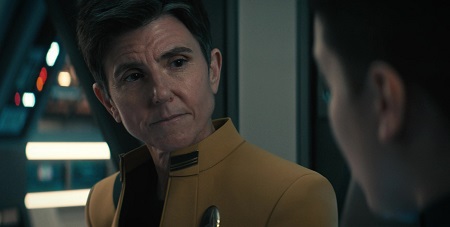
The Kelvin timeline USS Enterprise.

This is something else that Season 3 touched on briefly, with Kovich making note of a time war soldier who crossed over from the alternate reality. The Guardian of Forever, as mentioned, could be one way to literally cross over, but unless a new Kelvin timeline film is in development – and it doesn’t seem to be at this stage – there’s not as much to be gained by doing so when compared to a tie-in with Star Trek: Picard or other ongoing projects.

However, a Kelvin timeline reference would be neat, even if it were little more than a throwaway line akin to Kovich’s in Season 3. The 32nd Century, with its superior technology and better understanding of time and timelines, is the only Star Trek setting aside from the alternate reality itself that really can make the connection between Star Trek’s two major universes.

Number 9: Who is Kovich?

Kovich in Terra Firma, Part I.

Famed director David Cronenberg, who plays Kovich, has said that the character will return in Season 4 in some way, so there’s the possibility to learn more about this mysterious character. I’d been speculating since his first appearance that his distinctive uniform, high security clearance, and un-Starfleet lack of morality could hint at his being an operative of Section 31 – or even its leader.

Another theory I’ve heard fans kicking around is that Kovich is the Federation’s president. That would be an interesting way to go too, as a storyline which involves rebuilding the Federation could require serious diplomatic efforts. The Federation President would surely be involved in bringing key worlds like Earth back into the fold.

Number 10: Admiral or President Saru.

Saru in Terra Firma, Part II.

As I said earlier, I was disappointed in the way Saru was dumped at the end of the Season 3 finale. He didn’t get a chance to say goodbye to his crew, to offer Burnham her promotion in person, and his decision to leave the ship was only briefly touched on by Burnham in a voiceover. Though Saru is coming back, his role is unclear with Burnham now in command.

I can think of a couple of ways he could be included, though. The first would be a promotion to the rank of Admiral, joining Vance at the head of Starfleet. As the Federation grows, Starfleet will need to grow too, and with a new source of dilthium – and the potential for new Spore Drive ships too – and that will mean the need for new Admirals to command the expanding fleet. Saru proved himself as a good captain across Season 3, and while he did make some mistakes, I would argue he’s an excellent Admiral candidate.

Saru and Burnham with Admiral Vance.

However, we also saw Saru’s diplomatic side in Season 3, particularly with the President of Ni’Var. Saru could continue in this role as a diplomat, but if worlds like Trill, Earth, and Ni’Var all rejoin the Federation, might some of them want to see him become Federation President?

If the story of Season 4 looks at the Federation re-unifying, I could see why some of the aforementioned worlds might want to support the candidacy of Saru. Early Federation politics seemed to involve balancing the Vulcans and Andorians, but this led to almost all of the Federation’s key institutions being on Earth and dominated by humans. The reunited Federation may be less keen on giving humanity all of the top jobs, especially given Earth’s century of isolationism, so someone like Saru may be a compromise candidate among the Federation’s members who are coming back together for the first time in a long time.

Number 11: A redesign of the USS Discovery internally.

The bridge of the USS Discovery.

One aspect of Season 3 that didn’t quite sit right with me was the redesign of the USS Discovery. I adore the redesign, don’t get me wrong, but I didn’t quite buy into it as “believable” considering the ship didn’t change on the inside. We saw a few changes, like the programmable matter and holographic elements in many bridge consoles, and of course the big empty space in the engineering/drive section that we saw during Book’s turbolift battle against Zareh. But aside from a few small touches, a few lines of technobabble, and one CGI-heavy action sequence, the ship looks the same from the inside.

This undermines the decision to have the ship undergo a major refit, and I’d love to see some more aesthetic changes inside the USS Discovery to match its external appearance. It wouldn’t mean completely tearing down old sets, but tweaking and changing them to indicate that the ship has been heavily altered. Lighting is one way that the designers could make an immediate, obvious, and unobtrusive change. Ditching some of the blue lighting and generally upping the brightness of other lights – especially on the bridge – would transform the way Discovery looks.
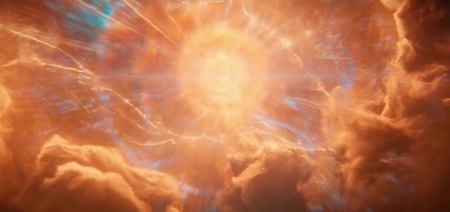
The inner workings of the USS Discovery.

The USS Enterprise, after its refit in Star Trek: The Motion Picture, looked like a different ship inside and out. The USS Discovery nailed the outside look in Season 3, but its inside hasn’t caught up. Even a handful of changes here and there would go some way to making good on the refit idea, and I’d love to see the bridge, the ready-room, and engineering given a facelift in time for Season 4.

This would also be a great moment to show off a new area of the ship, either something that was improved during the retrofit or a brand-new addition. We saw the data core at the end of Season 3, but I don’t see a pressing need for the crew to spend a lot of time there. What we could see, however, is some kind of holodeck or recreation area, an improved mess hall that had more of a Ten Forward lounge vibe, an observation deck or briefing room, a battle bridge or secondary command centre, or an additional science lab.

Number 12: Defending the Verubin Nebula.

The periphery of the Verubin Nebula.

In a galaxy devoid of its most significant source of fuel, the discovery of a massive cache of dilithium will not go unnoticed – or unopposed. The Emerald Chain may have “fractured” according to the Season 3 epilogue, but it seems unlikely that they’d be the only ones interested in acquiring the dilithium planet in the Verubin Nebula.

As such, part of the Season 4 storyline may involve Discovery having to defend the Verubin Nebula from someone looking to seize it for themselves. After the Emerald Chain did essentially the same thing at the end of Season 3, if I were writing it I wouldn’t make this the main point of Season 4, but it seems like something that could be included – or at least explained. How will the Federation defend what seems like the galaxy’s most valuable resource?

Number 13: To seek out new… dilithium?

The dilithium planet.

At the moment, the Verubin Nebula is the only major source of dilithium. The USS Discovery with its Spore Drive can jump all across the galaxy, making it a great ship to scout for new sources of the valuable fuel. Part of Discovery’s mission could be to jump around to areas of the galaxy the Federation had previously been unable to reach in search of dilithium.

I see this story point as the catalyst for something else to happen rather than the main event, though… because on its own it doesn’t exactly seem like the stuff of action and excitement!

Number 14: A new first officer.

Could Lieutenant Willa join Discovery’s crew?

Last time we looked at the odd Tilly situation and theorised that her uniform may have been altered from command red to science blue in post-production. This could mean she’s being replaced as first officer – a position she only took on a temporary basis to begin with.

If Captain Burnham doesn’t keep Tilly as first officer, that obviously opens the position up to someone else. There are candidates on Discovery’s crew, but I’d also propose Lieutenant Willa, Admiral Vance’s aide-de-camp from Season 3. She would be an interesting addition to the crew; another 32nd Century native along with Book to advise the crew of changes they might’ve missed.

Lieutenant Rhys was given the conn temporarily in Far From Home.

We could also consider the promotion of one of the secondary bridge crew, such as Nilsson, Rhys, or Bryce. Nilsson and Rhys have both been left in charge on the bridge before, so could in theory make good candidates. I wouldn’t pick Stamets or Dr Culber, as they both have roles elsewhere on the ship.

Nhan could make a comeback after she was dropped early in Season 3. I half-hoped to see her return in the season finale, but if she finishes her mission aboard the USS Tikhov, perhaps she could return to Discovery as first officer. If not, maybe a new character could join the crew in that role.

Number 15: A new home for Federation HQ.

Federation HQ.

I initially wondered if Season 4 might see Federation HQ return to its home on Earth, but I’m not sure if that would be the best option so early in the game. Plus I kind of like the idea of a space headquarters, not attached to any planet and able to be moved.

Perhaps it makes the most sense in the short term for Federation HQ to anchor itself near the Verubin Nebula, able to immediately respond to any threats to its valuable prize. But we could also see Federation HQ move between worlds, visiting new members in turn or just staying on the move. If Starfleet is growing in strength, the need for a secret location will be lessened and perhaps we could see some institutions of the Federation’s government relocate away from the base we first encountered in Season 3.

Number 16: The return of the Klingons.

Klingon leader T’Kuvma during the series premiere.

In Season 1, Discovery depicted a major Federation-Klingon war, and while the Klingons were peaceful by Season 2, they were not exactly staunch allies of the Federation. In Star Trek’s fictional history, the Federation and Klingons would remain at loggerheads for much of the 23rd Century, only to sign the Khittomer Accords at the end of the century, leading to a period of peace. By the 24th Century they were allies, particularly during the Dominion War, and I think it would be interesting to take that line forward in time.

How would the Discovery crew, veterans of the Federation-Klingon war, react to having to work with Klingons? Are the Klingons Federation members, or ex-members? If so, part of the season’s story could be bringing the Klingons back into the Federation – but would everyone on the crew be okay with that?

A map depicting the battlefields of the Federation-Klingon War in the Season 1 episode What’s Past Is Prologue.

Alternatively we could see the Klingons as a neutral power, watching the rebuilding of the Federation from the outside. Maybe they, like the Emerald Chain, have gotten used to being a more powerful faction as the Federation have declined, and may not like to see their old adversary getting back on its feet.

Almost anything could have happened to the Klingons both before and after the Burn, and for a faction that had previously been important within Discovery it would be great to see what became of them, and how that information would impact our characters.

Number 17: Aurellio will be back.

Aurellio.

Kenneth Mitchell’s Aurellio was one of the high points of the final two episodes of Season 3. As an ex-member of the Emerald Chain and a brilliant scientist, Aurellio could be a valuable ally to the Federation and Discovery’s crew.

Aurellio was tasked with working on the Spore Drive, and in the Season 3 finale figured out that empaths like Book are capable of navigating the mycelial network. He could have switched sides to work for the Federation, perhaps working on a way to give more starships a Spore Drive. There are other scientific roles he could play, depending on the nature of the season.

Number 18: More Spore Drive ships.

Discovery making a Spore Drive jump.

Speaking of the Spore Drive and Aurellio, now that the problem of navigating the mycelial network has potentially been fixed, there’s no reason why more Starfleet vessels can’t be fitted with a Spore Drive of their own. In Season 1, Stamets seemed to suggest early on that mycelial spores were difficult to collect or cultivate, but if that could be addressed (or a new source found) there’s no reason why more Spore Drives couldn’t be built.

The Spore Drive has long been Discovery’s most controversial piece of tech, and finding a proper role for it that didn’t get in the way of previously-established canon is one reason for taking the ship and the series out of the 23rd Century. Having arrived in the far future, now is the time to let the Spore Drive shine.

Number 19: Those grey uniforms?

Some of the crew in their new uniforms.

The reaction to the new uniforms in the 32nd Century was mixed, and I wonder if Season 4 will address this in any way. One thing to note is that the grey uniforms looked a lot better in the brightly-lit Federation HQ than they do on the more dimly-lit Discovery. This could be addressed by changing the lighting, as suggested above, but it could also be addressed by making some changes to the uniforms.

It was a refreshing change to ditch the all-blue look, and I don’t dislike the 32nd Century uniforms. Though Vance wore the Admiral’s variant all season long, I still need to get used to seeing the regular crew in that style before I can say for sure how much I like them. So from my personal perspective I think there’s no immediate need to change anything up, but I know not everyone agrees.

Lieutenant Owosekun in her new uniform, showing close-ups of the collar and coloured stripe.

Starfleet uniforms are like starship designs: everyone in the fandom has an opinion on which is best. For my two cents, after four seasons of Enterprise’s blue boiler suits, three seasons of Discovery’s all-blue look, and Picard’s crew not having uniforms, I’m happy to see something different. Lower Decks and the Kelvin timeline uniforms had blocks of colour, and that was great. But it’s been a long time since we really mixed up the uniforms in Star Trek – even the Starfleet uniforms of the Picard era were similar to those from Deep Space Nine and Voyager.

So I’m willing to give the grey outfits a chance. But I wouldn’t be shocked to see promo material for Season 4 showing off a new variant or even a different style altogether.
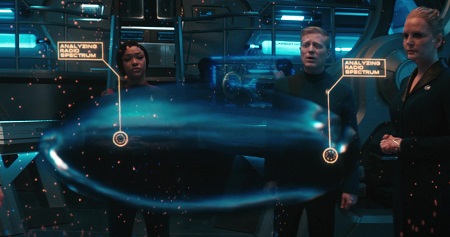
Number 20: Lieutenant Sahil will join the crew.

Lieutenant Sahil.

Lieutenant Sahil, newly commissioned into Starfleet in the Season 3 finale, was one of the first people Burnham met in the 32nd Century. It would make a lot of sense for her to want to repay his kindness and help by offering him a role aboard Discovery. He could be one of the bridge officers, perhaps taking over from someone like Nilsson or Bryce if either were promoted.

I’d love to see a recurring role for Lieutenant Sahil now that he’s a commissioned officer. With Georgiou having left the show entirely and Saru looking at a potentially reduced role or a role not aboard the ship, there’s plenty of space for Sahil, Aurellio, and others to join up.

So that’s it. A few far too early ideas for what Star Trek: Discovery might bring us in Season 4. If I remember after the season airs it’ll be fascinating to come back and look at this list!

So this was just a bit of fun as I continue to work through my post-Season 3 thoughts. As I say it’ll be great fun to come back and see how many of these guesses were completely wrong once we’ve seen Season 4 for ourselves. The 32nd Century has opened up Star Trek to radically new story ideas for the first time in a long time, and I’m loving that. No longer being constrained by canon means that Discovery can literally take the franchise anywhere, with open-ended story possibilities.

These are not even theories – I want to call them guesses rather than anything else. So please, please don’t get carried away thinking that any of these are destined to happen. We all need to remember to take such theories and predictions with a pinch of salt at the best of times, and guesswork this far out when we know less than nothing about the upcoming season is almost silly! So as fun as this was to put together, let’s all try not to get too excited about anything listed above.
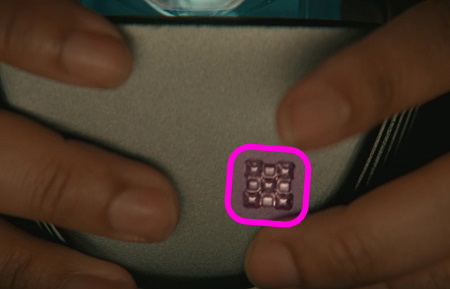
Star Trek: Discovery Season 3 is available to stream on CBS All Access in the United States, and on Netflix in the United Kingdom and elsewhere. The Star Trek franchise – including Discovery and all other properties mentioned above – is the copyright of ViacomCBS. This article contains the thoughts and opinions of one person only and is not intended to cause any offence.