


Spoiler Warning: There will be spoilers ahead for Nepenthe, as well as for the first six episodes of Star Trek: Picard. There may also be spoilers for other iterations of the Star Trek franchise, including Star Trek: Discovery Season 2.
Hugh! Poor, poor Hugh. When I heard Jonathan Del Arco was returning for Star Trek: Picard, well before the show had premiered, my first reaction was “What? Really?” Of all of the characters in Star Trek’s history, I just felt that Hugh, who had only appeared in a couple of episodes of The Next Generation, wouldn’t have been my first choice when thinking about characters to bring back. But I was wrong – the way Hugh has developed as a character between The Next Generation and his appearances this season was incredible, and his death this week was genuinely heartbreaking.
Star Trek: Picard’s death toll, for legacy characters anyway, now stands at three – Bruce Maddox, Icheb, and now Hugh. In the aftermath of series like The Walking Dead and Game of Thrones this was always a possibility – no main character on television should consider themselves “safe” any more. But of the three, Hugh’s death hit me the hardest.
But we’re getting ahead of ourselves! Where last week’s episode, The Impossible Box, was an edge-of-your-seat wild ride, Nepenthe was a quieter affair, but intensely emotional. Simply processing everything that happened will take some time. Nepenthe didn’t merely advance the storyline of Star Trek: Picard, it took us on a detour that looked at Riker and Troi, and thus broadened our understanding of how the overall story of Star Trek has progressed since the events of Voyager and Nemesis. In that sense, it felt like an episode that was “made for fans” far more explicitly than anything else we’ve seen so far this season, even counting Seven of Nine’s appearance.
If someone were to ask me why I’ve been so in love with Star Trek: Picard, I could give many reasons. But Nepenthe encapsulated them all perfectly. It brought back those nostalgic feelings, but it used characters and name-drops from the past in a way that made sense and tied in perfectly with the main plotline of the show. Unlike some other franchises we could mention, nothing in Nepenthe felt like fanservice, or overplayed the nostalgia card; Star Trek: Picard has been like a perfectly-cut jigsaw puzzle, with each piece of the story slotting neatly into place as the overall picture is now slowly coming together.
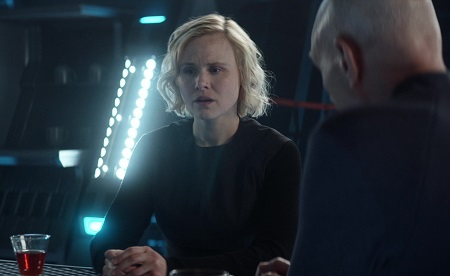
After the standard recap to bring us all up to speed, the episode kicks off with a flashback to just three weeks ago. We see more of the meeting between Dr Jurati and Commodore Oh from The End is the Beginning – and we see why it wasn’t shown in full in that episode. This is the moment Dr Jurati was recruited to join the Commodore Oh-Zhat Vash conspiracy, and I think we can now say with relative certainty that Commodore Oh is not a Romulan agent, but is in fact the Vulcan she has always claimed to be. While, in theory, there should be no reason Romulans can’t mild-meld, it’s never been shown on screen and that further adds to the evidence that Commodore Oh is a Vulcan. Whether her alliance with the Zhat Vash is new or not is unclear, but she is certainly fully signed up with their anti-synth crusade.
I had to go back and look at one part of this sequence several times before I could be sure, but at least part of what Commodore Oh showed Dr Jurati in her mind-meld is taken directly from Star Trek: Discovery’s second season. The two shows were always close from a thematic perspective, as both were looking at the possibility of rogue AIs and how they could be a danger, but this sequence seems to suggest that there’s more to it than thematic coincidence. In Discovery, the AI named Control was trying to acquire data stored in the USS Discovery’s computer which contained many millennia of information collected by an ancient lifeform, and if it had been successful it would have used its newfound power to wipe out all organic life in the galaxy. This seems to be the reason for the Romulans’ fear of synthetic life – that they will go rogue and start killing their creators. At least two of the shots of life in the galaxy being wiped out that Commodore Oh showed Dr Jurati in the mind-meld were identical to the vision Michael Burnham and Spock received.

Could this simply be a case of reusing shots to save money? After all, in the past Star Trek has shown the same Klingon ship blowing up on half a dozen occasions or more, and numerous models were reused over and over again from the era of The Original Series films through The Next Generation and its spin-offs. Given that the two clips I could identify in the mind-meld were less than a second long, I suppose we shouldn’t discount the possibility entirely. However, I’m not convinced that this is the reason. CGI nowadays requires far less effort and financial investment than many practical effects – like exploding starships – did in the past. For the sake of a couple of seconds’ worth of footage it would have been relatively inexpensive and not particularly time-consuming to make something altogether new if that was the aim. So I’m getting the sense that there’s a connection between Discovery’s Control AI and the Romulans in Star Trek: Picard – as I have been saying for several weeks in my Star Trek: Picard theories series! While I will save further speculation about what this could mean for my next theory post, I wanted to acknowledge it here too.
Mind-melds have been inconsistent in the way they’re presented in Star Trek. This one was more in line with the confusing jumble of images that Spock showed to Alternate Reality Kirk in 2009’s Star Trek film, rather than the calmer, slower-paced mind-melds that we’ve seen in The Original Series and The Next Generation. Obviously we didn’t get the full effect that Dr Jurati did, because the horrors she was shown caused her to vomit up her lunch. It was enough to immediately convince her, without any further persuasion needed from Commodore Oh, to sign up with the conspiracy and do anything – even kill her former friend and love interest and betray Picard.
Dr Jurati is given a tracking device, which she has to eat – and yes that is “eat” not “swallow”, which was interesting! The action then jumps to the present day, where La Sirena is caught in a tractor beam that the Artifact has deployed. Raffi and Rios are scrambling around on the bridge trying to break free. While Raffi attempts to break La Sirena free, she hacks into the Artifact’s computer and seems to see some drawings – possibly those drawn by Ramdha or another xB. Whether these will come into play or not is unclear, but the drawings, which were a pattern of circles repeated over and over, were at least visually interesting. So many aspects of Star Trek: Picard have been brilliantly set up by the creators and writers that almost everything we see or hear on screen has the potential to turn into a story point!
Dr Jurati is clearly terrified, trying to get Raffi and Rios to tell the Romulans that they “just want to go home” as it’s not really La Sirena that the Romulans are after. The others dismiss her semi-hysterical shouting, and then we get the beginning of Hugh’s punishment for the crime of aiding Picard. I didn’t expect Hugh to turn on his friend, and he never did, but there was always the possibility, as he didn’t know that Soji was synthetic, that learning her true nature might’ve shifted something for him. However, he stands by his promise to protect Soji and Picard, even as Rizzo executes one of the xBs. Even knowing the stakes he refuses to tell her – putting his loyalty to Picard ahead of his feelings for the room full of xBs, who Rizzo orders executed when he refuses to tell her where they went.

Rizzo also confirms that the operation to track and extract information from Soji has been ongoing for several years and has involved a number of different people, which is a neat thing to know I suppose.
This was definitely an emotional scene, and as I mentioned already, Jonathan Del Arco gives an amazing performance as Hugh sees people he has worked so hard to help cruelly and coldly murdered in front of him. His reaction to their deaths was raw and heartbreaking.
Peyton List, who plays Rizzo, was also on good form. Some of her earlier performances in the series have been a tad one-dimensional in parts. Rizzo as a character is, like Michelle Yeoh’s Terran Empress from Star Trek: Discovery, someone who is basically evil for the sake of being evil – or at least, that’s how I characterised her before this scene in Nepenthe. We finally get to see Rizzo’s motivation here – helpfully informed by the earlier mind-meld sequence. Far from being evil, she’s terrified. Synthetic life frightens her, and she genuinely fears that, were Soji allowed to live, all sentient life in the galaxy – “a trillion souls” as she puts it – would be wiped out. How it is that the Zhat Vash have come to know this – or rather, believe this – is not yet clear, but again I think the Control AI from Discovery surely has a role to play somehow. This second dimension changes what has been a rather flat villain and we are finally a big step closer to understanding why the Zhat Vash are so militant in their anti-synthetic crusade – and why, despite his feelings for her, Narek felt he had no choice when it came to killing Soji.
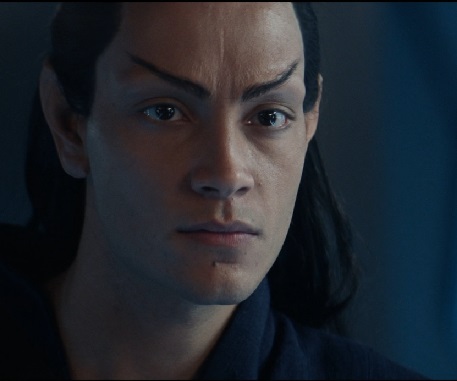
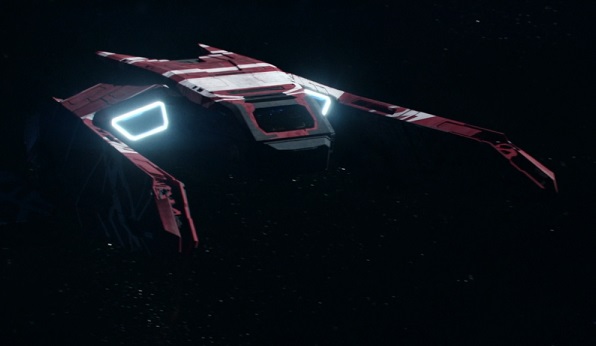
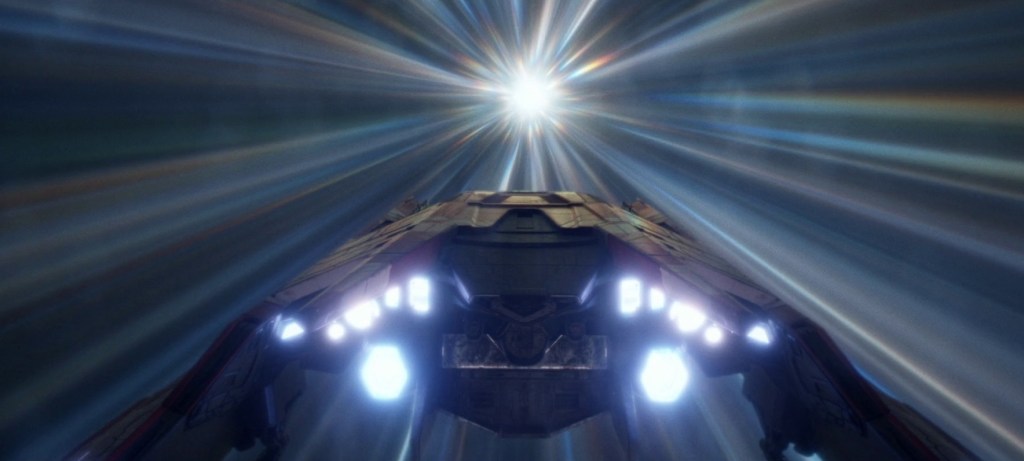
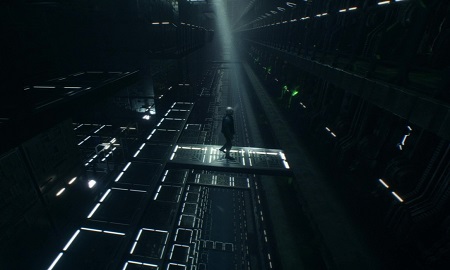
Speaking of Narek, he boards a one-person spacecraft in the Artifact’s hangar bay and departs the cube. La Sirena is no longer caught in a tractor beam – though Rios and Raffi realise it is undoubtedly a trap. We get a great scene as La Sirena skims along the Artifact’s hull at close range, showing off the incredible level of detail that has gone into the CGI work on both vessels. Elnor, who seems to have struck up a bond with Hugh since we last saw him, opts to remain behind to help the xBs after seeing them executed, and La Sirena warps off toward Nepenthe with Narek close behind.
For the first time since the show premiered, the main cast actually felt like a crew in this moment. And I know it seems silly as they’re all split up, but leaving Elnor behind was emotional for Rios, Raffi, and Dr Jurati – they clearly think they will never see him again. Whether they’re right or not doesn’t matter right now, because in that moment there was a sense of camaraderie; a bond between La Sirena’s crewmates. This is definitely something that Star Trek: Picard has lacked when compared to other shows. Even Deep Space Nine and Voyager, which both had different interpretations of a “divided” crew, had a sense of fellowship – and finally, seven episodes in, we saw some of that here. It was a nice throwback to the way crews have been in other Star Trek shows, and I really hope we see more of that going forward as Soji joins the crew and they’re all – hopefully – reunited with Elnor in a future episode.

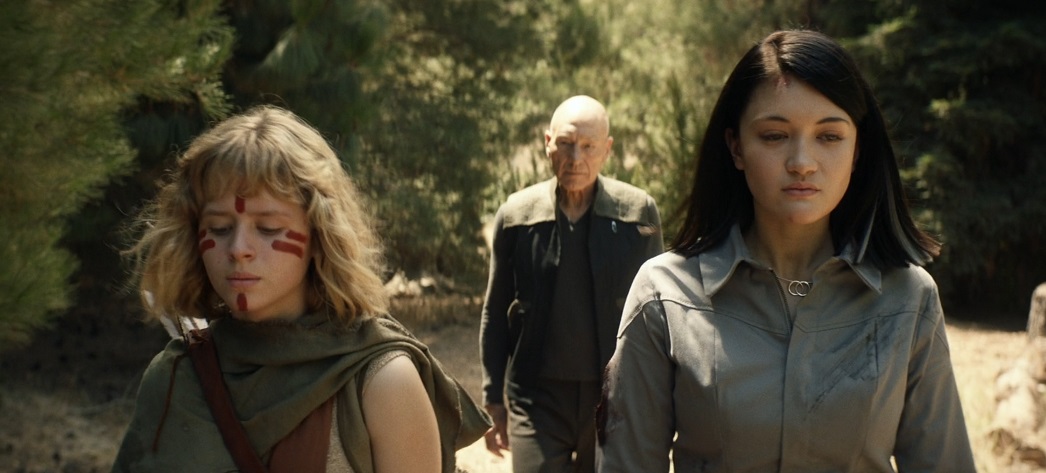
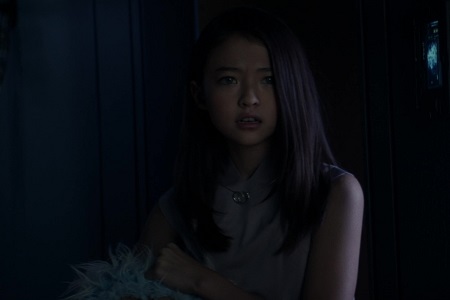
If you’ve been here before and read my other reviews, you’ll know I like to nitpick. And even in an episode as good as Nepenthe, there are still small things to pick at. After the credits roll, we’re with Picard and Soji as they materialise on Nepenthe – a few minutes’ walk from Troi and Riker’s house. That was some luck with the spatial trajector! I know it’s possible to get exact transport coordinates, but did Picard tell Hugh exactly where on the planet to send them? Did he know, by heart, the rough location of Riker’s house? Anyway, after they materialise they’re set upon by a girl brandishing a bow and arrow. Picard makes reference to his artificial heart – as seen in the episode Tapestry from the fifth season of The Next Generation – and it’s clear he recognises the girl. He calls her Kestra – which was the name of Deanna Troi’s sister from the seventh season of The Next Generation, specifically the episode Dark Page. It was nice to get a couple of little references in quick succession like that – and as always, neither of them got in the way of the flow of the story. Star Trek: Picard has handled its links to the franchise extraordinarily well.
While walking with Kestra to her home, Picard drops two huge bombshells on Soji. The first is that her father is Data, which means she’s an android. And the second is that Dahj has died. Soji, unsure really of what’s happened or who to trust, doesn’t really react. In this moment she doesn’t have space to process what she’s feeling, so grieving for Dahj will have to come later. Whereas Dahj seemed to have, as part of her programming, a desire to find Picard and an inherent feeling of safety in his presence, this seems to be absent in Soji for the duration of the episode. While she will, later, start to warm up to him and come around to the idea of trusting him, that feeling of safety and a desire to turn to Picard for protection does not seem to have been programmed into her in the way it was with Dahj. If I were to speculate as to why, I’d say it was probably because Dahj’s assignment was on Earth, whereas Soji’s was on the Artifact. It makes sense for Dahj to run to Picard as he was someone Maddox knew he could trust and was a stone’s throw away. On the Artifact, running to Picard would be difficult if not impossible, and Soji may have had someone else programmed into her as part of her activation, or she may have simply been programmed to defend herself. It’s also possible that, as Picard and Hugh intervened, Soji is not fully activated in the way Dahj was.
Picard was clearly expecting a different reaction from Soji. Even though he only knew Dahj for a short time, she trusted him implicitly, turned to him for help, and even saved his life. Because Soji and Dahj look identical – “more than twins”, as the show puts it – I wonder if he’s expecting her to behave in an identical manner too. When she doesn’t, it almost seems as if he doesn’t know what to do or what to say; she isn’t what he expected, and he may even feel disappointed by that, underneath the frustration of constantly messing things up.
The cabin was an absolutely lovely set, and must have been a fun location to film on for the actors. It’s rustic in its appearance, but it’s what I’d call “21st Century rustic” in that this is clearly not a log cabin from the 1800s! It makes sense as the home of a couple who know their way around technology but want the appearance of something from an earlier time, and as we’ll see that is basically exactly what the cabin is. Of all the sets used so far in Star Trek: Picard, including the vineyard, this is the one which feels most like a modern-day building, though. I liked that, because I could see how that kind of design could still be popular or could make a comeback, but I can also see that being a point of criticism for some, as it is definitely different from any other 24th Century buildings we’ve seen in earlier Star Trek shows.
While we’re dealing with the aesthetic, though, Star Trek: Picard has definitely fallen into the trap that The Next Generation and its contemporaries also fell into in that every planet visited is clearly California! We had Picard’s home in France, the town on Vashti, and now Nepenthe. While they are all different in some respects, they’re not so different that you’d be tricked into thinking they weren’t all filmed within fifty miles of each other. In a way, I think we’ve probably been spoilt by big-budget shows like Game of Thrones, which famously had filming locations right across Europe from Croatia to Northern Ireland and Iceland. Expecting something on that level was unrealistic, and to the credit of the showrunners the locations mentioned do all have a different tone – it’s just that they are all very definitely filmed in California.
The music in Star Trek: Picard has generally been great, but the music played as Picard reunites with Troi was a cut above and absolutely outstanding. Much of the emotion in any scene is tied to the music, even if we as the audience don’t realise it. And as Kestra delivers Picard and Soji to her mother we get a beautiful piece that ebbs and flows with the emotions of the characters.
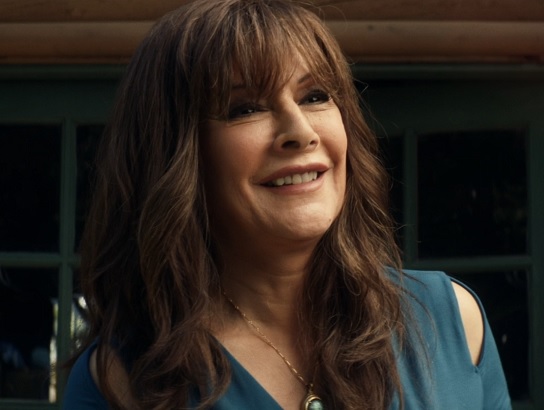
Troi, as an empath, can tell that Picard is in trouble – which is of course why he came to them in the first place. However, it’s her next moment after they embrace that really got me. We know, as of Maps and Legends, that Picard is dying. And Troi wordlessly touches his face and conveys, with just a bare look, that she knows his health is beginning to fail. He tries to reassure her that he’s fine, but of course we know better.
The next scene is the one we’ve all been waiting for since we first saw Riker in the second Star Trek: Picard trailer last year: the reunion between the Captain and his Number One. Jonathan Frakes’ performance in this scene reflects perfectly what the audience has been feeling for this whole journey: the excitement and pure joy of seeing an old friend again. That’s what nostalgia is, in a way. We’re just as happy to be reunited with Picard after all this time as Riker is in this moment. The last time we saw Riker and Picard, at the end of Star Trek: Nemesis, they were parting ways as Riker was moving on to take command of his own ship. A lot has happened since then as Troi and Riker seem settled in their home and with a teenage daughter to boot.

Riker’s home is not as rustic as it seems. Upon learning that Picard is in trouble and hiding out, he barks orders at the cabin’s computer: “shields up!” being my favourite, a classic Riker line from The Next Generation, delivered in exactly the way we’d remember from that show. There was also a neat little name-drop of the Kzinti – a feline-like species that featured in an episode of The Animated Series back in the 1970s! That might actually be my favourite one-line reference so far in the whole series; tying Star Trek: Picard to Captain Kirk’s lesser-known adventures.
The young actress playing Kestra does a great job in this scene as she brings a hunted “bunnicorn” to Riker to prepare for dinner. It’s clear that, having grown up in a rural setting, Kestra is much more comfortable with hunting and skinning than many would be in the 24th Century – or even in the 21st! Sometimes younger performers, especially those cast for smaller roles, can end up coming across inauthentic in their delivery of lines and the way they inhabit their roles, but none of that was the case here. She did a great job and was convincing as the daughter of Riker and Troi.
Soji takes a shower – outside, of course, to add to the feeling of a rustic cabin-in-the-woods – and Kestra pesters her with questions, all of which related to things Data enjoyed or could do: playing the violin, reading Sherlock Holmes, and finally her physical abilities like running and jumping – which we sad Dahj do in Remembrance – and being able to bend steel. Soji has just done this, when she ripped a hole in the floor of the meditation room to escape, but we also saw Data do so on several occasions, notably in Star Trek: Nemesis and in The Measure of a Man, the second-season episode of The Next Generation which introduced Bruce Maddox. Kestra is immediately accepting of Soji. Not that the others weren’t, of course, but she takes to Soji as a friend whereas Picard sees himself as more of a guardian. Soji needed that, I feel, after everything she’s been through.
The questions Kestra asked about whether she has, among other things, saliva, were reminiscent of the observations Dr Bashir made of Data in The Next Generation episode Birthright, a two-parter from the sixth season. Both Bashir and Kestra were interested less in the extraordinary things an android could do – like calculate unimaginably huge numbers in an instant – and more in the ways that their creators had tried to make them ordinary. Data could breathe and had a pulse, and Soji has normal body fluids like saliva. Whether intentional or not, and I have to assume it was given how much care and attention has gone into Star Trek: Picard at this point, I loved this little callback to Data and The Next Generation.
Kestra’s parents have clearly told her so much about Data, and again as a long-time fan I think that’s something I wanted to see even if I would never have realised it. To know that Data, who died in Nemesis almost twenty years ago, is still remembered by his friends is a great feeling – and as someone who had longed to be human, this most human of legacies is something I think he would have approved of. As Kestra keeps up her questions and discussion of Data, Soji says that, until she heard the word “android” used, she was still hoping that she might be human after all. This is a lot to take in for her, as in the last few hours her whole life has been exposed as a lie and everything has come crashing down: her boyfriend, her job, her family, and her whole identity. Now she’s stuck on a planet she doesn’t know with people she’s never met, and she feels horribly unsettled not just with them but in her own skin – or whatever the android equivalent of skin is.

It was a nice touch to see the term “android” back in Nepenthe, after previous episodes of Star Trek: Picard had almost entirely used the terms “synth” or “synthetic” when discussing artificial life. I still feel, despite the presence of holograms on La Sirena, that there must be a reason for that. The vision Commodore Oh showed Dr Jurati, and the idea of rogue AIs destroying sentient life which motivates her and the Zhat Vash, are not exclusive problems caused by Soji-type androids. As we saw with Control in Star Trek: Discovery, any kind of AI is potentially susceptible.
An emotional Deanna leads Picard to her son’s bedroom, and we learn that not everything worked out for the Troi-Riker family after we last saw them. Their son, and Kestra’s older brother, died a few years previously. As is not uncommon with grieving parents, Riker and Troi have kept his bedroom as he left it, and as it’s presumably the only other available room, this is where she offers Picard a rest. We got a nice photo of Picard – in his post-Nemesis uniform – holding Thad as a baby, and Deanna gives Picard a very unconvincing “we’re fine!” when discussing him. It’s clearly still incredibly painful for her – whether she feels the loss even more as someone who has empathic traits isn’t clear, but as an episode dealing with the loss of a child and looking at how families and parents respond to that, Nepenthe was right up there with many other Star Trek episodes throughout the years that have tackled complex emotional topics.
One thing that is clear, though, as Picard and Troi continue this conversation, is that she is uncomfortable with their presence. Not because she didn’t want to see him – she clearly does – but because of the danger their visit poses. Having lost her son, she cannot bear the idea of her daughter being in any kind of danger. Nepenthe can be a stopover for Picard and Soji, then, but any hope of a permanent shelter or even a longer stay is dashed – and Picard knows that. He probably knew it before they ever arrived, but if he had hope of staying beyond a few days it’s gone without Riker or Troi having to come out and say so.
La Sirena is up next, and the trio still aboard have realised that they’re being pursued. Narek is clearly an expert pilot, and has managed to get his ship to sit in a kind of “blind spot”, almost unnoticeable to Rios. They discuss how to throw him off their tail, and Rios performs a new manoeuvre of dropping out of warp very suddenly so that Narek will “overshoot” La Sirena without realising. Star Trek’s warp drive has always been a bit of a mess in canon, so this being a new tactic is fine. I think it’s not original in that it’s something other sci fi franchises have used in the past, but as a narrative device it worked well here, I felt.
Dr Jurati then pipes up asking Raffi and Rios if they really want to go to Nepenthe or if they can instead pack up and go back to Earth. We know, as the audience, that she’s getting cold feet about her mission, frightened of what might happen if she ended up face-to-face with Soji. But Rios and Raffi don’t know what’s going on – or how it is that they’re being tracked – so Raffi assumes she’s just frightened and takes her off the bridge. Dr Jurati made reference to a gormagander in this scene, which was a space-dwelling life-form seen in Short Treks and Star Trek: Discovery, continuing the theme of the episode tying itself into other stories in the franchise!

Riker is cooking dinner on Nepenthe when Picard walks up. He’s reluctant to tell him too much about Soji or what happened, but Riker is able to figure out much of it from Soji’s behaviour. Picard has been a man alone in his mission so far. Dr Jurati, the only person on La Sirena who we thought was on his side is actually working for the enemy, and the others are just along for the ride or for pay. Even Elnor, who had signed on for Picard’s hopeless cause, has chosen to stay on the Artifact where he feels he’s more needed. So in this moment, when he had a genuine friend offering to help, it seems strange that Picard chose not to. Of course part of it has to do with what happened to Riker’s son and the presence of Kestra and Troi – he doesn’t want to endanger them any further. But telling Riker the full truth – something he failed to do for Hugh, the only other trustworthy face he’s seen since he left Earth – was an option.
Seeing Soji immediately pick up on Thad and Kestra’s made-up language was great, and we’ve seen her in previous episodes speak Romulan and the language of the xB called “nameless”, so we know it’s a skill she possesses. What I absolutely did not like in this sequence, or rather, what I felt had not been set up at all and failed to work, was Soji’s awkward Data-esque head tilting motion. That was a Data trademark from his earliest appearances in The Next Generation, but we’ve never seen Soji behave in such an artificial way. Whatever techniques Bruce Maddox and his team used to create her, they had improved upon the formula used by Data’s creator Dr Soong, meaning we shouldn’t see her do something that looked so odd and artificial. It was clearly put in as a story point, one which Riker immediately picked up on, and I know as a single second of screen time it doesn’t seem worth commenting on, but of all the Soji moments in Nepenthe, I felt it was by far the weakest, and its inclusion was not a good decision given that it had never been set up. There were plenty of other ways for Riker to pick up on Soji’s true nature, or of course, as mentioned above, Picard could have explained the situation.
Riker gives Picard a piece of his mind – calling him out for trying to carry everything himself and not let anyone help, calling it “classic Picard arrogance”. This wasn’t an attack, it was the “absolute candor” of an old friend. (See what I did there?)
In the tomato garden, Troi offers Soji a home-grown tomato. For someone who’s only ever had replicated food, she can sense the difference right away. There’s a message here too, I think, for us as the audience. We live in a world where food is increasingly processed, and more often than not something that comes in a packet from a supermarket. Many of us in the modern world are out of touch with food production and where our food comes from, and there is a uniqueness to something grown at home that I think we can all relate to.

Troi uses the example of the tomato to explain to Soji why “real” isn’t always better. Soji says that she is not real – like replicated food as they had just been discussing. But it turns out that the illness that killed Thad was something that could have been cured using a positronic matrix – i.e. an android brain. Unfortunately, due to the ban on synthetic life, no such matrix was available to synthesise a cure, and Thad died as a result. While an interesting metaphor, and something Soji desperately needed to hear, this also adds a personal dimension to the synth ban. Not only has it gotten Dahj killed, but we now know that the ban directly resulted in the death of Troi and Riker’s son. I’d absolutely argue that this raises the stakes even higher in Picard’s coming battle against the Zhat Vash and their allies in Starfleet.
Soji finally opens up, telling Troi a little about what happened with Narek and how he betrayed her trust. Narek has really done a number on Soji. In addition to everything she’s gone through and learnt in the last few hours, she finds it impossible to really trust anyone, and that’s all thanks to Narek’s manipulations. I wrote last time that the Narek-Soji storyline can be seen as analogous to gaslighting, and again I feel we see part of that here. Having been lied to, having had her head messed with and dissected by Narek, Soji is finding it incredibly hard to trust anyone, even Picard.
Their conversation is interrupted by Picard and Riker, however, and Soji storms off after Picard tries the old “reverse psychology” technique. He should have left the counselling to, well, the counsellor, because he really just managed to make things worse. Troi gives him a second dressing-down for the way he acted, and he starts to realise in this moment what’s going on and why Soji hasn’t behaved the same way that Dahj did. He will have to earn her trust, despite going out of his way to save her.
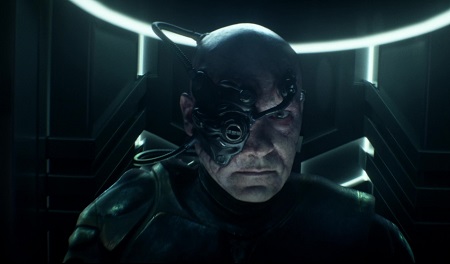
Elnor and Hugh are racing around the Artifact with a mission – they plan to return to the “queen cell” that they used to help Picard and Soji escape, and use the “immense power” it contains to seize control of the Artifact. Unfortunately they run into Rizzo, who has been tracking them. We finally, for the first time since Picard left Earth, get a mention of the Zhat Vash and confirmation that Rizzo is indeed a Zhat Vash operative. That aspect of the show had all but disappeared as Picard and everyone else insisted on referring to their adversaries as the Tal Shiar. As I said last time, this does make a kind of sense from an in-universe point of view, but I think it could be offputting for casual viewers in particular, as following the ins and outs of various Romulan factions is not easy, and the last thing viewers want when watching a show is to not understand the basics like who’s who and what’s going on.
Interestingly, Elnor doesn’t really seem to react to this revelation, though it is clear that the Zhat Vash and Qowat Milat know of each others’ existence. I had speculated that Elnor, having been told by Picard that he was facing off against the Tal Shiar, might have reacted badly to the involvement of the Zhat Vash. He still might, if he learns that Picard knew and didn’t tell him, but in this moment he doesn’t even react at all, he simply continues the fight. After dispatching a couple of Rizzo’s guards, the two engage in a hand-to-hand battle, but Rizzo uses a hidden blade to kill Hugh. In his dying moments, Hugh tells Elnor to find an xB and use them to activate whatever is in the “queen cell” – presumably something which will allow them to work together and overthrow their Romulan guards. Rizzo beams away before Elnor can avenge Hugh’s death, but I’m sure she’ll get her comeuppance sooner or later.
Raffi and Dr Jurati are sharing cake in the back of La Sirena. One thing I liked, both with the replicator in this scene and with transporters in various episodes since the show premiered, is that the materialisation process for both replicators and the transporter is significantly faster than it had been in The Next Generation and shows of that era. The faster pace, which allows both people and goods to appear almost instantaneously, feels like a natural progression of those similar technologies, and I appreciated that. Dr Jurati breaks down on being told she’s a good person – she’s been wrestling with her feelings and emotions since she killed Maddox. In that moment she was able to do the deed, but it’s broken her and, if she survives, her usefulness as an operative to the Commodore Oh-Zhat Vash conspiracy is surely at an end. If she did plan to stick around and kill Soji, I just don’t see her being able to go through with it.

As Dr Jurati vomits up her cake – the second time in this episode that poor Alison Pill has had to throw up on screen – Raffi escorts her to sickbay. Rios informs them that Narek is still on their tail, which I’m sure could only make Dr Jurati feel worse at this point, as it’s her presence that allows him to track La Sirena.
Dinner is finally served at the Troi-Riker cabin. After Picard has been unable to contact Rios aboard La Sirena, Kestra mentions a Capt. Crandall who has a ship, and again we got a couple of name-drops, this time of the Klingon homeworld, Qo’nos, most recently seen in Star Trek: Discovery, and Tyken’s Rift, which refers to the episode Night Terrors from the fourth season of The Next Generation. Picard and Soji did leave Nepenthe at the end of the episode, but I wonder if this Capt. Crandall will come back into play in future, as Star Trek: Picard has hardly wasted a second of runtime in any of its episodes on dead ends.
Picard uses himself, or rather, his physical state, to try to persuade Soji to trust him, remembering his encounter with Dahj and getting Soji to use her newly-activated skills to assess him to determine whether he’s telling the truth.
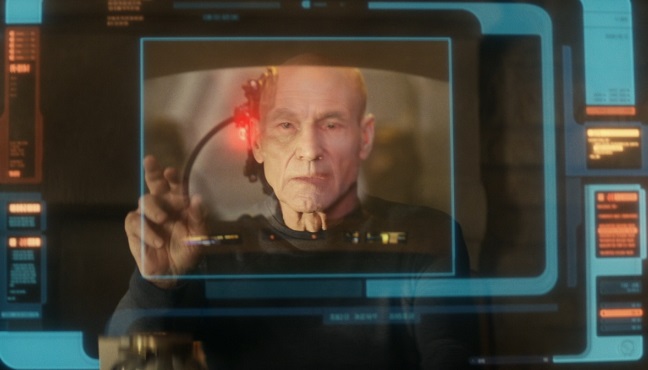
During the conversation, Picard confesses to Soji and the others his true reason for helping her. Partly it’s a desire to help Data, to repay Data’s sacrifice by helping what Picard considers to be his offspring. But the other element to his willingness to help is that Dahj essentially snapped him out of a fourteen-year-long depression, giving him motivation and a cause again, which is clearly something he never felt he’d get. I’ve written before about how Picard has been depressed in Star Trek: Picard. The first two episodes in particular looked at that side of him and his life since Nemesis, but it’s in this moment that Picard acknowledges it for himself. It can be hard for someone dealing with depression to even realise what’s happening, and acknowledging that privately to oneself is incredibly difficult to do because it means acknowledging what society still considers to be a weakness. Picard has been depressed, and if anyone says “but the Picard I remember never would be depressed!” then I have two things to say. First is that they should go and watch The Measure of a Man from the second season of The Next Generation – a review of which can be found here – and watch how Picard acts when he seems like he’s going to lose the case. Watch him in the scene with Guinan in Ten-Forward and compare it to how he was acting in the premiere of Star Trek: Picard. Also look at his emotional, angry reaction to the Borg in First Contact and compare that to his fear and hatred in last week’s episode. This is the man we’ve known. The second thing I’d say is that anyone believing that certain people, even fictional characters, could “never” fall into depression needs to get some fucking empathy because that can happen to anyone, at any time, for any reason or for no reason. Anyone who’s lived a life has had ups and downs; Picard’s “down” was intense and long-lasting, and just because someone has been lucky in life never to suffer like that, or see someone close to them suffer, well that doesn’t mean it can’t happen or that it doesn’t happen to others. This moronic criticism plagued Luke Skywalker’s characterisation in The Last Jedi a couple of years ago too. It was as stupid, insensitive, and ignorant about mental health then as it is now. Rant over.
Picard acknowledges for the first time how bad he’d been feeling. And though he doesn’t say it, his gratitude to Dahj for snapping him out of it and giving him something worth believing in again is a powerful motivator when it comes to helping Soji.

This was a deeply personal speech, but delivered in the calm Picard style that we remember from The Next Generation. He doesn’t raise his voice, he doesn’t try to be sarcastic or pushy or aggressive, or anything else. He gently makes his case to her, and after everything she’s been through, Soji relents and shares with Picard and the others the information she gave Narek. Last week I nitpicked this information, saying that in an area the size of the explored galaxy, a planetary body with two red moons and a lightning storm is hardly conclusive. There are other issues, too, such as the fact that nothing in her dream indicated that lightning storms were a constant presence on that world, nor that whatever caused the moons to appear red from the surface would be noticeable from space. I also said, however, that none of this would matter for the sake of the story! And in moments, Kestra has texted this Capt. Crandall and found the location of the planet – an unnamed world in the Vayt Sector.
So much to unpack here, but let’s start with Picard saying “thoughts?” to Troi and Riker. For a brief moment, we weren’t at a cabin in the wilds of Nepenthe, but on the Enterprise-D in the briefing room. That moment, as Picard asked the two for their opinions and they replied in turn could have been transposed to that setting and it would have slotted perfectly into place. I loved it as a nostalgia trip.
Next, though it wasn’t necessarily approached this way in the episode, how do we feel about young Kestra having a literally under-the-table text conversation with Capt. Crandall, who Riker describes as “unstable”? In another episode of Star Trek, perhaps that concept could be explored more. As we live in a world where almost all young people over the age of nine or ten have an internet-enabled device, what they use that technology for and who they communicate with is an issue that parents, schools, and governments will have to face.
Armed with the location of Soji’s homeworld – or at least, a good candidate for it – there’s a renewed optimism to Picard’s mission, and hope that he and Soji might be able to get there in time – though what exactly they will find there isn’t known. Troi and Riker, when they discussed Maddox around the table, seemed to imply that Soji and Dahj may not be the only synthetics living there – could there be a machine civilisation on this world for Picard to make first contact with? And how does this tie into what we already know from Stardust City Rag about Maddox’s lab having been destroyed by the Tal Shiar?

Rios takes Dr Jurati to the sickbay area of La Sirena. We get a better look at this area than last time. La Sirena is a small ship, but still larger than the Runabouts seen in Deep Space Nine or Voyager’s Delta Flyer. The rear area of the ship seems to double as a sickbay with a couple of beds and also a meeting/conference area with a table. Rios suspects they’re being tracked by Narek, which is how he keeps finding them. But he’s mistaken in his choice of who to trust – he feels that Raffi, after her time on Freecloud, may be spying on them or being tracked herself. This had been set up perfectly last week – not the suspicion of Raffi itself, but that Rios, when left with only two people on board, would turn to Dr Jurati having shared an intimate moment with her last time. He’s known Raffi longer, but he also knows she has a drug issue. He hasn’t known Dr Jurati very long at all, but they have shared a very close moment – possibly the first time in a long time that the lonely starship captain had been with anyone. His suspicion of Raffi only makes Dr Jurati feel still worse, and she comes right out and admits that she’s the one being tracked, but in that same moment Raffi calls Rios to the bridge to deal with Narek. There’s a look between Rios and Jurati that could be interpreted as him understanding what she said – or at least planting a seed for that understanding next week. In the moment, however, he has to deal with Narek and runs to the bridge.
Overwhelmed, unable to cope, and now having probably blown her cover and ruined her relationship with the only person on La Sirena she could have conceivably turned to for help, Dr Jurati uses the replicator to synthesise poison, which she uses a hypospray to inject herself with. Alison Pill was phenomenal here, no exaggeration. Without saying a word, the expressions on her face, the shaky way she raises and lowers the hypospray before finally taking the plunge and using it was riveting and disturbing to watch. Even though Star Trek: Picard is science fiction and her suicide method was a hypospray, there was something gritty, realistic, and outright disturbing to watching her try to take her own life. Suicide can be hard to portray on screen, often being overly dramatic and stylised, or worse, the “noble” suicide where a character kills himself or herself for the greater good. This scene was neither of those things. Dr Jurati made the attempt on her own life because she couldn’t live with the double guilt of what she’d done to her former friend, and that she was putting her new friends in danger. She was at the end of her rope, and felt that she had nowhere to turn to and no other option – it was an act of desperation. And it was portrayed as such. The camerawork stayed on her face and upper body throughout the scene, starting with her dash to the replicator and ending with her collapsing on the floor.
I don’t think this is the end for her – La Sirena’s EMH will make sure of that – but her crime will now surely be exposed, and it will be up to Picard, Soji, and the others what to do with a murderer and a spy.
Taking the poison does appear to have the side-effect of neutralising the tracking device, at least temporarily. Aboard his ship, Narek watches a single light blink out on his map, and is unable to find it again. For someone who had seemed to be wavering, Narek feels, in this wordless scene, like he’s once again found his faith in the Zhat Vash cause. Whether that will hold up if he meets Soji again is not clear, though.

On La Sirena’s bridge, Rios is clearly still suspicious of Raffi, but the EMH’s call notifies him that Dr Jurati is in a coma and they both seem to drop that conversation as he runs to be by her side in sickbay. Raffi remains alone on the bridge, seeming to dismiss his short investigation with an eye-roll. The action then jumps back to the Artifact, where Elnor is now alone and hiding out from Rizzo’s security forces. He spots a Fenris Rangers badge/chip and activates it – the call will bring Seven of Nine and her vigilante group to the Artifact. Elnor just has to lay low until they get there, then he can – presumably – use Seven of Nine to do whatever it was that Hugh wanted to do with the “queen cell”. In another scene with no dialogue, I really got the impression of Elnor being a man alone, trapped against impossible odds. He’s way out of his depth as a man with a sword on a Borg cube – and he knows it.
It’s time for goodbyes on Nepenthe, and we get a scene glimpsed in the trailers as Riker and Picard sit down on a wooden dock. They talk, one-on-one, about the mission, about Picard jumping back into galactic affairs, and again Picard’s “condition” – i.e. his terminal illness – is again referenced. Picard always valued Riker’s advice, and had always insisted on being given his unfiltered opinion, and just as in The Next Generation, Riker obliges here.
There was a strange kind of Americana vibe to two older men sat on a fishing dock that I feel served the scene well given their conversation. The staging, in that sense, was fantastic, even if it wouldn’t have been something we’d necessarily say was “Star Trek-y” just reading about it. Seeing the full scene unfold, however, was a different experience, and just like how in Star Trek V: The Final Frontier, seeing Kirk, Spock, and McCoy camping in the wilderness was a great scene, so too was this one. The “thank you” Picard gave to Riker – not just for letting him stay but really for everything they did together – was beautiful, but tinged with emotion knowing that Picard thinks he may never get another chance to say it.
I get the sense that Riker would have signed up in a heartbeat – but Picard can’t and won’t ask him to leave his family. He has obligations on Nepenthe, and Picard is content to head off to Soji’s homeworld with the new crew he has put together.
We already knew Picard, Riker, and Troi have a great connection. And that was on full display in Nepenthe, no doubt. What really surprised me, however, was the bond between Soji and Kestra. They got together like kids whose parents are friends often do – how many of us remember something like that from our own childhoods? But the bond they forged was genuine, and when Kestra says she will miss her, she really means it. Partly, I’m sure, that’s because she lives in a quiet, rural area, and Soji represents someone new and something altogether different and exciting. But largely it is because the two young women got along really well together – Soji may have made her first genuine friend on the show thus far. The hug between them as Soji and Picard prepared to depart was no less emotional than Picard’s was with Riker and Troi.
As La Sirena enters transporter range, Picard and Soji are beamed aboard, leaving the Troi-Riker family behind. I can’t tell right now whether it’s the last we’ll see of them in the series, or whether we might get Riker steaming back in to save the day if something goes wrong. We’ll have to see as the final episodes unfold.

So that was Nepenthe. As I said at the beginning, a quieter episode in some respects, but an intensely emotional one. The theme of nostalgia was once again perfectly played and never overused, with enough screen time given to all of La Sirena’s crew to balance out the scenes with Riker and Troi. Unless the show’s creators have a surprise in mind for later episodes, which they just might, I think we’ve seen all of the legacy characters that we knew would be in the show now.
After The Impossible Box, I sat back in my seat and felt this amazing sensation that you might experience after an intense rollercoaster at a theme park. When the credits rolled on Nepenthe, I almost cried, such was the intensity of emotion than ran through almost every scene. Some of them hit particularly hard – as some of you may know if you’re regulars, my own mental health is somewhat complicated, and my history with some of the issues raised in the episode brought feelings and memories to the fore.
Overall I loved Nepenthe. Seeing Riker and Troi was a treat after so long, and finally Picard and La Sirena now have their final destination in mind. Elnor may need help first, though.
Nepenthe is available to stream now, along with the first six episodes of Star Trek: Picard, on CBS All Access in the United States, and on Amazon Prime Video in the United Kingdom and other countries and territories. The Star Trek franchise – including Star Trek: Picard – is the copyright of ViacomCBS. This article contains the thoughts and opinions of one person only and is not intended to cause any offence.



 Trekking with Dennis