


Spoiler Warning: In addition to spoilers for the Deep Space Nine episodes on this list, minor spoilers may be present for other iterations of the Star Trek franchise, including Star Trek: Discovery and Star Trek: Picard.
In the previous two entries in this series of articles, I picked out ten great episodes from both The Next Generation and The Original Series. This time, it’s the turn of Deep Space Nine to get a closer look. Thus far on the blog I haven’t spent much time with Deep Space Nine, which is mostly due to Star Trek: Picard taking up a lot of time, and because practically nothing from Deep Space Nine crossed over to that show. So this is a first!
The Next Generation had successfully proven that the Star Trek brand was bigger than Kirk, Spock, and McCoy in the late 1980s. With Gene Roddenberry terminally ill, Rick Berman took over the running of the Star Trek franchise, and by 1990, when the fourth season of The Next Generation debuted, was in full control. It was around this time that the concept of a spin-off from The Next Generation began to be taken seriously. It was decided that the show should be set on a space station so as to differentiate it from The Next Generation, which was still on the air at the time it premiered. Returning to the franchise’s western inspirations from way back in the mid-1960s, Deep Space Nine was based on the idea of a frontier town from those kind of stories – complete with a town sheriff, bartender, “mayor”, and “natives”.
Deep Space Nine represented the biggest change in the Star Trek franchise so far, and even in 2020 remains unique as a series not set on a moving starship. The fixed setting meant that the producers could bring in a number of secondary recurring characters in addition to the main cast, several of whom would go on to have increasingly large roles as the seven seasons of the show rolled out. Two major characters from The Next Generation crossed over to Deep Space Nine – Chief O’Brien was present from the beginning and Worf joined in the fourth season. This continuity of characters, combined with crossover episodes, firmly tied the two series together as separate parts of a larger ongoing fictional universe in a way that was unprecedented at the time. The Next Generation had gone out of its way to stand apart from The Original Series at least in terms of its characters and setting, but Deep Space Nine leaned into its sister-show.

Thematically, however, The Next Generation and Deep Space Nine were worlds apart. From the very beginning there were tensions and conflicts among the crew, which was now made up of Federation and non-Federation personnel. The show would diverge even more from previous iterations of the franchise as time went on, becoming much darker in tone and eventually portraying a long, bitter war between the Federation and the Dominion – a new faction created for Deep Space Nine. The Dominion War storyline, which built up slowly between Seasons 2 and 5 and would explode into all-out war for the entirety of Seasons 6 and 7, marked Star Trek’s first foray into serialised storytelling. This more modern style of television storytelling would be employed in Enterprise, Discovery, and Star Trek: Picard as well.
For all of these reasons, Deep Space Nine was controversial in some Trekkie circles, and some fans of the two earlier shows weren’t keen on its static setting, darker tone, and serialised stories. Conversely, though, some Trekkies cite Deep Space Nine as their favourite entry in the franchise by far, precisely for those same reasons. I place myself somewhere in the middle; while it is different to what came before, that doesn’t make it worse and it is still greatly enjoyable Star Trek fare.
One final point worth making note of is that, as of 2020, Deep Space Nine has not been remastered and remains in its original broadcast format from the 1990s. I consider this to be a major mistake and oversight on ViacomCBS’ part, especially as they’ve been so keen to use the Star Trek franchise to drum up support for their streaming platform, CBS All Access. As a result, Deep Space Nine doesn’t look as good as most of the other shows (along with Voyager, which has the same limitation). I did write a piece about this, calling on ViacomCBS to remedy this situation. You can read it by clicking or tapping here.
If you missed the other posts in this series, here’s a recap of how the format works: this isn’t a “Top Ten” list of my all-time favourites. Instead, it’s a list of ten episodes (or rather, ten stories, some of which are multi-episode arcs) which I think are great and well worth watching – especially if you’re finding yourself with lots of time for entertainment at the moment. I’ve picked at least one episode from each of the show’s seven seasons, and the episodes are not ranked, they’re simply listed in order of release.
Let’s jump in and look at the episodes, and please be aware of spoilers.
Number 1: Emissary (Season 1, premiere)
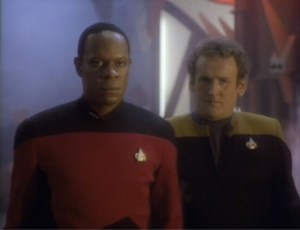
It’s rare for a series to kick off with one of its best episodes. What often happens in television is that it takes time for a show to find its feet as the actors and crew get used to working together and as characters and story elements develop. In the Star Trek franchise this is true too, but Emissary bucks the trend. Until very recently I’d have said it was easily the best opening episode of any Star Trek show, but it must now share that crown with Remembrance, the premiere of Star Trek: Picard – a review of which you can find by clicking or tapping here.
The episode begins with a flashback to the events of The Next Generation episode The Best of Both Worlds, around three years previously. Sisko, it turns out, had been aboard the USS Saratoga, one of the ships destroyed by the Borg. His wife had been killed but he escaped the exploding ship with his son Jake. Cut to the present day, and the Cardassians had finally withdrawn from Bajor after decades of occupation. Both factions had been introduced in The Next Generation too, so the audience would have been familiar with them. Both of these elements tied Deep Space Nine to its sister-show in a way that hadn’t really been seen before. Star Trek was expanding, but it was expanding in such a way that the shows being produced together would share a setting – we’d also see this in Voyager, and I’ve written previously about why it worked and why doing something similar would be good for Star Trek going forward. But we’re off-topic again.
Sisko and Jake travel to the Bajoran system and arrive aboard the newly-christened Deep Space Nine, a former Cardassian station. The episode introduces us to the crew – O’Brien, who’s obviously crossed over from The Next Generation, as well as Dax, Quark, Kira, Odo, and Dr Bashir. Interestingly, the role of Kira Nerys was intended to be filled by Ro Laren, another recurring character from The Next Generation, but actress Michelle Forbes declined the offer.
The episode sets up tension between Sisko and Picard; the former blaming the latter for what happened at Wolf 359. Sisko seems on the verge of resigning from Starfleet, but after discovering the Bajoran wormhole and encountering the noncorporeal Prophets, Sisko realises why he’d been unable to move on from those events, and approaches his new role with renewed vigour.
The only criticism I’d have of Emissary might be this: the story almost immediately took DS9 from being a minor frontier outpost to being a vitally important location. There was scope, I feel, for the show to have spent a little more time looking at DS9 as an unpopular posting, and at Bajor as a slowly-recovering backwater before introducing the Gamma Quadrant. I mentioned that Emissary stands up as being a pilot that’s one of the series’ best episodes and that’s true – in part because the discovery of the wormhole storyline could have been moved to later in the show!
Number 2: The Homecoming, The Circle, and The Siege (Season 2)
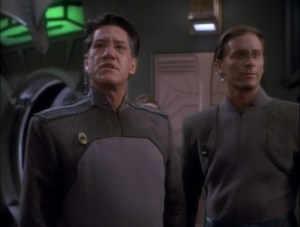
I believe this trio of episodes form Star Trek’s first “three-parter”, and kicked off the second season of Deep Space Nine with an explosive story. It would’ve felt wrong to pick just one of the three episodes considering they form a single story, and I wanted to talk about it in its entirety.
One aspect of the story in Season 1 designed to cause tension was the idea that some Bajorans resented the arrival of the Federation so soon after the Cardassians had left. While Major Kira expressed this view in Emissary, she had largely stepped back from overt criticism of the Federation’s presence, yet it was something the show wanted to address. In this story, an aggressive group of Bajorans want the Federation gone. They don’t realise it, but they’re being manipulated by the Cardassians, and the whole scheme is a Cardassian plot to retake the station and the Bajoran system – which is now strategically valuable because of the wormhole.
DS9 would come under attack a number of times across the series’ run, but this is the first time we really see the station and its crew forced into such a difficult combat situation. Despite Starfleet’s order to withdraw – they were only there, after all, at the request of the Bajoran government – Sisko and the crew stay behind to fight off the Bajoran soldiers involved in the coup.
The character of Li Nalas, played by Richard Beymer, is one of the best one-time characters that appeared in the show, especially in the early seasons. A resistance hero who Kira rescues, Li is assigned to the station and ultimately loses his life to save Sisko from the rebels.
Vedek Winn – who would later be elected Kai, the Bajorans’ spiritual leader – returns in this story from her sole appearance in Season 1. While she had been presented as a thoroughly dislikable character in the episode In the Hands of the Prophets, it was here, at the beginning of Season 2, that her role as a villain begins to be fleshed out, as she is shown to be collaborating with the Cardassians and is clearly someone for whom power is the ultimate goal.
Number 3: The Wire (Season 2)
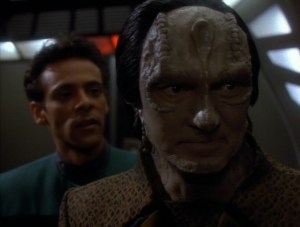
Elim Garak, the sole Cardassian aboard DS9, was an enigmatic and interesting character in his early appearances. Later episodes would flesh him out much more, especially during the Dominion War which of course affected Cardassia greatly. But The Wire was one of the first Garak-centric episodes, and it looked in detail at his past as a spy.
In fact, The Wire is the first episode to introduce the Obsidian Order – the Cardassian Empire’s secret police/intelligence agency. This faction would go on to be further developed as later seasons of the show rolled out, but here is where it was first introduced. We also meet its former head, Enabran Tain, for the first time. Tain would reappear several more times in Deep Space Nine.
Garak had been an enigmatic character, but prior to The Wire his status and his past were unclear, and his conversations, particularly with Dr Bashir but also with others, could be taken in different ways. It wasn’t until this episode that we get outright confirmation that not only was he once a spy, but that he’s in exile. His lies cloud the story somewhat, and even by the end of the episode the reason for his exile is not clear, but what is clear is that Dr Bashir had been right about him in a roundabout way – Garak had once been a spy.
Over the course of more than thirty appearances in Deep Space Nine, Andrew Robinson would make Garak just as much a part of the show as its main cast – especially in later seasons. It’s hard to imagine the series without him, as he would become such an important character, and from that point of view the story of The Wire is important. But as a work of mystery, and as an episode focusing on Dr Bashir as he tries to save a patient who, at times, treats him awfully, it’s a great work of drama too.
Number 4: The Search, Parts 1 & 2 (Season 3)
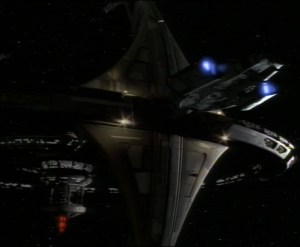
The finale of Season 2 introduced the Dominion, the aggressive Gamma Quadrant faction that would become Deep Space Nine’s major antagonists. The Season 3 premiere picks up the story in the aftermath, and the crew set out to search for the Dominion – in the brand-new USS Defiant.
The Dominion were intended to be an anti-Federation faction. Where the Klingon and Cardassian Empires were monoethnic, the Dominion would incorporate several races under its banner, just like the Federation. But instead of being a democratic society with a focus on peaceful exploration, the Dominion would be a dictatorship, and its races would be split into castes – with the Founders being treated with god-like reverence, akin to something we might see in Imperial Japan before 1945 or North Korea. The Dominion also answered a burning question for Deep Space Nine, namely what to do with the Gamma Quadrant. The show was supposed to be set on a static station with less focus on exploration, but with the Gamma Quadrant beckoning just beyond the wormhole, a number of episodes had basically been about going there and exploring. The Dominion, and their iron grip on the territory beyond the wormhole, gave Deep Space Nine an excuse to cut back on exploration, and by extension, avoid becoming The Next Generation or Voyager, which was about to premiere. Voyager’s upcoming launch also changed the name of the USS Defiant – it was originally to be named the USS Valiant, but Rick Berman and other Star Trek producers didn’t want two ships whose names began with the letter V!
The introduction of the Defiant allowed for more stories away from the station featuring the full crew, not all of whom could seemingly fit on one Runabout. It shook up the show, and would set the stage for the more military direction that the showrunners intended to take.
The Search also introduces two key recurring characters – Michael Eddington, the Starfleet officer who would go on to become a leader in the Maquis, and the unnamed female changeling, who would be the Founders’ representative throughout the Dominion War. Odo discovering his people and realising for the first time that he isn’t alone was a major turn for his character too, one which worked brilliantly, especially in later stories. Indeed, much of what would come later in Deep Space Nine in terms of successful storylines premiered or was at least hinted at in this two-parter.
The Dominion here are shown to be very powerful, but their intentions are not yet clear. The Founders clearly have a major problem with any non-changelings, but they do concede to Odo at the end and allow everyone to return home. Obviously, however, this wouldn’t be the last we’d see of the Dominion or Odo’s people.
Number 5: Homefront and Paradise Lost (Season 4)
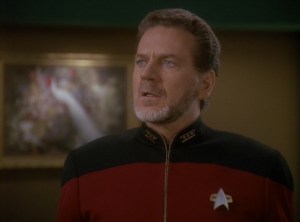
Since discovering the Dominion and their shape-shifting Founders, the Federation had become increasingly worried – to the point of paranoia, in some cases – about being attacked or infiltrated by changelings. The basic story of Homefront and Paradise Lost sees a former commander of Sisko’s recall him to Earth to work on strategies to protect the Federation – but this officer, Admiral Leyton, played by Robert Foxworth, has another scheme in mind.
Believing the democratic government to be impotent and paralysed in the face of the Dominion threat, Leyton plans a coup to seize power for himself on behalf of a cadre of Starfleet officers, in a story with a genuinely sympathetic antagonist. What’s so engrossing about Leyton is that he’s not a typical villain. He and Sisko actually have the same morals and the same motivation – they just have very different ways of going about engaging the Dominion. Leyton genuinely believes he’s doing the right thing – and while in the episode itself he’s presented as being in the wrong, we can at least entertain the argument that the later Dominion War would prove that he was right to take the threat seriously.
We’ve visited Earth in Star Trek on a number of occasions, but this was our first significant look at 24th Century Earth outside of Starfleet Academy. The action takes place in several locations on the planet, including Sisko’s hometown of New Orleans. It also gives Nog, now a Starfleet cadet, something significant to do for the first time in a number of episodes, and sets the stage for his future development as a Starfleet officer.
I’ve always liked the character of Joseph Sisko, played by veteran actor Brock Peters. In this story, he’s presented as a voice of reason, standing up to Sisko’s increasingly paranoid behaviour as he searches for changeling infiltrators. Giving that role to Joseph Sisko worked so well in the story, and it’s one of my favourite storylines from this duology.
Number 6: Nor Battle to the Strong (Season 5)
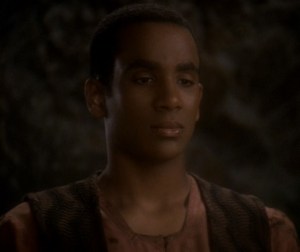
Despite being credited as a main cast member for all of Deep Space Nine’s seven seasons, Cirroc Lofton’s character of Jake Sisko made only 71 appearances out of the show’s 176 total episodes. For a long time, the show’s creators didn’t really know what to do with the character. Having him try to become a Starfleet officer would have been too similar to Wesley Crusher’s storyline in The Next Generation, and I have no doubt that there was an awareness on the part of the producers that Wesley had been, shall we say, not well-received by every fan. So there was a need to do things differently, but without any real sense of direction as to what that might be. Jake Sisko was created to be less a character in his own right than to give Benjamin Sisko a dependent, and it shows.
However, by the fifth season, the idea had been conceived to make Jake into a writer. Initially he wrote poetry and planned to write a novel, but in the episode Nor Battle to the Strong he branches out and begins writing articles and profiles about current events – in this case he uses the opportunity of writing about Dr Bashir as an excuse to get off the station, but ends up in a warzone when their ship is diverted. At this point in Deep Space Nine’s story, the Federation and Klingons are engaged in a brief war which had been set in motion by a Dominion infiltrator, but that really is’t the focus of the episode.
Jake is thrown into a warzone completely unprepared for what he’d find. He goes from enthusiastic to terrified in a matter of hours, and in a very powerful sequence finds himself alone with a badly-wounded Federation soldier, who dies in front of him.
Toward the end of the episode the Klingons attack, and Jake finds himself trapped and terrified in the Starfleet base. Firing his phaser randomly he inadvertently causes a cave-in, which stops the Klingons in their tracks. Hailed as a hero, Jake feels dejected and depressed, feeling that after abandoning Bashir and the dying soldier, he doesn’t deserve the label. He writes up his experiences in a powerfully honest piece which we see both Sisko and Bashir read.
Nor Battle to the Strong is an incredibly powerful story about the reality of war, told through the eyes of the kind of enthusiastic young man that our armies arguably consist of. At the beginning of the episode Jake is longing for action, to get away from the boredom of the station and a medical conference. He’d love to thought of as a hero, too. Yet by the end, after the horrors he saw and the trauma he went through, not only does he reject the label of “hero”, but he’s more than happy to be back aboard the station.
While he labels himself a coward, and perhaps not unfairly so, we sympathise with Jake. He wasn’t ready for what he saw, as indeed nobody can be until they see if for themselves, and he acted on instinct and out of fear. Jake could be any of us, and the episode challenges us as the audience as if to say: “you think you’d act any differently?” Nor Battle to the Stong also sets up Jake for his decision to remain aboard DS9 when it’s occupied by the Dominion at the end of the season. Having seen warfare first-hand, he’s more experienced and perhaps feels a little more ready for taking a big decision like that.
Number 7: Call to Arms (Season 5), Favor the Bold, & Sacrifice of Angels (Season 6)
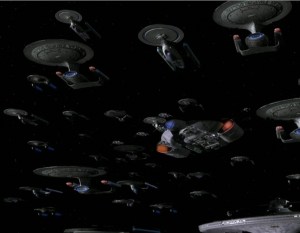
This trio of episodes forms a single story, with several other episodes in between at the beginning of the sixth season. In Call to Arms, the cold war between the Federation and the Dominion finally boils over into all-out conflict, and as the gateway to the Gamma Quadrant DS9 is in the firing line. In an attempt to stop the Dominion’s military build-up in Cardassian space, Sisko and the crew plant a minefield at the mouth of the wormhole – self-replicating mines, designed by Rom, Dax, and O’Brien, which would also be cloaked for maximum effectiveness. While it had been clear for some time that the Dominion War would happen one way or another, in the end it would be Starfleet and the Federation who would trigger it.
We’ve touched on Deep Space Nine being darker before, and this decision is another example of that. Starfleet had evidently given up on the idea of a negotiated settlement, and as they could no longer stand a military buildup on their frontier, they took the first step – aggressive action which had no other possible outcome. In this sense, Starfleet is presented in a much more military light than usual, akin to some of the conspirators in The Undiscovered Country, which is perhaps the closest we can get within the franchise.
The minefield ultimately leads to the anticipated Dominion-Cardassian attack, and with the Federation’s resources focused elsewhere, DS9 is surrendered to their forces at the end of Season 5, and remains under their control for the first third of Season 6. I’d argue, by the way, that DS9 was so vitally important to the war effort, as it controlled the only travel route between Dominion space and the Alpha Quadrant, that all steps should have been taken to keep it safe. But a) there’s no denying it was a dramatic turn as a story beat, and b) we don’t know the state of Federation-Klingon forces at the time, and they may well have decided that trying to hold the station and the Bajoran system would be massively costly and ultimately futile. But we’ve gone way off-topic!
Favor the Bold sees Sisko come up with a plan to recapture the station, but with the Dominion close to destroying the minefield and unleashing a vast wave of reinforcements, they have to launch the plan ahead of schedule. I loved the way that they were able to communicate the information from DS9 to Sisko – Morn would become a courier, and I loved this way of using his character.
The story arc is finally concluded in Sacrifice of Angels in dramatic fashion, and features what is still one of Star Trek’s biggest space battles to date, possibly only behind a couple of later battles in Deep Space Nine and the one seen in Discovery’s Battle at the Binary Stars. The battle is also one of Star Trek’s finest, with the last-minute arrival of the Klingon fleet clearing a path for Sisko to make it back to the station. The next twist involves the Prophets, who finally involve themselves in the war on the side of the Federation – at least for a moment.
Practically every character gets a turn across this story arc, from Jake Sisko, who opts to stay behind aboard the occupied station, to Kira, who sees herself as a collaborator with the Cardassians, to side-characters like Rom, Nog, and Garak, who all have roles to play. Gul Dukat sees a massive turnaround in his character, going from achieving his wildest ambitions to tasting bitter defeat and painful loss, setting the stage for what would come next for him. Overall, a stunning story to kick off the Dominion War arc.
Number 8: Who Mourns for Morn? (Season 6)
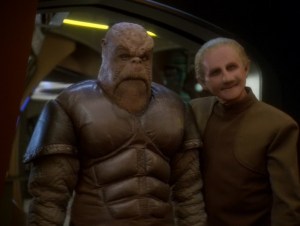
In the midst of a what was a very dark season overall, Who Mourns for Morn? stands out as being a much more light-hearted episode. Focusing on the character of Morn, who was less of a recurring character than a true background character, this episode sees him “killed”, and Quark scrambling to recover his fortune.
Taking a break from the war and returning to the Quark-versus-Odo dynamic that had worked so well in previous seasons, the episode also brings in a number of guest stars to play Morn’s criminal associates. Each of these characters was fairly one-dimensional and even a little over-the-top, but in the context of a fun heist/mystery story they worked wonderfully, and gave Deep Space Nine some much-needed time off from the war.
René Auberjonois and Armin Shimerman worked so well together, not just here but throughout their stories together in Deep Space Nine. The two actors built up a chemistry and, reportedly, a genuine friendship – helped, no doubt, by the long sessions spent together having makeup and prosthetics applied.
Morn had been a part of Deep Space Nine from the beginning, but in a non-speaking role. This episode took a more detailed look at him, particularly his past as a criminal. It was genuinely funny to see the characters talking about Morn as someone who would never shut up in light of the fact that we never heard him speak on-screen, though the episode wasn’t universally well-received, as some fans felt it was too un-serious in the middle of a war, and that Morn was somehow “unworthy” of an episode dedicated to him. Some people are real killjoys!
Number 9: In The Pale Moonlight (Season 6)
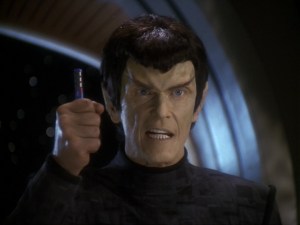
Deep Space Nine was much darker than any Star Trek show had been before, as we’ve already mentioned. It looked at themes like warfare and morality from a wholly different place than Gene Roddenberry had done, and In The Pale Moonlight sees the show at one of its darkest moments. What results is an episode that is divisive, at least in some circles. Fans of the more optimistic tone of The Original Series and The Next Generation may dislike what it brings to to the table, particularly in the way it shows how 24th Century humanity is susceptible to the same flaws and problems that we are today – but I’d argue that simply makes it more relatable, or even realistic.
With the Dominion War raging and many Starfleet officers dying on a daily basis, Sisko hatches a plan to bring the Romulans into the fight on the side of the Federation-Klingon alliance. Other episodes of Deep Space Nine had looked at the gritty reality of war from different angles, but In The Pale Moonlight showed the crew looking through reams of names of the dead and missing in a powerful sequence that showed just how many casualties were being inflicted.
The Dominion had been created to be an equal for – and to outgun, at points – the Federation-Klingon alliance. We’d seen even going back to their pre-war appearances how powerful their ships and weapons could be, so by this point in the show the fact that the war would see the Federation somewhere between a WWI-esque stalemate and actually being on the back foot is not unrealistic. The storyline builds masterfully on what has come before, especially earlier in Season 6, to present Sisko’s decisions in a sympathetic light.
Sisko employs Garak to aid in his scheme to convince a Romulan senator that the Dominion plans to attack them. As with any big lie, Sisko finds himself falling deeper and deeper into the scheme, crossing more and more lines in his quest to do what he believes is right. The episode thus looks as the concept of moral relativism and the question of whether the ends can in fact justify the means under exceptional circumstances. Sisko was ultimately okay with lying, forging evidence, pitting two powerful factions against one another, and dragging a foreign power into a war that they didn’t need to participate in. He was even content to cover up murders, all in the name of victory for the Federation. As Section 31 would say, sometimes saving the Federation means doing very un-Federation things.
Number 10: The Siege of AR-558 (Season 7)
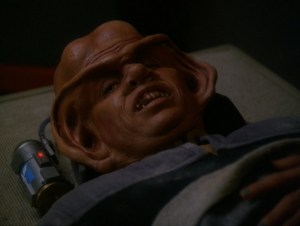
Deep Space Nine’s seventh and final season was a war story, and the latter part in particular was one long serialised arc. It can be difficult to pull out single episodes from such a story, but for me, The Siege of AR-558 encapsulates perfectly what the show wanted to say about war.
Directed by Vietnam War veteran Winrich Kolbe, who directed a number of other Star Trek episodes too, The Siege of AR-558 has a claustrophobic feel, no doubt informed by its director’s own experiences. The fact that the planetoid is not even given a proper name adds to the sense of futility, and while there is a good reason to defend the captured position – it hosts an important Dominion communications relay – that hardly matters to the soldiers stationed there.
Nog’s character arc in Deep Space Nine, from petty thief to outstanding officer and war hero, sees major development as he suffers a serious injury. The way Aron Eisenberg approached the role of Nog is commendable, because he took what could have been a one-dimensional minor character, and foil for Jake Sisko, and turned him around into someone we could root for and feel for. Sadly, Eisenberg passed away last year.
The Siege of AR-558 is also a reminder that all wars see small acts of heroism on a regular basis, many of which go unnoticed and unreported. Sisko’s decision to stay and fight is one, Nog’s injury is another, but also we have the soldiers already present on the planetoid – not all of whom survive the episode. These characters show different reactions to life on the front lines, and the episode is much better for their inclusion.
The Siege of AR-558 also gives Ezri Dax something to do away from the station. Ezri was brought in at the beginning of Season 7 to replace Jadzia Dax – who had been killed at the end of the sixth season. Nicole deBoer played her very well in all of her appearances, but with only one season left before the show would end, Ezri didn’t have a lot of time for us to get to know her. Thus her role in an episode like this one, while not the main focus, is important for her character as the season unfolds.
So that’s it. Ten great episodes from Deep Space Nine. I tried to pick a couple of non-war stories to go along with all of the war-themed episodes. There’s more to the show than the war, but war and its associated themes are prevalent throughout the series, even from its opening scene which was set midway through a battle.
There are many other episodes which almost made this list, and Deep Space Nine has some great options to revisit time and again. I’ve seen the Dominion War arc more times than I can count, and even on a repeat viewing the war is still incredibly dramatic, tense, and exciting. For me, “modern” Star Trek began partway through The Next Generation’s run, perhaps around the third season, and Deep Space Nine carried on the trend of modernising the storytelling, taking Star Trek away from its 1960s roots. While some fans of The Original Series may not appreciate that, for me personally it works. I have friends on both sides of the argument of whether the Dominion War arc was a great idea or a terrible one, but again it’s a storyline that worked for me.
As I said last time when looking at The Next Generation, there were many other episodes that I could have chosen for this list. Deep Space Nine can be divided into at least three distinct parts – Seasons 1 and 2, prior to the introduction of the Dominion, Seasons 3-5 before the outbreak of the war, and Seasons 6 and 7 while the war raged. Within that framework there were changes, the two biggest ones being the introduction of Worf in Season 4 and Jadzia Dax being replaced by Ezri at the beginning of Season 7.
While I wouldn’t pick Deep Space Nine to be someone’s first introduction to Star Trek – especially as it hasn’t been remastered – it is nevertheless a great show, and one that takes the franchise to different places both in terms of its static location and thematically. It’s a very interesting part of Star Trek’s history, and one that I hope will be the inspiration for a new series in the future.
Star Trek: Deep Space Nine is available to watch now on CBS All Access in the United States, and on Netflix in the United Kingdom and other countries and territories. The series is also available on DVD. The Star Trek franchise – including Deep Space Nine and all other properties mentioned above – is the copyright of ViacomCBS. This article contains the thoughts and opinions of one person only and is not intended to cause any offence.


 Trekking with Dennis