

Spoiler Warning: Beware minor spoilers for The Elder Scrolls III: Morrowind. Minor spoilers are also present for Oblivion, Skyrim, and Starfield.
A quotation from former Bethesda developer Bruce Nesmith has been doing the rounds over the last few days, sparking a bit of conversation in role-playing games and Bethesda communities about the prospect of a remake or remaster of The Elder Scrolls III: Morrowind. I thought it could be fun to talk about that today, and consider what a Morrowind remake could or should look like – as well as whether it’s even *remotely* possible in the near future.
The original quotation from Nesmith is quite long, so I’m going to pick out the key parts that I find the most interesting. If you want to read the whole thing in context (as well as the rest of his interview with Press Box), I’ve linked it at the end of this article.
“[…]go back and play Morrowind and tell me that’s the game you want to play again. […] you go back and play a 20 year old game and you will cringe. […] the reality of playing Morrowind would not stand the test of time, in my opinion. Now if you were to completely remake Morrowind with the Skyrim engine, to try and rebuild it from the ground up, that’s a whole other story[…]”
So, as you can see, what Bruce Nesmith is basically saying is that Morrowind is – in his opinion – too outdated to be given the same kind of treatment that the recent Oblivion remaster got; that the only way to recreate the game for modern players would be to remake it from scratch. And I have to say… I’m inclined to agree on the latter point, even if I don’t agree at all that going back to replay Morrowind today feels in any way cringeworthy!
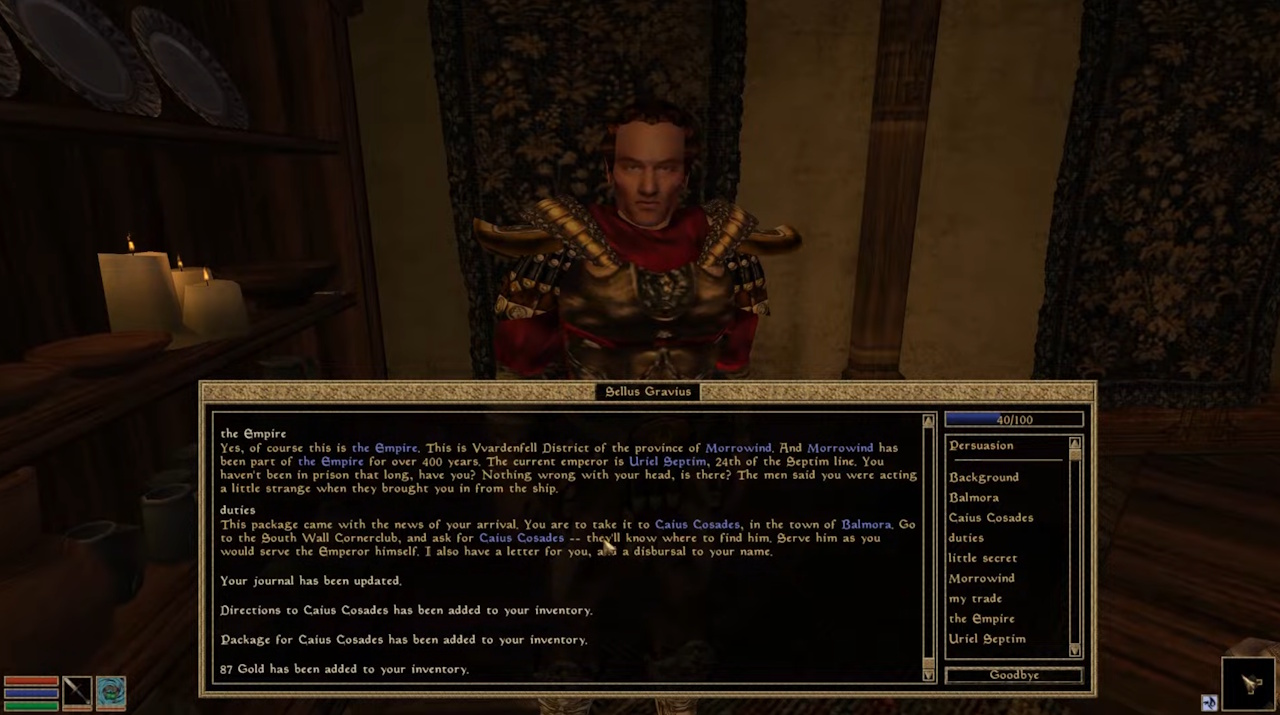
Morrowind lacks a lot of features that players today would want in an action/RPG, and some of its core gameplay systems are just… from another time. Morrowind launched at a moment of transition; it was a pioneer of the open-world genre, and being a pioneer often means that the folks who come later have a chance to refine things and make the experience a bit more smooth. The game doesn’t have voice acting, for instance, and while I’m perfectly happy to play text-based games… it’s not something that players today would accept as easily. It makes Morrowind more of a niche title, in that sense.
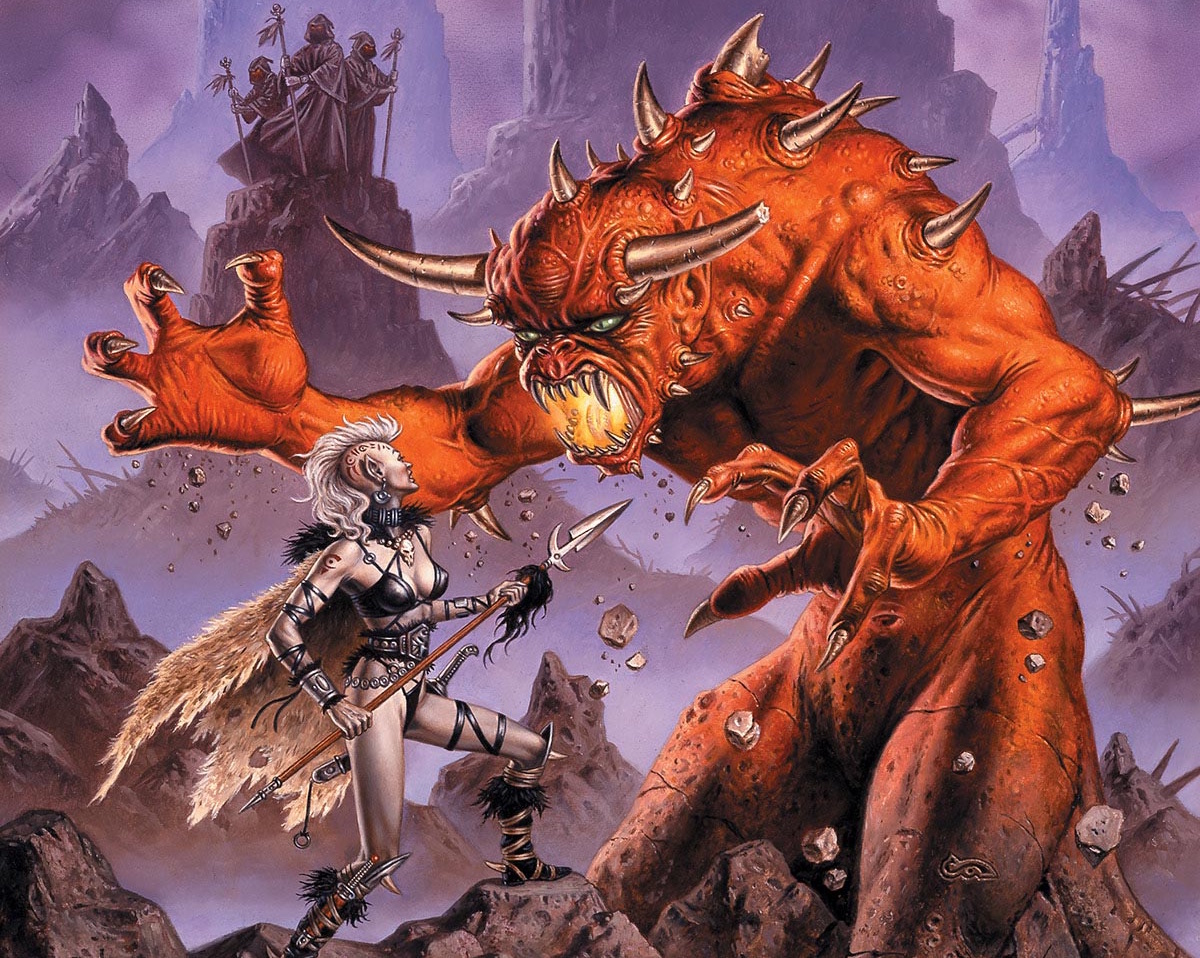
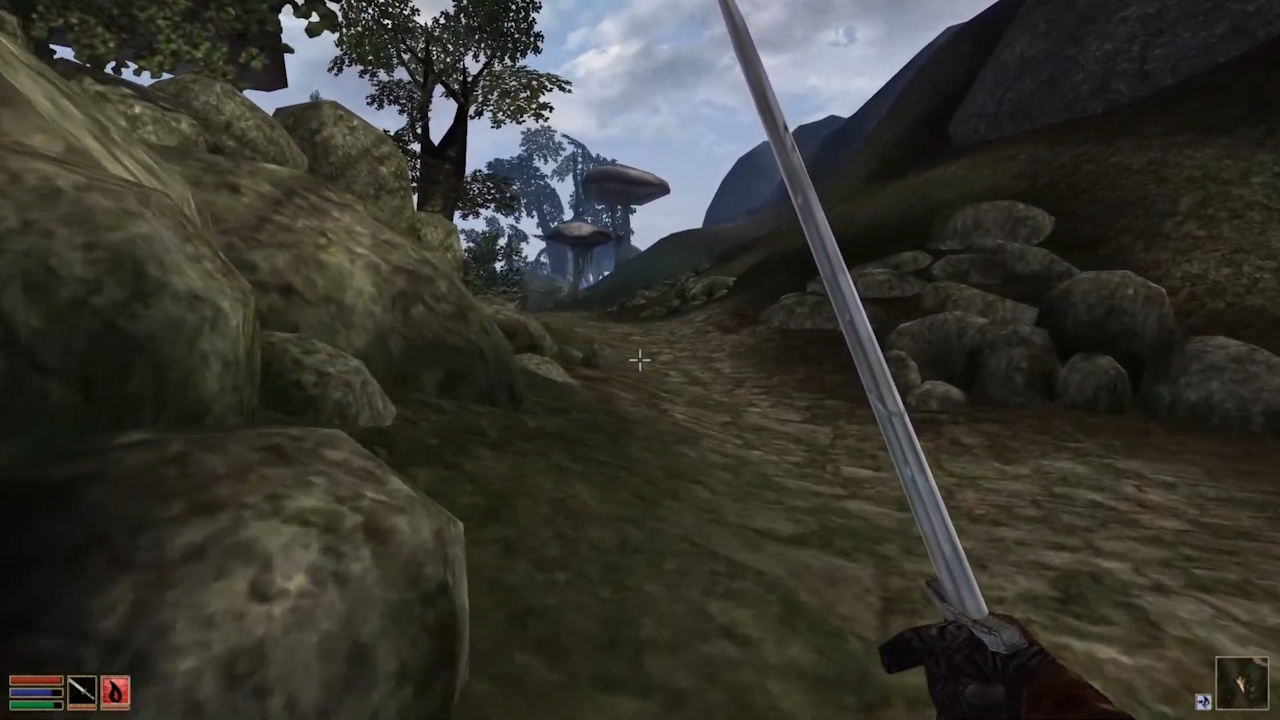
Morrowind’s combat is also clunky, even by Bethesda standards, with every attack being determined by a “hit calculator,” which can lead to a pretty jarring disconnect between what you see on screen and how the game reacts. You’re standing right in front of a monster or villain, swinging your sword, but Morrowind’s digital roll of the dice says you didn’t score a hit – even though it looks like you absolutely should’ve! In 2002, that was just something I kind of… rolled with (if you’ll excuse the dice pun). But today, I can see it being something players would criticise.
Removing or updating such a core component of the game effectively means Morrowind would need to be rebuilt from scratch. Adding fully-voiced NPCs might be possible in the current engine, but I’m not a programmer, so I’m not positive about that. But something as major as implementing an entirely new combat system… that seems like major work.
Setting that aside for a moment, though, I think there’s a compelling *business* argument for Bethesda to remake Morrowind – namely, the incredibly long wait for The Elder Scrolls VI.
Not long ago, I covered remarks from Bethesda executive producer Todd Howard, in which he said that the next entry in The Elder Scrolls series was still “a long way off.” I said that we knew that already; The Elder Scrolls VI seems, to me, to be a 2028 or 2029 game at the earliest. But if a Morrowind remake were possible in the interim, wouldn’t it be a good idea?
Alternatively, Bethesda could sit on this idea for a year or two, perhaps comissioning a remake that could launch sometime in the 2030s, while the main studio is busy with potential new entries in the Fallout series and a sequel to Starfield. One of Bethesda’s biggest problems right now, as game development moves on and games take longer and longer to make, is the studio’s outdated (and stupid) insistence on only crafting one game at a time. Outsourcing the remake of Morrowind to a subsidiary or partner – as happened with last year’s Oblivion remaster – would be one way to keep the series fresh in players’ minds, assuming there’s going to be another very long wait in between titles.

Depressingly, I guess that means I’m unlikely to play a potential Elder Scrolls VII, even if it were to get made! I mean, on current form, a sequel to The Elder Scrolls VI might not launch till, say, the mid-2040s?
But the point stands! If Bethesda plans to continue with its current approach to making games, there’s a good reason to commission remakes or remasters of basically the entire back catalogue. Filling the ever-growing gaps in between major releases with these kinds of projects isn’t a bad idea, in theory, and as long as the project was handled well and not rushed, I could absolutely see a remade Morrowind finding an audience.
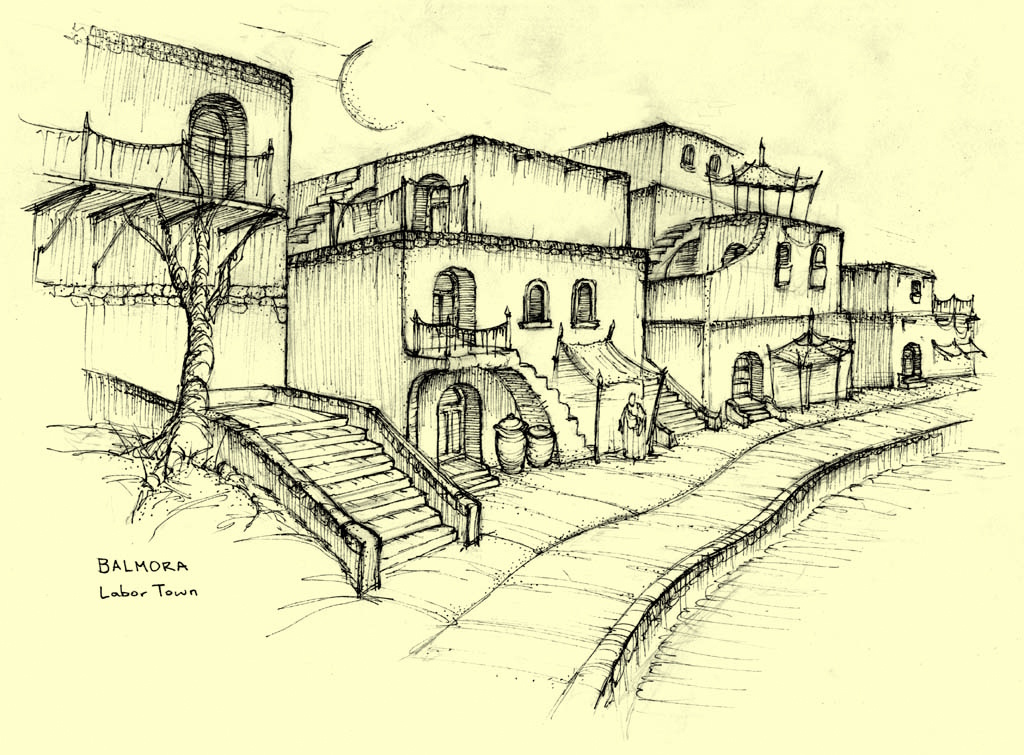
One of the things that can be disappointing or disheartening, sometimes, is hearing younger folks say they could “never” play a game from before, say, 2010 or 2005, because they find the gameplay to be clunky and the graphics too outdated. I guess that must’ve been how my parents felt when I criticised some of their favourite black-and-white films or TV shows from the ’50s! But as someone who played and fell in love with Morrowind in 2002, I would love it if new players could find an easy way into playing this incredible title.
A remake offers something to new players that even mods can’t. Yes, I agree that there are some fantastic graphics mods out there for Morrowind, capable of enhancing the game a lot. But a lot of folks don’t like to mess about with mods, have never done anything with mods, or don’t know how to get started – so an *official* remake is naturally going to find a much bigger audience. Compare the number of folks who played the Oblivion remaster to the number who’ve downloaded the most popular Oblivion graphical overhaul mods, just as an example.
Only one graphics mod (on popular modding site Nexus Mods) exceeded one million downloads for Oblivion, whereas the official remaster reached over nine million players in less than a year.
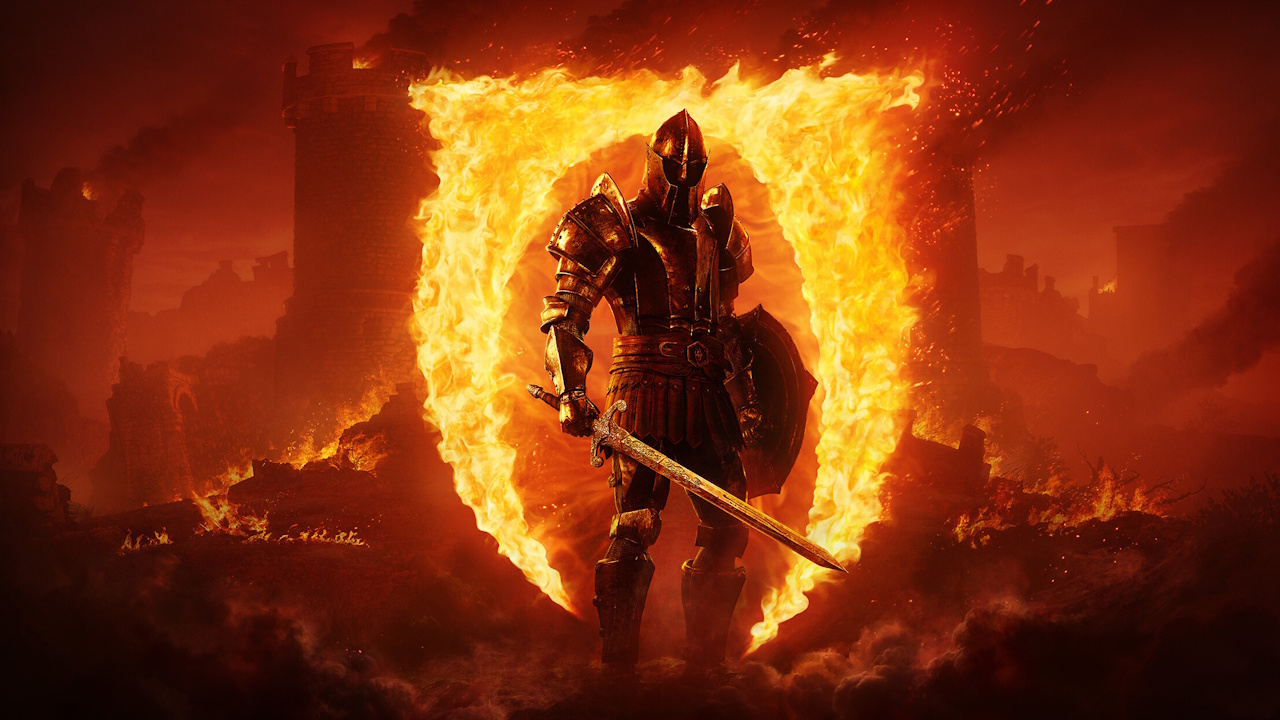
The thing with a remake, though – especially if, as Nesmith suggested, a partner studio would recreate Morrowind’s world and NPCs in the engine used for Skyrim, or even the updated engine used for Starfield – is that there’d undoubtedly have to be changes and sacrifices. One of the double-edged swords of Oblivion and Skyrim when compared to Morrowind, in my opinion, is the removal of quite a few things: spells, weapons, character classes, and other features.
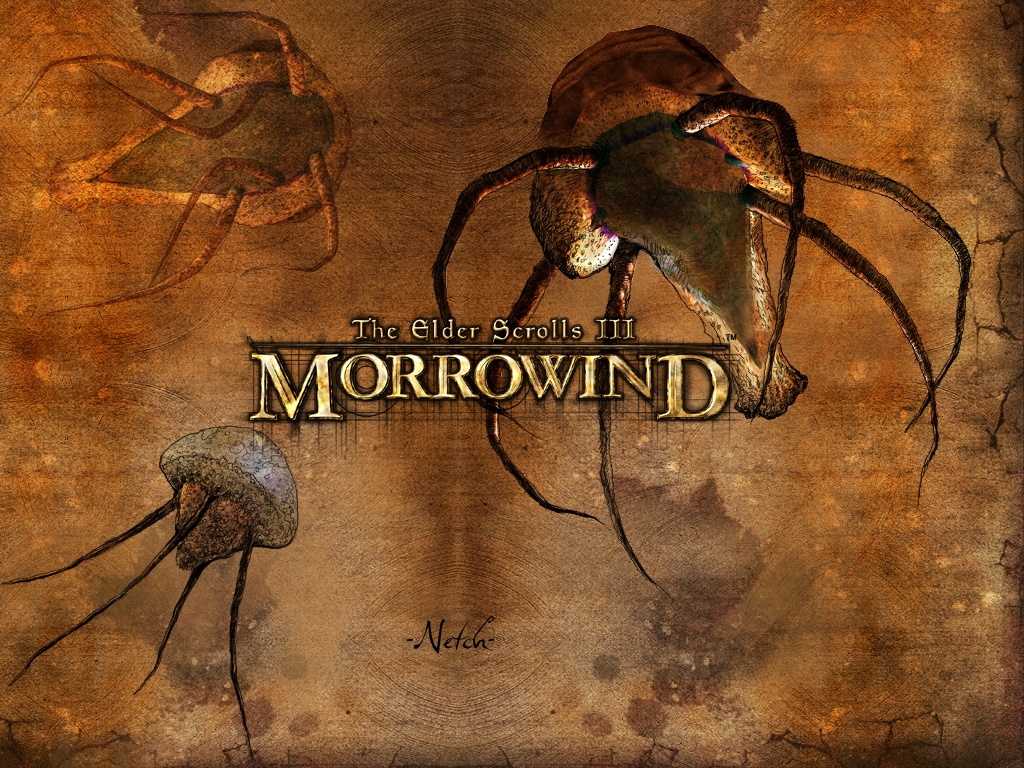
Did you know you could use spears and halberds in Morrowind? How about throwing knives and darts? There’s a levitation spell that lets you fly and hover – and it could be great for navigating the world and getting around obstacles. Mark and recall spells were so useful – allowing you to set a point on the map and return there by casting a spell, or even using a scroll or enchanted item. Morrowind also contained a lot of unique creatures that never appeared in Skyrim or Oblivion – and not just the ubiquitous Cliff Racers and Slaughterfish!
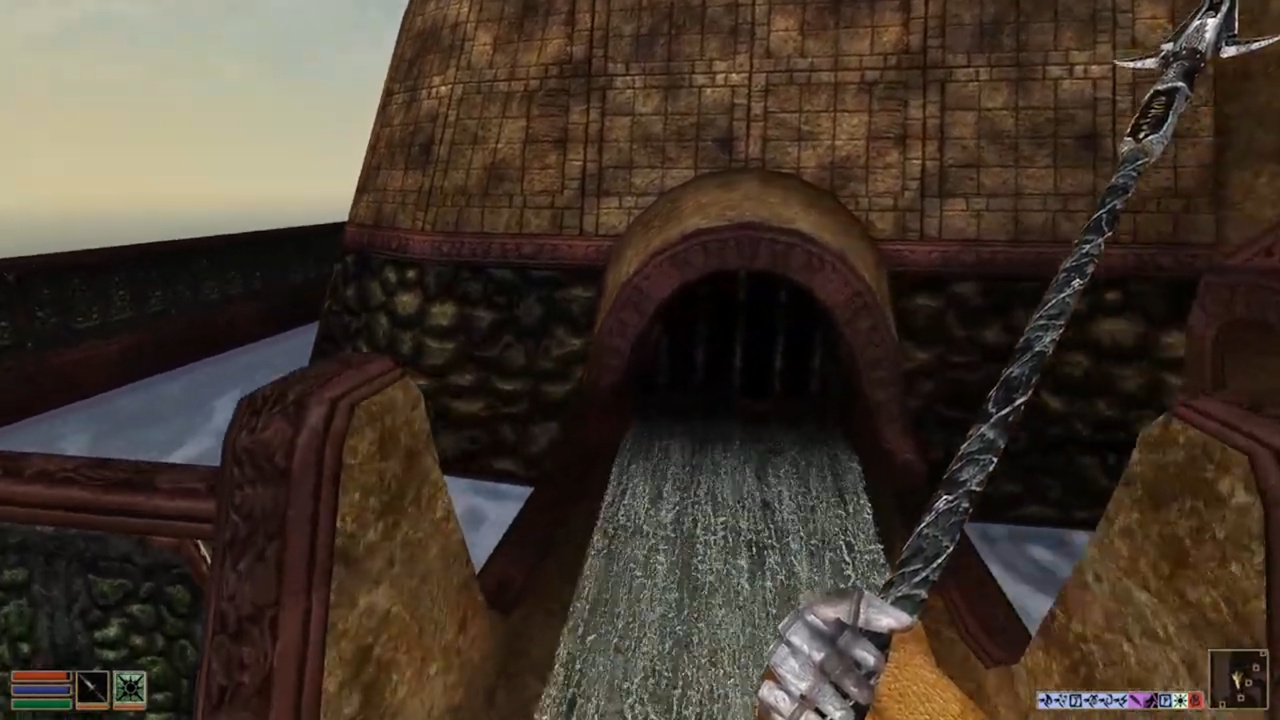
My point is that, unless a remake in the Creation Engine 2 *also* came with an overhaul to said engine, sacrifices would have to be made. Morrowind’s introductory sequence, with its classes, might have to be changed, and with no character classes in Skyrim at all… how well would that translate? And if a partner developer wanted to port the class system into a new engine… how difficult would that be, and how much work might be needed to get it to function properly? Bethesda’s most recent title, Starfield, had character backgrounds and a few traits, but nothing on the scale of Morrowind.
There are mods to bring classes to Skyrim, so obviously it’s technologically feasible to do so in that engine. Whether it would be easy, though, and how well Morrowind’s pre-made and custom classes would port… I don’t know. It would be a shame to lose something so central to the experience; a feature that gave Morrowind such genuine replayability. In fact, I’d go so far as to say that, if classes can’t be part of the game, don’t bother with the remake at all. If something so fundamental has to be stripped out, maybe it’s better to just… not do it.
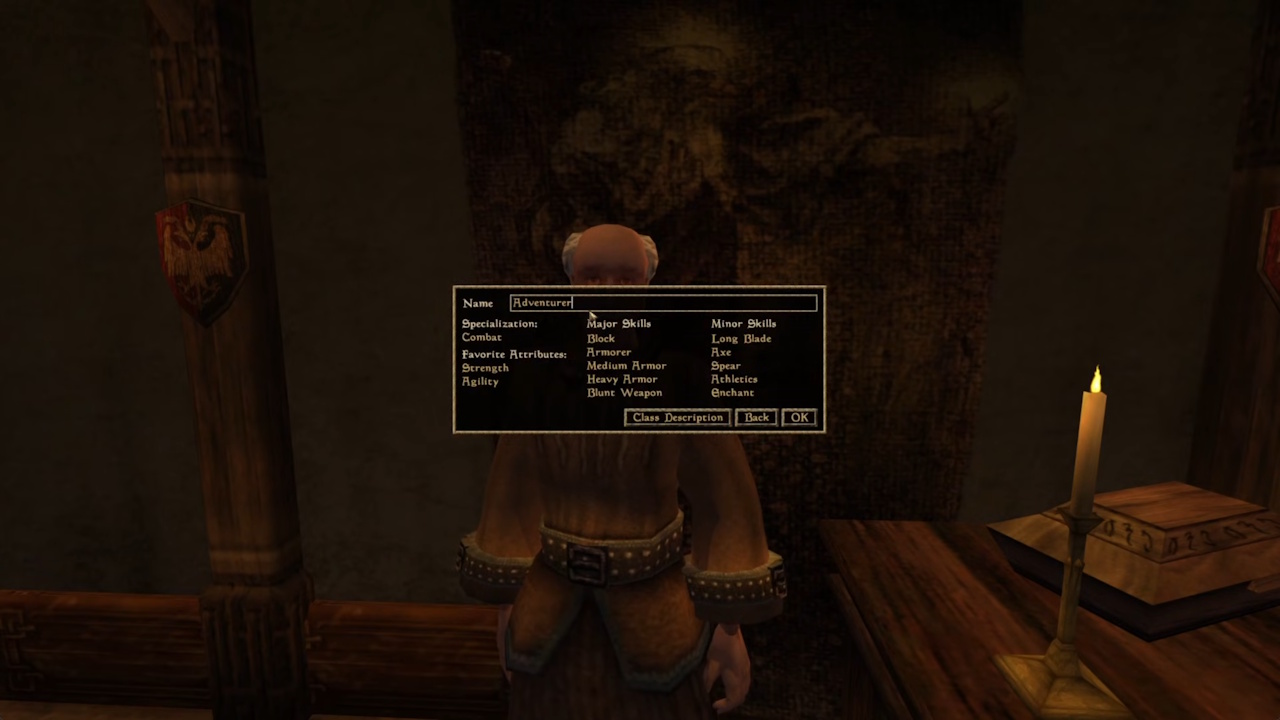
So that’s really my biggest concern, if a remake were to be announced. Could a remake retain the diversity of in-game systems, magic spells, weapons, classes, and more that made Morrowind the in-depth role-playing adventure that it was? And if not… will the sacrifices be worth it? If we get a shinier, more visually-appealing game, but one that’s lacking in that depth… will it even be the same game? Sure, some storylines might be the same, with fully-voiced characters who all look way better and more high-res than they ever did. But if the game is fundamentally transformed into less of an RPG and more of an open-world action/adventure… would it even still be Morrowind?
In recent years, Bethesda has shown a preference for making everything in its games accessible and playable in a single playthrough. Morrowind didn’t have that. Joining one of the three Great Houses would permanently cut off the other two. Joining one of the vampire clans likewise cuts off the others. And there are two religions which are effectively mutually-exclusive, too. Would *modern* Bethesda be okay with that? Or would a workaround be forced into the game, allowing players to join every faction and play every quest on a single save file? Again… that would detract from what made Morrowind the game it was.
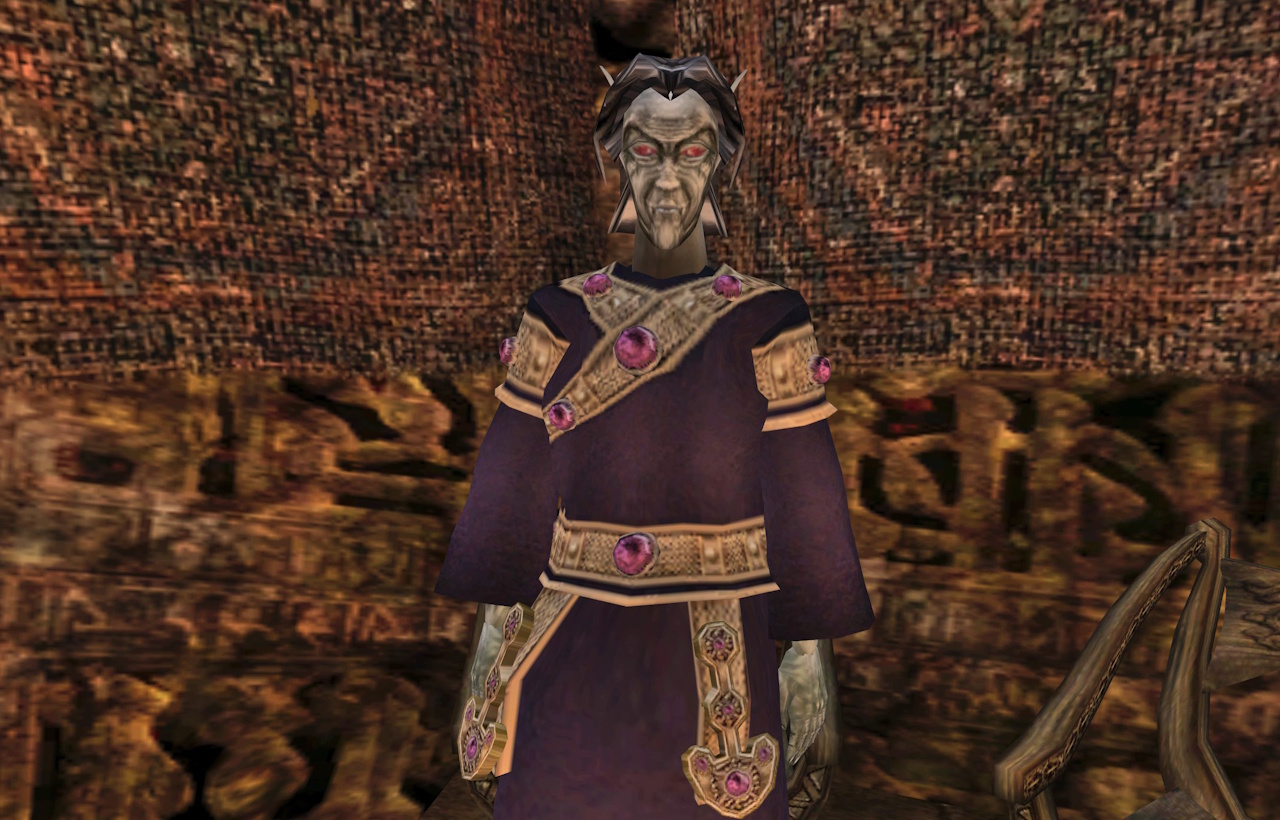
Then we come to killable NPCs. Morrowind was famous (or infamous) for allowing the player to kill anyone – including NPCs who were critical to the main quest and faction questlines. Because of its open world, it’s possible to stumble into a random building, ruin, or camp containing NPCs who may be critically important later in the game – and kill them to loot their stuff! But I can’t imagine *modern* Bethesda greenlighting something like that; today’s Bethesda seems to have far less confidence in the intelligence of its players.
Modern Bethesda games are less free and more… restricted. Oblivion, Skyrim, Fallout 4, and Starfield all have mission-critical NPCs who literally cannot die, and that makes those games fundamentally different from Morrowind. While Morrowind doesn’t have the “take any approach you like” game design as, say, Baldur’s Gate 3 does, it’s a much less linear and more open game than the likes of Starfield and Skyrim. In part that’s because it’s possible to get locked out of quests, or to have to find complicated workarounds if vital characters die.
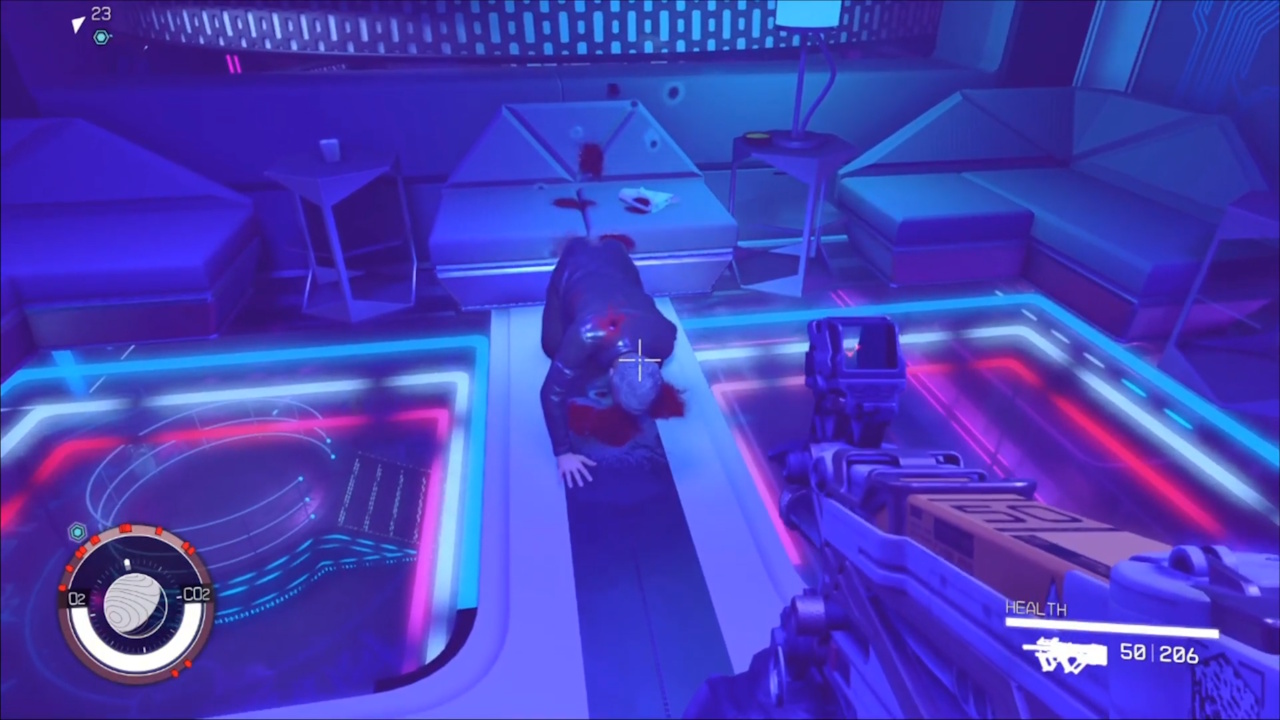
I just can’t see the Bethesda of today being okay with that, even in a remake. Unlike character classes or lockable faction quests, the handful of killable NPCs who actually matter to the story isn’t massive, and I’d wager that *most* players don’t jump into a new save file and immediately rush to murder the god Vivec! But as a point of principle, removing the ability to kill these vital NPCs would also be a change for the worse, in my opinion. Morrowind didn’t need training wheels and guard rails in its original form… so why add them in now?
Then there’s the map and journal. Since Skyrim, if not Fallout 3, Bethesda has been a fan of quest markers; big on-screen arrows pointing you in the right direction. Morrowind didn’t do that – and some quest direction in the journal actually take a bit of thinking and puzzle-solving to figure out. Again, I can’t see today’s Bethesda being okay with that. But with a smaller map, wouldn’t quest markers make the game less fun? I’d argue they would.
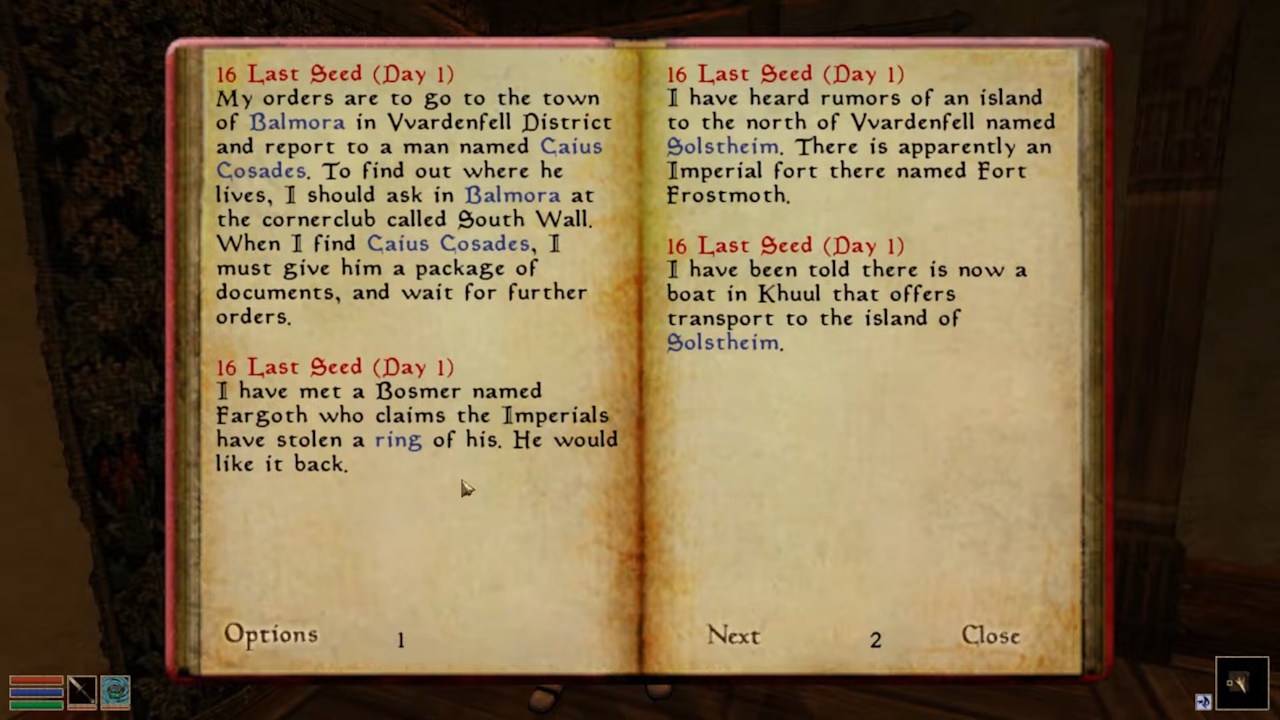
If these things were added as toggleable options for players coming to Morrowind from more recent games, I’d be okay with it. I’m a big believer in accessibility in gaming, and I’m not trying to argue that games were better “back in my day,” when technological limitations prevented things like quest markers or unkillable NPCs from existing! And if someone wants the more streamlined experience of Skyrim but in Morrowind’s world… I mean, I’d be okay with giving players options to set that up. That way of playing could even be the default.
But if it was the *only* way to play a Morrowind remake, I think that would be a bit of a disappointment. I’m all for adding accessibility features, shortcuts, and even cheats to games to help players make the most of their time in a game world – but not always at the expense of other ways to play. And for me, as someone who played and loved the original Morrowind, I’d want to recreate as much of that experience as possible – just with a better, more modernised graphical style.
But okay, let’s not get upset about hypothetical changes to a probably-not-being-developed remake!
I think there are positives here – reasons why remaking Morrowind could work. And I think there are ways to do it that would give both new and returning players enough choices to tailor the experience to either the classic way to play, a more modern Starfield/Skyrim style of play, or something in between. And expanding Morrowind to give the game and its wonderful stories the opportunity to be experienced by a new generation of players is a fantastic idea. I’d say there’s *more* of a point to remaking Morrowind than there was to remaking Oblivion.
So… I disagree with Bruce Nesmith. Depending on how a remake was handled, there’s a ton of value in going back to Morrowind to give it an overhaul and present it to a new audience. As long as there were options for fans of the game to retain at least part of what made it so special the first time around, I’m all in favour of a remake.
However, I think there are reasons to be concerned about a remake, given Bethesda’s recent form.
For one, I’d be *astonished* if a hypothetical Morrowind remake didn’t launch with a stupid “deluxe edition,” offering players a crappy digital sword, character skin, or something like that for a ridiculous extra fee. Then there’s Bethesda’s stripped-back game design, and how well Morrowind could be ported into an engine that doesn’t do character classes and that has fewer magic and weapon options. Bethesda’s insistence on making the entire game available in a single playthrough could mean that some of Morrowind’s replayability is likewise harmed.
But… despite some issues giving me pause, I think I’d still like to see a remake. Even if it wasn’t *as good* as the original experience, and even if some features had to be sacrificed, there’s still a fun story – or rather, “stories,” plural – at the heart of Morrowind that I’d love to see new players get the chance to experience. I don’t blame folks who grew up post-Skyrim looking back at games from the early 2000s and being turned off by clunky gameplay and outdated graphics; it’s natural to feel that way. And if I can’t convince younger folks to give Morrowind a shot on its own or with some of the player-made mods… a remake is a great option.
That being said, I suspect Nesmith is right about one thing: Bethesda isn’t interested in this. The higher-ups likely share his view that the game is outdated and cringeworthy, and would need too much of an investment to make it “playable.” So… as much as I’d like to see it, I get the impression that a Morrowind remake isn’t coming any time soon. Never say never, of course, and there are good business reasons for moving forward with a project like this. But in the short-to-medium term? Don’t bet on seeing a Morrowind remake, I’m afraid.
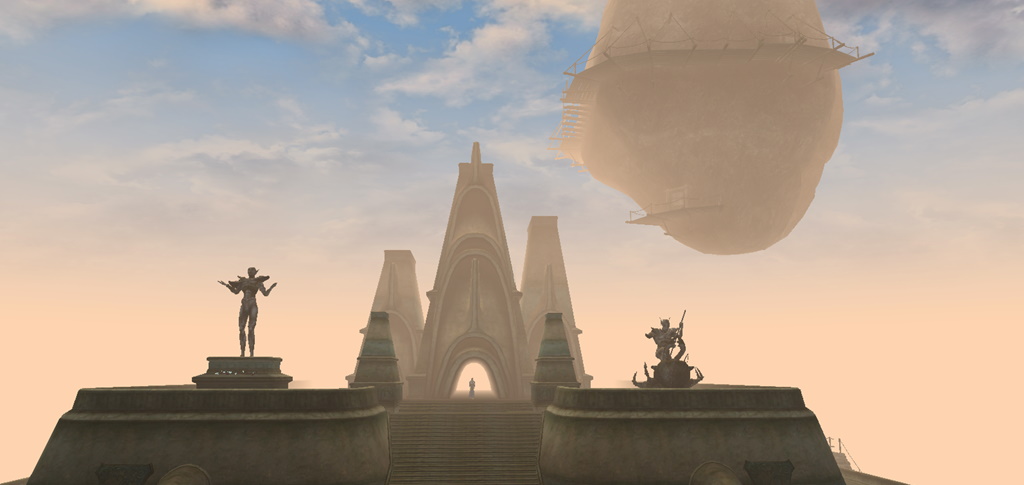
I hope this has been interesting. Despite the fact that I don’t expect this to actually happen, Bruce Nesmith’s comments did, for a moment, spark some interest in the Bethesda fan community about a potential return to Morrowind, so I thought it was worth having a discussion about it! And if you really want to get back to the Dunmer’s home province, don’t despair! You can visit parts of Morrowind in The Elder Scrolls Online, the island of Solstheim in one of the Skyrim expansion packs, and there are a huge number of fan-made graphics mods and other overhauls which can take the original game and really modernise it. So… check out Nexus and other modding sites!
I keep meaning to fire up Morrowind again and have another adventure in that world. Maybe 2026 will finally be the year I complete the Tribunal Temple questline… who knows? Have fun out there… and watch out for Cliff Racers.
The Elder Scrolls III: Morrowind is out now for PC and Xbox consoles. The Elder Scrolls series – including Morrowind and all other titles discussed above – is the copyright of Bethesda Game Studios, ZeniMax Media, and/or Microsoft. Some art courtesy of UESP. This article contains the thoughts and opinions of one person only and is not intended to cause any offence.
You can find the original interview with Bruce Nesmith, including the full quote about Morrowind referenced above, by clicking or tapping here. (Warning: Leads to an external website).



 Trekking with Dennis