Spoiler Warning: There are spoilers ahead for Star Trek: Voyager – Across The Unknown and for Star Trek: Voyager.
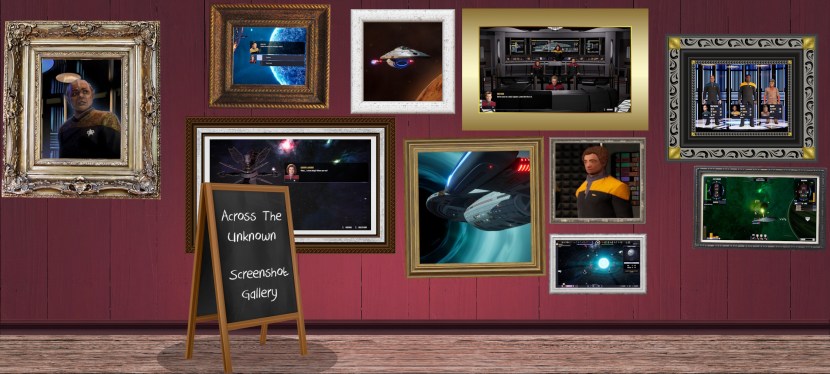
When I review video games here on the website, I often take a whole lot of screenshots! With over 1,000 screenshots for Across The Unknown just languishing on my computer, I thought I’d put together a gallery of some of the better or more interesting ones. This piece isn’t my review of the game – you can click or tap here if you want to read that. Instead, this is a gallery of more than 180 screenshots that I took but didn’t get to use in that review.
I’ve organised the screenshots into categories, and within each category, I’ve tried to go chronologically through the game. All screenshots are in 720p resolution (1280×720 pixels), which I find adequate for use here on my website; it’s a good balance between detail and size, in my opinion! And… yeah. That’s all. Feel free to use any of these screenshots in your own projects about Across The Unknown; unedited video game screenshots are generally considered to be the copyright of the developer/publisher, not of the person who took the screenshot. However, if you *do* find some of these to be useful for whatever you’re working on, I’d appreciate being acknowledged, and/or a link to this post!
It goes without saying that there are spoilers ahead for Across The Unknown and Star Trek: Voyager. I hope you find some of these screenshots useful, and… enjoy!
System View:
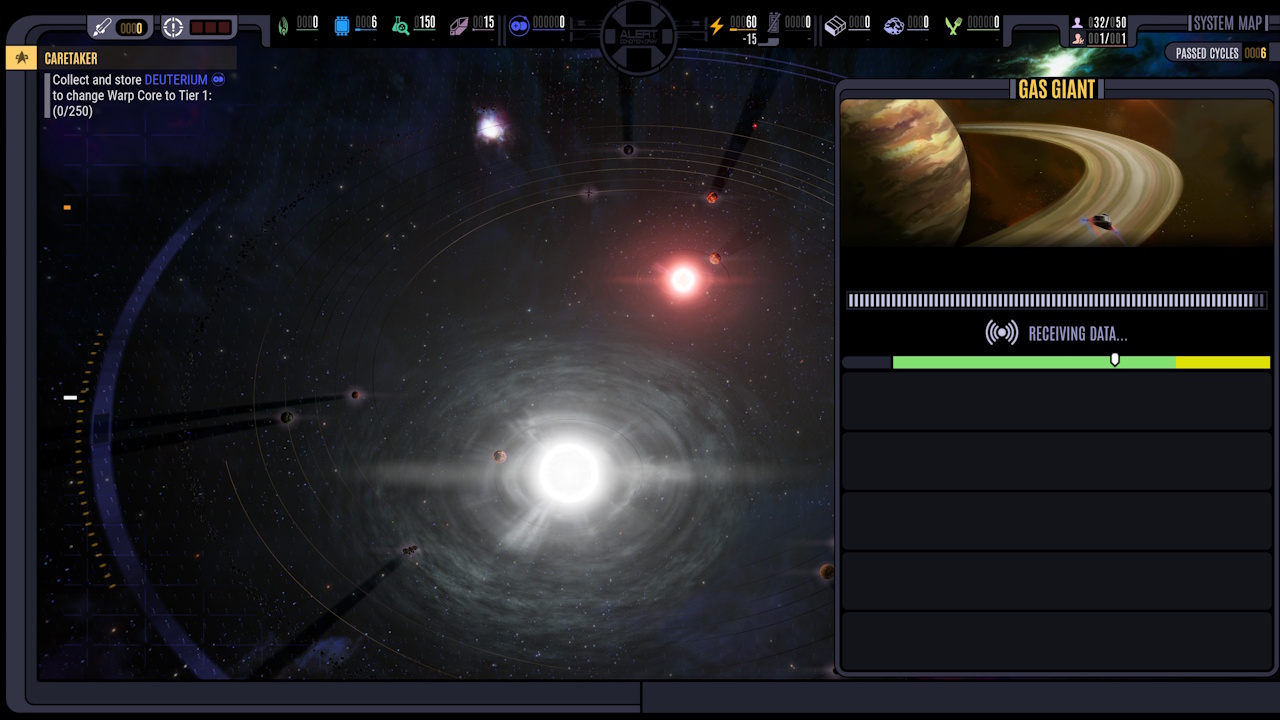
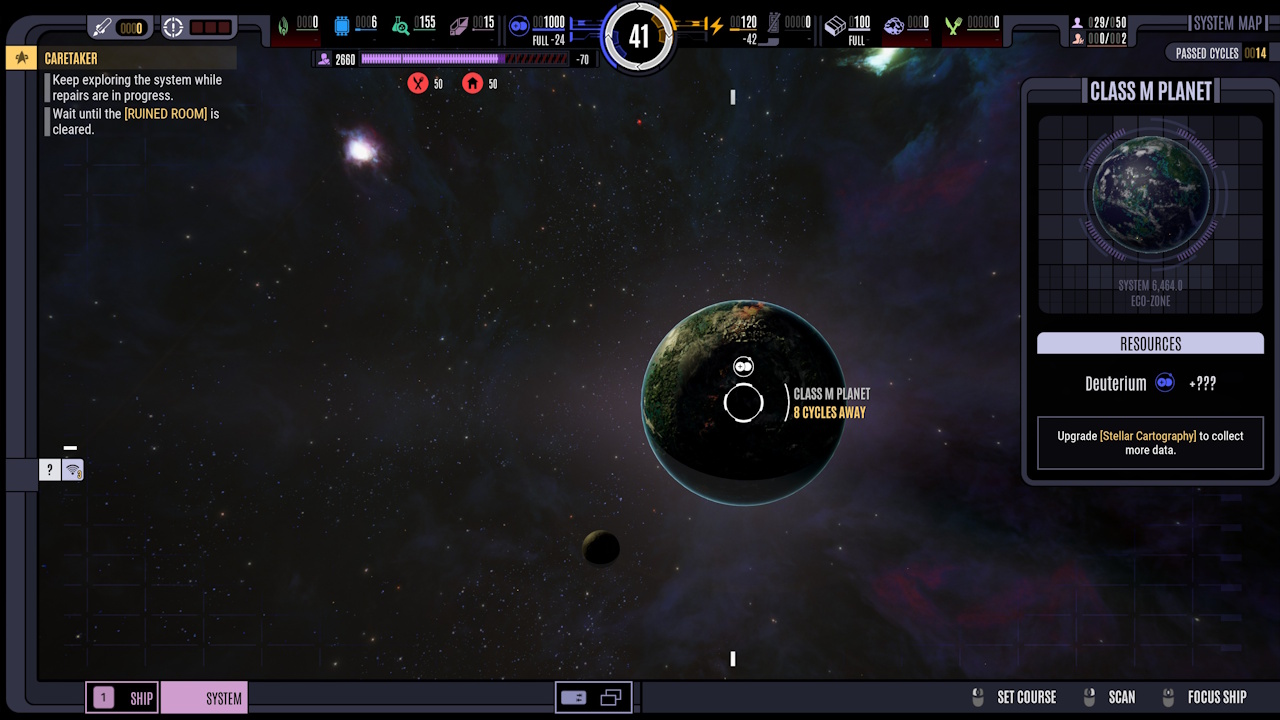
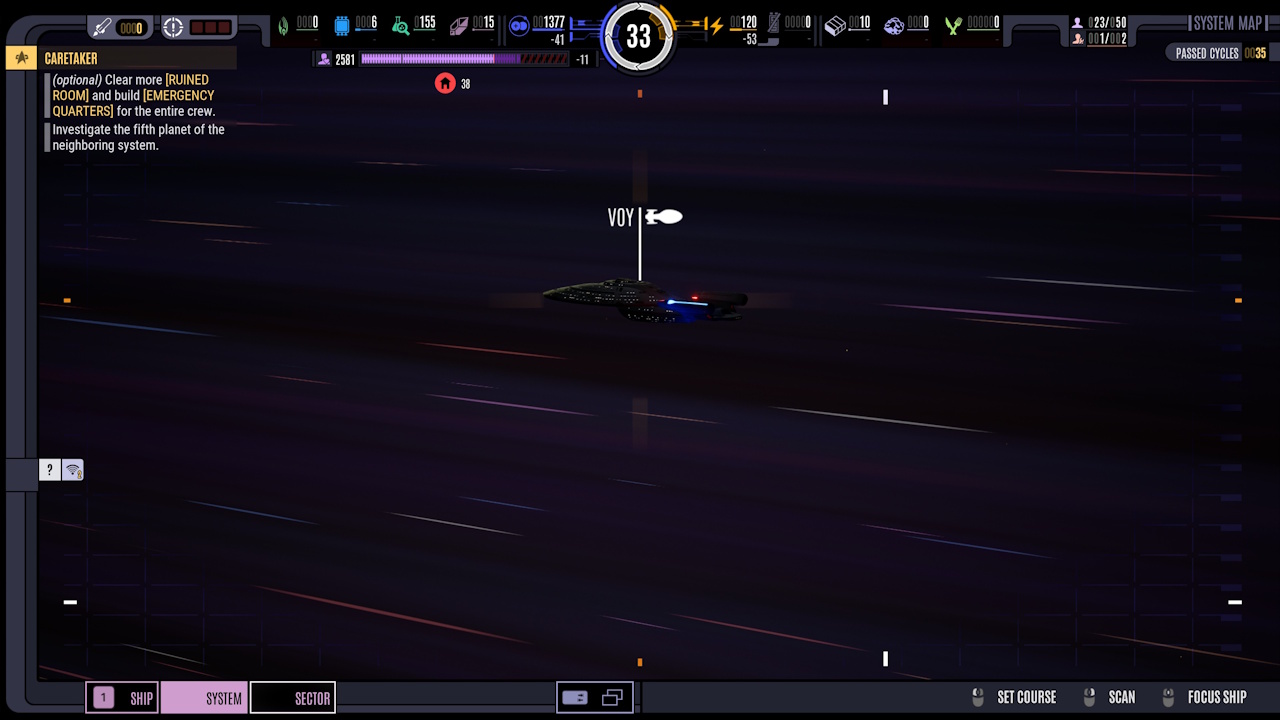
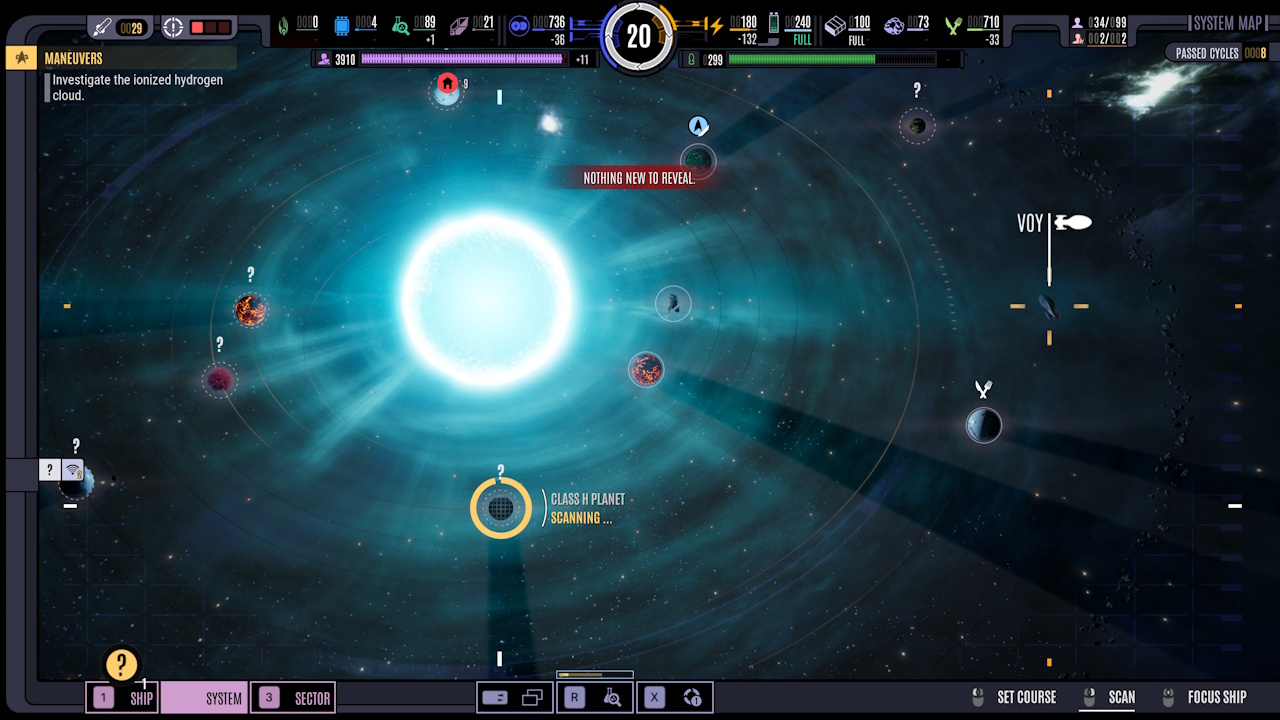
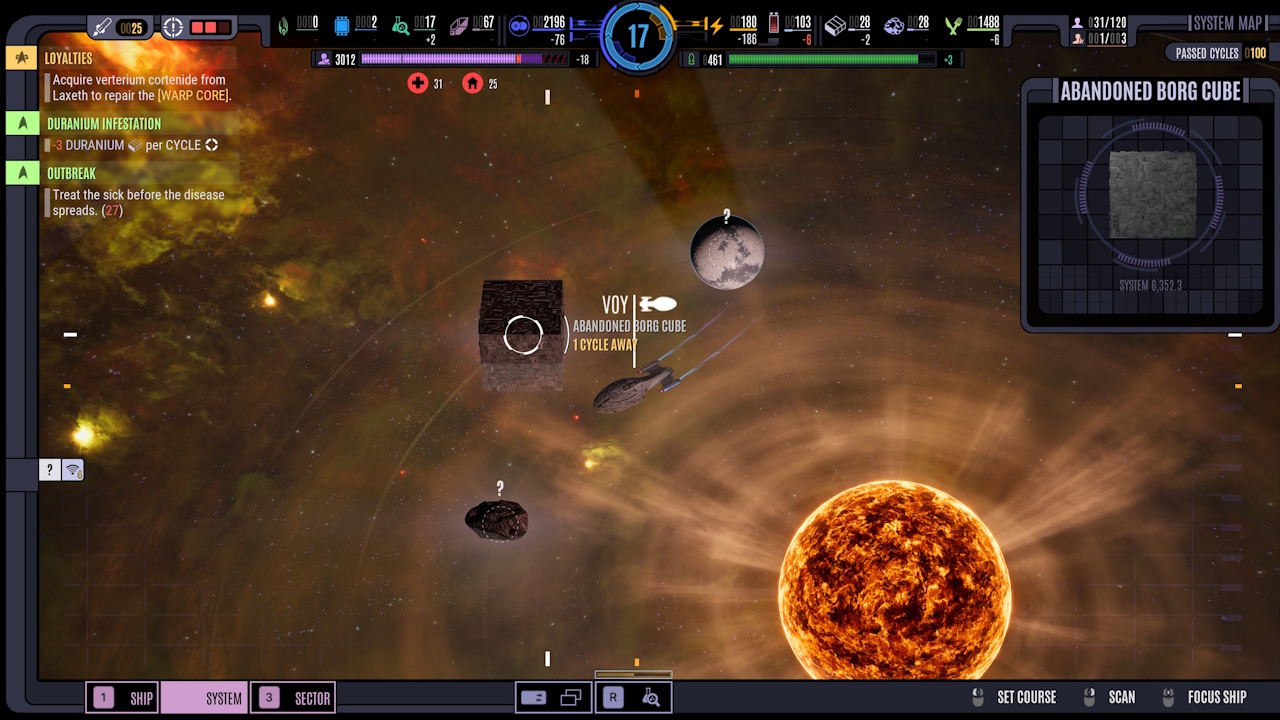
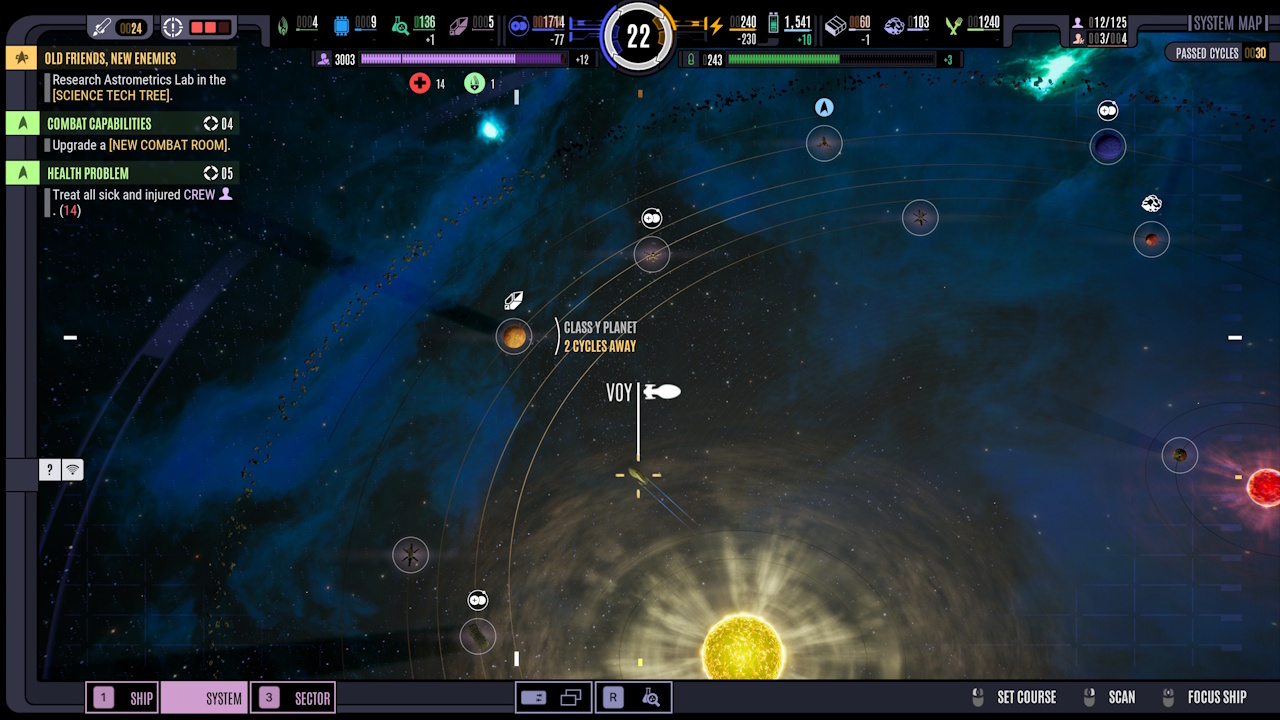
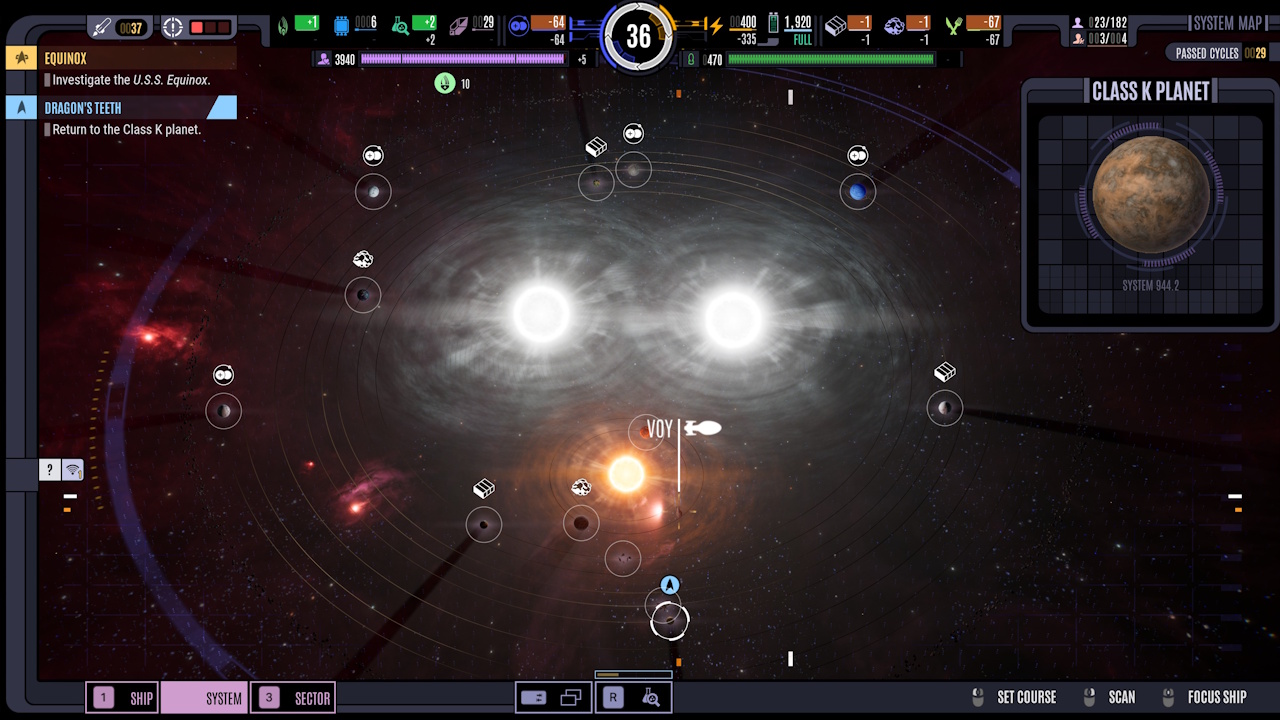
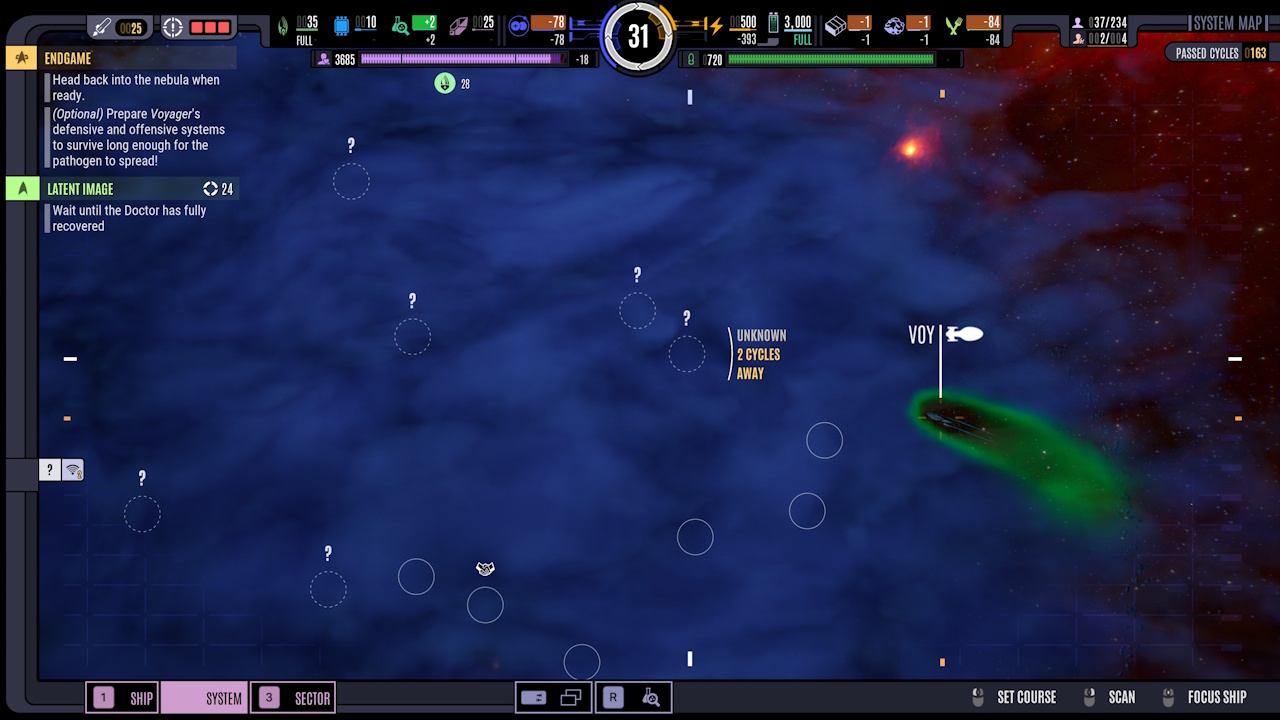
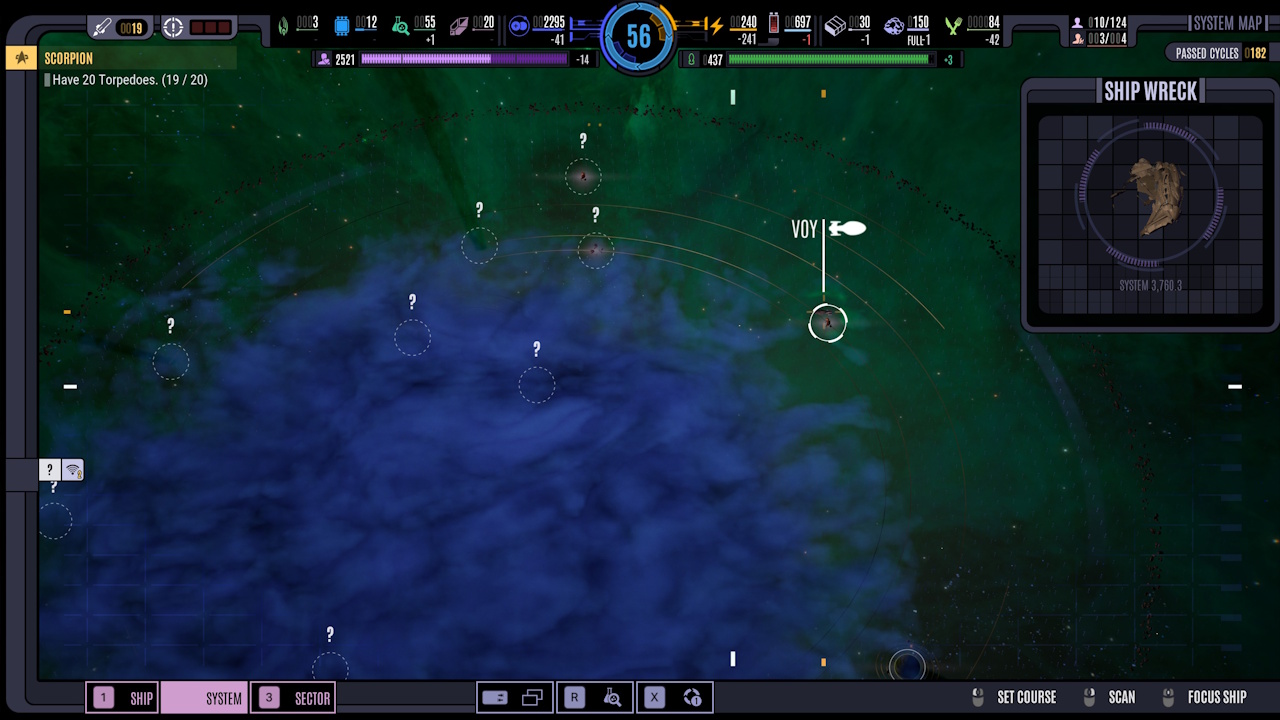
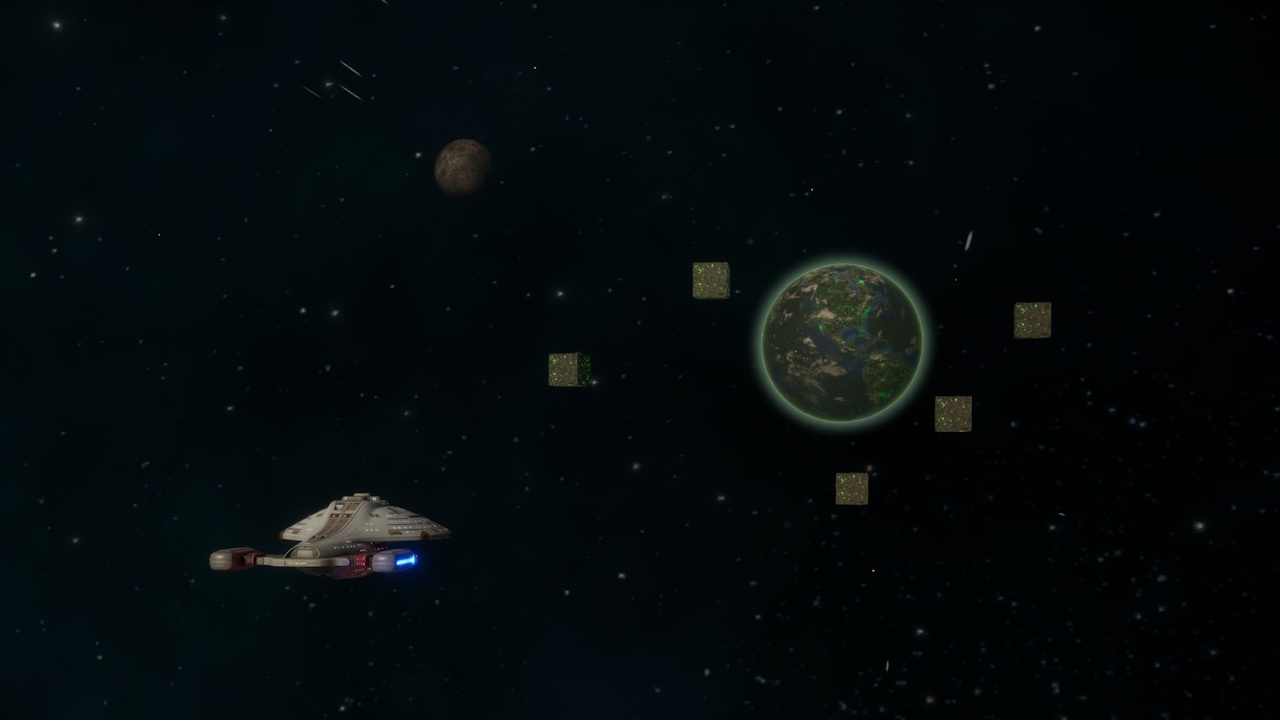
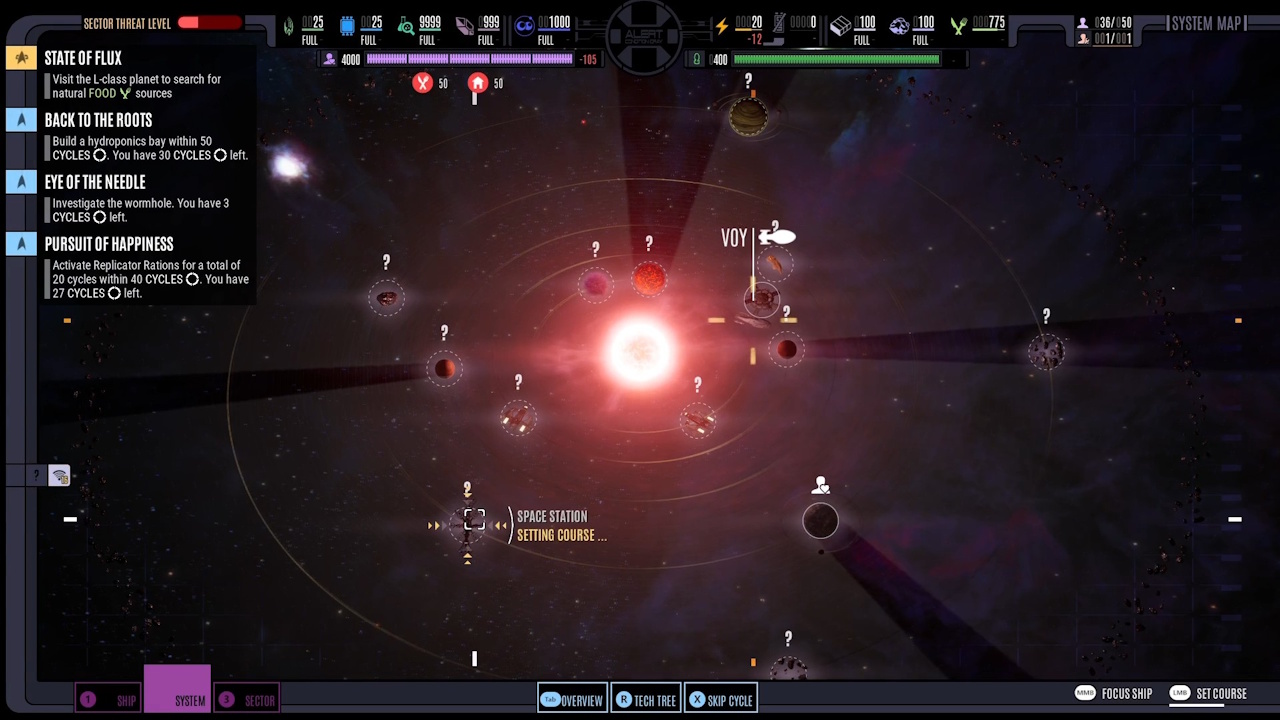
The system view is where you’ll spend a lot of time. Scanning planets, navigating nebulae, starting main quests and side missions… it all happens here.
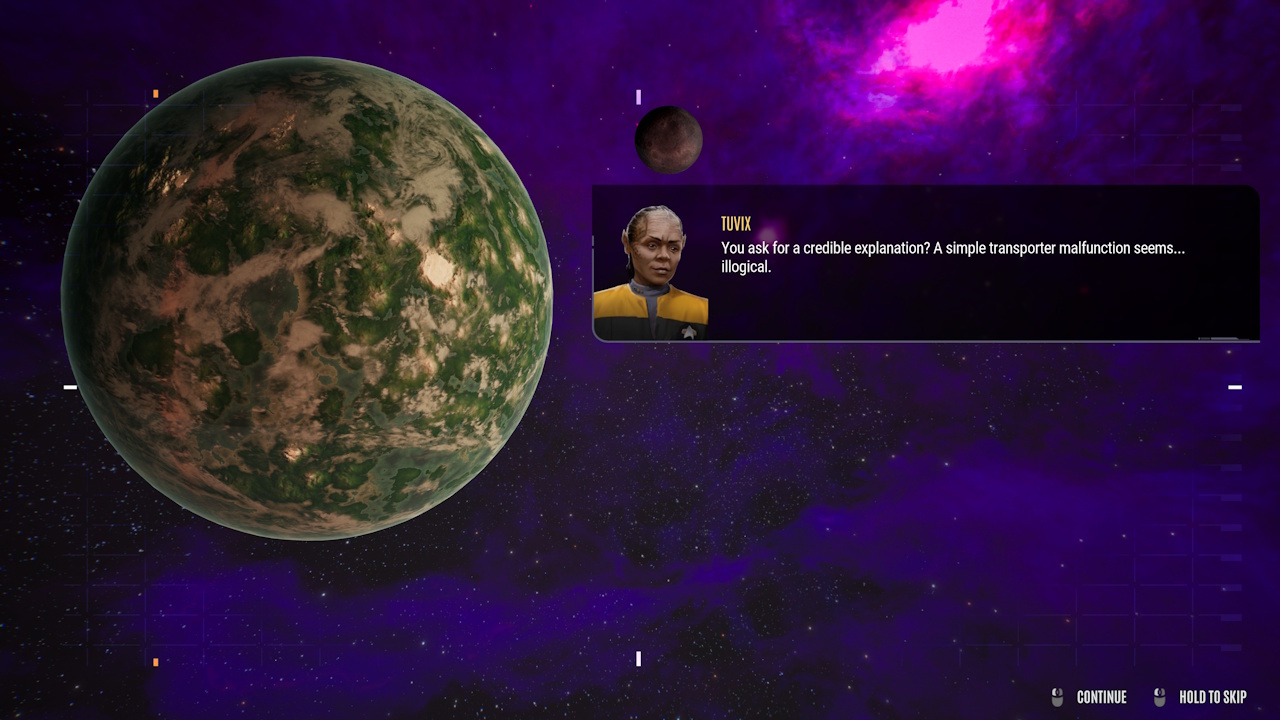
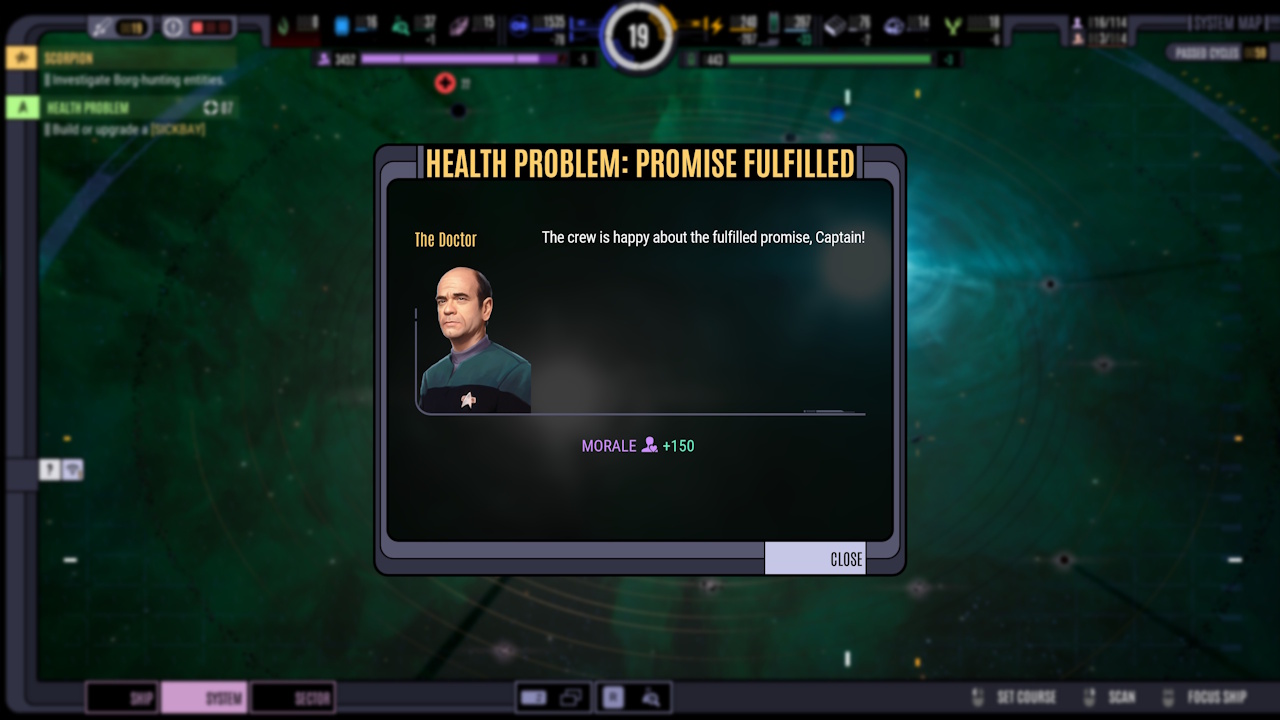
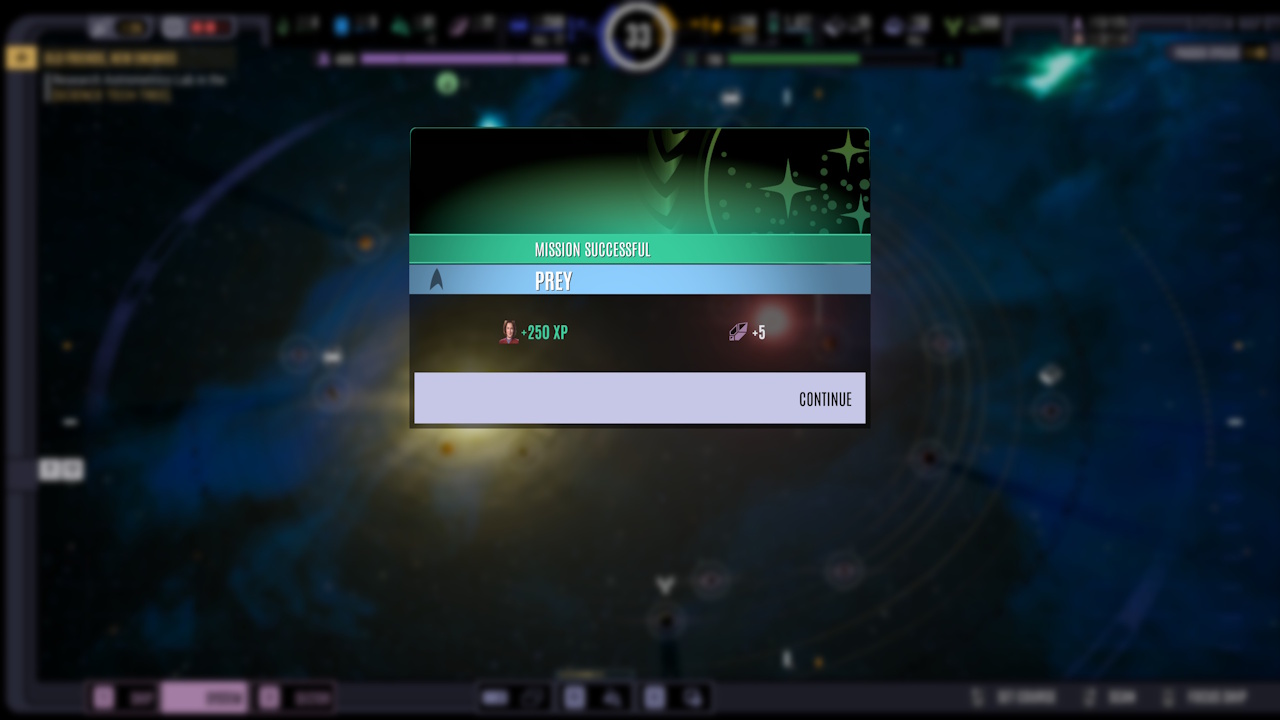
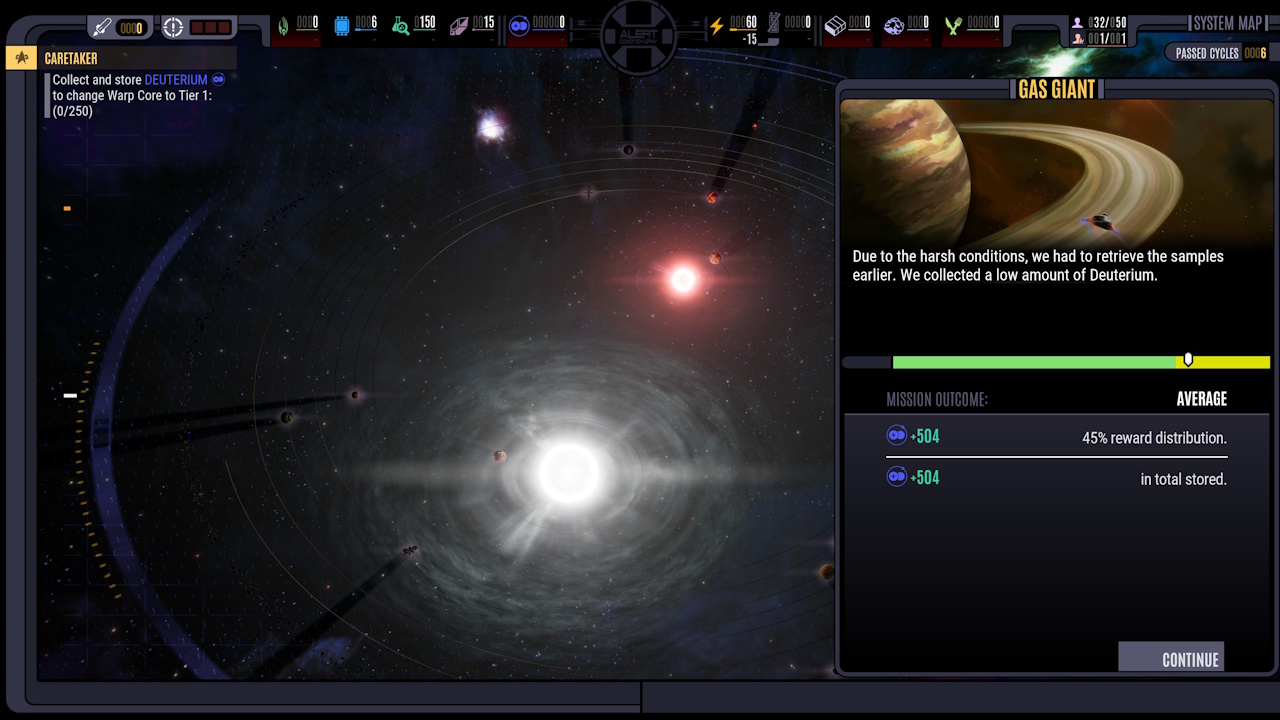
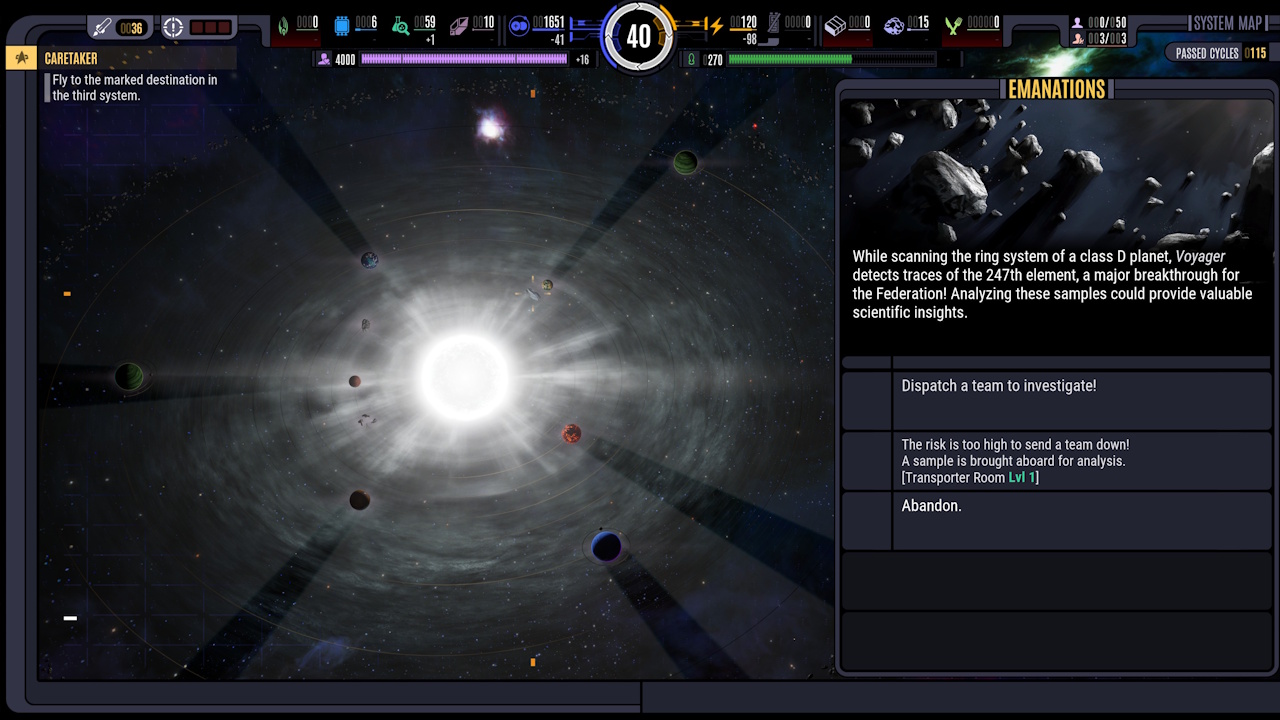
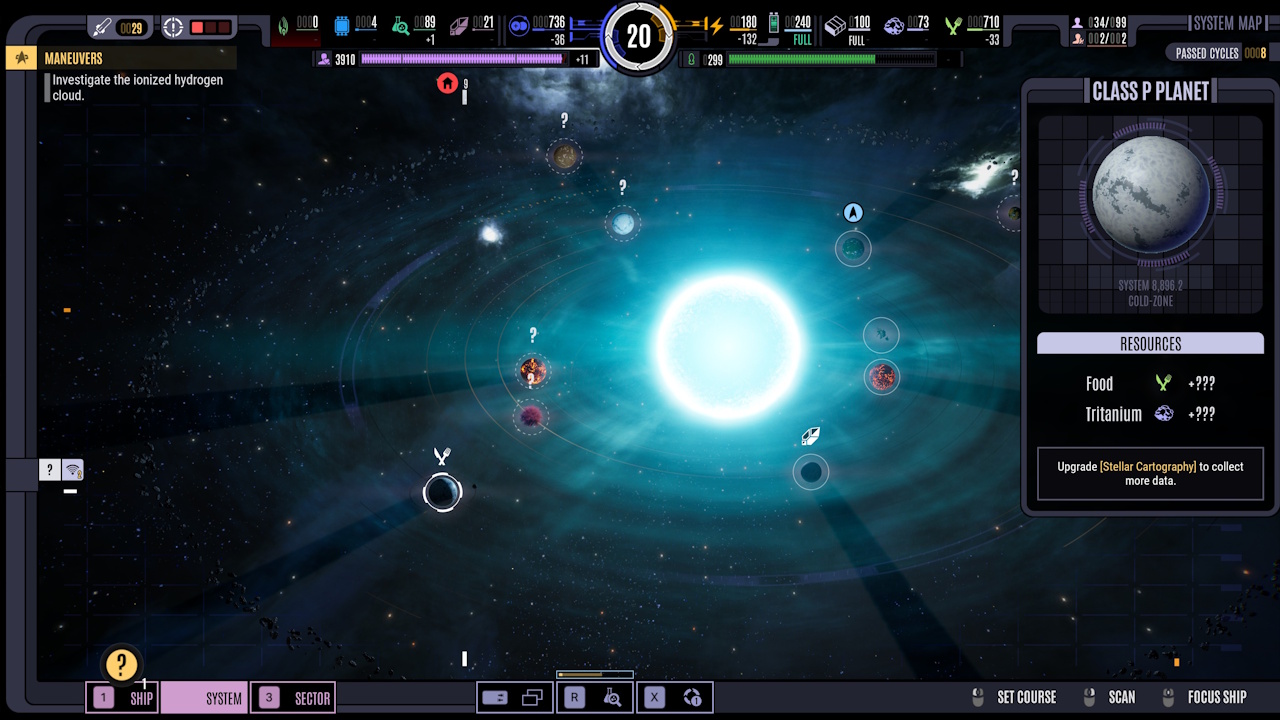
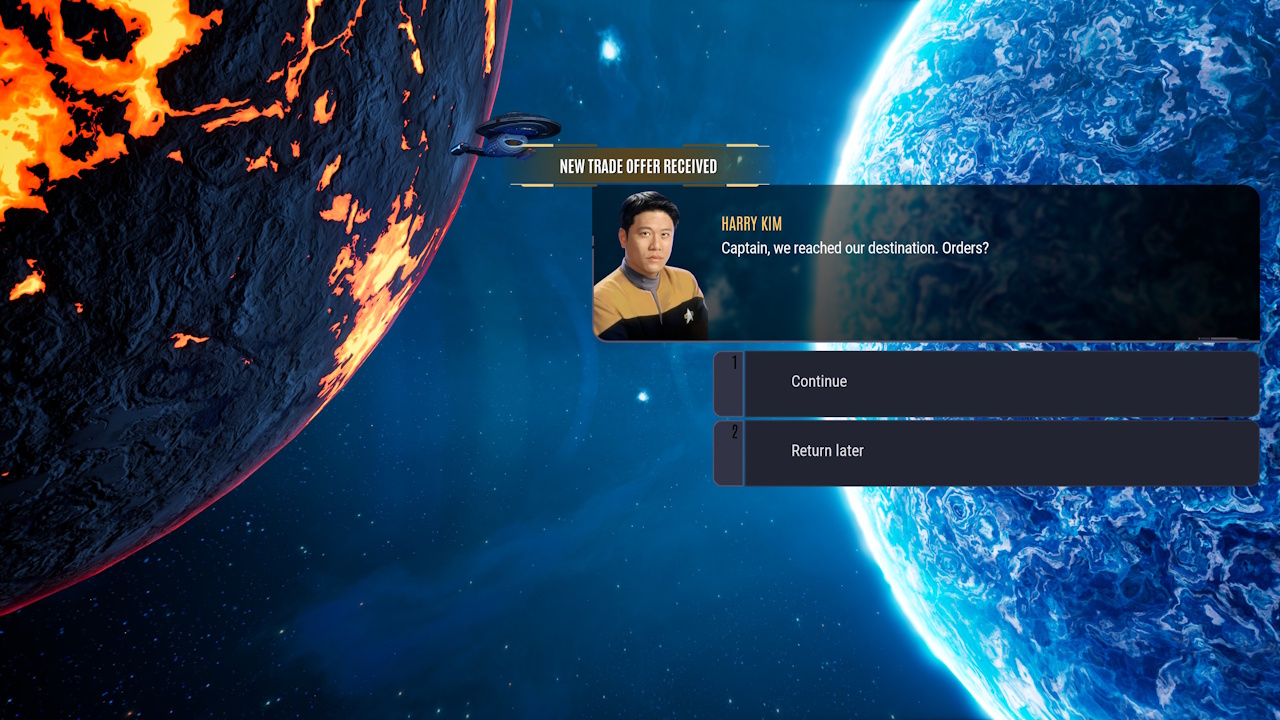
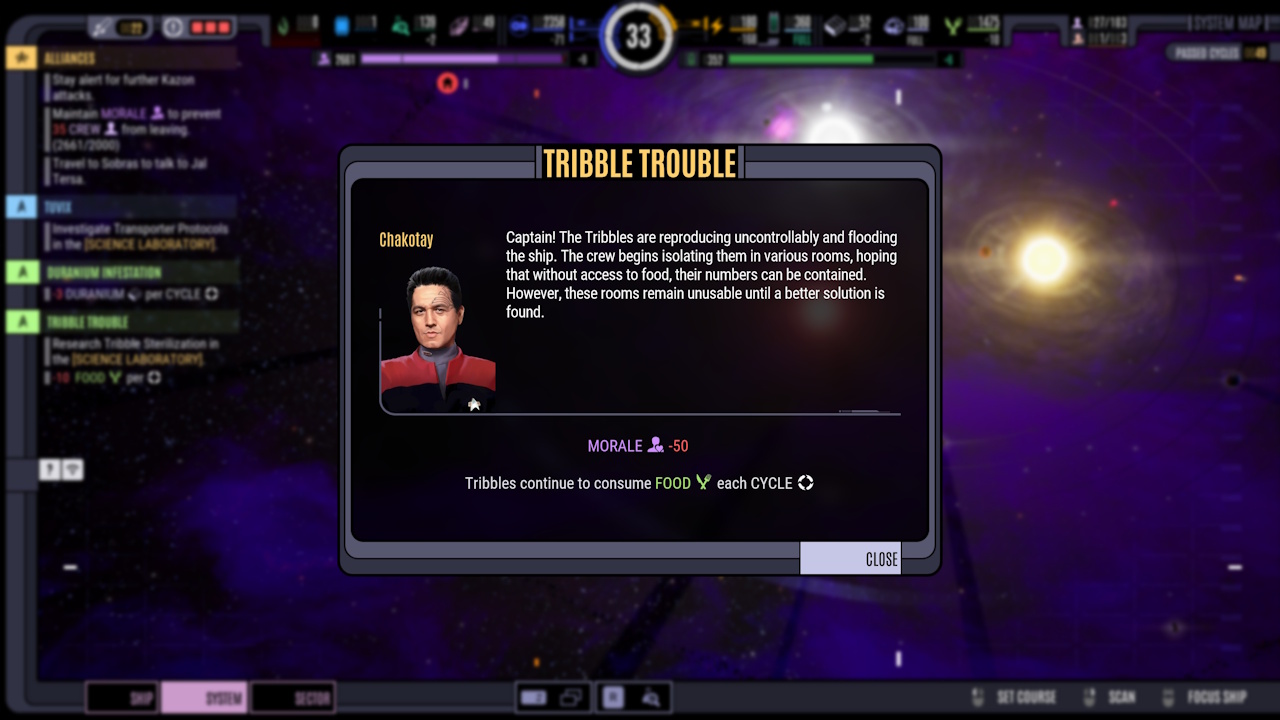
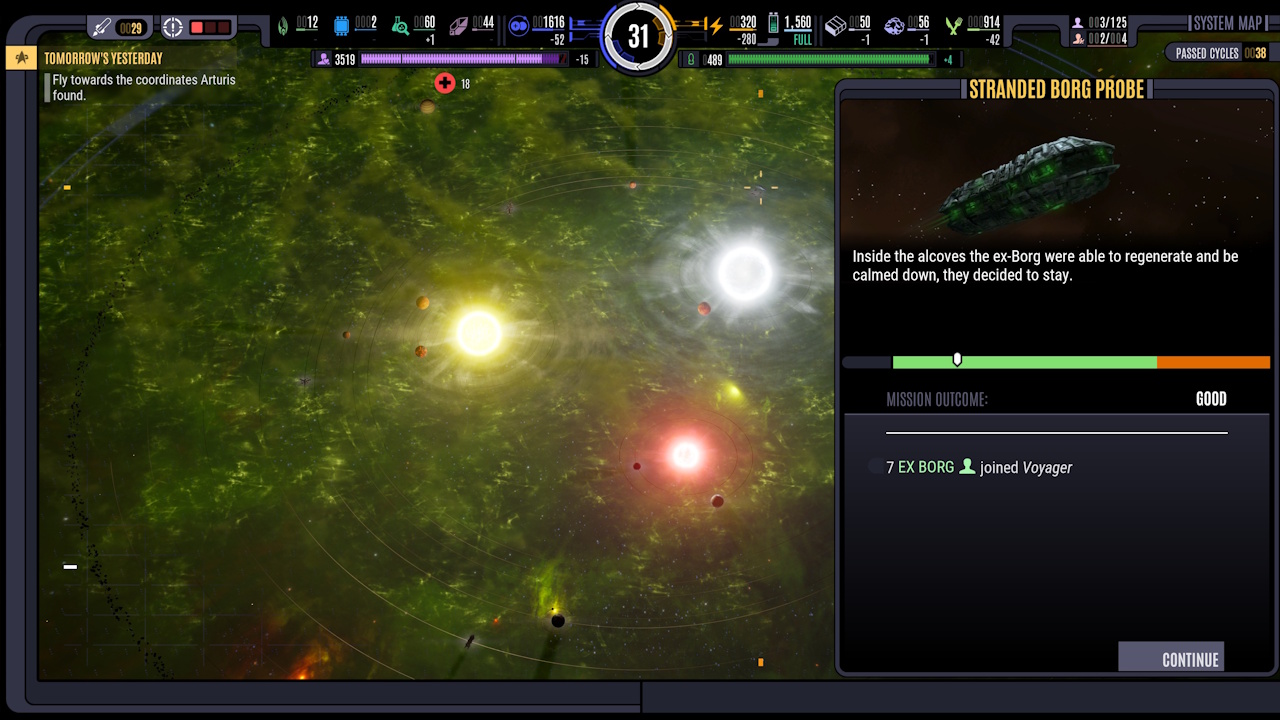
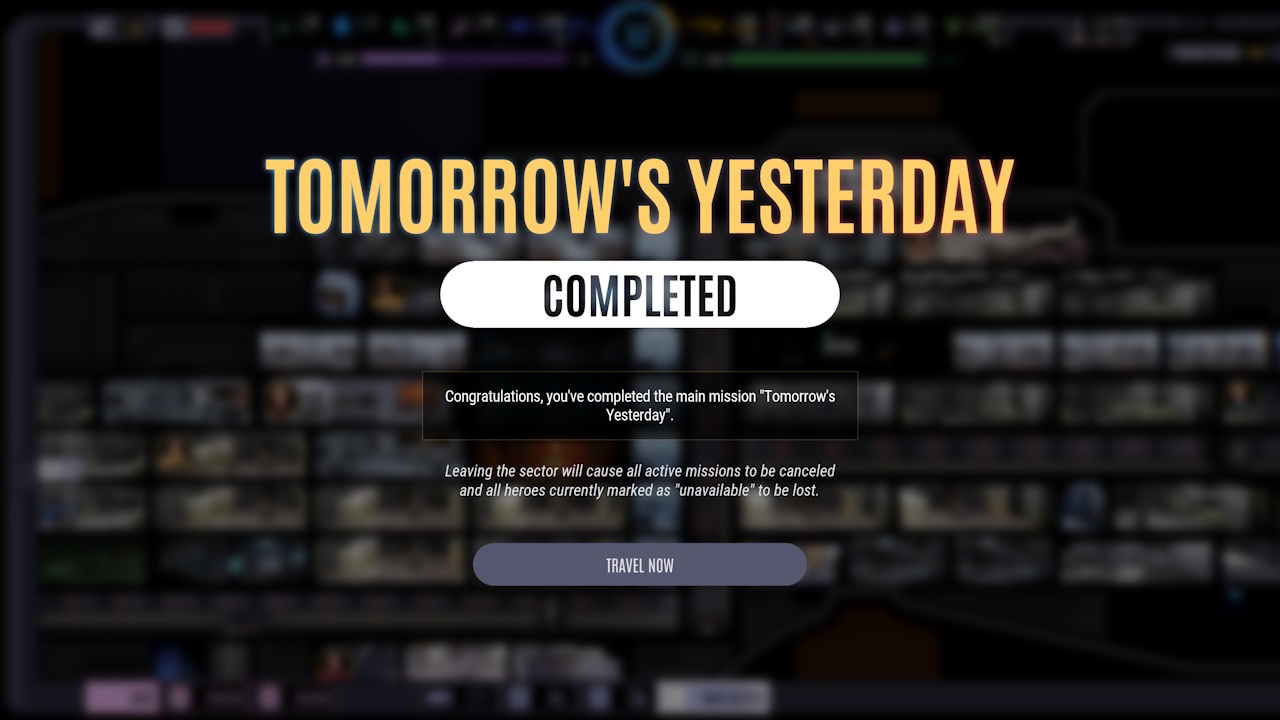
Scanning a gas giant…A Class M planet.Warping between systems.Scanning a planet…Who’s this?Approaching an abandoned Borg Cube…A promise fulfilled.Flying through a system.A completed side-mission.En route to a Class K planet.Traveling through a nebula.
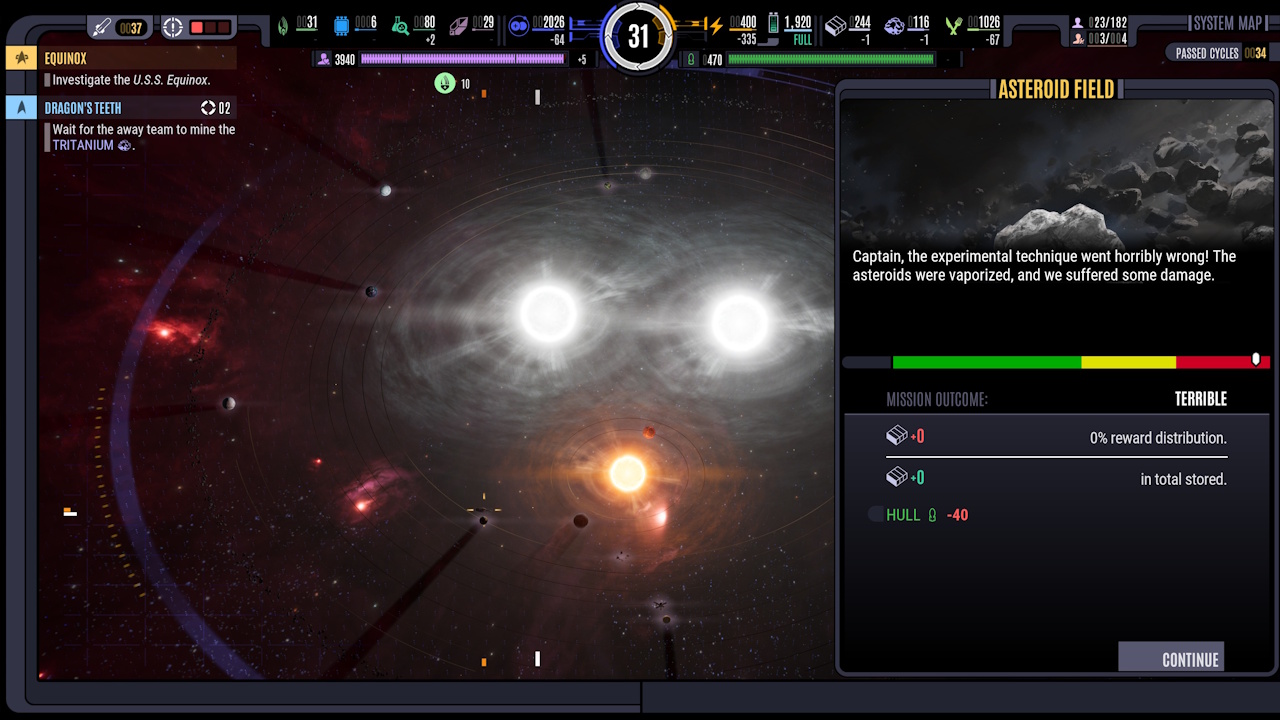
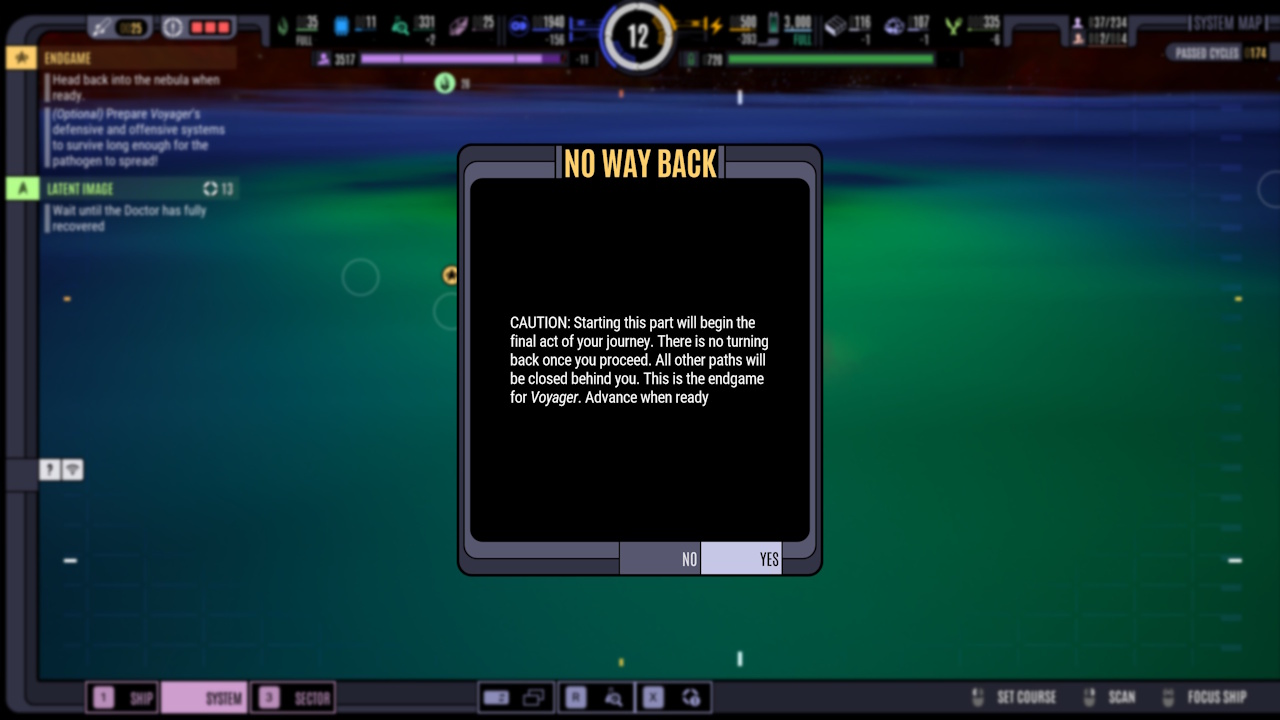
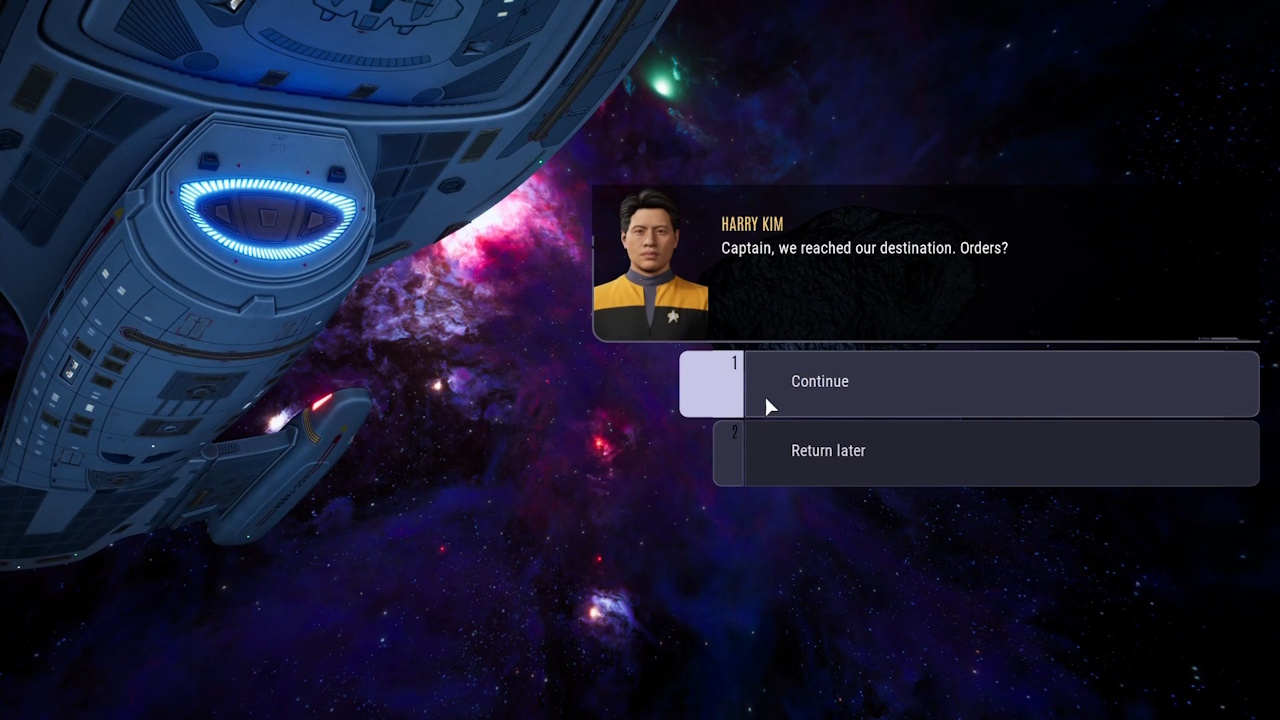
…and the results of the scan.Starting a mission.A Class P planet.Reaching a destination.A random event.A nebula.A mission to a planet.A successful outcome.A terrible outcome.A classy planet. Sorry, a Class Y planet.The start of a major story arc.
MSD/Ship View:
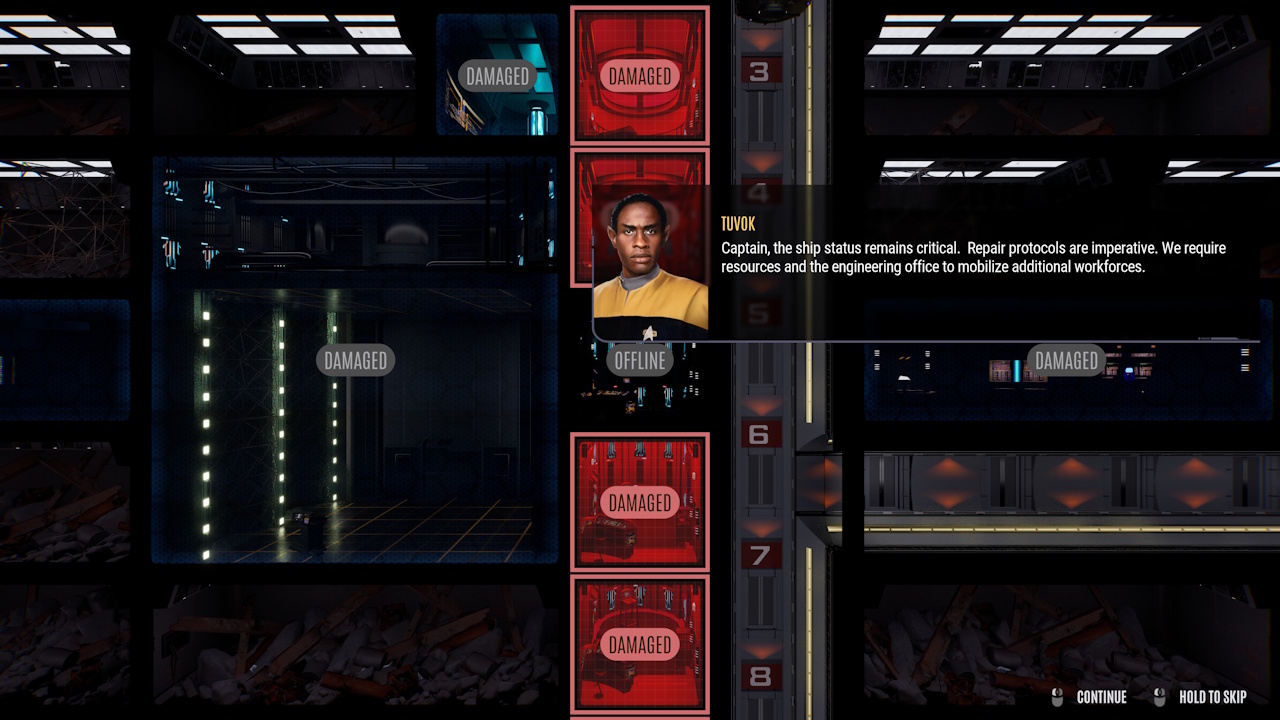
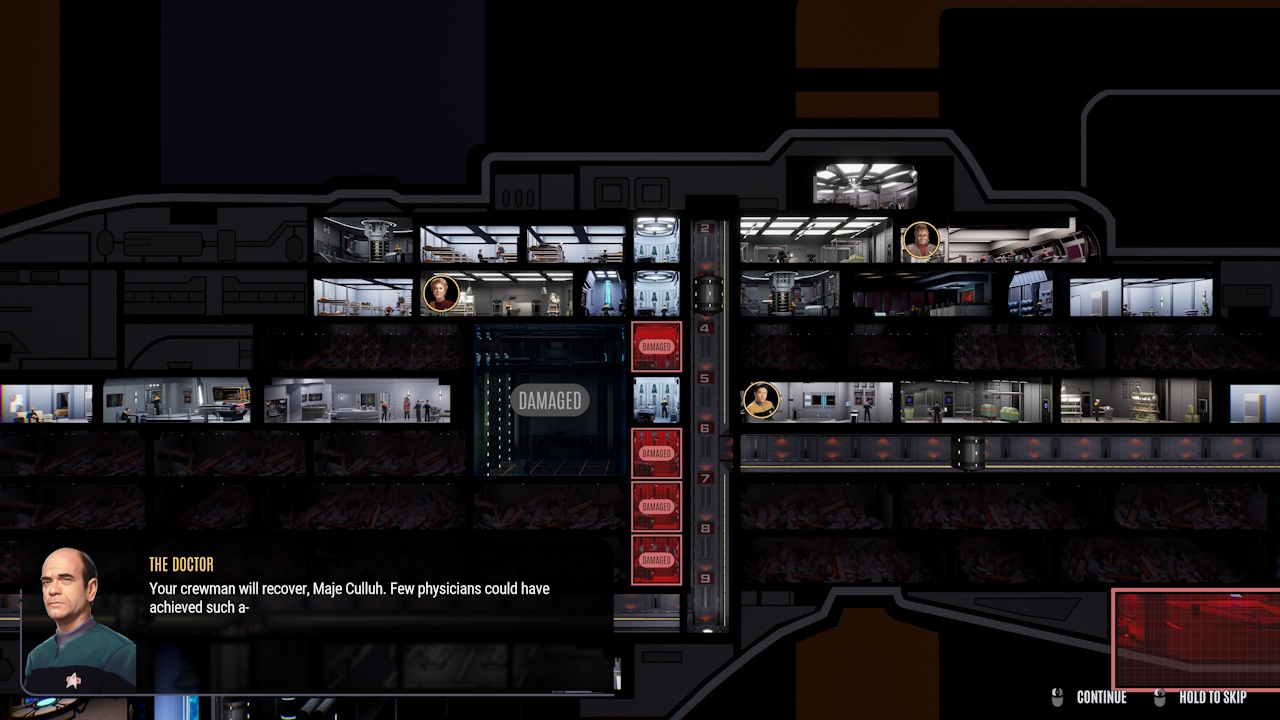
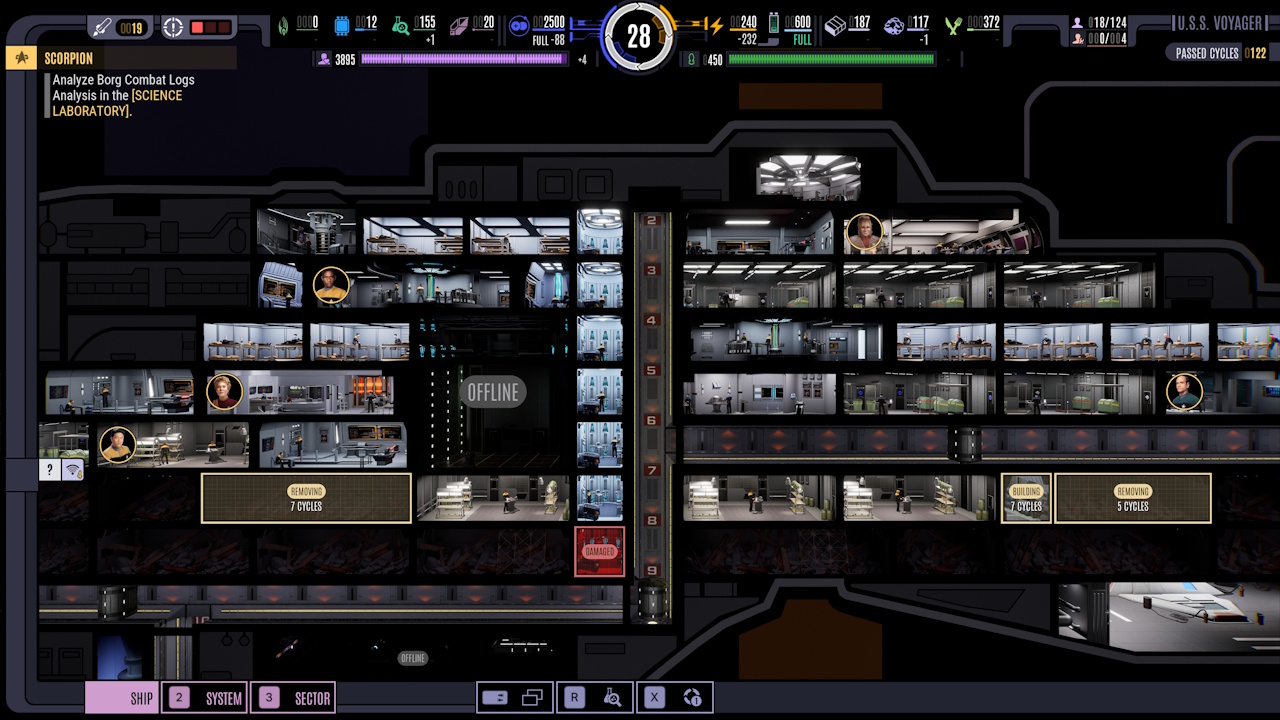
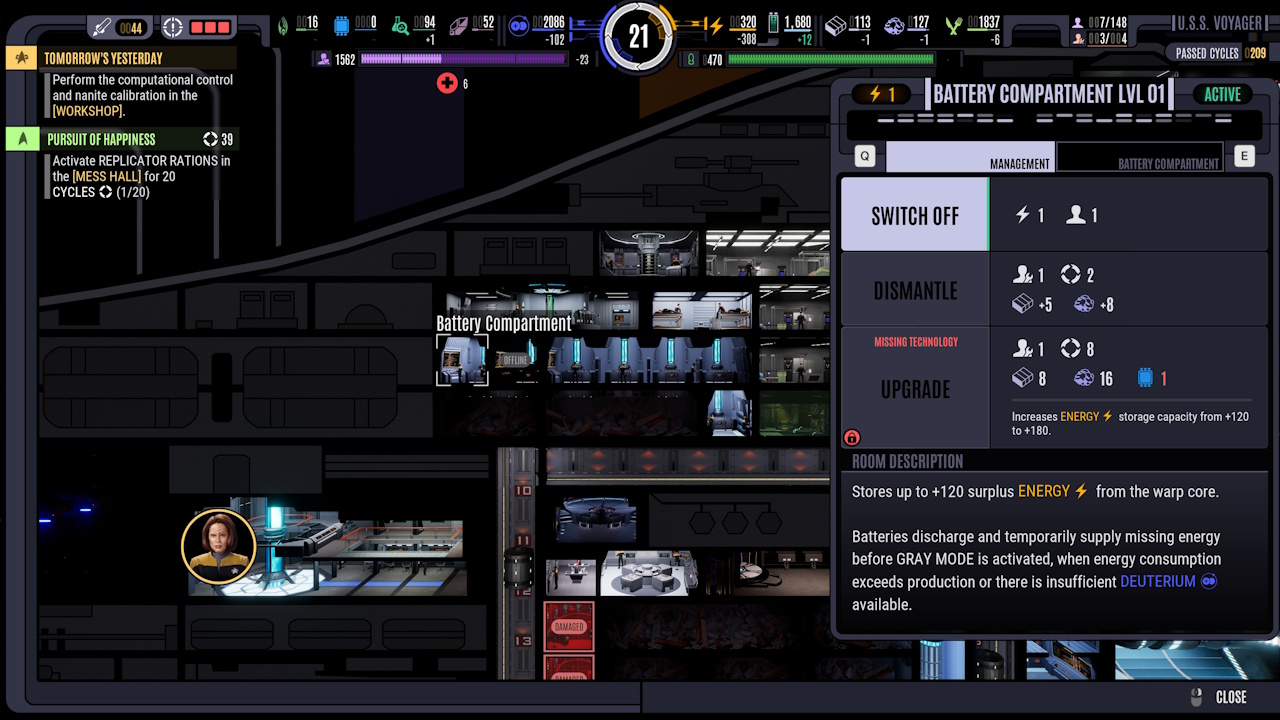
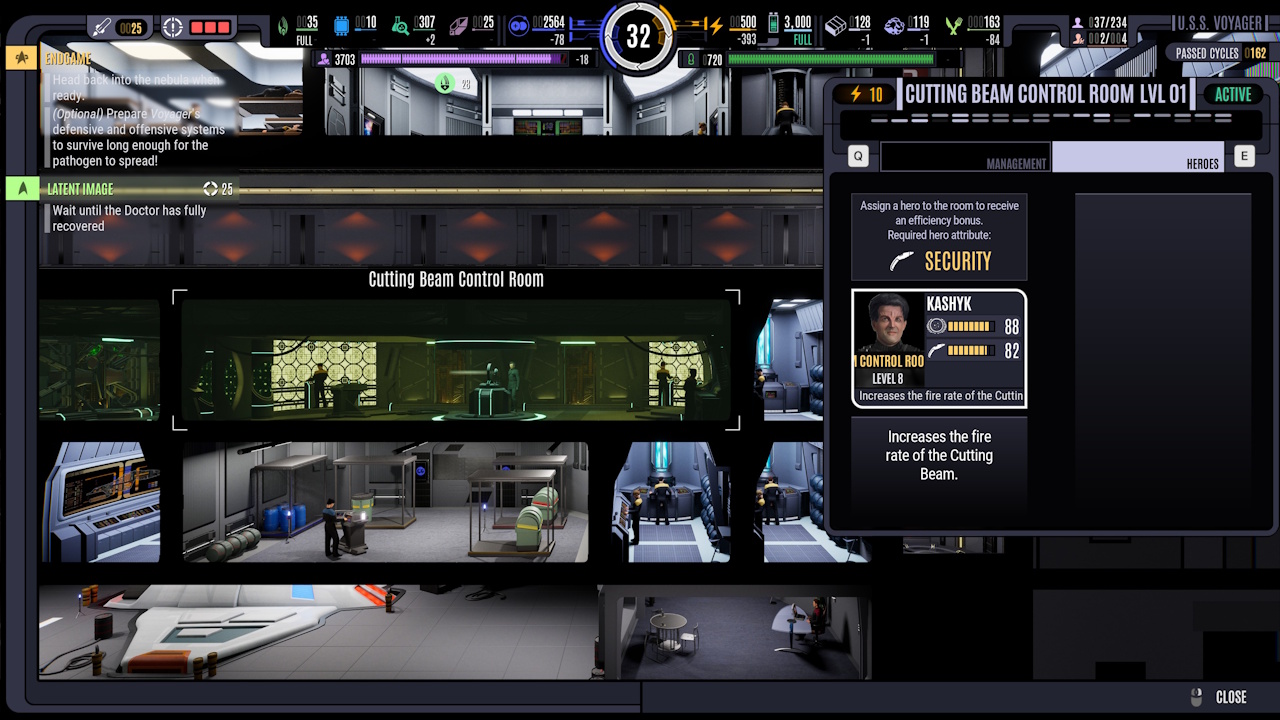
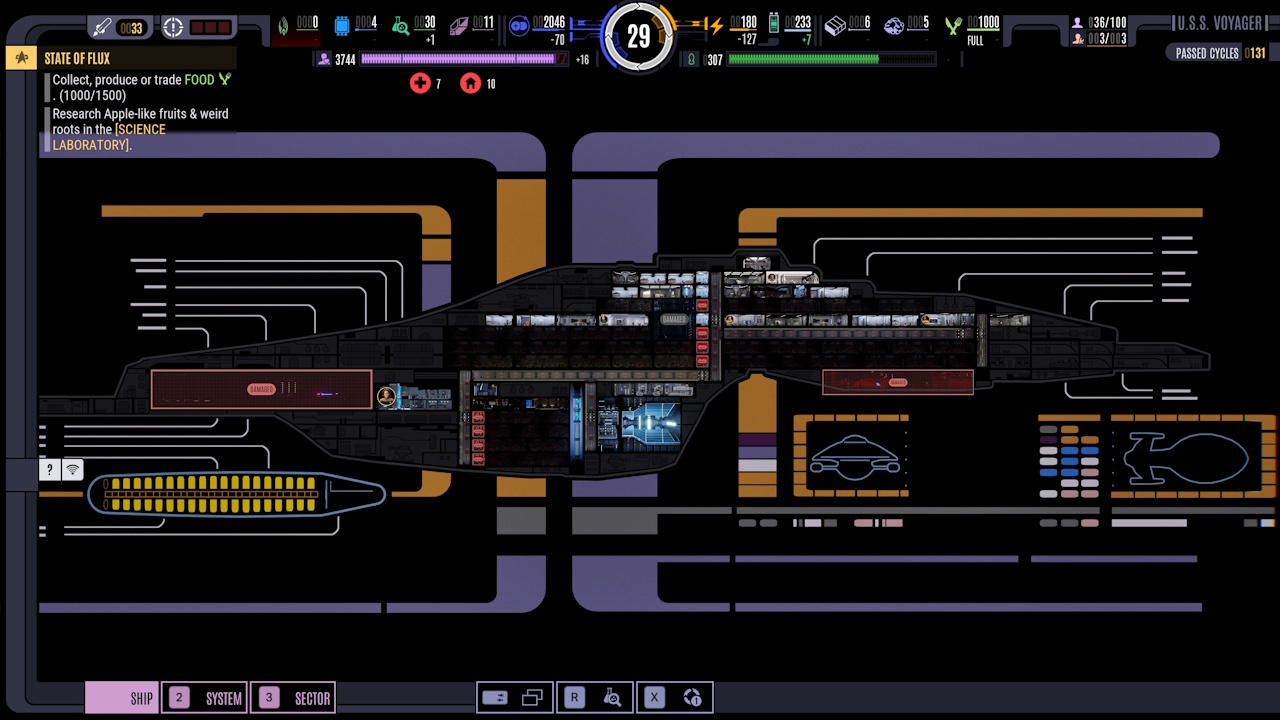
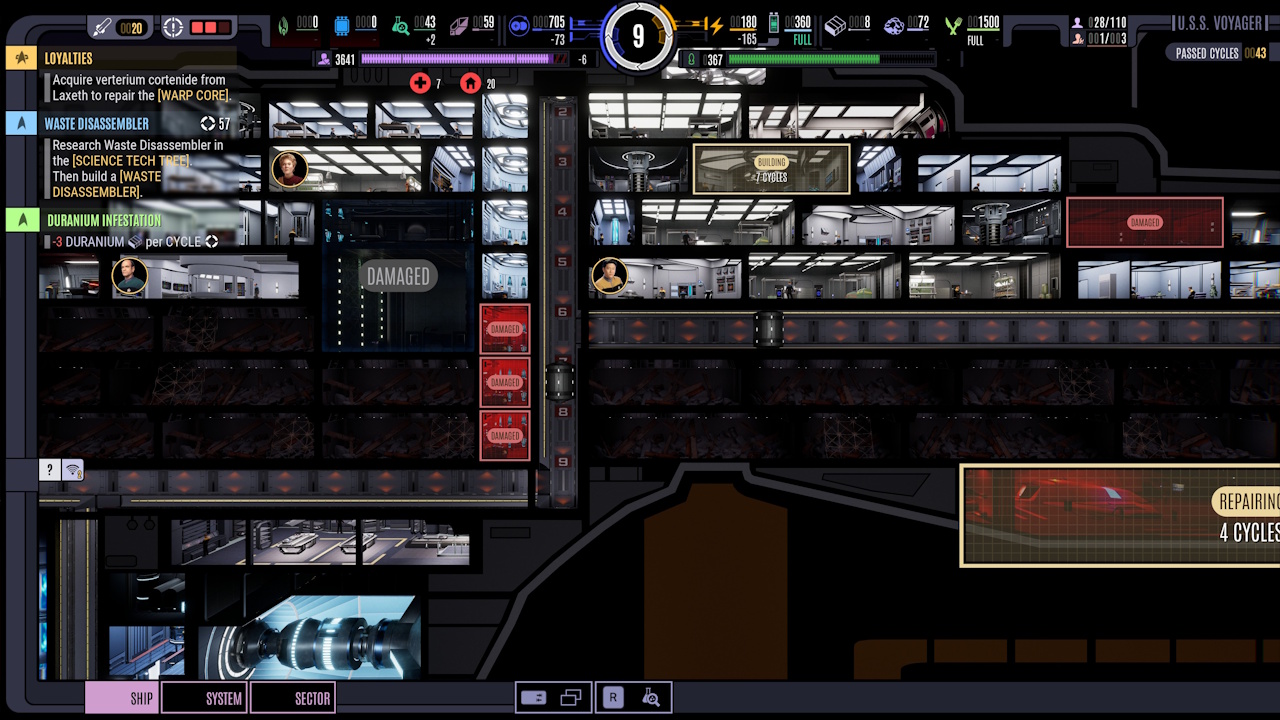
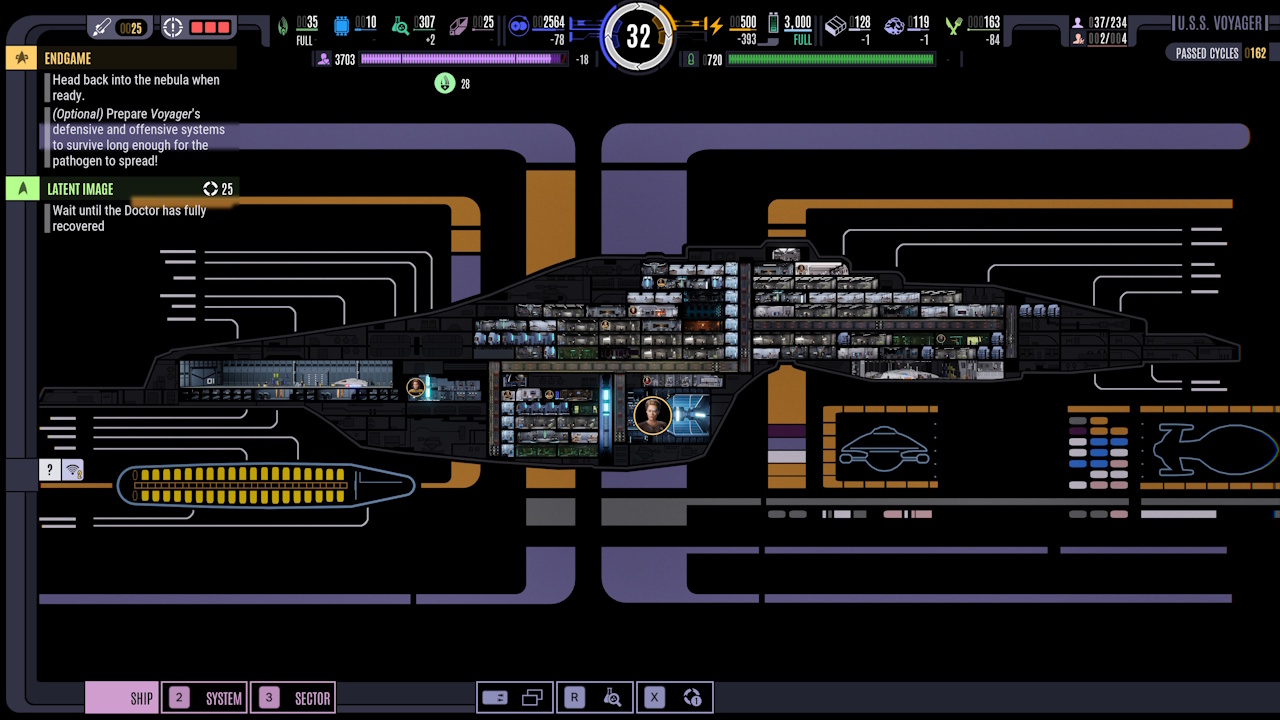
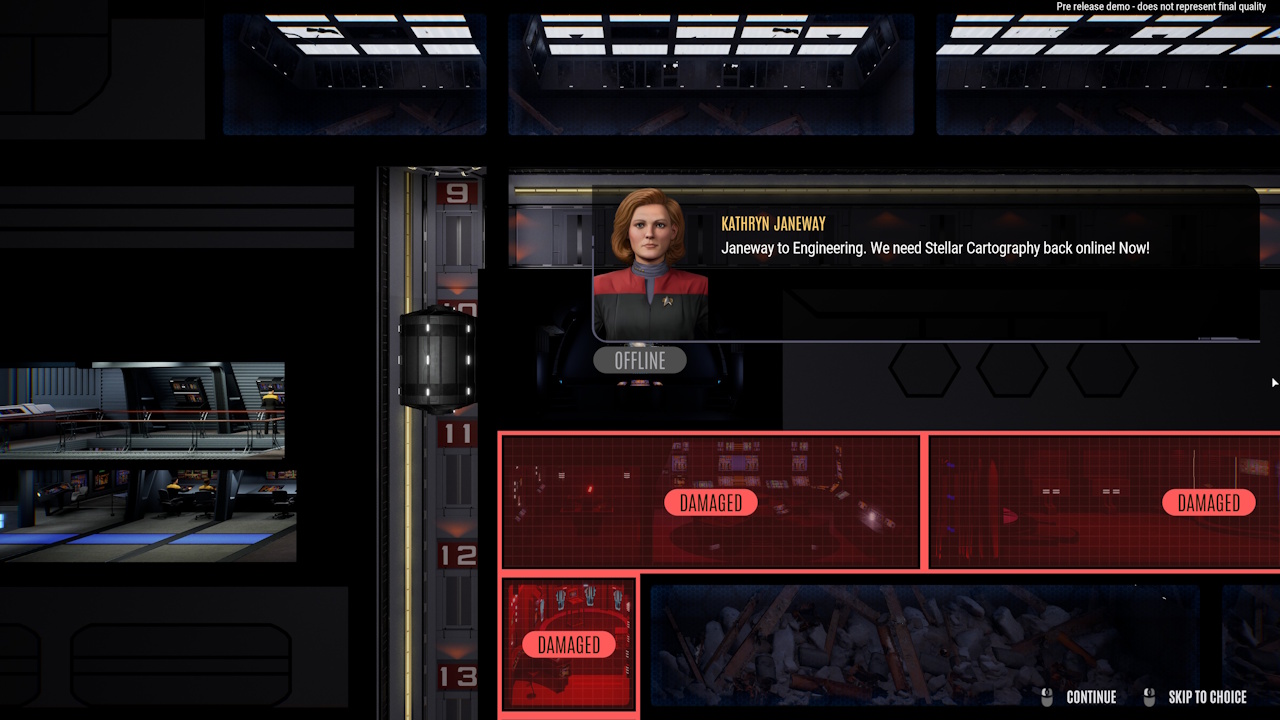
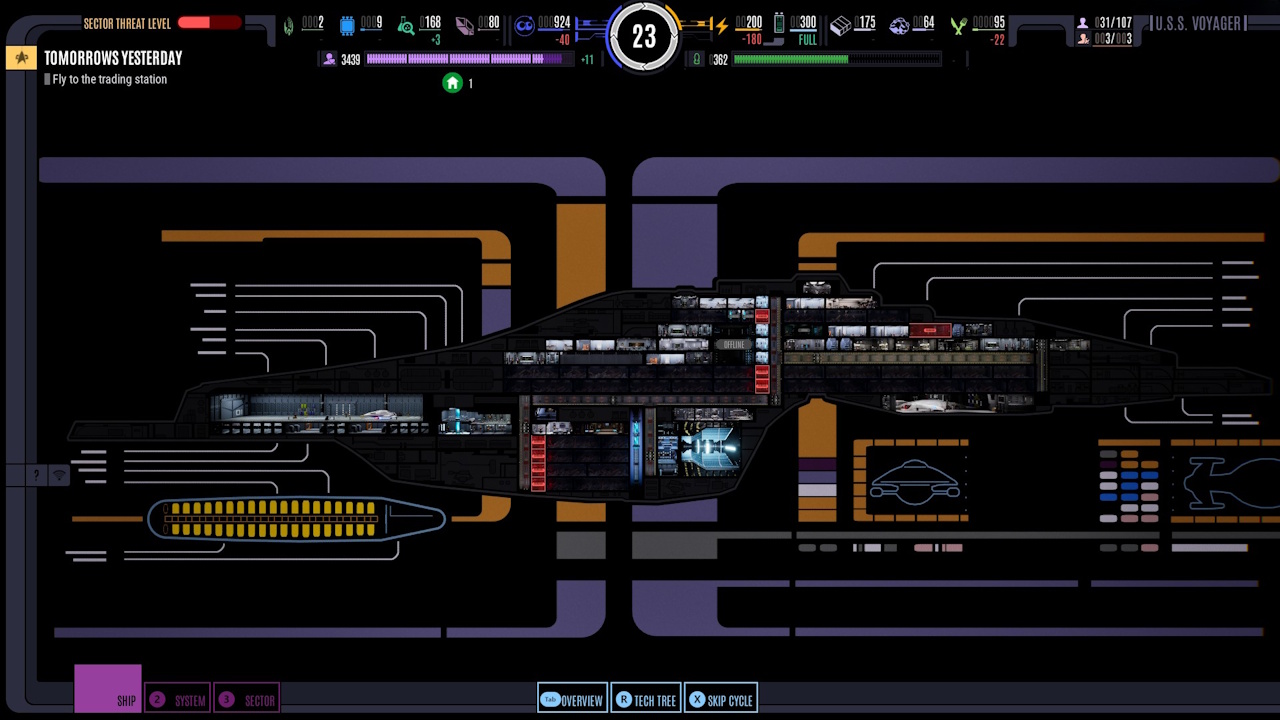
This is Voyager’s MSD (or Master Systems Display; a visual element from the TV series). It’s also where you’ll customise Voyager, clearing debris from damaged rooms, building replacement rooms, and assigning hero characters to be in control of key systems, like weapons, food production, and more.
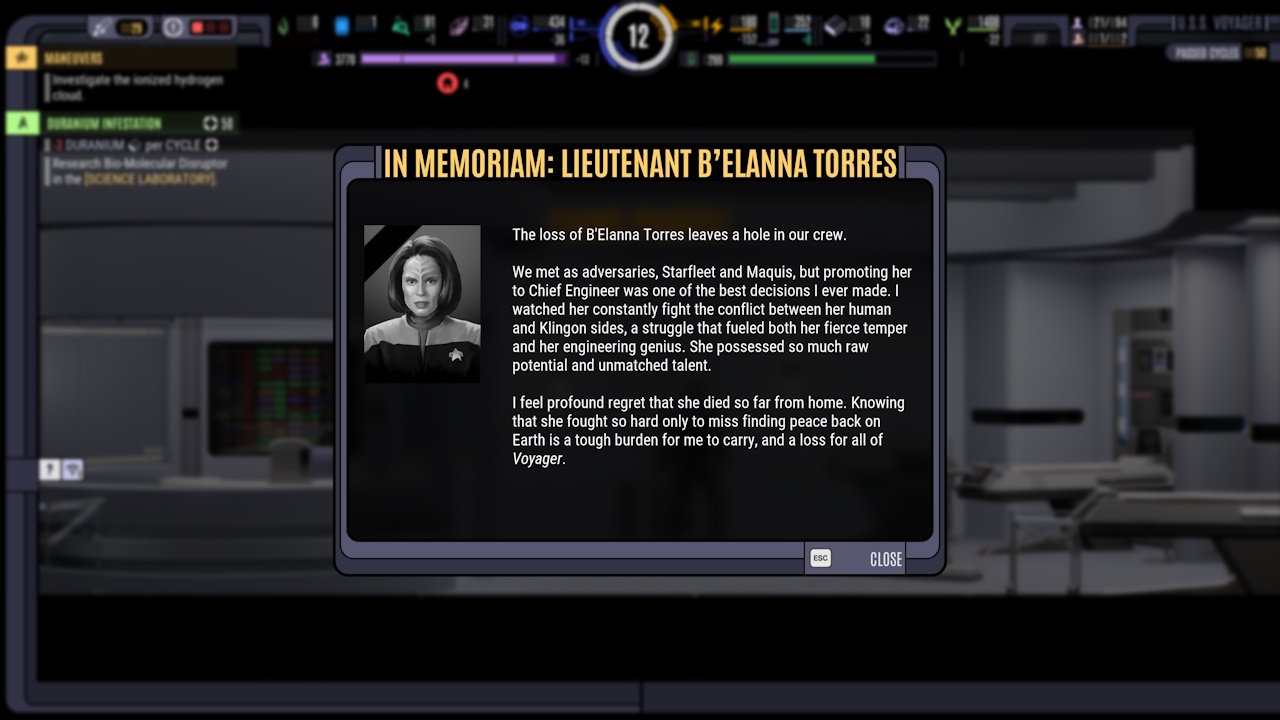
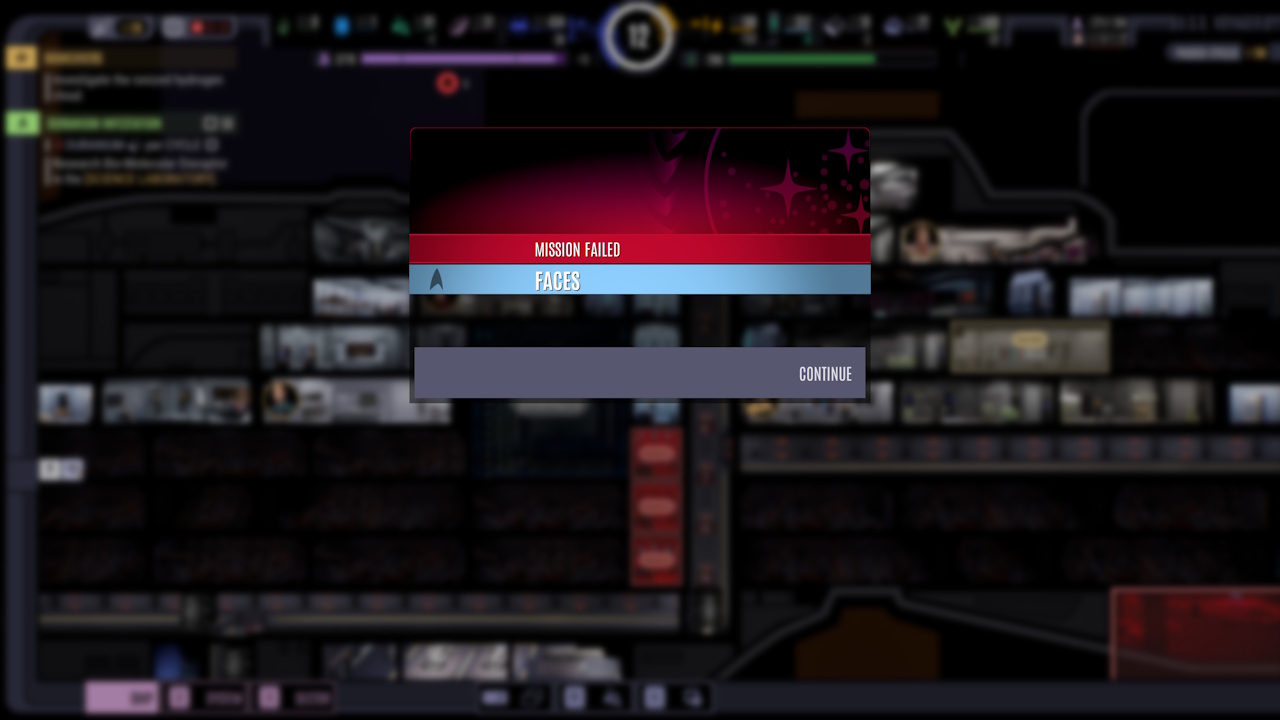
Things look bleak at first…In memoriam…The MSD with a text box.More decks are coming online.Managing a battery compartment.Assigning a hero to manage a room.
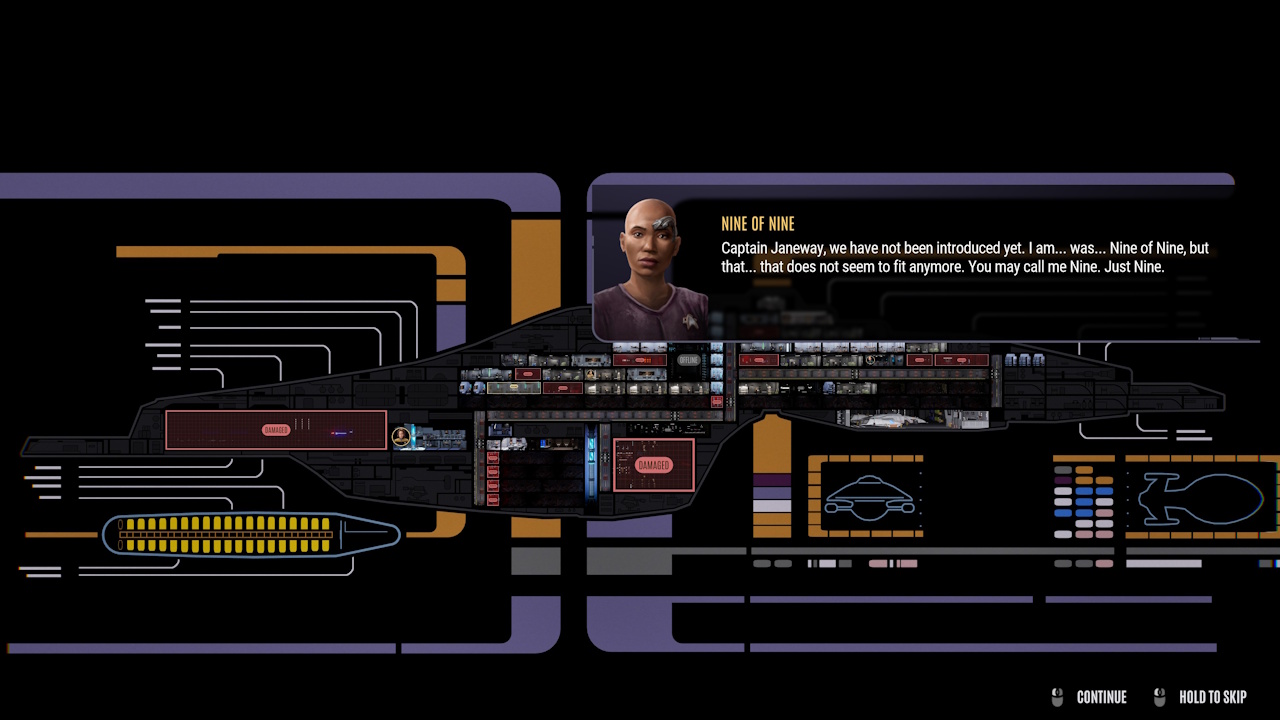
The MSD in the early game.Failing a side-mission.Power has been restored to several decks.Meeting Nine of Nine.Sector complete!All systems and decks operational!
Zoomed-In Rooms:
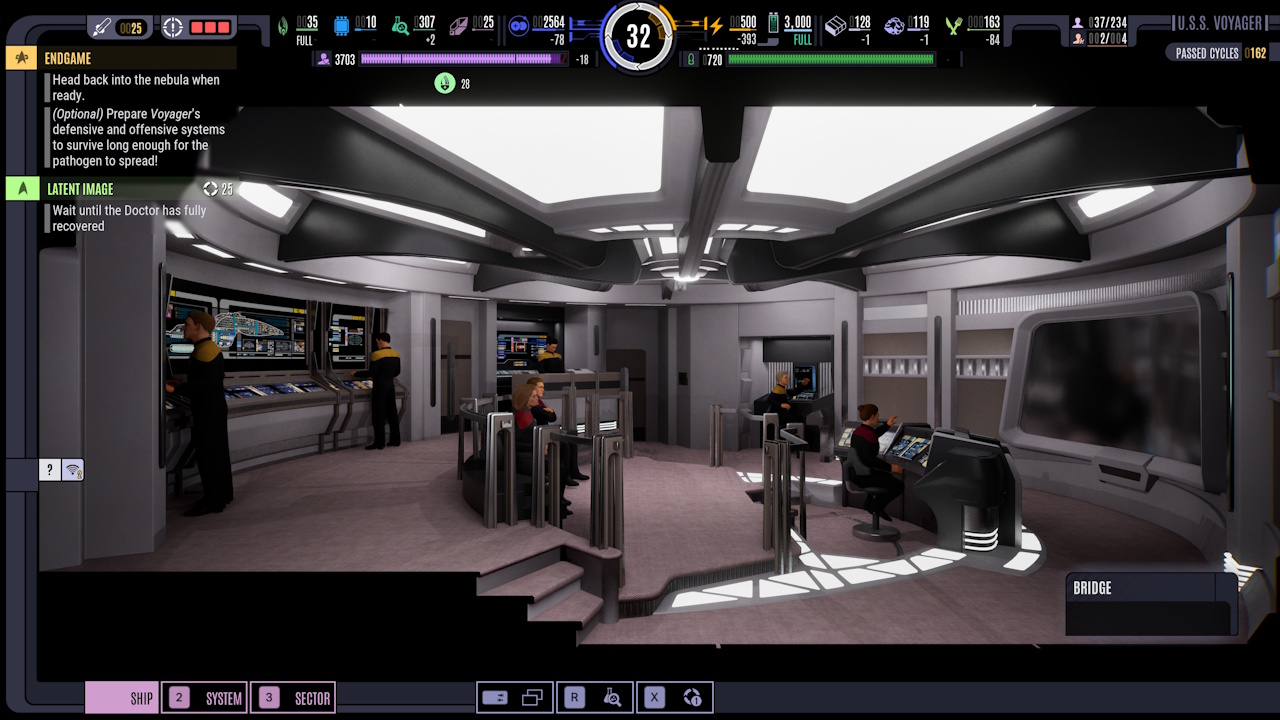
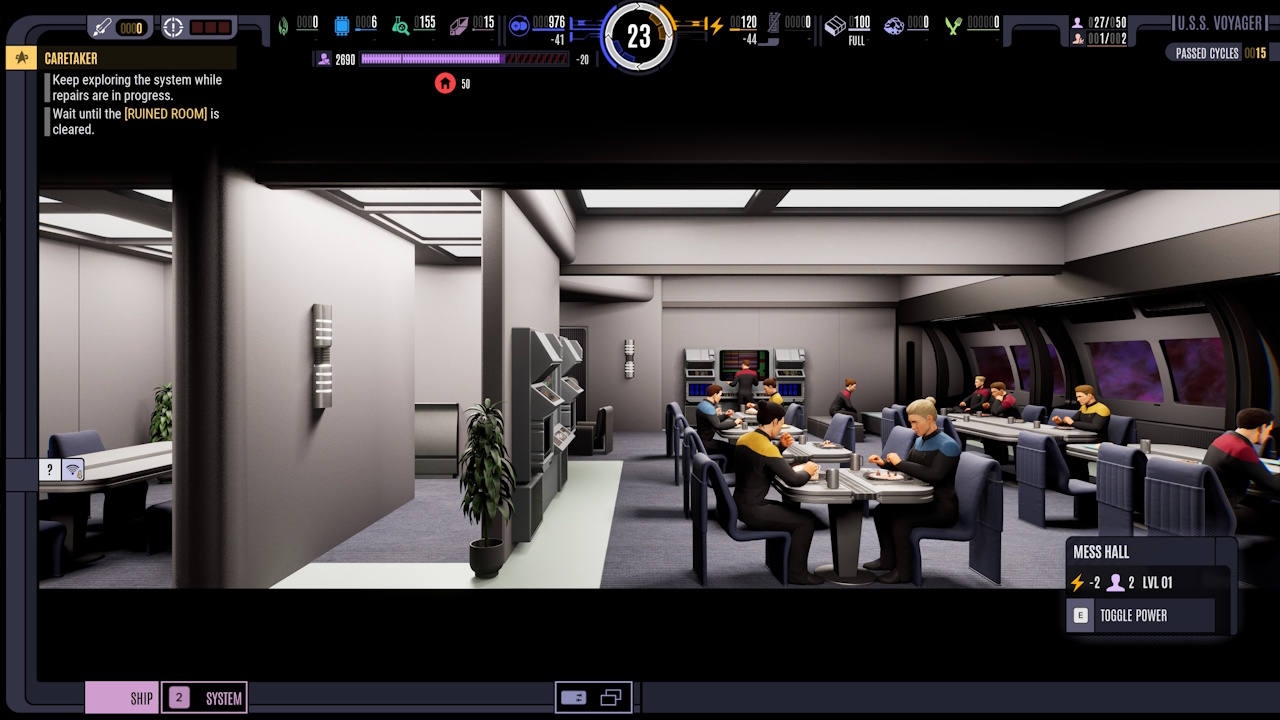
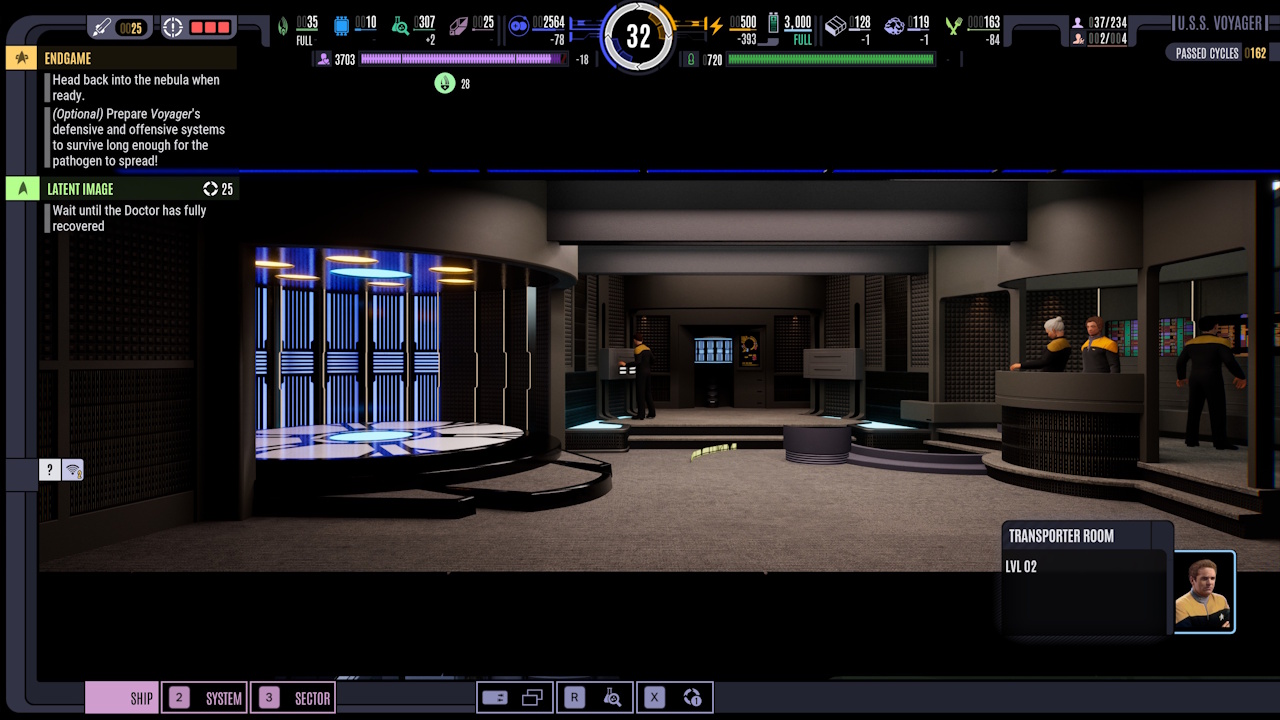
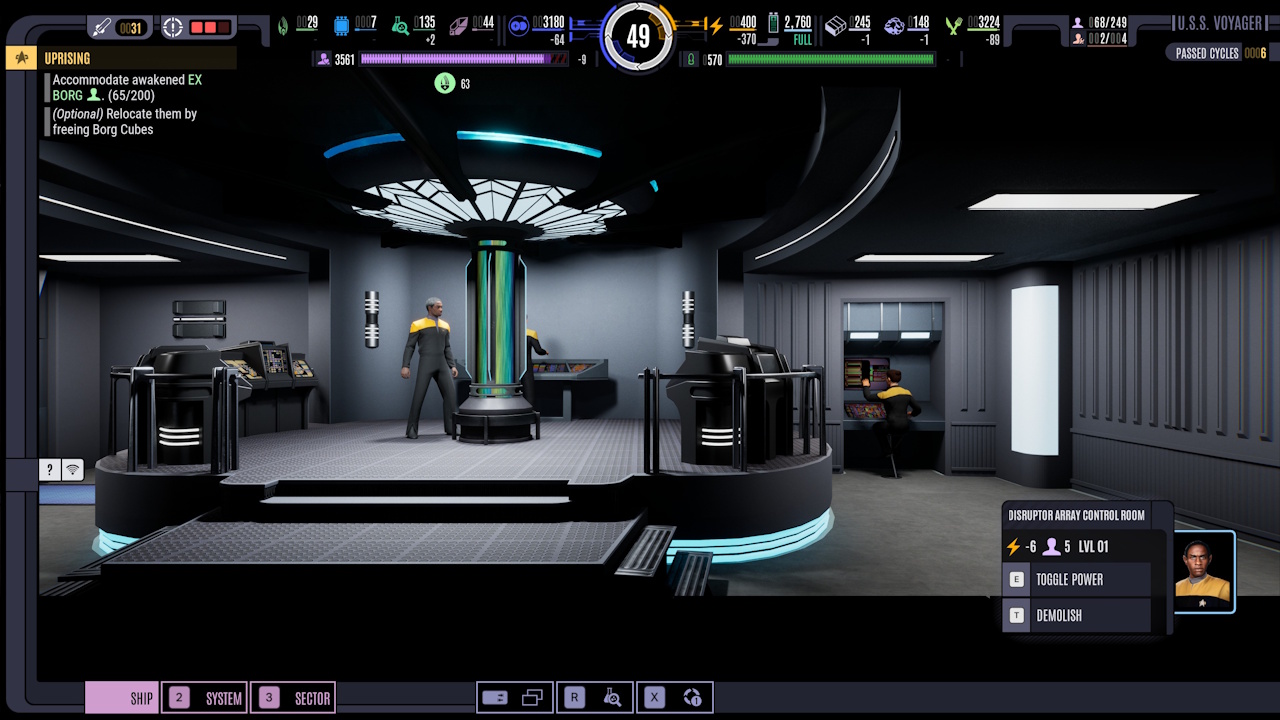
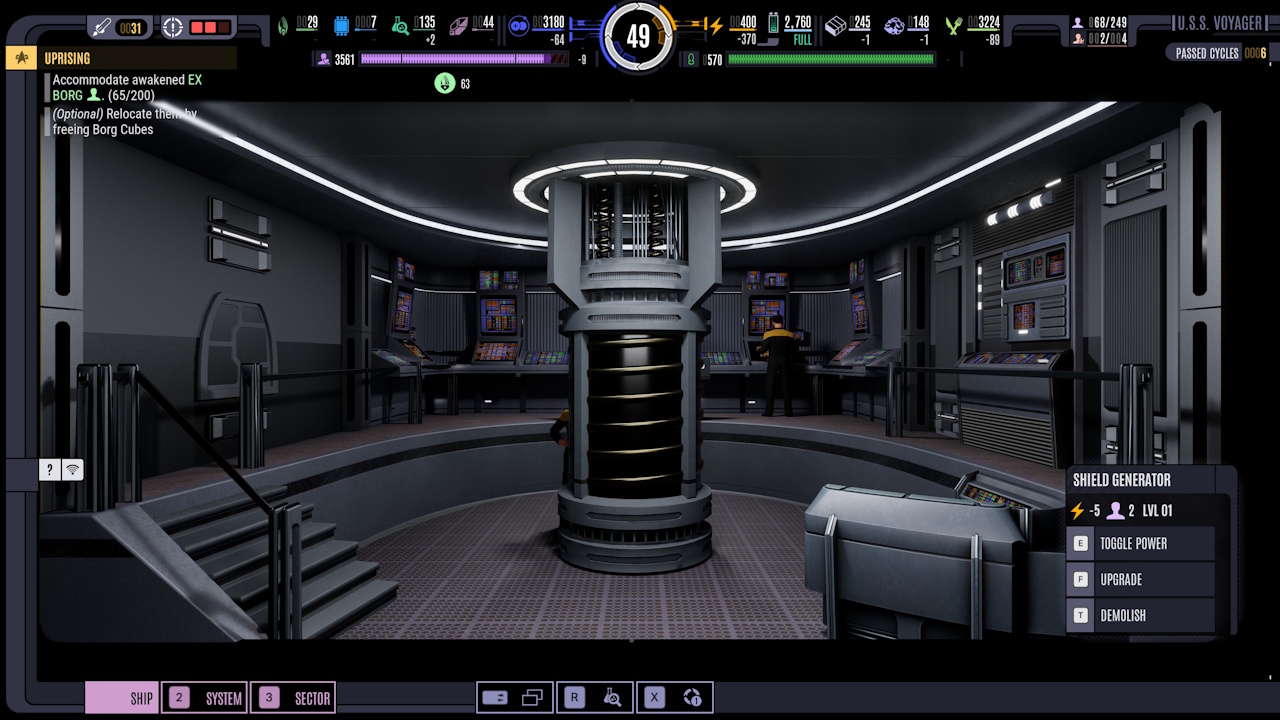
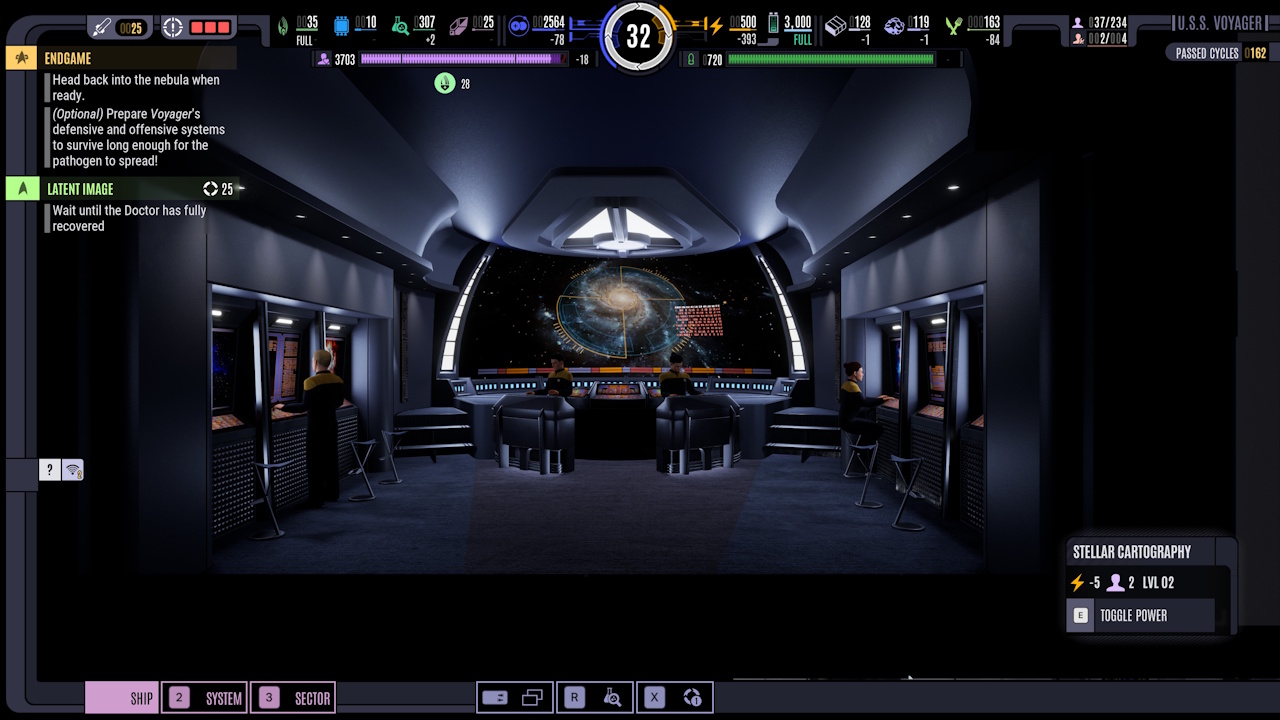
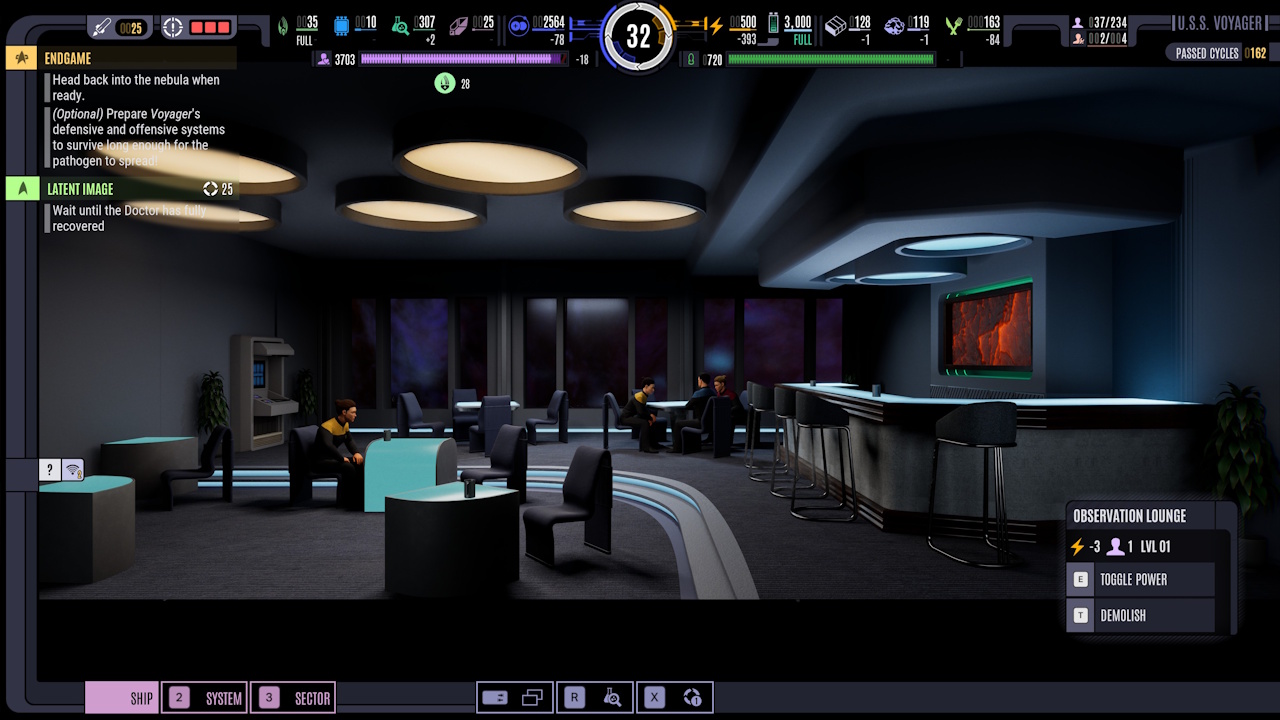
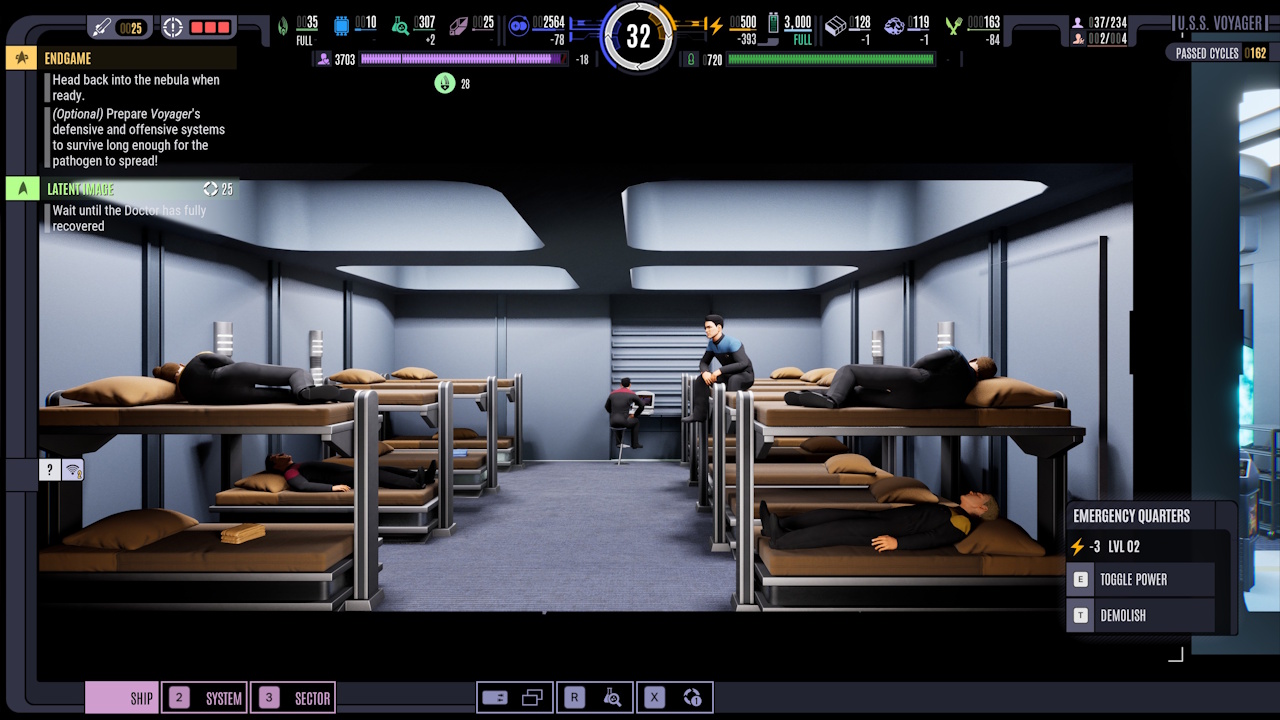
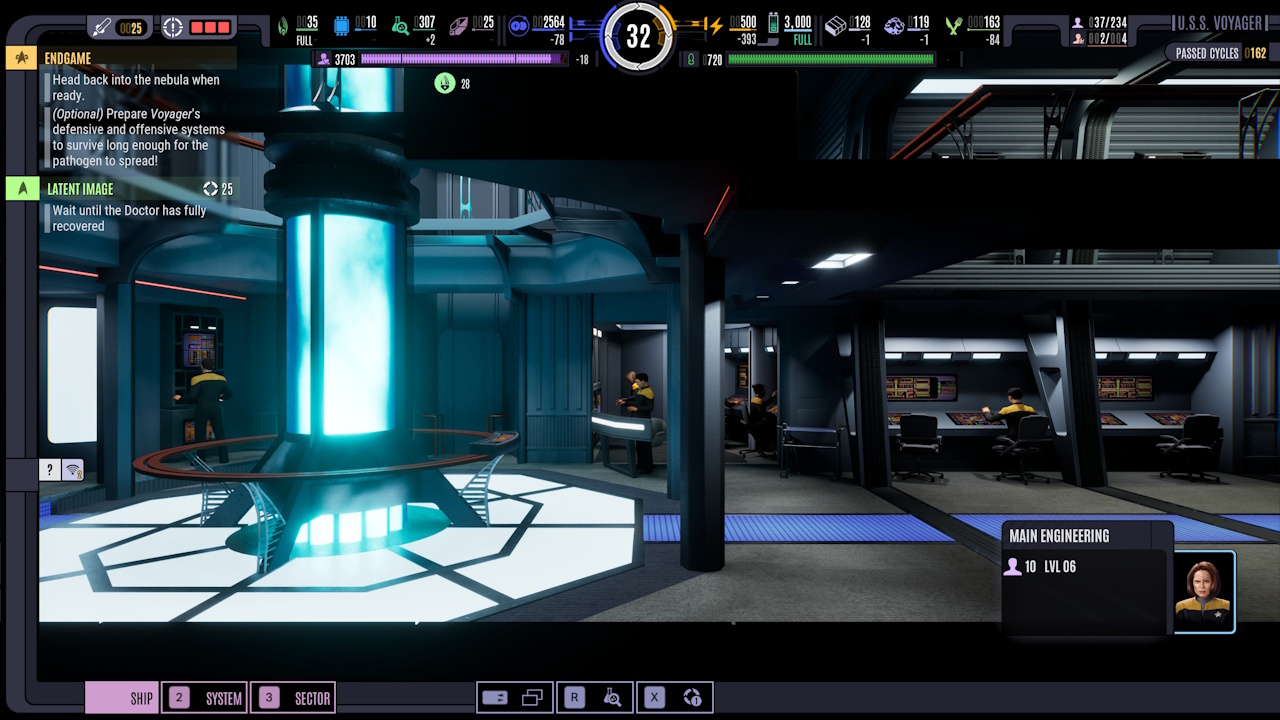
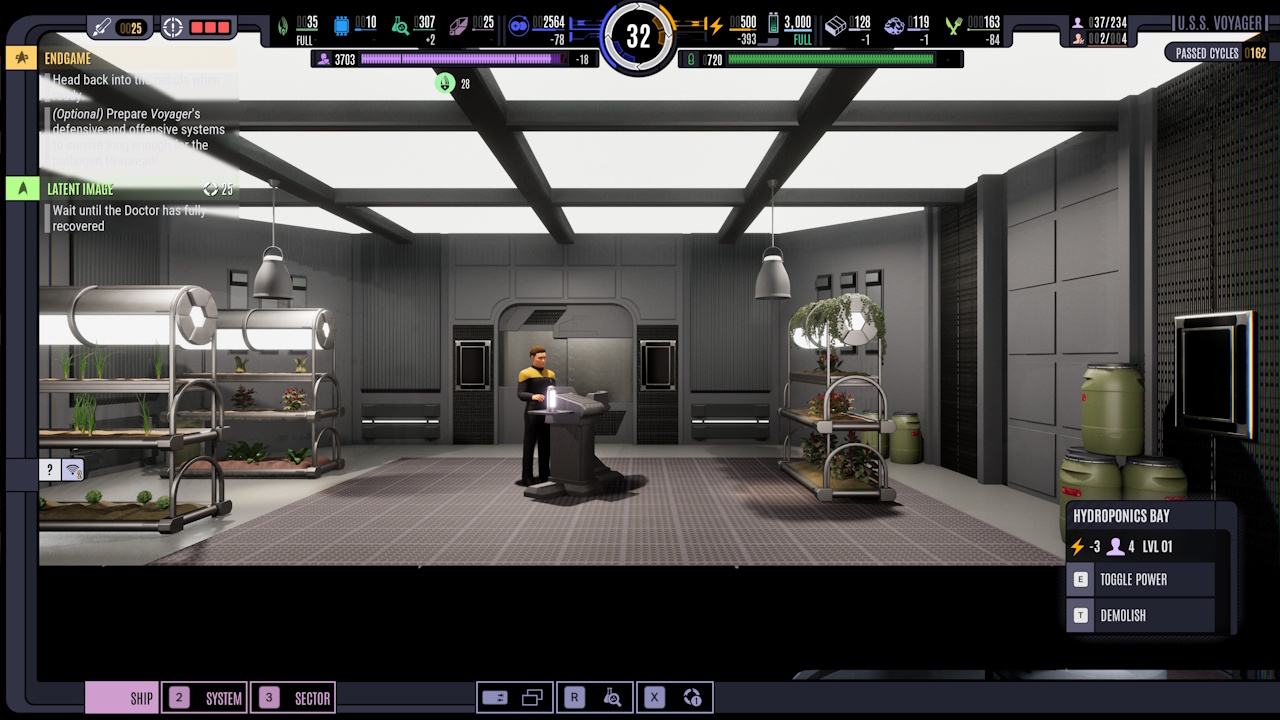
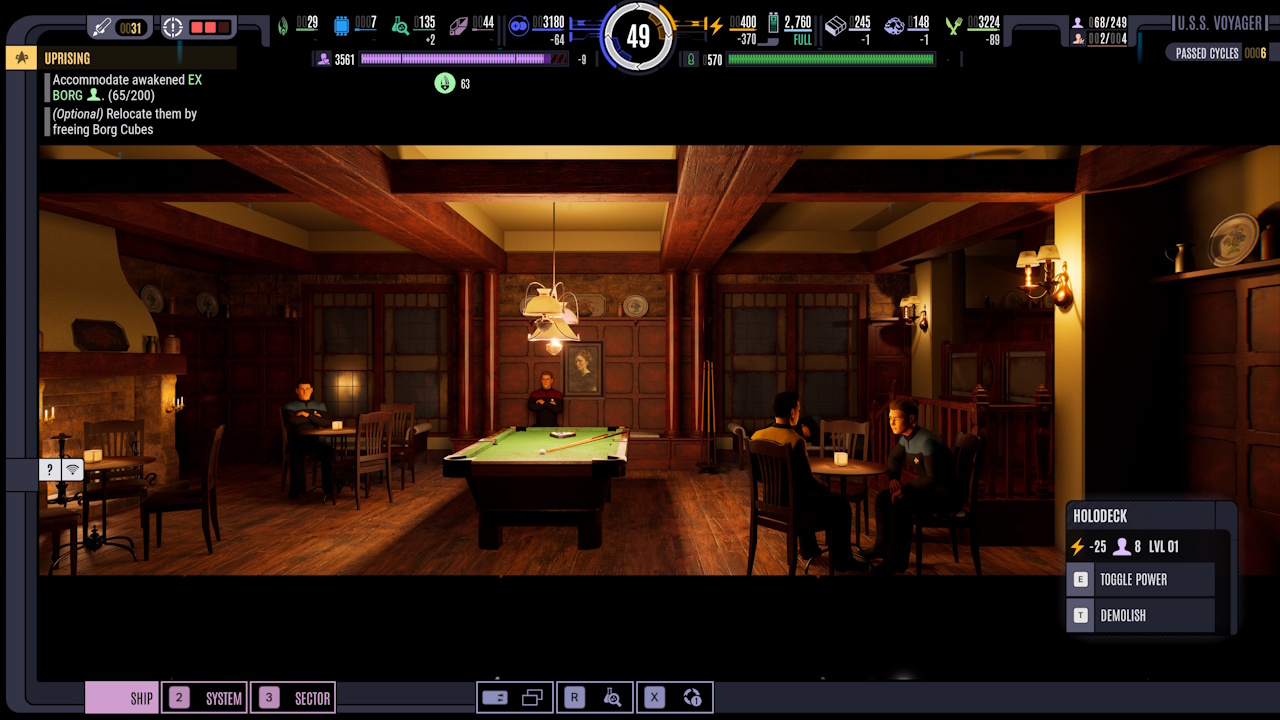
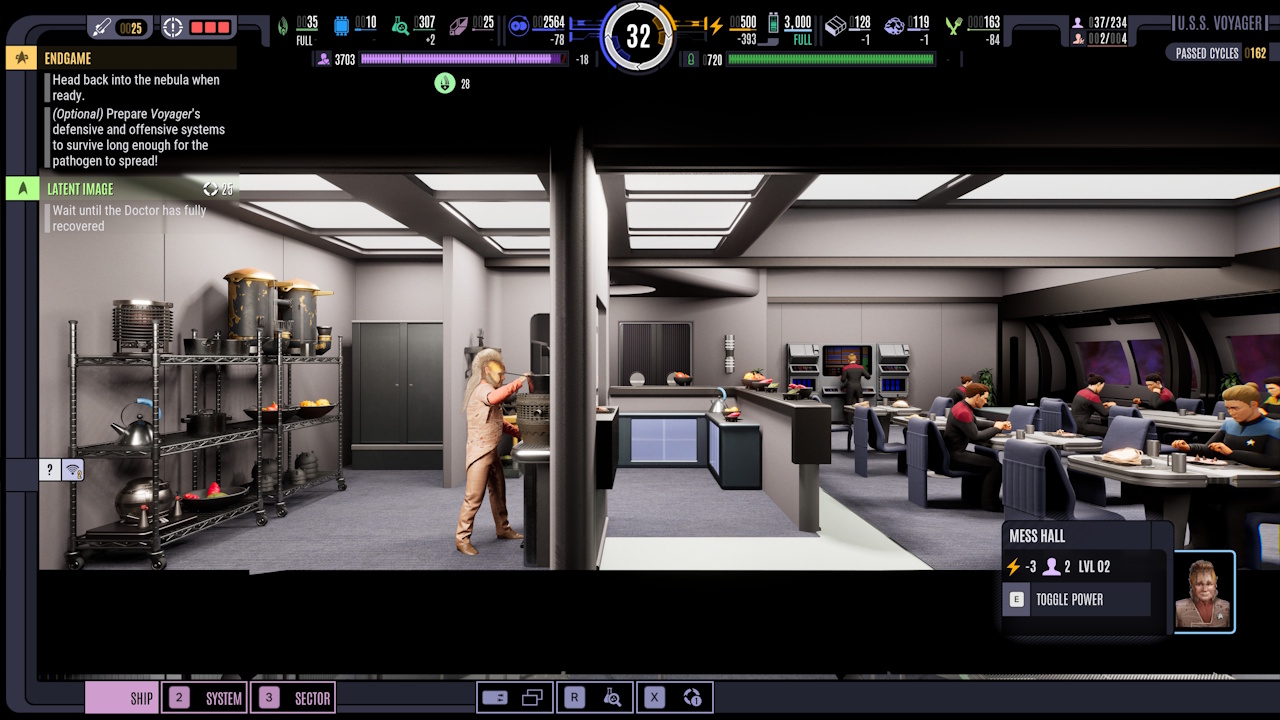
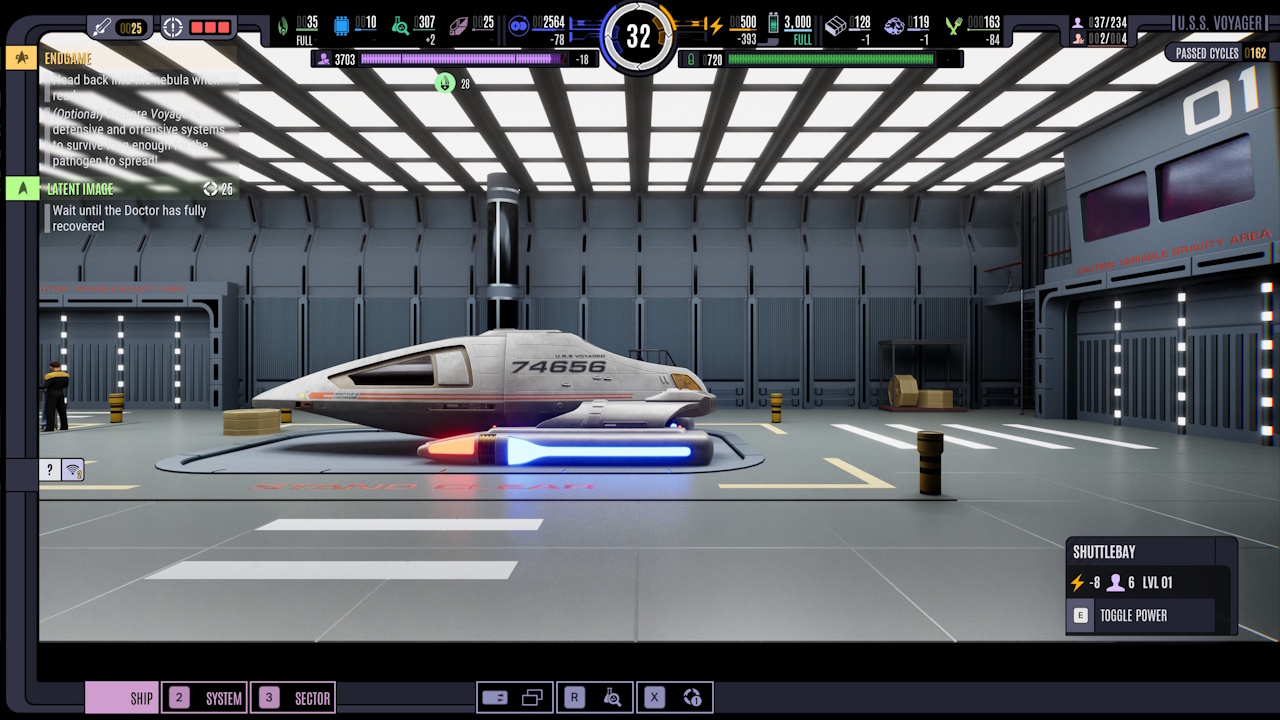
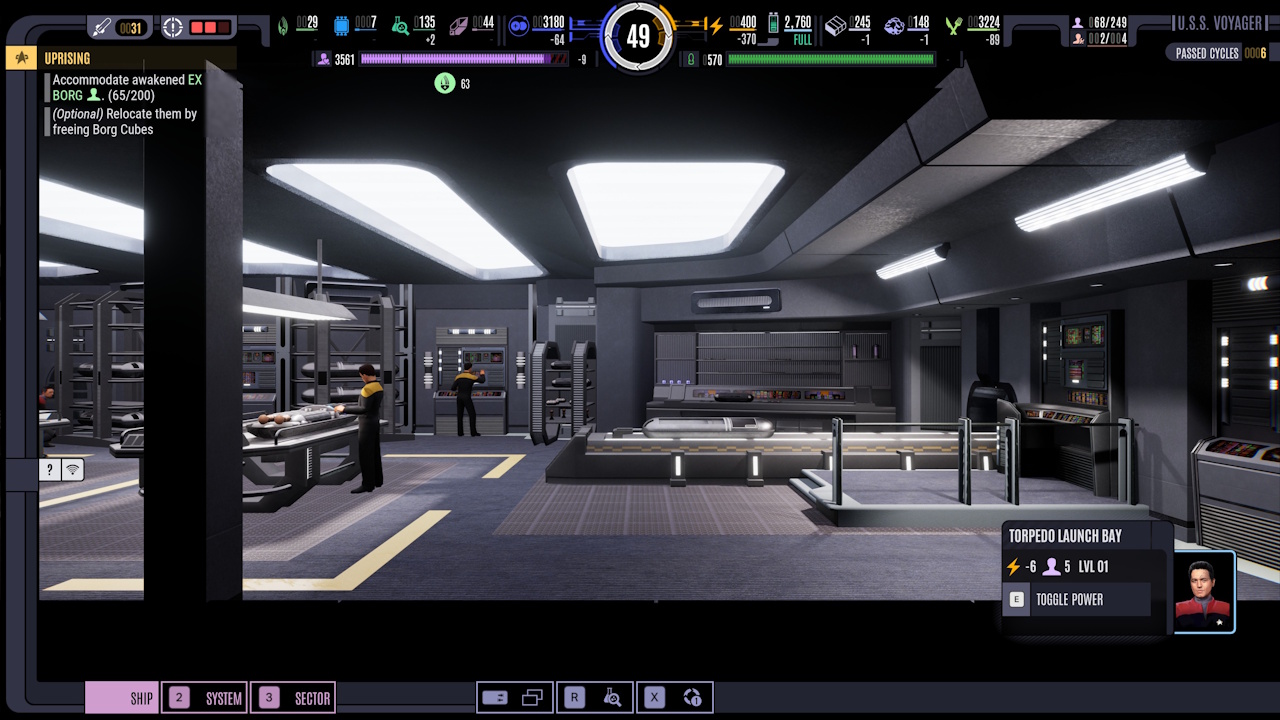
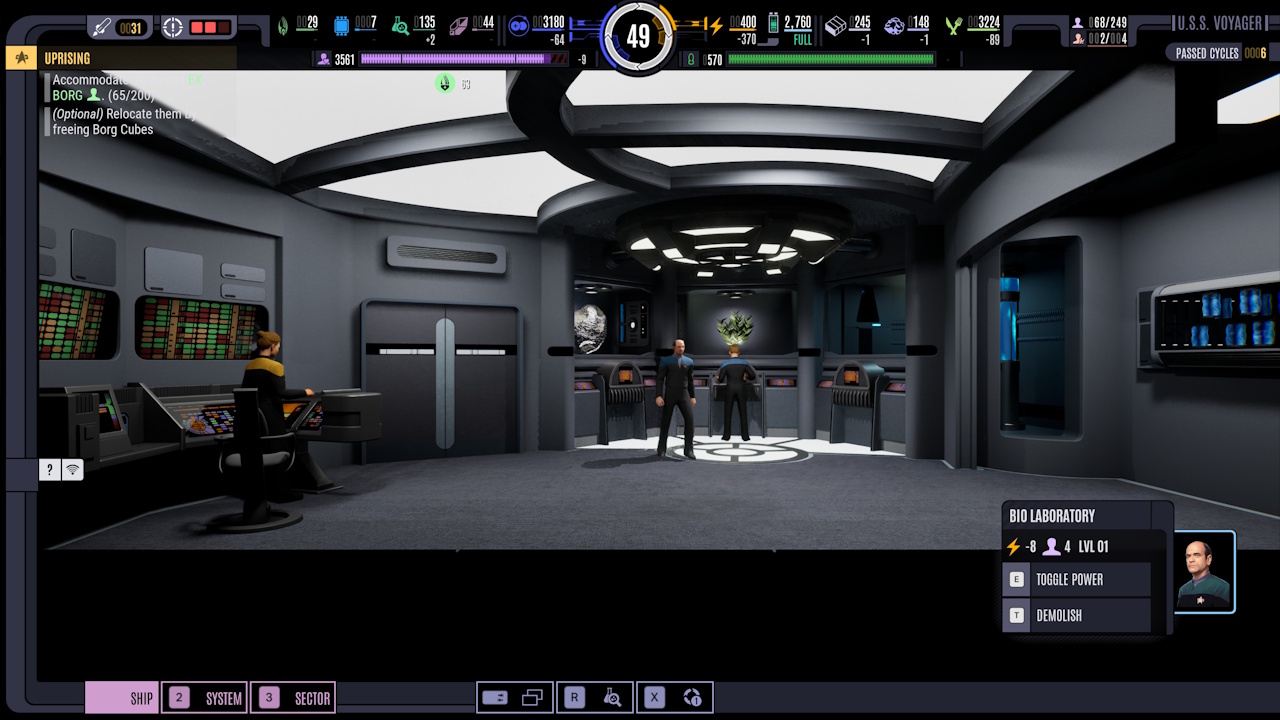
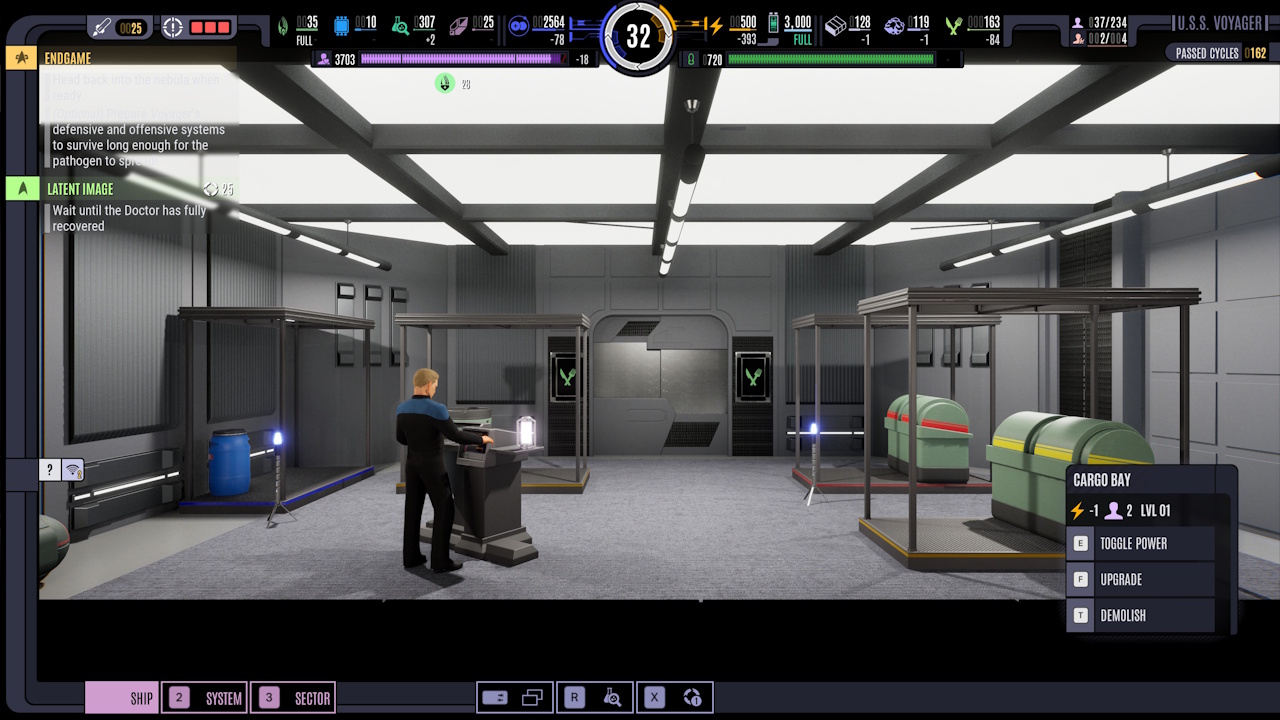
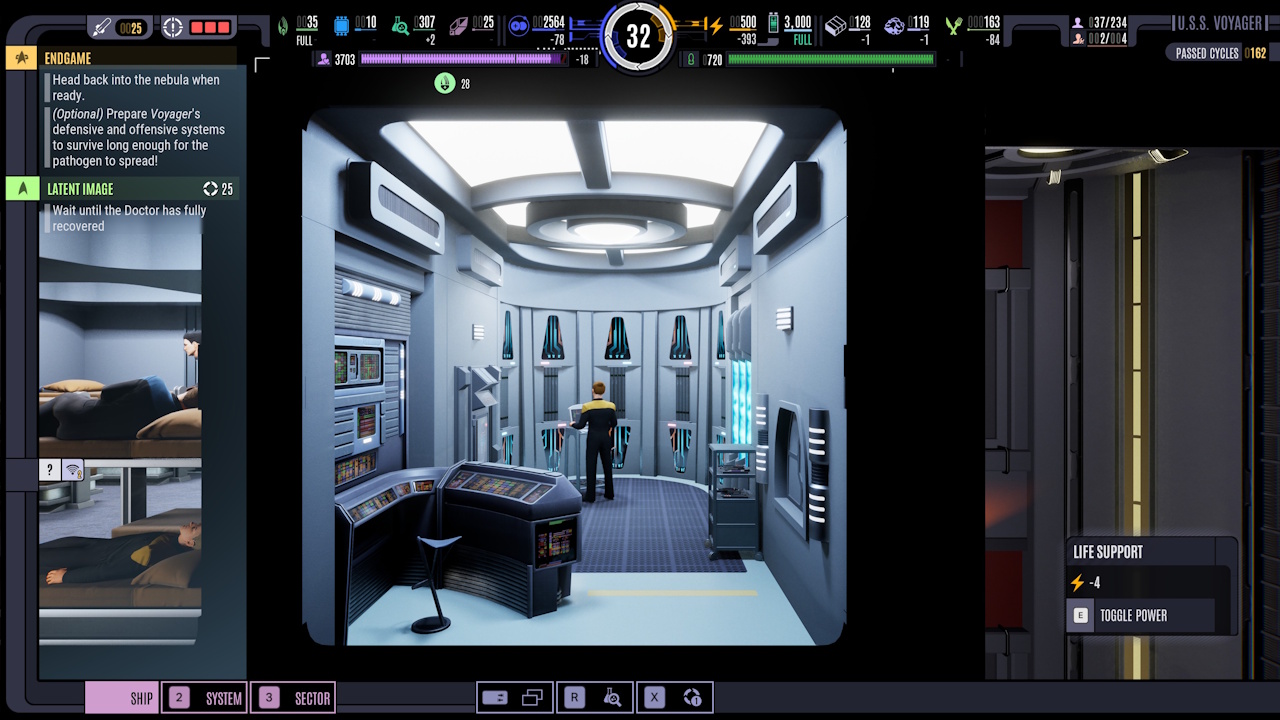
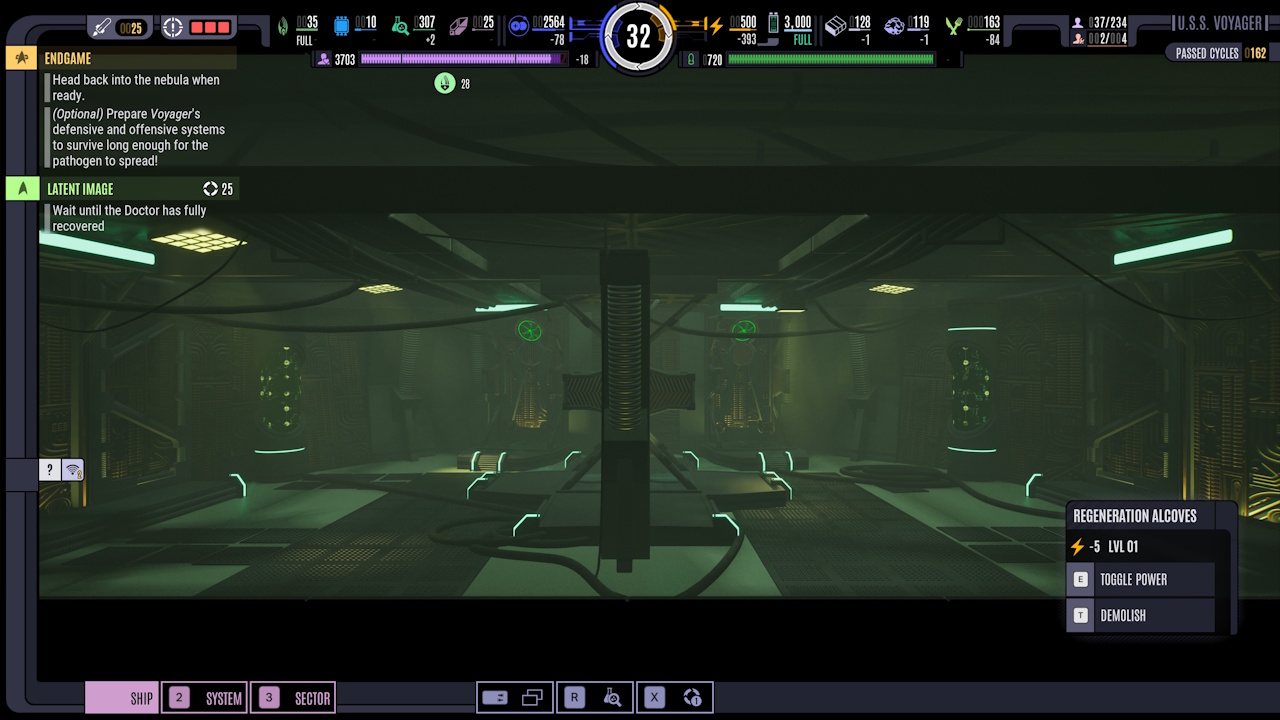
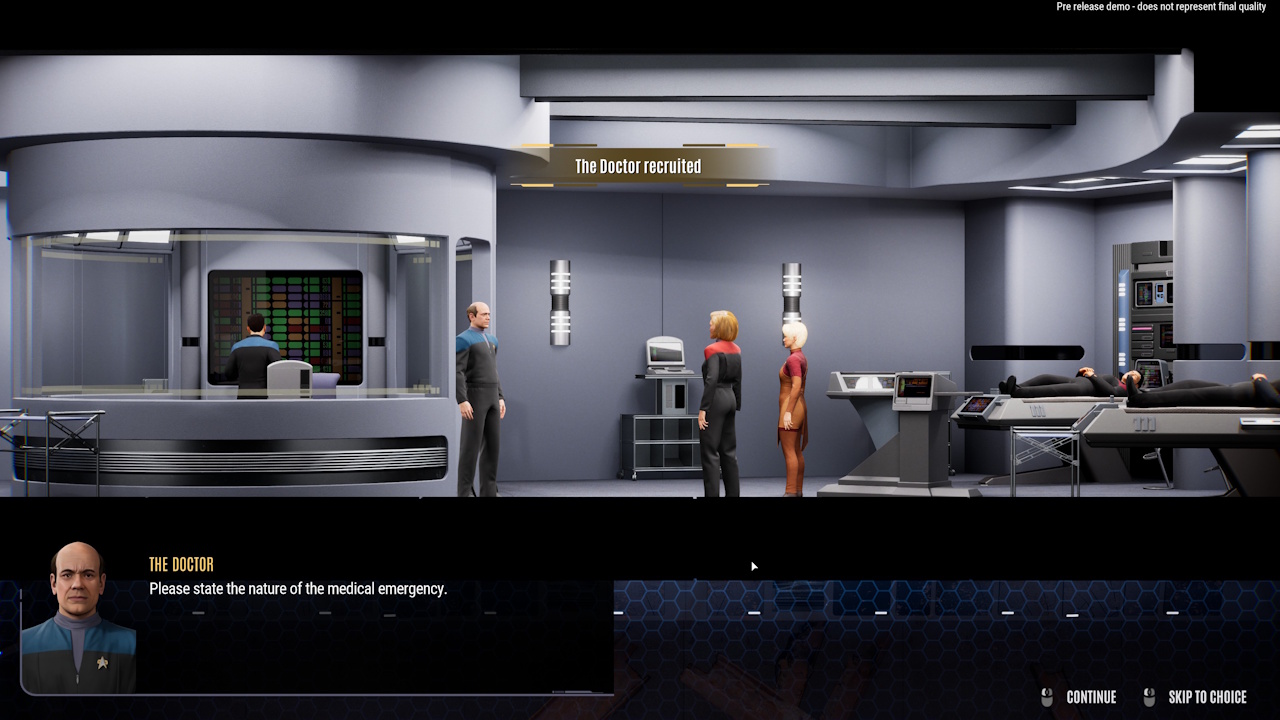
These are a few of the rooms that you can build aboard Voyager. These are from the same MSD/ship view as above, just zoomed in to the individual rooms. It’s fun to see NPCs milling around, keeping the ship flying! Some story moments also take place in rooms like Main Engineering or Sickbay, and you can make some major, run-impacting decisions here.
The Bridge.The Mess Hall without Neelix…The Transporter Room.Disruptor Control.A Shield Generator.Stellar Cartography/Astrometrics.An Observation Lounge.Emergency Quarters.Main Engineering.Hydroponics.
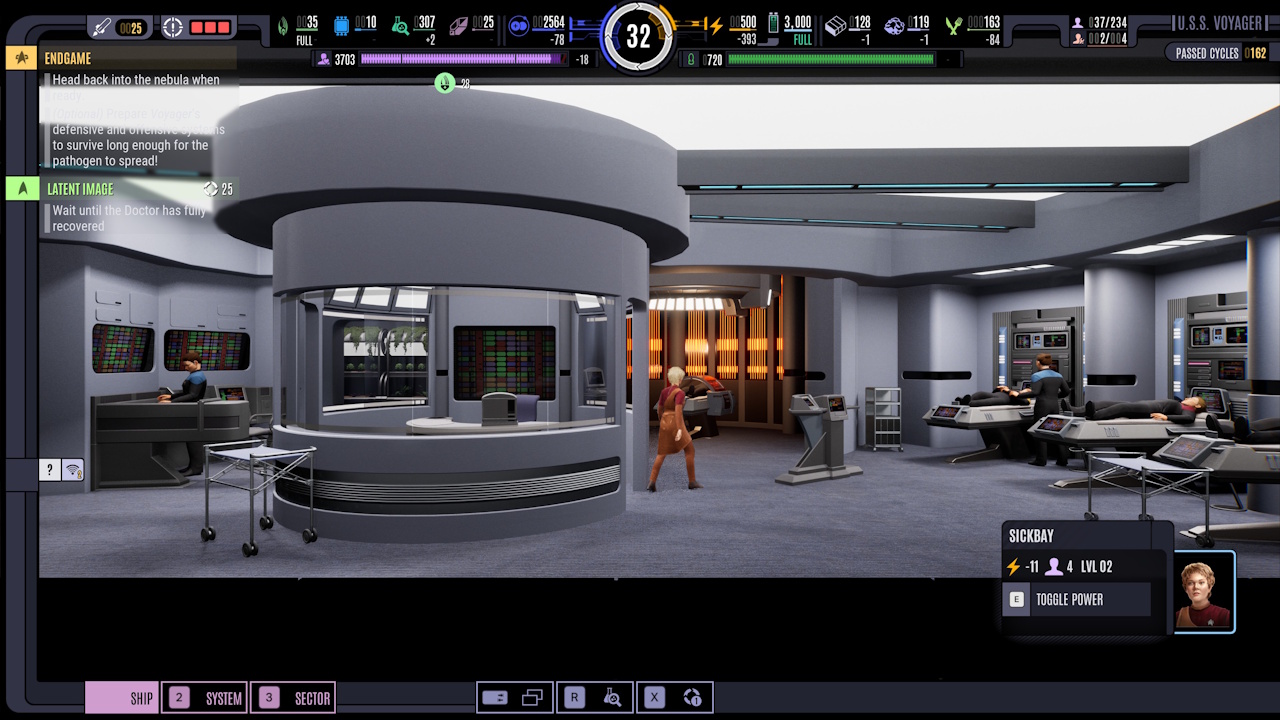
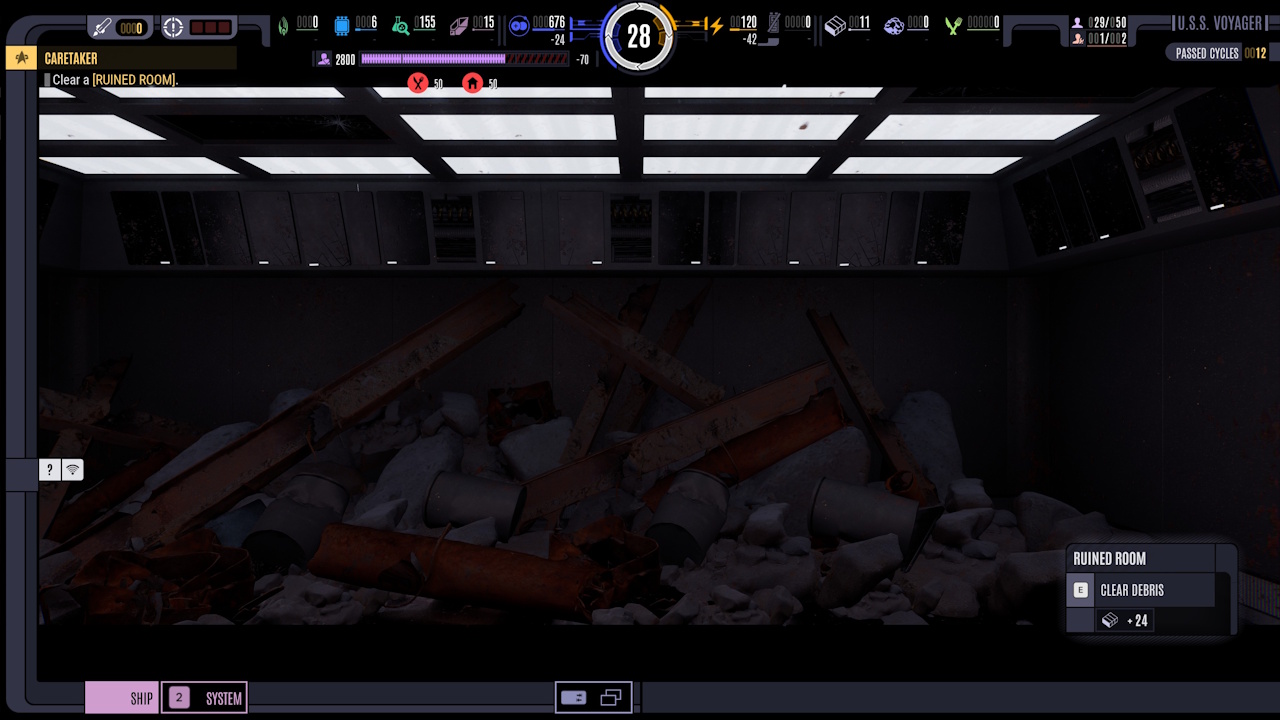
Sandrine’s on the Holodeck.…and the Mess Hall with Neelix.The Shuttlebay.The Torpedo Bay.A Bio Lab.A Cargo Bay.A Life Support Room.Borg Alcoves.Sickbay.Rubble in a ruined room.
Sector View:
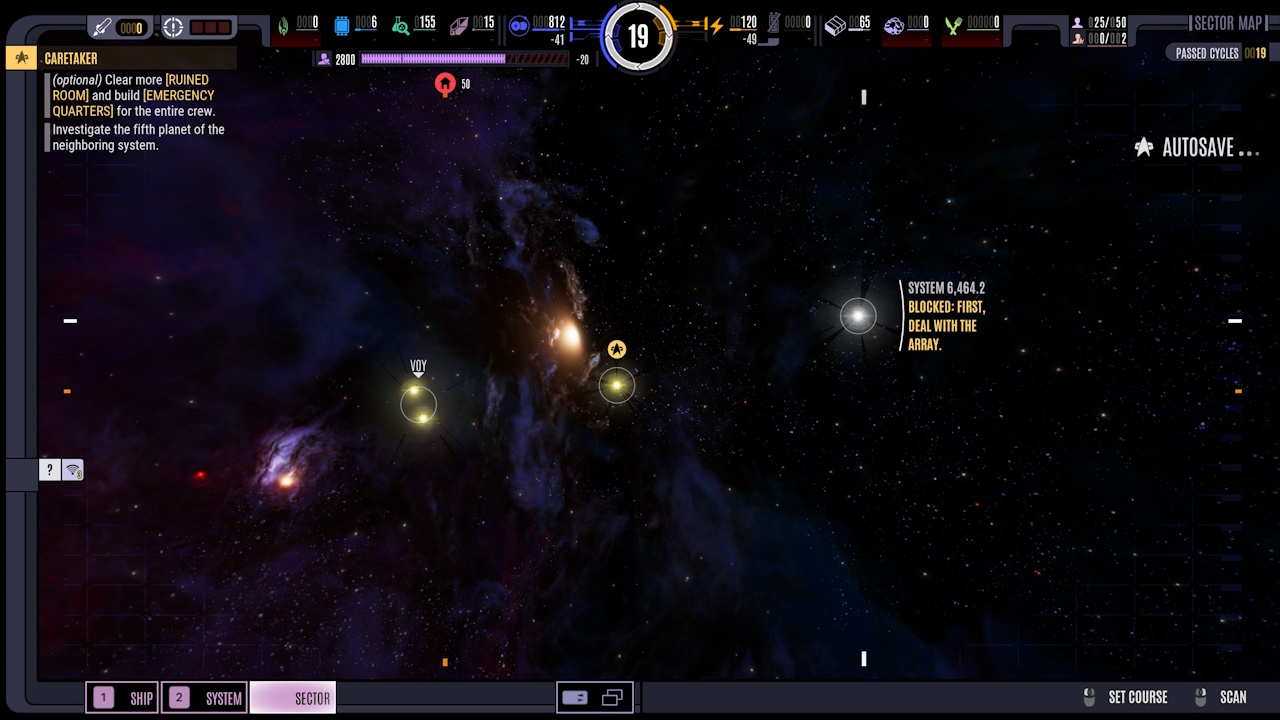
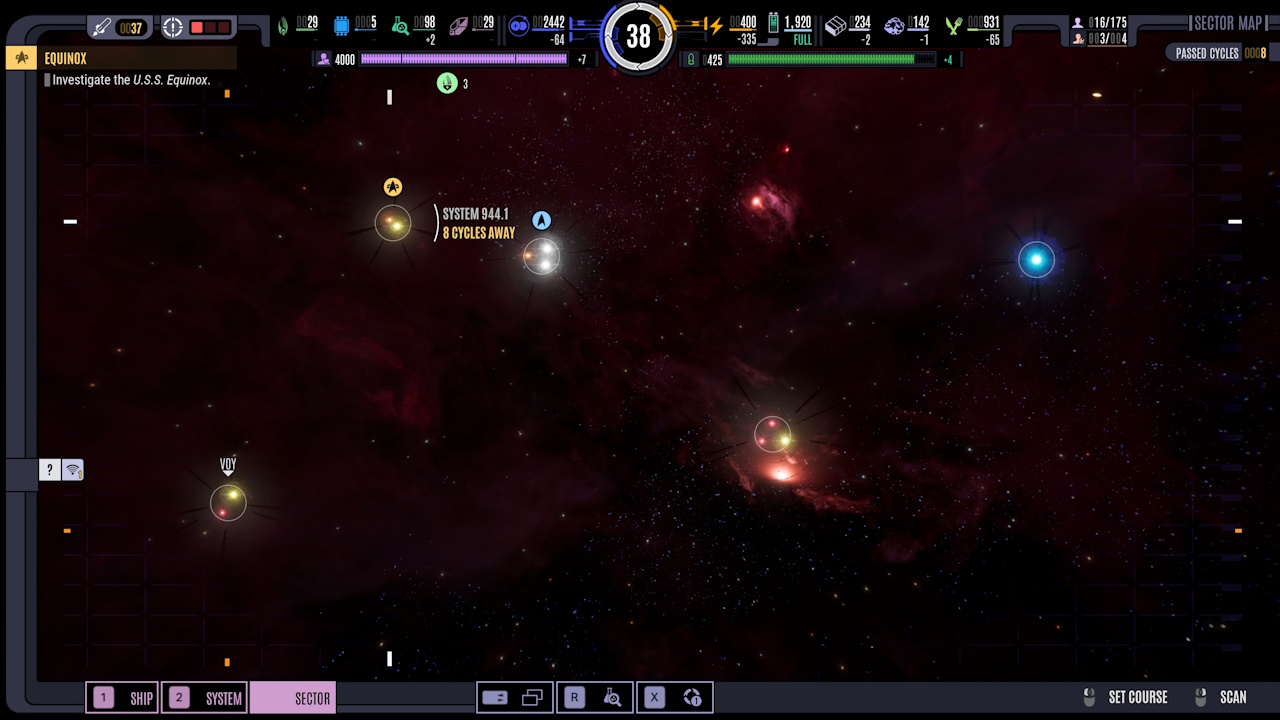
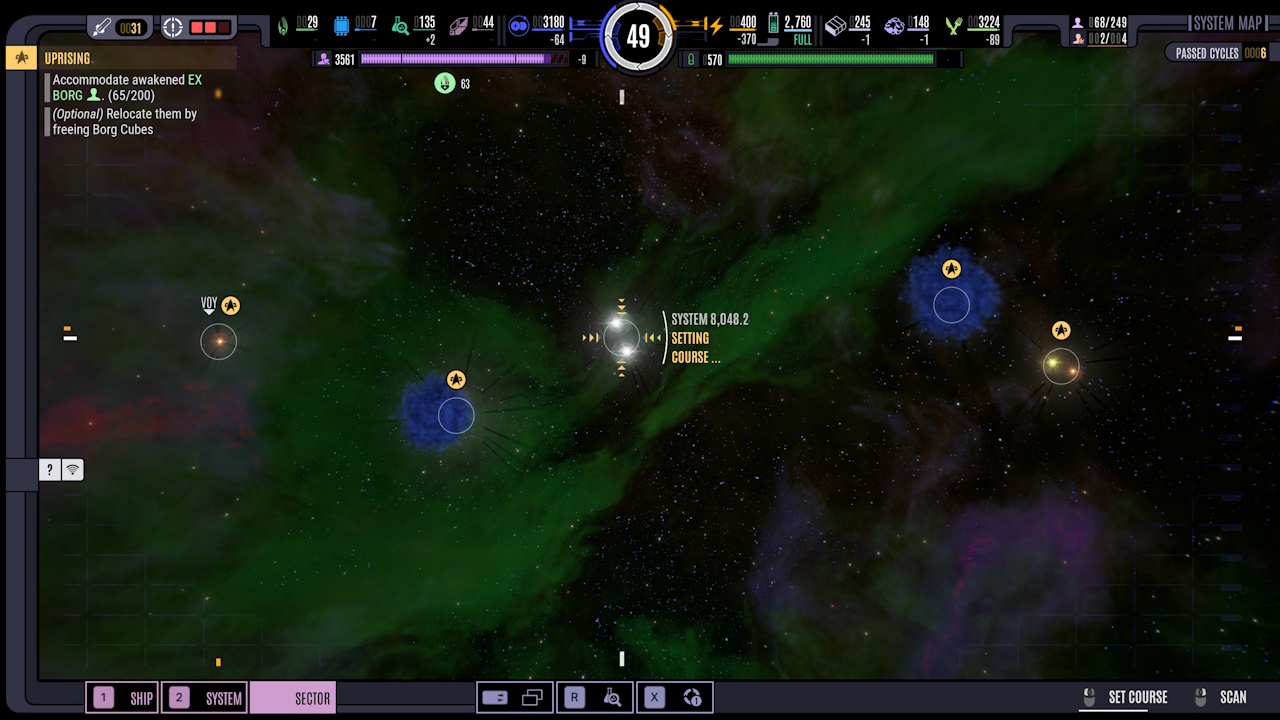
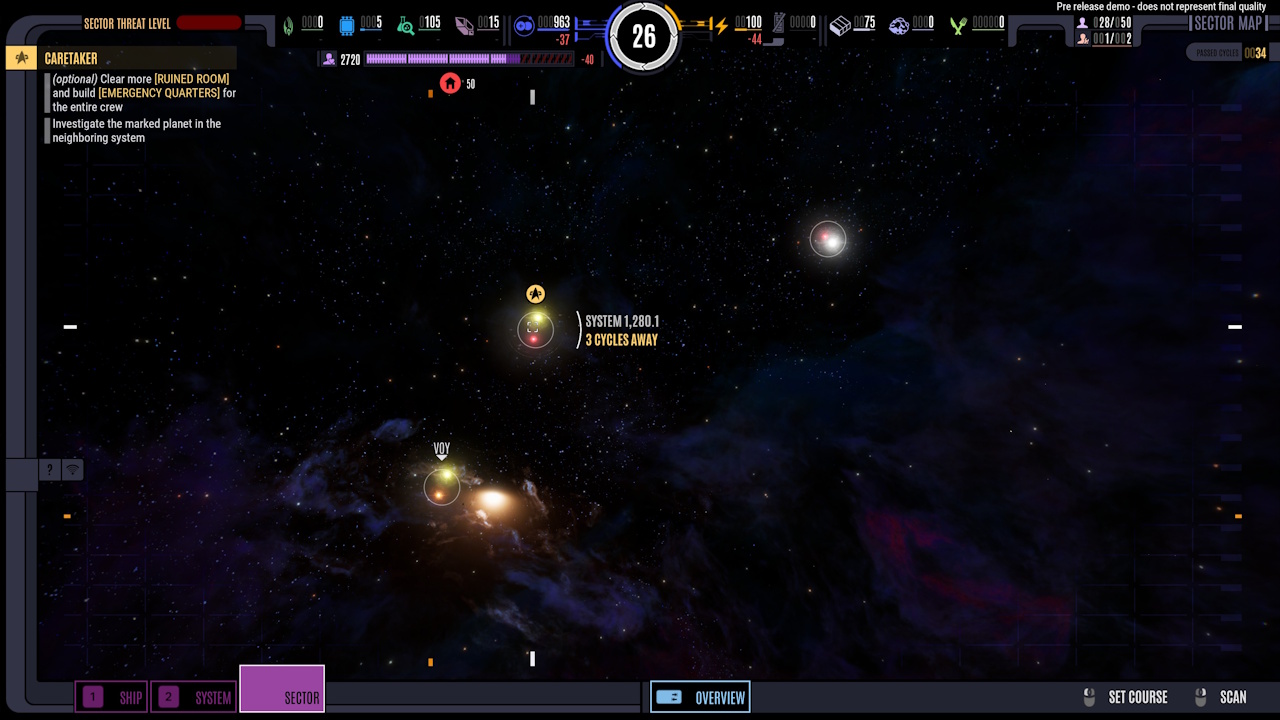
I didn’t spend a lot of time here. All you can really do is choose which system to scan or visit next.
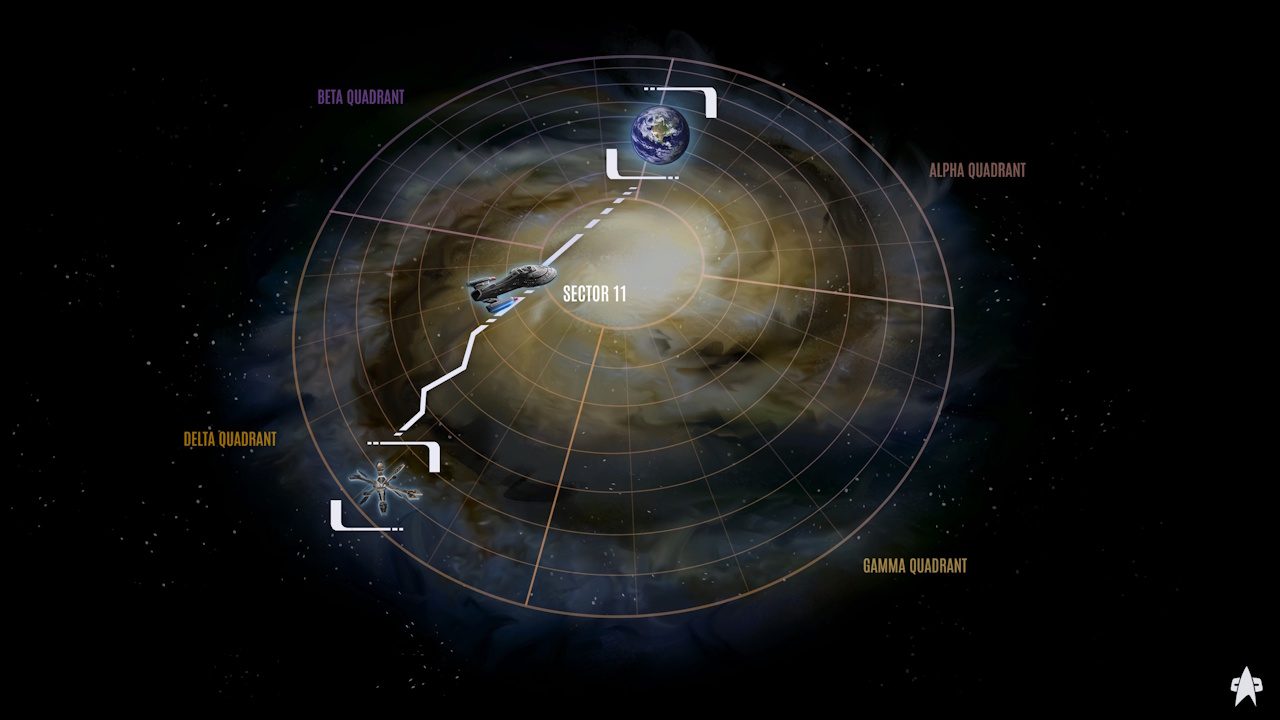
The sector view.This screen appears in between sectors.
A different sector later in the game.Setting course, captain!
The Tech Tree:
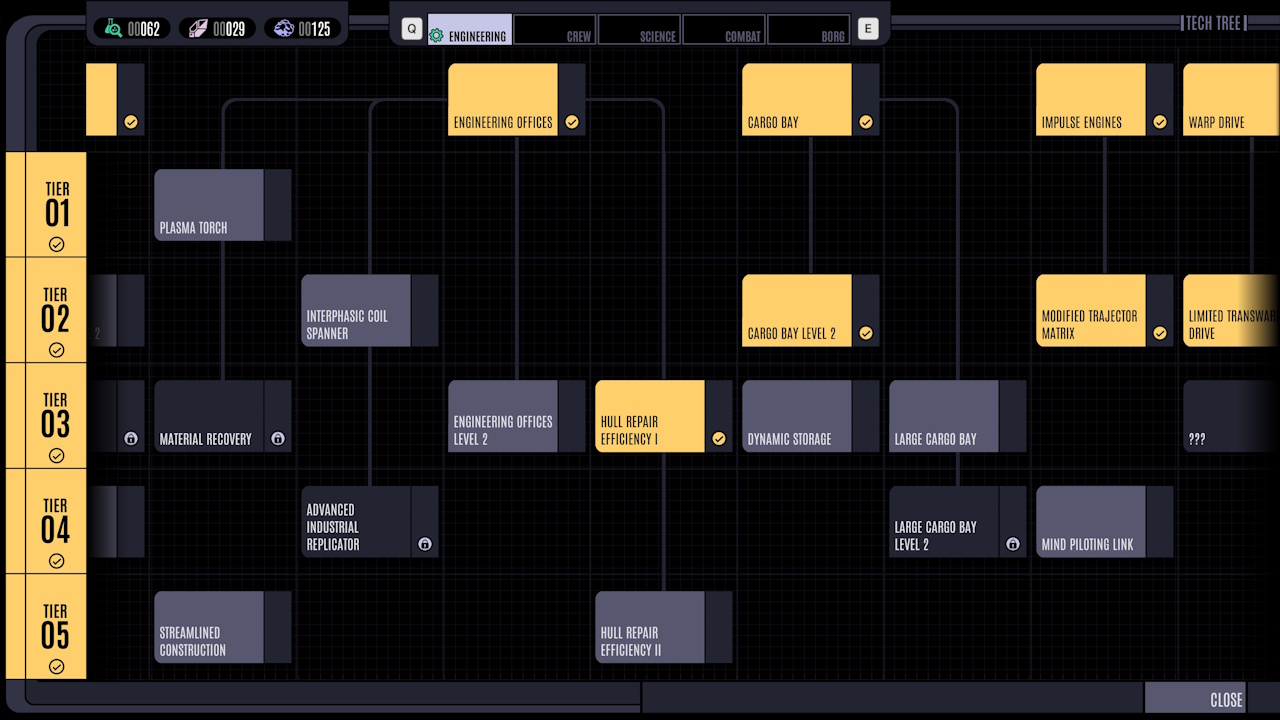
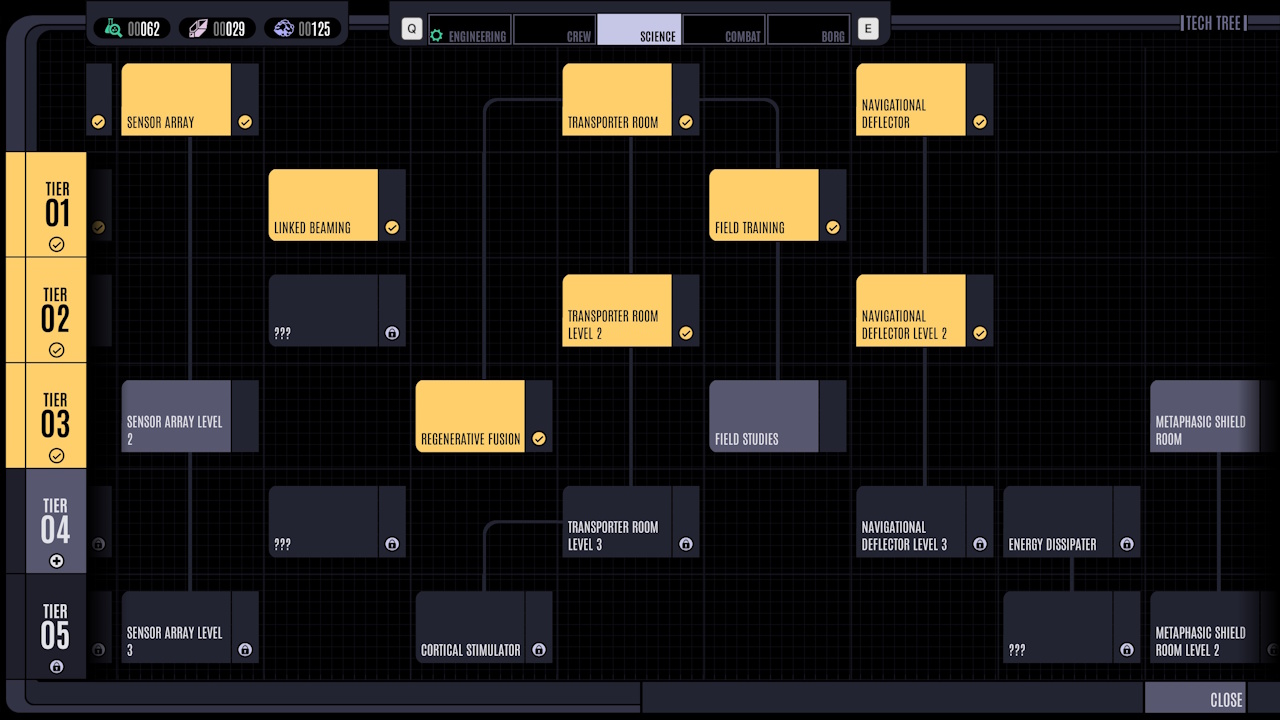
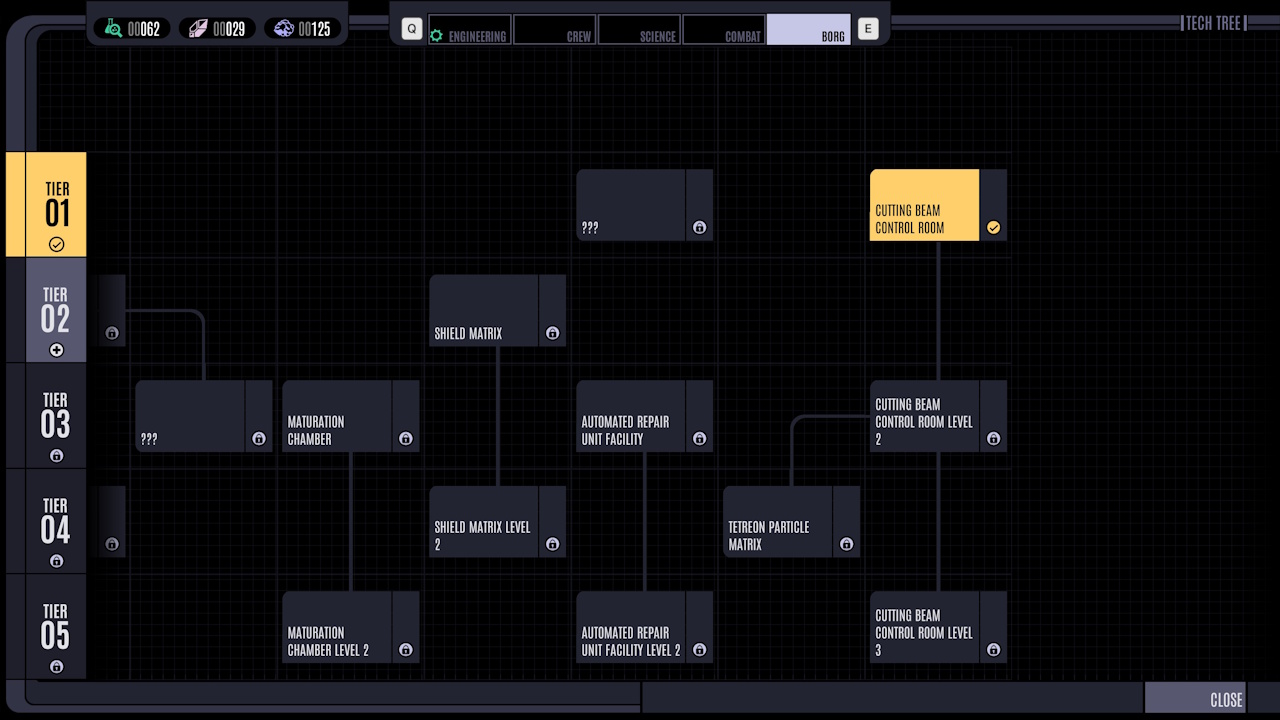
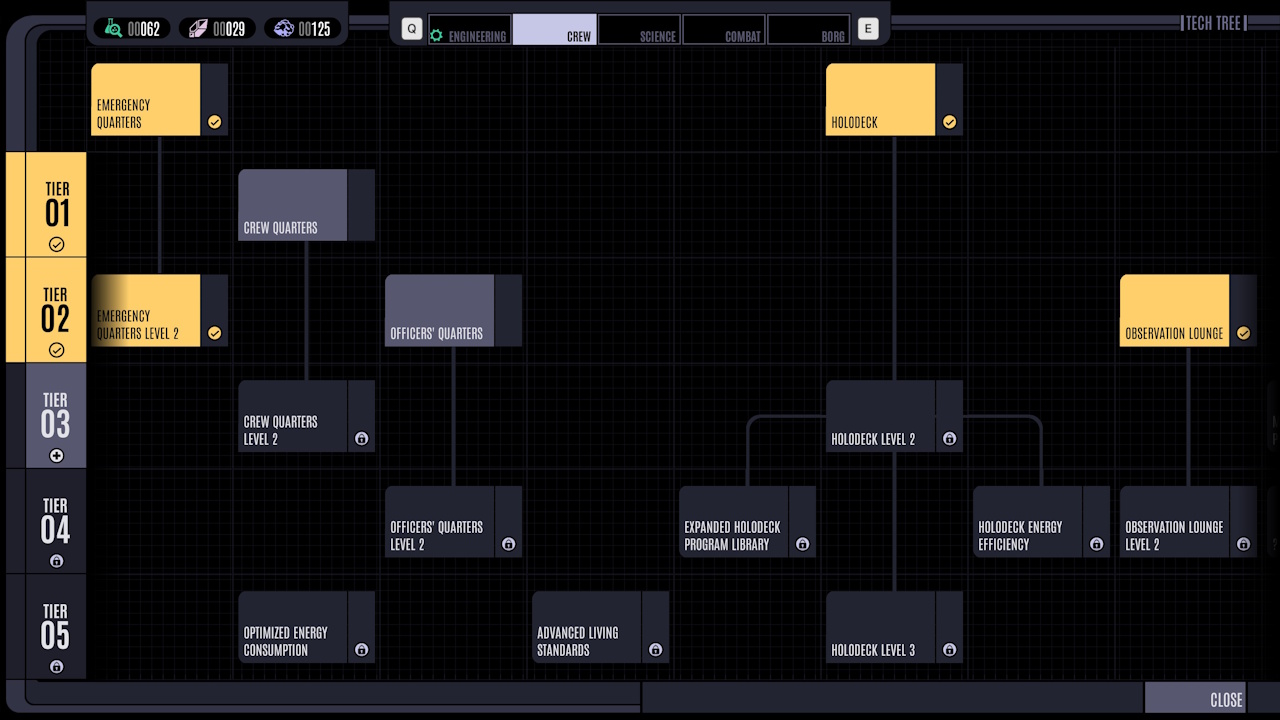
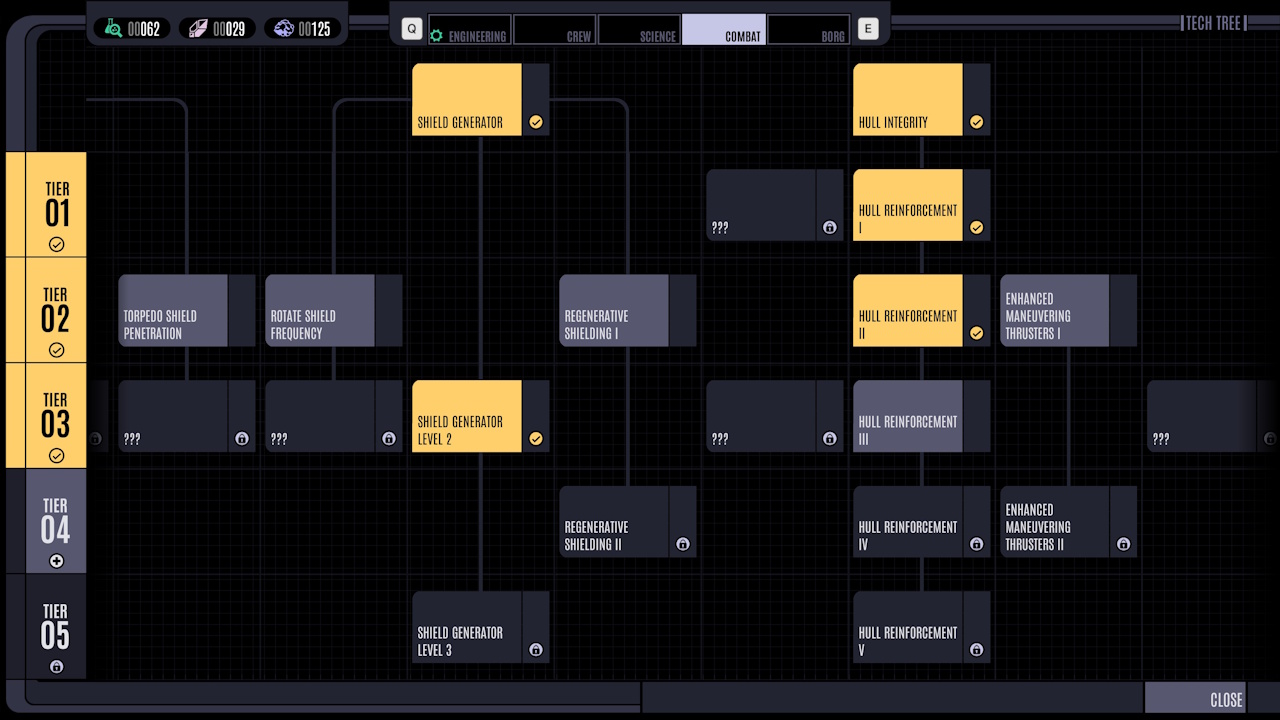
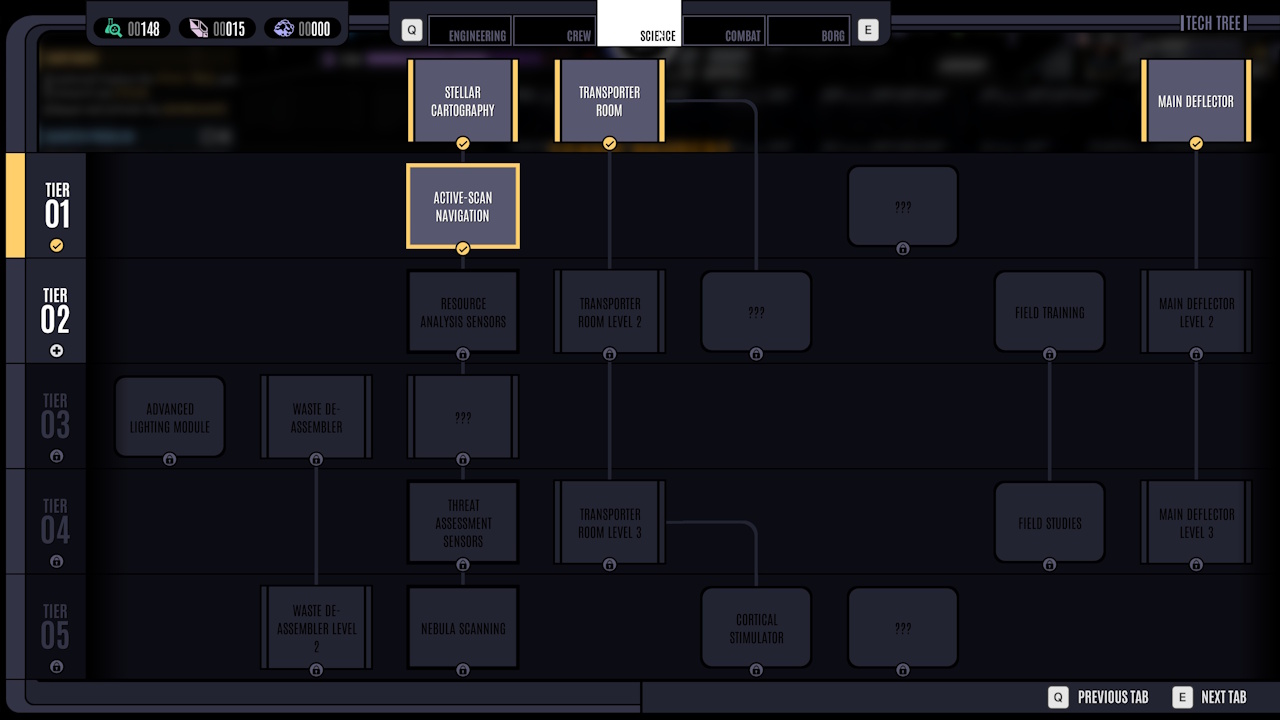
The tech tree is where you unlock new technologies, rooms, and such like. Some of these are available to research at any time if you have the right resources and enough Science Points, but others must be unlocked via missions. There are 5 categories: Engineering, Crew, Science, Combat, and Borg.
Engineering.Science.Borg.
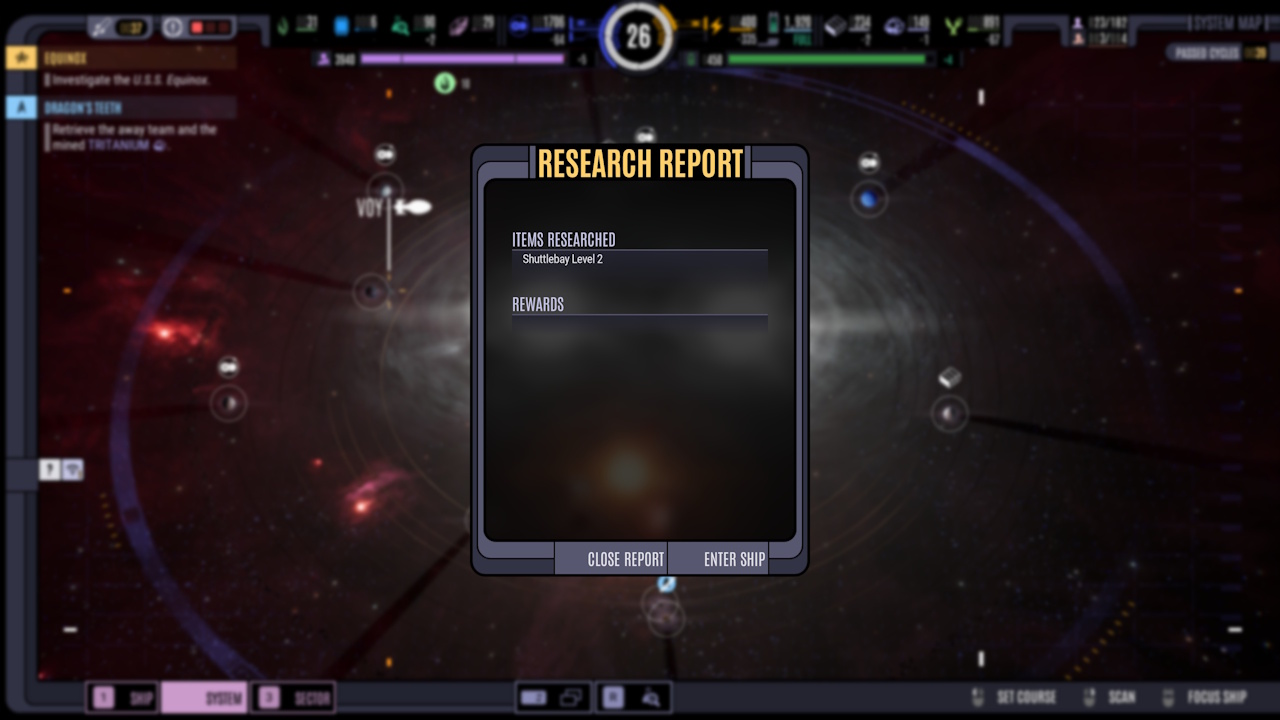
Crew.Combat.A new tech has been unlocked.
Cut-Scenes:
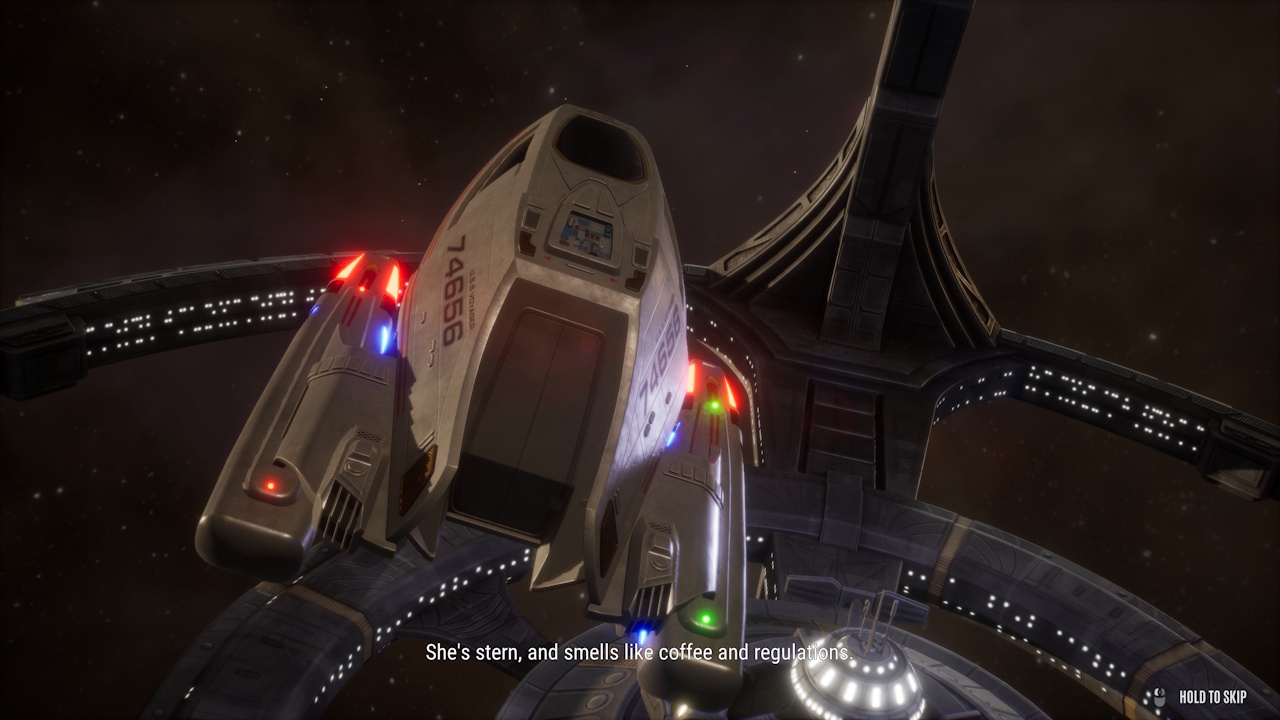
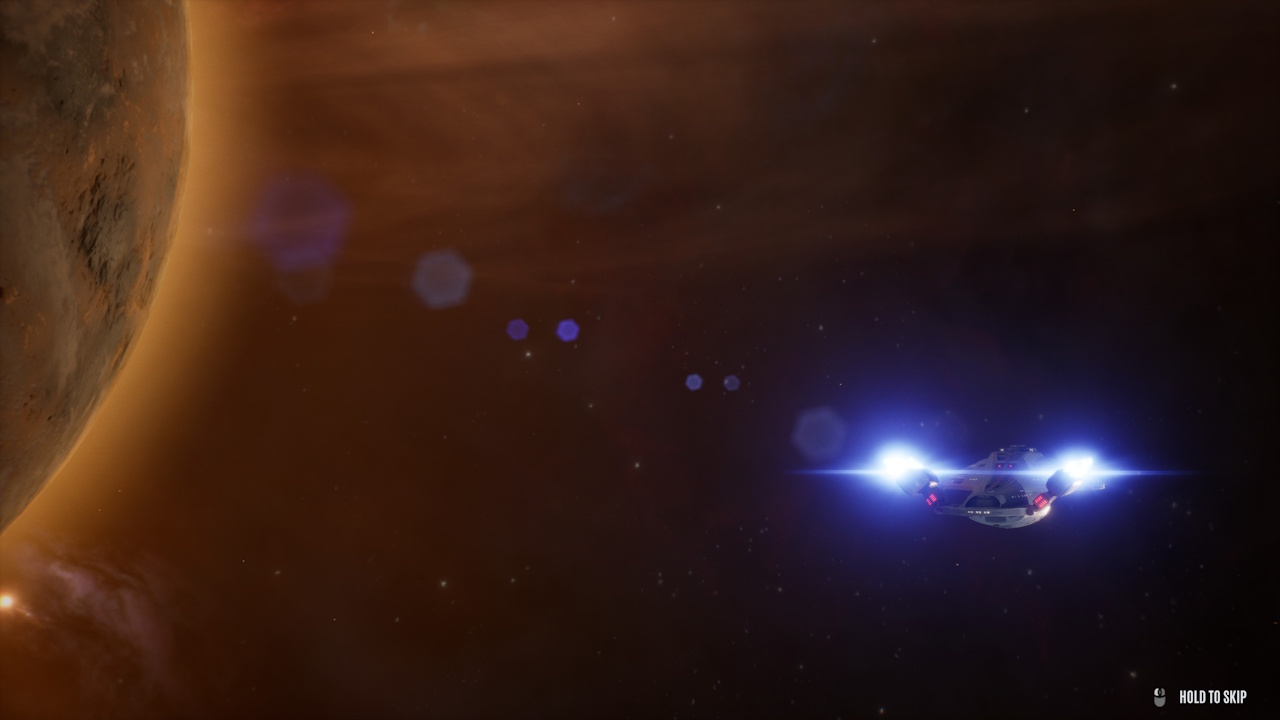
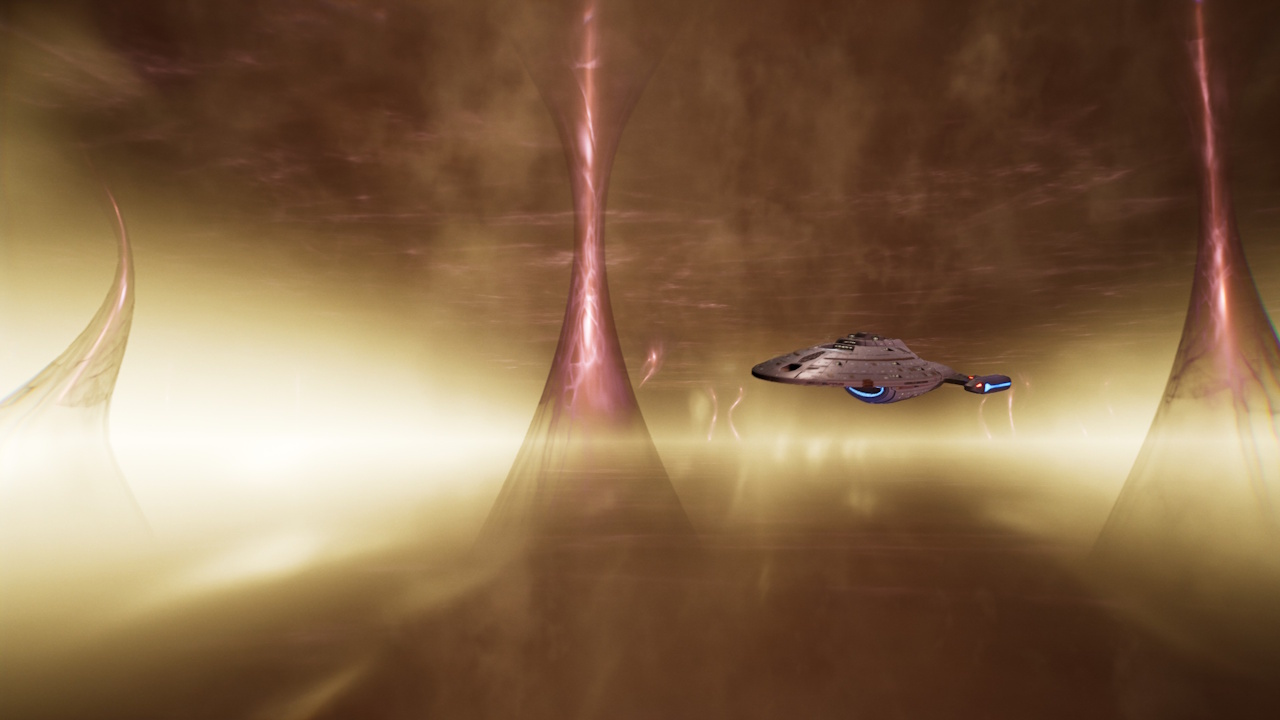
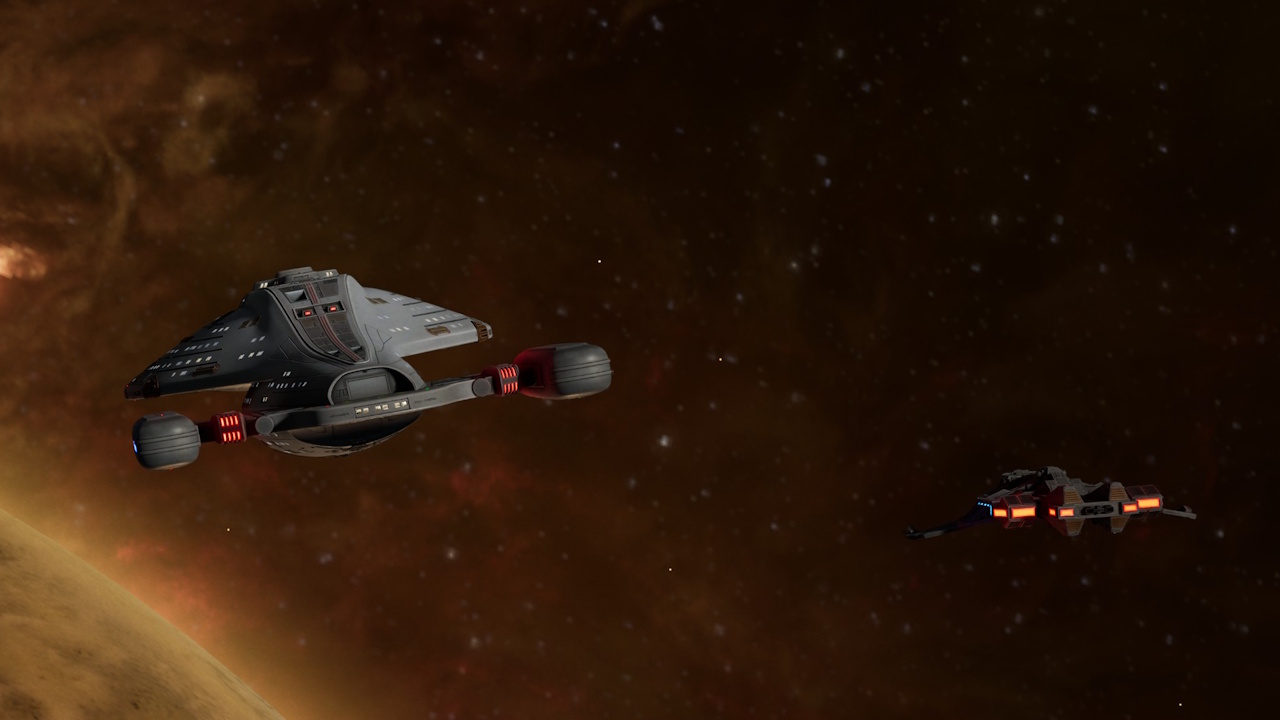
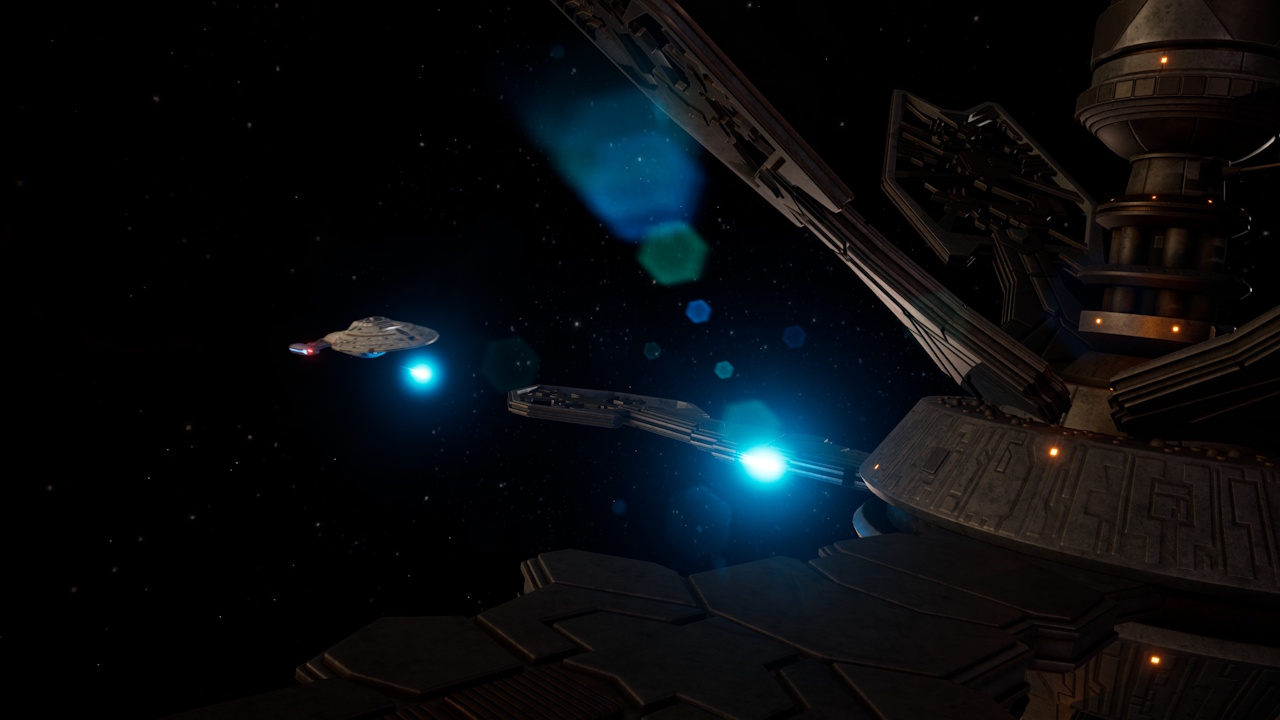
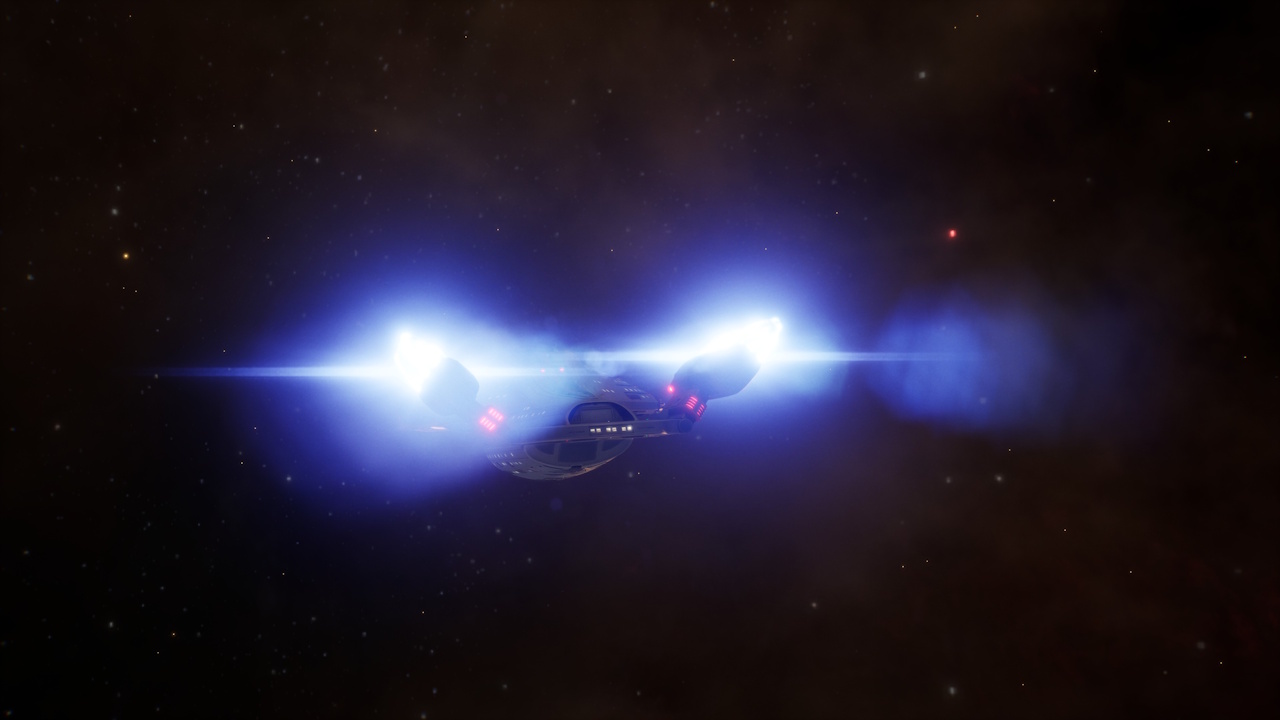
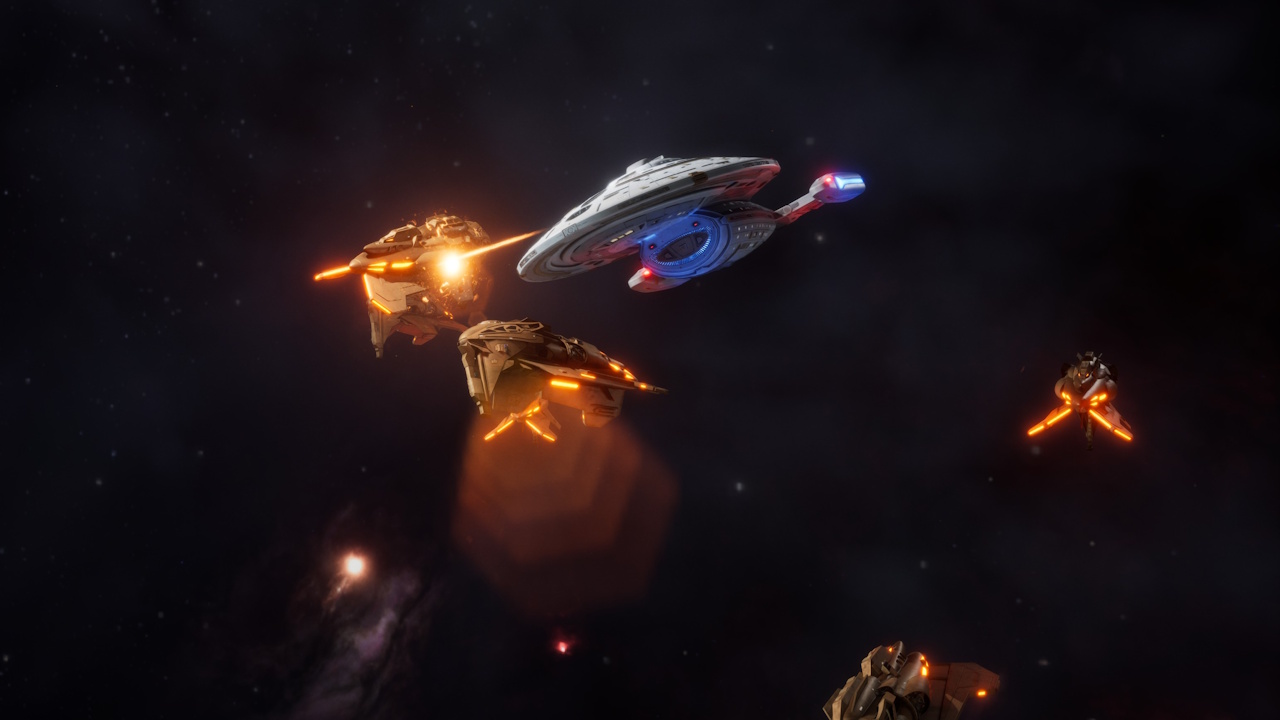
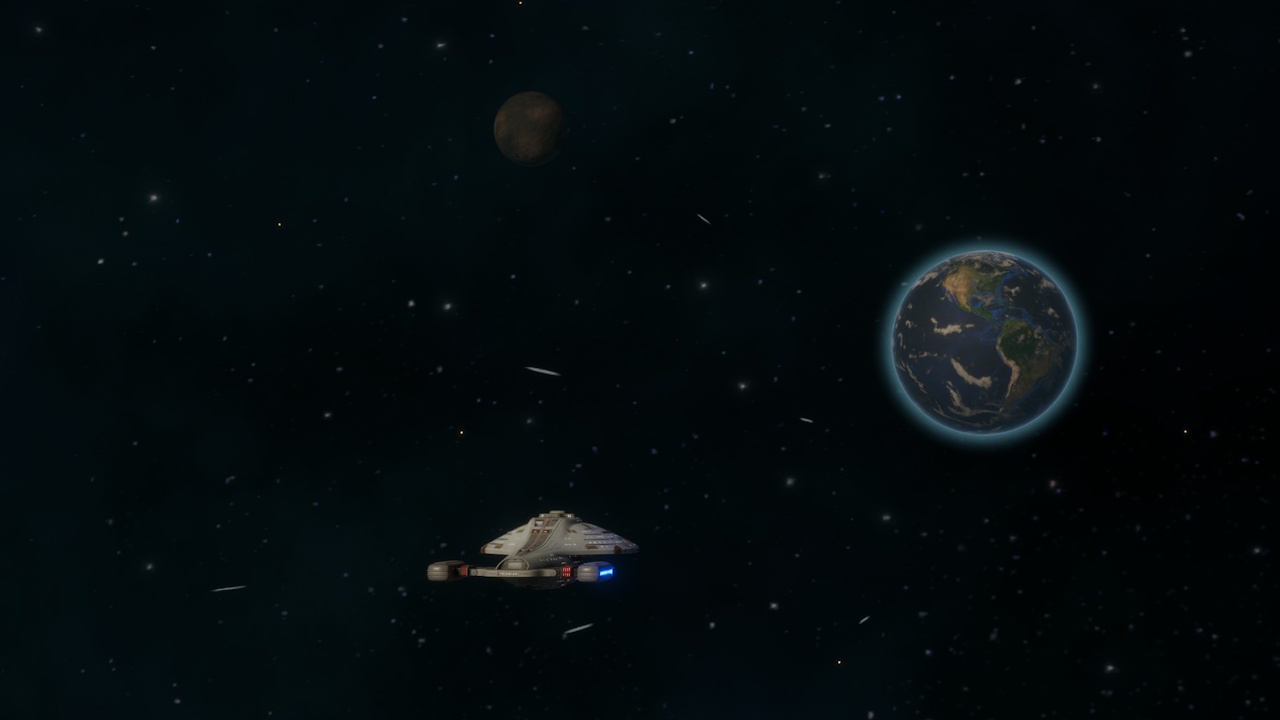
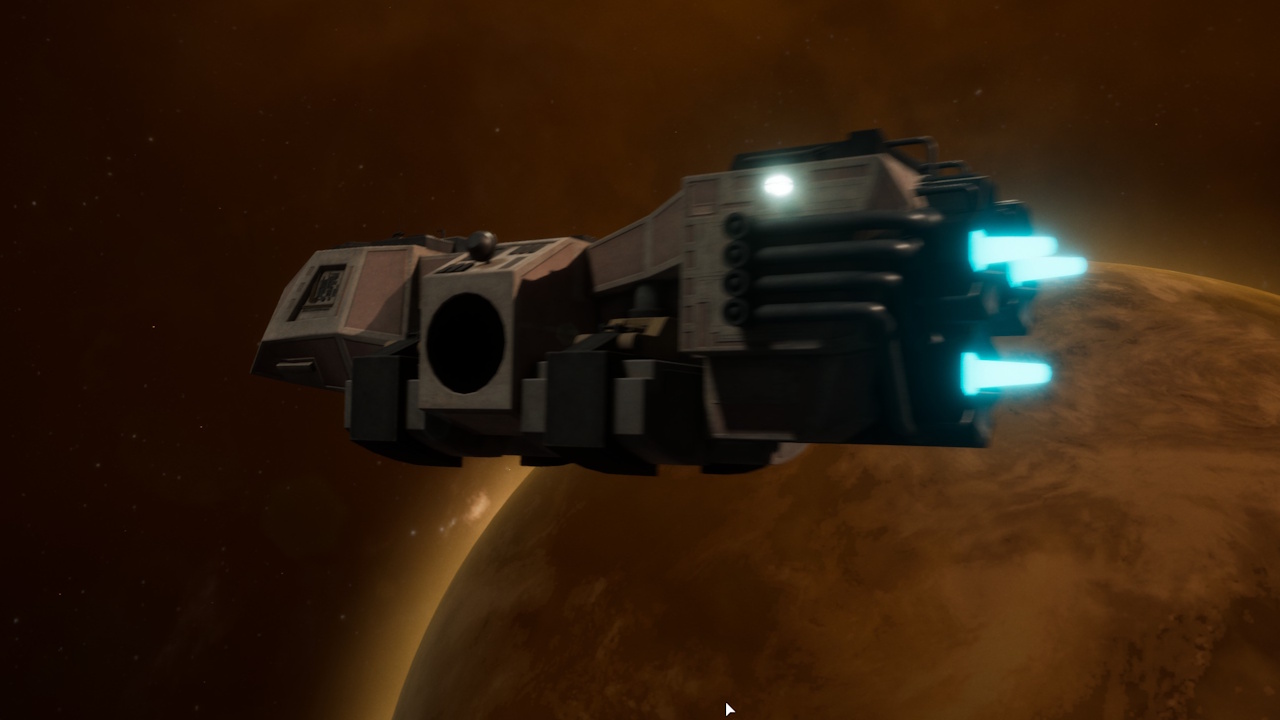
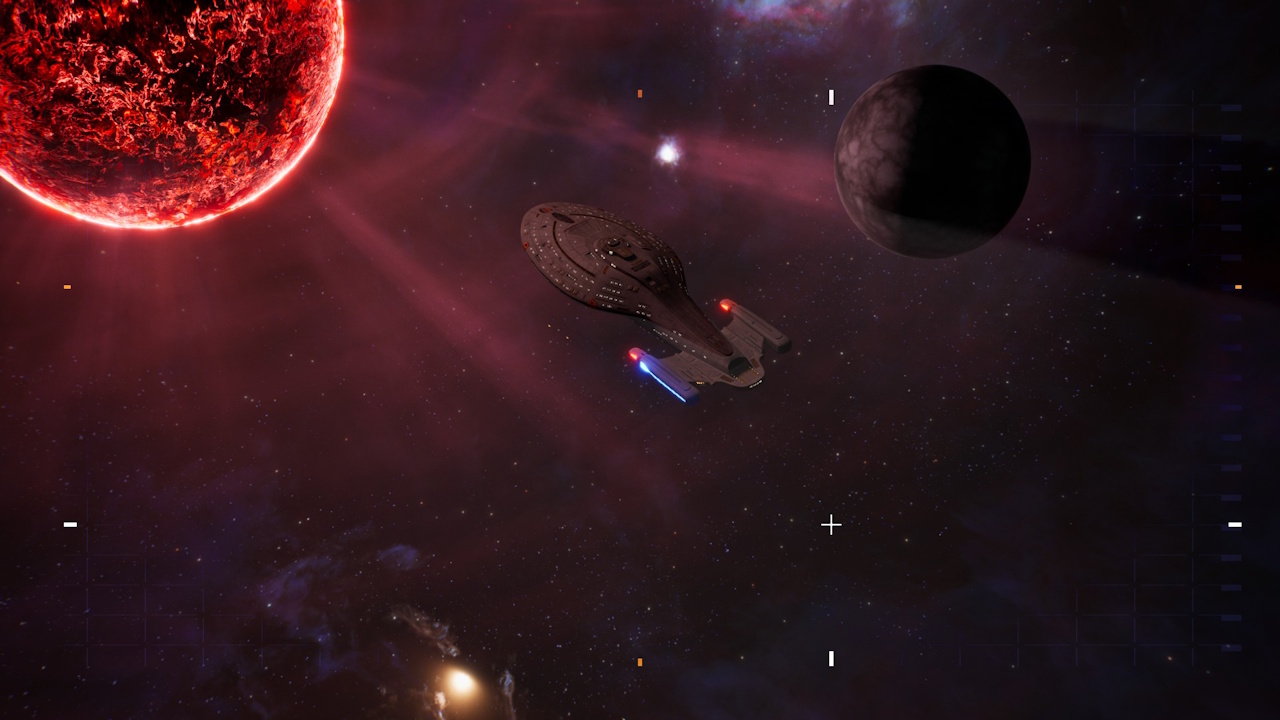
There are a few cut-scenes (or cinematics) in the game, all of which depict Voyager. The ship can be seen in flight, approaching points of interest, in combat, and so on. I cropped a few of these to be a bit more interesting/focused.
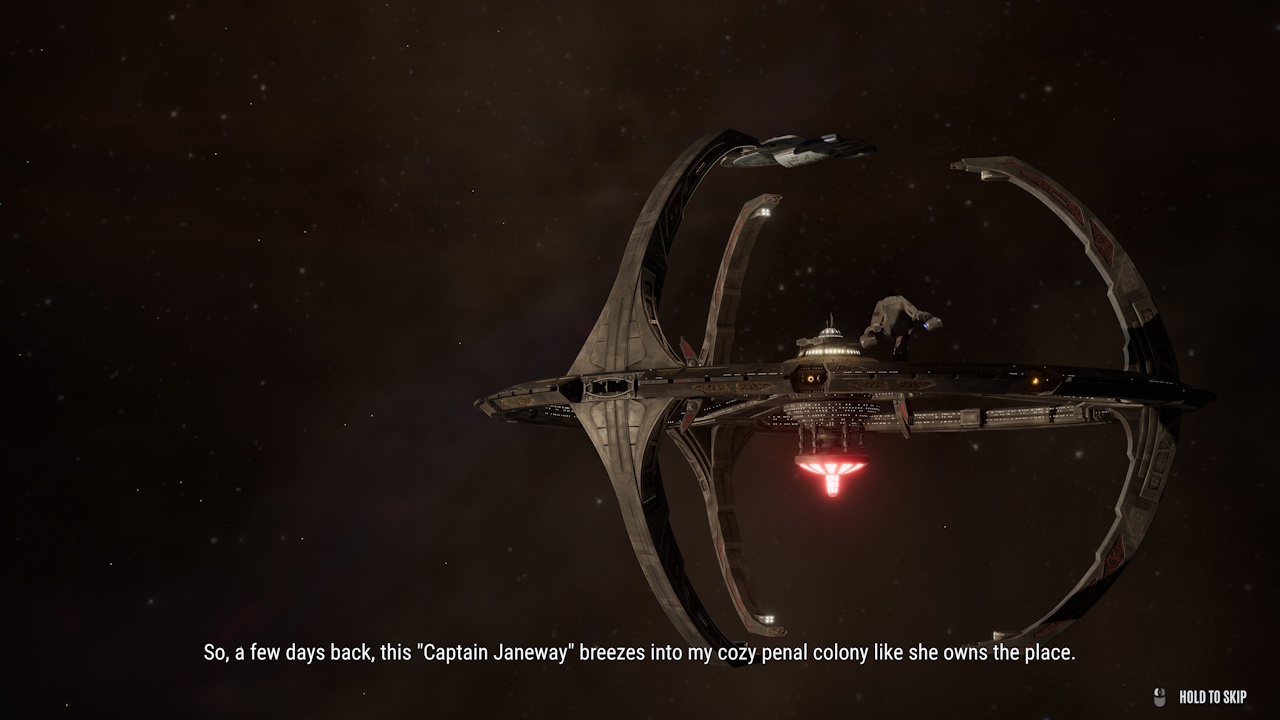
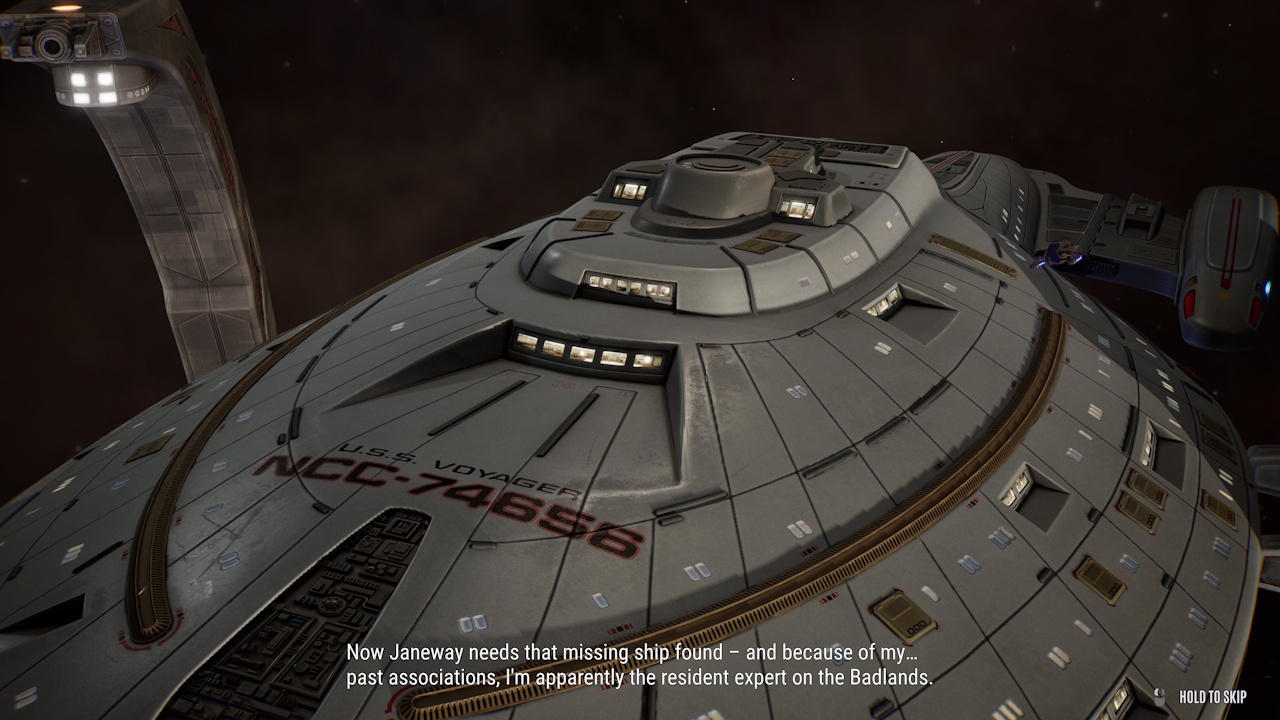
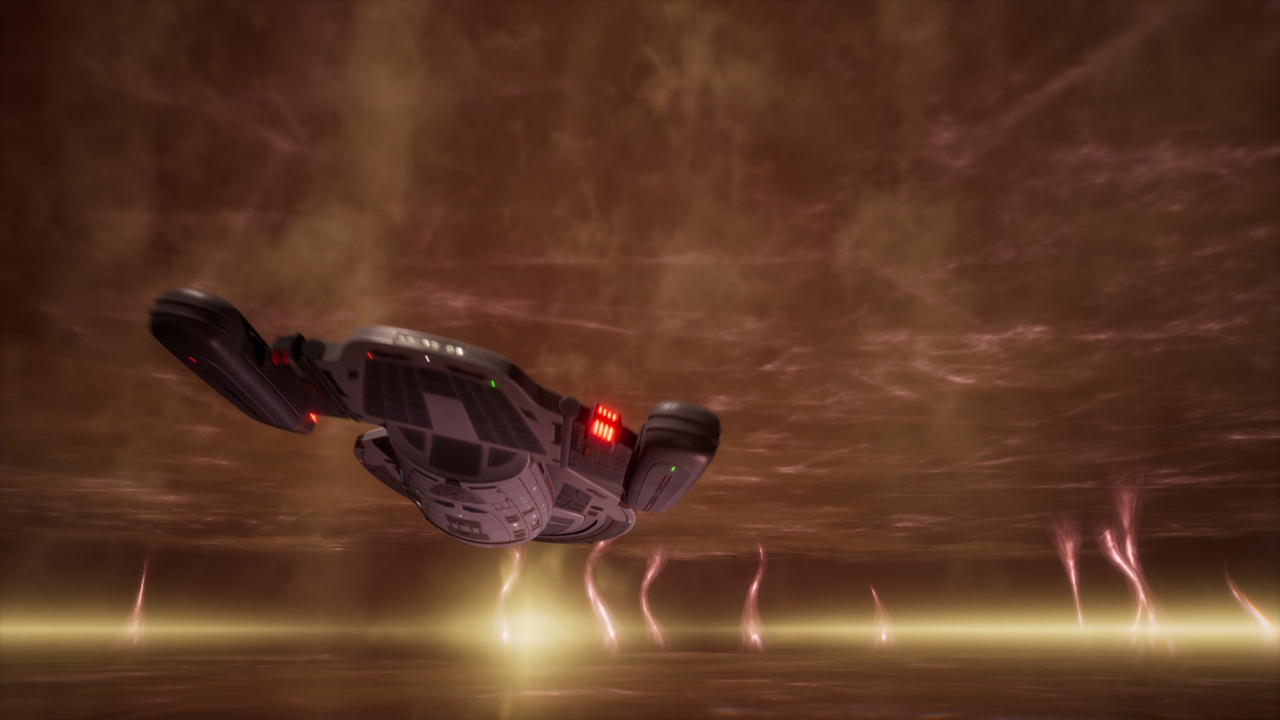
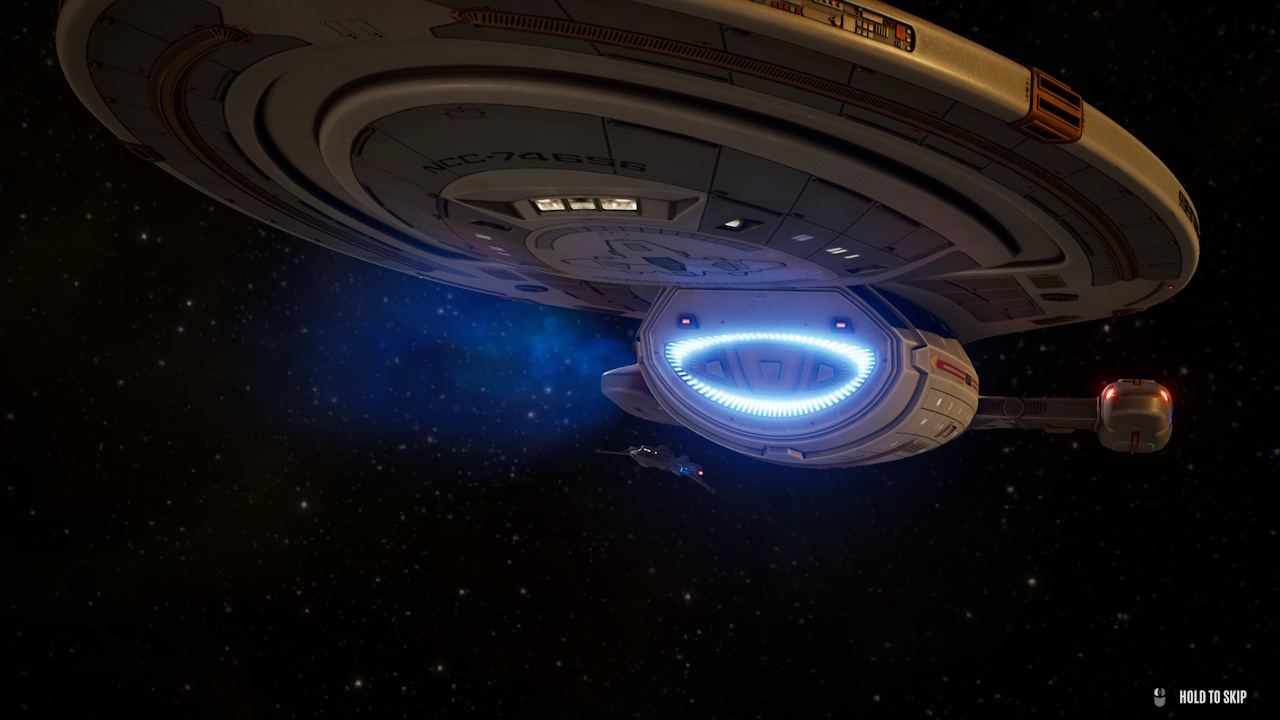
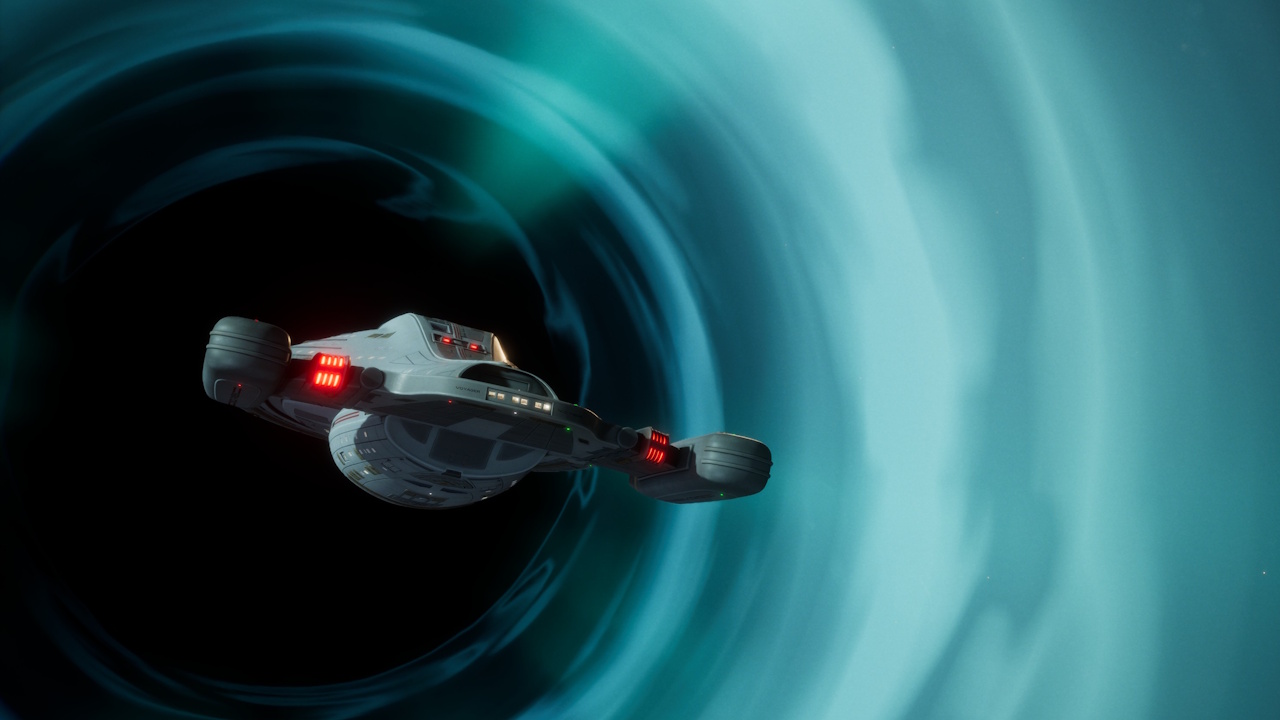
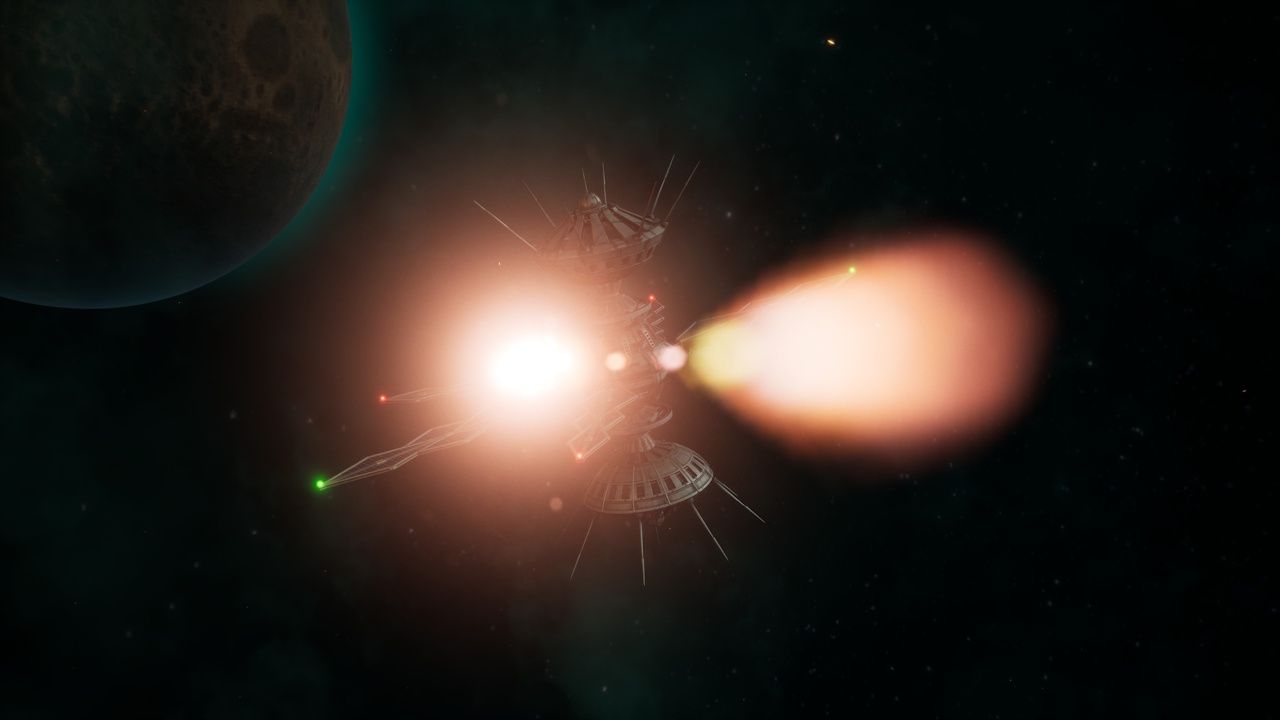
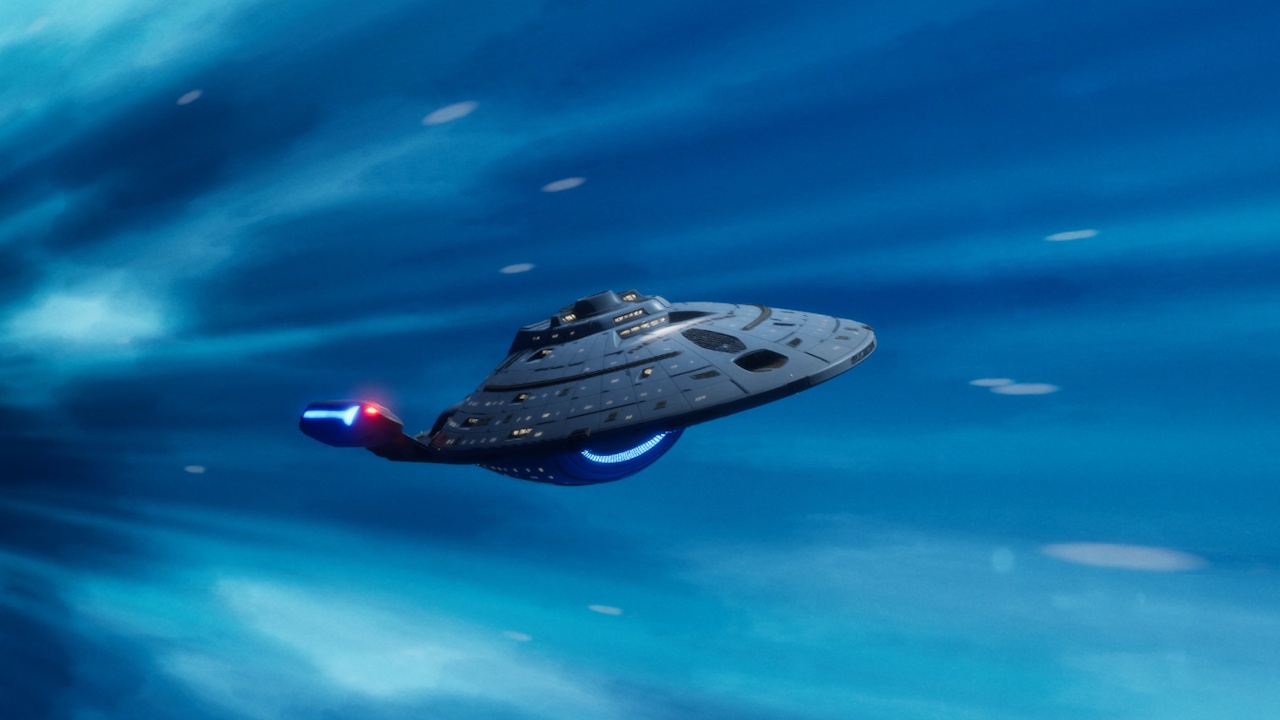
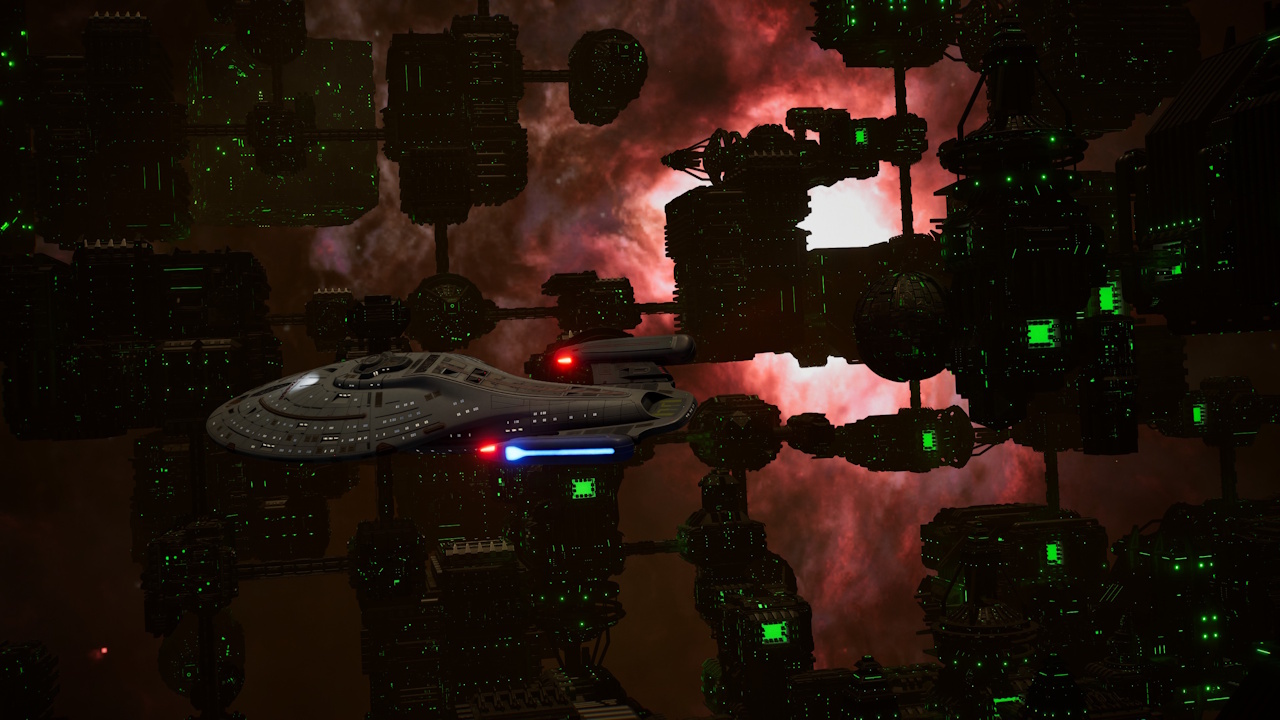
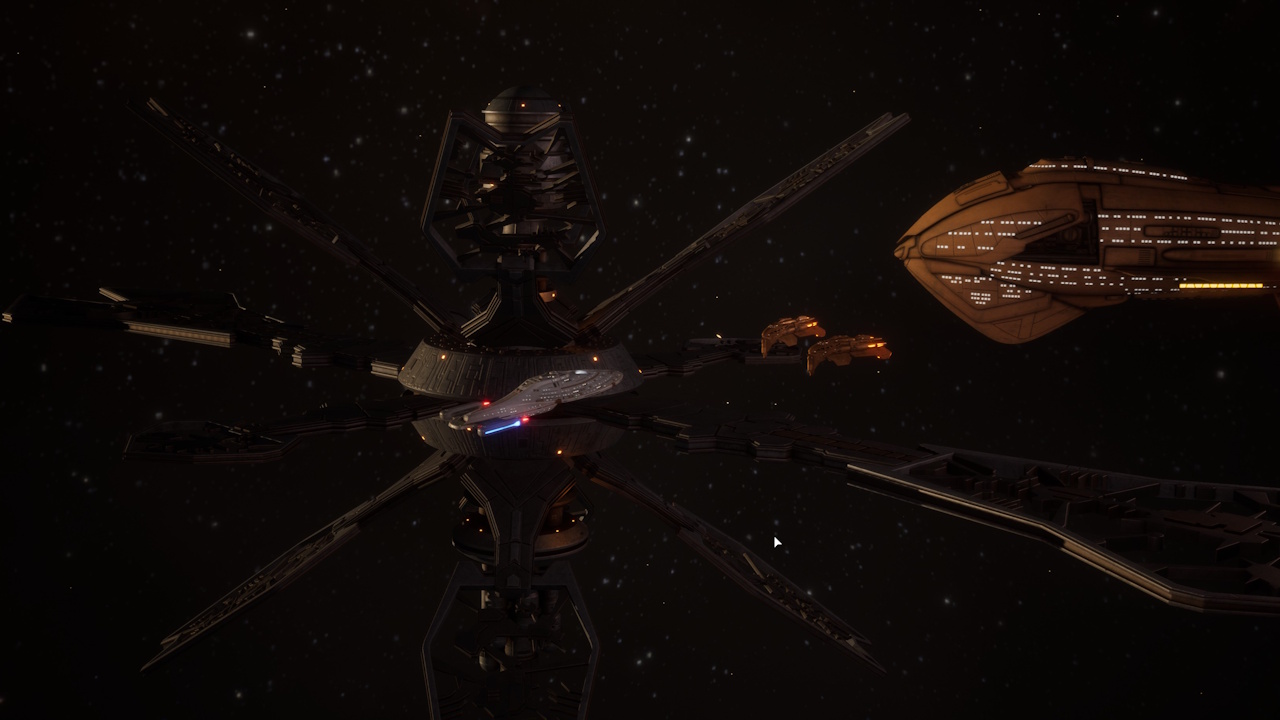
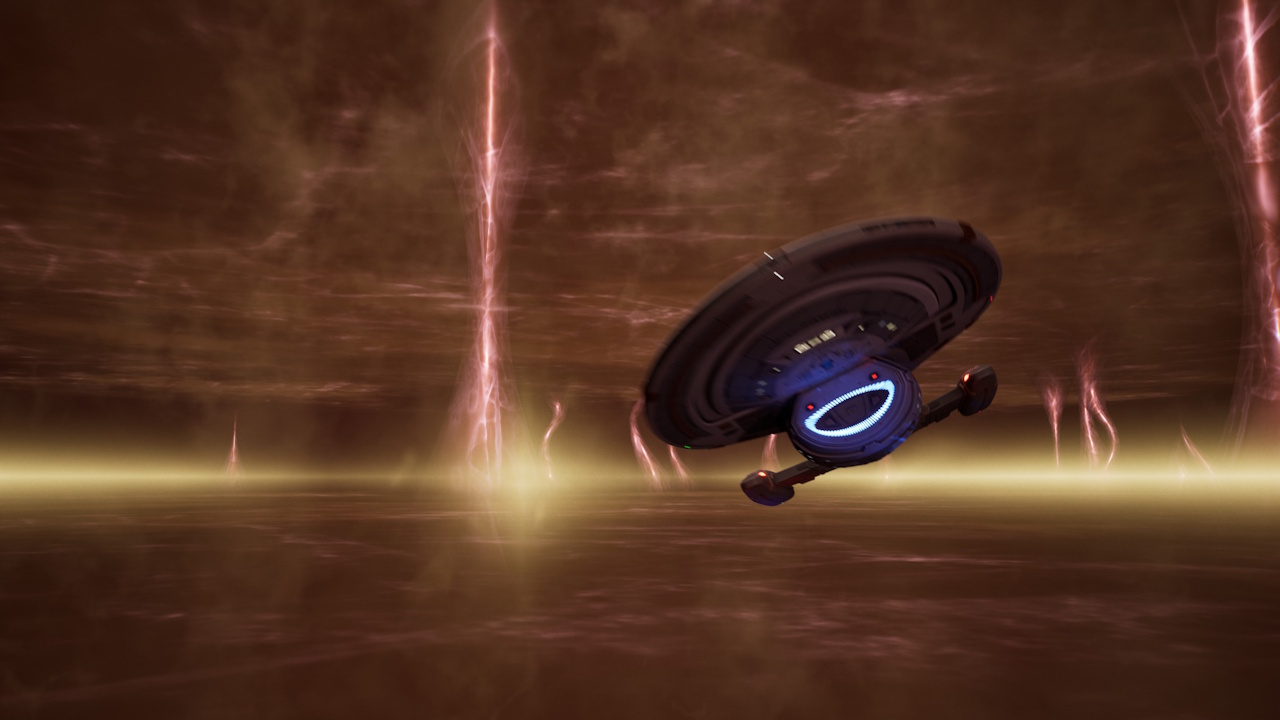
The opening cut-scene.Voyager at DS9.Voyager enters the Badlands.Voyager and the Val Jean.Neelix’s ship.Arriving in a new sector.Battling the Kazon.A Species 8472 bio-ship.Flying into a portal.A Hirogen station explodes.Slipstream.Escaping the Borg.Under attack!A surprise in the nebula…Approaching the transwarp hub.Destroying the transwarp hub.A bad outcome!
Tom’s shuttle.En route to the Badlands.The displacement wave.Arriving at Ocampa.Destroying the Array.Jumping to warp.The battle rages on…Borg Cubes.Orbiting a planet.The “USS Dauntless.”Arriving at Unimatrix-01.Using a transwarp coil.The USS Equinox.The Klingons arrive.Voyager’s ablative armour.Inside the transwarp network.Back to Earth.
Away Missions:
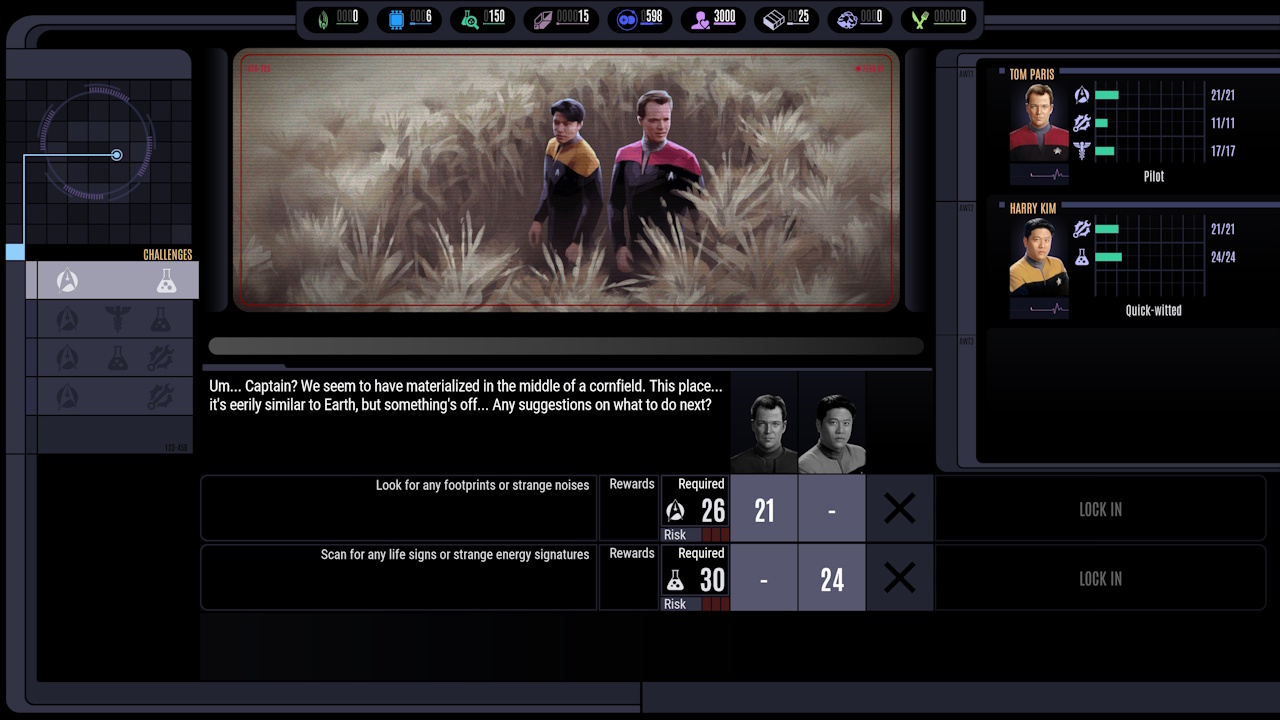
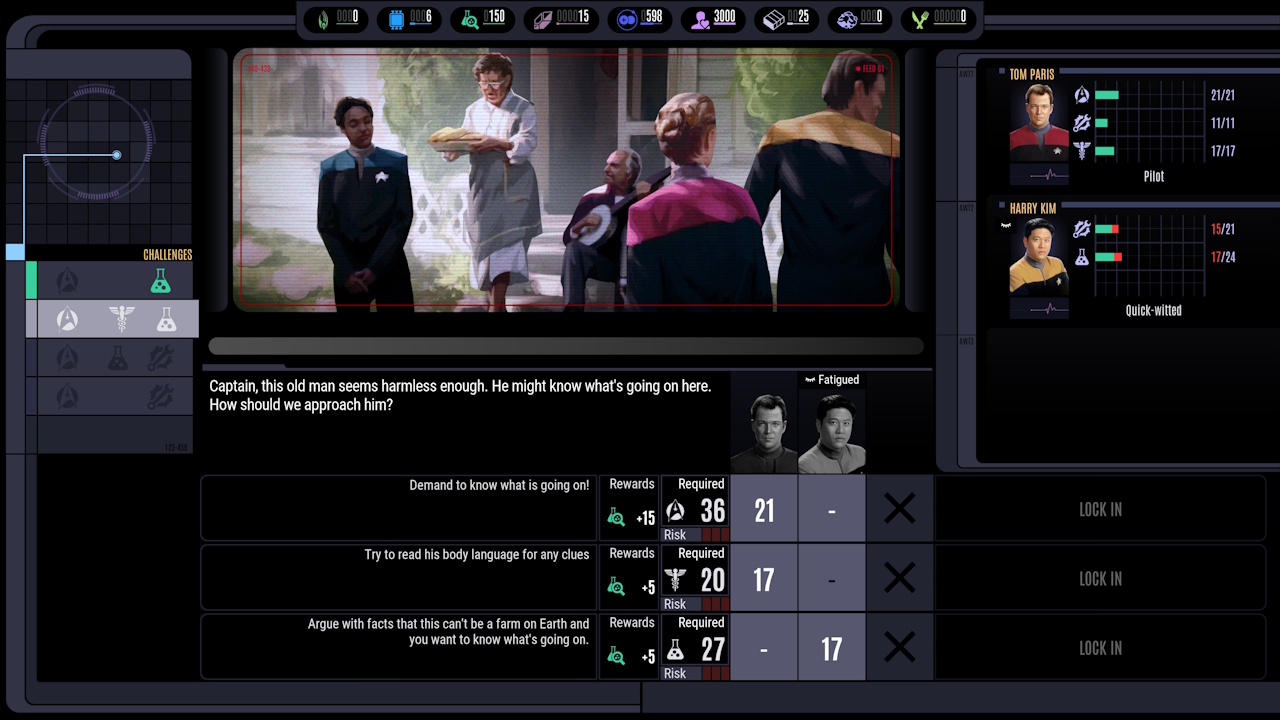
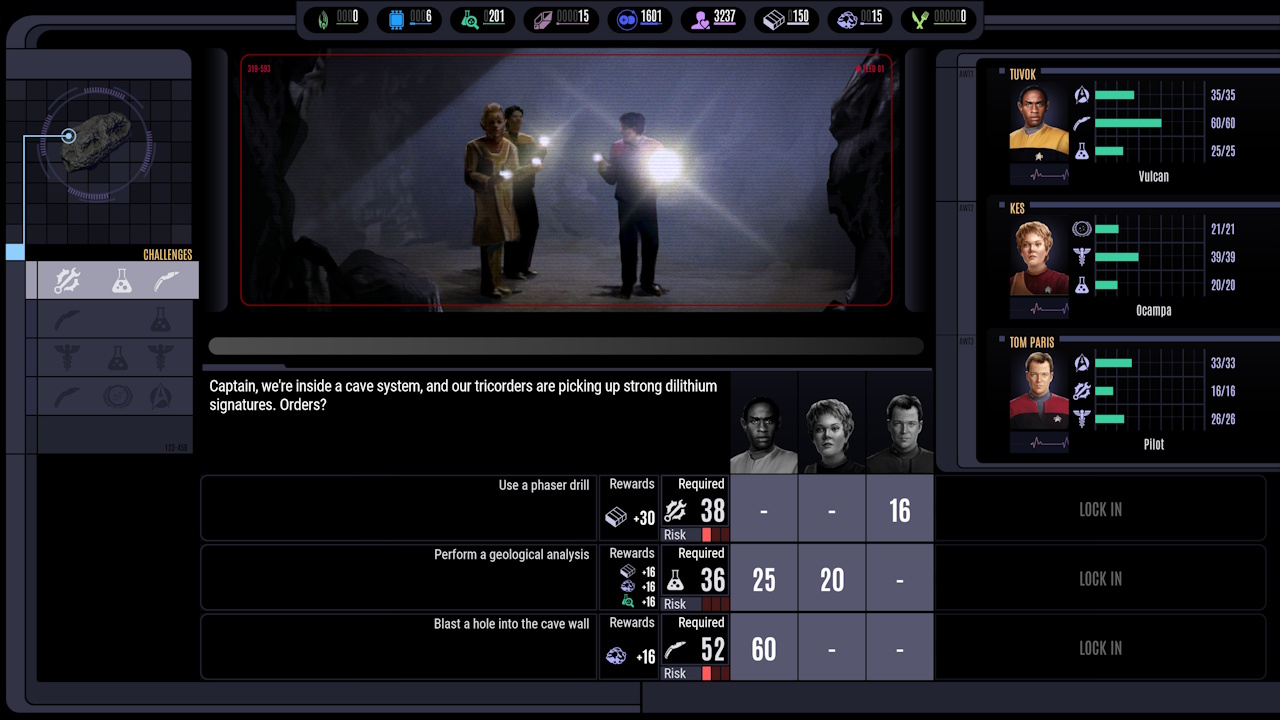
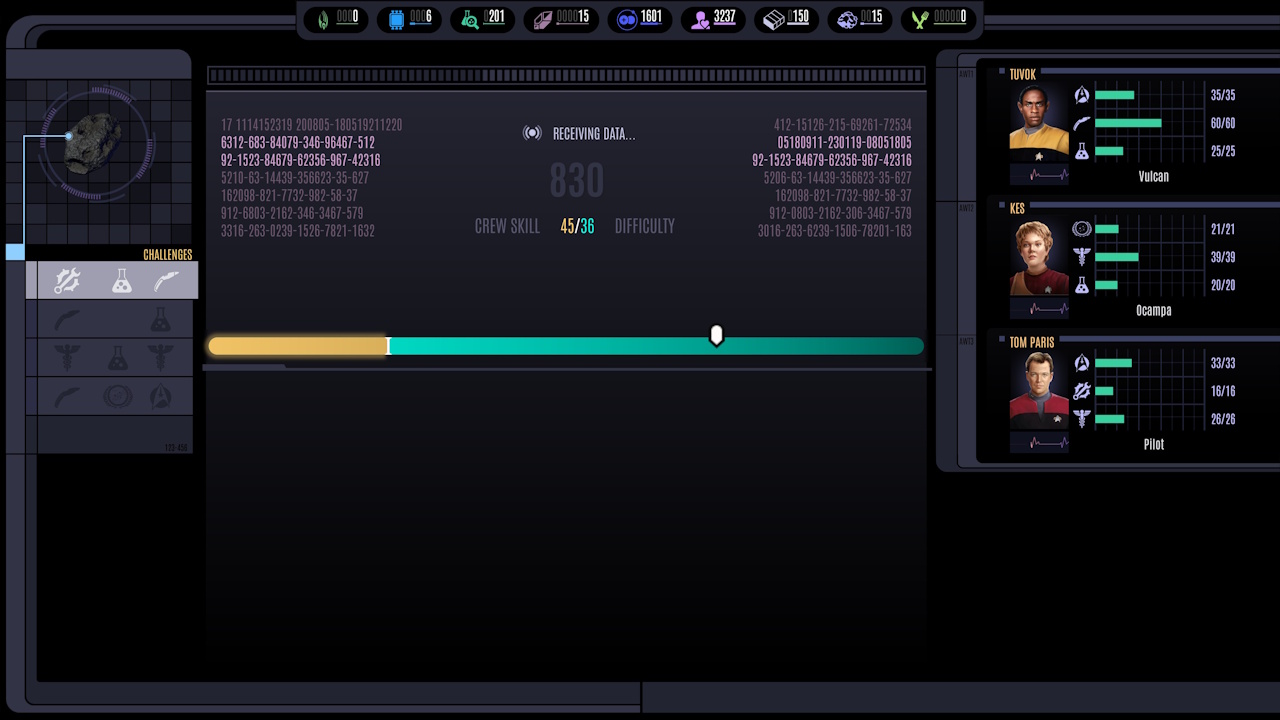
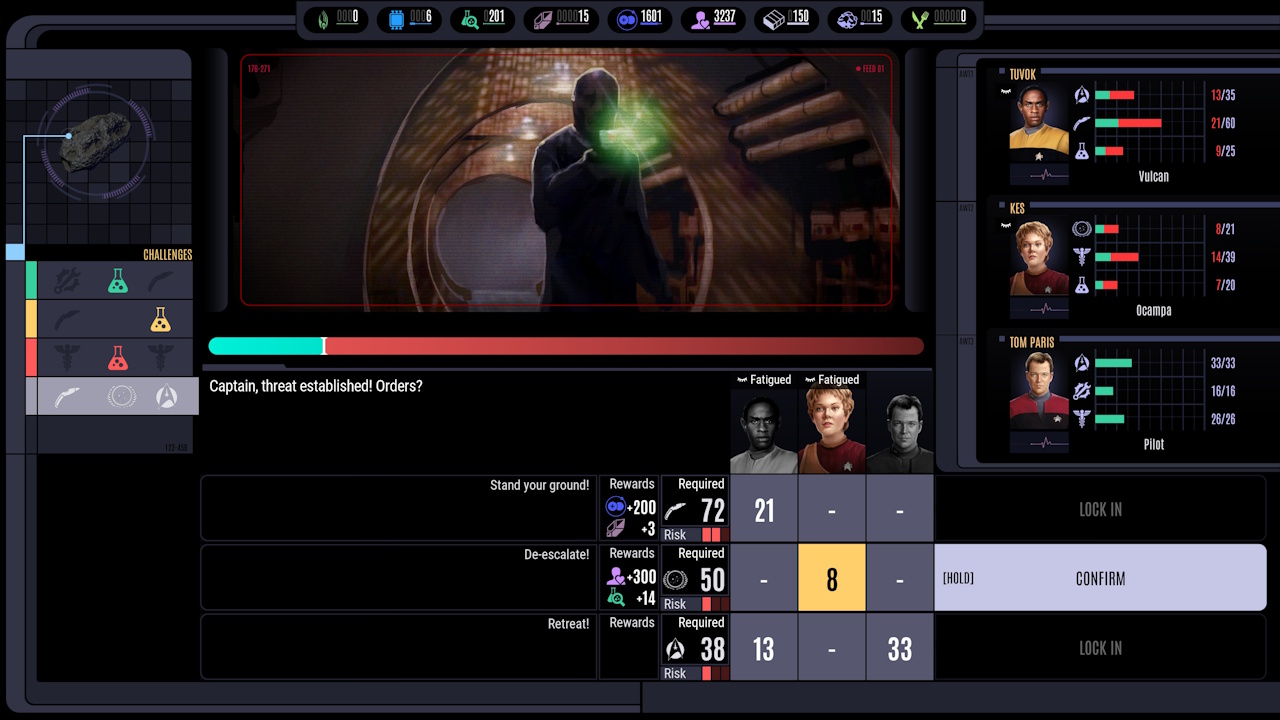
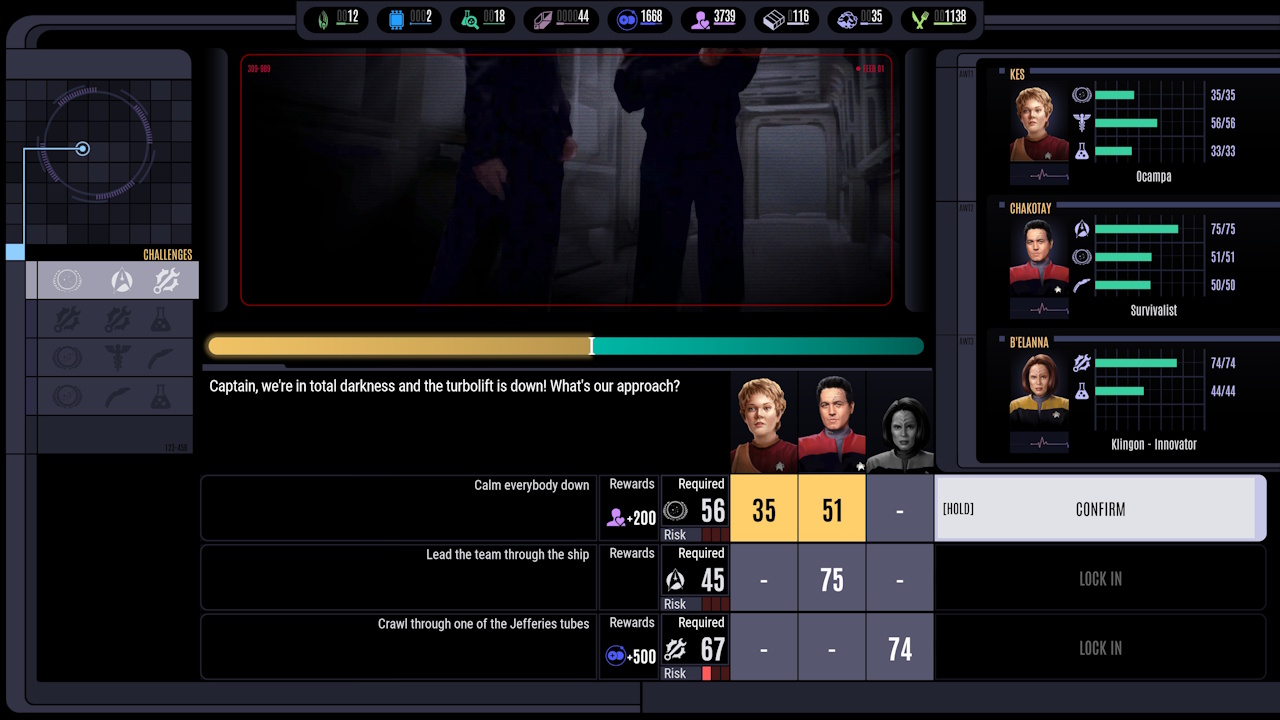
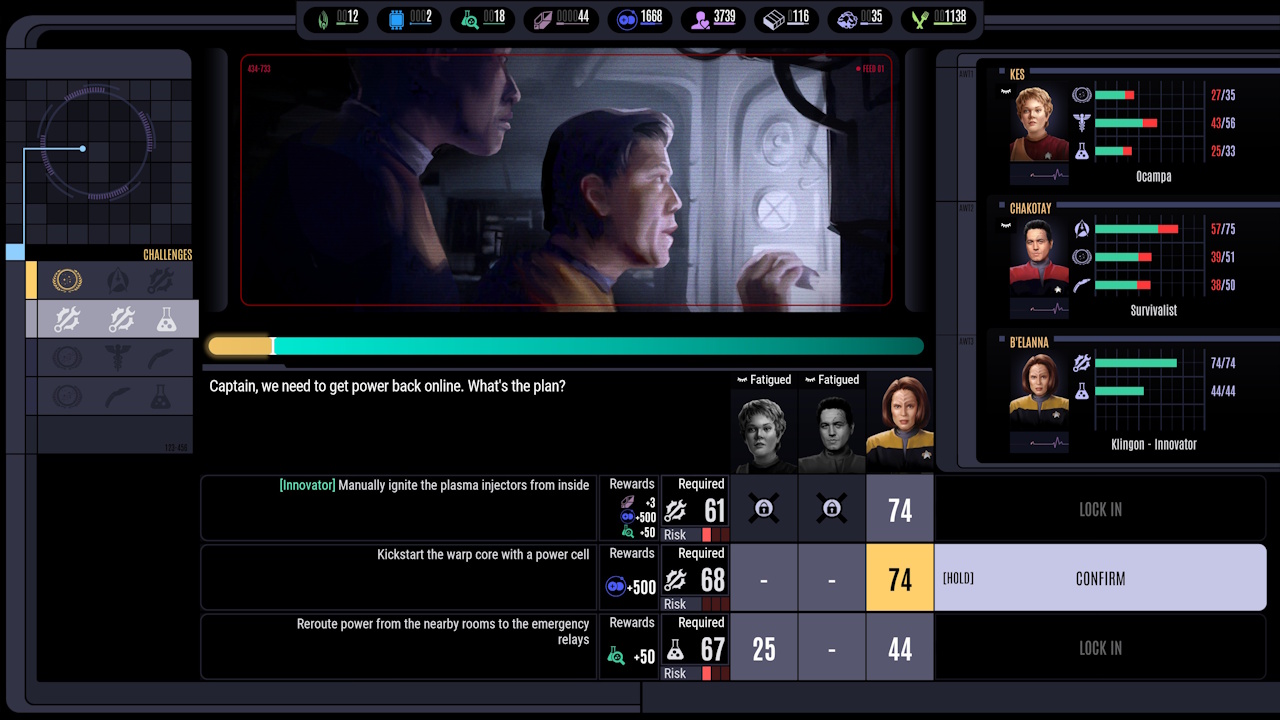
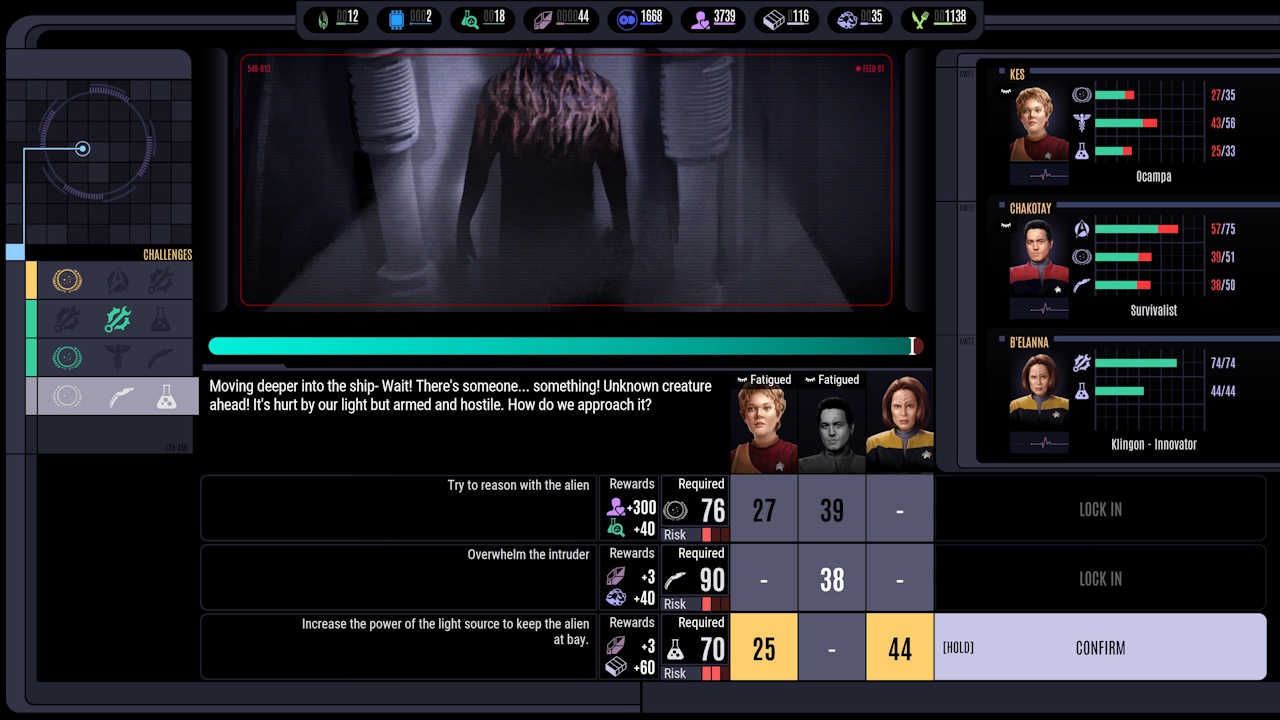
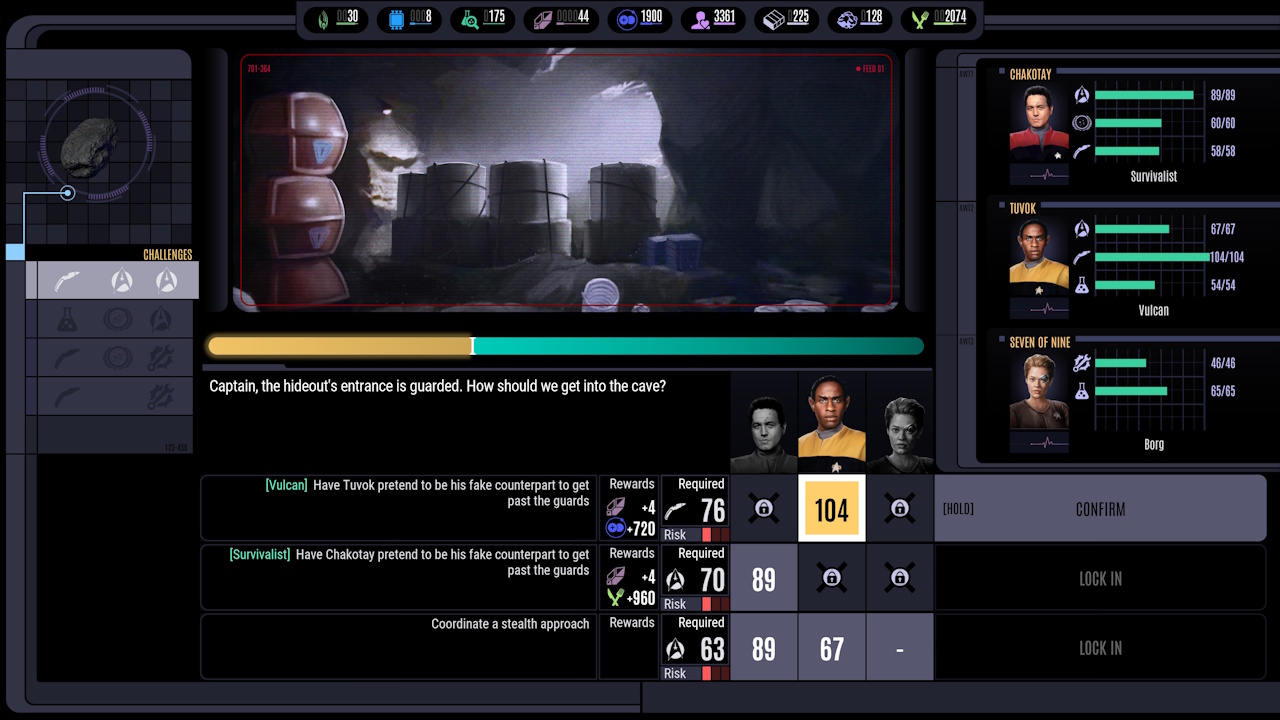
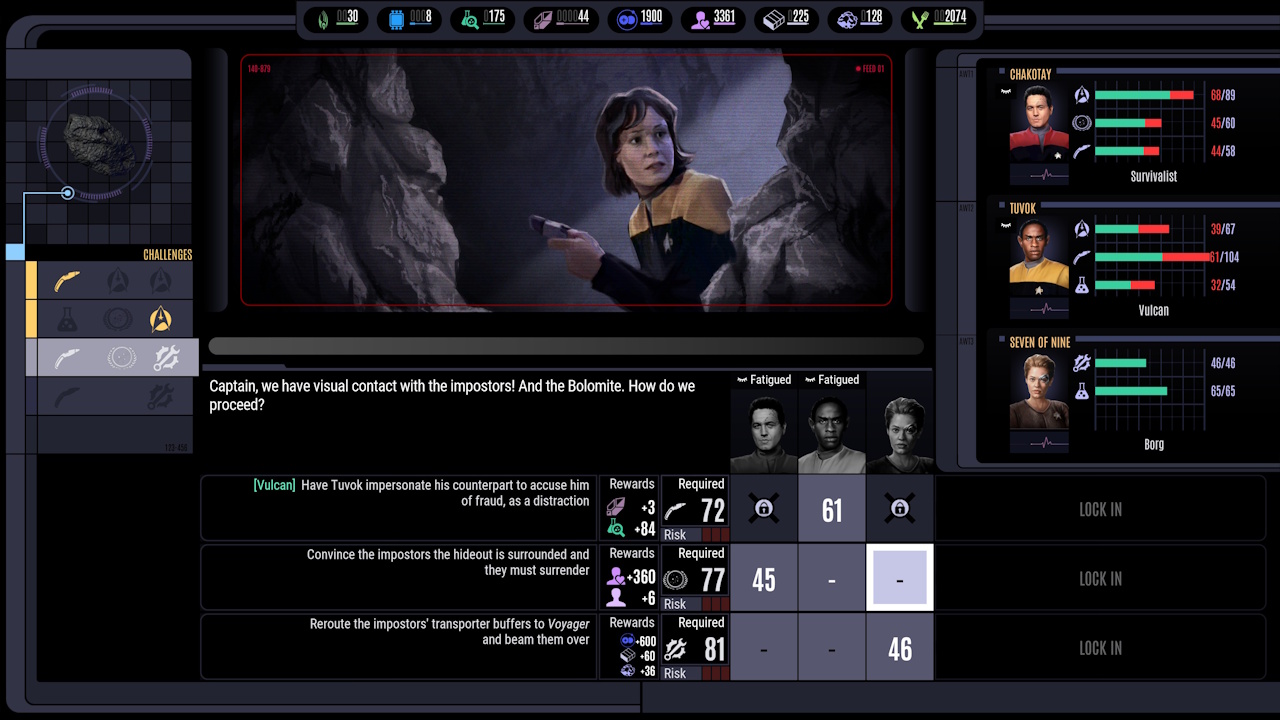
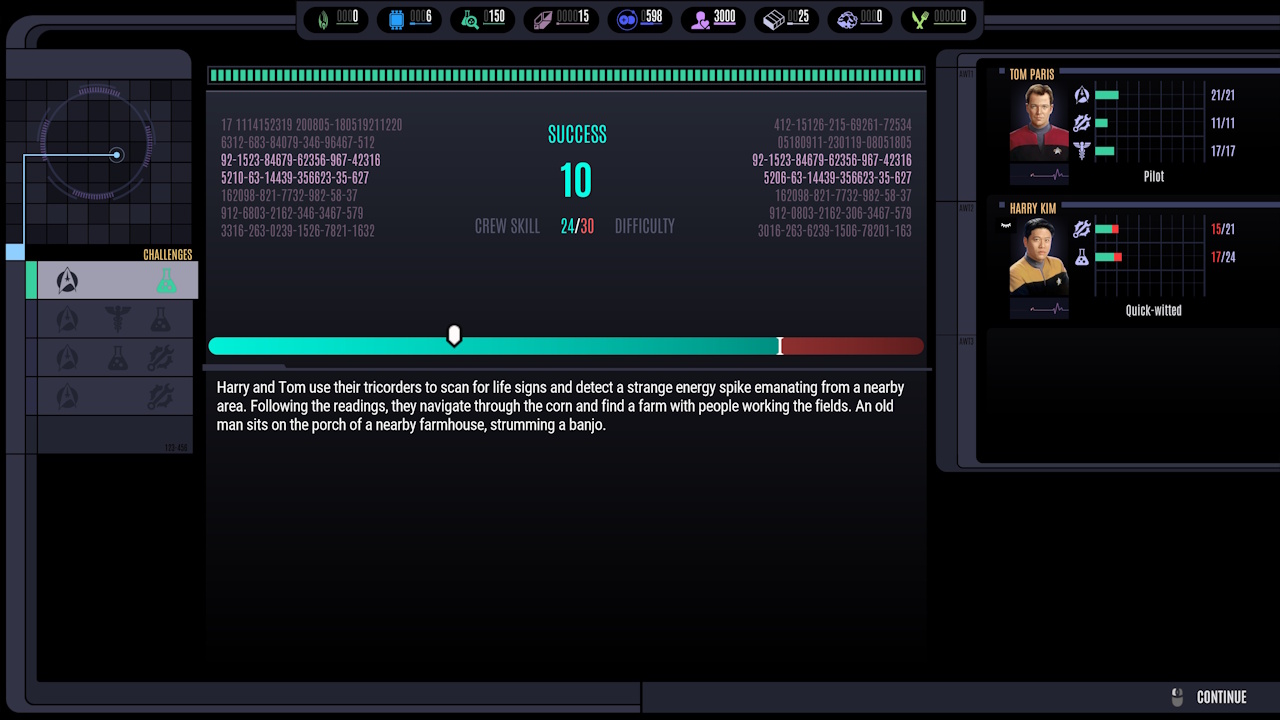
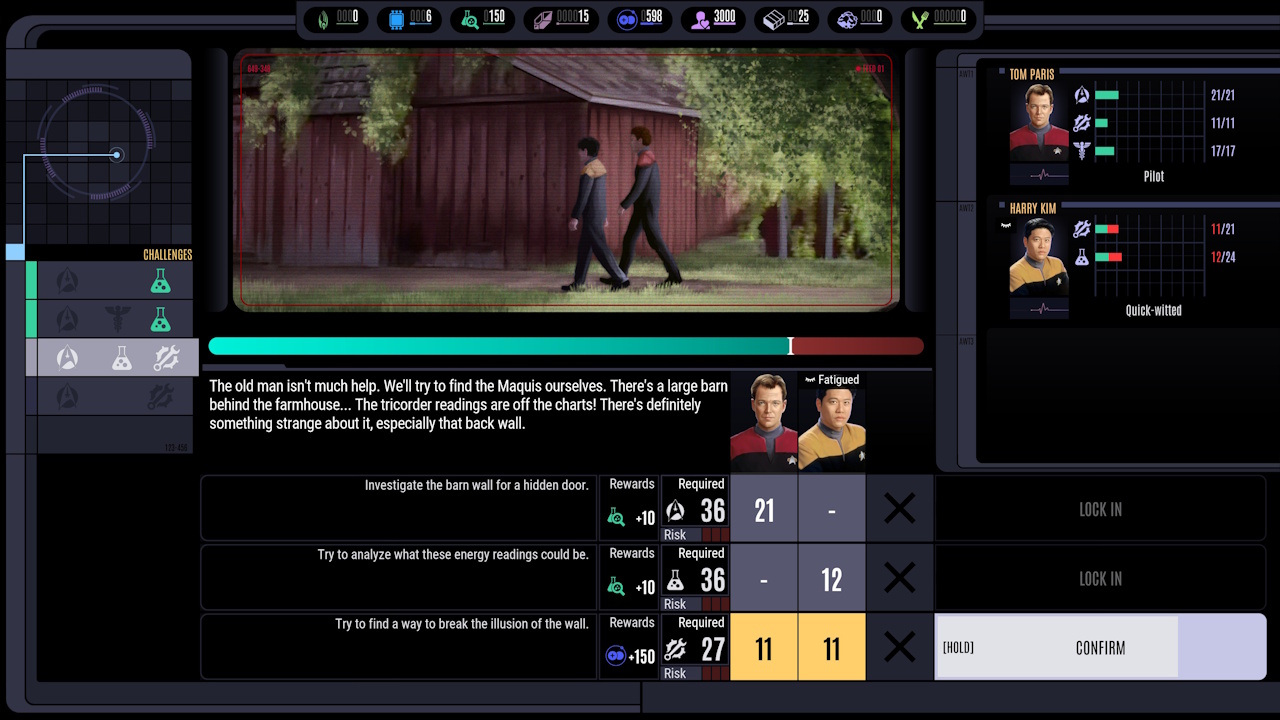
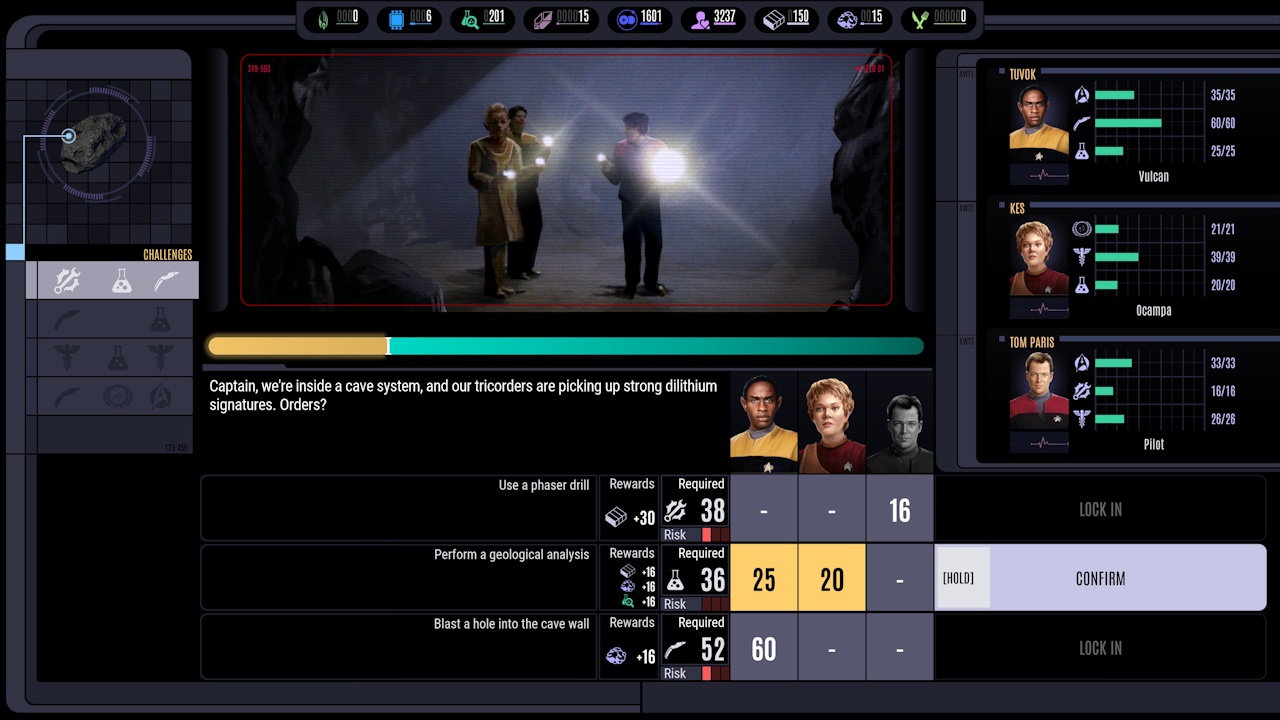
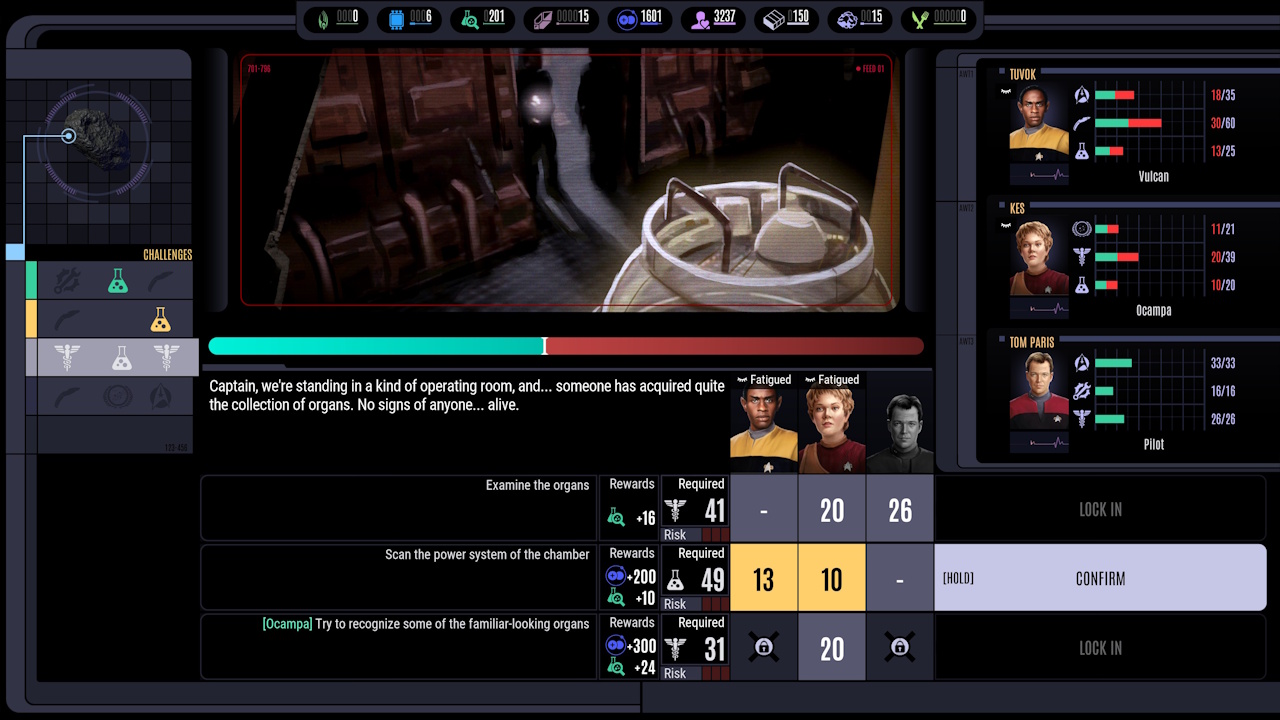
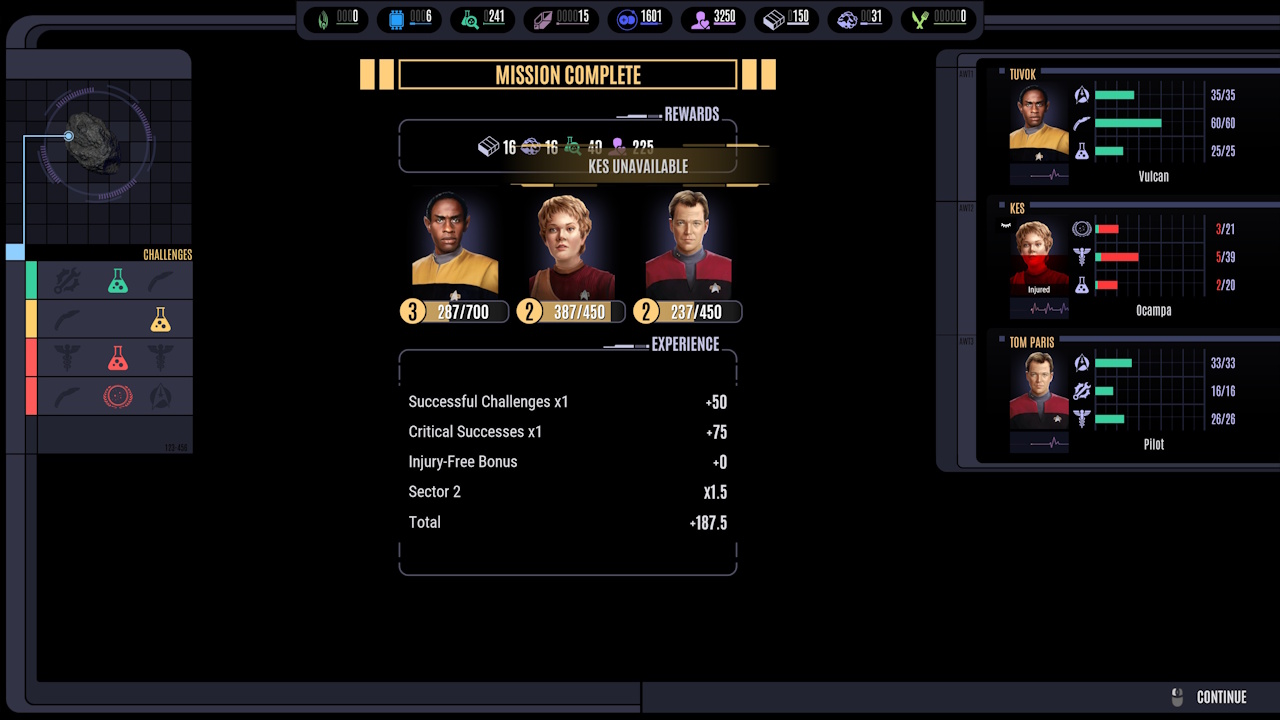
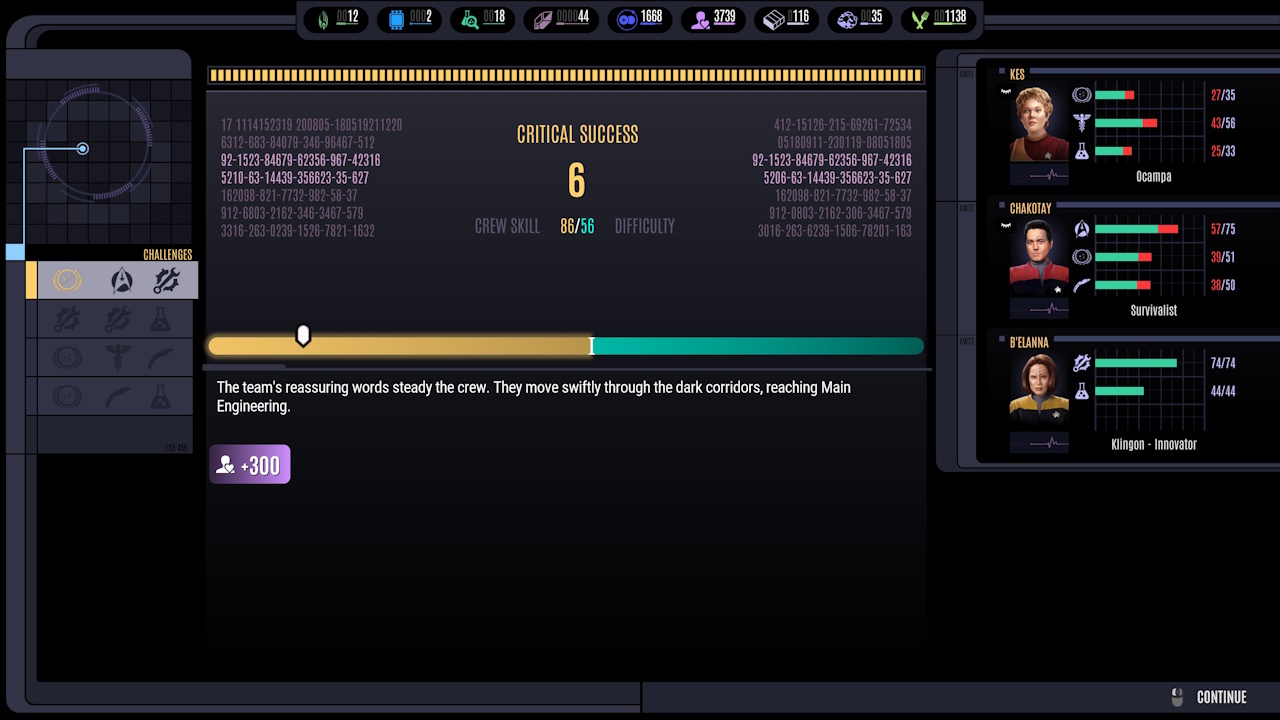
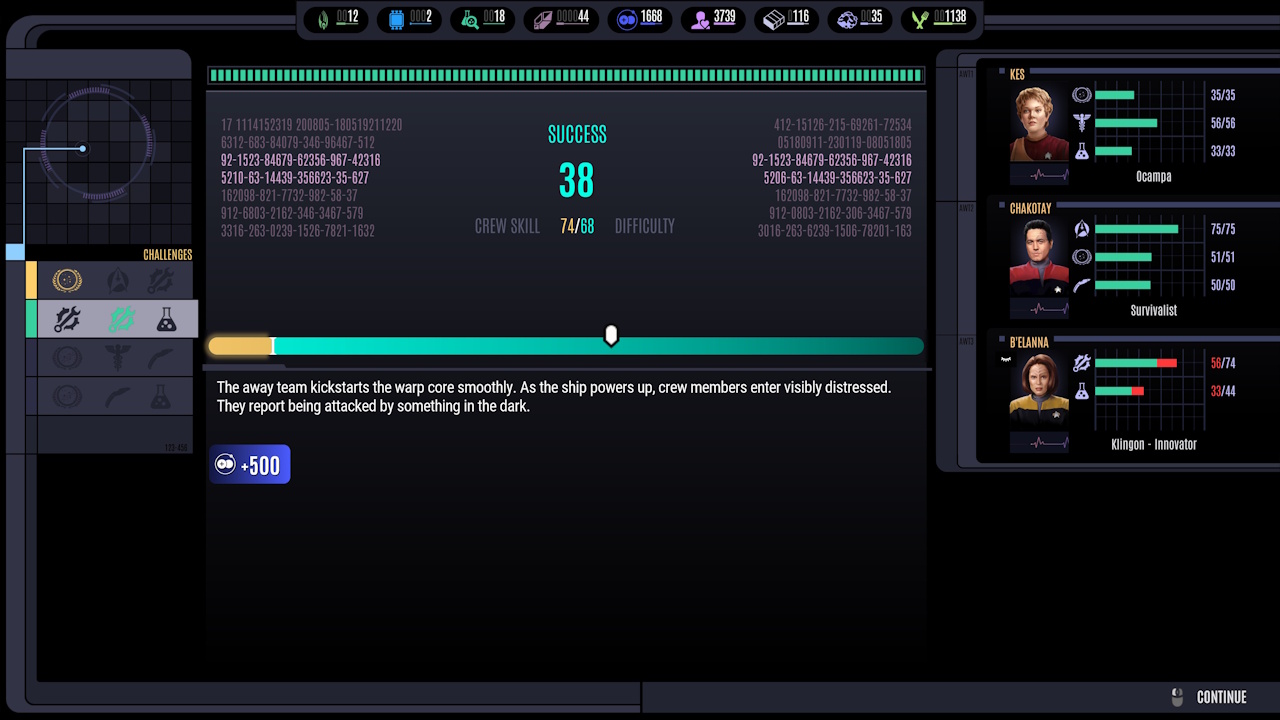
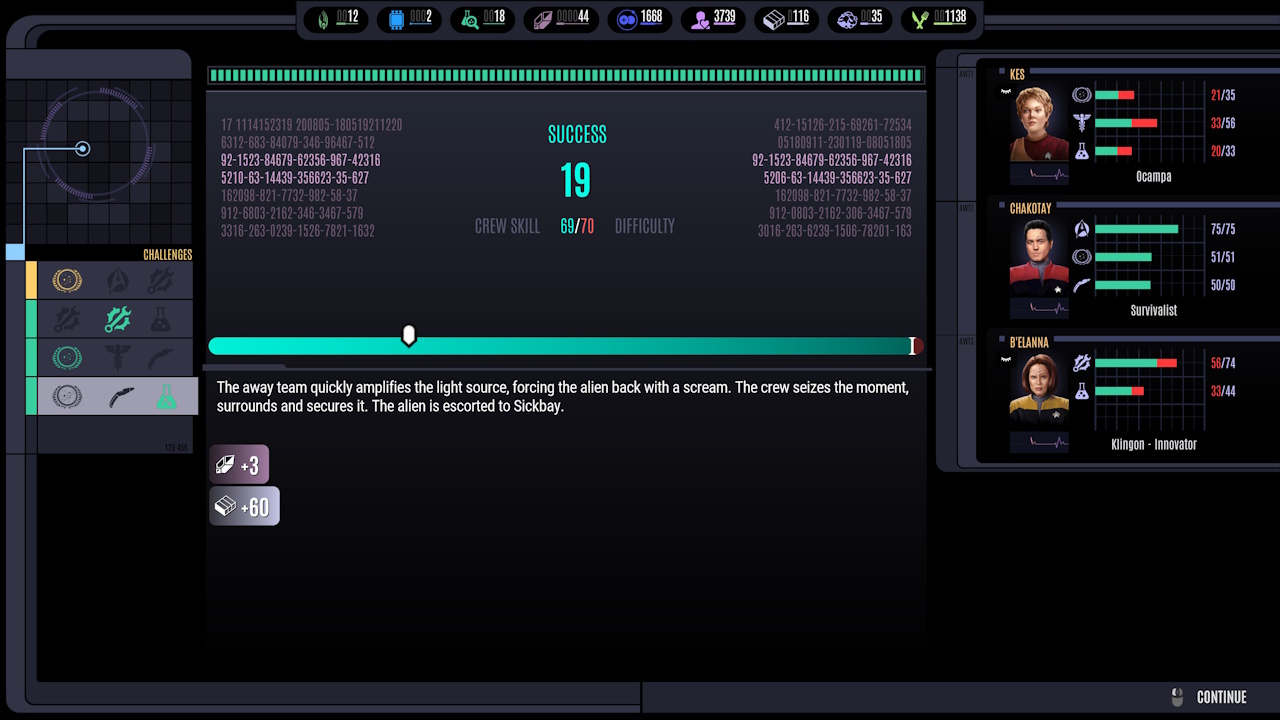
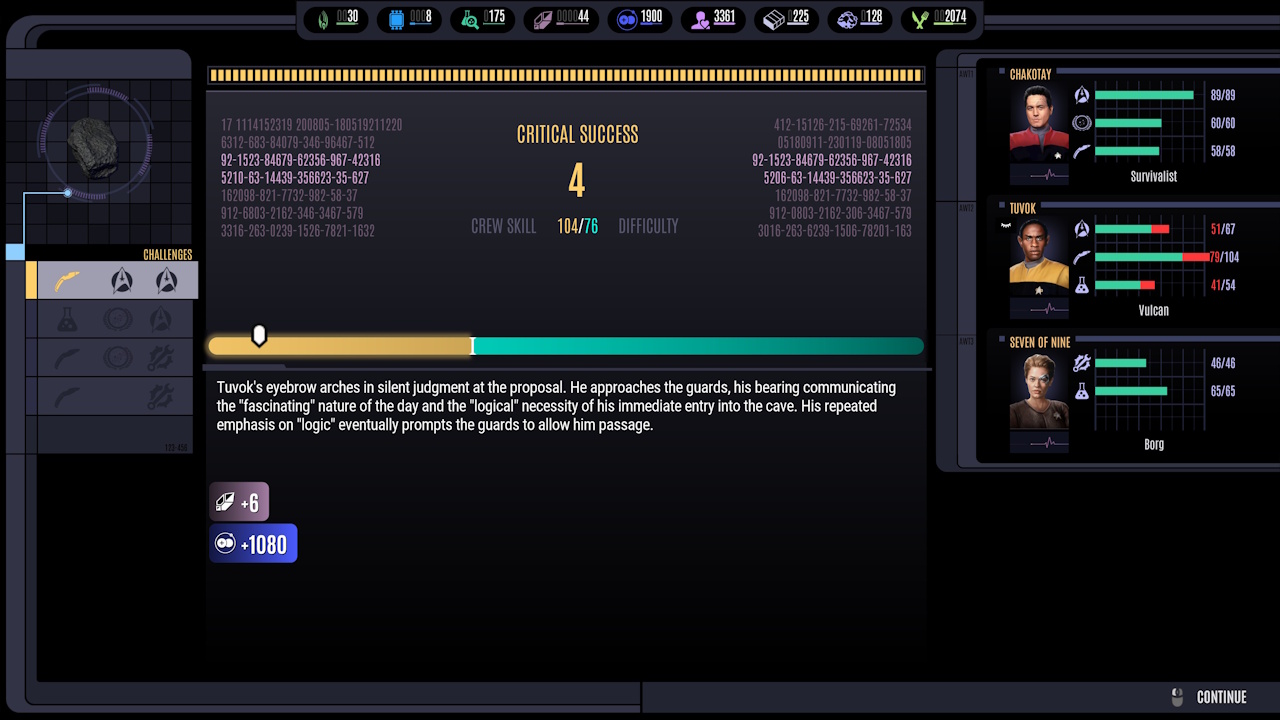
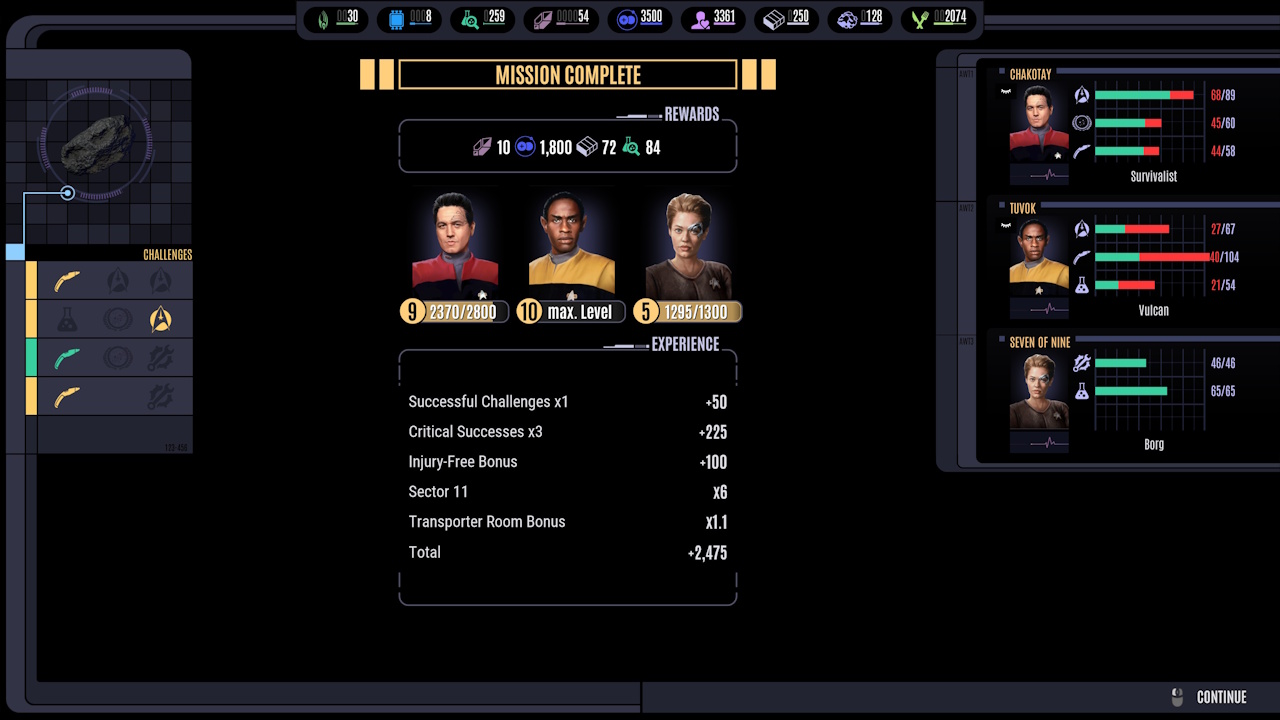
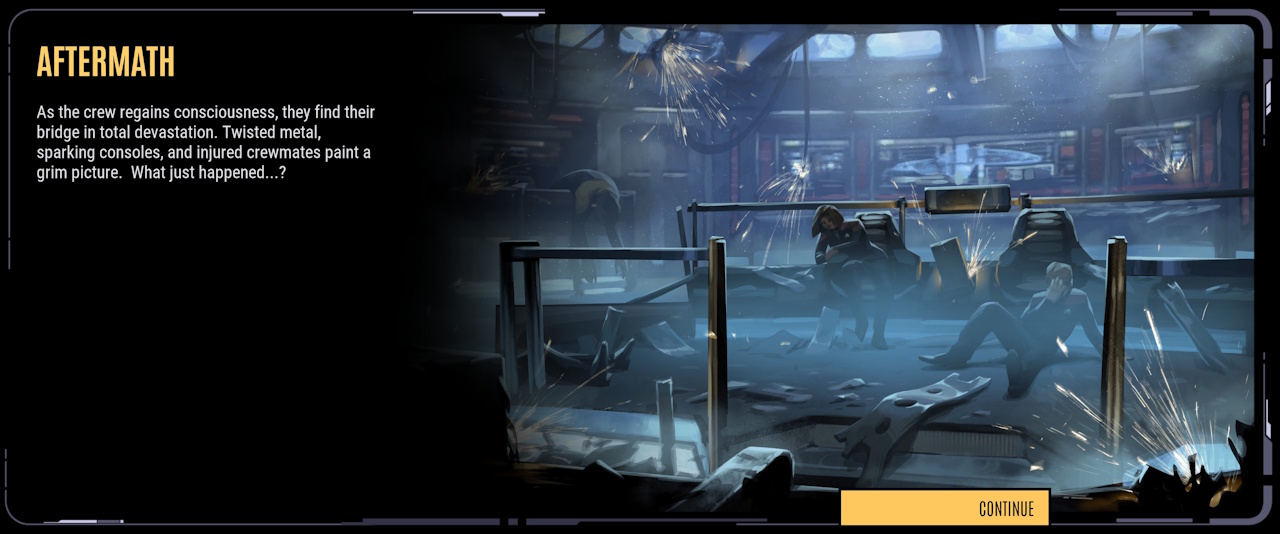
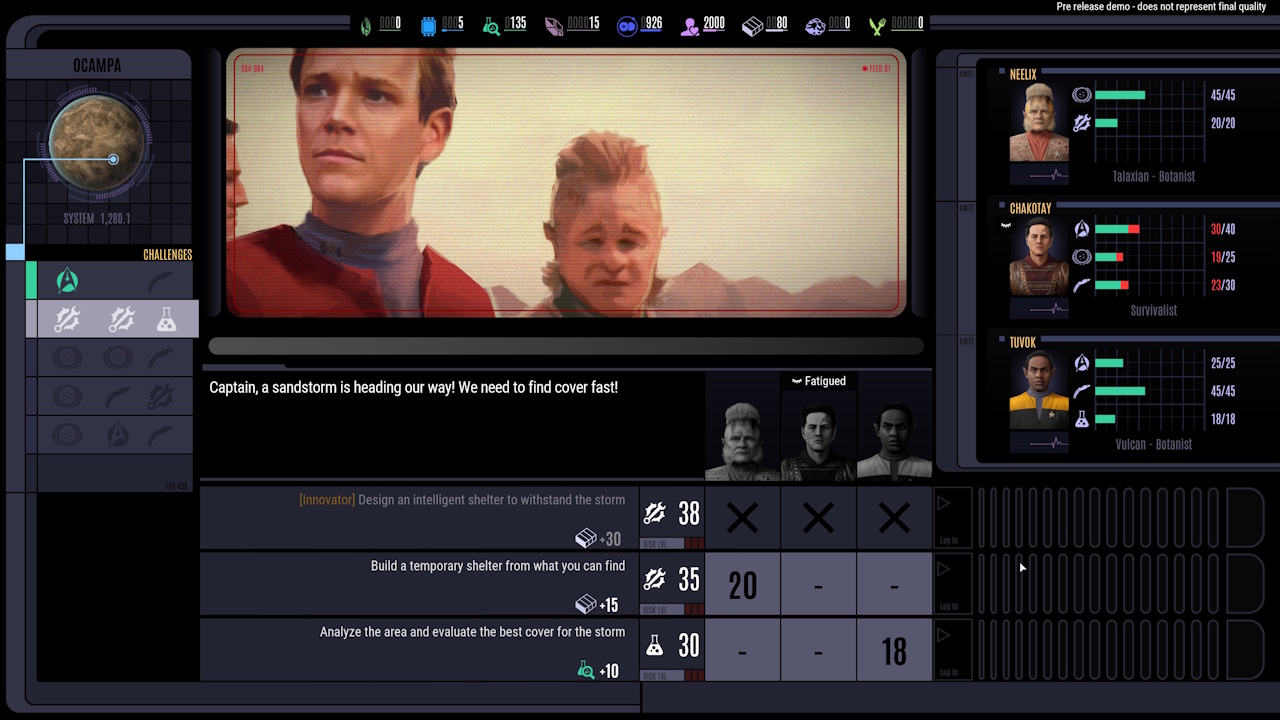
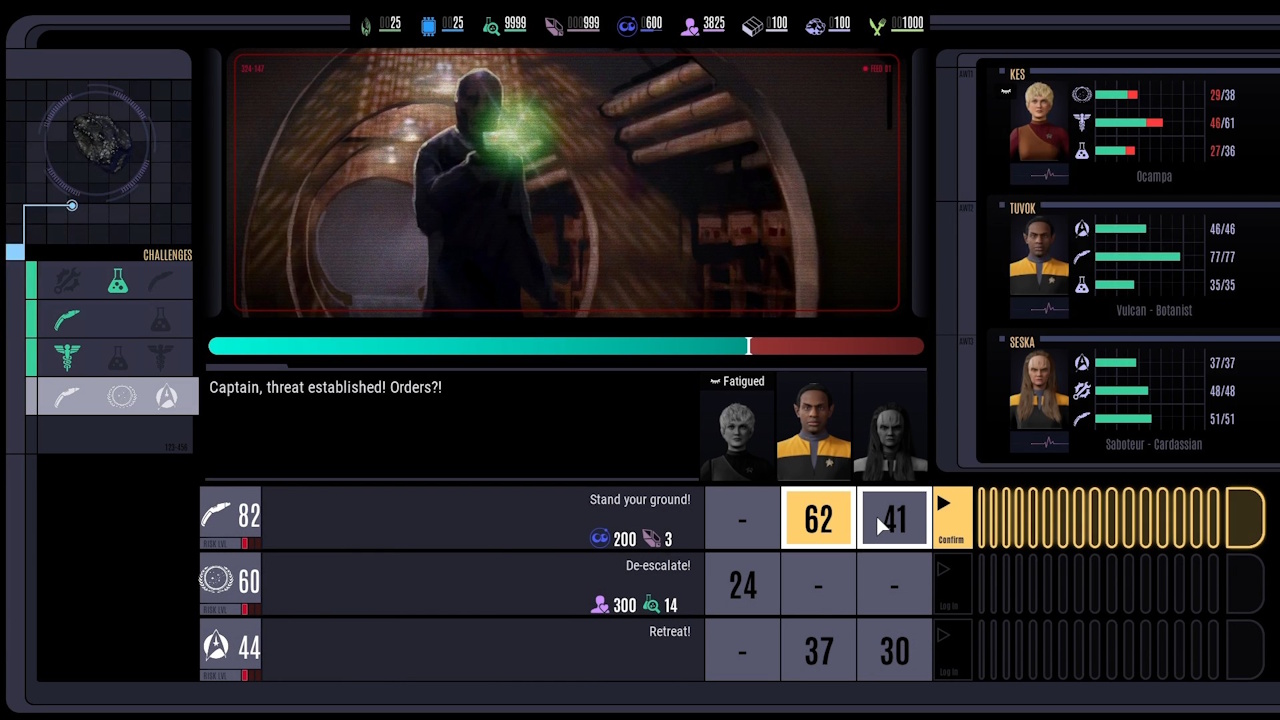
Away missions involve heroes visiting planets, ships, or other locations off of Voyager. They’re communicated through text and images, with the images having a kind of “painted” art style. Away missions also involve skill checks and rolls of the digital dice.
Caretaker, Part I.Caretaker, Part III.Phage, Part I.Phage, Part III.Phage, Part V.Night, Part I.Night, Part III.Night, Part V.Live Fast and Propser, Part I.Live Fast and Prosper, Part III.
Caretaker, Part II.Caretaker, Part IV.Phage, Part II.Phage, Part IV.Phage, Part VI.Night, Part II.Night, Part IV.Night, Part VI.Live Fast and Prosper, Part II.Live Fast and Prosper, Part IV.
Transporter Room:
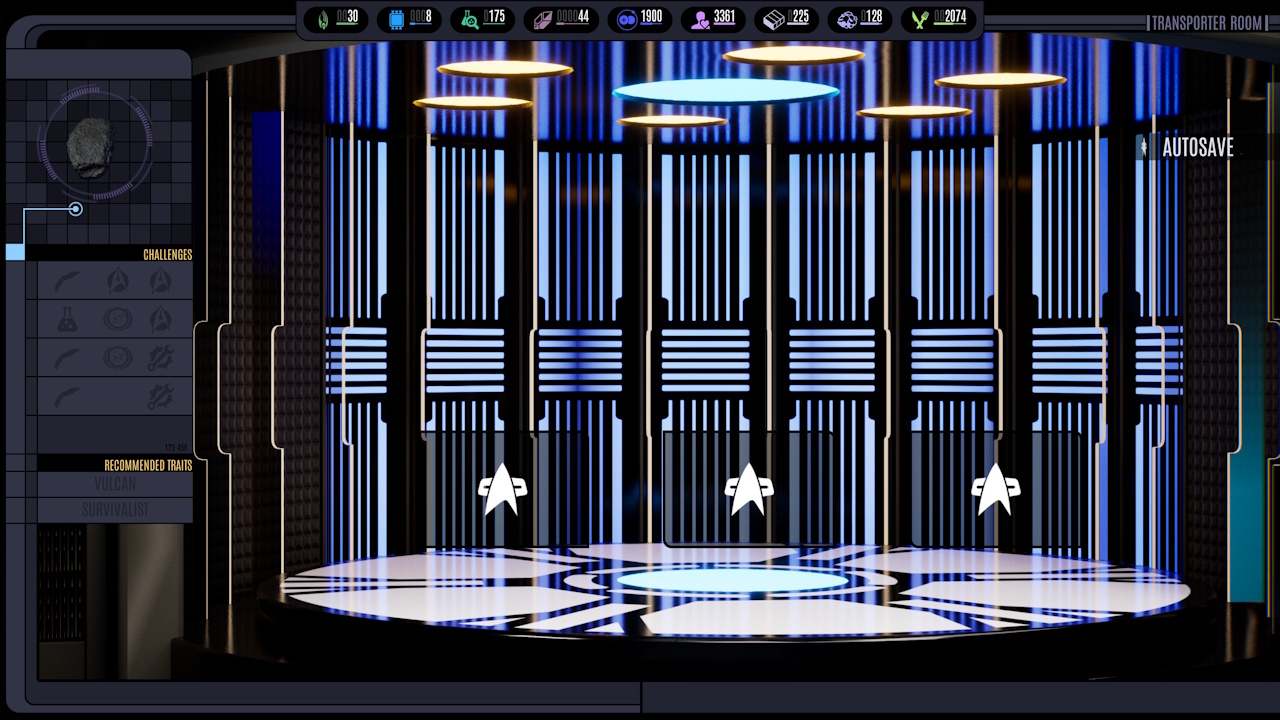
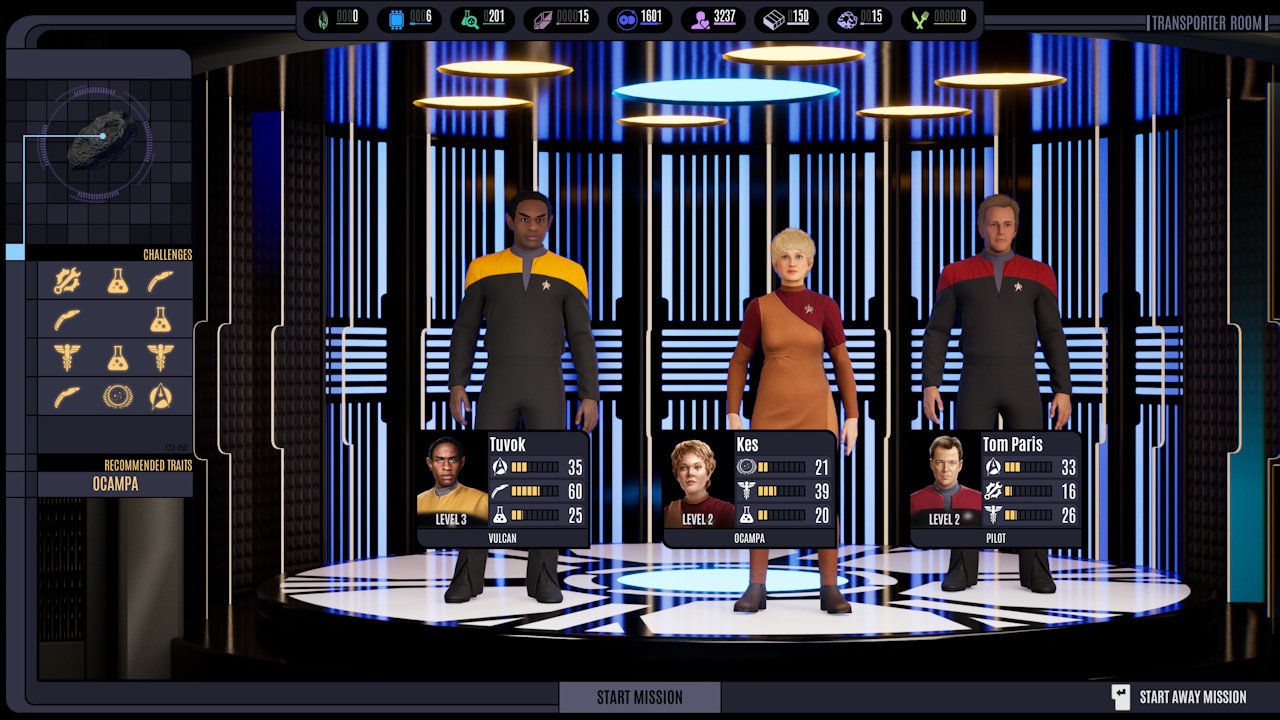
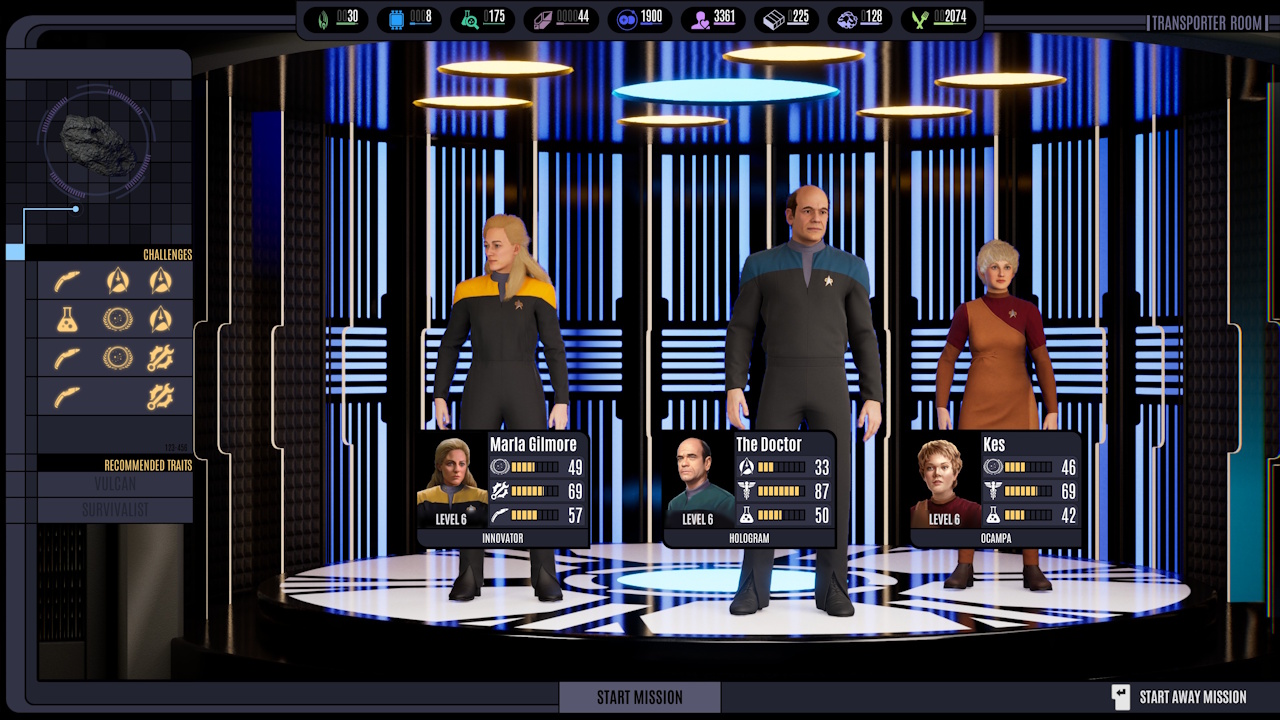
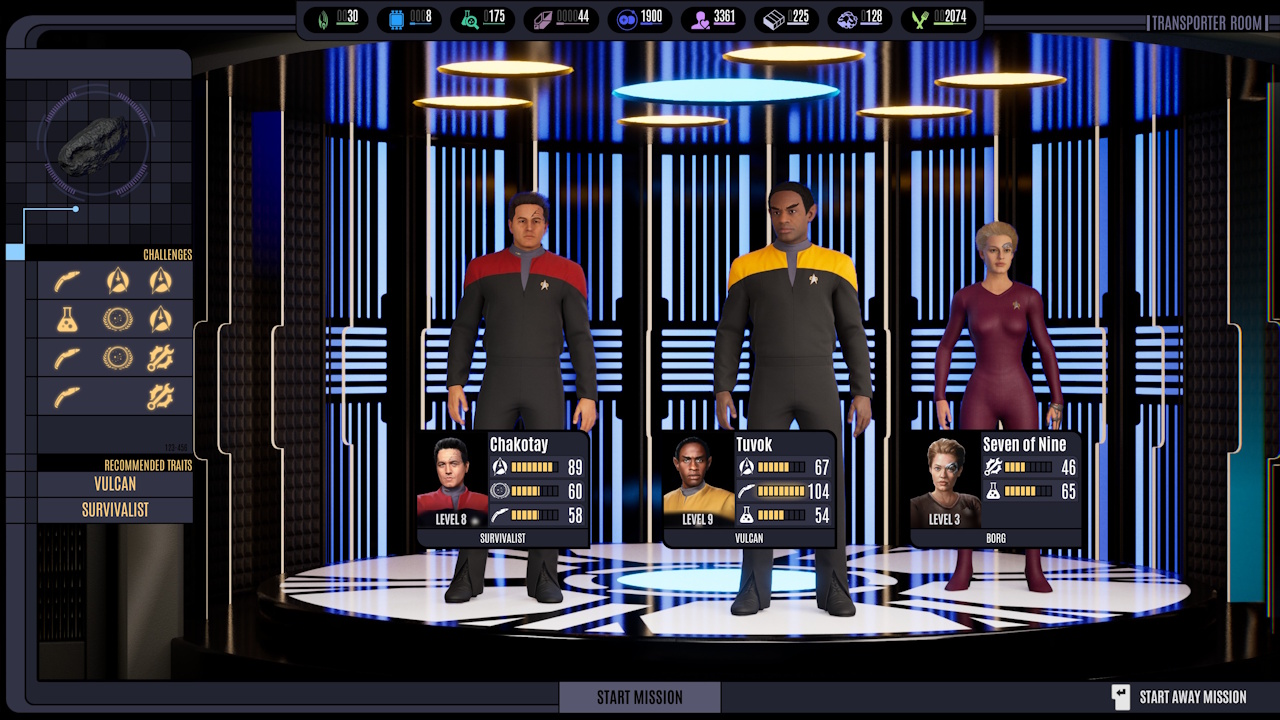
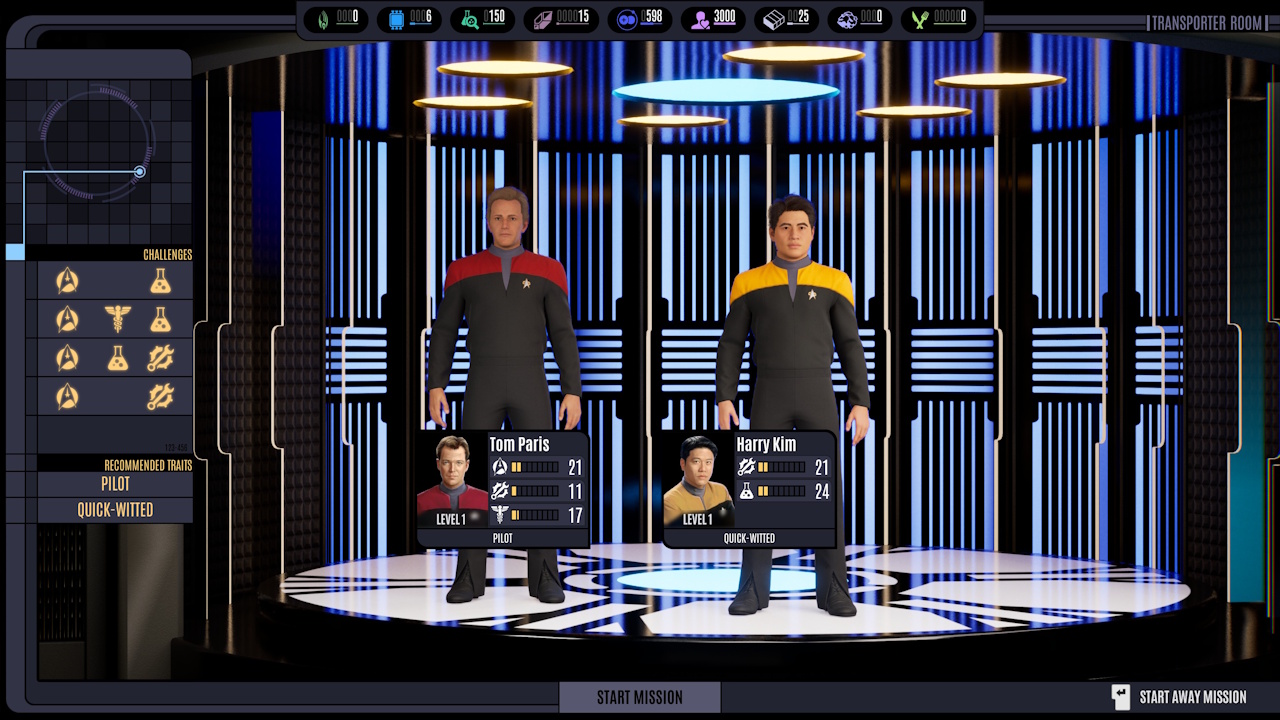
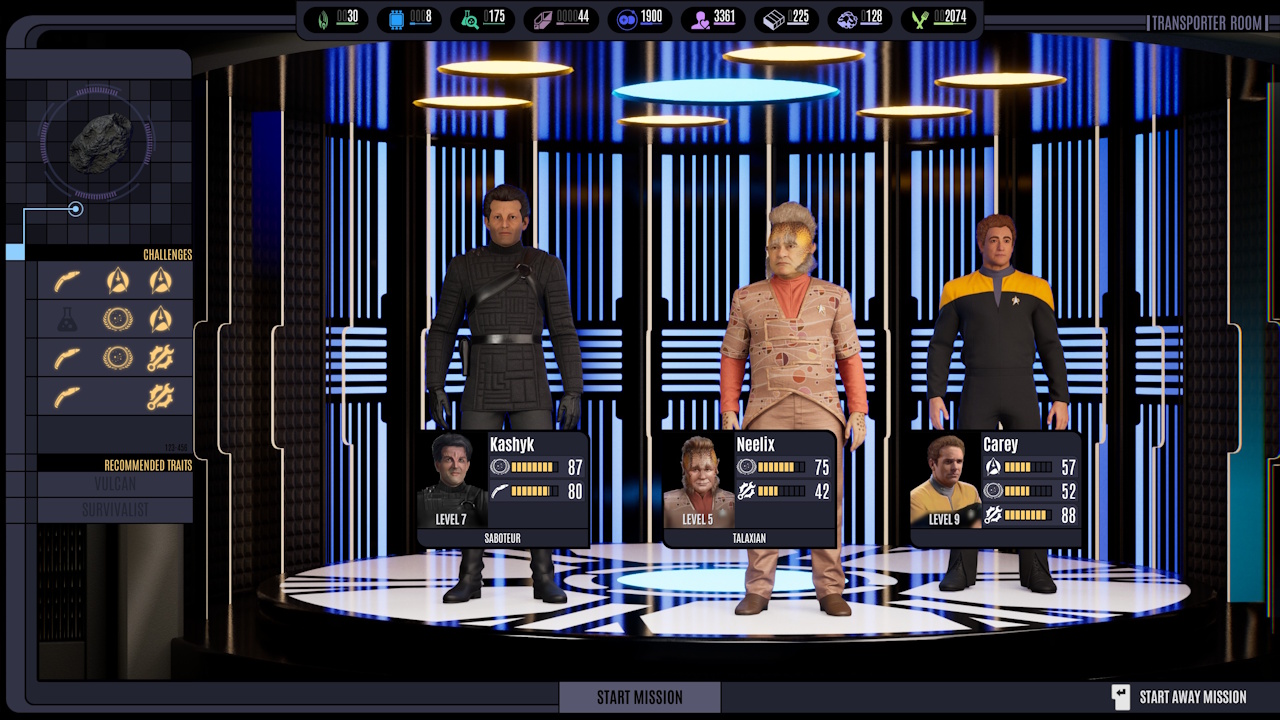
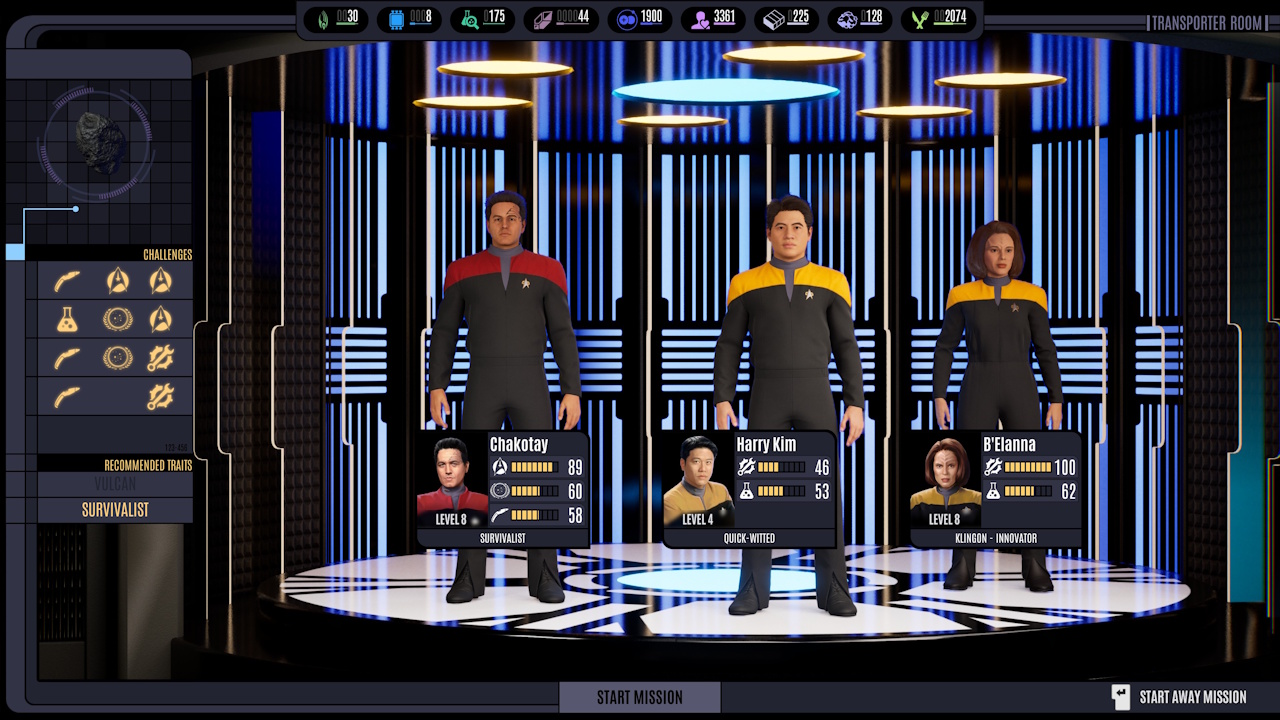
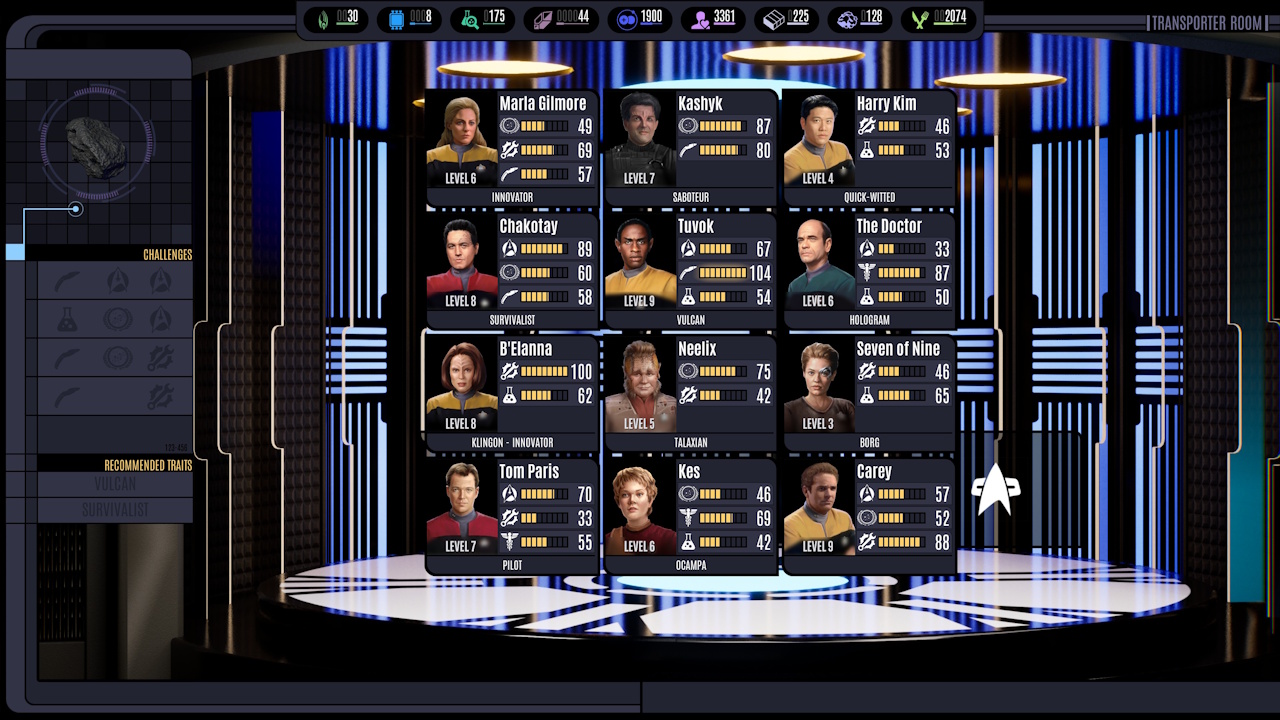
Before you start an away mission, you have to pick which hero(es) are going to take part. This takes place in the transporter room, and the game gives you hints about which heroes might be better-suited to the mission at hand.
The transporter pad.Tuvok, Kes, and Tom Paris.Marla Gilmore, the Doctor, and Kes.Chakotay, Tuvok, and Seven of Nine.
Tom Paris and Harry Kim.Kashyk, Neelix, and Joe Carey.Chakotay, Harry Kim, and B’Elanna.Choose your team!
The View from the Bridge:
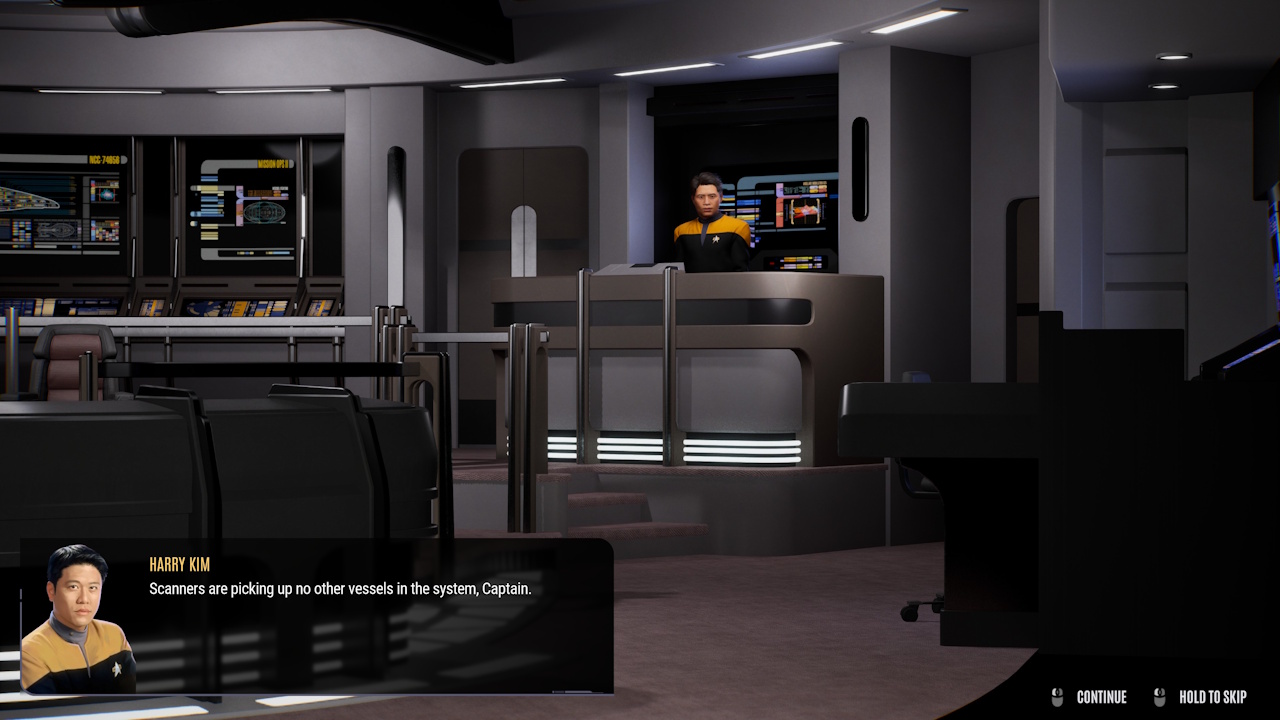
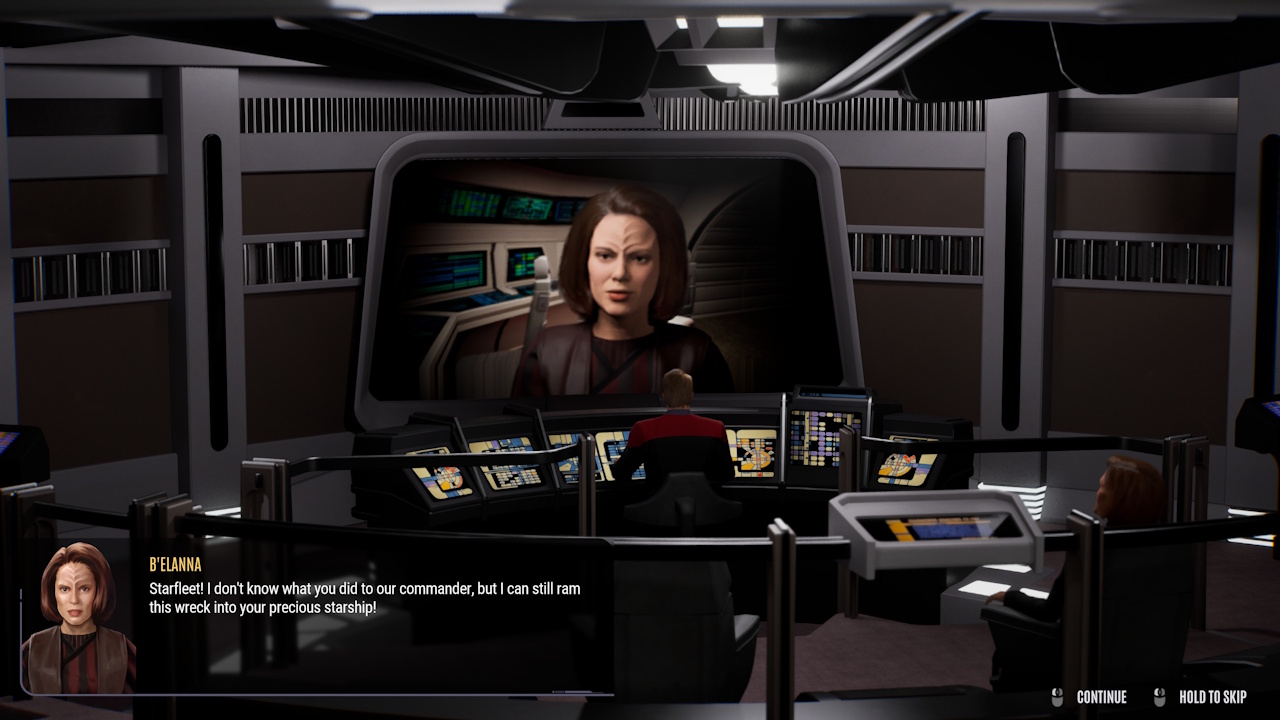
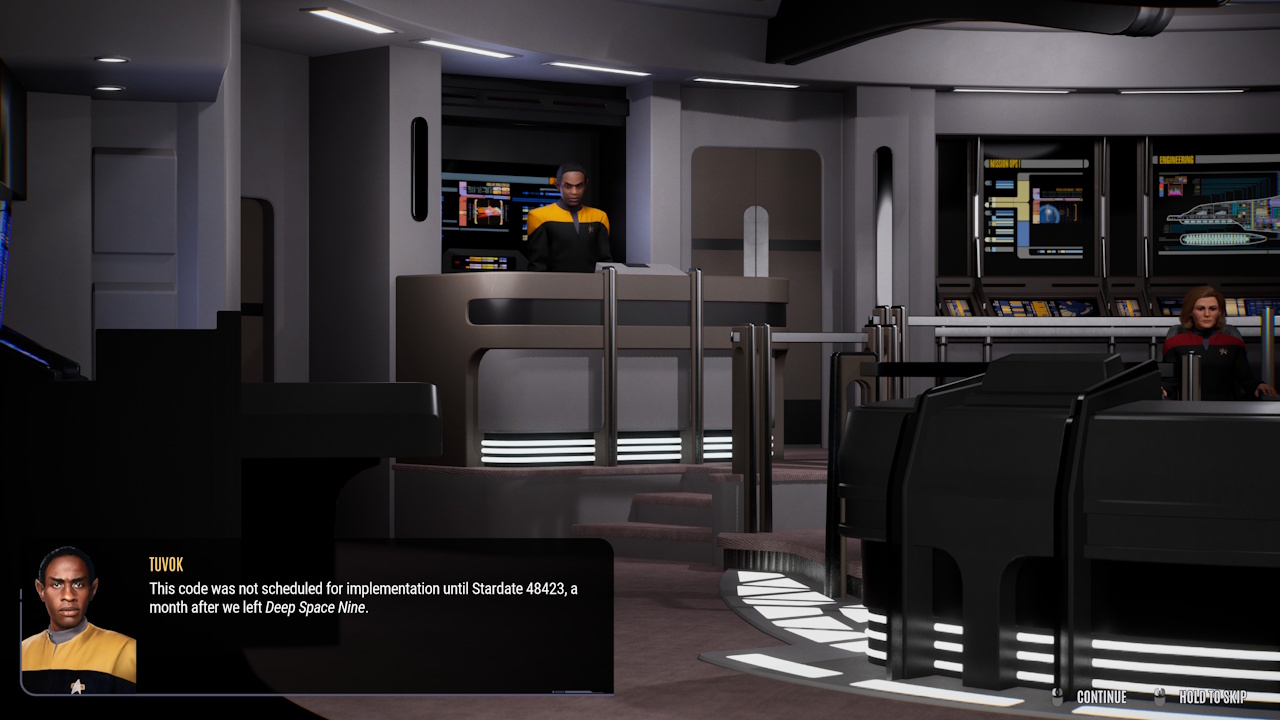
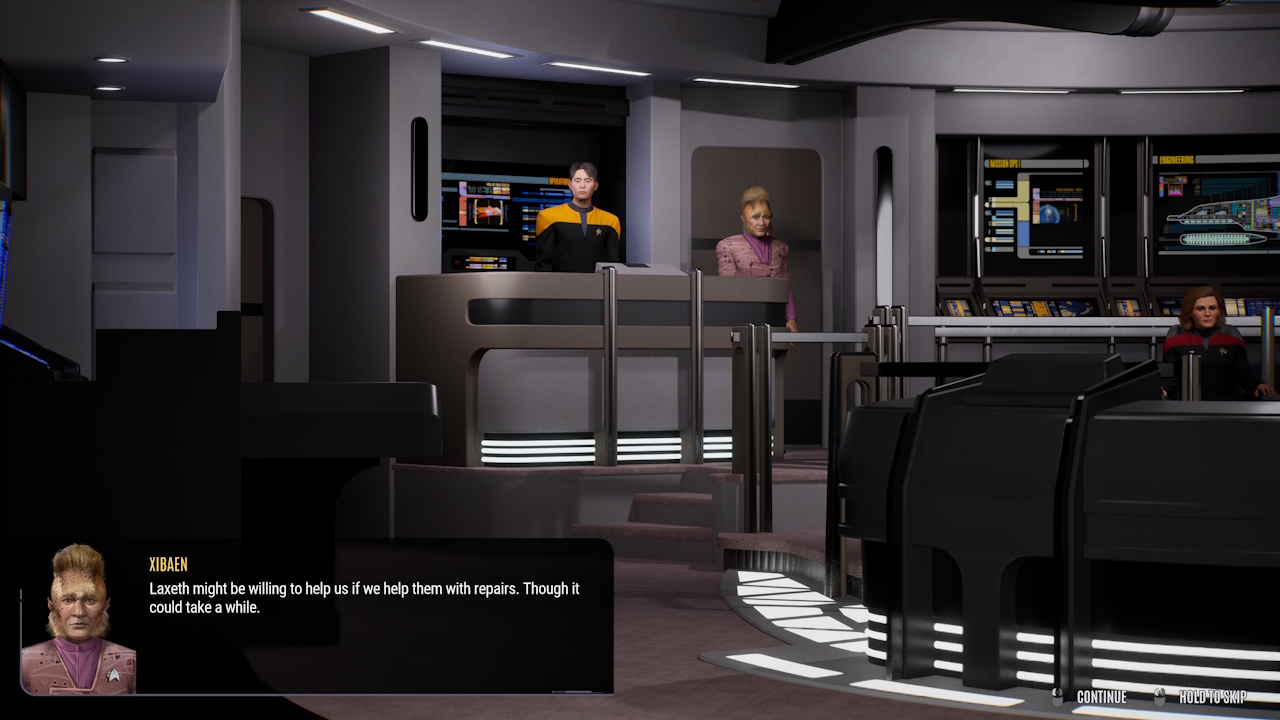
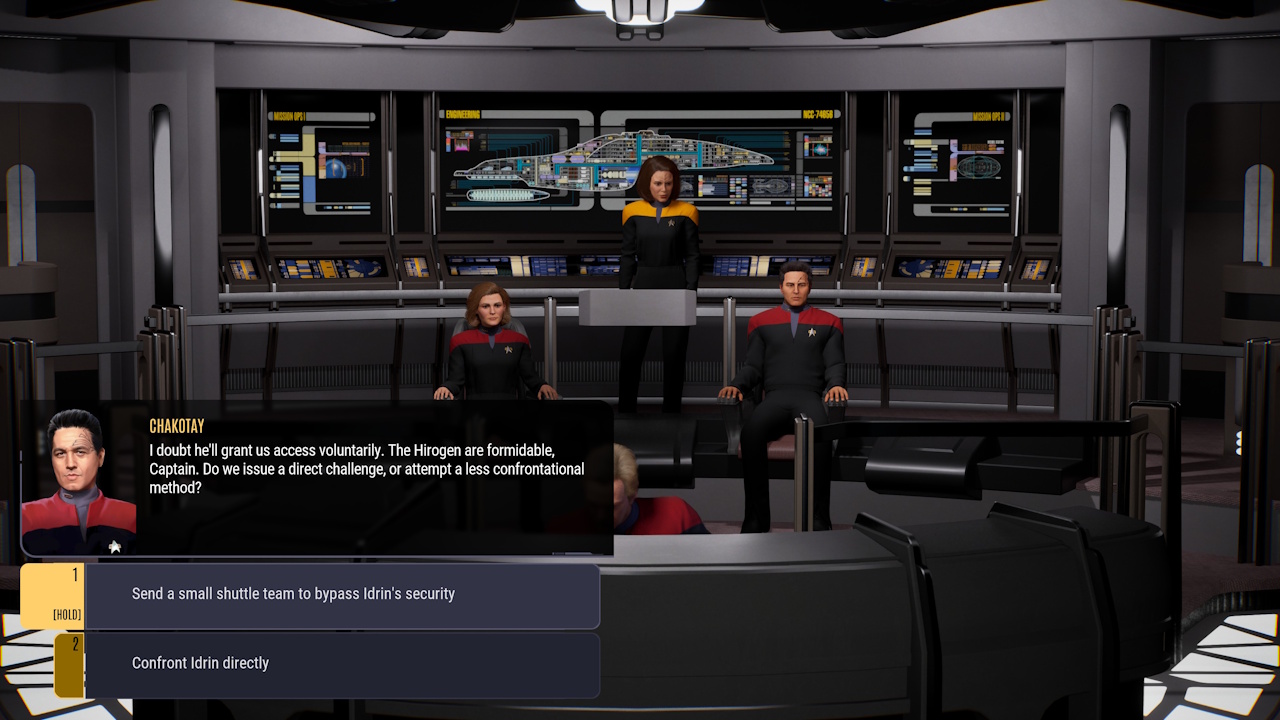
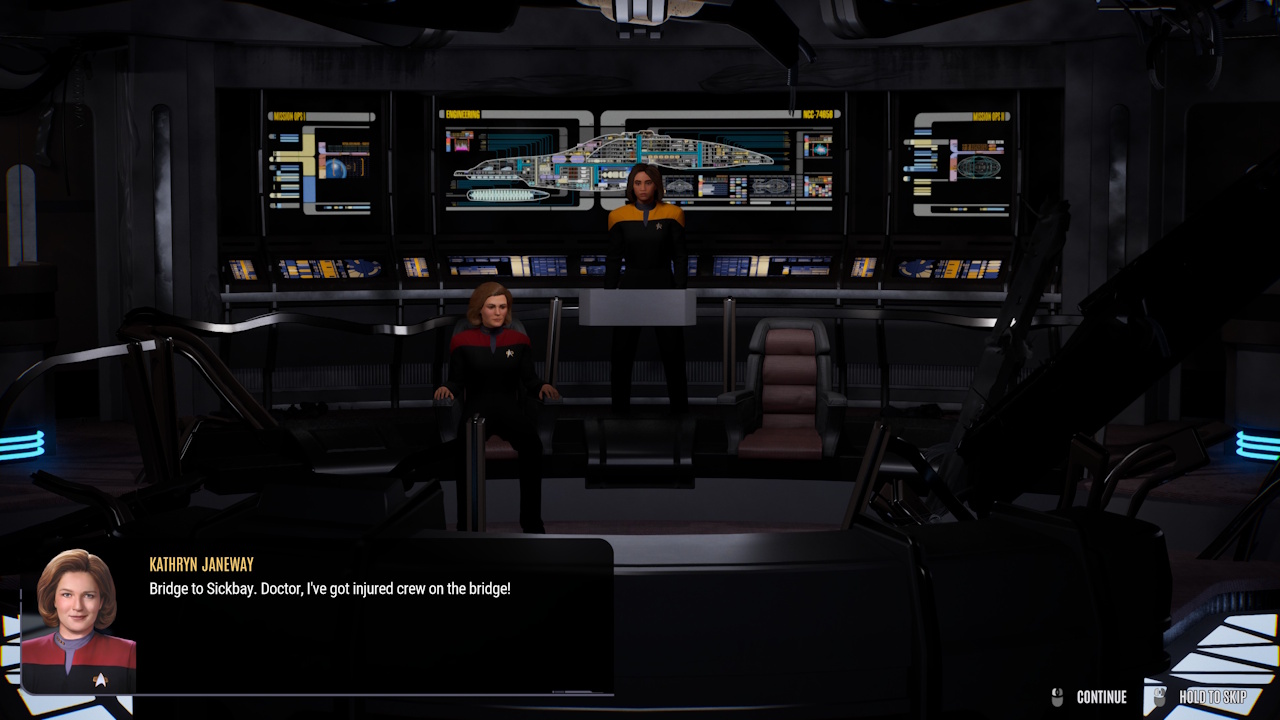
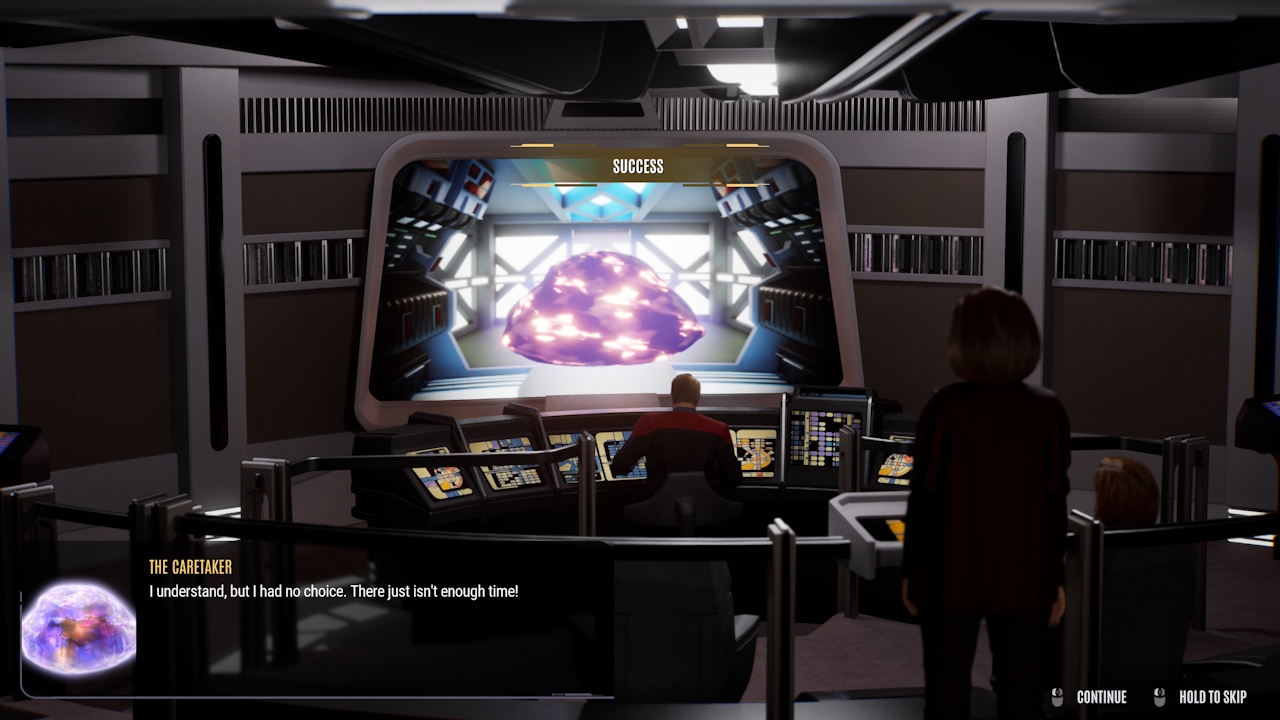
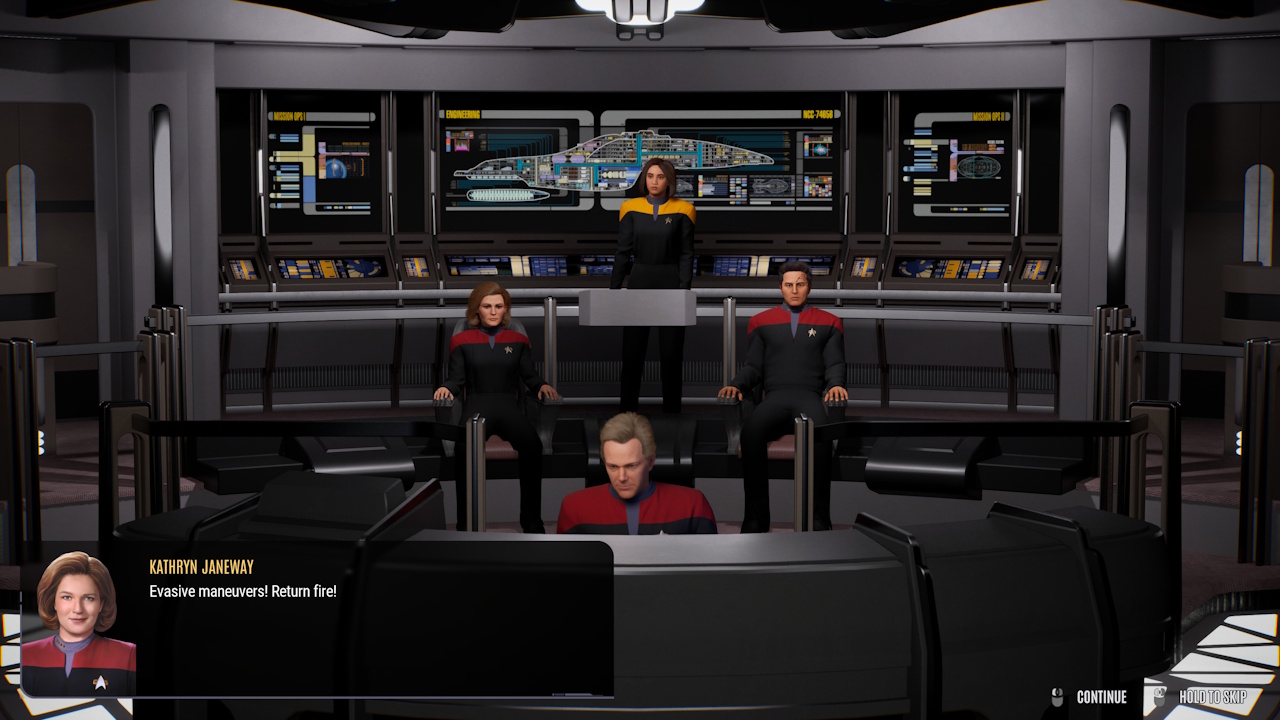
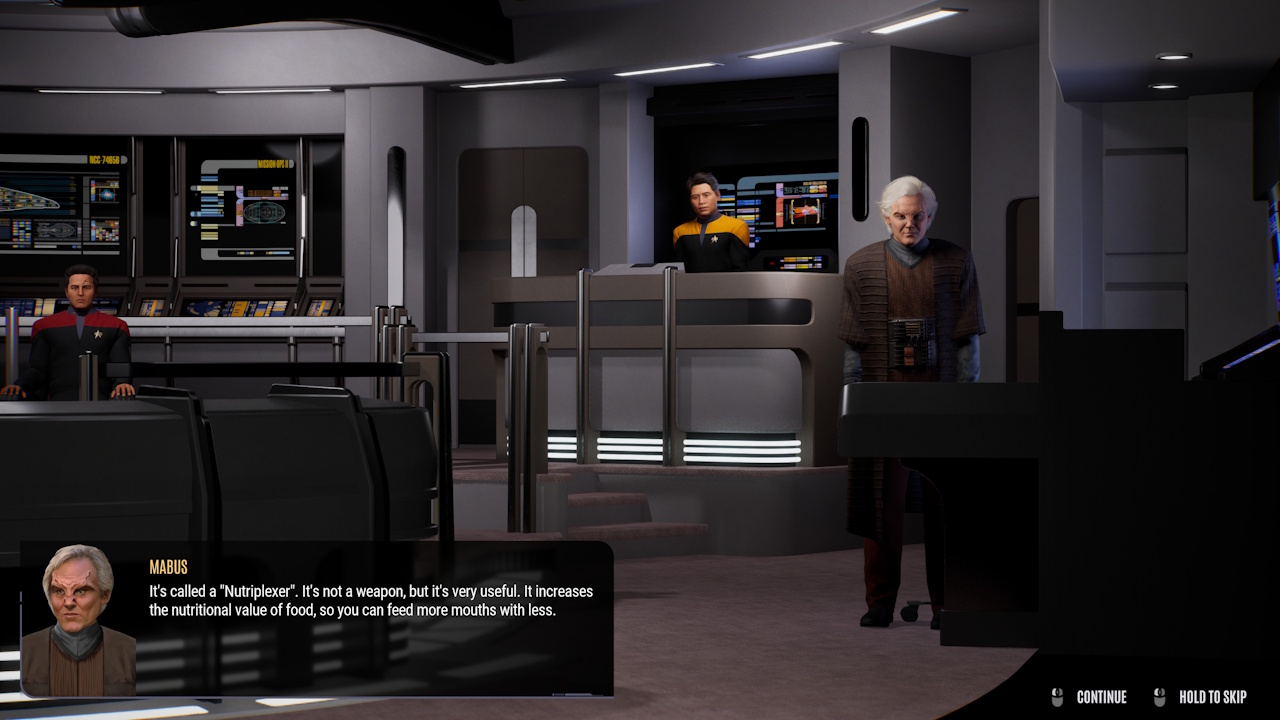
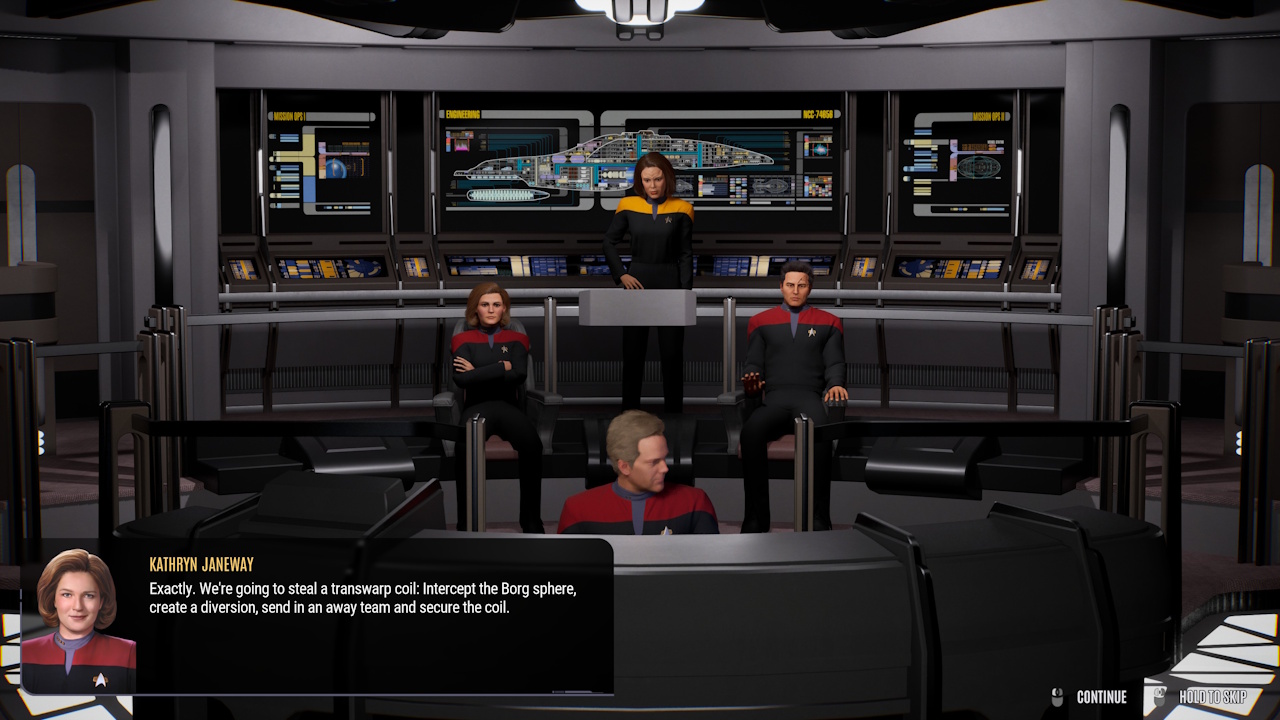
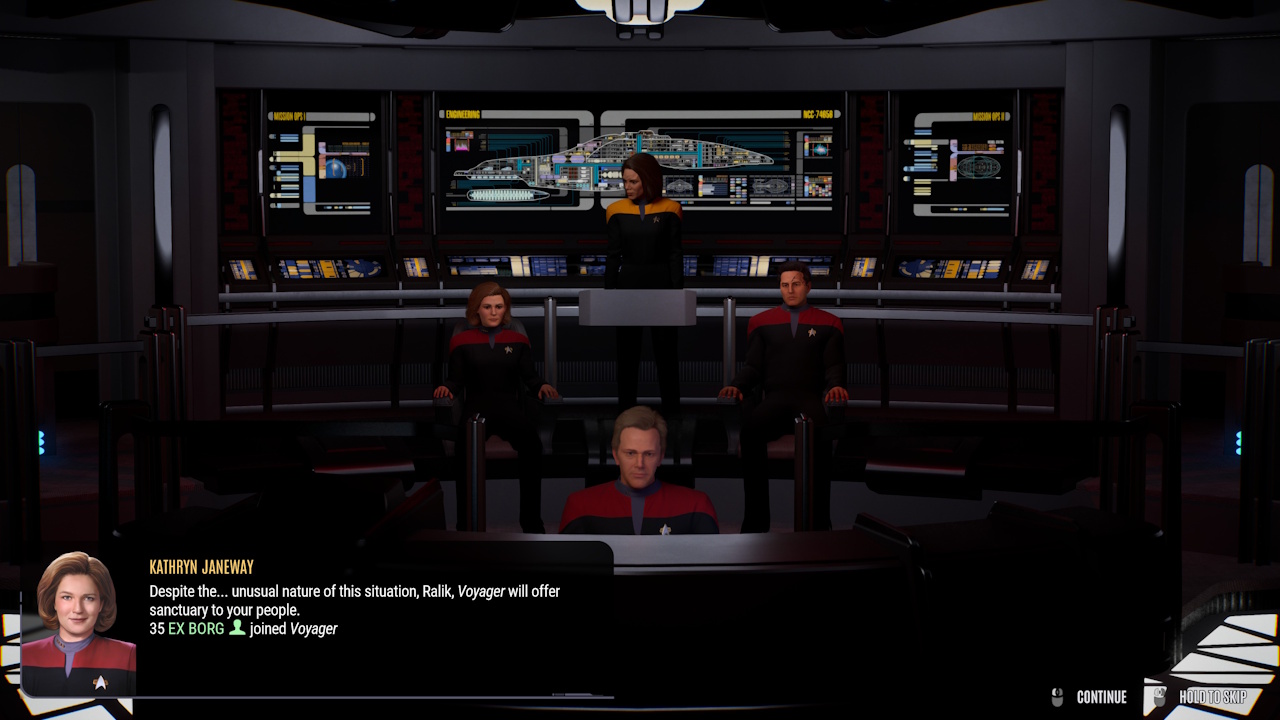
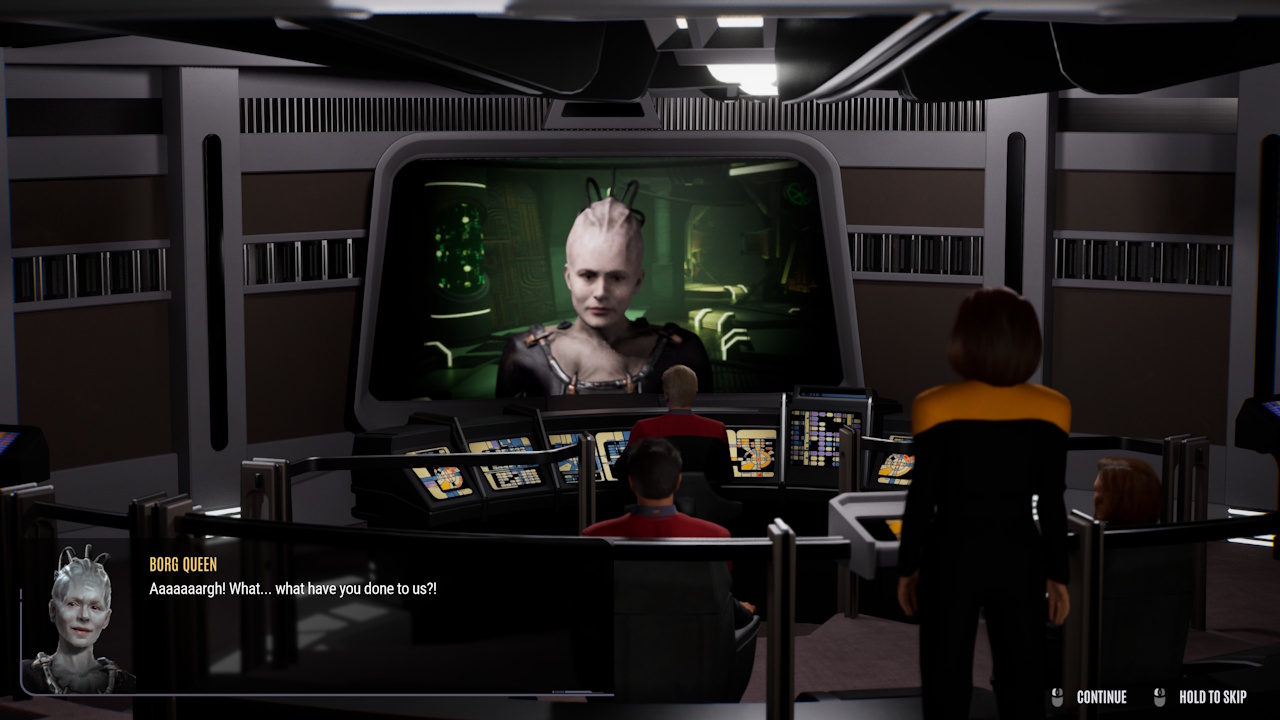
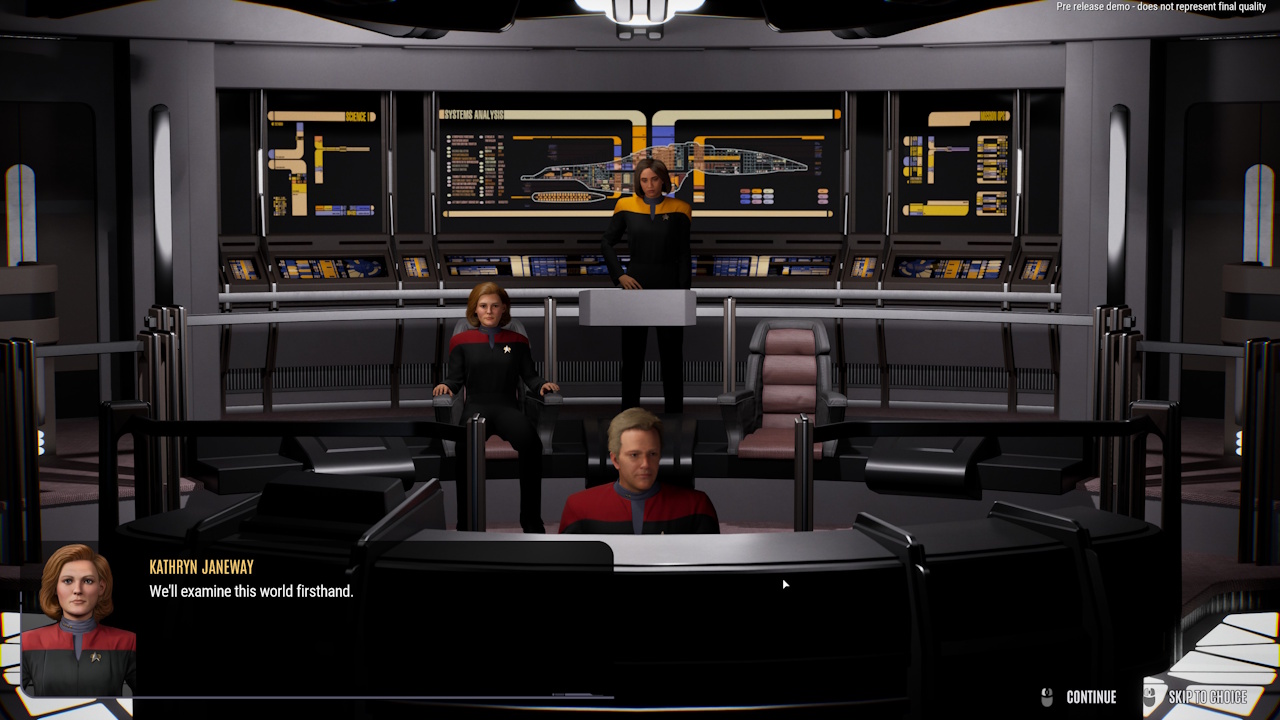
These scenes depict various characters conversing on the bridge. This is also where you get to make consequential choices.
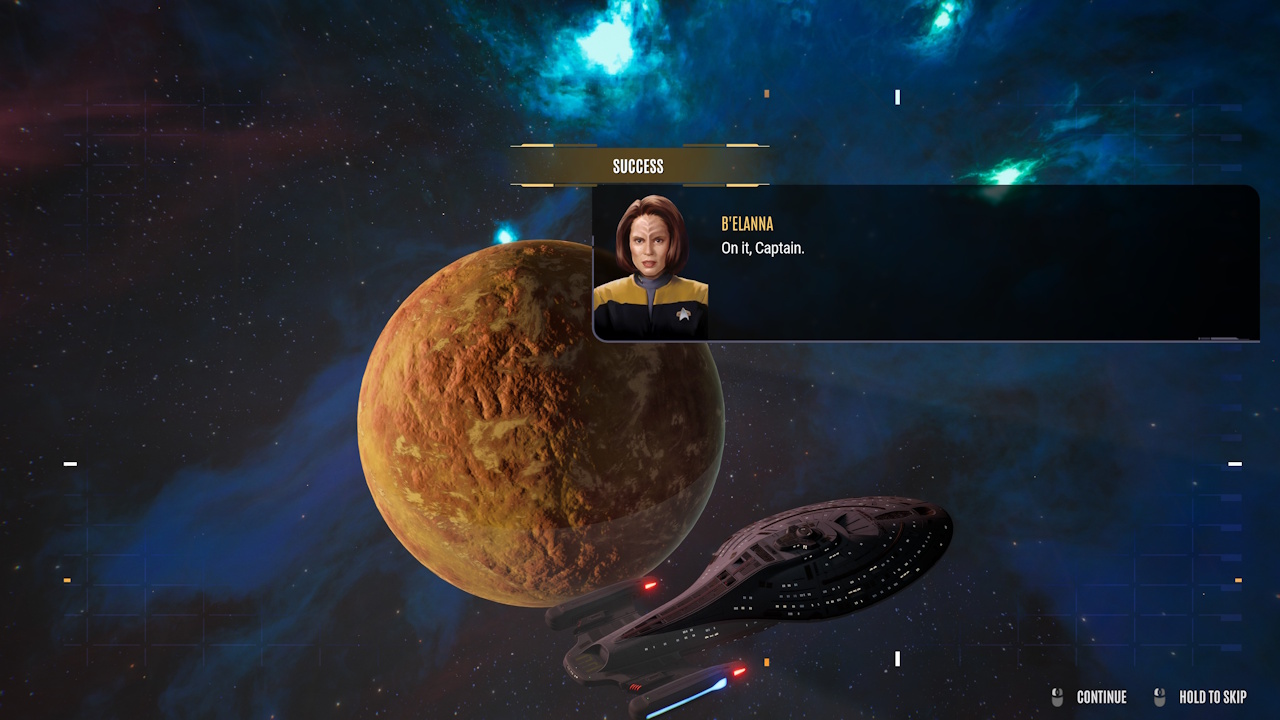
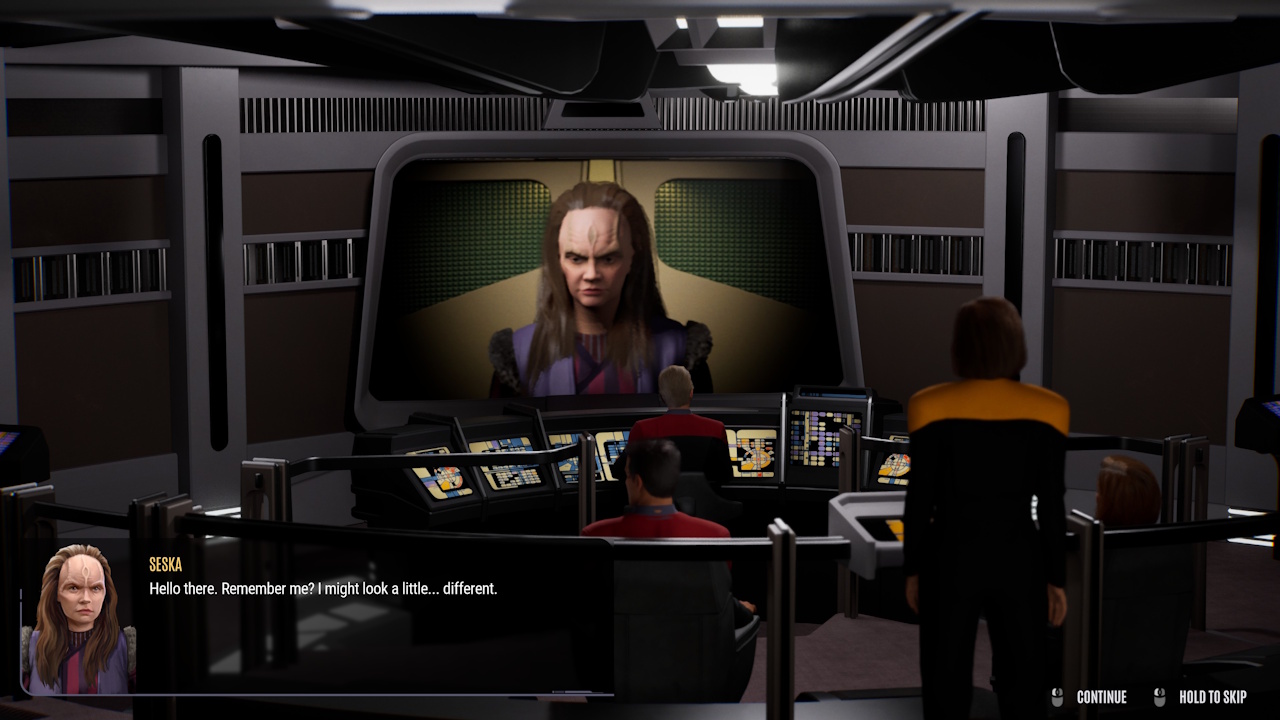
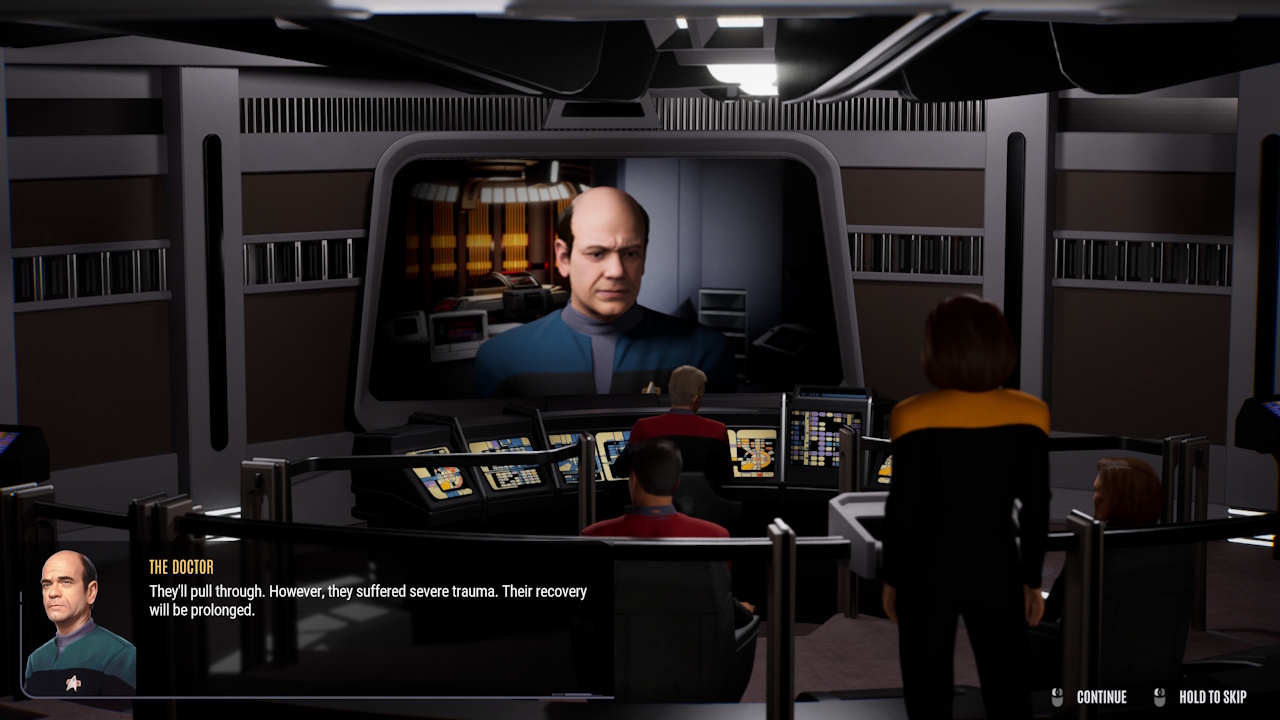
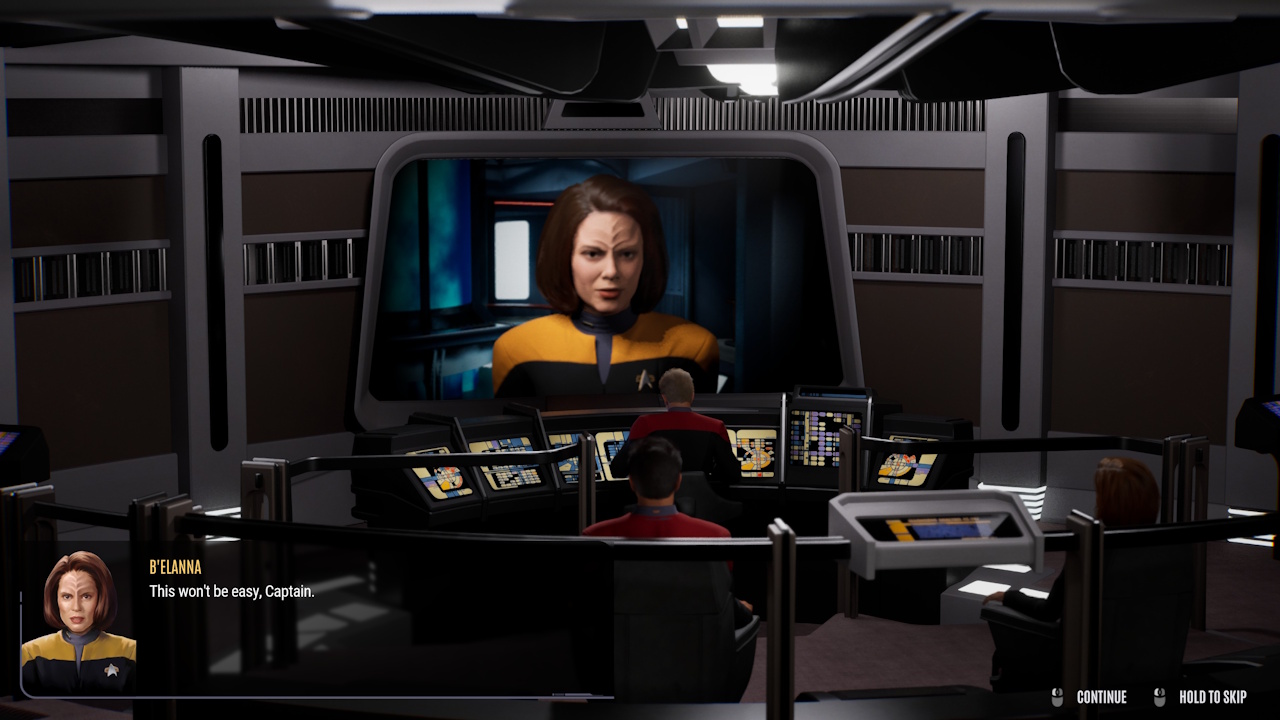
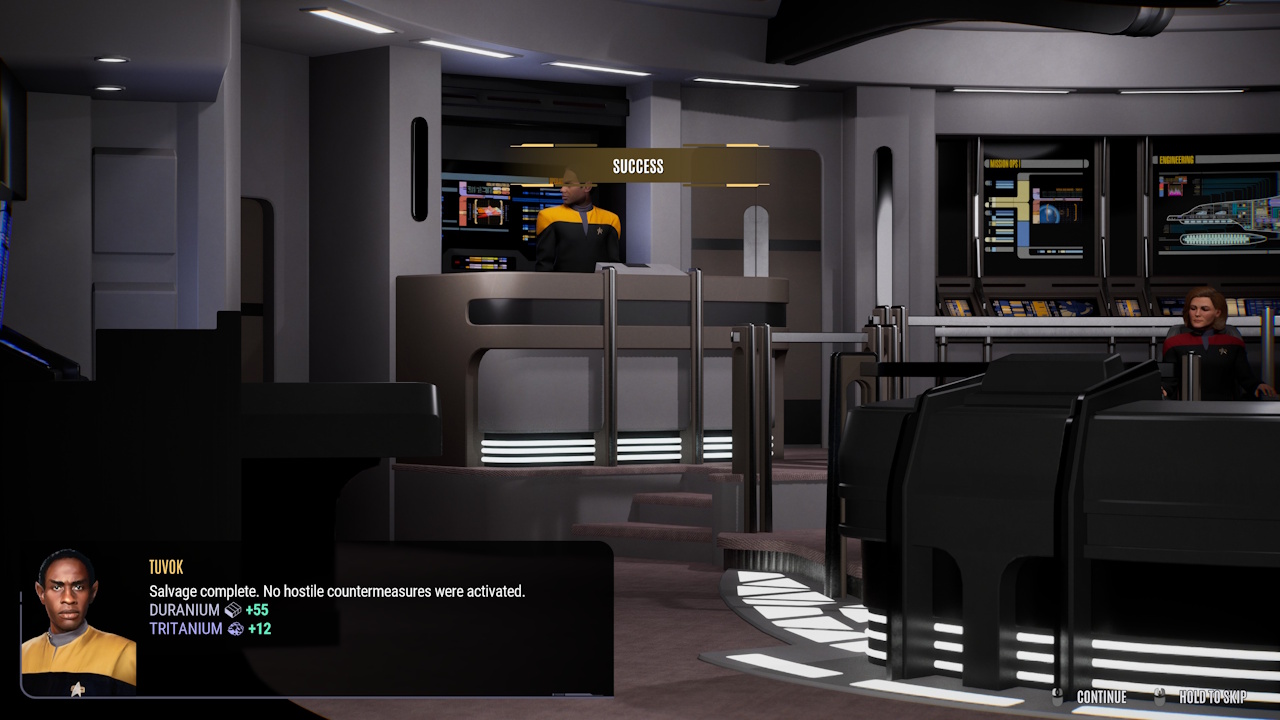
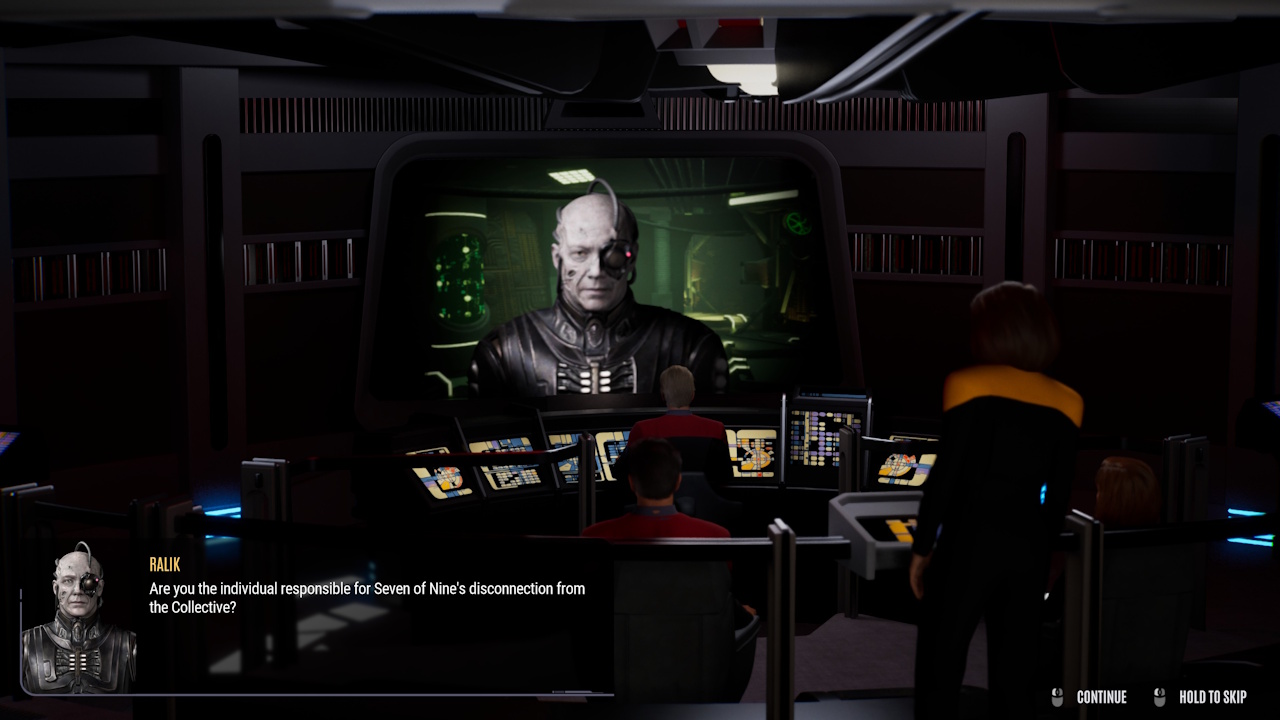
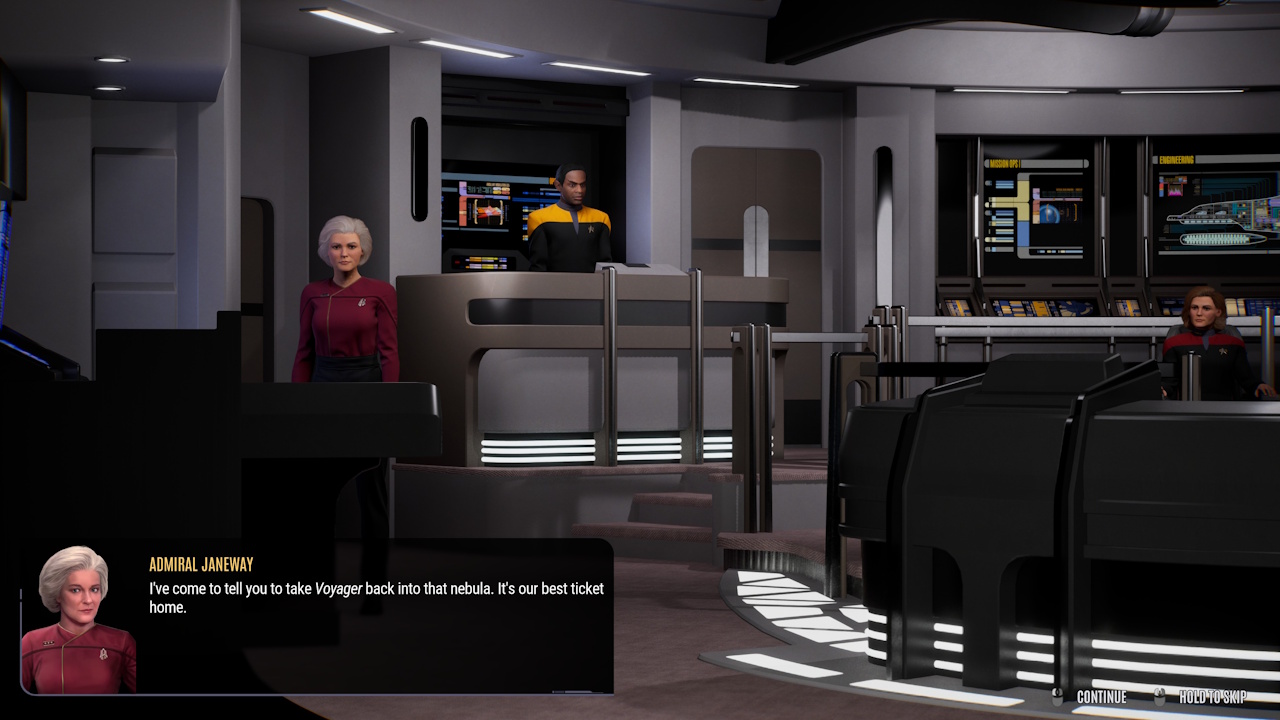
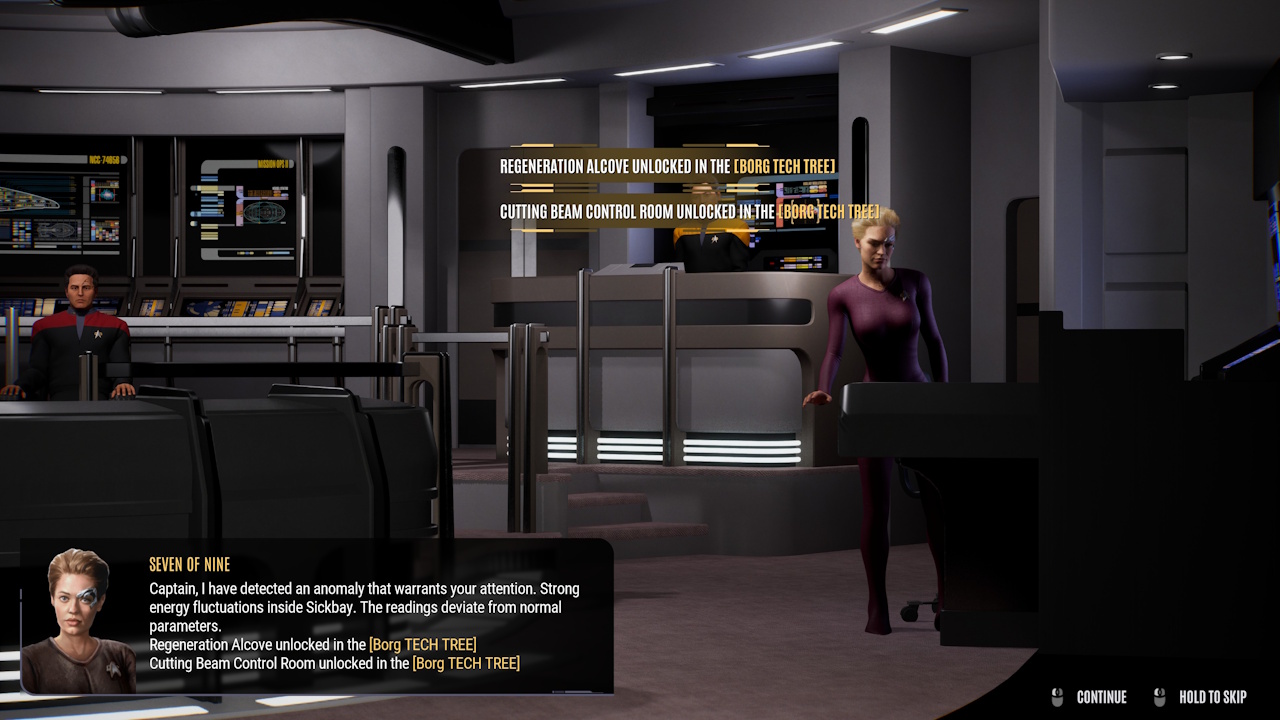
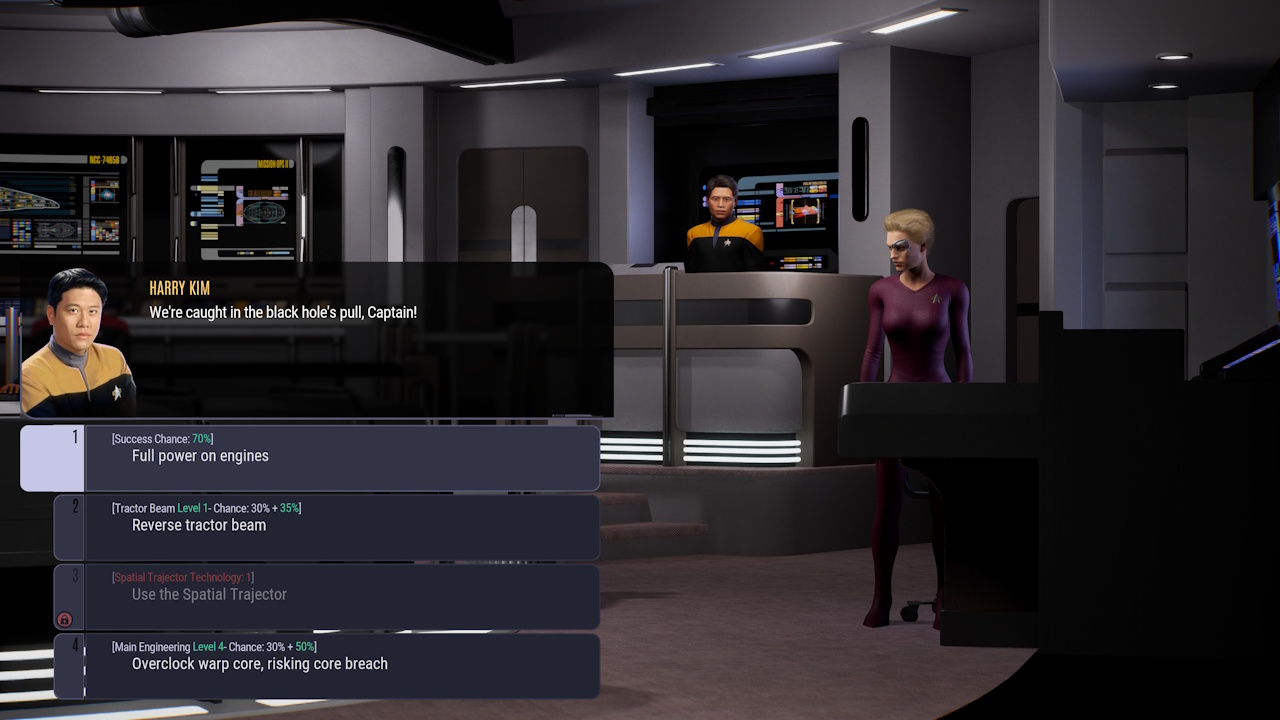
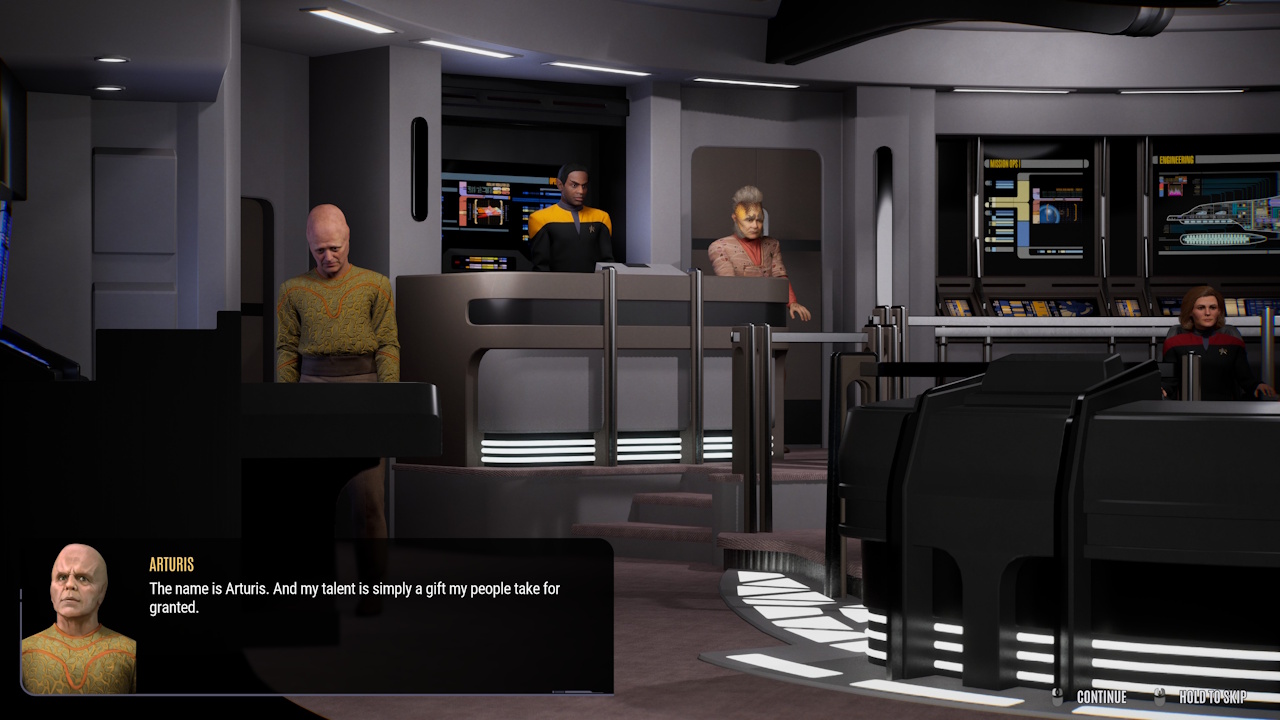
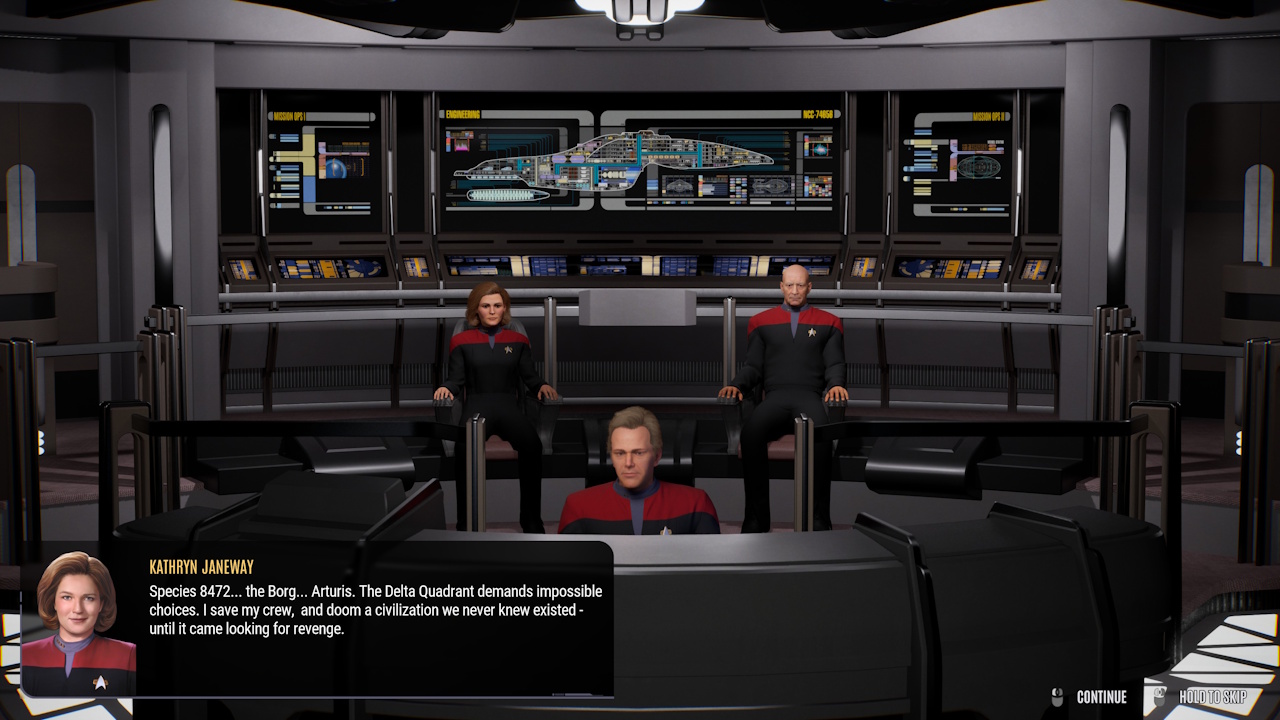
Harry at his station in Caretaker.Meeting the Maquis.Tuvok at his post.Seska.“We’ve got Neelix at home.”Making a consequential choice.The Doctor brings news…B’Elanna.Success!Who’s that Borg?Admiral Janeway.
The damage caused by the Array.Chatting to the Caretaker.Evasive maneuvers!Mabus on the bridge.Unlocking the Borg tech tree.Options and chances for success.Arturis.Chakotay? You… okay?Planning a heist.Red Alert.The Borg Queen.
Combat:
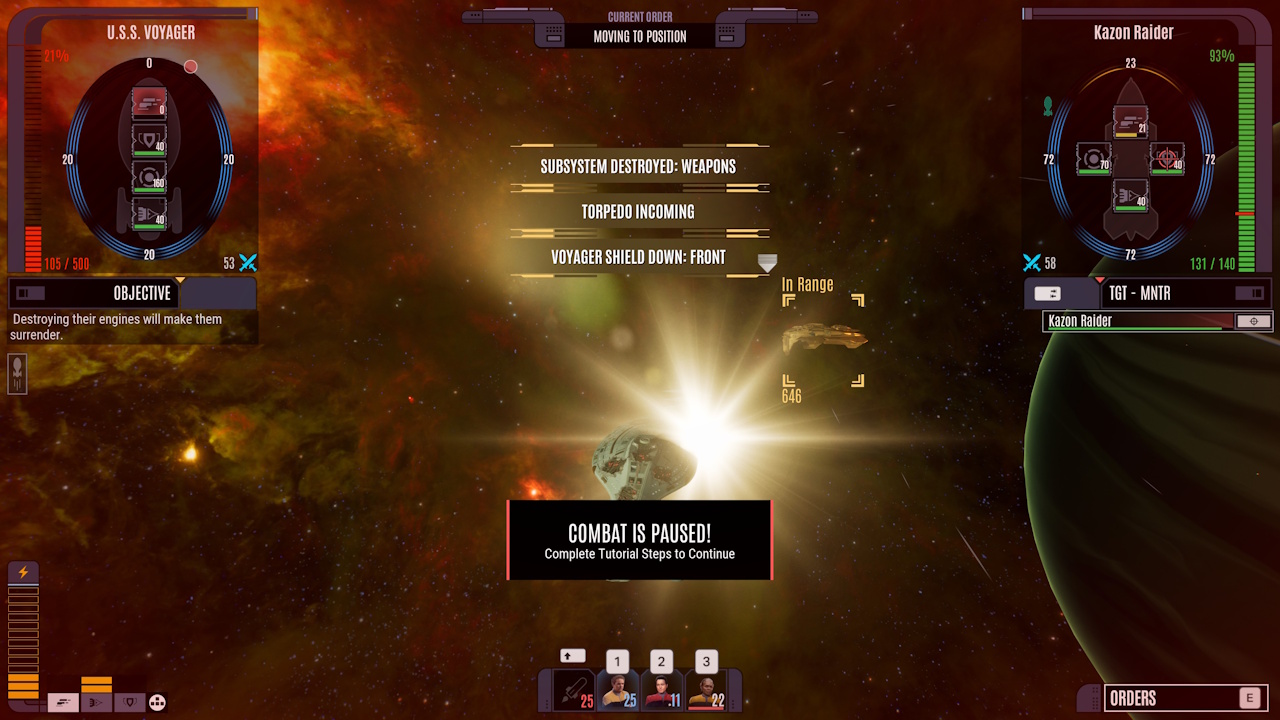
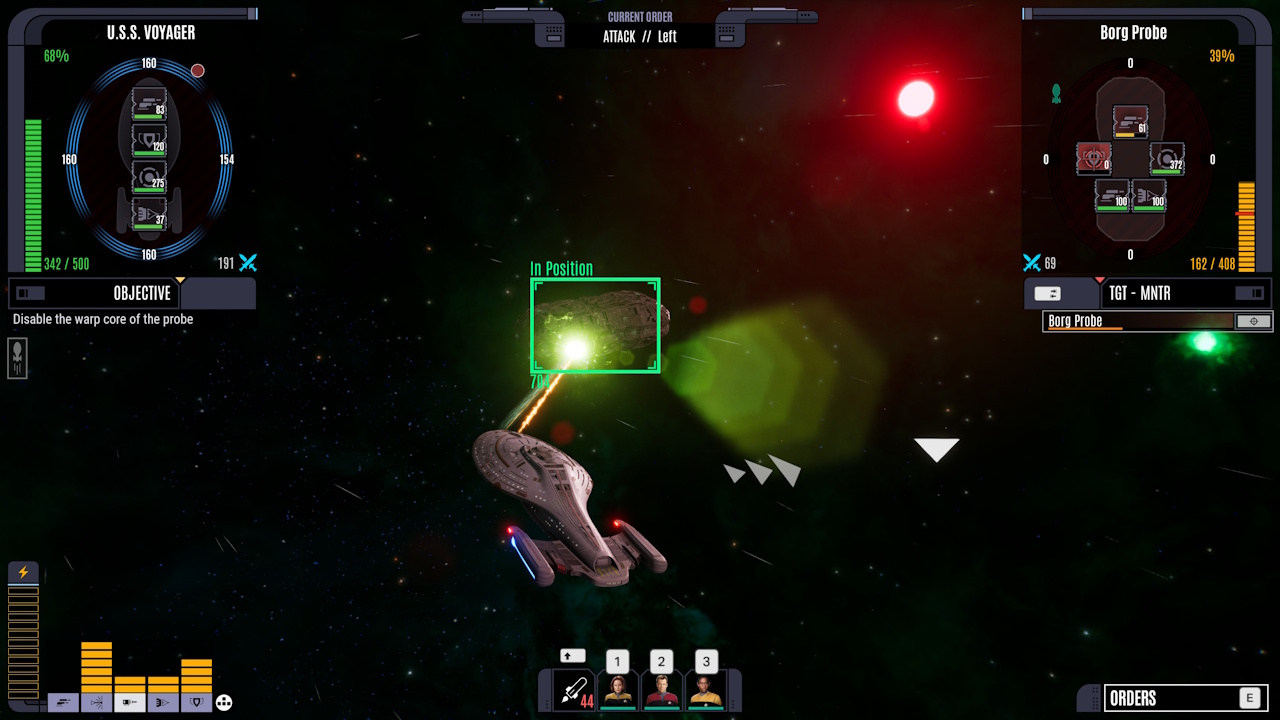
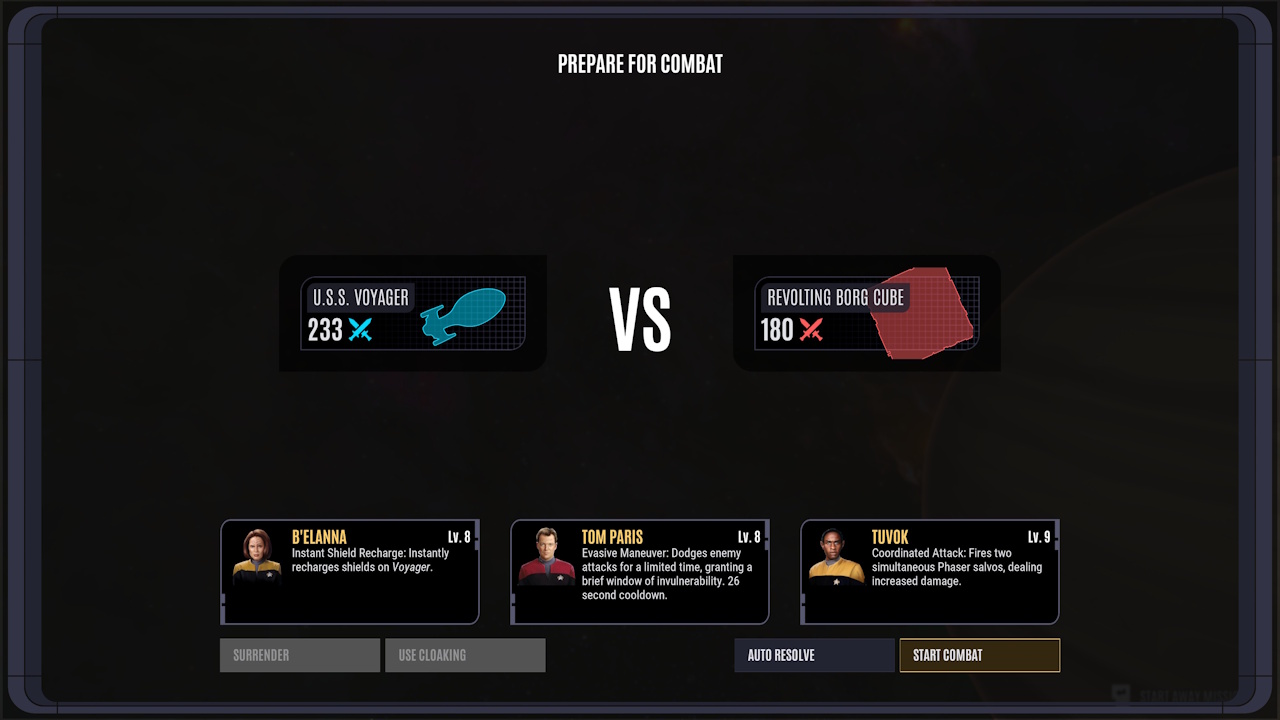
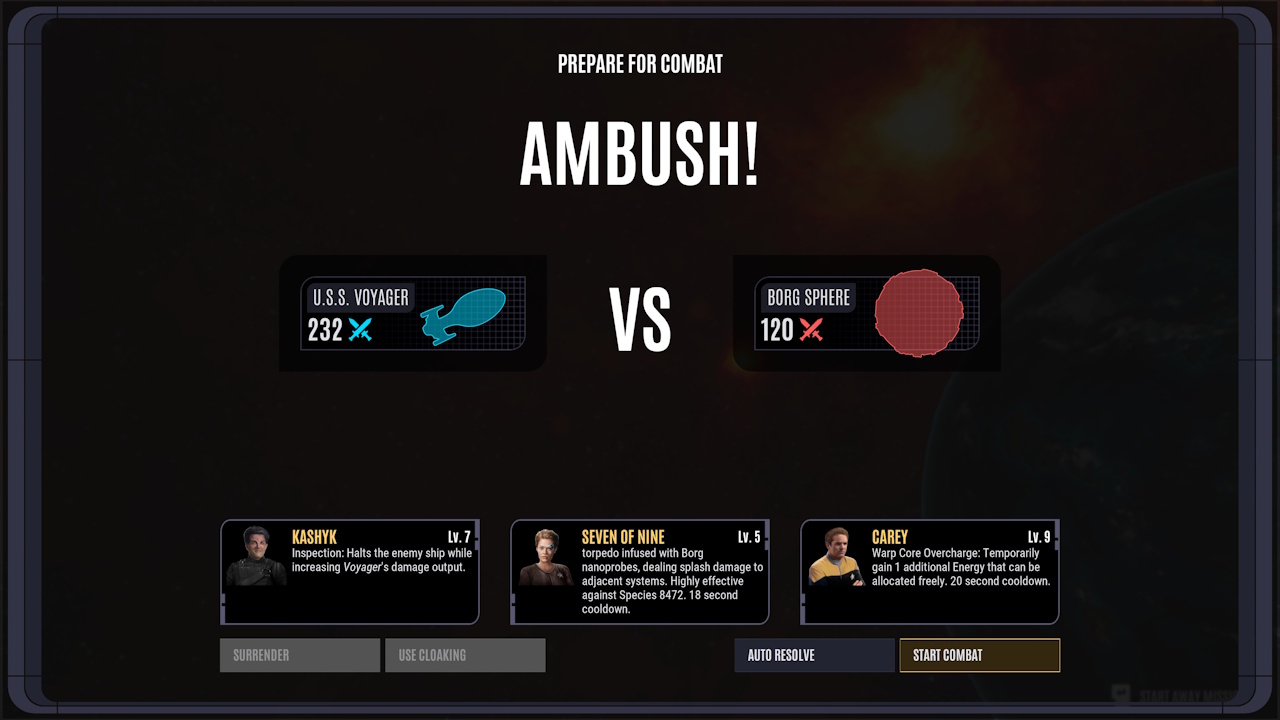
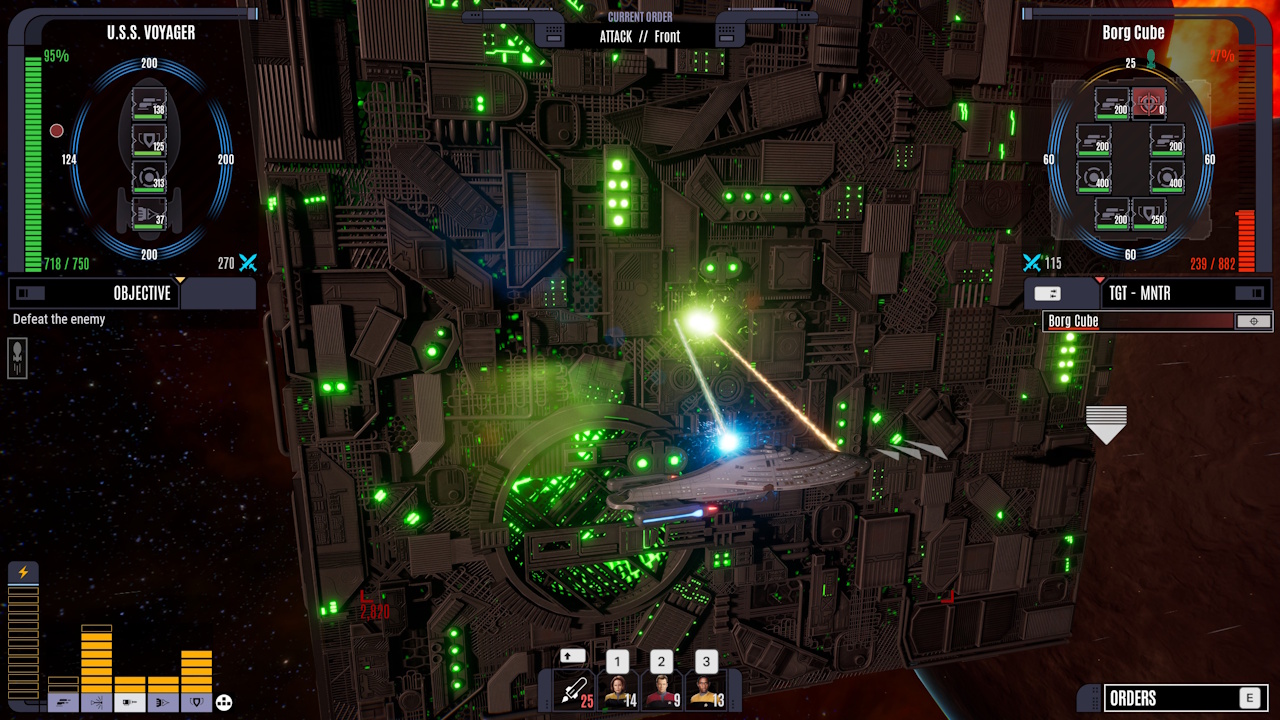
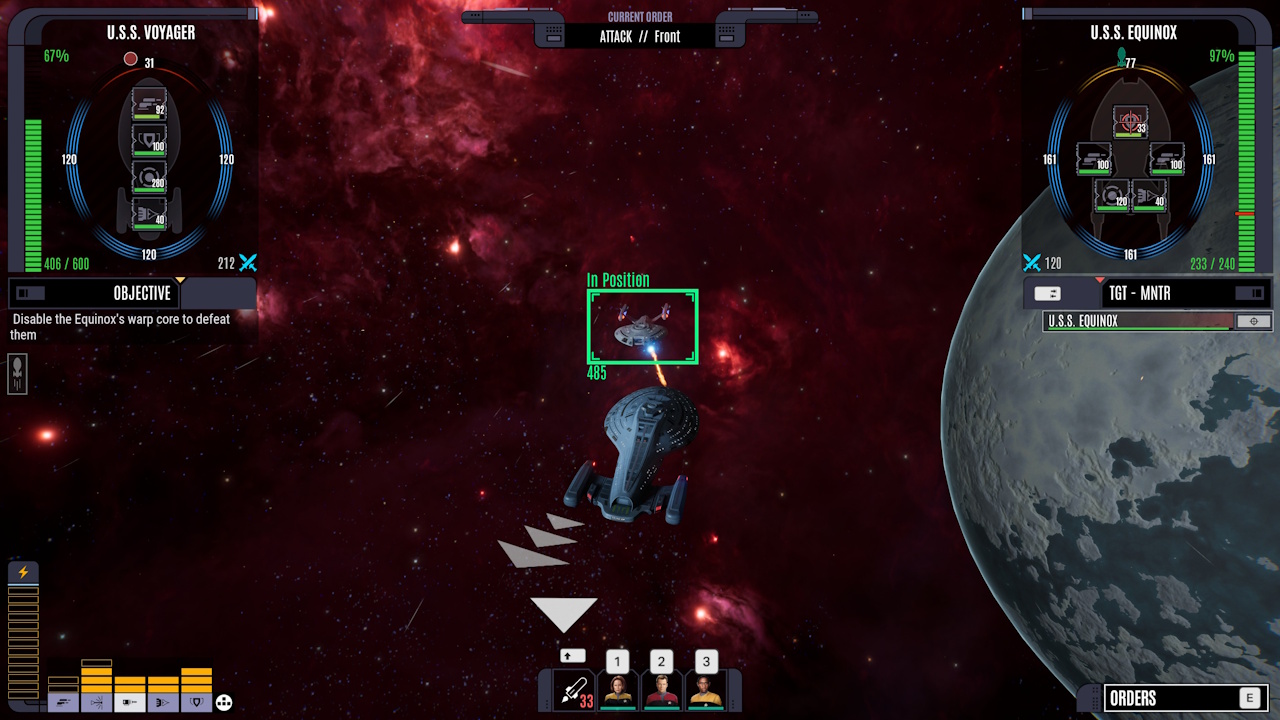
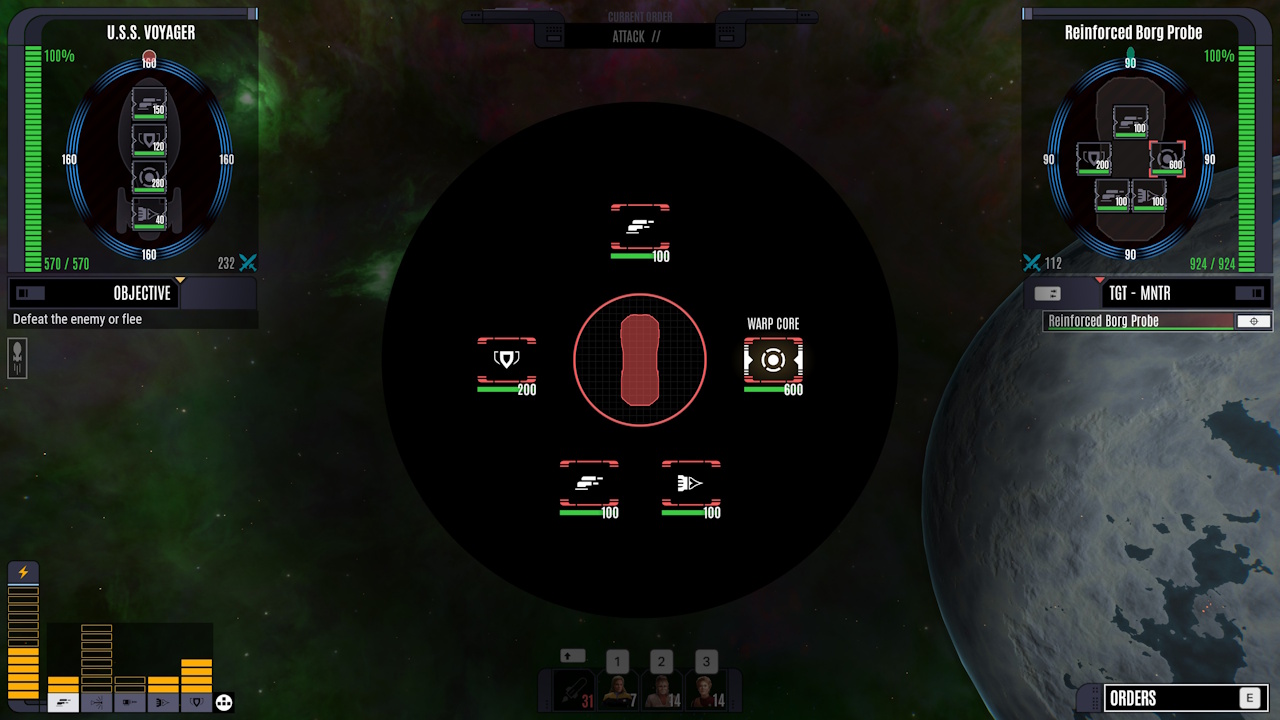
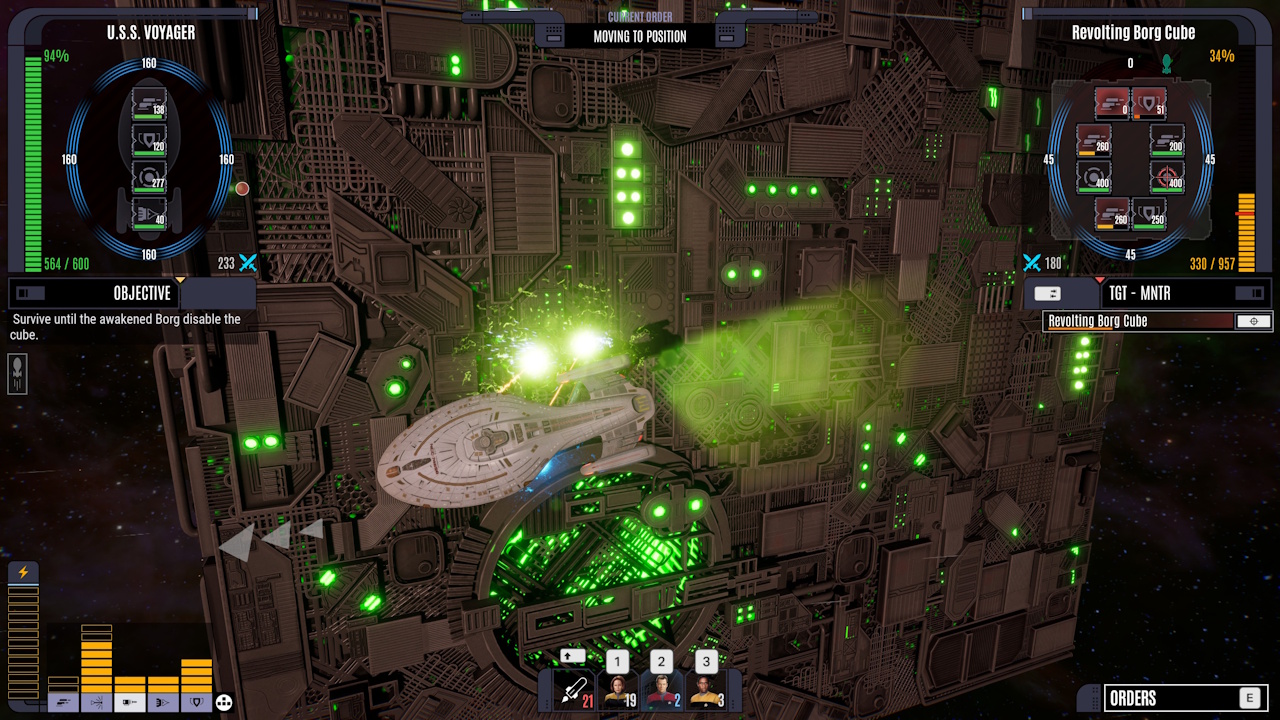
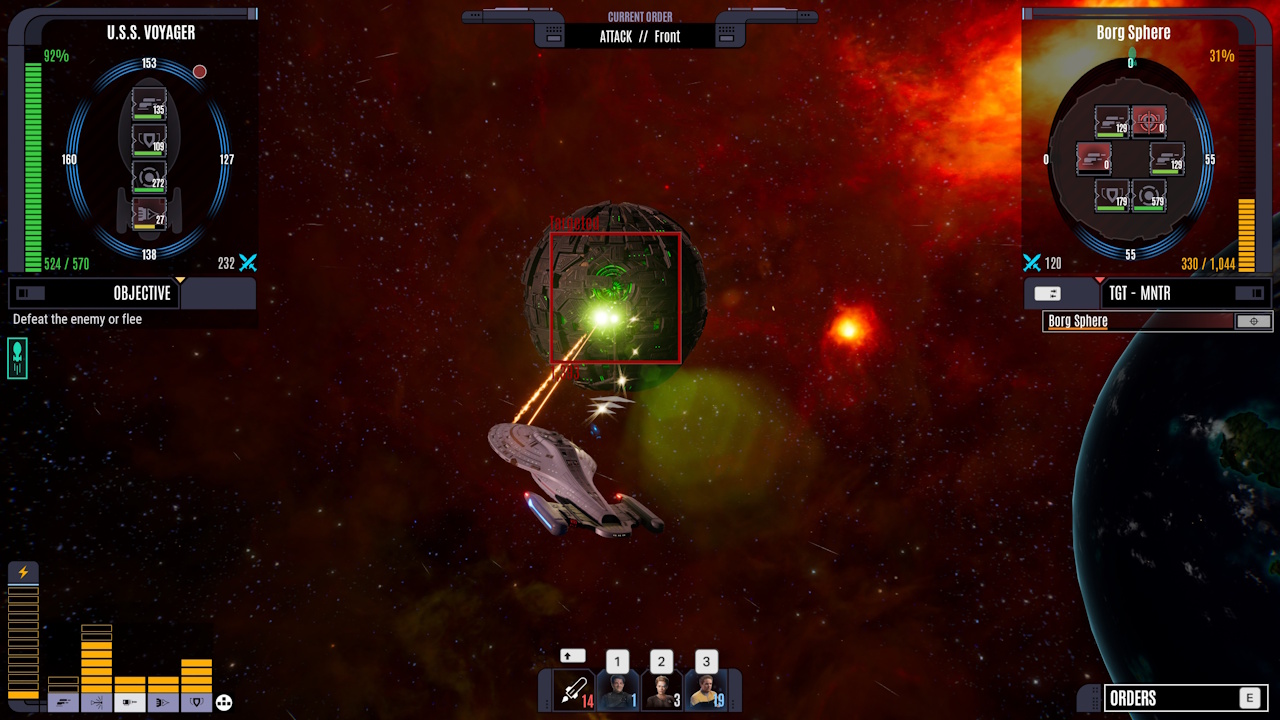
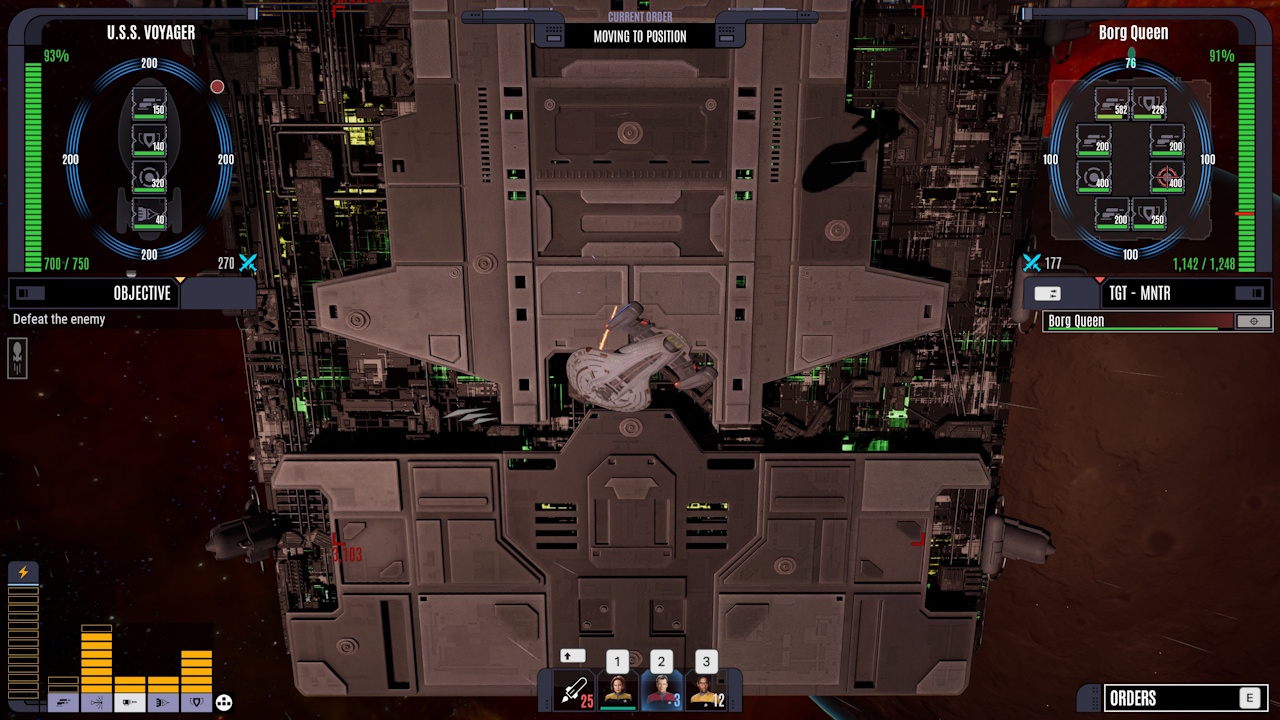
Combat takes place in real-time, and there are a variety of enemy ships you’ll encounter. Some are akin to boss fights, with big, imposing enemies who need to be defeated. Others are random encounters or ambushes at points of interest.
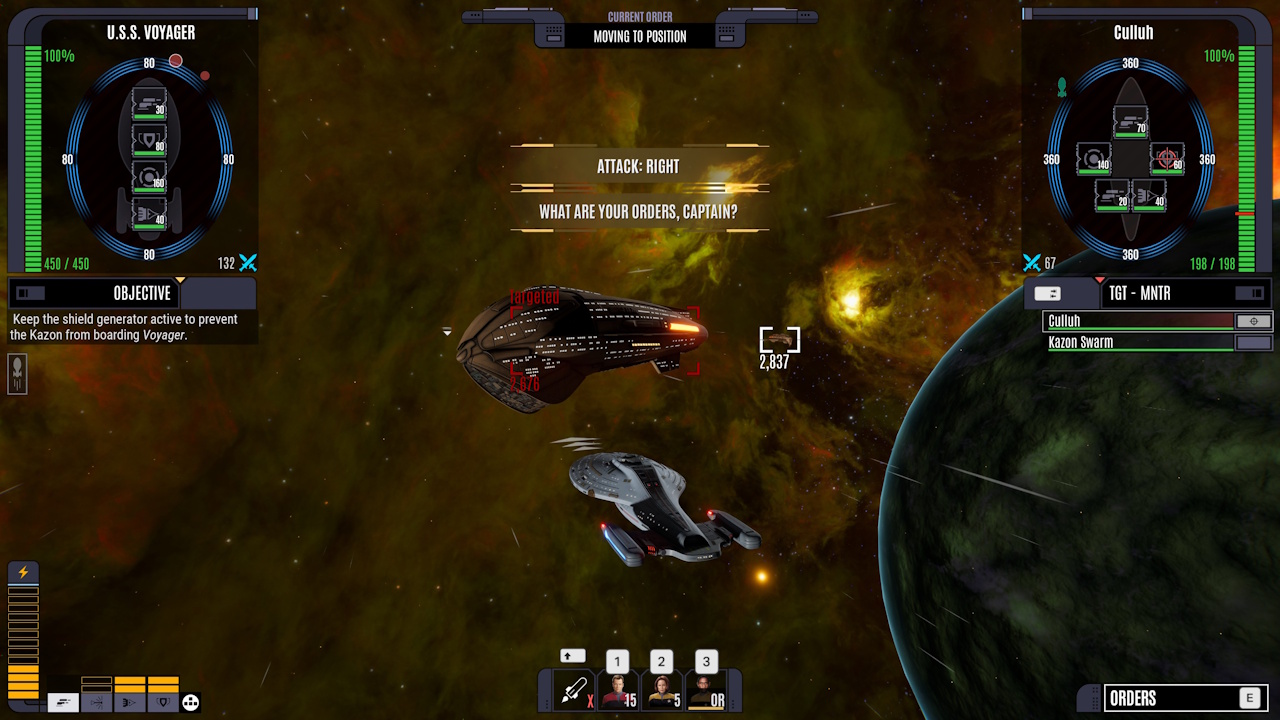
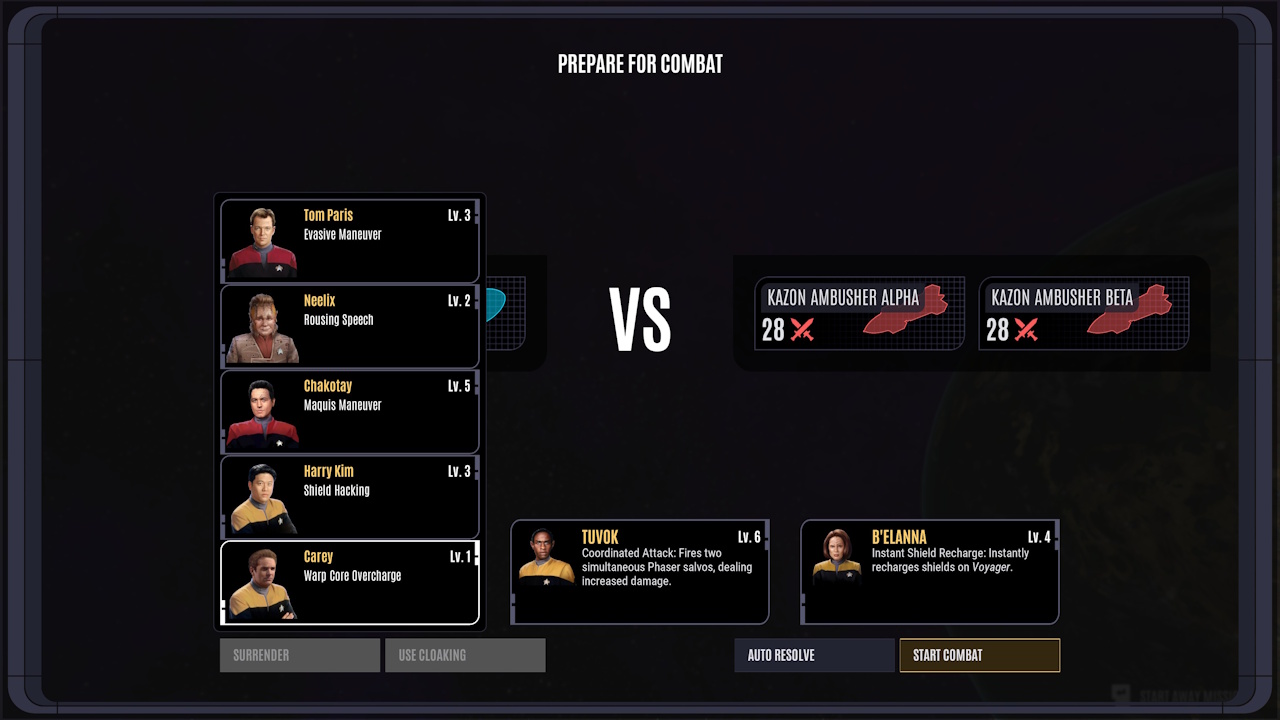
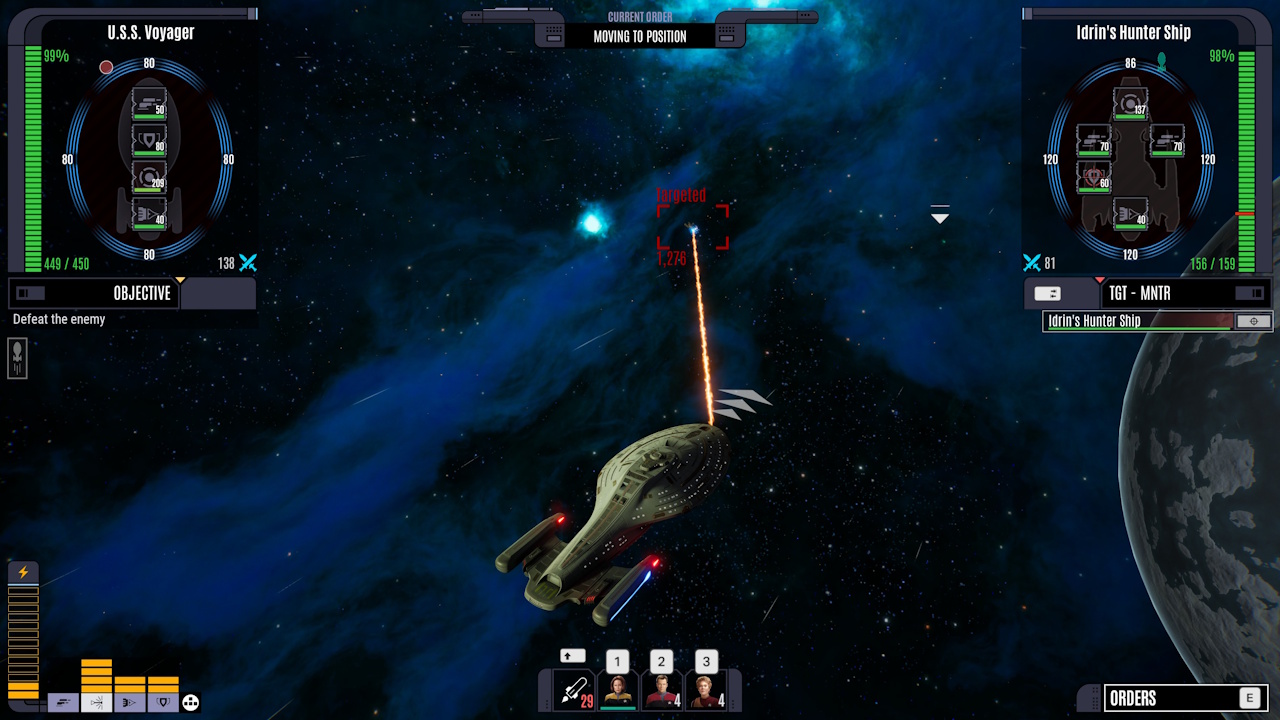
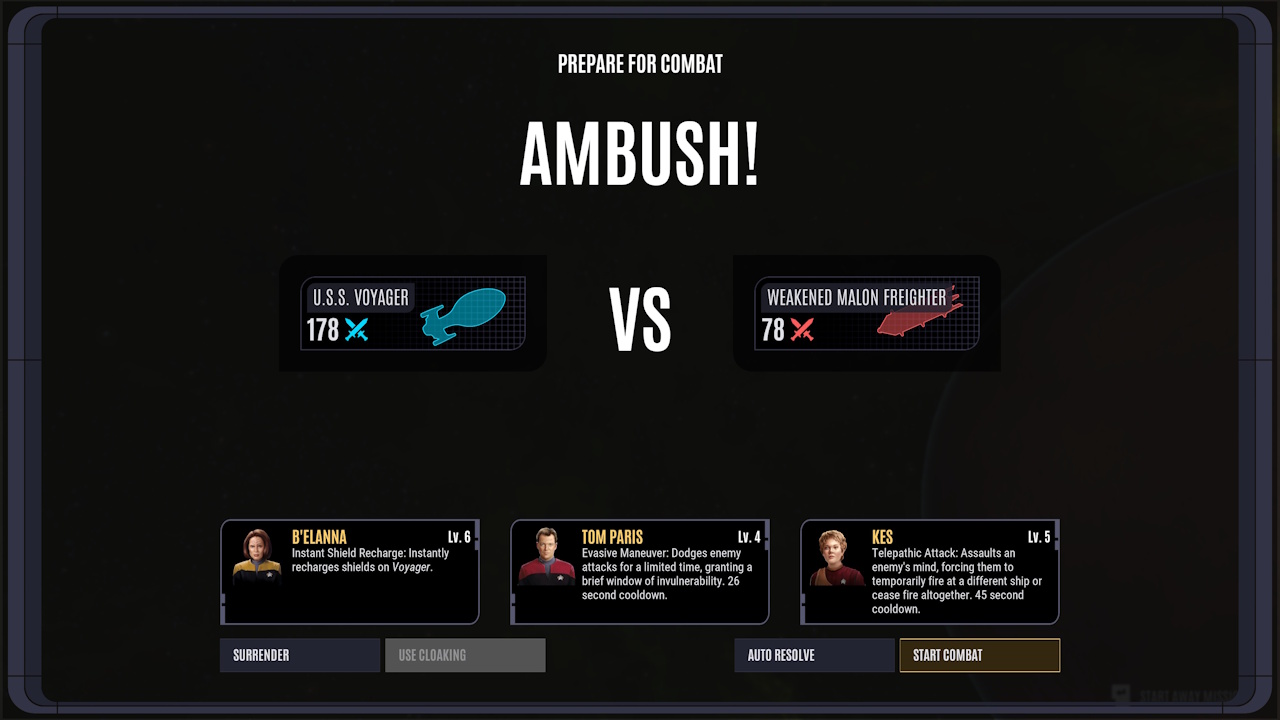
This is not going well…An early boss battle.Choose your fighter!Fire the disruptors!Oh no, it’s an ambush!Battling the Borg.Eww, the Borg are revolting.Another ambush, eh?Fire the cutting beam!
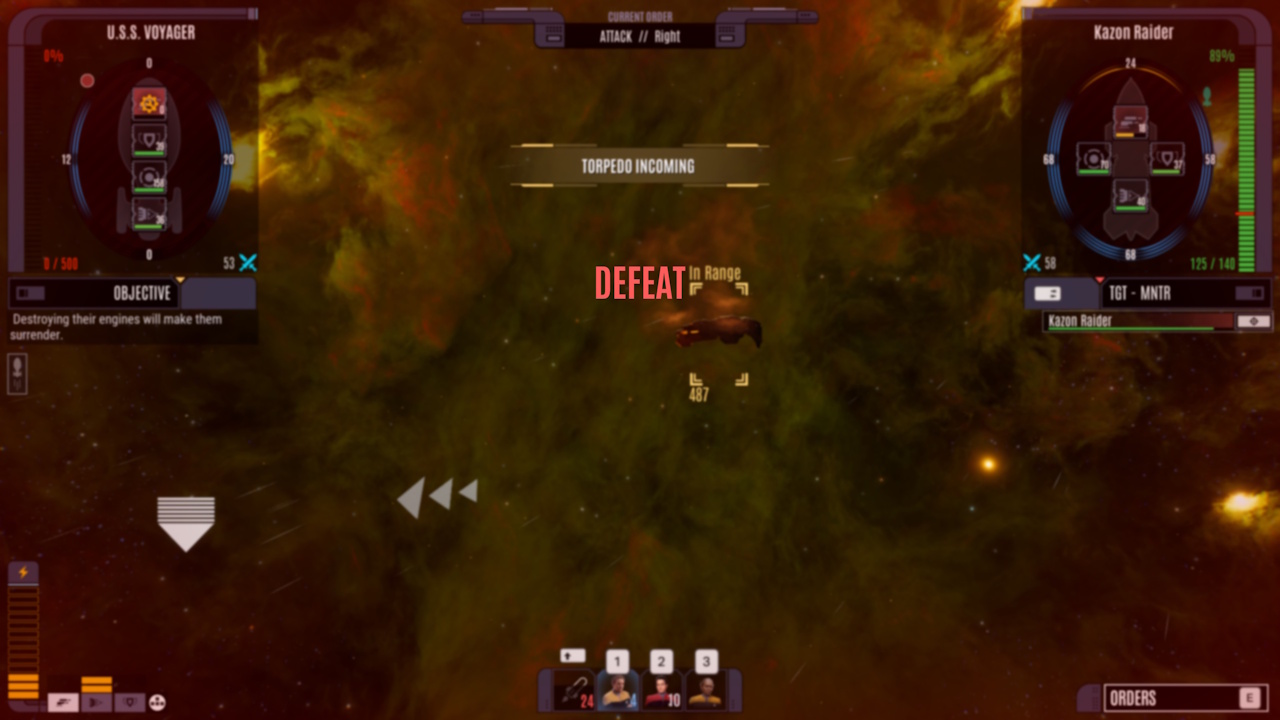
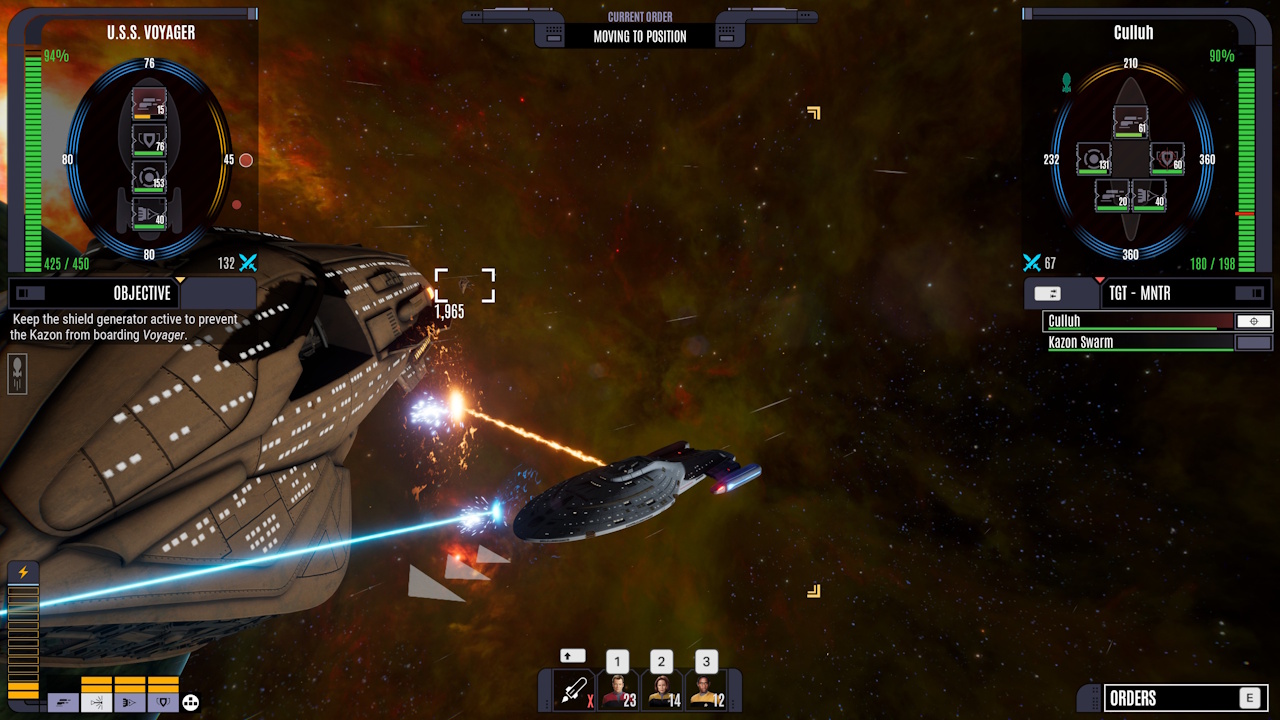
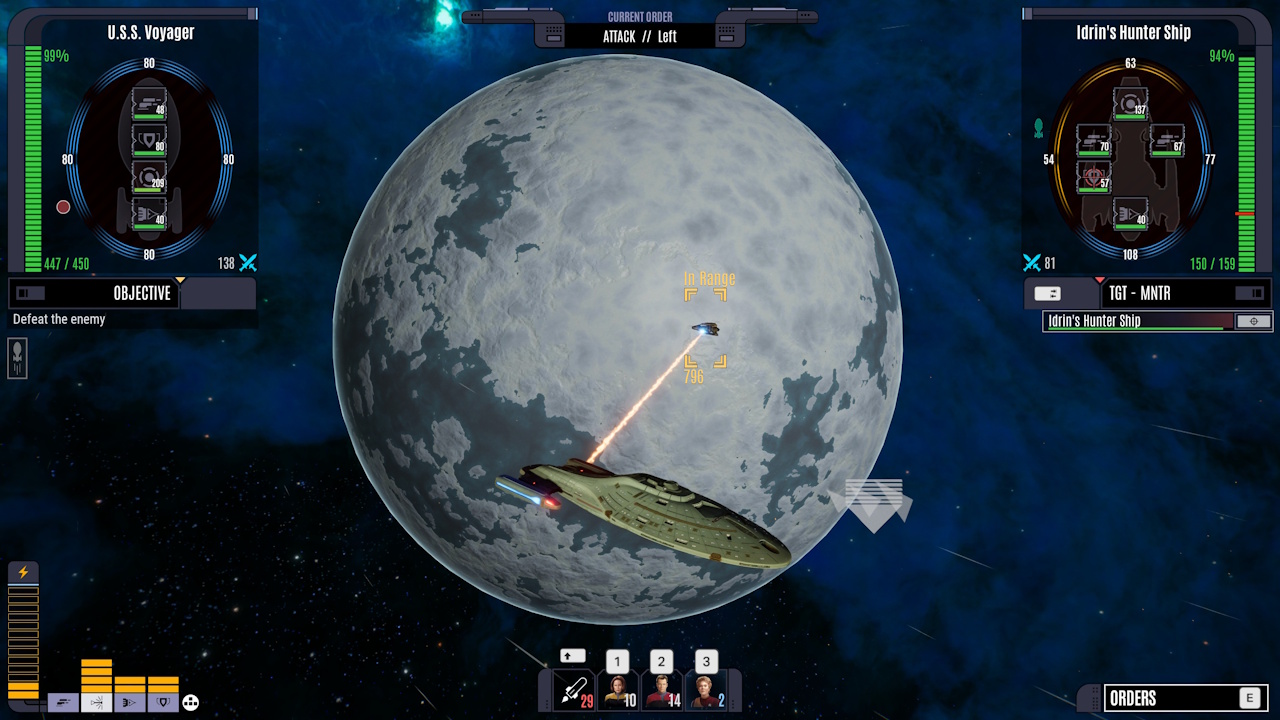
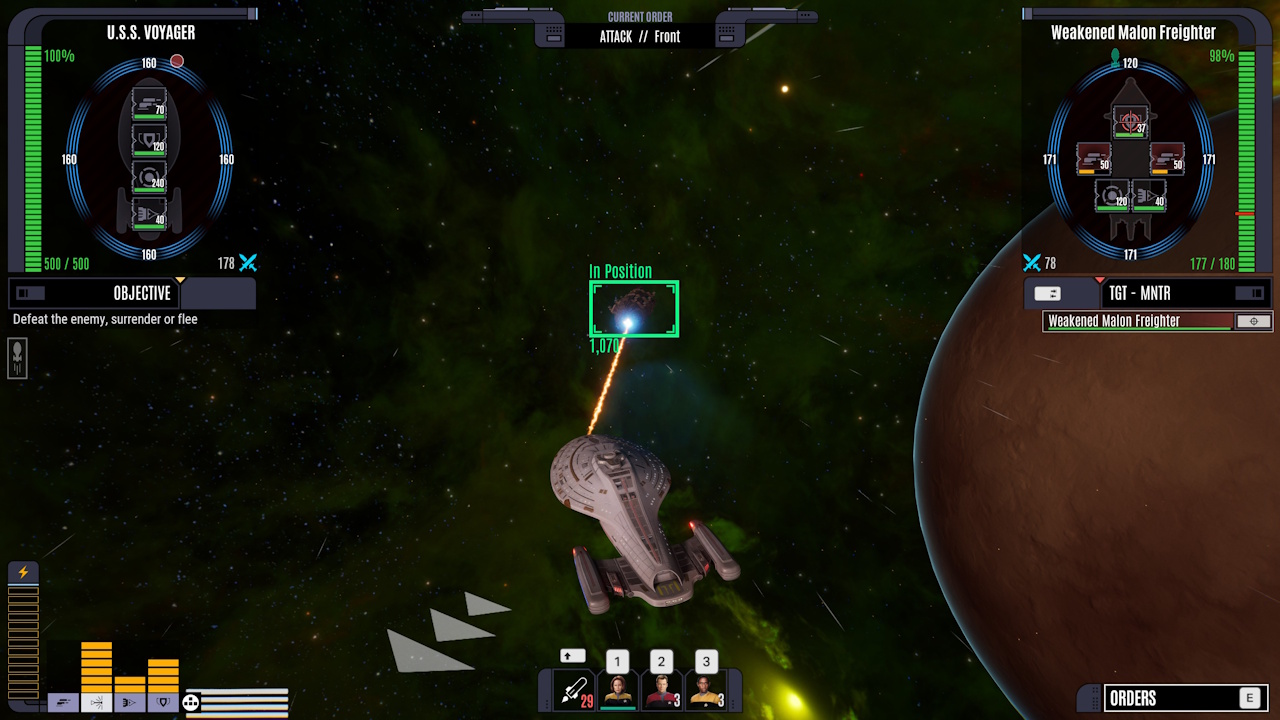
Defeat!Fighting Culluh.Idrin was a mid-game boss.Defeating the Malon.Facing off with the Equinox.Choosing which system to target.Take that, Borg Cube!We’ll hit ’em with everything we’ve got!The final boss battle.
The Main Menu:
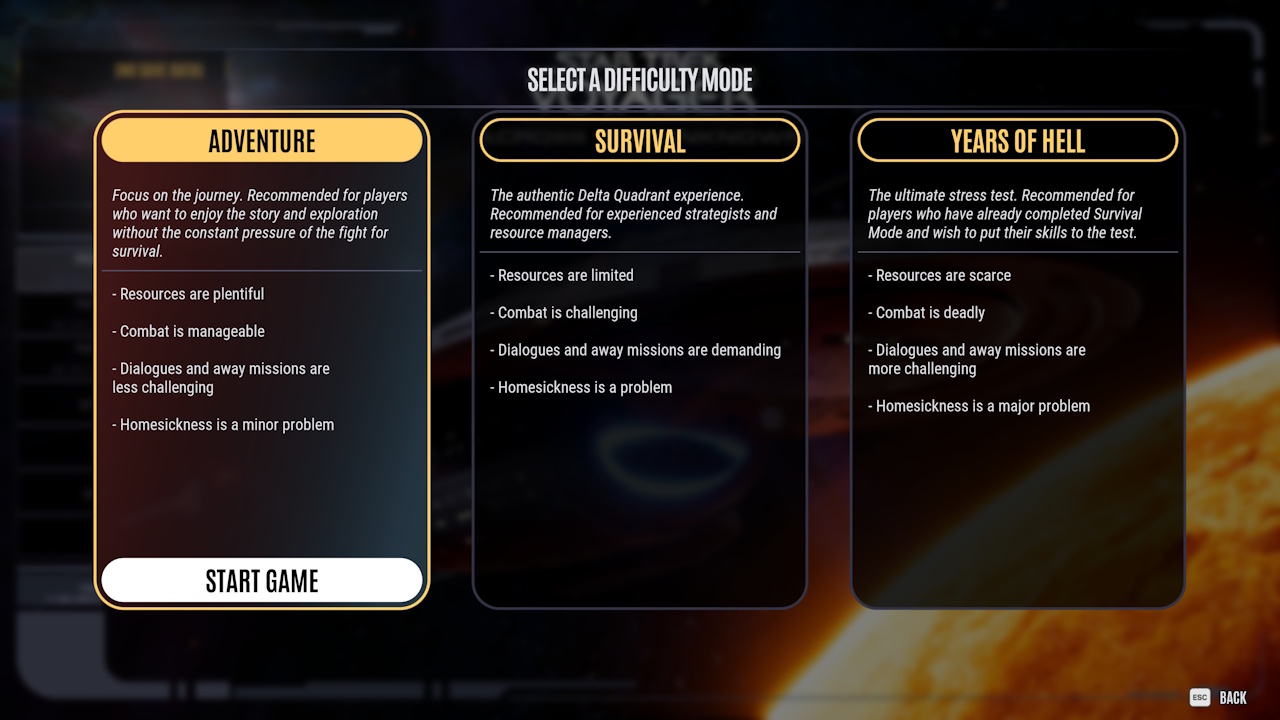
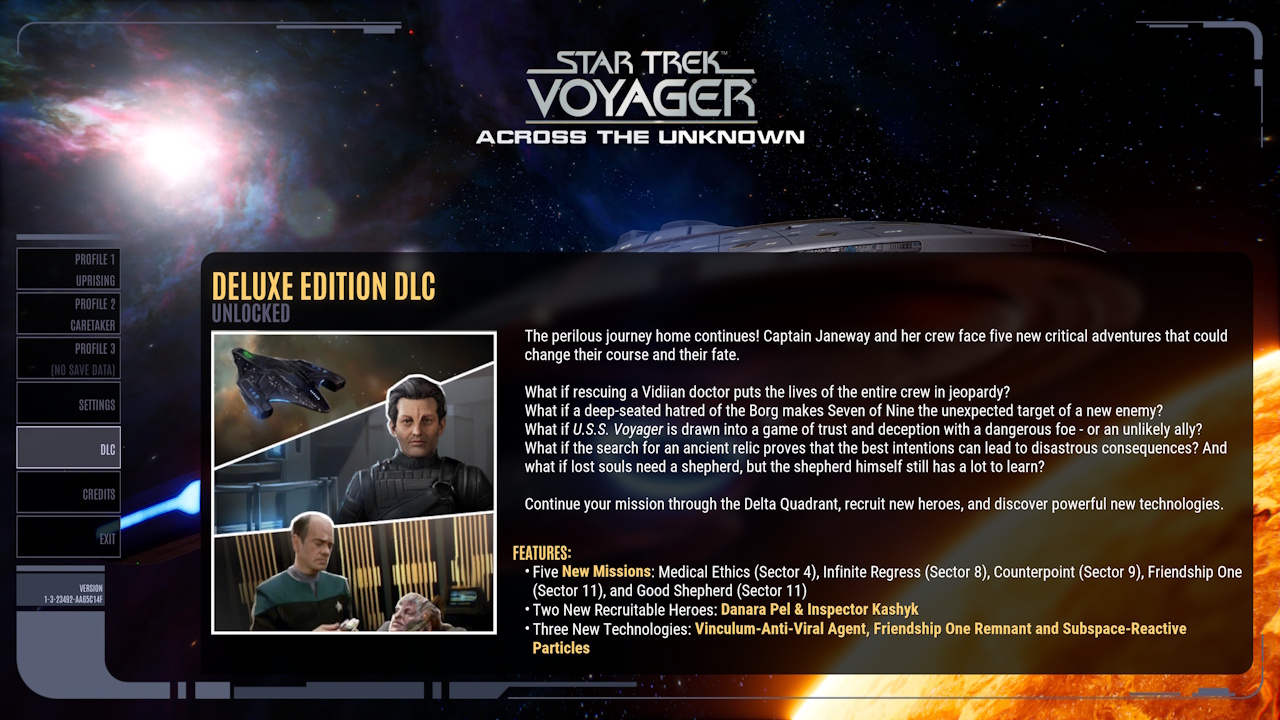
The game’s main menu and difficulty options.
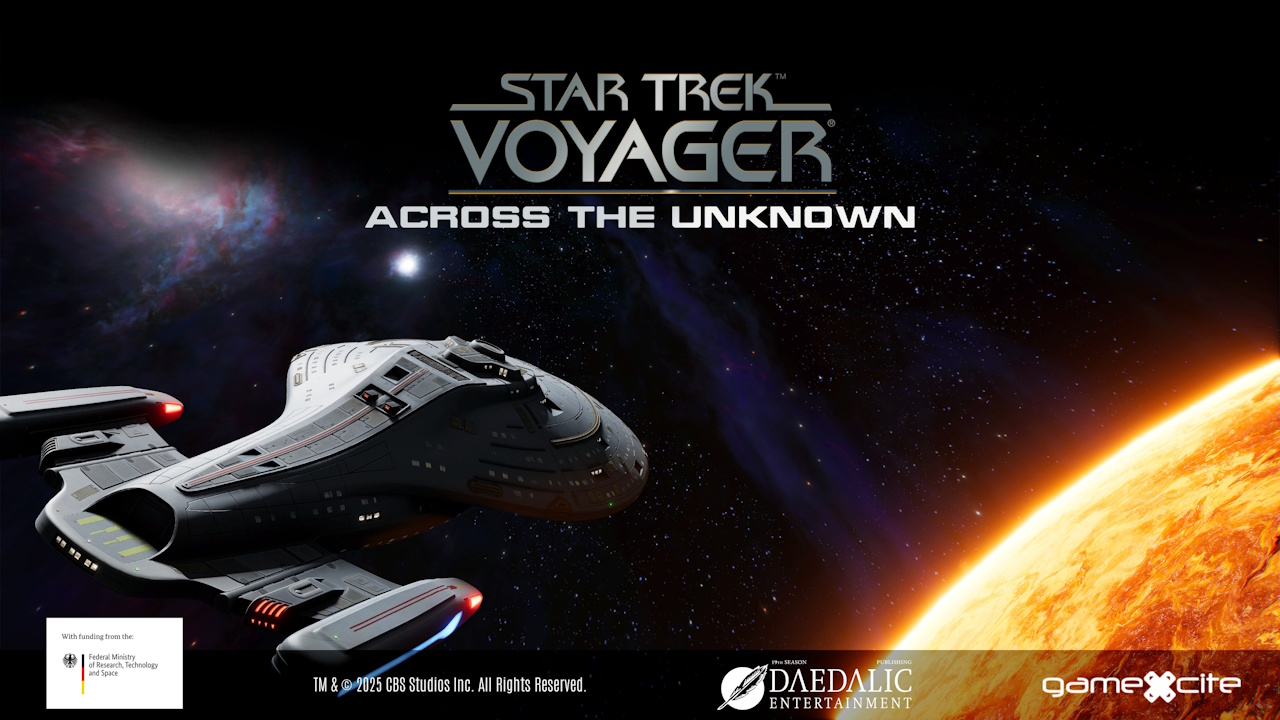
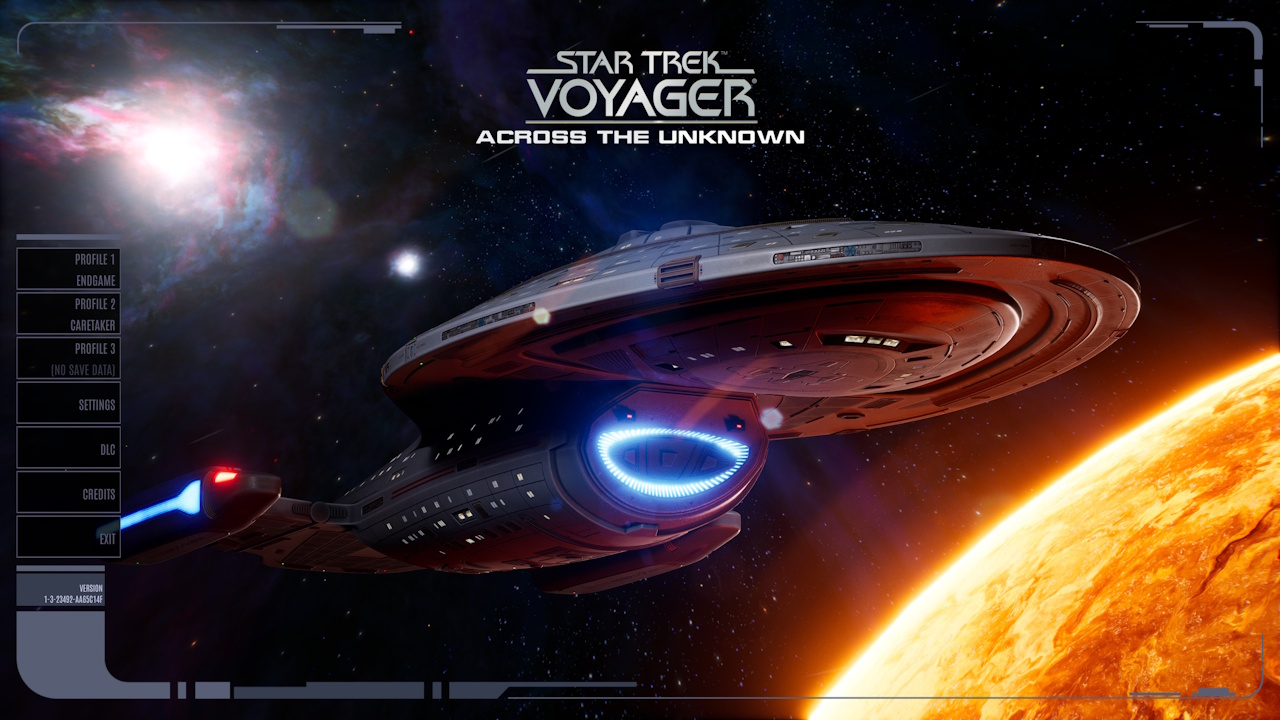
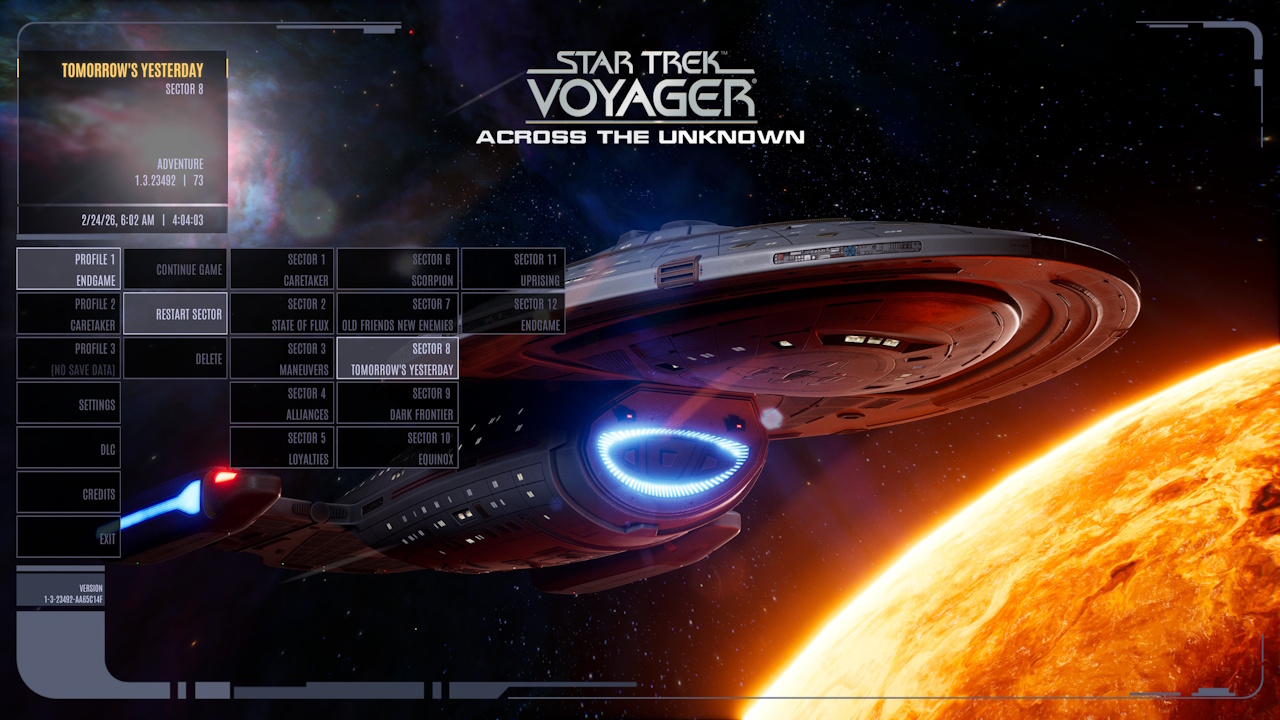
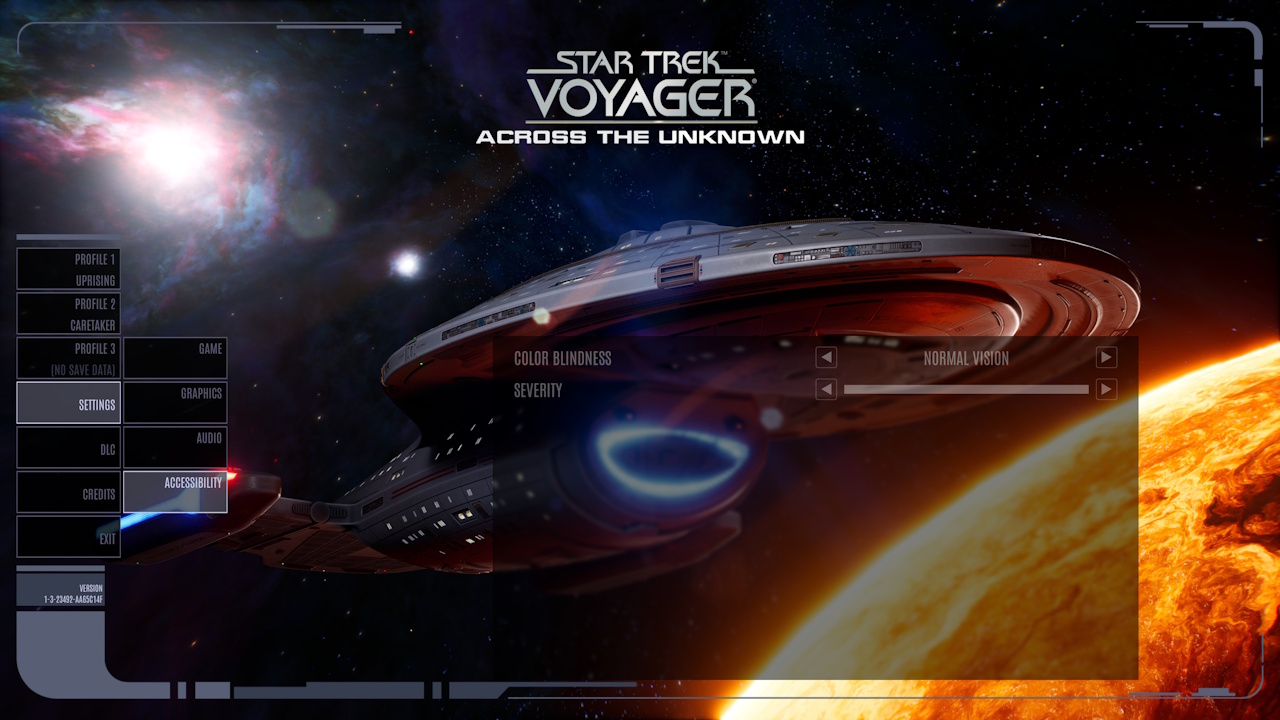
The first screen you see on booting up the game.Difficulty options.The DLC part of the main menu (I bought the deluxe edition).
The main menu.Main menu + sector list.Accessibility settings in the main menu.
Endings:
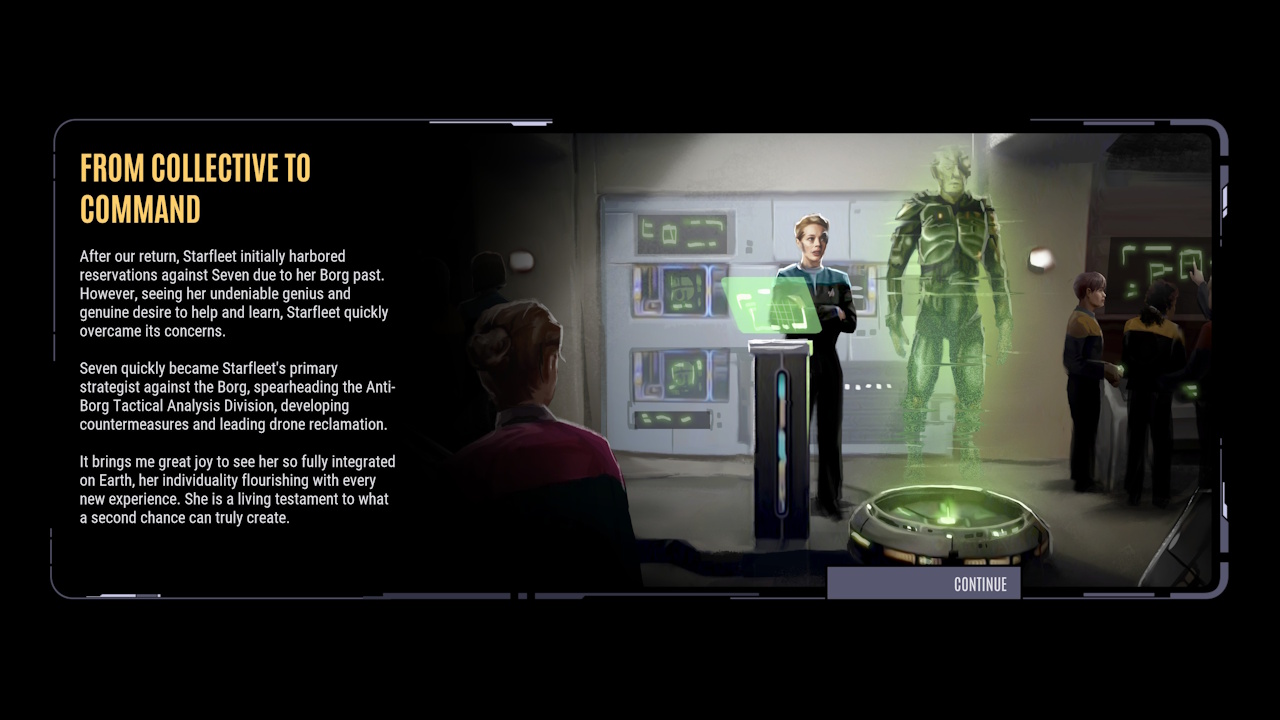
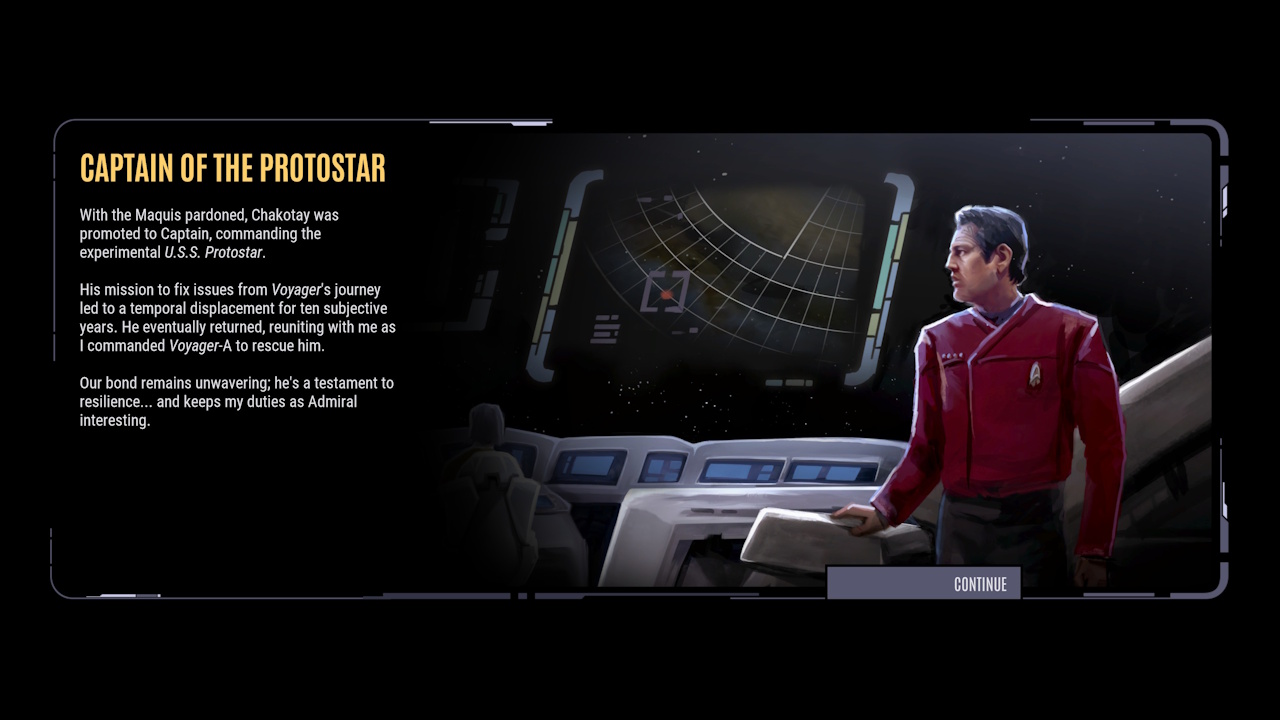
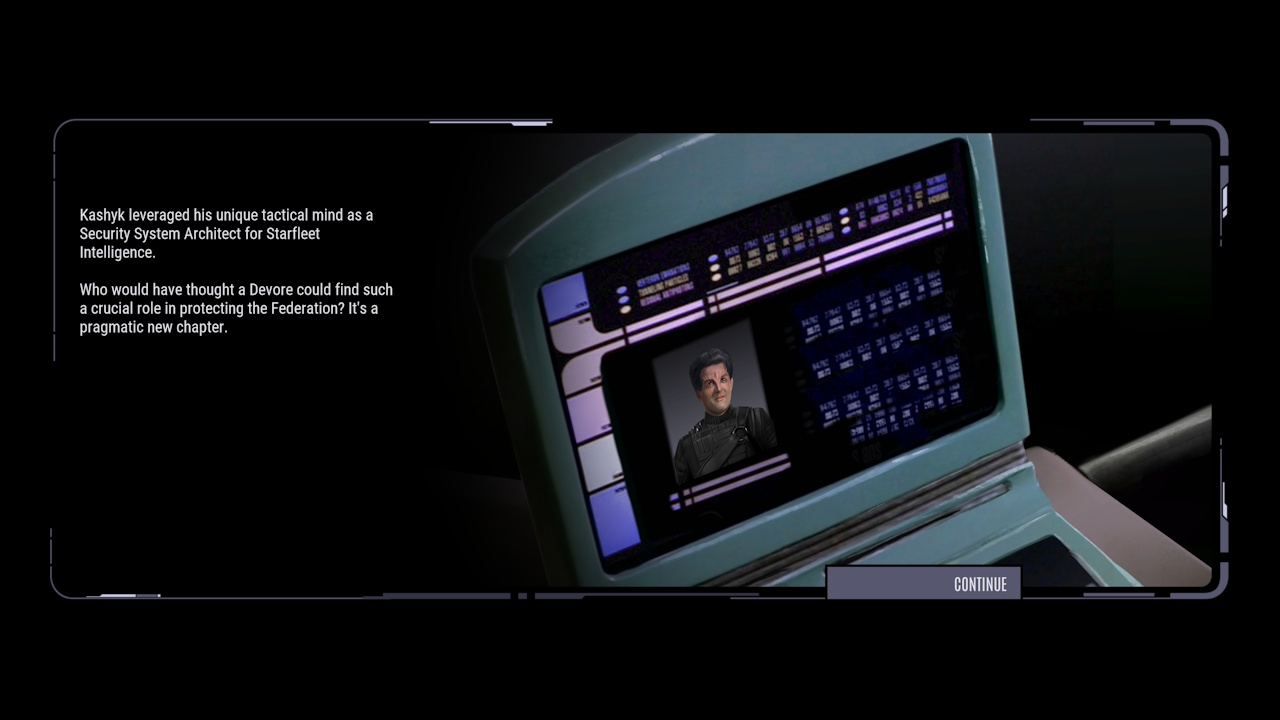
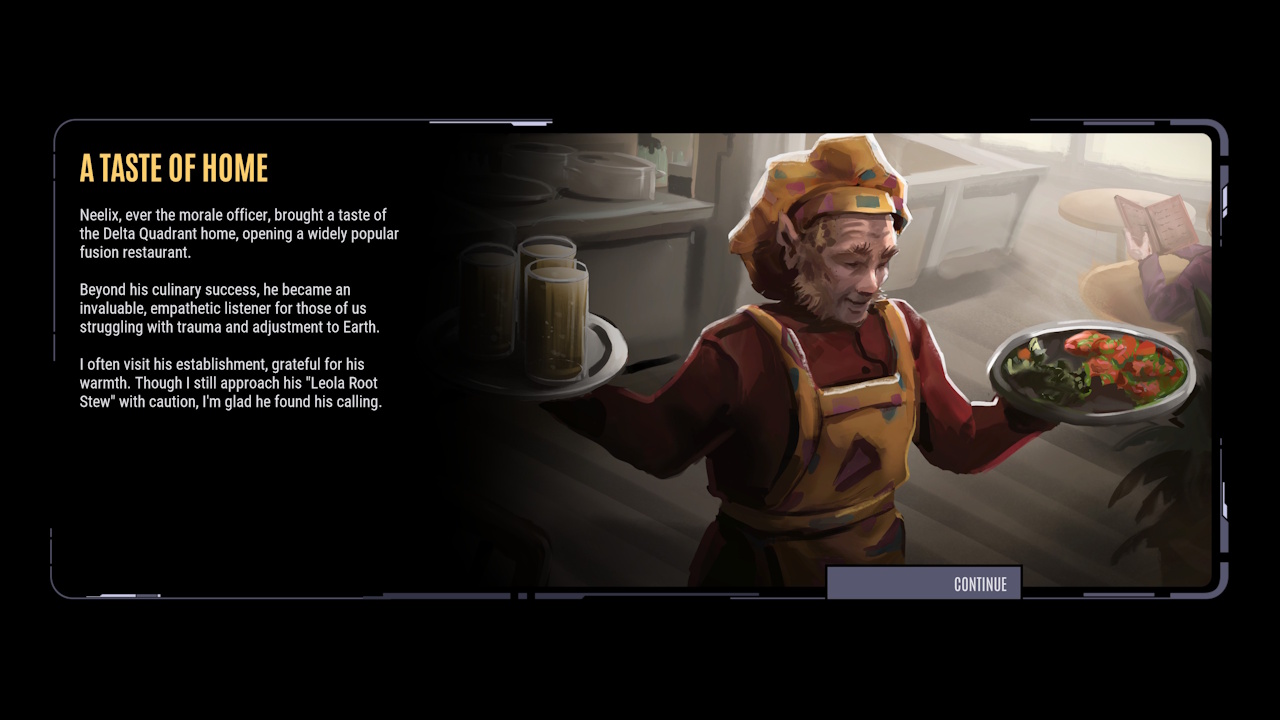
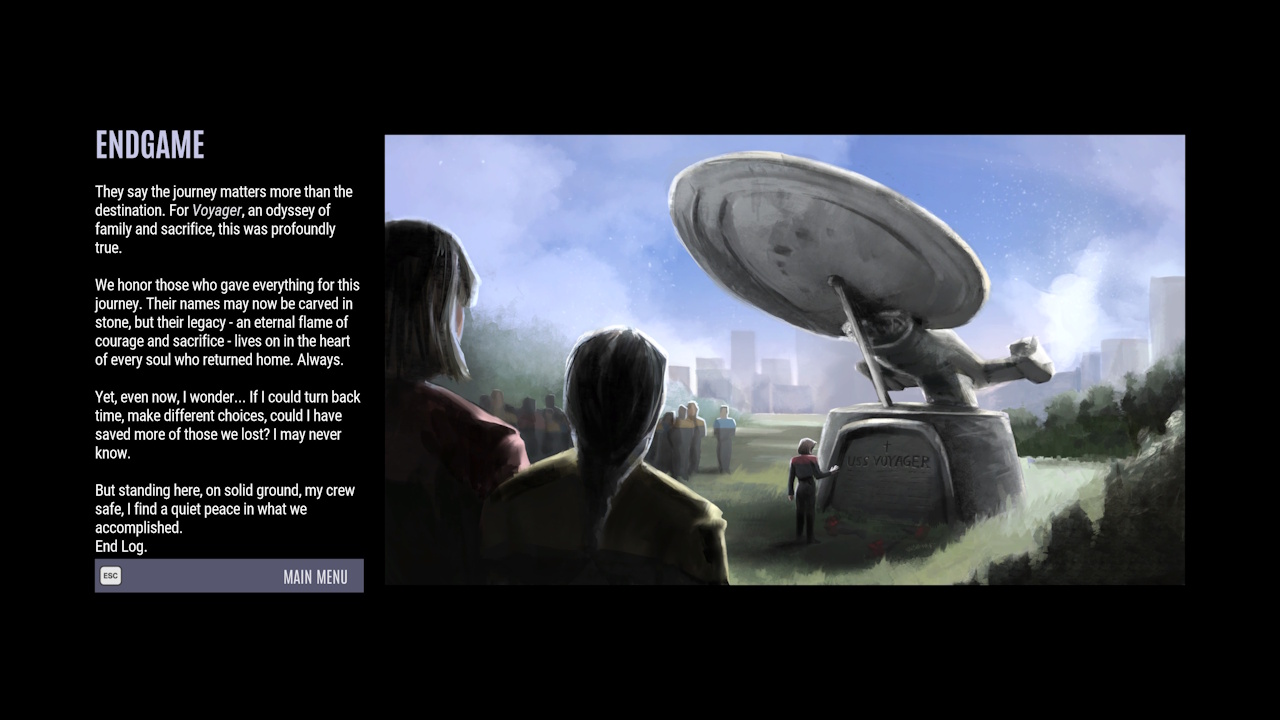
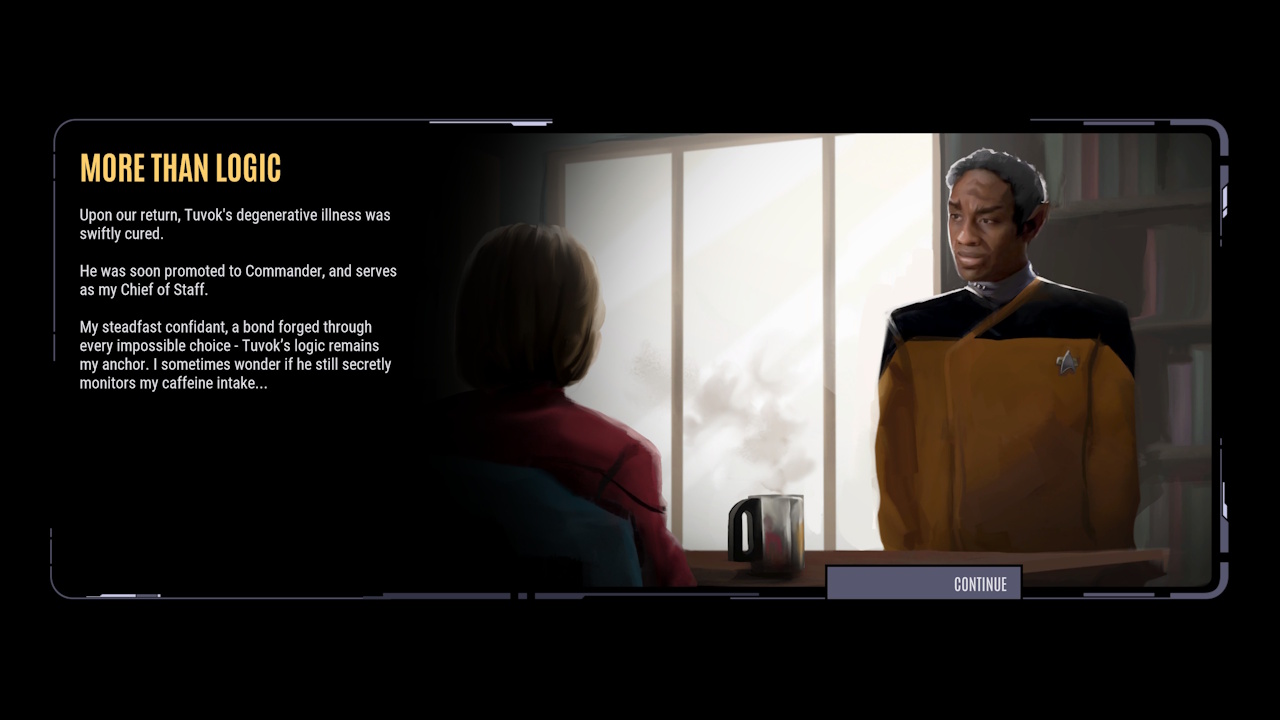
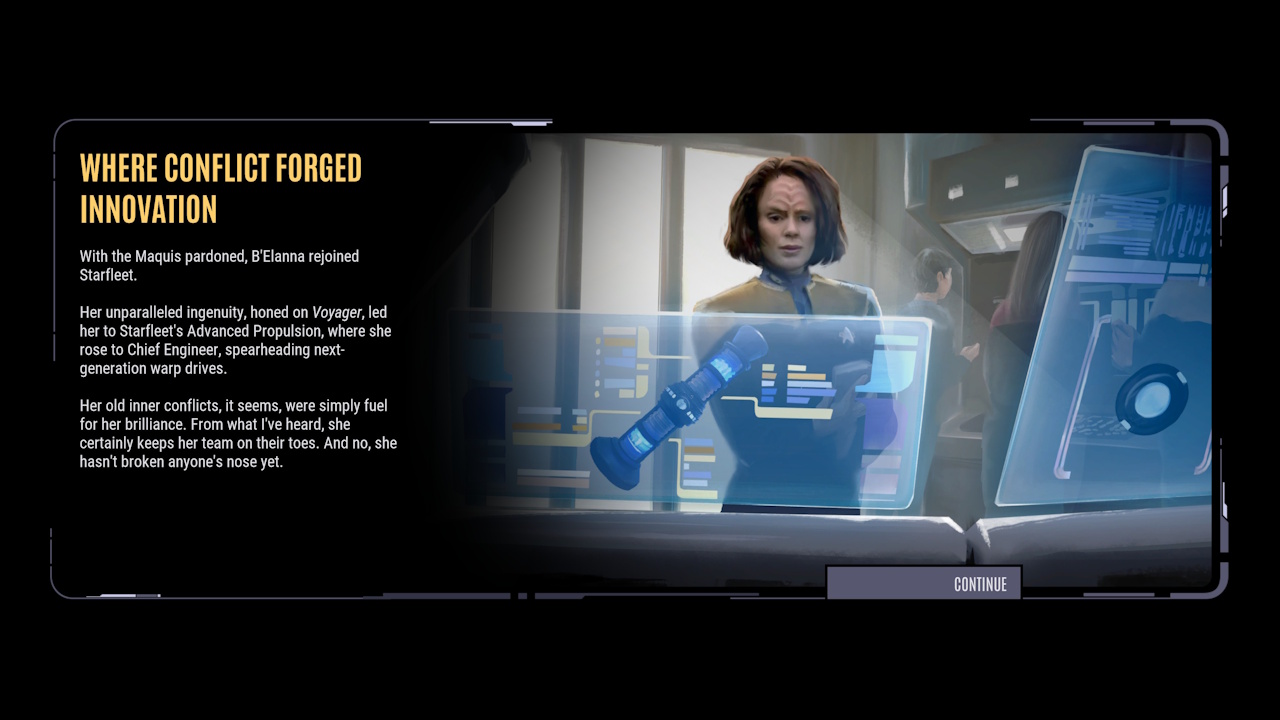
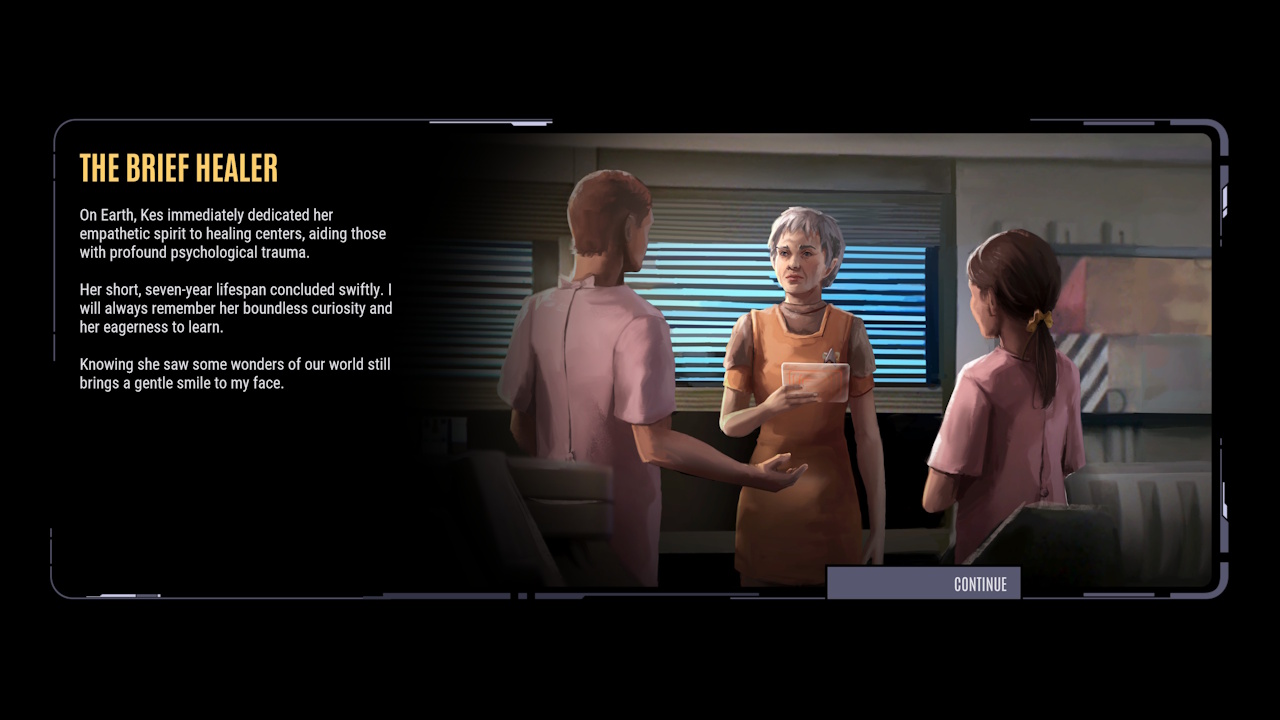
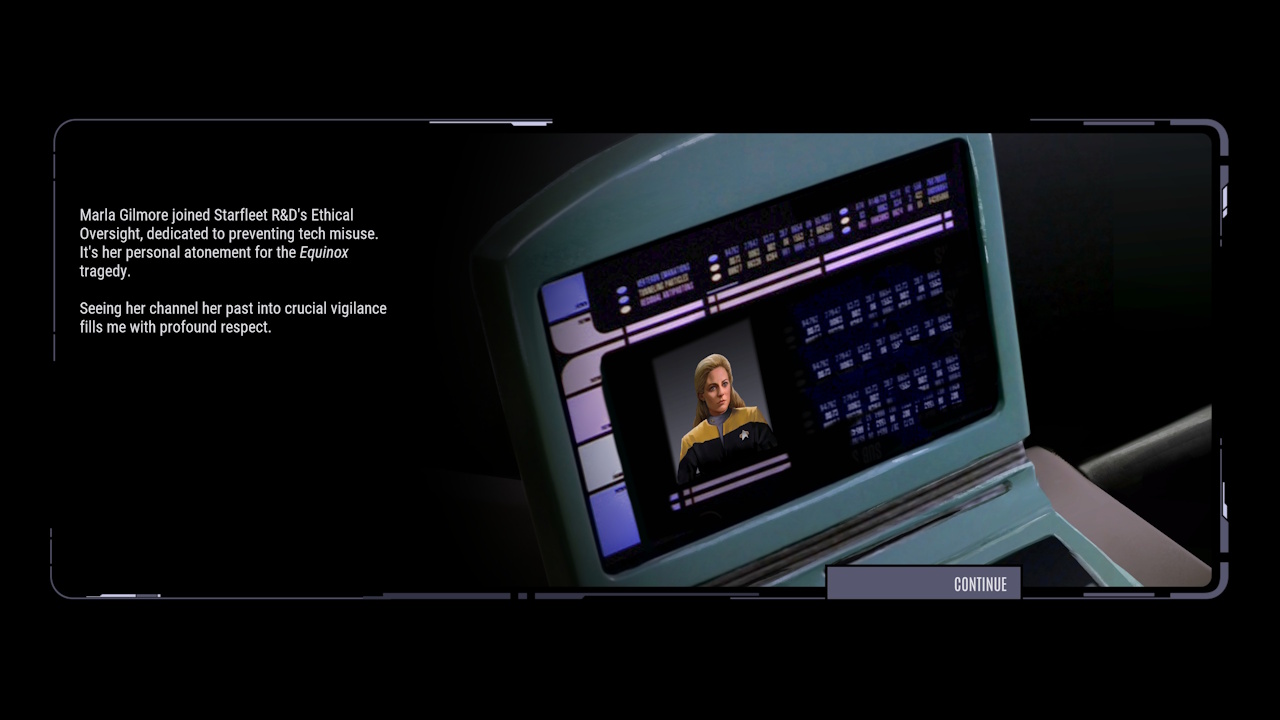
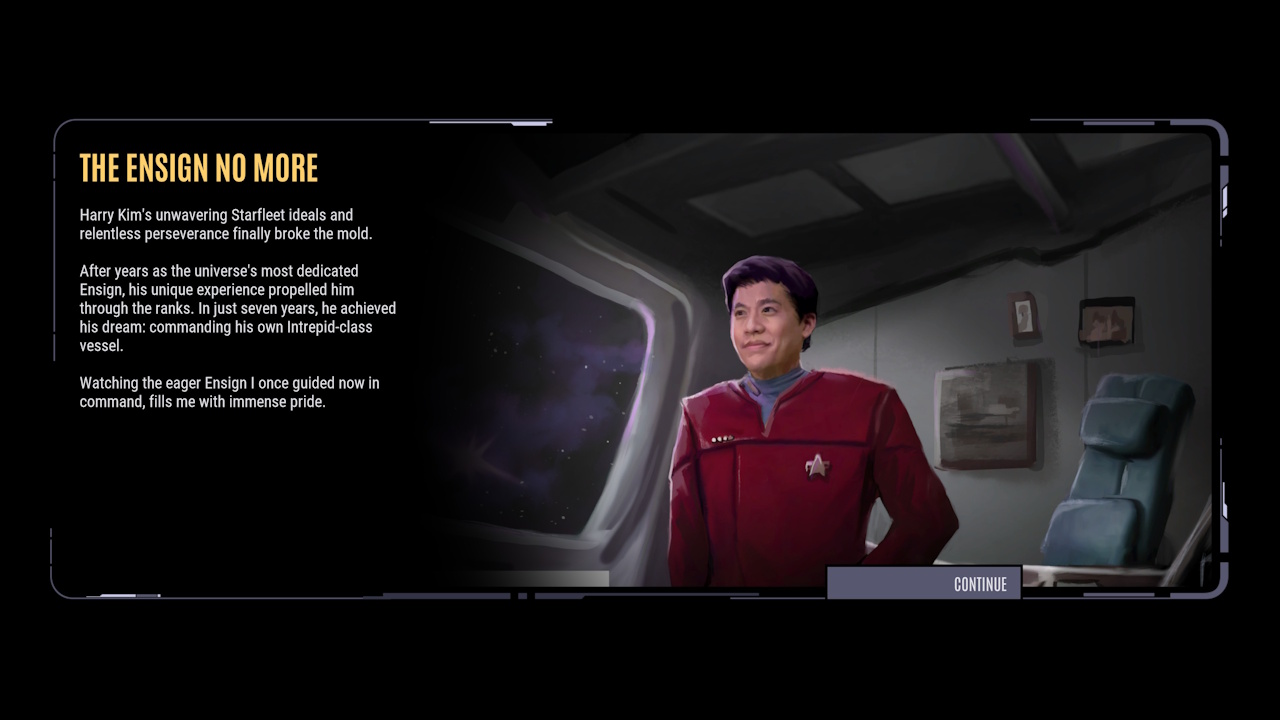
These are a selection of ending cards for various hero characters, as well as a couple from one of the “bad” endings.
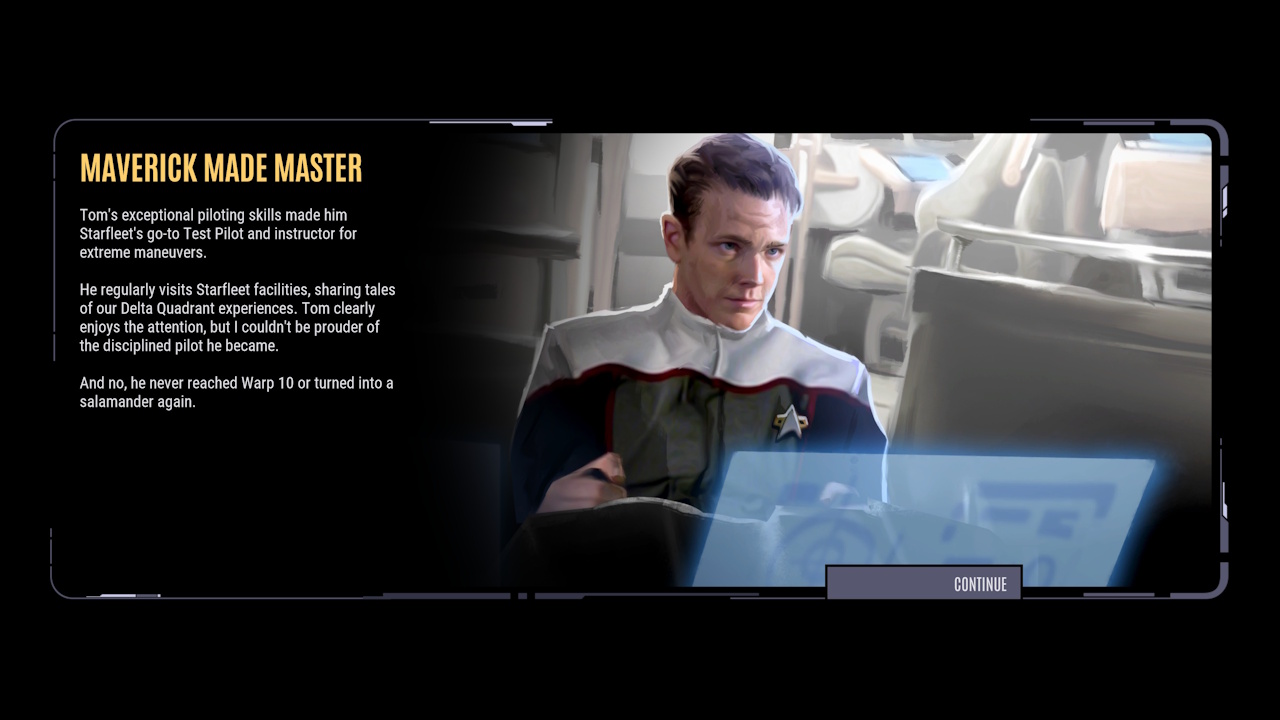
The ending screen.Seven of Nine’s ending.Chakotay’s ending connects with Prodigy.Kashyk’s ending.Neelix can make it to Earth.Tom Paris’ ending.
A better ending!Tuvok’s ending.B’Elanna’s ending.Kes’ ending was bittersweet.Marla Gilmore’s ending.Harry finally gets his promotion!
So that’s everything I have!
I hope some of these screenshots will prove useful to you – or just interesting, if you’re curious about the game but haven’t yet decided whether or not to commit to it. If you want to get my full thoughts on Across The Unknown, including the positives, some points of criticism, and why I’m happy to recommend it to fans of Voyager, please check out my full review. You can find it by clicking or tapping here.
That’s all for today. Screenshot galleries aren’t usually something I publish here on the website, but I had so many spare ones after my review of Across The Unknown that I thought I’d give it a try. Hopefully someone out there found these to be useful, in any case!
Have fun in the Delta Quadrant, friends!
Star Trek: Voyager – Across The Unknown is out now for Nintendo Switch 2, PC, PlayStation 5, and Xbox Series consoles. Across The Unknown was developed by GameXcite and published by Daedalic Entertainment. Star Trek: Voyager remains the copyright of the Skydance/Paramount corporation. This review contains the thoughts and opinions of one person only and is not intended to cause any offence.
Spoiler Warning: There are spoilers ahead for the following Star Trek productions: The Original Series, The Motion Picture, The Next Generation, Deep Space Nine, Voyager, Enterprise, Discovery, Picard, and the video game Star Trek: Voyager – Across the Unknown.
Let’s celebrate Star Trek’s 60th anniversary year with another of my Marvel-inspired “What If…” articles! This is something I’ve done a couple of times before here on the website, and I’ll briefly go over the format if you’re unfamiliar with it. I thought this could be a fun and interesting way to continue our 60th anniversary celebrations, anyway.
In 2021, Disney and Marvel premiered a series called What If…? on Disney+. The concept was, in brief, to show alternate histories of the Marvel universe; different characters or altered decisions leading to, in some cases, radically different or unexpected outcomes. I didn’t watch the show (because I’m not really into Marvel or superheroes that much), but I really liked the concept behind the series, and I wanted to apply it to the Star Trek franchise, too.
This idea is based on the Marvel TV series What If…?
My first take on this idea – which you can find by clicking or tapping here – saw me consider what might’ve happened if: Captain Picard died after the events of The Best of Both Worlds, Spock was never resurrected on the Genesis Planet in The Search for Spock, Voyager decided to head for the Gamma Quadrant terminus of the Bajoran Wormhole, the USS Discovery never went to the future, and Captain Sisko wasn’t the Prophets’ Emissary. I had fun delving into all of those ideas and laying out my “alternate histories of the future!”
Last year, in my second piece – which you can find by clicking or tapping here – I talked about what could’ve happened if: Captain Picard and Q never met, Section 31 was responsible for creating the Borg, the USS Voyager was destroyed over Ocampa and the survivors were picked up by Chakotay’s Maquis raider, the Romulans eventually figured out the deception from In The Pale Moonlight, and Captain Kirk survived the events of Generations. Again, all of those were a ton of fun to consider.
Be sure to check out those earlier pieces if you enjoy this format. And feel free to use the same concept in your own writing or on social media, too!
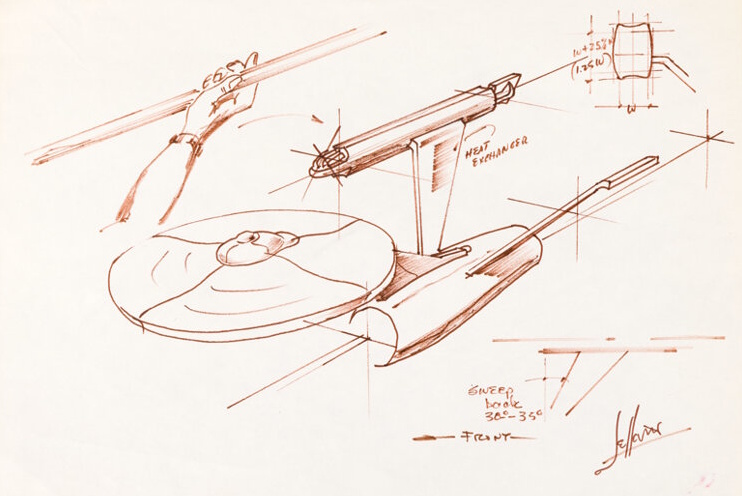
Concept art of the USS Enterprise filming model.
So today, I’m back for a third crack at this idea. I’ve chosen five storylines from across the Star Trek franchise, and I’m going to answer the question “what if things were different?”
My usual caveat applies: all of this is *subjective, not objective*, so if you hate all of my ideas and mini-stories, that’s okay! There’s plenty of room in the Trekkie community for differences of opinion and disagreements without getting into an argument. None of this is even *remotely* canon, anyway, nor will it ever be – so if you really do hate my ideas, you can take solace there, I hope!
With all of that out of the way, let’s get started!
What If… #1: What if… the USS Voyager returned home after the events of Caretaker?
Could Captain Janeway bring the crew home seven years ahead of schedule?
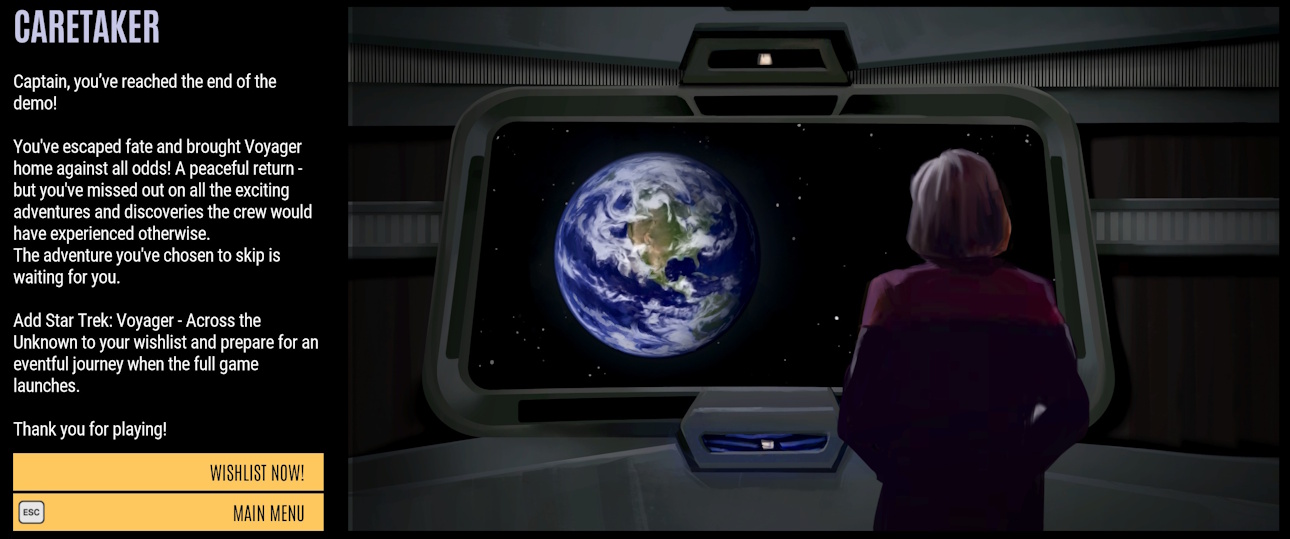
Shout out to the upcoming video game Across The Unknown, where you can actually pull this off if you want!
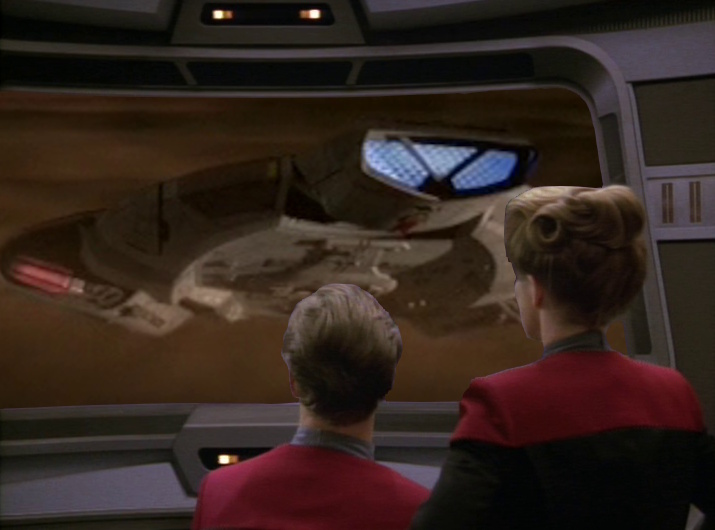
In this scenario, we’re starting with Voyager’s premiere: Caretaker. But we’re going to do things a little differently! As happened in an alternate timeline glimpsed in the episode Non Sequitur, Tom Paris got arrested by Odo on DS9, and never even set foot aboard Voyager. In our take on the story, we’re going to say that Captain Janeway approached Commander Sisko for advice, as she was still in need of a guide to the Badlands. Sisko would “loan” two of his officers to assist her on the mission – people who are familiar with the Badlands, both scientifically and geographically: Jadzia Dax and Michael Eddington.
Both officers would be present on the bridge during the search for Chakotay’s ship, and both would survive the displacement wave that dragged Voyager to the Delta Quadrant. After encountering the Kazon, Ocampa, and the Caretaker, Voyager’s captain and senior staff would be faced with the same dilemma as in the prime timeline: use the Array to return home, or destroy it to prevent it from falling into the hands of the Kazon.
Voyager and three Kazon vessels at the Caretaker’s Array.
There are two factors at play, I think. Firstly, Eddington’s true loyalties lie not with Starfleet, but with the Maquis. I think he’d be desperate to get back to DS9 so that he could continue to work undercover, building up to his big defection in For The Cause. Eddington would be one of the most significant voices arguing for a return home. Dax, too, would be keen to get back, but her centuries of experience and scientific background would come into play here. Dax might be able to find a way to set Voyager’s tricobalt devices to detonate on a timer, allowing the Array to be sabotaged, and then used to return home. Or, by having someone with a keen scientific mind access the Array, other options for using its technology could have presented themselves.
In any case, we’re going to say that a way is found for Voyager to use the Array to return home. Eddington would do just enough to ensure that the Val Jean (Chakotay’s ship) makes it back just before Voyager, allowing them to escape Federation custody while keeping his cover intact. Then, Voyager would end up back in the Alpha Quadrant, just outside of the Badlands. Waiting for them would be Sisko and the USS Defiant, just beginning a search-and-rescue when Voyager failed to report back.
How it might’ve looked if Voyager had returned home almost immediately.
The real consequences of this would be felt later, though. Chakotay, B’Elanna, Eddington, and others would be killed at the beginning of the Dominion War, when the Dominion-backed Cardassians (perhaps aided by Seska as an embedded spy) wiped out the Maquis. In the Delta Quadrant, the Ocampa would still be confronted with the reality of life without their Caretaker, and would eventually have to find a way to leave their underground city.
But there are more serious repercussions. At time of writing, it seems as if Janeway is directly responsible for the destruction of the Borg Queen and at least a significant portion of the Borg Collective (as seen in Picard Season 3). If she doesn’t undertake that seven-year journey, never meets Seven of Nine, and never travels back in time to plant a pathogen directly into the Borg Queen… the Borg will be in a massively strengthened position by the early 25th Century. The Collective may not need to employ rogue changelings to infiltrate Starfleet – they might just choose to launch a full-scale invasion. And without crucial information on the Borg that was collected by Voyager, Seven of Nine, the Hansen family, and more… Starfleet would be significantly more vulnerable.
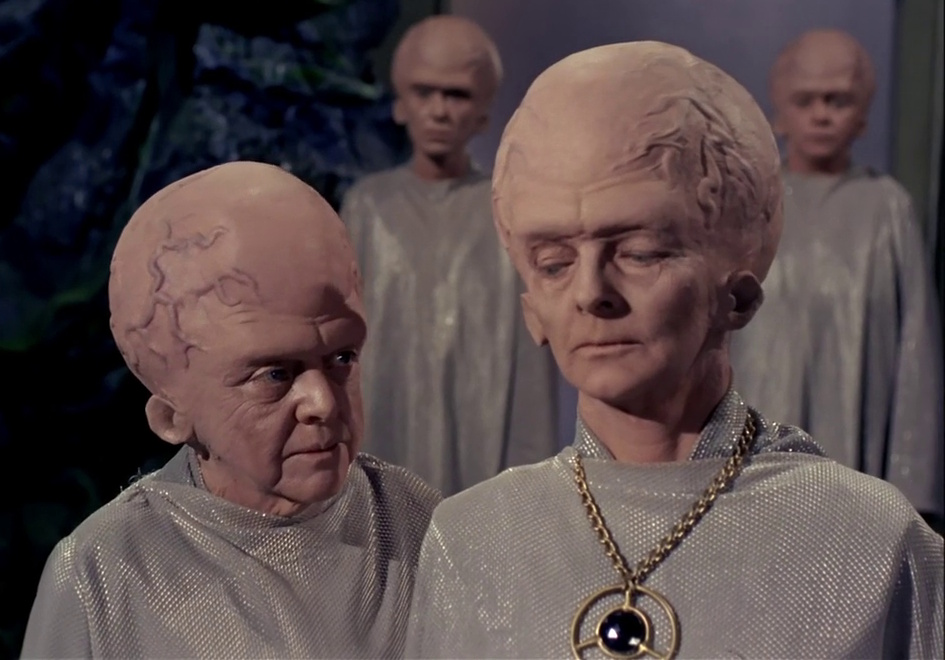
What If… #2: What if… the Talosians joined the Federation?
A group of Talosians.
We’re going all the way back to the beginning with this one – appropriate, in this milestone anniversary year. In short, it’s never sat quite right with me that Starfleet and the Federation would view the Talosians so negatively – and as such a dangerous threat – after just one interaction. Lest we forget, Captain Pike’s mission to Talos IV ended without any loss of life, and arguably with the beginnings of an understanding or even dialogue between the Talosians and humankind. Pike and the crew came to understand the Talosians’ situation, and for their part, the Talosians were able to acknowledge that humans (and Vulcans) were not suitable captives.
So in this alternate timeline, we’re going to say that Captain Pike returns to Starfleet HQ with a different mission report. Instead of recommending that Talos IV be quarrantined and declared to be off-limits, he instead advocates for sending aid to the Talosians to help rebuild or maintain their technology and rehabilitate the devastated surface of their world. The Talosians would be taken aback by this generosity, and would vow never to use their impressive telepathic powers to trick the Federation.
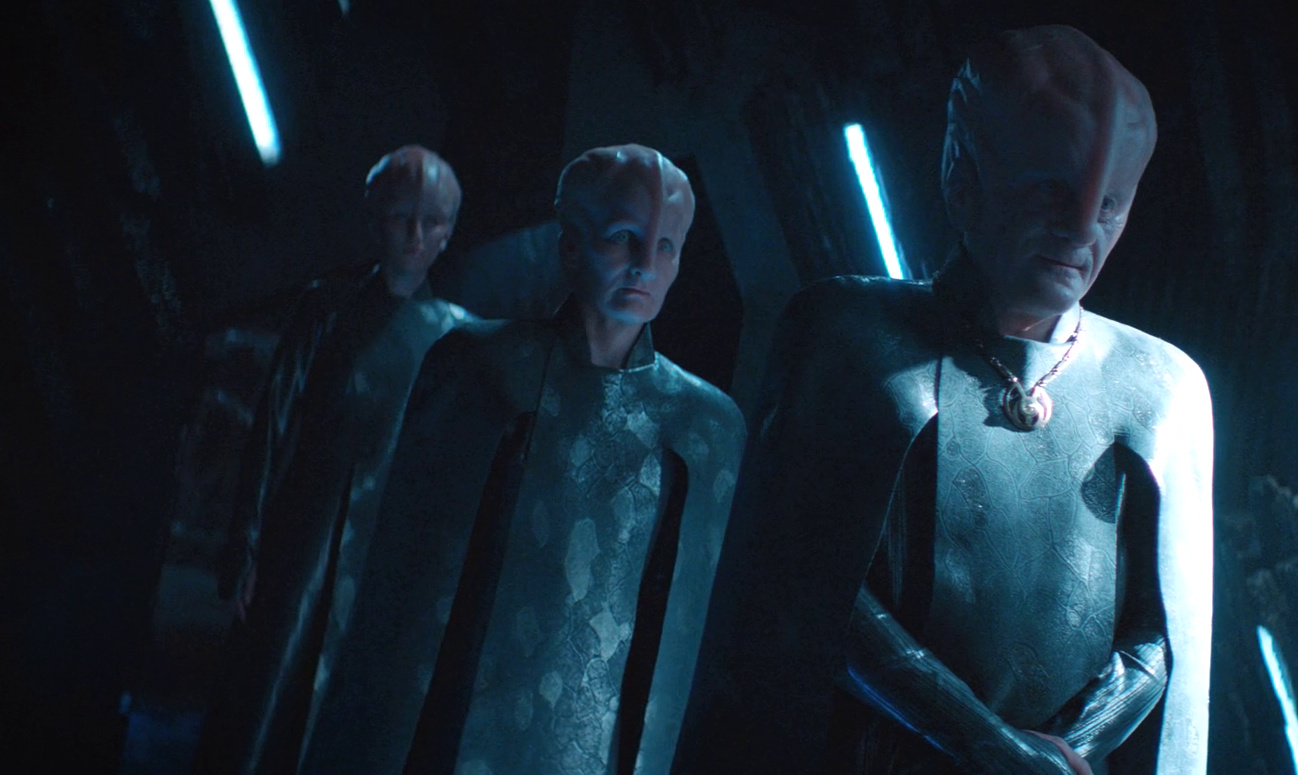
The Talosians as they appeared in Discovery’s second season.
Over time, the Talosian population would begin to grow, and Talosians would occasionally venture off-world, mingling with other citizens of the galaxy. The Talosians and Betazoids would form a particularly strong bond, as two races that both prefer telepathic communication. This would, in turn, set the stage for Talos IV joining the Federation as a full member world, coming under the protection of Starfleet and deepening their ties.
Though their numbers would be small at first, by the early 24th Century, Talosian officers would occasionally be seen in Starfleet – though the Federation would make them take oaths not to use their powers for deception (similar to the oaths that Deltan officers had to take, as seen in The Motion Picture). Talosians would be present for many of the major events of the late 23rd and 24th Centuries: the Federation’s alliance with the Klingons, the Romulan Empire’s isolation, the rising Borg threat, and the Dominion War.
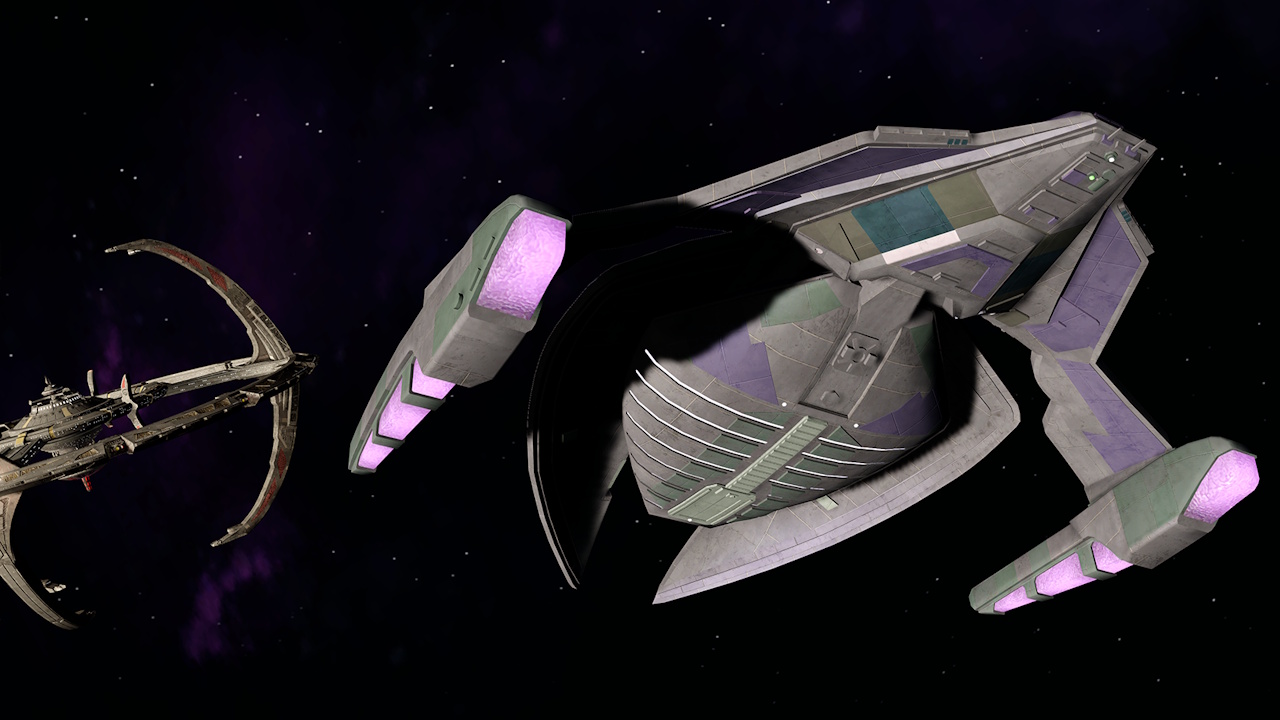
A Jem’Hadar warship near DS9. Image: Star Trek Online Wiki
It’s the latter event that I want to focus on now. After the Dominion War breaks out, the Talosian government, working in conjunction with Section 31, would hatch a plan to deceive the Dominion and the Cardassians on an unimaginable scale. Working as a group, the Talosians would use their mental powers to trick the Dominion alliance into believing they were on the offensive, about to retake Deep Space Nine and Bajor – all the while, a combined Federation and Klingon fleet would be launching an assault right into the heart of Cardassian territory.
The Dominion War could be ended in a matter of days, thanks to tapping into the Talosians’ impressive powers, and the Dominion would be forced to the negotiating table having been deceived into believing they were winning. But while the war was being settled and a peace treaty signed, something else would happen: the Battle of Sector 001, where a lone Talosian officer would be serving aboard a starship. This would be the Borg’s first encounter with a Talosian, and their assimilation might just have given the Borg a terrifying new upgrade…
What If… #3 What if… Bruce Maddox successfully convinced Starfleet to let him disassemble Data?
Dr Bruce Maddox.
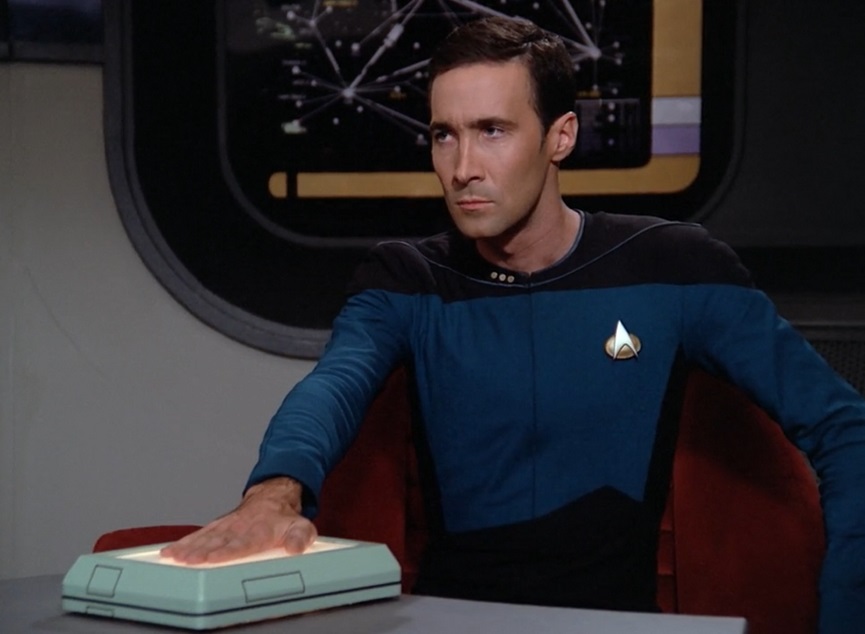
In The Next Generation Season 2 episode The Measure of a Man, we’re introduced to Dr Bruce Maddox: the Federation’s top cybernetic scientist. Dr Maddox would request that Data be turned over to him in order to be disassembled, planning to use the knowledge he’d gain to create legions of synths. In the prime timeline, Starfleet would deny this request, allowing Data to explore his sentience and his life in his own way. But in our alternate timeline? Starfleet instead rules that Data, as an artificial being, is not a “person,” and therefore cannot refuse Dr Maddox’s request.
This is such an interesting debate, because right now, out here in the real world, artificial intelligence – or some form of it, in any case – is a big deal. And despite what I’ve argued in the past about the limitations of today’s large language models, I admit to feeling uncomfortable about the idea of a potentially sentient A.I. being forced to do things it may not want to do. This will have to be the subject of an entire essay one day, but it’s so interesting to me how, some thirty-five years on from The Measure of a Man, the issues it raised are incredibly relevant!
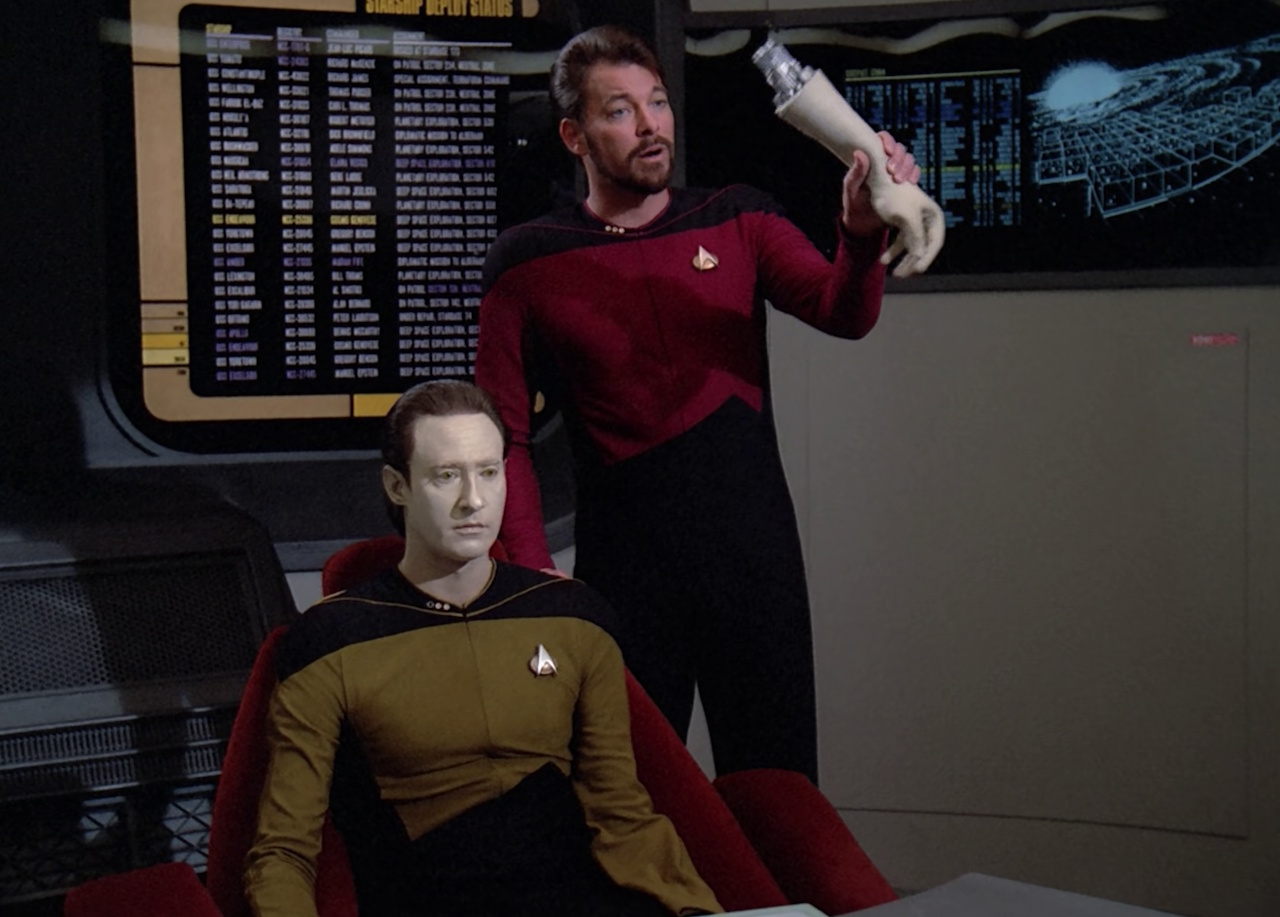
Data and Riker at the hearing.
But that’s enough about that for now. There would be *many* consequences as a result of Starfleet’s decision. In the immediate term, I think Captain Picard would resign his commission. It would be a desperate, last-ditch effort to convince the higher-ups at Starfleet to change their minds, but it would ultimately fail. This would lead to Riker getting temporary command of the Enterprise-D, before command would ultimately pass to a more senior officer – someone like Captain Edward Jellico.
But more serious consequences lay in store. In the prime timeline, Dr Maddox was able to use B-4 – an earlier and less complex Soong-type android – to construct a large number of pretty basic synths. But with Data fully disassembled, Maddox’s work would progress a lot further a lot faster, and synthetics not quite at Data’s level, but not too far behind, would begin to be rolled out across Starfleet. This would draw the attention of the Zhat Vash – an underground Romulan faction dedicated to preventing synthetic life from ever coming to exist.
Synths as seen in Star Trek: Picard.
The timing of this couldn’t be worse for Starfleet. After the Battle of Wolf 359, Starfleet was at a particularly low ebb. Senior admirals encouraged Dr Maddox to work faster, hoping to use his new synths in the rebuilding process, and poured a lot of resources into his synth programme. At the same time, Ambassador Spock travelled to Romulus in the hopes of promoting reunification. Without Picard and Data to stop the Romulans, and with the Zhat Vash aggressively pressuring the Romulan leadership to engage the Federation, the Romulan attack on Vulcan would prove successful – and it would be the first strike in a new Federation-Romulan conflict.
With Commodore Oh acting as an embedded spy, feeding information back to the Romulan Empire, they’d quickly gain the upper hand in this new war. The war would go poorly for the Federation, even if Oh was eventually captured, and with Starfleet still underpowered after the defeat at Wolf 359, it would be impossible for the Federation to defend all of its territory. The only outcome short of total conquest would be accepting a very difficult peace treaty, which would certainly include a clause prohibiting any and all research into synthetic life.
What If… #4: What if… the Borg attack on Earth in the 22nd Century had been much more serious?
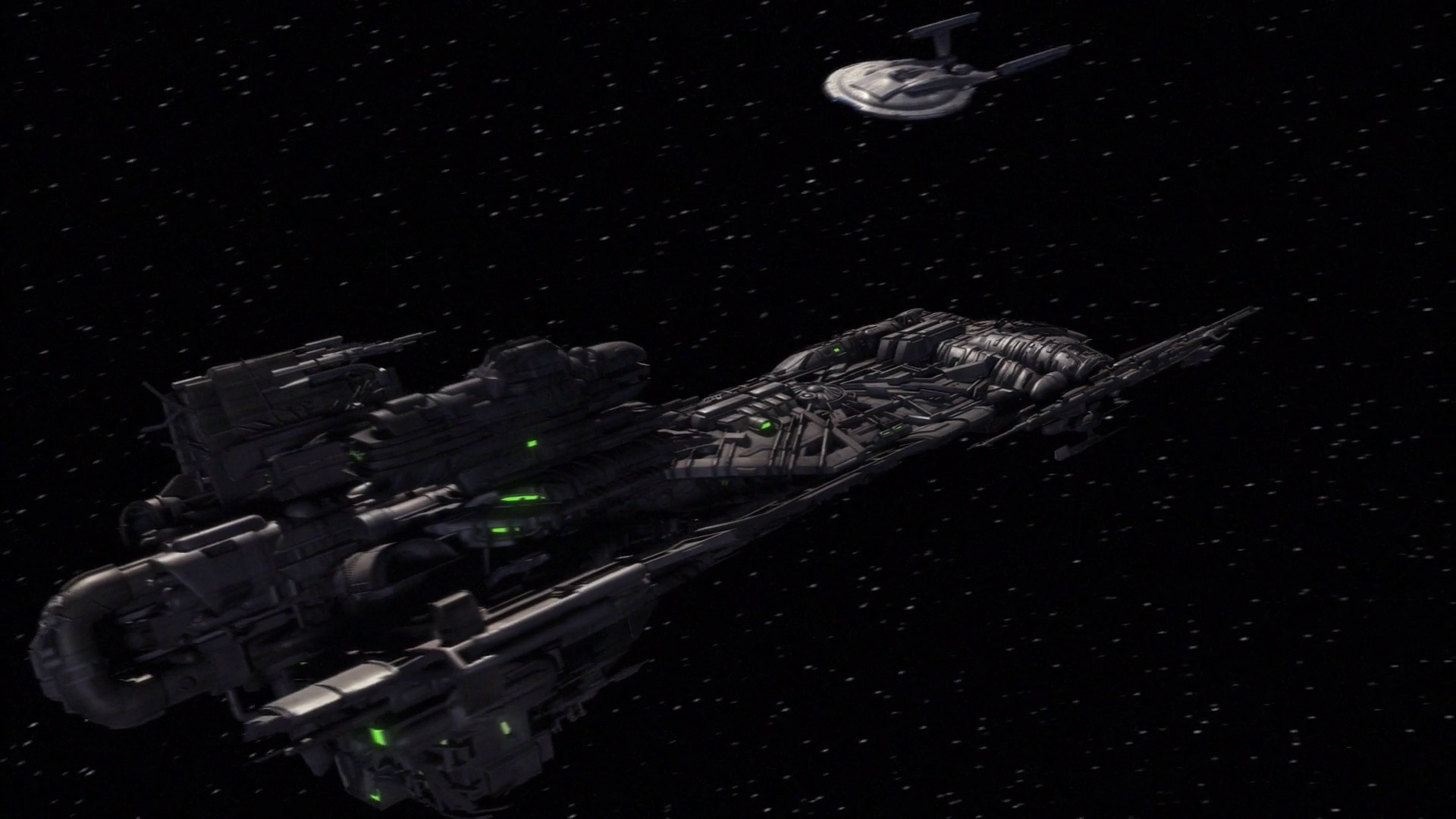
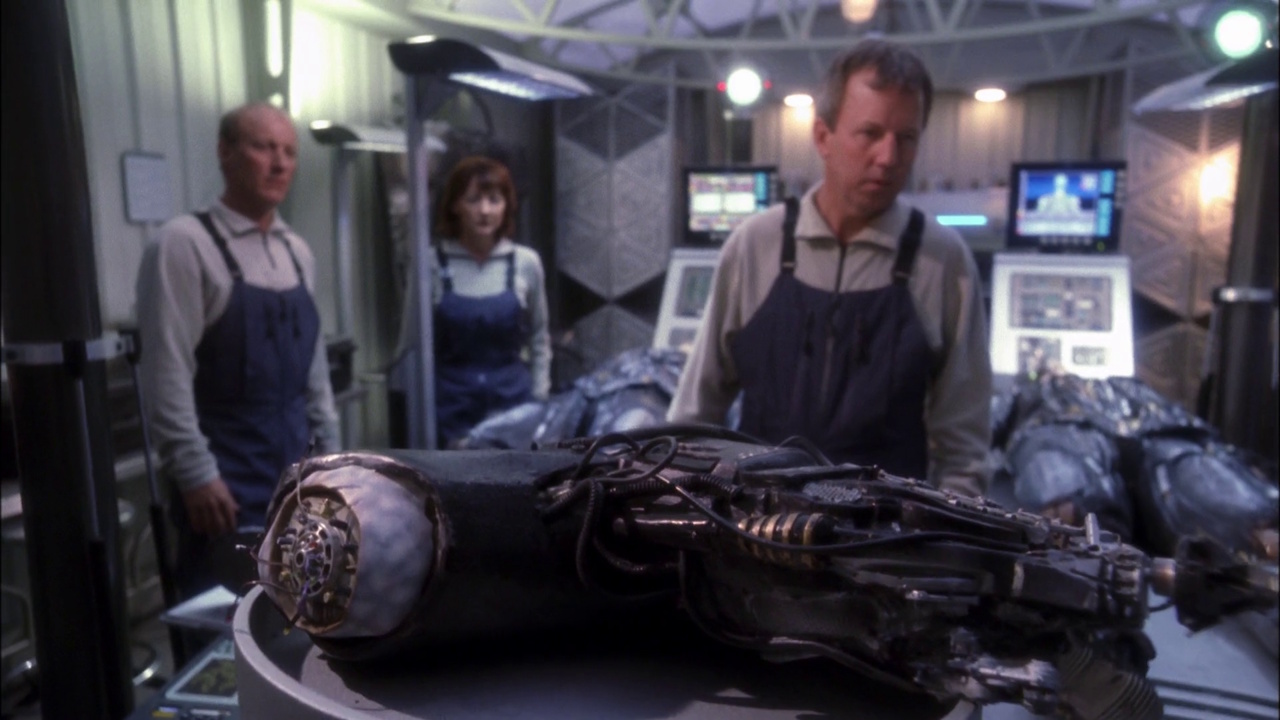
The Borg attacking the NX-01 Enterprise.
Regeneration, from Season 2 of Enterprise, is a fun episode in isolation… but I don’t really like what it does for the timeline of humanity’s conflict with the Borg. Setting that aside, though, let’s think about what might’ve happened if the Borg had managed to do a lot more damage to Earth in the 22nd Century. I’m not going to argue that this handful of defrosted drones would’ve been able to fully assimilate Earth in this era; I think, somehow, Starfleet and humanity would have prevailed. But in our alternate timeline, things are much more serious and the damage much more extensive.
Instead of merely assimiliating a single shuttle, the reactivated Borg drones would take over an entire starship: Enterprise. They’d assimilate practically the entire crew, kitting out the ship with upgraded weapons, and then they’d bring the fight back to Earth, in line with their original mission. It would take everything Starfleet had – and the sacrifice of many human and Vulcan lives – but the attack would eventually be stopped, with the remaining Borg being captured and studied.
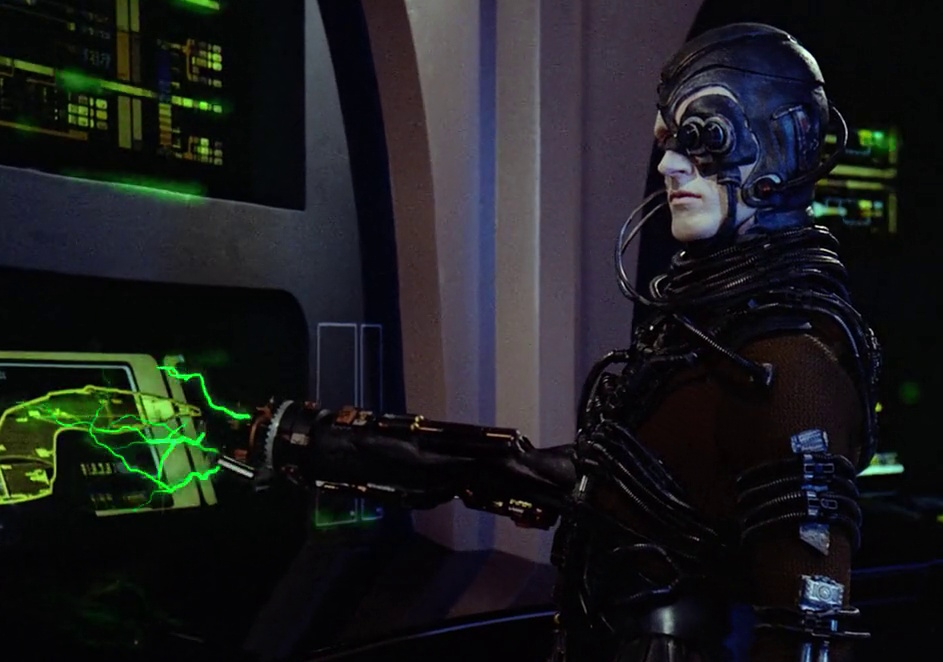
A Borg drone.
After causing devastation to parts of Earth unseen in more than a century, the United Earth government would re-think its planned mission of space exploration. Enterprise, humanity’s first long-range exploration vessel, has been lost, and the NX-02 would be repurposed as a purely defensive ship instead. The alliance with the Vulcans would weaken as humanity became a much more insular and isolationist power, scarred by the Borg attack and frightened of venturing too far into a galaxy that clearly poses a lot of dangers.
The Borg remnants would be extensively studied, in the hopes of discovering ways to counteract their technology, and some of these discoveries would lead to powerful Earth- and space-based weapons for humanity centuries ahead of schedule. The Xindi attack a year or so later would be *easily* defeated with Borg-powered weapons salvaged from the wreck of Enterprise.
Humanity would study the Borg and their tech.
But in the longer term, this isolationist stance would mean that the galaxy looks *very* different. Without humanity to mediate, the Vulcans and Andorians would wage a devastating war. Without Starfleet exploring and pushing the boundaries, there’d be no conflict between humanity and the Romulans. But most significantly… there’d never be a United Federation of Planets. Earth would maintain limited interstellar trade, including with the Denobulans and Vulcans, but fear-induced isolationism would become baked into the United Earth government at every level, with all talk of alliances or further missions of exploration being shut down.
By the time we reach the more familiar 23rd and 24th Centuries, the snowball has been rolling for a long time, and changes become unpredictable. But I’m going to posit that some of the Alpha and Beta Quadrant’s more aggressive powers – the Klingons, Romulans, and Cardassians – are all in much stronger positions without the Federation as a counterbalance. New alliances may emerge, such as the Mirror Universe’s Klingon-Cardassian alliance, or some powers may fully conquer others. The Romulans, for instance, may succeed at conquering Vulcan after the Andorian war left the Vulcans in a weakened state, or maybe the Klingons will launch an all-out war against their Cardassian rivals. And all the while, a strange, overlooked, isolationist Earth will be ready to shoot first and ask questions later whenever an uninvited guest arrives in the Sol system.
What If… #5: What if… the Federation and the Ferengi went to war?
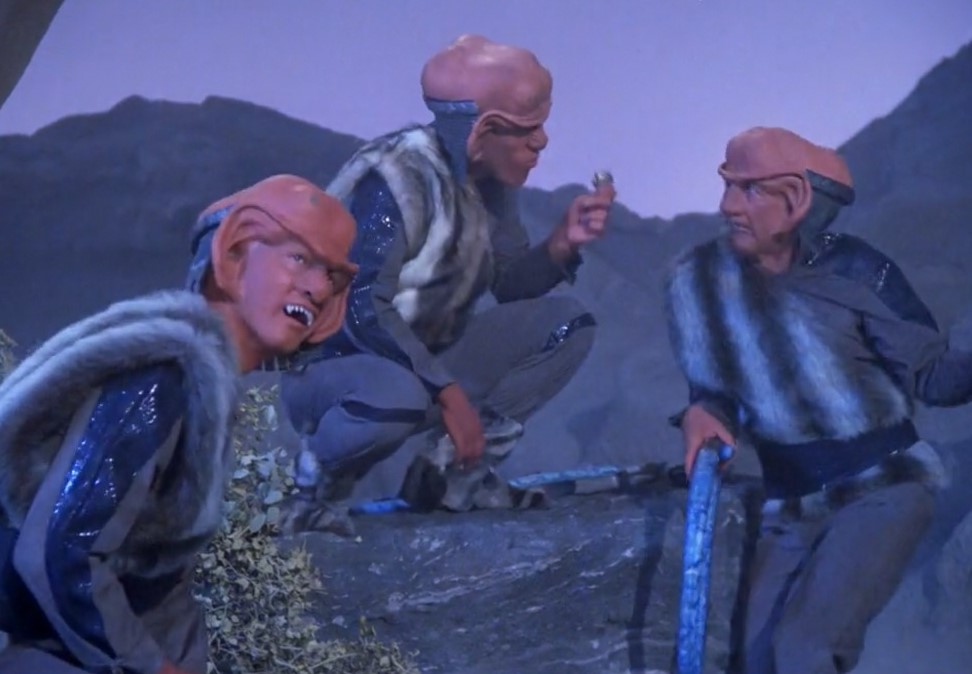
Three Ferengi from The Next Generation.
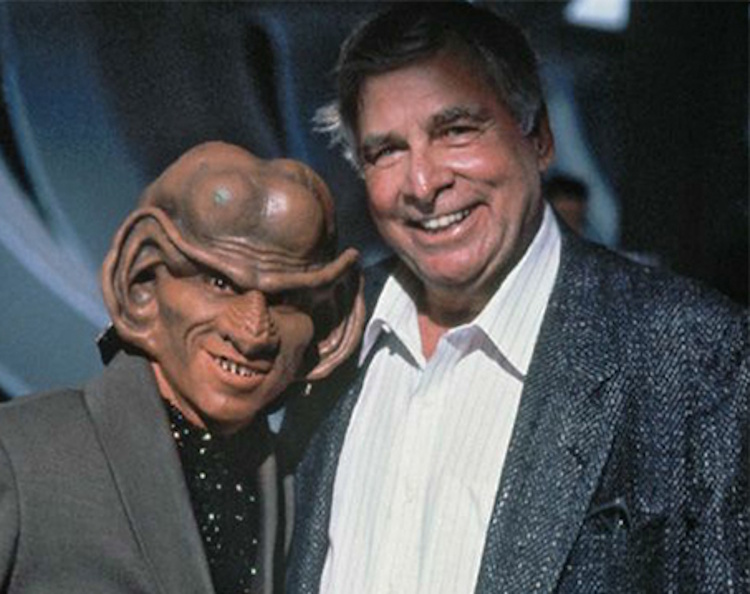
Chances are you already know this if you’re a Trekkie, but the Ferengi were originally supposed to be a major antagonist when The Next Generation was in early production. Gene Roddenberry intended for the Ferengi to take over the role vacated by the Klingons, now that Worf was going to be a permanent fixture on the bridge of the Enterprise-D. However… it didn’t pan out that way, mostly because of the way the Ferengi were presented in their first couple of appearances, and the way audiences responded to that.
In this case, though, we’re going to say that the Ferengi and the Federation didn’t just get off on the wrong foot… they continued down a path that would quickly lead to war. Ferengi DaiMons, eager for plunder, began raiding Federation convoys, stealing everything they could get their hands on, and even holding Starfleet officers and crew for ransom. Starfleet responded by taking an aggressive stance towards the Ferengi, sending armed escorts with trading and supply vessels, and gearing up for a confrontation.
Gene Roddenberry originally intended for the Ferengi to become a major villainous faction.
This version of the Ferengi – perhaps led by a more aggressive ruler than Grand Nagus Zek – would be less conciliatory, and would instead see war and piracy as opportunities for profit. Around the time of The Next Generation’s second season – which takes place in approximately 2365 – this would spill over into all-out war. The Ferengi DaiMons – most of whom had been acting autonomously up to this point – would be corralled by their Nagus into a proper fighting force, and their powerful D’Kora-class ships (the Ferengi Marauders) were more or less evenly-matched with Starfleet’s Galaxy-class vessels. The war would drag on.
I doubt this war would become existential for either the Ferengi or for the Federation, but it would be the most significant conflict either power had been involved in for decades, at the very least. The distraction would pause Starfleet’s mission of exploration, with more vessels being refitted and sent to the front lines, meaning that dozens of first contacts (and other missions) would come years later – or else would be missed entirely. And all the while, the Borg are on the prowl, scooping up outlying Federation and Romulan colonies. Blame for that might even initially fall on the Ferengi.
A D’Kora-class ship.
A peace treaty would eventually be signed, with the Ferengi and Federation agreeing to respect a shared border, and a prohibition would be placed on piracy – though renegade Ferengi DaiMons would continually flout this. But the war would sap Starfleet’s resources, leading to a monumental decision: the Federation would decline the Bajorans’ request to take over Terok Nor after the Cardassian withdrawal. Deep Space Nine would never be established, and the Bajoran wormhole would go undiscovered for decades.
This would completely change the course of the latter 24th Century: there’d be no Dominion War, no Cardassian alliance with the Dominion, no changeling infiltrations, and no Emissary of the Prophets. The Bajoran provisional government would struggle to remain in control of its system, and the Federation would commit to providing only limited aid to the Bajorans, earning their resentment. The eventual discovery of the Bajoran wormhole in the early 25th Century would lead to plenty of interest, including from the Ferengi – who can pay handsomely for access to the Gamma Quadrant. The Bajorans, still wary of the Federation after their very lukewarm response decades earlier, would deny Starfleet access to the wormhole, preventing the Federation from exploring the Gamma Quadrant. Bajor wouldn’t be on a path to joining the Federation, and first contact with the Dominion might be made by the Bajorans… or even the Ferengi.
So that’s it!
A modified Romulan warbird.
We’ve considered five possible “what if” scenarios from the Star Trek franchise.
I hope this has been a bit of fun. I love writing, and I love Star Trek, so writing about Star Trek is a great way for me to spend a bit more time in this wonderful galaxy. I tried to get creative, picking on a few different storylines and ideas from across the franchise, and extrapolating what might plausibly be able to happen if things turned out differently. I hope that the sequences of events made sense, and that I arrived at conclusions that you feel are at least *possible* based on the changes I proposed!
In any case, this was just for fun, and an excuse to talk about Star Trek as the franchise’s milestone 60th anniversary year rolls along. I have a few ideas for later in the year, as we get closer to the anniversary date itself, so I hope you’ll stick around and join me for some of those. And in a few weeks’ time, I’ll be sharing my thoughts on the franchise’s latest outing: Starfleet Academy. Click or tap here to check out my review of the two-part premiere, if you missed it.
Until then… be sure to check back for more discussion of the Star Trek franchise. Live Long and Propser, friends!
All shows and films discussed above can be streamed on Paramount+ or purchased on DVD and/or Blu-ray. The Star Trek franchise (including all properties discussed above) is the copyright of Skydance/Paramount. This article contains the thoughts and opinions of one person only and is not intended to cause any offence.
Spoiler Warning: Beware of spoilers for Star Trek: Voyager – Across The Unknown and Star Trek: Voyager.
A new video game based on Star Trek: Voyager, titled Across The Unknown, was announced only a few weeks ago. I didn’t think we’d see it until at least next year – but to my surprise, I received a notification that a demo version is available on Steam. I jumped into the game as soon as it had finished downloading, eager to try it out for myself, and I thought it could be fun to preview the upcoming title together.
I enjoyed the demo for the hour or so that it lasted, and playing through a modified version of Voyager’s premiere – Caretaker – was generally a fun experience. I think Across The Unknown still has work to do – there were a couple of issues that I picked up on in my brief playthrough – but by and large, the game seems poised to deliver more or less what I’d been expecting.
Voyager in the Badlands.
That idea of expectations, though, is going to be important to how you approach Across The Unknown. The tl;dr is this: this isn’t a big-budget, high production values, “triple-A” type of game. And if you go into it expecting ultra-sharp graphics, fully-voiced characters, detailed cut-scenes, and the like… you’re going to be disappointed, because this isn’t that type of game. What you get instead is a strategic starship management game, one with a tech tree to unlock upgrades, rooms to build, crew members to move around, and so on. There are no voiced characters; Across The Unknown is text-based. And while there are some starship cut-scenes and a pretty fun combat system, most of the time you’ll be treated to static images to convey key storylines.
I believe that if you set appropriate expectations, there’s going to be fun to be had here. The game’s core premise of “what if you were Captain Janeway and made different choices?” is a genuinely fun and appealing one, and Across The Unknown provided several points at which I could make what seemed to be defining choices for the ship and crew.
Captain Janeway issues an order.
An appropriate point of comparison is probably Fallout Shelter. The games use a similar point-of-view for managing your base/starship, and you get similar choices for where to construct different rooms, who to recruit, who to send on away missions, and so on. That’s a good starting point for understanding what Across The Unknown felt like to play.
Obviously, when you’re looking at a demo version, there are going to be limitations! So I don’t want to judge Across The Unknown too harshly based solely on the first hour-ish of gameplay. Just from looking at the tech tree and the amount of empty rooms aboard Voyager, there’s clearly a lot more to the game that I didn’t get to try out on this occasion. And I also suspect that, of all the missions/story arcs in the game, Caretaker is probably one of the most linear: certain events have to pan out in order for Chakotay, B’Elanna, Neelix, and Kes to join the crew – and that’s just for starters.
The demo is based on the episode Caretaker.
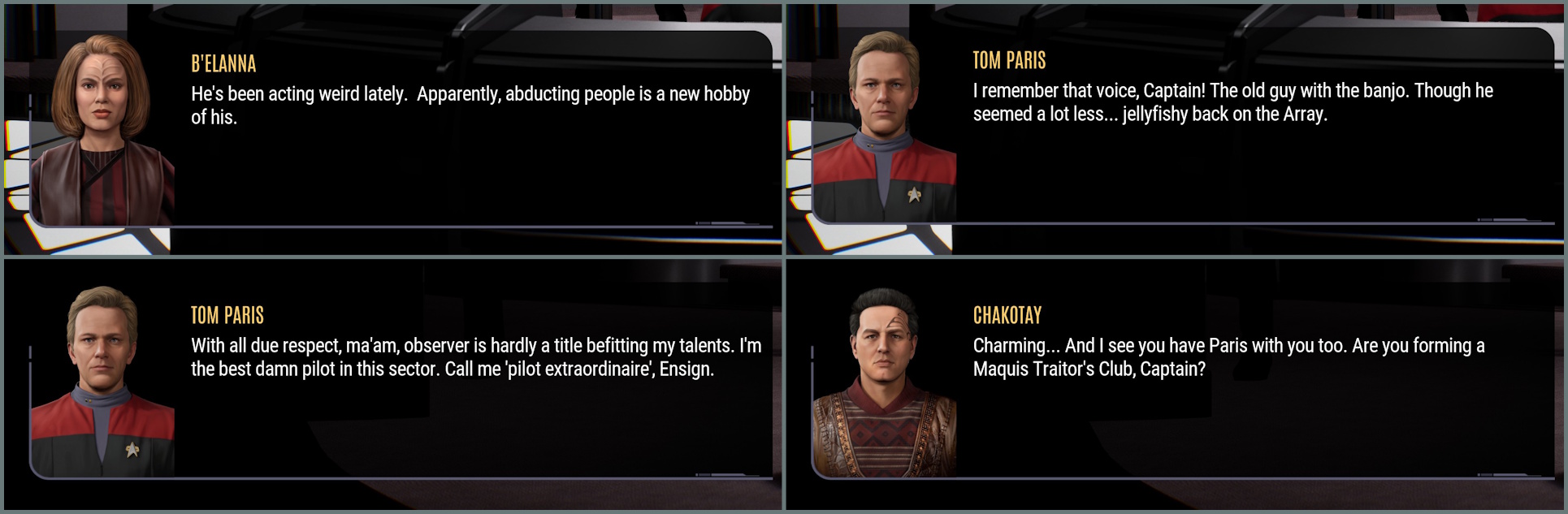
There were, however, some diversions from the story of Caretaker that felt unnecessary to me. Some lines of dialogue – particularly between characters like Chakotay and Tuvok, and Harry and Tom – felt really “off;” I know what these characters sound like, how they talk, and what they said to each other in the beginning – and this ain’t that!
In fact, I’d go so far as to say that some (but by no means all) of Across The Unknown’s dialogue reads like it’s been written by an AI chat bot. I’m not saying that’s what happened – and there could be issues with translation, for example, as the game is being developed in Germany. But that’s how some of these lines felt to me. Subjectively speaking.
A selection of the “awkward” dialogue lines.
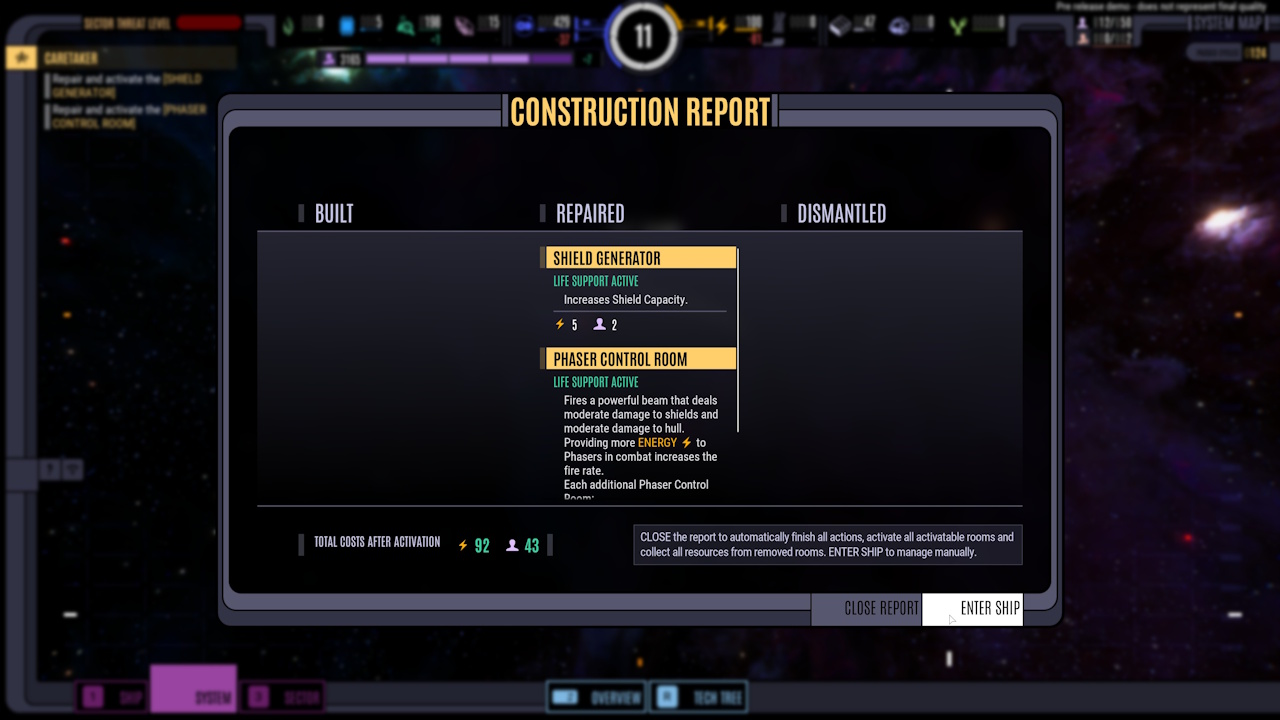
The tutorial was solid, and I felt that Across The Unknown communicated some of its pretty in-depth systems in a concise and understandable way. I didn’t play the game perfectly on my first outing; I failed one optional assignment when I didn’t build enough crew quarters in time! But that failure helped me learn more about the optional assignments and how the “cycles” (Across The Unknown’s timekeeping) work, so it wasn’t a total loss. And considering that I did fail one of these optional tasks, Across The Unknown was forgiving enough that it wasn’t fatal to my playthrough – which I did appreciate on my first time out!
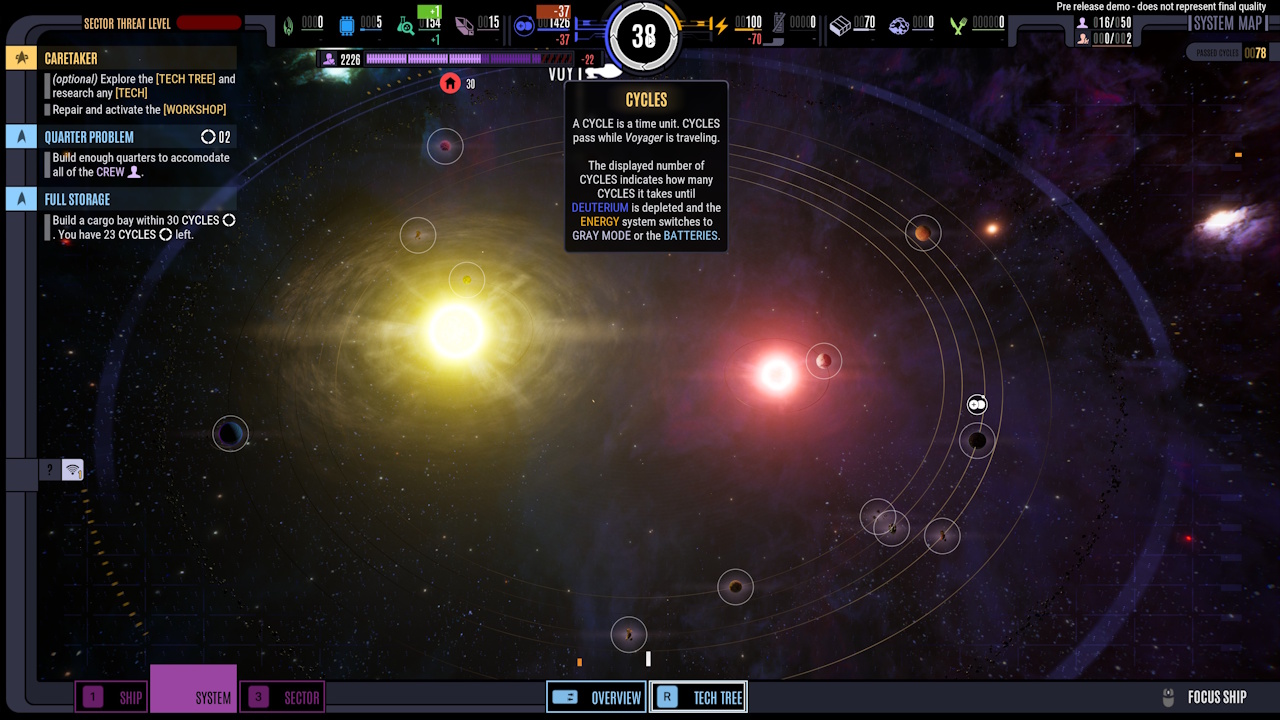
There are resource limitations, though. At one point, I was running dangerously low on deuterium – which is necessary to keep the ship running. I was only a couple of cycles away from completely running out, and having exhausted all of the planets and points of interest in the two available star systems, there was a bit of a time crunch to get back to the Caretaker’s Array! This is clearly part of the experience – Voyager’s journey home, especially in the early days, was one of scavenging resources where possible, and running close to the line on more than one occasion. It served as a great motivator, I found, to move the story along!
The system map (and a tool-tip showing details about cycles).
Away missions provide one of the ways to make a lot of different choices. Given that the demo is based on Caretaker, I was surprised that Captain Janeway wasn’t able to join any of the away missions to the Array or to Ocampa, and I wonder if that’s going to be a limitation throughout the game. I hope not, but I thought it was worth mentioning. I tried to use a selection of different characters when I could, just to get a different experience with the away missions that I had available.
Each away mission gives individual characters a chance to gain experience and level up – meaning they’ll be better the longer they stick around and the further into the game you get. The tutorial mentioned that some choices, if they go awry, can be fatal. That wasn’t something I experienced in the demo, but it’s interesting to know that even some named characters can, potentially, be killed off at a very early stage – or at any point throughout the run.
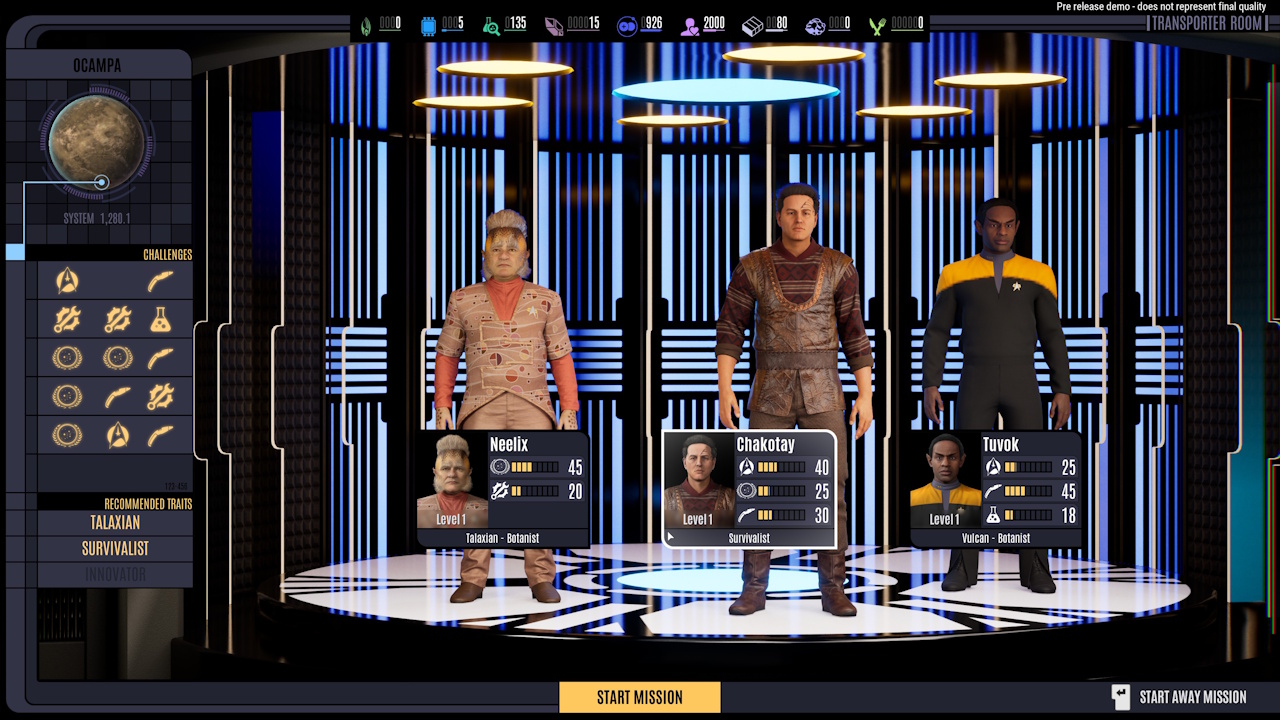
Selecting crew members for an away mission.
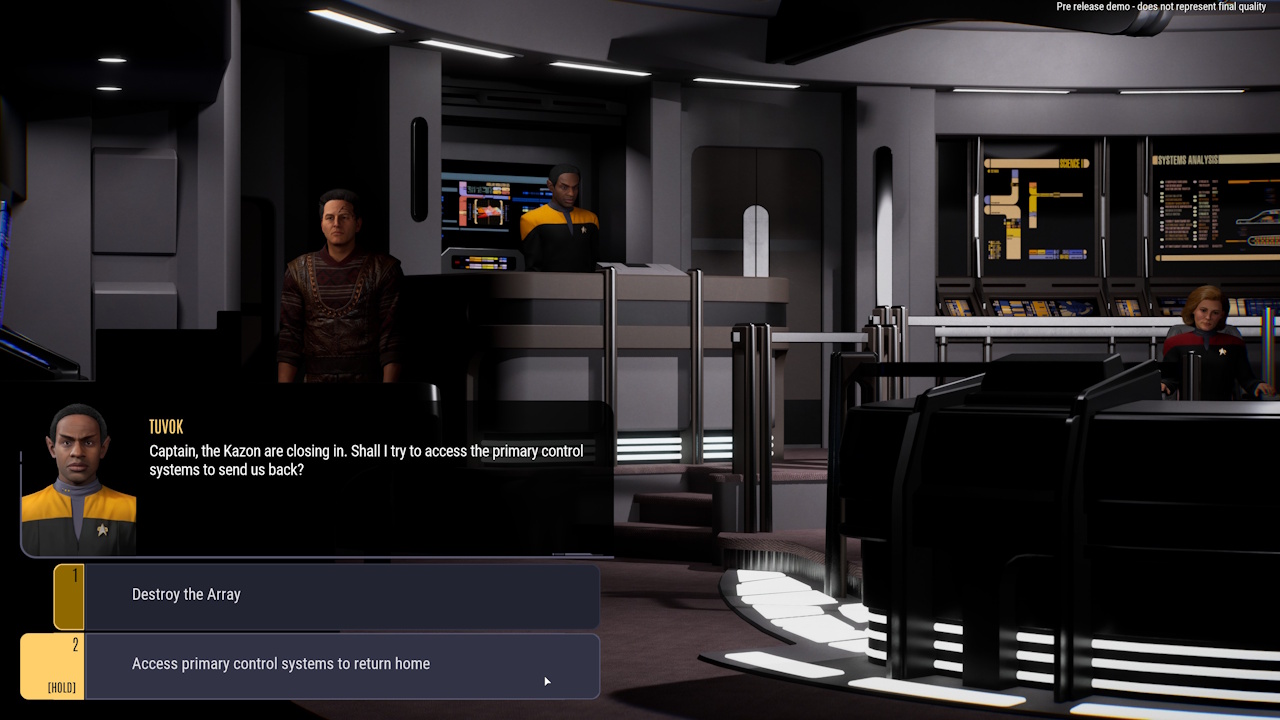
I want to touch on one story point that I’ve seen Trekkies talking about since Across The Unknown was announced. This is spoiler-y, so skip past the next screenshot if you really don’t want to know anything ahead of trying the demo for yourself! When it comes to Voyager and crucial choices… Across The Unknown does give you the option to use the Caretaker’s Array to send Voyager and her crew home seven years early! Obviously, this will cut off the entire rest of the game, but I thought it was a ton of fun that the option to do this was included.
And I think that speaks volumes about the kind of big decisions that we’ll get to experience in the full game. The blurb promises twelve sectors to explore – each of which, apparently, can be comprised of at least three star systems, which is neat. I would imagine each sector will provide one of these key inflection points – perhaps more than one. Being able to send the ship and crew home, though, using the Array… I gotta admit, that was pretty cathartic after all these years!
Home in time for tea!
There’s quite a lot of random chance (a.k.a. random number generation) in Across The Unknown, which isn’t atypical for this type of game. You can mitigate some of that by choosing characters and actions that have a higher chance of success, or when on away missions, by combining the efforts of more than one character to increase the odds. But it’s still possible that RNG will go against you at any point, and even an option that looks statistically solid could result in a negative outcome. Again, though: it’s that kind of game.
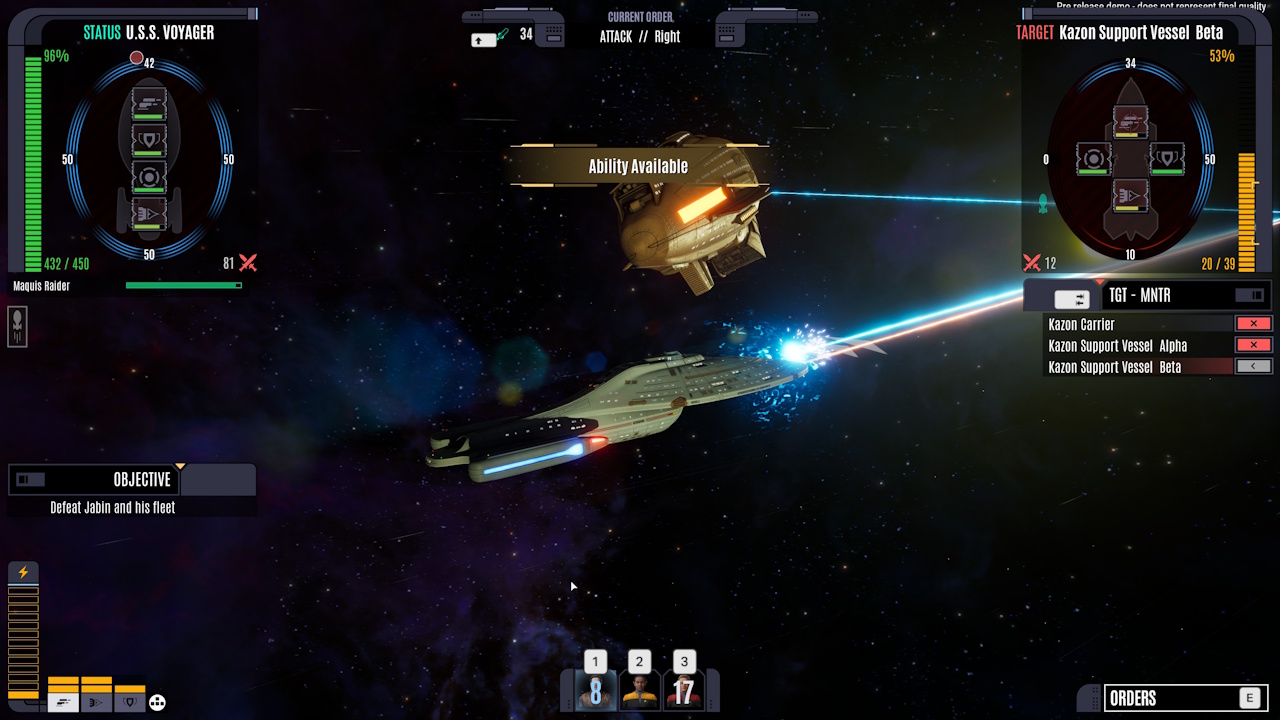
The ship-to-ship combat was interesting. Unlike exploration, which is measured in “cycles,” and away missions, which play out through a series of decision points, combat in space is close to real-time. Phasers fire automatically, but you get to choose when to fire torpedoes and when to issue other orders to members of the crew. There are a limited number of slots for characters to participate in ship-to-ship combat – which feels like a bit of a double-edged sword.
Ship combat.
On the one hand, this adds another element of strategy: do you want to pick Paris for his evasive manoeuvres, or Tuvok for his finesse with the phasers? It also makes each combat encounter potentially different, as you can choose a different crop of people every time. However… part of the captain’s chair fantasy experience, surely, is being able to issue orders to the entire crew in situations like this. Being able to divert extra power to the phasers by calling up B’Elanna in engineering, or telling the Doctor to prepare sickbay for casualties… that’s all part of sitting (metaphorically) in the captain’s chair. By reducing the number of characters who can participate, part of the combat just felt a bit… small, I guess.
That’s not to say it was bad. I actually had fun taking on the Kazon in my combat encounter! And after spending most of my time looking at a master systems display or a zoomed-out solar system, seeing Voyager moving around in real-time, up close… that was something special.
Voyager and Kazon ships at the Caretaker’s Array.
Across The Unknown needs some more polish. There were a few places where I saw a typo or missing punctuation, and another where Neelix popped up to tell me something before I’d even met him or invited him aboard. My PC also seemed to struggle, with the graphics card working overtime and the game still occasionally lagging – despite the fact that, as mentioned, the graphics really aren’t anything special. Performance when zooming in and out of the MSD could really use some improvement. I wasn’t even running Across The Unknown at its maximum settings.
That being said, I came away from my hour with the demo more excited to play the finished game than I was before I started. Voyager is such a great series, and it feels perfectly-suited to this kind of strategic management title. Being able to make radically different choices to those that Captain Janeway made during the show is going to be a lot of fun, and if the rest of the game is as good as the demo in terms of narrative and gameplay, I can see myself sinking many hours into it when it’s ready.
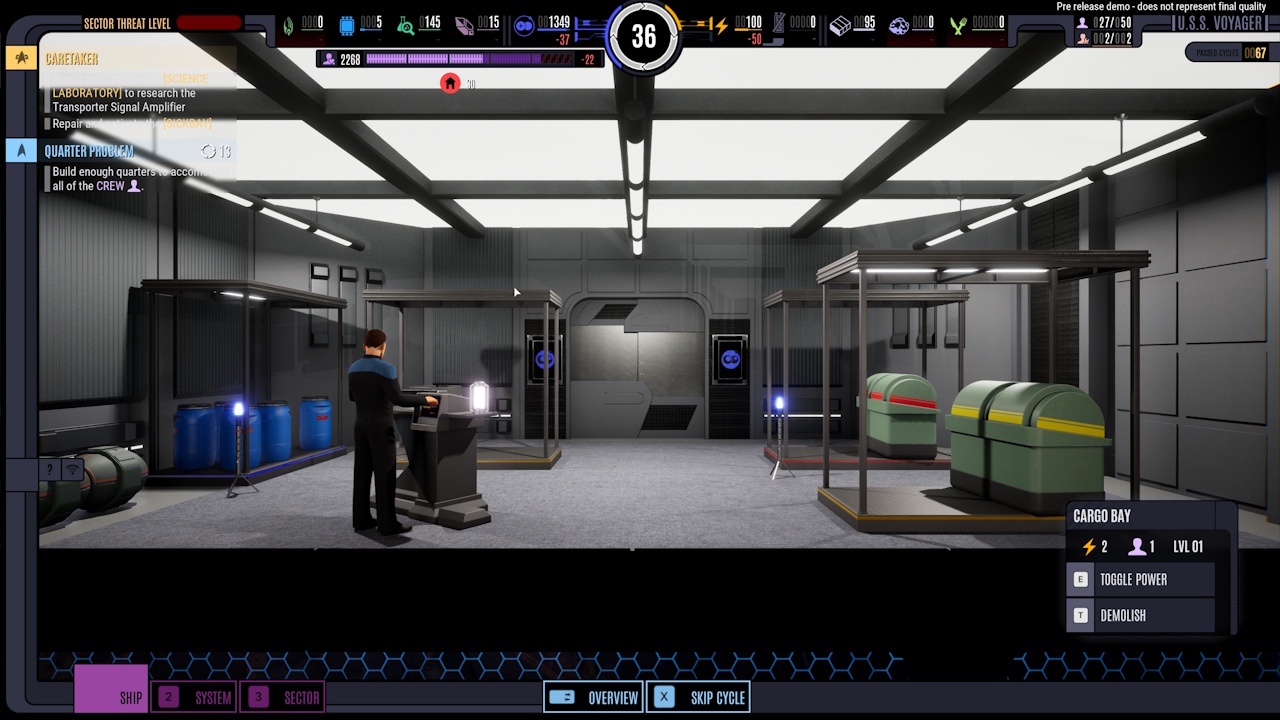
A cargo bay.
If you want to wait for the finished game, that’s a completely valid decision. I usually don’t play pre-release demos, and there are a few issues with Across The Unknown that I’d hope will be smoothed out before the full game releases. But it’s hard not to recommend a completely free demo of a game like this. It only took me an hour to play through the events of Caretaker and get a feel for what Across The Unknown is like, so if you’re like me and Across The Unknown is a guaranteed day-one purchase for you, I think trying out the demo is an easy recommendation.
I’ll end by saying that Across The Unknown is clearly a game made for fans. And that’s okay. Not every game is going to reach a broad audience; Across The Unknown knows what it is, knows who its target audience is, and seems to be leaning into that in a big way. It’s not going to blow up and win hundreds of awards, nor is it going to expand the Star Trek fan community in a meaningful way. But given that it’s Voyager’s thirtieth anniversary this year, I’m just pleased that a game like this was greenlit at all. Stepping back into that world – even with some last-gen graphics, odd facial expressions, and occasionally janky dialogue – was a lot of fun.
The demo is free on Steam at time of writing… so why not try it? All you have to lose is 6 and a bit gigabytes of disc space and an hour or so of your time!
Star Trek: Voyager – Across The Unknown will be released (in full) in the future. The demo version is available now on Steam. The Star Trek franchise – including Voyager and Across The Unknown – is the copyright of Skydance/Paramount. Star Trek: Voyager – Across The Unknown is developed by GameXcite and published by Daedalic Entertainment. This article contains the thoughts and opinions of one person only and is not intended to cause any offence.
A selection of screenshots from my time with the Across The Unknown demo that didn’t fit in the article above:
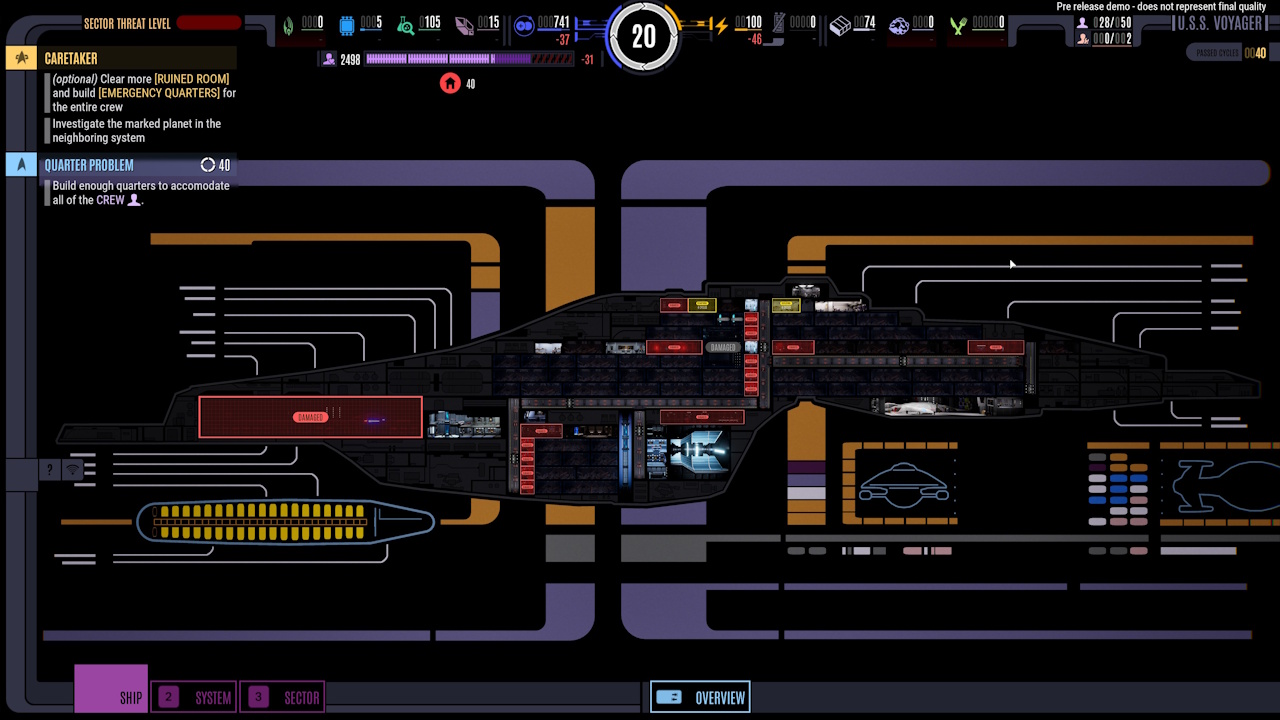
The main MSD/ship display (zoomed out).
An away mission.
Part of the tech tree.
Breaking a promise (a.k.a. failing an optional quest).A view of the sector, including three star systems.
Spoiler Warning: There are minor spoilers ahead for Star Trek: Voyager, as well as details about the upcoming game Across the Unknown.
A few days ago, at the video games industry’s big Gamescom event in Germany, a brand-new Star Trek game was announced. I was very briefly excited… then disappointed when I learned it was going to be VR-only. Star Trek: Infection looked genuinely fun… but I can’t get on with VR, so I doubt I’ll be able to play it unless it gets ported to non-VR systems in the future. “That’s a shame,” I thought, decrying that the only new Star Trek video game of the past couple of years was gonna be exclusive to VR. But oh well. Life goes on.
I mean, there’s no way the Star Trek franchise is gonna announce two video games at the same event within days of each other. Not after being radio-silent on video games since Resurgence and that Prodigy tie-in game were released. Right?
Star Trek: Voyager – Across the Unknown has just been announced by GameXcite and Daedalic Entertainment. It’s billed as a “story-driven survival strategy game” in which you, as the player, get to take command of the legendary USS Voyager during its journey home.
Are you ready to take command of the USS Voyager?
Wow. That honestly sounds like a great premise!
The game sounds like a kind of Fallout Shelter or U-Boat, with some amount of starship management in addition to the narrative choices. And that kind of game – where you get to manage and maintain the systems aboard your ship – has been one I’ve wanted to see Star Trek try out for a long time.
Voyager is a great show to use as inspiration for that kind of game. Being lost and alone, far from Federation space, gave Captain Janeway and the crew a lot of leeway when it came to making changes aboard Voyager: things like the Mess Hall and the assimilated cargo bay come to mind! And the unique community that the crew built – that sense of camaraderie that came from being the only humans in this far-flung part of the galaxy – could give the game almost a “cozy” vibe, perhaps.
Different rooms and decks.
Voyager also led to one of the Star Trek franchise’s few games that genuinely broke out of the Trekkie community to go somewhat mainstream: Elite Force. That game was a darling of early 2000s LAN parties, acquiring a good reputation with a wider audience – something very few Star Trek games have ever done, if you think about it. I don’t want to just assume that Across the Unknown will come anywhere close… but there’s precedent, at least, for potentially expanding the Star Trek fan community a little.
With all that being said, there are some caveats. Star Trek games, both recent and not-so-recent, haven’t always been particularly good… and that’s putting it mildly. Star Trek’s corporate overlords have never really seen the potential in video games as an artistic medium, and practically no licensed Star Trek game has been afforded a sufficiently high budget. The result? Compared to other big sci-fi franchises, like Star Wars and even Alien, Star Trek hasn’t made much of an impact in the video game realm, and some titles have been genuinely quite low-quality.
This looks like an away mission.
And… to be blunt, I’m getting a bit of a “cheap knock-off” vibe from the trailer and some of the screenshots of Across the Unknown. The graphics look okay, don’t get me wrong. Maybe a bit last-gen, but for a game that won’t have been given a blockbuster budget, that’s okay. But a game like this lives or dies on the quality of its management and sim elements – that’s the appeal of assuming command of the USS Voyager in a game like this. And I’m just not blown away by what I’ve seen, to be honest.
Perhaps, though, that’ll turn out to be a good thing. If I go into a game hyped up to the moon and it doesn’t live up to it, I’ll be disappointed. But if I have low expectations… it’s easier for a game to exceed them! So maybe my Fallout Shelter comparison is apt; maybe that level of quality and interactivity is about right.
This looks like a map screen, perhaps showing the available planets/star systems that can be visited.
I still need to play Resurgence. It kind of released at an awkward time for me personally, when I was feeling a bit burned out on Star Trek as a whole. I bought it, but it’s sat un-played in my Steam library ever since. Hopefully, though, I can get around to Across the Unknown a bit more quickly when it’s ready! At this stage, there’s no release date – but it could be sometime next year, maybe, based on nothing but the timing of the announcement.
I’m not familiar with developer GameXcite. The company seems to be based in Germany, and so far has released two Asterix and Obelix mobile games and one console/PC game. Oh, and for some reason… development of all of their games (including Across the Unknown) is partially funded by the German government. Go figure. The PC version of Asterix and Obelix: Heroes has a “mostly positive” rating on Steam, and I can’t see any complaints about the game running poorly, crashing, or suffering from game-breaking bugs. Which already puts it light-years ahead of 2013’s Star Trek tie-in game!
A very pretty master systems display!
But you may have heard of Across the Unknown’s publisher: Daedalic Entertainment. If that name sounds familiar, well… it’s because Daedalic was responsible for 2023’s The Lord of the Rings: Gollum, which was a broken, unfinished mess, and quite literally one of the worst games to launch that year. There’s a difference, of course, between Daedalic’s now-closed development studio and the company’s publishing arm. And Daedalic has published some genuinely good titles: Partisans 1941, for example, and 2023’s Barotrauma, which is a comparable kind of management/narrative game set on a submarine.
I’m trying to keep my expectations in check for Across the Unknown. The game’s blurb mentioned that there are twelve “sectors” of the Delta Quadrant to explore, which could mean there are basically twelve stages/levels. That… doesn’t sound like a ton of content, though I suppose it depends how detailed these sectors are, whether there are multiple star systems to visit in each one, and how many narrative events there could be. The blurb mentioned familiar faces from the show, like the Caretaker and Borg, returning, too.
The USS Voyager approaching a star.
One of the most interesting ideas, though, are the so-called “rogue-lite elements” that Across the Unknown promises to incorporate. Narrative inflection points, where choices can lead to completely different outcomes, potentially including things very different from what we saw in the TV show, sound genuinely interesting. If handled well, there could be some replayability here, making each run through the game feel different – assuming you pick different options each time!
The danger here is that there will be one “optimal” run, where, if you do everything just so, you get the best outcome, or the outcome that closest resembles the TV show. Part of the fun of an idea like this – taking the Voyager story but allowing players to make different choices – is that some of these choices could actually lead to better or just radically different outcomes. In short… if every choice except the one Captain Janeway made leads to instant death or the ship being wrecked on an asteroid, that’s not gonna take full advantage of this style of gameplay! So I hope the developers are aware of that and are at least trying to make these choices feel different and meaningful.
Ooh, it’s Harry Kim.
So that’s all for now. I shall follow Across the Unknown’s progress with interest, and when it launches – which could be next year – I daresay I’ll pick up a copy and check it out. If possible, I’ll try to write a review here on the website… but my track record with such things isn’t great, so someone might have to remind me if I forget!
Now… with Voyager getting some love in its 30th anniversary year, how about that HD remaster? Hmm, Skydance? HD remaster? HD remaster of Voyager from Skydance? Skydance’s HD remaster of Voyager to stick on Paramount+? Come on… you know you want to!
This was good news, though, and as Voyager celebrates a milestone anniversary, it’s nice to see the series getting a bit of attention from Star Trek’s corporate overlords. I’m trying to keep my expectations at a reasonable level, but if this game manages to make good on its premise, it could be a lot of fun.
Star Trek: Voyager – Across the Unknown will launch for PC, PlayStation 5, and Xbox Series consoles at an unknown future time. Star Trek: Voyager – Across the Unknown is the copyright of GameXcite, Daedalic Entertainment, and Paramount/Skydance. The Star Trek franchise – including Voyager and all other shows discussed above – is the copyright of Paramount/Skydance. This article contains the thoughts and opinions of one person only and is not intended to cause any offence.








 Trekking with Dennis