Star Trek: The Next Generation Episode Re-Watch – Season 2, Episode 12: The Royale

A Star Trek-themed spoiler warning.

Spoiler Warning: There are spoilers ahead for Star Trek: The Next Generation.

Do you remember your “first contact” with the Star Trek franchise? The *very first* episode or film you ever watched?

Let’s set the scene! It’s the 19th of June, 1991. The Soviet Union, while in decline and wounded by the revolutions of 1989, still exists, and the coup attempt that finished it off hasn’t yet taken place. The England football team is still reeling from a semi-final defeat at last year’s World Cup in Italy. The World Wide Web doesn’t exist publicly yet. And Sonic the Hedgehog won’t be released on Sega’s new Mega Drive/Genesis console for a few more days.

It was also on this day that The Royale premiered in the United Kingdom, on the channel BBC 2. And this is the very first episode of Star Trek that I can ever remember watching. Thirty-five years ago this very day, I began my journey as a Trekkie. And I thought it could be fun to mark the occasion by taking a look at the episode together.
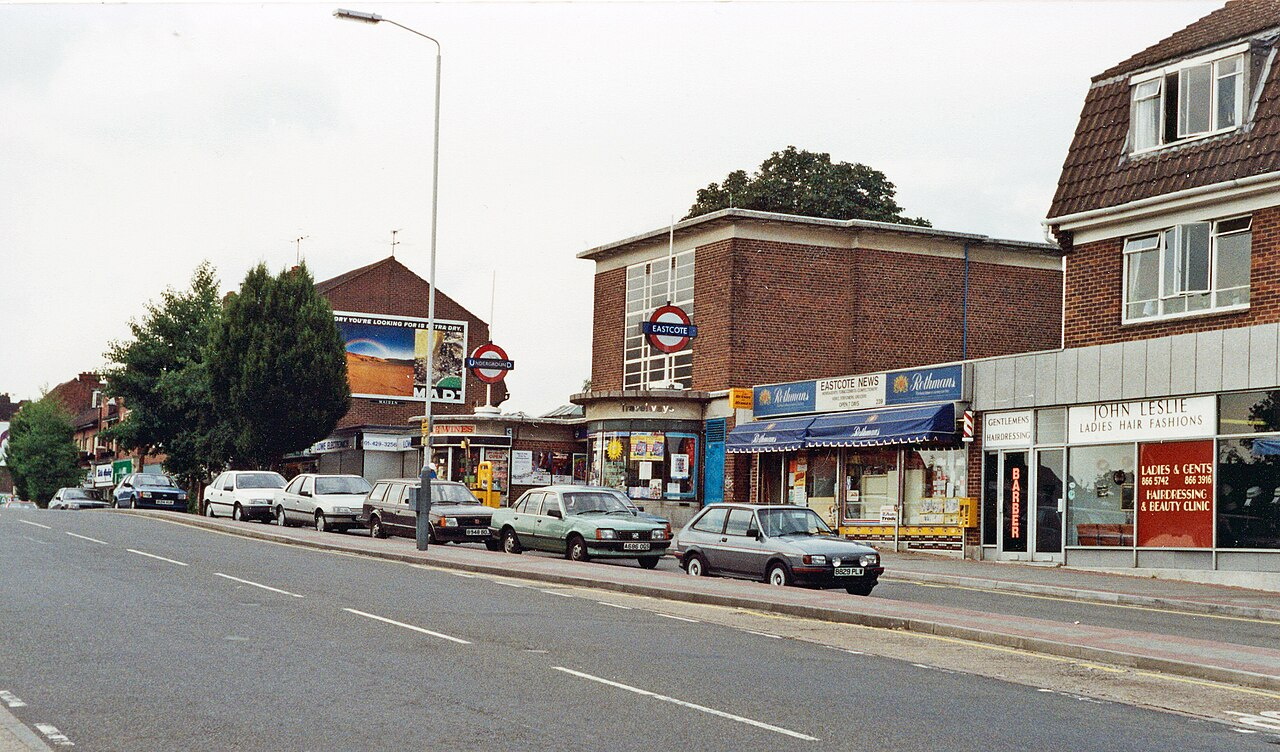
A photo of cars parked outside a railway station in the UK in 1991
I’ve chosen this photograph to represent the summer of 1991 in the UK!
Photo: Ben Brooksbank / Eastcote station, entrance 1991, via Wikimedia Commons

Okay, let’s step back for a moment. The Royale is the first episode of The Next Generation that I can remember watching in its entirety. However, I’m reasonably sure that I’d seen at least *parts* of other episodes prior to that. And my uncle, who was big TOS fan, had certainly talked Trek with me when I was a wee bairn! I can very vividly recall being enthralled with a toy phaser that he owned when I must’ve been only five or so – a solid two or three years prior to this moment. So why pick The Royale, then? Fair question!

This is the moment at which I became a regular viewer of The Next Generation, kick-starting a love of Star Trek which has persisted to the present day. Even if I’d played with that toy phaser a couple of years earlier, or watched parts of other episodes… The Royale is the one that turned me into a Trekkie. This is the moment I decided that Star Trek was something I needed to see more of; a TV show that I couldn’t put down and a world I wanted desperately to explore. Is it a great episode in its own right, or one of the best offerings in the franchise? Arguably not – though I’m afraid the rose-tinted glasses of nostalgia rather blind me to that! But it’s a special episode for me personally, as it marks the moment when I fully joined the Star Trek fan community.
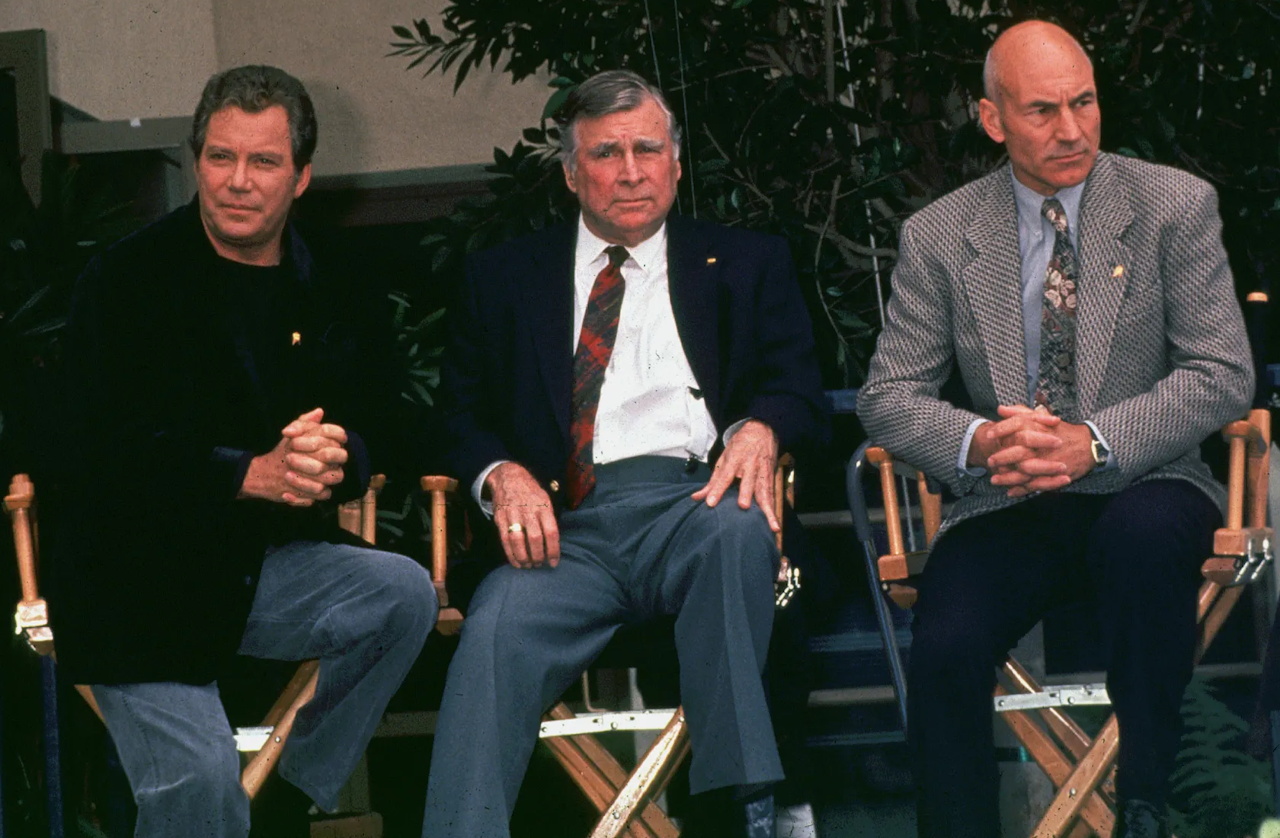
Photo of William Shatner, Gene Roddenberry, and Patrick Stewart at an event
William Shatner, Gene Roddenberry, and Patrick Stewart, circa 1990-91.

At this moment in the early summer of 1991, I’d have been finishing Year 3 at school (which I believe is the equivalent of second grade in Ameria; not sure on that, though). My memory isn’t great these days, but I can remember some of the things I experienced that year. Year 3 marked the beginning of being in the “Juniors” at school, not the “Infants” with the younger year groups. It was around this time that I got my first taste of computing – at my small school in the rural north of England, there was only one computer, and it was in the Juniors classroom! I can remember sitting with another pupil – an older girl – as I had my first-ever lesson on a BBC Micro. I looked down at the keyboard and told the girl, with some alarm, that I wanted to use “little letters, not big letters” (meaning lowercase, not uppercase) and listened as she explained to me that the keyboard could write *both* sets of letters!

At home, we didn’t have a computer. My household had a landline telephone, a single television set, and a Betamax recorder that my parents would begrudgingly swap for VHS later in ’91. And we didn’t own a games console, either – although I’d played games before, at a kids’ club and at my uncle’s place, I wouldn’t get my first games console for another year. I finally got a Super Nintendo in the summer of 1992.
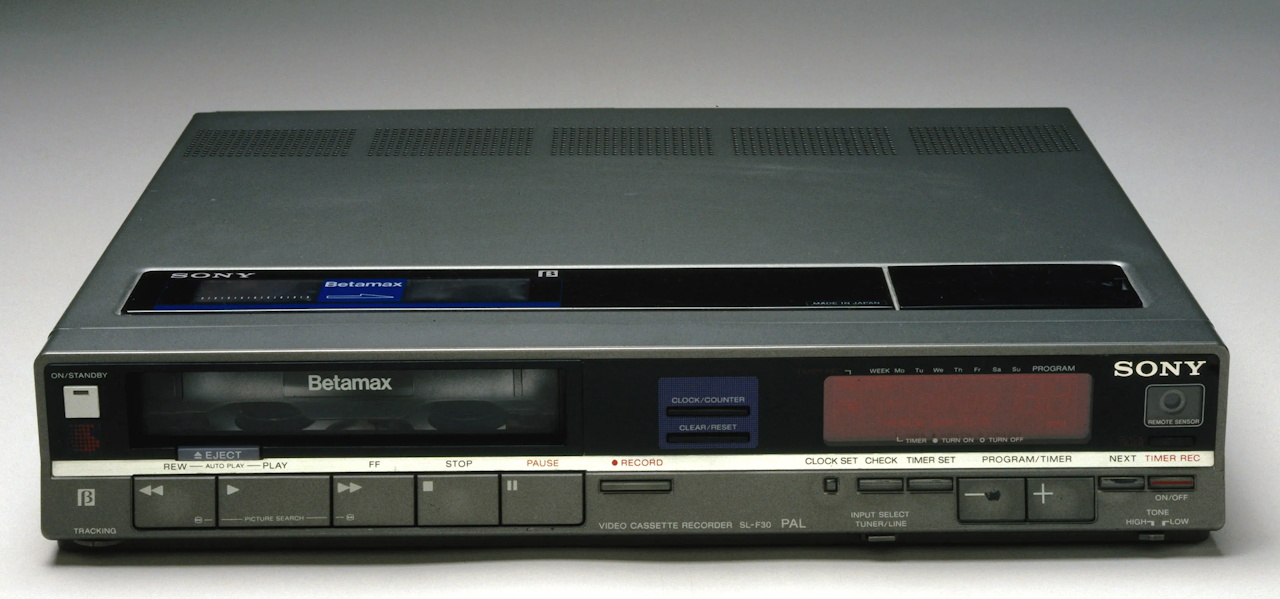
Stock photo of a Sony Betamax recorder
A Betamax recorder, similar to the one my parents owned in June 1991.

Sorry, this is turning into a stumble down memory lane, isn’t it?

But I suppose that’s a testament to the power of media. When I re-watched The Royale, I wasn’t just revisiting the episode and its story. I was stepping back in time to the moment I became a Star Trek fan, and that brings with it a certain amount of reflection. The world has changed a lot since that episode premiered here in the UK some thirty-five years ago. In fact, it’s almost unrecognisable in some ways. If I could magically teleport through time and sit down with my eight-year-old self, they’d be *stunned* to hear about some of the things that happened in the intervening years. And probably a little shocked at my appearance, too!

My point is that this episode holds a very special – and an utterly unique – place in my heart. Returning to it is always fun, but when I started to put pen to paper to write about it, I found myself wallowing in memories. Because this episode made me a Trekkie, I can’t help thinking back to that time in my life and reflecting on all of the things that have changed. Returning to The Royale today, on the thirty-fifth anniversary of its UK premiere, is something I’ve been looking forward to! I guess I just didn’t expect to take such a diversion back to my own past and my own schooldays.
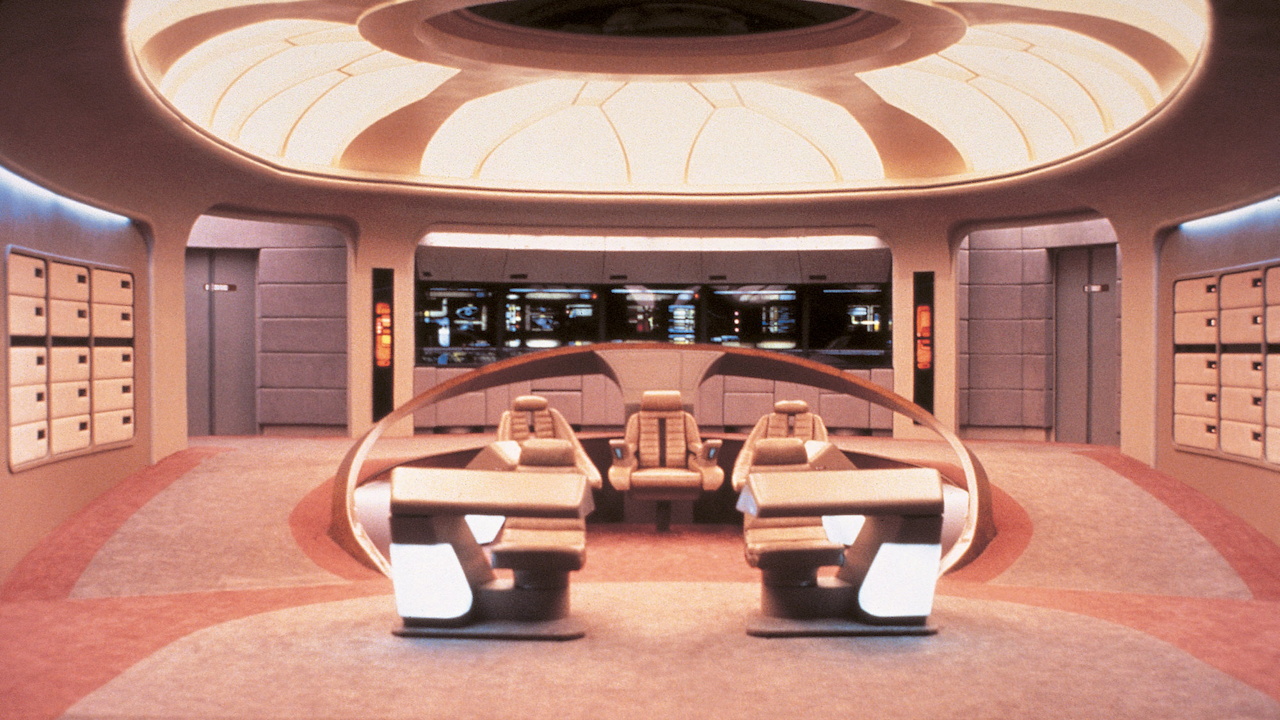
Behind-the-scenes photo from Star Trek TNG showing the empty bridge set
A behind-the-scenes photo of the bridge of the Enterprise-D.

Season 2 of The Next Generation coined the phrase “growing the beard;” the opposite of “jumping the shark.” This phrase means, in brief, that a television show has improved significantly after a rougher first season, and references Jonathan Frakes’ character of Will Riker, who first got his iconic beard this year. While I don’t agree at all with the sentiment that Season 1 of TNG is somehow “bad” in its entirety, I think it’s fair to say that the show went from strength to strength, growing into something better over time.

And it’s that moment that I joined in and became a Star Trek fan. That can’t be a coincidence, can it? In fairness, I’ve always wondered what I might’ve made of Star Trek if, at this seminal moment, I’d have watched an episode like Angel One, or a similar lowly-rated story from Season 1. Would I have persevered with Star Trek, or written it off? I suppose we’ll never know… but it’s an interesting “what if” idea, isn’t it?
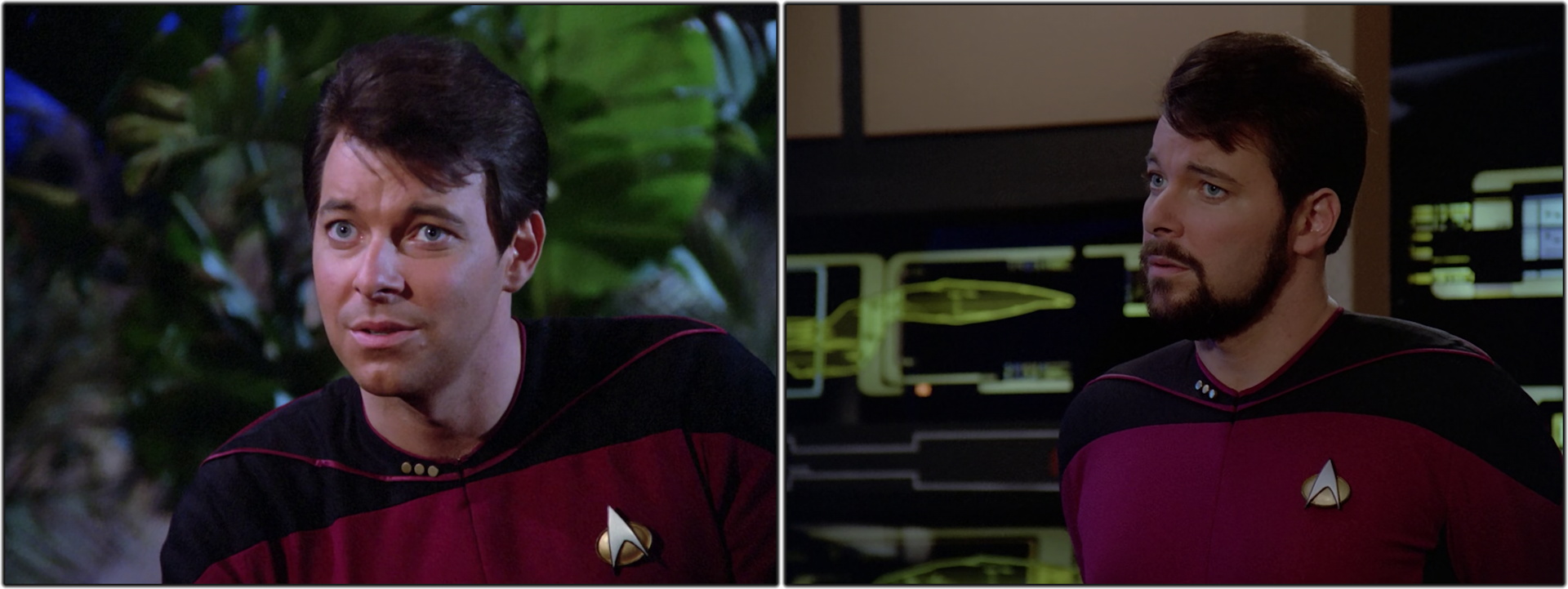
Two side-by-side still frames from Star Trek TNG S1 and S2 showing Riker
Riker in Season 1 (left) and Season 2 (right).

If you’ve made it this far, thanks! I think we’re finally ready to get into The Royale and its story.

The Royale aired at the midpoint of The Next Generation’s second season, in between Contagion and Time Squared. It was broadcast in the United States more than two years ahead of its UK premiere, in March 1989, and was written by Tracy Tormé and directed by Cliff Bole. Bole had previously worked on William Shatner’s police show T. J. Hooker, and had directed three episodes of TNG’s first season, including the penultimate episode, Conspiracy. He’d go on to direct almost two dozen more, as well as seven episodes of Deep Space Nine and ten of Voyager.

Tracy Tormé, the episode’s writer, is credited under a pseudonym for The Royale, as a result of conflicts with Maurice Hurley, TNG’s head writer for Season 2; Hurley had made changes and revisions to Tormé’s original script for the episode. According to Chaos on the Bridge, William Shatner’s documentary about the making of The Next Generation, Tormé and Hurley regularly butted heads during Seasons 1 and 2, before Tormé ultimately left the series ahead of Season 3.
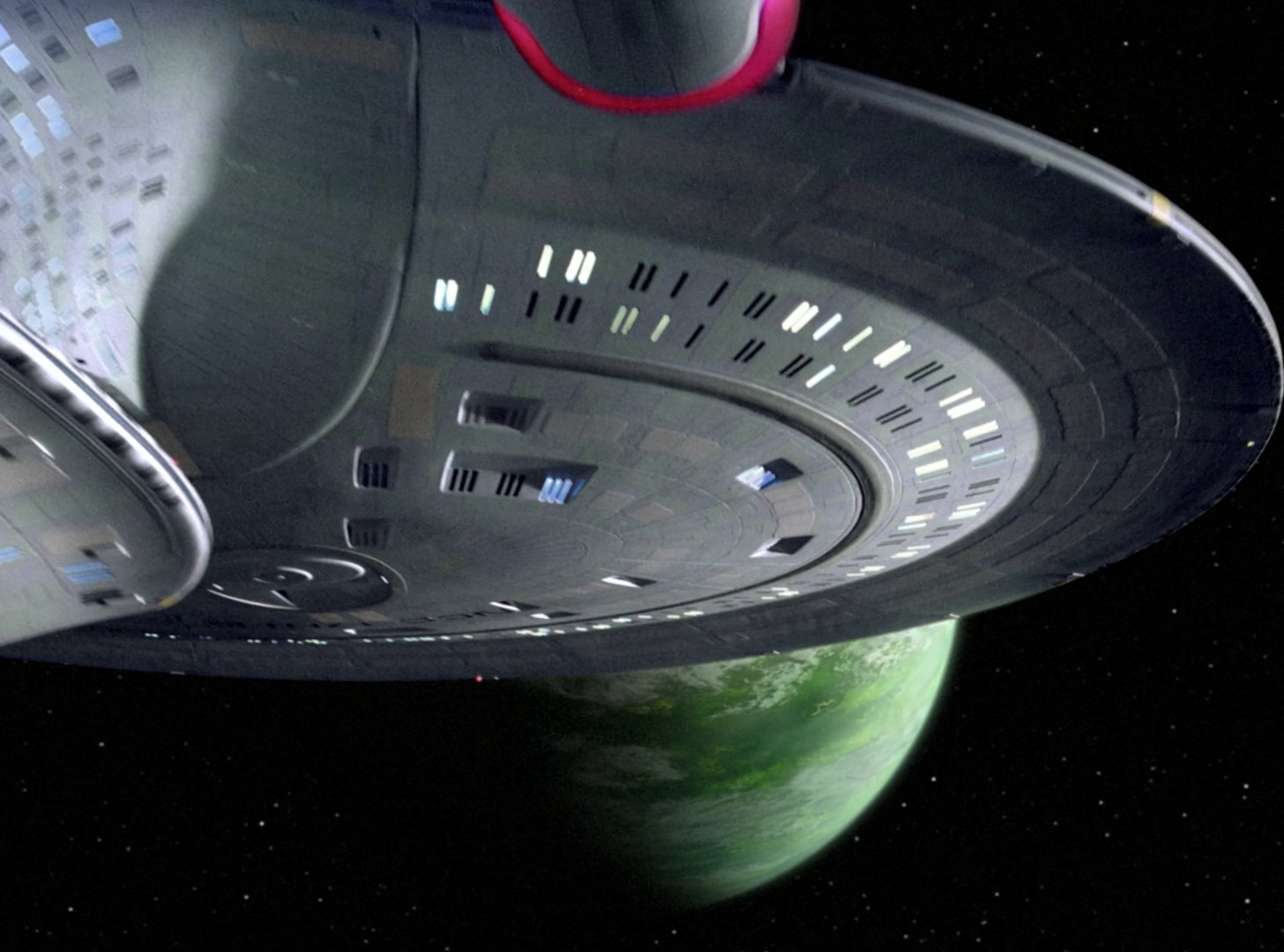
Still frame from Star Trek TNG The Royale showing the Enterprise-D
The opening shot of the episode.

According to director Cliff Bole, The Royale suffered from having a low budget. The revolving door leading into the hotel – and, really, the entire surface of Theta VIII outside of the hotel – is, to be incredibly generous, “minimalist!” Even the remastered version of the episode doesn’t change this (for which I’m actually glad), but I think there’s a weird kind of low-budget charm to the way the planet and away mission are presented. It’s kind of like The Original Series with its papier-mache and polystyrene rocks; something about that, while objectively unrealistic in its appearance, just… “feels like Star Trek,” or at least it does to me!

Tracy Tormé has said that his original draft was much more surreal, and from what I can glean, it sounds like it might’ve been closer to The Original Series in tone, perhaps with more of a focus on comedy or even outright silliness. Allegedly, this version of the story was felt to be too similar to A Piece of the Action from TOS; both stories involve an alien society contaminated by a book from Earth, and both had gangsters in them. That version of the episode may have been a lot funnier… or it could’ve been a lot worse, but I suppose we’ll never know, eh?
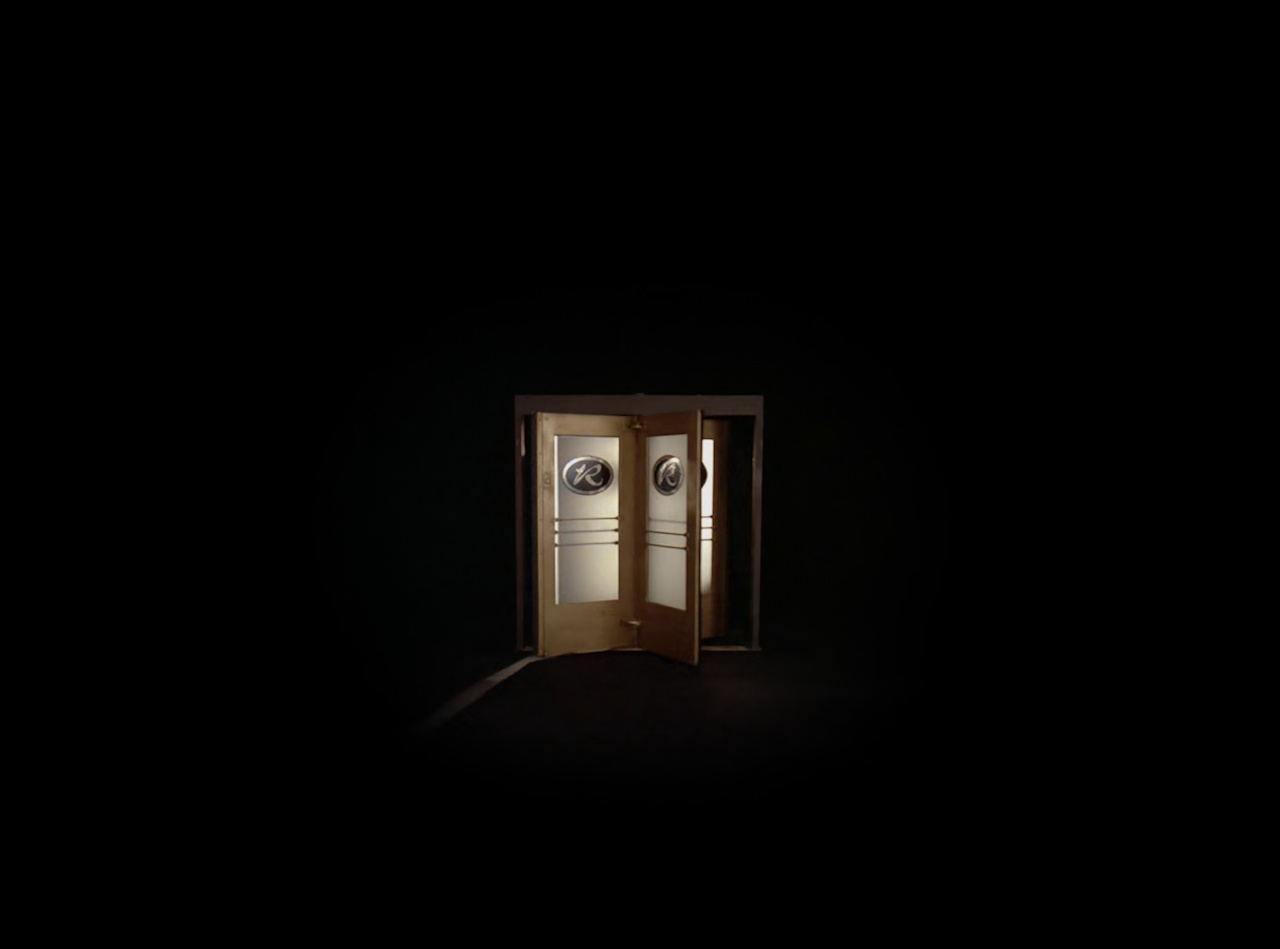
Still frame from Star Trek TNG The Royale showing a revolving door
A very minimalist set…

The episode begins with the Enterprise-D arriving at Theta VIII, and a brief discussion between Riker and Geordi about the planet. This sets up Theta VIII as an inhospitable place; a freezing planet with high winds and ammonia tornadoes. It’s a cute little conversation, and I like the shot of Riker on the bridge, moving from the front, near the helm and conn positions, to Geordi’s station at the back. It’s not something we’d see a lot of across the show, this kind of panning shot, following a command character as they move between stations.

It’s also a bit of a rarity to see Geordi on the bridge after Season 1, and I think this moment worked a lot better than if, say, Riker had called down to Engineering. Having the two together, with Riker looking over Geordi’s shoulder for the chat, just felt a bit more personal and familiar, adding to the sense that these two are friends as well as colleagues. Not a huge moment in the episode, considering what’s to come – but I still really like it!
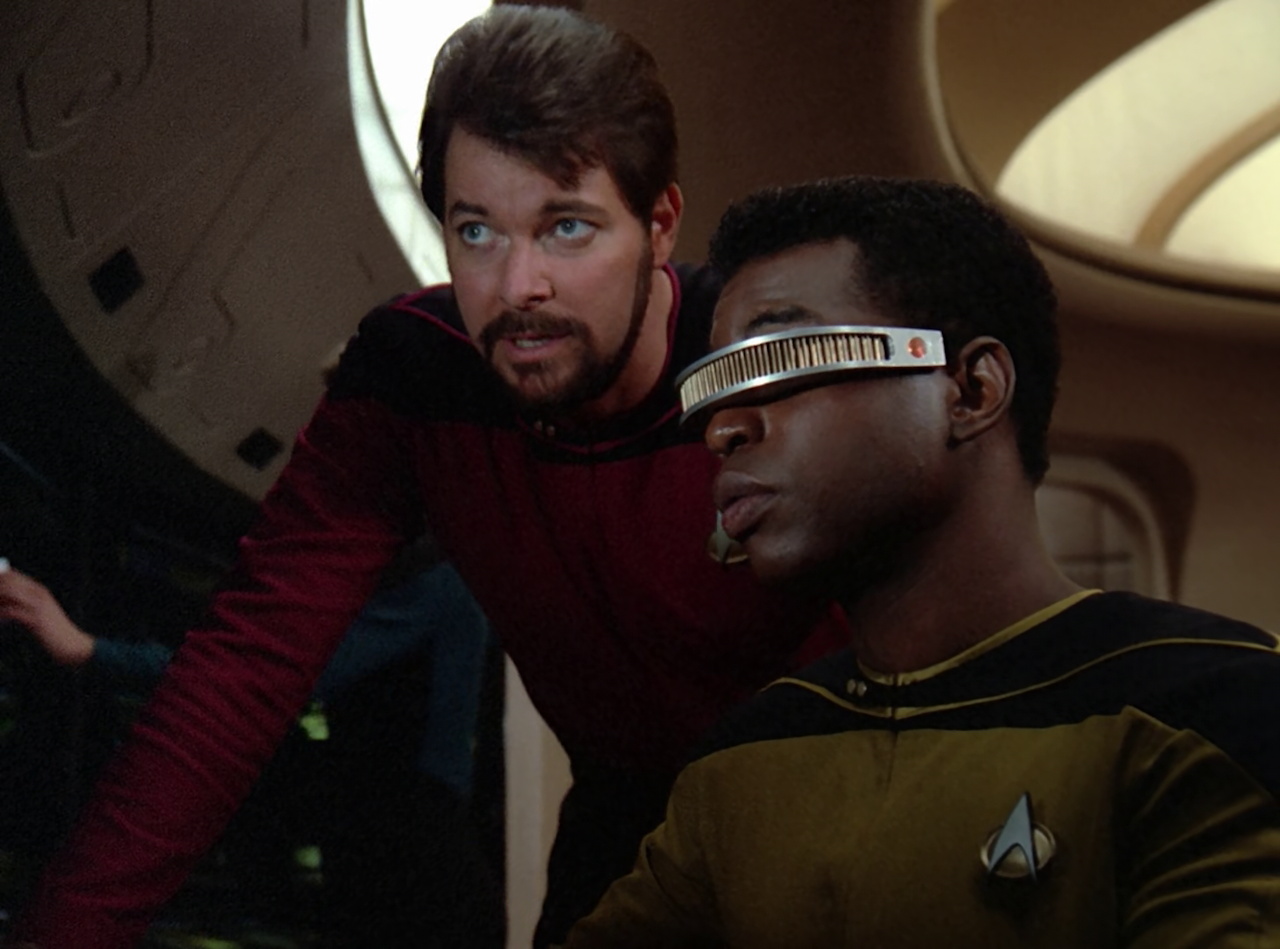
Still frame from Star Trek TNG The Royale showing Riker and Geordi
Riker with Geordi on the bridge.

Riker’s conversation with Picard in the Ready-Room has drawn a lot of attention over the years, but not for the reasons the writer may have wanted! Picard talks about Fermat’s last theorem, which was a famously unsolved problem in mathematics, and uses it as an example of how much Starfleet and the Federation still have to learn about the universe. This point is interesting, and it establishes a couple of things about Picard: that he spends his downtime thinking about puzzles like this, and that he’s keenly aware of how far humanity still has to go to uncover the mysteries of the universe. It neatly encapsulates who Picard is, why he’d join an organisation like Starfleet – and why, all these years later, he’s a character that so many of us absolutely adore!

But this moment has been overshadowed somewhat by the solution to Fermat’s last theorem! Only a few years after The Royale aired, mathematician Andrew Wiles published his proof, rendering Picard’s statement inaccurate. And some fans and viewers hold up this moment not as Picard being philosophical about Starfleet’s mission of exploration… but rather, as an example of how Star Trek’s vision of the future can be invalidated as the world around it shifts. I don’t really like that approach, and while we can look back at this scene now, with the benefit of hindsight, and acknowledge that, factually speaking, Picard is now incorrect to say that Fermat’s last theorem was never solved… I think his point still stands! And it feels a little pedantic for folks to seize on this moment as a kind of “gotcha” to say that Star Trek gets its vision of the future wrong. Star Trek, for me anyway, kind of exists in a floating timeline, and while we wouldn’t make an episode today using Fermat’s last theorem in this way, the point Picard was making about how humanity still has a long way to go to understand the universe isn’t invalidated. It’s interesting, though, that the proof was published only a few years after the episode aired.
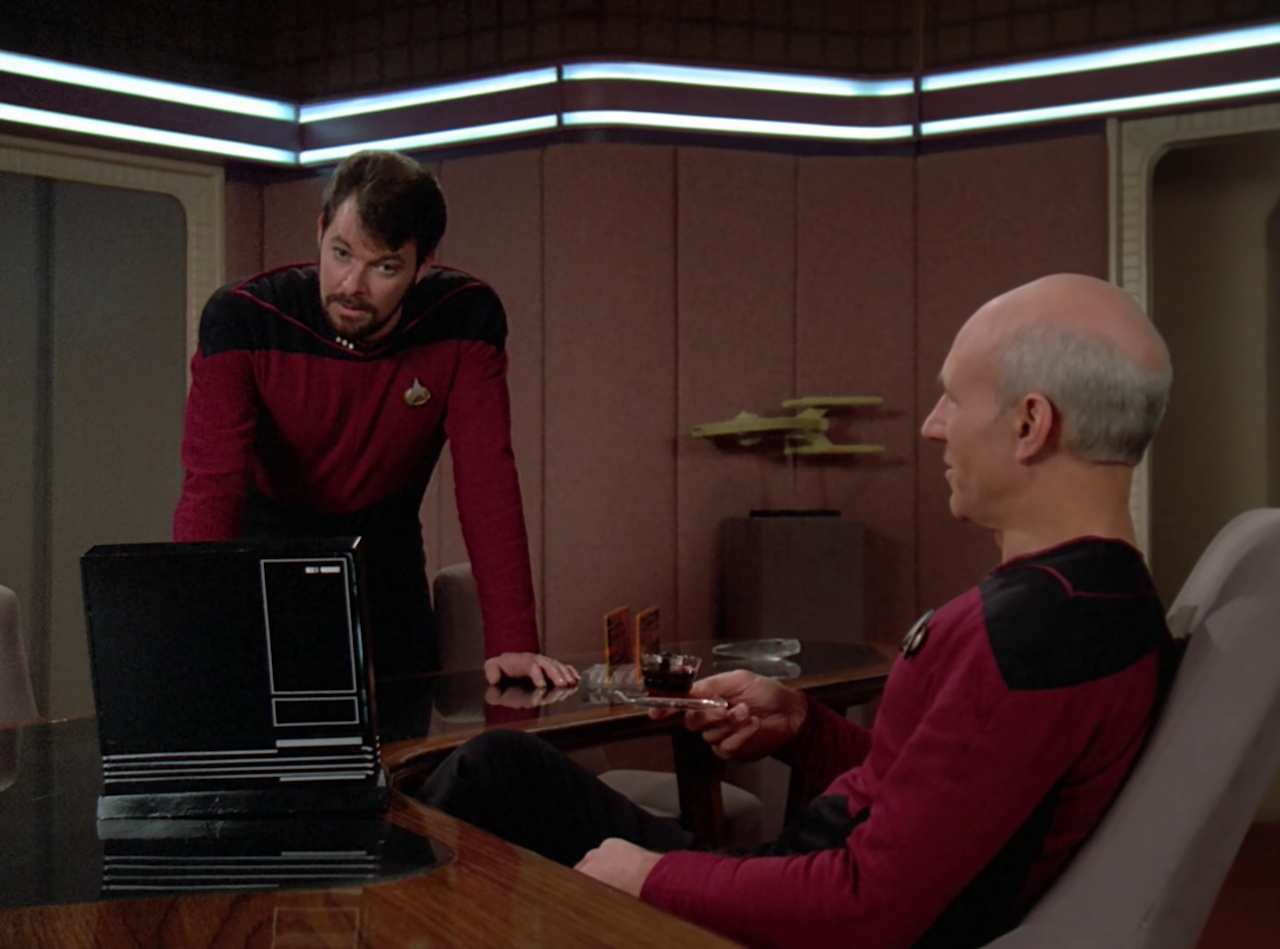
Still frame from Star Trek TNG The Royale showing Riker and Picard
This discussion of Fermat’s last theorem is interesting.

The teaser ends with the revelation that the debris detected in orbit of Theta VIII is from a NASA spacecraft. I like the little scene in the transporter room, and it’s always fun to see Chief O’Brien prior to his role in Deep Space Nine! However, I can’t help but feel like this moment – which is treated as a huge revelation by the episode – doesn’t quite make sense if you stop to think about it. Why wouldn’t either the Klingon cruiser or the Enterprise-D have been able to detect that the debris was of Earth origin? And given how much random junk and debris there must be in space, why would the Enterprise-D have diverted here just for that? Would the episode have been a bit more solid if it began with the message from the Klingons saying that they’d detected the wreck of an Earth spacecraft in orbit of Theta VIII?

I think this is an example of the passage of time – and the fact that I’ve seen this episode so many times over the years – getting in the way! The “big reveal” of the NASA emblem doesn’t shock me any more, and it hasn’t since I was eight years old and I first saw the episode! But that isn’t The Royale’s fault, and thinking about the mystery that the episode wants to establish going into the ad break… it’s done pretty well. I just get the sense that, if you think about it from an in-universe point of view, the Enterprise-D wouldn’t have necessarily diverted to Theta VIII for no reason, and the Klingons probably wouldn’t have even mentioned the debris unless they knew it was of human origin. Changing that would’ve completely ruined the shock of seeing the NASA emblem and American flag, but I’d still argue it would make more sense in-universe for the crew to have deliberately set out to recover the debris of a ship from Earth, rather than diverting the entire ship to take a look at some random space junk.
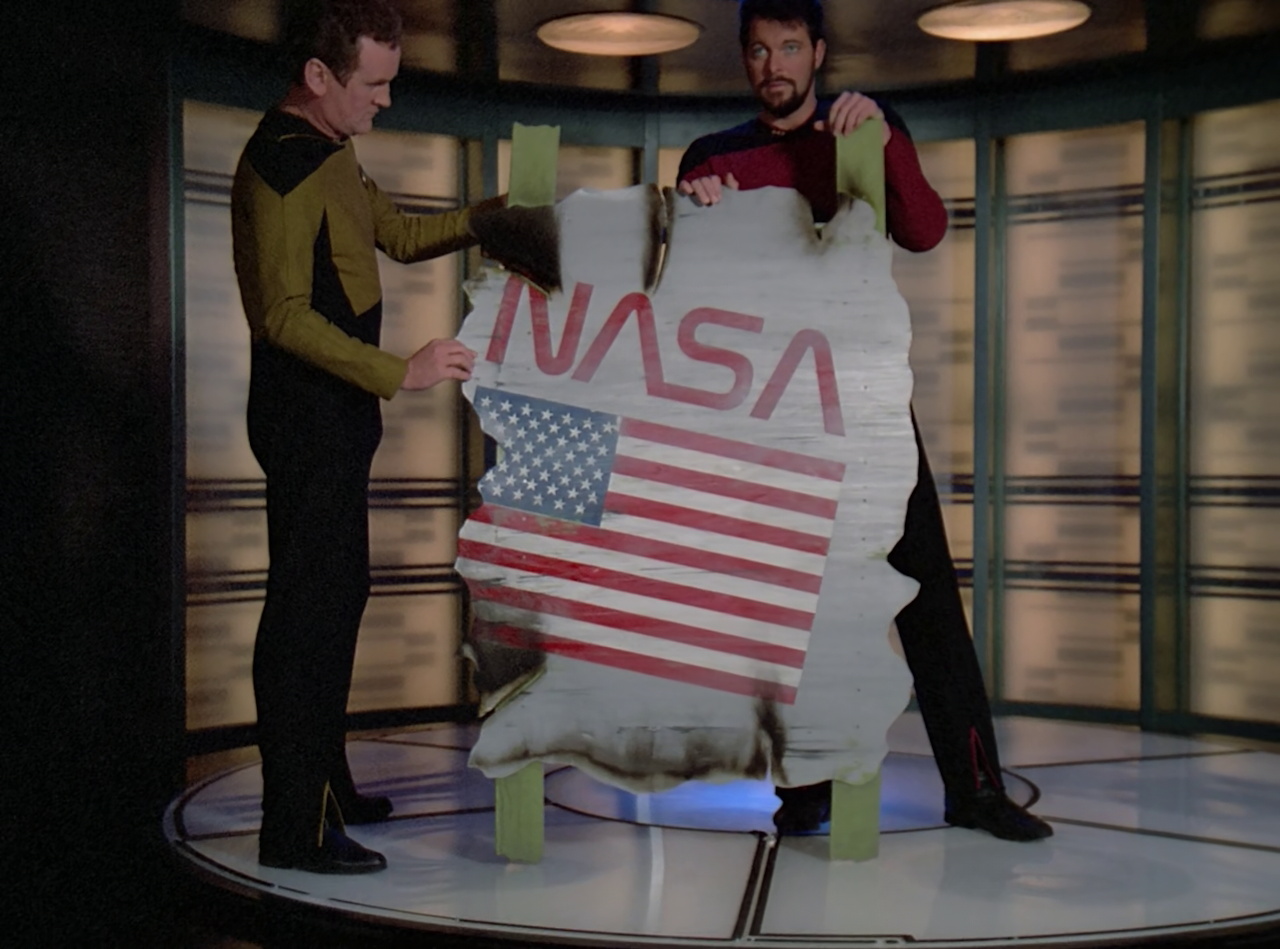
Still frame from Star Trek TNG The Royale showing O'Brien and Riker with the NASA debris
O’Brien and Riker with the recovered debris.

In the Conference Room, the crew briefly discuss what they’ve found. The damage to the debris could indicate it was hit by weapons fire, and Picard states that there’s no way a vessel from the mid-21st Century could have travelled so far into deep space. I think it’s fun to see, now we’re almost forty years on from The Next Generation’s premiere, how the show, especially in its first couple of seasons, was trying to remain consistent with The Original Series and its vision of Earth in the late 20th and early 21st Centuries. Encounter at Farpoint showed us the aftermath of World War III and the “post-atomic horror,” and now we’re getting NASA spacecraft from that same kind of era venturing beyond the solar system.

As we get closer to some of these dates and moments in real-time, we can see how wrong those depictions were! And that’s kind of sad, in a way. But speaking as we were of Star Trek having a kind of “floating timeline,” where events in the real world can ultimately overwrite some of these ideas… I don’t think it really matters all that much. If you look at Star Trek episodes produced in the 2020s, they might not reference the “mid-21st Century” in quite the same way, but Star Trek’s internal timeline is, for me, vague enough to still come together! And my personal head canon, anyway, is that Star Trek diverged from the real world at some point in the mid/late 20th Century! But I think we’ve gotten a little off-topic, huh?
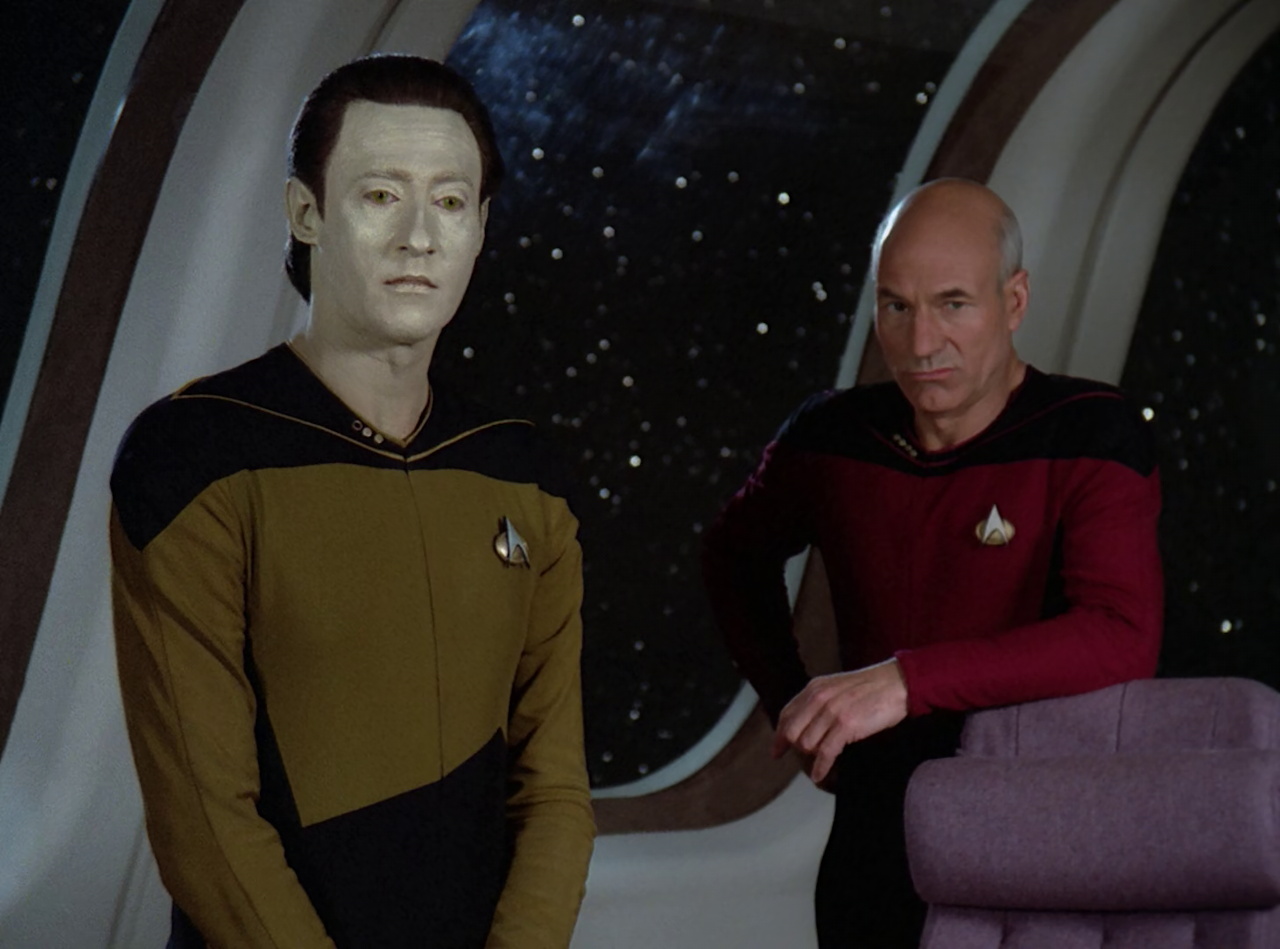
Still frame from Star Trek TNG The Royale showing Data and Picard
Data and Picard in the Conference Room.

I love the handheld phasers that the crew use for the away mission. A lot of phaser designs feel “iconic,” but something about the models used in the first part of The Next Generation just feels even more special, somehow. Perhaps that’s the nostalgia talking again! This model, lovingly referred to as the “dustbuster” after a handheld vacuum cleaner that it resembles, was seen on a few occasions across Seasons 1 and 2, but was changed by Season 3.

To get back on topic, Wesley and Geordi show Picard and the others a “structure” that they’ve detected on the surface of Theta VIII. And here’s where I feel like the script and the production didn’t quite align! This structure, briefly glimpsed on Wesley’s monitor, is simply never shown at all; the away team beams down to a black void with a simple revolving door set into it, and the exterior of the hotel is simply never seen, nor even acknowledged. This is clearly a consequence of the budget issues we talked about, and I happen to find the black void and simple door to be suitably mysterious and otherworldly, especially for the kind of story the episode is setting up. But it’s also a bit of an inconsistency, if you think about it, and it makes me wonder why they didn’t rework this moment on the bridge to perhaps make note of a pocket of breathable air, but not draw attention to the existence of a “structure” that we never get to see.
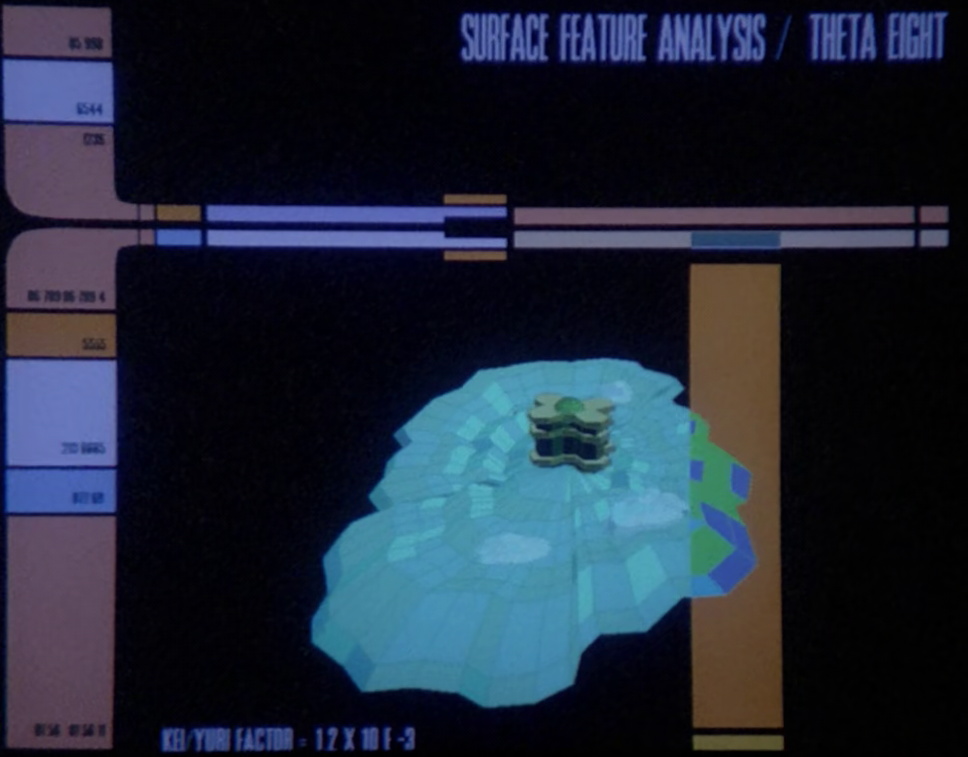
Still frame from Star Trek TNG The Royale showing an LCARS scan
We never actually get to see what this structure looks like.

The away team beams down to Theta VIII, and they encounter the revolving door! One thing I didn’t realise until looking into the production history of The Royale is that all of the sets for the hotel were constructed specifically for The Next Generation – they didn’t use an existing hotel or casino set, which is genuinely fascinating. I guess it must’ve been cheaper to do that than to try to book an existing location or reuse a set from another series, but… how?

Director Cliff Bole, who had previously worked on a crime drama called Vegas, described the set as being built with “curtains,” and recalled that whole scenes needed to be shot from very specific angles so as not to give the game away! The moment the away team walks into the hotel for the first time, though, doesn’t feel – to me, anyway – like actors walking onto a set. The number of people in frame, as well as the score and sound design, too, make the hotel’s casino feel like a very real – if mysterious and otherworldly – space.
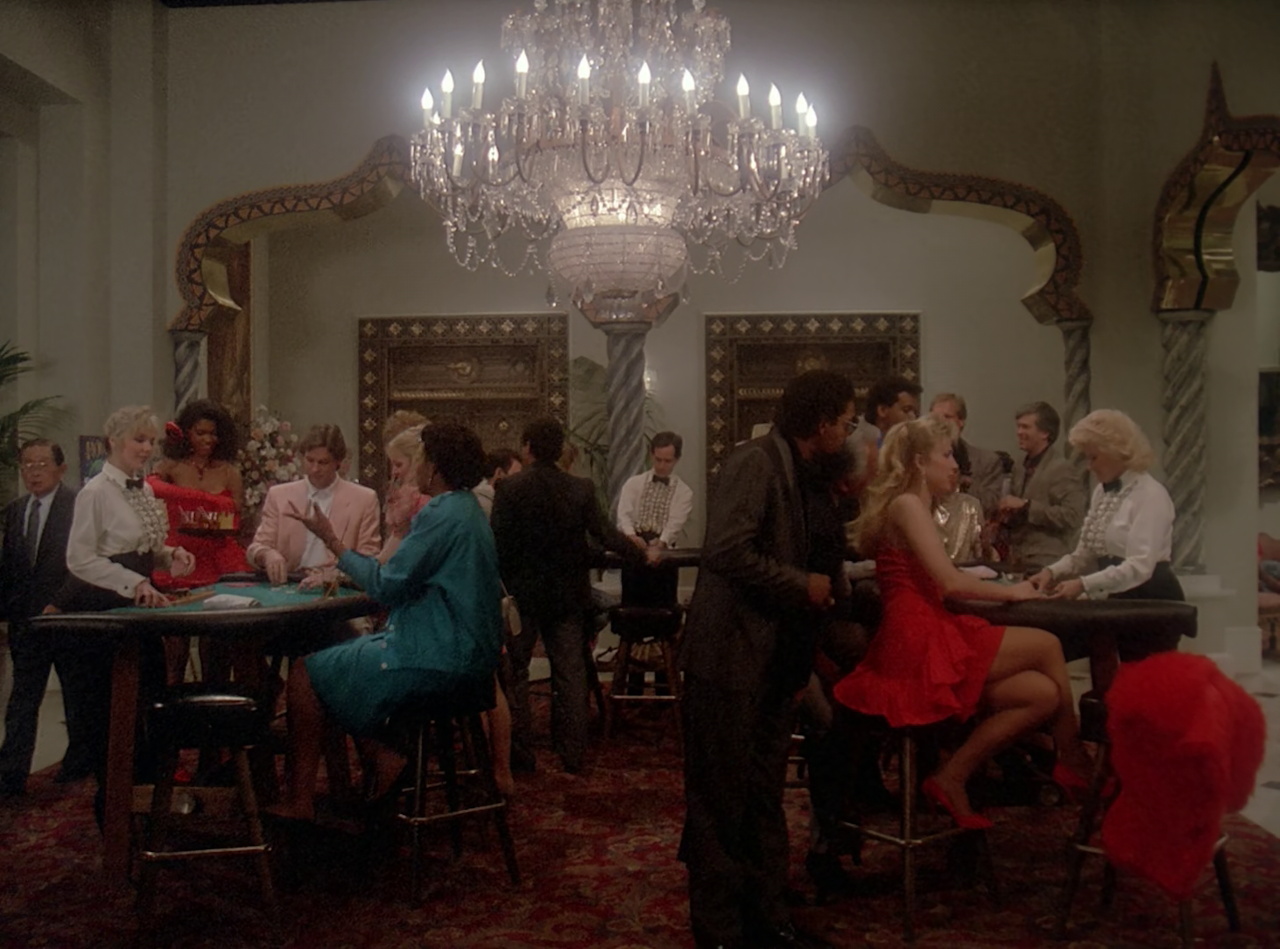
Still frame from Star Trek TNG The Royale showing the casino
The casino.

The interaction with the assistant manager at the hotel’s front desk is still, all these years later, absolutely hilarious. Sam Anderson, the actor who took on the role, has absolutely perfect comedic timing, especially in this first encounter. As Riker and Worf push him on what the planet’s called… I can’t help but laugh every single time, no matter how many times I’ve seen The Royale.

Anderson would go on to have roles in films like Forrest Gump and TV shows like ER and Lost.

There’s a creepiness to this interaction, making us think that the assistant manager is hiding things or refusing to share everything he knows about the hotel or the planet it’s situated on, and that successfully builds up more of the mystery that The Royale is going for.
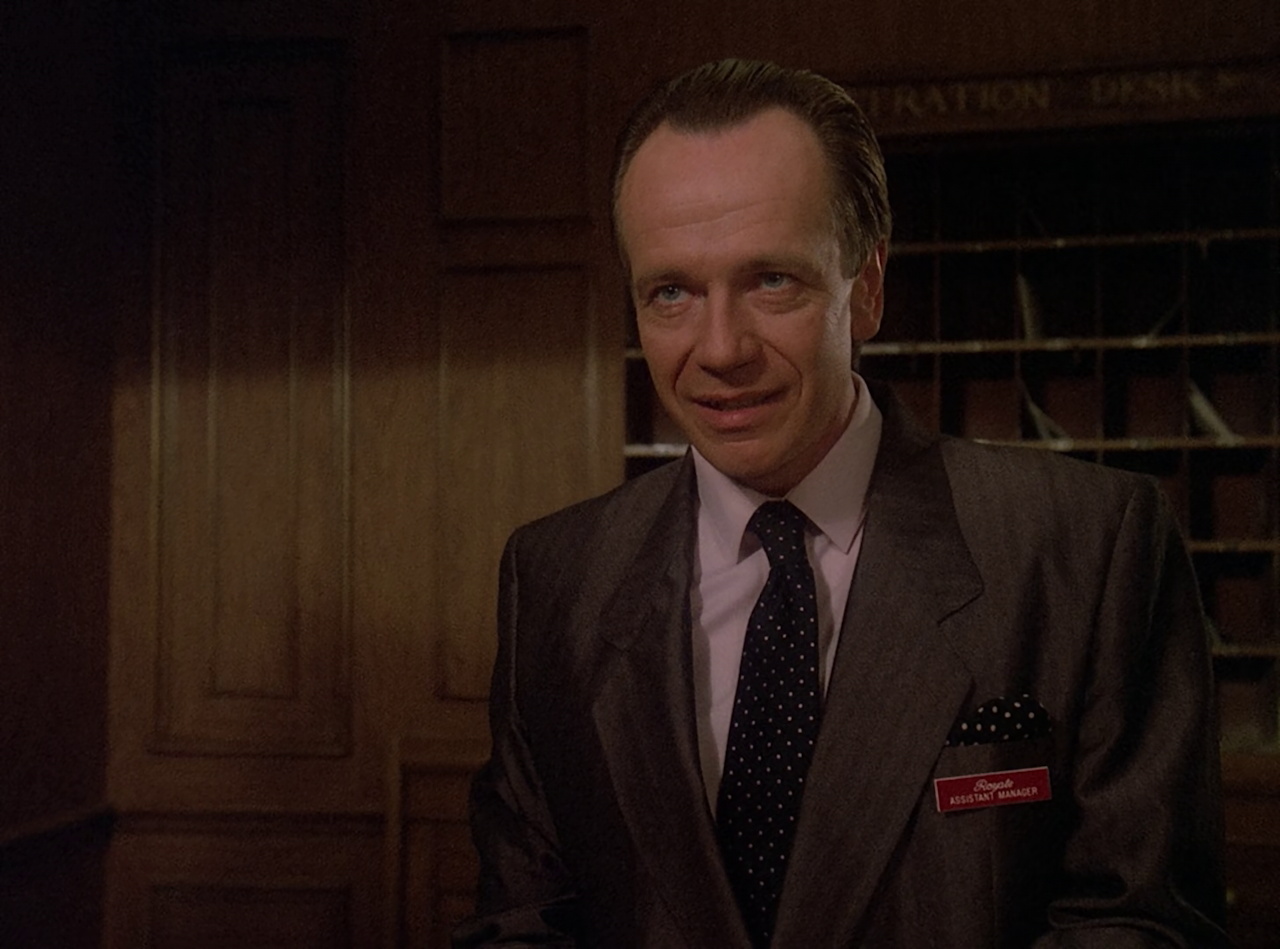
Still frame from Star Trek TNG The Royale showing the assistant manager
The assistant manager.

It’s also at this moment that we get the first signs of the episode’s other angle: the cheap story from a low-quality novel. Playing out like a tired cliché of the crime and drama genres, the hotel’s bellboy interrupts the away team to talk to the assistant manager about a girl. And the soundtrack here! It’s just pitch-perfect for this kind of over-the-top drama cliché; exactly the kind of thing you’d have heard in a B-movie or TV soap opera. The dramatic change in music adds so much to this scene, indicating to us as the audience that there’s something very strange going on. I love it!

This leads into the revelation that none of the people the away team has encountered are emitting life-signs. And this gets a little confusing; Data explains that they exist, but that they aren’t organic, nor are they machines. Again, the mysteries of the story are deepening. And we get a fun introduction to the character “Texas” to round things off.
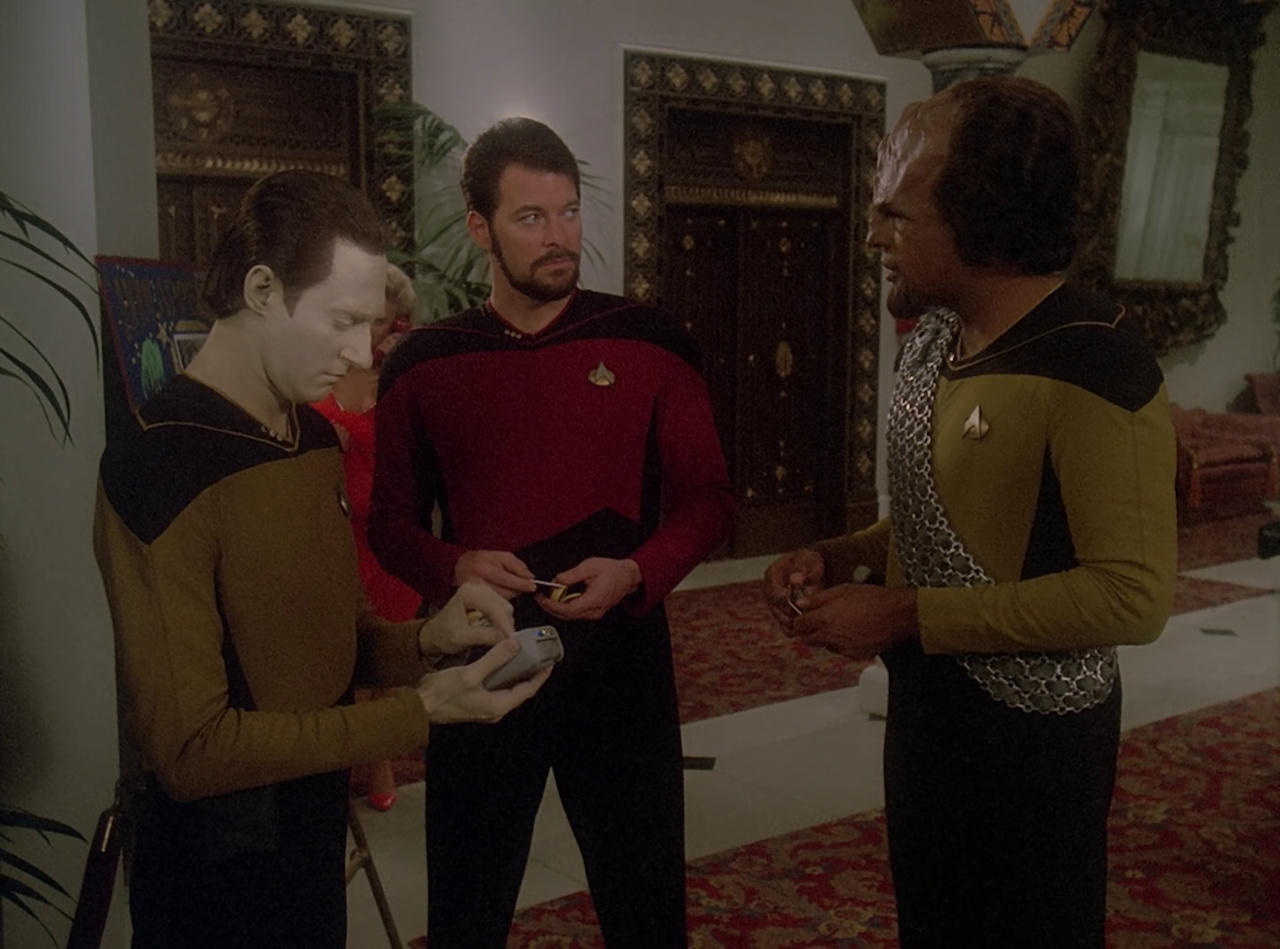
Still frame from Star Trek TNG The Royale showing the away team
The away team scanning for life-forms.

We get a brief scene back aboard the Enterprise-D with Wesley and Geordi still working on a way to break through the communications blackout. Picard talks to them, wondering whether something intelligent may be blocking their signal, and then hears from Counsellor Troi that Riker doesn’t appear to be in danger; she describes his mood as “amused,” which obviously tracks with what we just saw! This little scene on the bridge doesn’t add a lot, but it’s a fun little cutaway in its own right.

I think it might’ve been interesting for Picard to ask Troi, rather than Wesley and Geordi, whether there was some kind of intelligence or life-form at work here. Surely she’d be able to tell whether there was anyone else down there besides the away team, and that could’ve impacted how the crew were reacting to the situation. Deanna’s empathic abilities are not always perfect, of course, but she might’ve been able to join in this conversation and share her perspective, at least. Again, a nitpick – but it’s a role we’ve seen Troi fill multiple times already, even at this point in the show’s run, commenting on the likes of Q or the Ferengi, to name but two examples. So I don’t think it’s out of the question for Picard to have asked her if she could feel another presence down on Theta VIII.
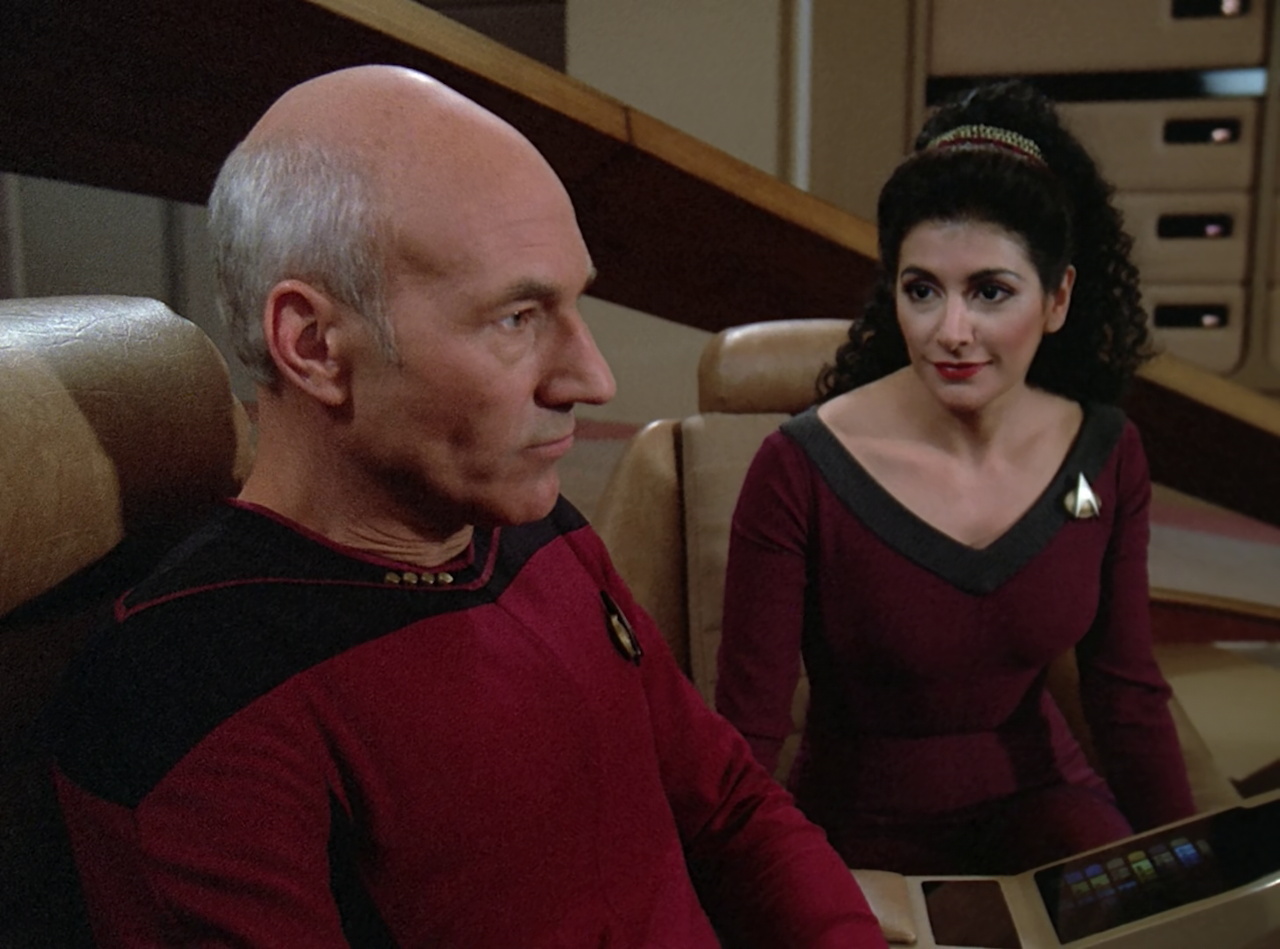
Still frame from Star Trek TNG The Royale showing Picard and Troi
Why doesn’t Captain Picard ask Counsellor Troi if she can sense another intelligence or presence down on the planet?

The blackjack scene with “Texas” is funny. Noble Willingham, the actor who played the role, would later go on to have a starring role in Walker, Texas Ranger with Chuck Norris, and he just feels perfectly cast as the old gambler in The Royale. He reminds me of The Simpsons’ character of the Rich Texan, thanks to a similar outfit, accent, and mannerisms, and I just think he’s a really fun and pretty unique character across really the entirety of Star Trek. He fits perfectly into this pulpy, low-quality novel, but there’s an edge to the character, too.

We get some genuinely cute moments with Texas and Data – Texas gives him his stetson hat to wear, briefly, and tries to talk him out of asking for another card during the game. I’m not a gambler, and I’m not all that familiar with blackjack as a game, but its rules are simple enough to understand – and Data explains them well – meaning it makes for a good choice of game to show off in a scene like this. Trying to explain the rules of a more complex game would’ve taken too long and could’ve been confusing or just less engaging for the audience.
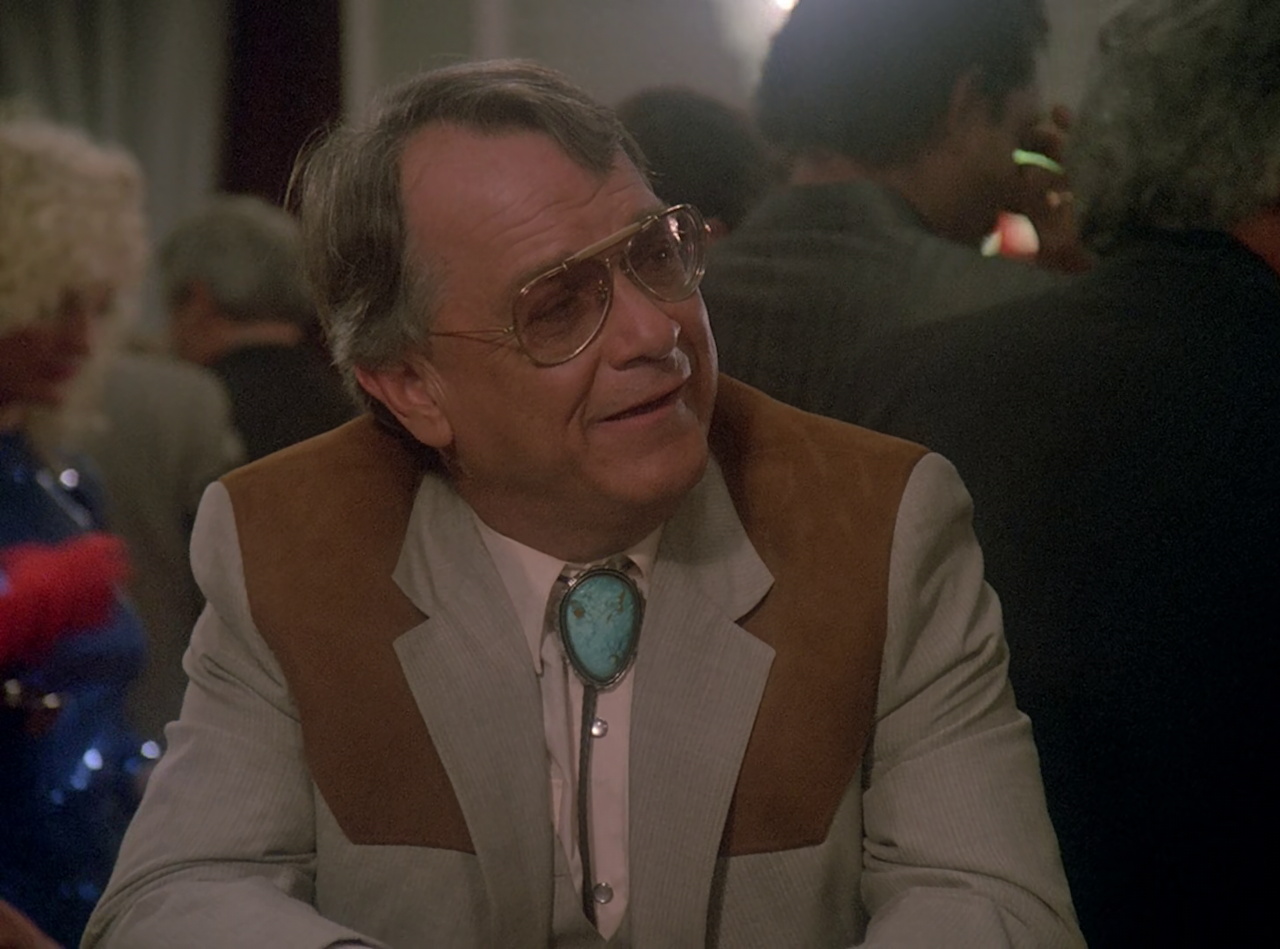
Still frame from Star Trek TNG The Royale showing "Texas"
“Texas.”

After another short scene on the bridge, it soon becomes clear to the away team that they’re trapped in the hotel. The scene of the three of them running through the revolving door is a little silly, to be honest; they’re clearly just going all the way around and coming back out into the hotel, and it makes for a kind of comical presentation which contrasts with how seriously all three characters are taking it! But it does well enough to establish the core premise: they’re stuck in the hotel, unable to leave, and also cut off from communicating with the Enterprise.

The Royale always reminded me a little of The Eagles’ song Hotel California. Remember the line “you can check out any time you like, but you can never leave”? Isn’t that pretty much the premise of the story here, that escaping the hotel is impossible? I’ve never seen other Trekkies making that link, though, so maybe that’s just a me thing! And the song isn’t *literally* about a magically inescapable hotel, it’s a metaphor. Still, I find the comparison to be a fun one.
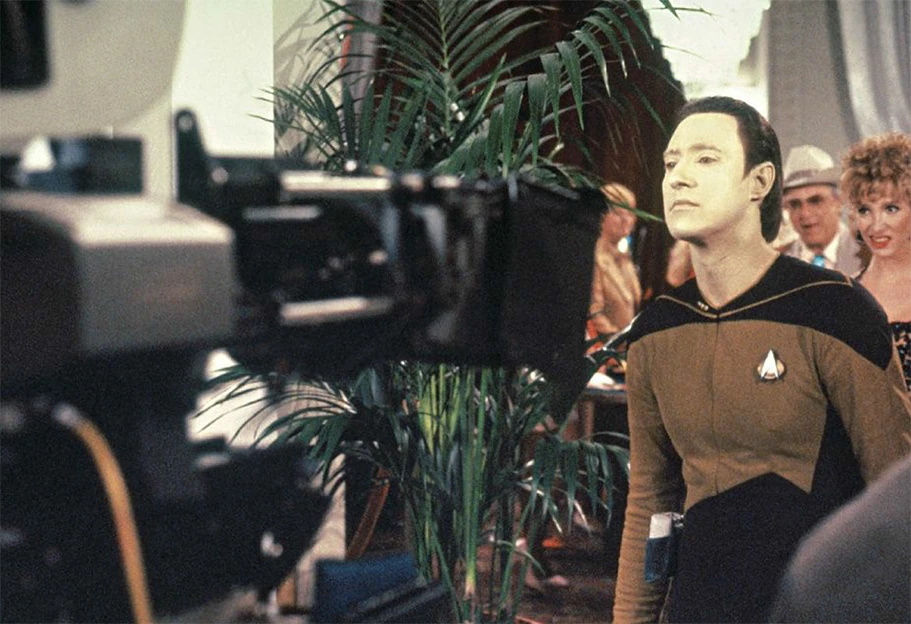
A behind-the-scenes photo from Star Trek TNG S2 showing Brent Spiner
Behind-the-scenes during production.

Riker attempts to talk to the assistant manager again, but makes no progress in figuring out how to leave the hotel. The Enterprise-D is able to briefly get in contact with Riker, but only long enough for him to tell Picard that they can’t leave the building. We get another scene with the bellboy and the assistant manager, with that absolutely wonderful scene-setting score again! And I just really love this incredibly cheesy story that’s unfolding at the hotel; it’s so silly, but it’s so… *Star Trek* at the same time.

Maybe you won’t agree, but I think The Royale is the kind of episode that modern Star Trek wouldn’t do. We’ve seen recent episodes involving time travel, including to the modern day, as well as stories involving aliens capable of generating illusions not dissimilar to the hotel in The Royale. But this kind of self-contained story – an alien recreation of a low-budget Las Vegas hotel, based on a book, and complete with one-dimensional characters played with self-awareness by the performers? I mean… would modern Star Trek do something like that? I doubt it… but it’s episodes like this one that make Star Trek what it is, at least to me. Recent stories all seem to be galactic in scope, with existential threats to the entire Federation and moustache-twirling villains who are played completely earnestly. The Royale is totally aware of the kind of books and TV shows it’s parodying, and I think that self-awareness is a big part of how well it works.
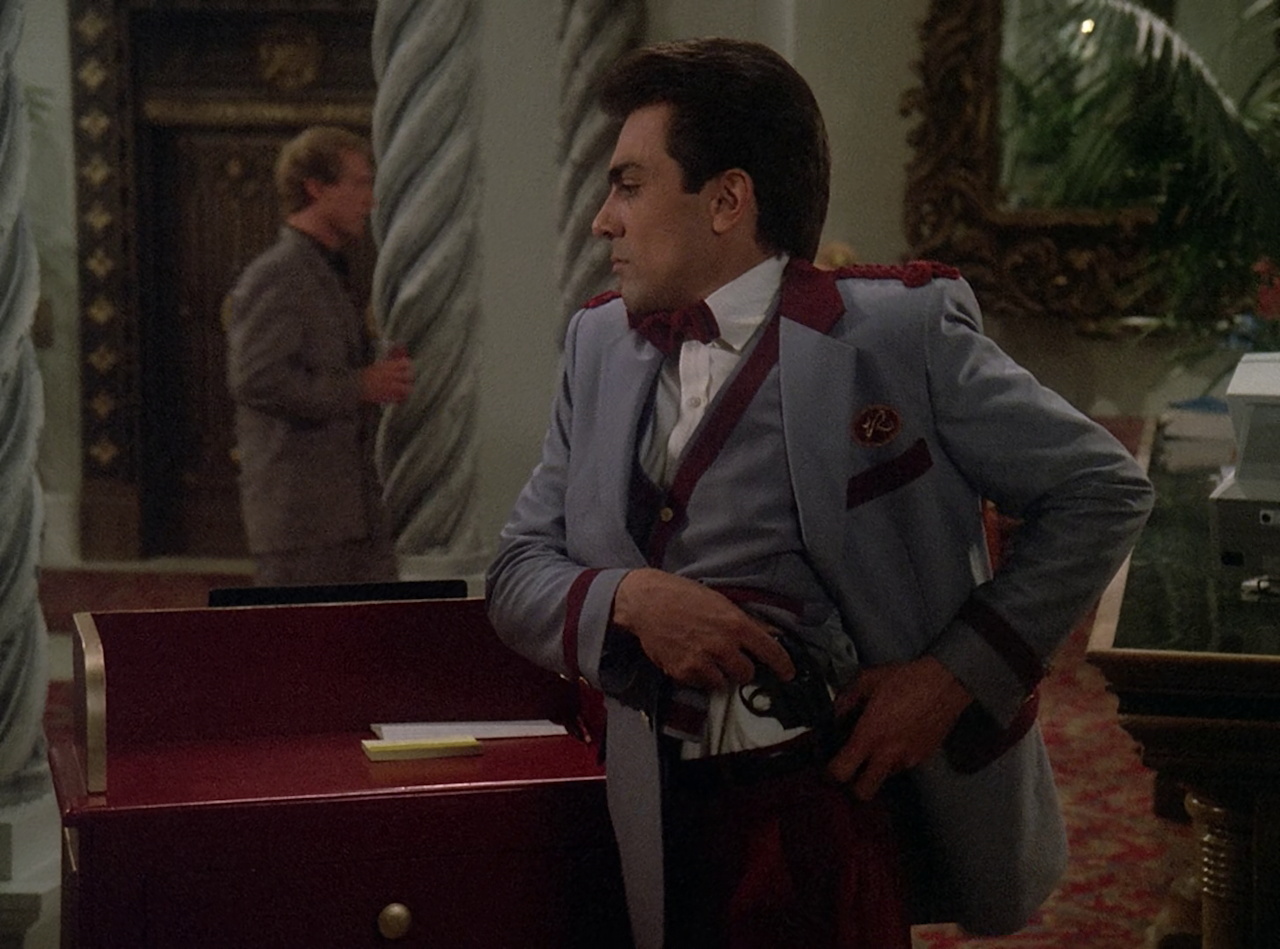
Still frame from Star Trek TNG The Royale showing the bellboy
The bellboy with his gun.

After a cute moment with Worf at the “turbolift,” the action moves to one of the hotel’s upper floors – and it’s here that the mystery begins to be explained. The away team reaches one of the hotel’s rooms, where Data’s detected “human DNA,” and they uncover the body of one of the NASA astronauts.

For a Star Trek episode, on a relatively low budget, produced in the late ’80s… the prop of the skeletonised astronaut is actually really good! At least, I think it is. It manages to feel old, decrepit, mouldy, and like it’s been there for centuries, and the reveal, I’m certain, would have shocked me when I first saw the episode all those years ago. It’s a well-executed moment, suitably creepy and intense for a mystery story, and it sees The Royale take a surprisingly dark twist. Yes, the away team has been trapped for a while, and yes, we know that, back on the ship, there are problems with communication. But this is the first time, really, after meeting some fairly whimsical characters and seeing a cheesy side-story right out of a mid-century soap opera, that the crew feels in danger. And if this prop had looked a lot worse… well, that feeling wouldn’t have been as strong.
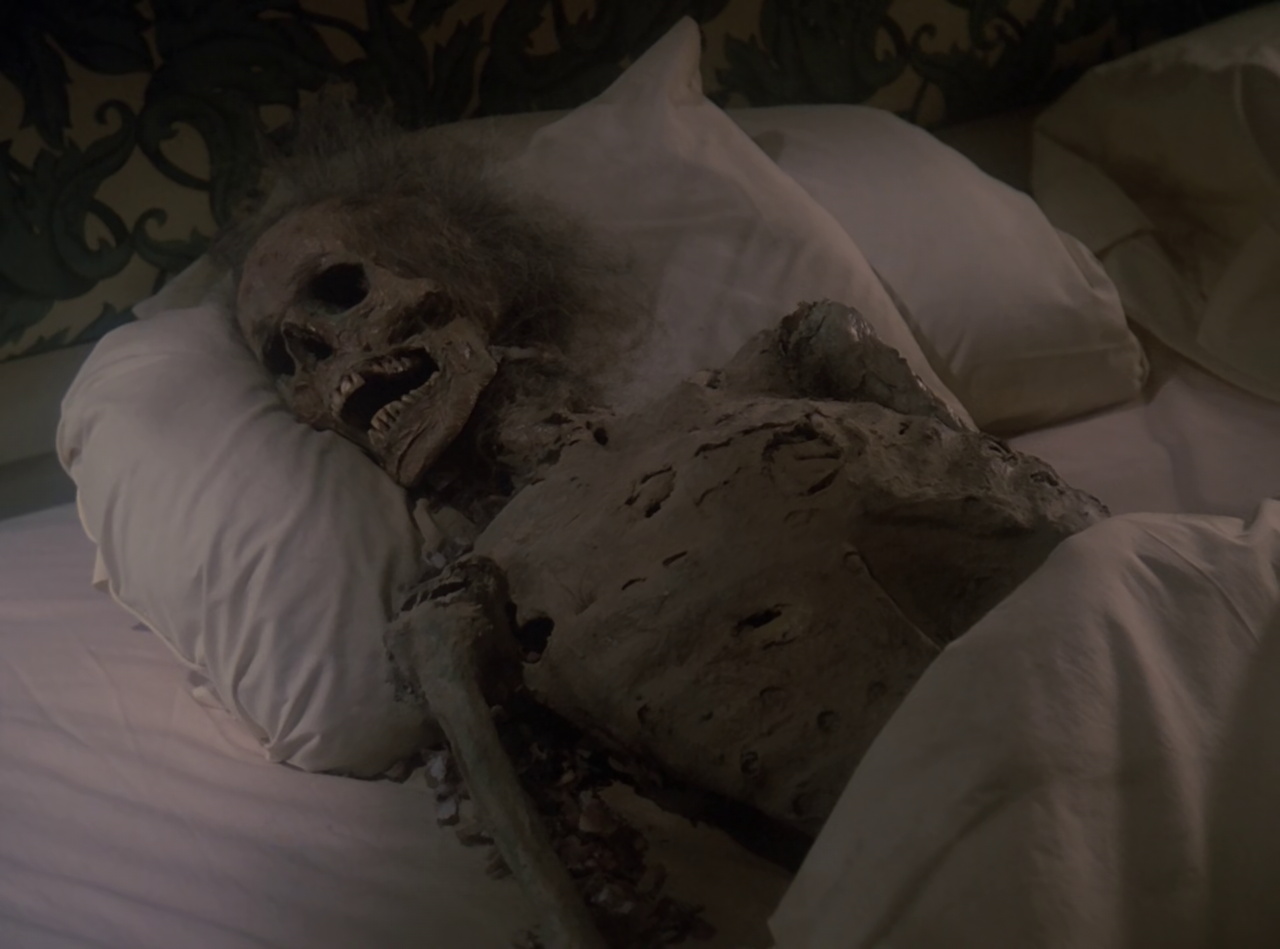
Still frame from Star Trek TNG The Royale showing a skeleton
The skeleton.

Worf’s comment about how dying in one’s sleep is “terrible” didn’t pass unnoticed – a subtle nod to how Klingons view such things. He then goes on to uncover the dead man’s NASA flight suit as Data explains that the astronaut – Colonel Richey – has been dead for almost three centuries. The Enterprise is able to get back in touch at this point, conveniently allowing Riker to ask them to search for details of Colonel Richey’s identity, while Worf uncovers the novel Hotel Royale – a ficticious book created for this episode.

I like the flight suit, and how it feels comparable to NASA’s spacesuits of the Space Shuttle era. Riker’s comment about the 52-star American flag indicating a time period was also interesting; it continues Star Trek’s theme of depicting a positive future for the United States in particular! I wonder which two new states those stars are meant to represent? Puerto Rico, perhaps, and Washington, DC? Those are the two most-likely candidates for statehood right now, I believe!
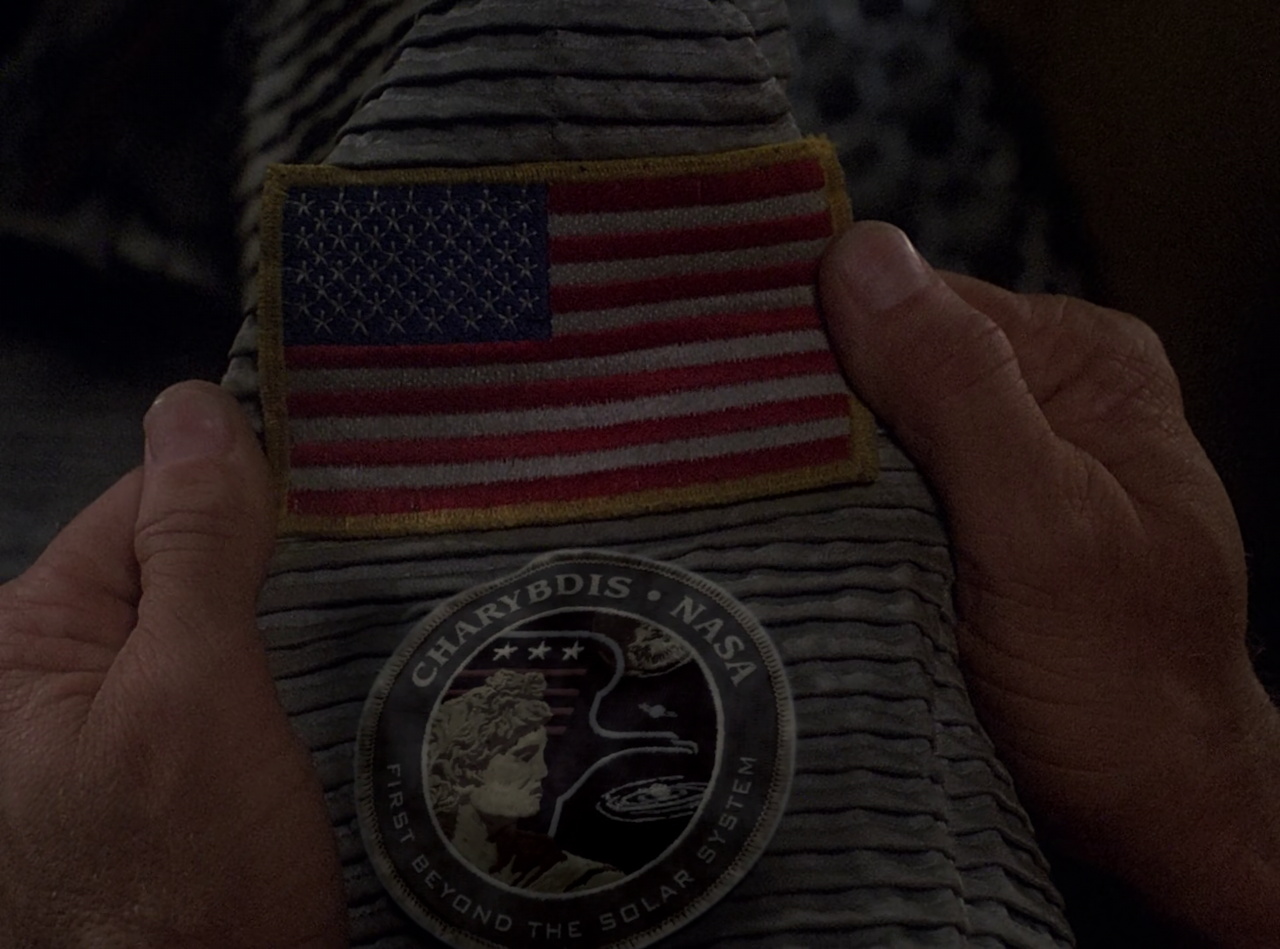
Still frame from Star Trek TNG The Royale showing the flight suit
The flight suit with its flag and mission patches.

As an aside, the remastered version of the episode contains one major difference from the original, and it’s at this moment. The original mission patch on Colonel Richey’s flight suit was much more basic; an Apollo 17 patch with the name scrubbed off. The remaster updates this, giving the patch a unique design, which I think looks a lot better – and certainly feels a bit more realistic for a mission of this type. It’s only seen briefly, but it is seen in close-up, so I definitely think it was worth updating it when The Next Generation went through the remastering process a few years ago.

After Worf discovers the novel Hotel Royale, Riker hands the book to Data to summarise it. And I’ve always loved seeing Data do these superhuman feats – reading an entire book in seconds, as in this case, just makes him feel like a unique character with special abilities. Data proceeds to explain, in brief, the plot of the book to Captain Picard and the away team, and they realise that the characters in the book are some of the people we’ve been seeing downstairs. It was a bit of a heavy-handed approach to have the characters say, out loud, things that we could’ve easily understood for ourselves, but that’s my only real criticism of this scene.
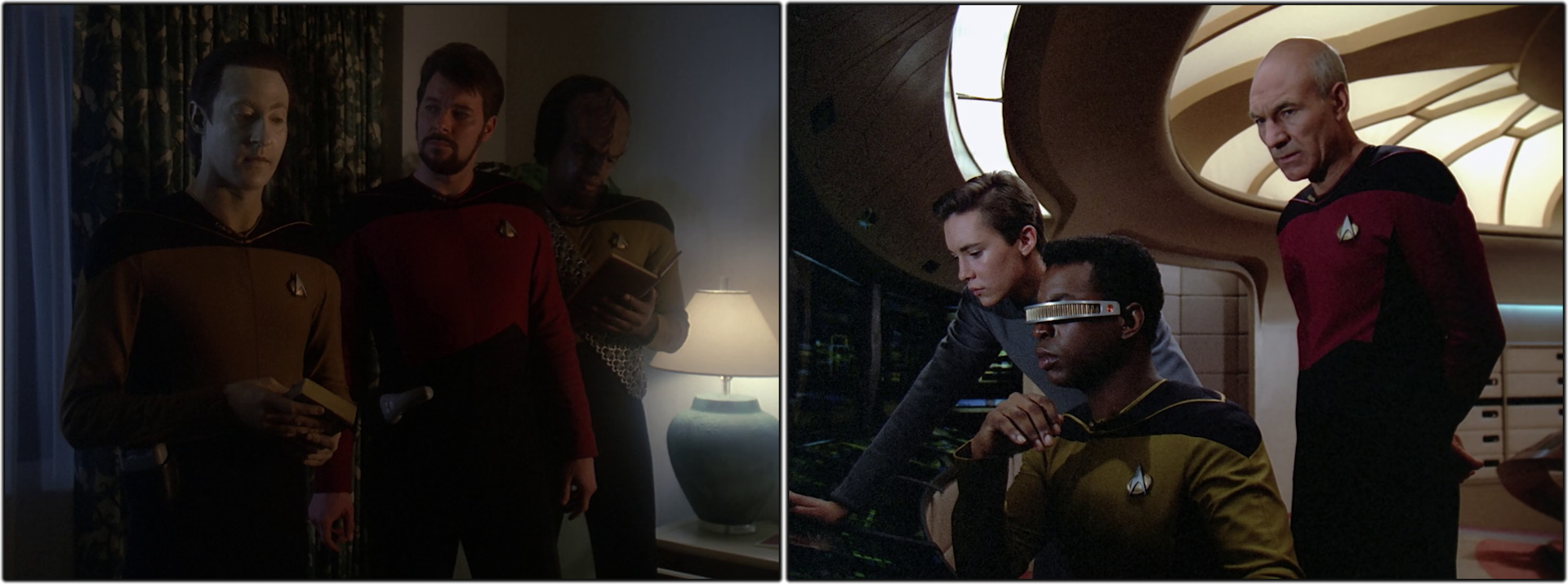
Pair of still frames from Star Trek TNG S2 The Royale showing Data explaining the novel
Data explains the plot of the book (left) while Picard and the crew listen.

Things take a darker turn again when Worf and Riker uncover the colonel’s diary. Somehow (and it isn’t explained how, sadly), Colonel Richey pieced together that the illusory hotel was concocted by an alien that he claims was aboard his ship and killed his crewmates. The alien (or aliens), out of a sense of guilt, built the hotel for him and allowed him to live there. He then spent the next thirty-eight years trapped in the Hotel Royale, before passing away.

So now we know why the hotel exists on this barren, otherwise lifeless world! The mystery has been at least partially solved, and with the exception of a bit of heavy-handedness in some of the dialogue, this worked pretty well. The mystery connects to Star Trek’s fictionalised past – the 21st Century – and to a race of aliens who appear to have inadvertently caused the deaths of the other NASA crew. And the book being misinterpreted as a kind of almost religious text by the aliens would be funny… if it wasn’t so dark. Colonel Richey’s final words, that he would “welcome death,” really hammer home that much darker tone for this aspect of the story.
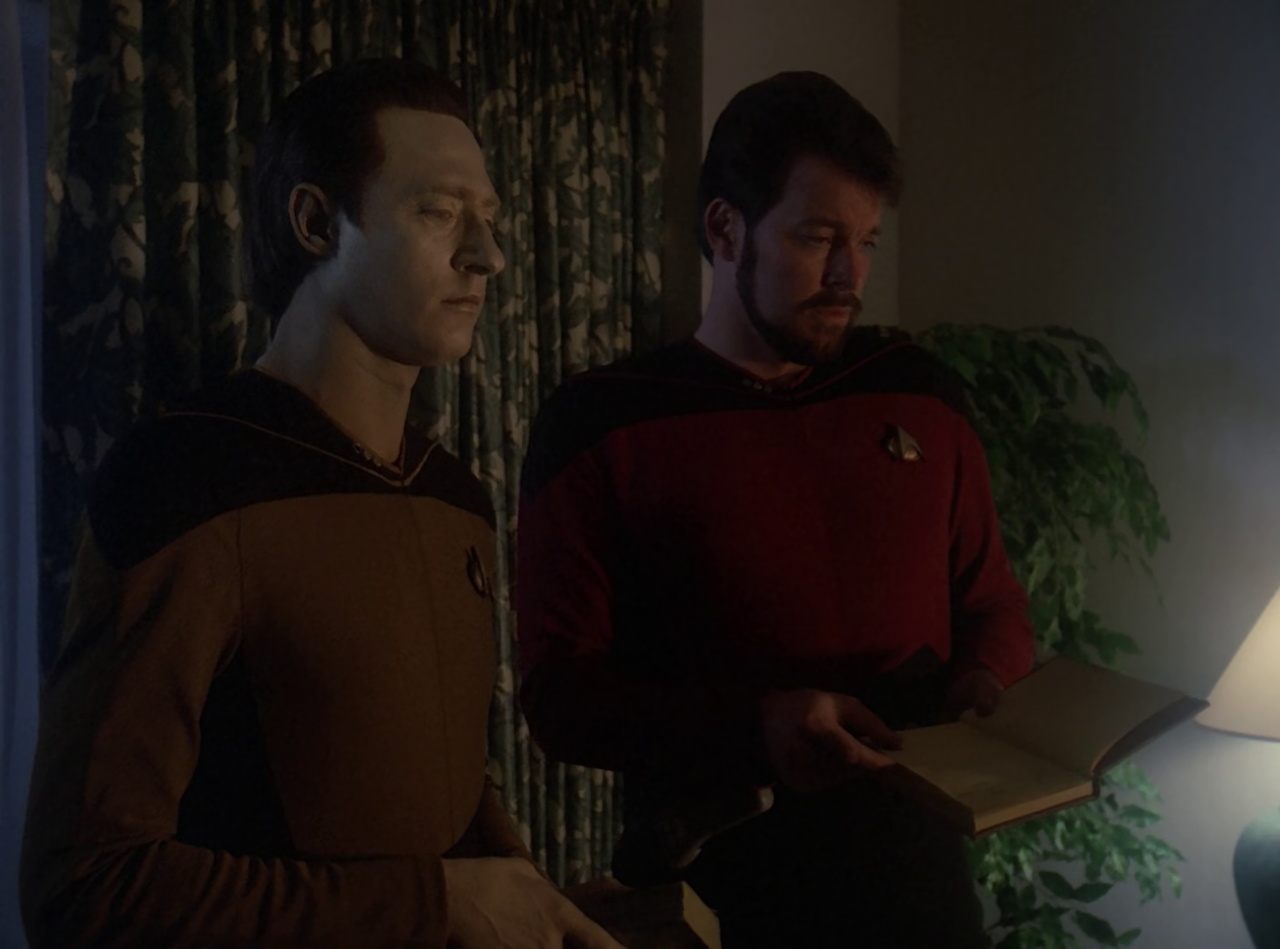
Still frame from Star Trek TNG The Royale showing Data and Riker
Data and Riker with the diary.

The next scene aboard the Enterprise gives us Dr Pulaski’s only lines in the episode. The crew come up with a plan – spearheaded by Geordi – to “slice” into the forcefield around the hotel, even though doing so would cause the frozen atmosphere of Theta VIII to rush in. If the away team couldn’t be beamed out in time, Dr Pulaski opines that, in theory, they could be resuscitated after being flash-frozen.

I like Dr Pulaski, and one of my biggest Star Trek “what-if” questions is what The Next Generation and the rest of the franchise might’ve looked like had she stuck around. Her role in The Royale is relatively minor, but I daresay it’s no coincidence that her presence in the first episodes I can remember watching is a big part of why I find her to be such a fascinating character. Dr Crusher’s return in Season 3 was welcomed by fans (and the cast) at the time, of course, and we’ve since seen different things from her. But Dr Pulaski is a unique character; her conflicts with characters like Data and her occasionally standoffish manner contrast in a fun way with other members of the crew.

If you’re interested to read more about Dr Pulaski, click or tap here to check out my thoughts on her character.
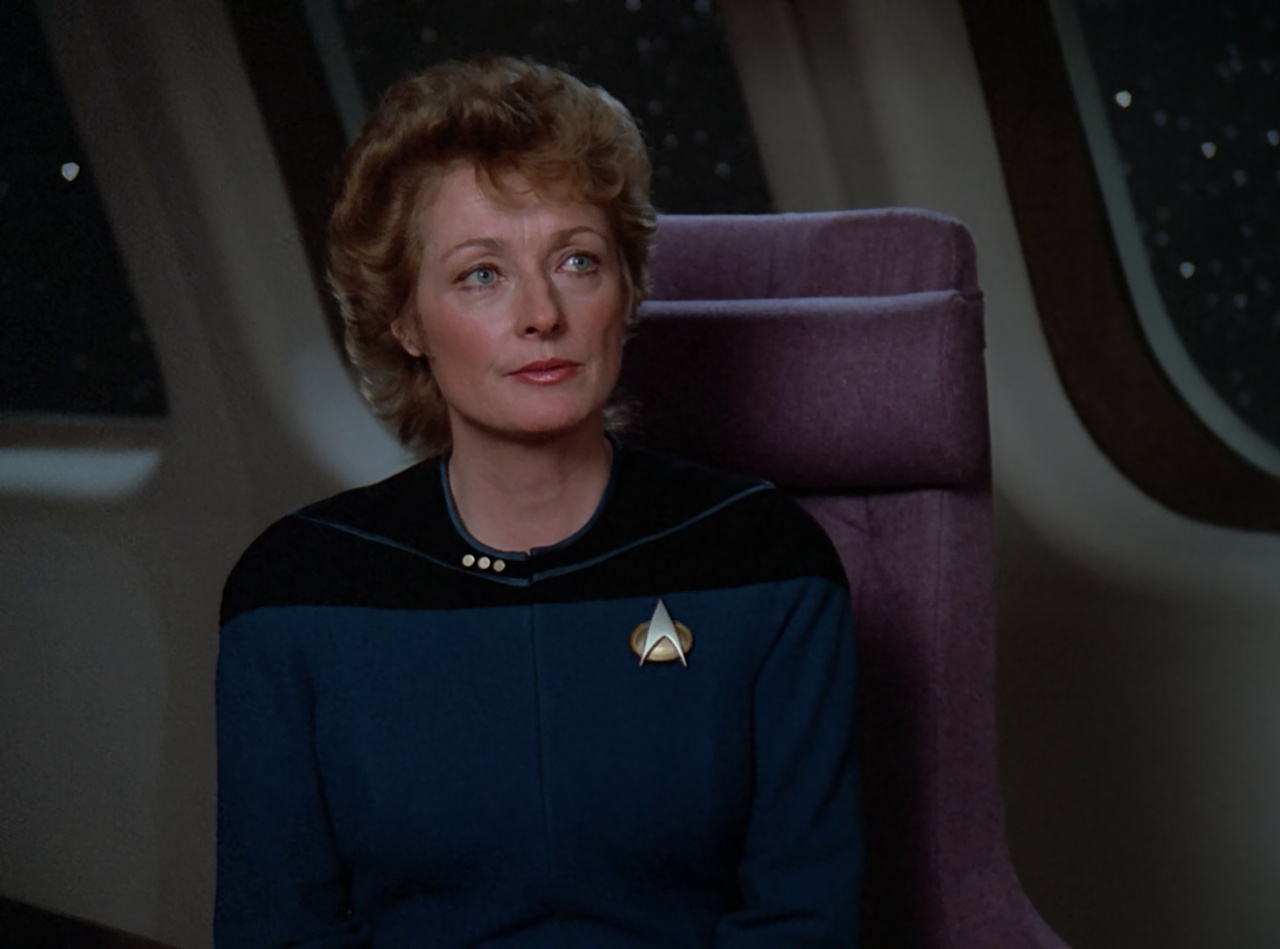
Still frame from Star Trek TNG The Royale showing Dr Pulaski
Dr Pulaski doesn’t play a big role in this episode.

As the away team splits up, Picard and Counsellor Troi begin to look over the text of Hotel Royale. I absolutely *adore* Picard’s disgusted expression on reading the opening line: “It was a dark and stormy night.” Somehow, that line has become a byword for poor-quality writing, often criticised and parodied, and its use here really emphasises the low-quality nature of this fictitious book. Picard, who had been discussing complex mathematics and high-brow philosophy with Riker at the start of the episode, is forced to engage with a text he clearly detests – and it’s kind of funny.

Back on the casino floor, Data attempts to get “Texas” to leave the hotel, surmising that he may be trapped within its walls, too. But the blackjack game is still going, and Texas shows off a much creepier side, as he tries to leverage Vanessa’s losing streak to… well, you can figure out the rest. It’s a turn for this previously comedic character to end up looking controlling, manipulative, sexually aggressive, and creepy, but it fits with the tone of the kind of novel Hotel Royale purports to be.
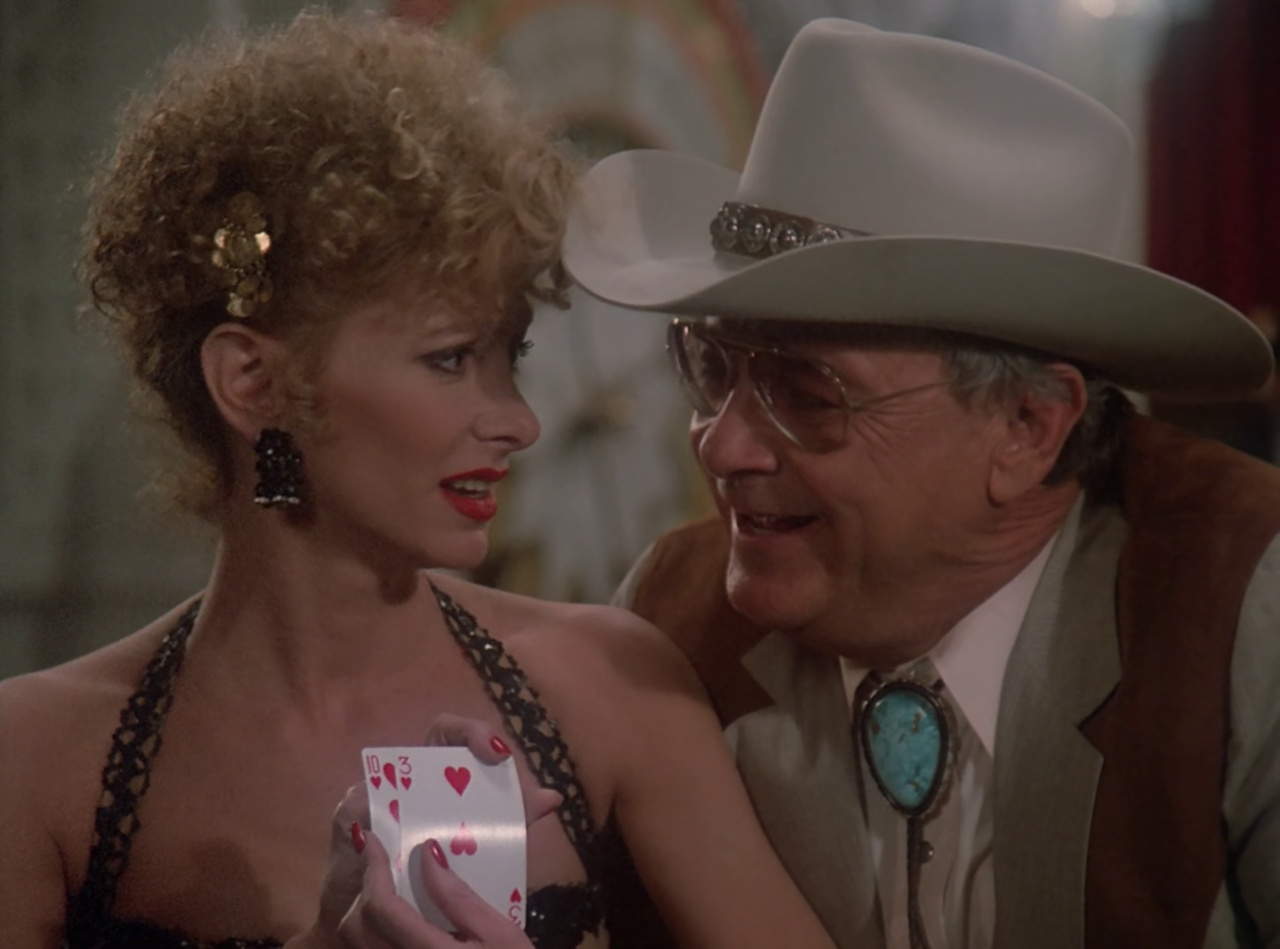
Still frame from Star Trek TNG The Royale showing Vanessa and "Texas"
Vanessa and Texas.

As Riker and Worf reconvene to share that they found “nothing” of consequence to aid in their escape, we get another of the pulpy scenes with the bellhop. It starts with the assistant manager, as the TV drama-style music swells, and leads into the arrival of Mickey D: the gangster at the heart of the novel.

The only part about this I didn’t really like was the action cutting between the planet and Picard, in his Ready-Room, who could apparently hear everything going on through the comm channel. Picard, for me, didn’t seem to take it as seriously as he perhaps should’ve; in-universe, the characters don’t know how dangerous the situation is, and we know that even holograms can kill if they malfunction. There’s no reason to assume that, just because this is a low-quality story, Riker and the away team will be safe – Mickey D could, perhaps, have harmed them if they’d got caught up in the middle of it. It was just a bit… tonally weird, I suppose. And cutting away from the actual scene to watch someone listening to it, only to make yet another comment on the quality of the writing? It just didn’t add a lot to the episode.
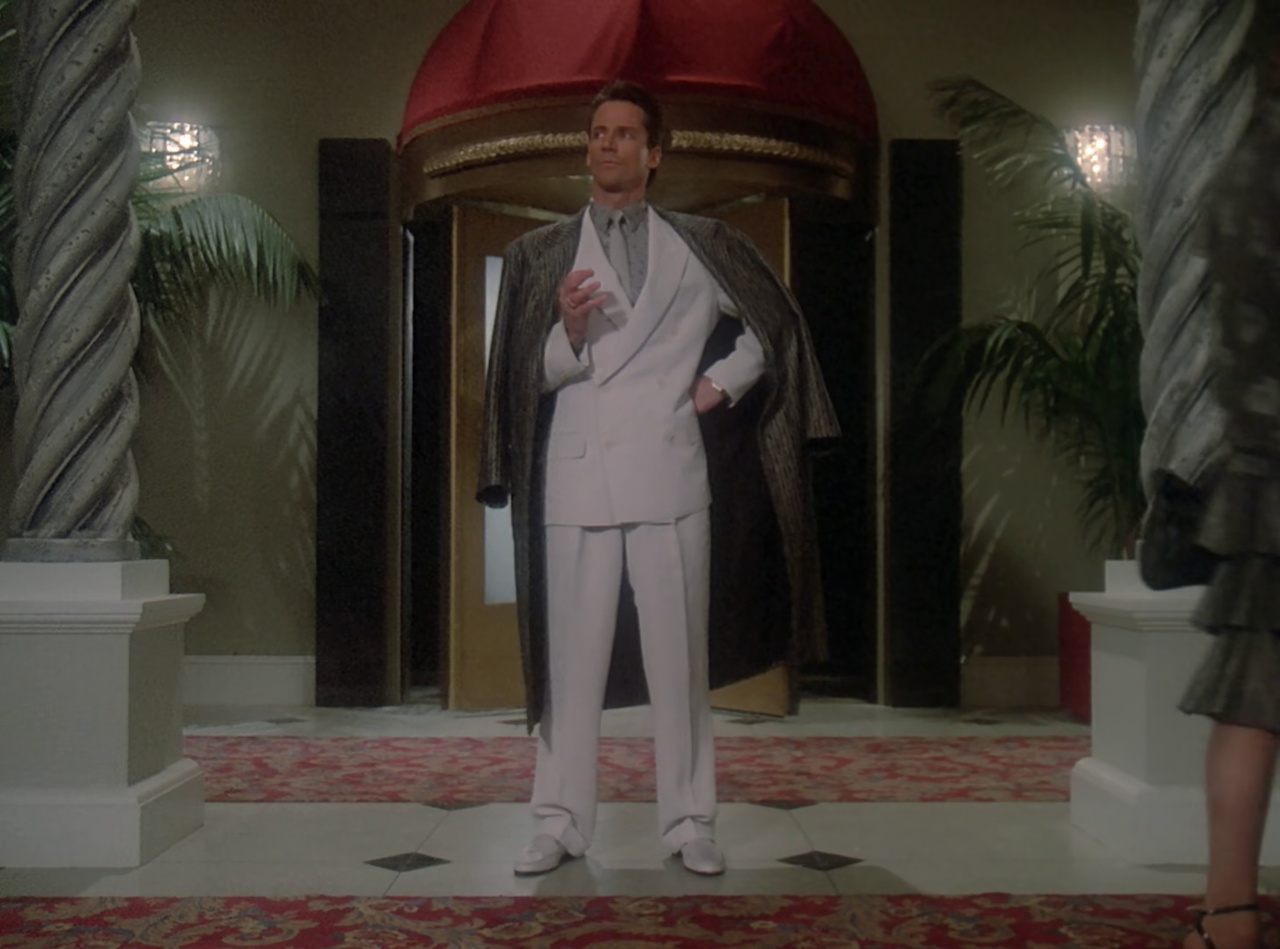
Still frame from Star Trek TNG The Royale showing Mickey D
Mickey D arrives.

The conflict between Mickey D and the bellboy, over a girl named Rita, escalates, despite the assistant manager’s attempts to defuse the situation, and the two seem to be heading outside for a confrontation. However, Mickey D shoots the bellboy in the back, quips about Rita not being worth dying over, and then departs.

Mickey D is a completely one-dimensional character – but in a self-aware way. He’s a typical “Vegas gangster” of this time period, with his mannerisms, style of dress, and everything made out to emphasise that. His one big action – shooting a young man in the back – also hammers home that this is a man who doesn’t play fair. I’d never say he’s a great or even good character (he gets far too little screen time for that), but he fills a role in this story in a way that makes sense, and he advances the plot both within Hotel Royale’s fictional story, and for the away team down on Theta VIII. They witness the shooting (complete with over-acting and no visible injuries or wounds), and that kick-starts the final act of the episode.
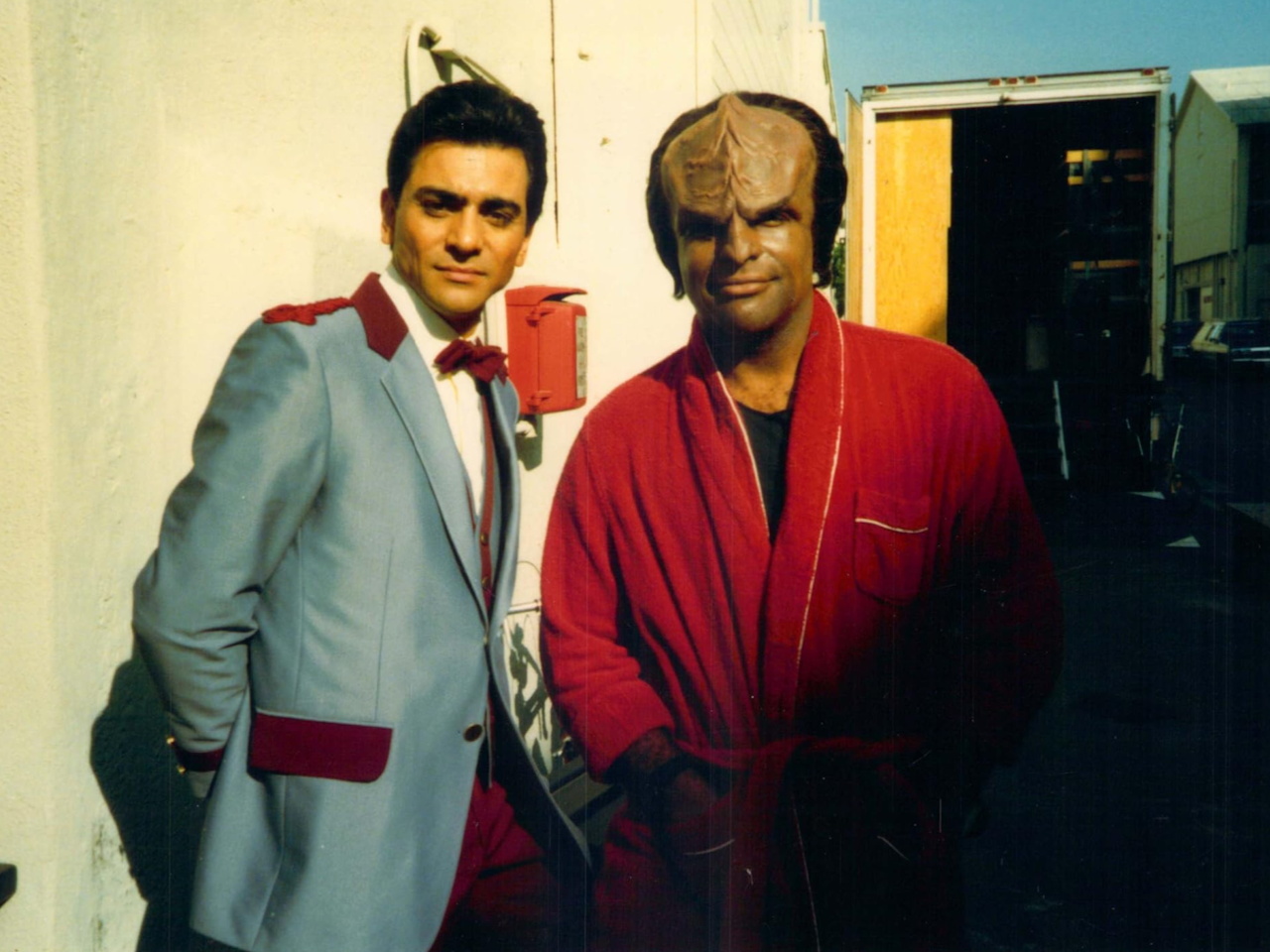
A behind-the-scenes photo from Star Trek TNG S2 showing Michael Dorn and a guest star
Michael Dorn (right) with guest star Leo Garcia, who played the bellboy.

Riker and Worf watch Mickey D walking out of the hotel, surprised that he’s able to leave while they remain trapped. This leads to a conversation with Captain Picard, who recounts the scene from the book. Riker then asks how the book ends – and after learning that “foreign investors” buy out the hotel, he comes up with a plan for the away team to *become* the foreign investors. This was hinted at, by the way, in their first interaction with the assistant manager shortly after their arrival.

One thing that’s great about this moment is how the typical TNG music sting starts to play, then blends into the TV drama jazz music that had defined the scenes recounting the pulpy Hotel Royale story. I just think it’s really creative; a way to kind of symbolise that these two disconnected halves of the episode’s story are going to come together. And, for the first time since arriving, Riker and the away team now have a plan to get back to the Enterprise-D.
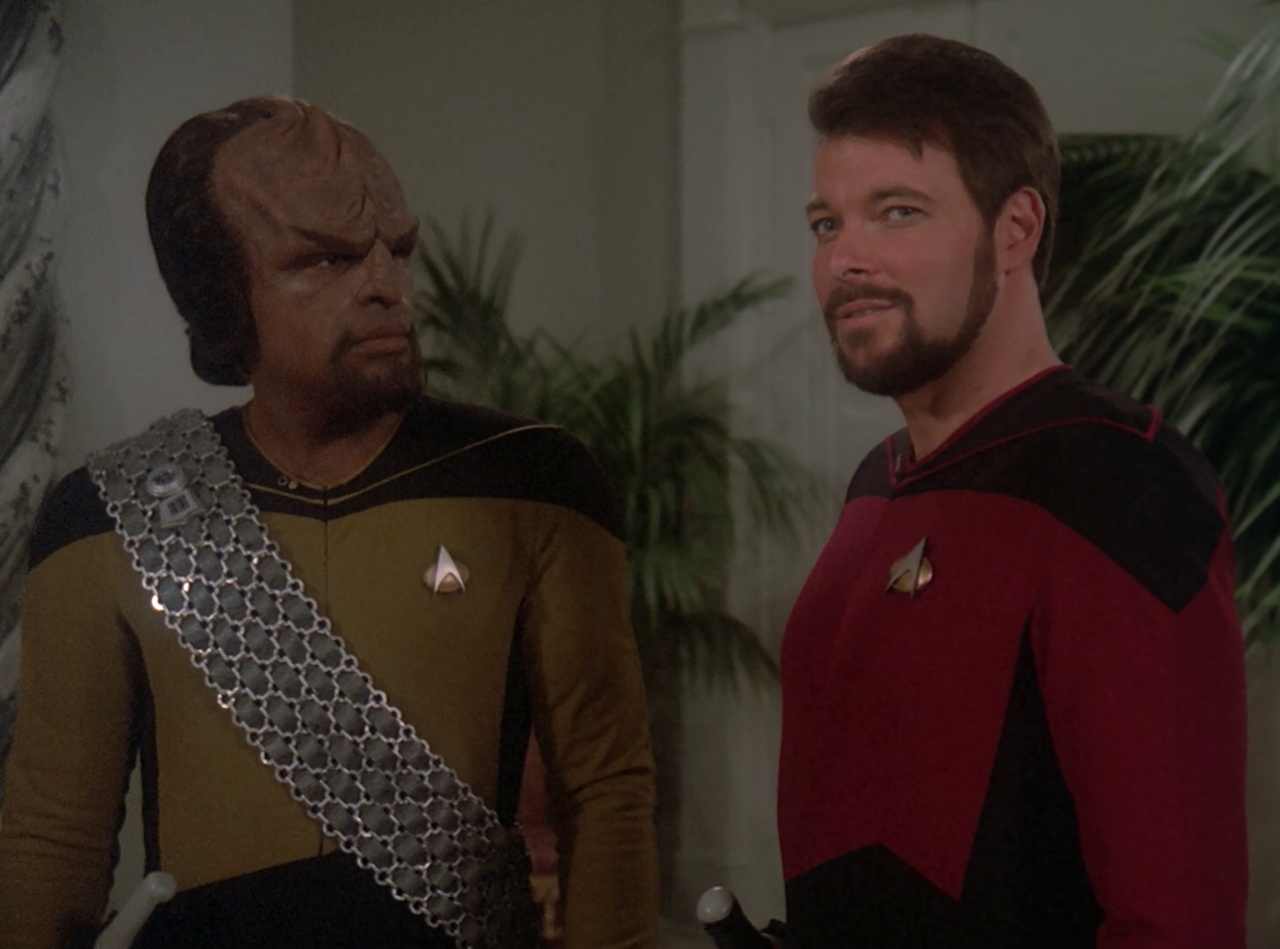
Still frame from Star Trek TNG The Royale showing Worf and Riker
The music swells… and Riker is a man with a plan.

The away team re-encounters “Texas” and Vanessa, this time at the craps table, and begin their scheme to win enough money gambling to buy out the hotel and finish the story, hopefully allowing them to escape. Data’s unique skillset once again proves invaluable; he’s able to “fix” the dice to make sure they win, much to Texas and Vanessa’s enjoyment.

We get a tiny sub-plot with “Texas” trying to bet against Data, and taking it personally when he loses. It was of some interest, especially given his earlier creepy behaviour, and seeing him taken down a few pegs is definitely satisfying. But he isn’t a major antagonist, and this feels like little more than a minor stumbling-block on the way to finishing the story.
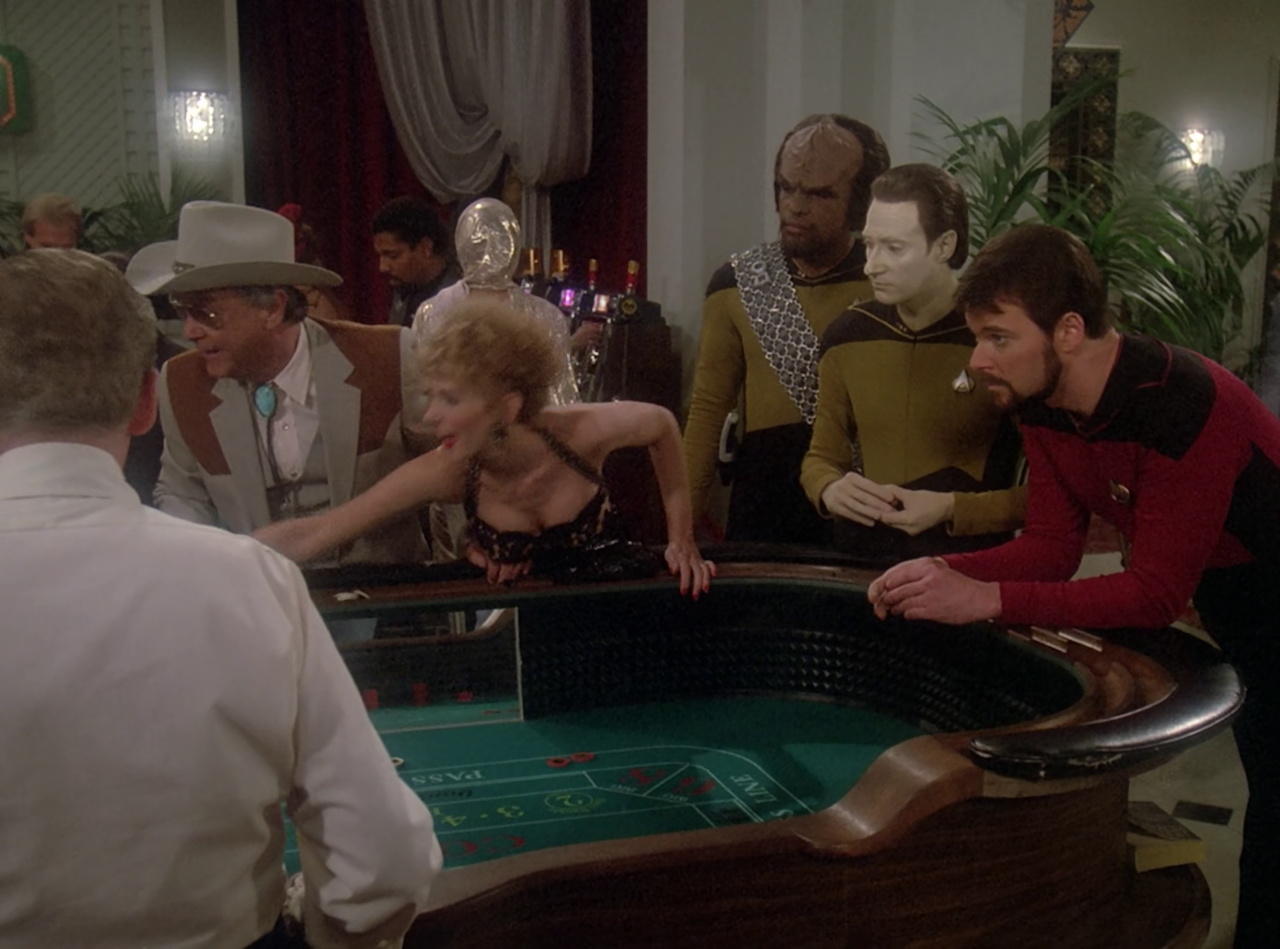
Still frame from Star Trek TNG The Royale showing a craps game
The craps game.

What I love about this sequence is how into character both Data and Riker get. Data adopts mid-century gambling mannerisms and terminology, despite not quite understanding all of it, and his line “baby needs a new pair of shoes” is delivered in a totally deadpan way that *only* Brent Spiner could ever manage! It’s really funny, really cute, and it’s one of the many reasons why I fell in love with Data way back when. He’s just such a fun, charming character, and every time he tries act “more human” he does it so earnestly and in such a fun way that it’s impossible not to root for him.

You know the rest of the story: thanks to Data’s interference, they win over and over at craps, breaking the bank in the process. They then announce they’re buying the hotel, to the surprise and gratitude of the assistant manager, and spread the rest of their winnings around. Even “Texas” gets to benefit, remaining at the craps table with Data’s loaded dice.
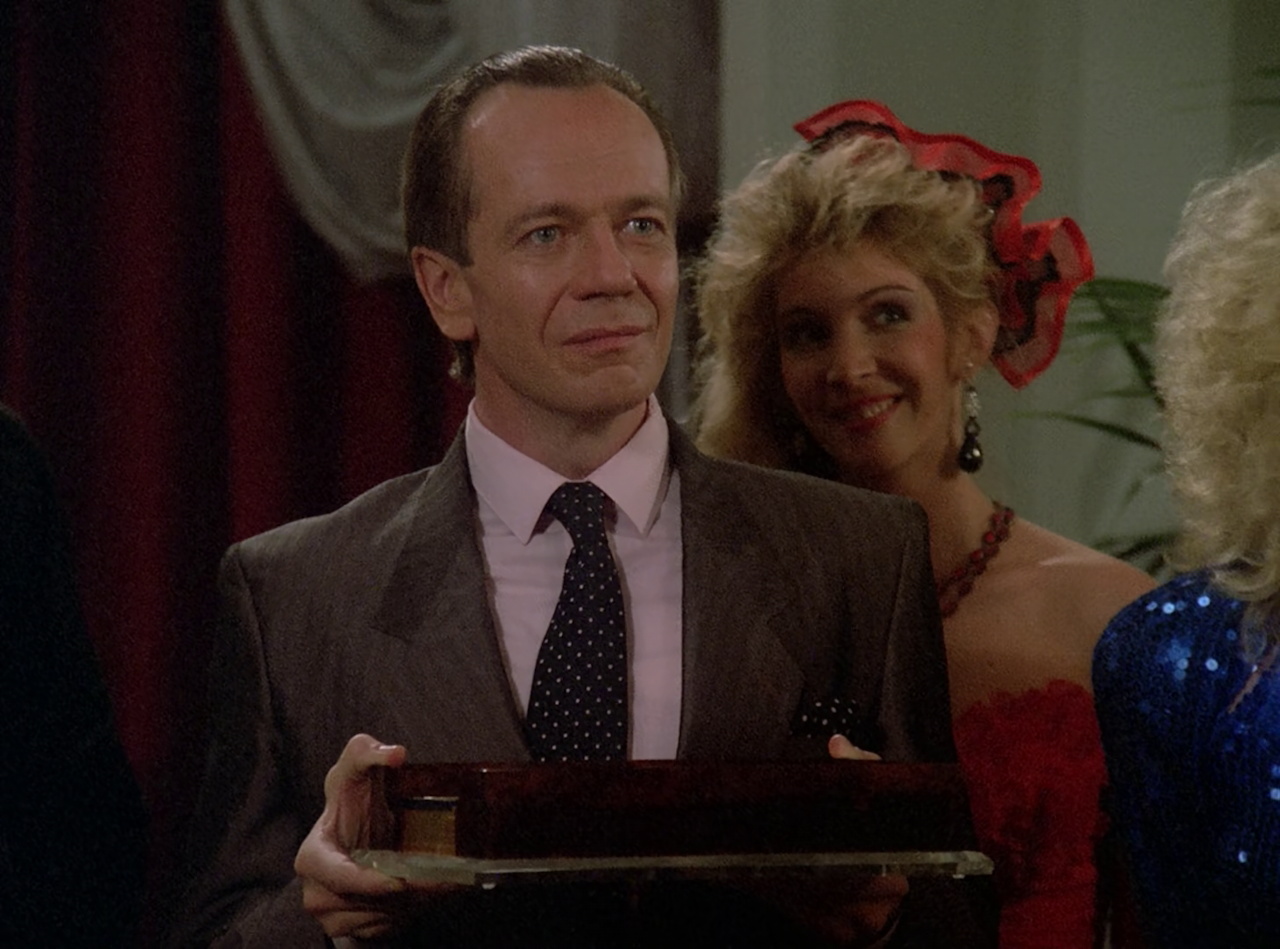
Still frame from Star Trek TNG The Royale showing the assistant manager
The assistant manager realises who he’s dealing with.

I think we’re meant to understand that, because the away team was believed to be the trio of “foreign investors,” they couldn’t leave the hotel until they’d completed their role in the story. Whether Colonel Richey was also assigned that role by the aliens who created the illusion isn’t clear, though, and the episode ends with the core mystery solved – but still some unanswered questions.

Back in the Ready-Room, Picard and Riker recall Fermat’s last theorem, and suggest that some of the mysteries of Colonel Richey’s story, and the hotel on Theta VIII, may simply never be solved. And while that may seem unsatisfying (which, in a way, it is), it’s also an interesting take on space exploration and Starfleet’s mission, isn’t it? We’re used to our heroes turning up at a planet, solving a puzzle or unravelling every aspect of a mystery, and warping away to a new adventure. But space… well, it isn’t always easy to understand. Who were these aliens? Why did they choose that book for Colonel Richey? What went wrong in their encounter with humanity – and what were they even trying to do? Why strand Colonel Richey on Theta VIII – is the planet their homeworld? Why not attempt to make contact with the Enterprise-D if that’s the case? So many questions left unanswered… but the lack of an answer is kind of the point.
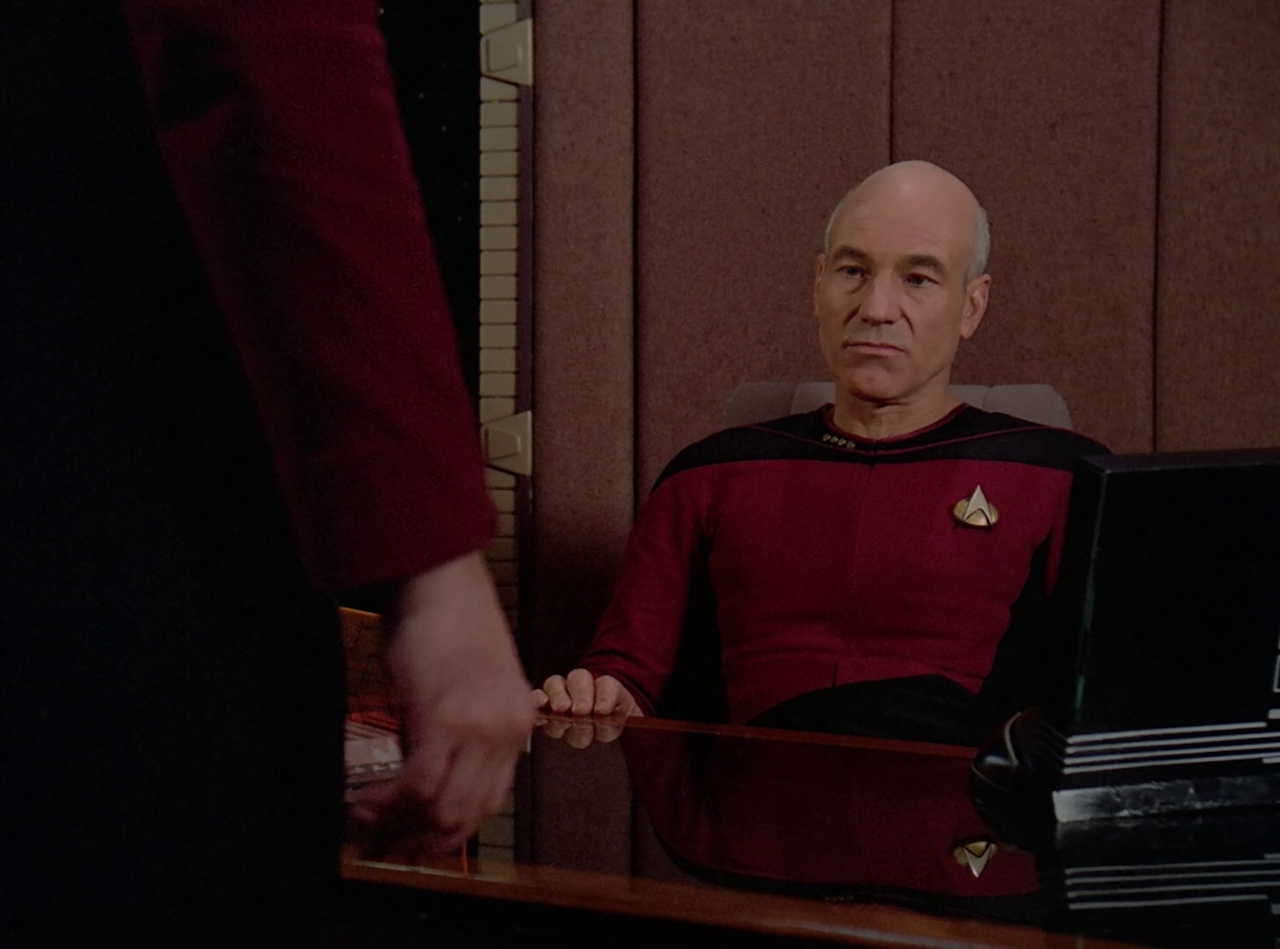
Still frame from Star Trek TNG The Royale showing Picard
Picard and Riker are left with unanswered questions as the Enterprise prepares to leave orbit.

So that was The Royale! Thanks for joining me on this re-watch of the episode.

I had a blast stepping back in time some thirty-five years to the episode that first turned me into a Trekkie, and I hope it was a bit of fun to come along for the ride with me. I adore this story, despite its low-budget sets, hammy acting, and kind of silly premise – and I hope that came across! As a kid, I was absolutely transfixed by this story, and desperately keen to go on more adventures with Riker, Data, Worf, and the rest of the crew of the Enterprise-D. From this moment on, I was a regular viewer of The Next Generation, watching the rest of Season 2, then Season 3, and going back to earlier episodes from Season 1 when they were re-broadcast.

Star Trek became a pretty big part of my life from then on. As I navigated school and social life, and especially as I grew into adolescence and attended seondary school, it became both a source of joy and, sometimes, an escape from the real world. I loved going on these adventures with the crew, and when TNG’s two spin-offs (Deep Space Nine and Voyager) came to the UK, I watched those religiously, too. And I may never have started to do so were it not for The Royale.
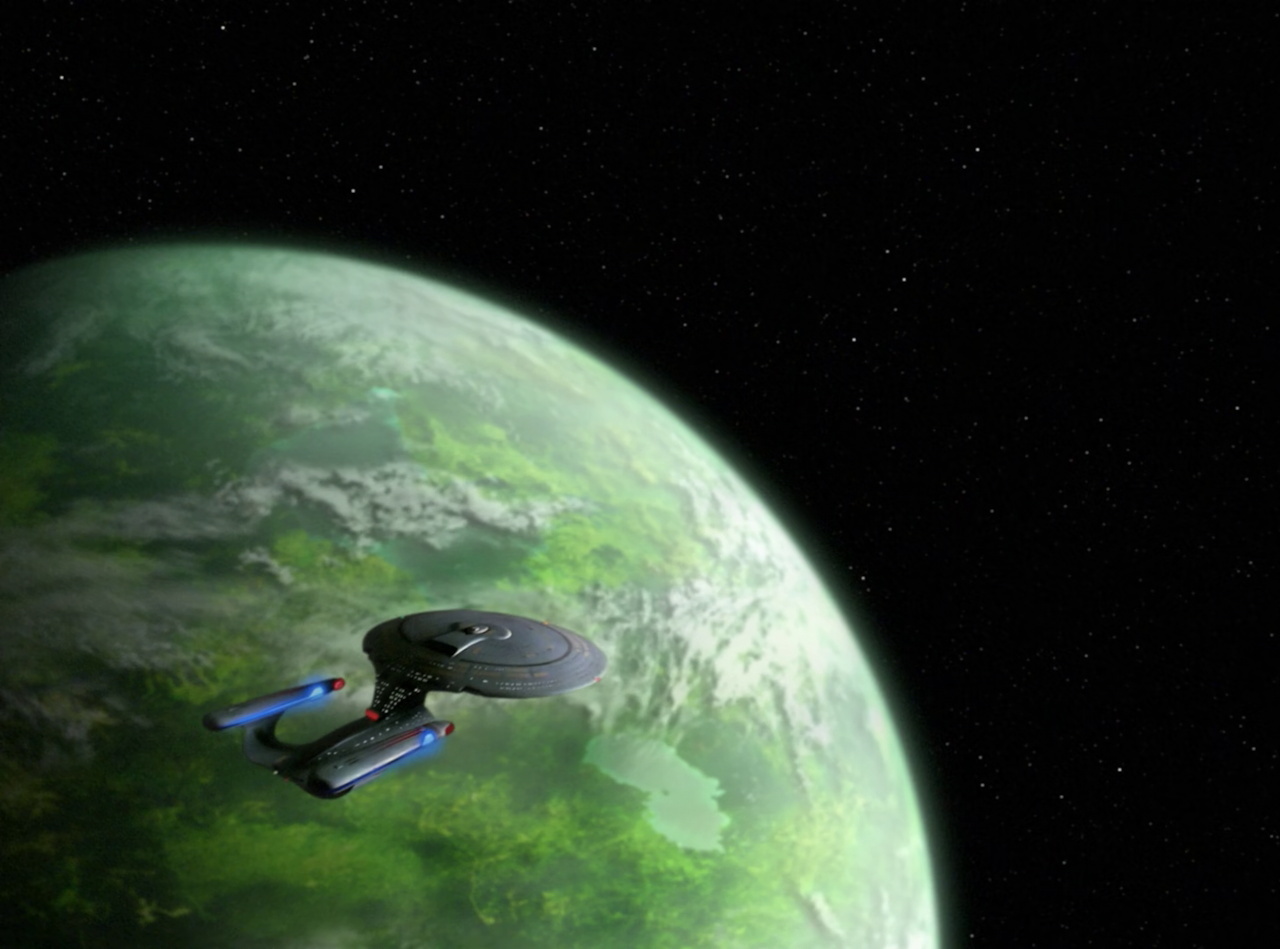
Still frame from Star Trek TNG The Royale showing the Enterprise-D and Theta VIII
The Enterprise-D in orbit of Theta VIII.

In Star Trek’s big sixtieth anniversary year, I thought it was fun to return to my own origins as a Trekkie, and with today being the thirty-fifth anniversary of The Royale’s UK premiere… well, it all just sort of fell into place!

It’s impossible for me to be in any way “objective” when dealing with an episode like this, so I hope that didn’t impact your enjoyment of this re-watch. I wanted to go back to The Royale not to criticise it or pick it apart – though I daresay there’s been some of that – but really to celebrate what it means to me personally, and to my journey into the Star Trek fan community. Hopefully that positivity came across, anyway.

It’s been a long time since June 1991, and a lot has changed. But my love of Star Trek – and of The Royale – hasn’t diminished. Star Trek has been a near-constant presence in my life since this moment, even when new episodes and films weren’t being aired, and without it… well, I probably wouldn’t be here running a small website! I really don’t know where I’d be without this wonderful franchise, to tell you the truth.
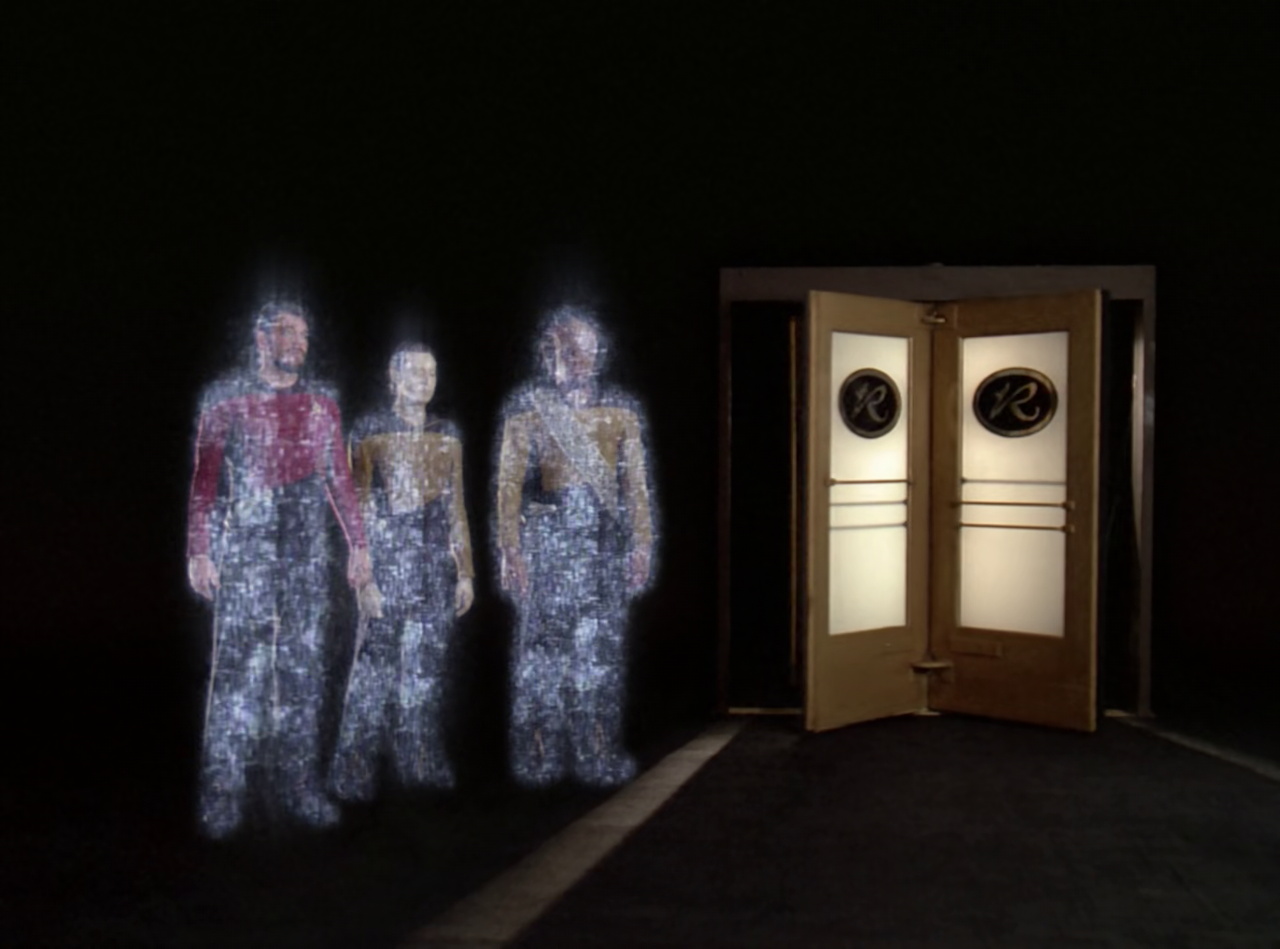
Still frame from Star Trek TNG The Royale showing the away team beaming out
The away team beams back to the ship.

If you liked this format and want more re-watches of older Star Trek episodes, I have several here on the website. My most recent was Where No Man Has Gone BeforeThe Original Series’ second pilot. You can find that piece by clicking or tapping here. Earlier this year, I also took a look at The First Duty from The Next Generation’s fifth season. Click or tap here to check that out. And if you visit my dedicated The Next Generation webpage, you can find all of my commentary and other TNG episode re-watches. Click or tap here to head there.

Later this year, we’ve got Strange New Worlds’ fourth season to come, and I plan to write episode reviews for that, so I hope you’ll join me for some of those. And as the sixtieth anniversary gets closer, I have a few other ideas for articles and episode re-watches that I hope I’ll be able to find time for.

Thanks for reading, and as always… Live Long and Prosper, friends!


Star Trek: The Next Generation is available to stream now on Paramount+ in countries and territories where the service is available, and is also available to buy on DVD/Blu-ray. The Star Trek franchise – including The Next Generation and all other properties discussed above – is the copyright of Skydance/Paramount. This article contains the thoughts and opinions of one person only and is not intended to cause any offence.
What If…? Star Trek Edition!

A Star Trek-themed spoiler warning.

Spoiler Warning: There are spoilers ahead for the following Star Trek productions: The Original Series, The Motion Picture, The Next Generation, Deep Space Nine, Voyager, Enterprise, Discovery, Picard, and the video game Star Trek: Voyager – Across the Unknown.

Let’s celebrate Star Trek’s 60th anniversary year with another of my Marvel-inspired “What If…” articles! This is something I’ve done a couple of times before here on the website, and I’ll briefly go over the format if you’re unfamiliar with it. I thought this could be a fun and interesting way to continue our 60th anniversary celebrations, anyway.

In 2021, Disney and Marvel premiered a series called What If…? on Disney+. The concept was, in brief, to show alternate histories of the Marvel universe; different characters or altered decisions leading to, in some cases, radically different or unexpected outcomes. I didn’t watch the show (because I’m not really into Marvel or superheroes that much), but I really liked the concept behind the series, and I wanted to apply it to the Star Trek franchise, too.

Promo graphic for Season 3 of Marvel's "What If."
This idea is based on the Marvel TV series What If…?

My first take on this idea – which you can find by clicking or tapping here – saw me consider what might’ve happened if: Captain Picard died after the events of The Best of Both Worlds, Spock was never resurrected on the Genesis Planet in The Search for Spock, Voyager decided to head for the Gamma Quadrant terminus of the Bajoran Wormhole, the USS Discovery never went to the future, and Captain Sisko wasn’t the Prophets’ Emissary. I had fun delving into all of those ideas and laying out my “alternate histories of the future!”

Last year, in my second piece – which you can find by clicking or tapping here – I talked about what could’ve happened if: Captain Picard and Q never met, Section 31 was responsible for creating the Borg, the USS Voyager was destroyed over Ocampa and the survivors were picked up by Chakotay’s Maquis raider, the Romulans eventually figured out the deception from In The Pale Moonlight, and Captain Kirk survived the events of Generations. Again, all of those were a ton of fun to consider.

Be sure to check out those earlier pieces if you enjoy this format. And feel free to use the same concept in your own writing or on social media, too!

Scan/photo of hand-drawn concept art of the USS Enterprise (or the Enterprise filming model) from Star Trek: TOS.
Concept art of the USS Enterprise filming model.

So today, I’m back for a third crack at this idea. I’ve chosen five storylines from across the Star Trek franchise, and I’m going to answer the question “what if things were different?”

My usual caveat applies: all of this is *subjective, not objective*, so if you hate all of my ideas and mini-stories, that’s okay! There’s plenty of room in the Trekkie community for differences of opinion and disagreements without getting into an argument. None of this is even *remotely* canon, anyway, nor will it ever be – so if you really do hate my ideas, you can take solace there, I hope!

With all of that out of the way, let’s get started!

What If… #1:
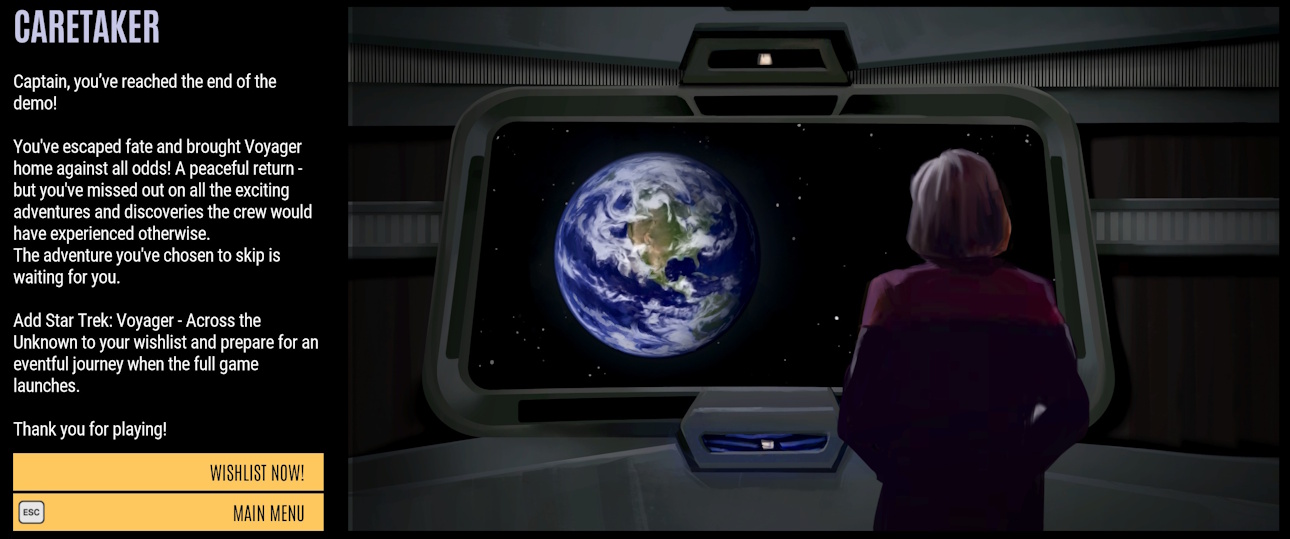
What if… the USS Voyager returned home after the events of Caretaker?

Screenshot from the Across the Unknown demo showing Janeway and Earth.
Could Captain Janeway bring the crew home seven years ahead of schedule?

Shout out to the upcoming video game Across The Unknown, where you can actually pull this off if you want!

In this scenario, we’re starting with Voyager’s premiere: Caretaker. But we’re going to do things a little differently! As happened in an alternate timeline glimpsed in the episode Non Sequitur, Tom Paris got arrested by Odo on DS9, and never even set foot aboard Voyager. In our take on the story, we’re going to say that Captain Janeway approached Commander Sisko for advice, as she was still in need of a guide to the Badlands. Sisko would “loan” two of his officers to assist her on the mission – people who are familiar with the Badlands, both scientifically and geographically: Jadzia Dax and Michael Eddington.

Both officers would be present on the bridge during the search for Chakotay’s ship, and both would survive the displacement wave that dragged Voyager to the Delta Quadrant. After encountering the Kazon, Ocampa, and the Caretaker, Voyager’s captain and senior staff would be faced with the same dilemma as in the prime timeline: use the Array to return home, or destroy it to prevent it from falling into the hands of the Kazon.

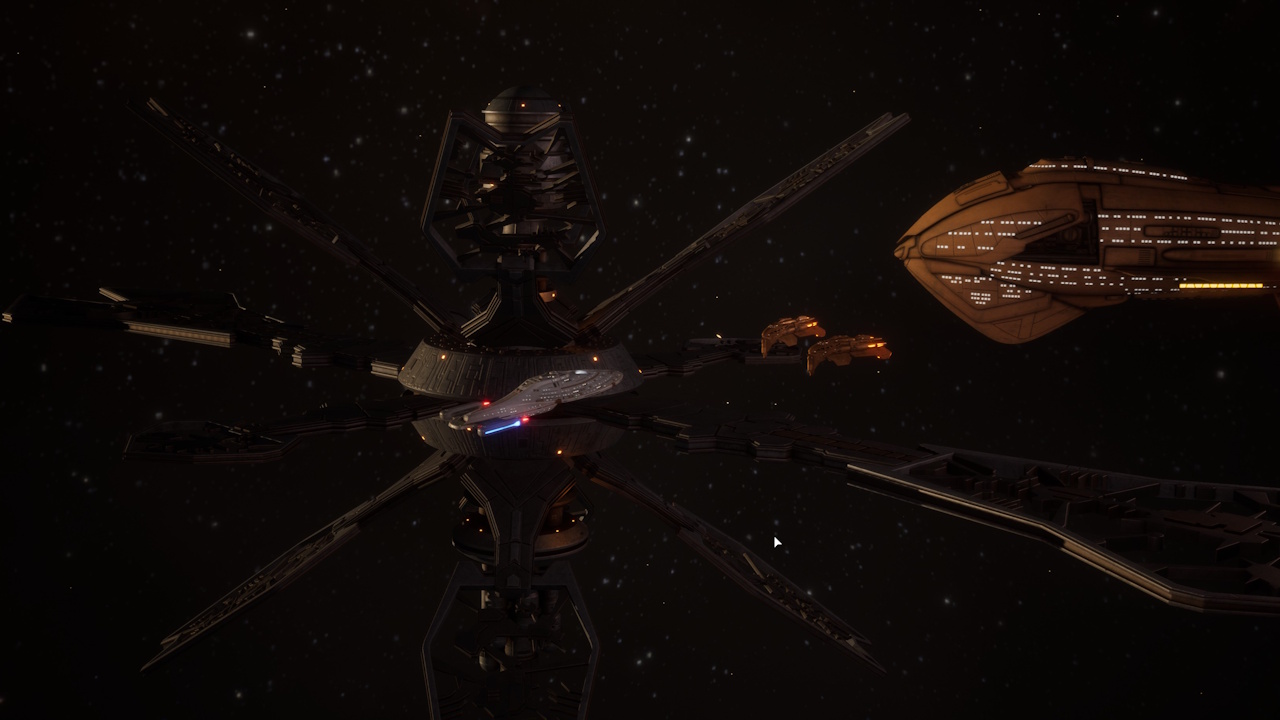
Screenshot from Star Trek: Voyager - Across the Unknown showing Voyager, Kazon ships, and the Array.
Voyager and three Kazon vessels at the Caretaker’s Array.

There are two factors at play, I think. Firstly, Eddington’s true loyalties lie not with Starfleet, but with the Maquis. I think he’d be desperate to get back to DS9 so that he could continue to work undercover, building up to his big defection in For The Cause. Eddington would be one of the most significant voices arguing for a return home. Dax, too, would be keen to get back, but her centuries of experience and scientific background would come into play here. Dax might be able to find a way to set Voyager’s tricobalt devices to detonate on a timer, allowing the Array to be sabotaged, and then used to return home. Or, by having someone with a keen scientific mind access the Array, other options for using its technology could have presented themselves.

In any case, we’re going to say that a way is found for Voyager to use the Array to return home. Eddington would do just enough to ensure that the Val Jean (Chakotay’s ship) makes it back just before Voyager, allowing them to escape Federation custody while keeping his cover intact. Then, Voyager would end up back in the Alpha Quadrant, just outside of the Badlands. Waiting for them would be Sisko and the USS Defiant, just beginning a search-and-rescue when Voyager failed to report back.

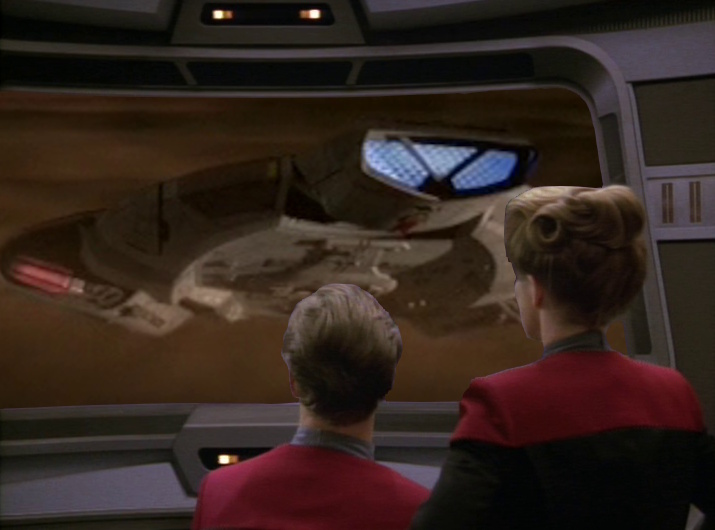
Edited still frame from two Star Trek episodes, depicting the USS Defiant as seen on the USS Voyager's viewscreen.
How it might’ve looked if Voyager had returned home almost immediately.

The real consequences of this would be felt later, though. Chakotay, B’Elanna, Eddington, and others would be killed at the beginning of the Dominion War, when the Dominion-backed Cardassians (perhaps aided by Seska as an embedded spy) wiped out the Maquis. In the Delta Quadrant, the Ocampa would still be confronted with the reality of life without their Caretaker, and would eventually have to find a way to leave their underground city.

But there are more serious repercussions. At time of writing, it seems as if Janeway is directly responsible for the destruction of the Borg Queen and at least a significant portion of the Borg Collective (as seen in Picard Season 3). If she doesn’t undertake that seven-year journey, never meets Seven of Nine, and never travels back in time to plant a pathogen directly into the Borg Queen… the Borg will be in a massively strengthened position by the early 25th Century. The Collective may not need to employ rogue changelings to infiltrate Starfleet – they might just choose to launch a full-scale invasion. And without crucial information on the Borg that was collected by Voyager, Seven of Nine, the Hansen family, and more… Starfleet would be significantly more vulnerable.

What If… #2:
What if… the Talosians joined the Federation?

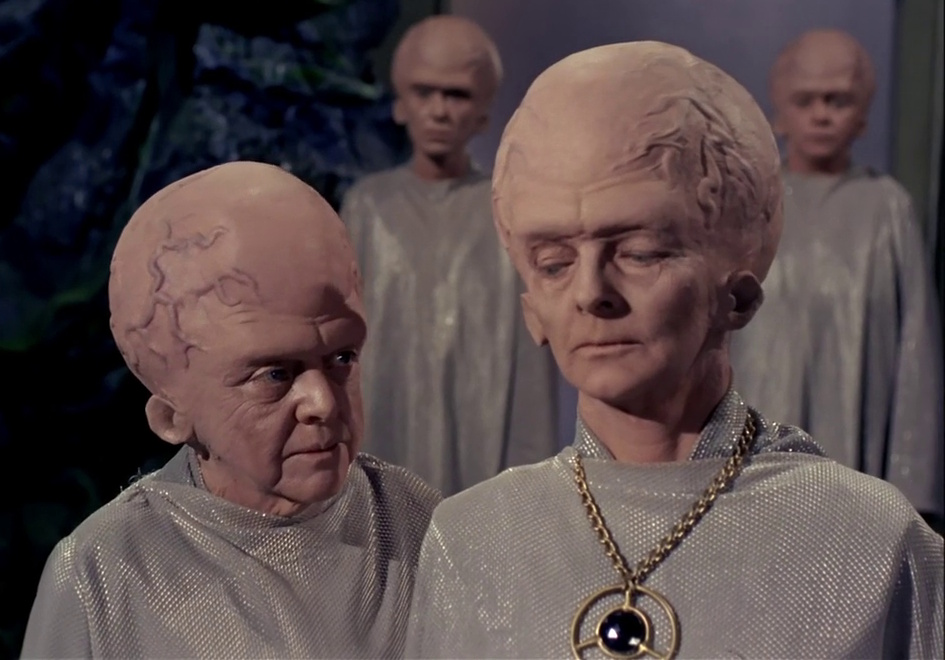
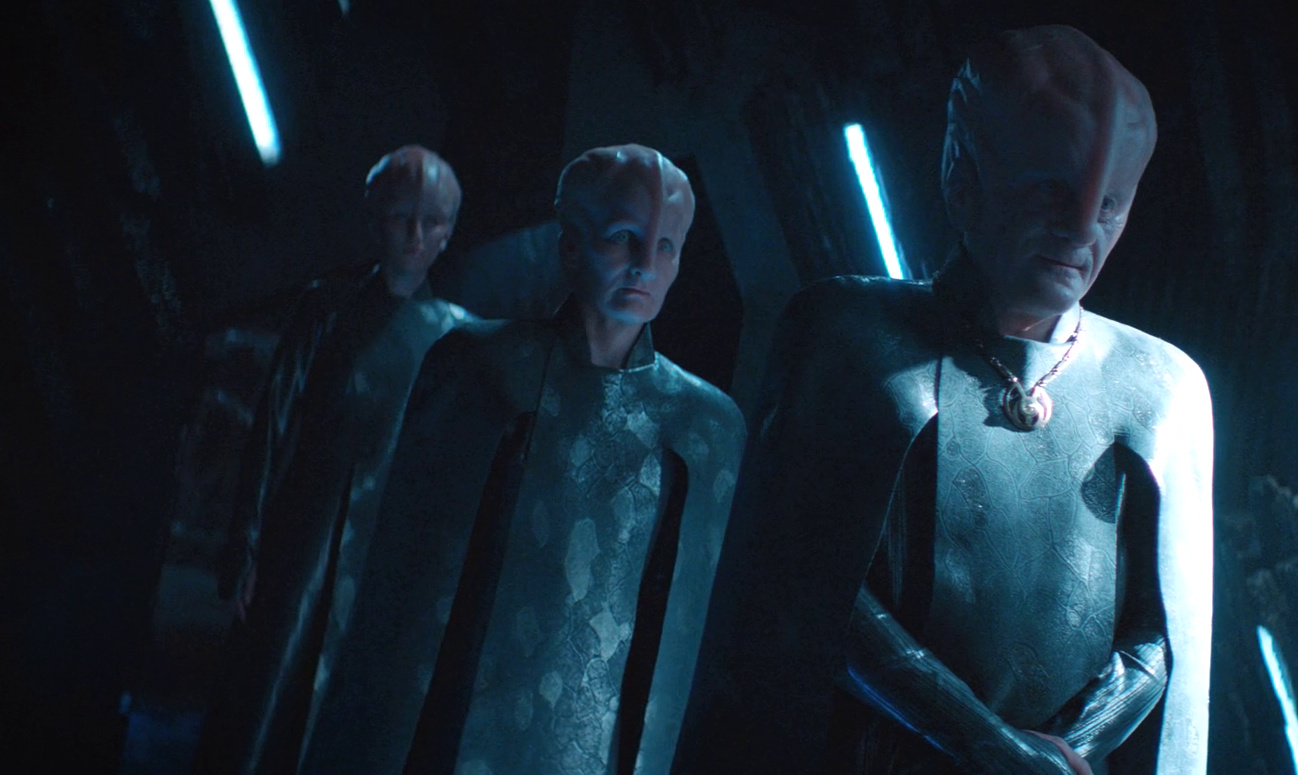
Still frame from Star Trek's original pilot (The Cage) showing four Talosians.
A group of Talosians.

We’re going all the way back to the beginning with this one – appropriate, in this milestone anniversary year. In short, it’s never sat quite right with me that Starfleet and the Federation would view the Talosians so negatively – and as such a dangerous threat – after just one interaction. Lest we forget, Captain Pike’s mission to Talos IV ended without any loss of life, and arguably with the beginnings of an understanding or even dialogue between the Talosians and humankind. Pike and the crew came to understand the Talosians’ situation, and for their part, the Talosians were able to acknowledge that humans (and Vulcans) were not suitable captives.

So in this alternate timeline, we’re going to say that Captain Pike returns to Starfleet HQ with a different mission report. Instead of recommending that Talos IV be quarrantined and declared to be off-limits, he instead advocates for sending aid to the Talosians to help rebuild or maintain their technology and rehabilitate the devastated surface of their world. The Talosians would be taken aback by this generosity, and would vow never to use their impressive telepathic powers to trick the Federation.

Still frame from Star Trek: Discovery Season 2 showing a trio of Talosians.
The Talosians as they appeared in Discovery’s second season.

Over time, the Talosian population would begin to grow, and Talosians would occasionally venture off-world, mingling with other citizens of the galaxy. The Talosians and Betazoids would form a particularly strong bond, as two races that both prefer telepathic communication. This would, in turn, set the stage for Talos IV joining the Federation as a full member world, coming under the protection of Starfleet and deepening their ties.

Though their numbers would be small at first, by the early 24th Century, Talosian officers would occasionally be seen in Starfleet – though the Federation would make them take oaths not to use their powers for deception (similar to the oaths that Deltan officers had to take, as seen in The Motion Picture). Talosians would be present for many of the major events of the late 23rd and 24th Centuries: the Federation’s alliance with the Klingons, the Romulan Empire’s isolation, the rising Borg threat, and the Dominion War.

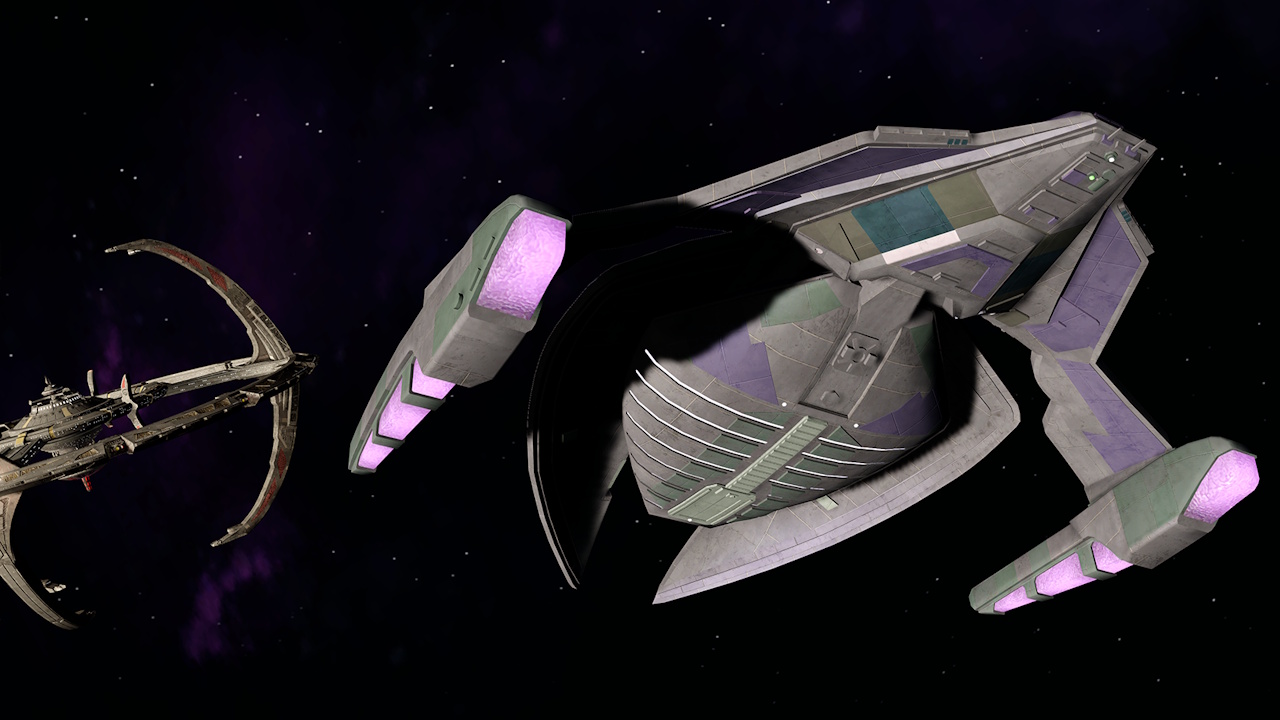
Screenshot from Star Trek Online showing a Jem'Hadar ship and DS9.
A Jem’Hadar warship near DS9.
Image: Star Trek Online Wiki

It’s the latter event that I want to focus on now. After the Dominion War breaks out, the Talosian government, working in conjunction with Section 31, would hatch a plan to deceive the Dominion and the Cardassians on an unimaginable scale. Working as a group, the Talosians would use their mental powers to trick the Dominion alliance into believing they were on the offensive, about to retake Deep Space Nine and Bajor – all the while, a combined Federation and Klingon fleet would be launching an assault right into the heart of Cardassian territory.

The Dominion War could be ended in a matter of days, thanks to tapping into the Talosians’ impressive powers, and the Dominion would be forced to the negotiating table having been deceived into believing they were winning. But while the war was being settled and a peace treaty signed, something else would happen: the Battle of Sector 001, where a lone Talosian officer would be serving aboard a starship. This would be the Borg’s first encounter with a Talosian, and their assimilation might just have given the Borg a terrifying new upgrade…

What If… #3
What if… Bruce Maddox successfully convinced Starfleet to let him disassemble Data?

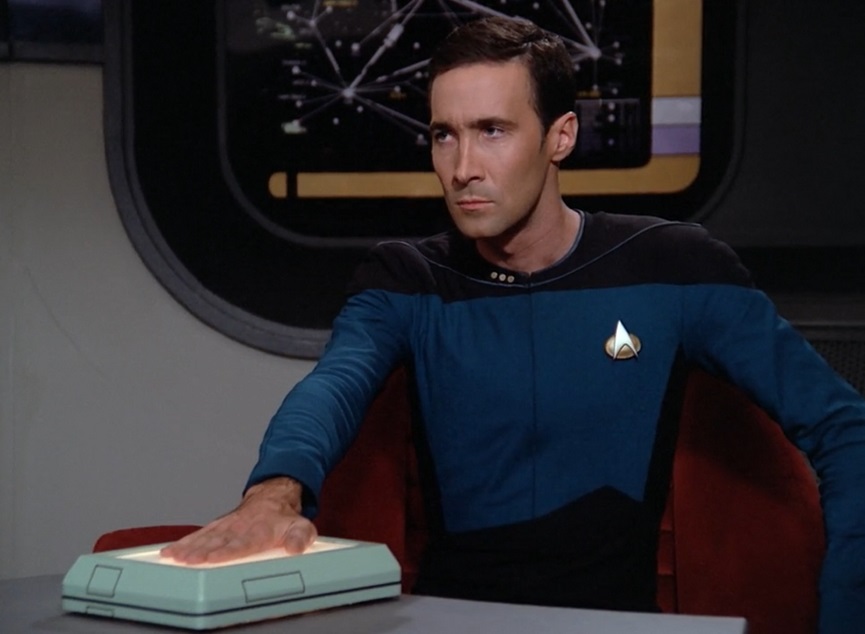
Still frame from Star Trek: The Next Generation (The Measure of a Man) showing Dr Maddox.
Dr Bruce Maddox.

In The Next Generation Season 2 episode The Measure of a Man, we’re introduced to Dr Bruce Maddox: the Federation’s top cybernetic scientist. Dr Maddox would request that Data be turned over to him in order to be disassembled, planning to use the knowledge he’d gain to create legions of synths. In the prime timeline, Starfleet would deny this request, allowing Data to explore his sentience and his life in his own way. But in our alternate timeline? Starfleet instead rules that Data, as an artificial being, is not a “person,” and therefore cannot refuse Dr Maddox’s request.

This is such an interesting debate, because right now, out here in the real world, artificial intelligence – or some form of it, in any case – is a big deal. And despite what I’ve argued in the past about the limitations of today’s large language models, I admit to feeling uncomfortable about the idea of a potentially sentient A.I. being forced to do things it may not want to do. This will have to be the subject of an entire essay one day, but it’s so interesting to me how, some thirty-five years on from The Measure of a Man, the issues it raised are incredibly relevant!

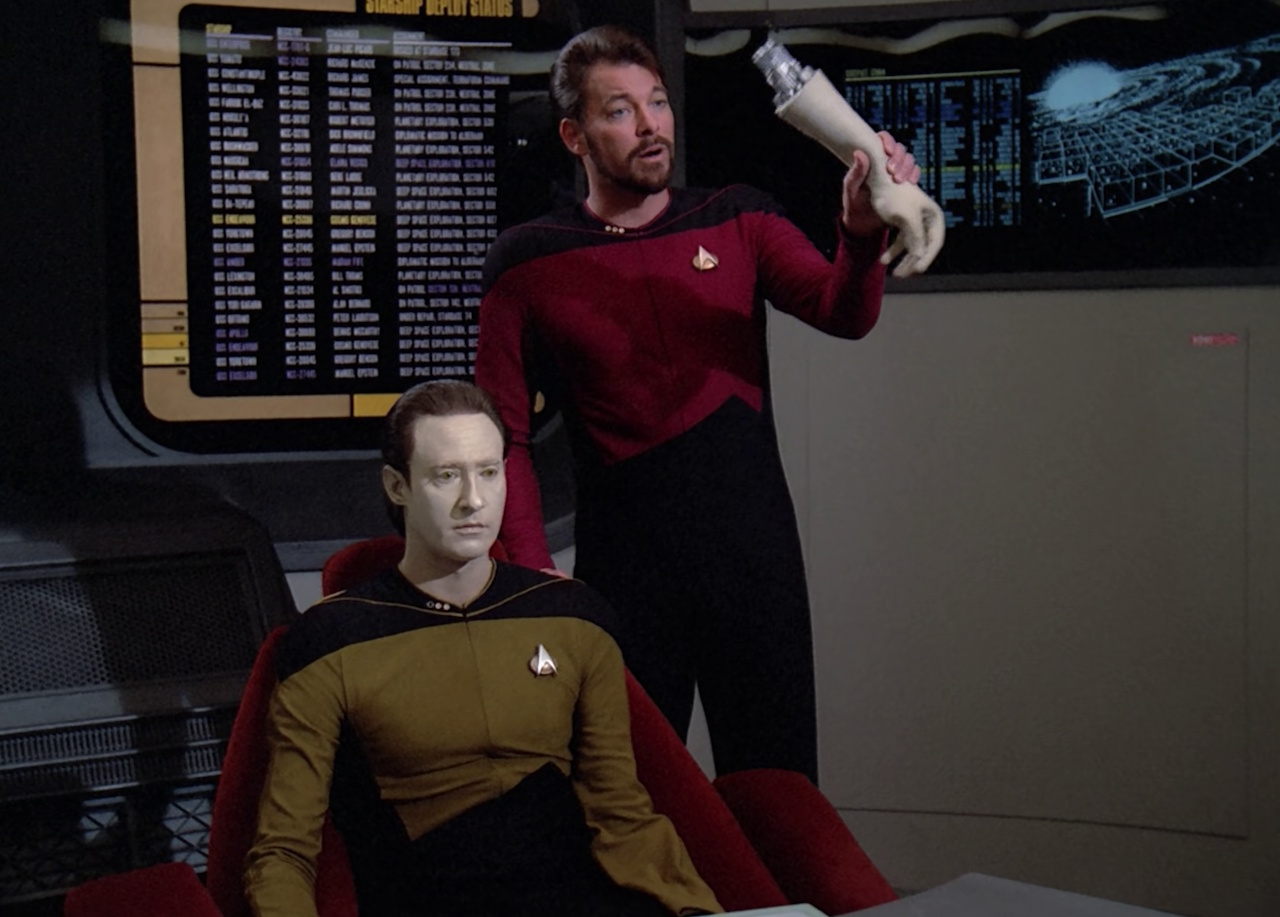
Still frame from Star Trek: The Next Generation (The Measure of a Man) showing Riker holding Data's arm at the trial.
Data and Riker at the hearing.

But that’s enough about that for now. There would be *many* consequences as a result of Starfleet’s decision. In the immediate term, I think Captain Picard would resign his commission. It would be a desperate, last-ditch effort to convince the higher-ups at Starfleet to change their minds, but it would ultimately fail. This would lead to Riker getting temporary command of the Enterprise-D, before command would ultimately pass to a more senior officer – someone like Captain Edward Jellico.

But more serious consequences lay in store. In the prime timeline, Dr Maddox was able to use B-4 – an earlier and less complex Soong-type android – to construct a large number of pretty basic synths. But with Data fully disassembled, Maddox’s work would progress a lot further a lot faster, and synthetics not quite at Data’s level, but not too far behind, would begin to be rolled out across Starfleet. This would draw the attention of the Zhat Vash – an underground Romulan faction dedicated to preventing synthetic life from ever coming to exist.

Still frame from Star Trek: Picard (Maps and Legends) showing a group of synths.
Synths as seen in Star Trek: Picard.

The timing of this couldn’t be worse for Starfleet. After the Battle of Wolf 359, Starfleet was at a particularly low ebb. Senior admirals encouraged Dr Maddox to work faster, hoping to use his new synths in the rebuilding process, and poured a lot of resources into his synth programme. At the same time, Ambassador Spock travelled to Romulus in the hopes of promoting reunification. Without Picard and Data to stop the Romulans, and with the Zhat Vash aggressively pressuring the Romulan leadership to engage the Federation, the Romulan attack on Vulcan would prove successful – and it would be the first strike in a new Federation-Romulan conflict.

With Commodore Oh acting as an embedded spy, feeding information back to the Romulan Empire, they’d quickly gain the upper hand in this new war. The war would go poorly for the Federation, even if Oh was eventually captured, and with Starfleet still underpowered after the defeat at Wolf 359, it would be impossible for the Federation to defend all of its territory. The only outcome short of total conquest would be accepting a very difficult peace treaty, which would certainly include a clause prohibiting any and all research into synthetic life.

What If… #4:
What if… the Borg attack on Earth in the 22nd Century had been much more serious?

Still frame from Star Trek: Enterprise (Regeneration) showing the assimilated shuttle bearing down on the NX-01.
The Borg attacking the NX-01 Enterprise.

Regeneration, from Season 2 of Enterprise, is a fun episode in isolation… but I don’t really like what it does for the timeline of humanity’s conflict with the Borg. Setting that aside, though, let’s think about what might’ve happened if the Borg had managed to do a lot more damage to Earth in the 22nd Century. I’m not going to argue that this handful of defrosted drones would’ve been able to fully assimilate Earth in this era; I think, somehow, Starfleet and humanity would have prevailed. But in our alternate timeline, things are much more serious and the damage much more extensive.

Instead of merely assimiliating a single shuttle, the reactivated Borg drones would take over an entire starship: Enterprise. They’d assimilate practically the entire crew, kitting out the ship with upgraded weapons, and then they’d bring the fight back to Earth, in line with their original mission. It would take everything Starfleet had – and the sacrifice of many human and Vulcan lives – but the attack would eventually be stopped, with the remaining Borg being captured and studied.

Still frame from Star Trek: The Next Generation (Q Who) showing a Borg drone attacking the Enterprise-D.
A Borg drone.

After causing devastation to parts of Earth unseen in more than a century, the United Earth government would re-think its planned mission of space exploration. Enterprise, humanity’s first long-range exploration vessel, has been lost, and the NX-02 would be repurposed as a purely defensive ship instead. The alliance with the Vulcans would weaken as humanity became a much more insular and isolationist power, scarred by the Borg attack and frightened of venturing too far into a galaxy that clearly poses a lot of dangers.

The Borg remnants would be extensively studied, in the hopes of discovering ways to counteract their technology, and some of these discoveries would lead to powerful Earth- and space-based weapons for humanity centuries ahead of schedule. The Xindi attack a year or so later would be *easily* defeated with Borg-powered weapons salvaged from the wreck of Enterprise.

Still frame from Star Trek: Enterprise (Regeneration) showing scientists and a Borg arm.
Humanity would study the Borg and their tech.

But in the longer term, this isolationist stance would mean that the galaxy looks *very* different. Without humanity to mediate, the Vulcans and Andorians would wage a devastating war. Without Starfleet exploring and pushing the boundaries, there’d be no conflict between humanity and the Romulans. But most significantly… there’d never be a United Federation of Planets. Earth would maintain limited interstellar trade, including with the Denobulans and Vulcans, but fear-induced isolationism would become baked into the United Earth government at every level, with all talk of alliances or further missions of exploration being shut down.

By the time we reach the more familiar 23rd and 24th Centuries, the snowball has been rolling for a long time, and changes become unpredictable. But I’m going to posit that some of the Alpha and Beta Quadrant’s more aggressive powers – the Klingons, Romulans, and Cardassians – are all in much stronger positions without the Federation as a counterbalance. New alliances may emerge, such as the Mirror Universe’s Klingon-Cardassian alliance, or some powers may fully conquer others. The Romulans, for instance, may succeed at conquering Vulcan after the Andorian war left the Vulcans in a weakened state, or maybe the Klingons will launch an all-out war against their Cardassian rivals. And all the while, a strange, overlooked, isolationist Earth will be ready to shoot first and ask questions later whenever an uninvited guest arrives in the Sol system.

What If… #5:
What if… the Federation and the Ferengi went to war?

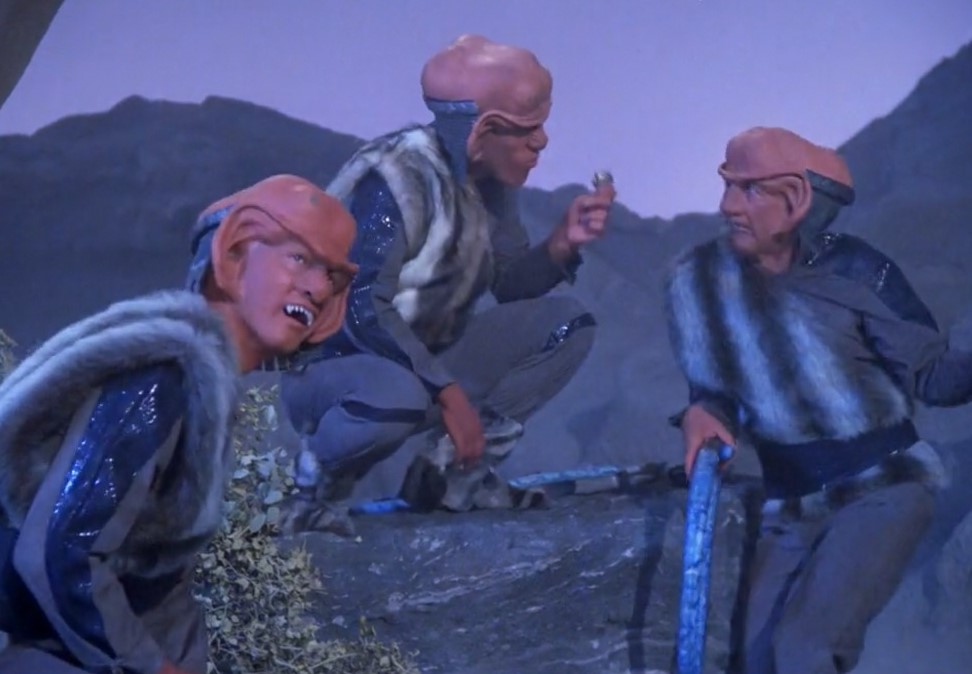
Still frame from Star Trek: The Next Generation Season 1 showing three Ferengi.
Three Ferengi from The Next Generation.

Chances are you already know this if you’re a Trekkie, but the Ferengi were originally supposed to be a major antagonist when The Next Generation was in early production. Gene Roddenberry intended for the Ferengi to take over the role vacated by the Klingons, now that Worf was going to be a permanent fixture on the bridge of the Enterprise-D. However… it didn’t pan out that way, mostly because of the way the Ferengi were presented in their first couple of appearances, and the way audiences responded to that.

In this case, though, we’re going to say that the Ferengi and the Federation didn’t just get off on the wrong foot… they continued down a path that would quickly lead to war. Ferengi DaiMons, eager for plunder, began raiding Federation convoys, stealing everything they could get their hands on, and even holding Starfleet officers and crew for ransom. Starfleet responded by taking an aggressive stance towards the Ferengi, sending armed escorts with trading and supply vessels, and gearing up for a confrontation.

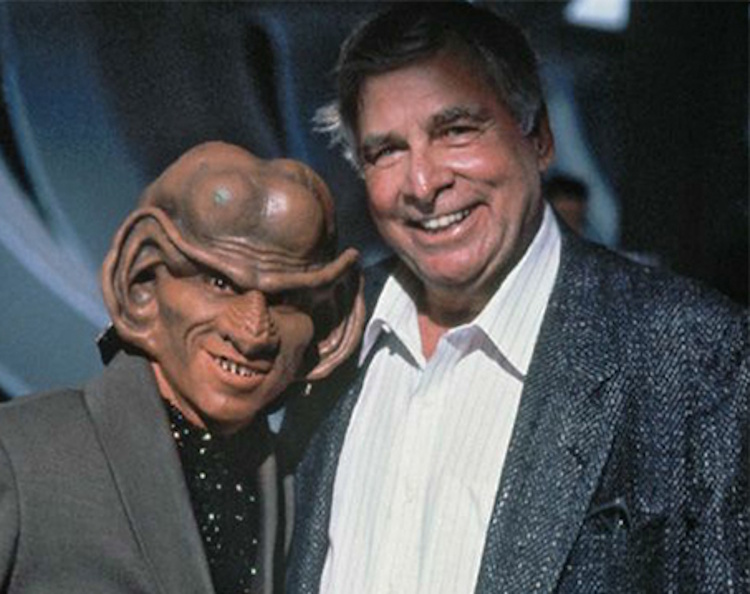
Behind-the-scenes photo from the Star Trek TNG S3 episode Menage a Troi showing Gene Roddenberry and actor Peter Slutsker (in Ferengi makeup).
Gene Roddenberry originally intended for the Ferengi to become a major villainous faction.

This version of the Ferengi – perhaps led by a more aggressive ruler than Grand Nagus Zek – would be less conciliatory, and would instead see war and piracy as opportunities for profit. Around the time of The Next Generation’s second season – which takes place in approximately 2365 – this would spill over into all-out war. The Ferengi DaiMons – most of whom had been acting autonomously up to this point – would be corralled by their Nagus into a proper fighting force, and their powerful D’Kora-class ships (the Ferengi Marauders) were more or less evenly-matched with Starfleet’s Galaxy-class vessels. The war would drag on.

I doubt this war would become existential for either the Ferengi or for the Federation, but it would be the most significant conflict either power had been involved in for decades, at the very least. The distraction would pause Starfleet’s mission of exploration, with more vessels being refitted and sent to the front lines, meaning that dozens of first contacts (and other missions) would come years later – or else would be missed entirely. And all the while, the Borg are on the prowl, scooping up outlying Federation and Romulan colonies. Blame for that might even initially fall on the Ferengi.

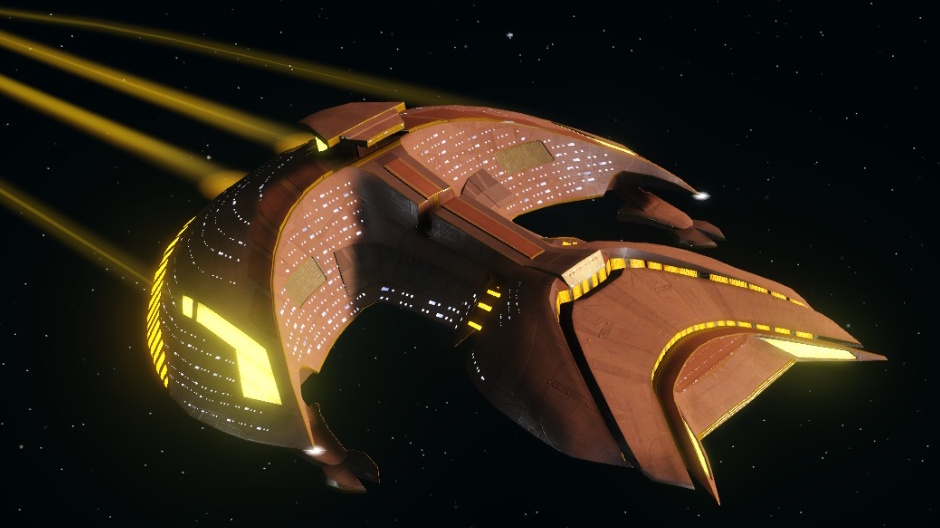
Promo screenshot for Star Trek Online showing a D'Kora Class ship.
A D’Kora-class ship.

A peace treaty would eventually be signed, with the Ferengi and Federation agreeing to respect a shared border, and a prohibition would be placed on piracy – though renegade Ferengi DaiMons would continually flout this. But the war would sap Starfleet’s resources, leading to a monumental decision: the Federation would decline the Bajorans’ request to take over Terok Nor after the Cardassian withdrawal. Deep Space Nine would never be established, and the Bajoran wormhole would go undiscovered for decades.

This would completely change the course of the latter 24th Century: there’d be no Dominion War, no Cardassian alliance with the Dominion, no changeling infiltrations, and no Emissary of the Prophets. The Bajoran provisional government would struggle to remain in control of its system, and the Federation would commit to providing only limited aid to the Bajorans, earning their resentment. The eventual discovery of the Bajoran wormhole in the early 25th Century would lead to plenty of interest, including from the Ferengi – who can pay handsomely for access to the Gamma Quadrant. The Bajorans, still wary of the Federation after their very lukewarm response decades earlier, would deny Starfleet access to the wormhole, preventing the Federation from exploring the Gamma Quadrant. Bajor wouldn’t be on a path to joining the Federation, and first contact with the Dominion might be made by the Bajorans… or even the Ferengi.

So that’s it!

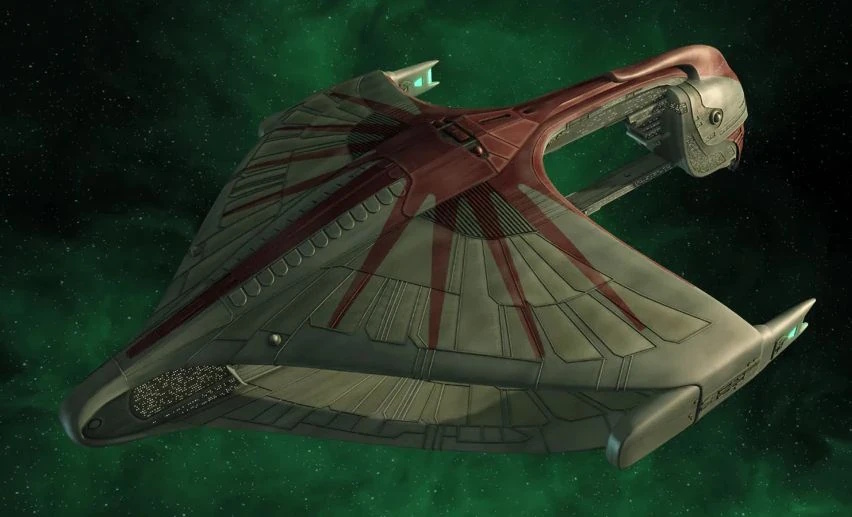
Promo image for Star Trek TNG: A Final Unity showing a warbird.
A modified Romulan warbird.

We’ve considered five possible “what if” scenarios from the Star Trek franchise.

I hope this has been a bit of fun. I love writing, and I love Star Trek, so writing about Star Trek is a great way for me to spend a bit more time in this wonderful galaxy. I tried to get creative, picking on a few different storylines and ideas from across the franchise, and extrapolating what might plausibly be able to happen if things turned out differently. I hope that the sequences of events made sense, and that I arrived at conclusions that you feel are at least *possible* based on the changes I proposed!

In any case, this was just for fun, and an excuse to talk about Star Trek as the franchise’s milestone 60th anniversary year rolls along. I have a few ideas for later in the year, as we get closer to the anniversary date itself, so I hope you’ll stick around and join me for some of those. And in a few weeks’ time, I’ll be sharing my thoughts on the franchise’s latest outing: Starfleet Academy. Click or tap here to check out my review of the two-part premiere, if you missed it.

Until then… be sure to check back for more discussion of the Star Trek franchise. Live Long and Propser, friends!


All shows and films discussed above can be streamed on Paramount+ or purchased on DVD and/or Blu-ray. The Star Trek franchise (including all properties discussed above) is the copyright of Skydance/Paramount. This article contains the thoughts and opinions of one person only and is not intended to cause any offence.
The weirdly contradictory nature of Star Trek: Picard

Spoiler Warning: There are spoilers ahead for all three seasons of Star Trek: Picard – including the series finale and post-credits scene.

For a series that only ran to thirty episodes across three seasons, Star Trek: Picard spent a lot of time overwriting itself! Across all three seasons of the show there were these weirdly contradictory moments where new storylines would appear from nowhere, completely changing what came before. One or two of these instances might pass by relatively unnoticed, or could feel like little more than nitpicks. But for a relatively short series to have so many… it speaks to something bigger, I feel.

I hope in future we’ll get a Chaos on the Bridge-type of documentary or exploration of what went on behind-the-scenes on Star Trek: Picard, because to say that production was “difficult” feels like an understatement. There were clearly major problems on the production side of the series, and I don’t just mean its pandemic-enforced delays. The evidence for this is the contradictory nature of the series itself, and how at the very least there was clearly no overall plan for how the story should be structured. Consistency is an important element of any good story – and Picard absolutely fails on that measure.

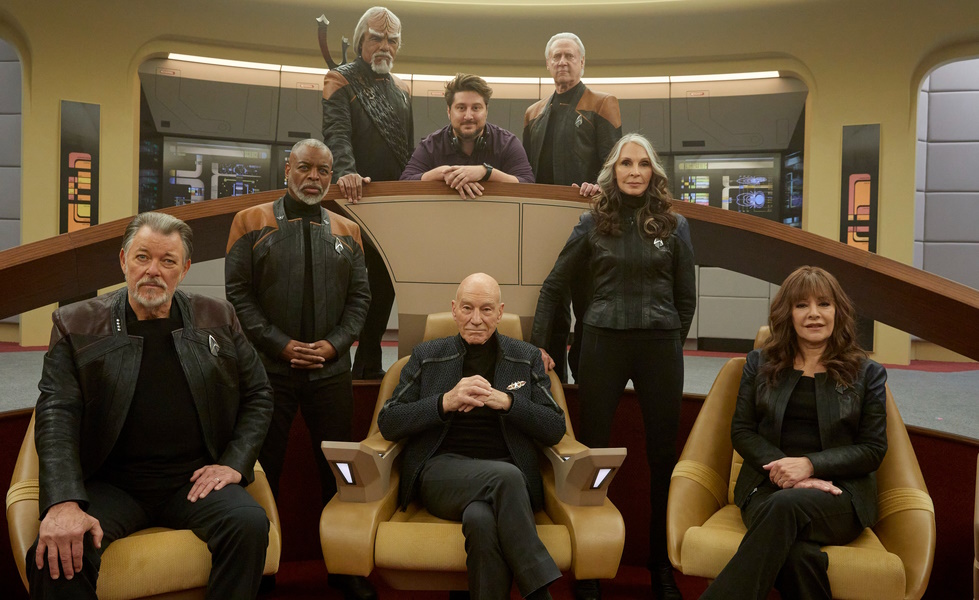
Seasons 2-3 showrunner Terry Matalas with Sir Patrick Stewart and the rest of the cast of The Next Generation.

I have a longer piece in the pipeline about Picard’s abandoned and unfinished storylines, but today I thought it could be interesting to take a short look at ten storylines that ended up being overwritten by some pretty sloppy, messy writing that failed to build on the foundations that had been laid in earlier episodes and seasons.

As always, a few caveats. If you loved all of these stories and felt they were perfectly-executed, or if you hated the original setup and feel that it was right and fitting to overwrite or ignore it, that’s okay! We all have different opinions about what makes for a good Star Trek story, and I’m not trying to claim that I’m somehow objectively right and that’s the end of the affair. In several cases, I’d actually agree that the overwrite or retcon was better than what had been previously established. This is all just the opinion of one old Trekkie, and as I always say, there ought to be room in the Star Trek fan community for polite discussion and disagreement! Although I have my issues with Picard, particularly when it comes to the show’s second season, by and large I’m a fan not a hater.

So with all of that out of the way, let’s take a look at some of Picard’s weirdly contradictory storylines.

Contradictory story #1:
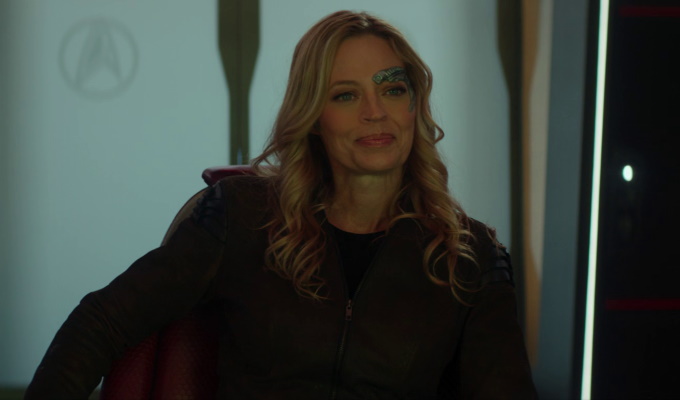
Seven of Nine is a captain! Oh wait, no she isn’t…

Seven in the captain’s chair at the end of Season 2.

At the end of Season 2, Seven of Nine was breveted into Starfleet by Picard as Captain of the Stargazer. This story point was already a bit… odd. Firstly, it raises the question of why, if offering a brevet position to someone outside of Starfleet is so simple, Admiral Janeway didn’t do that for Seven years ago. It also seemed unnecessary, as with Picard on the bridge, the Stargazer already had a senior officer present who could give orders.

But this already flimsy setup ended up being overwritten by the very next episode – when Seven was bumped down to the rank of commander and found herself serving as first officer of the Titan. There are a lot of contradictions in Picard, but this one feels even more peculiar because it’s something that literally changes from one episode to the next – episodes that, in spite of being one season apart, were produced and filmed at the same time.

Contradictory story #2:
Data’s dead. Deader than dead. Lol jk, he’s alive again!

Data awaits his final shutdown.

One of the few redeeming features of the two-part Season 1 finale was the laying to rest of Data, and giving him the emotional send-off that Nemesis didn’t have time to do justice to. It went a long way to making up for other deficiencies in the rushed and muddled end to Season 1, and the sequences with Picard and Data in the “digital afterlife” were powerful and deeply emotional.

But despite Data being as dead as it’s possible to be in Star Trek, with both his physical body and the surviving part of his consciousness having been destroyed and shut down respectively, Season 3 resurrected Data. We’ll have to go into this storyline in more detail in the future, because there’s a lot more to say. But for me, Data’s resurrection never really found a narrative justification, and it felt like the showrunner and writers wanted desperately to reunite the cast of The Next Generation – at any cost.

Contradictory story #3:
Welcome aboard the Stargazer! Wait, I mean the Titan…

The USS Titan.

In Season 2, the ship that Picard and co. didn’t spend enough time aboard was the USS Stargazer. In Season 3, they jumped over to the Titan – even though the sets were all the same (with a few minor tweaks here and there). I don’t really understand why this happened. What was the point of setting Season 3 aboard a nominally different starship? The exact same setup could have brought Riker and Picard to the Stargazer as it did to the Titan.

If the two ships had significant aesthetic differences, maybe it would be okay. And compared with some of the other points on this list, I admit it’s relatively minor. But it still feels odd to introduce the new Stargazer, build CGI models for it, and only use it in one-and-a-bit episodes.

Contradictory story #4:
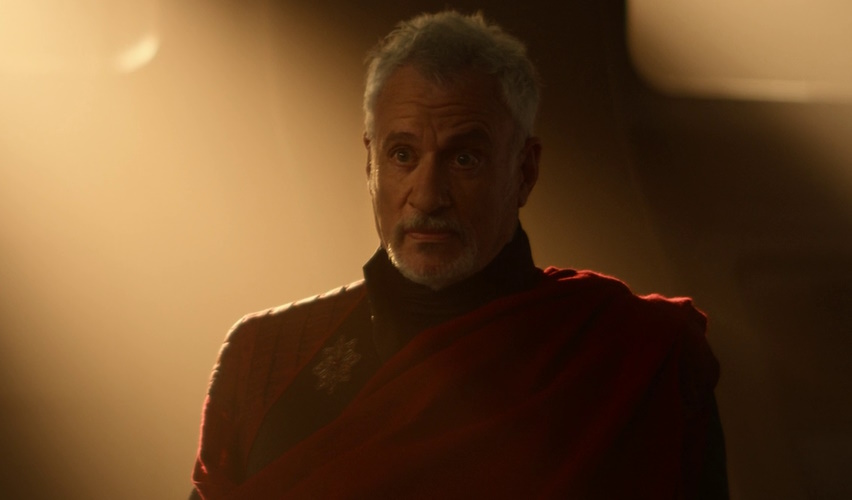
Q’s dying… oh wait, no he isn’t.

Q at the end of Season 3.

I know what you’re thinking: Q already explained his “return” by telling Jack Crusher not to think about time in a linear fashion. While that’s a perfectly rational in-universe explanation for Q’s return at the end of Season 3, it doesn’t get around the fact that Q, whose death was such a vital part of the entire plot of Season 2, is a profoundly odd choice of character to use for that one epilogue scene.

Picard’s writers pinned the convoluted and disappointing story of Season 2 on Q, and Q’s entire motivation was his imminent death. To undo that – even if there’s a technical explanation for it – only a few episodes later feels wrong. It undermines the already-weak story of Season 2 and makes me wonder what the point of it all was.

Contradictory story #5:
The Borg are back! The Borg are back! The Borg are back!

A Borg Cube.

However you look at it, and whatever nitpicky excuses there may be about who are and aren’t the “real” Borg, there’s no getting away from the fact that across its three seasons, Picard re-introduced the Borg three times. All three of the stories rely, either in whole or in part, on the Borg, and while Picard himself has a connection with the Borg after the events of The Best of Both Worlds and First Contact… there’s a whole galaxy out there filled with alien races that the show’s writers and producers could have used.

While Season 3’s Dominion/changeling rug-pull is probably the worst example of this, it really speaks to a broader problem with the show’s production. Picard’s writers, especially in Season 3, were unwilling to abide by what the show had already set up. The Borg are great fun, don’t get me wrong, but by the time we got to yet another Borg story in Season 3, I was feeling burned out.

Contradictory story #6:
The mysterious anomaly has set up a fascinating story! Let’s never mention it again.

Led by the Borg, a Federation fleet stops the anomaly.

The story of Season 2 was bookended by a mysterious anomaly that the Jurati-led Borg faction believed could be an attack against the Alpha Quadrant. Once the anomaly had been stopped, the Jurati-Queen promised to take her Borg faction and stand watch over the anomaly as a “guardian at the gates.” Her Borg faction were even granted provisional membership in the Federation as they did so.

This story felt like it had huge potential. Who could have been powerful enough to create a weapon on that scale? How would Picard and his friends be able to defeat them? What would it be like to see a Federation-Borg alliance? But alas, this storyline was dumped, orphaned, and never mentioned again. Was no explanation ever written? Why end Season 2 on this cliffhanger if it was never going to be resolved?

Contradictory story #7:
Soji’s a massively important character… let’s dump her.

Promo photo of Isa Briones as Soji.

Soji played a huge role in Season 1, serving as both the reason for Picard’s mission and later as someone who needed to be talked down from making a mistake. We spent a lot of time with her in the show’s first season, watching as she was manipulated by Narek, as she learned the truth of her own origin and who her people were, and as she came to work with and respect Picard.

It was disappointing that Soji was essentially forgotten after the end of Season 1, with a barebones cameo appearance and nothing more. Isa Briones got to play a minor role in Season 2 as the daughter of antagonist Adam Soong, but this storyline was samey and boring. As a new, young character – and a synthetic life-form – Soji had huge potential. It’s such a shame that a role couldn’t be written for her after Season 1.

Contradictory story #8:
Picard has a new relationship with Laris! No wait, Laris has fucked off and now he has a kid with Dr Crusher.

Laris and Picard at the end of Season 2.

The entire story of Season 2 – its raison d’être, at least according to Q – was that Picard was alone, prevented by his childhood trauma from being able to find love. At the end of the season, after ten episodes of shenanigans in the 21st Century, Picard finally returned to his vineyard – and to Laris. The two seemed ready to embark upon a new relationship together.

But nope! Laris made a small cameo appearance at the beginning of Season 3, and was never mentioned again. Picard’s story in Season 3 focused on his past relationship with Dr Crusher, a relationship that led to him having a son he’d never met. The season’s epilogue even showed Picard and Dr Crusher jointly escorting their son to his first Starfleet assignment – with Laris nowhere to be found. As I said above: Season 2 was already a weak, flimsy story. Undermining its ending like this was a poor decision.

Contradictory story #9:
Elnor’s dead. Oh wait, he’s back! No… he’s gone again.

Elnor at the end of Season 2.

Although I wasn’t thrilled to see Elnor killed off in the first half of Season 2, as time went on, it seemed to be working. Raffi’s story of coming to terms with loss and grief was one of Season 2’s stronger elements, and while I would’ve still said I was disappointed in Elnor’s wasted potential, at least his loss had mattered. Until it was all undone with seconds to spare.

If Elnor had a major role to play in Season 3 – and there was absolutely space for him – then I could at least have understood this reversal. But after Elnor was resurrected, he got one very brief scene in which he looked confused on a viewscreen, and another in which his dislike of a beverage made him the butt of a joke. After that, Elnor disappeared from Picard never to be seen or mentioned again. What was the point? Why undo a powerful story for the sake of an overdone sight gag?

Contradictory story #10:
Riker and Troi are happy and settled on Nepenthe. Just kidding, they hate it there.

Picard approaches Riker’s outdoor kitchen.

Nepenthe might be my favourite episode of Season 1. It slowed things down, stepped away from some of the drama, and reintroduced us to Riker and Troi – now happily married and living peacefully outside of Starfleet. In spite of the loss of their son, Riker and Troi seemed settled on Nepenthe with their daughter in a home that was important to their son and their family. It was a surprise, to say the least, when Season 3 tried to undo all of that.

In the episode Surrender, Riker and Troi were reunited as captives aboard Vadic’s ship. And while imprisoned, they both spoke about how they hated the “creaky old cabin” that had been their home. The end of the season implied that one or both of them may be back in Starfleet, and all the emotional storytelling present in Nepenthe was taken away.

So that’s it!

Dr Jurati on stage in Season 2.

Although there were some interesting stories – and some complete ones – overall, it’s not unfair to call Star Trek: Picard a contradictory series, one that either intentionally or unintentionally overwrote or ignored key characters and storylines. We’ll talk about some of these in more detail on another occasion, but for now I think we’ve covered the basics.

Picard was clearly a troubled production, one that jumped from one writing and production team to another, and that’s part of why the series as a whole feels so contradictory. I think I could overlook one or two of these things – and I might even support the decision to drop a character or change a storyline that wasn’t working or that failed to resonate with audiences. But for a series that ran to a mere thirty episodes across three seasons… we shouldn’t be able to pull out ten large contradictions like this.

Stay tuned, because I have a lot more to say about Picard even though the series has concluded! A longer retrospective is in the pipeline, and I’ll also be taking a look at abandoned and unfinished storylines, too.

Star Trek: Picard Seasons 1-3 are available to stream now on Paramount+ in the United States and other countries and territories where the service is available, and on Amazon Prime Video in the UK and around the world. The Star Trek franchise – including Picard and all other properties discussed above – is the copyright of Paramount Global. This article contains the thoughts and opinions of one person only and is not intended to cause any offence.
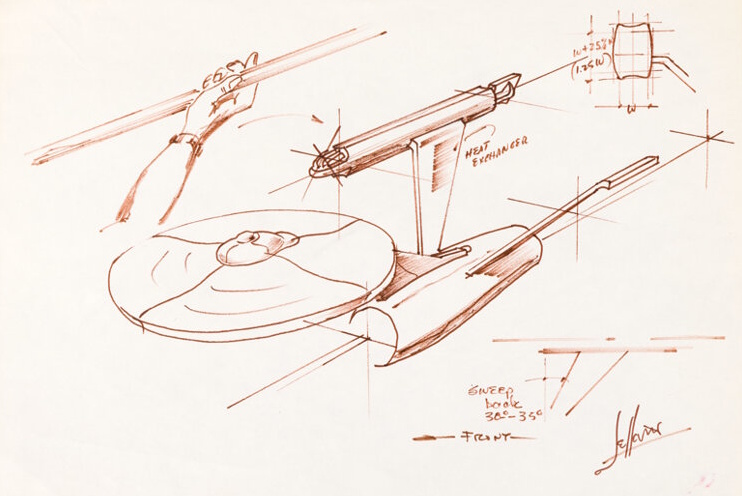
Building the “ultimate” Star Trek crew!

Spoiler Warning: There are spoilers ahead for the entire Star Trek franchise, including the most recent seasons of Discovery, Picard, Lower Decks, Prodigy, and Strange New Worlds.

I’ve seen a lot of posts on social media where fans try to construct their “ultimate” Star Trek crews with characters from across the franchise, including one that popped up a few weeks ago. For whatever reason, this latest one – which was put out by the official Star Trek Twitter account – captured my imagination. So today I thought it could be fun to show off the characters that I’d pick to be in my “ultimate” Star Trek crew!

Let’s start by laying down some ground rules…

The social media post which inspired this article.
  • First of all, I don’t want to pick more than a couple of characters from a single series. If you’re just going to pick the entire crew of the Enterprise-D, what’s the point? We might as well just go and watch The Next Generation!
  • Secondly, the fact that characters come from different eras or timelines is entirely irrelevant. This is pure fantasy – though who knows, maybe one day Star Trek will do some kind of massive crossover event featuring characters from all over the place!
  • Third, characters have to occupy a role that we saw them fill on screen; i.e. Captain Picard can’t be a tactical officer, nor could Michael Burnham be assigned as the ship’s Chief Medical Officer!
  • Fourth, I want to include all of the major roles that we’ve seen main characters occupy on Star Trek – something that the Twitter post that inspired this piece didn’t do!
  • Finally (and most importantly), I want this to be taken light-heartedly and in the spirit of fun!

So let’s get started building the USS Trekking with Dennis!

Starship Class:
Excelsior

The USS Excelsior in The Search for Spock.

One thing that a lot of these lists miss is the ship that the crew will be serving aboard. As many Trekkies have pointed out over the years, a starship is akin to a member of the crew; not merely a setting but a living, breathing entity in its own right. Many starship designs have become iconic parts not just of the Star Trek franchise, but of sci-fi and popular culture in general, and many Star Trek starships are instantly recognisable even to folks who aren’t fans.

The Excelsior-class has been one of my favourites ever since I first saw it. It’s a beautiful design that took the classic look of the Constitution-class and updated it, becoming an iconic piece of ’80s sci-fi in the process. It’s clearly a Starfleet ship – the design retains the saucer, neck, body, and nacelles on pylons that continue to define Federation starships, but it mixed things up for a new era. Excelsior-class ships became workhorses for Starfleet, remaining in use for decades. Picard Season 2 recently debuted an updated design, showing that the ships were still being used at the dawn of the 25th Century!

Admiral/Mission Commander:
Jean-Luc Picard

Admiral Picard.

In overall control of our mission at Starfleet Command is Admiral Picard! He’s level-headed, diplomatic, and willing to try to negotiate even with the fiercest adversaries. He’s also a skilled tactician in his own right, and someone who I’d trust to plan operations that involve entire fleets of starships.

Admiral Picard was initially chosen by Starfleet to spearhead the Federation’s efforts to evacuate the Romulan homeworld. While that plan ultimately fell apart due to events beyond his control, the fact that he was the right man to take charge of such a massive assignment shouldn’t be in dispute. Admiral Picard – with support from his team – will be co-ordinating our mission back at headquarters!

Captain:
Benjamin Sisko

Sisko in Deep Space Nine Season 7.

Although the question of “absolute favourite captain” is an incredibly difficult one, if I were placed under duress Benjamin Sisko is probably the individual I’d name! A battle-hardened commander who transformed a minor, obscure posting into one of the most significant strategic locations in the entire Alpha Quadrant, Captain Sisko led the charge against the Dominion during one of the Federation’s darkest hours.

As a commanding officer, Sisko inspired his crew to follow him, but he was also well-versed in dealing with alien cultures and could be both a diplomat and a deal-maker. I also feel that Captain Sisko would work well with Admiral Picard; he would command the ship while Picard was in control of the overall mission, but could also offer advice and input as we saw him do for Admiral Ross during the Dominion War.

First Officer:
Jack Ransom

Commander Jack Ransom.

At the top we have two very serious people – so we need someone like Commander Ransom to balance things out! Although he can be laid-back and make jokes, when the chips are down we’ve seen Commander Ransom absolutely excel, putting the needs of his shipmates first and stepping up to tackle whatever the cosmos throws at him.

The role of a first officer in Star Trek has varied from show to show, with some taking on more away missions and others serving as advisors and confidantes. The best first officers are a mix of both, and Jack Ransom seems like someone his commanding officer can rely on to give honest, sound advice – and then lead a dangerous mission independently.

Helm:
Tom Paris

Promo photo of Tom Paris.

The role of helm officer has been part of Star Trek since The Original Series. But it wasn’t until Tom Paris took over at the helm of the USS Voyager that I felt there was someone in the driving seat who was a bona fide pilot. Paris truly loves piloting Voyager – and any other ship or shuttle that he can get his hands on, too. That’s an impression that I never really got from Sulu, Wesley Crusher, or really anyone else who had sat in the chair before him; they seemed to see the role as a job or duty, where Paris revels in his work.

Not only does Tom Paris enjoy what he does, but he guided the USS Voyager safely home across an impossible distance. Whether it was wormholes, slipstream drives, spatial catapults, the Borg transwarp network, or a warp 10 shuttle that accidentally mutated him into a salamander, Paris navigated them all – and found redemption for his past misdeeds in the process.
Chief Engineer:
Hemmer

It’s Hemmer Time!

As the first Aenar to be a major character, Hemmer had a lot of potential. The no-nonsense attitude he had stands in stark contrast to some other engineers we could think of, but when he was off-duty he was personable and friendly with his shipmates – and a guiding light to young cadets who found themselves under his wing. Hemmer’s love of science was cute, too, and he was able to take in his stride all kinds of different events that befell the USS Enterprise.

As Hemmer once told Uhura, he believed that his purpose was to fix what is broken – and he did that in more ways than one while serving as the Enterprise’s chief engineer. Hemmer helped the Enterprise survive major damage during battles against dangerous enemies, and he’s the person I’d want to rely on to keep my starship flying!

Chief Medical Officer:
Dr T’Ana

Dr T’Ana.

Dr T’Ana is unapologetically my favourite Lower Decks character. Her gruff and grumpy bedside manner conceals genuine medical skill, and we’ve seen her treat patients with all kinds of horrible sci-fi ailments without so much as batting an eyelid. Despite her acerbic attitude, though, Dr T’Ana manages to strike up friendships with her shipmates – and has proven herself to be someone they can rely on.

We’ve also seen how Dr T’Ana is unflappable and doesn’t crack when put under pressure – something that could be important depending on how badly our mission goes! She may not be the politest doctor in the fleet, but no matter what was wrong – disease, injury, or random sci-fi shenanigans – I’d trust Dr T’Ana to patch me up. Plus she’s a Caitian, something that I appreciate as a cat-fanatic!

Nurse/Sickbay Assistant:
Kes

Promo photo of Kes.

While Dr T’Ana can be grumpy and even abrasive, Kes has a wonderful bedside manner that has a way of putting patients at ease. Although she didn’t have much by way of formal medical training when she joined the crew of the USS Voyager, she soon grew into her role as the Doctor’s assistant in sickbay. I still think it’s a shame that Kes had to leave Voyager after the show’s third season, just as she was hitting her stride and learning more about her telepathic abilities.

Kes provides a sharp contrast to Dr T’Ana, and for that reason I think the dynamic in sickbay would be a lot of fun. But Kes has also demonstrated a willingness to learn and a keen medical intuition of her own, so if Dr T’Ana (and the rest of the medical staff) were busy or indisposed, Kes is more than capable of treating patients on her own.

Counsellor:
Dr Hugh Culber

Dr Culber in Discovery Season 4.

Although Dr Culber is the USS Discovery’s chief medical officer, in recent seasons we’ve also seen him take on the role of ship’s counsellor to a greater degree. Not all doctors would make for good counsellors, but Dr Culber has grown into the role, taking on the extra burden of caring for his shipmates’ mental health in addition to his duties in sickbay.

In The Next Generation, Counsellor Troi had a pretty big advantage when it came to reading her patients and understanding them! Dr Culber doesn’t have that same empathic ability, meaning he has to do things the old-fashioned way! But his advice has proven invaluable to Captain Burnham, Saru, and even Book. Dr Culber throws himself into his work, prioritising his patients ahead of himself on occasion.

Tactical:
Tuvok

Tuvok in Voyager’s first season.

Tactical has often overlapped with security on Star Trek, but if you think about it, they’re really two distinct roles that require different approaches. As fun as it might be to see Worf getting angry as the Enterprise races into battle, if my back’s against the wall and I’m facing defeat, I want the cool-headed, logical Tuvok aiming the phasers and firing the photon torpedoes.

Tuvok’s temperament makes him incredibly well-suited to a position at tactical – and not only in the heat of battle, either. As a strategist who has mastered the difficult Vulcan game of kal-toh – a strategy game he’s been playing for well over a century – Tuvok is also someone I’d trust to draw up plans for everything from small away missions to large battles.

Security Chief:
Odo

Constable Odo.

As above, we’re separating the roles of tactical officer and security chief. For the latter, there’s no one I can think of who’s better-suited to the role than Odo! Odo is Star Trek’s first real “policeman;” a dedicated officer of the law who was trusted by the Cardassians, Bajorans, and the Federation to be impartial when it comes to justice.

That impartiality – ensuring that no one is above the law – is exactly what our crew needs. Odo will maintain order, but he’ll do so fairly. He’ll also be able to strike up friendships with the crew while retaining that impartiality. Everyone aboard our ship – Starfleet, non-Starfleet, guests, diplomats, or anyone else we meet along the way – will know that Odo will treat them fairly. And I gotta be honest about this last point: having a changeling on the crew could come in handy in a lot of situations!

Communications:
Hoshi Sato

Ensign Hoshi Sato.

Hoshi Sato had not only mastered forty languages – including some very alien ones – in the days before universal translators existed, but she contributed in a major way to making the universal translator itself work in the way we’ve come to expect in Star Trek. Real-time, instant translation of previously-unheard alien languages wouldn’t have been possible without Hoshi’s work.

Hoshi Sato also showed an incredible aptitude for picking up languages very quickly – notably translating languages like Romulan and both Xindi-Insectoid and Xindi-Aquatic. If there was ever a problem with the universal translator – or our mission encountered an alien race whose language and form of communication was difficult to understand – Hoshi Sato is the linguist I’d want on our crew to handle things!

Science Officer:
Spock

Spock at his post in The Original Series Season 1.

Could it really be anyone else in this role? Although Spock would go on to be a captain, an ambassador, and a diplomat, it’s his role as the Enterprise’s science officer where he’s best-remembered and most iconic. Spock has a genuine interest in uncovering the secrets of space and the universe, and his raised eyebrow and proclamation that something is “fascinating” have become legendary parts of the Star Trek franchise!

Spock’s logical analysis of sensor readings helped out – and saved – the Enterprise on multiple occasions. Taking his time to analyse unknown phenomena, Spock would present his findings based on the available evidence, and was instrumental in missions as diverse as discovering new forms of life and shutting down ancient super-weapons. On a mission of exploration – or any mission that needs good, solid scanning and sensor work, I want Spock manning that post!

Operations:
Data

Data in Tin Man.

Although the role of operations or ops officer isn’t always well-defined in Star Trek, the role can involve things like power management, sensor control, deflector control, and oversight of the internal workings of the ship. We’ve seen senior officers like Data and junior officers like Harry Kim and Nog assigned to operations roles, and I’m choosing to bring Data along on this mission.

Data is an android, and he has super-human abilities and reflexes as a result. When it comes to things like systems maintenance and keeping the ship in good working order, someone like Data is ideally-suited to the role, and he’s also proven himself to be more than capable of overseeing departments and even entire crews. Data can also provide valuable insight into unfolding situations almost entirely free from bias, making him incredibly useful to have on the bridge as an advisor.

Transporter Chief:
Montgomery Scott

Scotty shortly before his first retirement.

Although Scotty is best-remembered as the Enterprise’s chief engineer, I’m assigning him the role of transporter chief this time. One of the most iconic (and misquoted) lines from The Original Series is “beam me up, Scotty,” so I think we’re on safe ground here! Scotty is nothing short of an engineering genius, and when things go wrong – as they often do with Starfleet transporters – he’s the man I’d want to fix things and keep them running smoothly.

Transporter chief is a role that can be overlooked, especially considering that transporting is a fairly quick process when everything runs smoothly. But everything doesn’t always run smoothly, and the right transporter chief with the right technical know-how can mean the difference between beaming up and having your molecules scattered across half a sector of space. Or worse!

Cadet:
Rok-Tahk

Rok-Tahk.

It’s not unusual for a starship to have several cadets assigned as they complete their courses at Starfleet Academy, so I’m picking Prodigy’s Rok-Tahk for that role (even though she isn’t formally a Starfleet cadet!) Across the first ten episodes of Prodigy, I felt we got to see some genuine character growth from Rok-Tahk that I hadn’t really expected, and I think she’ll continue to develop into a truly excellent Starfleet officer one day.

We’ve seen cadets like Uhura in Strange New Worlds and Tilly in Discovery moving between departments to try their hand at basically everything aboard a starship. Perhaps Rok-Tahk will do something similar during the course of our mission, giving her a range of new experiences, and potentially bringing a different point of view to all of the departments aboard our ship.

Bartender:
Guinan

Guinan in Picard Season 2.

Although Quark is a worthy contender to bring along, I think it’s not unfair to say he’s a bit of a troublemaker! Guinan can be relied upon to create a welcoming environment in her bar for when our crew need some time to relax, but she’s also far less likely to cause problems during our mission!

Guinan can draw upon the experiences of her centuries-long life to offer advice and support to all members of the crew, and we’ve seen moments where her words to Captain Picard ended up completely transforming the outcome of a story. As someone who not only tends the bar but also listens and occasionally has something of value to add, Guinan is the perfect complement to any Starfleet crew.

Non-Starfleet Crewmate:
Garak

In The Pale Moonlight was one of Garak’s best episodes.

Since The Next Generation premiered, most Star Trek crews have included at least one non-Starfleet or non-Federation crewmate. When I think back over these characters, few stand out more than Deep Space Nine’s Garak. Garak also brings a lot to the table for our crew! His previous life as a spy saw him develop a completely unique set of skills ranging from technical to combat and beyond – and in a pinch, he could be very useful.

However, Garak will need to be carefully monitored during our mission, as he can be rather slippery and self-serving. Although his service toward the end of the Dominion War saw him firmly allied with the crew of DS9 and the Federation, Garak has gone off-script on a number of occasions. He doesn’t always willingly share everything that he knows, so having someone else on board who knows how to handle him and how to get the best out of him could be important! But when a crisis looms, I think Garak can be counted on to find unconventional – and often un-Starfleet – ways to solve problems.

Villain:
The Borg

The first Borg drone seen in Star Trek.

There have been some wonderfully iconic villains in Star Trek, like Khan or Gul Dukat, and it can be hard to pick an absolute favourite. Purely in terms of the scale of the threat they pose, though, few Star Trek adversaries can compare to the Borg Collective. A vast army of billions or perhaps trillions of assimilated drones, a fleet of thousands of identical cube-shaped ships… the Borg are a faction that could wipe out the Federation in a matter of days without seriously overtaxing themselves.

We’ve seen Starfleet ingenuity and individuality overcome the Borg on a handful of occasions, but I’ve always wondered what it would look like if the Borg ever tried to invade en masse. Would a one-sided rout be inevitable… or will our cobbled-together crew find a way to save the day?

So that’s it!

Star Trek’s first crew.

Those are the characters that I’m choosing for my “ultimate” Star Trek crew.

There are no right answers to the question of which characters make for the “best” crew, and in addition to individual characteristics it’s worth considering how different characters would interact with one another and how well they’d work together. For my two cents, practically every Star Trek show has managed to get a good balance of characters and deployed them successfully. There are a handful of characters who didn’t really get enough time in the spotlight to truly shine, but even so, the franchise as a whole has done a fantastic job – and there are plenty of wonderful characters to choose from when making a list like this one!

I hope this was a bit of fun – and not something to take too seriously or get upset over! I was inspired a few weeks ago by that post from the official Star Trek social media team, and this is my (lengthy) response. It took a while to put this list together and really think about which characters I’d want to include – and which I’d have to exclude. For practically every position on the list above, there was at least one and often two other characters that I strongly considered including. I hope that the final list feels balanced between different shows and different eras, and was, if nothing else, a bit of fun to read!

Until next time!

The Star Trek franchise – including all characters, television series, and films mentioned above – is the copyright of Paramount Global. This article contains the thoughts and opinions of one person only and is not intended to cause any offence.