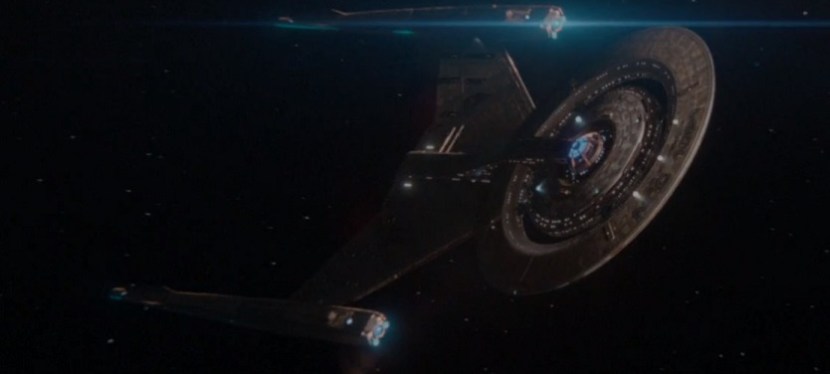
Another look at the Star Trek: Discovery Season 3 trailer

Spoiler Warning: There will be spoilers ahead for Star Trek: Discovery Season 2, and we’ll be looking in-depth at shots and scenes from the trailer for Season 3.

First of all, I hope you like the new look of the website’s homepage. It took a little while to get everything configured – and there are still some things to do. If the new logo and header-image look amateurish like they were made in Microsoft Paint, well… that’s because I made them in Paint. I never said I was a Photoshop expert!

When I logged into Facebook this evening, one of the first posts I saw was from the official Star Trek page – and it got me very excited! “The first Star Trek: Discovery Season 3 trailer has arrived”, or so proclaimed the post. The actual trailer – which you can find by clicking or tapping here (warning: leads to an external site) – was simply a repost of the only trailer we’ve seen for the season so far. Cue my disappointment!
The USS Discovery, pictured in the trailer.

While I might be overthinking things, I wonder if this marks the beginning of a social media push leading up to an announcement of the season’s release date – all we know so far is that it’s coming some time this year. I’d hoped to see a release date – or even just a release month – when the finale of Star Trek: Picard was released at the end of March, but ViacomCBS chose not to use that opportunity to plug Discovery. And that’s probably because of the pandemic causing delays to Discovery’s post-production work. Anyway, that’s not why we’re here.

Star Trek’s website and official Facebook page have chosen to republish the trailer, and while it isn’t exactly clear why they’ve done so (or why now), it does present us with a good excuse to take another look and see what we can gleam. The trailer was first published at New York Comic-con in October 2019, which was before I founded this website. While I’ve referred to the trailer a number of times in other articles, this will be my first breakdown of it in its entirety.

If you haven’t seen the trailer and want to head into Season 3 unspoiled, or if you haven’t seen Season 2 yet and want to avoid spoilers, this is your last chance to jump ship!

The very first shot in the trailer depicts Burnham – still in her Red Angel suit from Discovery’s finale – having crash-landed on a planet or moon. Obviously exiting the time-wormhole was not smooth, and while she’s survived the impact, she’s had a rough landing. The next frame shows her opening what looks like an emergency kit, and we see a phaser, a communicator, and a couple of other miscellaneous devices. The main takeaway from the way the trailer opens is that Burnham’s arrival in the future was difficult. I wonder if we’re seeing a hint that something went wrong – maybe this isn’t the full 930 years that she initially expected to travel. While I’ve all but given up on a link-up between Discovery and Picard, I still think keeping the franchise’s timeline as streamlined as possible makes sense. Either way, this crash-landing aftermath must surely be from the first episode of the season.

Burnham’s emergency kit.

“I’ve spent a year searching… for that domino, that tipped over and started all of this.” So says Burnham in a voiceover, as we see a brief progression of her as her hair grows out – a great way to represent the passage of time! The biggest questions I have from this sequence are – where is she? It looked like she was in a shuttlecraft, and while I couldn’t see exactly, the window of the shuttle looked dark, perhaps indicating she was in space? But Burnham arrived with just the Red Angel suit, so whose shuttle is it? Secondly, what is the “domiono” she’s referring to? Obviously we assume it to mean Control – the rogue artificial intelligence from Season 2, whose aggressive pursuit forced her to hide in the future in the first place. And that may absolutely be the case – but it could be a misdirect.

If we look at this sequence, it could be referring to events from later in the trailer – the loss of hope of the Federation official and/or the fighting group of Andorians, Lurians, Cardassians, and others. Burnham seems to have agreed to take on a task, later in the trailer, for the unnamed Federation official, and her remarks in the voiceover could be referring to that and not to Control.

The next shot is very brief, but it shows us a group, seemingly led by an Andorian, using a directed energy weapon of some kind – possibly aboard Discovery, but I couldn’t be 100% sure on that. This is one point I’ve picked on in previous articles – if 930 years have passed, shouldn’t there be better and more powerful weapons? What the Andorians were holding looked like big, chunky phasers, and the directed energy weapon they used sent some kind of shockwave, but it didn’t look like anything 23rd or 24th Century Starfleet couldn’t have had. Perhaps this is related to the broader setting being a kind of stagnant or even post-apocalyptic look at the future.
The Andorians.

We’re introduced to the new character of Booker – played by British actor David Ajala. He and Burnham walk across a landscape, and while we only see a snippet of their conversation, it’s an interesting one! Firstly, I love the location chosen for this trek. The moss-covered rocks look different and otherworldly, as well as being natural and unspoiled. One of the points of criticism you may remember me levelling at Star Trek: Picard was that all of the planets Picard and his crew visited – and indeed all of the different places they went on Earth, like France and Japan – looked exactly like California. Discovery, unlike Picard, is filmed in Toronto, so naturally they have a whole different set of filming locations to use. As someone largely unfamiliar with those locations, seeing them immediately gives the show a different look and avoids that repetitive feeling that built up across Season 1 of Star Trek: Picard.

Booker refers to Burnham’s Starfleet badge as representing a “ghost”. There are a couple of points to break down from this. Firstly, it’s implied that Starfleet as an organisation either no longer exists, or that no Starfleet vessel has ever been to Booker’s part of the galaxy, leaving him to consider the organisation little more than a legend. However, the good news is that Booker recognises the symbol – even if he’s never seen a Starfleet ship or met a Starfleet officer, the organisation is something he’s at least aware of and vaguely familiar with. Starfleet having been disbanded, or being reduced in size and effectiveness such that many people have never seen it, would tie in with the depressed Federation official that we’ll come to in a moment, as well as what seems to be the overall theme of the season – restoring hope to the people of this era.

The next sequence introduces the Federation official. He seems to be on a space station – that’s my guess, at any rate – and he unfurls a flag that is definitely worth a second look. The Federation emblem that we’ve seen a number of times in previous iterations of the franchise has far more stars than the one seen here. Stars on flags can represent states or regions that are members of the organisation – as we see with the flag of the United States, for example. The loss of many stars from the Federation flag could thus be seen as those worlds having seceded from the Federation. I think seceded seems more likely than them having been conquered by an outside power, because in such a case I’d have expected the Federation to consider those worlds still being its own.
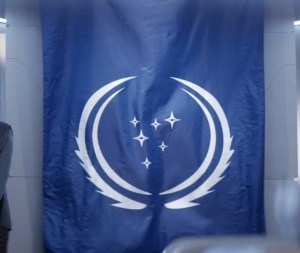
The flag with the “missing” stars.

I didn’t like what the Federation official had to say, at least in part. I’m sure we’ll learn more when the season debuts as to why he’s been at this post, and what he’s been waiting for all this time. That part I have no issue with. But where Discovery has come undone at points in its first two seasons is where it was a show solely about one character – Burnham. Putting her at the centre of stories in which she, and she alone, was capable of saving the ship, crew, and indeed the whole galaxy weren’t the high points of Discovery, at least not for me. Sonequa Martin-Green plays Burnham very well, but as a protagonist Burnham can be very hard to root for at times. She can come across as self-assured to the point of arrogance, and her slavish devotion to her own interpretation of what seems “logical” can overcome her common sense. These are traits embedded in her by her Vulcan upbringing, and while we’ve seen Burnham emotional and suffering setbacks, I don’t feel that the idea of making every season a “Burnham saves the universe” story is a great idea. I would love if Discovery could give its other crew members a chance to shine – we’ve seen Saru and Stamets come close, but several others have barely got a look-in after two full seasons.

In fact, I think that really is my biggest concern headed into Season 3: another story where Burnham is the only one who can help, the only one who can save the Federation, the only one who can bring hope and peace and blah blah blah. If it was Star Trek: Burnham, maybe that would be okay – but even then I’d still argue we needed a central character with better-written, more easily understandable motivations. It isn’t Star Trek: Burnham, though, it’s supposed to be Star Trek: Discovery, and to me that naming scheme implies more of an ensemble show with other characters allowed some degree of agency instead of plodding along behind Burnham in her shadow.

Burnham has been the focus for Discovery’s first two seasons.

Don’t get me wrong, there’s a lot to like in Burnham’s character and in Discovery in general. I love the show – I even picked it for my favourite television series of the last decade when I wrote a list back in December. I like the dynamic between Burnham and Tilly, for example, and her relationship with Ash Tyler showed how she can be emotional and conflicted. But generally speaking, Burnham hasn’t been my favourite element of the series so far, and after two season-long arcs which largely focused on her, I had hoped for a story that had the potential to bring in other crew members in a bigger way this time around. Who knows, perhaps that will still happen – Burnham’s mission might take place entirely off-screen and for the whole season we’ll hang out with everyone else!

The trailer re-emphasises the “930 years” into the future setting, and at this point it should be said that that looks very likely to be accurate. There’s no reason to be deliberately dishonest, and since the setting looks very much unlike what we saw, for example, in Star Trek: Picard, I think we have to take it as fact for now.
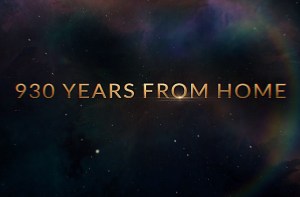
Discovery’s third season setting (probably).

This next part might be my favourite. Deep Space Nine gave us a deeper look at the Trill race, who had been introduced in The Next Generation. Jadzia Dax, and later Ezri Dax, were both Trill main characters, and in case you need a recap, the Trill were a conjoined species with a humanoid and a non-humanoid living together in one body. The non-humanoid symbiont was very long-lived and would be joined with several humanoid Trill over its lifetime. The pool depicted in the trailer looks like one seen in Deep Space Nine on the Trill homeworld, and we also see several Trill characters in the next shot. As far as we know at this stage, no Trill main character has been announced for the show. However, the species will clearly feature in some form. I can’t help but wonder if a return of Dax is on the cards. Trill symbiots could live for centuries – how many centuries is unclear. It’s at least plausible that the Dax symbiont could be alive in this timeframe, and even a cameo appearance would be an incredible callback to Deep Space Nine.

Saru gives an empowering speech in the next sequence. I would guess he’s now captain, or acting captain, unless a new character gets parachuted into that role. Both Capt. Lorca and Capt. Pike were great in their stories in Discovery’s first two seasons, but the lack of a recurring, permanent captain has left the show feeling, at points, somewhat rudderless. If there is to be fourth season – which it seems there will be – getting some continuity at the top is important for the show, I feel. Saru would be a natural fit for the position, as he’d been first officer and he’s a character we’re familiar with. I liked his speech, which was a rallying cry to “make the future bright”.

We also see Burnham reunited with the rest of the crew. It seems that this didn’t happen right away upon arriving in the future, and that may be tied to her “waited for a year” comment from earlier in the trailer. The reunion was nice, though, and seeing everyone happily back together felt good – something I hope translates to the full episode!

We see various members of Discovery’s crew, confirming that they all survived the trip through the time-wormhole. I wasn’t expecting any casualties as of the end of Season 2, but Burnham’s rough landing could have meant that the ship suffered a similar fate. Luckily this seems to have not been the case.
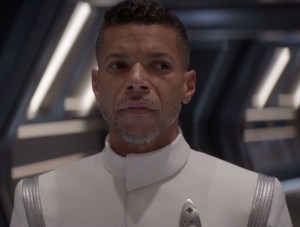
Dr Culber – and the rest of Discovery’s crew – seem to have survived their time-wormhole journey.

We see a couple of shots of Discovery being repaired – whether this is damage from the time-wormhole or from fighting a faction in the future is unclear. Interspersed with those shots we also see fighting between Discovery’s crew and what looks like the Andorian-led faction. Among the races seemingly working together in this group are Cardassians, Lurians (i.e. Morn’s species), and humans. Up next is confirmation that former Empress Georgiou made the trip with the rest of Discovery’s crew. Michelle Yeoh, who plays the character, is scheduled to headline the upcoming Section 31 series, which as far as we know is supposed to be set in the 23rd Century. How that circle will be squared is anyone’s guess at this point, but presumably she will have to travel back in time before the end of the season if that is to happen.

The trailer ends with Burnham telling the Federation official that she will go “wherever the answers are”. The obvious question this poses is: answers to what? It’s possible, in this scene, that Burnham is searching for the USS Discovery – that it has somehow become lost and she needs to locate it. However, it’s equally possible that it’s referring to something else entirely, something that may be connected to the Federation’s decline or demise in this time period. It could even be something related to the Control AI.

I’ve written previously why I don’t think a post-apocalyptic setting is a good fit for Star Trek, and I stand by that. The underlying premise of Star Trek, going right back to The Original Series and remaining consistent ever since, is that humanity had beaten the odds, overcome innumerable obstacles, and built a great future for ourselves and others. The tension and drama in Star Trek stories could come from external threats to the future we’d built, but never from that future not existing or having already been torn down. Changing that premise changes Star Trek at a fundamental level, and I’m not sold – at least, not yet – on that being a positive change. However, despite how the trailer feels overall, Discovery’s third season may not have a truly post-apocalyptic setting, and I think that’s something I’m hoping for.

Learning more about this renegade or rebel faction does absolutely interest me. I hope they have an interesting leader and genuinely understandable motivations for being opposed to Burnham and Discovery – and aren’t just “evil for the sake of it” villains. The reintroduction of the Cardassians and Andorians was fantastic – we haven’t seen the Cardassians since Deep Space Nine went off the air. Hopefully they’ll have named characters and won’t just be making cameos in the background. I’d love to know more about what happened to Cardassia after the Dominion War – but given that the season purports to be 800+ years in the future from that event, it probably won’t be discussed, at least not in detail.
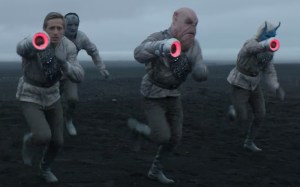
A Cardassian (second from the left) can be seen briefly, along with a human, a Lurian, and an Andorian.

Otherwise, the trailer was interesting in parts, potentially concerning in others. Season 2 was definitely the better of Discovery’s offerings so far, and I hope that the show can build on what it’s already accomplished, while giving some of its other characters a chance to be centre-stage. Despite my complaints, Burnham is okay. I don’t hate her as a character and she can be genuinely interesting. But another story where she’s the only one who can save the galaxy, and where everyone else is just along for another ride on the Burnham Express isn’t something I’m particularly excited about. Star Trek works best when a diverse cast of characters work together, and when each of them gets a turn to be the focus of a story and to have some degree of agency. Saru got a couple of episodes in the first two seasons – Si Vis Pacem, Para Bellum in Season 1 and The Sound of Thunder in Season 2 looked at him and his people. Stamets and Culber have had moments across both seasons too, and Tilly got a sub-plot in Season 2 focusing on a race that lives in the mycelial network. But largely the show has been about Burnham, and the biggest stories put her firmly at the centre. Shaking that formula up, even a little, would be great in my opinion.

Overall I’m really looking forward to Discovery’s third season – even if a couple of points make me nervous! Revisiting the Trill and Cardassians definitely piqued my interest, and I’m curious to see whether the 930-year time jump is actually completed. If Burnham and the crew end up in the far future, I hope the show will take time to slow down and give us a recap of some of the big events that have taken place in the galaxy since we last saw it.

So I’m still a little confused as to why the official Star Trek website and Facebook page republished the trailer. Perhaps there will be more details to come, or even a new trailer or release date, in the coming days. If I spot anything new, you can be sure we’ll discuss it here!

The trailer for Star Trek: Discovery Season 3 may be found on the official Star Trek website and Facebook page. The Star Trek franchise – including Star Trek: Discovery – is the copyright of ViacomCBS. This article contains the thoughts and opinions of one person only and is not intended to cause any offence.

“Old” versus “New” Star Trek

Spoiler Warning: While this essay doesn’t go into many plot details, there may be minor spoilers ahead for the Star Trek franchise, including for Star Trek: Picard and Star Trek: Discovery.

I’ve seen a number articles and videos over the last couple of years, really since Star Trek: Discovery premiered, looking at how the Star Trek fanbase has become divided into fans of “old” Star Trek and “new” Star Trek. However one may feel about the various films and series, it’s undeniable that there are many Trekkies who have jumped ship over the years and do not consider themselves fans of the franchise’s newer iterations – as well as plenty of casual viewers who have seen one series but not others. Given that the franchise is well past its fiftieth anniversary, perhaps that’s fair enough. But I did want to take a look at the phenomenon for myself and give my thoughts on how the franchise is split, some of the possible causes, and what that split could mean for the franchise going forward into the 2020s and beyond.

True hipster Star Trek fans only watched Star Trek when Jeffrey Hunter was in it. William Shatner? Pfft. Newbie.

Firstly, the question often asked in these articles is “how can everyone come back together?” Writers will often set up that question, pretending that they’re going to answer it fairly, only to basically end up saying “everyone will come back together if Star Trek does everything my way and gives me everything I want.” That just isn’t realistic, I’m afraid. And as with many cases of division, the reality is that there may not be a way to bridge the gulf and reunite everyone around one new Star Trek series or film. That may sound depressing, and it is in a way. But we have to be realistic – there are some people now who are literally making money from running anti-Star Trek groups online, and if anyone expects someone in that position to suddenly turn around and say “hey guys, I just saw the latest episode and it was amazing!” well, I’ve got a bridge to sell you. The truth is that some people aren’t interested in fair criticism. They have decided they want to hate, and just like fans of a football team could never support a rival club, no matter what, their hatred for the current and upcoming lineup of Star Trek shows and films will continue. It’s part of the tribal mindset that we as human beings all end up subscribing to in one way or another: “I support X, which is opposed to Y. Therefore, I can never ever like Y, because it would go against how I define myself as a person”. That’s true in sport, it’s true in politics, and it’s true in entertainment as well.

But before we can look at divisions in the fanbase, we need to examine the basic concept: what is “old” Star Trek, and what is “new” Star Trek? It’s a far more complicated question than it seems, and the answer will vary depending on how old a person is, and when they first encountered the franchise.

The bridge of the original USS Enterprise in the episode The Corbomite Maneuver. For many fans, The Original Series and its crew were irreplaceable.

There are several “turning points” in the history of Star Trek where fans jumped ship, and the easiest way to look at them is in chronological order. The first one was in 1987, when The Next Generation premiered. Until this point, Star Trek had been The Original Series with Kirk, Spock, McCoy, and the rest of the 1960s crew, and while there was excitement for Star Trek’s return to television – just as there was in 2017 – that was countered by a vocal number of fans who believed ardently that the original characters were the beating heart of Star Trek – and were irreplaceable. These people may have watched The Original Series and the first four Star Trek films (The Final Frontier and The Undiscovered County were released after The Next Generation premiered) but simply had no interest in a new crew, a new ship, and a new century. Indeed, Sir Patrick Stewart himself has said many times that he believed The Next Generation would not be a success – and would run for perhaps two seasons at most.

The NX-01 Enterprise leaves its dock in Broken Bow – the series premiere of Enterprise.

The second turning point is the one I’m most familiar with – because it’s the point I came very close to jumping ship myself: 2000-2001, when Enterprise was announced and entered production. In the aftermath of the disaster that was Star Wars Episode I: The Phantom Menace in 1999, a prequel was just something that many fans, myself included, had little interest in. Star Trek – as I have often written here on the blog – had always been about pushing forward into the future, and yet here was a show that wanted to look back at its own past. This kind of navel-gazing just didn’t feel like a good idea, and the aesthetic of the show, with its boiler-suit uniforms, clunky starship design, modern (for the time) computer screens, and overreliance on not-quite-good-enough early-2000s CGI was not inspiring. There had been some real stinkers in the Star Trek canon when it came to individual episodes and stories – Spock’s Brain, Angel One, Shades of Grey, Threshold, and Move Along Home to name but a few – but this was the first time that the premise of a series itself seemed unexciting, at least for me. The introduction of Scott Bakula as the captain did go some way toward lifting the show for some fans who had been on the fence, but I confess that during Enterprise’s original run here in the UK I only tuned in sporadically, and it was only when I got the series on DVD a few years after it went off the air that I watched it in its entirety. Nowadays I often cite Enterprise as an example whenever I hear the argument: “nobody asked for this”. Nobody in 2000 was asking for Enterprise, yet it actually told some interesting stories and had a great cast of characters. I’m glad to have seen it, I’m glad it existed, and ultimately I feel its strengths far outweighed its weaknesses. Giving it a second chance was a good decision – even if the only reason I bought the DVDs was to complete my Star Trek collection!

The 2009 redesign of the USS Enterprise – and re-casting of the original crew – was too much for some fans.

Next comes our third turning point: when Enterprise went off the air, a spell was broken. Star Trek had, in some form, been in continuous production for almost two decades, beginning with pre-release work on The Next Generation in 1986 running all the way through to 2005 when the final episodes of Enterprise were produced and released. The cancellation of Enterprise was symbolic – the end of an era. And in that moment it seemed as though Star Trek was dead and not coming back. But it didn’t stay that way for very long at all, and within a year or so of Enterprise’s cancellation, word started going around about a new film – one which would be a reboot, recasting iconic characters like Kirk, Spock, and McCoy. For many long-term fans – including some friends of mine – that was a bridge too far, and they were never interested in what would become 2009’s Star Trek and the “JJverse” or Kelvin timeline that it spawned. For others, Star Trek was too much of a departure from the rest of the franchise, with its visual overhaul and action-heavy story, and some fans who did give it a go were underwhelmed and didn’t come back for more.

The USS Discovery, as seen in the first official teaser trailer in 2016.

So we’ve reached the final turning point. 2017, and the premiere of Star Trek: Discovery is the moment that many of these articles and videos use when dividing “old” Star Trek from “new” Star Trek. Discovery had a somewhat troubled production, with Bryan Fuller departing before the show aired, and controversy surrounding CBS All Access as a platform for the show in the United States. There was also the “prequel problem” that plagued Enterprise, and as more details came out about the series, the visual style being more in line with the JJverse than The Original Series also became a bone of contention. As with each of the three previous turning points, a number of fans decided that Discovery just wasn’t for them and simply opted out.

The point of recounting this history of the Star Trek fanbase and the points at which some fans chose not to continue with new iterations is simple – this is not a new phenomenon. It has happened before in Star Trek, and, if we’re lucky enough for the franchise to continue into the future, it will undoubtedly happen again sooner or later. None of these moments destroyed the franchise or ruined the fanbase, nor drove Star Trek’s creators and promoters out of business for the simple reason that the fans who jumped ship were in the minority. A vocal minority, perhaps, but a minority nevertheless. And it’s the same with those who haven’t watched Discovery and Picard – and of course, those who make a big fuss about not supporting “new” Star Trek in online groups and on YouTube channels: they’re a minority.

“Real” Star Trek fans love The Final Frontier.

Trekkies have always been a minority of Star Trek’s audience. It’s a commercial product; a series designed to have appeal beyond a small niche of convention attendees. If it didn’t appeal to casual viewers it would never have survived or been reborn in the first place, at any of the points mentioned above. So to say that because a small number of Trekkies who liked the TNG-era shows don’t like Discovery there’s somehow a massive problem and that Star Trek today is fundamentally broken is nonsense. A minority of a minority, no matter how vocal they may be with their criticism and hate, don’t matter to ViacomCBS’ bottom line in any material way.

But do they have a point?

It’s a tough one for me to answer, and if you’ve been here before you’ll know why: I’m a big fan of “new” Star Trek, just as I’m a fan of “old” Star Trek too. I can see the point of view that says the newer shows and films are bad, but generally I don’t agree, so from my perspective they don’t have a point. Especially to those people who pre-judged Discovery and Picard based on what they read in anti-Star Trek groups online and never even watched the shows in the first place I’d really say they don’t have a leg to stand on in this argument. How can they possibly sit there and say something is bad when they haven’t given it a try for themselves? The biased “reporting” of some anti-Star Trek YouTuber is not the same as experiencing the film or series for themselves, and I’d really encourage everyone who falls into that category to at least stick with Discovery beyond its opening two episodes, which I fully concede were especially weak.

This actually ties into another point – most Star Trek series, with the exceptions of Deep Space Nine and Picard – opened quite underwhelmingly. And it took more than a few episodes for all of the Star Trek shows to really find their feet. The Next Generation’s first season isn’t anywhere near as good as its third, fourth, or fifth, for example, and Voyager similarly took at least a full season to get up and running. Even the beloved Original Series got off to a rocky start – so giving up on Discovery or Picard after one or two episodes isn’t really giving those shows a fair shake.

Lorca and Saru in Star Trek: Discovery.

Part of this is to do with binge-watching culture. For many Star Trek fans – and I include myself in this category to an extent, especially when it comes to Enterprise – they missed out on seeing most or all of “old” Star Trek when it originally aired. They could pick and choose which episodes to watch from DVDs or on streaming platforms, and watch them anytime they wanted to. Star Trek, to many Trekkies, was a complete product. Seven seasons of The Next Generation, Deep Space Nine, and Voyager, as well as three of The Original Series and four of Enterprise is a lot to wade through, and an individual bad episode is just a blip when you don’t have to wait a week for the next one and can skip ahead to another episode on the disc.

But there are changes in the way Star Trek has told stories over time, and we do have to acknowledge that. There has been a move away from episodic storytelling (aka the “monster-of-the-week” format) in favour of season-long story arcs and a serialised format. I confess I have a preference, in some cases at least, for episodic television. It’s nice to be able to jump into a random episode of a series without needing to know or remember everything that happened leading up to that point. It makes Discovery and Picard season-long commitments, instead of something fans can jump in and out of. And because, as mentioned, a lot of folks are used to Star Trek shows being complete products and in addition are used to binge-watching, having to wait a week between episodes of a partially-complete story can be annoying I suppose.

There has also been a shift away from the more ethereal, philosophical, and thought-provoking storylines that Star Trek used to do. Ironically, many of those stories and episodes are less popular among fans – The Motion Picture is always considered a poor relation to films like First Contact and The Wrath of Khan, which are both much more in the action-sci fi genre, just to give an example. I discussed this in a little more detail in my 40th anniversary look at The Motion Picture if you’re interested to read more. But there’s no doubt that Discovery and especially the JJverse films have gone in a much more action-centric direction, and for people who wanted to see more of the slower paced, thought-provoking stories, action-sci fi maybe doesn’t “feel like Star Trek” in quite the same way.

Kirk and Scotty in The Motion Picture – a less popular film than its sequel with many Trekkies.

Now we come to what is the single biggest point: nostalgia. People like what they grew up with. Heck, the whole reason Star Trek is being made again now, more than fifty years since it was first created, is because nostalgia is incredibly powerful and there’s money to be made from it. But nostalgia is a double-edged sword. Some people don’t want to see an “updated” version of the franchise they loved from childhood or young adulthood. If they want more of it in the first place, they want to see it exactly the same as before. No changes, no iterations, no modernising – a carbon copy of what came before. And that isn’t realistic.

Television storytelling has moved on since the 1960s and the 1990s – which are the two “golden ages” of Star Trek, depending on which fans you ask. Expecting to see The Next Generation Season 8 in 2020 was an unrealistic expectation. The way stories are told, and what television audiences expect from their shows, are just different nowadays. For fans of episodic television that might seem disappointing, but as with Trekkies in general we’re in a minority there. Shows like Lost, Breaking Bad, and of course Game of Thrones had such a huge impact on television that they fundamentally changed the way audiences approach their favourite franchises – and in order to stay competitive, Star Trek has to recognise that and keep up.

There are undeniably a lot of positive feelings attached to a franchise from childhood. The return of Star Trek (and other franchises too, like Star Wars) was designed to play on those positive feelings to sell a product – that’s basically the point of resurrecting franchises in the first place. For a minority of fans who only liked things when done the old way, that hasn’t worked and the updates and changes mean they don’t get the same feelings that they do when re-watching an old episode or film. But for a lot of people, these shows have been a hit. They hit the mark where it mattered and got many fans clamouring for more. And in a few years or a few decades from now, Discovery-era fans will be just as excited for the return of Burnham and Saru as I have been to see Picard and Seven of Nine.

Seven of Nine returned in Star Trek: Picard.

In fact, one of the things I was genuinely concerned about with Star Trek: Picard is that they were going to fall into the Star Wars trap of overplaying the nostalgia card. I didn’t want The Next Generation Season 8, because that show has ended. It’s over. What Picard represented is something practically no other series or franchise will ever get – a new iteration. Picard is the same man, and he’s the core of the show as he was in The Next Generation. But surrounding him are new characters, and I wanted to make sure that they would have the chance to become fan favourites for the next generation (pun absolutely intended) of Star Trek fans.

My introduction to the franchise was The Next Generation. And it wasn’t until a few years later – probably in the mid-1990s – that I got around to watching any of The Original Series. For some people, Picard and Discovery will be their first port of call as Star Trek fans, just as The Next Generation was for me. Those of us who’ve been around Star Trek for twenty-five years or more still have a place in the fandom, but things are changing. With new shows in production, new fans are coming on board who may not be aware of Picard’s top-secret mission to Celtris III, or that Kirk and his crew once visited a parallel universe where magic is real. If we try to be gatekeepers and say “you aren’t a real Star Trek fan because Discovery isn’t as good as the show that I like” then the fandom isn’t just going to be divided, it’s going to become toxic. Instead of being a “big tent”, recognising that the franchise means different things to different people, some folks seem to want to claim the fandom for themselves and exclude anyone who doesn’t share their belief about what Star Trek means.

And frankly, that’s just sad.

Star Trek has always tried to use its science fiction setting to tell stories that reflect contemporary issues. There are countless examples, and this could be an essay in itself, but suffice to say many of those stories resonated with fans in the past. The Original Series challenged the Cold War concepts of superweapons and mutually assured destruction in the episode The Doomsday Machine to great effect, and fans will laud that. But when Discovery uses Ash Tyler’s trauma as an analogy for underreported male sexual abuse, those same folks scream about “too much politics”. As I’ve said before, to anyone who says there’s “too much politics” in modern Star Trek I’d ask one simple question – “have you seen Star Trek before?”

Spock and Kirk at the end of The Doomsday Machine from Season 2 of The Original Series. They talked about nuclear weapons – a massive issue in the 1960s.

The problem here is that, when it comes to The Original Series and the shows of The Next Generation’s era, we’re watching them decades on from their original release. Many of the people complaining about politics in modern Star Trek weren’t even born when The Next Generation and its sister shows were first on the air. And very few people now can remember watching The Original Series when it was new. The political themes in many of those episodes are less prickly and less relevant today, and though they would be instantly recognisable to contemporary audiences, watching them today fifty years later or thirty years later, they’re harder to spot. And if someone is watching an episode for the tenth or twentieth time, an episode they first watched at age five or six, it’s even harder to be objective and pull the themes and messaging out of the drama and presentation. Taking a step back and looking at a favourite show or episode objectively is very difficult. I made an attempt to do so when I re-watched The Measure of a Man from The Next Generation’s second season, but it wasn’t easy.

Star Trek has always been a political show, even if as kids we didn’t realise it. And it has always taken a “progressive” political position on contemporary issues. If an individual can’t stand that, and is only content to watch entertainment that is either wholly politically neutral or agrees entirely with their own political biases, then that’s okay. No one is forcing anyone to watch a television show that they don’t like. And if they don’t like something, it’s easier than ever to change the channel. They can pick a new show on Netflix or Amazon Prime or CBS All Access and watch that instead, or go back to a previous Star Trek series that they do enjoy. Modern Star Trek is not mandatory viewing, and from my own point of view I can tell you I’m pretty brutal when it comes to switching off a show that I find boring or that I’m not enjoying for whatever reason.

In 2020 we live in a world where there is an insane amount of entertainment available to watch – and much of it can be found online for free with a basic knowledge of computing. So I don’t really understand why people would want to spend a lot of time watching a show that they don’t enjoy, then jump online to share their dislike with others – not when there are so many other things to watch. A few people who run websites, groups, or YouTube channels, make money by doing this. And I guess that’s fair enough – if people will pay for it, and you can make money at it, that’s okay. But for everyone else, I don’t really see what they gain from it – aside from the feeling of inclusion being part of a “tribe”, or perhaps a feeling of superiority to think they know better than the show’s creators?

Some people have been unhappy with Star Trek: Picard.

To get back on topic, and draw this essay to a conclusion, there are differences between Star Trek today and Star Trek in the era of The Original Series and The Next Generation. For some fans, the difference is too stark and they don’t want to watch whatever they consider to be “bad”. I’m okay with that – we can all have our own opinions about the franchise. I just don’t like the toxicity and gatekeeping that has plagued some – thankfully small – groups within the fandom.

Speaking for myself, I’ve enjoyed Star Trek’s return to television. Star Trek: Picard has been the better of the two offerings so far, but I’m genuinely excited at the prospect of a Capt. Pike series and at Lower Decks’ different take on the franchise. It’s a great time to be a fan right now, simply because there’s so much Star Trek – and sci fi/fantasy content in general – in production. We won’t always be so lucky to have this, and even though I wasn’t a big Enterprise fan during its original run, I was still sad when it went off the air and there was just a big void of nothing. That isn’t a scenario I’m keen to see repeated, and while I admit there have been hits and misses in modern Star Trek, I’d rather see it continue to be made than simply scrapped. By diversifying the kind of stories it tells – Picard and Discovery are very different in tone, for example, and Lower Decks will be something different again – hopefully Star Trek can build on what has been accomplished already and bring in more people. If some people decide not to stick with it because of the changes, that’s okay. But I firmly believe that the core or the heart of Star Trek is the same as it was in the 1960s – and that it has remained that way for its entire run.

Star Trek is a complicated franchise that means different things to different people. But there is room in the fandom for everyone – at least, everyone who wants to participate. If someone dislikes Picard or Discovery but loves The Next Generation, as fans and as people who know how to behave civilly, we can still have a great conversation about Star Trek without treading on each others’ toes. And it’s my hope that there’s more that unites us as fans of this great franchise than divides us – after all, Discovery and The Next Generation have much more in common than The Next Generation does with, say, the latest iteration of some celebrity reality show. At the end of the day, I’m happy to share a franchise and a fandom with some very passionate people – even if we can’t agree on a lot of things.

The Star Trek franchise – including all series and films mentioned above – is the copyright of ViacomCBS. This article contains the thoughts and opinions of one person only and is not intended to cause any offence.