Let’s Have A 21st Century Christmas!

A festive spoiler warning graphic.

Spoiler Warning: There are minor spoilers for several of the titles discussed below.

Have you ever noticed that *most* of the films and TV specials that we like to watch at this time of year are… kinda old? Even if you don’t go for a real old-school classic like It’s A Wonderful Life or Miracle on 34th Street, most of the festive entertainment that I see being talked about – at least among my peers and folks of a similar age to me – originated before the turn of the millennium.

Think about it: Die Hard came out in 1988. Home Alone is from 1990. A Christmas Story was 1983. The Santa Clause was released in 1994. The Nightmare Before Christmas? That was 1993. The Muppet Christmas Carol came out in 1992.

So where’s the 21st Century in our holiday traditions? That’s a wrong we’re going to right today!
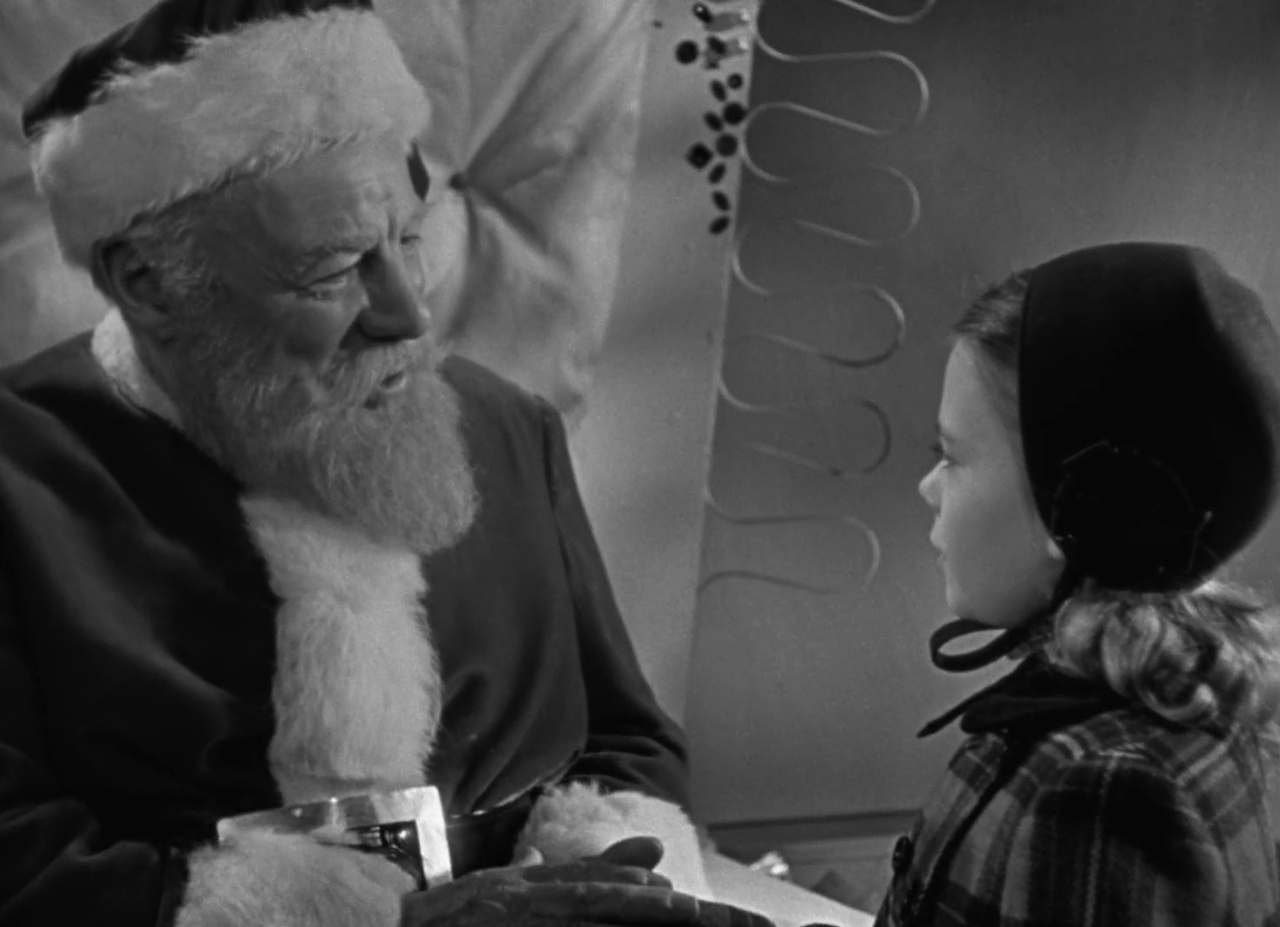
Still frame from Miracle on 34th Street (1947) showing Santa Claus.
Many of our “Christmas classics” are from the 20th Century, like Miracle on 34th Street.

I have really fond memories of this time of year, including watching the likes of 1982’s The Snowman, Mickey’s Christmas Carol from 1983, and the 1996 so-bad-it’s-good classic Jingle All The Way! But there are some wonderful films and TV specials which premiered in the first quarter of the 21st Century that I think some of us can occasionally overlook. And look, I get it: some of these still feel brand-new, even if they’re approaching their 20th or even 25th anniversaries! But Christmas, while a time of tradition and returning to things we’ve enjoyed in the past, still has room for newer and more modern touches.

If you’re British (or if you remember an earlier edition of my annual festive playlist), you might associate the term “21st Century Christmas” with the song of the same name by Cliff Richard! That’s where I got the title of this piece from. And the song itself is well worth a listen, even if Cliff’s idea of “the 21st Century” seems dated already, with lyrics talking of DVDs and faxes! But I think we’ve drifted off-topic…
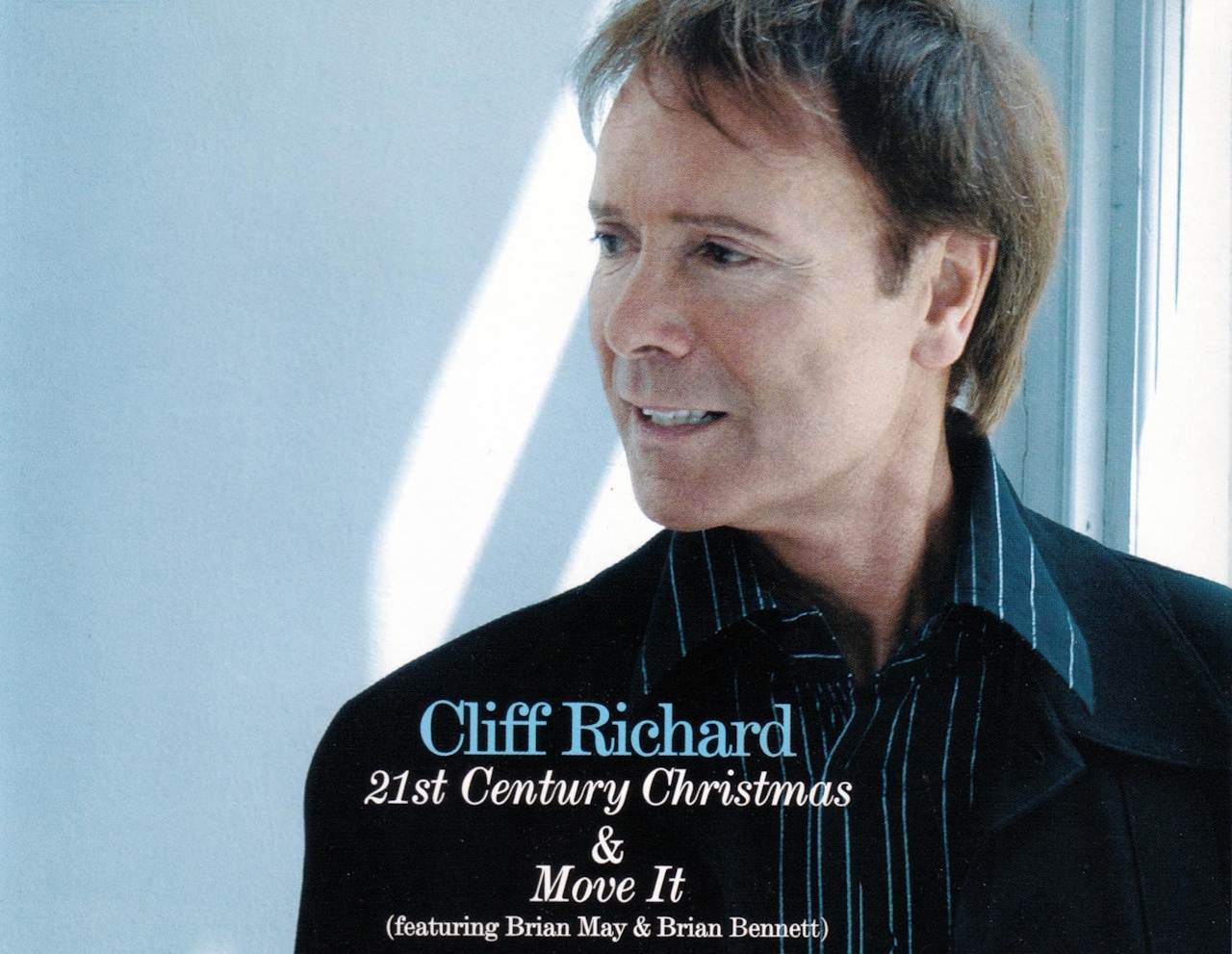
The cover of Cliff Richard's 2006 CD single "21st Century Christmas".
In the immortal words of Cliff Richard, let’s have a 21st Century Christmas!

What I’ve done today is put together a short list of five films and TV specials from the 21st Century that I think are well worth checking out at this time of year. If you missed them when they were new, or haven’t seen them since they premiered… maybe check them out in 2025. We’re almost a quarter of the way through the century, if you can believe that. And I’m still trying to adjust to writing dates where the year begins with a “2!”

My usual caveats apply: everything we’re going to talk about is the entirely subjective, not objective, opinion of one person only. If I highlight something you hate or miss out something you thought would be a shoo-in for a list like this… *that’s okay!* There are loads of fun Christmas specials and films, and I’ve only picked out a handful this time. They’re listed below in the order they were originally released, and I included any Christmassy or Christmas-adjacent film or TV special released after the 1st of January 2001 on my long list of titles under consideration!

With all of that out of the way… let’s have a 21st Century Christmas!

Number One:
The Polar Express
(2004)
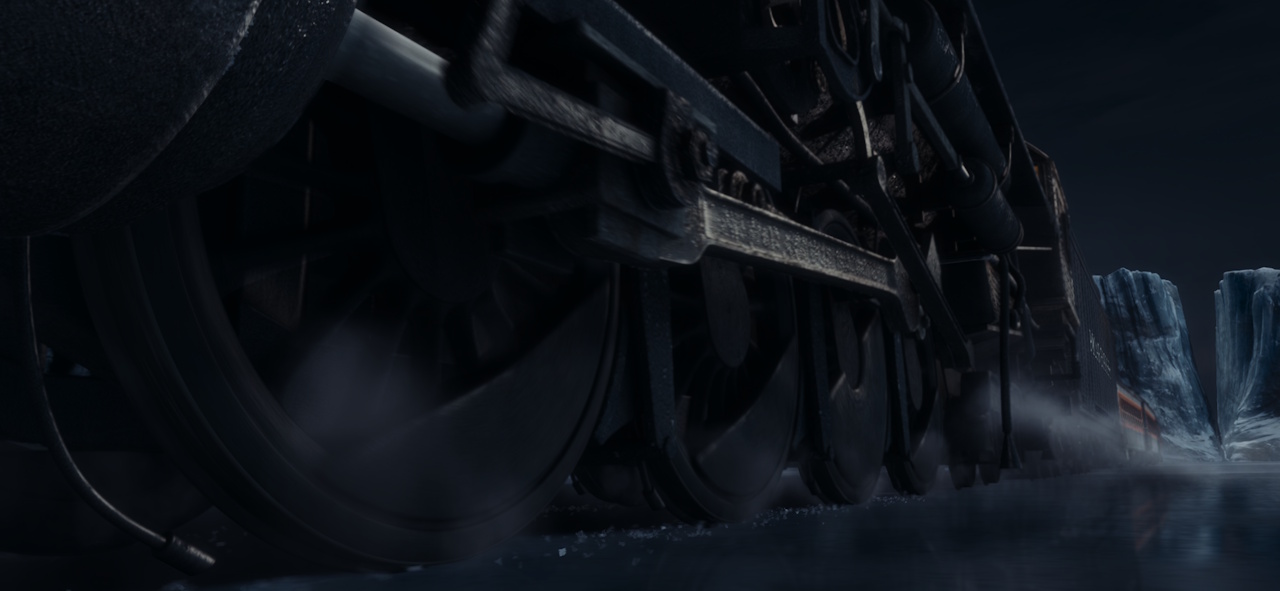
Still frame from The Polar Express (2004) showing the titular train on an icy lake.
The titular Polar Express.

Can you believe that The Polar Express is more than 20 years old already? The film has – in my view – aged remarkably well, shaking off a somewhat controversial start to become a true festive classic. When The Polar Express was released, I can clearly remember a colleague of mine telling me that their young children were frightened of the film and its “creepy” CGI. But as we’ve gotten more used to computer animation in the two decades since, I think that particular criticism of The Polar Express has well and truly fallen away.

This is a fun twist on the classic “does Santa really exist” dilemma that many kids face. And it’s a bold choice for a Christmas film to tackle that question head-on, not simply hand-waving away the young boy’s doubts. Instead, The Polar Express leans into this idea of doubt to tell a really engaging and just plain *fun* narrative that I’m sure continues to resonate really strongly with kids today.
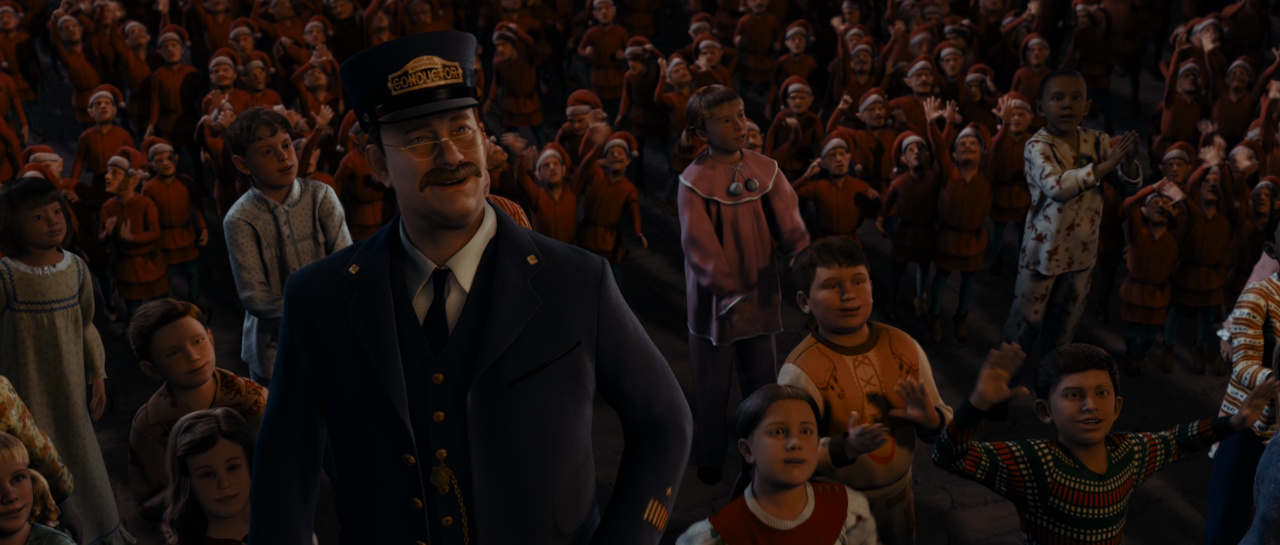
Still frame from The Polar Express (2004) showing the conductor, the kids, and a crowd of elves at the North Pole.
The conductor with some of the kids.

I love a good steam train, and The Polar Express brought a wonderful engine to life with its CGI. Trains are kind of related to Christmas – especially toy trains – so that’s on theme. And there’s a wonderful musical sequence as well as a great score. The theme from The Polar Express has become a classic Christmas track in its own right!

I wrote up a longer piece on The Polar Express last year to mark the film’s twentieth anniversary, and you can find it by clicking or tapping here. I’d be really curious to know what kids who’ve grown up since 2004 – and thus remember The Polar Express as just another old Christmas film – make of it nowadays!

Number Two:
Phineas and Ferb: Christmas Vacation
(2009)
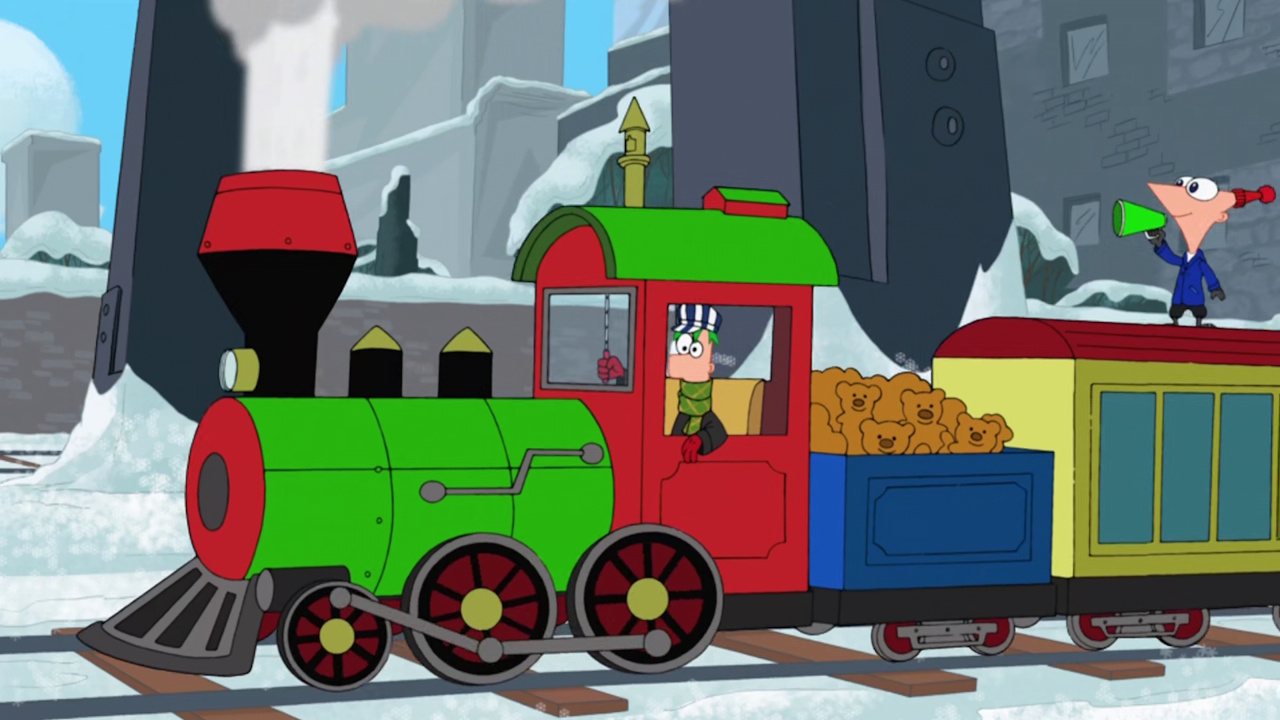
Still frame from Phineas and Ferb: Christmas Vacation showing Phineas and Ferb aboard a Christmassy steam train.
The boys on a train.

I’m a big fan of Phineas and Ferb, so I was pleased to see the series resurrected this year for a fifth season! The show’s big Christmas special, from back in 2009, is one of the absolute best episodes for me, and it puts a distinctively “Phineas and Ferb” spin on a classic holiday premise. When Christmas is endangered (by the nefarious Dr Doofenshmirtz, naturally), someone has to step up and save the day – and that task falls to Phineas, Ferb, Candace, and their friends.

Christmas Vacation also has an incredible soundtrack. Phineas and Ferb is well-known for its songs and musical numbers, but Christmas Vacation packed several great festive tracks into its runtime. Big Bad Voodoo Daddy’s song Christmas is Starting Now, which plays at the climax of the story, might be the pick of the pops, but really, all of the songs are just fantastic. Several of them are on my festive playlist!
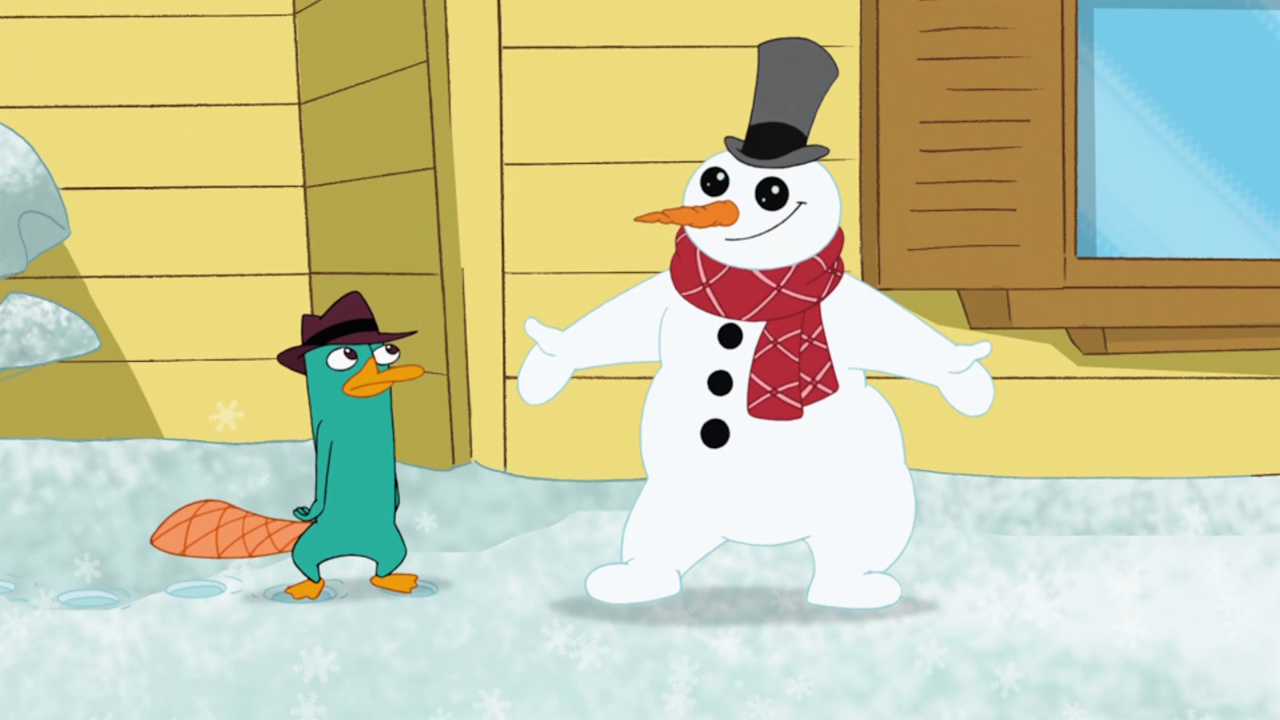
Still frame from Phineas and Ferb: Christmas Vacation showing Perry the Platypus and a magic, sentient snowman.
Perry and a magic snowman.

I’m an absolute sucker for the whole “Christmas is in danger, so someone has to fix it” story trope, and Phineas and Ferb executes it so well. We get some fantastic buildup, with the kids excitedly decorating the entire town as part of their “thank-you letter” to Santa Claus, Doofenshmirtz gets a cute conflicted backstory about his ambivalence towards the holidays, and it all culminates on Christmas Eve with the kids having to do what they do best… with a little help from the North Pole.

Phineas and Ferb: Christmas Vacation is the only Christmas special or movie that I watch, without fail, at least once every festive season. I have done since I first saw it, I think, and it’s become a tradition that I plan to continue for as many Christmases as I’ve got left! Last year, to mark the special’s fifteenth anniversary, I wrote a longer piece about it, which you can find by clicking or tapping here.

Number Three:
Family Guy: Road to the North Pole
(2010)
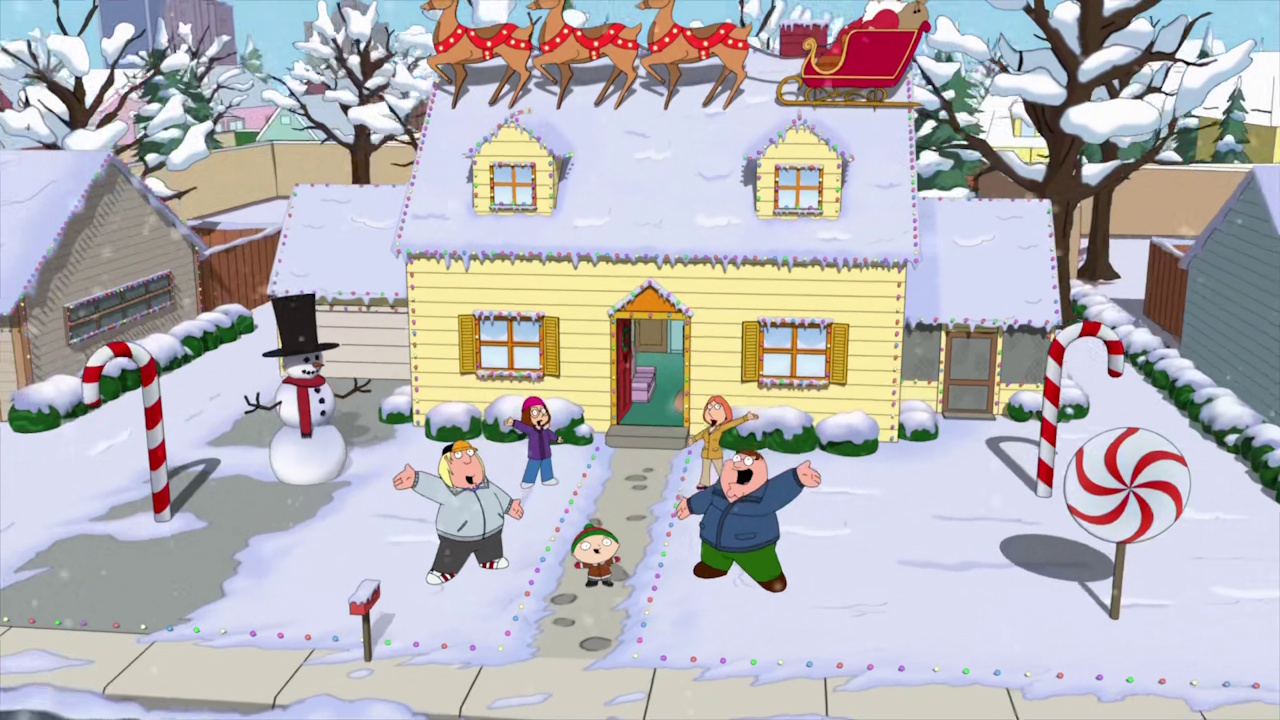
Still frame from Family Guy: Road to the North Pole showing the Griffin family and their house.
The song at the beginning of the special.

Family Guy had a good thing going for a few years with its “Road To…” special episodes, and the format was perfect for this Christmas special. Stewie and Brian take off on a wild adventure to find Santa after a run-in with a fake Santa at the local shopping mall. This kicks off a ridiculous quest that takes several dark turns… but one that has a surprisingly poignant message about consumerism and overconsumption.

Road to the North Pole kicks off with one of Family Guy’s best-ever songs, too: All I Really Want For Christmas, which sees most of the show’s main and secondary characters sharing their silly Christmas wants and wishes. The musical number is fantastic, well-animated, and pretty darn funny, too. I don’t think it’s a stretch to say that Family Guy – like The Simpsons before it – has declined in quality over the years, so maybe Road to the North Pole is one of the last truly good stories.
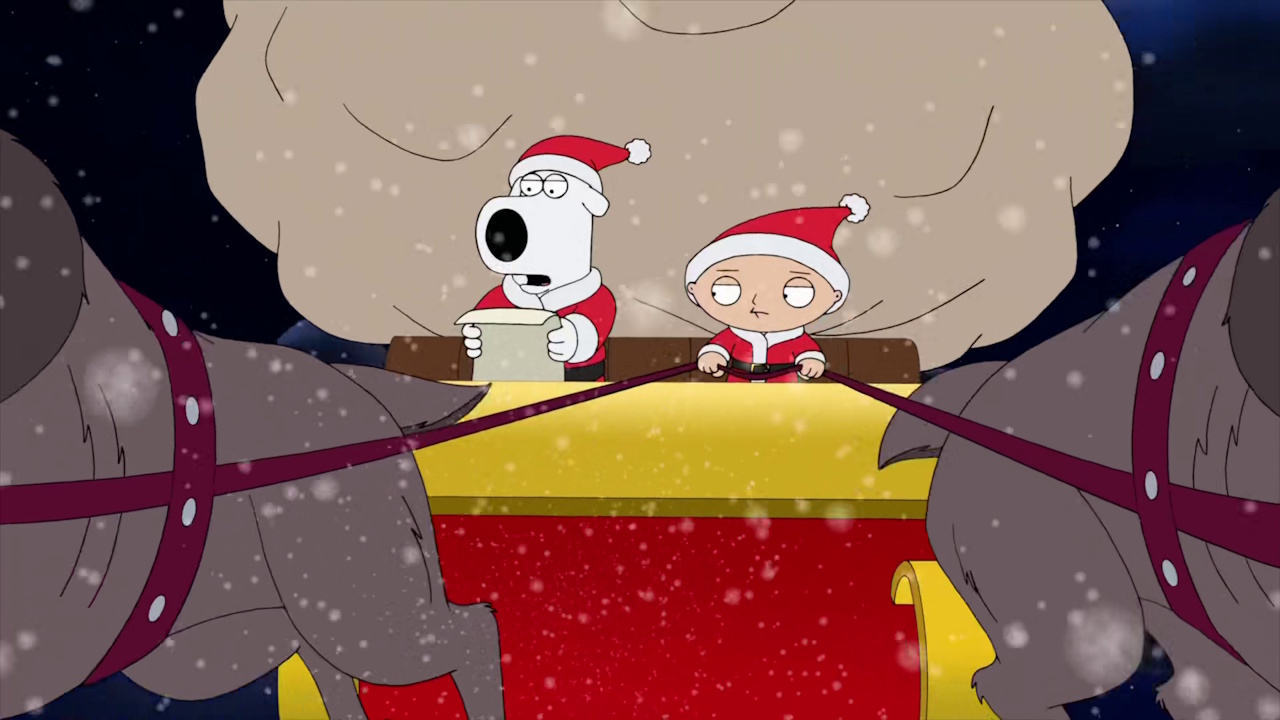
Still frame from Family Guy: Road to the North Pole showing Brian and Stewie piloting the sleigh.
Brian and Stewie on Santa’s sleigh.

Aside from the song – which is hilarious – I think what people remember the most about Road to the North Pole is its depiction of a weak Santa Claus, wasting away, beaten down by the incessant demands of consumerism. And that’s the core message of the special: that people are asking for (or demanding) too much at Christmas instead of being satisfied with smaller gifts, spending time with family, or just what they already have. Though presented in a weird, grotesque, and typically “Family Guy” way, that message is a good one – and a timeless one, too.

What I enjoy most, though, about Road to the North Pole is the road trip itself. Starting at their New England home, Brian and Stewie trek through the United States and Canada, under the Northern Lights, before making it to Santa’s workshop. Though not the biggest part of the special, there’s something about this kind of adventure that’s always captured my imagination.

Number Four:
Doctor Who: The Time of the Doctor
(2013)
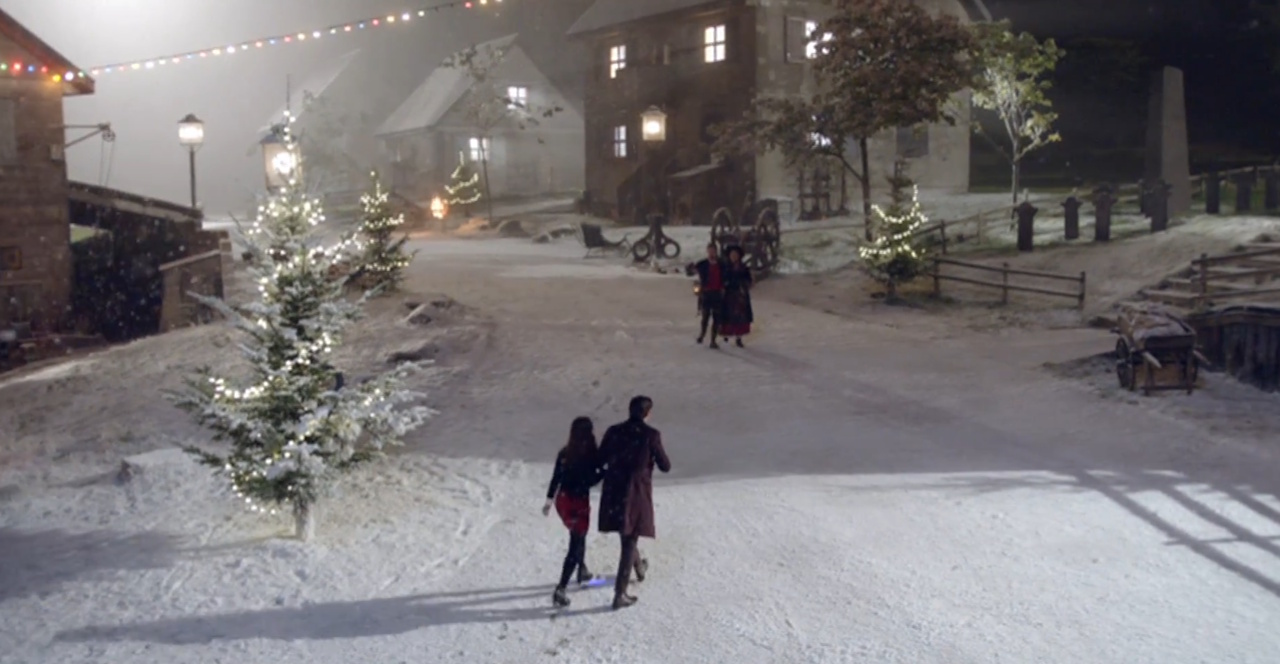
Still frame from Doctor Who showing the planet Trenzalore.
The village of Christmas.


Speaking as we were of a show’s “last hurrah” before descending into mediocrity… here’s Doctor Who! Joking aside, The Time of the Doctor, which came along just after the show’s wonderful fiftieth anniversary special earlier in 2013, is probably the final genuinely good episode of the revival. As much as I adore Peter Capaldi and his take on the ancient time-traveller, his tenure in the Tardis marked a decline in quality from which the show has simply not recovered.

But that’s not what we’re here to talk about!

The Time of the Doctor sees Matt Smith’s Eleventh Doctor battling alone, for decades, against the Daleks and a variety of other enemies, all in defence of a town named Christmas. There’s some snow, some cute Christmas imagery, and a pretty fun and emotional story as this incarnation of the Doctor reaches the end of his life.
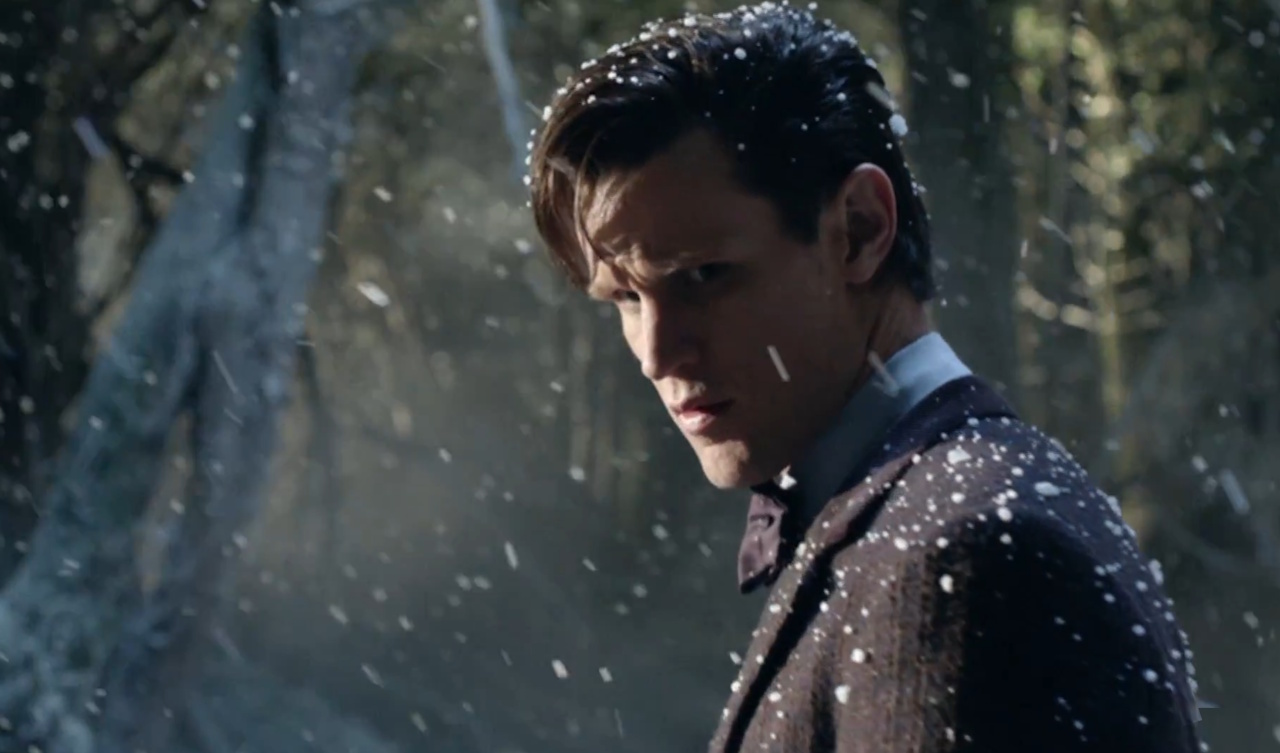
Still frame from Doctor Who showing the 11th Doctor in the snow.
Matt Smith as the Eleventh Doctor.

Doctor Who has done a number of Christmas specials since its revival – and not all of them feel as “Christmassy” as The Time of the Doctor. While it’s still very much the culmination of a multi-story arc, and some of that context *does* add a lot to the final act in particular, I still think it’s something that can be watched and enjoyed on its own merit. I haven’t seen Season 7 of the revived Doctor Who since it was on the air back in 2012/13, but The Time of the Doctor is still fun to return to.

I’ve always found stories about doomed last stands to be intense and emotional, and I think that’s a big part of what makes The Time of the Doctor work so well. It’s a tale of a man caught between two impossible extremes – and his only friend trying to reach him. The stakes are high… but also very personal. It’s a great special – and maybe, in hindsight, it should’ve brought the revived series to an end.

Number Five:
That Christmas
(2024)
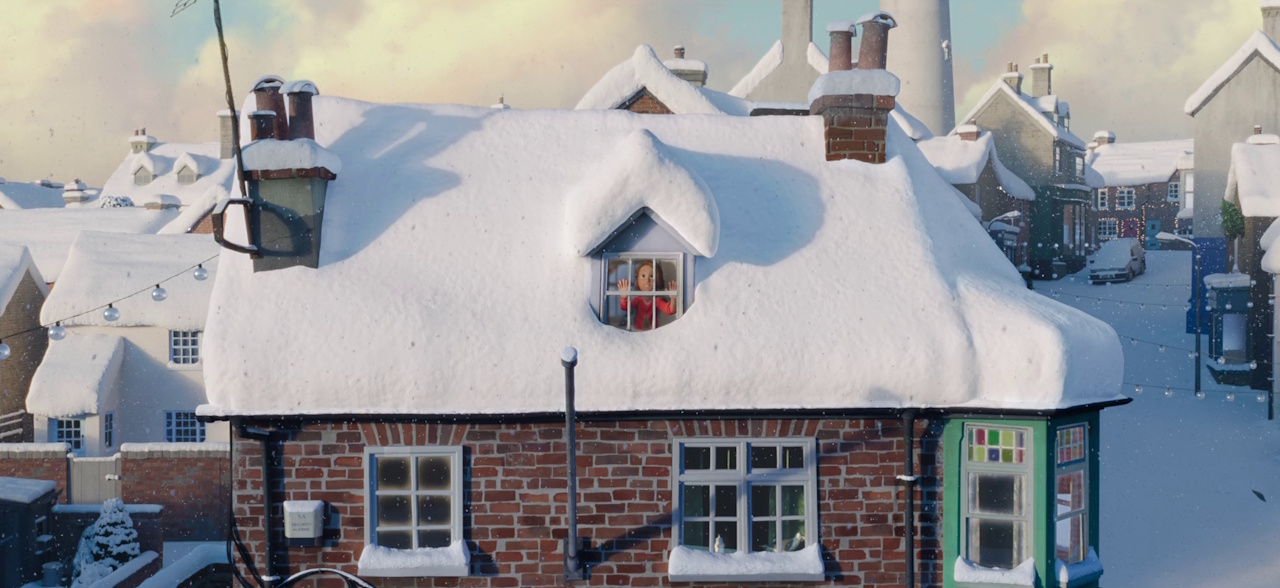
Still frame from That Christmas showing the Beccles' house.
Waking up to a snowy Christmas.

Richard Curtis, who also penned the festive favourite Love Actually, wrote this charming and distinctly British animated Christmas flick for Netflix just last year. And you know what? It’s fantastic. There are definitely echoes of Love Actually, with the film’s cast of characters spread out into different groups, whose stories are all connected in some way. And there’s plenty of the awe and wonder that Christmas time inspires thanks to Santa Claus, a blizzard, and the magic of Christmas Eve.

When you’ve got so many characters, it can be difficult to find enough time to give all of them personalities and motivations, but That Christmas never feels like it has that issue. With the caveat that a few of the adults seem particularly incompetent, everyone involved feels well-rounded and real, and given that the film’s only got a nintey-minute runtime, that’s pretty special.
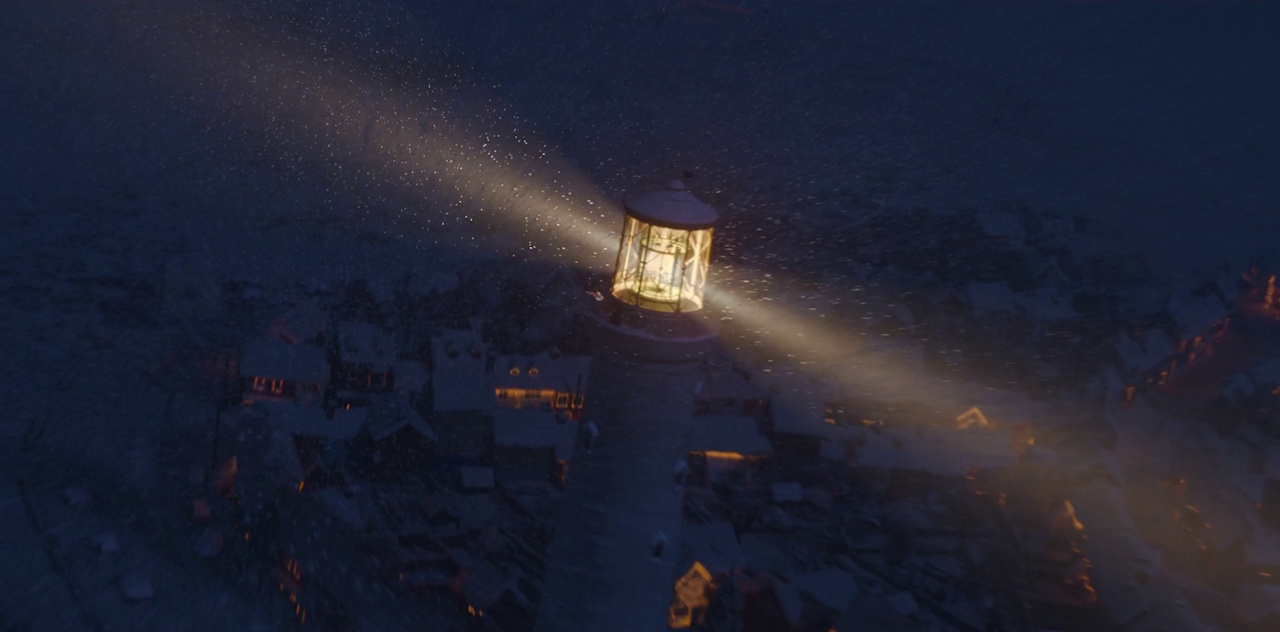
Still frame from That Christmas (2024) showing the lighthouse.
The town’s lighthouse on Christmas Eve.

The main song from That Christmas – Ed Sheeran’s Under The Tree – wasn’t my favourite at first, but the slow, almost haunting track has grown on me a lot since I first heard it, and it’s now a mainstay on my festive playlist. It’s the perfect melancholic track for one part of the film – but don’t worry, there’s bound to be a happy ending! After all, it’s Christmas.

That Christmas hadn’t been on my radar last year, but I’m really glad I checked it out. If you liked Love Actually, I think there’s a lot to love here, as the same kind of style is on show. Maybe it’s a bit early to hail That Christmas as a “classic,” but having seen it just last year, it’s already on my “watch again” list. If you missed it in 2024, definitely check it out. And if you want to read my full review, which I wrote last December, you can find it by clicking or tapping here.

So that’s it… for now!

A stock photo of a London street with Christmas lights, a Routemaster bus, and a black cab.
London’s Christmas lights.

I’ve already thought of *at least* five more 21st Century Christmas films and TV specials, so maybe this is an idea I’ll revisit next December. I don’t wanna play all of my cards at once, after all! But I hope this has been a bit of fun, and maybe I’ve highlighted a modern Christmas film or special that you missed or haven’t seen since it was new. If I’ve helped even one person find one thing to watch this festive season, I reckon I’ve done a good job!

A few days ago, I updated my annual festive playlist with twelve Christmassy songs – click or tap here to check that out, if you haven’t already! And between now and the big day, I have a few other pieces in my writing pile that I hope to get to. And coming up at the end of the month will be my End-of-Year Awards, so I hope you’ll join me as I hand out some imaginary trophies and statuettes to some of my favourite productions of 2025.

Until then… I hope you’re having a fantastic December!


All titles discussed above are the copyright of their respective studio, publisher, broadcaster, distributor, etc. This article contains the thoughts and opinions of one person only and is not intended to cause any offence.
Doctor Who Is Officially Out Of Ideas…

A Simpsons-themed spoiler warning graphic.

Spoiler Warning: There are spoilers ahead for Doctor Who, including the finale of Season 15.

Almost five years ago, I wrote a piece here on the website titled Another New Doctor Won’t Fix Doctor Who. In that article, I argued that the revived series had pretty much run its course. The Doctor’s old adversaries were played out and had lost their fear factor, new villains were bland and forgettable, and the quality of the writing – particularly when it came to companions, but also for villains and even the Doctor – seemed to have taken a nose-dive. So… have the most recent seasons and specials changed my mind about that? I bet you’ve already guessed my answer from the title of this piece!

I’ll hold up my hands and openly admit that I’m no longer a regular Doctor Who viewer. I’m approaching this subject as an ex-fan; a viewer who’d be willing to come back if things changed, but not someone who regularly tunes in any more. If that makes my take somehow less valid to you… that’s totally okay. But I wanted to be up front about where I stand before we go any further. As I like to say, all of this is the subjective, not objective, opinion of just one critic!

A promotional image for Doctor Who showing the first eleven Doctors plus the War Doctor.
I haven’t been a regular Doctor Who viewer for a while.

When it was announced a couple of years ago that David Tennant would be reprising his role – not for a crossover with Jodie Whittaker’s Doctor, nor for a special episode set in an earlier era – I rolled my eyes so far back in my head that I thought I’d gone blind. Nothing screams “desperation” quite like trying to bring back a long-dead character… and for all intents and purposes, regeneration in Doctor Who is akin to “death” for that incarnation of the character. Tennant’s return to the role smacked of a desperate attempt to play the nostalgia card by a showrunner and writers who’d run out of ideas.

Disney recently stepped up to partially fund Doctor Who’s production, with the expectation that new episodes would air on Disney+ around the world. That investment gave the show a significantly higher budget, but it will have come with expectations or even demands from Disney to meet certain viewership milestones. Tennant’s return can certainly be seen through that lens; Doctor Who’s writers recognised that something hadn’t been working really since Matt Smith’s departure all the way back in 2013, and tried to course-correct the only way they knew how. It didn’t work, and that’s putting it mildly.

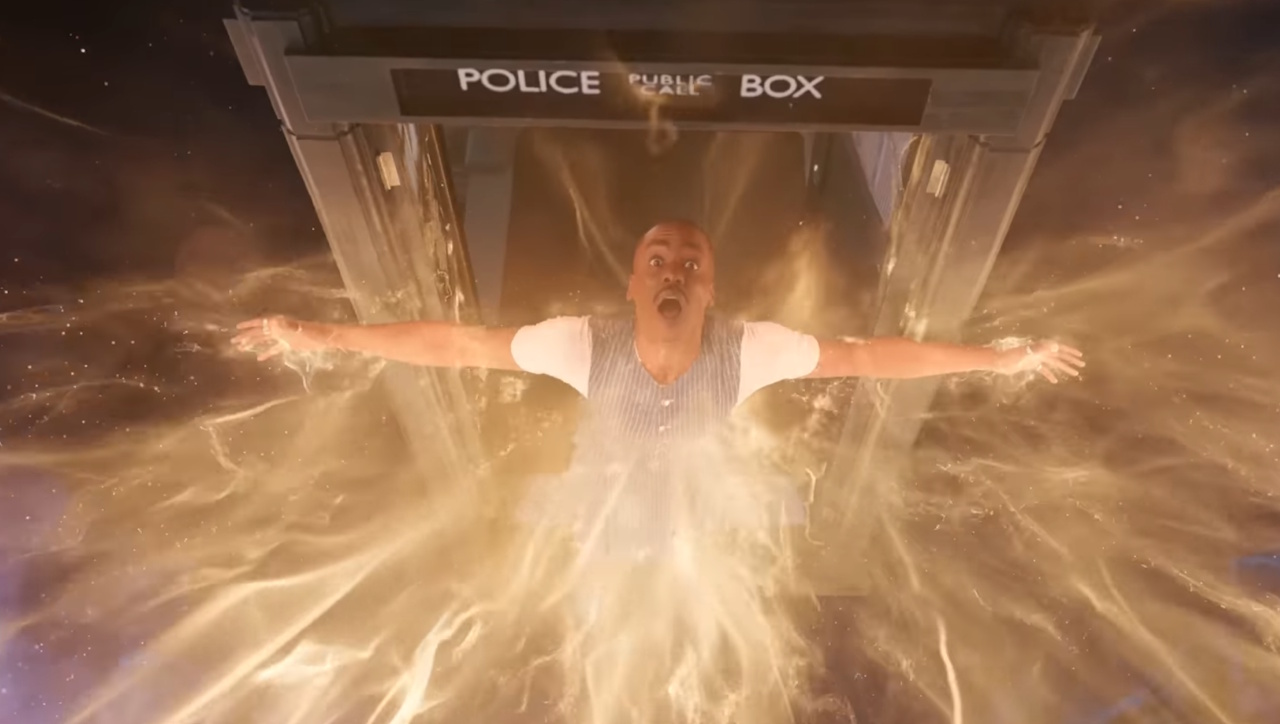
Still frame from Doctor Who Season 15 (2025) showing the Doctor's regeneration.
The Doctor regenerates.

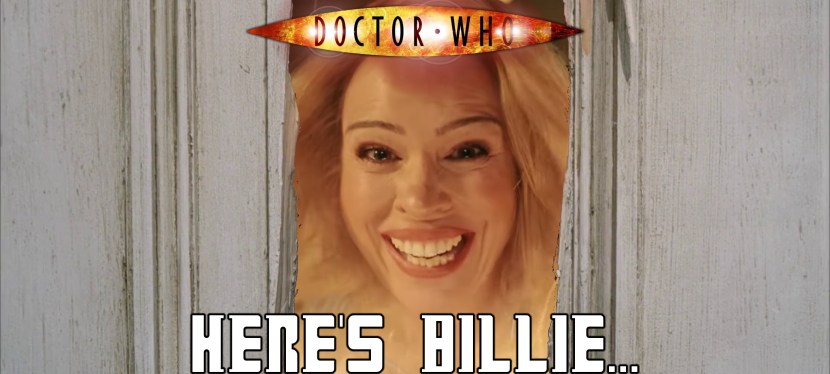
Billie Piper, who played Rose Tyler in the first couple of seasons of the revived Doctor Who, appeared at the end of the most recent season finale – apparently as a new incarnation of the Doctor. As with Tennant’s return above, this smacks of utter desperation and a flailing attempt to use fan-service to bring back the show’s wayward viewers. As one such wayward viewer, I wanted to share my thoughts on this move… and why I don’t expect it’ll work.

The first and most obvious thing to say is this: stories end. Every story has a natural lifespan, and when character arcs are complete, storylines are played out, and there’s nowhere left to go… that’s it. It’s time for the curtain to fall, the credits to roll, and everyone involved to move on. Given the lack of success and dwindling viewership Doctor Who has been finding of late… the show’s at that point. To be blunt, it’s been there for a while. And while there have been creditable attempts to revive its fortunes, these just haven’t worked and the decline has continued.

Still frame from a behind-the-scenes look at Doctor Who Season 15 (2025).
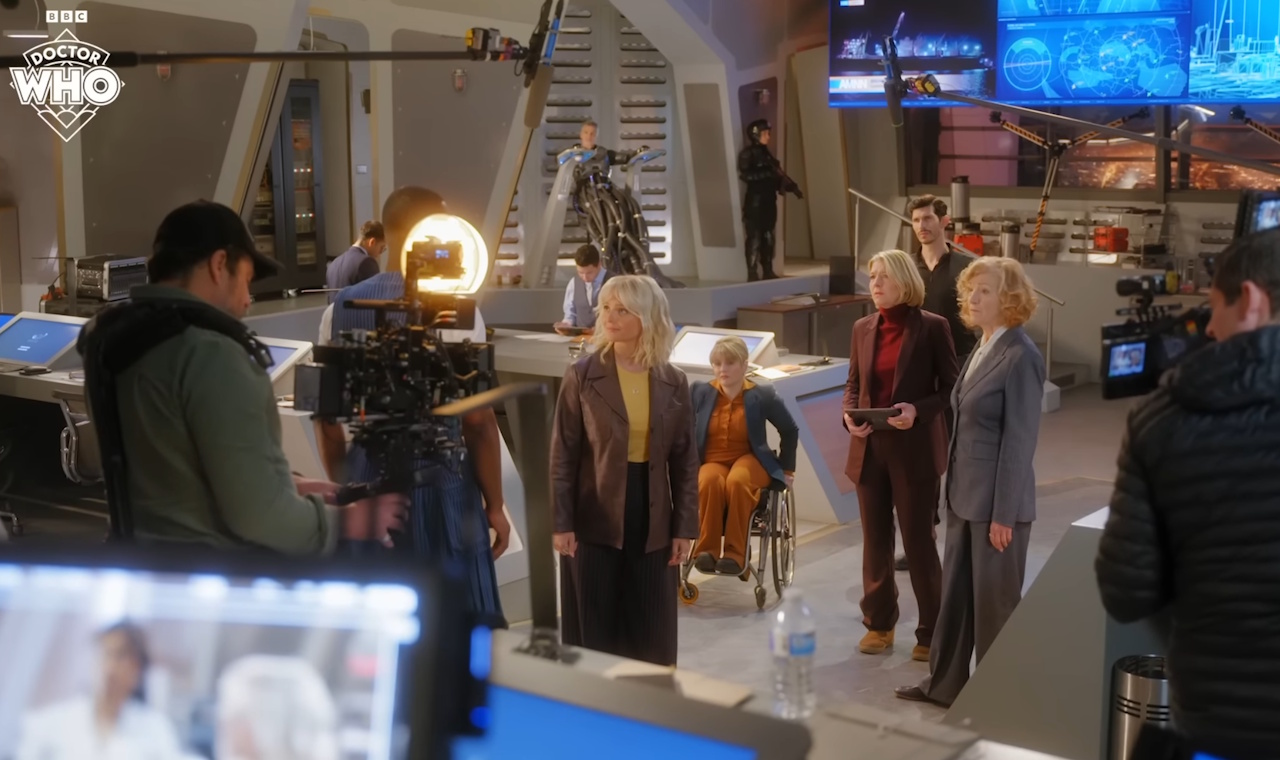
Behind the scenes during production on a recent episode of Doctor Who.

This is not meant to be an attack on any of the actors involved in recent seasons of Doctor Who, nor of casting decisions, either. On the contrary, I think both Jodie Whittaker and Ncuti Gatwa are fine performers, and from what I saw of them in the title role, they gave it their all. But some actors are too late to the party, arriving too late into a show’s run to have an impact. Peter Capaldi will forever be my case study in that regard; he was, in my view, pretty much the perfect actor to play the ancient time-traveller, but he got absolutely awful, boring, and uninspired stories for pretty much his entire time in the Tardis.

Some fans may be happy with Billie Piper’s return and the idea of some kind of Rose-Doctor hybrid. I don’t really engage much with the “Whoniverse” fandom online, so I’m not really in a position to judge. But her return isn’t just about pleasing hard-core fans; it’s much more cynical than that. It’s an attempt to shine a spotlight on Doctor Who and to convince lapsed viewers to give the series a second (or third) look. But it’s also an admission from the showrunner and writers that there are no more original ideas in that writing room; that the only thing they can think of is to recycle actors and characters over and over again. When Billie Piper’s done in the Tardis, who’s coming back next? Matt Smith? Noel Clarke?

Still frame from Doctor Who Season 1 (2005) showing Mickey and the Ninth Doctor.
Doctor Who is running out of actors and characters to bring back…

I stand by what I said almost five years ago: if there’s no one at the BBC (or Disney) with a genuinely good, original idea any more, then the show should take a break. Time has flown by, but it’s been twenty years – two entire decades – since Doctor Who returned to our screens in 2005, and this incarnation of the show just feels like it’s run its course and has had everything possible thrown at it. With ratings in what seem to be a terminal decline, putting the brakes on before any more harm is done to the brand is arguably the least-bad course of action.

Doctor Who has huge spin-off potential, though, so I don’t believe the end of the main series needs to mean the abandonment of the “Whoniverse.” I wouldn’t like to say what the hard-core fandom might be interested in, but speaking for myself, I’d certainly be interested in a miniseries or film set during the Time War, potentially building on the excellent 50th anniversary special from 2013. There are other spin-off ideas, too, like a series following UNIT or even a revival of Torchwood.

Still frame from the Doctor Who special episode The Five Doctors showing the headquarters of UNIT.
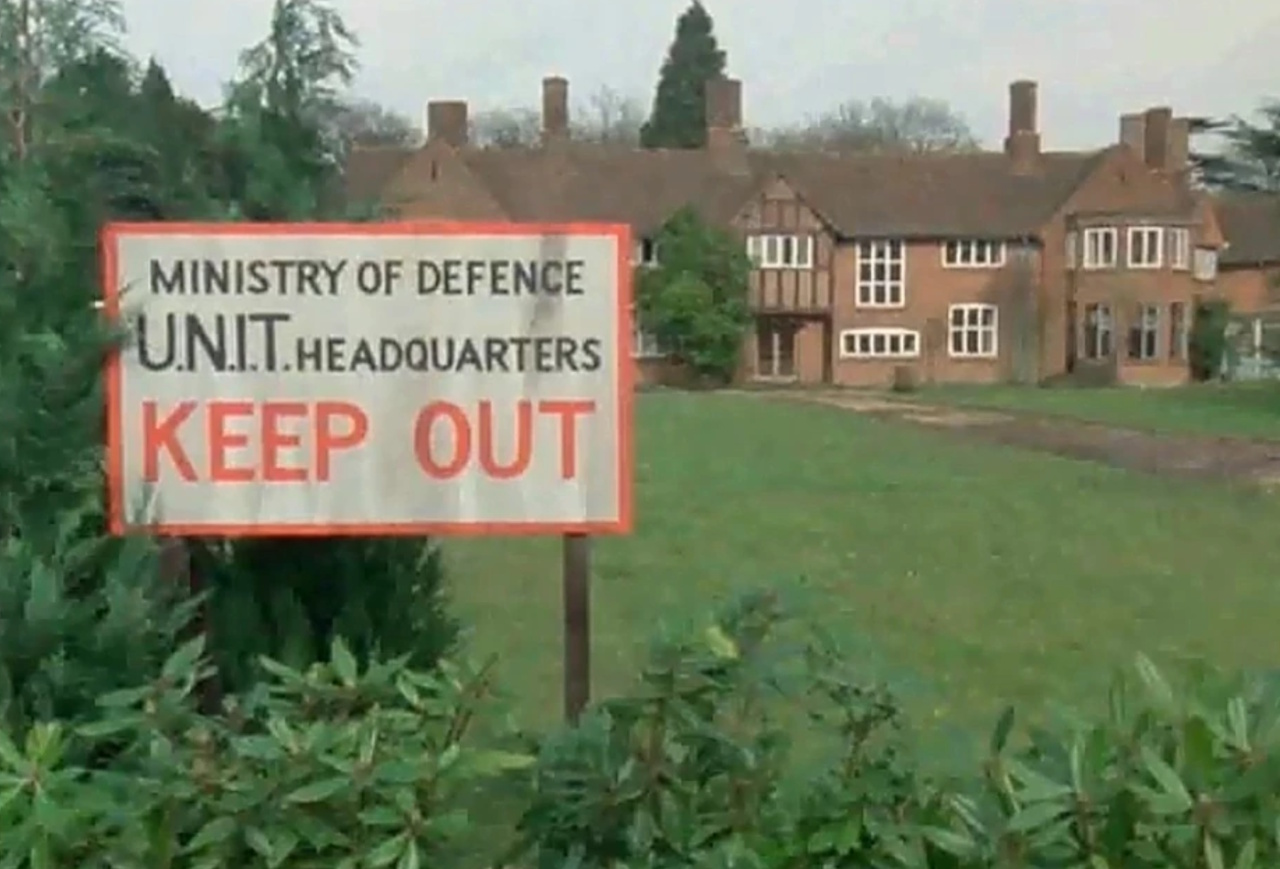
There are other things that the BBC could do with the Doctor Who IP without continuing the main series.

But for the main series? This should really be the end. Billie Piper’s return is the clearest indication yet that the writers have completely run out of ideas, and it’s genuinely sad to see one of the sci-fi genre’s oldest institutions reduced to this bland, uninspired, fan-servicey slop. In theory I get it: you’ve tried new things and they haven’t worked, so retreat to familiar ground and give the fans some “red meat;” something you’re sure will attract attention and get people talking. But it’s just so… empty. So hollow and pathetic, and so very far away from the excellence that was on show in 2005.

Nowadays, it seems as if well-established programmes and franchises aren’t allowed a dignified end. They must be strung out at all costs until every last ounce of value has been extracted from them, no matter the implications for fans and viewers. In the age of streaming, big corporations want well-known names and brands to pad out the lineup on their platforms, and it seems to me that Doctor Who has fallen victim to both of these malicious entertainment industry trends. It isn’t Billie Piper’s fault, by the way, any more than it was Ncuti Gatwa’s, Jodie Whittaker’s, Peter Capaldi’s, or David Tennant’s. She just happens to embody the failure of Doctor Who’s writing, ambition, and overall direction in this moment.

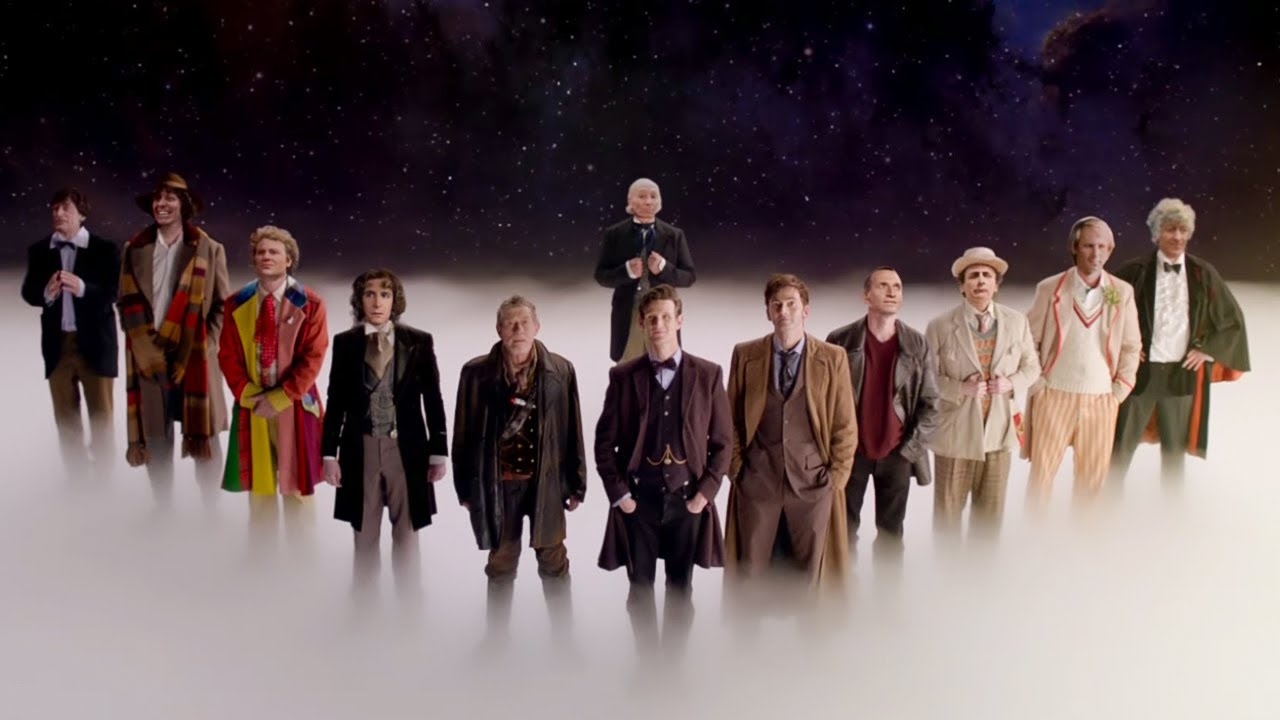
Promotional image for Doctor Who showing fourteen of the fifteen Doctors.
Almost all of the Doctors…

I’m not going to watch Doctor Who for the foreseeable future. And I was a bit of a Billie Piper fan back in the day; I bought her album Honey to the B back in 1998! But her return to this series at this moment feels unnecessary, forced, and like a total desperation play by writers who are out of their depth and out of ideas. Maybe there’s a way for Doctor Who to ride out this current slump and come back stronger – but if there is, it’ll take a total overhaul on the production side, not just a particularly egregious example of stunt casting.

This is usually the point where I’d tell you that I’ve been wrong about these things before and I’ll keep my ear to the ground when Doctor Who returns to see what Billie Piper’s role will be and what her take on the Doctor might look like. But the truth is… I don’t think there’s any realistic chance that the next season of the show will be any better than the last few. Whether Billie Piper is going to be present for a one-off special or a whole season, I don’t think it matters. The series has already lost pretty much everything that made it work, and desperately bringing back a long-gone actor in a way that doesn’t make sense or line up with anything in-universe just… isn’t gonna change that.

Still frame from the end of Doctor Who Season 15 (2025) showing Billie Piper as a new incarnation of the Doctor.
This won’t save Doctor Who.

As a Brit, I want to see British entertainment properties and brands succeed. There’s a weird sense of pride in something like Doctor Who; a series that used to be able to hold its own in a genre dominated by American brands with significantly higher budgets. But I’d rather see the money being thrown at the show invested elsewhere, perhaps giving a new sci-fi or fantasy series a chance. Doctor Who did some great things in both its original incarnation and after its 2005 revival. But in both cases… it ran out of steam. And just as happened in the late ’80s, it’s time to recognise that. It’s time to put the show to bed for a while. Maybe in another fifteen or twenty years, a new generation of writers who grew up on the revival will come in with fresh ideas and the Doctor and the Tardis can make a return. But right now? It’s sad to say, but I think it’s over.

If a new Doctor couldn’t turn things around, if reimagining the Doctor in different ways didn’t help, and if revisiting David Tennant’s popular and successful time in the Tardis also made no difference… what hope does Billie Piper have? I fear that, whatever the writers may have in mind for her, she’s walking into a bear pit. Her exit from the show in 2006 was heartbreaking, but it was also impactful, powerful, and part of an engaging storyline. I fear that her return to the show, in whatever form it may take, will be none of those things. It would be such a shame if one of the show’s most memorable companions ends up being tainted by a totally unnecessary and desperate return.


Doctor Who is out now and may be streamed on Disney+ around the world and on BBC iPlayer in the United Kingdom. Most seasons of the revived series are also available on DVD and Blu-ray. Doctor Who is the copyright of the BBC, BBC Studios, and/or Bad Wolf. This article contains the thoughts and opinions of one person only and is not intended to cause any offence.
Answering Ten of the Biggest Geeky Questions!

A spoiler warning graphic.

Spoiler Warning: Spoilers may be present for some of the franchises/properties discussed below.

There are a handful of “big questions” that define one’s place in geekdom – and today it’s my turn to answer some of them!

I thought it could be a bit of fun to consider some of the biggest questions that geeks like us have to wrangle with. Which fictional character is stronger? Which gaming platform is the best? These questions are contentious, especially here on the interweb – but I hope you’ll engage with this piece in the spirit of light-hearted fun! That’s how I’m choosing to present my answers, in any case.

As I always like to say, nothing we’re going to talk about today is in any way “objective!” These are my wholly subjective takes on questions that are intended to evoke strong reactions, so I hope you’ll keep that in mind! Although I’ve said that these are ten of the “biggest” geeky questions, I’m sure you can think of others – so this is by no means a definitive list.

A stock photo of a contemplative man surrounded by question marks.
Let’s contemplate some big questions together!

I’ve considered myself a geek – and been considered a geek by others – for basically my whole life. As a kid and a teenager, I moved in nerdy circles and friend groups where the likes of fantasy, sci-fi, horror, and video games were frequent topics of conversation. And in the ’80s and ’90s, those things were far less “mainstream” than they are nowadays! It’s actually been really cool to see the likes of The Lord of the Rings, Star Wars, and Marvel become some of the biggest entertainment properties on the planet – as well as the explosion in popularity of video games. When I was at school, and even into my young adulthood, admitting to being interested in those kinds of things could lead to mockery and even bullying!

For these questions today, I’ve set myself the rule of providing an actual answer – no cop-out, fence-sitting, “I like both equally” answers here! As I’ve already said, all of this is just one person’s opinion – and at the end of the day, this is supposed to just be for fun. So please try not to take it too seriously; none of this is worth getting into an argument over!

With the introduction out of the way, let’s answer some tough geeky questions!

Question #1:
Who’s the best Doctor?
Doctor Who

A promo image for Doctor Who showing all of the various incarnations of the titular character.
All of the Doctors – so far!

I don’t really remember watching much Doctor Who as a kid. The original incarnation of the long-running BBC sci-fi series was coming to an end when I was younger, and by the time I was getting interested in the genre, it was Star Trek: The Next Generation that really captured my imagination. As a result, I’m going to exclude all of the pre-2005 Doctors from consideration; I simply haven’t seen enough of any of them to really have a favourite.

Of the Doctors that have been part of the revived series, the Twelfth – played by Peter Capaldi – is my favourite… but with a big caveat! Capaldi gave the best individual performance as the Doctor in the role – hands down. No disrespect meant to any of the others… but I don’t think it’s even close. He’s a performer with exactly the right style, look, and gravitas – and in my view, he played the role absolutely perfectly. That’s why I didn’t hesitate when it came to naming him as my favourite!

Still frame from Doctor Who (2005) showing Pearl Mackie and Peter Capaldi.
Peter Capaldi’s Twelfth Doctor is my personal favourite.

But there’s a catch, as I said. Capaldi’s seasons as the Doctor – Seasons 8 through 10 of the post-2005 series – were almost universally terrible. There was one decent companion (Bill, played by Pearl Mackie) but her character was treated almost as an afterthought and she met a stupid and unsatisfying end. There were hardly any decent villains or antagonists, no truly standout episodes, and really very few memorable moments at all. In fact, Capaldi’s tenure as the Doctor marked a significant decline in Doctor Who’s quality… and the series doesn’t seem to have recovered.

In terms of the best seasons of the revived Doctor Who, I’d have to give the award – somewhat begrudgingly – to Seasons 2 through 4, which starred David Tennant in the title role. The quality of the stories produced at that time was so much higher, with some truly outstanding adventures in the mix. If only there was some way to go back in time and combine Capaldi’s performance with Tennant’s storylines. Where’s a Tardis when you need one, eh?

Question #2:
Who would win in a fight: Batman or Superman?
DC Comics

Cropped poster for Batman vs Superman (2016) featuring the title characters.
Wasn’t there a mediocre film dedicated to answering this question?

Uh, this one should be obvious. It’s Superman, right? It has to be – if you gave any other answer then I don’t think you’ve been paying attention! Who would win in a fight between an overpowered demigod and a billionaire with some expensive gadgets? Yeah… the demigod is gonna win this one. He could launch Batman into the sun, punch him so hard that every bone in his body would shatter, use his heat-vision on him from half a mile away… the list of ways in which Superman could not just defeat but murder and utterly annihilate Batman is nearly endless!

Superman is, I would argue, increasingly difficult to depict in film because of how blatantly overpowered he is. If you read my review of Zack Snyder’s Justice League a couple of years ago, you might remember me saying that the film flopped around, desperately trying to find a way to include the rest of its cast of superheroes… but to no avail. There was no getting away from the simple fact that Superman could do it all single-handedly without even breaking a sweat.

Cropped cover of Action Comics #19 showing Superman.
Superman on the cover of Action Comics #19 in 1939.

At the time the character of Superman was first created, all the way back in 1938, it wasn’t a problem. In fact, creating an “all-round, all-American hero” for comic books aimed at children was exactly the point. Superman is textbook escapism – he’s the perfect hero archetype that can do it all. In context, Superman works, and when all you want is a “good guy” to save the day and stop the evil villains, he’s perfect for the part.

But any story that puts Superman in genuine danger has to come up with a reason why. The man’s basically invincible, save for the mysterious crystal known as kryptonite, and I think at least some of Superman’s big-screen and small-screen adventures suffer as a result of that. But to get back on topic: Superman would win in a fight, and he’d win incredibly quickly and incredibly easily!

Question #3:
Console or PC?

A Super Nintendo console on a red background.
A Super Nintendo – or SNES.

In the early ’90s, the first home console I ever owned was a Super Nintendo. From then on, all the way through to the middle of the last decade, console was my preference. I liked the pick-up-and-play nature of consoles, with no need to check system requirements or fiddle with settings to just get a game running. The underpowered PCs that I had in the ’90s weren’t much good for gaming, so I think that’s part of it, too. But you have to also remember that, for a long time, consoles were just better in terms of performance – and especially in terms of value – than PC.

But nowadays I’m firmly on Team PC! I built my own PC for the first time a couple of years ago, and prior to that I had a moderately-priced “gaming” PC. Since about the middle of the 2010s, PC has been my platform of choice for practically everything. I will consider picking up Nintendo’s next machine when it’s ready, but my Nintendo Switch has been gathering dust since I stopped playing Animal Crossing and Mario Kart 8… so I’m not sure how great of an investment that’ll really be!

Stock photo of a gaming PC.
A very pretty gaming PC setup.

PC offers the best of both worlds. Wanna play an in-depth strategy game or city-builder with loads of options and menus that really need a mouse and keyboard to navigate? PC can do that. Wanna plug in a modern control pad to play a third-person adventure title? PC can do that too. Wanna install a virtual machine and play games from the Windows 95 era? PC can do that! Wanna emulate every console from the Atari 2600 to the Dreamcast and play games that are out-of-print everywhere? PC can do that too!

With Game Pass bringing a lot of new titles to PC on launch day, and with Sony even porting over some of its previously-exclusive titles too, PC really feels like the place to be. It’s a lot more expensive to get started with – and that’s still a massive point in favour of consoles for players on a budget. But once that initial expense is out of the way, the abundance of sales on platforms like Steam means that a lot of titles – even newer ones – can be picked up at a discount. I’m really happy with my PC as my main gaming platform, and I doubt I’ll be picking up an Xbox or PlayStation this generation.

Question #4:
What would be the best fictional world to live in?

There are plenty of fictional worlds to choose from!

There are loads of absolutely awful answers that people give to this question! Who’d want to live in Star Wars’ fascist-corporate dystopia, for example, which seems absolutely terrible for anyone not blessed with space magic? Or any fantasy setting with a medieval level of technology? Sure, you might have a magic elf as your buddy… but if there’s no central heating, antibiotics, or flushing toilets… you’re gonna have a bad time!

My pick is simple: Star Trek’s 24th Century. There are things to worry about, sure: the Borg, the Cardassians, and the Klingons to name but a few threats! But there are so many wonderful inventions and technologies that would make life so much better. For me, as someone with disabilities, the idea of some or all of my health issues being cured is perhaps the biggest – but there are plenty of others, too.

The USS Enterprise orbiting Earth.

Star Trek does not depict, as some have tried to claim, a “communist utopia.” As we see on multiple occasions throughout the franchise, private property still exists, and people have a great deal of freedom and autonomy. Star Trek’s future could be more accurately described as a post-scarcity society – one in which technological improvements have brought unlimited power generation, food, and other resources to the people.

There are some dark spots in Star Trek’s future – but these tend to be places outside of or separate from the Federation. Assuming I could live somewhere in the Federation, and have access to replicators, warp drive, weather-controlling satellites, and Starfleet for defence… I think it would be bliss! And so much better than anywhere else I can think of.

Question #5:
Martin or Tolkien?

Who’s the superior author?

I don’t need to think too long about this one! JRR Tolkien is, for me, one of the greatest authors of all-time. George RR Martin, in contrast, can’t even finish his own story, and seems far too easily distracted by other projects – including writing TV episodes and working on video games. And c’mon… he literally copied the “RR” part of Tolkien’s name for his own pen name!

Jokes aside, I think both writers are pretty great. Tolkien could be, in places, a little too black-and-white with his protagonists and antagonists, with the goodies being pure and virtuous and the villains being corrupt and evil. Martin’s work deliberately upends many of those notions, and he places imperfect and even selfish characters at the heart of his stories. Some of George RR Martin’s characters feel more nuanced – and dare I say more human – than Tolkien’s.

The Fellowship of the Ring at Rivendell from the 2001 film adaptation.

But Tolkien was a pioneer, writing the first modern fantasy epic. Martin, and countless other writers, are simply following in his footsteps. While Martin’s work is hardly derivative, some of the choices he makes in his writing are a reaction to the way Tolkien’s worlds and characters were set up. It’s impossible to critique A Song of Ice and Fire without making multiple references to Tolkien – whereas Tolkien’s work has always stood on its own two feet.

I would love it if George RR Martin would finish his magnum opus, but as time passes I feel less and less sure that he’s even interested in doing so. Now that Game of Thrones has finished its run on television, and Martin has seen the overwhelmingly negative reaction to its ending – which will have contained at least some elements that he planned to include in the remaining books – I just don’t get the impression that his heart is in it in the same way it was a few years ago. Tolkien’s work, in contrast, is complete and has been for decades – and people are still interested in new adaptations.

Question #6:
Who’s the best Star Trek captain?

Promo banner for Star Trek Day showing multiple characters.
Multiple captains on a promo banner for “Star Trek Day.”

I’ve always struggled with this question. But I’ve gone on record several times here on the website as saying that if you put a gun to my head and forced me to choose – as this question is metaphorically doing – I’d pick Deep Space Nine’s Captain Benjamin Sisko. So that’s gonna be my answer!

There’s a lot to be said for Captain Kirk – Star Trek’s first captain. He paved the way for all of the others, and without him, Star Trek would not be the same today – if it even existed at all. And Captain Picard was my personal first captain; it was through The Next Generation that I became a Trekkie in the early ’90s. Without him and the crew he led, there’s a chance I would never have fallen in love with Star Trek in the way that I did. And all of the other captains from Janeway and Burnham to Archer and Pike all have wonderful qualities that make Star Trek into the franchise it is today.

Still frame from the documentary What We Left Behind showing Avery Brooks as Captain Sisko in a remastered clip.
Captain Benjamin Sisko.

But Captain Sisko has always stuck out to me. In the first few seasons of Deep Space Nine he only held the rank of Commander, so we got to see his rise to the rank of captain as the story of that show unfolded. He was also a man with a deeply traumatic past, having to come to terms with the death of his wife while raising his son alone. He was a fantastic leader – not just of a crew, but of a community. Sisko could reach out across the cultural divide to Ferengi, Klingons, changelings, Bajorans, and more. He turned DS9 from a military outpost into a friendly place to visit and a bustling port.

Although words like “scientist” and “explorer” might not be the first ones that spring to mind when we think of Captain Sisko, he had those traditional Starfleet qualities, too. We’d see him as a pioneer of exploring the Gamma Quadrant and the wormhole, as well as interacting with the non-corporeal Prophets – the very definition of seeking out new life! Sisko could also be a soldier and a diplomat when he needed to be – and to me, he embodies the very best of Starfleet in the 24th Century.

Question #7:
Marvel or DC?

The logos of both Marvel and DC.

I don’t read comic books – and I never did, even as a kid. So my limited knowledge of both of these brands comes from their cinematic outings, not the original source material! I wanted to get that caveat out of the way before we got into the weeds with this one.

If you were to ask 100 people on the street to name a superhero, I think Superman and Batman would probably be the two names you’d hear most often. So DC, at least in my opinion, has produced the two most memorable and noteworthy superheroes. But Marvel, at least on the big screen, has a bigger and stronger ensemble – as we saw when Avengers Endgame briefly became the highest-grossing film of all time.

Still frame from Batman & Robin (1997).
Batman & Robin (1997).

Although I want to say that I’ve gotten roughly equal enjoyment from DC and Marvel over the years, I promised you no fence-sitting and no cop-outs! Based on the strength of characters like Batman, who have starred in some really great films over the years, I think I have to give the win to DC. Marvel’s output is becoming increasingly convoluted, and just keeping up with the franchise to know who’s who and what happened last time can feel like a full-time job! At least DC still produces some standalone or semi-standalone films and TV shows that I can dip in and out of.

Aside from Batman and Superman, though, DC hasn’t really been able to successfully capitalise on its other superheroes – let alone turn them into household names. Wonder Woman, Aquaman, the Flash, and Green Arrow have all had limited success in a single film or TV series, but others have struggled. Batman may drag DC over the finish line this time… but there’s still room for improvement!

Question #8:
Star Wars or Star Trek?

Still frame from Star Wars (1977) showing the Death Star.
The Death Star at Yavin IV in Star Wars.

If you’ve read the name of this website, I’m sure you can guess which way this one’s going to go! Thankfully the whole “Star Wars versus Star Trek” rivalry that was a big deal a few years ago has more or less died out, and fans no longer feel quite so tribal about which is the best. There’s been a lot more crossover in recent years, with Trekkies and Star Wars fans happy to enjoy both franchises.

I consider myself a Trekkie first and foremost – so I’ll answer this question by saying that I prefer Star Trek over Star Wars. But that doesn’t mean I hate or dislike Star Wars by any stretch. In fact, some of my favourite entertainment experiences of all-time have come courtesy of the Star Wars franchise: games like Knights of the Old Republic and films like Rogue One are genuinely fantastic.

Promo photo of the main cast of Star Trek: The Next Generation Season 2 (1988).
The cast of Star Trek: The Next Generation Season 2.

What I like about Star Trek is that many of its stories aren’t about fighting a villain or defeating an adversary – but about exploration, science, engineering, and just what it might be like to live in space in the future. Star Wars, by its very nature, is more violent, with more of a focus on conflict. That’s fine when I’m in more of an action mood – but there are times when a story about seeking out new life or learning to communicate is what I’m looking for.

It’s also worth pointing out that there’s a heck of a lot more Star Trek than Star Wars! At the time I first encountered the franchises, it wouldn’t be totally unfair to say that there were two good Star Wars films and one okay-ish one – at least in the opinion of a lot of folks! Star Trek already had more than 100 episodes of TV and five films under its belt, so there was plenty to get stuck into as a viewer in the early ’90s! Quantity over quality is never a good argument, of course… but if I’m enjoying something I’m always going to be happy to get more of it! Star Wars is slowly catching up to Star Trek now that Disney has commissioned several made-for-streaming series, but there’s still a long way to go to reach Star Trek’s 900+ episodes!

Question #9:
Sci-Fi or Fantasy?

The NeverEnding Story (1984) was one of my favourite films as a kid.

This may come as a surprise, but fantasy was my first love long before I got interested in sci-fi, space, and the “final frontier!” Among my earliest memories is reading The Hobbit – a book that was originally intended for children, lest we forget. I can even remember pointing out to my parents that there was a typo on one page; the word “wolves” had been misprinted as “wolevs.” Aside from Tolkien’s legendary novel, I read other children’s stories including Enid Blyton’s The Faraway Tree, and watched films like The Neverending Story.

But it’s not unfair to say that sci-fi became a much bigger deal for me by the time I was reaching adolescence. Inspired by Star Trek: The Next Generation I immersed myself in science fiction, reading as many books about space and the future as I could get my hands on, and watching films like Alien and the Star Wars trilogy. TV shows like Quantum Leap, Space Precinct, and Buck Rogers in the 25th Century graced my screens in the ’90s, as did more kid-friendly offerings like Captain Scarlet.

Star Trek: The Next Generation turned me into a sci-fi fan!

So while I can happily say that I enjoy both genres for what they offer, sci-fi has been my preference going back more than thirty years at this point! Star Trek opened my eyes to science fiction and remains one of my biggest fandoms to this day! But there are many other sci-fi films, shows, books, and video games that I’ve enjoyed – everything from Mass Effect and Foundation to Battlestar Galactica and Halo. Sci-fi is great escapism, and I love the feeling of being whisked away to another world or another moment in time.

Though I haven’t forgotten my roots as a fan of fantasy, and still enjoy many fantasy titles across all forms of media, if I had to choose I’d definitely say that I’m a fan of sci-fi first and foremost. Sci-fi feels broader and more varied in some respects – there are radically different presentations of humanity’s future, the kinds of aliens we might engage with, and so on. Modern fantasy tends to stick to a medieval level of technology and use the same kinds of magical spells and the same handful of races – Elves, Dwarves, Orcs, and so on – in different combinations depending on the story.

Question #10:
What’s your favourite anime/cartoon series?

Still frame from Shenmue: The Animation showing Ryo and Fangmei.
There’s an anime adaptation of Shenmue.

I have to confess something at this point: I’ve never seen any anime. I don’t know why exactly – I’ve never really been in friendship groups where anime was a topic of conversation, and when I was a kid, there wasn’t any anime on TV or in the cinema that I can recall. I’ve yet to encounter an anime series that felt like a must-watch – with the only exception being the adaptation of Shenmue that I really ought to get around to watching one of these days! But until I do… no anime for me.

I had to think about this question for a while, though. There are some great adult animation programmes: Lower Decks, Futurama, Rick and Morty, South Park, and The Simpsons all come to mind. The Simpsons in particular was a pioneer of adult animation, and a series I remember with fondness from its ’90s heyday here in the UK! The fact that my parents – and many others of their generation – absolutely loathed The Simpsons was a huge mark in its favour for a renegade adolescent!

Still frame from the Phineas and Ferb Season 3 episode What A Croc showing the kids on jet skis.
Phineas and Ferb.

But on this occasion, I’m giving the award to Phineas and Ferb. Regular readers might remember me talking about this series as one of my “comfort shows;” a programme I often return to when I need a pick-me-up. I recall watching a promo for the series circa 2007-08, and although kids’ cartoons on the Disney Channel should’ve held no appeal… something about Phineas and Ferb called out to me. I tuned in and I was hooked from almost the first moment.

Phineas and Ferb’s two-and-a-half story structure – with the kids making an invention, their sister trying to bust them for it, and special agent Perry the Platypus on a mission to fight evil – felt incredibly fun and innovative, and more often than not the storylines would intersect in creative and unexpected ways. There are also some fantastic moments of characterisation in Phineas and Ferb, particularly with the breakout character of Dr Doofenshmirtz. I was thrilled to learn that the series will be returning for two new seasons and a whopping forty new episodes, and I really hope it will be as good as it was the first time around.

So that’s it!

The famous "that's all folks" card shown at the end of Looney Tunes cartoons.
That’s all for now!

I hope this has been a bit of fun – and maybe bolstered my geeky credentials just a little. As I said at the beginning, I don’t think any of these subjects are worth fighting about or losing friends over, but I’ve had fun sharing my thoughts and nailing my colours to a few different masts!

The great thing about sci-fi, fantasy, gaming, and the wide world of geekdom is just how much of it there is nowadays. There are so many high-budget productions on the big screen, the small screen, and in the gaming realm that we’re really spoilt for choice. As much fun as it is to play favourites and pick one series or franchise over another… more than anything else I’m just glad to be living through a moment where geekdom is having its turn in the spotlight! That may not last forever – a return to action movies, westerns, or whatever else might be on the cards one day. So we should all make the most of it and enjoy it while it lasts!

It’s been interesting to consider some of these questions, and I hope reading my answers has been entertaining for you, too!


All properties discussed above are the copyright of their respective owner, company, distributor, broadcaster, publisher, etc. Some stock photos courtesy of Unsplash. This article contains the thoughts and opinions of one person only and is not intended to cause any offence.
Another New Doctor Won’t Fix Doctor Who…

It seems increasingly likely that Jodie Whittaker is in her final season as the titular Doctor in the BBC sci-fi series Doctor Who. The upcoming season will be the show’s thirteenth since it was recreated in 2005. The first few years of the show’s return were great – Christopher Eccleston, David Tennant, and even Matt Smith did very well in the role, but even by the end of Smith’s tenure the show’s decline had set in. Peter Capaldi, who took over the role after the 2013 Christmas special, endured a torrid time as the Doctor, with three seasons of stories that varied from underwhelming to just plain crap.

Jodie Whittaker, as the first woman to take over the role, came into the series at a time when it appeared to be in terminal decline. And although her arrival coincided with Doctor Who trying to put itself through a soft reboot, the decline continued. After thirteen seasons and more than fifteen years, the revived series has simply run its course. Practically every show has a natural lifespan, and though how long a series can run and remain exciting will vary, it seems clear that Doctor Who is long past that point.

Jodie Whittaker as the Thirteenth Doctor. She may be leaving the show imminently.

There were issues regarding Whittaker’s arrival in the role, not least the so-called “gender bending” of what has always been a male character, and some have argued that it may be a factor in why her tenure as the Doctor hasn’t been so well-received. But I would argue that, despite the strong feelings on both sides of that argument, it’s almost incidental. The way the character is written and the lack of good ideas for new and interesting stories has been much more of a hindrance to Doctor Who than its main character’s gender.

As an aside, I don’t buy the argument that fans somehow “don’t want women characters.” Look at the response to characters like Captain Janeway in Star Trek or Ahsoka in Star Wars – fans respond incredibly positively to strong women in sci-fi – but they have to be well-written characters first and foremost. If they aren’t, or if there are other issues with the stories they’re part of, fans won’t be interested – just as they aren’t interested in boring male characters or male characters involved in crap stories.

Star Trek’s Captain Janeway debunks the argument that sci-fi fans don’t want to see strong women.

Peter Capaldi is exactly how I would picture the Doctor if someone described the character to me. Compared to his two predecessors, David Tennant and Matt Smith, Capaldi had the gravitas required to truly embody the ancient time-travelling alien. But the storylines he got during his tenure were, as mentioned, uninteresting at best. As a result, viewership dropped, interest dropped, and while some fans may have been somewhat interested in what was billed as a second revival of the series when Jodie Whittaker took over, that interest soon dropped away when the underlying issues with Doctor Who were seen to remain.

Modern Doctor Who has suffered from an overuse of three key villains: the Weeping Angels, the Cybermen, and the Daleks. All three were fantastic in their initial appearances from 2005-2010, but by the turn of the last decade there was a sense that they were played out. Having seen the Doctor outsmart and defeat the Daleks in particular at least once a season for twelve seasons, they need a break.

The Daleks have to be one of the most overused villains in all of science fiction.

But the sad thing is that, when the writers in recent seasons have tried to step away from familiar adversaries, the new creations made for the series have just felt incredibly bland. Generic opponents invented for the Doctor and his or her companions have been so completely boring that I honestly couldn’t tell you the names or attributes of any off the top of my head. I’d have to go away and look up who the Doctor and co. have taken on in recent seasons, such is the boring, generic, bland nature of the factions and races created for this once-great sci-fi series.

When Doctor Who was revived in 2005, it was brought back by a team of people who had loved the original show and wanted to see it succeed again. I don’t want to question the dedication and commitment of the writers and producers behind recent seasons, but it doesn’t feel that they’re as interested in Doctor Who as Russell T Davies, Mark Gatiss, and even Steven Moffat had been in the first years after the show returned.

Another overused adversary: the Cybermen.

If making a big change to the Doctor when Whittaker was introduced didn’t reinvigorate the series, replacing her in the title role won’t help. Doctor Who needs a root-and-branch overhaul, but even then it’s hard to see where to take the series. Its iconic villains have become boring, cardboard cut-out opposition, and since the introduction of the Weeping Angels all the way back in 2007, no new villain has been anything other than a bland, generic sci-fi alien.

Realistically what Doctor Who needs is for the main series to go back on hiatus. The world-building in Doctor Who – at least in earlier seasons – was fantastic, and offers the opportunity to branch out into spin-offs that perhaps could look at the Time War or other key events in the series’ canon. But the main show needs a break. Maybe in another fifteen or twenty years, when another new team of writers have some genuinely good ideas, it can come back. But simply recasting the Doctor yet again won’t cut it.

Doctor Who Season 13 is due out later this year on the BBC. Doctor Who is the copyright of BBC Studios. This article contains the thoughts and opinions of one person only and is not intended to cause any offence.