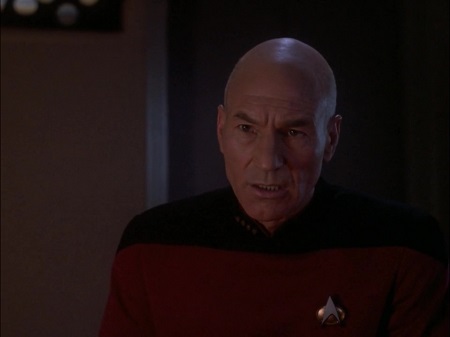
Ten More Things That Have Always Bugged Me In Star Trek

A Star Trek-themed spoiler warning graphic.

Spoiler Warning: There are spoilers ahead for the following Star Trek productions: The Original Series Seasons 1 & 3, The Wrath of Khan, The Next Generation Season 1, The Undiscovered Country, Enterprise Seasons 2 & 3, Star Trek 2009, Discovery Seasons 2 & 4, Strange New Worlds Season 1, and Section 31.

Last year, I wrote up a tongue-in-cheek list of some of the little things that have always bugged me in Star Trek! Today, I thought we could have a little bit more fun at the franchise’s expense by talking about a few more. These are incredibly small things that don’t even rise to the level of “nitpicks,” but every time I see or hear them in their respective stories, they bug me! I know none of them will ever be explained in canon – nor do they really need to be – but I hope you’ll forgive an old Trekkie for airing their thoughts!

Star Trek fans have a bit of a reputation – especially on fan sites like this one – for nitpicking and being sticklers for canon and internal consistency, and I’m acutely aware that that’s how this list could come across. For me, this is written with tongue firmly embedded in cheek – it’s not meant to be taken completely seriously. While I do concede that all of these things “bug me,” as the title says, none of them ruined my enjoyment of any film or episode. These are minor things that aren’t worth arguing about or getting upset over – and I share this piece with the fan community in that spirit.

Promotional photo of several main characters from Star Trek: Enterprise, circa 2001.
Several main characters from Star Trek: Enterprise.

A couple of important caveats before we go any further. All of this is the entirely subjective opinion of a single Star Trek fan. If I raise points you vehemently disagree with, if none of these things bothered you, if you think I’ve misunderstood something, or if you feel I’m overreacting… that’s okay! There’s room enough in the Star Trek fandom for polite discussion and differences of opinion. And as I said above, none of this really matters anyway as these are all exceptionally minor points.

Finally, I’m not counting out-of-universe explanations. “It’s just a story,” or “because the writer/director wanted to do things that way” do not count! Sometimes, in order to tell a more entertaining story, the minutiae of canon or some element of internal consistency has to get pushed aside – that’s the way it goes in the world of entertainment. But that’s not what we’re here to talk about on this occasion.

Phew. With all of that out of the way, let’s jump into the list.

Number 1:
Why did Khan have a Motion Picture/Wrath of Khan-era Starfleet badge? Where did he even get it?
Star Trek II: The Wrath of Khan
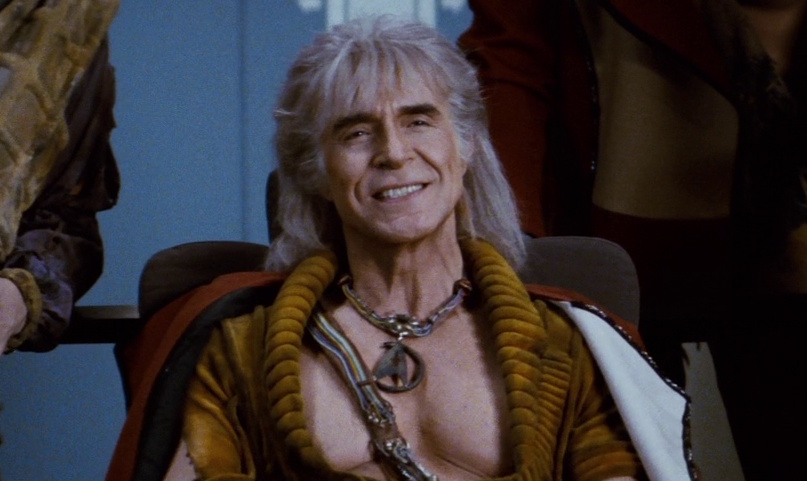
Still frame from Star Trek II: The Wrath of Khan showing a close-up of Khan aboard the USS Reliant.
Khan sporting his famous necklace.

Look at Khan’s outfit when Chekov and Captain Terrell encounter him and his surviving crewmates on Ceti Alpha V. After he takes off his overcoat, Khan is wearing a necklace which appears to be made from a damaged Motion Picture-era Starfleet badge – or a monster maroon belt buckle, perhaps. But how did he acquire this item? Khan and his people have been marooned on the planet since the time of The Original Series – years before either of those uniform styles were in use.

If Khan was wearing a piece of a Starfleet uniform, surely he should be wearing one of the gold, red, or blue shirts that we’re familiar with from The Original Series – or perhaps a pair of Starfleet boots from that era! It’s always stood out to me as a bit of an oddity of apparel; when you look at his necklace more closely, it’s clearly worn and weathered indicating it’s something he’s kept for years – perhaps as a symbol of his quest for vengeance against Kirk and Starfleet. But given that no Starfleet ships visited the Ceti Alpha system in between the events of Space Seed and The Wrath of Khan, it’s an item he simply shouldn’t have had access to.
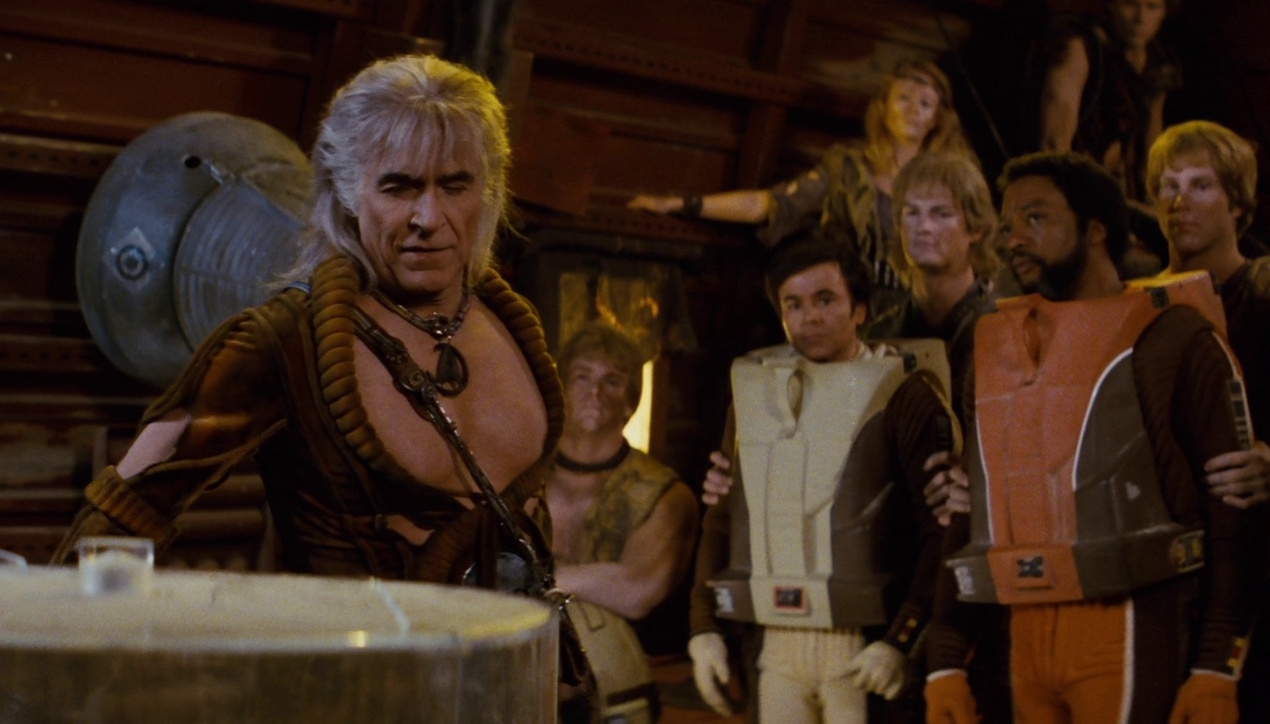
Still frame from Star Trek II: The Wrath of Khan showing Khan, Chekov, Captain Terrell, and several augments aboard the derelict Botany Bay.
Khan was already wearing the necklace when Chekov and Terrell arrived.

If Khan started wearing the necklace after his encounter with Chekov, I’d say that he took the piece from him or from someone else on Reliant’s crew. But he clearly converted part of a Starfleet uniform into this necklace during his time on the planet, before his meeting with the crew of the Reliant – so that explanation doesn’t work.

There’s no getting around the simple fact that Khan shouldn’t have this badge or belt buckle. Nothing like it was seen in The Original Series, and even if we extend our search to other 23rd Century shows like Discovery or Strange New Worlds, very generously assuming that another Starfleet vessel visited Ceti Alpha V before the destruction of Ceti Alpha VI, there are still no comparable badges, buckles, or anything with a Starfleet delta of the right shape and size for Khan to convert into a necklace. Unless he used his people’s very limited resources to smelt a perfect Starfleet delta the exact same shape and size… I don’t know where he got it from!

Number 2:
Aren’t the Cherons (or Cheronians) extinct?
Star Trek: Section 31
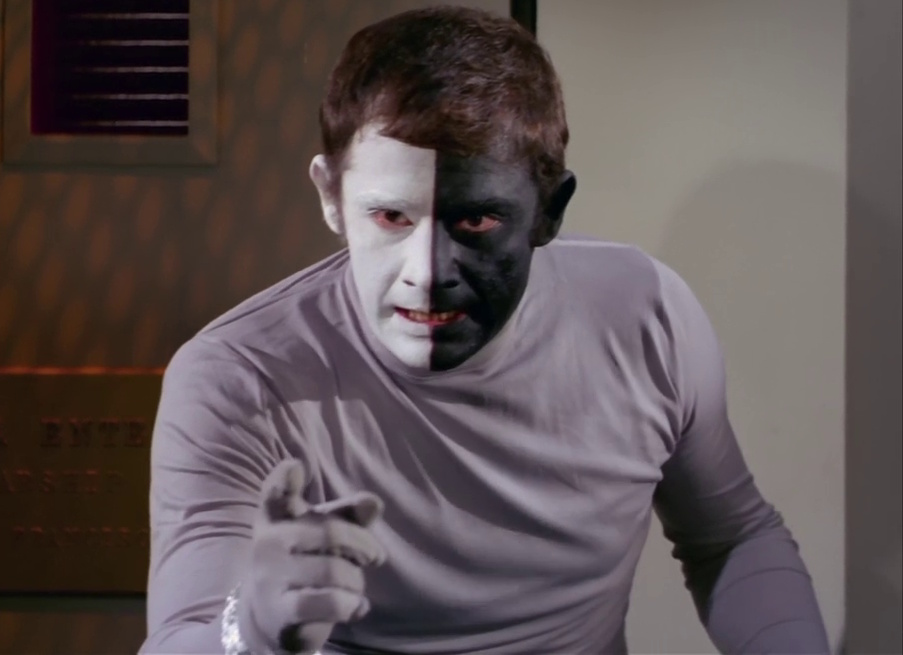
Still frame from Star Trek: The Original Series Season 3 showing Lokai, a black-and-white alien from the planet Cheron.
Lokai, one of the last surviving members of his race.

In the recent Section 31 TV movie (which you can read a review of by clicking or tapping here) we meet a character aboard Georgiou’s space station who looks very similar to a Cheron/Cheronian. The Cherons were encountered in the iconic episode Let That Be Your Last Battlefield – where the final two members of the species met Kirk and the crew of the Enterprise.

I like Let That Be Your Last Battlefield, and it’s an episode with a disappointingly timeless message about how racism and division will eventually lead to conflict, war, and extinction. The entire point of the story was that the Cherons wiped themselves out because they couldn’t get over their hatred of one another – even though, to us, they appeared to be the same species. It’s a message that was poignant at the time it was written – with the American civil rights movement ongoing – and has remained so to this day.

Still frame from Star Trek: Section 31 showing the character of Virgil.
Is Virgil from Section 31 meant to be a Cheron?

Section 31 confused me with its Stardate and therefore its place in the timeline – but no matter whether it was meant to be set in the mid-23rd Century or the early 24th Century, there simply shouldn’t be any surviving Cherons left. If Section 31 takes place before Let That Be Your Last Battlefield, then I guess technically two members of the species remain. But if, as the producers have told us, the film takes place in between The Undiscovered Country and The Next Generation, then the entire species is extinct – wiped out because they couldn’t overcome their hatred for one another.

Of all the things modern Star Trek could’ve chosen to retcon… the survival of the Cherons isn’t one I’d have wanted to see. It serves no purpose to bring in a character like that as a one-off campy joke, and furthermore, it undermines the powerful message of a classic story. My personal head-canon (which I really should write up one day) is that this character at Georgiou’s bar wasn’t actually a real Cheron, but someone basically cosplaying as one. I think that’s actually the least-bad spin I can put on the matter!

Number 3:
Does the Enterprise-D’s saucer section have warp drive or not?
Star Trek: The Next Generation
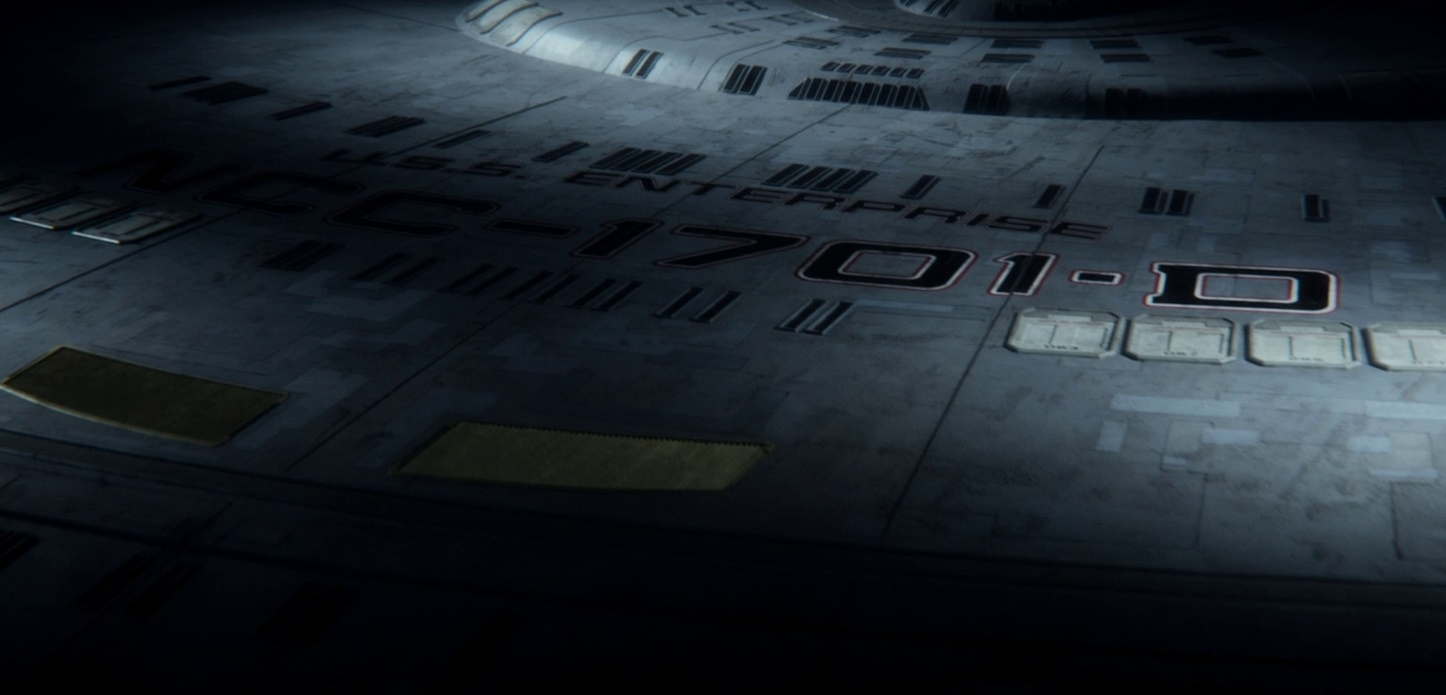
Still frame from Star Trek: Picard Season 3 showing a close-up of the Enterprise-D's saucer.
Close-up of the Enterprise-D’s saucer section.

According to most sources I can find – including in episodes where saucer separation occurs or is mentioned – the Enterprise-D’s saucer section has impulse engines only. Impulse engines allow for travel at speeds below warp one – i.e. below the speed of light. But this seems to contradict not only what we see on screen in episodes like Encounter at Farpoint… but the entire point of saucer separation as it’s explained in the show.

Except for situations like a warp core breach, where the destruction of the ship is imminent, what’s the main purpose of saucer separation? As stated in Encounter at Farpoint, The Best of Both Worlds, and other episodes, the star-drive section is where most of the Enterprise-D’s heavy armaments are – so the point of saucer separation is to evacuate civilians, scientists, and other non-combatants. The saucer section can be commanded by a junior officer with orders to set course for the nearest safe system or starbase, getting families and scientists out of the danger zone or battlefield. The star-drive section is then free to engage the enemy.
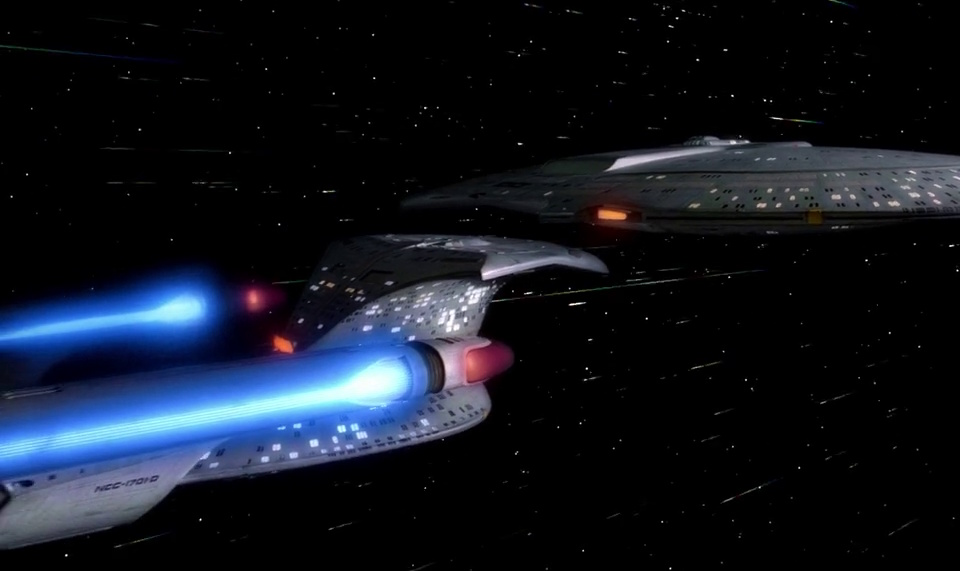
Still frame from Star Trek: The Next Generation Season 1 showing the Enterprise-D initiating a saucer separation.
Saucer separation in progress.

But at sub-light speeds, this won’t work. Any enemy ship could easily catch up to and overtake a fleeing saucer section travelling at impulse, or hit it with a torpedo or disruptor blast while it’s still in range. And at impulse speeds the saucer section would be decades away from help even if it was relatively close to a friendly base or star system. That’s not to mention that, in Encounter at Farpoint, the saucer section travels an apparently sizeable distance under its own power to reach Deneb IV after the encounter with Q. The Enterprise-D was at warp – apparently not in the Deneb system – yet the saucer was able to travel all that way, either at warp or at faster-than-light speeds, which seems to contradict what we know of the Enterprise-D and its capabilities.

So does the saucer section have warp engines? Or if saucer separation happens at warp, can the saucer cruise at warp for a while before slowing down? I think that contradicts what we know of how warp drive works and how warp bubbles are generated and sustained by warp cores… but there’s at least a degree of ambiguity there, I guess. What still doesn’t make sense, though, is how launching the saucer section at sub-light speeds is supposed to help the ship’s civilian crew escape from danger in a galaxy populated by warp-capable villains.

Number 4:
Why can’t the crew of the USS Reliant count to six?
Star Trek II: The Wrath of Khan
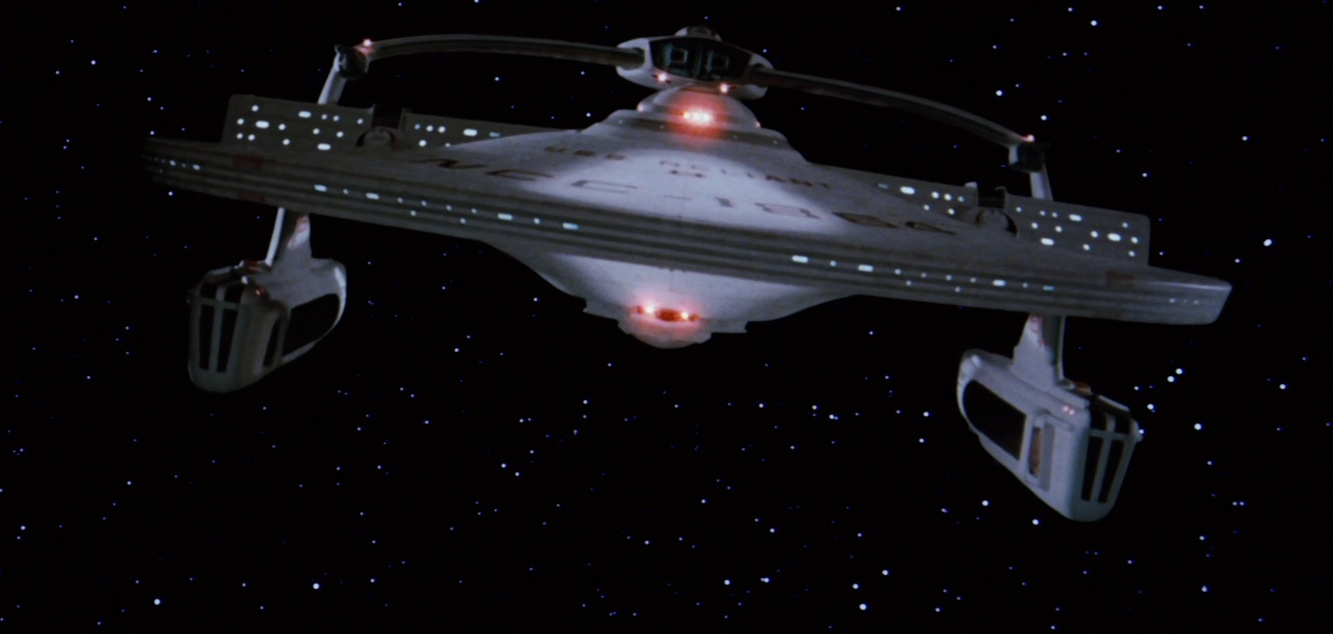
Still frame from Star Trek II: The Wrath of Khan showing the USS Reliant head-on.
The Miranda-class USS Reliant.

I know, I know: we’ve done The Wrath of Khan already! But this one really is dumb if you stop to think about it, so it’s definitely making the list. When the USS Reliant was scouting for planets as part of the Genesis project, it entered the Ceti Alpha system – a system that Starfleet has visited at least once before. The crew knew that there were supposed to be six planets… but no-one aboard can count, apparently.

Somehow – and I have no idea how this could’ve happened in the 23rd Century with all the technology aboard the USS Reliant – the crew mistook Ceti Alpha V for the destroyed Ceti Alpha VI, leading to them running into Khan and his band of augments. But there’s no way a mistake this glaringly obvious should’ve been able to happen at all.
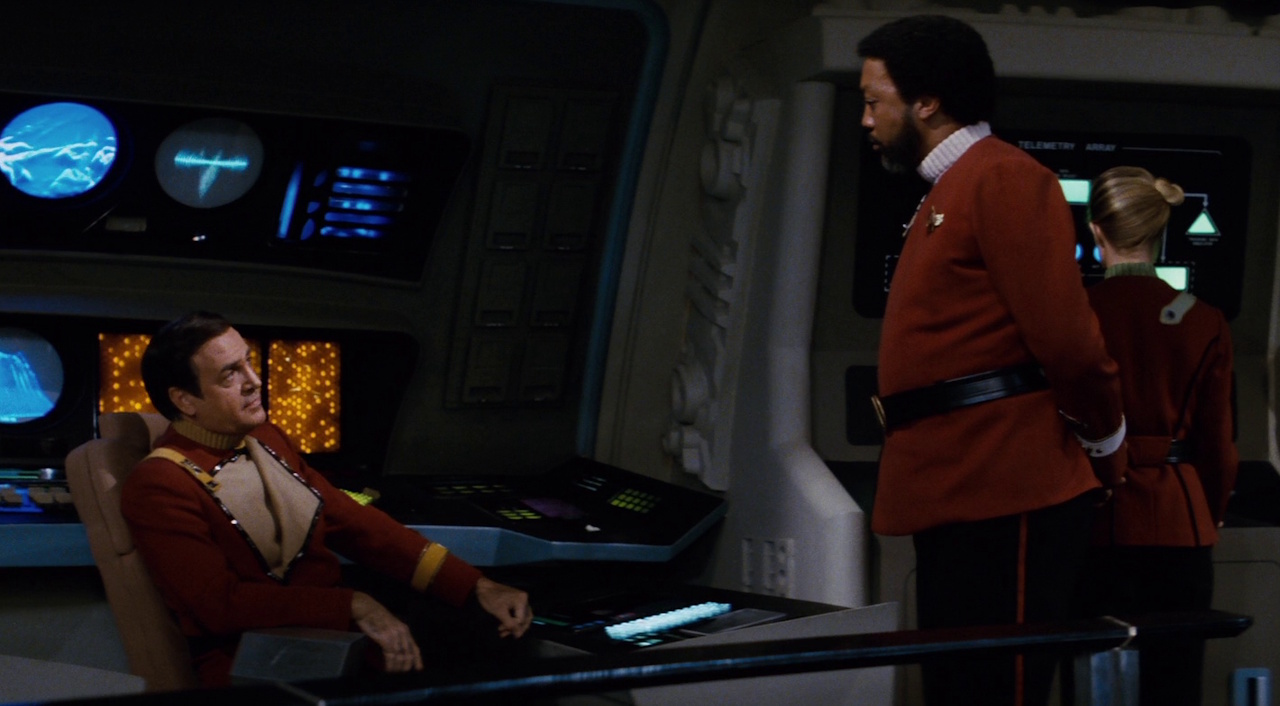
Still frame from Star Trek II: The Wrath of Khan showing Captain Terrell, Commander Beach, and another officer on the bridge of the USS Reliant.
Three senior officers on the bridge of the USS Reliant.

Upon entering the system – or hours ahead of arriving, using long-range sensors – Reliant’s crew should’ve noticed that, y’know, an entire planet is missing. If nothing else, the debris or dust cloud left behind by the explosion of Ceti Alpha VI – which is unlikely to have dissipated fully in a few short years – should’ve been a dead giveaway. But even if some kind of solar wind blew all the dust and rocks far outside the system, there were still only five planets where there should’ve been six! You’d think someone would’ve noticed this and at least mentioned it to the captain.

That’s to say nothing of Starfleet’s apparent lack of record-keeping. The Ceti Alpha system should’ve been flagged up as containing a dangerous colony of criminals: the augments. We know, thanks to the likes of Strange New Worlds, that Khan and his people were still notorious centuries after they tried to rule all of Earth, so surely Starfleet would want to prevent unwitting starships from stumbling upon their colony. The Talos system is restricted by Starfleet for much the same reason, as we saw in The Cage. But even if Kirk conveniently forgot to record that mission or tell Starfleet what became of Khan… why couldn’t anyone on the USS Reliant count to six?!

Number 5:
Can’t ships just fly over or under the Galactic Barrier?
Star Trek: The Original Series, Star Trek: Discovery
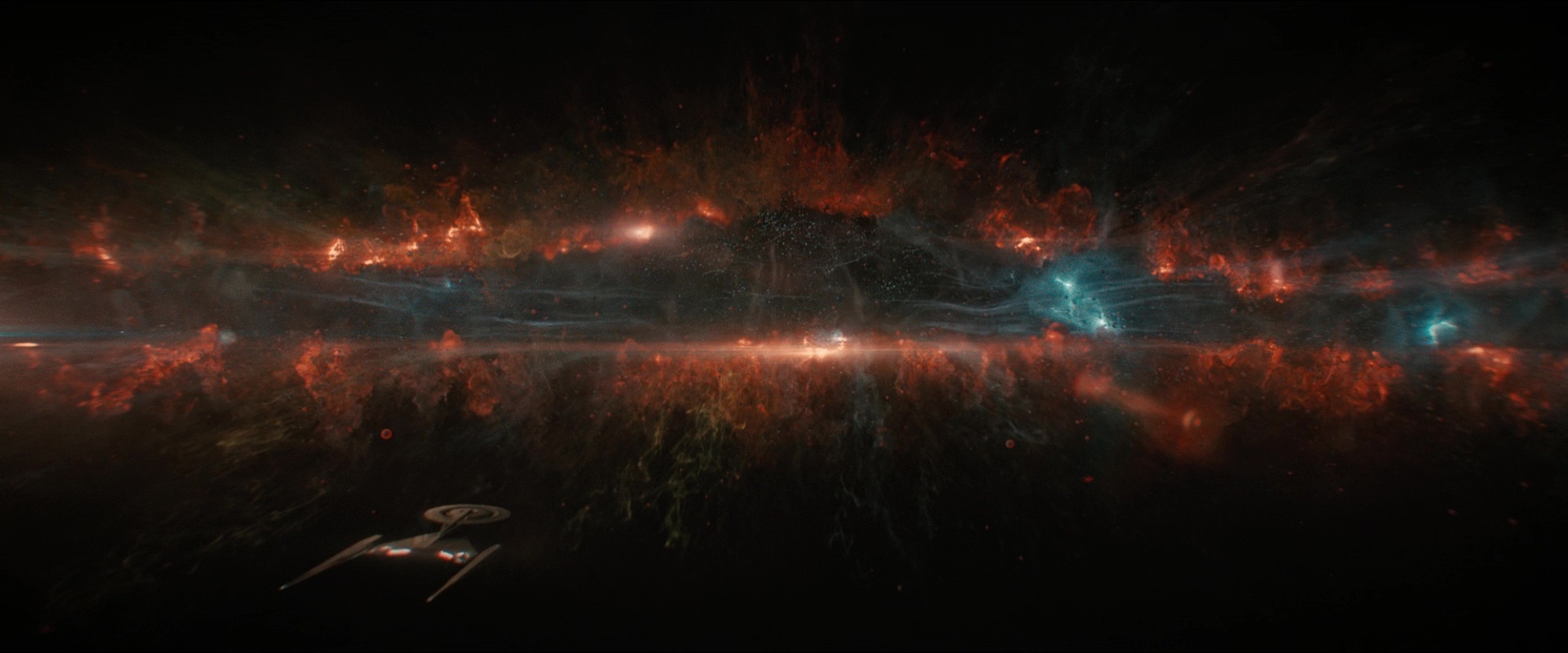
Still frame from Star Trek: Discovery Season 4 showing the USS Discovery at the Galactic Barrier.
The Barrier at it appeared in Discovery.

Star Trek has, on occasion, exhibited what Mr Spock might call “two-dimensional thinking.” By that I mean that many ships and objects in space appear as if they’re on a perfectly flat plane – but space is three-dimensional. One example of this appears to be the Galactic Barrier – the forcefield-like object that apparently surrounds the edge of the galaxy, preventing spacecraft from leaving.

Even in Discovery, though, which is the Galactic Barrier’s most significant appearance to date, the phenomenon (which doesn’t exist in real life) appears to be a mostly two-dimensional ring around the edge of the galaxy rather than a three-dimensional bubble. Which raises a simple question: why not simply fly over or under it? Starships are obviously capable of manoeuvring in three dimensions, so why fly through something you could easily fly around?
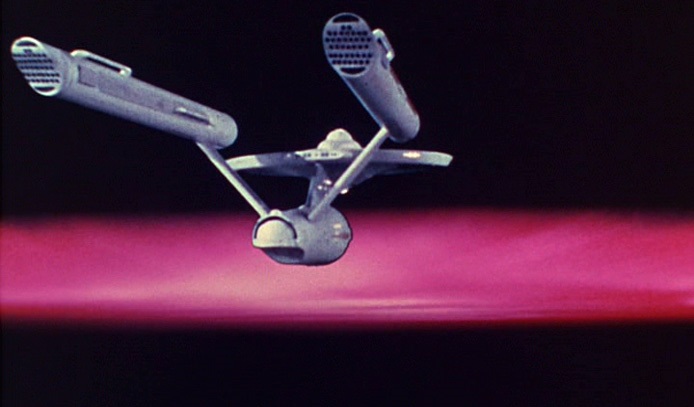
Still frame from Star Trek: The Original Series Season 1 showing the USS Enterprise approaching the Galactic Barrier.
The USS Enterprise approaches the Galactic Barrier.

Unless the Barrier is meant to surround the entire galaxy from all possible angles, there’s not really a good explanation for this. The way it’s been depicted on screen makes it seem like it’s something any starship could easily get around, even if doing so would take a bit longer. If this was a one-off visual effect from The Original Series I might be tempted to let it lie, but Discovery brought back the Galactic Barrier in its fourth season, presenting it as a pretty significant hurdle for Captain Burnham and the crew to overcome.

As an aside, I’m not sure that was a great idea! There are some elements of The Original Series, The Animated Series, and even from early in The Next Generation that just about work in context… but wouldn’t really translate well to a story made today. For me, as I think I said at the time of Discovery’s fourth season, the Galactic Barrier is one of them. And the way it’s presented and visualised on screen just kind of hammers home how two-dimensional some of the franchise’s space sequences can feel.

Number 6:
Why is artificial gravity always the last system to fail when a ship is damaged?
Star Trek VI: The Undiscovered Country et al.
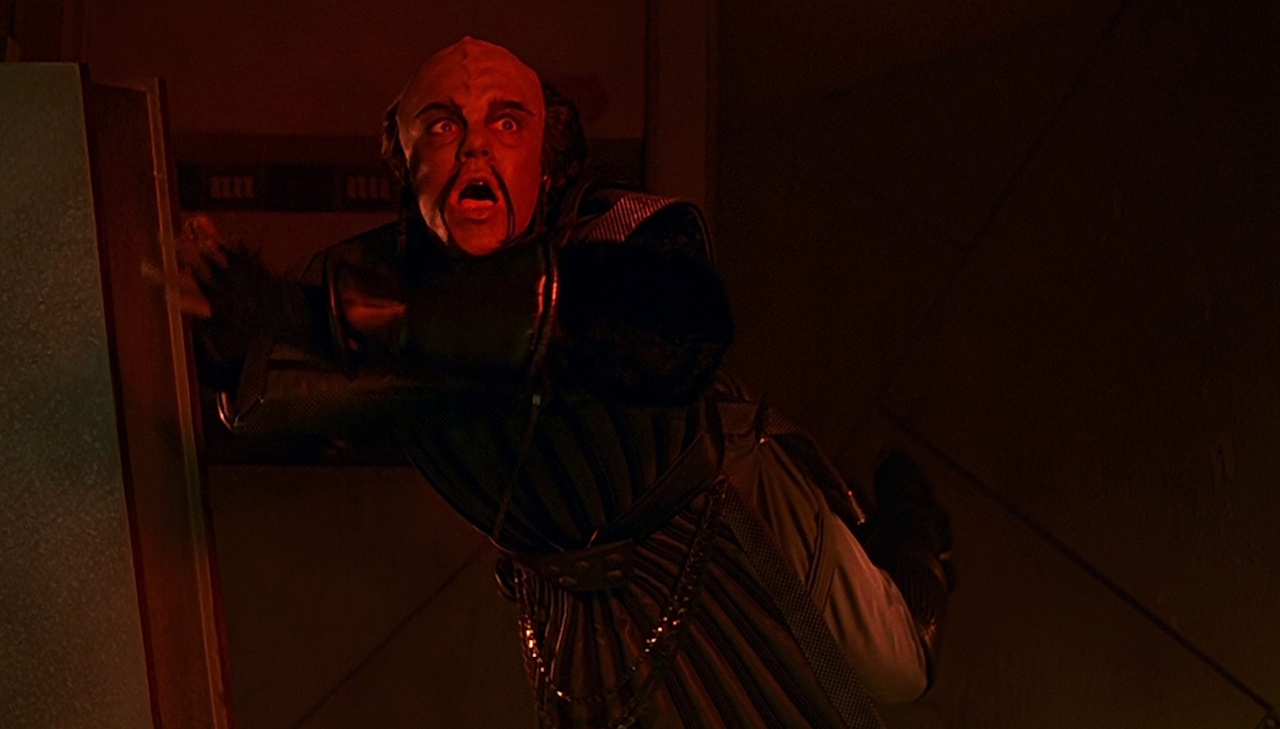
Still frame from Star Trek VI: The Undiscovered Country showing a Klingon floating helplessly.
A Klingon officer floating after his ship’s artificial gravity was knocked offline.

I think I can count on one hand the number of times a starship’s artificial gravity has been damaged in Star Trek. The only time it was plot-relevant was in The Undiscovered Country, where the damage to the artificial gravity on the Klingon ship Kronos One was instrumental to the plot to assassinate Chancellor Gorkon. But aside from that… can you think of a single time in the franchise’s 950 episodes and films where a ship has lost gravity?

We’ve seen starships take a real beating sometimes: the Enterprise in The Wrath of Khan, Voyager in Year of Hell, the NX-01 in Damage, and even non-Starfleet ships like the Cardassian vessel in The Wounded, or the Romulan warbird in Balance of Terror, but none of them ever lost their artificial gravity. This system appears to be more robust even than life-support, which we’ve seen fail on a number of occasions while artificial gravity was still operational.
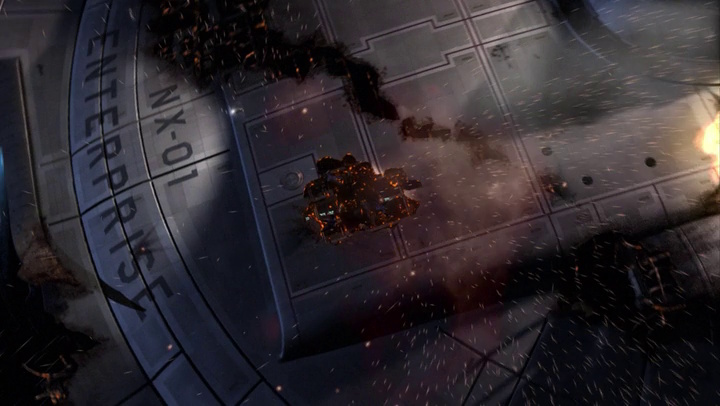
Still frame from Star Trek: Enterprise Season 3 showing the NX-01 Enterprise heavily damaged.
Even serious damage, such as to the NX-01 Enterprise pictured here, doesn’t usually stop artificial gravity from functioning.

You’d think prioritising something like breathable air and a survivable temperature would take precedence over artificial gravity, with ships being designed in such a way that life-support would be the most resilient and sturdy system. I know there’s some ambiguity in the way these technologies work in Star Trek, but artificial gravity must require some amount of power to function – and even if it’s powered by a wholly separate system, anything that disables the entire ship should deactivate artificial gravity. It would also make a logical target during ship-to-ship combat, as knocking out an opponent’s gravity would cripple their ability to operate the ship.

There are even times where disabling artificial gravity would be to the advantage of a crew trying to defend their ship. Perhaps the best example of this is the Borg attack on the Enterprise-E in First Contact, but there are other times where a boarding party, raiders, or pirates could have been at least slowed down and hampered if the crew deactivated artificial gravity on one or two decks. I suppose it’s good for Star Trek that the way artificial gravity works is deliberately vague, and it’s one of those “you’ve just gotta suspend your disbelief” things. But from an in-universe point of view, the apparently indestructible nature of this system, and the overlooked tactical advantages of trying to disable an adversary’s artificial gravity, don’t make a lot of sense.

Number 7:
Shouldn’t Starfleet have persevered with the Spore Drive?
Star Trek: Discovery
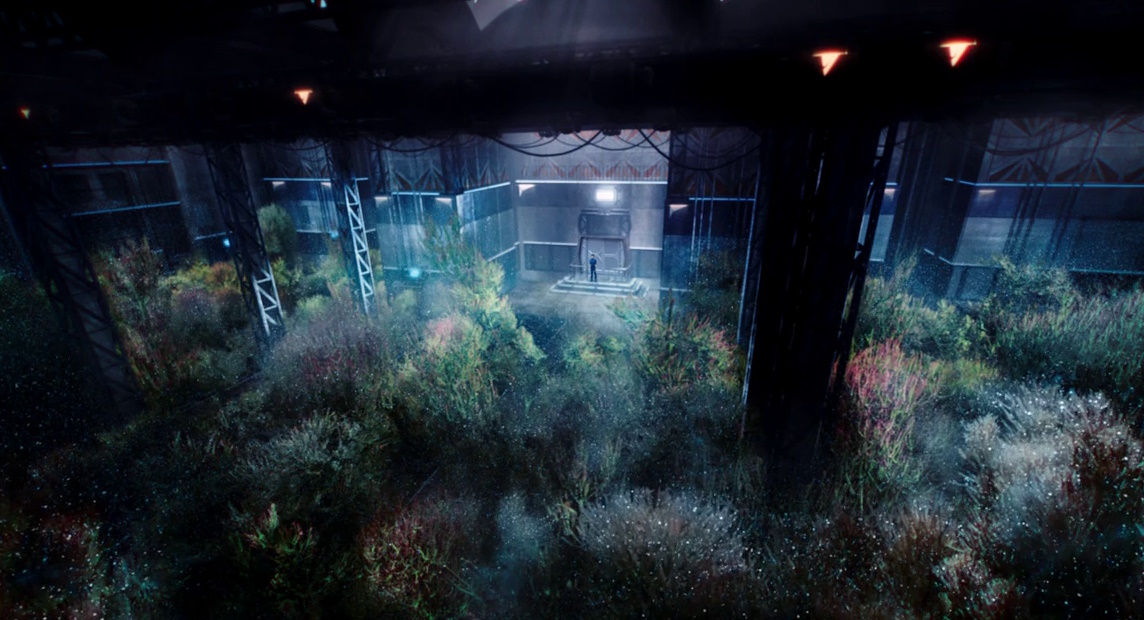
Still frame from Star Trek: Discovery Season 1 showing the mushroom cultivation area aboard the ship.
The cultivation bay aboard the USS Discovery.

After the loss of the USS Glenn and the apparent destruction of the USS Discovery, we’re led to believe that Starfleet abandoned its Spore Drive programme – even though the technology was proven to work and would be beyond useful to the organisation. For Starfleet, with its dual military and scientific missions, the Spore Drive was a phenomenal leap forward with so many applications. I genuinely cannot believe that they’d just abandon it after a few setbacks – especially after the Klingon Empire had come to learn of its existence.

We would later see, in Discovery’s third season, that basically any empathic race could – in theory – interface with the Spore Drive. That doesn’t seem like such a huge leap that Starfleet couldn’t have figured it out over time, especially with races like the Betazoids and Vulcans on hand. But even if using an empath as a navigator wasn’t possible, it still seems like such a ridiculously overpowered and useful piece of kit that Starfleet – and Section 31 in particular – would want to continue to develop it.
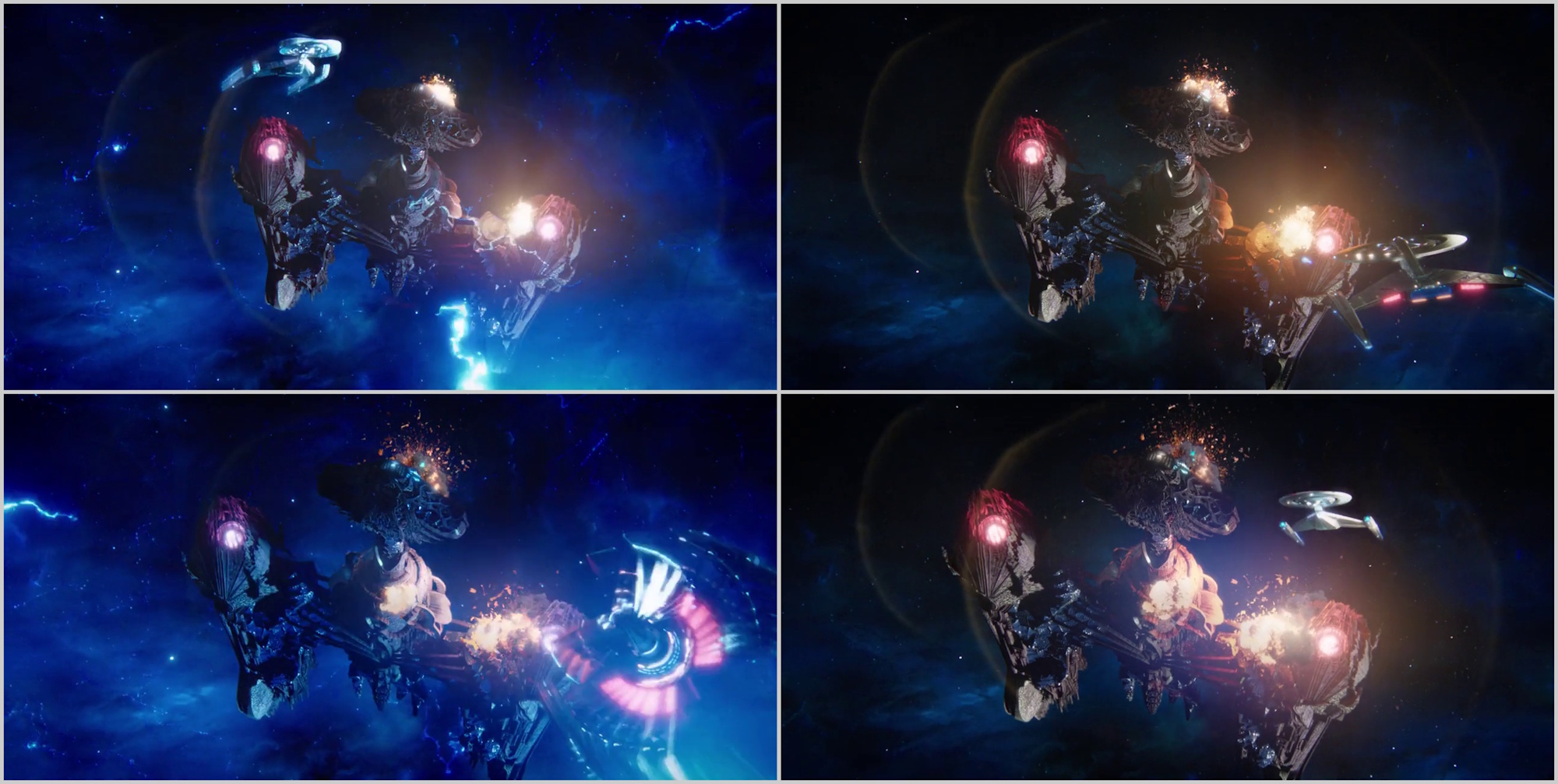
Four still frames from Star Trek: Discovery Season 1 depicting the USS Discovery at the Battle of Pahvo.
The Battle of Pahvo (pictured) proved the Spore Drive’s worth as a military tool.

Look at the Spore Drive’s capabilities. Two of its biggest achievements were cracking the Klingons’ cloaking device – becoming basically invulnerable to attacks in the process – and leaping tens of thousands of light-years across the galaxy to the planet Terralysium. For Starfleet’s military, the Spore Drive’s ability to jump so fast that attacks from disruptors and torpedos are ineffective is huge – it could redefine starship combat in the Alpha Quadrant. And for the organisation’s mission of exploration, being able to jump to literally anywhere in the galaxy renders warp drive obsolete and would mean Starfleet can investigate any interesting-looking phenomena with ease – while still being back home in time for tea.

The Spore Drive is an example of a “prequel problem;” if Discovery had been set years or decades after Nemesis – in the same period as Picard, for example – then it wouldn’t be an issue. We could simply say that the Spore Drive would become Starfleet’s new method of travel. But because Discovery was set before The Original Series, I don’t think there’s any way to create a satisfactory explanation for why Starfleet, Section 31, or other factions didn’t continue to develop and refine it.

Number 8:
Why would the Xindi fire a small weapon at Earth months ahead of their main attack?
Star Trek: Enterprise
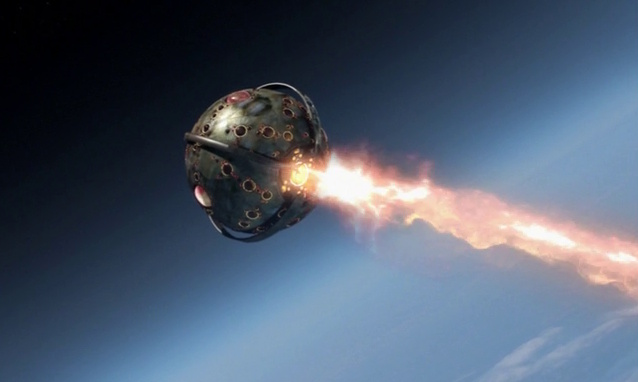
Still frame from Star Trek: Enterprise Season 2 showing a small spherical Xindi weapon firing.
The Xindi’s first weapon.

Sun Tzu, the legendary Chinese general, wrote two-and-a-half thousand years ago that a good commander should “always mystify, mislead, and surprise the enemy if possible.” And throughout history – from the ancient world to the Second World War and beyond – surprise attacks and misdirection have been incredibly powerful tools that successful generals and strategists have employed. So why would the Xindi – backed up by a faction from the far future, no less – launch a minor attack that alerted Earth and humanity to their much larger upcoming attack?

If the Xindi needed to test the range and abilities of their weapon, they could pick another target in a different system. This target would be a comparable distance away from where they planned to launch their weapon, and could also be a planet of roughly the same size and mass as Earth. This would give their scientists and engineers the data they needed without compromising the secrecy of their operation. All they achieved by targeting Earth with their initial, much smaller weapon was alerting humanity and Starfleet to their existence – which ultimately set the stage for their defeat.
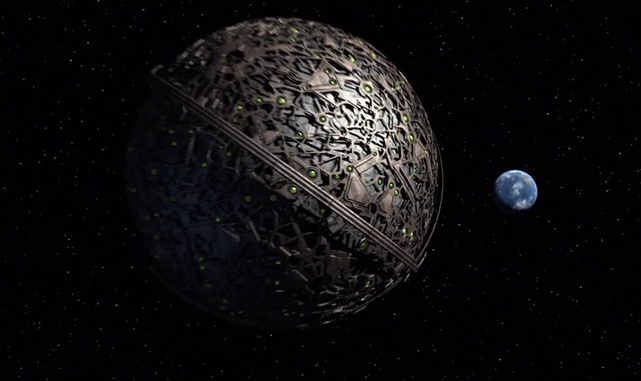
Still frame from Star Trek: Enterprise Season 3 showing the Xindi weapon arriving at Earth.
The much larger second Xindi weapon approaches Earth.

This is a military blunder so exceptionally basic that, if I were the Sphere-Builders, I’d have cut all contact with the Xindi and written off the entire operation. The miniature version of the weapon wasn’t designed to deal the kind of damage that the larger version was, but it was still damaging enough to put all of humanity and Starfleet on full alert – kick-starting a chain of events that led to Captain Archer confronting and stopping the Xindi and their Sphere-Builder allies.

All the Xindi would’ve had to do was pick a different target for their weapons testing. A planet the same size as Earth in a system roughly the same distance away would be ideal – or an unarmed probe sent to Earth if scouting that route was deemed necessary. Even if the Xindi and Sphere-Builders were so cocky and arrogant that they considered themselves to be unstoppable, it was still a catastrophic, primary school-level mistake to send the small weapon directly to Earth months before the larger weapon was ready.

Number 9:
How did Nero’s trip back in time create an alternate reality instead of changing the prime timeline?
Star Trek (2009)
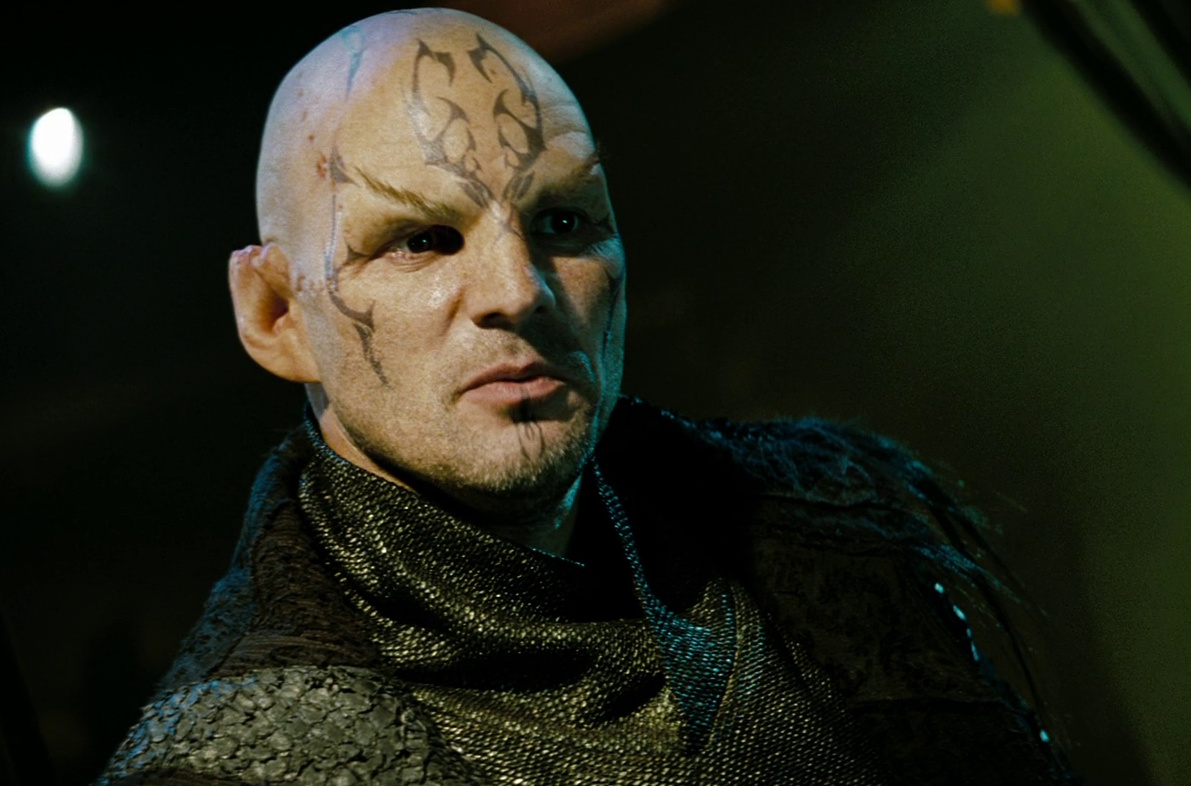
Still frame from Star Trek (2009) showing a close-up of Nero.
Nero.

The way it’s explained on screen in Star Trek, Nero travelled back in time from 2387 to 2233 via an artificial black hole created by Red Matter. Somehow, though, the changes Nero and later Spock would go on to make to the past didn’t overwrite the events of the prime timeline, but exist in their own separate universe. This doesn’t seem to gel with what we know of time travel and temporal paradoxes in Star Trek.

Starfleet vessels have encountered all kinds of temporal phenomena over the years, none of which led to the creation of a parallel universe. Even in cases where ships got caught up in time-travel shenanigans, the end result was either a permanently altered timeline – as in stories like The Voyage Home or Past Tense – or overwritten events that no-one remembered – as in stories like Cause and Effect or Year of Hell. None of these led to the creation of a permanent alternate reality that persisted after the phenomenon that created it had been dealt with – so why did the Red Matter black hole do so?

Still frame from Star Trek (2009) showing the Narada emerging from a black hole.
Nero’s ship, the Narada, arrives in the 23rd Century.

The best explanation I can come up with is this: Star Trek exists in a multiverse. Along with to the prime timeline, the Mirror Universe, and others that we’ve seen, there must be multiple additional parallel universes – some of which are identical to or indistinguishable from the prime timeline. Somehow, Red Matter creates a portal between universes, allowing for travel from one to another. Nero and Spock entered a parallel universe identical to the prime timeline – but it’s a parallel universe that already existed before they arrived.

That’s a pretty convoluted explanation, and it isn’t explained that way on screen. Instead, the alterations to the timeline that Nero perpetrated – from the destruction of the USS Kelvin to the attack on Vulcan and beyond – should have permanently altered the prime timeline based on what the characters told us and what we already know from other iterations of Star Trek.

Number 10:
Couldn’t Captain Pike just retire and live as a hermit?
Star Trek: Strange New Worlds
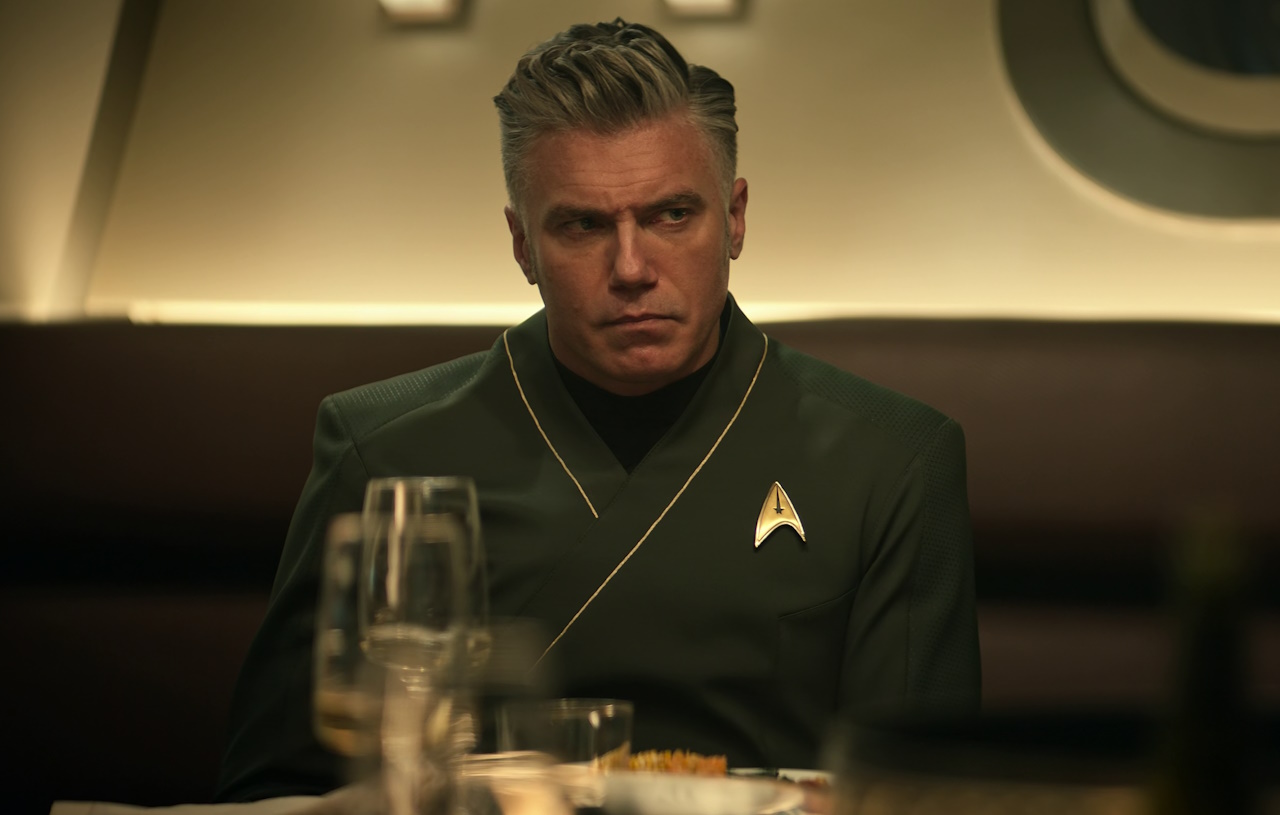
Still frame from Star Trek: Strange New Worlds Season 2 showing Captain Pike at a diplomatic dinner.
Captain Christopher Pike.

I found Pike’s arc in Discovery and the first season of Strange New Worlds to be interesting and relatable. I’ve been in a similar position to Captain Pike: being told that my health was going to get dramatically worse and knowing that it’s inevitable. It made Pike an incredibly sympathetic character, and one whose story brought a tear to my eye more than once. But… is Pike’s devastating accident and disability genuinely unavoidable?

The more Pike comes to learn about the future, the more he seems to uncover ways to avoid his supposedly-inevitable fate. In the fantastic Season 1 episode A Quality of Mercy, Pike learned – thanks to a time-travelling version of himself – that if he avoided his fate but remained in Starfleet, he’d accidentally trigger a chain of events that led to a devastating war between the Federation and Romulans. This conflict was something only Kirk and Spock could prevent, but Pike’s place on the bridge and Spock’s serious injury would keep the war going and prevent any hope for peace in the future. This seemed to strengthen Pike’s resolve and set him back on course for the accident that would leave him disabled.
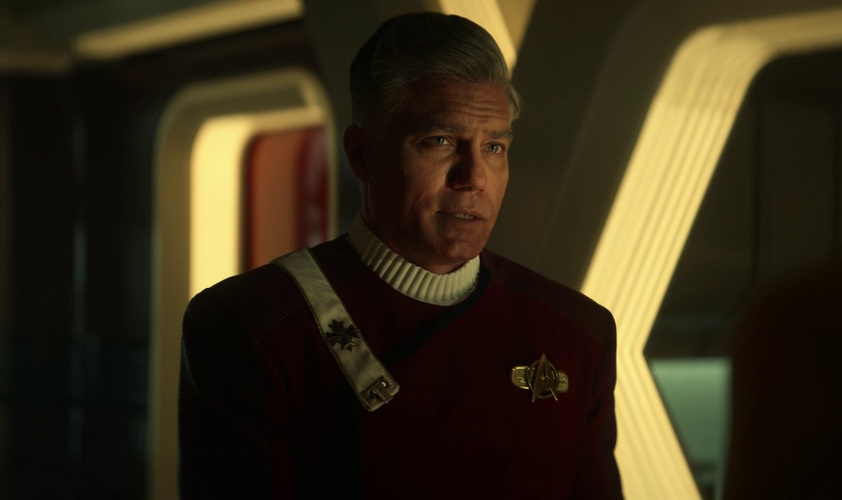
Still frame from Star Trek: Strange New Worlds Season 1 showing a future Captain Pike in a 'monster maroon' uniform.
Pike in an alternate future.

But… couldn’t he choose a radically different path? Sure, remaining in Starfleet after he was supposed to suffer the accident led to a horrible alternate future. But if Pike resigned his commission the day before the accident and went to live in a cave somewhere, what would change? Nothing, right? Pike could remain alive and relatively healthy, enjoying a well-earned retirement without the need for Talosian mind-games, and the rest of the galaxy could continue unaffected.

Maybe we’ll find out, in Seasons 3, 4, or beyond, why that kind of scenario couldn’t work. But it seems to me that, as long as Pike kept his head down and stayed away from Starfleet and galactic affairs, there wouldn’t be any harmful side-effects. Furthermore, knowing what he knew of the Romulan incursion, he could’ve even reacted differently in that situation to prevent the conflict from escalating. I guess the point of A Quality of Mercy was to hammer home that there’s no way to predict how any changes to the timeline could affect the Federation – and that’s a fair point, I suppose. But on a personal level, I could forgive Pike for trying to wrest back control of his destiny from the Klingon time crystal that doomed him.

So that’s it… for now!
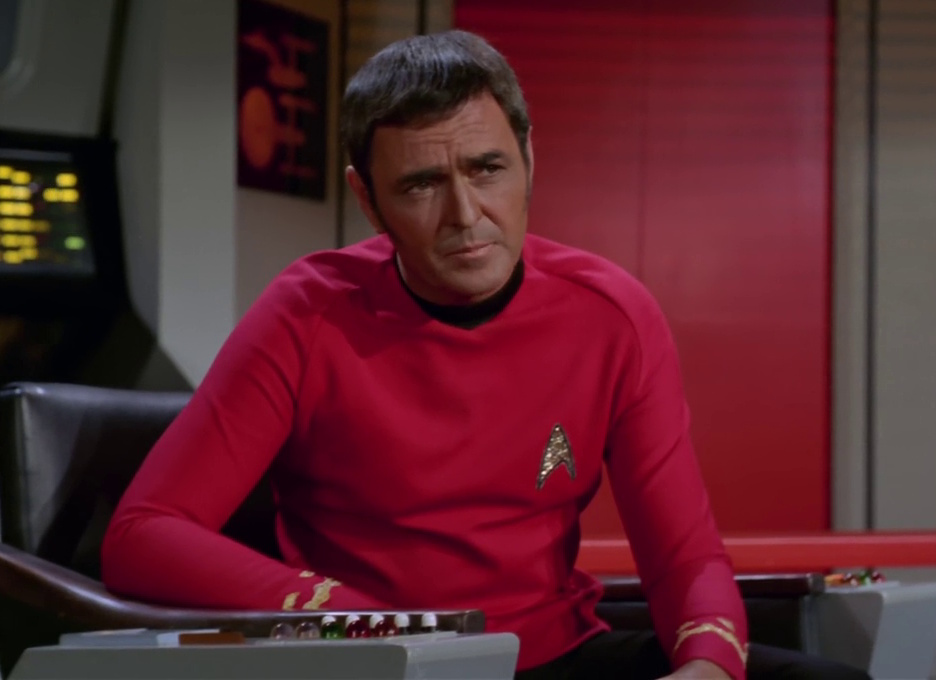
Still frame from Star Trek: The Original Series Season 3 showing Commander Scott in the captain's chair of the Enterprise.
It’s Scotty!

I hope this has been a bit of fun! Some of these things are more irritating than others, but to be honest with you, none of them are really that big of a deal. They only matter to folks like you and I – people who spend a bit too long thinking about Star Trek!

This might be a subject I’ll revisit in the future, so if your favourite little inconsistency or goof didn’t make the list this time, it’s possible I’ll get to it on another occasion. And if you want to check out my earlier list to read about ten other little things that bug me in Star Trek, you can find it by clicking or tapping here.
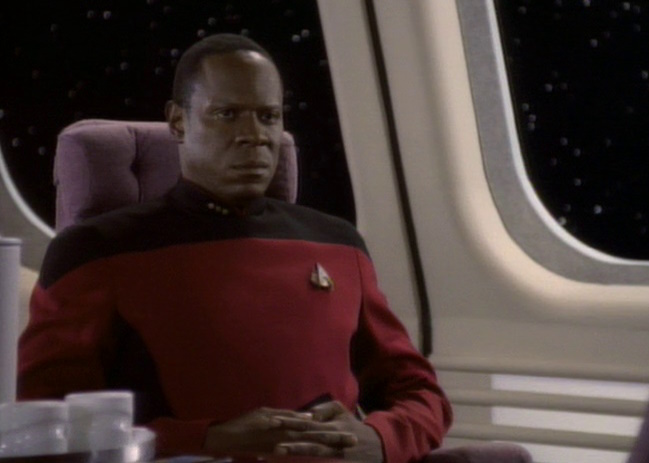
Still frame from Star Trek: Deep Space Nine Season 1 showing Commander Sisko aboard the Enterprise-D.
Commander Sisko looks rather grumpy…

Stay tuned, because there’s more Star Trek content to come here on the website as 2025 gets underway. Later this year we’ve got a new season of Strange New Worlds to look forward to, and if you missed my review of Section 31 you can find it by clicking or tapping here. I also wrote up my recollections of Voyager to mark the series’ thirtieth anniversary, and you can find that by clicking or tapping here.

Until next time… see you out there!


Most of the Star Trek shows, films, and episodes referenced above can be streamed now on Paramount+ in countries and territories where the platform is available, and may also be available on DVD and/or Blu-ray. The Star Trek franchise – including all shows, films, episodes, characters, and other properties discussed above – is the copyright of Paramount Global. This article contains the thoughts and opinions of one person only and is not intended to cause any offence.
Star Trek: The Next Generation re-watch – Season 7, Episode 17: Masks

Spoiler Warning: There are spoilers ahead for Star Trek: The Next Generation.

This is the first in what I hope to be a weekly series over the next few months. In the wake of the Star Trek: Discovery Season 4 disaster – the series has been withheld from fans outside of North America, if you somehow missed the news – I won’t be covering the show at all. Instead I’ll be writing up re-watches of some of my favourite episodes from Star Trek’s extensive back catalogue. This week we’re visiting The Next Generation’s final season to look at the episode Masks.

First up, a brief introduction to this format. I’m not calling these articles “reviews.” It wouldn’t be fair to do so because I’ve seen Masks – and all of the other episodes we’ll be looking at over the next few weeks – more times than I care to remember! This won’t just be a recap of the plot of the episode – I will be giving my thoughts and analysis as we go. But it can’t really be an objective “review,” strictly speaking.

The episode’s title card (from the remastered version).

Masks was one of the last episodes produced for The Next Generation before production shifted to Star Trek: Generations. At this stage we’ve been with the crew of the Enterprise-D for almost seven years and we know them well – so we think we know what to expect. Season 7 tried to shake things up at various points – like in Genesis where the crew all de-evolved! And Masks is kind of in a similar vein. We’ll see the ship transformed, and Data in particular will take on several different personalities.

Masks is one of those episodes that sticks in my mind. The Enterprise-D and her crew found themselves in many wacky and unpredictable situations over the years, but there’s something about the Aztec-inspired aesthetic that really makes what’s going on in Masks feel ancient and otherworldly. It’s a story that feels at home in the Star Trek franchise; the kind of episode no other sci-fi series would even attempt.

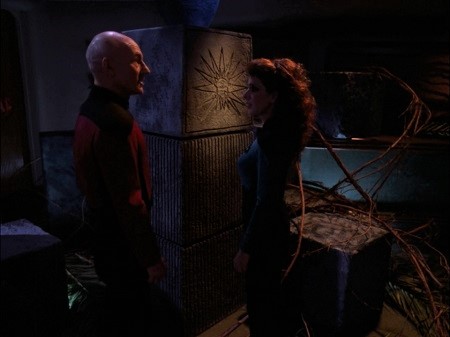
Picard and Troi examine a D’Arsay obelisk.

The episode is also a great one for Data actor Brent Spiner, who gets a chance to show off his range as an actor. There’s always seemed to be a disconnect between the character of Data and the personality of the man who plays the role! Data is cool and logical, but Brent Spiner has an almost chaotic energy to him, full of life and with a great sense of humour. Masks isn’t the only episode of Star Trek to give him more to do – look at his roles as Lore and as various members of the Soong family for more examples – but it’s certainly an episode that gives Spiner many opportunities to shake up his regular role.

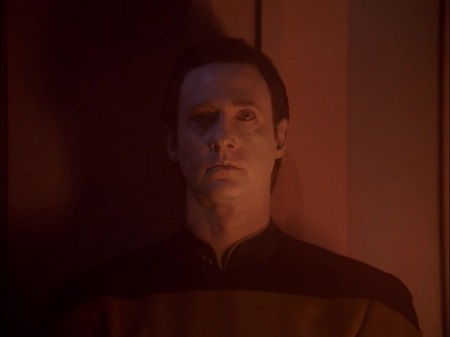
Data is such a wonderful character, and his series-long quest to become more human saw him attempt to mimic a variety of different behaviours. At the beginning of Masks we see him taking an art class, learning to sculpt and to use his imagination. Because of the largely episodic nature of The Next Generation, even in Season 7 Data is still chasing his ambition of becoming human in much the same way as he had been earlier in the show’s run. The character saw evolution across the series as a whole, but moments like these at the beginning of Masks could sometimes feel like a reset, reinforcing Data’s android nature and showing how he doesn’t fully understand some element or other of what it means to be human.

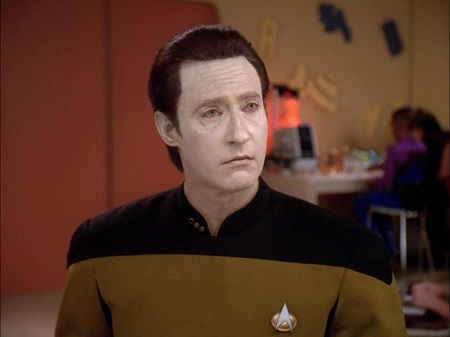
Data learning about imagination at the beginning of the episode.

I wouldn’t try to argue that Masks is an especially important episode, either for The Next Generation or Star Trek as a whole. It’s great, don’t get me wrong, but it isn’t groundbreaking or transformative for the franchise in the way certain stories can be – it doesn’t introduce new characters, factions, or themes that would carry over to future projects, for example, nor is it a transformative event in the lives of any of the main characters.

But that doesn’t mean it isn’t a fun episode with an interesting premise. In a way, what we have in Masks is an examination of computer viruses and the major cultural and technological differences that exist between cultures. After encountering the D’Arsay archive inside of what appears to be a comet, it transmits its information to the Enterprise-D, but that computer code plays havoc with the ship’s systems – and with Data. Though this computer virus analogy isn’t the episode’s message or primary focus, it’s not a coincidence that a story like Masks was created at this time.

There’s a timely message about rogue computer software buried in Masks.

In 1994, when the episode was initially broadcast, home computing was growing exponentially. Along with the rise of the PC came fears of computer viruses, and antivirus software was becoming a big business. Though Masks mainly considers cultural themes within the story itself, I’d argue very strongly that the premise – disruptive or even malicious software being beamed to the Enterprise-D – is a reaction to the way the home computer market was shaping up at the time.

Computer viruses continue to plague systems today, of course, but with improvements in antivirus software and better computer education, the fears most folks have of viruses has diminished. In that sense, this aspect of Masks feels like a step back in time a quarter of a century – which it is, of course! The idea of rogue computer code harming – or in this case transforming – one’s computer was certainly a relevant concern at the time, though, and although it’s one that the episode doesn’t feature prominently it’s still an interesting aspect.

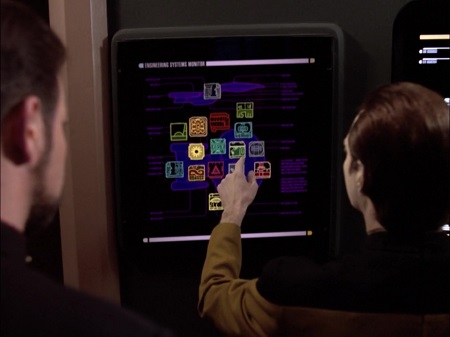
Riker, Data, and Geordi tried to make sense of the mysterious symbols that began appearing on the Enterprise-D’s computer screens.

Masks also looks at how we deal with cultures very different from our own, and how we need to be careful when interpreting history. Captain Picard is at his best in episodes like Masks, getting the chance to show off one of his real passions – history. Picard is well-placed to jump into the story and find a use for his skills, and is supported at various points by Riker, Troi, and perhaps the most unusual choice – Worf. One of Worf’s lines about the sun and moon proves crucial to unlocking the mystery of the archive, and while Captain Picard definitely needed others around him in these scenes, I’m not sure I’d have chosen Worf!

The struggle that Picard and the others had of trying to interpret an unfamiliar culture is one that historians and anthropologists have long dealt with. And to me, Masks is an example of Star Trek doing what it has always done: using a sci-fi lens to examine a real-world subject. Usually the stakes aren’t so high, of course, but putting a kind of ticking clock and threat in the background gave the story an impetus it would’ve otherwise lacked; had Picard and the crew simply been trying to learn about the D’Arsay symbols and characters out of curiosity, the story wouldn’t have gone anywhere.

Picard had to draw on his knowledge of history and anthropology to solve the mystery of the D’Arsay archive.

On the technical side of things, Masks was one of the first Star Trek episodes to use computer-generated imagery (CGI), using the new technology for the comet and D’Arsay archive. The remastered version, which is what you’ll find on blu-ray and streaming – didn’t preserve the original CGI model, recreating the archive from the ground up based on the original design. The DVD version, however, and other older copies (like VHS) do still have this piece of Star Trek’s history. You can also find images of the original CGI model online, of course.

A few times across The Next Generation, sped-up shots would be used to show Data working or moving faster than a human could. Out of everything present in Masks, this short sequence (which shows Data sculpting a treble clef in his art class) is perhaps the only part that feels dated in 2021. The rest of the episode’s effects hold up remarkably well, and the remastered CGI sequences look great even on a modern 4K display.

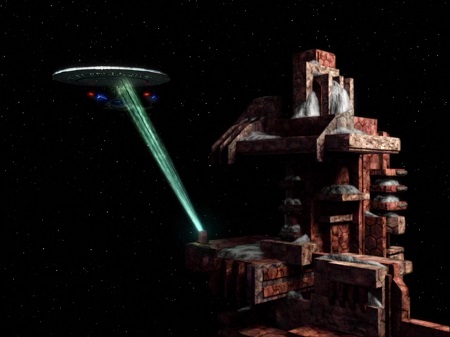
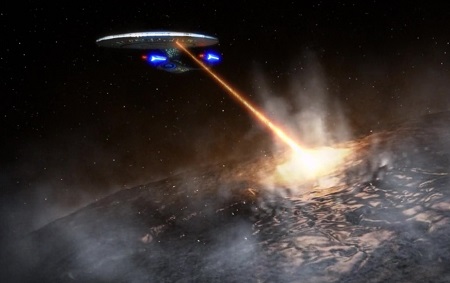
This shot of the Enterprise-D melting a comet with its phasers is pretty darn cool.

Many times across Star Trek’s long history there have been so-called “bottle shows.” These are episodes which primarily use existing sets and often don’t bring in many new characters or guest-stars, focusing on just the main cast. Though there was a set built for Masks – the temple, which would later be re-used in Deep Space Nine – the episode is mostly a bottle show, or perhaps a semi-bottle show! It focuses on a handful of characters, mostly re-uses existing Enterprise-D sets – with a few additions and changes to reflect the transformation the ship is undergoing – and feels like a very self-contained story in that respect.

Given Data’s prominent role, Brent Spiner is the star of Masks. And while we see elements of his portrayal of Lore in one of the personas that Data assumes, for the most part he makes each of the D’Arsay characters feel unique and distinctive. For an actor who spent most of The Next Generation’s run playing a very unemotional, unreactive character, I can quite understand why Brent Spiner would describe Masks as one of his biggest acting challenges on the show. I think he rises to the occasion and shows off a range that any actor would be proud of; making each persona feel separate despite only minor costuming changes is no mean feat, and he pulled it off very well. There was a risk, perhaps, that in order to differentiate each of the D’Arsay personas in such a short runtime each would have to be exaggerated to the point of pantomime caricature, but that didn’t happen in the final episode. That alone should be testament to Brent Spiner’s talents and hard work.

Data actor Brent Spiner had to take on several different personas in Masks.

There are a few lines from Masks that resonate with me from a mental health standpoint. Though the episode isn’t intended as an examination of mental illness, Data developing an android version of “multiple personalities,” as Troi puts it, does bring up some comparisons. When Data asks Geordi what it feels like to lose one’s mind is a line that very much struck a chord with me, not least because it’s a question I’ve asked myself (and doctors) in the past.

Data’s line as the episode draws to a close about feeling “empty” following the removal of the D’Arsay personalities likewise felt very relatable. It isn’t always easy to tell where the line is between one’s own personality and aspects of oneself that might be better characterised as manifestations of mental illness, and even the removal or lessening of a mental health symptom can, in some cases, bring with it a feeling of emptiness or of feeling incomplete. That’s definitely a second thing I find relatable – and I think it shows how stories which only touch on themes of mental health can still be impactful even if mental health isn’t the focus.

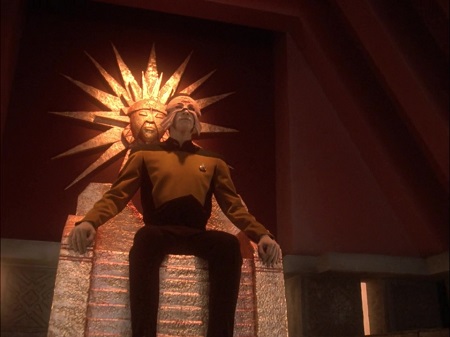
Data on Masaka’s throne.

The only real criticism I have of Masks is that its ending feels a little too quick – almost abrupt, really. After a slow buildup which sees the Enterprise-D progressively transformed to resemble the D’Arsay culture, Picard has a short conversation with Masaka, and then after a quick “woosh” everything is un-transformed and back to normal. A quick epilogue with Data and Picard in the ready-room closes the episode, and the final few minutes just feel a little rushed, especially considering the deliberately slow pacing of the rest of the episode.

Despite that, I enjoy Masks. It isn’t my all-time favourite episode of The Next Generation, but it’s one of those solid standalone stories that Star Trek does far fewer of since the move to serialised story arcs and shorter seasons. Masks shows off a different kind of science fiction with its slightly wacky concept of an archive transforming the ship into stone artefacts, but at the same time it’s a story that’s grounded in real-world parallels of history and anthropology. Brent Spiner puts in one of his finest performances, taking on a variety of personas that force him to step well outside of his normal bounds as Data.

So I hope this was a bit of fun. My objective at the moment is to remain connected to Star Trek and the Star Trek fan community but without providing any support or coverage of Discovery in light of the awful decision from ViacomCBS. Later this week I hope to look at an episode from Star Trek: Enterprise, and I already have dozens of other ideas for episode re-watches as we move through the holidays and into 2022.

Star Trek: The Next Generation is out now on blu-ray and DVD, and is available to stream on Netflix outside of the United States (at least for the time being). The Star Trek franchise – including The Next Generation and all other properties mentioned above – is the copyright of ViacomCBS. This article contains the thoughts and opinions of one person only and is not intended to cause any offence.

Star Trek: The Next Generation re-watch – Season 4, Episode 12: The Wounded

Spoiler Warning: There are spoilers ahead for Star Trek: The Next Generation, as well as for other iterations of the franchise.

Thirty years ago this very day, Star Trek: The Next Generation broadcast the twelfth episode of its fourth season: The Wounded. This would be a highly significant episode for the franchise going forward, and in many ways began to set the stage for the upcoming spin-off Deep Space Nine. At this stage work on pre-production of Deep Space Nine had already kicked off, and while The Wounded is by no means a backdoor pilot, there was a conscious effort on the part of Rick Berman – who was in charge of Star Trek at the time – to begin to put the pieces together for the new series.

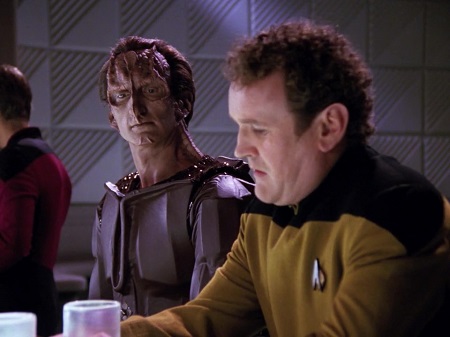
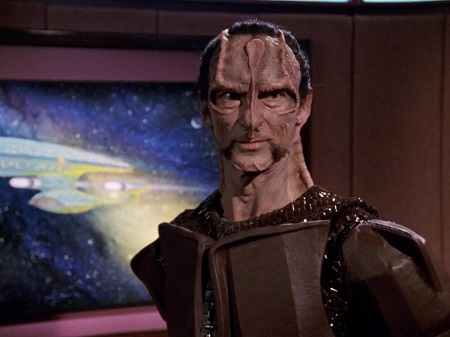
The Wounded is the first episode to give future Deep Space Nine regular Miles O’Brien a significant role. Though present since Encounter at Farpoint at the beginning of Season 1, O’Brien had been a background character with little to do until this point. The episode also marked the debut of the Cardassians, with future Gul Dukat actor Marc Alaimo featuring as a different Cardassian – Gul Macet.

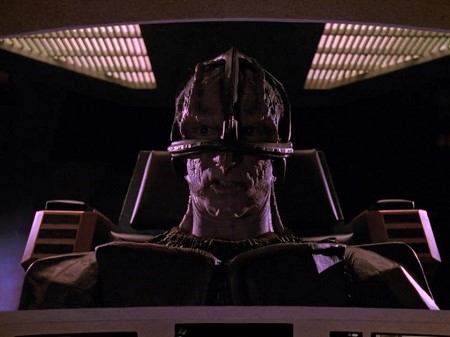
Gul Macet – the first Cardassian ever seen in Star Trek.

For both of those reasons, The Wounded is incredibly important within the history of Star Trek. The foundations of Deep Space Nine were laid here, and it was around this time, under Rick Berman’s direction, that Star Trek truly cemented its evolution from purely episodic storytelling to an interconnected franchise. Deep Space Nine would share The Next Generation’s time period and be broadcast while its sister show was still on the air. This was a marked change from the way The Next Generation was spun off from The Original Series, and one which allowed the different parts of the franchise to connect in ways that were unprecedented at the time.

After more than a decade of the Marvel Cinematic Universe and other such franchises, we almost take for granted this concept of big, interconnected fictional universes. But episodes like The Wounded are a big part of building that sense of connectedness within Star Trek, and in the early ’90s that was something entirely new. The difference between a good film or television show and one that can become one part of a greater franchise is that sense of interconnectivity, and it’s impossible to understate the importance of episodes like The Wounded on building up Star Trek as that kind of franchise.

The Wounded was instrumental in laying the groundwork for Deep Space Nine.

In that sense, it isn’t only Deep Space Nine which owes so much to The Wounded – and other similar episodes around this time in The Next Generation’s run – but also Voyager, and by extension Enterprise, the Kelvin films, Discovery, and the fact that Star Trek is still going strong thirty years later. It’s one of those incredibly significant moments in the history of the franchise – one of the moments at which Star Trek became an expanded franchise.

More than that, The Wounded is an especially good episode. As Star Trek has always done, it deals with real-world themes through its sci-fi lens, looking at war, post-traumatic stress, how feelings of hate can linger long after the event, and so on. It was also a rarity at this point in Star Trek to see Starfleet officers as anything other than exemplars of virtue, or the Federation as anything less than a utopia. Captain Maxwell is not a villain per se, but the actions he takes in The Wounded endanger the peace – a hard-won peace with the Cardassians. In that sense, the episode looks at the idea of how war can and should be justified, and whether it’s acceptable to sacrifice the truth to preserve the peace.

The episode’s title card.

Coming toward the end of the 1990-91 Gulf War, that makes The Wounded a very timely piece of television. Unlike the later Iraq War of 2003, the Gulf War was generally popular at the time, but even so there was a sense that there wasn’t a real plan for what to do after the initial military objectives had been achieved. Should the US and allies push on into Iraq and remove the Iraqi government? Or should they make peace even if doing so meant leaving a dictator in place? The Wounded doesn’t tackle all of these issues head-on, but the general theme of making peace with an enemy, the value of peace itself, and on a personal level, the toll war can take on those who serve, were all present in the narrative.

Finally, The Wounded draws on inspiration from the film Apocalypse Now, itself influenced by the novel Heart of Darkness, and in the vein of those classics features a story about a war hero going “mad.” Plot points like Captain Maxwell’s mental state and his foray into enemy territory are comparable to storylines in those classic works of literature and cinema. There’s a reason why audiences respond to such powerful themes and storylines, and The Wounded does an admirable job of translating them to Star Trek’s science fiction setting, doing so in a way that retains the original message, ensuring it isn’t buried too deeply in talk of aliens and spacecraft.

The Wounded follows a similar narrative to classic war film Apocalypse Now.

Because of the way The Next Generation was broadcast at the time, I can’t claim that this is the thirtieth anniversary of when I saw The Wounded! That would’ve been a couple of years later, as here in the UK that was the kind of delay we were looking at between an episode’s US premiere and when it would be broadcast here. Regardless, let’s take a look at The Wounded together.

The episode begins with a couple of sequences that set up the main storylines. Both via his captain’s log and on the bridge, Picard gives us a lot of information about the Cardassians – who were, as noted, new to Star Trek in this episode. The bridge crew briefly discuss the situation, and it emerges that Picard had been part of the conflict and negotiations to resolve it while in command of the Stargazer. The exact nature of Cardassian-Federation relations is a little confused; Picard says a “peace treaty” is in effect whereas Troi describes the Cardassians as “allies.”

Up next we get a sequence with Chief O’Brien and Keiko – whose wedding had been part of the previous episode, Data’s Day. In their quarters, O’Brien seems unimpressed with Keiko’s vegetarian cuisine. O’Brien got a fun line when looking at the kelp-based meal: “Sweetheart… I’m not a fish.” That line still wins a chuckle decades later! As O’Brien promises to prepare Keiko a meal of his childhood Irish classics, the ship comes under attack.

The attack on the Enterprise comes during Miles and Keiko’s breakfast.

On the bridge, the crew briefly discuss the minor damage to the ship. The Cardassians apparently fired without responding to hails. This sequence marked the first appearance of the Cardassian Galor-class warship, initially described here as a “scout ship.” Despite firing on the Enterprise-D while its shields were down, there is no major damage nor any casualties. A few phaser shots from the Enterprise-D causes damage to the Cardassian ship and forces its captain – Gul Macet – to hail. The Galor-class would go on to be one of the Cardassian mainstays during the Dominion War – where it was much more effective! Perhaps it got an upgrade. Macet alleges that a Federation ship attacked the Cardassians in violation of their peace treaty; he gives Picard one hour to find out what’s happened.

Star Trek: Picard and Star Trek: Discovery both have pretty understated theme music. They aren’t bad, but they’re closer to the themes from Deep Space Nine and Voyager in that they’re slower, quieter pieces of music. The Next Generation’s theme is in contrast to those! Taken from Star Trek: The Motion Picture, the up-tempo theme really conveys a sense of adventure in a way the others really don’t. Star Trek: Lower Decks, and to a degree the main theme from 2009’s Star Trek reboot film, both do this too, and both of those pieces of music are likewise up-tempo and adventurous. It’s only when coming back to The Next Generation after watching a full season of Discovery that I can really appreciate this difference in musical tone!

The Enterprise-D attacked by the Trager, the first Cardassian Galor-class ship seen in Star Trek.

After the opening titles Captain Picard receives a briefing from a Starfleet Admiral. He informs Picard that the USS Phoenix, under the command of Captain Maxwell, was responsible for destroying a Cardassian station – though they are unable to find out why as Captain Maxwell is not responding. The Enterprise-D – along with a small group of Cardassian “observers” – has been granted permission to enter Cardassian space and catch Maxwell.

The Admiral is very concerned with preserving a hard-won peace treaty, and makes it clear that he believes that the Federation is not prepared for another war with Cardassia – prescient, one might say, in light of how badly the Federation handled much of the Dominion War! Though the Dominion War arc hadn’t even been conceived at this stage, when looking back at The Wounded now that we know what happened, it’s possible to see how the Dominion War story built on what had previously been established in many ways. These smaller moments add up to a much greater whole, and are part of what makes for a believable narrative.

Admiral Haden speaks to Captain Picard.

Though Captain Picard is initially insistent that the three Cardassian observers be made welcome and not made to feel like “prisoners,” he acquiesces to Worf and Riker’s request that their access to the ship be limited. Worf intends to post guards at what he considers to be sensitive areas of the Enterprise-D for the duration of the Cardassians’ stay. Data establishes that O’Brien once served with Captain Maxwell aboard a ship called the Rutledge, and Picard tasks Counsellor Troi with looking after the crew, as he feels some officers may be uncomfortable with the Cardassians on board – foreshadowing what’s to come.

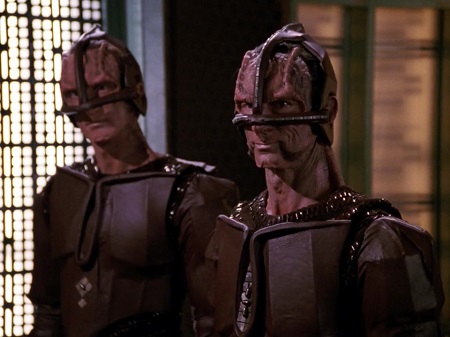
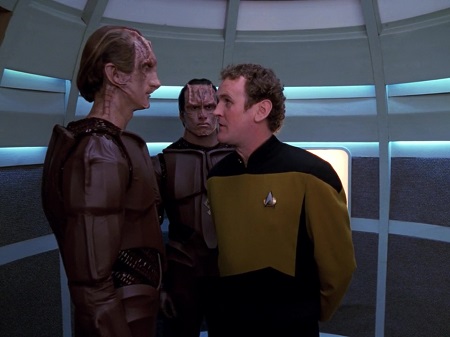
The Cardassians beam aboard and Riker and Troi are there to greet them, along with Chief O’Brien. The Wounded is the only episode of Star Trek to show off a different style of Cardassian uniform. Unlike the silver-grey mail-like armour that they would wear in the Deep Space Nine era, here the Cardassians wear a plain brown leather-like armour over some kind of undershirt. Most notably, this is the only episode which shows off Cardassian headgear – a kind of helmet that covers the back of the head with three bars connecting at the front. Though the outfit isn’t bad per se, I think it’s easy to see why it was changed later. Not only does the headgear look a little silly, it also covers up key aspects of the Cardassians’ facial features and makes them less distinguishable from one another. Gul Macet sports facial hair, too, and The Wounded would be the only time we would see that on a Cardassian character.

Gul Macet and his aide beam aboard.

It’s interesting that Marc Alaimo was the first Cardassian seen in Star Trek, and in another role would also go on to be the most significant Cardassian. In that sense he’s similar to Deep Space Nine co-star Armin Shimmerman, who was one of the first Ferengi seen in Season 1 of The Next Generation and also played Quark, the most famous Ferengi in Deep Space Nine. We don’t spend enough time with Gul Macet to really show off how different he is from Alaimo’s more well-known character of Gul Dukat, and in many ways the performance he puts in here is similar. Perhaps Macet and Dukat are related?

Counsellor Troi seems to pick up on O’Brien’s discomfort with the Cardassians as she and Riker escort them from the transporter room. In the briefing room, Geordi and Riker explain the basics of scanning for the Phoenix, and that they’re able to scan one sector per day. It’s worth pointing out that how big a “sector” is in Star Trek has never been consistently explained on screen! The Cardassians are sceptical – understandably so – but Picard is able to calm the tensions.

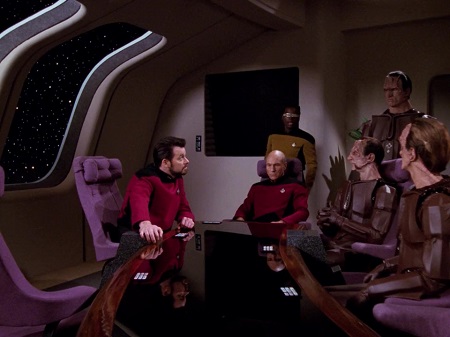
The briefing room scene.

Also present at the briefing room table is O’Brien, and Picard turns to him to ask him a little about Captain Maxwell, with whom he previously served. O’Brien explains that Maxwell’s family were killed during a Cardassian attack on the Setlik III outpost – and if Setlik III sounds familiar to you, it’s a name associated with O’Brien’s military service that would be brought up numerous times in Deep Space Nine, most significantly, perhaps, in the episode Empok Nor.

O’Brien responds aggressively when it’s suggested to him that Captain Maxwell is taking revenge for what happened to him, and it’s clear that he feels a strong sense of loyalty to his former commander. Gul Macet attempts to press the point when Picard intervenes, but before the discussion can continue the briefing is interrupted by Worf, who has located the Phoenix on long-range sensors.

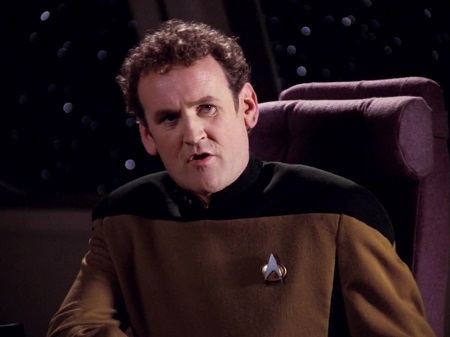
O’Brien in the briefing room.

The briefing breaks up, and Captain Picard invites Gul Macet to the bridge with the senior officers. O’Brien and the two junior Cardassians leave together and end up sharing a turbolift. Here’s where we get one of the episode’s most interesting scenes. The Cardassians – who are, after all, just doing their jobs – attempt small-talk with O’Brien, but he isn’t having any of it.

After an invitation to join the Cardassians in Ten-Forward, O’Brien snaps. He tells them abruptly that he will cooperate with them when it comes to discussing technology or the search for Captain Maxwell if ordered to do so, but will not spend his free time with them. He then barges past them out of the turbolift.

O’Brien and the Cardassians in the turbolift.

It was around this time that we began to see cracks in the utopian/perfect veneer of Starfleet and humanity in Star Trek, proving that they haven’t entirely risen above the pettiness and conflicts we have in contemporary times. Gene Roddenberry was strongly opposed to the idea of Starfleet as a military outfit, and famously tried to have Star Trek VI: The Undiscovered Country re-written to cut out what he saw as anti-Klingon racism from Kirk. He felt such attitudes were beneath humanity in his vision of the future. I can only imagine he felt the same way about O’Brien in The Wounded. As an aside, The Undiscovered Country will also celebrate its 30th anniversary this year.

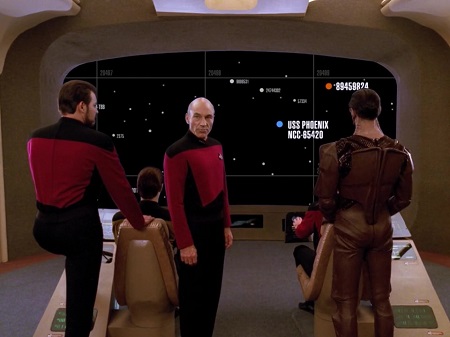
On the bridge, Picard orders the Enterprise-D to intercept the Phoenix, with Gul Macet watching over his shoulder. Macet wants the ship’s precise location so that he can have Cardassian vessels arrive first. He also asks for the ship’s transponder frequency – a neat callback to Star Trek II: The Wrath of Khan. Worf looks angry at this suggestion, which Captain Picard refuses – diplomatically, of course.

Picard and Gul Macet on the bridge.

O’Brien serves Keiko the promised meal in their quarters, though she seems unimpressed with his replicated potato casserole (which looks more like potato salad!) He sings an old song from his days on the Rutledge, and it seemed for a moment as though the unpleasantness with the Cardassians was forgotten. But it turns out the song – which Colm Meaney does his best to sing – was a favourite of Captain Maxwell’s. He pushes Keiko to comment on why someone – speaking abstractly – might not be comfortable with Cardassians, but appears in denial about his own feelings toward them.

This scene and the previous one really humanise O’Brien. What he’s feeling is, as Keiko explains, quite natural. Yet at the same time he’s not comfortable sharing with her exactly what it is that’s wrong. He brushes off his battle experiences calling them “skirmishes,” and refuses to accept or even recognise that he’s holding on to a degree of resentment.

O’Brien in his quarters.

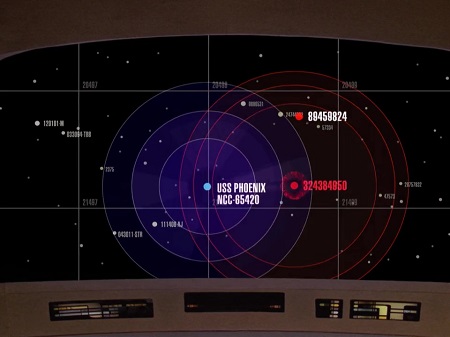
On the bridge, the crew has detected that the Phoenix is in pursuit of a Cardassian vessel – a supply ship. Gul Macet is incredulous that Data can read Cardassian transponder codes and tell what kind of vessel it is at such range, but they have a more immediate problem. Maxwell is not responding to hails, and goes on to attack the ship while the Enterprise-D can only watch.

I do like the 2D graphics used to represent the positions of the Phoenix and the Cardassian ship on the main viewscreen. Though arguably not very “high tech,” it’s cleverly done and easy to understand for us as the audience. The remastered Blu-Ray version didn’t change this, but did upscale and improve it. Though in many ways Discovery and Picard have changed up the aesthetic of Star Trek for modern times, we have seen these flat, 2D maps in those series as well.
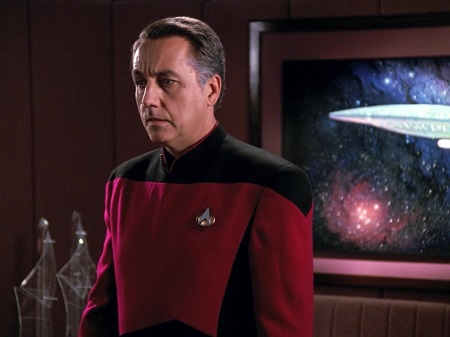
Watching the attack unfold.

Gul Macet again insists on being given the transponder frequency (or prefix code) for the Phoenix, and when Maxwell does not respond Picard orders Worf to send the code to the Cardassians. Worf loudly protests, but does carry out his orders. Despite sending the codes, however, the Phoenix is able to continue its attack and destroys both the Cardassian warship – to Gul Macet’s shock – and the supply ship it was initially targeting.

Following the battle – if it can be called that – Picard orders the Enterprise to increase speed to warp 9 to catch up. Given the urgency, I do wonder why the ship was only at warp 6 initially. Gul Macet leaves the bridge wordlessly.

The Phoenix destroys a Cardassian warship.

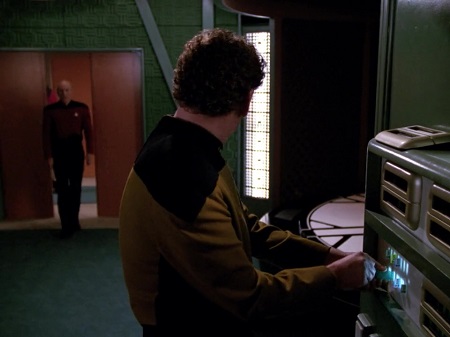
Picard goes to visit O’Brien in his transporter room. O’Brien again states how greatly he respects Captain Maxwell, saying he served with “the two finest captains in Starfleet,” putting Maxwell on par with Picard himself. He also says that he believes Captain Maxwell must have a reason for the actions he’s taken, reiterating that this isn’t some quest for revenge.

Captain Maxwell, according to O’Brien, took the loss of his family as well as one could, and continued to perform his duties despite the tragedy. Even hearing that Captain Maxwell has just killed 600 Cardassians does not shake O’Brien’s opinion, as he tells Picard that he “knows” them and that one must be careful around Cardassians, a race he clearly holds in low regard. What Picard says next about holding on to one’s anger clearly has an effect on O’Brien, and causes him to consider not only what Captain Maxwell is doing, but his own attitude to the Cardassians. It’s one of the most powerful moments in the episode – yet lasts mere seconds.

Captain Picard arrives in the transporter room.

Picard, in this statement, encapsulates the theme of the episode: that holding on to anger is never a good thing. Captain Maxwell may have pretended to be fine – as O’Brien was moments earlier with Keiko – but neither man ever got over their wartime experiences. It’s something that applies in the real world, too. At the time, the Gulf War was raging, but the peace treaty storyline reminds me more of the Vietnam War, and how Americans in this era might view their one-time enemies. It could even apply to the Second World War, and even today there are lingering feelings from that conflict in some areas.

In Ten-Forward, O’Brien joins one of the Cardassians for a drink. He initially offers an apology for his earlier actions, spurred no doubt by Captain Picard’s words. But as he talks to the Cardassian officer he spills more of his history with them – he was present on Setlik III after Captain Maxwell’s family was killed, and it was the first moment he ever killed someone. O’Brien’s words are very powerful: he doesn’t hate the Cardassians, he hates himself, and blames them for making him into a soldier and a killer.

O’Brien and the Cardassian officer in Ten-Forward.

On the bridge, Worf claims to have caught the other junior Cardassian accessing a computer on deck 35. Gul Macet reprimands him and confines him to quarters. The Cardassian officer’s staredown of Gul Macet seems to imply that he was carrying out his orders, but that point was not expanded upon further.

Gul Macet and Captain Picard speak in the ready-room. Macet says he will further discipline the man, Picard says it doesn’t matter, and that in order to have peace, no one individual must be allowed to disrupt it – a very self-serving statement under the circumstances, one might say! Macet sees Picard as a kindred spirit – both men desire peace above all else. Perhaps that comes as a surprise to both of them. Though it is hard to detach Marc Alaimo’s performance as Macet from his later role as Dukat, he is believable in this moment.

Gul Macet in Picard’s ready-room.

Data interrupts the conversation to tell Picard that they’re twenty minutes away from intercepting the USS Phoenix, and the very next scene shows the two ships together. Captain Maxwell beams aboard to discuss the situation with Captain Picard, and is greeted by O’Brien and Riker in the transporter room.

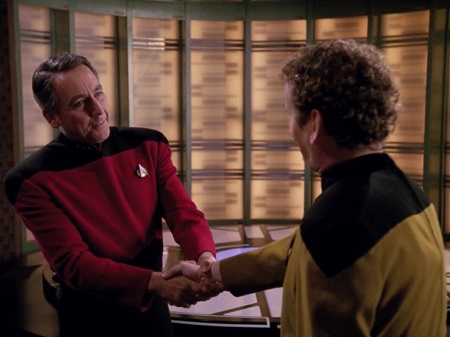
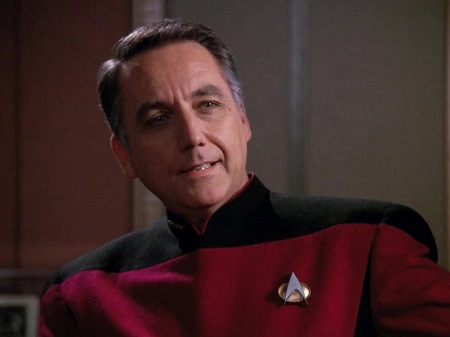
Far from being adversarial, Captain Maxwell is disarmingly pleasant, greeting Riker warmly and being pleased to see O’Brien after such a long time. Were it not for the previous twenty minutes we’d be forgiven for thinking this was any “normal” interaction between Starfleet officers! In that sense though, seeing this scene in context, there’s something very unsettling about it. Knowing that Captain Maxwell has gone rogue, knowing how many people he’s just murdered, and then seeing him as a jovial man in a Starfleet uniform offering friendly handshakes leaves a bad taste – intentionally so.

Captain Maxwell and O’Brien reunite in the transporter room.

O’Brien looks disturbed as Riker and Maxwell depart, the latter arriving in Picard’s ready-room for a showdown. Again, though, pleasantries were observed, and Maxwell initially retains his disarming persona. Soon, however, Maxwell appears to go off the rails. He insists that the Cardassians are re-arming, and that the science station he attacked was actually a military outpost.

When pushed by Picard for evidence, he offers nothing concrete, instead talking in vague terms about there being no need for a scientific station in the area and its strategic value from a military perspective. He didn’t contact Starfleet because he didn’t want to wait, believing that Federation bureaucracy would be too slow to recognise the threat.

Captain Maxwell in Picard’s ready-room.

Captain Maxwell genuinely expects to find a kindred spirit in Picard, a fellow veteran of the Cardassian border wars. Not only does he expect Picard to harbour the same anti-Cardassian sentiments he clearly holds, he seems to expect his so-called “evidence” – which is little more than guesswork – will be adequate to excuse his actions in Picard’s eyes.

When this doesn’t materialise, Maxwell begins to sound even more disconnected, talking in big but ultimately vague terms about the need to save lives. He argues that he’s trying to prevent a war by stopping what he sees as Cardassian aggression, and accuses Picard of losing his edge. He believes that the peace treaty was a ruse, and that he was doing necessary work by ignoring it.

Captain Picard responds to Maxwell.

Picard replies by giving his assessment of the situation. He suggests that Maxwell is not doing any of this for the good of the Federation, but simply for the sake of revenge. When Maxwell says that history will consider Picard a fool, Picard says he will accept that, but insists Maxwell stand down now and return to Federation space. Maxwell asks him to join him and scan one of the Cardassian supply ships together, but Picard refuses.
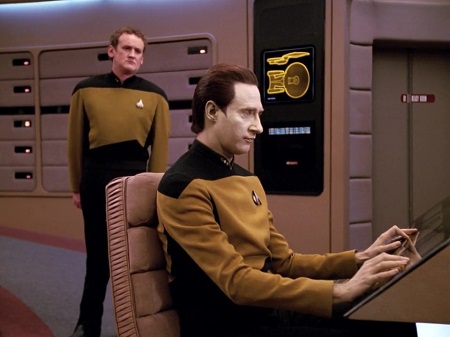
Can we argue, in light of what came next, that Maxwell was right? Not only in the sense of what the Cardassians were doing in The Wounded, but seen in hindsight after the Dominion War? The Cardassians were re-arming, and within five years of the events depicted in this episode, the Dominion War would break out. Captain Maxwell’s methods may have been wrong, but his basic point stands: the Cardassians did use the peace treaty to rebuild and re-arm. They were preparing for another conflict. In that sense, we can look at the Cardassians as one might look at Germany in the mid-1930s. Picard was arguing that peace was the most important goal, something worth making sacrifices for. Those same arguments were made by many in Britian, France, and elsewhere in the years preceding the Second World War. We might even call it appeasement.

Maxwell realises he’s misjudged Picard.

Maxwell initially agrees to Picard’s plan, agreeing to return to the Phoenix and accompany the Enterprise-D to a nearby Starbase. Picard was very strong and unwavering during the conversation, telling Captain Maxwell that he will “allow [him] the dignity” of returning to his own ship rather than putting him in the brig, then turning away to face the window after ordering Maxwell escorted out.
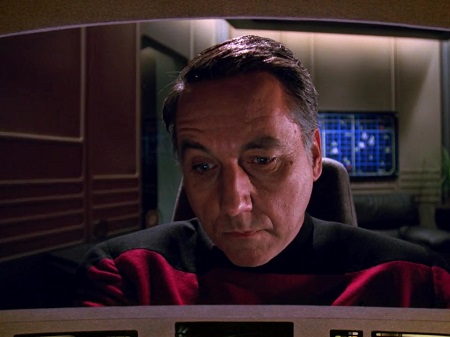
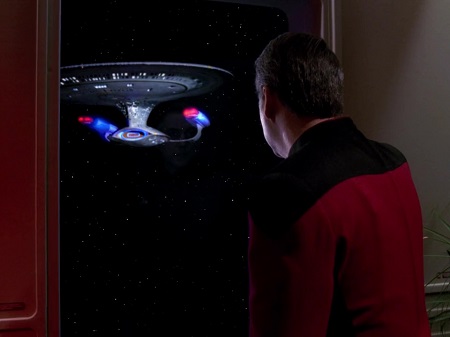
Predictably, though, Captain Maxwell does not stick to his side of the agreement. While en route to the Starbase, the Phoenix changes course, hunting down a Cardassian starship a light-year away. Picard orders the Enterprise-D to pursue, rapidly increasing speed. However, Data explains that the Phoenix is also accelerating and they won’t catch up in time.

The USS Phoenix changes course.

As an aside, I like the design of the Nebula-class ships. They debuted in The Best of Both Worlds, though this was the first time the ship design was named on-screen. The intention with the Nebula-class was to create a vessel comparable to the Galaxy-class but smaller, clearly giving the Enterprise-D an advantage. In that sense it’s an updated Miranda-class from Star Trek II: The Wrath of Khan, and in fact its saucer-plus-nacelles design is superficially similar. It’s a neat-looking starship, and though such things are 100% subjective I’ve always thought the Nebula-class was a fun design.

As Picard gives the order to ready the phasers, Riker informs him that O’Brien used to be Maxwell’s tactical officer, and he’s summoned to the bridge. The Enterprise-D catches up with the Phoenix just as it intercepts the Cardassian supply ship, and O’Brien arrives on the bridge to help out.

O’Brien and Data on the bridge.

The Phoenix has not powered up its weapons, and Data informs the bridge that they’re unable to scan the Cardassian ship. That does raise eyebrows – literally – but Picard first talks with O’Brien about Captain Maxwell, still hoping to avoid a Starfleet-on-Starfleet battle. Captain Maxwell hails the Enterprise and pleads with Picard to board the Cardassian ship, saying it will prove him right.

Picard, of course, is having none of it. With Maxwell no longer trustworthy he insists he beam aboard the Enterprise. Maxwell is looking increasingly desperate, threatening to destroy the Cardassian ship if Picard won’t board it. He ends the conversation when Picard doesn’t back down.

Captain Maxwell on the Enterprise-D’s viewscreen.

Captain Maxwell will strike if his back is against the wall, so says O’Brien. And mere seconds later the Phoenix is seen to power up its shields and weapons, reading an attack on the Cardassian vessel. Picard orders red alert, and prepares to take the extraordinary action of firing on another Starfleet vessel to defend a Cardassian ship.

O’Brien offers to beam aboard the Phoenix to talk Captain Maxwell down, and comes up with a technobabble plan to beam through the cycling shields of the Nebula-class vessel. With few other options, Picard authorises the mission. It would’ve been neat to see O’Brien in the transporter room pulling off this seemingly dangerous, complicated bit of transporter work! But instead the very next scene in in Captain Maxwell’s ready-room, with O’Brien having already beamed aboard.

Captain Maxwell looks out at the Enterprise-D.

Maxwell is shocked to see O’Brien, and pulls out a phaser. He refuses to believe Picard will attack his ship to protect “the enemy,” but when O’Brien insists that he will he becomes dejected. He asks O’Brien what happened in “this war,” but O’Brien retorts that there is no war any more, that the war is over and they have peace.

As they talk, it becomes clear to O’Brien – and to us as the audience – that Picard and Gul Macet were right: for Captain Maxwell this is all about what happened to his family on Setlik III. He says that the war is not over, that the Cardassians are butchers who “live to make war,” and O’Brien comes to realise that he was never able to let go of what happened.

Captain Maxwell points a phaser at O’Brien.

As O’Brien listens, Maxwell’s voice breaks. His children never had the chance to grow up, he lost his family, and he has been unable to let go of that anger toward the Cardassians. It has clouded his judgement. The two men talk and reminisce about their time on the Rutledge, and other officers they served with, including a man who died at Setlik III. O’Brien sings the song again, and Captain Maxwell joins in. It turns out the song was one sung by the man who was killed by the Cardassians.

As the song comes to an end, Captain Maxwell realises that it’s over. Whatever he was trying to do, whatever reasons he had, however he’d convinced himself and his crew that it was right, he couldn’t defeat the Enterprise and he couldn’t negotiate with Picard. As he says to O’Brien, he isn’t “going to win this one.”

Maxwell and O’Brien share a moment.

Picard confirms in a voiceover log that Captain Maxwell has been detained, and that the Phoenix has rejoined the Enterprise. In the briefing room, Picard thanks O’Brien for resolving what could’ve been a far worse situation. O’Brien expresses his pride at having served with Captain Maxwell, someone he still considers a “good man,” in spite of what he did. Picard dismisses him, and Gul Macet says he admires O’Brien’s loyalty, “even if it is misplaced.”

The Wounded has one final twist, though, as Picard explains to Gul Macet. After saying that Maxwell, who was a decorated war hero, simply could not find a role for himself when peace broke out, Picard drops the bombshell that Maxwell was right. The Cardassian ships were not carrying science equipment – they were, as Maxwell said, preparing for war.

Captain Picard talks to Gul Macet in the briefing room.

Gul Macet asks the obvious question: if Picard knew, why not board the ship? Picard responds that he was there to protect the peace; that was his only objective. He placed preserving the peace ahead of everything else, even when he knew that Maxwell was right and that the Cardassians were using the so-called science outpost for military purposes. As we discussed above, he chose to put peace ahead of all other considerations.

Picard tells Gul Macet to take a message back to the Cardassian Central Command: the Federation and Starfleet will be watching. They know what the Cardassians were trying to do, and though they did not take aggressive action this time, the option remains on the table. Any chance of a surprise attack is gone, the Cardassian objective has failed. Picard spins his chair around, signalling the end of the conversation – and the episode.

Gul Macet.

So that was The Wounded. It was fun to look back on this episode on its thirtieth anniversary – something which makes me feel very old indeed! The episode was a heavy one, with incredibly deep and meaningful themes that touched on issues which are still as relevant in 2021 as they were in 1991. It’s also an important piece of Star Trek history, introducing the Cardassians, giving O’Brien his first real storyline, and bringing Marc Alaimo into the franchise.

Though the Cardassians’ uniforms would be redesigned, their overall look, as well as the appearance of their Galor-class ships, would remain in use until the end of Deep Space Nine. We have briefly seen a Cardassian in the recent third season of Discovery, too, a design which is largely unchanged from that which debuted here. The Cardassians would go on to join the Klingons as one of the most-explored Star Trek factions thanks to their significant role in Deep Space Nine.

The Phoenix and the Enterprise-D.

As Gene Roddenberry stepped back from day-to-day work on Star Trek: The Next Generation, things began to change. Where the first season largely followed the formula Roddenberry used in The Original Series, by the end of Season 2 and certainly by the time The Wounded premiered, the series had taken a different path. In addition to the darker themes which looked at humans holding prejudiced views and even committing war crimes, Rick Berman and others were working hard to establish Star Trek as a growing, connected franchise with themes, characters, factions, and storylines that would all cross over.

Plans for Deep Space Nine were underway, and within two years that show would premiere with the episode Emissary. The Star Trek franchise we know today wasn’t created by The Wounded, but the episode plays an important role in taking Star Trek to new places, not only thematically but also in terms of expanding the roster of characters. O’Brien had his first major storyline here, and the success of his role in The Wounded established him as a major player in Star Trek, getting him ready for the move to Deep Space Nine.

I had fun re-watching this episode of The Next Generation. I have written up two other re-watches from the show, and you can find them here: Season 2’s The Measure of a Man and Season 7’s Lower Decks. This is something I do from time to time, and with no new Star Trek on the schedule at the moment, check back as I’m sure I’ll be writing up more episode re-watches this year!

Star Trek: The Next Generation is available to stream now on CBS All Access (soon to be Paramount+) in the United States, and on Netflix in the United Kingdom and elsewhere. The Star Trek franchise – including The Next Generation and all other properties mentioned above – is the copyright of ViacomCBS. This article contains the thoughts and opinions of one person only and is not intended to cause any offence.