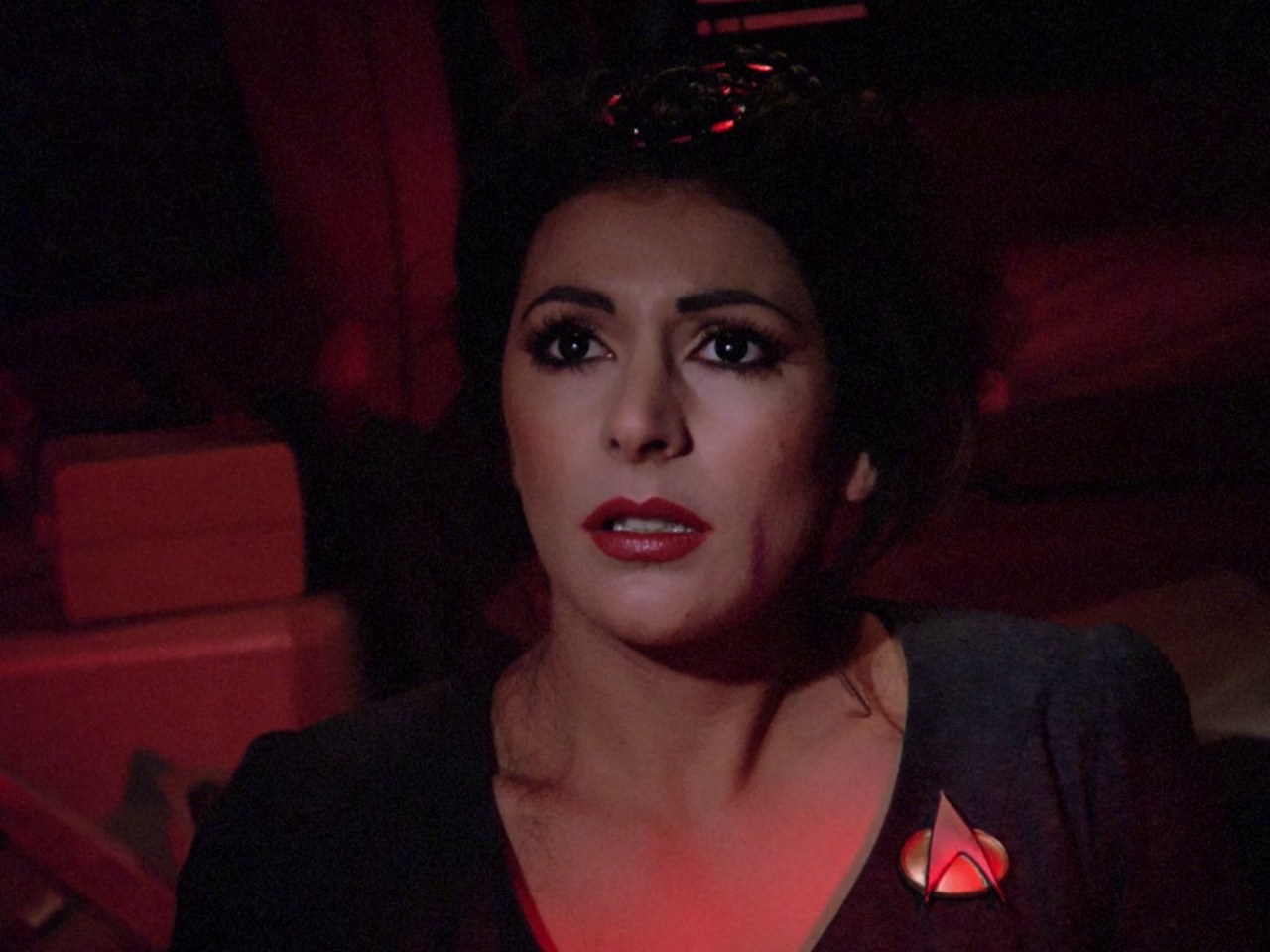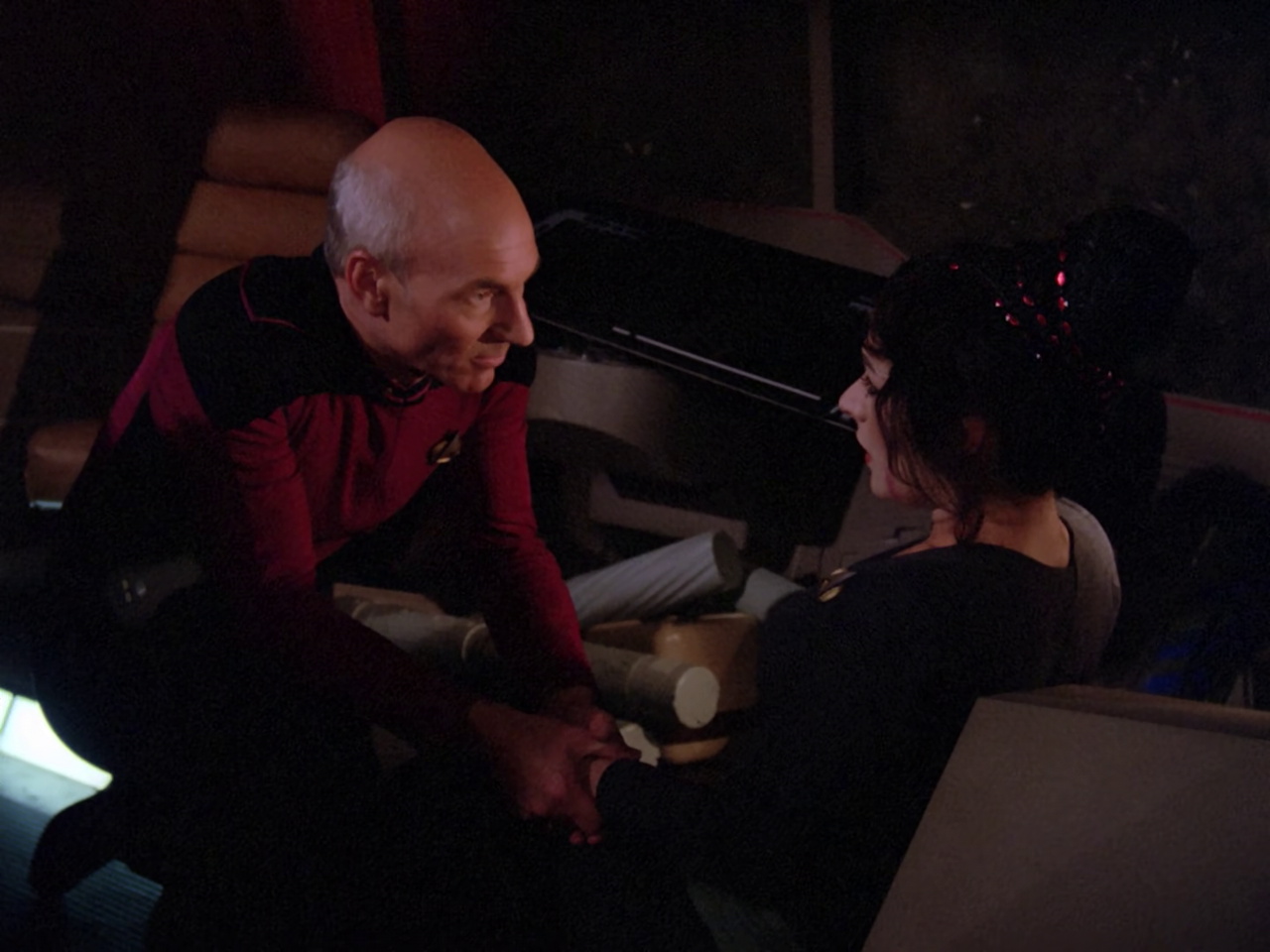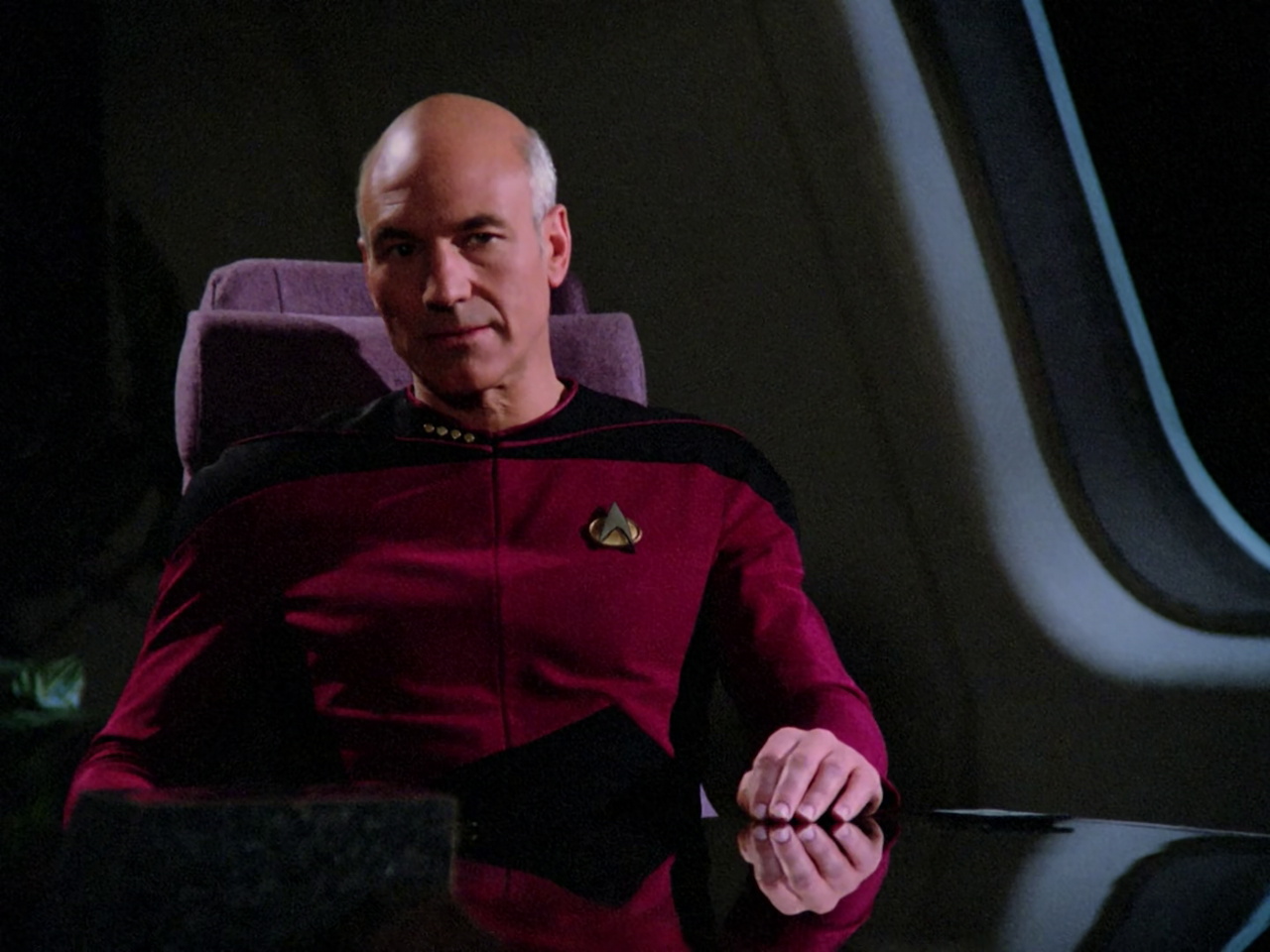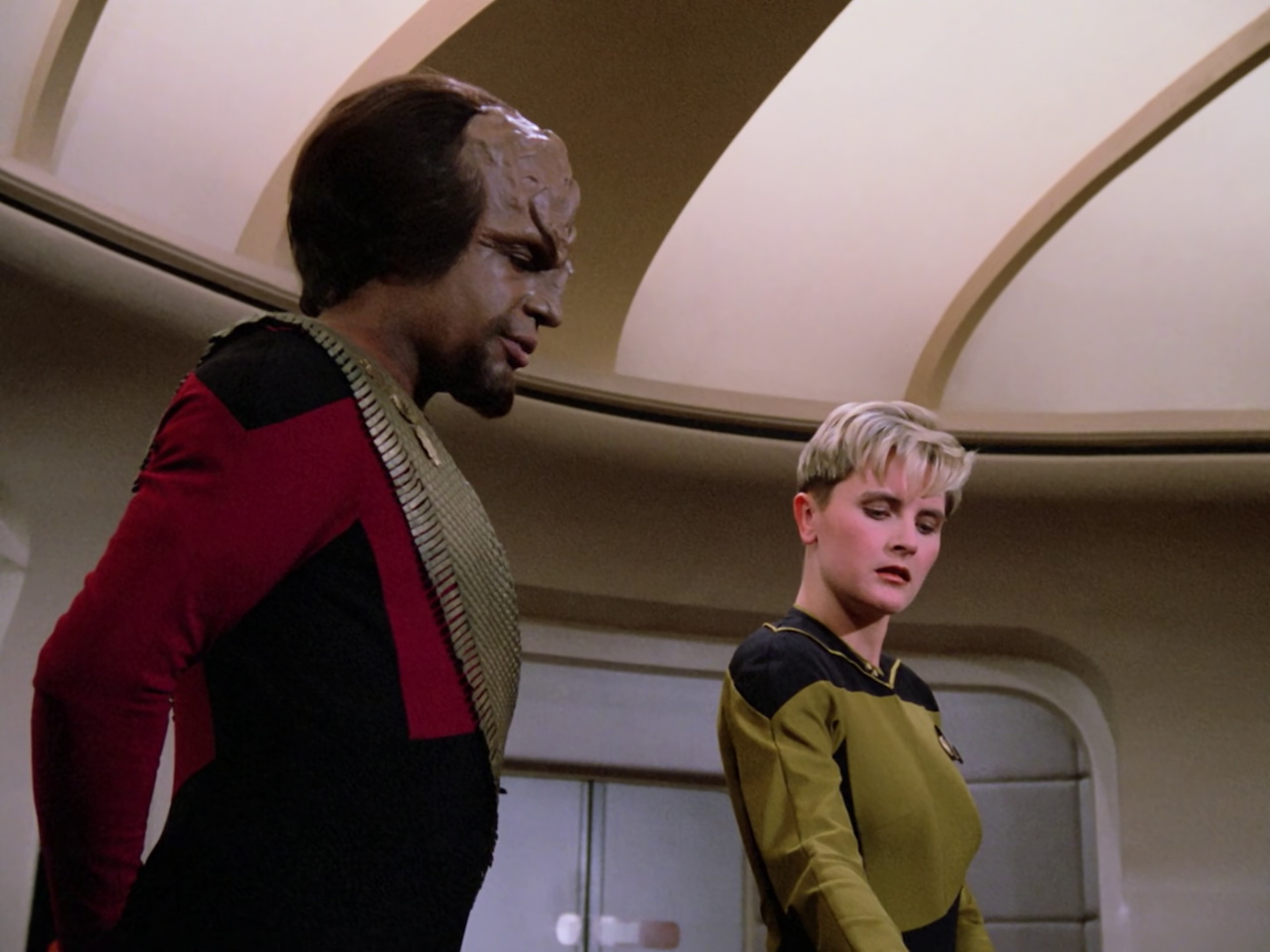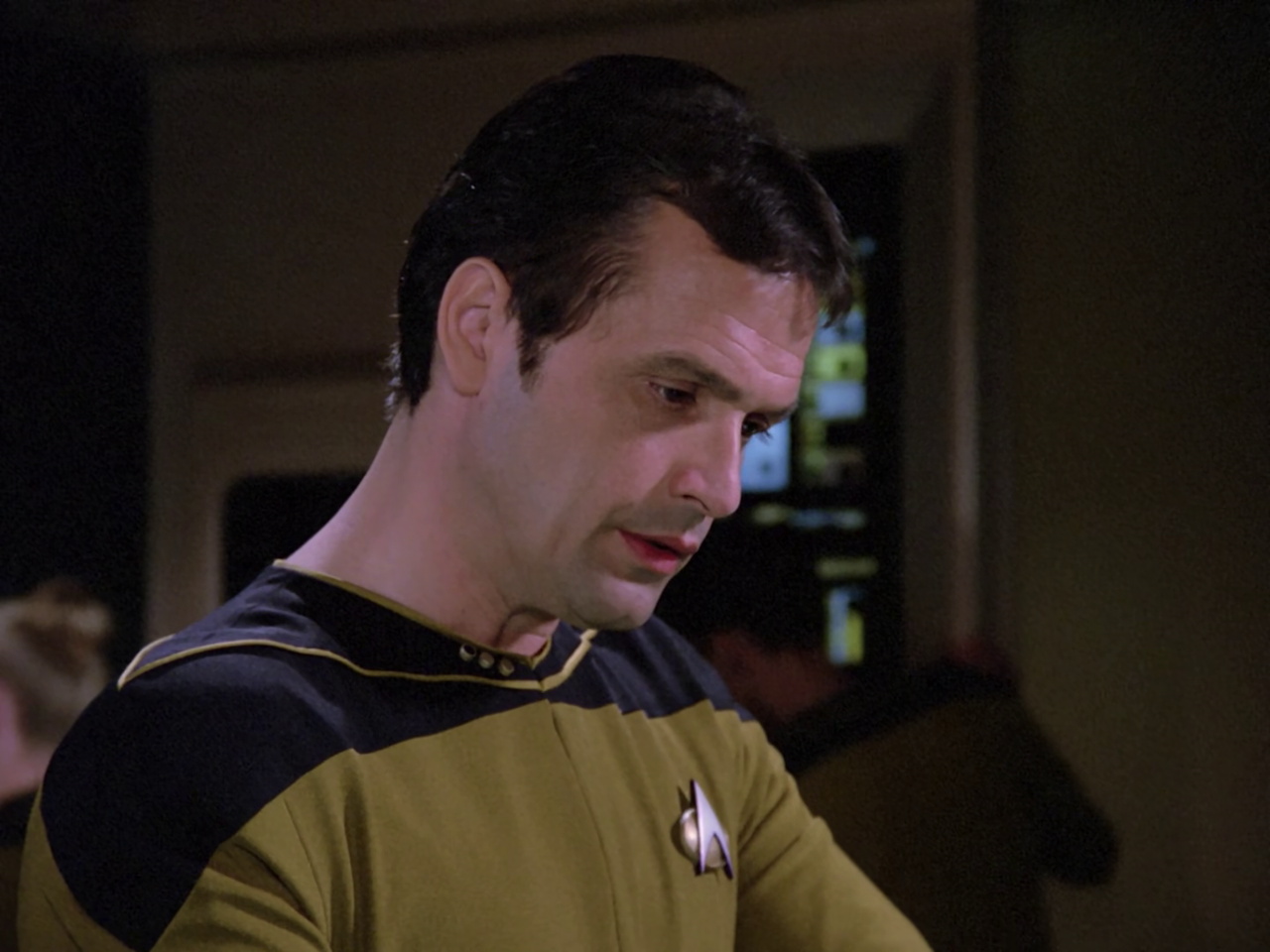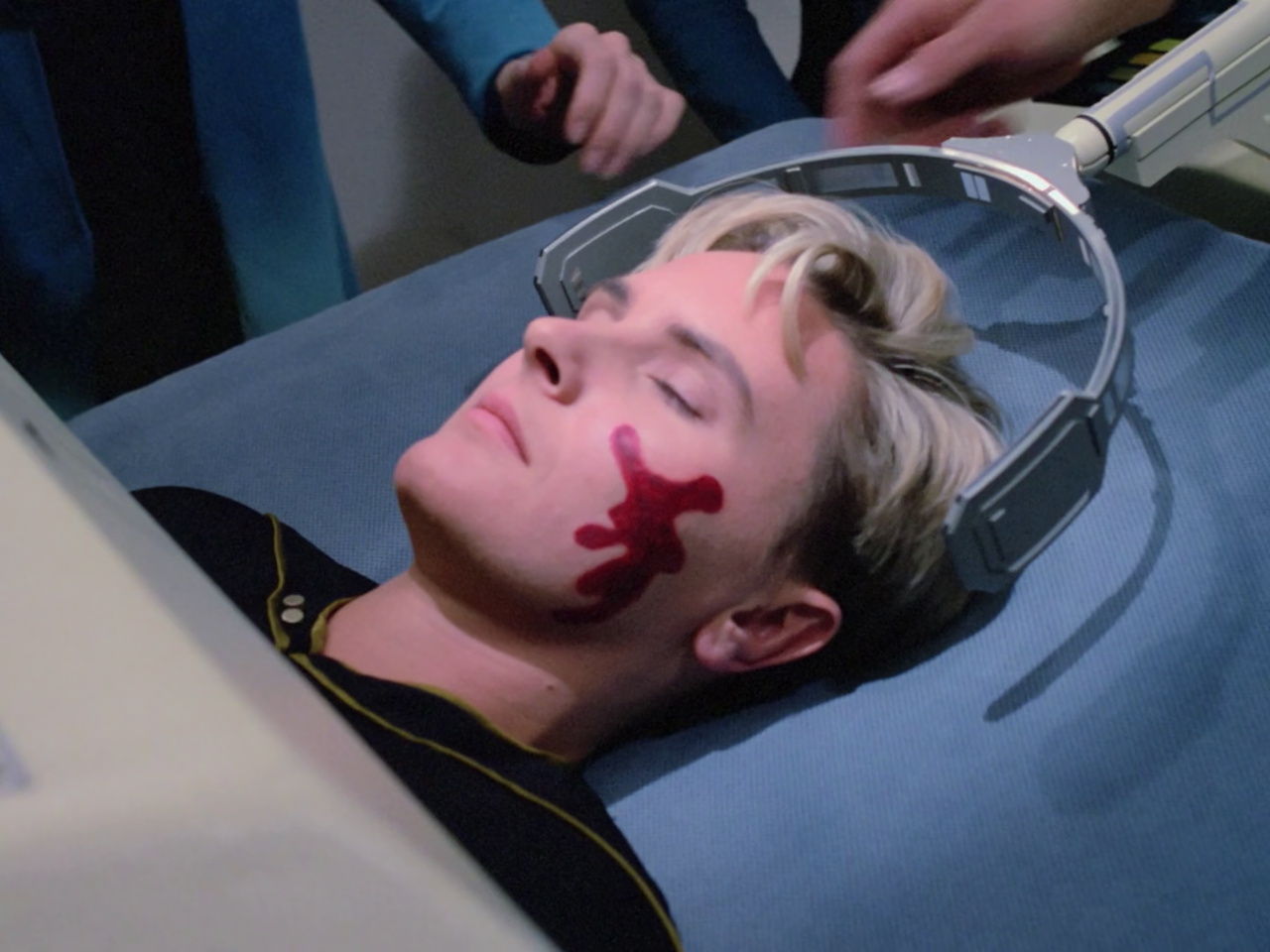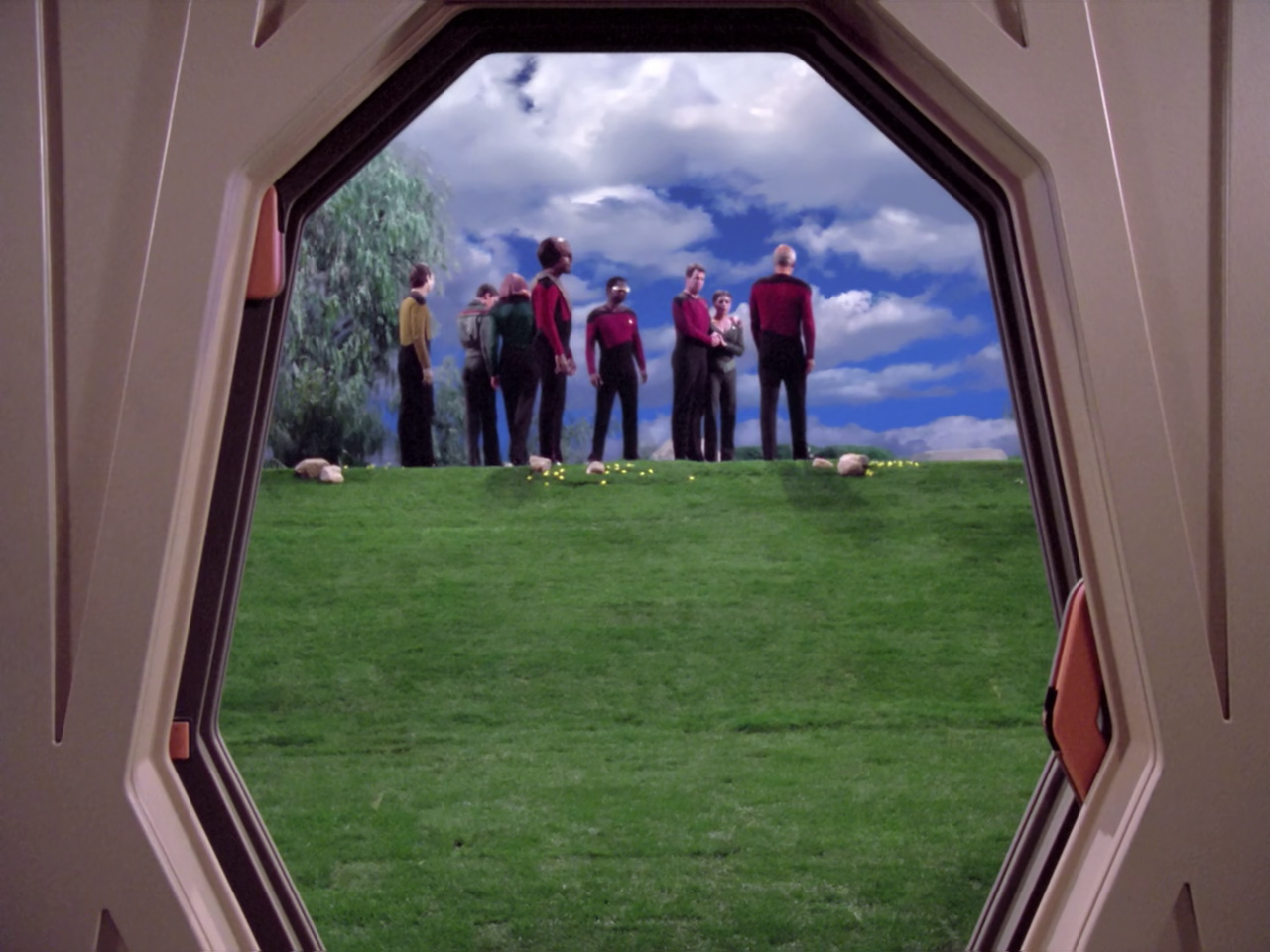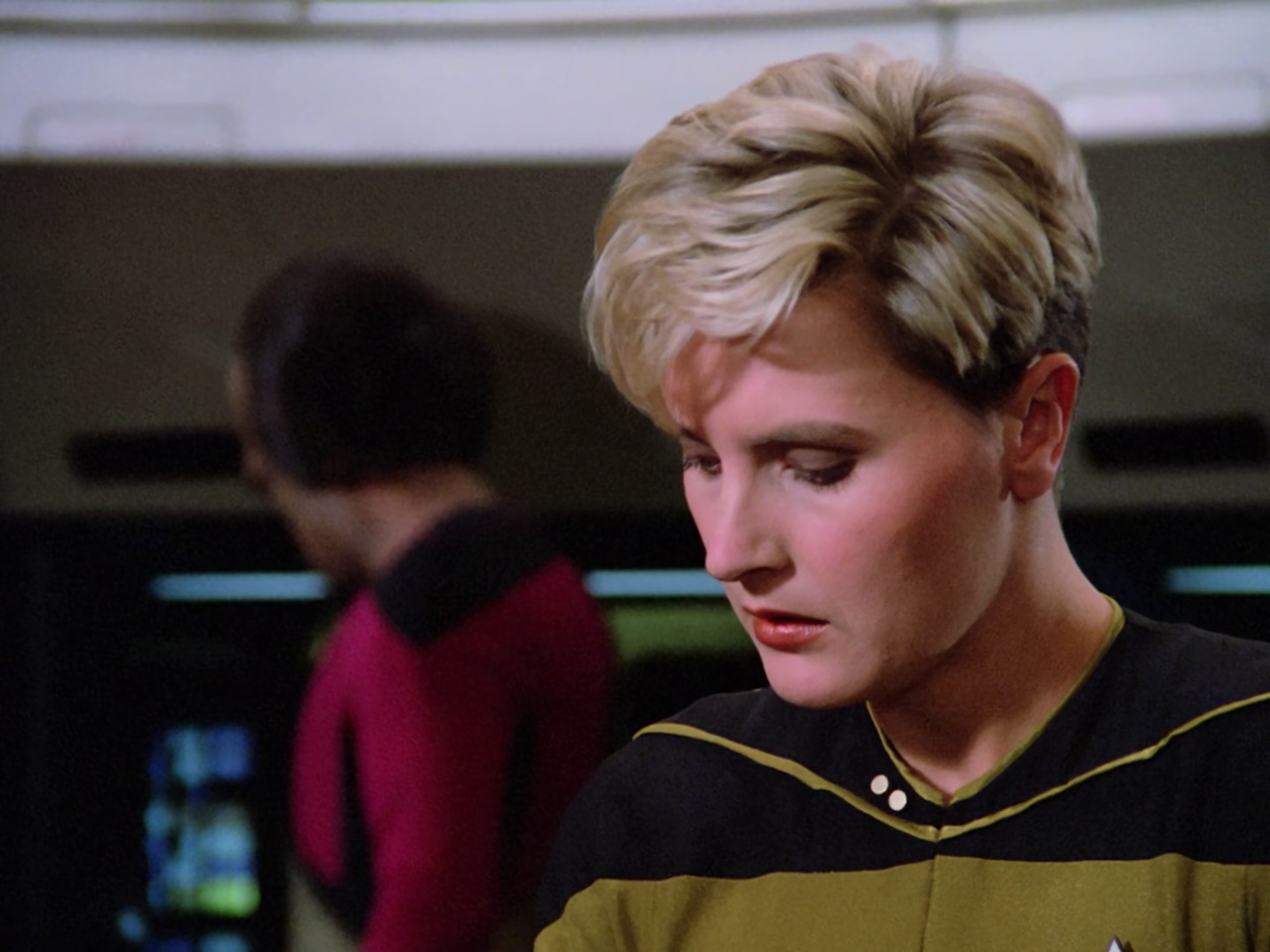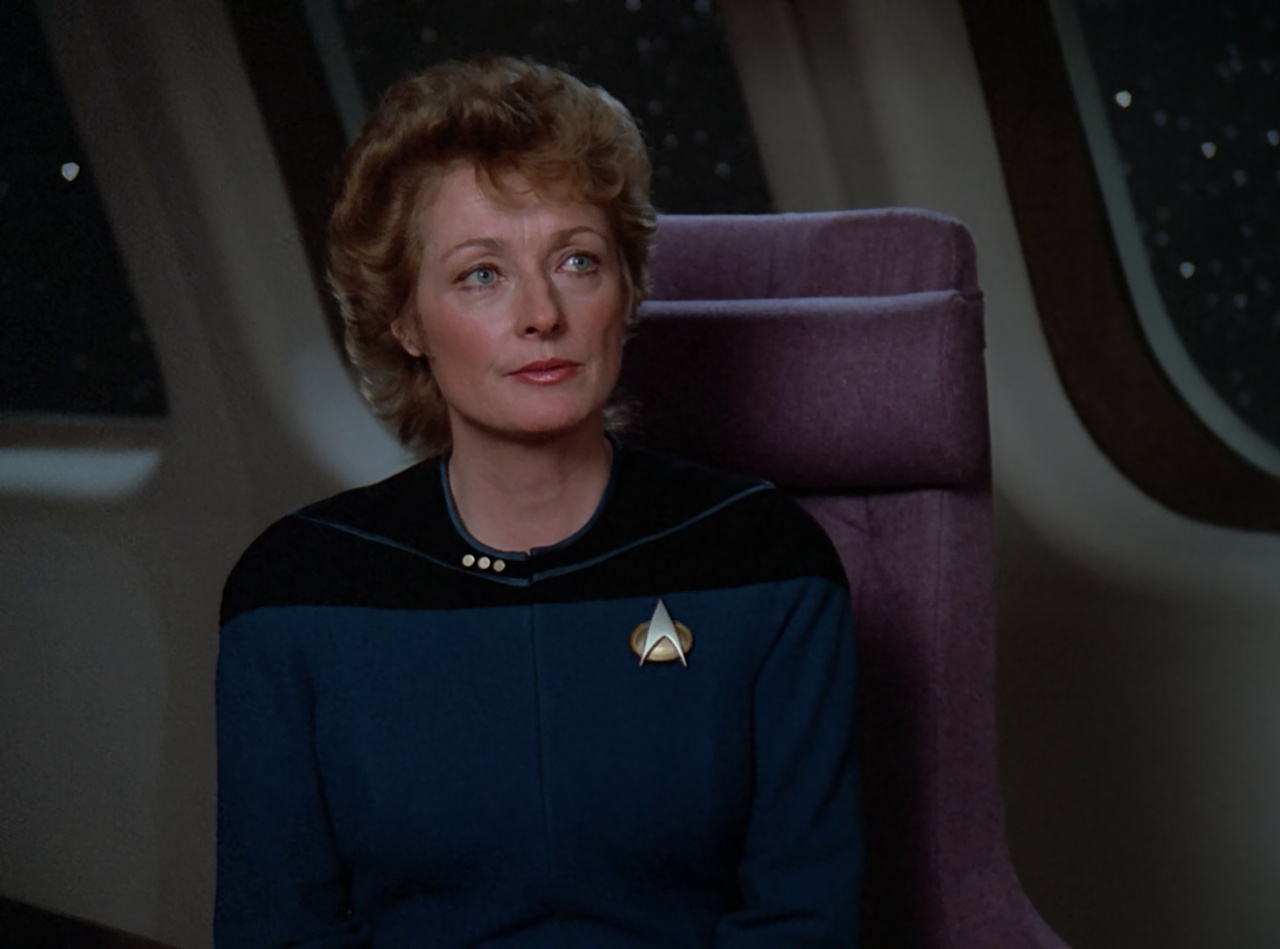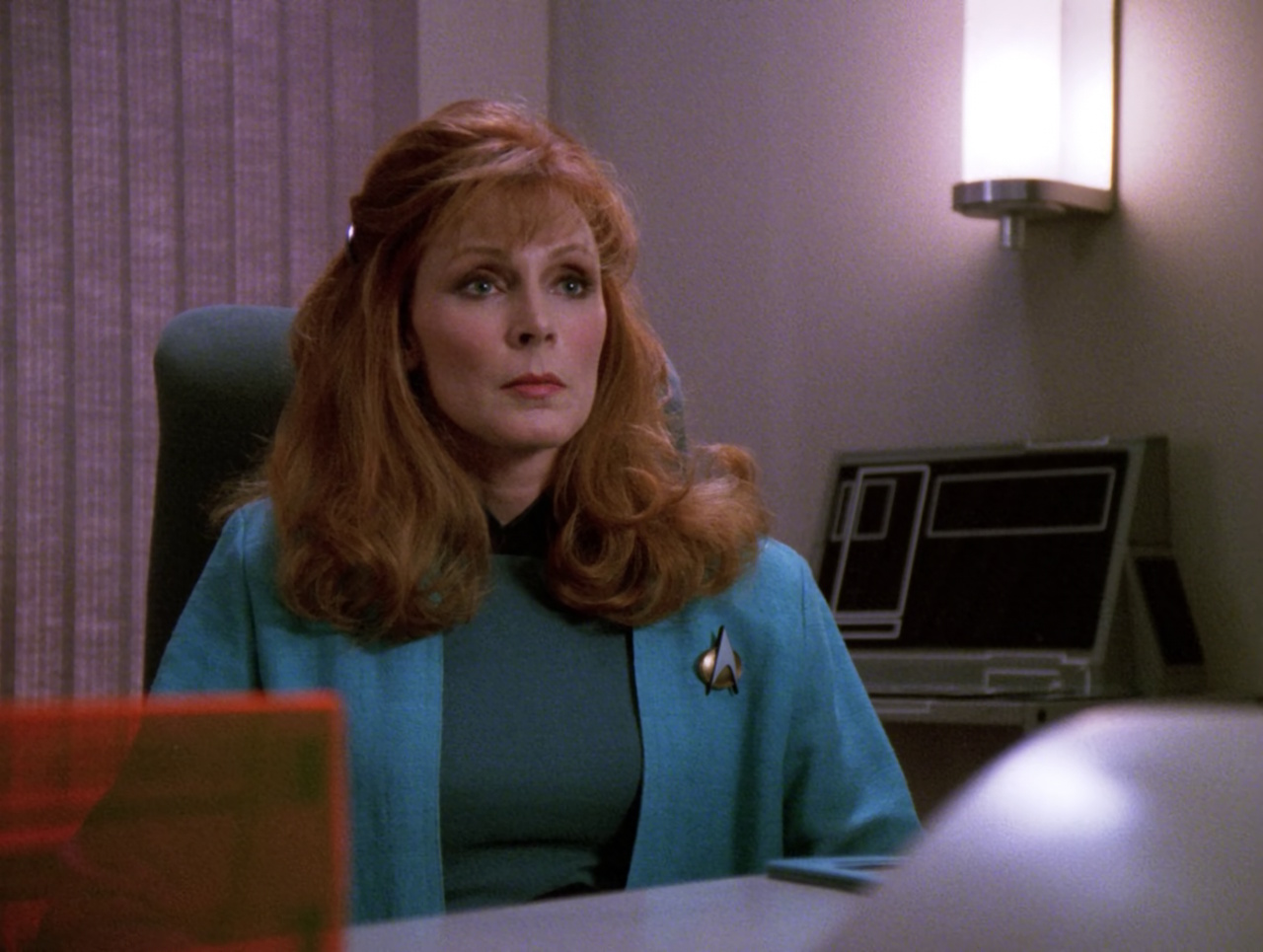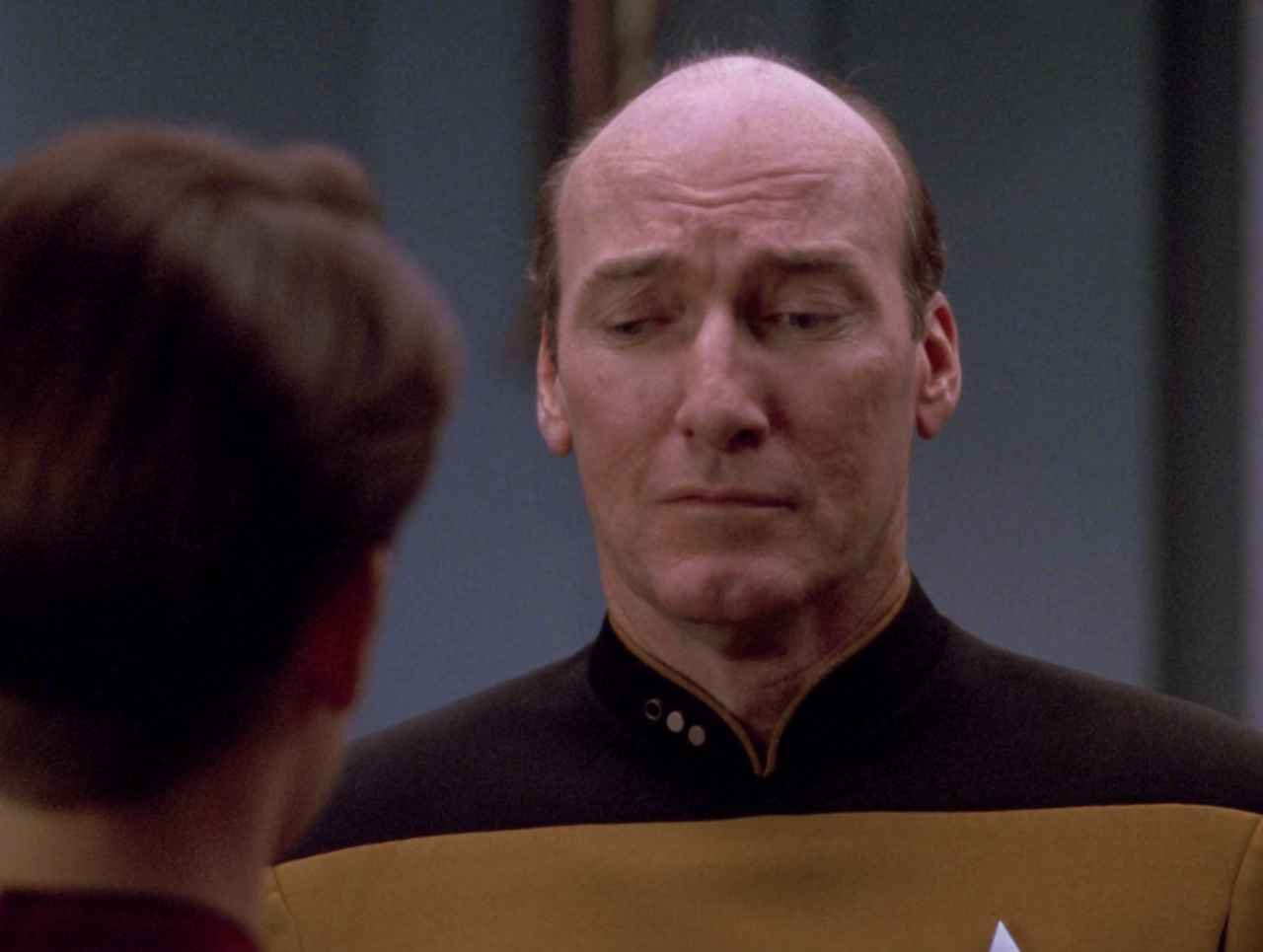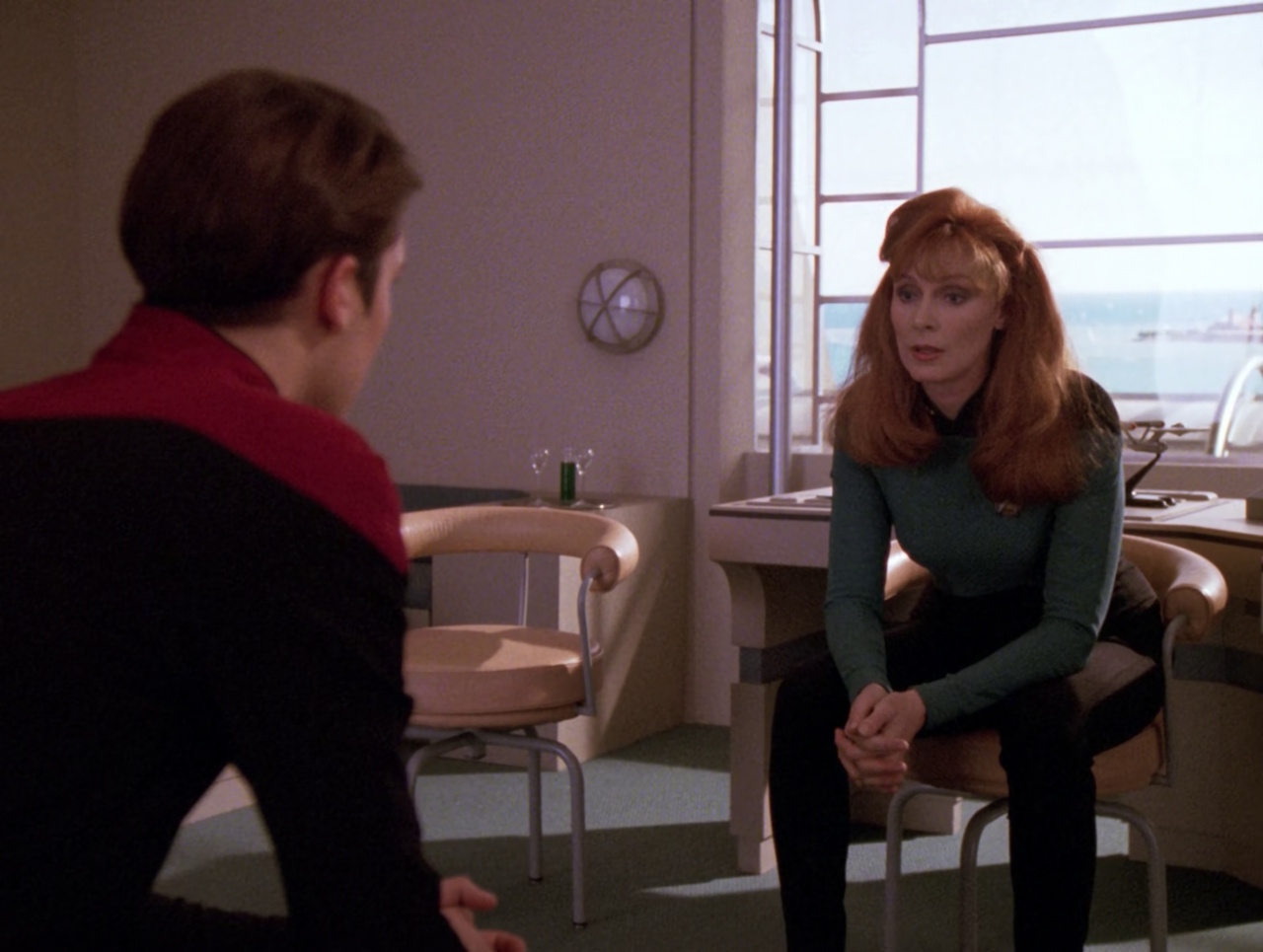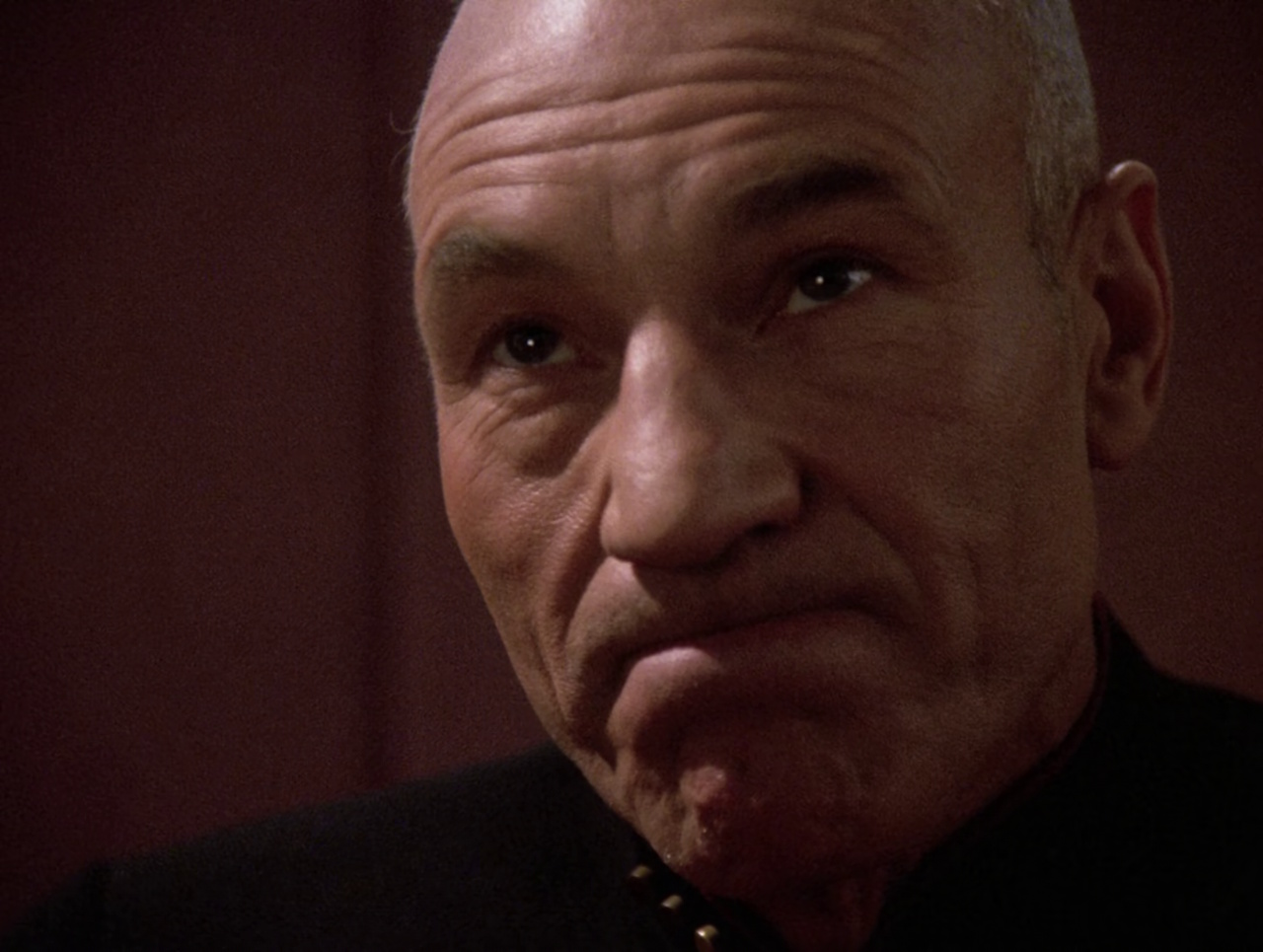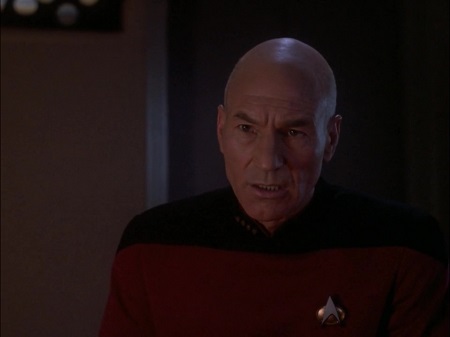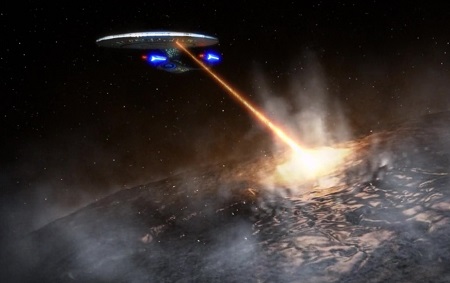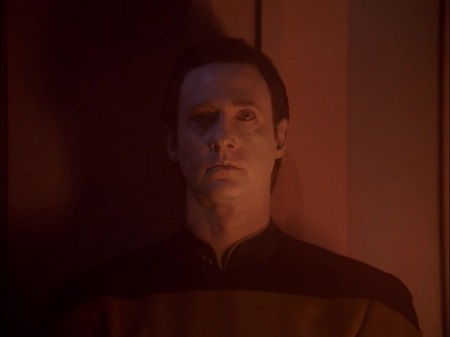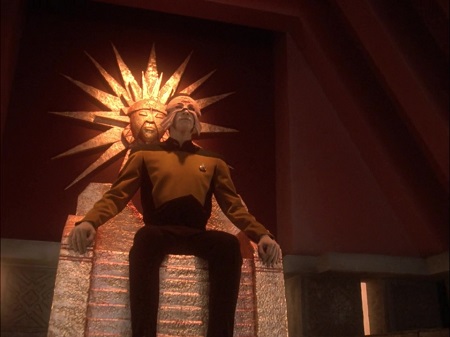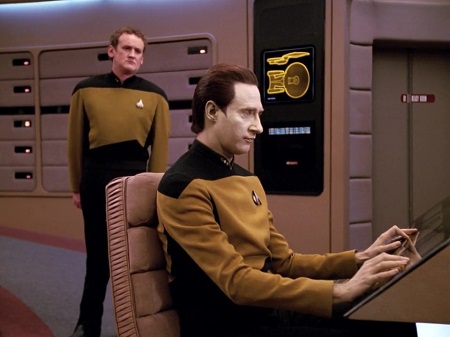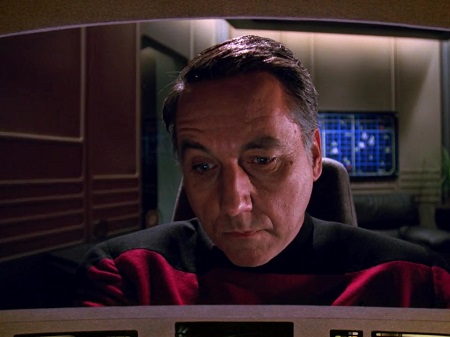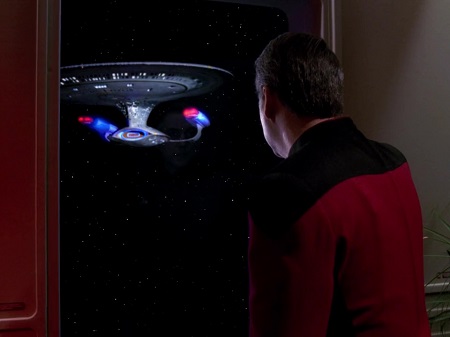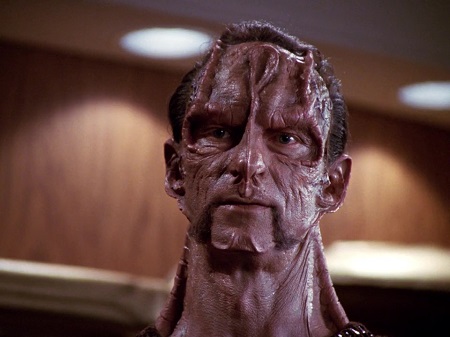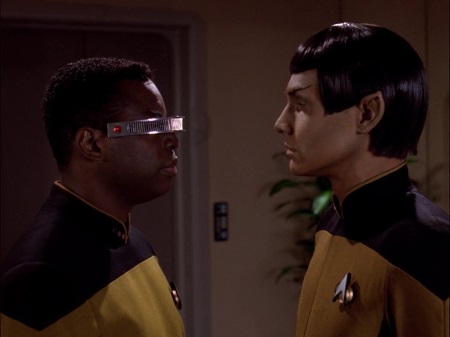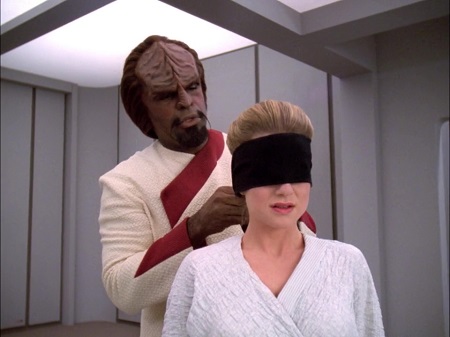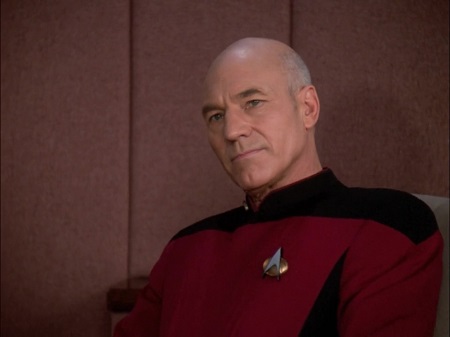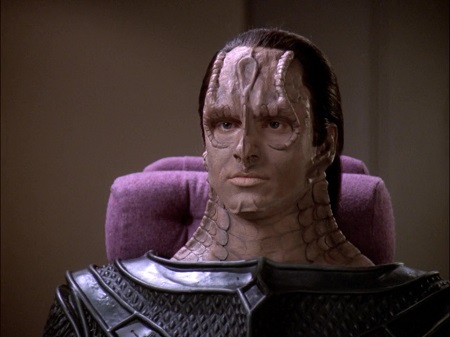
Star Trek: The Next Generation Episode Re-Watch – Season 2, Episode 12: The Royale

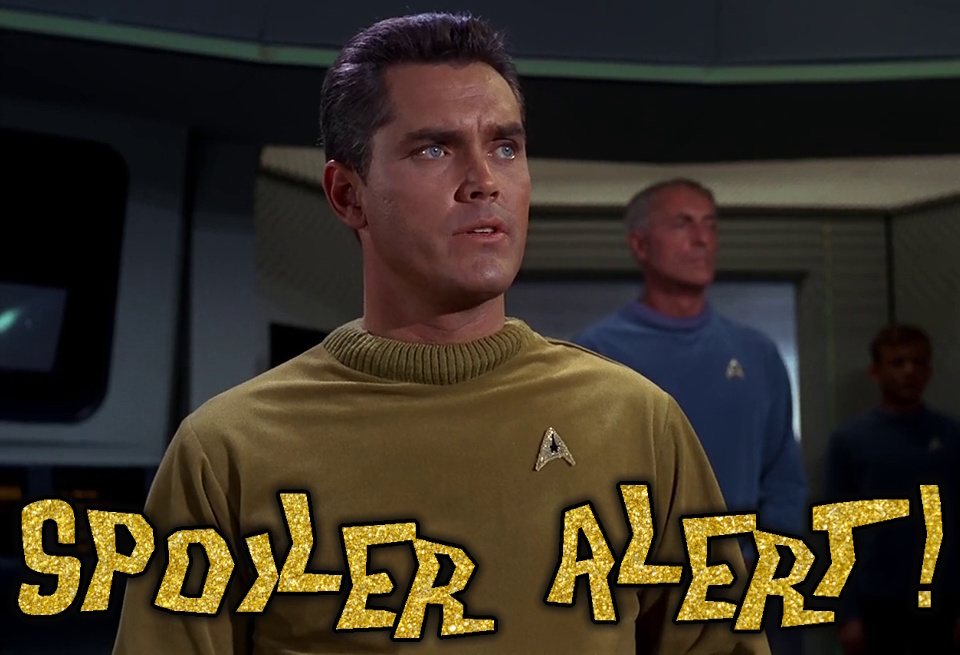
A Star Trek-themed spoiler warning.

Spoiler Warning: There are spoilers ahead for Star Trek: The Next Generation.

Do you remember your “first contact” with the Star Trek franchise? The *very first* episode or film you ever watched?

Let’s set the scene! It’s the 19th of June, 1991. The Soviet Union, while in decline and wounded by the revolutions of 1989, still exists, and the coup attempt that finished it off hasn’t yet taken place. The England football team is still reeling from a semi-final defeat at last year’s World Cup in Italy. The World Wide Web doesn’t exist publicly yet. And Sonic the Hedgehog won’t be released on Sega’s new Mega Drive/Genesis console for a few more days.

It was also on this day that The Royale premiered in the United Kingdom, on the channel BBC 2. And this is the very first episode of Star Trek that I can ever remember watching. Thirty-five years ago this very day, I began my journey as a Trekkie. And I thought it could be fun to mark the occasion by taking a look at the episode together.

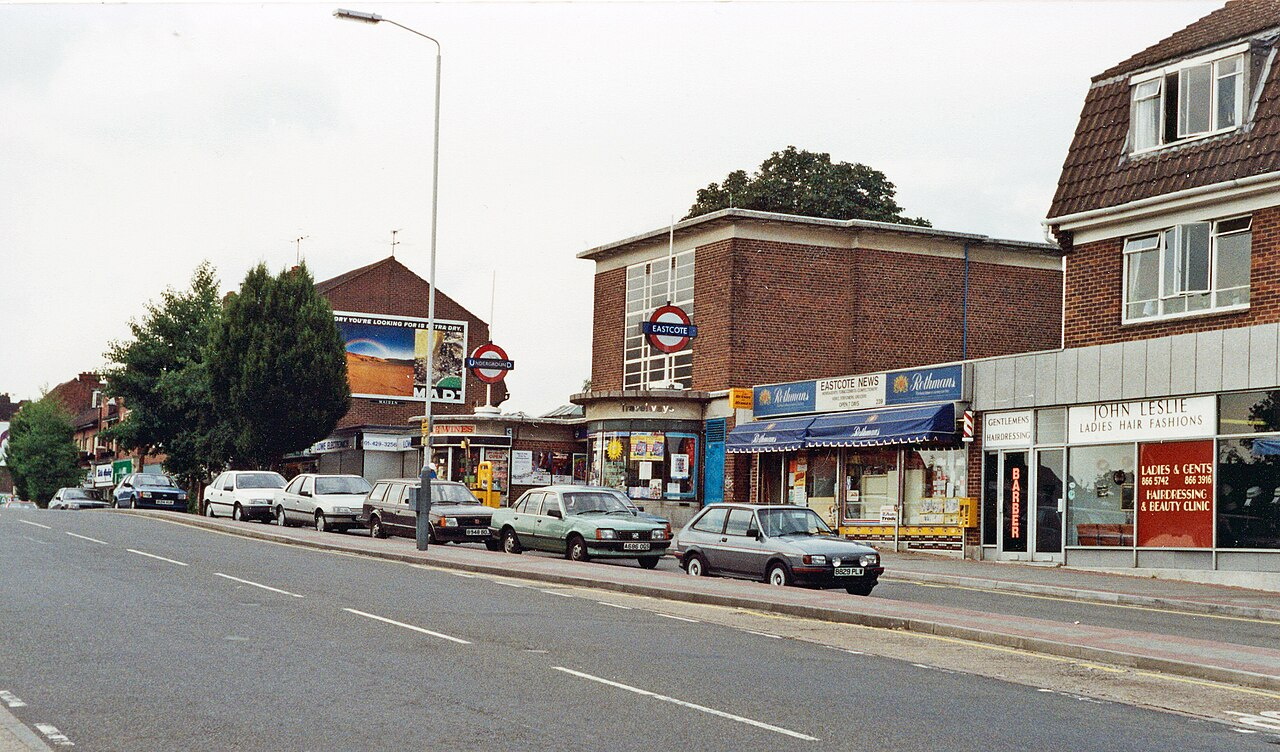
A photo of cars parked outside a railway station in the UK in 1991
I’ve chosen this photograph to represent the summer of 1991 in the UK!
Photo: Ben Brooksbank / Eastcote station, entrance 1991, via Wikimedia Commons

Okay, let’s step back for a moment. The Royale is the first episode of The Next Generation that I can remember watching in its entirety. However, I’m reasonably sure that I’d seen at least *parts* of other episodes prior to that. And my uncle, who was big TOS fan, had certainly talked Trek with me when I was a wee bairn! I can very vividly recall being enthralled with a toy phaser that he owned when I must’ve been only five or so – a solid two or three years prior to this moment. So why pick The Royale, then? Fair question!

This is the moment at which I became a regular viewer of The Next Generation, kick-starting a love of Star Trek which has persisted to the present day. Even if I’d played with that toy phaser a couple of years earlier, or watched parts of other episodes… The Royale is the one that turned me into a Trekkie. This is the moment I decided that Star Trek was something I needed to see more of; a TV show that I couldn’t put down and a world I wanted desperately to explore. Is it a great episode in its own right, or one of the best offerings in the franchise? Arguably not – though I’m afraid the rose-tinted glasses of nostalgia rather blind me to that! But it’s a special episode for me personally, as it marks the moment when I fully joined the Star Trek fan community.

Photo of William Shatner, Gene Roddenberry, and Patrick Stewart at an event
William Shatner, Gene Roddenberry, and Patrick Stewart, circa 1990-91.

At this moment in the early summer of 1991, I’d have been finishing Year 3 at school (which I believe is the equivalent of second grade in Ameria; not sure on that, though). My memory isn’t great these days, but I can remember some of the things I experienced that year. Year 3 marked the beginning of being in the “Juniors” at school, not the “Infants” with the younger year groups. It was around this time that I got my first taste of computing – at my small school in the rural north of England, there was only one computer, and it was in the Juniors classroom! I can remember sitting with another pupil – an older girl – as I had my first-ever lesson on a BBC Micro. I looked down at the keyboard and told the girl, with some alarm, that I wanted to use “little letters, not big letters” (meaning lowercase, not uppercase) and listened as she explained to me that the keyboard could write *both* sets of letters!

At home, we didn’t have a computer. My household had a landline telephone, a single television set, and a Betamax recorder that my parents would begrudgingly swap for VHS later in ’91. And we didn’t own a games console, either – although I’d played games before, at a kids’ club and at my uncle’s place, I wouldn’t get my first games console for another year. I finally got a Super Nintendo in the summer of 1992.

Stock photo of a Sony Betamax recorder
A Betamax recorder, similar to the one my parents owned in June 1991.

Sorry, this is turning into a stumble down memory lane, isn’t it?

But I suppose that’s a testament to the power of media. When I re-watched The Royale, I wasn’t just revisiting the episode and its story. I was stepping back in time to the moment I became a Star Trek fan, and that brings with it a certain amount of reflection. The world has changed a lot since that episode premiered here in the UK some thirty-five years ago. In fact, it’s almost unrecognisable in some ways. If I could magically teleport through time and sit down with my eight-year-old self, they’d be *stunned* to hear about some of the things that happened in the intervening years. And probably a little shocked at my appearance, too!

My point is that this episode holds a very special – and an utterly unique – place in my heart. Returning to it is always fun, but when I started to put pen to paper to write about it, I found myself wallowing in memories. Because this episode made me a Trekkie, I can’t help thinking back to that time in my life and reflecting on all of the things that have changed. Returning to The Royale today, on the thirty-fifth anniversary of its UK premiere, is something I’ve been looking forward to! I guess I just didn’t expect to take such a diversion back to my own past and my own schooldays.

Behind-the-scenes photo from Star Trek TNG showing the empty bridge set
A behind-the-scenes photo of the bridge of the Enterprise-D.

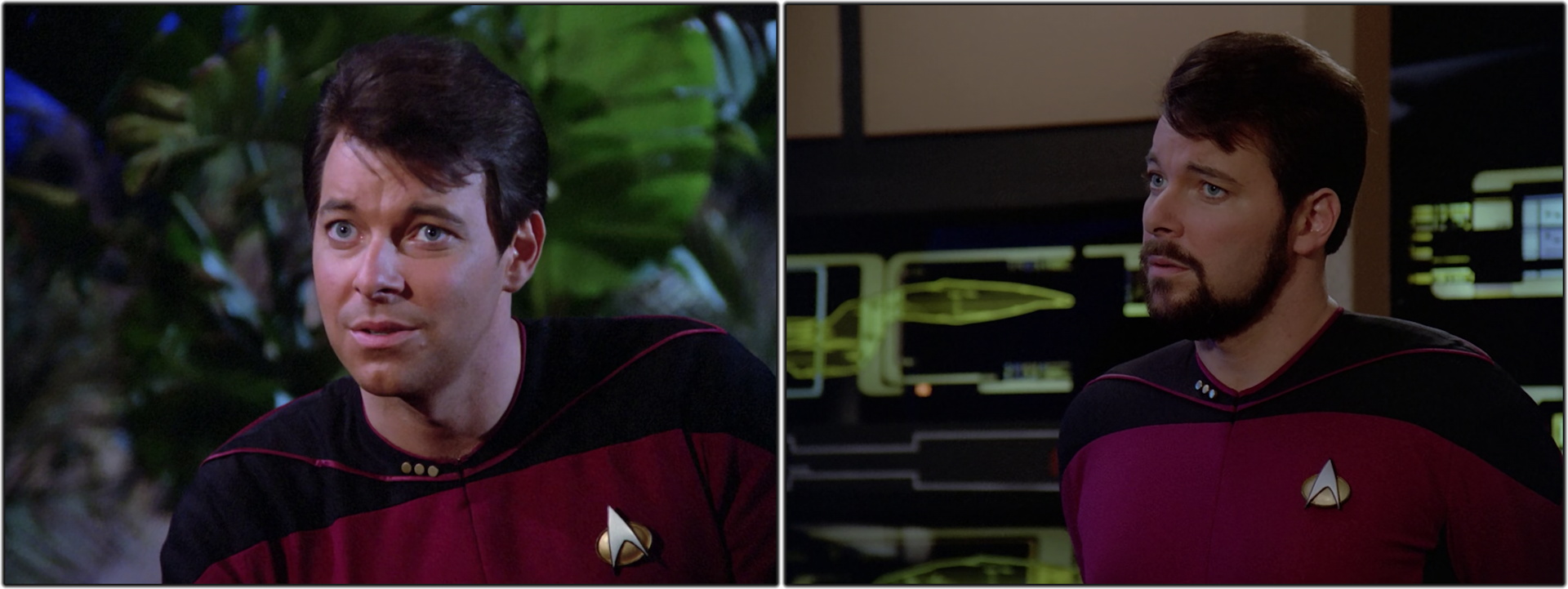
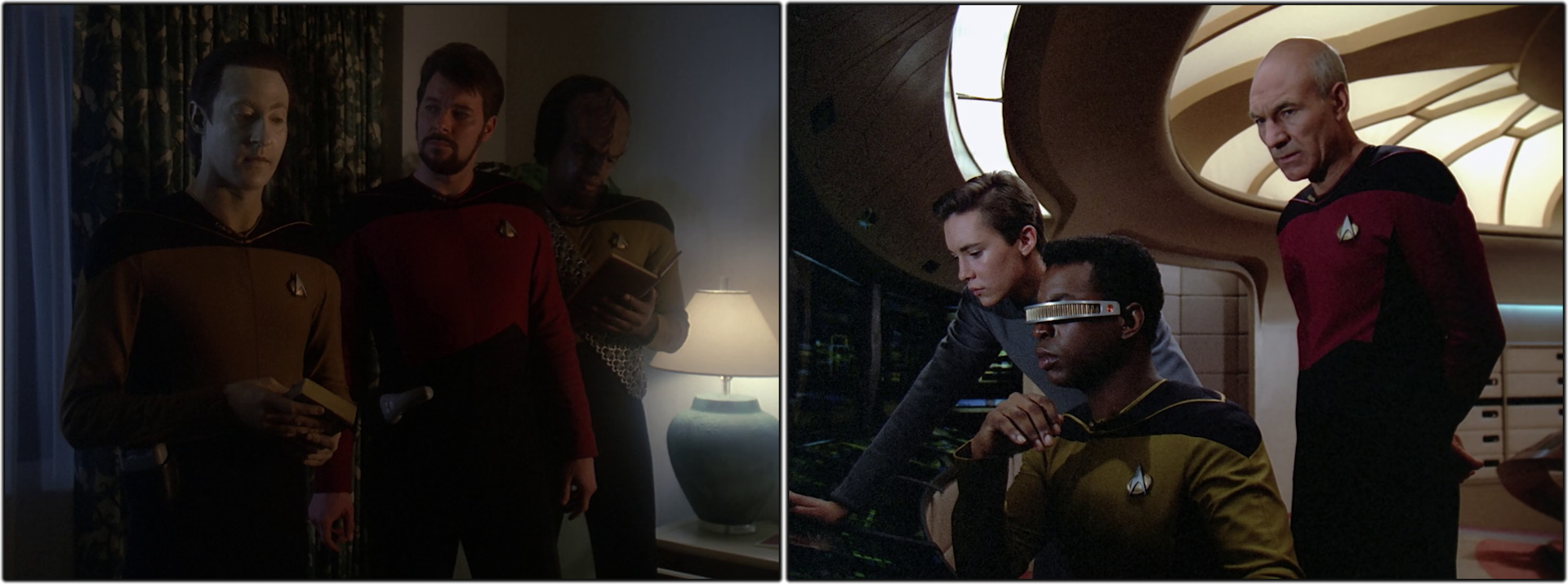
Season 2 of The Next Generation coined the phrase “growing the beard;” the opposite of “jumping the shark.” This phrase means, in brief, that a television show has improved significantly after a rougher first season, and references Jonathan Frakes’ character of Will Riker, who first got his iconic beard this year. While I don’t agree at all with the sentiment that Season 1 of TNG is somehow “bad” in its entirety, I think it’s fair to say that the show went from strength to strength, growing into something better over time.

And it’s that moment that I joined in and became a Star Trek fan. That can’t be a coincidence, can it? In fairness, I’ve always wondered what I might’ve made of Star Trek if, at this seminal moment, I’d have watched an episode like Angel One, or a similar lowly-rated story from Season 1. Would I have persevered with Star Trek, or written it off? I suppose we’ll never know… but it’s an interesting “what if” idea, isn’t it?

Two side-by-side still frames from Star Trek TNG S1 and S2 showing Riker
Riker in Season 1 (left) and Season 2 (right).

If you’ve made it this far, thanks! I think we’re finally ready to get into The Royale and its story.

The Royale aired at the midpoint of The Next Generation’s second season, in between Contagion and Time Squared. It was broadcast in the United States more than two years ahead of its UK premiere, in March 1989, and was written by Tracy Tormé and directed by Cliff Bole. Bole had previously worked on William Shatner’s police show T. J. Hooker, and had directed three episodes of TNG’s first season, including the penultimate episode, Conspiracy. He’d go on to direct almost two dozen more, as well as seven episodes of Deep Space Nine and ten of Voyager.

Tracy Tormé, the episode’s writer, is credited under a pseudonym for The Royale, as a result of conflicts with Maurice Hurley, TNG’s head writer for Season 2; Hurley had made changes and revisions to Tormé’s original script for the episode. According to Chaos on the Bridge, William Shatner’s documentary about the making of The Next Generation, Tormé and Hurley regularly butted heads during Seasons 1 and 2, before Tormé ultimately left the series ahead of Season 3.

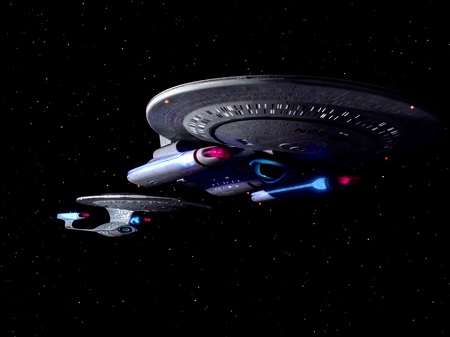
Still frame from Star Trek TNG The Royale showing the Enterprise-D
The opening shot of the episode.

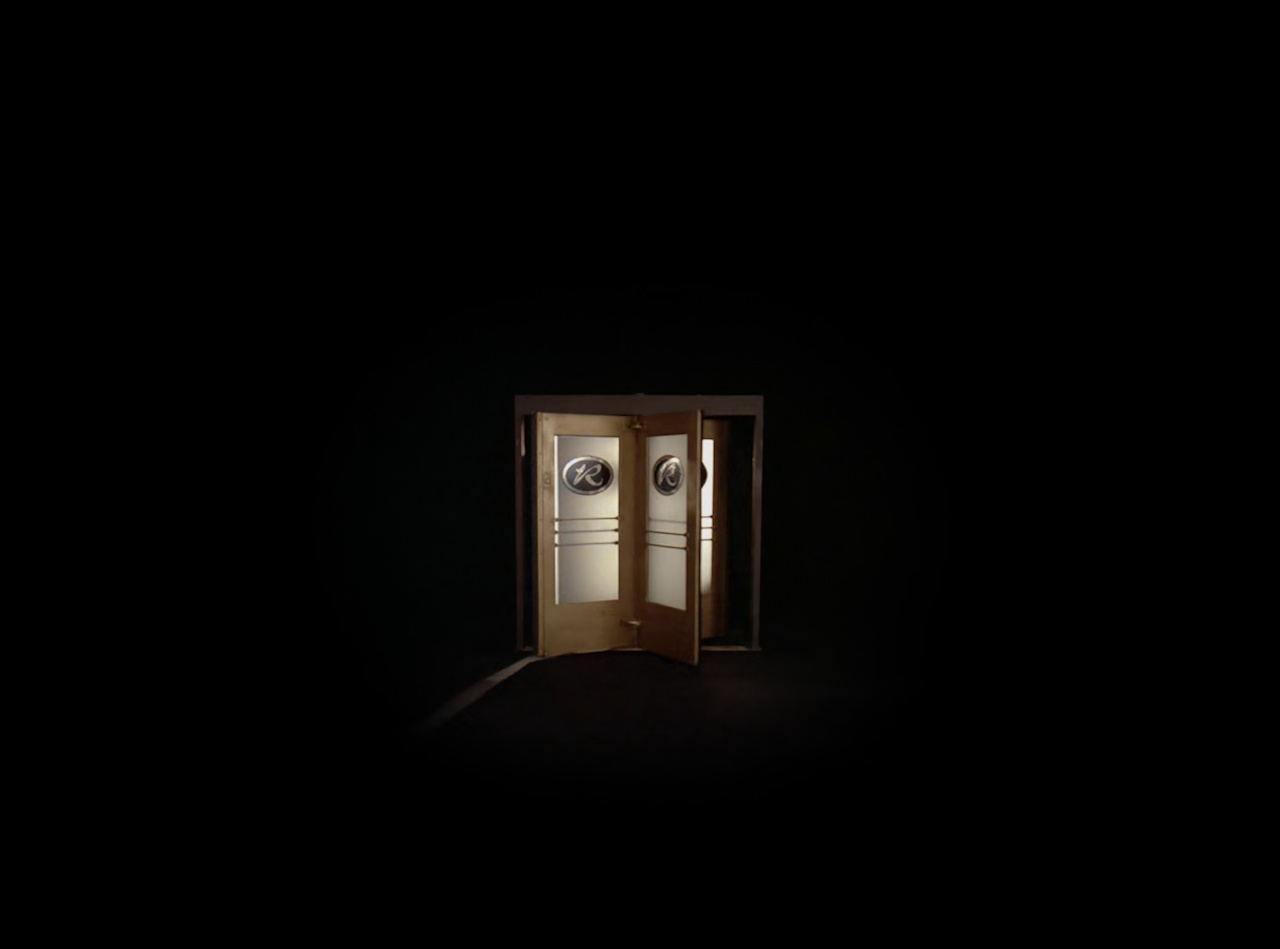
According to director Cliff Bole, The Royale suffered from having a low budget. The revolving door leading into the hotel – and, really, the entire surface of Theta VIII outside of the hotel – is, to be incredibly generous, “minimalist!” Even the remastered version of the episode doesn’t change this (for which I’m actually glad), but I think there’s a weird kind of low-budget charm to the way the planet and away mission are presented. It’s kind of like The Original Series with its papier-mache and polystyrene rocks; something about that, while objectively unrealistic in its appearance, just… “feels like Star Trek,” or at least it does to me!

Tracy Tormé has said that his original draft was much more surreal, and from what I can glean, it sounds like it might’ve been closer to The Original Series in tone, perhaps with more of a focus on comedy or even outright silliness. Allegedly, this version of the story was felt to be too similar to A Piece of the Action from TOS; both stories involve an alien society contaminated by a book from Earth, and both had gangsters in them. That version of the episode may have been a lot funnier… or it could’ve been a lot worse, but I suppose we’ll never know, eh?

Still frame from Star Trek TNG The Royale showing a revolving door
A very minimalist set…

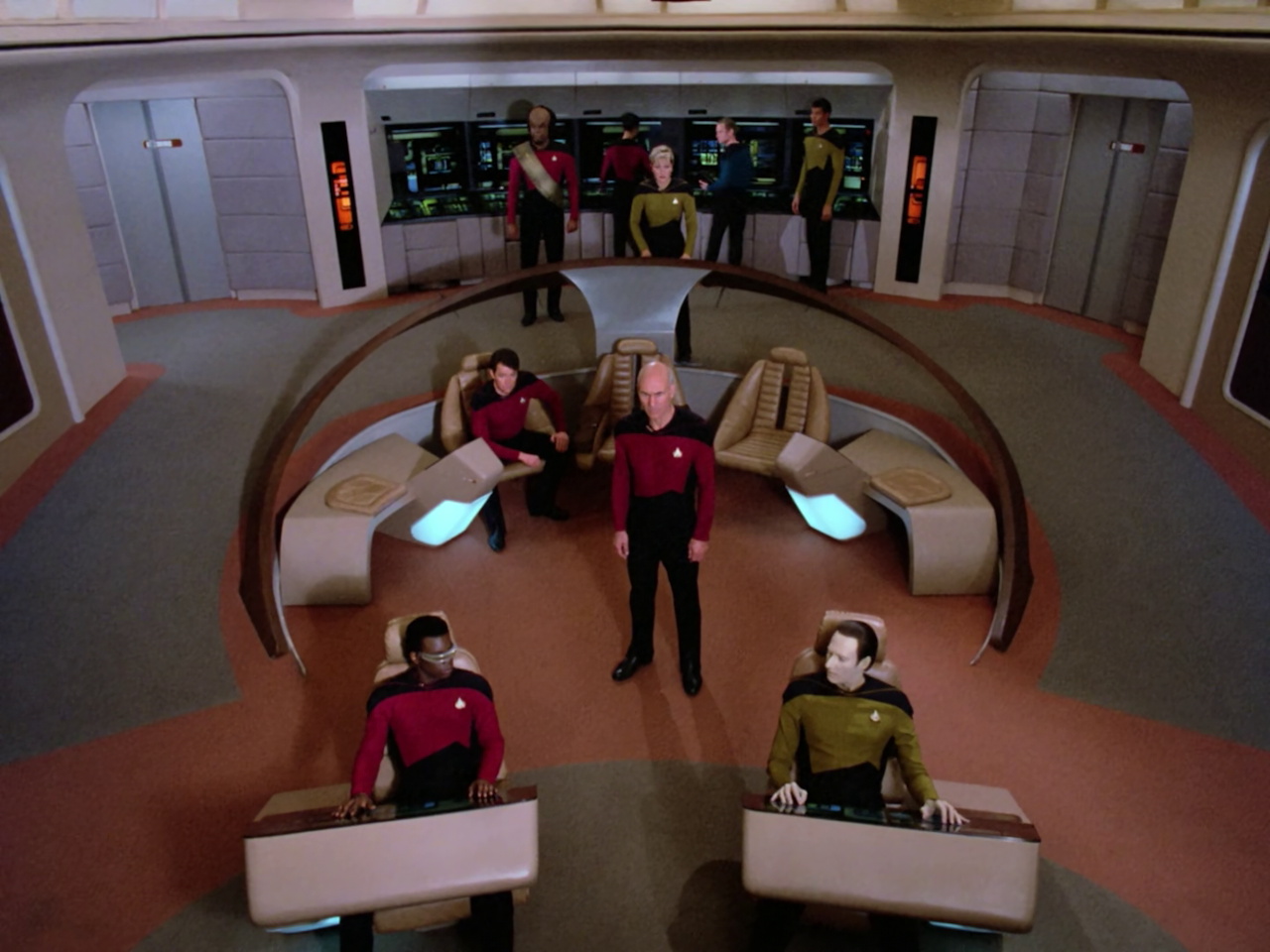
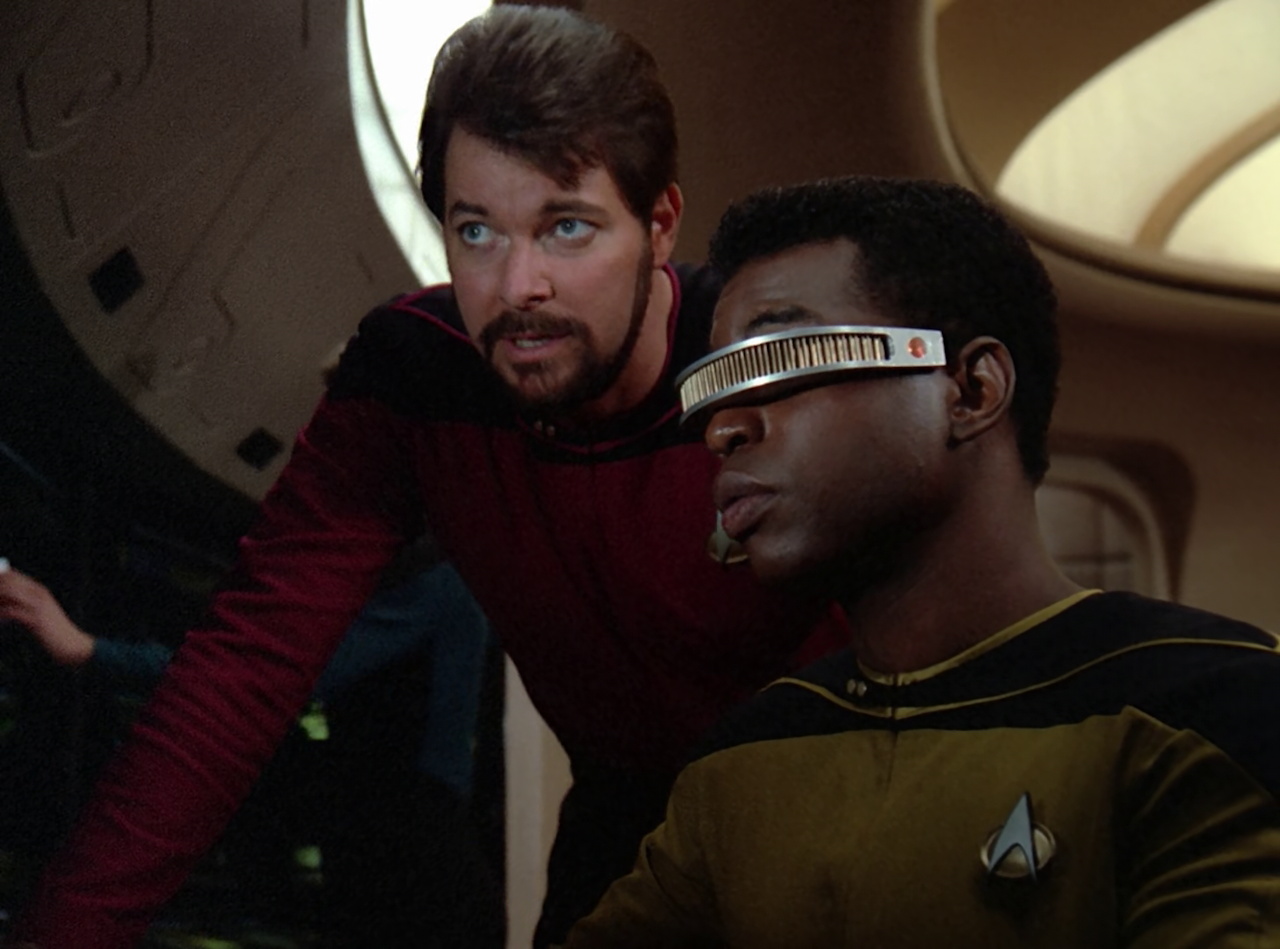
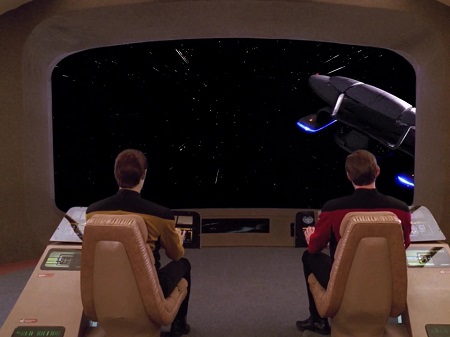
The episode begins with the Enterprise-D arriving at Theta VIII, and a brief discussion between Riker and Geordi about the planet. This sets up Theta VIII as an inhospitable place; a freezing planet with high winds and ammonia tornadoes. It’s a cute little conversation, and I like the shot of Riker on the bridge, moving from the front, near the helm and conn positions, to Geordi’s station at the back. It’s not something we’d see a lot of across the show, this kind of panning shot, following a command character as they move between stations.

It’s also a bit of a rarity to see Geordi on the bridge after Season 1, and I think this moment worked a lot better than if, say, Riker had called down to Engineering. Having the two together, with Riker looking over Geordi’s shoulder for the chat, just felt a bit more personal and familiar, adding to the sense that these two are friends as well as colleagues. Not a huge moment in the episode, considering what’s to come – but I still really like it!

Still frame from Star Trek TNG The Royale showing Riker and Geordi
Riker with Geordi on the bridge.

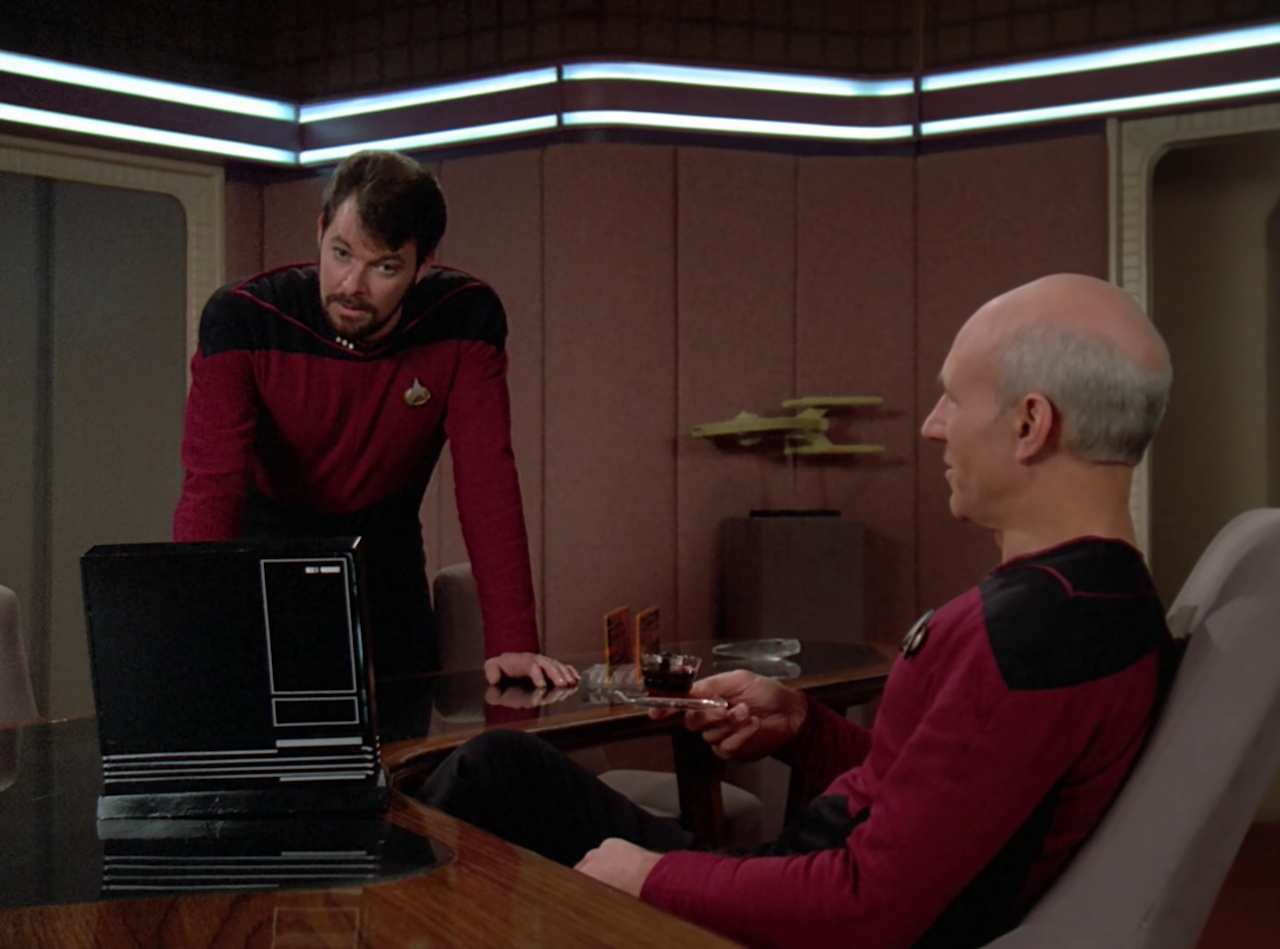
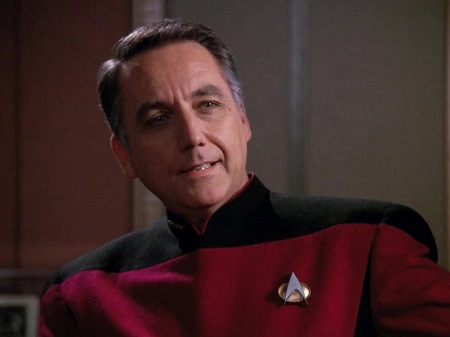
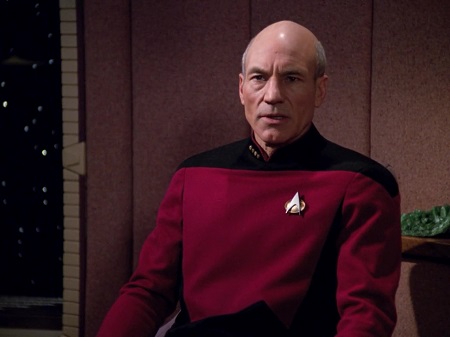
Riker’s conversation with Picard in the Ready-Room has drawn a lot of attention over the years, but not for the reasons the writer may have wanted! Picard talks about Fermat’s last theorem, which was a famously unsolved problem in mathematics, and uses it as an example of how much Starfleet and the Federation still have to learn about the universe. This point is interesting, and it establishes a couple of things about Picard: that he spends his downtime thinking about puzzles like this, and that he’s keenly aware of how far humanity still has to go to uncover the mysteries of the universe. It neatly encapsulates who Picard is, why he’d join an organisation like Starfleet – and why, all these years later, he’s a character that so many of us absolutely adore!

But this moment has been overshadowed somewhat by the solution to Fermat’s last theorem! Only a few years after The Royale aired, mathematician Andrew Wiles published his proof, rendering Picard’s statement inaccurate. And some fans and viewers hold up this moment not as Picard being philosophical about Starfleet’s mission of exploration… but rather, as an example of how Star Trek’s vision of the future can be invalidated as the world around it shifts. I don’t really like that approach, and while we can look back at this scene now, with the benefit of hindsight, and acknowledge that, factually speaking, Picard is now incorrect to say that Fermat’s last theorem was never solved… I think his point still stands! And it feels a little pedantic for folks to seize on this moment as a kind of “gotcha” to say that Star Trek gets its vision of the future wrong. Star Trek, for me anyway, kind of exists in a floating timeline, and while we wouldn’t make an episode today using Fermat’s last theorem in this way, the point Picard was making about how humanity still has a long way to go to understand the universe isn’t invalidated. It’s interesting, though, that the proof was published only a few years after the episode aired.

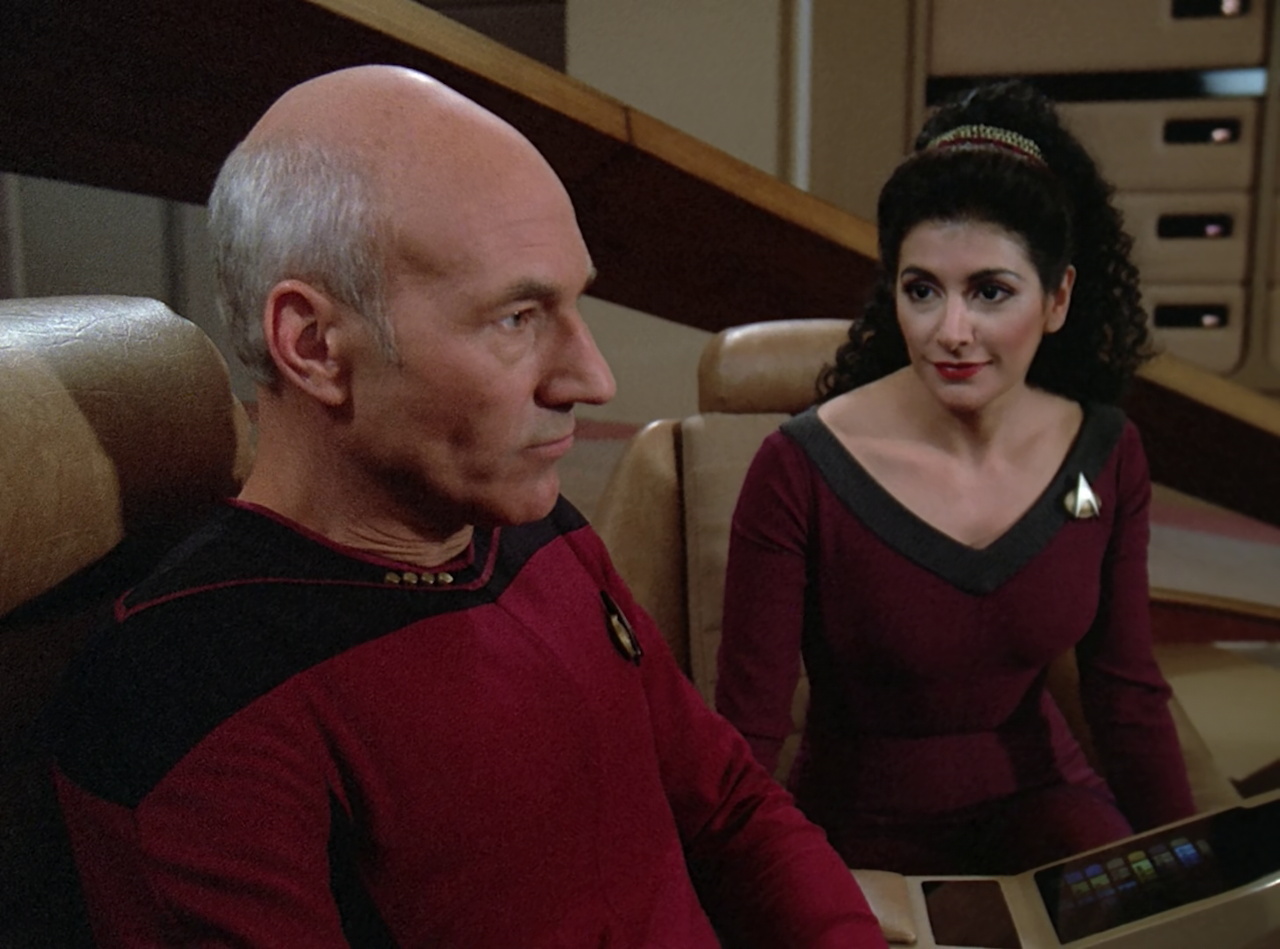
Still frame from Star Trek TNG The Royale showing Riker and Picard
This discussion of Fermat’s last theorem is interesting.

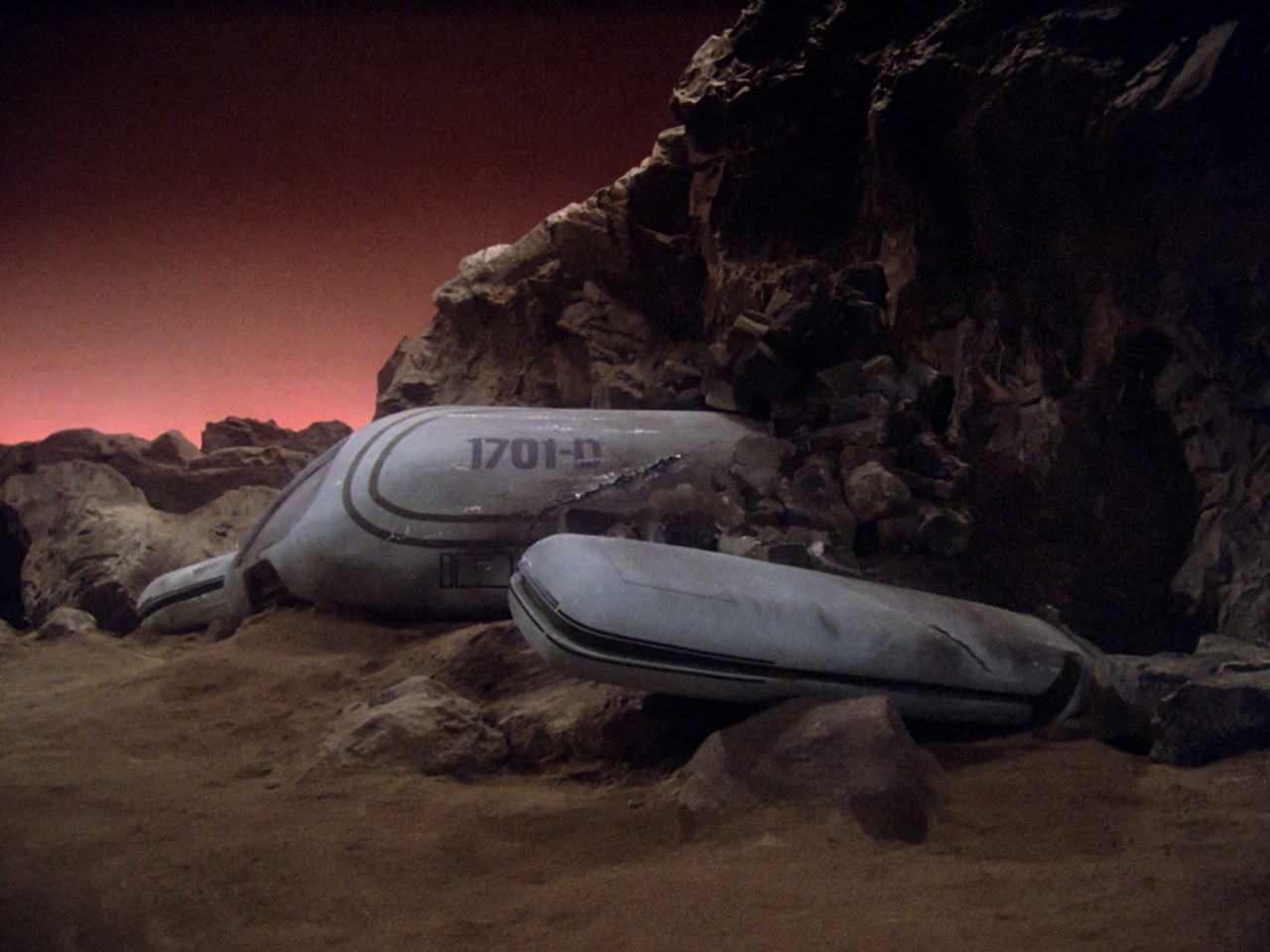
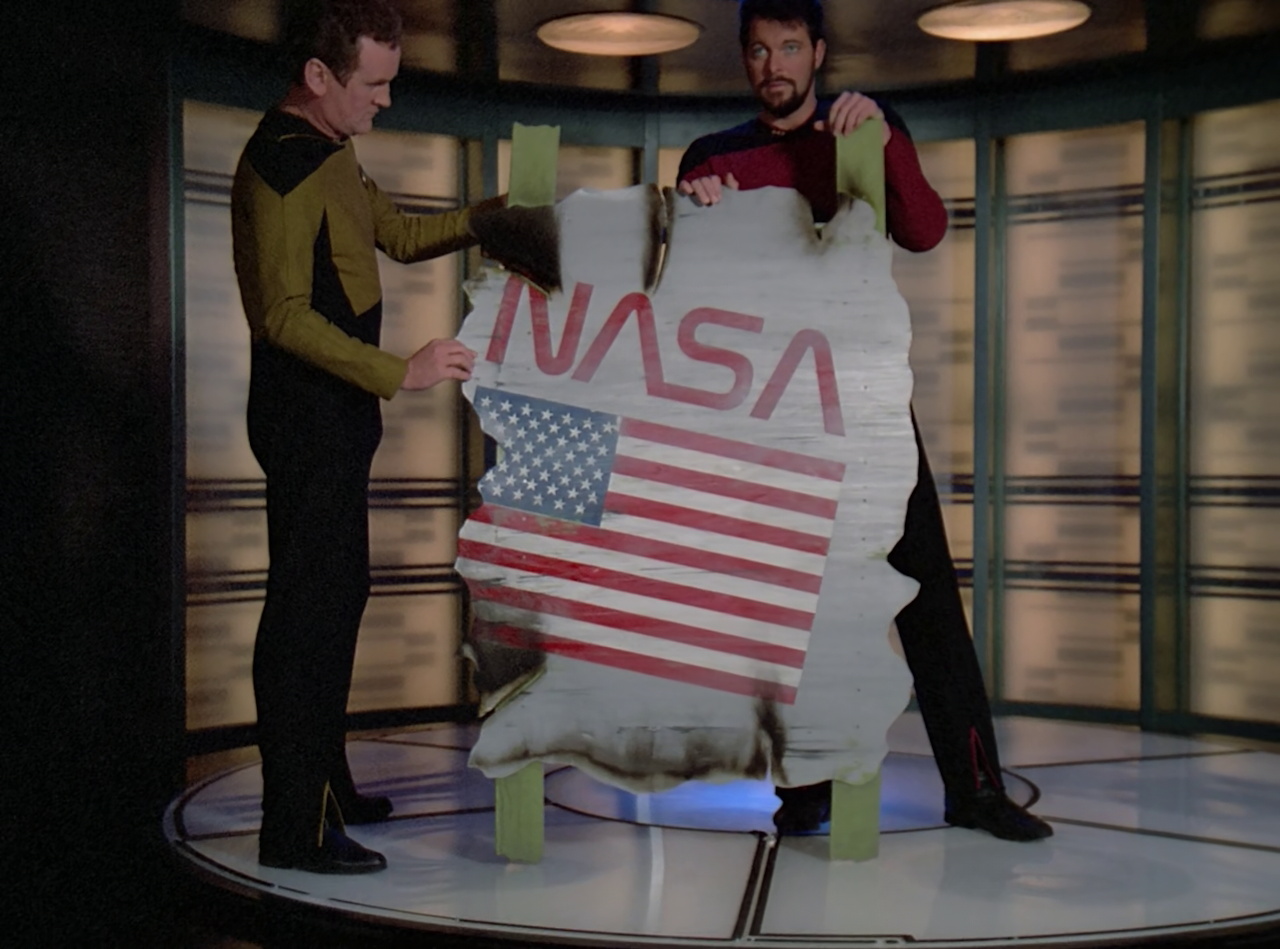
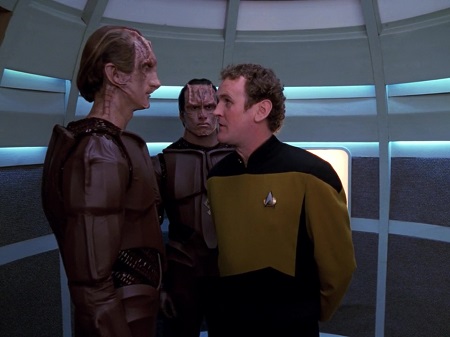
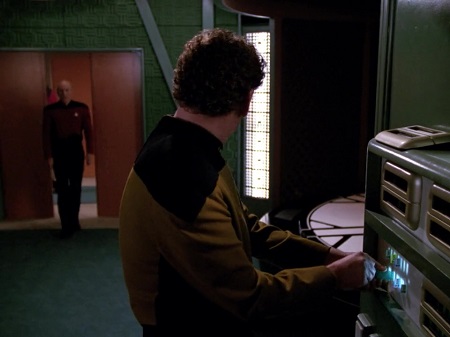
The teaser ends with the revelation that the debris detected in orbit of Theta VIII is from a NASA spacecraft. I like the little scene in the transporter room, and it’s always fun to see Chief O’Brien prior to his role in Deep Space Nine! However, I can’t help but feel like this moment – which is treated as a huge revelation by the episode – doesn’t quite make sense if you stop to think about it. Why wouldn’t either the Klingon cruiser or the Enterprise-D have been able to detect that the debris was of Earth origin? And given how much random junk and debris there must be in space, why would the Enterprise-D have diverted here just for that? Would the episode have been a bit more solid if it began with the message from the Klingons saying that they’d detected the wreck of an Earth spacecraft in orbit of Theta VIII?

I think this is an example of the passage of time – and the fact that I’ve seen this episode so many times over the years – getting in the way! The “big reveal” of the NASA emblem doesn’t shock me any more, and it hasn’t since I was eight years old and I first saw the episode! But that isn’t The Royale’s fault, and thinking about the mystery that the episode wants to establish going into the ad break… it’s done pretty well. I just get the sense that, if you think about it from an in-universe point of view, the Enterprise-D wouldn’t have necessarily diverted to Theta VIII for no reason, and the Klingons probably wouldn’t have even mentioned the debris unless they knew it was of human origin. Changing that would’ve completely ruined the shock of seeing the NASA emblem and American flag, but I’d still argue it would make more sense in-universe for the crew to have deliberately set out to recover the debris of a ship from Earth, rather than diverting the entire ship to take a look at some random space junk.

Still frame from Star Trek TNG The Royale showing O'Brien and Riker with the NASA debris
O’Brien and Riker with the recovered debris.

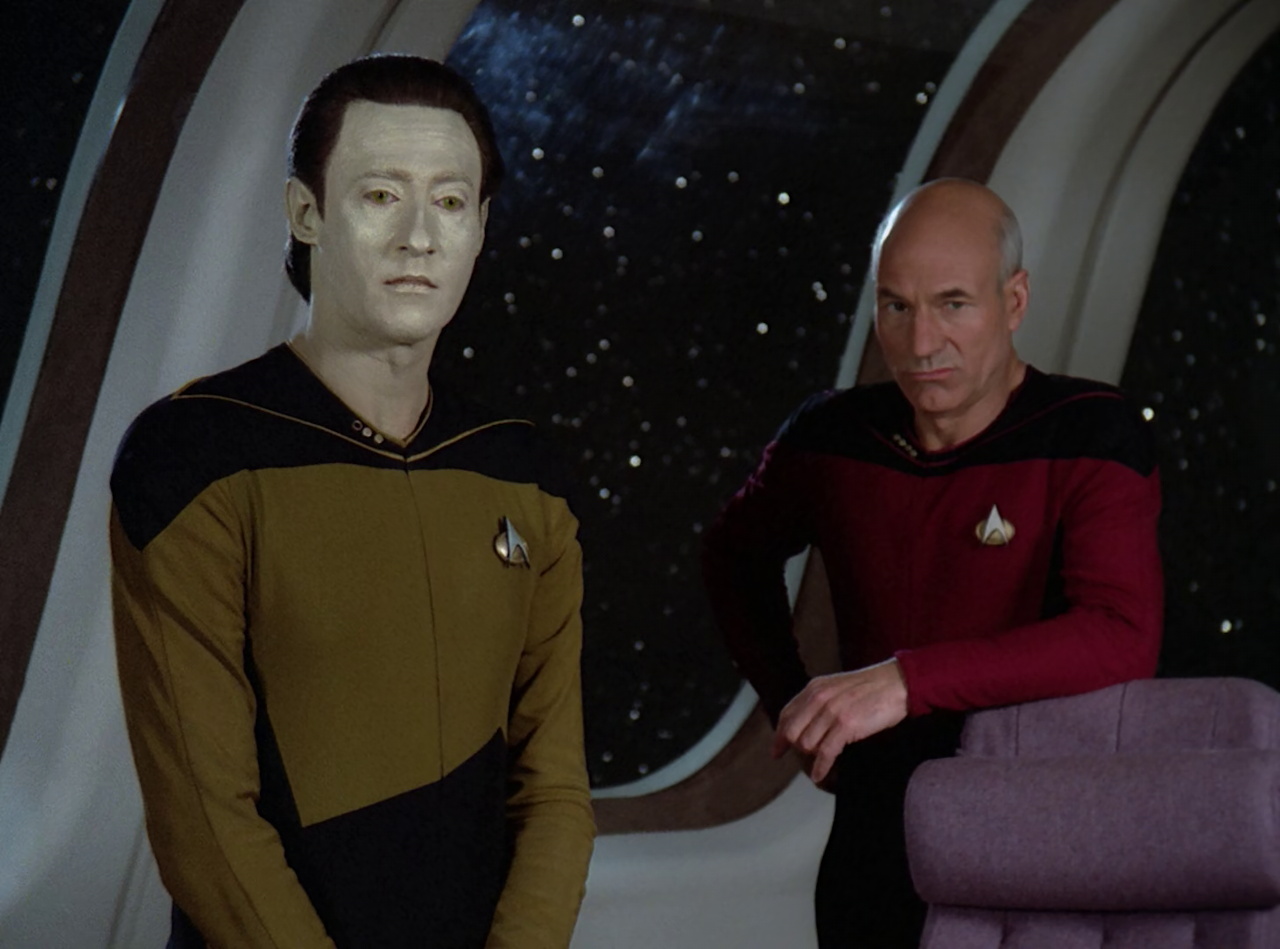
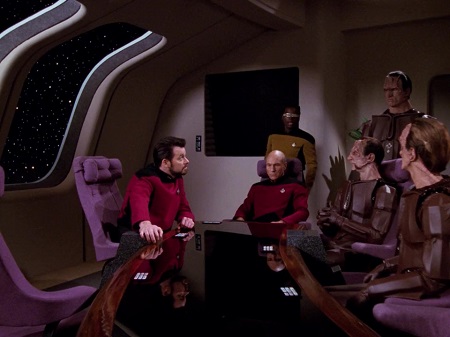
In the Conference Room, the crew briefly discuss what they’ve found. The damage to the debris could indicate it was hit by weapons fire, and Picard states that there’s no way a vessel from the mid-21st Century could have travelled so far into deep space. I think it’s fun to see, now we’re almost forty years on from The Next Generation’s premiere, how the show, especially in its first couple of seasons, was trying to remain consistent with The Original Series and its vision of Earth in the late 20th and early 21st Centuries. Encounter at Farpoint showed us the aftermath of World War III and the “post-atomic horror,” and now we’re getting NASA spacecraft from that same kind of era venturing beyond the solar system.

As we get closer to some of these dates and moments in real-time, we can see how wrong those depictions were! And that’s kind of sad, in a way. But speaking as we were of Star Trek having a kind of “floating timeline,” where events in the real world can ultimately overwrite some of these ideas… I don’t think it really matters all that much. If you look at Star Trek episodes produced in the 2020s, they might not reference the “mid-21st Century” in quite the same way, but Star Trek’s internal timeline is, for me, vague enough to still come together! And my personal head canon, anyway, is that Star Trek diverged from the real world at some point in the mid/late 20th Century! But I think we’ve gotten a little off-topic, huh?

Still frame from Star Trek TNG The Royale showing Data and Picard
Data and Picard in the Conference Room.

I love the handheld phasers that the crew use for the away mission. A lot of phaser designs feel “iconic,” but something about the models used in the first part of The Next Generation just feels even more special, somehow. Perhaps that’s the nostalgia talking again! This model, lovingly referred to as the “dustbuster” after a handheld vacuum cleaner that it resembles, was seen on a few occasions across Seasons 1 and 2, but was changed by Season 3.

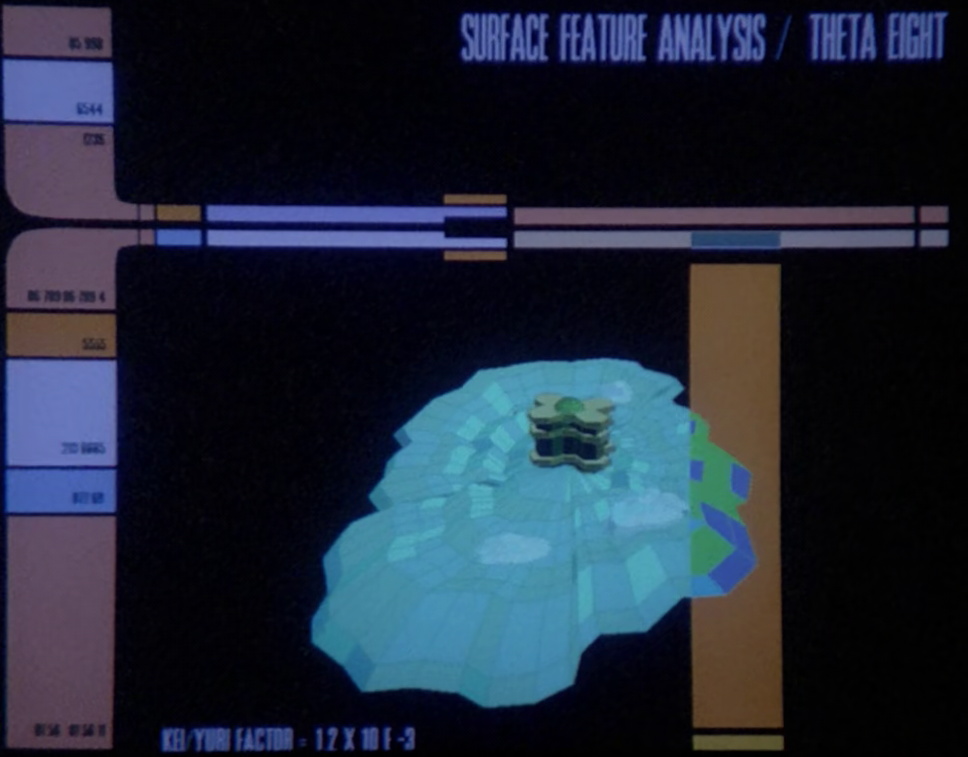
To get back on topic, Wesley and Geordi show Picard and the others a “structure” that they’ve detected on the surface of Theta VIII. And here’s where I feel like the script and the production didn’t quite align! This structure, briefly glimpsed on Wesley’s monitor, is simply never shown at all; the away team beams down to a black void with a simple revolving door set into it, and the exterior of the hotel is simply never seen, nor even acknowledged. This is clearly a consequence of the budget issues we talked about, and I happen to find the black void and simple door to be suitably mysterious and otherworldly, especially for the kind of story the episode is setting up. But it’s also a bit of an inconsistency, if you think about it, and it makes me wonder why they didn’t rework this moment on the bridge to perhaps make note of a pocket of breathable air, but not draw attention to the existence of a “structure” that we never get to see.

Still frame from Star Trek TNG The Royale showing an LCARS scan
We never actually get to see what this structure looks like.

The away team beams down to Theta VIII, and they encounter the revolving door! One thing I didn’t realise until looking into the production history of The Royale is that all of the sets for the hotel were constructed specifically for The Next Generation – they didn’t use an existing hotel or casino set, which is genuinely fascinating. I guess it must’ve been cheaper to do that than to try to book an existing location or reuse a set from another series, but… how?

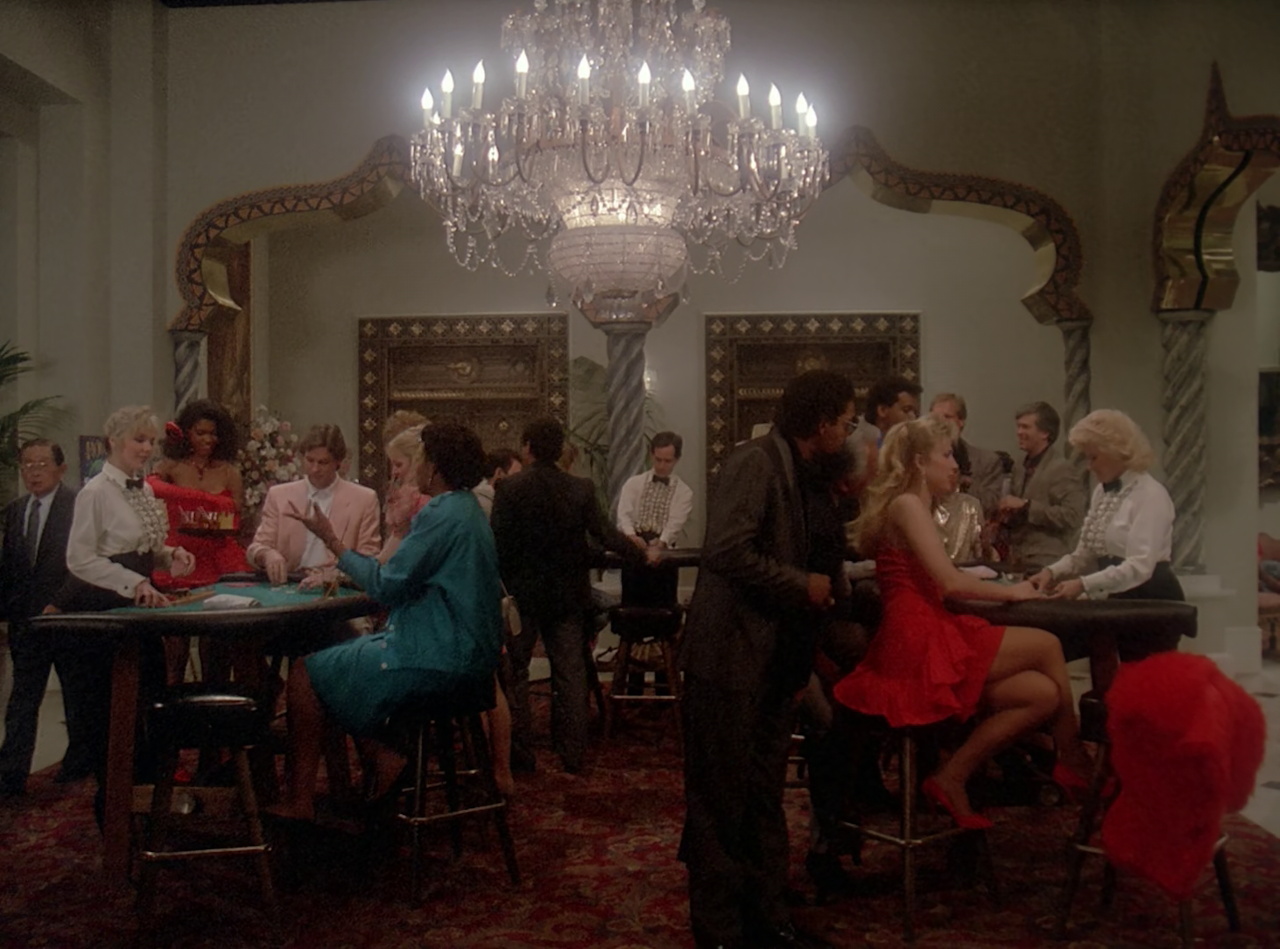
Director Cliff Bole, who had previously worked on a crime drama called Vegas, described the set as being built with “curtains,” and recalled that whole scenes needed to be shot from very specific angles so as not to give the game away! The moment the away team walks into the hotel for the first time, though, doesn’t feel – to me, anyway – like actors walking onto a set. The number of people in frame, as well as the score and sound design, too, make the hotel’s casino feel like a very real – if mysterious and otherworldly – space.

Still frame from Star Trek TNG The Royale showing the casino
The casino.

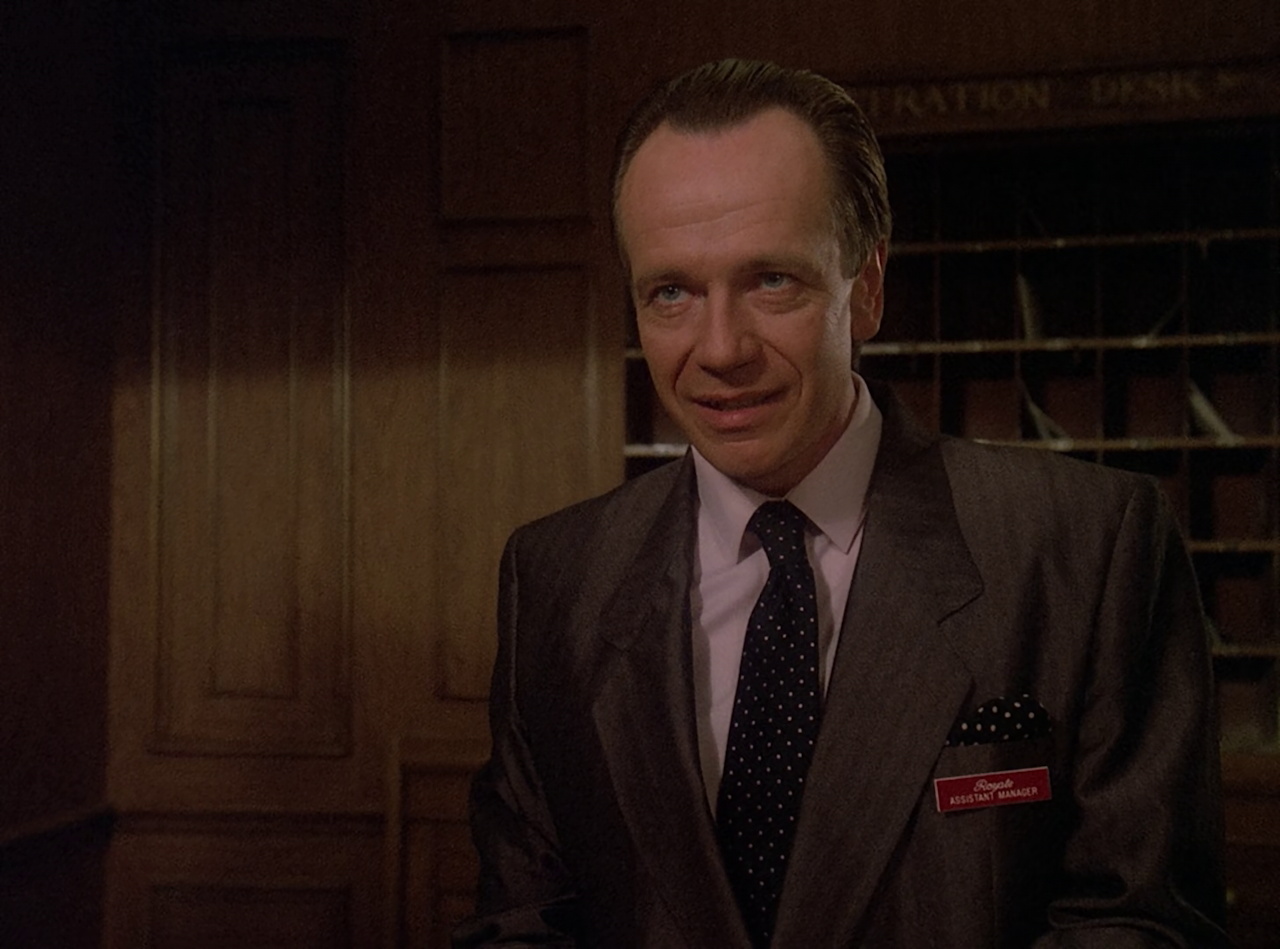
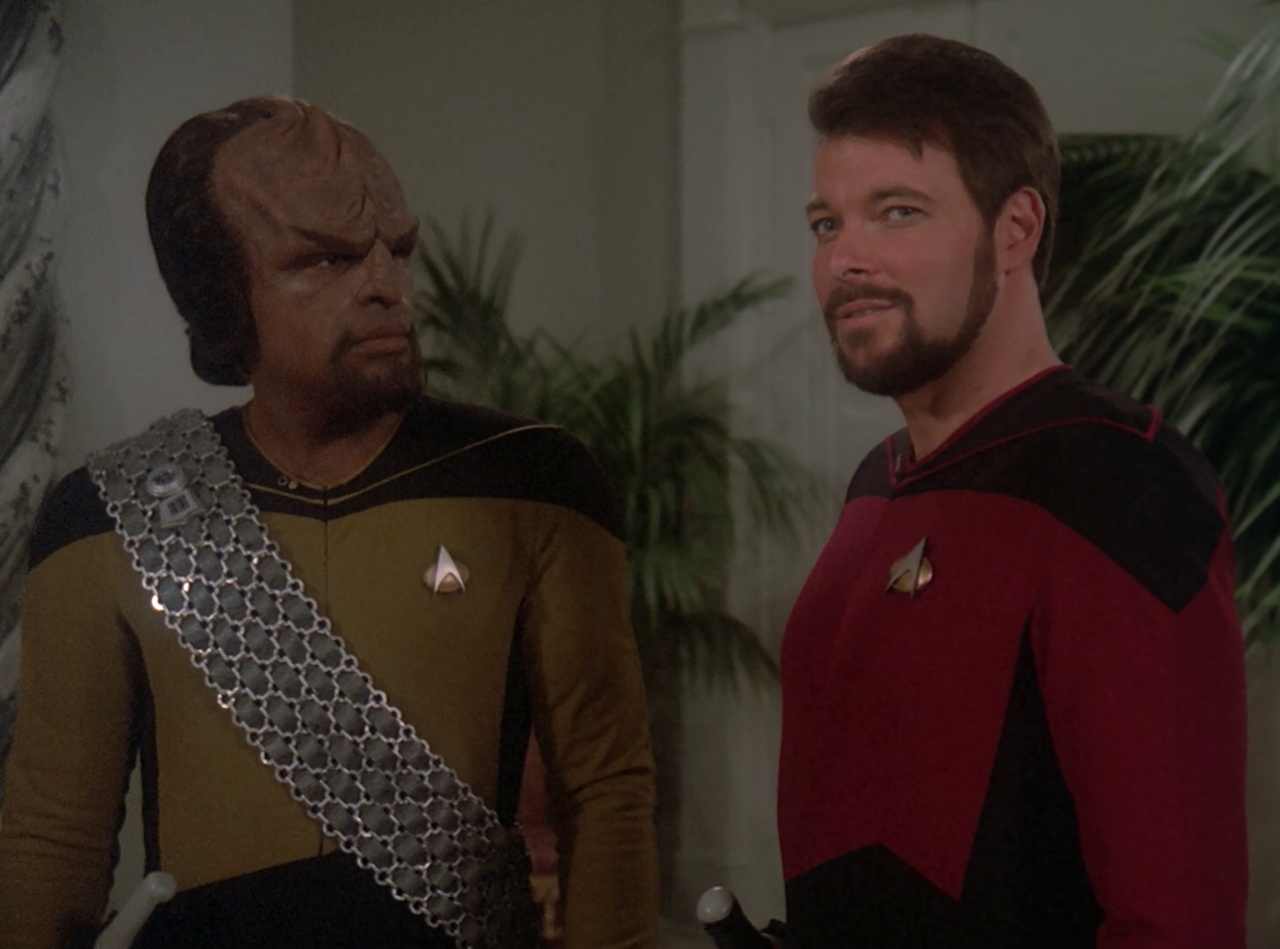
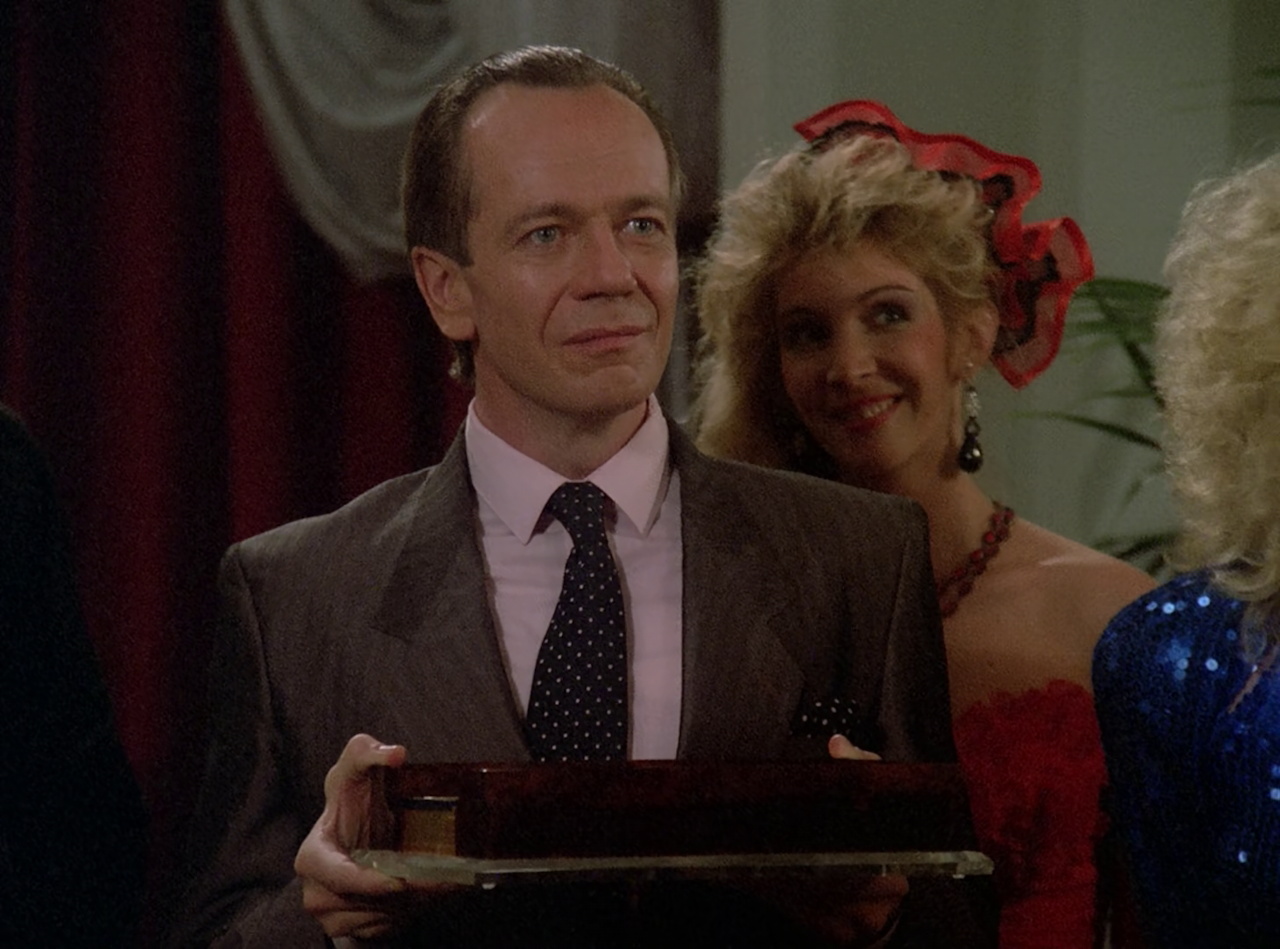
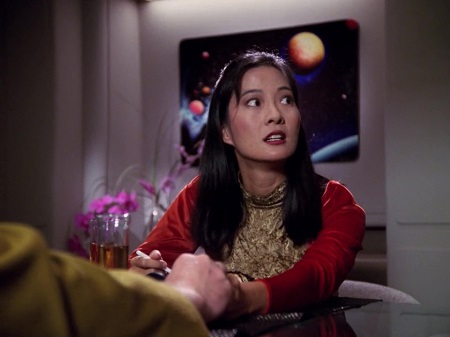
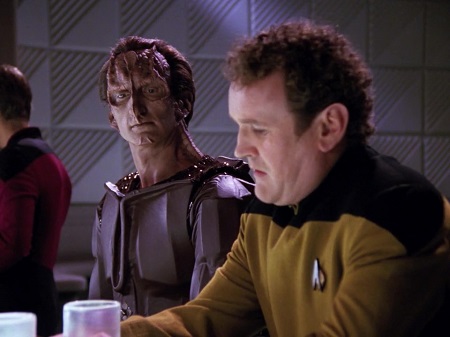
The interaction with the assistant manager at the hotel’s front desk is still, all these years later, absolutely hilarious. Sam Anderson, the actor who took on the role, has absolutely perfect comedic timing, especially in this first encounter. As Riker and Worf push him on what the planet’s called… I can’t help but laugh every single time, no matter how many times I’ve seen The Royale.

Anderson would go on to have roles in films like Forrest Gump and TV shows like ER and Lost.

There’s a creepiness to this interaction, making us think that the assistant manager is hiding things or refusing to share everything he knows about the hotel or the planet it’s situated on, and that successfully builds up more of the mystery that The Royale is going for.

Still frame from Star Trek TNG The Royale showing the assistant manager
The assistant manager.

It’s also at this moment that we get the first signs of the episode’s other angle: the cheap story from a low-quality novel. Playing out like a tired cliché of the crime and drama genres, the hotel’s bellboy interrupts the away team to talk to the assistant manager about a girl. And the soundtrack here! It’s just pitch-perfect for this kind of over-the-top drama cliché; exactly the kind of thing you’d have heard in a B-movie or TV soap opera. The dramatic change in music adds so much to this scene, indicating to us as the audience that there’s something very strange going on. I love it!

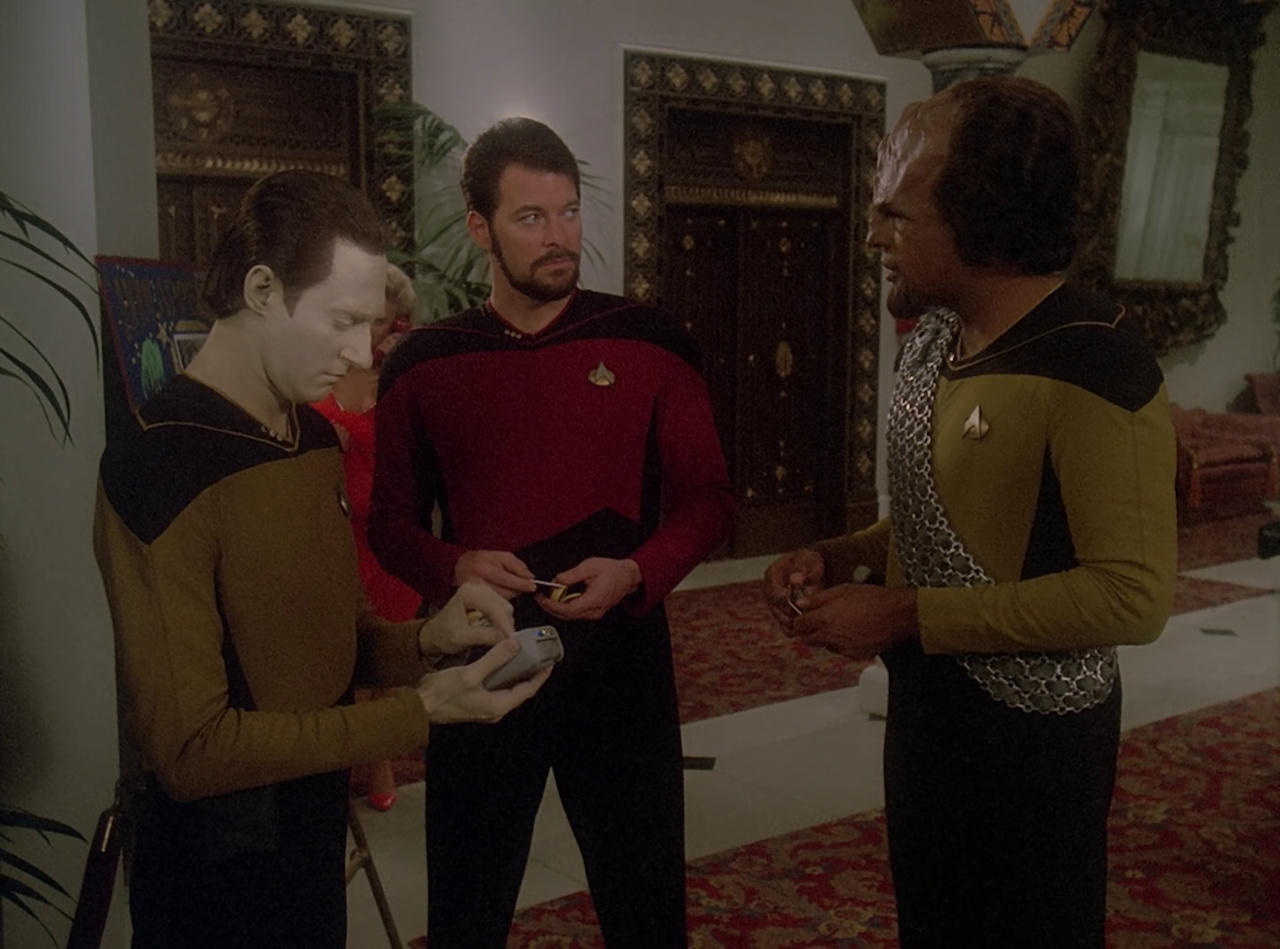
This leads into the revelation that none of the people the away team has encountered are emitting life-signs. And this gets a little confusing; Data explains that they exist, but that they aren’t organic, nor are they machines. Again, the mysteries of the story are deepening. And we get a fun introduction to the character “Texas” to round things off.

Still frame from Star Trek TNG The Royale showing the away team
The away team scanning for life-forms.

We get a brief scene back aboard the Enterprise-D with Wesley and Geordi still working on a way to break through the communications blackout. Picard talks to them, wondering whether something intelligent may be blocking their signal, and then hears from Counsellor Troi that Riker doesn’t appear to be in danger; she describes his mood as “amused,” which obviously tracks with what we just saw! This little scene on the bridge doesn’t add a lot, but it’s a fun little cutaway in its own right.

I think it might’ve been interesting for Picard to ask Troi, rather than Wesley and Geordi, whether there was some kind of intelligence or life-form at work here. Surely she’d be able to tell whether there was anyone else down there besides the away team, and that could’ve impacted how the crew were reacting to the situation. Deanna’s empathic abilities are not always perfect, of course, but she might’ve been able to join in this conversation and share her perspective, at least. Again, a nitpick – but it’s a role we’ve seen Troi fill multiple times already, even at this point in the show’s run, commenting on the likes of Q or the Ferengi, to name but two examples. So I don’t think it’s out of the question for Picard to have asked her if she could feel another presence down on Theta VIII.

Still frame from Star Trek TNG The Royale showing Picard and Troi
Why doesn’t Captain Picard ask Counsellor Troi if she can sense another intelligence or presence down on the planet?

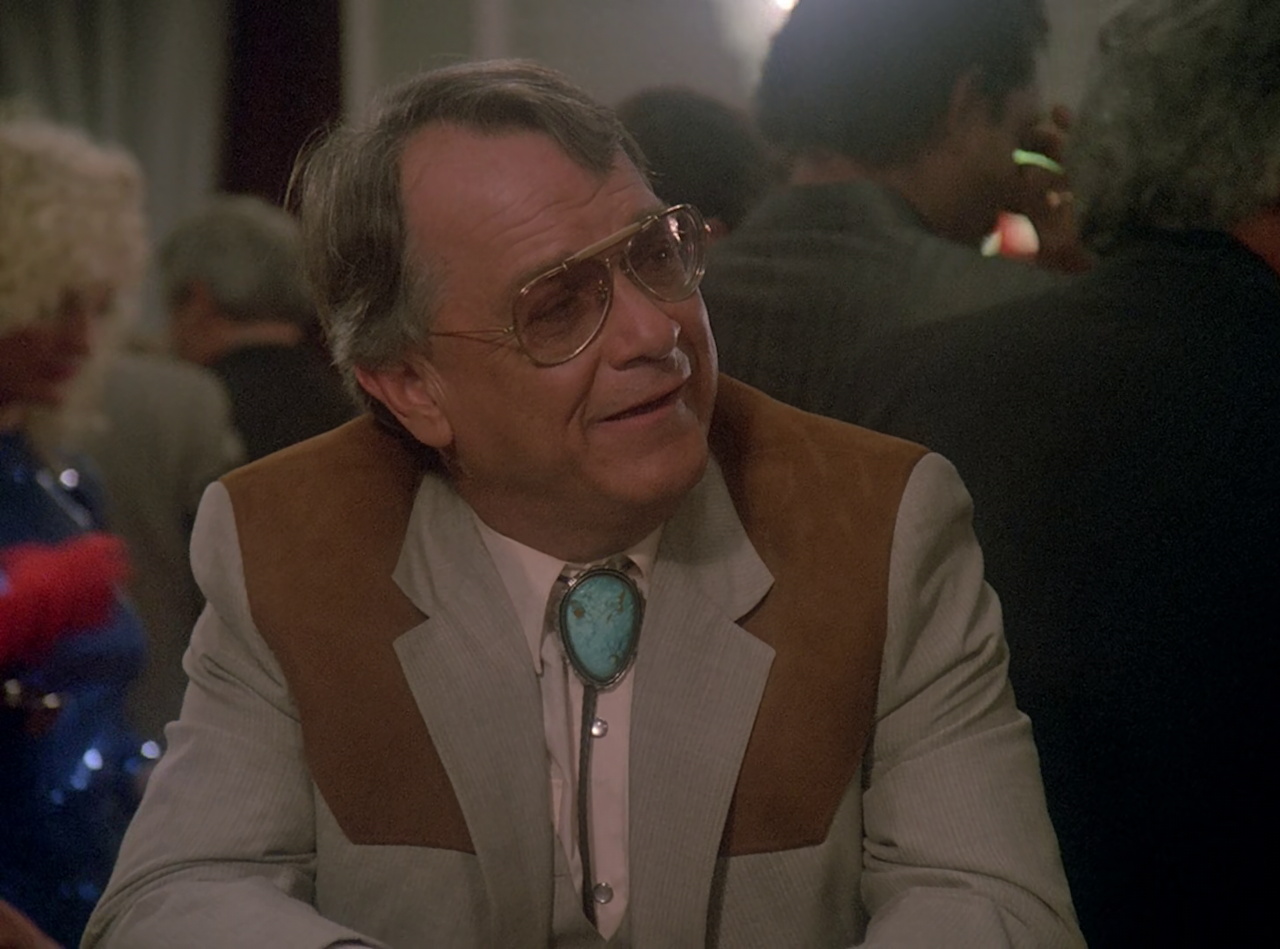
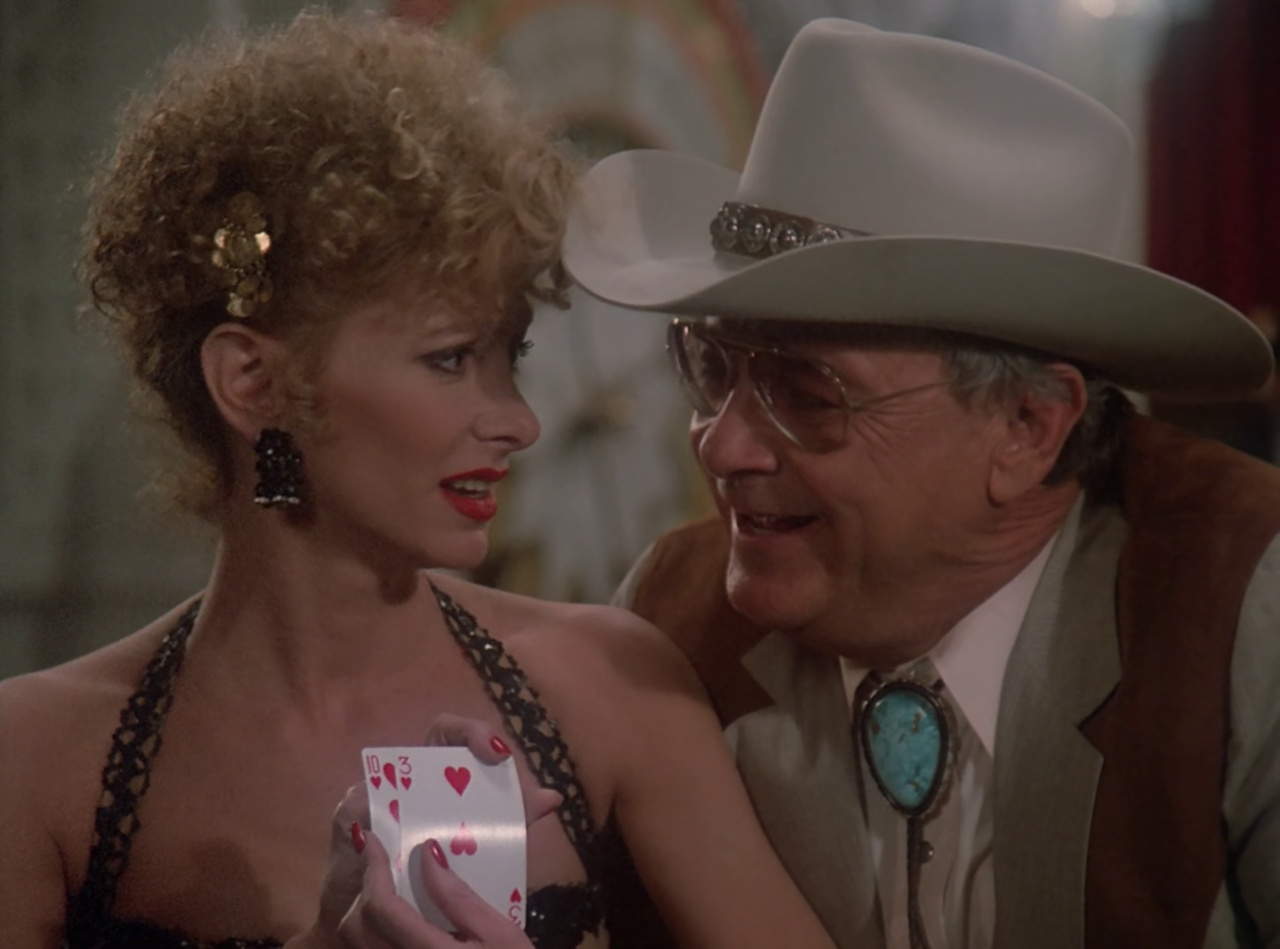
The blackjack scene with “Texas” is funny. Noble Willingham, the actor who played the role, would later go on to have a starring role in Walker, Texas Ranger with Chuck Norris, and he just feels perfectly cast as the old gambler in The Royale. He reminds me of The Simpsons’ character of the Rich Texan, thanks to a similar outfit, accent, and mannerisms, and I just think he’s a really fun and pretty unique character across really the entirety of Star Trek. He fits perfectly into this pulpy, low-quality novel, but there’s an edge to the character, too.

We get some genuinely cute moments with Texas and Data – Texas gives him his stetson hat to wear, briefly, and tries to talk him out of asking for another card during the game. I’m not a gambler, and I’m not all that familiar with blackjack as a game, but its rules are simple enough to understand – and Data explains them well – meaning it makes for a good choice of game to show off in a scene like this. Trying to explain the rules of a more complex game would’ve taken too long and could’ve been confusing or just less engaging for the audience.

Still frame from Star Trek TNG The Royale showing "Texas"
“Texas.”

After another short scene on the bridge, it soon becomes clear to the away team that they’re trapped in the hotel. The scene of the three of them running through the revolving door is a little silly, to be honest; they’re clearly just going all the way around and coming back out into the hotel, and it makes for a kind of comical presentation which contrasts with how seriously all three characters are taking it! But it does well enough to establish the core premise: they’re stuck in the hotel, unable to leave, and also cut off from communicating with the Enterprise.

The Royale always reminded me a little of The Eagles’ song Hotel California. Remember the line “you can check out any time you like, but you can never leave”? Isn’t that pretty much the premise of the story here, that escaping the hotel is impossible? I’ve never seen other Trekkies making that link, though, so maybe that’s just a me thing! And the song isn’t *literally* about a magically inescapable hotel, it’s a metaphor. Still, I find the comparison to be a fun one.

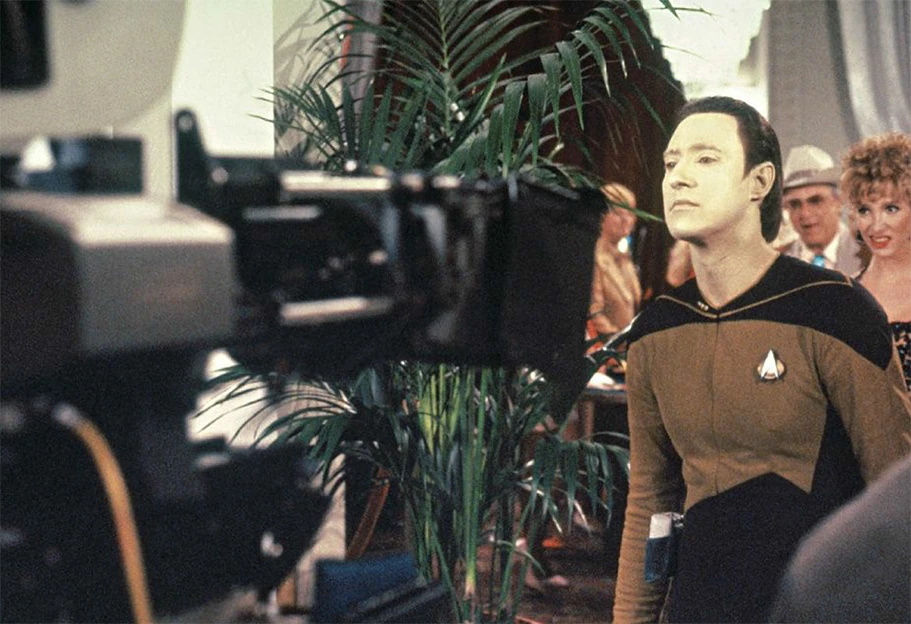
A behind-the-scenes photo from Star Trek TNG S2 showing Brent Spiner
Behind-the-scenes during production.

Riker attempts to talk to the assistant manager again, but makes no progress in figuring out how to leave the hotel. The Enterprise-D is able to briefly get in contact with Riker, but only long enough for him to tell Picard that they can’t leave the building. We get another scene with the bellboy and the assistant manager, with that absolutely wonderful scene-setting score again! And I just really love this incredibly cheesy story that’s unfolding at the hotel; it’s so silly, but it’s so… *Star Trek* at the same time.

Maybe you won’t agree, but I think The Royale is the kind of episode that modern Star Trek wouldn’t do. We’ve seen recent episodes involving time travel, including to the modern day, as well as stories involving aliens capable of generating illusions not dissimilar to the hotel in The Royale. But this kind of self-contained story – an alien recreation of a low-budget Las Vegas hotel, based on a book, and complete with one-dimensional characters played with self-awareness by the performers? I mean… would modern Star Trek do something like that? I doubt it… but it’s episodes like this one that make Star Trek what it is, at least to me. Recent stories all seem to be galactic in scope, with existential threats to the entire Federation and moustache-twirling villains who are played completely earnestly. The Royale is totally aware of the kind of books and TV shows it’s parodying, and I think that self-awareness is a big part of how well it works.

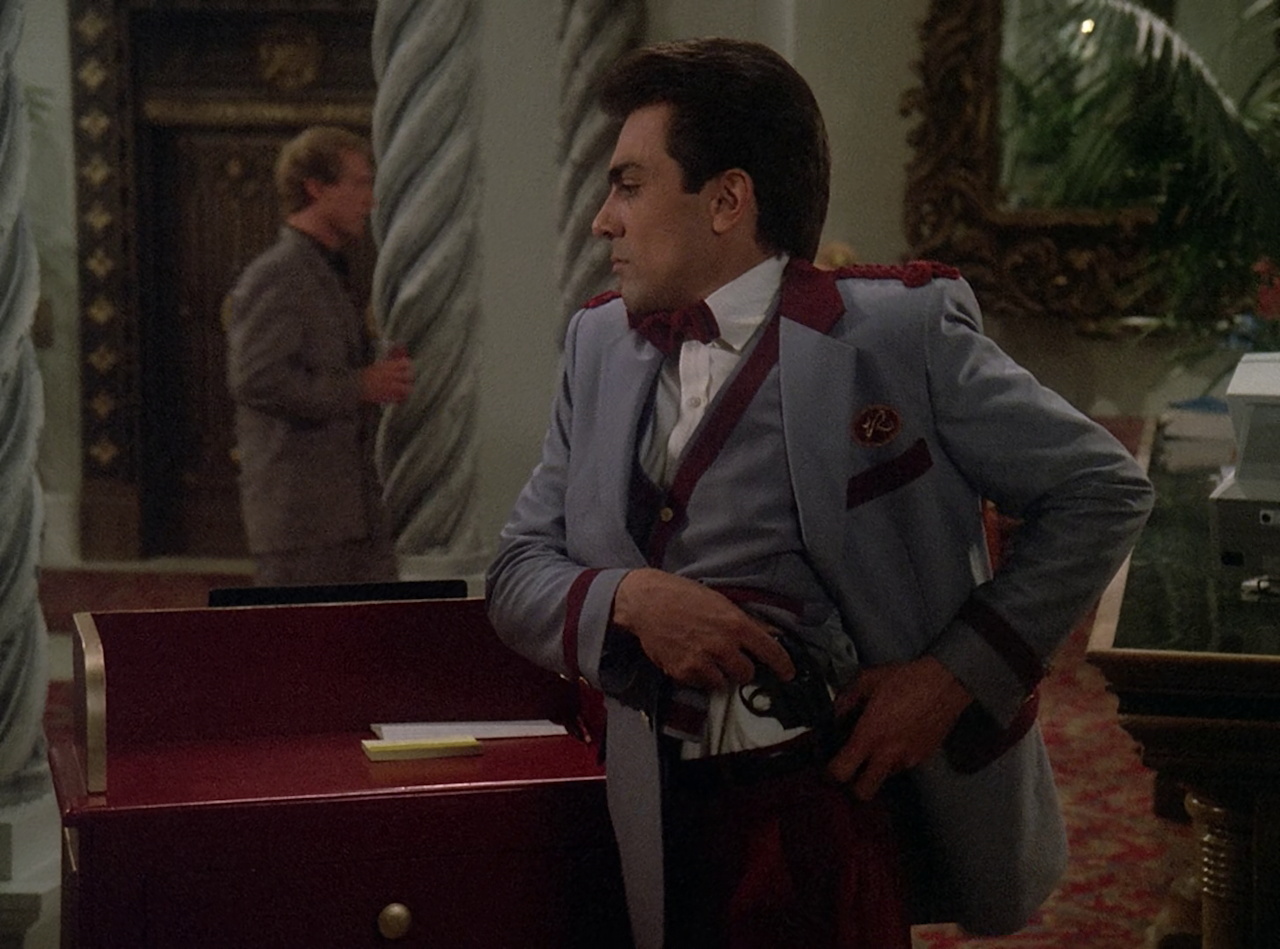
Still frame from Star Trek TNG The Royale showing the bellboy
The bellboy with his gun.

After a cute moment with Worf at the “turbolift,” the action moves to one of the hotel’s upper floors – and it’s here that the mystery begins to be explained. The away team reaches one of the hotel’s rooms, where Data’s detected “human DNA,” and they uncover the body of one of the NASA astronauts.

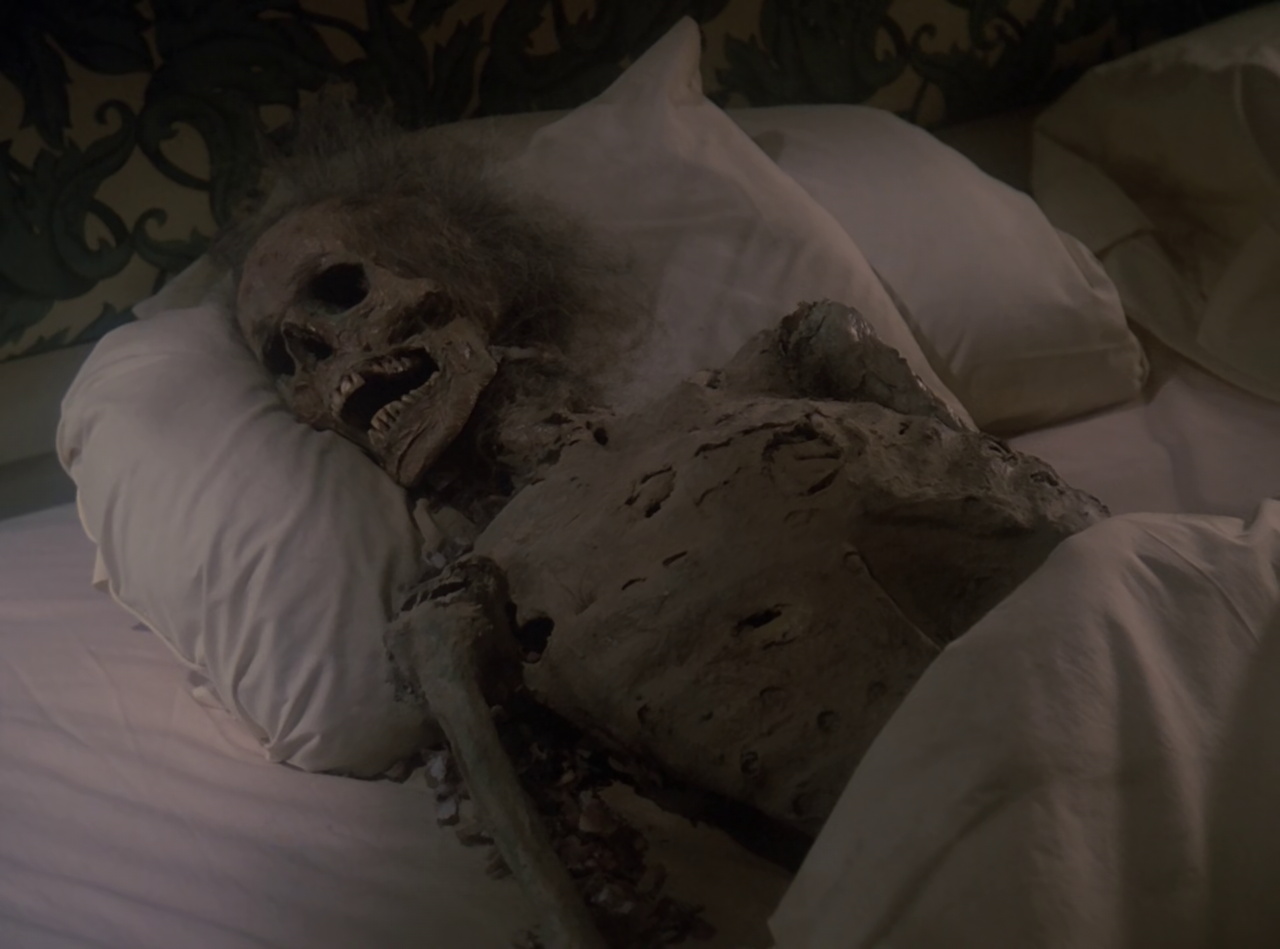
For a Star Trek episode, on a relatively low budget, produced in the late ’80s… the prop of the skeletonised astronaut is actually really good! At least, I think it is. It manages to feel old, decrepit, mouldy, and like it’s been there for centuries, and the reveal, I’m certain, would have shocked me when I first saw the episode all those years ago. It’s a well-executed moment, suitably creepy and intense for a mystery story, and it sees The Royale take a surprisingly dark twist. Yes, the away team has been trapped for a while, and yes, we know that, back on the ship, there are problems with communication. But this is the first time, really, after meeting some fairly whimsical characters and seeing a cheesy side-story right out of a mid-century soap opera, that the crew feels in danger. And if this prop had looked a lot worse… well, that feeling wouldn’t have been as strong.

Still frame from Star Trek TNG The Royale showing a skeleton
The skeleton.

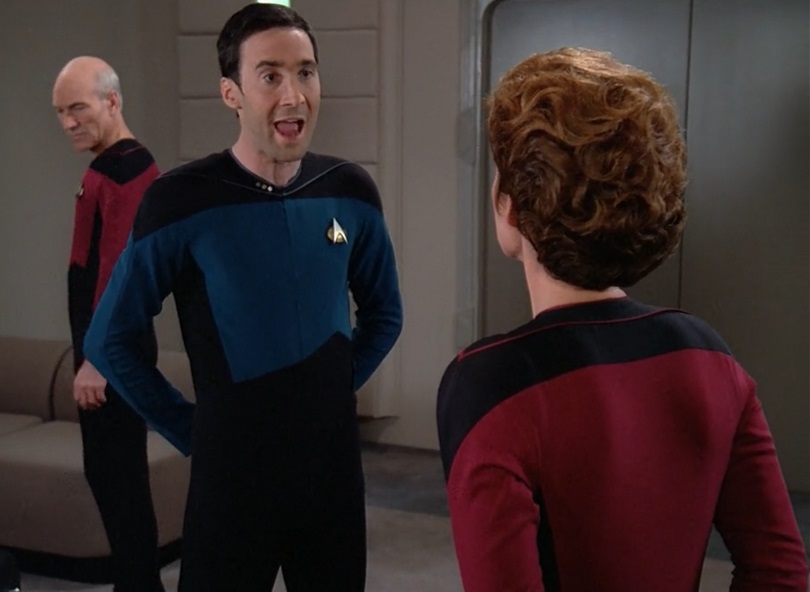
Worf’s comment about how dying in one’s sleep is “terrible” didn’t pass unnoticed – a subtle nod to how Klingons view such things. He then goes on to uncover the dead man’s NASA flight suit as Data explains that the astronaut – Colonel Richey – has been dead for almost three centuries. The Enterprise is able to get back in touch at this point, conveniently allowing Riker to ask them to search for details of Colonel Richey’s identity, while Worf uncovers the novel Hotel Royale – a ficticious book created for this episode.

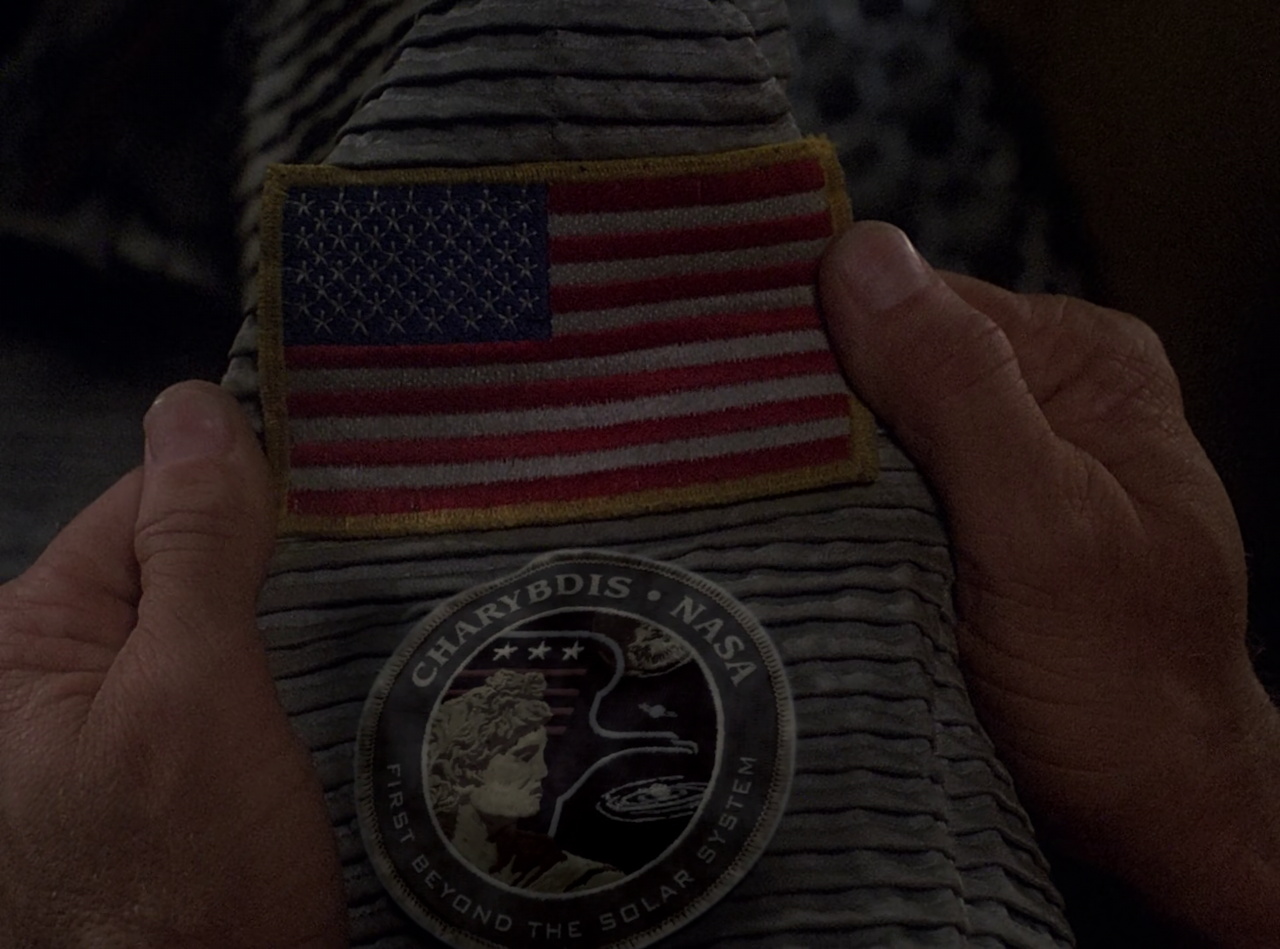
I like the flight suit, and how it feels comparable to NASA’s spacesuits of the Space Shuttle era. Riker’s comment about the 52-star American flag indicating a time period was also interesting; it continues Star Trek’s theme of depicting a positive future for the United States in particular! I wonder which two new states those stars are meant to represent? Puerto Rico, perhaps, and Washington, DC? Those are the two most-likely candidates for statehood right now, I believe!

Still frame from Star Trek TNG The Royale showing the flight suit
The flight suit with its flag and mission patches.

As an aside, the remastered version of the episode contains one major difference from the original, and it’s at this moment. The original mission patch on Colonel Richey’s flight suit was much more basic; an Apollo 17 patch with the name scrubbed off. The remaster updates this, giving the patch a unique design, which I think looks a lot better – and certainly feels a bit more realistic for a mission of this type. It’s only seen briefly, but it is seen in close-up, so I definitely think it was worth updating it when The Next Generation went through the remastering process a few years ago.

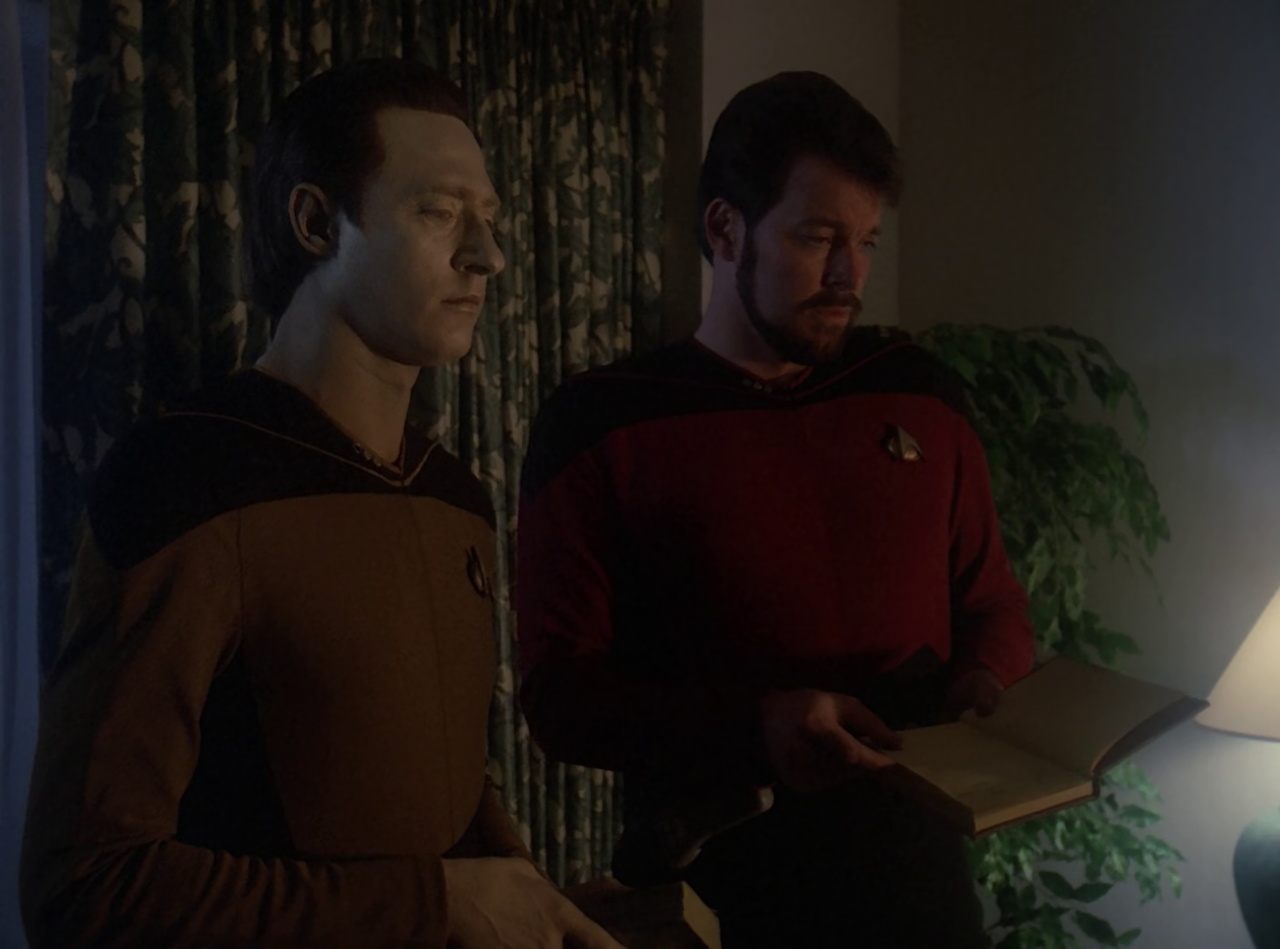
After Worf discovers the novel Hotel Royale, Riker hands the book to Data to summarise it. And I’ve always loved seeing Data do these superhuman feats – reading an entire book in seconds, as in this case, just makes him feel like a unique character with special abilities. Data proceeds to explain, in brief, the plot of the book to Captain Picard and the away team, and they realise that the characters in the book are some of the people we’ve been seeing downstairs. It was a bit of a heavy-handed approach to have the characters say, out loud, things that we could’ve easily understood for ourselves, but that’s my only real criticism of this scene.

Pair of still frames from Star Trek TNG S2 The Royale showing Data explaining the novel
Data explains the plot of the book (left) while Picard and the crew listen.

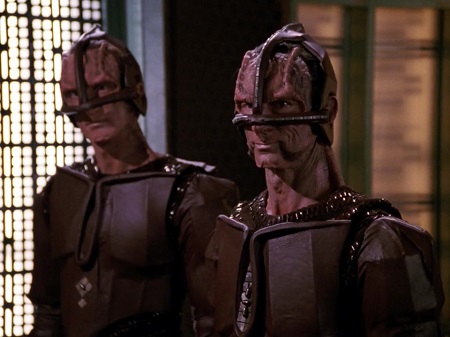
Things take a darker turn again when Worf and Riker uncover the colonel’s diary. Somehow (and it isn’t explained how, sadly), Colonel Richey pieced together that the illusory hotel was concocted by an alien that he claims was aboard his ship and killed his crewmates. The alien (or aliens), out of a sense of guilt, built the hotel for him and allowed him to live there. He then spent the next thirty-eight years trapped in the Hotel Royale, before passing away.

So now we know why the hotel exists on this barren, otherwise lifeless world! The mystery has been at least partially solved, and with the exception of a bit of heavy-handedness in some of the dialogue, this worked pretty well. The mystery connects to Star Trek’s fictionalised past – the 21st Century – and to a race of aliens who appear to have inadvertently caused the deaths of the other NASA crew. And the book being misinterpreted as a kind of almost religious text by the aliens would be funny… if it wasn’t so dark. Colonel Richey’s final words, that he would “welcome death,” really hammer home that much darker tone for this aspect of the story.

Still frame from Star Trek TNG The Royale showing Data and Riker
Data and Riker with the diary.

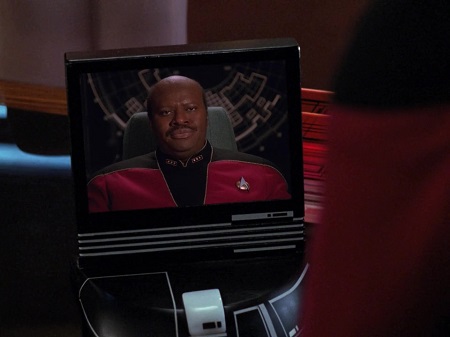
The next scene aboard the Enterprise gives us Dr Pulaski’s only lines in the episode. The crew come up with a plan – spearheaded by Geordi – to “slice” into the forcefield around the hotel, even though doing so would cause the frozen atmosphere of Theta VIII to rush in. If the away team couldn’t be beamed out in time, Dr Pulaski opines that, in theory, they could be resuscitated after being flash-frozen.

I like Dr Pulaski, and one of my biggest Star Trek “what-if” questions is what The Next Generation and the rest of the franchise might’ve looked like had she stuck around. Her role in The Royale is relatively minor, but I daresay it’s no coincidence that her presence in the first episodes I can remember watching is a big part of why I find her to be such a fascinating character. Dr Crusher’s return in Season 3 was welcomed by fans (and the cast) at the time, of course, and we’ve since seen different things from her. But Dr Pulaski is a unique character; her conflicts with characters like Data and her occasionally standoffish manner contrast in a fun way with other members of the crew.

If you’re interested to read more about Dr Pulaski, click or tap here to check out my thoughts on her character.

Still frame from Star Trek TNG The Royale showing Dr Pulaski
Dr Pulaski doesn’t play a big role in this episode.

As the away team splits up, Picard and Counsellor Troi begin to look over the text of Hotel Royale. I absolutely *adore* Picard’s disgusted expression on reading the opening line: “It was a dark and stormy night.” Somehow, that line has become a byword for poor-quality writing, often criticised and parodied, and its use here really emphasises the low-quality nature of this fictitious book. Picard, who had been discussing complex mathematics and high-brow philosophy with Riker at the start of the episode, is forced to engage with a text he clearly detests – and it’s kind of funny.

Back on the casino floor, Data attempts to get “Texas” to leave the hotel, surmising that he may be trapped within its walls, too. But the blackjack game is still going, and Texas shows off a much creepier side, as he tries to leverage Vanessa’s losing streak to… well, you can figure out the rest. It’s a turn for this previously comedic character to end up looking controlling, manipulative, sexually aggressive, and creepy, but it fits with the tone of the kind of novel Hotel Royale purports to be.

Still frame from Star Trek TNG The Royale showing Vanessa and "Texas"
Vanessa and Texas.

As Riker and Worf reconvene to share that they found “nothing” of consequence to aid in their escape, we get another of the pulpy scenes with the bellhop. It starts with the assistant manager, as the TV drama-style music swells, and leads into the arrival of Mickey D: the gangster at the heart of the novel.

The only part about this I didn’t really like was the action cutting between the planet and Picard, in his Ready-Room, who could apparently hear everything going on through the comm channel. Picard, for me, didn’t seem to take it as seriously as he perhaps should’ve; in-universe, the characters don’t know how dangerous the situation is, and we know that even holograms can kill if they malfunction. There’s no reason to assume that, just because this is a low-quality story, Riker and the away team will be safe – Mickey D could, perhaps, have harmed them if they’d got caught up in the middle of it. It was just a bit… tonally weird, I suppose. And cutting away from the actual scene to watch someone listening to it, only to make yet another comment on the quality of the writing? It just didn’t add a lot to the episode.

Still frame from Star Trek TNG The Royale showing Mickey D
Mickey D arrives.

The conflict between Mickey D and the bellboy, over a girl named Rita, escalates, despite the assistant manager’s attempts to defuse the situation, and the two seem to be heading outside for a confrontation. However, Mickey D shoots the bellboy in the back, quips about Rita not being worth dying over, and then departs.

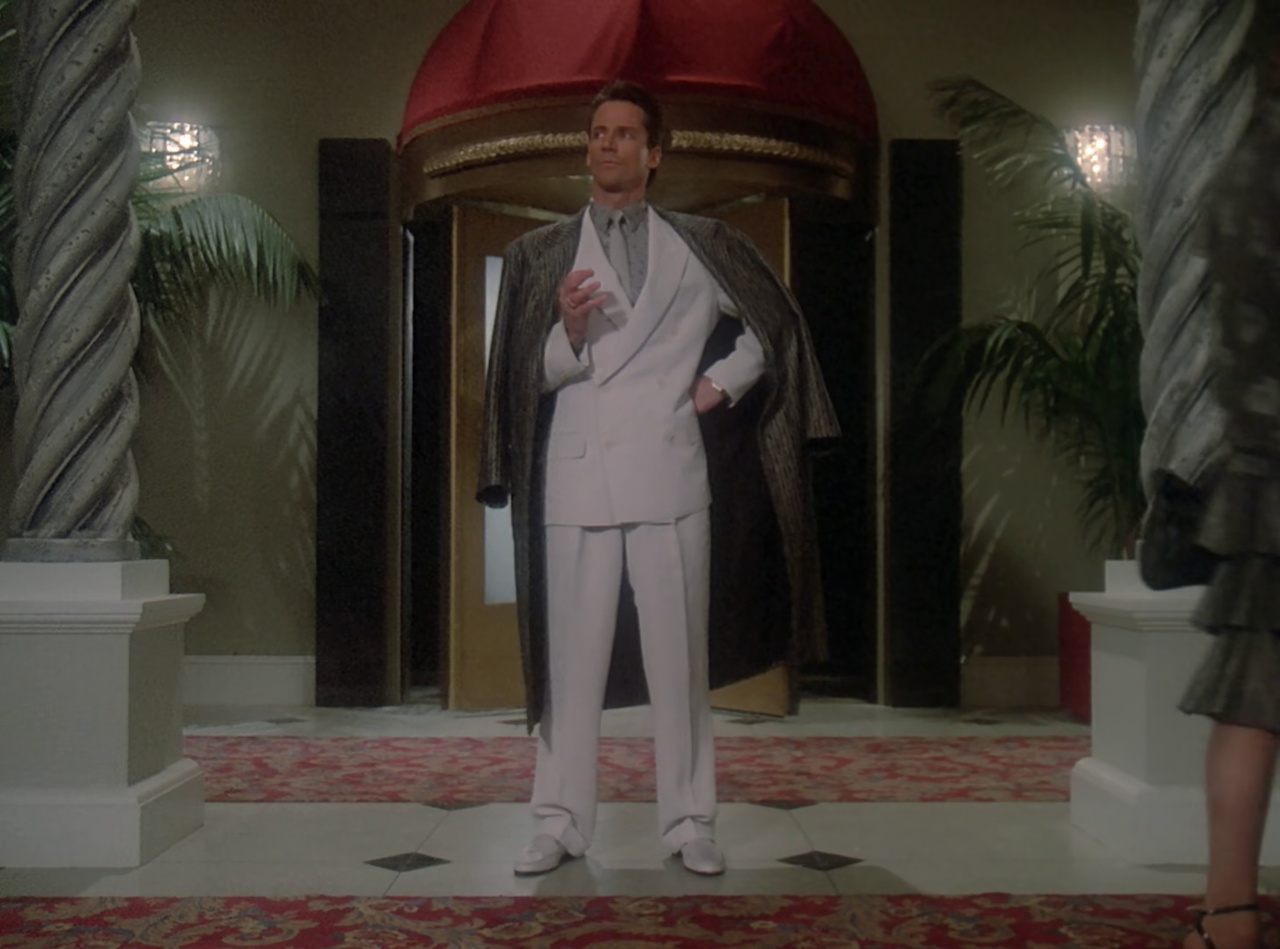
Mickey D is a completely one-dimensional character – but in a self-aware way. He’s a typical “Vegas gangster” of this time period, with his mannerisms, style of dress, and everything made out to emphasise that. His one big action – shooting a young man in the back – also hammers home that this is a man who doesn’t play fair. I’d never say he’s a great or even good character (he gets far too little screen time for that), but he fills a role in this story in a way that makes sense, and he advances the plot both within Hotel Royale’s fictional story, and for the away team down on Theta VIII. They witness the shooting (complete with over-acting and no visible injuries or wounds), and that kick-starts the final act of the episode.

A behind-the-scenes photo from Star Trek TNG S2 showing Michael Dorn and a guest star
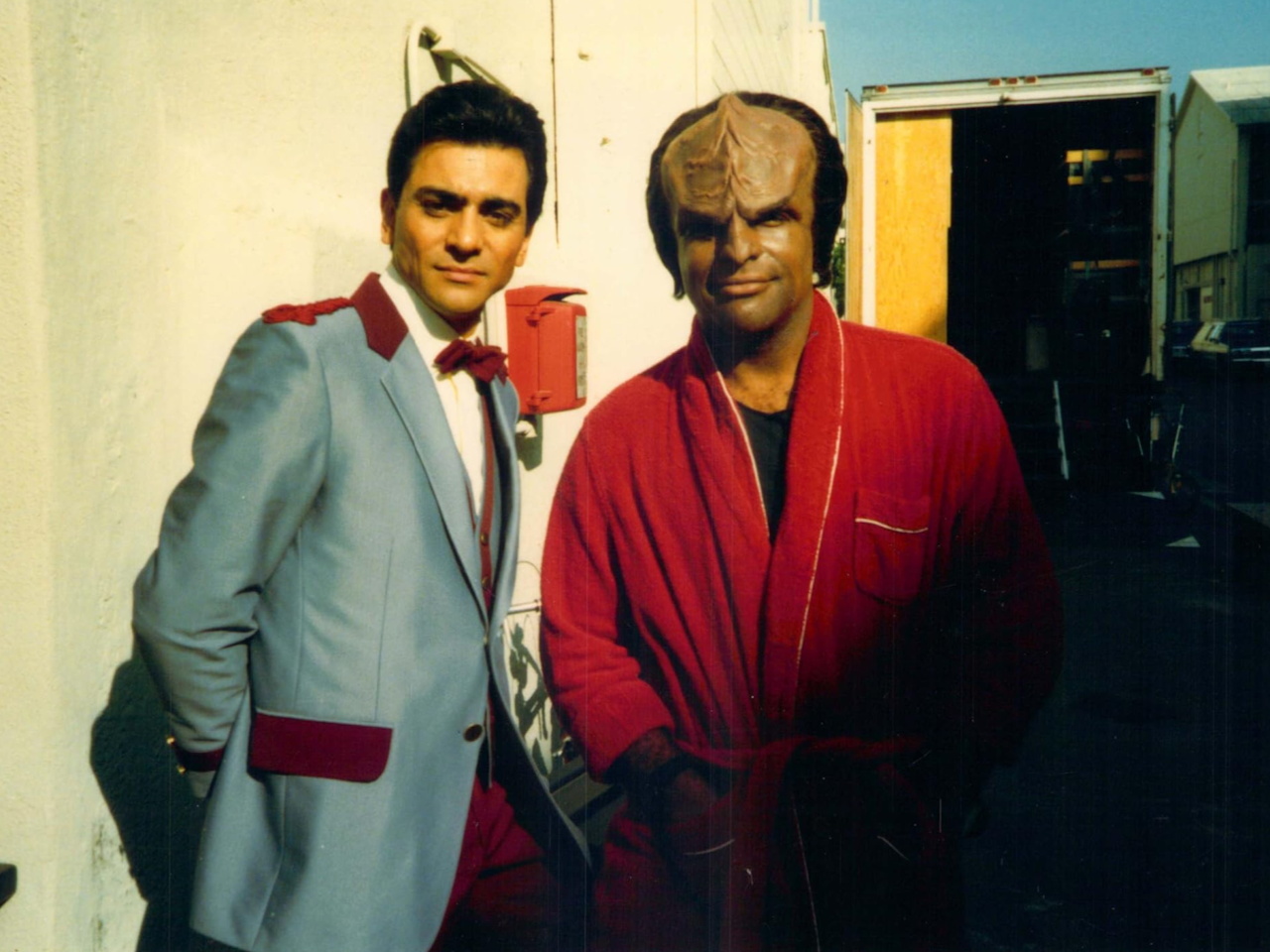
Michael Dorn (right) with guest star Leo Garcia, who played the bellboy.

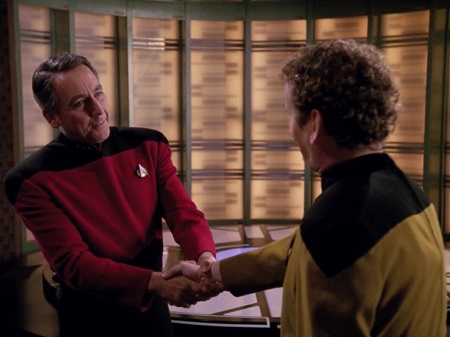
Riker and Worf watch Mickey D walking out of the hotel, surprised that he’s able to leave while they remain trapped. This leads to a conversation with Captain Picard, who recounts the scene from the book. Riker then asks how the book ends – and after learning that “foreign investors” buy out the hotel, he comes up with a plan for the away team to *become* the foreign investors. This was hinted at, by the way, in their first interaction with the assistant manager shortly after their arrival.

One thing that’s great about this moment is how the typical TNG music sting starts to play, then blends into the TV drama jazz music that had defined the scenes recounting the pulpy Hotel Royale story. I just think it’s really creative; a way to kind of symbolise that these two disconnected halves of the episode’s story are going to come together. And, for the first time since arriving, Riker and the away team now have a plan to get back to the Enterprise-D.

Still frame from Star Trek TNG The Royale showing Worf and Riker
The music swells… and Riker is a man with a plan.

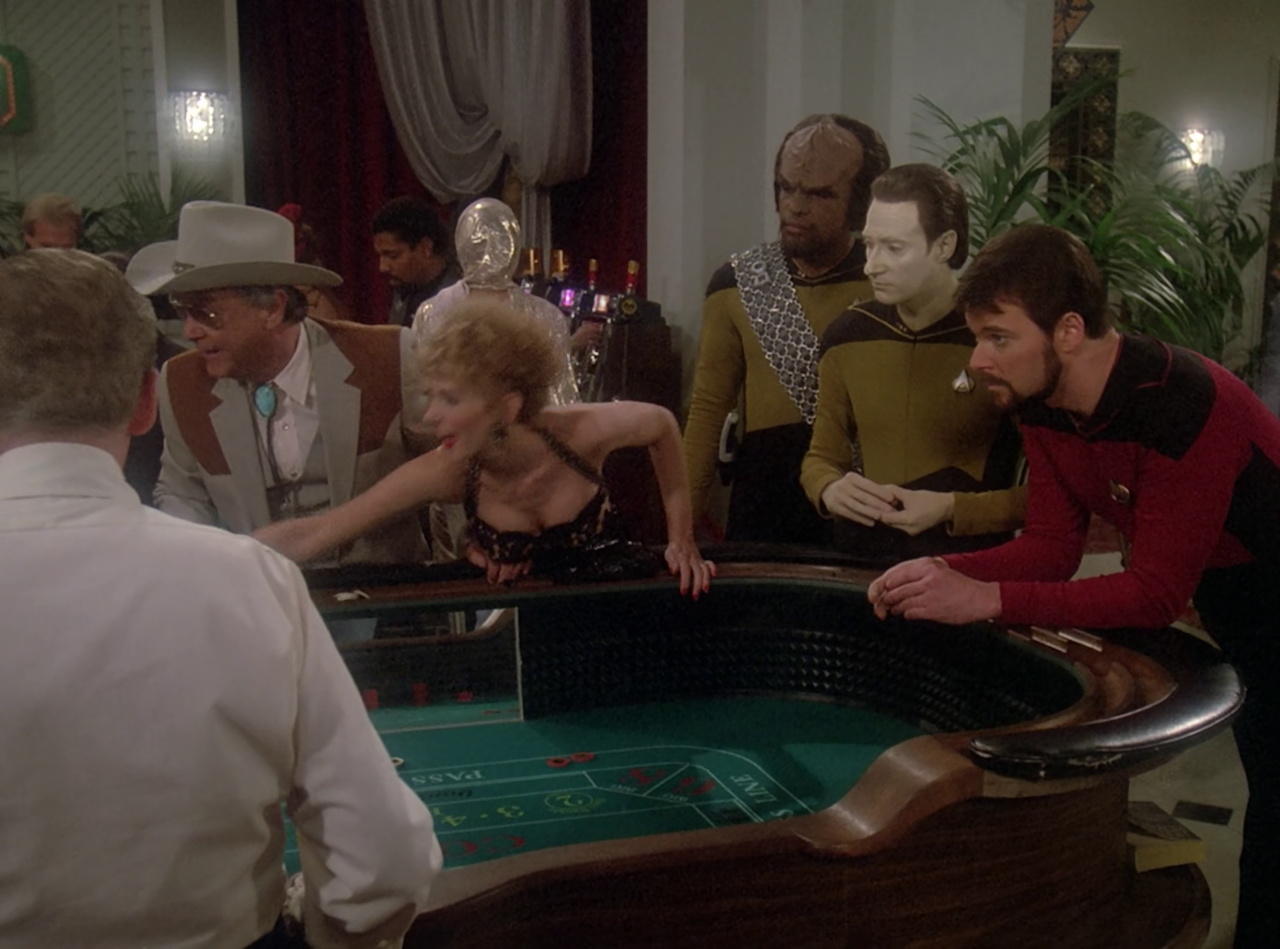
The away team re-encounters “Texas” and Vanessa, this time at the craps table, and begin their scheme to win enough money gambling to buy out the hotel and finish the story, hopefully allowing them to escape. Data’s unique skillset once again proves invaluable; he’s able to “fix” the dice to make sure they win, much to Texas and Vanessa’s enjoyment.

We get a tiny sub-plot with “Texas” trying to bet against Data, and taking it personally when he loses. It was of some interest, especially given his earlier creepy behaviour, and seeing him taken down a few pegs is definitely satisfying. But he isn’t a major antagonist, and this feels like little more than a minor stumbling-block on the way to finishing the story.

Still frame from Star Trek TNG The Royale showing a craps game
The craps game.

What I love about this sequence is how into character both Data and Riker get. Data adopts mid-century gambling mannerisms and terminology, despite not quite understanding all of it, and his line “baby needs a new pair of shoes” is delivered in a totally deadpan way that *only* Brent Spiner could ever manage! It’s really funny, really cute, and it’s one of the many reasons why I fell in love with Data way back when. He’s just such a fun, charming character, and every time he tries act “more human” he does it so earnestly and in such a fun way that it’s impossible not to root for him.

You know the rest of the story: thanks to Data’s interference, they win over and over at craps, breaking the bank in the process. They then announce they’re buying the hotel, to the surprise and gratitude of the assistant manager, and spread the rest of their winnings around. Even “Texas” gets to benefit, remaining at the craps table with Data’s loaded dice.

Still frame from Star Trek TNG The Royale showing the assistant manager
The assistant manager realises who he’s dealing with.

I think we’re meant to understand that, because the away team was believed to be the trio of “foreign investors,” they couldn’t leave the hotel until they’d completed their role in the story. Whether Colonel Richey was also assigned that role by the aliens who created the illusion isn’t clear, though, and the episode ends with the core mystery solved – but still some unanswered questions.

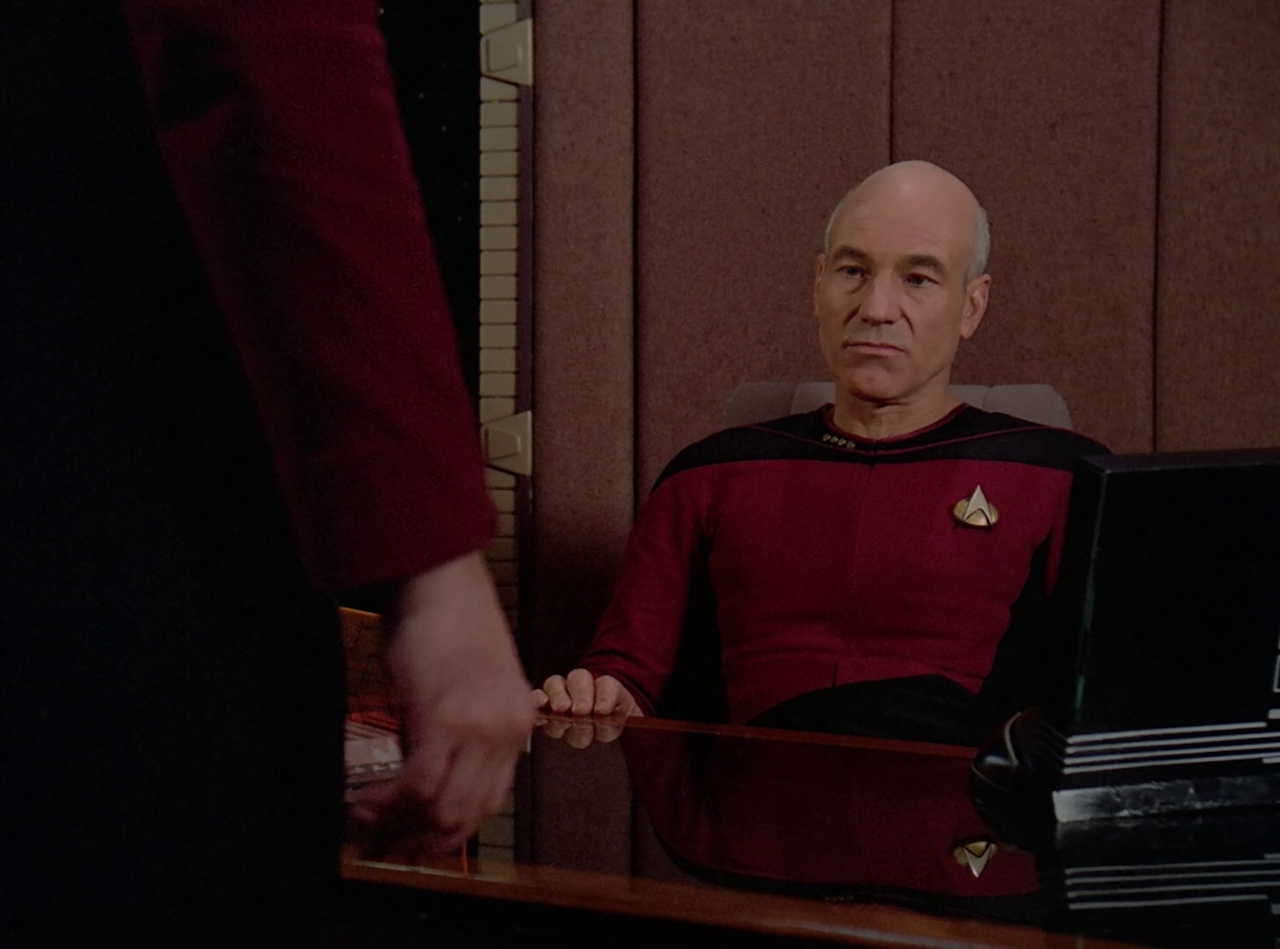
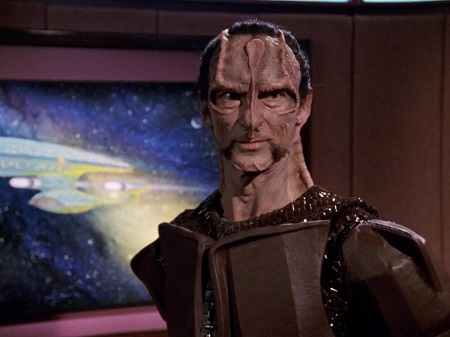
Back in the Ready-Room, Picard and Riker recall Fermat’s last theorem, and suggest that some of the mysteries of Colonel Richey’s story, and the hotel on Theta VIII, may simply never be solved. And while that may seem unsatisfying (which, in a way, it is), it’s also an interesting take on space exploration and Starfleet’s mission, isn’t it? We’re used to our heroes turning up at a planet, solving a puzzle or unravelling every aspect of a mystery, and warping away to a new adventure. But space… well, it isn’t always easy to understand. Who were these aliens? Why did they choose that book for Colonel Richey? What went wrong in their encounter with humanity – and what were they even trying to do? Why strand Colonel Richey on Theta VIII – is the planet their homeworld? Why not attempt to make contact with the Enterprise-D if that’s the case? So many questions left unanswered… but the lack of an answer is kind of the point.

Still frame from Star Trek TNG The Royale showing Picard
Picard and Riker are left with unanswered questions as the Enterprise prepares to leave orbit.

So that was The Royale! Thanks for joining me on this re-watch of the episode.

I had a blast stepping back in time some thirty-five years to the episode that first turned me into a Trekkie, and I hope it was a bit of fun to come along for the ride with me. I adore this story, despite its low-budget sets, hammy acting, and kind of silly premise – and I hope that came across! As a kid, I was absolutely transfixed by this story, and desperately keen to go on more adventures with Riker, Data, Worf, and the rest of the crew of the Enterprise-D. From this moment on, I was a regular viewer of The Next Generation, watching the rest of Season 2, then Season 3, and going back to earlier episodes from Season 1 when they were re-broadcast.

Star Trek became a pretty big part of my life from then on. As I navigated school and social life, and especially as I grew into adolescence and attended seondary school, it became both a source of joy and, sometimes, an escape from the real world. I loved going on these adventures with the crew, and when TNG’s two spin-offs (Deep Space Nine and Voyager) came to the UK, I watched those religiously, too. And I may never have started to do so were it not for The Royale.

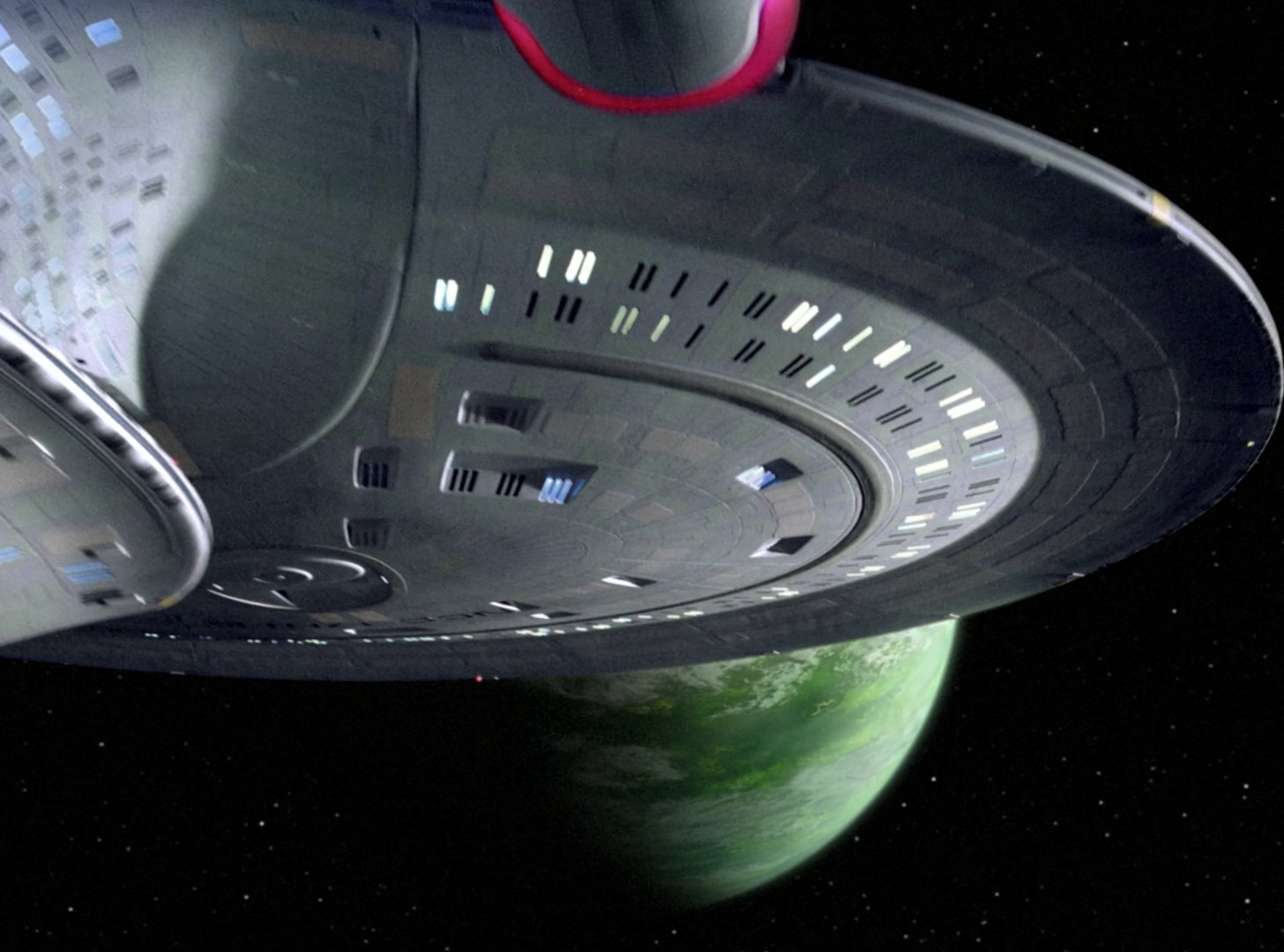
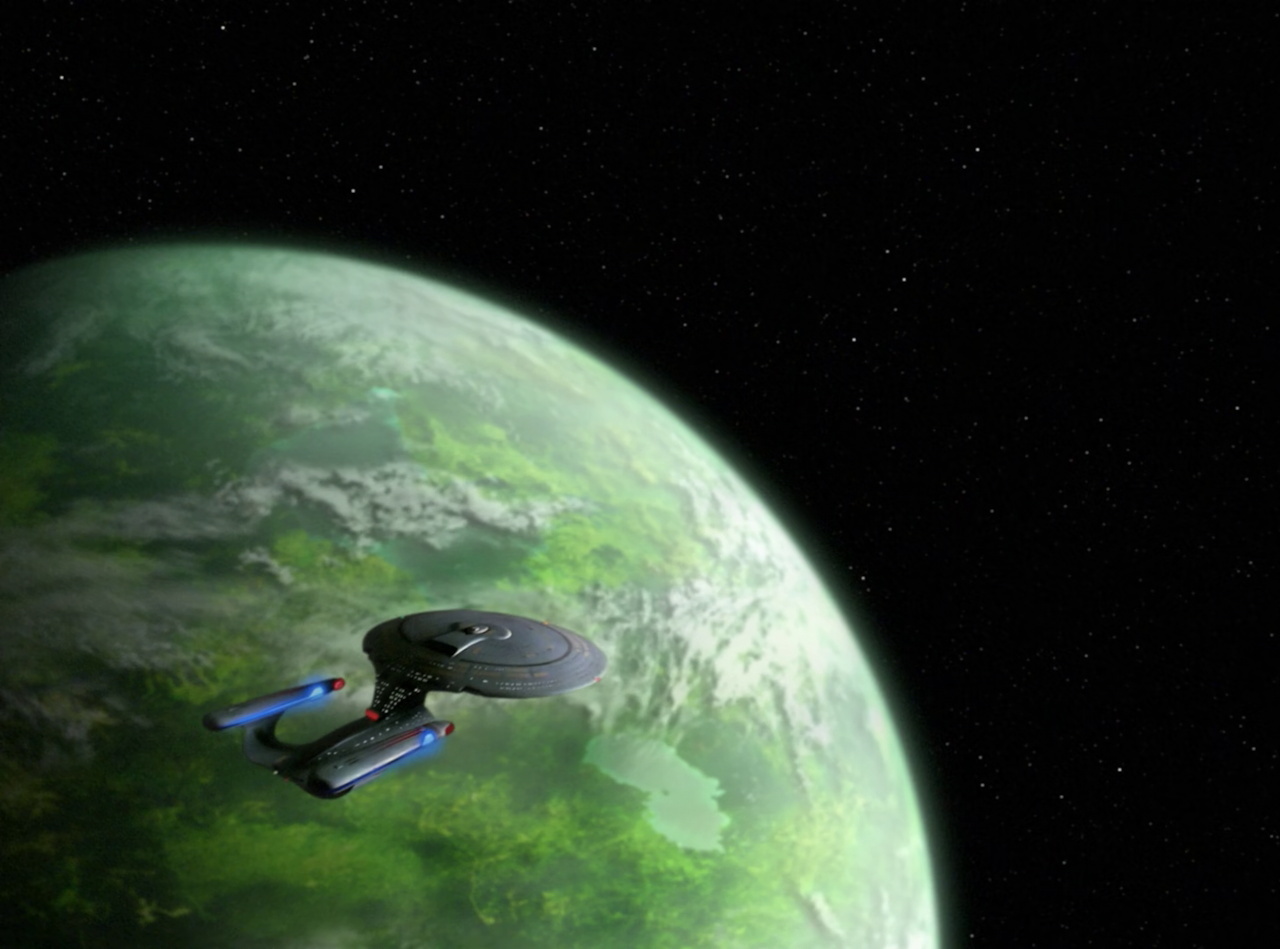
Still frame from Star Trek TNG The Royale showing the Enterprise-D and Theta VIII
The Enterprise-D in orbit of Theta VIII.

In Star Trek’s big sixtieth anniversary year, I thought it was fun to return to my own origins as a Trekkie, and with today being the thirty-fifth anniversary of The Royale’s UK premiere… well, it all just sort of fell into place!

It’s impossible for me to be in any way “objective” when dealing with an episode like this, so I hope that didn’t impact your enjoyment of this re-watch. I wanted to go back to The Royale not to criticise it or pick it apart – though I daresay there’s been some of that – but really to celebrate what it means to me personally, and to my journey into the Star Trek fan community. Hopefully that positivity came across, anyway.

It’s been a long time since June 1991, and a lot has changed. But my love of Star Trek – and of The Royale – hasn’t diminished. Star Trek has been a near-constant presence in my life since this moment, even when new episodes and films weren’t being aired, and without it… well, I probably wouldn’t be here running a small website! I really don’t know where I’d be without this wonderful franchise, to tell you the truth.

Still frame from Star Trek TNG The Royale showing the away team beaming out
The away team beams back to the ship.

If you liked this format and want more re-watches of older Star Trek episodes, I have several here on the website. My most recent was Where No Man Has Gone BeforeThe Original Series’ second pilot. You can find that piece by clicking or tapping here. Earlier this year, I also took a look at The First Duty from The Next Generation’s fifth season. Click or tap here to check that out. And if you visit my dedicated The Next Generation webpage, you can find all of my commentary and other TNG episode re-watches. Click or tap here to head there.

Later this year, we’ve got Strange New Worlds’ fourth season to come, and I plan to write episode reviews for that, so I hope you’ll join me for some of those. And as the sixtieth anniversary gets closer, I have a few other ideas for articles and episode re-watches that I hope I’ll be able to find time for.

Thanks for reading, and as always… Live Long and Prosper, friends!


Star Trek: The Next Generation is available to stream now on Paramount+ in countries and territories where the service is available, and is also available to buy on DVD/Blu-ray. The Star Trek franchise – including The Next Generation and all other properties discussed above – is the copyright of Skydance/Paramount. This article contains the thoughts and opinions of one person only and is not intended to cause any offence.
Star Trek: The Next Generation Episode Re-Watch – Season 5, Episode 19: The First Duty

A Star Trek-themed spoiler warning.

Spoiler Warning: There are spoilers ahead for Star Trek: The Next Generation Season 5, and minor spoilers for Star Trek: Starfleet Academy Season 1.

With Starfleet Academy’s first season currently on the air, I got thinking about the institution. Although we caught a glimpse of the Academy in The Wrath of Khan, its first major on-screen appearance came a decade later in Season 5 of The Next Generation. I thought it could be interesting to return to that episode today, in light of the different approach taken by the new young adult-focused series, and re-watch The First Duty.

I was surprised, when I looked into it, by two things: firstly, how Starfleet Academy only appeared relatively late into The Next Generation’s run. By the time we made our first visit to the Academy, DS9 was already in production, less than a year away from launch, and The Next Generation was well past its halfway point. And secondly, I was surprised at how few appearances the Academy itself actually made during The Next Generation era. Starfleet Academy only appeared twice in The Next Generation and once in Voyager – in simulated form – though the same filming location was re-used as Starfleet Headquarters in Deep Space Nine, Voyager, and Enterprise, which is probably where my confusion stemmed from.

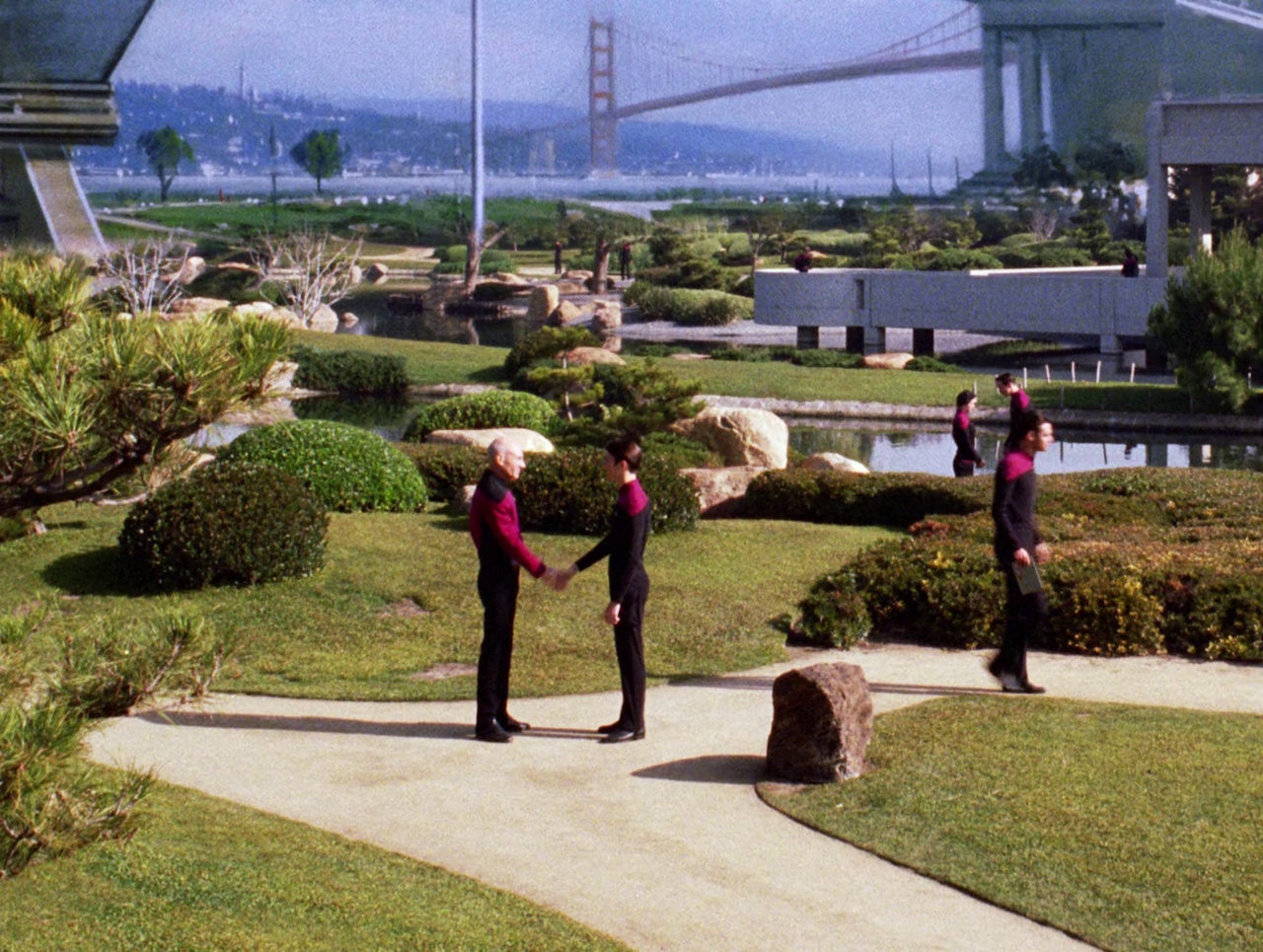
Photo of the Tillman Water Reclamation Plant in Los Angeles.
The Tillman Water Reclamation Plant and Japanese Garden was the filming location for parts of The First Duty.
Photo: City of Los Angeles/L.A. Times

Still, it’s interesting, isn’t it? The Academy feels like an iconic institution within the broader lore of Star Trek, yet it made relatively few on-screen appearances in The Next Generation era – and none at all in The Original Series.

The First Duty is one of a few episodes that I managed to watch *before* its terrestrial broadcast here in the UK – because I rented it on VHS! I couldn’t tell you exactly when; I’d guess sometime in 1993 or 1994. Star Trek video cassettes were a rarity in rental shops in the small towns around where I grew up, so I’d usually jump at the chance to grab a pair of episodes to watch! I’m almost positive I also caught the episode’s first broadcast on the BBC, too, which would’ve been in 1995. After acquiring The Next Generation on DVD, I watched the episode again multiple times, and I’ve since re-watched it on streaming, too.

Who else remembers watching The Next Generation on VHS?

What’s the point of explaining all of that? Well… my occasional “episode re-watch” series isn’t a “review.” It’s way too late for me to write anything like an “episode review” for a series I adore and for an episode I first watched more than three decades ago! This is going to be my thoughts on the story, but some of how I feel about The First Duty has probably shifted with the benefit of hindsight, with ageing, and after having viewed literally hundreds more Star Trek episodes that have premiered in the intervening years. It should also go without saying that everything we’re going to get into today is the *subjective, not objective* take of just one person. If you hate The First Duty, love it more than I do, disagree with my take, or think I’ve completely missed the point… that’s okay! We’re all here to just geek out about Star Trek, at the end of the day, and I share my take on this classic episode with the Trekkie community in that spirit.

The First Duty has a couple of interesting characters and narrative elements when considering the broader Star Trek franchise, and I’d like to begin there. This episode was only the sixth appearance of a Bajoran character, with the Bajorans having debuted earlier in Season 5. With Deep Space Nine in early production, the Bajorans (and the Cardassians, too) were being set up in The Next Generation ahead of their prominent role in the upcoming series. The character of Sito Jaxa was, after Ro Laren, the second Bajoran to be seen on screen serving in Starfleet. Sito would re-appear in the episode Lower Decks in Season 7.

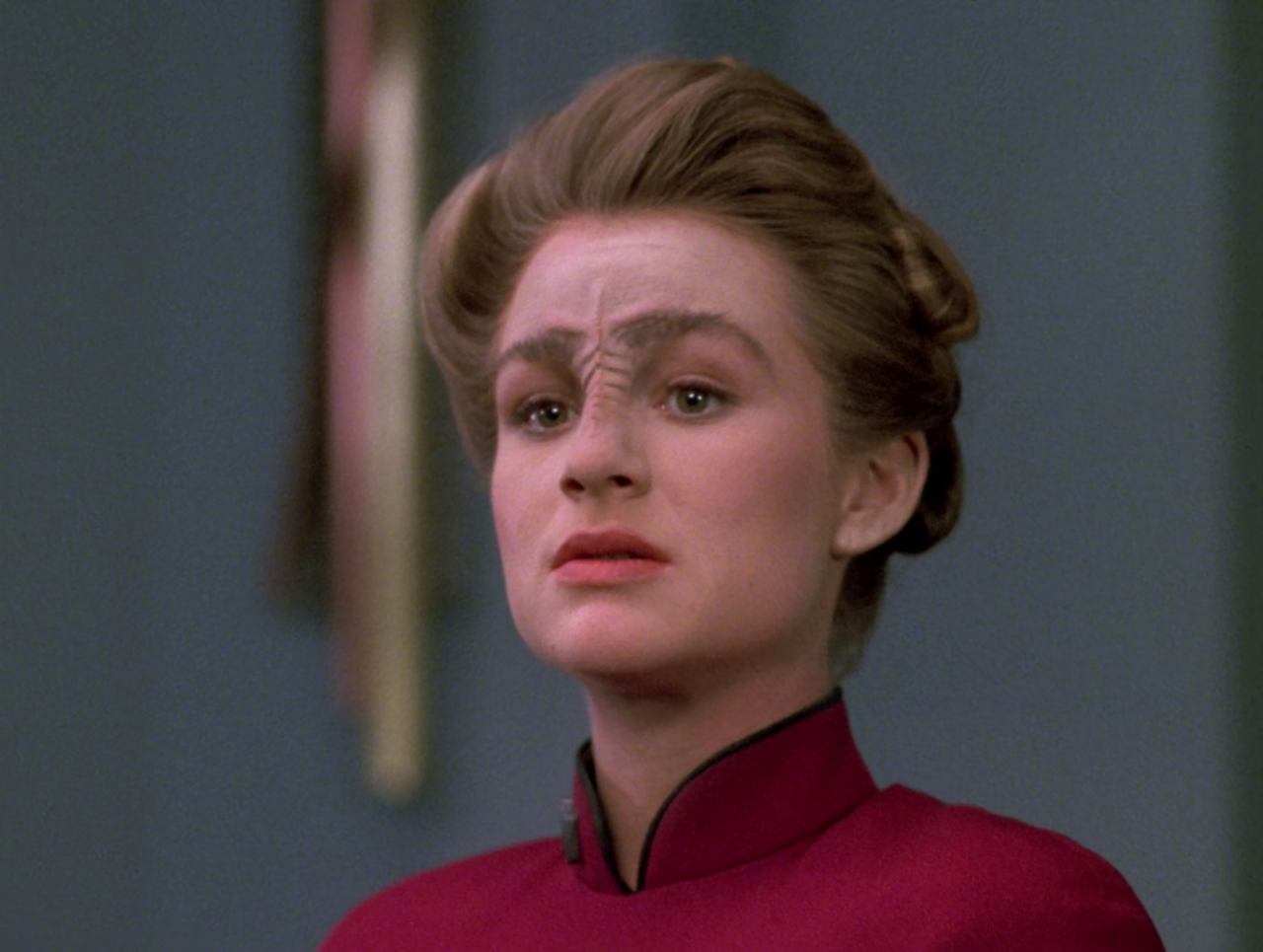
Still frame from Star Trek TNG S5 showing Sito
Cadet Sito.

We talked about Nick Locarno recently – click or tap here for more on that! But Locarno is an interesting character, as it’s pretty clear he was, at the very least, a partial inspiration for the character of Tom Paris in Voyager, which would premiere less than three years after The First Duty aired. Paris and Locarno share an actor in Robert Duncan McNeill, but they also share a piloting career and a lax approach to Starfleet regulations. I’m not fully caught up on Lower Decks yet, but I understand Locarno appeared in that series, too.

I just find it interesting that, in a single episode, we have elements from all three shows of The Next Generation era. In addition to characters from TNG itself, we have a Bajoran, whose home planet and people would be massively important in Deep Space Nine, and Nick Locarno, played by a future Voyager star, and who’s arguably a prototype or inspiration for one of that show’s main characters. It makes The First Duty feel – in hindsight – almost like a crossover! At the very least, it’s an episode that has those different components – even if, at the time, no one watching could’ve known!

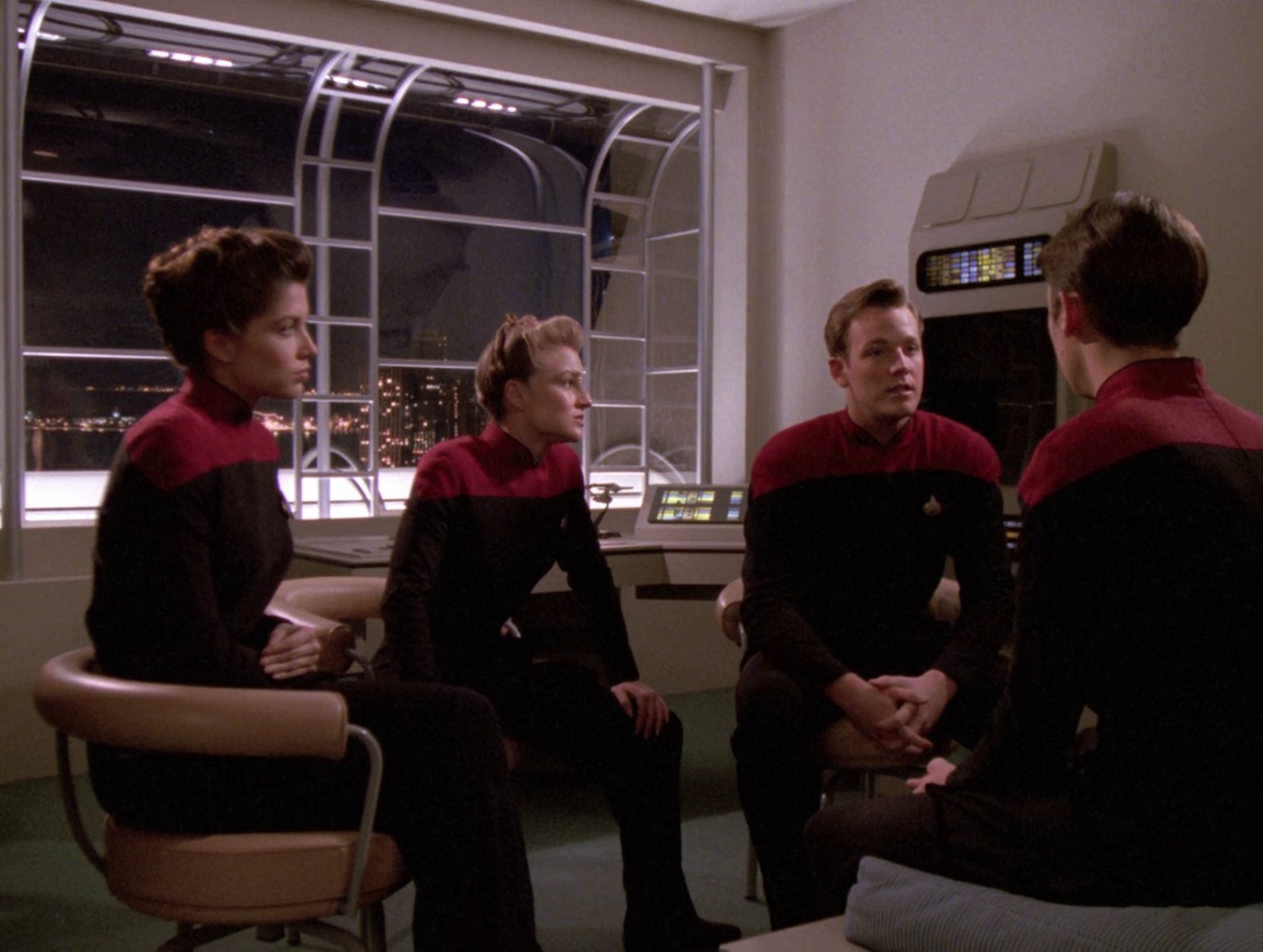
Still frame from Star Trek TNG S5 showing four cadets
The cadets bring together all three shows of The Next Generation era.

And this is what I mean about the benefit of hindsight. Watching The First Duty more than thirty years after its original broadcast means we can see how Star Trek’s production team were already laying the groundwork for their new spin-off. And we can see how Robert Duncan McNeill basically talked himself into getting the role of Tom Paris some three years before Tom Paris ever existed! It makes returning to the story a completely different experience than it was on that first viewing in the first half of the ’90s; nothing about the episode or its narrative has changed, but the way we interpret it arguably has.

At the core of the episode, we have two key character pairings: Wesley Crusher and Nick Locarno on one side, and Captain Picard and Boothby on the other. The First Duty follows Wesley, Nick, and the other members of Nova Squadron as they try to cover up the events leading to a fatal accident. Picard reconnects with Boothby – apparently for the first time since being promoted to the rank of captain, at least – and also relies on the Academy’s groundskeeper for advice as the inquest into Cadet Albert’s death unfolds.

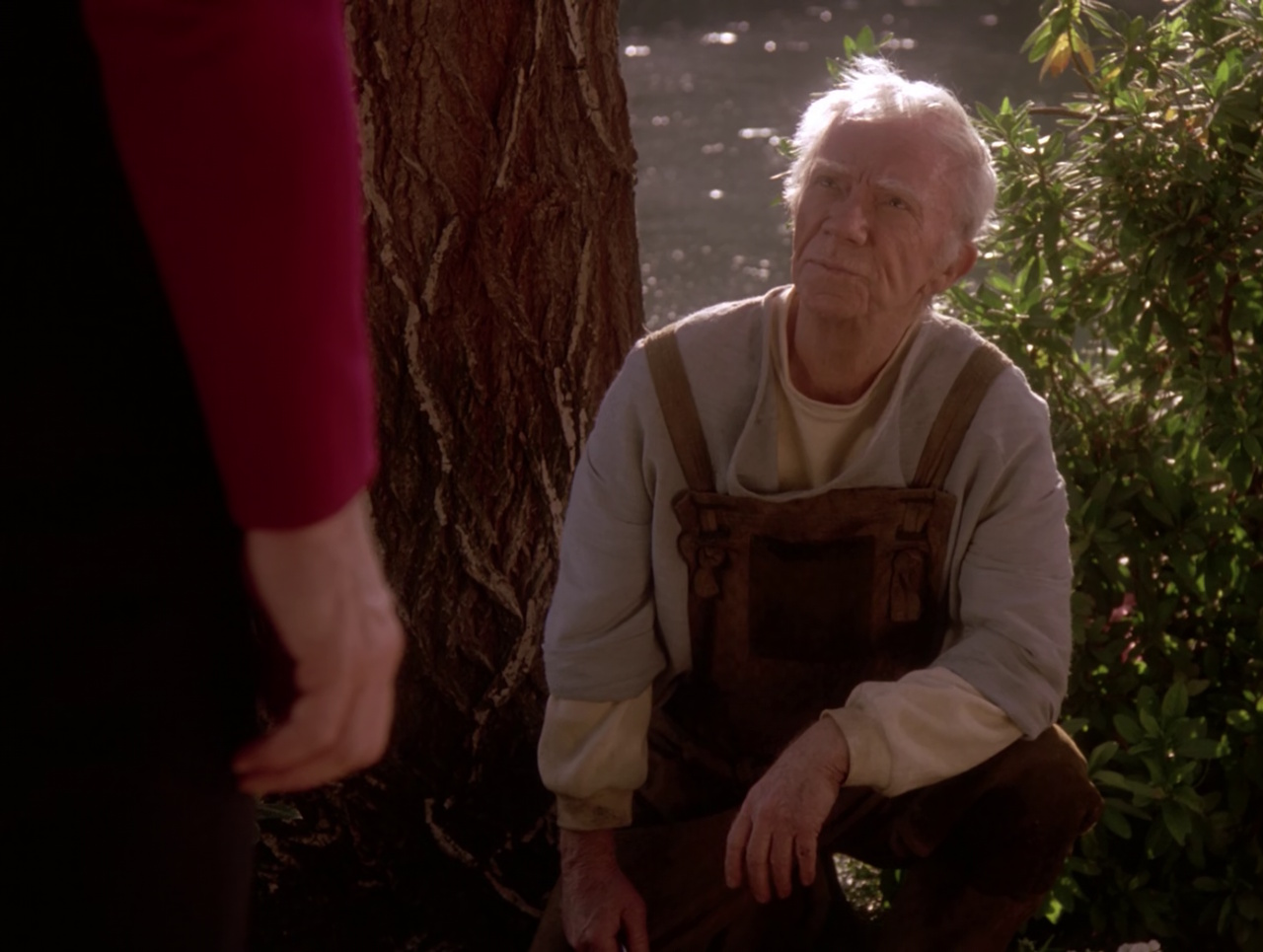
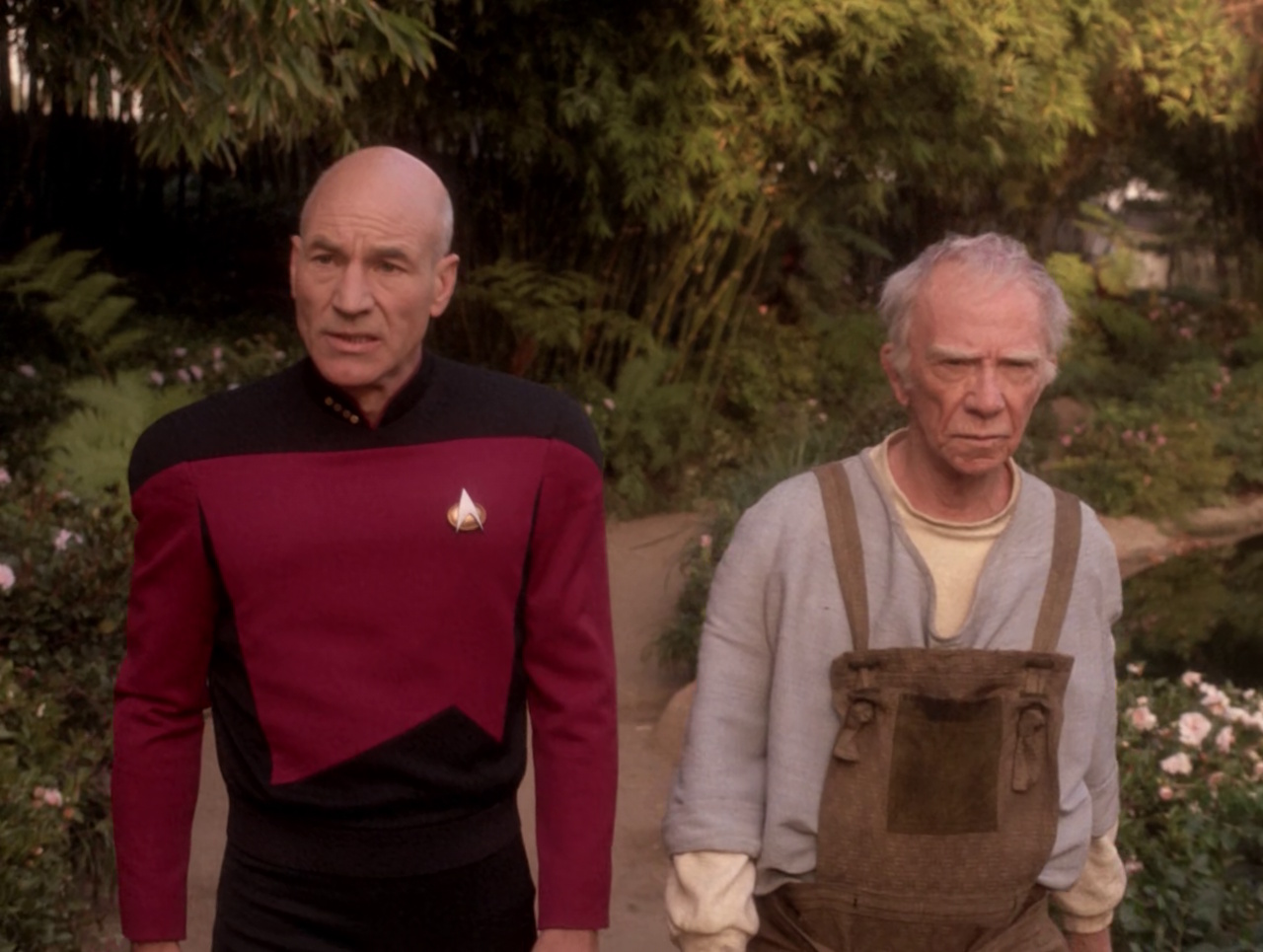
Still frame from Star Trek TNG S5 showing Boothby
Boothby’s reunion with Picard.

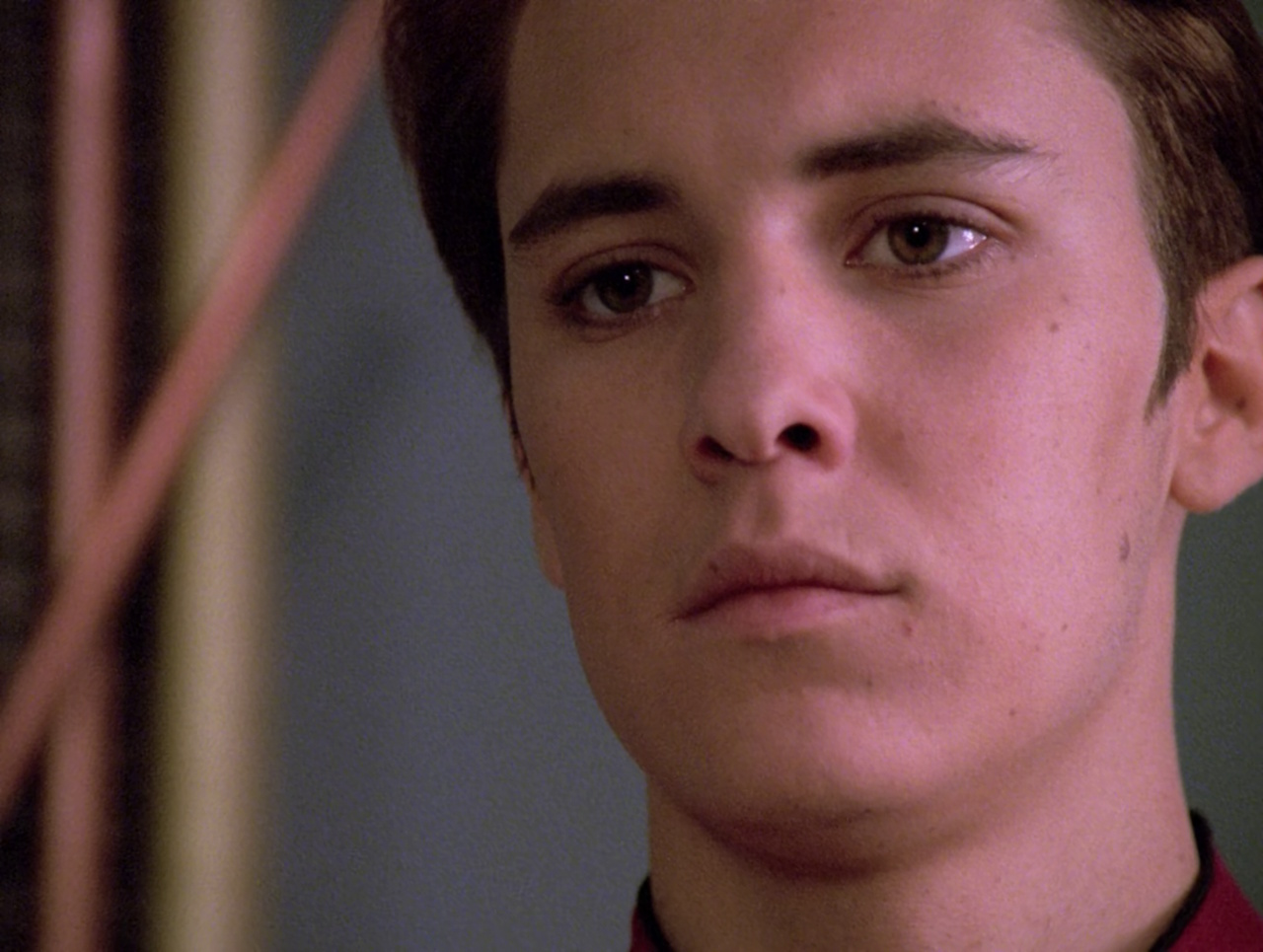
Wil Wheaton returns to The Next Generation for the second time since departing the series midway through the previous season. Wesley’s departure was written in such a way as to allow the character to return, and The First Duty was one of four episodes in which Wheaton reprised the role.

I don’t know if you were around while The Next Generation was airing, or during those early years of Star Trek fan forums on the interweb, but Wesley was often a controversial character, even for big fans of the series! A “Mary Sue,” according to some, Gene Roddenberry’s “self-insert” according to others, Wesley was perceived as being annoying, too smart or too skilful for his lack of training, and worse, by some viewers. I wouldn’t say that The First Duty was Wesley’s first defeat – see episodes like Justice, Coming of Age, or The Dauphin – but it certainly represents one of Wesley’s low points as a person – and, ironically, one of his most *human* moments, too.

Still frame from Star Trek TNG S5 showing Wesley
The First Duty shows Wesley at his most human.

I’m personally of the opinion that Wesley is unfairly disliked by viewers of The Next Generation, and while I get some of the criticism – particularly surrounding his near-perfect skills – I generally enjoy his characterisation in the show. The First Duty, though, shows us a much more vulnerable, weak, and human side to Wesley, showing us that, whatever intelligence and skill he may have, he can still make mistakes, he can still be caught up in the wake of someone more charismatic, and he’s still learning. Wesley is a kid – a university student or military college cadet, as of The First Duty. And… he acts like it.

We’ve seen this side of Wesley before, but in a relatively limited number of stories. And, I would argue, never to this extent. Despite the heavy adult themes of death, conspiracies, duty, and conflicted loyalties, this is a version of Wesley that feels *young* in a way that the character didn’t always manage to when he sat on the bridge of the Enterprise-D. And this is a story that looks at how a young person can feel peer pressure, can be pushed into doing something they know to be wrong, and how easily a charismatic friend can influence their life. Wesley slips into this role effortlessly, and Wil Wheaton puts in a fantastic performance, showing us how torn Wesley feels between his friendships with Nick and the rest of Nova Squadron and his desire to do the right thing by telling the truth.

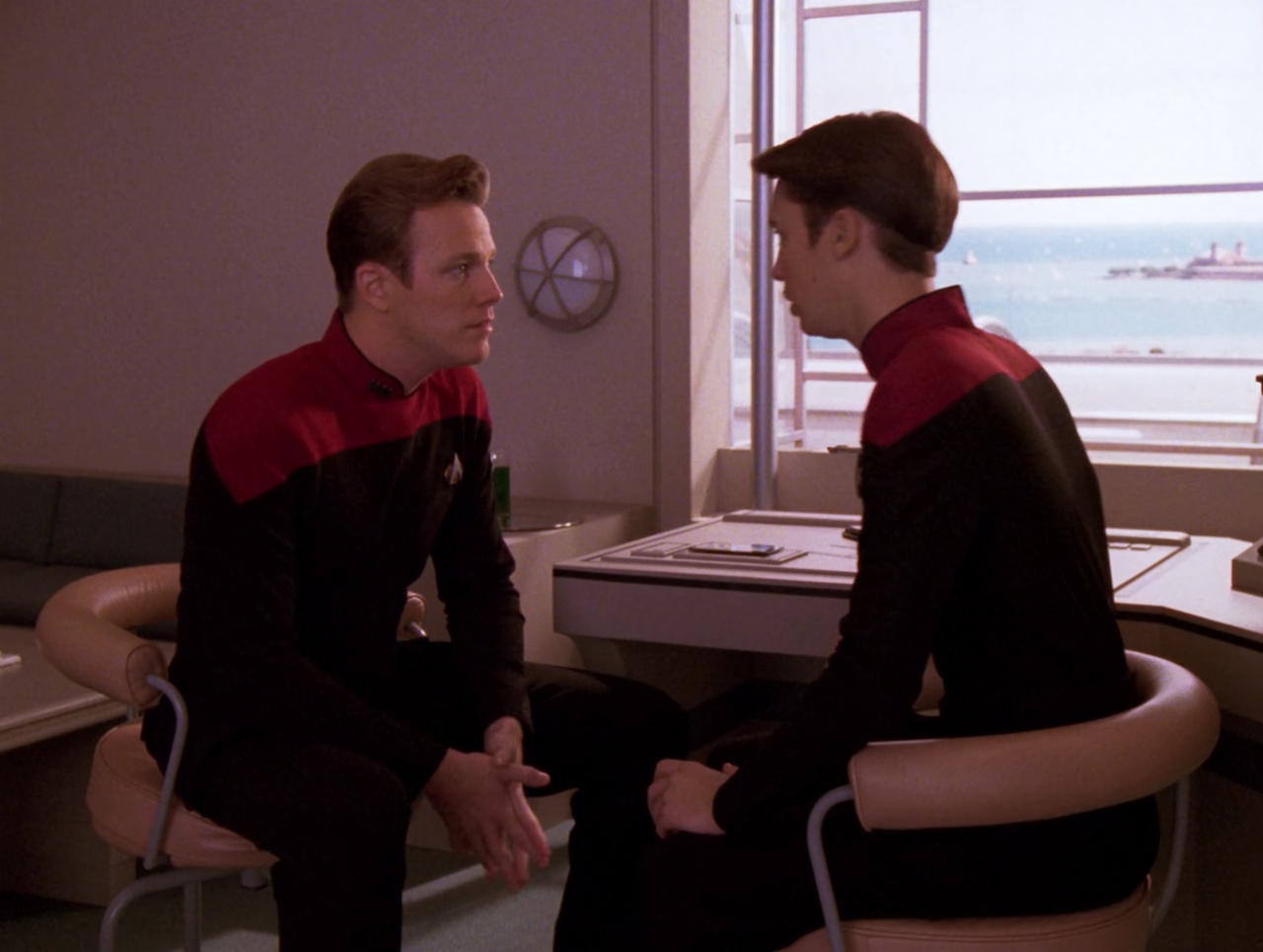
Still frame from Star Trek TNG S5 showing Nick and Wesley
Nick Locarno with Wesley.

Although never to such an extreme degree, I think a lot of us can relate to getting in trouble at school, or not wanting to “grass up” a friend. I certainly found myself in detention or sent to the headmaster’s office on more than one occasion when I was at school, and I can vividly remember how that felt – that fear of getting in trouble, and how serious it all seemed to be at the time. And I can recall occasions where friends at school would do something stupid – sneaking alcohol on a school trip, smoking behind the woodworking classroom, or cutting class to sneak into town. I covered for them when they misbehaved, and they probably did the same for me!

My point is that a big part of what makes The First Duty work is that, despite its heavy subject matter, it’s an incredibly relatable feeling. I’ve been in a position not unlike Wesley’s – where my schoolfriends expected me to cover for them while teachers demanded the truth. And it’s that near-universal feeling, something a huge number of folks in the audience will have experienced at least once in their lives, that makes Wesley feel so relatable and so human within the story.

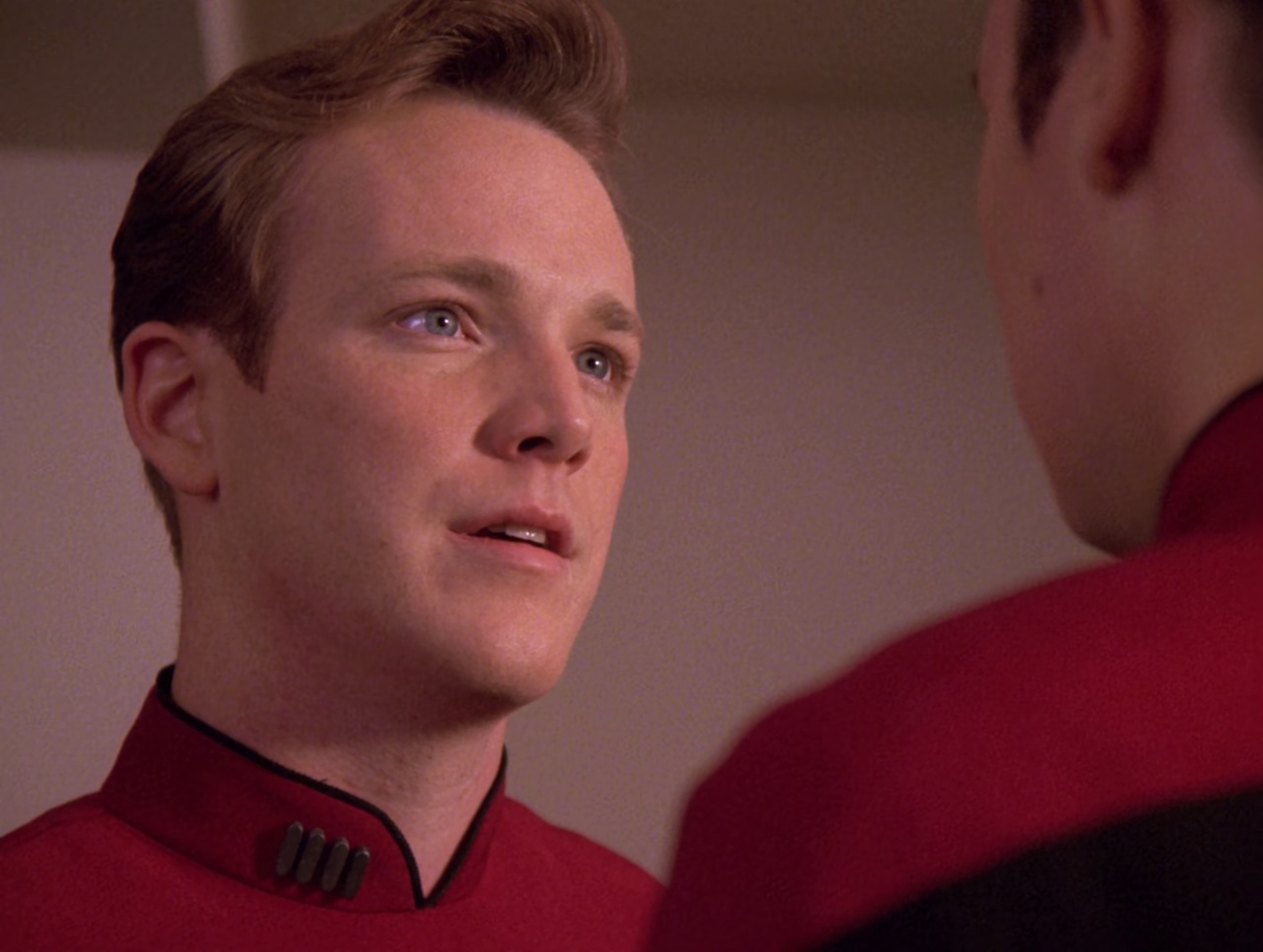
Still frame from Star Trek TNG S5 showing Nick Locarno
Nick Locarno put a lot of pressure on Wesley and the other cadets.

One thing that I think is a bit of a shame when it comes to The First Duty is that the episode didn’t have enough time to really flesh out Captain Picard’s backstory. We glimpsed, through his chat with Boothby, that Picard had made a mistake of some kind during his own Academy days, and that Boothby helped him understand what he’d done. Picard says that, without Boothby’s advice, he might not have been allowed to graduate – combined with his earlier recollection of being summoned to the Superintendent’s office, we can assume it was something pretty serious. We know Picard had a rebellious streak in his youth – something that the episode Tapestry would hammer home in Season 6. But what this incident was… it was never followed up on in the remainder of the show, unfortunately.

Picard and Boothby’s conversations were interesting, but they also leave me wanting more! I wish we could’ve got a flashback to Picard’s Academy days, perhaps, or even just a bit more of an explanation from one of the characters about what Picard did. The chat had a “we both know what this is, so there’s no need to go into detail” thing going on, which makes sense in-universe – both characters know what they’re referring to – but it’s a tiny bit frustrating as a viewer!

Still frame from Star Trek TNG S5 showing Picard with Boothby
What did Boothby do for Picard all those years ago?

Given the importance of this conversation to Picard, as he pursues the investigation into what happened with Wesley and Nova Squadron, I don’t think it’s unreasonable to want to know more about this mysterious event in Picard’s past. If I were to hazard a guess, I’d say that Picard broke a rule that resulted in endangerment or injury, perhaps, and Boothby was the one to convince him that he needed to come clean. It’s clearly something at least somewhat comparable to Wesley’s situation – but I doubt Picard would’ve done anything as severe as covering up someone’s death.

I kind of feel that Dr Crusher is a bit flat, especially at the beginning of the story. She’s learning for the first time that her son has been injured in an accident that killed one of his friends, but her reaction throws me off just a little. A lot of people don’t have big, over-the-top emotional reactions to events, but even by that standard, Dr Crusher just seems a little bit underwhelmed by what should be such a seismic and shocking event. Subsequent scenes show her a bit more animated when coming to Wesley’s defence, but that moment in her office at the beginning of the episode just… I’m not convinced it was played right, considering the seriousness of the accident.

Still frame from Star Trek TNG S5 showing Dr Crusher
Dr Crusher felt a bit flat to me, especially at the start of the story.

What I adored about Dr Crusher in The First Duty, though, was how she leapt to the conclusion that the sensor data had to be wrong – because, in her mind, there’s absolutely no way that Wesley could’ve been lying. It piled pressure on Wesley, of course, which is something we saw building up over the course of the episode, eating away at his conscience and making him feel ever more guilty. But I like what it says about Dr Crusher, and how she’s so willing to believe her son – even when it seems obvious to everyone else that he’s not being honest.

The downside to this, unfortunately, is that we never got any resolution to this mother-and-son story. Dr Crusher arrives on Earth to see Wesley, goes through the inquest with him, supports him even when he’s lying, but by the time his lie is exposed and he’s pushed into making a confession, she’s gone from the story. Picard is the one to deliver the news to Wesley about his academic punishment, and we never get to see whether Dr Crusher is upset, angry, disappointed, or some combination thereof. It’s not something that feels like a glaring omission until you stop to think about it – but as Wesley’s biggest supporter, Dr Crusher is yet another person that Wesley let down by his actions in The First Duty. And there’s no resolution to that story thread.

Still frame from Star Trek TNG S5 showing Cdr Albert
Commander Albert.

Obviously, a forty-five-minute episode can’t do everything. And given the characters and storylines in play, it was probably the right call for the writers to focus where they did. I just think that, if I had to pick on one thing that I’d say is missing from The First Duty, it would be some kind of closing scene between Dr Crusher and Wesley – some way for her to express her disappointment, perhaps even feeling like he’d broken her trust.

Maybe we should infer from Dr Crusher’s absence that she was so *livid* with Wesley in that moment that she couldn’t even look at him! That could be why Picard had to be the one to deliver the news, to express his own conflicted feelings – pride that Wesley eventually did what was right, understanding that it was difficult, but anger, frustration, and disappointment that the situation occurred in the first place. I don’t believe that was the writers’ intention, but that interpretation of Dr Crusher’s absence is there, if you want to read between the lines, and if you desperately need a way to resolve her arc in the episode.

Still frame from Star Trek TNG S5 showing Wesley and Beverly Crusher
Where was Dr Crusher in the episode’s final act?

And I happen to really like Picard’s closing scene with Wesley as the episode concludes. Picard went from sympathy to suspicion to righteous anger as he uncovered the truth about the accident, resulting in an incredibly impressive scene in his ready-room aboard the Enterprise-D in which he absolutely tore into Wesley. But the closing scene, after Wesley confessed, showed that Picard recognised how difficult the whole situation was, perhaps sympathised to an extent based on the mysterious event from his own Academy days, and even showed some measure of respect for Wesley’s ability to do the right thing in light of the pressure he felt.

Though they contrast in tone, both scenes between Picard and Wesley – in the ready-room and after the inquest – were played incredibly well. It’s performances like that from the venerable Sir Patrick Stewart that led to the character being so beloved by Trekkies… and eventually returning, some three decades later, for his own spin-off series!

Still frame from Star Trek TNG S5 showing Picard
Picard was furious.

Though they aren’t in focus for a lot of time, I enjoyed the moments we got with Data and Geordi in this episode. Working in main engineering, they analysed the sensor data that poked holes in Nova Squadron’s story, setting the stage for Picard to understand what really happened. The slow reveal of discrepancies or oddities in the recovered Data from Wesley’s ship was a really well-paced scene, and Geordi and Data both had roles to play in explaining (or technobabbling) parts of that.

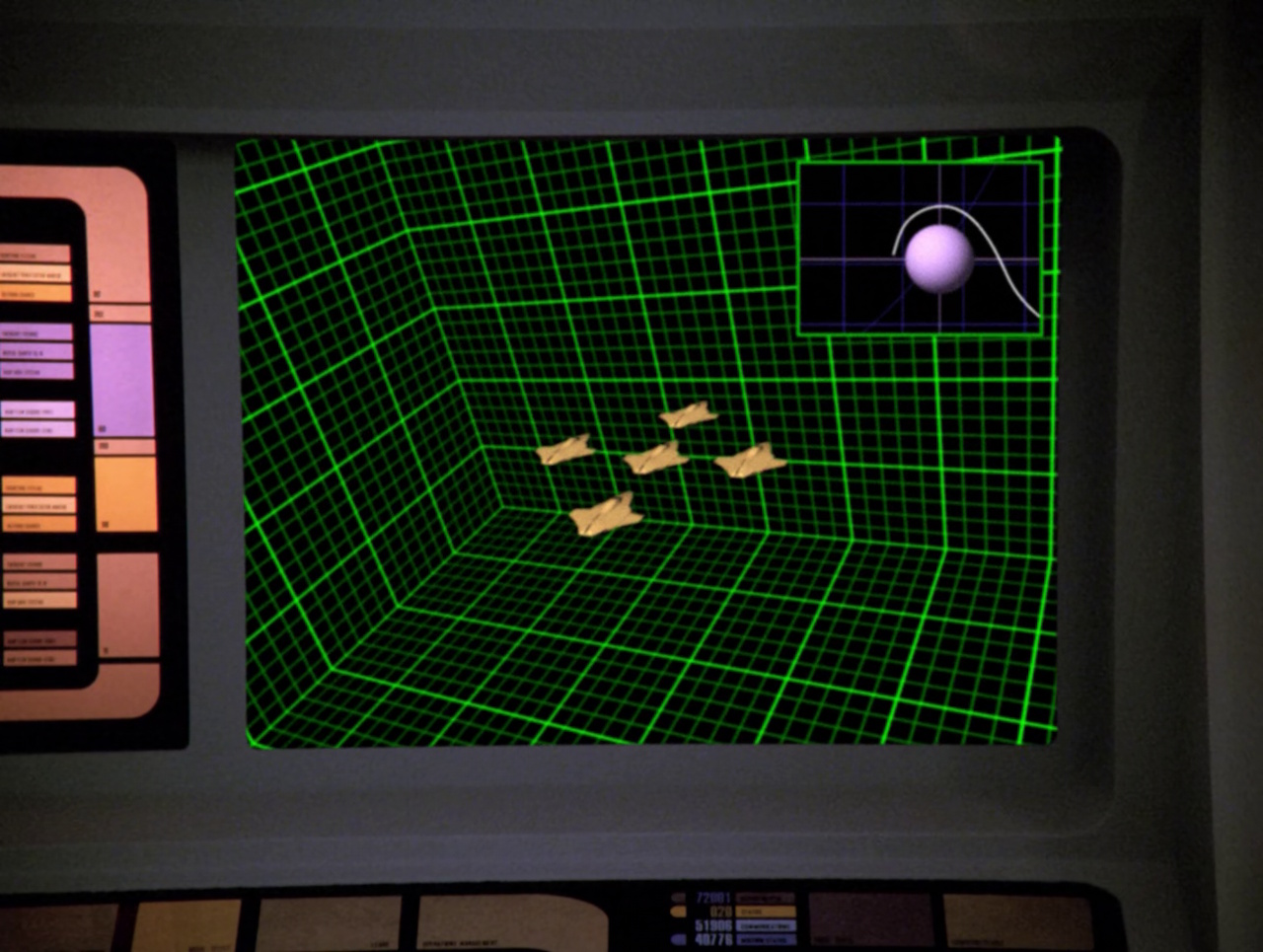
Starfleet ships of The Next Generation era are almost always my favourites in terms of design. But I gotta be honest: the Nova Squadron ships… they don’t really do much for me. Nothing about the design screams “Star Trek” at all, and they feel almost like single-pilot fighter ships from a franchise like Star Wars. Nothing about the design is *bad* per se, and I don’t dislike the way these ships looked. But in a franchise where there are so many fun and interesting designs, they’re nothing special.

Still frame from Star Trek TNG S5 showing the training ships
The Academy ships as they appeared on the inquest viewscreen.

Perhaps this is because these ships were mainly seen as CGI models, with a physical prop only appearing very briefly. The ’90s was a weird time for CGI – with the technology pretty limited. Given that Nova Squadron’s ships were all destroyed prior to the events of the episode, only depicted in logs and sensor data, I guess you could say that it’s fair enough that we didn’t get a more detailed look at them. But still… I just don’t feel like the aesthetic of the ships, the way they look, was particularly strong.

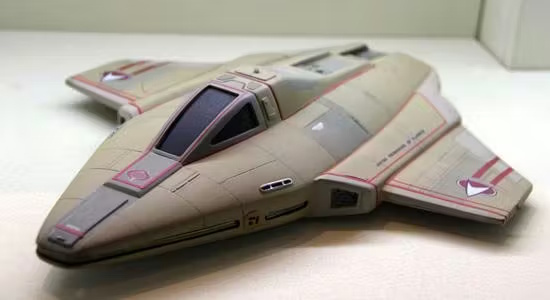
But your mileage may vary! Aesthetics and designs are very much a matter of personal taste. And I would say, having seen a photo of the original model of the Nova Squadron ships, up close, I don’t think it looks that bad. But the way it came across on screen, particularly in those CGI-heavy scenes, just didn’t leave a strong impression. The Next Generation era has way better shuttlecraft, shuttlepods, and smaller vessels.

The filming model (or a replica) of Nova Squadron’s ships.
Photo: StarTrek.com

Sticking with the look of the episode, one thing I found particularly interesting was the design of Starfleet Academy itself. Remember, this is our first real look at the campus anywhere in Star Trek, and obviously, there’s a lot of time spent both on the grounds – which were filmed at the Tillman Water Reclamation Plant in Los Angeles – and the room where the inquest took place. The gardens are an iconic part of Star Trek, I would argue, having been seen as both the Academy and Starfleet HQ. But I want to focus on a different space for a moment: Wesley’s dorm room.

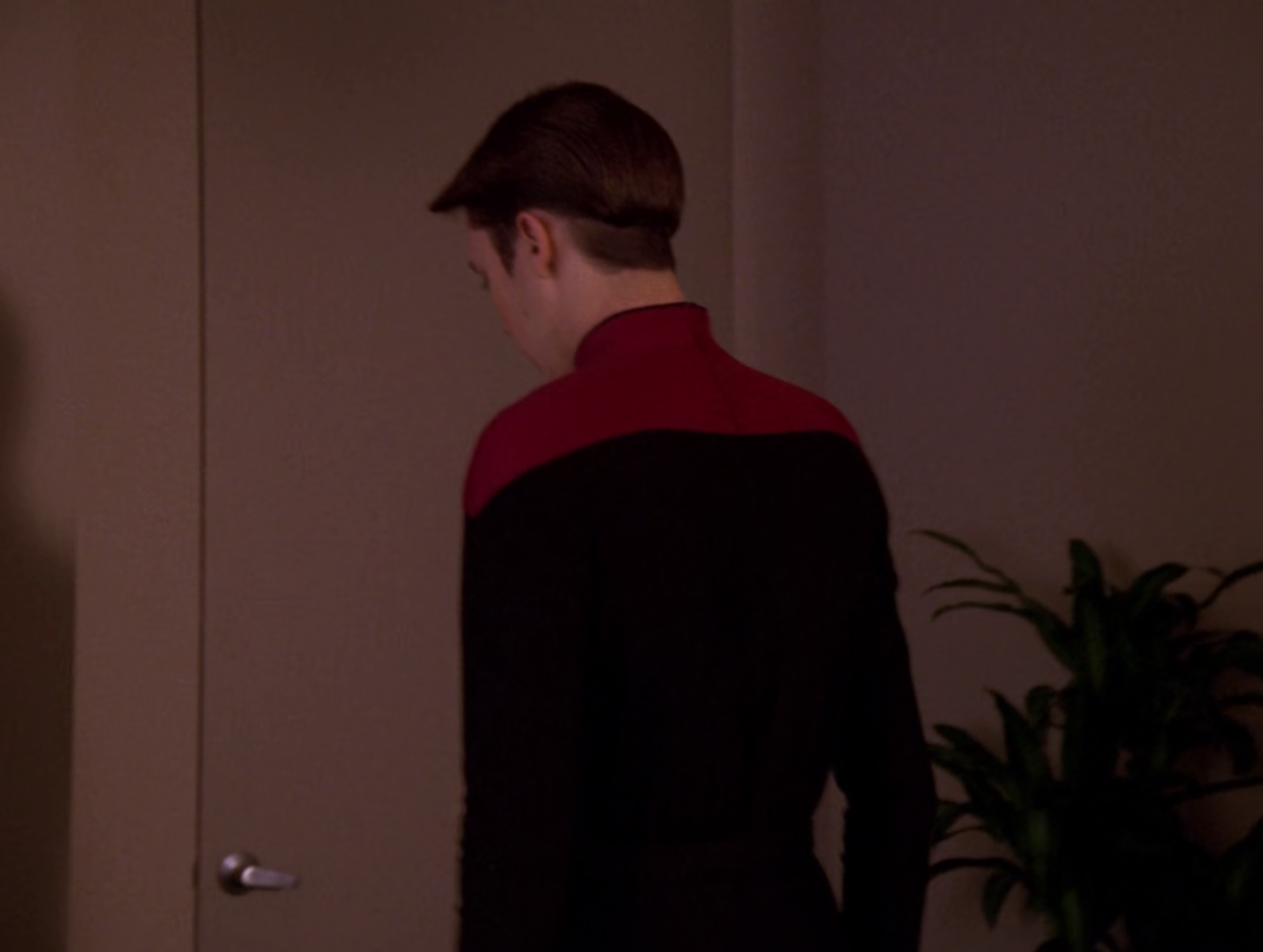
This is going to sound like a totally minor thing to focus on, but why do the doors on Starfleet Academy’s campus have… handles? Surely the Federation has moved beyond such things, right?! I don’t remember it being something I paid much attention to until this re-watch of the episode, but I found that, once I started to think about it, it stuck out like a sore thumb every time Wesley opened the door to his dorm. It’s not *totally* out-of-place in Star Trek, but for a location on Earth like the Academy? I dunno… you’d think they’d have sliding doors like on the Enterprise!

Still frame from Star Trek TNG S5 showing Wesley
The offending door handle…

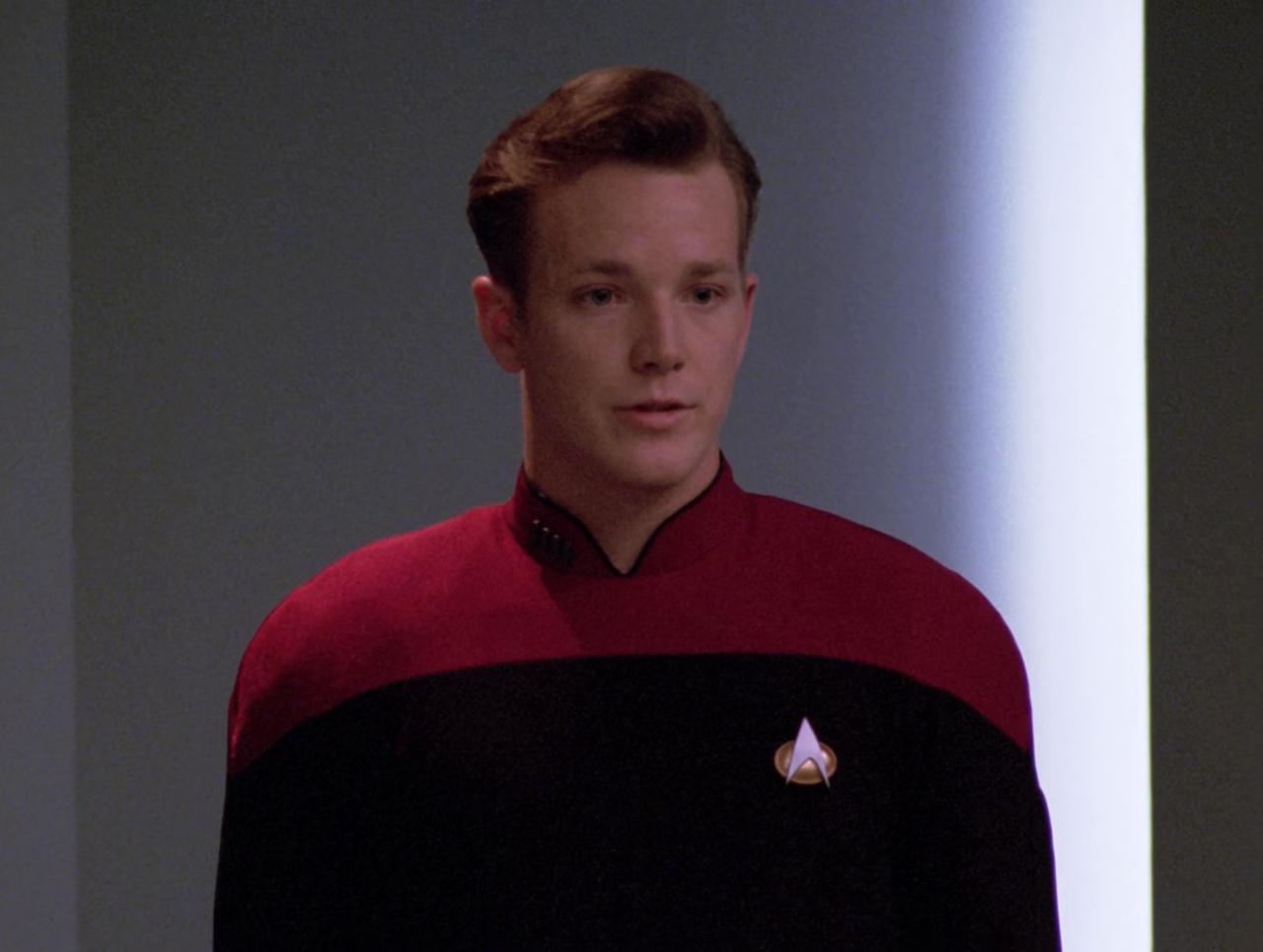
In light of Robert Duncan McNeill’s role in Voyager, I can’t help but wonder how similarly (or differently) we might’ve received his performance if a decision had been made to bring the character of Nick Locarno into that series. Would a similar “redemption arc” story have been possible for Locarno in the way it was for Tom Paris? I think it would have been interesting, and could’ve added another layer to this character, to say that Locarno joined the Maquis after being expelled from the Academy, only to be captured, imprisoned, and really hit rock bottom.

We still got a lot of that with Tom, something that the revelation about his father being an admiral certainly compounded, but part of me will always wonder how differently we might’ve received the character had Nick Locarno been the one assigned to Voyager. It would’ve been another connection point, a through line from The Next Generation to its sister show. I haven’t seen Locarno’s arc in Lower Decks yet, and perhaps I should’ve delayed this re-watch until I have! But maybe that will also change the way I look at the character in The First Duty.

Still frame from Star Trek TNG S5 showing Locarno
Nick Locarno.

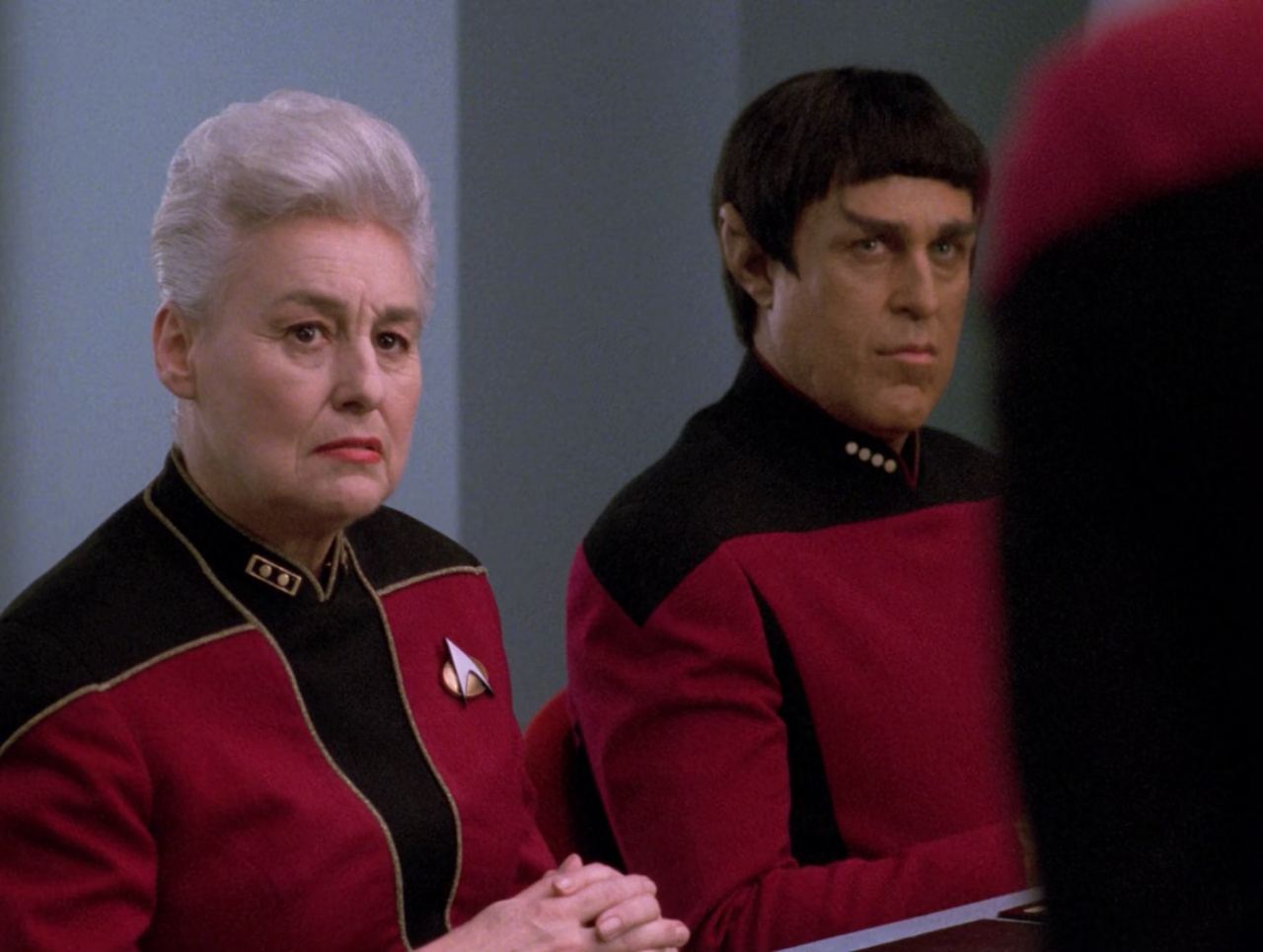
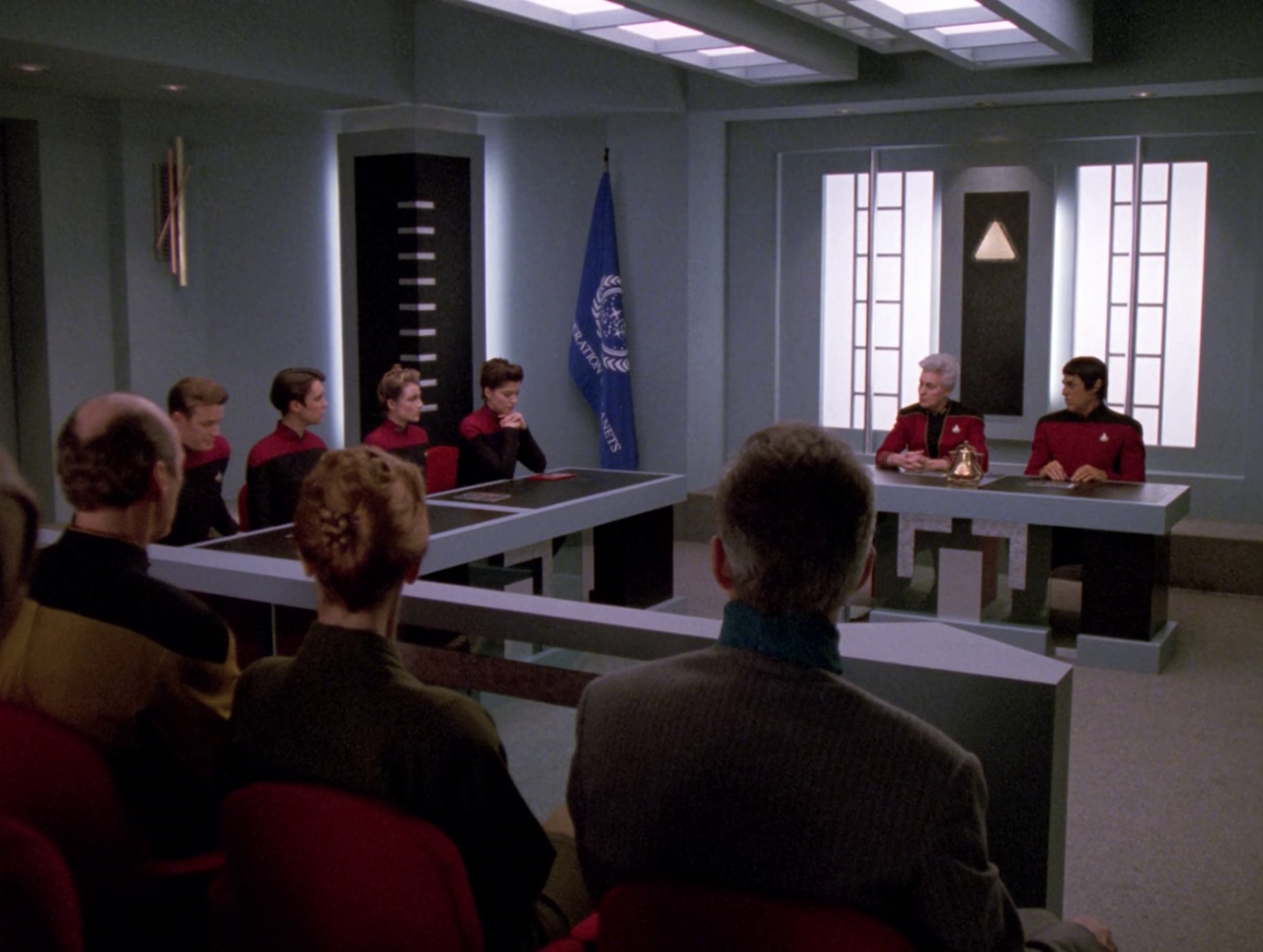
Star Trek has done courtroom drama going all the way back to the first season of The Original Series, and within The Next Generation, we have several other examples, too. I wouldn’t necessarily rank The First Duty’s inquest sequences as being among the best or most compelling courtroom-esque that the franchise has to offer, but they get the job done, and they’re sufficiently tense. When the cadets are caught in their lies, especially by the Vulcan captain, there are some moments of real jeopardy, moments that really captured that feeling of being a kid and getting in trouble that I talked about earlier.

Admiral Brand – the Superintendent of Starfleet Academy – is a fun character. I liked Picard’s description of her at the beginning of the story; it set her up pretty well as a “no-nonsense” type of educator. I think we all came across teachers like that when we were at school! Brand is the first one to question the cadets’ version of events, and her presence adds a lot to this side of the story.

Still frame from Star Trek TNG S5 showing Brand and Satelk
Admiral Brand and Captain Satelk.

In The Measure of a Man – another classic courtroom story from The Next Generation – it never made a lot of sense to me that Starfleet would pick Picard and Riker to argue the case. So I like how, in The First Duty, we don’t get the contrivance of having Picard or another Enterprise officer serving on the inquest panel. The inquest works better for having Admiral Brand and Captain Satelk as its members.

If I were to nitpick – and you know I must – it never felt realistic to me that Starfleet Academy would be content to basically say “a student died, we know you’re lying about what happened, but there’s nothing more we can do, so nevermind.” Which is, in effect, what Admiral Brand was going to do until Picard pushed Wesley into making a confession. It just doesn’t seem to gel with what we know of Starfleet that they’d give up on the investigation so easily when someone – a student, no less – had actually died. And while this works in the context of the episode as a way to raise the stakes for Wesley, part of me has always felt that Starfleet wouldn’t have been content to let it lie.

Still frame from Star Trek TNG S5 showing a courtroom
The inquest.

Narratively, The First Duty does an exceptional job of building up the pressure Wesley feels. There’s his initial guilt at Cadet Albert’s death, which is swiftly compounded by his mother fussing over him and his reunion with Captain Picard. Then there’s Nick, insisting that they all collude to cover up what really happened to save their own skins – even if that means Joshua’s reputation gets dragged through the mud. Commander Albert then comes into the story, apologising to Wesley for Joshua “letting Nova Squadron down,” and really just making Wesley feel awful. Next, as the inquest rolls on, the evidence from the satellite shows the team out of formation. Again, Dr Crusher compounds this by insisting that Wesley must be right and the data wrong. And finally, we come to the confrontation with Picard – after we’ve seen this slow buildup of various factors all combining to really weigh on Wesley’s conscience.

Picard’s blow-up would have had an impact regardless, but when you watch that scene after seeing all of those other moments of guilt and pressure… it works a whole lot better. Picard’s harsh words to Wesley come after we’ve already seen the cover-up slowly unravel, and they hit so much harder because we know that Picard is 100% in the right. And for Wesley, this is the final straw: the moment where he has to choose between his loyalty to Nick and his friends… and doing the right thing. The titular first duty.

Still frame from Star Trek TNG S5 showing Picard
Picard.

I think if you forced me to choose my favourite season of The Next Generation, Season 5 would be my pick. It has so many fantastic episodes: Disaster, Unification, Cause and Effect, The Next Phase, and fan-favourites like Darmok and The Inner Light, too. So The First Duty has some tough competition, but I think it fits in pretty well with many of those outstanding stories. It’s an episode that does a lot for Picard and his sense of duty, pushing Wesley to do the right thing. And it’s also an episode that takes the “impossibly perfect” Wesley Crusher and brings him down to earth, really humanising him and showing us that he can make mistakes, too.

I had fun returning to The First Duty, and I think it makes for an interesting point of comparison to the new Starfleet Academy series, too. Starfleet Academy has picked up criticism in some quarters for its tone and some of its stories – and there will always be folks both inside and outside of the fan community who aren’t happy when Star Trek doesn’t give them *exactly* what they want! For my money, I think you can see a through line from The First Duty to Starfleet Academy, even if some of that comes in exposition and dialogue! Boothby, for instance, talks about how the cadets’ celebrations in Picard’s day and for Wesley’s Nova Squadron caused a lot of damage to the grounds – something we see firsthand when the Academy cadets get into a “prank war” in the new series. That’s just one example, but I think it shows that, despite some changes in approach, Star Trek is still Star Trek even all these years later.

Still frame from Star Trek TNG S5 showing Wesley and Picard
The final shot of the episode.

So that’s all for today. I wanted to step back to the Academy’s first big appearance now that we have the new Starfleet Academy show – more out of curiosity, really, than for any other reason. When I write up my thoughts on Starfleet Academy’s first season later this month, I’m sure I’ll have more to say about how the show fits in with the wider Star Trek franchise, and this re-watch has certainly given me a lot to think about in that regard!

If you missed it, I reviewed Starfleet Academy’s two-part premiere: you can find that review by clicking or tapping here. And I also shared my thoughts on one storyline from the show’s fifth episode, so if you don’t mind spoilers, you can find that piece by clicking or tapping here.

Thanks for tuning in for this episode re-watch. I had a lot of fun revisiting The Next Generation and catching up with Picard, Wesley, Dr Crusher, and the rest of the crew. The First Duty is a fun episode, and one that feels, with the benefit of hindsight, like it brings together all three shows of The Next Generation era in a pretty fun way. I’m not sure which episode will be getting a full write-up next, but in this milestone 60th anniversary year, I’d love to do more to celebrate. Have fun out there… and Live Long and Prosper!


Star Trek: The Next Generation is available to stream now on Paramount+ in countries and territories where the service is available, and is also available to buy on DVD/Blu-ray. The Star Trek franchise – including The Next Generation and all other properties discussed above – is the copyright of Skydance/Paramount. This article contains the thoughts and opinions of one person only and is not intended to cause any offence.
Star Trek: The Next Generation Re-Watch – Season 7, Episode 17: Masks

Spoiler Warning: There are spoilers ahead for Star Trek: The Next Generation.

This is the first in what I hope to be a weekly series over the next few months. In the wake of the Star Trek: Discovery Season 4 disaster – the series has been withheld from fans outside of North America, if you somehow missed the news – I won’t be covering the show at all. Instead I’ll be writing up re-watches of some of my favourite episodes from Star Trek’s extensive back catalogue. This week we’re visiting The Next Generation’s final season to look at the episode Masks.

First up, a brief introduction to this format. I’m not calling these articles “reviews.” It wouldn’t be fair to do so because I’ve seen Masks – and all of the other episodes we’ll be looking at over the next few weeks – more times than I care to remember! This won’t just be a recap of the plot of the episode – I will be giving my thoughts and analysis as we go. But it can’t really be an objective “review,” strictly speaking.

The episode’s title card (from the remastered version).

Masks was one of the last episodes produced for The Next Generation before production shifted to Star Trek: Generations. At this stage we’ve been with the crew of the Enterprise-D for almost seven years and we know them well – so we think we know what to expect. Season 7 tried to shake things up at various points – like in Genesis where the crew all de-evolved! And Masks is kind of in a similar vein. We’ll see the ship transformed, and Data in particular will take on several different personalities.

Masks is one of those episodes that sticks in my mind. The Enterprise-D and her crew found themselves in many wacky and unpredictable situations over the years, but there’s something about the Aztec-inspired aesthetic that really makes what’s going on in Masks feel ancient and otherworldly. It’s a story that feels at home in the Star Trek franchise; the kind of episode no other sci-fi series would even attempt.

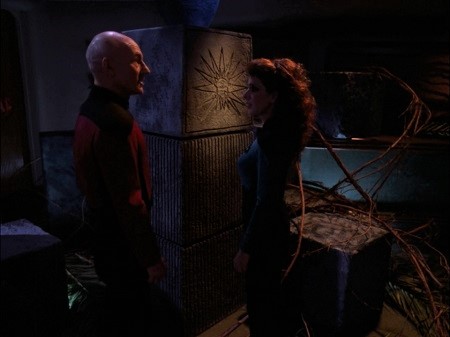
Picard and Troi examine a D’Arsay obelisk.

The episode is also a great one for Data actor Brent Spiner, who gets a chance to show off his range as an actor. There’s always seemed to be a disconnect between the character of Data and the personality of the man who plays the role! Data is cool and logical, but Brent Spiner has an almost chaotic energy to him, full of life and with a great sense of humour. Masks isn’t the only episode of Star Trek to give him more to do – look at his roles as Lore and as various members of the Soong family for more examples – but it’s certainly an episode that gives Spiner many opportunities to shake up his regular role.

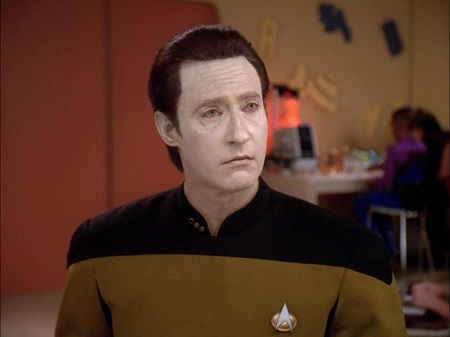
Data is such a wonderful character, and his series-long quest to become more human saw him attempt to mimic a variety of different behaviours. At the beginning of Masks we see him taking an art class, learning to sculpt and to use his imagination. Because of the largely episodic nature of The Next Generation, even in Season 7 Data is still chasing his ambition of becoming human in much the same way as he had been earlier in the show’s run. The character saw evolution across the series as a whole, but moments like these at the beginning of Masks could sometimes feel like a reset, reinforcing Data’s android nature and showing how he doesn’t fully understand some element or other of what it means to be human.

Data learning about imagination at the beginning of the episode.

I wouldn’t try to argue that Masks is an especially important episode, either for The Next Generation or Star Trek as a whole. It’s great, don’t get me wrong, but it isn’t groundbreaking or transformative for the franchise in the way certain stories can be – it doesn’t introduce new characters, factions, or themes that would carry over to future projects, for example, nor is it a transformative event in the lives of any of the main characters.

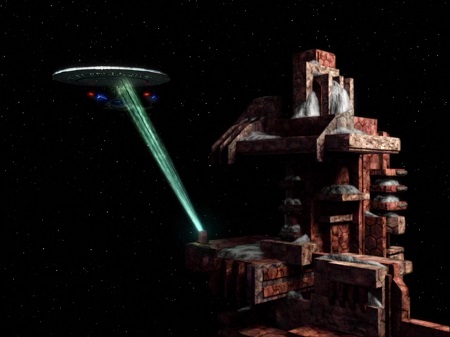
But that doesn’t mean it isn’t a fun episode with an interesting premise. In a way, what we have in Masks is an examination of computer viruses and the major cultural and technological differences that exist between cultures. After encountering the D’Arsay archive inside of what appears to be a comet, it transmits its information to the Enterprise-D, but that computer code plays havoc with the ship’s systems – and with Data. Though this computer virus analogy isn’t the episode’s message or primary focus, it’s not a coincidence that a story like Masks was created at this time.

There’s a timely message about rogue computer software buried in Masks.

In 1994, when the episode was initially broadcast, home computing was growing exponentially. Along with the rise of the PC came fears of computer viruses, and antivirus software was becoming a big business. Though Masks mainly considers cultural themes within the story itself, I’d argue very strongly that the premise – disruptive or even malicious software being beamed to the Enterprise-D – is a reaction to the way the home computer market was shaping up at the time.

Computer viruses continue to plague systems today, of course, but with improvements in antivirus software and better computer education, the fears most folks have of viruses has diminished. In that sense, this aspect of Masks feels like a step back in time a quarter of a century – which it is, of course! The idea of rogue computer code harming – or in this case transforming – one’s computer was certainly a relevant concern at the time, though, and although it’s one that the episode doesn’t feature prominently it’s still an interesting aspect.

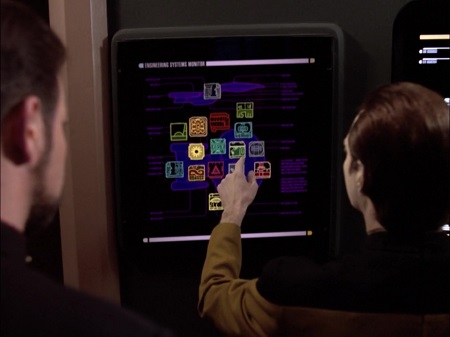
Riker, Data, and Geordi tried to make sense of the mysterious symbols that began appearing on the Enterprise-D’s computer screens.

Masks also looks at how we deal with cultures very different from our own, and how we need to be careful when interpreting history. Captain Picard is at his best in episodes like Masks, getting the chance to show off one of his real passions – history. Picard is well-placed to jump into the story and find a use for his skills, and is supported at various points by Riker, Troi, and perhaps the most unusual choice – Worf. One of Worf’s lines about the sun and moon proves crucial to unlocking the mystery of the archive, and while Captain Picard definitely needed others around him in these scenes, I’m not sure I’d have chosen Worf!

The struggle that Picard and the others had of trying to interpret an unfamiliar culture is one that historians and anthropologists have long dealt with. And to me, Masks is an example of Star Trek doing what it has always done: using a sci-fi lens to examine a real-world subject. Usually the stakes aren’t so high, of course, but putting a kind of ticking clock and threat in the background gave the story an impetus it would’ve otherwise lacked; had Picard and the crew simply been trying to learn about the D’Arsay symbols and characters out of curiosity, the story wouldn’t have gone anywhere.

Picard had to draw on his knowledge of history and anthropology to solve the mystery of the D’Arsay archive.

On the technical side of things, Masks was one of the first Star Trek episodes to use computer-generated imagery (CGI), using the new technology for the comet and D’Arsay archive. The remastered version, which is what you’ll find on blu-ray and streaming – didn’t preserve the original CGI model, recreating the archive from the ground up based on the original design. The DVD version, however, and other older copies (like VHS) do still have this piece of Star Trek’s history. You can also find images of the original CGI model online, of course.

A few times across The Next Generation, sped-up shots would be used to show Data working or moving faster than a human could. Out of everything present in Masks, this short sequence (which shows Data sculpting a treble clef in his art class) is perhaps the only part that feels dated in 2021. The rest of the episode’s effects hold up remarkably well, and the remastered CGI sequences look great even on a modern 4K display.

This shot of the Enterprise-D melting a comet with its phasers is pretty darn cool.

Many times across Star Trek’s long history there have been so-called “bottle shows.” These are episodes which primarily use existing sets and often don’t bring in many new characters or guest-stars, focusing on just the main cast. Though there was a set built for Masks – the temple, which would later be re-used in Deep Space Nine – the episode is mostly a bottle show, or perhaps a semi-bottle show! It focuses on a handful of characters, mostly re-uses existing Enterprise-D sets – with a few additions and changes to reflect the transformation the ship is undergoing – and feels like a very self-contained story in that respect.

Given Data’s prominent role, Brent Spiner is the star of Masks. And while we see elements of his portrayal of Lore in one of the personas that Data assumes, for the most part he makes each of the D’Arsay characters feel unique and distinctive. For an actor who spent most of The Next Generation’s run playing a very unemotional, unreactive character, I can quite understand why Brent Spiner would describe Masks as one of his biggest acting challenges on the show. I think he rises to the occasion and shows off a range that any actor would be proud of; making each persona feel separate despite only minor costuming changes is no mean feat, and he pulled it off very well. There was a risk, perhaps, that in order to differentiate each of the D’Arsay personas in such a short runtime each would have to be exaggerated to the point of pantomime caricature, but that didn’t happen in the final episode. That alone should be testament to Brent Spiner’s talents and hard work.

Data actor Brent Spiner had to take on several different personas in Masks.

There are a few lines from Masks that resonate with me from a mental health standpoint. Though the episode isn’t intended as an examination of mental illness, Data developing an android version of “multiple personalities,” as Troi puts it, does bring up some comparisons. When Data asks Geordi what it feels like to lose one’s mind is a line that very much struck a chord with me, not least because it’s a question I’ve asked myself (and doctors) in the past.

Data’s line as the episode draws to a close about feeling “empty” following the removal of the D’Arsay personalities likewise felt very relatable. It isn’t always easy to tell where the line is between one’s own personality and aspects of oneself that might be better characterised as manifestations of mental illness, and even the removal or lessening of a mental health symptom can, in some cases, bring with it a feeling of emptiness or of feeling incomplete. That’s definitely a second thing I find relatable – and I think it shows how stories which only touch on themes of mental health can still be impactful even if mental health isn’t the focus.

Data on Masaka’s throne.

The only real criticism I have of Masks is that its ending feels a little too quick – almost abrupt, really. After a slow buildup which sees the Enterprise-D progressively transformed to resemble the D’Arsay culture, Picard has a short conversation with Masaka, and then after a quick “woosh” everything is un-transformed and back to normal. A quick epilogue with Data and Picard in the ready-room closes the episode, and the final few minutes just feel a little rushed, especially considering the deliberately slow pacing of the rest of the episode.

Despite that, I enjoy Masks. It isn’t my all-time favourite episode of The Next Generation, but it’s one of those solid standalone stories that Star Trek does far fewer of since the move to serialised story arcs and shorter seasons. Masks shows off a different kind of science fiction with its slightly wacky concept of an archive transforming the ship into stone artefacts, but at the same time it’s a story that’s grounded in real-world parallels of history and anthropology. Brent Spiner puts in one of his finest performances, taking on a variety of personas that force him to step well outside of his normal bounds as Data.

So I hope this was a bit of fun. My objective at the moment is to remain connected to Star Trek and the Star Trek fan community but without providing any support or coverage of Discovery in light of the awful decision from ViacomCBS. Later this week I hope to look at an episode from Star Trek: Enterprise, and I already have dozens of other ideas for episode re-watches as we move through the holidays and into 2022.

Star Trek: The Next Generation is out now on blu-ray and DVD, and is available to stream on Netflix outside of the United States (at least for the time being). The Star Trek franchise – including The Next Generation and all other properties mentioned above – is the copyright of ViacomCBS. This article contains the thoughts and opinions of one person only and is not intended to cause any offence.
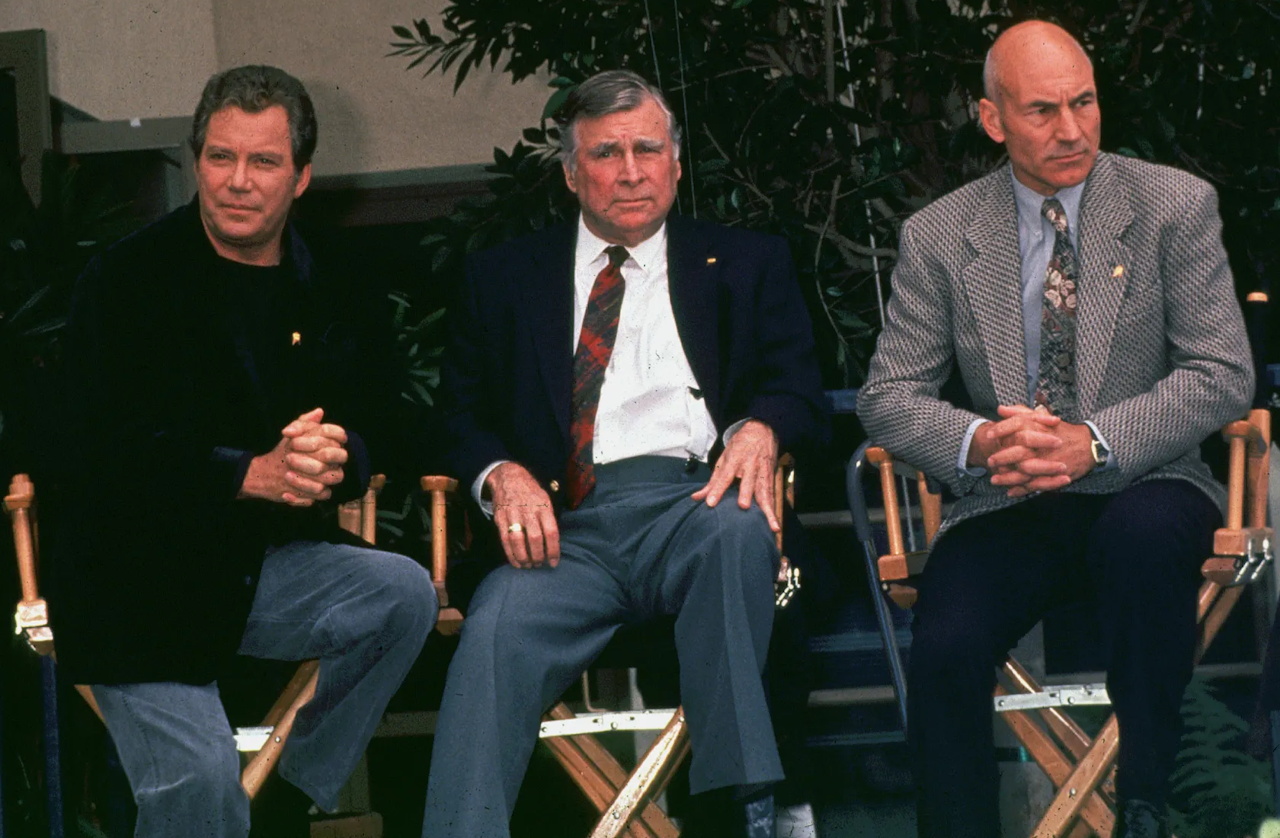
Star Trek: The Next Generation Re-Watch – Season 4, Episode 12: The Wounded

Spoiler Warning: There are spoilers ahead for Star Trek: The Next Generation, as well as for other iterations of the franchise.

Thirty years ago this very day, Star Trek: The Next Generation broadcast the twelfth episode of its fourth season: The Wounded. This would be a highly significant episode for the franchise going forward, and in many ways began to set the stage for the upcoming spin-off Deep Space Nine. At this stage work on pre-production of Deep Space Nine had already kicked off, and while The Wounded is by no means a backdoor pilot, there was a conscious effort on the part of Rick Berman – who was in charge of Star Trek at the time – to begin to put the pieces together for the new series.

The Wounded is the first episode to give future Deep Space Nine regular Miles O’Brien a significant role. Though present since Encounter at Farpoint at the beginning of Season 1, O’Brien had been a background character with little to do until this point. The episode also marked the debut of the Cardassians, with future Gul Dukat actor Marc Alaimo featuring as a different Cardassian – Gul Macet.

Gul Macet – the first Cardassian ever seen in Star Trek.

For both of those reasons, The Wounded is incredibly important within the history of Star Trek. The foundations of Deep Space Nine were laid here, and it was around this time, under Rick Berman’s direction, that Star Trek truly cemented its evolution from purely episodic storytelling to an interconnected franchise. Deep Space Nine would share The Next Generation’s time period and be broadcast while its sister show was still on the air. This was a marked change from the way The Next Generation was spun off from The Original Series, and one which allowed the different parts of the franchise to connect in ways that were unprecedented at the time.

After more than a decade of the Marvel Cinematic Universe and other such franchises, we almost take for granted this concept of big, interconnected fictional universes. But episodes like The Wounded are a big part of building that sense of connectedness within Star Trek, and in the early ’90s that was something entirely new. The difference between a good film or television show and one that can become one part of a greater franchise is that sense of interconnectivity, and it’s impossible to understate the importance of episodes like The Wounded on building up Star Trek as that kind of franchise.

The Wounded was instrumental in laying the groundwork for Deep Space Nine.

In that sense, it isn’t only Deep Space Nine which owes so much to The Wounded – and other similar episodes around this time in The Next Generation’s run – but also Voyager, and by extension Enterprise, the Kelvin films, Discovery, and the fact that Star Trek is still going strong thirty years later. It’s one of those incredibly significant moments in the history of the franchise – one of the moments at which Star Trek became an expanded franchise.

More than that, The Wounded is an especially good episode. As Star Trek has always done, it deals with real-world themes through its sci-fi lens, looking at war, post-traumatic stress, how feelings of hate can linger long after the event, and so on. It was also a rarity at this point in Star Trek to see Starfleet officers as anything other than exemplars of virtue, or the Federation as anything less than a utopia. Captain Maxwell is not a villain per se, but the actions he takes in The Wounded endanger the peace – a hard-won peace with the Cardassians. In that sense, the episode looks at the idea of how war can and should be justified, and whether it’s acceptable to sacrifice the truth to preserve the peace.

The episode’s title card.

Coming toward the end of the 1990-91 Gulf War, that makes The Wounded a very timely piece of television. Unlike the later Iraq War of 2003, the Gulf War was generally popular at the time, but even so there was a sense that there wasn’t a real plan for what to do after the initial military objectives had been achieved. Should the US and allies push on into Iraq and remove the Iraqi government? Or should they make peace even if doing so meant leaving a dictator in place? The Wounded doesn’t tackle all of these issues head-on, but the general theme of making peace with an enemy, the value of peace itself, and on a personal level, the toll war can take on those who serve, were all present in the narrative.

Finally, The Wounded draws on inspiration from the film Apocalypse Now, itself influenced by the novel Heart of Darkness, and in the vein of those classics features a story about a war hero going “mad.” Plot points like Captain Maxwell’s mental state and his foray into enemy territory are comparable to storylines in those classic works of literature and cinema. There’s a reason why audiences respond to such powerful themes and storylines, and The Wounded does an admirable job of translating them to Star Trek’s science fiction setting, doing so in a way that retains the original message, ensuring it isn’t buried too deeply in talk of aliens and spacecraft.

The Wounded follows a similar narrative to classic war film Apocalypse Now.

Because of the way The Next Generation was broadcast at the time, I can’t claim that this is the thirtieth anniversary of when I saw The Wounded! That would’ve been a couple of years later, as here in the UK that was the kind of delay we were looking at between an episode’s US premiere and when it would be broadcast here. Regardless, let’s take a look at The Wounded together.

The episode begins with a couple of sequences that set up the main storylines. Both via his captain’s log and on the bridge, Picard gives us a lot of information about the Cardassians – who were, as noted, new to Star Trek in this episode. The bridge crew briefly discuss the situation, and it emerges that Picard had been part of the conflict and negotiations to resolve it while in command of the Stargazer. The exact nature of Cardassian-Federation relations is a little confused; Picard says a “peace treaty” is in effect whereas Troi describes the Cardassians as “allies.”

Up next we get a sequence with Chief O’Brien and Keiko – whose wedding had been part of the previous episode, Data’s Day. In their quarters, O’Brien seems unimpressed with Keiko’s vegetarian cuisine. O’Brien got a fun line when looking at the kelp-based meal: “Sweetheart… I’m not a fish.” That line still wins a chuckle decades later! As O’Brien promises to prepare Keiko a meal of his childhood Irish classics, the ship comes under attack.

The attack on the Enterprise comes during Miles and Keiko’s breakfast.

On the bridge, the crew briefly discuss the minor damage to the ship. The Cardassians apparently fired without responding to hails. This sequence marked the first appearance of the Cardassian Galor-class warship, initially described here as a “scout ship.” Despite firing on the Enterprise-D while its shields were down, there is no major damage nor any casualties. A few phaser shots from the Enterprise-D causes damage to the Cardassian ship and forces its captain – Gul Macet – to hail. The Galor-class would go on to be one of the Cardassian mainstays during the Dominion War – where it was much more effective! Perhaps it got an upgrade. Macet alleges that a Federation ship attacked the Cardassians in violation of their peace treaty; he gives Picard one hour to find out what’s happened.

Star Trek: Picard and Star Trek: Discovery both have pretty understated theme music. They aren’t bad, but they’re closer to the themes from Deep Space Nine and Voyager in that they’re slower, quieter pieces of music. The Next Generation’s theme is in contrast to those! Taken from Star Trek: The Motion Picture, the up-tempo theme really conveys a sense of adventure in a way the others really don’t. Star Trek: Lower Decks, and to a degree the main theme from 2009’s Star Trek reboot film, both do this too, and both of those pieces of music are likewise up-tempo and adventurous. It’s only when coming back to The Next Generation after watching a full season of Discovery that I can really appreciate this difference in musical tone!

The Enterprise-D attacked by the Trager, the first Cardassian Galor-class ship seen in Star Trek.

After the opening titles Captain Picard receives a briefing from a Starfleet Admiral. He informs Picard that the USS Phoenix, under the command of Captain Maxwell, was responsible for destroying a Cardassian station – though they are unable to find out why as Captain Maxwell is not responding. The Enterprise-D – along with a small group of Cardassian “observers” – has been granted permission to enter Cardassian space and catch Maxwell.

The Admiral is very concerned with preserving a hard-won peace treaty, and makes it clear that he believes that the Federation is not prepared for another war with Cardassia – prescient, one might say, in light of how badly the Federation handled much of the Dominion War! Though the Dominion War arc hadn’t even been conceived at this stage, when looking back at The Wounded now that we know what happened, it’s possible to see how the Dominion War story built on what had previously been established in many ways. These smaller moments add up to a much greater whole, and are part of what makes for a believable narrative.

Admiral Haden speaks to Captain Picard.

Though Captain Picard is initially insistent that the three Cardassian observers be made welcome and not made to feel like “prisoners,” he acquiesces to Worf and Riker’s request that their access to the ship be limited. Worf intends to post guards at what he considers to be sensitive areas of the Enterprise-D for the duration of the Cardassians’ stay. Data establishes that O’Brien once served with Captain Maxwell aboard a ship called the Rutledge, and Picard tasks Counsellor Troi with looking after the crew, as he feels some officers may be uncomfortable with the Cardassians on board – foreshadowing what’s to come.

The Cardassians beam aboard and Riker and Troi are there to greet them, along with Chief O’Brien. The Wounded is the only episode of Star Trek to show off a different style of Cardassian uniform. Unlike the silver-grey mail-like armour that they would wear in the Deep Space Nine era, here the Cardassians wear a plain brown leather-like armour over some kind of undershirt. Most notably, this is the only episode which shows off Cardassian headgear – a kind of helmet that covers the back of the head with three bars connecting at the front. Though the outfit isn’t bad per se, I think it’s easy to see why it was changed later. Not only does the headgear look a little silly, it also covers up key aspects of the Cardassians’ facial features and makes them less distinguishable from one another. Gul Macet sports facial hair, too, and The Wounded would be the only time we would see that on a Cardassian character.

Gul Macet and his aide beam aboard.

It’s interesting that Marc Alaimo was the first Cardassian seen in Star Trek, and in another role would also go on to be the most significant Cardassian. In that sense he’s similar to Deep Space Nine co-star Armin Shimmerman, who was one of the first Ferengi seen in Season 1 of The Next Generation and also played Quark, the most famous Ferengi in Deep Space Nine. We don’t spend enough time with Gul Macet to really show off how different he is from Alaimo’s more well-known character of Gul Dukat, and in many ways the performance he puts in here is similar. Perhaps Macet and Dukat are related?

Counsellor Troi seems to pick up on O’Brien’s discomfort with the Cardassians as she and Riker escort them from the transporter room. In the briefing room, Geordi and Riker explain the basics of scanning for the Phoenix, and that they’re able to scan one sector per day. It’s worth pointing out that how big a “sector” is in Star Trek has never been consistently explained on screen! The Cardassians are sceptical – understandably so – but Picard is able to calm the tensions.

The briefing room scene.

Also present at the briefing room table is O’Brien, and Picard turns to him to ask him a little about Captain Maxwell, with whom he previously served. O’Brien explains that Maxwell’s family were killed during a Cardassian attack on the Setlik III outpost – and if Setlik III sounds familiar to you, it’s a name associated with O’Brien’s military service that would be brought up numerous times in Deep Space Nine, most significantly, perhaps, in the episode Empok Nor.

O’Brien responds aggressively when it’s suggested to him that Captain Maxwell is taking revenge for what happened to him, and it’s clear that he feels a strong sense of loyalty to his former commander. Gul Macet attempts to press the point when Picard intervenes, but before the discussion can continue the briefing is interrupted by Worf, who has located the Phoenix on long-range sensors.

O’Brien in the briefing room.

The briefing breaks up, and Captain Picard invites Gul Macet to the bridge with the senior officers. O’Brien and the two junior Cardassians leave together and end up sharing a turbolift. Here’s where we get one of the episode’s most interesting scenes. The Cardassians – who are, after all, just doing their jobs – attempt small-talk with O’Brien, but he isn’t having any of it.

After an invitation to join the Cardassians in Ten-Forward, O’Brien snaps. He tells them abruptly that he will cooperate with them when it comes to discussing technology or the search for Captain Maxwell if ordered to do so, but will not spend his free time with them. He then barges past them out of the turbolift.

O’Brien and the Cardassians in the turbolift.

It was around this time that we began to see cracks in the utopian/perfect veneer of Starfleet and humanity in Star Trek, proving that they haven’t entirely risen above the pettiness and conflicts we have in contemporary times. Gene Roddenberry was strongly opposed to the idea of Starfleet as a military outfit, and famously tried to have Star Trek VI: The Undiscovered Country re-written to cut out what he saw as anti-Klingon racism from Kirk. He felt such attitudes were beneath humanity in his vision of the future. I can only imagine he felt the same way about O’Brien in The Wounded. As an aside, The Undiscovered Country will also celebrate its 30th anniversary this year.

On the bridge, Picard orders the Enterprise-D to intercept the Phoenix, with Gul Macet watching over his shoulder. Macet wants the ship’s precise location so that he can have Cardassian vessels arrive first. He also asks for the ship’s transponder frequency – a neat callback to Star Trek II: The Wrath of Khan. Worf looks angry at this suggestion, which Captain Picard refuses – diplomatically, of course.

Picard and Gul Macet on the bridge.

O’Brien serves Keiko the promised meal in their quarters, though she seems unimpressed with his replicated potato casserole (which looks more like potato salad!) He sings an old song from his days on the Rutledge, and it seemed for a moment as though the unpleasantness with the Cardassians was forgotten. But it turns out the song – which Colm Meaney does his best to sing – was a favourite of Captain Maxwell’s. He pushes Keiko to comment on why someone – speaking abstractly – might not be comfortable with Cardassians, but appears in denial about his own feelings toward them.

This scene and the previous one really humanise O’Brien. What he’s feeling is, as Keiko explains, quite natural. Yet at the same time he’s not comfortable sharing with her exactly what it is that’s wrong. He brushes off his battle experiences calling them “skirmishes,” and refuses to accept or even recognise that he’s holding on to a degree of resentment.

O’Brien in his quarters.

On the bridge, the crew has detected that the Phoenix is in pursuit of a Cardassian vessel – a supply ship. Gul Macet is incredulous that Data can read Cardassian transponder codes and tell what kind of vessel it is at such range, but they have a more immediate problem. Maxwell is not responding to hails, and goes on to attack the ship while the Enterprise-D can only watch.

I do like the 2D graphics used to represent the positions of the Phoenix and the Cardassian ship on the main viewscreen. Though arguably not very “high tech,” it’s cleverly done and easy to understand for us as the audience. The remastered Blu-Ray version didn’t change this, but did upscale and improve it. Though in many ways Discovery and Picard have changed up the aesthetic of Star Trek for modern times, we have seen these flat, 2D maps in those series as well.

Watching the attack unfold.

Gul Macet again insists on being given the transponder frequency (or prefix code) for the Phoenix, and when Maxwell does not respond Picard orders Worf to send the code to the Cardassians. Worf loudly protests, but does carry out his orders. Despite sending the codes, however, the Phoenix is able to continue its attack and destroys both the Cardassian warship – to Gul Macet’s shock – and the supply ship it was initially targeting.

Following the battle – if it can be called that – Picard orders the Enterprise to increase speed to warp 9 to catch up. Given the urgency, I do wonder why the ship was only at warp 6 initially. Gul Macet leaves the bridge wordlessly.

The Phoenix destroys a Cardassian warship.

Picard goes to visit O’Brien in his transporter room. O’Brien again states how greatly he respects Captain Maxwell, saying he served with “the two finest captains in Starfleet,” putting Maxwell on par with Picard himself. He also says that he believes Captain Maxwell must have a reason for the actions he’s taken, reiterating that this isn’t some quest for revenge.

Captain Maxwell, according to O’Brien, took the loss of his family as well as one could, and continued to perform his duties despite the tragedy. Even hearing that Captain Maxwell has just killed 600 Cardassians does not shake O’Brien’s opinion, as he tells Picard that he “knows” them and that one must be careful around Cardassians, a race he clearly holds in low regard. What Picard says next about holding on to one’s anger clearly has an effect on O’Brien, and causes him to consider not only what Captain Maxwell is doing, but his own attitude to the Cardassians. It’s one of the most powerful moments in the episode – yet lasts mere seconds.

Captain Picard arrives in the transporter room.

Picard, in this statement, encapsulates the theme of the episode: that holding on to anger is never a good thing. Captain Maxwell may have pretended to be fine – as O’Brien was moments earlier with Keiko – but neither man ever got over their wartime experiences. It’s something that applies in the real world, too. At the time, the Gulf War was raging, but the peace treaty storyline reminds me more of the Vietnam War, and how Americans in this era might view their one-time enemies. It could even apply to the Second World War, and even today there are lingering feelings from that conflict in some areas.

In Ten-Forward, O’Brien joins one of the Cardassians for a drink. He initially offers an apology for his earlier actions, spurred no doubt by Captain Picard’s words. But as he talks to the Cardassian officer he spills more of his history with them – he was present on Setlik III after Captain Maxwell’s family was killed, and it was the first moment he ever killed someone. O’Brien’s words are very powerful: he doesn’t hate the Cardassians, he hates himself, and blames them for making him into a soldier and a killer.

O’Brien and the Cardassian officer in Ten-Forward.

On the bridge, Worf claims to have caught the other junior Cardassian accessing a computer on deck 35. Gul Macet reprimands him and confines him to quarters. The Cardassian officer’s staredown of Gul Macet seems to imply that he was carrying out his orders, but that point was not expanded upon further.

Gul Macet and Captain Picard speak in the ready-room. Macet says he will further discipline the man, Picard says it doesn’t matter, and that in order to have peace, no one individual must be allowed to disrupt it – a very self-serving statement under the circumstances, one might say! Macet sees Picard as a kindred spirit – both men desire peace above all else. Perhaps that comes as a surprise to both of them. Though it is hard to detach Marc Alaimo’s performance as Macet from his later role as Dukat, he is believable in this moment.

Gul Macet in Picard’s ready-room.

Data interrupts the conversation to tell Picard that they’re twenty minutes away from intercepting the USS Phoenix, and the very next scene shows the two ships together. Captain Maxwell beams aboard to discuss the situation with Captain Picard, and is greeted by O’Brien and Riker in the transporter room.

Far from being adversarial, Captain Maxwell is disarmingly pleasant, greeting Riker warmly and being pleased to see O’Brien after such a long time. Were it not for the previous twenty minutes we’d be forgiven for thinking this was any “normal” interaction between Starfleet officers! In that sense though, seeing this scene in context, there’s something very unsettling about it. Knowing that Captain Maxwell has gone rogue, knowing how many people he’s just murdered, and then seeing him as a jovial man in a Starfleet uniform offering friendly handshakes leaves a bad taste – intentionally so.

Captain Maxwell and O’Brien reunite in the transporter room.

O’Brien looks disturbed as Riker and Maxwell depart, the latter arriving in Picard’s ready-room for a showdown. Again, though, pleasantries were observed, and Maxwell initially retains his disarming persona. Soon, however, Maxwell appears to go off the rails. He insists that the Cardassians are re-arming, and that the science station he attacked was actually a military outpost.

When pushed by Picard for evidence, he offers nothing concrete, instead talking in vague terms about there being no need for a scientific station in the area and its strategic value from a military perspective. He didn’t contact Starfleet because he didn’t want to wait, believing that Federation bureaucracy would be too slow to recognise the threat.

Captain Maxwell in Picard’s ready-room.

Captain Maxwell genuinely expects to find a kindred spirit in Picard, a fellow veteran of the Cardassian border wars. Not only does he expect Picard to harbour the same anti-Cardassian sentiments he clearly holds, he seems to expect his so-called “evidence” – which is little more than guesswork – will be adequate to excuse his actions in Picard’s eyes.

When this doesn’t materialise, Maxwell begins to sound even more disconnected, talking in big but ultimately vague terms about the need to save lives. He argues that he’s trying to prevent a war by stopping what he sees as Cardassian aggression, and accuses Picard of losing his edge. He believes that the peace treaty was a ruse, and that he was doing necessary work by ignoring it.

Captain Picard responds to Maxwell.

Picard replies by giving his assessment of the situation. He suggests that Maxwell is not doing any of this for the good of the Federation, but simply for the sake of revenge. When Maxwell says that history will consider Picard a fool, Picard says he will accept that, but insists Maxwell stand down now and return to Federation space. Maxwell asks him to join him and scan one of the Cardassian supply ships together, but Picard refuses.

Can we argue, in light of what came next, that Maxwell was right? Not only in the sense of what the Cardassians were doing in The Wounded, but seen in hindsight after the Dominion War? The Cardassians were re-arming, and within five years of the events depicted in this episode, the Dominion War would break out. Captain Maxwell’s methods may have been wrong, but his basic point stands: the Cardassians did use the peace treaty to rebuild and re-arm. They were preparing for another conflict. In that sense, we can look at the Cardassians as one might look at Germany in the mid-1930s. Picard was arguing that peace was the most important goal, something worth making sacrifices for. Those same arguments were made by many in Britian, France, and elsewhere in the years preceding the Second World War. We might even call it appeasement.

Maxwell realises he’s misjudged Picard.

Maxwell initially agrees to Picard’s plan, agreeing to return to the Phoenix and accompany the Enterprise-D to a nearby Starbase. Picard was very strong and unwavering during the conversation, telling Captain Maxwell that he will “allow [him] the dignity” of returning to his own ship rather than putting him in the brig, then turning away to face the window after ordering Maxwell escorted out.

Predictably, though, Captain Maxwell does not stick to his side of the agreement. While en route to the Starbase, the Phoenix changes course, hunting down a Cardassian starship a light-year away. Picard orders the Enterprise-D to pursue, rapidly increasing speed. However, Data explains that the Phoenix is also accelerating and they won’t catch up in time.

The USS Phoenix changes course.

As an aside, I like the design of the Nebula-class ships. They debuted in The Best of Both Worlds, though this was the first time the ship design was named on-screen. The intention with the Nebula-class was to create a vessel comparable to the Galaxy-class but smaller, clearly giving the Enterprise-D an advantage. In that sense it’s an updated Miranda-class from Star Trek II: The Wrath of Khan, and in fact its saucer-plus-nacelles design is superficially similar. It’s a neat-looking starship, and though such things are 100% subjective I’ve always thought the Nebula-class was a fun design.

As Picard gives the order to ready the phasers, Riker informs him that O’Brien used to be Maxwell’s tactical officer, and he’s summoned to the bridge. The Enterprise-D catches up with the Phoenix just as it intercepts the Cardassian supply ship, and O’Brien arrives on the bridge to help out.

O’Brien and Data on the bridge.

The Phoenix has not powered up its weapons, and Data informs the bridge that they’re unable to scan the Cardassian ship. That does raise eyebrows – literally – but Picard first talks with O’Brien about Captain Maxwell, still hoping to avoid a Starfleet-on-Starfleet battle. Captain Maxwell hails the Enterprise and pleads with Picard to board the Cardassian ship, saying it will prove him right.

Picard, of course, is having none of it. With Maxwell no longer trustworthy he insists he beam aboard the Enterprise. Maxwell is looking increasingly desperate, threatening to destroy the Cardassian ship if Picard won’t board it. He ends the conversation when Picard doesn’t back down.

Captain Maxwell on the Enterprise-D’s viewscreen.

Captain Maxwell will strike if his back is against the wall, so says O’Brien. And mere seconds later the Phoenix is seen to power up its shields and weapons, reading an attack on the Cardassian vessel. Picard orders red alert, and prepares to take the extraordinary action of firing on another Starfleet vessel to defend a Cardassian ship.

O’Brien offers to beam aboard the Phoenix to talk Captain Maxwell down, and comes up with a technobabble plan to beam through the cycling shields of the Nebula-class vessel. With few other options, Picard authorises the mission. It would’ve been neat to see O’Brien in the transporter room pulling off this seemingly dangerous, complicated bit of transporter work! But instead the very next scene in in Captain Maxwell’s ready-room, with O’Brien having already beamed aboard.

Captain Maxwell looks out at the Enterprise-D.

Maxwell is shocked to see O’Brien, and pulls out a phaser. He refuses to believe Picard will attack his ship to protect “the enemy,” but when O’Brien insists that he will he becomes dejected. He asks O’Brien what happened in “this war,” but O’Brien retorts that there is no war any more, that the war is over and they have peace.

As they talk, it becomes clear to O’Brien – and to us as the audience – that Picard and Gul Macet were right: for Captain Maxwell this is all about what happened to his family on Setlik III. He says that the war is not over, that the Cardassians are butchers who “live to make war,” and O’Brien comes to realise that he was never able to let go of what happened.

Captain Maxwell points a phaser at O’Brien.

As O’Brien listens, Maxwell’s voice breaks. His children never had the chance to grow up, he lost his family, and he has been unable to let go of that anger toward the Cardassians. It has clouded his judgement. The two men talk and reminisce about their time on the Rutledge, and other officers they served with, including a man who died at Setlik III. O’Brien sings the song again, and Captain Maxwell joins in. It turns out the song was one sung by the man who was killed by the Cardassians.

As the song comes to an end, Captain Maxwell realises that it’s over. Whatever he was trying to do, whatever reasons he had, however he’d convinced himself and his crew that it was right, he couldn’t defeat the Enterprise and he couldn’t negotiate with Picard. As he says to O’Brien, he isn’t “going to win this one.”

Maxwell and O’Brien share a moment.

Picard confirms in a voiceover log that Captain Maxwell has been detained, and that the Phoenix has rejoined the Enterprise. In the briefing room, Picard thanks O’Brien for resolving what could’ve been a far worse situation. O’Brien expresses his pride at having served with Captain Maxwell, someone he still considers a “good man,” in spite of what he did. Picard dismisses him, and Gul Macet says he admires O’Brien’s loyalty, “even if it is misplaced.”

The Wounded has one final twist, though, as Picard explains to Gul Macet. After saying that Maxwell, who was a decorated war hero, simply could not find a role for himself when peace broke out, Picard drops the bombshell that Maxwell was right. The Cardassian ships were not carrying science equipment – they were, as Maxwell said, preparing for war.

Captain Picard talks to Gul Macet in the briefing room.

Gul Macet asks the obvious question: if Picard knew, why not board the ship? Picard responds that he was there to protect the peace; that was his only objective. He placed preserving the peace ahead of everything else, even when he knew that Maxwell was right and that the Cardassians were using the so-called science outpost for military purposes. As we discussed above, he chose to put peace ahead of all other considerations.

Picard tells Gul Macet to take a message back to the Cardassian Central Command: the Federation and Starfleet will be watching. They know what the Cardassians were trying to do, and though they did not take aggressive action this time, the option remains on the table. Any chance of a surprise attack is gone, the Cardassian objective has failed. Picard spins his chair around, signalling the end of the conversation – and the episode.

Gul Macet.

So that was The Wounded. It was fun to look back on this episode on its thirtieth anniversary – something which makes me feel very old indeed! The episode was a heavy one, with incredibly deep and meaningful themes that touched on issues which are still as relevant in 2021 as they were in 1991. It’s also an important piece of Star Trek history, introducing the Cardassians, giving O’Brien his first real storyline, and bringing Marc Alaimo into the franchise.

Though the Cardassians’ uniforms would be redesigned, their overall look, as well as the appearance of their Galor-class ships, would remain in use until the end of Deep Space Nine. We have briefly seen a Cardassian in the recent third season of Discovery, too, a design which is largely unchanged from that which debuted here. The Cardassians would go on to join the Klingons as one of the most-explored Star Trek factions thanks to their significant role in Deep Space Nine.

The Phoenix and the Enterprise-D.

As Gene Roddenberry stepped back from day-to-day work on Star Trek: The Next Generation, things began to change. Where the first season largely followed the formula Roddenberry used in The Original Series, by the end of Season 2 and certainly by the time The Wounded premiered, the series had taken a different path. In addition to the darker themes which looked at humans holding prejudiced views and even committing war crimes, Rick Berman and others were working hard to establish Star Trek as a growing, connected franchise with themes, characters, factions, and storylines that would all cross over.

Plans for Deep Space Nine were underway, and within two years that show would premiere with the episode Emissary. The Star Trek franchise we know today wasn’t created by The Wounded, but the episode plays an important role in taking Star Trek to new places, not only thematically but also in terms of expanding the roster of characters. O’Brien had his first major storyline here, and the success of his role in The Wounded established him as a major player in Star Trek, getting him ready for the move to Deep Space Nine.

I had fun re-watching this episode of The Next Generation. I have written up two other re-watches from the show, and you can find them here: Season 2’s The Measure of a Man and Season 7’s Lower Decks. This is something I do from time to time, and with no new Star Trek on the schedule at the moment, check back as I’m sure I’ll be writing up more episode re-watches this year!

Star Trek: The Next Generation is available to stream now on CBS All Access (soon to be Paramount+) in the United States, and on Netflix in the United Kingdom and elsewhere. The Star Trek franchise – including The Next Generation and all other properties mentioned above – is the copyright of ViacomCBS. This article contains the thoughts and opinions of one person only and is not intended to cause any offence.
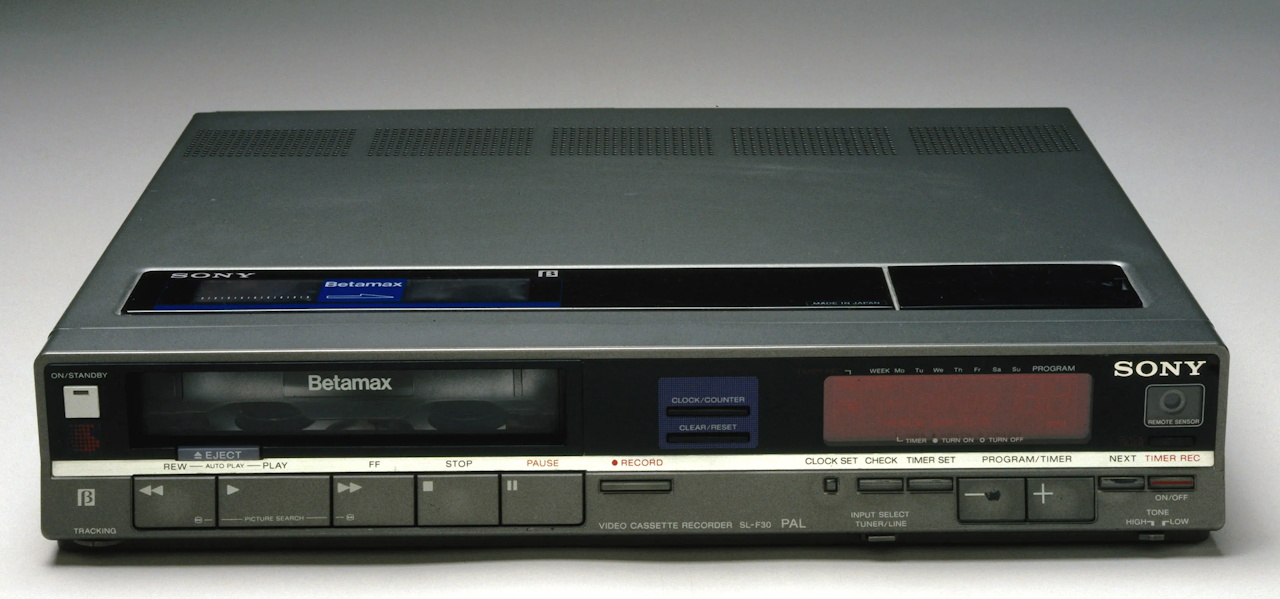
Star Trek: The Next Generation Re-Watch – Season 7, Episode 15: Lower Decks

Spoiler Warning: Spoilers will be present for The Next Generation and for other iterations of the Star Trek franchise.

It’s only a couple of days now until the premiere of Star Trek: Lower Decks – at least for viewers in the United States. The franchise’s first full animated series in over forty years looks like it’s going to be hilarious… but did you know that it isn’t Star Trek’s first “Lower Decks”?

On the 7th of February 1994, Star Trek: The Next Generation aired the fifteenth episode of its seventh and final season. The episode was titled Lower Decks, and much like the new show, it took the action away from the main cast and the bridge crew. The episode wouldn’t be broadcast in the UK until April 1996 (that’s when I will have first watched it, as I was an avid Trekkie even in those days!) Let’s hope that ViacomCBS doesn’t plan on making us wait anywhere near as long as two years to get the new Lower Decks.

With the new show coming out, I thought it could be fun to step back in time twenty-six years and revisit the first Lower Decks.

No, not that one…

By this point in the history of the franchise, Star Trek shows had expanded well beyond a small cast of regular characters. Where the “redshirts” of The Original Series had been, to put it politely, one-time use characters by and large, The Next Generation had a handful of secondary characters who would augment the main cast. Ensign Ro, Guinan, Chief O’Brien, Lt. Barclay, Nurse Ogawa, and several others all had roles to play, and as the show went on some of them came to be increasingly prominent. This was a concept that Deep Space Nine would expand greatly, and that series had a far larger secondary cast, some of whom – particularly in later seasons – would be incredibly important across whole story arcs.

Lower Decks looks at four junior members of the Enterprise-D’s crew (and one civilian). Only two – Nurse Ogawa and Sito Jaxa – were familiar to us before the episode aired. Ogawa had been a regular character in scenes set in sickbay since the fourth season, and Sito had appeared in the fourth season episode The First Duty. The other three were new for this episode, but all would have significant, interconnected roles in the story. The episode can be overlooked when it comes to thinking about The Next Generation’s best offerings, in part perhaps because its premise means it spends so much time away from the main cast. I confess that I overlooked it myself when I put together a list of ten great episodes from The Next Generation a couple of months ago; I didn’t even consider it a contender! However, it’s a fantastic story and a great piece of television. While it isn’t unique in the Star Trek canon – Deep Space Nine would have many episodes where secondary characters were the focus, and the episode Good Shepherd, from Voyager’s final season, similarly features junior crewmen – it was unusual for The Next Generation, and features some genuinely emotional moments. Stellar performances from all of the guest-stars elevate the episode, and make what was an interesting story into something truly great to watch.

Nurse Ogawa would go on to have roles in two films – Generations and First Contact.

At this point, almost a quarter of a century from when I first saw it (gosh does that make me feel old) I’ve seen Lower Decks a number of times. I wouldn’t like to guess how many, but The Next Generation is probably my most re-watched Star Trek series so it’s been a fair number, I can tell you that! I’m always happy to go back, though, and this will be my first time writing about it and taking a deeper look at some of the moments within.

Lower Decks opens with Commander Riker and Counsellor Troi sitting in Ten-Forward. They’re engaged in something we almost never saw them do in The Next Generation – managing the ship’s crew! On a ship with a complement of over 1,000 people, this must be a huge task, yet with all the other adventures and hijinks that befall the crew, we never really get to see these quieter moments or the more “boring” tasks involved in running a starship of this size. This is actually something I hope we’ll see some of in the new Lower Decks, as I feel it’s an under-explored side of Star Trek and life aboard a Federation starship.

Troi and Riker are the Enterprise-D’s human resources department.

While they discuss officer assignments and promotions, a group of younger officers are seated a few tables away. This is where we meet the episode’s real stars – in addition to Ogawa and Sito there’s Ensigns Lavelle and Taurik, as well as Ben, the waiter in Ten-Forward. While the others are enjoying their evening away from their duties, Lavelle is obsessed with the prospect of promotion. This character setup was great, painting Lavelle as the career-obsessed type and showing that the others find it easier to relax. Setting up Lavelle’s fixation on his promotion will pay off a bittersweet moment for him at the end of the story.

This kind of story can be difficult – in the space of a couple of minutes the show has to set up several new characters and their relationships in a way that feels natural and not like there’s a huge dump of exposition on the audience. It’s really only Nurse Ogawa who’s familiar to the audience; Sito hasn’t been seen in three years at this point, and the others are brand new. So it was a clever scene, and I think it achieved its goal of introducing us to the episode’s main characters.

The group in Ten-Forward.

Riker and Troi’s conversation turns to promotion, specifically for the night-duty Ops officer. This is a role that both Lavelle and Sito are contenders for. Ben, the waiter, overhears, and after the tiniest amount of persuasion from the junior officers spills the beans; I get the impression this is something he takes a lot of satisfaction in doing! Setting up a conflict between the friends is an interesting way for the episode to go, and of course there’s only one job so one of them will be disappointed.

Sito and Lavelle are left stunned and concerned, and then the title sequence rolls. I will always love The Next Generation’s theme – even though it was, of course, “borrowed” from The Motion Picture!

After the credits roll, Riker is in the Captain’s chair on the Bridge, ordering a phaser lock. Sito is at tactical, with Worf standing over her shoulder, and Lavelle is manning the helmsman’s position next to Data. They’re conducting a battle drill – though that may not have been immediately obvious – and Riker seems a little disappointed with their response time.

Riker in command during the battle drill.

Riker seems to be harsh on Lavelle, reprimanding him for saying “aye aye” instead of “aye”, while in main engineering, Taurik is tasked by La Forge with writing up the battle drill report. Sito seems to be the one who really messed up – after the ship changed course she had to re-lock the phasers which delayed firing on the target. However, Riker seemed to take it easy on her, offering her advice instead of cracking down, and compared to how he treats Lavelle it’s clear who he favours.

Captain Picard emerges from his ready-room and orders an immediate course change, postponing a scheduled rendezvous, as the ship has received new orders. Picard summons the main crew – Data, Riker, and Worf – to the observation lounge, and Riker assigns Sito to the ops station next to Lavelle, who seems put out by her being given the role ahead of him. The system they’re travelling to is close to Cardassian space, and there’s some discussion about why they may be going there, and the two share a cute moment when Sito uses the expression “spider under the table” to mean a “fly on the wall” – eavesdropping on the senior officers’ chat.

Lavelle and Sito on the bridge.

Lavelle is worried that Riker favours Sito for promotion over him, but it doesn’t seem to hurt their friendship at all – despite knowing they’re effectively in competition their friendship remains solid. I liked this characterisation; if Lavelle became too cold, distant, and unkind toward Sito he’d be much harder to root for as a character.

In engineering, Taurik tries to show La Forge a theory he learned at Starfleet Academy to increase the ship’s engine efficiency. La Forge initially seems interested, but Taurik may have jumped the gun by suggesting it be rolled out to the Enterprise’s engines without completing a simulation first. Taurik has other ideas to help too, but La Forge – seemingly annoyed – basically tells a confused Taurik to get back to him later.

La Forge listens – briefly – to Taurik’s proposal.

Two things come out of this for me: the first is that Lavelle and Taurik have comparable issues with their commanding officers. And secondly, we see how a junior officer can feel that they’re being treated not necessarily unfairly, but perhaps that they feel they’re taken less seriously. The Next Generation in its first few seasons would sometimes put the character of Wesley Crusher in a vital position where his ideas and plans were listened to by the whole crew; this episode feels, at parts, like a total reversal of that. The way Taurik is treated by La Forge here is just one example.

The next scene features Nurse Ogawa in sickbay. In contrast to how Taurik and Lavelle have, at best, complicated relationships with their superiors, she and Dr Crusher are on much more friendly terms. To the audience this undoubtedly makes sense – Ogawa is a character we’re much more familiar with as by this point in The Next Generation’s run she’s already made thirteen appearances going back over three years; she’s a character we’ve seen in sickbay often, and her relationship with Dr Crusher has been touched on previously. Ogawa is being recommended for a promotion to lieutenant – if only it were that easy for Sito and Lavelle!

Dr Crusher uses Ogawa’s first name – Alyssa – and they talk about her personal life and who she’s dating. Ogawa treats her as a friend, and I loved this dynamic.

Ogawa learns of her impending promotion to lieutenant.

The ship drops out of warp, and back in Ten-Forward, Sito is talking to Worf about her brief stint manning the ops console. Worf is the one who recommended Sito for the position – and on the other side of the room, Taurik, Lavelle, and Ben the waiter are looking on. Ben is on first-name terms with Commander Riker, much to the shock of Lavelle. Taurik and Ben convince him to strike up a conversation with his commander, as getting to know him on a personal level might improve their relationship.

What follows has to be one of the best scenes in the episode. Lavelle makes a truly cringeworthy attempt to talk to Riker, mistakenly believing him to be from Canada when he’s in fact from Alaska, and generally making a fool of himself in a moment that I certainly could relate to – and I’m sure lots of people who’ve made conversational missteps can too! As mentioned, Lavelle could have come across as a kind of selfish and egotistical glory hunter, chasing his own promotion and ignoring his friends if the character had been less-well written. But this moment, and the other with Sito on the bridge, go a long way to humanising him and making him relatable.

Though Lavelle doesn’t see it, as he excuses himself and slinks away, there seemed to be a moment of hope for his cause at the very end; despite everything, Riker was at least amused by the conversation and smiled to himself.

Lavelle realises his chat with Riker is not going well.

The Enterprise-D is holding position 5,000km from the Cardassian border – which is practically a stone’s throw when dealing with the vastness of space. Captain Picard is concerned, seemingly waiting for a ship to arrive, when Worf detects a small object that could be an escape pod. The pod is 50,000km inside Cardassian territory, and the captain wonders aloud how it will be possible to retrieve it. The only one of the ensigns present on the bridge in this moment is Lavelle, and from this point on the episode begins to split the characters up for important events.

I love this setup – each of the characters, as the episode progresses, will learn part of what’s going on, but it won’t be until the very end that they can put all the pieces together and establish the whole story. This is what really gives the episode its unique feel; following the junior officers who don’t know everything that’s happening but must carry out their orders regardless.

In engineering, Taurik and La Forge work to increase the effectiveness of the transporter to be able to beam the individual from the life support pod onto the ship. I have to confess at this point that I feel that 50,000km seems like a very limited range for the transporter. I wouldn’t like to say with certainty, because Star Trek in general can be vague with things like distances in the few instances where we get specifics, but I’m reasonably sure we’ve seen the transporter used over greater distances before with no issues.

La Forge and Taurik work on beaming the occupant of the life support pod to the ship.

Interestingly, and continuing the theme of the junior officers not knowing the full story, La Forge orders Taurik not to scan the life pod’s occupant to determine his or her species. Again – this seems like something that might be helpful or even necessary for using the transporter, but Star Trek’s technology is vague enough that it can be made to fit circumstances like this!

In sickbay, Ogawa helps Dr Crusher prepare for the arrival of the mysterious figure, but when they’re ready Crusher orders her to leave the room. In the hallway she meets Sito, who has been posted at the entrance to sickbay in her capacity as a security officer. They wonder aloud what’s going on; Sito isn’t letting anyone but the senior officers inside. As Ogawa departs, Captain Picard arrives and seems to briefly hesitate when greeting Sito.

Ensign Sito and Nurse Ogawa wonder what’s happening in sickbay.

Lavelle asks Riker on the bridge if he can work another shift; he says he needs the extra training, but Riker tells him it’s a bad time. Captain Picard leaves sickbay and orders Sito to accompany him. En route, he asks her if she’s a qualified pilot, and in his ready-room queries her past record from the Academy – the events of the Season 4 episode The First Duty. In that episode, Sito, Wesley Crusher and a couple of other cadets were involved in a plot to cover up the death of a fellow cadet who died during an illegal flying manoeuvre. Sito defends herself to the captain, and defends her record and her character.

We see Picard being far more harsh than usual, and something definitely seems “off”. Picard has always believed in telling the truth, as indeed we saw in the episode in question. But he’s also a believer in second chances; Sito would never have been allowed aboard the Enterprise-D without his permission, so his words seem overly critical and perhaps even unfair.

Ensign Sito and Captain Picard in the turbolift.

In one of the shuttlebays, Taurik is using some kind of beam on a shuttlecraft. It wasn’t obvious at first, at least not to me, but it’s revealed in short order that he is in fact firing a phaser rifle at it, “intentionally damaging” it as he puts it. La Forge tells him it’s a requirement to test shuttles in this manner from time to time, but like Taurik, the audience is just as surprised at such an odd regulation!

Taurik cottons on pretty quickly – La Forge is making it seem as though the shuttle was escaping an attack. He tells the junior officer it’s a coincidence – but both of them know that the other knows the truth. The way Taurik is presented is very much in line with other Vulcans – he’s very clever, but also not at all subtle about concealing the fact. Instead of keeping to himself what he knows about the work he’s doing on the shuttle, he shows off to La Forge that he’s figured it out – in spite of the fact that it could potentially cause problems for him.

Taurik fires his phaser rifle.

In sickbay, Dr Crusher swears Ogawa to secrecy before revealing their patient – a comatose Cardassian! It couldn’t be anyone else this close to Cardassian space, right? The seventh season of The Next Generation was running concurrently with Deep Space Nine’s second season – in fact, the day before Lower Decks premiered, the 14th episode of Season 2 had aired. So by this point in the history of Star Trek, the Cardassians have taken shape as a significant antagonist faction.

The junior officers – and Ben – are playing poker while off-duty in the next scene, and of course conversation turns to why they are where they are and what might be happening. Sito is of course upset because of her conversation with Picard. Playing poker has been a hobby of the Enterprise-D’s crew for the whole run of the series, and giving the junior officers the same hobby ties the two groups together neatly (if somewhat transparently).

The poker game.

The scene is juxtaposed with the senior officers’ poker game – where the topics of conversation are the junior officers! Riker disagrees with Worf recommending Sito for the role at ops, and Dr Crusher has spotted Ogawa’s boyfriend talking to someone else in Ten-Forward. The scenes jump between the two poker games in what is a pretty clever sequence.

I once again liked Lavelle’s conversation with Sito – despite wanting the promotion for himself, he reassures her when she’s feeling low after her dressing-down from Picard, strongly emphasising their friendship is what matters most to him. The poker games draw a comparison between Lavelle and Riker, something which Troi also picks up on, to Riker’s annoyance. Riker wins his hand, but Lavelle loses; he was bluffing. Perhaps that says something about the positions the two men are in?

As several people depart each poker game, La Forge arrives at Taurik and Lavelle’s quarters to summon Taurik to engineering.

La Forge and Taurik in the latter’s quarters.

Ben is the only character who’s able to flit between the two groups – and as Lavelle retires to bed, he joins the senior officers’ poker game. The next day, Worf springs a surprise test on Sito in her martial arts class – he claims it’s a Klingon ritual that the test must be unannounced. He blindfolds her and proceeds to beat her several times in a row.

Sito eventually protests; removing the blindfold she declares is isn’t a fair test. Worf tells her that she has passed – the test was not about defeating him while blindfolded, but about standing up for herself. Combined with what she’s just been through with Picard, the sense that the senior officers are all testing her is starting to build!

Worf blindfolds Sito for his “test”.

Inspired by the lesson from Worf, Sito heads straight to Captain Picard’s ready-room to respond to what he had told her earlier. Standing up for herself, she insists that if he won’t judge her fairly, she wants to be transferred to another ship.

Captain Picard wasn’t being unfair or unduly hard on Sito for no reason. As we suspected, he had an ulterior motive. The ops position will have to wait; Sito is being assessed to see if she’s capable of being given a very dangerous assignment – she’ll learn the details at a briefing with the senior officers. I’m glad that Captain Picard had a proper reason for treating her the way he had earlier; it seemed to run very much against his character and it needed an explanation!

Captain Picard listens to Ensign Sito defend herself.

A brief scene in sickbay sees Ogawa telling Dr Crusher that her boyfriend had proposed – Dr Crusher had been seconds away from telling her about seeing him with another woman! The action then cuts to Sito’s briefing. Captain Picard, Riker, and Worf are joined in the briefing room by the Cardassian from the escape pod. His name is Joret Dal, and he’s a Federation spy who brought them information about Cardassian military operations, and he now has to get home.

The mission sounds very dangerous – Sito is a bargaining chip to help Joret Dal cross the border, and when he makes it he’ll launch her home in an escape pod. The border is heavily militarised, and crossing it will almost certainly mean they’ll be intercepted by the Cardassian military. However, he believes that if he has a “prisoner”, it will make the crossing easier.

Joret Dal, the Cardassian spy.

It isn’t clear how or why Joret Dal came to work with the Federation, but Sito readily agrees to the mission. Earlier, Captain Picard had told her he asked for her to be assigned to the Enterprise-D to she could have a chance to “redeem” herself after the incident at the Academy; I can’t help but feel she sees this mission as her shot at redemption.

Sito is ordered to report to sickbay, and to keep the mission secret from everyone – which of course includes her junior officer friends. Out of everyone present, it’s Worf who seems to be most concerned for her safety. Captain Picard didn’t order her to undertake the mission, but in a way, being in the room with the captain, first officer, and the Cardassian spy put her in a very uncomfortable position if she had wanted to refuse. Combined with what Captain Picard said earlier about redemption, there’s an element of psychological persuasion going on that isn’t acknowledged, but is definitely present. Despite the way it’s presented as being Sito’s choice, I confess I find the circumstances a little concerning. She wasn’t coerced, not exactly. But she was certainly placed very deliberately into a position where refusing the mission would have been very difficult.

Ensign Sito accepts the mission.

As Sito departs, Worf looks very concerned. Joret Dal says “I didn’t realise she would be so young”, clearly foreshadowing what’s to come. At the damaged shuttle, Worf and La Forge are with Joret Dal. Sito arrives, having been made-up by Dr Crusher to look as though she had been hurt. Worf is even more alarmed at seeing her; he clearly cares deeply for her – in a platonic way, of course.

Sito expresses her thanks to Worf before departing aboard the shuttle – again, more foreshadowing and setting up what’s about to happen. After telling him she’ll see him soon, Worf is left to stand watching as the shuttle door closes, leaving her alone with Joret Dal and about to undertake the mission. Seeing a sensitive side to Worf may not be something I would’ve thought I’d have wanted to see, but it absolutely was. He was almost behaving like a father or older brother to Sito, building up her confidence and looking out for her. It’s a side of him that we don’t see often, despite him having a son of his own.

Worf watches wistfully as Sito boards the shuttle.

Aboard the shuttle, Joret Dal tells Sito he doesn’t consider himself a traitor for working with the Federation. He feels that the Cardassian military engages in too many pointless battles with the Federation, and no longer serves Cardassia properly. His motivation isn’t that of a spy, but of a patriot. His character, which doesn’t get much screen time and thus could have come across as wholly one-dimensional, ends up feeling very real and well-rounded in just this short scene.

Sito and Joret Dal share a moment – they both realise that they have at least over-generalised each other’s people. She never thought she’d see a Cardassian who was tired of war, and he never thought he’d meet a Bajoran who would help him. There are two strong moral lessons in these moments for us as the audience: war and international relations are far more complicated than it may ever seem, and it’s possible to misjudge someone on the basis of their background or even their race.

The shuttlecraft.

The scene ends when a computer alarm signals a patrol ship is moving in. Sito moves to the back of the shuttle where Joret Dal handcuffs her. She looks anxious as the mission approaches its most crucial phase.

In Ten-Forward, Lavelle, Taurik, Ogawa, and Ben are wondering where Sito has gone. Lavelle is convinced that she left aboard the shuttle, and he knows it was heading across the border. All four are concerned. Taurik has the most telling line: “we have to accept that we’re not told everything that happens aboard the ship.” Lavelle wants the three to share what they know, and is upset that Ogawa and Taurik can’t share what they know.

The group at the bar in Ten-Forward.

Thirty hours later, Sito hasn’t returned to the rendezvous point in her escape pod. On the bridge, Lavelle, Data, and Riker are attempting to locate the pod. Worf recommends launching a probe, and despite launching a cross-border probe being a violation of the treaty with the Cardassians, Captain Picard okays it.

The probe almost immediately detects debris – Data confirms it’s the right consistency to potentially be the escape pod. Later, the Enterprise-D intercepts a Cardassian message confirming they destroyed the pod, and that Sito was inside.

Lavelle realises Sito has died.

Captain Picard makes a statement to the crew via the intercom, letting them know that Sito has died. Taurik hears it at his post in engineering, Ogawa at hers in sickbay, and Lavelle at his station on the bridge. Ben was, sadly, omitted from this sequence. However, even now, even after seeing this episode so many times over the years, this moment packs an emotional punch. Captain Picard speaks about Sito in glowing terms, in sharp contrast to his first conversation with her, and her death clearly has a huge impact on her closest friends.

Nurse Ogawa learns of Sito’s death.

In Ten-Forward, Worf sits alone and doesn’t even acknowledge Ben, who has brought him a drink. Lavelle joins Taurik and Ogawa and reveals he’s been promoted to lieutenant, though he feels absolutely no joy in getting what he wanted at the beginning of the story. He’d trade it in a heartbeat to have Sito back.

Taurik, Ogawa, and Ben comfort him, telling him Sito would have been happy for him, and to honour her by performing his new role to the best of his ability. Ben talks to Worf, inviting him to join the others in mourning and remembering Sito, telling him that she considered him a friend, not just a superior officer. He joins Lavelle, Ogawa, Taurik, and Ben silently, and the episode ends as they prepare to remember their friend.

Worf joins the junior officers.

So that was it. The first Lower Decks. What started out as a story with an interesting premise turned into one of the emotional high points of the whole season. It’s a story which still has me tearing up a quarter of a century on, and despite the fact that we didn’t know Sito or her friends terribly well, the episode did a phenomenal job getting across their relationships, which were at the core of what made the story so emotional.

The new series may have its emotional moments too – we don’t know for sure yet, but many comedy shows have a balance between funny and emotional moments. I’m looking forward to seeing what Star Trek’s latest show, and first animated series in four decades, will have to offer, and it provided a great excuse to step back in time and re-watch the first Lower Decks.

If I were thinking of characters to bring back for a future iteration of Star Trek, the junior officers we met in Lower Decks would absolutely be contenders. I wonder if the new series will make any reference to them, or to the events of this episode. If it did, it would be a neat little tie-in between The Next Generation and the new Lower Decks.

It’s only a couple of days now, so I hope you’re ready! Check back here regularly while Lower Decks is on the air for episode reviews, theories, speculation, deep dives, and more.


Star Trek: Lower Decks begins on the 6th of August for viewers in the US and Canada. The Star Trek brand – including Lower Decks and The Next Generation – is the copyright of ViacomCBS. This article contains the thoughts and opinions of one person only and is not intended to cause any offence.
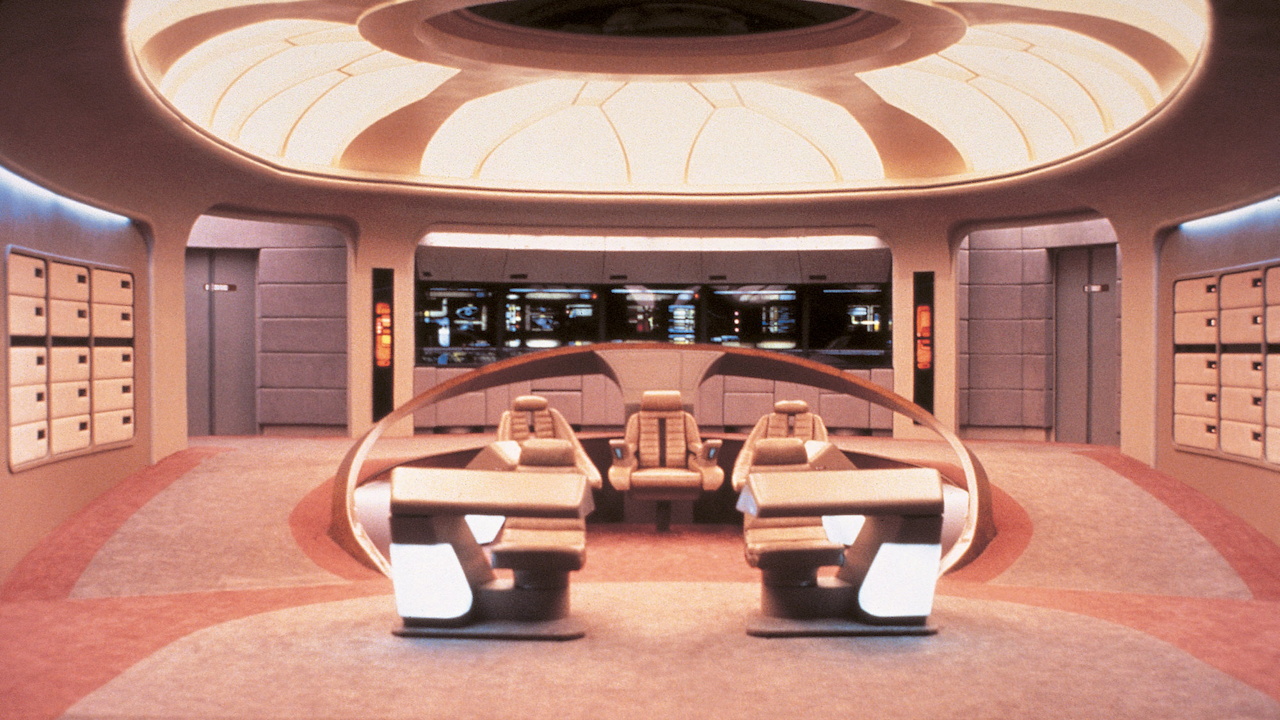
Star Trek: The Next Generation Re-Watch – Season 2, Episode 9: The Measure of a Man

Spoiler Warning: There will be spoilers for the first three episodes of Star Trek: Picard – as well as for The Measure of a Man from TNG Season 2.

When I was compiling two lists of episodes to watch prior to the release of Star Trek: Picard, I only included The Measure of a Man, from The Next Generation’s second season, as an afterthought in one of my “honourable mentions” sections. Despite having seen some androids briefly in one of the trailers, and even after having seen Mars come under attack in the Short Treks episode Children of Mars, I still wasn’t convinced this episode would be important. I wound up including it in my second list of episodes, but not because of androids or Bruce Maddox, but because of how it showed an aspect of Picard’s character – his staunch defence of the rights of different life-forms.

We now know, of course, that Maddox has a key role in Star Trek: Picard, though whether he’s actually going to appear in person or is merely a narrative force is unclear right now. And of course we’ve learnt a lot more about synthetics and the development and subsequent prohibition of synthetic life. Thus, at this point, The Measure of a Man warrants a re-watch and a closer re-examination.

Watching an episode so long after its original airdate, and after we’ve seen so much Star Trek content that was produced subsequently, it’s worth trying to stay objective and be aware of where the three characters we’ll be focusing on are at this point in the timeline. Obviously Maddox was a guest star, and aside from a reference in the fourth season, was never seen or heard about again until Picard premiered. But Data and Picard are arguably different than we might remember considering how early we are in The Next Generation’s run. This episode aired before Q Who introduced the Borg, before Picard was assimilated, and before Data had really developed a strong personality that extended beyond his original programming.

Data plays poker with his crewmates in the opening scene from The Measure of a Man.

The Next Generation operated differently to Discovery and Picard – it was much more of an ensemble show with each crewmember having their own stories and episodes, rather than focusing primarily on one character’s story. So Data and Picard, by this point in the show, still have significant parts of their backstories unexplored.

The episode opens, as many episodes of The Next Generation did, with Picard narrating his captain’s log. Nothing too exciting – the Enterprise-D is due to dock at a starbase, pick up and drop off some members of the crew, and switch out some science experiments that have presumably been running in the background. On board, we see Data, Riker, O’Brien, La Forge, and Dr Pulaski playing poker. Data seems confused by some of the “superstition” that the others apply to their playing – he can’t quite grasp the concept of “luck” in a game of chance. Again, it’s worth remembering how early we are in Data’s story! This might be the first game of poker he’s played, and just as he struggled with the others feeling lucky or unlucky, he was completely unprepared for bluffing – it’s such an illogical way of playing, after all.

In this moment, Data is still very much a machine, regarding the game as “simple”, based around mathematical probability and assuming that everyone will play logically. Having this sequence be the setup for an episode about taking him apart to find out what makes him tick is an interesting choice; we see Data at his most mechanical, but we also see in him an adaptability and a desire to learn and grow. The costuming choice to give Data a poker visor was also a great call – he’s approximating and mimicking human behaviour, but without fully understanding it.

Seeing Data easily outmanoeuvred by Riker – despite holding a better hand – emphasises how much he still has left to learn. Riker wasn’t betting on the strength of his cards, he was simply betting that Data would fold – Data thus missed a key element of playing poker. But he learns from this experience, much like a child would.

As an interesting aside, the next shot shows the Enterprise-D approaching Starbase 173. The model used for the Starbase was in fact a re-use of the Regula One station from Star Trek II: The Wrath of Khan and is virtually unchanged in its appearance (except for, I believe, its scale in relation to the Enterprise-D). This model was itself a re-use from Star Trek: The Motion Picture. With CGI generally being so good nowadays, it’s almost hard to imagine a time when a single model would have to be re-used over and over again – and The Measure of a Man was not the last appearance of this model by any means.

Aboard the station, Picard is reunited with Phillippa Louvois, accompanied by a very romantic soundtrack. He seems very surprised to see her, and she is clearly an old flame of his – someone who he didn’t part with on good terms judging by their conversation! But the passage of time can be a great healer, and where other people may have held a grudge, Picard is amused, and maybe even happy to see her again. The credits roll, and then we’re back with Picard and Louvois, sitting down to have a longer conversation.

Louvois holds the rank of captain – putting her on equal footing with Picard – and her uniform matches his. She’s not the first woman captain featured in The Next Generation – there was at least one other in Season 1 – but she gets a significant amount of screen time here. She explains that she’s the JAG (judge advocate general – i.e. a military judge, or in this case a Starfleet judge) for this sector, and the way she talks about it makes it seem like a remote part of the Federation, far from any other Starbases. It’s the frontier!

The Enterprise-D at Starbase 173.

We find out about Louvois’ history with Picard – she was the officer responsible for his court-martial after his previous command was lost. We’ve seen the Stargazer before in The Next Generation, in the episode The Battle, and we also know that Dr Crusher’s husband was serving on the Stargazer under Picard’s command when he was killed. Louvois says that a court-martial is “standard procedure” when a ship is lost, but Picard accuses her of being overly aggressive in her prosecution of him – and says that’s why she left Starfleet for a time. There’s a very complicated history here. Louvois calls Picard out on his arrogance – which to be fair, he actually was in this scene. But the chemistry and sexual tension between them is noticeable – there’s much more to their relationship than something professional or friendly.

After the awkwardness of seeing Picard called a “damn sexy man”, an Admiral approaches and Louvois excuses herself – but not before taking the opportunity to try to embarrass Picard in front of their superior. The Admiral introduces Commander Bruce Maddox, but they don’t immediately discuss Maddox’s proposal as the Admiral wants a tour of the Enterprise while it’s visiting his new Starbase. Maddox joins the Admiral on the tour, and they visit the Enterprise’s bridge. There is some discussion of the Starbase’s location being near the Neutral Zone, but the focus is clearly on Maddox, cutting to a close-up of him staring at Data.

Maddox interrupts the small-talk about the Romulans and the legacy of past starships Enterprise, clearly impatient. The Admiral tells Picard that Maddox is here “to work on your android”, then promptly leaves the bridge. Data, Picard, and Maddox have a conversation set to a backdrop of very tense music. Clearly all is not well. Maddox, it turns out, opposed Data’s entry into Starfleet Academy some years prior, claiming Data was not a sentient being and was thus not eligible. Picard asks what Maddox plans to do and he replies calmly that he is “going to disassemble Data.”

The way Maddox has been set up thus far is of someone who is impatient and impersonal – arguably lacking in empathy. He refers to Data as “it”, a term one might use for an inanimate object. Data is, anatomically speaking, male. In the second episode of The Next Generation’s first season, The Naked Now, Data sleeps with Tasha Yar and though we don’t see it on screen it’s confirmed that he is, for all intents and purposes, male. So Maddox dehumanising Data in this way, while subtle, shows us the kind of person he is.

Maddox explains his reasoning in the next scene – seeing Data when he first applied to the Academy sparked a desire in Maddox to learn more about the work of Dr Soong, Data’s creator. His intention is to dismantle Data, learning how he functions, in order to recreate him and produce copies. Maddox believes himself to be close to a breakthrough, and Data is intrigued at the prospect, in part no doubt because he’s been essentially alone as the only one of his kind. Riker, on the other hand, seems much more concerned. Data asks Maddox a technobabble-laden question, and when Maddox replies that he hasn’t been able to get the basics of a positronic brain working, Data’s tone changes from interest to concern – and after a couple more questions from both Riker and Picard, Data pipes up and says that Maddox’s research is inadequate. Picard says he will not allow Data to undergo the procedure, but Maddox has a trump card – Data is to be reassigned under his command.

Maddox makes his case to Picard – as well as to Riker and Data – in the briefing room of the Enterprise-D.

In the next scene, Data arrives in Picard’s ready room and the two have a conversation about what to do regarding Maddox. Data says he will not undergo the procedure, but Picard is playing devil’s advocate – wondering aloud whether there is merit to Maddox’s idea. Data uses the example of La Forge’s visor, and claims that his status as a non-human is why Picard would even consider letting Maddox experiment on him. Picard dismisses him but is clearly troubled by the implications. He gets to work reading Starfleet case law regarding officer transfers.

After what must be some time, Picard visits Louvois in her office aboard the Starbase, and is clearly very angry about Data’s forced transfer. The usual calmness we associate with Picard is gone, replaced by a firey demeanour borne perhaps from a combination of frustration at the legalese he’s been trying to wade through and his previous conversation with Data. After all, Data did essentially say that Picard and Maddox are being racist (or species-ist) in their treatment of him. Louvois gives Picard a “nuclear option” for getting Data out of the procedure – his resignation. There’s no other way to stop the transfer, and as Picard doesn’t trust Maddox, this seems to be the only way. Again the complicated past between Picard and Louvois complicates their conversation, but the advice she gives him is sound. And as she’s the senior officer in the sector for legal matters, that should be it.

Back aboard the Enterprise-D, Data is packing his belongings, and pauses briefly over a hologram of Tasha Yar. Maddox enters the room while Data has his back turned, and picks up a book that Data had been reading. Barging in without ringing the door chime is another way Maddox demonstrates to the audience that he doesn’t regard Data as warranting the same rights or respect as a human or other life-form. He tries to reassure Data that his knowledge and memories will remain intact despite the procedure, but Data retorts that the facts may remain, but the feelings associated with them will be lost. He then uses the example of the poker game from earlier in the episode – that the moment-to-moment reality, the essence of his experiences, is not just a case of data and facts. Maddox, Data claims, does not have the necessary expertise to preserve Data’s memories and personality.

It’s at this moment that Data explains that he has resigned. Maddox becomes angry and tells him that one way or another he will serve under his command – and undergo the procedure. It’s clear that Maddox’s attempts at gentle persuasion were all for show; this is how he really feels. Believing Data to be a “thing”, an object not a person, he pays lip service to Data’s feelings while not understanding them or even recognising their existence. In the next scene, Picard and Maddox are in Louvois’ office, where Maddox has started a legal process to prevent Data leaving Starfleet, saying that as a non-sentient being he cannot resign of his own volition.
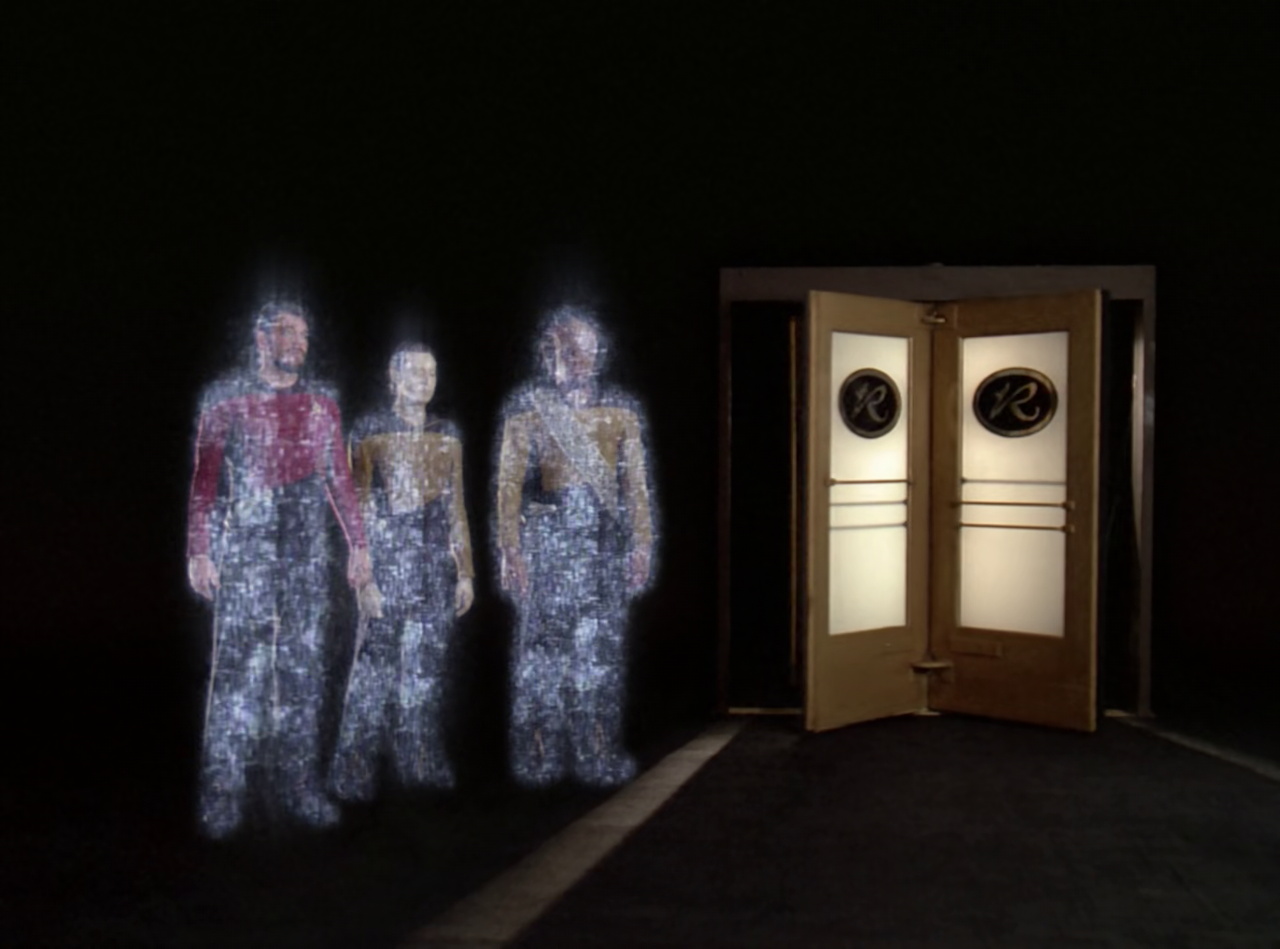
Maddox presents the argument that if he’s successful, every Federation starship could have its own Data on board, allowing for much greater exploration and potentially even saving lives. He’s “sick of hearing about rights” – a shocking statement in and of itself – and selfishly makes the point that this is his life’s work, and he doesn’t want it to be ruined by what he sees as the ignorance of Picard and Louvois. Data, in Maddox’s view, is “just” a machine, and because of that does not have the right to either refuse to undergo the procedure or to resign.

While Picard listens in, Maddox makes his case to Capt. Louvois.

Picard has a great line here: “Starfleet is not an organisation that ignores its own regulations when they become inconvenient.” In Remembrance, the first episode of Star Trek: Picard, this is essentially his own reasoning for leaving Starfleet. He felt that they had an obligation to help the Romulans and failed to do so – ignoring their own regulations, and a promise made, because it had become difficult in the aftermath of the attack on Mars.

Maddox manages to convince Louvois that there may be law to support the notion that Data – like the Enterprise’s computer – is not a “person” in the legal sense, but is merely the property of Starfleet. Picard urges her to use the same passion she showed at his court-martial. Though Maddox and Picard don’t interact much here, as they mostly direct their remarks to Louvois, it’s clear that they have very quickly developed a loathing for one another. Picard feels Maddox is essentially ignoring Data’s rights as a sentient being, and Maddox believes that Picard doesn’t understand the issue and is unfairly getting in the way of his work.

Back aboard the Enterprise, Data is attending a farewell party. Riker, Troi, Worf, Pulaski, and Wesley are all present in Ten-Foward, and Data receives several gifts from his friends, but La Forge is sat alone, away from the group. He’s feeling very down about the whole situation. In this moment, we see Data at his most human – La Forge is arguably his best friend among the crew, and when he says he will miss him, he really means it.

Louvois summons Riker and Picard to tell them that, according to her research and legal precedent from 300 years ago, Data is legally the property of Starfleet and not a person. Picard challenges her ruling, but the fact that the Starbase is new and she has no one working with her threatens to cause a problem. The solution is that Picard and Riker will take on the role of advocates – Picard arguing for Data and Riker against him.

This is the point in the episode which is the most questionable, I feel, as a point of plot. Riker is chosen to prosecute Maddox’s case as a senior officer, but Maddox himself is of equal rank to Riker and would be a better candidate – especially as Riker states very clearly that he can’t advocate a position he fundamentally disagrees with. I’m no expert on the law, let alone on military law, but surely there must be someone else who could have taken on the position. Or, if not, it should have been possible to send for lawyers from elsewhere – Maddox’s experiment is not time-sensitive and could have waited for the case being resolved. As it is, however, Riker and Picard agree to proceed with the case.

La Forge wishes Data good luck at his going-away party aboard the Enterprise-D.

As the scene ends, I think we see the real genius of setting up Louvois as having history with Picard. If he’d been facing off against a random, faceless judge or JAG, we would know the stakes but we’d be confident in his abilities and ultimate victory in the case. But knowing Louvois is a “hardball”, someone who prosecuted Picard aggressively in the past regarding his conduct on the Stargazer, it raises the stakes and there’s a real sense in this moment that Picard and Data could lose. Because we’ve always seen Picard to be a rule-following officer, an exemplar of Starfleet’s code of conduct, and an all-round upstanding captain and diplomat, knowing that Louvois went after him in the past makes her seem all the more aggressive in her handling of the law. We get the sense that things could end badly, that the one factor Picard has no control over in the case – the judge – is someone who will work hard against him and Data. This information, conveyed only in a few brief lines of dialogue in their earlier two encounters in the episode, has set the stage and told us all we need to know.

Data again visits Picard in his ready room, and Picard explains the ruling and the challenge he’s making to it. He offers Data the opportunity to select another officer to provide his defence, but Data declines – an important moment given the earlier conversation they had in the same room. We then see Riker studying the law in preparation for the case, feeling pretty rotten about what he has to do. He looks up Data’s technical schematics, smiling to himself as he thinks he’s found something – then his mood and the background music turn sour as he realises the implications. Riker doesn’t want, after all, to win the case. And getting caught up in it for a moment and allowing himself to feel excitement at a breakthrough ends up making him feel worse about the task.

At the hearing, Riker calls Data to take the stand. Could Data have refused, as he’s essentially being compelled to serve as both evidence and a witness for his own prosecution? I think that’s a matter of law again! And if he did refuse to take the stand, would there have had to have been another case to answer the question of whether he has the right to refuse to testify? Regardless, Data takes the stand and his commendations and decorations from Starfleet are listed by the Starbase computer (notably not the usual computer voice). Riker asks the simple question “what are you?” to which Data responds that he is an android. Riker pushes him for the definition of the word, which includes a sentence that androids “resemble” humans, but are obviously not, in fact, human. He then pushes Data on his creator, making the point that Data was artificially made.

None of this, really, seems relevant to the hearing. Data’s nature is known to all parties and his defence does not depend on proving himself to be anything other than an android. But for dramatic effect it’s important, as essentially the fact that Data was man-made is the entirety of the prosecution’s case against him. Interestingly, and completely unrelated to the events of the episode, Data states that his total memory capacity is “800 quadrillion bits”. If a 24th Century “bit” is assumed to be the same as today’s computer bits, that would put his memory at 800 petabits, or 100 petabytes as there are eight bits to one byte. While this is a lot of memory, it’s not as huge as it may sound even by today’s standards. It’s roughly an order of magnitude less than the most up-to-date estimates of the size of the data stored on the internet, for example. And that’s something which is growing all the time. It is, however, much greater than the capacity of a human brain or memory – though the comparison is an inexact one as we don’t store and process memories and information in the same form. But there are computers and servers in the world today which can store as much or more information that Data can – something which would obviously have been hard to conceive when The Measure of a Man aired in 1989, before the invention of what we know of as the internet today.

Riker looks up Data’s schematics in preparation for the hearing.

As Riker continues with his demonstrations, Maddox is seen smiling to himself – he seems to think the two of them have the case sewn up. Data is forced to bend a steel rod to demonstrate his physical prowess to the hearing, and Riker then removes his forearm and hand – apologising to Data as he does so. Riker then tries to explain that Data was made “to serve human needs”; that is his sole purpose. Of course, having already seen Data with his “brother” in the first season episode Datalore, we know this isn’t really true. Lore was a companion to the colonists on Omicron Theta, and Data was designed to be so too. Riker has also fallen into the habit of referring to Data as “it” in this moment, and as he continues his speech about Data he walks behind him – hitting a hidden “off switch”, which we’d previously seen Data show to Dr Crusher and others in the aforementioned episode Datalore.

Picard and Louvois are both shocked by this, and Riker sits back down. He clearly thinks that this is a case-winning move, and the look of shame and self-loathing on his face confirms that. Maddox smiles, smugly. Picard requests a recess and tells Guinan, back on board the Enterprise, that Riker’s words in the hearing “almost” convinced him of Data’s status.

Guinan’s response, that if Data is ruled to be merely property, it could pave the way for “whole generations of disposable people” warrants a closer look. And we have to step back and consider The Measure of a Man and its place in our own history. In 1989, we’re 25 years out from the Civil Rights Act and Voting Rights Act which put an end to legal segregation in parts of the United States. In living memory for a significant portion of the audience was segregation – itself a hangover from the days of slavery. And this line, delivered in a very calm manner by a black woman, absolutely references slavery without her ever using the term by name. The implication for Picard is clear – if he loses the case, and androids are ruled to be property and not people, it’s the first step to the creation of a slave underclass in the Federation.

This moment changes the way Picard approaches the case. The word “property”, he believes, is merely a euphemism for slavery. And he returns to work with a renewed sense of purpose. Again, given his state of mind in the first three episodes of Star Trek: Picard, I’d direct anyone who says that Picard “would never get depressed” to look to this moment and others from The Next Generation to see how he can become defeatist and sit in self-pity. It took Guinan here to give him the kick he needed, just as it took Dahj to snap him out of how he’d been feeling in Remembrance.
During a recess in the hearing, Picard is counselled by Guinan.

Back at the hearing, Picard says that humans are simply “machines of a different type” to Data, and his mechanical status is not relevant to the case. Picard asks Data to return to the stand, and presents him with the bag he packed earlier in the episode – demonstrating that Data has a semi-emotional attachment to things like his medals and a book gifted to him from Picard. The final item from Data’s bag is the hologram of Tasha Yar, and after some gentle prompting from Picard, Data discloses he and Yar had been intimate – to the surprise of Louvois and Maddox.

Maddox then takes the stand, and Picard runs him through three tests for sentience. This is also, by the way, the first time the Daystrom Institute is named on screen. Maddox lists three criteria for sentience – intelligence, self-awareness, and consciousness. Picard proceeds to quiz him on why these apply to him – a human – and not to Data. Maddox is forced to concede that Data is intelligent and that he’s self-aware, as Data’s intelligence was never in question and he’s clearly aware of his place in the hearing and the potential consequences it could bring.
Maddox then talks briefly about his plans to disassemble Data – to rebuild him and thousands more like him. Picard challenges that by doing so, he will be creating a race of beings – a race that meet two of Maddox’s own criteria for sentience. If there’s even a chance that Data could meet the third, would the Federation have created a race of slaves? This is where we see Picard at the most passionate he gets, not just in the context of this episode but in almost all of his appearances in Star Trek to date. Aside from the emotional reaction he has to the Borg in First Contact, I can’t remember seeing him more energetic and involved. He cares for Data’s rights, but his conversation with Guinan shifted his whole perspective on the case, and now he has an even greater passion and reason to win. He admits to the court that he doesn’t know whether Data has consciousness, nor what that would mean if a race of Datas were created from Maddox’s work. But the implication he makes, as Guinan did earlier, is clear – they’re on a cliff-edge, with slavery at the bottom.

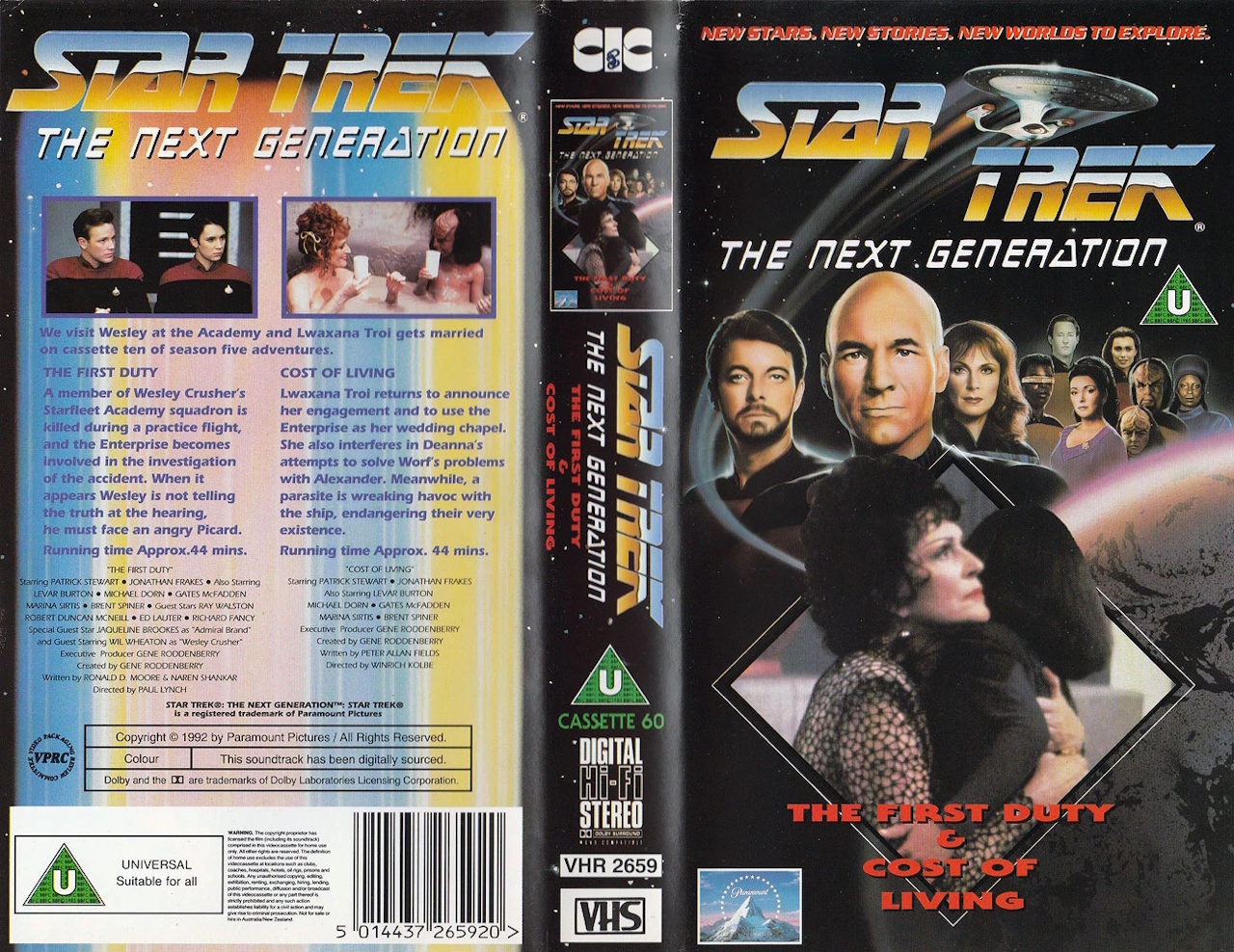
Picard also turns on its head the Starfleet mantra – “to seek out new life”. “There it sits,” he says as he gestures to Data. As he concludes his speech we see Riker smile for the first time since the hearing began. He’s never seen Picard so animated, and he clearly thinks the argument is a case-winner. And in short order he’s proven right. Louvois says she must allow Data the freedom to explore his life and consciousness for himself, and without explicitly ruling on his “personhood”, she rules that he is not the property of Starfleet and that he has the right to choose.

Bruce Maddox takes the stand.
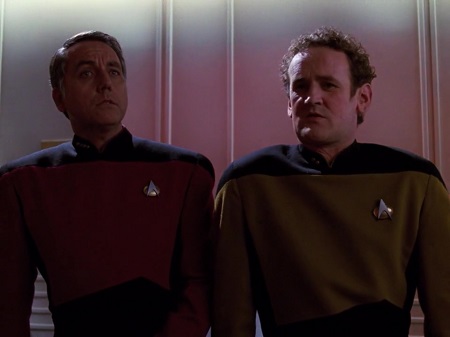
Maddox and Data have a moment of semi-reconciliation at the end of the hearing, as Maddox cancels the order to have Data transferred, and Data tells him to keep working and suggests that he may be able to agree to the procedure in future when more work has been undertaken. Maddox, disappointed by the ruling no doubt, appears to have had his opinion and perspective on Data shifted at least slightly by Picard’s argument – emphasised by his use of the word “he” right at the end.

Picard invites Louvois to dinner – as they reconcile too. Back aboard the Enterprise, Riker has declined to attend a party in Data’s favour, feeling that he came too close to costing his friend his life. But Data reminds him that if he had refused to participate, the ruling would have been made against him, and the episode ends with the two of them heading to the party.

So, when considering Star Trek: Picard, what do we get from The Measure of a Man? Obviously we see Dr Maddox, some thirty-five years prior to the events of the new series. We see his attitude toward androids – he considers them to be tools, not people. But we also see his attitude shift right at the end, swayed by Picard’s argument and the time spent with Data over the course of the episode. Maddox, despite moments of smugness, isn’t a classic villain. Instead, the episode shows what is basically a difference of opinion. Maddox, having studied androids from a theoretical standpoint for years, but with no practical real-world experience in living and working with Data holds the opinion that Data cannot be sentient. But Picard, Riker, and others, despite not having the same technical background as Dr Maddox believe Data to be their friend despite his synthetic nature. The episode thus shows the difference between theory and practice – and why practice is usually better and more appropriate!

Maddox obviously continued his work, as Data encouraged him to do. In the episode Data’s Day from Season 4, he dictates a letter to Maddox, confirming this. However, by the time of Star Trek: Nemesis, which takes place around fifteen years later, Data is still believed to be the only extant android – Lore having been disassembled. The discovery of B4 – an earlier version of Data – in that film is thus presented as a big deal. However, as we now know from Short Treks and Star Trek: Picard that teams of androids – albeit rather basic ones from a personality point of view – were working on Mars only a few years after Nemesis, Maddox must have been quite far along in his work by that point. It’s also possible that the discovery and disassembly of B4 provided Maddox with some of the missing pieces of the puzzle that he’d hoped to gain by dismantling Data.

Watching The Measure of a Man divorced from all thought of Picard is difficult, especially as we’re partway through the first season of the new show. But taken as a standalone episode, it’s an interesting piece of drama, the kind Star Trek has always been good at. Without any battles, explosions, or really any action at all, the episode manages to be riveting, especially in the hearing scenes. And of course it’s a great example of Star Trek using its science fiction setting to talk about real-world issues. In this case the issue was slavery rather than artificial intelligence, but looking back on it knowing the way technology has changed since, it can absolutely be viewed through than lens too.

Maddox was, aside from his single reference a couple of years later, a one-off character who served a fairly one-dimensional purpose for most of the episode. Bringing him back in a big way for Picard is something I absolutely was not expecting, and whether we get to see him on screen or not, his influence is all over the show. The Measure of a Man is not required viewing for Picard. The new show is structured and written in such a way that the role Maddox takes in the story could be swapped out for any other name and the story would be identical. But it does provide interesting background and backstory.

The development of a “race” of androids was clearly successful in the years after Nemesis.

Having had Maddox’s name dropped multiple times across the first three episodes, I would be surprised to learn we aren’t going to see him at all. A single reference would’ve been a cute throwback to The Measure of a Man and Data’s Day; a wink to returning fans. But with him being set up as perhaps the creative force behind Soji and Dahj, and with tracking him down being the driving force for the current storyline, I think he practically has to appear – at least in some capacity, even if it’s just in recordings – before the end of the season.

The legal precedent laid down in this episode was clearly not applied throughout the Federation. In the Voyager episode Author, Author, not only does The Doctor – a sentient hologram – have to undergo a very similar legal hearing, but we learn that thousands of Emergency Medical Holograms are being used as labourers in mines and on vessels across the Federation. And of course, in Picard we see that Maddox had been somewhat successful in creating his “slave race” of android labourers. There are disturbing implications there, which I wonder if the show will touch on in later episodes.

I enjoyed going back to The Measure of a Man. I wouldn’t like to guess how many times I’ve seen it already; as with most of the rest of The Next Generation and its spin-offs I’ve watched and re-watched it on a number of occasions.

The fourth episode of Picard premieres tomorrow here in the UK – though if you’re in America you may have seen it already! I’m looking forward to seeing if Picard and his new crew stay on Maddox’s tail as they head to Freecloud.


The Star Trek franchise – including Star Trek: The Next Generation and Star Trek: Picard – are the copyright of ViacomCBS. This article contains the thoughts and opinions of one person only and is not intended to cause any offence.