Star Trek: Voyager – Thirty Years Later

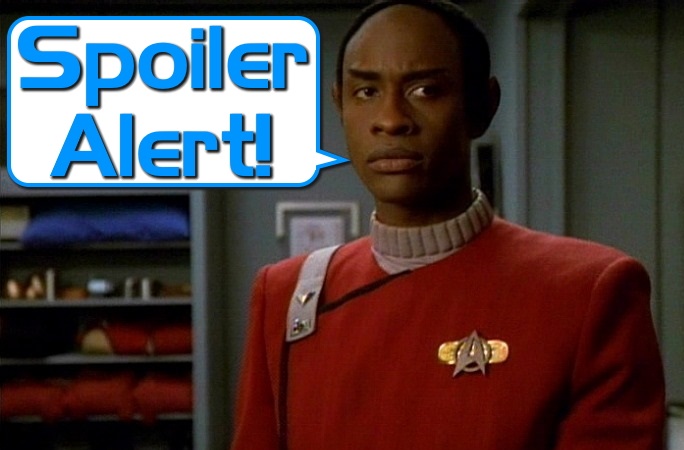
A spoiler warning graphic - featuring Neelix.

Spoiler Warning: There are spoilers ahead for Star Trek: Voyager and Star Trek: Prodigy.

In 1996, the Star Trek: Voyager episode Flashback was broadcast as part of the Star Trek franchise’s thirtieth anniversary celebrations. Today – and I can scarcely believe I’m writing these words – we’re marking Voyager’s own thirtieth anniversary!

That’s right: it was on the 16th of January 1995 that Caretaker, the premiere episode of Star Trek: Voyager, debuted in the United States. I thought it could be worth taking a few minutes to look back at not only the premiere, but Voyager as a whole – and try to assess its legacy and its place in the history of Star Trek. That’s what we’re going to talk about today, so I hope you’ll join me on a rose-tinted look back at Star Trek’s fourth live-action series!
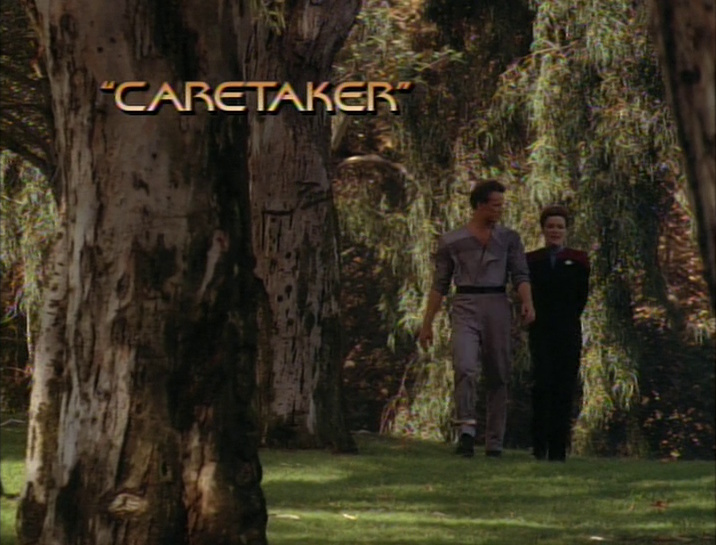
Still frame from Star Trek: Voyager showing the title "Caretaker" with Captain Janeway and Tom Paris.
Caretaker premiered on this day in 1995.

When Voyager premiered in 1995, the Star Trek franchise was arguably at the absolute peak of its “golden age.” The Next Generation cast had started making feature films, Deep Space Nine was well into its third season, and it felt like Star Trek had well and truly made it; a franchise that was dominating the sci-fi world. I remember at the time hearing some criticism of launching another series, but with The Next Generation having explored strange new worlds in the Alpha and Beta Quadrants, and Deep Space Nine tackling the Gamma Quadrant… I gotta admit that I was excited to see Voyager head to the unexplored and mysterious Delta Quadrant!

Having read a preview of the series (I think in the Radio Times; a UK TV magazine) I was also intrigued by this “one ship, two crews” idea that Voyager seemed to be promoting. Seeing Starfleet officers having to work hand-in-hand with the Maquis seemed like a really interesting concept, and one that could’ve given Voyager a unique selling point and a way to stand out from the pack as Star Trek continued its growth and expansion. I don’t think Voyager’s writers ever really made good on that promise – but more on that in a moment!
An early mock-up of the Star Trek: Voyager logo before the show premiered.
An early placeholder logo for the show circa 1994.

Stories about long journeys, people from different backgrounds having to work together in common cause, and having a small “island of safety” in a dangerous and unexplored environment are all things I absolutely adore in fiction – so Voyager seemed to be bringing together a bundle of elements that might as well have been tailor-made for me! And across its seven-season run, all of those things came to the fore in different ways. Voyager was a fun series.

Of course, one of the most-discussed things leading up to Voyager’s premiere was the show’s new captain: Kathryn Janeway, played by Kate Mulgrew, became Star Trek’s first woman captain. I remember this news being received positively at the time, at least in the Star Trek fan groups I was aware of. No one in 1995 knew what the word “woke” would come to mean, so Janeway’s announcement didn’t get the same kind of negative reaction and whining as we might expect in 2025! That’s not to say there wasn’t some degree of pushback, of course. There have always been toxic individuals within the fan community.
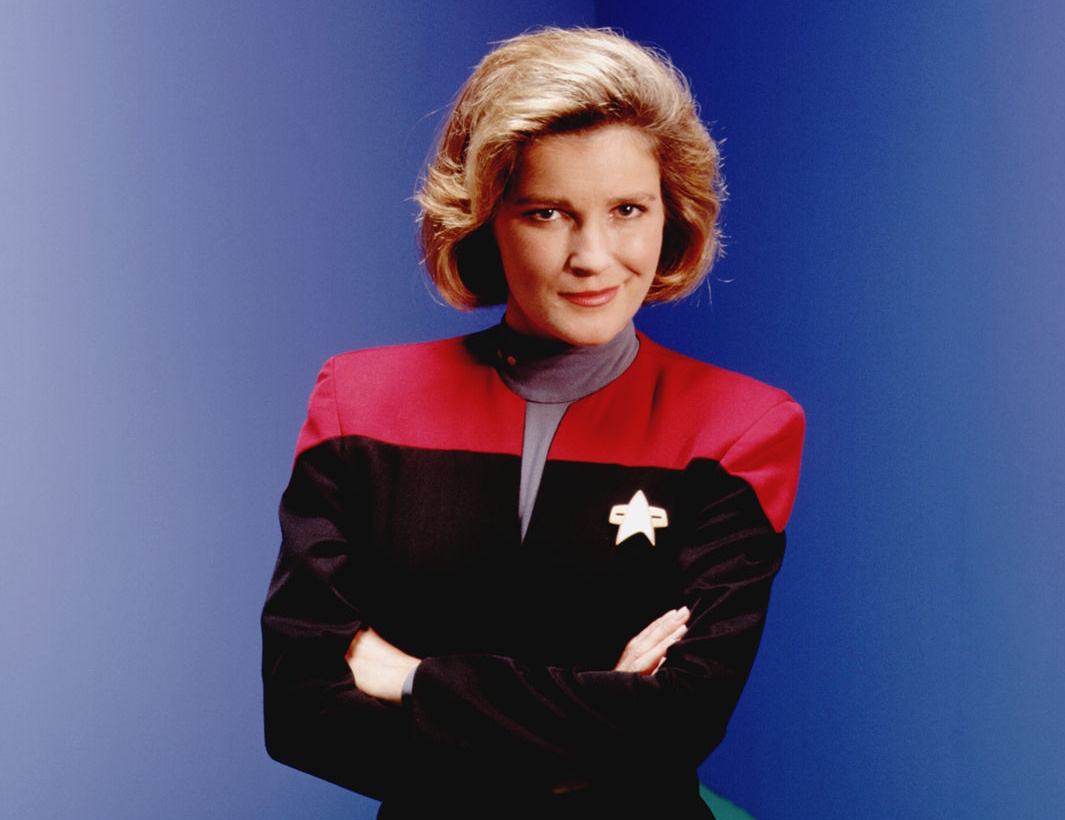
Promotional photo of Kate Mulgrew as Captain Janeway.
Captain Kathryn Janeway.

I remember the days leading up to Voyager’s premiere being ones of positivity and anticipation. I was absolutely thrilled at the prospect of Star Trek’s expansion, at getting a new exploration-focused series after The Next Generation’s finale, and at meeting a whole new crew and cast of characters. There was a lot to be excited about as Voyager’s premiere got closer!

Star Trek: Voyager was almost a very different show, though, and I think it’s worth taking a diversion to acknowledge that. As work began on the series, the question of who should sit in the captain’s chair was perhaps the biggest individual casting decision that befell casting directors Nan Dutton and Kathryn Eisenstein… and they fucked it up. Kate Mulgrew was considered for the role of Janeway, along with several others, but the role was given to Oscar-nominated actress Geneviève Bujold instead.
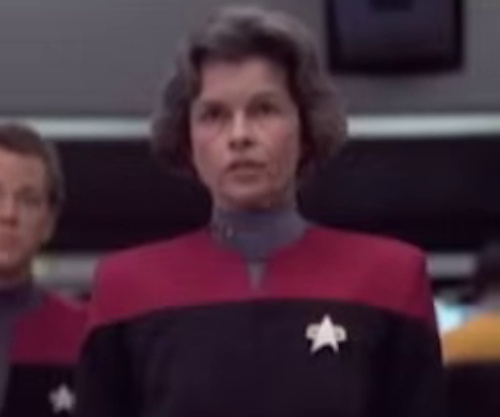
Still frame from the Star Trek: Voyager DVD special features showing Geneviève Bujold as Nicole Janeway.
What might’ve been…

Bujold was a terrible fit for the role of Janeway – as evidenced by the scenes she shot for Caretaker, which were included as a bonus in Voyager’s DVD box set – and seriously struggled with working on the show. Thankfully, Winrich Kolbe – who directed Caretaker – and executive producer Rick Berman recognised this before it was too late, and Bujold was replaced with Kate Mulgrew after only a couple of days. Still, this near-miss could’ve derailed Voyager before the show had a chance to get started.

As an aside, I don’t think Geneviève Bujold is in any way a bad actress or performer. But the idea to cast a character closer in style and tone to Jean-Luc Picard would’ve been wrong for Voyager, and that’s how I interpret her performance in those few scenes that have been revealed. Voyager needed a dynamic, energetic captain – someone who could make incredibly tough decisions under pressure while retaining the support of her crew. I didn’t see any of that in Bujold’s performance, so replacing her was unquestionably the right call.
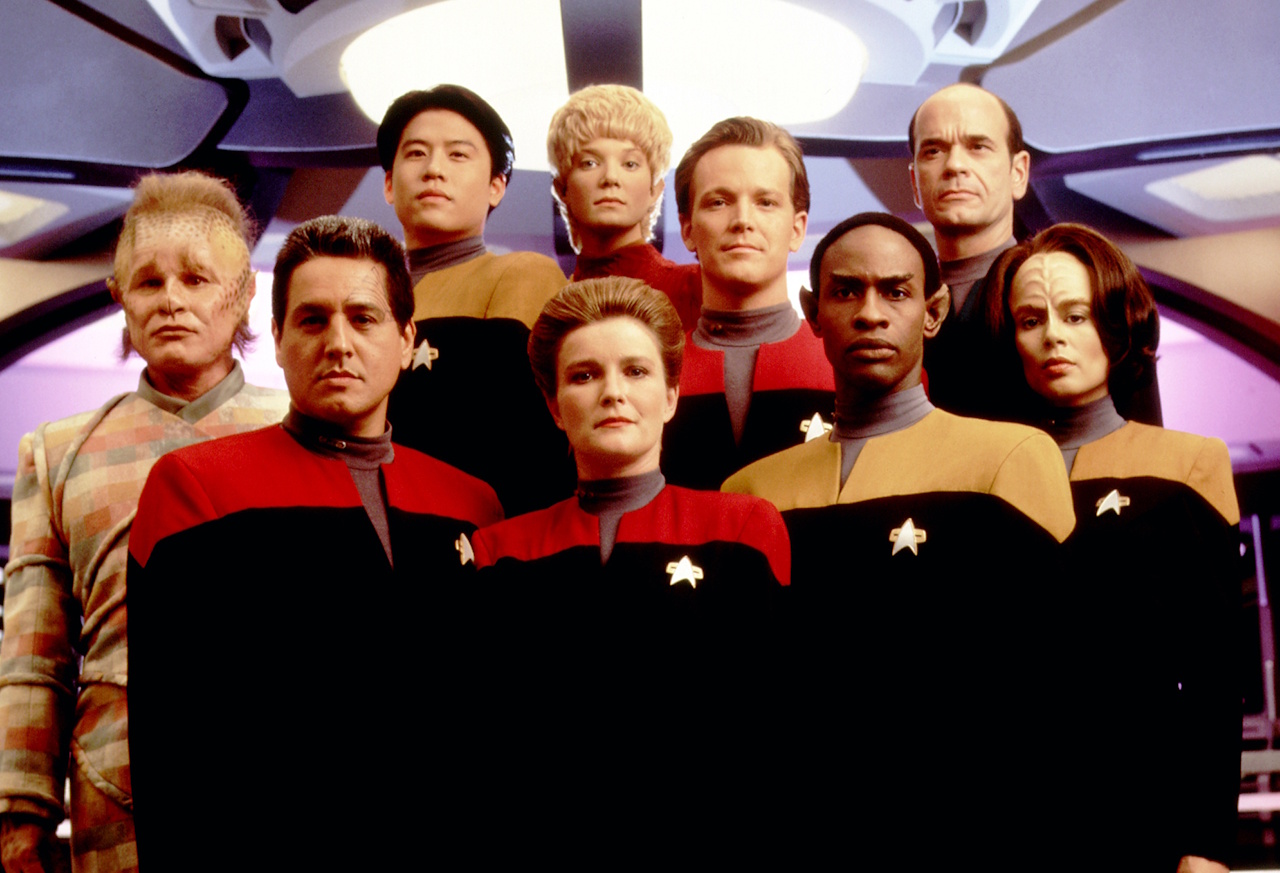
Promo photo showing the main cast of Star Trek: Voyager Season 1.
The main cast in Season 1.

Having to re-cast your lead role after filming has already started isn’t a great look for any television series, but Voyager was able to recover. Caretaker kicked off the show in style – and put a very interesting twist on a story premise that we’ve seen before in other episodes of Star Trek.

Several times in The Original Series, The Next Generation, and Deep Space Nine, our crews found themselves apparently stranded – perhaps on an alien planet, or else far away from Federation space. But in all of these, they found their way home again by the time the credits rolled. To me, Voyager always felt like it was taking one of those episodes and asking the obvious question: what if there wasn’t an instant way home? I really loved that idea, even in 1995 it felt subversive and creative; a unique and different take on a Star Trek story concept that we’d seen before.
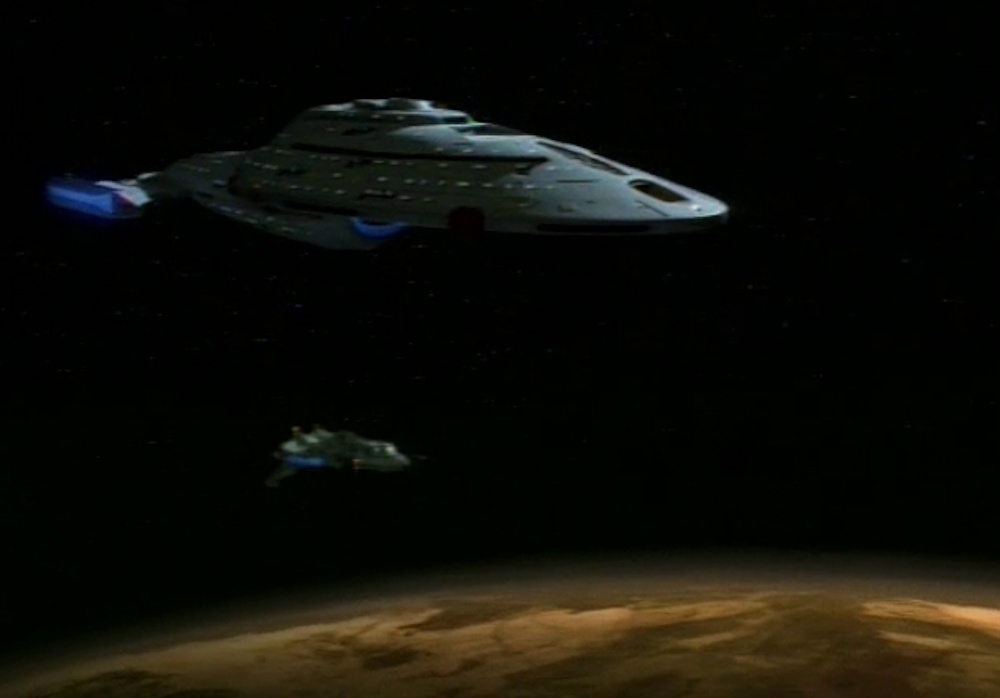
Still frame from Star Trek: Voyager showing the USS Voyager and the Maquis raider Val Jean in orbit of a planet.
The USS Voyager (and Chakotay’s ship) in orbit of the Ocampa homeworld.

Caretaker was also a fantastic crossover episode, bringing in characters and locations from Deep Space Nine. A couple of years earlier, the two-part episode Birthright had brought The Next Generation to DS9, too – so launching the show in this way felt like a real thread of continuity between all three extant Star Trek projects. Star Trek was doing the whole “shared universe” thing decades before the likes of Marvel!

Quark, Morn, and Gul Evek returned from past iterations of Star Trek, further tying Voyager into the franchise before striking out on its own. These three characters – along with Q – are the only ones to have appeared in all three of The Next Generation-era Star Trek shows, which is a fun little bit of trivia for your next Star Trek quiz night! Having that connection to the rest of the franchise was important, though, and it continued the trend of characters from Star Trek’s past appearing in the premiere of a new series.
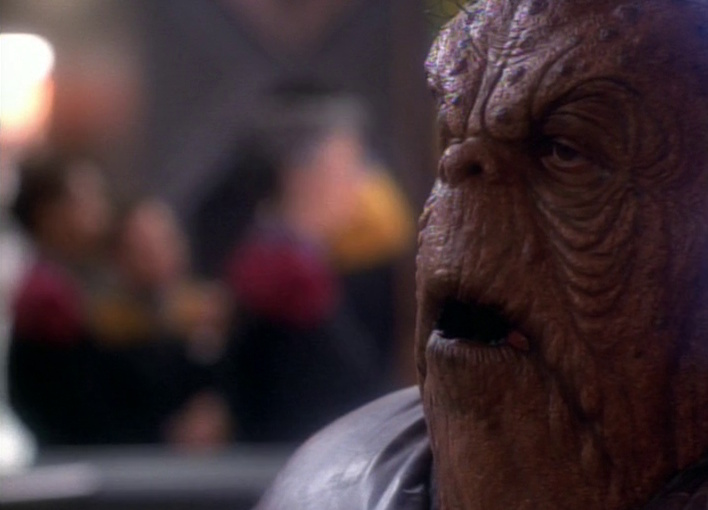
Still frame from Star Trek: Voyager showing Morn at Quark's bar.
Morn in Caretaker.

Caretaker gave Captain Janeway a moral dilemma, one that tied into the idea of the Prime Directive and Starfleet’s core mission of peaceful exploration. Janeway ultimately decided to intervene, destroying the Caretaker’s array to prevent it from falling into the hands of the aggressive Kazon – but stranding her ship and crew in the Delta Quadrant in the process. This kicked off a story that would run for seven seasons, blending Star Trek’s normal episodic format with an underlying quest: Voyager’s journey home.

Harry Kim made a fine addition to the crew, and also filled an important role for Voyager in a narrative sense. Kim was always the first character to jump on the idea of finding a shortcut home, and the most eager (of the main characters, at least) to make it back to the Alpha Quadrant. I wouldn’t say it was his sole defining character trait, but it was an important one. Voyager needed at least one character like this to keep the voyage home at the top of the agenda.
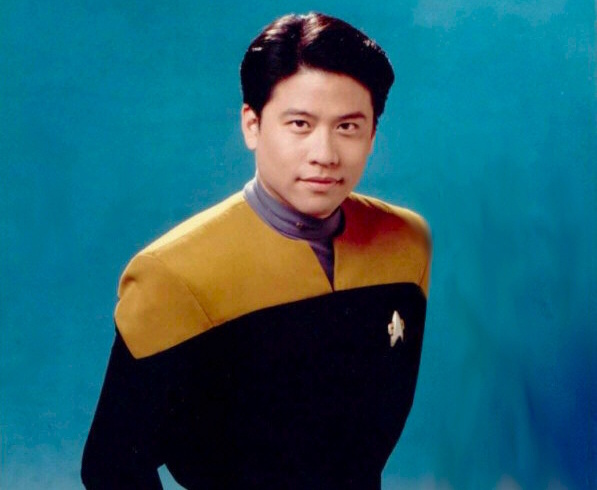
Promotional photo of Garrett Wang as Ensign Harry Kim.
Garrett Wang portrayed Harry Kim in all seven seasons.

More recently, Kim has become best-remembered in the fan community for never receiving a promotion! And I can kind of understand that; particularly as the show wore on and Kim gained more experience, it began to stretch belief to think that he’d remain a mere ensign. Again, though, Voyager was a semi-episodic show, and a show that needed at least one “young and eager” junior officer to fulfil that narrative role and occupy that space.

I was a big fan of Kes in Voyager’s early days; her gentle bedside manner and strong sense of empathy stood in contrast to the brash and often impolite Doctor in scenes set in sickbay. The idea of a short-lived species (Ocampa typically had a lifespan of around nine years) was also a unique one at this point in Star Trek’s history. Kes had close relationships with Neelix, Tom Paris, and of course the Doctor, too, all of which gave her plenty to do.
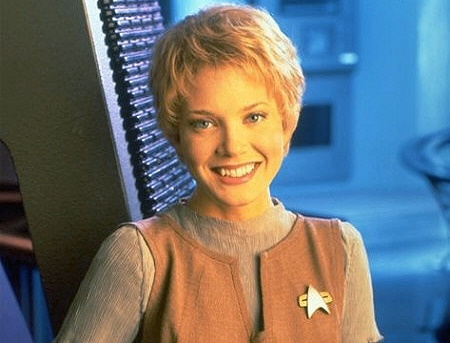
Promotional photo of Jennifier Lien as Kes.
A promotional photo of Kes.

I was disappointed when I learned that Kes was going to be dropped from Voyager heading into the show’s fourth season, particularly as she’d just begun developing her telepathic powers under the tutelage of Tuvok. I felt there was still more to explore with her character, and it was a shame that she was booted off the show before this potential could really be reached… especially because of who replaced her.

I know I’m in the minority here… but during the back half of Voyager’s run, I came to really dislike Seven of Nine. This character felt so boring and repetitive, but due to her popularity with at least a portion of the show’s audience she was prominently featured in many different episodes from Season 4 onwards. Seven always seemed to learn some lesson in “how to be human” in an episode… only to forget it all a week later and have to re-learn the same stuff over and over again. I really burned out on her character pretty quickly.
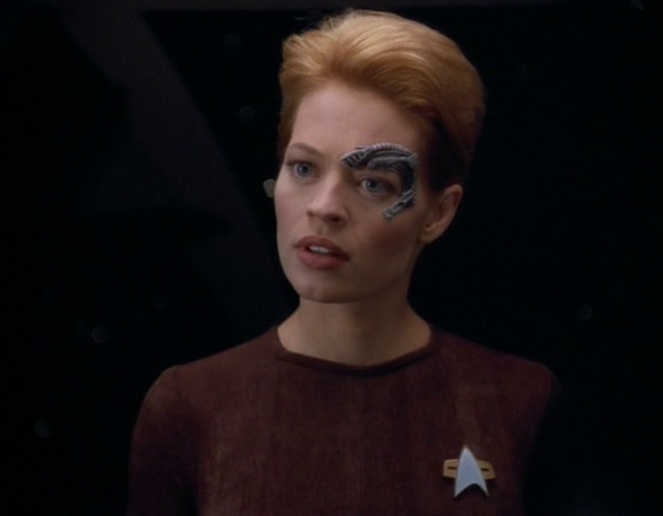
Still frame from Star Trek: Voyager showing Seven of Nine (looking surprised).
Seven of Nine wasn’t my favourite character.

But there’s no denying that Star Trek’s first ex-Borg main character (not counting Picard, of course) shook up Voyager and added something new to the show. Seven’s introduction also kicked off a succession of Borg-centric episodes… which, I’m afraid, were more miss than hit in my opinion, and went a long way to damaging the fear factor that a villain like the Borg needs to have. However, recent Seven of Nine appearances in Star Trek: Picard rehabilitated the character for me, resolved many of the issues I had with her, and generally left me with a much more positive view of Seven as a whole. Here’s hoping she might return one day!

I’ve said this before, but Tom Paris was the Star Trek franchise’s first proper pilot – the first helmsman to really seem like he loved being in the chair. Paris was a fun character – an ex-Maquis and ex-Starfleet officer who seemed to attract the ire of both halves of the combined crew, but came to be seen as a dependable fixture on Voyager’s bridge. Paris’ arc took him from a failure and a criminal to a rehabilitated Starfleet officer and family man, and it was great to see it play out.
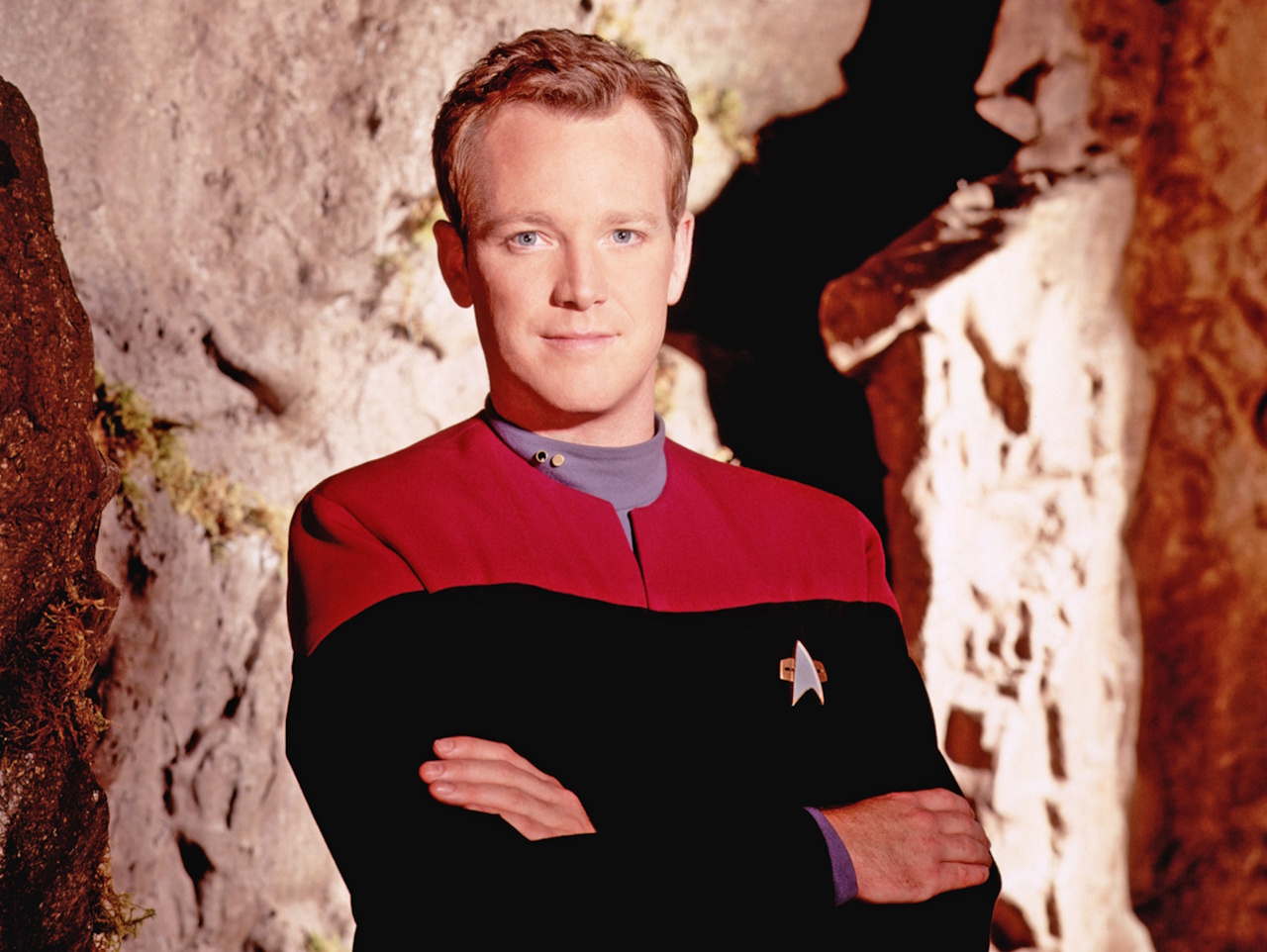
Promotional Photo of Robert Duncan McNeill as Tom Paris.
Tom Paris had a great character arc across Voyager’s run.

Paris’ love for the holodeck also led to some fun diversions across Voyager’s run. I was less enthusiastic about the likes of Captain Proton – though it could be fun for an episode or two – but his creations of Sandrine’s bar, the town of Fair Haven, and the Maquis insurrection holo-programmes all led to fun and exciting stories.

How can we talk about Tom Paris without mentioning B’Elanna Torres? Torres became – at Chakotay’s insistence – Voyager’s chief engineer, and had the challenge of standing out as both the second Maquis main character and (after Worf in The Next Generation) the second character with Klingon heritage. Voyager didn’t always know how to define and handle Torres, with some early episodes presenting her as angry and belligerent… but she soon settled into the role of chief engineer.
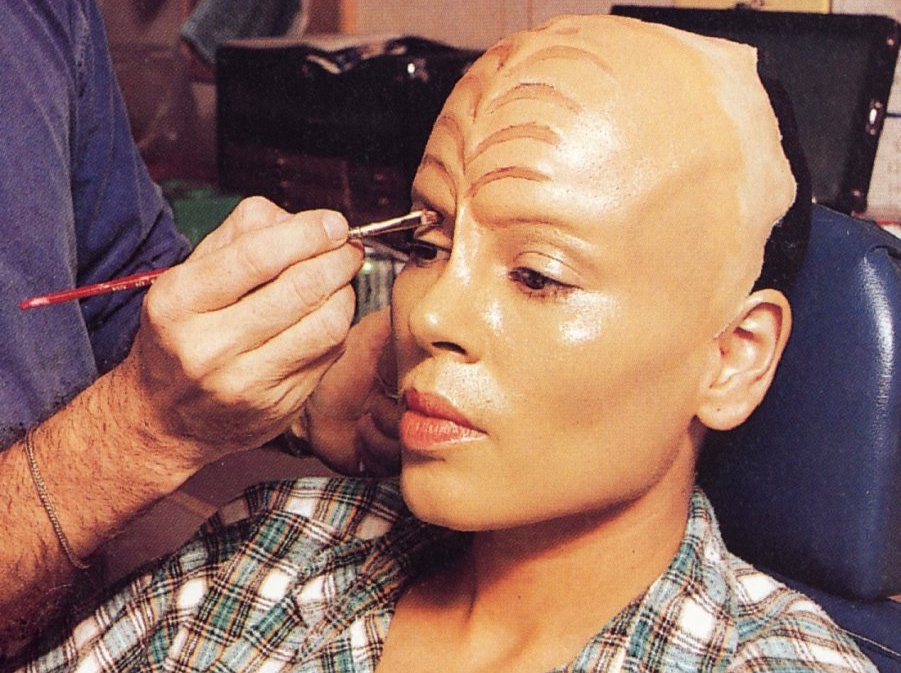
Behind-the-scenes photo from Star Trek: Voyager showing Roxann Dawson having her prosthetic makeup applied.
Roxann Dawson in the makeup chair.

B’Elanna, for me, is defined by two key relationships that would develop later in Voyager’s run: her antagonistic stance against Seven of Nine and her relationship and later marriage to Tom Paris. B’Elanna often stood as the voice of reason against Seven’s “Borg-ification” of parts of the ship, but her relationship with Tom went a long way to settling both characters down and giving them purpose. We’d also see several episodes featuring B’Elanna’s Klingon side – and these could be fun changes of direction for a show set thousands of light-years away from Klingon space.

Chakotay feels like the embodiment of Voyager’s missed opportunities. Voyager’s writers never made good on the “one ship, two crews” idea, meaning Chakotay basically became a Starfleet officer and Janeway’s confidante within a couple of episodes, robbing him of more than one potential character arc. His relationships with most of the crew besides Janeway and B’Elanna were never really explored in much depth, and he just feels like… a presence. Chakotay was on the bridge the whole time, but can you think of many episodes where he drove the plot or was otherwise in focus? Because I can’t!
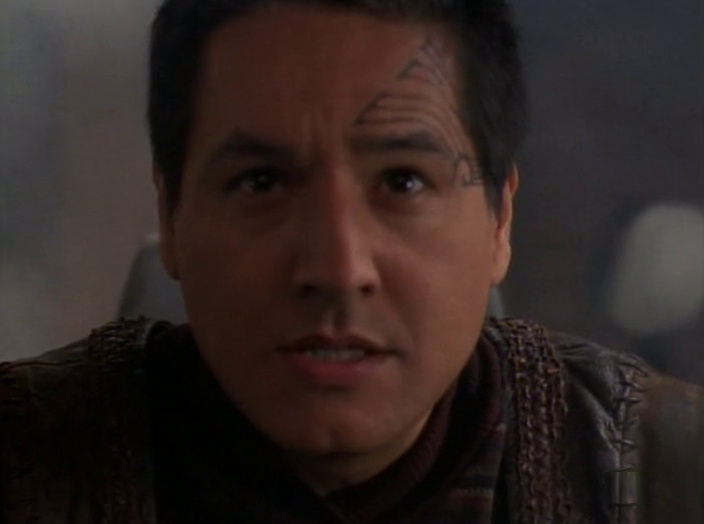
Still frame from Star Trek: Voyager showing Chakotay - the first shot of the series.
Chakotay was the first character we saw at the very beginning of Star Trek: Voyager.

I must get caught up with Prodigy, because Chakotay may get the kind of cathartic redemption arc that we were discussing with Seven of Nine, and that’s something I need to see! And across the show’s seven years, Chakotay did get a few spotlight episodes and storylines – notably exploring his Native American heritage and his relationship with Seska. I just feel there was more that Voyager could have done with this character – he was the first officer, after all, and it would be weird if the likes of Spock, Riker, or Major Kira had been similarly sidelined in their respective shows.

I remember feeling confused on learning that Voyager’s doctor was going to be a hologram! “How could that work?” I remember thinking to myself. “Exceptionally well” seems to be the answer, because Voyager’s Doctor was an incredibly fun character – and one who experienced growth over the course of the series. Starting out as a holo-programme with relatively little personality and no interests, the Doctor changed and evolved over the course of the show, taking on new challenges and new interests, and that was a really fun thing to see play out.
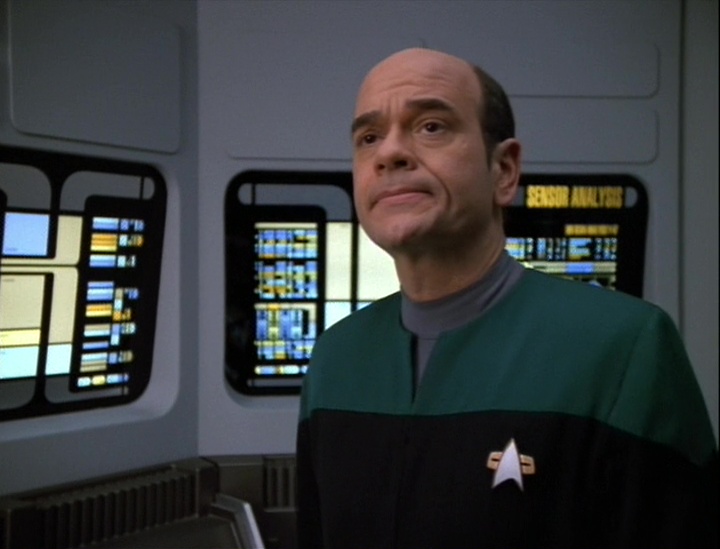
Still frame from Star Trek: Voyager showing the Doctor in sickbay.
The Doctor – the first holographic main character in Star Trek.

When the Doctor got his mobile emitter – a piece of 29th Century technology – in the third season, I was sceptical. But allowing him to leave the confines of sickbay and the holodeck turned out to be a great decision, leading to more involvement from this fun and enjoyable character across the second half of the show’s run. The Doctor could be great comic relief, and actor Robert Picardo has excellent comedic timing, but there’s much more to the character than that. We got some great emotional moments with him, too, such as losing his holographic family or sitting in court arguing for his rights as a sentient life-form.

Speaking of comic relief, we have Neelix! Star Trek shows had had barkeeps before – Guinan in The Next Generation and Quark in Deep Space Nine – but never a cook. Neelix took broad liberties with that role, serving first as a guide to the area around Ocampa, then as a “morale officer” for the ship – while cooking up a selection of interesting dishes to feed a hungry crew! I bought a copy of Ethan Phillips’ Star Trek Cookbook and even tried a few of them for myself… with terrestrial ingredients, of course.
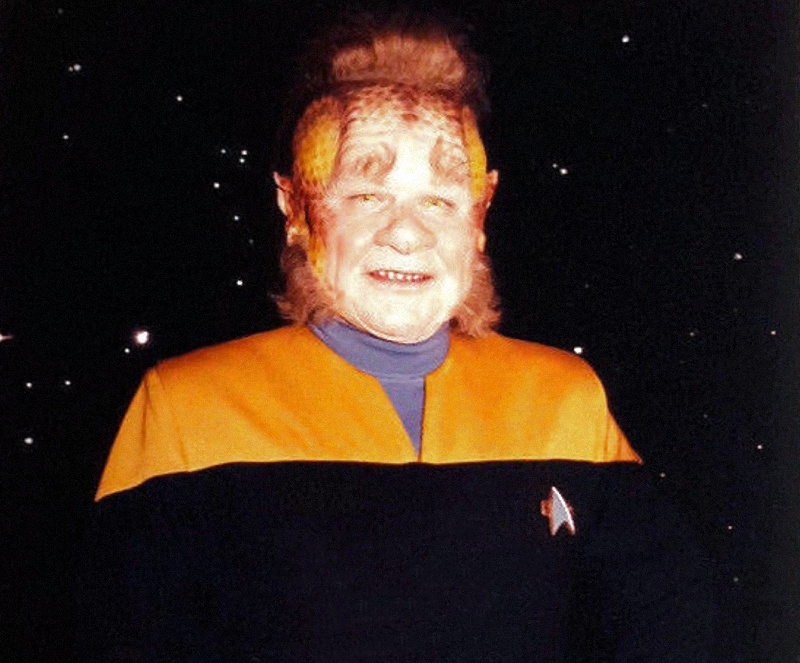
Promotional photo of Ethan Phillips as Neelix (in a Starfleet uniform for some reason).
A promo photo of Neelix… in a Starfleet uniform.

Neelix’s relationship with Kes could feel a little uncomfortable, but fortunately it wasn’t in focus all that much outside of a few early episodes. As Neelix settled in aboard the ship, he became an important character – and would often serve as a bridge between characters who didn’t always get much interaction. His largely one-sided friendship with Tuvok – though often played for laughs – was great to see, too, and showed Neelix’s way of accepting people different from him.

And speaking of Tuvok, Star Trek’s second Vulcan main character made quite an impact! Spock was always going to be a hard act to follow, but taking the calm and logical Tuvok as far away from science and exploration as possible was undeniably the right call. A Vulcan security and tactical officer makes a lot of sense when you stop to think about it – and Tuvok demonstrates exactly why. Calm and stoic under pressure is just what that job requires!
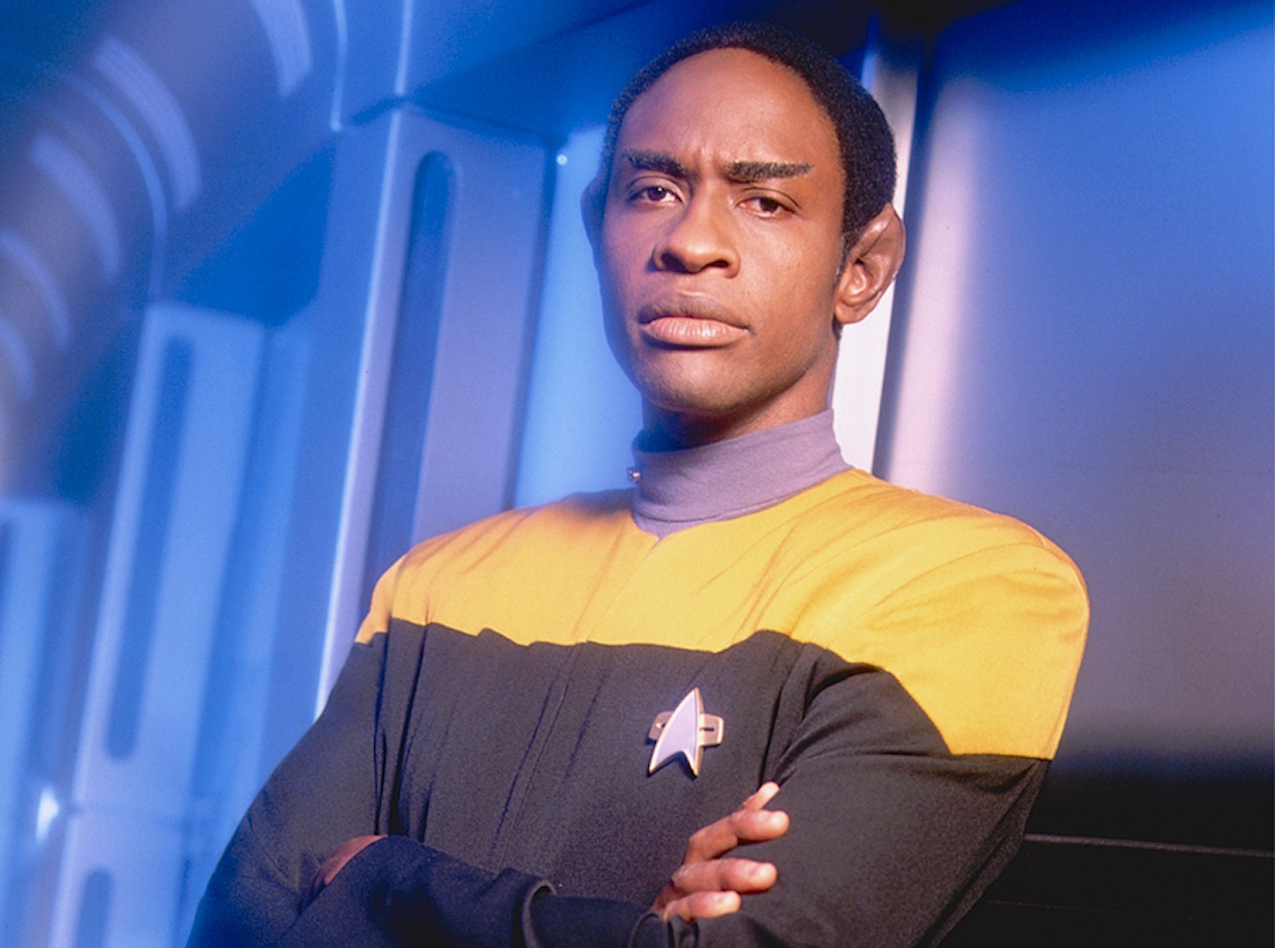
Promotional photo of Tim Russ as Tuvok.
Tuvok.

Tuvok also served as Janeway’s friend and confidante – arguably treading on the toes of the traditional first officer role, in that sense. I wish we’d gotten more of an examination of his relationship with Chakotay, though that’s more from Chakotay’s side, as mentioned above. Tuvok also bridged the gap between The Original Series era and Voyager in the most unexpected of ways – check out the episode Flashback, that I mentioned at the beginning, for more on that!

So that leaves us with Captain Janeway. Janeway was the captain that Voyager needed on a quest like this, and she had the strength to guide her crew home. She also had some fun character quirks, like her love of coffee, that kept her feeling grounded and real. The first woman to sit in the captain’s chair for a Star Trek series embodied elements of all three of her predecessors: Kirk’s toughness, Picard’s diplomacy and tact, and Sisko’s dedication to doing the right thing. But she was always her own woman, never feeling overshadowed by any of the captains that had come before.
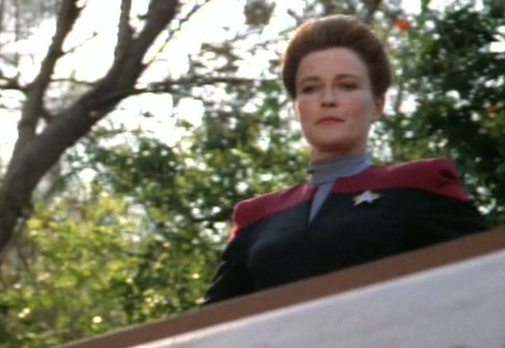
Still frame from Star Trek: Voyager showing Captain Janeway at the penal colony in the premiere.
Captain Janeway in Caretaker.

As mentioned above, Kate Mulgrew was the perfect choice for this role, and she delivered a masterful performance across all seven seasons of the show. Voyager’s journey home wouldn’t have been the same without her, in fact, and across the show’s run we got several great episodes that shone a spotlight on the captain. Stories pitted her against villains like the Krenim and the Borg Queen, and Janeway always found a way to come out on top!

The USS Voyager still feels like a futuristic design to me even thirty years on from its debut! Something about the more angled saucer section makes it feel more modern than the circular hull of Kirk’s Enterprise and the Enterprise-D, and the sleeker lines also scream “speed!” Voyager was a long-range tactical ship made for exploration and combat, and the ship’s design philosophy reflects that. I will never tire of the sequence in Caretaker of Paris being flown in by shuttlecraft, seeing Voyager for the first time.
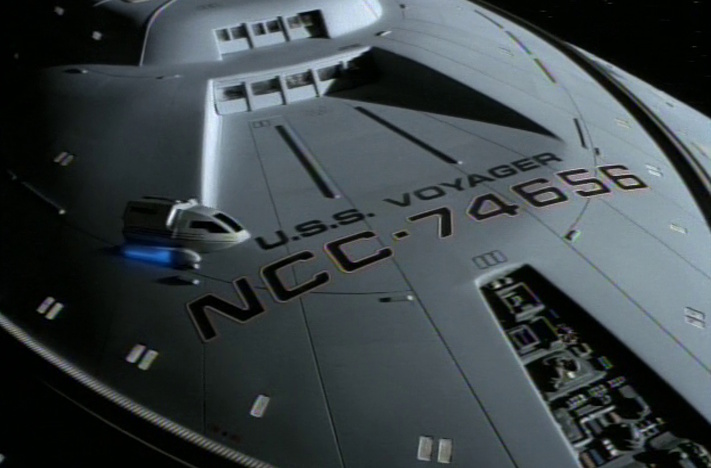
Still frame from Star Trek: Voyager showing a shuttlecraft flying over Voyager's saucer section.
Our first introduction to this wonderful starship.

On the inside, we got a continuation of the Starfleet aesthetic that debuted in The Motion Picture and has been a mainstay in the franchise since. Voyager’s bridge is larger and wider, though – or at least it feels larger and wider – than anything we’d seen before. This expansive space was the perfect stage for interactions between all of our favourite crew members! Again, the bridge felt more modern than that of the Enterprise-D, while at the same time continuing the design trends that we saw in The Next Generation.

Janeway’s ready-room was an interesting area, giving her a large desk but also a couch that could act as a social space. Engineering had a really neat effect for its warp core, and the expansive entryway was often where intense conversations played out. The Doctor had sickbay as his domain, but he also got an office and a small lab off to one side that were fun inclusions. Voyager also had a shuttlebay, holodecks, crew quarters, corridors, and the mess hall – all of which would get moments where they were in focus!
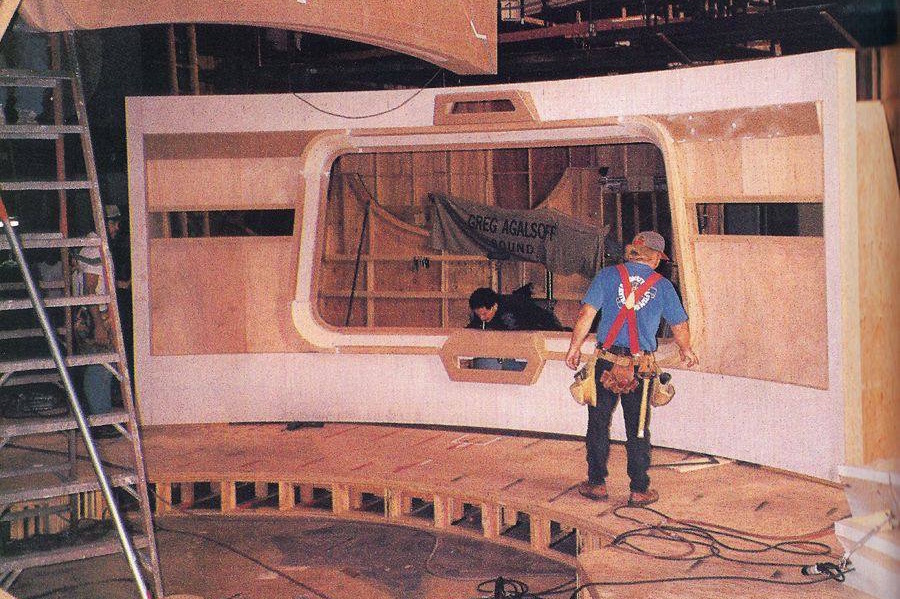
Behind-the-scenes photo from Star Trek: Voyager showing the bridge set under construction.
Voyager’s bridge set under construction circa 1994.
Image Credit: Forgotten Treks/TrekDocs

As an aside, being able to virtually explore Voyager in the game Elite Force was one of my absolute favourite things about that game! In 2000, being able to wander through the bridge, sickbay, and some of the ship’s corridors felt absolutely magical as a Star Trek fan, and while Elite Force wasn’t the only game to offer that experience (the adaptation of Generations had a mission set on the Enterprise-D, and there were probably others around the same time), it was certainly one of the most memorable for me personally.

One thing Voyager didn’t really have was an expansive secondary cast. Deep Space Nine gradually gave more time and attention to characters like Rom and Martok, but Voyager, by and large, kept its focus on its main cast of characters. The Borg children – and Icheb in particular – were really the only ones to break through in more than a handful of episodes, though some, like Seska and The Next Generation’s Reg Barclay, would go on to make multiple appearances. Deep Space Nine showed what Star Trek could do with a wider and more expansive cast… and it’s something the franchise has yet to return to. Voyager had the opportunity to build out some of its secondary characters, but never really went there. I think that’s a bit of a shame – but it is what it is!
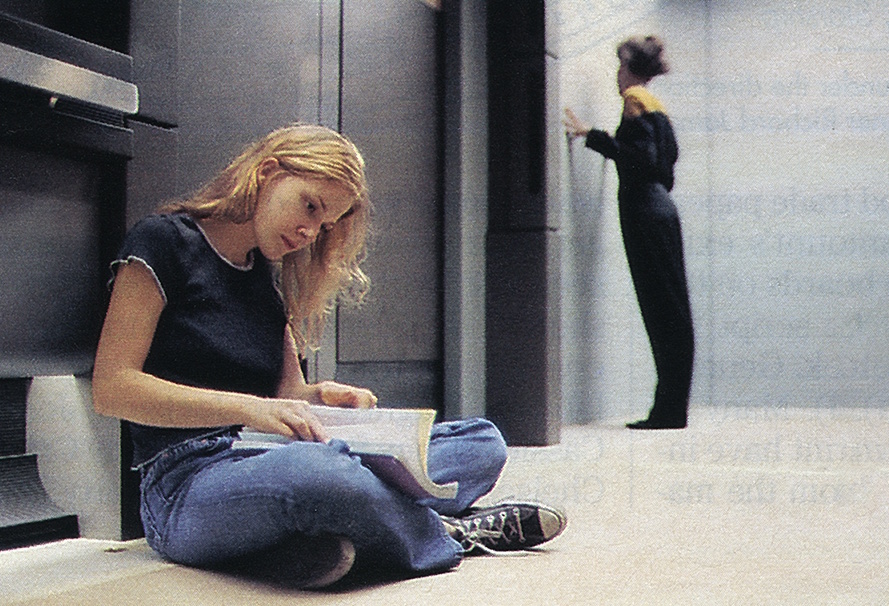
Behind-the-scenes photo from Star Trek: Voyager showing Jennifer Lien reading her script while sat on the floor.
Jennifer Lien (Kes) reading her script on the set of Caretaker.

For a variety of reasons, Voyager never really made good on its “one ship, two crews” idea, and by about halfway through Season 1, the main Maquis characters were basically entirely integrated with the Starfleet crew. With the exception of plot-relevant moments, such as stories involving Seska, the fact that almost one-third of Voyager’s complement were Maquis never really came to the fore in a big way, and I think that’s a bit of a missed opportunity.

Don’t get me wrong, a story about people from different backgrounds finding a way to work together for the common good is something I absolutely adore, and there were times where Voyager absolutely nailed that feeling. I guess I’ve just always felt that I would’ve liked to see more tension, scepticism, and disagreement as the two crews began the process of integrating. I never really felt as much of that as I would’ve liked – and that’s perhaps Voyager’s biggest sore spot for me, thirty years on.
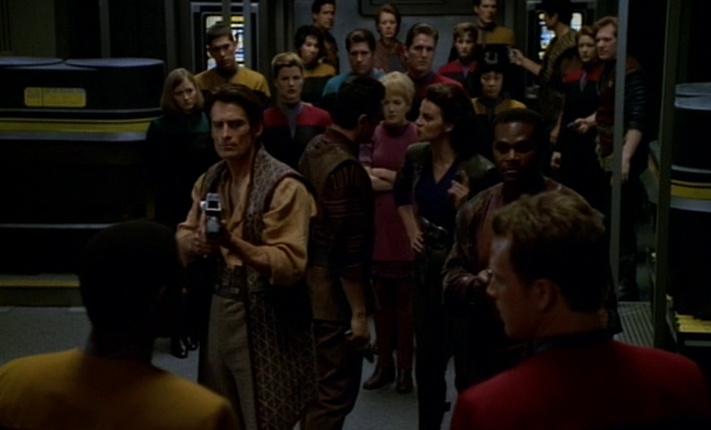
Still frame from Star Trek: Voyager showing a Maquis rebellion (on the holodeck!)
Voyager struggled to make good on its “one ship, two crews” premise.

That being said, Voyager was a great show all around, and a welcome addition to Star Trek. With The Next Generation’s crew off making feature films and Deep Space Nine occupying a space station, there was plenty of room for a new series set aboard a starship. Voyager embodied Star Trek’s ethos of peaceful exploration… but set that exploration against a new backdrop of trying, against the odds, to make it home. It was both familiar and different at the same time; a really interesting blend of storytelling styles.

Voyager was also a much more episodic series than Deep Space Nine – despite its voyage home story being omnipresent and frequently referred to. There were plenty of one-off stories featuring a wide range of alien races, factions, and wacky premises. It was a Star Trek series through and through, one that brought a fantastic cast of characters to the table and threw them into plenty of fun, exciting, and occasionally emotional situations.
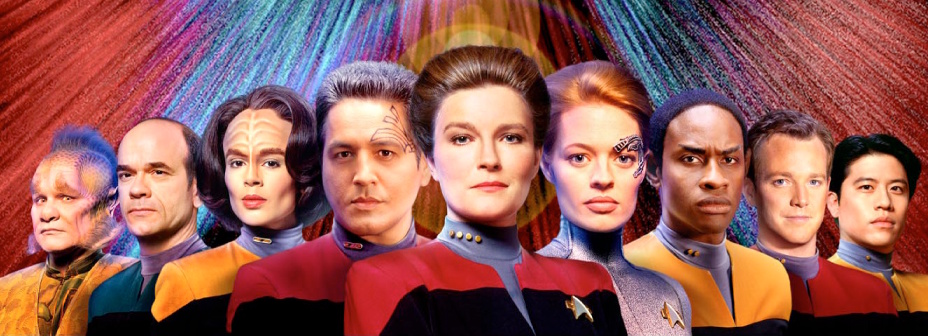
Promotional image of the Star Trek: Voyager cast.
The cast on a promotional poster.

The excitement I felt thirty years ago was more than rewarded! Voyager was an outstanding show, and I got thoroughly invested in the crew and their quest to return to the Alpha Quadrant. There were some episodes that were wide of the mark – as there are bound to be in any show that runs to 168 episodes across seven seasons! But even at its worst, there were things to enjoy, fun lines of dialogue, entertaining character moments, or creative decisions that made Voyager well worth watching for any Trekkie or fan of sci-fi in general.

As the final show of what I consider to be Star Trek’s “golden age,” I’ve long had a soft spot for Voyager. Of course I watched every single episode during the show’s run – I would tune in when they made their debut on terrestrial TV here in the UK, and I very rarely missed a week. I later bought all seven seasons when they were released on DVD and enjoyed the series all over again.
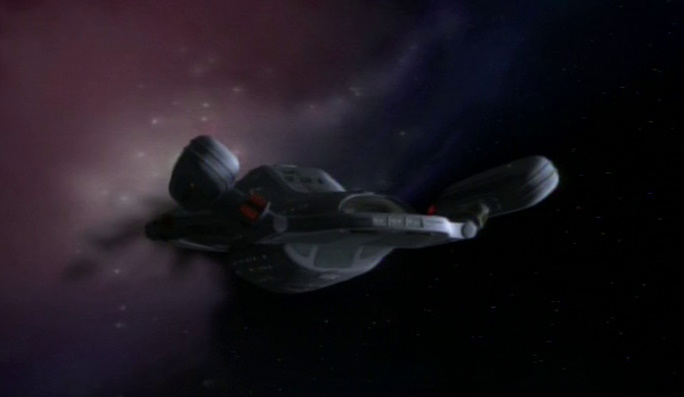
Still frame from Star Trek: Voyager showing the USS Voyager preparing to jump to warp.
The USS Voyager set course for the Alpha Quadrant thirty years ago today.

So I hope this has been an interesting look back! I wanted to do something to acknowledge Voyager’s milestone anniversary, but it’s hard to summarise my thoughts on 168 episodes and seven years’ worth of television in a single article! Stay tuned, though, because I’ll be writing up my thoughts on some of my favourite episodes in the days ahead as we continue to celebrate Voyager’s thirtieth anniversary.

I hope that Paramount and the folks in charge of Star Trek plan to do something to mark this momentous occasion, so I’ll definitely be checking out the official Star Trek website and social media pages over the next couple of days. With Seven of Nine, Janeway, Chakotay, and others all having returned to the Star Trek franchise in the last few years, Voyager’s legacy is very much alive. The documentary To The Journey: Looking Back at Star Trek: Voyager has had its official premieres, too, though I don’t think it’s available to stream just yet. Still, another thing to keep an eye on.

All that remains to say is this: happy thirtieth anniversary, Star Trek: Voyager! Thanks for all the memories.


Star Trek: Voyager is available to stream now on Paramount+ in countries and territories where the platform is available. The series is also available on DVD. The Star Trek franchise – including Voyager and all other properties discussed above – is the copyright of Paramount Global. Some images courtesy of TrekCore and Paramount. This article contains the thoughts and opinions of one person only and is not intended to cause any offence.

Star Trek Day roundup!

Spoiler Warning: There are spoilers ahead for the Star Trek franchise, including the following upcoming series: Strange New Worlds Season 1, Picard Season 2, Lower Decks Season 2, Discovery Season 4, and Prodigy Season 1.

Yesterday was Star Trek Day! And in case you missed it, ViacomCBS held a live event that was streamed online and via Paramount+ showcasing and celebrating all things Star Trek! We’ll break down the big news in a moment, but first I wanted to give you my thoughts on the event as a whole.

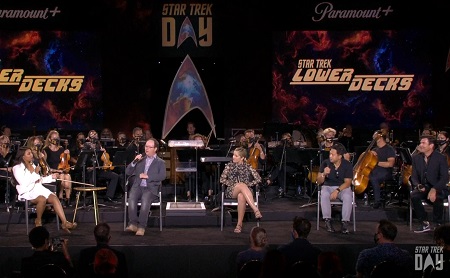
This was the first big in-person event that many of the folks involved had been able to attend since 2019, and there was talk of the pandemic and its enforced disruption on the various shows that have been in production over the last couple of years. There was also a lot of positivity from presenters and interviewees not only about Star Trek – which was to be expected, naturally – but also about being back together and simply being able to hold a major event of this nature. The positivity of hosts Wil Wheaton and Mica Burton was infectious, and the event was much better for the role the duo played in hosting the panels and introducing guests.

Mica Burton and Wil Wheaton were great hosts.

That isn’t to say that Star Trek Day was entirely without problems, though. To be blunt, the event dragged on a bit too long (it ran to over three hours) and several of the panels and interviews were the worse for being conducted live instead of the pre-recorded, edited, and curated segments and panels we’ve had to get used to in the coronavirus era. Several of the guests seemed unprepared for what should’ve been obvious questions, and there were too many awkward silences and pauses while people gathered their thoughts and responded to the hosts. Such is the nature of live broadcasting – and it sounds rather misanthropic to criticise it!

During what I assume was an intermission on the main stage we were treated(!) to a separate pair of presenters on the red carpet reading out twitter messages and posts from the audience. This was perhaps the segment that dragged the most; one of the presenters even admitted to not being a regular Star Trek viewer (she hadn’t seen Discovery at all) so unfortunately this part of the show was less interesting as the pair were a little less knowledgeable about the franchise. If it had been made clear that this section of the broadcast was going to last as long as it did I might’ve taken a break as well!

This segment in the middle of the broadcast dragged on a bit.

Overall, though, despite running a bit too long and the ending feeling a little rushed (something we’ll talk about later), Star Trek Day was a success. It didn’t only look forward to upcoming projects like Strange New Worlds and Picard Season 2, but it looked back at every past Star Trek series, inviting members of the casts of those shows to talk about what made them – and the franchise – so great.

As a true celebration of all things Star Trek, the broadcast has to be considered a success. And although a pre-recorded event could’ve been edited and streamlined to cut to the more interesting parts and to give interviewees a chance to gather their thoughts, it was nice to see many of the folks we know and love from Star Trek back together and able to spend time in person with one another. Hosts Wil Wheaton and Mica Burton did a great job at making us as the audience feel included, as if we were there at Star Trek Day right along with them. For those few hours – even through awkward moments and segments that seemed to run a little too long – it felt like being a member of the Star Trek family. As someone with few friends, I appreciated that immensely. For those few hours last night – and yes, even though Star Trek Day didn’t start until 1:30am UK time I did stay up to watch it – I felt like I, too, was an honorary member of the Star Trek family, and that’s a feeling I would never have been able to get anywhere else.

Star Trek Day was a successful celebration of all things Trek!

Now then! Let’s talk about the various panels, trailers, and interviews. Over the coming days I’ll be taking a closer look at some of the announcements and trailers in more detail (as well as perhaps crafting a few of my patented and often-wrong theories), but for now I want to try to include an overview of everything that was included in Star Trek Day.

We’ll come to the biggest announcements and trailers at the end, but first I wanted to talk for a moment about the music. Star Trek Day had a live orchestra on its main stage, and we were treated to live renditions of Star Trek theme music past and present – as well as a medley that kicked off the event. I was listening to Star Trek Day on my headphones, and the music sounded beautiful. Composer Jeff Ruso (who composed the theme music to Discovery and Picard) picked up the conductor’s baton, and the medley he arranged was really an outstanding celebration of all things Star Trek.

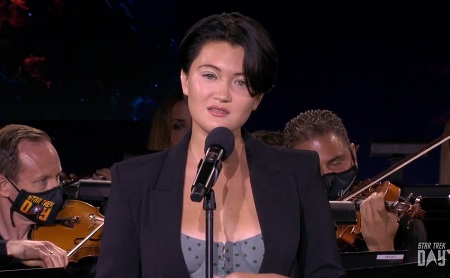
Star Trek Day both began and ended with music, as Isa Briones (Star Trek: Picard’s Soji) sang her rendition of Irving Berlin’s 1926 song Blue Skies to close out the broadcast.

Isa Briones’ rendition of Blue Skies brought proceedings to a fitting end.

There were five “legacy moments” spread throughout Star Trek Day, and these celebrations of past Star Trek series were genuinely moving. Actors George Takei, LeVar Burton, Cirroc Lofton, Garrett Wang, and Anthony Montgomery spoke about their respective series with enthusiasm and emotion. Cirroc Lofton paid tribute to his on-screen dad Avery Brooks, talking about how Deep Space Nine showed a single dad balancing his work and family commitments. He also spoke about Deep Space Nine’s legacy as the first Star Trek show to step away from a starship and take a different look at the Star Trek galaxy.

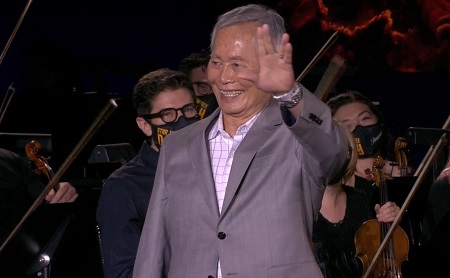
The themes of diversity and inclusion were omnipresent in these legacy moments, and all five actors spoke about how Star Trek and Gene Roddenberry have promoted diversity since the very beginning. George Takei spoke about Gene Roddenberry’s vision for Star Trek, how sci-fi had previously been something often seen as just for kids, and how putting a very diverse cast of characters together was groundbreaking in the 1960s. It’s always amazing to hear George Takei speak, and even fifty-five years later he still has a grace and eloquence when speaking on these topics. As someone who has himself been at the forefront of campaigning for diversity and equality, he does so with a gravitas that few can match.

George Takei’s speech was outstanding.

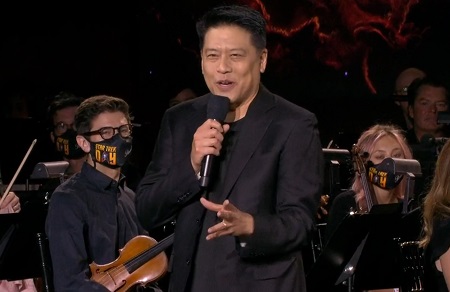
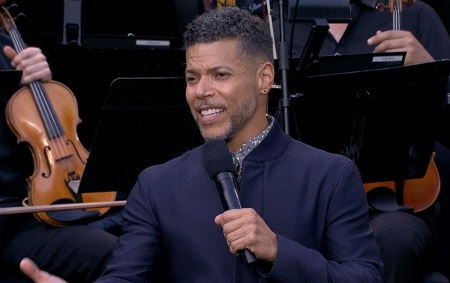
Garrett Wang spoke about how Voyager could be a “refuge” for fans; a place to go where everyone could feel included and like they were part of the family. The way the show combined two crews was, I would argue, one of its weaker elements, but Wang looked at it through a different lens, and I can see the point about how Voyager put those folks in a difficult situation and brought them together to work in common cause. He also spoke in very flattering terms about Captain Janeway and Kate Mulgrew – who is returning to Star Trek very soon.

Anthony Montgomery was incredibly positive about Enterprise, and how the series embodied the pioneering spirit of exploration. I loved his line about how Enterprise, although it was a prequel recorded later than many other shows, laid the groundwork and filled in much of Star Trek’s previously unvisited stories and unexplained lore. Above all, he said, Enterprise was a “fun” show – and it’s hard to disagree! The orchestra concluded this speech with Archer’s Theme – the music heard over the end credits for Enterprise – which is a beautiful piece of music. If I were to remaster Enterprise I’d drop Faith of the Heart (which is a nice enough song, don’t get me wrong) and replace it on the opening titles with Archer’s Theme. The orchestra played it perfectly.

Anthony Montgomery spoke with passion and good humour about Enterprise.

LeVar Burton talked about The Next Generation, and how Star Trek was reinvigorated for a new era. The Next Generation was the first spin-off, and it came at a time when spin-offs didn’t really exist in the sci-fi or drama spaces, so it was an unknown and a risk. Burton also spoke about The Next Generation’s sense of family, and how Star Trek can be a unifying force in the world.

Far from being mere padding, the five legacy moments saw stars of Star Trek’s past pay tribute to the franchise and the shows they were part of. There were consistent themes running through all five speeches, particularly the theme of inclusion. Star Trek has always been a franchise that strives to include people who are “different” – people like myself. For many fans, that’s one of the things that makes Star Trek so great. To see some of the biggest stars acknowledge and celebrate that aspect of Star Trek was wonderful, emotional, and rather cathartic.

Cirroc Lofton paid tribute to Deep Space Nine and his on-screen dad Avery Brooks.

Each of the five actors spoke with love, positivity, and enthusiasm for the franchise that made them household names. Anthony Montgomery’s incredibly positive attitude in particular shone through – he was beaming the whole time and seemed genuinely thrilled to have been invited to speak and to celebrate Enterprise.

If Star Trek Day aimed to celebrate all things Star Trek, then the legacy moments went a long way to making that ambition a reality on the night. The speeches were pitch-perfect, as were the orchestral renditions of all five Star Trek themes, and I had an unexpectedly good time with these moments. I wasn’t sure what to expect from the programme listed on the website; I didn’t really have any expectations of what the legacy moments would include. They surprised me by being one of the most enjoyable, down-to-earth parts of a hugely entertaining evening.

Garrett Wang represented Voyager in the show’s legacy moment segment.

Let’s talk about news and announcements. That’s what you’re here for, right?! That was certainly what I was most interested in and excited for when I sat down to watch the Star Trek Day broadcast – though, as mentioned, I was taken aback by some of the other elements present that I wouldn’t have expected!

First, a non-announcement! Wil Wheaton interviewed the head of production on Star Trek, Alex Kurtzman, early on in the evening. Kurtzman didn’t have anything to say about the Section 31 series, nor about the upcoming Star Trek film due for release in 2023. However, he mentioned something that I found really interesting: a Starfleet Academy series or project. This isn’t anything close to an official announcement, of course, and he and Wil Wheaton talked about it in abstract terms. But a Starfleet Academy series has been something Star Trek has considered in the past; Gene Roddenberry was quite keen on a Starfleet Academy spin-off prior to developing The Next Generation. Watch this space, because it’s at least possible that a project centred around Starfleet Academy will get off the ground under Kurtzman’s leadership.

Alex Kurtzman seemed to tease that a Starfleet Academy project may be coming sometime soon!

There were no brand-new shows or films formally announced at Star Trek Day. While I wasn’t necessarily expecting such an announcement, and Kurtzman’s earlier statement that no new show will be worked on until the current crop have run their course would seem to exclude it, there are multiple pitches and projects that have been rumoured or talked about over the last few years. The Section 31 series was absent again, as mentioned, and that’s more bad news for a series that feels like it isn’t going to happen. There were also no mentions of the likes of Ceti Alpha V, Captain Proton, or Captain Worf – just some of the heavily-speculated or rumoured pitches believed to be floating around over at ViacomCBS.

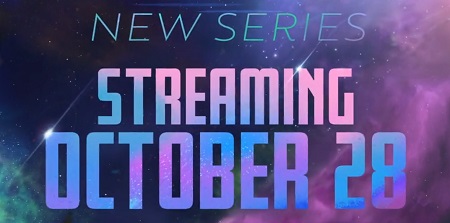
We did get release dates or release windows for several upcoming seasons, though! After Lower Decks Season 2 draws to a close in mid-October there’ll be a couple of weeks with no Star Trek, but then Prodigy will be available (in the United States at least) from the 28th of October. Shortly thereafter, Discovery Season 4 will kick off – it will premiere on the 18th of November in the United States and on the 19th internationally. Finally, Picard Season 2 is scheduled to arrive on our screens in February next year – presumably shortly after the season finale of Discovery.

Prodigy is coming soon… if you live in the USA, anyway.

All of this is great news! There was no release date for Strange New Worlds, but I think we can assume it will follow within a few weeks at most of Picard Season 2, which would put it perhaps in May or June 2022 at the very latest. But there will be a whole lot of Star Trek on our screens this autumn and winter, well into the first half of next year. Wil Wheaton said it best: with so many new Star Trek projects in production, we’re living through a new golden age of Star Trek right now!

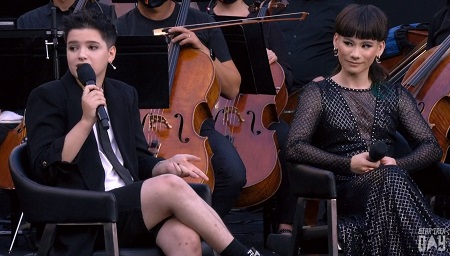
I was a little surprised when the Discovery panel ended without revealing a new trailer or teaser for Season 4. Michelle Paradise, Wilson Cruz, Blu del Barrio, and Ian Alexander talked about how the show is fostering a sense of family in the 32nd Century – and that we will see Gray get a “corporeal” body in Season 4 somehow, which is great! But I have to say I’d been expecting a new trailer; the show is only a couple of months away after all. Perhaps we’ll get that nearer to the time. There wasn’t any mention of Season 5 either, but it’s possible that announcement will come as the marketing campaign for Season 4 ramps up.

Wilson Cruz speaking during the Discovery panel.

Wilson Cruz seems like such a positive person in every interview I’ve ever seen him participate in, and he brought a lot of positive energy to the stage in Star Trek Day as well. There was talk of the Stamets-Culber relationship being revisited in Season 4, which is great – Stamets and Culber really form the emotional core of the show. He also spoke about how Dr Culber is embracing new roles in Season 4 – the role of counsellor to others aboard the ship as well as a parental role for Adira and Gray.

Gray’s storyline has the potential to be one of the most powerful in Discovery as the show moves into its fourth season. Being trans or gender-nonconforming can make one feel invisible – something I can speak to myself – and this is literally shown on screen by Gray’s invisibility. The powerful story of discovering how to be seen, and to do so with the help, encouragement, and support of one’s closest friends and family has the potential to be an exceptionally powerful story, one which I can already feel resonating with me. Blu del Barrio and Ian Alexander spoke very positively about their on- and off-screen relationships, and they seem like they work exceptionally well together as a duo. I can’t wait to see what Season 4 will bring for them both.

Blu del Barrio and Ian Alexander play Adira and Gray respectively. I’m greatly looking forward to their stories in Season 4.

I’ve already got a Prodigy theory! The show’s co-creators talked about how Prodigy Season 1 begins with the kids on a never-before-seen planet described as being “far removed and mysterious.” It sounds like we aren’t seeing a planet that the USS Voyager visited in the Delta Quadrant – something backed up by scenes seemingly set on that world in the trailer – and the USS Protostar appears to have crashed “inside” the planet. Did it crash during the final leg of Voyager’s journey home through the Borg transwarp network? Or perhaps during one of Voyager’s other flights – the space catapult from The Voyager Conspiracy or Kes’ telepathic launch in The Gift, for example. More to come on this, so stay tuned!

So we got a release date for Prodigy in the United States, but as I’ve said on a couple of occasions now it seems as though Prodigy isn’t going to be broadcast anywhere that doesn’t already have Paramount+. Considering that the series is a collaborative project between Star Trek and Nickelodeon (itself a ViacomCBS subsidiary), it should surely have been possible to secure an international broadcast on the Nickelodeon channel – a satellite/cable channel here in the UK and in many other countries. It’s a disappointment that, once again, ViacomCBS does not care about its international fans. It’s not as egregious a failing as it was with Lower Decks, because as a kids’ show Prodigy’s primary audience won’t really notice the delay. But for Trekkies around the world, to see Prodigy teased then find out we have no way to watch it is disappointing, and there’s no way around that.

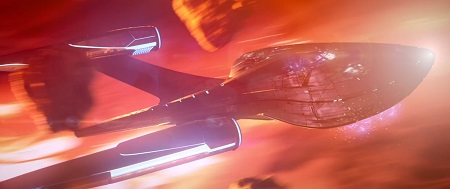
The USS Protostar in flight.

Despite that, the Prodigy panel was interesting. Dee Bradley Baker, who voices Murf – the cute blob-alien – seems like he’s a real Trekkie and spoke about the franchise with passion. It was so much fun to see him perform Murf’s voice live, as well! Brett Gray, who will take on the role of young leader Dal, seemed overjoyed to have joined a franchise – and a family – with such a legacy, and I liked the way he spoke about how the young crew of the USS Protostar will grow as the season progresses.

The show’s co-creators – brothers Dan and Kevin Hageman – spoke about how Prodigy won’t be a series that talks down to children, but rather aims to be a series with plenty to offer for adults as well. The best kids’ shows manage this – and the Hagemans have received critical acclaim and awards for their work on Trollhunters and Ninjago, so there’s a lot of room for optimism. They both seemed to have a good grasp of the legacy and role Star Trek plays and has played for young people, and I think the show is in safe hands.

Dee Bradley Baker gave us a tease of Murf’s voice!

The Prodigy trailer was action-packed and exciting! We got a glimpse of the villainous character played by John Noble – and heard his distinctive voice – as well as got a much closer look at the USS Protostar than we had before. Perhaps the most exciting moment, though, was seeing the Janeway hologram for the first time! Janeway’s role in the show seems like it will be that of a mentor; the kids will make their own calls and decisions, but Janeway will be on hand to offer advice – at least that’s my take at this stage.

There were some funny moments in the trailer, too, which will surely produce a lot of giggles from Prodigy’s young audience. “Just hit all the buttons” until the phasers fire was a great laugh line, and the ship losing artificial gravity was likewise hilarious. There was also a crash-landing that reminded me very much of a scene in the Voyager episode Timeless. I’m really looking forward to Prodigy and to spending time with the young crew of the USS Protostar.

The crew of Prodigy on the bridge of the USS Protostar.

The Lower Decks panel was perhaps the funniest of the night. It was also the one where the interviewees felt the most comfortable and did their best at participating and answering questions; there were none of the awkward silences or long pauses that made me cringe during other panels. Noël Wells, Eugene Cordero, and creator Mike McMahan initially took to the stage before being joined in truly spectacular fashion by Ransom voice actor Jerry O’Connell. The cast members clearly get on very well together, and this came across as the four talked with host Mica Burton about the first four episodes of the season as well as what’s to come in the remaining six episodes.

Wells and Cordero talked about how they see their characters of Tendi and Rutherford becoming friends and bonding over “nerd” things – geeking out together over things like new tricorders, engineering, or how best to do their work was a hallmark for both in Season 1. I’m not so sure how I feel about Mike McMahan saying that the rest of the season plans to go “even bigger” with some of its stories. Lower Decks can be overly ambitious, at times, with the number of characters and story threads it tries to cram into a twenty- or twenty-five-minute episode, and this can be to the detriment of some or all of the stories it wants to tell.

Mike McMahan, Noël Wells, Eugene Cordero, and Jerry O’Connell participated in the Lower Decks panel.

However, McMahan spoke about the episode Crisis Point from Season 1 as a kind of baseline for how big and bold the show wants to go in the second half of Season 2. That episode was one of the best, not just for its wacky over-the-top action, but for its quieter character moments. If the rest of Season 2 keeps in mind the successful elements from episodes like Crisis Point, then I think we’re in for a good time!

The mid-season trailer was interesting! Here are just some of the things I spotted: the Pakleds are returning, Rutherford seems to get a “Wrath of Khan-inspired” moment in a radiation chamber, Tendi was transformed into a monster that seemed reminiscent of those in Genesis from Season 7 of The Next Generation, Boimler and Mariner are involved in a shuttle crash, Mariner rejoins Captain Freeman on the bridge, there was a scene in which Boimler easily defeated some Borg that I assume must be a dream or holodeck programme, a Crystalline Entity was seen, the creepy bartender with the New England accent was back, and Boimler and Mariner shared a joke about the utility of phaser rifles. I’m sure there was more – but those were the key things I spotted! The rest of Season 2 will hopefully continue to hit the highs of the past few weeks – and there’s another episode coming out very soon here in the UK that I can’t wait to watch!

Rutherford’s “Wrath of Khan moment” from the mid-season trailer.

It was very sweet for Star Trek Day to take time to discuss Gene Roddenberry’s legacy, coming in the centenary year of his birth. His son Rod, and former Star Trek stars LeVar Burton, George Takei, and Gates McFadden joined Wil Wheaton to talk about Gene Roddenberry, and this was one of the most touching moments in the entire event. There were some laughs as George Takei told us about his first meeting with Gene Roddenberry and how he came to land the role of Sulu – including how both he and Gene mispronounced each others’ names! Gates McFadden seemed to have been talked into joining the cast of The Next Generation by Roddenberry, having initially wanted to return to the stage and join a play. Rod Roddenberry’s reminiscence of the design process for the Enterprise-D was hilarious – apparently his mother thought the ship looked like “a pregnant duck!”

LeVar Burton, who had been a Star Trek fan prior to joining The Next Generation, spoke about how he was overwhelmed at first when meeting “the Great Bird of the Galaxy,” and how a small role on a made-for-television film introduced him to producer Bob Justman, who later arranged for him to meet with Gene Roddenberry during pre-production on The Next Generation. All of these anecdotes went a long way to humanising Gene Roddenberry the man – we can often get lost in the legacy and philosophy he left behind, and how Star Trek and the world he created has influenced and impacted us, but this was a rare opportunity to hear small, personal stories about the man himself. I greatly appreciated that.

LeVar Burton spoke about working with Gene Roddenberry before giving a speech about The Next Generation.

George Takei got one of the biggest applause lines of the evening when he spoke about the importance of Star Trek’s fans, in particular Bjo Trimble, on popularising The Original Series and getting a nationwide fan community started. Decades before the internet came along to make fandoms and fan communities a part of many peoples’ lives, Star Trek was already developing its very own devoted fan community thanks to people like Bjo Trimble, and for George Takei to take time to acknowledge the role fans have played in Star Trek’s ongoing success was wonderful to hear.

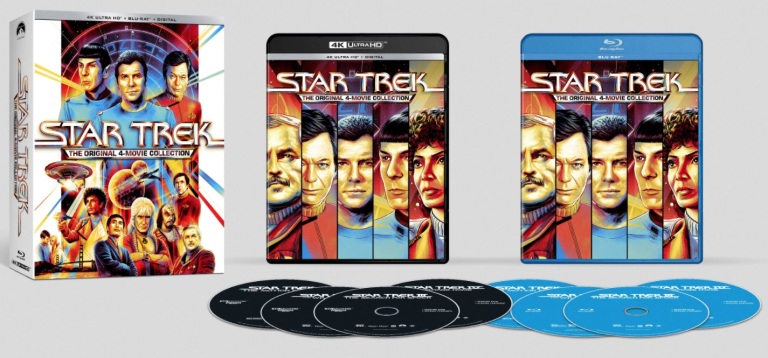
As I’ve said before, The Motion Picture was the culmination of this fan-led journey for Star Trek, but the film also laid the groundwork for much of what we’d come to know as Star Trek in the eighties and nineties. Many sets and design elements were in continuous use in some form from The Motion Picture’s premiere in 1979 right the way through to the cancellation of Enterprise in 2005, and much of the aesthetic and feel of Star Trek is owed to what The Motion Picture pioneered. George Takei acknowledged that, and that was a pretty cool moment. The Motion Picture is one of my favourite Star Trek films, and a 4K remaster was briefly shown off as well – the 4K blu-ray set of the first four Star Trek films is out now, so Star Trek Day took a moment to plug it!

There was a brief glimpse of the remastered version of The Motion Picture from this new box set.

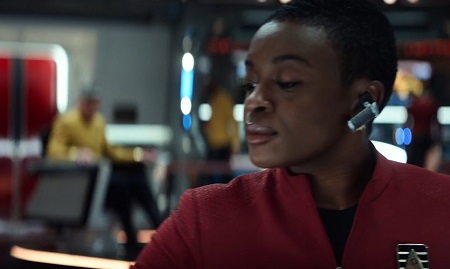
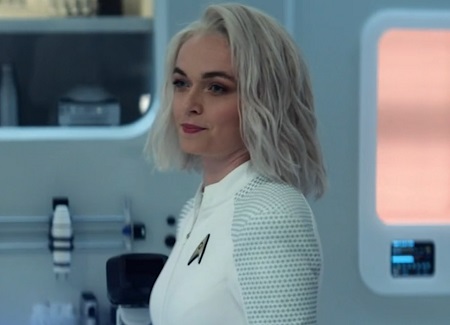
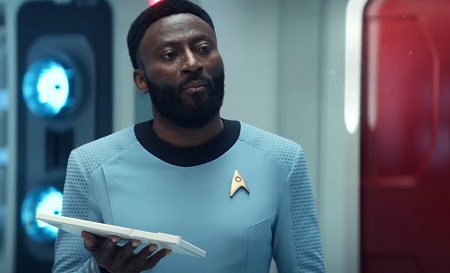
The panel that seemed to get the most online attention was, I felt, one of the worst and most cringeworthy to watch! The Strange New Worlds panel was followed up by a pre-recorded video that introduced new members of its main cast, who joined Anson Mount, Ethan Peck, and Rebecca Romijn. Among the newly-revealed characters were an Aenar (an Andorian race introduced in Enterprise) a possible descendant or relation of iconic villain Khan, and three characters from The Original Series who are returning to Star Trek: Dr M’Benga, who appeared in a couple of episodes, Nurse Chapel, and the one who got the most attention: Cadet Nyota Uhura!

Uhura blew up online after the announcement, and it’s fair to say that I was not expecting this! There was scope, I felt, for Strange New Worlds to bring back classic characters, but the choices they made seem to be pitch-perfect. I’m especially excited to see more from Dr M’Benga – he was a minor character who feels ripe for a deeper look. The same could also be said of Captain Pike and Number One!

Uhura’s return pretty much broke the internet!

As I predicted a few months ago, the uniforms for Strange New Worlds have been slightly redesigned from their Discovery style. I was never wild about the asymmetrical collars; they worked okay on Discovery’s all-blue uniforms but looked perhaps a little clumsy on the recoloured uniforms worn by Pike and the Enterprise crew. So to see the teaser show off a redesigned style that keeps the bold primary colours but ditches the Discovery style was pretty great! As with any new uniform I think we need time to see them in action and get used to them, but there’s already a lot to like. In addition to the V-neck style worn by Pike and Spock, we saw a white medical variant worn by Nurse Chapel, another medical variant with a broad crew collar worn by Dr M’Benga, and a zipper style worn by Number One. Starfleet uniforms – like any aesthetic or design element – are of course subject to personal taste, but from what we’ve seen so far I like the Strange New Worlds uniforms.

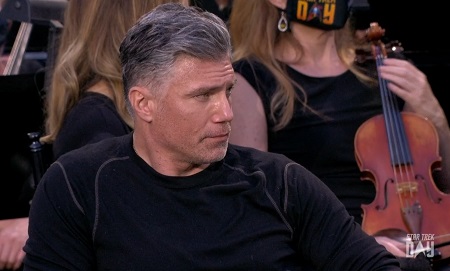
The Strange New Worlds live panel was not the best, though. Anson Mount, who is usually so full of life and happy to talk about all things Trek, sat in silence for large parts of it, deferring to the rest of the panel to answer questions. He may have been trying to avoid jumping in too fast or dominating proceedings, but it led to several very awkward silences that weren’t fun to watch. I got the sense that perhaps he wasn’t feeling well.

Anson Mount was not on his best form for the Strange New Worlds panel, unfortunately.

The producers – Akiva Goldsman, who has previously worked on Picard, and Henry Alonso Myers – gave us a few tidbits of information about the series. I was very pleased to hear so much positive talk about returning Star Trek to a more episodic format. Goldsman, who had been instrumental in crafting Picard’s serialised story during Season 1, seems quite happy to return to episodic television. There are a lot of advantages in a show like Strange New Worlds – i.e. one about exploration – to using a more episodic format. Episodic television can still see wonderful character growth – I’d point to Ensign Mariner in Lower Decks as a recent Star Trek example – so it was great to see how positively the cast and crew talked about that aspect of Strange New Worlds.

The producers and cast seemed very keen to embrace the legacy of The Original Series in more ways than one. Without looking to overwrite anything, they want to bring their own take on classic characters, and I think that’s great. Spock benefitted greatly from the expanded look we got at him in Discovery’s second season, and there’s no reason to think characters like Nurse Chapel or Cadet Uhura won’t likewise get significant character development that plays into the characters we know and love from their roles in The Original Series.

Jess Bush will be taking on the role of Nurse Christine Chapel in Strange New Worlds.

In terms of aesthetic, Strange New Worlds is trying to walk a line between embracing the 1960s style of The Original Series and also updating the show to a more modern look. There was talk about the design of sets, in particular Captain Pike’s quarters, and how the designers had been keen to return to the 1960s for inspiration. Likewise hair and nail styles were mentioned by Rebecca Romijn for Number One – a ’60s-inspired, “retro” look seems to be on the cards for the character, but not to such an extent that it becomes distracting. Walking that line is a challenge – but one I’m glad to see the show tackling!

We didn’t get a full trailer for Strange New Worlds, and the character introductions were cut in such a way as to minimise what we could see of the USS Enterprise. However, we did get a decent look at the transporter room set, which looks really cool, and when we met Dr M’Benga we got a glimpse of what I assume to be sickbay – and it looks like the colour scheme from The Original Series is still present in some form. We also got to see the logo and typeface for Strange New Worlds.

The Strange New Worlds logo.

So an underwhelming panel in some respects led to one of the biggest reveals of the night! Uhura, Chapel, and Dr M’Benga make welcome returns to Star Trek, that’s for sure. And there’s a particular genius to choosing these three characters in particular: they’re all ripe for more development and exploration. Uhura was a mainstay on The Original Series, but compared with the likes of Kirk and Spock there’s still plenty of room to explore her characterisation, background, and learn more about who she is in a way that will inform the original character and portrayal. Likewise for Nurse Chapel and Dr M’Benga – in many ways these two characters are near-blank slates for the new writers and producers to mould into their own creations.

I’m more excited today for Strange New Worlds than I was 24 hours ago, and that’s really saying something! I loved how Mount and the producers spoke about how his portrayal of Pike and Pike’s leadership style led them to redesign parts of his quarters so he could accommodate more of his crew around the table. Cooking was a big part of Captain Sisko’s character in Deep Space Nine, and I picked up at least a hint of that in some of the things said about Pike.

Dr M’Benga, despite being a returning character, offers a lot of scope for further development by a new team of writers.

The panel also discussed how the USS Enterprise is a “star of the show” in many respects, and how episodic storytelling will allow the series to return to Star Trek’s roots in terms of producing entertaining stories with morals. As I’ve said before, Star Trek has always used its sci-fi lens to shine a light on real-world issues, and to learn that Strange New Worlds is embracing that is fantastic news.

Spock’s characterisation was mentioned by Ethan Peck and the producers, and there was talk of how we’d see different facets of his personality. The Cage was mentioned as showing us “smiley Spock,” and I liked how the producers have a keen knowledge of how Spock and other Vulcans perceive and experience emotions – Spock is an emotional person, even if he suppresses those emotions much of the time. An exploration of that aspect of his character – informed by his experiences in Discovery Season 2, perhaps – will be truly interesting to see play out.

Captain Pike and the crew of Strange New Worlds will be on our screens in 2022.

Finally we come to Star Trek: Picard. This was the final event of the evening, and unfortunately the way it was teed up felt incredibly rushed. Jeri Ryan – who will reprise her role as Seven of Nine in Season 2 – raced onto the stage to introduce the new trailer, and it just seemed very obvious that the people running the event were acutely aware of time constraints and wanted to get it over with as quickly as possible. There was no Picard panel, no appearance from Sir Patrick Stewart (even by video-link or in a pre-recorded message), and though the trailer was very interesting the way Picard Season 2 was handled felt rushed right at the end of Star Trek Day – ironic, perhaps, considering the rushed way Season 1 also ended!

We’ll get to the trailer in a moment, but it was great to see that Picard Season 3 has been officially confirmed. We knew this was coming – Season 3 is already in production, and filming has already begun. But to get an official confirmation was good, and it drew a huge cheer from the audience. There’s clearly a big appetite for more Picard!

Picard is coming back for a third season!

Onward, then, to the trailer. This is one that I’ll have to return to for a more detailed breakdown in the days ahead, but for now here are my summarised thoughts.

A return to the 21st Century is not what I would have chosen. Time travel isn’t my favourite Star Trek storyline, and in particular time travel stories which return to the modern day can feel awfully dated very quickly. Look, for example, at Voyager’s two-parter Future’s End, or Star Trek IV as examples of that. Star Trek feels like the future – one of the reasons I love it so much – and when it comes back to the modern day I think it risks losing something significant. It’s possible that only a small part of the story will be set in the modern day, but even so I wasn’t exactly wild about this story element, unfortunately.

We knew from the earlier trailer that there has been some kind of change or damage to the timeline. It now seems as though Q may be more directly involved, as Picard blamed him for breaking the timeline. Whatever the change was, it seems to be centred in our own 21st Century (though it could be anywhere from 2020-2040, I guess) and resulted not in the creation of the Federation but a “totalitarian state” by the 24th Century. I don’t believe that this is the Mirror Universe that we’re familiar with, but rather a change to the Prime Timeline itself – perhaps caused by Q, but earlier comments seemed to suggest that Q wasn’t to blame, so watch this space.

A visit to the 21st Century would not have been my choice… but I will give it a chance!

In voiceover we heard Laris questioning Picard’s motivation for wanting to join Starfleet or leave Earth, something we’d seen him talk about in episodes like Family and again in Generations. She seemed to question whether he’s “running” from something in his past – could it be some darker impulse or perhaps a family secret that’s connected in some way to the creation of the totalitarian state? Could it be, as I suggested recenly, tied into World War III?

One of the things I was most curious about was the role of the Borg Queen, whose return had been signalled a few days ago via a casting announcement. It seems as though Picard has access to the incarcerated remains of a Borg Queen – somehow – and that she may be vital to allowing the crew of La Sirena to travel through time. Rather than the Borg themselves playing a role in the story, then, this may be a battle involving Picard and Seven – victims of assimilation – and a captured, damaged Borg Queen.

What role will the Borg Queen play? She appears to be a captive of some kind.

There’s a lot more to break down from the Picard trailer, and in the days ahead I’ll put together my thoughts in more detail – as well as perhaps fleshing out a theory or two. For now, I think what I want to say is that I have mixed feelings. The big drawback I can see is the modern-day setting for part of the show. I hope I’m proven wrong, but to me Star Trek has never been at its best with these kinds of stories, and I’m concerned that it’ll stray from being a Star Trek show into something… else.

On the other hand, there are many positives. The return of Laris, who seems to have an expanded role compared to where she was in Season 1. Q’s mysterious time-bending role, too. Is he the villain of the piece, or is his latest “trial” something that he believes will help Picard and humanity? What role will he play – ally, adversary, or something in between? The “totalitarian state” definitely channelled some elements of the Mirror Universe, but also seems to have put its own spin on this concept, taking it to different thematic places. I’d be curious to see what role the Picard of this timeline has in the government of the totalitarian state.

Something has broken the timeline – leaving Picard and his crew trapped in a “totalitarian” nightmare.

So that’s all I have to say for now. In the days ahead I’ll take a closer look at the Picard trailer, as well as talk about other things we learned at Star Trek Day.

Although it was a late night and a long broadcast, I had a good time with Star Trek Day overall. There were some moments that didn’t work well, some unprepared interviewees and some segments that dragged on too long, but on the whole it was a fun and incredibly positive celebration of Star Trek. I came to the broadcast hoping to see more from upcoming shows, but I was blown away just as much by the celebration of Star Trek’s past as I was by the look ahead.

The hosts, presenters, and most of the speakers and guests showed off their passion and love for Star Trek in a very positive way. There was a lot of talk about returning the franchise to its roots, celebrating the legacy of Gene Roddenberry and his original vision for Star Trek and what made it so appealing to people of all ages across multiple generations. As we look ahead to Star Trek’s future in 2021, 2022, and beyond, taking these moments to look back at what got Star Trek to where it is today was fantastic, and well worth taking the time to see. Above all, Star Trek Day shone with passion and positivity, and that’s just what the franchise needed as it marked its fifty-fifth birthday. Here’s to the next fifty-five years of Star Trek!

Star Trek Day was broadcast online and on Paramount+ on the 8th of September 2021 (9th of September 2021 in the UK). At time of writing the event can be re-watched on the official Star Trek website; panels and trailers are supposed to be available via Star Trek and Paramount+ official YouTube channels. Clips may also be available via official social media pages and channels. The Star Trek franchise – including all properties and series mentioned above – is the copyright of ViacomCBS. This article contains the thoughts and opinions of one person only and is not intended to cause any offence.