Star Trek: Strange New Worlds Episode Review – Season 4, Episode 4: A Case of Chiaroscuro

A Star Trek-themed spoiler warning (black and white)

Spoiler Warning: There are spoilers ahead for Star Trek: Strange New Worlds Seasons 1-4. Spoilers are also present for the following Star Trek productions: The Original Series, The Search for Spock, The Next Generation, Deep Space Nine, Enterprise, and Lower Decks.

I think I ought to start this week’s review with a bit of an explanation of how I try to approach new episodes of Star Trek. On the one hand, I’m obviously going to tell you whether I personally enjoyed the story, the character moments, the presentation, the score… all of that *subjective* stuff. But I also try to keep in mind, when writing a review, what an episode was aiming for and how well it measured up to those objectives.

That’s why I can look at an episode like last week’s Human Best Friend and say that I truly enjoyed its sense of humour, its pastiche of films like The Hangover, and its genuinely well-written character moments – and why, conversely, I’ll tell you that the otherwise outstanding horror offering The Griffin Incident came with a glaring narrative flaw. I’ll even admit – however begrudingly – that Season 2’s Subspace Rhapsody was competently made, musically solid, and even had some solid characterisation… even though I will literally never watch that absolute travesty ever again!
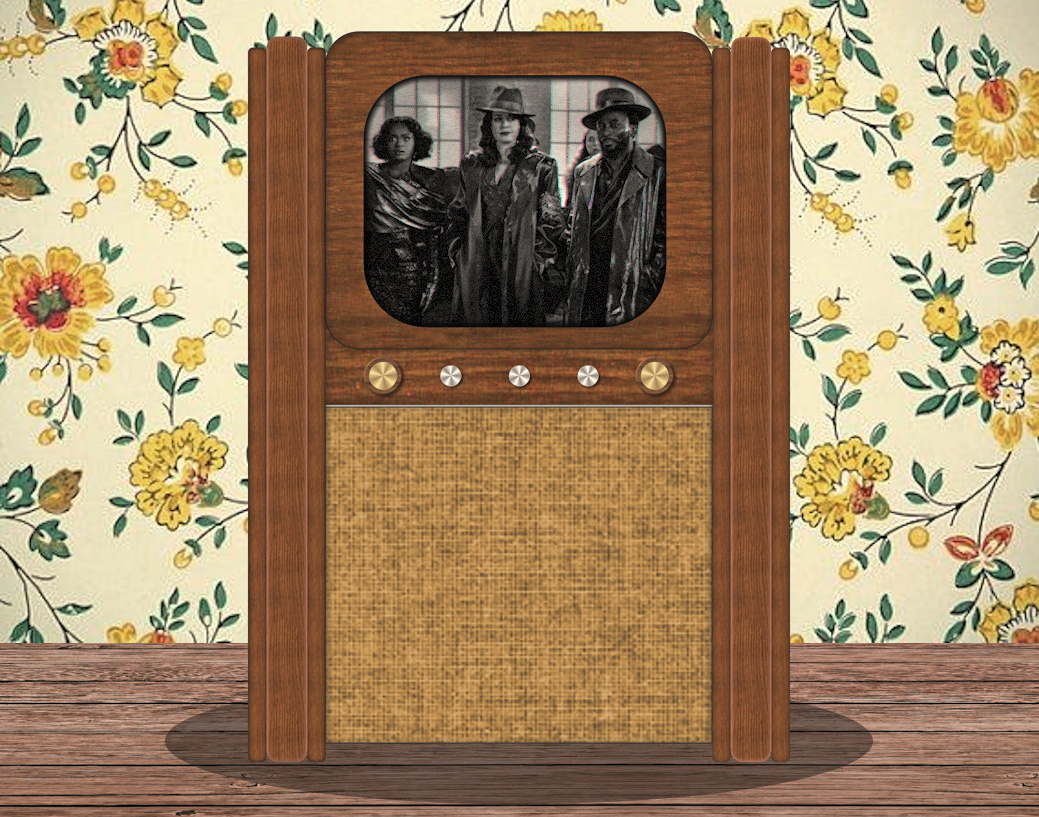
Stylised promo photo from Star Trek SNW 4x04 showing a vintage television set
I considered doing all of the still frames like this… but don’t worry, I thought better of it!

Why did I start my review of A Case of Chiaroscuro with that explanation-come-caveat? Well, the truth is… I *really* don’t like watching black-and-white films and TV shows. I realise that’s a horrible generalisation, and there are some exceptions – Christmas films, like Miracle on 34th Street, for instance. But, generally speaking, I just struggle to get immersed in black-and-white media, and *modern* productions which deliberately use black-and-white – as A Case of Chiaroscuro does – almost universally feel gimmicky and silly to me.

Again, this is a *subjective, not objective* take – but I wanted to be up front about my bias here, because my general dislike of black-and-white has undoubtedly coloured (pun very much intended) my thoughts on A Case of Chiaroscuro.

A Case of Chiaroscuro was a faithful recreation of the kind of ’30s and ’40s noir movies that inspired it. Not only in terms of its use of black-and-white, but the entire episode’s visual style and presentation all drew from that source, as did its score. Narratively, A Case of Chiaroscuro also leaned heavily on noir and melodrama from a bygone era. And regardless of whether I *liked* that in a personal sense… I respect the commitment to the bit.
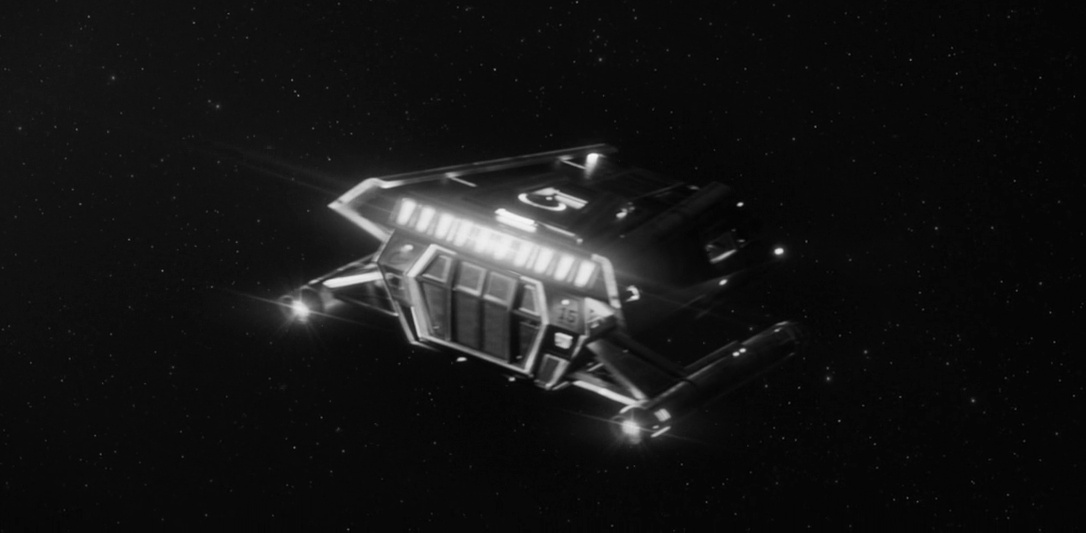
Still frame from Star Trek SNW 4x04 showing the shuttle
A shuttle in black-and-white.

However, more so than any other story so far this season – and really, any other story in Strange New Worlds, save, perhaps for Subspace RhapsodyA Case of Chiaroscuro felt like “a bit.” Its noir inspiration was *so* omnipresent in everything from the set design and music to the soft-focus close-up shots and narrative melodrama that it feels less like an actual story within the Star Trek universe and more like a pulpy television serial. It was hard to take A Case of Chiaroscuro as seriously as I wanted to – because, by turning the dials all the way up and not just drawing inspiration from film noir but actively copying as many aspects of it as possible, the episode imported all of what I’d consider to be the genre’s flaws.

By choosing to employ an outdated kind of storytelling – not just the black-and-white, but a melodramatic narrative with over-the-top twists and turns and cardboard cut-out secondary characters who didn’t feel like real people – A Case of Chiaroscuro feels… vintage. But that isn’t a good thing in this case, if we’re talking about an episode of Star Trek that I want to watch and enjoy. Most of the episode didn’t just look dated, but it also *felt* out-of-date; TV serials and movies like this were past their prime even sixty years ago, when The Original Series was on the air. And while there absolutely are interesting points in A Case of Chiaroscuro that I can wholeheartedly say that I enjoyed… the final product is simply too gimmicky for my personal taste.
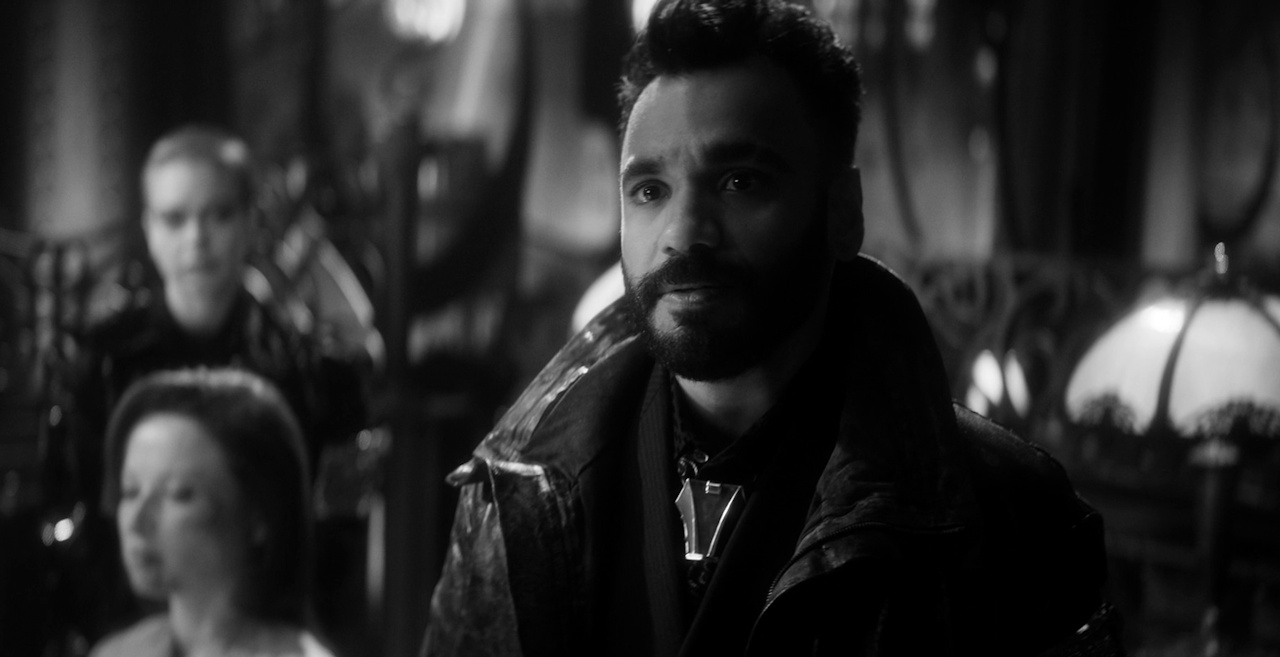
Still frame from Star Trek SNW 4x04 showing the collaborator
The collaborator.

I concede, though, that A Case of Chiaroscuro knows exactly what kind of story it wants to tell, and sets out to tell it earnestly and successfully. I can absolutely see this being considered a highlight of the season – and perhaps even of Star Trek as a whole – for Trekkies who have a fondness for these kinds of mystery-thriller noir stories. And, as I’ve said before, it’s to the credit of the former Paramount corporation that the executives were willing to greenlight a project like this, to spend a not insignificant amount of money on scripts and sets, and to – for lack of a better word – allow Star Trek to be “weird.” I can’t think of many other big-budget streaming productions that would’ve so wholeheartedly embraced the kind of genre-shifting that Strange New Worlds has done… and, for all of the many, many flaws and failings of the old Paramount, I think they deserve at least some kudos for giving the thumbs-up to a story like this one.

So… another “big swing” in Season 4, then! Adventure, horror, comedy, and now film noir… and we still have the puppet episode yet to come. I think this season will go down in the history books for just how many different ideas the writers brought to the table – and I can appreciate the diversity, the semi-episodic storytelling, and the willingness to go to places Star Trek hasn’t always gone before. Even if the results, on this occasion, weren’t “my thing.”
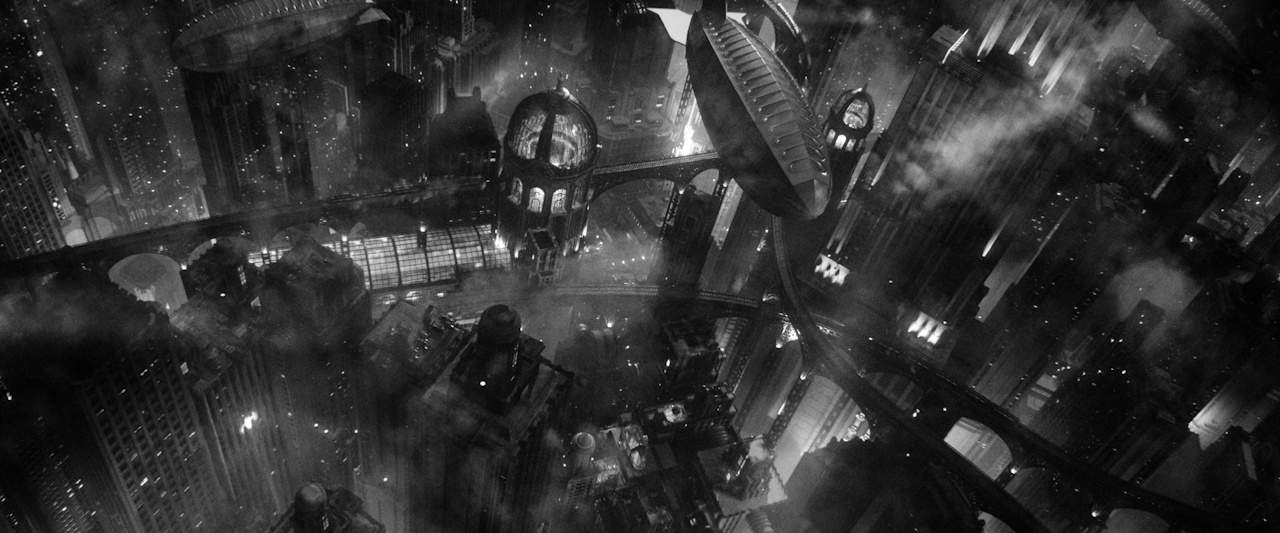
Still frame from Star Trek SNW 4x04 showing the city from above
The city on Mat’Aar XII.

Let’s concentrate on the part of the episode which I liked… or at least the part I felt wasn’t as weak as the main story.

Back aboard the Enterprise – but still in black-and-white – we have La’an’s investigation of a mysterious signal. The probe – little more than a macguffin to kick-start the episode’s two main storylines – may have been tampered with, or at least La’an believed so.

I liked the way that the episode framed this, and the way the story convinced us as the audience that what we were seeing was nothing more than La’an overreacting. Even the little recap at the beginning of the episode, which went back to last season, showed how La’an might be succumbing to paranoia. And, as her storyline unfolded, A Case of Chiaroscuro tried very hard to convey to us that La’an was seeing things that weren’t really there.

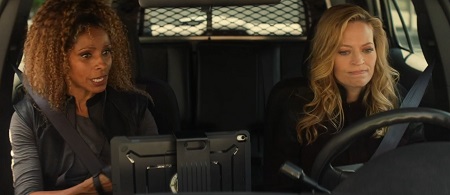
Still frame from Star Trek SNW 4x04 showing La'an's padd
La’an investigated some missing data.

This made the ultimate reveal – that the probe *had* in fact been meddled with – hit a bit harder. I still don’t think that this storyline was executed perfectly; both Spock’s dismissal of La’an’s concerns and Chapel’s confession felt rushed. But that’s a consequence of this being the B-plot of an episode that had its attention elsewhere. Had we not already got a major La’an storyline already this season, I might’ve said I’d have liked to see this B-plot fleshed out into its own episode. But, that limitation aside, I liked this storyline.

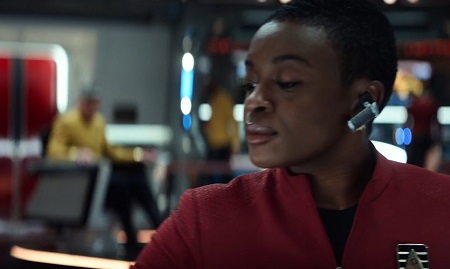
Firstly, the Vulcan cadet – I’ve now learned her name is A’sha – finally got something plot-relevant to do after her introduction in the season premiere. Maybe it’s this episode’s noir tone and double- and triple-crosses, but I can’t help but wonder if A’sha is going to turn out to be a spy or something! But maybe that’s too much of a reach based on her limited screen time. In any case, it was nice to see her on the bridge and for her to get something to do. Modern Star Trek hasn’t always handled its secondary characters especially well, but it’s nice to get *some* conversations and interactions outside of the main cast; it populates the Enterprise and makes the broader world of Star Trek feel more lived-in and real.
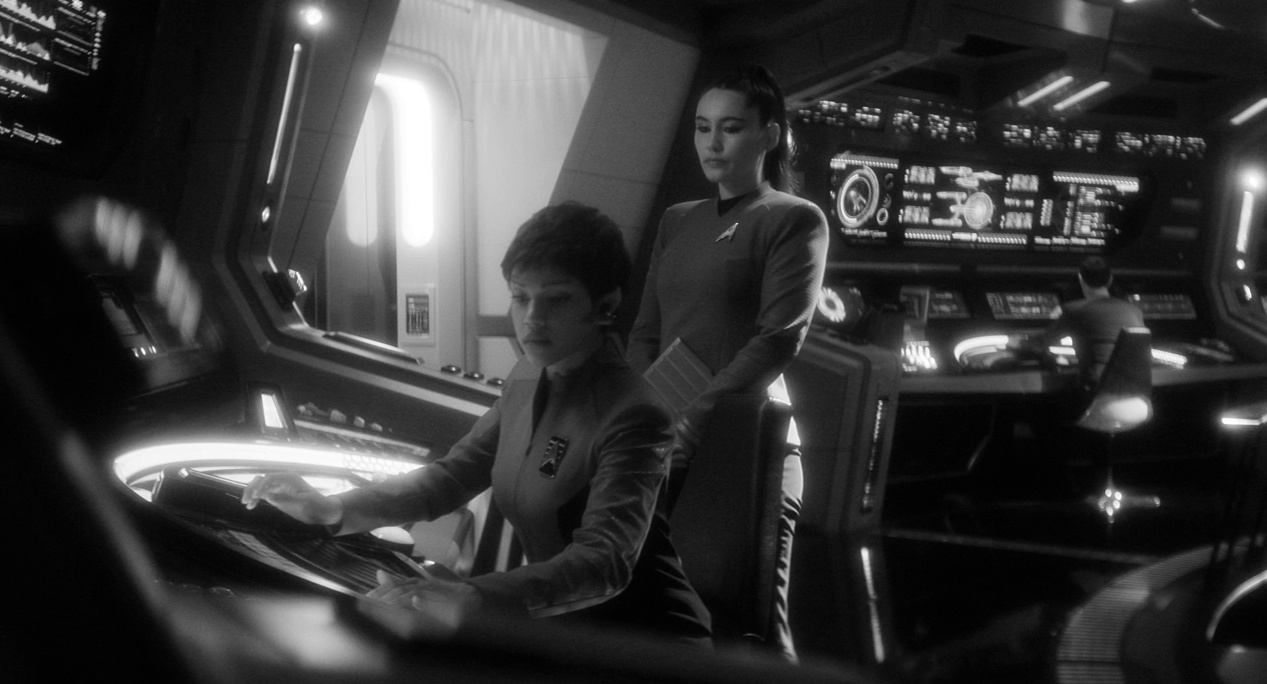
Still frame from Star Trek SNW 4x04 showing La'an and A'sha
La’an with Cadet A’Sha.

I wasn’t wild about the speed with which Spock dismissed La’an’s concerns – though, in a noir-style story, it made me question whether *he* might’ve been complicit in… whatever may or may not have been going on, so I guess that’s not all bad. I do wonder, though, what recent events – including last week’s argument in the bar and now this dismissive reaction – might mean for La’an’s relationship with Spock.

We also got a bit of a follow-up to last week’s episode as Ortegas and Scotty were seen hanging out together. I wondered, when they seemed to be in the same quarters, whether this might be another hint at some kind of romantic relationship, but La’an stated they’re “friends now,” at the end of the episode – and I think that’s how we’re meant to read it. In any case, it was cute to see them together after their adventure, and I appreciate how Strange New Worlds retains these character relationships and moments that it develops.
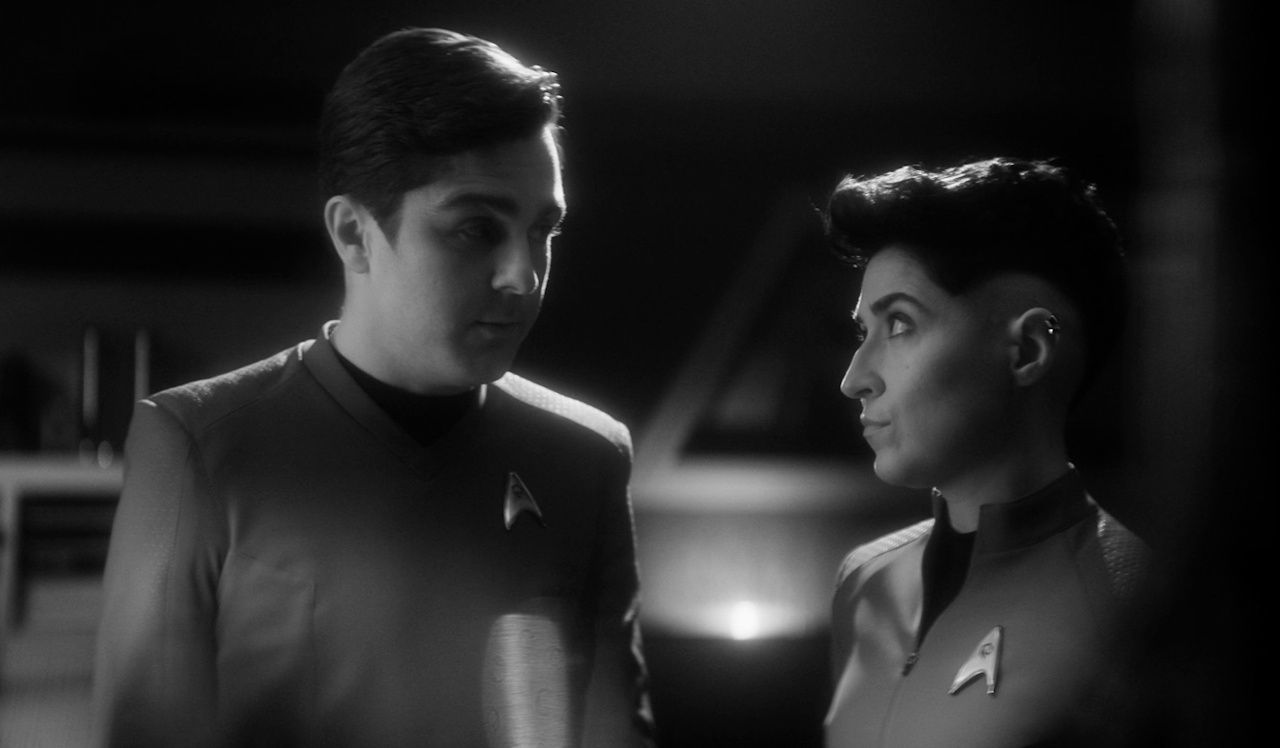
Still frame from Star Trek SNW 4x04 showing Scotty and Ortegas
Scotty and Ortegas are friends now, after last week’s adventure.

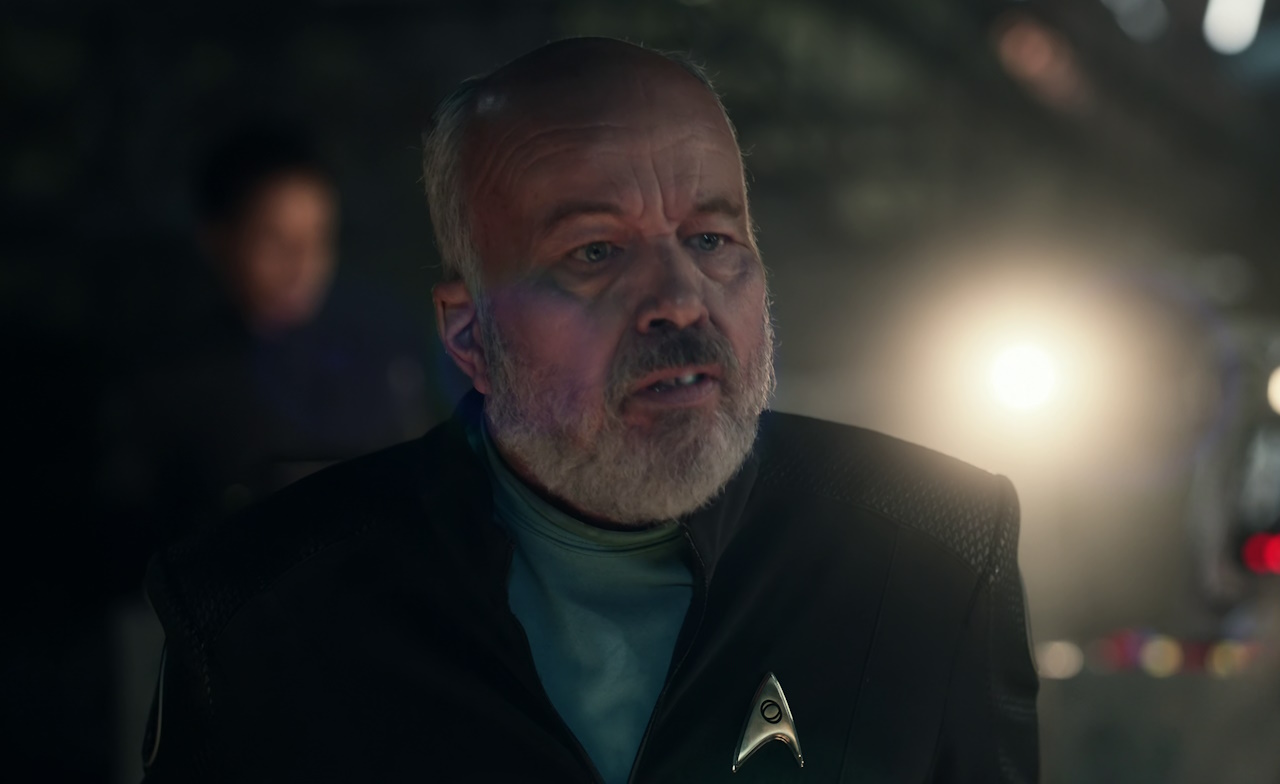
Scotty gave us a great line of technobabble about how he was keeping tabs on the Klingon ship, and that was both fun and very “Star Trekky,” for want of another term. I felt Dr M’Benga’s line about why everything was in black-and-white was a bit hand-wavey earlier in the episode, as technobabble goes, but Scotty’s was definitely more in line with what we’ve seen before. Not sure why he was keeping it a secret from the ship’s security officer, of all people, but I guess it worked as an excuse for La’an to chase leads and catch up with other members of the crew.

One thing I didn’t really like, though, was Scotty’s line about being “trapped in a transporter buffer;” a reference to his ultimate fate and the TNG episode Relics. If this had been a one-off, I wouldn’t have minded (I think), but so far this season, La’an has called back to The Search for Spock and Dr M’Benga made another reference to Relics just last week. Occasional callbacks to past iterations of Star Trek – or calls forward, I guess, to these characters’ fates and ultimate destinations – are okay, but they really ought to be *occasional*. Otherwise they come across as heavy-handed and overwhelming… and it just isn’t necessary and stops being fun. A single line like this is great; a nod and wink to long-time Trekkies. Too many just feel like navel-gazing, self-referential fluff… or just a plain lack of originality, I guess. And because we’ve had several of these lines in earlier episodes – one of which already featured Scotty – this one was a bridge too far. On its own? Totally okay. But after seeing several others already this season, I felt it crossed that invisible line between being a playful in-joke and becoming excessive.
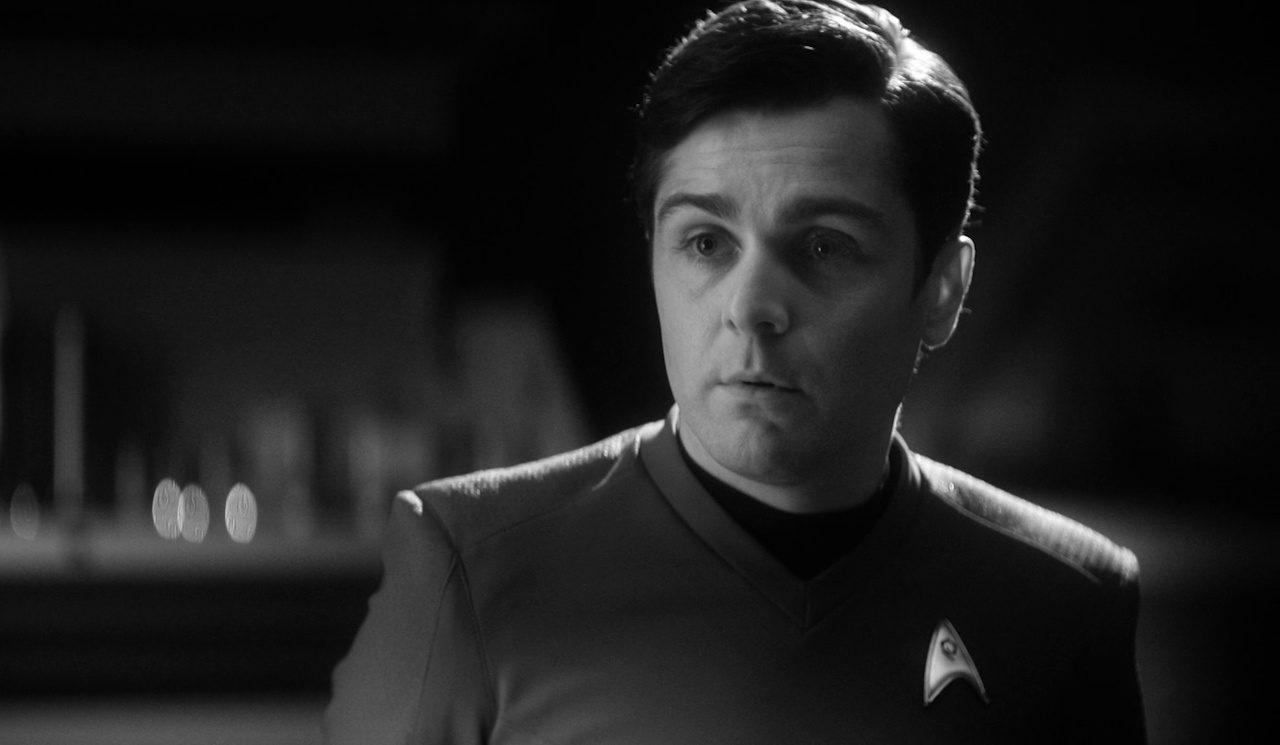
Still frame from Star Trek SNW 4x04 showing Scotty
Don’t call it “foreshadowing”…

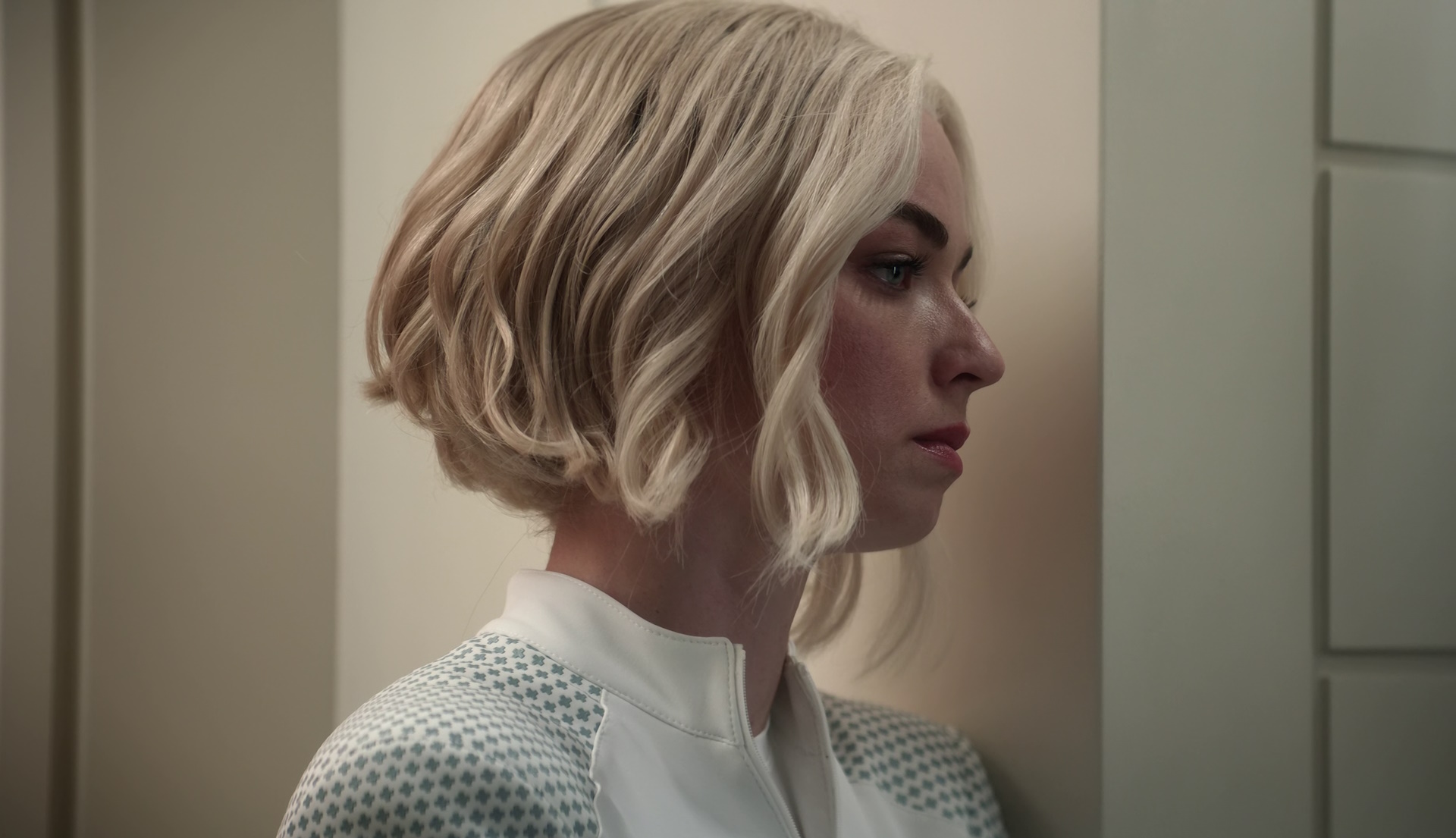
The conclusion of this storyline sees Chapel confessing to being the one who interfered with the probe and deleted its data. Though, as I said, this felt kind of rushed, it was nice that in this kind of storyline, the ending was difficult to deduce and there was still time for a twist. I think both Chapel and La’an got good moments of characterisation here: Chapel didn’t just let La’an think paranoia was overtaking her, instead confessing even though doing so could’ve had real consequences for her, and La’an chose loyalty to a friend over following the letter of the law.

For both characters, those are positive things – and while not “out of character” by any stretch, it’s still good to see both of them doing the right thing and choosing friendship, not blind rule-following. Chapel’s decision to delete the incriminating data felt understandable, even though I wish we’d gotten a longer scene explaining it, and La’an’s choice to keep the issue between them said a lot about her character. If, as I’ve theorised, we could be seeing the beginning of the end for La’an – either aboard the Enterprise or, y’know, alive – moments like this will be all the more important.
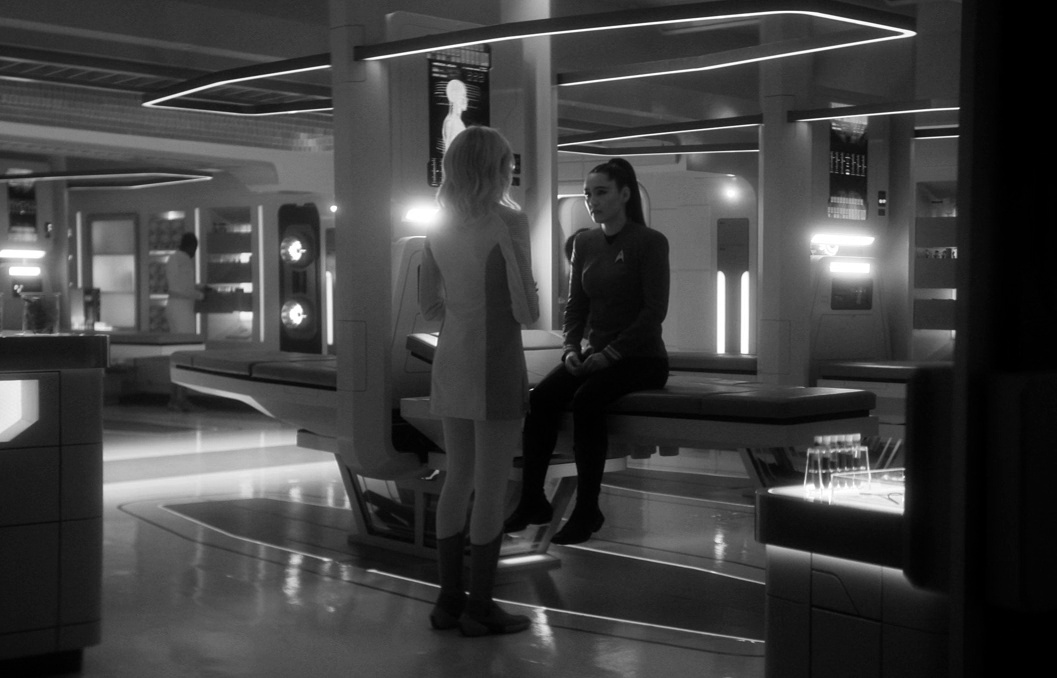
Still frame from Star Trek SNW 4x04 showing La'an and Chapel
Nurse Chapel with La’an in Sickbay.

La’an got this week’s secondary story, with the main focus of A Case of Chiaroscuro being on Una. But these two stories were thematically linked, and that made these two otherwise disconnected parts of the episode feel a bit closer together. La’an had to wrangle with her own paranoia and consider whether she was imagining things, or whether there actually was an issue with the probe. But the end of this story saw her choosing to do the right thing by a friend, even if that ment bending the rules.

Una’s story ends in a similar way. She chooses to bend the rules – in this case actively, whereas La’an’s was more passive, I suppose – to facilitate the rebels’ plan on Mat’Aar XII. But both characters had to deal with intrigue, mysteries, and ultimately, both had to decide whether to do the right thing – or what the “right” thing even is when faced with complex and nuanced situations.
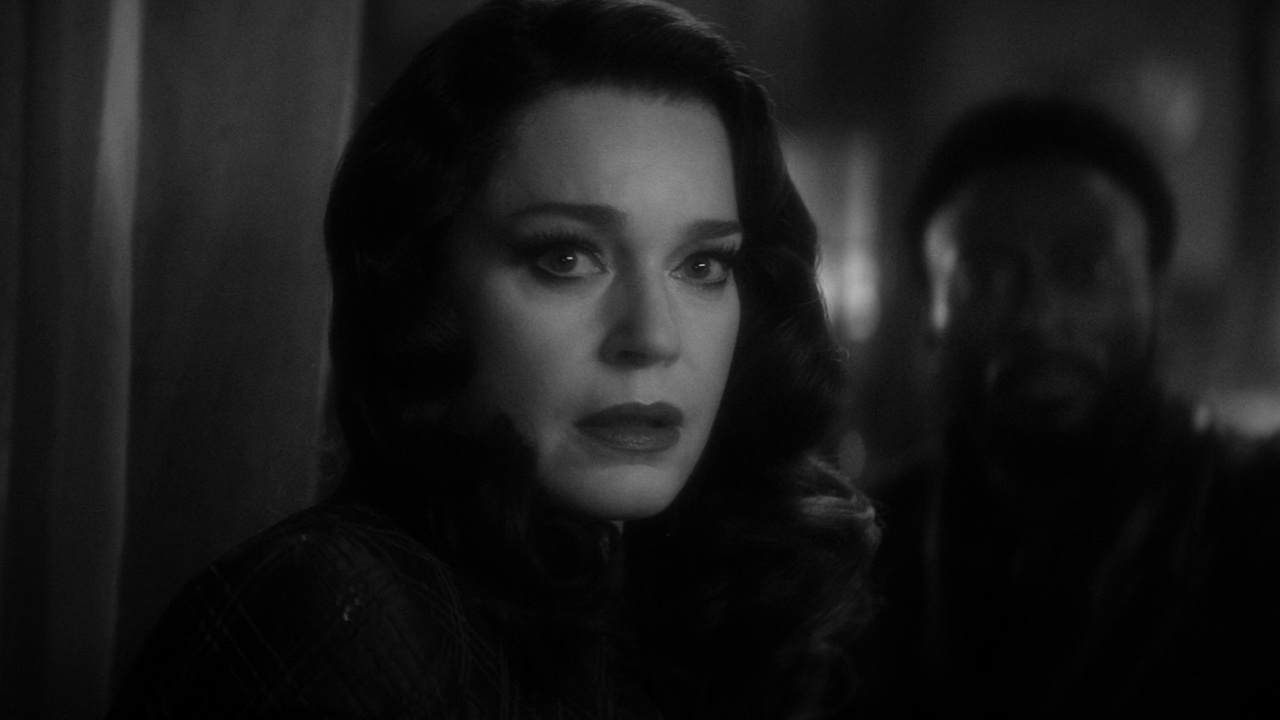
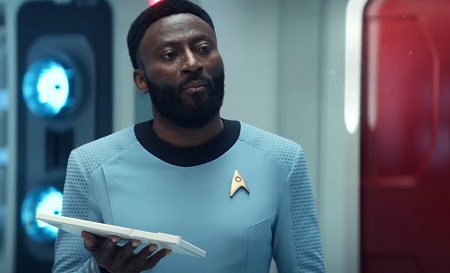
Still frame from Star Trek SNW 4x04 showing Una and M'Benga
Una’s storyline was similar, in thematic terms, to La’an’s.

Before we get further into the main thrust of the mysteries on Mat’Aar XII, I want to talk briefly about the Klingons.

A Case of Chiaroscuro wasn’t really a Klingon episode. The Klingons were present, sure, and they played a significant narrative role – but the bulk of the story was focused on the main characters and the intrigue on Mat’Aar XII. But the episode did something for the Klingons that I think is kind of important – and that I approve of!

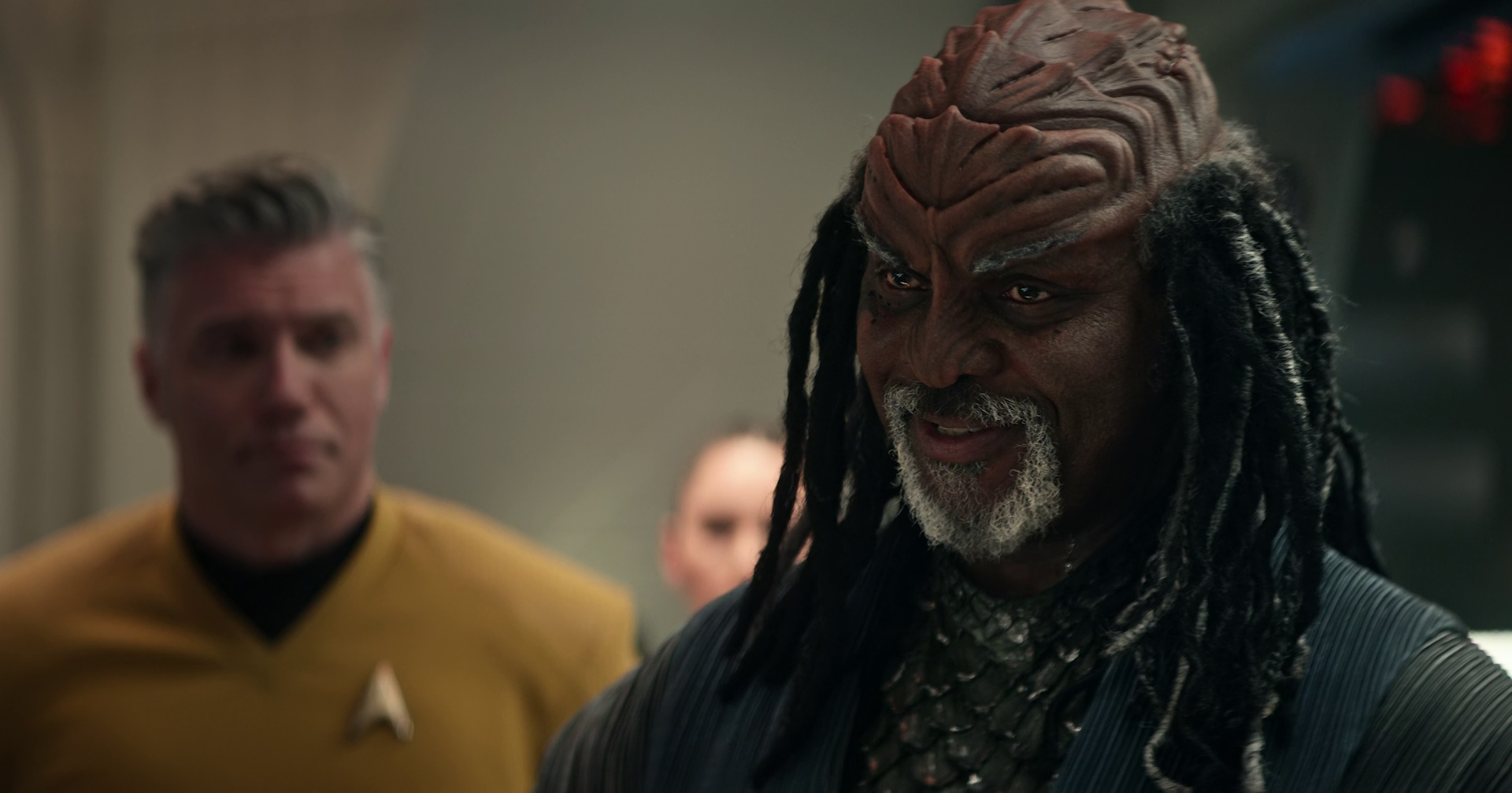
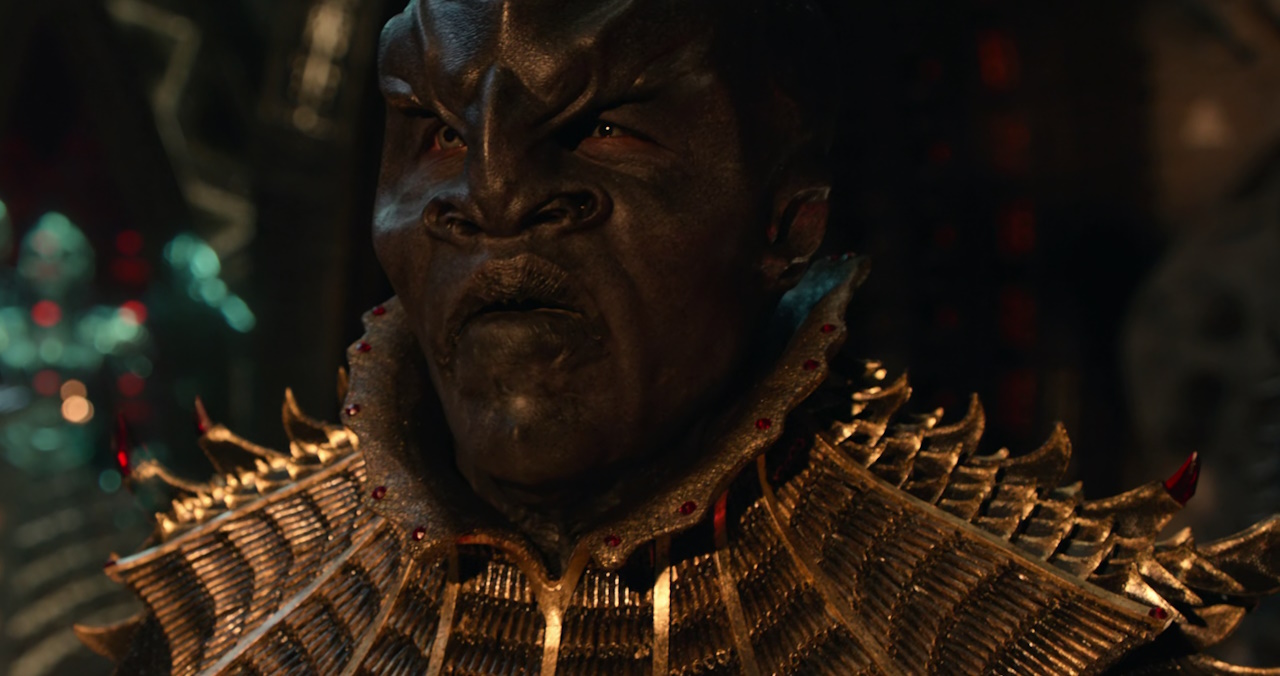
I’ve said, on the record, that I felt Enterprise’s “Klingon-augment virus” storyline was one of the show’s weakest, and that the change in prosthetic makeup for the Klingons in between TOS and The Motion Picture simply did not need to be called attention to nor given an in-universe explanation. Thankfully, modern Star Trek has walked away from that idea, and we’ve already seen Klingons in Strange New Worlds with the more familiar design. That continued here – even with the character of Kor. Kor is a Klingon who tangled with Kirk in The Original Series and returned in three episodes of Deep Space Nine, too.
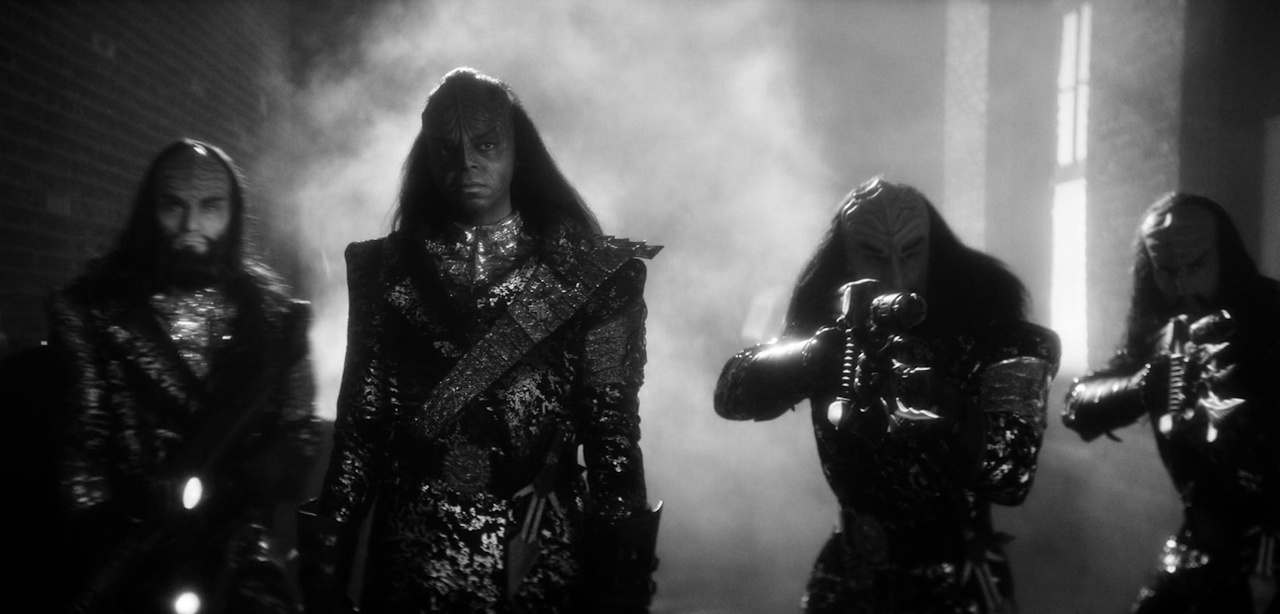
Still frame from Star Trek SNW 4x04 showing Kor and three Klingons
Kor with his band of Klingons.

In Kor’s TOS and TAS appearances, he sports the original Klingon aesthetic, but this was updated for DS9. So if you want to be fussy about it, now we have a contradiction! But I don’t really see it as a contradiction at all. Just as when Kor appeared in DS9, prosthetic forehead and all, Star Trek was kind of drawing a line under TOS and updating things without drawing attention to it. And I read this prequel version of Kor in much the same way. Some parts of Star Trek… well, they can (and should) be ignored. Some stories didn’t work, some aesthetic changes could be made as new technologies and higher budgets allowed, and this is the result.

And hey, if you want to be picky and make everything in Star Trek fit? Let’s just say that Kor contracted the virus in between his posting to Mat’Aar XII and his run-in with Kirk!

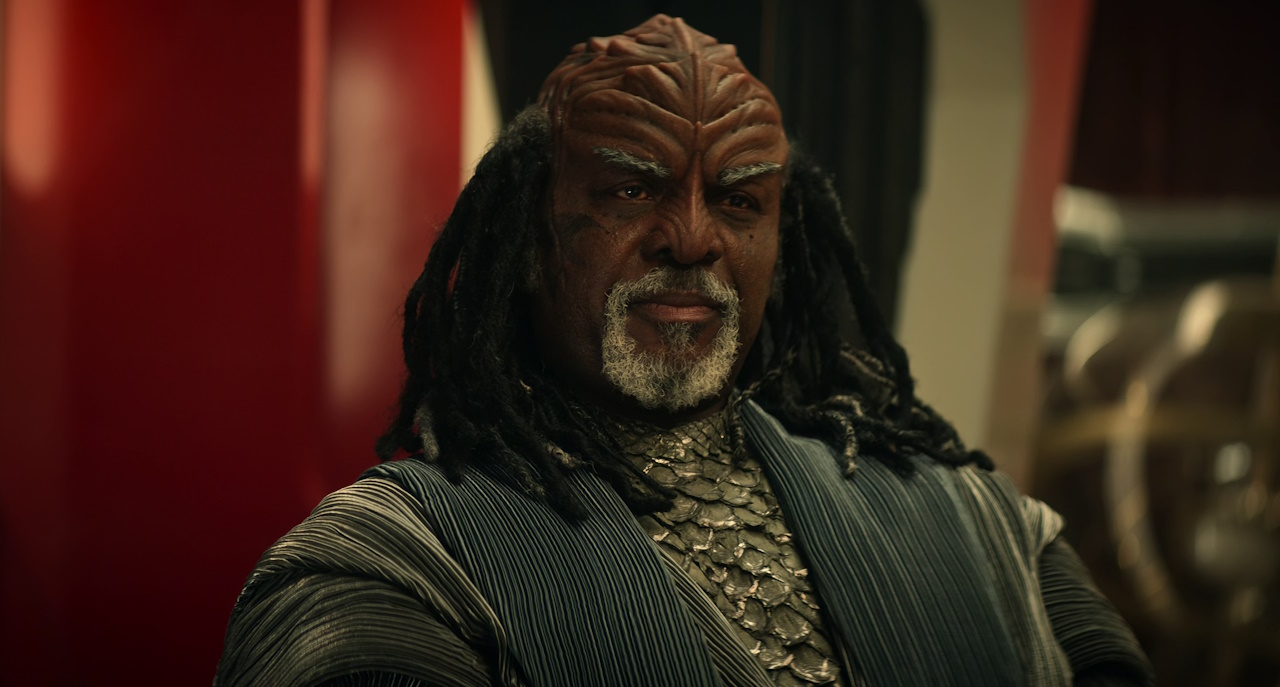
I felt that Demore Barnes’ take on the character of Kor was one of the best parts of this weaker side of the story. Barnes – who you might recognise from Supernatural, Hannibal, or Twelve Monkeys, among other high-profile TV roles – was absolutely excellent in this villainous role, showing us a nuanced take on a Klingon leader that didn’t just rely on anger, aggression, and murder. In this kind of noir-inspired story, that’s how a villain should behave. Was bringing Kor into the show a bit of cheap nostalgia bait for Trekkies? Well… maybe. And I could entertain the argument that *this* version of Kor doesn’t fully line up with the way the character behaved in TOS and DS9. But that doesn’t mean I didn’t enjoy the performance or Kor’s role in the story!
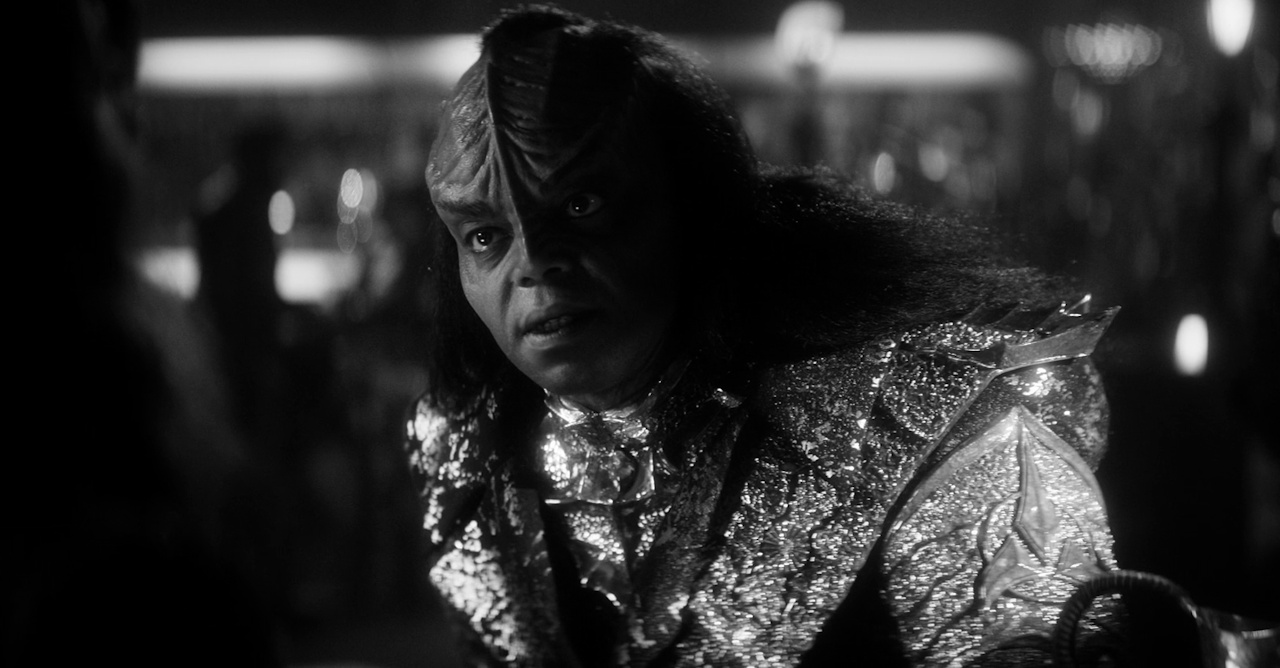
Still frame from Star Trek SNW 4x04 showing Kor
I enjoyed this new take on the established character of Kor.

The Klingons, in their original incarnation some sixty years ago, were famously meant to be metaphorical stand-ins for the Soviet Union, with the Federation representing the United States or the broader western alliance. And A Case of Chiaroscuro called attention to the “cold war” that exists between the Klingons and Federation in this time period. That little connection was neat, and the lines referring to it were well-delivered.

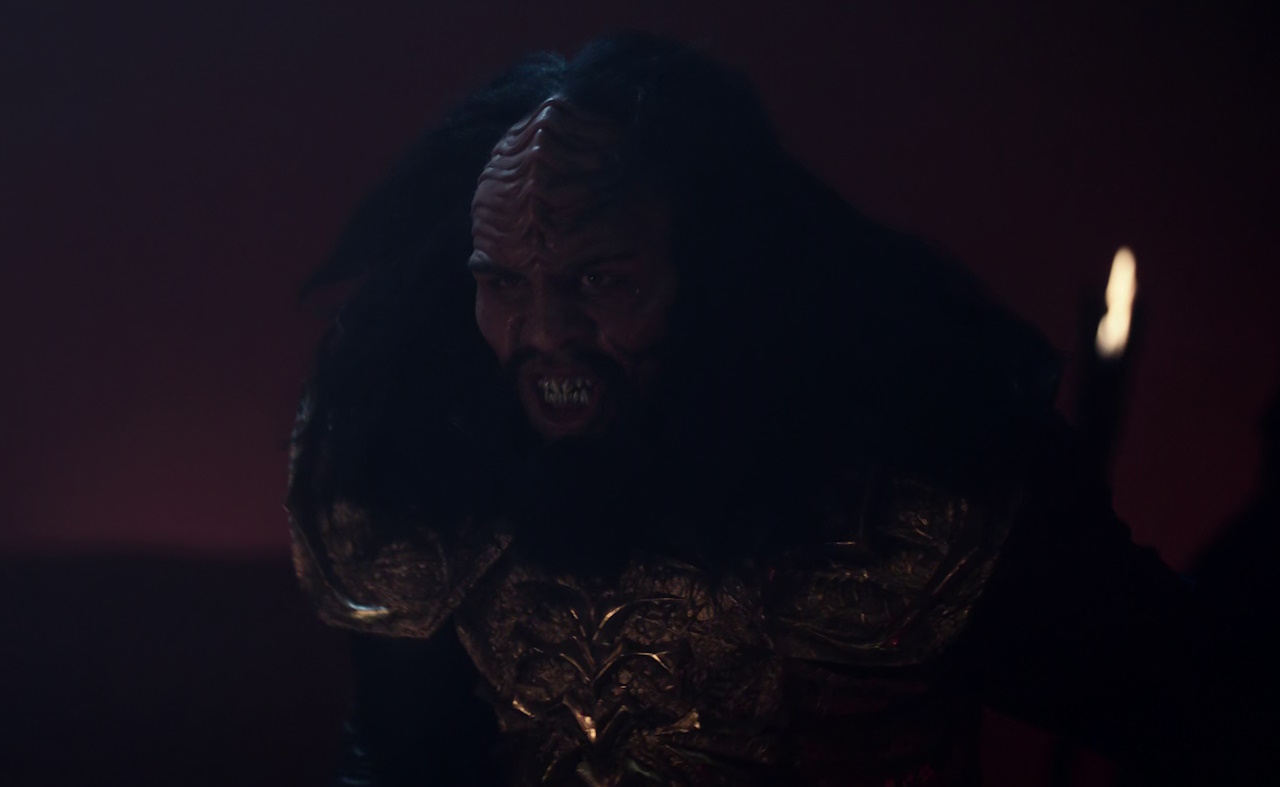
But in this story, the Klingons felt less like 1960s Soviets and more like 1940s Nazis with the way their occupation of Mat’Aar XII came to life. Roving gangs of collaborators, uniformed soldiers, symbolic armbands, and propaganda messages being broadcast all linked up to create a really unsettling feel to the entire city; even seemingly “safe” spaces like the bar or the office felt like they could be raided or interfered with at any moment.
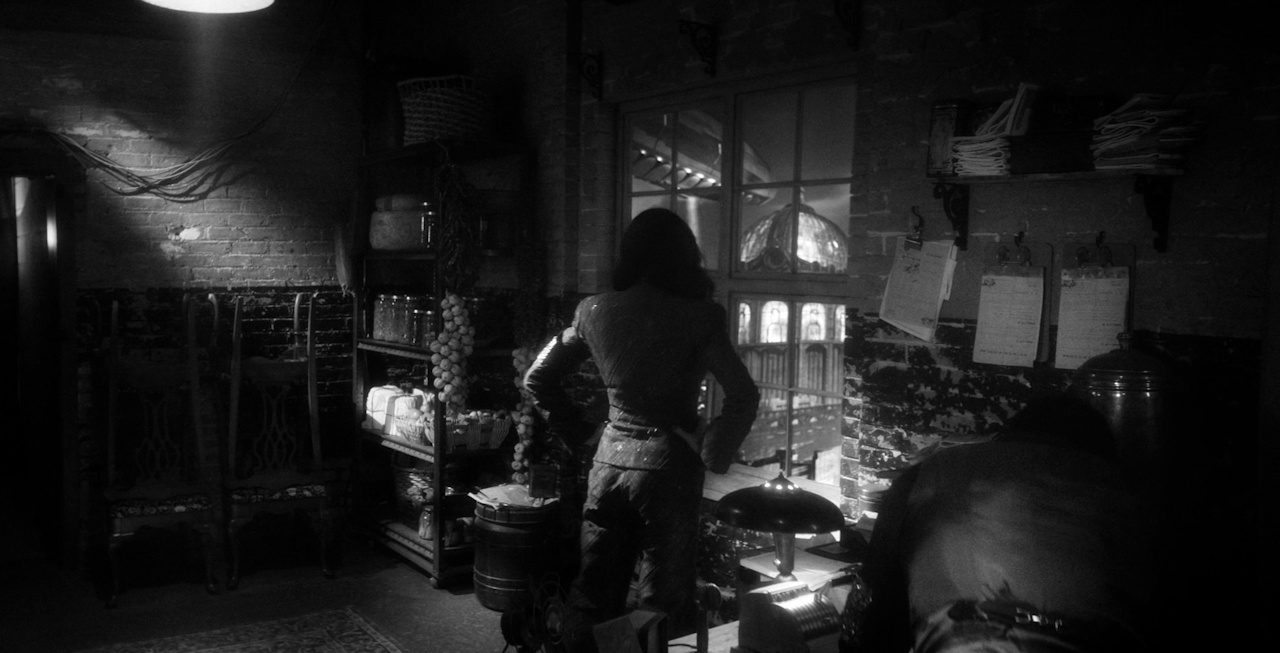
Still frame from Star Trek SNW 4x04 showing Una in her doppelgänger's office
Una in the doppelgänger’s office.

The sets and stages used to create Mat’Aar XII were genuinely very well done. I got a “Paris in World War II” kind of vibe; that this city was very much under occupation. The ’40s-style barrage balloons, the spotlights, and the art deco-style architecture (which was mostly seen in CGI establishing shots) all added to this sensation, as did the claustrophobic street set with its archway checkpoint. The white steam or smoke – another hallmark of films from this era – was well-used, too. As I said above, every aspect of A Case of Chiaroscuro leaned into this film noir style, and that extends to the way the sets were designed. The city was undeniably atmospheric.

Parts of A Case of Chiaroscuro reminded me a little of A Piece of the Action from TOS – the “gangster episode” where Kirk and co. visit a planet whose inhabitants were inspired by a book about 1920s Chicago. Some of the costumes, sets, and vehicles – all inspired by the first half of the 20th Century – gave me that feeling, and even the Klingons’ disruptors seemed to resemble Tommy guns! Obviously, A Piece of the Action was, itself, drawing on stories from the ’30s and ’40s for inspiration – G-Men, Invisible Stripes, and others – and there’s a difference between the kind of noir story present here and the simplified gangster/crime drama of that older episode. But, as I’ve said before, it can be nice when Star Trek stories… rhyme.
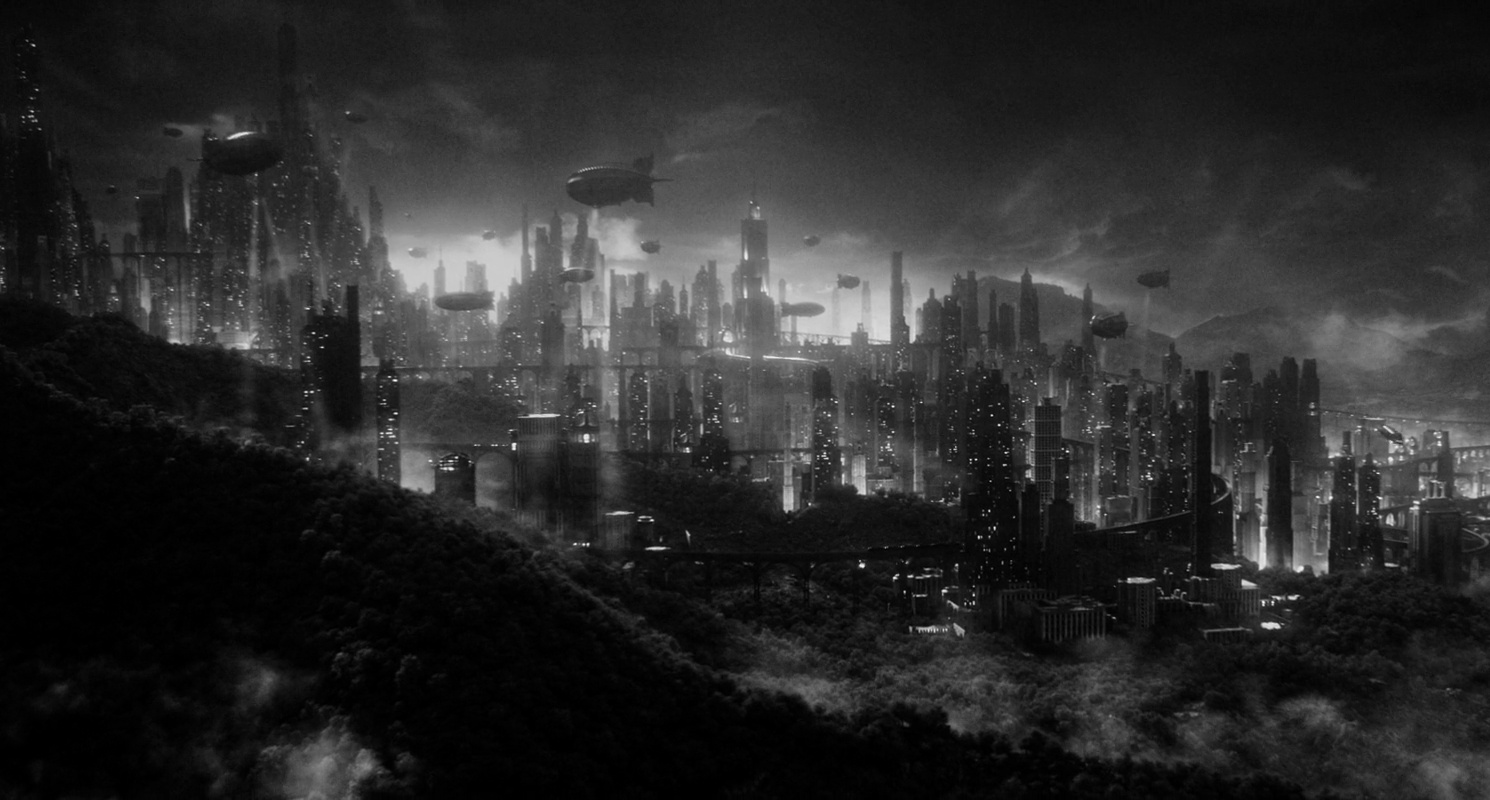
Still frame from Star Trek SNW 4x04 showing the city on Mat'Aar XII
I liked these establishing shots of the city, and how atmospheric they felt.

The main storyline’s central conceit was that Una is the exact doppelgänger of Mat’Aar XII’s resistance leader. And… I gotta be honest: I hated this and the stupid way it was “explained.” Basically, Dr M’Benga says that “well, space is big so we all have doppelgängers,” and that hand-wavey line is the only explanation offered for this really contrived setup. I admit that I don’t see an easy narrative pathway to tell this exact story without having Una share the exact same look as the resistance leader, but the way it was handled left a lot to be desired.

As I said in my review of The Griffin Incident: this is Star Trek. And in Star Trek, we like our technobabble explanations! You don’t have to be 100% scientifically accurate. You can make something up and then invent fancy-sounding technical words to fit. But in Star Trek stories, I don’t think it’s too much to ask that major narrative points receive more of an explanation than we got in A Case of Chiaroscuro. It was just a weaker narrative setup than the story deserved.

Still frame from Star Trek SNW 4x04 showing the doppelgänger's corpse
The doppelgänger’s corpse.

Once you got that out of the way, though, A Case of Chiaroscuro was a good episode for Una’s character journey. Her story intersected with her Illyrian heritage – something that we learned about in Season 2 – and gave her an arc about “doing the right thing” even if that meant breaking the rules. For a character who’s usually portrayed as a by-the-book kind of officer, this was a turn – albeit one that makes sense in context.

One thing I didn’t really follow, on this side of the story, was whether the Prime Directive should’ve been applied to Mat’Aar XII and its inhabitants. The planet’s own technology looked like it was from the 20th Century, with only the Klingons in possession of what might reasonably look like 23rd Century tech. But, despite being undercover the entire time, none of the away team mentioned the Prime Directive even once. Does it cease to apply when a planet meets another interstellar power, maybe?

Still frame from Star Trek SNW 4x04 showing Una and Dr M'Benga with the bartender
So I guess the Prime Directive doesn’t apply…

To get back to Una, there was a lot of noir-style intrigue on this side of the story, as Una’s doppelgänger appeared, at first, to be a collaborator, then a rebel leader, and the episode did a reasonably good job of making it difficult to know who she could fully trust. Most of the Mat’Aar XII inhabitants felt fairly two-dimensional – which, let’s be honest, is kind of a hallmark of many films of the era A Case of Chiaroscuro is mimicking – but the question of which one of them betrayed Una’s doppelgänger still felt like an open one as the story progressed.

One thing I don’t really like in Star Trek – and *especially* in modern Star Trek – is just how many alien races are literally identical to humans! There aren’t enough “alien-looking” aliens in Star Trek’s galaxy, and while this was a contrivance during the early days of The Original Series with all of its budgetary and technical limitations… it’s something I wish modern Star Trek would dump. On this occasion, given that Una needed to be an exact lookalike of this rebel leader, I guess you can say the story wouldn’t have worked. But the episode itself even referenced this, with Uhura wondering aloud what the native population of Mat’Aar XII look like. It’s just something that, in older shows – and TOS in particular – I could overlook, but I don’t think it really fits modern Star Trek or a modern sci-fi setting any more, and I’d rather see the franchise invent more aliens who look truly otherworldly and different. With a few changes, we could’ve said that Mat’Aar XII was a human colony under occupation, or… something.
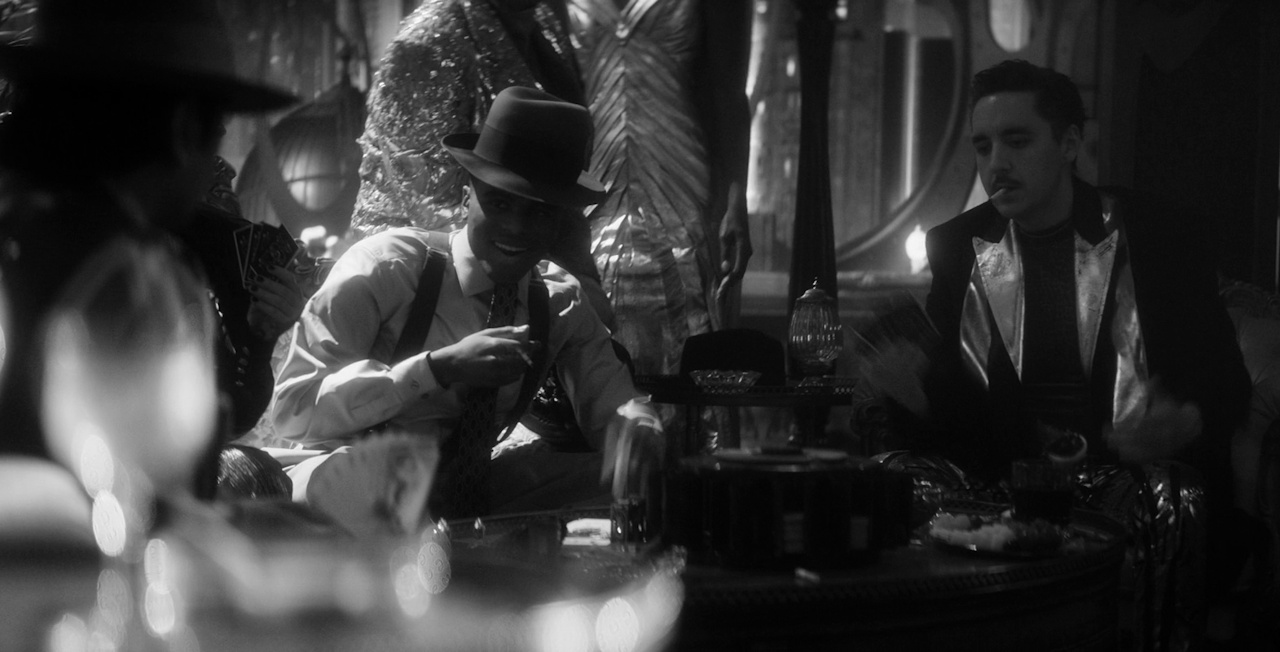
Still frame from Star Trek SNW 4x04 showing Mat'Aar-ians
Mat’Aar-ians.

That issue also extends into Uhura’s storyline. After being arrested by the Klingons for not showing her ID, Uhura was taken to a Klingon facility to be tortured. But despite having access to 23rd Century scanners, tricorders, and some kind of brain-alyser, the Klingons never found out that she wasn’t actually a Mat’Aar-ian. How’s that possible? Even human-looking aliens, surely, have different DNA or other identifying markers? That’s how sensors and tricorders across Star Trek are able to differentiate between different races.

As an aside, though, I actually really liked the design of the Klingon torture device. It was a retro throwback – and, in this case, I mean that as a positive thing! I suspect that, if the episode was in full colour and trying to employ a more modern visual style, something like that would’ve looked dated and out-of-place, but in this kind of story, the brain-alyser looked pitch-perfect! There’s something about its simple design that just felt like the perfect TOS throwback, and it looked great.
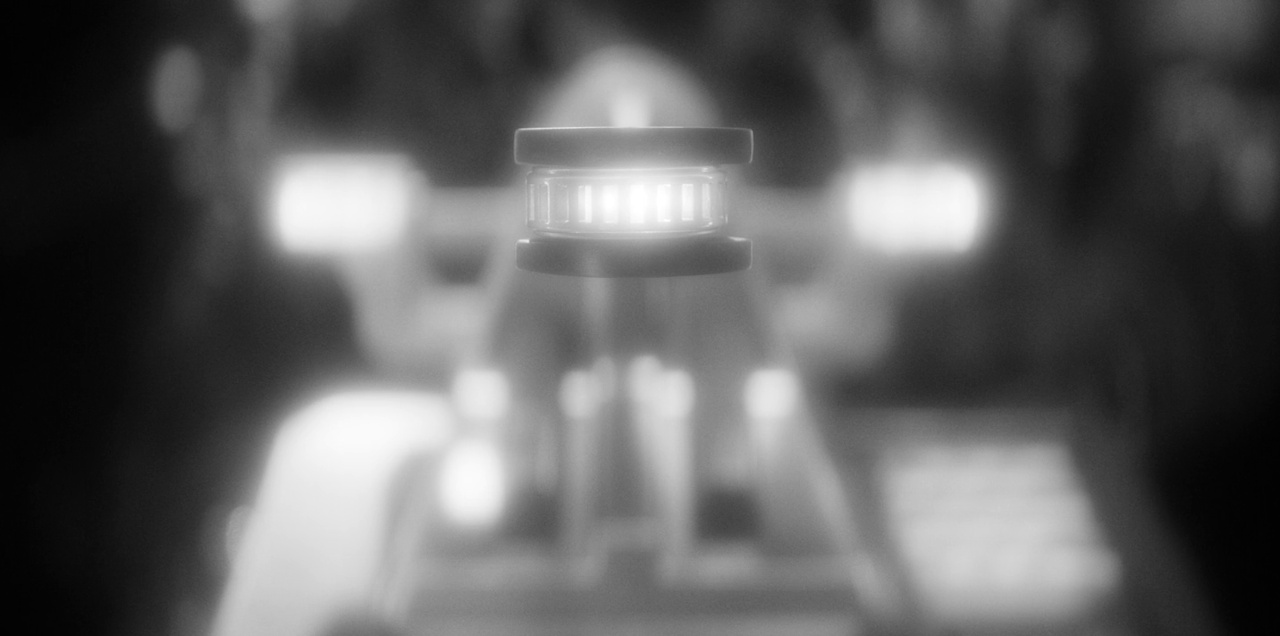
Still frame from Star Trek SNW 4x04 showing the torture machine/brain-alyser
The brain-alyser.

To wrap up Una’s story, I thought the ending was pretty predictable; I clocked what Una had done – planting the macguffin bomb thing on the collaborator – long before the episode revealed it. But at the same time, it says something about her character that she’d get so involved in this planet’s cause and crusade for freedom. Una bent (or broke) the rules in order to help the people of Mat’Aar XII in their fight against the Klingon occupation, despite knowing that doing so could have massive consequences. She took a risk, but it always felt like a calculated risk.

Dr M’Benga referenced his service in the Klingon War – something that’s become a defining trait of his character, especially in more recent seasons. The show’s writers clearly like this idea of “the doctor who’s also a special forces killer,” and they’ve really latched onto that. I would like to see Dr M’Benga in different storylines, though, as I feel his arc with the Klingons and his backstory from his war days has been reasonably well explored, and with limited time remaining to do anything else… well, time’s a-ticking, sadly.
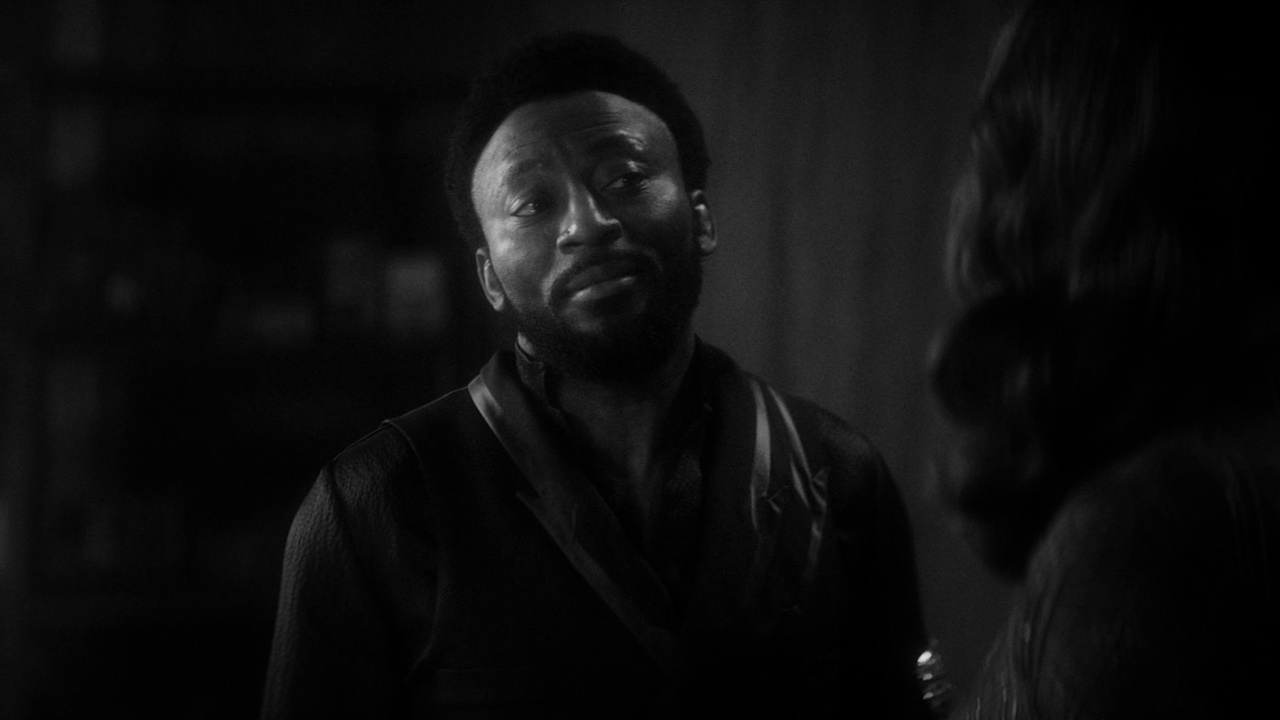
Still frame from Star Trek SNW 4x04 showing M'Benga
Dr M’Benga.

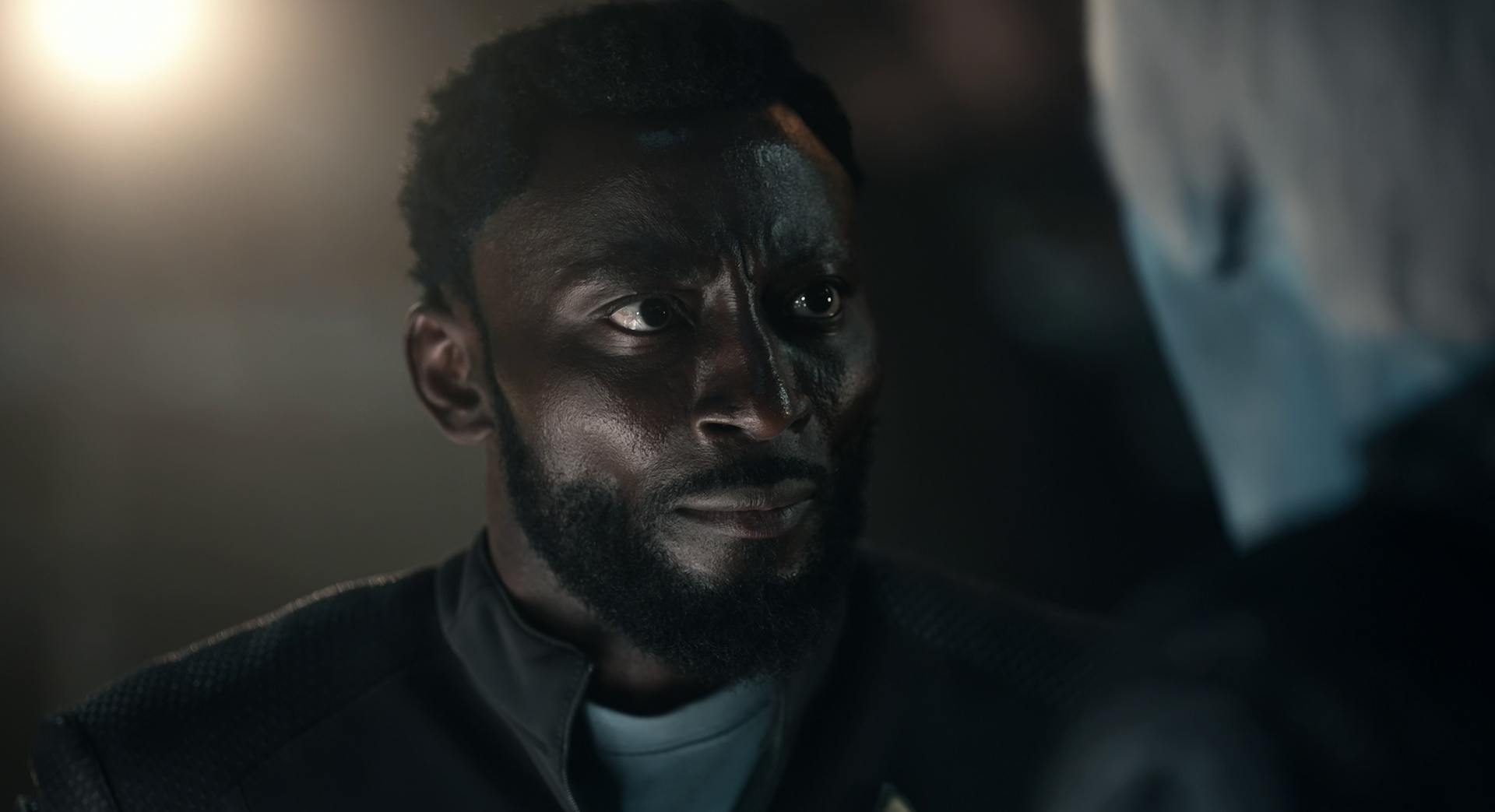
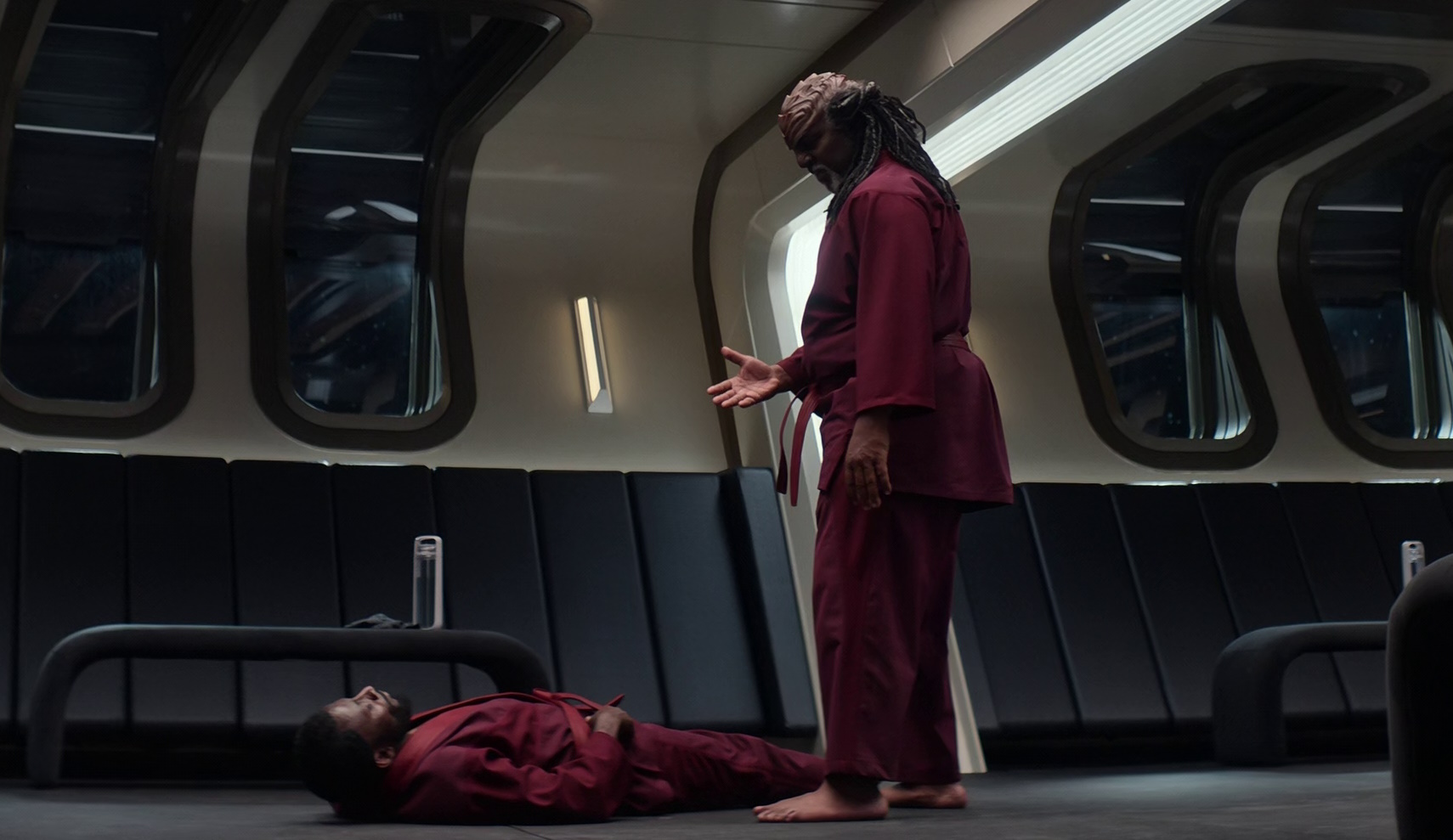
That being said, Dr M’Benga was a great choice to involve in a story like this, not least because of the Klingon element. He managed to be a mentor to both Una and Uhura at different points, offering advice, making note of how the Mat’Aar XII resistance was operating, and kind of serving as an exposition device for us as the audience, too! His war service felt like a natural thing for him to bring up in the context of the story, and while there were some contrivances – like how he could instantly recognise Kor, for example – they’re minor enough to not be bothersome.

Dr M’Benga guided Una, keeping her from making too many mistakes, but this was still Una’s story first and foremost, so we didn’t get any gratuitous scenes of him massacring legions of Klingons, or using his special forces background as an excuse to take the lead. Again, given the kind of story this was, and who it was centred around, that worked pretty well. From an in-universe standpoint, Dr M’Benga has told us many times that he wants to leave his past behind him, so again, his taking a back seat makes sense, too.
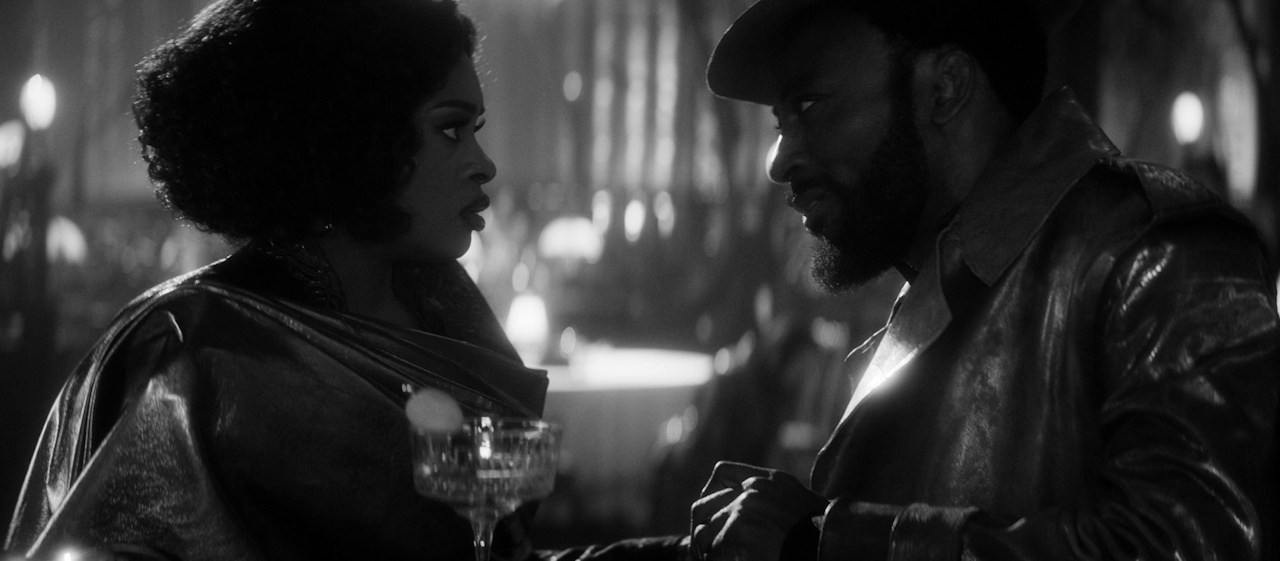
Still frame from Star Trek SNW 4x04 showing Uhura and M'Benga
Uhura and Dr M’Benga.

Celia Rose Gooding put in a great performance as Uhura this week. This younger version of the character is still, in some ways, finding her feet – and this mission took her far outside her comfort zone in more ways than one. Uhura’s friendship with Dr M’Benga was on full display, and the two characters played off one another exceptionally well in those supporting roles for Una and the noir-intrigue story.

However, I didn’t really feel like Uhura was ever in any real *danger,* even when she was literally facing the Klingons and their torture machine. Partly this is because Strange New Worlds is a prequel, and we know, in the backs of our minds, that Uhura will make it off-planet, back to Starfleet, and resume her career (relatively) unscathed. However, for a storyline involving literal torture… I think the episode could’ve made more of it. Perhaps Uhura will reference this experience in a future episode; I didn’t get the feeling, though, that this was an “Ortegas with the Gorn” or a “La’an’s DNA” type of situation, where a character’s storyline in one episode is clearly being set up for something more. But I guess we’ll have to wait and see on that front!
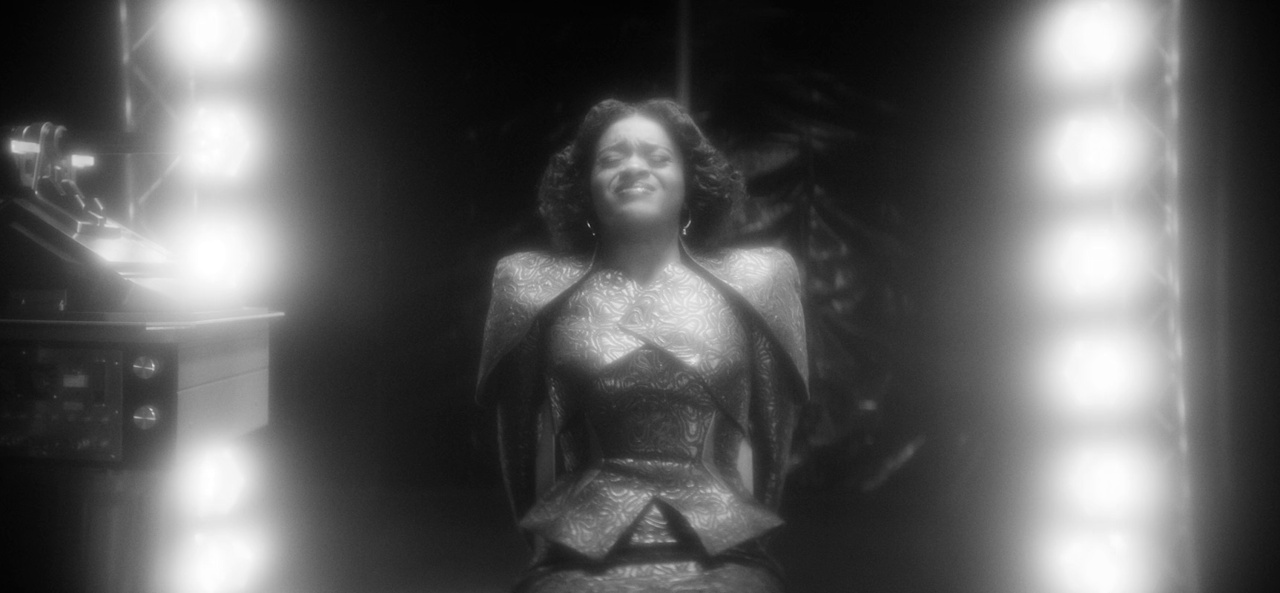
Still frame from Star Trek SNW 4x04 showing Uhura being tortured by the brain-alyser
Will this storyline lead to anything more for Uhura?

A couple of final points before we wrap things up.

This is at least the second Strange New Worlds episode where ships (or a shuttle, in this case) have literally been within visual range of one another, but – for no other reason I can discern than “because plot” – the adversary’s ship doesn’t notice or detect our heroes. In this case, a Klingon battlecruiser just wasn’t aware of either the probe or the shuttlecraft until the shuttle passed through the planet’s sensor grid. I know that, in prior Star Trek stories, the range at which sensors are effective can vary a lot depending on the needs of the story… but even with that in mind, this feels like a real stretch.

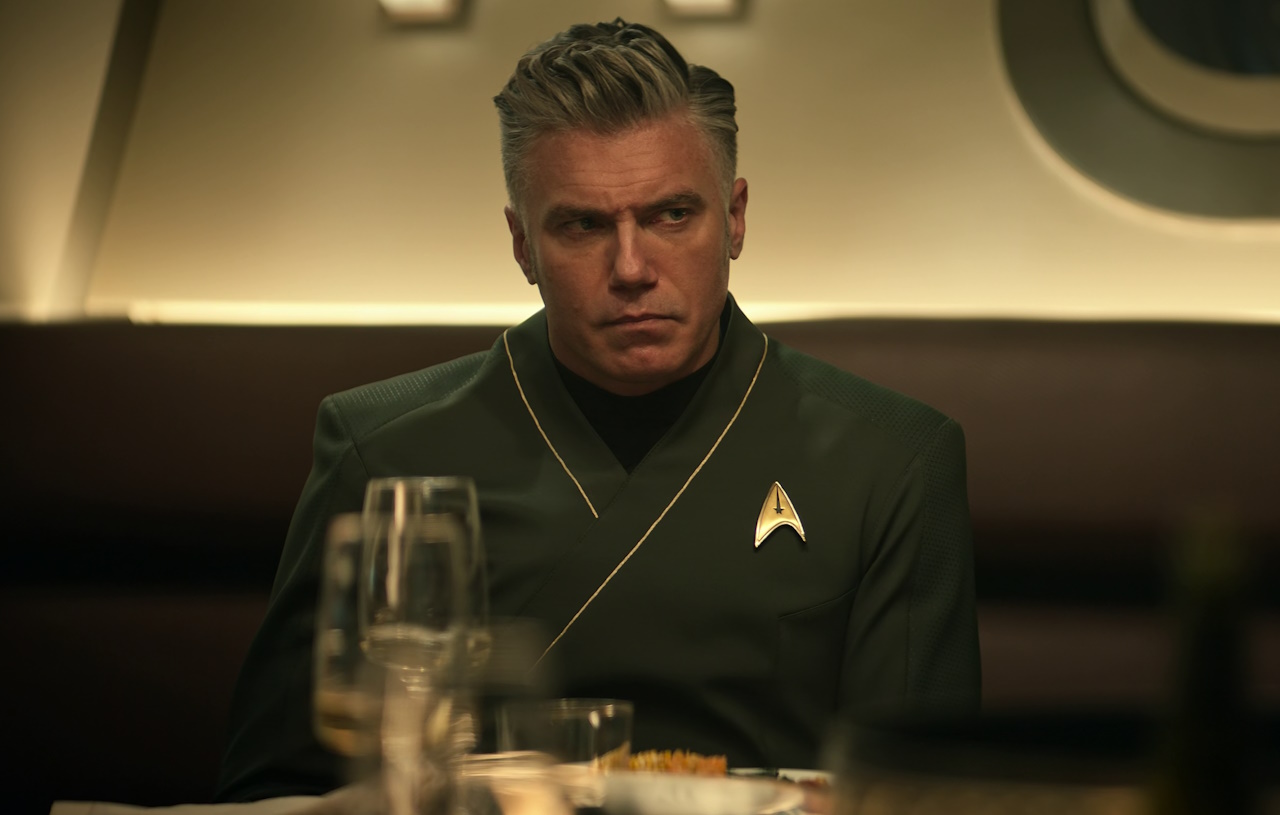
For the third episode in a row, Captain Pike had very little to do. I think I said this last season, too, but one of the main appeals of “the Captain Pike show” that fans – myself included – were clamouring for back in 2019 was Anson Mount and his incredible take on this character. We’re now a mere twelve episodes away from the end of the show’s run… and I kind of want to get a few more stories with Pike before the curtain falls. Star Trek has always done spotlight episodes where one or two characters are in focus – and this episode was very much an Una story, with supporting roles for Uhura and M’Benga, and a B-plot for La’an. And that’s great! But with limited time remaining, I’d like to spend a bit more time with the Enterprise’s captain.
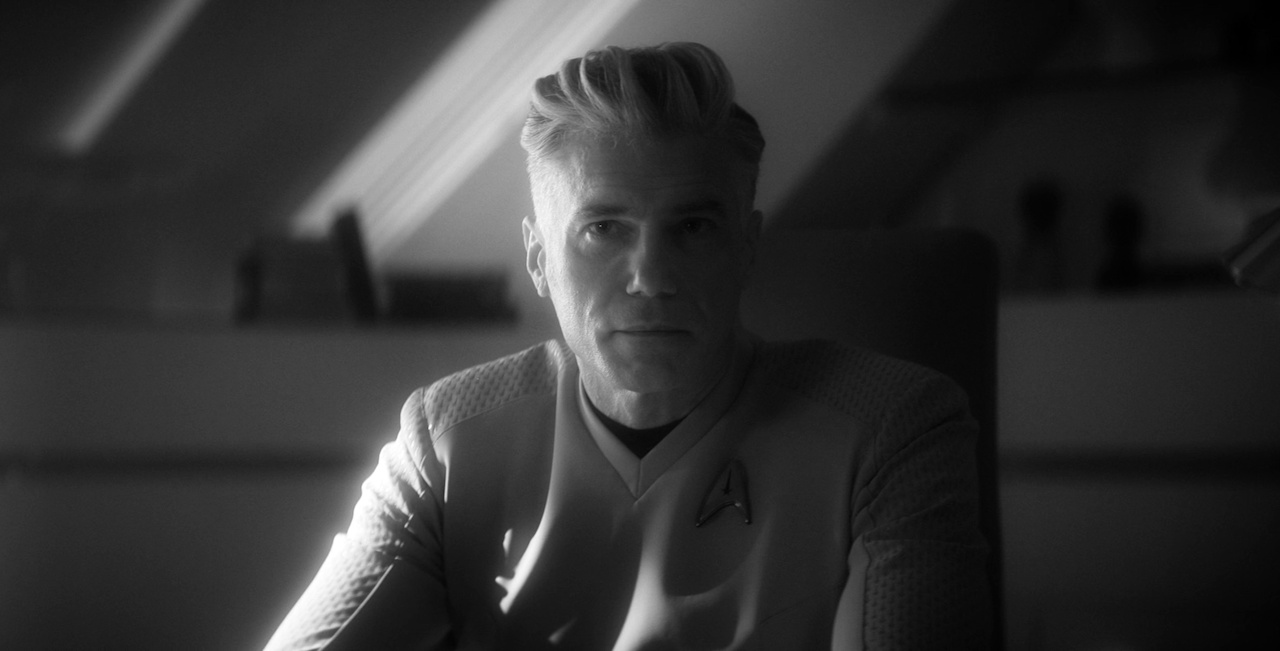
Still frame from Star Trek SNW 4x04 showing Pike
Captain Pike hasn’t had much to do for several episodes now.

As the dust settles, I’m left with one feeling more than any other: A Case of Chiaroscuro just isn’t an episode I’m in a rush to revisit, and as and when I return to Strange New Worlds in the future, it’s an episode I’m more likely to skip than sit through. Despite its earnestness and the way it fully embraced its film noir and mystery inspirations… it just wasn’t for me. Partly that’s the black-and-white; a gimmick that felt, well… nothing more than gimmicky. But it’s also, at least in part, due to some outdated and two-dimensional tropes among the secondary characters, the melodrama that the episode imports directly from its source material, and the simple fact that this genre is quite a niche thing nowadays.

That being said, I tried very hard to give A Case of Chiaroscuro a fair shake, and not pre-judge it based solely on the fact that it was going to be in black-and-white. And, as I said above, I respect both Strange New Worlds’ creative team and the leaders at Paramount for creating a story like this and getting it across the line in a way that stayed largely true to the kinds of stories that inspired it. It’s something very few other franchises would attempt, and – at least in that sense – it’s a very “Star Trekky” thing!
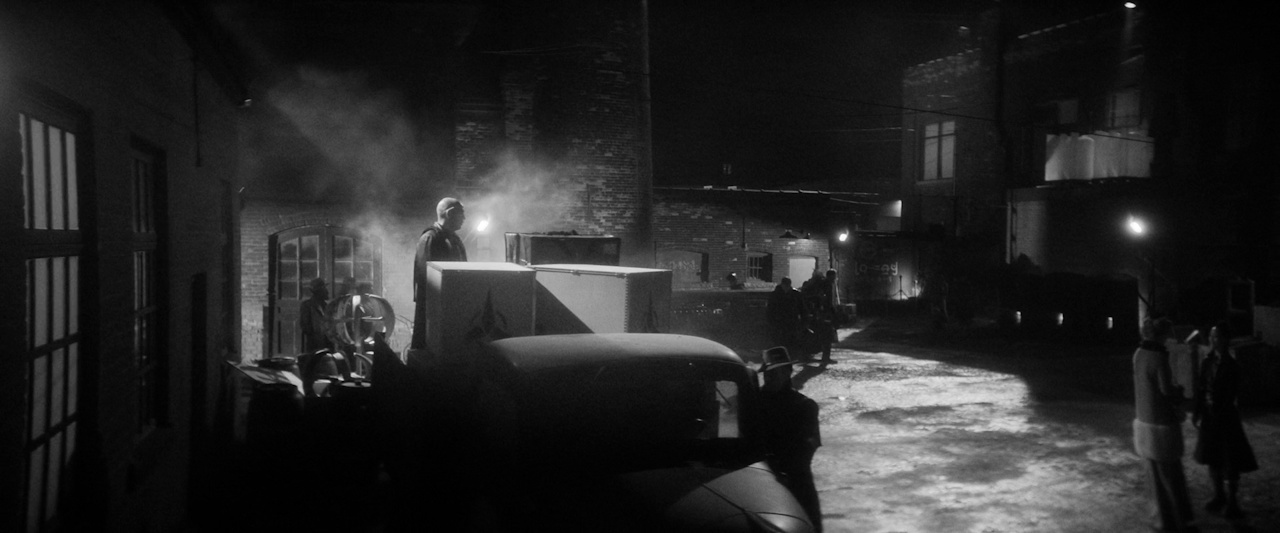
Still frame from Star Trek SNW 4x04 showing the yard set with vehicles
A Case of Chiaroscuro stayed true to its noir inspirations.

Next week, Strange New Worlds is going to serve up a Level-Five Transporter Accident – the (in)famous “puppet episode” that was teased in pre-season marketing. I honestly don’t know what to expect from that one; I like that they went to the Jim Henson Company to get proper puppets made, and there’s a potential tie-in, I guess, with an episode of Lower Decks that could be interesting. It’s certainly going to be another “big swing” after this week’s noir-style story.

I hope this has been interesting! As I often say: please keep in mind that all of this is just the *subjective, not objective* take of one old Trekkie. If you liked A Case of Chiaroscuro a lot more than I did, feel it’s irredeemably awful, or just don’t agree with my take… that’s okay! There’s plenty of room in the Star Trek fan community for differences of opinion and respectful disagreement.

Thanks for joining me for this review, and as always… Live Long and Prosper, friends!


Star Trek: Strange New Worlds Seasons 1-4 are available to stream now on Paramount+ in countries and territories where the platform is available. The first three seasons are also available on DVD and/or Blu-ray. The Star Trek franchise – including Strange New Worlds and all other properties discussed above – is the copyright of the Skydance-Paramount corporation. This review contains the thoughts and opinions of one person only and is not intended to cause any offence.
Star Trek: Strange New Worlds Episode Review – Season 2, Episode 8: Under the Cloak of War

A spoiler warning graphic.

Spoiler Warning: There are spoilers ahead for Star Trek: Strange New Worlds Seasons 1 and 2.

After a rather light-hearted story in the crossover episode Those Old Scientists a week earlier, Strange New Worlds served up a dramatic and emotional war story in Under the Cloak of War. The episode was intense and brutal in its depictions of war and the post-traumatic stress that many soldiers and other participants can suffer from for years afterwards. It was also a story that challenged Star Trek’s positive and optimistic presentation of the 23rd Century – with some members of the crew coming across as prejudiced and almost racist.

In that sense, parts of the episode were deliberately uncomfortable. Others, however, were in danger of being tripped up by the big contrivance that set up the main thrust of the story, and by a couple of scenes and sequences that seemed to zip by a little too quickly for my liking. However, despite some limitations, Under the Cloak of War is one of the most gritty, realistic, and brutal depictions of war that the Star Trek franchise has ever brought to screen – and the episode succeeds at conveying those sensations for almost its entire runtime.

Still frame from Star Trek: Strange New Worlds Season 2 (2023) showing Nurse Chapel and Dr M'Benga.
Nurse Chapel and Dr M’Benga.

Let’s start by talking about the biggest contrivance in Under the Cloak of War, because at first I was worried that this was going to set the stage for a weak story. However, I think I can forgive it in light of what subsequently transpired.

Having Starfleet and Captain Pike essentially force Dr M’Benga, Nurse Chapel, Lieutenant Ortegas (and presumably other members of the crew too) to interact with Ambassador Rah was… poor. It’s the kind of thing 23rd Century Starfleet shouldn’t do, because that decision put members of the crew in uncomfortable and even dangerous positions – as we’d see. Pike’s complicity in this, too, was unpleasant to see, and I’d have liked to have seen him trying to argue against whichever higher-up gave this order – even if just briefly in a single scene.

We know Captain Pike as an advocate for his crew, and someone who cares about them deeply. Even if he didn’t or couldn’t know the extent of the trauma faced by the veterans – and it’s worth remembering that this idea of not being able to understand the trauma of war was one of the themes of the episode – I still believe Pike wouldn’t have wanted to put them in that situation. Having Pike be the one to order Dr M’Benga and Nurse Chapel to participate took what was already a pretty contrived idea and made it uncomfortable.

Still frame from Star Trek: Strange New Worlds Season 2 (2023) showing Captain Pike at dinner.
Captain Pike ordered his crewmates – veterans of the Klingon War – to have dinner with a former Klingon general.

The final act of Under the Cloak of War hinged on the “big reveal” of Dr M’Benga – thanks to his super-soldier serum – being the real “Butcher of J’Gal,” and while this idea was interesting in some ways, I think it also constrained the story in others. Part of the power of an episode like Under the Cloak of War, particularly in its flashback sequences, is that the characters we’re following aren’t anyone special – they’re regular people caught up in this incredibly traumatic event. The things they see and are forced to participate in end up changing them.

When Under the Cloak of War introduces the idea that Dr M’Benga is a kind of infamous super-soldier, the character loses at least some of his “ordinary guy” persona, and that begins to work counter to other parts of his arc. We saw earlier in the season this “super-serum” that Dr M’Benga and Nurse Chapel had, and finding out more about where that came from was admittedly interesting. It’s something I can absolutely see a future story picking up on; M’Benga’s role in creating something that horrified him is clearly eating away at him. But in terms of this story – one about the repercussions war and trauma can have years later – I think we lost something with the focus on Dr M’Benga and the way his character was presented.

Still frame from Star Trek: Strange New Worlds Season 2 (2023) showing a flashback of Dr M'Benga.
Was it a mistake to make Dr M’Benga into a “super-soldier?”

If instead Under the Cloak of War had spent more of its time with either Ortegas or Chapel, we could’ve gotten a more down-to-earth depiction of post-traumatic stress. Throwing non-soldiers into a warzone is a great setup for an intense and traumatic story, and a focus on one of those characters, perhaps, would’ve made that side of the story more engaging. Keeping the focus on Dr M’Benga but dropping the “super-soldier” angle could’ve worked, too.

As an aside, I know that Ortegas has been less front-and-centre this season due to her performer, Melissa Navia, asking for a reduced amount of screen time. Navia’s partner passed away in between production on Seasons 1 and 2, and she requested less of a prominent role. Throwing her into a story about death, post-traumatic stress, and so on would have been difficult, so I’m not saying I wanted to see Ortegas in these flashbacks or taking on a major role in the story. There are perfectly understandable reasons for this episode focusing on Dr M’Benga and Nurse Chapel. I merely present the idea of a character like Ortegas – a non-soldier – taking part in a story about war and post-traumatic stress as being closer to the episode’s core themes and ideas.

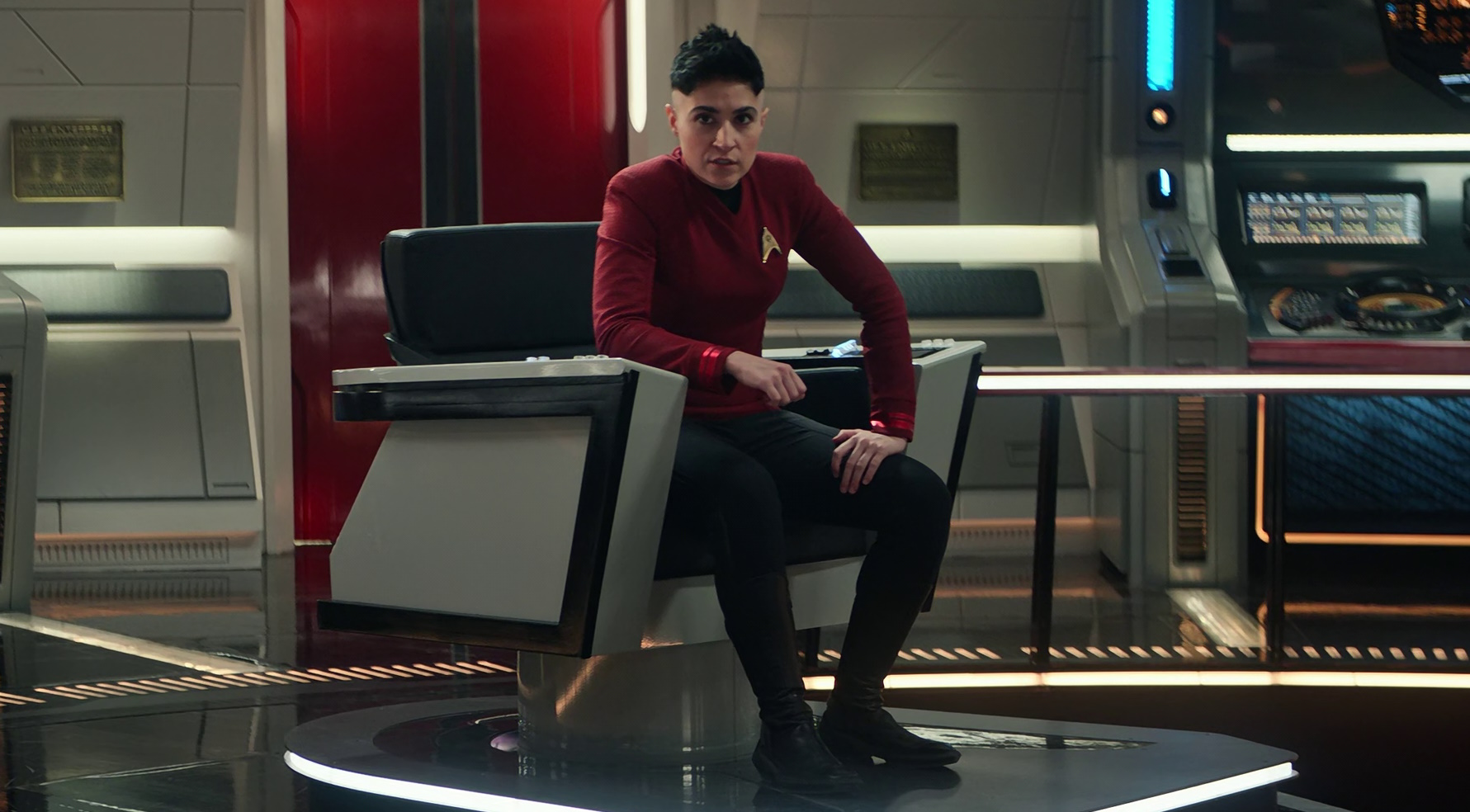
Still frame from Star Trek: Strange New Worlds Season 2 (2023) showing Lt. Ortegas in the captain's chair.
Ortegas got a rare turn in the captain’s chair this week.

Sometimes modern Star Trek has tripped over this kind of “extra-special character” trope. We’ve seen it in Discovery, where Michael Burnham always happened to be the “Chosen One;” the only person capable of solving a mystery or defeating a villain. I guess I’m just a bit tired of it at this point, and while I liked what Under the Cloak of War ultimately did with Dr M’Benga and his secretive past, I can’t help but feel that making him into a super-soldier who had a direct connection to the episode’s reformed villain ended up jumbling some of the other messages it wanted to convey.

Under the Cloak of War wanted to confront us with the very visceral reaction some of its characters had to Ambassador Rah. There was anti-Klingon prejudice – racism, really – in the way some of them behaved and reacted, and the writing seemed to want to make us uncomfortable with that. Here was a man who had defected to the Federation, giving up violence, changing, and becoming an advocate for peace. And some of our favourite characters treated him with disdain because of where he came from and what he looked like. You can argue that M’Benga and Chapel should be excused from that because they saw first-hand what Rah had done a few years ago. But can we give that same pass to Ortegas? There’s no evidence that she was present on J’Gal during the events depicted. Nor to the other nameless crew members both on the Enterprise and other Federation ships who have been uncomfortable with or protested against Ambassador Rah.

Still frame from Star Trek: Strange New Worlds Season 2 (2023) showing Ambassador Rah.
Several members of the crew harboured prejudice against Klingons as a result of the Klingon War.

I’m reminded of The Undiscovered Country, and how Kirk and his crew had to come to terms with making peace with the Klingons. In Kirk’s own words: “I’ve never trusted Klingons, and I never will.” Gene Roddenberry famously hated this presentation of Kirk and Starfleet at large, feeling that things like racism and prejudice should have been all but forgotten about by the 23rd Century. Indeed, we’d see this theme in several episodes of The Original Series, from Balance of Terror in Season 1 through to Let That Be Your Last Battlefield in Season 3.

We will never be able to agree, as fans and viewers, on which presentation of Starfleet is “better” or more realistic. And I’m open to arguments on both sides. On the one hand, this kind of overt prejudice runs counter to what we’ve come to expect from (most) Starfleet officers, and from a narrative and storytelling perspective, there’s power in depicting a society that has largely moved on from such things. On the other, it’s difficult if not impossible to tell a story about war and post-traumatic stress without at least acknowledging that such prejudices exist – and to tell a relatable story for an audience today, you kind of have to go there.

Still frame from Star Trek: Strange New Worlds Season 2 (2023) showing Ambassador Rah.
Ambassador Rah at the awkward dinner.

So I’m on the fence about this one. I get where it came from and I think it worked in context. But I’m not sure that this kind of open prejudice is something I want to see a lot of in Star Trek. Using it sparingly and in a nuanced way – as Under the Cloak of War does – arguably heightens its impact and makes it as powerful a storytelling device as it can be. Overuse would take away from that… and would arguably damage some or all of the characters if we saw them repeatedly behaving that way and espousing those kinds of sentiments.

But maybe that’s the point, or at least part of it. Some stories are intended to be uncomfortable to force us, as the audience, to consider the questions being raised. Veterans of many conflicts out here in the real world find it difficult to deal with former enemies – and moments where combatants from both sides of a resolved conflict are able to come together are often seen as moments to be celebrated. We could write a book or a series of books on the psychological impact of war and how it must feel to be forced to break bread with a former enemy. This episode barely scratched the surface in that regard.

Still frame from Star Trek: Strange New Worlds Season 2 (2023) showing Dr M'Benga and Ambassador Rah sparring.
Dr M’Benga and Ambassador Rah.

One episode more than any other was foremost in my mind during the flashback sequences: Deep Space Nine’s Season 7 episode The Siege of AR-558. Intentionally or not, there were clear echoes of that story in Under the Cloak of War, from the minor Federation outpost to the depleted and patched-together Starfleet soldiers. That was also a powerful episode, one that focused on the futility of war and how, from the perspective of a soldier, dying or being wounded for the sake of a nameless place just doesn’t sit right.

If The Siege of AR-558 was inspired by the war in Vietnam (a war in which the episode’s director, Winrich Kolbe, had served) then maybe it’s fair to call Under the Cloak of War a reaction to modern conflicts like those in Iraq and Afghanistan, as well as the War on Terror in a more general sense. The United States is still wrangling with the fallout of those wars; the futility of the latter coming into frame following America’s withdrawal from the country.

Still frame from Star Trek: Deep Space Nine Season 7 showing a Federation soldier.
The flashback sequences in Under the Cloak of War reminded me of DS9′s The Siege of AR-558.

Ambassador Rah was an interesting character, and I really enjoyed the performance from veteran actor Robert Wisdom. The way Rah came across – conversational, pleasant, and even likeable – had an undercurrent of tension or even creepiness because of the way he was framed and how his story was told from the perspective of Dr M’Benga and others. The character had an unsettling vibe for practically his entire time on screen – and the combination of a stellar performance with some great sound design, cinematography, and direction from Jeff W. Byrd made this possible. It’s rare to get such a strong feeling from a single guest star, but Under the Cloak of War really succeeded at making me feel unsettled and creeped out by this affable, personable Klingon.

Sticking with the Klingons (or Klingon, singular, in this case), Strange New Worlds has taken the deliberate decision to return to the more familiar visual language of the Klingon Empire that we’ve seen in past iterations of Star Trek. The Kelvin films changed the way Klingons look, but it was Discovery that doubled-down on this in its first season, stripping away much of what we’d seen of the Klingons throughout the previous 600+ episodes of Star Trek to bring in shaved heads and armour and ships that seemed to borrow quite heavily from Ancient Egypt in their appearances.

Still frame from Star Trek: Strange New Worlds Season 2 (2023) showing a Klingon warrior.
Strange New Worlds has brought back the familiar aesthetic of the Klingon Empire.

I noted when looking back at Star Trek III: The Search for Spock a few months ago that some of the designs that debuted there – such as Klingon armour as well as the Bird-of-Prey – had become absolutely iconic, and that some fans had been disappointed when the Kelvin films and Discovery changed things up. I think the reaction to that has been interesting, and we now see Star Trek’s executive producers moving back to more familiar ground for important and well-developed races like the Klingons. In a way, we could argue that creativity is being stifled here… but on the whole, I think that having a consistent visual style is probably more useful than not for a franchise that aims to retain viewers.

Casual viewers who may be tuning into Star Trek for the first time in years can instantly recognise the Klingons in a way that perhaps they couldn’t in Discovery, and that’s a positive thing. I maintain that Strange New Worlds is a great “first contact” for new and returning viewers, so making it easier for folks to jump over to other parts of the Star Trek franchise is also a good thing to see.

Still frame from Star Trek: Discovery Season 1 showing a Klingon warrior.
This is what the Klingons looked like back in Discovery’s first season.

It was a treat to welcome back Clint Howard to the Star Trek franchise! Howard first appeared in The Original Series episode The Corbomite Maneuver and has since played roles in Deep Space Nine, Enterprise, and Discovery as well. He’s an icon of the Star Trek franchise for his role as Balok, and he was instantly recognisable to me in Under the Cloak of War as the rather stressed-out Commander Buck Martinez – the officer who received Nurse Chapel upon her arrival at J’Gal.

There are threads that bind disparate parts of Star Trek together, and some performers fill that role. Just as it’s great to see an episode directed by the legendary Jonathan Frakes, so too is it wonderful to get another special performance from Clint Howard. Commander Martinez was an interesting character, too – and a prominent one. Howard’s interpretation of someone who’d almost become numb to the warzone he was stuck in stood in contrast to Nurse Chapel – the newcomer who was still adjusting and finding all of it frightening and shocking.

Still frame from Star Trek: Strange New Worlds Season 2 (2023) showing Clint Howard's character.
Clint Howard played Commander Buck Martinez.

Chapel was, for me, the episode’s standout character. Though she got less screen time than Dr M’Benga, and her conflict with Ambassador Rah didn’t have that personal edge, seeing war through the eyes of a nurse was harrowing. Chapel seemed to lose her innocence across the flashback sequences, culminating in the scene where she lost the first patient she treated when his pattern was erased. Despite that, however, we never saw her become numb to the suffering like Martinez, nor as resigned to her fate as Dr M’Benga – Chapel held onto at least some sliver of herself and her humanity despite the trauma she went through.

I would’ve loved to have seen an extended scene between her and Spock. In the hallway, Spock’s admission that he didn’t understand how she felt or what she’d been through was played exceptionally well by both Ethan Peck and Jess Bush, and I could’ve happily spent half an episode on just those two characters as they wrangled with the fallout of Chapel’s experiences. Spock could be uniquely able to help. But at the same time, seeing her push him away and him having to acknowledge that he can never really understand… it was powerful stuff.

Still frame from Star Trek: Strange New Worlds Season 2 (2023) showing Nurse Chapel.
Nurse Chapel.

Part of me wonders if Strange New Worlds is readying Dr M’Benga for departure. We know he won’t be killed off – M’Benga appears alongside Dr McCoy in a couple of episodes of The Original Series, lest we forget. But having built a wall between M’Benga and Captain Pike, with Pike clearly not fully trusting M’Benga’s lie that he killed Rah purely in self-defence, I’m not sure how the series will be able to break that down again. With more legacy characters being added to Strange New Worlds periodically, could M’Benga be about to be reassigned or take a demotion, and could we see Dr McCoy signing up in Season 3 or 4? I can’t help but wonder.

So I think that’s everything I have from my notes. This was a tough one to watch, in places – and I mean that in the best possible way as a compliment to everyone involved! There were some truly gruesome moments, and the story really hammered home just how destructive war can be to the individuals caught up in it. There are some possible ramifications down the line for those involved, and possibly a bit of tension developing between Captain Pike and members of his crew. Whether Strange New Worlds will return to these ideas remains to be seen. Or not, if you’ve already seen the next two episodes and know what happens! I’m still catching up with Season 2, as you can tell.

I have to be honest: I’m not looking forward to Subspace Rhapsody next time. Musicals – non-animated musicals, at any rate – really aren’t my thing, and musical episodes in non-musical series even less so. But I daren’t skip it, so I’m sure I’ll have a review of it ready before too long!


Star Trek: Strange New Worlds Seasons 1-2 are available to stream now on Paramount Plus in countries and territories where the service is available. The series is also available on DVD and Blu-ray. The Star Trek franchise – including Strange New Worlds – is the copyright of Paramount Global. This article contains the thoughts and opinions of one person only and is not intended to cause any offence.
Star Trek Day roundup!

Spoiler Warning: There are spoilers ahead for the Star Trek franchise, including the following upcoming series: Strange New Worlds Season 1, Picard Season 2, Lower Decks Season 2, Discovery Season 4, and Prodigy Season 1.

Yesterday was Star Trek Day! And in case you missed it, ViacomCBS held a live event that was streamed online and via Paramount+ showcasing and celebrating all things Star Trek! We’ll break down the big news in a moment, but first I wanted to give you my thoughts on the event as a whole.

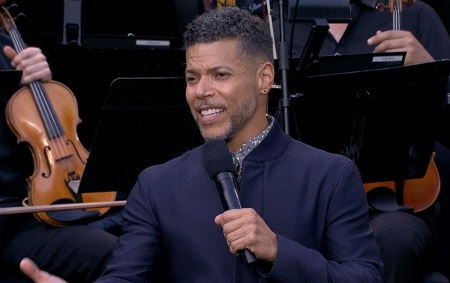
This was the first big in-person event that many of the folks involved had been able to attend since 2019, and there was talk of the pandemic and its enforced disruption on the various shows that have been in production over the last couple of years. There was also a lot of positivity from presenters and interviewees not only about Star Trek – which was to be expected, naturally – but also about being back together and simply being able to hold a major event of this nature. The positivity of hosts Wil Wheaton and Mica Burton was infectious, and the event was much better for the role the duo played in hosting the panels and introducing guests.

Mica Burton and Wil Wheaton were great hosts.

That isn’t to say that Star Trek Day was entirely without problems, though. To be blunt, the event dragged on a bit too long (it ran to over three hours) and several of the panels and interviews were the worse for being conducted live instead of the pre-recorded, edited, and curated segments and panels we’ve had to get used to in the coronavirus era. Several of the guests seemed unprepared for what should’ve been obvious questions, and there were too many awkward silences and pauses while people gathered their thoughts and responded to the hosts. Such is the nature of live broadcasting – and it sounds rather misanthropic to criticise it!

During what I assume was an intermission on the main stage we were treated(!) to a separate pair of presenters on the red carpet reading out twitter messages and posts from the audience. This was perhaps the segment that dragged the most; one of the presenters even admitted to not being a regular Star Trek viewer (she hadn’t seen Discovery at all) so unfortunately this part of the show was less interesting as the pair were a little less knowledgeable about the franchise. If it had been made clear that this section of the broadcast was going to last as long as it did I might’ve taken a break as well!
This segment in the middle of the broadcast dragged on a bit.

Overall, though, despite running a bit too long and the ending feeling a little rushed (something we’ll talk about later), Star Trek Day was a success. It didn’t only look forward to upcoming projects like Strange New Worlds and Picard Season 2, but it looked back at every past Star Trek series, inviting members of the casts of those shows to talk about what made them – and the franchise – so great.

As a true celebration of all things Star Trek, the broadcast has to be considered a success. And although a pre-recorded event could’ve been edited and streamlined to cut to the more interesting parts and to give interviewees a chance to gather their thoughts, it was nice to see many of the folks we know and love from Star Trek back together and able to spend time in person with one another. Hosts Wil Wheaton and Mica Burton did a great job at making us as the audience feel included, as if we were there at Star Trek Day right along with them. For those few hours – even through awkward moments and segments that seemed to run a little too long – it felt like being a member of the Star Trek family. As someone with few friends, I appreciated that immensely. For those few hours last night – and yes, even though Star Trek Day didn’t start until 1:30am UK time I did stay up to watch it – I felt like I, too, was an honorary member of the Star Trek family, and that’s a feeling I would never have been able to get anywhere else.

Star Trek Day was a successful celebration of all things Trek!

Now then! Let’s talk about the various panels, trailers, and interviews. Over the coming days I’ll be taking a closer look at some of the announcements and trailers in more detail (as well as perhaps crafting a few of my patented and often-wrong theories), but for now I want to try to include an overview of everything that was included in Star Trek Day.

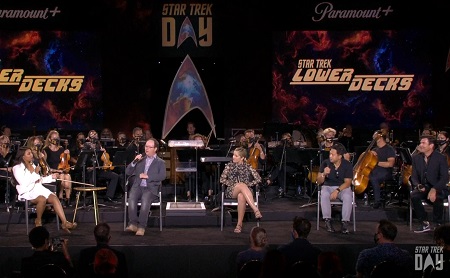
We’ll come to the biggest announcements and trailers at the end, but first I wanted to talk for a moment about the music. Star Trek Day had a live orchestra on its main stage, and we were treated to live renditions of Star Trek theme music past and present – as well as a medley that kicked off the event. I was listening to Star Trek Day on my headphones, and the music sounded beautiful. Composer Jeff Ruso (who composed the theme music to Discovery and Picard) picked up the conductor’s baton, and the medley he arranged was really an outstanding celebration of all things Star Trek.

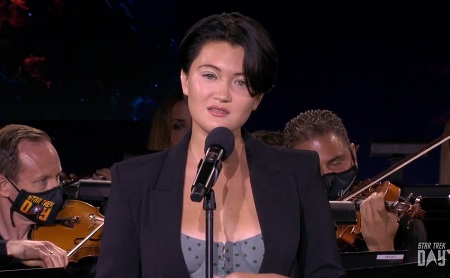
Star Trek Day both began and ended with music, as Isa Briones (Star Trek: Picard’s Soji) sang her rendition of Irving Berlin’s 1926 song Blue Skies to close out the broadcast.

Isa Briones’ rendition of Blue Skies brought proceedings to a fitting end.

There were five “legacy moments” spread throughout Star Trek Day, and these celebrations of past Star Trek series were genuinely moving. Actors George Takei, LeVar Burton, Cirroc Lofton, Garrett Wang, and Anthony Montgomery spoke about their respective series with enthusiasm and emotion. Cirroc Lofton paid tribute to his on-screen dad Avery Brooks, talking about how Deep Space Nine showed a single dad balancing his work and family commitments. He also spoke about Deep Space Nine’s legacy as the first Star Trek show to step away from a starship and take a different look at the Star Trek galaxy.

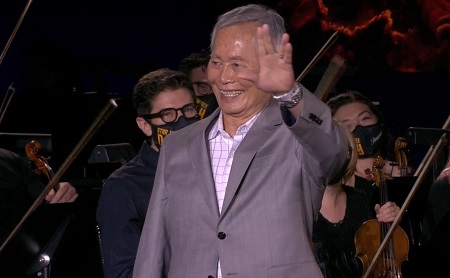
The themes of diversity and inclusion were omnipresent in these legacy moments, and all five actors spoke about how Star Trek and Gene Roddenberry have promoted diversity since the very beginning. George Takei spoke about Gene Roddenberry’s vision for Star Trek, how sci-fi had previously been something often seen as just for kids, and how putting a very diverse cast of characters together was groundbreaking in the 1960s. It’s always amazing to hear George Takei speak, and even fifty-five years later he still has a grace and eloquence when speaking on these topics. As someone who has himself been at the forefront of campaigning for diversity and equality, he does so with a gravitas that few can match.

George Takei’s speech was outstanding.

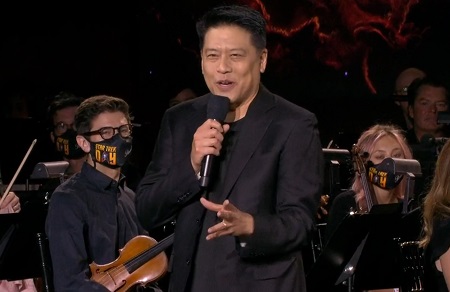
Garrett Wang spoke about how Voyager could be a “refuge” for fans; a place to go where everyone could feel included and like they were part of the family. The way the show combined two crews was, I would argue, one of its weaker elements, but Wang looked at it through a different lens, and I can see the point about how Voyager put those folks in a difficult situation and brought them together to work in common cause. He also spoke in very flattering terms about Captain Janeway and Kate Mulgrew – who is returning to Star Trek very soon.

Anthony Montgomery was incredibly positive about Enterprise, and how the series embodied the pioneering spirit of exploration. I loved his line about how Enterprise, although it was a prequel recorded later than many other shows, laid the groundwork and filled in much of Star Trek’s previously unvisited stories and unexplained lore. Above all, he said, Enterprise was a “fun” show – and it’s hard to disagree! The orchestra concluded this speech with Archer’s Theme – the music heard over the end credits for Enterprise – which is a beautiful piece of music. If I were to remaster Enterprise I’d drop Faith of the Heart (which is a nice enough song, don’t get me wrong) and replace it on the opening titles with Archer’s Theme. The orchestra played it perfectly.

Anthony Montgomery spoke with passion and good humour about Enterprise.

LeVar Burton talked about The Next Generation, and how Star Trek was reinvigorated for a new era. The Next Generation was the first spin-off, and it came at a time when spin-offs didn’t really exist in the sci-fi or drama spaces, so it was an unknown and a risk. Burton also spoke about The Next Generation’s sense of family, and how Star Trek can be a unifying force in the world.

Far from being mere padding, the five legacy moments saw stars of Star Trek’s past pay tribute to the franchise and the shows they were part of. There were consistent themes running through all five speeches, particularly the theme of inclusion. Star Trek has always been a franchise that strives to include people who are “different” – people like myself. For many fans, that’s one of the things that makes Star Trek so great. To see some of the biggest stars acknowledge and celebrate that aspect of Star Trek was wonderful, emotional, and rather cathartic.

Cirroc Lofton paid tribute to Deep Space Nine and his on-screen dad Avery Brooks.

Each of the five actors spoke with love, positivity, and enthusiasm for the franchise that made them household names. Anthony Montgomery’s incredibly positive attitude in particular shone through – he was beaming the whole time and seemed genuinely thrilled to have been invited to speak and to celebrate Enterprise.

If Star Trek Day aimed to celebrate all things Star Trek, then the legacy moments went a long way to making that ambition a reality on the night. The speeches were pitch-perfect, as were the orchestral renditions of all five Star Trek themes, and I had an unexpectedly good time with these moments. I wasn’t sure what to expect from the programme listed on the website; I didn’t really have any expectations of what the legacy moments would include. They surprised me by being one of the most enjoyable, down-to-earth parts of a hugely entertaining evening.

Garrett Wang represented Voyager in the show’s legacy moment segment.

Let’s talk about news and announcements. That’s what you’re here for, right?! That was certainly what I was most interested in and excited for when I sat down to watch the Star Trek Day broadcast – though, as mentioned, I was taken aback by some of the other elements present that I wouldn’t have expected!

First, a non-announcement! Wil Wheaton interviewed the head of production on Star Trek, Alex Kurtzman, early on in the evening. Kurtzman didn’t have anything to say about the Section 31 series, nor about the upcoming Star Trek film due for release in 2023. However, he mentioned something that I found really interesting: a Starfleet Academy series or project. This isn’t anything close to an official announcement, of course, and he and Wil Wheaton talked about it in abstract terms. But a Starfleet Academy series has been something Star Trek has considered in the past; Gene Roddenberry was quite keen on a Starfleet Academy spin-off prior to developing The Next Generation. Watch this space, because it’s at least possible that a project centred around Starfleet Academy will get off the ground under Kurtzman’s leadership.

Alex Kurtzman seemed to tease that a Starfleet Academy project may be coming sometime soon!

There were no brand-new shows or films formally announced at Star Trek Day. While I wasn’t necessarily expecting such an announcement, and Kurtzman’s earlier statement that no new show will be worked on until the current crop have run their course would seem to exclude it, there are multiple pitches and projects that have been rumoured or talked about over the last few years. The Section 31 series was absent again, as mentioned, and that’s more bad news for a series that feels like it isn’t going to happen. There were also no mentions of the likes of Ceti Alpha V, Captain Proton, or Captain Worf – just some of the heavily-speculated or rumoured pitches believed to be floating around over at ViacomCBS.

We did get release dates or release windows for several upcoming seasons, though! After Lower Decks Season 2 draws to a close in mid-October there’ll be a couple of weeks with no Star Trek, but then Prodigy will be available (in the United States at least) from the 28th of October. Shortly thereafter, Discovery Season 4 will kick off – it will premiere on the 18th of November in the United States and on the 19th internationally. Finally, Picard Season 2 is scheduled to arrive on our screens in February next year – presumably shortly after the season finale of Discovery.

Prodigy is coming soon… if you live in the USA, anyway.

All of this is great news! There was no release date for Strange New Worlds, but I think we can assume it will follow within a few weeks at most of Picard Season 2, which would put it perhaps in May or June 2022 at the very latest. But there will be a whole lot of Star Trek on our screens this autumn and winter, well into the first half of next year. Wil Wheaton said it best: with so many new Star Trek projects in production, we’re living through a new golden age of Star Trek right now!

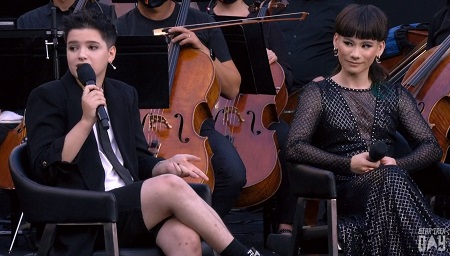
I was a little surprised when the Discovery panel ended without revealing a new trailer or teaser for Season 4. Michelle Paradise, Wilson Cruz, Blu del Barrio, and Ian Alexander talked about how the show is fostering a sense of family in the 32nd Century – and that we will see Gray get a “corporeal” body in Season 4 somehow, which is great! But I have to say I’d been expecting a new trailer; the show is only a couple of months away after all. Perhaps we’ll get that nearer to the time. There wasn’t any mention of Season 5 either, but it’s possible that announcement will come as the marketing campaign for Season 4 ramps up.

Wilson Cruz speaking during the Discovery panel.

Wilson Cruz seems like such a positive person in every interview I’ve ever seen him participate in, and he brought a lot of positive energy to the stage in Star Trek Day as well. There was talk of the Stamets-Culber relationship being revisited in Season 4, which is great – Stamets and Culber really form the emotional core of the show. He also spoke about how Dr Culber is embracing new roles in Season 4 – the role of counsellor to others aboard the ship as well as a parental role for Adira and Gray.

Gray’s storyline has the potential to be one of the most powerful in Discovery as the show moves into its fourth season. Being trans or gender-nonconforming can make one feel invisible – something I can speak to myself – and this is literally shown on screen by Gray’s invisibility. The powerful story of discovering how to be seen, and to do so with the help, encouragement, and support of one’s closest friends and family has the potential to be an exceptionally powerful story, one which I can already feel resonating with me. Blu del Barrio and Ian Alexander spoke very positively about their on- and off-screen relationships, and they seem like they work exceptionally well together as a duo. I can’t wait to see what Season 4 will bring for them both.

Blu del Barrio and Ian Alexander play Adira and Gray respectively. I’m greatly looking forward to their stories in Season 4.

I’ve already got a Prodigy theory! The show’s co-creators talked about how Prodigy Season 1 begins with the kids on a never-before-seen planet described as being “far removed and mysterious.” It sounds like we aren’t seeing a planet that the USS Voyager visited in the Delta Quadrant – something backed up by scenes seemingly set on that world in the trailer – and the USS Protostar appears to have crashed “inside” the planet. Did it crash during the final leg of Voyager’s journey home through the Borg transwarp network? Or perhaps during one of Voyager’s other flights – the space catapult from The Voyager Conspiracy or Kes’ telepathic launch in The Gift, for example. More to come on this, so stay tuned!

So we got a release date for Prodigy in the United States, but as I’ve said on a couple of occasions now it seems as though Prodigy isn’t going to be broadcast anywhere that doesn’t already have Paramount+. Considering that the series is a collaborative project between Star Trek and Nickelodeon (itself a ViacomCBS subsidiary), it should surely have been possible to secure an international broadcast on the Nickelodeon channel – a satellite/cable channel here in the UK and in many other countries. It’s a disappointment that, once again, ViacomCBS does not care about its international fans. It’s not as egregious a failing as it was with Lower Decks, because as a kids’ show Prodigy’s primary audience won’t really notice the delay. But for Trekkies around the world, to see Prodigy teased then find out we have no way to watch it is disappointing, and there’s no way around that.

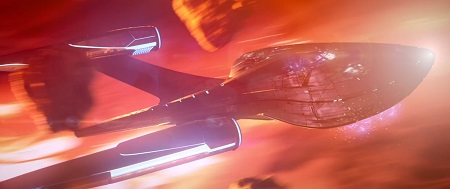
The USS Protostar in flight.

Despite that, the Prodigy panel was interesting. Dee Bradley Baker, who voices Murf – the cute blob-alien – seems like he’s a real Trekkie and spoke about the franchise with passion. It was so much fun to see him perform Murf’s voice live, as well! Brett Gray, who will take on the role of young leader Dal, seemed overjoyed to have joined a franchise – and a family – with such a legacy, and I liked the way he spoke about how the young crew of the USS Protostar will grow as the season progresses.

The show’s co-creators – brothers Dan and Kevin Hageman – spoke about how Prodigy won’t be a series that talks down to children, but rather aims to be a series with plenty to offer for adults as well. The best kids’ shows manage this – and the Hagemans have received critical acclaim and awards for their work on Trollhunters and Ninjago, so there’s a lot of room for optimism. They both seemed to have a good grasp of the legacy and role Star Trek plays and has played for young people, and I think the show is in safe hands.

Dee Bradley Baker gave us a tease of Murf’s voice!

The Prodigy trailer was action-packed and exciting! We got a glimpse of the villainous character played by John Noble – and heard his distinctive voice – as well as got a much closer look at the USS Protostar than we had before. Perhaps the most exciting moment, though, was seeing the Janeway hologram for the first time! Janeway’s role in the show seems like it will be that of a mentor; the kids will make their own calls and decisions, but Janeway will be on hand to offer advice – at least that’s my take at this stage.

There were some funny moments in the trailer, too, which will surely produce a lot of giggles from Prodigy’s young audience. “Just hit all the buttons” until the phasers fire was a great laugh line, and the ship losing artificial gravity was likewise hilarious. There was also a crash-landing that reminded me very much of a scene in the Voyager episode Timeless. I’m really looking forward to Prodigy and to spending time with the young crew of the USS Protostar.
The crew of Prodigy on the bridge of the USS Protostar.

The Lower Decks panel was perhaps the funniest of the night. It was also the one where the interviewees felt the most comfortable and did their best at participating and answering questions; there were none of the awkward silences or long pauses that made me cringe during other panels. Noël Wells, Eugene Cordero, and creator Mike McMahan initially took to the stage before being joined in truly spectacular fashion by Ransom voice actor Jerry O’Connell. The cast members clearly get on very well together, and this came across as the four talked with host Mica Burton about the first four episodes of the season as well as what’s to come in the remaining six episodes.

Wells and Cordero talked about how they see their characters of Tendi and Rutherford becoming friends and bonding over “nerd” things – geeking out together over things like new tricorders, engineering, or how best to do their work was a hallmark for both in Season 1. I’m not so sure how I feel about Mike McMahan saying that the rest of the season plans to go “even bigger” with some of its stories. Lower Decks can be overly ambitious, at times, with the number of characters and story threads it tries to cram into a twenty- or twenty-five-minute episode, and this can be to the detriment of some or all of the stories it wants to tell.

Mike McMahan, Noël Wells, Eugene Cordero, and Jerry O’Connell participated in the Lower Decks panel.

However, McMahan spoke about the episode Crisis Point from Season 1 as a kind of baseline for how big and bold the show wants to go in the second half of Season 2. That episode was one of the best, not just for its wacky over-the-top action, but for its quieter character moments. If the rest of Season 2 keeps in mind the successful elements from episodes like Crisis Point, then I think we’re in for a good time!

The mid-season trailer was interesting! Here are just some of the things I spotted: the Pakleds are returning, Rutherford seems to get a “Wrath of Khan-inspired” moment in a radiation chamber, Tendi was transformed into a monster that seemed reminiscent of those in Genesis from Season 7 of The Next Generation, Boimler and Mariner are involved in a shuttle crash, Mariner rejoins Captain Freeman on the bridge, there was a scene in which Boimler easily defeated some Borg that I assume must be a dream or holodeck programme, a Crystalline Entity was seen, the creepy bartender with the New England accent was back, and Boimler and Mariner shared a joke about the utility of phaser rifles. I’m sure there was more – but those were the key things I spotted! The rest of Season 2 will hopefully continue to hit the highs of the past few weeks – and there’s another episode coming out very soon here in the UK that I can’t wait to watch!

Rutherford’s “Wrath of Khan moment” from the mid-season trailer.

It was very sweet for Star Trek Day to take time to discuss Gene Roddenberry’s legacy, coming in the centenary year of his birth. His son Rod, and former Star Trek stars LeVar Burton, George Takei, and Gates McFadden joined Wil Wheaton to talk about Gene Roddenberry, and this was one of the most touching moments in the entire event. There were some laughs as George Takei told us about his first meeting with Gene Roddenberry and how he came to land the role of Sulu – including how both he and Gene mispronounced each others’ names! Gates McFadden seemed to have been talked into joining the cast of The Next Generation by Roddenberry, having initially wanted to return to the stage and join a play. Rod Roddenberry’s reminiscence of the design process for the Enterprise-D was hilarious – apparently his mother thought the ship looked like “a pregnant duck!”

LeVar Burton, who had been a Star Trek fan prior to joining The Next Generation, spoke about how he was overwhelmed at first when meeting “the Great Bird of the Galaxy,” and how a small role on a made-for-television film introduced him to producer Bob Justman, who later arranged for him to meet with Gene Roddenberry during pre-production on The Next Generation. All of these anecdotes went a long way to humanising Gene Roddenberry the man – we can often get lost in the legacy and philosophy he left behind, and how Star Trek and the world he created has influenced and impacted us, but this was a rare opportunity to hear small, personal stories about the man himself. I greatly appreciated that.

LeVar Burton spoke about working with Gene Roddenberry before giving a speech about The Next Generation.

George Takei got one of the biggest applause lines of the evening when he spoke about the importance of Star Trek’s fans, in particular Bjo Trimble, on popularising The Original Series and getting a nationwide fan community started. Decades before the internet came along to make fandoms and fan communities a part of many peoples’ lives, Star Trek was already developing its very own devoted fan community thanks to people like Bjo Trimble, and for George Takei to take time to acknowledge the role fans have played in Star Trek’s ongoing success was wonderful to hear.

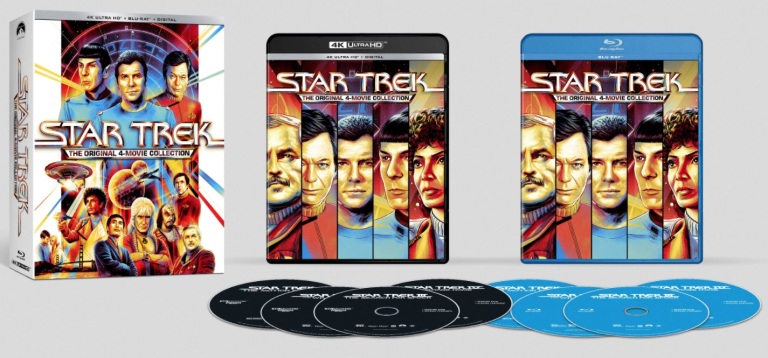
As I’ve said before, The Motion Picture was the culmination of this fan-led journey for Star Trek, but the film also laid the groundwork for much of what we’d come to know as Star Trek in the eighties and nineties. Many sets and design elements were in continuous use in some form from The Motion Picture’s premiere in 1979 right the way through to the cancellation of Enterprise in 2005, and much of the aesthetic and feel of Star Trek is owed to what The Motion Picture pioneered. George Takei acknowledged that, and that was a pretty cool moment. The Motion Picture is one of my favourite Star Trek films, and a 4K remaster was briefly shown off as well – the 4K blu-ray set of the first four Star Trek films is out now, so Star Trek Day took a moment to plug it!

There was a brief glimpse of the remastered version of The Motion Picture from this new box set.

The panel that seemed to get the most online attention was, I felt, one of the worst and most cringeworthy to watch! The Strange New Worlds panel was followed up by a pre-recorded video that introduced new members of its main cast, who joined Anson Mount, Ethan Peck, and Rebecca Romijn. Among the newly-revealed characters were an Aenar (an Andorian race introduced in Enterprise) a possible descendant or relation of iconic villain Khan, and three characters from The Original Series who are returning to Star Trek: Dr M’Benga, who appeared in a couple of episodes, Nurse Chapel, and the one who got the most attention: Cadet Nyota Uhura!

Uhura blew up online after the announcement, and it’s fair to say that I was not expecting this! There was scope, I felt, for Strange New Worlds to bring back classic characters, but the choices they made seem to be pitch-perfect. I’m especially excited to see more from Dr M’Benga – he was a minor character who feels ripe for a deeper look. The same could also be said of Captain Pike and Number One!

Uhura’s return pretty much broke the internet!

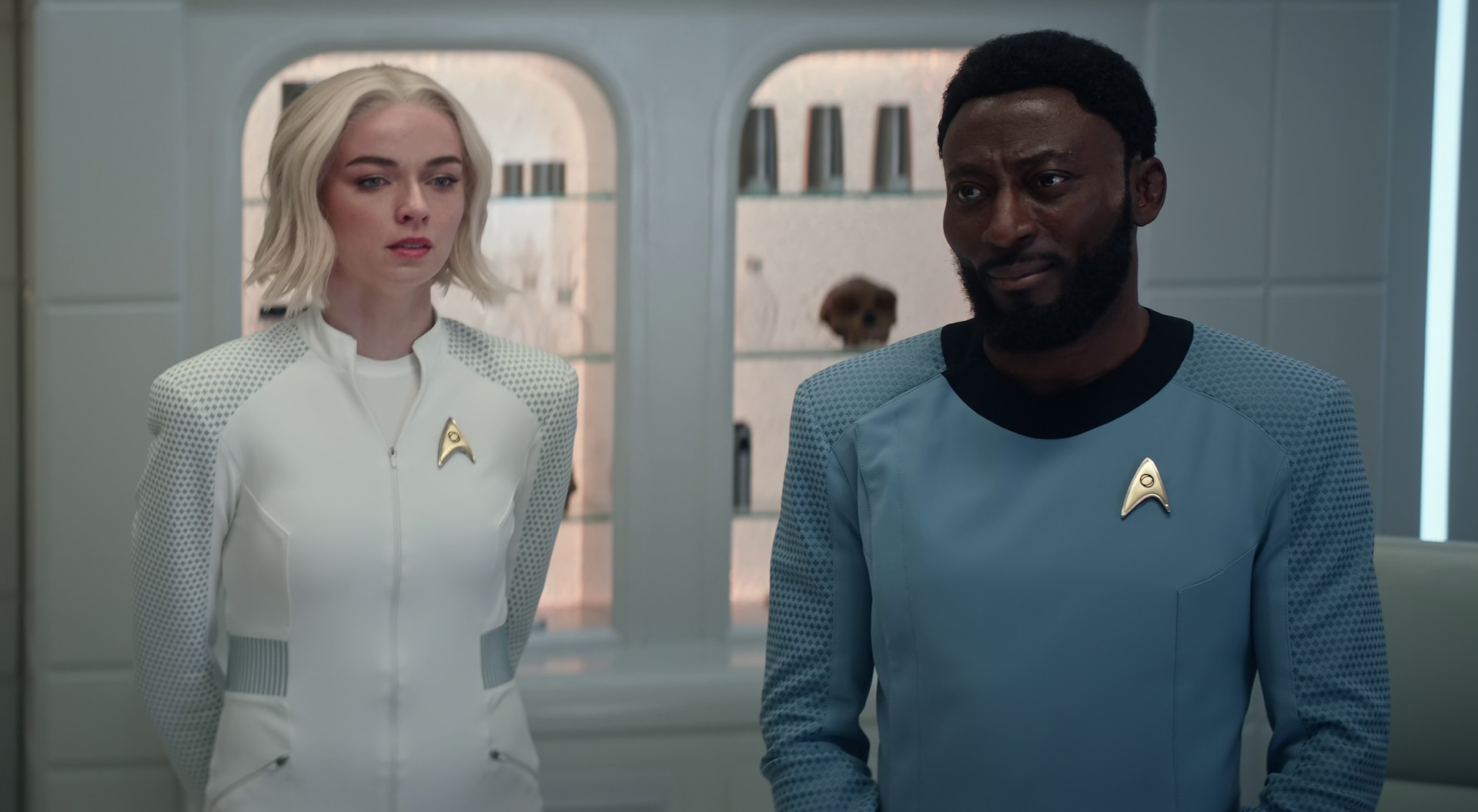
As I predicted a few months ago, the uniforms for Strange New Worlds have been slightly redesigned from their Discovery style. I was never wild about the asymmetrical collars; they worked okay on Discovery’s all-blue uniforms but looked perhaps a little clumsy on the recoloured uniforms worn by Pike and the Enterprise crew. So to see the teaser show off a redesigned style that keeps the bold primary colours but ditches the Discovery style was pretty great! As with any new uniform I think we need time to see them in action and get used to them, but there’s already a lot to like. In addition to the V-neck style worn by Pike and Spock, we saw a white medical variant worn by Nurse Chapel, another medical variant with a broad crew collar worn by Dr M’Benga, and a zipper style worn by Number One. Starfleet uniforms – like any aesthetic or design element – are of course subject to personal taste, but from what we’ve seen so far I like the Strange New Worlds uniforms.

The Strange New Worlds live panel was not the best, though. Anson Mount, who is usually so full of life and happy to talk about all things Trek, sat in silence for large parts of it, deferring to the rest of the panel to answer questions. He may have been trying to avoid jumping in too fast or dominating proceedings, but it led to several very awkward silences that weren’t fun to watch. I got the sense that perhaps he wasn’t feeling well.

Anson Mount was not on his best form for the Strange New Worlds panel, unfortunately.

The producers – Akiva Goldsman, who has previously worked on Picard, and Henry Alonso Myers – gave us a few tidbits of information about the series. I was very pleased to hear so much positive talk about returning Star Trek to a more episodic format. Goldsman, who had been instrumental in crafting Picard’s serialised story during Season 1, seems quite happy to return to episodic television. There are a lot of advantages in a show like Strange New Worlds – i.e. one about exploration – to using a more episodic format. Episodic television can still see wonderful character growth – I’d point to Ensign Mariner in Lower Decks as a recent Star Trek example – so it was great to see how positively the cast and crew talked about that aspect of Strange New Worlds.

The producers and cast seemed very keen to embrace the legacy of The Original Series in more ways than one. Without looking to overwrite anything, they want to bring their own take on classic characters, and I think that’s great. Spock benefitted greatly from the expanded look we got at him in Discovery’s second season, and there’s no reason to think characters like Nurse Chapel or Cadet Uhura won’t likewise get significant character development that plays into the characters we know and love from their roles in The Original Series.

Jess Bush will be taking on the role of Nurse Christine Chapel in Strange New Worlds.

In terms of aesthetic, Strange New Worlds is trying to walk a line between embracing the 1960s style of The Original Series and also updating the show to a more modern look. There was talk about the design of sets, in particular Captain Pike’s quarters, and how the designers had been keen to return to the 1960s for inspiration. Likewise hair and nail styles were mentioned by Rebecca Romijn for Number One – a ’60s-inspired, “retro” look seems to be on the cards for the character, but not to such an extent that it becomes distracting. Walking that line is a challenge – but one I’m glad to see the show tackling!

We didn’t get a full trailer for Strange New Worlds, and the character introductions were cut in such a way as to minimise what we could see of the USS Enterprise. However, we did get a decent look at the transporter room set, which looks really cool, and when we met Dr M’Benga we got a glimpse of what I assume to be sickbay – and it looks like the colour scheme from The Original Series is still present in some form. We also got to see the logo and typeface for Strange New Worlds.

The Strange New Worlds logo.

So an underwhelming panel in some respects led to one of the biggest reveals of the night! Uhura, Chapel, and Dr M’Benga make welcome returns to Star Trek, that’s for sure. And there’s a particular genius to choosing these three characters in particular: they’re all ripe for more development and exploration. Uhura was a mainstay on The Original Series, but compared with the likes of Kirk and Spock there’s still plenty of room to explore her characterisation, background, and learn more about who she is in a way that will inform the original character and portrayal. Likewise for Nurse Chapel and Dr M’Benga – in many ways these two characters are near-blank slates for the new writers and producers to mould into their own creations.

I’m more excited today for Strange New Worlds than I was 24 hours ago, and that’s really saying something! I loved how Mount and the producers spoke about how his portrayal of Pike and Pike’s leadership style led them to redesign parts of his quarters so he could accommodate more of his crew around the table. Cooking was a big part of Captain Sisko’s character in Deep Space Nine, and I picked up at least a hint of that in some of the things said about Pike.

Dr M’Benga, despite being a returning character, offers a lot of scope for further development by a new team of writers.

The panel also discussed how the USS Enterprise is a “star of the show” in many respects, and how episodic storytelling will allow the series to return to Star Trek’s roots in terms of producing entertaining stories with morals. As I’ve said before, Star Trek has always used its sci-fi lens to shine a light on real-world issues, and to learn that Strange New Worlds is embracing that is fantastic news.

Spock’s characterisation was mentioned by Ethan Peck and the producers, and there was talk of how we’d see different facets of his personality. The Cage was mentioned as showing us “smiley Spock,” and I liked how the producers have a keen knowledge of how Spock and other Vulcans perceive and experience emotions – Spock is an emotional person, even if he suppresses those emotions much of the time. An exploration of that aspect of his character – informed by his experiences in Discovery Season 2, perhaps – will be truly interesting to see play out.

Captain Pike and the crew of Strange New Worlds will be on our screens in 2022.

Finally we come to Star Trek: Picard. This was the final event of the evening, and unfortunately the way it was teed up felt incredibly rushed. Jeri Ryan – who will reprise her role as Seven of Nine in Season 2 – raced onto the stage to introduce the new trailer, and it just seemed very obvious that the people running the event were acutely aware of time constraints and wanted to get it over with as quickly as possible. There was no Picard panel, no appearance from Sir Patrick Stewart (even by video-link or in a pre-recorded message), and though the trailer was very interesting the way Picard Season 2 was handled felt rushed right at the end of Star Trek Day – ironic, perhaps, considering the rushed way Season 1 also ended!

We’ll get to the trailer in a moment, but it was great to see that Picard Season 3 has been officially confirmed. We knew this was coming – Season 3 is already in production, and filming has already begun. But to get an official confirmation was good, and it drew a huge cheer from the audience. There’s clearly a big appetite for more Picard!
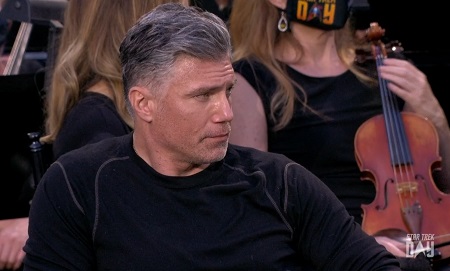
Picard is coming back for a third season!

Onward, then, to the trailer. This is one that I’ll have to return to for a more detailed breakdown in the days ahead, but for now here are my summarised thoughts.

A return to the 21st Century is not what I would have chosen. Time travel isn’t my favourite Star Trek storyline, and in particular time travel stories which return to the modern day can feel awfully dated very quickly. Look, for example, at Voyager’s two-parter Future’s End, or Star Trek IV as examples of that. Star Trek feels like the future – one of the reasons I love it so much – and when it comes back to the modern day I think it risks losing something significant. It’s possible that only a small part of the story will be set in the modern day, but even so I wasn’t exactly wild about this story element, unfortunately.

We knew from the earlier trailer that there has been some kind of change or damage to the timeline. It now seems as though Q may be more directly involved, as Picard blamed him for breaking the timeline. Whatever the change was, it seems to be centred in our own 21st Century (though it could be anywhere from 2020-2040, I guess) and resulted not in the creation of the Federation but a “totalitarian state” by the 24th Century. I don’t believe that this is the Mirror Universe that we’re familiar with, but rather a change to the Prime Timeline itself – perhaps caused by Q, but earlier comments seemed to suggest that Q wasn’t to blame, so watch this space.
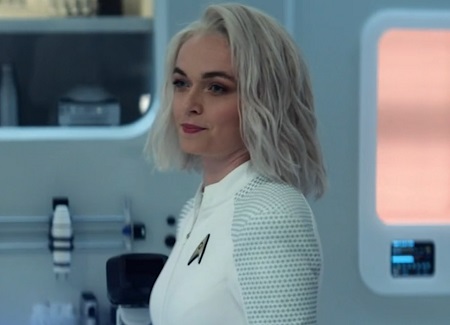
A visit to the 21st Century would not have been my choice… but I will give it a chance!

In voiceover we heard Laris questioning Picard’s motivation for wanting to join Starfleet or leave Earth, something we’d seen him talk about in episodes like Family and again in Generations. She seemed to question whether he’s “running” from something in his past – could it be some darker impulse or perhaps a family secret that’s connected in some way to the creation of the totalitarian state? Could it be, as I suggested recenly, tied into World War III?

One of the things I was most curious about was the role of the Borg Queen, whose return had been signalled a few days ago via a casting announcement. It seems as though Picard has access to the incarcerated remains of a Borg Queen – somehow – and that she may be vital to allowing the crew of La Sirena to travel through time. Rather than the Borg themselves playing a role in the story, then, this may be a battle involving Picard and Seven – victims of assimilation – and a captured, damaged Borg Queen.

What role will the Borg Queen play? She appears to be a captive of some kind.

There’s a lot more to break down from the Picard trailer, and in the days ahead I’ll put together my thoughts in more detail – as well as perhaps fleshing out a theory or two. For now, I think what I want to say is that I have mixed feelings. The big drawback I can see is the modern-day setting for part of the show. I hope I’m proven wrong, but to me Star Trek has never been at its best with these kinds of stories, and I’m concerned that it’ll stray from being a Star Trek show into something… else.

On the other hand, there are many positives. The return of Laris, who seems to have an expanded role compared to where she was in Season 1. Q’s mysterious time-bending role, too. Is he the villain of the piece, or is his latest “trial” something that he believes will help Picard and humanity? What role will he play – ally, adversary, or something in between? The “totalitarian state” definitely channelled some elements of the Mirror Universe, but also seems to have put its own spin on this concept, taking it to different thematic places. I’d be curious to see what role the Picard of this timeline has in the government of the totalitarian state.

Something has broken the timeline – leaving Picard and his crew trapped in a “totalitarian” nightmare.

So that’s all I have to say for now. In the days ahead I’ll take a closer look at the Picard trailer, as well as talk about other things we learned at Star Trek Day.

Although it was a late night and a long broadcast, I had a good time with Star Trek Day overall. There were some moments that didn’t work well, some unprepared interviewees and some segments that dragged on too long, but on the whole it was a fun and incredibly positive celebration of Star Trek. I came to the broadcast hoping to see more from upcoming shows, but I was blown away just as much by the celebration of Star Trek’s past as I was by the look ahead.

The hosts, presenters, and most of the speakers and guests showed off their passion and love for Star Trek in a very positive way. There was a lot of talk about returning the franchise to its roots, celebrating the legacy of Gene Roddenberry and his original vision for Star Trek and what made it so appealing to people of all ages across multiple generations. As we look ahead to Star Trek’s future in 2021, 2022, and beyond, taking these moments to look back at what got Star Trek to where it is today was fantastic, and well worth taking the time to see. Above all, Star Trek Day shone with passion and positivity, and that’s just what the franchise needed as it marked its fifty-fifth birthday. Here’s to the next fifty-five years of Star Trek!

Star Trek Day was broadcast online and on Paramount+ on the 8th of September 2021 (9th of September 2021 in the UK). At time of writing the event can be re-watched on the official Star Trek website; panels and trailers are supposed to be available via Star Trek and Paramount+ official YouTube channels. Clips may also be available via official social media pages and channels. The Star Trek franchise – including all properties and series mentioned above – is the copyright of ViacomCBS. This article contains the thoughts and opinions of one person only and is not intended to cause any offence.