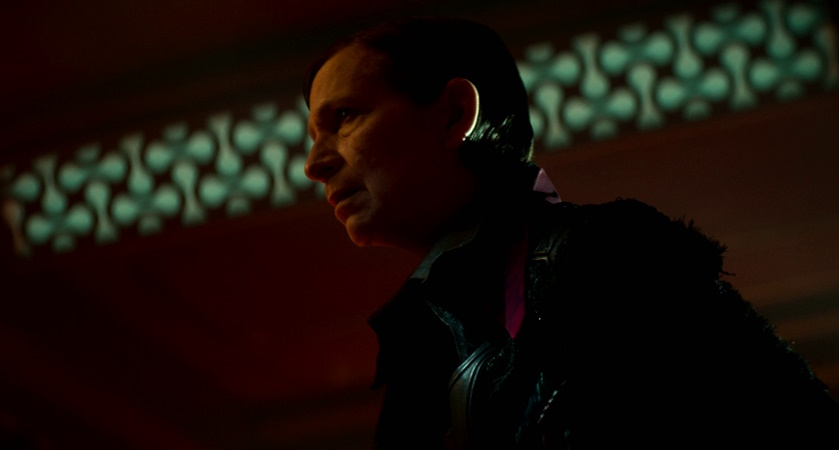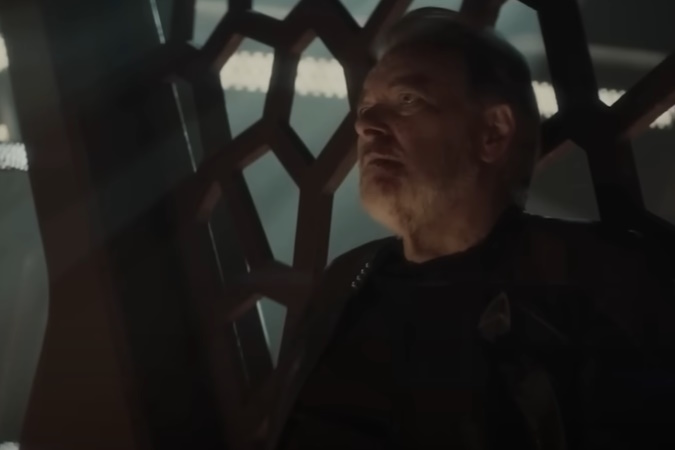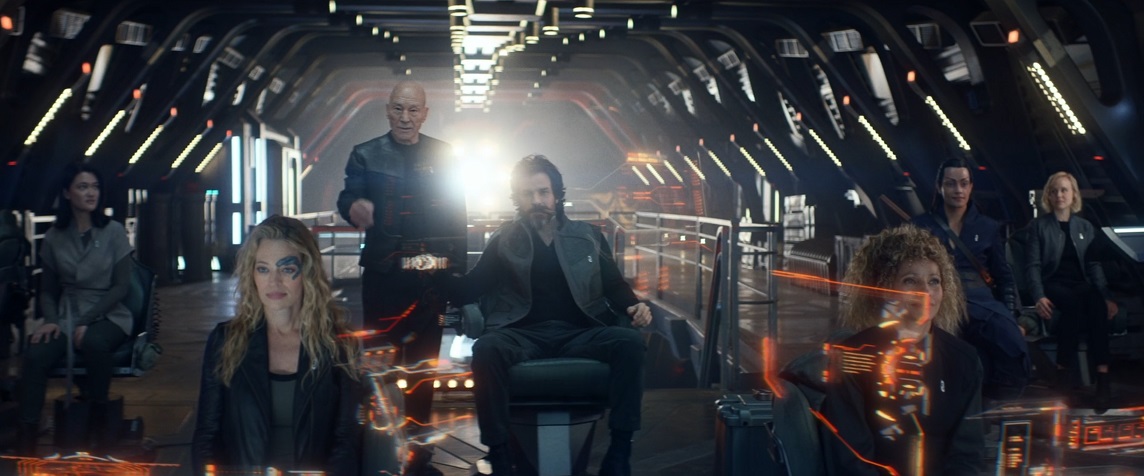
The Star Trek Fan Community’s Worst Theories

A Star Trek-themed spoiler warning.

Spoiler Warning: There are spoilers ahead for practically the entire Star Trek franchise, including recent seasons of Picard, Strange New Worlds, and Starfleet Academy.

I like to engage in a bit of theory-crafting here on the website! If you’re a regular reader, you might’ve followed along with my weekly Discovery and Picard theories while those shows were on the air. Or perhaps you clicked on one of my viral theories speculating about Unknown Species 10-C, Q, or Vadic. Or maybe you’re brand-new to Trekking with Dennis… in which case, welcome! But my point is that I like Star Trek fan theories, I write a lot of Star Trek fan theories, and I get a *lot* of things utterly wrong.

I give that caveat for one important reason: this piece, in which I’m going to demolish some fan theories that I’ve found doing the rounds in the online Trekkie community, is meant to be tongue-in-cheek! I’m trying to have a bit of fun with the Star Trek franchise in this landmark sixtieth anniversary year, and picking apart some fan theories I’ve come across on social media seemed like it could be a way to do that. But I’m not taking this too seriously, and you only need look at my own fan theories to see how bad some of them were.
Cropped promo poster for The Search for SquarePants (in a Star Trek style).
Brace yourself. Things are about to get… silly.

More than ever, I encourage you to keep in mind that this is entirely *subjective, not objective*, and that we’re dealing with non-canonical fan theories which are likely never to be confirmed nor even referenced on screen. This is just for fun, it’s supposed to be a light-hearted exploration of some of the Trekkie community’s “wilder” and more “out there” ideas, and it’s just one person’s take on things, at the end of the day. So please try to keep all of that in mind as we go through these theories!

I visited a few different Star Trek social media pages and channels, collecting twenty-five theories that I thought sounded… well, to be blunt, I thought they sounded kinda silly. Some of these seem to have been written almost as parody, but others did seem to have elicited debate, and clearly have believers. But in any case, all of these made interesting (or weird) points, and I thought breaking them down could be a bit of fun as we continue our year-long celebration of the franchise’s sixtieth anniversary.
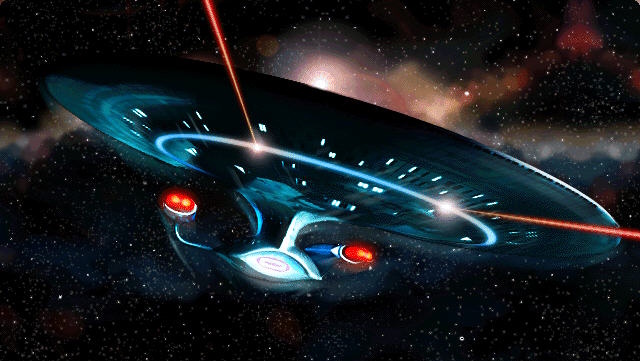
Screenshot from Star Trek: Generations (PC game) showing the Enterprise-D firing phasers.
The Enterprise-D. Bonus points if you know where this image comes from!

These theories cover all kinds of topics, and span the breadth of Star Trek’s history, from The Original Series all the way through to some of the most recent episodes of Starfleet Academy. Some fans have been, shall we say, especially *creative* with their ideas! Which is fantastic. I adore the Star Trek fan community and how passionate folks can be. As I’ve said many times here on the website: crafting a theory is a great excuse to spend a bit more time in Star Trek’s wonderful galaxy, and even though I may disagree vehemently with a theory, I love that Trekkies all over the world are so invested in this franchise.

We’re going to get into the theories now, so consider this your final content warning. This is your last chance to jump ship if you need to avoid spoilers or if you don’t want to come across some potentially controversial Star Trek opinions! The theories below are in no particular order.

Theory #1:
Dr McCoy knows that he’s a character in a TV show.
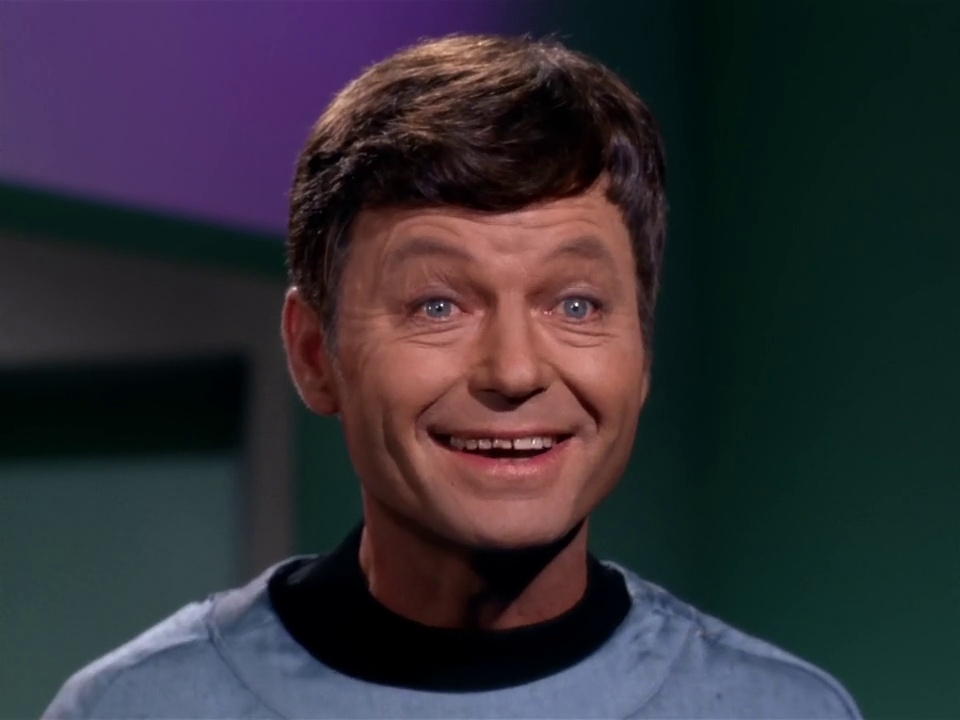
Still frame from Star Trek: The Original Series Journey to Babel showing Dr McCoy.
Leonard “Bones” McCoy.

In The Original Series, there were a handful of moments that seemed to break the fourth wall – i.e. where characters within Star Trek seemed to acknowledge the audience, or that what was unfolding on screen might not be real. Dr McCoy was a key part of one of the most (in)famous fourth wall breaks in The Original Series: the closing scene of the Season 2 episode Journey to Babel. In this scene, Dr McCoy remarks that he “finally got the last word,” after shushing Kirk and Spock – seemingly referencing other episode endings in which Kirk, Spock, or another character would say the closing line or remark on what had transpired. Furthermore, McCoy seems to say this while looking *almost* straight into the camera.

Without getting too nitpicky, I think we can debunk this one by explaining that McCoy was simply commenting on Kirk and Spock’s tendency to talk over him in-universe, rather than anything more meta! And the choice of camera angle, rather than hinting at McCoy somehow being self-aware, was merely a close-up. The Original Series did close-up shots like that all the time, and McCoy’s gaze is slightly off to one side, not straight down the lens. There’s nothing in canon to suggest that Dr McCoy is somehow self-aware of his status as a character, and anything that hints otherwise can be written off as a quirk of the show’s production or writing.

Theory #2:
The show T.J. Hooker depicts Kirk’s adventures on a holodeck.
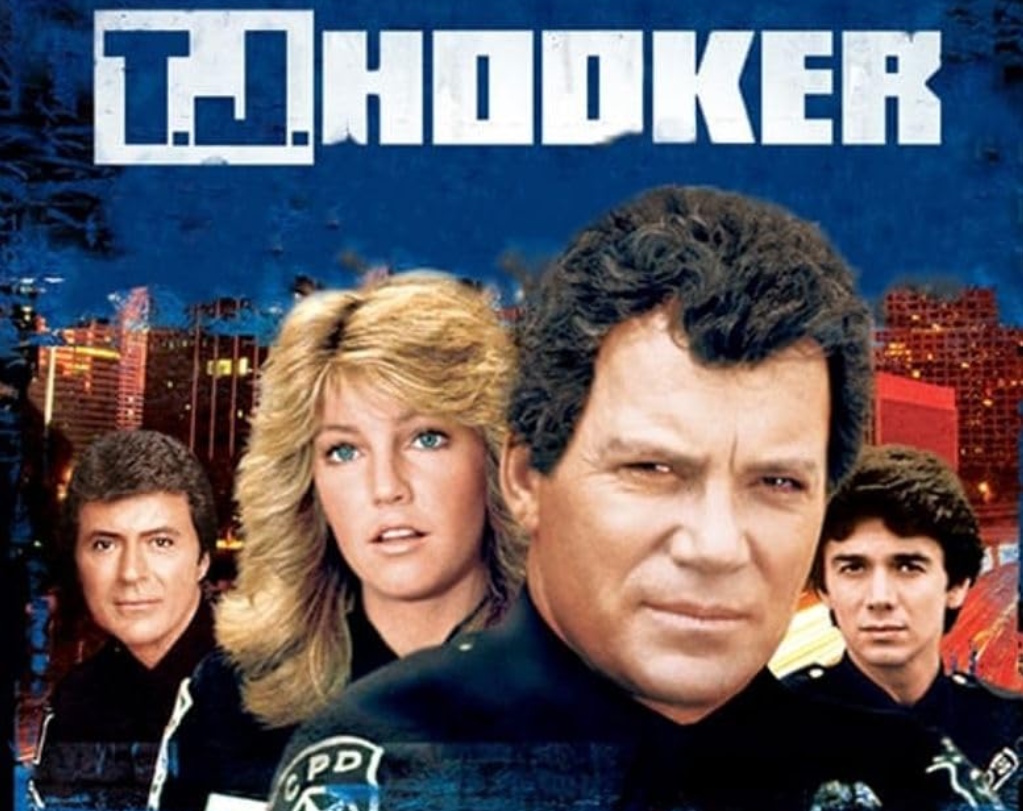
Poster/box art for T.J. Hooker.
It’s Captain Kirk!

T.J. Hooker stars William Shatner in the lead role, and if you don’t know it, it’s a police procedural show from the ’80s. Besides Shatner’s role, Leonard Nimoy had a small role in one episode (and directed another), and James Darren (DS9′s Vic Fontaine) was a regular character. The series was in production alongside three Star Trek films – The Wrath of Khan, The Search for Spock, and The Voyage Home. But… that’s it. There are no overt references to Star Trek in T.J. Hooker, nor to T.J. Hooker anywhere in Star Trek – at least, not that I can recall.

If fans want to watch the show and make this inference… I mean, there’s nothing stopping you anymore. A few years ago, I might’ve said that the holodeck is a 24th Century creation, but Strange New Worlds has blown that theory out of the water. Holodecks clearly did exist at the time of The Wrath of Khan, and to be honest, I could see Kirk choosing to play make-believe as a cop in the ’80s. Obviously this isn’t and never will be canon… but don’t let that stop you!

Theory #3:
Borg “transwarp” is actually the mycelial network (from Discovery).
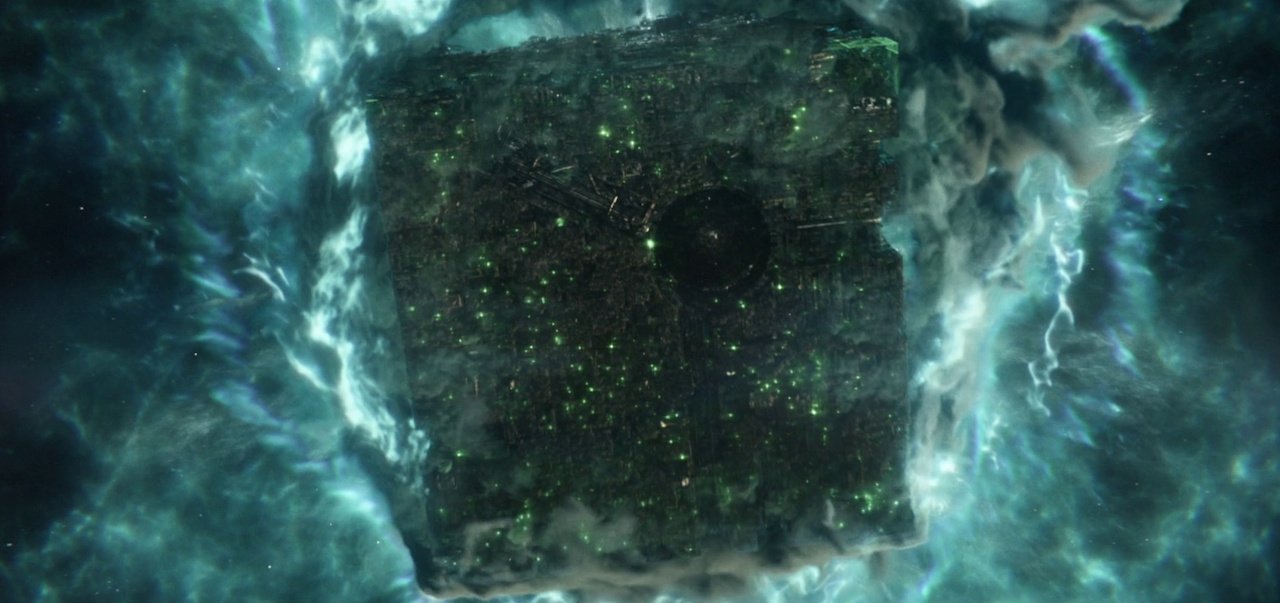
Still frame from Star Trek: Picard S1 showing the Artifact at transwarp.
A Borg Cube exiting a transwarp aperture into normal space.

I think we have enough context to fully debunk this one, right? Discovery’s mycelial network and Borg transwarp behave completely differently to one another, with the USS Discovery able to “jump” instantaneously to points across the galaxy, whereas Borg vessels enter a transwarp network and are accelerated to vast speeds. Borg transwarp is way quicker than warp speed and clearly allows for much faster transport than anything 24th or 25th Century Starfleet is capable of. But it lacks the instantaneous movement or the “jumping” effect of Discovery’s mycelial network. So I think that alone rules it out.

One thing that Star Trek’s writers usually do well is keep the intricacies of different technologies pretty vague. We know that dilithium crystals moderate the antimatter reaction in a warp core… but what that technobabble actually means, or how it all truly works, is a mystery. And you could argue that Borg transwarp is even more mysterious; just because no Borg character ever said the words “mycelial network” doesn’t mean they don’t have access to that technology. I will concede that it stands to reason that, if the mycelial network is a known phenomenon in the Star Trek galaxy, the Borg would be aware of it. But that doesn’t mean it’s how their transwarp network operates, and there are enough differences between how they appear on screen as to render this one null and void for me.

Theory #4:
Transporters beam out everyone’s bodily waste.
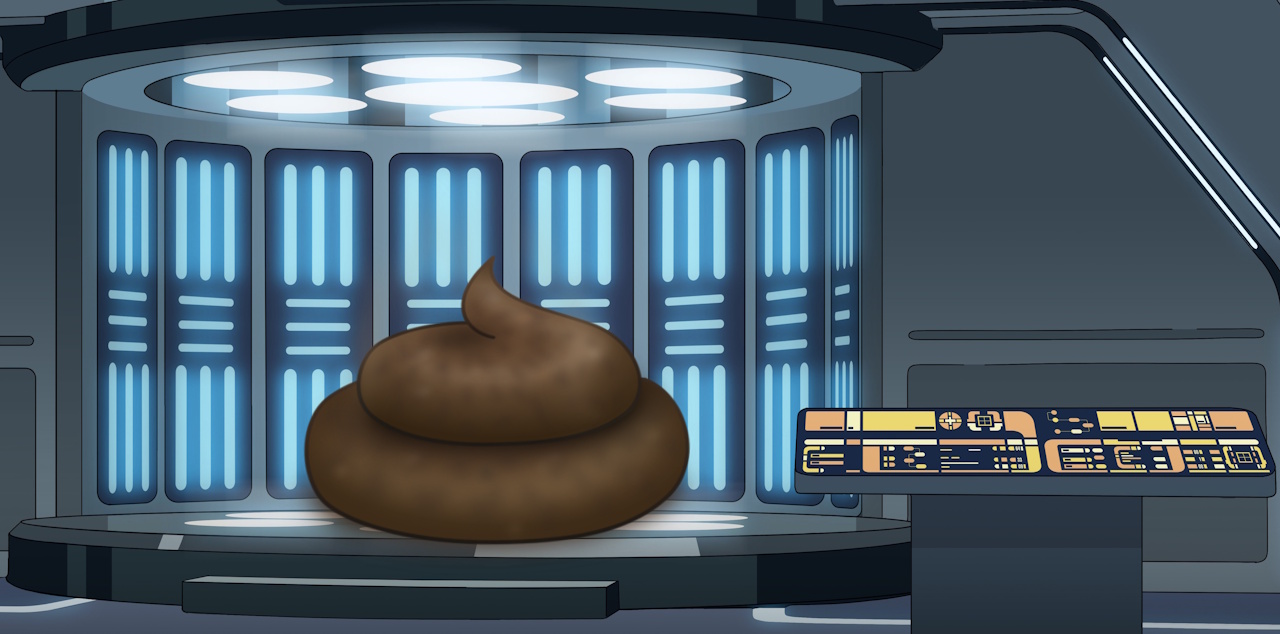
Star Trek art of a giant poo on a transporter pad.
Yuck.

Uh, sure… *that’s* what the Federation uses transporters for. Rather than going to the toilet, no one in the future is potty trained, and instead, transporters automatically empty everyone’s bladders and bowels every time they start to fill up. That’s why you never see a toilet aboard a starship, and why only the most oblique references are made to “waste extraction.”

But… this is just plain *silly*, isn’t it? “Waste extraction” was only ever mentioned in DS9, and only on a few occasions. There are few direct depictions of toilets in Star Trek, but there are references to them. Kirk sits on a toilet (clothed) in The Final Frontier, and Boimler says he dropped his tricorder in the toilet in Lower Decks. If we count non-canon sources, like starship blueprints, toilet facilities can be seen on a few different 23rd and 24th Century vessels, too. There are types of toilet today that don’t use water or a flushing system, and it’s conceivable that, in the future, refinements or brand-new designs could have been invented. Considering the energy cost, the number of transporters required, and the constant need to be in transporter range… I can’t see this being realistic. A fun, jokey idea? Sure. But something to take seriously? No!

Theory #5:
The USS Riker (from Starfleet Academy) is crewed entirely by Will Riker’s descendants.
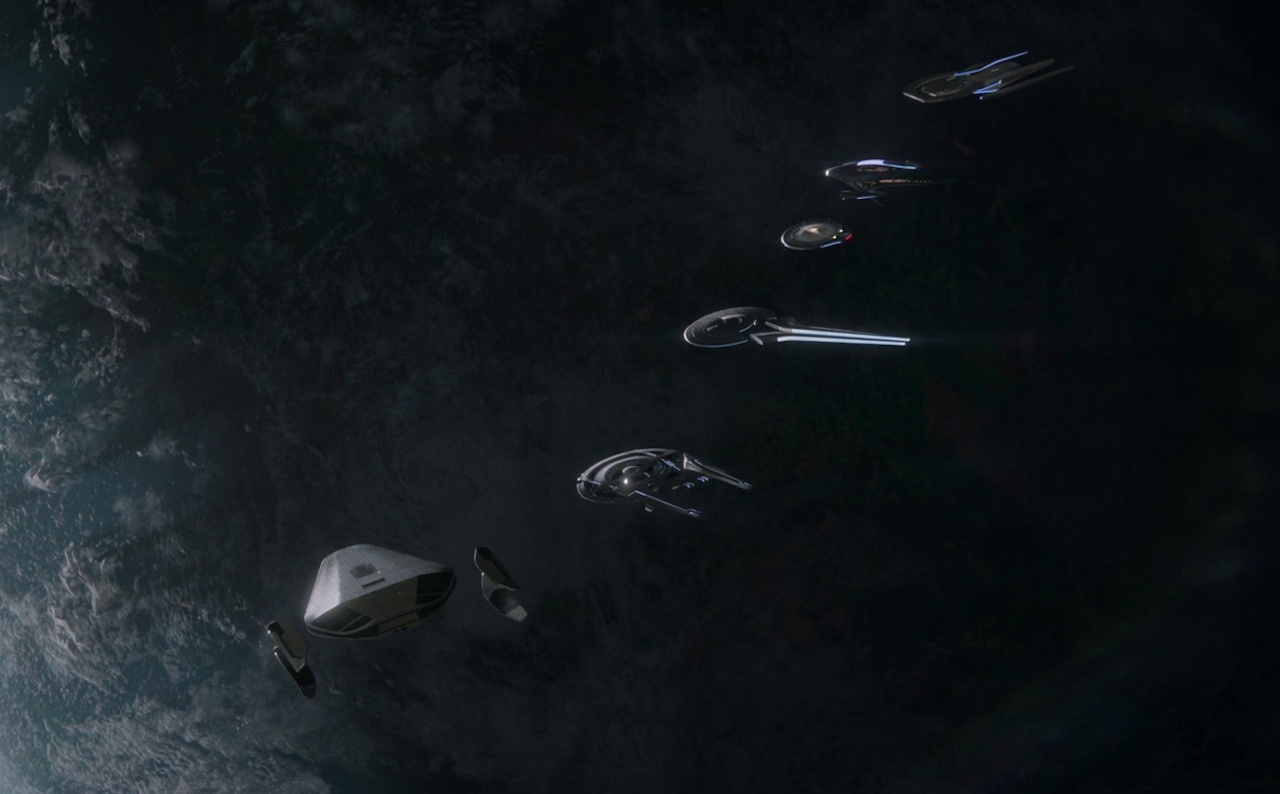
(Cropped) still frame from Star Trek: Starfleet Academy S1 showing a Federation fleet.
One of these ships (probably the one on the far left) is the USS Riker.

The USS Riker has (at time of writing) appeared in one episode of Starfleet Academy – a blink-and-you’ll-miss-it cameo in Vox in Excelso. Someone online suggested that the Riker’s entire crew are the descendants of TNG’s Will Riker – famous, somewhat, for his womanising ways and romantic liaisons with a variety of different characters across the show’s seven-season run. Riker would later settle down with Deanna Troi, as we saw in Picard, and had two children – only one of whom survived to the dawn of the 25th Century.

But could Riker’s many flings and one-night stands across The Next Generation have led to more… offspring? This theory says so! And while I think it’s a cute joke within the fandom at the expense of how Riker was sometimes written, I don’t think it has an ounce of actual merit. Firstly, we don’t even know for sure that the USS Riker is named for *William* Riker and not some hypothetical other character. Riker’s father, Kyle, also worked for the Federation, the transporter clone known as Thomas may have survived the Dominion War, and Riker’s daughter may also have gone on to achieve something significant, just to give three examples of characters we know to exist. So… this cameo was cute, and appreciated by this old TNG fan. But the idea of a ship crewed entirely by the descendants of Riker’s various liaisons? Silly!

Theory #6:
Discord (from My Little Pony: Friendship is Magic) is actually Q.
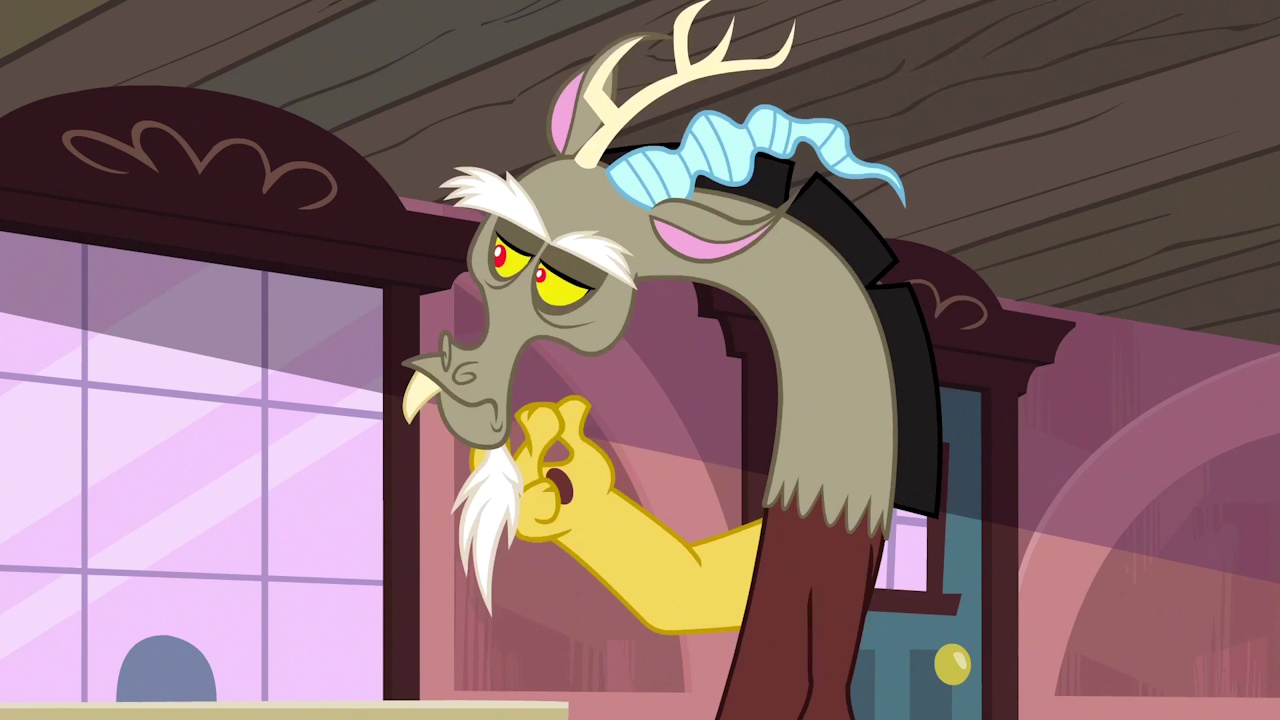
Still frame from My Little Pony: FiM S6 showing Discord.
Discord.

We could’ve done an entire article on *just* theories involving crossovers with other franchises, I guess! But this one really does make me smile, because it’s just so silly. I concede that Q and Discord have some pretty obvious similarities: their personalities, their penchant for trickery, and the fact that they’re both ancient beings who form a bond with a mortal protagonist. But c’mon, guys… these are two completely different franchises with very little in common, totally different target audiences, and which are owned by two competing corporations.

John de Lancie portrays both characters, which is where this idea seems to have originated, but that’s really as far as it can go. The same voice actor has found himself somewhat typecast into playing a role which may have been directly inspired by his earlier character. That’s it. Q can’t exist in a franchise where… Q doesn’t exist. It’s a fun head-canon, I guess, if you’re a fan of both universes. But there’s no way it can be anything more than that.

Theory #7:
Benny Russell is real, and Gene Roddenberry stole Star Trek from him.
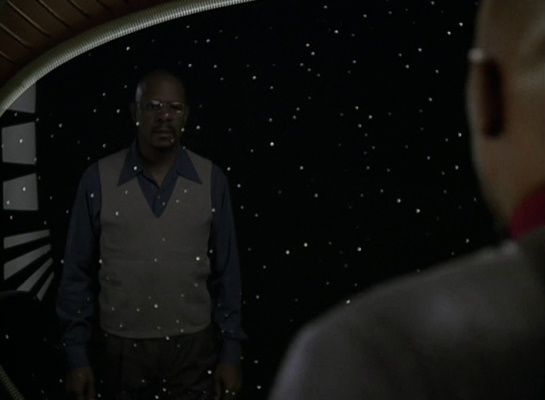
Still frame from Star Trek: DS9 showing Sisko seeing Benny Russell.
Sisko sees a reflection of Benny Russell.

There are a few variants of this theory. Some posit that, in-universe, the episode Far Beyond the Stars suggests that Star Trek as a whole exists as a fictional creation. I don’t agree with that at all (it’s always seemed logical, to me, that Benny Russell is a vision from the Prophets and nothing more), but I don’t, like, viscerally *object* to fans subscribing to that idea or exploring it. But I have seen fans propose – I *hope* entirely in jest – that there was a real Benny Russell once upon a time, and Gene Roddenberry either got the idea for Star Trek from him… or stole it.

If this is a total joke, which I believe it is, then… I mean, sure. Humour is subjective, and just because I don’t personally find it all that funny… I’m not the joke police. I can’t imagine any Star Trek fan taking this idea seriously, though, because it implies that not only did Gene Roddenberry steal these stories and this world-building, but then the DS9 writers – who must’ve known or been in on it – created a fictionalised version of Benny Russell as a character in their show… for… reasons? As a “confession?” A fun joke, maybe, but not something to take seriously.

Theory #8:
Saavik and/or Tuvok are transgender (because of Vulcan naming customs).
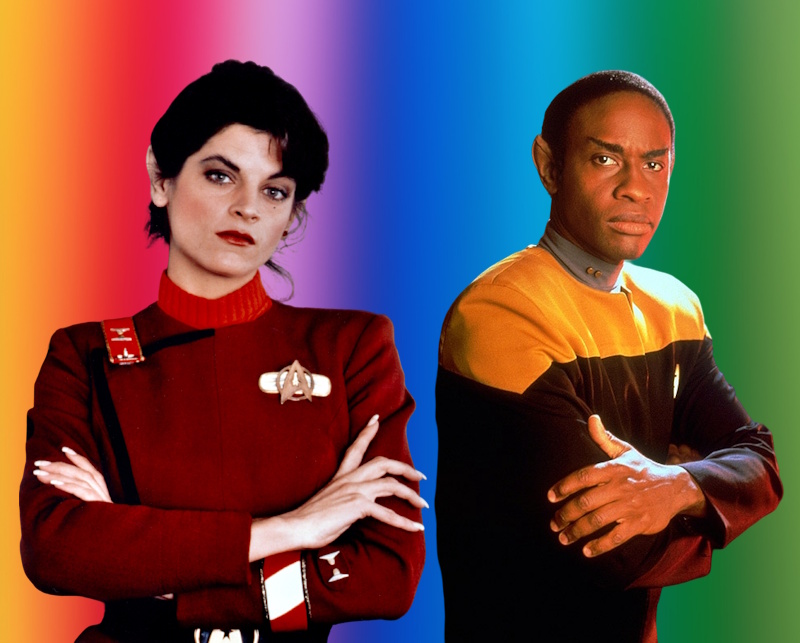
Saavik and Tuvok (from Star Trek) on a rainbow background.
Saavik and Tuvok.

In The Original Series, every named Vulcan we met had a name beginning with S if they were male or T if they were female. But then, in The Wrath of Khan, we met Saavik – the first female Vulcan whose name begins with an S. Cue the fan theories! In short, this theory posits that, because of Vulcan naming conventions that were established in TOS, Saavik and Tuvok “must” be transgender. Saavik would be a trans woman and Tuvok a trans man.

Setting aside the silly premise for a moment, let’s think about this. There are some transgender folks who keep their birth name after transitioning, but it’s more common in the trans community to choose a name more befitting of one’s true gender. For Saavik and Tuvok to keep their deadnames wouldn’t make a lot of sense. Then there’s the fact that there’s absolutely no trans storytelling for either character… at all. In a way, you might say that’s great – that the Federation just accepts everyone and doesn’t make a big deal of it. But for a writer to introduce a character who is intended to be trans and then make no effort to tell a single trans or trans-adjacent story with them? And for fans to have to infer, years after the stories were first told, that these characters are meant to be trans? We’re hitting “Harry Potter” levels of fake inclusivity. If you find something relatable in Tuvok or Saavik as a trans person, I don’t wanna take that away from you. But it’s not how I read either character, and there are other explanations for their names.

Theory #9:
Star Trek V: The Final Frontier didn’t happen; it’s all just Kirk’s bad dream.
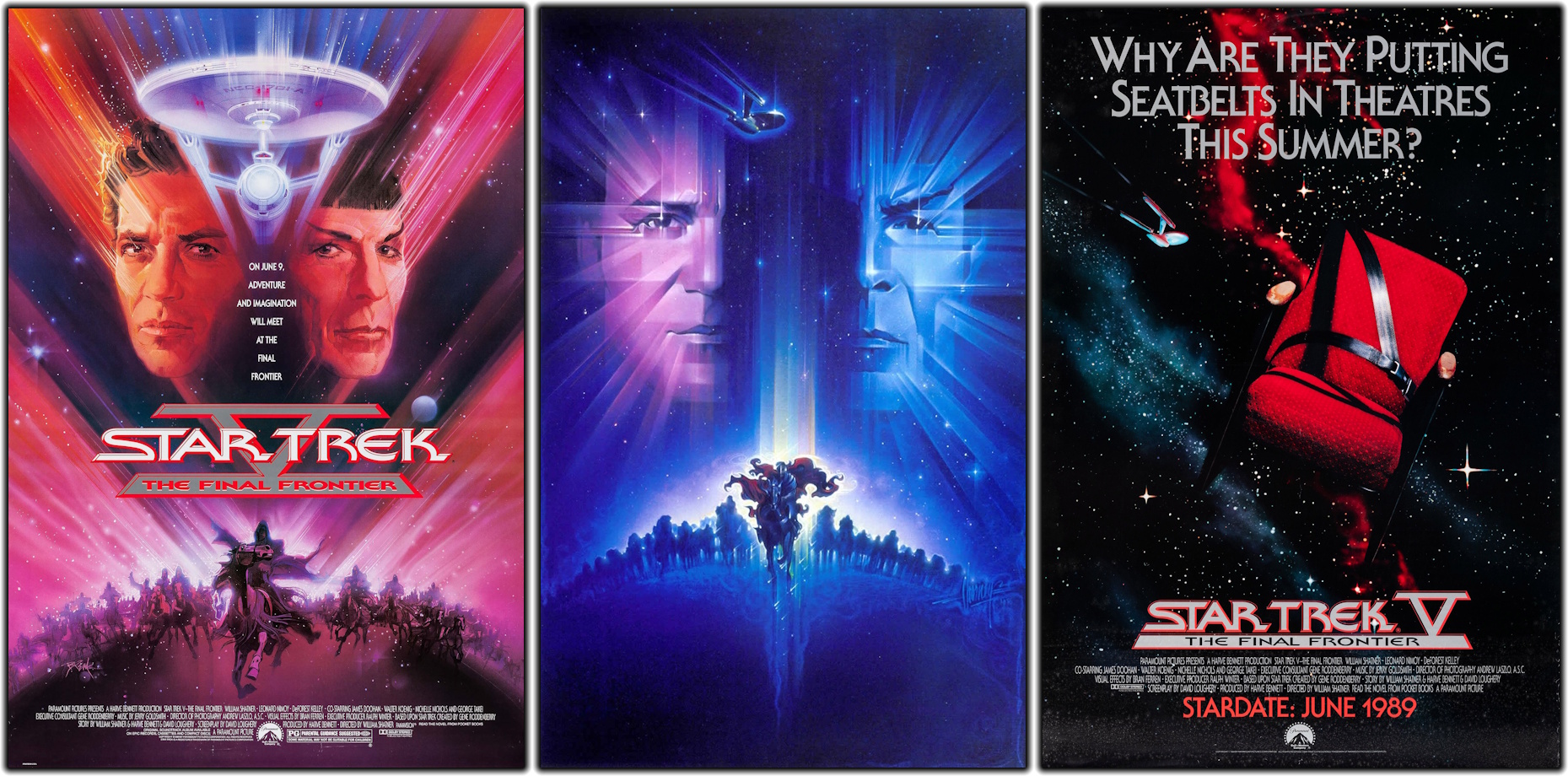
Three posters for Star Trek V: The Final Frontier.
Did it really happen?

Have you ever taken a creative writing class? One of the first things the teacher warns you about is the importance of avoiding tired narrative clichés… like “but it was all just a dream.” And to me, that’s how this fan theory comes across. I get that not everyone likes The Final Frontier; I personally rank it as one of the lesser Star Trek films, too. But just because it isn’t popular… that doesn’t mean its events can be scrubbed from canon altogether. Not to mention that the film does genuinely have redeeming features and moments of characterisation (like Kirk, Spock, and McCoy camping) that I wouldn’t want to lose.

This theory hinges on Kirk’s starring role, and the fact that some of his worst fears seem to come true. Sybok’s presence (and Spock never having mentioned him) seems to threaten their special bond. His ship is stolen from him. Members of his own crew turn against him. And there are discrepancies, like the number of decks the Enterprise-A seems to have, or the “Galaxy-class” feel to the ship (caused by recycling sets from The Next Generation). But to me, this one feels like wishful thinking at best… or clutching at the tiniest of straws at worst.

Theory #10:
Nick Locarno and Tom Paris are the same person.
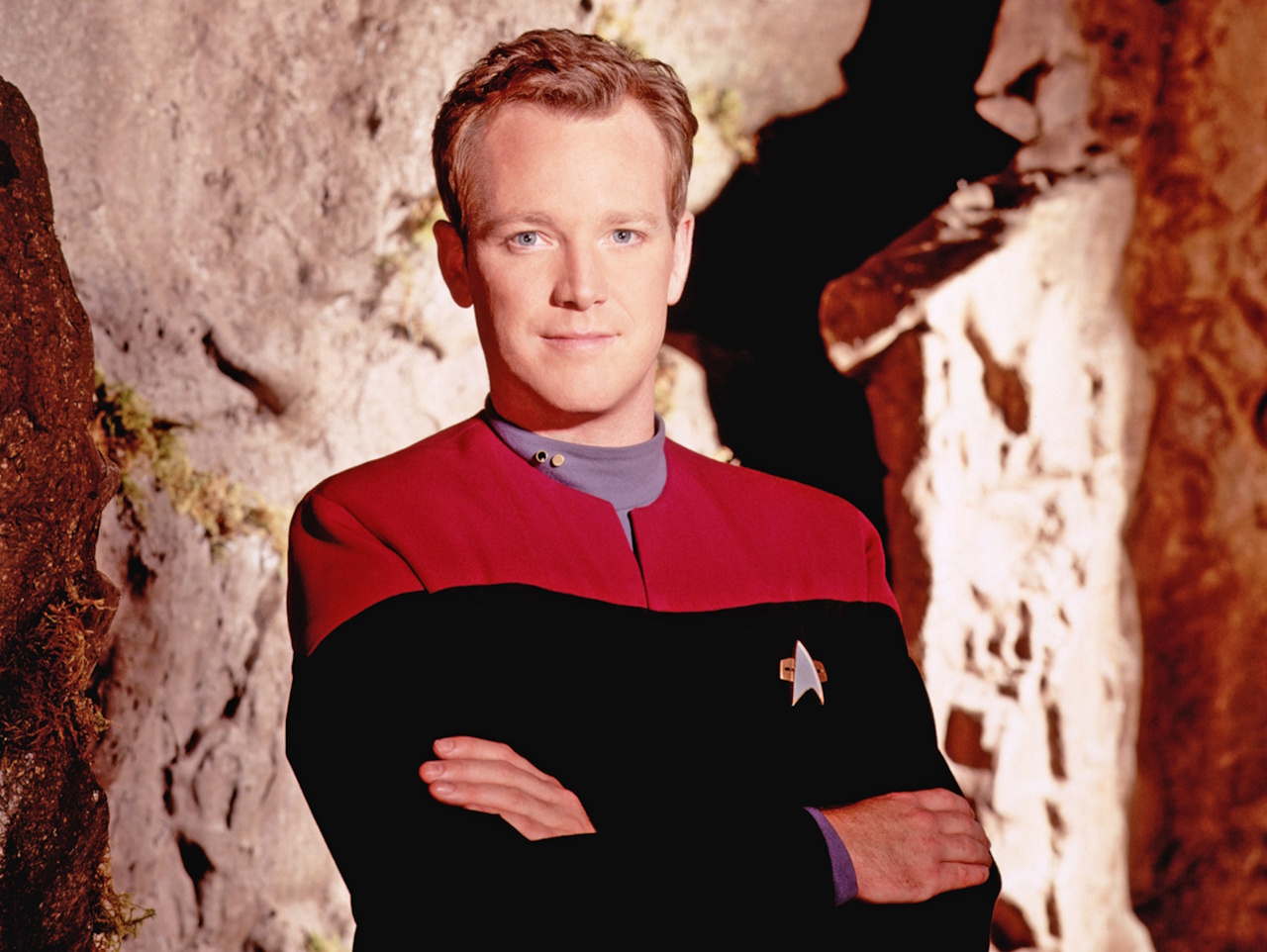
Promo photo for Star Trek: Voyager showing Tom Paris.
Tom Paris… or should that be Nick Locarno?

I think it’s safe to say that Lower Decks has debunked this one (though I still need to get caught up on that show!) But before Locarno made a return to Star Trek, fans speculated that “Nick Locarno” was actually a pseudonym adopted by Tom Paris prior to enrolling in Starfleet Academy. The theory went that Paris wanted to keep his connection to his father (who is a senior officer) a secret – either to be judged on his own merits, or for some other reason.

There are similarities between Locarno and Paris, besides the obvious point that both characters were played by Robert Duncan McNeill. They’re both able pilots, they both have a cocky or arrogant streak, and both have an ambivalent relationship with the Federation and its rules. On the production side of things, it’s long been rumoured that Voyager’s creators wanted to use Nick Locarno, but were concerned about having to pay royalties to the writer of The Next Generation episode in which he originated, so a new, very similar character was created. A photo of McNeill in his role as Locarno can be briefly seen in Voyager, representing a younger Tom Paris in his father’s office. So there’s merit to this in theory… but Lower Decks has completely debunked it by now. And if it were true, I’d have expected Paris to have said so, or for it to have been noted by Janeway early on in the series. The “Locarno” persona might’ve worked for a while, but the scandal would surely have blown his cover, and his identity would be common knowledge by the time of Voyager – at least among senior officers.

Theory #11:
Section 31 isn’t a real Federation organisation – it’s a criminal syndicate pretending to be one.
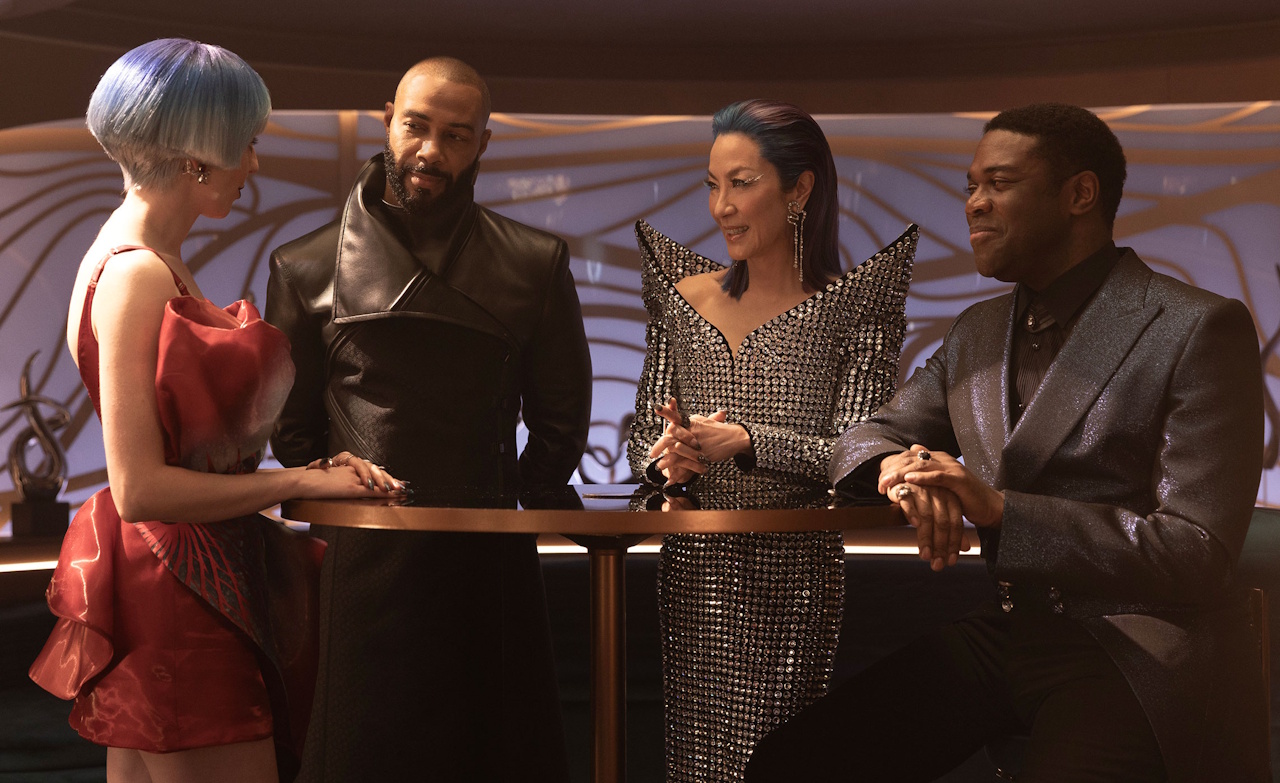
Still frame from Star Trek: Section 31 showing four main characters.
Section 31: Federation black-ops division or crime syndicate?

The way Section 31 has been depicted in Star Trek has fluctuated a lot. There’s been the clandestine, shadowy agency we encountered in DS9 and later in Enterprise. Then there’s the out-in-the-open branch of Starfleet Intelligence from Discovery. And finally, the “rag-tag gang of misfits” from the TV movie. But one thing that has remained consistent in Section 31 is that the people involved are all Federation die-hards doing things they believe to be in the Federation’s best interests… even as they answer to no one and wield almost unfathomable power.

I can see a world in which a criminal syndicate would side with Starfleet to help prevent, say, the Federation’s total conquest by the Dominion. Or in which Starfleet would make deals with shady crime lords to acquire some kind of biological weapon when faced with an existential crisis. And I can even see a world where a clever criminal would *claim* to be from a government agency or black-ops division as a tactic. But do any of those things apply to Section 31? I would argue no. The closest Section 31 has come to that kind of presentation came in the TV movie, but even then, it was clear that Starfleet was involved – albeit that the mission was still off-the-record. So this idea is simply debunked by what we’ve seen on screen – as fun as it might seem.

Theory #12:
Jean-Luc Picard is Wesley Crusher’s biological father (and he treats him the way he does out of a sense of guilt or obligation).
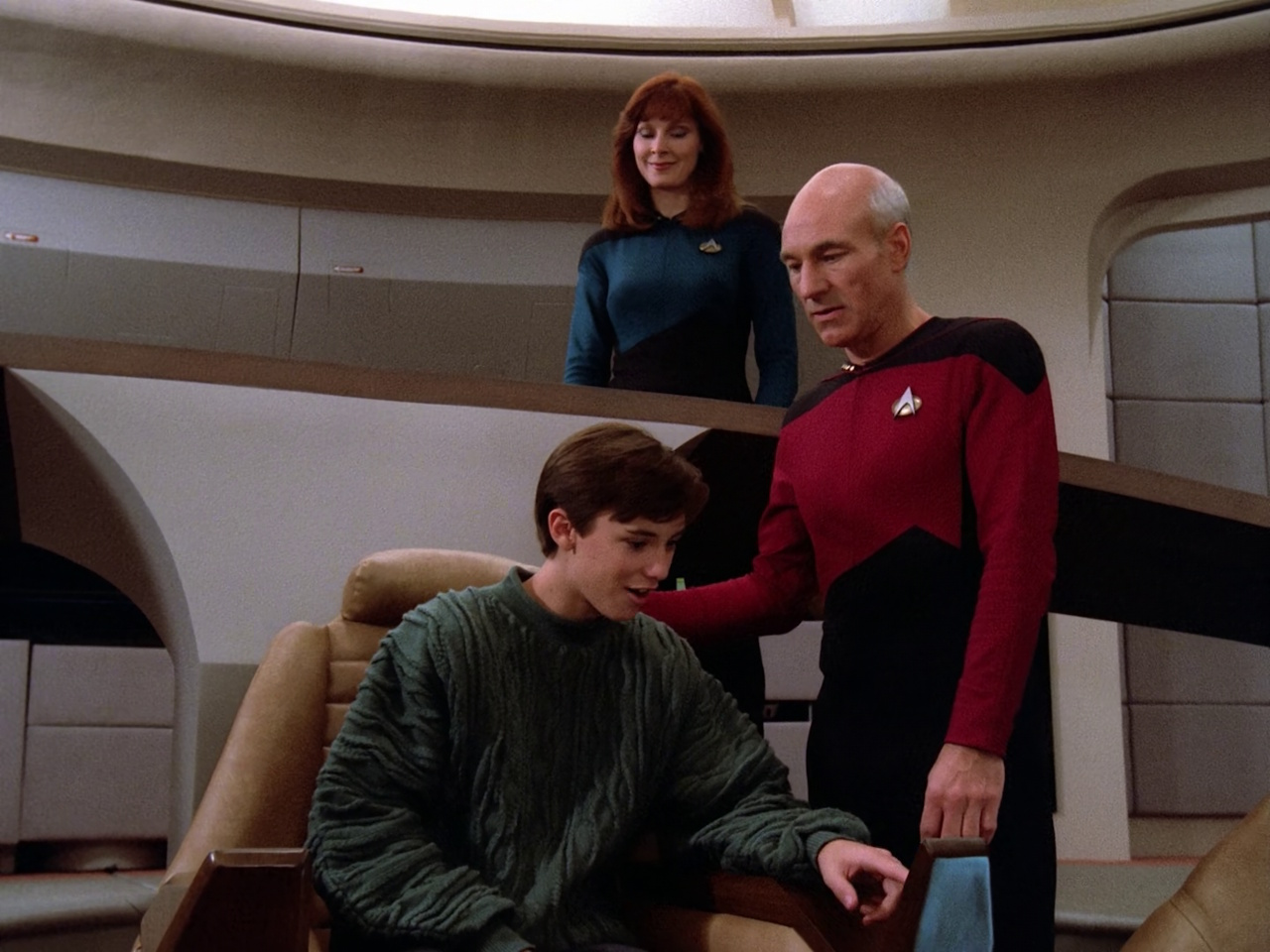
Still frame from Star Trek: TNG S1, showing Picard, Dr Crusher, and Wesley.
Picard with Wesley on the bridge of the Enterprise-D.

Sometimes you come across a theory – even one that’s been doing the rounds for years – and you just feel… gobsmacked. I simply don’t read Picard and Wesley’s relationship in this way, and any paternal feelings Picard has for the younger Crusher is pretty clearly explained within the context of the show as stemming from his close friendships with Jack and Beverly. Picard does come to appreciate Wesley’s talents, even giving him a role on the bridge of his ship… but not out of any kind of obligation or guilt – it’s in recognition of Wesley’s skills.

I will admit that Picard’s third season complicated my rebuttal somewhat, as we learned that Picard and Dr Crusher did have a child together, and that Dr Crusher kept this a secret. If she did it once, could she have done it years earlier? It could have been an interesting plotline in The Next Generation or even in Picard, if it had been handled well, but despite having some merit in theory, nothing in the show itself leads us to that conclusion. And such a complex story would require a very sensitive and well-written episode or arc, and I’m not sure it would’ve been handled well or been well-received by a large portion of the fanbase. So this one… it can be your head-canon, if you like, but it goes no further in my opinion!

Theory #13:
The Progenitors evolved into the Founders.
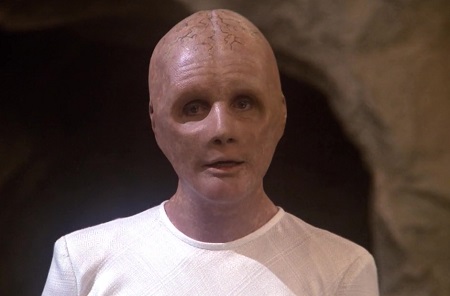
Still frame from Star Trek TNG showing an ancient alien/Progenitor.
A Progenitor in The Next Generation.

I don’t know if this theory came about because the same actress (Salome Jens) played both the ancient alien hologram in The Chase and the Female Changeling on DS9, but I suspect that has something to do with it! In any case, this theory posits that the “Progenitors,” as Discovery would later dub them, didn’t go extinct or disappear from the galaxy, but instead evolved to become the Founders of the Dominion. And on the surface, it doesn’t seem totally impossible. The Founders claim to have once been fully solid. And the Founders are capable of genetically engineering entire races. But if the Founders *were* descendants of the ancient aliens who seeded the entire galaxy with life… you’d think they might’ve mentioned it.

For me, that’s where this theory falls down. Something so monumental to who the Founders are – and most Founders seem to be almost ageless – would surely be preserved knowledge, handed down through the millions of years of their existence. Yet the Founders not only don’t bring this up, but they’re distrustful of any non-shapeshifters to the point of paranoia – not something you’d expect to see in the grandparents of the galaxy’s races. I don’t really like the way the Progenitors’ storyline went or what it says about the Star Trek galaxy, and perhaps that’s my own bias showing through when I rule out this theory. But I do believe that something so important would be known to the Founders, and it would be something they’d have at least tried to communicate in their various dealings with “solids.” Not to mention that, for a race that would need to be billions of years old… it’s weird that their technology got to a 24th Century level and apparently stayed there.

Theory #14:
Every film and episode that premiered after First Contact takes place in an alternate reality, due to the changes made to the timeline.
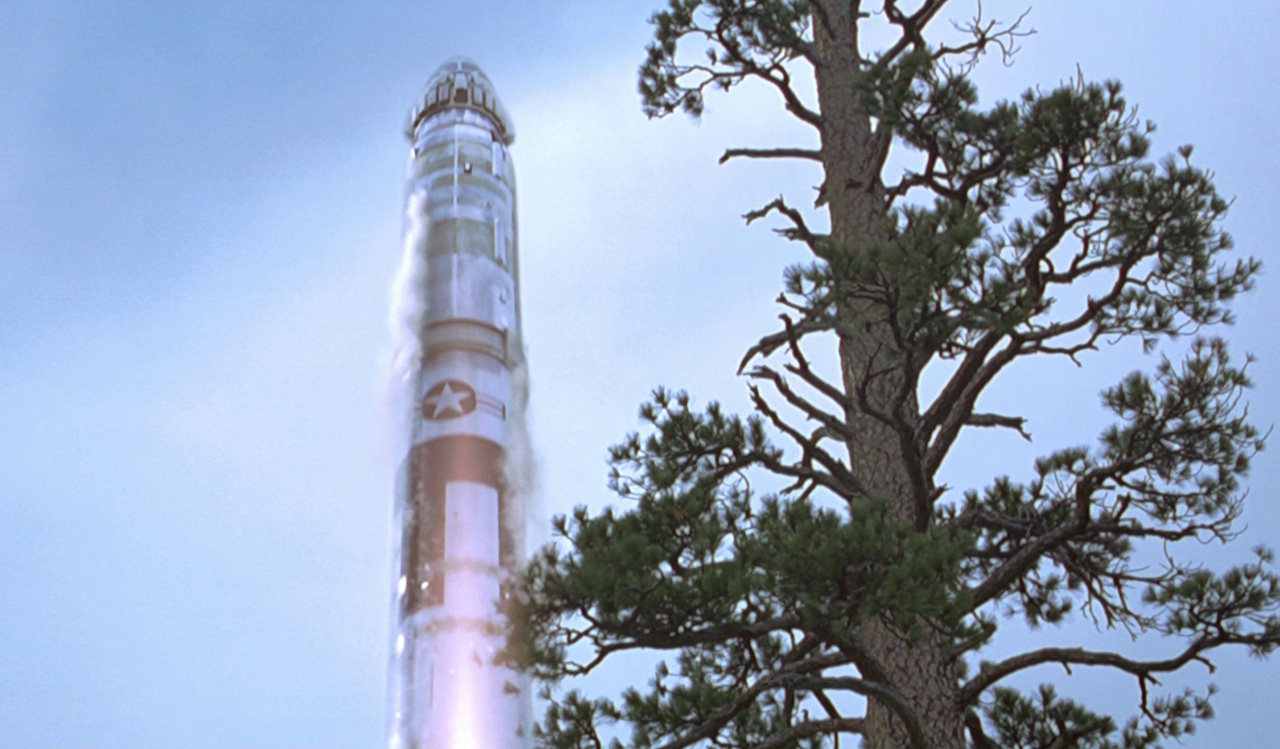
Still frame from Star Trek: First Contact showing the launch of the Phoenix.
The launch of the Phoenix.

Time travel is a pain in the arse, isn’t it? Time-loops, paradoxes… all of that. It’s very difficult to write a compelling time travel story and pull it off flawlessly – even more so in a long-running franchise with a timeline that has to be basically consistent from one episode to the next. This theory posits that the changes Picard and co. made in the 21st Century were so serious that the Star Trek franchise can essentially be divided into two alternate realities: pre- and post-First Contact stories.

I don’t know how to word this without using terms like “destiny” or “fate,” but I think the way we’re meant to read the events of First Contact is that the interventions by the Borg and Enterprise-E were always “meant” to happen; i.e. they happen in every timeline. That’s why there was no Department of Temporal Investigations inquiry, and no ramifications for Picard for meddling in the timeline. We could also ask why First Contact should be the divide – why not other time travel stories, like The City on the Edge of Forever, Assignment: Earth, Past Tense, or even Endgame. All of these made major changes to the timeline that, by the same logic this theory uses, could create an alternate reality.

Theory #15:
Discovery Seasons 3-5 didn’t happen – and what we saw are Pike’s imaginings during his convalescence on Talos IV.
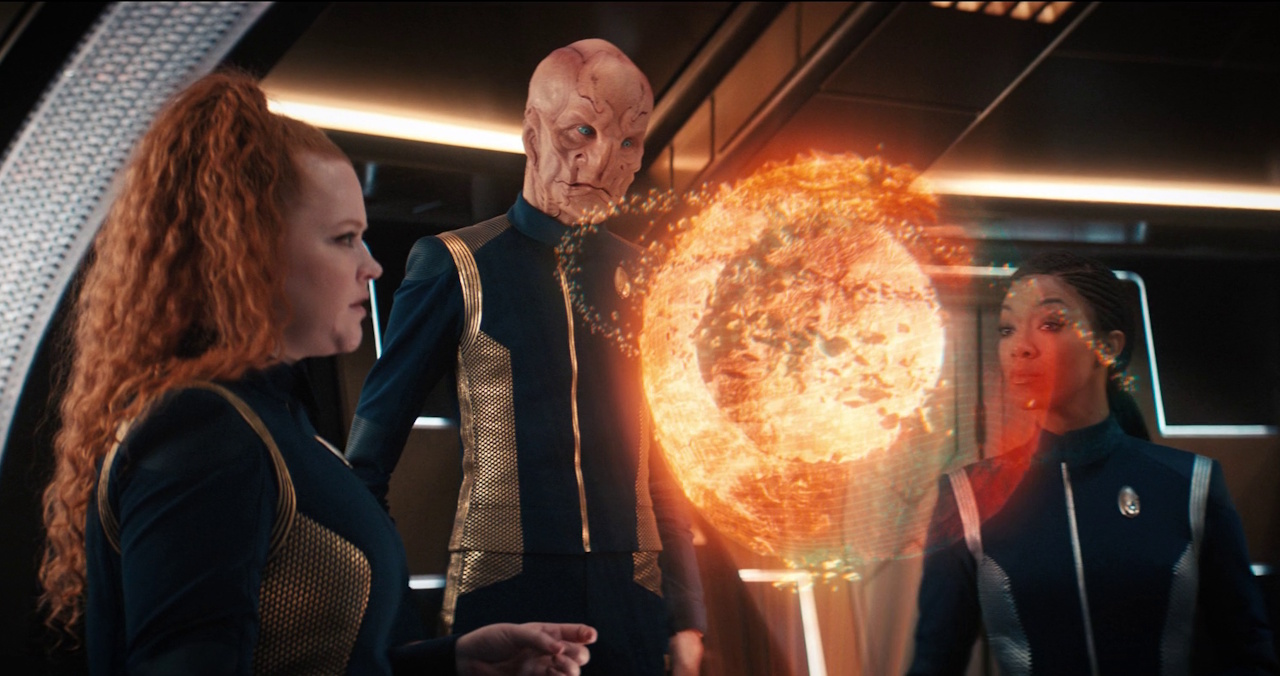
Still frame from Star Trek: Discovery showing Saru, Tilly, and Burnham.
Tilly, Saru, and Burnham in the 32nd Century.

I don’t see how you could subscribe to this theory without also writing off Starfleet Academy, Section 31, and probably Strange New Worlds, too, as they’re all connected. But setting that aside… this theory reminds me more than a little of the Star Wars so-called “theory” that one or more of the sequel trilogy films is “about to be removed from canon!!1!” In short, it feels like a bit of a cope from folks who don’t like Discovery, the 32nd Century setting, and in particular, the Burn.

My personal view, by the way, is that – somehow – a future Star Trek production should find a way to gently push Discovery’s 32nd Century out of the prime timeline, partially because of how depressing the Burn is as a future destination, but also because of how it turns any potential future film or TV show into a de facto prequel to Discovery. But that isn’t the issue here: this theory posits that nothing we saw on screen in Discovery’s 32nd Century actually happened to begin with. That simply isn’t true; Discovery, Strange New Worlds, Section 31, and Starfleet Academy all coexist in the prime timeline. You can choose to disregard different parts of Star Trek from your personal head-canon; fans have been doing that for decades. Or you can choose not to tune in to any new shows set in that era. That’s totally okay. But this theory can be nothing more than head-canon, and a heavy hit of copium for folks who hate where Discovery went.

Theory #16:
Dr Zimmerman used the Professor Moriarty hologram when creating the EMH.
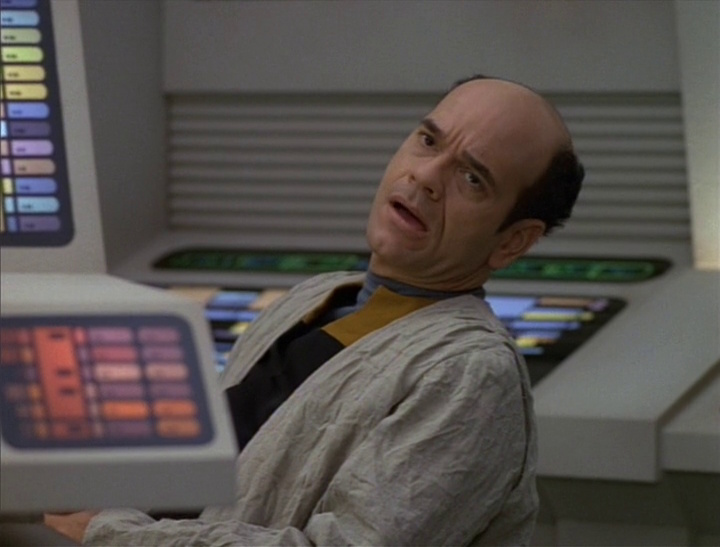
Still frame from Star Trek: Voyager showing Dr Zimmerman.
Dr Lewis Zimmerman.

In the episode Elementary, Dear Data, we saw the creation of a sentient, self-aware hologram: Professor Moriarty, Sherlock Holmes’ nemesis. Moriarty would later be re-activated and trapped in a holographic world, before apparently being transferred to Section 31’s Daystrom Station by the early 25th Century. As one of the first truly sentient holograms, it’s not impossible to think Starfleet would’ve wanted to study Moriarty, figuring out how a simple miscommunication with the Enterprise-D’s computer could lead to such an entity coming to exist.

This theory goes a lot further, though, suggesting that Dr Zimmerman – the creator of the EMH programme – used Moriarty in some way, either as a “template” or just to further his own research. And while nothing on-screen explicitly contradicts this idea, it’s just not something I think makes a ton of sense. Zimmerman is presented as egotistical and selfish, so the idea that he’d rely on someone else’s work instead of developing his own holograms doesn’t make a lot of sense. And it’s strongly implied in DS9 and Voyager that the EMH Mark I (i.e. the Doctor) had a long and difficult creation process, with some of Zimmerman’s more basic holograms coming first. So while the idea of Starfleet researching Moriarty makes sense, I don’t think Zimmerman being involved really does.

Theory #17:
Enterprise’s mysterious “Humanoid Figure” is Archer from the future, and he’s trying to sabotage his own earlier missions. For some reason.
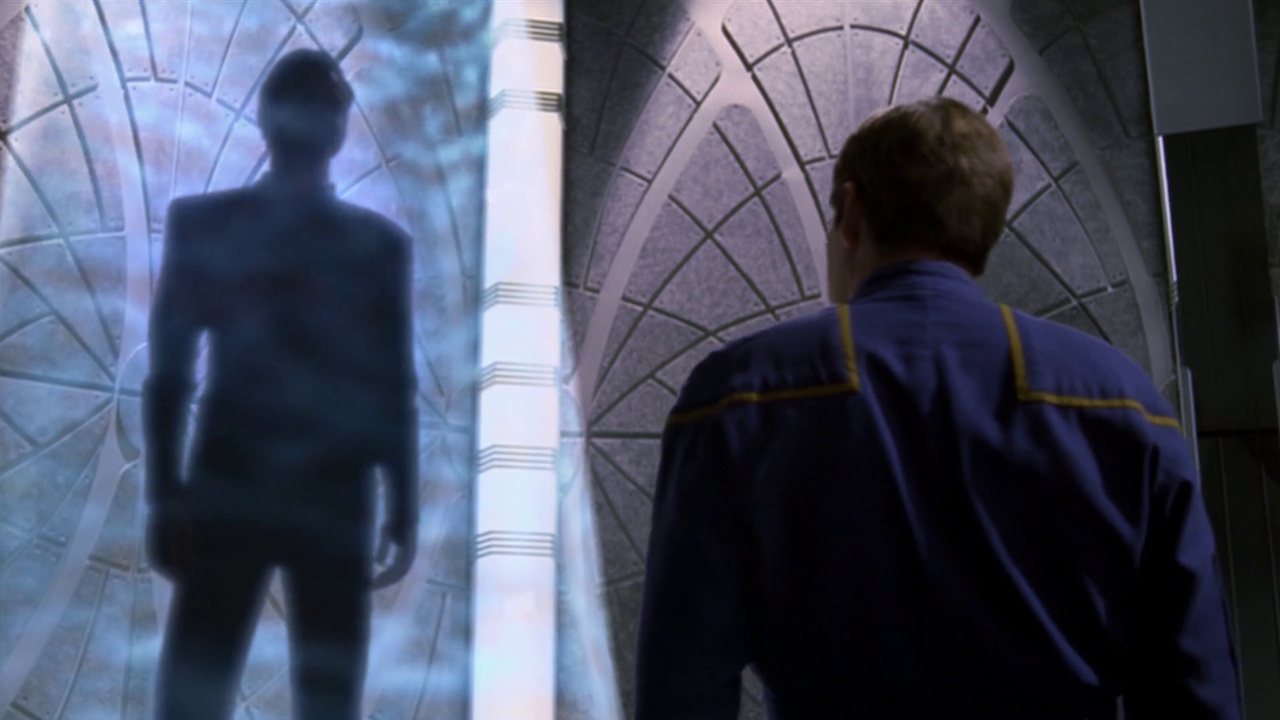
Still frame from Star Trek: Enterprise showing Archer and the Humanoid Figure.
Archer meeting… himself?

This theory has the benefit of having been discussed by some of the original writers of Enterprise – with a suggestion that this was even a seriously-considered plot point for what would’ve been Season 5. But as we said above: time travel, time-loops, and paradoxes are really difficult to get right, and the idea of an older, jaded Archer somehow deciding that he wants to sabotage his own earlier mission and his own life… such a story would be difficult to write in a way that made sense, and it would be a challenge to pull it off successfully.

I’ve always interpreted the “Humanoid Figure” as simply being one of the leaders of a faction from the Temporal Cold War/Temporal Wars, though to be honest, I try not to think too hard about this element of Enterprise. Time travel stories just aren’t my favourites in Star Trek, and a significant portion of Enterprise was taken up by these kinds of plotlines. If the “Humanoid Figure” was meant to be Archer – which he wasn’t, at least not originally, as no identity was built into the character at first – it raises too many questions, and would realistically have needed a multi-episode arc. Given what we know of Archer’s future – his captaincy of the NX-01 and his later role in the founding and leadership of the Federation – this villainous turn (and his apparent acquiring of time travel tech) doesn’t make sense, and I struggle to see how a story could be written to take Archer from the textbook definition of a Starfleet captain to a man who tries (and fails) to sabotage… himself.

Theory #18:
We (the audience) are living in the timeline that ultimately becomes the Mirror Universe.
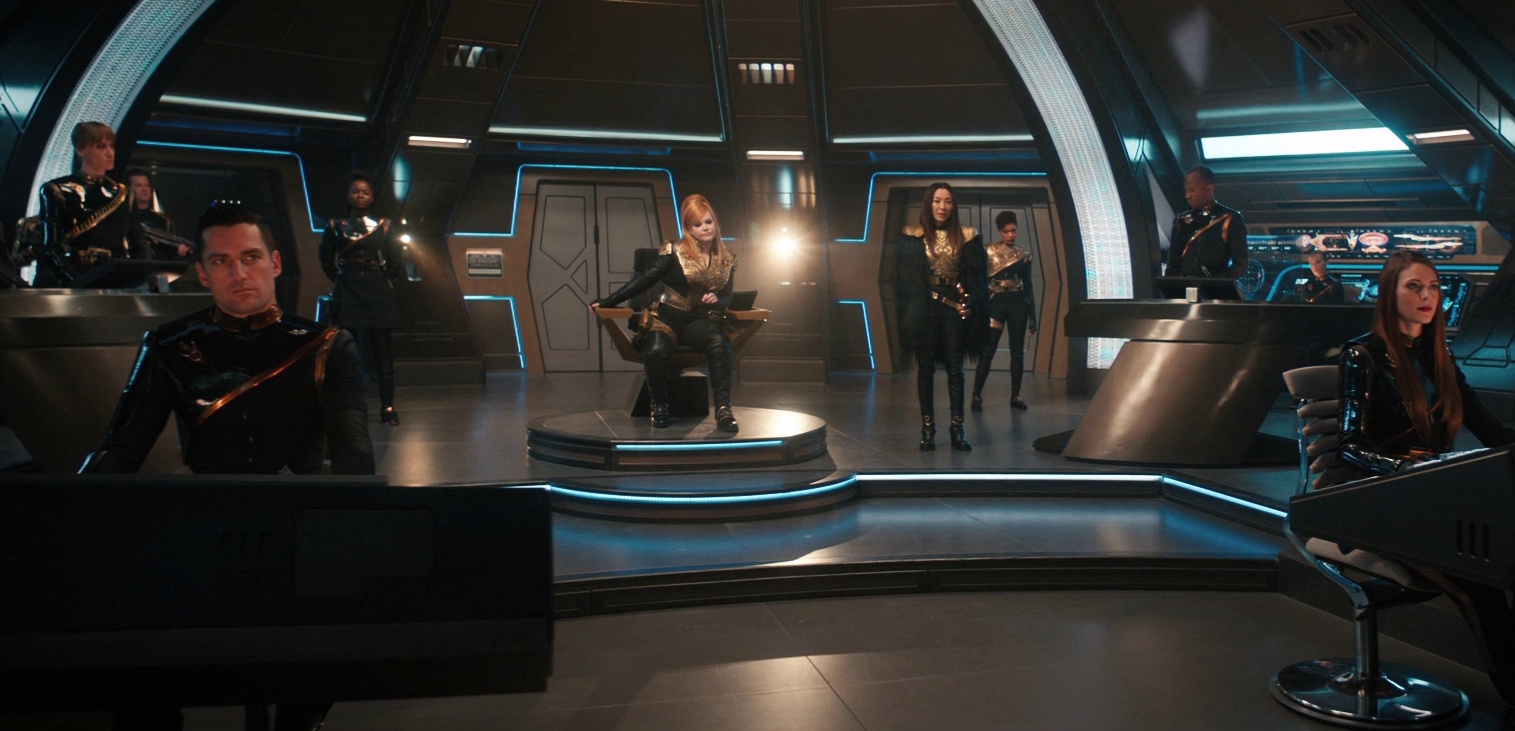
Still frame from Star Trek: Discovery S3 showing Terrans on the bridge.
Soldiers of the Terran Empire.

Do you ever read something and just think to yourself, “god, you were *so close* to understanding the point… but then you blew it?” The Mirror Universe is *intended* to be uncomfortably close to reality – any sci-fi dystopia is! That’s the point of the genre, and Star Trek’s Mirror Universe is meant to be a mirror (get it?) of our current society’s darkest impulses, moral failings, and inclination towards autocracy. That’s the entire point! It’s Star Trek showing us a dark reflection of ourselves to make us pause and think.

If you see elements of the Mirror Universe in today’s world, that isn’t because we’re in some dark timeline that Star Trek predicted… it’s because the stories were deliberately written that way to show us some of our own failings and societal problems. The point isn’t to fall into depression and pessimism, to say that we’re on a dark path and there’s nothing we can do but wait for the Terran Empire to emerge. We’re meant to look at these stories and say, “let’s do something about that. Let’s make changes for the better.” The Mirror Universe, with its pantomime-level overacting and one-dimensional baddies, has never been my cup of tea, and as a metaphor I think it’s almost too basic and too unserious. But in a way, that’s part of how it works: it’s storytelling by fable. The point was never that we’re locked into a dark path to the “bad outcome,” the point is that we have these dark impulses, but we can overcome them. Bad things can happen, and bad leaders can rise to power – but we can stop them.

Theory #19:
The Genesis Device and replicators are the same technology.

Still from Star Trek III showing the Genesis Planet.
The Genesis Planet.

This one made me smile. In a way, I like the idea of Starfleet looking at the Genesis Project and saying, “yeah, let’s not use it to terraform planets, let’s use it to make bowls of tomato soup.” It’s just kind of small-scale and silly. And it’s true that, out here in the real world, technological innovation often comes from unexpected places. An attempt to create a high-strength adhesive famously led to the weak glue used for post-it notes, for instance!

Star Trek works best when its technologies are deliberately kept vague. That allows for maximum wiggle-room when telling a story, and it also allows for head-canon like this to exist. I guess you could say that, based on what we know of both the Genesis Device and replicators, they both use subatomic particles to change one form of matter into another. But does that mean that one was developed from the other, or that Starfleet shut down Project Genesis only to use the same technology in a totally different way? I don’t see it.

Theory #20:
The entire Soong family are clones – which is why they all look the same.
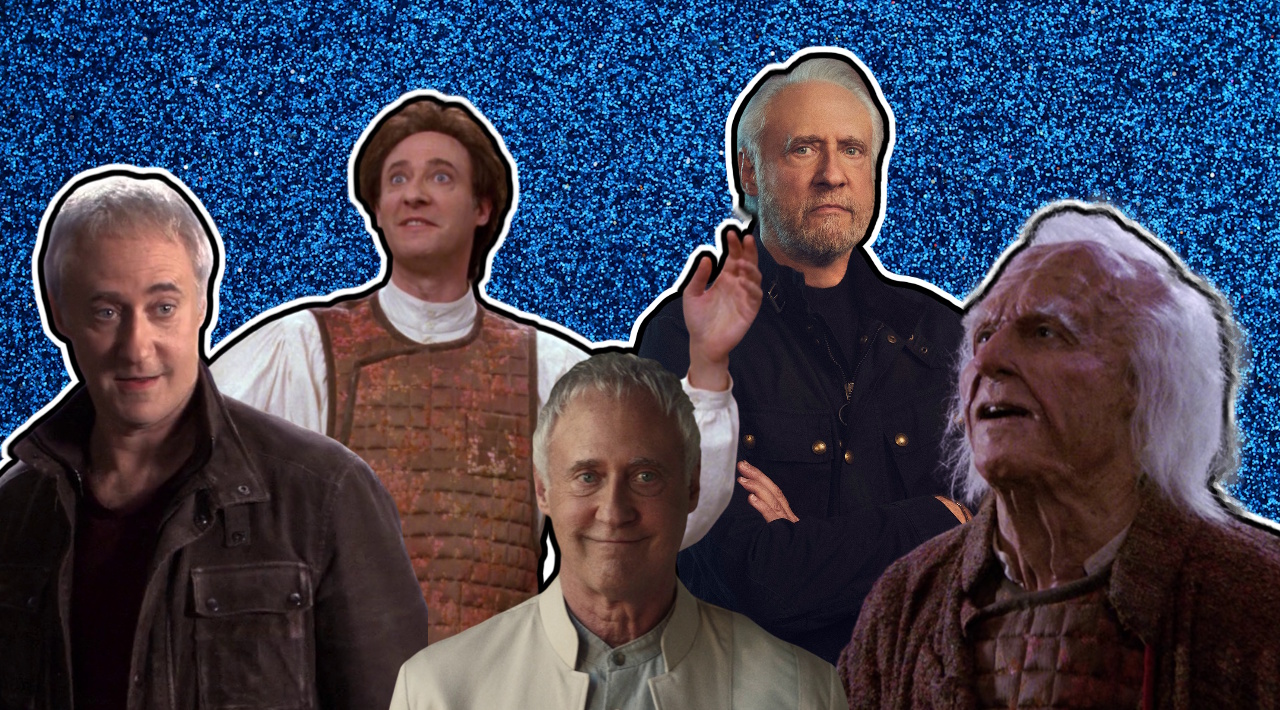
Composite image of various Soong characters from Star Trek.
A family portrait…

This theory exists for one reason and one reason alone: every member of the Soong family that we’ve met is played by the same actor! Brent Spiner took on the role of Data’s creator in The Next Generation, and this was later expanded in Enterprise and Picard to include new ancestors and descendants of the Soong family. They all look the same because they’re all Brent Spiner. But could there be more to it than that?

Adam Soong, the earliest-known Soong ancestor, was interested in genetic engineering, so could he have cloned himself in the mid-21st Century, sometime after the events of Picard’s second season? I mean, it’s not *impossible*, I suppose. But we know in the prime timeline that genetic engineering has been outlawed, so the practice can’t have continued through the generations all the way to Altan Soong in the late 24th Century, surely.

Theory #21:
Worf has an incorrect (or incomplete) idea of what it means to be a Klingon, because he only learned about his culture from Federation books.

Promo photo for Star Yrek: Picard S3 showing Worf.
Worf.

Worf is a Klingon… but he was raised from a young age by humans. That’s a core part of his character background, and having lived away from his homeworld and his people, Worf can feel torn between his loyalties to Starfleet and to the Klingons. But does Worf truly know what being a Klingon means, having only learned about his culture from books? Some fans seem to think he doesn’t, arguing that it explains why Worf seems to lack the famous Klingon sense of humour, being very dour and serious almost all of the time. Others have even suggested that Worf might have a form of “Klingon autism.”

There is the kernel of an interesting idea here, and I think it could’ve been fun to put Worf into a Klingon story as a “fish out of water,” or better, as someone who *thinks* they know everything… until they’re confronted by people who’ve been immersed in that culture from day one. But Star Trek never went down that route, and there are other examples of stoic Klingons who share some of Worf’s traits. It’s an interesting theory, in some ways, but we’ve spent so much time with Worf over the years, and he’s had so many encounters with a huge number of Klingons, that if this theory were even close to true… we’d have seen something more concrete.

Theory #22:
Romulans are the “true” Vulcans, and Vulcans are the ones who left.
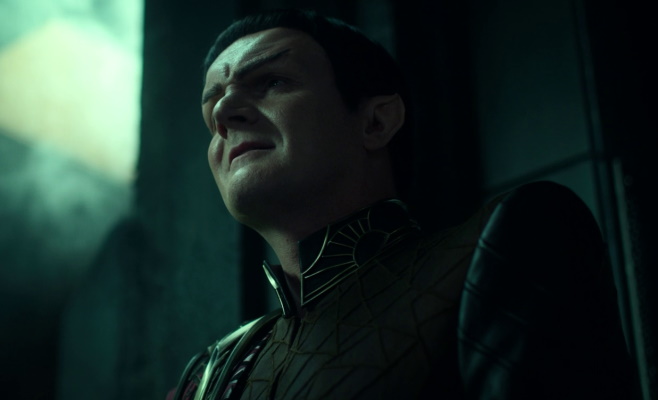
Still frame from Star Trek: Strange New Worlds showing a Romulan commander.
A 23rd Century Romulan.

This just flat-out isn’t true. It’s established multiple times in Star Trek that the Romulans were the ones who left their homeworld behind after rejecting the Vulcans’ moves to embrace logic and purge their emotions. Now, if this theory had said that Romulan culture is the original Vulcan culture, I guess we could have more of a conversation, because there’s a way to read the Romulan-Vulcan split that would say the Romulans preserved a pre-Surak, pre-logic culture that the Vulcans may have possessed. But that’s never been confirmed on screen.

What I think would be a way more interesting theory is this: the Vulcans have *always* known the Romulans’ true identity, but chose not to share that with Earth and humanity, perhaps out of a sense of shame or fear. I think there’s a great case to be made that the Vulcans either kept track of the Romulans or else were able to scan their bio-signs, analyse their language, or something after re-encountering them. It’s always seemed likely to me that Vulcan leadership, at least, was aware of their shared history – even if individuals like Spock may not have been. But this idea that the Vulcans are the offshoot… it just doesn’t line up with what we’ve seen on screen in many different stories.

Theory #23:
There is no “Q Continuum;” there’s only one Q, and after billions of years of isolation and loneliness, he’s developed some kind of multiple personality disorder.

Still frame from Star Trek Picard S2 showing Q.
Q in Star Trek: Picard.

Again, we have a theory that directly contradicts things we’ve seen on screen. As far back as The Next Generation, Q was confirmed to be just one member of a species, and we even met other Q in the show. I guess this theory would also propose that all of those individuals were the same Q, but that doesn’t make a lot of sense, does it? Nor does the idea of a Q civil war, as seen in Voyager, or one member of the Continuum committing suicide. If we’d only met Q a few times, and never seen other members of his race, I’d at least have to concede that this one was plausible. But having met dozens of other Q and literally visited the Continuum itself… I think there’s more than enough evidence to dump this one in the “debunked” pile.

There are mysteries associated with Q, though – not least what became of the familiar John de Lancie character after his apparent “death” in Picard’s second season. I just don’t see this as being a plausible theory, or even something mysterious at all. The Q Continuum exists, other Q exist, and trying to overwrite that would mean dozens of stories would be adversely affected. It’s an interesting thought, for sure, but one that just feels thoroughly debunked by what we see on screen.

Theory #24:
The species that abandoned Armus were the Founders.
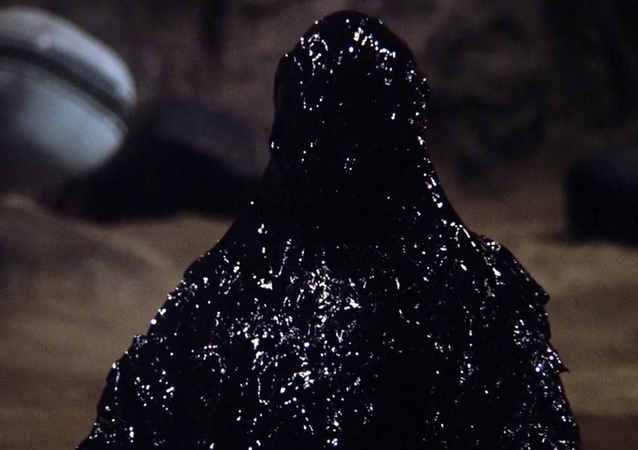
Still frame from Star Trek: TNG S1 showing Armus.
Armus.

This theory obviously comes from Armus and the Founders both existing in a liquid state, and I can see why it might seem plausible on the surface. But there are two pretty big issues which, in my view, render it null and void. Firstly, Armus lives in the Alpha (or Beta) Quadrant, whereas the Founders and Dominion are native to the Gamma Quadrant. Without access to the Wormhole (which the Founders canonically did not know about until they met the Federation), that’s a decades- or centuries-long journey.

Secondly, and perhaps most importantly, if the point of creating and abandoning Armus was for the Founders to shed their “skin of evil,” and to leave all of their negative traits and qualities behind… it didn’t exactly work, did it? The Founders are paranoid, hateful, and view themselves as superior to most other forms of life. So… how is Armus alone the sum total of all of their negative qualities? Between that and the distances involved, I have to say that I don’t find this one to be plausible. The fact that both the Founders and Armus are liquid doesn’t do enough to outweigh that.

Theory #25:
Apparent discrepancies between The Original Series and the rest of Star Trek are because TOS is a holonovel being viewed from the 24th Century.
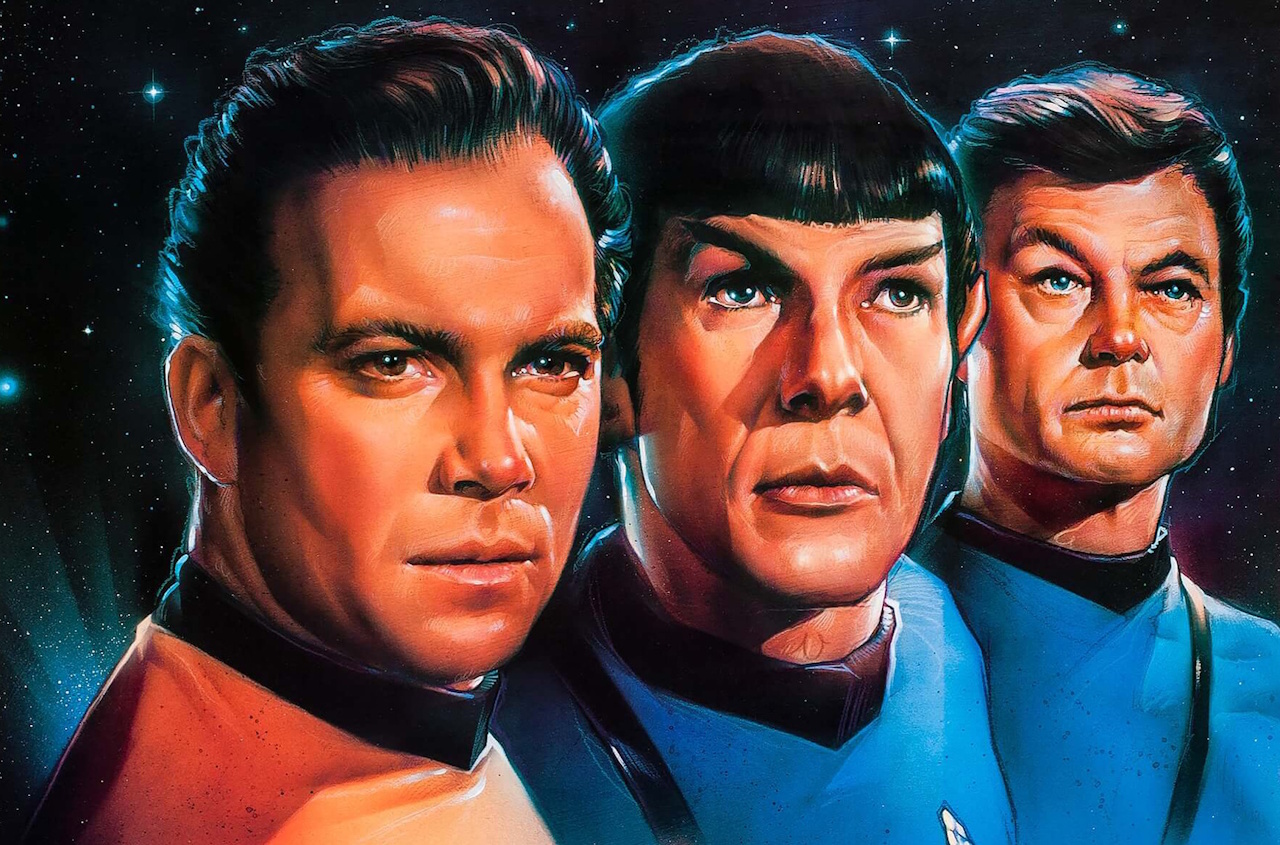
Promo image of Kirk, Spock, and McCoy from Star Trek.
Kirk, Spock, and Dr McCoy.

I admire the lengths some fans are willing to go to in order to smooth out inconsistencies in Star Trek’s canon. A similar theory states that These Are The Voyages didn’t happen as shown, because it was an exaggerated or misremembered holo-programme. But in this case… I mean, firstly there’s just no evidence at all that a single part of TOS is a holo-programme. Then there are episodes like Trials and Tribble-ations, which very clearly show that TOS and the 24th Century share a setting. And while there can be inconsistencies within Star Trek’s canon, I’m not even convinced at this point that the line should be drawn between TOS and the rest of the franchise. Why not between, say, Voyager’s finale and everything that came after?

This will sound unsatisfying, especially for folks who love to theorise – and I get that, believe me. But the plain and simple fact is that these discrepancies and inconsistencies exist because Star Trek is a long-running franchise, and these are stories. Sometimes, a new story seems to overwrite or retcon something, or makes a change that’s inconsistent with what came before. While I have argued in the past that internal consistency is important, I’m also not a stickler for the tiniest minutiae of canon, and I believe there’s enough wiggle-room in Star Trek for all of the various parts of its universe to coexist in a single setting.

So that’s it… for now!
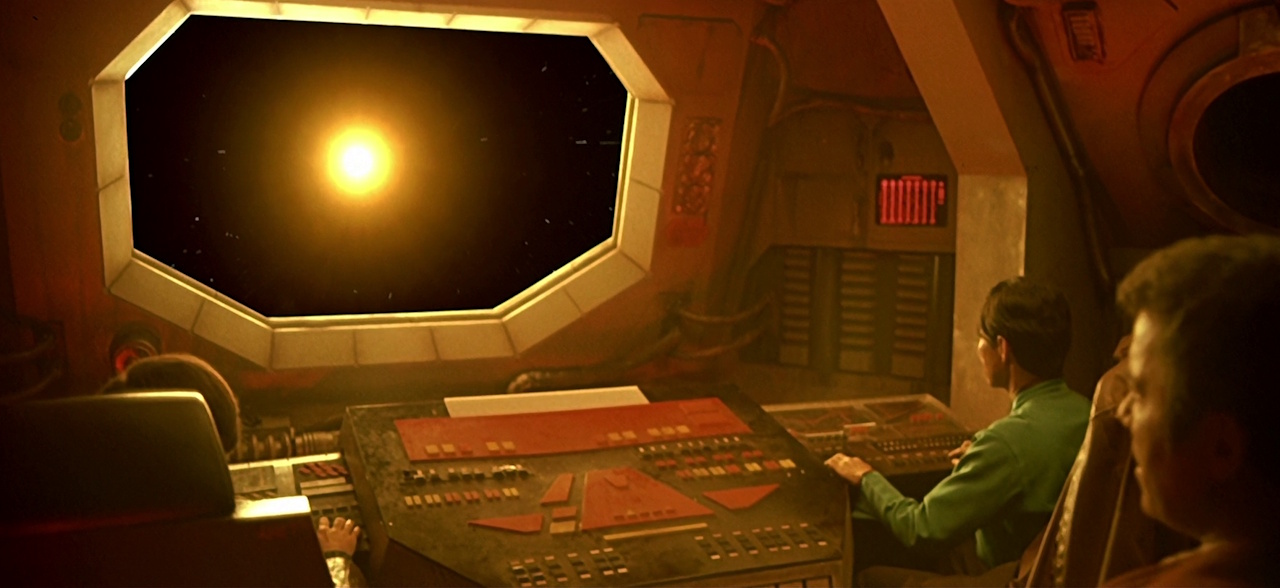
Still frame from Star Trek IV showing the sun on the Bounty viewscreen.
We’re flying too close to the sun…

I hope this has been fun. Twenty-five theories was a lot, but at the same time… I feel there’s more to this idea. So if your favourite bad theory didn’t make the cut, stay tuned. I may revisit this concept in the future, if I can find more fan theories to pick on.

As I said at the beginning, this was meant to be a bit of fun, and not something to get too wound up or upset over. While I don’t personally subscribe to any of these theories – for reasons I’ve tried to explain – I found all of them to be interesting, and I don’t want to dent anyone’s passion for Star Trek. I’m a theory-crafter myself, so I respect and appreciate other folks putting their theories out there to be discussed.
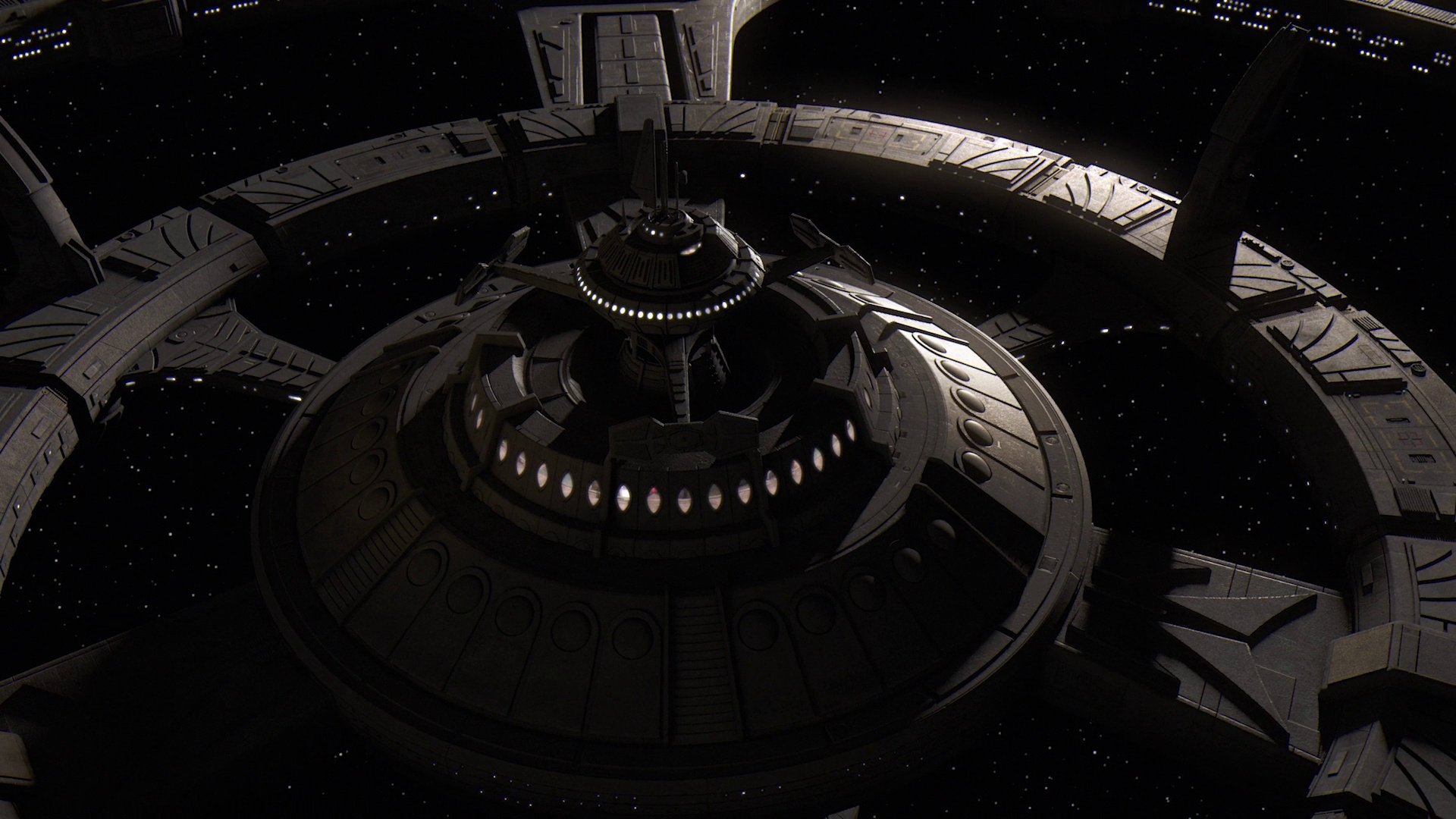
HD still frame from the documentary What We Left Behind showing a close-up of DS9.
It’s DS9!

I’ve got a few more ideas for articles and columns as Star Trek’s huge sixtieth anniversary year rolls on. How many TV shows and franchises can say they’ve made it this far, eh? Not many, that’s for sure! It’s a testament to how amazing this franchise is that so many years later, people like us are still discussing and debating every aspect of Star Trek, and still enjoy getting lost in this fantastic setting.

So please stick around throughout 2026 for more pieces celebrating all things Star Trek! Next month, I daresay I’ll be writing a review of Starfleet Academy’s first season. And I’m still hopeful we’ll see Strange New Worlds before the year is out. And there are other theories, discussions, and episode re-watches to get into, too.

Thanks for tuning in this time… and Live Long and Prosper, friends!


The Star Trek franchise – including most films and TV series discussed above – can be streamed now on Paramount+ in countries and territories where the platform is available. Many are also available on DVD and/or Blu-ray. The Star Trek franchise is the copyright of Skydance-Paramount. This article contains the thoughts and opinions of one person only and is not intended to cause any offence.

Star Trek: Picard bonus Season 3 theory: The “Prodigal Crewman”

Spoiler Warning: There are spoilers ahead for Star Trek: Picard Seasons 1-3, including the trailers, teasers, and marketing material for upcoming episodes. Spoilers are also present for the following Star Trek productions: The Next Generation, Deep Space Nine, Voyager, and Discovery.

For some utterly inexplicable reason, Paramount doesn’t make all of its marketing material available to viewers outside of the United States. Trailers, teasers, clips, posters, and even Paramount’s own press website are geo-blocked, meaning fans and viewers who aren’t American can’t access them – at least, not officially. This is just another example of Paramount’s stupid, dangerous, and obviously damaging “America First” fetish that we’ve talked about here on the website on more than one occasion in the last few years.

But we’ll have to give Paramount another stern talking-to, clearly.

Fuck you too, Paramount.

Because I don’t have access to that, I missed something potentially huge about the upcoming fifth episode of Star Trek: Picard Season 3 that was revealed in the episode’s official press release. Here’s the full blurb so you can read it for yourself:

“Caught by Starfleet and facing court martial, paranoia grows as Picard struggles to uncover whether a prodigal crewman from his past has returned as an ally – or an enemy hellbent on destroying them all.”

One part of this in particular jumped out at me: the “prodigal crewman.” Who could this character be? And more importantly: might it be someone we’ve met before; a returning legacy character?

There are quite a lot of characters who could potentially return!

I would have included this as part of my theory list if I’d spotted it in time! I don’t like going back to posts I’ve already published and adding whole paragraphs and chunks of text, so instead of doing that, I’ve decided to write this one up as a standalone theory.

The use of the word “prodigal” is very interesting here, as it could absolutely be argued to imply that we’re dealing with a character we’ve already met. A “prodigal” son or daughter is someone who returns home, so I think we’ve got a case – albeit not a watertight one – to make in favour of this character being someone we’ve already met. And you better believe that I have a few ideas for who they could be!

Prodigal Crewman #1:
Tasha Yar

Tasha Yar at her post.

Denise Crosby, who originated the role of Tasha Yar in The Next Generation’s first season, has been heavily rumoured to be involved with Picard Season 3 for months, and it’s primarily for that reason that she’s in contention here. Yar was, of course, famously killed off toward the end of The Next Generation Season 1, but that didn’t stop Crosby from making occasional returns to Star Trek – either as Tasha Yar herself or as her half-Romulan daughter Sela.

Perhaps part of what Picard will have to figure out is whether Tasha Yar survived her injuries at the hands of Armus, or whether this version of Tasha Yar might be the mother of Sela – someone detained and imprisoned for years by the Romulans. Such a storyline could even cross over with a potential Section 31 series; Tasha’s survival may have been hushed up by the shadowy black-ops organisation.

Tasha Yar was killed off early in The Next Generation’s run.

Most fans of The Next Generation would instantly assume that Tasha Yar couldn’t possibly be real – because we know that she died a long time ago. That would potentially set up a kind of double-bluff, where the show leans into the idea that Tasha Yar is a changeling… only to perhaps rip that away at the last moment and say that she’s actually for real.

A good rule in Star Trek (and fiction in general!) is that if you haven’t seen the corpse, a character may not be truly dead. But we did see Tasha’s body, we watched her die, and we even saw her friends attend her memorial service. It would be difficult, narratively speaking, to find a way around that… and I don’t think it’s something that can just be hand-waved away or ignored. So there’s a potential pitfall here, I fear.

Prodigal Crewman #2:
Sito Jaxa

Ensign Sito Jaxa.

Ensign Sito Jaxa made two appearances in The Next Generation. She debuted in the episode The First Duty, where, as a cadet at Starfleet Academy, she played a role in covering up the death of a colleague during an unsanctioned flying manoeuvre. Later she appeared in the episode Lower Decks, having been assigned to the Enterprise-D at Picard’s explicit request.

Ensign Sito was presumed to have died during a mission to aid a Cardassian spy – but her body was never recovered, so it’s possible, perhaps, that she wasn’t killed in action as we were led to believe.

Sito with Picard.

Sito definitely qualifies as a “prodigal” crewman, I think! But as a character who only made a couple of appearances, she may not be as recognisable to the audience. The story would also have to find a way to explain what happened to Sito after her disappearance in a satisfactory way, telling us how and why she disappeared and allowed her friends to assume the worst.

Even with those issues, though, I think Sito could make for a fascinating character to bring back. And as a relatively unknown character, there’s scope to tell a different kind of story unconstrained by too much prior canon.

Prodigal Crewman #3:
Dr Pulaski

Dr Kate Pulaski.

I gotta be honest: I don’t really think that Dr Pulaski is a strong contender here. But as you’ll know if you read my in-depth look at her character, I truly like Dr Pulaski, and she’s a character that I wish we’d gotten to spend more time with. Giving her an epilogue after all these years would be fantastic – even if it seems quite unlikely!

So that’s the truth of Dr Pulaski’s inclusion on this list. But I still think we can build a case for her return. First and foremost, Dr Pulaski never got a conclusive goodbye after Season 2 of The Next Generation. She simply disappeared when Dr Crusher returned at the beginning of Season 3, and while there was supposedly a mention of her over a tannoy in the background during the events of the Voyager series finale Endgame, implying that she may have worked at Starfleet Medical, I don’t think that really counts!

Dr Pulaski, ready for a trip to the holodeck!

It would be genuinely interesting to see some kind of on-screen interaction between Drs Crusher and Pulaski, as that’s something we never got during The Next Generation’s run. How would these two very different doctors react to one another, and would their styles completely clash? It could certainly be a bit of fun to see that!

Dr Pulaski also had a burgeoning friendship with Worf, and has a strained relationship with Riker as she had once been involved with his father. She’s also a character who knew Professor Moriarty, who we know is coming back soon; she was present during his creation on the holodeck. There are good reasons to want to see more of Dr Pulaski – even though I think her return on this occasion isn’t the most likely.

Prodigal Crewman #4:
Ro Laren

Ro betrayed Riker and Picard the last time we saw her.

The former Ensign Ro is someone who could be absolutely fascinating to bring back. Her defection to the Maquis at the end of The Next Generation was something that clearly stung Picard, so there’d immediately be a loss of trust between them. Ro is also a character who could tell us a great deal about relations between the Federation and the Cardassians, as well as the potential survival of some members of the Maquis.

One interesting idea that hasn’t been explored fully in Star Trek since the Dominion War is the idea that characters like Ro and even Michael Eddington were, in a roundabout way, right. They predicted Cardassian aggression years before it happened, and were willing to fight back at a time when the Federation was pursuing what amounted to a policy of appeasement; peace at any cost.

Picard with Ensign Ro at a Bajoran refugee camp.

If Ro were to return, we could see her take Picard to task for failing to recognise signs that the Cardassians would once again make offensive moves against the Federation – and hearing what Picard may have to say in defence of his actions in that era could be fascinating, particularly in light of what happened in the Dominion War.

We could also see Ro as the returning “prodigal” crewman, perhaps having suffered years of imprisonment at the hands of the Cardassians, and lamenting the loss of many of her Maquis friends. I’m sure Riker would have a thing or two to say to her, too, because the last time he saw her she was pointing a phaser at him!

Prodigal Crewman #5:
Lore

Lore as he appeared in The Next Generation.

Is Lore a “crewman” in the strict sense of the term? I’m not so sure… but he’s also the only character on this list that we know for a fact will be included in the season’s story! That alone should mean he’s in contention.

It seems to have been hinted in pre-season marketing material that Lore may have changed since we last encountered him, and that he may have become more of a friend/ally to Picard and the crew. If so, perhaps that will be what Picard figures out over the course of this upcoming episode.

Lore in the final Season 3 trailer.

Is it possible that Lore might have been “repurposed” to somehow resurrect Data? That could also give Picard a puzzle to figure out: is he dealing with the genuine resurrection of his dead friend, or is Lore once again trying to take everyone for a ride by posing as his brother? After a prominent sequence at the end of Season 1 in which Data was laid to rest, I’m not sure this is the route I’d want to see the story go down – but you never know.

I’m not really sold on Lore’s return, to tell the truth. The “evil twin” angle was a fun one on a couple of occasions during The Next Generation’s run, but with Data seemingly out of the picture, Lore’s return seems to be more to do with wanting to reunite actor Brent Spiner with his co-stars rather than for any narrative reason. And with Spiner having already appeared in both Seasons 1 and 2 of Picard… maybe that’s just not something that will turn out to have been necessary. Regardless, this feels like it could plausibly be the moment of Lore’s return.

Prodigal Crewman #6:
Elnor

Season 2 promotional photo of Elnor.

I know, I know: actor Evan Evagora has stated that he isn’t coming back for Picard’s third season. However, we heard similar words from Orla Brady, who plays Laris, and she actually did appear in the season premiere. Perhaps Elnor could be back for a one-off appearance after all!

Would we call Elnor a “prodigal” crewman? And what reason might Picard have to suspect that he’s dangerous – other than the obvious changeling infiltration possibility? Also, what kind of role might Elnor have in prosecuting Picard at a potential court-martial? All of these questions would have to be answered if Elnor is indeed to return!

Cadet Elnor at the end of Season 2.

However, it would be an unexpected and fun twist in the story. We could learn that Elnor has graduated from Starfleet Academy and is now a fully-fledged Starfleet officer, perhaps serving in the security division. He could even enable Picard and Riker to escape their potential arrest, proving that he’s on their side.

Elnor’s return could also lead to a reunion with Raffi, as the two clearly had a strong bond. It must’ve been difficult for Raffi to leave Elnor behind to go undercover – especially as he’s the closest thing to family she has left after alienating and estranging herself from her ex-husband, son, and daughter-in-law. Elnor’s story, perhaps more so than any other new character, is arguably the most unfinished – and finding a genuinely good reason for his last-second resurrection at the end of Season 2 should be a priority, too.

Prodigal Crewman #7:
Sela

Sela in The Next Generation.

We mentioned Sela above when talking about Tasha Yar, but could she turn out to be the “prodigal crewman” herself? Depending on the state of Romulan-Federation relations in this era, it’s possible, I suppose, that other Romulans might follow in Elnor’s footsteps and join Starfleet – or at least work alongside Starfleet in some capacity as allies.

Sela could also emerge not as a member of the crew, but in some other role, perhaps as a fellow prisoner if Picard and Riker are placed under arrest. She could return offering to break Picard out of jail, only for Picard to have to stop to consider whether she’s doing so to help – or because she has some other nefarious goal in mind.

Picard and Sela have crossed paths before…

This would allow Denise Crosby to return but without having to, for want of a better expression, dig up Tasha Yar. Given the adversarial nature of Sela’s relationship with Picard, it would make sense why he wouldn’t know whether or not to trust her – and why he’d need to figure out whether she’s an ally or an enemy.

I definitely think that there’s scope to bring back Sela in some form this season – though whether this would be the right way to do it is still an open question!

Prodigal Crewman #8:
Vadic

Vadic in Seventeen Seconds.

This one is a bit “out there,” so bear with me! I’ve had a theory that has been running for as long as we’ve known Vadic would be a part of the season’s story in which I’ve suggested that she could be a former Starfleet officer – someone who once served under Picard’s command. The inclusion of multiple connections to the Battle of Wolf-359 – including most prominently Captain Shaw’s presence at the battle that was revealed in No Win Scenario – could also be a potential origin story for Vadic: she was a Starfleet officer or enlisted crewman present at the battle.

Perhaps Vadic will return in the upcoming episode, relatively unscathed after Riker’s asteroid attack, and will reveal herself as a former crewmate of Picard’s. She may offer some tantalising piece of information pertaining to the rogue changelings and their conspiracy that Picard will need to investigate – and determining whether Vadic’s offer is genuine or a trap could be a big part of the story.

Who is Vadic?

If Vadic truly is someone who served in Starfleet, I’m not sure if this is how that revelation might come. But it feels like a possibility, at least, and now that we’re relatively certain that Vadic isn’t actually a changeling herself, but is merely working for them in some capacity, the question of her origin is once again an open one.

It would be a shocking twist in the story if Vadic essentially “turned evil” because of something that Picard did or didn’t do. She might blame him for her injuries if she once served aboard the Stargazer or Enterprise-D, or she might hold Picard accountable for her assimilation if she was captured and assimilated by the Borg, for example. There are multiple ways to tie Vadic to Picard’s past – including as a “prodigal crewman.”

Prodigal Crewman #9:
Reg Barclay

Barclay with a medical tricorder.

Barclay would be a fun and interesting character to include in Season 3, and a potential story in which he plays a role could also see him interacting with Seven of Nine. Barclay was instrumental in helping the USS Voyager communicate with Starfleet while the ship was stranded in the Delta Quadrant, so a kind of reunion between him and Seven could be a ton of fun!

Although Barclay was arguably not Picard’s favourite officer during his tenure aboard the Enterprise-D, he was always an ally – so the question of why Picard might mistrust him is an open one. As an engineer, there’s also the question of what role Barclay might play during a potential arrest and court-martial – he clearly isn’t going to be a security officer or advocate.

Barclay in Star Trek: Voyager.

Again, Barclay could be someone who shows up, seemingly out of nowhere, offering Picard and Riker a potential way out. Determining whether that offer of assistance is genuine could be what the blurb of the episode is hinting at, and it could be fun to see Picard and Riker trying to “test” Barclay to see whether he’s the genuine article.

Barclay is another character that I think could make a welcome return to Star Trek, and could link up with Picard, Geordi, Seven, and others in Picard’s third season in different and fun ways. Whether this would be the right way to do it… I’m not 100% sure. But it’s at least a possibility!

Prodigal Crewman #10:
Miles O’Brien

O’Brien in The Next Generation.

Chief O’Brien is basically the only person on this list who meets the strictest definition of “crewman!” O’Brien was never a commissioned officer, instead holding the rank of chief petty officer – a non-commissioned rank that essentially makes him a senior crewman. Could that complicated work of semantic gymnastics be a hint at the return of Chief O’Brien?

I’d absolutely love to see Miles O’Brien come back. He’d certainly have a lot to say to Worf – the two worked together for years during the Dominion War. He’s also a character with a strong connection to Picard, having served aboard the Enterprise-D before transferring to DS9.

Chief O’Brien.

O’Brien is also a great character to include in a story all about the rogue changelings. As a kind of epilogue to Deep Space Nine seems to be unfolding, bringing back other characters from that series makes a lot of sense – and if it’s someone like O’Brien that Picard hasn’t seen for a long time, it would be understandable if trust is hard to come by at first. Worf could be the point of connection here, proving to Picard that O’Brien is on their side.

I doubt that the question of “crewman” versus “officer” will ultimately matter; that was just a bit of fun. It would be great to think that we might see Chief O’Brien again, though, and that he might have a role to play in a story that brings back the changelings and makes reference to the Dominion War – a war in which he played a major role.

Prodigal Crewman #11:
Wesley Crusher

Wesley after his field commission.

Another character who would arguably fit the definition of “prodigal” is Wesley Crusher, who has been off with the Travelers for a number of years. We saw at the end of Season 2 that Wesley has settled into that role, so the question of why he might choose to make himself known to Picard at this time is unclear.

However, as the blurb hints, it could be possible that a changeling is impersonating Wesley to try to catch Picard and Dr Crusher off-guard. This imposter could be trying to get to Jack through Dr Crusher, using the image of Wesley to worm their way into the Crushers’ trust.

Wesley with Kore Soong at the end of Season 2.

Having seen Wesley at the end of last season, though, and seemingly in a pretty conclusive scene, I’m not certain that he’ll be back again so soon. There are good reasons to do it, both narratively speaking and for the fun of including another legacy character, but there are also some pretty solid counterpoints, too.

Still, Wesley would certainly fit the definition, and would be an interesting character to include. His inclusion could set up a kind of double-bluff, where we’re led to believe there’s a high likelihood of his being a changeling, only for the story to prove at the last moment that he actually is Wesley Crusher. I think a lot of fans would like to see a reunion between Wesley and Beverly – and it could be fun to see Wesley meeting his half-sibling for the first time, too!

Prodigal Crewman #12:
Thomas Riker

Thomas Riker.

Thomas Riker – a transporter-created clone of William Riker – would be an interesting character to bring back. Last we saw him, Thomas was being arrested by the Cardassians, having exposed a secret fleet that the Obsidian Order was building. This took place in the years prior to the Dominion War – so what became of him after his arrest was never seen on screen.

If Thomas survived the war, he may have been returned to the Federation, or perhaps liberated from a Cardassian prison camp during the course of the conflict. If so, perhaps he was able to rejoin Starfleet at some point.

Could this be Thomas Riker? Or did Thomas somehow replace the real Riker?

The presence of Thomas Riker could tie into the theme of an “imposter” without going down the obvious route of having another changeling hiding out in Starfleet. It could fall to Picard to figure out whether he’s sitting with the original Riker or his clone – and as the two men are indistinguishable by scans and sensors, it might only be Picard’s insight into his former number one that could find out the truth.

This could also potentially explain why we saw a clip in one of the pre-season trailers that seemed to show Riker trapped or imprisoned. If Thomas is involved, could he be working with Vadic? He was actually one of the characters I suggested could be part of her team when I put together a list back in November. You can find the full list by clicking or tapping here.

Bonus Prodigal Crewman:
Someone entirely new.

Will it be someone we’ve never met?

In Season 1, the super-synths and Zhat Vash were entirely new creations. In Season 2, Star Trek’s past likewise didn’t factor into either the mysterious anomaly or Picard’s own backstory. There have been moments in both seasons where characters from the past could have been included: multiple admirals and senior Starfleet personnel could have been replaced by the likes of Admiral Janeway, for instance, or Dr Benayoun in Season 1 could have been subbed out for someone like Dr Pulaski or Dr Bashir.

So there are good reasons to think that, once again, Picard will create an entirely new character to fill this space. Such a character could be said to have served under Picard’s command aboard the Enterprise-D, the Enterprise-E, the Stargazer, or during the Romulan rescue mission, and they could be tailor-made to fill a particular role in this new narrative.

In Season 1, the new character of Dr Benayoun was created.

I’d suggest that this reference to a “prodigal crewman” hasn’t exactly been a massive part of the marketing or promotional material for either the season as a whole or even for this episode – so if it turns out not to be relevant, I don’t think we can really accuse Paramount of getting our hopes up too much! On several occasions in recent seasons of Star Trek, there arguably have been teases that hinted at potential returning characters or factions that ultimately didn’t pan out. We could point to Tarka’s friend and Unknown Species 10-C in Discovery Season 4, the Burn in Discovery Season 3, and the super-synths in Picard Season 1 as examples of this… but this reference to a “prodigal crewman” feels minor in comparison.

In short, what I’m trying to say is this: don’t be surprised if this character turns out to be someone brand-new. Although we’ve had fun (I hope) speculating wildly about possible returning characters, a brand-new creation is at least as likely – if not more so – than anyone on this list!

So that’s it!

The Titan will rendezvous with another Starfleet vessel…

We’ve considered twelve possible characters who could be the “prodigal crewman” mentioned in the blurb for Imposters, the upcoming fifth episode of Picard Season 3. Will we look back at this list in a few days’ time and think how brilliant and insightful it was? Or will we instead think how silly it was to speculate about a bunch of characters who clearly had no role to play? Only time will tell! But even if I’m completely wrong on this, it was a bit of fun to speculate about who may or may not be coming back.

I’d be hard-pressed to pick a favourite on the list above. For production-side reasons, characters played by actors who we know to be involved in the season – like Thomas Riker or Lore – feel plausible, as do characters like Sela and Tasha Yar as Denise Crosby has been heavily rumoured to be playing a role this time. But Star Trek has kept some wonderful surprises – Wesley Crusher’s role at the end of Season 2 hadn’t been leaked or even hinted at, making it a great inclusion in the episode Farewell. What I’m saying is that a complete shock shouldn’t be entirely disregarded; it’s possible, at least, that a truly unexpected character could be about to make a return.

As a final note: I always like to end these theory posts by saying that I do this just for fun. I enjoy writing, I enjoy Star Trek, and spending more time in this world is an escape and an enjoyable distraction for me. But for some folks, fan theories can become frustrating or unenjoyable, especially if they get very attached to a plausible-sounding theory that ultimately doesn’t pan out. I have no “insider information” and I’m not trying to claim that anything suggested above can, will, or must be part of Picard Season 3.

Star Trek: Picard Seasons 1-3 are available to stream now on Paramount+ in the United States and other countries and territories where the service is available, and on Amazon Prime Video in the UK and around the world. The Star Trek franchise – including Picard and all other properties discussed above – is the copyright of Paramount Global. This article contains the thoughts and opinions of one person only and is not intended to cause any offence.

Star Trek: Picard Season 3 theory – the super-synths, part 2

Spoiler Warning: There are spoilers ahead for Star Trek: Picard Seasons 1-2 and the teasers, trailers, and announcements for Season 3. Spoilers are also present for the following Star Trek productions: The Next Generation and Voyager.

You can find the first part of this theory by clicking or tapping here.

Today I’m updating one of my big Star Trek: Picard Season 3 theories and adding a second part to it! This addition is based on what we saw in the recent New York Comic-Con trailer, and if you’re a regular reader you may have seen me allude to it in my recent articles about who Captain Vadic could be and who else might be joining her on the villainous side of the season!

First of all, a recap. A few months ago I put together a theory that, if it were to pan out, would tie together all three seasons of Star Trek: Picard – which is something that hasn’t really happened so far. Seasons 1 and 2 told largely standalone stories, and it’s a distinct possibility that Season 3 will also go in its own direction – the likelihood of which was arguably raised when most of the main cast members from Seasons 1 and 2 were dumped.

The crew of La Sirena at the end of Season 1.

But the theory that I came up with tied together Seasons 1 and 2 in a big way, and potentially set the stage for Season 3 as well.

In brief, my theory says that the super-synths from Season 1 (the faction who left the beacon on Aia and who Soji and Sutra attempted to open a portal for in the season finale) are also responsible for the anomaly that the Borg Queen and Picard joined forces to stop at the end of Season 2. After being unable to arrive at Coppelius, the super-synths used the anomaly to try to attack the Federation and/or the Romulans, perhaps in retaliation or perhaps as some kind of preemptive strike prior to an invasion.

Nothing that we saw on screen in either season would rule out the super-synths as being responsible for both attacks, and as we know so little about this faction and their objectives and motivations, it feels plausible to me that they might have left the beacon on Aia as a trap – that their real intent was not to help synthetics, but to use the presence of synthetic life as an indicator that a quadrant or galaxy was ripe for the conquering!

The super-synths’ portal.

Enter Captain Vadic and her “rogues’ gallery.” After what we saw of synthetic life in Seasons 1 and 2, I don’t think we can entirely rule out an artificial background for Captain Vadic, even though she appears to be organic at a glance. But that’s neither here nor there, really. One thing that I find absolutely fascinating about the characters we saw joining her crew is this: they’re both artificial life forms. Professor Moriarty is a sentient hologram and Lore is, of course, an android.

I had speculated back when I made my original theory that the villain Picard and the crew would have to face in Season 3 would be the super-synths; tying together all three seasons of the show and giving Picard a truly powerful adversary to defeat. This theory now expands to include Captain Vadic – she could be their pawn, she could be a synth, or she could be someone who experienced the beacon on Aia and became obsessed with the arrival of the super-synths.

Who is Captain Vadic?

We’ve spoken before about some of the similarities between Picard Season 1 and the Mass Effect video game series, in particular the first game, and I think we can draw upon Mass Effect once again to add to this theory. In the world of Mass Effect, the Reapers – a race of sentient machines from far beyond the Milky Way galaxy – could exert influence over organic minds through a process called “indoctrination.” Indoctrinated servants of the Reapers could work on their behalf, but would eventually begin to worship the Reapers themselves before going mad.

Captain Vadic could be someone who has been indoctrinated – or brainwashed, if you prefer that term – by the super-synths. Perhaps this happened when she encountered their beacon, or maybe it happened on some other occasion – possibly during the standoff over Coppelius. Either way, Captain Vadic came to worship the super-synths and wants them to arrive in the Milky Way galaxy. Picard prevented that from happening – at least once and maybe twice – so that could explain why Captain Vadic has such a personal grudge against him and his crew.

Could Captain Vadic be “indoctrinated” like some characters in the Mass Effect video game series?

This could also set the stage for the story of the season. Season 1 ended with Picard preventing the arrival of the super-synths, and Season 2 ended with Picard and the Borg Queen stopping the anomaly – which, as we’ve discussed, could be a super-synth weapon. Season 3 may begin with Captain Vadic on a quest for revenge against Picard, but it could also see her – and her gallery of rogues – planning to build a new portal to allow the super-synths to invade. This could be what Picard and the crew have to stop, it could even be what Dr Crusher was doing on her mission in space when she had to send a distress signal.

If I’m right, the super-synths could be behind the attack on Starfleet Command that we saw in the most recent trailer, too. We saw some kind of beam coming from above completely destroy one of the main Starfleet buildings, and that beam was superficially similar (in colour, at least) to the Season 2 anomaly. Could that be another piece of the jigsaw puzzle?

Who did this… and why?

So there are really two additional components to my super-synths theory! And the story could go in either direction. It seems possible that Captain Vadic has been driven mad by the beacon on Aia, like the Zhat Vash were, but redirected her madness into some kind of devotion to or worship of the super-synths, perhaps through a process not dissimilar to Mass Effect’s indoctrination. That could explain why she wants to attack Picard and the Federation – they were responsible for preventing the super-synths’ arrival.

Alternatively, Captain Vadic could be seeking to build her own portal to allow the super-synths to travel to the Milky Way, and this could be what Picard and the crew have to prevent. Captain Vadic could be a synth herself, or she could be an organic under their thrall who’s doing their bidding.

The Shrike – Captain Vadic’s ship.

With Professor Moriarty and Lore on her side – both of whom are malevolent artificial life-forms – Captain Vadic could be attempting to bring about a full-scale assault on organic life in the Milky Way galaxy, or seeking revenge for an arrival that was thwarted by Picard and the Federation. I could quite see Lore and Moriarty supporting this kind of “synthetic supremacy” crusade, and who knows – maybe the ultimate twist will be that the super-synths never intended to help artificial life-forms, but rather intended to destroy, conquer, or assimilate them.

So that’s my addendum to my earlier theory!

What I liked about the super-synth idea in the first place was that it would tie together all three seasons of the show in a big way, connecting everything from the attack on Mars and the Zhat Vash plot through to the Season 2 anomaly, Dr Jurati becoming a Borg Queen, and beyond into Season 3. Star Trek: Picard would be transformed from a disjointed sequence of standalone stories into one continuous story – albeit one that got sidetracked!

The strange anomaly in Season 2.

And at the very least, what we’ve seen of Captain Vadic and her “rogues’ gallery” – at least so far – hasn’t ruled any of that out. It’s still a viable theory, and it still seems at least possible to me that Season 3 will pan out this way. The decision to show Captain Vadic seemingly working with two artificial life-forms could even be a hint toward the idea of her working for the super-synths in some capacity.

There are other possibilities, of course, and as has happened in recent seasons of Star Trek, the show could go in wildly unpredictable directions! But I think it’s possible to tell this kind of story in a way that would still keep Season 3 approachable for newcomers and casual viewers. Because the super-synths and the Season 2 anomaly were only on screen for such a short time, and because so little was revealed about them in the first two seasons, Season 3 has a near-blank slate on which to build. The connection back to Seasons 1 and 2 would be fun for returning viewers, but wouldn’t necessarily hamper the enjoyment of anyone who missed those seasons or for casual viewers who may not remember every event that unfolded.

Professor Moriarty.

But as I always say: I have no “insider information,” and all of this is just for fun! I like writing, I like Star Trek, and writing up these Star Trek theories is fun for me – and that’s the spirit in which I hope you’ll take this theory. No fan theory, no matter how fun or plausible it may seem, is worth getting upset about, and it’s highly likely that Star Trek: Picard Season 3 won’t include anything that we’ve talked about today. I’m totally okay with that, and I hope that the new season will tell a fun and exciting story regardless of whether any of my fan theories come to pass!

So that’s all for today. After thinking about Captain Vadic a lot over the last couple of weeks I thought it was worth adding this addendum to my earlier super-synths theory. I’m really looking forward to Picard Season 3, which is now less than three months away from being broadcast! If we get any major news or new trailers between now and then I hope you’ll check in as I’ll be sure to provide some analysis.

You can find part 1 of this theory by clicking or tapping here.

Star Trek: Picard Season 3 will be broadcast on Paramount+ in the United States and on Amazon Prime Video in the United Kingdom and around the world beginning on the 17th of February 2023. The Star Trek franchise – including Picard and all other properties discussed above – is the copyright of Paramount Global. This article contains the thoughts and opinions of one person only and is not intended to cause any offence.

Star Trek: Picard theories – week 0

Spoiler Warning: There are spoilers ahead for Star Trek: Picard Season 1 and the trailers and teasers for Season 2. Spoilers are also present for the following Star Trek productions: The Next Generation, First Contact, Deep Space Nine Season 3, Voyager Season 7, and Discovery Seasons 3-4.

The new season of Star Trek: Picard kicks off later this week! After a two-year wait since Season 1 ended, it feels so good to finally be just days away from another adventure with the crew of La Sirena. During Picard Season 1 I wrote up a list of theories that was updated after each new episode, and this season I wanted to do something similar. Because news, information, and teasers have trickled out about Picard Season 2 over the past couple of years, I have a few theories already – and this week we’re going to start my Picard Season 2 theory list by looking at each of them in turn.

Several of these theories have had longer write-ups elsewhere on the website, and you’ll find links to some of those articles as we go. As always, a caveat: I have no “insider information,” nor am I trying to claim that anything listed below will be part of Picard Season 2! If you followed along last season, or if you’ve been keeping up to date with some of my Discovery theories, you’ll know that I get things wrong! For me, that’s part of the fun, and taking time away from the real world to dive a little more deeply into Star Trek is something I find enjoyable. But no fan theory is worth getting too attached to or too upset over!

With all of that out of the way, let’s jump into the list.

Theory #1:
The season will end on a cliffhanger.

This one really comes from what we know about the production side of things! Picard Season 3 is already in production, and filming appears to have kicked off almost the minute work was done on Season 2. That leads me to think that the two seasons could form one continuous story – or, at the very least, that the final act of Season 2 will set up the story of Season 3.

Star Trek has a track record of cliffhangers going all the way back to Season 1 of The Original Series with the two-part episode The Menagerie. There have also been a number of season-ending cliffhangers, including in The Next Generation, with the most famous, perhaps, being The Best of Both Worlds. So I think it’s at least possible that Picard Season 2 will draw to a close in this fashion!

Theory #2:
The USS Stargazer will make an appearance.

A model of the USS Stargazer.

This is a theory that the very first Season 2 teaser kicked off almost a year ago! The image above, taken from that teaser, was a lingering shot of a model of the USS Stargazer in Picard’s study, and while we’ve seen glimpses of what appears to be a new USS Stargazer in some of the most recent clips and teasers, I think it’s still plausible that the original vessel will show up at some point.

Time travel is on the agenda, and while we know for a fact that Picard and the crew of La Sirena plan to visit the year 2024, that may not be their only destination. If the damage to the timeline is connected, somehow, to an event in Picard’s past, maybe it will be necessary to visit his time as captain of the Stargazer as part of that storyline. The Stargazer could also be seen in flashbacks, or even as a museum ship!

Check out a longer article about the USS Stargazer by clicking or tapping here.

Theory #3:
There will be some kind of crossover with Star Trek: Discovery.

The USS Discovery in the Season 4 episode Rubicon.

One thing that I find a little odd right now is the scheduling of Picard and Discovery. For the next three weeks, the two shows will be broadcast on the same day, which doesn’t make a lot of sense when you consider that 1) they’re shows with relatively short seasons, and 2) Paramount+ is a streaming platform. Does that mean there’s a glimmer of hope for some kind of larger-scale crossover than either show has attempted so far?

I suspect I’ll be proven wrong on this one, and that it’s simply due to the inexplicable nonsense that we’ve come to expect from Paramount+ and parent company Paramount Global. Someone has evidently decided that “Thursday is Star Trek day,” and that’s inflexible no matter what. That still doesn’t explain why Picard Season 2 couldn’t be delayed by a measly three weeks, though – especially with the constipated international rollout of Paramount+ potentially meaning that Strange New Worlds will premiere in the USA weeks or months before Paramount+ arrives in Europe. But we’re off topic!

In short, one possible explanation for the odd scheduling could be because the two shows are planning some kind of crossover event; if so, I’d love to see it! And with time travel on the agenda, anything is possible, right? At the very least, I hope that Picard Season 2 will put in more of an effort to connect with Discovery than happened in Season 1.

Theory #4:
There will be a reference to Gabriel Bell or Sanctuary Districts.

Dr Bashir and Commander Sisko in Past Tense.

According to the latest trailer, Picard Season 2 will be paying a visit to the year 2024… but it isn’t the first Star Trek production to visit that specific year! If Picard Season 2 wanted to visit “the modern day,” why not pick 2022 – or 2021 or 2023? 2024 feels like it could hold some kind of significance, and though there have been a couple of other references to events in the 2020s, the Deep Space Nine third season two-part episode Past Tense has already taken us to 2024.

The biggest event that we know of took place in California – the Bell Riots. I don’t necessarily expect to see the Bell Riots depicted all over again, but we could get some kind of reference to Gabriel Bell – the man who led the riots. There could also be mentions of “Sanctuary Districts,” which were areas built to house homeless people that became overcrowded prisons.

Given the current problem with homelessness in some American cities – including in California – it could be an interesting point of social commentary to revisit some of the themes tackled by Past Tense. That episode’s depiction of the 2020s feels a little too close for comfort to the state of the real world, in some respects!

Theory #5:
The Borg Queen will be necessary for time travel.

The Borg Queen in one of the Season 2 trailers.

One aspect of the Picard Season 2 story that I can’t place right now is the inclusion of the Borg Queen. In a story that seems not to be all about the Borg, what role might she play? To answer this question I wonder if we need to step back to the events of First Contact. In that film, the Borg Queen was present during a mission to assimilate Earth in the 21st Century… so could it be that Borg Queens have a special ability to travel through time that other Borg lack?

If so, perhaps the Borg Queen will be necessary to facilitate time travel, or at least to precisely calculate a destination in time. The explanation could be that time travel is possible but imprecise, and the Borg Queen has some kind of unique ability to hone in on a specific point in space-time that makes precise jumps through time possible. This wouldn’t be entirely inconsistent with the way time travel post-The Original Series has been depicted… so watch this space.
When the Borg Queen was initially teased, I had a bunch of ideas for ways that the Borg as a whole could be included. But when the season’s time travel story seemed to take up such a significant part of the marketing campaign I dropped most of them in favour of this one!

Theory #6:
Dr Jurati will unleash the Borg Queen.

The Borg Queen and Dr Jurati.

Sticking with the Borg Queen, we’ve seen several teases and clips that seem to show the Borg Queen on the loose. If the Borg Queen was originally a captive – as the trailers have seemed to suggest – the question of how she was able to break free raises its head. It’s of course possible that the Borg Queen is smart enough and powerful enough to break out of her confinement on her own, but she might also be able to convince someone to help her.
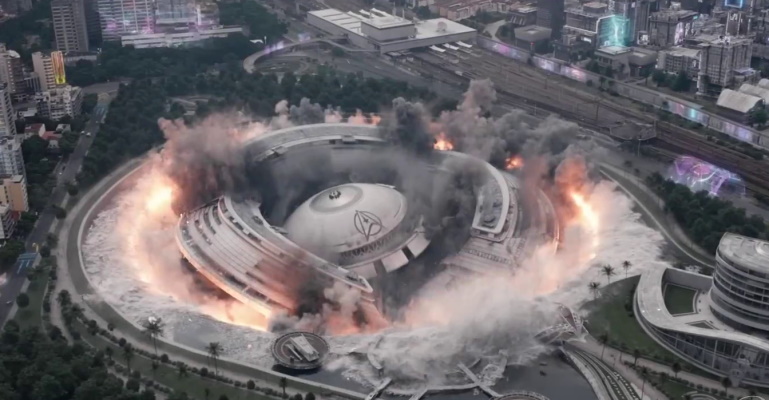
Dr Jurati is the cyberneticist that we met in Season 1, and she has a real love for all things synthetic. She wasn’t able to carry out her mission of harming Soji because her love and curiosity about synthetic life overwhelmed her Zhat Vash mind-meld, and I wonder if her innate fascination and sympathy for synthetic life could make her a target of the Borg Queen.

If so, perhaps Dr Jurati is able to be convinced to (literally or metaphorically) loosen the Borg Queen’s restraints, accidentally letting her loose on La Sirena.

Theory #7:
The captive Borg Queen is the same one from First Contact.

The Borg Queen in First Contact.

At the end of First Contact, Picard and Data managed to stop the Borg Queen. The Queen’s organic components were destroyed by plasma coolant in the Enterprise-E’s main engineering, but her synthetic parts – including her skull and part of her spine – remained intact. Picard appeared to break them at the end of the film, signifying the “death” of the Borg Queen.

However, the Borg Queen returned on several occasions, most notably in Voyager, seeming to confirm that there are multiple Borg Queens, or that the Queen is able to move her consciousness into a new body at will. It’s possible, then, that the captive Borg Queen in Picard Season 2 was found elsewhere, such as aboard the Artifact. But it’s also possible that the Queen from First Contact was not totally dead, and has been revived or reactivated in the years following the events of the film.

Theory #8:
Elnor will be assimilated.

Raffi and Elnor.

This theory stems entirely from a clip glimpsed in two of the recent trailers! In the image above, Elnor can be seen clearly injured with Raffi by his side. What’s interesting to note, though, is the eerie green light – green is a colour that has a strong association with the Borg. Could it be that Elnor has been attacked by the Borg Queen and is in the early stages of being assimilated?

That was definitely how I interpreted the clip on first viewing! I can’t tell if it’s taking place in La Sirena’s sickbay or somewhere else, though. Regardless… I hope that poor Elnor survives whatever’s happening to him! There are ways of surviving or reversing Borg assimilation, so there’s hope for Elnor even if the worst comes to pass.

Theory #9:
Q is not responsible for changing or damaging the timeline.

Did Q really damage the timeline?

The teasers and trailers for Season 2 seem to place the blame for whatever’s going on firmly at the feet of Q. But I would argue that the role of an out-and-out villain doesn’t really fit with Q’s prior characterisation, where he’s been challenging and adversarial, but usually to make a point or to push Picard to solve a mystery. Q’s god-like powers would also make him ill-suited to fill the role of the season’s overarching villain; with a snap of his fingers he could undo any victory Picard could hope to win.

I’ve always felt that Q sees himself as a friend, ally, and guide to Picard – and to humanity in general. That doesn’t fit with becoming a super-villain, and with so much teased about Q in pre-release marketing material, I have to assume that there’s more going on than meets the eye. We can’t have been introduced to the entire plot already, surely?

I have a longer article that goes into more detail about this theory, and you can find it by clicking or tapping here.

Theory #10:
Q shielded Picard and the crew of La Sirena from changes to the timeline.

Q in one of the trailers for Season 2.

One way in which Q could be involved would be to protect Picard – and his new crew – from changes to the timeline. There are many reasons why he might do this, and it could apply regardless of whether Q changed the timeline himself or not. If the entire timeline has been changed going back centuries, there has to be a reason why Picard and the crew of La Sirena are seemingly the only ones unaffected – and one explanation for that could be “Q’s magic.”

This would be in line with how we’ve known Q to operate. Episodes like Tapestry and All Good Things saw him use his powers to place Picard in an alternate life while retaining his original memories, and to move between three different time periods. Such a power is something we know Q can use, and it would explain two key things: how Picard and the crew of La Sirena remained unaffected, and how Q is involved in the story.

Theory #11:
Who is responsible for damaging the timeline, then?

Did the Borg do it?

If Q isn’t the one who changed the timeline, the obvious question that raises is “who did it?” In the days ahead I might put together a longer list of suspects, but for now I have a few suggestions!

In theory, it could be any one of a number of different Star Trek factions. We’ve seen the Klingons having access to time travel in the early 25th Century, for example, in the Voyager episode Endgame, and various time travel stories and stories depicting powerful alien races could all theoretically yield suspects. But considering what we know about Star Trek: Picard specifically, in my view the main suspects are as follows:

  • The Borg. We know the Borg have the ability to travel through time, and that they’ve weaponised that ability on more than one occasion.
  • The Zhat Vash. While the Zhat Vash may not have been shown to possess time travel tech, they were the primary antagonist last season, and arguably were not defeated in the Season 1 finale.
How about the Zhat Vash?
  • The super-synths. The super-synths from the Season 1 finale are a wildcard; we don’t know much about them except that they seem to be technologically powerful. Travelling back in time might be on their agenda – but erasing the prime timeline could result in the erasure of the Coppelius synths.
  • The Romulan government or the Tal Shiar. With or without the support of the Zhat Vash, the Romulan government could have taken action against the Federation in response to the events of Season 1.

There are undoubtedly other Star Trek factions who could be implicated, and if we had a free choice we could suggest the likes of the Dominion or the Sphere-Builders. But I think those are far less likely when considering the elements Picard has brought on board.

Theory #12:
Picard and the crew will have to actively trigger World War III to save the future.

World War III soldiers as glimpsed in Discovery Season 2.

Although the Bell Riots are the main event of 2024 that we know about in Star Trek’s internal timeline, the 21st Century was arguably dominated by another event: World War III. The war may have kicked off as early as 2026 (as suggested in The Original Series) and concluded by the mid-2050s as seen in First Contact. The “post-atomic horror” that followed was the backdrop for Q’s trial in Encounter at Farpoint.

World War III is integral to Star Trek because without it, it’s hard to see how warp drive would’ve developed and how humanity would’ve made peaceful first contact with the Vulcans. Just like the end of the Second World War brought about major technological and societal changes that ultimately made the world a better place, Star Trek’s World War III is integral to the events that led to the founding of the Federation. If it were prevented, the timeline would change dramatically.

So my theory is that the point of divergence is the outbreak of World War III – meaning that it will fall to Picard to trigger one of the worst wars in human history in order to save the future. Talk about a moral dilemma! You can find a full write-up of this theory by clicking or tapping here.

Theory #13:
The “totalitarian state” will be run by Khan and the augments.

Picard in the alternate timeline.

The alternate timeline that is established in Picard Season 2 will see the Federation replaced by a “totalitarian state.” This faction appears to be superficially similar to the Terran Empire from the Mirror Universe (though I hope not too similar, as I’m not the biggest Mirror Universe fan!) At the very least, this faction is not as genteel as the Federation and may be governed in an autocratic, dictatorial style.

Based on his appearances in The Original Series and The Wrath of Khan, we know that this is how Khan governed – or intended to govern – when he held power. It’s possible, then, that the totalitarian state that we’ve glimpsed in the trailers and teasers is led or inspired by Khan, and may be a society in which augmented humans hold power.

This could be supported by the introduction of a new member of the Soong family – played by Brent Spiner. The Soongs were known to have researched and studied human augmentation prior to the 22nd Century.

Theory #14:
There will be a connection between the augments and Strange New Worlds.

One of the few things we know about Strange New Worlds at this early stage is that there will be a character named La’an Noonien-Singh. This new character seems to be related in some way to the iconic villain Khan, and if Khan or Khan-inspired augments play some kind of a role in the “totalitarian state,” perhaps that will set up a connection – or even a crossover – between Picard Season 2 and Strange New Worlds.

Theory #15:
The “totalitarian state” is an isolationist power.

A portrait of the alternate timeline version of Picard.

Rather than being one part of a Federation, or the conquering force behind an Empire, it seems possible based on what we’ve seen so far that the “totalitarian state” is only comprised of humans on Earth. This could mirror Discovery’s isolationist Earth in the 32nd Century, and it would be interesting to look at the state of the galaxy if humanity remained isolationist and refused contact with other races. There could also be an allegory about some of our current political movements.

It will be very interesting to learn more about this faction. Who exactly it is, how it rose to power, and what role the alternate timeline version of Picard played in its power structure are all open questions at this stage, and I’m very curious to see how it will all unfold!

Theory #16:
Romulans are spying on Earth in the 21st Century… and could be time-travelling Zhat Vash.

A young boy encounters a Romulan or Vulcan.

In the third trailer, a young boy wearing what seemed to be 21st Century clothing was seen encountering a Romulan or Vulcan. If the Zhat Vash are involved in the new season’s story somehow, perhaps this individual is a Zhat Vash operative, and could confirm that the Zhat Vash were able to travel through time, or send a message back in time to their 21st Century counterparts. The Romulans had achieved interstellar flight centuries earlier, so travelling to Earth to spy or place operatives seems plausible for them.

Of all the scenes we’ve glimpsed so far from Season 2, the one with the young boy and the Romulan or Vulcan is the one that I’m least sure about! It doesn’t seem to fit naturally into a story about the Borg, Q, and time travel… but this is one theory that could make sense, and would connect to the theory above about Q not being to blame.

Theory #17:
The Vulcans are on Earth in the early 21st Century… as stated in Discovery Season 4.

A meeting of senior Federation and allied officials in Discovery Season 4.

Another theory about the unnamed Romulan or Vulcan is tied into the most recent episode of Discovery. This could easily be a complete overreaction to a throwaway line, but at the beginning of The Galactic Barrier, mysterious Federation leader Dr Kovich stated that Vulcans were on Earth for decades prior to official first contact taking place.

This one line could be a reference to Carbon Creek, an episode of Enterprise that saw Vulcans crash-land on Earth in the 1950s. But the timing seems odd given the scene glimpsed in the Picard Season 2 trailers! If the character seen above is a Vulcan, perhaps there will be a connection of some kind between Discovery and Picard.

Theory #18:
Guinan will be aware of the shifting timelines.

Picard with Guinan in the Season 2 trailer.

Though clips with Guinan that we’ve seen so far seem to suggest that she and Picard will meet prior to his new mission or during the very early stages of it, one thing we know for sure about Guinan is that she has a sense of when the timeline has been changed or damaged. We saw this in The Next Generation Season 3 episode Yesterday’s Enterprise most prominently, and it could come into play again here.

This could set up Guinan to be an advisor to Picard; she could be the one to tell him, for example, roughly when she thinks the timelines were changed or when the point of divergence was – potentially setting up the entire mission to the past!

Theory #19:
Laris and Zhaban will join Picard’s new mission.

Laris and Zhaban in Season 1.

Laris and Zhaban – Picard’s Romulan friends who lived with him at his vineyard – didn’t accompany him on the mission to track down Bruce Maddox and Soji, despite their skills potentially being very useful. If there’s another dangerous mission in the offing, will they be left behind again? I hope not!

We’ve already glimpsed Laris in some of the trailers for Season 2, and it seems as though she will have an expanded role, which is great. Although she and Zhaban filled a narrative role in Season 1 (being the familiar faces of home that Picard had to leave behind on his adventure, similar to the residents of Hobbiton in The Hobbit and The Lord of the Rings) it never sat right that Picard had two ex-Tal Shiar operatives on his side and just… ditched them! So maybe Season 2 will right that wrong.

Theory #20:
The loose ends from Season 1 will be tied up.

The crashed remains of the Artifact.

Because of the rushed nature of its final two episodes, Season 1 left a lot of unfinished story elements behind. Some of these will be solvable with a line or two of dialogue, and it would be great if Picard Season 2 could at least make an effort to draw a line under some of the unresolved, underdeveloped points at the end of Season 1.

Here are the main ones, as I see it:

  • What will become of the synths on Coppelius, and will they have to be relocated for safety?
  • Did Starfleet attempt to visit Aia and shut down the beacon at the centre of the Zhat Vash’s prophecy? Leaving it out in the open seems dangerous.
  • Will Starfleet contact the super-synths and attempt to make peace or convince them that they pose no threat?
The super-synths’ mechanical noodles.
  • Why did Bruce Maddox go to Freecloud?
  • With the Zhat Vash plot exposed, what will become of their crusade against synthetic life?
  • Did Federation-Romulan relations suffer as a result of the Zhat Vash’s attack on Mars and attempted attack on Coppelius?
  • What happened to Narek after he was captured by the Coppelius synths?
  • Who controls the Artifact and what will happen to the surviving ex-Borg?
  • Were there legal consequences for Dr Jurati?

Theory #21:
At least one character from The Next Generation will make an appearance.

The cast of The Next Generation Season 4.

With the return of Guinan and Q, as well as Voyager’s Seven of Nine, there are already a lot of returning characters in Picard Season 2! But that doesn’t mean that there isn’t room for a well-placed cameo or two, or even an episode like Season 1’s Nepenthe that steps away from the main story to revisit classic characters.

There are so many characters from Star Trek’s past that I would love to spend more time with; listing them all here would be impossible! But if Picard is to end with Season 3, as some outlets have been reporting, it would be fantastic if the crew of The Next Generation could reunite one last time.

I have a list of possible character crossovers that I wrote back in 2020, before we got to see any teasers or trailers, and you can find it by clicking or tapping here.

So that’s it!

La Sirena is warping onto our screens very soon!

With Picard Season 2 now just days away, those are my main pre-season theories. I have no doubt, though, that Picard Season 2 will bring new and unexpected storylines into play, so I hope you’ll tune in every week to see which theories get debunked and which new ones emerge as the story gets rolling!

I’m excited to see ex-Admiral Picard and the crew of La Sirena return. Getting back to the 24th Century had been my biggest Star Trek wish for almost twenty years, and we’ve now got three different shows in that time period! Whatever happens this season, and regardless of whether any of my theories pan out, I’m hopeful and optimistic that we’ll get a fun, engaging story.

Star Trek: Picard Season 2 will premiere on the 3rd of March on Paramount+ in the United States and on the 4th of March on Amazon Prime Video in the United Kingdom and around the world. The Star Trek franchise – including Picard and all other properties mentioned above – is the copyright of Paramount Global. This article contains the thoughts and opinions of one person only and is not intended to cause any offence.