The first section of this review is free from major narrative spoilers for The Mandalorian and Grogu and The Mandalorian Seasons 1-3. The end of the spoiler-free section is clearly marked.
It doesn’t feel like too long ago that I sat down to watch The Rise of Skywalker for the first time – the last Star Wars film I had the displeasure of sitting through. Since then, the franchise has focused on streaming, with shows airing on Disney+ that have been – in my subjective opinion, of course – more miss than hit. The Mandalorian and Grogu is Star Wars’ first trip to the movies in almost seven years… and having not really vibed with the show it serves as the final chapter of, I didn’t exactly have sky-high expectations.
At about the ninety-minute mark, I paused The Mandalorian and Grogu to go to the bathroom. And that trip was probably the most fun I had while watching the film. After The Rise of Skywalker, I’d have said that the bar for the worst Star Wars movie was so low it had melted through the floor, Chernobyl-style, deep into the basement. The best and kindest thing I can say about The Mandalorian and Grogu is that it wasn’t quite *that* bad; for all the flaws this film has, it has not eclipsed The Rise of Skywalker for the title of “worst in the franchise.” But that is hardly an achievement.
The Rise of Skywalker failed for myriad reasons, but none more so than its writer and director had absolutely no idea where to take the story or how to end it. The result was two films’ worth of plot haphazardly crammed into a single picture – one of which was desperately trying to overwrite character backstories and whole chunks of plot from The Last Jedi. This isn’t the same failing that The Mandalorian and Grogu has.
At its core, The Mandalorian and Grogu is meaningless and uninspired, desperately trying to lean into the aesthetic of Star Wars, but without seeming to really understand what made any of it work in the first place. It’s a boring, trope-laden, aggressively bland film; the cinematic equivalent of jangling keys in front of a baby. Hardcore Star Wars fans might be interested in some of the minute details and additions to the franchise’s wider lore, but the main narrative of the film just feels like fluff. The Mandalorian (the character) still feels like one of those silent protagonists from a 1980s or 1990s video game; the kind of guy who runs through a bunch of samey levels, shooting whatever moves, for the very flimsiest of reasons (that you probably had to read about in the manual).
This was the same criticism, by the way, that I had of The Mandalorian’s first few episodes; all the way back in 2019, I described Mandy as “an emotionless helmet-wearing slab of nothing” who seemed to act not because of any discernable character trait or motivation, but at the behest of a room full of TV writers who were desperate to move the plot along. And even the word “plot” is being generous – most of The Mandalorian, as well as practically the entirety of this new cinematic adventure, feels like a series of barely-connected individual action sequences. To continue our video game analogy: these are side-quests to keep the player character busy in a title that doesn’t have enough actual narrative content to stretch for even just a couple of hours.
I don’t sit down to watch a film *hoping* to have a bad time. I paid good money to watch The Mandalorian and Grogu, and I wouldn’t have done so if I was absolutely convinced that it was going to be another stinker. I genuinely hoped that Star Wars’ latest trip to the cinema would be an improvement; that the writers had been able to come up with an ending to these characters’ stories that might’ve even made the preceding three seasons of the show feel better in hindsight. And, to be honest… I kinda feel like Star Wars is overdue for a win! The divisiveness of The Last Jedi, The Rise of Skywalker, and several of the streaming shows has done perhaps irreparable harm to the fan community and the brand, but a new film had the potential, at least, to get everyone on the same page once again.
The version of the film I watched was advertised as “IMAX” resolution. But… it wasn’t. The film uses a variable aspect ratio, where some sequences are basically in 16:9 widescreen and others are in 2.39:1 theatrical/anamorphic – i.e. the standard you’d get for most films. This was *incredibly* jarring, especially because some scenes are incredibly short, so the film jumps from one aspect ratio to another and then back again in quick succession. If you choose to watch The Mandalorian and Grogu, I think you have the choice to disable this, effectively “cropping” those non-IMAX “IMAX” scenes and putting the entire film in a standard theatrical letterbox. I highly recommend you do that, because the not-even-properly-IMAX ratio adds absolutely nothing of consequence to any single frame.
The Mandalorian and Grogu makes use of some pretty neat physical props and puppets – something I will continue to praise the modern Star Wars franchise for, especially when compared to the janky CGI of the prequel trilogy! But for a big-budget film coming from Disney, the first Star Wars cinematic adventure in almost a decade… there were some pretty poor CGI moments in The Mandalorian and Grogu, too. If you stick with me to the spoiler-y part of the review, I’ll point out a couple of my least-favourite CGI misfires.
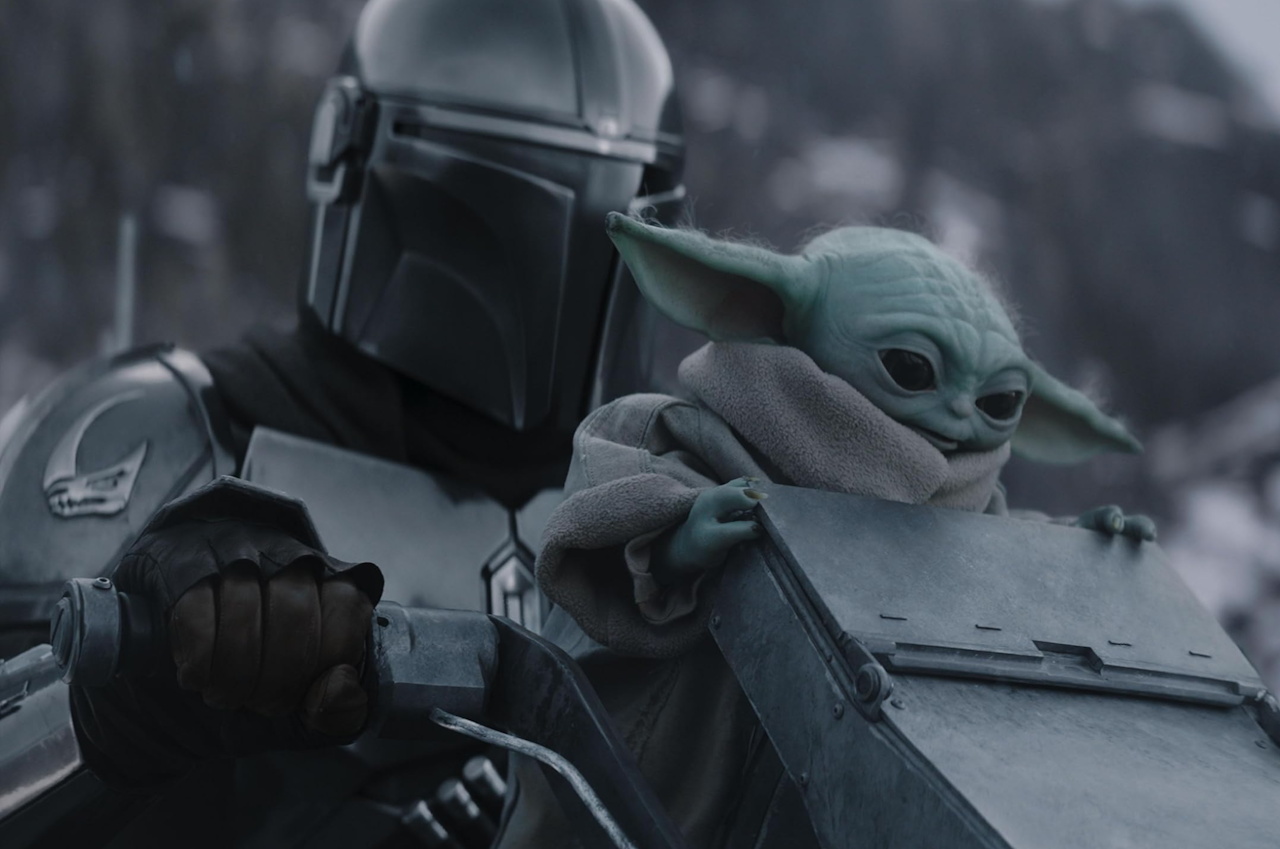
The Mandalorian and Grogu is not a good film. But it isn’t a total failure of storytelling or filmmaking, either. It’s just forgettable, bland fluff. No characters are memorable, no events are interesting, it relies on contrivances and tropes to move its very bare-bones story along, and it’s a film that takes basically no risks with its narrative, its characters, or its world.
With that being said, I can absolutely see The Mandalorian and Grogu being the “best film of 2026” for a very specific subset of viewers. If you absolutely *adored* The Mandalorian, its spin-offs, and its characters, the film is basically more of the same. If this slice of Star Wars has been your jam since it debuted in 2019, there’s a reasonably high chance you’ll enjoy its cinematic adaptation, too. And, hey, I hope you do! Just because the film wasn’t my speed, that doesn’t mean it won’t find support from folks who were bigger fans of the series than I ever was.
Up next, we’re going to get into spoiler territory and talk about The Mandalorian and Grogu’s story in a bit more detail. If you haven’t seen the film yet, and still want to head into it un-spoiled, I hope you’ll consider bookmarking this review and coming back later! My official recommendation, such as it is, would be to wait a few weeks until the film inevitably hits Disney+ and you can watch it less expensively. At £16 here in the UK (at time of writing), it’s a pretty tough sell, at least in my opinion.
Spoiler Warning: This is the end of the spoiler-free section. There will be spoilers for The Mandalorian and Grogu – including the film’s ending – from here on out. Spoilers are also present for Jedi: Fallen Order, The Mandalorian, The Book of Boba Fett, and Obi-Wan Kenobi.
Narratively, I felt that The Mandalorian and Grogu suffered a very similar problem to parts of the show it’s based on, as well as The Book of Boba Fett and Obi-Wan Kenobi – that being that the “main story,” such as it is, isn’t really a single cohesive thing. In The Mandalorian, Mandy would get sidetracked, starting a job, then having to go somewhere else to fix his spaceship or track down a contact who’s supposed to lead him to another contact… and so on. Obi-Wan Kenobi – probably the worst piece of Star Wars media to exist, eclipsing even The Rise of Skywalker – was likewise a series of lightly-connected action set-pieces, as “Young Old Ben” left Tatooine to track down the missing Leia.
The Mandalorian and Grogu sees Mandy working for the New Republic, helping them track down some of the Empire’s remaining leaders in the aftermath of Return of the Jedi. He’s given an assignment by his nameless handler (or maybe she had a name, but she was just so bland and forgettable that I’ve forgotten it already?) to track down a faceless Imperial commander. But first, before he can do that, he has to do a favour for the Hutts, because they’ve promised information! And we’re only a few minutes into the film and we’re already starting out with this side-quest story idea.
I genuinely feel that The Mandalorian and its cinematic sequel would’ve worked better – and perhaps even worked *well* – as a video game. These kinds of storylines can feel a lot more engaging in interactive media, where you, as a player, are in control of the protagonist. Look at one of my favourite recent Star Wars stories as an example of this: Jedi: Fallen Order. That game unfolds similarly to The Mandalorian and Grogu – you go to a planet, meet a character, start a side-mission that takes you partway to your goal, then go somewhere else and do something else, and eventually make it to the end of the story.
But what works for a video game doesn’t always work for a film. Getting sidetracked or doing barely-connected, action-packed levels is fun… *when you’re in control of the character* and when you’re part of the action. But a film doesn’t have that interactivity, so you’re stuck watching a character go through this series of loosely-connected events that just… aren’t as much fun to watch as they might’ve been to play. Perhaps writer and director Jon Favreau missed his calling; the kinds of stories he seems able to tell would just work way better if they had that interactive element.
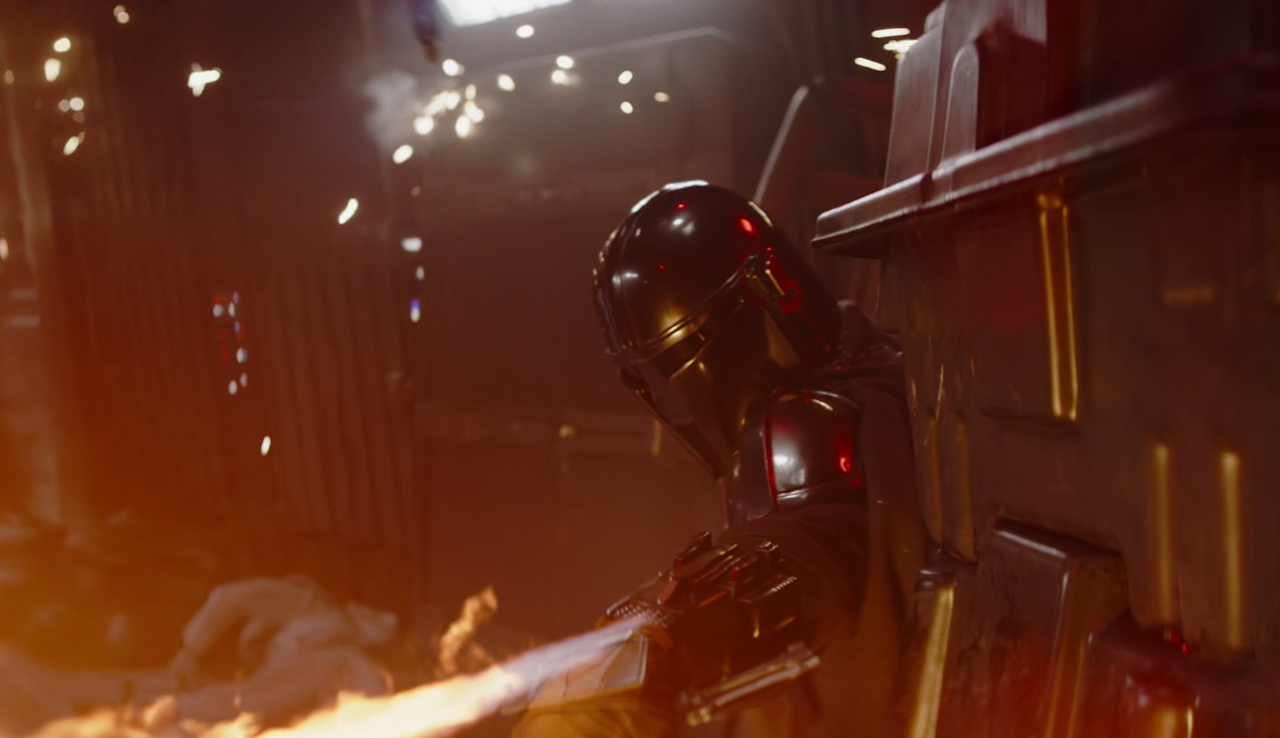
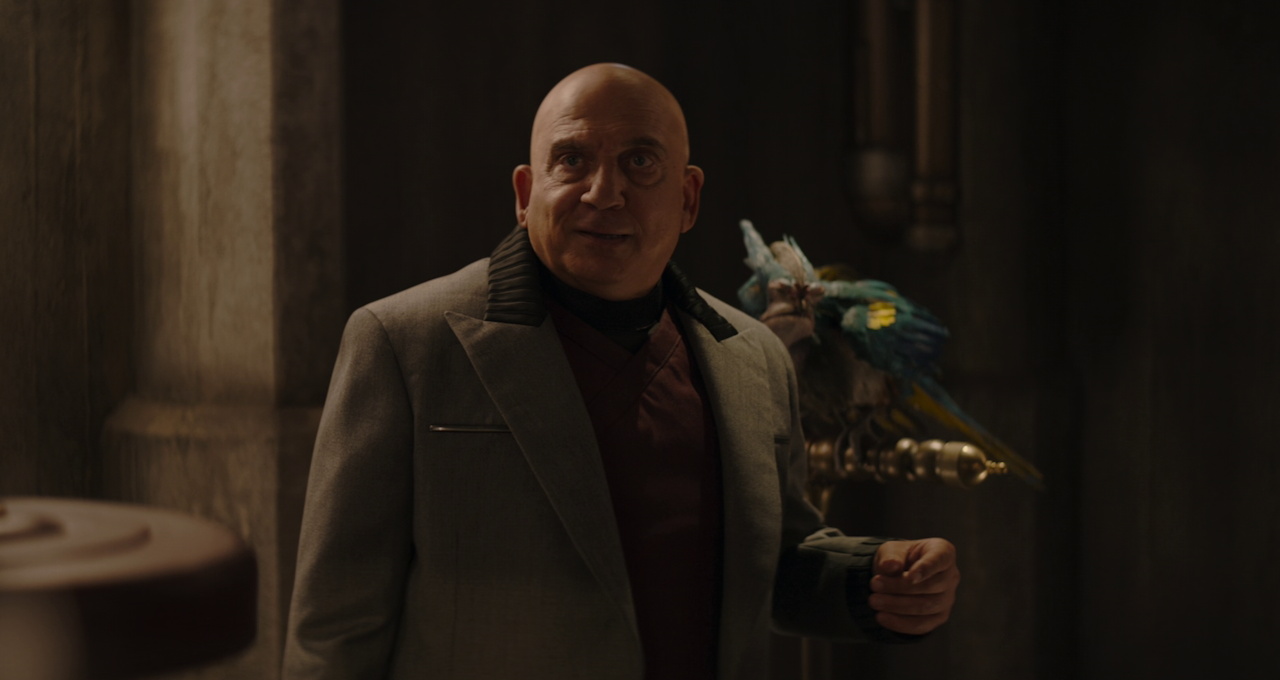
In order to advance its plot, The Mandalorian and Grogu relies heavily on cut-down sequences and contrived moments. After figuring out (thanks to Jabba the Hutt’s weirdly buff son) that the crime lord he came face-to-face with a few minutes earlier is the same Imperial officer he’s meant to be arresting, Mandy and his nameless pilot/sidekick (or maybe he had a name, but he’s so bland and uninteresting that I’ve already forgotten it?) decide to launch a full-frontal assault on the man’s heavily-guarded mansion.
Do we get to see this attack being planned? Nope. Do we see the attack itself? Barely. What we get is Mandy storming in, guns ablaze, in another action sequence that’s basically the same as the film’s opening act. It just felt so incredibly rushed; something this important to the story seemed to be planned and executed in a heartbeat. And why? So we could get a car chase scene that reminded me of the one in The Rise of Skywalker? Is… is that *really* the best we can do?
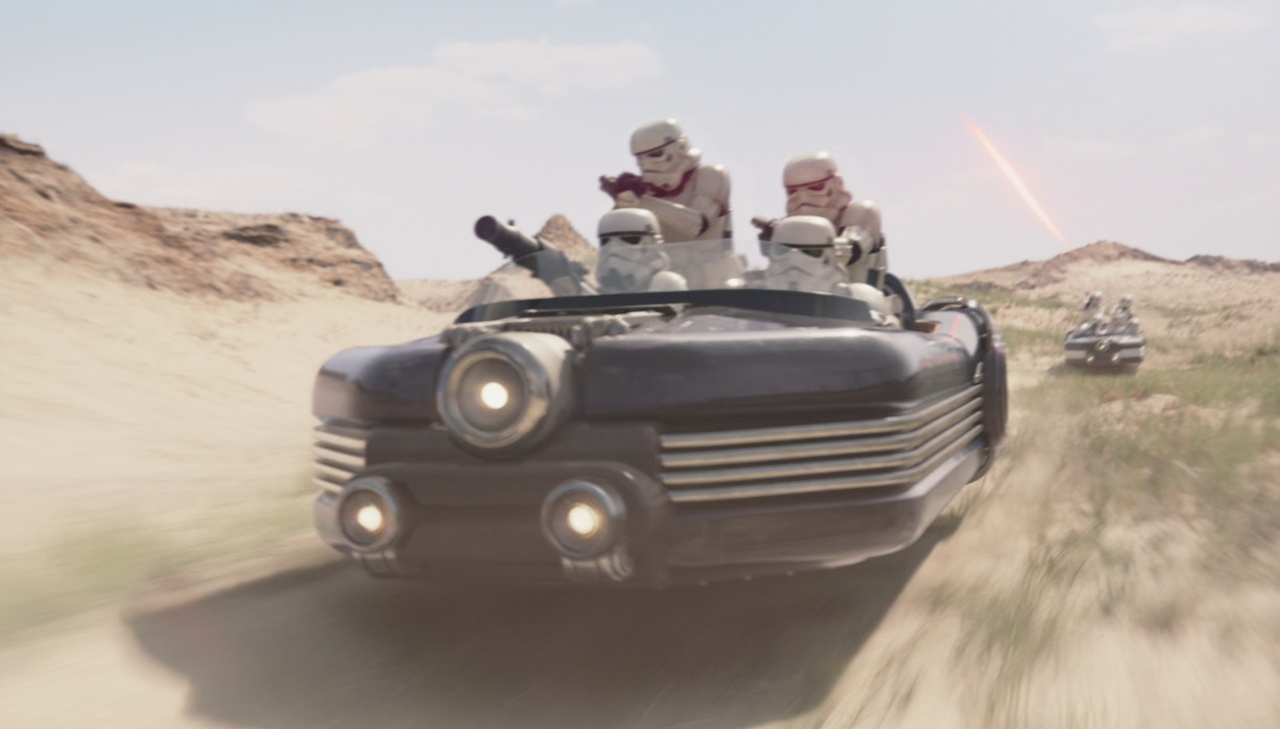
I’ve talked about this before, but Star Wars *desperately* needs to move on from the so-called “Skywalker Saga” and the characters that inhabited it. That was one of the things I really hoped for from The Mandalorian back in 2019, when the show premiered. But The Mandalorian very quickly brought the Jedi and the Force back into play, as well as Luke Skywalker, Boba Fett, and other major characters from the past. And this time, rather than finally leaving all of that behind to tell a *unique* story, The Mandalorian and Grogu introduces us to the son of Jabba the Hutt.
To be clear, I think that Rotta the Hutt was one of the film’s more interesting characters, and the one who came perilously close to having a point and a message that went beyond “look at the shiny shiny!” There’s something fascinating, in theory, about a character who feels trapped by the legacy of an infamous parent or illustrious forebear, and wanting to strike out on one’s own is something that can be relatable. When Rotta came to realise that the crowd at the fighting pit was just as happy to jeer and chant for him to be killed as they were to cheer for his wins, that was probably the closest that The Mandalorian and Grogu managed to get to a genuinely heartfelt or emotional moment.
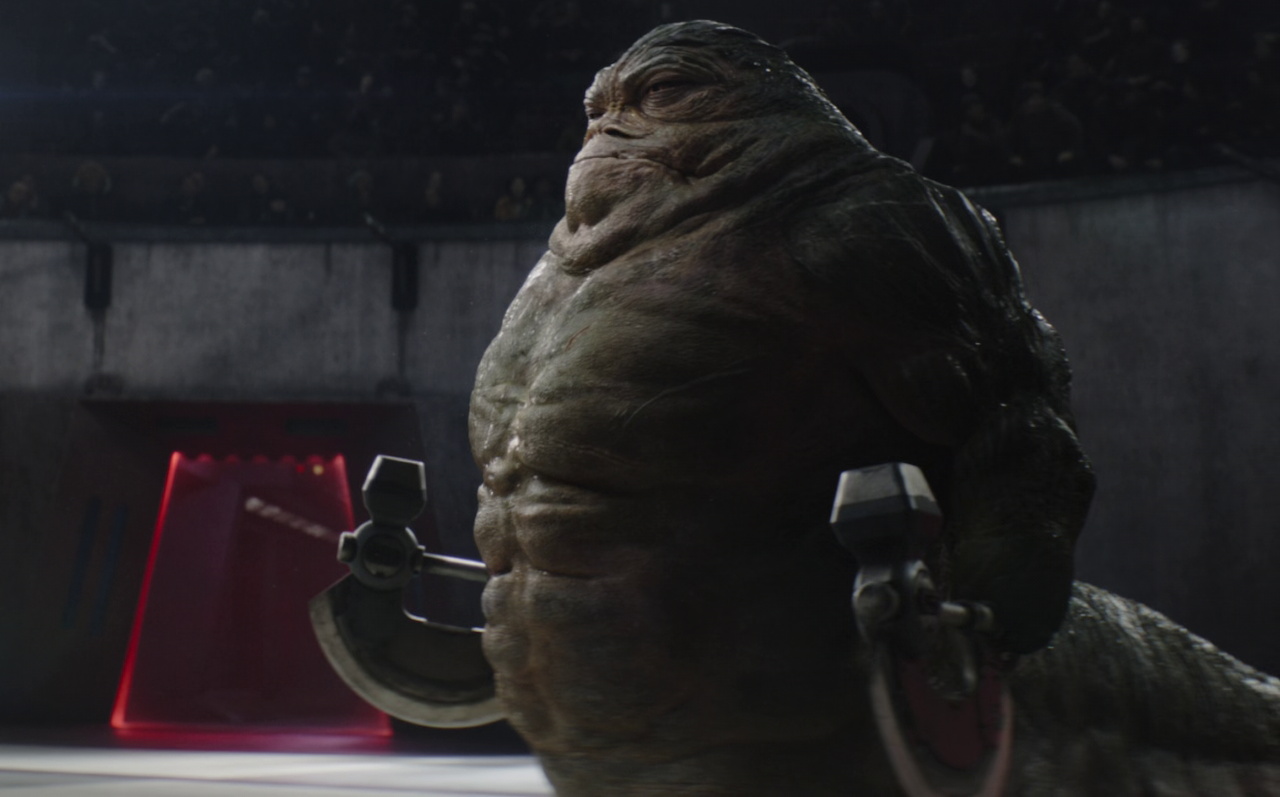
I also liked the idea of showing a different side to the Hutts. In practically every piece of Star Wars media, we’ve seen Hutts as nothing more than corrupt gangsters; their grotesque slug-like appearance reflecting the depravity within. So to take a member of a reviled and deliberately ugly species and give them a completely different spin and a different kind of characterisation is a good idea. It’s probably the only genuinely good idea in the film’s conception. It wasn’t executed especially well, because The Mandalorian and Grogu prioritised other things – brain-dead action set-pieces, for the most part. But I can appreciate that there was a genuinely interesting idea there, and I might even be tempted to say that I’d have liked to have seen more of Rotta’s story.
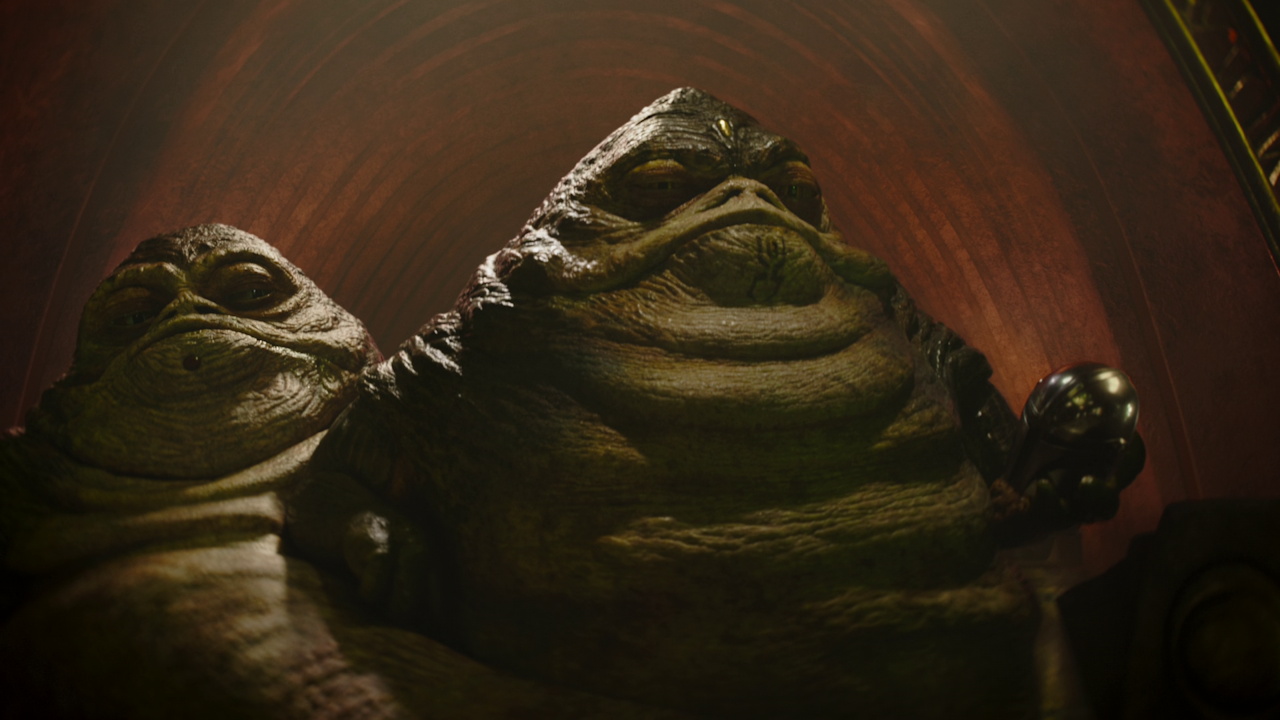
But – and here’s where the film’s overreliance on Star Wars’ past trips things up again – did Rotta have to be the son of Jabba the Hutt for this story to work? Jabba’s not a character in the film; he’s long-dead by the time these events take place. We have two Hutt characters in The Mandalorian and Grogu – the twins, who I think were introduced in either The Mandalorian or The Book of Boba Fett. Why not give Rotta a more direct connection to them and forget the name “Jabba?” Oh, that’s right: because modern Star Wars can’t escape the shadow of its original trilogy, even for a second.
Capturing Commander Coin at his mansion was too quick and too easy. But so was Mandy and Rotta’s escape from the fighting pit. After realising they needed to team up, a lucky accident involving a weird electric monster of some kind short-circuited the digital fence penning in the monsters, and they all escaped into the crowd. This was… not great, let’s be honest. It’s a contrivance, but it’s such a basic one that it felt fundamentally weak and unsatisfying. This moment could have seen Mandy and Rotta realising they needed each other; that working together was going to be key to their survival and escape. Instead, the writers realised they’d got stuck in a narrative dead-end and magicked up a solution out of nowhere.
Even the lead-up to the fight was overladen with tired clichés. Mandy wants to track down Rotta, but because this is a video game story, he has to first track down “Lord Janu.” But Lord Janu, despite operating his crime syndicate out of a downtown bar, doesn’t take kindly to people… trying to do business with him? So everyone has to attack Mandy as soon as the name “Janu” is mentioned. It’s the kind of thing that, once again, you might overlook in a video game because it got you a fun boss fight, but it just doesn’t make much sense in-universe and it doesn’t work well for a film.
As The Mandalorian unfolded, I felt Grogu – a.k.a. Baby Yoda – was a bit of a contrivance in himself. Grogu seems to swing wildly from “helpless toddler” to “overpowered Force-wielder” depending on the needs of the individual scene or set-piece he’s currently part of, and it makes it really hard to get a read on what kind of character he’s even supposed to be. I like the idea, in theory, of someone like Mandy having a young apprentice that they have to train; that Grogu is new to all of this and still learning the ropes. But the way it’s been handled – both in the show and the film – leads to some just plain weird contradictions.
Grogu can, for instance, heal Mandy’s wounds with the Force, lift Rotta the Hutt with the Force, or use the Force to pacify a rabid dog-like animal. But he can’t handle *basic* instructions like, “no, don’t press the missile button twice.” I’m not a parent, so I don’t know exactly how young childhood development works. But to me, Grogu seems either too overpowered for his developmental stage, or too developmentally delayed given the impressive things he can do. I get that we’re dealing with an alien species that clearly ages at a different rate, but the contradictions are too extreme to make the character feel at all believable. When it was a seemingly instinctual thing – that Grogu was using the Force innately without really *intending* to do so, as in his first couple of appearances – that might’ve just about passed muster. But when he clearly has powerful abilities that he can control, his otherwise weak and helpless presentation, and his inability to do basic tasks or follow simple instructions, doesn’t make much sense.
I will give credit to The Mandalorian and Grogu for – somehow – avoiding the worst fan theory on the internet: that Grogu is, in fact, a time-travelling Yoda. I genuinely feared that this was gonna be the way this character’s story would end; that somehow, some way, he’d *literally* turn out to be Baby Yoda. Thankfully, that was a bridge too far even for this iteration of Star Wars.
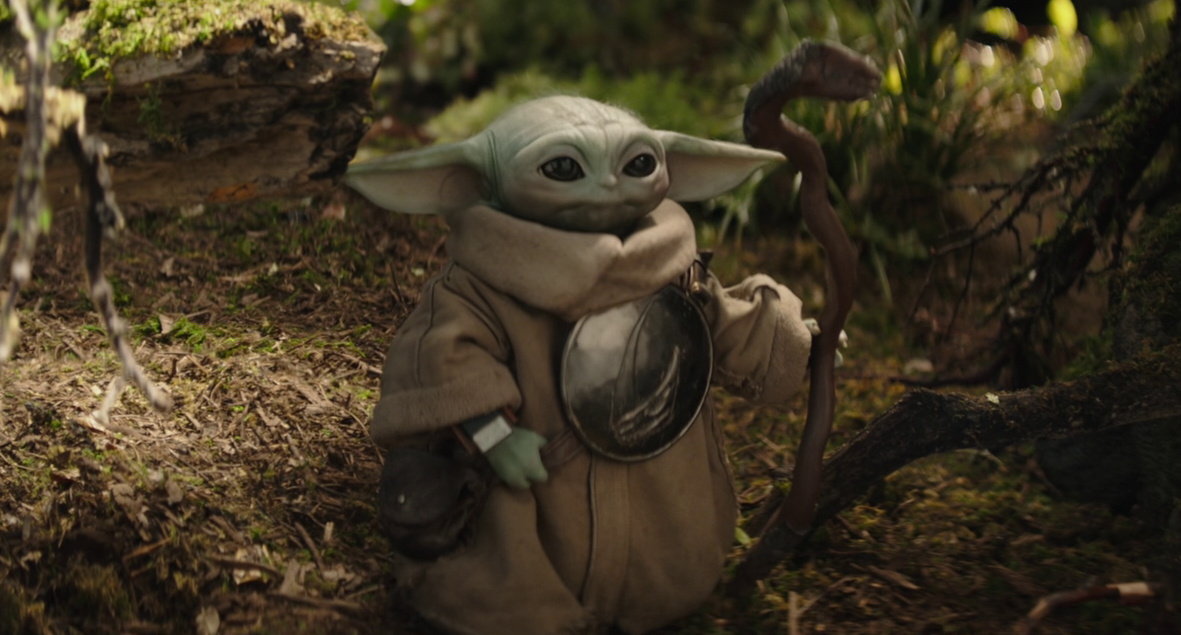
However, you could tell from the very on-the-nose, not-at-all-subtle imagery in Grogu’s sequences on the Hutt planet that the film was leaning into Yoda in a huge way. The mud hut Grogu constructs for Mandy is very similar to Yoda’s Dagobah hut, the stick he uses is reminiscent of Yoda’s own walking stick, and even the boggy, swampy setting reminded me a lot of those scenes in The Empire Strikes Back. Rather than coming across as respectful homage, though… it just felt like a blatant, shameless rip-off, done for no other reason than to say to fans, “hey! Remember how good Star Wars used to be?”
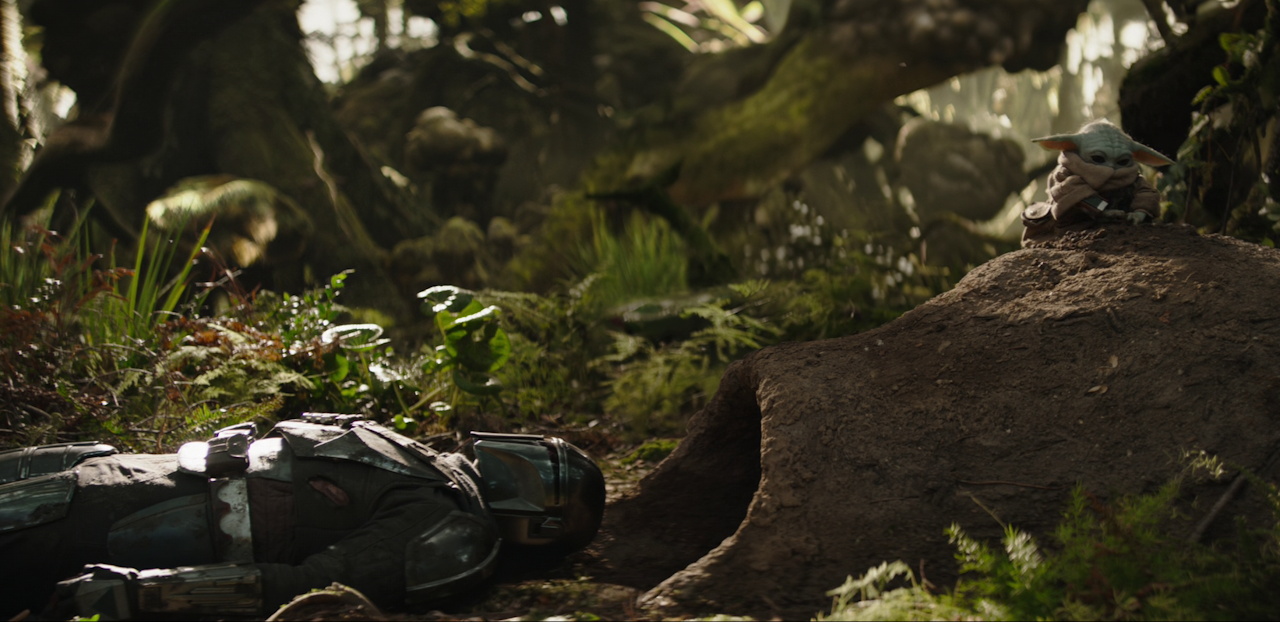
I almost wrapped up this review without actually talking about Mandy the Mandalorian – y’know, the title character? Mandy is such a non-entity in both his own show and his own film that I literally do not know what to say about him. He wanders around, shooting and punching things for the barest of reasons, stumbling through the plot, reading all of his lines in a bland monotone, never emoting, never explaining, and just… doing nothing at all. When he got injured and poisoned and seemed on the verge of death, I didn’t think “oh no!” and I didn’t even think “good, finally we can get rid of this clown.” I just felt absolutely nothing at all; no reaction. Mandy could’ve died, and I guess the film might’ve been able to claim it had made a point about parents making sacrifices for their kids, or something – even though that isn’t really what Mandy did. But at least it would’ve been *something* – and a definitive ending for the character, given that the film is supposed to bring this chapter of Star Wars to a close.
But The Mandalorian and Grogu couldn’t even do that, of course. Gotta leave that door cracked open for a sequel for when Disney runs out of other characters to strip-mine, eh?
Mandy’s best moment arguably came when he was stripped of his helmet by the Hutt twins, robbing him of some of his honour or standing in the Mandalorian community. Except… we’ve already done this before in the series, where Mandy had a whole storyline of having to “atone” for removing his helmet. And, to cap it all off, the Hutts *gave him his fucking helmet back* all of three minutes later because… plot armour has to be literal, I guess?
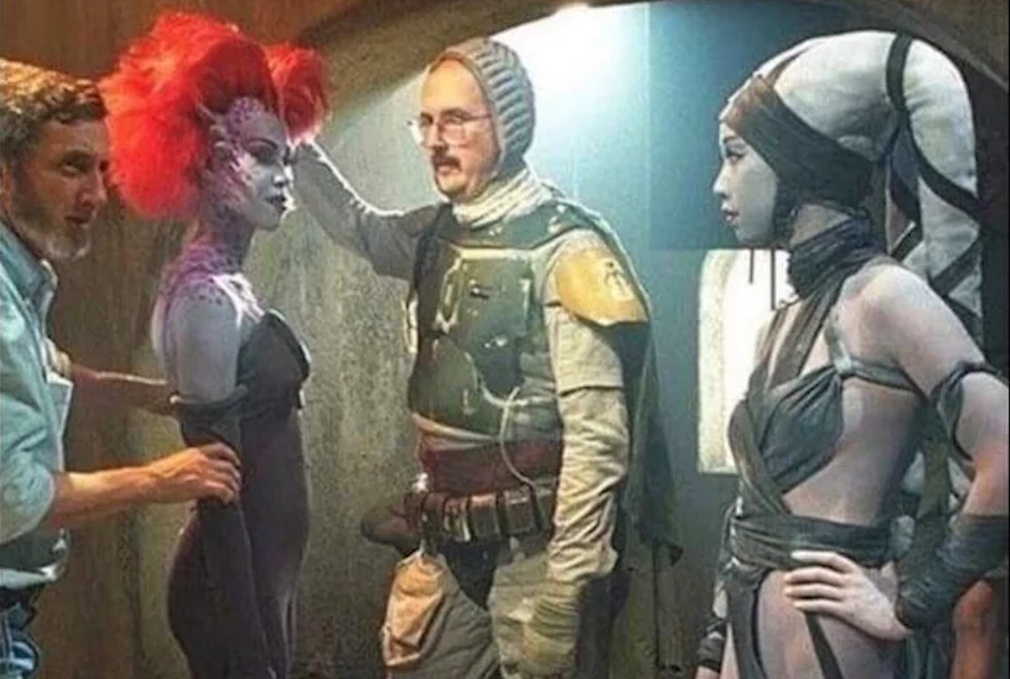
I mentioned earlier that some of the film’s visual effects weren’t spectacular, so let’s briefly touch on that. There were a few moments when Mandy and Grogu visited “the 90’s New York planet” (whose name I’ve already forgotten) where Disney’s fancy AR wall just wasn’t especially well-integrated into the sets around it. This is also a problem I noted in Obi-Wan Kenobi, though I would say things have slightly improved since then.
While I’ve praised The Mandalorian and Grogu for its use of physical props and puppets, CGI continues to be a weak spot for the Star Wars franchise. Several of the film’s alien monsters, especially in the fight sequence with Rotta and Mandy, didn’t look especially believable, and there were moments with Rotta himself and the other two Hutts that just weren’t at the level I’d have expected from a film with a budget well north of $150 million. There were also a few odd moments where Mandy’s alien pilot/sidekick’s mouth seemed not to move in sync with his voice lines; the same issue plagued the Hutts at several points, too.
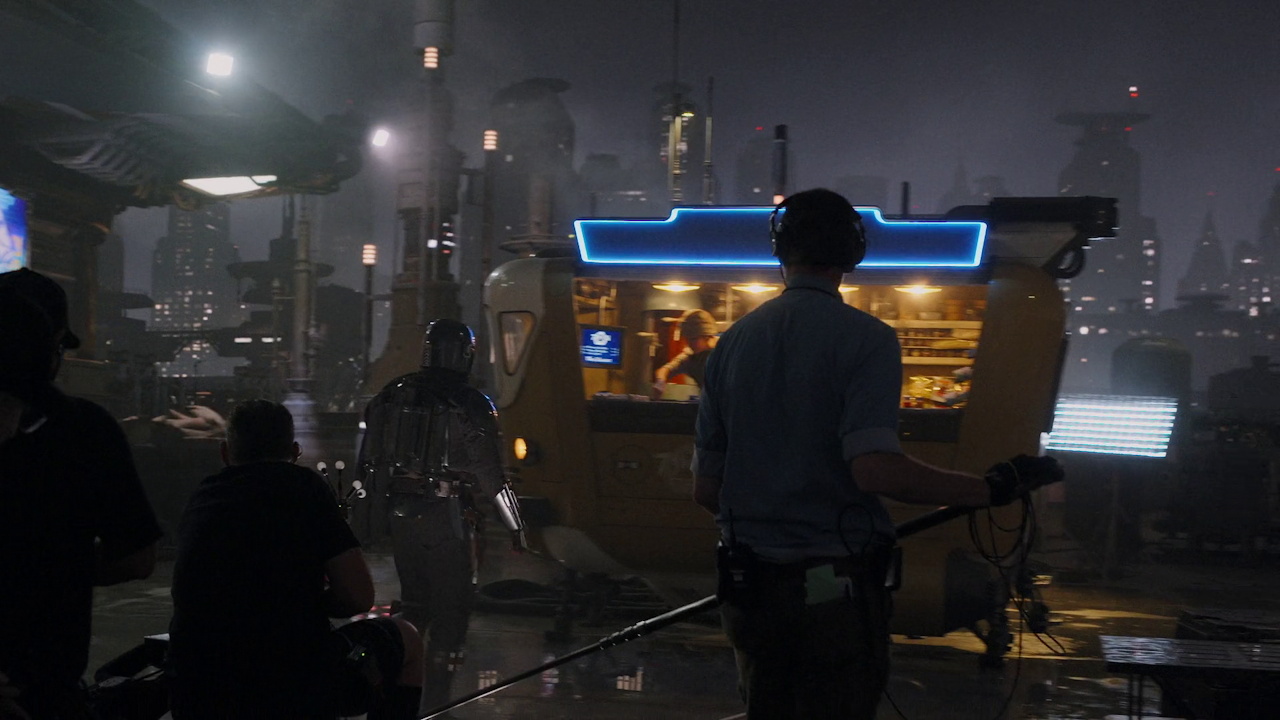
The Mandalorian and Grogu was a boring, uninspired film that achieved next to nothing. Its world was populated by paper-thin, intensely forgettable characters, it arranged a series of action scenes into something barely resembling a plot, and the only time it even came *close* to having something meaningful to say, it quickly dumped all of that for the next brain-dead fight sequence or lingering shot of an unimpressive CGI creature.
Unlike The Rise of Skywalker or The Phantom Menace, which stick in my memory for all the wrong reasons, The Mandalorian and Grogu is already fading. It’s just pure fluff; the absolute definition of “content for content’s sake.” The film says nothing, delivers nothing, goes nowhere, and doesn’t even introduce anything genuinely new to this long-running fictional world. I would say that The Mandalorian and Grogu will be a contender for my “worst film” award when I hand out some imaginary statuettes in December (something I do every year, so I hope you’ll join me for that!) but honestly… I’m already forgetting about the film *now*, having seen it twice in the span of just a few days. I doubt I’ll even remember it exists in four-plus months from now.
I continue to hope for better things from Star Wars, but the franchise has really been on a downward trajectory for close to a decade already. Disney spent a ton of cash to buy the rights to this IP, in the full expectation that it would be a license to print money. But The Mandalorian and Grogu has been a box office bomb; the worst-performing film in the franchise to date, eclipsing even Solo: A Star Wars Story from 2018. There are fewer and fewer bright spots in Star Wars, unfortunately, and relatively few things I can say I’m genuinely looking forward to any more.
Perhaps this’ll have to be the subject of a longer essay one day, but… do you think maybe Star Wars needs another break? Novels, comics, and video games could keep the franchise alive for its hardcore fans, but maybe it’s time to take the cinematic franchise and the streaming shows and just put them on the back burner for a while until someone has a genuinely good idea for what to do and where to take things. I know that there are new Star Wars projects in various stages of production… but can you honestly say you’re *excited* for any of them? At best, I’m mildly curious to see whether the next film, the next show, or the one after that might actually bring something new to the table. The Mandalorian didn’t, and nor did its cinematic adaptation.
So that’s all for today. I didn’t enjoy this film, as you can tell! If it’s the final chapter in The Mandalorian saga, as has been promised, well… all I can say is that I hope whatever Star Wars does next will be an improvement. Thanks for checking out my review. Click or tap here to read some of my other reviews and articles about the Star Wars franchise… and may the Force be with you, I guess.
The Mandalorian and Grogu is available to stream now (for a fee) on Amazon Video, Apple TV, and other video-on-demand platforms. The Mandalorian and Grogu will likely be available to stream on Disney+ later in 2026, and will also be available on DVD/Blu-ray later in 2026. The Mandalorian Seasons 1-3 are available to stream now on Disney+. The Star Wars franchise – including The Mandalorian and Grogu and all other titles and properties discussed above – is the copyright of Lucasfilm and The Walt Disney Company. This review contains the thoughts and opinions of one person only and is not intended to cause any offence.