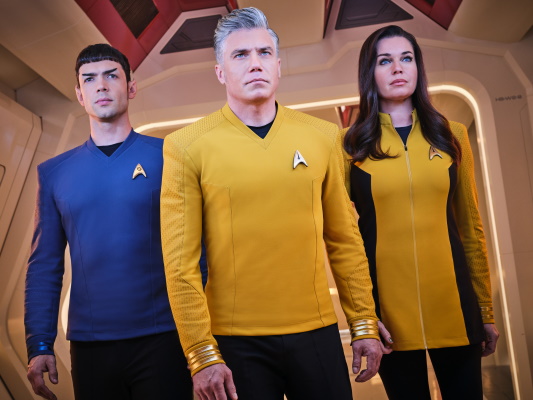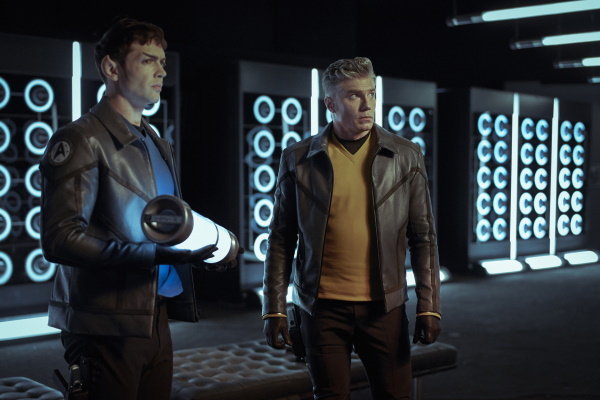
Star Trek: Strange New Worlds Episode Review – Season 2, Episode 9: Subspace Rhapsody

A spoiler warning graphic.

Spoiler Warning: There are spoilers ahead for Strange New Worlds Seasons 1-2.

I’ve been putting off this review.

After I re-started my Strange New Worlds Season 2 episode reviews in the autumn, this episode stood out as one that I just wasn’t looking forward to or was even interested in, so when it was the next one in the lineup I found myself procrastinating.

I will tell you up-front that I’m generally not a fan of non-animated musicals. I adore musicals in the theatre; seeing Wicked shortly after its West End debut is genuinely one of my favourite memories. And I like Disney-style animated musical films, too. But live-action musical films have never been my cup of tea.
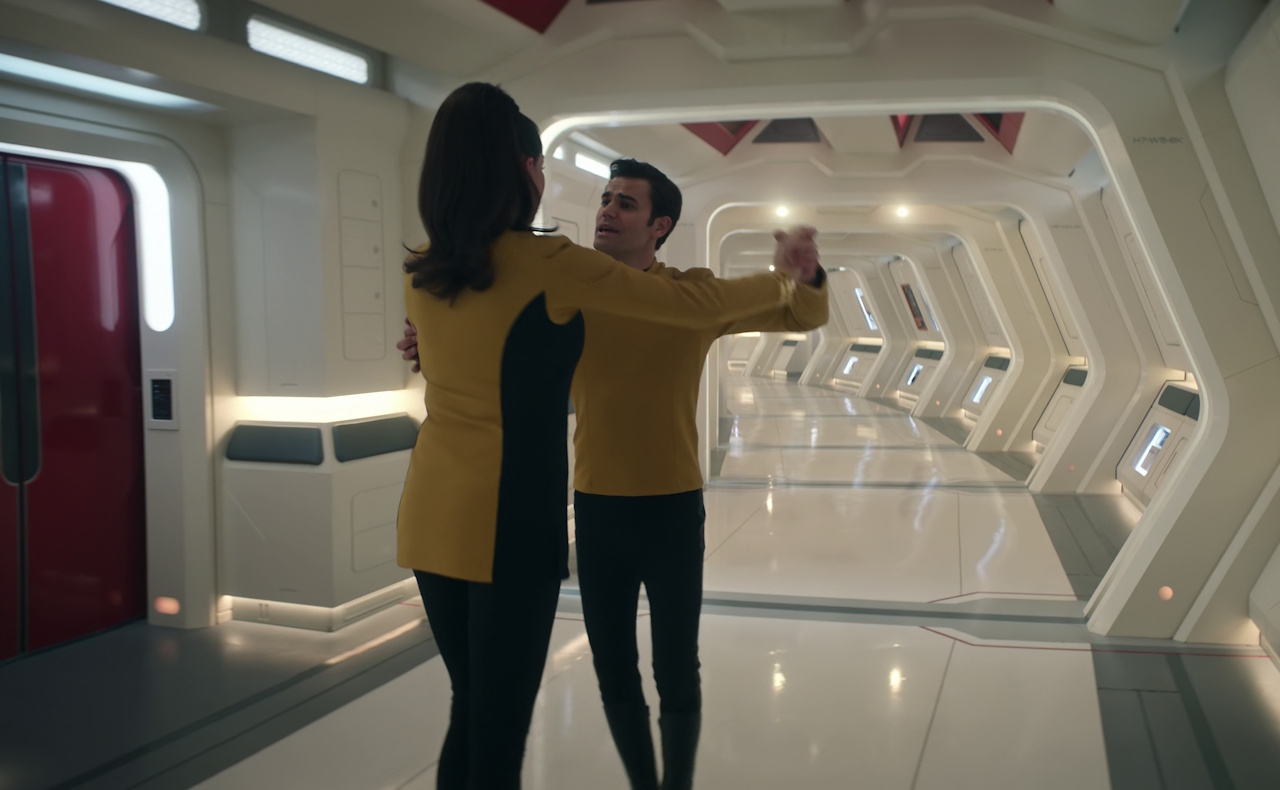
Still frame from Star Trek: Strange New Worlds Season 2 (2023) showing Kirk and Una dancing.
Una and Kirk dancing aboard the Enterprise.

Worse, musical episodes in shows that are otherwise not musicals have been – in my subjective opinion, naturally – universally terrible. Whether it was in Supernatural, Buffy the Vampire Slayer, or even Scrubs… I really didn’t like what was on offer. I’m a fan of the camp and kitsch as much as the next person, but musical episodes have always been a bridge too far. They feel offputting, immersion-breaking, silly, and even fan-servicey sometimes.

So it’s with that background that I approach Subspace Rhapsody.
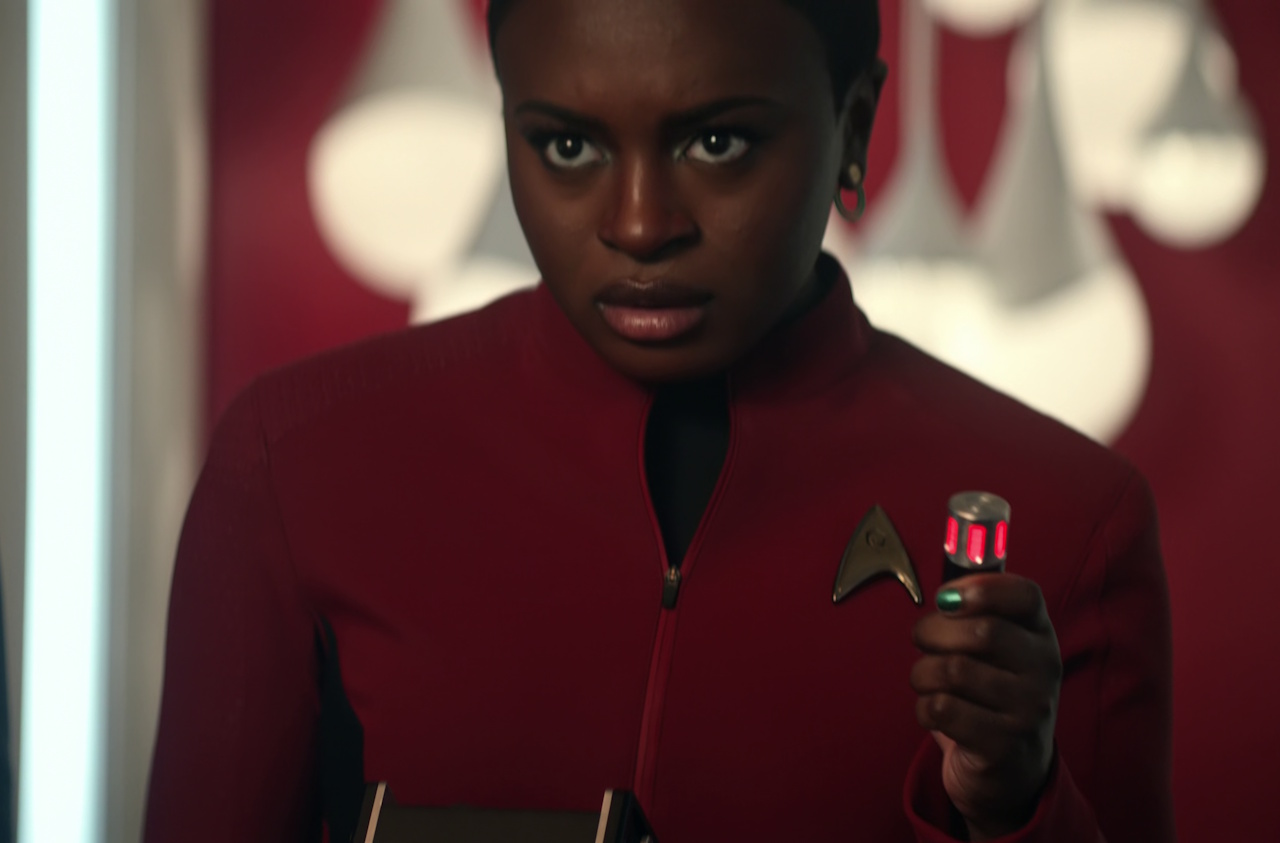
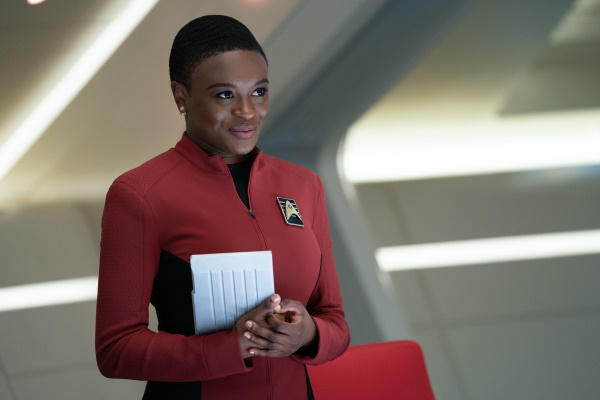
Still frame from Star Trek: Strange New Worlds Season 2 (2023) showing Uhura holding a tricorder.
Let’s analyse and dissect Subspace Rhapsody.

I’m gonna do something a little different for this review. Rather than waste your time and mine with a two thousand-word explanation of why I’ve never liked musical episodes, I want to try to stay positive and focus on some of the things I liked or appreciated about Subspace Rhapsody. Because I’m not gonna lie to you: I would rather hammer a rusty nail into my scrotum than watch this episode again. It was so far beyond cringeworthy that I barely got through it once.

First of all, let’s talk choreography and songwriting.

Creating a musical – any musical, really – is a lot of work. Trust me, I know: I used to do amateur dramatics, and we’d always have songs and performances in our shows! Rehearsing Subspace Rhapsody must’ve been a challenge, and for choreographers and vocal coaches, having to work with actors who are not natural singers nor particularly practised in musical theatre will have been an additional challenge. A lot of work went into writing songs, working with the actors to get the best possible take when recording the songs, and especially choreographing some of the bigger dance routines. Getting multiple performers to dance and sing in unison is a creative and technical feat. The fact that I didn’t enjoy the result doesn’t mean I can’t appreciate the skill that went into it!
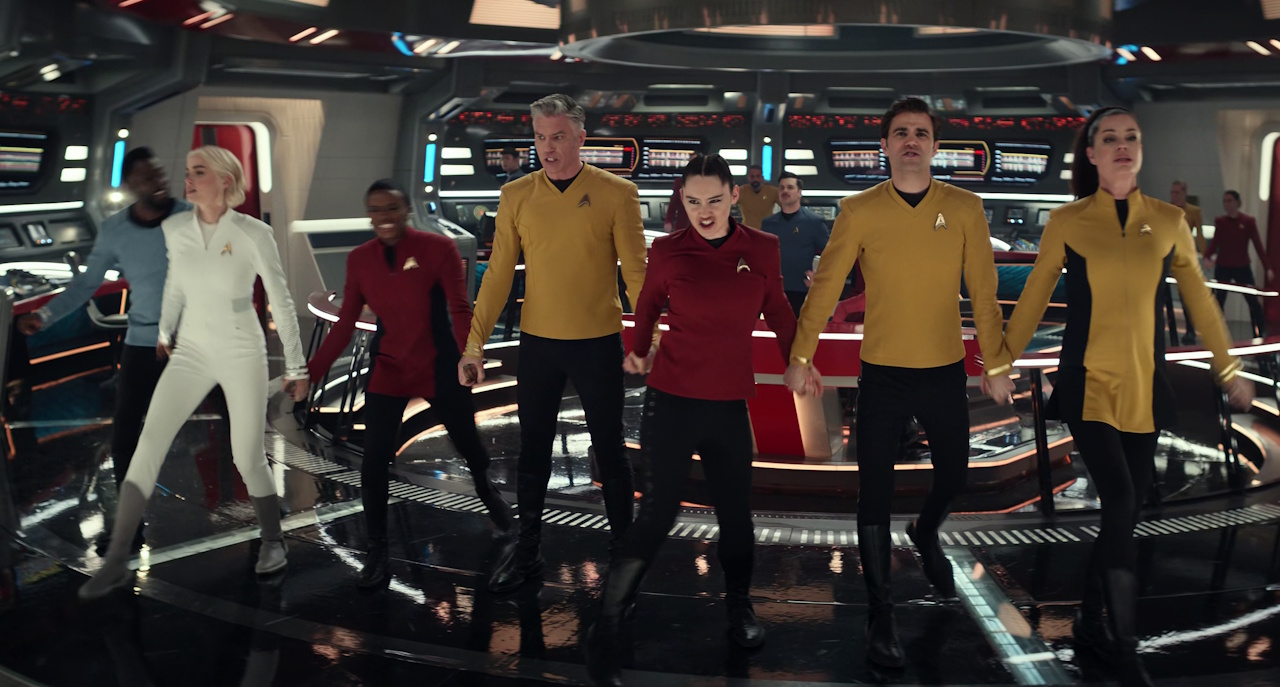
Still frame from Star Trek: Strange New Worlds Season 2 (2023) showing the main cast singing the final song of the episode.
Singing and dancing at the episode’s climax.

Redoing the Strange New Worlds opening theme as an a capella piece was creative, too. I actually didn’t mind the result – it was different from the usual theme (which happens to be one of my favourites in the entire franchise) while being familiar enough to still fit the opening titles. It was the right choice for this episode, and whoever came up with the idea deserves praise! As do the performers who vocalised the theme and the sound mixers who brought it together.

Secondly, the premise of the episode – a random space phenomenon causing chaos on the Enterprise – feels like something straight out of The Original Series or really any pre-Enterprise show. Subspace Rhapsody, in concept, wasn’t a million miles away from episodes like The Naked Time, If Wishes Were Horses, or Masks, which I mean as a compliment. Star Trek has always been ethereal and, for want of a better term, “weird” in its take on sci-fi, particularly in The Original Series and the early part of The Next Generation. It’s hard not to look at Subspace Rhapsody’s core concept through that lens, and stepping back to that style of storytelling after the intensely dramatic Discovery and Picard is a welcome change.
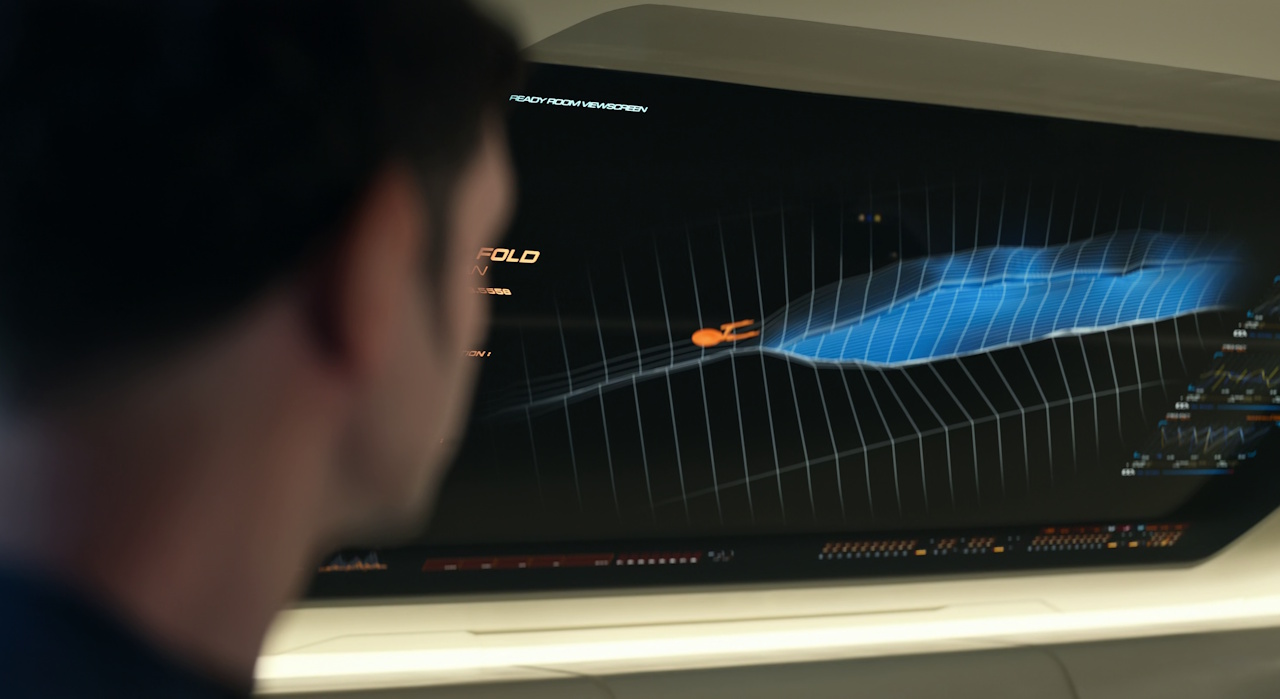
Still frame from Star Trek: Strange New Worlds Season 2 (2023) showing Spock and the improbability field.
The improbability field felt like something right out of classic Star Trek.

The quantum uncertainty field – or improbability field – felt so familiar, in fact, that I could’ve sworn it had been used somewhere else in Star Trek before! Not for musical reasons, it just seemed like a very familiar term. I was wrong about that, it was actually new for Subspace Rhapsody, but the concept felt very “Star Trek.” We’ve seen space phenomena lowering peoples’ inhibitions, making dreams come alive, or turning the Enterprise into a stone pyramid, so why couldn’t there be something out there forcing people to sing? It’s not so outlandish that it couldn’t be part of Star Trek’s occasionally wacky galaxy!

The one side of this that I felt didn’t work as well as intended was the danger posed by both the field itself and the Klingons’ response to it. At no point did I feel the crew of the Enterprise – or the wider Federation, come to that – were in any real danger. And I know in Star Trek stories the heroes always find a way to save the day… but that isn’t what I mean. Plenty of episodes and films can still feel tense, even though at the back of our minds we know there’s going to be a solution. But Subspace Rhapsody didn’t convey that feeling well enough for me, even when the Klingon ships were bearing down on the Enterprise.
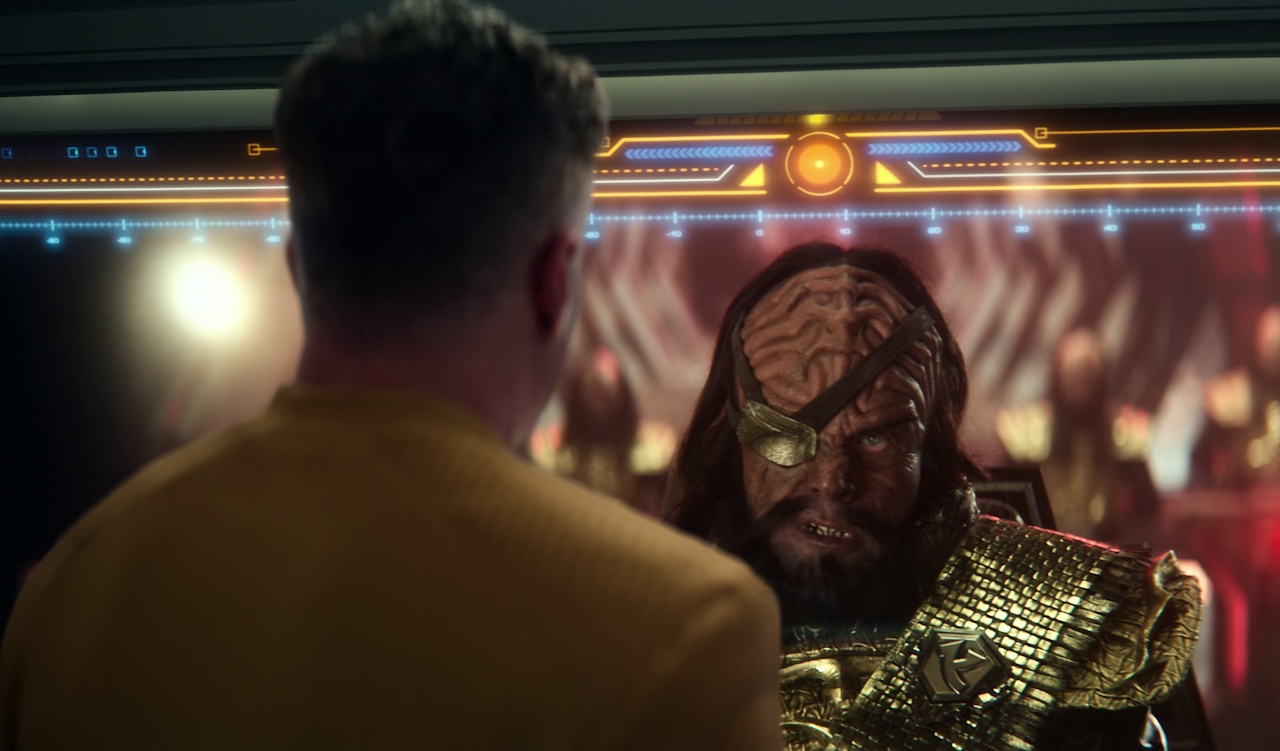
Still frame from Star Trek: Strange New Worlds Season 2 (2023) showing Captain Pike communicating with the Klingons.
The Klingons were partial antagonists in Subspace Rhapsody.

I was, I must admit, pleasantly surprised with the quality of the singing in Subspace Rhapsody. Often, when non-singers are pressed to take on musical roles… it’s kind of obvious, and all the auto-tune in the world can’t hide a lack of talent and training. To my surprise, most of the cast did well – even though it could be obvious that the singing was pre-recorded and everyone was just miming along. Still, I’ll take reasonably good lip-syncing over bad singing any day of the week!

Sticking with the songs, there are a couple more positives. I appreciate that the songs were all original – this wasn’t a “jukebox musical,” trying to recycle out-of-copyright songs from years gone by. Having the crew sing about their feelings and what was going on around them was silly, yes, but better than if they’d burst into a rendition of something like Button Up Your Overcoat or Embraceable You. Songwriting takes talent, and putting together original songs inspired by classic musicals on a budget is no mean feat.

Still frame from Star Trek: Strange New Worlds Season 2 (2023) showing Chapel singing.
All of the songs were original.

There must’ve been a temptation to try to emulate the style of composers like Lin-Manuel Miranda, creating pieces of music with a much more modern style. For my money – which, admittedly, doesn’t go very far in an episode like this one – Subspace Rhapsody was better-served by generally sticking with a more trad-pop style. The episode’s final musical number (its grand finale) was a bit of a departure from that, but trying to do the whole episode in that style, or with a mix of genres like disco or hip-hop, wouldn’t have been a positive.

Obviously Subspace Rhapsody was a great episode for Uhura, picking up her character arc from Season 1 and referencing how Hemmer had inspired her. Her growth as an officer, and finding her place both in Starfleet and aboard the Enterprise, were also instrumental to her role in the story, helping her discover a solution to the improbability field. We didn’t get to learn a lot about Uhura this time, nor did she really change over the course of the story, but her role in Subspace Rhapsody felt like the culmination of her arc across the show’s first two seasons. It was nice to see.
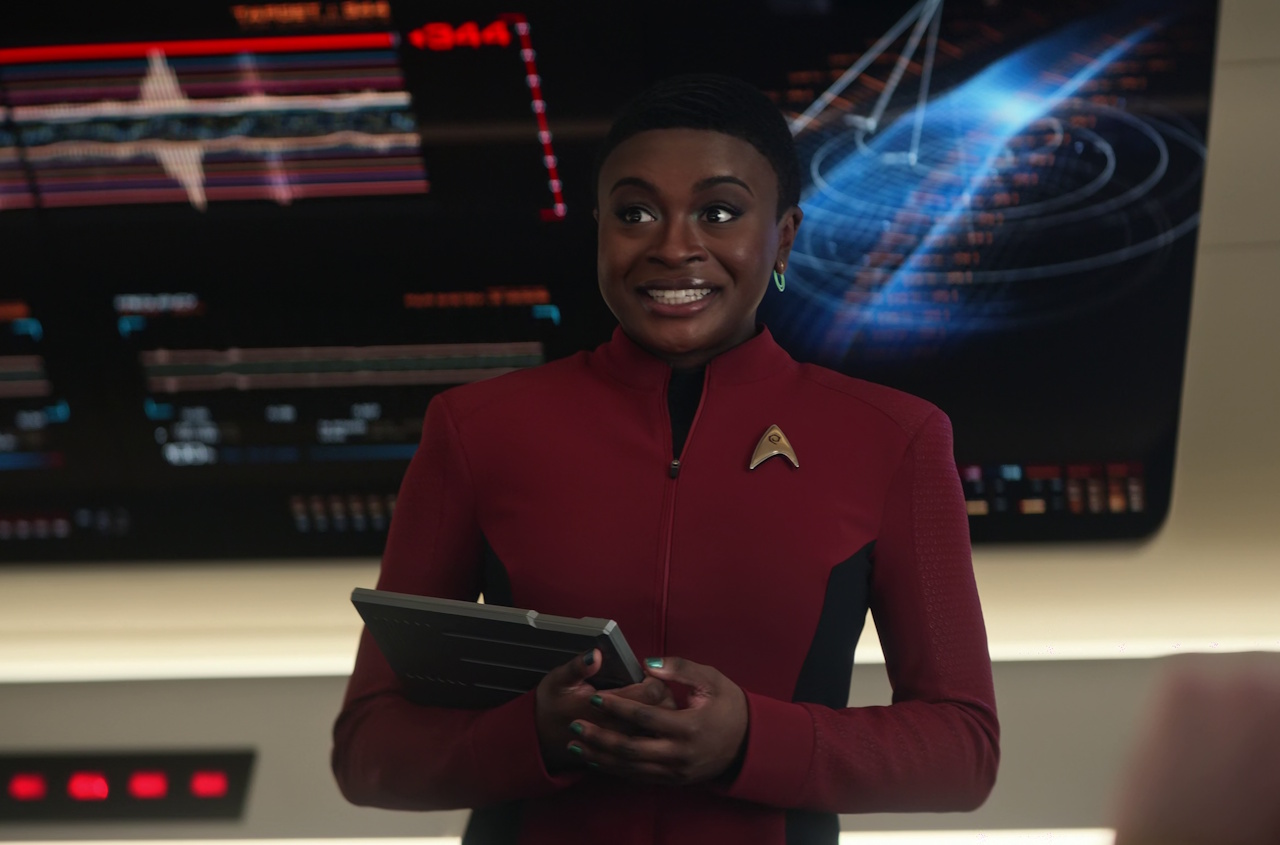
Still frame from Star Trek: Strange New Worlds Season 2 (2023) showing Uhura holding a padd.
Subspace Rhapsody was a big episode for Uhura.

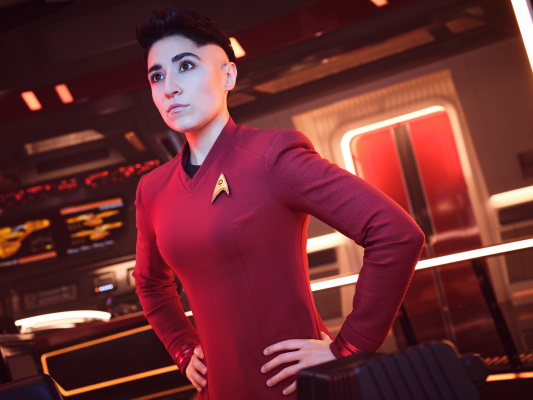
Subspace Rhapsody was also a great episode for La’an – particularly her relationships with Kirk and Una. La’an lanced the boil of her feelings for this reality’s version of Kirk, and while it didn’t go the way she might’ve wanted, there’s something cathartic in the act of confession. Hopefully it’ll settle those feelings for her going forward. This felt like a pretty relatable moment; who among us hasn’t had feelings for someone and tried, awkwardly, to talk to them? I know I’ve been in the position of feeling conflicted about whether to confess how I feel and how to go about it! It’s part of the human condition.

La’an and Una make a fun pair; there’s a kind of big sister/little sister relationship between them, sometimes. For Una to be the one La’an turned to when she was struggling with what to do about Kirk felt natural in the context of their relationship across the series so far, and deepening their bond was something I appreciated this time.
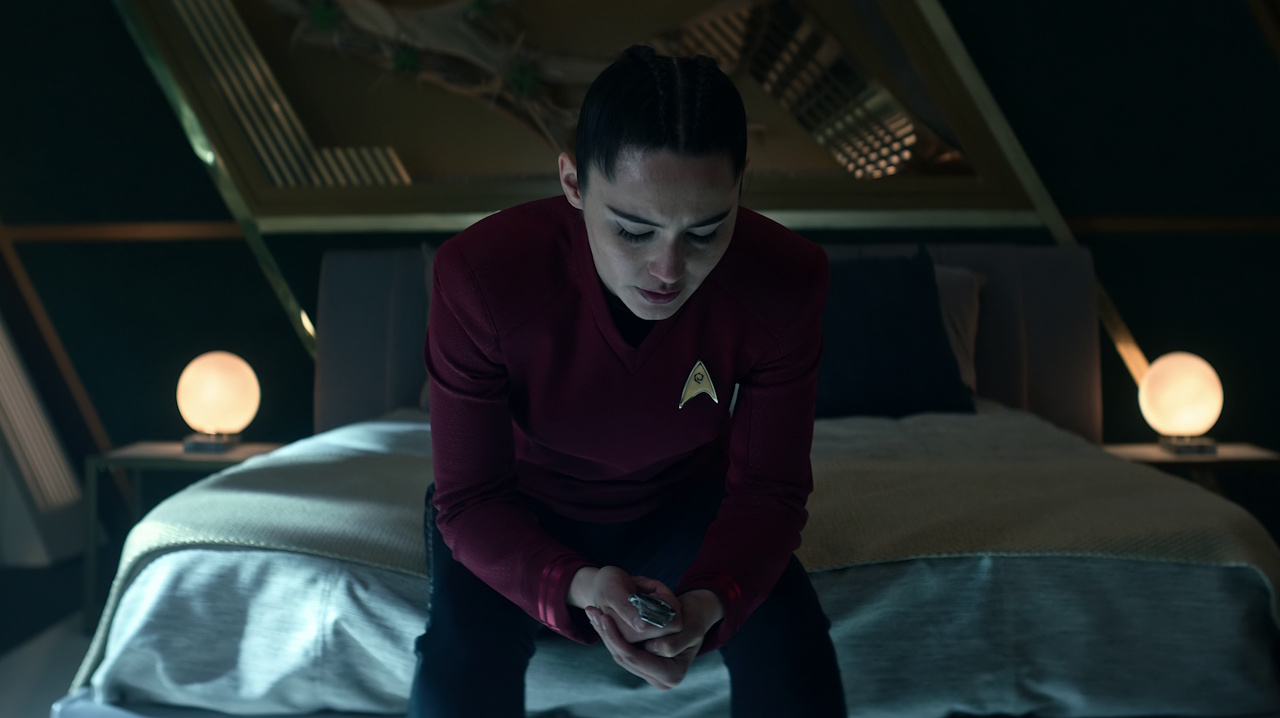
Still frame from Star Trek: Strange New Worlds Season 2 (2023) showing La'an sitting on her bed.
La’an evolved her relationships with Kirk and Una this time.

The one character I’d argue that Subspace Rhapsody didn’t handle well was actually Captain Pike. Firstly, Pike seemed to trip over a pretty basic relationship hurdle in a way that didn’t feel right for his character. The “issue” in his relationship with Captain Batel was so incredibly simple that it didn’t make a lot of sense to me that he wouldn’t simply propose a different kind of vacation or try to find a compromise. Allowing something so small to eat away at him and potentially damage their relationship just doesn’t feel like something Pike would do – even though, again, it was kind of a relatable moment. Sometimes in relationships something small can seem intimidating, and maybe the story wanted to get at Pike being inexperienced with this kind of thing. It was still wide of the mark, but at least I get what the story wanted to say.

Secondly, Pike is known for his inspiring speeches and his ability to motivate his crew. For him to delegate that task at the episode’s climax – with potentially huge stakes and the survival of Starfleet on the line – didn’t seem right. Uhura was well-positioned to speak to the crew, sure, but no one does inspiration quite like a ship’s captain. We’ve seen Pike take on that role several times already in both Strange New Worlds and Discovery, and while I get this was Uhura’s moment… the way the script brushed Pike aside to get there didn’t sit right with me.
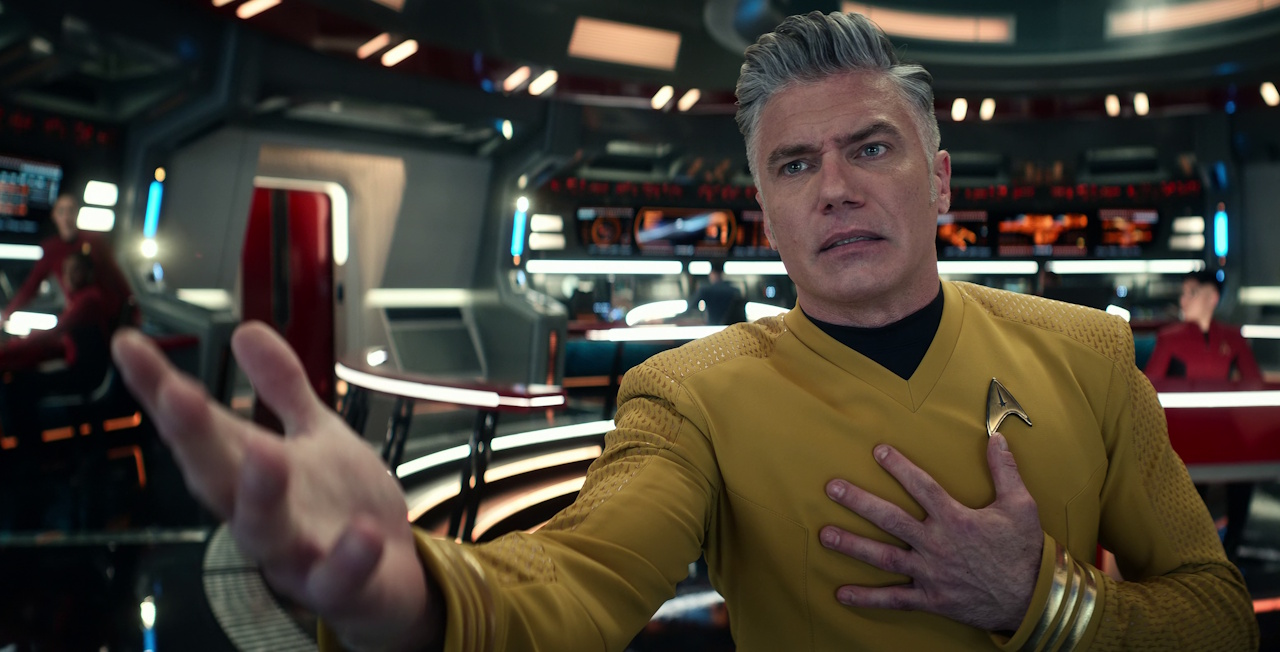
Still frame from Star Trek: Strange New Worlds Season 2 (2023) showing Captain Pike with his hand outstretched.
This wasn’t Captain Pike’s strongest episode.

We should also talk about Spock and Chapel, who seem to have come to the end of their brief relationship. I liked the callback to The Original Series on this side of the story – Roger Korby was a character from the Season 1 episode What Are Little Girls Made Of, and having him name-dropped here was interesting. I wonder if Korby will be mentioned – or even seen on screen – in Season 3.

I found both Spock and Chapel to be relatable on this side of the story… because I’ve been both of them at different points in my life. Leaving someone behind to take advantage of a once-in-a-lifetime opportunity is hard, and being the one left behind as a partner goes somewhere you can’t follow… that’s probably even more difficult. Spock’s intense feeling of rejection really hit me in a way I wasn’t expecting, and I think it also shows how far Spock still has to go in order to become the stoic Vulcan we’re familiar with from The Original Series. This younger version of the character is still carrying more of his emotional human side – and it came through in that moment.
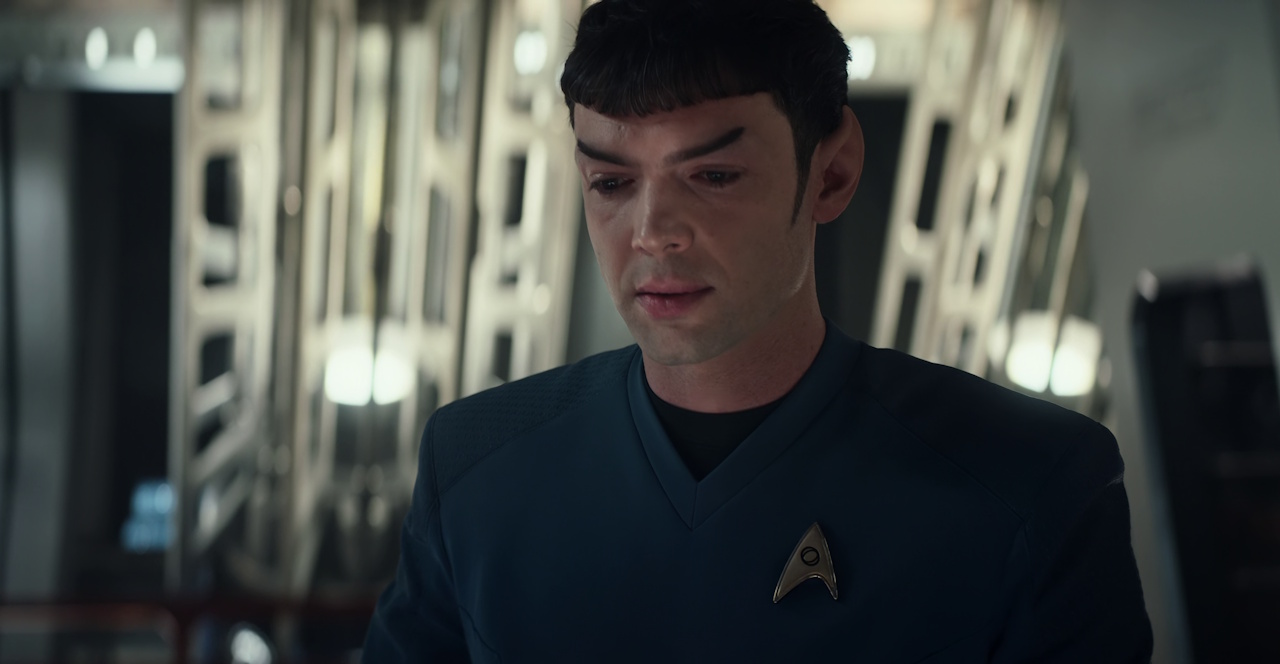
Still frame from Star Trek: Strange New Worlds Season 2 (2023) showing Spock.
Spock is still – on occasion – an emotional character.

There were several creative camera shots in Subspace Rhapsody, as well as some great special effects and animated moments. La’an gazing out of the window during her solo song, complete with a zoom out to the Enterprise, was great – and it’s a pretty uncommon shot in Star Trek, when you think about it. Una and La’an floating with the artificial gravity having been deactivated was also a neat effect, and another rarity!

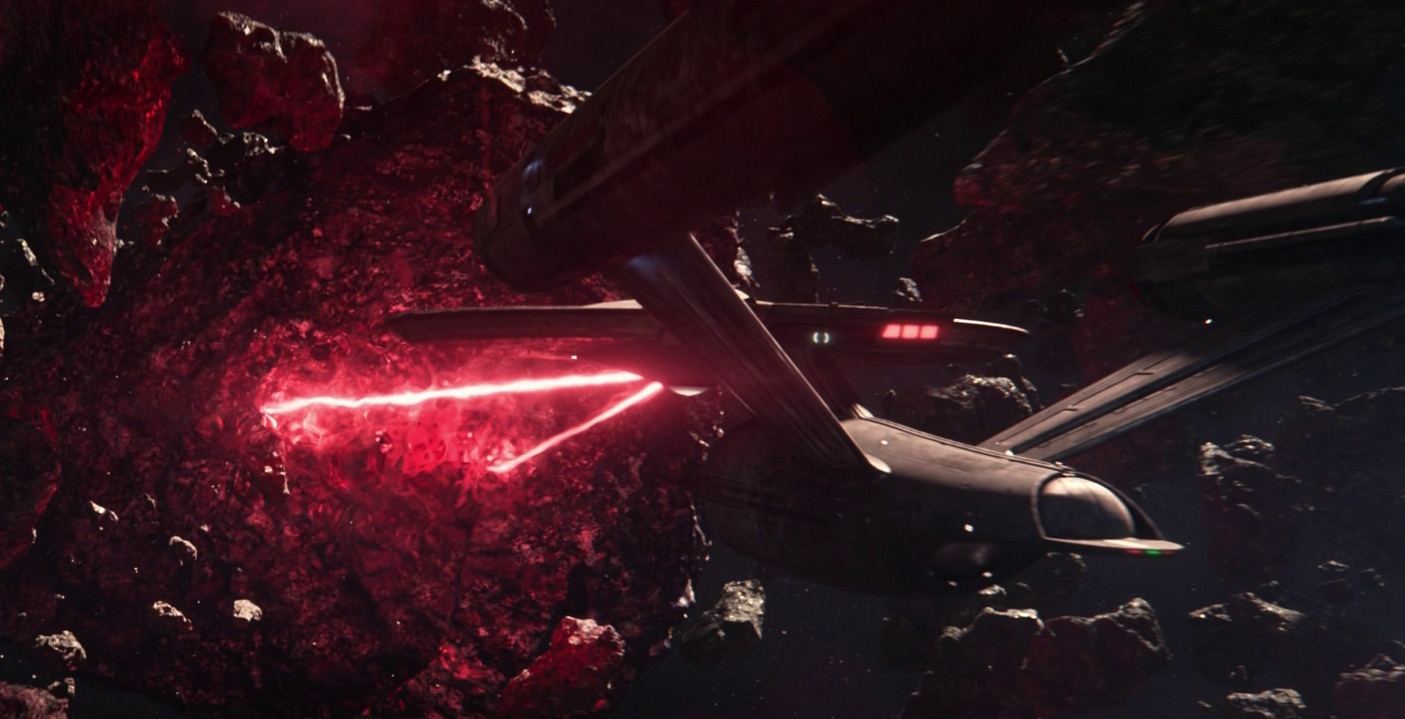
The Enterprise and three Klingon ships performing a kind of ballet in space was exceptionally creative, too, and tied into the theme of the episode really well. It was well-animated, and I liked seeing the D7 class (referred to as a K’t’inga class in the episode) back on screen once more. I also liked the classic warp effect that was used near the end of the episode as the Enterprise headed on to her next adventure.
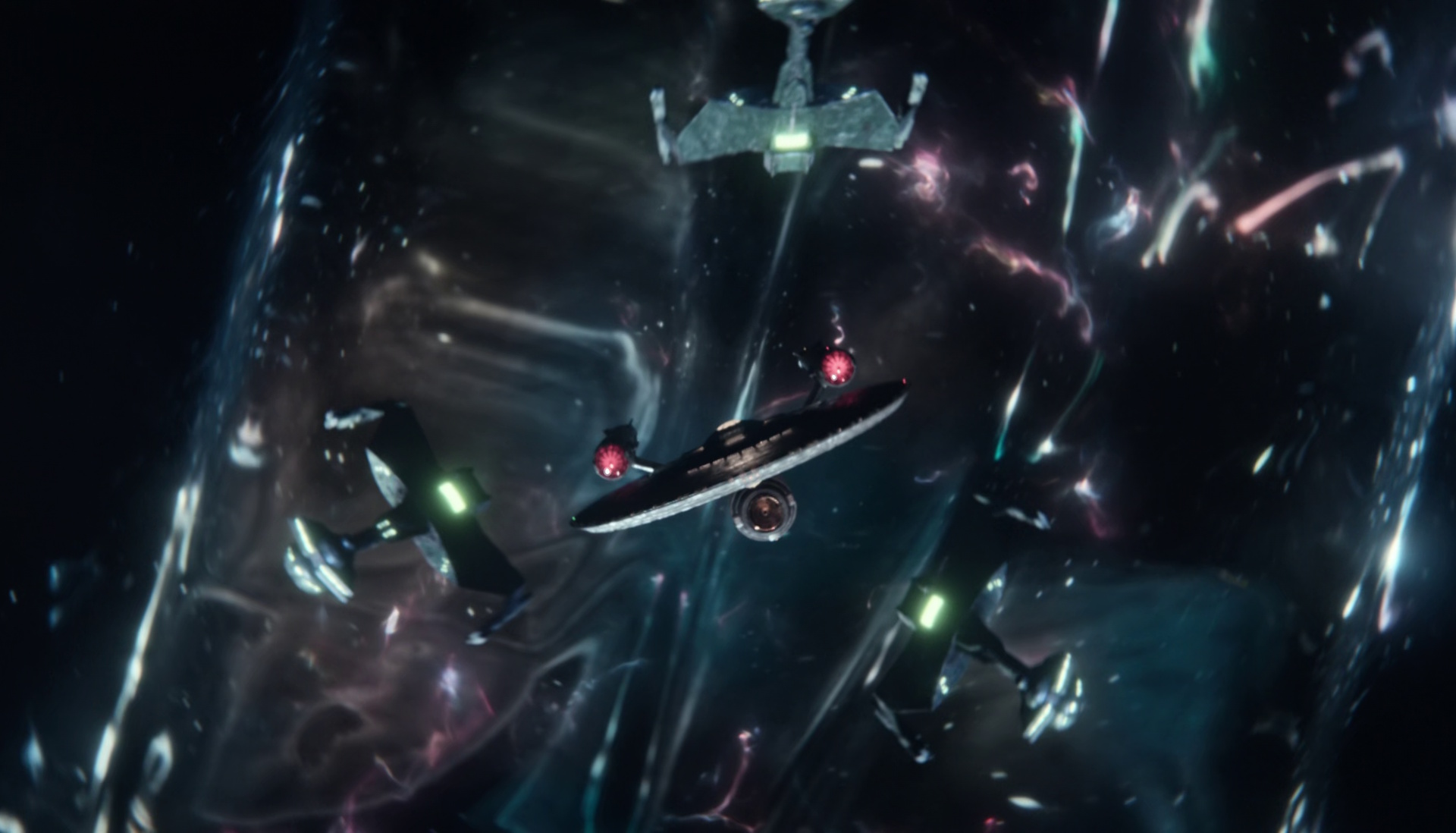
Still frame from Star Trek: Strange New Worlds Season 2 (2023) showing the USS Enterprise and three Klingon ships.
Even the Enterprise and the Klingon ships couldn’t resist dancing.

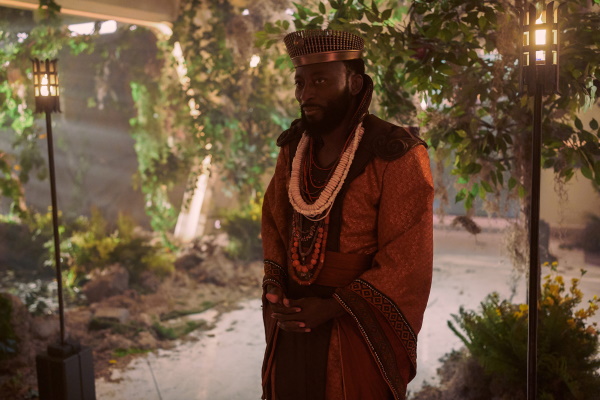
Speaking of the Klingons, I felt more than a little of Deep Space Nine’s General Martok in Bruce Horak’s Garkog. Not only do the two characters each have a missing eye, but Horak seemed to be channelling J G Hertzler in his performance, particularly in his first scene. Garkog was a pretty minor character in the grand scheme of things, but it was sweet to welcome back Bruce Horak for the second time this season. I still think it was a mistake to kill off Hemmer so early, by the way!

I could’ve spent another scene or two with the Klingons. We got to see their musical “dishonour” on screen, but I would’ve been interested to get a different perspective on the improbability field phenomenon. Maybe we could’ve seen Garkog and his crew trying to find a solution before their encounter with Pike and the Enterprise.
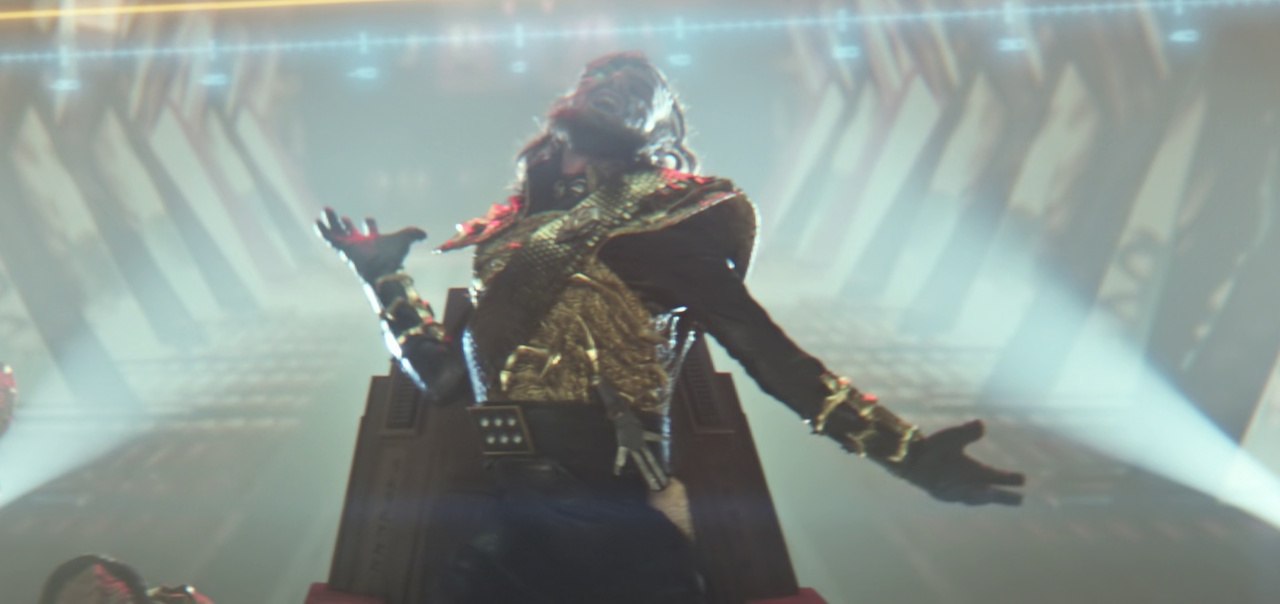
Still frame from Star Trek: Strange New Worlds Season 2 (2023) showing Klingon General Garkog mid-song.
General Garkog.

There were a couple of funny lines in Subspace Rhapsody that successfully won a smile. Pelia’s line in the briefing room about using the “zipper” was one, and Kirk’s a moment later about how he “almost understood” what Spock was saying was also a bit of fun. I would say that Kirk’s unspecified “commission review” felt like a bit of a clumsy way to shoehorn him into the story, but once he was aboard the Enterprise I enjoyed having him around.

So I think that’s everything I had in my notes this time.

Subspace Rhapsody was borderline unwatchable for me, and unless someone duct-tapes me to a chair and holds my eyes open, A Clockwork Orange-style, I will never watch it again. It was categorically not “my thing,” and I’m okay with that. Star Trek is an experimental franchise, and I welcome the creative team striking out in new directions, trying different things, and keeping Strange New Worlds a largely episodic project. As long as they don’t try to make a fully-musical series, I think I can cope with Subspace Rhapsody as a one-off.
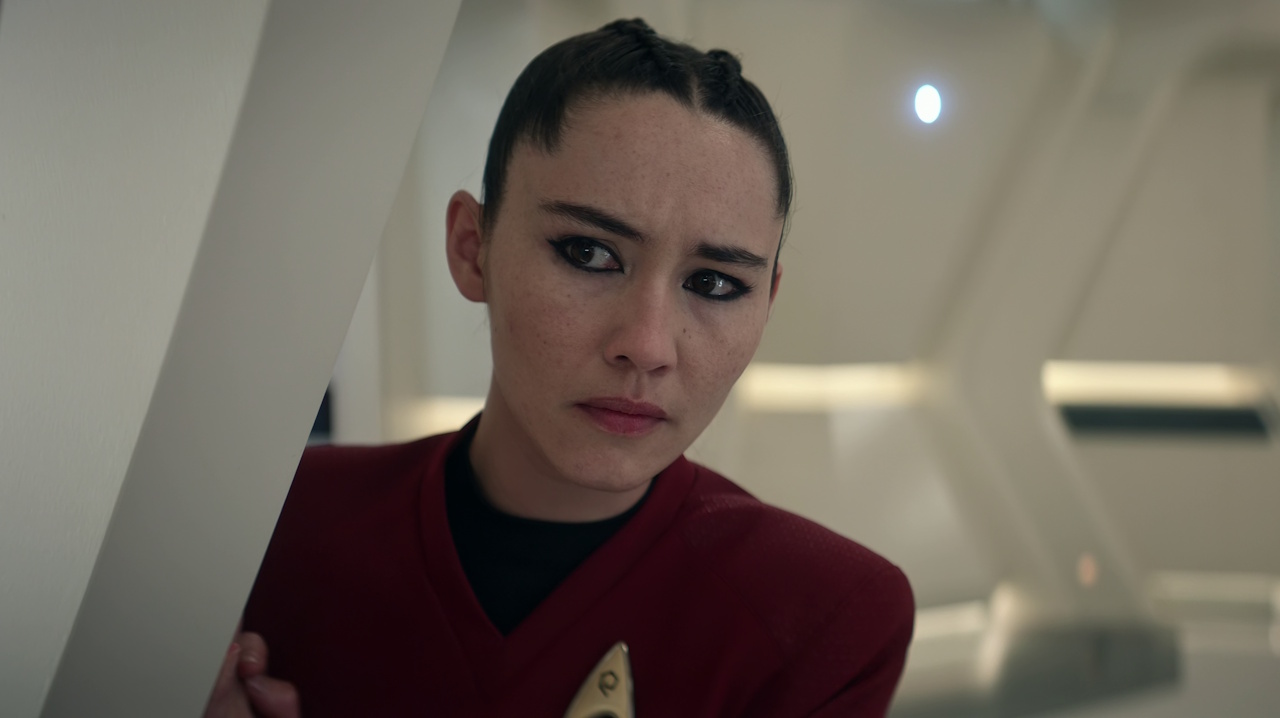
Still frame from Star Trek: Strange New Worlds Season 2 (2023) showing La'an peeking out from behind a wall.
La’an is spying on someone…

There were positives in the mix. Uhura and La’an got great moments of characterisation, Spock was particularly relatable, and it was fun to welcome back Paul Wesley as Kirk. His take on the character is fantastic, and I’m genuinely looking forward to spending more time with him in future. There was also some excellent cinematography and visual effects work.

On the musical side of things, here’s what I’ll say. There are some styles of storytelling, movie making, and entertainment in general that I personally don’t like or aren’t “my thing.” But I can still appreciate the skill, effort, and work that went into their creation, and I can acknowledge that they are exemplars of their genres. I don’t like opera, for instance, but I can still appreciate the years of training needed to sing that way, or the months of work and rehearsing that go into the staging of an opera.
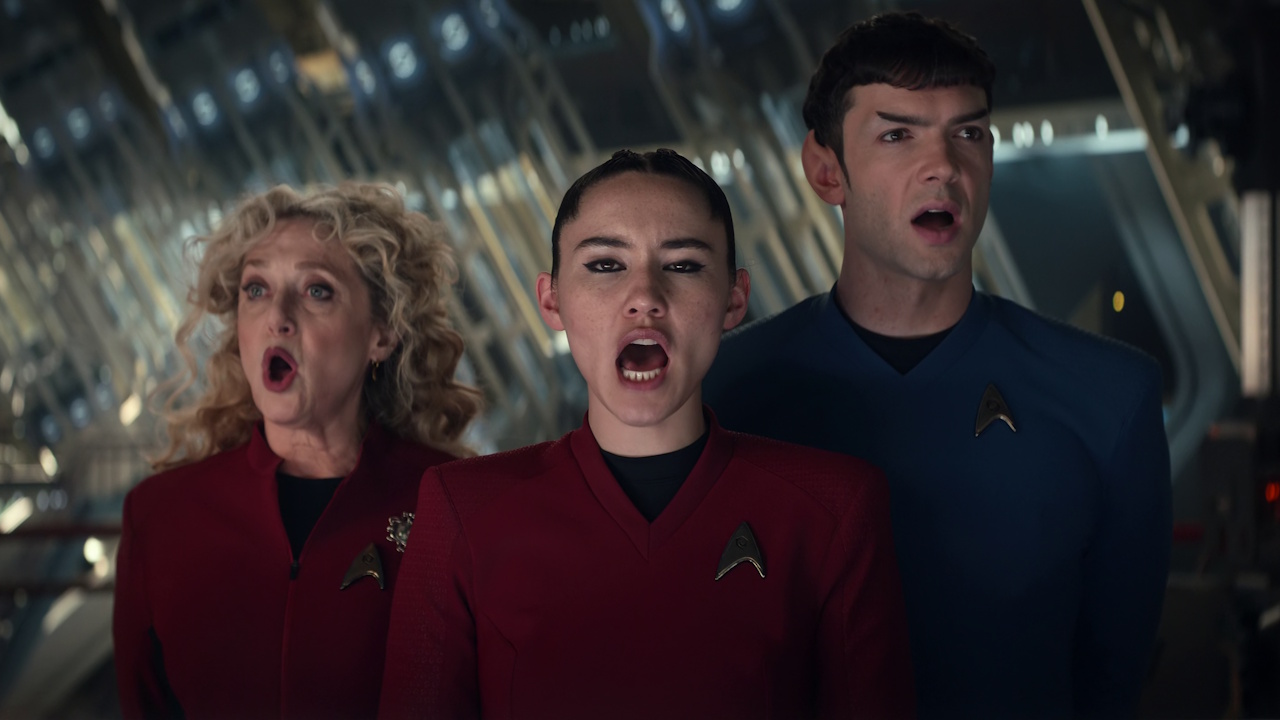
Still frame from Star Trek: Strange New Worlds Season 2 (2023) showing Pelia, La'an, and Spock singing.
Pelia, La’an, and Spock.

And that’s how I feel about Subspace Rhapsody, at the end of the day. I didn’t enjoy it – and I knew I wouldn’t before I watched it, hence all the procrastination – but I can tell that the cast, crew, and production team had a ton of fun with it. A lot of effort and practise went into some of the more involved musical numbers, and there was some genuinely great choreography – at least from my perspective as a layman. And as a Trekkie, I can appreciate other parts of the story even if the musical side of things really didn’t do it for me.

I hope this didn’t feel like too much of an attack on Subspace Rhapsody. If you liked it, or if you’re more a fan of musicals than I am, that’s great. And I will say that it looked like it would’ve been a lot of fun to work on as a dancer or background performer! It just wasn’t for me. I promised myself I wouldn’t watch Hegemony until I’d seen Subspace Rhapsody, so I really needed to get this out of the way to get to the end of the season! I’m ready to jump into that episode now… so stay tuned for what will hopefully be a more positive review sometime soon.


Star Trek: Strange New Worlds Seasons 1-2 are available to stream now on Paramount Plus in countries and territories where the service is available. The Star Trek franchise – including Strange New Worlds – is the copyright of Paramount Global. This article contains the thoughts and opinions of one person only and is not intended to cause any offence.

Star Trek: Strange New Worlds Episode Review – Season 2, Episode 4: Among the Lotus Eaters

Spoiler Warning: There are spoilers ahead for Star Trek: Strange New Worlds Seasons 1-2. Spoilers are also present for the following Star Trek productions: The Original Series and Enterprise.

I’m a bit late getting to Among the Lotus Eaters, so I apologise for that! I’m a couple of weeks behind with Strange New Worlds, and I hope to catch up over the next few days.

This episode brought several really interesting concepts to bear, gave Captain Pike his first proper outing of the season, and allowed us to spend more time with Lieutenant Ortegas than in any other story thus far. It took us back to a mission referenced in The Menagerie and The Cage all the way back in The Original Series, but put an unexpected spin on it. And all in all, I had a good time with Among the Lotus Eaters.

Let’s return to Rigel VII…

If I were to make one criticism of the episode it would be that it was perhaps a little overambitious – not in terms of its singular main story, nor even in its B-plot with Captain Pike’s romance, but rather in terms of the number of characters it tried to include. There wasn’t quite enough time to flesh out everyone’s experience with the memory-loss radiation, and I felt that Among the Lotus Eaters – somewhat ironically, given the storyline – seemed to jump quite quickly from one point to another, almost as if there were missing scenes or sequences that could have explained things a little more and provided the story with better pacing.

We missed out on seeing, for example, how the crew of the Enterprise regained their memories and returned to normal, how Dr M’Benga held off the Kalar warriors and went back for La’an, how Spock reacted to losing his memories, and how Dr M’Benga re-learned his medical skills. Unlike the deliberate time-skips – which were well-executed in the episode – these “missing” moments could have added something extra to the story, and if Among the Lotus Eaters had used fewer characters, or used the ones it included sparingly, more could have been made of some of these impactful moments.

La’an and Dr M’Benga near the end of the episode.

For the past three weeks I’d been commenting on how odd it has felt to see Strange New Worlds proceeding with so little input from Captain Pike – and I stand by that, even as I enjoyed what each of those episodes brought to the table. So it was fantastic to see Pike back in action this time, even though he spent much of the episode without his memories.

Captain Pike isn’t just the heart of Strange New Worlds, he’s the reason why the series came to exist in the first place. The incredibly positive reaction that fans had to Anson Mount’s portrayal in Discovery’s second season led to the series being commissioned, and Mount has been a joy to watch in every episode of the series so far. He put in a complex performance this week with some unusual material, and Pike’s connection with Captain Batel managed to keep things grounded and understandable, even as sci-fi shenanigans about radiation-induced memory loss and a rogue forgotten yeoman played out around him.

This episode was Captain Pike’s first real outing of the season so far.

This episode is the first since Enterprise’s second season episode The Communicator that really took a look at the idea of cultural contamination and its impact on Starfleet’s mission of exploration. The two stories play out very differently, and combined they make a great example of how Star Trek can take the same basic premise but have it play out completely differently each time. But as fans, and as people who are invested in this fictional setting, learning more about how Starfleet operates – and in this case, how the organisation behaves when things go wrong – is fascinating. We caught a glimpse of something we don’t always get to see in Star Trek: the aftermath of one of these “away mission gone wrong” setups that the franchise has used fairly regularly.

Speaking as we were of storylines that could’ve been fleshed out a little more, I think a flashback to the events of the original mission wouldn’t have gone amiss in Among the Lotus Eaters. Nor would a flashback depicting Zac’s rise to power on Rigel VII – or at least part of it. Zac himself, despite being the episode’s nominal villain, feels pretty flat and one-dimensional, and some additional explanation could’ve elevated him somewhat.

Zac was an interesting idea for a villain… let down by sub-par execution.

In fact, a better presentation of Zac could have nudged a fairly black-and-white story into a greyer area. If you think about it, what was Zac to do, stranded on a hostile planet with no hope of communication or rescue? Finding a way to preserve his memories – by using the ore that protected them – was about the only thing he could do, and using the resources at his disposal – i.e. his Starfleet kit – makes a degree of sense. There was a pathway here to tell a story with a villain who, if not sympathetic because of the extreme actions he took, was at least understandable, or the predicament in which he found himself could have been presented in that way.

Because we didn’t spend much time with Zac, I didn’t really get any strong feelings about him either way. I wasn’t desperate to see him beaten in the way I can be for some villains, but I also didn’t feel much by way of sympathy for his plight, either. He felt less a fully-rounded character than a plot device; an obstacle for Pike and the others to overcome just as they had to overcome their memory loss.

Zac defeated.

Captain Pike stated up-front that the cultural contamination of Rigel VII was on him – and he’s right, because as captain, the buck stops with him. He also noted that it was a chaotic mission that necessitated a rapid escape. But even so, I can’t be the only one who thinks that Pike and the away team managed to leave a lot of Starfleet junk behind, can I? I mean, Zac had at least half a dozen phaser rifles, an entire crate of Starfleet supplies, a tricorder, a medical kit, and more. Leaving behind a rogue phaser or communicator is one thing… but an entire crate full of stuff? Not to mention a crewman, too. That’s some sloppy away team work right there!

And I know: that’s a nitpick. It was necessary for the story to have all of those things in place. But c’mon… we should expect higher standards from the Captain of the Enterprise! If Rigel VII wasn’t afflicted with that memory-erasing radiation, leaving behind an entire crate full of Federation goodies could have completely altered the destiny of the planet. As it is, Starfleet may just get away with this blatant failure. But it’s not exactly a great look!

A lost communicator is one thing… but an entire crate?!

I’ve been racking my brain, thinking about The Cage and The Menagerie, but I don’t believe that anything in Among the Lotus Eaters contradicts or overwrites what we saw in those episodes. Strange New Worlds has managed to thread the needle: expanding our knowledge and updating a classic story but without treading on its toes. That’s something the series has consistently managed to get right, and I’m pleased to see the trend continue here.

Rigel VII is a planet that has been name-dropped in Star Trek on multiple occasions, often in throwaway lines or even in the background of episodes, but that we only really saw in that first-season episode way back when. It was actually quite nice to take a deeper dive into the mysterious planet, learning more about its inhabitants. Seeing a softer side to the Kalar was interesting, too, as the only Kalar we’d seen before were violent warriors.

The surface of Rigel VII.

Among the Lotus Eaters takes more than its fair share of leaps in logic and contrivances with its central memory loss concept. What knowledge is retained and how after “the forgetting” seems to jump around at the behest of the plot, with the Kalar seeming to hold onto things like the basic operation of their tools in a way that Starfleet personnel didn’t. A central idea on Rigel VII was the totem – mentioned repeatedly but barely so much as glimpsed on screen. The Kalar seemingly retained enough knowledge to look at the totem and decipher its pictograms, understanding from that where they were and what was expected of them. But aboard the Enterprise, Spock and the crew seemed to lose a lot more of their memories and knowledge.

Connecting retained memories to strong emotions was an interesting idea – and one that has some basis in fact, or at least can in some cases. But again, the way this came across on screen seemed inconsistent at best. While everyone aboard the Enterprise wandered around the halls aimlessly, only Lieutenant Ortegas seemed to have a strong enough emotional connection to her work to be able to break through. Are we to assume, then, that Nurse Chapel in sickbay, Pelia in engineering, and everyone else in every department aboard the ship couldn’t do the same? It’s a bit of a leap.

Nurse Chapel and other officers wandering the hallways of the USS Enterprise.

On the planet’s surface, the same was true of Pike and the away team. Pike seemed to retain a lot more of his personality than the crew of the Enterprise, and even compared to the Kalar and the other members of the away team, he managed to hang onto more of himself. If the story had stronger foundations, with an explanation for these discrepancies in the radiation-induced memory loss that was perhaps more easily followed, I think this would’ve worked better.

I think that Among the Lotus Eaters wanted to include something about proximity; that the Enterprise crew were more severely affected because the ship moved closer to the radiation-emitting asteroids. And indeed the epilogue states this as fact in voiceover form. But it wasn’t readily apparent on screen in the moment just what was going on, nor why Pike was able to push through the memory loss to a far greater extent. And that explanation still falls short when it comes to Ortegas and her ability to pilot the ship with finesse, fire the phasers, and generally drag everyone out of the difficult situation they were in.

Pike and Ortegas were able to push through their memory loss to a far greater extent than everyone else.

If we take Among the Lotus Eaters’ memory loss idea as being a metaphor for conditions like dementia or Alzheimer’s disease, we can see Strange New Worlds doing what Star Trek has always done: taking a sci-fi lens to examine a real-world situation. I’m no expert, but I think many of us know or knew a close relative who suffered, to a degree, with a condition like this, and there are definitely areas where this episode seemed to be at least acknowledging the comparison.

Some dementia patients, for example, remember how to perform tasks through “muscle memory,” which isn’t a million miles away from how Ortegas knew how to fly the Enterprise. Seeing the Enterprise crew silently and absently shuffling through the ship’s corridors also brought back memories of visiting an elderly relative in a care facility some years ago, and seeing patients there behaving in a simliar way.

Ortegas remembered how to pilot the Enterprise.

When Star Trek looks at real-world ailments through its sci-fi lens, one thing I’ve always found inspirational is the idea that one day, through advancements in science and technology, life-limiting or even fatal conditions that impact people today can and will be cured. Geordi’s blindness is a great example, and his line in The Next Generation to a Romulan officer that the 24th Century Federation sees value in everyone is something I’ve long felt embodied this aspect of the franchise.

With that in mind, if we stretch our dementia metaphor to its logical end point… I don’t really see what point, if any, Strange New Worlds intended to make. Its sci-fi ailment came with an equally sci-fi resolution, and while one of the Kalar expressed gratitude for regaining his memories and seemed to come to understand their value… that was quite a rapid turnaround for a single secondary character, and wasn’t really enough on its own to be a payoff to a story like this. Maybe I’ve overthought this aspect of Among the Lotus Eaters based on a couple of scenes that felt close to some of my personal experiences.

Nurse Chapel.

Spock’s role this week, while relatively small, was nonetheless an interesting one. Spock’s journey in Strange New Worlds isn’t about recreating exactly the character we’re familiar with from The Original Series, but exploring who he was before that and how he came to become that individual. Seeing Spock make a mistake, taking the Enterprise to the asteroid field on the assumption that it would provide cover, feels like something that could have been a big step for him.

We’ll have to see if this moment is called back to in future episodes, because based on Among the Lotus Eaters alone, I don’t think we really gained a lot of insight into Spock. We saw in a strictly factual sense that Spock can make a mistake, or that his assumptions can be wrong, and I can see how we might extrapolate from that and say that it’s one reason why Spock is so hesitant to make guesses or assumptions as he gets older. But none of that was explicitly stated on screen, and I’d like to see a bit more of that when these kinds of stories arise for Spock.

This could be an interesting foundation for a Spock story.

So here’s a question: was the Kalar palace on Rigel VII supposed to be the exact same one as Pike and co. visited years earlier? Strange New Worlds has updated and, for want of a better term, retconned a number of designs and aesthetic elements across both seasons so far, and when you combine that with the fact that Zac may have made changes in order to better shield the palace and its occupants… I think we can make the case for this castle being the same one that had been seen in The Menagerie and The Cage.

The design was neat in some ways, though I would say – not for the first time in Star Trek – that the castle’s interior and exterior didn’t quite gel. I’d have liked to have seen more of the palace’s exterior design reflected in the set used for its interior – or vice versa. The exterior sets were all created with the help of Paramount’s AR wall, and parts of the snowy, windswept landscape felt quite similar to Season 1’s Valeo Beta V – the planet seen in All Those Who Wander. Neither of these things were bad per se, but it’s the first time in the show so far where I felt that set design was perhaps letting the story down somewhat.

I didn’t feel that the palace interior and exterior matched.

So let’s start to wrap things up!

Among the Lotus Eaters brought together two genuinely interesting concepts: the memory loss radiation and revisiting the only other mission and planet that we saw in The Menagerie and The Cage. Talos IV, remember, had been seen a couple of years ago during Discovery’s second season. Strange New Worlds has now exhausted “classic Pike” storylines, if we can use that definition here.

The memory loss idea was imperfect in its execution, with contrivances involving the extent of characters’ amnesia, the way in which it manifested, and how they were able to push through using emotion or connections to the world around them. Some more explanation – even if it had been little more than technobabble – could have limited the damage here, and built a stronger foundation for this idea.

Captain Pike.

As a metaphor for conditions like dementia, I’m not sure how well Among the Lotus Eaters’ memory loss storyline worked. There was a visual presentation of the Enterprise’s crew that felt uncomfortably real, and the real-world ideas of emotion and “muscle memory” being able to cut through have a basis in fact. But I’m not sure what – if anything – this story wanted to say. It was wrapped up neatly by the end of the episode, with the implication being that Pike’s decision to remove the meteorite would bring a permanent end to the Kalar’s “forgetting.”

On the other hand, the character moments in Among the Lotus Eaters – particularly with Pike and Ortegas – were strong. Pike’s internal dilemma about his burgeoning relationship with Captain Batel was believable, complex, and cute, and the way Pike reached out to Una for guidance went a long way to cementing their relationship as captain and first officer, too. Pike being able to break through his memory loss by focusing on his strong feelings for Batel and the gift she’d given him not only provided a (somewhat convenient) route for the story to take, but also told us a lot about Pike himself.

Fire phasers!

All things considered, I had a good time this week. Among the Lotus Eaters probably isn’t Strange New Worlds’ strongest episode, but it’s a Star Trek story through-and-through. It had an interesting mystery, a sci-fi/fantasy storyline that verged on the mystical, some exciting moments of action, and a villain who, while not as well-developed as I’d have liked, was strong enough to keep things entertaining.

I haven’t watched Charades yet, but I hope to take a look at that episode in the next day or two, and to get back on track with this season’s episode reviews. Thanks for bearing with me!

Star Trek: Strange New Worlds Seasons 1-2 are available to stream now on Paramount Plus in countries and territories where the service is available. The Star Trek franchise – including Strange New Worlds – is the copyright of Paramount Global. This article contains the thoughts and opinions of one person only and is not intended to cause any offence.
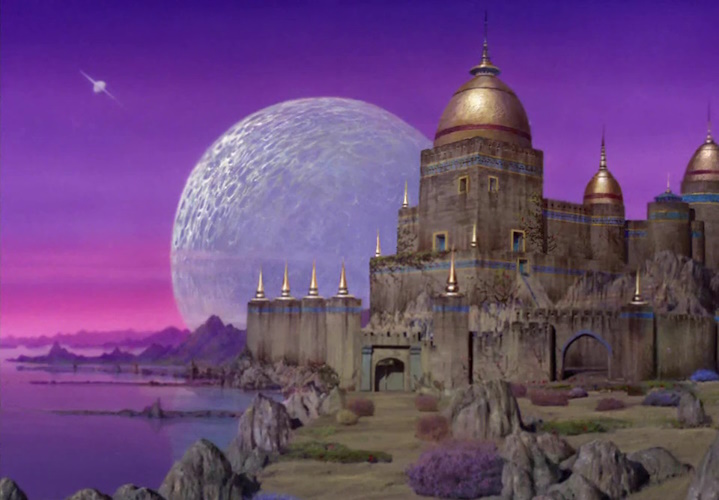
Star Trek: Strange New Worlds Episode Review – Season 2, Episode 3: Tomorrow and Tomorrow and Tomorrow

Spoiler Warning: There are spoilers ahead for Star Trek: Strange New Worlds Seasons 1-2. Spoilers are also present for the following Star Trek productions: Picard Season 2, Enterprise, Voyager, and Deep Space Nine.

Tomorrow and Tomorrow and Tomorrow was an interesting episode – and one of the better time travel stories in modern Star Trek. Its central pairing of La’an and an alternate timeline Kirk was interesting, and one that accomplished the objective of putting them together but without treading on the toes of established canon; Kirk’s legendary conflict with the original Khan Noonien Singh is something that modern Star Trek needs to preserve at all costs!

There were a few contrivances in the episode, though, and both the opening act and Kirk’s willingness to erase his own timeline seemed to be quite rushed. That’s despite Tomorrow and Tomorrow and Tomorrow being the longest episode of the season so far!

Stranded in the past…

I’ve commented on this twice already this season, but here we go again: where oh where is Captain Pike?! Was Anson Mount unavailable for part of the season’s production? In the first episode, Pike was present only briefly before taking off on a mission of his own. Last week, the opening act saw Pike recruit Una’s lawyer – but he was then sidelined and didn’t have much to say. And this week, Pike got one line in a very short sequence right at the end of the episode. Is Paramount paying Anson Mount by the line these days? What’s going on?!

I say that jokingly – but Strange New Worlds was “the Captain Pike show” when we were campaigning to make it happen. You have to admit that it’s odd, at the very least, for Pike to have been so thoroughly absent in the first part of this season. Basically one-third of Season 2 has now progressed with very little input from the Enterprise’s captain. In past iterations of Star Trek there were always spotlight episodes for individuals and stories in which some characters were more prominent than others… but these came in longer seasons, and it was still relatively uncommon to go three episodes in a row with the captain having so little to do. In modern Star Trek it’s unprecedented; can you imagine if Discovery had run three episodes with so little screen time for Burnham? I just find the whole thing rather perplexing – even though I’ve enjoyed each of these three episodes.

Captain Pike was once again notable by his absence from the story.

Let’s talk about a specific story criticism. Tomorrow and Tomorrow and Tomorrow saw La’an make wild assumptions and leaps that had no basis in fact or logic. Given that she’s been thrust into a completely new and unfamiliar situation, her assumption that she must have been sent to a specific timeline to team up with Kirk, or to a specific moment in the past for a reason, or that the device she was given wouldn’t “unlock” until she’d completed her mission… all of these things and more needed more time to play out.

As much as I dislike Picard’s second season, the episode Penance is actually a reasonably good example of this “fish-out-of-water” idea. In that story, Picard and several of his crewmates find themselves in an alternate timeline, separated from one another and with no idea of what’s going on. It takes them basically an entire episode just to piece together what’s happened and get back together; it’s not something that can or should be rushed in the way that Tomorrow and Tomorrow and Tomorrow tried to do.

La’an and Kirk made some wild leaps in logic.

We know that La’an is capable and self-reliant, but her completely baseless assumptions – though validated in a way by the resolution of the story – undermine her characterisation and significantly weaken the episode. Because of the time constraint, it was necessary for La’an to quickly assess the situation she found herself in and come up with a plan – but there may have been ways to cut some other scenes and sequences down, giving this incredibly important setup more time to play out.

This is also true, to an extent, of other parts of the episode. After seeing the bombing and chasing after stolen parts, La’an and Kirk seemed to pretty quickly figure out – again, via baseless assumption – what they had been sent to the past to do. Although Tomorrow and Tomorrow and Tomorrow found time to slow down in between these rushed moments, the main plot of the episode seemed to leap from point to point incredibly quickly, leaving very little time to digest what was going on. I wanted to shout at La’an and Kirk to slow down and give me a moment to catch my breath!

Racing through the streets of Toronto…

While we’re picking holes in the story, I’ll say this: time travel can be exceptionally difficult to get right in any fictional setting. It’s all too easy to write oneself into a corner, relying on paradoxes, tropes, and “you can’t tell anyone this ever happened” in order to get out of it. The end of Tomorrow and Tomorrow and Tomorrow raises such a point: if the Department of Temporal Investigations knew what was going on and were able to observe La’an and Kirk, why didn’t they intervene?

La’an is a 23rd Century security officer, and Kirk was a starship captain from a dystopian timeline that shouldn’t exist. They are categorically not the best-qualified people to stop a Romulan super-spy from the future… not without help or guidance, at any rate. If the episode had ended without the official from Temporal Investigations showing up, I guess we could have written it off as the first agent turning to La’an out of desperation. But knowing that this organisation had been watching her all along… it kind of smacks of Enterprise’s Temporal Agent Daniels teaming up with the 22nd Century’s Captain Archer. Surely these organisations have their own staff!

Doesn’t the Department of Temporal Investigations have its own staff?!

That being said, Tomorrow and Tomorrow and Tomorrow might just be my favourite Star Trek time travel story – or at least my favourite one for a long while! Time travel to the modern day is difficult to get right, and practically every Star Trek episode that’s taken this approach has also taken its crew to the sunlit coast of southern California. This happened in Voyager, in Picard, and even in The Voyage Home. By taking the simple step of visiting Toronto (where the series is filmed) Strange New Worlds was already doing something different. I appreciated that.

I was worried that, coming only a year after Picard Season 2 had spent eight-and-a-half episodes wandering in the 21st Century, Tomorrow and Tomorrow and Tomorrow might just turn me off before it even got started. Luckily that wasn’t the case, and we got a good mix of lighthearted moments. Kirk and La’an having to figure out how to dress and how to act in an unfamiliar environment stood in contrast to the heavier storyline involving time-travelling terrorists and a plot to stop the Federation from ever being created.

There were lighter moments to balance out a heavy story.

This last point – preventing the Federation from coming into existence – was a fascinating one that I would have loved to explore in more detail. Because it was only revealed at the climax of the plot that the Federation’s existence hinged upon disaster, genocide, and the reign of terror that Khan brought to Earth, there wasn’t an awful lot of time to get into the real implications of this – and of the decision that La’an was forced to make.

But this is such an interesting idea! I even wondered if Picard’s aforementioned second season might’ve been going for a similar setup, because the idea of having to consciously choose to permit something so horrific is a real moral quandary. In that moment, La’an was face-to-face with one of Earth’s most brutal dictators. She could have chosen to kill him, sparing Earth the torment that she knows is 100% guaranteed to happen. But she didn’t – she couldn’t. Not because she wanted it to happen, but because she knew that without those horrors, the future would be radically and almost unimaginably altered.

La’an confronted her family legacy.

The fact that La’an has a personal family tie here makes it an even more complex idea. La’an has spent her life living in the shadow of an infamous, hated ancestor – and she was given an opportunity to prevent any of that from ever happening. The themes at play here, expressed through La’an’s decision and the impossible choice that befell her, are incredibly deep, and Tomorrow and Tomorrow and Tommorow almost feels like an episode posing a challenge to its viewers: what would you have done in her place?

This storyline also updates that of Khan and his augments, changing parts of Star Trek’s internal timeline. The Romulan super-spy seemed to imply that the actions of a variety of time-traveling factions may be to blame for Khan’s rise to power taking place decades later than it was supposed to – and that’s something we’ll have to digest or figure out later if it ever returns as a major plot point!

Young Khan.

For now, suffice to say that I’m not a canon “purist,” and I like the idea of Star Trek refreshing and updating itself. That being said, I don’t necessarily feel that the specific timing of Khan’s rise to power is some kind of gaping plot hole that needs to be plugged, even as Star Trek continues to tell modern-day time-travel stories that, in theory, contradict or overwrite parts of the franchise’s prior history. Tomorrow and Tomorrow and Tomorrow could have proceeded just fine without this somewhat ambiguous line.

This was, perhaps, Strange New Worlds throwing a bone to long-term fans: people like you and I who remember Spock’s line in Space Seed confirming that Khan’s ship left Earth in the late 1990s. Is that a discrepancy? Sure, of course it is. But does it matter? Should all future Star Trek projects avoid modern-day time-travel because the franchise’s fictional history tells us that the late 20th and early 21st Centuries are radically different from how they actually turned out to be? Personally I don’t think so – though canon purists may disagree!

The crew of the Enterprise will meet Khan again…

At first, I was concerned that I wouldn’t be sold on Tomorrow and Tomorrow and Tomorrow’s Kirk-La’an relationship. But as the story progressed, this turned out to be one of the episode’s strongest elements. The slow buildup to their shared kiss stood in contrast to other story beats that felt rushed or blitzed through too quickly, and by the time Kirk was dying in La’an’s arms, the love story that the episode had constructed truly hit home and formed a much stronger emotional core to the story than I’d been expecting.

Paul Wesley has earned my respect for not only taking on the role of Captain Kirk – a role that is fraught with criticism and that is watched hawkishly by fans – but for putting his own spin on it. Wesley’s Kirk isn’t an attempt to mimic William Shatner’s portrayal – nor Chris Pine’s, come to that. Paul Wesley has made the role his own, showing off his own range, his own emotions, and his own comedic timing. It’s not a carbon copy – any more than Ethan Peck’s Spock is a carbon copy of Leonard Nimoy’s. But I’m impressed with what he’s done with the character – and this alternate version in particular gave the actor a fair amount of leeway.

Paul Wesley as Captain Kirk.

Does La’an’s contact with Pelia form a paradox? I guess we could argue that it does! If Pelia was inspired to become an engineer by La’an in the past, then investigating her possessions was the reason why La’an was alone in the corridor when she crossed over to the alternate timeline, then… wait, my head hurts.

Pelia’s role in the episode was fun, paradoxes aside. It was neat to see Kirk and La’an tracking her down in the past, and the resolution to this side of the story both gives a bit of background to Pelia that we didn’t have before while also being a lighter moment as it became clear that she wasn’t an engineer and would be of no help whatsoever in creating a tracking device. Again, the resolution to this point felt rather contrived and rushed, but the scenes between La’an, Kirk, and Pelia were more than strong enough to carry the story through.

Tomorrow and Tomorrow and Tomorrow was interesting for the character of Pelia.

Although it was obvious that there would be no “happily ever after” for La’an and Kirk, the way in which the latter was killed was still pretty brutal by Star Trek standards. The episode did a reasonable job at setting up the idea that La’an and Kirk had hope that he might’ve been able to transport back to the prime timeline, but it still felt like a sure thing that that wouldn’t be able to happen, no matter how much they wanted to believe it.

As mentioned, though, the let-down on this side of the story was the rapid, blink-and-you’ll-miss-it turnaround in Kirk. The episode wanted to say something like this: after seeing Earth for the first time with his own eyes, learning of his brother’s survival, and hearing La’an’s tales of a United Federation of Planets and a peaceful, prosperous humanity, Kirk was willing to sacrifice his timeline in order to bring hers into being. Self-sacrifice is a well-established Kirk trait, so that tracks.

Kirk was killed.

But there just wasn’t enough time for this to play out effectively, and it makes the story substantially weaker than it could’ve been. In order to fit in everything else that Tomorrow and Tomorrow and Tomorrow wanted – the visit to Pelia, the relationship buildup, the car chase, La’an’s run-in with Khan, etc. – this side of things took a back seat. And while other story points worked well, I’m having a hard time with this supposedly grizzled, battle-hardened version of Kirk being so willing to wipe everyone he’s ever known from existence.

This is something that could have been made more of, particularly in terms of a conflict between La’an and Kirk. Two characters from two alternate realities find themselves at the “fork in the road,” where one path leads to one timeline and the other path to a very different one. There was potential in the idea of them arguing over which way to go, because from Kirk’s perspective at least, don’t his people have as much of a right to exist as La’an’s? The episode just didn’t spend much time on what could have been a really interesting idea – and the result of that is that Kirk’s turnaround feels incredibly abrupt.

We could’ve spent longer on this idea.

The episode’s epilogue contained a truly heartbreaking scene. La’an was confronted with the reality that the prime timeline version of Kirk had no idea who she was, and no recollection of the time she’d shared with his alternate counterpart. All credit must go to Christina Chong for a deeply emotional and raw performance; I genuinely felt La’an’s emptiness, loneliness, and heartbreak as she broke down and cried.

The end of Tomorrow and Tomorrow and Tomorrow feels bleak in more ways than one. La’an had to commit to her ancestor’s genocidal reign, but also lost the sole human connection that we’d ever seen her make. La’an has friendly relationships with her shipmates, but Kirk was something different – someone who seemed to understand her and who didn’t feel encumbered by the weight of her past. La’an caught a glimpse of what that could be like – but it was brutally ripped away from her.

La’an’s heartbreak was a sad end to the episode.

So a bit of a contradictory one this week! Tomorrow and Tomorrow and Tomorrow is one of Star Trek’s best modern-day time-travel stories. It was fun and lighthearted in places, dense and heavy in others, and it connected back to The Original Series in clever and unexpected ways. But it was let down by trying to cram in one too many storylines, with the result being that several key moments and elements of characterisation were missing, lessening the impact as the story wore on.

I had a good time this week, all things considered. Pairing up Kirk with La’an was a risk, but because this version of Kirk came from an alternate reality, I think we can say it’s a risk that paid off. It was a great episode for La’an’s characterisation, bringing her face-to-face with the monster from her past, but also taking her on an emotional rollercoaster and showing off a side of her that we haven’t always gotten to see.

There’s only one question left to ask: will Captain Pike finally get a role to play next time?!

Star Trek: Strange New Worlds Seasons 1-2 are available to stream now on Paramount Plus in countries and territories where the service is available. The Star Trek franchise – including Strange New Worlds – is the copyright of Paramount Global. This article contains the thoughts and opinions of one person only and is not intended to cause any offence.

Strange New Worlds: Season 1 Spoiler-free thoughts

Spoiler Warning: Although there are no major plot spoilers for Star Trek: Strange New Worlds Season 1, spoilers are present for other iterations of the Star Trek franchise, including Discovery Seasons 1-4 and Short Treks.

Despite Paramount’s best efforts to keep Strange New Worlds away from fans in 95% of the world, I’ve been able to watch the first season over the past ten weeks. With the finale recently airing and the curtain falling on the show’s first season, I thought it would be worthwhile to share my spoiler-free thoughts on each of the episodes.

I had hoped to write full reviews of every episode of Strange New Worlds as they aired, as well as perhaps concocting a few theories along the way, but the show’s unavailability internationally has made that difficult. As much as I love Star Trek and want to see it succeed, I felt unable to offer Paramount and the series my support due to the offensive and misguided way the corporation has treated its non-American fans – treatment that is regrettably still ongoing at time of writing.

The first poster that was revealed for Strange New Worlds.
(I have it framed on my living room wall!)

However, stay tuned in the weeks and months ahead, because I daresay I will eventually publish individual episode reviews. Paramount+ has finally landed here in the UK – though it didn’t bring all of Strange New Worlds with it – so I can go back and re-watch the episodes any time. As Paramount+ continues its international rollout, I hope that Trekkies who avoided piracy will be able to watch the show.

The international broadcast situation and Paramount’s failings in that regard feel all the more egregious because of just how damn good Strange New Worlds has been across its first season. This is the Star Trek show that fans have been asking for and waiting for, a show that recaptures the episodic nature of The Original Series and The Next Generation but updates it with season-long arcs and modern trappings. It’s a show that feels so very similar to those classic stalwarts of the Star Trek franchise, and one that definitely has huge potential to reach out across the growing divide in the fan community to bring back into the fold people who felt disappointed or uninterested in Discovery, Picard, and even Lower Decks.

A behind-the-scenes photo of the Enterprise’s bridge crew.

Strange New Worlds updates the look of Star Trek, retaining some visual elements from Discovery and the Kelvin films, but blends that look with a very classic aesthetic with a clear inspiration from The Original Series. After the bland all-blue uniforms of Discovery, the bold primary colours are unapologetically back. The USS Enterprise is brightly-lit and colourful too, with some wonderful sets that have updated the look of areas like the bridge, sickbay, and engineering while retaining key design elements to make it clear that this is a Star Trek show.

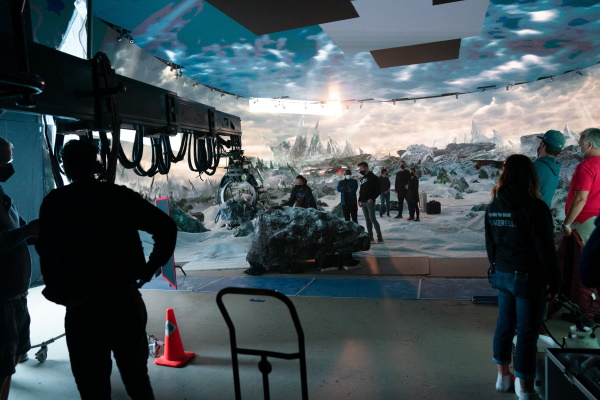
The use of practical special effects and puppets has created some really incredible creatures and aliens, some of which have had a genuinely “old-school” feel that reminded me of some of the alien races from The Original Series and The Next Generation era. These effects have combined with some excellent CGI animation and increasingly creative use of the expensive AR wall. It’s clear that Paramount’s visual effects artists are becoming more and more comfortable with this fancy piece of kit, and Strange New Worlds has found some fun ways to blend in the AR wall and make it seamless.

Behind-the-scenes filming with the AR wall.

Like classic Star Trek shows have always done, Strange New Worlds tried its hand at some very different genres across Season 1. There was plenty of sci-fi, exploration, and action, but the show also dipped its toes in comedy, drama, warfare, and even horror at one point. Combined with a diverse range of planets to visit and alien races to meet, this gave Strange New Worlds an incredibly varied feel. A worse show might’ve ended up feeling jumpy or even unsettled, but the characters at Strange New Worlds’ heart kept it on track throughout thanks to some truly wonderful writing and world-building.

The theme music that has been composed for Strange New Worlds jumped right up the list to become one of my absolute favourite Star Trek themes. I felt an influence from the classic Superman theme by John Williams that blended perfectly with elements from The Original Series theme to create an exciting, adventurous up-tempo piece of music to really set the stage for every new episode. It’s a wonderful piece of music that I just know is going to become a celebrated part of the franchise.

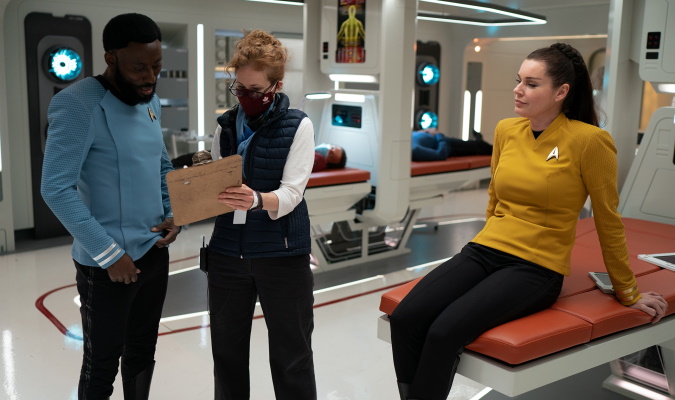
Behind-the-scenes in sickbay with Dr M’Benga and Una Chin-Riley.

I’d happily recommend Strange New Worlds to any fan of Star Trek, and I’d challenge even the most ardent Discovery-hater to give it a fair shake. More than that, I feel that Strange New Worlds has huge potential to bring in new Star Trek fans alongside Lower Decks and Prodigy, as it’s a very accessible show. Perhaps folks who’ve tried Star Trek in the past and found it wasn’t to their taste won’t be swayed, but for anyone who’s been on the fence or curious about where to start, Strange New Worlds would make for a wonderful and engaging first contact.

For longstanding Trekkies like myself, Strange New Worlds feels like a return to a long-forgotten format, but not in a way that’s regressive. Strange New Worlds has taken the episodic, exploration-oriented format that was at the heart of the franchise in its golden age but updated it for 2022, keeping things like character growth and arcs while still finding ways to play in different genres and with different aliens and settings. It’s the best of both worlds, and while the series builds on what Discovery, Picard, and even Lower Decks and Prodigy have achieved, for me it surpasses all of them.

Promo photo of Spock, Pike, and Una.

I’ll hold up my hands and admit to having found a few nitpicks across the first season, including a couple of character arcs that either felt under-developed or rushed, but generally speaking the quality was high and the episodes outstanding. It’s rare for me to be able to say this, but Strange New Worlds hit ten for ten in its first season – ten genuinely great episodes that I thoroughly enjoyed.

What I’ll do now is briefly summarise my spoiler-free thoughts on each of the episodes in turn.

Episode 1:
Strange New Worlds

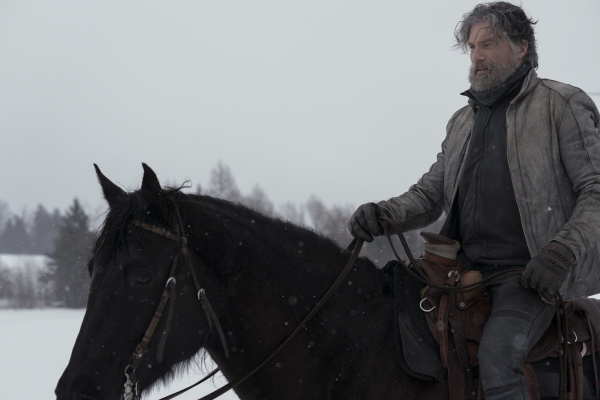
Captain Pike on horseback in the season premiere.

The season premiere was an episode that showcased Captain Pike. We got to see his internal struggle as he wrangled with the knowledge of his impending disability, and we got to see him at his best as he resumed command of the Enterprise. There are parallels to Picard Season 1, particularly the contrast between where Pike began the story in terms of his emotional and mental state and where he finished it; finding his place and restoring his confidence were absolutely crucial parts of the episode.

Strange New Worlds was a strong premiere and a great way to kick off the series. It took Star Trek back to its roots and showcased the exploration and missions of first contact that were key parts of the shows that we remember. There were moments of action and humour as we were introduced to most of the new crew for the first time, and what resulted was a solid foundation for the season to build upon.

Episode 2:
Children of the Comet

Cadet Nyota Uhura.

Children of the Comet had an interesting premise and pitted the Enterprise against an adversary who was able to easily overpower the Federation flagship – and yes, Strange New Worlds has confirmed that the Enterprise is the flagship in this era! There were some truly outstanding visual effects both practical and animated, and we got to see a really beautiful episode that, as the title suggests, focused in large part on a comet.

Uhura was a big part of this story, and this new, younger version of the character has a lot of space to grow into the person we remember with fondness from The Original Series. Celia Rose Gooding stepped up and put in an outstanding and complex performance as we saw the young cadet navigate her first away mission to a very alien environment.

Episode 3:
Ghosts of Illyria

Spock and Captain Pike on an away mission.

I have to confess that I’d almost entirely forgotten about the Illyrians prior to watching Ghosts of Illyria. The alien race appeared once in Enterprise’s third season – so I really recommend checking out the episode Damage for context before watching this one! Nothing in Damage is essential, but having that extra bit of background was definitely useful.

This was a big episode for Una Chin-Riley – a.k.a. Number One – as well as for the relationship between Captain Pike and Spock. Ghosts of Illyria also told us something important about Dr M’Benga that would go on to define his arc across much of the rest of the season. There were some clever and innovative concepts here, and what resulted was a fun episode.

Episode 4:
Memento Mori

La’an Noonien-Singh.

Memento Mori raised my first real nitpick of the season! But despite that, it was a tense and thoroughly enjoyable ride that drew inspiration from battles in classic Star Trek stories like Balance of Terror and The Wrath of Khan – as well as the war films that served to inspire those episodes. Throughout Memento Mori there was a sense that everyone was in danger and that not all of our favourite characters would make it out alive.

We got to see Captain Pike at his absolute best in Memento Mori, showing off why he’s long been considered one of Starfleet’s finest commanders. It was also a great episode for Lieutenant Ortegas – the Enterprise’s navigator – and for La’an Noonien-Singh, who had to confront her own inner demons and traumatic memories.

Episode 5:
Spock Amok

T’Pring and Spock in Spock’s quarters.

An episode about Spock confronting his conflicted inner nature and the way he feels about the human and Vulcan sides of his heritage doesn’t seem at first like it would be the foundation for a comedic story, but Spock Amok ended up being absolutely hilarious with plenty of laugh-out-loud moments that could rival even Lower Decks for its unapologetic sense of fun. Spock Amok had emotion at its heart, though, with Spock’s struggle played for more than just a cheap laugh.

The episode’s B-plot featured Captain Pike attempting diplomacy with an unusual alien race who felt like they couldn’t possibly be from any other science-fiction franchise. In that sense, Spock Amok is a Star Trek episode through and through!

Episode 6:
Lift Us Where Suffering Cannot Reach

Captain Pike wielding a phaser.

This episode’s title feels like it was lifted directly from The Original Series – as does the concept it brings to the fore. Captain Pike finds himself caught between his feelings for an alien woman he met in the past and his duty to the Federation. There’s a continuation of Dr M’Benga’s character arc from earlier in the season, one that flips the idea of the Prime Directive on its head in a way that reminded me very much of the Voyager Season 1 episode Prime Factors.

Lift Us Where Suffering Cannot Reach pushed the limits of narrative complexity within a single episode, with a dramatic mystery involving the attempted kidnapping of a young boy who was destined to play a key role in the leadership and future of his planet. A worse episode could’ve made its central mystery feel convoluted or even rushed, but Lift Us Where Suffering Cannot Reach balanced this complexity perfectly, despite having other storylines in play.

Episode 7:
The Serene Squall

Nurse Chapel seems to be in trouble!

I didn’t think I was going to enjoy The Serene Squall based on its premise and the teases we got prior to its broadcast – but I was wrong! The crew face off against space pirates in what was both a tense and fun story that also found time to throw in an unexpected twist. Perhaps the resolution to the narrative was a tad rushed in its final act, but that would be my only real criticism.

There was an incredibly powerful moment with Spock early in the episode that reframed his internal human-Vulcan split, and without giving too much away, it was something I found absolutely fascinating – and more than a little relatable! I think Spock’s characterisation here was the highlight of the episode for me, and pairing him up with Nurse Chapel was a great creative choice.

Episode 8:
The Elysian Kingdom

Dr M’Benga isn’t in uniform!

The Elysian Kingdom is two very different episodes rolled into one. On the one hand, there’s a funny, almost pantomime story in which the entire crew – sans Hemmer and Dr M’Benga – take on roles from a children’s story book. On the other, there’s an intensely emotional story with Dr M’Benga.

The Elysian Kingdom follows on from episodes like Mirror, Mirror or Bride of Chaotica insofar as it allows all of the main cast a chance to play around and step out from their usual roles. I have no doubt that it was an incredibly fun episode to work on – and that comes across in the performances from practically everyone involved. My only real gripe is that the final act and conclusion wrapped up very quickly.

Episode 9:
All Those Who Wander

It’s Hemmer time!

Of all the episodes in Season 1, the most important one to go into un-spoiled has to be All Those Who Wander. It’s an incredibly powerful episode with a thrilling horror theme, and there’s clear inspiration from the film Alien throughout. It’s also an episode that builds to a shocking emotional climax – and I won’t say any more about that lest I risk spoiling it!

Star Trek can do horror really well, as episodes like Empok Nor demonstrated years ago. For me, All Those Who Wander takes the horror angle right up to the edge of my personal comfort zone – but never beyond it. It’s not the most kid-friendly episode, that’s for sure, but it’s an incredibly tense and thrilling ride from start to finish with a wonderfully atmospheric setting.

Episode 10:
A Quality of Mercy

Spock, Pike, and [Spoiler] on the bridge of the Enterprise.

Captain Pike receives a visit from, well, “The Ghost of Christmas Yet To Come.” That’s about the best way I can describe A Quality of Mercy! There are some outstanding visual moments that really show off the USS Enterprise, a callback to a classic episode of The Original Series, and a storyline that furthers Captain Pike’s season-long arc.

A Quality of Mercy sees Season 1 end on a high note – and with a little tease for something more to come. It’s an action-packed episode with some real emotional punches, and a love letter to fans of The Original Series in particular. All in all, an absolutely outstanding episode and a great way to close out one of the best seasons of Star Trek ever put to screen.

So that’s it!

Promo photo of Lieutenant Ortegas.

Strange New Worlds is off to a roaring start, and I can’t wait for Season 2 already! Good news in that regard – the show’s second season recently finished filming and will be broadcast next year. Here’s to Season 3 – and beyond! Hopefully Paramount will have gotten its act together by then, ensuring that this amazing series is available to audiences all around the world.

Star Trek: Strange New Worlds is the show that fans had been asking for since Captain Pike and Spock appeared in Season 2 of Star Trek: Discovery in 2019. Its mere existence would already be a massive win for Star Trek fans and proof that Paramount is willing to listen to feedback, but the fact that the show has been such an amazing experience across its first season and exceeded expectations that were already sky-high is absolutely fantastic!

Commander Una Chin-Riley – a.k.a. Number One.

Not only has Strange New Worlds Season 1 laid the groundwork for future stories with Captain Pike and co. aboard the Enterprise, but I feel it offers a template that future Star Trek projects should take a serious look at. The serialised season-long stories of Picard and Discovery have been interesting – and some have worked better than others – but Strange New Worlds’ more episodic approach has been absolutely wonderful, allowing for a more diverse array of stories that both revisited elements from Star Trek’s past while also introducing us to brand-new aliens, planets, and cultures.

I was bitterly upset that Paramount’s pathetic and indefensible “America First” attitude cut off Strange New Worlds from so many of the fans who campaigned to make it happen, and unfortunately I can’t deny that that has tainted the experience. But if we can look past the corporate nonsense, Strange New Worlds itself has been an absolutely phenomenal show, one that I hope will continue for at least four more seasons to fulfil Captain Pike’s promised “five-year mission.”

Whether you’re new to Star Trek or whether you’ve enjoyed past iterations of the franchise, it’s easy to recommend Strange New Worlds. I sincerely hope you’ll give it a try.

Star Trek: Strange New Worlds Season 1 is available to stream now on Paramount+ in countries and territories where the platform is available. Episodes are being broadcast weekly on Paramount+ in the UK. Further international availability has not been announced. The Star Trek franchise – including Strange New Worlds and all other properties mentioned above – is the copyright of Paramount Global. This article contains the thoughts and opinions of one person only and is not intended to cause any offence.