Star Trek: Enterprise Episode Re-Watch: Season 1, Episode 7: The Andorian Incident

A Star Trek-themed spoiler warning graphic

Spoiler Warning: There are spoilers ahead for Star Trek: Enterprise Seasons 1-4. Minor spoilers are also present for the following Star Trek productions: The Original Series, The Motion Picture, The Voyage Home, The Next Generation, and Strange New Worlds.

I have kind of a weird relationship with Star Trek: Enterprise, and the show’s first season in particular. I can remember listening to the radio, sometime around the turn of the millennium, when news was breaking that a brand-new Star Trek series was going to be created. But my excitement at that announcement was almost immediately dashed upon learning that it would be a prequel! Yes, I’m one of *those* Trekkies – the “oh god, not a prequel show” Enterprise-avoiders!

Okay, that’s a bit of an exaggeration, but you see my point. When Enterprise landed here in the UK in early 2002, I tuned in for the premiere, but after that, I really only watched the show sporadically while it was on the air, and I didn’t really consider myself a huge fan of Captain Archer’s adventures. It was only in the latter part of the 2000s, after Enterprise’s cancellation, that I became fully acquainted with the series; I purchased Enterprise on DVD to round out my Star Trek collection.
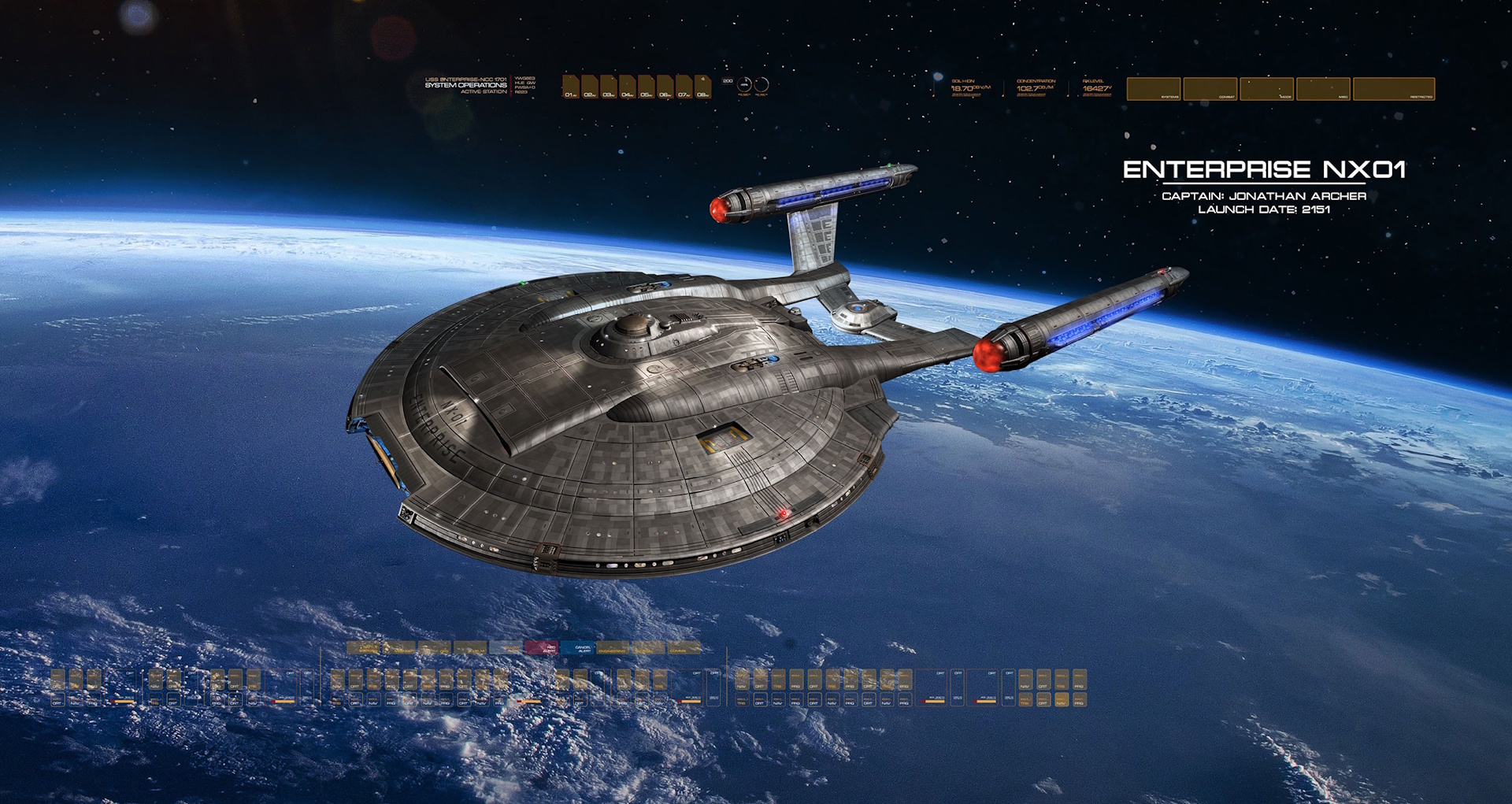
Promo graphic from Star Trek SNW showing the NX-01
The NX-01 as it appears on a background graphic in Strange New Worlds.

I’m pretty sure that The Andorian Incident is one of the episodes I first watched on DVD; I don’t think I caught it on TV when it first aired, but I might be mixing it up with Shadows of P’Jem, its sequel/sister episode (that I hope to write up a re-watch of one day, too!). In any case, I came late to most of Enterprise, but I’ve since come to regret my snap judgement of Star Trek’s first prequel series. Enterprise told some fun, enjoyable, and very “Star Trekky” stories across its four seasons, expanded our understanding of the Federation and the wider Star Trek universe, and padded out historical events and first contact missions that other Star Trek shows only made oblique references to.

Enterprise is the show I point to whenever I hear fans (both inside and outside of the Trekkie community) use the expressions “no one’s asking for this,” or “who asked for this?” in response to a new series, film, or spin-off. If you’d asked most Trekkies in 2001 what kind of show they’d like to see, I doubt that many of us would’ve said “a prequel set a century before Captain Kirk!”, but Enterprise took that premise and did some truly wonderful things with it. It’s perhaps my biggest regret as a Trekkie that I didn’t do more to support the series during its original broadcast run, and that I misjudged it upon hearing little more than its premise.

Promo photo of the Star Trek ENT cast in S1
Several of the main characters in a Season 1 promo photo.

I’ve been meaning to return to Enterprise for a while, and regular readers might have an inkling as to why! Almost a year ago, I had the immense pleasure of meeting Connor Trinneer – Enterprise’s Trip Tucker – at a fan convention here in the UK. Being able to shake his hand was absolutely fantastic, and ever since, I’ve wanted to dip back into Enterprise and write up my thoughts on a few of the episodes. This is the first time, in almost seven years of writing here on the website, that I’ve done one of these re-watches for Enterprise, if you can believe it! I guess I’m in danger of losing my Trekkie credentials, eh?

The Andorian Incident isn’t a “Trip episode,” though Tucker is featured as part of the away team to the Vulcan outpost of P’Jem, so I think it still works for a re-watch! This’ll be the first time, since I had the opportunity to meet him, that I’m watching any episodes of Enterprise, actually – it’s a series I enjoy, but I guess I haven’t found the time to sit down and watch any episodes for a while.
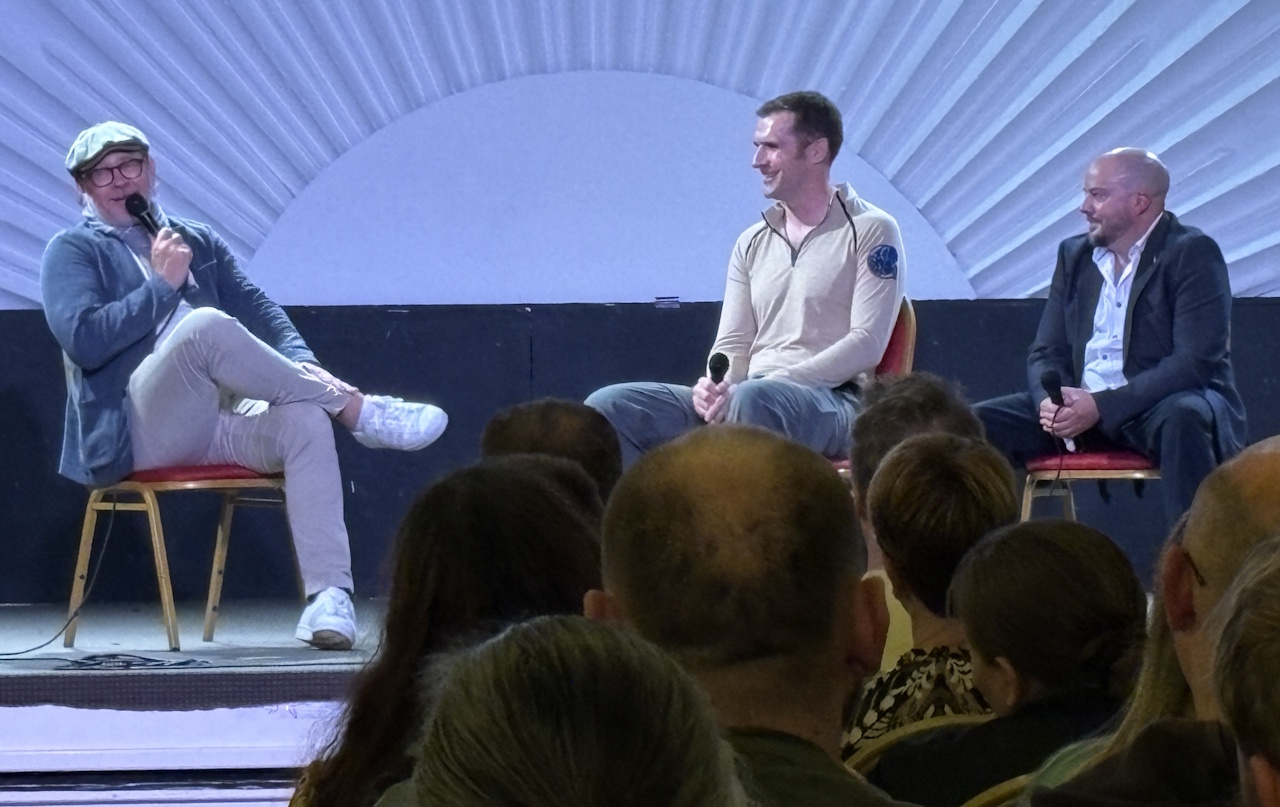
Photo of Connor Trinneer on stage at a fan convention
Connor Trinneer (left) at a fan convention in the UK in 2025.
Photo: Trekking with Dennis

So that’s a bit of personal background for you as we sit down to re-watch The Andorian Incident.

The Andorian Incident was the first of ten Enterprise episodes to be directed by former Voyager star Roxann Dawson. Dawson played B’Elanna Torres for all seven seasons of Voyager, and went on to direct two episodes of that series, too. She worked on episodes across all four seasons of Enterprise, which helped to establish her as a television director; she continues to direct today.

After Enterprise, Roxann Dawson has gone on to direct episodes of The O.C., The Mentalist, Agents of S.H.I.E.L.D, House of Cards, and Foundation, among many others. It’s always nice to see the stars of Star Trek succeed beyond the franchise, and Dawson’s TV directing career really began with Star Trek; it was Enterprise where she first directed an episode of a show that she wasn’t also starring in.
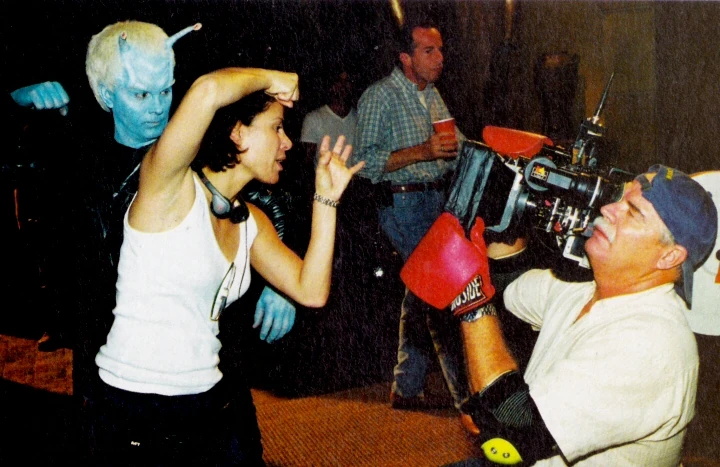
Behind-the-scenes photo from Star Trek ENT 1x07 showing Roxann Dawson, Jeffrey Combs, and a camera
Roxann Dawson on the set of The Andorian Incident with Jeffrey Combs.
Photo: Star Trek Monthly via Memory Alpha

The Andorian Incident is the kind of episode that could really only work as a prequel, and saw Enterprise taking full advantage of its prequel status. At this early point in the show’s run, the Vulcans’ attitude towards their new human allies is still being established, but we know that Earth is very much the junior partner in this relationship. The Andorian Incident expands on that a little, and also sets the stage for something Enterprise would do a lot more of over its subsequent seasons: exploring contradictions within the Vulcans and showing how their High Command, in particular, was not always as friendly or peaceful as it appeared to be.

This episode is also notable for bringing the Andorians back to Star Trek after a long absence. Andorians appeared in The Original Series and The Animated Series, as well as in background roles in The Motion Picture and The Voyage Home, but they were essentially absent for the entirety of The Next Generation era, save for a couple of very minor appearances. Early ideas for this episode may have considered bringing in the Gorn, but the switch was made to the Andorians relatively early on – and I think we can all agree that that was a great choice! The Andorians went on to play a prominent role in Enterprise.
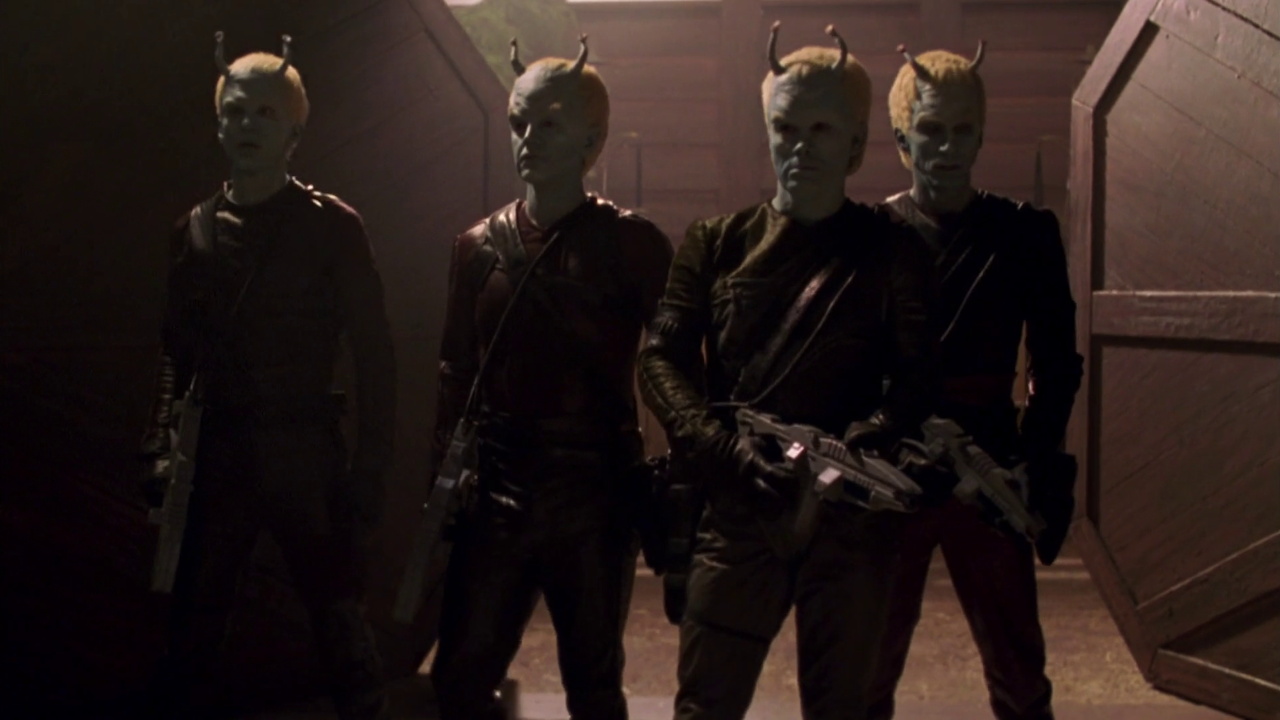
Still frame from Star Trek ENT 1x07 showing Andorians
The Andorians have arrived!

In Journey to Babel – the TOS episode where the Andorians first appeared – their animosity toward the Vulcans had been established, and The Andorian Incident picks up that thread in a way that feels natural. This is our first look at the pre-Federation conflict between these two powers, and we get some interesting bits of lore and background that help build up the early days of the Federation – and both races’ roles within it. That’s exactly the kind of story that only a prequel (or a flashback, I guess) can really tell, which is what I meant when I said that this is a great example of Enterprise fully taking advantage of its place in the timeline and leaning into that.

The animosity between the Vulcans and Andorians needed to have more of a reason than “just because,” but if there was ever going to be a believable narrative pathway to get them – and Earth – to one day work together, it was incredibly important for stories in this era not to make out either faction to be irredeemably awful and villainous, and for me, I think The Andorian Incident stays on the right side of that line. That isn’t to say that the Andorians or Vulcans come across as particularly *nice*, but rather there’s room in the way their conflict is depicted to see how, one day in the future, humanity and Earth could help bring it to an end.
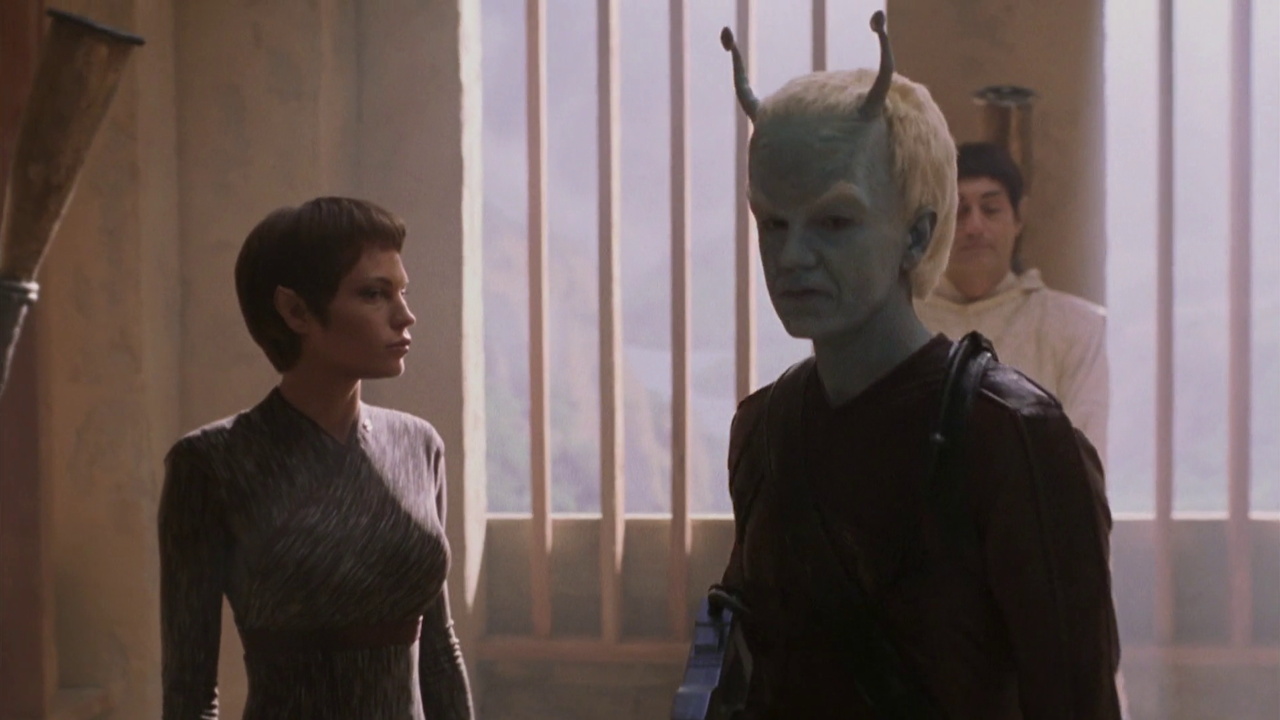
Still frame from Star Trek ENT 1x07 showing T'Pol and an Andorian
T’Pol with an Andorian soldier.

Let’s talk briefly about Enterprise’s other regulars – the ones who didn’t go on the away mission.

Hoshi and Travis don’t get very much to do in this episode; I think they really only get a few lines each. It was interesting, though, that Hoshi was the one selected to operate the transporter – Reed’s first-ever time transporting, I think I’m right in saying. You’d think that Enterprise would’ve had a dedicated transporter officer, or that the role would’ve at least been delegated to an engineer! Still, it gave us a couple of cute moments in the transporter room as Reed and his security team prepared to beam down.

This episode also saw Reed sitting in the captain’s chair, being left in command of Enterprise in lieu of Archer, T’Pol, and Tucker. Reed’s role is more notable, really, for how the away team discussed him – Archer and Tucker both agreed that Reed wouldn’t wait indefinitely before launching a potentially deadly rescue operation.
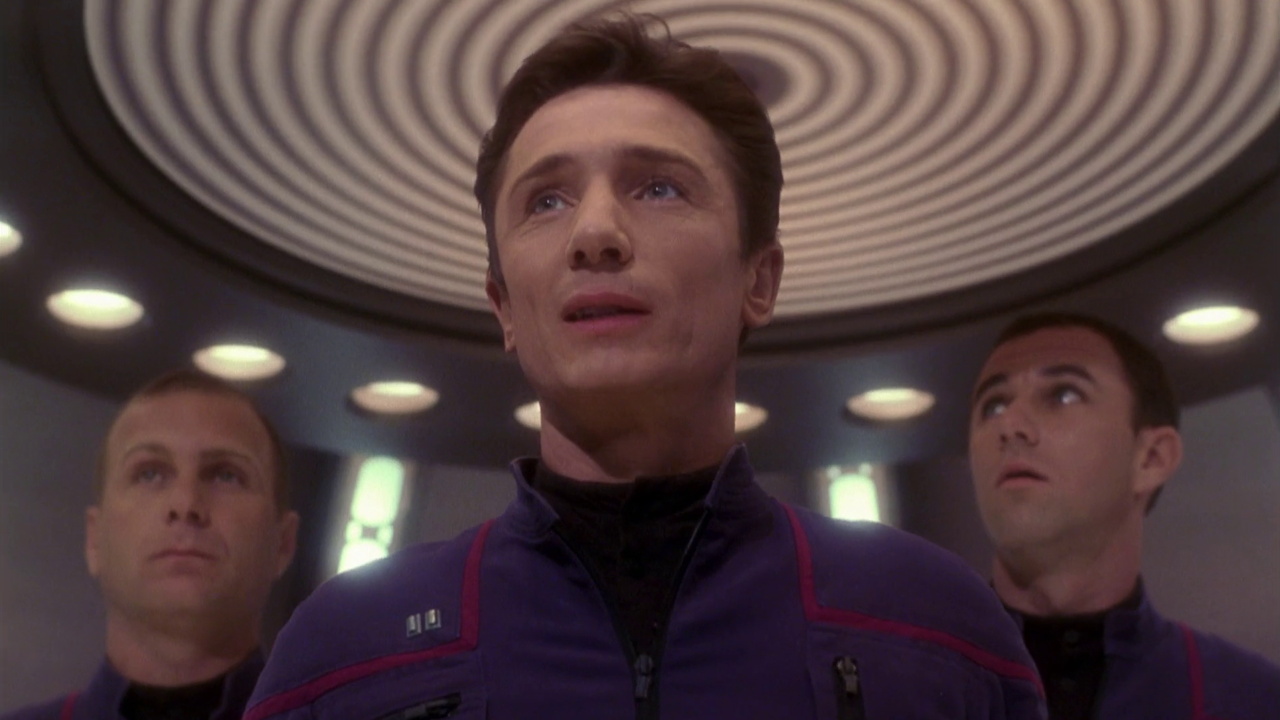
Still frame from Star Trek ENT 1x07 showing Reed on the transporter pad
Reed got a turn in the captain’s chair… and a turn being transported.

Dr Phlox got a fun scene with T’Pol near the beginning of the episode. After agreeing to divert Enterprise to P’Jem, T’Pol shares a meal with Dr Phlox in Enterprise’s dining area, and Phlox philosophises about the nature of being an outsider aboard a human ship, as well as why T’Pol may be reluctant to appear at an important site to the Vulcans in the company of humans. It was a nice little scene, and I think it says a lot for T’Pol at this early point in the show’s run, as well as shows that she has a bond (of sorts, anyway) with Dr Phlox.

This conversation takes an interesting turn, with Phlox and T’Pol discussing the Vulcan motto “infinite diversity in infinite combinations,” and what exactly it means in the context of Enterprise’s mission. Unfortunately, in the years since The Andorian Incident aired, the word “diversity” has become a little contentious – even among some Trekkies – so I’m not sure how well a scene like this would land today! Still, as an homage to what Star Trek is and has always aimed to be, as well as an exploration of the Vulcans and T’Pol’s thoughts on serving aboard a human ship… I liked it. It was a cute scene, and Phlox helping himself to part of T’Pol’s meal showed a friendliness and familiarity between them.
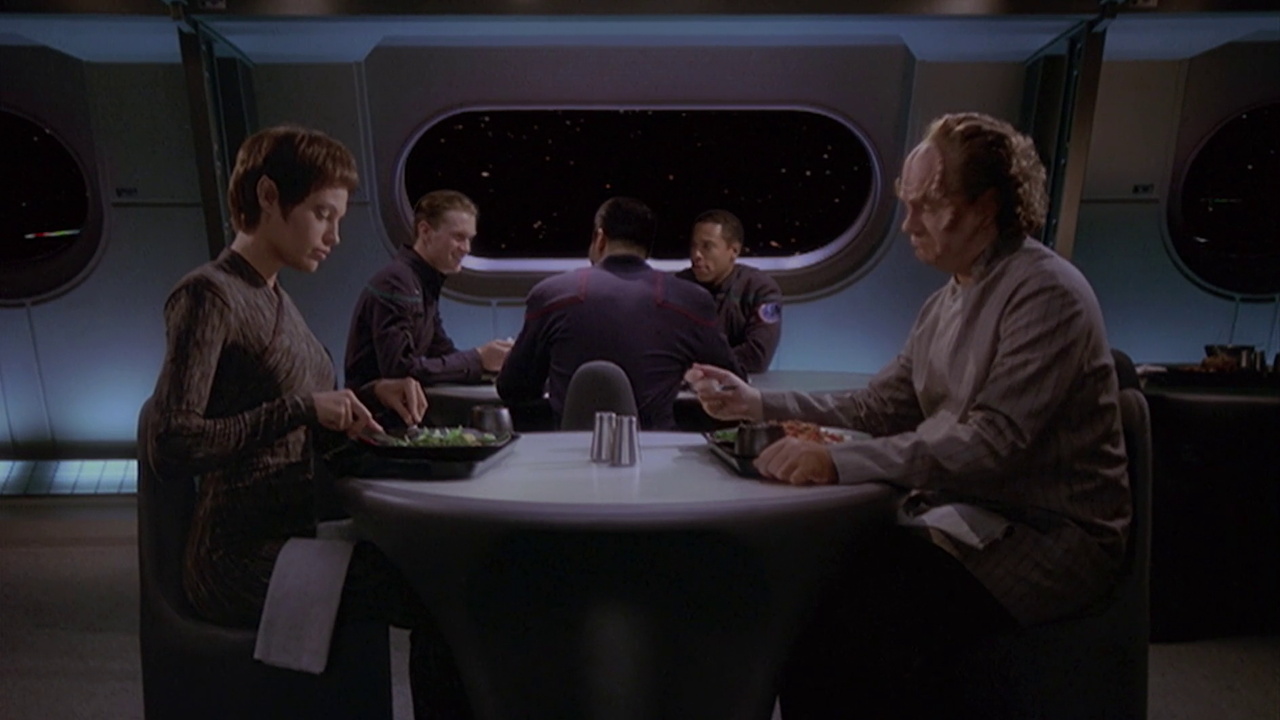
Still frame from Star Trek ENT 1x07 showing T'Pol dining with 
Dr Phlox
T’Pol dines with Dr Phlox.

Since we’re talking about the start of the episode, I do want to flag up one thing that I don’t think worked especially well. The very short scene leading into the opening titles showed the Andorian squad’s arrival at P’Jem… but then later, after Archer and co. arrived, it was kind of treated as a bit of a surprise that the monastery had been invaded and attacked. I can’t help but feel that this little opening scene could’ve been cut or moved, making the revelation of the Andorians’ presence a surprise to us as the audience, not just the characters in the show.

It’s not the biggest deal in the world, sure. But, given how The Andorian Incident presented the away team’s arrival at P’Jem and encounter with the Vulcan elder, I think it could’ve been a bit more exciting or entertaining if *that* had been the moment where we learned what was really going on; a surprise ambush by the Andorians could’ve been a fun reveal instead of something we already knew was bound to happen.
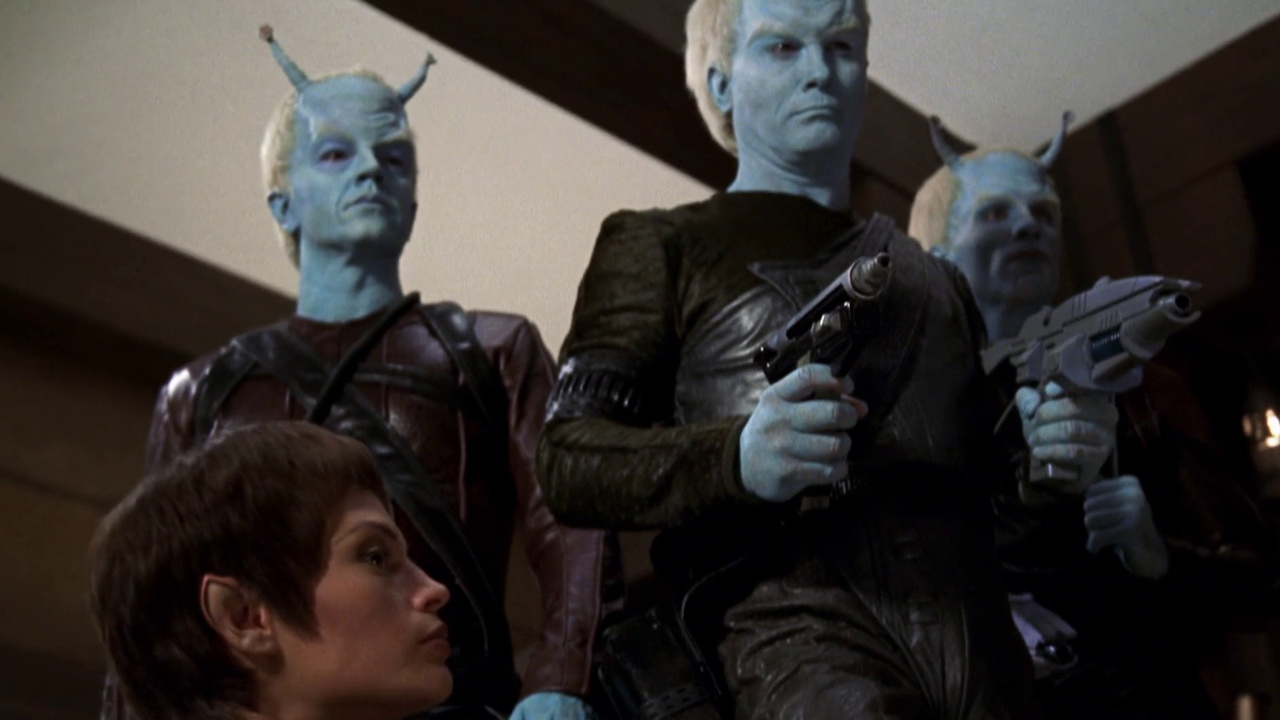
Still frame from Star Trek ENT 1x07 showing T'Pol, Shran, and the ambush
The ambush.

I liked the design of P’Jem – inside and out – though I would say, unfortunately, that some of Enterprise’s early 2000s CGI doesn’t hold up quite as well a quarter of a century later! That’s not a problem unique to this series by any means; just look at the Star Wars prequels, which were also released around the same time, for plenty of other examples of CGI that just wasn’t quite ready for prime-time.

The biggest CGI/green screen offender, in my opinion, comes at the very end of the episode; Archer and co. stepping through the doorway into the Vulcan observation post has aged quite poorly. The exterior shots of the P’Jem monastery, the shuttle taking off, and shots of the NX-01 in space are all vastly superior by comparison. Is it the end of the world? No. And partly it’s because, in 2026, we’re watching on bigger, better screens; in standard definition in 2001-02, these shots probably looked a lot better! However, I’d be remiss if I didn’t say that a lot of similar shots in the movies and across the TNG era, which relied more on physical models, props, and even matte paintings, have stood the test of time a lot better. A subjective take, sure, but one I stand by!
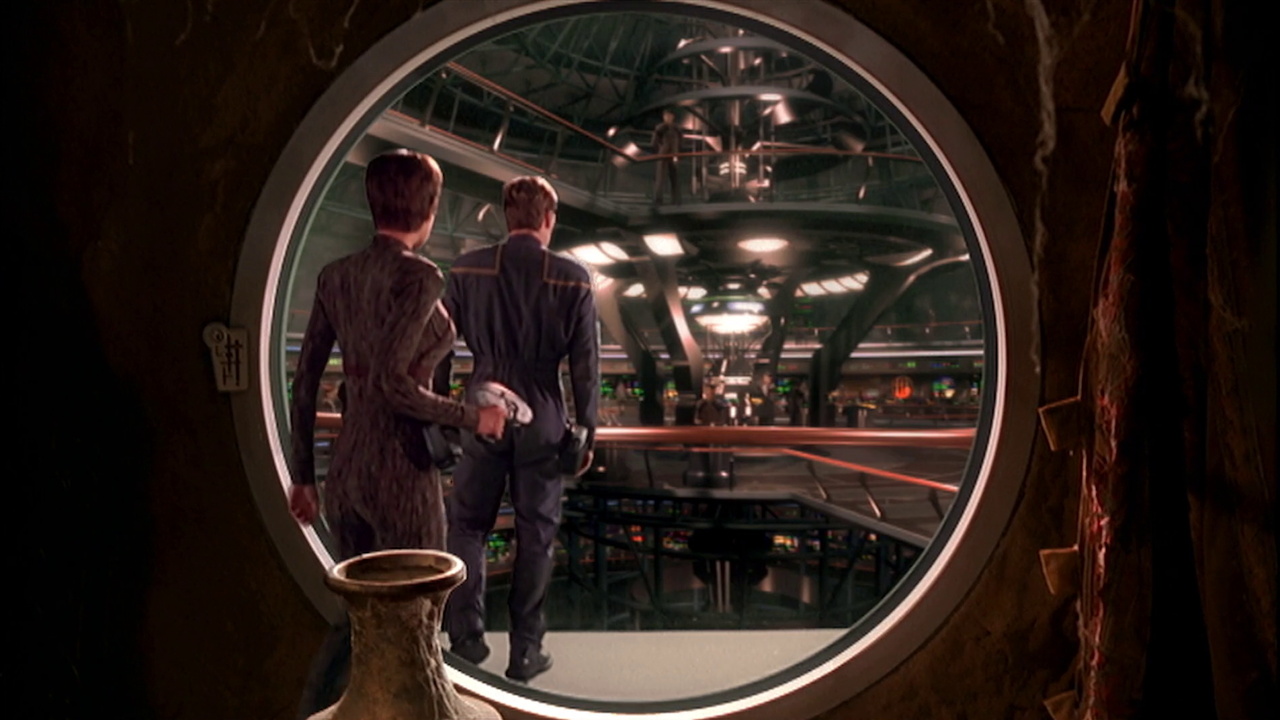
Still frame from Star Trek ENT 1x07 showing T'Pol and Archer discovering the listening post
Not a great visual effect, at least in my opinion.

In terms of physical sets and props, The Andorian Incident does a lot better. The monastery – despite being built entirely on a sound stage – manages to feel ancient, with a kind of “Mediterranean” vibe that reminds me a little of Ancient Greece or perhaps Italy. I really did get the sense, as the away team arrived, that this was an old, isolated, religious outpost – something absolutely crucial to keeping the episode’s biggest revelation a secret until the right moment.

Many of the statues, reliefs, icons, and other props also looked pretty great inside the P’Jem monastery, and again, that sensation that this is both an ancient and holy place was present throughout. The cobweb-covered transmitter was also a fun prop, and I liked Trip’s line about having “never met a radio he couldn’t fix!” Several props seen in The Andorian Incident were either recycled from episodes in the TNG era or would go on to be re-used in future Enterprise stories.
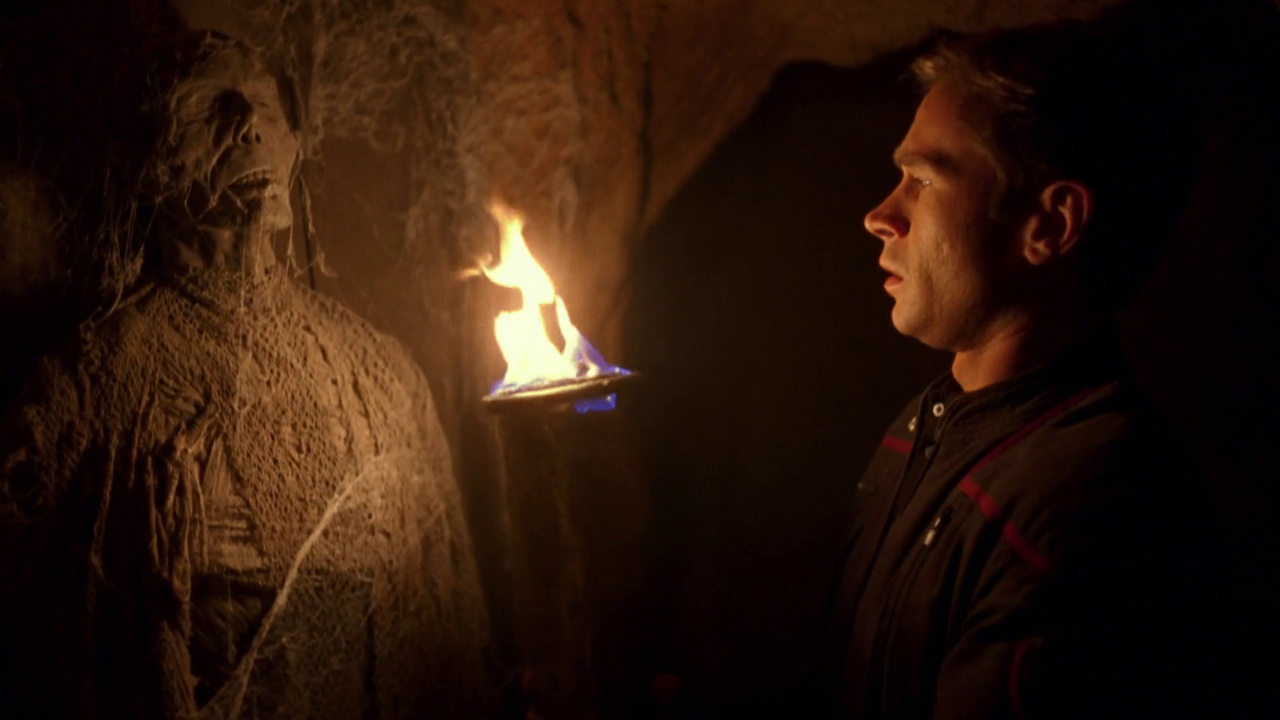
Still frame from Star Trek ENT 1x07 showing Trip holding a torch in front of a mummy
Trip meets another resident of P’Jem…

Jeffrey Combs is legendary within the Star Trek fan community! Combs has played nine different roles (or more, if clones, holograms, and alternate-timeline characters count separately) across four different series, including the iconic Weyoun on Deep Space Nine. And The Andorian Incident brings him back to play the role of Shran, the Andorian leader. Shran would go on to be another recurring role for Jeffrey Combs; his second-biggest after Weyoun.

I fear my judgement of Shran is coloured by his subsequent appearances; he’s just such a fun character, and his relationship with Archer develops across the show’s run in a truly entertaining way. In this first appearance, Shran seems to get off to a rough start – he’s almost Klingon-like in his aggression, torturing prisoners, beating Archer or ordering him beaten, and seeming to be completely unreasonable in his demands. However, the episode’s final moment reveals that Shran and the Andorians are right: there really is a listening post hidden beneath the monastery. And while that doesn’t mean that Shran was right in *everything* he did… it certainly reframes how we’re meant to understand his character.
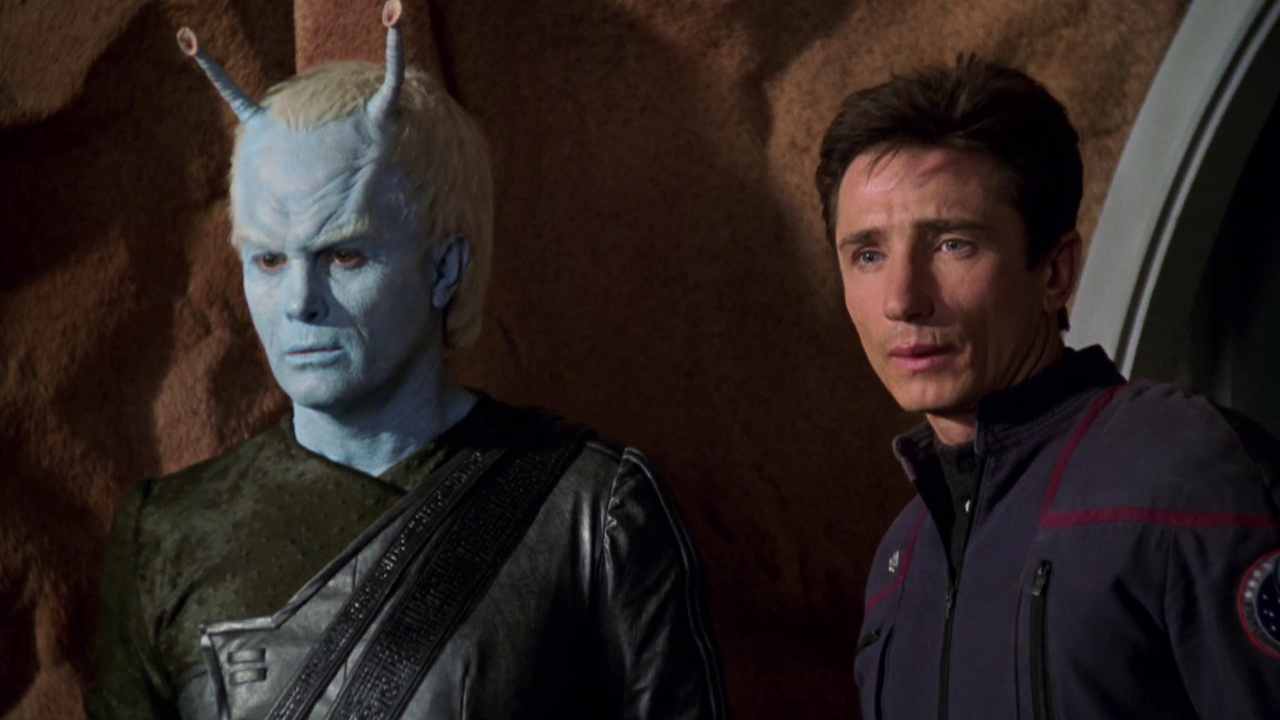
Still frame from Star Trek ENT 1x07 showing Shran with Reed
This episode set up Shran for a recurring role.

Those final scenes show the beginnings of an understanding between Archer and Shran – and, by extension, between humanity and the Andorians. This is what I was talking about a moment ago: this is how we start to build a narrative pathway for the Andorians to become founding members of the United Federation of Planets. And it’s ironic – deliberately so – that humans and Andorians get off to such a rocky start! It doesn’t do anything to take away from or minimise the Andorians’ roles in episodes set a century later, like Journey to Babel. But it does add context, background, and – I would argue – extra believability to stories like that.

A good prequel does exactly this. It deepens our understanding of the way the Vulcans, humans, and Andorians interact, provides context that could explain lingering mistrust or ill-feelings, and makes sure we understand that there’s blame to go around. The Andorians were aggressive, mistrusting, and treated their prisoners awfully. But the Vulcans lied – to their enemies *and* their supposed friends – and used a religious site as cover for a military installation. I guess we can appreciate why Ambassadors Shras and Sarek had a hard time getting along!
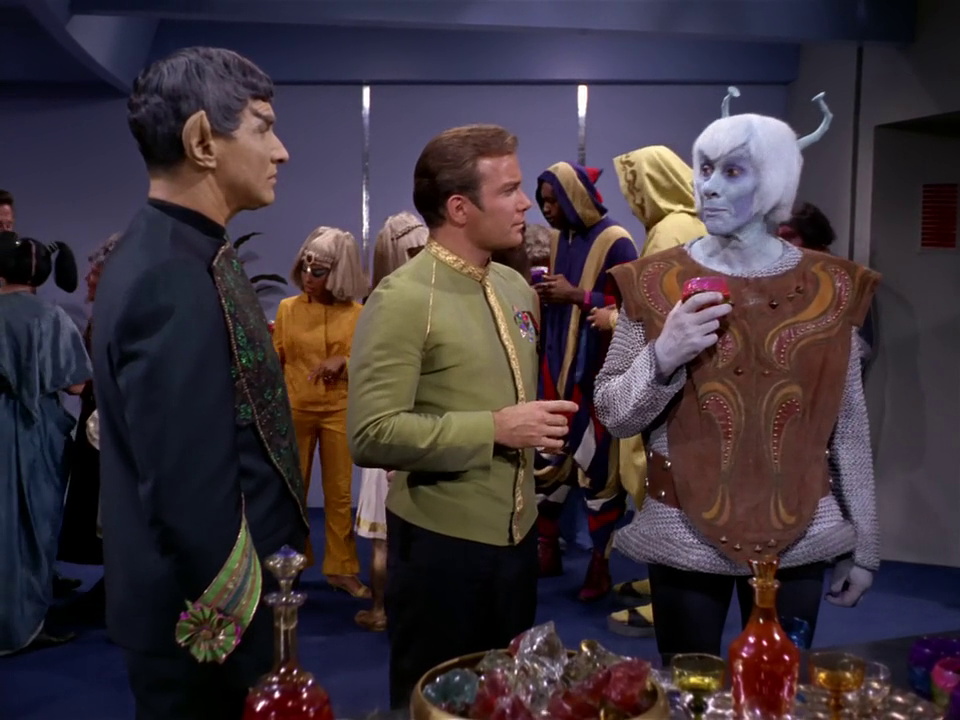
Still frame from Star Trek TOS 'Journey to Babel' showing Kirk, Sarek, and Shras
Ambassadors Sarek and Shras with Captain Kirk a century later.

The Andorian Incident also does a lot to further the complex and occasionally tense relationship between Captain Archer and T’Pol. Having expressed her feelings about serving aboard a human ship earlier in the episode, T’Pol has to confront Archer’s doubts about her loyalty when they’re in captivity. She disagrees with Archer’s plan to have Reed lead a rescue mission to the monastery, but makes it clear that she will obey his orders – even if those orders, in her view, put Vulcan lives and a Vulcan holy site at risk.

At this point in the show’s run, T’Pol hasn’t had many opportunities to demonstrate that she’s a team player, and given his contentious relationship with the Vulcans in general, we can kind of understand Archer’s point of view here. It’s not always easy to step back and completely set aside dozens of other episodes which add to the Archer-T’Pol dynamic or to T’Pol’s evolving relationship with humans – both of which are parts of her character arc that Enterprise handled well. But if we *try* to keep in mind how early in the series this takes place, and how much growing Archer and T’Pol still have to do to fully trust one another, I think the scenes between them work. We feel Archer’s barely-concealed resentment toward the Vulcans in moments with T’Pol and while being “interrogated” by Shran, and we also feel T’Pol’s righteous indignation at Archer’s implication that she’d go against his orders or side with the Vulcans against him.
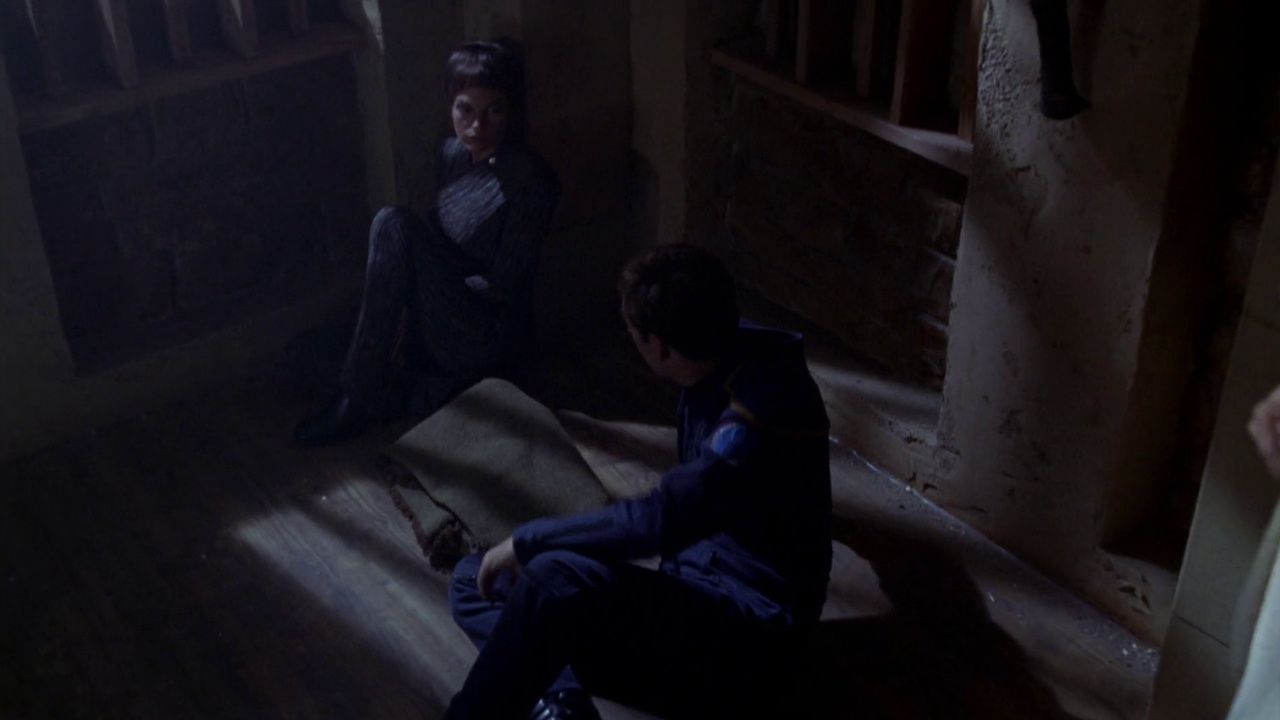
Still frame from Star Trek ENT 1x07 showing T'Pol, Archer, and a blanket
T’Pol and Archer.

For Tucker, The Andorian Incident is a chance to show off his friendship with the captain – I like some of their little moments of banter together both before and during the away mission – and his technical prowess. We don’t get a complicated sequence of him repairing the old transmitter, nor a lot of technobabble about what’s going on, but just the fact that he could take ageing, decrepit technology and get it to work well enough to send a signal back to the ship is impressive. Tucker is very much in the Scotty mould: a miracle-worker!

Tucker is also the one who figures out the layout of the tunnels at the P’Jem monastery, which later enables Reed and his team to get the drop on the Andorians. The scene of the large Vulcan relief exploding was incredibly cool, and it was brought to screen exceptionally well. It’s not totally unique in Star Trek, of course – see The Final Frontier’s jail-break scene, among plenty of other similar moments – but I really liked it here. And it was a fun excuse to return to one of the Star Trek franchise’s ubiquitous underground caves and caverns! Seriously, a lot of planets seem to have something like that, eh?
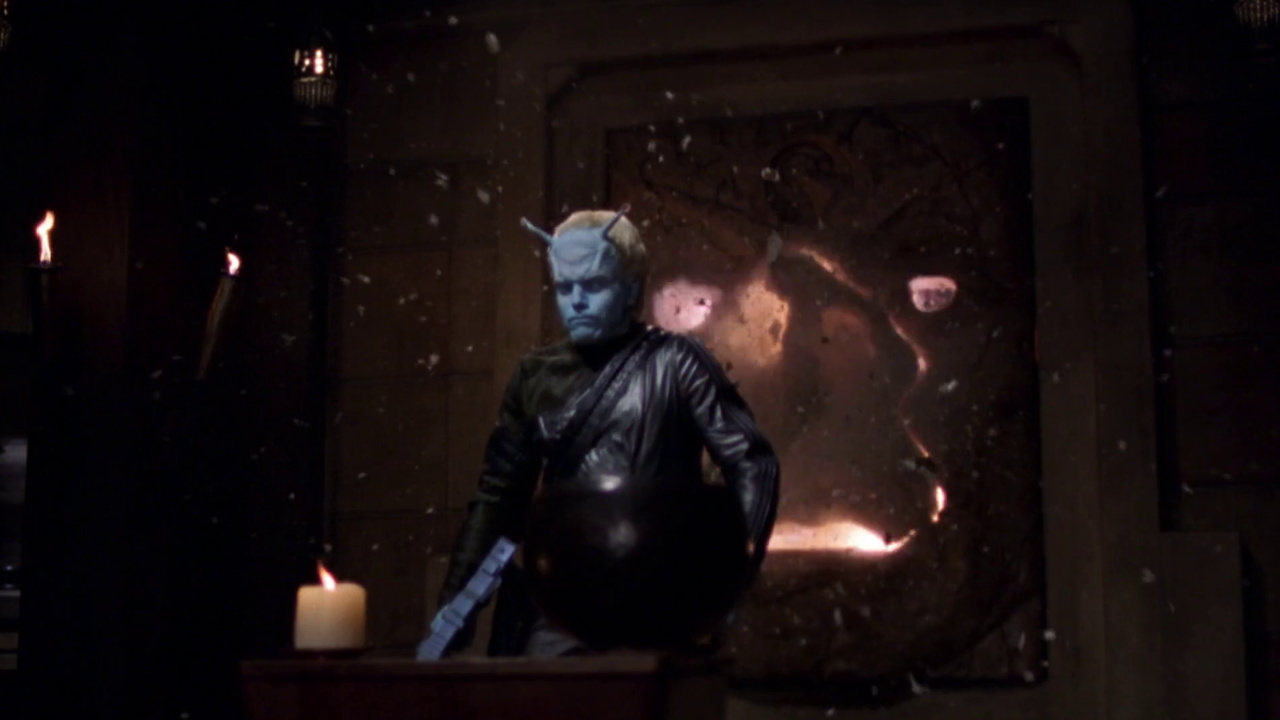
Still frame from Star Trek ENT 1x07 showing an explosion
The Vulcan sculpture gets blown up!

One thing Enterprise did well, especially in these early episodes, was conveying that sense of exploration; that space really was “the final frontier,” full of wonders and dangers to encounter. And for me, The Andorian Incident is among those stories. We continue the trend of seeing humanity as the junior, less-experienced partner to the Vulcans, hammered home by the fact that Archer and co. don’t even know who the Andorians are. And we get the sense that space is bigger and more dangerous than they could’ve expected, as seen by the Andorian attack on a seemingly-peaceful Vulcan monastery.

At the same time, The Andorian Incident is a great prequel: linking up with events in The Original Series in a big way, doing a lot to establish the Vulcan-Andorian conflict and cold war, while also setting the stage for a more peaceful future and the founding of the Federation. We also learn that there’s clearly more going on with the Vulcans than meets the eye, while giving T’Pol her clearest opportunity yet to demonstrate – to us as the audience as much as to Archer – that she’s on the side of Enterprise and the humans, even if that brings her into conflict with the Vulcan High Command. This arc would pay off in a big way in the seasons ahead.
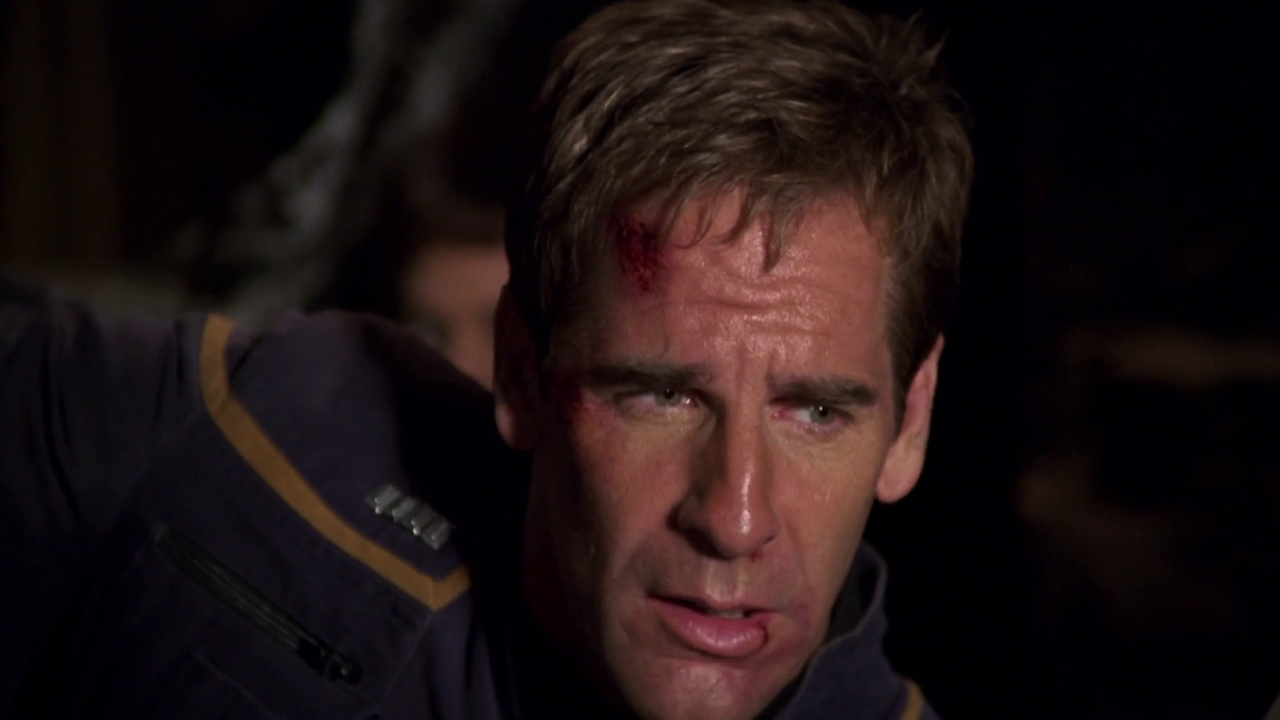
Still frame from Star Trek ENT 1x07 showing Archer
Archer discovers the listening post.

I’d forgotten just how abruptly The Andorian Incident ends. Although the story started here would be picked up later in the season in Shadows of P’Jem, the final moments of this episode seem to wrap up very quickly. We don’t see Archer and the away team returning to Enterprise, nor Shran’s ship departing the planet. The Vulcan listening post is exposed, Shran is handed the sensor data, and then… that’s it. While this storyline will be continued, the episode itself kind of just ends, and that’s a bit of an odd feeling.

All in all, though, I like The Andorian Incident. We met Shran for the first time, Archer and T’Pol shared a blanket, and the Vulcans turned out to be sneaky little so-and-sos! It’s a fun episode in its own right, as well as an important one for Star Trek’s fictional history. It’s one of the episodes that really justifies Enterprise’s prequel setting and place in the timeline, stepping back in time to add context and detail to historical events but without treading on the toes of stories set a century or more later. That isn’t always easy to get right – and Enterprise could mess this up, too – but when it works… it works.
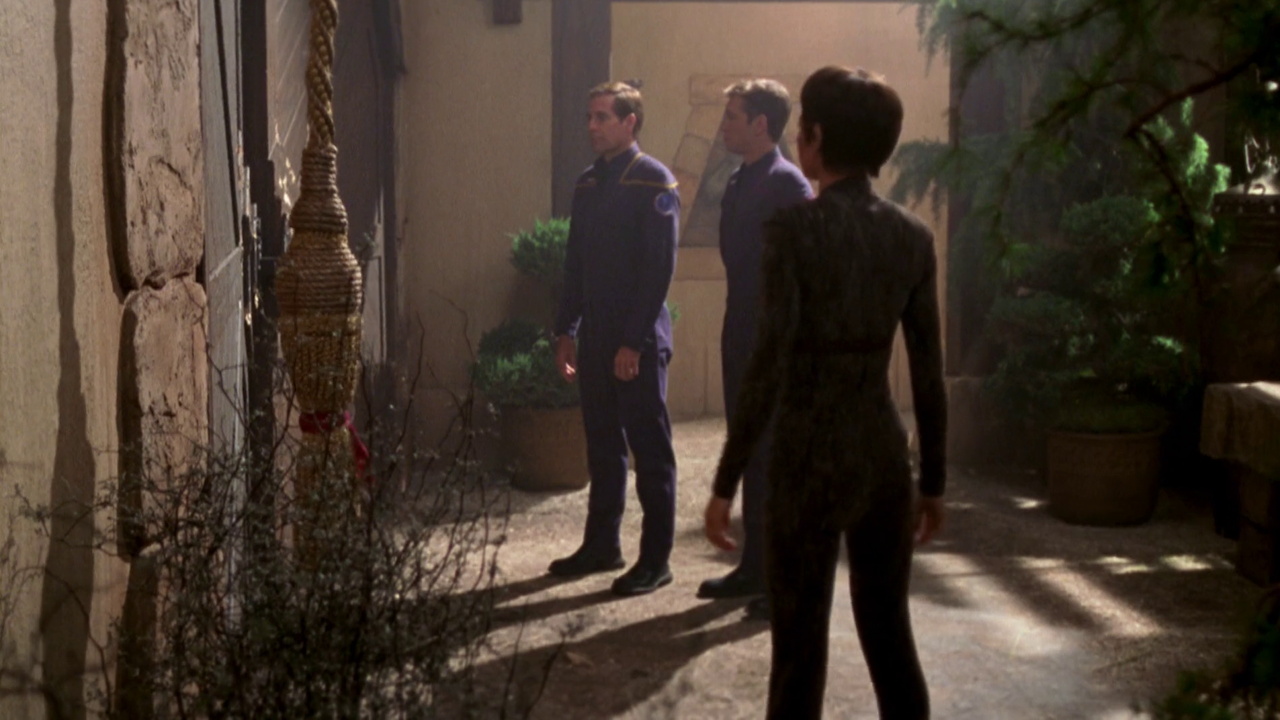
Still frame from Star Trek ENT 1x07 showing Archer, T'Pol, and Tucker at the monastery door
A fun episode of Enterprise.

I hope this has been a bit of fun. I’d been meaning to revisit Enterprise for a while, even before I got to meet Connor Trinneer, because it’s been a while since I last sat down and just enjoyed an episode or two of Enterprise. And in Star Trek’s big sixtieth anniversary year – and Enterprise’s landmark quarter-of-a-century milestone anniversary year, too – it seemed like the right moment! Here’s hoping it won’t take *another* seven years for me to get around to doing another one of these re-watches!

If you missed them, I’ve done a few other re-watches this year. When Starfleet Academy was on the air, I went back to revisit The First Duty – the Academy’s first big on-screen appearance in The Next Generation. Then I re-watched The Original Series’ second pilot, Where No Man Has Gone Before. And I’ve also re-watched The Royale from TNG’s second season, which was my personal “first contact” with the Star Trek franchise. Earlier this year, I had the fantastic opportunity to meet William Shatner – Captain Kirk himself – at an event here in the UK. And, as I’ve noted a few times already, I met Enterprise’s Connor Trinneer last year at a Star Trek convention.

Click or tap any of those links to check out those re-watches and other articles, and stay tuned! I’ll have more to say about Star Trek before long. Thanks for joining me for this re-watch, and as always… Live Long and Prosper, friends!


Star Trek: Enterprise is available to stream now on Paramount+ in countries and territories where the platform is available. The entire series is also available on DVD and Blu-ray. The Star Trek franchise – including Enterprise and all other properties discussed above – is the copyright of the Skydance-Paramount corporation. This article contains the thoughts and opinions of one person only and is not intended to cause any offence.
Twenty of the best Star Trek episodes!

Spoiler Warning: There are spoilers ahead for the Star Trek franchise, including all episodes on this list. Spoilers are present for the following: Discovery Season 4, Picard Season 3, Prodigy Season 1, Strange New Worlds Season 1, and more.

So, I did a thing. A few days ago, I published a tongue-in-cheek list of what I consider to be some of the worst episodes in the Star Trek franchise. Since it went up, it’s been racking up clicks – almost immediately becoming the most-viewed piece on the website over the past few days. To balance out that list – and to claw back some of my standing as a Trekkie – I thought I shouldn’t wait any longer before writing the counterpoint!

As I said last time, I’m a huge Star Trek fan. Heck, I run a Star Trek-themed website – so obviously I like the franchise! But I’m not one of those fans who says that “everything Star Trek has ever done is perfect,” nor am I someone who wants to whitewash Star Trek and never mention the bad parts. Paramount has a marketing team to do that.

It’s the Enterprise-E!

So today, as a counterpoint to my last list, I’m going to pick twenty of my absolute favourite episodes. It should go without saying that this list is also entirely subjective, so if I exclude your favourite episode or you hate all of my picks… that’s okay! We’re all entitled to our preferences about which Star Trek stories we prefer, and there should be enough room within the Star Trek fan community for polite discussion and disagreement.

So without any further ado, let’s dive into the list!

Episode #1:
The Doomsday Machine
The Original Series Season 2

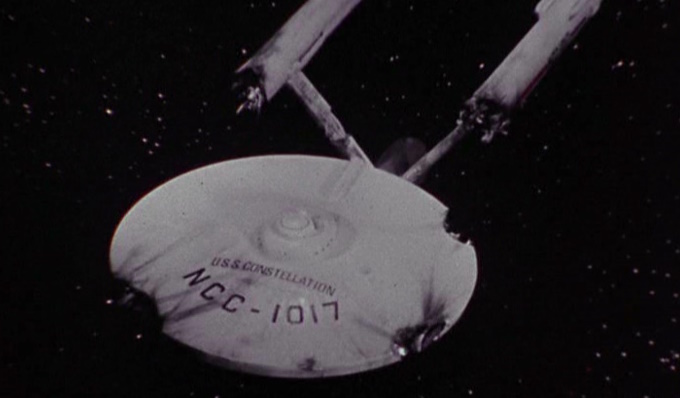
The wreck of the USS Constellation.

The Doomsday Machine is, in some respects, The Original Series in microcosm. It has everything that fans loved about the show: an exciting sci-fi premise, an incredible guest star, and a hard-hitting real-world comparison. It’s always stood out to me as one of The Original Series’ finest outings, masterfully building up tension as the unmanned weapon mindlessly carries out its directive.

The character of Commodore Decker, who was created for The Doomsday Machine, is one of the show’s most brilliant and tragic characters. His story has always been an absolutely riveting one for me – and the performance by guest star William Windom is phenomenal. The Doomsday Machine had a point to make about nuclear weapons out here in the real world, too – and coming at the height of the Cold War, less than six years after the Cuban Missile Crisis, it could hardly be more timely.

Episode #2:
Coming Home
Discovery Season 4

Captain Burnham on the bridge of the USS Discovery.

Discovery’s fourth season – like its predecessors – took a meandering and occasionally frustrating route to reach its final episode… but it was more than worth the wait! Coming Home is fantastic, and encapsulates everything that Star Trek is and always has been. There were incredibly tense and exciting moments as the Federation leapt to the defence of Earth, which was in serious danger, but those moments were coupled with the discovery of a very new and different alien race.

Seeking out new life has been at the heart of Star Trek since its inception. But, as many have pointed out over the years, Star Trek’s “new life” could often look and act very, well, human. Species 10-C, which we finally got to meet in this episode after a season-long buildup, have to be one of the most strikingly different aliens ever created for the franchise. Above all, though, Coming Home excels for its sense of optimism and hope. I’d challenge even the most ardent Discovery-avoider to give it a try.

Episode #3:
The Siege of AR-558
Deep Space Nine Season 7

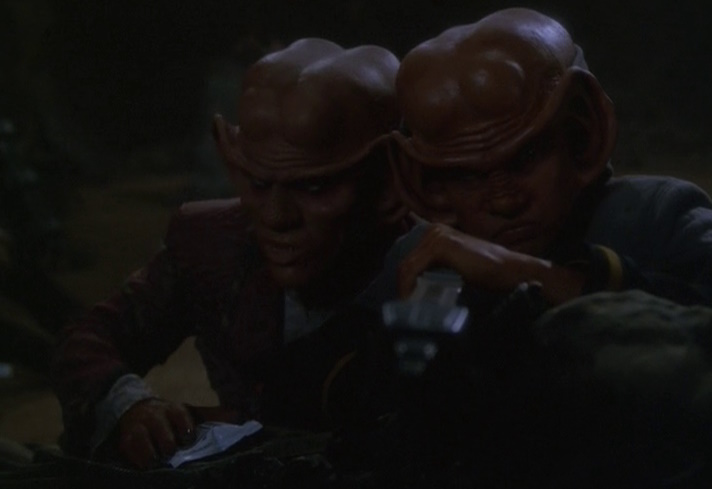
Quark and Nog.

Few Star Trek episodes truly manage to capture the feel of being at war quite so dramatically and spectacularly as The Siege of AR-558. Director Winrich Kolbe drew on his own experiences in the Vietnam War to create a claustrophobic, frightening scenario in which Federation soldiers were fighting for their lives over a nameless lump of rock. The futility of war is on display in The Siege of AR-558 in a way that Star Trek has seldom touched upon.

Nog’s character arc is one of Deep Space Nine’s best, and this episode shows why. Nog went from petty thief to Starfleet hero over the course of seven seasons, and the life-changing injury he suffered in the battle on the planetoid AR-558 would be a defining moment for him. The Siege of AR-558 is an episode that challenges many of our assumptions and beliefs about the Federation, Starfleet, and the Dominion War – and it’s an absolutely incredible watch.

Episode #4:
First First Contact
Lower Decks Season 2

Shaxs in First First Contact.

First First Contact is Lower Decks at its very best. It’s a Star Trek story through-and-through, with a challenge befalling the crew of the Cerritos that’s of a scientific and engineering nature. It’s also the perfect example of how Star Trek can tell tense and exciting stories without the need for evil villains and big set-piece battles.

Lower Decks often operates with a two-story or even three-story structure, pairing up characters and setting them off on their own adventures. But First First Contact is a comparatively rare example of the entire crew working together and taking part in the same storyline – and it works incredibly well. There are moments of high drama, tension, and emotion as the Cerritos races to save a stricken Federation starship and an uncontacted planet – and a moment of engineering genius that would rival anything Scotty or Geordi could’ve come up with!

Episode #5:
Disaster
The Next Generation Season 5

A plasma fire!

I consider Season 5 to probably be The Next Generation’s strongest overall outing, so Disaster really is the cream of the crop! This is an episode in which every main character gets to play a role in one large, connected story – but it’s a story that throws everyone far outside of their comfort zones and usual roles! The situations the characters find themselves in are tense, dramatic, and occasionally comical, because Disaster really is an episode that has it all!

The basic premise of the episode sees the Enterprise-D damaged, without power, and adrift. Troi is the senior officer on the bridge, being advised by Ro and O’Brien. Data and Riker rush to engineering to try to bring power back to the ship. Picard is stuck in a turbolift with three frightened children (his own personal hell). Worf must take care of civilians in Ten-Forward. And Dr Crusher and Geordi are trapped in a cargo bay. Everyone gets their moment in the spotlight, making Disaster a genuine ensemble piece.

Episode #6:
Vanishing Point
Enterprise Season 2

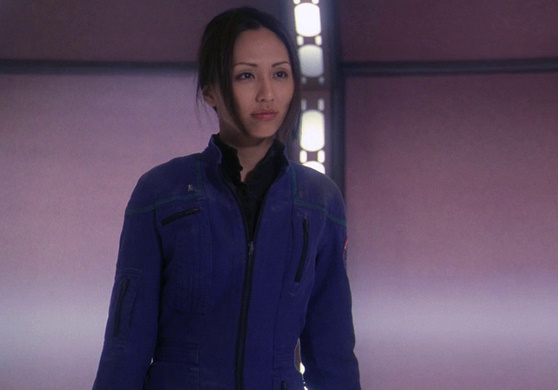
Hoshi on the transporter pad.

Although Vanishing Point’s ending is pretty cheap and uninspired, the episode itself is a truly interesting exploration of one of Star Trek’s best-known pieces of technology: the transporter. We’ve seen characters like Dr McCoy being averse to the transporter, and more transporter accidents than I can call to mind! But Vanishing Point steps back in time to when the technology was new and untested, and places Hoshi Sato at the centre of its story.

Ensign Sato was such a great point-of-view character, as her nervousness and anxiety at being out in space had already been well-established. Vanishing Point also took Hoshi outside of her usual role as communications officer, allowing her to take centre-stage in a different kind of story. Although the ending drags it down somewhat, Vanishing Point is nevertheless a ton of fun!

Episode #7:
A Quality of Mercy
Strange New Worlds Season 1

Christopher Pike as we’ve never seen him before!

Season 1 of Strange New Worlds is fantastic across the board, without so much as a single bad episode! It was difficult to pick just one for this list, but I’ve decided to go with A Quality of Mercy. This episode gets time travel just right, with Captain Pike dealing with himself from an alternate future timeline in which he avoided his devastating accident and disability. Time travel can be tricky to pull off, but A Quality of Mercy manages it.

The episode also returns to the classic story Balance of Terror, showing us an alternate outcome to the battle between Kirk and the Romulan Commander. This gives it the feel of a story “made for fans,” and Trekkies who’ve followed the franchise for a long time will surely find a lot to love here. At the core of it all is Captain Pike, a character who I find incredibly relatable. Knowing that one’s health is in decline and seeking to make a “deal with the devil” to find a solution… I’ve been there. And Anson Mount plays the whole thing – and the roles of two different Pikes – incredibly well.

Episode #8:
Equinox Parts I and II
Voyager Season 5-6

Captain Ransom.

Voyager’s fifth season ended in stunning fashion with the first part of Equinox. I was hanging on for months waiting for Part II, which brought the story to an explosive conclusion. After years lost in the Delta Quadrant, Captain Janeway and the crew finally encounter another Federation vessel – and another crew who understand what they’ve gone through. But all is not what it seems, as it turns out that the aliens attacking the small USS Equinox are actually in the right.

Equinox is a challenging episode, condemning Captain Ransom’s actions while also presenting him and (most of) his crew in a relatively sympathetic light. It’s an episode that hammers home how lucky Janeway and the crew of Voyager have been – comparatively speaking – and shows the extremes that people can be willing to go to in order to survive.

Episode #9:
The Star Gazer
Picard Season 2

Who’s this?

I debated for a long time whether I wanted to include The Star Gazer on this list. The story that it so brilliantly set up went off the rails pretty quickly in subsequent episodes, and Picard’s second season is, overall, a disappointment. But on its own, The Star Gazer is actually a pretty great episode, one that re-introduces one of Star Trek’s classic villains in a new and terrifying manner.

If the rest of Picard Season 2 had been anywhere near as good as The Star Gazer, it would be one of the best in the entire franchise! As it is, this episode almost feels like an alternate timeline, showing us what might have been! Regardless, though, it sets up a tantalising mystery, teases us with some serious development for some of the show’s supporting characters, and contains one of the best and most frightening clashes between Starfleet and the Borg that the Star Trek franchise has ever created.

Episode #10:
Homefront and Paradise Lost
Deep Space Nine Season 4

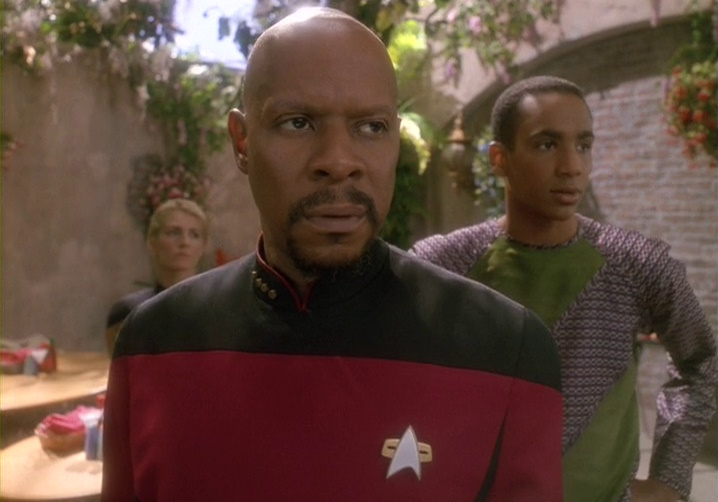
Benjamin and Jake Sisko.

Deep Space Nine had done things differently from its very first episode, and some fans weren’t wild about its darker tone. This shift away from the Federation and Starfleet being presented as an incorruptible and enlightened paradise was on full display in this pair of episodes. In between the discovery of the Dominion and the official outbreak of war, the Federation was terrified of changeling infiltrators. Feeling that politicians and bureaucrats weren’t up to the task, a renegade “badmiral” plots a coup.

Some early Star Trek stories could present the Federation as almost too perfect, and this continued into The Next Generation era. What Captain Sisko and Odo had to confront here was the idea that Starfleet officers could themselves fall prey to paranoia, corruption, and ego – and this very human reaction to the threat of infiltration felt quite relatable. Although we’re firmly on Sisko’s side, Homefront and Paradise Lost throw some moral ambiguity into the mix thanks to some complex writing and several outstanding guest stars.

Episode #11:
The Royale
The Next Generation Season 2

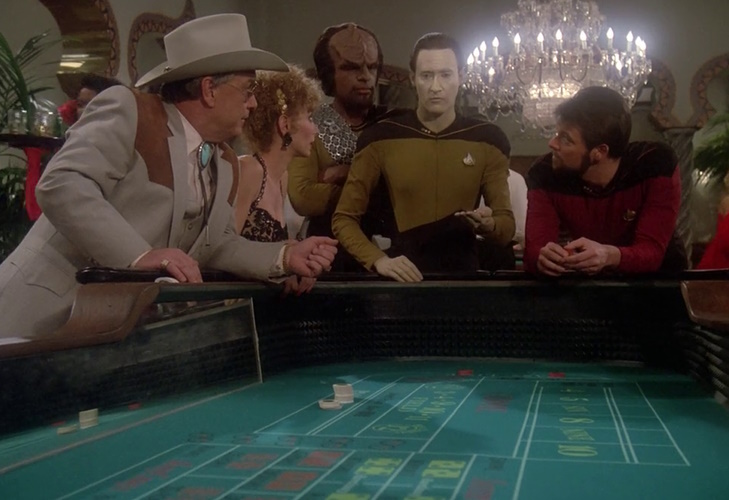
The away team gambling.

I confess that I have a soft spot for The Royale for one principal reason: it’s the earliest episode of Star Trek that I can remember watching! Although I’m sure I’d seen at least parts of other episodes prior to The Royale’s broadcast on terrestrial TV here in the UK in 1991, this is the first one I have rock-solid memories of, and it’s always carried special significance as a result. So that’s my own bias stated up front!

Bias aside, though, I think there’s a lot to enjoy in this episode. It’s the kind of story that no other sci-fi franchise would attempt, and it has an unusual and somewhat eerie feel. Imagine having to spend the rest of your life trapped in an alien recreation of a three-star hotel! That seems like a very specific kind of hell, putting a dark spin on what could’ve been a purely comical story. The idea of roaming to the farthest, unexplored reaches of space only to find an Earth hotel and a mystery is part of what made Star Trek stand out to me, and seeing Riker and the away team solve the puzzle is still an engaging watch more than three decades later!

Episode #12:
Through the Valley of Shadows
Discovery Season 2

The Klingon monastery on Boreth.

Through the Valley of Shadows reframes Captain Pike and the accident that left him disabled. The Menagerie, from the first season of The Original Series, showed us the aftermath of what happened to Pike, as well as introduced us to the character and his time in the captain’s chair. Through the Valley of Shadows took that idea to a completely new and different thematic place: Captain Pike had to choose this future for himself, making an unimaginable sacrifice in order to complete his mission and save untold numbers of lives.

We looked at one consequence of that above with the Strange New Worlds episode A Quality of Mercy. These two episodes make a fascinating pair, and the tragedy of Captain Pike takes on a whole new dimension in light of what we learn here. Pike has always been a character I find incredibly relatable, and Through the Valley of Shadows puts a distinctly “Star Trek” spin on the idea of seeing one’s own future – and knowing that illness, disability, and worsening health lie ahead.

Episode #13:
Court Martial
The Original Series Season 1

Captain Kirk with his lawyer.

Court Martial is Star Trek’s first foray into courtroom drama – a genre that the franchise would return to on multiple occasions! Captain Kirk is accused of murdering an officer under his command and attempting to cover it up, and the stakes are high! We know he couldn’t possibly be guilty, of course… but the evidence against him appears to be compelling.

Samuel T. Cogley – Kirk’s advocate – is a character I’d absolutely love modern Star Trek to revisit! Based on the “old country lawyer” character archetype, Cogley led Kirk’s defence in unorthodox fashion, and is one of the best parts of Court Martial. Along with The Conscience of the King and Charlie X, which also delve into Kirk’s backstory, Court Martial puts flesh on the bones of someone who was still a new character. Kirk’s integrity and honour are on display – and on trial.

Episode #14:
Dragon’s Teeth
Voyager Season 6

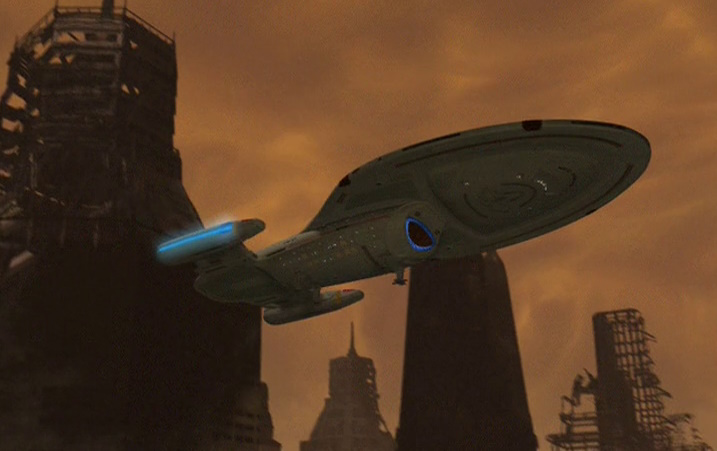
The USS Voyager prepares to land.

Dragon’s Teeth is an interesting episode, and one that tells us a little about the history of the Star Trek galaxy. It’s also a story that looks at the potential consequences of war and conquest, as well as how different reality can be from societal memory. The crew of Voyager re-awaken a group of aliens who have been in stasis since the 1400s, following a devastating war that culminated in the bombardment of their planet.

The Vaadwaur proved to be untrustworthy allies, however, and attempted to capture Voyager. The “underspace corridors” that were present in this episode weren’t revisited, even though they potentially offered a quicker way to traverse this region of space. The concept was fun, though, and reviving a long-dormant race was likewise an interesting and well-executed idea.

Episode #15:
The Andorian Incident
Enterprise Season 1

Andorians!

I have to hold up my hands and confess that I wasn’t a big supporter of Enterprise during its original run. I was disappointed in its choice of setting, believing that Star Trek should move forwards instead of looking back at its own fictional history. But episodes like The Andorian Incident show just how wrong I was to feel that way! The episode showcases the conflict between Andoria and Vulcan in the years prior to the founding of the Federation – and begins to set the stage for humanity to bridge the divide and bring them together.

At a Vulcan holy site on the planet P’Jem, a monastery has been attacked by Andorians. The Andorian leader claims the monastery is a front for a listening post. Jeffrey Combs returns to Star Trek after his roles in Deep Space Nine to play Andorian leader Shran, and the interplay between Shran and Captain Archer would be one of Enterprise’s best. All in all, a fascinating outing.

Episode #16:
Where Pleasant Fountains Lie
Lower Decks Season 2

Andy Billups, chief engineer of the USS Cerritos.

I adore Where Pleasant Fountains Lie. I think it has a potentially-interesting explanation for the abundance of human-looking aliens in the Star Trek galaxy (they’re all Earth colonies), but moreover it touches on a subject close to home for me: asexuality. I’m asexual, and while the Cerritos’ chief engineer Andy Billups isn’t explicitly stated to be asexual in the story, Where Pleasant Fountains Lie focuses in large part on his discomfort with having sex and desire to avoid it.

Star Trek has always used its sci-fi setting to shine a new light on the real world, and for me, this episode absolutely nailed it. When people ask me about asexuality, I now have a relatable story that I can point to, one that touches on many of the same feelings and experiences that I’ve personally had as an asexual individual. I wrote a longer piece about this episode’s asexuality analogy, and you can find it by clicking or tapping here if you’re interested to read more.

Episode #17:
Let Sleeping Borg Lie
Prodigy Season 1

What have the crew of the Protostar got themselves into this time?

Prodigy had a strong first season – though it’s been disappointingly let down by a lack of support from Paramount, especially in the merchandising department. There are several contenders for episodes to include on this list, but I’ve decided to go with Let Sleeping Borg Lie from the second half of the season.

The episode focuses on a derelict Borg vessel – tying into the story recently seen in Picard’s third season – and gives all of the main youngsters something to do. The episode moves key storylines along, as Prodigy is a surprisingly serialised affair, but it also takes the crew to a different environment. One of the advantages of animation over live-action is the ability to visit different ships and planets every week relatively inexpensively! There are strong themes of sacrifice and friendship that form the emotional core of the story, too.

Episode #18:
Birthright, Parts I & II
The Next Generation Season 6

The Enterprise-D at DS9.

This story is a fun crossover between The Next Generation and Deep Space Nine, which wasn’t yet ten episodes into its first season. The main story focuses on Worf as he tracks down a hitherto unknown group of survivors of the Khitomer massacre – the event in which his birth parents were killed. The second part of the story in particular focuses on the Klingons and Klingon culture.

I adore a good crossover, and it’s a ton of fun to see Picard and Dr Crusher aboard DS9, as well as Data and Dr Bashir working together. This episode was designed to give Deep Space Nine a jump-start as its first season got underway, but it’s more than that. It’s a fantastic combination of characters and settings that expands Star Trek beyond a single series into a connected franchise.

Episode #19:
State of Flux
Voyager Season 1

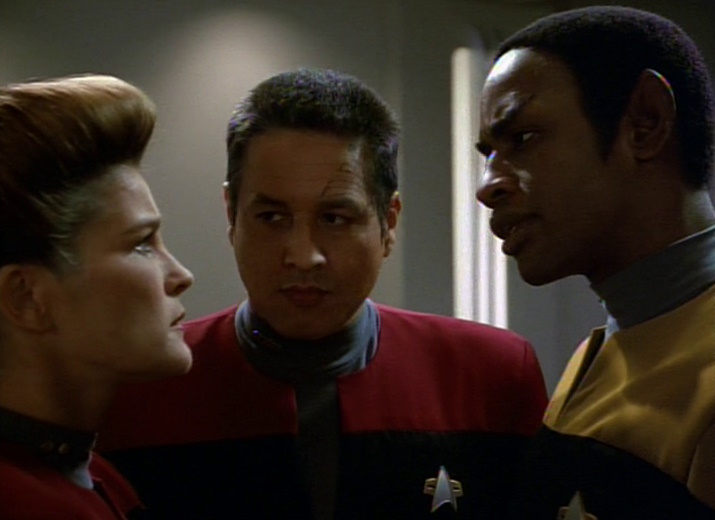
Janeway, Chakotay, and Tuvok discuss the situation.

Voyager never managed to make good on its “one ship, two crews” idea, and State of Flux, coming midway through the first season, was one of the few episodes to really explore that concept. When the crew of Voyager come to suspect that someone is passing secret information to the Kazon, a trap is laid – and a member of Chakotay’s Maquis sect is the prime suspect.

This episode set up a recurring story that would come back in Season 2 and at the beginning of Season 3, giving Voyager at least some consistent themes across the first part of the crew’s journey home. It’s also an engaging mystery on its own merit, and a strong episode for Chakotay – a character who could feel under-used, especially toward the latter part of the show’s run.

Episode #20:
Civil Defense
Deep Space Nine Season 3

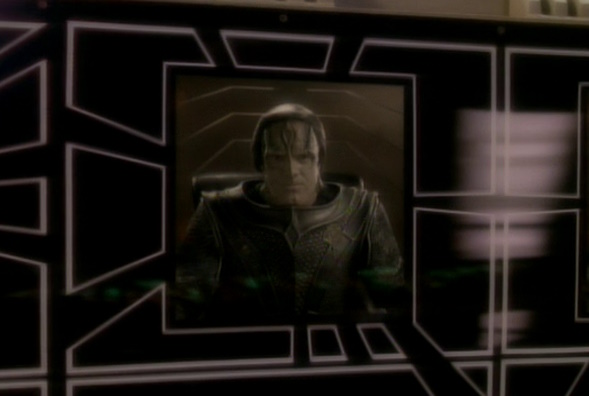
Kell, the former commanding officer of Terok Nor, appears on a screen.

Despite a station-threatening premise, Civil Defense is a remarkably fun episode! It takes the premise of occupying an alien space station to a completely different place than almost any other story in the series, as O’Brien accidentally triggers a computer programme designed to put down a rebellion by the Cardassian station’s former Bajoran workforce.

Civil Defense gives most of the show’s main characters – including Jake Sisko – something to do, putting together groups or pairs of characters who always work well together and provide a ton of entertainment. Quark and Odo help to keep things light – and so does Dukat, to an extent, when he arrives to offer his “assistance!” All in all, an exciting and surprisingly fun outing.

So that’s it!

The USS Enterprise in The Wrath of Khan.

We’ve taken a look at twenty fantastic Star Trek episodes from across the franchise, getting a great mix of modern and older episodes. Hopefully this will help me regain some of my lost standing as a Trekkie after my list a few days ago!

All jokes aside, though, there’s a ton of fun to be had with Star Trek. Put all twenty of these episodes together in a playlist and you’ve got a hugely entertaining Star Trek marathon that will take you from the very beginnings of the franchise in 1966 right the way through to the most recent seasons that have only just been broadcast. It was a blast to go back and revisit all of these wonderful episodes.

The Star Trek franchise – including all series, films, and episodes mentioned above – is the copyright of Paramount Global. This article contains the thoughts and opinions of one person only and is not intended to cause any offence.