Star Trek: The Original Series Episode Re-Watch – Season 1, Episode 3: Where No Man Has Gone Before

A Star Trek-themed spoiler warning

Spoiler Warning: There are spoilers ahead for Star Trek: The Original Series.

2026 marks Star Trek’s landmark 60th anniversary – and six decades later, we’re still getting brand-new episodes and stories! That’s something incredibly special; a milestone few other franchises have ever reached or will ever reach. Today, as part of my ongoing celebrations of the 60th anniversary, I thought we could step back in time, not only to the first season of The Original Series, but to a particularly special – and rather unusual – episode. Today, we’re watching Where No Man Has Gone Before – Star Trek’s second pilot.

After The Cage wasn’t picked up by NBC in 1965, Gene Roddenberry and his team were given a rare and unusual second chance to salvage Star Trek. The resulting script was Where No Man Has Gone Before, and after almost the entire cast – sans Leonard Nimoy as Spock – was changed, the new episode entered production. Recycling the sets which had been built for The Cage, but which were subsequently dismantled and rebuilt ahead of filming the rest of what we now know of as The Original Series, the episode has a completely distinct look, one which simply doesn’t appear anywhere else in the franchise.
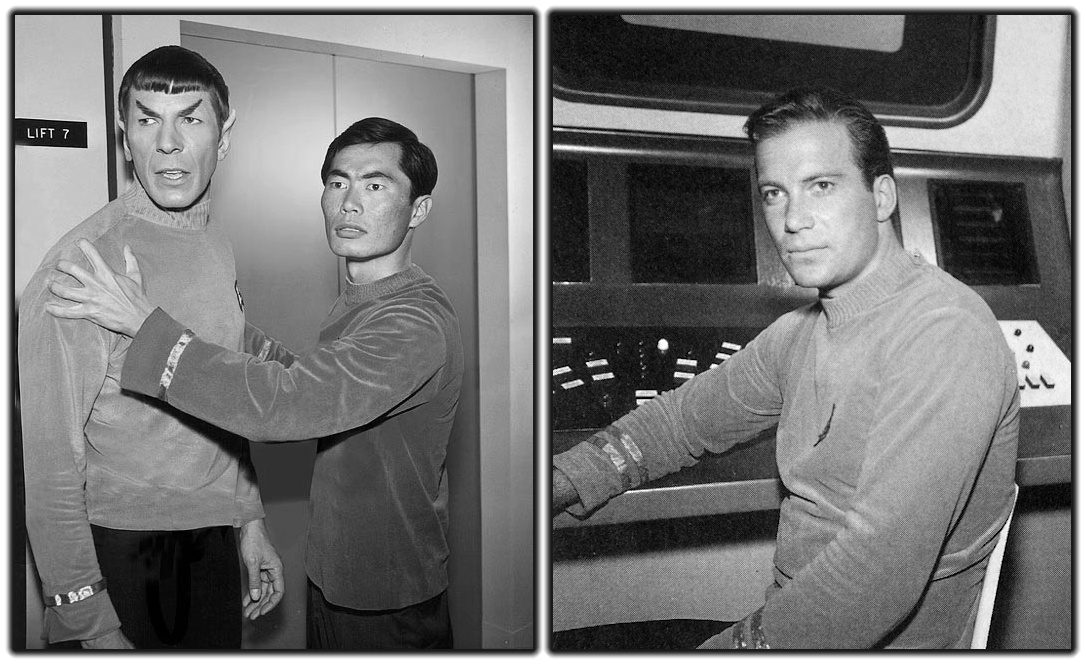
Promo photos for Star Trek TOS showing Nimoy and Takei (l) and Shatner (r)
Black-and-white promotional photos showing Leonard Nimoy with George Takei (left) and William Shatner (right).

The uniforms may be the most obvious, with Star Trek’s (in)famous red shirts nowhere to be seen! Instead, the entire crew wears either blue, a different shade of “gold” that almost looks green or khaki, or beige. And, with the exception of Kirk, the remaining characters we’d come to know – Spock, Scotty, and Sulu – are all wearing a different colour than we’d expect. Spock gets a uniform similar to Kirk’s in command gold, Sulu – who isn’t the helmsman this time, but some kind of mathematical aide – wears medical blue, and Scotty is in one of the beige uniforms that seem to have taken the place of engineering/security’s red.

The uniforms are also different in the way they appear: visual zippers on the shoulders, a softer, ribbed crew-neck collar that evokes World War II-era naval uniforms, and smaller, slightly different Starfleet delta patches, too. These uniforms are similar to those seen in The Cage, which is another quirk of production. But for the main crew and characters we’d come to know, this was the only time we’d ever see them in these particular uniforms.
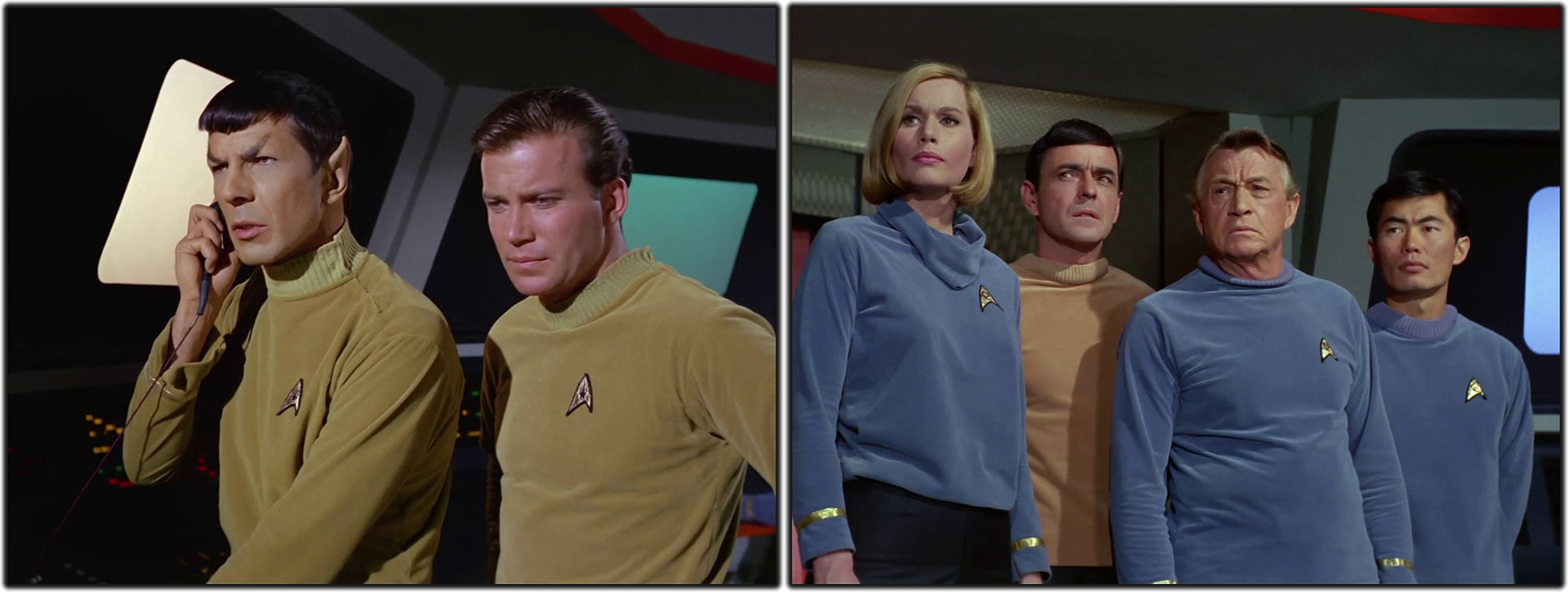
Two still frames from Star Trek TOS showing early uniform variants
The uniforms are different in this episode.

Then there are the sets. The bridge is different – albeit in ways that may not be obvious at first. Kirk’s chair has a large communicator on one side, which I think I’m right in saying wasn’t seen again. The main viewscreen, though, is the most clear and obvious point of difference; its corners are far more rounded than they would be in the rest of the show, again evoking more of that World War II naval style in some ways. The set was moved to a different sound stage when The Original Series entered full production, which is why it looks different here.

Sickbay, which is one of the only other Enterprise rooms where the episode spends much time, is also quite different, with different coloured walls and simpler upholstery than we’d see in the rest of the show. Some doors in Where No Man Has Gone Before are grey or silver instead of the more familiar red, chairs are a different colour and have shorter backs, and the Enterprise as a whole just feels a little… different. You weren’t making that up, if you felt something was “off” upon watching this episode! Things really are different.
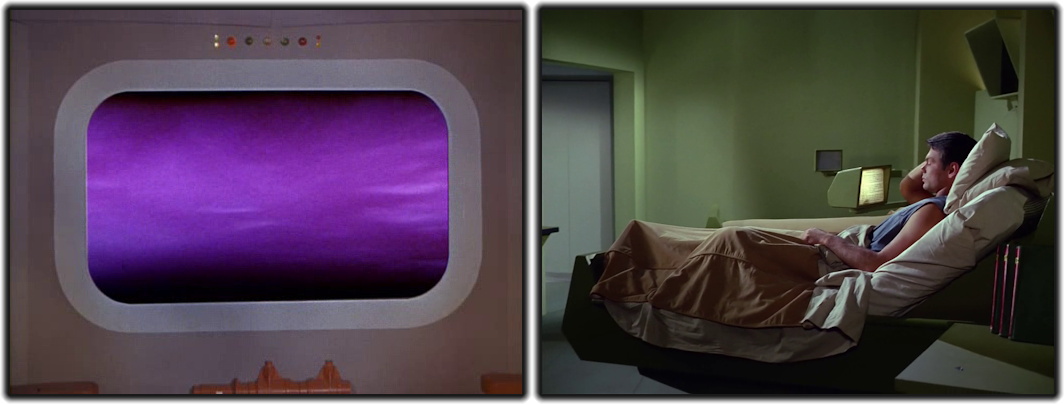
Two still frames from Star Trek TOS showing the viewscreen and sickbay
The main viewscreen on the bridge (left) and sickbay (right) aren’t quite the same as they are in the rest of the series.

Unusually for a pilot episode, Where No Man Has Gone Before wasn’t the first to be broadcast. That honour fell to The Man Trap, which executives at NBC apparently felt was a simpler, more straightforward story. This episode was pushed back and aired as the third of Season 1 in the United States… but interestingly, when Star Trek came to the UK in 1969, it actually was the first episode that the BBC chose to broadcast. I wonder why that happened?

Here’s a fun question: how many times, across The Original Series, do we see Captain Kirk wielding his phaser rifle? This iconic, legendary prop, which is well-known to all of us Trekkies and instantly recognisable, must’ve been used a lot… right? Well, no! The phaser rifle *only* appears here, in Where No Man Has Gone Before, and despite being seen in publicity photos of William Shatner in his role as Kirk, it never appears again in the entire series. According to Star Trek legend Bjo Trimble, Gene Roddenberry disliked the design, feeling that it looked “too lethal” for his calmer, more rational vision of humankind’s future.

Still frame from a YouTube video showing the Star Trek phaser rifle prop with its designer
Prop designer Reuben Klamer (pictured in 2013 with the original prop) designed the phaser rifle for Where No Man Has Gone Before.

In addition to Chekov, who wouldn’t be seen until Season 2, Where No Man Has Gone Before is also noteworthy insofar as it was produced before Nichelle Nichols was cast as Uhura, and before DeForest Kelley was cast as the ship’s doctor. The role of communications officer is instead taken by Lieutenant Alden, played by Lloyd Haynes, and standing in for DeForest Kelley is Paul Fix, who plays the character of Dr Mark Piper.

I’ve always felt that Dr Piper – in his limited on-screen moments – is a bit of a half-step between The Cage’s Dr Boyce and the main show’s Dr McCoy. He’s similar to both characters in as much as he’s older than Kirk, but he comes across as being a bit less serious than Dr Boyce, slouching during a conference meeting, but also less lighthearted or quippy than Dr McCoy would be. The archetype that Gene Rodenberry wanted to create – the older, slightly wiser ship’s doctor, who could be a guide to the captain both in medical matters and beyond – was clearly present in Dr Piper and Dr Boyce, but these versions feel… less refined, if that makes sense. Like, I can see where Dr McCoy is going to materialise, but the full personality of the character isn’t there yet.
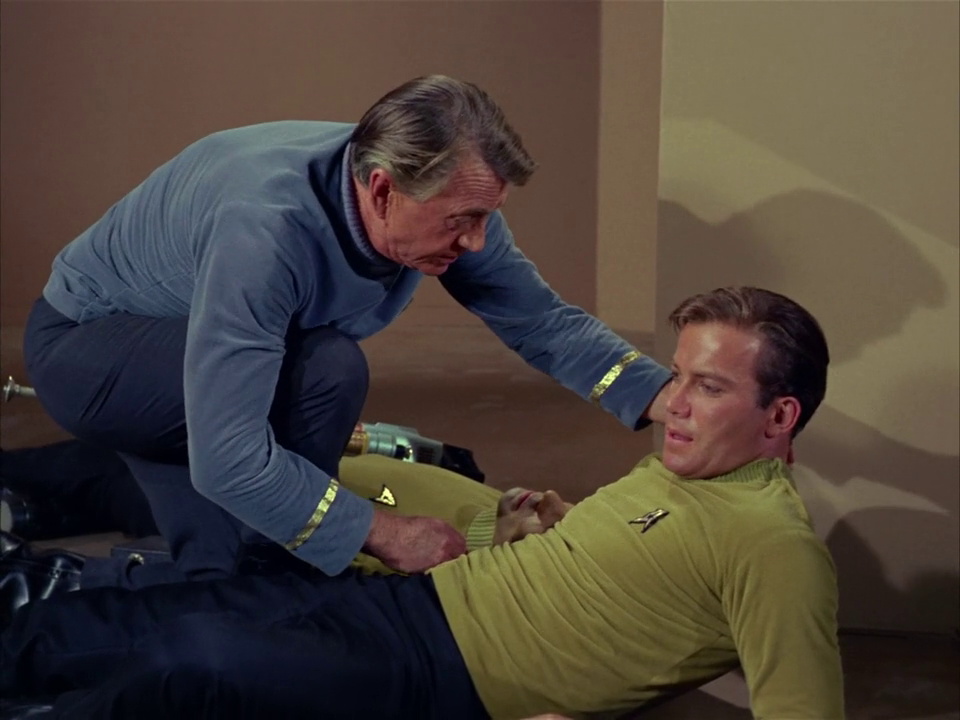
Still frame from Star Trek TOS showing Kirk and Dr Piper
Dr Piper with Captain Kirk.

As an interesting aside, Gene Roddenberry had his heart set on casting DeForest Kelley for both The Cage and Where No Man Has Gone Before, but was overruled by others involved in the production. It was only when Star Trek was fully greenlit that Rodenberry got his man – and I think we can all agree that it was the right call! Still… it’s interesting to see what might have been.

I usually prefer to watch Star Trek on streaming nowadays… or at least I do during the months where I pay for Paramount+! But on this occasion, I actually went back to my old DVDs; the streaming versions are the remastered ones, complete with new special effects and CGI shots of the Enterprise. And while the remastered version of The Original Series does look, by every objective measure going, “better,” I wanted the classic look this time. There are differences in the way the episode looks – the Galactic Barrier, for instance, looks very different, as do a few other VFX shots. The Enterprise itself is also a fully CGI model in establishing shots.
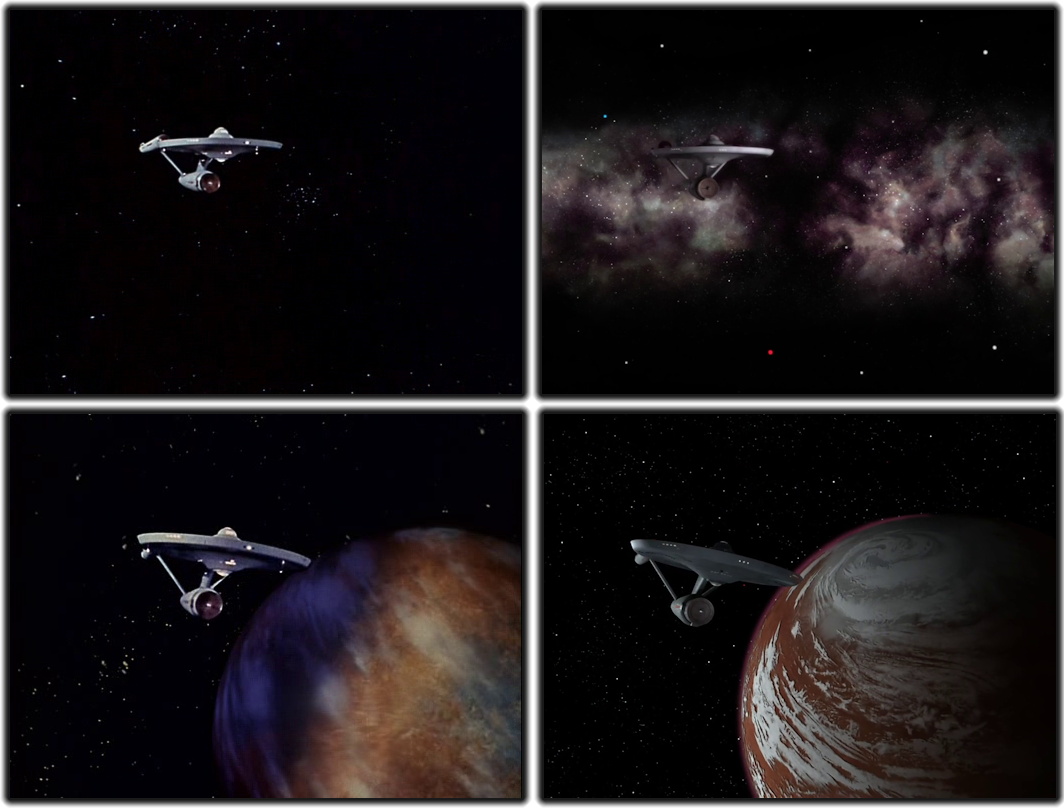
Side-by-side comparison of Star Trek TOS original and remastered shots
The original versions (left) and remastered versions (right) of two moments in the story.

As a Trekkie, there are a lot of things that seem “wrong” about Where No Man Has Gone Before. What I mean by that is… with the hindsight that six decades and almost 1,000 subsequent stories can provide, there are things in the story that just don’t seem to fit. Spock being so quick to advocate for Mitchell’s extrajudicial execution, the Enterprise being on a mission to scout outside of the galaxy, some confusion about warp drive and impulse engines, and how fast impulse actually is when trying to get between star systems… all of these things feel a little “off.” To what extent that will bother you, or whether you can set it all aside and enjoy the story for what it is will be a matter of personal taste!

For me… I kind of place Where No Man Has Gone Before along with The Cage in almost their own category. These are fun Star Trek stories, of course, but they’re also unique oddities within the broader franchise; episodes which almost seem to take place apart from the rest of The Original Series. I think I can fall victim to being overly nitpicky sometimes (check out some of my other episode write-ups and reviews for that!) and the temptation is there with Where No Man Has Gone Before to say that things like the uniforms, the attitudes of some of the characters, and the Enterprise’s strange mission all seem to be, for want of a better word, “wrong.” But placing the episode in context, and understanding it for what it is, helps me set a lot of that aside. Even though it’s not an episode I re-watch all that often, I still had a good time when I revisited it, and I found myself getting swept along for the ride.
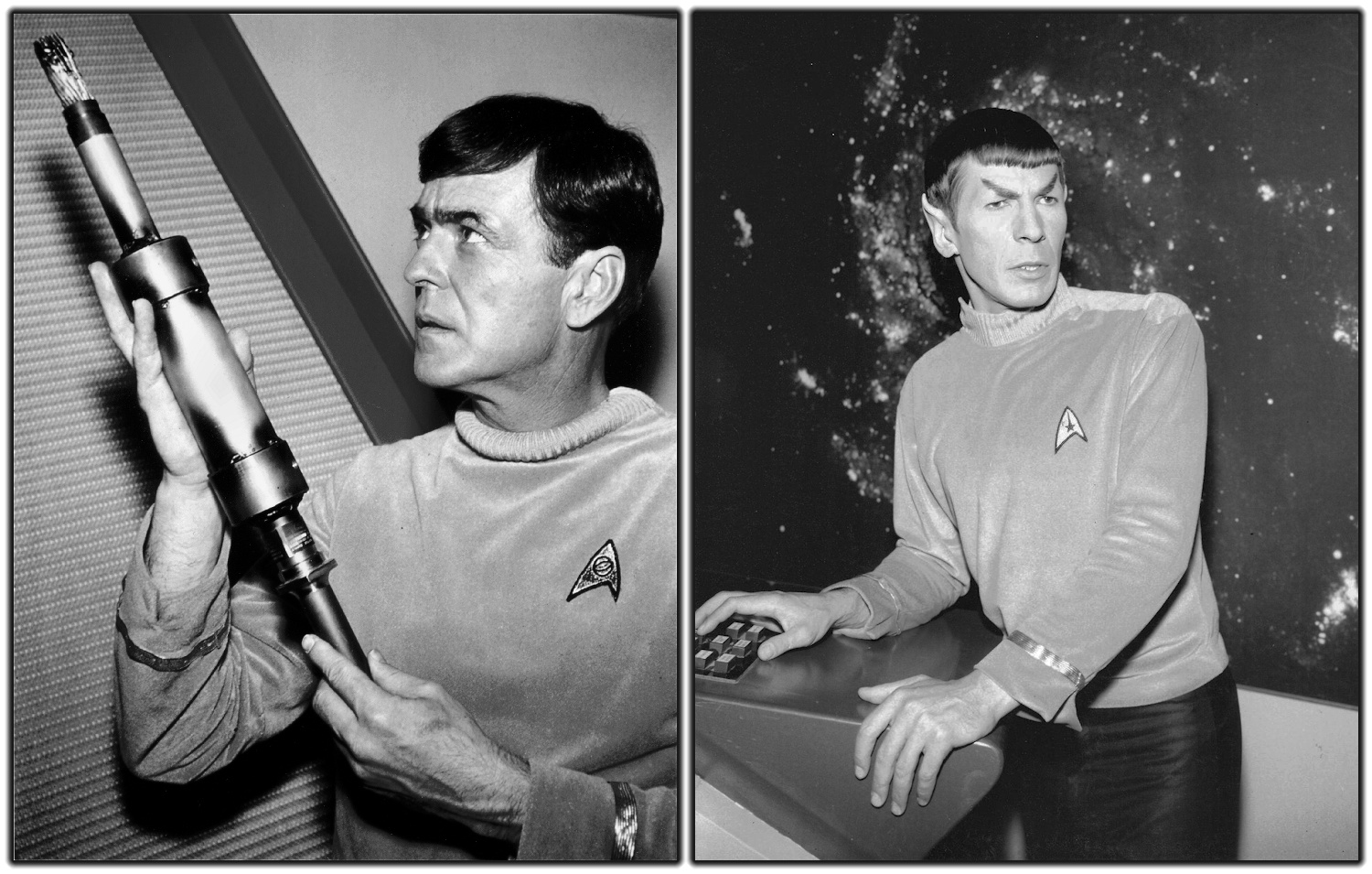
Promo photos for Star Trek TOS showing Doohan and Nimoy
Black-and-white promotional photos of James Doohan (left) and Leonard Nimoy (right).

That’s testament to the power that Star Trek still has some six decades later! There are undeniably outdated things in Where No Man Has Gone Before: papier-mache rocks, for instance, or Kirk and Mitchell’s attitude towards women. But the story itself is timeless; a classic morality fable about the dangers of granting a mere mortal the powers of a god. Given where we are today with conversations about artificial intelligence and its potential to far exceed us in terms of its capabilities, and the so-called “alignment problem,” stories like Where No Man Has Gone Before actually seem *more* relevant, not less.

So I like that we catch a glimpse of a kind of “alternate reality” for both Star Trek the show and the USS Enterprise in-universe. We see Kirk, presumably at a slightly earlier moment in his command, with different crewmates, wearing different uniforms, and even with a slightly different design to parts of the ship. It makes for a fun “what if;” what might The Original Series have looked like if *this* series – the one we catch a glimpse of for just one episode – had been continued with zero changes? Would these uniforms have been as iconic, with their toned-down colours and no red? Would the phaser rifle have become a standard part of the Federation’s arsenal? Would Dr Piper have been as well-received and well-remembered as Dr McCoy? And would some of the characters we don’t spend as much time with in the episode – like Alden or Yeoman Smith – have gone on to fill the absent roles of Uhura, Rand, or Chapel? I guess we’ll never know, eh?
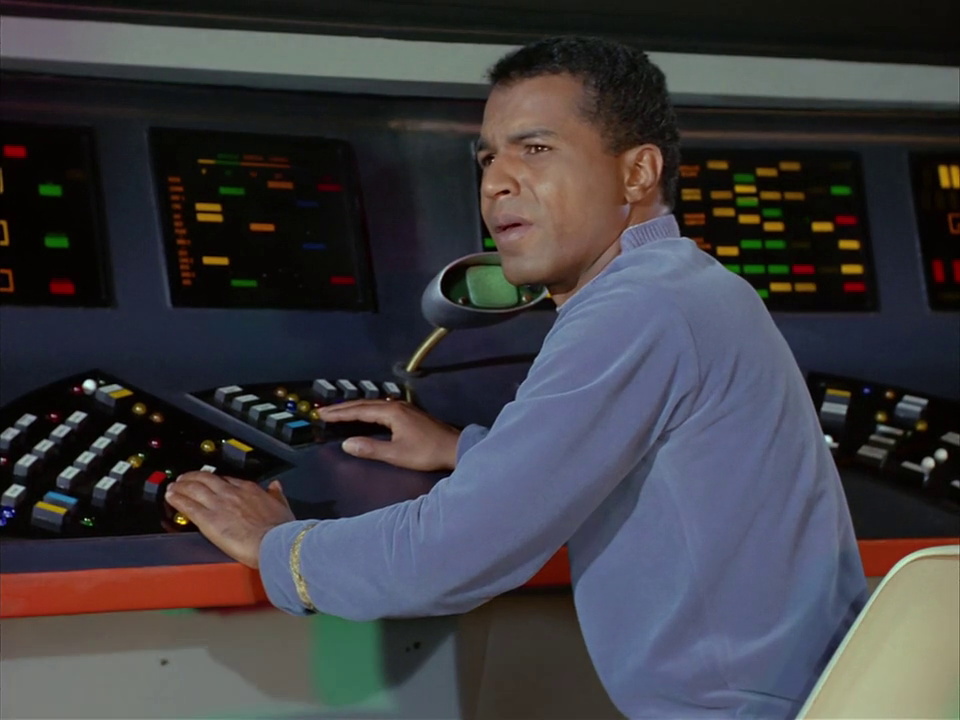
Still frame from Star Trek TOS showing Alden
Lieutenant Alden, the Enterprise’s communications officer in this episode.

I think I’m right in saying that extra-sensory perception, or ESP, wasn’t mentioned again after Where No Man Has Gone Before. Obviously, we’ve seen similar abilities in races like the Talosians, Betazoids, Q Continuum, and more – and humans would occasionally gain similar powers in some stories. But it was never again expressed in quite this way, with Starfleet apparently keeping track of humans who possessed these seemingly magical powers.

It’s interesting that this vision of the future sees almost a blend of magic and science. ESP, even in the 1960s, was a fringe idea at best, but Where No Man Has Gone Before wraps it up in the language of science, presenting it as something to be merely noted and catalogued, the way we might expect Starfleet to make note of someone’s height or allergies. Because ESP is this kind of pseudoscientific, paranormal thing – which, if we think sceptically, has never been proven to exist – it feels odd to see it included in a Star Trek episode in this manner. I don’t hate it, and when you look at other stories in The Original Series, The Animated Series, and even early Next Generation episodes, it doesn’t feel that out-of-place. But once you get past, say, Season 2 of TNG, it’s not the kind of storyline I’d expect to see. Star Trek could make a comparable episode today, but if one were commissioned, I don’t think the ESP angle would be included at all – at least, not in this straightforward, scientific way.
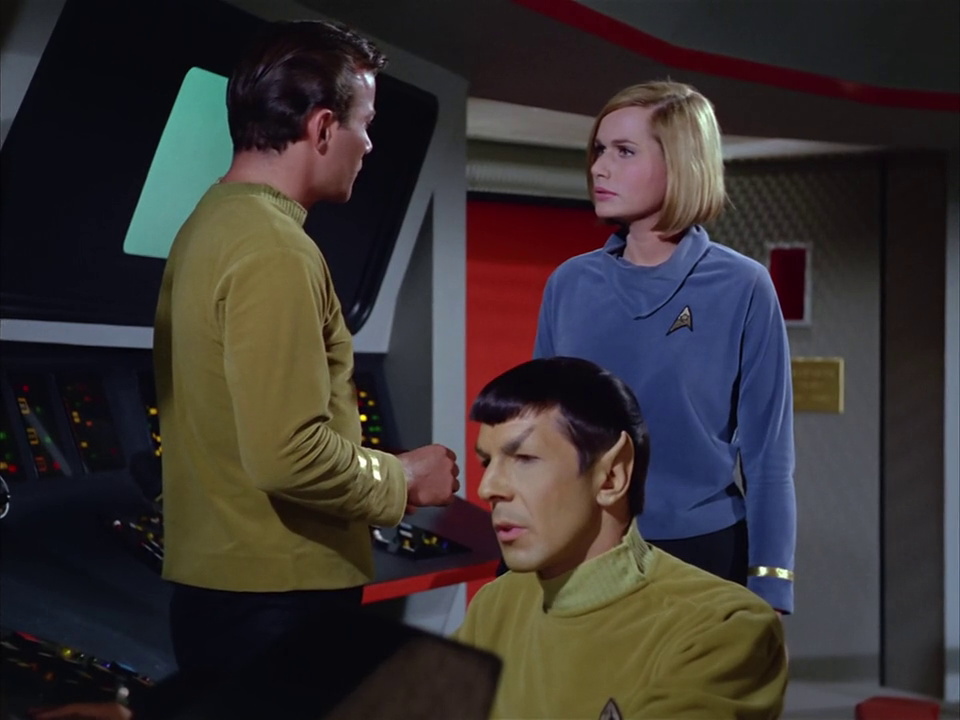
Still frame from Star Trek TOS showing Kirk, Spock, and Dehner
Kirk, Spock, and Dr Dehner discuss extra-sensory perception.

So we’ve talked a lot about what makes Where No Man Has Gone Before stand apart, different from the rest of Star Trek. Let’s move on to ways in which the episode *does* feel familiar!

I recently had the opportunity to meet William Shatner – Captain Kirk himself – at an event here in the UK. Click or tap here to check out my thoughts on that, by the way; it’s a big part of why I wanted to write up another TOS episode re-watch! Shatner’s Captain Kirk arrives in Where No Man Has Gone Before basically fully-formed as the character we know and love: friendly with his crew, especially close to Spock, flirty with women, and with a strong sense of duty and protectiveness for his ship. Those traits would go on to define the character, and they’re all present here, in what was the first time Kirk was conceived and brought to the screen.

Spock has changed from The Cage, but in terms of the character we’re most familiar with, he’s also more or less fully-formed. Where No Man Has Gone Before was the first time (in production order, I mean) that the Vulcans were established as being a logical, unemotional people, and Spock embodies that here in a way he didn’t in The Cage.
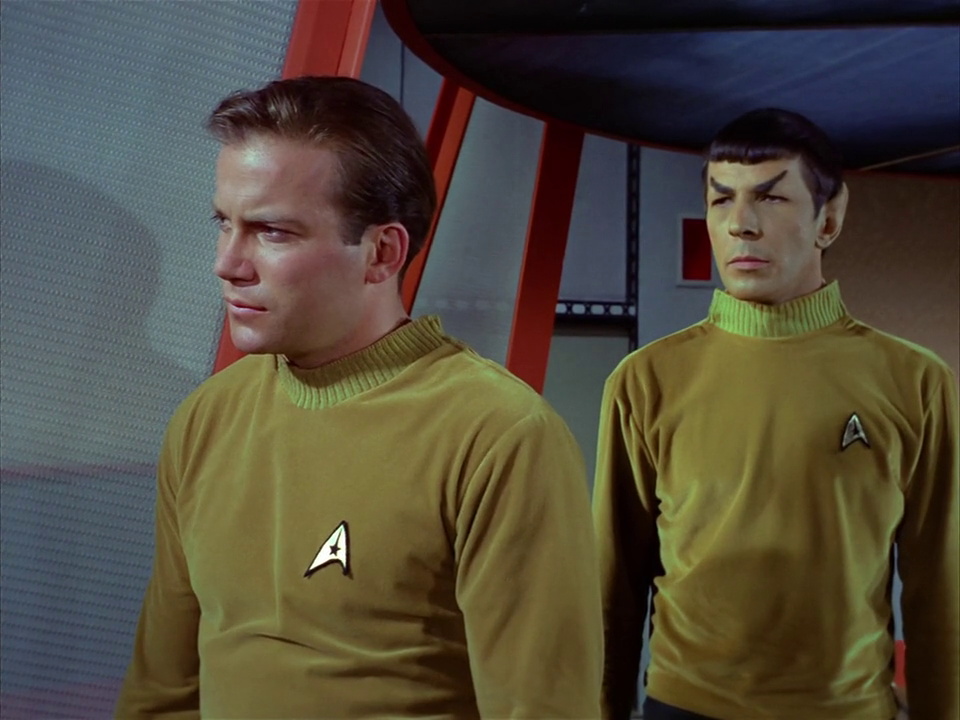
Still frame from Star Trek TOS showing Kirk and Spock
Kirk and Spock in the conference room.

The barest bones of Scotty can be glimpsed; James Doohan is already doing the accent, and while we don’t exactly see Scotty as a miracle-worker (major repair tasks and the retrofitting of Delta Vega’s station fall to other characters this time), he’s at least established as the Enterprise’s senior engineer. Sulu is a bit of an oddity; as I said above, he’s not a helmsman, nor even a bridge officer, and if uniform colours mean *anything* in this particular story, he might well be supposed to be affiliated with the science or even medical divisions. But nevertheless, we have George Takei in his familiar role, and Sulu gets a few lines.

Dr Piper is a Dr McCoy prototype, as discussed above, and although he doesn’t get a ton of screen time or a lot of lines, you can see the outline for that kind of character in Paul Fix’s performance. So, once again, we have the bare bones of a familiar character – albeit that this one isn’t played by the actor we’d expect to see!
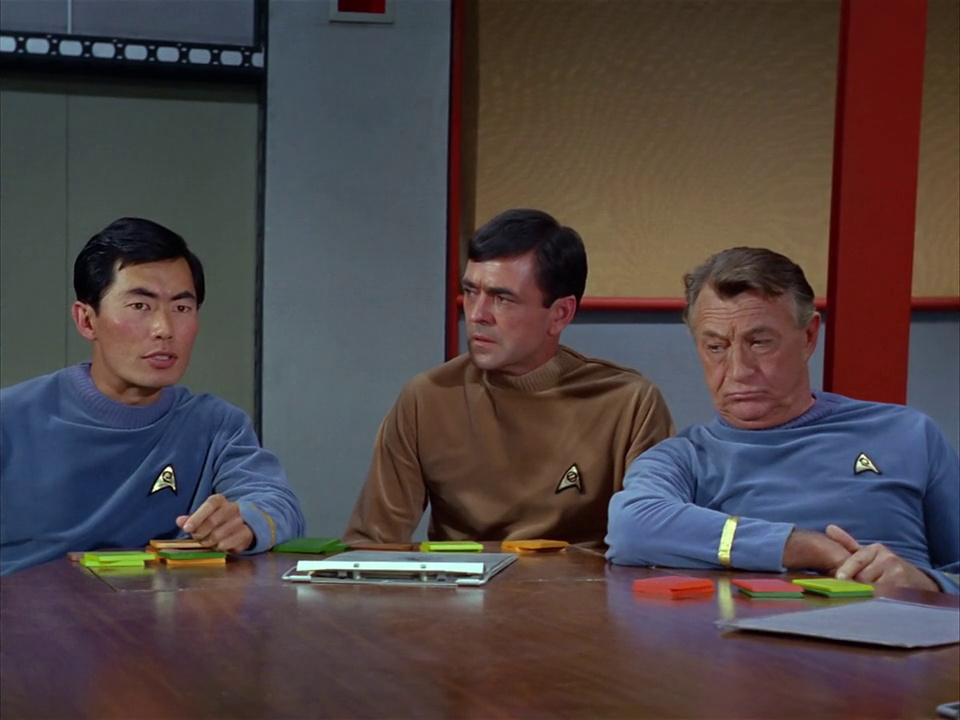
Sulu, Scotty, and Dr Piper.

The Enterprise, despite some key differences that we’ve already discussed, still feels familiar. The bridge is set up the same, despite the different main viewscreen, and the captain’s chair, Spock’s science station, the red turbolift doors, and the helm console are all exactly as we’d remember them. Minor differences may be a result of the set being dismantled and rebuilt at a different location, but by and large, the internal areas of the Enterprise that we see are still familiar enough not to feel totally “wrong.”

The exterior of the ship is also exactly the same. Where No Man Has Gone Before re-uses the filming model that had been built for The Cage, and some establishing shots of the ship would go on to be mainstays of The Original Series. The remastered Blu-ray version has different CGI shots; the Enterprise moves in ways we didn’t really see in the show’s original run. But, like I said, that’s partly why I wanted to watch my old DVD copy on this occasion!
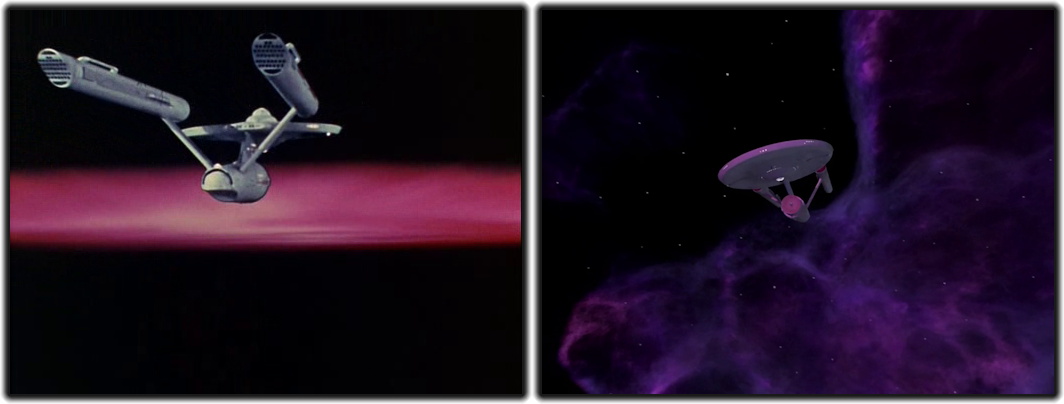
Side-by-side comparison of Star Trek TOS original and remastered shots
The exact same moment in the story as seen in the original version of the episode (left) and the Blu-ray remaster (right).

For a one-off character, Gary Mitchell is surprisingly well-written. He fits seamlessly into The Original Series at this very early stage, and if Where No Man Has Gone Before was the first episode you ever watched, I could see what happens to him being genuinely shocking – especially to an audience some sixty years ago. I genuinely buy into Kirk and Mitchell’s friendship. Some one-off characters who are introduced as supposed besties of someone on the main cast don’t always stick the landing – their inclusions can, sometimes, feel a little *too* forced. But Mitchell and Kirk have chemistry together, thanks to William Shatner’s performance playing well with guest star Gary Lockwood.

Opinions on Mitchell himself may vary, I suspect, due to the passage of time. Writing in 2026, some six decades on from the character’s debut, I view Mitchell as being kind of arrogant and unlikable from the get-go; his dismissive attitude to the Enterprise’s helm officer and his unpleasant interaction with Dr Dehner being examples of this. But to an audience back then, I think Mitchell was meant to come across as kind of similar to Kirk; a ladies’ man with a sense of humour, perhaps even a happy-go-lucky attitude that would contrast with his later god-like powers.
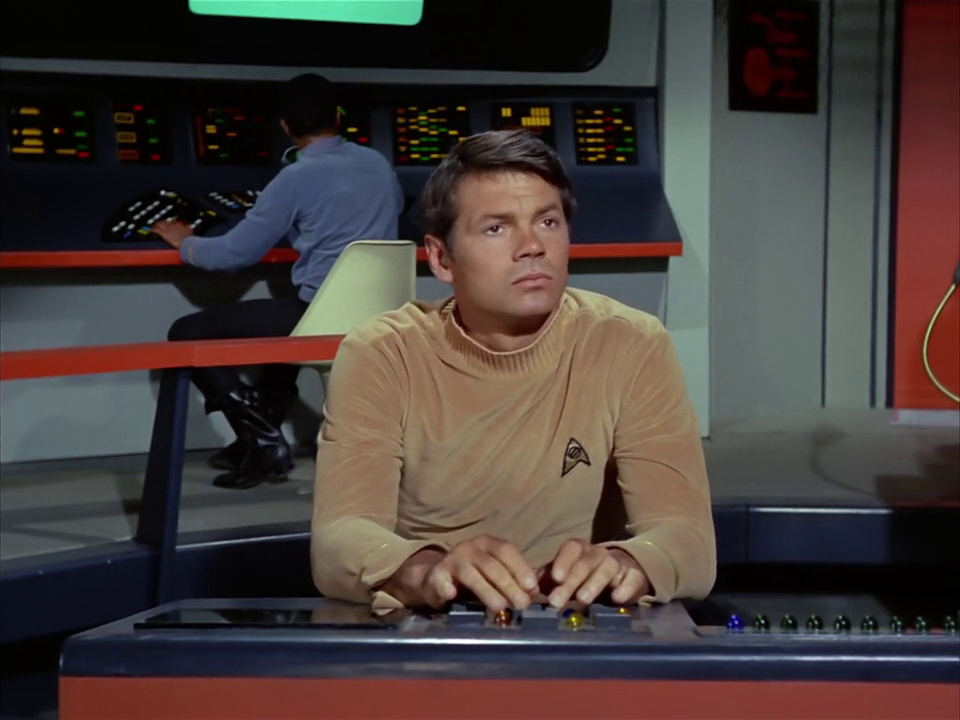
Still frame from Star Trek TOS showing Mitchell
Gary Mitchell, prior to his transformation.

I would argue, though, that Mitchell’s early scenes with Kirk on the bridge and in the turbolift are at least meant to inform us of a selfish or arrogant side – something that would make his developing powers even harder to handle. Because Mitchell starts out as arguably a flawed person, there’s room for him to abuse the powers he develops later on in a way that feels plausible. If a character like Kirk had been given such powers, it would be harder, perhaps, to imagine that he’d want to misuse them; Kirk has a stronger moral core – or at least, I feel he does with the benefit of more than a hundred other episodes and films! But Mitchell has that arrogant streak from the get-go; a flaw that makes him susceptible to being corrupted by power.

But is that the moral of the story? That *only* a flawed person would abuse power?

I suspect the real intention was to show that a normal guy – as Mitchell is supposed to be, for the era in which Where No Man Has Gone Before was produced – is always going to be too tempted to abuse power. He’s an example of, to quote Kirk in the episode itself: “absolute power corrupting absolutely.” Mitchell was intended to be just an “everyman,” a regular Starfleet officer who couldn’t handle that kind of power. None of us can… and that’s supposed to be the point.
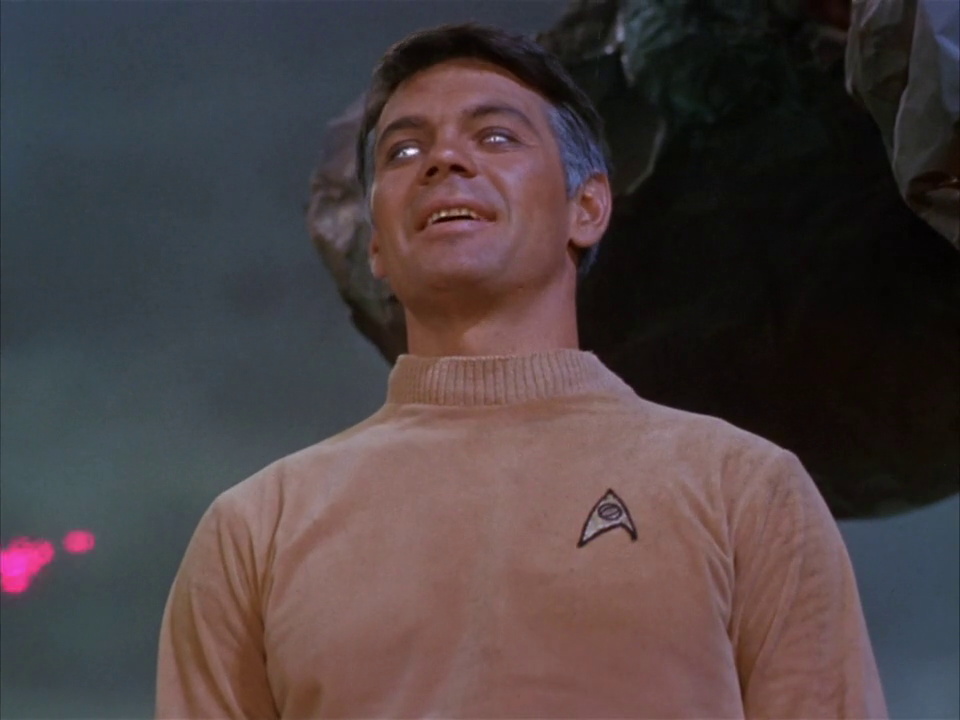
Still frame from Star Trek TOS showing Mitchell
Mitchell with his god-like powers.

Gene Roddenberry saw Star Trek, in part, as a vehicle for conveying these kinds of morality fables. Yes, there’s a vision of the future where humankind has overcome all kinds of obstacles, and there’s an incredibly positive outlook which, at the height of the Cold War, seemed impossible to a lot of folks. That inspirational side, that optimism, and that sense of hope are still part of the franchise to this day. But there’s also storytelling by metaphor – Gary Mitchell receives god-like powers, but those powers can be read as a metaphor for political power. Mitchell’s transformation, seen through that lens, is a warning against granting *anyone* – even a likeable guy or an “average Joe” like Gary Mitchell – too much power. I wonder if you can think of a contemporary example of someone like that… a politician, perhaps?

Then there’s Dr Dehner. Her powers take longer to manifest, and seem to be a little behind Mitchell’s – whether that’s because she’s supposed to be weaker, or because powers grow and improve over time isn’t 100% clear in the story itself, but it’s still an interesting question. It’s fascinating that Dr Dehner, not Mitchell, is the character able to be reasoned out of her power-mad state. If we take what I was saying before about storytelling by fable and metaphor, I think we can argue that Where No Man Has Gone Before wants to present intelligence, and perhaps education, as being virtues; that Dr Dehner, as a psychiatrist and a more intelligent and thoughtful person than Mitchell – was able to snap out of it and resist the temptation of unlimited power.
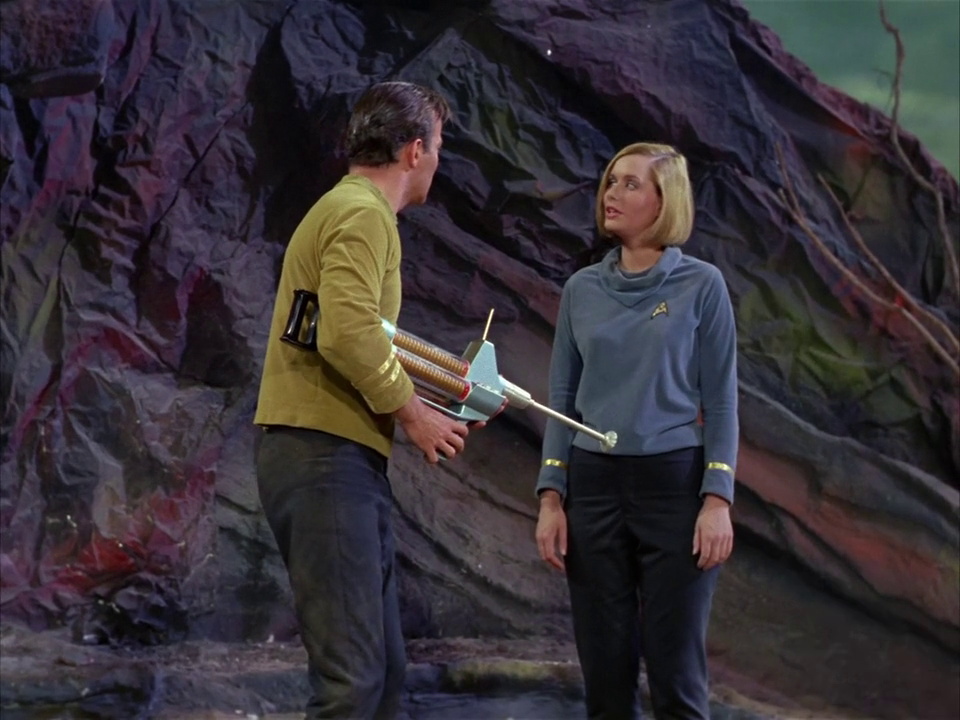
Kirk was able to remind Dr Dehner of her humanity in a way he couldn’t with Mitchell.

So I hope this has been interesting.

Where No Man Has Gone Before is, in many ways, an odd little curiosity; produced more than a year before the rest of The Original Series’ first season, it doesn’t integrate with it perfectly. But the outline of what Star Trek would become is present here – some characters aren’t fully fleshed-out yet, and others would be added, removed, or changed entirely. It makes the episode feel… unique. A distinct offering, and a rare glimpse at a vision for the series that’s both similar and different. Compared to The Cage, the episode is a lot closer to the rest of The Original Series. But compare it to any story produced later and it stands apart.

My encounter with William Shatner last month, and Star Trek’s big 60th anniversary year, were the catalysts for returning to Where No Man Has Gone Before. And you know what? I had fun with it! It’s an episode I haven’t actually re-watched in a few years, at this point, and it’s been even longer since I went back to my TOS DVD collection and watched the show in its un-remastered form. It was a lot of fun.
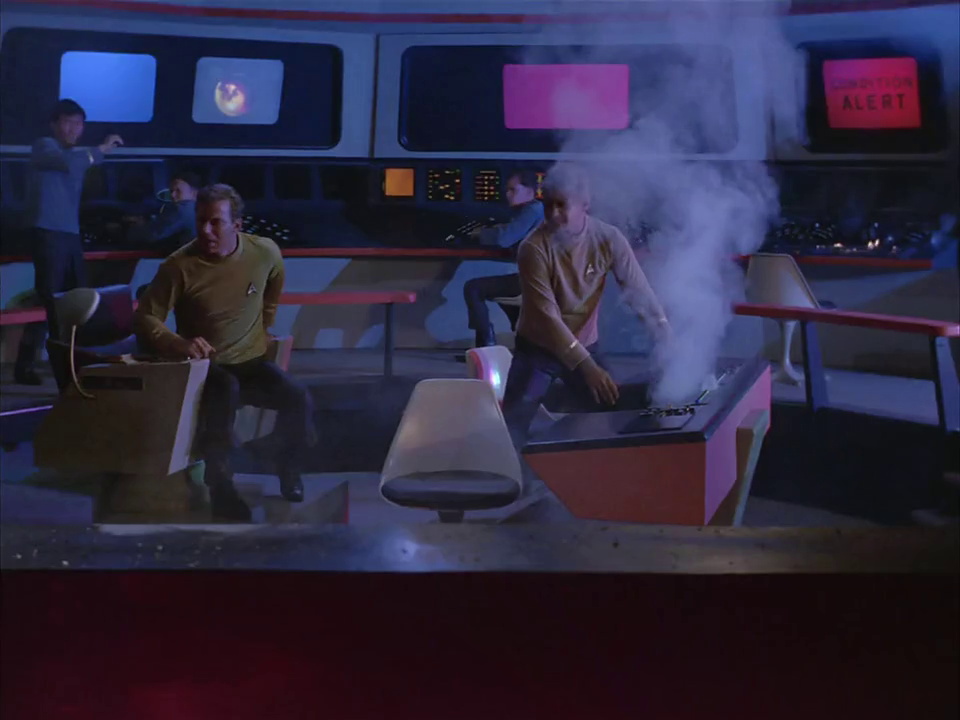
Still frame from Star Trek TOS showing the bridge and smoke
Fire on the bridge!

As the 60th anniversary nears, I have a few other ideas for episode re-watches, essays, discussion pieces, and more. Some of those may eventually make their way onto the website – so please stay tuned for that! And just next month we’ll be graced with Strange New Worlds’ fourth season. I plan to write individual episode reviews, so if that’s something you’re interested in, I hope you’ll join me for that.

Thanks for checking out my thoughts on this unique episode. If you’re interested in more of my take on TOS, I have write-ups of The Original Series episode Arena and The Animated Series episode How Sharper Than A Serpent’s Tooth, which you can find by following those links. And I’ve got pieces about The Motion Picture and The Search For Spock, too. Click or tap those links to check them out.

As always… Live Long and Prosper, friends!


Star Trek: The Original Series (a.k.a. Star Trek) is available to stream now on Paramount+ in countries and territories where the platform is available. The series is also available on DVD and Blu-ray. The Star Trek franchise – including The Original Series, Strange New Worlds, and all other properties discussed above – is the copyright of the Skydance-Paramount corporation. This article contains the thoughts and opinions of one person only and is not intended to cause any offence.
Twenty of the best Star Trek episodes!

Spoiler Warning: There are spoilers ahead for the Star Trek franchise, including all episodes on this list. Spoilers are present for the following: Discovery Season 4, Picard Season 3, Prodigy Season 1, Strange New Worlds Season 1, and more.

So, I did a thing. A few days ago, I published a tongue-in-cheek list of what I consider to be some of the worst episodes in the Star Trek franchise. Since it went up, it’s been racking up clicks – almost immediately becoming the most-viewed piece on the website over the past few days. To balance out that list – and to claw back some of my standing as a Trekkie – I thought I shouldn’t wait any longer before writing the counterpoint!

As I said last time, I’m a huge Star Trek fan. Heck, I run a Star Trek-themed website – so obviously I like the franchise! But I’m not one of those fans who says that “everything Star Trek has ever done is perfect,” nor am I someone who wants to whitewash Star Trek and never mention the bad parts. Paramount has a marketing team to do that.

It’s the Enterprise-E!

So today, as a counterpoint to my last list, I’m going to pick twenty of my absolute favourite episodes. It should go without saying that this list is also entirely subjective, so if I exclude your favourite episode or you hate all of my picks… that’s okay! We’re all entitled to our preferences about which Star Trek stories we prefer, and there should be enough room within the Star Trek fan community for polite discussion and disagreement.

So without any further ado, let’s dive into the list!

Episode #1:
The Doomsday Machine
The Original Series Season 2

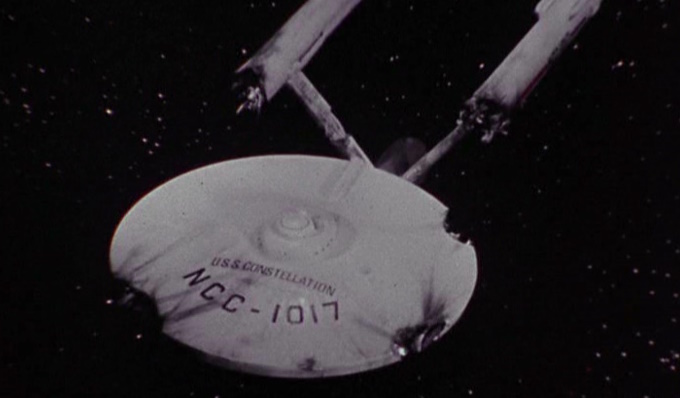
The wreck of the USS Constellation.

The Doomsday Machine is, in some respects, The Original Series in microcosm. It has everything that fans loved about the show: an exciting sci-fi premise, an incredible guest star, and a hard-hitting real-world comparison. It’s always stood out to me as one of The Original Series’ finest outings, masterfully building up tension as the unmanned weapon mindlessly carries out its directive.

The character of Commodore Decker, who was created for The Doomsday Machine, is one of the show’s most brilliant and tragic characters. His story has always been an absolutely riveting one for me – and the performance by guest star William Windom is phenomenal. The Doomsday Machine had a point to make about nuclear weapons out here in the real world, too – and coming at the height of the Cold War, less than six years after the Cuban Missile Crisis, it could hardly be more timely.

Episode #2:
Coming Home
Discovery Season 4

Captain Burnham on the bridge of the USS Discovery.

Discovery’s fourth season – like its predecessors – took a meandering and occasionally frustrating route to reach its final episode… but it was more than worth the wait! Coming Home is fantastic, and encapsulates everything that Star Trek is and always has been. There were incredibly tense and exciting moments as the Federation leapt to the defence of Earth, which was in serious danger, but those moments were coupled with the discovery of a very new and different alien race.

Seeking out new life has been at the heart of Star Trek since its inception. But, as many have pointed out over the years, Star Trek’s “new life” could often look and act very, well, human. Species 10-C, which we finally got to meet in this episode after a season-long buildup, have to be one of the most strikingly different aliens ever created for the franchise. Above all, though, Coming Home excels for its sense of optimism and hope. I’d challenge even the most ardent Discovery-avoider to give it a try.

Episode #3:
The Siege of AR-558
Deep Space Nine Season 7

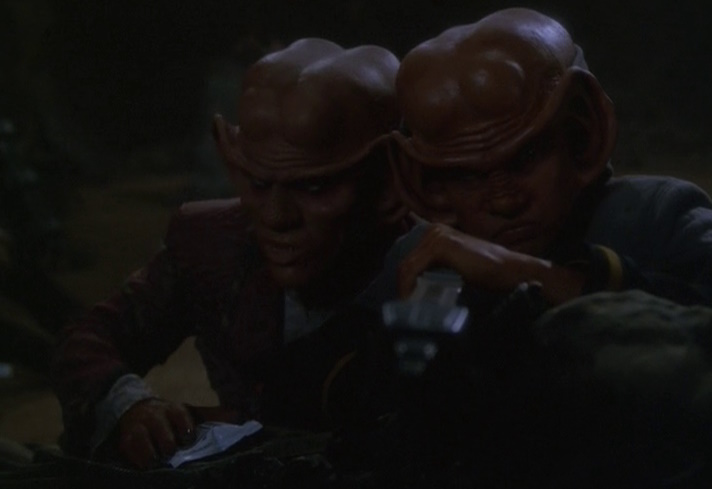
Quark and Nog.

Few Star Trek episodes truly manage to capture the feel of being at war quite so dramatically and spectacularly as The Siege of AR-558. Director Winrich Kolbe drew on his own experiences in the Vietnam War to create a claustrophobic, frightening scenario in which Federation soldiers were fighting for their lives over a nameless lump of rock. The futility of war is on display in The Siege of AR-558 in a way that Star Trek has seldom touched upon.

Nog’s character arc is one of Deep Space Nine’s best, and this episode shows why. Nog went from petty thief to Starfleet hero over the course of seven seasons, and the life-changing injury he suffered in the battle on the planetoid AR-558 would be a defining moment for him. The Siege of AR-558 is an episode that challenges many of our assumptions and beliefs about the Federation, Starfleet, and the Dominion War – and it’s an absolutely incredible watch.

Episode #4:
First First Contact
Lower Decks Season 2

Shaxs in First First Contact.

First First Contact is Lower Decks at its very best. It’s a Star Trek story through-and-through, with a challenge befalling the crew of the Cerritos that’s of a scientific and engineering nature. It’s also the perfect example of how Star Trek can tell tense and exciting stories without the need for evil villains and big set-piece battles.

Lower Decks often operates with a two-story or even three-story structure, pairing up characters and setting them off on their own adventures. But First First Contact is a comparatively rare example of the entire crew working together and taking part in the same storyline – and it works incredibly well. There are moments of high drama, tension, and emotion as the Cerritos races to save a stricken Federation starship and an uncontacted planet – and a moment of engineering genius that would rival anything Scotty or Geordi could’ve come up with!

Episode #5:
Disaster
The Next Generation Season 5

A plasma fire!

I consider Season 5 to probably be The Next Generation’s strongest overall outing, so Disaster really is the cream of the crop! This is an episode in which every main character gets to play a role in one large, connected story – but it’s a story that throws everyone far outside of their comfort zones and usual roles! The situations the characters find themselves in are tense, dramatic, and occasionally comical, because Disaster really is an episode that has it all!

The basic premise of the episode sees the Enterprise-D damaged, without power, and adrift. Troi is the senior officer on the bridge, being advised by Ro and O’Brien. Data and Riker rush to engineering to try to bring power back to the ship. Picard is stuck in a turbolift with three frightened children (his own personal hell). Worf must take care of civilians in Ten-Forward. And Dr Crusher and Geordi are trapped in a cargo bay. Everyone gets their moment in the spotlight, making Disaster a genuine ensemble piece.

Episode #6:
Vanishing Point
Enterprise Season 2

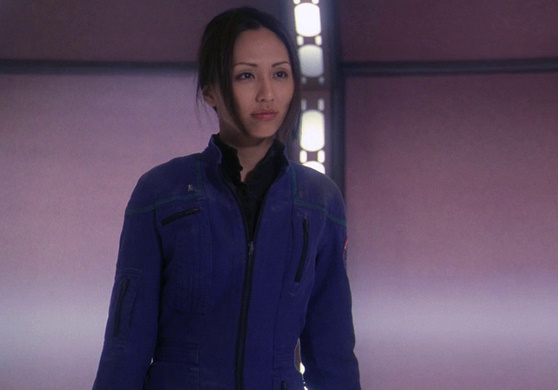
Hoshi on the transporter pad.

Although Vanishing Point’s ending is pretty cheap and uninspired, the episode itself is a truly interesting exploration of one of Star Trek’s best-known pieces of technology: the transporter. We’ve seen characters like Dr McCoy being averse to the transporter, and more transporter accidents than I can call to mind! But Vanishing Point steps back in time to when the technology was new and untested, and places Hoshi Sato at the centre of its story.

Ensign Sato was such a great point-of-view character, as her nervousness and anxiety at being out in space had already been well-established. Vanishing Point also took Hoshi outside of her usual role as communications officer, allowing her to take centre-stage in a different kind of story. Although the ending drags it down somewhat, Vanishing Point is nevertheless a ton of fun!

Episode #7:
A Quality of Mercy
Strange New Worlds Season 1

Christopher Pike as we’ve never seen him before!

Season 1 of Strange New Worlds is fantastic across the board, without so much as a single bad episode! It was difficult to pick just one for this list, but I’ve decided to go with A Quality of Mercy. This episode gets time travel just right, with Captain Pike dealing with himself from an alternate future timeline in which he avoided his devastating accident and disability. Time travel can be tricky to pull off, but A Quality of Mercy manages it.

The episode also returns to the classic story Balance of Terror, showing us an alternate outcome to the battle between Kirk and the Romulan Commander. This gives it the feel of a story “made for fans,” and Trekkies who’ve followed the franchise for a long time will surely find a lot to love here. At the core of it all is Captain Pike, a character who I find incredibly relatable. Knowing that one’s health is in decline and seeking to make a “deal with the devil” to find a solution… I’ve been there. And Anson Mount plays the whole thing – and the roles of two different Pikes – incredibly well.

Episode #8:
Equinox Parts I and II
Voyager Season 5-6

Captain Ransom.

Voyager’s fifth season ended in stunning fashion with the first part of Equinox. I was hanging on for months waiting for Part II, which brought the story to an explosive conclusion. After years lost in the Delta Quadrant, Captain Janeway and the crew finally encounter another Federation vessel – and another crew who understand what they’ve gone through. But all is not what it seems, as it turns out that the aliens attacking the small USS Equinox are actually in the right.

Equinox is a challenging episode, condemning Captain Ransom’s actions while also presenting him and (most of) his crew in a relatively sympathetic light. It’s an episode that hammers home how lucky Janeway and the crew of Voyager have been – comparatively speaking – and shows the extremes that people can be willing to go to in order to survive.

Episode #9:
The Star Gazer
Picard Season 2

Who’s this?

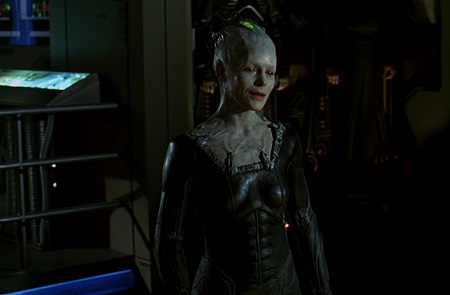
I debated for a long time whether I wanted to include The Star Gazer on this list. The story that it so brilliantly set up went off the rails pretty quickly in subsequent episodes, and Picard’s second season is, overall, a disappointment. But on its own, The Star Gazer is actually a pretty great episode, one that re-introduces one of Star Trek’s classic villains in a new and terrifying manner.

If the rest of Picard Season 2 had been anywhere near as good as The Star Gazer, it would be one of the best in the entire franchise! As it is, this episode almost feels like an alternate timeline, showing us what might have been! Regardless, though, it sets up a tantalising mystery, teases us with some serious development for some of the show’s supporting characters, and contains one of the best and most frightening clashes between Starfleet and the Borg that the Star Trek franchise has ever created.

Episode #10:
Homefront and Paradise Lost
Deep Space Nine Season 4

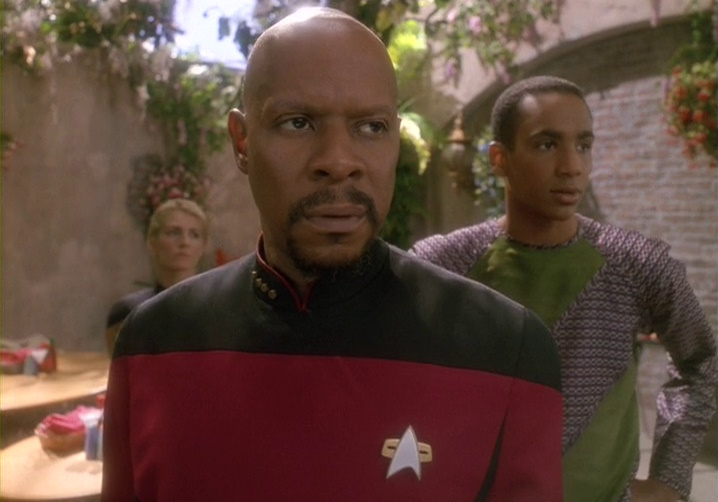
Benjamin and Jake Sisko.

Deep Space Nine had done things differently from its very first episode, and some fans weren’t wild about its darker tone. This shift away from the Federation and Starfleet being presented as an incorruptible and enlightened paradise was on full display in this pair of episodes. In between the discovery of the Dominion and the official outbreak of war, the Federation was terrified of changeling infiltrators. Feeling that politicians and bureaucrats weren’t up to the task, a renegade “badmiral” plots a coup.

Some early Star Trek stories could present the Federation as almost too perfect, and this continued into The Next Generation era. What Captain Sisko and Odo had to confront here was the idea that Starfleet officers could themselves fall prey to paranoia, corruption, and ego – and this very human reaction to the threat of infiltration felt quite relatable. Although we’re firmly on Sisko’s side, Homefront and Paradise Lost throw some moral ambiguity into the mix thanks to some complex writing and several outstanding guest stars.

Episode #11:
The Royale
The Next Generation Season 2

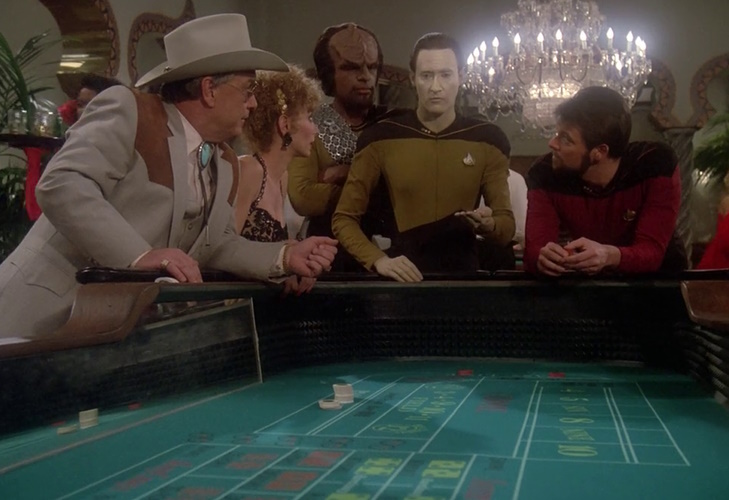
The away team gambling.

I confess that I have a soft spot for The Royale for one principal reason: it’s the earliest episode of Star Trek that I can remember watching! Although I’m sure I’d seen at least parts of other episodes prior to The Royale’s broadcast on terrestrial TV here in the UK in 1991, this is the first one I have rock-solid memories of, and it’s always carried special significance as a result. So that’s my own bias stated up front!

Bias aside, though, I think there’s a lot to enjoy in this episode. It’s the kind of story that no other sci-fi franchise would attempt, and it has an unusual and somewhat eerie feel. Imagine having to spend the rest of your life trapped in an alien recreation of a three-star hotel! That seems like a very specific kind of hell, putting a dark spin on what could’ve been a purely comical story. The idea of roaming to the farthest, unexplored reaches of space only to find an Earth hotel and a mystery is part of what made Star Trek stand out to me, and seeing Riker and the away team solve the puzzle is still an engaging watch more than three decades later!

Episode #12:
Through the Valley of Shadows
Discovery Season 2

The Klingon monastery on Boreth.

Through the Valley of Shadows reframes Captain Pike and the accident that left him disabled. The Menagerie, from the first season of The Original Series, showed us the aftermath of what happened to Pike, as well as introduced us to the character and his time in the captain’s chair. Through the Valley of Shadows took that idea to a completely new and different thematic place: Captain Pike had to choose this future for himself, making an unimaginable sacrifice in order to complete his mission and save untold numbers of lives.

We looked at one consequence of that above with the Strange New Worlds episode A Quality of Mercy. These two episodes make a fascinating pair, and the tragedy of Captain Pike takes on a whole new dimension in light of what we learn here. Pike has always been a character I find incredibly relatable, and Through the Valley of Shadows puts a distinctly “Star Trek” spin on the idea of seeing one’s own future – and knowing that illness, disability, and worsening health lie ahead.

Episode #13:
Court Martial
The Original Series Season 1

Captain Kirk with his lawyer.

Court Martial is Star Trek’s first foray into courtroom drama – a genre that the franchise would return to on multiple occasions! Captain Kirk is accused of murdering an officer under his command and attempting to cover it up, and the stakes are high! We know he couldn’t possibly be guilty, of course… but the evidence against him appears to be compelling.

Samuel T. Cogley – Kirk’s advocate – is a character I’d absolutely love modern Star Trek to revisit! Based on the “old country lawyer” character archetype, Cogley led Kirk’s defence in unorthodox fashion, and is one of the best parts of Court Martial. Along with The Conscience of the King and Charlie X, which also delve into Kirk’s backstory, Court Martial puts flesh on the bones of someone who was still a new character. Kirk’s integrity and honour are on display – and on trial.

Episode #14:
Dragon’s Teeth
Voyager Season 6

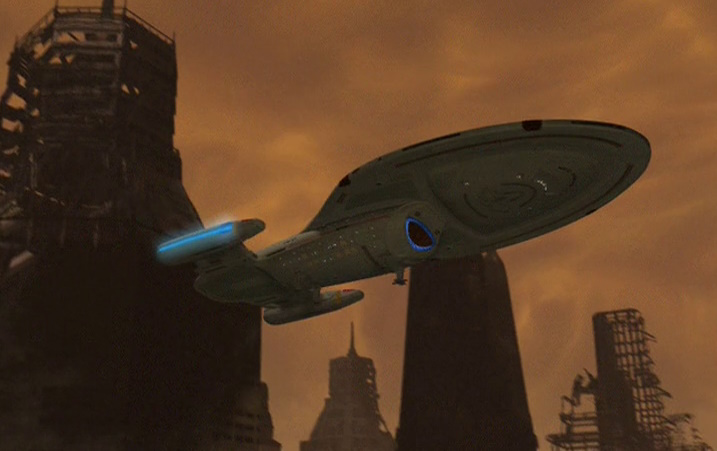
The USS Voyager prepares to land.

Dragon’s Teeth is an interesting episode, and one that tells us a little about the history of the Star Trek galaxy. It’s also a story that looks at the potential consequences of war and conquest, as well as how different reality can be from societal memory. The crew of Voyager re-awaken a group of aliens who have been in stasis since the 1400s, following a devastating war that culminated in the bombardment of their planet.

The Vaadwaur proved to be untrustworthy allies, however, and attempted to capture Voyager. The “underspace corridors” that were present in this episode weren’t revisited, even though they potentially offered a quicker way to traverse this region of space. The concept was fun, though, and reviving a long-dormant race was likewise an interesting and well-executed idea.

Episode #15:
The Andorian Incident
Enterprise Season 1

Andorians!

I have to hold up my hands and confess that I wasn’t a big supporter of Enterprise during its original run. I was disappointed in its choice of setting, believing that Star Trek should move forwards instead of looking back at its own fictional history. But episodes like The Andorian Incident show just how wrong I was to feel that way! The episode showcases the conflict between Andoria and Vulcan in the years prior to the founding of the Federation – and begins to set the stage for humanity to bridge the divide and bring them together.

At a Vulcan holy site on the planet P’Jem, a monastery has been attacked by Andorians. The Andorian leader claims the monastery is a front for a listening post. Jeffrey Combs returns to Star Trek after his roles in Deep Space Nine to play Andorian leader Shran, and the interplay between Shran and Captain Archer would be one of Enterprise’s best. All in all, a fascinating outing.

Episode #16:
Where Pleasant Fountains Lie
Lower Decks Season 2

Andy Billups, chief engineer of the USS Cerritos.

I adore Where Pleasant Fountains Lie. I think it has a potentially-interesting explanation for the abundance of human-looking aliens in the Star Trek galaxy (they’re all Earth colonies), but moreover it touches on a subject close to home for me: asexuality. I’m asexual, and while the Cerritos’ chief engineer Andy Billups isn’t explicitly stated to be asexual in the story, Where Pleasant Fountains Lie focuses in large part on his discomfort with having sex and desire to avoid it.

Star Trek has always used its sci-fi setting to shine a new light on the real world, and for me, this episode absolutely nailed it. When people ask me about asexuality, I now have a relatable story that I can point to, one that touches on many of the same feelings and experiences that I’ve personally had as an asexual individual. I wrote a longer piece about this episode’s asexuality analogy, and you can find it by clicking or tapping here if you’re interested to read more.

Episode #17:
Let Sleeping Borg Lie
Prodigy Season 1

What have the crew of the Protostar got themselves into this time?

Prodigy had a strong first season – though it’s been disappointingly let down by a lack of support from Paramount, especially in the merchandising department. There are several contenders for episodes to include on this list, but I’ve decided to go with Let Sleeping Borg Lie from the second half of the season.

The episode focuses on a derelict Borg vessel – tying into the story recently seen in Picard’s third season – and gives all of the main youngsters something to do. The episode moves key storylines along, as Prodigy is a surprisingly serialised affair, but it also takes the crew to a different environment. One of the advantages of animation over live-action is the ability to visit different ships and planets every week relatively inexpensively! There are strong themes of sacrifice and friendship that form the emotional core of the story, too.

Episode #18:
Birthright, Parts I & II
The Next Generation Season 6

The Enterprise-D at DS9.

This story is a fun crossover between The Next Generation and Deep Space Nine, which wasn’t yet ten episodes into its first season. The main story focuses on Worf as he tracks down a hitherto unknown group of survivors of the Khitomer massacre – the event in which his birth parents were killed. The second part of the story in particular focuses on the Klingons and Klingon culture.

I adore a good crossover, and it’s a ton of fun to see Picard and Dr Crusher aboard DS9, as well as Data and Dr Bashir working together. This episode was designed to give Deep Space Nine a jump-start as its first season got underway, but it’s more than that. It’s a fantastic combination of characters and settings that expands Star Trek beyond a single series into a connected franchise.

Episode #19:
State of Flux
Voyager Season 1

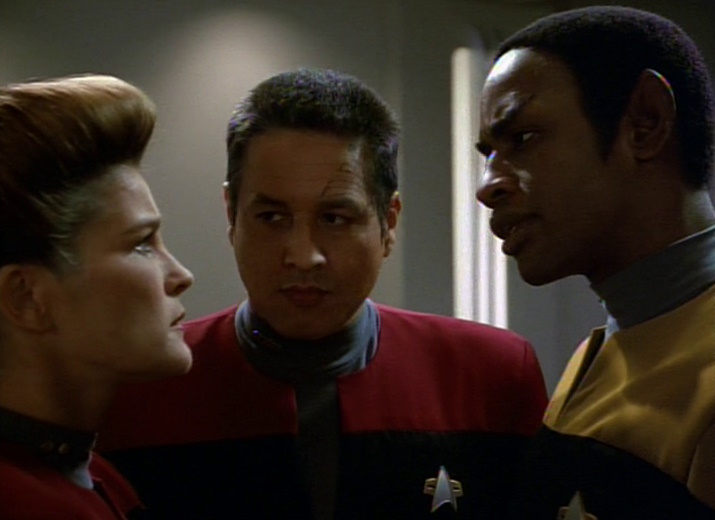
Janeway, Chakotay, and Tuvok discuss the situation.

Voyager never managed to make good on its “one ship, two crews” idea, and State of Flux, coming midway through the first season, was one of the few episodes to really explore that concept. When the crew of Voyager come to suspect that someone is passing secret information to the Kazon, a trap is laid – and a member of Chakotay’s Maquis sect is the prime suspect.

This episode set up a recurring story that would come back in Season 2 and at the beginning of Season 3, giving Voyager at least some consistent themes across the first part of the crew’s journey home. It’s also an engaging mystery on its own merit, and a strong episode for Chakotay – a character who could feel under-used, especially toward the latter part of the show’s run.

Episode #20:
Civil Defense
Deep Space Nine Season 3

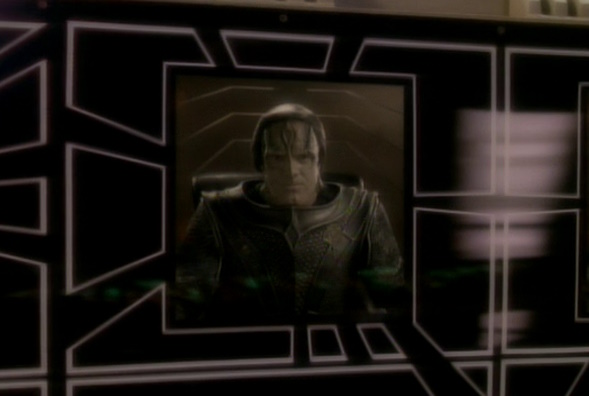
Kell, the former commanding officer of Terok Nor, appears on a screen.

Despite a station-threatening premise, Civil Defense is a remarkably fun episode! It takes the premise of occupying an alien space station to a completely different place than almost any other story in the series, as O’Brien accidentally triggers a computer programme designed to put down a rebellion by the Cardassian station’s former Bajoran workforce.

Civil Defense gives most of the show’s main characters – including Jake Sisko – something to do, putting together groups or pairs of characters who always work well together and provide a ton of entertainment. Quark and Odo help to keep things light – and so does Dukat, to an extent, when he arrives to offer his “assistance!” All in all, an exciting and surprisingly fun outing.

So that’s it!

The USS Enterprise in The Wrath of Khan.

We’ve taken a look at twenty fantastic Star Trek episodes from across the franchise, getting a great mix of modern and older episodes. Hopefully this will help me regain some of my lost standing as a Trekkie after my list a few days ago!

All jokes aside, though, there’s a ton of fun to be had with Star Trek. Put all twenty of these episodes together in a playlist and you’ve got a hugely entertaining Star Trek marathon that will take you from the very beginnings of the franchise in 1966 right the way through to the most recent seasons that have only just been broadcast. It was a blast to go back and revisit all of these wonderful episodes.

The Star Trek franchise – including all series, films, and episodes mentioned above – is the copyright of Paramount Global. This article contains the thoughts and opinions of one person only and is not intended to cause any offence.

Twelve Star Trek episodes to watch before Picard Season 2 arrives!

Spoiler Warning: There are spoilers ahead for Star Trek: Picard Season 1 and the trailers and teasers for Season 2. Spoilers are also present for the following Star Trek productions: The Original Series Season 1, The Next Generation, Deep Space Nine Season 3, Voyager Seasons 2, 3, and 7, and First Contact.

It seems an age ago that we were eagerly anticipating Season 1 of Star Trek: Picard. In those sunlit, rosy days before the pandemic hit, this website was brand-new, and I spent a lot of time in December 2019 and January 2020 looking ahead and wondering what we’d see when the Star Trek franchise finally returned to the 24th Century – after an eighteen-year wait!

With Season 2 of Picard now only days away, I thought it could be fun to revisit a concept from the early days of the website: a list of episodes that I think could make for interesting background viewing, potentially informing story points and characterisations in the new season of Picard. In the run-up to Season 1 I focused on episodes of The Next Generation that strongly featured Captain Picard himself, as well as a few stories about the Romulans, and a few more stories which could’ve potentially led to big changes in the two decades following the events of Endgame and Nemesis.

We’ll soon be on another adventure with Jean-Luc Picard!

This time, we have a little bit more information to go on! Season 2 will tell a story that involves (to a greater or lesser degree) the following elements: the Borg Queen, Guinan, Q, time travel, and, of course, Admiral Picard himself. On this occasion, then, I thought it could be fun to pull out twelve stories from Star Trek’s past that might just be useful background viewing for Season 2 of Picard. It goes without saying that Season 1 is mandatory viewing, so I’m not putting any of those episodes on this list! You should really watch, or re-watch, all ten before the season kicks off!

My usual caveats apply, as they always do! Firstly, everything listed below is entirely subjective. If I miss out an episode that you think is incredibly important, or you hate all of my picks, that’s okay! We all have different opinions about Star Trek, and there’s no need to fight about it. Secondly, I don’t claim to have any “insider information.” I’m basing my theories and guesses about Season 2 on publicly released material, such as trailers and interviews. And finally, the episodes are not ranked; they’re merely listed below in the order in which they were originally broadcast.

With all of that out of the way, let’s jump into the list!

Number 1:
Tomorrow is Yesterday
The Original Series Season 1 (1967)

I’m pretty sure this violates the Temporal Prime Directive…

Though The City on the Edge of Forever is perhaps the best-known of The Original Series’ time travel stories, Tomorrow is Yesterday preceded it by several months. It was the first episode of the Star Trek franchise where time travel played a major role in the story, and it was also the first in which the crew paid a visit to the modern day. Tomorrow is Yesterday established what went on to become a mainstay in terms of the franchise’s time travel story tropes: being sent back in time by accident!

Aside from being a fun episode in its own right and well worth a watch, Tomorrow is Yesterday is also the episode which introduced the Star Trek franchise to something that appears to be making a return in Picard Season 2: the slingshot method of travelling through time, referred to in this episode as the “light-speed breakaway factor.”

The USS Enterprise using the “light-speed breakaway factor” to travel through time.

Almost every Star Trek series has included the occasional time travel story, and we can look to episodes like Tomorrow is Yesterday for creating that premise. Visiting the modern world would go on to be significant later in The Original Series, in Star Trek IV, and on several other significant occasions in the franchise. For me, some of these stories can feel rather dated, but I think Tomorrow is Yesterday largely avoids that trap!

As we get ready for Picard Season 2 and the franchise’s latest foray into time travel, stepping back to see where it all began during the first season of The Original Series is no bad thing. Tomorrow is Yesterday has a fairly straightforward premise that should be easy enough to follow even for fans who aren’t as familiar with The Original Series, and is well worth a watch on its own merits.

Number 2:
Encounter at Farpoint
The Next Generation Season 1 (1987)

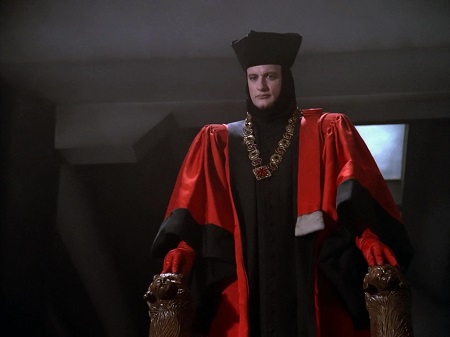
Judge Q.

In the first teaser trailer for Picard Season 2, we heard Q’s voice proclaiming that “the trial never ends.” Encounter at Farpoint is the episode in which Captain Picard first encountered Q, and the episode in which the referenced “trial” began. Q accused humanity (and by extension, the Federation) of being a “dangerous, savage, child-race” who are unfit to travel the stars. Picard and his crew defended themselves against the accusation.

The task Q set for Picard was to unravel the mystery of Farpoint Station, which he and the crew of the Enterprise-D were en route to. However, figuring out the puzzle wasn’t the end of the trial, and even after bringing the Farpoint saga to a successful conclusion, Q departed in ambiguous fashion, hinting that he would return. He did, of course, on a number of occasions!

Worf, Picard, and La Forge on the bridge of the Enterprise-D.

Encounter at Farpoint was the premiere of The Next Generation and established the characters of Picard and Q (as well as many other familiar faces). As we approach Picard Season 2, it’s worth going back to see where it all began. This was the first big puzzle that Q tasked Picard with solving, and seeing how Q operates and what the point of it all is, from his perspective, is well worth taking into consideration.

This is also the beginning of “the trial.” We don’t know to what extent the idea of Picard – and humanity – being on trial will feature in Picard Season 2, but if Q has returned to set up a new mystery there could be a connection – and there could be consequences if Picard and the crew of La Sirena can’t figure it out. Q has toyed with Picard on a number of occasions; Encounter at Farpoint was the first.

Number 3:
Q Who
The Next Generation Season 2 (1989)

Q threw Picard and the Enterprise-D into danger.

Q Who is the episode that introduced us to the Borg – and it’s a pretty scary one by Star Trek’s standards! Captain Picard and the crew of the Enterprise-D have never faced a villain like this, and the Borg represent an existential threat. Q made good on his promise to show Picard that there are dangers in the galaxy that he couldn’t even imagine… and eighteen members of the Enterprise-D’s crew paid the ultimate price.

In a way, Q Who shows Q at his most aggressive, devious, and villainous. By throwing the Enterprise-D into the path of the Borg, he proved his point to Picard about the Federation’s unpreparedness in the most painful way possible. But I don’t believe that’s all there is to the story.

The first Borg seen in Star Trek.

I have a theory about Q Who that you can find by clicking or tapping here. To briefly summarise: Star Trek has made a mess of the history of Borg-Federation contact, and it seems likely that the Borg were already aware of humanity and Earth long before the events of this episode. They may have already been preparing for an attack or assimilation attempt, and Q hoped to prevent that by giving the Federation advance warning.

My theory goes into much more detail! But suffice to say the complicated history of contact between humanity and the Borg makes it seem plausible, at least to me, and shows off an aspect to Q’s character that I think could come into play in Picard Season 2. Q Who also establishes the existence of history between Q and Guinan – something that may come up in Picard Season 2 given that both characters are returning.

Number 4:
Yesterday’s Enterprise
The Next Generation Season 3 (1990)

The Enterprise-C.

Though it’s a fantastic episode in its own right, Yesterday’s Enterprise is on this list for one reason: Guinan. When a rift in the space-time continuum sends the Enterprise-C forward through time, decades’ worth of history are changed, leaving the Federation in a very bleak timeline in which it’s fighting a losing war against the Klingons.

Aboard the warship Enterprise-D, Captain Picard and the rest of the crew are completely oblivious to the change; this version of the characters have only ever known the war timeline. But Guinan alone realises that something has gone wrong, and argues with Captain Picard about how to set things right.

Guinan presents her case to Captain Picard.

Despite a recent controversy, Whoopi Goldberg will be reprising the role of Guinan in Picard Season 2, bringing the character back for the first time since Generations in 1994. Given that we know Season 2 also features a radically changed timeline, not dissimilar to the one seen in Yesterday’s Enterprise, perhaps Guinan will be aware of the change.

Guinan could be the one to talk to Picard about the possible point of divergence, as we know she’d visited Earth in the 19th Century. She may also be one of the only people other than the crew of La Sirena to be aware that something has changed. Guinan also has a history with Q, as we saw in the episode Q Who – so that could also come into play!

Number 5:
Time’s Arrow Parts I-II
The Next Generation Seasons 5-6 (1992)

R.I.P. Data…

Guinan also plays a key role in the two-part episode Time’s Arrow. Thanks to time travel, this is the episode where she and Captain Picard actually have their first meeting, and although the nature of their relationship is still shrouded in mystery, we get a little bit more information about how they came to meet in the first place.

Guinan’s fascination with Earth appears to date back to at least the 19th Century, as she visited undercover during that time period. We know from the most recent Picard Season 2 trailer that Guinan appears to be running a bar on Earth at the dawn of the 25th Century, giving her an association with Earth and humanity that stretches back over five hundred years.

Guinan and Picard in the 19th Century.

Time’s Arrow is an interesting story that mostly focuses on Data, who was of course a huge part of the story of Picard Season 1. It seems as though Brent Spiner will be playing a new role in Season 2 – perhaps another ancestor of the Soong family – so getting a bit of extra data on Data could be worthwhile, too!

One thing I’m personally curious about in Picard Season 2 is if we’ll get any further backstory on the Picard-Guinan relationship. Although Time’s Arrow depicts their first meeting from Guinan’s perspective, we’ve still never learned how they came to meet in the 24th Century from Picard’s point of view. All we know is that it likely happened prior to his assuming command of the Enterprise-D. I don’t know if Picard Season 2 will expand on that in any way… but it would be interesting!

Number 6:
Tapestry
The Next Generation Season 6 (1993)

Q and Picard.

Tapestry is a really interesting episode that deals with the dynamic between Q and Picard, and specifically looks at the nuances present in their relationship. Picard has always viewed Q as an adversary, but I’ve argued in the past that Q doesn’t see himself that way. He views Picard as a friend, and himself as a guide or even an ally – and the way Tapestry unfolds kind of shows why that is.

When Picard is injured on an away mission, he finds himself close to death. At that moment, he encounters Q – who claims he’s already dead. Q gives Picard a chance to avert his death by changing a key event in his past – getting stabbed shortly after graduating from Starfleet Academy – but doing so sets Picard’s life and career on a completely different path.

Lieutenant Picard in an alternate 24th Century.

The important thing here is how Q views the whole affair. We can entertain debates on whether or not Q actually sent Picard back in time or whether it was all an elaborate illusion, but that’s entirely beside the point. Q genuinely believed that he was helping – that by showing Picard an alternate life, he gave him an appreciation for the life he had actually led, even if that meant it was about to end.

I firmly believe that there’s more going on with Q in Season 2 than meets the eye. It’s possible that he didn’t change the timeline at all, and is merely responsible for shielding Picard and the crew of La Sirena from it. It’s also possible that he did change it as part of an elaborate puzzle, one which he hopes and expects that Picard will be able to solve. Speaking of which…

Number 7:
All Good Things…
The Next Generation Season 7 (1994)

Q and Picard in the distant past.

All Good Things is the best example of this aspect of the dynamic between Picard and Q, and could – in theory – be a template for the events of Picard Season 2. In All Good Things, the Q Continuum sets a puzzle for Picard – an eruption of “anti-time.” Thanks to the time-travelling interventions of Q, Picard is able to hop between three different periods of his own past to solve the mystery.

The solution to the anti-time eruption required Picard to challenge his own way of thinking, specifically his linear perception of cause-and-effect. Being able to recognise that events in the future had a causal link to events in the past greatly impressed Q, who seemed to suggest that it was the first step on a path that could one day see humanity evolve into beings comparable to the Q themselves.

Q in his judge’s robes.

All Good Things was also Picard’s last dalliance with Q prior to the events of Picard Season 2. As far as we know at this stage, Q hasn’t been to see Picard in the approximately twenty-five years since the events of All Good Things – but that could change as we get into the new season. It’s possible, at least in my opinion, that Q might’ve been interested to see Picard at his lowest ebb, possibly showing up to see if he could provoke him into action. But we’ll save a detailed explanation of that for my next theory post!

It’s possible that the trailers and teasers for Season 2 have already revealed the nature of Q’s involvement in the story: that he is directly responsible for changing the timeline, he did so on purpose, and he will be the main villain of the season. But I would argue that the “villain” monicker does not fit with Q’s past characterisation, and thus I suspect that there’s much more going on than meets the eye. All Good Things is both a piece of evidence in favour of that argument, as well as a potential blueprint for how a time travel puzzle set by Q could unfold.

Number 8:
Past Tense, Parts I-II
Deep Space Nine Season 3 (1995)

Dr Bashir and Commander Sisko.

We know, thanks to a voiceover in the most recent trailer, that at least some of the events of Picard Season 2 take place in the year 2024. But Picard Season 2 isn’t the first Star Trek production to visit that specific year! In Deep Space Nine’s third season, Commander Sisko and the crew of the USS Defiant found themselves accidentally sent back in time to the exact same year.

Past Tense is an interesting story, as it will mark the first time that any episode of Star Trek set in “the future” at the time it was broadcast will be reached, and I’m sure I won’t be alone in doing a full write-up of its story when we hit the end of August 2024! We could talk for hours about how its depressing presentation of the 2020s seemed a long way from reality once upon a time, but with the growth of homelessness and other economic issues, today’s society feels far too close for comfort to the world of the Bell Riots.

The USS Defiant in orbit over Earth.

I’m not sure how much of Deep Space Nine’s presentation of a fictionalised 2024 will make it into Picard Season 2. It’s possible that the new series will entirely ignore this two-part episode… but I think we should keep an eye open for references or callbacks to some of the characters, events, or even things like brands and products.

Regardless, this will be the first time that two very different Star Trek productions have travelled back in time to the same year, and it might be interesting and informative to take a look at Past Tense to see how Deep Space Nine told us that the year would unfold. It seems as though Picard Season 2 will be set, in part, in California – which is also where Past Tense was set, so that’s another point of connection. I’m not expecting a huge crossover with this one single Deep Space Nine story, but there could easily be references made to it.

Number 9:
Death Wish
Voyager Season 2 (1996)

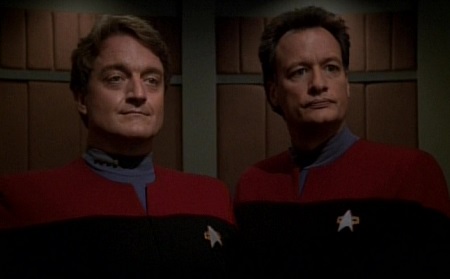
Two Qs?!

Captain Picard wasn’t the only Starfleet officer to tangle with Q. After making a sole appearance in Deep Space Nine, Q hopped over to the Delta Quadrant, where he had several run-ins with Captain Janeway during Voyager’s journey home. Q presented a bit of a puzzle for Voyager; his abilities mean that he could have sent the ship and crew back to Earth with a snap of his fingers. But if we can look beyond that narrative hurdle, Q’s appearances in Voyager added a lot to his characterisation.

In Death Wish, we got our best look to date at the Q Continuum itself. Depicted in a manner that humans could comprehend, the Continuum resembled a rather dilapidated roadside house in the middle of the desert. For the first time, we got to see more members of the Q Continuum as well, and got a glimpse of how Q himself is a bit of a radical by the standards of his people.

Captain Janeway and Tuvok visit the Q Continuum.

The idea that the Q Continuum is not an entirely stable, homogeneous place is an interesting one, and was explored in more detail in the episode The Q and the Grey. But Death Wish also presented a very complex moral question – in the longstanding tradition of Star Trek! This episode can be a difficult watch for some folks because of its discussion of suicide, and it’s absolutely fine to skip it if that subject hits too close to home. If the debate around suicide and end-of-life care is something you’re interested in, though, this is a uniquely “Star Trek” attempt to tackle it.

Q emerges from this story as a reformer – or even a radical – by the standards of his people. We also know, thanks to a line in All Good Things, that he was responsible for assisting Picard when the Continuum set the anti-time puzzle. It’s stories like this that make me think that there’s a goodness in Q; that he isn’t just a trickster or a pure villain.

Number 10:
Future’s End, Parts I-II
Voyager Season 3 (1996)

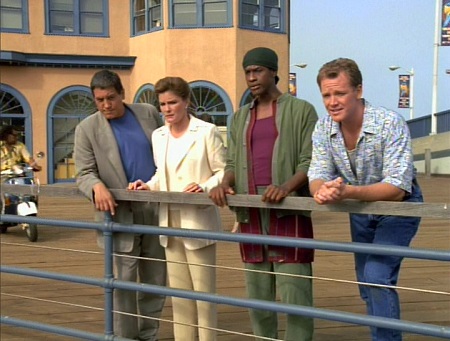
Chakotay, Janeway, Tuvok, and Paris on Earth.

The two-part time travel story Future’s End sees Captain Janeway and the crew of the USS Voyager sent back in time to Earth, circa 1996. It’s another story set in the California area, and I think it’s an interesting episode – albeit one that I feel has become very dated by Star Trek standards!

If Picard Season 2 sticks with things like the Borg and the slingshot method, it seems that the kind of time travel depicted in Future’s End won’t be a factor. But there are still interesting points to consider, such as the Temporal Prime Directive and how Starfleet in the future would come to police the timeline, watching out for changes.

It’s Los Angeles – where Picard and the crew of La Sirena appear to be headed!

There aren’t a great many Star Trek episodes that visit the modern day, and as I’ve already explained I feel that a modern setting can make such stories feel very out-of-date very quickly. Future’s End definitely falls into this trap; its depiction of Southern California has a very ’90s flavour. But it’s a bit of fun, and dare I say almost a guilty pleasure!

I’m including Future’s End here for its modern day time travel story and its focus on California, both of which are elements that we know will be part of Picard Season 2. As with Past Tense, I don’t expect to see a huge tie-in between the new season and the events of this episode, but there may be smaller callbacks and references to some of the characters and events it depicted.

Number 11:
Star Trek: First Contact
Film (1996)

The Borg Queen.

First Contact introduced us to the Borg Queen for the first time, and went into a lot more detail about Picard’s assimilation experience. The Borg Queen was presented as the embodiment of the Borg rather than their leader, and she became a fearsome adversary for Picard and Data over the course of the story.

Season 1 of Picard saw the retired Admiral face his lingering Borg assimilation trauma when he beamed aboard the Artifact in the episode The Impossible Box, but Season 2 will see him come face to face with a Borg Queen for the first time in twenty-five years. For someone who’s clearly suffering from some form of post-traumatic stress, we don’t know what effect that could have.

Data and Picard lead the battle against the Borg.

Picard was violently anti-Borg in First Contact, and we saw hints of that in Picard Season 1 as well. His conversation with Dr Jurati and Elnor in The Impossible Box, as well as the way he responded to some of the xB’s in later episodes, was in line with his attitude to the Borg in First Contact – and I wonder how encountering a Borg Queen will make him feel!

Many Trekkies hold up First Contact as one of the absolute best Star Trek films, and it’s hard to disagree. As an action-packed work of sci-fi with some truly scary elements thanks to the way the Borg are depicted, it’s an exciting ride from start to finish. It also goes into a little more detail about World War III – an event in the history of the Star Trek timeline that could play a role in Picard Season 2. Check out my full World War III theory by clicking or tapping here!

Number 12:
Endgame
Voyager Season 7 (2001)

Some of Voyager’s crew in an alternate 25th Century future.

Almost five years after First Contact depicted the Borg’s biggest attack on Earth to date, Endgame brought back the Borg Queen in a significant way. The interventions of a time-travelling Admiral Janeway from the future saw the USS Voyager make it home to Earth, and in the process dealt a significant blow to the Borg Collective.

Even though it’s been more than twenty years since Endgame, we don’t actually know what became of the Borg in the aftermath of Admiral Janeway’s attack. I’ve always assumed that the Borg Collective was large enough, clever enough, and adaptable enough to survive the neurolytic pathogen that she introduced into the Borg Queen… but because the Star Trek franchise has yet to return to the Borg post-Endgame, we can’t be certain of that.

Admiral Janeway and the Borg Queen.

Even Season 1 of Picard, which depicted the disabled Borg Cube known as the Artifact, didn’t settle the issue. So it’s an open question at this juncture whether the Collective survived, whether it was significantly damaged by Admiral Janeway’s pathogen, or whether it was able to easily shake off the attack. It seems as though no major Borg activity occurred in Federation space in the twenty-plus years after Endgame, though.

Endgame makes this list because of the Borg Queen’s role in Picard Season 2, and I think it could be very useful background viewing, possibly even setting up a story about the Queen herself or the state of the Borg Collective at the dawn of the 25th Century. On a vaguely related note, I took a deeper look at Admiral Janway’s actions in Endgame, and you can find that article by clicking or tapping here.

So that’s it!

Admiral Picard is coming back in just a few days’ time!

Those are twelve episodes (alright, eleven episodes and a film) that I think might make for useful or interesting viewing prior to Picard Season 2! I think we’ve hit most of the key subjects – at least, those that we’re aware of at this early stage – and got a good mix of stories focusing on Captain Picard, Q, Guinan, time travel, and the Borg Queen.

At the end of the day, though, Star Trek’s past didn’t prove all that important to unravelling the events of Picard Season 1 – nor to recent storylines in Discovery, either. So it’s quite likely, in my view, that Picard Season 2 will bring plenty of brand-new characters and story elements into play. That doesn’t mean it isn’t worth going back to these stories and others, but my suspicion at this stage is that the new story won’t rely excessively on what came before.

When Picard Season 2 arrives at the end of next week, I hope you’ll stay tuned for individual episode reviews, theories, and more. Despite the somewhat underwhelming end to Season 1, Picard Season 2 has been one of my most-anticipated shows for almost two years, and I can’t wait to jump in and have another adventure with Jean-Luc Picard and the crew of La Sirena.

Star Trek: Picard Season 2 will premiere on Paramount+ in the United States on the 3rd of March 2022, and on Amazon Prime Video in the United Kingdom and elsewhere 24 hours later. The Star Trek franchise – including Picard and all other properties mentioned above – is the copyright of Paramount Global. This article contains the thoughts and opinions of one person only and is not intended to cause any offence.