


Spoiler Warning: There are spoilers ahead for Star Trek: The Next Generation. Minor spoilers may also be present for other iterations of the Star Trek franchise.
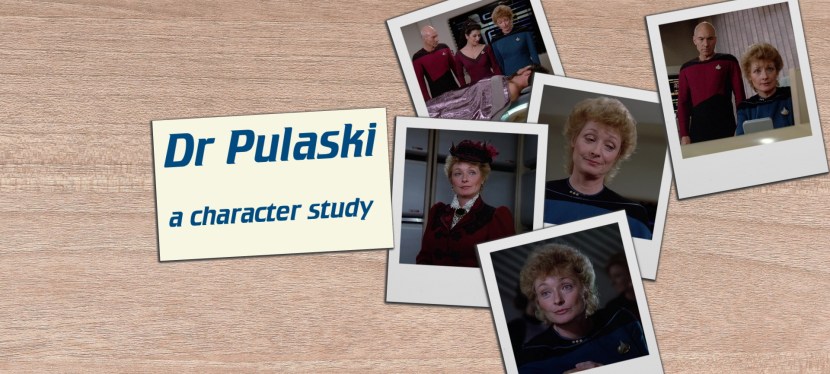
For reasons that still aren’t crystal clear over thirty years later, Gates McFadden was dropped after Season 1 of Star Trek: The Next Generation. Dr Crusher had been a mainstay of the show’s first season, going a long way to humanising the otherwise stoic Captain Picard, as well as bringing a family dynamic to the series. Her absence in Season 2 was an obstacle for the show to overcome, and to replace her, Gene Roddenberry and the creative team introduced a new character: Dr Katherine Pulaski.
I have to hold up my hands and admit to being a fan of Dr Pulaski. There are certainly elements to her characterisation that worked less well, and we’ll look at those in a moment, but on the whole I felt her inclusion in the series took The Next Generation to different places, places it wouldn’t have been able to reach without her. That’s my own bias coming into play as we delve into her character today.

The intention behind Dr Pulaski’s introduction was to shake up The Next Generation. Across the show’s first season there hadn’t been much interpersonal drama between the main characters – something that was a marked change from The Original Series. In Star Trek’s first incarnation, the “frenemy” relationship between Dr McCoy and Spock in particular was a source of both drama and humour, and it seems clear to me that The Next Generation lacked that in Season 1, and that Dr Pulaski was created to try to bring that element back to Star Trek.
When I think about Dr Crusher, with the possible exception of her role in the two-part episode Descent, I wouldn’t use the terms “strong” or “forceful” to describe her personality. She’s a reasonably quiet, slightly soft-spoken character, clearly very compassionate but also quite agreeable, especially when pressed by Captain Picard. To call her “bland” might be unkind, but she was never meant to be the standout character among the cast of The Next Generation.

Dr Pulaski is the polar opposite. She’s opinionated, outspoken, and occasionally brash. Though she does form firm friendships with other members of the senior staff, she’s much more of a standalone, individualist character. These are all traits that she inherited from The Original Series’ Dr McCoy, and we can see a very definite McCoy influence for practically her entire run on the series.
The role of a doctor in Star Trek is naturally a limited one, and that was especially true when the franchise was primarily interested in episodic storytelling. Dr Pulaski’s scenes are largely limited to Sickbay or dealing with medical-themed stories and events, and this naturally puts constraints on what she – and other doctors in the franchise too – can do. In episodes with a strong medical storyline, I’d argue that Dr Pulaski shines, and aspects of her personality that might otherwise come across as abrasive can instead feel determined and driven. In stories without much going on in Sickbay she’s naturally of less use to the writers, and it shows.

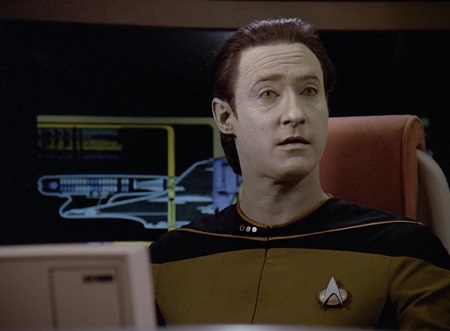
One of the main areas of criticism when Dr Pulaski came aboard was her relationship with Data. Designed to mimic the Spock-McCoy dynamic from The Original Series, some of Dr Pulaski’s early scenes and episodes with Data did not work as intended. She came across as patronising and looking down at Data – and that’s putting the most positive spin possible on it! At worst, Dr Pulaski was actively degrading and dehumanising in the way she spoke to and about Data, and that’s something that many fans found hard to take.
Though we’re more aware in 2021 of the need to be inclusive and attentive to the needs of neurodivergent people, non-binary folks, and other marginalised groups, even in 1988 many fans were uncomfortable at seeing Data dehumanised and talked about in the abstract. Fans had had a whole year to get to know Data, and just like we balked at Dr Bruce Maddox’s treatment of him in the episode The Measure of a Man, so too fans felt Dr Pulaski was treating Data unfairly. This is legitimate criticism, and soured many fans on Dr Pulaski almost from her first moment on the series.

Though I was perhaps a little unkind in my characterisation of Dr Crusher earlier, there were many fans of The Next Generation who liked the character and wanted her back. A letter-writing campaign began almost from the moment Season 2 premiered – supposedly with some involvement from Patrick Stewart – to convince the producers to bring back Gates McFadden and dump Dr Pulaski. Though I daresay this would’ve happened regardless of how well Dr Pulaski’s character had been received, the fact that those early episodes featured a conflict with Data that certainly went too far and crossed a line didn’t help her cause.
Despite all of that, by the time Season 2 was finding its feet, Dr Pulaski had become established as a regular member of the crew of the Enterprise-D, and had settled into her role in Sickbay about as well as she could. The fact that she was a strong and decisive personality may have been divisive among fans, but in my opinion she elevated the role of the ship’s medical officer, taking what had been a secondary position with Dr Crusher in Season 1 and transforming it into a more important role, especially in medical storylines. Even when Dr Crusher returned in Season 3, this aspect of the show continued to an extent; Dr Pulaski’s legacy on the show, despite the character being dropped with little fanfare, may be that Dr Crusher found more prominent storylines.
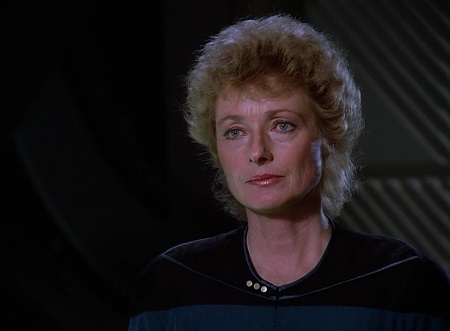
The comparisons with Dr Crusher are inescapable, and one other aspect that viewers felt was missing after Dr Crusher departed the series was a relationship with Picard. Dr Crusher and Picard had history as well as more than a little romantic tension, whereas Dr Pulaski didn’t have that connection with Picard – or with anyone else. Though there was a storyline in the episode The Icarus Factor involving a past relationship with Commander Riker’s father, this didn’t become a major aspect of her character, and she remained romantically un-attached for the rest of her tenure.
Though the episode Unnatural Selection is perhaps the story where she was given the most to do, where I felt we saw Dr Pulaski at her best was in episodes like Time Squared, where she tended to a second Captain Picard from several hours in the future, Up The Long Ladder, in which she takes part in a traditional Klingon ceremony with Worf, and though there are two sides to her relationship with Data on display in Peak Performance, the way she consoled him after his defeat at Strategema was sweet. In these moments we see different aspects of her character – her medical expertise, her embrace of different cultures, and through her evolving relationship with Data, her ability to overcome her own prejudice.

Perhaps the fact that Dr Pulaski had anti-android prejudice to begin with made her too unpopular with fans to be redeemable. Her occasionally blunt persona didn’t help her in that regard either. But had we met Dr Pulaski in Season 1 not Season 2, I think it’s possible for her evolving relationship with Data to have provided a deeply satisfying character arc.
The problem Dr Pulaski faced was that she joined a series that already had a full season – 25 episodes – under its belt. The characters had grown together and been through some major events in Season 1, particularly the death of their friend and colleague Tasha Yar. Yar’s own deep relationship with Data, which was jump-started by the events of The Naked Now, had gone a long way to humanising him across Season 1, and there was something charming in the “android who longs to be human” story. In Encounter At Farpoint, Riker called Data “Pinocchio,” and across Season 1 that’s how viewers came to know Data. Dropping in Dr Pulaski at the beginning of Season 2 and giving her a very prejudiced way of looking at this character we’d come to know and love was a bridge too far for many viewers, and although the relationship improved dramatically over the course of the season, her early interactions with Data remained a sore spot.

Dr Pulaski was present for all but two episodes of Season 2. However, most episodes didn’t have a major medical focus, and thus she was really a secondary character much of the time. Even so, I’d argue that she brought a lot to the show, and despite the introduction of her character not really succeeding in the way the creative team intended, Dr Pulaski certainly achieved her objective of shaking up the crew. Though she was never a villain, the introduction of Dr Pulaski showed that there can still be disagreements and interpersonal drama among Starfleet officers in the 24th Century, and that not everyone has to agree all the time. The Next Generation could, at times, fall into the trap of being too idealistic in its portrayal of characters in particular, and while there were adversaries and antagonists in Season 1 – including some from the Federation – Dr Pulaski was the first main character on the show to pull in a different direction. In that sense she arguably laid the groundwork for storylines we’d see from Season 4 onwards with characters like Ro Laren, and in particular the non-Starfleet crews we’d meet in Deep Space Nine and Voyager.
The fact that Dr Pulaski was never shy and didn’t pull her punches is something I found charming and appealing about her, particularly when compared to Dr Crusher’s Season 1 persona. She could be opinionated and even pushy at times, but she always did her best to help those in her care and didn’t bat an eyelid at the wacky situations the Enterprise-D would find itself in. Not only that, but she grew as a character across her single season on the show, particularly in terms of her relationship with Data and her understanding of different kinds of life. The Next Generation set out to seek out new life, and while Dr Pulaski’s old fashioned idea of what “life” is may have held her back at first, over time she came to recognise that Data was a valuable colleague and even a friend, even if she didn’t understand everything about him.
Had she been kept around and spent more time on the show, perhaps we would have seen those themes continue to play out. There was scope for her relationship with Worf to develop, not romantically necessarily but certainly putting them in more stories that would have allowed their friendship to grow and for both characters to learn more about the other’s culture. Her relationship with Kyle Riker could have been revisited, allowing for a more complex and nuanced relationship with William Riker on the Enterprise-D. And though she could never replace Dr Crusher in terms of having a close relationship with Captain Picard, the dynamic between the two – particularly the power play between a man who’s used to being the sole commanding officer of his ship and the doctor who’s the unquestioned master of Sickbay – would have been interesting to explore. There was scope for her to occasionally push back against Picard and other main characters, asserting herself more strongly than Dr Crusher usually would.
All of that and more would have been interesting to see, and while Dr Crusher had some great stories from Season 3 onwards, I’ve always felt at least a little sad that we didn’t get more from Dr Pulaski. At the very least it would have been nice to know how she came to depart the Enterprise-D and what her next role was going to be. Did she transfer to a different starship, return to Earth, retire? We don’t know, and I think it’s highly unlikely we will ever get any kind of solid confirmation of Dr Pulaski’s post-Season 2 life.

I found Dr Pulaski an interesting character and a welcome addition to The Next Generation, even though not every aspect of her characterisation succeeded or achieved its intended objectives. She remains an interesting character in Star Trek, particularly within the 24th Century, and I’ve always been fascinated by this single-season character. Season 2 of The Next Generation marked a change and uptick in the show’s quality – whence comes the expression “growing the beard,” a reference to Commander Riker’s facial hair! Though she wasn’t front-and-centre at every moment, Dr Pulaski played a significant role in the evolving series, helping it grow and become better than it had been in its first season. We can’t argue that the introduction of her character is somehow responsible for The Next Generation’s increasing success in that era, but we can’t dismiss it as mere coincidence either.
And perhaps that’s Dr Pulaski’s real legacy. She was a part of The Next Generation at a key moment – its powerful second season. Season 2 provided much more of a blueprint for the show’s future success – and for the successful development of Deep Space Nine and other parts of the franchise – than The Original Series-inspired first season had. Dr Pulaski, though originally intended to be a throwback to Star Trek’s first series, played a role in the franchise’s evolution as a character who wasn’t afraid to shake things up, stand up to her commander, and hold her ground. We can see elements of her personality in a number of Star Trek characters who came later, even continuing to the modern day.
Star Trek: The Next Generation is available to stream now on Paramount+ in the United States and on Netflix in the United Kingdom and elsewhere. The Star Trek franchise – including all characters and properties mentioned above – is the copyright of ViacomCBS. This article contains the thoughts and opinions of one person only and is not intended to cause any offence.


 Trekking with Dennis