Spoiler Warning: There are spoilers ahead for Star Trek: The Next Generation. Minor spoilers may also be present for other iterations of the Star Trek franchise.
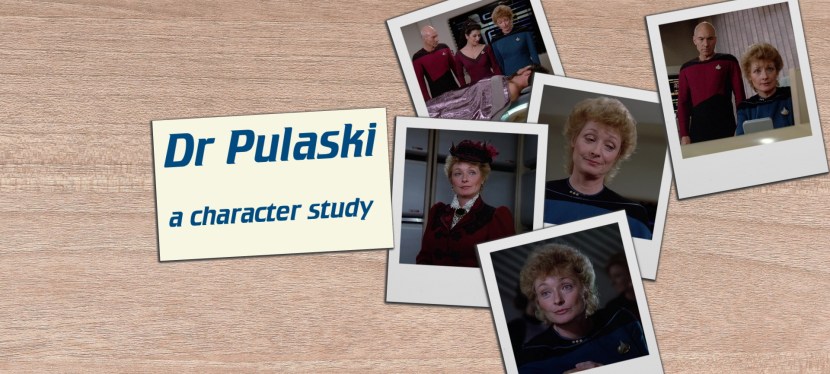
For reasons that still aren’t crystal clear over thirty years later, Gates McFadden was dropped after Season 1 of Star Trek: The Next Generation. Dr Crusher had been a mainstay of the show’s first season, going a long way to humanising the otherwise stoic Captain Picard, as well as bringing a family dynamic to the series. Her absence in Season 2 was an obstacle for the show to overcome, and to replace her, Gene Roddenberry and the creative team introduced a new character: Dr Katherine Pulaski.
I have to hold up my hands and admit to being a fan of Dr Pulaski. There are certainly elements to her characterisation that worked less well, and we’ll look at those in a moment, but on the whole I felt her inclusion in the series took The Next Generation to different places, places it wouldn’t have been able to reach without her. That’s my own bias coming into play as we delve into her character today.
The intention behind Dr Pulaski’s introduction was to shake up The Next Generation. Across the show’s first season there hadn’t been much interpersonal drama between the main characters – something that was a marked change from The Original Series. In Star Trek’s first incarnation, the “frenemy” relationship between Dr McCoy and Spock in particular was a source of both drama and humour, and it seems clear to me that The Next Generation lacked that in Season 1, and that Dr Pulaski was created to try to bring that element back to Star Trek.
When I think about Dr Crusher, with the possible exception of her role in the two-part episode Descent, I wouldn’t use the terms “strong” or “forceful” to describe her personality. She’s a reasonably quiet, slightly soft-spoken character, clearly very compassionate but also quite agreeable, especially when pressed by Captain Picard. To call her “bland” might be unkind, but she was never meant to be the standout character among the cast of The Next Generation.
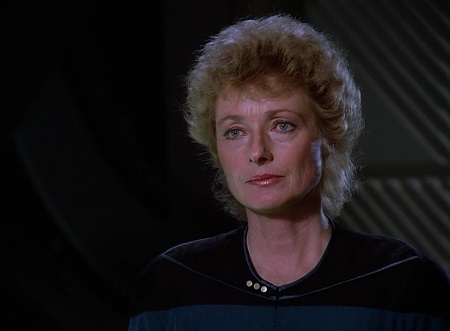
Dr Pulaski is the polar opposite. She’s opinionated, outspoken, and occasionally brash. Though she does form firm friendships with other members of the senior staff, she’s much more of a standalone, individualist character. These are all traits that she inherited from The Original Series’ Dr McCoy, and we can see a very definite McCoy influence for practically her entire run on the series.
The role of a doctor in Star Trek is naturally a limited one, and that was especially true when the franchise was primarily interested in episodic storytelling. Dr Pulaski’s scenes are largely limited to Sickbay or dealing with medical-themed stories and events, and this naturally puts constraints on what she – and other doctors in the franchise too – can do. In episodes with a strong medical storyline, I’d argue that Dr Pulaski shines, and aspects of her personality that might otherwise come across as abrasive can instead feel determined and driven. In stories without much going on in Sickbay she’s naturally of less use to the writers, and it shows.
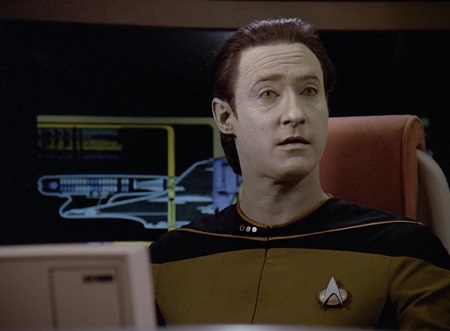
One of the main areas of criticism when Dr Pulaski came aboard was her relationship with Data. Designed to mimic the Spock-McCoy dynamic from The Original Series, some of Dr Pulaski’s early scenes and episodes with Data did not work as intended. She came across as patronising and looking down at Data – and that’s putting the most positive spin possible on it! At worst, Dr Pulaski was actively degrading and dehumanising in the way she spoke to and about Data, and that’s something that many fans found hard to take.
Though we’re more aware in 2021 of the need to be inclusive and attentive to the needs of neurodivergent people, non-binary folks, and other marginalised groups, even in 1988 many fans were uncomfortable at seeing Data dehumanised and talked about in the abstract. Fans had had a whole year to get to know Data, and just like we balked at Dr Bruce Maddox’s treatment of him in the episode The Measure of a Man, so too fans felt Dr Pulaski was treating Data unfairly. This is legitimate criticism, and soured many fans on Dr Pulaski almost from her first moment on the series.
Though I was perhaps a little unkind in my characterisation of Dr Crusher earlier, there were many fans of The Next Generation who liked the character and wanted her back. A letter-writing campaign began almost from the moment Season 2 premiered – supposedly with some involvement from Patrick Stewart – to convince the producers to bring back Gates McFadden and dump Dr Pulaski. Though I daresay this would’ve happened regardless of how well Dr Pulaski’s character had been received, the fact that those early episodes featured a conflict with Data that certainly went too far and crossed a line didn’t help her cause.
Despite all of that, by the time Season 2 was finding its feet, Dr Pulaski had become established as a regular member of the crew of the Enterprise-D, and had settled into her role in Sickbay about as well as she could. The fact that she was a strong and decisive personality may have been divisive among fans, but in my opinion she elevated the role of the ship’s medical officer, taking what had been a secondary position with Dr Crusher in Season 1 and transforming it into a more important role, especially in medical storylines. Even when Dr Crusher returned in Season 3, this aspect of the show continued to an extent; Dr Pulaski’s legacy on the show, despite the character being dropped with little fanfare, may be that Dr Crusher found more prominent storylines.
The comparisons with Dr Crusher are inescapable, and one other aspect that viewers felt was missing after Dr Crusher departed the series was a relationship with Picard. Dr Crusher and Picard had history as well as more than a little romantic tension, whereas Dr Pulaski didn’t have that connection with Picard – or with anyone else. Though there was a storyline in the episode The Icarus Factor involving a past relationship with Commander Riker’s father, this didn’t become a major aspect of her character, and she remained romantically un-attached for the rest of her tenure.
Though the episode Unnatural Selection is perhaps the story where she was given the most to do, where I felt we saw Dr Pulaski at her best was in episodes like Time Squared, where she tended to a second Captain Picard from several hours in the future, Up The Long Ladder, in which she takes part in a traditional Klingon ceremony with Worf, and though there are two sides to her relationship with Data on display in Peak Performance, the way she consoled him after his defeat at Strategema was sweet. In these moments we see different aspects of her character – her medical expertise, her embrace of different cultures, and through her evolving relationship with Data, her ability to overcome her own prejudice.
Perhaps the fact that Dr Pulaski had anti-android prejudice to begin with made her too unpopular with fans to be redeemable. Her occasionally blunt persona didn’t help her in that regard either. But had we met Dr Pulaski in Season 1 not Season 2, I think it’s possible for her evolving relationship with Data to have provided a deeply satisfying character arc.
The problem Dr Pulaski faced was that she joined a series that already had a full season – 25 episodes – under its belt. The characters had grown together and been through some major events in Season 1, particularly the death of their friend and colleague Tasha Yar. Yar’s own deep relationship with Data, which was jump-started by the events of The Naked Now, had gone a long way to humanising him across Season 1, and there was something charming in the “android who longs to be human” story. In Encounter At Farpoint, Riker called Data “Pinocchio,” and across Season 1 that’s how viewers came to know Data. Dropping in Dr Pulaski at the beginning of Season 2 and giving her a very prejudiced way of looking at this character we’d come to know and love was a bridge too far for many viewers, and although the relationship improved dramatically over the course of the season, her early interactions with Data remained a sore spot.
Dr Pulaski was present for all but two episodes of Season 2. However, most episodes didn’t have a major medical focus, and thus she was really a secondary character much of the time. Even so, I’d argue that she brought a lot to the show, and despite the introduction of her character not really succeeding in the way the creative team intended, Dr Pulaski certainly achieved her objective of shaking up the crew. Though she was never a villain, the introduction of Dr Pulaski showed that there can still be disagreements and interpersonal drama among Starfleet officers in the 24th Century, and that not everyone has to agree all the time. The Next Generation could, at times, fall into the trap of being too idealistic in its portrayal of characters in particular, and while there were adversaries and antagonists in Season 1 – including some from the Federation – Dr Pulaski was the first main character on the show to pull in a different direction. In that sense she arguably laid the groundwork for storylines we’d see from Season 4 onwards with characters like Ro Laren, and in particular the non-Starfleet crews we’d meet in Deep Space Nine and Voyager.
The fact that Dr Pulaski was never shy and didn’t pull her punches is something I found charming and appealing about her, particularly when compared to Dr Crusher’s Season 1 persona. She could be opinionated and even pushy at times, but she always did her best to help those in her care and didn’t bat an eyelid at the wacky situations the Enterprise-D would find itself in. Not only that, but she grew as a character across her single season on the show, particularly in terms of her relationship with Data and her understanding of different kinds of life. The Next Generation set out to seek out new life, and while Dr Pulaski’s old fashioned idea of what “life” is may have held her back at first, over time she came to recognise that Data was a valuable colleague and even a friend, even if she didn’t understand everything about him.
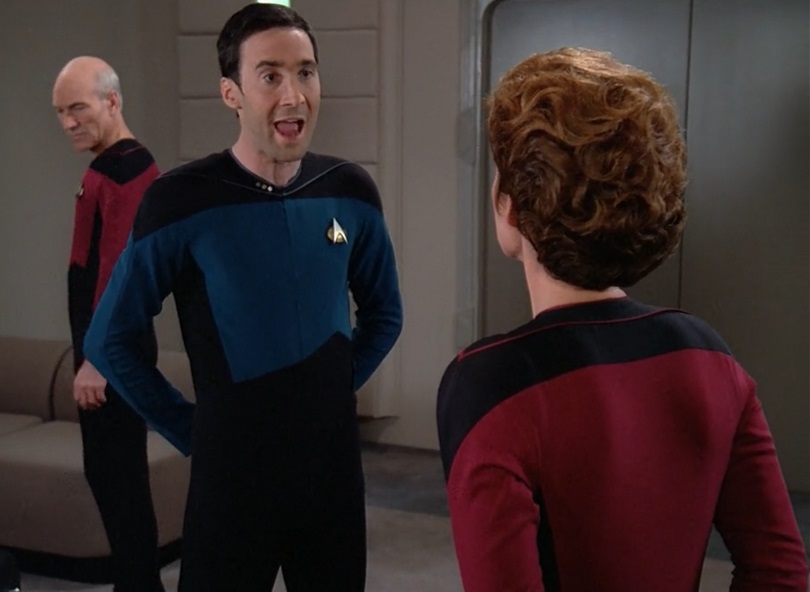
Had she been kept around and spent more time on the show, perhaps we would have seen those themes continue to play out. There was scope for her relationship with Worf to develop, not romantically necessarily but certainly putting them in more stories that would have allowed their friendship to grow and for both characters to learn more about the other’s culture. Her relationship with Kyle Riker could have been revisited, allowing for a more complex and nuanced relationship with William Riker on the Enterprise-D. And though she could never replace Dr Crusher in terms of having a close relationship with Captain Picard, the dynamic between the two – particularly the power play between a man who’s used to being the sole commanding officer of his ship and the doctor who’s the unquestioned master of Sickbay – would have been interesting to explore. There was scope for her to occasionally push back against Picard and other main characters, asserting herself more strongly than Dr Crusher usually would.
All of that and more would have been interesting to see, and while Dr Crusher had some great stories from Season 3 onwards, I’ve always felt at least a little sad that we didn’t get more from Dr Pulaski. At the very least it would have been nice to know how she came to depart the Enterprise-D and what her next role was going to be. Did she transfer to a different starship, return to Earth, retire? We don’t know, and I think it’s highly unlikely we will ever get any kind of solid confirmation of Dr Pulaski’s post-Season 2 life.
I found Dr Pulaski an interesting character and a welcome addition to The Next Generation, even though not every aspect of her characterisation succeeded or achieved its intended objectives. She remains an interesting character in Star Trek, particularly within the 24th Century, and I’ve always been fascinated by this single-season character. Season 2 of The Next Generation marked a change and uptick in the show’s quality – whence comes the expression “growing the beard,” a reference to Commander Riker’s facial hair! Though she wasn’t front-and-centre at every moment, Dr Pulaski played a significant role in the evolving series, helping it grow and become better than it had been in its first season. We can’t argue that the introduction of her character is somehow responsible for The Next Generation’s increasing success in that era, but we can’t dismiss it as mere coincidence either.
And perhaps that’s Dr Pulaski’s real legacy. She was a part of The Next Generation at a key moment – its powerful second season. Season 2 provided much more of a blueprint for the show’s future success – and for the successful development of Deep Space Nine and other parts of the franchise – than The Original Series-inspired first season had. Dr Pulaski, though originally intended to be a throwback to Star Trek’s first series, played a role in the franchise’s evolution as a character who wasn’t afraid to shake things up, stand up to her commander, and hold her ground. We can see elements of her personality in a number of Star Trek characters who came later, even continuing to the modern day.
Star Trek: The Next Generation is available to stream now on Paramount+ in the United States and on Netflix in the United Kingdom and elsewhere. The Star Trek franchise – including all characters and properties mentioned above – is the copyright of ViacomCBS. This article contains the thoughts and opinions of one person only and is not intended to cause any offence.
Spoiler Warning: There are spoilers ahead for Star Trek: The Next Generation.
It isn’t. This “article” is just a horrible April Fool’s Day joke.
Gotcha!
I need to write something convincing here so that I can use it as an excerpt on the homepage. Let’s see what we can come up with… By expertly blending these different scenes together, Shades of Gray compiles the very best of Star Trek: The Next Generation into a single package. There, that’ll do. What can I say? I used to work in video game marketing. I can spin and bullshit about any subject I choose!
While we’re here, though, it’s worth noting a couple of things about Shades of Gray if you have the time. And yes, I’m serious this time. Pinkie promise.
Riker was injured on an away mission… setting up a clip show.
Shades of Gray is the only clip show that Star Trek ever made. With the decline of clip shows in general, and modern Star Trek shows having shorter seasons that don’t need to be padded out to fit archaic broadcast television schedules, I doubt that we’ll ever see another one. That makes it utterly unique in the Star Trek franchise. “Unique,” though, does not mean “good.”
The only reason Shades of Gray was made, as I alluded to above, was to fulfil The Next Generation’s contract of producing twenty-two episodes in its second season. Problems earlier in the season caused shoots to run longer than planned, and several episodes ended up being more expensive to produce than expected – most notably Q Who, which introduced the Borg for the first time, but also Elementary, Dear Data. This left the show in a place where it was necessary to produce an episode as cheaply as possible. It was thus little more than a money-saving measure, as clip shows almost always were.
The final scene of the episode – and of the entire second season. They were lucky a third had already been commissioned!
The poor reception to Shades of Gray meant that no other attempts were made to make clip shows, and the creative team behind The Next Generation and other Star Trek shows of the ’90s were very keen to avoid them.
It’s the only episode of The Next Generation to feature all of the show’s main cast. In addition to the main cast of Season 2, Dr Crusher and Tasha Yar returned in clip form from Season 1. So it’s got that going for it… which is nice.
Finally, and this is the most bittersweet part for me, is that Shades of Gray marked the unceremonious end of Diana Muldaur’s role as Dr Pulaski.
Captain Picard and Dr Pulaski.
I’ve yet to meet another fan of The Next Generation who likes Dr Pulaski as much as I do. Where Dr Crusher was often – and I’m sorry to say this – rather bland and uninteresting, even in episodes which gave her a significant role, Dr Pulaski has much more personality and more character. She’s headstrong and opinionated, and while some of her opinions – such as her ideas about Data being less than human – did not win her any fans, I liked that about her.
I would say that the Data issue was only really present in a couple of places across the season, and certainly by the time the season really got going she and Data had developed much more of a rapport. But her initial conflict with Data was supposed to mimic Dr McCoy’s argumentative tone with Spock in The Original Series. Indeed Dr Pulaski was intended to be a Dr McCoy-type character, designed to shake up the dynamic in what was still a new series. I do like Dr Crusher, and she had some great episodes, particularly in Seasons 5 and 6. But I would have dearly loved to have seen more of Dr Pulaski.
Perhaps we should save that for a Dr Pulaski article somewhere down the line? Remind me if I forget!
I’m not going to waste any more of your time for this silly April Fool’s Day joke. I hope it was a bit of fun!
Star Trek: The Next Generation is available to stream now on Paramount+ in the United States and other regions where the service is available. The series may also be available internationally on Netflix, and is available to buy on DVD and Blu-ray. The Star Trek franchise – including The Next Generation and all other properties mentioned above – is the copyright of ViacomCBS. This article contains the thoughts and opinions of one person only and is not intended to cause any offence.
Spoiler Warning: There will be spoilers for the first three episodes of Star Trek: Picard – as well as for The Measure of a Man from TNG Season 2.
When I was compiling two lists of episodes to watch prior to the release of Star Trek: Picard, I only included The Measure of a Man, from The Next Generation’s second season, as an afterthought in one of my “honourable mentions” sections. Despite having seen some androids briefly in one of the trailers, and even after having seen Mars come under attack in the Short Treks episode Children of Mars, I still wasn’t convinced this episode would be important. I wound up including it in my second list of episodes, but not because of androids or Bruce Maddox, but because of how it showed an aspect of Picard’s character – his staunch defence of the rights of different life-forms.
We now know, of course, that Maddox has a key role in Star Trek: Picard, though whether he’s actually going to appear in person or is merely a narrative force is unclear right now. And of course we’ve learnt a lot more about synthetics and the development and subsequent prohibition of synthetic life. Thus, at this point, The Measure of a Man warrants a re-watch and a closer re-examination.
Watching an episode so long after its original airdate, and after we’ve seen so much Star Trek content that was produced subsequently, it’s worth trying to stay objective and be aware of where the three characters we’ll be focusing on are at this point in the timeline. Obviously Maddox was a guest star, and aside from a reference in the fourth season, was never seen or heard about again until Picard premiered. But Data and Picard are arguably different than we might remember considering how early we are in The Next Generation’s run. This episode aired before Q Who introduced the Borg, before Picard was assimilated, and before Data had really developed a strong personality that extended beyond his original programming.
Data plays poker with his crewmates in the opening scene from The Measure of a Man.
The Next Generation operated differently to Discovery and Picard – it was much more of an ensemble show with each crewmember having their own stories and episodes, rather than focusing primarily on one character’s story. So Data and Picard, by this point in the show, still have significant parts of their backstories unexplored.
The episode opens, as many episodes of The Next Generation did, with Picard narrating his captain’s log. Nothing too exciting – the Enterprise-D is due to dock at a starbase, pick up and drop off some members of the crew, and switch out some science experiments that have presumably been running in the background. On board, we see Data, Riker, O’Brien, La Forge, and Dr Pulaski playing poker. Data seems confused by some of the “superstition” that the others apply to their playing – he can’t quite grasp the concept of “luck” in a game of chance. Again, it’s worth remembering how early we are in Data’s story! This might be the first game of poker he’s played, and just as he struggled with the others feeling lucky or unlucky, he was completely unprepared for bluffing – it’s such an illogical way of playing, after all.
In this moment, Data is still very much a machine, regarding the game as “simple”, based around mathematical probability and assuming that everyone will play logically. Having this sequence be the setup for an episode about taking him apart to find out what makes him tick is an interesting choice; we see Data at his most mechanical, but we also see in him an adaptability and a desire to learn and grow. The costuming choice to give Data a poker visor was also a great call – he’s approximating and mimicking human behaviour, but without fully understanding it.
Seeing Data easily outmanoeuvred by Riker – despite holding a better hand – emphasises how much he still has left to learn. Riker wasn’t betting on the strength of his cards, he was simply betting that Data would fold – Data thus missed a key element of playing poker. But he learns from this experience, much like a child would.
As an interesting aside, the next shot shows the Enterprise-D approaching Starbase 173. The model used for the Starbase was in fact a re-use of the Regula One station from Star Trek II: The Wrath of Khan and is virtually unchanged in its appearance (except for, I believe, its scale in relation to the Enterprise-D). This model was itself a re-use from Star Trek: The Motion Picture. With CGI generally being so good nowadays, it’s almost hard to imagine a time when a single model would have to be re-used over and over again – and The Measure of a Man was not the last appearance of this model by any means.
Aboard the station, Picard is reunited with Phillippa Louvois, accompanied by a very romantic soundtrack. He seems very surprised to see her, and she is clearly an old flame of his – someone who he didn’t part with on good terms judging by their conversation! But the passage of time can be a great healer, and where other people may have held a grudge, Picard is amused, and maybe even happy to see her again. The credits roll, and then we’re back with Picard and Louvois, sitting down to have a longer conversation.
Louvois holds the rank of captain – putting her on equal footing with Picard – and her uniform matches his. She’s not the first woman captain featured in The Next Generation – there was at least one other in Season 1 – but she gets a significant amount of screen time here. She explains that she’s the JAG (judge advocate general – i.e. a military judge, or in this case a Starfleet judge) for this sector, and the way she talks about it makes it seem like a remote part of the Federation, far from any other Starbases. It’s the frontier!
The Enterprise-D at Starbase 173.
We find out about Louvois’ history with Picard – she was the officer responsible for his court-martial after his previous command was lost. We’ve seen the Stargazer before in The Next Generation, in the episode The Battle, and we also know that Dr Crusher’s husband was serving on the Stargazer under Picard’s command when he was killed. Louvois says that a court-martial is “standard procedure” when a ship is lost, but Picard accuses her of being overly aggressive in her prosecution of him – and says that’s why she left Starfleet for a time. There’s a very complicated history here. Louvois calls Picard out on his arrogance – which to be fair, he actually was in this scene. But the chemistry and sexual tension between them is noticeable – there’s much more to their relationship than something professional or friendly.
After the awkwardness of seeing Picard called a “damn sexy man”, an Admiral approaches and Louvois excuses herself – but not before taking the opportunity to try to embarrass Picard in front of their superior. The Admiral introduces Commander Bruce Maddox, but they don’t immediately discuss Maddox’s proposal as the Admiral wants a tour of the Enterprise while it’s visiting his new Starbase. Maddox joins the Admiral on the tour, and they visit the Enterprise’s bridge. There is some discussion of the Starbase’s location being near the Neutral Zone, but the focus is clearly on Maddox, cutting to a close-up of him staring at Data.
Maddox interrupts the small-talk about the Romulans and the legacy of past starships Enterprise, clearly impatient. The Admiral tells Picard that Maddox is here “to work on your android”, then promptly leaves the bridge. Data, Picard, and Maddox have a conversation set to a backdrop of very tense music. Clearly all is not well. Maddox, it turns out, opposed Data’s entry into Starfleet Academy some years prior, claiming Data was not a sentient being and was thus not eligible. Picard asks what Maddox plans to do and he replies calmly that he is “going to disassemble Data.”
The way Maddox has been set up thus far is of someone who is impatient and impersonal – arguably lacking in empathy. He refers to Data as “it”, a term one might use for an inanimate object. Data is, anatomically speaking, male. In the second episode of The Next Generation’s first season, The Naked Now, Data sleeps with Tasha Yar and though we don’t see it on screen it’s confirmed that he is, for all intents and purposes, male. So Maddox dehumanising Data in this way, while subtle, shows us the kind of person he is.
Maddox explains his reasoning in the next scene – seeing Data when he first applied to the Academy sparked a desire in Maddox to learn more about the work of Dr Soong, Data’s creator. His intention is to dismantle Data, learning how he functions, in order to recreate him and produce copies. Maddox believes himself to be close to a breakthrough, and Data is intrigued at the prospect, in part no doubt because he’s been essentially alone as the only one of his kind. Riker, on the other hand, seems much more concerned. Data asks Maddox a technobabble-laden question, and when Maddox replies that he hasn’t been able to get the basics of a positronic brain working, Data’s tone changes from interest to concern – and after a couple more questions from both Riker and Picard, Data pipes up and says that Maddox’s research is inadequate. Picard says he will not allow Data to undergo the procedure, but Maddox has a trump card – Data is to be reassigned under his command.
Maddox makes his case to Picard – as well as to Riker and Data – in the briefing room of the Enterprise-D.
In the next scene, Data arrives in Picard’s ready room and the two have a conversation about what to do regarding Maddox. Data says he will not undergo the procedure, but Picard is playing devil’s advocate – wondering aloud whether there is merit to Maddox’s idea. Data uses the example of La Forge’s visor, and claims that his status as a non-human is why Picard would even consider letting Maddox experiment on him. Picard dismisses him but is clearly troubled by the implications. He gets to work reading Starfleet case law regarding officer transfers.
After what must be some time, Picard visits Louvois in her office aboard the Starbase, and is clearly very angry about Data’s forced transfer. The usual calmness we associate with Picard is gone, replaced by a firey demeanour borne perhaps from a combination of frustration at the legalese he’s been trying to wade through and his previous conversation with Data. After all, Data did essentially say that Picard and Maddox are being racist (or species-ist) in their treatment of him. Louvois gives Picard a “nuclear option” for getting Data out of the procedure – his resignation. There’s no other way to stop the transfer, and as Picard doesn’t trust Maddox, this seems to be the only way. Again the complicated past between Picard and Louvois complicates their conversation, but the advice she gives him is sound. And as she’s the senior officer in the sector for legal matters, that should be it.
Back aboard the Enterprise-D, Data is packing his belongings, and pauses briefly over a hologram of Tasha Yar. Maddox enters the room while Data has his back turned, and picks up a book that Data had been reading. Barging in without ringing the door chime is another way Maddox demonstrates to the audience that he doesn’t regard Data as warranting the same rights or respect as a human or other life-form. He tries to reassure Data that his knowledge and memories will remain intact despite the procedure, but Data retorts that the facts may remain, but the feelings associated with them will be lost. He then uses the example of the poker game from earlier in the episode – that the moment-to-moment reality, the essence of his experiences, is not just a case of data and facts. Maddox, Data claims, does not have the necessary expertise to preserve Data’s memories and personality.
It’s at this moment that Data explains that he has resigned. Maddox becomes angry and tells him that one way or another he will serve under his command – and undergo the procedure. It’s clear that Maddox’s attempts at gentle persuasion were all for show; this is how he really feels. Believing Data to be a “thing”, an object not a person, he pays lip service to Data’s feelings while not understanding them or even recognising their existence. In the next scene, Picard and Maddox are in Louvois’ office, where Maddox has started a legal process to prevent Data leaving Starfleet, saying that as a non-sentient being he cannot resign of his own volition.
Maddox presents the argument that if he’s successful, every Federation starship could have its own Data on board, allowing for much greater exploration and potentially even saving lives. He’s “sick of hearing about rights” – a shocking statement in and of itself – and selfishly makes the point that this is his life’s work, and he doesn’t want it to be ruined by what he sees as the ignorance of Picard and Louvois. Data, in Maddox’s view, is “just” a machine, and because of that does not have the right to either refuse to undergo the procedure or to resign.
While Picard listens in, Maddox makes his case to Capt. Louvois.
Picard has a great line here: “Starfleet is not an organisation that ignores its own regulations when they become inconvenient.” In Remembrance, the first episode of Star Trek: Picard, this is essentially his own reasoning for leaving Starfleet. He felt that they had an obligation to help the Romulans and failed to do so – ignoring their own regulations, and a promise made, because it had become difficult in the aftermath of the attack on Mars.
Maddox manages to convince Louvois that there may be law to support the notion that Data – like the Enterprise’s computer – is not a “person” in the legal sense, but is merely the property of Starfleet. Picard urges her to use the same passion she showed at his court-martial. Though Maddox and Picard don’t interact much here, as they mostly direct their remarks to Louvois, it’s clear that they have very quickly developed a loathing for one another. Picard feels Maddox is essentially ignoring Data’s rights as a sentient being, and Maddox believes that Picard doesn’t understand the issue and is unfairly getting in the way of his work.
Back aboard the Enterprise, Data is attending a farewell party. Riker, Troi, Worf, Pulaski, and Wesley are all present in Ten-Foward, and Data receives several gifts from his friends, but La Forge is sat alone, away from the group. He’s feeling very down about the whole situation. In this moment, we see Data at his most human – La Forge is arguably his best friend among the crew, and when he says he will miss him, he really means it.
Louvois summons Riker and Picard to tell them that, according to her research and legal precedent from 300 years ago, Data is legally the property of Starfleet and not a person. Picard challenges her ruling, but the fact that the Starbase is new and she has no one working with her threatens to cause a problem. The solution is that Picard and Riker will take on the role of advocates – Picard arguing for Data and Riker against him.
This is the point in the episode which is the most questionable, I feel, as a point of plot. Riker is chosen to prosecute Maddox’s case as a senior officer, but Maddox himself is of equal rank to Riker and would be a better candidate – especially as Riker states very clearly that he can’t advocate a position he fundamentally disagrees with. I’m no expert on the law, let alone on military law, but surely there must be someone else who could have taken on the position. Or, if not, it should have been possible to send for lawyers from elsewhere – Maddox’s experiment is not time-sensitive and could have waited for the case being resolved. As it is, however, Riker and Picard agree to proceed with the case.
La Forge wishes Data good luck at his going-away party aboard the Enterprise-D.
As the scene ends, I think we see the real genius of setting up Louvois as having history with Picard. If he’d been facing off against a random, faceless judge or JAG, we would know the stakes but we’d be confident in his abilities and ultimate victory in the case. But knowing Louvois is a “hardball”, someone who prosecuted Picard aggressively in the past regarding his conduct on the Stargazer, it raises the stakes and there’s a real sense in this moment that Picard and Data could lose. Because we’ve always seen Picard to be a rule-following officer, an exemplar of Starfleet’s code of conduct, and an all-round upstanding captain and diplomat, knowing that Louvois went after him in the past makes her seem all the more aggressive in her handling of the law. We get the sense that things could end badly, that the one factor Picard has no control over in the case – the judge – is someone who will work hard against him and Data. This information, conveyed only in a few brief lines of dialogue in their earlier two encounters in the episode, has set the stage and told us all we need to know.
Data again visits Picard in his ready room, and Picard explains the ruling and the challenge he’s making to it. He offers Data the opportunity to select another officer to provide his defence, but Data declines – an important moment given the earlier conversation they had in the same room. We then see Riker studying the law in preparation for the case, feeling pretty rotten about what he has to do. He looks up Data’s technical schematics, smiling to himself as he thinks he’s found something – then his mood and the background music turn sour as he realises the implications. Riker doesn’t want, after all, to win the case. And getting caught up in it for a moment and allowing himself to feel excitement at a breakthrough ends up making him feel worse about the task.
At the hearing, Riker calls Data to take the stand. Could Data have refused, as he’s essentially being compelled to serve as both evidence and a witness for his own prosecution? I think that’s a matter of law again! And if he did refuse to take the stand, would there have had to have been another case to answer the question of whether he has the right to refuse to testify? Regardless, Data takes the stand and his commendations and decorations from Starfleet are listed by the Starbase computer (notably not the usual computer voice). Riker asks the simple question “what are you?” to which Data responds that he is an android. Riker pushes him for the definition of the word, which includes a sentence that androids “resemble” humans, but are obviously not, in fact, human. He then pushes Data on his creator, making the point that Data was artificially made.
None of this, really, seems relevant to the hearing. Data’s nature is known to all parties and his defence does not depend on proving himself to be anything other than an android. But for dramatic effect it’s important, as essentially the fact that Data was man-made is the entirety of the prosecution’s case against him. Interestingly, and completely unrelated to the events of the episode, Data states that his total memory capacity is “800 quadrillion bits”. If a 24th Century “bit” is assumed to be the same as today’s computer bits, that would put his memory at 800 petabits, or 100 petabytes as there are eight bits to one byte. While this is a lot of memory, it’s not as huge as it may sound even by today’s standards. It’s roughly an order of magnitude less than the most up-to-date estimates of the size of the data stored on the internet, for example. And that’s something which is growing all the time. It is, however, much greater than the capacity of a human brain or memory – though the comparison is an inexact one as we don’t store and process memories and information in the same form. But there are computers and servers in the world today which can store as much or more information that Data can – something which would obviously have been hard to conceive when The Measure of a Man aired in 1989, before the invention of what we know of as the internet today.
Riker looks up Data’s schematics in preparation for the hearing.
As Riker continues with his demonstrations, Maddox is seen smiling to himself – he seems to think the two of them have the case sewn up. Data is forced to bend a steel rod to demonstrate his physical prowess to the hearing, and Riker then removes his forearm and hand – apologising to Data as he does so. Riker then tries to explain that Data was made “to serve human needs”; that is his sole purpose. Of course, having already seen Data with his “brother” in the first season episode Datalore, we know this isn’t really true. Lore was a companion to the colonists on Omicron Theta, and Data was designed to be so too. Riker has also fallen into the habit of referring to Data as “it” in this moment, and as he continues his speech about Data he walks behind him – hitting a hidden “off switch”, which we’d previously seen Data show to Dr Crusher and others in the aforementioned episode Datalore.
Picard and Louvois are both shocked by this, and Riker sits back down. He clearly thinks that this is a case-winning move, and the look of shame and self-loathing on his face confirms that. Maddox smiles, smugly. Picard requests a recess and tells Guinan, back on board the Enterprise, that Riker’s words in the hearing “almost” convinced him of Data’s status.
Guinan’s response, that if Data is ruled to be merely property, it could pave the way for “whole generations of disposable people” warrants a closer look. And we have to step back and consider The Measure of a Man and its place in our own history. In 1989, we’re 25 years out from the Civil Rights Act and Voting Rights Act which put an end to legal segregation in parts of the United States. In living memory for a significant portion of the audience was segregation – itself a hangover from the days of slavery. And this line, delivered in a very calm manner by a black woman, absolutely references slavery without her ever using the term by name. The implication for Picard is clear – if he loses the case, and androids are ruled to be property and not people, it’s the first step to the creation of a slave underclass in the Federation.
This moment changes the way Picard approaches the case. The word “property”, he believes, is merely a euphemism for slavery. And he returns to work with a renewed sense of purpose. Again, given his state of mind in the first three episodes of Star Trek: Picard, I’d direct anyone who says that Picard “would never get depressed” to look to this moment and others from The Next Generation to see how he can become defeatist and sit in self-pity. It took Guinan here to give him the kick he needed, just as it took Dahj to snap him out of how he’d been feeling in Remembrance.
During a recess in the hearing, Picard is counselled by Guinan.
Back at the hearing, Picard says that humans are simply “machines of a different type” to Data, and his mechanical status is not relevant to the case. Picard asks Data to return to the stand, and presents him with the bag he packed earlier in the episode – demonstrating that Data has a semi-emotional attachment to things like his medals and a book gifted to him from Picard. The final item from Data’s bag is the hologram of Tasha Yar, and after some gentle prompting from Picard, Data discloses he and Yar had been intimate – to the surprise of Louvois and Maddox.
Maddox then takes the stand, and Picard runs him through three tests for sentience. This is also, by the way, the first time the Daystrom Institute is named on screen. Maddox lists three criteria for sentience – intelligence, self-awareness, and consciousness. Picard proceeds to quiz him on why these apply to him – a human – and not to Data. Maddox is forced to concede that Data is intelligent and that he’s self-aware, as Data’s intelligence was never in question and he’s clearly aware of his place in the hearing and the potential consequences it could bring.
Maddox then talks briefly about his plans to disassemble Data – to rebuild him and thousands more like him. Picard challenges that by doing so, he will be creating a race of beings – a race that meet two of Maddox’s own criteria for sentience. If there’s even a chance that Data could meet the third, would the Federation have created a race of slaves? This is where we see Picard at the most passionate he gets, not just in the context of this episode but in almost all of his appearances in Star Trek to date. Aside from the emotional reaction he has to the Borg in First Contact, I can’t remember seeing him more energetic and involved. He cares for Data’s rights, but his conversation with Guinan shifted his whole perspective on the case, and now he has an even greater passion and reason to win. He admits to the court that he doesn’t know whether Data has consciousness, nor what that would mean if a race of Datas were created from Maddox’s work. But the implication he makes, as Guinan did earlier, is clear – they’re on a cliff-edge, with slavery at the bottom.
Picard also turns on its head the Starfleet mantra – “to seek out new life”. “There it sits,” he says as he gestures to Data. As he concludes his speech we see Riker smile for the first time since the hearing began. He’s never seen Picard so animated, and he clearly thinks the argument is a case-winner. And in short order he’s proven right. Louvois says she must allow Data the freedom to explore his life and consciousness for himself, and without explicitly ruling on his “personhood”, she rules that he is not the property of Starfleet and that he has the right to choose.
Bruce Maddox takes the stand.
Maddox and Data have a moment of semi-reconciliation at the end of the hearing, as Maddox cancels the order to have Data transferred, and Data tells him to keep working and suggests that he may be able to agree to the procedure in future when more work has been undertaken. Maddox, disappointed by the ruling no doubt, appears to have had his opinion and perspective on Data shifted at least slightly by Picard’s argument – emphasised by his use of the word “he” right at the end.
Picard invites Louvois to dinner – as they reconcile too. Back aboard the Enterprise, Riker has declined to attend a party in Data’s favour, feeling that he came too close to costing his friend his life. But Data reminds him that if he had refused to participate, the ruling would have been made against him, and the episode ends with the two of them heading to the party.
So, when considering Star Trek: Picard, what do we get from The Measure of a Man? Obviously we see Dr Maddox, some thirty-five years prior to the events of the new series. We see his attitude toward androids – he considers them to be tools, not people. But we also see his attitude shift right at the end, swayed by Picard’s argument and the time spent with Data over the course of the episode. Maddox, despite moments of smugness, isn’t a classic villain. Instead, the episode shows what is basically a difference of opinion. Maddox, having studied androids from a theoretical standpoint for years, but with no practical real-world experience in living and working with Data holds the opinion that Data cannot be sentient. But Picard, Riker, and others, despite not having the same technical background as Dr Maddox believe Data to be their friend despite his synthetic nature. The episode thus shows the difference between theory and practice – and why practice is usually better and more appropriate!
Maddox obviously continued his work, as Data encouraged him to do. In the episode Data’s Day from Season 4, he dictates a letter to Maddox, confirming this. However, by the time of Star Trek: Nemesis, which takes place around fifteen years later, Data is still believed to be the only extant android – Lore having been disassembled. The discovery of B4 – an earlier version of Data – in that film is thus presented as a big deal. However, as we now know from Short Treks and Star Trek: Picard that teams of androids – albeit rather basic ones from a personality point of view – were working on Mars only a few years after Nemesis, Maddox must have been quite far along in his work by that point. It’s also possible that the discovery and disassembly of B4 provided Maddox with some of the missing pieces of the puzzle that he’d hoped to gain by dismantling Data.
Watching The Measure of a Man divorced from all thought of Picard is difficult, especially as we’re partway through the first season of the new show. But taken as a standalone episode, it’s an interesting piece of drama, the kind Star Trek has always been good at. Without any battles, explosions, or really any action at all, the episode manages to be riveting, especially in the hearing scenes. And of course it’s a great example of Star Trek using its science fiction setting to talk about real-world issues. In this case the issue was slavery rather than artificial intelligence, but looking back on it knowing the way technology has changed since, it can absolutely be viewed through than lens too.
Maddox was, aside from his single reference a couple of years later, a one-off character who served a fairly one-dimensional purpose for most of the episode. Bringing him back in a big way for Picard is something I absolutely was not expecting, and whether we get to see him on screen or not, his influence is all over the show. The Measure of a Man is not required viewing for Picard. The new show is structured and written in such a way that the role Maddox takes in the story could be swapped out for any other name and the story would be identical. But it does provide interesting background and backstory.
The development of a “race” of androids was clearly successful in the years after Nemesis.
Having had Maddox’s name dropped multiple times across the first three episodes, I would be surprised to learn we aren’t going to see him at all. A single reference would’ve been a cute throwback to The Measure of a Man and Data’s Day; a wink to returning fans. But with him being set up as perhaps the creative force behind Soji and Dahj, and with tracking him down being the driving force for the current storyline, I think he practically has to appear – at least in some capacity, even if it’s just in recordings – before the end of the season.
The legal precedent laid down in this episode was clearly not applied throughout the Federation. In the Voyager episode Author, Author, not only does The Doctor – a sentient hologram – have to undergo a very similar legal hearing, but we learn that thousands of Emergency Medical Holograms are being used as labourers in mines and on vessels across the Federation. And of course, in Picard we see that Maddox had been somewhat successful in creating his “slave race” of android labourers. There are disturbing implications there, which I wonder if the show will touch on in later episodes.
I enjoyed going back to The Measure of a Man. I wouldn’t like to guess how many times I’ve seen it already; as with most of the rest of The Next Generation and its spin-offs I’ve watched and re-watched it on a number of occasions.
The fourth episode of Picard premieres tomorrow here in the UK – though if you’re in America you may have seen it already! I’m looking forward to seeing if Picard and his new crew stay on Maddox’s tail as they head to Freecloud.
The Star Trek franchise – including Star Trek: The Next Generation and Star Trek: Picard – are the copyright of ViacomCBS. This article contains the thoughts and opinions of one person only and is not intended to cause any offence.