Spoiler Warning: There are spoilers ahead for The Next Generation Seasons 3-4, Deep Space Nine Season 1, and Picard Season 3.
I don’t cover fan films very often here on the website. Trekkies have created some great productions over the years, don’t get me wrong, but it’s just never been a priority for me – especially when there are still some recent official episodes I need to catch up on! But I wanted to take a moment to highlight one such fan-made production today, as it’s something I greatly enjoyed.
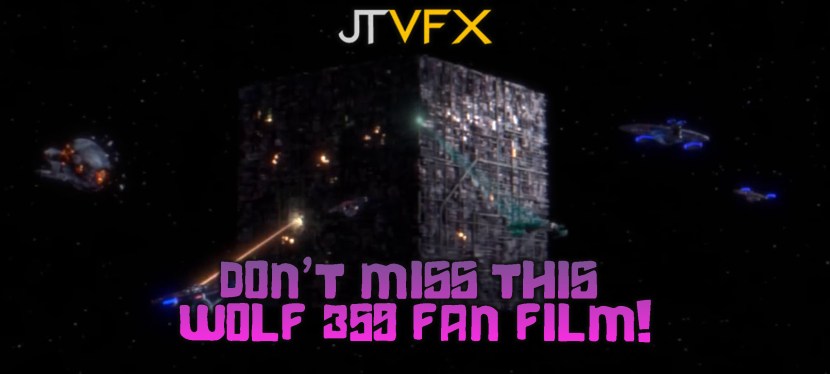
Over on YouTube, a channel called JTVFX has put together a four-part series all about the Battle of Wolf 359: the famous battle between Starfleet and the Borg that was depicted in The Best of Both Worlds. The creator took what we saw of the battle in The Next Generation and Deep Space Nine’s premiere and massively expanded upon it, crafting what is genuinely one of the best space battles set in the Star Trek universe that I’ve ever seen. In fact, I’d go so far as to say that this fan film easily eclipses many of the space battles seen in official Star Trek films and TV shows.
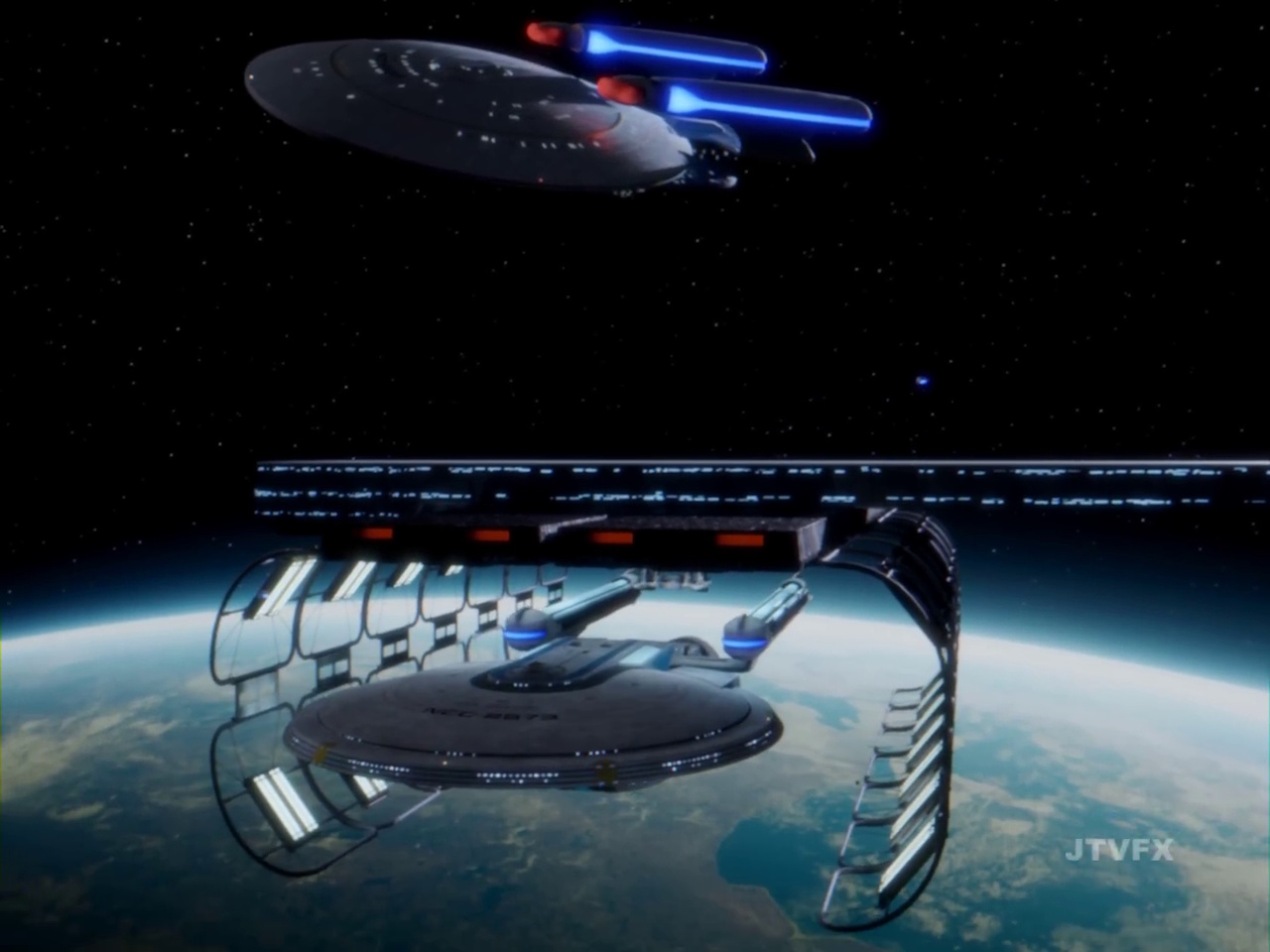
Federation ships in orbit above Earth.
I wanted to highlight this because, at time of writing, The Massacre: Part II has just been published on YouTube – so it’s the perfect time to check it out if you haven’t already. The first part garnered a whopping 1.5 million views, and with Part II being bigger, longer, and even more intense, I think it’s something that no fan of The Next Generation era and The Best of Both Worlds should miss out on. I took time away from working on my review of Alien: Earth to step back into the Star Trek galaxy, and I’m so glad that I did!
We are gonna get into spoiler-y territory, so if you want to watch the whole fan film without any spoilers, this is your last chance to duck out. But I hope you’ll come back after you’ve seen all four parts!
What I really loved about this fan film was how it incorporated everything we know about the Battle of Wolf 359 from canon. We had Picard/Locutus aboard the Borg Cube, being influenced by the Borg Queen. Admiral Hanson leading the Federation fleet. Sisko aboard the doomed Saratoga. And even a young Liam Shaw – future captain of the Titan-A – was glimpsed as he escaped his ship. It felt like JTVFX had gone out of their way to tie together The Next Generation, Deep Space Nine, and Picard in a way that felt natural.
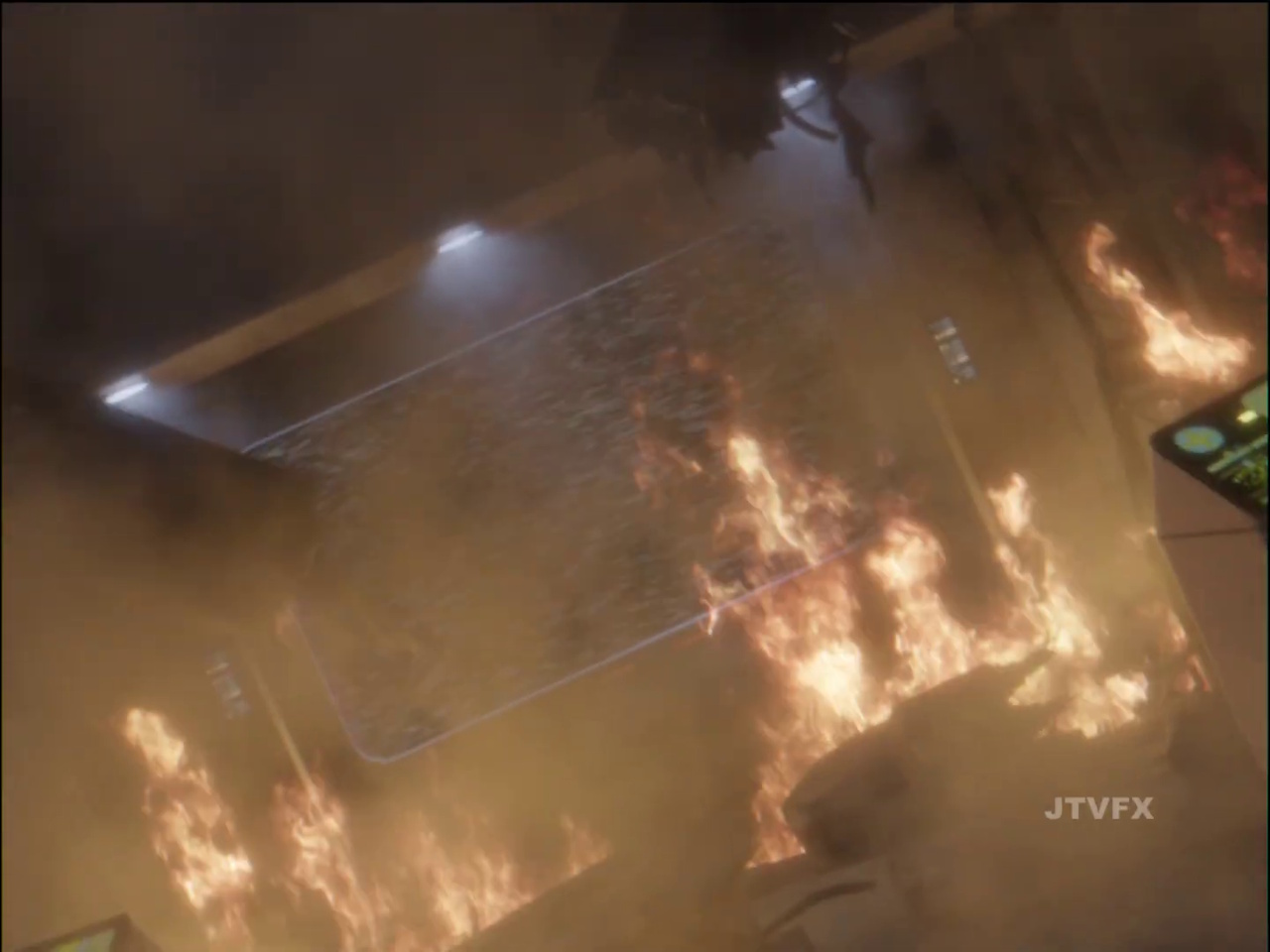
A burning starship bridge.
Then we come to the Klingons’ involvement. At this point in the 24th Century, the Klingons and the Federation are allies, so it makes sense that they’d be willing to come to Starfleet’s aid. While a request for help from the Klingons was mentioned in The Best of Both Worlds, we never saw any Klingon ships on screen in the episode. I really liked seeing the Klingons here; their fleet racing to join the battle at the last minute was reminiscent of the Enterprise-E’s arrival in First Contact, and hit all of the same emotional notes for me.
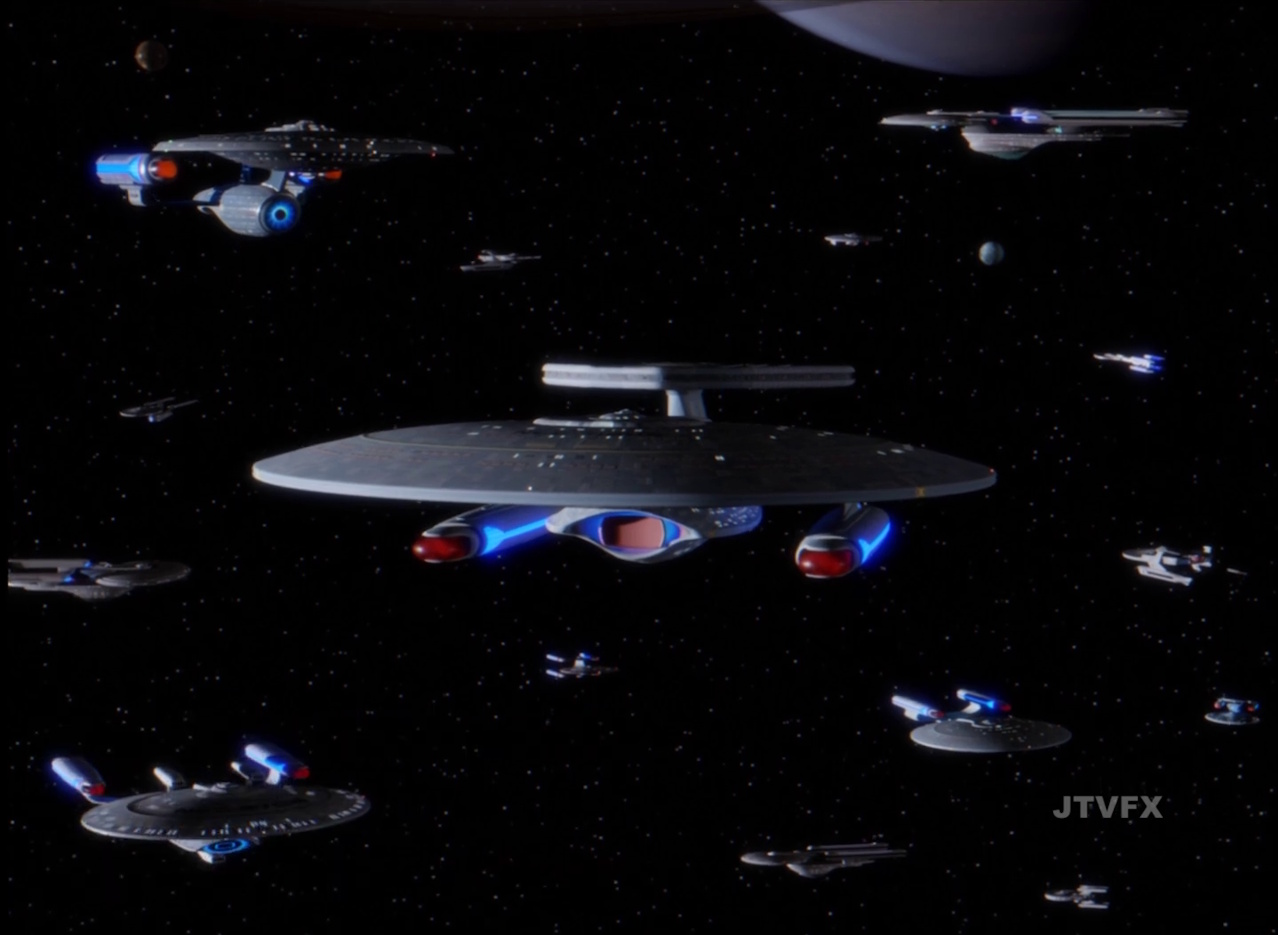
Obviously, this is, first and foremost, an animation and VFX project. And there were so many beautiful starship models on display. I’ve said this before in other contexts, but I love seeing a big, beautiful, and diverse fleet of starships. It’s so much more visually interesting to see different classes and styles of ships working together than just copies of the exact same ship, and when most of the designs were from The Next Generation era, that just made it even better!
Part of the Federation fleet.
In The Best of Both Worlds, Admiral Hanson’s fleet always seemed to me like the kind of thing Starfleet had tried to throw together at the last moment. The Federation just doesn’t expect this kind of deep incursion into its territory, and with no major wars in this era, it makes sense that Starfleet wouldn’t just have a massive defence force armed and ready to go. I’ve always assumed that Starfleet was basically forcing ships out of mothballs, staffing them up with whoever was available, and throwing them into Hanson’s fleet – the time constraints surely meant that recalling ships from long-range exploration voyages was impossible.
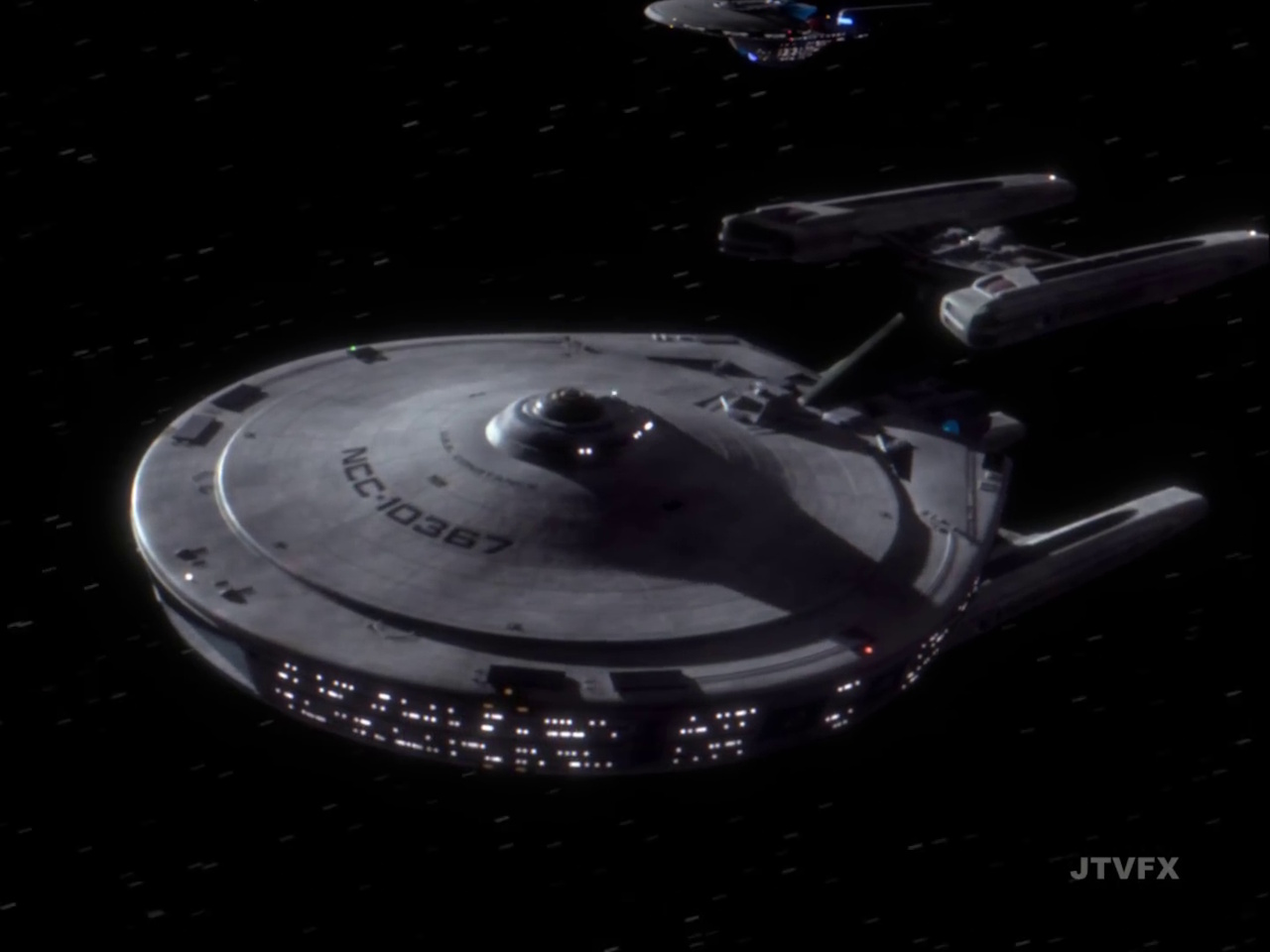
And that feeling of a hastily thrown-together collection of random ships was absolutely present in JTVFX’s film. We got a collection of ships from the 23rd and mid-24th Centuries: Excelsior-class, Ambassador-class, Constellation-class, Miranda-class, Oberth-class, Nebula-class, Constitution-class refits, and a few others that I’m sure I’m forgetting. The Klingon fleet, too, contained D7-class ships, Birds-of-Prey, and just one more recent Vor’cha-class as its flagship. I just adored the way these fleets felt, especially the Federation ships. You could feel how Admiral Hanson had been scrounging around, trying to find any spaceworthy vessel to throw at the Borg. In that context… does it make the losses more understandable? I’d argue that maybe it does!
A Constellation-class ship.
One thing we never really got to see in canon was whether the fleet at Wolf 359 made much of a dent in the Borg Cube, and even though the outcome of the battle was known, the moments where the Federation and Klingon ships seemed to find an advantage or a weakness in the Borg’s defences still felt incredible. The whole battle was exceptionally tense, with some of the named characters genuinely feeling like real people. Given that the focus was on the starships, not their crews, that’s a hard thing to achieve.
So let’s talk about the animation work.
I’m not an expert in CGI or any of that, not at all. But as a Trekkie, I know what a good space battle looks and feels like when I see it! And for me, JTVFX absolutely nailed it. The Battle of Wolf 359 felt… well, like how I’ve always imagined the Battle of Wolf 359: a desperate last stand against an impossibly powerful adversary, with Starfleet throwing everything it had at the Borg Cube to absolutely no avail.
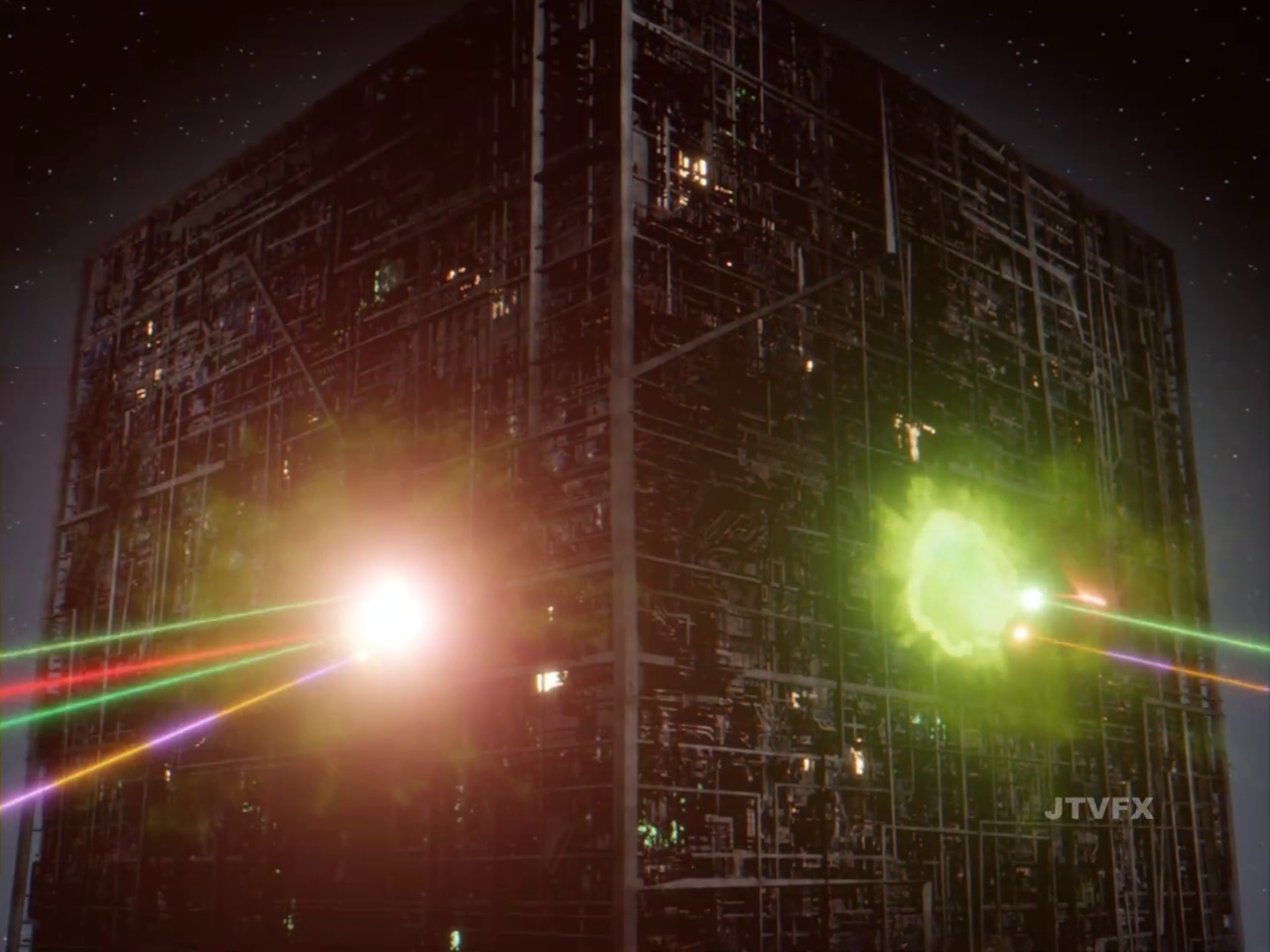
The Borg Cube is hit with phaser fire.
The Borg Cube looked fantastic, its tractor beams, weapons, shields, and repairs all felt like updated versions of what we saw in The Next Generation, and I loved seeing Locutus aboard the ship, coordinating the battle. The Federation and Klingon ships all manoeuvred and flew through space exactly like they did in The Next Generation era, and many of the sweeping action shots reminded me of Deep Space Nine’s Dominion War battles, which I think JTVFX must’ve drawn inspiration from.
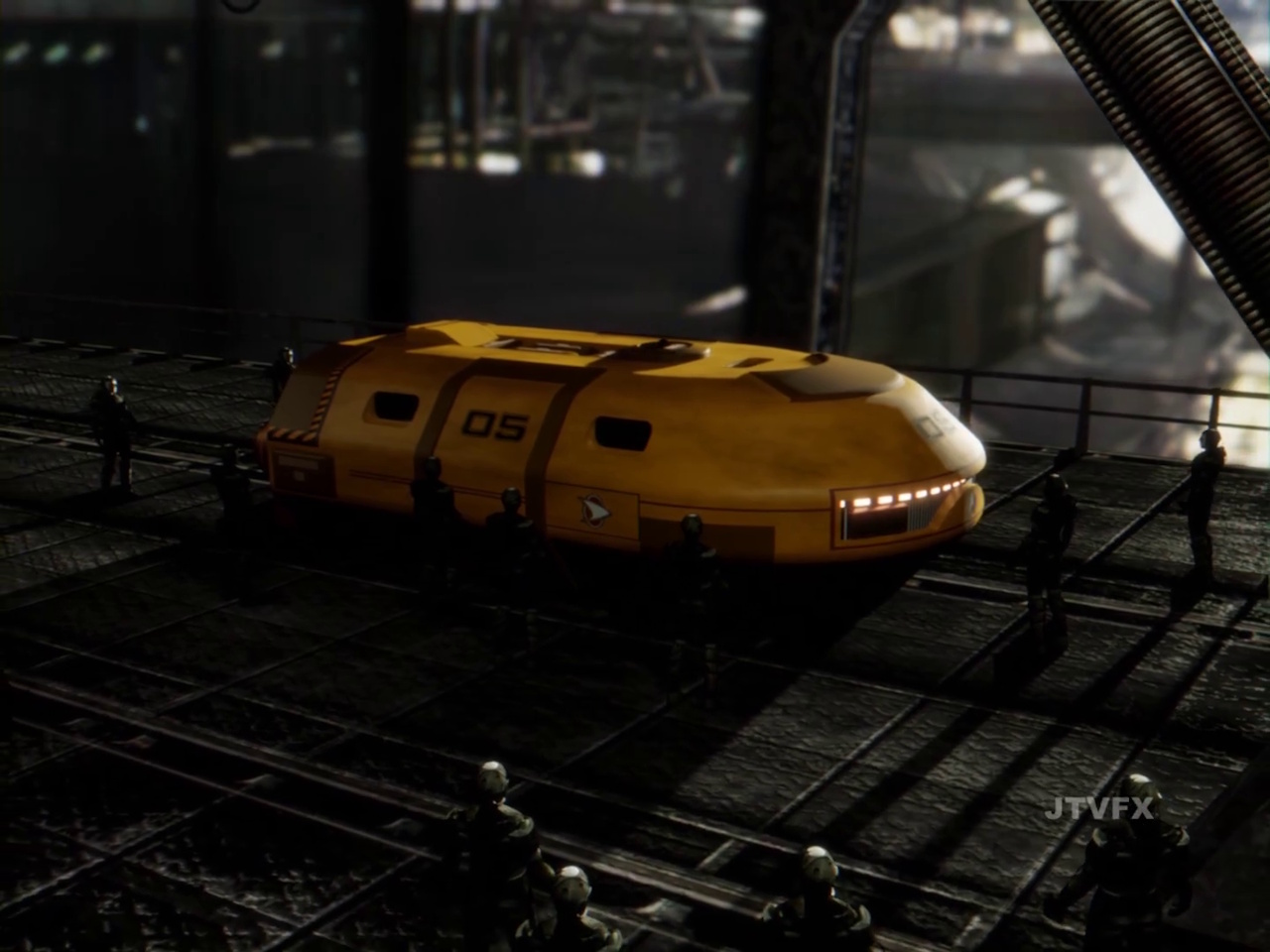
It’s one thing to make a CGI model of a starship – but it’s altogether more complicated to make that ship fly and move around in the way we, as Trekkies, are used to seeing. But whether it was the smallest shuttles and escape pods or the largest Klingon and Borg ships, all of the vessels on screen – and there could be many on screen at once – felt absolutely perfect… and like they’d flown out of a Star Trek production from that era. I loved it… if you couldn’t tell already!
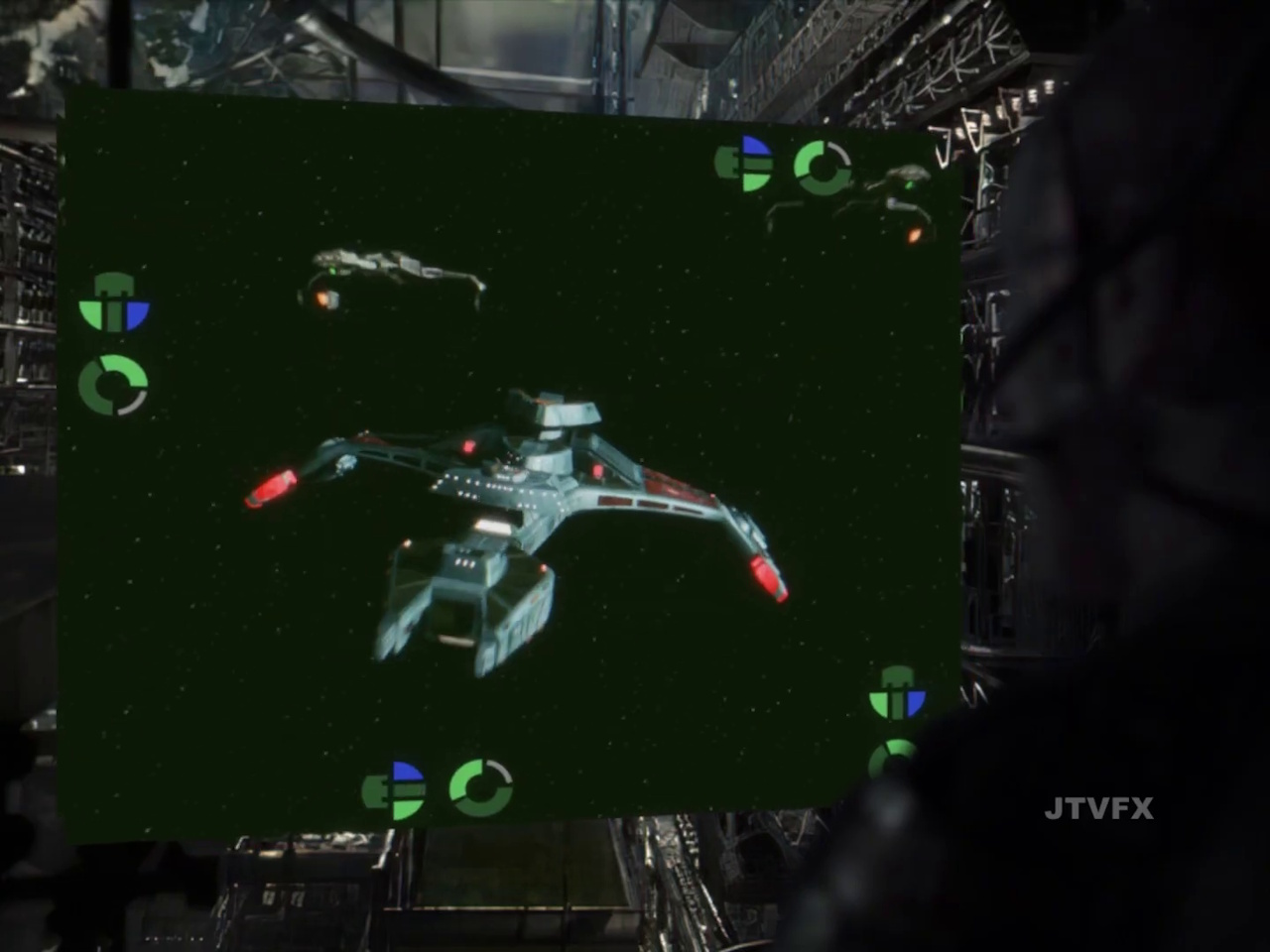
The Klingon fleet – as seen on the Borg viewscreen.
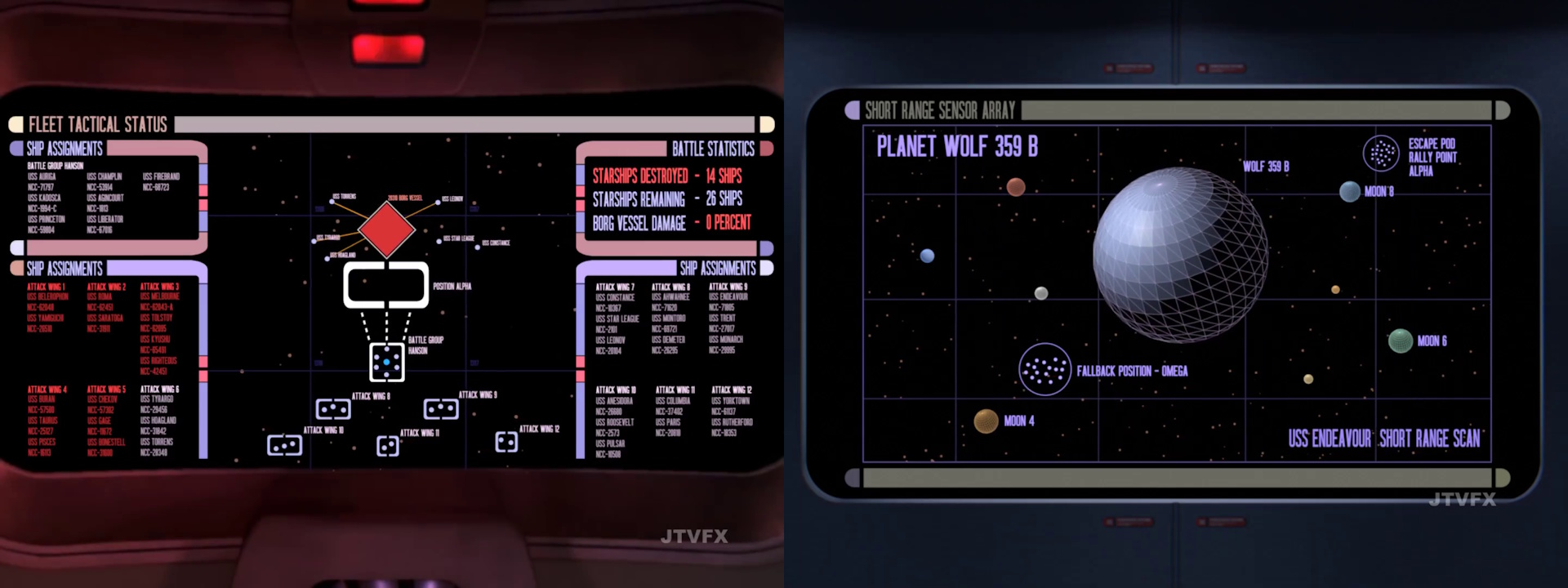
I also adored seeing the recreations of Next Gen-era LCARS displays and computer graphics. I think that added a lot, and seeing a few moments in the battle from behind a computer screen or a tactical display were really fun inclusions. It also adds to the feeling that the Battle of Wolf 359 was playing out exactly as it had in The Best of Both Worlds, complete with the limitations of computer graphics at the time the episode was made.
I’m not always a fan of this. Sometimes, it’s nice to see franchises modernise and move with the times, and trying to use deliberately anachronistic things like CRT monitors, cassette tapes, or ’80s graphics can rip me out of it if I’m watching a modern production. But here? It worked seamlessly, and the displays and monitors felt like they came right out of starships of the 24th Century! The Klingon displays and graphics looked great, too.
A pair of tactical displays.
This was an incredibly creative project, one that blended The Next Generation with other shows, films, novels, and even video games to create an intricate and detailed recreation of one of the Star Trek franchise’s most epic off-screen space battles! The only thing I wasn’t expecting, or didn’t imagine back in the day, was the arrival of the Klingons – but as I said, I think it worked exceptionally well, fits in with canon, and felt great in the moment as the Klingon fleet arrived. The rest of it, though, with the Starfleet vessels, the absolute shellacking they got, and the assimilation and deaths of many of their crews? It felt exactly the way I imagined this battle would when I first saw The Best of Both Worlds in 1992 – which is when it first aired here in the UK.
So if you’ve missed JTVFX’s channel or the earlier parts of this Wolf 359 adaptation… what are you waiting for?! Head over to YouTube and check it out!
Spoiler alert: it doesn’t end well for Starfleet.
Given Paramount’s occasionally antagonistic stance toward fan films, I think the sooner you watch it, the better. These things can, sometimes, be subject to copyright claims and other issues, so there’s no guarantee it’ll be around and available to watch indefinitely. I hope the new Skydance/Paramount corporation will do better on that front… but you can never be sure, unfortunately.
I had a great time with JTVFX’s masterpiece, and this absolutely wonderful recreation of the Battle of Wolf 359. If you enjoyed The Best of Both Worlds and you’ve always wondered what the battle looked like… here’s your chance to see it for real! And if you just like epic space battles in Star Trek, I genuinely believe this is one of the absolute best – eclipsing even some recent big-budget official productions.
Don’t miss out… and as always, Live Long and Prosper, friends!
Wolf 359: The Prelude Parts I & II and Wolf 359: The Massacre Parts I & II are available to watch now on YouTube through JTVFX’s channel, which is linked below. Still frames above courtesy of JTVFX on YouTube. The Star Trek franchise – including The Best of Both Worlds and all other episodes, films, characters, and properties discussed above – is the copyright of Skydance/Paramount. This article contains the thoughts and opinions of one person only and is not intended to cause any offence.
Spoiler Warning: There are spoilers ahead for Star Trek: Picard Seasons 1-3. Spoilers are also present for the following Star Trek productions: The Wrath of Khan, The Next Generation, Deep Space Nine, and Voyager.
The title of this week’s episode annoyed me! A “no-win scenario” should be written thus, with a hyphen, but Paramount opted not to abide by that particular rule of grammar. Still, I suppose I’m not one to talk!
After Seventeen Seconds had been fantastic across the board last week, I felt the quality dip slightly this time as No Win Scenario couldn’t quite reach that same level. There were a couple of moments where the conversations characters had felt like they were taken from a soap-opera, an incredibly rushed rationalisation for what was going on, and a big, explosive moment as the episode reached its climax that, for reasons we’ll get into, didn’t quite have the impact it was going for.
Picard exits the holodeck.
After last week’s episode ended with Picard and Riker experiencing a major falling-out, I was expecting that No Win Scenario would find a way to bring them back together. However, I wasn’t expecting it to happen so quickly, nor for the conflict to just… fizzle out. Don’t get me wrong, I’m always going to be happier to see Picard and Riker on friendly terms and working in common cause, but after such a spectacular blow-up last week that saw Picard banished from the bridge… I expected some kind of apology-come-resolution to settle this argument. No Win Scenario didn’t really deliver that, at least not in a meaningful way, and this aspect of the story – which had been a major part of last week’s episode and its cliffhanger ending – felt unsatisfying.
As happened more than once in Season 2, I felt that No Win Scenario was in a rush to bring this cliffhanger to a resolution so that there’d be enough time left to crack on with the rest of the story. While it’s possible that there will be ramifications for Picard and Riker if things settle down aboard the Titan, and we could re-visit this character conflict in a future episode to get a more conclusive ending, based on what we saw in No Win Scenario I was left feeling a bit empty; something significant was missing from the way this conflict wrapped up.
Picard and Riker’s argument seemed to fizzle out.
That last sentence also applies to my feelings on the conflict with Captain Vadic, and although the fight between the Titan and the Shrike came at the tail end of the episode, we’ll jump ahead to look at that next.
The use of an asteroid as a weapon was visually spectacular and just plain cool, with the animation work used to bring it to life being absolutely outstanding. There was a kind of poetic symmetry to Riker using the tractor-beam as a weapon after Vadic had done the same in Disengage a couple of weeks ago.
The Shrike was heavily damaged by Riker’s asteroid attack.
But here’s the problem that I have with the way this conflict came across: we still don’t know Vadic. We want to see her stopped and we don’t want her to succeed – but that’s only because we don’t want to see Jack Crusher or our other heroes harmed or captured. At this point in the story, Vadic is no-one… we don’t know who she is, what she wants, what her connection is to the rogue changelings and their scheme, or really anything else about her. She’s an over-the-top villain, almost a caricature of someone like Khan… and seeing her defeated just didn’t feel like it had any significance except insofar as it allowed the Titan to escape.
Think about some of the best, nastiest Star Trek villains from the franchise’s past. By the time the Battle of the Mutara Nebula ended in The Wrath of Khan, we didn’t just want Kirk to win – we wanted Khan to lose. Likewise for villains like Sela, Gul Dukat, or the Kelvin timeline’s Admiral Marcus – their stories were written in such a way that we wanted to see them beaten, defeated, and left for dead. I don’t feel any of that toward Vadic right now, and the reason is simple: I don’t know who she is or what she wants. She’s a speedbump; an obstacle for our heroes to overcome. I want to see her stopped, but only by default.
Picard Season 3 hasn’t earned a moment like this yet.
No Win Scenario set up the Shrike’s return and had the ship standing in the Titan’s way as Riker and Picard tried to guide the ship to safety. And this moment felt tense and exciting, with a genuine threat to our heroes. Jack in particular seemed to be in danger; with no shields to speak of, he could have been beamed away by Vadic, perhaps.
But in terms of Vadic herself… her defeat on this occasion felt unimportant and unearned. Sure, the Titan needed to get the Shrike out of the way to make an escape. But beyond that, seeing Vadic and her crew scrambling around on their damaged vessel just didn’t make much of an impression. Earlier in the episode we started the process of unravelling the Vadic mystery… but we haven’t made enough progress on that front for her to feel like a fully-rounded, fleshed-out character just yet. Unless and until that happens, these moments will continue to fall flat.
The Titan launches an asteroid at the Shrike.
A villain created to be as over-the-top as Vadic is supposed to be someone we can “love to hate.” And I’m hopeful that that feeling will come in the episodes ahead; we aren’t yet at the halfway point. But at this point in the story, Vadic isn’t someone I love to hate. In fact, she isn’t someone I “hate” at all, she’s someone who I don’t yet understand.
Had this moment with the Shrike and the asteroid come later, after we’d learned more about Vadic and what this conspiracy is that Picard and the crew will need to stop, then maybe her defeat in the moment would feel more significant and more impactful. At this point in the story, though, it didn’t. We’ll see more of Vadic, of this I’m sure, but there’s also a risk in defeating a villain at an early stage. The Shrike was incredibly intimidating at first… but we’ve already seen that it can be defeated. That could potentially lower the stakes and reduce the tension when we inevitably encounter Vadic further down the road.
We’ve already seen how Vadic can be beaten. Will that make the next encounter feel less tense?
With all that being said, there was a very interesting aspect to Vadic’s story this week. We knew, thanks to the presence of a changeling infiltrator aboard the Titan, that Vadic had some kind of relationship with the rogue changelings that Worf and Raffi uncovered in last week’s episode. I wasn’t alone in having speculated that Vadic might be a changeling herself – but it seems that isn’t the case. Maybe she truly is the bounty hunter she claimed to be – but there’s a close working relationship with at least one changeling that will be fascinating to see unfold.
As a concept, the idea of a changeling forming a body part is something that Star Trek has never really explored before – perhaps it was too gory for television networks in the ’60s or the ’90s to consider! But the idea that Vadic may have a kind of symbiotic relationship with a changeling is an interesting one, and if we learn, perhaps, that Vadic has had a hand amputated due to a wartime injury or a horrible accident, there’s a chance for such a story point to lead to some of that understanding that’s currently absent from her characterisation.
Vadic has a changeling-hand.
Another interesting aspect of the conversation Vadic had with the changeling was how fearful she seemed to be. In her first appearance in Disengage – her most significant thus far – Vadic had a kind of chaotic energy; a bizarre, unsettling, almost carefree approach. She knew that she was in a dominant position thanks to the power of her ship, but she revelled in the chase and in hunting her prey.
Contrast how she spoke to the crew of the Titan a couple of weeks ago with how she spoke to her changeling attaché in No Win Scenario – and particularly how fearful she seemed and how quick she was to acquiesce when pushed. The changeling clearly has some degree of leverage over Vadic here; there’s a power imbalance. But what could it be? For the second time, I find myself saying that “money” will not be anywhere close to a satisfactory explanation!
Vadic’s boss. I vote that we name him “Floaty McFloatface.”
Villains don’t need to be sympathetic. We just talked about examples of wonderful villains in Star Trek who were nasty pieces of work through-and-through. I don’t need to feel that a villain has a good point in order to understand them. But a villain needs motivation, and right now, Vadic’s true motives are obscured through a thick narrative fog. If a suitable ending to her story has been planned, written, and properly executed, then there’s no need to worry. In time we’ll come to understand what Vadic wants and be able to enjoy her comeuppance when she doesn’t get it.
But I’m afraid that Picard’s track record in these areas is once again ringing alarm bells. Season 1 came totally unstuck because it ran out of road and an acceptable ending couldn’t be constructed in the remaining time allotted to the show. Season 2 had a plethora of issues, but the same problem of a rushed, unsatisfying ending that didn’t have time to tie up enough loose ends was repeated. And Season 2 had the same creative team and showrunner as Season 3. So as we approach the midpoint of the season, I look upon Vadic’s story in particular with more than a little concern. There’s no small amount of work to do to give this character a genuine reason for behaving the way she does while also pulling out a creditable ending.
Why do Vadic do what Vadic do?
That’s enough about Vadic for now. Another character who caused me mixed feelings in No Win Scenario was Captain Shaw – and there are several parts to his story. Some worked better than others, and I’ll start by saying that Shaw is a more interesting and nuanced character than I’d been expecting. There’s also an inspired performance from Todd Stashwick, who really seems to be putting his all into the standoffish Starfleet captain.
You know there’s a “but” coming, though.
But unfortunately, Shaw’s story in No Win Scenario was muddled in more ways than one. First of all, we have the problem I could see coming a mile away: there are too many captains aboard the Titan. Shaw’s injury in Seventeen Seconds was a convenient excuse to bump Riker into the captain’s chair – but that was always implied to be a very temporary move. Shaw’s recovery should have seen him reclaim the chair – especially given his obvious dislike of Riker and Picard. A convoluted story beat involving Shaw being literally the only officer on the Titan capable of performing a technobabble engineering task may have gone some way to excusing his absence on the bridge… but by the end of the episode I fully expected him to come bursting out of the turbolift to reclaim his ship.
Captain Shaw.
We’ve seen other Star Trek stories where more than one character holding the rank of captain was present on the same ship, and that doesn’t have to be an issue in and of itself. In The Wrath of Khan, for instance, we had Admiral Kirk and Captain Spock aboard the Enterprise, and by the time of The Undiscovered Country Sulu had also been promoted and was in command of his own ship. But in this particular story, the way Shaw is written and the uncertain nature of both Riker and Picard’s status as Starfleet or ex-Starfleet or semi-retired officers just makes it feel unnecessarily complicated.
If the reason for Shaw sticking around was to have a big blow-up with Picard about the Battle of Wolf-359 and Picard’s assimilation… then I’m afraid it didn’t stick the landing and wasn’t worth the fuss. This was supposed to be one of the emotional punches of No Win Scenario, and a sequence that explained much of Captain Shaw’s hostility since Picard first came aboard the ship. But I didn’t feel there was sufficient buildup to Shaw’s outburst, which left the resulting scene feeling like it came from nowhere – and with character drama that could rival any soap-opera.
Shaw hated Picard for his role in the Battle of Wolf-359.
In principle, this is a clever idea. It forces Picard to confront a part of his past that he’s still uncomfortable with, and he has to do it in front of Jack at a time when the two are just beginning to get to know one another. But the execution here wasn’t great, nor was the shoehorning in of the Guinan’s Bar set that Paramount seems to insist on re-using as often as possible.
A captain who hates Picard because of what happened at Wolf-359? Why does that sound familiar? Oh, right: it’s because this was also the setup for Benjamin Sisko at the beginning of Deep Space Nine more than thirty years ago. In short, we’ve seen this argument before. There are differences between Shaw and Sisko, of course; Sisko’s anger was more of a slow-burning thing, whereas Shaw’s was a rapid explosion – perhaps influenced by the pain medication he claimed to be taking. But while those differences keep the two sequences and two characters feeling distinct, the underlying premise is so similar as to feel incredibly familiar to any long-standing Star Trek fan.
We’ve been here before…
Picard’s third season promised to draw on the legacy of Deep Space Nine in a way that modern Star Trek hasn’t so far – and by introducing a rogue faction of changelings that Odo warned Worf about, the writers have created a truly engaging epilogue to the Deep Space Nine story. But Shaw’s background being nigh-on identical to Sisko’s feels like it crosses the line from homage into plagiarism, and while it gives us a reason to feel more sympathy for Shaw, or at least to understand him better, it also feels like a pretty cheap recycling of such an important story beat.
With no Borg presence readily apparent in the story of the season (though that could admittedly change), I’m also a little confused as to why the story keeps returning to Picard’s Borg past. We had multiple references to The Best of Both Worlds in the season premiere, and now we have this big reveal that Shaw was present at the Battle of Wolf-359 too… but at this point, which again is nearly halfway through the season, these references don’t seem to be going anywhere.
The Enterprise-D flies past wrecked ships after the Battle of Wolf-359.
In Seasons 1 and 2, Picard’s Borg connection – and the trauma it brought him – were big plot points. We had his first visit to a Borg cube in the Season 1 episode The Impossible Box, which contained a truly excellent sequence looking at Picard’s post-traumatic stress and how being back in that environment was a trigger. And in Season 2, we saw how Picard had grown in regard to the Borg, being willing to at least listen to a Borg proposal – something that later set the stage for Seven of Nine’s character arc, learning to accept the Borg side of herself.
In both cases, though, the Borg connection to current events was readily apparent. We had the Artifact in Season 1, which showed up in pre-season marketing before appearing in either the first or second episode of the season (I forget which exactly). And in Season 2, the very first episode re-introduced the Borg in truly spectacular fashion. Both stories set up their Borg elements early on, meaning that their subsequent Borg connections worked and felt meaningful. That sense just isn’t present here.
Picard confronted his Borg demons in Season 1.
Narratively, I don’t see what we gain by Shaw bringing up Picard’s Borg past, either. As mentioned, Picard has basically come to terms with what his assimilation experience means by this point – from The Next Generation episode Family, the Deep Space Nine premiere, the film First Contact, and episodes in Picard Seasons 1 and 2, we’ve seen him process different parts of this experience. I’m struggling to see what – if anything – has been gained or could be gained in future, in a story all about Jean-Luc Picard, by re-hashing this aspect of his life – especially by re-doing a storyline that we’ve already seen play out.
For Captain Shaw, of course, his outburst was almost certainly a cathartic release; the outpouring of emotions bottled up for more than three decades. But – and I don’t mean this unkindly – I don’t really care about Shaw at this stage. He’s a new character, someone who’s only been on screen for a few minutes in total until now, and while this revelation certainly tells us something in a strictly factual sense about his background, I’m just not feeling its necessity… not to this story, at any rate. With Sisko, who was about to take centre-stage in his own series, it made sense to detail this defining incident in his life to set up where he was going to go over the course of Deep Space Nine’s run. For Shaw, who may or may not have much of a role to play over the remaining six episodes of Picard… again, I just don’t see why it was necessary to take this diversion.
Captain Shaw told his story to Picard and Jack.
I said a couple of weeks ago that I understood why Captain Shaw had been basically subbed in for Chris Rios – the character from Seasons 1 and 2 who had been dumped by the series. But if this connection to The Best of Both Worlds and the grumpy, standoffish persona is the only real reason why Captain Shaw exists… then I think I’d rather have had Rios in the captain’s chair this time around. Creating a brand-new character only to essentially re-do part of the plot of Deep Space Nine’s Emissary just doesn’t feel substantial or satisfying. But perhaps I’m biased in the sense that I felt Rios was treated incredibly poorly by the writers for much of last season!
It’s also worth saying that Shaw may yet have more to contribute. I don’t hate him by any means, and I think he has potential in some ways to be an interesting character, and as someone who isn’t a natural friend to Picard, he introduces a bit of drama and conflict into the story that wouldn’t necessarily be present otherwise. What I am saying, though, is that if this is Shaw’s only big moment – his main contribution to the season’s story – then I’m underwhelmed.
Captain Shaw: grease monkey.
One thing that I absolutely adored about No Win Scenario was the alien-nursery anomaly that the Titan found itself trapped inside of. Nothing could feel more “Star Trek” than seeing a spacefaring lifeform give birth, and it harkened back to the events of the very first episode of The Next Generation – as the characters themselves noted in the episode.
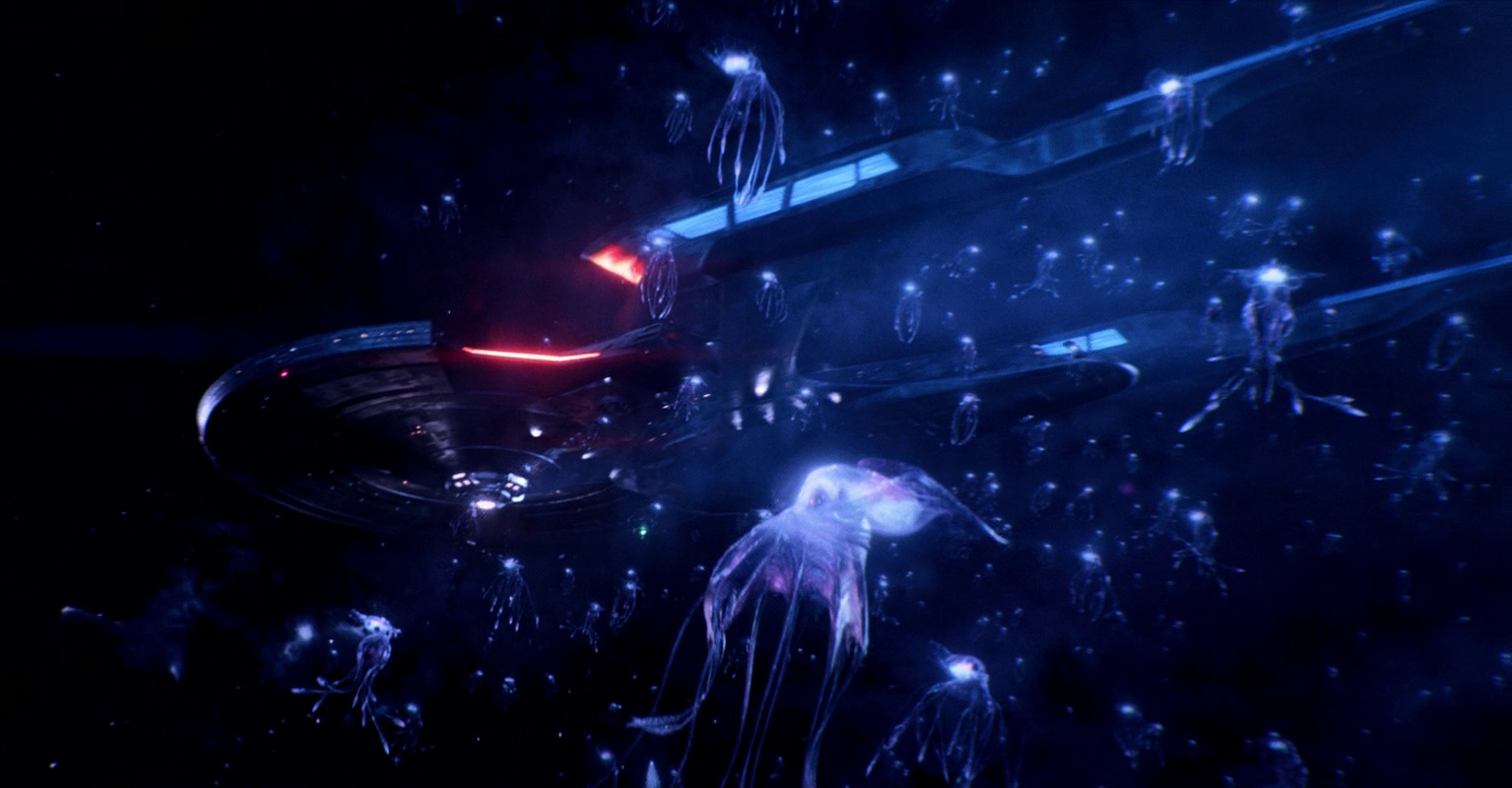
The life-forms that were born as the nursery-nebula erupted were beautiful, too, and the CGI artists and animators deserve so much praise for bringing these creatures to life in such spectacular fashion. The whole idea from concept to execution felt like it had been lifted from a classic episode of The Original Series or The Next Generation, with the threat of Vadic fading into the background and a scientific mystery for Picard, Riker, and the Crushers to unravel.
The Titan surrounded by spacefaring life-forms.
However, there was one aspect of this story that didn’t work particularly well, and because of who it involves it feels like quite a disappointment. In The Next Generation, Dr Crusher didn’t always get enough screen time or a lot to do; her scenes were mainly in sickbay, so in episodes with no medical element, she wasn’t always able to make much of a contribution to the story. Her return in Picard – and particularly having been outside of Starfleet for twenty years, operating independently – is an opportunity to right a thirty-five-year-old wrong, and show Dr Crusher in somewhat of a new light. We saw the beginnings of that in the season premiere as she grabbed a phaser rifle to defend her ship… but this week felt like a regression to the way she’d been treated in The Next Generation – and I don’t mean that in any sense as a compliment.
No Win Scenario had its attention on several storylines at once. There was the Picard-Riker spat, the Picard-Shaw confrontation, Picard’s attempt to get to know Jack, and off to one side was Seven of Nine as she hunted a rogue changeling. Even with a fifty-five minute runtime, Dr Crusher once again felt sidelined.
Dr Crusher didn’t get as much screen time as I’d have liked to see.
This mattered not only because, well, I wanted and still want to see more of Dr Crusher, but because her condensed storyline ended up feeling like it skipped a beat… or more like a dozen beats. Dr Crusher seemed to take a completely irrational leap of logic from “these energy pulses are increasing in frequency” to “the nebula must be a womb,” and it happened in a matter of seconds. In The Next Generation era, this kind of storyline would have played out at least slightly slower, and would have been in focus for longer. Dr Crusher would still have arrived at the same end point, but it seemed like one heck of a contrivance for her to figure out exactly what was going on based on a single piece of evidence and a very shaky hypothesis that she concocted in a matter of seconds.
We’re seeing the consequence of a busy season here. Not only were Worf and Raffi entirely absent this week, but there’s still no sign of Geordi or Lore, and of the characters who were present, not all of them got enough time to shine. We had some fantastic moments with Riker, Picard, Jack, and even Seven and Captain Shaw… but Dr Crusher appears to have drawn the short straw. And not for the first time.
Dr Crusher seemed to figure out what was happening unrealistically quickly.
Last week, I said in my review that I was beginning to feel concerned that Geordi and Troi hadn’t shown up yet, and that Worf and Raffi were off to one side in their own little narrative box, unable to interact with the rest of the cast of characters – and this week’s episode has really ramped that up. I’m less worried about Lore, partly I have to say because I’ve never been a huge Lore fan, but also because Brent Spiner has already been a big part of Picard in its first two seasons. But I have been genuinely excited to welcome back Geordi, and to see Worf getting back together with his old crew.
With Dr Crusher having parts of her story cut this week – or, perhaps more likely, not written in the first place – I feel even more concern for this supposed reunion. Even if Geordi, Troi, and Lore join the story next week, and Worf and Raffi’s storyline finally crosses over with the Titan’s, we’ll still have spent basically half the season without them. And based on what we saw with Dr Crusher this week… I’m not convinced that the writers will have given everyone enough to do.
We still haven’t seen Geordi and Lore, nor had more than a cameo from Troi.
In these truncated ten-episode seasons that have become commonplace not only in Star Trek, but in modern streaming series in general, there’s such a thing as too many characters and too many storylines. That’s part of the reason why, despite my objections, the likes of Soji and Elnor were dropped and didn’t come back this time around: there simply wasn’t space for them in an already-crowded series.
But having promised us a reunion, and talked about how characters who didn’t always get enough to do in The Next Generation might finally have an opportunity to contribute… Season 3 hasn’t yet delivered. Those ideas remain incredibly appealing, but it’s at the very least worth noting that we’re 40% of the way through and they haven’t happened yet. Not only that, but at points where characters could have been used and where this feeling could have materialised – as with Dr Crusher this week – it didn’t work as well as it should’ve.
Dr Crusher with Jack and Picard.
After we saw how Captain Shaw was unkind to and even deadnaming Seven of Nine, it was nice to see them working together and developing their very own kind of begrudging rapport. We haven’t really seen in Star Trek this kind of adversarial dynamic between captain and XO, with such unpleasantness and genuine dislike between them, at least not outside of a handful of one-off guest characters like Jellico. So it’s an interesting element to add to the story – and one that did manage to get a cathartic payoff as No Win Scenario reached its climax.
There was also a reason, of a sort, for the deadnaming, which had been an uncomfortable element earlier in the season. I stand by what I said, though: this kind of deadnaming should be socially unacceptable in Star Trek’s optimistic future, and while it served a narrative function in more ways than one, it’s still deeply uncomfortable in terms of what it says about the state of the Federation and the Star Trek galaxy.
The deadnaming of Seven of Nine got a narrative payoff… but still feels uncomfortable.
But the deadnaming of Seven of Nine provided a satisfying end to the changeling infiltration storyline – one which, again, succeeded at recapturing that elusive sense of “Star Trek.” Seven was able to figure out who the changeling was posing as, partly by working with Riker and partly because she’d developed friendships with other members of the crew – in this case, Ensign La Forge.
One contrivance here that I guess we’ll have to overlook is the changeling’s objective. If they wanted to ensure Jack Crusher’s capture – as Vadic’s changeling “boss” seemed to suggest is their main mission – then why on earth would the changeling wish to sabotage the Titan’s escape from certain death in the gravity well of a nebula? I could believe that they would place the success of their mission ahead of their own survival, but in terms of what we know about the changelings’ objective at this stage, if capturing Jack is priority #1, then the infiltrator shouldn’t have been trying to sabotage the Titan’s escape. We learned this week that Vadic only broke off her pursuit last time because she feared for the safety of her ship, not because killing Jack or trapping the Titan were important objectives, so again: the changeling infiltrator’s motives don’t really make a lot of sense here.
Why would the changeling try to prevent the Titan’s escape if doing so meant their own death and the death of Jack Crusher?
I can overlook this point, as in the context of the story it isn’t massive and is basically a glorified nitpick, but I think it’s worth taking note of these things as they arise. One or two contrivances here and there are almost inevitable – but too many risks damaging the overall integrity of the narrative, so keeping it to a minimum is essential in order to maintain suspension of disbelief.
The way in which the story as a whole was set up this week was again something that harkened back to The Next Generation and even The Original Series – the ship being adrift, trapped by an unknown space phenomenon, with time running out. Those are Star Trek tropes as old as the franchise itself! But the way in which No Win Scenario put a twist on them was unique – and very dark.
The Titan “sinking” into the nebula.
Instead of this story immediately leading to the crew springing into action and preparing their escape, there was a defeatist tone from the very first scene of the episode. Riker in particular was very bleak in the first half of the episode, sinking into dejection and depression as he couldn’t figure out a way to save the ship and crew.
This spin on a classic formula was incredibly well handled, and in many ways feels a lot more realistic than any episodes in those earlier Star Trek series. One thing that Star Trek hasn’t always managed to convey is just how deadly and dangerous space can be – and we saw firsthand this week that it’s possible for even an advanced Federation starship to find itself in an impossible situation. Past Star Trek stories succeeded at conveying a sense of danger, but there was always a positive, optimistic approach – never the kind of “lay down and wait to die” mentality that seemed pervasive on the Titan in parts of No Win Scenario. Yet it makes perfect sense that some people would react that way – and it perfectly fits the darker tone that Picard has when compared to The Next Generation.
Riker was one of the defeatists earlier in the episode.
We talked a little about how Picard has arguably already overcome much of his Borg-related trauma, or at least how we’ve seen him engaged in that process in both Picard and earlier Star Trek productions. One thing that we haven’t always seen is Picard asking for help, reaching out to someone else and saying that he needs them – but we got that through his scenes with Jack this week.
When facing what seemed to be imminent death, Picard asked Jack to spend some time with him, and as they talked, it became clear that Picard wasn’t doing it for Jack’s sake – but for his own. To hear him articulate that was deeply emotional, and both Sir Patrick Stewart and Ed Speleers excelled in that moment. This was, from their point of view, perhaps the only opportunity they were going to get to have this conversation – or any conversation, for that matter – and it was important for Picard to at least ask some of those questions of Jack, and to try to reach out to him.
Jack agreed to share a drink with Picard.
Picard had indicated earlier, I think in last week’s episode, that he felt the bridges between himself and Jack had long ago been burned, but it was great to see Riker encouraging him – albeit with the threat of death spurring them on – to give it a try. As his life seemed to be ending, Picard hoped to spend a moment or two with the son he never knew, and there’s something touching about that. Likewise, for Jack to reciprocate that, even if it was only for a moment, was something very sweet.
Male relationships – and the relationships men have with their fathers – can be difficult, and are often defined by a lack of emotion or warmth. Although I now identify as non-binary, I was assigned male at birth, and I can say from my own experience that my relationship with my father has never been warm, emotional, or loving. My father and I can make small-talk, sure, but he would never have a heart-to-heart with me about, well, anything… and the best I can hope for from him has always been a firm handshake.
Daddy issues…
What I’m trying to say is that, for many men, there may be something cathartic about a scene like the one between Picard and Jack. A father and son having a genuine and deeply emotional conversation is something that a lot of folks frankly just don’t get in their personal lives, and even though Picard’s relationship with Jack is new – and pretty complicated – there’s still something about it that brings almost a sense of emotional release.
Jean-Luc Picard is, for many of us, a kind of “space dad;” a character we’ve known for decades and who has often, through his position in the captain’s chair, felt like the patriarch of a family. I often wished I could be a part of that family when I watched The Next Generation in the early ’90s. So to see this conversation between Jack and Picard… I felt a very strong connection with Jack in those moments.
Jack felt very relatable this week.
I won’t lie, though, it still gave me a bit of a giggle to see Picard asking Jack whether he was 23 or 24. I don’t like to keep bringing this up (the show rather forces it upon us) but actor Ed Speleers, who plays Jack, simply does not pass for someone in his early twenties any more. It’s perhaps not quite as bad as some of those “teen” dramedies from the ’70s or ’80s in which actors in their thirties and sometimes even forties were trying – and utterly failing – to play teenagers… but it’s not far off. It’s no slight against the actor – I’m sure I couldn’t pass for thirty any more, let alone twenty… but I know my limitations so I wouldn’t try!
Picard clearly offended Jack several years earlier, as we saw in that flashback scene. One thing about that bugged me a little, and that’s how it seems to conflict with Picard’s status as a “hermit” in that period. Having retired and left Starfleet behind, it just strikes me as odd that he’d go halfway across the world to eat lunch at an establishment that he must’ve known would be frequented by Starfleet cadets and personnel.
Jack in the flashback scene.
But Picard’s sentiment that he considered Starfleet his “real” family obviously stung Jack, who was potentially considering reaching out to his father in that moment. I couldn’t tell, as the episode came to an end, whether Picard was finally realising that he’d seen Jack before… or whether that moment really is just something he doesn’t recall. Either way, I’m sure it’ll come up in a future episode as a sore spot; based on what Jack said in Disengage, he clearly carries some degree of resentment toward Picard – and that moment may be the crux of it.
So that only really leaves us with Riker, who, as mentioned, seemed to fall into a pretty deep depression this week. The story of the last two episodes has wanted to contrast Picard with Riker, first in their differing approaches to battling the Shrike and then this week as they tried to wrangle with the difficult situation the Titan found itself in. Taking the loss of Riker’s son – something we first learned about back in Season 1 – as a starting point, I think No Win Scenario built up a genuinely engaging new chapter for Riker’s story.
Riker’s story felt important and meaningful.
One of the challenges that a series like Picard faces comes from legacy characters. How can someone like Riker get an epilogue that’s both worth exploring in a narrative sense and that takes him to new thematic places without shaking him up so much that he doesn’t feel like the same person any more? The way in which Riker’s story unfolded over the past few weeks has actually mirrored Picard’s – especially from the show’s first season.
Picard faced defeat when Starfleet shut down his Romulan rescue mission, and instead of continuing to fight, he gave up. He went into (relatively) quiet retirement and left the galaxy to fend for itself. This week, we saw the same thing with Riker. He had the additional motive of wanting to preserve the wreck of the Titan so he could send one last message to Troi – but fundamentally, the same idea of falling into depression when confronted with a seemingly unsolvable problem was present.
Picard has been here too…
As I said in Season 1, what makes such stories meaningful isn’t where the characters begin, but where the journey takes them. And so it proved again with Riker – he found a reason to hope, a reason to try again, and through the whole experience of danger and trauma, he emerged out the other side with a newfound sense of purpose, reaching out to Troi to recommit to their relationship and to working on his personal issues and the issues they jointly had been facing. It’s by no means identical to what Picard went through in Season 1 – but it took him from a similarly dark place to find light at the end of the tunnel.
There is real value in showing heroic characters facing moments of self-doubt and depression. I wrote an entire essay a couple of years ago about how well this worked with Luke Skywalker over in the Star Wars franchise, and while Riker’s story was shorter and didn’t go into as much depth as Picard’s did in Season 1, for all of those same reasons I felt it worked well in No Win Scenario. It was understandable that Riker would feel the way he did – but it was also an inspiring story as we got to see him find a spark of hope and use that to regain at least some of his lost confidence.
How a story like this starts isn’t nearly as important as where it takes us…
So let’s start to wrap things up. No Win Scenario wasn’t as good as Seventeen Seconds had been last week. It crammed a lot in – and seems to have brought to a close the first chapter of Season 3’s story – but it skipped one whole storyline entirely, cut down Dr Crusher’s involvement to a mere contrivance, and had a couple of moments of soap-opera-level dialogue that just didn’t fit with the dark tone of the rest of the story.
However, it was a Star Trek episode through-and-through, one that recaptured much of the magic of The Next Generation era – but still found a way to update the formula, giving it a new spin fit for a streaming series in 2023. There were some deeply emotional, cathartic moments with Picard and Jack, an interesting twist in Captain Shaw’s story that led to a reconciliation of sorts with Seven, and some great CGI and visual effects to bring the starships, the nebula, and the spacefaring critters to life. I had fun with No Win Scenario in more ways than one.
A few scattered final thoughts:
Could Vadic also be a veteran of Wolf-359? I’ll expand on this idea in my next theory post!
Why didn’t the changeling either vaporise or revert to their liquid state when Seven killed them?
Too bad there’s already a “Riker manoeuvre,” because that’s what we could’ve called that tractor-beam/asteroid attack!
It was interesting to learn that the changeling was already aboard the Titan… makes me wonder how many rogue changelings are out there, and whether there may be more aboard other vessels.
Paramount is obviously trying to get its money’s worth out of the Ten-Forward bar set…
The actors playing the bridge crew each got a line or two of dialogue this week, which was nice to see.
Picard is still ridiculously dark and under-lit, and I wish they’d fix that. I needed to turn up the brightness on several of the still frames used in this review to compensate.
Star Trek: Picard Seasons 1-3 are available to stream now on Paramount+ in the United States and other countries and territories where the service is available, and on Amazon Prime Video in the UK and around the world. The Star Trek franchise – including Picard and all other properties discussed above – is the copyright of Paramount Global. This article contains the thoughts and opinions of one person only and is not intended to cause any offence.








 Trekking with Dennis