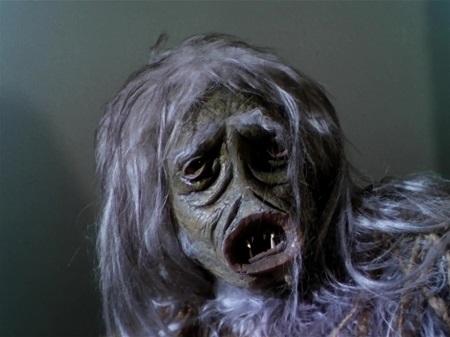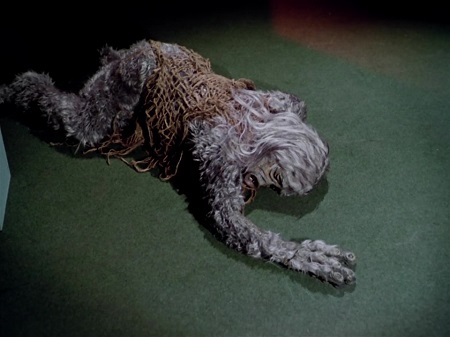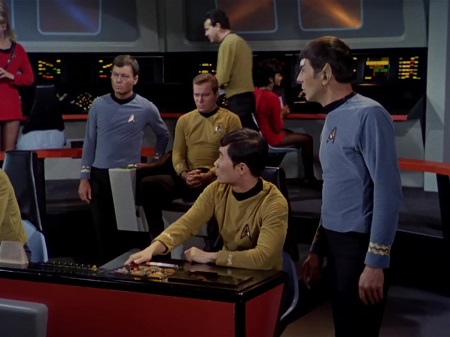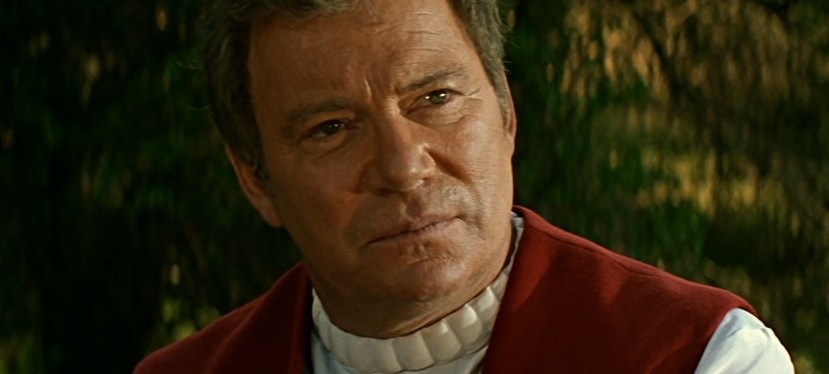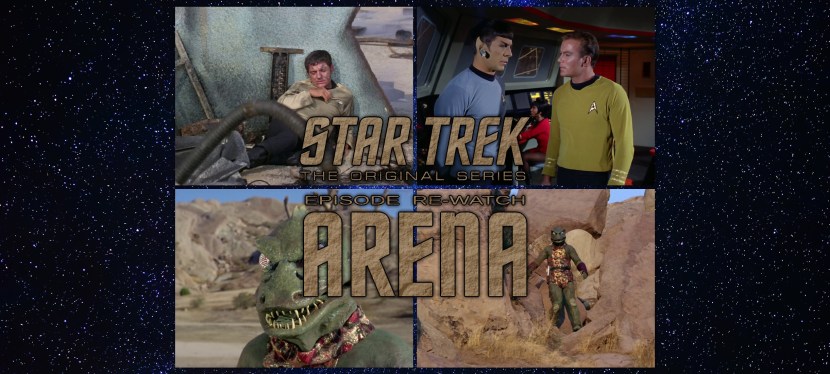
Star Trek: The Original Series Episode Re-Watch: Season 1, Episode 18: Arena

A Star Trek-themed spoiler warning.

Spoiler Warning: There are spoilers ahead for Star Trek: Strange New Worlds Seasons 1, 2, and 3, Star Trek: Enterprise Season 4, and Star Trek: The Original Series Season 1.

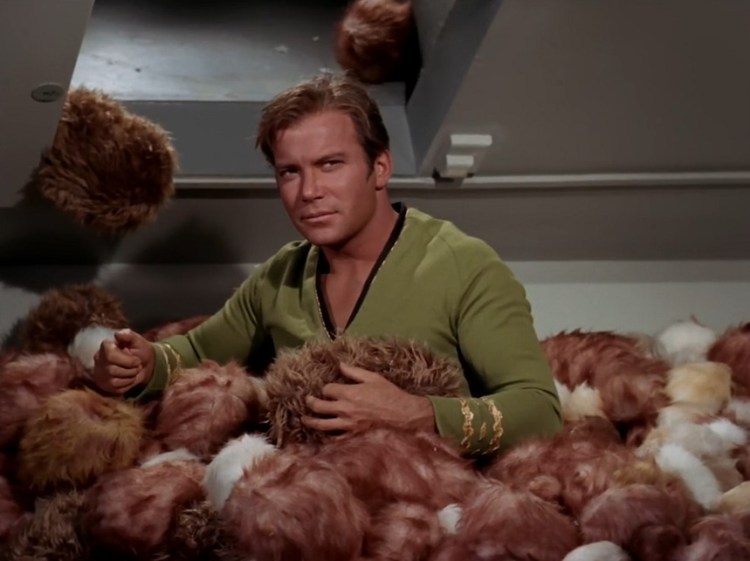
It’s been more than five years since I set up this website. In that time, I’ve written hundreds – literally hundreds – of articles, essays, and reviews all about Star Trek. But this’ll be the first time I’ve written up a full re-watch of an episode of The Original Series. I must be the first Trekkie in history to write up a re-watch of an episode of The Animated Series before The Original Series! But this catastrophic failure of Trekkie-dom comes to an end today, as we sit down together to watch the classic first season episode Arena.

I’m going to split this article into two parts. We’ll talk about Arena on its face, including some of the episode’s production history – and the reason why the creator of the iconic Gorn costume went uncredited and unknown for almost a decade after the episode aired – and then we’ll talk about the Gorn themselves in a bit more detail. Spoiler alert if you haven’t watched Strange New Worlds and still plan to, but the Gorn appear prominently in that show. That’s actually part of the reason why I wanted to re-visit Arena ahead of the third season premiere!
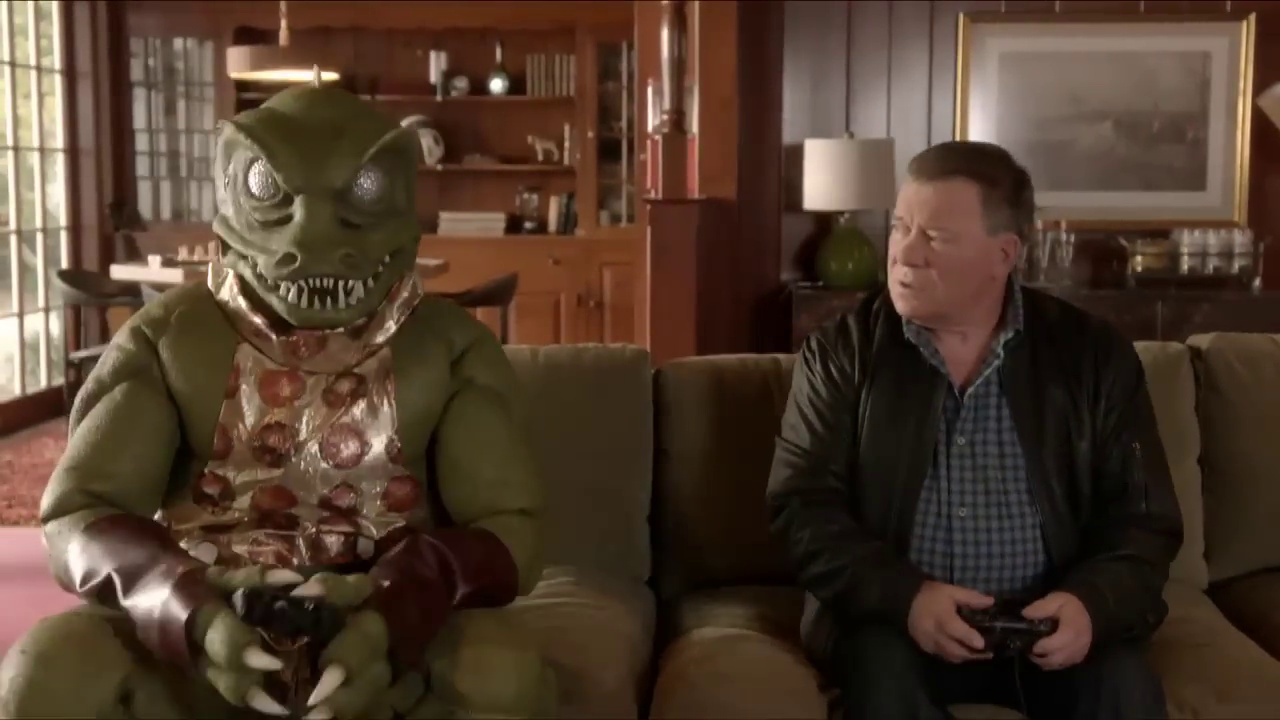
Still frame from a TV advert for the Star Trek video game circa 2013 showing William Shatner and someone in a Gorn costume.
The Gorn and Captain Kirk…

Arena is an iconic episode – and the Gorn captain has to be one of The Original Series’ most recognisable villains. In fact, I was a little surprised not to see Arena on the list when I did my recent recap of IMDB’s top-rated Star Trek episodes – according to that site’s users, Arena ranks a measly 19th out of The Original Series’ 79 episodes! I think I’d have put it a fair bit higher than that; it’s gotta be a top ten episode, at the very least! It has a strong story, expanding our understanding of the Federation, while also containing enough of that esoteric sci-fi “weirdness” that makes Star Trek the franchise we know and love.

It’s also best-known, of course, as “the Gorn episode,” introducing the famous reptillian species to the franchise. But Arena is as much about another alien race – the Metrons – as it is about the Gorn. The Metrons feel, with the benefit of decades of hindsight now, almost like a prototype of what would become the Q Continuum – millennia ahead of the Federation, considering themselves to be enlightened, but not above a bit of interference in galactic affairs. The Metrons have never returned to Star Trek, though, and I can kind of understand why: for a “morality play” like Arena, they work well as a somewhat neutral arbiter. But as the franchise has expanded, we’ve seen fewer of these kinds of stories. Modern Star Trek in particular lends itself much more to the inclusion of the Gorn than it does the Metrons!
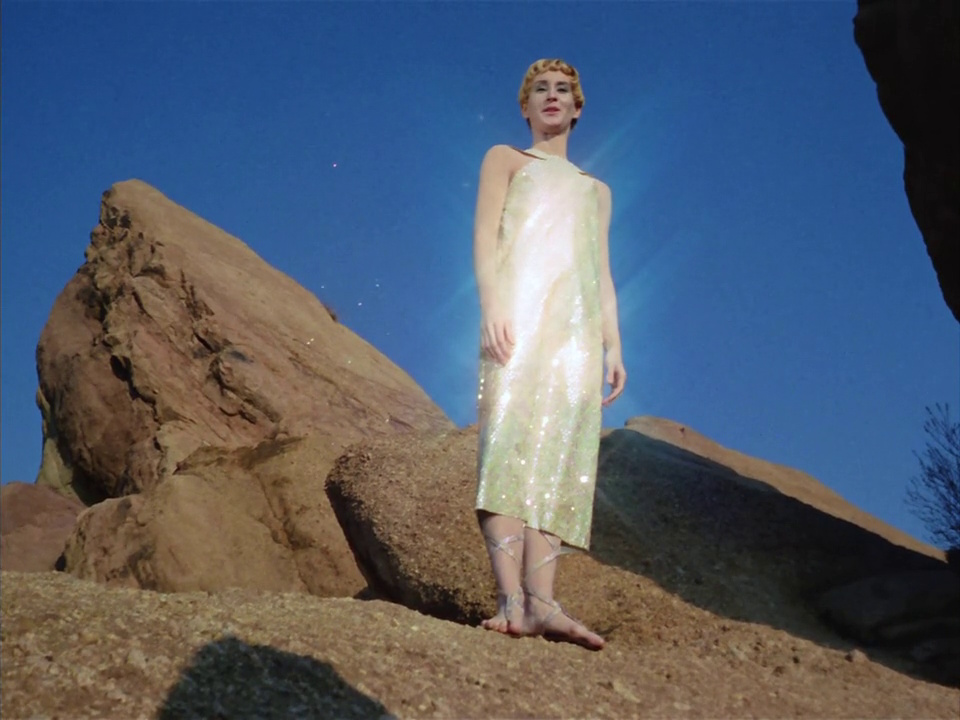
Still frame from Star Trek: The Original Series Season 1 episode Arena, showing a Metron.
An unnamed Metron from the end of the episode.

Because the battle at Vasquez Rocks is so well-remembered, it can be easy to overlook the first part of Arena – but the away mission to Cestus III is one of the first season’s most tense combat sequences. Drawing on war films for inspiration, with an unseen enemy and whistling noises reminiscent of World War II-era mortars, the entire away mission to the destroyed outpost is – for the time, anyway – really exciting stuff. This is also one of the first away missions to be shot on location – i.e. not on a sound stage or backlot. Following the previous episode, Shore Leave, which was also shot in the Los Angeles area, Arena took the cast and crew to a set near Vasquez Rocks which had been built a few years earlier for a different television series.

I think I’m right in saying that it’s this away mission sequence in Arena, which used several pyrotechnic explosions to create the effect of the Gorn attack, that led to both William Shatner and Leonard Nimoy suffering from tinnitus – a condition that causes ringing in the ears and can be painful. The Original Series used pyrotechics throughout its run, but this battle sequence pushed the performers to act in close proximity to these explosive devices. Knowing the impact the sequence had on the actors, that does taint how we view it. Because as exciting and intense as the Cestus III mission was, no television scene is worth suffering from life-long after-effects.
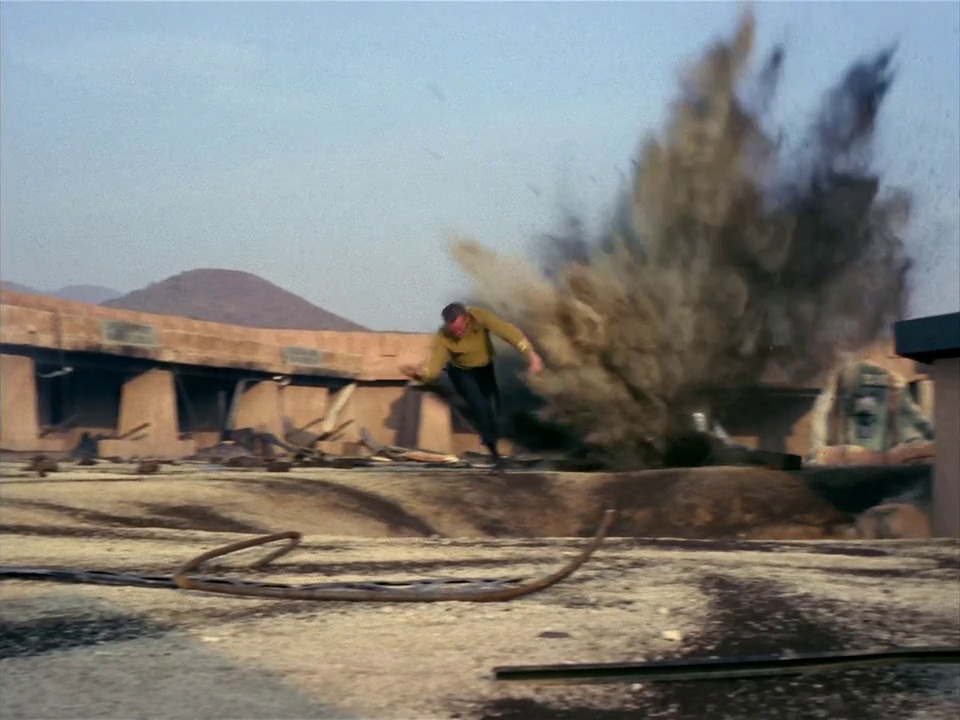
Still frame from Star Trek: The Original Series Season 1 episode Arena, showing Kirk being flung into the air by an explosion.
One of the explosions on Cestus III.

The first part of Arena, it could be argued, plays out similarly to Balance of Terror, which would’ve premiered just a month or so earlier. The attack on a Federation outpost, pursuing a powerful but unseen enemy… it starts the story in a familiar way. But the episode soon takes a completely different turn with the intervention of the Metrons. What begins with a deadly raid and an attack on the away team seems to be building up to another starship battle – but just as the Enterprise seems to be catching up to the Gorn vessel, the Metrons rebuke both ships and crews for their violent nature.

The Metrons are an interesting addition to the story. Rather than just another enemy encounter or a straightforward action story, their intervention puts a different spin on things. Kirk, who seemed hell-bent on revenge at first, is forced to confront the way he handled the interaction, and this idea of revenge at any cost – mutually assured destruction, perhaps – is thrust into the spotlight in an uncomfortable way.
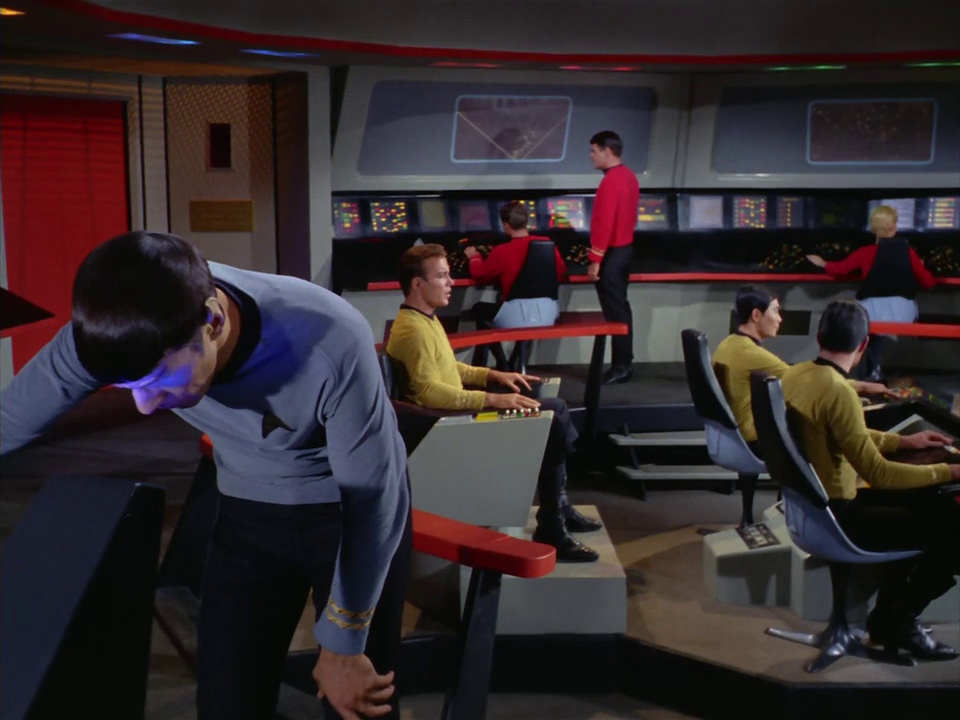
Still frame from Star Trek: The Original Series Season 1 episode Arena, showing the crew on the bridge.
Spock, Kirk, and the crew on the bridge while the chase unfolded.

That’s part of the context behind Arena, this idea that seeking revenge isn’t healthy and is, in itself, a violent urge. But there’s more to it than that. The revelation that the Gorn considered Cestus III to be one of their planets, and that’s why they attacked the outpost, reframes things for Kirk, Bones, and the rest of the crew. The Federation may not have been aware of the Gorn claim, but either way, they settled an outpost on a planet that someone else considered to be their territory. There’s another analogy here that I think is particularly interesting.

The Original Series draws inspiration from the western genre. The idea of space as a new “frontier” conjures images of the wild west, and in Arena itself, Kirk refers to himself and the Enterprise as the only lawmen in this region of the galaxy. The Gorn, therefore, are this story’s metaphorical Native Americans, having a pre-existing claim to the land and attacking the Federation settlers who’d moved in on their territory. Maybe that wasn’t exactly how the story was written, but I think that reading is there, just beneath the surface. And for the 1960s – when the western genre was still riding high at the box office, with films like El Dorado, Ride in the Whirlwind, and The Good, the Bad, and the Ugly – that’s kind of a progressive idea. To make the point that, in this case, the Federation may have been in the wrong… that’s a pretty neat inversion of the typical western-inspired frontier story.
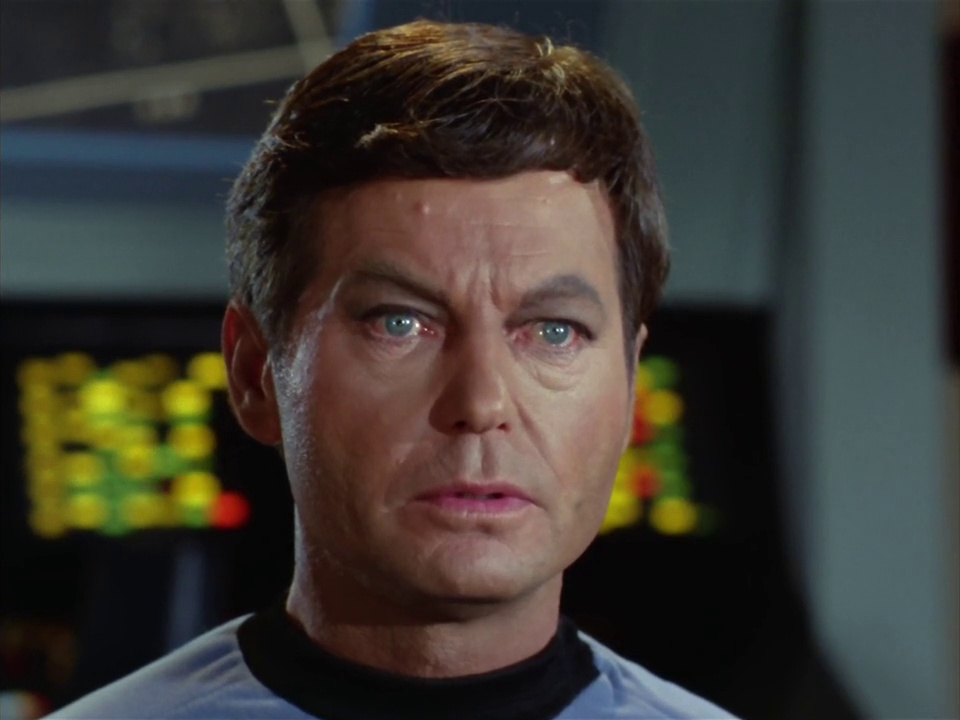
Still frame from Star Trek: The Original Series Season 1 episode Arena, showing Dr McCoy.
Dr McCoy put it best: “we could be in the wrong.”

Vasquez Rocks has become an iconic location within the Star Trek franchise, and that really began here in Arena. The filming location, which is just inside the famous “thirty-mile zone” around the film studios in Los Angeles, has appeared in The Next Generation, Voyager, Enterprise, Picard, and two of the Kelvin films as well as The Original Series and The Voyage Home. It was a great choice for Kirk’s battle against the Gorn commander, and even though I’ve criticised some modern Star Trek productions for re-using the same filming locations too often, I think Vasquez Rocks is such an iconic spot that it gets a pass!

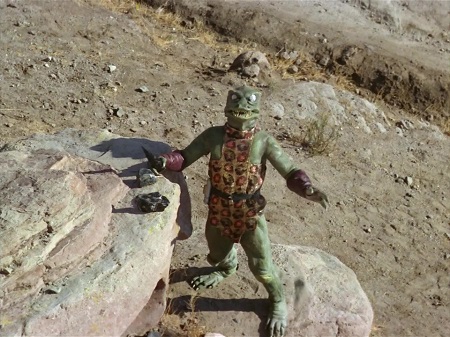
I absolutely love the original Gorn design, and even though it might not be as “realistic” as the updated variant seen in Strange New Worlds… I think there’s something special about the original costume. I always compared the Gorn to a Tyrannosaurus Rex – but that’s because I first watched Arena after having seen Jurassic Park in the mid 1990s! The design draws inspiration from real-world reptiles like the komodo dragon, using reflective, almost insect-like eyes and needle-sharp teeth to complement the monstrous design.
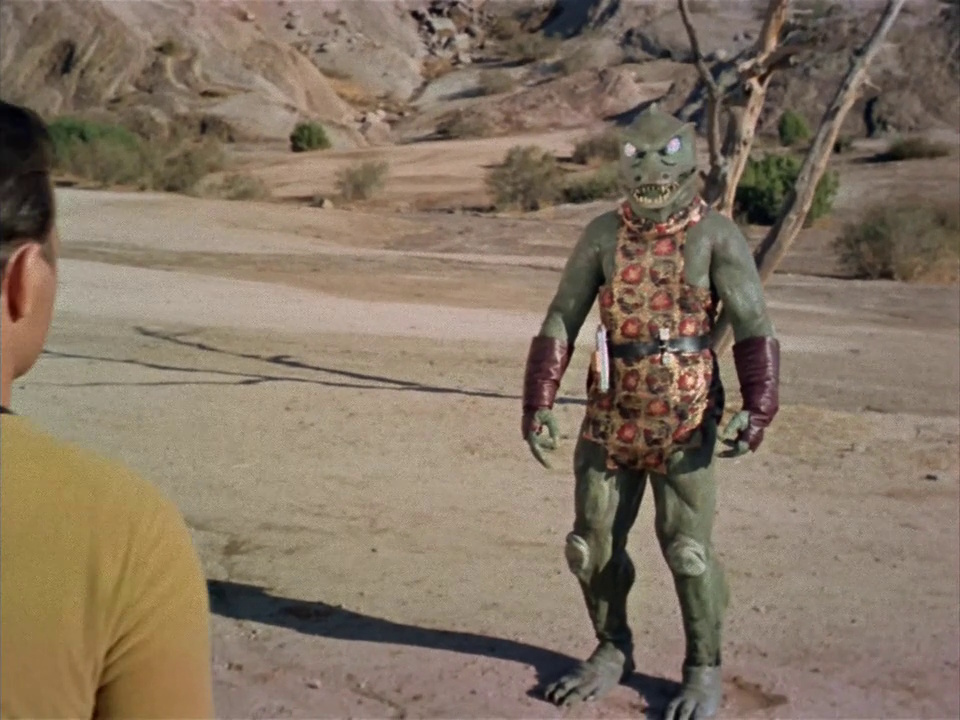
Still frame from Star Trek: The Original Series Season 1 episode Arena, showing Kirk and the Gorn captain's first encounter.
I just love this costume.

Wah Chang designed the Gorn costume as well as many other iconic Star Trek props. The tricorder, the flip-open communicator, and tribbles were all his creations – but he went uncredited for all of it, and was unknown until members of the Star Trek fan community uncovered his role in the 1970s. Chang seems to have been commissioned by Desilu – Star Trek’s production company – in a weird legal grey area; director and producer Bob Justman wanted to use Chang’s work, but Chang wasn’t a member of the prop-makers union. In a kind of workaround, Desilu would “purchase” items from Chang, but he was never credited on screen for any of his creations.

This is another great example of the early Star Trek fan community pulling together! Chang’s role was eventually uncovered in the 1970s by Trekkies, who were keen to find out more about some of the show’s iconic props and designs. It’s one of those fun little stories that, were it not for the dedication of fans, would’ve simply never come to light. Chang’s contributions to Star Trek – not only the episode Arena, but really across the entire first season – helped to define the look and feel of this vision of the 23rd Century. Who knows where Star Trek would’ve been without him?
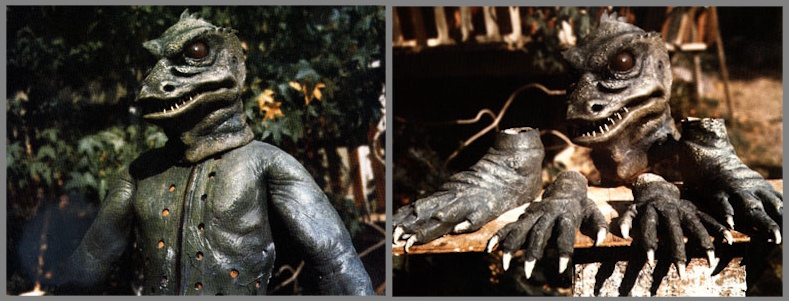
Two set photos from Star Trek: The Original Series showing the Gorn costume.
The original Gorn costume.

There are some great moments between Kirk and Spock in Arena, as they wrangle with the aftermath of the Gorn attack on Cestus III and what it could mean. In the context of Arena itself, disregarding any other Gorn stories, we can see both points of view. Kirk argues that the attack – which seems, at first, to be completely unprovoked – could be the precursor to a wider invasion, and as the only ship in the area, it falls to the Enterprise to prevent that. But Spock is also correct – without more information about what happened, who perpetrated the attack, and why… Kirk is kind of jumping to conclusions. His line about seeking revenge hits particularly hard.

We’ll get into this more in a moment when we discuss the Gorn, but this is one area where more recent Star Trek productions – and Strange New Worlds in particular – arguably re-frame this conversation. As a veteran of conflicts against the Gorn while serving under Pike’s command, Spock is acutely aware of how bloodthirsty and vicious the Gorn can be, and how single-minded they are when staking their claims to planets that the Federation already occupies. There is wiggle-room here, and nothing in Strange New Worlds explicitly contradicts Arena (at least as of the end of Season 2). But it does change how we perceive these conversations – which, it shouldn’t need to be said, supposedly take place a decade or so after the events of that show.
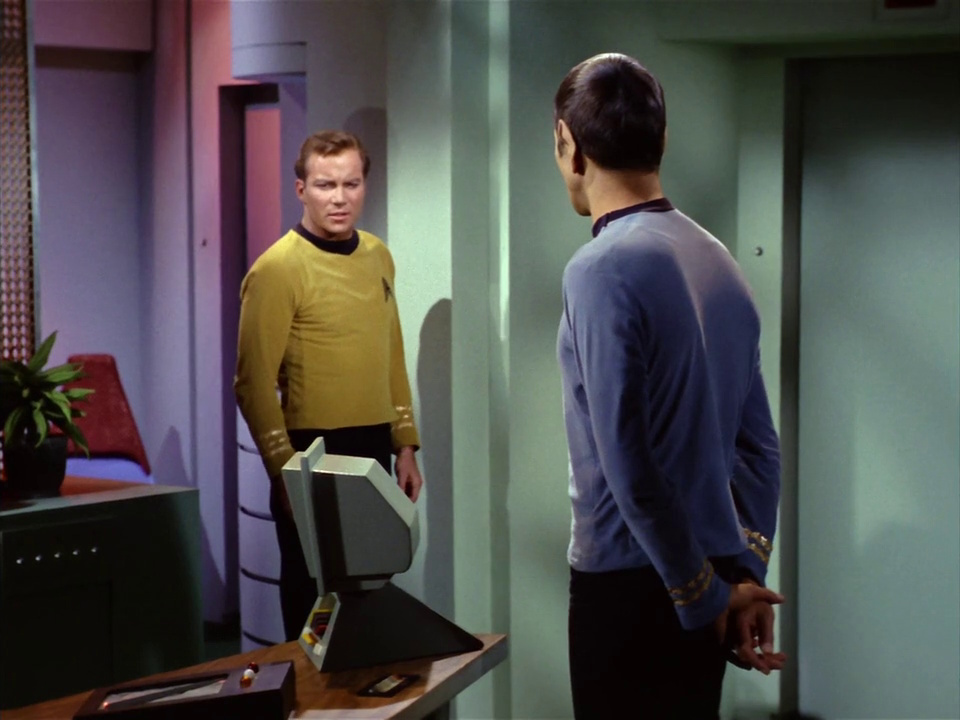
Still frame from Star Trek: The Original Series Season 1 episode Arena, showing Kirk and Spock in Kirk's cabin.
The conversation in Kirk’s cabin.

Kirk’s hand-to-hand battle with the Gorn captain is a ton of fun. The lumbering monster reminds me of the titular Creature from the Black Lagoon with its heavy rubber suit and somewhat clumsy movements, and I just really love that kind of old-school style of creature design. The rubber suit may be old-fashioned compared to, say, the new dinosaur-inspired Gorn depiction from Strange New Worlds… but I think it’s light-years ahead of the awful CGI rendition that we got in Enterprise! The very “sixties” fabric used for the Gorn captain’s uniform just adds to the charm.

The fight has its tense and serious moments. Kirk’s two-handed attack, which we’ve seen him use to great effect across the show’s first season, has absolutely no impact on the powerful and muscular Gorn, which was interesting. We also see the Gorn’s own ingenuity as he devises a trap – Kirk ends up injured and seemingly about to be impaled… just in time for the ad break! But the fight also has moments that, almost sixty years later, seem almost cartoonish or campy. The obviously polystyrene rocks – which look even less convincing in HD on a large television set – are part of that.
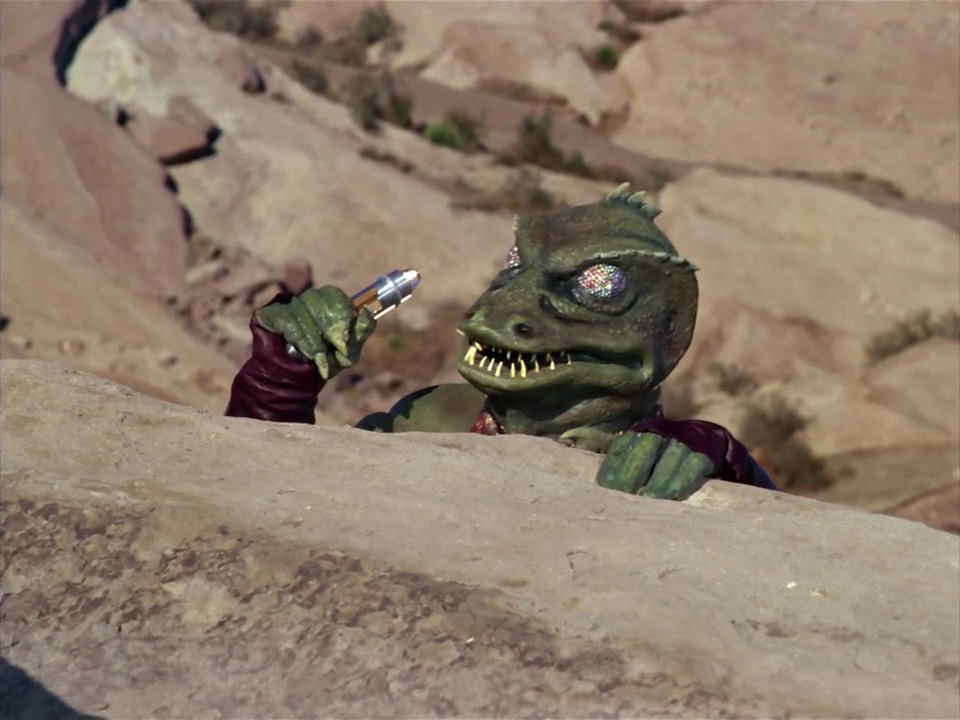
Still frame from Star Trek: The Original Series Season 1 episode Arena, showing the Gorn captain using a communicator.
The Gorn captain.

Then there’s Kirk’s “Wile E. Coyote” moment! Sneaking up on the Gorn captain from atop Vasquez Rocks, Kirk plans to drop a very large boulder on his opponent. And look, I get it: it’s a smart move given the circumstances. But the way this sequence is framed and shot makes it look like something straight out of the old Road Runner cartoon. It’s a ton of fun, but perhaps less tense or serious to a modern audience than it was intended to be in 1966!

The fight ends with Kirk choosing to show mercy to his defeated and injured opponent, impressing the Metrons and showing that, despite his earlier feelings about the attack on Cestus III, Kirk has learned something from the experience. His final conversation with Spock suggests that Federation diplomats might be able to contact the Gorn and peacefully resolve the Cestus III dispute. This resolution was clearly successful, because according to Deep Space Nine, Cestus III had a Federation colony again in the 24th Century… though we never saw this on screen for ourselves!
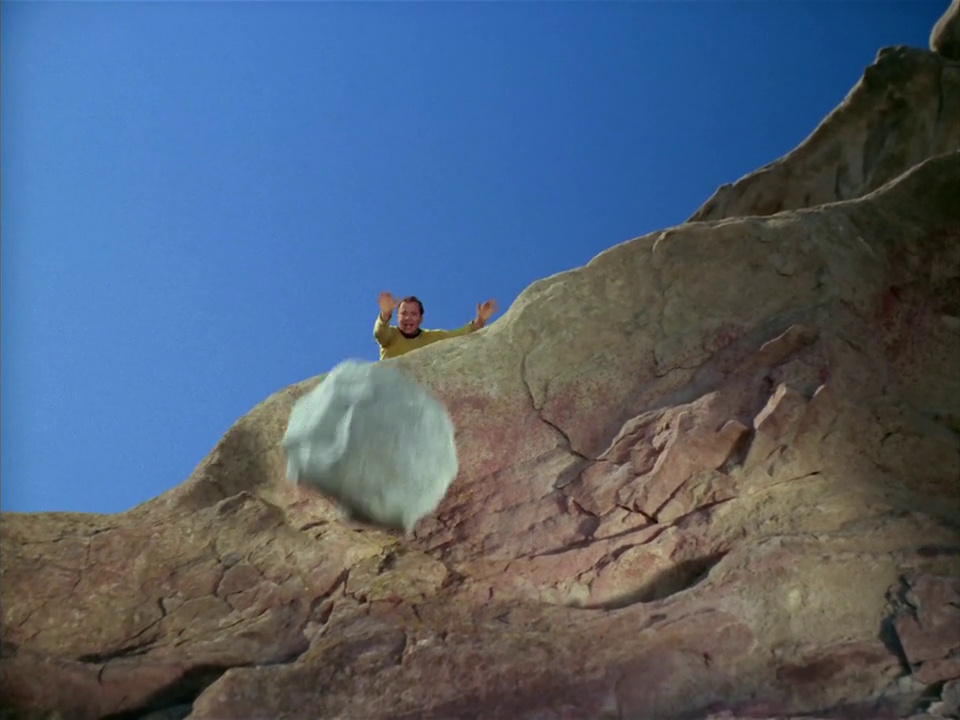
Still frame from Star Trek: The Original Series Season 1 episode Arena, showing Kirk and a boulder.
Captain Kirk’s plan was clearly inspired by the great tactician Wile E. Coyote.

With Strange New Worlds’ third season coming up, I want to talk a little bit more about the Gorn, and how Arena still has relevance to Star Trek today.

The Gorn have become Strange New Worlds’ most important villain, filling a role that the Klingons arguably did in The Original Series, the Borg did in The Next Generation, or the Cardassians and Dominion did in Deep Space Nine. Gorn stories have had profound impacts on Pike and the crew, from La’an’s tragic backstory, through Hemmer’s untimely death, and ultimately leading to the attack on Parnassus Beta, the infection of Captain Batel, and the abduction of Ortegas and many surviving colonists.

Strange New Worlds took the barest of outlines of the Gorn – a race who, since Arena, had only made a couple of other appearances in Star Trek – and changed them into a genuinely intimidating and threatening villain. Strange New Worlds’ depiction of the Gorn blends together the likes of Jurassic Park’s velociraptors with Alien’s iconic Xenomorphs. The new series takes the foundation established by Arena – that the Gorn are kind of monstrous reptillians – but pads it out with newer inspirations from the horror and sci-fi genres.
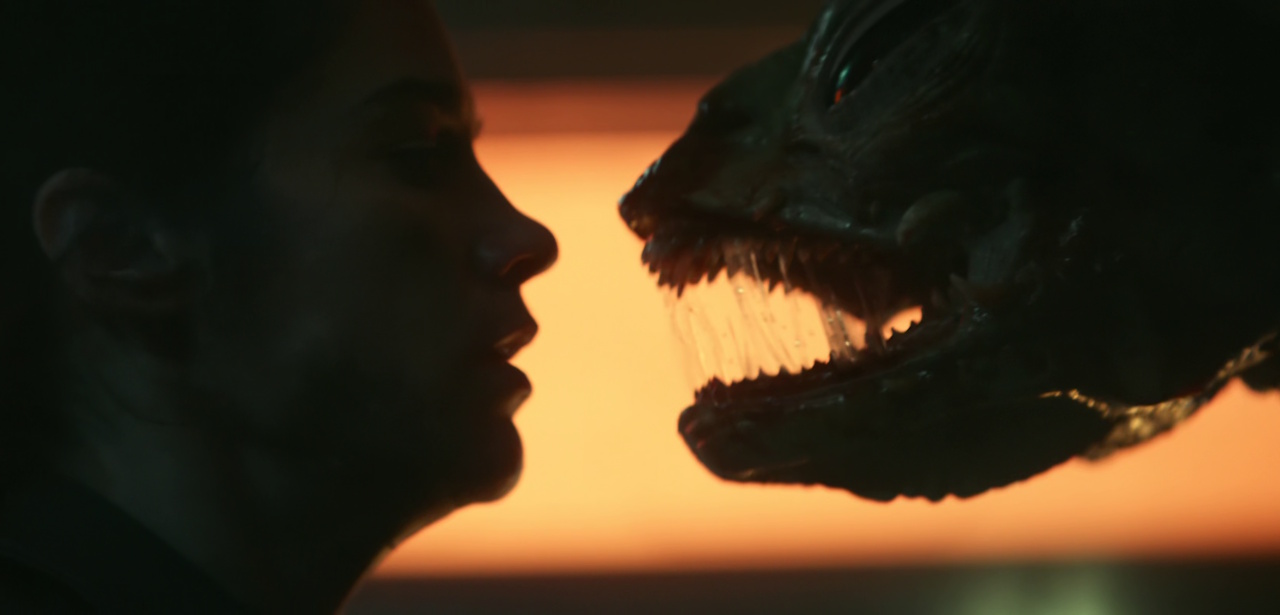
Still frame from Star Trek: Strange New Worlds Season 2 episode Hegemony showing Captain Batel and a Gorn.
An updated depiction of the Gorn from Strange New Worlds.

If you take a straight reading of Star Trek as a whole, from the point of view of a “canon purist,” then I guess I can understand why this change might not work. It *is* a change, at the end of the day, and with Strange New Worlds being a prequel, the fact that a major conflict against the Gorn happened just a few years earlier – involving several of the same characters – arguably gets close to treading on Arena’s toes. I’m not a “canon purist,” though, and I’m perfectly happy to enjoy both of these different depictions of the Gorn on their own terms.

I wish I had the photoshop skills to bring Arena’s Gorn captain into Strange New Worlds! I think that would be a really funny visual, and would make a great little Star Trek meme. Highlighting the differences in these depictions would be fun, and much of that would come from how different they appear to be – even though, I would argue, in terms of how they’re depicted, the Gorn aren’t actually all that inconsistent.
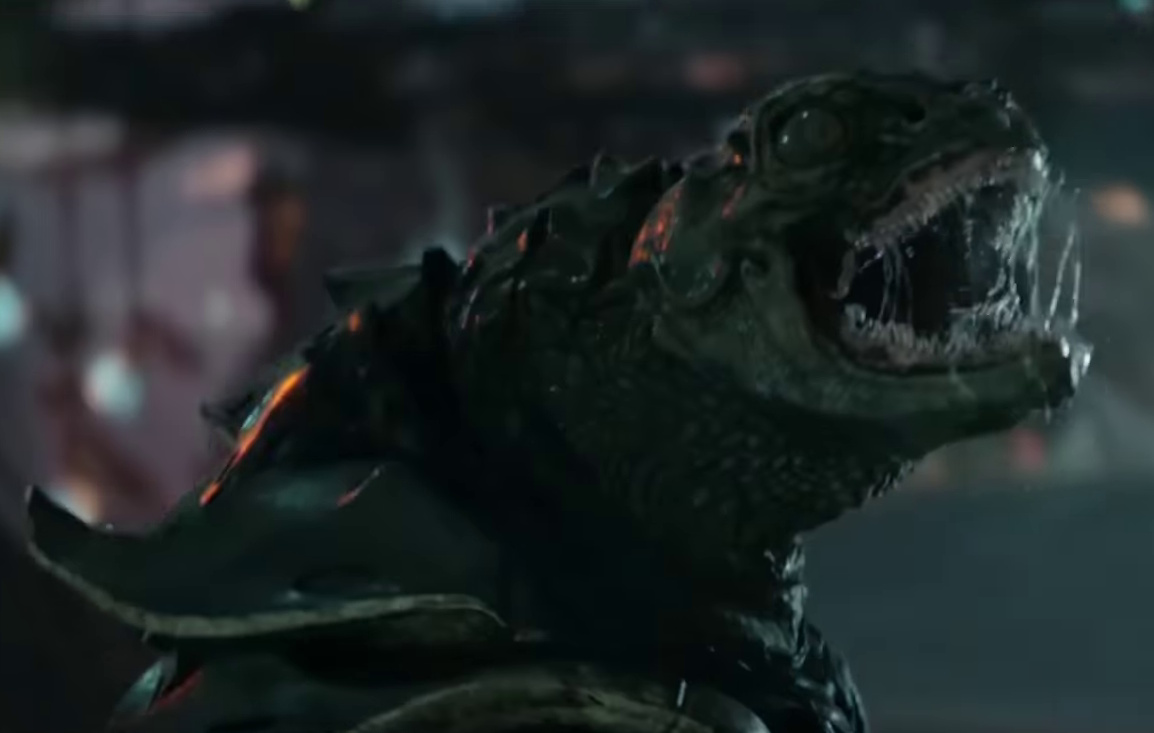
Still frame from the Star Trek: Strange New Worlds Season 3 trailer showing a Gorn.
A Gorn from the Strange New World Season 3 trailer.

Think about it: the attack on Cestus III and the total destruction the Gorn wrought isn’t far off what we see on Parnassus Beta in Strange New Worlds. The Gorn captain still makes the same kinds of horror-inspired “monster” noises, emphasising how different this life-form is to our familiar characters. The differences are really twofold: the limitations of the visual effects of the time compared to a more modern production with a higher budget, and perhaps more importantly, the limitations imposed on broadcast television at the time in terms of how graphic and horrifying visuals could be. For the mid-1960s, the Gorn captain is pure horror – and I think we can forget that because of how much time has elapsed and the kinds of things television shows today can do that they couldn’t do back then.

All that being said, I still adore the original Gorn design. I think it was incredibly creative, and Arena is just a fantastic episode all around, really. I think the parts we tend to overlook – the mission to Cestus III, the spaceship chase, and the involvement of the Metrons – are arguably the story’s most interesting parts, and to reduce Arena to Kirk and the Gorn squabbling in the desert is incredibly reductive and does Arena a huge disservice.
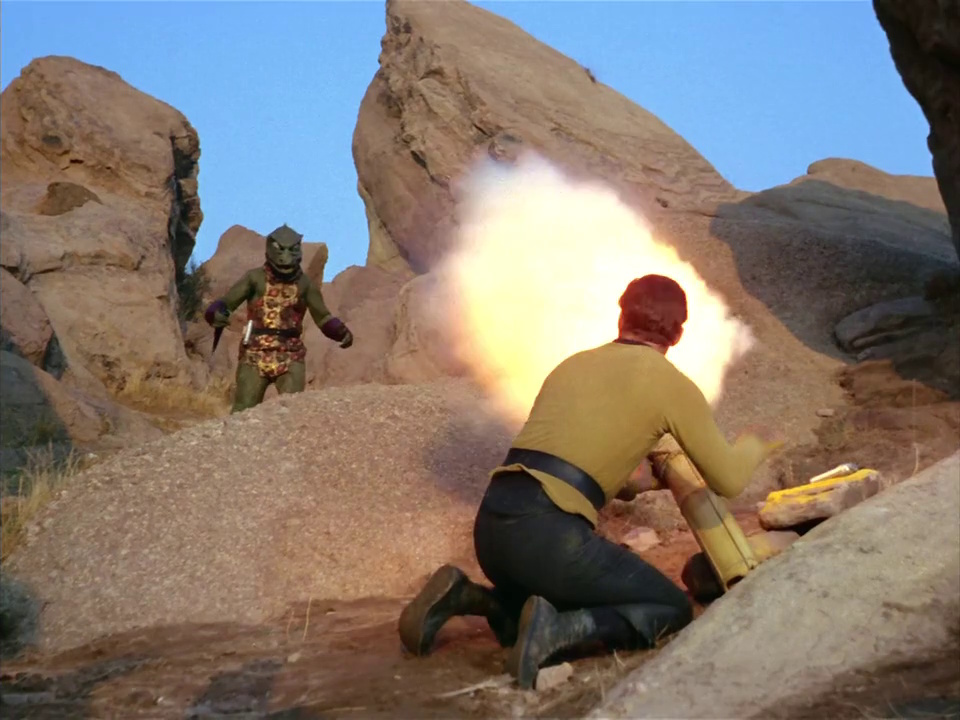
Still frame from Star Trek: The Original Series Season 1 episode Arena, showing Kirk firing his cannon at the Gorn captain.
Captain Kirk fires his makeshift cannon.

So that’s it for now. The Gorn are coming back, though… and soon! Strange New Worlds’ third season is just a couple of weeks away at time of writing, and I’m really looking forward to the resolution of the cliffhanger from Hegemony last season. I’ll do my best to write up reviews of Hegemony, Part II and the rest of the episodes in a more timely fashion this time around!

I hope this has been a bit of fun. I’ve been wanting to do a full write-up of an Original Series episode for ages, but I kept putting it on the back burner for one reason or another. Stay tuned, though, because I’ll definitely return to Star Trek’s roots before too long! I’d love to tackle one of my favourite episodes next: The Doomsday Machine! I have no idea when that’ll be… but one of these days, for sure.

Live Long and Prosper!


Star Trek: The Original Series (a.k.a. Star Trek) is available to stream now on Paramount+ in countries and territories where the platform is available. The series is also available on DVD and Blu-ray. The Star Trek franchise – including The Original Series, Strange New Worlds, and all other properties discussed above – is the copyright of Paramount Global. This article contains the thoughts and opinions of one person only and is not intended to cause any offence.
What If…? Star Trek Edition!

A Star Trek-themed spoiler warning graphic.

Spoiler Warning: Beware of spoilers for the following Star Trek productions: The Next Generation Season 1, Deep Space Nine Season 6, Voyager Season 1, Generations, Star Trek ’09, Discovery Season 2, and Picard Season 2.

Almost four years ago I had a lot of fun writing a piece here on the website called “What If…? Star Trek Edition!” I took the basic concept behind the then-new Marvel miniseries What If…? and applied it to several storylines from the Star Trek franchise that I found interesting. Speculating and getting creative was a blast, so… let’s do it again!

If you missed the miniseries (or my earlier post), I’ll briefly explain how this works! We’re going to look at five stories from across the Star Trek franchise and ask a simple question: what if things went differently? What would the consequences be for Starfleet, the Federation, and some of the characters we’ve come to know and love if, for example, Spock wasn’t resurrected on the Genesis Planet or Captain Janeway and the USS Voyager tried to reach the Gamma Quadrant terminus of the Bajoran wormhole? I covered both of those topics in my post from 2021, by the way, so be sure to check it out – you can find it by clicking or tapping here.

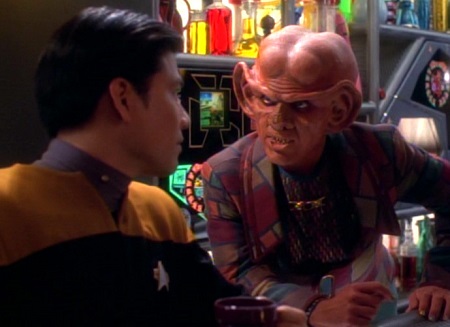
Still frame from Star Trek: Voyager showing Kim and Quark.
Harry Kim and Quark.

Alternate history has been an interest of mine for a long time – so we can consider this an “alternate history of the future,” if you like! With the Star Trek franchise slowly but surely heading toward the 1,000-story mark, there are a lot of places where narratives could branch, and where the Star Trek galaxy could end up in very different situations! As a Trekkie, and as someone who likes to spend time in this setting, it’s a ton of fun to come up with these ideas and consider how they might play out.

As always, a couple of important caveats! All of this is the entirely subjective take of one old Trekkie. If you hate all of my ideas, think I’ve got the wrong end of the stick, or if I miss something that seems totally obvious to you… that’s okay! There ought to be enough room in the Star Trek fan community for differences of opinion. None of this is close to being “canon,” anyway, so there’s even less of a reason to get upset about completely made-up Star Trek stories that will never be seen on screen!

Alright, let’s jump into the “what if” scenarios!

What If…? #1:
What if… Captain Picard and Q never met?
The Next Generation, Picard Season 2

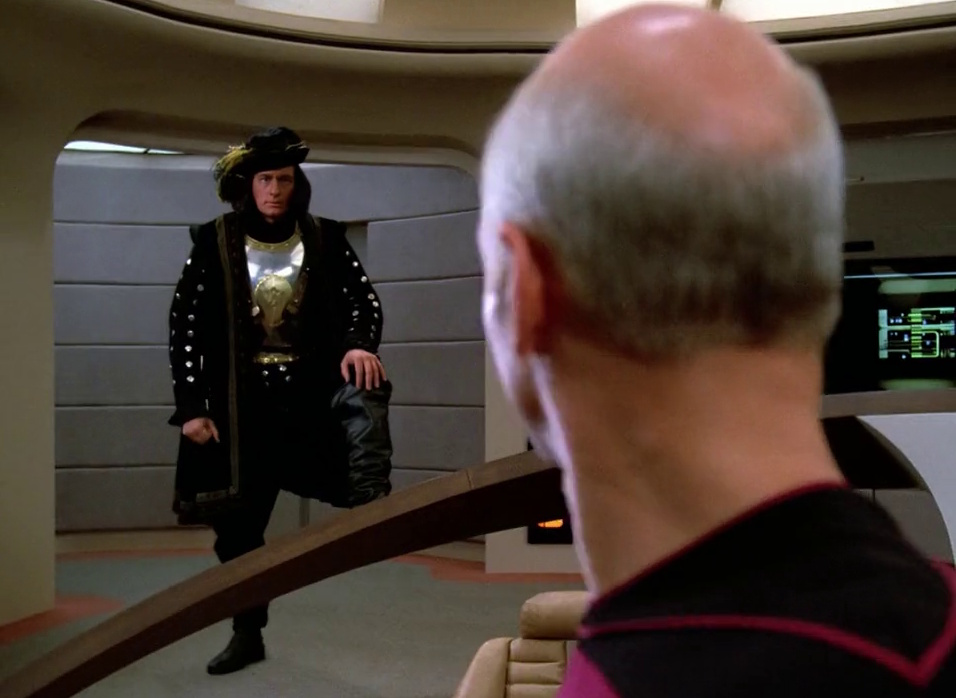
Still frame from Star Trek: The Next Generation Season 1 showing Picard meeting Q for the first time.
Picard’s first encounter with Q.

This is a really interesting one – and it might not go the way you think! Looking back over Picard’s run-ins with Q during The Next Generation, there really aren’t many places where we could say that their interactions had wide-ranging consequences. I have my pet theory that Q deliberately saved Picard and the Federation by making them aware of the Borg threat (click or tap here for that one, it’s one of my favourite Star Trek theories!) but that’s not the angle I’m gonna take today. In this case, we’re going to say that – for whatever reason – Picard and Q never met, never developed their complex relationship, and Q never set any puzzles for Picard to solve. In fact, Q stayed away from humanity and Starfleet altogether in this alternate timeline.

As noted, Q’s interactions with Picard and the crew of the Enterprise-D almost always involved problems or scenarios of his own devising. So without Q on the scene, the Enterprise-D’s mission actually proceeds slightly more smoothly than it did in the series; the absence of Q doesn’t matter in a big way to the seven-year cruise. Every other episode and story plays out more or less the same, from the mystery at Farpoint Station to the ship’s destruction over Veridian III. Picard assumes command of the Enterprise-E, then the Romulan rescue armada, before retiring from Starfleet.

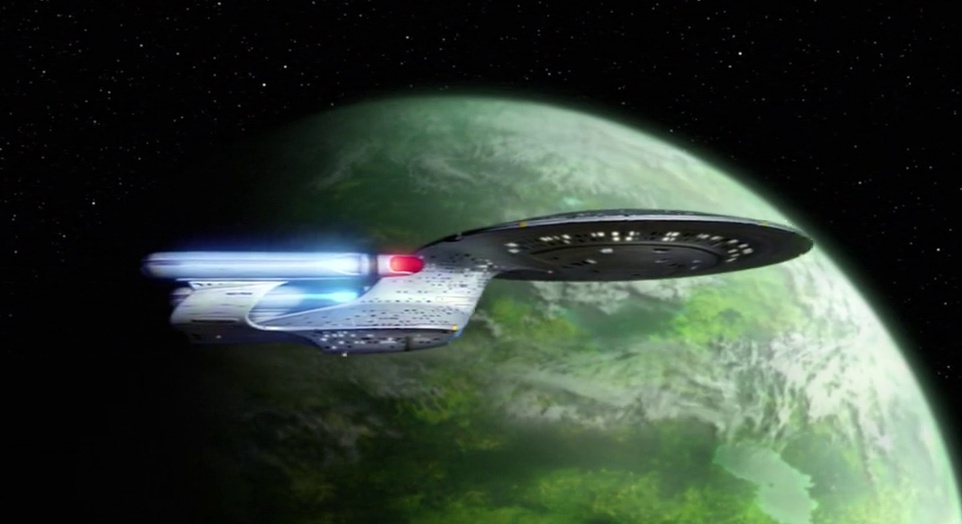
Still frame from Star Trek: The Next Generation showing the Enterprise-D in orbit of a green planet.
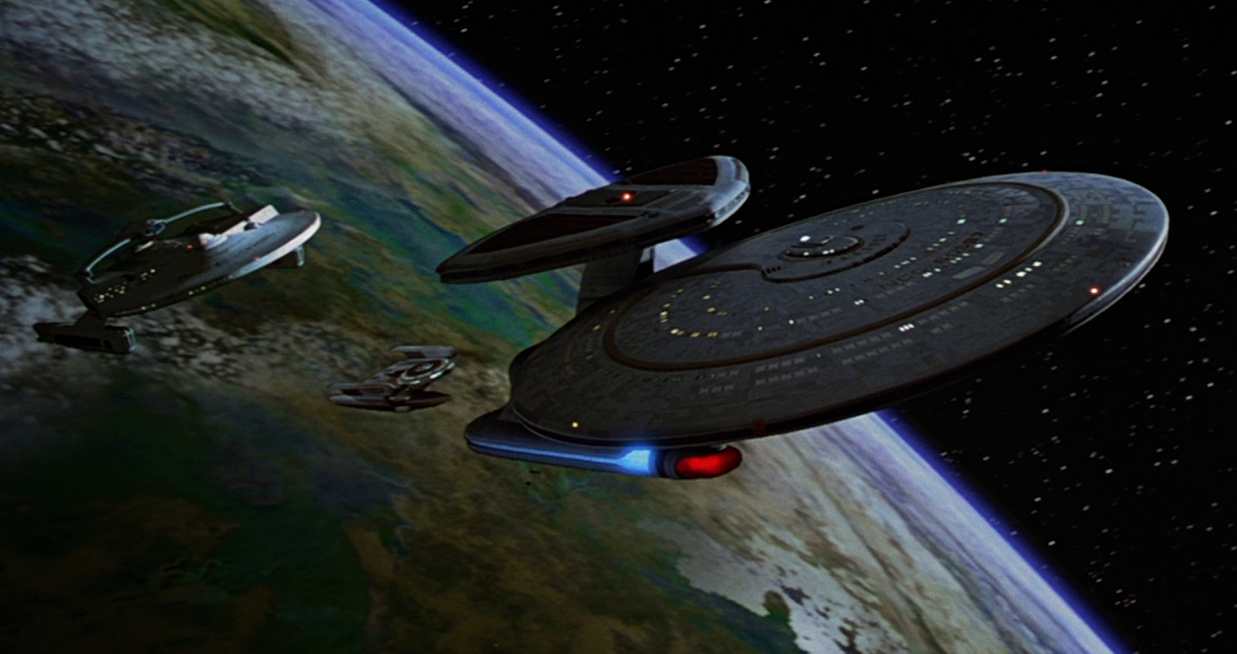
The voyages of the starship Enterprise would proceed in exactly the same way… just without Q’s occasional shenanigans!

But here’s where things change. After the mission to rescue Soji and being named Chancellor of Starfleet Academy, Admiral Picard is aboard the USS Stargazer when a mysterious anomaly is detected. The Stargazer, the Excelsior, and a handful of other ships race to the scene, where they’re confronted by a massive subspace anomaly that Seven of Nine thinks could be a huge transwarp conduit. Attempts at communication fail, and with only a handful of Starfleet ships on the scene, there’s no way to prevent the conduit from unleashing its triquantum waves.

Aboard the Stargazer, Picard and the crew look desperately for solutions – but there are none. Without the Borg, their vessel, and their knowledge of the situation, there’s no way to stop the transwarp conduit from doing what it was designed to do: launching a massive attack on the Federation. Its triquantum waves blast across several sectors of space, destroying the Starfleet ships as they attempt to escape, as well as several starbases and Federation colonies. Having expended its initial wave of energy, the conduit then falls eerily silent, as if waiting for instructions… or for its operators to emerge.

Still frame from Star Trek: Picard showing the mysterious transwarp anomaly.
This time, there’s no one to stop the transwarp anomaly…

Because Star Trek: Picard was a jumbled mess of a show, we don’t know who made the transwarp anomaly. My pet theory is that it’s something to do with Season 1’s super-synths, but it could also be the Borg, the Dominion, or any one of a number of Star Trek baddies! In this timeline, though, the anomaly’s initial attack would be successful – because there’d be no Q to throw Picard and his friends into the alternate reality that eventually led to Dr Jurati’s assimilation and the creation of a Borg splinter group. Without the Jurati-Borg’s presence at the site of the transwarp anomaly, there was no way to stop its energy from being unleashed.

What would happen next? I’d imagine that whoever made the anomaly would be pleased with its success, and if it was a transwarp conduit – as Seven theorised – then it could serve as a gateway for any ships that the attacker had. With a devastated sector and no intact ships remaining in the area, any invader would quickly be able to establish a massive bridgehead right in the heart of Federation territory, and if they have more transwarp conduit weapons… who knows? The next target could be Earth.

What If…? #2:
What if… Section 31 and the Federation accidentally created the Borg?
Deep Space Nine, First Contact, Discovery Season 2

Concept art for Star Trek: The Next Generation showing three Borg designs.
Early concept art of the Borg.

If you’re a regular reader, you might remember my theory that Discovery’s second season – which featured a time-travelling spacesuit and an AI that could “assimilate” humans using nano-bots – was originally pitched as a “Borg origin story.” So what if that’s actually what happened? In this timeline, Section 31 and the Control AI are going to be uncovered as the true progenitors of the Borg!

Here’s how it went down: after chasing Captain Pike and the USS Discovery all over the quadrant, Control and its fleet of automated drone-ships finally have them cornered. Using the assimilated body of Captain Leland, Control boards Discovery and attempts to seize the all-important Sphere Data that it needs – but the battle in space is going poorly, and Control seems to be on the verge of defeat. Not wanting to give up, Control switches tactics. Instead of the Sphere Data, Control races to the science lab and steals the Red Angel suit that Burnham and the crew have finished working on.

Still frame from Star Trek: Discovery Season 2 showing Captain Leland holding a phaser.
The “assimilated” Captain Leland.

Staring down an armada of allied ships in space and Discovery’s security team just outside the doors, Control is trapped. With no other options, Control uses the Red Angel suit to escape – but because the suit is malfunctioning, Control ends up in the distant past. Trapped on a planet in the far-flung Delta Quadrant, anchored in time the same way Gabrielle Burnham was, Control surveys its surroundings. The planet is primitive, populated by humanoids in an early stage of development – with no spacefaring technology. Control has some nano-bots remaining, and the Red Angel suit… but that’s it. It decides that the best course of action is to assimilate some of the local humanoids and work on producing more technology – hoping to one day return to Federation space and finish what it started.

For me, the biggest question is this: does the Borg Collective still know all of this as of the late 24th Century? Or has the passage of time and countless assimilations over the millennia led to this information being forgotten, buried somewhere in the depths of the Collective’s knowledge? My personal take is that this is something the Borg Queen would know – but in the Collective’s run-ins with Starfleet, it’s gone out of its way to avoid revealing this truth.

Still frame from Star Trek: Discovery Season 2 showing the Red Angel suit opening a portal.
The Red Angel suit can be used to travel through time.

But the Borg Queen is clearly not the same as Control – so what happened there? Perhaps the Queen regards Control as her “ancestor,” in a sense, or maybe Control merged with a particularly strong personality that it assimilated early on. Dr Jurati, in Picard’s second season, merged with the Borg Queen rather than simply becoming a Borg drone, so the same principle could apply here. It does beg the question, though, as to why the Borg Collective didn’t set its sights on Earth and humanity decades earlier if Control’s desire for revenge is hard-coded into the Collective’s DNA!

More interestingly, I wonder what Starfleet would make of this revelation. Let’s say that, after the Battle of Sector 001, Starfleet was able to analyse the remains of the Borg Cube and found remnants of 23rd Century Federation programming in the Borg’s systems. Further analysis eventually led to one inescapable conclusion: the Control AI is the basis for the Borg, making the biggest threat to the galaxy an accidental Federation creation. Perhaps that knowledge could be used by Starfleet’s Borg experts to find a weakness or a way to communicate… but it would also be a serious blow to morale.

What If…? #3:
What if… the USS Voyager was destroyed over Ocampa?
Voyager Season 1

Still frame from Star Trek: Voyager showing the USS Voyager exploding.
The destruction of the USS Voyager!

In this alternate timeline, we’re going to say that the USS Voyager and the Val Jean – Chakotay’s ship – were both transported to the Delta Quadrant as we saw in Caretaker. But during the battle for the Caretaker’s Array, it’s Voyager, not the Val Jean, that ended up being destroyed by the Kazon. Some survivors made it to the escape pods and were taken aboard by the Maquis, with Chakotay ordering B’Elanna to fire up the engines and get the ship out of range of the Kazon as quickly as possible!

The first character we’d miss would be the Doctor – and with no surviving medical staff (and apparently no medically-trained Maquis, either) that would quickly become a problem for the crew of the Val Jean. I’m also going to suggest that Neelix and Kes wouldn’t be a part of this crew – or if they were involved, they’d remain aboard Neelix’s ship rather than try to cram aboard the already-overcrowded and cramped Maquis raider. As to what else would be different… well, it depends on who survived the destruction of Voyager.

Photograph of the original Maquis Raider model from Star Trek: Deep Space Nine and Star Trek: Voyager.
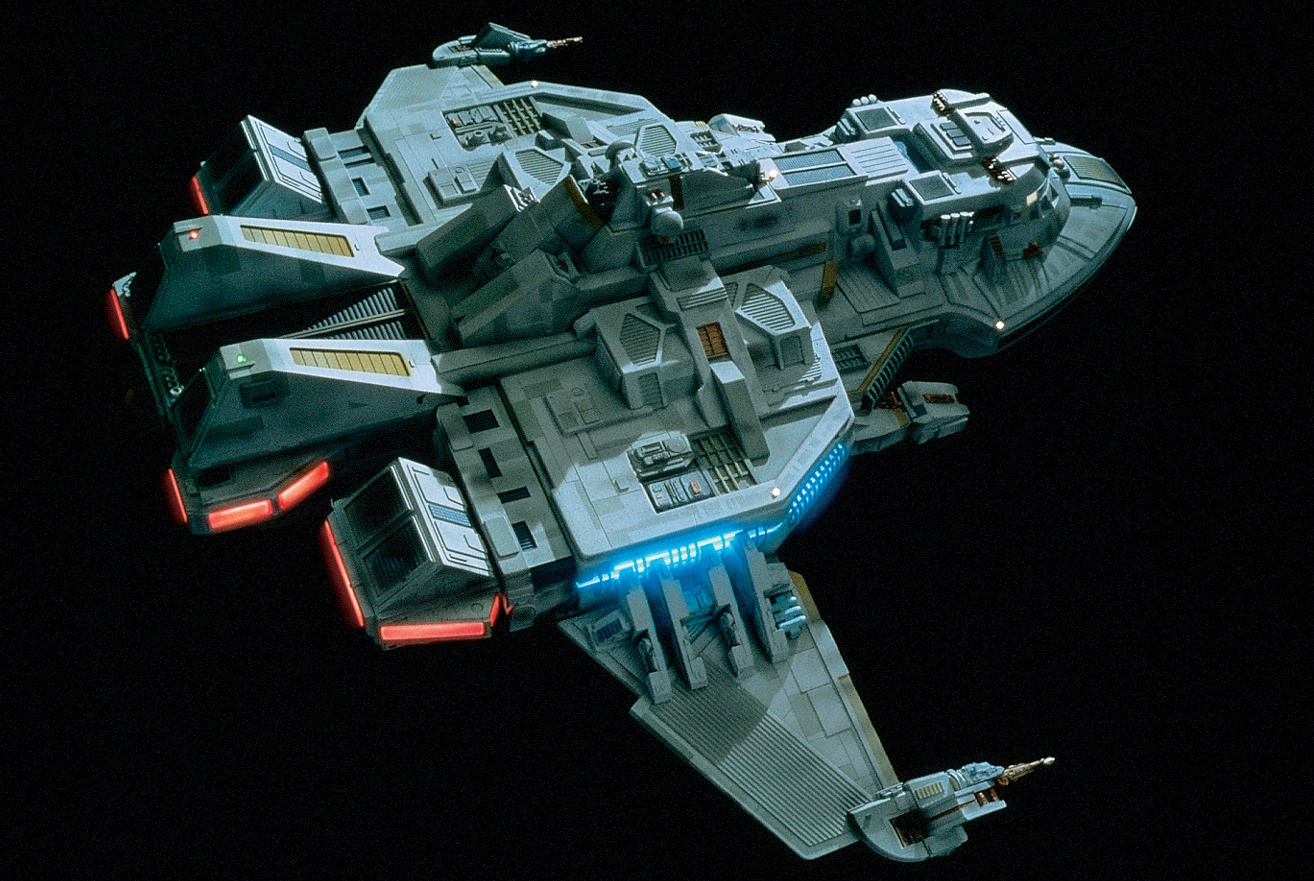
Chakotay’s Maquis raider – the Val Jean.

I’m going to assume that Captain Janeway went down with the ship – as she once told Naomi Wildman that it’s part of a captain’s duty. That was half-joking, perhaps, but I can’t see Janeway abandoning the ship while any members of the crew were still aboard, so I’m gonna say she was lost with Voyager. Among the survivors, though, would be Tuvok, Harry Kim, Tom Paris, and B’Elanna Torres, as well as Seska, Ensign Wildman, and engineer Carey. There’d likely be a clash between Tuvok and Chakotay over command decisions, but Chakotay would pull rank – figuratively speaking – and remind the Starfleet survivors that they’re aboard his ship, so he’s in charge. However, as a concession given the difficult situation, he’d offer senior roles to Tuvok and Carey, and Kim would take up a role on the bridge.

Living conditions would be difficult, though. Voyager was kind of inconsistent with this, but we got hints in several episodes that there might’ve been about twenty-five or so Maquis aboard Voyager. If we assume that there’d be at least forty survivors from Voyager’s original complement of 150, the Starfleet personnel would outnumber the Maquis – which could lead to a lot more tensions aboard a Maquis ship than it did aboard Voyager. The small raider – which probably wasn’t equipped for a long voyage – would struggle to accommodate so many people, and with fewer replicators (if they even worked at all) the ship would have to make many more stops to forage and hunt for food and supplies.

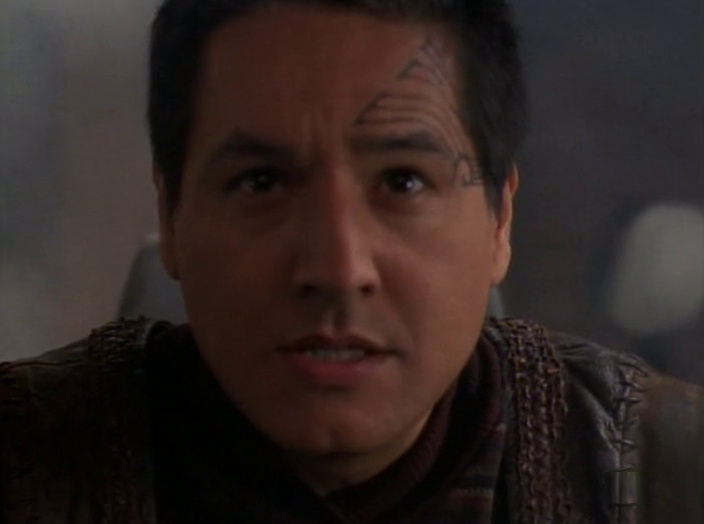
Still frame from Star Trek: Voyager showing a close-up of Chakotay in the series premiere.
Chakotay would remain in command of his Maquis vessel.

Equinox offers an excellent look at how a ship less well-equipped than Voyager might’ve handled being stranded in the Delta Quadrant. Despite the Val Jean’s personnel being arguably better prepared to survive than Captain Ransom’s crew, the limitations of the ship, the difficult living conditions, and the constant danger would all take a toll on the survivors. Morale would be low among the Starfleet personnel after Janeway’s death, and the reality of the situation would sink in for them over the first few days as they struggled to adapt. Having to share bunk beds and malfunctioning replicators would lower morale even further.

Chakotay would do his best to avoid the Kazon, and without the technologically-advanced Voyager to pursue, I daresay they’d be less interested in chasing the Val Jean, so the ship would make slow but steady progress toward the Alpha Quadrant. After several months (or perhaps a year) of planet-hopping, the Val Jean would encounter something strange: an old Earth automobile floating in space. This would lead them to a planet with a human settlement; the descendants of abductees from Earth. Most of the Starfleet personnel would disembark here, choosing to stay on the planet rather than remain aboard Chakotay’s ship. Chakotay and the Maquis would stay for a while, too, enjoying the friendly atmosphere and making repairs to their ship. After an extended stay, though, would anyone want to re-join the mission back to the Alpha Quadrant on a ship dangerously unsuited for such a voyage?

What If… #4:
What if… the Romulans figured out what Sisko and Garak did?
Deep Space Nine Season 6

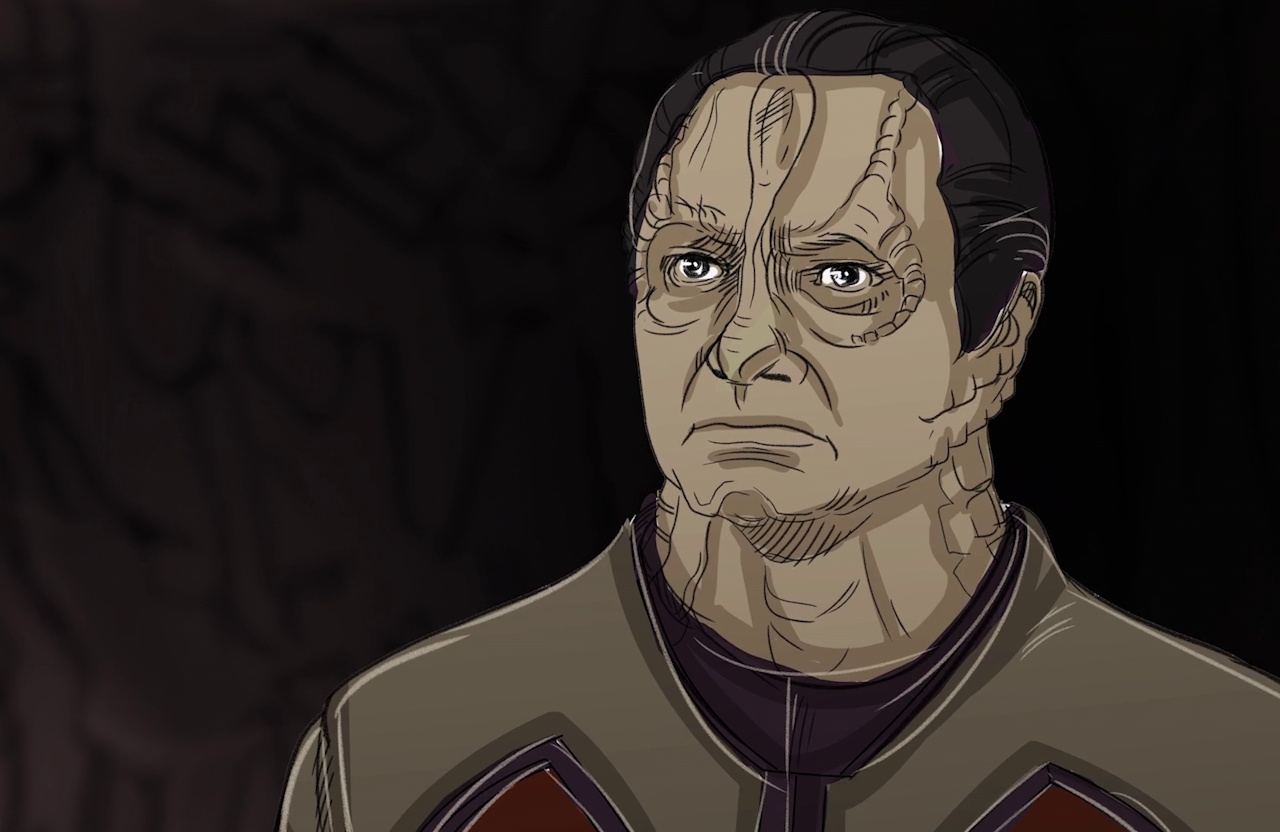
Still frame from What We Left Behind: Looking Back At Deep Space Nine showing a sketch of Garak.
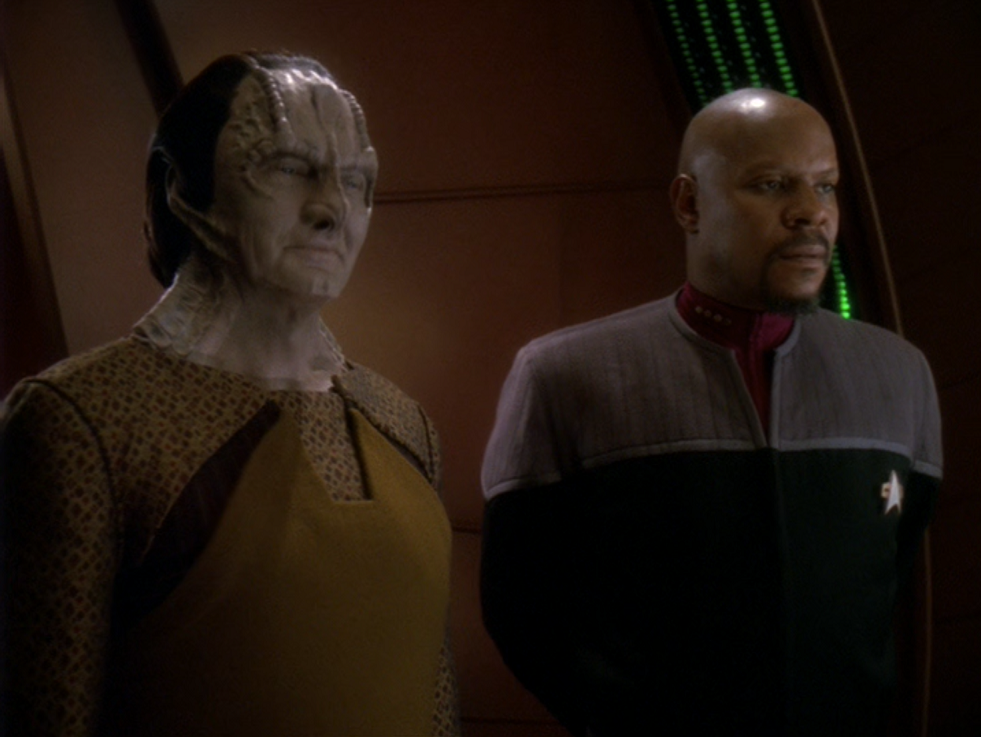
Garak.

Perhaps this one won’t always be a “what if!” One of my fantasy Star Trek episodes is a follow-up to the outstanding Deep Space Nine episode In The Pale Moonlight, and I’d really love to see a sequel of sorts one day. But for now we’re going to make up our own version – and connect it to other parts of Star Trek, too!

There are two time slots for this, and both are interesting – so this is kind of two “what ifs” in one!

Firstly, we have the obvious question: what if the Romulans figured out what happened before the end of the Dominion War?

Still frame from Star Trek: Deep Space Nine showing Senator Vreenak.
The Romulans have figured out that “it’s a faaaaaake!”

Shortly after the Breen joined the Cardassians and the Dominion, the Tal Shiar uncovers the truth behind the assassination of Senator Vreenak. How they figured it out doesn’t matter; all we need to know is that the proof is irrefutable. As a result, the Romulans terminate their alliance with the Federation and Klingons at the worst possible moment – just as Breen weapons are proving to be a tactical and technological hurdle for the allies to overcome. Worse, a few days later the Romulans announce a non-aggression pact with the Dominion, shortly followed up by an official alliance. In short, the Romulans have switched sides.

It’s no secret that the Romulans have long coveted Federation systems, and promises from the Dominion about ownership of Vulcan combined with a need for revenge swayed the Romulan senate. They began collaborating openly with the Dominion, sharing technology like cloaking devices with their new allies. The Cardassian rebellion led by Damar would be quickly crushed by the combined might of the Dominion, Breen, Romulans, and Cardassian collaborators, and would be far less effective and far-reaching. With the axis shored up and bolstered by Romulan troops and Romulan intelligence, they’d be back on the front foot ready to press home their advantage. The obvious first targets are Bajor and DS9; control of the wormhole would be vital. From there, it could be a very short war indeed…

Still frame from Star Trek: Deep Space Nine showing Garak and Sisko.
Garak and Captain Sisko.

The second scenario is the one I still hope to see on screen one day. In this timeline, the Romulans discover what happened – but only years after the war is over. The destruction of their homeworld took a toll, and the Romulan Empire is in a difficult position. Romulan leaders demand the extradition of those responsible, but with Sisko “missing in action” and apparently residing with the Prophets, there’s really no one to prosecute. Garak’s involvement remains unknown, and he wouldn’t stick his head above the parapet!

But the Romulans would make a fuss, doing whatever they could to make life difficult for Starfleet. One action the Romulan government takes is cutting off Federation researchers from a derelict Borg vessel that they control, and ordering all Romulans to leave Federation space. The result? Soji doesn’t head to the Artifact, Laris and Zhaban leave Earth, and the synths at Coppelius Station remain hidden from Starfleet. But not necessarily hidden from everyone

What If…? #5:
What if… Captain Kirk didn’t die on Veridian III?
Generations

Still frame from Star Trek: Generations showing Picard at Kirk's grave.
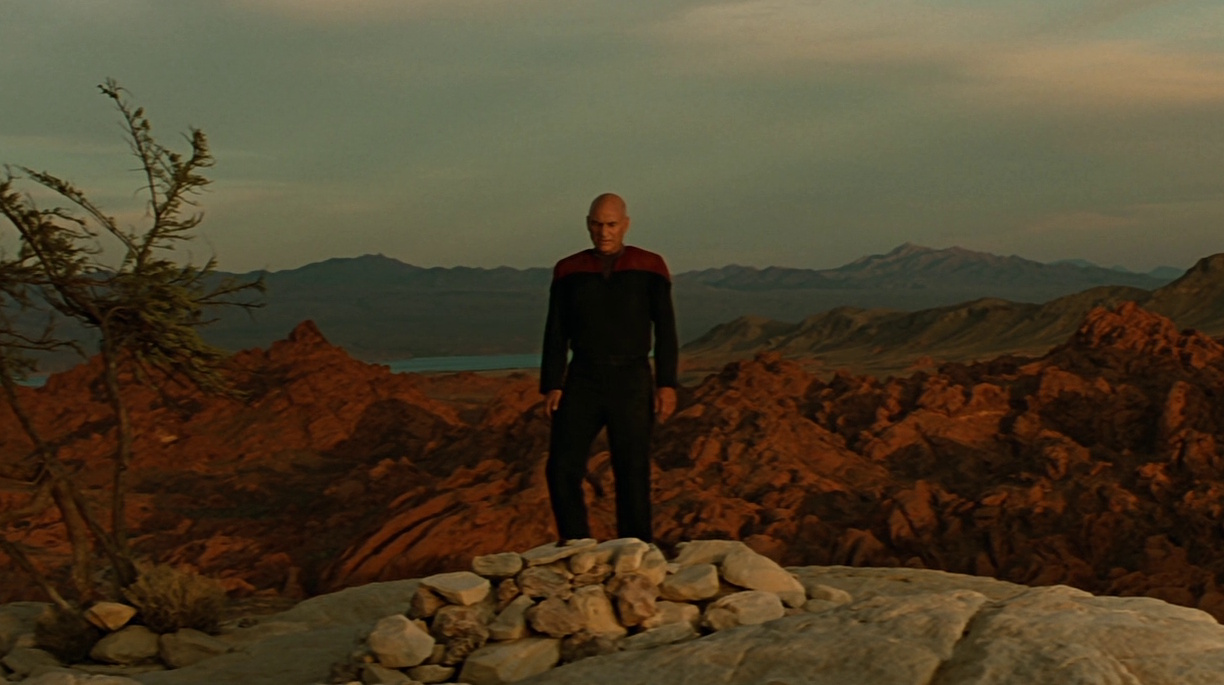
Picard stands over Kirk’s grave.

This is one of the biggest “what-ifs” in Star Trek – at least for fans of a certain age! Kirk’s death in Generations was controversial, though I’d argue it was at least fitting for his character that he gave his life in an act of sacrifice, saving the crew of the Enterprise-D and the population of Veridian III from the Nexus. But in this alternate timeline, Kirk and Picard are able to stop Soran without Kirk losing his life.

Kirk would reunite with Picard and then meet up with the crew of the crashed Enterprise-D, before boarding a rescue ship bound for Federation space. Upon reaching a starbase, Kirk would be absolutely stunned to disembark only to be greeted by Spock and Montogomery Scott! Scotty had survived to the 24th Century in a transporter buffer (as seen in the episode Relics) and of course, Vulcans live longer lives than humans so we know that Spock is also still alive. This reunion would be incredibly touching, and Kirk would spend time with his old friends, catching up on almost eighty years of Spock’s life and also learning of Scotty’s 24th Century adventures.

Still frame from Star Trek: Generations showing three starships departing Veridian III.
Kirk would board a rescue ship and return to Earth.

Kirk would be debriefed by Starfleet Command about his time in the Nexus and would also seek out other members of his crew. Dr McCoy would have passed away, but at least one other member of the Enterprise’s bridge crew – someone like Uhura or Chekov – could still be alive in this time period, though they’d be very old! Kirk would visit them at their home, catching up on the events of their lives after he’d last seen them. Having decided to retire from Starfleet around the time the Enterprise-B was commissioned, Kirk would consider returning to his home – which has been preserved as a museum by Starfleet for the last eighty years – but I’m not so sure that that’s what he’d do.

We know that, in between the events of Relics and Star Trek ’09, Scotty was still working in some capacity – it’s in this era that “transwarp beaming” is invented. I’m going to say that, for the purposes of this alternate timeline, Kirk would return to Starfleet. In an unofficial capacity at first, he’d work with Scotty and Spock, and might also be visited by an old rival: the Klingon Captain Kor, now a Dahar master. Kor would invite Kirk to Qo’noS, where he’d see the results of his work to bring about peace between the Federation and the Klingon Empire.

Still frame from Star Trek III: The Search for Spock showing Kirk out of uniform at his home.
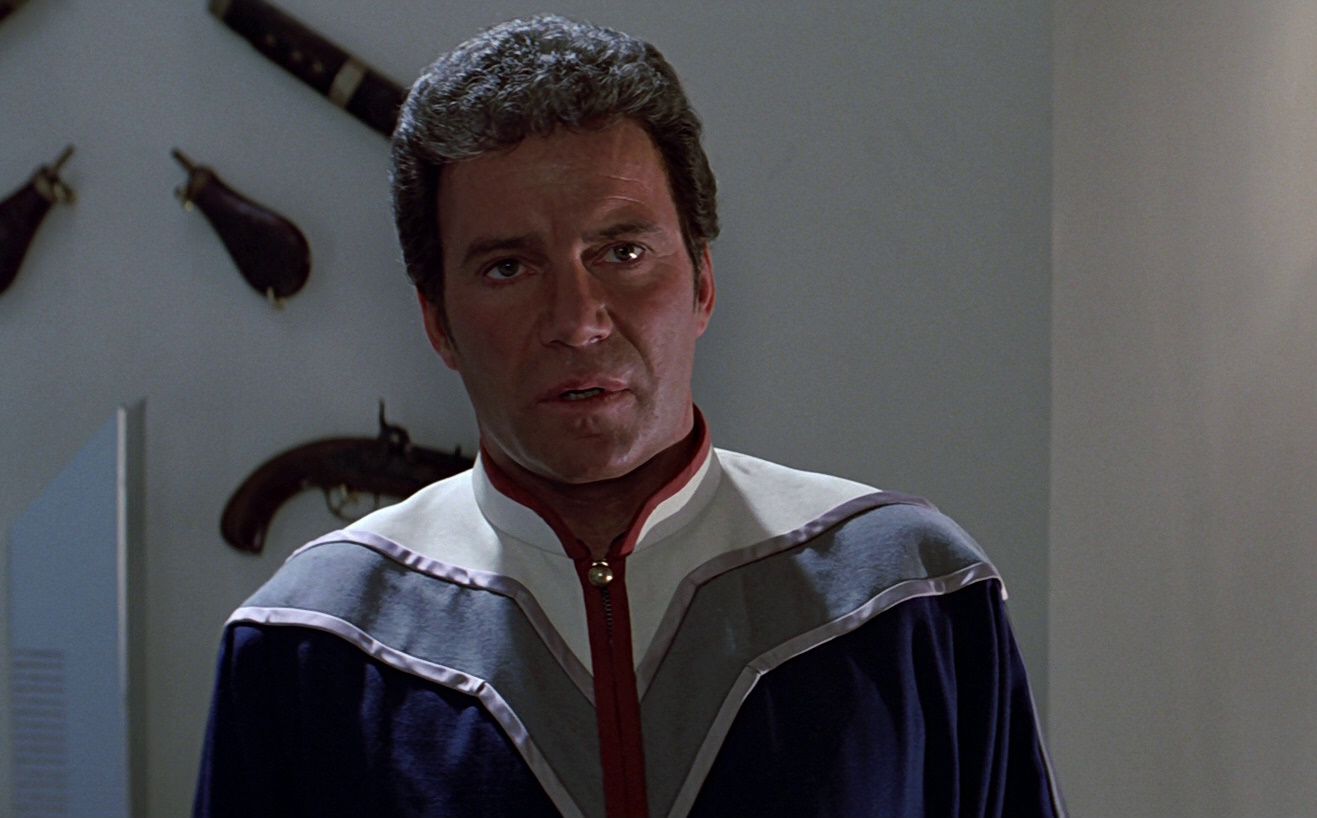
Kirk could still have some adventures and new experiences in the 24th Century.

Kirk would also be present at the launch of the Enterprise-E, reuniting with Picard as the ship undertook her first cruise. Scotty would also be present, having opted to join his former captain at the launch of the latest ship to bear the name Enterprise. Kirk and Scotty would have departed the ship shortly before the Battle of Sector 001, though. Kirk would be offered a promotion back to the rank of Admiral, and he’d join Starfleet Command in an advisory role; many senior Starfleet officers and admirals would call upon the famed officer for advice.

Where I think Kirk could be most influential, though, is in the aftermath of the synths’ attack on Mars. In the prime timeline, Picard was unable to convince Starfleet to proceed with their plan to help the Romulans, but I think Kirk would be on Picard’s side here. As a living legend and someone of such high standing in Starfleet Command, Kirk’s word would carry a lot of weight. As a result, Picard’s rescue armada would be rebuilt, and many more Romulan lives could be saved before the Hobus supernova. Among the evacuees would be Nero’s family – meaning Nero never attacks Spock’s ship, the two are never pulled into a black hole, and the alternate reality seen in Star Trek ’09 would never begin.

So that’s it!

Concept art for Star Trek: The Motion Picture showing the USS Enterprise in drydock.
Concept sketch of the USS Enterprise in drydock from The Motion Picture.

We’ve taken a look at five “what if” scenarios set in the Star Trek universe. I hope this has been interesting – and perhaps a bit of fun, too!

There are a lot of places in Star Trek where things could’ve gone very differently, and something as small as the absence (or presence) of a single individual has literally changed the course of history for the Federation and the entire galaxy. I can already think of plenty of other “what ifs,” so stay tuned! I’d love to revisit this idea again one day.

There’s plenty more Star Trek content coming up here on the website. So far in 2025 we’ve talked about some of my head canon, as well as some Star Trek stories that I wish weren’t canon at all! I’ve also reviewed the Section 31 film and finally caught up with Season 2 of Strange New Worlds. Season 3 will premiere later this year and I’ll definitely have something to say about it when it’s here! Until then, see you… out there.


Most Star Trek series and films discussed above are available to stream now on Paramount+ in countries and territories where the service is available. The Star Trek franchise is also available on DVD and Blu-ray. The Star Trek franchise – including all films, shows, and properties discussed above – is the copyright of Paramount Global. This article contains the thoughts and opinions of one person only and is not intended to cause any offence.
Star Trek: The Animated Series Episode Re-Watch: How Sharper Than a Serpent’s Tooth

A spoiler warning graphic.

Spoiler Warning: There are spoilers ahead for Star Trek: The Animated Series as well as The Original Series and Voyager Season 2.

I haven’t really talked about The Animated Series very much here on the website, but to mark the fiftieth anniversary of the episode How Sharper Than a Serpent’s Tooth – which premiered on this day back in 1974 – I thought it might be a bit of fun to step back in time to Star Trek’s first foray into the world of animation. It’s actually been a long time since I last watched this episode (or really any of The Animated Series), so we’re going into this re-watch almost completely blind!

I have to confess that I have a bit of a psychological block when it comes to The Animated Series. From the late ’80s to the early 2000s, the official line from Gene Roddenberry, Gulf+Western, Viacom, and Star Trek’s other corporate overlords was that the show was officially “non-canon.” For the purposes of The Next Generation-era Star Trek, nothing in The Animated Series happened, and that’s left me with a lingering feeling about that show that’s difficult to put into words. The era in which I became a Trekkie was the era in which The Animated Series was deemed to be “too low-quality” to be an official part of the franchise. I watched a few episodes here and there in the ’90s, but The Animated Series wasn’t a mainstay on terrestrial TV here in the UK at the time, so I didn’t see it in full until it arrived on DVD in the mid-2000s.

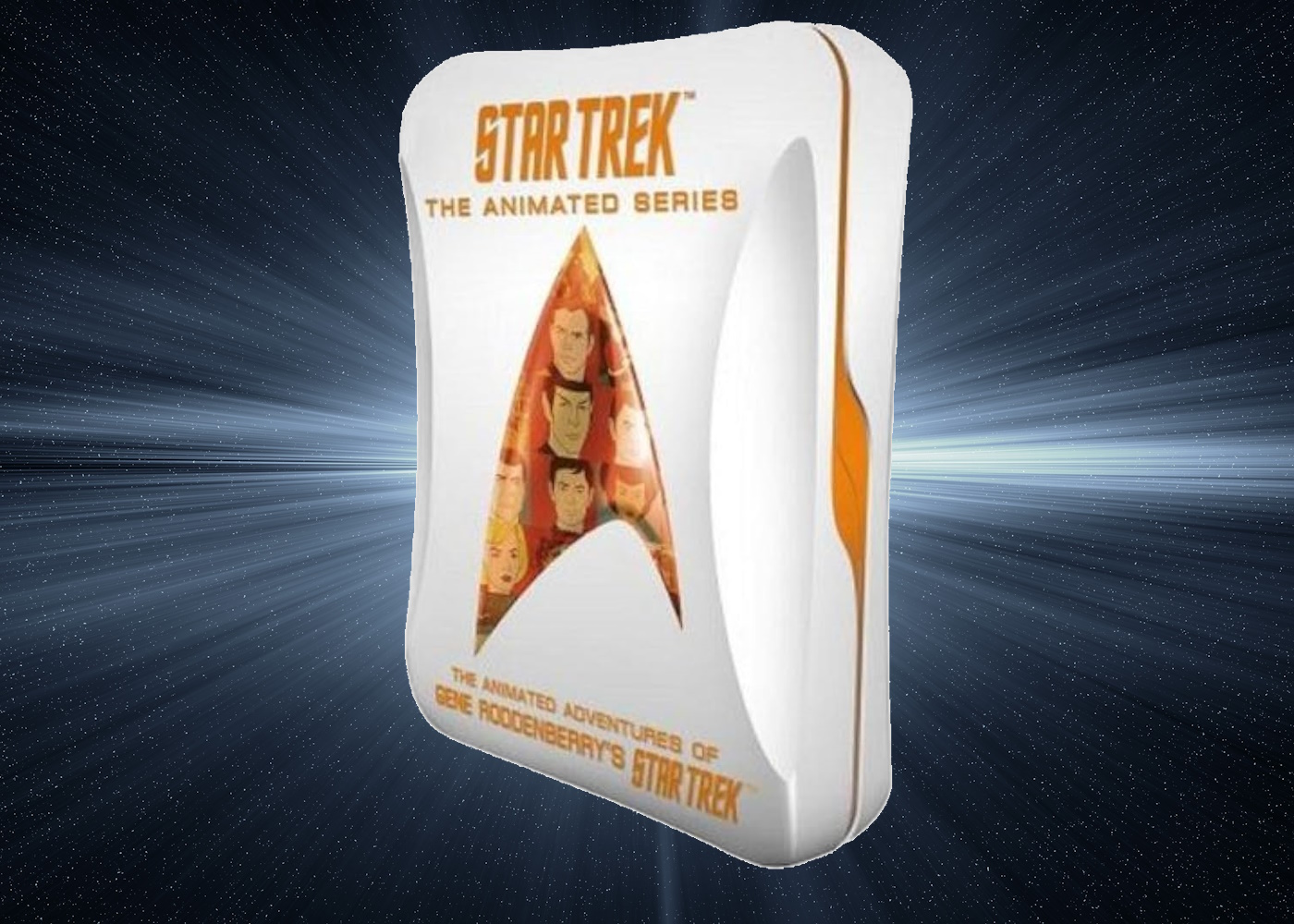
The DVD box set of Star Trek: The Animated Series on a space-themed background.
Remember when Star Trek DVD box sets came in chunky plastic cases that were awkward to open?

It was only when the DVD box set was being readied for release that CBS formally ditched the “non-canon” line, by the way, declaring The Animated Series to be a full and official part of the Star Trek franchise once again. At that time, with Enterprise being cancelled, it seemed as if Star Trek might’ve been over – so why not include The Animated Series if it helps shift a few more DVDs? I guess that was the thinking when that decision was taken!

So that’s my background with The Animated Series as we come to this episode re-watch! Although it’s a show I only occasionally dip into, the fiftieth anniversary is still a big deal, and it’s always worth keeping in mind the role The Animated Series played in the history of Star Trek. As re-runs of The Original Series gained traction in the early 1970s, calls grew for Star Trek to be brought back. The Animated Series was a compromise; a way to make new episodes and satisfy the growing fan community without having to commit the money required to re-start production on a live-action show.

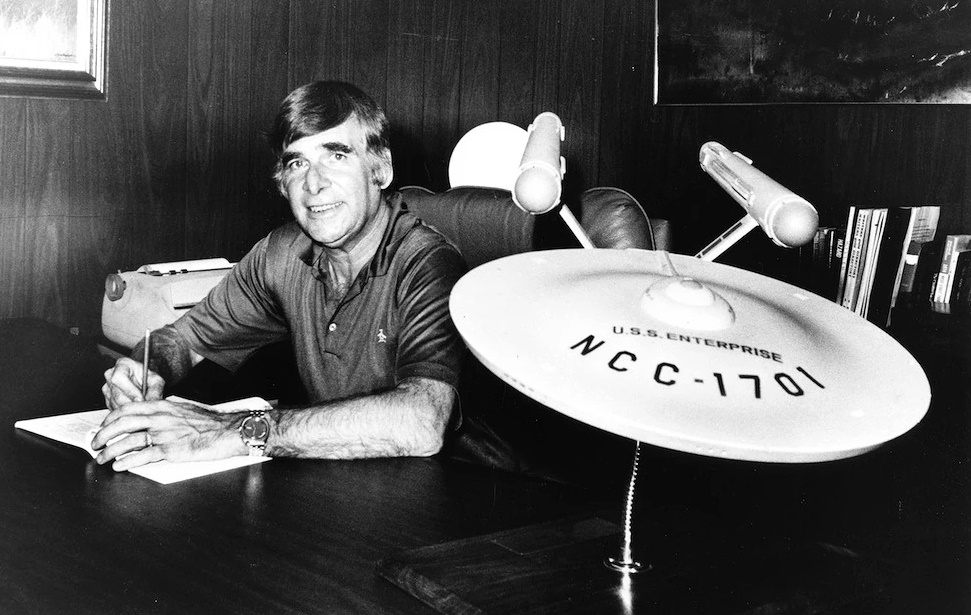
A photo of Gene Roddenberry in his office in the early 1970s, with a model of the USS Enterprise next to him.
Gene Roddenberry in the early ’70s, around the time The Animated Series was entering production.
Photo Credit: Starlog Press

And the lack of budget awarded The Animated Series… well, let’s just say it can be obvious! There is a distinctly old-school charm to parts of the show, and the low-budget animation of the time. But The Animated Series can also feel quite janky, especially if you aren’t used to it or if you prefer today’s slicker, computer-animated visual style. I think there’s a real warmth to this style of animation, and the obvious jank just adds to that in my opinion!

As the show that boosted Star Trek during what could’ve been its darkest hour, we owe a lot to The Animated Series for the franchise’s re-birth at the end of the 1970s. The Motion Picture and Star Trek’s subsequent renewal in the ’80s would arguably not have been possible without this show keeping things fresh and growing the audience. Bringing younger eyes to Star Trek through this “Saturday morning cartoon” style bolstered the franchise’s prospects and shouldn’t be understated.

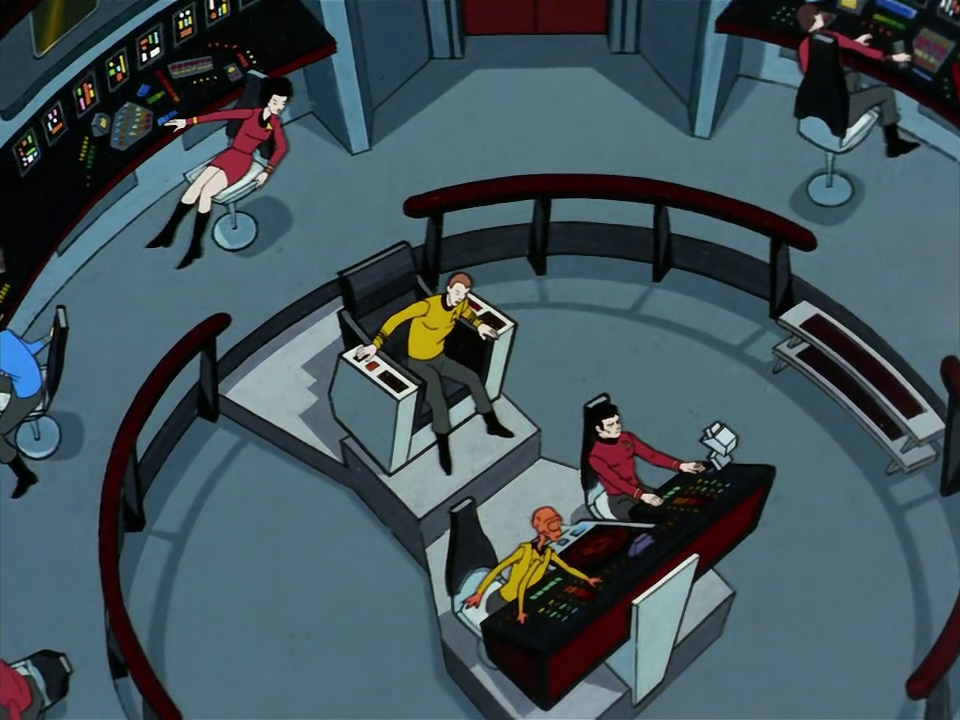
Still frame from Star Trek: The Animated Series Season 2 (1974) showing a top-down view of the bridge.
Kirk and the crew (including a rather pale-looking Uhura) on the bridge of the Enterprise.

By happy coincidence, the episode I picked for this re-watch happens to be the 100th episode of Star Trek! After 79 episodes of The Original Series there were 22 produced for The Animated Series across two seasons – this being the penultimate one. I know it isn’t a huge deal, but these milestones can feel important.

Onward, then, to the episode How Sharper Than a Serpent’s Tooth!

Still frame from Star Trek: The Animated Series Season 2 (1974) showing a close-up of Uhura.
:-O

The first thing to note is the opening titles! A slightly jazzed-up version of The Orignal Series theme plays, heavy on the horns, and William Shatner gives his usual “these are the voyages” voice-over as Captain Kirk. Hearing it again after not watching either show for a while was a real blast of nostalgia… and we haven’t even got started yet!

The episode proper kicks off with a captian’s log, with Kirk narrating that the Enterprise is tracking a mysterious probe. Lower Decks and Strange New Worlds have brought back the captain’s log as a framing device after the likes of Picard and Discovery used logs much more sparingly, and I have to say I’m glad for that. The captain’s log is an integral part of the franchise, after all!

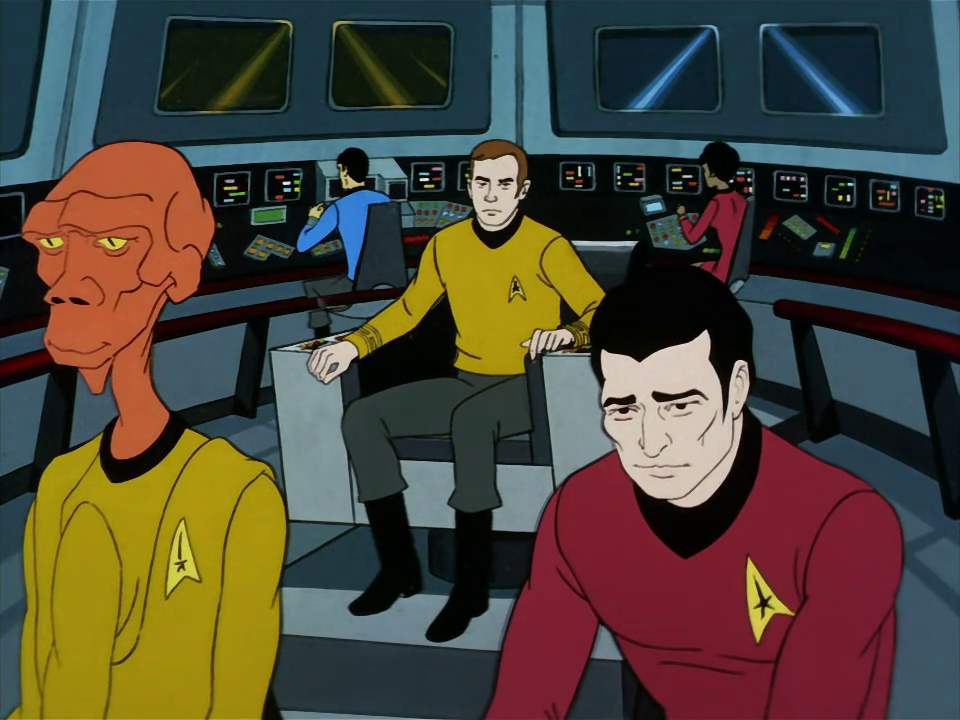
Still frame from Star Trek: The Animated Series Season 2 (1974) showing Kirk and other characters on the bridge.
Arex, Kirk, and Walking Bear on the bridge.

The opening scene on the bridge sets the stage for the episode – a second probe is coming in, following the same trajectory as the first. Characters created specially for The Animated Series are present: the three-armed, three-legged Arex being a personal favourite of mine! Ensign Walking Bear – a Native American – is at the helm. Both characters (and many others in The Animated Series) were voiced by the late James Doohan, better known for his role as Scotty.

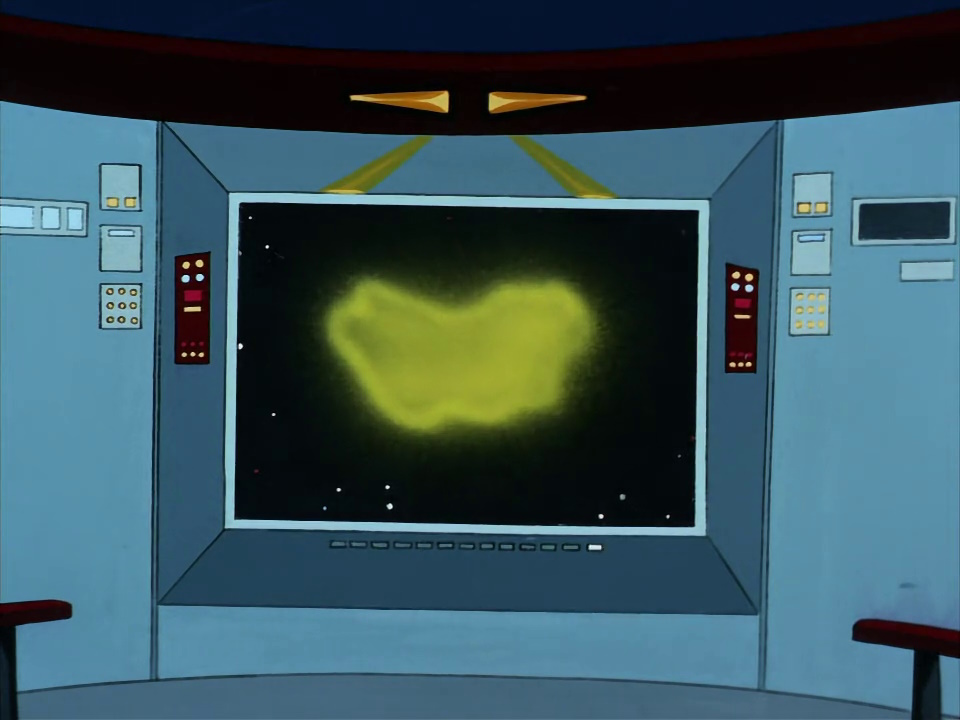
On the viewscreen, the alien probe appears as little more than a smudge of yellow-green – and waddles unconvincingly toward the Enterprise! This is a great example of what I mean about finding charm in the jankiness of The Animated Series; by anyone’s standards, even in the ’70s, this doesn’t look great! But part of the fun of fantasy and sci-fi is getting lost in the setting, looking past things like that, and even using one’s imagination to help suspend disbelief. Sure, the alien probe looks like something you might find in a newborn’s nappy… but so what? It’s an alien probe, dammit, and that’s that!

Still frame from Star Trek: The Animated Series Season 2 (1974) showing a blob on the main viewscreen.
The alien smudge… I mean probe.

As the Enterprise becomes trapped in a “globular force-field” – which looks like a snow-globe or Christmas bauble from the outside – Spock proclaims it is “fascinating” while Scotty reports to Kirk that he doesn’t know how long the ship can take the strain! Classic lines from the classic crew, and I’m right back there with them. The ship comes to a complete stop while Kirk and the crew decide how to proceed.

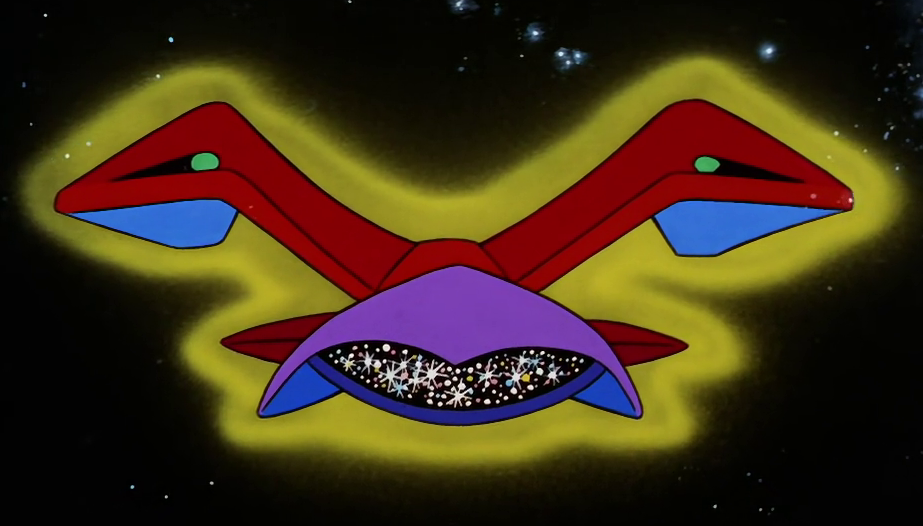
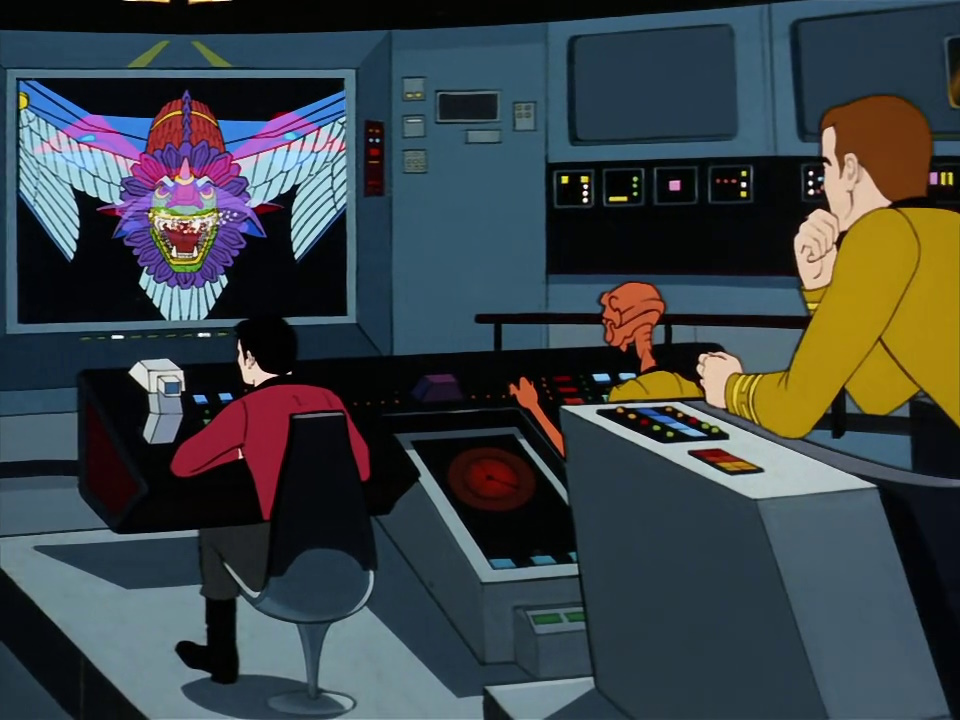
The smudge “de-cloaks” to reveal a beautiful spaceship that could be right out of a dozen or more mid-century sci-fi properties! The vibrant shades of red, purple, and blue give it a striking appearance, and the glittering panel at the front makes the vessel stand out. It really is a beautiful ship – and clearly more than a match for the entrapped Enterprise. Though you might not assume so from appearances alone! I love this kind of design; a pre-Star Wars retro sci-fi look, bold in its colour choices. They don’t make ’em like that any more!

Still frame from Star Trek: The Animated Series Season 2 (1974) showing Kukulkan's starship.
I really like this spaceship design.

The Animated Series was also pretty limited with its soundtrack. At this point in the episode, with the Enterprise under attack by the beautiful alien vessel, the show’s only “action theme” plays – and I’d forgotten just how much I love this piece of music, too. It seems to perfectly capture the danger that the crew are in… even if, by this point in The Animated Series’ run, we’d have heard it twenty times or more!

Kirk tries everything – reversing the engines, powering up the shields, and hailing the ship – but running out of options and limited by the globe preventing the Enterprise from moving, he reluctantly orders phasers to fire. Although this also proves ineffective, I like how The Animated Series was still true to Kirk’s character: he was never spoiling for a fight and would look for a peaceful way out where possible.

Still frame from Star Trek: The Animated Series Season 2 (1974) showing Captain Kirk.
Kirk only fired on the alien ship when he’d tried everything else.

The new character – Ensign Walking Bear – recognises the ship when it projects a dragon-like design (using something like an early holo-projector, perhaps?) and this seems to give the attacker pause. Pleased that at least one human “remembers” them, they give the crew a chance to succeed – but warn that failure will mean death.

Now we see why Walking Bear was on the bridge, eh? Star Trek always finds uses for redshirts and always has! Even classic episodes like Balance of Terror put secondary characters like this in just the right place to contribute to the story or to building up the lore of the franchise. I’ve been critical of modern Star Trek, sometimes, for nakedly shoehorning in some piece of backstory to a secondary character solely for the purposes of connecting to the main narrative… and I guess in some cases it works better than others. But it’s worth remembering that it’s something the franchise has always done in one form or another.

Still frame from Star Trek: The Animated Series Season 2 (1974) showing Kukulkan's message on the viewscreen.
Kirk and the crew received a message from their attacker.

This Kukulkan – described by Walking Bear as an ancient legendary god of the Aztecs and Mayans – is who’s attacking the Enterprise. I’m reminded of two episodes – one from The Original Series and one produced much later during Voyager’s run. Who Mourns for Adonais? during the second season of The Original Series introduced Kirk and the crew to the “gods” of Ancient Greece. And Tattoo, the Voyager Season 2 episode that saw Chakotay encountering an alien race that his people called the “Sky Spirits.” The stories aren’t identical by any means, but there’s a similarity in the underlying premise of all three.

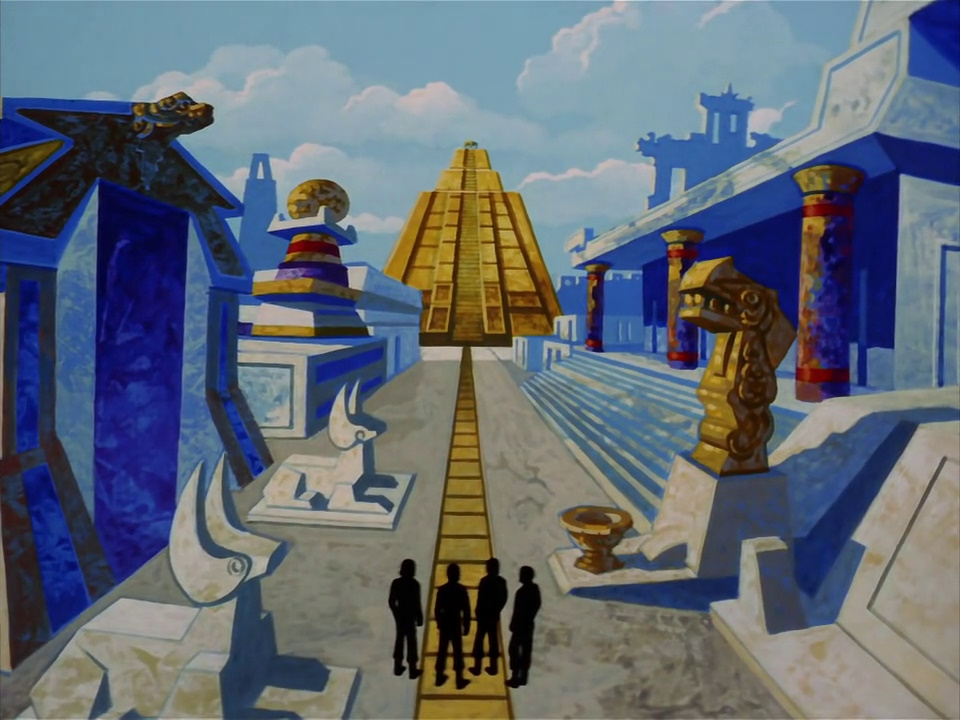
Midway through a conversation with Kirk, Walking Bear vanishes – as do Scotty, Dr McCoy, and eventually Kirk himself. Spock assumes temporary command of the Enterprise, before the action switches to the kidnapped men aboard Kukulkan’s ship. They seem to be in some kind of holodeck – the room, while plain silvery-grey at first – soon morphs into a landscape filled with trees, and then ultimately a city. There was a vaguely Mayan or Aztec look to this city, which was adorned with several statues of Kukulkan. The statues themselves, though, almost gave me a Chinese or East Asian vibe; dragons are a big part of the folklore of that part of the world, too.

Still frame from Star Trek: The Animated Series Season 2 (1974) showing the away team.
The reluctant “away team.”

Back on the Enterprise, we get a short scene with Spock and Uhura. Uhura wants to do something to help Kirk, but Spock insists that their priority is to free the Enterprise from Kukulkan’s clutches. It isn’t easy to convey facial expressions with such limited animation, but I think we’re meant to understand that Uhura isn’t thrilled with this response!

Kirk, Walking Bear, and the others try to puzzle out what Kukulkan wants. Using Walking Bear’s knowledge of history, they piece together that Kukulkan tried to instruct several ancient cultures, but that none of them did exactly what the entity wanted. Kirk heads to the top of an Aztec pyramid that has appeared in the middle of the city – which seems to be comprised of elements from several different cultures. For its time, this is a pretty sensitive and historically accurate depiction of Native Americans, Maya, Aztecs, and others. There’s even a mention of the Mayan calendar… giving me flashbacks to the 2012 phenomenon!

Still frame from Star Trek: The Animated Series Season 2 (1974) showing the away team in a city.
The city created by Kukulkan.

Maybe it’s an old memory bubbling under the surface from when I last watched How Sharper Than a Serpent’s Tooth some years ago, or perhaps it was just a pretty obvious story beat, but the fact that the statues could be rotated to generate the signal Kukulkan was looking for wasn’t exactly a surprise! It seemed like something the crew figured out pretty easily, so maybe I shouldn’t be patting myself on the back too hard for figuring it out. It felt like a puzzle you might have to solve in a video game like Tomb Raider!

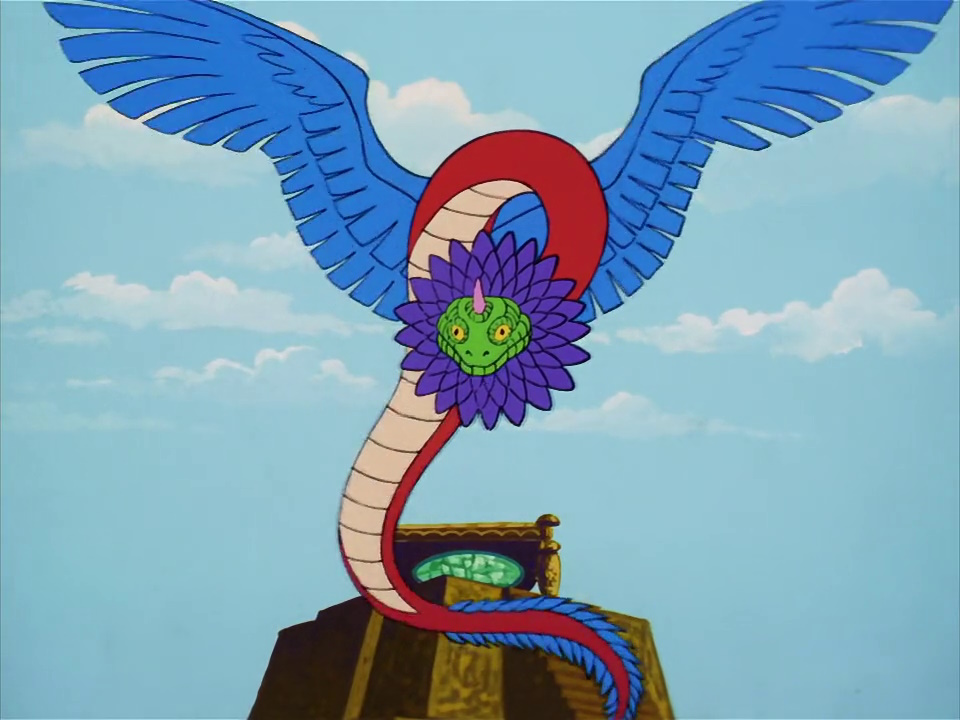
Kukulkan makes their appearance after Kirk solved the (easy) puzzle, but complains yet again that they have been forgotten. I like the design of Kukulkan – appearing as a colourful winged snake with a kind of mane or frill. I wouldn’t say the design was “intimidating” as it appears in the show, but I daresay if I came face to face with a real-life Kukulkan I’d be quite frightened! It was neat, at any rate.

Still frame from Star Trek: The Animated Series Season 2 (1974) showing Kukulkan.
Kukulkan.

Kirk and the others are then transported to a “zoo,” one populated by a number of other aliens and animals. Kukulkan’s convoluted explanation is that they’re the last member of a race that wiped itself out, and that they keep these creatures in cages, using technology to create “mental worlds” for them to inhabit. Dr McCoy is shocked that one of the creatures is a Capellan power-cat – an animal that’s notorious for hating being kept in captivity. The power-cat is adorable, by the way, and I won’t hear a bad word said about it.

Kirk argues that Kukulkan has no right to interfere with humanity or any other culture – but all this does is enrage them. Kukulkan hisses like a snake and seemingly attacks the crew, while back on the Enterprise Spock seems to have found a way out of the globe force-field. I wasn’t wild about Kukulkan’s explanation here; it seemed a bit basic. And it runs into the problem that other, similarly powerful aliens encounter in other stories: it should be clear that humanity has changed a lot over the centuries, growing, evolving, developing new technologies – and in this case, becoming more peaceful. Sure, the Enterprise fired phasers – but as Kirk points out, only in self-defence.

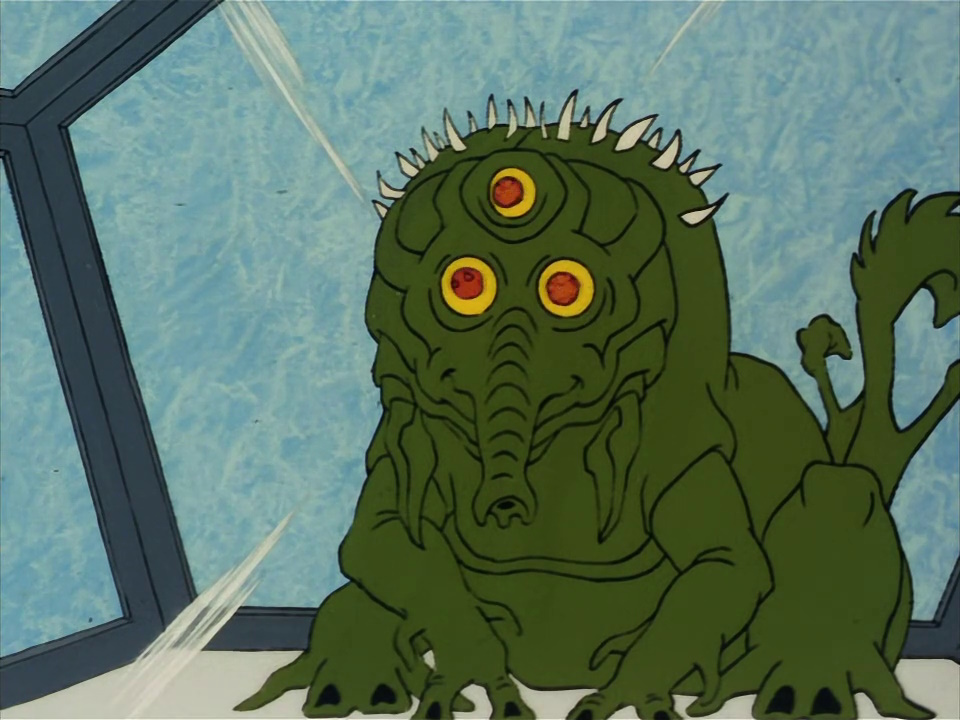
Still frame from Star Trek: The Animated Series Season 2 (1974) showing a three-eyed alien.
One of the alien animals in Kukulkan’s zoo.

Spock’s plan works – because of course it does! – and the Enterprise is able to break free from the trap. It’s always fun to see Arex in action on the bridge, and at the time this three-limbed alien could really only be created for animation. The Animated Series, in that sense, gave Star Trek a chance to branch out beyond the make-up and basic prosthetics of its original incarnation. Kukulkan is also a great example of this: live-action couldn’t really have made a similar-looking alien – not with the budget usually set for a single episode of Star Trek, at any rate!

After Bones and Kirk free the power-cat from captivity, it runs wild. Using its high-voltage fur(?) it threatens Kukulkan, whose ship’s power has been damaged following an attack by the Enterprise. Kirk intervenes, subduing the power-cat with a hypospray, demonstrating to Kukulkan that he doesn’t wish the entity any harm, despite the damage that has been caused.

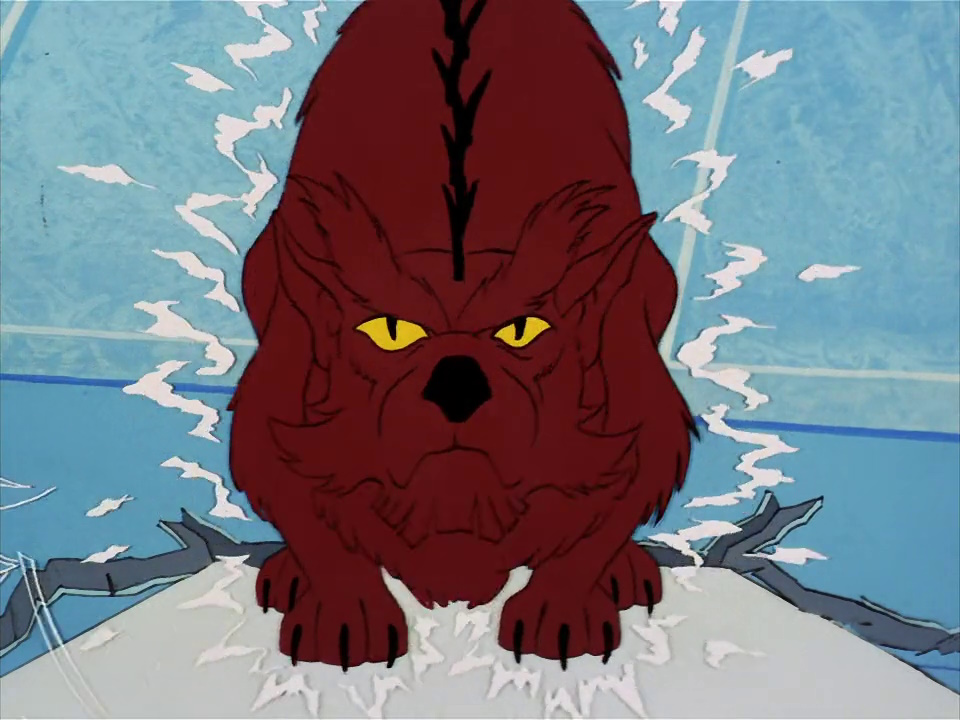
Still frame from Star Trek: The Animated Series Season 2 (1974) showing a Capellan power-cat.
The Capellan power-cat.

What follows is a fairly typical Star Trek dialogue, with Kirk and the others emphasising how much humanity has grown since Kukulkan visited centuries earlier. Kirk rejects the idea of being caged or led around like the animals in the zoo, and Kukulkan capitulates, realising that humanity no longer needs or wants to associate with them. I actually felt a bit sad for Kukulkan in this moment – their dreams of having sentient companions instead of just animals seemed to be shattered, and being told “we no longer need you” is just harsh to hear!

Kirk says that the price for Kukulkan sharing its knowledge was too high, and back on the Enterprise he and Spock ponder the implications of several of Earth’s civilisations having contact with this ancient alien – as well as the irony that, at the end of the day, Kukulkan was just lonely and seeking companionship. The danger averted, Kukulkan withdraws, and the credits roll.

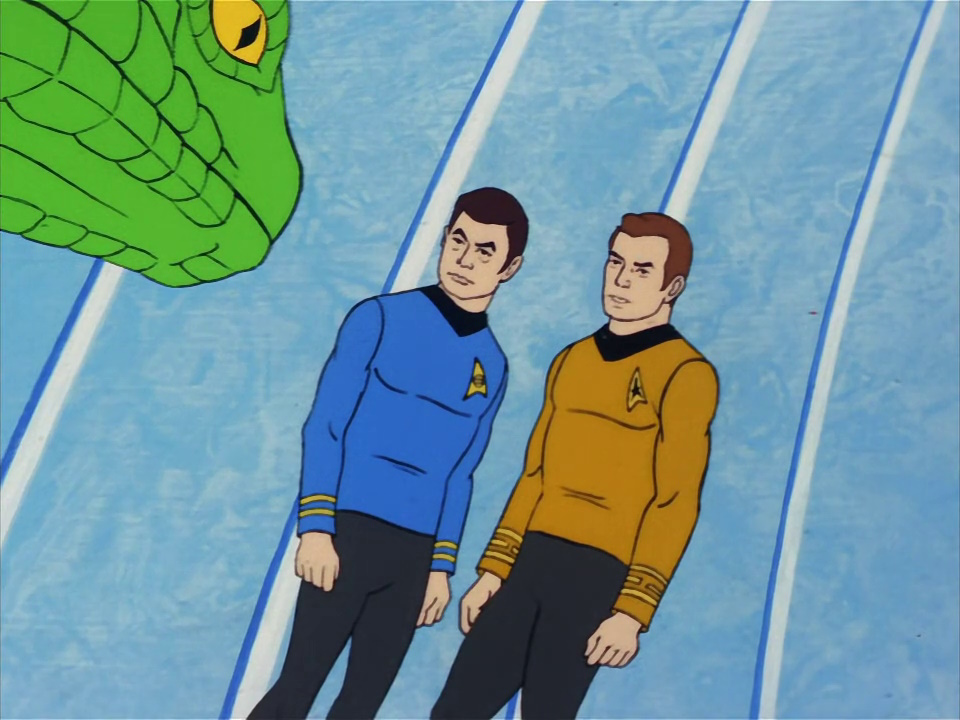
Still frame from Star Trek: The Animated Series Season 2 (1974) showing Kirk and Dr McCoy with an alien.
Kukulkan with Dr McCoy and Kirk.

All in all, this was a fun episode to re-visit. I adored the designs of Kukulkan’s ship and the entity itself, as well as some of the very alien critters in the zoo. The power-cat is something I’d love to see make a re-appearance in modern Star Trek; I can see it being a ton of fun to depict in live-action! But then again I’m a cat lover, so I suppose I would say that.

This was a story that felt very “Star Trek.” An ancient alien visited humanity in the past, and returns only to be disappointed with the war-like nature of humans. Kirk and the crew had to intervene to show that their perceptions weren’t entirely right, and that humanity has developed beyond the need for gods and deities. It’s far from the only episode to touch on themes like this – but something about the design of Kukulkan as this winged, dragon-like serpent, and its connection to real cultures like the Maya and Aztecs, gave the story some more depth. At the very least, Kukulkan stands out from the pack of Star Trek aliens with prosthetic noses and foreheads!

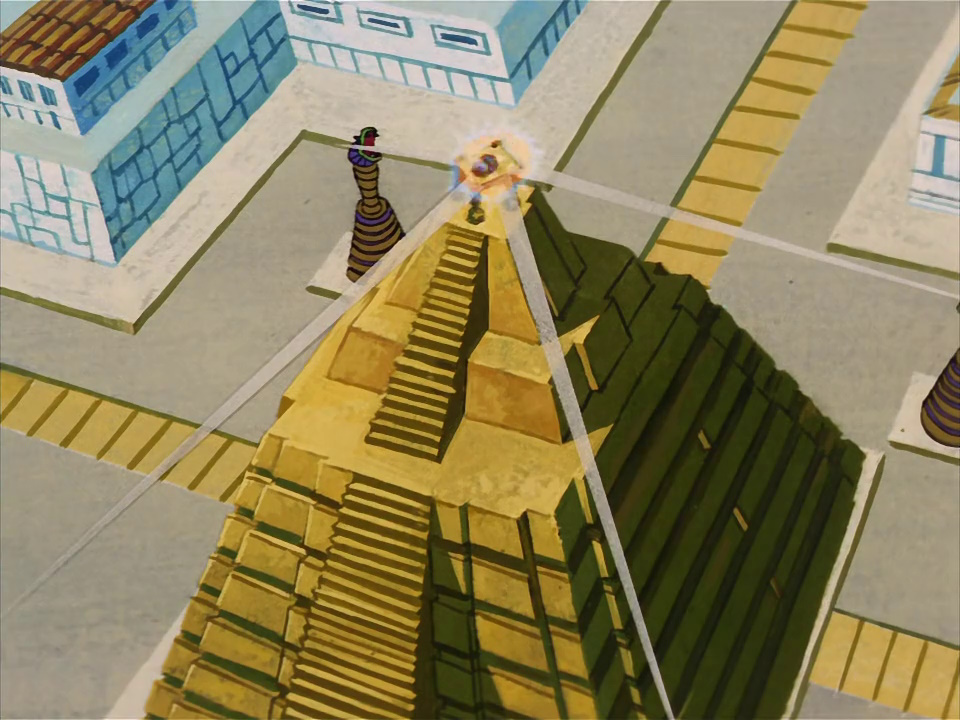
Still frame from Star Trek: The Animated Series Season 2 (1974) showing a pyramid.
Kukulkan’s pyramid.

As a bit of background, How Sharper Than a Serpent’s Tooth was submitted as the episode to be assessed when The Animated Series was nominated for a Daytime Emmy Award in 1975; the series would go on to win that award. It’s the only time a Star Trek show has won the award for “Best Series,” so this episode turned out to be quite influential! It also marks Spock’s 100th Star Trek appearance, and as noted above is the franchise’s 100th instalment.

It was a blast to go back to The Animated Series for the first time in years, and I’m glad that I got to mark the milestone anniversary of at least one of its episodes. Very few TV shows – and even fewer cartoons – can claim to have such a legacy half a century after their first broadcast, but The Animated Series really does occupy a unique place in Star Trek’s history. I hope you’ll join me in celebrating this fun show as we mark the fiftieth anniversary of the episode How Sharper Than a Serpent’s Tooth.

So which episode of The Animated Series should we look at next? I’ve always had a soft spot for the frankly bizarre episode The Magicks of Megas-Tu… a story that no other franchise would dare attempt, especially not nowadays! I’ve also never written a proper episode re-watch for The Original Series here on the website, despite being up and running for almost five years. We’ll have to rectify that one day, too. But for now, I hope you’ve enjoyed stepping back in time with me. And until next time: Live Long and Prosper!


Star Trek: The Animated Series is available to stream now on Paramount+ in countries and territories where the platform is available. The series is also available on DVD and Blu-ray. The Star Trek franchise – including The Animated Series and all other properties discussed above – is the copyright of Paramount Global. This article contains the thoughts and opinions of one person only and is not intended to cause any offence.
The classic Star Trek dilemma: Kirk or Picard?

Spoiler Warning: There are spoilers ahead for the following Star Trek productions: The Original Series and its films, The Next Generation and its films, and Picard Season 1.

“The only question I ever thought was hard / Was do I like Kirk, or do I like Picard?” So sang “Weird Al” Yankovic on his 2006 parody hit White & Nerdy. In those two lines, the comedy singer encapsulated a debate that has rumbled on in the Trekkie community since The Next Generation premiered in 1987! This is a question I’ve thought about many times, and today I’m finally going to put (metaphorical) pen to paper and lay out my thoughts on this classic Trekkie debate.

Though there have been at least a further six captains or protagonists who’ve joined the Star Trek franchise over the years – or more, depending on how you count things – the classic debate has always surrounded Picard versus Kirk, and I think that’s probably because the contrasts between the two characters and their approaches to leadership are so extreme. Most Star Trek captains who have followed embody elements of both Kirk and Picard’s styles of management and leadership while remaining distinct characters, but when it comes to the franchise’s first two captains, there seems to be a major clash of personalities.

Just like “Weird Al” did, we’re going to consider this difficult question!

My first contact with the Star Trek franchise was The Next Generation in the early 1990s. It was only later that I went back to watch The Original Series and its films, encountering Captain Kirk and his crew for the first time. The Next Generation made me a Star Trek fan, and while I can appreciate what The Original Series did and how entertaining it was, I just don’t have the same connection to it – or to any other Star Trek show, frankly – as I do to The Next Generation. So that’s my own bias stated up front as we go into this discussion!

I’ve always found this debate to be fascinating, but I try not to take it too seriously. Some fans can turn genuine and heartfelt passion into toxic or even aggressive negativity sometimes, attacking others who don’t share their precise views on the nature of Star Trek (or other franchises). Fandoms shouldn’t be a place for division, negativity, or toxicity; they should be a place where we can all come together to share something we love. It’s in that spirit that I enter this discussion – and I encourage everyone to keep in mind that all of this is subjective, and it’s supposed to be light-hearted fun!

So let’s get started, shall we? For reasons both alphabetical and chronological, Captain Kirk gets to go first!

The Case For Kirk

Captain Kirk in his first appearance.

Captain Kirk will forever be Star Trek’s first captain, and thus he should be the yardstick that Trekkies use to judge the successes of any subsequent captain – Picard included. Without Kirk, there would never have even been Picard – because there would quite literally have been no Star Trek. Just look at the failure of The Cage, the first pilot shot for The Original Series, as a case in point: Star Trek only became successful when Captain Kirk was in command.

But Kirk isn’t the best just because he was first. James T. Kirk is a man of action: a tough-talking, villain-punching, decisive commander who stops at nothing to get the job done and protect his ship and crew. He’s not above a bit of rule-breaking, either; when you’re alone on a mission of exploration far beyond Federation space, what’s the point in Starfleet orders or the Prime Directive?

Captain Kirk wasn’t above getting into a proper fight.

On board his ship, Captain Kirk made friends. He didn’t see his crew as mere underlings, but as people he actually liked spending time with. He even developed Star Trek’s first ever cross-species friendship, bridging the gap between emotional humans and stoic, logical Vulcans in the best way possible. His friendship and partnership with Spock became legendary – and frankly, Picard has no friends… or at least, he has no friendships that come anywhere close to matching the closeness between Kirk and Spock. This pair literally created the genre of slash fiction!

It wasn’t until the finale of The Next Generation that Picard was prepared to sit down with Riker and play a round of poker, but Kirk had those friendships from the start. His closeness with Spock has rightly become legendary, but he was also firm friends with Dr McCoy, Sulu, Uhura, Scotty, and even the young Chekov. Kirk’s crew would even risk their Starfleet careers to steal the USS Enterprise and follow him on a dangerous mission to the Genesis Planet in The Search For Spock.

Captain Kirk was loved by his crew… not grudgingly respected.

As Star Trek’s first captain, Kirk made first contact with many different races and factions – including practically all of the franchise’s best-known and most famous aliens. He also introduced us as the audience to races like the Vulcans and the Klingons – two of Star Trek’s most iconic alien races. It’s through Kirk’s eyes that we first came to perceive many of the franchise’s classic factions; he gave us his perspective and allowed us as the audience to meet these aliens through his interactions with them.

Captain Kirk developed rivalries with some of Star Trek’s biggest and most notorious villains. The Romulan commander from Balance of Terror, Garth of Izar, who went on to inspire an entire fan-series, Dr Tolian Soran in Generations, and even “God” himself in The Final Frontier. Most significantly, of course, Kirk found his arch-enemy in one of the greatest villains ever put to screen in the whole of cinema: Khan. Picard’s enemies simply aren’t in the same league.

“Khaaaaaan!”

Captain Kirk recognised the dangers of space travel, and he blazed a trail that Picard and others merely followed. He knew that it wasn’t going to be possible to find a negotiated settlement to every problem, and wasn’t shy about pulling out his phaser – and his fists – to settle disputes. Do you think Captain Kirk would have been bossed around by the Sheliak, or by the Edo and their Mediators? Or would he have punched those alien menaces in the face and told them where to shove it?

In conclusion, Captain Kirk is a bona fide action hero, a man’s man, and the embodiment of the very best of Starfleet in the 23rd Century. He would consider peaceful options where they were available, but wasn’t above punching aliens in the face when he needed to. He would go above and beyond for the sake of his crew, even being reduced in rank by Starfleet for having the audacity to save Spock. He saved Earth on many occasions – and even saved the life of his rival, Captain Picard, and the entire crew of the Enterprise-D in his final act before dying a hero.

The Case For Picard

Captain Picard in Encounter at Farpoint.

Let’s calm down, leave the toxic masculinity in the ’60s where it belongs, and let a grown-up take charge. Captain Picard is the Joe Biden to Captain Kirk’s Donald Trump – he’s level-headed, diplomatic, and professional. Captain Kirk may have been the archetypal action hero of the ’60s, but by the late ’80s, things had moved on. What fans wanted to see from someone in a position of authority was not someone who was quick to pull out their phaser or punch an alien in the face, but someone who could be diplomatic, courteous, and who could resolve situations without needing to resort to such barbarity. Embodying all of those traits was Captain Picard.

A new era of Star Trek not only needed a new face, but a whole new style of leadership, and Captain Picard delivered. If the 23rd Century had been the “wild west,” where anything was allowed and rules were made to be broken, the 24th Century saw Starfleet evolve and move beyond that. Civility could finally replace cowboys like Captain Kirk.

Captain Picard is a more civilised leader perfect for a new era.

Did Captain Kirk ever pilot his own ship? In the episode Booby Trap, we saw for ourselves just how skilled Captain Picard was, and how intimately he knew his ship. Where someone like Kirk would have ordered maximum warp until the power was drained, Picard and his crew came up with a complex solution, then executed it perfectly. Picard made the Enterprise-D dance like a ballerina; Kirk could never have done anything like that.

Where is Star Trek: Kirk? Oh, that’s right: they never made that series. But they did make Star Trek: Picard, such was the overwhelming response from fans to this wonderful character. 176 episodes of The Next Generation and four films weren’t enough – fans were eager for more Captain Picard, and thus he became the first character in Star Trek’s history to get a new show named after him. More than thirty years after we first met Captain Picard, new adventures with the character are still being created, with at least two more seasons of the show in production.

Captain Picard got his own spin-off show because fans love the character so much.

While Kirk may have had fun with some villains like Khan, he never had to stare down the biggest, most devastating threat that the Federation ever faced. Captain Picard beat the Borg… and he did it twice. He even survived being assimilated and was able to push through his Borg programming to give his crew a piece of vital information that ultimately saved Earth. In First Contact, Picard brought the Enterprise-E to the Borg’s second invasion attempt, saving the day in the 24th Century and then again in the past. Forget the Klingons, the Gorn, the Romulans, and the people on that weird planet who all pretended it was Chicago in the ’20s: Captain Picard fought and defeated the most dangerous threat that the Federation has ever encountered.

Captain Picard realised that he can be on good terms with those under his command, but that as the captain he has to put the needs of the ship first. In the episode Lessons, he learned first-hand that having close relationships with subordinates is difficult for any commanding officer, and maintaining a friendly but respectful distance from his crew – even those whose advice he relied upon – was necessary to keep everyone safe and to allow him to be able to make the tough calls.

Captain Picard and the crew of the Enterprise-D.

Captain Kirk got to make many first contacts – but he did so by default because he was first. Captain Picard actually made more first contacts than Kirk did – including with some very different forms of life. Whether it’s the Microbrains, the Exocomps, or the Q Continuum, Captain Picard was prepared to treat everyone he met with courtesy and respect, staying true to Starfleet’s mission of seeking out new life. But it doesn’t end there. Captain Picard introduced us as the audience to alien races like the Bajorans, Cardassians, and of course the Borg – and these would go on to be just as important to the Star Trek franchise overall as any of the aliens we met in The Original Series.

In conclusion, Captain Picard is a calm diplomat, the level-headed manager of a large crew, and the personification of the very best of 24th Century Starfleet. He guided his crew through some incredibly difficult and dangerous missions while maintaining his composure. He learned lessons about loss and grief that Kirk never had to learn. And he saved the lives of at least two of Kirk’s crew: Spock and Scotty. He also saved Earth from the Federation’s greatest threat, and even learned to perceive time in a non-linear fashion thanks to Q.

So Who Wins?

Kirk or Picard?

You’re going to hate me for this – but they both win. Everything I said above is true (in a roundabout, tongue-in-cheek way), but that doesn’t mean that one captain is better than the other! Like all of us, Kirk and Picard have strengths and weaknesses; things they do well and areas where they need to rely on others. There isn’t a definitive answer to a question like this, because the answer will always be “it depends on the circumstances.”

There are times when Captain Kirk’s approach to leadership is needed, and times when the way Picard approached a situation would lead to the best chance of success. As we saw in Generations, there was even a time when the only way to save the day was for both men to team up. The fact that each captain has his own set of skills and his own style of leadership isn’t a weakness – it’s a strength, one which benefits Star Trek as a whole.

Kirk and Picard meeting for the first time.

I mentioned in my introduction that subsequent captains have incorporated elements from both Kirk and Picard, and that’s because both men have so many positive, upstanding qualities that Star Trek’s writers were keen to give to new characters as the franchise has continued to grow. Kirk was always ready for action, but that never came at the expense of being thoughtful and considering non-violent solutions. And Picard’s diplomatic, polite style could give way to ordering his crew to “fire at will” when the situation called for it. Both captains are adaptable, able to rise to meet the needs of all manner of incredibly difficult situations – even if that meant setting aside their usual ways of doing things.

No one can doubt Kirk or Picard were absolutely dedicated to their ships and crews, either. They may have shown that dedication in slightly different ways, and they may have expressed their appreciation and love for their friends and crewmates in different forms as well, but both of them were quite literally willing to lay down their lives and go down with the ship if necessary. Both men ultimately lost their ships – the original USS Enterprise and the Enterprise-D were both destroyed. But they both bounced back to take over new commands and go on to even greater things.

There are times when I’m in the mood for watching Captain Kirk get into a fist-fight with a Gorn or for seeing his epic stand-off against Khan. And there are moments where I want to see Picard use diplomacy to win an argument with the Sheliak or watch him wrangle with one of Q’s puzzles. But there are also times where I want to see Picard grab his phaser rifle and kick some Borg butt, and times where I can think of nothing better than seeing Kirk solve a scientific mystery like that of V’Ger. Both captains have given all of us so much enjoyment and entertainment over the years that I simply can’t crown one of them a winner and leave the other a loser. To me, they’ll always both be winners.

The Star Trek franchise – including The Original Series, The Next Generation, and every episode and film mentioned above – is the copyright of ViacomCBS. This article contains the thoughts and opinions of one person only and is not intended to cause any offence.
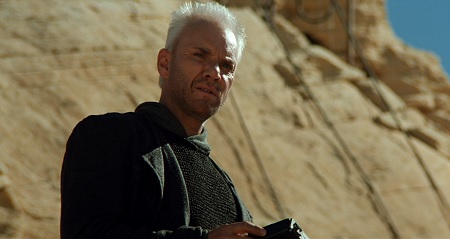
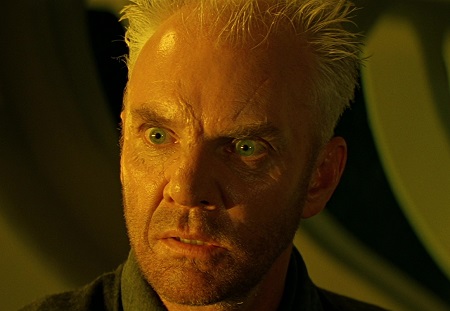
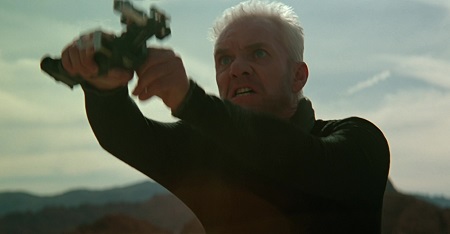
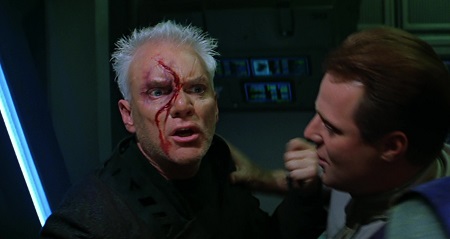
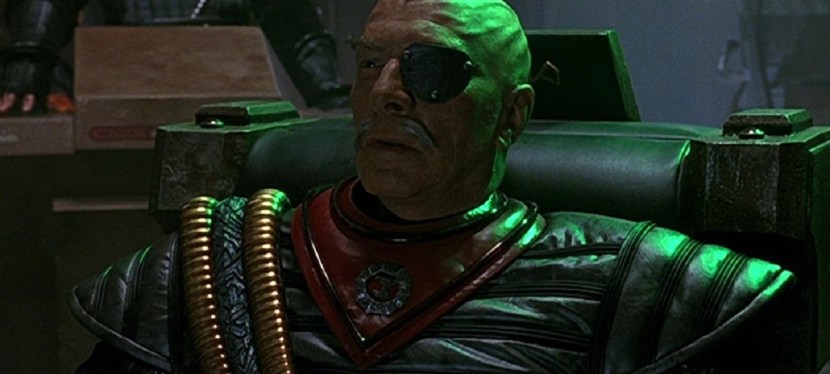
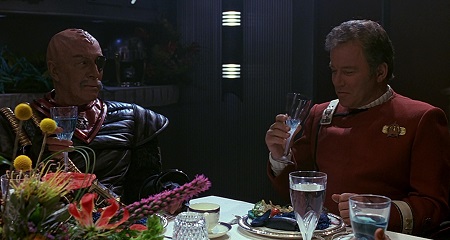
Great Star Trek villains: Dr Tolian Soran

Spoiler Warning: There are spoilers ahead for Star Trek: Generations. Minor spoilers may also be present for other iterations of the Star Trek franchise.

The Star Trek franchise has featured some absolutely terrific villains across its fifty-five year history. Characters like Khan, Gul Dukat, the Borg Queen, and many, many more have gone on to play significant roles in the franchise, cranking up the tension and drama while giving fans someone to truly despise. One of my all-time favourite Star Trek villains comes from what may – controversially – be my favourite Star Trek film: Dr Tolian Soran from Star Trek: Generations. It’s this character that I want to talk about today.

Although their motivations are very different, I feel that Dr Soran fills a similar role as an adversary for Captain Picard specifically as Khan did in The Wrath of Khan for Captain Kirk. Khan was motivated by vengeance and hatred for Kirk in particular, whereas Soran sees Picard as little more than a bump in the road on the way to completing a scheme he’s worked on for decades, so there are clear differences, yet in their two films the characters play similar adversarial roles for Star Trek’s first two captains.

Dr Soran in Star Trek: Generations.

One of Dr Soran’s lines has stuck with me ever since I first watched Generations in the cinema in 1995 (which is when the film was released here in the UK). The line is this: “Time is the fire in which we burn.” Delivered with menacing clarity by actor Malcolm McDowell, Soran’s view of time as an all-consuming fire is dark, yet beautifully poetic at the same time. Though Captain Picard would argue against this notion at the end of the film, the line, and the way it was delivered, is permanently etched in my memory. At times, it has been a motivating factor in my life, which may seem strange for a line delivered by a villain! As I said last November when I commemorated this website’s anniversary, the notion that time was catching up to me was one of the motivating factors I had in setting up my website and writing about Star Trek and other topics.

What I love most about the fire analogy is the way in which it describes the one-way flow of time. When an object is burned in a fire, an irreversible reaction takes place at the molecular level, and no matter how much we might regret burning something or wish we could undo a disastrous fire, doing so is impossible. The same is true of time – going back in time, changing the past or reliving a moment isn’t possible. (Except when Star Trek does time travel episodes, but that’s a different subject altogether!)

“Time is the fire in which we burn.”

Although Soran was an obsessive, desperate to get back to the Nexus, his philosophical side shines through at several key moments in the story, and the way this side of his character comes across elevates him. No longer a one-dimensional villain with a singular purpose, Soran is a thinker, someone who has an understanding of the world and his place in it. His interpretation of the world, or rather his reaction to it, may be extreme, but nevertheless the mere existence of this deep-thinking aspect of his character makes him feel a lot more significant and a lot more well-rounded. Soran has clearly considered the implications of what he’s doing, even if it means sacrificing millions of lives for his own benefit.

The attacks of September 11th, 2001 brought religiously-motivated terrorism to the fore in a way that was new for many people in the western world. Yet even before then, the idea of sacrificing one’s life in order to reach paradise, or heaven, had been a significant force. Soran’s quest to reach the Nexus at any cost can be seen through this lens; a dangerously obsessed man willing to do whatever it takes to reach his version of paradise.

The desperation etched on Soran’s face shows how obsessed he had become with returning to the Nexus.

At the same time, the Nexus storyline rebuffs the idea of religion in general, at least insofar as Soran is concerned. If Soran believed in an afterlife – a belief which is not uncommon even in Star Trek’s 24th Century – then his quest to re-enter the Nexus wouldn’t make sense. He could be comforted by the belief that the afterlife would be just as good, if not better than, what he experienced there. The fact that Soran is a scientist and he’s chasing an interstellar energy ribbon that is observable and definitely exists (within the confines of the story, of course) seems to pour cold water on the idea of Soran as a religious fundamentalist; his desire to reach the Nexus is based on his own experience of the phenomenon, and not simply on the nebulous concept of “faith.”

Star Trek’s history with religion is complicated. The Original Series once showed a “chapel” aboard the USS Enterprise, and in Deep Space Nine Kasidy Yates claimed her father was a minister, so human religion definitely still exists in the 24th Century and the franchise hasn’t tried to erase it. At the same time, however, Star Trek has often tried to offer alternative explanations for gods, miracles, and other religious experiences. The Final Frontier depicted the “god” at the centre of the galaxy as a beligerent alien. Q fills a similar role on occasion in The Next Generation. The Prophets in Deep Space Nine are noncorporeal aliens. And so on.

Star Trek has frequently looked at other explanations for things like the afterlife. (Pictured: Q in Tapestry).

So if the Nexus represents heaven or the afterlife for the sake of Soran’s story, it’s still a scientific and secular take on the concept. Soran isn’t like Sybok, a man on a mission with faith at its core. He’s a scientist, trying to solve a scientific puzzle. The fact that it has religious comparisons is neither here nor there for him; he sees the Nexus as his one shot at paradise.

Though we don’t see anything on screen of Soran’s life prior to his encounter with the Enterprise-B, given what happened to the El-Aurians and Generations’ focus on Picard’s family, there are the building blocks to see Soran through a semi-sympathetic lens if we’re so inclined. The Borg destroyed or assimilated the El-Aurian homeworld, and during the attack they killed Soran’s family, including his wife and children. When Picard visits the Nexus, he sees a version of the life he could have led, as did Kirk. What Soran sees in the Nexus – and what he wants so desperately to recapture – is his family. At a personal level we can understand and even empathise with that, even if it doesn’t come close to excusing his actions.

Soran immediately after being beamed aboard the Enterprise-B.

A villain that we as the audience can relate to is something the best stories manage to have, and a villain who isn’t simply evil for the sake of it also makes for a much more satisfying and fulfilling narrative. Soran ticks both of those boxes. We could even argue that Soran isn’t “evil” in the strict sense of the word; he’s merely uncaring and ambivalent to the lives of others due to his single-minded dedication to his quest.

For Trekkies, Soran is perhaps most significant and best-remembered for being the character who killed Captain Kirk. Star Trek’s first captain carried the torch for the franchise for more than two decades prior to the inception of The Next Generation, and while characters like Scotty, Spock, Dr McCoy and others all had their fans and their moments in the spotlight, Kirk was the most significant character from The Original Series. His death in Generations arguably marked the end of an era, and the definitive passing of the baton from one set of characters to another.

Soran is responsible for Kirk’s death – a seminal moment in the history of Star Trek.

Though we have since had a version of Captain Kirk back in the Kelvin timeline films, and Star Trek has of course returned to the 23rd Century with Discovery and Short Treks, the death of William Shatner’s Kirk is an incredibly significant moment in the history of the franchise. While it’s true that Star Trek had already moved beyond The Original Series by 1994 thanks to The Next Generation, Deep Space Nine, and the gentle yet clear ending to The Undiscovered Country, there was still a sense that any of the main characters could return – something epitomised by the return of Spock in Unification and Scotty in Relics. Captain Kirk did get the chance to make a triumphant return to the franchise – but doing so led to his death.

Kirk’s death is clearly a hugely emotional moment, especially for Trekkies who’d been with the franchise since the beginning. But his sacrifice stopped Soran and prevented the deaths of millions, as well as the deaths of the crew of the Enterprise-D. Even though the film doesn’t really acknowledge his death in this way, he died a hero.

Soran’s scheme brought Kirk and Picard together.

It was Soran’s scheme that killed Kirk, but it also brought Captains Kirk and Picard together. Between them they had to figure out a way to prevent Soran going through with his plan, and thus Soran became the unintentional catalyst for what has to be one of my favourite moments in all of Star Trek. Marvel films have shown that a good team-up story can be emotional and exceptionally fun, but putting together two of the most significant characters in the entire Star Trek franchise? It’s a moment that’s very hard to beat even more than 25 years later!

Without Soran, none of this would have come to pass. While we may lament Captain Kirk’s death, in a franchise that runs as long as Star Trek and where the in-universe timeline spans centuries, characters are eventually going to die. Maybe Captain Kirk would have preferred a quiet retirement, but as a satisfying story beat, making the ultimate sacrifice in order to save the lives of millions and a crew of Starfleet officers could not be more quintessentially Kirk.

Soran was a fantastic villain in Generations.

I find Dr Soran to be an absolutely fascinating character in his own right. But more than that, he’s responsible for perhaps the most ambitious crossover that the Star Trek franchise has yet attempted, and brought together Captains Kirk and Picard for an amazing adventure in a truly excellent film.

It’s hard to pick a fault with the way Soran was brought to screen, too. Malcolm McDowell put in an outstanding performance that was intense and riveting to watch. Even Soran’s lighter moments, such as his conversations with Geordi and the Duras Sisters, have a distinct edge to them. McDowell makes it clear with every syllable and every movement that Soran doesn’t care about any of them or their goals, and would hurt or kill them in a heartbeat if they got in his way. He comes across as a powerful, intimidating adversary thanks to this no-holds-barred approach.

So that’s about all I have to say, really! I find Dr Soran to be one of Star Trek’s most compelling villains.

Star Trek: Generations is available to stream on Paramount+ in the United States, and is also available on Blu-ray and DVD. The Star Trek franchise – including Generations and all other properties mentioned above – is the copyright of ViacomCBS. This article contains the thoughts and opinions of one person only and is not intended to cause any offence.
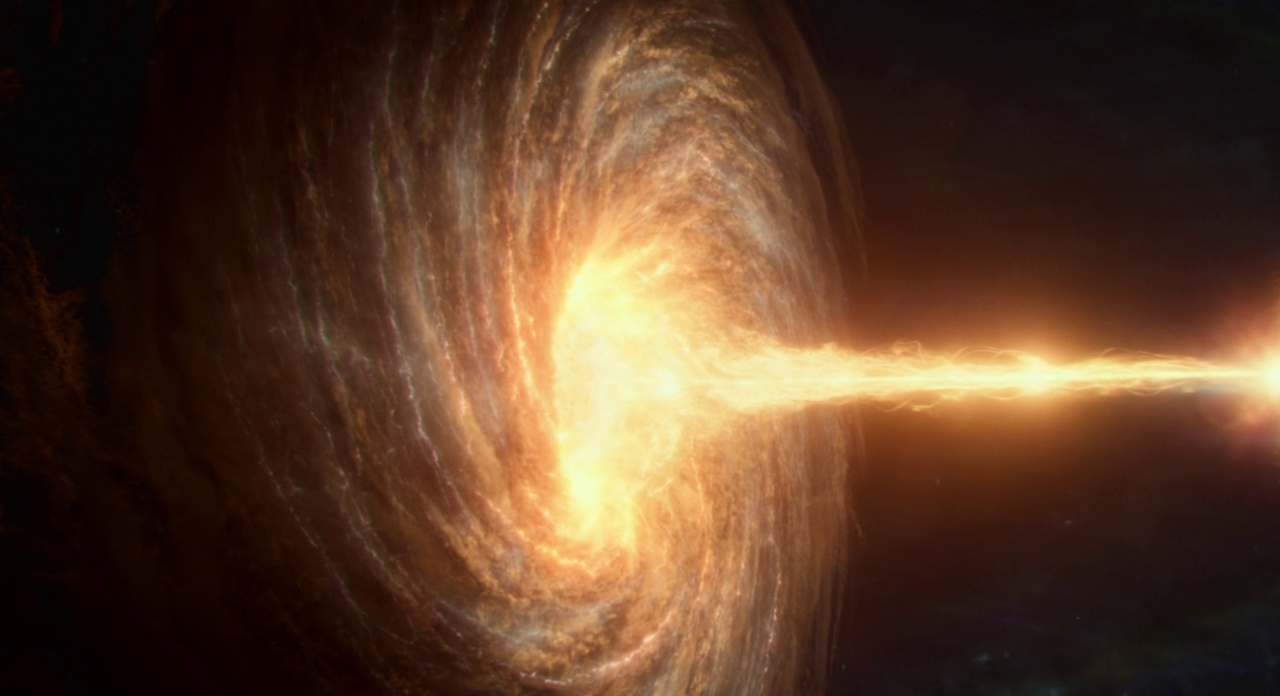
Great Star Trek villains: General Chang

Spoiler Warning: There are spoilers ahead for Star Trek VI: The Undiscovered Country.

The Star Trek franchise sometimes lucks out on getting a wonderful guest star to jump aboard. Some of these guest stars are relative unknowns; actors and actresses who aren’t household names, but nevertheless gave wonderful, memorable performances. On the other hand, there are a handful of actors and actresses who join Star Trek when they’re already very well-known, either because they’re longstanding fans or because they were offered a once-in-a-lifetime role.

Christopher Plummer, who played General Chang in Star Trek VI: The Undiscovered Country, was firmly in the second category; an established, renowned star. Plummer sadly passed away yesterday at the age of 91, and I thought it would be nice to take a look at his single Star Trek role, as well as pay tribute to this legend of stage and screen.

Christopher Plummer (1929-2021)
Picture Credit: 20th Century Fox, Public domain, via Wikimedia Commons

Christopher Plummer had a long career, first appearing on television in his native Canada in 1953. He continued to act well into his 80s, and among his final roles were the 2019 film Knives Out and a Canadian television show called Departure which was broadcast that same year. To Star Trek fans, Plummer is iconic for his role as the eyepatch-wearing Klingon General Chang in 1991’s The Undiscovered Country, where he faced off against fellow Canadian William Shatner’s Captain Kirk.

Plummer’s love of Shakespeare was incorporated into the story of The Undiscovered Country – the title of which is itself a quotation from the Great Bard. Chang would go on to quote Shakespeare numerous times throughout the film, appearing all the more villainous for it! There’s something about Shakespearean language that makes for a menacing antagonist.

General Chang and Captain Kirk share a glass of Romulan Ale aboard the Enterprise-A.

General Chang was one part of a broader conspiracy to prevent the Klingons and Federation achieving peace – a metaphor, in 1991, for the end of the Cold War. The Klingons had been conceived during The Original Series as the “Russians” to the Federation’s “Americans,” so it was certainly fitting to bring them into a storyline like this.

To continue the analogy, Chang represents the hard-liners – Soviet military leaders who could not conceive of the end of their dominance and place in the world. A few months before The Undiscovered Country would hit cinemas, a number of such men attempted a coup in the Soviet Union. This was the final roll of the dice from the old guard to preserve Soviet communism and wrench control away from the reformer Gorbachev; the Soviet Union would be formally dissolved in December of that year.

Chang appears on the Enterprise-A’s main viewscreen shortly after the assassination.

Perhaps it’s because of how timely the story was that General Chang made such an impact on Star Trek. The franchise has often looked at the real world through its sci-fi lens, but few stories managed to be as relevant or as timely as The Undiscovered Country was in 1991. The end of the conflict between the Klingons and the Federation represented the end of the Cold War, the explosion of Praxis and its fallout can be seen as an analogy for the Chernobyl nuclear disaster, and General Chang and Captain Kirk are the respective “old soldiers” from either side who must overcome the way they feel.

Kirk succeeded where Chang could not in that regard, and The Undiscovered Country gave him a meaningful character arc in a way few prior stories had. But Chang’s role is just as interesting, as he represents the many people on both sides of the conflict who were unable to find a way to live in peace. He was a foil for Kirk; a dark reflection of where Kirk’s own biases and mistrust could have led. Chang’s philosophy was that it was better to die in battle than live peacefully with one’s enemies – and he got his comeuppance for it.

Chang during Kirk’s trial on Qo’noS.

But having an interesting real-world message isn’t the only thing that makes Chang’s story so much fun. As I’ve said before, pushing too hard on that front can sometimes lead to a story or character being less entertaining! Instead, Chang was a truly interesting villain for the Star Trek franchise; a Klingon whose motivations were steeped in the concept of honour that his warrior people hold so dear.

Chang’s Klingon Bird-of-Prey could fire its weapons while cloaked, making it a uniquely challenging vessel for Kirk’s Enterprise-A and Sulu’s Excelsior during the climactic final confrontation. This battle, along with the Battle of the Mutara Nebula in The Wrath of Khan, draws on inspiration from war films set aboard submarines, with Kirk and Sulu trying to outmanoeuvre and outthink their unseen opponent.

General Chang’s Bird-of-Prey could fire while cloaked.

During Kirk and McCoy’s trial on Qo’noS, Chang was a powerful advocate for the prosecution, insisting they be convicted for the assassination of Klingon Chancellor Gorkon – an act for which he and his co-conspirators were, in fact, responsible. Star Trek has shown numerous times that it’s a franchise capable of some great moments of courtroom drama, and this was absolutely one of them! Chang shouting at Kirk that he shouldn’t wait for the universal translator was pitch-perfect acting.

A complex villain, whose motives were to continue a conflict that he could simply see no way of bringing to a peaceful end, General Chang is absolutely one of the most interesting and entertaining antagonists in all of Star Trek, and is up there with Khan as one of the best ever faced by Kirk and The Original Series’ crew.

Christopher Plummer had a long and varied career, one which touched many different genres and styles of acting, and endeared him to generations of audiences. His one moment in Star Trek was not his defining role – and is not the headline in most of his obituaries in mainstream news outlets today – but I firmly believe it showed what he was capable of at his best: a classic Shakespearean actor capable of transitioning to a wholly new genre. He will be missed.

Star Trek VI: The Undiscovered Country is available to stream now on CBS All Access (soon to be rebranded as Paramount+) in the United States, and on Netflix in the United Kingdom and elsewhere. The Star Trek franchise – including Star Trek VI: The Undiscovered Country – is the copyright of ViacomCBS. This article contains the thoughts and opinions of one person only and is not intended to cause any offence.
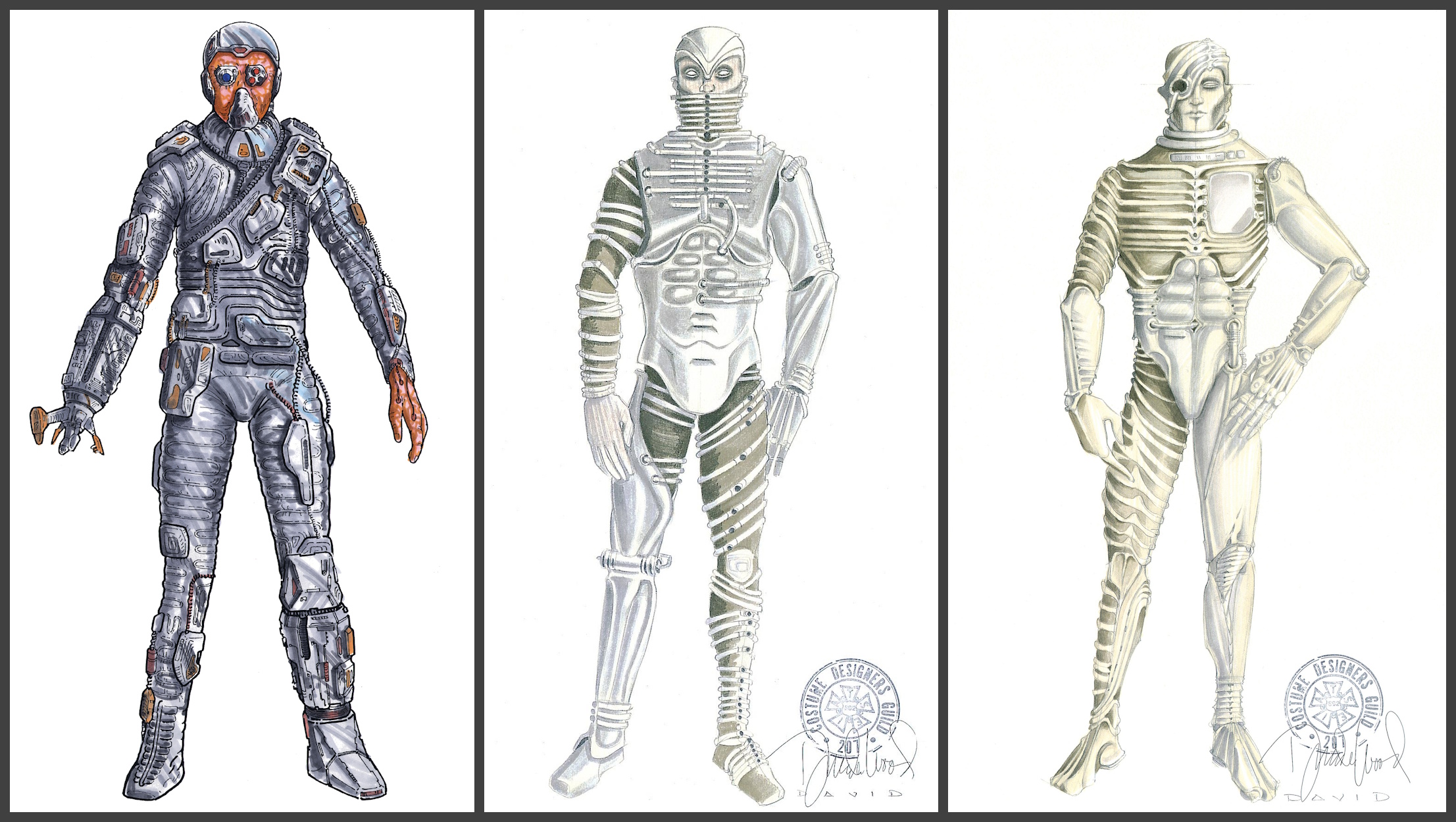
Aliens of Star Trek: The M-113 Creature

Happy Star Trek Day! Today marks fifty-four years since the first episode of The Original Series aired on American television, kicking off a franchise which is still going strong today. The Man Trap featured an alien called the M-113 Creature, but you may know it by its unofficial name: the Salt Vampire!

The early production history of Star Trek is complicated! After The Cage – the show’s original pilot – wasn’t picked up by network NBC, a second pilot was commissioned. This was very unusual, and rumours abound as to what happened. Gene Roddenberry and co. went away to work on a new pilot, and what resulted was Where No Man Has Gone Before. The new pilot dropped most of The Cage’s characters – only Spock would be retained – and reworked the series. It ultimately led to Star Trek being greenlit, and the show was picked up for a full season. Several episodes were filmed, including The Man Trap, and when NBC came to deciding the order in which the stories would air, it was selected as the premiere as its story was considered easier to follow by the executives at the network.

Happy 54th anniversary to The Man Trap… and to Star Trek!

So that’s a potted history of how The Man Trap came to be Star Trek’s first episode, despite the fact it wasn’t filmed first! The episode would see the crew take on a nefarious alien which was the last of its kind: the M-113 Creature.

I’m going to go out on a limb and say that I really like the design of the creature and the special effects used to pull it off. The heavy rubber suits used for some of The Original Series’ aliens and creatures have a distinct aesthetic, but it’s one I think really works. The suits were very cleverly and lovingly designed, and compared to a lot of contemporary special effects have held up remarkably well over the decades. I’d even compare these kind of practical effects very favourably to lots of digital effects and CGI; no one will ever convince me that Enterprise’s CGI Gorn looks better than The Original Series’ rubber suit!

I think this Gorn still looks pretty good in 2020!

Though the M-113 creature was only seen in its true form very briefly, the same kind of special effects brought it to life in a horrifying way, yet with a unique look that is now emblematic of the Star Trek franchise. Many people who are only dimly aware of Star Trek would recognise the M-113 Creature and be able to identify it as a Star Trek alien; in that sense the creature is up there with races like the Borg and Klingons as being iconic.

It’s been great to see a couple of recent references within Star Trek to the M-113 creature. It appeared in Ephraim and Dot – an animated episode of Short Treks that aired back in December. And just last week we caught a glimpse of the M-113 Creature in Cupid’s Errant Arrow, the fifth episode of Star Trek: Lower Decks. These fun little “Easter eggs” to Trekkies were greatly appreciated, and serve as a reminder of Star Trek’s origins all these years later.

The M-113 Creature seen in Ephraim and Dot…
…and again in Cupid’s Errant Arrow.

Though the creature the crew of the Enterprise encountered in The Man Trap was said to be the last of its kind, it’s arguable that may no longer be the case. Being mentioned in Lower Decks could be seen to imply that further M-113 Creatures have been discovered later in the 23rd and 24th Centuries, so we may not have seen the last of this iconic villain.

Nicknamed the “Salt Vampire” because of its ability to extract all of the salt from its victims, the M-113 Creature was a shapeshifter, able to take the form of other species, including humans. It also seems to have been sentient – able to mimic human behaviour and even hold in-depth conversations and form relationships.

The M-113 Creature was able to assume many forms.

Though distinct from later shapeshifting races – most notably the Founders of the Dominion – the M-113 Creature was the first such alien encountered in Star Trek. We’ve since seen a number of others, all of which owe at least a little something to their predecessor from The Man Trap. The concept of a shapeshifter is frightening, and that aspect has been used to great effect in several Star Trek stories.

The M-113 Creature also possessed several other abilities that made it a formidable adversary: it could telepathically sense the minds of sentient life forms – including humans – and use what it found to choose its appearance. This kind of tactic allowed it to get close to its prey and get them to let their guard down. It was also capable of paralysing people in order to get close to them when in its true form, and was incredibly physically strong – far more so than humans and Vulcans.

The M-113 Creature in its true form.

In The Man Trap, the sole surviving M-113 Creature (that we know of) took the form of Nancy Crater, a woman Dr McCoy had known; “that one woman”, as Captain Kirk put it. It lived with Crater’s husband, Robert, on the planet M-113 for a number of years. It was speculated that there had once been a civilisation of M-113 Creatures, but that the majority had gone extinct when the planet’s supply of salt was used up. Robert and Nancy Crater led an archaeological expedition to the world, encountering what could be the last survivor of the race.

Despite possessing some degree of sentience, it wasn’t possible for the crew of the Enterprise to reason with the M-113 Creature that they encountered, and it was killed by Dr McCoy while attempting to feed on Captain Kirk. If it were possible to negotiate with it – or others of its race – Starfleet could have provided the aliens with a supply of salt in exchange for peace. Perhaps such a story could be included in a future episode of Star Trek!

The M-113 Creature after being killed by Dr McCoy.

Despite its monstrous appearance and villainous role in the story, the death of the M-113 Creature in The Man Trap is a sad occasion. Potentially the last of its kind, the entire race and everything they had created now seems lost to history. Starfleet aims not only to seek out new life, but also to find ways – where possible – to peacefully coexist. It’s ironic, considering subsequent Star Trek stories, that the first encounter with an alien ended with its death!

But in a way, the aftermath of the M-113 Creature’s death is what established Star Trek as being more than just typical mid-century B-movie sci-fi fare. It took an emotional toll on Dr McCoy to kill what he thought was his long-lost love, and it took a toll on Kirk and the crew to have killed off the last member of a species. But as the Enterprise prepares to leave orbit, Kirk, Spock, and McCoy gather on the bridge and remember the creature in what was a very poignant moment.

The crew of the Enterprise at the end of The Man Trap.

It’s moments like this, across The Original Series’ early episodes, that set up Star Trek as being something special. There was more to the story of the M-113 Creature than just a horrible monster for our heroes to outsmart. That story was emotional and complex, bringing up issues of morality that other television series and films struggle to get across even today.

Star Trek offered – and continues to offer, fifty-four years later – much more to its audience than just exciting space adventures. This is why the franchise has endured so long, and it all began on the 8th of September 1966 with The Man Trap and the M-113 Creature.

Star Trek: The Original Series is available to stream now on CBS All Access in the United States and on Netflix in the United Kingdom and other countries and territories. The series is also available on DVD and Blu-ray. The Star Trek franchise – including The Original Series and all other properties listed above – is the copyright of ViacomCBS. This article contains the thoughts and opinions of one person only and is not intended to cause any offence.
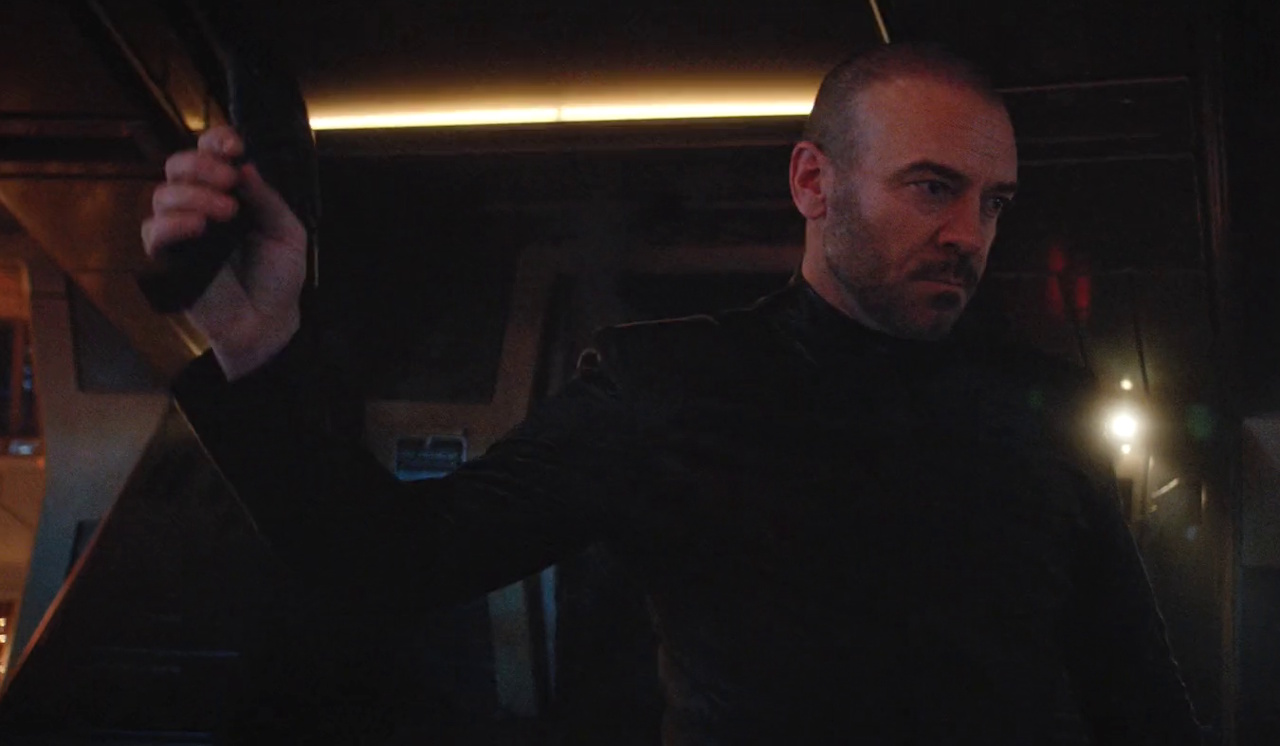
Will we see William Shatner back as Captain Kirk?

Spoiler Warning: There may be minor spoilers ahead for the Star Trek franchise, including the most recent seasons of Star Trek: Discovery and Star Trek: Picard. There will also be major spoilers for the film Star Trek: Generations.

There has been some buzz lately in Star Trek fan communities about something William Shatner said in a recent interview. To make a long story short, Shatner said that he’d be interested to return to his most iconic role, provided it was more than a mere cameo.

I don’t really like commenting on these types of stories. There were many in the run-up to the release of Star Trek: Picard, when practically everyone who had once been a main cast member in a Star Trek series was asked whether they’d be up for a return. People like Robert Picardo and LeVar Burton got some attention for their comments, as did others, but they were all saying basically the same thing, which was some variant of this: “I’d like to do it, but there hasn’t been any formal discussion with ViacomCBS about it.” Well… that could apply to anyone. Aside from very few individuals who seem to want nothing to do with the franchise any more, practically every ex-Star Trek star would – for the right price, of course – be up for a return.

William Shatner as Capt. James T. Kirk in The Original Series second-season episode The Trouble With Tribbles.

So why has William Shatner’s comment blown up the way it has? I’m honestly not sure. In the aftermath of 1994’s Star Trek: Generations, Shatner co-wrote a series of novels – his first set in the Star Trek universe. In these books, Kirk – who you’ll remember died in Generations – was resurrected by Borg-Romulans and would go on to live in the late 24th Century. As a statement of intent from the actor that Kirk could be resurrected somehow, a published series of novels is about as clear as it gets! Shatner has been willing to reprise his role ever since he last played Kirk in 1994. It shouldn’t come as a surprise that he still is.

As things stand right now, I don’t see it happening. The first and biggest reason why is that it would be incredibly difficult to do in-universe. Kirk is dead. He died in Generations, and even with all the technobabble at Starfleet’s disposal, there’s no way around that. Star Wars has learned to its great cost that the resurrection of long-dead characters can go over incredibly poorly, feeling like nothing but cheap fan-service and a blatant nostalgia play, and frankly there’s no way to resurrect Kirk without those same issues rearing their heads.

The second “Shatnerverse” novel, The Return, saw Kirk brought back to life.

The only way Shatner could reprise the role of Kirk would be as an alternate-universe version. And that has problems too. The first is which parallel universe this version of Kirk would inhabit. With the production of a fourth Kelvin timeline/JJverse film unclear at best, it seems very unlikely he could appear there. There had been rumours in the run-up to Star Trek Beyond that Shatner might join former co-star Leonard Nimoy for a role, with both older actors appearing as future versions of that timeline’s Kirk and Spock. With Nimoy’s death, that element of the film never happened – if indeed it was ever going to.

Could Shatner appear as another character, though? In my opinion, for whatever that’s worth, this would be the only way to include him in any new Star Trek production. He could be, just as an example, the grandfather of a young Ensign or Lieutenant Kirk. But it would be hard to make a role of this kind anything more than a cameo, which is something Shatner has said he wasn’t interested in.

Killing off Kirk in Generations was a big decision, and it wasn’t without controversy at the time – though in the days when most people weren’t online and there was no social media, those criticisms were less widespread! But it was undeniably a final end for the character, and there simply isn’t a sensible way to bring him back in his original, Prime Universe form. Frankly, it would be disrespectful to ask William Shatner to play a minor role or to make a cameo appearance, and I understand why someone of his calibre and with his unique standing in the Star Trek community would feel that way. But all of this means that there really isn’t a way to bring him back.

Capt. Kirk was killed at the end of 1994’s Star Trek: Generations.

The final point I’d make is this: Star Trek is doing okay at the moment. CBS All Access is still in a very competitive market in the United States, but it’s clear as day that recent Star Trek projects have been at least somewhat successful, or we wouldn’t see the continued investment in the franchise that ViacomCBS has been willing to make. A second season of Picard is happening, a third of Discovery is happening, and there are two new live-action shows that have been announced, one that’s in early development that hasn’t been announced, and two animated shows too, one of which already has a two-season order. With all of this going on, I just don’t see a need for Kirk to be shoehorned in.

The obvious comparison is Palpatine in The Rise of Skywalker, which I alluded to above. That film had a number of issues – as I noted in my review – but what it boiled down to was that Star Wars as a brand has found itself unable to escape the characters and storylines of its original trilogy. We see this across Star Wars, from the prequels to the sequels and the spin-offs. The entire franchise revolves around its original incarnation, as no one has really been bold enough yet to take it in a new direction. As such, when JJ Abrams needed a powerful villain for The Rise of Skywalker, he fell back on the original “big bad”: Palpatine.

Star Wars tried bringing back a long-dead character… and look how well that worked.

Star Trek, in contrast, has long since moved on from Capt. Kirk – something which has been obvious since 1987, when The Next Generation premiered and showed that the franchise could be more than its first captain and crew. And Star Trek has only grown since then. Discovery may overlap slightly with Kirk’s era, but that’s all it is: an overlap. Strange New Worlds will share that setting, but again, it’s not a story that’s as tied up with The Original Series in the same way as Star Wars’ ongoing saga is with its original trilogy. Star Trek may have started with William Shatner’s Capt. Kirk in the 1960s, but it doesn’t end there, not by a long shot. As a result of that point alone, there just isn’t any need for Kirk to come back. As a fan of The Original Series I can admit it would be a cute nod and wink to fans to find a way to bring Shatner in – but no more so than it would be to see Robert Picardo or LeVar Burton, or any of the other 30 or more actors who once played a main role in a Star Trek show.

Speaking more broadly, any franchise has to be careful when looking backwards. One of the things I was concerned about with Star Trek: Picard is that it could end up trying to be Season 8 of The Next Generation – something which it simply never could be. As fun and nostalgic as it can be to see classic characters return, if that’s all that a story offers it will never be a success. There has to be something interesting, entertaining, and dramatic to drive the plot, and any new characters we meet along the way have to be part of that. Spending too much time looking backwards means there’s no time to look forwards, and that’s unfair to any new cast members. They deserve at least a chance to become fan favourites for a new generation of Trekkies, the way William Shatner and others were fan favourites for the first generation. Stories can be drowned out by nostalgia, with new characters left underdeveloped and sidelined. While it can be done well, as I’d argue Star Trek: Picard demonstrates, it can also be done poorly as we’ve seen in recent years.

Star Trek: Picard brought back Sir Patrick Stewart to the franchise.

So do I think we’ll see William Shatner back in Star Trek? I would never say “never”, but at the moment I think it’s unlikely. With his character having been killed off more than two decades ago, and with the franchise standing on its own two feet just fine without needing to continually return to The Original Series for ideas, it’s hard to see where there’s a place for him to make a major contribution. If he wanted to do a cameo I think that could be fun, but as he’s made clear that isn’t something he’s up for – which is perfectly fair enough – it’s hard to see any Star Trek writer going out of their way to create a role especially for him, or to find some convoluted and inevitably controversial way to un-kill Kirk.

There will always be these kinds of comments from actors. It’s understandable, given that Star Trek has made a big return to our screens, that journalists and fans will ask anyone who’d been involved with Star Trek in the past if they’d be willing to come back. And it’s understandable for someone of Shatner’s pedigree to say he’d only do it if he could be given a decent-sized role. But none of it actually means anything, because if the people in charge of Star Trek over at ViacomCBS were genuinely interested, they’d have reached out to him. That’s why I tend not to comment on these kind of stories.

The Star Trek franchise – including all properties mentioned above – is the copyright of ViacomCBS. This article contains the thoughts and opinions of one person only and is not intended to cause any offence.
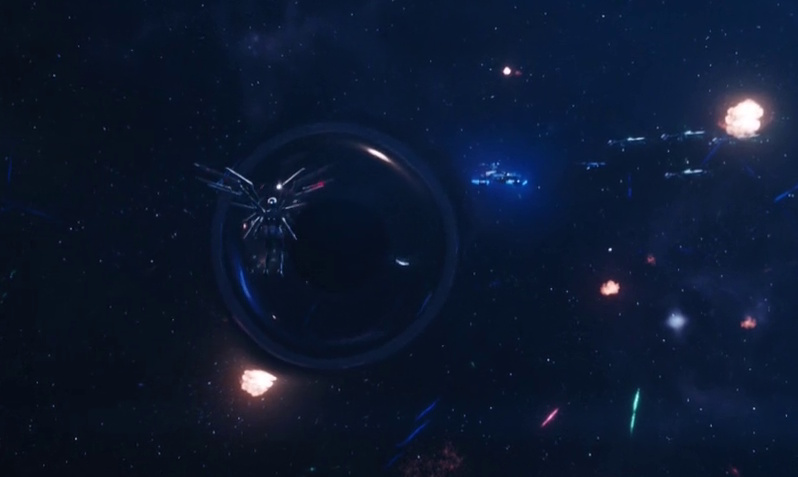
Looking back at Star Trek: The Motion Picture on its 40th anniversary

Spoiler Warning: There are spoilers ahead for Star Trek: The Motion Picture and other iterations of the Star Trek franchise.

On the 7th of December 1979, ten years after going off the air (and five years since The Animated Series went off the air), Star Trek was back. Star Trek: The Motion Picture premiered, and while it has been overshadowed in many ways by its sequel, Star Trek II: The Wrath of Khan, the film was a success – albeit not an overwhelming one according to distributors and producers – and reinvigorated the franchise. Make no mistake, if it weren’t for The Motion Picture, Star Trek as we know it wouldn’t exist today – there would’ve been no Wrath of Khan, and from that there’d have been no Next Generation or any future series or film. In a very real sense, The Motion Picture paved the way for the franchise’s future, and the success Star Trek enjoys today owes a lot to this film.

The Motion Picture was a risk for Paramount Pictures. Star Trek had shown that it had a number of very vocal fans – the letter-writing campaign in 1968 to get the series renewed demonstrated this – but its wider popularity was an unknown quantity, especially on the big screen. Reruns of The Original Series had garnered a larger audience than its 1966-69 original run, but there were still question marks over whether to make a new television series or to go down the box office route.

Star Trek: The Motion Picture turns 40 in December 2019.

Indeed, the project that would eventually become The Motion Picture started out life as Star Trek: Phase II, a television series that was to reunite the original cast – without Spock – for another five-year mission onboard the Enterprise. After a project called Planet of the Titans failed to get off the ground in the mid-1970s, by 1977 Phase II was officially in production. It has been said many times that the success of another 1977 project – Star Wars – is what led Gene Roddenberry and Paramount to reconsider the television series and make a film instead. While there is undoubtedly a kernel of truth to that, there were other factors at play too. The script which would eventually become The Motion Picture was originally set to be the pilot episode for Phase II but after a series of revisions and discussions between the creative team and the studio, the decision was made to enter production as a film instead, and two versions of the script were submitted – one by Gene Rodenberry and one by Harold Livingston, who’d been a producer on Phase II. Livingston’s script was chosen (by Michael Eisner – future CEO of Disney) and Star Trek: The Motion Picture was officially greenlit.

As an interesting aside, Phase II remained officially “in production” even after the decision was taken to switch focus to a film, and for much of 1977 the official line from the studio was that a series, originally set at 13 episodes, was being produced. It wasn’t until 1978 that the film would be officially announced.

Concept art of the bridge of the Enterprise that was created for Phase II.

So that’s a brief potted history of how it came to be. But despite making around $139 million on a budget of $46 million, Paramount considered the film a disappointment. The big risk had paid off, but not as much as they’d hoped. The expensive special effects and continued revisions to the script even during production were cited as reasons why, as was the less action-heavy, more ethereal storyline.

For me personally, it’s the lack of action and the deliberate slow pacing that gives this film something that others lack – a sense of “Star Trek-ness”. Star Trek was always into the weirder, more esoteric side of science fiction, especially prior to The Motion Picture, and this film stands alongside episodes of The Original Series as a pure science fiction work, not an action-sci fi film like The Wrath of Khan or First Contact. While some people might find its slower pace to be a grind, to me it makes it akin to watching a feature-length episode of the series, rather than just another action flick.

Leonard Nimoy, director Robert Wise, Gene Roddenberry, DeForest Kelley, and William Shatner during production on The Motion Picture.

Because of the overwhelming popularity of The Wrath of Khan within the fanbase, The Motion Picture often gets a bad rap. People have said that “all of the odd-numbered Star Trek films are bad”, including The Motion Picture in with Search for Spock and The Final Frontier. Both of those titles have good and bad moments – the latter suffering perhaps from too much involvement from William Shatner – but to me, The Motion Picture is in a different league.

Some criticism of the film is that it feels like a two-and-a-half hour episode of The Original Series. But why should that be a criticism? The Motion Picture masterfully builds up its drama – the V’ger cloud’s attack on the Klingons, its destruction of the Epsilon IX station, and finally the death of new character Ilia all add to the stakes. While none of these are particularly dramatic, nor gory, that doesn’t detract from the threat, it heightens it. V’ger is shown to be a being of such incredible power that it can make whole fleets of starships vanish in a heartbeat. We don’t need huge explosions or a punch-out to learn this. V’ger’s power is also confirmed by the reaction of characters. So as the film progresses, we know what’s at stake.

Kirk and the away team encounter V’Ger.

To change lanes completely, I happen to really like the aesthetic of The Motion Picture. It’s very 1970s in some ways – the orange and brown tones, and some of the uniform choices in particular, but that’s not necessarily a negative thing. Kirk’s uniform as an admiral happens to be one of my all-time favourite Star Trek uniforms. The high collar, the belted tunic, and the simple curved lines in grey and white combine with a metallic gold Starfleet insignia to make an understated yet interesting uniform. I’m not a cosplayer by any means, but if I ever were to make myself a uniform, that would be the one I’d go for. And while we’re talking about things that look great, the sweeping shot over the Enterprise when Kirk is being taken aboard by shuttlepod is absolutely perfect. Combined with an amazing score – for which composer Jerry Goldsmith was nominated for an Academy Award – the full sequence is one of the most inspiring and moving in all of Star Trek, speaking for myself as a fan. When the music ramps up right as we see the Enterprise from the front for the first time, it can be quite emotional. I could happily watch that sequence over and over again.

Many of the sets built in 1978-79 were in continuous use (albeit in modified form) right through to Enterprise‘s cancellation in 2005. Some of the reuses are quite apparent in The Next Generation, so in that sense, the design choices made in The Motion Picture carried through the next two decades of Star Trek as a franchise. The panelling and angles on corridors in particular can be seen on the Enterprise-D and the USS Voyager, and the idea of a warp core as a large upright glowing tube is also something that has carried on right through Star Trek – even cropping up in CGI form in the most recent of the Short Treks episodes. Much of what we consider to be “Star Trek” in terms of aesthetic has its roots not in 1966 but in 1979 – future productions built on what designers and artists had created here. The Next Generation and Voyager in particular owe significant parts of their design to The Motion Picture.

Some of these sets would be in continuous use – albeit with tweaks here and there – until Enterprise’s cancellation in 2005. They defined the “look” of Star Trek.

The storyline of The Motion Picture is certainly different from many science fiction outings. It isn’t a film about defeating and destroying an enemy, it’s a film about bridging the gulf and communicating with a new form of life. V’ger, set up to be the film’s antagonist, wanted to evolve – to merge physically with its creator. The crew of the Enterprise could’ve used that moment of weakness to attack it, and maybe even destroy it – and in a different film perhaps that would’ve been the finale. But The Motion Picture builds up to this moment, and it isn’t the death and vanquishing of a foe that we see, but communication, and ultimately the creation of new life. Klingons, Romulans, Cardassians, and the like may be fun to see on screen, but Star Trek is all about “seeking new life” – and what could be newer and more different than a hyperevolved, massively intelligent machine?

This side of Star Trek, though, has always been more of a niche product. When fans are asked about their favourite films, The Wrath of Khan and First Contact are usually somewhere up near the top, as well as episodes like The Best of Both Worlds, or DS9’s The Way of the Warrior. These are all action-heavy stories, and while Star Trek has enough room for both these and the slower-paced, thought-provoking ones, The Motion Picture falls firmly into the second category. With that comes being underrated and overlooked by fans who prefer more action-oriented stories.

Robert Wise, William Shatner, Leonard Nimoy, Gene Roddenberry, and DeForest Kelley at the film’s premiere.

When Spock describes V’ger as being little more than “a child”, he sets the stage for understanding, and from that, communication. The ultimate revelation that V’ger was, in fact, a probe of human origin was truly unexpected. The Motion Picture had an incredibly ambitious story which sought to blend these elements together. The cyclical nature of a returning spacecraft, the massive differences that almost certainly will exist between humankind and anything we might encounter in outer space, and at the heart of it all, the returning characters – not all of whom had enough to do, arguably. But the core dynamic between Kirk, Spock, and McCoy was still there. Perhaps The Motion Picture needed more fine-tuning, and perhaps its scope was too vast for a single film to properly encompass, but as a story it makes you stop and think. The galaxy isn’t just going to be humanoids, there are going to be things out there completely beyond our understanding. And the choices we make today – like probing outer space – may have consequences well into the future that we could never foresee.

As an inspirational message, I think that can’t be understated. Seeking out new life and new civilisations – the raison d’être of Starfleet – isn’t always going to be smooth sailing. But if we’re willing to look at things from a different point of view, to listen, to understand, and to communicate, we can find a way to coexist even with someone who seems to be big and threatening. I know the real world doesn’t always work that way, but Gene Roddenberry was always about showing us how humanity can be better than we are in the present day. Speaking personally, I find that aspect of The Motion Picture to be inspiring. As a work of science fiction, that’s the kind of message I admire and what I’d like to see more of on our screens.

Above all, The Motion Picture relaunched the Star Trek brand for a new decade, one which would culminate in The Next Generation and a return to television. If it weren’t for this film, Star Trek would look very different today – if it even existed at all. We can argue about which Star Trek film we like best, and at the end of the day it’s always going to be a subjective choice, but I’d definitely rank The Motion Picture highly on any list. Not just for what it did for the franchise, though that is incredibly important, but as a work of science fiction that wasn’t afraid to tell a thought-provoking story.

Star Trek: The Motion Picture is available to stream now on Paramount Plus in the United States, the United Kingdom, and other countries and territories where the platform is available. The film is also available to buy on DVD and Blu-Ray. Star Trek, Star Trek: The Motion Picture, and all other Star Trek properties mentioned above are the copyright of Paramount Global and/or Paramount Pictures. This article contains the thoughts and opinions of one person only and is not intended to cause any offence.