


Spoiler Warning: There will be spoilers ahead for Et in Arcadia Ego, Part 2, and for the entirety of Star Trek: Picard Season 1. There may also be spoilers for other iterations of the Star Trek franchise.
I’m in two minds about Et in Arcadia Ego, Part 2. On the one hand, the entire second half of the episode was incredibly emotional, with hit after hit after hit that left me in tears. But on the other hand, much of the first half of the episode followed on directly from Et in Arcadia Ego, Part 1 and was a waste of space.
I think overall, I stand by what I said in my review last week: that many of the story points in this two-part season finale were rushed and underdeveloped. Et in Arcadia Ego, Part 2 had, at points, the same issue of blitzing through potentially interesting story beats, and the disappointing thing isn’t that any of the storylines were bad, it’s that they had potential to be so much more than they were. Despite the second half of the episode going a long way toward redeeming the entire two-part finale, I think when the dust settles and I’m thinking more clearly and less emotionally, the overall picture will be, at best, mixed. There just wasn’t enough time remaining for many of these points to be fully explored, and realistically that meant that either some story threads needed to be cut entirely, or the season needed another couple of episodes to explore them fully.
Where the second half of Et in Arcadia Ego, Part 2 succeeded was that it slowed down, and the rushed pacing, the jumping between storylines, and the obviously-cut down scenes did largely abate. This gave way for a more emotional story to develop and play out over several slower, touching sequences, which brilliantly played on elements of the story that had been spread out over the preceding nine episodes – beginning right back in the first episode of the season, and indeed the first sequence of the first episode.
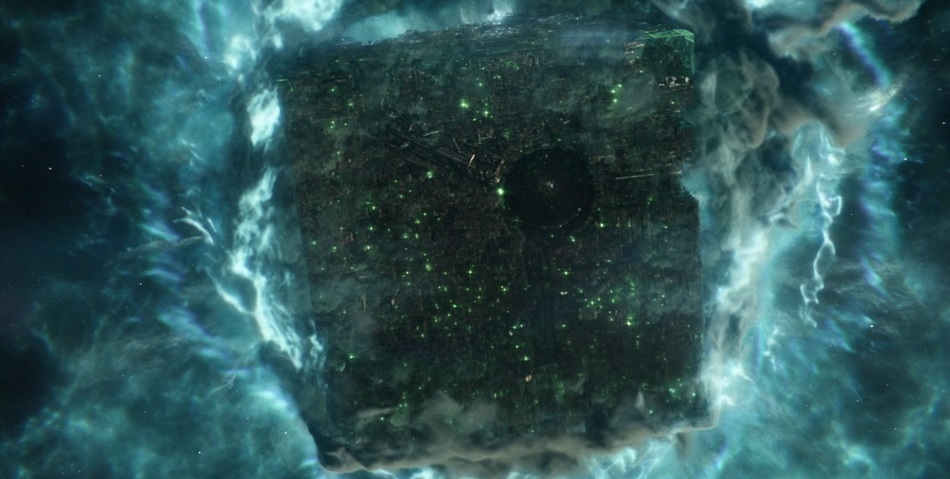
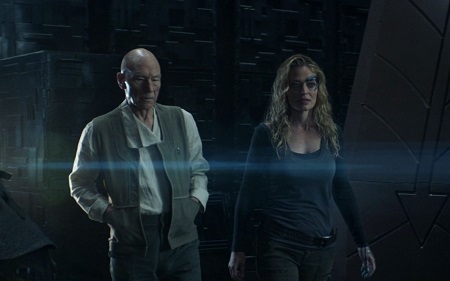
But we’re getting ahead of ourselves. Et in Arcadia Ego, Part 2 begins right where Part 1 left off last week, where Sutra let Narek escape and locked Picard up. Narek travels to the Artifact’s crash site and manages to sneak aboard, passing Seven of Nine, Elnor, and a handful of xBs who seem to be working on repairing the crashed vessel. The establishing shot of the Artifact was actually really pretty, and the closest the planet of Coppelius or Ghoulion IV came to not looking like California for the whole episode.

Narek is searching for something on the Artifact when Rizzo appears from nowhere and surprises him. I’ve mentioned several times that Rizzo has grown on me as a character in her appearances over the course of the season. Her transformation from an uninteresting and one-dimensional villain into an actual fleshed-out character has been great to see, and it’s hard to imagine the story of Star Trek: Picard’s first season without Peyton List’s occasionally over-the-top performance. Seeing Rizzo and Narek reunited showed us that they were real people underneath it all, and given it was almost sure to be Narek’s last meeting with his sister, their hug was strangely touching. After being attacked by the xBs at the end of Broken Pieces, I’d assumed Rizzo had beamed over to one of the Romulan ships near the Artifact, but it seems that she remained aboard during its short-lived mission to Coppelius and survived the crash-landing. I hadn’t expected that – partly because it wasn’t communicated clearly, it must be said – so it was a surprise to see her. But we did get to see a brief moment of vulnerability and emotion from Rizzo – in that moment, she was genuinely relieved, happy, and even slightly overwhelmed to see Narek, and that moment played out perfectly.
The next scene has to be one of my least-favourites. Not for its dialogue, which was a conversation between Picard and Soji as he tries to convince her to try things his way instead of following Sutra, but for the editing. The best moments with Picard, both in this series and in his previous Star Trek appearances, have been a combination of what he said and his presence while saying it. With this scene cutting away from Picard and Soji in large part, with what should’ve been one of his trademark speeches heard only in voiceover, something significant was missing that made the words he said far less impactful to us as the audience. We needed to see Picard as well as hear him for his speech to have its full effect. And back to what I said at the beginning, this feels like a consequence of both parts of the finale having just too much to cram in to two episodes. Before the opening titles, the episode needed to show this conversation, as well as convey – through Dr Jurati seeing it firsthand – the construction of the beacon that Sutra planned to use to contact the “Mass Effect Reapers”. Instead of there being enough time for both scenes, they ended up smashed together, with the voices of Picard and Soji on top of Dr Jurati silently watching the beacon. For me it simply didn’t work, and both scenes were the worse for being amalgamated.
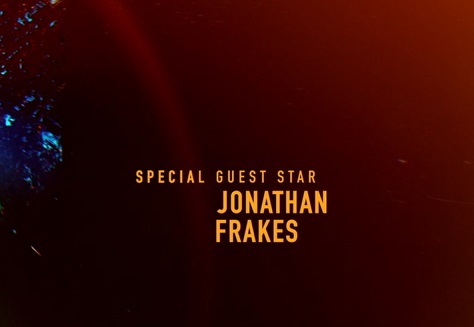
The opening titles once again ruined the surprise appearance of a character. For the third time this season, an actor’s name was included which telegraphed the arrival of a character whose appearance was supposed to be unexpected: this time it was Jonathan Frakes, who reprised his role as Riker. What was the point of that? In all three cases where this has happened – Seven of Nine in Stardust City Rag, Dr Soong in Et in Arcadia Ego, Part 1, and Riker this time – the appearance of the character was treated in the episode as a surprise. Everything from the camera work to the music built up the suspense of who we were about to meet – yet the opening titles had already spoilt it. Riker’s appearance at the head of Starfleet’s armada was supposed to be something that would make the audience go “wow!”, but instead it was telegraphed ahead of time, so the arrival of his fleet and then seeing him in person when he hailed the Romulans had lost the crucial element of surprise. I just do not understand this decision. How hard would it have been to credit Jonathan Frakes at the end and leave Riker’s appearance a genuine surprise? It was poor, and it detracted from what should’ve been one of the episode’s more powerful moments. It was still nice to see Riker on screen and back in uniform – we’ll deal with that scene in more detail later – but it was such a shame that it wasn’t the surprise it should’ve been.
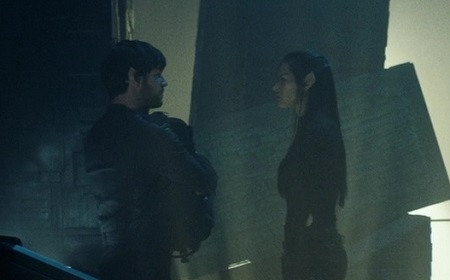
After the opening titles we see why Narek went to the Artifact – among the many things the Romulans didn’t have time to evacuate were a set of bombs, and he plans to use them to destroy the orchid-ships before the Romulan fleet arrives. This is a pretty tense scene in contrast to his reunion with Rizzo, as we see that there’s still tension between them and they’re of unequal status – despite being very shaken by recent events, Rizzo is still the superior officer. She really doesn’t have a choice in letting Narek go, as there are two jobs to do – destroying the orchids and activating the Artifact’s weapons – and two of them. Narek called himself a “Zhat Vash washout”, and clearly his history with the secretive organisation is complicated. We’d seen a couple of hints at that in earlier episodes, but nothing as major as what we got here. Unfortunately, as with many points across the two-part finale, it was left undeveloped. Narek has had multiple appearances across Star Trek: Picard’s first season for this aspect of his background to be explored, and given that we’re less likely to see him return for Season 2 than anyone else at this point, I would have thought that if the series wanted to properly explore his Zhat Vash background that this would’ve been the last opportunity. As it is, we got a couple of throwaway lines about Narek and Rizzo’s family: their parents, apparently, died as a result of working for the Zhat Vash, but again, how or why is not explained in any detail. Narek and Rizzo part for what would be the final time.
Out of all of Star Trek: Picard’s villains, the dynamic between Rizzo and Narek was by far the most interesting. As brother and sister there’s always going to be an element of sibling rivalry to what they’re trying to do, and Rizzo made clear in every scene together where the power lay in that dynamic. They played off each other well, with Rizzo pushing Narek to the brink of mutiny at times. But throughout it all, his commitment to the cause never wavered, and was stronger than both his fear of and disdain for Rizzo, as well as his clear feelings for Soji.
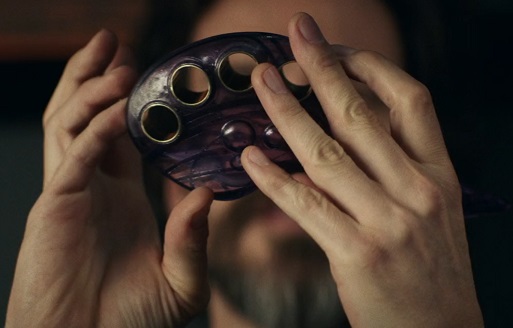
Technology in Star Trek has always been flexible to suit the needs of the story, and I appreciate that’s something that has happened going back to The Original Series. Even with that caveat, I didn’t like like the magical do-anything macguffin that’s used in the next scene by Raffi and Rios to fix La Sirena’s engine. It strayed too far into the realm of magic for me, especially with its “just believe it will work” spiel. While we’ve seen similar things in Star Trek before, and perhaps in some contexts it could’ve worked, it just felt forced at this moment; a way to send Raffi and Rios on a mission to La Sirena so they could be there for other story elements to unfold, but done in such a way that they didn’t need to spend more than thirty seconds fixing the engine – which they went back to do.
In fact, at several points in Et in Arcadia Ego, Part 2 did I get this feeling that the story was being forced down a particular path. Scenes would be included not because they fit the natural flow of the story, but because they either looked “cool” from a visual standpoint, or because they moved characters around to get them to be in the right place for other things to happen. In this example, Raffi and Rios had to leave Coppelius Station – under the guise of fixing La Sirena, they were moved out of the way so Picard could be apprehended, and placed in the right location for Narek to find them later, so they could plan their (stupid) attack on the synths’ beacon. It all felt just a little too much like it was driven by a room full of writers, and not a natural way for the characters to go. We’d also see the attack I mentioned be done in a very stupid way to get the plot to a specific climax, as well as the campfire scene with Narek which will come later as other examples of characters being forced into specific situations which didn’t really make sense in the context of the episode. It was constructed in such a way as to allow the plot to unfold, and unfortunately we’re supposed to just brush off some of the contrivances to make it happen.
While we’re talking about contrivances, I can’t wait any longer to talk about Star Trek: Picard Season 1’s big plot hole. I’ve been flagging this up for several weeks as a potential issue, and unfortunately it was left unresolved at the end of the season. So a plot hole is what it’s become: why was Maddox on Freecloud? Finding Bruce Maddox was the driving force behind the first half of the season’s story, and when Picard finally encountered him on Freecloud, he made it very clear that the reason he was there, and had put himself in danger by contacting Bjayzl, was because his lab had been destroyed by the Tal Shiar. With nowhere else to go and no one to turn to, he went to see Bjayzl as a last resort – and ended up paying for it with his life. Yet Maddox’s lab clearly wasn’t destroyed. He wasn’t kicked out by Dr Soong and the synths, who continued to speak very highly of him. If he’d set up a lab elsewhere that had been destroyed, he could’ve returned to Coppelius. And as it sits right now, there’s no reason for Maddox going to Freecloud other than “because plot”. And that’s a mistake – Maddox was such an important figure, especially in those early episodes, that the reason he put himself in danger should have been given a proper explanation. It’s disappointing that the story and the season have ended with this gaping hole left unexplained.
After Raffi and Rios have used the magical macguffin, we get a scene with Dr Jurati and Dr Soong. At the end of last week’s episode, Dr Jurati had promised to aid the synths – but this was clearly a ploy to avoid being locked up and to be able to help Picard. I liked the dynamic between Soong and Jurati – he clearly hates her for killing Maddox, yet he needs her help. And his barely-contained loathing breaks the surface in the way he talks to her, as Brent Spiner delivers the lines in a style not dissimilar to how he portrayed Lore in The Next Generation. Again, though, as with too many points in the finale, this didn’t really have time to properly develop, and this scene between them, and one brief moment last week, is all the time they had alone together.
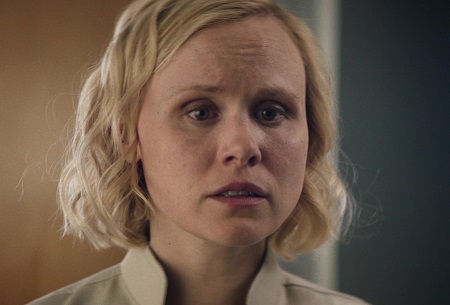
Both Brent Spiner and Alison Pill delivered amazing performances with the limited material they had – I especially liked Dr Jurati’s “I’m not their mother, asshole” line – but I would have liked to have seen more of this relationship. There was the potential for it to go from bad to worse, then for the two of them to form a hate-filled unlikely alliance, before finally coming to terms with what happened. Dr Jurati had been essentially brainwashed by Commodore Oh, and they had both lost someone they cared about in Maddox – I would have liked to see that explored some more, especially because the on screen presence and chemistry the two actors had was definitely one of the finale’s high points.
Back at La Sirena, Narek has arrived and is trying to get the attention of Raffi and Rios by throwing rocks. He shows off his grenade collection and insists on meeting with them. At the meeting, Elnor arrives – we’d seen him following Narek as he left the Artifact. Speaking as we had been of two characters who loathe one another, Elnor and Narek feel that even more strongly. Elnor’s anger at Hugh’s death was on full display, but everyone had to stow their feelings as they discussed the synth problem. Narek is still in Zhat Vash mode, seeking out allies for his mission to blow up the synths’ ships. Staying with the theme of parts of the story being rushed, Raffi and Rios’ decision to believe him almost straightaway wasn’t great. While it was nice to see Narek finally interacting with someone other than Soji or Rizzo – the only two characters we’d seen him spend any significant time with – it came too late in the story to really have much impact, and like other points in the finale, was rushed. Narek really didn’t have to do much at all to convince the others that the synths – who they’d just met and were on friendly terms with – were a galaxy-ending threat, and they didn’t consider any other possibilities for why they couldn’t contact Picard at Coppelius Station other than Narek’s reasoning that the synths were jamming their commuications. It’s just another part of the finale where more time was needed – time to allow the three non-Zhat Vash characters to come around to Narek’s way of thinking. As it is, it felt like an instant turnaround – 180 degrees from trying to save the synths to trying to blow up their ships and beacon.

At the beginning of Stardust City Rag, we got a fairly brutal scene where Icheb has his eye torn out. The graphic sequence was shown in full, and it was grotesque but at the same time it was something that as the audience, we couldn’t look away from. In the next scene in Et in Arcadia Ego, Part 2, Dr Jurati takes the eye out of Saga, the deceased synth from last week, in order to use it to unlock a door and spring Picard from his captivity. But we didn’t get to see the eye removal, as the camera instead cut to Dr Jurati’s face for the majority of the scene. And unfortunately, this didn’t look great. Alison Pill undoubtedly gave it her best shot, trying to look both disgusted and like someone who was trying to figure out how to disconnect sensitive electronics, but it would’ve been better to either see the entire process or to jump-cut from her starting the procedure to having the eye successfully removed. As a story point I did like using the eye, and I liked the eyeball prop when we saw her use it later, but the removal itself was just a bit of a waste in my opinion.
The campfire scene where Rios, Raffi, and Elnor sit and listen to Narek’s Zhat Vash stories wasn’t great. In principle it was good to have them together, but by this point in the story, we as the audience are familiar with the Zhat Vash prophecy. And ghost stories around the campfire is just such a cliché that the scene felt so forced. And it didn’t make sense in context. The ship had been fixed – why sit around outside it? And with such urgency to get to Coppelius Station to destroy the beacon, couldn’t they have talked en route? Or flown La Sirena closer to the synths’ compound? It was just so obvious that the director or creators of the show had decided that a campfire scene would look cool that they shoehorned it in, even though doing so made little sense.

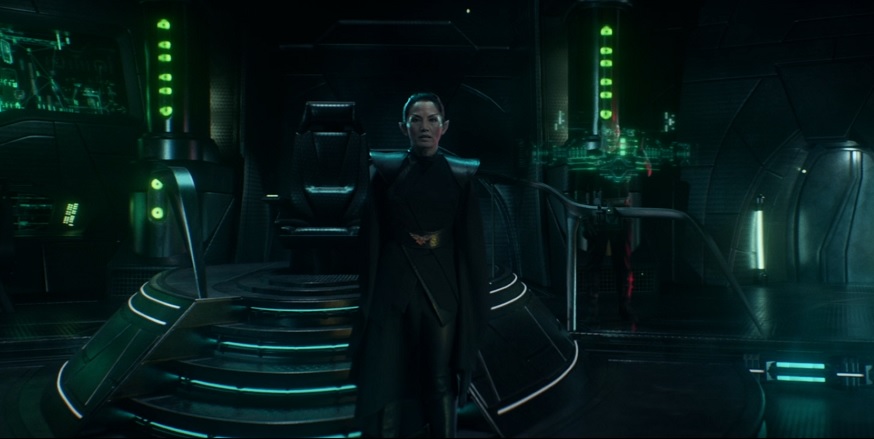
The campfire story itself was fine, but as I said there wasn’t much in there that we as the audience didn’t already know. In an episode with so much story left to conclude, and thus where every minute matters, a lot of this campfire scene was really just wasted time. Conversely to that, the next scene with Commodore Oh – which barely even qualifies as a “scene” because of how short it was – had been very obviously and badly edited down to just a few seconds, and simply fell flat in the moment. Who was she supposed to be talking to when she said “At last, our great work is nearly at an end”? There was no one else present in the scene, she was just standing on the bridge of her ship in her evil villain cloak doing an evil villain pose spouting a generic evil villain line. Given how tightly it was cut, there was almost certainly more to this scene that didn’t make it into the final episode, but this line simply did not work on its own.
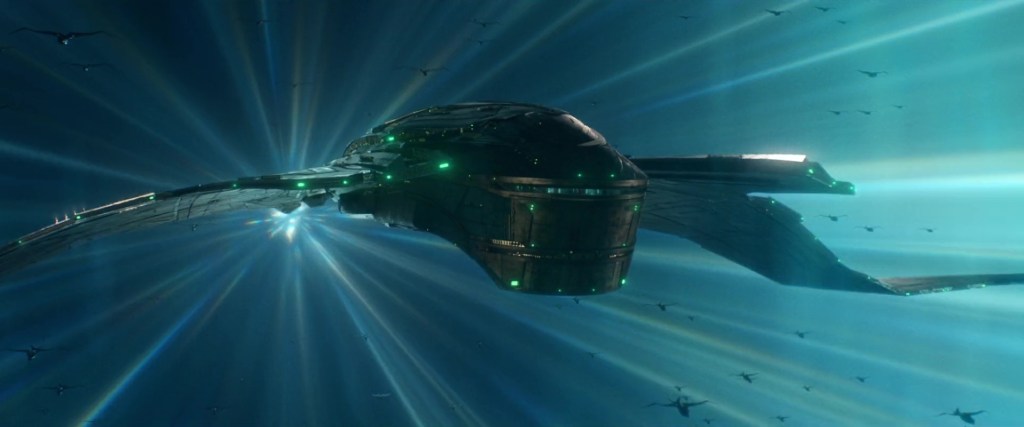
The visual effect of the Romulan fleet at warp was good, however, and I did enjoy seeing that. The design of the new style of Romulan vessel was great, and I could see it being a natural evolution of the Romulan Warbirds from The Next Generation and the advanced warship used by Shinzon in Nemesis, and the fact that some elements of those designs made it into the new Romulan ships was good and shows that the show’s creators were paying attention to past iterations of Star Trek. However, one thing I didn’t like – and this also applies to the Federation fleet that we see later in the episode – was that all of the ships were identical. Past fleets that we’ve seen, while arguably smaller in scale, were almost always comprised of multiple classes of ships, and the fact that the animators and CGI artists had essentially copied-and-pasted the ships meant that the large fleet was less visually impressive that it could’ve been. It was good to see the number of Romulan ships en route, though.
Narek is back in the next scene, a mere few seconds later, showing off the bombs he retrieved from the Artifact. While the episode hasn’t communicated this very well, it seems that a significant amount of time has passed. When Narek arrived it was daylight outside La Sirena, but then the campfire scene seemed to take place after sunset. Yet this scene is in daylight again – and as I said before, considering the urgency of the mission to stop the synths bringing about the end of the galaxy, which everyone seems to agree on, they don’t seem to be moving very fast toward that goal as they’re still talking aboard La Sirena.
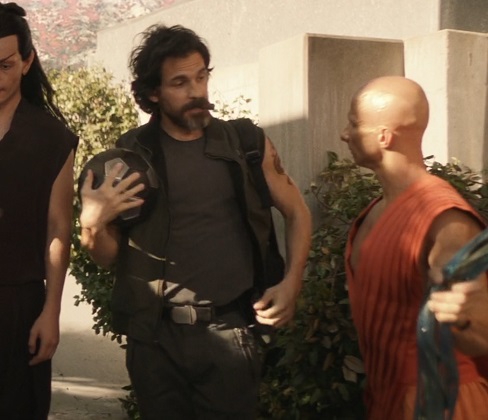
I did like the creative way that they were able to sneak the bombs into Coppelius Station; that was a fun story beat, especially when Rios seemed to be playing with the ball in front of the synths. There was a second where it felt like he might kick it too hard and it would explode! The scene a few episodes ago where Rios had been kicking a ball around on La Sirena also paid off here. And if I’m not mistaken, at least one of the synths on guard duty looked like F8 – the synth from the flashbacks to Mars that we saw earlier in the season. However, the next part of this is yet another example of a plot contrivance – the guards let Raffi, Elnor, and Rios into their compound with Narek, but then seem to leave them alone to do their own thing instead of following them or taking Narek back into custody. It would’ve been better to skip the part about hiding the bombs in the football and have them sneak in another way, or leave the compound unguarded altogether (who are they guarding it from, after all?)
I’ve already mentioned that the eyeball was a neat prop, and the way Dr Jurati figured out how to use it to access Picard’s room and spring him from custody was great. Picard is clearly suffering here from the unnamed brain condition that we saw the first real indication of last week. And while I liked that this had been set up way back in the second episode of the season, it was really only in the two parts of the finale that Picard goes from experiencing no symptoms to full-on dead in a matter of hours or a couple of days. And while we have no frame of reference for how futuristic diseases might run their course, as a story point I feel this would’ve worked better if we’d seen a couple of other instances of his health starting to fail in previous episodes. I know we’ve seen him snap and seem to be quicker to anger at a couple of points, and that we saw his PTSD-breakdown when he first arrived aboard the Artifact, but for the most part Picard has seemed in good health for his age – until the finale, when his condition seemed to rapidly accelerate from nowhere.
Dr Soong learns, in the next scene, that it was Sutra and not Narek who killed Saga, and is visually shocked and heartbroken at the revelation. I’m glad that Dr Soong turned out to be someone who was on Picard’s side in the end. Brent Spiner can portray villains wonderfully, as he did with Lore and another Dr Soong in Star Trek: Enterprise, but as a fan, seeing his new character at odds with Picard wouldn’t have been my preference, given that it’s been so long since we saw the two actors together in Star Trek.
The guards of Coppelius Station seem to have just allowed Raffi, Rios, Elnor, and Narek free rein inside the compound, and they’re planning their attack on the beacon when Dr Soong intervenes. For a moment they thought they’d been caught, but Dr Soong plans to help take down the beacon having learned of Sutra’s betrayal.
Picard and Dr Jurati made it back to La Sirena – though how the two groups managed not to cross paths or spot each other isn’t clear. I mean, there can only be one direct route to the ship after all. But that is a minor nitpick compared to others in the episode. This scene, between Picard and Dr Jurati, was very powerful, and the first point in the episode where I really started to feel things turn around. I loved Picard’s line that “fear is an incompetent teacher”, and their plan – to launch La Sirena into space and make a last stand against the Romulans as a way to show Soji and Sutra that not all organics are evil is a good move – perhaps their only possible plan under the circumstances short of using La Sirena’s weapons to destroy the beacon. They’re banking their hopes on Starfleet having received Picard’s message and already being en route, because at best they’ll be able to stall the Romulans for a few minutes. This is basically a suicide mission, and they both know it. The genius of putting these two characters together, as opposed to say, having Picard teamed up with Rios or Elnor, is that they both have nothing to lose. Picard’s at death’s door, and Dr Jurati is facing a lengthy spell in prison, so of all the characters who could try to make a last stand, it makes sense for them more so than any others – except perhaps Raffi.
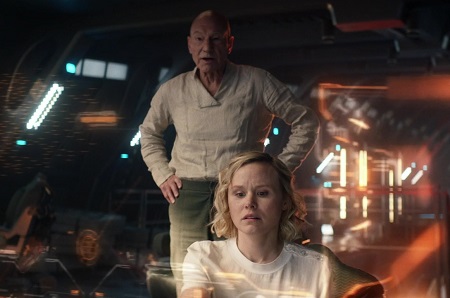
The Romulan fleet is only seven minutes away, so Picard launches La Sirena and shakily leads the ship into orbit, with Dr Jurati along for the ride. The action then cuts to Coppelius Station, where the rest of the crew are planning to attack the beacon.
Attacking the beacon makes sense in the story, but the way it was executed was so bad, and the plan was clearly designed to fail. They storm in and make a huge fuss, then Dr Soong uses another macguffin to deactivate Sutra, but because the other synths are still all-in on using the beacon and summoning the “Mass Effect Reapers”, the rest of the crew scramble around, punching and kicking before being wrestled to the ground. Dr Soong, having deactivated Sutra with his magic wand, doesn’t do anything. He stands motionless in the background while Rios makes a desperate throw to get the bomb into position, but Soji catches it and throws it away.
So many things wrong here, but the overall problem is this – the fight was clearly written in such a way that the “heroes” lose. And that was painfully obvious in the way it was carried out on screen. But let’s break down some individual failings. Why did Dr Soong not show the assembled synths the video of Sutra killing Saga? That single piece of evidence would have swayed most of them to his side. Why did he not use his magic wand on Soji after disabling Sutra? Why did the crew launch a full-frontal attack against a force of massively superior synths instead of sneaking around or causing a distraction? Why try to fight the synths at all? And finally, probably my biggest complaint about the synth storyline in the finale as a whole: what was the point of Sutra?

Don’t get me wrong, I’m not arguing that we should’ve seen more of Sutra this episode. The awful makeup and hammy performance meant I wanted to see as little of her as possible – in that sense I got my wish – but for an antagonist who’d played such a large role last week, and who did have, as I pointed out, a motive that was at least partly understandable, she was just completely sidelined by a story that raced through far too many points and left her completely undeveloped. Sutra had the potential to be interesting, at least in theory. Her presence turned the synths from damsels in distress needing to be saved to antagonists needing to be dissuaded or defeated, and that concept, if executed better, could have been interesting. Unfortunately, as I’ve already said, it would’ve needed several more episodes to work effectively – and a better performance from the central synth villain.
Given that Star Trek: Picard has been at least as much Soji’s story as Picard’s, I feel it would have been better on the whole to ditch Sutra and simply have Soji and Dr Soong be the principle drivers behind contacting the “Mass Effect Reapers”. It would have cut an extraneous character, allowed more time for some of the others to be explored, and we wouldn’t have had to sit through that awful performance last week. Soji did need someone to guide her turnaround last week, to allow her to convincingly side with the synths. But I don’t think that needed to be Sutra, and with a few tweaks here and there the story could’ve arrived at the same place without her – and it would have been better for it, especially considering she did nothing whatsoever this week.
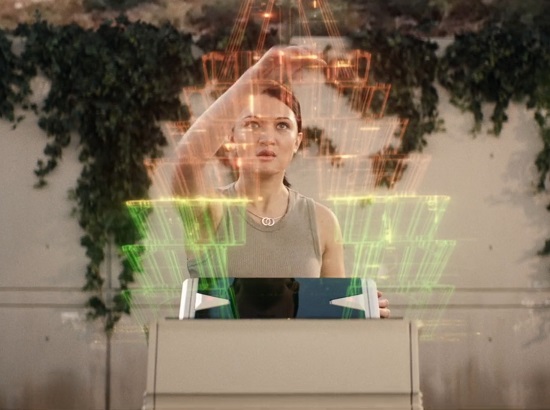
The next scene with Dr Jurati and Picard was hit-and-miss for me. The jumps in tone from deadly serious suicide mission to cracking dumb jokes just didn’t work, and while Dr Jurati has occasionally provided moments of comic relief throughout the season, this was not the moment for humour and it just ended up detracting from what could’ve been a much more powerful scene. I did like, however, that La Sirena was not flying smoothly in the exterior shots we saw, indicating that Picard is still getting back into the swing of things. We have seen him pilot spacecraft before – shuttlecraft most often, but also the Enterprise-D itself in the episode Booby Trap from the third season of The Next Generation – so we know he’s at least basically capable and should understand the principles involved.
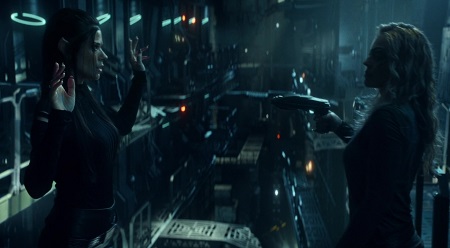
Seven of Nine and Rizzo fight aboard the Artifact as Rizzo has tried to bring the Cube’s weapons online. She’s targeting La Sirena, which does raise the stakes somewhat, and the fight itself was decently exciting. There was never any real doubt as to who the victor would be, however, and Rizzo finally gets her comeuppance for killing Hugh as Seven of Nine sends her falling to her death with a well-placed kick. The two traded barbs during the fight, and we really saw Rizzo in a way that I talked about a couple of weeks ago: as a racist. That aspect of the Zhat Vash and Romulans – that their actions are a veiled analogy for hating another group of people because they’re different – is something the show found a balance between hinting at and overplaying, and I think, taken as a whole, the balance was probably about right.
The visual effects and CGI in the episode were great, as we’ve already discussed, and the sight of the orchid ships launching to meet the Romulans, and overtaking La Sirena, was visually impressive. I still feel that the way the orchids operated last week was pretty dumb, but this time they don’t seem to be dragging intact ships to the planet’s surface; what exactly they’re doing in the fight other than getting shot at and serving as a huge distraction isn’t really clear.
The magical macguffin is back; Rios and Raffi apparently left it aboard La Sirena. Dr Jurati figures out that it can be used to produce holographic duplicates of the ship, which they can use to distract the Romulan fleet. Again, I really didn’t like this tool, and the fact that it seems to be magical and can be used for anything one’s heart desires was not great, even by the standards of Star Trek technobabble. While in principle what Dr Jurati hoped to do was a good idea, and I did like the name-check of the Picard manouvre from The Next Generation, the macguffin spoilt it really. And I felt that the moment where it created holo-duplicates of Dr Jurati’s face was a rare miss in the episode’s visuals.
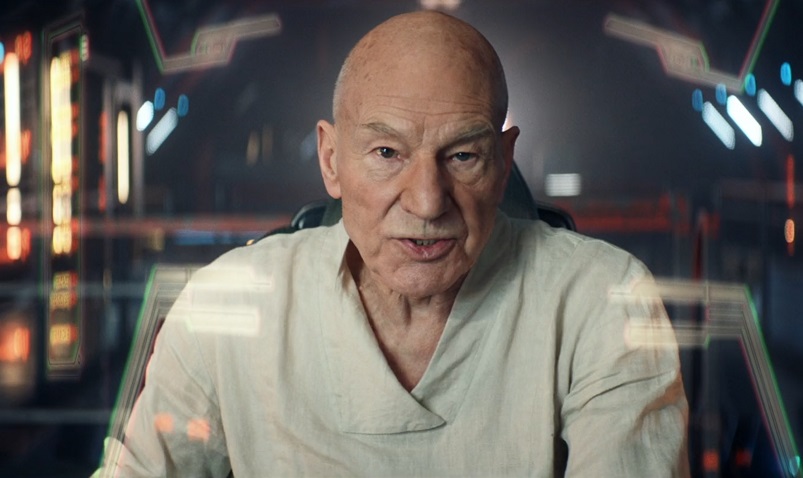
However, Picard’s conversation with Soji, in which he explains that he’s basically laying down his own life to defend the synths was incredible and very powerful – the first of those emotional hits I mentioned at the beginning of the review. There’s something about a noble last stand that always gets to me, and this was a great example of it! It was an absolute desperation play, as Picard hopes against hope that Starfleet will arrive in time. If Starfleet didn’t get there, the “Mass Effect Reapers” would be the synths’ only hope of survival.
The shot of La Sirena standing alone against the Romulan fleet was incredibly powerful too – part of that last stand feeling that I mentioned. The next part of the story has hits and misses, though. And I know this is kind of a nitpick, but what were the other synths and Dr Soong doing while Soji was activating the beacon? Did no one try to stop her or at least question what she was doing – especially given that they all heard what Picard had to say – nor try to contact the Romulans and reason with them? Several of the next few scenes played out as if Soji were the only one there, yet there were a dozen or more synths plus all of the other main characters.
Soji succeeds in activating the beacon just as the Romulans finish dealing with Picard and Dr Jurati’s last stand. The timely arrival of Starfleet – led, as the opening credits made clear, by Riker – prevented them from attacking the planet, and the two fleets enter a tense standoff. It was great to see Riker back in uniform again, and the last-minute arrival of the fleet saved Picard as well as the synths. However, as with the Romulan fleet earlier, all of the ships were the same type and I do feel that the copy-and-paste look detracted somewhat from the otherwise-impressive sight of so many Starfleet vessels – which, I believe, are based on a design from the Star Trek Online video game (but I could be mistaken in that). Until we’d seen his name in the credits, I wasn’t sure if we’d see Riker back in action this season. I was pleased that we did, and it definitely felt good to see Starfleet as the good guys again, after Picard had been forced to work around their obstinance for the majority of the season.

Though this moment had been telegraphed ahead of time and sadly was robbed of some of its impact as a result, the musical score as the ships emerged from warp, coupled with Riker’s appearance a few moments later, did still feel good – just not as good as if it had been a genuine surprise.
We got to see a better look at the command variant of the new Starfleet uniforms – which still have that Starfleet logo pattern in the coloured section – and again, as I said at the start of the season I do like the new uniforms. Especially compared to Star Trek: Discovery’s all-blue look I think they look great, and the combadges complement the look nicely.
Commodore Oh, throughout her appearances this season, hasn’t seemed like someone who would listen to reason. The Zhat Vash have been presented as the most committed of all Romulans to the anti-synthetic cause; both she and the organisation are zealots. And zealots seldom back down, even when facing significant opposition. Picard uses what is basically his dying breath to talk Soji down from summoning the “Mass Effect Reapers”, who hadn’t yet emerged through the aperture created by the beacon. This speech was really the climax of the episode, and the emotional hit of the words Picard spoke, combined with knowing he was suffering greatly as he spoke them, matched the high points other episodes of the season hit. It was the kind of speech Picard could’ve given at any time in The Next Generation as he focused on the rights of all life to exist, and for the need to demonstrate that the synths aren’t what the Zhat Vash feared them to be.
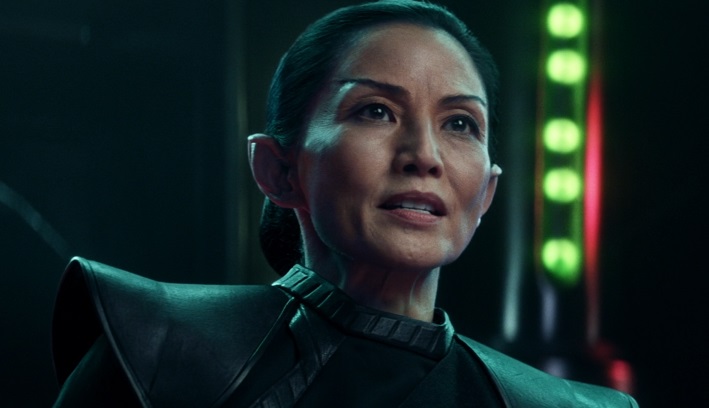
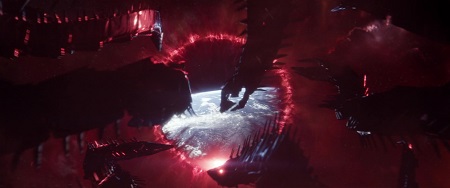
It was enough to sway Soji, who closes the aperture before the “Mass Effect Reapers” could come through or even send a message. Their mechanical tentacles did look menacing, but that’s all we go to see of them. Faced with Soji having stood down and Riker staring her down with a large fleet, Commodore Oh withdraws, and this is something which I feel was out of character. Are we supposed to believe Picard’s speech swayed her? Or simply seeing Soji stand down one time would be enough to override years of Zhat Vash indoctrination? Even if it was good enough for Oh, did everyone on the fleet agree? From her point of view, what is there to prevent the synths rebuilding the beacon in twenty years – or twenty minutes? While Picard’s climactic speech was beautiful, Commodore Oh’s decision to withdraw, like so many other points in the finale, felt rushed. And no sooner had he arrived than Riker, too, was gone – warping out of the system accompanying Oh’s fleet. Couldn’t they have left a ship or two behind? Considering what came next, Riker’s presence would have been incredibly emotional.
Picard bids Riker a solemn “adieu”, before succumbing to the effects of his condition – perhaps combined with whatever medication he was given earlier by Dr Jurati.
Picard’s death – or rather, his “death” – in this moment was the emotional climax of the story, after the plot had reached its own zenith a moment earlier. And it was a very powerful sequence. Soji transports Picard and Dr Jurati to the synths’ location, and Picard dies, surrounded by his crew and knowing that he did right by Soji and her people. His final act was one of sacrifice – making a last stand to defend the synths, righting a wrong from fourteen years ago where he had been unable to prevent the ban or aid the Romulans. The emotion on the faces of the characters – especially Raffi, as Michelle Hurd put in her best performance of the season – was heart-wrenching to witness. Surrounded by his friends, and with a few last words to (most) of them, he passes away, killed by the nameless condition that we assume to be Irumodic Syndrome.
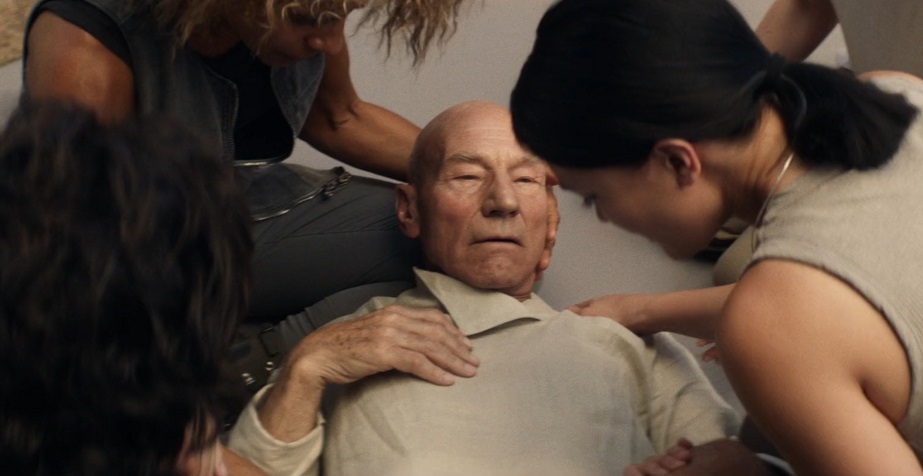
Of all the characters we’ve met across the season, Rios and Seven of Nine arguably had the least connection to Picard on a personal level. Aside from a few scenes when they first met, I can’t recall a significant moment with Rios and Picard together. While there’s always sadness when someone passes away, especially under such circumstances, putting Seven of Nine and Rios together wouldn’t have been my first choice in the immediate aftermath, simply because they didn’t have the connection that, say, Raffi or Soji had with Picard. Nevertheless, the scene between them was touching, and they both spoke highly of the fallen Admiral. I liked the idea of sharing a bad drink because it was all they had access to, and it emphasised that they’re both a long way from home and that this is, for the moment at least, the end of the journey.
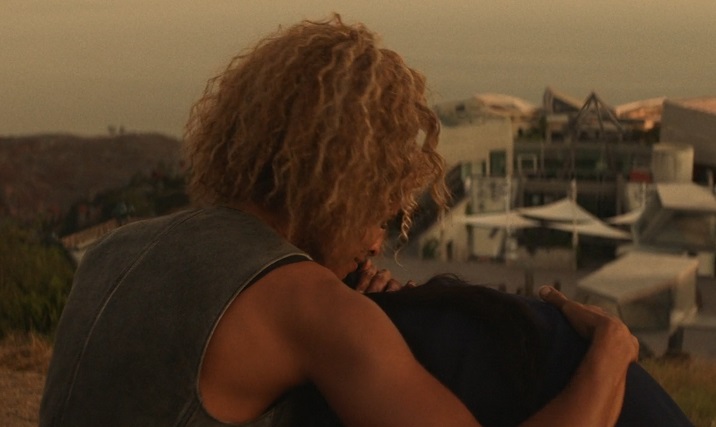
The real heartbreaking scene was when Elnor broke down and was comforted by Raffi. Elnor, who had been so strong and powerful, was weak and vulnerable having regained and then lost his surrogate father figure, and Raffi, who was devastated too, trying to comfort him was just incredibly emotional. Both actors put in amazing performances here, and as sad as this scene was, I loved it.
When Picard awoke, for a moment I was half-expecting to see Q! That was never going to happen, of course – it would be a complete bolt from the blue for anyone who hadn’t seen The Next Generation, for one thing – but it would have bookended Picard’s story in the Star Trek franchise if this had been his final appearance and he was to stay dead, tying into themes from Encounter at Farpoint. Instead, Picard finds himself sat opposite Data. And I know there will be criticism of Data’s appearance given Brent Spiner’s age, but a combination of lighting, makeup, and what I assume are digital effects made him look decent here, and I didn’t find the way he looked offputting, especially when compared to the way the gold synths had looked last week.
At no point was I convinced that Picard would stay dead, but that in itself didn’t rob any of the scenes surrounding his death of any of their drama or emotion. As a story point, though, killing a character in such a dramatic and emotional way only to immediately revive them can end up feeling like a bit of an anticlimax, and there was an element of that here I’m afraid. Not in the moment, and not in Picard’s scene with Data in the digital afterlife, but certainly after his revival there was part of me left thinking “well, what was all that for?” In a sense, restoring Data’s mortality and finally providing him with the closest thing to humanity that he could get, Picard did have a reason to travel to the digital afterlife. No one could have known that Data was trapped in a kind of purgatory, nor that saving parts of his mind from the information transferred to B4 would mean that some essence or facet of his personality would be forever entombed in this realm. That action – saving Data and finally laying him to rest – gives Picard a reason for this temporary death, and as a story it was, overall, a success.

Data takes on the role of what I guess you’d say was a god or grim reaper figure from classical literature, explaining to Picard that he’s in the afterlife and that he died. This was another incredibly emotional scene, as Picard got to express twenty years’ worth of sadness and regret to his long-lost friend. Maybe I’m seeing what I want to see, but I seemed to get hints at Data’s study in the set design, notably the room he occupied in All Good Things, the finale of The Next Generation, in which he was still alive and working as a professor. In fact, while we’re talking about set design, I felt that this room was one of Star Trek: Picard’s best and most evocative. I’ve written before that the outdoor filming scenes, supposedly taking place in France, in Japan, and on several alien worlds, all looked suspiciously like California, and that has been a let-down at points. But the interior sets have been fantastic. I love the way La Sirena looks – inside and out, in that case! – and the Troi-Riker cabin was everything it needed to be. The Artifact is something I really haven’t written about as often as I should’ve, because the subtle updates to the Borg vessel have been fantastic. I loved the shifting walls that were present at times, and the way that, despite being claimed by Romulans and some area being declared “safe”, it was still definitely a Borg vessel. Bjayzl’s club on Freecloud was maybe a tad cliché, but it still did a great job feeling like a futuristic, alien club. The nunnery on Vashti was incredibly reminiscent of something from Japan, and I loved that style when it appeared in Absolute Candor. And finally, Coppelius Station and the Daystrom Institute both conveyed the look of being futuristic in a similar but not identical way to locations in previous iterations of Star Trek.
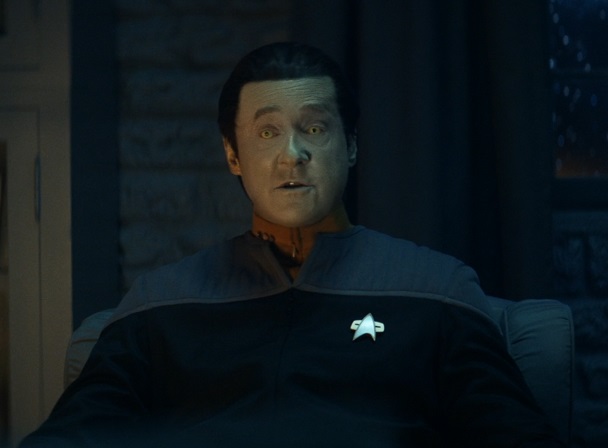
In this case, the room was clearly artificial, but in a way that conveyed a sense of limbo or purgatory. By the furniture and decor being greyed out, there was the sense that, like in a computer when a file or programme is inaccessible, things weren’t quite right. And the fact that the only colour came from the two figures of Picard and Data, our focus as the audience was drawn to them and all attention focused on them – in the same way as you might expect if seeing a very minimalist stage production.
Part of the criticism of Star Trek: Nemesis at the time it was released surrounded how Data’s death was handled in the story. Aside from the criticisms of the story beat itself, the main ones were that he didn’t really get a chance for any goodbyes, and that in a relatively short space of time, Picard and the crew were laughing and joking on the way to their next adventures. We saw earlier in the season – indeed, from the very beginning – that Data’s loss weighed heavily on Picard, and that his friends Riker and Troi remembered him fondly and held his legacy dear, but in this moment, the second criticism was addressed, as Data got to say goodbye properly. Partly this was to Picard, but partly it was to the audience – to us. In a way, this righted what some fans had considered an eighteen-year wrong.

The conversation they had about dying was interesting – and it did, in a way, capture that elusive sense of “Star Trek-ness” that Star Trek: Picard has been so keen to restore to the franchise in the aftermath of Discovery and the JJverse films. Both of those, despite what some have argued, had moments where they “felt like Star Trek”, but not every moment. For all my criticisms of the plot and various scenes in Star Trek: Picard’s finale, it did always feel like Star Trek – and this scene with Data, talking about life and death, was just one part of that, but it was a particularly powerful part.
Picard walks out of the room into a bright white light, and awakens in a new synthetic body, donated by Dr Soong. I wish we’d seen more of Dr Soong and learned why he built himself a synthetic body. There seemed to be hints last week that he was sick or possibly dying, but these were vague and underdeveloped – like many points in the finale – so we don’t really know the stakes or what kind of sacrifice Dr Soong may have made. Did he condemn himself to death by giving Picard the “golem”, or will he just build another one next week now he knows how to do the mind-transfer?
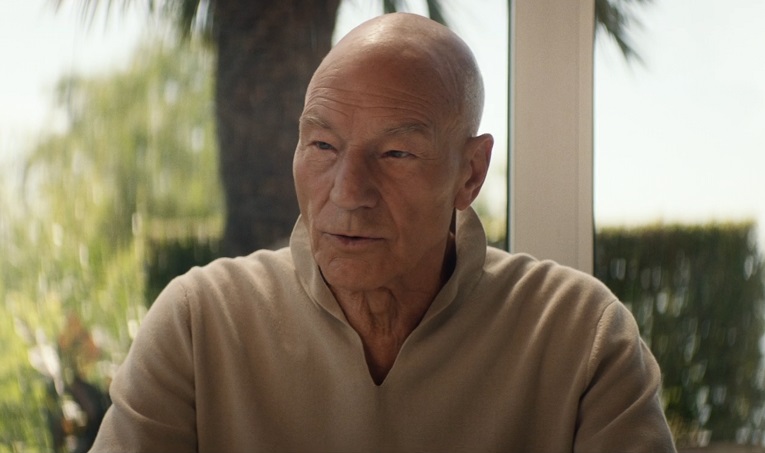
Soji, Dr Soong, and Dr Jurati explain to Picard a number of caveats – his new body is the same as his old one, he won’t have any enhanced strength, speed, brainpower, or anything that would change him in any way. He’ll be identical to how he was, just without the terminal brain condition. And it was around here that the sense of “well what was the point of all that?” kicked in. The Data storyline was great, and I loved that Picard got to say goodbye, that we as the audience got to say goodbye to Data, and that Picard got to do his friend a final favour of letting him die properly. But for Picard’s own character, the death-and-rebirth story didn’t really do much of anything. He’s back to how he was before he died a few minutes later, and all of the emotion from his goodbye to Riker to the reaction of all of the characters was, in retrospect, at least slightly wasted.
We get a touching sequence as Picard fulfils his promise, unplugging Data and letting him finally die. Data prepares his room in the digital afterlife, and lies down to await the inevitable. Picard appears to him in his old uniform – whether Data was imagining him or dreaming isn’t clear, but it is clear that his final thoughts were of his friend. Getting a proper goodbye with Data wasn’t even something I knew that I wanted – but now that I’ve seen it, I can see how it was missing from Nemesis and that it really was something cathartic and beautiful to see. Picard’s speech, the music, the change in lighting in the digital afterlife, and finally Data fading away were all amazing to see, and it was another deeply emotional moment. Picard may have come back to life, but Data won’t – he can’t. This marks the final goodbye to a character we first met in 1987, and who we spent a lot of time with.
The crew reassembles aboard La Sirena – and they’ve had to find extra chairs for the bridge. Seven of Nine seems to have joined the crew, though whether that’s temporary isn’t clear at this stage. They set off to destinations unknown, and we learn that the ban on synthetic life has been overturned. The season ends with Picard giving the order to “engage!”, and La Sirena jumps to warp. The familiar Star Trek music sting kicked in at this moment, making the final scene of the episode another stirring and emotional moment.
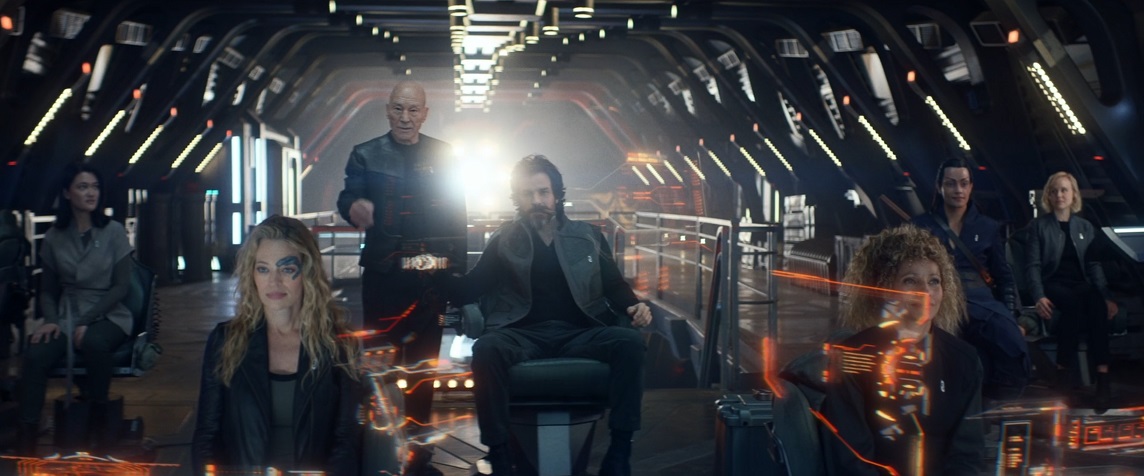
Taken as a whole, the episode was certainly mixed. There were high points which equalled or even went beyond the heights reached by other episodes of the season – even Remembrance right at the beginning. And there were some beautiful, deeply emotional moments which still pack a punch on a third, fourth, and fifth viewing. But there were some mistakes and disappointments too, and too much undeveloped story that was left behind as La Sirena warps off to a new destination and – presumably – a new story in Season 2.
There are key points left hanging as of the end of the episode. The first is: what happened to Narek? He obviously wasn’t present aboard La Sirena at the end, but he’d been a major character who we’d spent a lot of time with and he just seems to have been abandoned by the story about halfway through the episode. It’s not clear if he returned to Romulus, remained in captivity with the synths, was handed over to Starfleet, or even if he joined La Sirena but just didn’t sit with the others on the bridge. I don’t expect to see him return for Season 2 at this point, but just ditching him with no goodbye and no end to his story was just a bit strange.

Obviously I’ve already mentioned the Bruce Maddox plot hole that was left unresolved, but that’s a major annoyance so it’s worth bringing up again. There’s also Dr Jurati – she did still murder someone, so why is she free to go with Picard? Was her conviction expunged? Is she a fugitive? Will this come back to haunt her in future? It would have been nice to see some resolution to that point – unless, of course, it’s something planned for next season, in which case I’m content to wait.
Next are the “Mass Effect Reapers”. The Zhat Vash were right, in a roundabout way. The relic on Aia does tell of a race of synthetic monsters from far beyond the stars. That race are out there – is Starfleet going to try to contact them and make peace? Will the synths from Coppelius contact them and tell them not to hurt anyone? Are the “Mass Effect Reapers” content to just go back to waiting for someone else to contact them, or are they now aware of Starfleet, the Romulans, and the Milky Way galaxy’s various species? What steps will everyone have to take in case they return? What’s to stop another synthetic race from contacting them, or even the Coppelius synths changing their minds and asking for their help after all? Building a beacon didn’t look too hard or time-consuming. And what of the relic on Aia? Is it still active? Will it be shut down? Are the Zhat Vash still hell-bent on killing other synths, even if they leave Coppelius alone?
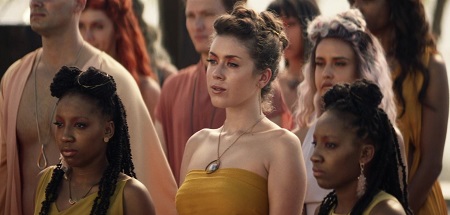
Finally, we have Dr Soong and the synths. They’re under Federation protection now, but what will happen to them? Will they stay on Coppelius? Will they continue to make more copies of themselves? Without Data’s neurons, can they make more synths? And without Dr Maddox and Dr Jurati, can Dr Soong continue to work? What’s to stop the Romulans coming back next week and nuking their settlement from orbit? Are they protected in any way? Will they have to leave Coppelius and settle somewhere safer? I didn’t expect every single one of these points to be addressed, but some hint and what’s to come next for the synths would’ve been nice given how they were such a large part of the finale and the story of the season overall.
If I had been tasked with salvaging the story of the finale, the first thing I’d have done would have been to get at least one more episode for the season – perhaps two. Then I’d have interspersed some of the storylines present on Coppelius with the other active stories much earlier in the season, allowing more time for the development of characters like Dr Soong, Sutra, and even Saga. Beginning with perhaps episode six or seven – roughly the halfway point of a twelve-episode extended season – I’d have introduced the audience to Coppelius and everyone resident there. I’d have done more to build up the stakes by exploring the “Mass Effect Reapers” in more detail, too. A name for the faction would have been good, but also a basic motivation as well as some indication of their level of technology. Finally, I’d have spent more time on the climactic stand-off between Commodore Oh’s fleet and Riker’s Starfleet armada, and tried to find a convincing way to end the Zhat Vash threat, like having other Romulans mutiny against Oh when the synths deactivated the beacon. I think that by spending some more time with some of the characters, and by introducing them earlier, the finale would have been more enjoyable. But there’s no salvaging that awful gold makeup. That would have to go!
I guess what I’d say about the two parts of Et in Arcadia Ego is this: it did provide a satisfactory conclusion to many parts of the story of Star Trek: Picard’s first season, but it left a lot on the table and it was rushed, poorly paced, and incomplete. When I think about the season as a whole, Et in Arcadia Ego, Part 1 is by far the worst episode, and while Part 2 went some way to rectifying that, and did manage to pull out a passable end to the story, it wasn’t an especially great episode either, with some definite low points to counteract the emotional highs.
Star Trek: Picard Season 1 stumbled across the finish line, scraping together the bare bones of a conclusion, but leaving a lot of unanswered questions and at least one gaping plot hole. That doesn’t mean that Et in Arcadia Ego, Part 2 was a failure; it did manage to elicit some powerful feelings and bring together some of the dangling story threads. But I don’t think we can call it a rousing success either, and a story that started out incredibly strongly ten weeks ago has finished with a weaker and less enjoyable pair of episodes than I would’ve wanted.
All that being said, I’m satisfied with the season as a whole. My gripes about specific points in both parts of the finale don’t detract from what has been, overall, a wonderful story and a great return to the Star Trek universe as the 25th Century is about to begin. I hope that Star Trek: Picard can now serve as a jumping-off point for other Star Trek shows set in and around the same era, moving the franchise forward into the future – where it should always have been trying to go.
Stay tuned for the conclusion to my Star Trek: Picard theories for Season 1, as well as later in the year when I hope to do a retrospective look at the season. When some time has passed and the dust has settled, it should be a good to go back and take a second look. Rewatching earlier episodes while keeping in mind some of the story elements from the finale should be an interesting experience, and I will undoubtedly see more hints and foreshadowing that I missed when I first saw them.
Now that Star Trek: Picard has concluded, don’t think that the blog is going away! There will be lots more to come as I have numerous articles in the pipeline. I half-expected to see a release date for Star Trek: Discovery Season 3 announced, but despite all the hype around Star Trek: Picard, ViacomCBS have chosen not to take advantage of this opportunity to plug Discovery. Even if the release date isn’t for a couple of months, putting it out there now would have been a great move. Regardless, whenever it airs, I hope you’ll come back to see me review and break down those episodes too.
See you next time!
All ten episodes of Star Trek: Picard’s first season are available to stream now on CBS All Access in the United States, and on Amazon Prime Video in the United Kingdom and other countries and territories. The Star Trek franchise – including Star Trek: Picard – is the copyright of ViacomCBS. This article contains the thoughts and opinions of one person only and is not intended to cause any offence.



 Trekking with Dennis