Artemis II Inspired Me

Even as the astronauts suited up and boarded the impressive Space Launch System rocket… I was sceptical. When the countdown got to ten minutes, and then paused… I was *even more* sceptical! Would this long-delayed, oft-postponed mission to the moon ever make it off the launchpad? Or would this be just another broken promise, another failure, and another let-down in a long line? After so many cancellations and disappointments courtesy of NASA, I’m afraid my faith in these things has been well and truly sapped.

But the idea of a return to the moon – even just for a flyby, this time – was so incredible, intense, and inspirational that even as I sat there, watching that stalled clock… I found myself *wanting* to believe it. As the minutes passed, and various NASA ground control crew talked to each other over the radio, it didn’t seem like a sure thing, but I felt my hopes slowly starting to build. And then… it actually happened. Artemis II took humanity back to the moon.
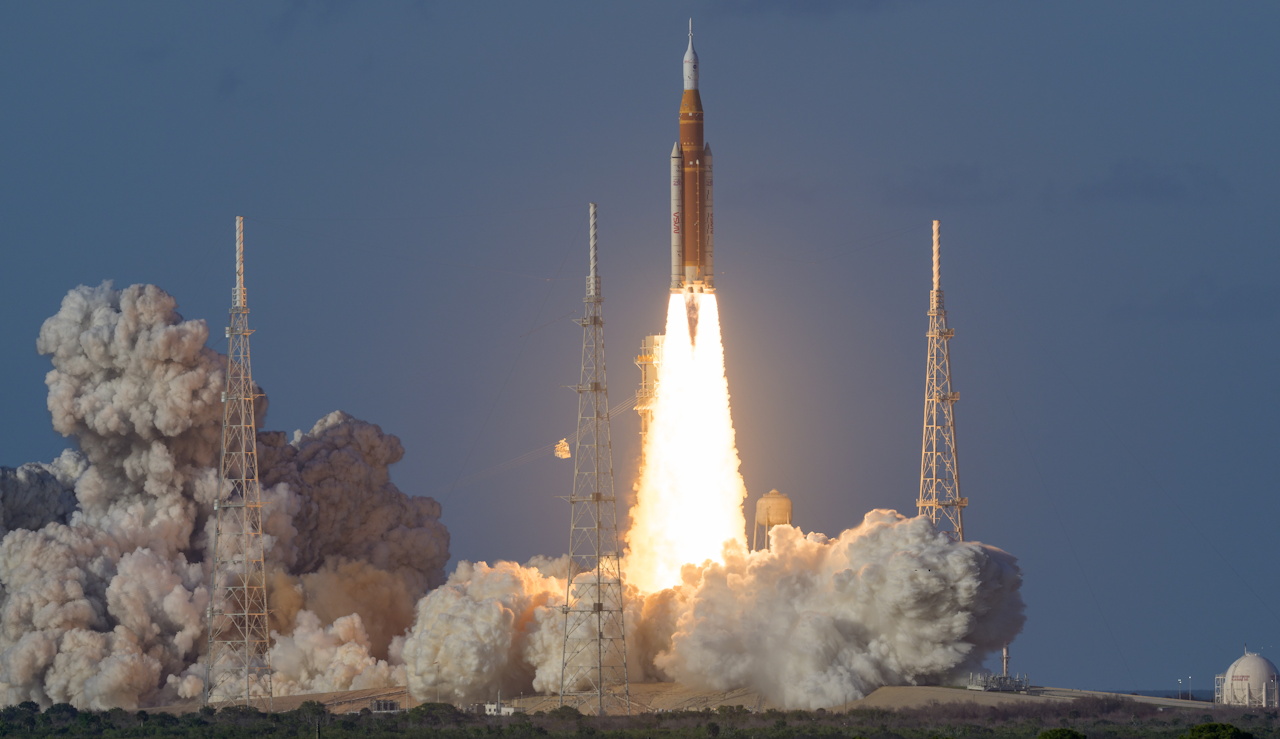
Artemis II/SLS launching from Florida
The launch of Artemis II.

Here on the website, we’ve talked a few times about real-life space exploration. Specifically, I’ve shared my scepticism about recent space projects, and how a crucial element of space exploration – the inspirational factor – has gone missing more often than not. Flights to low Earth orbit have become so commonplace that I don’t really consider the most recent astronauts, space station visitors, and space tourists to truly be “pioneers” any more, which I guess says a lot about how far we’ve come as a spacefaring species! But on the other hand, I’ve come to feel distinctly uninspired by and even bored of repeated missions to the ISS, test launches for new rockets and vehicles, and even sending *another* rover to the same planet where we’ve already got one!

Space exploration *needs* that inspirational element. Without it, how are we to convince a new generation that there’s anything worth doing in space? If all we’re able to do any more is go back to the same space station time and again, or send identical-looking robots to the same planet over and over again, or launch the same wealthy bajillionaires into space for ten minutes over and over again… why would *anyone* be interested in that? And without that interest, that inspiration… how can humankind take the next big steps in space technology and space exploration?

That’s where Artemis II came in.
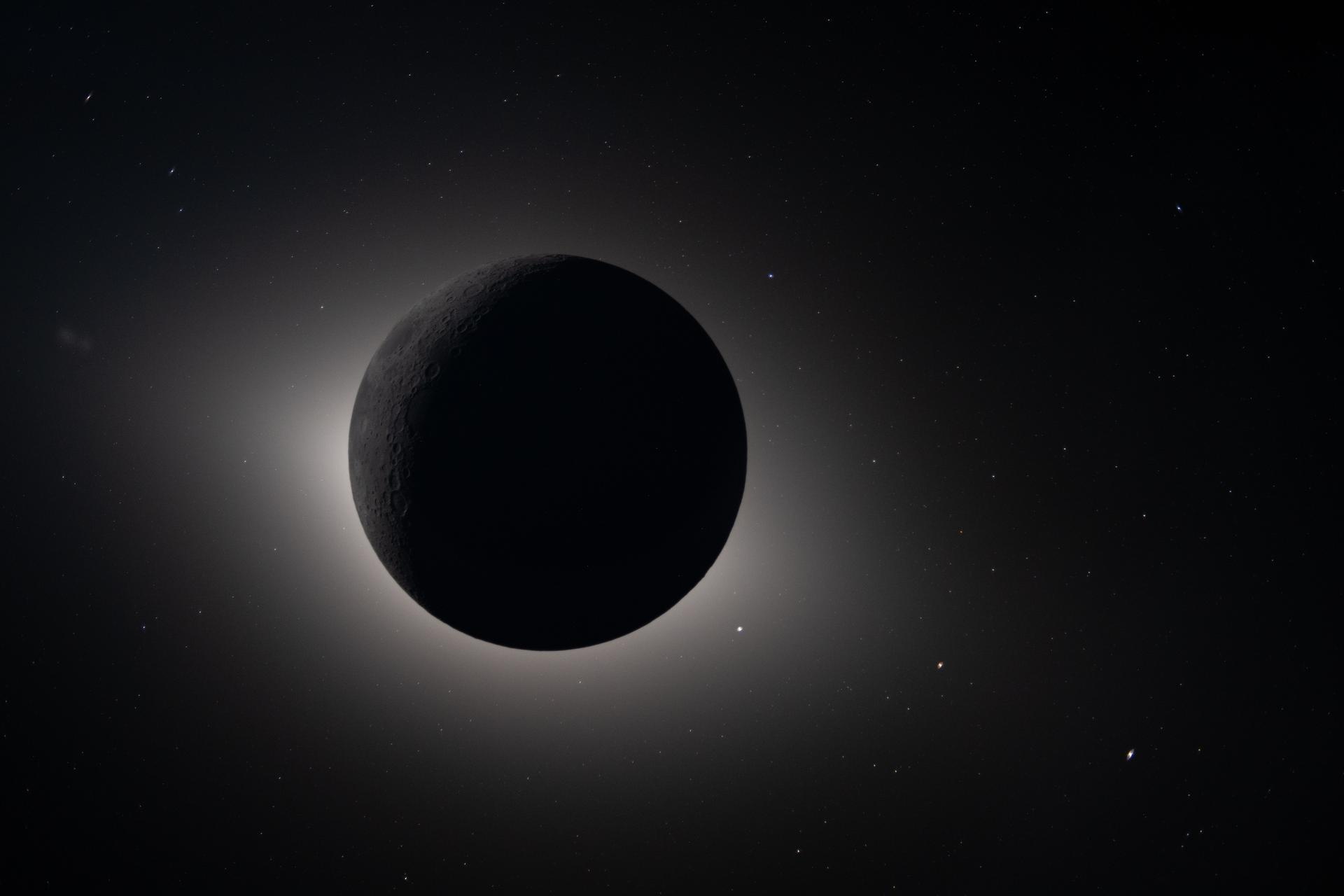
The moon as seen from Artemis II
The moon as seen by the crew of Artemis II.

I’m the wrong side of forty, but in my entire lifetime, no humans had so much as left low Earth orbit. The last mission to the moon was all the way back in 1972, meaning you’d need to be past fifty to have even been alive for that – sixty-plus to remember it with any real clarity. Artemis II was the culmination of decades’ worth of effort to take humanity back to the true frontiers of space exploration – and the first spaceflight in years to really feel like it was inspiring masses of people and capturing the imagination of the public at large.

I watched the live stream of Artemis II’s launch – which was late at night here in the UK – while on a video call with my sister. My niece was born just last year, and my sister and I talked at length about how exciting it was that, within her first year of life, something that feels so profound and huge was happening. Artemis II took humans further from Earth than we’ve ever been before, and also paved the way for a new landing on the surface of the moon sometime in the next few years. Those are incredible achievements, and I was thrilled to be able to watch the mission as it unfolded.
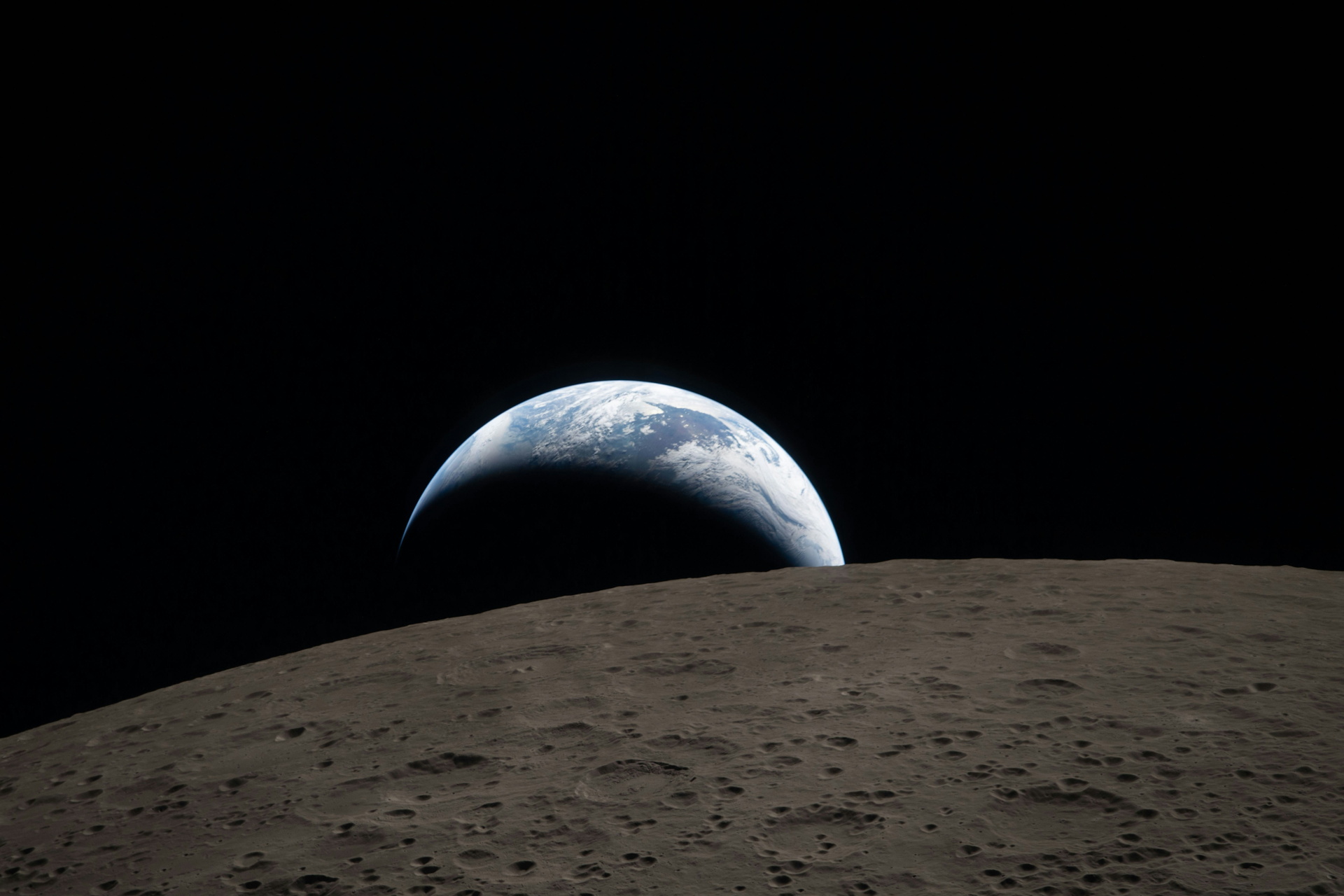
Earthrise from Artemis II
Earthrise.

As Artemis II cruised to and around the moon, I periodically checked in with NASA’s live streams. I wouldn’t say I was glued to my screen for the duration of the mission, but I certainly spent a good amount of time seeing this mission unfold as close to first-hand as I could. And one evening, when the clouds had parted and the sky was clear, I perched outside on my garden wall, just gazing up at the moon. “It’s incredible,” I remember thinking to myself, “that right now, people are… there.” Was this what it felt like in the 1960s, during the first Apollo missions? Apollo 8 was the Apollo programme’s equivalent; the first mission to leave Earth behind and orbit the moon. I wonder how many people, in 1968, perched on their garden walls and gazed up at the moon, as I just did.

Artemis II feels like NASA (and the Americans in general, I suppose) planting a flag and saying, “we’re back, we’re really doing this.” And after so many false starts, cancellations, and disappointments… I’m glad to see it. And this isn’t some kind of flag-wavy thing; I’m not an American, and I’d have been just as excited if China or India or the European Space Agency had managed to launch a similar moon-orbiting mission. Space isn’t the sole preserve of one faction or one nation, and it should be something we can explore together – or at least somewhere we can celebrate all achievements, no matter where they originate.
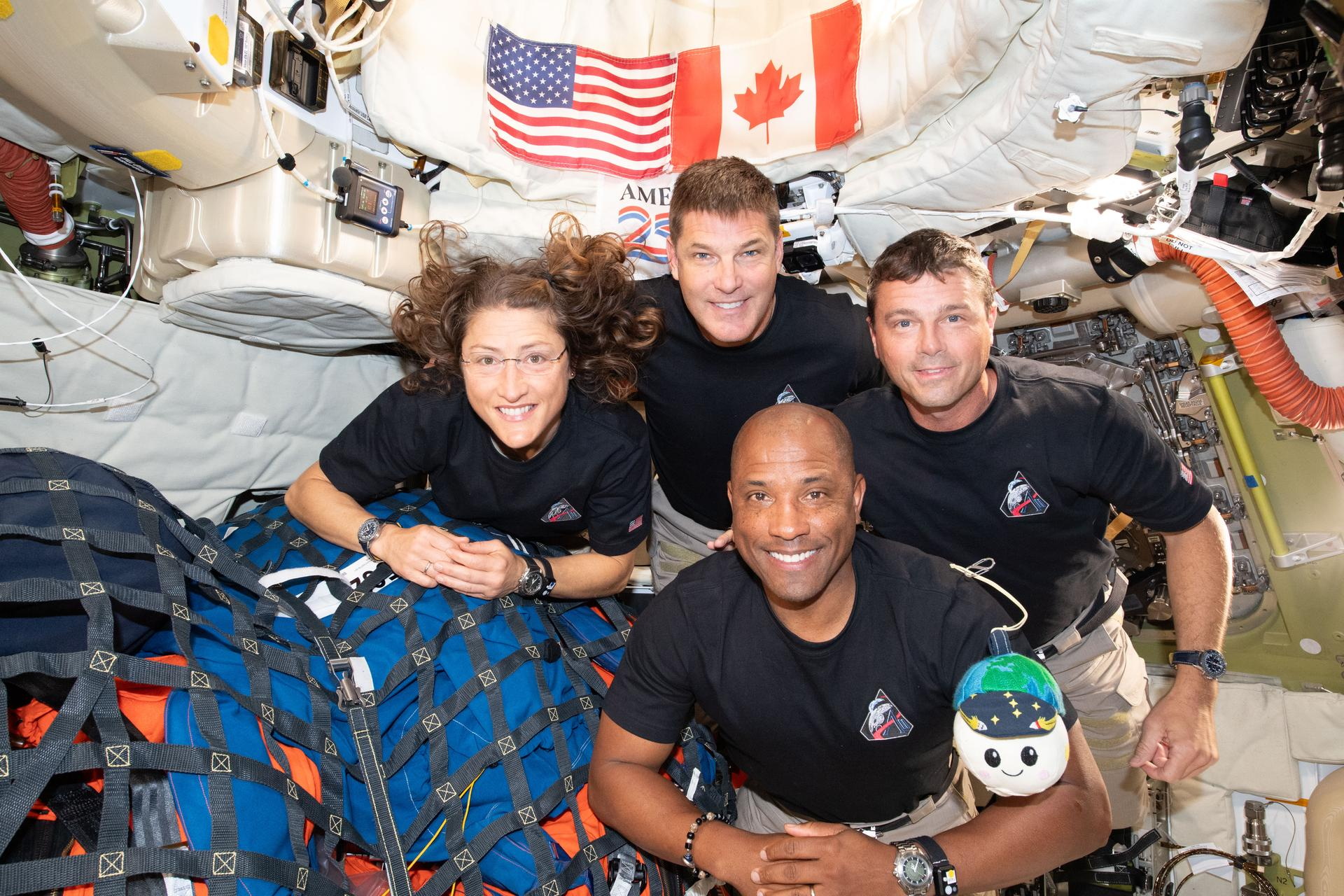
The crew of Artemis II during the mission.
Clockwise from left: Christina Koch, Jeremy Hansen, Reid Wiseman, and Victor Glover.

There are still innumerable hurdles for current and future space missions to overcome. Going beyond the moon to send humans to visit the likes of Mars or Venus – our closest planetary neighbours – still feels out of reach with current technology, despite recent advancements and promises of a Martian colony springing up! And there will be more setbacks to come, for sure; Artemis III has been “downgraded” from its moon landing to another trial run, and Artemis IV has been pushed back to 2028. But that potential moon landing – humans setting foot on the moon’s surface for the first time in more than half a century, and for the first time in my lifetime… well, it feels a lot closer today than it did just a few months ago.

Sci-fi is what really kick-started my love for all things space. As a geeky little kid, I can remember reading every book about outer space that I could get my hands on, and being *obsessed* with the Space Shuttle and NASA. Going to space – actually sending real people up there – felt magical, like something out of Star Trek. But as time passed (and as I got older), that excitement seemed to fade. And there haven’t been very many missions in the last few years to truly recapture it. The last two I can remember before Artemis II were New Horizons’ visit to Pluto, which completed the “set” of the nine planets I learned about in school, and William Shatner’s trip to space. The idea of sending Captain Kirk himself into space in real life… that definitely tickled me!
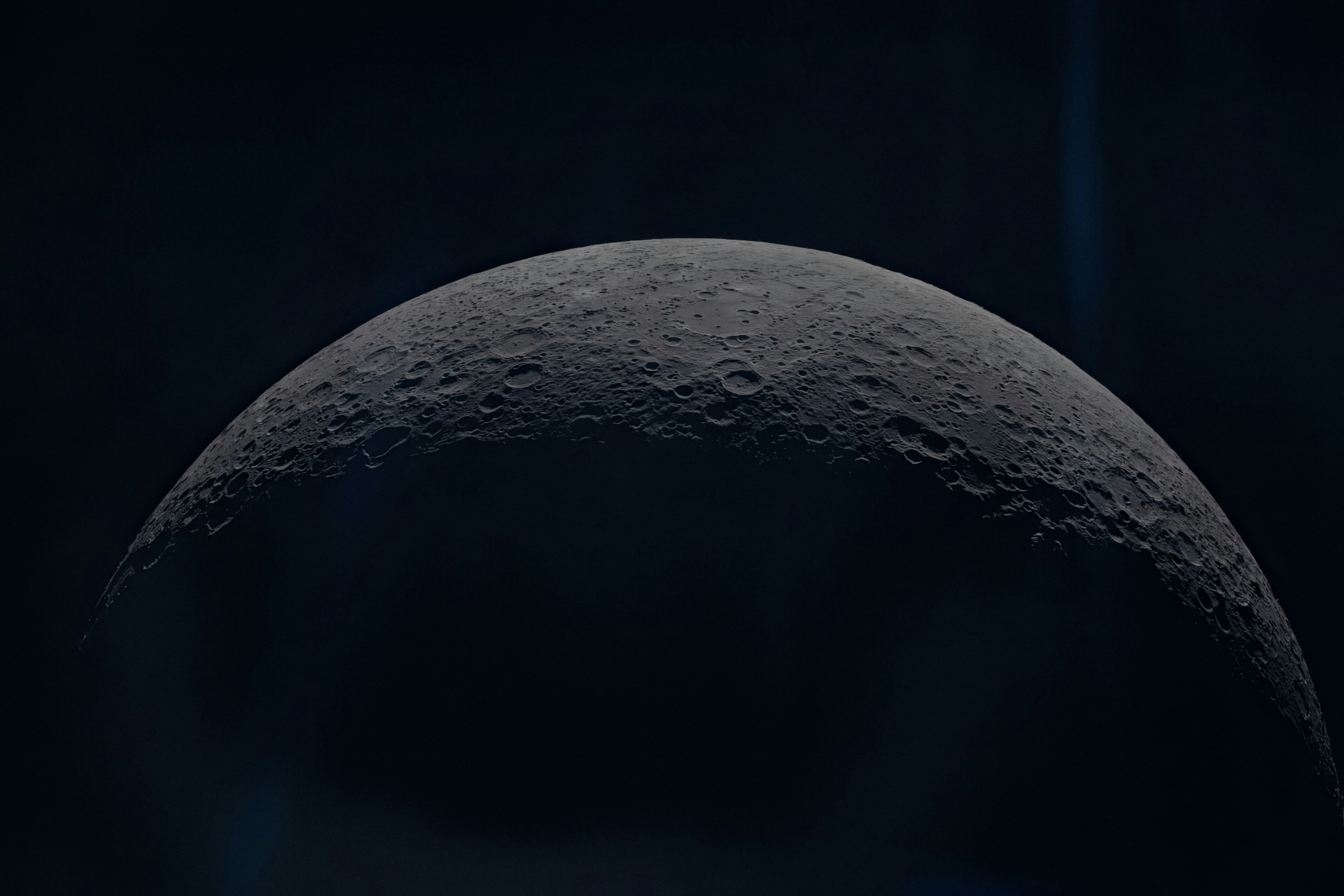
The moon as seen from Artemis II
We really went back to the moon. Wow.

I’m still not sure what the future will hold for space exploration. Events here on Earth have a tendency to get in the way, unfortunately, and with wars, political disruption, economic problems, and all kinds of other issues already plaguing us… I can’t say I have 100% confidence in Artemis IV landing on the moon a couple of years from now. But I feel more confident in the possibility – the idea that it plausibly *could* happen – than I did at the beginning of the year.

And that’s pretty neat! It’s a feeling I haven’t had in a long time, really.

So, as I said at the beginning: Artemis II inspired me. It’s a rare space mission in the 2020s to truly recapture that sense of excitement, that humanity was going “where no one has gone before” – quite literally, in this case, as Artemis II went further than any of the Apollo missions, setting a new record! It’s important that space exploration retains that sense of wonder and excitement if we’re to inspire the next generation of astronauts and rocket scientists, and I hope that many of my niece’s generation will look at Artemis II with the same sense of wonder that I had when I looked at the Apollo missions and the Space Shuttle. Who knows… maybe one day *she’ll* suit up and blast off to the final frontier. I may not be here to see it, but she’ll have an incredibly proud uncle either way.


Some images above are courtesy of NASA. This article contains the thoughts and opinions of one person only and is not intended to cause any offence.


Remembering Nichelle Nichols

What can be said about Nichelle Nichols that hasn’t already been said over the last few days? Her loss is felt profoundly by the entire Star Trek fan community – a rare moment of togetherness in what can be a divided fandom at times. But beyond that, news of her passing has resonated across the world of entertainment and beyond. She was a unique person, someone whose influence and hard work may not have been centre-stage for everybody, but whose tireless commitment to the causes she supported – and to fans of Star Trek – will never be forgotten.

At a time when the United States was still in the process of outlawing racial segregation, Nichelle Nichols became an icon for the civil rights movement. The character of Uhura took her place on the bridge of the USS Enterprise not as a servant or a maid, not as a subordinate, but as an equal member of the crew; an officer with the respect of her shipmates. Such roles were incredibly rare on American television at that time, and the statement made by Uhura’s presence on Star Trek was one of racial equality and hope for the future.

Nichelle Nichols, 1932—2022.

There’s a frequently-cited story that it was Martin Luther King who convinced Nichelle Nichols to remain on Star Trek when she considered leaving to return to the stage after the show’s first season. Star Trek, according to King, was one of the few shows he allowed his children to watch – and Uhura’s role was the reason why.

Star Trek told morality tales and gave commentary on contemporary issues of race and civil rights across its three seasons, and Uhura was a powerful presence in many of those stories. Nichelle Nichols brought the character to life with a quiet, understated charm, and quickly became an irreplaceable part of Star Trek.

Nichelle Nichols as Uhura in The Undiscovered Country, 1991.

While we as Trekkies might remember Nichelle Nichols from her role as Uhura, her legacy extends far, far beyond the Star Trek franchise – and even beyond the realm of entertainment itself. Beginning in the 1970s, she worked with NASA to help drive the recruitment of new, younger astronauts from diverse backgrounds. The first African-American, Asian-American, and Hispanic-Americans to travel into space joined the space programme as part of Nichelle Nichols’ initiative. She quite literally changed the face of NASA and diversified space exploration.

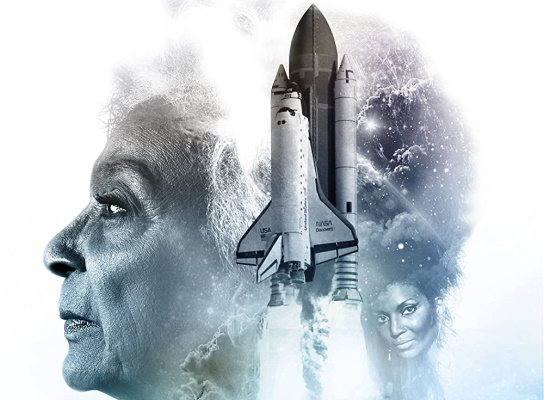
The documentary Woman in Motion goes into detail about Nichols’ work with NASA, and if you haven’t seen it it’s well worth a watch. I love a good documentary, and Woman in Motion presents her story in an understandable way. I have to be honest and say that I didn’t know much about her involvement with NASA prior to watching Woman in Motion, but it’s a story that absolutely should be told – and I’m glad it was able to be told before Nichelle Nichols passed away.

Nichelle Nichols on the Woman in Motion poster.

Over the past few days we’ve seen an outpouring of grief and remembrance from Nichelle Nichols’ Star Trek co-stars, actors and creatives in the Star Trek franchise, many others from the world of entertainment, and countless people who felt inspired by her. Many people have shared their own stories of what it meant to see Uhura on the bridge of the Enterprise, how Nichelle Nichols inspired them to get started in their chosen career, or the words of advice she had from those lucky enough to have met her in person.

For one person to have such an impact and leave such a legacy is phenomenal, and the thousands upon thousands of tributes that we’ve seen are just a small fraction of the lives that Nichelle Nichols touched in one way or another. Those lives were changed not because she played a role on Star Trek, but because of what she did with that role, that fame, and the spotlight that was placed upon her. Other actors could’ve happily taken their pay and done nothing more – and there’s nothing wrong with that at all – but Nichelle Nichols went the extra mile. She recognised what her role meant to millions of people across the United States and around the world, and she did everything that she could to make it matter. That’s why it’s been so hard to know what to say, and why her loss hits so profoundly. She wasn’t just another performer – she was so much more than that to so many people.

Nichelle Nichols with Star Trek: Discovery’s Sonequa Martin-Green.

We’ve been lucky to have Nichelle Nichols with us for as long as she was. It was only in her final couple of years that she began slowing down her activities; she attended her final Star Trek convention less than a year ago. In all of that time she offered to fans and everyone else the kind of boundless, unbridled optimism that defines Star Trek itself: always smiling, always happy to be seen with fans, co-stars, and new actors alike.

I’m going to miss Nichelle Nichols. I’ll miss hearing about her appearances at conventions and the interactions she had with fellow fans and friends of mine within the Star Trek fan community. I’ll miss the stories she could tell about working on the show and its films. And I’ll miss seeing her with the likes of Sonequa Martin-Green, Zoe Saldaña, and Celia Rose Gooding. The comfort I take is that she lived a full life, one in which she put her talents to good use both on-screen and off. She leaves behind a legacy most people could only imagine, and her impact on the worlds of Star Trek, entertainment, and even space exploration itself will outlive her, continuing long into the future.

Some images used above courtesy of Star Trek/Paramount Global. This article contains the thoughts and opinions of one person only and is not intended to cause any offence.

Has space exploration become… boring?

I’m a huge fan of Star Trek – which you probably know if you’re a regular around here! What would become the Star Trek franchise was born out of the space race of the 1960s; the incredible excitement of launching rockets, sending human beings into space, and the Apollo programme that would eventually send Neil Armstrong and Buzz Aldrin to the surface of the moon in July 1969.

It’s hard to remember now, almost fifty years since mankind last set foot on the moon, but the pace of technological progress required to get there in the first place was incredible. The Wright brothers made the first ever powered flight in a heavier-than-air vehicle in 1903. Sixty-six years later, Neil Armstrong took that “giant leap for mankind.” In less than the span of a single human lifetime, we went from the horse and cart to the Saturn V rocket.

It’s been more than fifty years since Neil Armstrong took the first steps on the surface of the moon.

This was the world my parents’ generation grew up in. My father would’ve been in his late twenties when the first moon landing happened, and like practically everyone his age he can remember that event vividly. My grandfather, on the other hand, could distinctly remember the excitement he and his schoolfriends felt at seeing an automobile – a rarity when he was a child.

For all of the monumental accomplishments made in the field of space exploration in my lifetime, nothing compares to landing on the moon, launching the first satellite, or sending the first people to space. And that’s for a pretty simple – yet devastating – reason: we don’t do those kind of big missions any more. The space race ended, and with it the investment of governments shrank significantly. The scope of future missions was curtailed, and NASA in particular looked to money-saving measures.

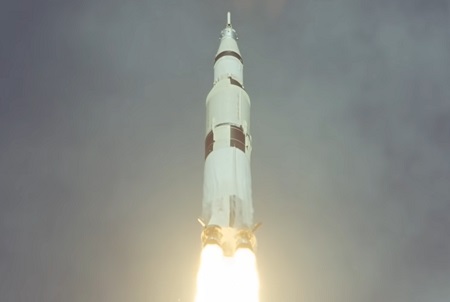
The launch of a Saturn V rocket.

We’ve heard in every decade since the eighties the promise that we’d land humans on Mars within ten years – then the decade draws to a close and the promise is repeated. If you’d spoken to someone of my parents’ generation in the late ’60s, the idea that humanity would still have never gone to Mars – or even left Earth’s orbit – over fifty years later would have seemed utterly absurd! Surely, they felt, the pace of technological change and improvement would simply continue, and with it, more exciting space missions would come.

But the fundamental technologies involved in space travel haven’t really changed. The rockets that launch all of our satellites, probes, and astronauts are based on the same technology that Wernher von Braun created for the V-2 rocket during the Second World War. The engines and reactors powering our probes have hardly changed since the days of the Pioneer and Voyager programmes. When the money dried up, and the impetus pushing humans to explore space also dried up, technology stagnated.

Dr Wernher von Braun (circled) initially developed rockets for Nazi Germany before working for NASA.
Photo Credit: Bundesarchiv, Bild 146-1978-Anh.023-02 / CC-BY-SA 3.0, CC BY-SA 3.0 DE https://creativecommons.org/licenses/by-sa/3.0/de/deed.en, via Wikimedia Commons

The development of the reusable space shuttle was a double-edged sword. On the one hand, it allowed for more frequent missions, sending more humans to space and putting up more satellites and probes than ever before. On the other, it limited humanity’s manned missions to Earth orbit only, and restricted the size and weight of those same satellites and probes. The shuttle remained in service for thirty years, and in all of that time, the development of other spacecraft slowed to a crawl.

There are financial and political reasons why this is the case, especially in the United States. For the US government, space exploration is expensive, and thus NASA’s budget is first on the chopping block when savings need to be made! But there are also political reasons – many politicians have promised a return to the moon and further manned missions, yet were unable to deliver due to changes in political control of the White House and Congress.

All of this has contributed to a sense that I have, as a non-scientist and layman, that space exploration has lost much of its excitement.

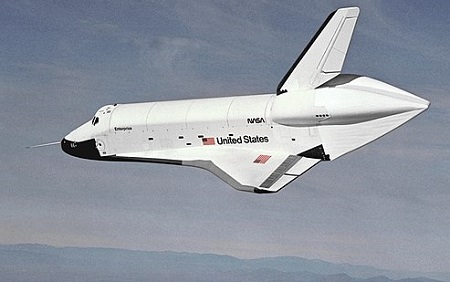
The Space Shuttle Enterprise during a test-flight.

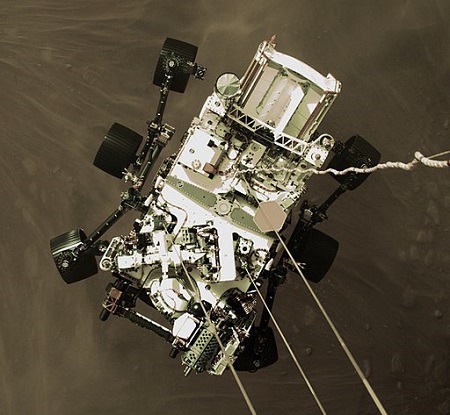
The recent landing of the Perseverance Rover on Mars kind of encapsulated this, and is what prompted me to write this piece. Because as amazing an accomplishment as Perseverance’s successful landing was, it’s an almost-identical vehicle to Curiosity – a rover which has been on Mars, sending back data and photos since 2012.

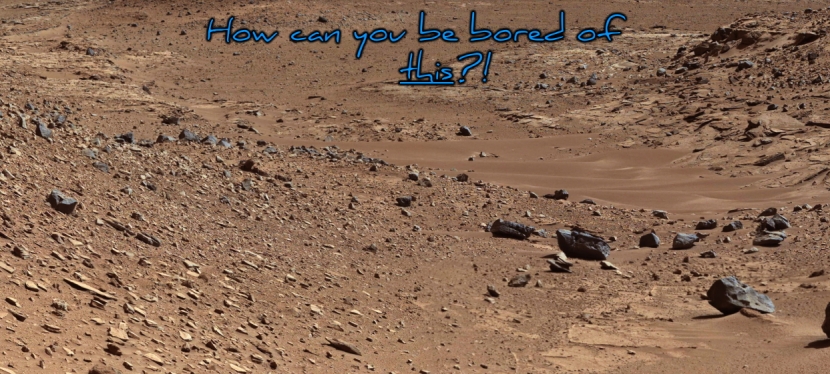
From a scientist’s point of view, the two rovers may have different equipment. Perseverance may be able to conduct experiments that Curiosity couldn’t, and that’s fine. As scientific instruments I’m not doubting their merits. But as a layman looking in, we’ve been seeing photos of the barren Martian landscape for decades, and in high-definition for almost ten years. It’s pretty much a given that Mars once held liquid water and some forms of bacteria, even if the “smoking gun” evidence has yet to be found, so even if Perseverance were to conclusively prove that Mars once harboured microscopic life… even that wouldn’t feel all that interesting.

The Perseverance Rover recently landed on Mars.

The same applies to manned missions. No human has left Earth’s orbit in my lifetime. Manned missions to “space” today take humans to the barest edge of what we could reasonably call “space” – a few hundred miles above our planet’s surface, locked in orbit. The International Space Station, like the space shuttle before it, may be a wonderful engineering accomplishment, and its experiments may achieve interesting results for scientists, but after more than twenty years of continuous occupation of the ISS, it’s not exactly exciting is it?

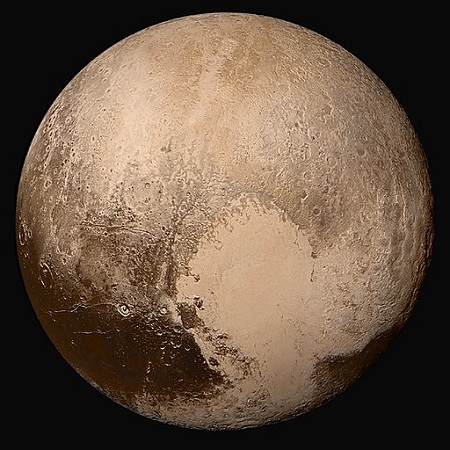
The last time I felt truly awed by a space mission was New Horizons’ flyby of Pluto in 2015. Seeing images of a planet – or dwarf planet, to give Pluto its official designation – that had never been visited before was genuinely interesting. New Horizons completed the set – all nine planets that I learned about in school had now been visited and photographed by human space probes. That was an interesting moment.

Pluto in true colour, as seen by the New Horizons probe.

I’m increasingly sceptical, though, that any manned mission in the years to come will recapture that feeling. We’ve heard every few years that a manned mission to Mars is in the planning stages, but so far it’s never happened. There are certainly still technical and medical issues to overcome with such an endeavour, such as the long-term effects of low gravity on human bodies and the not-so-easy feat of constructing a large enough and powerful enough spacecraft to make such a journey. I doubt we’ll see it before the most-recent promised date of 2030.

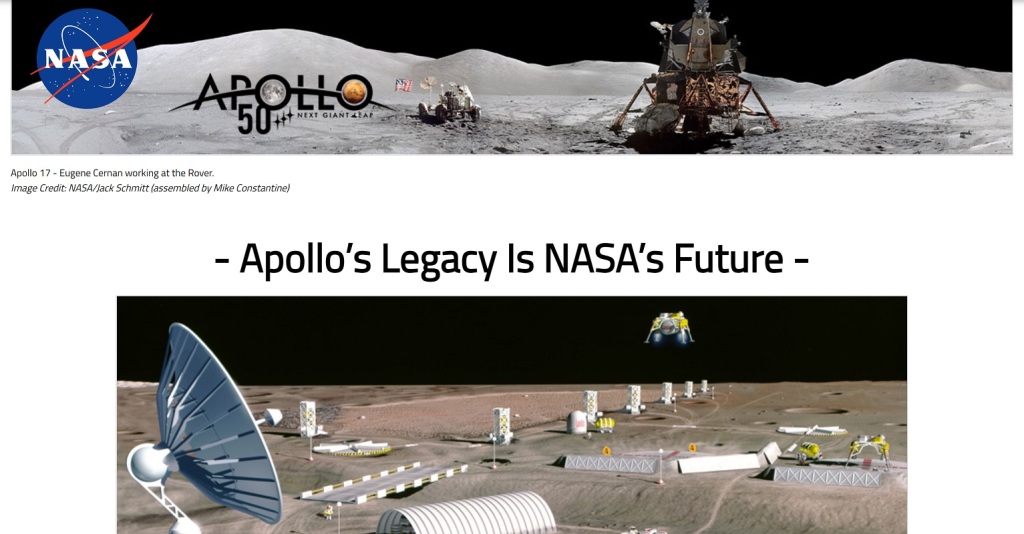
Nor does a return to the moon seem to be on the agenda – again, despite promises to the contrary. The United States had talked about a manned mission sometime this decade, but nothing seems to have been done to further that objective in a long time; NASA’s “back to the moon” web page hasn’t been updated in several years, and I haven’t heard any talk of the proposed mission in a long time.

NASA’s “back to the moon” web page.

So we’re left with more missions to Earth orbit and probes to places we’ve already been. Nothing about that inspires me right now, and the missions that humanity sends into space have become mundane and routine. Perhaps that’s a comment on how we’ve become a spacefaring species: that rocket launches which would have drawn huge attention in years past are now considered dull. But I think it’s also a comment on how space exploration has lost some of its focus and impetus, with missions opting to stay in – relatively speaking, of course – “safe” territory.

As we come to learn more about space and our place in it, the expectation from decades past that we’d be up there exploring it has failed to come to pass. We’ve discovered thousands of planets orbiting stars in our galaxy, yet we have no way to ever practically visit them. We’ve sent countless rockets up into space to undertake a variety of missions, yet never tried to develop an alternate method of propulsion or getting into space. Because the fundamental technologies underlying our space missions haven’t been replaced, space exploration itself has kind of stagnated.

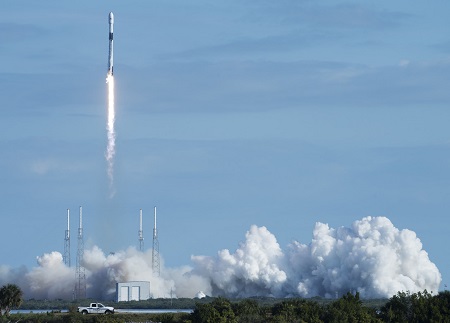
A SpaceX Falcon 9 rocket uses the same basic technology as the V-2 did in the ’40s.
Photo Credit: U.S. Air Force photo by Airman 1st Class Zoe Thacker.

As a kid I can remember wanting to be an astronaut and having a fascination with all things space. In the late ’80s and ’90s it seemed that there was still the potential to keep exploring and do bigger and better things – even if that potential had gone unrealised for twenty years or more. But it never came to pass, and I find it quite sad in a way that no human has walked on the moon, or even left Earth orbit, in my entire lifetime.

Perseverance landed on Mars a few weeks ago, and I have no doubt that it will send back data and images that will be of interest to scientists. It may even make the long-awaited breakthrough regarding ancient microbial life on the red planet. But as I look in as a layman, I can’t help but feel that I want to see something else. Why not go to Venus, to Mercury, to the moons of Jupiter? Why not send a probe to visit Neptune or Uranus, neither of which have been visited since the Voyager probes flew past them in the ’80s?

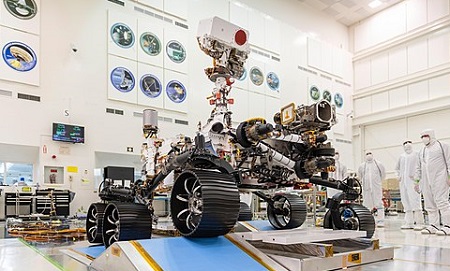
Perseverance at NASA prior to travelling to Mars.

Above all, our goal should be to send humans out into space, pushing the boundaries of science and technology to go where no man has gone before. And there’s the rub. We’re sending probes where probes have already gone before. Rovers to planets where rovers have already gone before… and are still actively exploring. Humans are going to a space station where more than 200 people have gone before. More than 550 humans have spent time in Earth orbit. It’s beginning to stretch the truth to call the most recent ones “pioneers.”

There are some interesting-sounding missions on the horizon, including planned missions to Saturn’s moon Titan, flybys of asteroids, and the James Webb Space Telescope, which will be an improvement over the decades-old Hubble Space Telescope and may potentially help scientists learn more about the formation of galaxies and stars. But there aren’t any manned missions I can feel excited about yet – and as I said I’ll be sceptical of any mission claiming to send humans anywhere other than the ISS until the rocket is on the launchpad and the astronauts are suited up. We’ve been down this road too many times for me to have any confidence, I’m afraid.

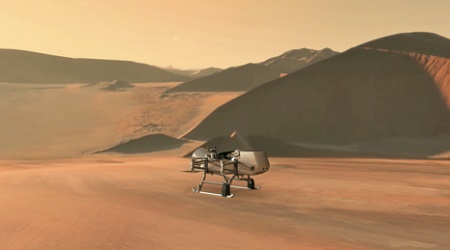
NASA’s upcoming Dragonfly mission will visit Saturn’s moon Titan. (Artist’s impression)

I know how this article comes across, and it’s for that reason I didn’t want to publish it immediately after Perseverance landed on Mars. That is undeniably an accomplishment, one which the team can and should take pride in. And as I keep saying, I’m not a scientist. These missions achieve a lot from a scientific standpoint, bringing in a lot of data about different aspects of the cosmos. The data we gain from missions like Perseverance, for example, will hopefully further inform a future manned mission to Mars.

The fact that we have so much technology in space, and that we see so many rocket launches that they don’t even make the news any more are accomplishments. Humanity’s space infrastructure may not have developed in the way I would have wanted, or in the way people of my parents’ generation may have expected in the aftermath of the moon landings, but we have achieved a lot. None of that should be in dispute, and that isn’t what I’m trying to say in this article.

The International Space Station over Florida.

Space exploration isn’t just about raw data and scientific interest. It needs to be inspirational, calling out to future generations of scientists and astronauts to say “hey, look at this absolutely amazing thing we’ve done.” And for me, that inspiring aspect hasn’t been present for a while. The decisions made going back fifty years or more to focus on Earth orbit and unmanned probes to Mars at the expense of other destinations has led space exploration to feel boring by 2021. I think that’s a shame, but I also worry that if that inspirational aspect remains lost, we may never get it back. If nobody cares about going into space because the things we do in space have already been done before, the resultant loss of interest will mean future generations won’t even try to develop new technologies or push forward to new destinations.

Necessity, as they say, is the mother of invention. And with space exploration having become a luxury rather than a necessity, there has been no real drive toward creating new and better ways of doing it. Why spend time, money, and resources inventing some kind of anti-gravity thruster when chemical rockets from the 1940s still work? But without that need, that drive, I really do believe we’ve seen space technology stagnate and fail to improve.

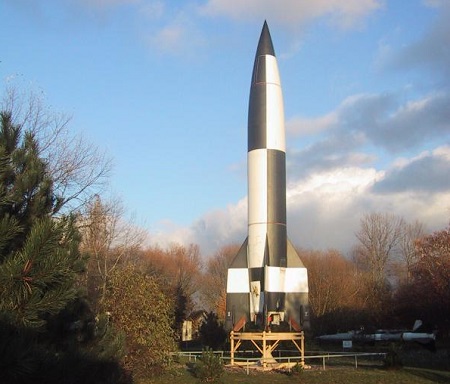
The Nazi V-2 rocket (modern replica pictured) was the first truly successful long-range rocket.
Photo Credit: Lars Aronsson, CC SA 1.0 http://creativecommons.org/licenses/sa/1.0/, via Wikimedia Commons

None of these things are easy, and it’s outstanding in many ways that we’re in as good a position as we are in terms of space exploration and space technology. But I can’t be the only one who feels this way. There hasn’t been a truly pioneering manned mission since we last went to the moon in the early ’70s, and when we’re sending probes and rovers to planets that have seen probes and rovers visit on a number of previous occasions… let’s just say that the first time is always interesting, but each subsequent one draws less and less attention and excitement.

The sad reality, I suppose, is that there isn’t any compelling reason to go to space beyond the thrill of exploring it. And thrills don’t pay the bills! We have all of the resources we need here on Earth – at least in the short-to-medium term – and the expense of doing something commercial in space, like mining or collecting resources, versus the potential profit seems to rule it out. Space is hard to commercialise right now, and thus we seem not to be as interested as we were in decades past.

The planet Uranus – last visited by a human probe in 1986.

SpaceX, the most successful commercial space company, makes its money by launching satellites and other missions in Earth’s orbit – as well as from the upcoming Starlink satellite internet service. That aspect of space can and has been commercialised. But the rest of it – the moon, the asteroids, the planets, and beyond – are currently beyond our reach, at least in terms of a cost-to-profit ratio. It falls solely to government-sponsored agencies, then, to engage in exploration.

I always keep my fingers crossed for interesting and exciting news from space. And it isn’t all doom and gloom; there have been some interesting events, such as the recent transit of ʻOumuamua – which may have been the first interstellar object ever detected. But even then, I’m left with a sense of a missed opportunity. We didn’t send a probe to investigate ʻOumuamua because we couldn’t. We lacked the technology to catch up to the fast-moving object, and thus we’ll never know for certain exactly what it was or what it looked like.

Will we put humans back on the moon – or even on Mars – in the next few years, or even in my lifetime? I can’t answer that question with any certainty any more, and having been let down so many times, I don’t think I’ll believe it until I see the astronauts strapped into their seats on the launchpad. I want space to be interesting, for humans to push the boundaries and strike out into the great unknown. And I want probes to do the same, visiting distant parts of the solar system in the name of exploration. Revisiting Mars and the ISS may provide interesting scientific opportunities, but speaking for myself as a layman, these things no longer hold my interest. Space exploration has become boring.

Some images and artwork courtesy of NASA and/or Wikimedia Commons. This article contains the thoughts and opinions of one person only and is not intended to cause any offence.