


Spoiler Warning: There are spoilers ahead for the entirety of Star Trek: Picard Season 1, including its ending. There may also be spoilers for other iterations of the Star Trek franchise.
Star Trek: Picard’s first season wrapped up at the end of March – and it feels like forever ago, what with everything that’s happened in the world since! While the season was running, in addition to reviewing each of the episodes in turn I also concocted a number of different theories for what was going on in the show. Star Trek: Picard very carefully set up a number of mysteries, and even heading into the second half of the finale, it wasn’t clear exactly how they would be resolved.
I’d argue that the first season’s two-part finale wasn’t the show at its best, and it felt as though a season which started incredibly strongly ended up stumbling a little as it crossed the finish line. There were a number of reasons for this – which I covered at the time – but it boils down to some of the show’s mysteries not being fully explained, and some storylines being dropped or left unresolved. That and the truly awful gold makeup used for the synths on Coppelius!

If you’d like to read all of my theories from Star Trek: Picard Season 1, you can find them on my dedicated Star Trek: Picard page. Click or tap here to be taken there!
This time, what I’d like to do is take a look back at some of the theories I postulated while the season was running. I’ll explain why I thought they seemed viable – and why they ended up being total misses! In a way, part of the fun of theory-crafting and speculating is knowing that you won’t always get it right… and boy oh boy did I have some seriously wrong theories!
Number 1:
Dahj and Soji aren’t synthetics, they’re genetically-engineered humans.

This is a theory I first came up with right at the beginning of the series, almost from the very moment Picard begins to suspect that Dahj is synthetic. It seemed like it could’ve been a clever idea for a double-bluff – establishing Dahj and Soji as synths, only to rip that away and challenge both Picard’s and the audience’s expectations. However, it didn’t pan out that way, and looking back, this theory was kind of ridiculous!
Genetic enhancements, similar to those made on characters like Dr Bashir and Khan, could have given Dahj the incredible speed and strength that she possessed in Remembrance, so from that point of view it wasn’t wholly unthinkable. But looking back, while Star Trek: Picard did aim to be a show that kept us guessing and didn’t telegraph every aspect of its storyline, this kind of subversion of expectations would have been a step too far. We didn’t know anything about Dahj or Soji at the beginning of the series, and to take the one established fact about them and make it a lie or a misunderstanding would have been a storytelling mistake.

There was also plenty of evidence that Dahj and Soji were synthetic: Picard’s meeting with Dr Jurati, Narek’s interest in Soji, and the strong connection Picard felt to Dahj (and later to Soji) because of his friendship with Data. All of that would have made no sense in the story if we’d ended up dealing with genetically-enhanced humans!
I brought this theory back after episode 3, The End is the Beginning, based on a line spoken by one of the Romulans who attempted to assassinate Picard: “she’s not what you think she is!” This of course referred to Soji, and it struck me that, as Picard and his comrades believed Soji to be a synth, perhaps the Romulan knew that she was not. However, as the story progressed it became abundantly clear that Soji and Dahj were the synthetics that the story established them to be, and that I was barking up the wrong tree with this one!
Number 2:
Section 31 will make an appearance in the show.
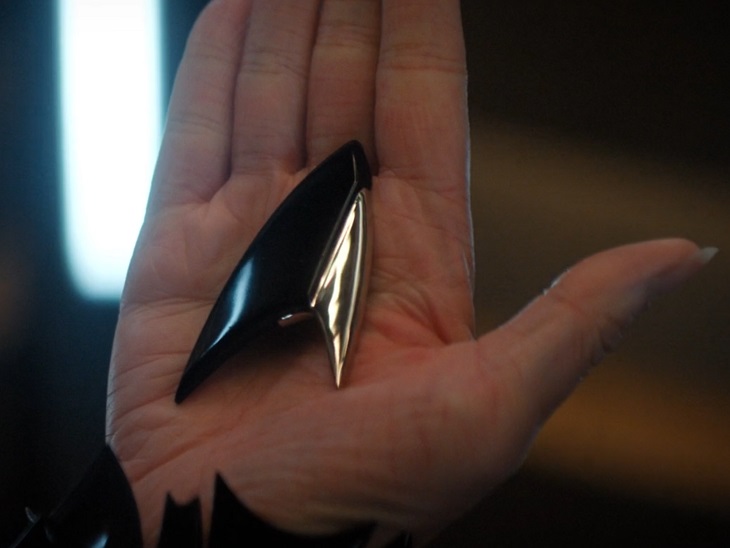
This theory was crafted not so much because of anything that directly happened in the plot of the show, but rather for production reasons. In short, the Star Trek timeline is seriously fractured, with shows being produced simultaneously occupying very different timeframes. When Discovery’s third season kicks off in a few weeks time, there will be four shows occupying four time periods. This complicates the franchise, and what that means is that some threads of continuity would be very helpful, especially for casual viewers.
Section 31 featured heavily in Discovery’s second season, and in addition, a spin-off based on the organisation is currently being worked on. It seemed logical that Star Trek: Picard might want to find some way of incorporating Section 31 if for no other reason than having one of those threads of continuity running through the franchise, tying things loosely together and being a frame of reference for casual viewers.
My first thought for a potential Section 31 appearance was that they could’ve been responsible for the attack on Mars and the destruction of Picard’s armada. I theorised they might have taken such aggressive action to prevent the Federation giving aid to the Romulans. This was extended to include Section 31 hacking the Mars synths as part of this plan.

I next had two potential Section 31 operatives pegged – Chris Rios and Seven of Nine. Rios because he worked aboard a Starfleet ship that was “erased” from the records, and Seven of Nine because it wasn’t clear who she worked for or why she was following Picard.
Finally, as these other theories fell by the wayside, I speculated that Section 31 may have arrived to take control of the Artifact after it was abandoned by the Romulans and later crashed on Coppelius. While I suppose you could argue that might yet happen, it didn’t happen in Season 1, and thus any real benefit of the organisation crossing over from a behind-the-scenes perspective was lost.
I maintain that this theory makes a lot of sense from a production perspective, and my final idea in particular – Section 31 taking control of the Artifact to study it – could have been accomplished without making any changes whatsoever to the season’s storyline. However, it didn’t happen!
Number 3:
Soji’s Trill friend will end up getting assimilated or killed.

Episode 2, Maps and Legends, introduced a Trill doctor working aboard the Artifact along with Soji. She ultimately only appeared in one sequence, but that sequence seemed to contain a lot of horror film-style foreshadowing, and for weeks I was insistent that we’d see this character meet an unpleasant end! Aboard a Borg cube – even a disabled one – the most likely way that would manifest would’ve been her assimiliation.
After Soji helped Dr Kunamadéstifee with her uniform, the two stood together while they listened to a speech from one of the Artifact’s Romulan guards. He stated that the area they were about to enter was incredibly dangerous, and a nearby sign seemed to reinforce the possibility of assimilation by counting the days since it had last happened. This seemed as thought it could tie in with Soji working on de-assimilating Borg drones; was she about to see her friend end up on her operating table?

It turned out, of course, that I was reading too much into one side character and one short sequence, because not only didn’t Dr Kunamadéstifee end up assimilated, she was never seen again after Maps and Legends, which was a shame because she seemed like a potentially interesting character. Soji spent much of her time from episodes 2-6 with Narek, and giving her someone else to interact with was a good idea. My theory was that their friendship may have built up a little more, leading to shock and sadness for Soji upon learning of Dr Kunamadéstifee’s fate.
I suppose in theory we could say that it’s unlikely that she survived the various disasters which befell the Artifact, from Narissa executing huge numbers of ex-Borg to the ship crashing on Coppelius, but nothing was ever seen on screen to even hint at her fate.
Number 4:
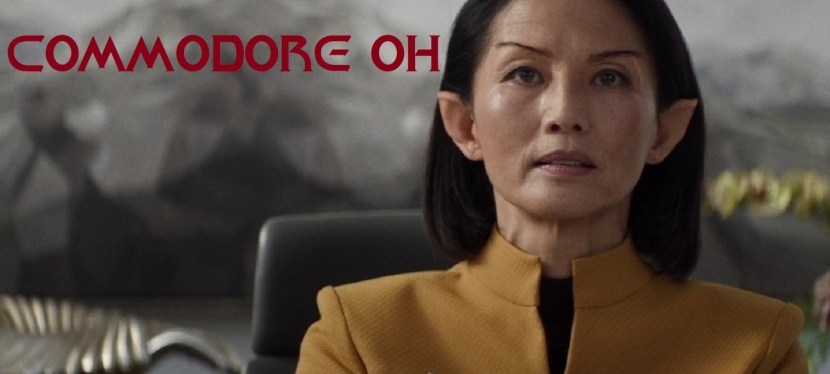
Commodore Oh is a synthetic.

As with Soji and Dahj being human, this was kind of an “out there” theory! But the whole point of theory crafting is to make wild guesses sometimes, and there were a couple of reasons why I considered this a possibility. First of all, it would have been thoroughly unexpected and shocking. Many recent films, games, and television series have tried to pull off genuinely unexpected twists, and had this been true, it would have been one heck of a shock!
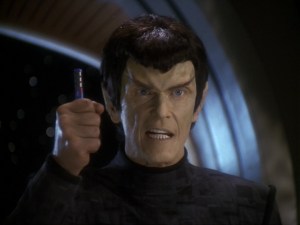
Secondly, the premise of Star Trek: Picard’s first season had been the cloak-and-dagger factions vying to thwart or create synthetic life. The Zhat Vash and the Tal Shiar were on one side, Maddox and his team on the other. There were rogue traders, Romulans, ex-Borg, and all sorts of shadowy figures involved – any one of whom could have not been what they seemed. The show crafted mysteries for us to examine. As we learned more about the Zhat Vash and their mission, I began to wonder if they could have been infiltrated by someone who wanted to stop them harming synths. This later evolved into wondering if they’d been infiltrated by someone who wanted to bring about the very disaster they sought to prevent.

Dahj and Soji were both unaware of their true synthetic natures, which built on past iterations of Star Trek that showed synths can be programmed to not realise they’re synths. Commodore Oh could have genuinely believed in the Zhat Vash cause – but been programmed to “activate” at the opportune moment. We later learned that the Zhat Vash feared the arrival of a faction of super-synths that I dubbed the “Mass Effect Reapers” (because they were very similar to that video game faction) and I incorporated that into this theory, suggesting that Commodore Oh may be working for the “Mass Effect Reapers” to try and bring about their arrival.
Of course it was a complete bust! Commodore Oh was a Zhat Vash operative to the core, and as far as we know, wholly organic in nature! I still think she’s a fascinating character, and I wrote an article a few months back looking at her place in the Star Trek timeline. You can find it by clicking or tapping here.
Number 5:
Picard telling everyone that their enemies are the Tal Shiar – and not the Zhat Vash – will have consequences.

One thing that Star Trek: Picard didn’t do particularly well, in my opinion, was staying consistent in how it referred to its antagonists. In Remembrance, the faction who attacked Picard and Dahj weren’t named, but in Maps and Legends we learned of the existence of the Zhat Vash – an ancient, shadowy organisation which operated within, yet were distinct from, the Tal Shiar.
Yet for several episodes, Picard and others kept referring to their adversaries as the Tal Shiar. In-universe, there’s a certain kind of logic to this. Picard may not have believed fully in the Zhat Vash’s existence, having only heard about them from one source, or he may have felt trying to explain the difference would have been too time consuming and/or made him seem too conspiratorial. However, with practically everything else in the show being done deliberately to achieve certain story payoffs, I wondered whether Picard’s decision not to be up front with his crew might have had repercussions.

Elnor was the one character who I felt seemed most likely to be affected by the revelation that it was the Zhat Vash, not the Tal Shiar, that he was up against. As a member of the Qowat Milat, Elnor was opposed to the Tal Shiar. But the Qowat Milat’s relationship with the Zhat Vash was unclear; even if they were enemies, the Qowat Milat may have had particular techniques for dealing with them. And at the very least, Elnor and his faction seemed likely to know of their existence.
However, Elnor learned in Nepenthe that he was facing off against the Zhat Vash, not the Tal Shiar, and the revelation seemed to have no impact on him whatsoever. The rest of La Sirena’s crew were equally nonplussed, and there were no consequences at all for the confused terminology – at least, not from an in-universe point of view. I think that, unfortunately, the decision to complicate the terminology around the show’s antagonists may have made it harder to follow for casual viewers. When dealing with made-up names like “Tal Shiar” and “Zhat Vash”, remaining consistent is important for the audience to be able to follow what’s going on.
Number 6:
There’s a Starfleet-Zhat Vash conspiracy.

In Maps and Legends, we were introduced to Commodore Oh for the first time. It was a great shock to see a high-ranking Starfleet officer involved in Dahj’s murder, and at the time it wasn’t at all clear whether Commodore Oh was a Romulan infiltrator or a Vulcan co-conspirator. If she was a Starfleet officer working with the Zhat Vash, it stood to reason that others in Starfleet were as well – perhaps even senior admirals.
Furthermore, when we learned how Commodore Oh recruited Dr Jurati into the conspiracy – all it took was a brief mind-meld – it seemed plausible that she may have used the same technique on others. Commodore Oh had been embedded in Starfleet for more than sixty years, and in that time there’s no telling how many people she may have interacted with.

However, it turned out not to be the case. Admiral Clancy, the head of Starfleet Command, wasn’t compromised, nor were any of the other Starfleet officers and leaders seen or referenced in Season 1. As far as we know – and this could change if future Star Trek projects decide to look at this aspect more deeply – only Commodore Oh and Rizzo were involved within Starfleet, and they were both Zhat Vash operatives.
This is one theory that I’m definitely pleased didn’t pan out. Making Starfleet itself the “bad guys”, even if there were a reason for it, wouldn’t have felt great in a Star Trek series, and would have been a far darker path for the show to have taken. Seeing Riker show up in Et in Arcadia Ego, Part 2 at the head of a Starfleet armada was a beautiful moment (though sadly one that had been telegraphed ahead of time) in large part because it proved that Starfleet and the Federation were still on the right side. The plot to kill the synths and attack Mars was purely a Zhat Vash creation.
Number 7:
The Control AI, from Star Trek: Discovery Season 2, is involved.

Although I initially considered it to be a bit out of left field, the episode Nepenthe really kicked this theory into high gear! My first thought had been that perhaps the reason why the Zhat Vash were so frightened of synthetic life was because they had some involvement with Control, the rogue artificial intelligence from Star Trek: Discovery’s second season. I was convinced – wrongly – that the producers behind the overall Star Trek franchise would have wanted to build a major connection between Discovery and Picard for some of the reasons already discussed, and bringing Control in seemed like a viable option for accomplishing this.
In the episode Nepenthe, we finally got to see how Dr Jurati came to be recruited into the conspiracy – she was shown a vision by Commodore Oh, one that seemed to warn of something apocalyptic. Contained within this vision were a couple of visuals that were made for Star Trek: Discovery – more specifically, they were used to show a vision Michael Burnham and Spock had of the Control AI.
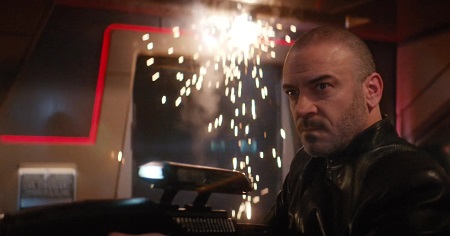
At the time, I noted that there could be production-side reasons to re-use visual effects, as it was less time-consuming and cheaper than making wholly new CGI. However, for a couple of weeks I really did think that we were going to find some connection between Control and the Zhat Vash; perhaps the Romulans and Federation had been competing in some kind of mid-23rd Century AI arms race, or perhaps while Control was on the loose it had attacked Romulan ships or planets.
In a thematic sense, Star Trek: Picard’s first season and Discovery’s second season share some significant points. Both consider the potential for rogue or out-of-control artificial life, and both look at the consequences of continuing to develop AI – something that we arguably should be concerned about today! But there was no deeper crossover beyond basic themes, and the shows remain almost entirely separate from one another. The re-used visuals are what completely threw me for this one!
Number 8:
The synths on Coppelius are already dead.
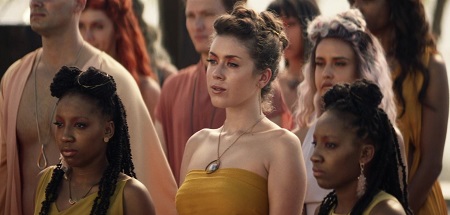
Star Trek: Picard’s first season had, unfortunately, one rather large plot hole. The driving force for much of the first half of the season was locating and rescuing Bruce Maddox, the Federation cyberneticist who built Soji, Dahj, and many of the other synths. Maddox was on a planet called Freecloud, a place he travelled to when he seemed to have nowhere else to turn. He ended up returning to the dangerous Bjayzl, someone he owed a lot of money to, and was captured. The reason he put himself in such grave danger was because his lab had been destroyed by the Tal Shiar, or so he claimed.
But in the two-part finale, Picard and the crew travelled to Coppelius and saw for themselves that Maddox’s lab hadn’t been destroyed, and the Tal Shiar or the Zhat Vash had never been there. This feels like a pretty major issue, because the question of why Maddox was on Freecloud now has no satisfactory answer. The reason seems to be “because plot”, and that’s never a good thing.

However, before the finale I was still trying to square that particular circle. One of the possibilities I came up with was that Maddox was right – his lab had already been destroyed, which could mean that the synths he’d built were already dead. It would have made Narek’s mission kind of a waste of time, as his colleagues had already killed off the synths, not to mention being a rather bleak way to end the season, but it would have fit together with what had already been established.
I don’t think I’d have enjoyed this storyline, which would have left Soji as perhaps the sole survivor of her race. It would have been very dark, and would have felt like a victory for the show’s antagonists. But at the time, I was scrambling around looking for ways to make the story of the first half of the season – culminating in Maddox’s statement to Bjayzl about his lab being destroyed – fit with the second half of the season and the revelation of the existence of more synths.
Number 9:
The captain of the USS Ibn Majid is a character from a past Star Trek show.

This was a pretty simple theory by my standards. When we learned that Rios had served aboard a ship called the USS Ibn Majid, which was destroyed and covered up, I began to wonder who might’ve been in command of the vessel. Rios was clearly very attached to his former captain, and I wasn’t sure if we might’ve seen – in flashback form – this character make an appearance.
From Rios’ initial comments about the character – that they were dead, male, and “heroic” – I put together a shortlist based on possible characters from past Star Trek shows who could conceivably have been starship captains in that era. I ruled out those who seemed to have no desire to sit in the captain’s chair, like Dr Bashir or Tom Paris, and obviously ruled out those who wouldn’t be eligible like Chief O’Brien. Finally, Zhaban had mentioned that La Forge and Worf were still alive, so they were out too. That left a handful of characters, including Chakotay and Harry Kim, both from Voyager. I also suggested Edward Jellico from The Next Generation two-parter Chain of Command, Solok from the Deep Space Nine episode Take Me Out to the Holosuite, and Captain Bateson from The Next Generation Season 5 episode Cause and Effect.

There were other possibilities – most of which were minor characters who made only one or two appearances in Star Trek – and there were many male officers who could, in theory, have made the cut. I liked this idea simply for the sake of continuity, as having the Ibn Majid’s captain be someone we already knew seemed like an interesting concept.
With Bruce Maddox, Hugh, and Icheb all killed off in Star Trek: Picard’s first season, it was clear that the producers has no qualms about getting rid of legacy characters! That fact also contributed to making this theory plausible. Past iterations of Star Trek has been reluctant to kill off main characters, but Star Trek: Picard did so several times. However, none of this came to pass, and instead a new character – Captain Alonso Vandermeer – was created for the show, and was only seen briefly in a photograph.
Number 10:
Narek will go rogue.
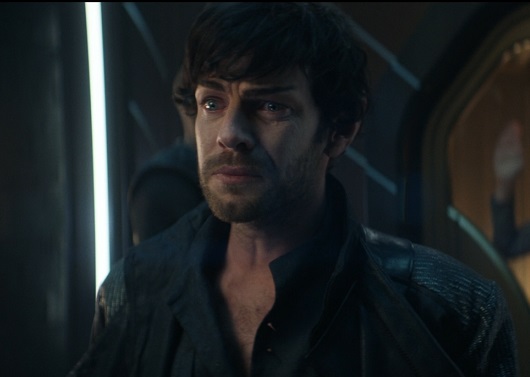
Narek was a unique character, not only in Star Trek: Picard but in the whole franchise. Never before had an out-and-out villain been a main character, with their name in the opening titles. Narek was also an interesting and nuanced character in a season where – most of the time – the villains could feel flat and one-dimensional. I’m still disappointed that his storyline was unceremoniously dumped midway through the season finale; we didn’t even learn what became of him after Picard’s “death”.
But that’s somewhat beside the point. From as early as the third episode, I began speculating that somehow, Narek would be convinced to abandon his mission and join with Soji and Picard. His clear feelings for Soji seemed to offer a route for him to make this happen, but even if the show didn’t go for the “spy falls in love with his target” trope, there were other ways it could’ve happened. Narek seemed like a reasonable man; if it were demonstrated to him that the synths were not a threat, it seemed at least plausible that he might’ve switched sides.

However, as of the last time we saw him – before he just dropped of the face of the series with no conclusion to his story – he was still 100% committed to the Zhat Vash cause. In fact, he never wavered. His attempt to kill Soji may have caused him great distress, but that didn’t stop him going ahead with his mission; he didn’t even hesitate.
I actually like that Narek was unpredictable, and as a whole I like that the show set up what looked to be a familiar trope – the spy with a heart of gold who switches sides for the girl he loves – only to say that actually, Narek was still committed to his cause and his mission. However, it’s a shame that this never really got a proper payoff, as Narek disappeared. His character arc feels incomplete, and as I’m fairly confident he won’t be returning for the show’s second season, we may never learn what happened to him after the events on Coppelius.
So that’s it!
A handful of my theories for Star Trek: Picard Season 1 that never came to pass! I did manage to successfully predict a handful of (more obvious) plot points across the first season, so my theories didn’t all fail as hard as those listed above. The important thing, though, was that I had fun doing this. Thinking about the series and writing up the theories was really enjoyable at the time, and it’s something I hope to do with Discovery later in the year – at least, provided it has suitable theory-crafting material to work with!

The important thing when considering fan theories is to remember that they’re just guesses and speculation. The showrunners, writers, and producers are the ones who craft the story, and they’re the ones who get the final say on how it’s going to pan out. Getting overly attached to any one theory – no matter how much we like it or how plausible it seems – really just means we’re setting ourselves up for disappointment. I could point to many projects in recent years which have suffered as a result of this, but all I really want to say is that, for those of you who followed my theories during Star Trek: Picard Season 1, I hope that I didn’t cause you any disappointment or frustration when I was wrong. At the end of the day, this is supposed to be fun and an excuse to spend more time in the Star Trek galaxy. Let’s all try to take fan theories with an extra-large pinch of salt!
Star Trek: Lower Decks is currently airing its first season – the second of three Star Trek projects in 2020. For all the problems that this year has thrown at us, having three different Star Trek shows to enjoy has been a blessing. If you missed it, I’ve reviewed the first episode of Lower Decks and I’ll soon be taking a look at episode 2, which will be available to watch (at least for viewers in the US and Canada) later today. And as mentioned I’ll be looking at Discovery when that airs in October. There’s no word on when exactly we can expect to see Season 2 of Star Trek: Picard. It has an optimistic release date of 2021, but given that California is still largely locked down and filming has yet to begin, I wouldn’t be surprised if that slips back. Regardless, whenever we get it I’ll be taking a look at the episodes and probably crafting a bunch more theories!
Star Trek: Picard Season 1 is available to stream now on CBS All Access in the United States, and on Amazon Prime Video in the United Kingdom and elsewhere. The Star Trek franchise – including Star Trek: Picard – is the copyright of ViacomCBS. This article contains the thoughts and opinions of one person only and is not intended to cause any offence.




 Trekking with Dennis