Why I’m so excited for Star Trek: Picard

Spoiler Warning:
I will be looking at material from the two trailers for Star Trek: Picard, as well as discussing the most recent season of Star Trek: Discovery. There will also be spoilers for other Star Trek films and series.

In either 1999 or 2000 – I can’t remember which – I was listening to the radio when the news of a new Star Trek show was breaking. In the UK, the complicated rights agreements in place for broadcasting Star Trek meant that – at least for households which didn’t have satellite television – we were quite behind where the various series were in their US airings. The Next Generation had concluded its run, though Deep Space Nine and Voyager hadn’t yet, and I was very interested to see what would be coming next for the franchise.

When it was announced that the new series – later titled Enterprise – would in fact be a prequel, I wasn’t impressed. Star Trek was about looking forward to the future, I felt, so why did they need to go back in time to before Captain Kirk? In addition, Star Wars Epsiode I: The Phantom Menace had been in cinemas, and there was a lot of talk at the time about how prequels as a concept were bad – some of which admittedly went over my head in my youth.

Nevertheless, I wasn’t convinced about a Star Trek prequel and during Enterprise‘s original run on television over here, I only tuned in sporadically. It wasn’t until I got the series on DVD a few years later that I got to watch it in its entirety. Enterprise actually told some great stories – and is a good example of how a show that “no one asked for” can actually be worth watching after all. But this isn’t a review of Enterprise.

We’d have to go back to the 1990s to find a Star Trek series with a new cast that wasn’t a prequel.

Since just after the turn of the millennium, when Voyager went off the air and Nemesis hit cinemas, the Star Trek franchise hasn’t moved its timeline forward. Instead, we’ve had Enterprise and Discovery – both of which are set before Kirk’s original five-year mission – and the Kelvin-timeline reboot films – which are also set in the 23rd Century, but in an alternate timeline. In all that time we’ve had some admittedly interesting stories, and in 2009’s Star Trek a very brief glimpse at the post-Nemesis future, but no real advancement of the overall narrative of the franchise. And while Enterprise, Discovery, and even the Kelvin-timeline films have told some fun, interesting, and “Star Trek-y” stories, they’ve all been firmly embedded in a time period we’ve seen before.

Any prequel has an uphill struggle when it comes to telling a dramatic and interesting story, as well as building tension. The reason is simple – we know what comes next. You can have a galaxy-ending threat as part of your narrative, but if we’ve seen the galaxy fifty or a hundred years hence, we know that the threat isn’t serious – and even if in the moment it’s possible to get caught up in the story, at the back of our minds we still know that there will be a way out of it. At least, that’s how it works for me. As an example, in season 3 of Enterprise we follow the crew as they race to stop the Xindi planet-killing weapon from destroying the Earth. And that’s a very exciting story – arguably Enterprise‘s best season – but while watching it, at the back of my mind I was always aware that in the 23rd and 24th Centuries, we’ve been to Earth and we’ve seen that it clearly wasn’t destroyed. The journey can still be entertaining if the destination is known, but for me at least, knowing the outcome robs the story of some of its drama and tension.

This is why series like Game of Thrones or The Walking Dead have been so successful with what I call the “disposable cast”. By routinely killing off key characters and getting rid of starring actors and actresses, simply being a main cast member isn’t enough to guarantee safety any more – and the sense that anything could happen is present all the time as a viewer, arguably raising the stakes.

Star Trek has occasionally lost main cast members, though these have more often been motivated by production reasons – such as a cast member leaving the series, or the showrunners deciding to “refresh” the cast by replacing someone – rather than for purely narrative ones. In most cases, as viewers we tend to feel that the main characters are safe, and it’s the redshirts like Ensign Bob, introduced for the first time five minutes ago, who are most in danger in any given scenario.

But as we’re now in a new phase of television, one dominated in the aftermath of shows like Game of Thrones with ideas like the “disposable cast” and serialised storytelling, there are new and exciting possibilities for Star Trek. We’ve already seen some of this in Discovery – the first two seasons each told season-long stories instead of being episodic, and we’ve seen characters like Lorca killed off, as well as Pike, Spock, and Una appearing for a single season, and of course Ash Tyler being left behind as Burnham leads the U.S.S. Discovery into the future. Sir Patrick Stewart, when interviewed regarding the new series, has gone on record saying that Picard will be “like a ten-hour movie” instead of a series of episodes – firmly stating that this will be another serialised show.
The vineyards of Château Picard form the Starfleet logo in the first teaser poster for the new series.

Personally I’m a fan of episodic television – I think it’s great to be able to drop into an episode of a show without needing to have followed the entire season to understand what’s going on. Previous iterations of Star Trek largely operate like this, though the aforementioned third season of Enterprise, as well as the Dominion War arc in Deep Space Nine, were serialised stories. But for shows like TNG and Voyager, it’s possible to jump into most episodes and follow a single story over forty-five minutes. I like that, and I think it makes for a good format. There’s no getting away from the move to serialised shows, though, and Picard is set to go down this route.

When the TNG-era series all concluded around the turn of the millennium, there were a lot of leftover story points. Although each crew had arguably reached their destination – Deep Space Nine ended its war, Voyager saw the crew make it home, and Nemesis saw the Enterprise’s crew go their separate ways – 500-odd episodes across 21 seasons of TV, along with four films, told over a 15-year period from 1987 to 2002 had a lot of stories to tell and taking that era of Star Trek off the air left a lot of open-ended, unfinished plot threads. There are too many to name here, but a few that spring to mind are: what would happen next for Cardassia after the war? How would the Klingon-Romulan-Federation alliance work with no common enemy? And what happened to the Borg after Voyager attacked their transwarp network and the Queen’s complex? In addition, finding out what happened next to a lot of the characters is something fans would like to know.

By this point in time, several members of Kirk’s crew have had their futures shown on screen. Kirk himself died saving Veridian III in Generations, McCoy lived to a ripe old age and helped christen the Enterprise-D when it launched, Spock ended up in the Kelvin timeline after trying to save Romulus, and Scotty emerged from transporter-suspension in the TNG episode Relics. But what happened next for the crews we’d seen in the TNG era is still unknown to fans – and there’s definitely scope to explore some of that within Picard.

I don’t feel that Picard should overload itself with characters, though. It’s a short series – clocking in at only ten episodes – and the more time it spends looking back, the less time there is to look forward. And the more time it spends with fan favourites of the past, the less time there is to show off the new crew. I’d like to give the new cast a chance to become fan favourites for the next generation (pun intended) of Star Trek fans. I really hope that in another thirty years’ time they’ll be clamouring to find out what happened next to some of these characters the way we are for those of the TNG era. So in that sense, Picard has to walk a line between what happened since Nemesis and what’s to come.

It’s my hope that Picard can strike that balance, and that while we’ll learn a great deal about the shape of the Star Trek galaxy and what happened next for some fan-favourite characters, we’ll also get an exciting original story in which those pieces of information are conveyed. The Next Generation didn’t spend too much of its time in its first season looking backwards – aside from DeForest Kelley’s cameo in Encounter at Farpoint and a couple of name-drops, TNG told its own story. Some elements of that story filled in the blanks for returning fans – we learn, for example, that the Klingons and Federation are at peace, and that the Romulans have isolated themselves for a number of years – but they weren’t in-your-face about it, and those story points unfolded naturally in the episodes in question. They didn’t feel tacked-on or shoehorned in in order to provide cheap fanservice – something I’d argue has happened in some recent Star Wars projects.

At the end of the day, Picard is taking the franchise forward in time – to the close of the 24th Century. And it’s the first time in a very long time that the timeline is going to advance. That is already a huge point in its favour, and without knowing much at all about the story, it’s enough to get me hyped up.
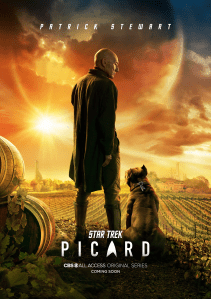
Jean-Luc Picard and Number One (the dog) on the second poster for Star Trek: Picard.

The two trailers for Picard have been great, and I can’t wait to catch up with Seven of Nine, Riker, Troi, and of course, Picard himself. I’m also really interested to learn more about the new cast – including, for the first time, a Romulan main cast member. It looks from the trailers that we’ll see some Borg story elements, as well as learning more about the Romulans after the destruction of their capital. All of those things seem absolutely fascinating, and while I have to admit I’d be hyped up for almost any Star Trek story that moves the narrative forward, the teases we’ve seen of Picard just look incredible.

I know that recent Star Trek projects haven’t thrilled everyone in the fanbase, but I really do hope that Trekkies who weren’t taken with Discovery will give Picard a try. The chance to see what comes next isn’t something we’re always going to get. A lot of shows – by far the majority – are one-off things, and when they’re done they’re done. Some even get cancelled too soon, before even the first part of their story can be told. So this opportunity that Picard presents is a rarity, one I intend to take full advantage of. If Picard is a success, it has the potential to be a launchpad for other series set in the same time period, taking the Star Trek franchise boldly into the 25th Century.

While I don’t expect Picard to spend its entire runtime catching up with galactic events and reintroducing old crewmates, I do hope we’ll get enough of that to feel like we’re back in that galaxy again – combined with enough new material and new characters to drive the story forward and give new fans a chance to get hooked in. Walking that line between the old and the new might be a challenge, but I’m confident that the producers, having cut their teeth on Discovery, can manage it with ease. And with Picard having just been renewed for a second season while I was writing this column, ViacomCBS are clearly confident of that too.

After almost two decades, Star Trek is finally ready to move forward again. With just over a month left to go, I can feel the excitement building already. Forget Christmas, forget New Year – it’s Star Trek: Picard that I’m most looking forward to right now!

Live Long and Prosper!

The Star Trek franchise, Star Trek: Picard, and all other Star Trek properties mentioned above are the copyright of ViacomCBS. This article contains the thoughts and opinions of one person only and is not intended to cause any offence.
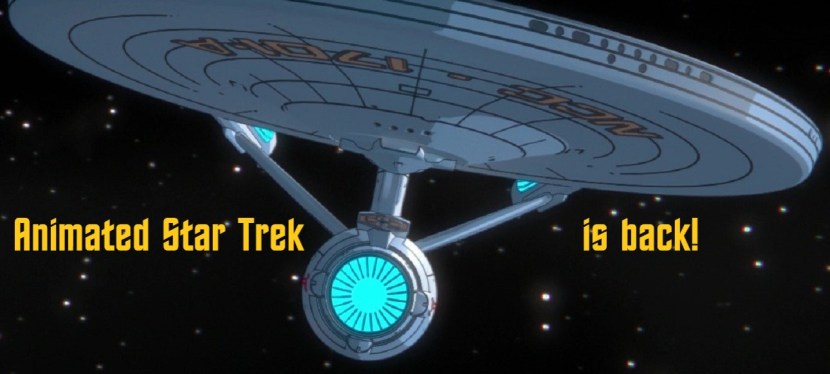
Animated Star Trek is back!

Spoiler Warning: There are spoilers ahead for the plots of both Ephraim and Dot and The Girl Who Made The Stars, as well as for Star Trek: Discovery. If you want to avoid spoilers, turn back now!

Star Trek: The Animated Series ran for two seasons in 1973-74. It featured the voice talent of most of the original cast (sans Walter Koenig), but since then Star Trek has stuck to live-action series and films. Until, that is, the latest two episodes of Short Treks, which were released a couple of days ago.

At least they were for Trekkies in the United States – ViacomCBS apparently places no value on its overseas fans. But let’s not get into that right now, because these two episodes were absolutely fantastic.

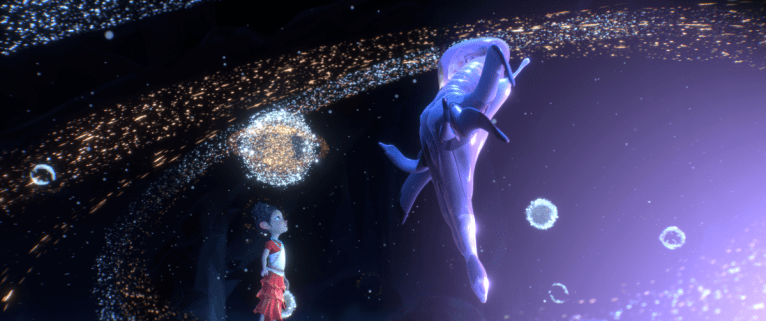
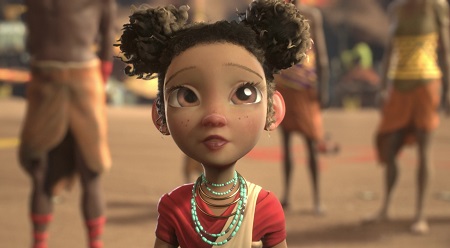
After I was finally able to track down copies, I watched The Girl Who Made The Stars first, as I thought I probably wouldn’t find it as interesting as the other episode, Ephraim and Dot. But The Girl Who Made The Stars was a cute, Disney-esque bedtime story, told by Michael Burnham’s father to her when she was a child. I got a distinct Moana vibe from this short episode, which tells of a young girl who teaches her tribe of ancient humans to overcome their fear of the night – aided, in true Star Trek fashion, by an ethereal alien.

The unnamed little girl in The Girl Who Made The Stars.

As in Moana, the key to defeating what the tribe’s elders called the Night Beast wasn’t violence, and hiding away from it didn’t help either. It took someone to be bold and head out beyond the safety of the tribe’s valley to overcome the imagined monster. How much of the episode was actually based on African legends is something I don’t know, but this was a uniquely Star Trek look at history and at Africa. Framed as a bedtime story, I’m certain we aren’t supposed to take the episode’s main plot as canonical, but it was an interesting look at Michael Burnham’s childhood. Burnham has been in some respects a hard protagonist to get behind in Star Trek: Discovery. Partly that’s a consequence of her internal struggle between a logical Vulcan upbringing and human emotion, which she has at times seemed to be confused with. And partly, it has to be said, it’s a consequence of a character whose motivations – especially in Discovery‘s premiere – were impossible to follow and understand. This short episode doesn’t change anything fundamental about her character, but it does show the audience that she’s human at her core. Something which may be important as Discovery travels to unknown destinations next season. I wouldn’t be surprised to see this bedtime story referred to, perhaps inspiring her to lead Discovery’s crew and/or the Federation in season 3.

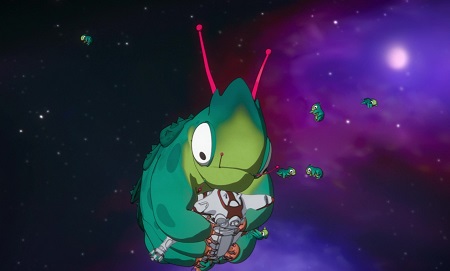
The other episode was absolutely adorable. Ephraim and Dot told the story of a tardigrade, the species seen in season 1 of Discovery, laying its eggs. After trying to find a warm place, the tardigrade chooses the warp core of the Enterprise – by this time under Kirk’s command. We see an animated recreation of the TOS engine room, and this is where Ephraim (as I assume she’s called, she’s never named on-screen) lays her eggs, only to be kicked off the ship by Dot – an R2D2 or BB8-type droid, seemingly employed on the Enterprise to perform menial tasks and jobs humans wouldn’t be able to do.

Ephraim and DOT.

The episode then launches into a brief “greatest hits” of the Enterprise under Kirk’s command. We see Khan waking up in sickbay from Space Seed, the hand of Apollo, Sulu brandishing his sword, the Planet Killer from The Doomsday Machine, and a recreation of Lincoln featured in the episode The Savage Curtain. As the sequence continues, we see the refit Enterprise fighting Khan’s Reliant in The Wrath of Khan before Ephraim finally manages to scramble back aboard, just as the Enterprise is set to be destroyed over the Genesis Planet in The Search for Spock.

I’m going to let you guys in on a secret – I got legitimately emotional at this point. As Ephraim races to save her eggs from the crippled, soon-to-be-destroyed ship I was literally on the edge of my seat. And when Dot got to her first and threw her overboard yet again, I felt a real emotional stab. I’ve always been a sucker for animals in films and television, and the cute way Ephraim is styled here no doubt contributed to that.

Luckily, at the last minute Dot realises that the eggs are on board and manages to save them, delivering the newly-hatched babies to Ephraim after the ship has exploded. The two then disappear into the Mycelial Network – perhaps laying the groundwork for a future episode or an appearance in one of the two new animated shows? Gosh I hope so.

Ephraim embraces DOT.

These two episodes were absolutely unlike anything Star Trek has done before – at least not since some of the weirder episodes of The Animated Series in the 1970s saw a 50-foot-tall clone of Spock, or the Enterprise visiting a parallel universe where magic is real. Yes, those really happened. And yes, they’re canon. Deal with it.

These episodes were undoubtedly inspired by Disney – the storytelling, the use of animals, cute robots, and a child as the main characters all come together to make these the most child-friendly Star Trek episodes so far, as well as a fantastic way to introduce little ones to Star Trek. Ephraim and Dot in particular contained some very funny moments, complete with traditional cartoon sound effects. At one point, Ephraim is sucked into a tube and bounces through it, with the tube bulging out in a throwback to old-school cartoons.

The little girl and the alien in The Girl Who Made The Stars.

But at their core, these were just cute, heartfelt episodes. I’m sure that people who haven’t enjoyed modern Star Trek will hate them, and that’s fine because at this point those folks hate just about everything. Both of these episodes have something to say about Star Trek. Yes, characters are important. Yes, alien races and cool ship battles and the politics of the Alpha and Beta Quadrants are important. But at its core, Star Trek is about inspiring stories, and seeking out new life. The Girl Who Made The Stars tells such a story, and Ephraim and Dot takes a look at one example of the kind of new life that Starfleet has been seeking. And these episodes are presented in a cute, fun, approachable way. Show them to anyone sceptical of Star Trek and I bet they’d come away thinking about the franchise in a whole new light.

Overall, Ephraim and Dot and The Girl Who Made The Stars leave me hopeful that the new animated series – Lower Decks – is in good hands and will turn out to be a lot of fun. And moreover, that the currently-untitled animated series that’s supposed to be more kid-friendly will also have something to offer to adult fans like myself. The best kids’ shows manage to find a way to appeal to us too, and from these shorts, I feel like there’s a real chance that the new series will absolutely have something to offer older Trekkies.

Star Trek animation is back – with a bang!

There’s only one episode left in this season of Short Treks – and it’s set to be a prequel of sorts, leading into Star Trek: Picard. So I can’t wait to see that. And Picard is coming next month! It really is a great time to be a Star Trek fan right now.

The Star Trek franchise – including Short Treks and all other properties mentioned above – is the copyright of ViacomCBS. Short Treks is available to stream on CBS All Access in the United States, and is now available on Blu-ray elsewhere. This article contains the thoughts and opinions of one person only and is not intended to cause any offence.
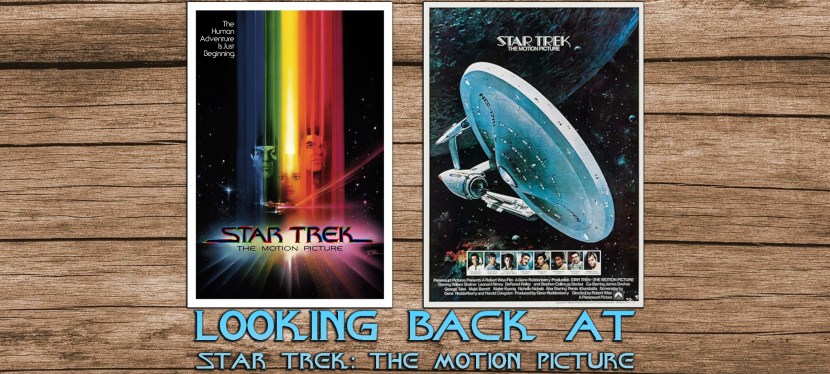
Looking back at Star Trek: The Motion Picture on its 40th anniversary

Spoiler Warning: There are spoilers ahead for Star Trek: The Motion Picture and other iterations of the Star Trek franchise.

On the 7th of December 1979, ten years after going off the air (and five years since The Animated Series went off the air), Star Trek was back. Star Trek: The Motion Picture premiered, and while it has been overshadowed in many ways by its sequel, Star Trek II: The Wrath of Khan, the film was a success – albeit not an overwhelming one according to distributors and producers – and reinvigorated the franchise. Make no mistake, if it weren’t for The Motion Picture, Star Trek as we know it wouldn’t exist today – there would’ve been no Wrath of Khan, and from that there’d have been no Next Generation or any future series or film. In a very real sense, The Motion Picture paved the way for the franchise’s future, and the success Star Trek enjoys today owes a lot to this film.

The Motion Picture was a risk for Paramount Pictures. Star Trek had shown that it had a number of very vocal fans – the letter-writing campaign in 1968 to get the series renewed demonstrated this – but its wider popularity was an unknown quantity, especially on the big screen. Reruns of The Original Series had garnered a larger audience than its 1966-69 original run, but there were still question marks over whether to make a new television series or to go down the box office route.

Star Trek: The Motion Picture turns 40 in December 2019.

Indeed, the project that would eventually become The Motion Picture started out life as Star Trek: Phase II, a television series that was to reunite the original cast – without Spock – for another five-year mission onboard the Enterprise. After a project called Planet of the Titans failed to get off the ground in the mid-1970s, by 1977 Phase II was officially in production. It has been said many times that the success of another 1977 project – Star Wars – is what led Gene Roddenberry and Paramount to reconsider the television series and make a film instead. While there is undoubtedly a kernel of truth to that, there were other factors at play too. The script which would eventually become The Motion Picture was originally set to be the pilot episode for Phase II but after a series of revisions and discussions between the creative team and the studio, the decision was made to enter production as a film instead, and two versions of the script were submitted – one by Gene Rodenberry and one by Harold Livingston, who’d been a producer on Phase II. Livingston’s script was chosen (by Michael Eisner – future CEO of Disney) and Star Trek: The Motion Picture was officially greenlit.

As an interesting aside, Phase II remained officially “in production” even after the decision was taken to switch focus to a film, and for much of 1977 the official line from the studio was that a series, originally set at 13 episodes, was being produced. It wasn’t until 1978 that the film would be officially announced.

Concept art of the bridge of the Enterprise that was created for Phase II.

So that’s a brief potted history of how it came to be. But despite making around $139 million on a budget of $46 million, Paramount considered the film a disappointment. The big risk had paid off, but not as much as they’d hoped. The expensive special effects and continued revisions to the script even during production were cited as reasons why, as was the less action-heavy, more ethereal storyline.

For me personally, it’s the lack of action and the deliberate slow pacing that gives this film something that others lack – a sense of “Star Trek-ness”. Star Trek was always into the weirder, more esoteric side of science fiction, especially prior to The Motion Picture, and this film stands alongside episodes of The Original Series as a pure science fiction work, not an action-sci fi film like The Wrath of Khan or First Contact. While some people might find its slower pace to be a grind, to me it makes it akin to watching a feature-length episode of the series, rather than just another action flick.

Leonard Nimoy, director Robert Wise, Gene Roddenberry, DeForest Kelley, and William Shatner during production on The Motion Picture.

Because of the overwhelming popularity of The Wrath of Khan within the fanbase, The Motion Picture often gets a bad rap. People have said that “all of the odd-numbered Star Trek films are bad”, including The Motion Picture in with Search for Spock and The Final Frontier. Both of those titles have good and bad moments – the latter suffering perhaps from too much involvement from William Shatner – but to me, The Motion Picture is in a different league.

Some criticism of the film is that it feels like a two-and-a-half hour episode of The Original Series. But why should that be a criticism? The Motion Picture masterfully builds up its drama – the V’ger cloud’s attack on the Klingons, its destruction of the Epsilon IX station, and finally the death of new character Ilia all add to the stakes. While none of these are particularly dramatic, nor gory, that doesn’t detract from the threat, it heightens it. V’ger is shown to be a being of such incredible power that it can make whole fleets of starships vanish in a heartbeat. We don’t need huge explosions or a punch-out to learn this. V’ger’s power is also confirmed by the reaction of characters. So as the film progresses, we know what’s at stake.

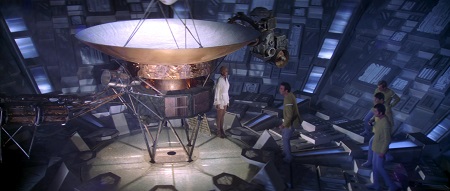
Kirk and the away team encounter V’Ger.

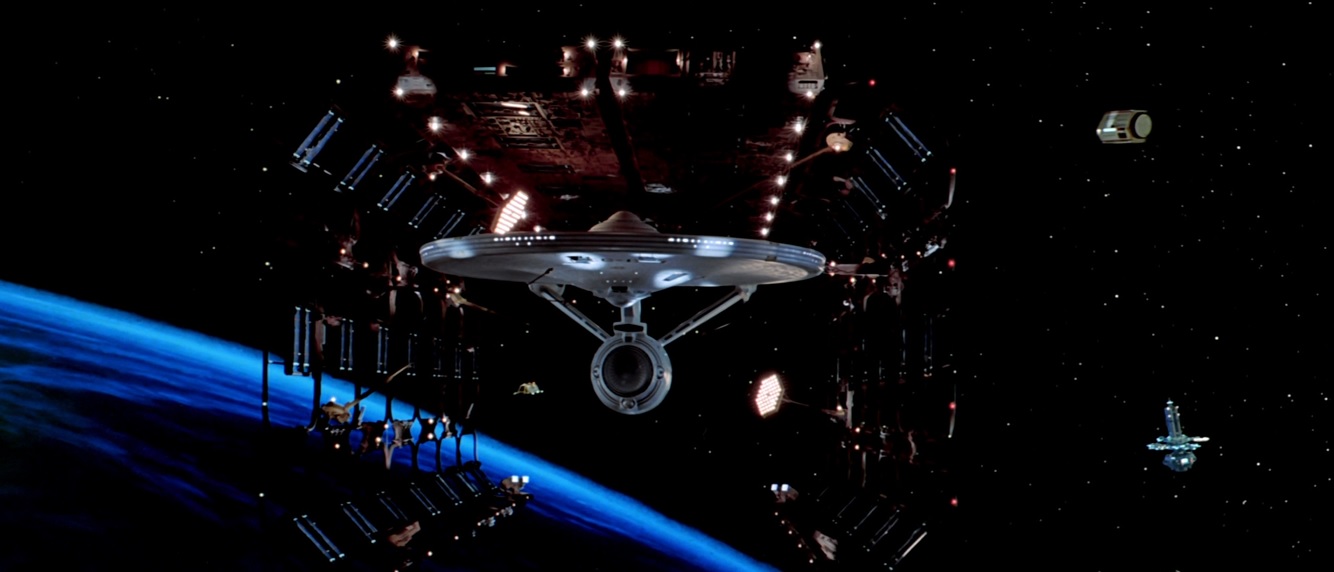
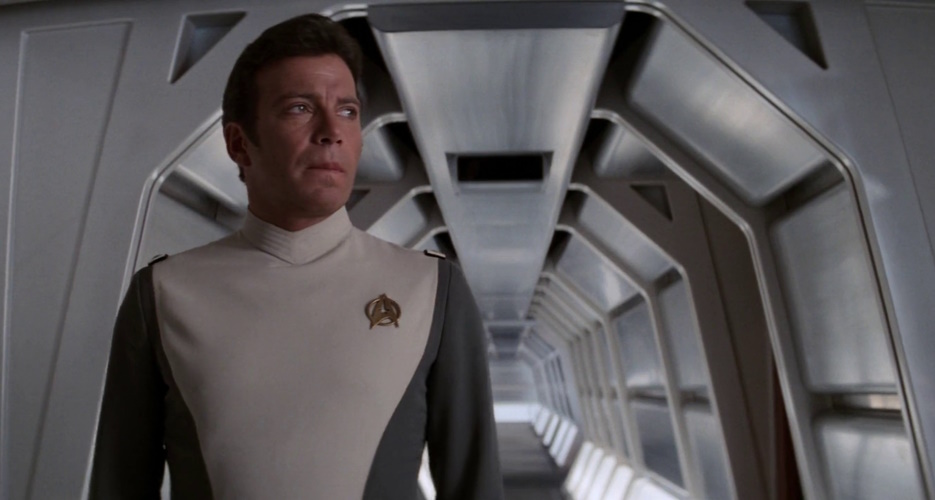
To change lanes completely, I happen to really like the aesthetic of The Motion Picture. It’s very 1970s in some ways – the orange and brown tones, and some of the uniform choices in particular, but that’s not necessarily a negative thing. Kirk’s uniform as an admiral happens to be one of my all-time favourite Star Trek uniforms. The high collar, the belted tunic, and the simple curved lines in grey and white combine with a metallic gold Starfleet insignia to make an understated yet interesting uniform. I’m not a cosplayer by any means, but if I ever were to make myself a uniform, that would be the one I’d go for. And while we’re talking about things that look great, the sweeping shot over the Enterprise when Kirk is being taken aboard by shuttlepod is absolutely perfect. Combined with an amazing score – for which composer Jerry Goldsmith was nominated for an Academy Award – the full sequence is one of the most inspiring and moving in all of Star Trek, speaking for myself as a fan. When the music ramps up right as we see the Enterprise from the front for the first time, it can be quite emotional. I could happily watch that sequence over and over again.

Many of the sets built in 1978-79 were in continuous use (albeit in modified form) right through to Enterprise‘s cancellation in 2005. Some of the reuses are quite apparent in The Next Generation, so in that sense, the design choices made in The Motion Picture carried through the next two decades of Star Trek as a franchise. The panelling and angles on corridors in particular can be seen on the Enterprise-D and the USS Voyager, and the idea of a warp core as a large upright glowing tube is also something that has carried on right through Star Trek – even cropping up in CGI form in the most recent of the Short Treks episodes. Much of what we consider to be “Star Trek” in terms of aesthetic has its roots not in 1966 but in 1979 – future productions built on what designers and artists had created here. The Next Generation and Voyager in particular owe significant parts of their design to The Motion Picture.

Some of these sets would be in continuous use – albeit with tweaks here and there – until Enterprise’s cancellation in 2005. They defined the “look” of Star Trek.

The storyline of The Motion Picture is certainly different from many science fiction outings. It isn’t a film about defeating and destroying an enemy, it’s a film about bridging the gulf and communicating with a new form of life. V’ger, set up to be the film’s antagonist, wanted to evolve – to merge physically with its creator. The crew of the Enterprise could’ve used that moment of weakness to attack it, and maybe even destroy it – and in a different film perhaps that would’ve been the finale. But The Motion Picture builds up to this moment, and it isn’t the death and vanquishing of a foe that we see, but communication, and ultimately the creation of new life. Klingons, Romulans, Cardassians, and the like may be fun to see on screen, but Star Trek is all about “seeking new life” – and what could be newer and more different than a hyperevolved, massively intelligent machine?

This side of Star Trek, though, has always been more of a niche product. When fans are asked about their favourite films, The Wrath of Khan and First Contact are usually somewhere up near the top, as well as episodes like The Best of Both Worlds, or DS9’s The Way of the Warrior. These are all action-heavy stories, and while Star Trek has enough room for both these and the slower-paced, thought-provoking ones, The Motion Picture falls firmly into the second category. With that comes being underrated and overlooked by fans who prefer more action-oriented stories.

Robert Wise, William Shatner, Leonard Nimoy, Gene Roddenberry, and DeForest Kelley at the film’s premiere.

When Spock describes V’ger as being little more than “a child”, he sets the stage for understanding, and from that, communication. The ultimate revelation that V’ger was, in fact, a probe of human origin was truly unexpected. The Motion Picture had an incredibly ambitious story which sought to blend these elements together. The cyclical nature of a returning spacecraft, the massive differences that almost certainly will exist between humankind and anything we might encounter in outer space, and at the heart of it all, the returning characters – not all of whom had enough to do, arguably. But the core dynamic between Kirk, Spock, and McCoy was still there. Perhaps The Motion Picture needed more fine-tuning, and perhaps its scope was too vast for a single film to properly encompass, but as a story it makes you stop and think. The galaxy isn’t just going to be humanoids, there are going to be things out there completely beyond our understanding. And the choices we make today – like probing outer space – may have consequences well into the future that we could never foresee.

As an inspirational message, I think that can’t be understated. Seeking out new life and new civilisations – the raison d’être of Starfleet – isn’t always going to be smooth sailing. But if we’re willing to look at things from a different point of view, to listen, to understand, and to communicate, we can find a way to coexist even with someone who seems to be big and threatening. I know the real world doesn’t always work that way, but Gene Roddenberry was always about showing us how humanity can be better than we are in the present day. Speaking personally, I find that aspect of The Motion Picture to be inspiring. As a work of science fiction, that’s the kind of message I admire and what I’d like to see more of on our screens.

Above all, The Motion Picture relaunched the Star Trek brand for a new decade, one which would culminate in The Next Generation and a return to television. If it weren’t for this film, Star Trek would look very different today – if it even existed at all. We can argue about which Star Trek film we like best, and at the end of the day it’s always going to be a subjective choice, but I’d definitely rank The Motion Picture highly on any list. Not just for what it did for the franchise, though that is incredibly important, but as a work of science fiction that wasn’t afraid to tell a thought-provoking story.

Star Trek: The Motion Picture is available to stream now on Paramount Plus in the United States, the United Kingdom, and other countries and territories where the platform is available. The film is also available to buy on DVD and Blu-Ray. Star Trek, Star Trek: The Motion Picture, and all other Star Trek properties mentioned above are the copyright of Paramount Global and/or Paramount Pictures. This article contains the thoughts and opinions of one person only and is not intended to cause any offence.

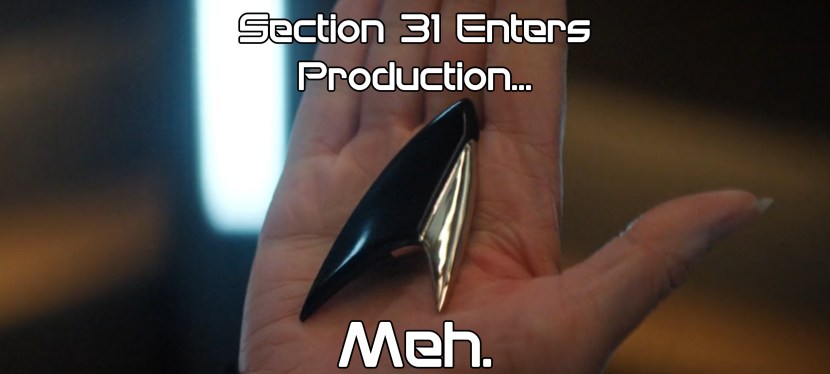
Section 31 Enters Production… Meh.

Spoiler warning: spoilers ahead for Star Trek, including both seasons of Star Trek: Discovery. If you haven’t seen Discovery yet and don’t want to see any spoilers, you’re better off reading another article and coming back when you’re caught up.


Just to get this out of the way, more Star Trek on our screens is always going to be a good thing. Even when it’s at its worst – like some of the episodes in TOS season 3, or that weird TNG clip show in season 2 – it’s still better than having no Star Trek at all. When Star Trek: Enterprise was cancelled in 2005 I really felt disappointed. I wasn’t around through the dark days of the 1970s when it seemed like Star Trek was gone forever, so to me this was the first time I’d really seen it off the air. I’m not sure if you remember, but before JJ Abrams picked up the franchise for his reboot film, Star Trek really did look dead.


I also don’t like the expression “nobody asked for this”. A lot of films and series that nobody seemed to be asking for have turned out to be absolutely fantastic. And honestly, in today’s insular fan communities, a lot of what people seem to be asking for or think would be good would either turn out to be just god-awful, or at the very best a niche product that would be a commercial failure.


So with those two big caveats out of the way, I’m not really sold at the moment on the idea of a Star Trek series based around Section 31.


There are some interesting ideas within that concept, which, if properly executed, could work well. But there are some issues with the Section 31 show as currently envisioned that make me feel it might not be the best direction to take the franchise.


First is the timeframe. With Star Trek: Picard and Lower Decks returning to the late 24th Century and beyond, as well as Discovery‘s third season heading into an unknown future, I’m just not sure that the franchise needs to have three different eras on the go simultaneously. Aside from the fact that it’s convoluted to the point of being offputting for new viewers – people who CBS needs to hook in and retain if Star Trek is to survive long-term – it’s just not a good way to split up the narrative of the franchise. Personally I’ve been going back and forth on my pet theory that Discovery either doesn’t go as far into the future as was suggested last season, or that somehow its time travel narrative crosses over with Picard. It just makes more sense to me to do it that way; tying shows together when they’re set in the same universe and being produced at the same time makes a lot of sense. Look at how the Marvel films cross over with one another successfully. But that’s just one point.


The 23rd Century has been explored a lot recently, and Star Trek has been busy with prequels, reboots, and mid-quels (or whatever Discovery is) since the turn of the millennium. I don’t want to say it’s entirely devoid of storytelling potential, but Star Trek has primarily been about moving forward, looking to the future, and where it’s been arguably at its least successful from the point of view of its story is when it’s been looking back at its own history and tying itself in knots. After four seasons of Enterprise, three reboot films, and two seasons of Discovery, it’s going to be great to see Star Trek finally moving into the future again, and the Section 31 series taking place in the 23rd Century seems more than a little regressive when looking at Picard, Lower Decks, and Discovery‘s future.


The next issue is with the two main characters, or rather, the two characters returning from Discovery around whom the show is currently being built.


Ash Tyler – or Voq – has had his story fairly well explored already in his appearances in Star Trek: Discovery. Without inventing more backstory for him, it’s hard to see where he’d go and how he’ll be able to have a satisfying character arc. Having started out as a victim of Klingon manipulation, Tyler fought hard against his programming and fell in love with Discovery’s protagonist, Michael Burnham, who helped him overcome what had been done to him in what was a very interesting and inspirational rape analogy. Star Trek, for me, is at its best when it uses its sci-fi setting to tackle real-world issues, and the issue of under-reported male sexual abuse is something Ash Tyler’s story touched on perfectly. And in his second season role as an agent of Section 31, he overcame his Klingon heritage, had a child, gave up his child, and finally dealt with his feelings for Burnham – and hers for him. He’s been on a rollercoaster over the last two seasons, but what he’s been through has concluded, and while there may be lingering feelings left over from that, as a story arc it’s essentially done. Because of how much of him we’ve seen and how much he’s been through, he wouldn’t make for the best protagonist.


So that leaves the Mirror Universe version of Burnham’s old captain, Philippa Georgiou. Michelle Yeoh has been announced as the lead actress of this series, so her character would be central to the Section 31 show. But… what character is there, exactly? In terms of modern Star Trek, Mirror Georgiou is about as one-dimensional as it gets. She seems to like being evil for the sake of being evil – a 23rd Century Heinz Doofenshmirtz, perhaps, but with less backstory. No, Mirror Georgiou is the Star Trek equivalent of a villain from a bad direct-to-video kids’ film, the kind of person who wants to steal a puppy from a child or tries to shut down a sweet shop so she can bulldoze it to build an office block. She just isn’t interesting in the slightest.


I like Michelle Yeoh. As a supporting actress in Danny Boyle’s 2007 film Sunshine, she did a great job. But she’s unproven as a lead actress in a major series like this, and the character she’s set to play just isn’t one a lot of fans find interesting or relatable.


While there are positives to consider from a Section 31 series, such as exploring how the organisation changed and went entirely underground between its appearances in Discovery and Deep Space Nine, as well as the potential to see Star Trek cross over into the mystery/thriller genre, I’m just not convinced right now that it’s the right way to go.


Section 31 was announced too early. If CBS had waited to see how Discovery’s second season was received, then the obvious choice by far for a spin-off was an Anson Mount-led series, which would probably be set on the Enterprise. That would be the fan favourite choice for a 23rd Century spin-off at the moment. You can see the desire for such a series at conventions and panels, and whenever Alex Kurtzman and others are interviewed, it’s the one question that keeps coming up. Conversely, when was the last time you heard anyone asking about how the Section 31 show is progressing?


It is actually a really great time to be a Star Trek fan at the moment. There are three series scheduled to premiere in 2020 – Picard‘s first season, Discovery‘s third season, and the first season of Lower Decks which already has a second on order. And in addition, a fourth Kelvin-timeline film is in the works, and beyond that, a possible Quentin Tarantino-directed Star Trek film. More Star Trek on our screens is always going to be a good thing, and while I don’t want to say I don’t want Section 31, it’s just not at the top of my list right now. I want it to do well, and to be successful, because I want Star Trek as a franchise to succeed and carry on into the future. So while I remain more than a little cautious about approaching this new show, I wish it well and I will certainly tune in when it premieres. Perhaps in 2021?


Live Long and Prosper!


Star Trek: Discovery and all other Star Trek series and films are available in the United States on CBS All Access, and in other countries on Netflix. Star Trek: Picard premieres on CBS All Access in January 2020 and on Amazon Prime in other countries. All copyrights belong to Paramount and CBS. This article contains the thoughts and opinions of one person only and is not intended to cause any offence.