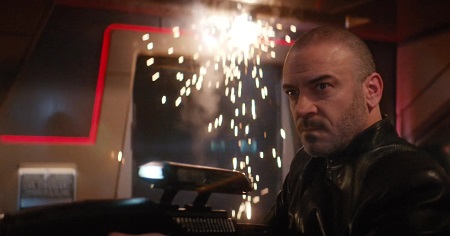
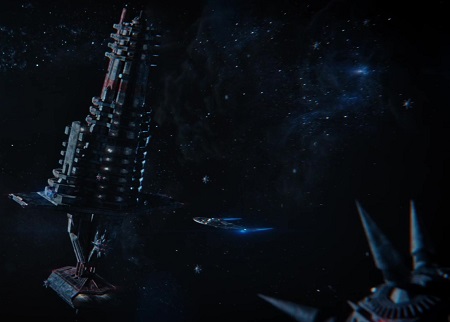
Star Trek: Picard + Star Trek: The Next Generation crossover theory: Lore

Spoiler Warning: There are spoilers ahead for Star Trek: Picard Season 1, Star Trek: The Next Generation, and for other iterations of the franchise.

Season 1 of Star Trek: Picard expanded our knowledge and understanding of the Star Trek galaxy in the 24th Century. As the lore of Star Trek grows (pun intended!) one thing I find fun is seeing how any new information we get can be made to fit with past iterations of the franchise, and in the case of Picard, I think I’ve hit on a theory that is plausible based on some new facts that we learned last year.

I previously touched on this theory as part of my essay on Commodore Oh a few months ago, but I thought it warranted being expanded and given its own article – so that when it’s finally confirmed on screen I can say “I told you so!” Or not. In short, this theory connects Data’s brother Lore to the Zhat Vash, the faction introduced in Star Trek: Picard.

Lore in Datalore.

Before we go any further and get into the weeds, let’s recap. Lore was introduced in The Next Generation Season 1 episode Datalore, and would return in Brothers in Season 4, as well as the Season 6 finale Descent, and Descent, Part II which opened Season 7. He was, in effect, Data’s “evil twin,” and would go on to cause havoc for Data and the crew of the Enterprise-D. We would also learn that Lore was responsible for luring a spacefaring lifeform called the Crystalline Entity to his homeworld, killing most of the citizens of the colony.

Next we have the Zhat Vash, who were introduced in Star Trek: Picard. An ancient, secretive Romulan sect, the Zhat Vash were on an anti-synthetic crusade. They believed that the development of artificial life would lead to all life in the galaxy being exterminated, and sought to wipe out synthetics wherever they found them. As part of their plan to prevent the Federation developing synths, a Romulan agent named Oh infiltrated Starfleet shortly after the discovery of Data in 2338.

Commodore Oh infiltrated Starfleet.

This theory begins with something that The Next Generation never really explained: Lore being evil. Apparently this is a flaw in at least some Soong-type androids, as we’d also see Sutra exhibiting many similar traits to Lore in the two-part finale of Picard Season 1. But is there more to it than a simple mistake, as Dr Soong believed?

Though the Zhat Vash despise synthetic life, as part of their crusade to exterminate synths from the galaxy they seem to have learned a great deal about them – including how to reprogram them. In Picard Season 1, we learned that rogue synths had attacked Mars, destroying Admiral Picard’s fleet. It was the intervention of the Zhat Vash, hacking into the synths and reprogramming them, that caused this attack. If the Zhat Vash possessed the ability to do this in the 2380s, it’s at least possible that they were able to do something similar to Lore in the 2330s.
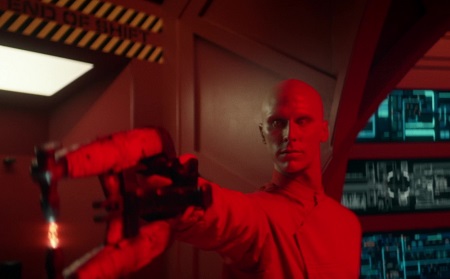
The Zhat Vash were able to reprogram Federation synths, leading to the attack on Mars.

Lore was activated months (or possibly years) before Data, and lived with his creator on the Omicron Theta colony. Dr Soong’s reputation seems to have been known within the Federation, and his work doesn’t appear to have been classified or somehow kept secret. The Zhat Vash seem to have been able to infiltrate the Federation with relative ease, having two spies inside Starfleet that we know of, and even if a Zhat Vash operative in this era were not an especially high-ranking officer, given the openness of Dr Soong’s work and the dedication the Zhat Vash have to their cause, I think we can reasonably suggest that they would have come to know what he was doing, and thus of the existence of Lore.

As I suggested in my last crossover theory, it stands to reason that the Zhat Vash will have been deeply alarmed about the Federation and their synthetic research. In the mid-23rd Century, two Federation AIs went rogue: Control (as seen in Discovery Season 2) and the M-5 multitronic unit (as seen in The Original Series second season episode The Ultimate Computer). Although it seems to be androids that were the main focus of Zhat Vash attention, as Laris made clear, the Romulans fear all kinds of AI – so these events would certainly have upset them enough to keep an eye on Starfleet and the Federation.

A fleet of ships under Control’s command went rogue and attacked the USS Enterprise and the USS Discovery.

That makes it even more likely, in my opinion, that the Zhat Vash would have found out about Dr Soong and Lore on Omicron Theta. If they were following Dr Soong’s work on positronic brains, they may have been working on ways to shut down his research or reprogram Lore. As mentioned, none of this appears to have been classified, and while Dr Soong kept his work private, it may have been possible for the Zhat Vash to infiltrate Omicron Theta and gain access to his research.

Their main goal was to prevent the rise of synthetic life. A single android was bad enough, but what they feared most was a civilisation of them. But Dr Soong didn’t have a civilisation – he had one single operational android. From the Zhat Vash’s perspective in the 2330s, if they could force Lore to be shut down – and ideally kill Dr Soong at the same time – the Federation would be unable to replicate the work and would thus be unable to build more.

Lore in Descent, Part II.

At some point following his activation, Lore began to exhibit “emotional instability” to the point that he upset and worried the colonists on Omicron Theta. This doesn’t appear to have happened from the moment of his activation, though, which lends credence to the idea that he was reprogrammed – perhaps rather crudely in an attempt to force Dr Soong to take him offline.

However, before Dr Soong could take action to shut him down, Lore contacted the Crystalline Entity, which arrived and wiped out the Omicron Theta colony. If Lore had been reprogrammed, was this something he chose to do of his own volition? It seems a very specific action to take if he wanted to kill the colonists – he was more than capable of physically overpowering and outwitting them if he wanted to kill them.

The Crystalline Entity “feeding,” as seen in Silicon Avatar.

The destruction of Omicron Theta can be seen as a classic Romulan move. By using the Crystalline Entity, not only was Lore assumed destroyed, but so were Dr Soong, his assistants, and all of his research, setting back synthetic research in the Federation by decades. Of course we know that Dr Soong and Lore both escaped – but that clearly wasn’t part of the Zhat Vash’s plan! Perhaps they underestimated Lore.

Most importantly, though, having the Crystalline Entity wipe out Omicron Theta absolved the Romulans of any direct involvement, as well as potentially destroyed any evidence that they had ever been there. It reminds me in many ways of the false flag operation that they ran on Mars; the synths were reprogrammed and forced to go rogue, an event which so thoroughly shocked the Federation that the Zhat Vash were able to persuade them to shut down all synthetic research.

Laris first told Admiral Picard – and us as the audience – about the existence of the Zhat Vash.

With Lore being the only extant android, a “clean” attack on the colony, wiping out the entire site and all of its inhabitants, would work very well from the Zhat Vash’s perspective. Openly attacking Omicron Theta would surely have started a conflict with the Federation, and if that could be avoided through this kind of cloak-and-dagger operation, well that seems exactly like something they would seek to do.

So that’s the extent of the theory, and any Zhat Vash involvement afterwards appears to have ignored Lore. Perhaps they figured that the existence of Data showed that the Federation would not stop until they were forced to, or at least that it was no longer possible to stop Federation AI research by killing one android. This would explain why they didn’t take any aggressive action against Data during The Next Generation era, and could also explain why Dr Soong went into hiding after the Omicron Theta attack – he may have been hiding from the Zhat Vash.

Data in Star Trek: Generations. The Zhat Vash appear to have been either unable or unwilling to attack him.

This theory fits with Lore’s appearances in The Next Generation and doesn’t step on the toes of anything as far as I can see. It provides backstory to why Lore acted the way he did, and explains his motivations for doing so in a different way. It also elevates Lore from simply being an “evil twin” trope into more of a tragic character – we will never know what Lore could have been were he not interfered with.

Crucially, this theory fits with what we learned of the Zhat Vash in Picard Season 1, both in terms of their goals and their methods. It seems at least possible that the Zhat Vash are responsible for the attack on Omicron Theta and for reprogramming Lore, turning him into the malevolent adversary that Data and the crew of the Enterprise-D had to deal with.
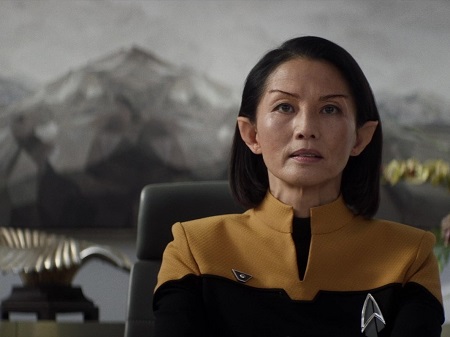
Commodore Oh.

This could have even been the first mission of a young Zhat Vash operative named Oh. Maybe she was the one sent to Omicron Theta to deal with Dr Soong, and this entire situation is her doing.

So that’s it. That’s my theory! I doubt it will ever be confirmed, but you never know! It seems plausible to me, at least. I hope this was a bit of fun and an excuse to jump back into the Star Trek galaxy. As always, please remember not to take this theory, or any other fan theory, too seriously. Theory-crafting is supposed to be enjoyable, and the last thing we need right now is something else to argue about!

Star Trek: Picard Season 1 is available to stream now on CBS All Access (soon to be rebranded as Paramount+) in the United States, and on Amazon Prime Video in the United Kingdom and elsewhere. The Star Trek franchise – including Picard and The Next Generation – is the copyright of ViacomCBS. This article contains the thoughts and opinions of one person only and is not intended to cause any offence.

Star Trek: Picard + Star Trek: Discovery crossover theory: Control and the Romulans

Spoiler Warning: There are spoilers ahead for the most recent seasons of Star Trek: Picard and Star Trek: Discovery. There may be further spoilers for other iterations of the Star Trek franchise.

While Star Trek: Picard Season 1 was ongoing earlier in the year, I postulated a number of theories about what was going on in the show. One theory that I had related to Control – the rogue artificial intelligence from Star Trek: Discovery Season 2. Specifically, I speculated that the Zhat Vash’s hatred and fear of synthetic life may have stemmed from a run-in with Control, or that the Romulans may have been trying to compete with Starfleet in a mid-23rd Century AI arms race. It seemed possible that Control could have attacked Romulan ships or settlements in the time between its takeover of Section 31 and its defeat by the USS Discovery, or that if the Romulans developed their own AI that it would have similarly gotten out of control and attacked them.

This theory came back with a vengeance after Picard reused a couple of CGI sequences from Discovery in the latter part of the season, particularly as those sequences depicted Control attacking – and ultimately destroying – all organic life in the galaxy. While Picard and Discovery had thematic similarities in their most recent seasons, insofar as both stories looked at the creation of synthetic life and how that synthetic life could go rogue, there was no broader crossover. The Zhat Vash were not motivated by either their own rogue AI from the mid-23rd Century or by an attack from Control.

This CGI sequence of a planet being destroyed was created for Discovery… and recycled in Picard.

But that doesn’t necessarily mean that we have to drop the idea of there being any connection between the Zhat Vash in Picard and Control in Discovery. My theory started with the idea that Control could have been the reason for the Zhat Vash… but what if it’s the other way around? What if the Zhat Vash are responsible for Control going rogue?

There was no explanation given for why Control decided to lash out and attack its creators. It wanted to acquire the data from the planetoid-sized lifeform known as the Sphere, believing that data would help it achieve true sentience. But that isn’t a reason to go on to commit genocide; something inside Control made it want to kill. Remember that Dr Gabrielle Burnham – Michael’s mother – arrived in a future timeline where no sentient organic life existed in the known galaxy; Control had wiped it all out. Why did it want to do that?

Dr Gabrielle Burnham.

We could try to argue that Control’s murderous rage is somehow a result of Starfleet denying it access to the Sphere data. But Starfleet and the USS Discovery only came to possess the data because of the time-travelling interventions of Dr Burnham; we don’t know how Control came to acquire it in the “original,” pre-intervention timeline. There are a couple of possibilities. The first is that when the Sphere died, it broadcast its data as far and wide as possible and that’s how Control acquired it. It’s also possible that Starfleet received the transmission and Control gained access to it from there. However, neither of these scenarios involve Starfleet actively trying to prevent Control accessing the data, meaning that it wasn’t Starfleet who started the fight with Control.

So if Control had no reason on the surface to attack its organic creators, why did it do so? It could simply be a programming error; Control was programmed to prevent war, and perhaps that got twisted around so that it decided the only way to prevent the Milky Way’s organic civilisations from fighting was to exterminate all of them. This kind of basic AI programming mistake is one that’s not uncommon in science fiction, and arguably something we need to consider out here in the real world as we develop our own AIs!

Control assimilated Captain Leland and went on a murderous rampage.

So that’s one possibility. But here’s where the Zhat Vash could come in: what if they are responsible for corrupting Control’s programming? We saw in Picard that the Zhat Vash know enough about synthetic life to hack into Federation synths and change their programming. That’s what they did on Mars, causing F8 and the other synths to go rogue and destroy Admiral Picard’s rescue armada. If they had that capability in the 24th Century, it isn’t much of a stretch to think they could have been capable of something similar in the 23rd Century too.

We also know that the Zhat Vash are “far older” than the Tal Shiar. Let’s look at what we know for sure to try to pin down a rough estimate of how old they could be. The Romulans split from the Vulcans somewhere around the 4th Century AD, and by that time were capable of interstellar flight. By the 2150s the Romulans were involved in covert operations on Vulcan, trying to start a war between Vulcans and Andorians. While it was never stated outright in Enterprise that the Romulan operatives we saw were working for the Tal Shiar, it’s not an unreasonable assumption. The Zhat Vash sent Commodore Oh to infiltrate the Federation sometime around the discovery of Data, which took place in the year 2338. When Raffi asked La Sirena’s Emergency Navigational Hologram about the octonary star system, he described the Romulan star charts that depicted it as “ancient,” which seems to suggest they’re more than a century old at least. It was the discovery of Aia, the planet in the octonary star system, and the beacon that resided there that led to the creation of the Zhat Vash.

Raffi and the ENH discuss the octonary star system.

Put all of that together and we can assume with reasonable confidence that the Zhat Vash existed by the mid-23rd Century. We also know, thanks to what we saw in Enterprise and Deep Space Nine, that Romulan intelligence was far better than Starfleet’s – they knew a lot more about the Federation than the Federation did about them.

There’s a question of just how secret Control was. Section 31 was much more out in the open in Discovery than it was by the time of Deep Space Nine, but even so it seems logical to assume that Control would be a top-secret project within an already-secretive organisation. Still, when most Starfleet flag officers used Control regularly, word of its existence would get out and it was generally known within Starfleet that an AI existed. Thus any Zhat Vash or Tal Shiar operative would have come to know about Control.

Section 31 HQ was heavily-guarded, but perhaps not impenetrable for a Zhat Vash spy.

Okay, so let’s slow down. Even if we’re confident that the Zhat Vash existed by Discovery’s era, and had commenced their anti-synthetic crusade, and even if they had operatives within Starfleet who would have made them aware of the existence of Control, that doesn’t mean they could just walk up to Control’s data servers and start messing around. Right? I mean, Control was based at Section 31 headquarters, which as we saw in the show was incredibly well-protected. And we saw no evidence of such an operative. Did we?

How about Admiral Patar, the Vulcan Starfleet admiral who was killed by Control at Section 31 headquarters? We know that Commodore Oh spent decades embedded within Starfleet, waiting to make her move at just the right moment. We also know she was able to attain a very high rank, and it’s only one short step from being a commodore to being an admiral. It’s at least possible. Admiral Patar had the means to access Control. She spent time at Section 31 headquarters right around the time Control went rogue. She was a Vulcan, and thus was biologically indistinguishable from a Romulan – meaning she could have been an undercover Romulan operative. Enterprise depicted Romulans undercover on Vulcan a century earlier, meaning that they had infiltrated Vulcan by that time and were able to do so with relative ease. The pieces fall into place for Admiral Patar to be a Romulan operative – or to have been replaced by one – even if the evidence is only circumstantial. Even if it wasn’t Patar, there may well have been other Vulcans working at Section 31 headquarters, any one of whom could have been a Romulan spy.

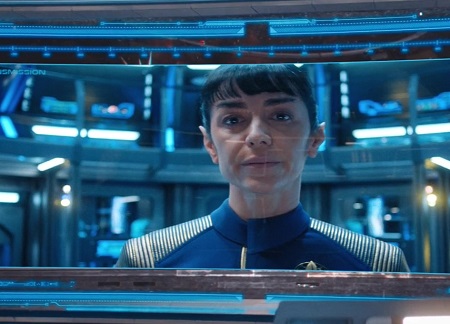
Admiral Patar on the USS Discovery’s viewscreen.

Once they had access to Control’s systems and specifications, the Zhat Vash could have figured out how to mess with Control’s programming and turn it hostile. Perhaps they only intended for it to attack the Federation, forcing them to shut it down permanently. Or perhaps they hoped it would cause wider chaos so they could force the kind of galactic ban on synthetic life that we saw in Picard. So the question of what they had to gain by such a move is obvious; it’s the same basic goal as they had for staging the attack on Mars.

If the Zhat Vash introduced a glitch in Control’s programming that would turn it murderous, they obviously didn’t intend for Control to go on and wipe out everything. That wasn’t the goal; that’s what they were trying to prevent. However, as I wrote earlier, it’s possible for even well-intentioned AI to get out of control or to act in a way its creators and programmers couldn’t anticipate. Perhaps that’s what happened with Control, and by the time it had assimilated Captain Leland, killed off most of Section 31’s leadership, and got a fleet at its command, there was no way for the Zhat Vash to stop it. If their sole operative had been killed when Control wiped out Section 31’s headquarters, the Zhat Vash may not have even been aware that the mission was not going to plan until it was too late.

Control commandeered a small armada of Section 31 vessels.

So that’s my crossover theory for Star Trek: Discovery and Star Trek: Picard – the Zhat Vash hacked or reprogrammed Control, and that’s what made it go rogue. There’s enough circumstantial evidence for this theory to be possible, and it would explain why Control went from being a useful tool for Starfleet to a menace capable of wiping out all sentient life in the galaxy. However, there’s no concrete proof. All we really have are two shows with similar themes, and a bunch of unrelated pieces that could be made to fit together – but also may not fit at all!

As I always say: it’s just a fan theory. Unless we get some confirmation on screen in future – which seems unlikely given both Picard and Discovery are almost certainly moving on to new stories in their upcoming seasons – we have to consider it as unconfirmed at best. I consider it plausible (obviously, or I wouldn’t have written an article about it!) but it may prove to be a complete miss… just like many of my other Star Trek: Picard theories!

This post was edited 31.03.21 to replace header image. Star Trek: Discovery and Star Trek: Picard are available to stream now on CBS All Access in the United States. Discovery is available internationally on Netflix; Picard is available internationally on Amazon Prime Video. The Star Trek franchise – including all properties mentioned above – is the copyright of ViacomCBS. This article contains the thoughts and opinions of one person only and is not intended to cause any offence.