


Spoiler Warning: There are spoilers ahead for the following Star Trek productions: The Original Series Season 2, The Voyage Home, The Next Generation Season 6, Deep Space Nine Season 6, Voyager Season 4, Enterprise Season 2, Short Treks, Picard Season 1, Lower Decks Season 2, and Prodigy Season 1.
Phew. That was a lot!
The world can be a crappy place, and not just because of wars and pandemics. Sometimes we all need to switch off from current events and seek out some escapism. For me, films and TV shows with very heavy themes, lots of violence, or dark narratives don’t always provide the best escape, and on days when my mental health suffers I find myself reaching for something lighter and comforting. On this occasion, I thought we could pick out a few Star Trek stories that I believe fit that description.
The Star Trek franchise has long been an escape from reality for me. In both its older and modern incarnations, I find that jumping head-first into a future that looks safer and better than anything we could imagine today feels pretty great! Star Trek has always had an underlying setting that feels optimistic and hopeful for a better tomorrow – and that’s something we all need to hear sometimes.
So with that in mind, let’s consider a few Star Trek stories that I believe make for lighter, comforting viewing. As always, this isn’t a ranked list; the episodes are listed below in the order they were first broadcast.
Number 1:
A Piece of the Action
The Original Series Season 2

The Original Series made very creative use of some of the limitations of its time! It wasn’t always possible to visit a brand-new planet every week that looked and felt very “alien,” so The Original Series used sets intended for other films and TV shows in different – and occasionally silly – ways. A Piece of the Action sees Captain Kirk and the crew encounter a planet whose entire population have based their society around the Chicago mob!
When A Piece of the Action was written, the 1920s were only forty years in the past – the equivalent today of the eighties! So perhaps to viewers at the time it was more relevant and less… camp. But I’ve always found A Piece of the Action to have a light, almost comedic flair simply because of its setting; the ’20s-inspired dialogue, the old fashioned suits, and the general tone of a “Golden Age of Hollywood” gangster flick all contribute to that.

The notion of going to a faraway planet in space and finding a society based on the Chicago mob is silly, but A Piece of the Action sells it in the best way it can, making the very odd juxtaposition of scenes aboard the Enterprise and scenes on Sigma Iotia II flow surprisingly well. But above all, it’s a fun story that imitates, in a very Star Trek way, classic mobster films from a generation earlier.
Apparently A Piece of the Action was going to be the basis for a Quentin Tarantino-directed Star Trek film that ultimately didn’t enter production. It seems as though I’m in a minority, based on the reactions to this news from Trekkies I’ve spoken with, but I’d have been interested to see what a director as undeniably talented as Tarantino would’ve brought to Star Trek. A new film from such a big name would surely have been a box office draw, at the very least! But maybe that should be the topic of a longer article sometime.
Number 2:
Star Trek IV: The Voyage Home
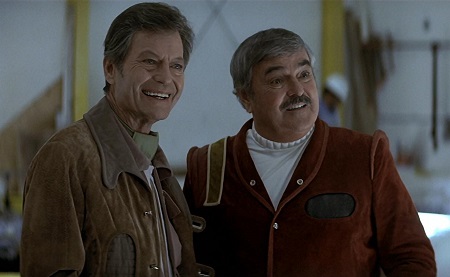
Also known as “the one with the whales,” The Voyage Home is arguably the most lighthearted and fun of all the Star Trek films to date! After the very heavy stories of loss and death in The Wrath of Khan and The Search for Spock, the third and final act of this trilogy came along like a breath of fresh air. I feel that The Voyage Home is the most dated of the Star Trek films thanks to being set in what was, at the time, the modern day. But that doesn’t detract from it; the kitschy eighties flavour is all part of the appeal!
There are some fantastic moments of pure comedy in The Voyage Home. I won’t spoil them if it’s been a while since you’ve seen it, but suffice to say that bringing a 23rd Century crew to the modern day and forcing them to interact with basic things like cash and computers led to some absolutely hilarious, iconic moments.
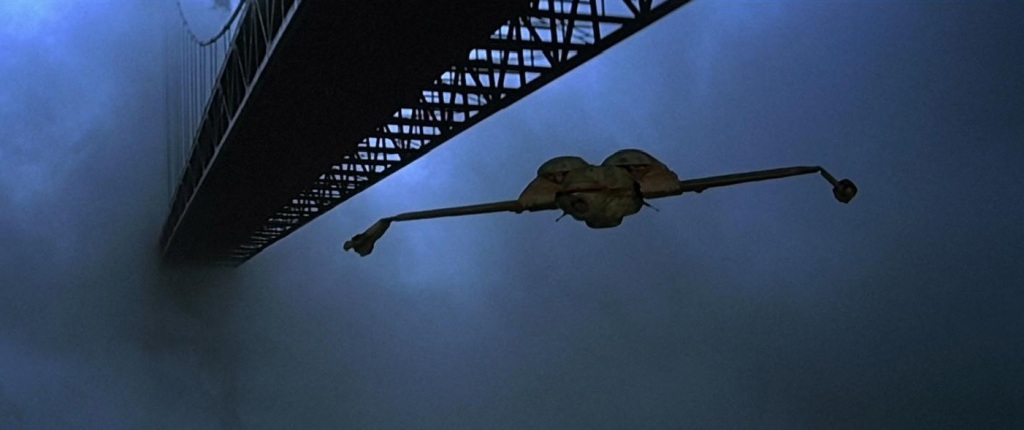
There’s an ecological message at the heart of The Voyage Home, and the threat posed by the alien “whale probe” is definitely serious. But that theme doesn’t present as excessively weighty, and by the time Kirk and the gang are running around San Fransisco in 1986, the focus is more on the fun side of that premise.
With Star Trek: Picard Season 2 fast approaching, it could be fun to go back to The Voyage Home to see the most recent use of the “slingshot method” of travelling through time – something that may be making a return to Star Trek very soon!
Number 3:
Relics
The Next Generation Season 6
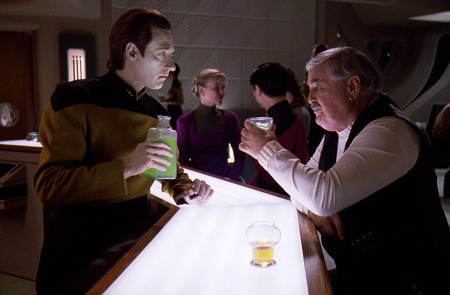
I wanted to put at least one crossover episode on this list, and this time it’s Relics that makes the cut! Bringing Scotty into The Next Generation was a lot of fun, and having him overcome his “fish out of water” status to eventually work alongside Geordi La Forge was absolutely fantastic, and made for a wonderful, heartwarming story.
With no evil villain to defeat nor a war to fight, Relics posed a scientific puzzle for Star Trek’s first two engineers to overcome – and in the process they were able to save the Enterprise-D from being trapped inside of a Dyson Sphere! There’s definitely a message in Relics: that older people have a lot to contribute if younger people are willing to take the time to listen.
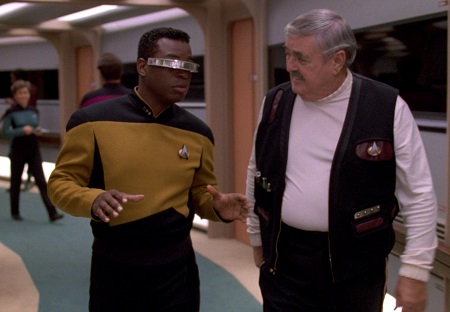
When I first saw Relics back in the ’90s, I wasn’t prepared for Scotty’s arrival. This was before the days of spoilers on social media, so I went into the episode completely unaware of what I was about to see. When Scotty materialised on the transporter pad for the first time I was absolutely blown away! The Next Generation had been my first port of call in the early ’90s, but by the time Relics came around I’d seen all of The Original Series films and quite a few episodes, so I was really excited when it turned out to be a crossover episode.
Relics is, in a lot of ways, a very fan-servicey episode. But it’s also a comforting one, and more than that it feels almost like a slice of pure Star Trek. There’s a scientific mystery that’s both interesting and exciting, there are some wonderful character moments between Scotty and Picard and Scotty and La Forge in particular, there’s more than a dash of humour, and there’s an underlying message that may just strike a chord with some folks in the real world. It’s an all-around Star Trek episode!
Number 4:
The Magnificent Ferengi
Deep Space Nine Season 6

The Magnificent Ferengi takes what should be a dark and upsetting premise but manages to put a lighthearted, comedic spin on it thanks to the inclusion of the titular Ferengi. After a less than spectacular introduction in the first season of The Next Generation, in which they were originally supposed to replace the newly-pacified Klingons and become a major antagonist, the Ferengi carved themselves a new niche in Deep Space Nine thanks in no small part to a wonderful performance by Armin Shimerman as Quark.
We came to see the Ferengi as comic relief on a number of occasions, as in The Magnificent Ferengi, but they were also a people with depth. Issues within Ferengi society surrounding the pursuit of wealth at all costs, the second-class status of women, and so on were topics that Deep Space Nine tackled, and the fact that the Ferengi can be funny didn’t detract from those attempts to use them to examine some more serious subjects. But that’s not why we’re here today!

At the height of the Dominion War, Quark and Rom’s mother is captured by the Dominion, and Quark leads an all-Ferengi rescue operation. With the exception of Grand Nagus Zek, this episode brings together practically every Deep Space Nine Ferengi character, and musician Iggy Pop has a guest-starring role.
The plot descends into a comedic farce – naturally, given Quark’s leadership – and if you’ve ever seen Weekend at Bernie’s… well, you know what to expect! The Magnificent Ferengi is a ton of fun, and a great episode for showcasing some of Deep Space Nine’s recurring characters.
Number 5:
Message in a Bottle
Voyager Season 4
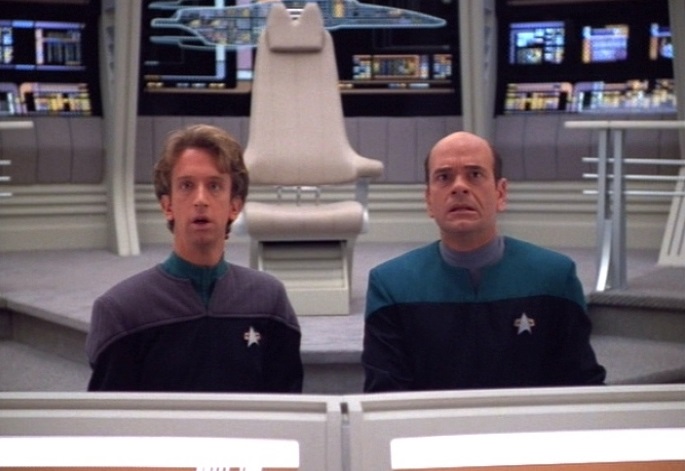
Once again we have an episode with a potentially dark premise that goes in a very different and fun direction! The Doctor is the star here, as he’s sent to the Alpha Quadrant to attempt to make contact with Starfleet for the first time since Captain Janeway and the crew became stranded 75,000 light-years from home… but he finds himself aboard a ship that has been captured by the Romulans!
Comedian Andy Dick guest-stars as a newer version of the Emergency Medical Hologram, and forms an astonishingly funny pair with the Doctor, who was often used for moments of comic relief during Voyager’s run. Seeing the two holograms working together to outsmart the Romulans in a comic story that could verge into slapstick is absolutely hilarious, and there are some real laugh-out-loud moments.
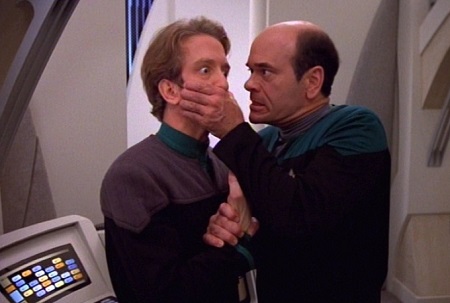
I also find Message in a Bottle to be a very uplifting episode. It marks the halfway point of Voyager’s seven-season run, and the first moment that the crew are able to contact the Federation. After four years of being alone, the crew finally get to inform Starfleet that they’re okay and working their way home, and there’s something incredible about the episode’s closing moments as a result.
The Prometheus-class ship is a pretty cool inclusion, too – a brand-new class of ship which has features that even the USS Voyager or Enterprise-E couldn’t match. I always wanted to see more from this ship, but aside from a couple of background appearances, we haven’t yet!
Number 6:
Carbon Creek
Enterprise Season 2
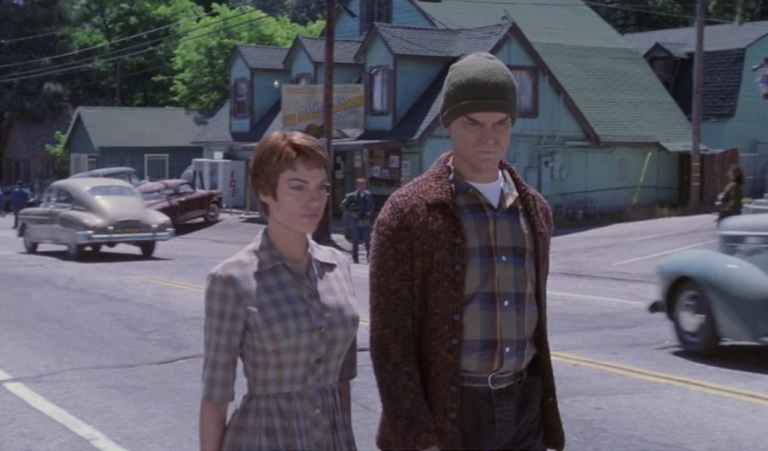
Carbon Creek uses a frame narrative to tell the story of the first time Vulcans came to Earth… and it wasn’t in the mid-21st Century, as Captain Archer (and us as the audience) had been led to believe! Instead, T’Pol tells the tale of her great-grandmother, and how she and a small crew came to be stranded on Earth in the 1950s during a survey mission.
Carbon Creek is fun for its fifties atmosphere, and Enterprise really manages to nail that feel through some wonderful sets, costumes, and dialogue. It’s also an episode that shows off how Vulcans can be unintentionally funny in Star Trek, particularly when confronted with different or unusual situations. In this case, T’Mir and her crew have to blend in with a town of very emotional humans.

There are definitely some lighthearted moments scattered through the entire episode, and the frame of T’Pol recounting the story to a stunned Archer and Tucker adds to that as well. It’s also a great example of how a prequel story doesn’t have to tread on the toes of anything established previously; nothing in Carbon Creek fundamentally changes what we already know about first contact between humans and Vulcans. In many ways it expands it – knowing that Vulcan had humanity under observation decades ahead of official first contact gives them a reason to be surveying the area during the events of First Contact!
All in all, a fun episode that steps away from many of Star Trek’s familiar elements like starships to tell a story with some interesting characters in a fun setting.
Number 7:
Ephraim and DOT
Short Treks Season 2

It’s a shame that we haven’t seen more Short Treks lately; the most recent batch of episodes ended with Children of Mars shortly before Picard Season 1 kicked off in early 2020. The idea of telling one-shot short stories in the Star Trek galaxy may have been a fairly blunt and obvious way for CBS All Access (since rebranded as Paramount+) to convince Trekkies to remain subscribed in between seasons of the main Star Trek shows, but several episodes ended up being fantastic in their own right.
Ephraim and DOT was one of two animated Short Treks episodes that were broadcast in December 2019, and it’s something that we hadn’t really seen the Star Trek franchise do before. Thirty-five years after The Animated Series went off the air, this was Star Trek’s first return to animation, and where The Girl Who Made The Stars was more of a conventional story, Ephraim and DOT was framed very differently!
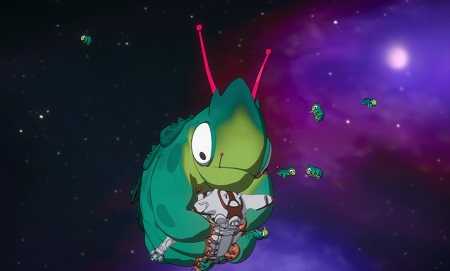
Telling the story of a tardigrade named Ephraim and a DOT-type robot aboard the USS Enterprise, this Disney-inspired tale sees the unlikely duo team up to save Ephraim’s eggs. With an enthusiastic narrator who sounds like they’ve come from a National Geographic documentary, the short story is a lot of fun – and packs a surprisingly emotional punch at its climax!
Ephraim and DOT also shows off a handful of fun clips from The Original Series that have been reimagined for animation, and this “greatest hits” montage was absolutely fantastic; a blast from the past that elevated the episode.
Number 8:
Nepenthe
Picard Season 1

If you don’t have the same connection to the characters from The Next Generation that I do, maybe Nepenthe won’t be one of your “comfort episodes.” But for me, seeing Picard reunited with Riker and Troi was one of the highlights of Picard Season 1 – and Nepenthe is one of the best Star Trek episodes that I’ve seen in a long time!
After several tense and dramatic episodes in which Picard and the crew of La Sirena had to unpick the mystery of Bruce Maddox, the synths, the Zhat Vash plot, and so on, Picard was able to rescue Soji and use a spatial trajector to escape to the planet of Nepenthe – home to Riker, Troi, and their daughter Kestra.

There are some very sweet moments between Soji and Kestra as they bond, and while the story has some very bittersweet moments as we learn that Riker and Troi’s elder child had passed away, there are some absolutely incredible and heartwarming character moments as well. After more than eighteen years away from the 24th Century, Nepenthe felt like the homecoming I had been waiting for.
Seeing Riker and Troi enjoying a peaceful life away from Starfleet was something that I needed to see, even if I didn’t realise it beforehand! Although there were issues with the Picard Season 1 finale that meant that, realistically, taking an entire episode away from the main plot to slow down and hang out with Picard, Riker, Troi, and Soji was arguably a mistake, I just can’t find it in my heart to fault Nepenthe for the way it comes across on screen. It’s a beautiful, emotional episode, and sitting down to eat pizza with the characters after everything they’ve been through just feels right.
Number 9:
First First Contact
Lower Decks Season 2
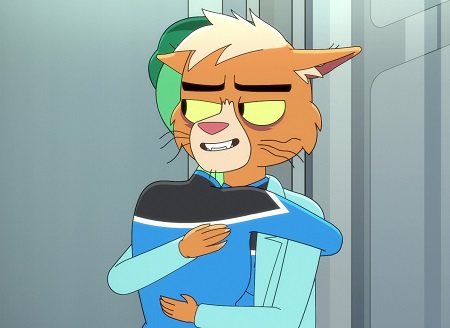
First First Contact might be my favourite episode of Lower Decks so far. It isn’t as hilarious as some of the show’s other offerings, but as an uplifting story with a real “Star Trek” feel, I don’t think it can be bettered! The episode sees the crew of the Cerritos teamed up with the fancier and more powerful USS Archimedes – under the command of one Captain Sonya Gomez, no less – to undertake their first ever mission of first contact!
But naturally, things don’t go to plan. The Cerritos is called into action to save the stricken Archimedes, and the entire crew pulls together to perform the very difficult and dangerous task of literally stripping off the ship’s outer hull! Lower Decks ditched its usual two (or three) storylines format here, and put all four ensigns and all of the ship’s senior staff in the same story – and the result was absolutely fantastic.
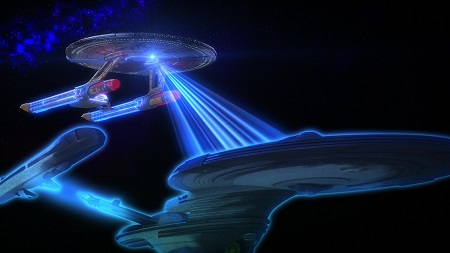
Lower Decks goes out of its way to recreate the look of The Next Generation era, and I’ve always appreciated that. But it doesn’t hesitate to bring new things to the table, and we get our first look at Cetacean Ops in this episode – an aquatic department that had been mentioned in background dialogue in The Next Generation but never seen on screen.
All four ensigns have roles to play in the story, and after the Cerritos had to be saved at the climax of the Season 1 finale, the poetic symmetry of being the one to save a disabled Starfleet ship was absolutely beautiful, and a great way to bring the show’s successful second season to a close.
Number 10:
Kobayashi
Prodigy Season 1

The Kobayashi Maru test seems like an odd choice for a “comfort” pick, doesn’t it? But the way Prodigy pulls it off feels like a love letter to Star Trek, bringing in classic characters from The Original Series, The Next Generation, and Deep Space Nine in holographic form.
There’s more going on in the episode than just the Kobayashi Maru test on the holodeck, and Prodigy’s ongoing story arcs come into play in a big way throughout. But for me, the moments on the holodeck with Dal and the holographic versions of some wonderful characters from Star Trek’s past are what elevates Kobayashi and what makes it so enjoyable.

It’s such a shame that Prodigy remains (officially) unavailable in most of the world, because it’s been one of the most surprisingly fun Star Trek projects, and despite its kid-friendly atmosphere and intended audience, there’s so much to love for Trekkies. I hope that the rollout of Paramount+ internationally will see Prodigy grow in popularity and bring in hordes of new fans – and with episodes as strong as Kobayashi to ease them into the world of Star Trek, there’s a good chance that’ll happen!
The character choices may seem like an odd mix at first – and seeing Odo on the bridge of a Galaxy-class ship definitely felt strange! But each of them is given a moment to showcase their strengths, and what they brought to Star Trek in their original appearances. It makes the entire holodeck sequence feel so very special – and with such an eclectic mix of characters, there really isn’t anything quite like it in Star Trek’s entire official canon!
So that’s it!

Those are my picks for ten “comfort episodes” – or rather, nine comfort episodes and a comfort film – from the Star Trek franchise. We don’t need to repeat why the world feels so messed up right now, because we can all see what’s going on. Certain news stories have become omnipresent, completely taking over social media and other apps. If you find yourself doomscrolling, take a break. Do anything other than wallow in the mess of the real world.
The Star Trek franchise has been my comfort place for decades, and I find myself drawn to it when the world feels too much or when my mental health suffers. A future where humanity has succeeded at conquering not only the problems of today but also many of the baser, more primitive aspects of our own nature holds an appeal that can be difficult to put into words, and I find that practically every Star Trek story – even those darker in tone – have a lot to offer.
So I hope this was a bit of fun and maybe gave you some viewing inspiration! I had a great time going back to these episodes to put this list together, and with everything going on in the world I thought it could be a good time to share something like this.
The Star Trek franchise – including all episodes and films discussed above – is the copyright of Paramount Global. This article contains the thoughts and opinions of one person only and is not intended to cause any offence.




 Trekking with Dennis